EP1108579A2 - Folding door system to bodies of cars and lorries - Google Patents
Folding door system to bodies of cars and lorries Download PDFInfo
- Publication number
- EP1108579A2 EP1108579A2 EP00610131A EP00610131A EP1108579A2 EP 1108579 A2 EP1108579 A2 EP 1108579A2 EP 00610131 A EP00610131 A EP 00610131A EP 00610131 A EP00610131 A EP 00610131A EP 1108579 A2 EP1108579 A2 EP 1108579A2
- Authority
- EP
- European Patent Office
- Prior art keywords
- wings
- wing
- hinged
- door
- hand
- Prior art date
- Legal status (The legal status is an assumption and is not a legal conclusion. Google has not performed a legal analysis and makes no representation as to the accuracy of the status listed.)
- Withdrawn
Links
- 238000006073 displacement reaction Methods 0.000 claims description 2
- 238000003780 insertion Methods 0.000 claims description 2
- 230000037431 insertion Effects 0.000 claims description 2
- 230000003019 stabilising effect Effects 0.000 claims 1
- 238000010276 construction Methods 0.000 description 3
- 230000000903 blocking effect Effects 0.000 description 1
- 238000000034 method Methods 0.000 description 1
- 238000005057 refrigeration Methods 0.000 description 1
- 239000000725 suspension Substances 0.000 description 1
Images
Classifications
-
- B—PERFORMING OPERATIONS; TRANSPORTING
- B60—VEHICLES IN GENERAL
- B60J—WINDOWS, WINDSCREENS, NON-FIXED ROOFS, DOORS, OR SIMILAR DEVICES FOR VEHICLES; REMOVABLE EXTERNAL PROTECTIVE COVERINGS SPECIALLY ADAPTED FOR VEHICLES
- B60J5/00—Doors
- B60J5/04—Doors arranged at the vehicle sides
- B60J5/06—Doors arranged at the vehicle sides slidable; foldable
- B60J5/062—Doors arranged at the vehicle sides slidable; foldable for utility vehicles or public transport
-
- B—PERFORMING OPERATIONS; TRANSPORTING
- B60—VEHICLES IN GENERAL
- B60J—WINDOWS, WINDSCREENS, NON-FIXED ROOFS, DOORS, OR SIMILAR DEVICES FOR VEHICLES; REMOVABLE EXTERNAL PROTECTIVE COVERINGS SPECIALLY ADAPTED FOR VEHICLES
- B60J5/00—Doors
- B60J5/04—Doors arranged at the vehicle sides
- B60J5/06—Doors arranged at the vehicle sides slidable; foldable
Definitions
- the present invention relates to a folding door arrangement, especially for use in connection with non-fixed frame parts such as in box vans, refrigeration vans, exchange-load containers and corresponding vehicles.
- folding doors With the use of folding doors, it is possible to work with broad, crossbar-free access openings without the need for broad and heavy swingor sliding doors, in that the folding door sections, preferably three sections for folding together in a zigzag, can each be of moderate breadth.
- the door sections prefferably be fixedly hinged together, and for each to be provided with a vertical locking bar at their outer ends, said locking bar being pivotal by means of a horizontally-extending operating door handle, so that a special locking engagement part on these bars can be brought into and out of locking engagement with locking socket parts at the bottom and the top of the van body.
- the overall multi-wing structure must hereby be configured in such a manner that it is supported as a frame, though as a foldable unit on the innermost support hinges, which will typically be disposed on a corner post of the van body, so that also the outer sections of the folding door in folded-out state will be supported at precisely that height which corresponds to their level in the closed position.
- This requires a precise hinge suspension and a good form stability of the innermost door sections, whereby these - or the door sections in general - must be configured with a relatively strong and herewith heavy construction.
- the door sections do not need to be enclosed within frames, nor in any other way be stabilised to be able to support the outer sections at a certain operative height, and the said vertical locking bars can be omitted in favour of the local and far smaller hand-lever. All in all, there is hereby achieved a considerable reduction in cost and weight without any disadvantage regarding the convenience of operation.
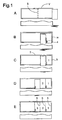
- the side of a van body V shown in fig. 1 is completely open, though possibly with a centre frame-bar S, in that each of the two half parts are arranged to be closed with three-winged folding doors, of which only the door at the righthand end is shown.
- the door, fig. 1E has three wings 1, 2 and 3, of which the wing 1 is hinged to a corner post H by means of hinges 5, which when the door is open allows the door to assume a lowered position, in which cf. fig. 2A it can extend for a distance down along the side surface of the bottom L of the body, while at the top it is lowered from a locking groove 7 in the edge of the roof of the body.
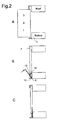
- this door section can be forcibly raised by means of a hand-lever 4, see especially fig. 2B, which by or with a lower end can be brought into operative engagement with a recess 8 in a flange 10 protruding from the lower edge area of the bottom L of the body.
- the hand-lever 4 is connected with a link arm 12 to a point 14 of the door, so that by an upwards and inwards swinging of the bar-formed hand-lever, the door is forcibly displaced upwards, namely into locking engagement in the roof groove 7, cf. fig. 2C.
- the door will be able to be blocked against outwards pressure from the inside by a suitable, not-shown and from the outside operable blocking of the hand-lever in the closed position.
- the door wing no. 2 is hinged to wing no. 1 by means of ordinary swing-hinges which do not permit any mutual axial displacement between these wings, i.e. the hand-lever 4 on wing 1 when operated will automatically bring about the same raising or lowering of both of the wings 1 and 2.
- Wing no. 2 is not provided with a hand-lever 4.
- Door wing no. 3 is hinged to wing no. 2 by means of an axially-displaceable hinge connection 5, and this wing is provided with a hand-lever 4 in the same manner as the wing no. 1.
- the individual door sections do not hereby need to be dimensioned to take up the weight of that or the outer sections for presentation of all the sections along a rectilinear distance, in that the sections are individually displaceable in height and can herewith be brought into locking engagement in the upper roof groove 7 (fig. 2B).
Landscapes
- Engineering & Computer Science (AREA)
- Mechanical Engineering (AREA)
- Extensible Doors And Revolving Doors (AREA)
Abstract
Description
- The present invention relates to a folding door arrangement, especially for use in connection with non-fixed frame parts such as in box vans, refrigeration vans, exchange-load containers and corresponding vehicles. With the use of folding doors, it is possible to work with broad, crossbar-free access openings without the need for broad and heavy swingor sliding doors, in that the folding door sections, preferably three sections for folding together in a zigzag, can each be of moderate breadth.
- With the known constructions, it is common for the door sections to be fixedly hinged together, and for each to be provided with a vertical locking bar at their outer ends, said locking bar being pivotal by means of a horizontally-extending operating door handle, so that a special locking engagement part on these bars can be brought into and out of locking engagement with locking socket parts at the bottom and the top of the van body.
- The overall multi-wing structure must hereby be configured in such a manner that it is supported as a frame, though as a foldable unit on the innermost support hinges, which will typically be disposed on a corner post of the van body, so that also the outer sections of the folding door in folded-out state will be supported at precisely that height which corresponds to their level in the closed position. This requires a precise hinge suspension and a good form stability of the innermost door sections, whereby these - or the door sections in general - must be configured with a relatively strong and herewith heavy construction.
- It is endeavoured with the present invention to provide a van body and van door construction which can appear with relatively low weight by a minimising of the weight of the folding door sections. It is a fundamental consideration with the invention that some or each of the outer door sections can be configured with axially-displaceable hinge connections, but on the other hand be equipped with hand-lever means which are operable for the raising of the respective sections by local co-operation with the lower edge area of the van body. An active locking of the sections in the closed position can thus be brought about by the establishing of a simple insertion engagement at the top of the van body.
- Consequently, the door sections do not need to be enclosed within frames, nor in any other way be stabilised to be able to support the outer sections at a certain operative height, and the said vertical locking bars can be omitted in favour of the local and far smaller hand-lever. All in all, there is hereby achieved a considerable reduction in cost and weight without any disadvantage regarding the convenience of operation.
- In the following, the invention is explained in more detail with reference to the drawing, in which
- Fig. 1 A-E are plan views for the illustration of different open/closed positions of a set of folding doors on the side of a van body according to the invention, while
- Fig. 2 A-C are cross-sectional views of the same area.
-
- The side of a van body V shown in fig. 1 is completely open, though possibly with a centre frame-bar S, in that each of the two half parts are arranged to be closed with three-winged folding doors, of which only the door at the righthand end is shown. The door, fig. 1E, has three
wings wing 1 is hinged to a corner post H by means ofhinges 5, which when the door is open allows the door to assume a lowered position, in which cf. fig. 2A it can extend for a distance down along the side surface of the bottom L of the body, while at the top it is lowered from alocking groove 7 in the edge of the roof of the body. - In the closed, lowered position, this door section can be forcibly raised by means of a hand-
lever 4, see especially fig. 2B, which by or with a lower end can be brought into operative engagement with arecess 8 in aflange 10 protruding from the lower edge area of the bottom L of the body. The hand-lever 4 is connected with alink arm 12 to apoint 14 of the door, so that by an upwards and inwards swinging of the bar-formed hand-lever, the door is forcibly displaced upwards, namely into locking engagement in theroof groove 7, cf. fig. 2C. At the bottom, the door will be able to be blocked against outwards pressure from the inside by a suitable, not-shown and from the outside operable blocking of the hand-lever in the closed position. - The door wing no. 2 is hinged to wing no. 1 by means of ordinary swing-hinges which do not permit any mutual axial displacement between these wings, i.e. the hand-
lever 4 onwing 1 when operated will automatically bring about the same raising or lowering of both of thewings lever 4. - Door wing no. 3 is hinged to wing no. 2 by means of an axially-
displaceable hinge connection 5, and this wing is provided with a hand-lever 4 in the same manner as the wing no. 1. - In their closed positions, all three wings will stand as shown in fig. 1E and fig. 2C, i.e. in raised positions in which they are locked by the upper engagement with the
roof groove 7. For the opening of the wings, the hand-lever onwing 3 is swung out first, whereby this wing is lowered on thehinges 5 to the position shown in fig. 1D and 2B, from which it can be freely swung out around thehinges 5 for folding-in againstwing 2, fig. 1C. Thereafter, the hand-lever 4 onwing 1 fig. 1B is swung out, whereby thesections section 3. Hereafter, when the hand-lever 4 onsection 1 is drawn outwards, a folding-together of thesections outer section 3 simply follows this as an outer covering onsection 2, and all three sections can then be swung out in the folded-together state (fig. 1A) for total opening of the previously covered part of the opening in the side of the van body. - For the closing of the side opening, the reverse procedure is followed, in that the folded-out door wings are swung in and the hand-
levers 4 are operated successively for raising and locking of the different sections. - It will be understood that the individual door sections do not hereby need to be dimensioned to take up the weight of that or the outer sections for presentation of all the sections along a rectilinear distance, in that the sections are individually displaceable in height and can herewith be brought into locking engagement in the upper roof groove 7 (fig. 2B).
Claims (8)
- Folding door arrangement, especially for use in non-fixed frame parts, with an innermost, frame-hinged door wing, to the free edge of which there is hinged a swing-wing which can correspondingly support one or more additional, serially-hinged swing wings, said arrangement comprising means for stabilising the wings in their folded-out closed position, characterised in that one or more of the swing wings extend from their support hinges in a vertically-displaceable manner, and are connected to a hand-lever means which in co-operation with an under-frame part can be operated for the raising of the respective wing(s) for the establishing of insertion engagement between the top of the wings and an upper frame area.
- Arrangement according to claim 1, characterised in that the said support hinges in themselves are configured to enable said vertical displacement.
- Arrangement according to claim 1, characterised in that a pair of neighbouring swing wings are firmly hinged together.
- Arrangement according to claim 1, characterised in that the hand-lever means are disposed in permanent operative connection with the respective wings.
- Arrangement according to claim 4, characterised in that the hand-lever means comprise a pivotal lifting bar which at a lower end can support itself against the upper side of a lower frame, and which is connected by a link to the wing in such a manner that by swinging up around its lower end from an outwards-upwards inclined position to a vertical position, the lifting bar can force the coupled wing to be raised into its locked position.
- Arrangement according to claim 5, characterised in that at its lower end, the lifting bar is disposed behind a fixed raised part on said upper side of the lower frame, and that means are provided for the locking of the lifting bar in its upwardly-swung position, so that the lifting bar also constitutes locking means for the lower end of the wing.
- Van body with frame parts and a folding door arrangement in accordance with one or more of the foregoing claims.
- Box van with a van body in accordance with claim 7.
Applications Claiming Priority (2)
| Application Number | Priority Date | Filing Date | Title |
|---|---|---|---|
| DK180899 | 1999-12-16 | ||
| DK199901808A DK199901808A (en) | 1999-12-16 | 1999-12-16 | Folding door system, especially for car crates and the like. |
Publications (2)
| Publication Number | Publication Date |
|---|---|
| EP1108579A2 true EP1108579A2 (en) | 2001-06-20 |
| EP1108579A3 EP1108579A3 (en) | 2002-10-16 |
Family
ID=8108206
Family Applications (1)
| Application Number | Title | Priority Date | Filing Date |
|---|---|---|---|
| EP00610131A Withdrawn EP1108579A3 (en) | 1999-12-16 | 2000-12-15 | Folding door system to bodies of cars and lorries |
Country Status (3)
| Country | Link |
|---|---|
| EP (1) | EP1108579A3 (en) |
| DK (1) | DK199901808A (en) |
| NO (1) | NO20006423L (en) |
Cited By (2)
| Publication number | Priority date | Publication date | Assignee | Title |
|---|---|---|---|---|
| FR2829090A1 (en) * | 2001-08-31 | 2003-03-07 | Roger Henri Deschamp | Freight vehicle has folding/sliding side panels moving along top and bottom rails |
| FR2830507A1 (en) * | 2001-08-31 | 2003-04-11 | Roger Deschamp | DEVICE FOR CLOSING / SIDE OPENING OF A FREIGHT TRANSPORT VEHICLE |
Family Cites Families (3)
| Publication number | Priority date | Publication date | Assignee | Title |
|---|---|---|---|---|
| US3416836A (en) * | 1967-09-21 | 1968-12-17 | Victor S. Swanby | Side-loading moving van |
| FI96496C (en) * | 1994-10-19 | 1996-07-10 | Naerko Ab Oy | Cabinet design for wheeled vehicles, such as trucks and trailers |
| FR2740752B1 (en) * | 1995-11-03 | 1998-01-23 | Asca Carrossier Constructeur | BODY HAVING A BASE, A PAVILION AND AT LEAST ONE SLIDING DOOR AND TWO SWING DOORS |
-
1999
- 1999-12-16 DK DK199901808A patent/DK199901808A/en not_active Application Discontinuation
-
2000
- 2000-12-15 EP EP00610131A patent/EP1108579A3/en not_active Withdrawn
- 2000-12-15 NO NO20006423A patent/NO20006423L/en not_active Application Discontinuation
Non-Patent Citations (1)
| Title |
|---|
| None |
Cited By (3)
| Publication number | Priority date | Publication date | Assignee | Title |
|---|---|---|---|---|
| FR2829090A1 (en) * | 2001-08-31 | 2003-03-07 | Roger Henri Deschamp | Freight vehicle has folding/sliding side panels moving along top and bottom rails |
| FR2830507A1 (en) * | 2001-08-31 | 2003-04-11 | Roger Deschamp | DEVICE FOR CLOSING / SIDE OPENING OF A FREIGHT TRANSPORT VEHICLE |
| WO2003018339A3 (en) * | 2001-08-31 | 2003-11-06 | Roger Deschamp | Device for lateral closure/opening of a cargo transport vehicle |
Also Published As
| Publication number | Publication date |
|---|---|
| NO20006423D0 (en) | 2000-12-15 |
| EP1108579A3 (en) | 2002-10-16 |
| NO20006423L (en) | 2001-06-18 |
| DK199901808A (en) | 2001-06-17 |
Similar Documents
| Publication | Publication Date | Title |
|---|---|---|
| ES2292243T3 (en) | WHEELCHAIR ELEVATOR WITH FOLDABLE PLATFORM. | |
| US4960299A (en) | Mobile accommodation structure with extension unit | |
| US5992918A (en) | Bi-fold gull wing vehicle door | |
| US4577772A (en) | Collapsible containers | |
| US20080238133A1 (en) | Tonneau cover | |
| GB1572352A (en) | Vehicle body | |
| WO2023236695A1 (en) | Bundle-type folding wagon | |
| US20240200322A1 (en) | Expandable house structure | |
| KR20200125161A (en) | Loof top cover type vehicle | |
| AU2023348823A1 (en) | Tent and tent top structure | |
| US5788319A (en) | Camping unit for pick-up trucks, vans, boats and the like | |
| US559965A (en) | bierstadt | |
| EP1108579A2 (en) | Folding door system to bodies of cars and lorries | |
| US20240384524A1 (en) | One-directional expansion house structure | |
| KR102403573B1 (en) | Roof top tent for vehicle | |
| US3356410A (en) | Collapsible trailers | |
| US20020101089A1 (en) | Bi-fold box door system | |
| US4240357A (en) | Folding rail car doors | |
| AU2024200114B2 (en) | Stowable Veranda for Recreational Vehicle | |
| US7281744B1 (en) | Convertible pickup canopy | |
| CN208531281U (en) | A kind of hinge means and Collapsible container | |
| KR101934925B1 (en) | Camping trailer for vehicle | |
| KR102677007B1 (en) | Rear door opening and closing structure of cargo box | |
| EP0089133A1 (en) | Improvements in and/or relating to mobile accomodation units | |
| US3343866A (en) | Collapsible trailer |
Legal Events
| Date | Code | Title | Description |
|---|---|---|---|
| PUAI | Public reference made under article 153(3) epc to a published international application that has entered the european phase |
Free format text: ORIGINAL CODE: 0009012 |
|
| AK | Designated contracting states |
Kind code of ref document: A2 Designated state(s): AT BE CH CY DE DK ES FI FR GB GR IE IT LI LU MC NL PT SE TR |
|
| AX | Request for extension of the european patent |
Free format text: AL;LT;LV;MK;RO;SI |
|
| PUAL | Search report despatched |
Free format text: ORIGINAL CODE: 0009013 |
|
| AK | Designated contracting states |
Kind code of ref document: A3 Designated state(s): AT BE CH CY DE DK ES FI FR GB GR IE IT LI LU MC NL PT SE TR |
|
| AX | Request for extension of the european patent |
Free format text: AL;LT;LV;MK;RO;SI |
|
| RAP1 | Party data changed (applicant data changed or rights of an application transferred) |
Owner name: HMK INDUSTRI A/S |
|
| AKX | Designation fees paid | ||
| REG | Reference to a national code |
Ref country code: DE Ref legal event code: 8566 |
|
| STAA | Information on the status of an ep patent application or granted ep patent |
Free format text: STATUS: THE APPLICATION IS DEEMED TO BE WITHDRAWN |
|
| 18D | Application deemed to be withdrawn |
Effective date: 20030417 |