EP1107469A1 - Procédé de corrélation partielle dans un récepteur de type CDMA - Google Patents
Procédé de corrélation partielle dans un récepteur de type CDMA Download PDFInfo
- Publication number
- EP1107469A1 EP1107469A1 EP00403342A EP00403342A EP1107469A1 EP 1107469 A1 EP1107469 A1 EP 1107469A1 EP 00403342 A EP00403342 A EP 00403342A EP 00403342 A EP00403342 A EP 00403342A EP 1107469 A1 EP1107469 A1 EP 1107469A1
- Authority
- EP
- European Patent Office
- Prior art keywords
- signal
- samples
- decimation
- correlation
- value
- Prior art date
- Legal status (The legal status is an assumption and is not a legal conclusion. Google has not performed a legal analysis and makes no representation as to the accuracy of the status listed.)
- Granted
Links
- 238000000034 method Methods 0.000 title claims abstract description 24
- 108010003272 Hyaluronate lyase Proteins 0.000 claims description 8
- 230000006870 function Effects 0.000 claims description 2
- 230000002596 correlated effect Effects 0.000 abstract description 2
- 230000003595 spectral effect Effects 0.000 abstract description 2
- 238000012360 testing method Methods 0.000 abstract description 2
- 230000001419 dependent effect Effects 0.000 abstract 1
- 230000010365 information processing Effects 0.000 abstract 1
- 230000000875 corresponding effect Effects 0.000 description 3
- 230000033764 rhythmic process Effects 0.000 description 3
- 230000032683 aging Effects 0.000 description 2
- 230000003321 amplification Effects 0.000 description 2
- 230000005540 biological transmission Effects 0.000 description 2
- 238000004364 calculation method Methods 0.000 description 2
- 230000015556 catabolic process Effects 0.000 description 2
- 238000004891 communication Methods 0.000 description 2
- 238000006731 degradation reaction Methods 0.000 description 2
- 238000010438 heat treatment Methods 0.000 description 2
- 238000003199 nucleic acid amplification method Methods 0.000 description 2
- 238000012545 processing Methods 0.000 description 2
- 230000001105 regulatory effect Effects 0.000 description 2
- 238000005070 sampling Methods 0.000 description 2
- 238000007493 shaping process Methods 0.000 description 2
- 238000006243 chemical reaction Methods 0.000 description 1
- 238000010586 diagram Methods 0.000 description 1
- 238000005516 engineering process Methods 0.000 description 1
- 230000005669 field effect Effects 0.000 description 1
- 238000001914 filtration Methods 0.000 description 1
- 238000011160 research Methods 0.000 description 1
- 238000001228 spectrum Methods 0.000 description 1
- 230000017105 transposition Effects 0.000 description 1
Images

Classifications
-
- H—ELECTRICITY
- H04—ELECTRIC COMMUNICATION TECHNIQUE
- H04B—TRANSMISSION
- H04B1/00—Details of transmission systems, not covered by a single one of groups H04B3/00 - H04B13/00; Details of transmission systems not characterised by the medium used for transmission
- H04B1/69—Spread spectrum techniques
- H04B1/707—Spread spectrum techniques using direct sequence modulation
- H04B1/7073—Synchronisation aspects
- H04B1/7075—Synchronisation aspects with code phase acquisition
- H04B1/70751—Synchronisation aspects with code phase acquisition using partial detection
- H04B1/70752—Partial correlation
-
- H—ELECTRICITY
- H04—ELECTRIC COMMUNICATION TECHNIQUE
- H04B—TRANSMISSION
- H04B1/00—Details of transmission systems, not covered by a single one of groups H04B3/00 - H04B13/00; Details of transmission systems not characterised by the medium used for transmission
- H04B1/69—Spread spectrum techniques
- H04B1/707—Spread spectrum techniques using direct sequence modulation
-
- H—ELECTRICITY
- H04—ELECTRIC COMMUNICATION TECHNIQUE
- H04B—TRANSMISSION
- H04B1/00—Details of transmission systems, not covered by a single one of groups H04B3/00 - H04B13/00; Details of transmission systems not characterised by the medium used for transmission
- H04B1/69—Spread spectrum techniques
- H04B1/707—Spread spectrum techniques using direct sequence modulation
- H04B1/7073—Synchronisation aspects
- H04B1/7075—Synchronisation aspects with code phase acquisition
- H04B1/70751—Synchronisation aspects with code phase acquisition using partial detection
Definitions
- the subject of the present invention is a method of partial correlation in a CDMA type receiver (Code Division Multiple Access for access multiple to division for the code in French). It applies to all types of receivers for which a received signal is produced from an operation of spectral spreading and which transmission through a support uses a CDMA type technique. It therefore applies more particularly to field of mobile telephony using such an access technique.
- a CDMA type receiver Code Division Multiple Access for access multiple to division for the code in French. It applies to all types of receivers for which a received signal is produced from an operation of spectral spreading and which transmission through a support uses a CDMA type technique. It therefore applies more particularly to field of mobile telephony using such an access technique.
- the object of the invention is to relieve the unit responsible for the operations of correlation in the mobile phone by reducing a pace of operation of this unit as well as power consumption associated.
- a rhythm of operation of such a system is determined especially by the frequency with which the samples are presented to an input from the correlation unit. More precisely, the received signal is sampled, or even oversampled, at a frequency of up to megahertz or even much more. As a result, a sequence of treatment by the correlation unit is at the same frequency as the frequency of presentation of samples.
- a heating of an integrated circuit increases with a frequency of operation thereof and this in particular in the case where the integrated circuit would use a technology based on field effect transistor. So a circuit operating at a first frequency will heat up more weaker than a second circuit operating at a second frequency more higher than the second frequency.
- an aging of the second circuit is faster than an aging of the first circuit and therefore a performance degradation associated with this integrated circuit is faster.
- the present invention overcomes these problems by proposing a partial correlation method operating at a frequency reduced by a variable factor and including robustness to disturbances of short duration is improved.
- a first series of partial correlations therefore with low consumption, for estimate whether or not a sequence is likely to be the sequence which produced the received signal.
- It also relates to a use of the method of the invention in a mobile phone.
- Figure 1 shows an example of implementation of the the invention in a mobile phone 1.
- This simplified example shows a very basic architecture of phone 1 in order to highlight the different means used to implement the method of the invention. Obviously, these different means can be combined or grouped in the same device. However, for the sake of simplicity of the description, this simplified architecture of the phone 1 as support.
- the telephone 1 has an antenna 2 to receive a signal 3 radio transmitted by a base station 4 of a telephone network 5 mobile.
- the signal 3 is transmitted by respecting a protocol CDMA type access.
- a signal to transmit is modulated by a so-called spreading sequence.
- SFi spreading factor
- a correlation series is carried out between the received signal and a series of spreading sequences until a maximum of correlations or peak of correlation.
- a correlation peak indicates that the spreading sequence used in reception corresponds to the sequence used on the show. It is generally the correlation product of which a result gives the greatest value.
- the signal 3 received by the antenna 2 is transmitted to a device 6 of reception carrying out in particular frequency transposition operations and filtering.
- the device 6 produces, at an output 7, a received signal.
- This signal received is transmitted, via a sampling means 8, to a 9 means of conversion into digital form.
- Medium 8 or even sampler 8 can, for example, be in the form of a light switch.
- the means 9 is generally in the form of a analog to digital converter 9 or CAN. Converter 9 produces a sampled signal at output 10.
- Phone 1 has in addition to a microprocessor 11 controlled by a program 12 in a program memory 13 via a data bus 14, addresses and orders.
- the sampled signal is transmitted to a decimation means 15 in order to produce a first series of samples from a decimation of the sampled signal.
- the means 15 is regulated by the microprocessor 11 via the bus 14 using a determined value of the decimation factor.
- the value of the decimation factor of the medium 15 is adjusted according to a value of a signal to noise ratio associated with the received signal.
- This signal-to-noise ratio can be calculated, by example, from the sampled signal present at output 10.
- the factor of decimation can also be calculated based on a power value of the received signal, this value can also be obtained from the continuation of samples at output 10.
- the decimation factor can still be set from a value of the SFi factor associated with the received signal.
- the value of spreading factor used is known to telephone 1 since, when communication establishment protocol between telephone 1 and network 5, a value of the spreading factor to be used for this communication was determined during the protocol.
- this value of decimation factor of means 15 can be determined from a combination of the three previous criteria.
- the first series of samples is thus obtained at an output 16 of the medium 15.
- This first series of samples is transmitted to an input 17 a correlation means 18 or also a correlator 18.
- the correlator 18 has for the function of producing a correlation product between the first sequence of samples at input 17 and a second series of samples, present at an input 19, until identifying a despread sequence and / or a signal synchronization.
- a despread sequence is, in this description, a generic term used to speak about the signal object of the modulation by a spreading sequence such as a speech signal for example or of a data signal. In an example with a speech signal, this one is then sent to a speaker 20 via a device 21 shaping and amplification.
- Identify a synchronization signal means that we have just identified, in the received signal, an instant of synchronization. This synchronization instant makes it possible to decode a signal received and thus to be able to read and interpret the messages received.
- Every new correlation product we present at entry 19 a new second series of samples corresponding to a new sequence spreading. It is known, in the case of CDMA in particular, that a intercorrelation between a signal modulated by a spreading sequence and a another spreading sequence gives a zero or rather weak result then that an intercorrelation between a signal modulated by a first sequence spreading and this same spreading sequence gives a value much higher than in other cases. So we start over correlation product until such a value is obtained.
- the spreading sequences used by telephone 1 and presented at entry 19 are stored in telephone 1 in a memory 22 of backup for example.
- the memory 22 comprises, at a location memory 23, a set of spreading sequences.
- a table 24 of decimation factors is stored in a backup memory, for example memory 22.
- a value of a factor K i is associated, in table 24, with a value of the spreading factor used with the received signal and / or with a value of the power of the received signal and / or with a value of a signal to noise ratio.
- Table 24 can be seen symbolically as a set of lines 24 1, 24 2 to 24 n, each line corresponding to a memory location comprising, in a preferred example, four fields.
- the line 24 1 comprises a first field 25 in which is stored a value of a spreading factor, a field 26 in which is stored a power value, a field 27 in which is stored a value of a signal to noise ratio and a field 28 in which is stored a value of the decimation factor associated with the three preceding parameters. Consequently, the program 12, by means of the microprocessor 11, searches in the table 24 for the line, among the lines 24 1 to 24 n, corresponding to the value of spreading factor and / or to the value of power and / or the value of the signal to noise ratio determined during the connection phase for the first and measured, at reception, for the last two.
- the microprocessor 11 adjusts the means 15 using the decimation factor associated with this line.
- this table 24 stores a limited number of parameters judged to be the most frequent. In the case where a determined and / or measured value is not present in the table 24, we will then have recourse to an interpolation method starting notably from the two closest values in the table. However, one could, in order to eliminate these interpolation calculations, select the decimation factor whose value of an associated parameter is closest to a determined and / or measured value in the telephone 1.
- the method of the invention as a means of rough estimation of the sequence spreading used. So we identify a spreading sequence as in the invention then we go to a precision phase of the identification of the despread sequence and / or synchronization signal. For this, the program 12 compares a result of the correlation product with a threshold, preferably predetermined. When the result of the correlation product is above this threshold then we again perform a correlation product between the sampled signal and the spreading sequence causing the second series of samples used in this correlation product. This variant will be particularly used when searching for synchronization in order to accelerate a convergence of this research.
- the correlator 18, receiving inputs 17 and 19 of the decimated signals operates at a rate thus limiting heating of it.
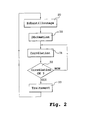
- Figure 2 shows, in the form of an algorithm, an example of operation of the method of the invention.
- the signal 3 received by the telephone 1 is sampled by the sampling means 8. These samples are converted by the converter 9 in order to produce the first series of samples.
- This first series of samples is decimated regularly, in a step 30, by means 15 including a factor of decimation is regulated by the microprocessor 11.
- a symmetrical decimation is performed on the spreading sequence in order to maintain a correlation consistent. Indeed, a correlation peak is detected when there is agreement between samples and the coefficients of the sequence spreading. If we delete certain samples, we must delete certain coefficients in order to maintain the consistency of the calculation. Otherwise the concordance between samples and coefficients can no longer be produce because there is a mismatch between the samples and the coefficients.
- the correlation thus carried out is a partial correlation.
- this first series of samples is correlated with a second series of samples present in telephone 1, in memory 22 for example.
- a test step 32 we check, from of a result of the correlation product, the presence or not of a peak correlation. In the event that a correlation peak is detected, during a partial correlation, we proceed to a total correlation. That is to say a correlation using the set of samples and coefficients in order to be able to extract the information contained in the samples. It's about then a total correlation.
- This processing phase is, for example, a phase of shaping and amplification of a signal to transmit it to a speaker 20.
- the process of the invention is preferably used in a mobile phone produced in compliance with the UMTS or IMT 2000 standard (International Mobile Telephone for international mobile phone) however, the invention can be applied to any reception mechanism, performing synchronization and / or demodulation operations, for spread spectrum systems using correlation products for find useful information.
Landscapes
- Engineering & Computer Science (AREA)
- Computer Networks & Wireless Communication (AREA)
- Signal Processing (AREA)
- Mobile Radio Communication Systems (AREA)
- Synchronisation In Digital Transmission Systems (AREA)
Abstract
Description
- on échantillonne le signal reçu et on obtient un signal échantillonné,
- on produit une première suite d'échantillons à partir d'une première décimation régulière du signal échantillonné,
- on produit une deuxième suite d'échantillons à partir d'une deuxième décimation régulière d'une séquence d'étalement,
- on réalise des corrélations partielles entre des premières suites d'échantillons et la deuxième suite d'échantillons jusqu'à identifier une séquence désétalée et ou un signal de synchronisation.
- Figure 1: une réalisation, sous forme d'un schéma de principe simplifié, d'un téléphone mobile permettant de mettre en oeuvre le procédé de l'invention ;
- Figure 2 : une représentation, sous forme d'une succession d'étapes, d'un fonctionnement du procédé de l'invention.
Claims (8)
- Procédé de corrélation, dans un récepteur d'un système CDMA, entre un signal reçu, préalablement modulé par une séquence d'étalement choisie parmi plusieurs, et cette séquence d'étalement dans lequel :caractérisé en ce que :on échantillonne le signal reçu et on obtient un signal échantillonné,on produit une première suite d'échantillons à partir d'une première décimation régulière du signal échantillonné,on produit une deuxième suite d'échantillons à partir d'une deuxième décimation régulière d'une séquence d'étalement,on réalise des corrélations partielles entre des premières suites d'échantillons et la deuxième suite d'échantillons jusqu'à identifier une séquence désétalée et ou un signal de synchronisation.
- Procédé selon la revendication 1, caractérisé en ce que le nombre d'échantillons résultant de la décimation du signal échantillonné est inférieure au nombre d'échantillons nécessaires pour effectuer une corrélation totale.
- Procédé selon l'une des revendications 1 ou 2, caractérisé en ce que des facteurs de décimation utilisés pour la première et la deuxième décimation sont identiques.
- Procédé selon l'une des revendications 1 à 3 caractérisé en ce que:on règle un facteur de décimation en fonction d'une valeur du facteur d'étalement utilisé avec le signal reçu et ou d'une valeur mesurée de la puissance du signal reçu et ou d'une valeur mesurée d'un rapport signal sur bruit.
- Procédé selon l'une des revendications 1 à 4 caractérisé en ce que:on mémorise dans une mémoire (22) de sauvegarde une table (24) de facteurs de décimation, une valeur d'un facteur de décimation étant associée dans la table à une valeur du facteur d'étalement utilisé avec le signal reçu et ou à une valeur de la puissance du signal reçu et ou à une valeur d'un rapport signal sur bruit.
- Procédé selon l'une des revendications 1 à 5 caractérisé en ce que pour préciser une identification de la séquence désétalée et ou du signal de synchronisation :et en ce que lorsque le résultat est supérieur au seuil :on compare un résultat du produit de corrélation avec un seuil ;on réalise un nouveau produit de corrélation entre le signal échantillonné et la séquence d'étalement à l'origine de la deuxième suite d'échantillons.
- Utilisation du procédé selon l'une des revendications 1 à 6 dans un téléphone (1) mobile.
- Utilisation du procédé selon l'une des revendications 1 à 6 dans un téléphone mobile réalisé en respectant la norme UMTS ou IMT2000.
Applications Claiming Priority (2)
| Application Number | Priority Date | Filing Date | Title |
|---|---|---|---|
| FR9915169 | 1999-12-01 | ||
| FR9915169A FR2802036B1 (fr) | 1999-12-01 | 1999-12-01 | Procede de correlation partielle dans un recepteur de type cdma |
Publications (2)
| Publication Number | Publication Date |
|---|---|
| EP1107469A1 true EP1107469A1 (fr) | 2001-06-13 |
| EP1107469B1 EP1107469B1 (fr) | 2003-02-26 |
Family
ID=9552783
Family Applications (1)
| Application Number | Title | Priority Date | Filing Date |
|---|---|---|---|
| EP20000403342 Expired - Lifetime EP1107469B1 (fr) | 1999-12-01 | 2000-11-29 | Procédé de corrélation partielle dans un récepteur de type CDMA |
Country Status (4)
| Country | Link |
|---|---|
| EP (1) | EP1107469B1 (fr) |
| DE (1) | DE60001481T2 (fr) |
| ES (1) | ES2188492T3 (fr) |
| FR (1) | FR2802036B1 (fr) |
Cited By (1)
| Publication number | Priority date | Publication date | Assignee | Title |
|---|---|---|---|---|
| EP2958244A1 (fr) * | 2014-06-20 | 2015-12-23 | Commissariat à l'Énergie Atomique et aux Énergies Alternatives | Procédé de démodulation auto-adaptative de signaux quasi-orthogonaux, unité de démodulation et récepteur de signaux radio |
Citations (4)
| Publication number | Priority date | Publication date | Assignee | Title |
|---|---|---|---|---|
| US5377226A (en) * | 1993-10-19 | 1994-12-27 | Hughes Aircraft Company | Fractionally-spaced equalizer for a DS-CDMA system |
| EP0767544A2 (fr) * | 1995-10-04 | 1997-04-09 | Interuniversitair Micro-Elektronica Centrum Vzw | Modem programmable utilisant la communication à spectre étalé |
| WO1998053556A2 (fr) * | 1997-05-20 | 1998-11-26 | Sanconix, Inc. (La Corp) | Procede d'etalement du spectre en sequence directe, produit informatique, appareil et systeme tolerants aux decalages de frequence de reference |
| US5966402A (en) * | 1995-11-22 | 1999-10-12 | Sony Corporation | Method and apparatus for detecting pilot signals and subscriber |
-
1999
- 1999-12-01 FR FR9915169A patent/FR2802036B1/fr not_active Expired - Lifetime
-
2000
- 2000-11-29 EP EP20000403342 patent/EP1107469B1/fr not_active Expired - Lifetime
- 2000-11-29 ES ES00403342T patent/ES2188492T3/es not_active Expired - Lifetime
- 2000-11-29 DE DE2000601481 patent/DE60001481T2/de not_active Expired - Lifetime
Patent Citations (4)
| Publication number | Priority date | Publication date | Assignee | Title |
|---|---|---|---|---|
| US5377226A (en) * | 1993-10-19 | 1994-12-27 | Hughes Aircraft Company | Fractionally-spaced equalizer for a DS-CDMA system |
| EP0767544A2 (fr) * | 1995-10-04 | 1997-04-09 | Interuniversitair Micro-Elektronica Centrum Vzw | Modem programmable utilisant la communication à spectre étalé |
| US5966402A (en) * | 1995-11-22 | 1999-10-12 | Sony Corporation | Method and apparatus for detecting pilot signals and subscriber |
| WO1998053556A2 (fr) * | 1997-05-20 | 1998-11-26 | Sanconix, Inc. (La Corp) | Procede d'etalement du spectre en sequence directe, produit informatique, appareil et systeme tolerants aux decalages de frequence de reference |
Cited By (3)
| Publication number | Priority date | Publication date | Assignee | Title |
|---|---|---|---|---|
| EP2958244A1 (fr) * | 2014-06-20 | 2015-12-23 | Commissariat à l'Énergie Atomique et aux Énergies Alternatives | Procédé de démodulation auto-adaptative de signaux quasi-orthogonaux, unité de démodulation et récepteur de signaux radio |
| FR3022712A1 (fr) * | 2014-06-20 | 2015-12-25 | Commissariat Energie Atomique | Procede de demodulation auto-adaptative de signaux quasi-orthogonaux, unite de demodulation et recepteur de signaux radio |
| US9356651B2 (en) | 2014-06-20 | 2016-05-31 | Commissariat A L'energie Atomique Et Aux Energies Alternatives | Method for self-adaptively demodulating quasi-orthogonal signals, demodulation unit and radio signal receiver |
Also Published As
| Publication number | Publication date |
|---|---|
| DE60001481T2 (de) | 2003-11-20 |
| DE60001481D1 (de) | 2003-04-03 |
| FR2802036A1 (fr) | 2001-06-08 |
| FR2802036B1 (fr) | 2003-04-18 |
| ES2188492T3 (es) | 2003-07-01 |
| EP1107469B1 (fr) | 2003-02-26 |
Similar Documents
| Publication | Publication Date | Title |
|---|---|---|
| CA2173779C (fr) | Recepteur de signal a spectre etale | |
| EP0630120B1 (fr) | Procédé de synchronisation pour des communications radiotéléphoniques à accès multiple à répartition par codes | |
| FR2724275A1 (fr) | Procede et dispositif pour activer ou desactiver un circuit d'assourdissement dans un systeme emetteur-recepteur | |
| FR2760157A1 (fr) | Procede et dispositif pour l'acquisition d'un signal de pilotage dans un recepteur cdma | |
| EP1195924A1 (fr) | Méthode de synchronisation de stations de base | |
| FR3036566B1 (fr) | Procede de selection d'un filtre a appliquer en reception d'une trame | |
| WO2002052521A2 (fr) | Recepteur radiofrequence pour la telereleve de compteurs et methode de telereleve de compteurs comprenant un tel recepteur | |
| EP4059180B1 (fr) | Procédé de synchronisation d'un système de communication basé sur la retransmission de données | |
| EP3220592A1 (fr) | Méthode de synchronisation d'un système fbmc au moyen d'un canal rach | |
| EP1107469B1 (fr) | Procédé de corrélation partielle dans un récepteur de type CDMA | |
| EP0629059B1 (fr) | Système de transmission numérique à étalement de spectre obtenu par codage pseudo-aléatoire basse fréquence de l'information utile et procédé d'étalement et de compression de spectre utilisé un tel système | |
| EP3476054B1 (fr) | Emission/réception de données par sauts d'écarts en fréquence, perfectionnées | |
| EP2334021B1 (fr) | Méthode d'estimation aveugle de paramètres ofdm par adaptation de covariance | |
| EP1050987B1 (fr) | Procédé d'accès multiple de type CDMA à capacité améliorée | |
| WO2003101065A1 (fr) | Procede et dispositif d'estimation de la fonction de transfert d'un canal de transmission variable d’un signal multiporteuse | |
| EP3491742A1 (fr) | Coexistence de modules radio au sein d'un dispositif electronique | |
| EP1009105A1 (fr) | Récepteur, système de télécommunications CDMA et procédé de synchronisation d'un récepteur avec une station d'émission d'un tel système | |
| CA2389784A1 (fr) | Systeme et procede de transmission d'un signal audio ou phone | |
| EP0693247B1 (fr) | Dispositif de synchronisation pour un terminal d'un systeme de radiocommunication | |
| FR2758676A1 (fr) | Methode de reduction des clics dans un systeme de transmission de donnees | |
| EP3127247A1 (fr) | Procede de communication radio de donnees numeriques dans un environnement bruite | |
| EP0998065A1 (fr) | Canal module d'acquisition et de poursuite pour un systeme de radiocommunications | |
| FR2659510A1 (fr) | Dispositif de reception d'un spectre disperse. | |
| EP0831626B1 (fr) | Procédé et dispositif pour déterminer l'erreur sur la fréquence d'une porteuse | |
| FR2934102A1 (fr) | Procede de synchronisation temporelle d'un signal numerique, dispositif et produit programme d'ordinateur correspondants |
Legal Events
| Date | Code | Title | Description |
|---|---|---|---|
| PUAI | Public reference made under article 153(3) epc to a published international application that has entered the european phase |
Free format text: ORIGINAL CODE: 0009012 |
|
| AK | Designated contracting states |
Kind code of ref document: A1 Designated state(s): DE ES GB IT |
|
| AX | Request for extension of the european patent |
Free format text: AL;LT;LV;MK;RO;SI |
|
| 17P | Request for examination filed |
Effective date: 20010824 |
|
| RAP1 | Party data changed (applicant data changed or rights of an application transferred) |
Owner name: SAGEM S.A. |
|
| 17Q | First examination report despatched |
Effective date: 20011115 |
|
| AKX | Designation fees paid |
Free format text: DE ES GB IT |
|
| GRAG | Despatch of communication of intention to grant |
Free format text: ORIGINAL CODE: EPIDOS AGRA |
|
| GRAG | Despatch of communication of intention to grant |
Free format text: ORIGINAL CODE: EPIDOS AGRA |
|
| GRAG | Despatch of communication of intention to grant |
Free format text: ORIGINAL CODE: EPIDOS AGRA |
|
| GRAH | Despatch of communication of intention to grant a patent |
Free format text: ORIGINAL CODE: EPIDOS IGRA |
|
| GRAG | Despatch of communication of intention to grant |
Free format text: ORIGINAL CODE: EPIDOS AGRA |
|
| GRAH | Despatch of communication of intention to grant a patent |
Free format text: ORIGINAL CODE: EPIDOS IGRA |
|
| GRAH | Despatch of communication of intention to grant a patent |
Free format text: ORIGINAL CODE: EPIDOS IGRA |
|
| GRAA | (expected) grant |
Free format text: ORIGINAL CODE: 0009210 |
|
| AK | Designated contracting states |
Designated state(s): DE ES GB IT |
|
| REG | Reference to a national code |
Ref country code: GB Ref legal event code: FG4D Free format text: NOT ENGLISH |
|
| GBT | Gb: translation of ep patent filed (gb section 77(6)(a)/1977) |
Effective date: 20030226 |
|
| REF | Corresponds to: |
Ref document number: 60001481 Country of ref document: DE Date of ref document: 20030403 Kind code of ref document: P |
|
| REG | Reference to a national code |
Ref country code: ES Ref legal event code: FG2A Ref document number: 2188492 Country of ref document: ES Kind code of ref document: T3 |
|
| PLBE | No opposition filed within time limit |
Free format text: ORIGINAL CODE: 0009261 |
|
| STAA | Information on the status of an ep patent application or granted ep patent |
Free format text: STATUS: NO OPPOSITION FILED WITHIN TIME LIMIT |
|
| 26N | No opposition filed |
Effective date: 20031127 |
|
| REG | Reference to a national code |
Ref country code: GB Ref legal event code: 732E Free format text: REGISTERED BETWEEN 20120426 AND 20120502 |
|
| REG | Reference to a national code |
Ref country code: GB Ref legal event code: 732E Free format text: REGISTERED BETWEEN 20120503 AND 20120509 |
|
| REG | Reference to a national code |
Ref country code: DE Ref legal event code: R082 Ref document number: 60001481 Country of ref document: DE Representative=s name: BARDEHLE PAGENBERG PARTNERSCHAFT PATENTANWAELT, DE |
|
| REG | Reference to a national code |
Ref country code: DE Ref legal event code: R082 Ref document number: 60001481 Country of ref document: DE Representative=s name: BARDEHLE PAGENBERG PARTNERSCHAFT PATENTANWAELT, DE Effective date: 20121212 Ref country code: DE Ref legal event code: R081 Ref document number: 60001481 Country of ref document: DE Owner name: APPLE INC., US Free format text: FORMER OWNER: SAGEM MOBILES, PARIS, FR Effective date: 20121212 Ref country code: DE Ref legal event code: R081 Ref document number: 60001481 Country of ref document: DE Owner name: APPLE INC., CUPERTINO, US Free format text: FORMER OWNER: SAGEM MOBILES, PARIS, FR Effective date: 20121212 Ref country code: DE Ref legal event code: R082 Ref document number: 60001481 Country of ref document: DE Representative=s name: BARDEHLE PAGENBERG PARTNERSCHAFT MBB PATENTANW, DE Effective date: 20121212 |
|
| REG | Reference to a national code |
Ref country code: GB Ref legal event code: 732E Free format text: REGISTERED BETWEEN 20180920 AND 20180926 |
|
| PGFP | Annual fee paid to national office [announced via postgrant information from national office to epo] |
Ref country code: DE Payment date: 20191119 Year of fee payment: 20 |
|
| PGFP | Annual fee paid to national office [announced via postgrant information from national office to epo] |
Ref country code: IT Payment date: 20191108 Year of fee payment: 20 Ref country code: ES Payment date: 20191202 Year of fee payment: 20 |
|
| PGFP | Annual fee paid to national office [announced via postgrant information from national office to epo] |
Ref country code: GB Payment date: 20191129 Year of fee payment: 20 |
|
| REG | Reference to a national code |
Ref country code: DE Ref legal event code: R071 Ref document number: 60001481 Country of ref document: DE |
|
| REG | Reference to a national code |
Ref country code: GB Ref legal event code: PE20 Expiry date: 20201128 |
|
| PG25 | Lapsed in a contracting state [announced via postgrant information from national office to epo] |
Ref country code: GB Free format text: LAPSE BECAUSE OF EXPIRATION OF PROTECTION Effective date: 20201128 |
|
| REG | Reference to a national code |
Ref country code: ES Ref legal event code: FD2A Effective date: 20211229 |
|
| PG25 | Lapsed in a contracting state [announced via postgrant information from national office to epo] |
Ref country code: ES Free format text: LAPSE BECAUSE OF EXPIRATION OF PROTECTION Effective date: 20201130 |