EP1106673A2 - Removal of polycyclic aromatic compounds from extracts - Google Patents
Removal of polycyclic aromatic compounds from extracts Download PDFInfo
- Publication number
- EP1106673A2 EP1106673A2 EP00204357A EP00204357A EP1106673A2 EP 1106673 A2 EP1106673 A2 EP 1106673A2 EP 00204357 A EP00204357 A EP 00204357A EP 00204357 A EP00204357 A EP 00204357A EP 1106673 A2 EP1106673 A2 EP 1106673A2
- Authority
- EP
- European Patent Office
- Prior art keywords
- solvent
- extract
- stream
- process according
- pca
- Prior art date
- Legal status (The legal status is an assumption and is not a legal conclusion. Google has not performed a legal analysis and makes no representation as to the accuracy of the status listed.)
- Granted
Links
- 239000000284 extract Substances 0.000 title claims abstract description 63
- -1 polycyclic aromatic compounds Chemical class 0.000 title description 2
- 238000000034 method Methods 0.000 claims abstract description 45
- 238000000605 extraction Methods 0.000 claims abstract description 19
- 239000002904 solvent Substances 0.000 claims description 41
- 239000000203 mixture Substances 0.000 claims description 30
- SECXISVLQFMRJM-UHFFFAOYSA-N N-Methylpyrrolidone Chemical compound CN1CCCC1=O SECXISVLQFMRJM-UHFFFAOYSA-N 0.000 claims description 23
- XLYOFNOQVPJJNP-UHFFFAOYSA-N water Substances O XLYOFNOQVPJJNP-UHFFFAOYSA-N 0.000 claims description 21
- HYBBIBNJHNGZAN-UHFFFAOYSA-N furfural Chemical compound O=CC1=CC=CO1 HYBBIBNJHNGZAN-UHFFFAOYSA-N 0.000 claims description 12
- 239000003921 oil Substances 0.000 claims description 9
- 238000001816 cooling Methods 0.000 claims description 5
- 239000010692 aromatic oil Substances 0.000 claims description 4
- 238000011084 recovery Methods 0.000 claims description 4
- 238000000926 separation method Methods 0.000 claims description 4
- ISWSIDIOOBJBQZ-UHFFFAOYSA-N Phenol Chemical compound OC1=CC=CC=C1 ISWSIDIOOBJBQZ-UHFFFAOYSA-N 0.000 claims description 3
- 238000002156 mixing Methods 0.000 claims description 2
- 231100000252 nontoxic Toxicity 0.000 claims description 2
- 230000003000 nontoxic effect Effects 0.000 claims description 2
- 239000006184 cosolvent Substances 0.000 claims 1
- IJGRMHOSHXDMSA-UHFFFAOYSA-N Atomic nitrogen Chemical compound N#N IJGRMHOSHXDMSA-UHFFFAOYSA-N 0.000 abstract description 18
- 125000003367 polycyclic group Chemical group 0.000 abstract description 13
- NINIDFKCEFEMDL-UHFFFAOYSA-N Sulfur Chemical compound [S] NINIDFKCEFEMDL-UHFFFAOYSA-N 0.000 abstract description 11
- 239000005864 Sulphur Substances 0.000 abstract description 11
- 125000003118 aryl group Chemical group 0.000 abstract description 11
- 229910052757 nitrogen Inorganic materials 0.000 abstract description 9
- 239000010734 process oil Substances 0.000 abstract description 8
- 238000005984 hydrogenation reaction Methods 0.000 abstract description 6
- 239000007858 starting material Substances 0.000 abstract description 3
- 239000012467 final product Substances 0.000 abstract description 2
- 238000002360 preparation method Methods 0.000 abstract description 2
- 239000000047 product Substances 0.000 description 15
- 239000002199 base oil Substances 0.000 description 7
- 239000004215 Carbon black (E152) Substances 0.000 description 6
- 229930195733 hydrocarbon Natural products 0.000 description 6
- 150000002430 hydrocarbons Chemical class 0.000 description 6
- 238000004458 analytical method Methods 0.000 description 5
- 238000002474 experimental method Methods 0.000 description 5
- 239000000314 lubricant Substances 0.000 description 5
- 238000004519 manufacturing process Methods 0.000 description 5
- 238000000638 solvent extraction Methods 0.000 description 5
- UFHFLCQGNIYNRP-UHFFFAOYSA-N Hydrogen Chemical compound [H][H] UFHFLCQGNIYNRP-UHFFFAOYSA-N 0.000 description 3
- 239000003054 catalyst Substances 0.000 description 3
- 150000001875 compounds Chemical class 0.000 description 3
- 239000001257 hydrogen Substances 0.000 description 3
- 229910052739 hydrogen Inorganic materials 0.000 description 3
- PAYRUJLWNCNPSJ-UHFFFAOYSA-N Aniline Chemical compound NC1=CC=CC=C1 PAYRUJLWNCNPSJ-UHFFFAOYSA-N 0.000 description 2
- 231100000357 carcinogen Toxicity 0.000 description 2
- 239000003183 carcinogenic agent Substances 0.000 description 2
- 239000004927 clay Substances 0.000 description 2
- 230000000694 effects Effects 0.000 description 2
- 238000002290 gas chromatography-mass spectrometry Methods 0.000 description 2
- DDTIGTPWGISMKL-UHFFFAOYSA-N molybdenum nickel Chemical compound [Ni].[Mo] DDTIGTPWGISMKL-UHFFFAOYSA-N 0.000 description 2
- 239000004606 Fillers/Extenders Substances 0.000 description 1
- 229910017313 Mo—Co Inorganic materials 0.000 description 1
- 229910003296 Ni-Mo Inorganic materials 0.000 description 1
- QXZUUHYBWMWJHK-UHFFFAOYSA-N [Co].[Ni] Chemical compound [Co].[Ni] QXZUUHYBWMWJHK-UHFFFAOYSA-N 0.000 description 1
- 238000013019 agitation Methods 0.000 description 1
- 150000001491 aromatic compounds Chemical class 0.000 description 1
- 150000004945 aromatic hydrocarbons Chemical class 0.000 description 1
- 230000000711 cancerogenic effect Effects 0.000 description 1
- 238000006243 chemical reaction Methods 0.000 description 1
- 230000001627 detrimental effect Effects 0.000 description 1
- 238000004821 distillation Methods 0.000 description 1
- 239000011521 glass Substances 0.000 description 1
- 231100001261 hazardous Toxicity 0.000 description 1
- 238000010438 heat treatment Methods 0.000 description 1
- 239000007788 liquid Substances 0.000 description 1
- 239000010687 lubricating oil Substances 0.000 description 1
- QJGQUHMNIGDVPM-UHFFFAOYSA-N nitrogen group Chemical group [N] QJGQUHMNIGDVPM-UHFFFAOYSA-N 0.000 description 1
- 238000005457 optimization Methods 0.000 description 1
- 238000011020 pilot scale process Methods 0.000 description 1
- 239000003755 preservative agent Substances 0.000 description 1
- 238000003756 stirring Methods 0.000 description 1
- 239000002023 wood Substances 0.000 description 1
Images
Classifications
-
- C—CHEMISTRY; METALLURGY
- C10—PETROLEUM, GAS OR COKE INDUSTRIES; TECHNICAL GASES CONTAINING CARBON MONOXIDE; FUELS; LUBRICANTS; PEAT
- C10G—CRACKING HYDROCARBON OILS; PRODUCTION OF LIQUID HYDROCARBON MIXTURES, e.g. BY DESTRUCTIVE HYDROGENATION, OLIGOMERISATION, POLYMERISATION; RECOVERY OF HYDROCARBON OILS FROM OIL-SHALE, OIL-SAND, OR GASES; REFINING MIXTURES MAINLY CONSISTING OF HYDROCARBONS; REFORMING OF NAPHTHA; MINERAL WAXES
- C10G21/00—Refining of hydrocarbon oils, in the absence of hydrogen, by extraction with selective solvents
-
- C—CHEMISTRY; METALLURGY
- C10—PETROLEUM, GAS OR COKE INDUSTRIES; TECHNICAL GASES CONTAINING CARBON MONOXIDE; FUELS; LUBRICANTS; PEAT
- C10G—CRACKING HYDROCARBON OILS; PRODUCTION OF LIQUID HYDROCARBON MIXTURES, e.g. BY DESTRUCTIVE HYDROGENATION, OLIGOMERISATION, POLYMERISATION; RECOVERY OF HYDROCARBON OILS FROM OIL-SHALE, OIL-SAND, OR GASES; REFINING MIXTURES MAINLY CONSISTING OF HYDROCARBONS; REFORMING OF NAPHTHA; MINERAL WAXES
- C10G67/00—Treatment of hydrocarbon oils by at least one hydrotreatment process and at least one process for refining in the absence of hydrogen only
- C10G67/02—Treatment of hydrocarbon oils by at least one hydrotreatment process and at least one process for refining in the absence of hydrogen only plural serial stages only
- C10G67/04—Treatment of hydrocarbon oils by at least one hydrotreatment process and at least one process for refining in the absence of hydrogen only plural serial stages only including solvent extraction as the refining step in the absence of hydrogen
Definitions
- the invention is related to a process for obtaining aromatic oils having a polycyclic aromatic (PCA) compounds content of less than three percent from a mixed extract flow obtained in the manufacture of lubricant base oils.
- PCA polycyclic aromatic
- a two-stage process is shown for producing aromatic process oil containing less than three weight percent polycyclic aromatics.
- Process oils having a suitable high aromatic content, preferably greater than 40%, is desired for many applications.
- process oils with high aromatic hydrocarbon content have been used in ink production, in wood preservatives such as those used in pole treating, and as rubber extenders for products such as tires.
- the extracts from lube units typically have a high aromatic content, suitably greater than 70%.
- these extracts contain a high concentration of polycyclic aromatics, for example between 10-40% as well.
- Polycyclic aromatics (PCA's) are considered to be carcinogens and products containing these extracts require adherence to additional requirements for proper use. It is required to have less than three weight percent PCA's in the product in order to have an unlabeled product.
- EP-A-839891 discloses such a process for obtaining aromatic oils with a polycyclic aromatic compounds content of less than 3% (IP-346) from the mixed extract flow obtained in a furfural extraction of a vacuum distillate fraction.
- a furfural extraction step is a typical process step when manufacturing lubricant base oils.
- the mixed extract consisting of furfural and an aromatic rich hydrocarbon mixture is first (a) cooled to render non-polyaromatic components insoluble; (b) settling to bring about separation of the phases; (c) total or partial redissolution in solvent of the light phase obtained from the settling in (b); (d) cooling to effect separation of the non-polyaromatic components; and (e) settling to recover the light phase having a low polyaromatic compounds content.
- a disadvantage of this two stage extraction process is that not all extracts from a lube extraction process step can be used to yield a product having less than three weight percent PCA. Further, the yield loss by this process is expected to be high.
- the object of the present invention is to provide a process wherein a high yield of aromatic process oils is obtained having the desired PCA specification.
- Process for producing a non-toxic aromatic oil having a low PCA comprising the steps of precleaning a mix extract from a lube plant in a first stage by adding appropriate amounts of solvent/water to said mix extract and separating a raffinate oil; and hydrotreating said precleaned-extract in a second stage.
- the invention comprises a two stage process of producing aromatic process oil containing less than three weight percent polycyclic aromatics: A single step extraction of extract from a lube extraction unit is carried out in the first stage. In this feed preparation step, sulphur, nitrogen, and polycyclic aromatics are significantly reduced. This precleaned extract is then used for the second stage, wherein a hydrogenation process is adopted to reduce polycyclic aromatics to less than three weight percent. In this process, the starting material has a high polycyclic aromatics content and a final product with less than three weight percent polycyclic aromatics is obtained.
- the first step most of the PCA's may be removed. Sulphur and Nitrogen-containing molecules are removed selectively. In addition, by the variation of solvent/water/extract ratio and temperature, one can tailor it to a particular lube plant.
- the second step a hydrotreating step, is then used to reduce the PCA level to less than three weight percent. The large reduction in sulphur and nitrogen that occurs in the precleaning step allows the hydrotreating step to be carried out under economical conditions.
- the mix extract which can be used in the present invention is obtained in a process to prepare lubricant base oils.
- aromatics are removed from a suitable base stock by means of solvent extraction.
- suitable solvent extraction processes are described in Lubricant Base Oil and Wax Processing, Avilino Sequeira, Jr, Marcel Dekker Inc, New York, 1994, pages 81-91.
- aromatic compounds are separated from the hydrocarbon mixture by means of solvent extraction, thereby obtaining a hydrocarbon product containing less aromatics than the feed, also referred to as a mix raffinate, and a mix extract rich in aromatics.
- the mix extract which is used in the present process is preferably the mixture of solvent and the aromatic rich hydrocarbon fraction directly obtained in the above described solvent extraction process.
- the mix extract may also be a oily fraction wherein the solvent has been separated from.
- the hydrocarbon fraction alone will further be referred to as oil.
- Suitable extraction solvents are furfural, N-methyl pyrrolidone (NMP) and phenol.
- the mix extract is preferably obtained in a process wherein a hydrocarbon base oil feed is contacted with N-methyl pyrrolidone (NMP) as described on page 88-90 of the reference cited above.
- a solvent and water is added to the mix extract.
- the solvent is suitably one of the following solvents, furfural, N-methyl pyrrolidinone (NMP) and phenol.
- NMP N-methyl pyrrolidinone
- the mix extract comprises the solvent of the previous solvent extraction step, of the lube base oil manufacture process, then preferably the same solvent is added to the mix extract.
- the weight ratio of total solvent-to-oil after addition is preferably in the range of 0.25-10 and more preferably between 1-8.
- the water content as calculated on the water/solvent fraction after addition is preferably above 2 wt%, preferably above 4 wt% and preferably below 12 wt% and more preferably below 8 wt%.
- the separation in the first step of the process according to the present invention is preferably performed by
- the temperature after said cooling is preferably such that the PCA is reduced to 5-25 wt% and more preferably to 8-19 wt%.
- the temperature is between -1 and 93 °C (30-200 °F) and more preferably between 38 and 66 °C (100-150 °F).
- the hydrogenation of said precleaned extract can be performed by any hydrogenation process known to one skilled in the art. Examples are described in the above referred to general textbook of Sequeira.
- a process is used wherein the hydrotreating catalyst is selected from the group comprising Nickel-Molybdenum and Nickel-Cobalt.
- the hydrotreating process is preferably performed at a pressure in the range of 34-204 bar (500-3000 psi), more preferably between 68-136 bar (1000-2000 psi), and at a temperature in the range of 260-426 °C (500-800 °F), more preferably between 343-371 °C (650-700 °F).
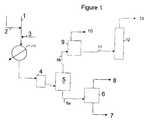
- FIG. 1 is a schematic drawing of the process according to a preferred embodiment.
- Mix extract stream 1, extract without solvent/water stream 2, and solvent/water stream 3 are brought together in appropriate quantities. It is then cooled in cooler 14 before sending it to mixer 4, followed by settler 5. Cooling could be effectively carried out by pre-chilling solvent/water stream 2. Depending on the lubricant plants, mixer 4 and settler 5 could be combined without sacrificing the desired precleaned extract properties.
- the high PCA stream 5a from the settler 5 would then be sent to solvent recovery system 6.
- Stream 8 is a recovered solvent.
- Stream 7 contains high PCA compounds.
- Solvent of precleaned-extract 5b from settler 5 is also recovered as stream 10.
- the precleaned extract 11 from solvent recovery system 9 would then be sent to a hydrotreator 12. It is then appropriately treated to obtain the product, aromatic process oil 13.
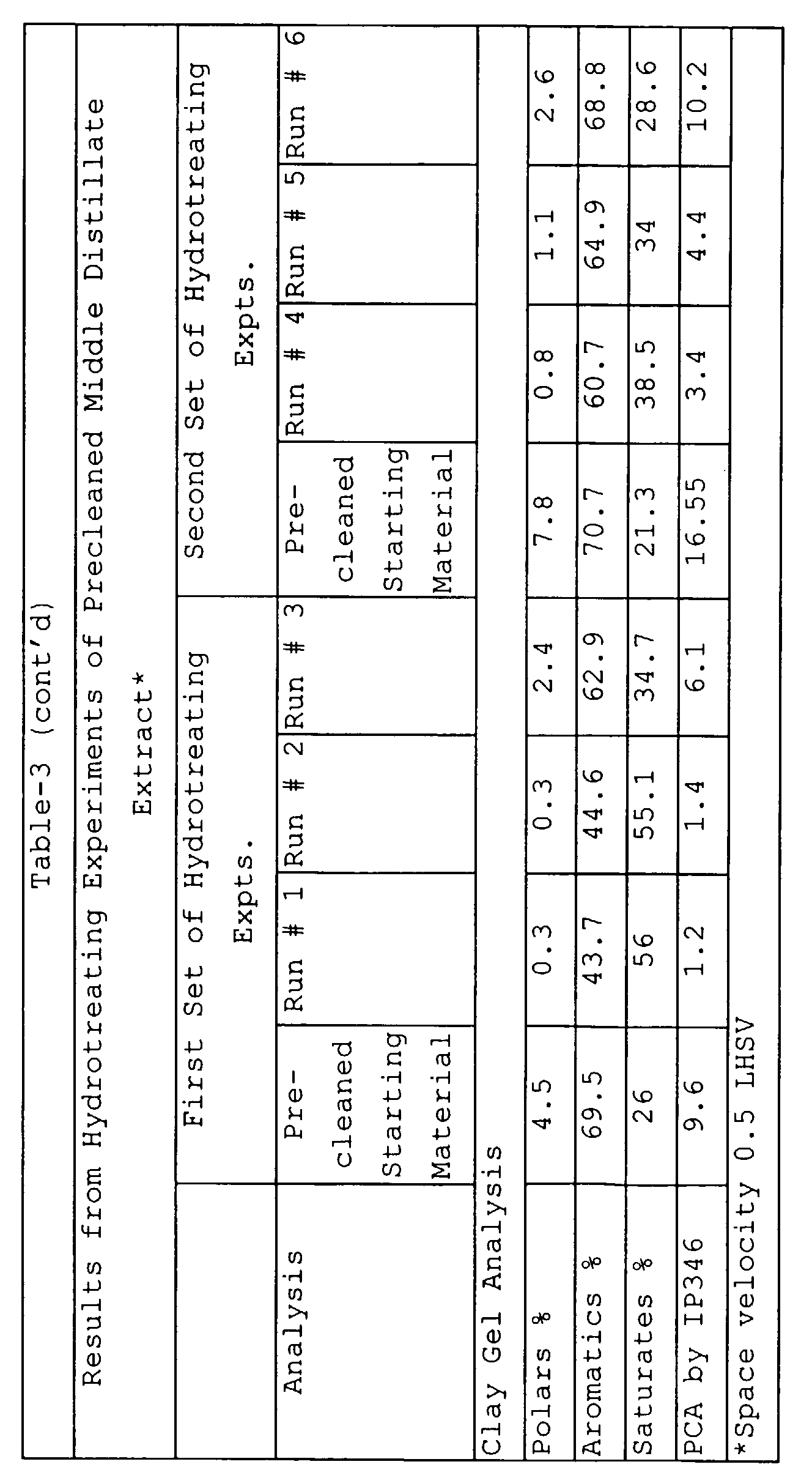
- precleaned extracts were hydrotreated.
- the hydrotreating conditions and the resulting products for two samples [(a) Expt. No. 10 & (b) Expt. No. 11 from Table 2] are tabulated in Table-3.
- Each precleaned extract was hydrotreated at 2,000 psi, at 680 °F (duplicate experiments) and also (in Run # 3) at 500 psi, 680 °F.
- the precleaned starting material has a PCA of 9.6 weight percent and was reduced to 1.2, 1.4 and 6.1 respectively.
Landscapes
- Chemical & Material Sciences (AREA)
- Oil, Petroleum & Natural Gas (AREA)
- Engineering & Computer Science (AREA)
- Chemical Kinetics & Catalysis (AREA)
- General Chemical & Material Sciences (AREA)
- Organic Chemistry (AREA)
- Production Of Liquid Hydrocarbon Mixture For Refining Petroleum (AREA)
Abstract
Description
| Middle Distillate Extract analysis (solvent-free basis) | |
| Viscosity | |
| cSt@40 °C (Calc) | 658 |
| cSt@60 °C | 136 |
| cSt@100 °C | 17.8 |
| Nitrogen, PPM | 2820 |
| Sulphur, PPM | 37600 |
| Density @60 °F, g/ml | 1.02 |
| Pour Point, °F | 73 |
| COC Flash Point, °F | 495 |
| Clay Gel Analysis, % | |
| ASTM D2007, POLARS | 9.1 |
| AROMS | 76.6 |
| SATS | 14.3 |
| PCA by IP346, wt% | 29.1 |
| Aniline Cloud Point, °F | 84 |
| D2887 Distillation | |
| 5% off Temp, °F | 757 |
| 50% off Temp, °F | 841 |
| 95% off Temp, °F | 902 |
| GC-MS: ASTM D3239 | |
| Saturates, wt% | 17.4 |
| Aromatics, wt% | 79.4 |
| Polars, wt% | 4.26 |
| Laboratory Single Stage Extraction of Middle Distillate Extract | |||||||
| Expt. No. | NMP/ Oil ratio wt./ wt. | Water in NMP wt% | Extraction Temp, °F | Raffinate Yield, % | IP346 wt% | Sulphur PPM | Nitrogen PPM |
| 1 | 0.5 | 4 | 140 | 86.1 | 26.5 | 37300 | 3290 |
| 2 | 0.5 | 6 | 140 | 89.4 | 25.1 | 36000 | 2720 |
| 3 | 0.8 | 5 | 140 | 71.8 | 22.3 | 34400 | 1980 |
| 4 | 0.8 | 5 | 140 | 72.9 | 21.9 | 34200 | 2110 |
| 5 | 1 | 4 | 140 | 60.7 | 18.8 | 34600 | 1870 |
| 6 | 1 | 6 | 140 | 76.1 | 20.3 | 26200 | 1790 |
| 7 | 3.7 | 6 | 140 | 24.8 | 6.8 | 18000 | 6 |
| 8 | 4.2 | 6 | 140 | 21.7 | 6.7 | 17800 | 6 |
| 9 | 3.8 | 8 | 120 | 52 | 11.3 | 27200 | 1040 |
| 10 | 3.8 | 8 | 120 | 53.8 | 9.6 | 24600 | 3560 |
| 11 | 1 | 4 | 120 | 59.9 | 16.6 | 28800 | 5820 |

Claims (9)
- A process for producing a non-toxic aromatic oil having a low PCA comprising the steps of:precleaning a mix extract from a lube plant in a first stage by adding appropriate amounts of solvent/water to said mix extract and separating a raffinate oil; andhydrotreating said precleaned-extract in a second stage.
- Process according to claim 1, wherein the separation is performed bycooling said mixture of the mix extract, solvent and water;mixing said mixture of said extract stream and said solvent/water stream in a mixer;settling said mixture of said cooled extract stream and said solvent/water stream in a settler thereby producing a first stream having a high PCA and a second stream comprising a precleaned extract and solvent;sending said first high PCA stream to a solvent recovery system;recovering said solvent from said precleaned extract.
- Process according to any one of claims 1-2, wherein said solvent is selected from a group comprising furfural, N-methyl pyrrolidinone (NMP) and phenol.
- Process according to claim 3, wherein the solvent is N-methyl pyrrolidinone (NMP).
- Process according to any one of claims 1-5 wherein said solvent-to-oil weight ratio is in the range of 0.25-10.
- Process according to claim 5, wherein said ratio is between 1-8.
- Process according to any one of claims 1-6 wherein the water content in said solvent as co-solvent is in the range of 2-12 wt%.
- Process according to claim 7, wherein said content is between 4-8 wt%.
- Process according to any one of claims 1-7 wherein said precleaning of said extraction is performed at a temperature between 38 and 66 °C.
Applications Claiming Priority (2)
| Application Number | Priority Date | Filing Date | Title |
|---|---|---|---|
| US45506999A | 1999-12-06 | 1999-12-06 | |
| US455069 | 1999-12-06 |
Publications (3)
| Publication Number | Publication Date |
|---|---|
| EP1106673A2 true EP1106673A2 (en) | 2001-06-13 |
| EP1106673A3 EP1106673A3 (en) | 2002-02-06 |
| EP1106673B1 EP1106673B1 (en) | 2004-10-06 |
Family
ID=23807265
Family Applications (1)
| Application Number | Title | Priority Date | Filing Date |
|---|---|---|---|
| EP20000204357 Expired - Lifetime EP1106673B1 (en) | 1999-12-06 | 2000-12-06 | Removal of polycyclic aromatic compounds from extracts |
Country Status (2)
| Country | Link |
|---|---|
| EP (1) | EP1106673B1 (en) |
| DE (1) | DE60014558T2 (en) |
Cited By (4)
| Publication number | Priority date | Publication date | Assignee | Title |
|---|---|---|---|---|
| US6802960B1 (en) | 1999-03-02 | 2004-10-12 | Bp Oil International Limited | Two stage extraction oil treatment process |
| CN106190288A (en) * | 2015-05-05 | 2016-12-07 | 中国石油化工股份有限公司 | A kind of method producing aromatic hydrocarbon rubber filling oil |
| CN106190292A (en) * | 2015-05-05 | 2016-12-07 | 中国石油化工股份有限公司 | A kind of method being produced environment-friendly aromatic type rubber filling oil by wax tailings |
| US9567532B2 (en) | 2012-10-09 | 2017-02-14 | Orgkhim Biochemical Holding Management Company, Joint Stock Company (Orgkhim Bch Management Company, Jsc) | Method for producing non-carcinogenic aromatic process oil |
Family Cites Families (5)
| Publication number | Priority date | Publication date | Assignee | Title |
|---|---|---|---|---|
| GB1426746A (en) * | 1972-08-30 | 1976-03-03 | British Petroleum Co | Oil treatment process |
| FR2273859A1 (en) * | 1974-06-05 | 1976-01-02 | Exxon Research Engineering Co | MINERAL OIL REFINING PROCESS TO PRODUCE IN PARTICULAR OILS WITH AROMATIC TENDENCY |
| US4515680A (en) * | 1983-05-16 | 1985-05-07 | Ashland Oil, Inc. | Naphthenic lube oils |
| US5059303A (en) * | 1989-06-16 | 1991-10-22 | Amoco Corporation | Oil stabilization |
| ES2224215T3 (en) * | 1996-10-31 | 2005-03-01 | Repsol Petroleo S.A. | PROCESS FOR OBTAINING AROMATIC OILS WITH A CONTENT IN POLYCLICAL AROMATIC COMPOUNDS LESS THAN 3% USED AS PROCESS OILS. |
-
2000
- 2000-12-06 EP EP20000204357 patent/EP1106673B1/en not_active Expired - Lifetime
- 2000-12-06 DE DE2000614558 patent/DE60014558T2/en not_active Expired - Fee Related
Cited By (6)
| Publication number | Priority date | Publication date | Assignee | Title |
|---|---|---|---|---|
| US6802960B1 (en) | 1999-03-02 | 2004-10-12 | Bp Oil International Limited | Two stage extraction oil treatment process |
| US9567532B2 (en) | 2012-10-09 | 2017-02-14 | Orgkhim Biochemical Holding Management Company, Joint Stock Company (Orgkhim Bch Management Company, Jsc) | Method for producing non-carcinogenic aromatic process oil |
| CN106190288A (en) * | 2015-05-05 | 2016-12-07 | 中国石油化工股份有限公司 | A kind of method producing aromatic hydrocarbon rubber filling oil |
| CN106190292A (en) * | 2015-05-05 | 2016-12-07 | 中国石油化工股份有限公司 | A kind of method being produced environment-friendly aromatic type rubber filling oil by wax tailings |
| CN106190292B (en) * | 2015-05-05 | 2018-06-19 | 中国石油化工股份有限公司 | A kind of method by wax tailings production environment-friendly aromatic type rubber filling oil |
| CN106190288B (en) * | 2015-05-05 | 2018-06-19 | 中国石油化工股份有限公司 | A kind of method for producing aromatic hydrocarbon rubber filling oil |
Also Published As
| Publication number | Publication date |
|---|---|
| EP1106673A3 (en) | 2002-02-06 |
| DE60014558T2 (en) | 2005-10-20 |
| DE60014558D1 (en) | 2004-11-11 |
| EP1106673B1 (en) | 2004-10-06 |
Similar Documents
| Publication | Publication Date | Title |
|---|---|---|
| AU733061B2 (en) | Selective re-extraction of lube extracts to reduce mutagenicity index | |
| EP0839891B1 (en) | Process for obtaining aromatic oils having a polycyclic aromatics content of less than 3% which are useful as process oils | |
| US6110358A (en) | Process for manufacturing improved process oils using extraction of hydrotreated distillates | |
| US5034119A (en) | Non-carcinogenic bright stock extracts and deasphalted oils | |
| JPH11302456A (en) | Process oil and method for producing the same | |
| KR950005684B1 (en) | Method for producing lubricant base oil | |
| EP0290656A1 (en) | Process for the separation of hydrocarbons from a mixed feedstock | |
| EP1106673B1 (en) | Removal of polycyclic aromatic compounds from extracts | |
| EP0926219B1 (en) | Method of producing a process oil | |
| US20030168382A1 (en) | Process for making non-carcinogentic, high aromatic process oil | |
| EP0899321A2 (en) | Process oil production | |
| EP0892032B1 (en) | nManufacturing process for improved process oils using aromatic enrichment and two stage hydrofining | |
| JP3658155B2 (en) | Production of non-carcinogenic aromatic hydrocarbon oils by solvent extraction | |
| CA1093490A (en) | Process for the production of lubricating oils from sulfur-containing petroleum stocks | |
| US7186876B2 (en) | Process to prepare a process oil | |
| JP3079091B2 (en) | Rubber process oil and method for producing the same | |
| KR100705141B1 (en) | Raffinate hydroconversion process | |
| EP0187479A2 (en) | Extraction of aromatics with ethyl acetoacetate | |
| JP3902841B2 (en) | Production of non-carcinogenic aromatic hydrocarbon oils by solvent extraction and hydrorefining | |
| JPH0586993B2 (en) | ||
| EP3545054A1 (en) | Process for producing an extender process oil | |
| WO2022170257A1 (en) | Methods of preparing naphthenic process oil via extraction and separation | |
| JPH01153790A (en) | Production of highly aromatic and high-boiling solvent | |
| JPS6146518B2 (en) | ||
| EP0816473A1 (en) | Non-carcinogenic bright stock extracts and deasphalted oils and process for the production thereof |
Legal Events
| Date | Code | Title | Description |
|---|---|---|---|
| PUAI | Public reference made under article 153(3) epc to a published international application that has entered the european phase |
Free format text: ORIGINAL CODE: 0009012 |
|
| AK | Designated contracting states |
Kind code of ref document: A2 Designated state(s): DE FR GB IT NL SE Kind code of ref document: A2 Designated state(s): AT BE CH CY DE DK ES FI FR GB GR IE IT LI LU MC NL PT SE TR |
|
| AX | Request for extension of the european patent |
Free format text: AL;LT;LV;MK;RO;SI |
|
| PUAL | Search report despatched |
Free format text: ORIGINAL CODE: 0009013 |
|
| AK | Designated contracting states |
Kind code of ref document: A3 Designated state(s): AT BE CH CY DE DK ES FI FR GB GR IE IT LI LU MC NL PT SE TR |
|
| AX | Request for extension of the european patent |
Free format text: AL;LT;LV;MK;RO;SI |
|
| 17P | Request for examination filed |
Effective date: 20020801 |
|
| AKX | Designation fees paid |
Free format text: DE FR GB IT NL SE |
|
| 17Q | First examination report despatched |
Effective date: 20020920 |
|
| GRAP | Despatch of communication of intention to grant a patent |
Free format text: ORIGINAL CODE: EPIDOSNIGR1 |
|
| GRAS | Grant fee paid |
Free format text: ORIGINAL CODE: EPIDOSNIGR3 |
|
| GRAA | (expected) grant |
Free format text: ORIGINAL CODE: 0009210 |
|
| AK | Designated contracting states |
Kind code of ref document: B1 Designated state(s): DE FR GB IT NL SE |
|
| REG | Reference to a national code |
Ref country code: GB Ref legal event code: FG4D |
|
| REG | Reference to a national code |
Ref country code: IE Ref legal event code: FG4D |
|
| REF | Corresponds to: |
Ref document number: 60014558 Country of ref document: DE Date of ref document: 20041111 Kind code of ref document: P |
|
| ET | Fr: translation filed | ||
| PLBE | No opposition filed within time limit |
Free format text: ORIGINAL CODE: 0009261 |
|
| STAA | Information on the status of an ep patent application or granted ep patent |
Free format text: STATUS: NO OPPOSITION FILED WITHIN TIME LIMIT |
|
| 26N | No opposition filed |
Effective date: 20050707 |
|
| PGFP | Annual fee paid to national office [announced via postgrant information from national office to epo] |
Ref country code: NL Payment date: 20071228 Year of fee payment: 8 |
|
| PGFP | Annual fee paid to national office [announced via postgrant information from national office to epo] |
Ref country code: SE Payment date: 20081031 Year of fee payment: 9 Ref country code: IT Payment date: 20081111 Year of fee payment: 9 |
|
| PGFP | Annual fee paid to national office [announced via postgrant information from national office to epo] |
Ref country code: FR Payment date: 20081020 Year of fee payment: 9 |
|
| PGFP | Annual fee paid to national office [announced via postgrant information from national office to epo] |
Ref country code: DE Payment date: 20081222 Year of fee payment: 9 |
|
| PGFP | Annual fee paid to national office [announced via postgrant information from national office to epo] |
Ref country code: GB Payment date: 20081124 Year of fee payment: 9 |
|
| NLV4 | Nl: lapsed or anulled due to non-payment of the annual fee |
Effective date: 20090701 |
|
| PG25 | Lapsed in a contracting state [announced via postgrant information from national office to epo] |
Ref country code: NL Free format text: LAPSE BECAUSE OF NON-PAYMENT OF DUE FEES Effective date: 20090701 |
|
| EUG | Se: european patent has lapsed | ||
| GBPC | Gb: european patent ceased through non-payment of renewal fee |
Effective date: 20091206 |
|
| REG | Reference to a national code |
Ref country code: FR Ref legal event code: ST Effective date: 20100831 |
|
| PG25 | Lapsed in a contracting state [announced via postgrant information from national office to epo] |
Ref country code: FR Free format text: LAPSE BECAUSE OF NON-PAYMENT OF DUE FEES Effective date: 20091231 |
|
| PG25 | Lapsed in a contracting state [announced via postgrant information from national office to epo] |
Ref country code: DE Free format text: LAPSE BECAUSE OF NON-PAYMENT OF DUE FEES Effective date: 20100701 |
|
| PG25 | Lapsed in a contracting state [announced via postgrant information from national office to epo] |
Ref country code: GB Free format text: LAPSE BECAUSE OF NON-PAYMENT OF DUE FEES Effective date: 20091206 |
|
| PG25 | Lapsed in a contracting state [announced via postgrant information from national office to epo] |
Ref country code: IT Free format text: LAPSE BECAUSE OF NON-PAYMENT OF DUE FEES Effective date: 20091206 |
|
| PG25 | Lapsed in a contracting state [announced via postgrant information from national office to epo] |
Ref country code: SE Free format text: LAPSE BECAUSE OF NON-PAYMENT OF DUE FEES Effective date: 20091207 |