EP1106582A2 - Silica soot and process for producing it - Google Patents
Silica soot and process for producing it Download PDFInfo
- Publication number
- EP1106582A2 EP1106582A2 EP00122419A EP00122419A EP1106582A2 EP 1106582 A2 EP1106582 A2 EP 1106582A2 EP 00122419 A EP00122419 A EP 00122419A EP 00122419 A EP00122419 A EP 00122419A EP 1106582 A2 EP1106582 A2 EP 1106582A2
- Authority
- EP
- European Patent Office
- Prior art keywords
- silica
- intermediates
- soot
- process according
- grow
- Prior art date
- Legal status (The legal status is an assumption and is not a legal conclusion. Google has not performed a legal analysis and makes no representation as to the accuracy of the status listed.)
- Withdrawn
Links
- VYPSYNLAJGMNEJ-UHFFFAOYSA-N Silicium dioxide Chemical compound O=[Si]=O VYPSYNLAJGMNEJ-UHFFFAOYSA-N 0.000 title claims abstract description 179
- 239000000377 silicon dioxide Substances 0.000 title claims abstract description 87
- 239000004071 soot Substances 0.000 title claims abstract description 60
- 238000000034 method Methods 0.000 title claims abstract description 27
- 239000000543 intermediate Substances 0.000 claims abstract description 30
- 239000007787 solid Substances 0.000 claims abstract description 11
- 235000012239 silicon dioxide Nutrition 0.000 claims abstract description 8
- 230000002035 prolonged effect Effects 0.000 claims abstract description 6
- 238000002485 combustion reaction Methods 0.000 claims abstract description 5
- 230000007062 hydrolysis Effects 0.000 claims abstract description 5
- 238000006460 hydrolysis reaction Methods 0.000 claims abstract description 5
- 239000004215 Carbon black (E152) Substances 0.000 claims abstract description 4
- 239000001257 hydrogen Substances 0.000 claims abstract description 4
- 229910052739 hydrogen Inorganic materials 0.000 claims abstract description 4
- 150000003377 silicon compounds Chemical class 0.000 claims abstract description 4
- 239000002245 particle Substances 0.000 claims description 20
- LIVNPJMFVYWSIS-UHFFFAOYSA-N silicon monoxide Chemical compound [Si-]#[O+] LIVNPJMFVYWSIS-UHFFFAOYSA-N 0.000 claims description 6
- 239000002210 silicon-based material Substances 0.000 claims description 3
- 238000005245 sintering Methods 0.000 claims description 2
- 239000012798 spherical particle Substances 0.000 abstract description 2
- 238000005498 polishing Methods 0.000 description 17
- 239000011521 glass Substances 0.000 description 8
- 239000000758 substrate Substances 0.000 description 6
- 239000000243 solution Substances 0.000 description 4
- 230000005540 biological transmission Effects 0.000 description 3
- 238000005266 casting Methods 0.000 description 3
- 239000000919 ceramic Substances 0.000 description 3
- 238000011068 loading method Methods 0.000 description 3
- 239000000463 material Substances 0.000 description 3
- 230000003746 surface roughness Effects 0.000 description 3
- 238000003917 TEM image Methods 0.000 description 2
- 239000007864 aqueous solution Substances 0.000 description 2
- 238000009826 distribution Methods 0.000 description 2
- 238000001125 extrusion Methods 0.000 description 2
- 239000000446 fuel Substances 0.000 description 2
- 238000004519 manufacturing process Methods 0.000 description 2
- 238000004377 microelectronic Methods 0.000 description 2
- 238000012545 processing Methods 0.000 description 2
- 238000001878 scanning electron micrograph Methods 0.000 description 2
- 239000000725 suspension Substances 0.000 description 2
- XLYOFNOQVPJJNP-UHFFFAOYSA-N water Substances O XLYOFNOQVPJJNP-UHFFFAOYSA-N 0.000 description 2
- 229910002012 Aerosil® Inorganic materials 0.000 description 1
- OKTJSMMVPCPJKN-UHFFFAOYSA-N Carbon Chemical compound [C] OKTJSMMVPCPJKN-UHFFFAOYSA-N 0.000 description 1
- ZLMJMSJWJFRBEC-UHFFFAOYSA-N Potassium Chemical compound [K] ZLMJMSJWJFRBEC-UHFFFAOYSA-N 0.000 description 1
- 238000010521 absorption reaction Methods 0.000 description 1
- PNEYBMLMFCGWSK-UHFFFAOYSA-N aluminium oxide Inorganic materials [O-2].[O-2].[O-2].[Al+3].[Al+3] PNEYBMLMFCGWSK-UHFFFAOYSA-N 0.000 description 1
- 238000013459 approach Methods 0.000 description 1
- 239000007900 aqueous suspension Substances 0.000 description 1
- 238000000089 atomic force micrograph Methods 0.000 description 1
- 230000009286 beneficial effect Effects 0.000 description 1
- 230000015572 biosynthetic process Effects 0.000 description 1
- 229910000420 cerium oxide Inorganic materials 0.000 description 1
- 239000000084 colloidal system Substances 0.000 description 1
- 238000001514 detection method Methods 0.000 description 1
- 239000003989 dielectric material Substances 0.000 description 1
- 238000000921 elemental analysis Methods 0.000 description 1
- 238000002474 experimental method Methods 0.000 description 1
- 238000001914 filtration Methods 0.000 description 1
- 238000009472 formulation Methods 0.000 description 1
- 229910021485 fumed silica Inorganic materials 0.000 description 1
- 239000005350 fused silica glass Substances 0.000 description 1
- 239000007789 gas Substances 0.000 description 1
- 238000000227 grinding Methods 0.000 description 1
- 238000011065 in-situ storage Methods 0.000 description 1
- 239000012528 membrane Substances 0.000 description 1
- 229910044991 metal oxide Inorganic materials 0.000 description 1
- 150000004706 metal oxides Chemical class 0.000 description 1
- 239000000203 mixture Substances 0.000 description 1
- 238000012986 modification Methods 0.000 description 1
- 230000004048 modification Effects 0.000 description 1
- BMMGVYCKOGBVEV-UHFFFAOYSA-N oxo(oxoceriooxy)cerium Chemical compound [Ce]=O.O=[Ce]=O BMMGVYCKOGBVEV-UHFFFAOYSA-N 0.000 description 1
- 239000006132 parent glass Substances 0.000 description 1
- 239000008188 pellet Substances 0.000 description 1
- 230000000704 physical effect Effects 0.000 description 1
- 229920000642 polymer Polymers 0.000 description 1
- 229910052700 potassium Inorganic materials 0.000 description 1
- 239000011591 potassium Substances 0.000 description 1
- 239000000843 powder Substances 0.000 description 1
- 239000002243 precursor Substances 0.000 description 1
- 238000001694 spray drying Methods 0.000 description 1
- 239000003381 stabilizer Substances 0.000 description 1
- 239000007858 starting material Substances 0.000 description 1
- 239000000126 substance Substances 0.000 description 1
- 229910052726 zirconium Inorganic materials 0.000 description 1
Images


Classifications
-
- B—PERFORMING OPERATIONS; TRANSPORTING
- B82—NANOTECHNOLOGY
- B82Y—SPECIFIC USES OR APPLICATIONS OF NANOSTRUCTURES; MEASUREMENT OR ANALYSIS OF NANOSTRUCTURES; MANUFACTURE OR TREATMENT OF NANOSTRUCTURES
- B82Y30/00—Nanotechnology for materials or surface science, e.g. nanocomposites
-
- C—CHEMISTRY; METALLURGY
- C01—INORGANIC CHEMISTRY
- C01B—NON-METALLIC ELEMENTS; COMPOUNDS THEREOF; METALLOIDS OR COMPOUNDS THEREOF NOT COVERED BY SUBCLASS C01C
- C01B33/00—Silicon; Compounds thereof
- C01B33/113—Silicon oxides; Hydrates thereof
- C01B33/12—Silica; Hydrates thereof, e.g. lepidoic silicic acid
- C01B33/18—Preparation of finely divided silica neither in sol nor in gel form; After-treatment thereof
- C01B33/181—Preparation of finely divided silica neither in sol nor in gel form; After-treatment thereof by a dry process
- C01B33/183—Preparation of finely divided silica neither in sol nor in gel form; After-treatment thereof by a dry process by oxidation or hydrolysis in the vapour phase of silicon compounds such as halides, trichlorosilane, monosilane
-
- C—CHEMISTRY; METALLURGY
- C03—GLASS; MINERAL OR SLAG WOOL
- C03B—MANUFACTURE, SHAPING, OR SUPPLEMENTARY PROCESSES
- C03B19/00—Other methods of shaping glass
- C03B19/10—Forming beads
- C03B19/1005—Forming solid beads
- C03B19/102—Forming solid beads by blowing a gas onto a stream of molten glass or onto particulate materials, e.g. pulverising
-
- C—CHEMISTRY; METALLURGY
- C03—GLASS; MINERAL OR SLAG WOOL
- C03B—MANUFACTURE, SHAPING, OR SUPPLEMENTARY PROCESSES
- C03B19/00—Other methods of shaping glass
- C03B19/10—Forming beads
- C03B19/1005—Forming solid beads
- C03B19/106—Forming solid beads by chemical vapour deposition; by liquid phase reaction
-
- C—CHEMISTRY; METALLURGY
- C03—GLASS; MINERAL OR SLAG WOOL
- C03B—MANUFACTURE, SHAPING, OR SUPPLEMENTARY PROCESSES
- C03B19/00—Other methods of shaping glass
- C03B19/14—Other methods of shaping glass by gas- or vapour- phase reaction processes
-
- C—CHEMISTRY; METALLURGY
- C04—CEMENTS; CONCRETE; ARTIFICIAL STONE; CERAMICS; REFRACTORIES
- C04B—LIME, MAGNESIA; SLAG; CEMENTS; COMPOSITIONS THEREOF, e.g. MORTARS, CONCRETE OR LIKE BUILDING MATERIALS; ARTIFICIAL STONE; CERAMICS; REFRACTORIES; TREATMENT OF NATURAL STONE
- C04B35/00—Shaped ceramic products characterised by their composition; Ceramics compositions; Processing powders of inorganic compounds preparatory to the manufacturing of ceramic products
- C04B35/01—Shaped ceramic products characterised by their composition; Ceramics compositions; Processing powders of inorganic compounds preparatory to the manufacturing of ceramic products based on oxide ceramics
- C04B35/14—Shaped ceramic products characterised by their composition; Ceramics compositions; Processing powders of inorganic compounds preparatory to the manufacturing of ceramic products based on oxide ceramics based on silica
-
- C—CHEMISTRY; METALLURGY
- C01—INORGANIC CHEMISTRY
- C01P—INDEXING SCHEME RELATING TO STRUCTURAL AND PHYSICAL ASPECTS OF SOLID INORGANIC COMPOUNDS
- C01P2002/00—Crystal-structural characteristics
- C01P2002/80—Crystal-structural characteristics defined by measured data other than those specified in group C01P2002/70
- C01P2002/84—Crystal-structural characteristics defined by measured data other than those specified in group C01P2002/70 by UV- or VIS- data
-
- C—CHEMISTRY; METALLURGY
- C01—INORGANIC CHEMISTRY
- C01P—INDEXING SCHEME RELATING TO STRUCTURAL AND PHYSICAL ASPECTS OF SOLID INORGANIC COMPOUNDS
- C01P2004/00—Particle morphology
- C01P2004/01—Particle morphology depicted by an image
- C01P2004/03—Particle morphology depicted by an image obtained by SEM
-
- C—CHEMISTRY; METALLURGY
- C01—INORGANIC CHEMISTRY
- C01P—INDEXING SCHEME RELATING TO STRUCTURAL AND PHYSICAL ASPECTS OF SOLID INORGANIC COMPOUNDS
- C01P2004/00—Particle morphology
- C01P2004/01—Particle morphology depicted by an image
- C01P2004/04—Particle morphology depicted by an image obtained by TEM, STEM, STM or AFM
-
- C—CHEMISTRY; METALLURGY
- C01—INORGANIC CHEMISTRY
- C01P—INDEXING SCHEME RELATING TO STRUCTURAL AND PHYSICAL ASPECTS OF SOLID INORGANIC COMPOUNDS
- C01P2004/00—Particle morphology
- C01P2004/30—Particle morphology extending in three dimensions
- C01P2004/32—Spheres
-
- C—CHEMISTRY; METALLURGY
- C01—INORGANIC CHEMISTRY
- C01P—INDEXING SCHEME RELATING TO STRUCTURAL AND PHYSICAL ASPECTS OF SOLID INORGANIC COMPOUNDS
- C01P2004/00—Particle morphology
- C01P2004/60—Particles characterised by their size
- C01P2004/62—Submicrometer sized, i.e. from 0.1-1 micrometer
-
- C—CHEMISTRY; METALLURGY
- C01—INORGANIC CHEMISTRY
- C01P—INDEXING SCHEME RELATING TO STRUCTURAL AND PHYSICAL ASPECTS OF SOLID INORGANIC COMPOUNDS
- C01P2004/00—Particle morphology
- C01P2004/60—Particles characterised by their size
- C01P2004/64—Nanometer sized, i.e. from 1-100 nanometer
-
- C—CHEMISTRY; METALLURGY
- C01—INORGANIC CHEMISTRY
- C01P—INDEXING SCHEME RELATING TO STRUCTURAL AND PHYSICAL ASPECTS OF SOLID INORGANIC COMPOUNDS
- C01P2006/00—Physical properties of inorganic compounds
- C01P2006/10—Solid density
-
- C—CHEMISTRY; METALLURGY
- C01—INORGANIC CHEMISTRY
- C01P—INDEXING SCHEME RELATING TO STRUCTURAL AND PHYSICAL ASPECTS OF SOLID INORGANIC COMPOUNDS
- C01P2006/00—Physical properties of inorganic compounds
- C01P2006/12—Surface area
Definitions
- the invention relates to a process for producing high purity, dense silica soot. More specifically, the process uses a unique flame step.
- Polishing advanced materials has become an exceedingly critical aspect of final part formation for the glass and microelectronics industries.
- Silica and alumina colloids are formed through various techniques and typically require expensive precursor materials in order to ensure the highest purity products. Solutions are stabilized with buffer systems to pH and solids loading values that result in optimal surface finish attainment. Particle size distribution can be adjusted to control the final surface finish, as well as the ability to clean residue abrasive particles from workpiece surfaces after processing.
- silica articles such as Cab-O-Sil (by Cabot Corporation), Aerosil (by Degussa), Ludox (by Du Pont) are commercially available.
- Conventional silica typically has an average particle size of 50 nanometers (nm) or less. While these fine size silica articles have their advantages, we have found the larger particle size silica soot of this invention to have their own unique properties and uses.
- the process of this invention generates the silica soot by a unique flame hydrolysis or flame combustion process under a specially designed environment.
- High purity silicon compounds are introduced into an oxygen-hydrocarbon, or oxygen-hydrogen flame, to generate silica intermediates in an insulated enclosure which is maintained at temperatures above 1600°C.
- the silica intermediates include "seeds" of solid silicon dioxide, gaseous silicon monoxide, and other intermediate silicon containing compounds from the flame hydrolysis or flame combustion reactions.
- the insulating enclosure is designed in such a way that the silica intermediates experience prolonged residence time under high temperature ( ⁇ 1600°C) within the enclosure. During the prolonged residence time, the solid silicon dioxide "seed” grows and sinters simultaneously before exiting the enclosure. Due to this unique processing approach and the selection of high purity starting chemicals, the silica soot consists of high purity, dense, spherical particles of 0.02 - 0.4 microns (average size 0.2 microns).
- the process of this invention produces high purity, dense silica (HPFS®) soot.
- the process comprises the steps of providing a furnace and maintaining it at temperatures above 1600°C. We then introduce an oxygen-hydrocarbon or oxygen-hydrogen flame into the furnace followed by introducing high purity silicon compounds into the flame. This generates high purity silica intermediates. We then keep the silica intermediates under prolonged residence times at the temperature above 1600°C. This grows and sinters the silica intermediates simultaneously into high purity, dense silica soot before exiting the furnace.
- the flame produces the silica intermediates by flame hydrolysis or flame combustion reactions.
- the silica intermediates include seeds of solid silicon dioxide, gaseous silicon monoxide and other intermediate silicon containing compounds. The solid silicon dioxide seeds grow and sinter simultaneously into the high purity, dense silica soot before exiting the furnace.
- Fig. 3 is a schematic drawing of a furnace for producing the silica soot of this invention.
- Fig. 3 shows furnace 10 including refractory enclosure 12, soot generating burner 14, auxiliary heat burners 16 and soot streams 18.
- Furnace 10 maintains temperatures above 1600°C.
- the silica soot particulate from soot stream 18 has an average particle size ranging from above 20 nm to 500 nm. More specifically, the silica soot has an average particle size ranging from 100 nm to 400 nm. Preferably, the silica soot has an average particle size ranging from 250 nm to 350 nm. More preferably, the silica soot has an average particle size of about 300 nm. We also prefer that the silica soot have a spherical morphology.
- the soot has a specific surface area of 20m 2 /g or less.
- the specific surface area is 10 to 20m 2 /g and more preferably the surface area is 15 to 20 m 2 /g.
- Particle size and surface area dimension are understood to be greater than zero.
- auxiliary heat burners 16 Conventional gas fired or electrically heated means may be used as auxiliary heat burners 16 to heat an insulated enclosure such as refractory enclosure 12.
- the oxy-fuel burners used for soot generating burner 14 also are known in the art.
- a typical oxy-fuel burner is a two million BTU/hr. burner.
- the two million BTU burner develops the following kinetic energy express in ft/lbs/sec: 400 ft/sec 356 ft-lbs/sec 800 ft/sec 1424 ft-lbs/sec 1173 ft/sec 2530 ft-lbs/sec. These burners amply provide the required temperatures above 1600°C.
- the silica soot of this invention has a density of at least 1 g/cc.
- the density is at least 2 g/cc.
- Table 1 is a trace elemental analysis of the silica soot showing the soot to be a high purity silica.
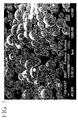
- Fig. 1 is an SEM micrograph showing the particle of the silica soot (HPFS®).
- the SCM shows the particles to be spherical with size ranging from 50 nm to 300 nm.
- Fig. 2 is a TEM micrograph showing the particles of the HPFS® soot.
- the TEM show the particles to be spherical with size ranging between 20 nm and 400 nm.
- the silica soot becomes an excellent starting material of various high-tech ceramic productions, as the following examples illustrate.
- Example 1 high purity substrate for high temperature application
- the soot can be processed into pellets, plates or various shaped containers by conventional ceramic processes such as casting, palletizing, spray drying, and extrusion, to form high purity substrates or furniture for high temperature applications.
- Example 2 high solid loading aqueous suspension
- Example 3 near net shape, low shrinkage silica body
- HPFS® soot Utilizing its dense, spherical nature and its appropriate size range, HPFS® soot has been processed by vacuum casting into desired shapes with green density of 70% theoretical value. As a result, the sintering linear shrinkage of such green body is below 12%, as compared to the normal linear shrinkage rate of above 17% when conventional silica powder is used.
- Example 4 dry glass for infrared window application
- UV transmitting glass (>90% transmission at 248 nm) has been made from HPFS® soot.
- Fig. 3 shows the transmission curve of HPFS® "soot" glass to be greater than 90%. Greater than 90% transmission was achieved from 248nm through 400nm.
- Example 6 complex shapes of silica bodies
- HPFS® soot with its appropriate size distribution makes it possible to be formulated into paste of right consistency applicable for extrusion.
- Complex honeycomb structures of high purity silica can be readily made, and have a variety of applications such as bio-reactor, capillary flow controller, high efficiency filtration system, membrane reactor, in-situ water management, microlens array, light weight mirror support and specialty dielectric materials.
- the silica soot is an ideal candidate for polishing applications.
- the soot has a large particle size when compared to conventional colloidal or fumed silica. As a result, the large size produces less surface damage and allows for a higher (faster) removal rate. The large particle size also results in super polished surfaces.
- a method for final polishing silica substrates comprises the steps of providing a silica substrate, first polishing a surface of the substrate with an aqueous solution of at least one metal oxide abrasive to a surface roughness Ra ranging from 6 to 10 ⁇ , and further polishing the surface of the substrate with an aqueous solution of the silica soot to a surface roughness Ra of 5 ⁇ or less.
- a hard polishing pad carries out the first polishing step and a soft polishing pad carries out the further polishing step.
- the soot material is ideal for polishing applications in the glass and microelectronics industries. Results show the attainment of a final surface finish with Ra of 5 ⁇ . AFM images of final polishing surfaces suggest that the soot is particularly successful in removing large scratches that are remnant from previous polishing steps.
Landscapes
- Chemical & Material Sciences (AREA)
- Engineering & Computer Science (AREA)
- Organic Chemistry (AREA)
- Materials Engineering (AREA)
- Manufacturing & Machinery (AREA)
- Chemical Kinetics & Catalysis (AREA)
- Nanotechnology (AREA)
- Ceramic Engineering (AREA)
- Physics & Mathematics (AREA)
- Composite Materials (AREA)
- Condensed Matter Physics & Semiconductors (AREA)
- General Physics & Mathematics (AREA)
- Crystallography & Structural Chemistry (AREA)
- Inorganic Chemistry (AREA)
- Structural Engineering (AREA)
- Silicon Compounds (AREA)
- Glass Melting And Manufacturing (AREA)
Abstract
Description
| 400 ft/sec | 356 ft-lbs/sec |
| 800 ft/sec | 1424 ft-lbs/sec |
| 1173 ft/sec | 2530 ft-lbs/sec. |
| Ba, Na, Zr | Al, Ca, Co, Ni | Fe, Mg, Ti |
| <0.01 wt% | <0.003 wt% | <0.001 wt% |
Claims (18)
- A process for producing high purity, dense silica soot comprising the steps of:providing a furnace;maintaining the furnace at temperatures above 1600°C;introducing an oxygen-hydrocarbon or oxygen-hydrogen flame into the furnace;introducing high purity silicon compounds into the flame;generating high purity silica intermediates;keeping the silica intermediates under prolonged residence times at the temperature above 1600°C; and
growing and sintering the silica intermediates simultaneously into high purity, dense silica soot before exiting the furnace. - A process according to claim 1 wherein the flame produces the silica intermediates by flame hydrolysis or flame combustion reactions.
- A process according to claim 1 wherein the flame produces the silica intermediates which include seeds of solid silicon dioxide, gaseous silicon monoxide and other intermediate silicon containing compounds.
- A process according to claim 3 wherein the solid silicon dioxide seeds grow and sinter simultaneously into the high purity, dense silica soot before exiting the furnace.
- A process according to claim 1 wherein the silica intermediates grow into high purity, dense, spherical silica soot.
- A process according to claim 1 wherein the silica intermediates grow into silica soot.
- A process according to claim 1 wherein the silica intermediates grow into silica soot having an average particle size ranging from 20nm to 500nm.
- A process according to claim 1 wherein the silica intermediates grow into silica soot having an average particle size ranging from 100 nm to 400 nm.
- A process according to claim 1 wherein the silica intermediates grow into silica soot having an average particle size ranging from 250 nm to 350 nm.
- A process according to claim 1 wherein the silica intermediates grow into silica soot having an average particle size of about 300 nm.
- A process according to claim 1 wherein the silica intermediates grow into silica soot having a specific surface area of 20m2/g or less.
- A process according to claim 1 wherein the silica intermediates grow into silica soot having a specific surface area of 10 to 20m2/g.
- A process according to claim 1 wherein the silica intermediates grow into silica soot having a specific surface area of 15 to 20m2/g.
- A process according to claim 1 wherein the silica intermediates grow into silica soot having a density of at least 1 g/cc.
- A process according to claim 1 wherein the silica intermediate grow into silica soot having a density of at least 2 g/cc.
- High purity, dense silica soot produced according to the process of claim 1.
- High purity, dense silica soot having a density of at least 1 g/cc.
- Silica soot according to claim 17 having a density of at least 2 g/cc.
Applications Claiming Priority (2)
| Application Number | Priority Date | Filing Date | Title |
|---|---|---|---|
| US45889899A | 1999-12-10 | 1999-12-10 | |
| US458898 | 1999-12-10 |
Publications (2)
| Publication Number | Publication Date |
|---|---|
| EP1106582A2 true EP1106582A2 (en) | 2001-06-13 |
| EP1106582A3 EP1106582A3 (en) | 2001-10-24 |
Family
ID=23822536
Family Applications (1)
| Application Number | Title | Priority Date | Filing Date |
|---|---|---|---|
| EP00122419A Withdrawn EP1106582A3 (en) | 1999-12-10 | 2000-10-13 | Silica soot and process for producing it |
Country Status (3)
| Country | Link |
|---|---|
| EP (1) | EP1106582A3 (en) |
| JP (1) | JP2001213618A (en) |
| KR (1) | KR20010062256A (en) |
Cited By (6)
| Publication number | Priority date | Publication date | Assignee | Title |
|---|---|---|---|---|
| US6829908B2 (en) | 2002-02-27 | 2004-12-14 | Corning Incorporated | Fabrication of inclusion free homogeneous glasses |
| US6832493B2 (en) | 2002-02-27 | 2004-12-21 | Corning Incorporated | High purity glass bodies formed by zero shrinkage casting |
| US6931097B1 (en) | 1999-07-22 | 2005-08-16 | Corning Incorporated | Extreme ultraviolet soft x-ray projection lithographic method system and lithographic elements |
| US6988377B2 (en) | 2001-11-27 | 2006-01-24 | Corning Incorporated | Method for making extreme ultraviolet lithography structures |
| US6997015B2 (en) | 2001-11-27 | 2006-02-14 | Corning Incorporated | EUV lithography glass structures formed by extrusion consolidation process |
| CN102976343A (en) * | 2012-12-31 | 2013-03-20 | 宁夏胜蓝化工环保科技有限公司 | Preparation method for nano-silicon dioxide with low specific surface area |
Families Citing this family (3)
| Publication number | Priority date | Publication date | Assignee | Title |
|---|---|---|---|---|
| DE60133416T2 (en) * | 2000-06-20 | 2009-04-02 | Nippon Aerosil Co., Ltd. | AMORPHIC FINE PARTICLES FROM SILICON DIOXIDE, PROCESS FOR THEIR PREPARATION AND USE. |
| JP2003067909A (en) * | 2001-08-24 | 2003-03-07 | Fuji Electric Co Ltd | Perpendicular magnetic recording media |
| JP6853158B2 (en) * | 2017-10-27 | 2021-03-31 | クアーズテック株式会社 | Manufacturing method of silica sintered body |
Family Cites Families (8)
| Publication number | Priority date | Publication date | Assignee | Title |
|---|---|---|---|---|
| US3391997A (en) * | 1964-12-21 | 1968-07-09 | Cabot Corp | Pyrogenic silica production |
| JPS5888130A (en) * | 1981-11-20 | 1983-05-26 | Nippon Telegr & Teleph Corp <Ntt> | Manufacture of fine glass particle |
| DE3223454A1 (en) * | 1982-06-23 | 1983-12-29 | Wacker-Chemie GmbH, 8000 München | METHOD FOR PRODUCING PYROGEN-GENERATED SILICO ACID WITH AN ENHANCED THICKENING EFFECT |
| US4778500A (en) * | 1987-08-11 | 1988-10-18 | Research Foundation Of The City University Of New York | Laser initiated chain reactions for producing a sintered product |
| US6360562B1 (en) * | 1998-02-24 | 2002-03-26 | Superior Micropowders Llc | Methods for producing glass powders |
| US6260385B1 (en) * | 1998-08-07 | 2001-07-17 | Corning Incorporated | Method and burner for forming silica-containing soot |
| FI116469B (en) * | 1998-10-05 | 2005-11-30 | Liekki Oy | Flame spraying method and apparatus for manufacturing a multi-component glass |
| AU6158900A (en) * | 1999-07-19 | 2001-02-05 | Linde Gas Aktiengesellschaft | Methods for producing highly pure silicon dioxide glass and burner for carrying out this method |
-
2000
- 2000-10-13 EP EP00122419A patent/EP1106582A3/en not_active Withdrawn
- 2000-12-08 KR KR1020000074539A patent/KR20010062256A/en not_active Withdrawn
- 2000-12-11 JP JP2000375917A patent/JP2001213618A/en not_active Withdrawn
Cited By (8)
| Publication number | Priority date | Publication date | Assignee | Title |
|---|---|---|---|---|
| US6931097B1 (en) | 1999-07-22 | 2005-08-16 | Corning Incorporated | Extreme ultraviolet soft x-ray projection lithographic method system and lithographic elements |
| USRE41220E1 (en) | 1999-07-22 | 2010-04-13 | Corning Incorporated | Extreme ultraviolet soft x-ray projection lithographic method system and lithographic elements |
| US6988377B2 (en) | 2001-11-27 | 2006-01-24 | Corning Incorporated | Method for making extreme ultraviolet lithography structures |
| US6997015B2 (en) | 2001-11-27 | 2006-02-14 | Corning Incorporated | EUV lithography glass structures formed by extrusion consolidation process |
| US6829908B2 (en) | 2002-02-27 | 2004-12-14 | Corning Incorporated | Fabrication of inclusion free homogeneous glasses |
| US6832493B2 (en) | 2002-02-27 | 2004-12-21 | Corning Incorporated | High purity glass bodies formed by zero shrinkage casting |
| CN102976343A (en) * | 2012-12-31 | 2013-03-20 | 宁夏胜蓝化工环保科技有限公司 | Preparation method for nano-silicon dioxide with low specific surface area |
| CN102976343B (en) * | 2012-12-31 | 2015-02-04 | 宁夏胜蓝化工环保科技有限公司 | Preparation method for nano-silicon dioxide with low specific surface area |
Also Published As
| Publication number | Publication date |
|---|---|
| JP2001213618A (en) | 2001-08-07 |
| EP1106582A3 (en) | 2001-10-24 |
| KR20010062256A (en) | 2001-07-07 |
Similar Documents
| Publication | Publication Date | Title |
|---|---|---|
| US5665663A (en) | Method for manufacturing oxide ceramic sintered bodies | |
| EP1088789A3 (en) | Porous silica granule, its method of production and its use in a method for producing quartz glass | |
| JP6698585B2 (en) | Method for producing opaque quartz glass containing pores | |
| US20030121283A1 (en) | Optical glass silica soot particles and method of making same | |
| Cai et al. | Microstructure and mechanical properties of porous Si3N4–SiO2 ceramics fabricated by a process combining carbothermal reduction and sol–gel infiltration–sintering | |
| EP1856001A1 (en) | Method for producing ultra-high purity, optical quality, glass articles | |
| US20030232149A1 (en) | Dispersion comprising silicon/titanium mixed oxide powder, and green bodies and shaped glass articles produced therefrom | |
| JPH04219310A (en) | Production of non-sintered cristobalite particle | |
| US4040848A (en) | Polycrystalline silicon articles containing boron by sintering | |
| KR20010062256A (en) | Process for producing silica soot | |
| KR100704520B1 (en) | Manufacturing Method of Molten Glass Products | |
| JP2001220157A (en) | Amorphous synthetic silica powder and glass compact using the same | |
| JP2001220126A (en) | Crystalline synthetic silica powder and glass molding using the same | |
| JP5108803B2 (en) | Method for producing silica container | |
| JPH11310423A (en) | Synthetic quartz glass and its production | |
| JP2007504073A (en) | SiO2 molded body, production method thereof and use of the molded body | |
| Minehan et al. | Titania-silica glasses prepared by sintering alkoxide derived spherical colloids | |
| EP0767761B1 (en) | Sintered quartz glass products and methods for making same | |
| JP2875686B2 (en) | High purity silica glass foam and method for producing the same | |
| KR102422149B1 (en) | Method for manufacturing porous ceramic by direct foaming method and porous ceramic manufactured thereby | |
| JP2571181B2 (en) | Quartz glass porous molded body and method for producing the same | |
| JP4035601B2 (en) | Porous oxide and method for producing the same | |
| AU3111801A (en) | Sol-gel process for producing synthetic silica glass | |
| JPS6357383B2 (en) | ||
| JPH0664906A (en) | Powdery silicon nitride |
Legal Events
| Date | Code | Title | Description |
|---|---|---|---|
| PUAI | Public reference made under article 153(3) epc to a published international application that has entered the european phase |
Free format text: ORIGINAL CODE: 0009012 |
|
| AK | Designated contracting states |
Kind code of ref document: A2 Designated state(s): DE FR GB NL Kind code of ref document: A2 Designated state(s): AT BE CH CY DE DK ES FI FR GB GR IE IT LI LU MC NL PT SE |
|
| AX | Request for extension of the european patent |
Free format text: AL;LT;LV;MK;RO;SI |
|
| PUAL | Search report despatched |
Free format text: ORIGINAL CODE: 0009013 |
|
| AK | Designated contracting states |
Kind code of ref document: A3 Designated state(s): AT BE CH CY DE DK ES FI FR GB GR IE IT LI LU MC NL PT SE |
|
| AX | Request for extension of the european patent |
Free format text: AL;LT;LV;MK;RO;SI |
|
| RIC1 | Information provided on ipc code assigned before grant |
Free format text: 7C 03B 19/10 A, 7C 01B 33/18 B, 7C 03C 3/06 B |
|
| 17P | Request for examination filed |
Effective date: 20011219 |
|
| AKX | Designation fees paid |
Free format text: DE FR GB NL |
|
| 17Q | First examination report despatched |
Effective date: 20030131 |
|
| STAA | Information on the status of an ep patent application or granted ep patent |
Free format text: STATUS: THE APPLICATION IS DEEMED TO BE WITHDRAWN |
|
| 18D | Application deemed to be withdrawn |
Effective date: 20030611 |