EP1106177A1 - Tumor tissue accumulation enhancers for drugs - Google Patents
Tumor tissue accumulation enhancers for drugs Download PDFInfo
- Publication number
- EP1106177A1 EP1106177A1 EP00935661A EP00935661A EP1106177A1 EP 1106177 A1 EP1106177 A1 EP 1106177A1 EP 00935661 A EP00935661 A EP 00935661A EP 00935661 A EP00935661 A EP 00935661A EP 1106177 A1 EP1106177 A1 EP 1106177A1
- Authority
- EP
- European Patent Office
- Prior art keywords
- alkyl
- phenyl
- drugs
- agent
- tumor tissues
- Prior art date
- Legal status (The legal status is an assumption and is not a legal conclusion. Google has not performed a legal analysis and makes no representation as to the accuracy of the status listed.)
- Withdrawn
Links
Images


Classifications
-
- A—HUMAN NECESSITIES
- A61—MEDICAL OR VETERINARY SCIENCE; HYGIENE
- A61K—PREPARATIONS FOR MEDICAL, DENTAL OR TOILETRY PURPOSES
- A61K49/00—Preparations for testing in vivo
- A61K49/001—Preparation for luminescence or biological staining
- A61K49/0013—Luminescence
- A61K49/0017—Fluorescence in vivo
- A61K49/0019—Fluorescence in vivo characterised by the fluorescent group, e.g. oligomeric, polymeric or dendritic molecules
- A61K49/0021—Fluorescence in vivo characterised by the fluorescent group, e.g. oligomeric, polymeric or dendritic molecules the fluorescent group being a small organic molecule
-
- A—HUMAN NECESSITIES
- A61—MEDICAL OR VETERINARY SCIENCE; HYGIENE
- A61K—PREPARATIONS FOR MEDICAL, DENTAL OR TOILETRY PURPOSES
- A61K31/00—Medicinal preparations containing organic active ingredients
- A61K31/557—Eicosanoids, e.g. leukotrienes or prostaglandins
- A61K31/558—Eicosanoids, e.g. leukotrienes or prostaglandins having heterocyclic rings containing oxygen as the only ring hetero atom, e.g. thromboxanes
- A61K31/5585—Eicosanoids, e.g. leukotrienes or prostaglandins having heterocyclic rings containing oxygen as the only ring hetero atom, e.g. thromboxanes having five-membered rings containing oxygen as the only ring hetero atom, e.g. prostacyclin
-
- A—HUMAN NECESSITIES
- A61—MEDICAL OR VETERINARY SCIENCE; HYGIENE
- A61K—PREPARATIONS FOR MEDICAL, DENTAL OR TOILETRY PURPOSES
- A61K47/00—Medicinal preparations characterised by the non-active ingredients used, e.g. carriers or inert additives; Targeting or modifying agents chemically bound to the active ingredient
- A61K47/06—Organic compounds, e.g. natural or synthetic hydrocarbons, polyolefins, mineral oil, petrolatum or ozokerite
- A61K47/22—Heterocyclic compounds, e.g. ascorbic acid, tocopherol or pyrrolidones
-
- A—HUMAN NECESSITIES
- A61—MEDICAL OR VETERINARY SCIENCE; HYGIENE
- A61K—PREPARATIONS FOR MEDICAL, DENTAL OR TOILETRY PURPOSES
- A61K9/00—Medicinal preparations characterised by special physical form
- A61K9/0012—Galenical forms characterised by the site of application
- A61K9/0019—Injectable compositions; Intramuscular, intravenous, arterial, subcutaneous administration; Compositions to be administered through the skin in an invasive manner
-
- A—HUMAN NECESSITIES
- A61—MEDICAL OR VETERINARY SCIENCE; HYGIENE
- A61P—SPECIFIC THERAPEUTIC ACTIVITY OF CHEMICAL COMPOUNDS OR MEDICINAL PREPARATIONS
- A61P35/00—Antineoplastic agents
-
- C—CHEMISTRY; METALLURGY
- C07—ORGANIC CHEMISTRY
- C07D—HETEROCYCLIC COMPOUNDS
- C07D307/00—Heterocyclic compounds containing five-membered rings having one oxygen atom as the only ring hetero atom
- C07D307/77—Heterocyclic compounds containing five-membered rings having one oxygen atom as the only ring hetero atom ortho- or peri-condensed with carbocyclic rings or ring systems
- C07D307/93—Heterocyclic compounds containing five-membered rings having one oxygen atom as the only ring hetero atom ortho- or peri-condensed with carbocyclic rings or ring systems condensed with a ring other than six-membered
Definitions
- the present invention relates to an agent for enhancing accumulation of antitumor agents in tumor tissues, which comprises as an effective ingredient a prostaglandin I derivative, which agent is used in combination with the drugs.
- tumor tissues have been tried to effectively transport drugs to tumor cells or tumor tissues so as to promote therapeutic effectiveness exploiting this architectural feature of tumor tissues.
- a protein such as interferon (Cancer and Chemotherapy, 14, 1194, 1987), tumor necrosis factor (Igakunoayumi, 141, 641, 1987) or interleukin (J. Natl. Cancer. Inst., 75, 595, 1985) is used as an antitumor agent, or complexes between a high molecular or fine particulate carrier and an antitumor agent are selectively transported to tumor tissues.
- conjugates between an antitumor agent and a high molecular substance include SMANCS (covalently bound conjugate between styrene-maleic acid copolymer and neocarzinostatin)(Gann, 73, 278, 1982), dextran-mitomycin C conjugate (Pharm.
- K-18 covalently bound conjugate between melphalan and IgG
- Estracyt conjugate between oestradiol and nitrogen mustards
- Cancer and Chemotherapy 11, 2106, 1984
- conjugate between polyethylene glycol and L-asparaginase conjugate between polyethylene glycol and L-asparaginase (Chem. Lett., 773, 1980), as well as those between an antitumor agent and HPMA polymer, polyvinylpyrrolidone, polyvinyl alcohol or various polyamino acids.
- antitumor agents As for the transportation of antitumor agents to tumor tissues by making the antitumor agents into fine particles, known such fine particles include cisplatin-encapsulating microspheres, adriamycin-encapsulating albumin microspheres, doxorubicin-encapsulating liposomes (Chem. Rev., 95, 2601, 1995), cisplatin-encapsulating liposomes (J. Neurosurg., 84, 180, 1996) and daunorubicin-encapsulating liposomes (Am. J. Clin. Oncol., 17, 498, 1994). To promote the therapeutic effectiveness of these antitumor agents, combination drugs are also administered.
- angiotensin II is clinically applied because it selectively increases the blood flow in tumor tissues so as to increase the concentration of the antitumor agent in the tumor tissues (World J. Surg., 19, 836, 1995).
- quinine catabolic enzyme inhibitor which is an antihypertensive drug to increase blood vessel permeability of high molecular antitumor agents selectively in tumor tissues is also disclosed (Japanese Laid-open Patent Application (Kokai) No. 1-66130).
- carboplatin level in uterus tissue was increased by administering prostaglandin E1-containing lipid microspheres before arterial injection of carboplatin against progressive cancer of uterine cervix (Cancer and Chemotherapy, 23, 1697, 1996).
- contrast media are administered to promote the contrast of tumor images.
- various water-soluble and oily iodine-containing contrast media are used.
- gadolinium compounds such as Gd-DTPA (gadolinium chelate of diethylenetriamine pentacetate) are used as contrast media for the diagnosis of tumors (Radiology, 156, 681, 1985).
- Prostaglandin I has strong antithrombotic activity and vasodilation activity, and is used for various diseases such as peripheral circulatory disturbance. Some compounds have been found to have anti-ulcer activities, and have various pharmacological activities. However, a case wherein prostaglandin I is used as a combination drug of another drug so as to enhance accumulation of the drug in tumor tissue is not known.
- An object of the present invention is to provide an agent for enhancing accumulation of drugs in tumor tissues, which can increase accumulation of the drugs in tumor tissues, which drugs are used for the diagnosis or therapy of tumors.
- prostaglandin I derivatives specifically increase permeability of blood vessels in tumors, and decrease the blood flow thereby minimizing the recovery of the drugs from the tumor tissues, so as to enable the drugs dwelling in the tumor tissues at a high concentration, thereby completing the present invention.
- the present invention provides an agent for enhancing accumulation of drugs in tumor tissues, comprising as an effective ingredient a prostaglandin I derivative.
- the present invention also provides a use of the prostaglandin I derivative as an agent for enhancing accumulation of drugs in tumor tissues.
- prostaglandin I derivatives specifically increase permeability of blood vessels in tumors, and decrease the blood flow.
- accumulation of the drugs such as antitumor agents and contrast media in tumor tissues can be enhanced, so that therapy and diagnosis of tumors, which are highly safe and effective, are expected to be provided.
- the drugs to be used in the present invention are not restricted, and examples thereof include antitumor agents and contrast media for the diagnosis of tumors.
- the antitumor agents are not restricted as long as they have anti-tumor activities. In view of attaining sufficient therapeutic effects, high molecular antitumor agents and those in the form of fine particles encapsulating effective ingredients therein are preferred.
- the high molecular antitumor agents those having molecular weights of the effective ingredient, or the effective ingredient plus carrier moiety for formulation, if any, of not less than 5000 are preferred.
- the effective ingredient per se of the antitumor agent may be a high molecular substance.
- examples of such an antitumor agent include proteins such as interferon, tumor necrosis factor and interleukin.
- the effective ingredient may be made into a high molecular substance by complexing with a high molecular carrier.
- an antitumor agent examples include conjugates between an antitumor agent and a high molecular substance such as SMANCS (covalently bound conjugate between styrene-maleic acid copolymer and neocarzinostatin), dextran-mitomycin C conjugate, K-18 (covalently bound conjugate between melphalan and IgG), Estracyt (conjugate between oestradiol and nitrogen mustards), conjugate between polyethylene glycol and asparaginase, as well as those between an antitumor agent and HPMA polymer, polyvinylpyrrolidone, polyvinyl alcohol or various polyamino acids.
- SMANCS covalently bound conjugate between styrene-maleic acid copolymer and neocarzinostatin
- dextran-mitomycin C conjugate K-18 (covalently bound conjugate between melphalan and IgG)
- Estracyt conjugate between oestradiol and nitrogen mustards
- antitumor agents in the form of fine particles encapsulating effective ingredients therein those wherein the effective ingredients are encapsulated in liposomes, microspheres, nanospheres, microcapsules, nanocapsules and emulsions are preferred.
- those wherein lipids and/or high molecular substances are used as the materials for forming the fine particles are preferred.
- the contrast media used for the diagnosis of tumors are not restricted and include oily iodine-containing contrast media such as lipiodol, and water-soluble iodine-containing contrast media such as iopamidol and iohexol for X-ray CT; gadolinium compounds such as Gd-DTPA (gadolinium chelate of diethylenetriamine pentacetate) for the diagnosis of tumors for MRI; and gallium ( 67 Ga) chloride- or thallium ( 201 TI) citrate-containing injection solutions for RI scintigraphy diagnosis.
- oily iodine-containing contrast media such as lipiodol
- water-soluble iodine-containing contrast media such as iopamidol and iohexol for X-ray CT
- gadolinium compounds such as Gd-DTPA (gadolinium chelate of diethylenetriamine pentacetate) for the diagnosis of tumors for MRI
- Prostaglandin I derivatives are used as the agent for enhancing accumulation of drugs in tumor tissues.
- Examples of the prostaglandin I derivatives include prostaglandin I 1 derivatives, prostaglandin I 2 derivatives and prostaglandin I 3 derivatives as well as their salts and esters.
- Prostaglandin I 2 derivatives as well as their salts and esters may preferably be employed. More preferably, those represented by the following formula (I): [wherein R 1 represents
- prostaglandin I derivatives which may be used in the present invention include beraprost of the formula (II) below, iloprost, clinprost, ataprost, ciprostene, naxaprostene, taprostene, cicaprost, pimilprost,CH-169, SM-10902 and CS570, as well as salts and esters thereof, although the prostaglandin I derivatives are not restricted to these.
- the salts are not restricted as long as they are pharmaceutically acceptable, and preferred examples include alkaline metal salts such as sodium salt and potassium salt.
- the esters are also not restricted as long as they are pharmaceutically acceptable. Preferred are the esters mentioned in the definition of R 1 in Formula (I) described above, and especially preferred examples include C 1 -C 12 straight alkyl esters and C 3 -C 14 branched alkyl esters.
- the prostaglandin I derivatives used in the present invention may be produced by known processes.
- the compounds of the Formula (I) may be produced by the methods described in Japanese Laid-open Patent Application (Kokai) No. 58-124778 and Japanese Patent Publication (Kokoku) No. 6-62594.
- the tumors to be treated are not restricted, and examples thereof include malignant tumors in lung, stomach, liver, kidney, cholecyst, pancreas, skin, brain and bladder.
- the agent for enhancing accumulation of drugs in tumor tissues may be in the form of tablets, granules, fine granules, capsules, syrups or the like and may be orally administered. Alternatively, it may be administered parenterally by subcutaneous, intramuscular, arterial, intravenous, rectal or percutaneous administration or the like. In formulation for oral administration, formulation techniques such as coating may be employed. In formulation for parenteral administration, carriers for making the drug into fine particles or into high molecular substances may be employed.
- the agent for enhancing accumulation of antitumor agents may be administered simultaneously with the antitumor agent, or may be administered at time points different from those at which the drugs such as antitumor agents are administered depending on the purpose of the therapy.
- the dose of the agent for enhancing accumulation of drugs in tumor tissues differs depending on the type of the tumor, the drug, age and body weight of the patient, the administration method and the like, in case of using beraprost sodium, the dose may be about 0.1 ⁇ g to 10 g, preferably 10 ⁇ g to 1 g per day per adult.
- AH136B cells were transplanted to dorsa of feet of Donryu rats to form solid tumors.
- 0.5 mL of solution of Evans Blue (1.5%) in physiological saline was administered i.v. and then 2 ⁇ g of beraprost sodium was injected into common iliac artery which is the tumor-controlling artery.
- the blood vessel permeability-increasing effect was evaluated by comparing the amounts of the accumulated Evans Blue-albumin complex in the tissue, which is the index of the blood vessel permeability in the tumor tissue, of the beraprost sodium-administered group and of the non-administered group.
- Example 2 To each of the tumor-bearing rats prepared in the same manner as in Example 1, 0.5 mL of solution of Evans Blue (1.5%) in physiological saline was administered i.v. and then 20 ⁇ g of beraprost sodium was injected into the tail vein. The blood vessel permeability-increasing effect was evaluated by comparing the amounts of the accumulated Evans Blue-albumin complex in the tissues of the beraprost sodium-administered group and of the non-administered group. As a result, it was observed that by administration of 20 ⁇ g of beraprost sodium, the blood vessel permeability was increased to about 1.5 times that of the non-administered group (P ⁇ 0.05). The amount of the accumulated Evans Blue was quantified in the same manner as in
- common iliac artery which is the tumor-controlling artery of the tumor on the dorsum of foot of each of the tumor-bearing rats prepared in the same manner as in Examples 1 and 2
- 0.3 mL of beraprost sodium solution (30 ⁇ g/mL) in middle-length fatty acid was arterially injected continuously for 1 minute.
- the changes in the blood flow in various tissues were measured by a Doppler type blood flowmeter.
- the rate of change was expressed in terms of % of the average during 10 minutes after the beginning of the arterial injection based on the average during several minutes before the arterial injection.
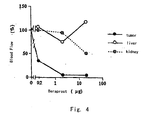
- the blood flow in the tumor tissue was sharply decreased dose-dependently. This was the phenomenon brought about by the specific relaxation of the blood vessels in the tumor tissues.
- common iliac artery which is the tumor-controlling artery of the tumor on the dorsum of foot of each of the tumor-bearing rats prepared in the same manner as in Examples 1 to 3, 0.2, 2, or 20 ⁇ g of beraprost sodium was arterially injected and the change in the blood flow was measured by a Doppler type blood flowmeter.
- the rate of change was expressed in terms of % of the average during 10 minutes after the beginning of the arterial injection based on the average during several minutes before the arterial injection. Sharp decrease in the blood flow was observed in the tumor. This decrease in the blood flow was not observed in normal tissue organs such as liver and kidney, so that it was a tumor-specific phenomenon.
Landscapes
- Health & Medical Sciences (AREA)
- Chemical & Material Sciences (AREA)
- Public Health (AREA)
- Veterinary Medicine (AREA)
- Life Sciences & Earth Sciences (AREA)
- Animal Behavior & Ethology (AREA)
- General Health & Medical Sciences (AREA)
- Organic Chemistry (AREA)
- Epidemiology (AREA)
- Pharmacology & Pharmacy (AREA)
- Medicinal Chemistry (AREA)
- General Chemical & Material Sciences (AREA)
- Chemical Kinetics & Catalysis (AREA)
- Engineering & Computer Science (AREA)
- Oil, Petroleum & Natural Gas (AREA)
- Biomedical Technology (AREA)
- Nuclear Medicine, Radiotherapy & Molecular Imaging (AREA)
- Dermatology (AREA)
- Pharmaceuticals Containing Other Organic And Inorganic Compounds (AREA)
- Medicinal Preparation (AREA)
- Acyclic And Carbocyclic Compounds In Medicinal Compositions (AREA)
Abstract
Description

wherein Z represents covalent bond, or straight or branched alkylene represented by CtH2t wherein t represents an integer of 1 to 6, R3 represents C3-C12 cycloalkyl or C3-C12 cycloalkyl substituted with 1 to 3 R4 wherein R4 represents hydrogen or C1-C5 alkyl,
wherein n represents an integer of 1 to 5,
wherein Z represents the same meanings described above, Ar1 represents phenyl, α-naphthyl, β-naphthyl, 2-pyridyl, 3-pyridyl, 4-pyridyl, α-furyl, β-furyl, a-thienyl, β-thienyl or substituted phenyl (wherein substituent(s) is(are) at least one chlorine, bromine, fluorine, iodine, trifluoromethyl, C1-C4 alkyl, nitro, cyano, methoxy, phenyl, phenoxy, p-acetamide, benzamide, -CH=N-NH-C(=O)-NH2, -NH-C(=O)-Ph, -NH-C(=O)-CH3 or -NH-C(=O)-NH2)
wherein CtH2t and R4 represent the same meanings as described above,
wherein CtH2t and R4 represent the same meanings as described above,
wherein R5 represents hydrogen or benzoyl, and R6 represents phenyl, p-bromophenyl, p-chlorophenyl, p-biphenyl, p-nitrophenyl, p-benzamidephenyl or 2-naphthyl,
wherein W represents -CH=CH-, -CH=CR7- or -C≡C-, wherein R7 represents hydrogen, C1-C30 straight or branched alkyl or aralkyl, p represents an integer of 1 to 5, or
wherein R8 represents C1-C30 alkyl or acyl,
wherein R9 represents hydrogen, C1-C12 straight alkyl, C3-C12 branched alkyl, C3-C12 cycloalkyl, C4-C13 cycloalkylalkylene, phenyl, substituted phenyl (wherein the definitions of the substituent(s) are the same as those described in (A)5) mentioned above), C7-C12 aralkyl or -SO2R10 wherein R10 represents C1-C10 alkyl, C3-C12 cycloalkyl, phenyl, substituted phenyl (wherein the definitions of the substituent are the same as those described in (A)5) mentioned above), or C7-C12 aralkyl, wherein the two R9 may be the same or different, with the proviso that when one of them is -SO2R10, the other R9 is not -SO2R10, or
- 1) -(CH2)m-
- 2) -CH=CH-CH2-
- 3) -CH2-CH=CH-
- 4) -CH2-O-CH2-
- 5) -CH=CH-
- 6) -O-CH2- or
- 7) -C≡C-
wherein m represents an integer of 1 to 3,
B represents -X-C(R11)(R12)OR13
wherein R11 represents hydrogen or C1-C4 alkyl, R13 represents hydrogen, C1-C14 acyl, C6-C15 aroyl, tetrahydropyranyl, tetrahydrofuranyl, 1-ethoxyethyl or t-butyl,
X represents
- 1) -CH2-CH2-
- 2) -CH=CH- or
- 3) -C≡C-
- 1) C1-C12 straight alkyl, C3-C14 branched alkyl, or
- 2) -Z-Ar2-
wherein Z represents the same meanings as described above, Ar2 represents phenyl, α-naphthyl, β-naphthyl, or phenyl substituted with at least one chlorine, bromine, fluorine, iodine, trifluoromethyl, C1-C4 alkyl, nitro, cyano, methoxy, phenyl or phenoxy, - 3) -CtH2tOR14
wherein CtH2t represents the same meanings as described above, R14 represents C1-C6 straight alkyl, C3-C6 branched alkyl, phenyl, phenyl substituted with at least one chlorine, bromine, fluorine, iodine, trifluoromethyl, C1-C4 alkyl, nitro, cyano, methoxy, phenyl or phenoxy, cyclopentyl, cyclohexyl, or cyclopentyl or cyclohexyl substituted with 1 to 4 C1-C4 alkyl, - 4) -Z-R3
wherein Z and R3 represent the same meanings as mentioned above, - 5) -CtH2t-CH=C(R15)R16
wherein CtH2t represents the same meanings as mentioned above, R15 and R16 represent hydrogen, methyl, ethyl, propyl or butyl, or - 6) -CuH2u-C≡C-R17
wherein u represents an integer of 1 to 7, CuH2u represents straight or branched alkylene, and R17 represents C1-C6 straight alkyl,
wherein R18 represents C1-C12 acyl, C7-C15 aroyl or R2 (wherein R2 represents the same meanings as described above),
said formula includes d-isomers, 1-isomers and racemic compounds] are employed. Preferred examples of the "pharmaceutically acceptable cation" in the above-described definitions include alkaline metal ions such as sodium ion and potassium ion.

Claims (11)
- An agent for enhancing accumulation of drugs in tumor tissues, comprising as an effective ingredient a prostaglandin I derivative.
- The agent for enhancing accumulation of drugs in tumor tissues according to claim 1, wherein said prostaglandin I derivative is a prostaglandin I2 derivative.
- The agent for enhancing accumulation of drugs in tumor tissues according to claim 1 or 2, wherein said prostaglandin I derivative is represented by the formula (I):[wherein R1 represents
 E represents hydrogen or -OR18(A) COOR2, wherein R2 represents1) hydrogen or a pharmaceutically acceptable cation,2) C1-C12 straight alkyl or C3-C14 branched alkyl,3) -Z-R3,
wherein Z represents covalent bond, or straight or branched alkylene represented by CtH2t wherein t represents an integer of 1 to 6, R3 represents C3-C12 cycloalkyl or C3-C12 cycloalkyl substituted with 1 to 3 R4 wherein R4 represents hydrogen or C1-C5 alkyl,4) -(CH2CH2O)nCH3
wherein n represents an integer of 1 to 5,5) -Z-Ar1,
wherein Z represents the same meanings described above, Ar1 represents phenyl, α-naphthyl, β-naphthyl, 2-pyridyl, 3-pyridyl, 4-pyridyl, α-furyl, β-furyl, α-thienyl, β-thienyl or substituted phenyl (wherein substituent(s) is(are) at least one chlorine, bromine, fluorine, iodine, trifluoromethyl, C1-C4 alkyl, nitro, cyano, methoxy, phenyl, phenoxy, p-acetamide, benzamide, -CH=N-NH-C(=O)-NH2, -NH-C(=O)-Ph, -NH-C(=O)-CH3 or -NH-C(=O)-NH2)6) -CtH2tCOOR4
wherein CtH2t and R4 represent the same meanings as described above,7) -CtH2tN(R4)2
wherein CtH2t and R4 represent the same meanings as described above,8) -CH(R5)-C(=O)-R6
wherein R5 represents hydrogen or benzoyl, and R6 represents phenyl, p-bromophenyl, p-chlorophenyl, p-biphenyl, p-nitrophenyl, p-benzamidephenyl or 2-naphthyl,9) -CPH2P-W-R7
wherein W represents -CH=CH-, -CH=CR7- or -C≡C-, wherein R7 represents hydrogen, C1-C30 straight or branched alkyl or aralkyl, p represents an integer of 1 to 5, or10) -CH(CH2OR8)2
wherein R8 represents C1-C30 alkyl or acyl,(B) -CH2OH(C) -C(=O)N(R9)2
wherein R9 represents hydrogen, C1-C12 straight alkyl, C3-C12 branched alkyl, C3-C12 cycloalkyl, C4-C13 cycloalkylalkylene, phenyl, substituted phenyl (wherein the definitions of the substituent(s) are the same as those described in (A)5) mentioned above), C7-C12 aralkyl or -SO2R10 wherein R10 represents C1-C10 alkyl, C3-C12 cycloalkyl, phenyl, substituted phenyl (wherein the definitions of the substituent are the same as those described in (A)5) mentioned above), or C7-C12 aralkyl, wherein the two R9 may be the same or different, with the proviso that when one of them is -SO2R10, the other R9 is not -SO2R10, or(D) -CH2OTHP (wherein THP represents tetrahydropyranyl), A representsY represents hydrogen, C1-C4 alkyl, chlorine, bromine, fluorine, formyl, methoxy or nitro,1) -(CH2)m-2) -CH=CH-CH2-3) -CH2-CH=CH-4) -CH2-O-CH2-5) -CH=CH-6) -O-CH2- or7) -C≡C-
wherein m represents an integer of I to 3,
B represents -X-C(R11)(R12)OR13
wherein R11 represents hydrogen or C1-C4 alkyl, R13 represents hydrogen, C1-C14 acyl, C6-C15 aroyl, tetrahydropyranyl, tetrahydrofuranyl, 1-ethoxyethyl or t-butyl,
X representsR12 represents1) -CH2-CH2-2) -CH=CH- or3) -C≡C-1) C1-C12 straight alkyl, C3-C14 branched alkyl, or2) -Z-Ar2-
wherein Z represents the same meanings as described above, Ar2 represents phenyl, α-naphthyl, β-naphthyl, or phenyl substituted with at least one chlorine, bromine, fluorine, iodine, trifluoromethyl, C1-C4 alkyl, nitro, cyano, methoxy, phenyl or phenoxy,3) -CtH2tOR14
wherein CtH2t represents the same meanings as described above, R14 represents C1-C6 straight alkyl, C3-C6 branched alkyl, phenyl, phenyl substituted with at least one chlorine, bromine, fluorine, iodine, trifluoromethyl, C1-C4 alkyl, nitro, cyano, methoxy, phenyl or phenoxy, cyclopentyl, cyclohexyl, or cyclopentyl or cyclohexyl substituted with 1 to 4 C1-C4 alkyl,4) -Z-R3
wherein Z and R3 represent the same meanings as mentioned above,5) -CtH2t-CH=C(R15)R16
wherein CtH2t represents the same meanings as mentioned above, R15 and R16 represent hydrogen, methyl, ethyl, propyl or butyl, or6) -CuH2u-C≡C-R17
wherein u represents an integer of 1 to 7, CuH2u represents straight or branched alkylene, and R17 represents C1-C6 straight alkyl,
wherein R18 represents C1-C12 acyl, C7-C15 aroyl or R2 (wherein R2 represents the same meanings as described above),
said formula includes d-isomers, I-isomers and racemic compounds]. - The agent for enhancing accumulation of drugs in tumor tissues according to claim 3, which is beraprost or a salt thereof.
- The agent for enhancing accumulation of drugs in tumor tissues according to any one of claims 1 to 4, wherein said drug is an antitumor agent or a contrast medium.
- The agent for enhancing accumulation of drugs in tumor tissues according to any one of claims I to 5, wherein said drug is a high molecular drug.
- The agent for enhancing accumulation of drugs in tumor tissues according to any one of claims 1 to 6, wherein effective ingredient of said drug, or complex of effective ingredient moiety and carrier moiety for formulation, has a molecular weight of not less than 5000.
- Use of said prostaglandin I derivative according to any one of claims 1 to 4 as an agent for enhancing accumulation of drugs in tumor tissues.
- The use according to claim 8, wherein said drug is an antitumor agent or a contrast medium.
- The use according to claim 8 or 9, wherein said drug is a high molecular drug.
- The use according to any one of claims 8 to 10, wherein effective ingredient of said drug, or complex of effective ingredient moiety and carrier moiety for formulation, has a molecular weight of not less than 5000.
Applications Claiming Priority (3)
| Application Number | Priority Date | Filing Date | Title |
|---|---|---|---|
| JP16676399 | 1999-06-14 | ||
| JP16676399 | 1999-06-14 | ||
| PCT/JP2000/003829 WO2000076496A1 (en) | 1999-06-14 | 2000-06-13 | Tumor tissue accumulation enhancers for drugs |
Publications (2)
| Publication Number | Publication Date |
|---|---|
| EP1106177A1 true EP1106177A1 (en) | 2001-06-13 |
| EP1106177A4 EP1106177A4 (en) | 2002-03-13 |
Family
ID=15837266
Family Applications (1)
| Application Number | Title | Priority Date | Filing Date |
|---|---|---|---|
| EP00935661A Withdrawn EP1106177A4 (en) | 1999-06-14 | 2000-06-13 | Tumor tissue accumulation enhancers for drugs |
Country Status (4)
| Country | Link |
|---|---|
| EP (1) | EP1106177A4 (en) |
| CN (1) | CN1319011A (en) |
| CA (1) | CA2340375A1 (en) |
| WO (1) | WO2000076496A1 (en) |
Family Cites Families (5)
| Publication number | Priority date | Publication date | Assignee | Title |
|---|---|---|---|---|
| CA2010511A1 (en) * | 1989-03-01 | 1990-09-01 | Roberto L. Ceriani | Method of enhancing cancer therapy by administration of unsaturated fatty acids |
| EP0389162B1 (en) * | 1989-03-14 | 1993-12-08 | Toray Industries, Inc. | 2,5,6,7-Tetranor-4,8-inter-m-phenylene PGI2 derivatives |
| JP3230246B2 (en) * | 1991-04-11 | 2001-11-19 | 東レ株式会社 | Malignant tumor metastasis inhibitor |
| DE4135193C1 (en) * | 1991-10-22 | 1993-03-11 | Schering Ag Berlin Und Bergkamen, 1000 Berlin, De | |
| DE4446694A1 (en) * | 1994-12-09 | 1996-06-13 | Schering Ag | Using additives to contrast agents to improve imaging |
-
2000
- 2000-06-13 EP EP00935661A patent/EP1106177A4/en not_active Withdrawn
- 2000-06-13 WO PCT/JP2000/003829 patent/WO2000076496A1/en not_active Ceased
- 2000-06-13 CN CN00801509A patent/CN1319011A/en active Pending
- 2000-06-13 CA CA002340375A patent/CA2340375A1/en not_active Abandoned
Also Published As
| Publication number | Publication date |
|---|---|
| WO2000076496A1 (en) | 2000-12-21 |
| CA2340375A1 (en) | 2000-12-21 |
| CN1319011A (en) | 2001-10-24 |
| EP1106177A4 (en) | 2002-03-13 |
Similar Documents
| Publication | Publication Date | Title |
|---|---|---|
| Ichihara et al. | Transcatheter arterial chemoembolization therapy for hepatocellular carcinoma using polylactic acid microspheres containing aclarubicin hydrochloride | |
| Silvestri et al. | Respiratory distress syndrome from lymphangiography contrast medium | |
| Gryglewski et al. | Reversal of platelet aggregation by prostacyclin | |
| US5049582A (en) | Prostacyclin derivatives with cytoprotective effect on liver, pancreas and kidney | |
| Li et al. | Novel strategy of combined interstitial macrophage depletion with intravenous targeted therapy to ameliorate pulmonary fibrosis | |
| Stefaniszyn et al. | Toward a better understanding of the hemodynamic effects of protamine and heparin interaction | |
| JP2002528473A5 (en) | ||
| EP0609336B1 (en) | Use of prostacyclin derivatives to prevent or treat disorders of the microcirculating system when x-ray, nmr or ultrasonic contrasting agents are administered | |
| US20020147223A1 (en) | Agent for enhancing accumulation of drugs in tumor tissues | |
| Kishi et al. | Acute toxicity of lipiodol infusion into the hepatic arteries of dogs | |
| CA2030346C (en) | Treatment of cardiac dysfunction with 15-keto-prostaglandin compounds | |
| CA2340375A1 (en) | Agent for enhancing accumulation of drugs in tumor tissues | |
| NZ521464A (en) | Apoptosis inhibiting composition comprising a 15-keto-prostaglandin or derivative thereof | |
| JPWO2000076496A1 (en) | Tumor tissue accumulation enhancer | |
| CA2337213C (en) | Therapeutic agent for renal failure containing 4,8-inter-m-phenylene prostaglandin i2 derivative | |
| Wakitani et al. | Inhibitory Effect of OP-41483· α-CD, a Prostacyclin Analog, on Peripheral Vascular Lesion Models in Rats | |
| JP2000355541A (en) | Antitumor agent | |
| JPH0378368B2 (en) | ||
| Hermreck et al. | Renal response in sepsis | |
| JPH11510809A (en) | Use of prostane derivatives and their combinations with antibiotics in the treatment of bacterial infections | |
| USRE34756E (en) | Excretion of potassium ion by prostanoic acid derivatives | |
| JPH10509691A (en) | Use of additives in addition to contrast agents to improve image display | |
| JPH11189536A (en) | Drugs for treating or preventing primary glomerulonephritis | |
| MASUGI et al. | The Role of Antihypertensive Polar Renomedullary Lipid in the Pathogenesis of Hypertension: SYMPOSIUM ON BLOOD PRESSURE AND VASOACTIVE SUBSTANCES | |
| CN121338010A (en) | Liposome for resisting tumor |
Legal Events
| Date | Code | Title | Description |
|---|---|---|---|
| PUAI | Public reference made under article 153(3) epc to a published international application that has entered the european phase |
Free format text: ORIGINAL CODE: 0009012 |
|
| 17P | Request for examination filed |
Effective date: 20010307 |
|
| AK | Designated contracting states |
Kind code of ref document: A1 Designated state(s): AT BE CH CY DE DK ES FI FR GB GR IE IT LI LU MC NL PT SE |
|
| AX | Request for extension of the european patent |
Free format text: AL;LT;LV;MK;RO;SI |
|
| A4 | Supplementary search report drawn up and despatched |
Effective date: 20020124 |
|
| AK | Designated contracting states |
Kind code of ref document: A4 Designated state(s): AT BE CH CY DE DK ES FI FR GB GR IE IT LI LU MC NL PT SE |
|
| 17Q | First examination report despatched |
Effective date: 20040211 |
|
| RBV | Designated contracting states (corrected) |
Designated state(s): DE ES FR GB IT |
|
| RTI1 | Title (correction) |
Free format text: PROSTAGLANDIN DERIVATIVES TUMOR TISSUE ACCUMULATION ENHANCERS FOR DRUGS |
|
| GRAP | Despatch of communication of intention to grant a patent |
Free format text: ORIGINAL CODE: EPIDOSNIGR1 |
|
| STAA | Information on the status of an ep patent application or granted ep patent |
Free format text: STATUS: THE APPLICATION IS DEEMED TO BE WITHDRAWN |
|
| 18D | Application deemed to be withdrawn |
Effective date: 20060221 |