EP1106167A2 - Dye compositions for keratin fibers comprising a nonionic compound - Google Patents
Dye compositions for keratin fibers comprising a nonionic compound Download PDFInfo
- Publication number
- EP1106167A2 EP1106167A2 EP00310764A EP00310764A EP1106167A2 EP 1106167 A2 EP1106167 A2 EP 1106167A2 EP 00310764 A EP00310764 A EP 00310764A EP 00310764 A EP00310764 A EP 00310764A EP 1106167 A2 EP1106167 A2 EP 1106167A2
- Authority
- EP
- European Patent Office
- Prior art keywords
- composition
- dyeing
- composition according
- dye
- fibers
- Prior art date
- Legal status (The legal status is an assumption and is not a legal conclusion. Google has not performed a legal analysis and makes no representation as to the accuracy of the status listed.)
- Withdrawn
Links
Classifications
-
- A—HUMAN NECESSITIES
- A61—MEDICAL OR VETERINARY SCIENCE; HYGIENE
- A61Q—SPECIFIC USE OF COSMETICS OR SIMILAR TOILETRY PREPARATIONS
- A61Q5/00—Preparations for care of the hair
- A61Q5/10—Preparations for permanently dyeing the hair
-
- A—HUMAN NECESSITIES
- A61—MEDICAL OR VETERINARY SCIENCE; HYGIENE
- A61K—PREPARATIONS FOR MEDICAL, DENTAL OR TOILETRY PURPOSES
- A61K8/00—Cosmetics or similar toiletry preparations
- A61K8/18—Cosmetics or similar toiletry preparations characterised by the composition
- A61K8/30—Cosmetics or similar toiletry preparations characterised by the composition containing organic compounds
- A61K8/33—Cosmetics or similar toiletry preparations characterised by the composition containing organic compounds containing oxygen
- A61K8/39—Derivatives containing from 2 to 10 oxyalkylene groups
-
- A—HUMAN NECESSITIES
- A61—MEDICAL OR VETERINARY SCIENCE; HYGIENE
- A61K—PREPARATIONS FOR MEDICAL, DENTAL OR TOILETRY PURPOSES
- A61K8/00—Cosmetics or similar toiletry preparations
- A61K8/18—Cosmetics or similar toiletry preparations characterised by the composition
- A61K8/72—Cosmetics or similar toiletry preparations characterised by the composition containing organic macromolecular compounds
- A61K8/81—Cosmetics or similar toiletry preparations characterised by the composition containing organic macromolecular compounds obtained by reactions involving only carbon-to-carbon unsaturated bonds
- A61K8/8141—Compositions of homopolymers or copolymers of compounds having one or more unsaturated aliphatic radicals, each having only one carbon-to-carbon double bond, and at least one being terminated by only one carboxyl radical, or of salts, anhydrides, esters, amides, imides or nitriles thereof; Compositions of derivatives of such polymers
- A61K8/8147—Homopolymers or copolymers of acids; Metal or ammonium salts thereof, e.g. crotonic acid, (meth)acrylic acid; Compositions of derivatives of such polymers
-
- A—HUMAN NECESSITIES
- A61—MEDICAL OR VETERINARY SCIENCE; HYGIENE
- A61K—PREPARATIONS FOR MEDICAL, DENTAL OR TOILETRY PURPOSES
- A61K8/00—Cosmetics or similar toiletry preparations
- A61K8/18—Cosmetics or similar toiletry preparations characterised by the composition
- A61K8/72—Cosmetics or similar toiletry preparations characterised by the composition containing organic macromolecular compounds
- A61K8/84—Cosmetics or similar toiletry preparations characterised by the composition containing organic macromolecular compounds obtained by reactions otherwise than those involving only carbon-carbon unsaturated bonds
-
- A—HUMAN NECESSITIES
- A61—MEDICAL OR VETERINARY SCIENCE; HYGIENE
- A61K—PREPARATIONS FOR MEDICAL, DENTAL OR TOILETRY PURPOSES
- A61K8/00—Cosmetics or similar toiletry preparations
- A61K8/18—Cosmetics or similar toiletry preparations characterised by the composition
- A61K8/72—Cosmetics or similar toiletry preparations characterised by the composition containing organic macromolecular compounds
- A61K8/84—Cosmetics or similar toiletry preparations characterised by the composition containing organic macromolecular compounds obtained by reactions otherwise than those involving only carbon-carbon unsaturated bonds
- A61K8/86—Polyethers
Definitions
- the present invention relates to dye compositions for keratin fibers, in particular for human keratin fibers such as hair, comprising at lest one colorant [oxidation dye (base and/or coupler) or direct dye], and at least one nonionic compound of the general formula R-(OCH 2 CH 2 ) n -OR', wherein R denotes a C 10 -C 30 alkyl radical, R' denotes a C 10 -C 30 alkyl radical which may be substituted by a hydroxyl radical, and n is an integer from 1 to approximately 100.
- Two types of coloration can be distinguished in the field of hair treatment.
- the first is semi-permanent or temporary coloration, or direct coloration, which involves dyes capable of giving the hair's natural color a more or less pronounced color change which may withstand shampooing several times. These colorants are known as direct dyes; they can be used with or without an oxidizing agent. In the presence of an oxidizing agent, the aim is to obtain a lightening direct coloration.
- the lightening coloration is carried out by applying to the hair the mixture, prepared at the time of use, of a direct dye and an oxidizing agent, and in particular makes it possible to obtain, by lightening the melanin in the hair, an advantageous effect such as a unified color in the case of gray hair, or to bring out the color in the case of naturally pigmented hair.
- the second is permanent coloration or oxidation coloration.
- oxidation dyes comprising oxidation dye precursors and couplers.
- Oxidation dye precursor commonly known as “oxidation bases”
- Oxidation bases are initially colorless or weakly colored compounds which develop their dyeing power on the hair in the presence of oxidizing agents added at the time of use, leading to the formation of colored compounds and dyes.
- the formation of these colored compounds and dyes results either from an oxidative condensation of the "oxidation bases” with themselves or from an oxidative condensation of the "oxidation bases” with coloration modifier compounds commonly known as “couplers", which are generally present in the dye compositions used in oxidation coloration.
- the applicant has discovered that the ingredients of the traditional thickener type, surfactant and solvent generally decreased the holding of the dye on the fibers, which results in dull shades and also larger quantity of the dye, solvent and/or surfactant to be used to dissolve the dye, if stronger shades are needed. Furthermore, it was also discovered that after mixing with oxidizing agent, the dyeing compositions containing one or more dyes and the above-described ingredients lost their gelling character and exhibited undesirable fluidity.
- the Applicant has discovered that it is possible to obtain the coloring compositions which do not flow and remain more localized at the location where it is applied, and which permits to obtain stronger and more chromatic (luminous) shades, if an effective amount of the particular nonionic new compound is introduced in the dyeing composition, or in the oxidizing composition (when it relates to oxidation dyeing or lightening direct dyeing), or in the two compositions at the same time.
- the present invention thus has an object to provide a dyeing composition for keratin fibers, particularly for human keratin fibers such as hair, comprising, in a medium suitable for dyeing, at least one dye, and characterized by the fact that it further contains at least one nonionic compound of the general formula R-(OCH 2 CH 2 ) n -OR', wherein R denotes a C 10 -C 30 alkyl radical, R' denotes a C 10 -C 30 alkyl radical which may be substituted by a hydroxyl radical , and n is an integer from 1 to approximately 100.
- the present invention it is possible to provide a dyeing composition having high viscosity by utilizing a small amount of nonionic compound according to the invention, and to improve the quality of use at application. It is also possible in an advantageous manner to reduce the consumption of the surfactants.
- the invention also makes it possible to reduce the quantity of the active colorants used in the dyeing composition compared with the classic technique in the prior art.
- composition according to the invention makes it possible to obtain shades with little selectivity and good resistance with respect to chemical agents (shampoos, permanent agents) or natural agents (light, perspiration).
- Another object of the present invention is to provide a composition ready to use for dyeing keratin fibers, constituted with a composition A comprising, in a medium appropriate for dyeing, at least one oxidation dye (base and/or coupler), or at least one direct dye, and a composition B comprising at least one oxidizing agent, the nonionic compound as defined above being present in the composition A or in the composition B, or in both of the compositions A and B.
- a composition ready to use for dyeing keratin fibers constituted with a composition A comprising, in a medium appropriate for dyeing, at least one oxidation dye (base and/or coupler), or at least one direct dye, and a composition B comprising at least one oxidizing agent, the nonionic compound as defined above being present in the composition A or in the composition B, or in both of the compositions A and B.
- the present invention also provides a dyeing process of keratin fibers, particularly human keratin fibers such as hair, consisting of applying to the dry or wet keratin fibers at least one composition containing, in a medium appropriate for dyeing, at least one direct dye and at least one nonionic compound as defined above, and after having optionally left the composition to act on the fibers for a resting time from 3 to 60 minutes, rinsing the fibers, optionally washing the fibers, rinsing again and then drying the fibers.
- the present invention also relates to the dyeing process of keratin fibers, particularly human keratin fibers such as hair, consisting of applying on the fibers at least one composition A containing, in a medium appropriate for dyeing, at least one oxidation dye (base and/or coupler) or at least one direct dye, the color being developed at alkaline, neutral or acid pH, with the aid of an oxidizing composition B which is mixed just at the moment of use with the composition A or which is applied sequentially without intermediate rinsing, the nonionic compound defined according to the present invention being present in either the composition A or the composition B, or in both of the compositions A and B.
- the present invention relates particularly to a dyeing process which consists of applying the composition for ready to use, extemporarily prepared at the moment of use from the compositions (A) and (B) described above, on the dry or wet keratin fibers, leaving it to act for a resting time varying preferably from 1 to 60 minutes approximately, and more preferably from 10 to 45 minutes approximately, rinsing the fibers, then optionally shampooing the fibers, and again rinsing and drying the fibers.
- a variation of the process consists of taking a composition A' containing at least one oxidation dye and/or at least one direct dye, but without the nonionic compound of the invention, and another composition A" containing at least one nonionic compound of the invention, and mixing the compositions A' and A" and the oxidizing composition B at the moment of use, and applying the mixture thus obtained.
- the invention also has an object to provide a dyeing device or "kit” having a plurality of compartments.
- a device having 2 compartments comprises a compartment containing a composition A1 containing, in a medium appropriate for dyeing, at least one oxidation dye (base and/or coupler), or at least one direct dye, and another compartment containing a composition B1 containing, in a medium appropriate for dyeing, an oxidizing agent, the or those nonionic compounds defined above being present in either the composition Al or the composition B1, or in both of the compositions A1 and B1.
- Another device having 3 compartments comprises a first compartment containing a composition A2 containing, in a medium appropriate for dyeing, at least one oxidation dye (base and/or coupler), at least one direct dye, a second compartment containing a composition B2 containing, in a medium appropriate for dyeing, an oxidizing agent, and a third compartment containing a composition C containing, in a medium appropriate for dyeing, at least one nonionic compound defined above, wherein the composition A2 and/or the composition B2 can also contain the above-defined nonionic compound.
- the present invention also relates to the use of the above-defined dyeing compositions or dyeing device or "kit” having a plural of compartments for dyeing keratin fibers such as human hair.
- the nonionic compound according to the present invention is preferably a compound of the formula R-(OCH 2 CH 2 ) n -OR' wherein R denotes a C 16 -C 18 alkyl radical, R' denotes a C 16 -C 18 alkyl radical which may be substituted by a hydroxyl radical, and n is an integer equal to or larger than 20.
- the nonionic compound is more particularly again a compound of the formula R-(OCH 2 CH 2 ) n -OR' wherein R and R' denote a C 16 -C 18 alkyl radical, and n is equal to 4.
- Such a compound is for example described in the CTFA dictionary under the name of PEG 4 DITTALLOW ETHER.
- the nonionic compound is also more particularly again a compound of the formula R-(OCH 2 CH 2 ) n -OR' wherein R denotes a C 16 -C 18 alkyl radical, R' denotes a substituted alkyl radical -C 14 OH, and n is preferably equal to 60.
- R denotes a C 16 -C 18 alkyl radical
- R' denotes a substituted alkyl radical -C 14 OH
- n is preferably equal to 60.
- Such a compound is for example found in the CTFA dictionary under the name of CETEARETH 60 MYRISTYL GLYCOL or HYDROGENATED TALLOWETH 60 MYRISTYL GLYCOL.
- CETEARETH 60 MYRISTYL GLYCOL is for example sold by the company AKZO under the commercial name ELFACOS GT 282 S.
- the nonionic compound according to the invention is preferably used in a quantity which may vary between 0.05 and 10 wt % approximately of the total weight of the dyeing composition applied on the fibers. More preferably, the quantity varies between 0.1 and 5 wt % approximately.
- the oxidation dyes which can be used according to the present invention are selected from the oxidation bases and/or the couplers.
- the compositions according to the invention contain at least one oxidation base.
- oxidation bases usable in the context of the present invention are chosen from those conventionally known as oxidation dye, from which we can cite paraphenylenediamines, double bases, ortho- and para-aminophenols and heterocyclic bases as follows;
- the oxidation bases represent preferably from 0.0005 to 12 wt% of the total weight of the composition (A).
- the couplers which can be used in the dyeing process of the invention are those which have been conventionally used in the oxidation dyeing composition, that is, meta-phenylenediamines, meta-aminophenols and meta-diphenols, the mono- or poly-hydroxylated derivatives of naphthalene, sesamol and its derivatives and heterocyclic compounds such as for example indole couplers, indoline couplers, pyridine couplers and their addition salts with an acid.
- couplers may be in particular chosen from 2-methyl-5-aminophenol, 5-N-( ⁇ -hydroxyethyl)amino-2-methylphenol, 3-aminophenol, 1,3-dihydroxybenzene, 1,3-dihydroxy-2-methylbenzene, 4-chloro-1,3-dihydroxybenzene, 2,4-diamino-1-( ⁇ -hydroxyethyloxy)benzene, 2-amino-4-( ⁇ -hydroxyethylamino)-1-methoxybenzene, 1,3-diaminobenzene, 1,3-bis(2,4-diaminophenoxy)propane, sesamol, ⁇ -naphthol, 6-hydroxyindole, 4-hydroxyindole, 4-hydroxy-N-methylindole, 6-hydroxyindoline, 2,6-dihydroxy-4-methylpyridine, 1-H-3-methylpyrazole-5-one, 1-phenyl-3-methylpyrazole-5-one, and their addition
- couplers When these couplers are present, they preferably represent from 0.0001 to 10 % by weight approximately of the total weight of composition (A), and more preferably 0.005 to 5 % by weight approximately thereof.
- the addition salts with an acid of the oxidation bases and couplers can be in particular chosen from hydrochlorides, hydrobromides, sulphates and tartrates, lactates and acetates.
- the direct dye which can be used in the present invention are those which have conventionally been used in the direct dyeing composition or lighting direct dyeing composition, that is, the dye can be chosen from nitrobenzene anthraquinone, azo, neutral, cationic or anionic dyes, naphtoquinone dyes, triarylmethane dyes, xanthene dyes, Arianors and those described in the patent applications WO 95/01772, WO 95/15144 and EP-A-0 714 954. They are used at the concentration between 0.01 and 20 % by weight approximately of the total weight of the composition.
- composition (A) and/or the composition (B) can more particularly contain at least one cationic or amphoteric substantive polymer.
- cationic polymer denotes all kinds of polymers containing cationic groups and/or groups which can be ionized into cationic groups.
- the cationic polymer which can be used in the present invention may be chosen from any of those already known per se as enhancing the cosmetic properties of hair, namely in particular those described in patent application EP-A-337 354 and in French patents FR-2 270 846, 2 383 660, 2 598 611, 2 470 596 and 2 519 863.
- the preferred cationic polymer are chosen from those which contain unites containing primary, secondary, tertiary and/or quaternary amine groups which can either form part of the main polymer chain or which can be carried by a lateral substituent that is directly attached thereto.
- the cationic polymers used generally have a number-average molecular mass of between 500 and 5 ⁇ 10 6 approximately, and preferably between 10 3 and 3 ⁇ 10 6 approximately.
- cationic polymers mention may be made more particularly of polymers of polyamine, polyamino amide and quaternary polyammonium type. These are known products. They are in particular described in French patents No. 2 505 348 or 2 542 997. Among these polymers, mention may be made of:
- cationic polymers which can be used in the context of the invention are polyalkyleneimines, in particular polyethyleneimines, polymers containing vinylpyridine or vinylpyridinium unites, condensates of polyamines and of epichlorohydrin, quaternary polyureylenes and chitin derivatives.
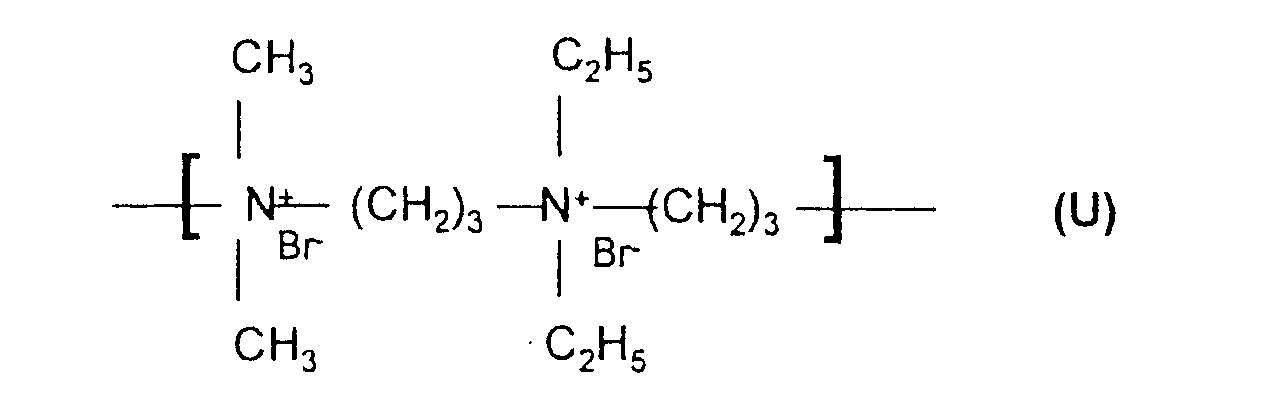
- polymers of the family (1), (9), (10), (11) and (14) are preferred, and more preferably, polymers of the formula (W) and (U) below are preferable: and in particular those of which the molecular weight, determined by gel chromatography, is between 9500 and 9900; and in particular those of which the molecular weight, determined by gel chromatography, is approximately 1200.
- Concentration of the cationic polymer in the composition according to the present invention is 0.01 to 10% by weight, preferably 0.05 to 5% by weight, more preferably 0.1 to 3% by weight of the total weight of the composition.
- the amphoteric polymers which can be used in the present invention can be selected from the polymers containing K and M units distributed statistically in the polymer chain, where K denotes a unit derived from a monomer containing at least one basic nitrogen atom and M denotes a unit derived from an acid monomer containing one or more carboxylic or sulphonic groups, or alternatively K and M can denote groups derived from zwitterionic monomers of carboxybetaines or of sulphobetaines; K and M may also denote a cationic polymer chain containing primary, secondary, tertiary or quaternary amine groups, in which at least one of the amine groups carries a carboxylic or sulphonic group linked via a hydrocarbon radical or alternatively K and M form part of a chain of a polymer with an ⁇ , ⁇ -dicarboxylic ethylene unit in which one of the carboxylic groups has been caused to react with a polyamine containing one or more primary or secondary amine groups
- the film forming amphoteric polymers defined above are more preferably selected from the following polymers:
- amphoteric polymers particularly preferred according to the invention are those belonging to the family (1).
- the cationic or amphoteric polymer or polymers may represent from 0.01 % to 10 % by weight, preferrably 0.05 % to 5 % by weight, further preferably, 0.1 % to 3 % by weight of the total weight of the composition.
- composition according to the invention contain preferably one or more surfactants.
- the surfactant or surfactants may be chosen independently, solely or as a mixture, from the anionic, amphoteric, nonionic, zwitterionic and cationic surfactants.
- the surfactants which may be used for carrying out the present invention are especially the following:
- anionic surfactants that can be employed, solely or as mixtures, in the context of the present invention, there may be mentioned especially (non limiting listing) the salts (in particular alkali metal, especially sodium salts, ammonium salts, amine salts, amino alcohol salts or magnesium salts) of the following compounds: alkyl sulphates, alkyl ether sulphates, alkylamido ether sulphates, alkylaryl-polyether sulpahtes, monoglyceride sulphates, alkyl sulphonates, alkyl phosphates, alkylamidesulphonates, alkyl aryl sulphonates, ⁇ -olefin-sulphonates, paraffin-sulphonates, alkyl(C 6 -C 24 ) sulphosuccinates, alkyl(C 6 -C 24 ) ether sulphosuccinates, alkyl(C 6 -C 24 )amide
- alkyl(C 6 -C 24 )polyglycoside carboxylic esters such as alkylglucoside citrates, alkylpolyglycoside tartrate and alkylpolyglycoside sufosuccinates, alkylsulfosuccinamates; acylisethionates and N-acyltaurates, the alkyl or acyl radical of all these different compounds preferably containing from 12 to 20 carbon atoms, and the aryl radical preferably denoting a phenyl or benzyl group.
- anionic surfactants which are further usable, there may also be mentioned the salts of fatty acids such as the salts of oleic, ricinoleic, palmitic and stearic acids, the acids of copra oil or of hydrogenetaed copra oil; and acyl lactylates in which the acyl radical contains 8 to 20 carbon atoms.
- alkyl-D-galactosideuronic acids and salts thereof polyoxyalkylenated carboxylic (C 6 -C 24 )alkyl ether acid, the polyoxyalkylenated carboxylic (C 6 -C 24 )alkylaryl ether acids, the polyoxyalkylenated carboxylic (C 6 -C 24 )alkyl amidoether acids and their salts, in particular those containing from 2 to 50 ethylene oxide groups and mixtures thereof.
- nonionic surfactants themselves are also compounds which are well known per se (in this respect, see especially the "Handbook of Surfactants” by M.R. Porter, published by Blackie & Son (Glasgow and London), 1991, pp. 116-178) and, in the context of the present invention, their nature is not of critical importance. They can thus be chosen especially from (nonlimiting listing) alcohols, alpha-diols, or alkylphenols.
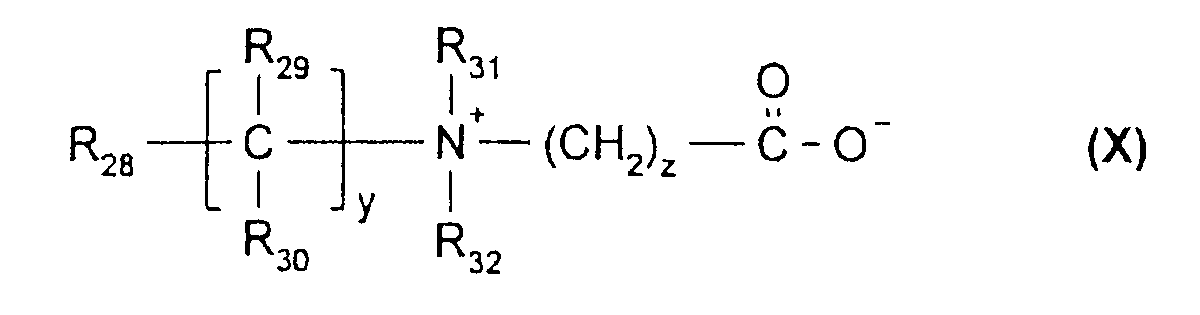
- amophoteric or zwitterionic surfactants can be, in particular (non-limiting listing), aliphatic secondary or tertiary amine derivatives in which the aliphatic radical is a linear or branched chain containing 8 to 18 carbon atoms and containing at least one water-solubilizing anionic group (for example carboxylate, sulphonate, sulphate, phosphate or phosphonate); mention may also be made of (C 8 -C 20 )alkylbetaines, sulphobetaines, (C 8 -C 20 )alkylamido(C 1 -C 6 )alkylbetaines or (C 8 -C 20 )alkylamido(C 1 -C 6 )alkylsulphobetaines.
- aliphatic secondary or tertiary amine derivatives in which the aliphatic radical is a linear or branched chain containing 8 to 18 carbon atoms and containing at least one water-sol
- R 2 denotes an alkyl radical derived from an acid R 2 -COOH present in hydrolysed coconut oil, a heptyl, nonyl or undecyl radical, R3 denotes a beta hydroxyethyl group and R4 denotes a carboxymethyl group; and R 2 ,-CONHCH 2 CH 2 -N(B)(C) wherein:
- cationic surfactants it is possible to particularly cite (non limiting list) salts of optionally polyoxyalkylenated primary, secondary or tertiary fatty amine; quaternary ammonium salts such as tetraalkylammonium, alkylamidoalkyltrialkylammonium, trialkylbenzylammonium, trialkylhydroxyalkylammonium or alkylpyridinium chlorides or bromides; imidazoline derivatives; or amine oxides of cationic nature.
- the quantity of surfactants present in the composition according to the present invention may vary between 0.01 and 40 % and preferably between 0.5 and 30% of the total weight of the composition.
- composition according to the present invention may eventually contain other agents for adjustment of rheology, such as the cellulose thickeners (hydroxyethylcellulose, hydroxypropylcellulose, carboxymethylcellulose ..), guar gum and its derivatives (hydroxypropylguar ..), gum of microbial origin (xanthan gum, scleroglucan gum ..), synthetic thickeners such as crosslinked homopolymers of acrylic acid or acrylamidopropanesulfonic acid and ionic or nonionic associative polymers such as the polymers commercialized under the trade name PEMULEN TR1 or TR2 by the company GOODRICH, SALCARE SC90 by the company ALLIED COLLOIDS and ACULYN 22, 28, 33, 44 or 46 by the company ROHM and HAAS, and ELFACOS T210 and T212 by the company AKZO.
- the cellulose thickeners hydroxyethylcellulose, hydroxypropylcellulose, carboxymethylcellulose ..
- These thickeners may represent from 0.01 to 10 % by weight of the total weight of the composition.
- the medium of the composition appropriate for dyeing is preferably an aqueous medium constituted by water, which may advantageously contain the cosmetically acceptable organic solvents, which is more particularly alcohols such as ethyl alcohol, isopropyl alcohol, benzyl alcohol, and phenylethyl alcohol, or glycols or ethers of glycol such as, for example, monomethyl, monoethyl and monobutyl ethers of ethyleneglycol, propyleneglycol or their ethers such as, for example, monomethylether of propyleneglycol, butyleneglycol, dipropyleneglycol as well as alkylethers of diethyleneglycol such as, for example, monoethylether or monobutylether of diethyleneglycol, at concentrations between approximately 0.5 and 20 % and, preferably, between approximately 2 and 10 % by weight of the total weight of the composition.
- the cosmetically acceptable organic solvents which is more particularly alcohols such as ethyl alcohol, iso
- composition (A) may further contain an effective quantity of other agents for example which are already known for oxidation coloration, such as various ordinary adjuvants such as sequesterizers such as EDTA and etidronic acid, UV filters, waxes, volatile or nonvolatile, cyclic or non-cyclic, linear or branched, organomodified (especially by amine groups) silicones, preservatives, ceramides, pseudoceramides, vegetable, mineral or synthetic oils, vitamines or provitamines such as panthenol, opacifiers, etc.
- various ordinary adjuvants such as sequesterizers such as EDTA and etidronic acid, UV filters, waxes, volatile or nonvolatile, cyclic or non-cyclic, linear or branched, organomodified (especially by amine groups) silicones, preservatives, ceramides, pseudoceramides, vegetable, mineral or synthetic oils, vitamines or provitamines such as panthenol, o
- the composition can also contain the reducing agents or antioxidants. They may be chosen particularly among sodium sulphite, thioglycolic acid, thiolactic acid, sodium bisulphite, dehydroascorbic acid, hydroquinone, 2-methylhydroquinone, tert-butylhydroquinone and homogentisic acid, and they may be present in the quantity of approximately 0.05 to 1.5 % by weight of the total weight of the composition.
- the oxidizing agent is chosen preferably among urea peroxide, alkali metal bromates or ferricyanides, persalts such as perborates and persulfates.
- the use of hydrogen peroxide is particularly preferable.
- This oxidizing agent is advantageously constituted by an oxygenated aqueous solution of which the titre may vary more particularly approximately 1 to 40 in volume, more preferably approximately 5 to 40.
- one or more oxidation-reduction enzymes such as laccases, peroxydases and 2-electron oxydoreductases (such as uricase), if necessary in the presence of their respective donner or cofacter, may be used.
- the pH of the composition ready for use on the keratin fibers is generally between the value 4 and 11. It is preferable to be within 6 and 10, and may be adjusted to the desired value by means of acidifying or basifying agents well known in the art of dyeing keratin fibers.
- basifying agents which may be mentioned, for example, are aqueous ammonia, alkaline carbonates, alkanolamines such as mono-, di- and triethanolamines and derivatives thereof, hydroxyalkylamines and oxyethylenated and/or oxypropylenated ethylenediamines, sodium or potassium hydroxide and the compounds of formula (XIV) below: in which R is a propylene residue optionally substituted with a hydroxyl group or a C 1 -C 4 alkyl; R 42 , R 43 , R 44 and R 45 , which may be identical or different, represent a hydrogen atom or a C 1 -C 4 alkyl or C 1 -C 4 hydroxyalkyl radical.
- the acidifying agents are classically, by way of example, organic or inorganic acids such as hydrochloric acid, orthophosphoric acid, carboxylic acids such as tartaric acid, citric acid, lactic acid or sulphonic acids.
- composition A Oxyethylenated fatty alcohols 21 Lauric acid 3 Cetylstearyl alcohol 11.5 Polyacrylic acid 0.4 Silica 1.2 Opacifying agent 2 Propylene glycol 10 Cationic polymer of formula (W) in a 60 % aqueous solution 5 Merquat 280 3.7 Sequestering agent qs Reducing agent qs Ammonia (20 % NH 3 ) 11 Oxidation dye qs Water qsp 100
- composition A' was mixed with lg of composition A" and 15g of oxygenated water solution at 20 volumes. A thick and stable composition was obtained. Then, the composition obtained was applied to locks of permed hair containing 90 % white hairs. After pausing 30 minutes, the locks were rinsed, then washed with shampoo, rinsed again and then dried. The hair was dyed to a natural brown color.
- this composition was mixed with oxygenated water solution at 20 volumes. A thick and stable composition was obtained. Then the composition obtained was applied to locks of permed hair containing 90 % white hairs. After 30 minutes of pause, the locks of hair were rinsed, then washed with shampoo, rinsed again and then dried. The hair was dyed to a natural brown color.
Landscapes
- Health & Medical Sciences (AREA)
- Life Sciences & Earth Sciences (AREA)
- Animal Behavior & Ethology (AREA)
- General Health & Medical Sciences (AREA)
- Public Health (AREA)
- Veterinary Medicine (AREA)
- Birds (AREA)
- Epidemiology (AREA)
- Emergency Medicine (AREA)
- Cosmetics (AREA)
Abstract
Description
The variety of the molecules employed therein, constituted on the one hand by the oxidation bases and on the other hand by the couplers, makes it possible to obtain a pallet very rich in color.
In order to further vary the shades obtainable by the oxidation dyes, or to enrich the glints, direct dyes may be added thereto.
Furthermore, it was also discovered that after mixing with oxidizing agent, the dyeing compositions containing one or more dyes and the above-described ingredients lost their gelling character and exhibited undesirable fluidity.
It is also possible in an advantageous manner to reduce the consumption of the surfactants.
The invention also makes it possible to reduce the quantity of the active colorants used in the dyeing composition compared with the classic technique in the prior art.
The nonionic compound is more particularly again a compound of the formula R-(OCH2CH2)n-OR' wherein R and R' denote a C16-C18 alkyl radical, and n is equal to
4. Such a compound is for example described in the CTFA dictionary under the name of PEG 4 DITTALLOW ETHER.
The nonionic compound is also more particularly again a compound of the formula R-(OCH2CH2)n-OR' wherein R denotes a C16-C18 alkyl radical, R' denotes a substituted alkyl radical -C14 OH, and n is preferably equal to 60.
Such a compound is for example found in the CTFA dictionary under the name of CETEARETH 60 MYRISTYL GLYCOL or HYDROGENATED TALLOWETH 60 MYRISTYL GLYCOL. CETEARETH 60 MYRISTYL GLYCOL is for example sold by the company AKZO under the commercial name ELFACOS GT 282 S.
Preferably, the compositions according to the invention contain at least one oxidation base.
- (I) paraphenylenediamines of the formula (I) below and their addition salts with an
acid:
in which:

- R1 represents a hydrogen atom, a C1-C4 alkyl radical, a monohydroxy (C1-C4 alkyl) radical, a polyhydroxy (C2-C4 alkyl) radical, a (C1-C4) alkoxy(C1-C4)alkyl radical, a C1-C4 alkyl substituted with a nitrogen-containing group, a phenyl radical or a 4'-aminophenyl radical;
- R2 represents a hydrogen atom, a C1-C4 alkyl radical, a monohydroxy (C1-C4 alkyl) radical, a polyhydroxy (C2-C4 alkyl) radical, a (C1-C4) alkoxy(C1-C4)alkyl radical or a C1-C4 alkyl radical substituted with a nitrogen-containing group;
- R1 and R2 may also form with the nitrogen atom to which they are bonded a nitrogen-containing heterocycle ring of 5 or 6 members optionally substituted with one or more alkyl, hydroxy or ureido groups;
- R3 represents a hydrogen atom, a halogen atom such as a chlorine atom, a C1-C4 alkyl, sulfo, carboxy, monohydroxy (C1-C4 alkyl) or hydroxy (C1-C4 alkoxy), acetylamino(C1-C4 alkoxy), mesylamino (C1-C4 alkoxy) or carbamoylamino (C1-C4 alkoxy) radical;
- R4 represents a hydrogen atom, a halogen atom or a C1-C4 alkyl radical. Among the nitrogen-containing groups of formula (I) above, amino, mono (C1-C4)alkylamino, (C1-C4)dialkylamino, (C1-C4)trialkylamino, monohydroxy(C1-C4)alkylamino, imidazolinium and ammonium radicals may particularly be cited. Among the para-phenylenediamines of formula (I) above, para-phenylenediamine, para-toluylenediamine, 2-chloro-para-phenylenediamine, 2,3-dimethyl-para-phenylenediamine, 2,6-dimethyl-para-phenylenediamine, 2,6-diethyl-para-phenylenediamine, 2,5-dimethyl-para-phenylenediamine, N,N-dimethyl-para-phenylenediamine, N,N-diethyl-para-phenylenediamine, N,N-dipropyl-para-phenylenediamine, 4-amino-N,N-diethyl-3-methylaniline, N,N-bis(β-hydroxyethyl)-para-phenylenediamine, 4-amino-N,N-bis(β -hydroxyethyl)-3-methylaniline, 4-amino-3-chloro-N,N-bis(β-hydroxyethyl)-aniline, 2-β-hydroxyethyl-para-phenylenediamine, 2-fluoro-para-phenylenediamine, 2-isopropyl-para-phenylenediamine, N-(β-hydroxypropyl)-para-phenylenediamine, 2-hydroxymethyl-para-phenylenediamine, N,N-dimethyl-3-methyl-para-phenylenediamine, N,N-(ethyl-β -hydroxyethyl)-para-phenylenediamine, N-(β, γ -dihydroxypropyl)-para-phenylenediamine, N-(4'-aminophenyl)-para-phenylenediamine, N-phenyl-para-phenylenediamine, 2-β -hydroxyethyloxy-para-phenylenediamine, and their addition salts with an acid may particularly be cited.Among the para-phenylenediamines of formula (I) above, particularly preferred are para-phenylenediamine, para-toluylenediamine, 2-isopropyl-para-phenylenediamine, 2-β-hydroxyethyl-para-phenylenediamine, 2-β -hydroxyethyloxy-para-phenylenediamine, 2,6-dimethyl-para-phenylenediamine, 2,6-diethyl-para-phenylenediamine, 2,3-dimethyl-para-phenylenediamine, N,N-bis(β -hydroxyethyl)-para-phenylenediamine, 2-chloro-para-phenylenediamine, and their addition salts with an acid.
- (II) According to the invention, the double bases are understood to mean the
compounds containing at least two aromatic rings on which amino and/or hydroxyl
groups are carried.
Among the double bases which can be used as oxidation bases in the dyeing
compositions in accordance with the invention, there may be mentioned in particular
the compounds corresponding to the following formula (II), and their addition salts
with an acid:
in which:
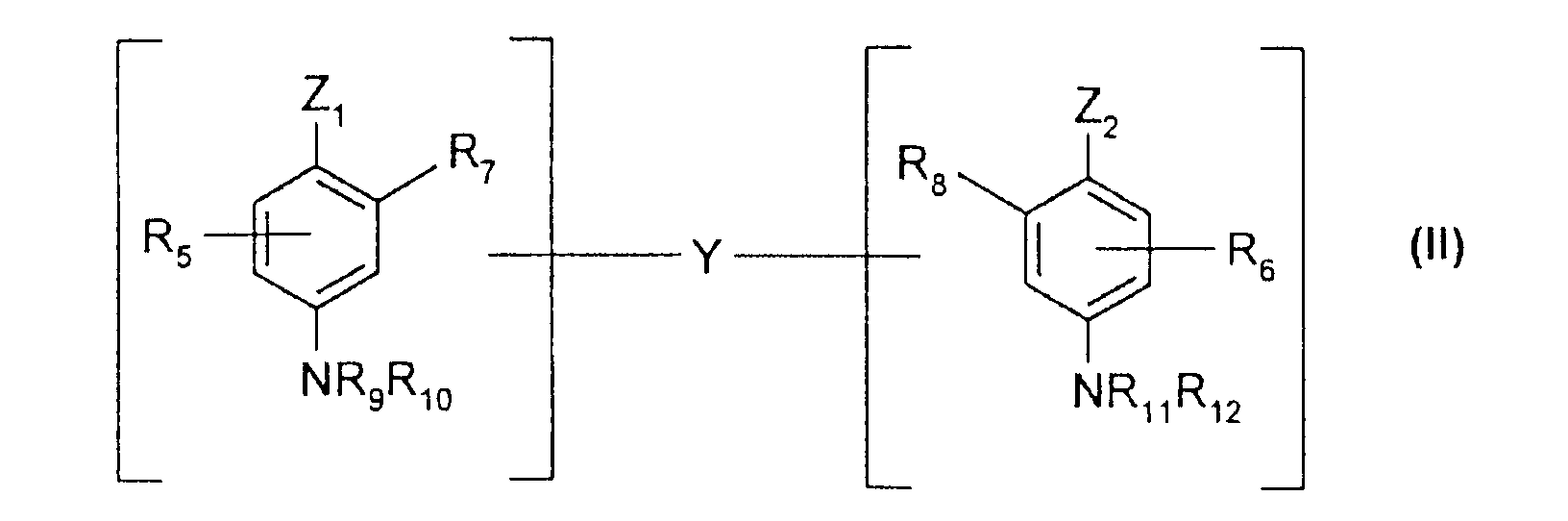
- Z1 and Z2, identical or different, represent a hydroxyl or -NH2 radical which may be substituted with a C1-C4 alkyl radical or by a linking arm Y;
- the linking arm Y represents a linear or branched alkylene chain comprising from 1 to 14 carbon atoms, which may be interrupted by or which may end with one or more nitrogen-containing groups and/or one or more heteroatoms such as oxygen, sulphur or nitrogen atoms, and optionally substituted with one or more hydroxyl or C1-C6 alkoxy radicals;
- R5 and R6 represent a hydrogen or halogen atom, a C1-C4 alkyl radical, a monohydroxy(C1-C4 alkyl) radical, a polyhydroxy(C2-C4 alkyl) radical, an amino(C1-C4 alkyl) radical or a linking arm Y;
- R7, R8, R9, R10, R11 and R12, which are identical or different, represent a hydrogen atom, a linking arm Y or a C1-C4 alkyl radical;
Among the nitrogen-containing groups of formula (II) above, there may be mentioned in particular the amino, mono (C1-C4)alkylamino, (C1-C4)dialkylamino, (C1-C4)trialkylamino, monohydroxy(C1-C4)alkylamino, imidazolinium and ammonium radicals. Among the double bases of formulae (II) above, reference is made more particularly to N, N'-bis(β-hydroxyethyl)-N,N'-bis(4'-aminophenyl)-1,3-diaminopropanol, N,N'-bis(β-hydroxyethyl)-N,N'-bis(4'-aminophenyl)ethylenediamine, N,N'-bis(4-aminophenyl) tetramethylenediamine, N,N'-bis(β -hydroxyethyl)-N,N'-bis(4-aminophenyl)tetramethylenediamine, N,N'-bis(4-methylaminophenyl)tetramethylenediamine, N,N'-bis(ethyl)-N,N'-bis(4'-amino-3'-methylphenyl)ethylenediamine, 1,8-bis(2,5-diaminophenoxy)-3,5-dioxaoctane, and their addition salts with an acid.Among the double bases of formulae (II), N,N'-bis(β -hydroxyethyl)-N,N'-bis(4'-aminophenyl)-1,3-diaminopropanol, 1,8-bis(2,5-diaminophenoxy)-3,5-dioxaoctane or one of their addition salts with an acid are particularly preferred. - (III) The para-aminophenols corresponding to the formula (III) below and their
addition salts with an acid.
wherein:

- R13 represents a hydrogen atom, a halogen atom such as fluorine, a C1-C4 alkyl radical, monohydroxy(C1-C4 alkyl), (C1-C4)alkoxy(C1-C4)alkyl or amino(C1-C4 alkyl), or hydroxy(C1-C4)alkylamino(C1-C4 alkyl) radical.
- R14 represents a hydrogen atom or halogen atom such as fluorine, a C1-C4 alkyl radical, monohydroxy(C1-C4 alkyl), polyhydroxy (C2-C4 alkyl), amino (C1-C4 alkyl), cyano (C1-C4 alkyl) or (C1-C4)alkoxy(C1-C4 alkyl) radical, with the condition that at least one of radicals R13 and R14 represents a hydrogen atom.Among the para-aminophenols of formula (III) above, there may be mentioned more particularly para-aminophenol, 4-amino-3-methylphenol, 4-amino-3-fluorophenol, 4-amino-3-hydroxymethylphenol, 4-amino-2-methylphenol, 4-amino-2-hydroxymethylphenol, 4-amino-2-methoxymethylphenol, 4-amino-2-aminomethylphenol, 4-amino-2-(β-hydroxyethylaminomethyl)phenol, and their addition salts with an acid.
- (IV) The ortho-aminophenols which can be used as the oxidation bases in the context of the present invention, are in particular chosen from 2-aminophenol, 2-amino-1-hydroxy-5-methylbenzene, 2-amino-1-hydroxy-6-methylbenzene, 5-acetamido-2-aminophenol, and their addition salts with an acid.
- (V) Among the heterocyclic bases which can be used as the oxidation bases in the dyeing composition constituting the invention, pyridine derivatives, pyrimidine derivatives, pyrazole derivatives and their addition salts with an acid may be more particularly cited. Among the pyridine derivatives, there may be mentioned more particularly the compounds described for example in patents GB 1 026 978 and GB 1 153 196, such as 2,5-diaminopyridine, 2-(4-methoxypenyl)amino-3-aminopyridine, 2,3-diamino-6-methoxypyridine, 2-(β -methoxyethyl)amino-3-amino-6-methoxypyridine, 3,4-diaminopyridine and their addition salts with an acid.Among the pyrimidine derivatives, there may be mentioned more particularly the compounds described for example in German patent DE 2 359 399 or Japanese patents JP 88-169571 and JP 91-10659 or patent application WO 96/15765, such as 2,4,5,6-tetra-aminopyrimidine, 4-hydroxy-2,5,6-triaminopyrimidine, 2-hydroxy-4,5,6-triaminopyrimidine, 2,4-dihydroxy-5,6-diaminopyrimidine, 2,5,6-triaminopyrimidine, and such pyrazolo-pyrimidine derivatives as those described in the patent application FR-A-2 750 048 and among which mention is made of pyrazolo[1,5-a]pyrimidine-3,7-diamine; 2,5-dimethylpyarzolo[1,5-a]pyrimidine-3,7-diamine; pyrazolo[1,5-a]pyrimidine-3,5-diamine; 2,7-dimethylpyrazolo[1,5-a]pyrimidine-3,5-diamine; 3-aminopyrazolo[1,5-a]pyrimidin-7-ol; 3-aminopyrazolo[1,5-a]pyrimidin-5-ol; 2-(3-amino-pyrazolo[1,5-a]pyrimidin-7-ylamino)ethanol, 2(7-aminopyrazolo[1,5-a]pyrimidin-3-ylamino)ethanol, 2[(3-aminopyrazolo[1,5-a]pyrimidin-7-yl)-(2-hydroxy-ethyl)amino]ethanol, 2-[(7-aminopyrazolo-[1,5-a]pyrimidin-3-yl)-(2-hydroxyethyl)amino]ethanol, 5,6-dimethylpyrazolo[1,5-a]pyrimidine-3,7-diamine, 2,6-dimethylpyrazolo[1,5-a]pyrimidine-3,7-diamine, 2,5,N7,N7-tetramethylpyrazolo[1,5-a]pyrimidine-3,7-diamine, and the addition salts thereof and tautomeric forms thereof, when a tautomeric equilibrium exists, and the addition salts thereof with an acid.Among the pyrazole derivatives, one can more particularly cite the compounds described in patent DE 3 843 892, DE 4 133 957, and patent applications WO 94/08969, WO 94/08970, FR-A-2 733 749 and DE 195 43 988 such as 4,5-diamino-1-methylpyrazole, 4,5-diamino-1-hydroxyethylpyrazole, 3,4-diamiopyrazole, 4,5-diamino-1-(4'-chlorobenzyl)pyrazole, 4,5-diamino-1,3-dimethylpyrazole, 4,5-diamino-3-methyl-1-phenylpyrazole, 4,5-diamino-1-methyl-3-phenylpyrazole, 4-amino-1,3-dimethyl-5-hydrazinopyrazole, 1-benzyl-4,5-diamino-3-methylpyrazole, 4,5-diamino-3-tert-butyl-1-methylpyrazole, 4,5-diamino-1-tert-butyl-3-methylpyrazole, 4,5-diamino-1-(β -hydroxyethyl)-3-methylpyrazole, 4,5-diamino-1-ethyl-3-methylpyrazole, 4,5-diamino-1-ethyl-3-(4'-metoxyphenyl)pyrazole, 4,5-diamino-1-ethyl-3-hydroxymethylpyrazole, 4,5-diamino-3-hydroxymethyl-1-methylpyrazole, 4,5-diamino-3-hyroxymethyl-1-isopropylpyrazole, 4,5-diamino-3-methyl-1-isopropylpyrazole, 4-amino-5-(2'-aminoethyl)amino-1,3-dimethylpyrazole, 3,4,5-triaminopyrazole, 1-methyl-3,4,5-triaminopyrazole, 3,5-diamino-1-methyl-4-methylaminopyrazole, 3,5-diamino-4-(β-hydroxyethyl)amino-1-methylpyrazole, and their addition salts with an acid.
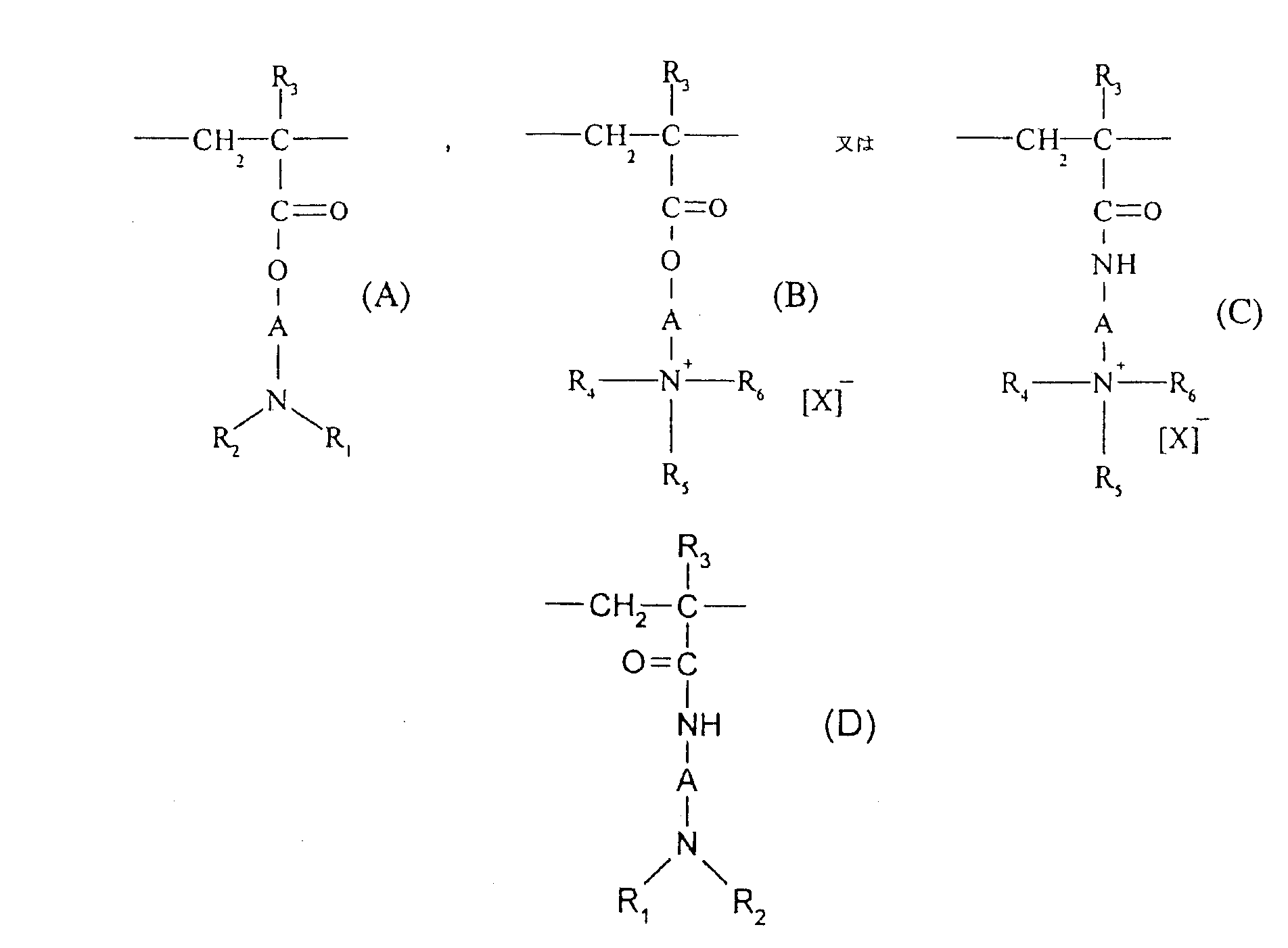
- copolymers of acrylamide and of dimethylaminoethyl methacrylate quaternized with dimethyl sulphate or with a dimethyl halide such as that sold under the name HERCOFLOC by the company HERCULES,
- copolymers of acrylamide and of methacryloyloxyethyl-trimethylammonium chloride, described, for example, in patent application EP-A-080976 and sold under the name BINA QUAT P 100 by the company CIBA GEIGY,
- the copolymer of acrylamide and of methacryloyloxyethyltrimethylammonium methosulphate sold under the name RETEN by the company HERCULES,
- quaternized or non-quaternized vinylpyrrolidone/dialkylaminoalkyl acrylate or methacrylate copolymers, such as the products sold under the name "GAFQUAT" by the company ISP such as, for example, "GAFQUAT 734" or "GAFQUAT 755" or the products known as "COPOLYMER 845, 958 and 937". These polymers are described in detail in French patents 2,077,143 and 2,393,573.
- the dimethylaminoethyl methacrylate/vinylcaprolactam/vinylpyrrolidone terpolymers, such as the product sold under the name GAFFIX VC 713 by the company ISP,
- the vinylpyrrolidone/methacrylamidopropyl dimethylamine copolymers sold in particular under the name STYLEZE CC 10 by ISP,
- and the quaternized vinylpyrrolidone/dimethylaminopropyl methacrylamide copolymers such as the product sold under the name "GAFQUAT HS 100" by the company ISP.
The commercial products corresponding to this definition are more particularly the products sold under the names "Celquat L 200" and "Celquat H 100" by the company National Starch.
Such products are sold in particular under the trade names JAGUAR C13 S, JAGUAR C 15, JAGUAR C 17 or JAGUAR C162 by the company MEYHALL.
Among these derivatives, mention may be made more particularly of the adipic acid/dimethylaminohydroxypropyl/diethylenetriamine polymers sold under the name "Cartaretine F, F4 or F8" by the company Sandoz.
Polymers of this type are sold in particular under the name "Hercosett 57" by the company Hercules Inc. or alternatively under the name "PD 170" or "Delsette 101" by the company Hercules in the case of the adipic acid/epoxypropyl/diethylenetriamine copolymer.

Among the polymers defined above, mention may be made more particularly of the dimethyldiallylammonium chloride homopolymer sold under the name "Merquat 100" by the company Calgon (and its homologues of low weight-average molecular mass) and copolymers of diallyldimethylammonium chloride and of acrylamide sold under the name "Merquat 550".

These polymers generally have a number average molecular mass of between 1000 and 100,000.
Polymers of this type are describe in particular in French Patents 2,320,330, 2,270,846, 2,316,271, 2,336,434 and 2,413,907 and US patents 2,273,780, 2,375,853, 2,388,614, 2,454,547, 3,206,462, 2,261,002, 2,271,378, 3,874,870, 4,001,432, 3,929,990, 3,966,904, 4,005,193, 4,025,617, 4,025,627, 4,025,653, 4,026,945 and 4,027,020.
It is more particularly possible to use the polymers consisting of repeating units corresponding to the formula:


- a) D represents a -(CH2)4-CO- group, X denotes a chlorine atom, the molecular weight measured by NMR of Carbon 13 (NMR13C) being approximately 5600; this type of polymer is proposed by the company MIRANOL under the name MIRAPOL-AD1,
- b) D represents a -(CH2)7-CO- group, X denotes a chlorine atom, the molecular weight measured by NMR of Carbon 13 (NMR13C) being approximately 8100; this type of polymer is proposed by the company MIRANOL under the name MIRAPOL-AZ1,
- c) D represents a zero value, X denotes a chlorine atom, the molecular weight measured by NMR of Carbon 13 (NMR13C) being approximately 25500; this type of polymer is proposed by the company MIRANOL under the name MIRAPOL-A15,
- d) a "Block Copolymer" formed of the units corresponding to the polymers described in paragraphs a) and c), proposed by the company MIRANOL under the names NIRAPOL-9, (molecular weight NMR13C, approximately 7800) MIRAPOL-175, (molecular weight NMR13C, approximately 8000) MIRAPOL-95, (molecular weight NMR13C, approximately 12500).

The vinyl compound can also be a salt of dialkyldiallylammonium such as diethyldiallylammonium chloride. The copolymers of acrylic acid and the latter monomer are proposed under the name "MERQUAT 280", "MERQUAT 295" and "MERQUAT PLUS 3330" by the company CALGON.
The N-substituted acrylamides or methacrylamides most particularly preferred according to the invention are groups whose alkyl radicals contain from 2 to 12 carbon atoms and more particularly N-ethylacrylamide, N-tert-butylacrylamide,
N-tert-octylacrylamide, N-octylacrylamide, N-decylacrylamide, N-dodecylacrylamide as well as the corresponding methacrylamides.
The acidic comonomers are chosen more particularly from acrylic, methacrylic, crotonic, itaconic, maleic and fumaric acids as well as the alkyl monoesters having 1 to 4 carbon atoms of maleic or fumaric anhydrides or acids.
The preferred basic comonomers are methacrylates of aminoethyl, butylaminoethyl, N,N'-dimethylaminoethyl, N-tert-butylaminoethyl.
Particularly used are the copolymers of which the CTFA name (4th edition, 1991) are Octylacrylamide/acrylates/butylaminoethylmethacrylate copolymer such as the products sold under the name AMPHOMER or LOVOCRYL 47 by the company NATIONAL STARCH.

this radical being derived from the diethylenetriamine, triethylenetetraamine or dipropylenetriamine;
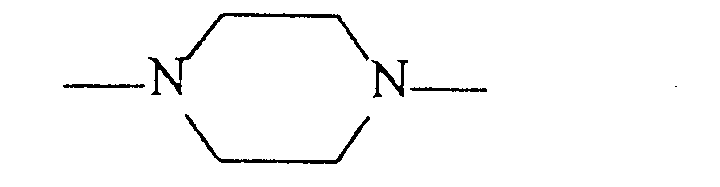
The alkanesultones used in the alkylation are preferably propane or butanesultone, the salts of the alkylating agents are preferably the sodium or potassium salts.


as well as the higher homologues of these radicals and containing up to 6 carbon atoms.


As an oxidizing agent, one or more oxidation-reduction enzymes such as laccases, peroxydases and 2-electron oxydoreductases (such as uricase), if necessary in the presence of their respective donner or cofacter, may be used.

| Composition A' | |
| Oxyethylenated fatty alcohols | 21 |
| Lauric acid | 3 |
| Cetylstearyl alcohol | 11.5 |
| Polyacrylic acid | 0.4 |
| Silica | 1.2 |
| Opacifying agent | 2 |
| Propylene glycol | 10 |
| Cationic polymer of formula (W) in a 60 % aqueous solution | 5 |
| Merquat 280 | 3.7 |
| Sequestering agent | qs |
| Reducing agent | qs |
| Ammonia (20 % NH3) | 11 |
| Oxidation dye | qs |
| Water qsp | 100 |
| Composition A" | |
| Ceteareth 60 myristyl glycol (ELFACOS GT 282 S of company AKZO) | 6.0 g |
| Diisopropyl adipate | 50 g |
| Benzoate of C12-C15 alcohol | 10 g |
| Preservatives | qs |
| Water qsp | 100 |
A thick and stable composition was obtained. Then, the composition obtained was applied to locks of permed hair containing 90 % white hairs. After pausing 30 minutes, the locks were rinsed, then washed with shampoo, rinsed again and then dried. The hair was dyed to a natural brown color.
| ELFACOS GT 282 S | 1 |
| Oxyethylenated fatty alcohols | 21 |
| Lauric acid | 3 |
| Cetylstearyl alcohol | 11.5 |
| Polyacrylic acid | 0.4 |
| Silica | 1.2 |
| Opacifying agent | 2 |
| Propylene glycol | 10 |
| Cationic polymer of formula (W) in a 60 % aqueous solution | 5 |
| Merquat 280 | 3.7 |
| Sequestrating agent | qs |
| Reducing agent | qs |
| Ammonia (20% NH3) | 11 |
| Oxidation dye | qs |
| Water qsp | 100 |
The hair was dyed to a natural brown color.
Claims (31)
- A composition for dyeing keratin fibers, particularly for human keratin fibers such as hair, comprising, in a medium suitable for dyeing, at least one dye and at least one nonionic compound of the formula R-(OCH2CH2)n,-OR', wherein R is a C10-C30 alkyl radical, R' is a C10-C30 alkyl radical which may be substituted with a hydroxyl radical, and n is from 1 to approximately 100.
- A composition according to claim 1, wherein R is a C16-C18 alkyl radical, R' is a C16-C18 alkyl radical which may be substituted by a hydroxyl radical, and n is equal to or larger than 20.
- A composition according to claim 1 or 2, wherein R is a C16-C18 alkyl radical and R' is an alkyl radical C14OH.
- A composition according to claim 3, wherein n is 60.
- A composition according to claim 1, wherein R and R' are each a C16-C18 alkyl radical and n is 4.
- A composition according to any preceding claim, wherein the nonionic compound is present at the concentration of from 0.05 to 10% by weight with respect to the total weight of the composition.
- A composition according to claim 6, wherein the nonionic compound is present at the concentration of from 0.1 to 5% by weight with respect to the total weight of the composition.
- A composition according to any preceding claim, wherein the dye is an oxidation dye.
- A composition according to any of claims 1 to 7, wherein the dye is a direct dye.
- A composition according to any preceding claim, wherein the composition is a composition ready to use for dyeing keratin fibers, constituted with a composition A comprising, in a medium appropriate for dyeing, at least one oxidation dye, and/or a direct dye, and a composition B comprising an oxidizing agent, the nonionic compound as defined in any of claims 1 to 5 being contained in the composition A or in the composition B, or in both of the compositions A and B.
- A composition according to claim 8 or 10, wherein the oxidation dye is an oxidation base chosen from paraphenylenediamine, double bases, ortho- or para-aminophenols and heterocyclic bases and addition salts of these compounds with an acid.
- A composition according to claim 8 or 10, wherein the oxidation dye is a coupler chosen from meta-phenylenediamines, meta-aminophenols, meta-diphenols, the mono- or poly-hydroxylated derivatives of naphthalene, sesamol and its derivatives and heterocyclic compounds such as indole couplers, indoline couplers, pyridine couplers, and their addition salts with an acid.
- A composition according to any of claims 8 or 10 to 12, which comprises at least one oxidation base and at least one coupler.
- A composition according to claim 11 or 12, wherein the addition salts with an acid are chosen from hydrochlorides, hydrobromides, sulphates and tartrates, lactates and acetates.
- A composition according to any of claims 11, 13 or 14, wherein the oxidation base is present at a concentration of from 0.0005 to 12% by weight of the total weight of the composition A.
- A composition according to any of claims 12, 13 or 14, wherein the coupler is present at a concentration of from 0.0001 to 10% by weight of the total weight of the composition A.
- A composition according to any of claims 10 to 16, wherein the oxidising agent of composition B is chosen from hydrogen peroxide, urea peroxide, alkali metal bromates or ferricyanides, organic peroxides, persalts or oxidation-reduction enzymes.
- A composition according to claim 17, wherein the oxidising agent is an oxygenated water solution of which the titre varies from 1 to 40 volumes.
- A composition according to claims 10 to 18, wherein the direct dye is chosen from nitrobenzene, anthraquinone, azo, neutral, cationic or anionic dyes, naphtoquinone dyes, triarylmethane dyes, and xanthene dyes.
- A composition according to any preceding claim, which comprises from 0.01 to 40% by weight of at least one nonionic, anionic, cationic, amphoteric or zwitterionic surfactant.
- A composition according to any preceding claim, which comprises from 0.01 to 10% by weight of at least one cationic or amphoteric polymer.
- A composition according to claim 21, wherein the cationic polymer is constituted by repeating units of the formulae (W) or (U) as follows:


- A composition according to any preceding claim, wherein the medium appropriate for dyeing is an aqueous medium constituted by water and optionally organic solvents at a concentration of from 0.5 to 20%.
- A process for dyeing keratin fibers, and in particular human keratin fibers such as hair, which process comprises applying to the dry or wet keratin fibers at least one composition containing, in a medium appropriate for dyeing, at least one direct dye and at least one nonionic compound as defined in any of claims 1 to 5, optionally leaving the composition to act on the fibers for a resting time of from 3 to 60 minutes, rinsing the fibers, optionally washing and rinsing the fibers, and then drying the fibers.
- A process for dyeing the keratin fibers, and in particular human keratin fibers such as hair, which process comprises applying to the fibers one composition A containing, in a medium appropriate for dyeing at least one oxidation dye (base and/or coupler) or at least one direct dye, the colour being developed at alkaline, neutral or acid pH, with the aid of an oxidising composition B which is mixed just at the moment of use with the composition A or which is applied sequentially without intermediate rinsing, the nonionic compound defined in any of claims 1 to 5 being present in either the composition A or the composition B, or in both the compositions A and B.
- A process according to claim 25, which process comprises applying the ready to use composition to the dry or wet hair, which ready to use composition is prepared at the moment of use from the compositions (A) and (B), leaving it to act for a resting time varying preferably from 1 to 60 minutes, and more preferably from 10 to 45 minutes, rinsing the fibers, then optionally shampooing and rinsing the fibers, and drying the fibers.
- A process according to claim 25, which process comprises applying the ready to use composition to the dry or wet hair, which ready to use composition is prepared at the moment of use from the composition A' containing at least one oxidation dye and/or at least one direct dye, without the nonionic compound as defined in any of claims 1 to 5, composition A" containing at least one nonionic compound as defined in any one of claims 1 to 5 and an oxidising composition B, leaving it to act for a resting time varying preferably from 1 to 60 minutes, and more preferably from 10 to 45 minutes, rinsing the fibers, then optionally shampooing and rinsing the fibers, and drying the fibers.
- A process according to any of claims 25 to 27, wherein the composition (A) and /or composition (B) further comprise at least one cationic or amphoteric polymer.
- A device or kit having 2 compartments for dyeing keratin fibers, and in particular human keratin fibers such as hair, which comprises a compartment containing a composition Al comprising, in a medium appropriate for dyeing, at least one oxidation dye (base and/or coupler), or at least one direct dye, and another compartment containing a composition B 1 comprising, in a medium appropriate for dyeing, an oxidising agent, wherein one or more nonionic compounds as defined in any of claims 1 to 5 are present in either the composition Al or the composition B1, or in both of the compositions A1 and B1.
- A device having 3 compartment for dyeing keratin fibers, and in particular human keratin fibers such as hair, which comprises a first compartment containing composition A2 comprising, in a medium appropriate for dyeing at least one oxidation dye (base and/or coupler), at least one direct dye, a second compartment containing composition B2 comprising, in a medium appropriate for dyeing, at least one oxidising agent, and a third compartment containing a composition C comprising, in a medium appropriate for dyeing, at least one nonionic compound as defined in any of claims 1 to 5, wherein the composition A2 and/or the composition B2 can also further comprise the nonionic compound as defined in any of claims 1 to 5.
- Use of a dye composition according to any of claims 1 to 23 or a dyeing device or kit having a plurality of compartments according to claim 29 or 30, for dyeing keratin fibers such as human hair.
Applications Claiming Priority (2)
| Application Number | Priority Date | Filing Date | Title |
|---|---|---|---|
| JP34554699 | 1999-12-03 | ||
| JP34554699 | 1999-12-03 |
Publications (2)
| Publication Number | Publication Date |
|---|---|
| EP1106167A2 true EP1106167A2 (en) | 2001-06-13 |
| EP1106167A3 EP1106167A3 (en) | 2003-10-22 |
Family
ID=18377333
Family Applications (1)
| Application Number | Title | Priority Date | Filing Date |
|---|---|---|---|
| EP00310764A Withdrawn EP1106167A3 (en) | 1999-12-03 | 2000-12-04 | Dye compositions for keratin fibers comprising a nonionic compound |
Country Status (3)
| Country | Link |
|---|---|
| US (1) | US20010032368A1 (en) |
| EP (1) | EP1106167A3 (en) |
| CA (1) | CA2327277A1 (en) |
Cited By (15)
| Publication number | Priority date | Publication date | Assignee | Title |
|---|---|---|---|---|
| WO2002102351A3 (en) * | 2001-06-18 | 2003-04-03 | Oreal | Compositions comprising a cationic homopolymer and their use for stabilization of an oxidizing solution |
| WO2003053386A1 (en) * | 2001-12-21 | 2003-07-03 | Unilever Plc | Enhanced colour deposition for hair with sequestering agents |
| WO2008049767A1 (en) * | 2006-10-25 | 2008-05-02 | L'oreal | Composition for oxidation dyeing keratinous fibres comprising at least one particular ammonium salt derived from 18mea, and a colouring method using the composition |
| FR2907669A1 (en) * | 2006-10-25 | 2008-05-02 | Oreal | Composition useful for oxidation dyeing of human keratinous fibers i.e. for hair coloring, comprises an oxidation base, a coupler, an ammonium salt and a polyquaternary ammonium compound |
| WO2013004772A2 (en) | 2011-07-05 | 2013-01-10 | L'oreal | Dye composition comprising an alkoxylated fatty alcohol ether and a fatty alcohol |
| WO2013004784A2 (en) | 2011-07-05 | 2013-01-10 | L'oreal | Dye composition using a long-chain ether of an alkoxylated fatty alcohol and a cationic polymer, processes and devices using the same |
| WO2013004786A2 (en) | 2011-07-05 | 2013-01-10 | L'oreal | Dye composition using a long-chain ether of an alkoxylated fatty alcohol and a pyrazolone oxidation base, processes and devices using the same |
| WO2013004787A1 (en) | 2011-07-05 | 2013-01-10 | L'oreal | Dye composition using a long-chain ether of an alkoxylated fatty alcohol and glycerol, processes and devices using the same |
| WO2013004773A2 (en) | 2011-07-05 | 2013-01-10 | L'oreal | Cosmetic composition rich in fatty substances comprising a polyoxyalkylenated fatty alcohol ether and a direct dye and/or an oxidation dye, the dyeing method and the device |
| FR2977479A1 (en) * | 2011-07-05 | 2013-01-11 | Oreal | COLORING COMPOSITION COMPRISING ALCOHOLIC FATTY ALCOHOL ETHER AND SOLID FATTY ACID ESTER |
| FR2977485A1 (en) * | 2011-07-05 | 2013-01-11 | Oreal | Composition used for e.g. dyeing keratin fibers (hair), comprises non-ionic ether of polyoxyalkylenated fatty alcohols, fatty substance e.g. silicones, surfactant, direct dye or oxidation dye, basifying agent and chemical oxidizing agent |
| FR2977484A1 (en) * | 2011-07-05 | 2013-01-11 | Oreal | COSMETIC COMPOSITION RICH IN BODY COMPRISING A POLYOXYALKYLENE FATTY ALCOHOL ETHER AND A DIRECT COLOR, THE COLORING PROCESS AND THE DEVICE |
| FR2977480A1 (en) * | 2011-07-05 | 2013-01-11 | Oreal | COLORING COMPOSITION COMPRISING ALCOHOLIC FATTY ALCOHOL ETHER AND FATTY ALCOHOL |
| EP1277463B2 (en) † | 2001-07-20 | 2014-08-13 | L'Oréal | Foaming composition of silica and cationic polymer |
| WO2016084972A1 (en) * | 2014-11-26 | 2016-06-02 | L'oreal | Oil-rich composition |
Families Citing this family (1)
| Publication number | Priority date | Publication date | Assignee | Title |
|---|---|---|---|---|
| FR2818539B1 (en) * | 2000-12-22 | 2004-04-30 | Oreal | COMPOSITION FOR OXIDATION DYEING OF KERATIN FIBERS COMPRISING AT LEAST 4.5 OR 3.4 DIAMINO PYRAZOLE OR TRIAMINO PYRAZOLE AND AT LEAST ONE PARTICULAR CELLULOSIC COMPOUND, AND METHOD FOR DYEING |
Family Cites Families (5)
| Publication number | Priority date | Publication date | Assignee | Title |
|---|---|---|---|---|
| FR2687570A1 (en) * | 1992-02-21 | 1993-08-27 | Oreal | COSMETIC COMPOSITION BASED ON NON-IONIC SURFACTANT AGENTS AND CATIONIC OR AMPHOTERIC SUBSTANTIVE POLYMERS AND ITS USE AS A DYE OR DECOLORATION SUPPORT. |
| DE4332965A1 (en) * | 1993-09-28 | 1995-03-30 | Wella Ag | An oxidation hair dye comprising a cream-colored dye carrier mass and a preparation containing a polymer and an oxidizing agent, and a process for the oxidative dyeing of hair |
| FR2714825B1 (en) * | 1994-01-11 | 1996-02-02 | Oreal | Detergent cosmetic compositions for hair use and the use thereof. |
| FR2723312A1 (en) * | 1994-08-02 | 1996-02-09 | Cird Galderma | Fungicidal shampoo for hair and body |
| US6156076A (en) * | 1998-01-16 | 2000-12-05 | Bristol-Myers Squibb Company | Two-part hair dye compositions containing polyether polyurethanes and conditioning agents |
-
2000
- 2000-12-01 CA CA002327277A patent/CA2327277A1/en not_active Abandoned
- 2000-12-04 EP EP00310764A patent/EP1106167A3/en not_active Withdrawn
- 2000-12-04 US US09/727,585 patent/US20010032368A1/en not_active Abandoned
Cited By (35)
| Publication number | Priority date | Publication date | Assignee | Title |
|---|---|---|---|---|
| WO2002102351A3 (en) * | 2001-06-18 | 2003-04-03 | Oreal | Compositions comprising a cationic homopolymer and their use for stabilization of an oxidizing solution |
| US7204855B2 (en) | 2001-06-18 | 2007-04-17 | L'oreal S.A. | Compositions comprising a cationic homopolymer and their use for stabilization of an oxidizing solution |
| CN100341481C (en) * | 2001-06-18 | 2007-10-10 | 莱雅公司 | Compositions comprising cationic homopolymers and their use in stabilizing oxidizing solutions |
| EP1277463B2 (en) † | 2001-07-20 | 2014-08-13 | L'Oréal | Foaming composition of silica and cationic polymer |
| WO2003053386A1 (en) * | 2001-12-21 | 2003-07-03 | Unilever Plc | Enhanced colour deposition for hair with sequestering agents |
| US6758866B2 (en) | 2001-12-21 | 2004-07-06 | Unilever Home & Personal Care Usa, Division Of Conopco, Inc. | Enhanced color deposition for hair with sequestering agents |
| WO2008049767A1 (en) * | 2006-10-25 | 2008-05-02 | L'oreal | Composition for oxidation dyeing keratinous fibres comprising at least one particular ammonium salt derived from 18mea, and a colouring method using the composition |
| FR2907669A1 (en) * | 2006-10-25 | 2008-05-02 | Oreal | Composition useful for oxidation dyeing of human keratinous fibers i.e. for hair coloring, comprises an oxidation base, a coupler, an ammonium salt and a polyquaternary ammonium compound |
| FR2977484A1 (en) * | 2011-07-05 | 2013-01-11 | Oreal | COSMETIC COMPOSITION RICH IN BODY COMPRISING A POLYOXYALKYLENE FATTY ALCOHOL ETHER AND A DIRECT COLOR, THE COLORING PROCESS AND THE DEVICE |
| WO2013004773A3 (en) * | 2011-07-05 | 2013-07-11 | L'oreal | Cosmetic composition rich in fatty substances comprising a polyoxyalkylenated fatty alcohol ether and a direct dye and/or an oxidation dye, the dyeing method and the device |
| WO2013004787A1 (en) | 2011-07-05 | 2013-01-10 | L'oreal | Dye composition using a long-chain ether of an alkoxylated fatty alcohol and glycerol, processes and devices using the same |
| WO2013004773A2 (en) | 2011-07-05 | 2013-01-10 | L'oreal | Cosmetic composition rich in fatty substances comprising a polyoxyalkylenated fatty alcohol ether and a direct dye and/or an oxidation dye, the dyeing method and the device |
| FR2977479A1 (en) * | 2011-07-05 | 2013-01-11 | Oreal | COLORING COMPOSITION COMPRISING ALCOHOLIC FATTY ALCOHOL ETHER AND SOLID FATTY ACID ESTER |
| FR2977482A1 (en) * | 2011-07-05 | 2013-01-11 | Oreal | COLORING COMPOSITION USING A LONG CHAIN ETHER OF ALCOXYL FATTY ALCOHOL AND CATIONIC POLYMER, METHODS AND DEVICES |
| FR2977481A1 (en) * | 2011-07-05 | 2013-01-11 | Oreal | COLORING COMPOSITION USING A LONG CHAIN ETHER OF ALCOXYL FATTY ALCOHOL AND A PYRAZOLONE OXIDATION BASE, METHODS AND DEVICES |
| FR2977485A1 (en) * | 2011-07-05 | 2013-01-11 | Oreal | Composition used for e.g. dyeing keratin fibers (hair), comprises non-ionic ether of polyoxyalkylenated fatty alcohols, fatty substance e.g. silicones, surfactant, direct dye or oxidation dye, basifying agent and chemical oxidizing agent |
| WO2013004784A2 (en) | 2011-07-05 | 2013-01-10 | L'oreal | Dye composition using a long-chain ether of an alkoxylated fatty alcohol and a cationic polymer, processes and devices using the same |
| FR2977483A1 (en) * | 2011-07-05 | 2013-01-11 | Oreal | COLORING COMPOSITION IMPLEMENTING A LONG CHAIN ETHER OF ALCOXYL FATTY ALCOHOL AND GLYCERINE, METHODS AND DEVICES |
| FR2977480A1 (en) * | 2011-07-05 | 2013-01-11 | Oreal | COLORING COMPOSITION COMPRISING ALCOHOLIC FATTY ALCOHOL ETHER AND FATTY ALCOHOL |
| WO2013004772A3 (en) * | 2011-07-05 | 2013-07-11 | L'oreal | Dye composition comprising an alkoxylated fatty alcohol ether and a fatty alcohol or a fatty acid ester |
| WO2013004786A3 (en) * | 2011-07-05 | 2013-07-11 | L'oreal | Dye composition using a long-chain ether of an alkoxylated fatty alcohol and a pyrazolone oxidation base, processes and devices using the same |
| WO2013004786A2 (en) | 2011-07-05 | 2013-01-10 | L'oreal | Dye composition using a long-chain ether of an alkoxylated fatty alcohol and a pyrazolone oxidation base, processes and devices using the same |
| WO2013004784A3 (en) * | 2011-07-05 | 2013-07-11 | L'oreal | Dye composition using a long-chain ether of an alkoxylated fatty alcohol and a cationic polymer, processes and devices using the same |
| CN103619321A (en) * | 2011-07-05 | 2014-03-05 | 莱雅公司 | Cosmetic composition, method and device for dyeing fat-rich substances comprising polyoxyalkylenated fatty alcohol ethers and direct dyes and/or oxidation dyes |
| CN103619314A (en) * | 2011-07-05 | 2014-03-05 | 莱雅公司 | Dye compositions comprising alkoxylated fatty alcohol ethers and fatty alcohols or fatty acid esters |
| CN103648473A (en) * | 2011-07-05 | 2014-03-19 | 莱雅公司 | Dye composition using a long-chain ether of an alkoxylated fatty alcohol and a cationic polymer, processes and devices using the same |
| WO2013004772A2 (en) | 2011-07-05 | 2013-01-10 | L'oreal | Dye composition comprising an alkoxylated fatty alcohol ether and a fatty alcohol |
| US9044412B2 (en) | 2011-07-05 | 2015-06-02 | L'oreal | Dye composition using a long-chain ether of an alkoxylated fatty alcohol and a cationic polymer, processes and devices using the same |
| US9060944B2 (en) | 2011-07-05 | 2015-06-23 | L'oreal | Cosmetic composition rich in fatty substances comprising a polyoxyalkylenated fatty alcohol ether and a direct dye and/or an oxidation dye, the dyeing method and the device |
| US9066890B2 (en) | 2011-07-05 | 2015-06-30 | L'oreal | Dye composition comprising an alkoxylated fatty alcohol ether and a fatty alcohol |
| CN109908028A (en) * | 2011-07-05 | 2019-06-21 | 莱雅公司 | Cosmetic composition, colouring method and device |
| CN107412007A (en) * | 2011-07-05 | 2017-12-01 | 莱雅公司 | Dye composite comprising alkoxy fatty alcohols ether and fatty alcohol or fatty acid ester |
| RU2666399C2 (en) * | 2011-07-05 | 2018-09-07 | Л'Ореаль | Dye composition comprising an alkoxylated fatty alcohol ether and a fatty alcohol |
| RU2667000C2 (en) * | 2011-07-05 | 2018-09-13 | Л'Ореаль | Cosmetic composition enriched in fatty substances containing ester of polyoxyalkylated fatty alcohol and direct dye and/or oxidation dye, coloring method and device |
| WO2016084972A1 (en) * | 2014-11-26 | 2016-06-02 | L'oreal | Oil-rich composition |
Also Published As
| Publication number | Publication date |
|---|---|
| EP1106167A3 (en) | 2003-10-22 |
| CA2327277A1 (en) | 2001-06-03 |
| US20010032368A1 (en) | 2001-10-25 |
Similar Documents
| Publication | Publication Date | Title |
|---|---|---|
| US6800098B1 (en) | Oxidation dye composition for keratinic fibres containing a thickening polymer with an ether plastic skeleton | |
| US7066966B2 (en) | Oxidation dyeing composition for keratin fibers comprising a cationic poly(vinyllactam) | |
| US6436151B2 (en) | Compositions for oxidation dyeing keratin fibers comprising at least one oxidation dye, at least one thickening polymer comprising at least one fatty chain, and at least one fatty alcohol comprising more than twenty carbon atoms and uses thereof | |
| AU764030B2 (en) | Composition for the oxidation dyeing of keratin fibres, comprising a cationic amphiphilic polymer, an oxyalkylenated or glycerolated fatty alcohol and a hydroxylated solvent | |
| AU2002300197B2 (en) | Composition for the oxidation dyeing of keratin fibres, comprising a mono- or polyglycerolated fatty alcohol and a particular polyol | |
| US7771492B2 (en) | Compositions for oxidation dyeing keratin fibers comprising at least one thickening polymer comprising at least one fatty chain and at least one fatty alcohol chosen from monoglycerolated fatty alcohols and polyglycerolated fatty alcohols | |
| US6695887B2 (en) | Compositions for oxidation dyeing keratin fibers comprising at least one fatty alcohol having more than twenty carbon atoms and at least one oxyalkylenated nonionic surfactant with an hlb greater than 5 | |
| US7198649B2 (en) | Oxidation dyeing composition for keratinous fibers comprising glycerine and a polyol other than glycerine in a specific ratio | |
| US7172631B2 (en) | Dyeing composition for human keratinous fibers with oxidation dyes and dicationic compounds | |
| ES2222404T3 (en) | COMPOSITION OF DYING BY OXIDATION FOR KERATIN FIBERS THAT INCLUDE CATIONIC ASSOCIATIVE POLYURETHANE. | |
| KR20040068336A (en) | Dyeing composition for keratinous fibers comprising an oxyethylene rapeseed fatty acid amide | |
| US7147672B2 (en) | Oxidation dyeing composition for keratin fibers comprising a cationic poly(vinyllactam) and at least one C10-C14 fatty acid, methods and devices for oxidation dyeing | |
| US20010032368A1 (en) | Dye compositions comprising at least one nonionic compound and uses thereof | |
| ES2306743T3 (en) | COMPOSITION FOR OXIDATION STATION OF KERATIN FIBERS CONTAINING AN ASSOCIATIVE POLYMER AND A NACARANT AGENT. | |
| US7323015B2 (en) | Oxidation dyeing composition for keratin fibers comprising a cationic poly(vinyllactam) and at least One C10-C14 fatty alcohol, methods and devices for oxidation dyeing | |
| US20050235431A9 (en) | Oxidation dyeing composition for keratin fibers comprising a cationic poly(vinyllactam) and at least one oxidation dye in the form of a sulphate ion | |
| EP1299072B1 (en) | Oxidation dyeing composition for keratinous fibres comprising an amphoteric polymer with fatty chain | |
| ES2386642T3 (en) | Composition of dyeing by oxidation of keratin fibers |
Legal Events
| Date | Code | Title | Description |
|---|---|---|---|
| PUAI | Public reference made under article 153(3) epc to a published international application that has entered the european phase |
Free format text: ORIGINAL CODE: 0009012 |
|
| 17P | Request for examination filed |
Effective date: 20001211 |
|
| AK | Designated contracting states |
Kind code of ref document: A2 Designated state(s): AT BE CH CY DE DK ES FI FR GB GR IE IT LI LU MC NL PT SE TR |
|
| AX | Request for extension of the european patent |
Free format text: AL;LT;LV;MK;RO;SI |
|
| PUAL | Search report despatched |
Free format text: ORIGINAL CODE: 0009013 |
|
| AK | Designated contracting states |
Kind code of ref document: A3 Designated state(s): AT BE CH CY DE DK ES FI FR GB GR IE IT LI LU MC NL PT SE TR |
|
| AX | Request for extension of the european patent |
Extension state: AL LT LV MK RO SI |
|
| AKX | Designation fees paid |
Designated state(s): AT BE CH CY DE DK ES FI FR GB GR IE IT LI LU MC NL PT SE TR |
|
| 17Q | First examination report despatched |
Effective date: 20050124 |
|
| 17Q | First examination report despatched |
Effective date: 20050124 |
|
| STAA | Information on the status of an ep patent application or granted ep patent |
Free format text: STATUS: THE APPLICATION IS DEEMED TO BE WITHDRAWN |
|
| 18D | Application deemed to be withdrawn |
Effective date: 20100701 |