EP1105422B1 - Hepatitis c inhibitor peptides - Google Patents
Hepatitis c inhibitor peptides Download PDFInfo
- Publication number
- EP1105422B1 EP1105422B1 EP99938085A EP99938085A EP1105422B1 EP 1105422 B1 EP1105422 B1 EP 1105422B1 EP 99938085 A EP99938085 A EP 99938085A EP 99938085 A EP99938085 A EP 99938085A EP 1105422 B1 EP1105422 B1 EP 1105422B1
- Authority
- EP
- European Patent Office
- Prior art keywords
- alkyl
- formula
- compound
- compound according
- amino
- Prior art date
- Legal status (The legal status is an assumption and is not a legal conclusion. Google has not performed a legal analysis and makes no representation as to the accuracy of the status listed.)
- Expired - Lifetime
Links
- 108090000765 processed proteins & peptides Proteins 0.000 title claims description 54
- 239000003112 inhibitor Substances 0.000 title claims description 21
- 102000004196 processed proteins & peptides Human genes 0.000 title description 21
- 208000006454 hepatitis Diseases 0.000 title 1
- 231100000283 hepatitis Toxicity 0.000 title 1
- 150000001875 compounds Chemical class 0.000 claims description 189
- -1 phenylmethoxycarbonyl Chemical group 0.000 claims description 91
- 239000000203 mixture Substances 0.000 claims description 67
- 125000004169 (C1-C6) alkyl group Chemical group 0.000 claims description 61
- 125000000217 alkyl group Chemical group 0.000 claims description 58
- 150000002148 esters Chemical class 0.000 claims description 54
- 238000000034 method Methods 0.000 claims description 54
- 241000711549 Hepacivirus C Species 0.000 claims description 52
- 125000003118 aryl group Chemical group 0.000 claims description 50
- 125000002924 primary amino group Chemical group [H]N([H])* 0.000 claims description 44
- 125000003178 carboxy group Chemical group [H]OC(*)=O 0.000 claims description 40
- 101800001838 Serine protease/helicase NS3 Proteins 0.000 claims description 33
- 150000001413 amino acids Chemical class 0.000 claims description 31
- 125000003710 aryl alkyl group Chemical group 0.000 claims description 30
- 125000004191 (C1-C6) alkoxy group Chemical group 0.000 claims description 28
- 238000011282 treatment Methods 0.000 claims description 27
- 125000005843 halogen group Chemical group 0.000 claims description 26
- 125000006239 protecting group Chemical group 0.000 claims description 25
- 150000003839 salts Chemical class 0.000 claims description 24
- VOPWNXZWBYDODV-UHFFFAOYSA-N Chlorodifluoromethane Chemical group FC(F)Cl VOPWNXZWBYDODV-UHFFFAOYSA-N 0.000 claims description 23
- 238000002360 preparation method Methods 0.000 claims description 22
- KZSNJWFQEVHDMF-UHFFFAOYSA-N Valine Natural products CC(C)C(N)C(O)=O KZSNJWFQEVHDMF-UHFFFAOYSA-N 0.000 claims description 21
- 150000001408 amides Chemical class 0.000 claims description 21
- CKLJMWTZIZZHCS-REOHCLBHSA-N L-aspartic acid Chemical compound OC(=O)[C@@H](N)CC(O)=O CKLJMWTZIZZHCS-REOHCLBHSA-N 0.000 claims description 20
- TXHAHOVNFDVCCC-UHFFFAOYSA-N 2-(tert-butylazaniumyl)acetate Chemical compound CC(C)(C)NCC(O)=O TXHAHOVNFDVCCC-UHFFFAOYSA-N 0.000 claims description 18
- 238000005859 coupling reaction Methods 0.000 claims description 18
- 239000008194 pharmaceutical composition Substances 0.000 claims description 17
- 125000000391 vinyl group Chemical group [H]C([*])=C([H])[H] 0.000 claims description 16
- WHUUTDBJXJRKMK-VKHMYHEASA-N L-glutamic acid Chemical compound OC(=O)[C@@H](N)CCC(O)=O WHUUTDBJXJRKMK-VKHMYHEASA-N 0.000 claims description 15
- 230000008878 coupling Effects 0.000 claims description 15
- 238000010168 coupling process Methods 0.000 claims description 15
- 229920002554 vinyl polymer Polymers 0.000 claims description 15
- 230000008569 process Effects 0.000 claims description 14
- HEDRZPFGACZZDS-UHFFFAOYSA-N Chloroform Chemical compound ClC(Cl)Cl HEDRZPFGACZZDS-UHFFFAOYSA-N 0.000 claims description 13
- 208000005176 Hepatitis C Diseases 0.000 claims description 13
- 125000001495 ethyl group Chemical group [H]C([H])([H])C([H])([H])* 0.000 claims description 13
- 229920006395 saturated elastomer Polymers 0.000 claims description 13
- 125000006272 (C3-C7) cycloalkyl group Chemical group 0.000 claims description 12
- WHUUTDBJXJRKMK-UHFFFAOYSA-N Glutamic acid Natural products OC(=O)C(N)CCC(O)=O WHUUTDBJXJRKMK-UHFFFAOYSA-N 0.000 claims description 11
- 229910052799 carbon Inorganic materials 0.000 claims description 11
- 230000002401 inhibitory effect Effects 0.000 claims description 11
- 125000002023 trifluoromethyl group Chemical group FC(F)(F)* 0.000 claims description 11
- WHUUTDBJXJRKMK-GSVOUGTGSA-N D-glutamic acid Chemical compound OC(=O)[C@H](N)CCC(O)=O WHUUTDBJXJRKMK-GSVOUGTGSA-N 0.000 claims description 10
- 125000003368 amide group Chemical group 0.000 claims description 10
- 125000002496 methyl group Chemical group [H]C([H])([H])* 0.000 claims description 10
- 239000003443 antiviral agent Substances 0.000 claims description 9
- 229910052736 halogen Inorganic materials 0.000 claims description 9
- 230000002829 reductive effect Effects 0.000 claims description 9
- PAJPWUMXBYXFCZ-UHFFFAOYSA-N 1-aminocyclopropanecarboxylic acid Chemical group OC(=O)C1(N)CC1 PAJPWUMXBYXFCZ-UHFFFAOYSA-N 0.000 claims description 8
- 102000014150 Interferons Human genes 0.000 claims description 8
- 108010050904 Interferons Proteins 0.000 claims description 8
- 125000002915 carbonyl group Chemical group [*:2]C([*:1])=O 0.000 claims description 8
- 125000001559 cyclopropyl group Chemical group [H]C1([H])C([H])([H])C1([H])* 0.000 claims description 8
- 229940079322 interferon Drugs 0.000 claims description 8
- OKTJSMMVPCPJKN-UHFFFAOYSA-N Carbon Chemical group [C] OKTJSMMVPCPJKN-UHFFFAOYSA-N 0.000 claims description 7
- CKLJMWTZIZZHCS-UHFFFAOYSA-N D-OH-Asp Natural products OC(=O)C(N)CC(O)=O CKLJMWTZIZZHCS-UHFFFAOYSA-N 0.000 claims description 7
- CKLJMWTZIZZHCS-UWTATZPHSA-N D-aspartic acid Chemical compound OC(=O)[C@H](N)CC(O)=O CKLJMWTZIZZHCS-UWTATZPHSA-N 0.000 claims description 7
- 108091005804 Peptidases Proteins 0.000 claims description 7
- 239000004365 Protease Substances 0.000 claims description 7
- 125000005119 alkyl cycloalkyl group Chemical group 0.000 claims description 7
- 239000003814 drug Substances 0.000 claims description 7
- 125000001997 phenyl group Chemical group [H]C1=C([H])C([H])=C(*)C([H])=C1[H] 0.000 claims description 7
- 125000000008 (C1-C10) alkyl group Chemical group 0.000 claims description 6
- 125000000882 C2-C6 alkenyl group Chemical group 0.000 claims description 6
- KZSNJWFQEVHDMF-SCSAIBSYSA-N D-valine Chemical compound CC(C)[C@@H](N)C(O)=O KZSNJWFQEVHDMF-SCSAIBSYSA-N 0.000 claims description 6
- 108060004795 Methyltransferase Proteins 0.000 claims description 6
- 241000700605 Viruses Species 0.000 claims description 6
- 125000002252 acyl group Chemical group 0.000 claims description 6
- 230000003287 optical effect Effects 0.000 claims description 6
- 125000001424 substituent group Chemical group 0.000 claims description 6
- 125000000472 sulfonyl group Chemical group *S(*)(=O)=O 0.000 claims description 6
- 230000009385 viral infection Effects 0.000 claims description 6
- WAMWSIDTKSNDCU-ZETCQYMHSA-N (2s)-2-azaniumyl-2-cyclohexylacetate Chemical compound OC(=O)[C@@H](N)C1CCCCC1 WAMWSIDTKSNDCU-ZETCQYMHSA-N 0.000 claims description 5
- 208000036142 Viral infection Diseases 0.000 claims description 5
- 125000001436 propyl group Chemical group [H]C([*])([H])C([H])([H])C([H])([H])[H] 0.000 claims description 5
- 230000003612 virological effect Effects 0.000 claims description 5
- UFHFLCQGNIYNRP-UHFFFAOYSA-N Hydrogen Chemical compound [H][H] UFHFLCQGNIYNRP-UHFFFAOYSA-N 0.000 claims description 4
- KZSNJWFQEVHDMF-BYPYZUCNSA-N L-valine Chemical compound CC(C)[C@H](N)C(O)=O KZSNJWFQEVHDMF-BYPYZUCNSA-N 0.000 claims description 4
- 108010006035 Metalloproteases Proteins 0.000 claims description 4
- 102000005741 Metalloproteases Human genes 0.000 claims description 4
- IWUCXVSUMQZMFG-AFCXAGJDSA-N Ribavirin Chemical group N1=C(C(=O)N)N=CN1[C@H]1[C@H](O)[C@H](O)[C@@H](CO)O1 IWUCXVSUMQZMFG-AFCXAGJDSA-N 0.000 claims description 4
- 125000000051 benzyloxy group Chemical group [H]C1=C([H])C([H])=C(C([H])=C1[H])C([H])([H])O* 0.000 claims description 4
- 239000003937 drug carrier Substances 0.000 claims description 4
- 125000001188 haloalkyl group Chemical group 0.000 claims description 4
- 229910052739 hydrogen Inorganic materials 0.000 claims description 4
- 239000001257 hydrogen Substances 0.000 claims description 4
- 238000000338 in vitro Methods 0.000 claims description 4
- 230000010076 replication Effects 0.000 claims description 4
- 229960000329 ribavirin Drugs 0.000 claims description 4
- HZCAHMRRMINHDJ-DBRKOABJSA-N ribavirin Natural products O[C@@H]1[C@H](O)[C@@H](CO)O[C@H]1N1N=CN=C1 HZCAHMRRMINHDJ-DBRKOABJSA-N 0.000 claims description 4
- 125000005907 alkyl ester group Chemical group 0.000 claims description 3
- DKNWSYNQZKUICI-UHFFFAOYSA-N amantadine Chemical compound C1C(C2)CC3CC2CC1(N)C3 DKNWSYNQZKUICI-UHFFFAOYSA-N 0.000 claims description 3
- 229960003805 amantadine Drugs 0.000 claims description 3
- 125000000738 acetamido group Chemical group [H]C([H])([H])C(=O)N([H])[*] 0.000 claims description 2
- 125000004423 acyloxy group Chemical group 0.000 claims description 2
- 239000012752 auxiliary agent Substances 0.000 claims description 2
- 125000000956 methoxy group Chemical group [H]C([H])([H])O* 0.000 claims description 2
- 125000000951 phenoxy group Chemical group [H]C1=C([H])C([H])=C(O*)C([H])=C1[H] 0.000 claims description 2
- 239000004474 valine Substances 0.000 claims description 2
- 125000004356 hydroxy functional group Chemical group O* 0.000 claims 11
- 125000000218 acetic acid group Chemical group C(C)(=O)* 0.000 claims 5
- 102100037486 Reverse transcriptase/ribonuclease H Human genes 0.000 claims 1
- 125000000896 monocarboxylic acid group Chemical group 0.000 claims 1
- XEKOWRVHYACXOJ-UHFFFAOYSA-N Ethyl acetate Chemical compound CCOC(C)=O XEKOWRVHYACXOJ-UHFFFAOYSA-N 0.000 description 101
- YMWUJEATGCHHMB-UHFFFAOYSA-N Dichloromethane Chemical compound ClCCl YMWUJEATGCHHMB-UHFFFAOYSA-N 0.000 description 76
- CSNNHWWHGAXBCP-UHFFFAOYSA-L Magnesium sulfate Chemical compound [Mg+2].[O-][S+2]([O-])([O-])[O-] CSNNHWWHGAXBCP-UHFFFAOYSA-L 0.000 description 64
- IAZDPXIOMUYVGZ-UHFFFAOYSA-N Dimethylsulphoxide Chemical compound CS(C)=O IAZDPXIOMUYVGZ-UHFFFAOYSA-N 0.000 description 56
- HEDRZPFGACZZDS-MICDWDOJSA-N Trichloro(2H)methane Chemical compound [2H]C(Cl)(Cl)Cl HEDRZPFGACZZDS-MICDWDOJSA-N 0.000 description 54
- HEMHJVSKTPXQMS-UHFFFAOYSA-M Sodium hydroxide Chemical compound [OH-].[Na+] HEMHJVSKTPXQMS-UHFFFAOYSA-M 0.000 description 51
- 230000015572 biosynthetic process Effects 0.000 description 51
- 239000000243 solution Substances 0.000 description 51
- XLYOFNOQVPJJNP-UHFFFAOYSA-N water Substances O XLYOFNOQVPJJNP-UHFFFAOYSA-N 0.000 description 50
- 238000005160 1H NMR spectroscopy Methods 0.000 description 49
- 238000003786 synthesis reaction Methods 0.000 description 49
- 235000019439 ethyl acetate Nutrition 0.000 description 45
- VLKZOEOYAKHREP-UHFFFAOYSA-N n-Hexane Chemical compound CCCCCC VLKZOEOYAKHREP-UHFFFAOYSA-N 0.000 description 44
- WYURNTSHIVDZCO-UHFFFAOYSA-N Tetrahydrofuran Chemical compound C1CCOC1 WYURNTSHIVDZCO-UHFFFAOYSA-N 0.000 description 42
- OKKJLVBELUTLKV-UHFFFAOYSA-N Methanol Chemical compound OC OKKJLVBELUTLKV-UHFFFAOYSA-N 0.000 description 36
- 239000011541 reaction mixture Substances 0.000 description 35
- IAZDPXIOMUYVGZ-WFGJKAKNSA-N Dimethyl sulfoxide Chemical compound [2H]C([2H])([2H])S(=O)C([2H])([2H])[2H] IAZDPXIOMUYVGZ-WFGJKAKNSA-N 0.000 description 34
- FAPWRFPIFSIZLT-UHFFFAOYSA-M Sodium chloride Chemical compound [Na+].[Cl-] FAPWRFPIFSIZLT-UHFFFAOYSA-M 0.000 description 34
- RTZKZFJDLAIYFH-UHFFFAOYSA-N Diethyl ether Chemical compound CCOCC RTZKZFJDLAIYFH-UHFFFAOYSA-N 0.000 description 33
- 229910052943 magnesium sulfate Inorganic materials 0.000 description 32
- KRKNYBCHXYNGOX-UHFFFAOYSA-N citric acid Chemical compound OC(=O)CC(O)(C(O)=O)CC(O)=O KRKNYBCHXYNGOX-UHFFFAOYSA-N 0.000 description 30
- 239000007787 solid Substances 0.000 description 30
- 238000004992 fast atom bombardment mass spectroscopy Methods 0.000 description 29
- UIIMBOGNXHQVGW-UHFFFAOYSA-M Sodium bicarbonate Chemical compound [Na+].OC([O-])=O UIIMBOGNXHQVGW-UHFFFAOYSA-M 0.000 description 27
- PEDCQBHIVMGVHV-UHFFFAOYSA-N Glycerine Chemical compound OCC(O)CO PEDCQBHIVMGVHV-UHFFFAOYSA-N 0.000 description 24
- 229940024606 amino acid Drugs 0.000 description 24
- 235000001014 amino acid Nutrition 0.000 description 24
- 239000012267 brine Substances 0.000 description 23
- HPALAKNZSZLMCH-UHFFFAOYSA-M sodium;chloride;hydrate Chemical compound O.[Na+].[Cl-] HPALAKNZSZLMCH-UHFFFAOYSA-M 0.000 description 23
- VEXZGXHMUGYJMC-UHFFFAOYSA-N Hydrochloric acid Chemical compound Cl VEXZGXHMUGYJMC-UHFFFAOYSA-N 0.000 description 22
- 150000003254 radicals Chemical class 0.000 description 21
- 238000003556 assay Methods 0.000 description 19
- 239000006260 foam Substances 0.000 description 19
- 239000003921 oil Substances 0.000 description 19
- LFQSCWFLJHTTHZ-UHFFFAOYSA-N Ethanol Chemical compound CCO LFQSCWFLJHTTHZ-UHFFFAOYSA-N 0.000 description 18
- ZMXDDKWLCZADIW-UHFFFAOYSA-N N,N-Dimethylformamide Chemical compound CN(C)C=O ZMXDDKWLCZADIW-UHFFFAOYSA-N 0.000 description 18
- 239000002253 acid Substances 0.000 description 18
- ONIBWKKTOPOVIA-BYPYZUCNSA-N L-Proline Chemical compound OC(=O)[C@@H]1CCCN1 ONIBWKKTOPOVIA-BYPYZUCNSA-N 0.000 description 17
- 230000000694 effects Effects 0.000 description 17
- 239000011780 sodium chloride Substances 0.000 description 17
- WORJRXHJTUTINR-UHFFFAOYSA-N 1,4-dioxane;hydron;chloride Chemical compound Cl.C1COCCO1 WORJRXHJTUTINR-UHFFFAOYSA-N 0.000 description 16
- QCQCHGYLTSGIGX-GHXANHINSA-N 4-[[(3ar,5ar,5br,7ar,9s,11ar,11br,13as)-5a,5b,8,8,11a-pentamethyl-3a-[(5-methylpyridine-3-carbonyl)amino]-2-oxo-1-propan-2-yl-4,5,6,7,7a,9,10,11,11b,12,13,13a-dodecahydro-3h-cyclopenta[a]chrysen-9-yl]oxy]-2,2-dimethyl-4-oxobutanoic acid Chemical compound N([C@@]12CC[C@@]3(C)[C@]4(C)CC[C@H]5C(C)(C)[C@@H](OC(=O)CC(C)(C)C(O)=O)CC[C@]5(C)[C@H]4CC[C@@H]3C1=C(C(C2)=O)C(C)C)C(=O)C1=CN=CC(C)=C1 QCQCHGYLTSGIGX-GHXANHINSA-N 0.000 description 16
- 238000003818 flash chromatography Methods 0.000 description 16
- ZSKRGEZVUPKAKC-AEFFLSMTSA-N (2s,4r)-1-[(2-methylpropan-2-yl)oxycarbonyl]-4-(naphthalen-1-ylmethoxy)pyrrolidine-2-carboxylic acid Chemical compound C1[C@@H](C(O)=O)N(C(=O)OC(C)(C)C)C[C@@H]1OCC1=CC=CC2=CC=CC=C12 ZSKRGEZVUPKAKC-AEFFLSMTSA-N 0.000 description 15
- CSCPPACGZOOCGX-UHFFFAOYSA-N Acetone Chemical compound CC(C)=O CSCPPACGZOOCGX-UHFFFAOYSA-N 0.000 description 15
- 101710144111 Non-structural protein 3 Proteins 0.000 description 15
- RWRDLPDLKQPQOW-UHFFFAOYSA-N Pyrrolidine Chemical compound C1CCNC1 RWRDLPDLKQPQOW-UHFFFAOYSA-N 0.000 description 15
- 239000003795 chemical substances by application Substances 0.000 description 15
- 238000001914 filtration Methods 0.000 description 15
- 102000004190 Enzymes Human genes 0.000 description 14
- 108090000790 Enzymes Proteins 0.000 description 14
- YXFVVABEGXRONW-UHFFFAOYSA-N Toluene Chemical compound CC1=CC=CC=C1 YXFVVABEGXRONW-UHFFFAOYSA-N 0.000 description 14
- 125000004432 carbon atom Chemical group C* 0.000 description 14
- 229940088598 enzyme Drugs 0.000 description 14
- 238000004128 high performance liquid chromatography Methods 0.000 description 14
- 239000011734 sodium Substances 0.000 description 14
- WEVYAHXRMPXWCK-UHFFFAOYSA-N Acetonitrile Chemical compound CC#N WEVYAHXRMPXWCK-UHFFFAOYSA-N 0.000 description 13
- DTQVDTLACAAQTR-UHFFFAOYSA-N Trifluoroacetic acid Chemical compound OC(=O)C(F)(F)F DTQVDTLACAAQTR-UHFFFAOYSA-N 0.000 description 13
- 125000002887 hydroxy group Chemical group [H]O* 0.000 description 13
- 229910000030 sodium bicarbonate Inorganic materials 0.000 description 13
- 239000000758 substrate Substances 0.000 description 13
- WFDIJRYMOXRFFG-UHFFFAOYSA-N Acetic anhydride Chemical compound CC(=O)OC(C)=O WFDIJRYMOXRFFG-UHFFFAOYSA-N 0.000 description 12
- 0 CC(C)(C)OC(N(C[C@](*)C1)[C@]1C(O)=O)=O Chemical compound CC(C)(C)OC(N(C[C@](*)C1)[C@]1C(O)=O)=O 0.000 description 12
- JGFZNNIVVJXRND-UHFFFAOYSA-N N,N-Diisopropylethylamine (DIPEA) Chemical compound CCN(C(C)C)C(C)C JGFZNNIVVJXRND-UHFFFAOYSA-N 0.000 description 12
- DVWOYOSIEJRHKW-UIRZNSHLSA-M sodium (2S)-2-[[(2S)-2-[[(4,4-difluorocyclohexyl)-phenylmethoxy]carbonylamino]-4-methylpentanoyl]amino]-1-hydroxy-3-[(3S)-2-oxopyrrolidin-3-yl]propane-1-sulfonate Chemical compound FC1(CCC(CC1)C(OC(=O)N[C@H](C(=O)N[C@H](C(S(=O)(=O)[O-])O)C[C@H]1C(NCC1)=O)CC(C)C)C1=CC=CC=C1)F.[Na+] DVWOYOSIEJRHKW-UIRZNSHLSA-M 0.000 description 12
- 239000000725 suspension Substances 0.000 description 12
- KCXVZYZYPLLWCC-UHFFFAOYSA-N EDTA Chemical compound OC(=O)CN(CC(O)=O)CCN(CC(O)=O)CC(O)=O KCXVZYZYPLLWCC-UHFFFAOYSA-N 0.000 description 11
- 101800001020 Non-structural protein 4A Proteins 0.000 description 11
- 150000001412 amines Chemical class 0.000 description 11
- 210000004027 cell Anatomy 0.000 description 11
- 239000000463 material Substances 0.000 description 11
- GQHTUMJGOHRCHB-UHFFFAOYSA-N 2,3,4,6,7,8,9,10-octahydropyrimido[1,2-a]azepine Chemical compound C1CCCCN2CCCN=C21 GQHTUMJGOHRCHB-UHFFFAOYSA-N 0.000 description 10
- JGABMVVOXLQCKZ-UHFFFAOYSA-N 2-phenyl-1h-quinolin-4-one Chemical class N=1C2=CC=CC=C2C(O)=CC=1C1=CC=CC=C1 JGABMVVOXLQCKZ-UHFFFAOYSA-N 0.000 description 10
- KXDHJXZQYSOELW-UHFFFAOYSA-M Carbamate Chemical compound NC([O-])=O KXDHJXZQYSOELW-UHFFFAOYSA-M 0.000 description 10
- 241000124008 Mammalia Species 0.000 description 10
- 125000001797 benzyl group Chemical group [H]C1=C([H])C([H])=C(C([H])=C1[H])C([H])([H])* 0.000 description 10
- 239000000872 buffer Substances 0.000 description 10
- 238000006243 chemical reaction Methods 0.000 description 10
- 239000003480 eluent Substances 0.000 description 10
- 239000012044 organic layer Substances 0.000 description 10
- 239000011347 resin Substances 0.000 description 10
- 229920005989 resin Polymers 0.000 description 10
- 125000000999 tert-butyl group Chemical group [H]C([H])([H])C(*)(C([H])([H])[H])C([H])([H])[H] 0.000 description 10
- RIOQSEWOXXDEQQ-UHFFFAOYSA-N triphenylphosphine Chemical compound C1=CC=CC=C1P(C=1C=CC=CC=1)C1=CC=CC=C1 RIOQSEWOXXDEQQ-UHFFFAOYSA-N 0.000 description 10
- RAXXELZNTBOGNW-UHFFFAOYSA-N 1H-imidazole Chemical compound C1=CNC=N1 RAXXELZNTBOGNW-UHFFFAOYSA-N 0.000 description 9
- QKNYBSVHEMOAJP-UHFFFAOYSA-N 2-amino-2-(hydroxymethyl)propane-1,3-diol;hydron;chloride Chemical compound Cl.OCC(N)(CO)CO QKNYBSVHEMOAJP-UHFFFAOYSA-N 0.000 description 9
- JZVUAOCDNFNSGQ-UHFFFAOYSA-N 7-methoxy-2-phenyl-1h-quinolin-4-one Chemical compound N=1C2=CC(OC)=CC=C2C(O)=CC=1C1=CC=CC=C1 JZVUAOCDNFNSGQ-UHFFFAOYSA-N 0.000 description 9
- QTBSBXVTEAMEQO-UHFFFAOYSA-N Acetic acid Chemical compound CC(O)=O QTBSBXVTEAMEQO-UHFFFAOYSA-N 0.000 description 9
- 239000012317 TBTU Substances 0.000 description 9
- CLZISMQKJZCZDN-UHFFFAOYSA-N [benzotriazol-1-yloxy(dimethylamino)methylidene]-dimethylazanium Chemical compound C1=CC=C2N(OC(N(C)C)=[N+](C)C)N=NC2=C1 CLZISMQKJZCZDN-UHFFFAOYSA-N 0.000 description 9
- 239000002585 base Substances 0.000 description 9
- 239000003153 chemical reaction reagent Substances 0.000 description 9
- 208000015181 infectious disease Diseases 0.000 description 9
- 239000010410 layer Substances 0.000 description 9
- 239000000047 product Substances 0.000 description 9
- QOSSAOTZNIDXMA-UHFFFAOYSA-N Dicylcohexylcarbodiimide Chemical compound C1CCCCC1N=C=NC1CCCCC1 QOSSAOTZNIDXMA-UHFFFAOYSA-N 0.000 description 8
- 108010016626 Dipeptides Proteins 0.000 description 8
- AGPKZVBTJJNPAG-WHFBIAKZSA-N L-isoleucine Chemical compound CC[C@H](C)[C@H](N)C(O)=O AGPKZVBTJJNPAG-WHFBIAKZSA-N 0.000 description 8
- 238000005481 NMR spectroscopy Methods 0.000 description 8
- NFHFRUOZVGFOOS-UHFFFAOYSA-N palladium;triphenylphosphane Chemical compound [Pd].C1=CC=CC=C1P(C=1C=CC=CC=1)C1=CC=CC=C1.C1=CC=CC=C1P(C=1C=CC=CC=1)C1=CC=CC=C1.C1=CC=CC=C1P(C=1C=CC=CC=1)C1=CC=CC=C1.C1=CC=CC=C1P(C=1C=CC=CC=1)C1=CC=CC=C1 NFHFRUOZVGFOOS-UHFFFAOYSA-N 0.000 description 8
- DHMQDGOQFOQNFH-UHFFFAOYSA-N Glycine Chemical compound NCC(O)=O DHMQDGOQFOQNFH-UHFFFAOYSA-N 0.000 description 7
- ROHFNLRQFUQHCH-YFKPBYRVSA-N L-leucine Chemical compound CC(C)C[C@H](N)C(O)=O ROHFNLRQFUQHCH-YFKPBYRVSA-N 0.000 description 7
- 108010076039 Polyproteins Proteins 0.000 description 7
- PZBFGYYEXUXCOF-UHFFFAOYSA-N TCEP Chemical compound OC(=O)CCP(CCC(O)=O)CCC(O)=O PZBFGYYEXUXCOF-UHFFFAOYSA-N 0.000 description 7
- 238000004458 analytical method Methods 0.000 description 7
- 125000000623 heterocyclic group Chemical group 0.000 description 7
- 108090000623 proteins and genes Proteins 0.000 description 7
- 238000000746 purification Methods 0.000 description 7
- FPGGTKZVZWFYPV-UHFFFAOYSA-M tetrabutylammonium fluoride Chemical compound [F-].CCCC[N+](CCCC)(CCCC)CCCC FPGGTKZVZWFYPV-UHFFFAOYSA-M 0.000 description 7
- 125000003088 (fluoren-9-ylmethoxy)carbonyl group Chemical group 0.000 description 6
- PAYRUJLWNCNPSJ-UHFFFAOYSA-N Aniline Chemical compound NC1=CC=CC=C1 PAYRUJLWNCNPSJ-UHFFFAOYSA-N 0.000 description 6
- UHOVQNZJYSORNB-UHFFFAOYSA-N Benzene Chemical compound C1=CC=CC=C1 UHOVQNZJYSORNB-UHFFFAOYSA-N 0.000 description 6
- 239000007821 HATU Substances 0.000 description 6
- XUJNEKJLAYXESH-REOHCLBHSA-N L-Cysteine Chemical compound SC[C@H](N)C(O)=O XUJNEKJLAYXESH-REOHCLBHSA-N 0.000 description 6
- SJRJJKPEHAURKC-UHFFFAOYSA-N N-Methylmorpholine Chemical compound CN1CCOCC1 SJRJJKPEHAURKC-UHFFFAOYSA-N 0.000 description 6
- 102000035195 Peptidases Human genes 0.000 description 6
- 102000012479 Serine Proteases Human genes 0.000 description 6
- 108010022999 Serine Proteases Proteins 0.000 description 6
- VYPSYNLAJGMNEJ-UHFFFAOYSA-N Silicium dioxide Chemical compound O=[Si]=O VYPSYNLAJGMNEJ-UHFFFAOYSA-N 0.000 description 6
- 125000002777 acetyl group Chemical group [H]C([H])([H])C(*)=O 0.000 description 6
- 239000007822 coupling agent Substances 0.000 description 6
- 239000012043 crude product Substances 0.000 description 6
- 239000000706 filtrate Substances 0.000 description 6
- 150000002466 imines Chemical class 0.000 description 6
- 238000011534 incubation Methods 0.000 description 6
- 230000005764 inhibitory process Effects 0.000 description 6
- 239000012074 organic phase Substances 0.000 description 6
- 238000010647 peptide synthesis reaction Methods 0.000 description 6
- 229920000136 polysorbate Polymers 0.000 description 6
- 229960002429 proline Drugs 0.000 description 6
- 235000019419 proteases Nutrition 0.000 description 6
- 235000018102 proteins Nutrition 0.000 description 6
- 102000004169 proteins and genes Human genes 0.000 description 6
- 238000010992 reflux Methods 0.000 description 6
- 239000001488 sodium phosphate Substances 0.000 description 6
- 229910000162 sodium phosphate Inorganic materials 0.000 description 6
- 239000007790 solid phase Substances 0.000 description 6
- RYFMWSXOAZQYPI-UHFFFAOYSA-K trisodium phosphate Chemical compound [Na+].[Na+].[Na+].[O-]P([O-])([O-])=O RYFMWSXOAZQYPI-UHFFFAOYSA-K 0.000 description 6
- MTCFGRXMJLQNBG-REOHCLBHSA-N (2S)-2-Amino-3-hydroxypropansäure Chemical compound OC[C@H](N)C(O)=O MTCFGRXMJLQNBG-REOHCLBHSA-N 0.000 description 5
- QSUXZIPXYDQFCX-JTQLQIEISA-N (2s)-2-cyclohexyl-2-[(2-methylpropan-2-yl)oxycarbonylamino]acetic acid Chemical compound CC(C)(C)OC(=O)N[C@H](C(O)=O)C1CCCCC1 QSUXZIPXYDQFCX-JTQLQIEISA-N 0.000 description 5
- 108020004414 DNA Proteins 0.000 description 5
- 101000851058 Homo sapiens Neutrophil elastase Proteins 0.000 description 5
- 108020004684 Internal Ribosome Entry Sites Proteins 0.000 description 5
- KFZMGEQAYNKOFK-UHFFFAOYSA-N Isopropanol Chemical compound CC(C)O KFZMGEQAYNKOFK-UHFFFAOYSA-N 0.000 description 5
- 102100033174 Neutrophil elastase Human genes 0.000 description 5
- 108010067372 Pancreatic elastase Proteins 0.000 description 5
- 102000016387 Pancreatic elastase Human genes 0.000 description 5
- NQRYJNQNLNOLGT-UHFFFAOYSA-N Piperidine Chemical compound C1CCNCC1 NQRYJNQNLNOLGT-UHFFFAOYSA-N 0.000 description 5
- ONIBWKKTOPOVIA-UHFFFAOYSA-N Proline Natural products OC(=O)C1CCCN1 ONIBWKKTOPOVIA-UHFFFAOYSA-N 0.000 description 5
- 239000012131 assay buffer Substances 0.000 description 5
- 238000003776 cleavage reaction Methods 0.000 description 5
- 239000000543 intermediate Substances 0.000 description 5
- 239000007788 liquid Substances 0.000 description 5
- 239000000137 peptide hydrolase inhibitor Substances 0.000 description 5
- 230000007017 scission Effects 0.000 description 5
- KSAVQLQVUXSOCR-UHFFFAOYSA-M sodium lauroyl sarcosinate Chemical compound [Na+].CCCCCCCCCCCC(=O)N(C)CC([O-])=O KSAVQLQVUXSOCR-UHFFFAOYSA-M 0.000 description 5
- SLRMQYXOBQWXCR-UHFFFAOYSA-N 2154-56-5 Chemical compound [CH2]C1=CC=CC=C1 SLRMQYXOBQWXCR-UHFFFAOYSA-N 0.000 description 4
- VHYFNPMBLIVWCW-UHFFFAOYSA-N 4-Dimethylaminopyridine Chemical compound CN(C)C1=CC=NC=C1 VHYFNPMBLIVWCW-UHFFFAOYSA-N 0.000 description 4
- XGMCSJADYYYWRN-MNOVXSKESA-N C(=O)(OC(C)(C)C)[C@@]1([C@](C1)(CC)N)C(=O)O Chemical compound C(=O)(OC(C)(C)C)[C@@]1([C@](C1)(CC)N)C(=O)O XGMCSJADYYYWRN-MNOVXSKESA-N 0.000 description 4
- YXHKONLOYHBTNS-UHFFFAOYSA-N Diazomethane Chemical compound C=[N+]=[N-] YXHKONLOYHBTNS-UHFFFAOYSA-N 0.000 description 4
- 229910004373 HOAc Inorganic materials 0.000 description 4
- 101800001014 Non-structural protein 5A Proteins 0.000 description 4
- 101800001554 RNA-directed RNA polymerase Proteins 0.000 description 4
- ZMANZCXQSJIPKH-UHFFFAOYSA-N Triethylamine Chemical compound CCN(CC)CC ZMANZCXQSJIPKH-UHFFFAOYSA-N 0.000 description 4
- 235000008206 alpha-amino acids Nutrition 0.000 description 4
- RDOXTESZEPMUJZ-UHFFFAOYSA-N anisole Chemical compound COC1=CC=CC=C1 RDOXTESZEPMUJZ-UHFFFAOYSA-N 0.000 description 4
- 239000008346 aqueous phase Substances 0.000 description 4
- 229960005261 aspartic acid Drugs 0.000 description 4
- 210000004899 c-terminal region Anatomy 0.000 description 4
- 239000000969 carrier Substances 0.000 description 4
- 239000003054 catalyst Substances 0.000 description 4
- 229940125782 compound 2 Drugs 0.000 description 4
- 235000018417 cysteine Nutrition 0.000 description 4
- XUJNEKJLAYXESH-UHFFFAOYSA-N cysteine Natural products SCC(N)C(O)=O XUJNEKJLAYXESH-UHFFFAOYSA-N 0.000 description 4
- 238000010511 deprotection reaction Methods 0.000 description 4
- 238000011161 development Methods 0.000 description 4
- 150000005690 diesters Chemical class 0.000 description 4
- FAMRKDQNMBBFBR-BQYQJAHWSA-N diethyl azodicarboxylate Substances CCOC(=O)\N=N\C(=O)OCC FAMRKDQNMBBFBR-BQYQJAHWSA-N 0.000 description 4
- 201000010099 disease Diseases 0.000 description 4
- 208000037265 diseases, disorders, signs and symptoms Diseases 0.000 description 4
- 239000002552 dosage form Substances 0.000 description 4
- FAMRKDQNMBBFBR-UHFFFAOYSA-N ethyl n-ethoxycarbonyliminocarbamate Chemical compound CCOC(=O)N=NC(=O)OCC FAMRKDQNMBBFBR-UHFFFAOYSA-N 0.000 description 4
- 239000000284 extract Substances 0.000 description 4
- 239000012634 fragment Substances 0.000 description 4
- 230000007062 hydrolysis Effects 0.000 description 4
- 238000006460 hydrolysis reaction Methods 0.000 description 4
- 208000019423 liver disease Diseases 0.000 description 4
- 239000012071 phase Substances 0.000 description 4
- LPNYRYFBWFDTMA-UHFFFAOYSA-N potassium tert-butoxide Chemical compound [K+].CC(C)(C)[O-] LPNYRYFBWFDTMA-UHFFFAOYSA-N 0.000 description 4
- 230000009467 reduction Effects 0.000 description 4
- 229910000104 sodium hydride Inorganic materials 0.000 description 4
- 239000011550 stock solution Substances 0.000 description 4
- 238000002560 therapeutic procedure Methods 0.000 description 4
- FYSNRJHAOHDILO-UHFFFAOYSA-N thionyl chloride Chemical compound ClS(Cl)=O FYSNRJHAOHDILO-UHFFFAOYSA-N 0.000 description 4
- 241000701447 unidentified baculovirus Species 0.000 description 4
- BENKAPCDIOILGV-RQJHMYQMSA-N (2s,4r)-4-hydroxy-1-[(2-methylpropan-2-yl)oxycarbonyl]pyrrolidine-2-carboxylic acid Chemical compound CC(C)(C)OC(=O)N1C[C@H](O)C[C@H]1C(O)=O BENKAPCDIOILGV-RQJHMYQMSA-N 0.000 description 3
- 108091032973 (ribonucleotides)n+m Proteins 0.000 description 3
- RYHBNJHYFVUHQT-UHFFFAOYSA-N 1,4-Dioxane Chemical compound C1COCCO1 RYHBNJHYFVUHQT-UHFFFAOYSA-N 0.000 description 3
- ASOKPJOREAFHNY-UHFFFAOYSA-N 1-Hydroxybenzotriazole Chemical compound C1=CC=C2N(O)N=NC2=C1 ASOKPJOREAFHNY-UHFFFAOYSA-N 0.000 description 3
- OEJZTHHHQNEZPU-NEPJUHHUSA-N 1-O'-tert-butyl 1-O-methyl (1S,2R)-2-amino-2-ethylcyclopropane-1,1-dicarboxylate Chemical compound COC(=O)[C@]1([C@](C1)(CC)N)C(=O)OC(C)(C)C OEJZTHHHQNEZPU-NEPJUHHUSA-N 0.000 description 3
- TYMLOMAKGOJONV-UHFFFAOYSA-N 4-nitroaniline Chemical compound NC1=CC=C([N+]([O-])=O)C=C1 TYMLOMAKGOJONV-UHFFFAOYSA-N 0.000 description 3
- 108091003079 Bovine Serum Albumin Proteins 0.000 description 3
- 102000004225 Cathepsin B Human genes 0.000 description 3
- 108090000712 Cathepsin B Proteins 0.000 description 3
- 208000006154 Chronic hepatitis C Diseases 0.000 description 3
- QMMFVYPAHWMCMS-UHFFFAOYSA-N Dimethyl sulfide Chemical compound CSC QMMFVYPAHWMCMS-UHFFFAOYSA-N 0.000 description 3
- 239000004471 Glycine Substances 0.000 description 3
- PMMYEEVYMWASQN-DMTCNVIQSA-N Hydroxyproline Chemical compound O[C@H]1CN[C@H](C(O)=O)C1 PMMYEEVYMWASQN-DMTCNVIQSA-N 0.000 description 3
- DCXYFEDJOCDNAF-REOHCLBHSA-N L-asparagine Chemical compound OC(=O)[C@@H](N)CC(N)=O DCXYFEDJOCDNAF-REOHCLBHSA-N 0.000 description 3
- COLNVLDHVKWLRT-QMMMGPOBSA-N L-phenylalanine Chemical compound OC(=O)[C@@H](N)CC1=CC=CC=C1 COLNVLDHVKWLRT-QMMMGPOBSA-N 0.000 description 3
- OUYCCCASQSFEME-QMMMGPOBSA-N L-tyrosine Chemical compound OC(=O)[C@@H](N)CC1=CC=C(O)C=C1 OUYCCCASQSFEME-QMMMGPOBSA-N 0.000 description 3
- AHVYPIQETPWLSZ-UHFFFAOYSA-N N-methyl-pyrrolidine Natural products CN1CC=CC1 AHVYPIQETPWLSZ-UHFFFAOYSA-N 0.000 description 3
- 239000007832 Na2SO4 Substances 0.000 description 3
- PMZURENOXWZQFD-UHFFFAOYSA-L Sodium Sulfate Chemical compound [Na+].[Na+].[O-]S([O-])(=O)=O PMZURENOXWZQFD-UHFFFAOYSA-L 0.000 description 3
- 239000007983 Tris buffer Substances 0.000 description 3
- SORGEQQSQGNZFI-UHFFFAOYSA-N [azido(phenoxy)phosphoryl]oxybenzene Chemical compound C=1C=CC=CC=1OP(=O)(N=[N+]=[N-])OC1=CC=CC=C1 SORGEQQSQGNZFI-UHFFFAOYSA-N 0.000 description 3
- 150000001266 acyl halides Chemical class 0.000 description 3
- 229960003767 alanine Drugs 0.000 description 3
- BHELZAPQIKSEDF-UHFFFAOYSA-N allyl bromide Chemical compound BrCC=C BHELZAPQIKSEDF-UHFFFAOYSA-N 0.000 description 3
- 125000000539 amino acid group Chemical group 0.000 description 3
- 230000000840 anti-viral effect Effects 0.000 description 3
- 239000007900 aqueous suspension Substances 0.000 description 3
- 235000003704 aspartic acid Nutrition 0.000 description 3
- 230000008901 benefit Effects 0.000 description 3
- 125000001584 benzyloxycarbonyl group Chemical group C(=O)(OCC1=CC=CC=C1)* 0.000 description 3
- OQFSQFPPLPISGP-UHFFFAOYSA-N beta-carboxyaspartic acid Natural products OC(=O)C(N)C(C(O)=O)C(O)=O OQFSQFPPLPISGP-UHFFFAOYSA-N 0.000 description 3
- 230000037396 body weight Effects 0.000 description 3
- 150000001718 carbodiimides Chemical class 0.000 description 3
- 150000001721 carbon Chemical group 0.000 description 3
- 238000000423 cell based assay Methods 0.000 description 3
- 239000012230 colorless oil Substances 0.000 description 3
- 229940042399 direct acting antivirals protease inhibitors Drugs 0.000 description 3
- 230000002255 enzymatic effect Effects 0.000 description 3
- 239000013604 expression vector Substances 0.000 description 3
- 125000002485 formyl group Chemical group [H]C(*)=O 0.000 description 3
- 238000004108 freeze drying Methods 0.000 description 3
- 230000006870 function Effects 0.000 description 3
- 235000013922 glutamic acid Nutrition 0.000 description 3
- 239000004220 glutamic acid Substances 0.000 description 3
- 208000010710 hepatitis C virus infection Diseases 0.000 description 3
- 230000002519 immonomodulatory effect Effects 0.000 description 3
- 238000001727 in vivo Methods 0.000 description 3
- 150000004702 methyl esters Chemical class 0.000 description 3
- 239000002243 precursor Substances 0.000 description 3
- 230000002797 proteolythic effect Effects 0.000 description 3
- QRDZFPUVLYEQTA-UHFFFAOYSA-N quinoline-8-carboxylic acid Chemical compound C1=CN=C2C(C(=O)O)=CC=CC2=C1 QRDZFPUVLYEQTA-UHFFFAOYSA-N 0.000 description 3
- 239000000700 radioactive tracer Substances 0.000 description 3
- 238000011160 research Methods 0.000 description 3
- 238000003757 reverse transcription PCR Methods 0.000 description 3
- 229960001153 serine Drugs 0.000 description 3
- 210000002966 serum Anatomy 0.000 description 3
- 239000000741 silica gel Substances 0.000 description 3
- 229910002027 silica gel Inorganic materials 0.000 description 3
- 229910052938 sodium sulfate Inorganic materials 0.000 description 3
- 239000000126 substance Substances 0.000 description 3
- 238000004809 thin layer chromatography Methods 0.000 description 3
- 150000003573 thiols Chemical class 0.000 description 3
- LENZDBCJOHFCAS-UHFFFAOYSA-N tris Chemical compound OCC(N)(CO)CO LENZDBCJOHFCAS-UHFFFAOYSA-N 0.000 description 3
- YBJHBAHKTGYVGT-ZKWXMUAHSA-N (+)-Biotin Chemical compound N1C(=O)N[C@@H]2[C@H](CCCCC(=O)O)SC[C@@H]21 YBJHBAHKTGYVGT-ZKWXMUAHSA-N 0.000 description 2
- RLHIWMRQDUCBDO-XINAWCOVSA-N (1S,2R)-1-amino-2-ethylcyclopropanecarboxylic acid Chemical compound CC[C@@H]1C[C@@]1(N)C(O)=O RLHIWMRQDUCBDO-XINAWCOVSA-N 0.000 description 2
- GALLMPFNVWUCGD-XINAWCOVSA-N (1s,2s)-1-azaniumyl-2-ethenylcyclopropane-1-carboxylate Chemical compound [O-]C(=O)[C@]1([NH3+])C[C@H]1C=C GALLMPFNVWUCGD-XINAWCOVSA-N 0.000 description 2
- YONLFQNRGZXBBF-ZIAGYGMSSA-N (2r,3r)-2,3-dibenzoyloxybutanedioic acid Chemical compound O([C@@H](C(=O)O)[C@@H](OC(=O)C=1C=CC=CC=1)C(O)=O)C(=O)C1=CC=CC=C1 YONLFQNRGZXBBF-ZIAGYGMSSA-N 0.000 description 2
- VUDZSIYXZUYWSC-DBRKOABJSA-N (4r)-1-[(2r,4r,5r)-3,3-difluoro-4-hydroxy-5-(hydroxymethyl)oxolan-2-yl]-4-hydroxy-1,3-diazinan-2-one Chemical compound FC1(F)[C@H](O)[C@@H](CO)O[C@H]1N1C(=O)N[C@H](O)CC1 VUDZSIYXZUYWSC-DBRKOABJSA-N 0.000 description 2
- LJVHJHLTRBXGMH-HNQUOIGGSA-N (e)-1,4-dibromobut-1-ene Chemical compound BrCC\C=C\Br LJVHJHLTRBXGMH-HNQUOIGGSA-N 0.000 description 2
- IGVKWAAPMVVTFX-BUHFOSPRSA-N (e)-octadec-5-en-7,9-diynoic acid Chemical compound CCCCCCCCC#CC#C\C=C\CCCC(O)=O IGVKWAAPMVVTFX-BUHFOSPRSA-N 0.000 description 2
- FJZNNKJZHQFMCK-LRDDRELGSA-N 1-[(3S,4R)-4-(2,6-difluoro-4-methoxyphenyl)-2-oxopyrrolidin-3-yl]-3-phenylurea Chemical compound C1(=CC(=CC(=C1[C@H]1[C@@H](C(=O)NC1)NC(=O)NC1=CC=CC=C1)F)OC)F FJZNNKJZHQFMCK-LRDDRELGSA-N 0.000 description 2
- YCGQPIRMLGEWMW-UHFFFAOYSA-N 1-[1-butyl-4-(3-methoxyphenyl)-2-oxo-1,8-naphthyridin-3-yl]-3-[4-[(dimethylamino)methyl]-2,6-di(propan-2-yl)phenyl]urea;hydrochloride Chemical compound Cl.CC(C)C=1C=C(CN(C)C)C=C(C(C)C)C=1NC(=O)NC=1C(=O)N(CCCC)C2=NC=CC=C2C=1C1=CC=CC(OC)=C1 YCGQPIRMLGEWMW-UHFFFAOYSA-N 0.000 description 2
- AVFZOVWCLRSYKC-UHFFFAOYSA-N 1-methylpyrrolidine Chemical compound CN1CCCC1 AVFZOVWCLRSYKC-UHFFFAOYSA-N 0.000 description 2
- MZMNEDXVUJLQAF-YUMQZZPRSA-N 1-o-tert-butyl 2-o-methyl (2s,4s)-4-hydroxypyrrolidine-1,2-dicarboxylate Chemical compound COC(=O)[C@@H]1C[C@H](O)CN1C(=O)OC(C)(C)C MZMNEDXVUJLQAF-YUMQZZPRSA-N 0.000 description 2
- ZNGINKJHQQQORD-UHFFFAOYSA-N 2-trimethylsilylethanol Chemical compound C[Si](C)(C)CCO ZNGINKJHQQQORD-UHFFFAOYSA-N 0.000 description 2
- UMCMPZBLKLEWAF-BCTGSCMUSA-N 3-[(3-cholamidopropyl)dimethylammonio]propane-1-sulfonate Chemical compound C([C@H]1C[C@H]2O)[C@H](O)CC[C@]1(C)[C@@H]1[C@@H]2[C@@H]2CC[C@H]([C@@H](CCC(=O)NCCC[N+](C)(C)CCCS([O-])(=O)=O)C)[C@@]2(C)[C@@H](O)C1 UMCMPZBLKLEWAF-BCTGSCMUSA-N 0.000 description 2
- RTLKJCSGNBYCKJ-UHFFFAOYSA-N 3-oxo-3-phenylpropanamide Chemical compound NC(=O)CC(=O)C1=CC=CC=C1 RTLKJCSGNBYCKJ-UHFFFAOYSA-N 0.000 description 2
- 229960000549 4-dimethylaminophenol Drugs 0.000 description 2
- 229920000936 Agarose Polymers 0.000 description 2
- 108090001008 Avidin Proteins 0.000 description 2
- 241000283690 Bos taurus Species 0.000 description 2
- FERIUCNNQQJTOY-UHFFFAOYSA-N Butyric acid Chemical compound CCCC(O)=O FERIUCNNQQJTOY-UHFFFAOYSA-N 0.000 description 2
- 125000001433 C-terminal amino-acid group Chemical group 0.000 description 2
- WUZBOJXXYMKMMF-UHFFFAOYSA-N COC1=CC2=NC=3N(C(N(C(C=3N2C=C1)=O)CCC)=O)CCCCNC(=O)C1=CC=C(C=C1)S(=O)(=O)F Chemical compound COC1=CC2=NC=3N(C(N(C(C=3N2C=C1)=O)CCC)=O)CCCCNC(=O)C1=CC=C(C=C1)S(=O)(=O)F WUZBOJXXYMKMMF-UHFFFAOYSA-N 0.000 description 2
- KXDHJXZQYSOELW-UHFFFAOYSA-N Carbamic acid Chemical group NC(O)=O KXDHJXZQYSOELW-UHFFFAOYSA-N 0.000 description 2
- 229920002261 Corn starch Polymers 0.000 description 2
- 238000006969 Curtius rearrangement reaction Methods 0.000 description 2
- 108010005843 Cysteine Proteases Proteins 0.000 description 2
- 102000005927 Cysteine Proteases Human genes 0.000 description 2
- 102000016911 Deoxyribonucleases Human genes 0.000 description 2
- 108010053770 Deoxyribonucleases Proteins 0.000 description 2
- XTHFKEDIFFGKHM-UHFFFAOYSA-N Dimethoxyethane Chemical compound COCCOC XTHFKEDIFFGKHM-UHFFFAOYSA-N 0.000 description 2
- GKKZMYDNDDMXSE-UHFFFAOYSA-N Ethyl 3-oxo-3-phenylpropanoate Chemical compound CCOC(=O)CC(=O)C1=CC=CC=C1 GKKZMYDNDDMXSE-UHFFFAOYSA-N 0.000 description 2
- 229940122604 HCV protease inhibitor Drugs 0.000 description 2
- HTTJABKRGRZYRN-UHFFFAOYSA-N Heparin Chemical compound OC1C(NC(=O)C)C(O)OC(COS(O)(=O)=O)C1OC1C(OS(O)(=O)=O)C(O)C(OC2C(C(OS(O)(=O)=O)C(OC3C(C(O)C(O)C(O3)C(O)=O)OS(O)(=O)=O)C(CO)O2)NS(O)(=O)=O)C(C(O)=O)O1 HTTJABKRGRZYRN-UHFFFAOYSA-N 0.000 description 2
- 108060003951 Immunoglobulin Proteins 0.000 description 2
- SIKJAQJRHWYJAI-UHFFFAOYSA-N Indole Chemical compound C1=CC=C2NC=CC2=C1 SIKJAQJRHWYJAI-UHFFFAOYSA-N 0.000 description 2
- 102000006992 Interferon-alpha Human genes 0.000 description 2
- 108010047761 Interferon-alpha Proteins 0.000 description 2
- QNAYBMKLOCPYGJ-REOHCLBHSA-N L-alanine Chemical compound C[C@H](N)C(O)=O QNAYBMKLOCPYGJ-REOHCLBHSA-N 0.000 description 2
- ODKSFYDXXFIFQN-BYPYZUCNSA-N L-arginine Chemical compound OC(=O)[C@@H](N)CCCN=C(N)N ODKSFYDXXFIFQN-BYPYZUCNSA-N 0.000 description 2
- ZDXPYRJPNDTMRX-VKHMYHEASA-N L-glutamine Chemical compound OC(=O)[C@@H](N)CCC(N)=O ZDXPYRJPNDTMRX-VKHMYHEASA-N 0.000 description 2
- KDXKERNSBIXSRK-YFKPBYRVSA-N L-lysine Chemical compound NCCCC[C@H](N)C(O)=O KDXKERNSBIXSRK-YFKPBYRVSA-N 0.000 description 2
- HXEACLLIILLPRG-YFKPBYRVSA-N L-pipecolic acid Chemical compound [O-]C(=O)[C@@H]1CCCC[NH2+]1 HXEACLLIILLPRG-YFKPBYRVSA-N 0.000 description 2
- AYFVYJQAPQTCCC-GBXIJSLDSA-N L-threonine Chemical compound C[C@@H](O)[C@H](N)C(O)=O AYFVYJQAPQTCCC-GBXIJSLDSA-N 0.000 description 2
- GUBGYTABKSRVRQ-QKKXKWKRSA-N Lactose Natural products OC[C@H]1O[C@@H](O[C@H]2[C@H](O)[C@@H](O)C(O)O[C@@H]2CO)[C@H](O)[C@@H](O)[C@H]1O GUBGYTABKSRVRQ-QKKXKWKRSA-N 0.000 description 2
- KDXKERNSBIXSRK-UHFFFAOYSA-N Lysine Natural products NCCCCC(N)C(O)=O KDXKERNSBIXSRK-UHFFFAOYSA-N 0.000 description 2
- 238000000134 MTT assay Methods 0.000 description 2
- 231100000002 MTT assay Toxicity 0.000 description 2
- TWRXJAOTZQYOKJ-UHFFFAOYSA-L Magnesium chloride Chemical compound [Mg+2].[Cl-].[Cl-] TWRXJAOTZQYOKJ-UHFFFAOYSA-L 0.000 description 2
- 238000006751 Mitsunobu reaction Methods 0.000 description 2
- 101800001019 Non-structural protein 4B Proteins 0.000 description 2
- 108700026244 Open Reading Frames Proteins 0.000 description 2
- 239000004793 Polystyrene Substances 0.000 description 2
- JUJWROOIHBZHMG-UHFFFAOYSA-N Pyridine Chemical compound C1=CC=NC=C1 JUJWROOIHBZHMG-UHFFFAOYSA-N 0.000 description 2
- KAESVJOAVNADME-UHFFFAOYSA-N Pyrrole Chemical compound C=1C=CNC=1 KAESVJOAVNADME-UHFFFAOYSA-N 0.000 description 2
- SMWDFEZZVXVKRB-UHFFFAOYSA-N Quinoline Chemical compound N1=CC=CC2=CC=CC=C21 SMWDFEZZVXVKRB-UHFFFAOYSA-N 0.000 description 2
- 102000004409 RNA Helicases Human genes 0.000 description 2
- 108090000944 RNA Helicases Proteins 0.000 description 2
- MTCFGRXMJLQNBG-UHFFFAOYSA-N Serine Natural products OCC(N)C(O)=O MTCFGRXMJLQNBG-UHFFFAOYSA-N 0.000 description 2
- KEAYESYHFKHZAL-UHFFFAOYSA-N Sodium Chemical compound [Na] KEAYESYHFKHZAL-UHFFFAOYSA-N 0.000 description 2
- CDBYLPFSWZWCQE-UHFFFAOYSA-L Sodium Carbonate Chemical compound [Na+].[Na+].[O-]C([O-])=O CDBYLPFSWZWCQE-UHFFFAOYSA-L 0.000 description 2
- 108010056079 Subtilisins Proteins 0.000 description 2
- 102000005158 Subtilisins Human genes 0.000 description 2
- QAOWNCQODCNURD-UHFFFAOYSA-L Sulfate Chemical compound [O-]S([O-])(=O)=O QAOWNCQODCNURD-UHFFFAOYSA-L 0.000 description 2
- UCKMPCXJQFINFW-UHFFFAOYSA-N Sulphide Chemical compound [S-2] UCKMPCXJQFINFW-UHFFFAOYSA-N 0.000 description 2
- YTPLMLYBLZKORZ-UHFFFAOYSA-N Thiophene Chemical compound C=1C=CSC=1 YTPLMLYBLZKORZ-UHFFFAOYSA-N 0.000 description 2
- AYFVYJQAPQTCCC-UHFFFAOYSA-N Threonine Natural products CC(O)C(N)C(O)=O AYFVYJQAPQTCCC-UHFFFAOYSA-N 0.000 description 2
- 239000004473 Threonine Substances 0.000 description 2
- 229920004890 Triton X-100 Polymers 0.000 description 2
- 239000013504 Triton X-100 Substances 0.000 description 2
- 108700022715 Viral Proteases Proteins 0.000 description 2
- 239000004480 active ingredient Substances 0.000 description 2
- 239000000654 additive Substances 0.000 description 2
- 238000013019 agitation Methods 0.000 description 2
- 235000004279 alanine Nutrition 0.000 description 2
- 150000001370 alpha-amino acid derivatives Chemical class 0.000 description 2
- 150000001371 alpha-amino acids Chemical class 0.000 description 2
- 108010027597 alpha-chymotrypsin Proteins 0.000 description 2
- 150000003862 amino acid derivatives Chemical class 0.000 description 2
- 125000003277 amino group Chemical group 0.000 description 2
- 238000013459 approach Methods 0.000 description 2
- 230000001580 bacterial effect Effects 0.000 description 2
- 239000011324 bead Substances 0.000 description 2
- HTZCNXWZYVXIMZ-UHFFFAOYSA-M benzyl(triethyl)azanium;chloride Chemical compound [Cl-].CC[N+](CC)(CC)CC1=CC=CC=C1 HTZCNXWZYVXIMZ-UHFFFAOYSA-M 0.000 description 2
- 210000004369 blood Anatomy 0.000 description 2
- 239000008280 blood Substances 0.000 description 2
- 239000002775 capsule Substances 0.000 description 2
- 150000001732 carboxylic acid derivatives Chemical group 0.000 description 2
- 239000000470 constituent Substances 0.000 description 2
- 239000008120 corn starch Substances 0.000 description 2
- 239000013058 crude material Substances 0.000 description 2
- 238000002425 crystallisation Methods 0.000 description 2
- 230000008025 crystallization Effects 0.000 description 2
- 238000013461 design Methods 0.000 description 2
- VHJLVAABSRFDPM-QWWZWVQMSA-N dithiothreitol Chemical compound SC[C@@H](O)[C@H](O)CS VHJLVAABSRFDPM-QWWZWVQMSA-N 0.000 description 2
- PMMYEEVYMWASQN-UHFFFAOYSA-N dl-hydroxyproline Natural products OC1C[NH2+]C(C([O-])=O)C1 PMMYEEVYMWASQN-UHFFFAOYSA-N 0.000 description 2
- 238000006911 enzymatic reaction Methods 0.000 description 2
- 238000000605 extraction Methods 0.000 description 2
- 239000012894 fetal calf serum Substances 0.000 description 2
- 238000009472 formulation Methods 0.000 description 2
- 229960002897 heparin Drugs 0.000 description 2
- 229920000669 heparin Polymers 0.000 description 2
- 206010073071 hepatocellular carcinoma Diseases 0.000 description 2
- 239000000833 heterodimer Substances 0.000 description 2
- 229960002591 hydroxyproline Drugs 0.000 description 2
- 102000018358 immunoglobulin Human genes 0.000 description 2
- 229940072221 immunoglobulins Drugs 0.000 description 2
- 238000001802 infusion Methods 0.000 description 2
- 238000002347 injection Methods 0.000 description 2
- 239000007924 injection Substances 0.000 description 2
- 229960000310 isoleucine Drugs 0.000 description 2
- 125000001449 isopropyl group Chemical group [H]C([H])([H])C([H])(*)C([H])([H])[H] 0.000 description 2
- HXEACLLIILLPRG-RXMQYKEDSA-N l-pipecolic acid Natural products OC(=O)[C@H]1CCCCN1 HXEACLLIILLPRG-RXMQYKEDSA-N 0.000 description 2
- 239000008101 lactose Substances 0.000 description 2
- 229960003136 leucine Drugs 0.000 description 2
- 239000007791 liquid phase Substances 0.000 description 2
- 239000012280 lithium aluminium hydride Substances 0.000 description 2
- ZCSHNCUQKCANBX-UHFFFAOYSA-N lithium diisopropylamide Chemical compound [Li+].CC(C)[N-]C(C)C ZCSHNCUQKCANBX-UHFFFAOYSA-N 0.000 description 2
- 210000004185 liver Anatomy 0.000 description 2
- HQKMJHAJHXVSDF-UHFFFAOYSA-L magnesium stearate Chemical compound [Mg+2].CCCCCCCCCCCCCCCCCC([O-])=O.CCCCCCCCCCCCCCCCCC([O-])=O HQKMJHAJHXVSDF-UHFFFAOYSA-L 0.000 description 2
- 230000001404 mediated effect Effects 0.000 description 2
- 239000012528 membrane Substances 0.000 description 2
- UZKWTJUDCOPSNM-UHFFFAOYSA-N methoxybenzene Substances CCCCOC=C UZKWTJUDCOPSNM-UHFFFAOYSA-N 0.000 description 2
- 125000000449 nitro group Chemical group [O-][N+](*)=O 0.000 description 2
- 231100000252 nontoxic Toxicity 0.000 description 2
- 230000003000 nontoxic effect Effects 0.000 description 2
- 230000001151 other effect Effects 0.000 description 2
- IWDCLRJOBJJRNH-UHFFFAOYSA-N p-cresol Chemical compound CC1=CC=C(O)C=C1 IWDCLRJOBJJRNH-UHFFFAOYSA-N 0.000 description 2
- KDLHZDBZIXYQEI-UHFFFAOYSA-N palladium Substances [Pd] KDLHZDBZIXYQEI-UHFFFAOYSA-N 0.000 description 2
- XHXFXVLFKHQFAL-UHFFFAOYSA-N phosphoryl trichloride Chemical compound ClP(Cl)(Cl)=O XHXFXVLFKHQFAL-UHFFFAOYSA-N 0.000 description 2
- 229920000137 polyphosphoric acid Polymers 0.000 description 2
- 229920002223 polystyrene Polymers 0.000 description 2
- 238000011533 pre-incubation Methods 0.000 description 2
- 238000012545 processing Methods 0.000 description 2
- 239000000651 prodrug Substances 0.000 description 2
- 229940002612 prodrug Drugs 0.000 description 2
- VVWRJUBEIPHGQF-MDZDMXLPSA-N propan-2-yl (ne)-n-propan-2-yloxycarbonyliminocarbamate Chemical compound CC(C)OC(=O)\N=N\C(=O)OC(C)C VVWRJUBEIPHGQF-MDZDMXLPSA-N 0.000 description 2
- 239000000376 reactant Substances 0.000 description 2
- TZSZZENYCISATO-WIOPSUGQSA-N rodatristat Chemical compound CCOC(=O)[C@@H]1CC2(CN1)CCN(CC2)c1cc(O[C@H](c2ccc(Cl)cc2-c2ccccc2)C(F)(F)F)nc(N)n1 TZSZZENYCISATO-WIOPSUGQSA-N 0.000 description 2
- FSYKKLYZXJSNPZ-UHFFFAOYSA-N sarcosine Chemical compound C[NH2+]CC([O-])=O FSYKKLYZXJSNPZ-UHFFFAOYSA-N 0.000 description 2
- 238000000926 separation method Methods 0.000 description 2
- 239000003001 serine protease inhibitor Substances 0.000 description 2
- 238000009097 single-agent therapy Methods 0.000 description 2
- WRIKHQLVHPKCJU-UHFFFAOYSA-N sodium bis(trimethylsilyl)amide Chemical compound C[Si](C)(C)N([Na])[Si](C)(C)C WRIKHQLVHPKCJU-UHFFFAOYSA-N 0.000 description 2
- 238000002415 sodium dodecyl sulfate polyacrylamide gel electrophoresis Methods 0.000 description 2
- 239000012312 sodium hydride Substances 0.000 description 2
- 239000002904 solvent Substances 0.000 description 2
- 230000003595 spectral effect Effects 0.000 description 2
- 239000006228 supernatant Substances 0.000 description 2
- 239000000375 suspending agent Substances 0.000 description 2
- 125000005931 tert-butyloxycarbonyl group Chemical group [H]C([H])([H])C(OC(*)=O)(C([H])([H])[H])C([H])([H])[H] 0.000 description 2
- 150000003512 tertiary amines Chemical class 0.000 description 2
- VZGDMQKNWNREIO-UHFFFAOYSA-N tetrachloromethane Chemical compound ClC(Cl)(Cl)Cl VZGDMQKNWNREIO-UHFFFAOYSA-N 0.000 description 2
- YLQBMQCUIZJEEH-UHFFFAOYSA-N tetrahydrofuran Natural products C=1C=COC=1 YLQBMQCUIZJEEH-UHFFFAOYSA-N 0.000 description 2
- 229960002898 threonine Drugs 0.000 description 2
- FGMPLJWBKKVCDB-UHFFFAOYSA-N trans-L-hydroxy-proline Natural products ON1CCCC1C(O)=O FGMPLJWBKKVCDB-UHFFFAOYSA-N 0.000 description 2
- 239000013598 vector Substances 0.000 description 2
- 239000003981 vehicle Substances 0.000 description 2
- 230000029812 viral genome replication Effects 0.000 description 2
- RQEUFEKYXDPUSK-ZETCQYMHSA-N (1S)-1-phenylethanamine Chemical compound C[C@H](N)C1=CC=CC=C1 RQEUFEKYXDPUSK-ZETCQYMHSA-N 0.000 description 1
- RCBGJERANNNDBR-WDEREUQCSA-N (1S,2R)-1-amino-2-ethyl-2-[(2-methylpropan-2-yl)oxycarbonyl]cyclopropane-1-carboxylic acid Chemical compound CC[C@]1(C[C@]1(C(=O)O)N)C(=O)OC(C)(C)C RCBGJERANNNDBR-WDEREUQCSA-N 0.000 description 1
- RLHIWMRQDUCBDO-NJGYIYPDSA-N (1S,2S)-1-amino-2-ethylcyclopropanecarboxylic acid Chemical compound CC[C@H]1C[C@@]1(N)C(O)=O RLHIWMRQDUCBDO-NJGYIYPDSA-N 0.000 description 1
- OCQAXYHNMWVLRH-QZTJIDSGSA-N (2r,3r)-2,3-dibenzoyl-2,3-dihydroxybutanedioic acid Chemical class O=C([C@@](O)(C(=O)O)[C@](O)(C(O)=O)C(=O)C=1C=CC=CC=1)C1=CC=CC=C1 OCQAXYHNMWVLRH-QZTJIDSGSA-N 0.000 description 1
- MJLQPFJGZTYCMH-LURJTMIESA-N (2s)-1-[(2-methylpropan-2-yl)oxycarbonyl]-5-oxopyrrolidine-2-carboxylic acid Chemical compound CC(C)(C)OC(=O)N1[C@H](C(O)=O)CCC1=O MJLQPFJGZTYCMH-LURJTMIESA-N 0.000 description 1
- SZXBQTSZISFIAO-ZETCQYMHSA-N (2s)-3-methyl-2-[(2-methylpropan-2-yl)oxycarbonylamino]butanoic acid Chemical compound CC(C)[C@@H](C(O)=O)NC(=O)OC(C)(C)C SZXBQTSZISFIAO-ZETCQYMHSA-N 0.000 description 1
- TWYYFYNJOJGNFP-CUXYNZQBSA-N (2s,4r,5s,6s)-2-[(4s,5r)-4-acetyloxy-5-methyl-3-methylidene-6-phenylhexyl]-2-carbamoyl-4-[[(e,4s,6s)-4,6-dimethyloct-2-enoyl]oxymethyl]-5-hydroxy-1,3-dioxane-4,5,6-tricarboxylic acid Chemical compound O1[C@H](C(O)=O)[C@](C(O)=O)(O)[C@](COC(=O)/C=C/[C@@H](C)C[C@@H](C)CC)(C(O)=O)O[C@]1(C(N)=O)CCC(=C)[C@@H](OC(C)=O)[C@H](C)CC1=CC=CC=C1 TWYYFYNJOJGNFP-CUXYNZQBSA-N 0.000 description 1
- JXDNUMOTWHZSCB-XMTZKCFKSA-N (3s)-3-acetamido-4-[[(2s)-3-carboxy-1-[[(2s,3s)-1-[[(2s)-1-[(2s)-2-[[(1r)-1-carboxy-2-sulfanylethyl]carbamoyl]pyrrolidin-1-yl]-3-methyl-1-oxobutan-2-yl]amino]-3-methyl-1-oxopentan-2-yl]amino]-1-oxopropan-2-yl]amino]-4-oxobutanoic acid Chemical compound OC(=O)C[C@H](NC(C)=O)C(=O)N[C@@H](CC(O)=O)C(=O)N[C@@H]([C@@H](C)CC)C(=O)N[C@@H](C(C)C)C(=O)N1CCC[C@H]1C(=O)N[C@@H](CS)C(O)=O JXDNUMOTWHZSCB-XMTZKCFKSA-N 0.000 description 1
- 125000004178 (C1-C4) alkyl group Chemical group 0.000 description 1
- 125000000229 (C1-C4)alkoxy group Chemical group 0.000 description 1
- 102000040650 (ribonucleotides)n+m Human genes 0.000 description 1
- LRANPJDWHYRCER-UHFFFAOYSA-N 1,2-diazepine Chemical compound N1C=CC=CC=N1 LRANPJDWHYRCER-UHFFFAOYSA-N 0.000 description 1
- CZWSZZHGSNZRMW-UHFFFAOYSA-N 1,2-dibromobutane Chemical compound CCC(Br)CBr CZWSZZHGSNZRMW-UHFFFAOYSA-N 0.000 description 1
- BDNKZNFMNDZQMI-UHFFFAOYSA-N 1,3-diisopropylcarbodiimide Chemical compound CC(C)N=C=NC(C)C BDNKZNFMNDZQMI-UHFFFAOYSA-N 0.000 description 1
- OGYGFUAIIOPWQD-UHFFFAOYSA-N 1,3-thiazolidine Chemical compound C1CSCN1 OGYGFUAIIOPWQD-UHFFFAOYSA-N 0.000 description 1
- SZCBDIVMCGFVPW-UHFFFAOYSA-N 1-[4-(aminomethyl)-2,6-di(propan-2-yl)phenyl]-3-[1-butyl-4-(3-methoxyphenyl)-2-oxo-1,8-naphthyridin-3-yl]urea;hydrochloride Chemical compound Cl.CC(C)C=1C=C(CN)C=C(C(C)C)C=1NC(=O)NC=1C(=O)N(CCCC)C2=NC=CC=C2C=1C1=CC=CC(OC)=C1 SZCBDIVMCGFVPW-UHFFFAOYSA-N 0.000 description 1
- GALLMPFNVWUCGD-UHFFFAOYSA-N 1-azaniumyl-2-ethenylcyclopropane-1-carboxylate Chemical compound OC(=O)C1(N)CC1C=C GALLMPFNVWUCGD-UHFFFAOYSA-N 0.000 description 1
- DLKQHBOKULLWDQ-UHFFFAOYSA-N 1-bromonaphthalene Chemical compound C1=CC=C2C(Br)=CC=CC2=C1 DLKQHBOKULLWDQ-UHFFFAOYSA-N 0.000 description 1
- RMSGQZDGSZOJMU-UHFFFAOYSA-N 1-butyl-2-phenylbenzene Chemical group CCCCC1=CC=CC=C1C1=CC=CC=C1 RMSGQZDGSZOJMU-UHFFFAOYSA-N 0.000 description 1
- 125000001637 1-naphthyl group Chemical group [H]C1=C([H])C([H])=C2C(*)=C([H])C([H])=C([H])C2=C1[H] 0.000 description 1
- SXGZJKUKBWWHRA-UHFFFAOYSA-N 2-(N-morpholiniumyl)ethanesulfonate Chemical compound [O-]S(=O)(=O)CC[NH+]1CCOCC1 SXGZJKUKBWWHRA-UHFFFAOYSA-N 0.000 description 1
- JGMXNNSYEFOBHQ-OWOJBTEDSA-N 2-[(e)-4-morpholin-4-ylbut-2-enyl]-1,1-dioxothieno[3,2-e]thiazine-6-sulfonamide Chemical compound O=S1(=O)C=2SC(S(=O)(=O)N)=CC=2C=CN1C\C=C\CN1CCOCC1 JGMXNNSYEFOBHQ-OWOJBTEDSA-N 0.000 description 1
- DILISPNYIVRDBP-UHFFFAOYSA-N 2-[3-[2-(2-hydroxypropylamino)pyrimidin-4-yl]-2-naphthalen-2-ylimidazol-4-yl]acetonitrile Chemical compound OC(CNC1=NC=CC(=N1)N1C(=NC=C1CC#N)C1=CC2=CC=CC=C2C=C1)C DILISPNYIVRDBP-UHFFFAOYSA-N 0.000 description 1
- WGABOZPQOOZAOI-UHFFFAOYSA-N 2-[4-[[(3,5-dimethoxy-4-methylbenzoyl)-(3-phenylpropyl)amino]methyl]phenyl]acetic acid Chemical compound COC1=C(C)C(OC)=CC(C(=O)N(CCCC=2C=CC=CC=2)CC=2C=CC(CC(O)=O)=CC=2)=C1 WGABOZPQOOZAOI-UHFFFAOYSA-N 0.000 description 1
- PWKSKIMOESPYIA-UHFFFAOYSA-N 2-acetamido-3-sulfanylpropanoic acid Chemical compound CC(=O)NC(CS)C(O)=O PWKSKIMOESPYIA-UHFFFAOYSA-N 0.000 description 1
- WTTYETIBBBWBMV-UHFFFAOYSA-N 2-amino-2-cyclohexylacetic acid;2-(cyclohexylamino)acetic acid Chemical compound OC(=O)C(N)C1CCCCC1.OC(=O)CNC1CCCCC1 WTTYETIBBBWBMV-UHFFFAOYSA-N 0.000 description 1
- QDGAVODICPCDMU-UHFFFAOYSA-N 2-amino-3-[3-[bis(2-chloroethyl)amino]phenyl]propanoic acid Chemical compound OC(=O)C(N)CC1=CC=CC(N(CCCl)CCCl)=C1 QDGAVODICPCDMU-UHFFFAOYSA-N 0.000 description 1
- WAMWSIDTKSNDCU-UHFFFAOYSA-N 2-azaniumyl-2-cyclohexylacetate Chemical compound OC(=O)C(N)C1CCCCC1 WAMWSIDTKSNDCU-UHFFFAOYSA-N 0.000 description 1
- OFUFXTHGZWIDDB-UHFFFAOYSA-N 2-chloroquinoline Chemical compound C1=CC=CC2=NC(Cl)=CC=C21 OFUFXTHGZWIDDB-UHFFFAOYSA-N 0.000 description 1
- YOETUEMZNOLGDB-UHFFFAOYSA-N 2-methylpropyl carbonochloridate Chemical compound CC(C)COC(Cl)=O YOETUEMZNOLGDB-UHFFFAOYSA-N 0.000 description 1
- 125000001622 2-naphthyl group Chemical group [H]C1=C([H])C([H])=C2C([H])=C(*)C([H])=C([H])C2=C1[H] 0.000 description 1
- 125000005979 2-naphthyloxy group Chemical group 0.000 description 1
- 125000003903 2-propenyl group Chemical group [H]C([*])([H])C([H])=C([H])[H] 0.000 description 1
- FPQQSJJWHUJYPU-UHFFFAOYSA-N 3-(dimethylamino)propyliminomethylidene-ethylazanium;chloride Chemical compound Cl.CCN=C=NCCCN(C)C FPQQSJJWHUJYPU-UHFFFAOYSA-N 0.000 description 1
- HNFMVVHMKGFCMB-UHFFFAOYSA-N 3-[3-[4-(1-aminocyclobutyl)phenyl]-5-phenylimidazo[4,5-b]pyridin-2-yl]pyridin-2-amine Chemical compound NC1=NC=CC=C1C1=NC2=CC=C(C=3C=CC=CC=3)N=C2N1C1=CC=C(C2(N)CCC2)C=C1 HNFMVVHMKGFCMB-UHFFFAOYSA-N 0.000 description 1
- PBVAJRFEEOIAGW-UHFFFAOYSA-N 3-[bis(2-carboxyethyl)phosphanyl]propanoic acid;hydrochloride Chemical compound Cl.OC(=O)CCP(CCC(O)=O)CCC(O)=O PBVAJRFEEOIAGW-UHFFFAOYSA-N 0.000 description 1
- 125000004080 3-carboxypropanoyl group Chemical group O=C([*])C([H])([H])C([H])([H])C(O[H])=O 0.000 description 1
- WQZHTTDOYXSSAF-UHFFFAOYSA-N 3-chloro-7-methoxy-2-phenylquinoline Chemical compound N=1C2=CC(OC)=CC=C2C=C(Cl)C=1C1=CC=CC=C1 WQZHTTDOYXSSAF-UHFFFAOYSA-N 0.000 description 1
- BAZSITKSXXHTNS-UHFFFAOYSA-N 4-chloro-7-methoxy-2-phenylquinoline Chemical compound N=1C2=CC(OC)=CC=C2C(Cl)=CC=1C1=CC=CC=C1 BAZSITKSXXHTNS-UHFFFAOYSA-N 0.000 description 1
- CWARULQNYJKOMP-UHFFFAOYSA-N 4-o-tert-butyl 1-o-methyl 2-aminobutanedioate Chemical compound COC(=O)C(N)CC(=O)OC(C)(C)C CWARULQNYJKOMP-UHFFFAOYSA-N 0.000 description 1
- XMFXTXKSWIDMER-UHFFFAOYSA-N 7-chloro-1h-quinolin-4-one Chemical compound ClC1=CC=C2C(O)=CC=NC2=C1 XMFXTXKSWIDMER-UHFFFAOYSA-N 0.000 description 1
- YYVYAPXYZVYDHN-UHFFFAOYSA-N 9,10-phenanthroquinone Chemical compound C1=CC=C2C(=O)C(=O)C3=CC=CC=C3C2=C1 YYVYAPXYZVYDHN-UHFFFAOYSA-N 0.000 description 1
- 241000023308 Acca Species 0.000 description 1
- 102000002260 Alkaline Phosphatase Human genes 0.000 description 1
- 108020004774 Alkaline Phosphatase Proteins 0.000 description 1
- USFZMSVCRYTOJT-UHFFFAOYSA-N Ammonium acetate Chemical compound N.CC(O)=O USFZMSVCRYTOJT-UHFFFAOYSA-N 0.000 description 1
- 239000005695 Ammonium acetate Substances 0.000 description 1
- VHUUQVKOLVNVRT-UHFFFAOYSA-N Ammonium hydroxide Chemical compound [NH4+].[OH-] VHUUQVKOLVNVRT-UHFFFAOYSA-N 0.000 description 1
- 239000004475 Arginine Substances 0.000 description 1
- 244000186140 Asperula odorata Species 0.000 description 1
- 125000006374 C2-C10 alkenyl group Chemical group 0.000 description 1
- GALLMPFNVWUCGD-UJURSFKZSA-N C=C[C@@H](C1)[C@]1(C(O)=O)N Chemical compound C=C[C@@H](C1)[C@]1(C(O)=O)N GALLMPFNVWUCGD-UJURSFKZSA-N 0.000 description 1
- UHNRLQRZRNKOKU-UHFFFAOYSA-N CCN(CC1=NC2=C(N1)C1=CC=C(C=C1N=C2N)C1=NNC=C1)C(C)=O Chemical compound CCN(CC1=NC2=C(N1)C1=CC=C(C=C1N=C2N)C1=NNC=C1)C(C)=O UHNRLQRZRNKOKU-UHFFFAOYSA-N 0.000 description 1
- CAWHJQAVHZEVTJ-UHFFFAOYSA-N Cc1nccnc1 Chemical compound Cc1nccnc1 CAWHJQAVHZEVTJ-UHFFFAOYSA-N 0.000 description 1
- 108090000317 Chymotrypsin Proteins 0.000 description 1
- QNAYBMKLOCPYGJ-UHFFFAOYSA-N D-alpha-Ala Natural products CC([NH3+])C([O-])=O QNAYBMKLOCPYGJ-UHFFFAOYSA-N 0.000 description 1
- 101710118188 DNA-binding protein HU-alpha Proteins 0.000 description 1
- XPDXVDYUQZHFPV-UHFFFAOYSA-N Dansyl Chloride Chemical compound C1=CC=C2C(N(C)C)=CC=CC2=C1S(Cl)(=O)=O XPDXVDYUQZHFPV-UHFFFAOYSA-N 0.000 description 1
- 241001198387 Escherichia coli BL21(DE3) Species 0.000 description 1
- PIICEJLVQHRZGT-UHFFFAOYSA-N Ethylenediamine Chemical compound NCCN PIICEJLVQHRZGT-UHFFFAOYSA-N 0.000 description 1
- 241000710781 Flaviviridae Species 0.000 description 1
- 235000008526 Galium odoratum Nutrition 0.000 description 1
- 206010019786 Hepatitis non-A non-B Diseases 0.000 description 1
- 206010019799 Hepatitis viral Diseases 0.000 description 1
- 108010093488 His-His-His-His-His-His Proteins 0.000 description 1
- 102000003996 Interferon-beta Human genes 0.000 description 1
- 108090000467 Interferon-beta Proteins 0.000 description 1
- 239000005909 Kieselgur Substances 0.000 description 1
- QNAYBMKLOCPYGJ-UWTATZPHSA-N L-Alanine Natural products C[C@@H](N)C(O)=O QNAYBMKLOCPYGJ-UWTATZPHSA-N 0.000 description 1
- 125000000998 L-alanino group Chemical group [H]N([*])[C@](C([H])([H])[H])([H])C(=O)O[H] 0.000 description 1
- 235000014852 L-arginine Nutrition 0.000 description 1
- 229930064664 L-arginine Natural products 0.000 description 1
- ODKSFYDXXFIFQN-BYPYZUCNSA-P L-argininium(2+) Chemical compound NC(=[NH2+])NCCC[C@H]([NH3+])C(O)=O ODKSFYDXXFIFQN-BYPYZUCNSA-P 0.000 description 1
- 229930182816 L-glutamine Natural products 0.000 description 1
- 229930182844 L-isoleucine Natural products 0.000 description 1
- 239000004395 L-leucine Substances 0.000 description 1
- 235000019454 L-leucine Nutrition 0.000 description 1
- ROHFNLRQFUQHCH-UHFFFAOYSA-N Leucine Natural products CC(C)CC(N)C(O)=O ROHFNLRQFUQHCH-UHFFFAOYSA-N 0.000 description 1
- 108010028275 Leukocyte Elastase Proteins 0.000 description 1
- 102000016799 Leukocyte elastase Human genes 0.000 description 1
- 239000004472 Lysine Substances 0.000 description 1
- POFVJRKJJBFPII-UHFFFAOYSA-N N-cyclopentyl-5-[2-[[5-[(4-ethylpiperazin-1-yl)methyl]pyridin-2-yl]amino]-5-fluoropyrimidin-4-yl]-4-methyl-1,3-thiazol-2-amine Chemical compound C1(CCCC1)NC=1SC(=C(N=1)C)C1=NC(=NC=C1F)NC1=NC=C(C=C1)CN1CCN(CC1)CC POFVJRKJJBFPII-UHFFFAOYSA-N 0.000 description 1
- 125000000729 N-terminal amino-acid group Chemical group 0.000 description 1
- ZNSPHKJFQDEABI-NZQKXSOJSA-N Nc1nc(O[C@H](c2ccc(Cl)cc2-c2ccccc2)C(F)(F)F)cc(n1)N1CCC2(CN[C@@H](C2)C(O)=O)CC1 Chemical compound Nc1nc(O[C@H](c2ccc(Cl)cc2-c2ccccc2)C(F)(F)F)cc(n1)N1CCC2(CN[C@@H](C2)C(O)=O)CC1 ZNSPHKJFQDEABI-NZQKXSOJSA-N 0.000 description 1
- 101710144128 Non-structural protein 2 Proteins 0.000 description 1
- 108091092724 Noncoding DNA Proteins 0.000 description 1
- 101710199667 Nuclear export protein Proteins 0.000 description 1
- 102000008021 Nucleoside-Triphosphatase Human genes 0.000 description 1
- 108010075285 Nucleoside-Triphosphatase Proteins 0.000 description 1
- PBLNHHSDYFYZNC-UHFFFAOYSA-N OCc1cccc2c1cccc2 Chemical compound OCc1cccc2c1cccc2 PBLNHHSDYFYZNC-UHFFFAOYSA-N 0.000 description 1
- 229910019213 POCl3 Inorganic materials 0.000 description 1
- 206010033645 Pancreatitis Diseases 0.000 description 1
- 206010033647 Pancreatitis acute Diseases 0.000 description 1
- 108010033276 Peptide Fragments Proteins 0.000 description 1
- 102000007079 Peptide Fragments Human genes 0.000 description 1
- OAICVXFJPJFONN-UHFFFAOYSA-N Phosphorus Chemical compound [P] OAICVXFJPJFONN-UHFFFAOYSA-N 0.000 description 1
- 239000004743 Polypropylene Substances 0.000 description 1
- 229940124158 Protease/peptidase inhibitor Drugs 0.000 description 1
- CZPWVGJYEJSRLH-UHFFFAOYSA-N Pyrimidine Chemical compound C1=CN=CN=C1 CZPWVGJYEJSRLH-UHFFFAOYSA-N 0.000 description 1
- 208000017442 Retinal disease Diseases 0.000 description 1
- 206010038923 Retinopathy Diseases 0.000 description 1
- 108010077895 Sarcosine Proteins 0.000 description 1
- 101710172711 Structural protein Proteins 0.000 description 1
- NINIDFKCEFEMDL-UHFFFAOYSA-N Sulfur Chemical group [S] NINIDFKCEFEMDL-UHFFFAOYSA-N 0.000 description 1
- 239000012505 Superdex™ Substances 0.000 description 1
- 238000006069 Suzuki reaction reaction Methods 0.000 description 1
- 230000024932 T cell mediated immunity Effects 0.000 description 1
- FZWLAAWBMGSTSO-UHFFFAOYSA-N Thiazole Chemical compound C1=CSC=N1 FZWLAAWBMGSTSO-UHFFFAOYSA-N 0.000 description 1
- 108010067390 Viral Proteins Proteins 0.000 description 1
- RSBFMCGEQFBZBE-CIRBGYJCSA-N [(1r,2s)-2-ethenyl-1-ethoxycarbonylcyclopropyl]azanium;chloride Chemical compound Cl.CCOC(=O)[C@@]1(N)C[C@H]1C=C RSBFMCGEQFBZBE-CIRBGYJCSA-N 0.000 description 1
- NELWQUQCCZMRPB-UBPLGANQSA-N [(2r,3r,4r,5r)-4-acetyloxy-5-(4-amino-5-ethenyl-2-oxopyrimidin-1-yl)-2-methyloxolan-3-yl] acetate Chemical compound CC(=O)O[C@@H]1[C@H](OC(C)=O)[C@@H](C)O[C@H]1N1C(=O)N=C(N)C(C=C)=C1 NELWQUQCCZMRPB-UBPLGANQSA-N 0.000 description 1
- BBAWTPDTGRXPDG-UHFFFAOYSA-N [1,3]thiazolo[4,5-b]pyridine Chemical compound C1=CC=C2SC=NC2=N1 BBAWTPDTGRXPDG-UHFFFAOYSA-N 0.000 description 1
- 238000002835 absorbance Methods 0.000 description 1
- TUCNEACPLKLKNU-UHFFFAOYSA-N acetyl Chemical compound C[C]=O TUCNEACPLKLKNU-UHFFFAOYSA-N 0.000 description 1
- 150000007513 acids Chemical class 0.000 description 1
- 230000001154 acute effect Effects 0.000 description 1
- 201000003229 acute pancreatitis Diseases 0.000 description 1
- 150000001263 acyl chlorides Chemical class 0.000 description 1
- 125000005076 adamantyloxycarbonyl group Chemical group C12(CC3CC(CC(C1)C3)C2)OC(=O)* 0.000 description 1
- 239000002671 adjuvant Substances 0.000 description 1
- QBYJBZPUGVGKQQ-SJJAEHHWSA-N aldrin Chemical compound C1[C@H]2C=C[C@@H]1[C@H]1[C@@](C3(Cl)Cl)(Cl)C(Cl)=C(Cl)[C@@]3(Cl)[C@H]12 QBYJBZPUGVGKQQ-SJJAEHHWSA-N 0.000 description 1
- 125000001931 aliphatic group Chemical group 0.000 description 1
- 125000003342 alkenyl group Chemical group 0.000 description 1
- 150000004703 alkoxides Chemical class 0.000 description 1
- 125000004183 alkoxy alkyl group Chemical group 0.000 description 1
- 125000003545 alkoxy group Chemical group 0.000 description 1
- 125000005256 alkoxyacyl group Chemical group 0.000 description 1
- 125000004453 alkoxycarbonyl group Chemical group 0.000 description 1
- 239000002168 alkylating agent Substances 0.000 description 1
- 229940100198 alkylating agent Drugs 0.000 description 1
- 125000002947 alkylene group Chemical group 0.000 description 1
- 238000005576 amination reaction Methods 0.000 description 1
- 125000004202 aminomethyl group Chemical group [H]N([H])C([H])([H])* 0.000 description 1
- 229940043376 ammonium acetate Drugs 0.000 description 1
- 235000019257 ammonium acetate Nutrition 0.000 description 1
- 150000003863 ammonium salts Chemical class 0.000 description 1
- 229940019748 antifibrinolytic proteinase inhibitors Drugs 0.000 description 1
- 239000012062 aqueous buffer Substances 0.000 description 1
- 239000007864 aqueous solution Substances 0.000 description 1
- ODKSFYDXXFIFQN-UHFFFAOYSA-N arginine Natural products OC(=O)C(N)CCCNC(N)=N ODKSFYDXXFIFQN-UHFFFAOYSA-N 0.000 description 1
- 235000009697 arginine Nutrition 0.000 description 1
- 125000005160 aryl oxy alkyl group Chemical group 0.000 description 1
- 229960001230 asparagine Drugs 0.000 description 1
- 239000012298 atmosphere Substances 0.000 description 1
- QVGXLLKOCUKJST-UHFFFAOYSA-N atomic oxygen Chemical group [O] QVGXLLKOCUKJST-UHFFFAOYSA-N 0.000 description 1
- 150000001540 azides Chemical class 0.000 description 1
- 239000003637 basic solution Substances 0.000 description 1
- 125000002619 bicyclic group Chemical group 0.000 description 1
- 229960002685 biotin Drugs 0.000 description 1
- 235000020958 biotin Nutrition 0.000 description 1
- 239000011616 biotin Substances 0.000 description 1
- 125000005620 boronic acid group Chemical group 0.000 description 1
- 229940098773 bovine serum albumin Drugs 0.000 description 1
- 125000001246 bromo group Chemical group Br* 0.000 description 1
- 125000005997 bromomethyl group Chemical group 0.000 description 1
- 125000000484 butyl group Chemical group [H]C([*])([H])C([H])([H])C([H])([H])C([H])([H])[H] 0.000 description 1
- PFKFTWBEEFSNDU-UHFFFAOYSA-N carbonyldiimidazole Chemical compound C1=CN=CN1C(=O)N1C=CN=C1 PFKFTWBEEFSNDU-UHFFFAOYSA-N 0.000 description 1
- 150000003857 carboxamides Chemical class 0.000 description 1
- 239000012876 carrier material Substances 0.000 description 1
- 239000013592 cell lysate Substances 0.000 description 1
- 230000001413 cellular effect Effects 0.000 description 1
- 238000005119 centrifugation Methods 0.000 description 1
- 239000003638 chemical reducing agent Substances 0.000 description 1
- 125000001309 chloro group Chemical group Cl* 0.000 description 1
- 125000004218 chloromethyl group Chemical group [H]C([H])(Cl)* 0.000 description 1
- 229960001231 choline Drugs 0.000 description 1
- OEYIOHPDSNJKLS-UHFFFAOYSA-N choline Chemical compound C[N+](C)(C)CCO OEYIOHPDSNJKLS-UHFFFAOYSA-N 0.000 description 1
- 230000001684 chronic effect Effects 0.000 description 1
- 229960002376 chymotrypsin Drugs 0.000 description 1
- 208000019425 cirrhosis of liver Diseases 0.000 description 1
- PMMYEEVYMWASQN-IMJSIDKUSA-N cis-4-Hydroxy-L-proline Chemical compound O[C@@H]1CN[C@H](C(O)=O)C1 PMMYEEVYMWASQN-IMJSIDKUSA-N 0.000 description 1
- 238000010367 cloning Methods 0.000 description 1
- 229910052681 coesite Inorganic materials 0.000 description 1
- 239000003086 colorant Substances 0.000 description 1
- 238000002648 combination therapy Methods 0.000 description 1
- 239000002299 complementary DNA Substances 0.000 description 1
- 230000009918 complex formation Effects 0.000 description 1
- 229940125876 compound 15a Drugs 0.000 description 1
- 229940126212 compound 17a Drugs 0.000 description 1
- 238000009833 condensation Methods 0.000 description 1
- 230000005494 condensation Effects 0.000 description 1
- 238000011109 contamination Methods 0.000 description 1
- 238000001816 cooling Methods 0.000 description 1
- 229910052906 cristobalite Inorganic materials 0.000 description 1
- 239000010779 crude oil Substances 0.000 description 1
- 125000004122 cyclic group Chemical group 0.000 description 1
- 125000000000 cycloalkoxy group Chemical group 0.000 description 1
- 125000000753 cycloalkyl group Chemical group 0.000 description 1
- 125000001995 cyclobutyl group Chemical group [H]C1([H])C([H])([H])C([H])(*)C1([H])[H] 0.000 description 1
- 125000000582 cycloheptyl group Chemical group [H]C1([H])C([H])([H])C([H])([H])C([H])([H])C([H])(*)C([H])([H])C1([H])[H] 0.000 description 1
- 125000000596 cyclohexenyl group Chemical group C1(=CCCCC1)* 0.000 description 1
- 125000000113 cyclohexyl group Chemical group [H]C1([H])C([H])([H])C([H])([H])C([H])(*)C([H])([H])C1([H])[H] 0.000 description 1
- 125000004210 cyclohexylmethyl group Chemical group [H]C([H])(*)C1([H])C([H])([H])C([H])([H])C([H])([H])C([H])([H])C1([H])[H] 0.000 description 1
- 125000001511 cyclopentyl group Chemical group [H]C1([H])C([H])([H])C([H])([H])C([H])(*)C1([H])[H] 0.000 description 1
- 150000001942 cyclopropanes Chemical class 0.000 description 1
- 125000004186 cyclopropylmethyl group Chemical group [H]C([H])(*)C1([H])C([H])([H])C1([H])[H] 0.000 description 1
- 125000000151 cysteine group Chemical group N[C@@H](CS)C(=O)* 0.000 description 1
- 125000001295 dansyl group Chemical group [H]C1=C([H])C(N(C([H])([H])[H])C([H])([H])[H])=C2C([H])=C([H])C([H])=C(C2=C1[H])S(*)(=O)=O 0.000 description 1
- 230000034994 death Effects 0.000 description 1
- 230000003247 decreasing effect Effects 0.000 description 1
- 230000002939 deleterious effect Effects 0.000 description 1
- 238000000326 densiometry Methods 0.000 description 1
- 238000001212 derivatisation Methods 0.000 description 1
- AQEFLFZSWDEAIP-UHFFFAOYSA-N di-tert-butyl ether Chemical compound CC(C)(C)OC(C)(C)C AQEFLFZSWDEAIP-UHFFFAOYSA-N 0.000 description 1
- 235000005911 diet Nutrition 0.000 description 1
- 230000037213 diet Effects 0.000 description 1
- BGRWYRAHAFMIBJ-UHFFFAOYSA-N diisopropylcarbodiimide Natural products CC(C)NC(=O)NC(C)C BGRWYRAHAFMIBJ-UHFFFAOYSA-N 0.000 description 1
- 239000003085 diluting agent Substances 0.000 description 1
- 238000010790 dilution Methods 0.000 description 1
- 239000012895 dilution Substances 0.000 description 1
- 125000002147 dimethylamino group Chemical group [H]C([H])([H])N(*)C([H])([H])[H] 0.000 description 1
- MKRTXPORKIRPDG-UHFFFAOYSA-N diphenylphosphoryl azide Chemical compound C=1C=CC=CC=1P(=O)(N=[N+]=[N-])C1=CC=CC=C1 MKRTXPORKIRPDG-UHFFFAOYSA-N 0.000 description 1
- 239000002270 dispersing agent Substances 0.000 description 1
- 239000006185 dispersion Substances 0.000 description 1
- CLPHAYNBNTVRDI-UHFFFAOYSA-N ditert-butyl propanedioate Chemical compound CC(C)(C)OC(=O)CC(=O)OC(C)(C)C CLPHAYNBNTVRDI-UHFFFAOYSA-N 0.000 description 1
- NLEBIOOXCVAHBD-QKMCSOCLSA-N dodecyl beta-D-maltoside Chemical compound O[C@@H]1[C@@H](O)[C@H](OCCCCCCCCCCCC)O[C@H](CO)[C@H]1O[C@@H]1[C@H](O)[C@@H](O)[C@H](O)[C@@H](CO)O1 NLEBIOOXCVAHBD-QKMCSOCLSA-N 0.000 description 1
- 239000000890 drug combination Substances 0.000 description 1
- 241001493065 dsRNA viruses Species 0.000 description 1
- 239000003995 emulsifying agent Substances 0.000 description 1
- 230000001804 emulsifying effect Effects 0.000 description 1
- 210000002472 endoplasmic reticulum Anatomy 0.000 description 1
- 230000002708 enhancing effect Effects 0.000 description 1
- 239000002532 enzyme inhibitor Substances 0.000 description 1
- 229940125532 enzyme inhibitor Drugs 0.000 description 1
- 150000002170 ethers Chemical class 0.000 description 1
- 125000003754 ethoxycarbonyl group Chemical group C(=O)(OCC)* 0.000 description 1
- NBJXCTLFPNBZSG-UHFFFAOYSA-N ethyl 1-amino-2-ethenylcyclopropane-1-carboxylate Chemical compound CCOC(=O)C1(N)CC1C=C NBJXCTLFPNBZSG-UHFFFAOYSA-N 0.000 description 1
- QUGJYNGNUBHTNS-UHFFFAOYSA-N ethyl 2-(benzhydrylideneamino)acetate Chemical compound C=1C=CC=CC=1C(=NCC(=O)OCC)C1=CC=CC=C1 QUGJYNGNUBHTNS-UHFFFAOYSA-N 0.000 description 1
- 239000002024 ethyl acetate extract Substances 0.000 description 1
- PQVSTLUFSYVLTO-UHFFFAOYSA-N ethyl n-ethoxycarbonylcarbamate Chemical compound CCOC(=O)NC(=O)OCC PQVSTLUFSYVLTO-UHFFFAOYSA-N 0.000 description 1
- 238000001704 evaporation Methods 0.000 description 1
- 230000008020 evaporation Effects 0.000 description 1
- 230000005284 excitation Effects 0.000 description 1
- 230000029142 excretion Effects 0.000 description 1
- 238000010265 fast atom bombardment Methods 0.000 description 1
- 238000000855 fermentation Methods 0.000 description 1
- 230000004151 fermentation Effects 0.000 description 1
- 239000000796 flavoring agent Substances 0.000 description 1
- 239000012530 fluid Substances 0.000 description 1
- 125000001153 fluoro group Chemical group F* 0.000 description 1
- 125000000524 functional group Chemical group 0.000 description 1
- 238000001641 gel filtration chromatography Methods 0.000 description 1
- 229960002743 glutamine Drugs 0.000 description 1
- 229960002449 glycine Drugs 0.000 description 1
- 150000004820 halides Chemical class 0.000 description 1
- 150000002367 halogens Chemical class 0.000 description 1
- 230000003862 health status Effects 0.000 description 1
- 238000010438 heat treatment Methods 0.000 description 1
- 108700012707 hepatitis C virus NS3 Proteins 0.000 description 1
- 231100000844 hepatocellular carcinoma Toxicity 0.000 description 1
- 125000005842 heteroatom Chemical group 0.000 description 1
- 125000004051 hexyl group Chemical group [H]C([H])([H])C([H])([H])C([H])([H])C([H])([H])C([H])([H])C([H])([H])* 0.000 description 1
- 210000005260 human cell Anatomy 0.000 description 1
- 230000028996 humoral immune response Effects 0.000 description 1
- 150000002431 hydrogen Chemical group 0.000 description 1
- 125000004029 hydroxymethyl group Chemical group [H]OC([H])([H])* 0.000 description 1
- 150000002463 imidates Chemical class 0.000 description 1
- 230000028993 immune response Effects 0.000 description 1
- 210000000987 immune system Anatomy 0.000 description 1
- 238000011065 in-situ storage Methods 0.000 description 1
- PZOUSPYUWWUPPK-UHFFFAOYSA-N indole Natural products CC1=CC=CC2=C1C=CN2 PZOUSPYUWWUPPK-UHFFFAOYSA-N 0.000 description 1
- RKJUIXBNRJVNHR-UHFFFAOYSA-N indolenine Natural products C1=CC=C2CC=NC2=C1 RKJUIXBNRJVNHR-UHFFFAOYSA-N 0.000 description 1
- 239000012442 inert solvent Substances 0.000 description 1
- 229940047124 interferons Drugs 0.000 description 1
- 238000007918 intramuscular administration Methods 0.000 description 1
- 238000007919 intrasynovial administration Methods 0.000 description 1
- 238000007913 intrathecal administration Methods 0.000 description 1
- 238000001990 intravenous administration Methods 0.000 description 1
- 125000002346 iodo group Chemical group I* 0.000 description 1
- 125000000959 isobutyl group Chemical group [H]C([H])([H])C([H])(C([H])([H])[H])C([H])([H])* 0.000 description 1
- AGPKZVBTJJNPAG-UHFFFAOYSA-N isoleucine Natural products CCC(C)C(N)C(O)=O AGPKZVBTJJNPAG-UHFFFAOYSA-N 0.000 description 1
- BPHPUYQFMNQIOC-NXRLNHOXSA-N isopropyl beta-D-thiogalactopyranoside Chemical compound CC(C)S[C@@H]1O[C@H](CO)[C@H](O)[C@H](O)[C@H]1O BPHPUYQFMNQIOC-NXRLNHOXSA-N 0.000 description 1
- CTAPFRYPJLPFDF-UHFFFAOYSA-N isoxazole Chemical compound C=1C=NOC=1 CTAPFRYPJLPFDF-UHFFFAOYSA-N 0.000 description 1
- 230000000670 limiting effect Effects 0.000 description 1
- 229940040692 lithium hydroxide monohydrate Drugs 0.000 description 1
- GLXDVVHUTZTUQK-UHFFFAOYSA-M lithium hydroxide monohydrate Substances [Li+].O.[OH-] GLXDVVHUTZTUQK-UHFFFAOYSA-M 0.000 description 1
- 230000004807 localization Effects 0.000 description 1
- 239000000314 lubricant Substances 0.000 description 1
- 239000012139 lysis buffer Substances 0.000 description 1
- NCBZRJODKRCREW-UHFFFAOYSA-N m-anisidine Chemical compound COC1=CC=CC(N)=C1 NCBZRJODKRCREW-UHFFFAOYSA-N 0.000 description 1
- 108010026228 mRNA guanylyltransferase Proteins 0.000 description 1
- 229910001629 magnesium chloride Inorganic materials 0.000 description 1
- 235000019359 magnesium stearate Nutrition 0.000 description 1
- 238000004949 mass spectrometry Methods 0.000 description 1
- 239000011159 matrix material Substances 0.000 description 1
- 238000001840 matrix-assisted laser desorption--ionisation time-of-flight mass spectrometry Methods 0.000 description 1
- 230000007246 mechanism Effects 0.000 description 1
- 230000010534 mechanism of action Effects 0.000 description 1
- HRDXJKGNWSUIBT-UHFFFAOYSA-N methoxybenzene Chemical group [CH2]OC1=CC=CC=C1 HRDXJKGNWSUIBT-UHFFFAOYSA-N 0.000 description 1
- 125000004184 methoxymethyl group Chemical group [H]C([H])([H])OC([H])([H])* 0.000 description 1
- 125000002950 monocyclic group Chemical group 0.000 description 1
- 230000035772 mutation Effects 0.000 description 1
- PSHKMPUSSFXUIA-UHFFFAOYSA-N n,n-dimethylpyridin-2-amine Chemical compound CN(C)C1=CC=CC=N1 PSHKMPUSSFXUIA-UHFFFAOYSA-N 0.000 description 1
- PHVXTQIROLEEDB-UHFFFAOYSA-N n-[2-(2-chlorophenyl)ethyl]-4-[[3-(2-methylphenyl)piperidin-1-yl]methyl]-n-pyrrolidin-3-ylbenzamide Chemical compound CC1=CC=CC=C1C1CN(CC=2C=CC(=CC=2)C(=O)N(CCC=2C(=CC=CC=2)Cl)C2CNCC2)CCC1 PHVXTQIROLEEDB-UHFFFAOYSA-N 0.000 description 1
- 125000004108 n-butyl group Chemical group [H]C([H])([H])C([H])([H])C([H])([H])C([H])([H])* 0.000 description 1
- 125000004123 n-propyl group Chemical group [H]C([H])([H])C([H])([H])C([H])([H])* 0.000 description 1
- 210000004897 n-terminal region Anatomy 0.000 description 1
- 239000006225 natural substrate Substances 0.000 description 1
- 229910052757 nitrogen Inorganic materials 0.000 description 1
- IJGRMHOSHXDMSA-UHFFFAOYSA-N nitrogen Substances N#N IJGRMHOSHXDMSA-UHFFFAOYSA-N 0.000 description 1
- QJGQUHMNIGDVPM-UHFFFAOYSA-N nitrogen group Chemical group [N] QJGQUHMNIGDVPM-UHFFFAOYSA-N 0.000 description 1
- 229940127073 nucleoside analogue Drugs 0.000 description 1
- 239000002773 nucleotide Substances 0.000 description 1
- 125000003729 nucleotide group Chemical group 0.000 description 1
- 230000003647 oxidation Effects 0.000 description 1
- 238000007254 oxidation reaction Methods 0.000 description 1
- 230000033116 oxidation-reduction process Effects 0.000 description 1
- 229910052760 oxygen Inorganic materials 0.000 description 1
- 239000001301 oxygen Chemical group 0.000 description 1
- 125000004430 oxygen atom Chemical group O* 0.000 description 1
- 229910052763 palladium Inorganic materials 0.000 description 1
- 239000008188 pellet Substances 0.000 description 1
- 238000005897 peptide coupling reaction Methods 0.000 description 1
- 239000008177 pharmaceutical agent Substances 0.000 description 1
- 229960005190 phenylalanine Drugs 0.000 description 1
- COLNVLDHVKWLRT-UHFFFAOYSA-N phenylalanine Natural products OC(=O)C(N)CC1=CC=CC=C1 COLNVLDHVKWLRT-UHFFFAOYSA-N 0.000 description 1
- UYWQUFXKFGHYNT-UHFFFAOYSA-N phenylmethyl ester of formic acid Natural products O=COCC1=CC=CC=C1 UYWQUFXKFGHYNT-UHFFFAOYSA-N 0.000 description 1
- 229910052698 phosphorus Inorganic materials 0.000 description 1
- 239000011574 phosphorus Substances 0.000 description 1
- 125000001557 phthalyl group Chemical group C(=O)(O)C1=C(C(=O)*)C=CC=C1 0.000 description 1
- 150000003053 piperidines Chemical class 0.000 description 1
- 229920001155 polypropylene Polymers 0.000 description 1
- 239000013641 positive control Substances 0.000 description 1
- 230000002064 post-exposure prophylaxis Effects 0.000 description 1
- 230000003389 potentiating effect Effects 0.000 description 1
- 238000002953 preparative HPLC Methods 0.000 description 1
- 230000002265 prevention Effects 0.000 description 1
- 150000003147 proline derivatives Chemical class 0.000 description 1
- UFUASNAHBMBJIX-UHFFFAOYSA-N propan-1-one Chemical group CC[C]=O UFUASNAHBMBJIX-UHFFFAOYSA-N 0.000 description 1
- VVWRJUBEIPHGQF-UHFFFAOYSA-N propan-2-yl n-propan-2-yloxycarbonyliminocarbamate Chemical compound CC(C)OC(=O)N=NC(=O)OC(C)C VVWRJUBEIPHGQF-UHFFFAOYSA-N 0.000 description 1
- 230000000069 prophylactic effect Effects 0.000 description 1
- 238000011321 prophylaxis Methods 0.000 description 1
- 125000001501 propionyl group Chemical group O=C([*])C([H])([H])C([H])([H])[H] 0.000 description 1
- 230000001681 protective effect Effects 0.000 description 1
- 238000002731 protein assay Methods 0.000 description 1
- 239000013014 purified material Substances 0.000 description 1
- UMJSCPRVCHMLSP-UHFFFAOYSA-N pyridine Natural products COC1=CC=CN=C1 UMJSCPRVCHMLSP-UHFFFAOYSA-N 0.000 description 1
- 238000010791 quenching Methods 0.000 description 1
- 230000035484 reaction time Effects 0.000 description 1
- 238000011945 regioselective hydrolysis Methods 0.000 description 1
- 230000004044 response Effects 0.000 description 1
- 230000002441 reversible effect Effects 0.000 description 1
- 229940043230 sarcosine Drugs 0.000 description 1
- 125000002914 sec-butyl group Chemical group [H]C([H])([H])C([H])([H])C([H])(*)C([H])([H])[H] 0.000 description 1
- 150000003335 secondary amines Chemical class 0.000 description 1
- 125000003607 serino group Chemical group [H]N([H])[C@]([H])(C(=O)[*])C(O[H])([H])[H] 0.000 description 1
- 239000000377 silicon dioxide Substances 0.000 description 1
- 235000012239 silicon dioxide Nutrition 0.000 description 1
- 229910000029 sodium carbonate Inorganic materials 0.000 description 1
- 239000001509 sodium citrate Substances 0.000 description 1
- NLJMYIDDQXHKNR-UHFFFAOYSA-K sodium citrate Chemical compound O.O.[Na+].[Na+].[Na+].[O-]C(=O)CC(O)(CC([O-])=O)C([O-])=O NLJMYIDDQXHKNR-UHFFFAOYSA-K 0.000 description 1
- 238000010532 solid phase synthesis reaction Methods 0.000 description 1
- 238000001228 spectrum Methods 0.000 description 1
- 238000003756 stirring Methods 0.000 description 1
- 229910052682 stishovite Inorganic materials 0.000 description 1
- 238000007920 subcutaneous administration Methods 0.000 description 1
- KDYFGRWQOYBRFD-UHFFFAOYSA-L succinate(2-) Chemical compound [O-]C(=O)CCC([O-])=O KDYFGRWQOYBRFD-UHFFFAOYSA-L 0.000 description 1
- 229910052717 sulfur Chemical group 0.000 description 1
- 239000011593 sulfur Chemical group 0.000 description 1
- YBBRCQOCSYXUOC-UHFFFAOYSA-N sulfuryl dichloride Chemical compound ClS(Cl)(=O)=O YBBRCQOCSYXUOC-UHFFFAOYSA-N 0.000 description 1
- 230000002459 sustained effect Effects 0.000 description 1
- 239000003826 tablet Substances 0.000 description 1
- 125000004213 tert-butoxy group Chemical group [H]C([H])([H])C(O*)(C([H])([H])[H])C([H])([H])[H] 0.000 description 1
- 238000012360 testing method Methods 0.000 description 1
- 150000003536 tetrazoles Chemical class 0.000 description 1
- 230000001225 therapeutic effect Effects 0.000 description 1
- 150000003548 thiazolidines Chemical class 0.000 description 1
- HNKJADCVZUBCPG-UHFFFAOYSA-N thioanisole Chemical compound CSC1=CC=CC=C1 HNKJADCVZUBCPG-UHFFFAOYSA-N 0.000 description 1
- 229930192474 thiophene Natural products 0.000 description 1
- 206010043778 thyroiditis Diseases 0.000 description 1
- 210000001519 tissue Anatomy 0.000 description 1
- 231100000419 toxicity Toxicity 0.000 description 1
- 230000001988 toxicity Effects 0.000 description 1
- 238000001890 transfection Methods 0.000 description 1
- 238000003146 transient transfection Methods 0.000 description 1
- 238000011269 treatment regimen Methods 0.000 description 1
- ZGYICYBLPGRURT-UHFFFAOYSA-N tri(propan-2-yl)silicon Chemical compound CC(C)[Si](C(C)C)C(C)C ZGYICYBLPGRURT-UHFFFAOYSA-N 0.000 description 1
- 125000004665 trialkylsilyl group Chemical group 0.000 description 1
- 125000006000 trichloroethyl group Chemical group 0.000 description 1
- 229910052905 tridymite Inorganic materials 0.000 description 1
- ITMCEJHCFYSIIV-UHFFFAOYSA-N triflic acid Chemical compound OS(=O)(=O)C(F)(F)F ITMCEJHCFYSIIV-UHFFFAOYSA-N 0.000 description 1
- 125000004044 trifluoroacetyl group Chemical group FC(C(=O)*)(F)F 0.000 description 1
- 125000000026 trimethylsilyl group Chemical group [H]C([H])([H])[Si]([*])(C([H])([H])[H])C([H])([H])[H] 0.000 description 1
- 238000001665 trituration Methods 0.000 description 1
- 125000002221 trityl group Chemical group [H]C1=C([H])C([H])=C([H])C([H])=C1C([*])(C1=C(C(=C(C(=C1[H])[H])[H])[H])[H])C1=C([H])C([H])=C([H])C([H])=C1[H] 0.000 description 1
- 229960004441 tyrosine Drugs 0.000 description 1
- 238000005199 ultracentrifugation Methods 0.000 description 1
- 229960005486 vaccine Drugs 0.000 description 1
- 210000003462 vein Anatomy 0.000 description 1
- 201000001862 viral hepatitis Diseases 0.000 description 1
- 230000008957 viral persistence Effects 0.000 description 1
- 238000001262 western blot Methods 0.000 description 1
- 239000000080 wetting agent Substances 0.000 description 1
- 238000002424 x-ray crystallography Methods 0.000 description 1
- DGVVWUTYPXICAM-UHFFFAOYSA-N β‐Mercaptoethanol Chemical compound OCCS DGVVWUTYPXICAM-UHFFFAOYSA-N 0.000 description 1
Classifications
-
- C—CHEMISTRY; METALLURGY
- C07—ORGANIC CHEMISTRY
- C07K—PEPTIDES
- C07K7/00—Peptides having 5 to 20 amino acids in a fully defined sequence; Derivatives thereof
- C07K7/04—Linear peptides containing only normal peptide links
- C07K7/06—Linear peptides containing only normal peptide links having 5 to 11 amino acids
-
- A—HUMAN NECESSITIES
- A61—MEDICAL OR VETERINARY SCIENCE; HYGIENE
- A61P—SPECIFIC THERAPEUTIC ACTIVITY OF CHEMICAL COMPOUNDS OR MEDICINAL PREPARATIONS
- A61P1/00—Drugs for disorders of the alimentary tract or the digestive system
- A61P1/16—Drugs for disorders of the alimentary tract or the digestive system for liver or gallbladder disorders, e.g. hepatoprotective agents, cholagogues, litholytics
-
- A—HUMAN NECESSITIES
- A61—MEDICAL OR VETERINARY SCIENCE; HYGIENE
- A61P—SPECIFIC THERAPEUTIC ACTIVITY OF CHEMICAL COMPOUNDS OR MEDICINAL PREPARATIONS
- A61P3/00—Drugs for disorders of the metabolism
-
- A—HUMAN NECESSITIES
- A61—MEDICAL OR VETERINARY SCIENCE; HYGIENE
- A61P—SPECIFIC THERAPEUTIC ACTIVITY OF CHEMICAL COMPOUNDS OR MEDICINAL PREPARATIONS
- A61P31/00—Antiinfectives, i.e. antibiotics, antiseptics, chemotherapeutics
-
- A—HUMAN NECESSITIES
- A61—MEDICAL OR VETERINARY SCIENCE; HYGIENE
- A61P—SPECIFIC THERAPEUTIC ACTIVITY OF CHEMICAL COMPOUNDS OR MEDICINAL PREPARATIONS
- A61P31/00—Antiinfectives, i.e. antibiotics, antiseptics, chemotherapeutics
- A61P31/12—Antivirals
-
- A—HUMAN NECESSITIES
- A61—MEDICAL OR VETERINARY SCIENCE; HYGIENE
- A61P—SPECIFIC THERAPEUTIC ACTIVITY OF CHEMICAL COMPOUNDS OR MEDICINAL PREPARATIONS
- A61P31/00—Antiinfectives, i.e. antibiotics, antiseptics, chemotherapeutics
- A61P31/12—Antivirals
- A61P31/14—Antivirals for RNA viruses
-
- A—HUMAN NECESSITIES
- A61—MEDICAL OR VETERINARY SCIENCE; HYGIENE
- A61P—SPECIFIC THERAPEUTIC ACTIVITY OF CHEMICAL COMPOUNDS OR MEDICINAL PREPARATIONS
- A61P43/00—Drugs for specific purposes, not provided for in groups A61P1/00-A61P41/00
-
- C—CHEMISTRY; METALLURGY
- C07—ORGANIC CHEMISTRY
- C07K—PEPTIDES
- C07K5/00—Peptides containing up to four amino acids in a fully defined sequence; Derivatives thereof
- C07K5/04—Peptides containing up to four amino acids in a fully defined sequence; Derivatives thereof containing only normal peptide links
- C07K5/10—Tetrapeptides
- C07K5/1002—Tetrapeptides with the first amino acid being neutral
- C07K5/1016—Tetrapeptides with the first amino acid being neutral and aromatic or cycloaliphatic
-
- A—HUMAN NECESSITIES
- A61—MEDICAL OR VETERINARY SCIENCE; HYGIENE
- A61K—PREPARATIONS FOR MEDICAL, DENTAL OR TOILETRY PURPOSES
- A61K38/00—Medicinal preparations containing peptides
Definitions
- the present invention relates to compounds, compositions and methods for the treatment of hepatitis C virus (HCV) infection.
- HCV hepatitis C virus
- the present invention provides novel peptides, analogs and intermediates thereof, pharmaceutical compositions containing such peptides and methods for using these peptides in the treatment of HCV infection.
- Hepatitis C virus is the major etiological agent of post-transfusion and community-acquired non-A non-B hepatitis worldwide. It is estimated that over 150 million people worldwide are infected by the virus. A high percentage of carriers become chronically infected and many progress to chronic liver disease, so called chronic hepatitis C. This group is in turn at high risk for serious liver disease such as liver cirrhosis, hepatocellular carcinoma and terminal liver disease leading to death.
- HCV The mechanism by which HCV establishes viral persistence and causes a high rate of chronic liver disease has not been thoroughly elucidated. It is not known how HCV interacts with and evades the host immune system. In addition, the roles of cellular and humoral immune responses in protection against HCV infection and disease have yet to be established. Immunoglobulins have been reported for prophylaxis of transfusion-associated viral hepatitis. However, the Center for Disease Control does not presently recommend immunoglobulins for this purpose.
- interferon was the only available therapy of proven benefit approved in the clinic for patients with chronic hepatitis C.
- the sustained response rate is low, and interferon treatment also induces severe side-effects (i.e. retinopathy, thyroiditis, acute pancreatitis, depression) that diminish the quality of life of treated patients.
- interferon in combination with ribavirin has been approved for patients non-responsive to IFN alone.
- the side effects caused by IFN are not alleviated with this combination therapy.
- HCV is an enveloped positive strand RNA virus in the Flaviviridae family.
- the single strand HCV RNA genome is approximately 9500 nucleotides in length and has a single open reading frame (ORF) encoding a single large polyprotein of about 3000 amino acids. In infected cells, this polyprotein is cleaved at multiple sites by cellular and viral proteases to produce the structural and non-structural (NS) proteins.
- NS structural and non-structural
- the generation of mature nonstructural proteins (NS2, NS3, NS4A, NS4B, NS5A, and NS5B) is effected by two viral proteases.
- the first one cleaves at the NS2-NS3 junction; the second one is a serine protease contained within the N-terminal region of NS3 (henceforth referred to as NS3 protease) and mediates all the subsequent cleavages downstream of NS3, both in cis, at the NS3-NS4A cleavage site, and in trans, for the remaining NS4A-NS4B, NS4B-NS5A, NS5A-NS5B sites.
- the NS4A protein appears to serve multiple functions, acting as a cofactor for the NS3 protease and possibly assisting in the membrane localization of NS3 and other viral replicase components.
- NS3 protein The complex formation of the NS3 protein with NS4A seems necessary to the processing events, enhancing the proteolytic efficiency at all of the sites.
- the NS3 protein also exhibits nucleoside triphosphatase and RNA helicase activities.
- NS5B is a RNA-dependent RNA polymerase that is involved in the replication of HCV.
- patent application WO 97/06804 describes the (-) enantiomer of the nucleoside analogue cytosine-1,3-oxathiolane (also known as 3TC) as active against HCV.
- This compound although reported as safe in previous clinical trials against HIV and HBV, has yet to be clinically proven active against HCV and its mechanism of action against the virus has yet to be reported.
- WO 99/07733 describes peptides and analogues thereof that are inhibitory to the NS3 protease of the hepatitis C virus.
- peptides disclosed in that application are morpholinylcarbonyl-benzoyl-peptide analogues that are structurally different from the peptides of the present invention.
- WO 98/17679 from Vertex Pharmaceuticals Inc. discloses inhibitors of serine protease, particularly, Hepatitis C virus NS3 protease. These inhibitors are peptide analogues based on the NS5A/5B natural substrate. All of these peptides contain C-terminal activated carbonyl function as an essential feature. These peptides were also reported to be active against other serine protease and are therefore not specific for HCV NS3 protease.
- Hoffman LaRoche has also reported hexapeptides that are proteinase inhibitors useful as antiviral agents for the treatment of HCV infection. These peptides contain an aldehyde or a boronic acid at the C-terminus.
- WO 98/46597 from Emory University discloses serine protease inhibitors, particularly Hepatitis C virus protease. All of the compounds disclosed are structurally different from the peptides of the present invention.
- WO 98/46630 from Peptide Therapeutics Ltd. discloses hepatitis C NS3 protease inhibitors. However, none of the peptides disclosed are related to the peptides of the invention.
- JP10298151 from Japan Energy Corp. discloses N-(2,3-dihydroxybenzoyl)-substituted serine derivatives as serine protease inhibitors, specifically as hepatitis C viral protease inhibitors. These compounds do not contain any structural similarity to the peptide analogs of the present invention.
- One advantage of the present invention is that it provides peptides that are inhibitory to the NS3 protease of the hepatitis C virus.
- a further advantage of one aspect of the present invention resides in the fact that these peptides specifically inhibit the NS3 protease and do not show significant inhibitory activity at concentrations up to 300 ⁇ M against other serine proteases such as human leukocyte elastase (HLE), porcine pancreatic elastase (PPE), or bovine pancreatic chymotrypsin, or cysteine proteases such as human liver cathepsin B (Cat B).
- HLE human leukocyte elastase
- PPE porcine pancreatic elastase
- Cat B bovine pancreatic chymotrypsin
- cysteine proteases such as human liver cathepsin B (Cat B).
- composition comprising an anti-hepatitis C virally effective amount of a compound of formula I, or a therapeutically acceptable salt or ester thereof, in admixture with a pharmaceutically acceptable carrier medium or auxiliary agent.
- An important aspect of the invention involves the use of a compound of formula I or a therapeutically acceptable salt or ester thereof for the preparation of a medicament for treating a hepatitis C viral infection.
- Another important aspect involves a in vitro method of inhibiting the replication of hepatitis C virus by exposing the virus to a hepatitis C viral NS3 protease inhibiting amount of the compound of formula I, or a therapeutically acceptable salt or ester thereof or a composition as described above.
- Still another aspect involves the use of a combination of the compound of formula I or a therapeutically acceptable salt or ester thereof and an interferon for the preparation of a medicament for treating a hepatitis C viral infection.
- the natural amino acids with exception of glycine, contain a chiral carbon atom. Unless otherwise specifically indicated, the compounds containing natural amino acids with the L-configuration are preferred. However, applicants contemplate that when specified, some amino acids of the formula I can be of either D- or L-configuration or can be mixtures of D- and L-isomers, including racemic mixtures.
- P1, P2, P3 etc. refer to the position of the amino acid residues starting from the C-terminus end of the peptide analogues and extending towards the N-terminus (i.e. P1 refers to position 1 from the C-terminus, P2: second position from the C-terminus, etc.) (see Berger A. & Schechfer I., Transactions of the Royal Society London series B257 , 249-264 (1970)).
- tert -butylglycine refers to a compound of formula:
- reduct with reference to an amino acid or amino acid derivative means a radical derived from the corresponding ⁇ -amino acid by eliminating the hydroxyl of the carboxy group and one hydrogen of the ⁇ -amino group.
- the terms Gln, Ala, Gly, Ile, Arg, Asp, Phe, Ser, Leu, Cys, Asn, Sar and Tyr represent the "residues" of L-glutamine, L-alanine, glycine, L-isoleucine, L-arginine, L-aspartic acid, L-phenylalanine, L-serine, L-leucine, L-cysteine, L-asparagine, sarcosine and L-tyrosine, respectively.
- side chain with reference to an amino acid or amino acid residue means a group attached to the ⁇ -carbon atom of the ⁇ -amino acid.
- the R-group side chain for glycine is hydrogen, for alanine it is methyl, for valine it is isopropyl.
- the specific R-groups or side chains of the ⁇ -amino acids reference is made to A.L. Lehninger's text on Biochemistry (see chapter 4 of LEHNINGER A.L.: Biochemistry 2nd edition, Worth Publishers, Inc., N.Y. 1975).
- halo as used herein means a halogen radical selected from bromo, chloro, fluoro or iodo.
- C 1-6 alkyl or "(lower)alkyl” as used herein, either alone or in combination with another radical, means straight chain or branched alkyl radicals containing up to six carbon atoms and includes, for example, methyl, ethyl, propyl, butyl, hexyl, 1-methylethyl, 1-methylpropyl, 2-methylpropyl, 1,1-dimethylethyl (e.g. tert -butyl).
- C 3-7 cycloalkyl as used herein, either alone or in combination with another radical, means a cycloalkyl radical containing from three to seven carbon atoms and includes cyclopropyl, cyclobutyl, cyclopentyl, cyclohexyl and cycloheptyl.
- unsaturated cycloalkyl includes, for example, the cyclohexenyl:
- C 4-10 (alkylcycloalkyl) as used herein means a cycloalkyl radical containing from three to seven carbon atoms linked to an alkyl radical, the linked radicals containing up to ten carbon atoms; for example, cyclopropylmethyl, cyclopentylethyl, cyclohexylmethyl, cyclohexylethyl or cycloheptylethyl.
- C 2-10 alkenyl as used herein, either alone or in combination with another radical, means an alkyl radical as defined above containing from 2 to 10 carbon atoms, and further containing at least one double bond.
- alkenyl includes allyl and vinyl.
- C 1-6 alkanoyl as used herein, either alone or in combination with another radical, means straight or branched 1-oxoalkyl radicals containing one to six carbon atoms and includes formyl, acetyl, 1-oxopropyl (propionyl), 2-methyl-l-oxopropyl, 1-oxohexyl and the like.
- C 1-6 alkoxy as used herein, either alone or in combination with another radical, means the radical -O(C 1-6 alkyl) wherein alkyl is as defined above containing up to six carbon atoms.
- Alkoxy includes methoxy, ethoxy, propoxy, 1-methylethoxy, butoxy and 1,1-dimethylethoxy.
- the latter radical is known commonly as tert -butoxy.
- C 3-7 cycloalkoxy as used herein, either alone or in combination with another radical, means a C 3-7 cycloalkyl group linked to an oxygen atom, such as, for example:
- C 6 or C 10 aryl as used herein, either alone or in combination with another radical, means either an aromatic monocyclic group containing 6 carbon atoms or an aromatic bicyclic group containing 10 carbon atoms.
- aryl includes phenyl, 1-naphthyl or 2-naphthyl.
- C 7-16 aralkyl as used herein, either alone or in combination with another radical, means a C 6 or C 10 aryl as defined above linked to an alkyl group, wherein alkyl is as defined above containing from 1 to 6 carbon atoms.
- C 7-16 Aralkyl includes for example benzyl, butylphenyl, and 1-naphthylmethyl.
- amino aralkyl as used herein, either alone or in combination with another radical, means an amino group substituted with a C 7-16 aralkyl group, such as, for example, the amino aralkyl:
- carboxy(lower)alkyl as used herein, either alone or in combination with another radical, means a carboxyl group (COOH) linked through a (lower)alkyl group as defined above and includes for example butyric acid.
- heterocycle or "Het” as used herein, either alone or in combination with another radical, means a monovalent radical derived by removal of a hydrogen from a five-, six-, or seven-membered saturated or unsaturated (including aromatic) heterocycle containing from one to four heteroatoms selected from nitrogen, oxygen and sulfur.
- Het as used herein, means a heterocycle as defined above fused to one or more other cycle be it a heterocycle or any other cycle.
- heterocycles examples include: pyrrolidine, tetrahydrofuran, thiazolidine, pyrrole, thiophene, diazepine, 1H-imidazole, isoxazole, thiazole, tetrazole, piperidine, 1,4-dioxane, 4-morpholine, pyridine, pyrimidine, thiazolo[4,5-b]-pyridine, quinoline, or indole, or the following heterocycles:
- (lower alkyl)-Het means a heterocyclic radical as defined above linked through a chain or branched alkyl group, wherein alkyl is as defined above containing from 1 to 6 carbon atoms.
- Examples of (lower alkyl)-Het include:
- esters of the compound of formula I in which any of the carboxyl functions of the molecule, but preferably the carboxy terminus, is replaced by an alkoxycarbonyl function: in which the R moiety of the ester is selected from alkyl (e.g. methyl, ethyl, n -propyl, t-butyl, n -butyl); alkoxyalkyl (e.g. methoxymethyl); alkoxyacyl (e.g. acetoxymethyl); aralkyl (e.g. benzyl); aryloxyalkyl (e.g.
- phenoxymethyl e.g. phenoxymethyl
- aryl e.g. phenyl
- suitable prodrug esters can be found in Design of prodrugs, Bundgaard, H. Ed. Elsevier (1985). Such pharmaceutically acceptable esters are usually hydrolyzed in vivo when injected in a mammal and transformed into the acid form of the compound of formula I.
- any alkyl moiety present advantageously contains 1 to 16 carbon atoms, particularly 1 to 6 carbon atoms.
- Any aryl moiety present in such esters advantageously comprises a phenyl group.
- esters may be a C 1-16 alkyl ester, an unsubstituted benzyl ester or a benzyl ester substituted with at least one halogen, C 1-6 alkyl, C 1-6 alkoxy, nitro or trifluoromethyl.
- pharmaceutically acceptable salt includes those derived from pharmaceutically acceptable bases.
- suitable bases include choline, ethartolamine and ethylenediamine.
- Na + , K + , and Ca ++ salts are also contemplated to be within the scope of the invention (also see Pharmaceutical salts, Birge, S.M. et al., J. Pharm. Sci. (1977), 66 , 1-19).
- B is preferably R 7 -SO 2 wherein R 7 is preferably C 6 or C,o aryl, a C 7-16 aralkyl or Het all optionally substituted with C 1-6 alkyl.
- B is preferably H or an acyl derivative of formula R 7 C(O)- wherein R 7 is preferably C 1-6 alkyl; C 1-6 alkoxy; C 3-7 cycloalkyl optionally substituted with hydroxy; amido optionally substituted with C 1-6 alkyl or Het; C 6 or C 10 aryl, C 7-16 aralkyl or Het all optionally substituted with C 1-6 alkyl or hydroxy. More preferably, B is H or R 7 C(O)- wherein R 7 is more preferably C 1-6 alkyl or Heterocycles such as: Most preferably, B is H; acetyl;
- B is acetyl
- R 6 is preferably the side chain of Asp or Glu. Most preferably, R 6 , is the side chain of Asp. Alternatively, preferably, a is 0 and then R 6 is absent.
- R 5 is the side chain of an amino acid selected from the group consisting of: D-Asp, L-Asp, D-Glu, L-Glu, D-Val, L-Val, D-tert-butylglycine (Tbg), and L-Tbg. More preferably, R 5 , is the side chain of D-Asp, D-Val, or D-Glu. Most preferably, R 5 , is the side chain of D-Glu.
- R 4 is the side chain of an amino acid selected from the group consisting of: Val, cyclohexylglycine (Chg), Tbg, Ile or Leu. More preferably, R 4 is the side chain of Chg or Ile. Most preferably, R 4 is the side chain of Chg.
- R 3 is the side chain of an amino acid selected from the group consisting of: IIe, Chg, Val or Tbg. More preferably, R 3 is the side chain of Val, Chg or Tbg. Most preferably, R 3 is the side chain of Val or Tbg.
- R 2 is S- R 20 or O- R 20 wherein R 20 is preferably a C 6 or C 10 aryl, C 7-16 aralkyl, Het or -CH 2 -Het, all optionally mono-, di- or tri-substituted with R 21 .
- R 21 is C 1-6 alkyl; C 1-6 alkoxy; amino; mono- or di-(lower alkyl)amino; amido optionally mono-substituted with C 1-6 alkyl, C 6 or C 10 aryl, C 7-16 aralkyl, Het or (lower alkyl)-Het; NO 2 ; OH; halo; trifluoromethyl; carboxyl; C 6 or C 10 aryl, C 7-16 aralkyl, or Het, said aryl, aralkyl or Het being optionally substituted with R 22 .
- R 21 is C 1-6 alkyl; C 1-6 alkoxy; amino; di(lower alkyl)amino; (lower alkyl)amide; C 6 or C 10 aryl, or Het, said aryl or Het being optionally substituted with R 22 .
- R 22 is C 1-6 alkyl; C 1-6 alkoxy; amino; mono- or di-(lower alkyl)amino; (lower alkyl)amide; NO 2 ; OH; halo; trifluoromethyl; or carboxyl. More preferably, R 22 is C 1-6 alkoxy; amino; di(lower alkyl)amino; (lower alkyl)amide; halo; or trifluoromethyl.
- R 2 is 1-naphthylmethoxy; 2-naphthylmethoxy; benzyloxy, 1-naphthyloxy; 2-naphthyloxy; or quinolinoxy unsubstituted , mono- or di-substituted with R 21 as defined above.
- R 2 is 1-naphtylmethoxy; or quinolinoxy unsubstituted, mono- or di-substituted with R 21 as defined above.
- R 2 is :
- R 21A is amido optionally mono-substituted with C 1-6 alkyl, C 6 or C 10 aryl, C 7-16 aralkyl or Het; or C 6 or C 10 aryl or Het optionally substituted with R 22 .
- R 21A is C 6 or C 10 aryl or Het, all optionally substituted with R 22 .
- R 22 is amino; di(lower alkyl)amino; or (lower alkyl)amide. Even most preferably, R 22 is amino; dimethylamino; or acetamido.
- R 21A is C 6 or C 10 aryl or Het, all unsubstituted.
- R 21B is C 1-6 alkyl; C 1-6 alkoxy; amino; di(lower alkyl)amino; (lower alkyl)amide; NO 2 ; OH; halo; trifluoromethyl; or carboxyl. More preferably, R 21B is C 1-6 alkoxy; or di(lower alkyl)amino. Most preferably, R 21B is methoxy.
- R 1 is methyl, ethyl, propyl, vinyl all of which optionally substituted with halo. More preferably, R 1 is ethyl, vinyl or bromovinyl. Most preferably, R 1 is vinyl.
- W is hydroxy or a pharmaceutically acceptable salt or ester thereof; or (lower alkyl)amino, di(lower alkyl)amino or amino aralkyl. More preferably, W is hydroxy, or N(R 13a )R 13b wherein R 13a and R 13b are independently H, aryl or C 1-6 alkyl optionally substituted with hydroxy or phenyl; or a pharmaceutically acceptable salt thereof. Most preferably, W is -OH, -NH-benzyl or -NH-CH(Me)Ph. Still most preferably, W is -OH or -NH-(S)CH(Me)-phenyl.
- W is an ester
- such ester is preferably selected from C 1-6 alkoxy, phenoxy, or aryl(C 1-6 alkoxy). More preferably such ester is methoxy, ethoxy, phenoxy, benzyloxy, or PhCH(Me)-O-.
- the P1 segment of the compounds of formula I is a cyclopropyl ring system of formula: wherein C 1 and C 2 each represent an asymmetric carbon atom at positions 1 and 2 of the cyclopropyl ring.
- C 1 and C 2 each represent an asymmetric carbon atom at positions 1 and 2 of the cyclopropyl ring.
- the presence of these two asymmetric centers means that the compound of formula I can exist as racemic mixtures of diastereoisomers.
- the racemic mixtures can be prepared and thereafter separated into individual optical isomers, or these optical isomers can be prepared by chiral synthesis.
- the compound of formula I can exist as a racemic mixture of diastereoisomers wherein R 1 at position 2 is orientated syn to the carbonyl at position 1 , represented by the radical: or the compound of formula I can exist as a racemic mixture of diastereoisomers wherein R 1 at position 2 is orientated anti to the carbonyl at position 1 , represented by the radical:
- racemic mixtures can be separated into individual optical isomers.
- a most interesting finding of this invention pertains to the spatial orientation of the P1 segment.
- the finding concerns the configuration of the asymmetric carbon at position 1.
- a preferred embodiment is one wherein asymmetric carbon at position 1 has the R configuration.
- HCV NS3 protease inhibition is further enhanced by the position of the substituent R 1 (e.g. alkyl or alkylene) at carbon 2 of the cyclopropyl ring.
- R 1 e.g. alkyl or alkylene
- a most preferred compound is an optical isomer having the R 1 substituent and the carbonyl in a syn orientation in the following absolute configuration:
- R 1 is ethyl
- the asymmetric carbon atoms at positions 1 and 2 have the R,R configuration.
- compound 112 (Table 1) having the absolute configuration as 1R,2R , has an IC 50 of 1.6 ⁇ M whereas the corresponding 1S,2S isomer (compound 113 ) has an IC 50 of 27.5 ⁇ M. Therefore, the 1R,2R isomer is 25 fold more potent than the corresponding 1S,2S isomer.
- R 6 when present, is the side chain of Asp or Glu
- R 5 when present, is the side chain of D- or L-: Asp, Glu, Val, or Tbg
- Y is H or methyl
- R 4 is the side chain of Val, Chg, Tbg, Ile or Leu
- R 3 is the side chain of Ile, Chg, Val or Tbg
- R 2 is 1-naphthylmethoxy, 2-naphthylmethoxy, O-Bn
- R 22 is amino; di(lower alkyl)amino; (lower alkyl)amide; NO 2 ; OH; halo; CF 3 ; or carboxy
- P1 is a cyclopropyl ring system of formula wherein R 1 is ethyl, vinyl or bromovinyl
- W is
- P1 is: and W is hydroxy, or a pharmaceutically acceptable salt or ester thereof.
- compositions of this invention may additionally comprise another anti-HCV agent.
- anti-HCV agents include ⁇ - or ⁇ -interferon, ribavirin and amantadine.
- compositions of this invention may additionally comprise other inhibitors of HCV protease.
- compositions of this invention may additionally comprise an inhibitor of other targets in the HCV life cycle, including but not limited to, such as helicase, polymerase, metalloprotease or internal ribosome entry site (IRES).
- an inhibitor of other targets in the HCV life cycle including but not limited to, such as helicase, polymerase, metalloprotease or internal ribosome entry site (IRES).
- compositions of this invention may be administered orally, parenterally or via an implanted reservoir. Oral administration or administration by injection is preferred.
- the pharmaceutical compositions of this invention may contain any conventional non-toxic pharmaceutically-acceptable carriers, adjuvants or vehicles.
- the pH of the formulation may be adjusted with pharmaceutically acceptable acids, bases or buffers to enhance the stability of the formulated compound or its delivery form.
- parenteral as used herein includes subcutaneous, intracutaneous, intravenous, intramuscular, intra-articular, intrasynovial, intrasternal, intrathecal, and intralesional injection or infusion techniques.
- compositions may be in the form of a sterile injectable preparation, for example, as a sterile injectable aqueous or oleaginous suspension.
- This suspension may be formulated according to techniques known in the art using suitable dispersing or wetting agents (such as, for example Tween® 80) and suspending agents.
- compositions of this invention may be orally administered in any orally acceptable dosage form including, but not limited to, capsules, tablets, and aqueous suspensions and solutions.
- carriers which are commonly used include lactose and corn starch.
- Lubricating agents such as magnesium stearate, are also typically added.
- useful diluents include lactose and dried corn starch.
- aqueous suspensions are administered orally, the active ingredient is combined with emulsifying and suspending agents. If desired, certain sweetening and/or flavoring and/or coloring agents may be added.
- Dosage levels of between about 0.01 and about 100 mg/kg body weight per day, preferably between about 0.5 and about 75 mg/kg body weight per day of the protease inhibitor compounds described herein are useful in a monotherapy for the prevention and treatment of HCV mediated disease.
- the pharmaceutical compositions of this invention will be administered from about 1 to about 5 times per day or alternatively, as a continuous infusion. Such administration can be used as a chronic or acute therapy.
- the amount of active ingredient that may be combined with the carrier materials to produce a single dosage form will vary depending upon the host treated and the particular mode of administration.
- a typical preparation will contain from about 5% to about 95% active compound ( w / w ).
- such preparations contain from about 20% to about 80% active compound.
- compositions of this invention comprise a combination of a compound of formula I and one or more additional therapeutic or prophylactic agent
- both the compound and the additional agent should be present at dosage levels of between about 10 to 100%, and more preferably between about 10 and 80% of the dosage normally administered in a monotherapy regimen.
- the resulting composition may be administered in vivo to mammals, such as man, to inhibit HCV NS3 protease or to treat or prevent HCV virus infection.
- Such treatment may also be achieved using the compounds of this invention in combination with agents which include, but are not limited to: immunomodulatory agents, such as ⁇ -, ⁇ -, or ⁇ -interferons; other antiviral agents such as ribavirin, amantadine; other inhibitors of HCV NS3 protease; inhibitors of other targets in the HCV life cycle, which include but not limited to, helicase, polymerase, metalloprotease, or internal ribosome entry site (IRES); or combinations thereof.
- the additional agents may be combined with the compounds of this invention to create a single dosage form. Alternatively these additional agents may be separately administered to a mammal as part of a multiple dosage form.
- this invention provides methods of inhibiting HVC NS3 protease activity in mammals by administering a compound of the formula I, wherein the substituents are as defined above.
- Preferred methods are useful in decreasing HCV NS3 protease activity in a mammal.
- the pharmaceutical composition comprises only a compound of this invention as the active component, such methods may additionally comprise the step of administering to said mammal an agent selected from an immunomodulatory agent, an antiviral agent, a HCV protease inhibitor, or an inhibitor of other targets in the HCV life cycle such as helicase, polymerase, metalloprotease or IRES.
- additional agent may be administered to the mammal prior to, concurrently with, or following the administration of the compositions of this invention.
- Alternate methods are useful for inhibiting viral replication in a mammal. Such methods are useful in treating or preventing HCV disease. If the pharmaceutical composition comprises only a compound of this invention as the active component, such methods may additionally comprise the step of administering to said mammal an agent selected from an immunomodulatory agent, an antiviral agent, a HCV protease inhibitor, or an inhibitor of other targets in the HCV life cycle. Such additional agent may be administered to the mammal prior to, concurrently with, or following the administration of the composition according to this invention.
- the compounds set forth herein may also be used as laboratory reagents.
- the compounds of this invention may also be used to treat or prevent viral contamination of materials and therefore reduce the risk of viral infection of laboratory or medical personnel or patients who come in contact with such materials (e.g. blood, tissue, surgical instruments and garments, laboratory instruments and garments, and blood collection apparatuses and materials).
- the compounds set forth herein may also be used as research reagents.
- the compounds of this invention may also be used as positive control to validate surrogate cell-based assays or in vitro or in vivo viral replication assays.
- P1, P2, P3, P4, and optionally P5 and P6 can be linked by well known peptide coupling techniques.
- the P1, P2, P3, P4, and P5 and P6 groups may be linked together in any order as long as the final compound corresponds to peptides of formula I.
- P6 can be linked to P5 to give P5-P6 that is linked to P4-P3-P2-P1 ; or P6 linked to P5-P4-P3-P2 then linked to an appropriately C-terminal protected P1.
- peptides are elongated by deprotecting the ⁇ -amino group of the N-terminal residue and coupling the unprotected carboxyl group of the next suitably N-protected amino acid through a peptide linkage using the methods described. This deprotection and coupling procedure is repeated until the desired sequence is obtained.
- This coupling can be performed with the constituent amino acids in stepwise fashion, as depicted in Scheme I, or by condensation of fragments (two or several amino acids), or combination of both processes, or by solid phase peptide synthesis according to the method originally described in Merrifield, J. Am. Chem. Soc. (1963), 85 , 2149-2154.
- Coupling between two amino acids, an amino acid and a peptide, or two peptide fragments can be carried out using standard coupling procedures such as the azide method, mixed carbonic-carboxylic acid anhydride (isobutyl chloroformate) method, carbodiimide (dicyclohexylcarbodiimide, diisopropylcarbodiimide, or water-soluble carbodiimide) method, active ester (p-nitrophenyl ester, N-hydroxysuccinic imido ester) method, Woodward reagent K-method, carbonyldiimidazole method, phosphorus reagents or oxidation-reduction methods. Some of these methods (especially the carbodiimide method) can be enhanced by adding 1-hydroxybenzotriazole. These coupling reactions can be performed in either solution (liquid phase) or solid phase.
- the coupling step involves the dehydrative coupling of a free carboxyl of one reactant with the free amino group of the other reactant in the presence of a coupling agent to form a linking amide bond.
- a coupling agent to form a linking amide bond.
- Suitable coupling agents are N , N '-dicyclohexylcarbodiimide, 1-hydroxybenzotriazole in the presence of N,N' -dicyclohexylcarbodiimide or N -ethyl- N'- [(3-dimethylamino)propyl]carbodiimide.
- a very practical and useful coupling agent is the commercially available (benzotriazol-1-yloxy)tris-(dimethylamino)phosphonium hexafluorophosphate, either by itself or in the presence of 1-hydroxybenzotriazole.
- Another very practical and useful coupling agent is commercially available 2-(1H-benzotriazol-1-yl)- N,N,N' , N' -tetramethyluronium tetrafluoroborate. Still another very practical and useful coupling agent is commercially available O-(7-azabenzotriazol-1-yl)- N,N,N',N' -tetramethyluronium hexafluorophosphate.
- the coupling reaction is conducted in an inert solvent, e.g. dichloromethane, acetonitrile or dimethylformamide.
- An excess of a tertiary amine e.g. diisopropylethylamine, N -methylmorpholine or N-methylpyrrolidine, is added to maintain the reaction mixture at a pH of about 8.
- the reaction temperature usually ranges between 0°C and 50°C and the reaction time usually ranges between 15 min and 24 h.
- the C-terminal carboxylic acid is attached to an insoluble carrier (usually polystyrene).
- insoluble carriers usually contain a group that will react with the carboxylic group to form a bond that is stable to the elongation conditions but readily cleaved later. Examples of which are: chloro- or bromomethyl resin, hydroxymethyl resin, and aminomethyl resin. Many of these resins are commercially available with the desired C-terminal amino acid already incorporated. Alternatively, the amino acid can be incorporated on the solid support by known methods Wang, S.-S., J. Am. Chem. Soc., (1973), 95 , 1328; Atherton, E.; Shepard, R.C.
- the functional groups of the constituent amino acids generally must be protected during the coupling reactions to avoid formation of undesired bonds.
- the protecting groups that can be used are listed in Greene, "Protective Groups in Organic Chemistry", John Wiley & Sons, New York (1981) and "The Peptides: Analysis, Synthesis, Biology", Vol. 3, Academic Press, New York (1981).
- the ⁇ -carboxyl group of the C-terminal residue is usually protected as an ester (CPG) that can be cleaved to give the carboxylic acid.
- CPG ester
- Protecting groups that can be used include: 1) alkyl esters such as methyl, trimethylsilylethyl and t -butyl, 2) aralkyl esters such as benzyl and substituted benzyl, or 3) esters that can be cleaved by mild base treatment or mild reductive means such as trichloroethyl and phenacyl esters.
- APG The ⁇ -amino group of each amino acid to be coupled to the growing peptide chain must be protected (APG). Any protecting group known in the art can be used. Examples of such groups include: 1) acyl groups such as formyl, trifluoroacetyl, phthalyl, and ⁇ -toluenesulfonyl; 2) aromatic carbamate groups such as benzyloxycarbonyl (Cbz or Z) and substituted benzyloxycarbonyls, and 9-fluorenylmethyloxycarbonyl (Fmoc); 3) aliphatic carbamate groups such as tert- butyloxycarbonyl (Boc), ethoxycarbonyl, diisopropylmethoxycarbonyl, and allyloxycarbonyl; 4) cyclic alkyl carbamate groups such as cyclopentyloxycarbonyl and adamantyloxycarbonyl; 5) alkyl groups such as triphenylmethyl and
- the ⁇ -amino protecting group of the newly added amino acid residue is cleaved prior to the coupling of the next amino acid.
- the methods of choice are trifluoroacetic acid, neat or in dichloromethane, or HCl in dioxane or in ethyl acetate.
- the resulting ammonium salt is then neutralized either prior to the coupling or in situ with basic solutions such as aqueous buffers, or tertiary amines in dichloromethane or acetonitrile or dimethylformamide.
- the Fmoc group the reagents of choice are piperidine or substituted piperidine in dimethylformamide, but any secondary amine can be used.
- the deprotection is carried out at a temperature between 0°C and room temperature (RT), usually 20-22°C.
- any of the amino acids having side chain functionalities must be protected during the preparation of the peptide using any of the above-described groups.
- Those skilled in the art will appreciate that the selection and use of appropriate protecting groups for these side chain functionalities depend upon the amino acid and presence of other protecting groups in the peptide. The selection of such protecting groups is important in that the group must not be removed during the deprotection and coupling of the ⁇ -amino group.
- Boc when used as the ⁇ -amino protecting group, the following side chain protecting group are suitable: p-toluenesulfonyl (tosyl) moieties can be used to protect the amino side chain of amino acids such as Lys and Arg; acetamidomethyl, benzyl (Bn), or t -butylsulfonyl moieties can be used to protect the sulfide containing side chain of cysteine; benzyl (Bn) ethers can be used to protect the hydroxy containing side chains of serine, threonine or hydroxyproline; and benzyl esters can be used to protect the carboxy containing side chains of aspartic acid and glutamic acid.
- p-toluenesulfonyl (tosyl) moieties can be used to protect the amino side chain of amino acids such as Lys and Arg
- Fmoc is chosen for the ⁇ -amine protection
- usually tert -butyl based protecting groups are acceptable.
- Boc can be used for lysine and arginine, tert- butyl ether for serine, threonine and hydroxyproline, and tert -butyl ester for aspartic acid and glutamic acid.
- Triphenylmethyl (Trityl) moiety can be used to protect the sulfide containing side chain of cysteine.
- the peptide is cleaved from the resin simultaneously with the removal of the protecting groups.
- Boc protection method is used in the synthesis, treatment with anhydrous HF containing additives such as dimethyl sulfide, anisole, thioanisole, or p -cresol at 0°C is the preferred method for cleaving the peptide from the resin.
- the cleavage of the peptide can also be accomplished by other acid reagents such as trifluoromethanesulfonic acid/trifluoroacetic acid mixtures.
- Fmoc protection method is used, the N-terminal Fmoc group is cleaved with reagents described earlier.
- the other protecting groups and the peptide are cleaved from the resin using solution of trifluoroacetic acid and various additives such as anisole, etc.
- the Mitsunobu reaction can be produced in solid phase (Scheme V).
- the 96-well block of the Model 396 synthesizer (advanced ChemTech) is provided with aliquots of resin-bound compound ( Va ) and a variety of aryl alcohols or thiols and appropriate reagents are added. After incubation, each resin-bound product ( Vb ) is washed, dried, and cleaved from the resin.
- a Suzuki reaction (Miyaura et al ., (1981), Synth. Comm. 11 , 513; Sato et al ., (1989), Chem.
- the invention further comprises a process for the preparation of a peptide analog of formula (I) wherein P1 is a substituted aminocyclopropyl carboxylic acid residue, comprising the step of:
- the invention also comprises the use of an intermediate of formula: wherein R 1 is C 1-6 alkyl or C 2-6 alkenyl optionally substituted with halogen, for the preparation of a compound of formula I as defined above.
- the alcohol (2.3 g, 11.44 mmol) was dissolved in AcOH/HBr (20 mL, 30% solution from Aldrich) and heated at 70°C for 2.5 h. The mixture was concentrated in vacuo to dryness, partitioned between EtOAc (100 mL) and saturated aqueous NaHCO 3 before being dried (MgSO 4 ), filtered and concentrated to give the desired compound ( 1A ) as a brownish solid (2.54 g, 100%).
- This amide (250 mg, 1.53 mmol) was refluxed using a Dean-Stark apparatus with aniline (143 mg, 1.53 mmol) and aniline•HCl (10 mg, 0.08 mmol) in toluene (10 mL) for 16 h.
- the solution was concentrated to afford a brown oil that was mixed with polyphosphoric acid (2 g) and heated at 135°C for 20 min.
- the reaction mixture was poured into water and adjusted to pH 8 with 5 M NaOH.
- the aqueous suspension was extracted twice with ethyl acetate.
- the organic layers were combined, washed with brine, dried over MgSO 4 , filtered and concentrated.
- the residue was flash chromatographed on silica gel, eluting with 3% MeOH in ethyl acetate, to give 2-phenyl-4-hydroxyquinoline ( 1B ), 67 mg, 20% yield.
- Boc-4 (R) -hydroxyproline (5.00 g, 21.6 mmol) was dissolved in THF (100 mL) and cooled to 0°C.
- Sodium hydride (60% dispersion in oil, 1.85 g, 45.4 mmol) was added portionwise over 10 minutes and the suspension was stirred at RT for 1 h.
- 1-(bromamethyl)naphthalene (8.00 g, 36.2 mmol) (prepared as described in E.A. Dixon et al. Can. J. Chem., (1981), 59 , 2629-2641) was added and the mixture was heated at reflux for 18 h.
- the mixture was poured into water (300 mL) and washed with hexane.
- the aqueous layer was acidified with 10% aqueous HCl and extracted twice with ethyl acetate. The organic layers were combined and washed with brine, dried (MgSO 4 ), filtered and concentrated. The residue was purified by flash chromatography (49:49:2 hexane: ethyl acetate: acetic acid) to give the title compound as a colorless oil (4.51 g, 56% yield).
- Boc-4( R )-hydroxyproline (1.96 g, 8.5 mmol) in anhydrous THF (20 mL) was added to a suspension of NaH (1.4 g, 60% in oil, 34 mmol) in THF (100 mL). This mixture was stirred 30 min before bromomethyl-8-quinoline from Example 1 A (2.54 g, 11.44 mmol) was added in THF (30 mL). The reaction mixture was heated at 70°C (5 h) before the excess NaH was destroyed carefully with wet THF. The reaction was concentrated in vacuo and the resulting material was dissolved in EtOAc and H 2 O.
- Boc-4( S )-hydroxyproline methyl ester 500 mg, 2.04 mmol
- 7-chloro-4-hydroxyquinoline 440 mg, 2.45 mmol
- Triphenylphosphine 641 mg, 2.95 mmol
- DIAD 426 mg, 2.45 mmol
- the reaction mixture was stirred at RT for 20 h.
- the reaction mixture was then concentrated, taken up in ethyl acetate and extracted three times with HCl 1N.
- the aqueous phase was basified with Na 2 CO 3 and extracted twice with ethyl acetate.
- the organic layers were combined, dried over MgSO 4 , filtered and concentrated to give a yellow oil.
- the oil was purified by flash chromatography to give compound 4A methyl ester as a white solid, 498 mg, 58% yield.
- This methyl ester (400 mg, 0.986 mmol) was hydrolyzed with 1 M aqueous sodium hydroxide (1.7 mL, 1.7 mmol) in methanol (4 mL), at 0°C, for 3 h. The solution was concentrated to remove the methanol and neutralized with 1 M aqueous HCl. The suspension was concentrated to dryness and taken up in methanol (20 mL), the salts were filtered off and the filtrate concentrated to give the desired compound 4A as a white solid, 387 mg, quant. yield.
- Potassium tert-butoxide (8.16 g, 72.7 mmol) was added in small portions, over 15 min, to a solution of commercially available 4-( S )-hydroxyproline (6.73 g, 29.1 mmol) in DMSO (83 mL) maintained at 25°C. The mixture was stirred at 25°C for 1.5 h. Chloro-2-phenyl-7-methoxyquinoline 1C (8.61 g, 32.0 mmol) was added in 4 portions over 15 min to the reaction mixture. The reaction mixture was stirred at 25°C for 19 h.
- dipeptide 7c was found to be identical to the less polar compound 6a obtained in Example 6, thus identifying the absolute stereochemistry of 6a as ( 1R,2R ).
- the carbamate 5e from example 5 (2.6 g, 7.88 mmol) was stirred for 40 min in TFA at 0°C. The mixture was then concentrated and diluted with THF (10 mL). An aqueous NaOH solution (700 mg, 17.5 mmol in 8.8 mL of H 2 O) was added followed by a THF (13 mL) solution of (Boc) 2 O (2.06 g, 9.44 mmol, 1.2 eq.). The reaction mixture was stirred overnight at RT (the pH was maintained at 8 by adding a 10 % aqueous NaOH solution when needed), then diluted with H 2 O, washed with Et 2 O (3X) and acidified at 0°C with a 10 % aq.
- the hydrochloride salt 11d (1.0 g, 5.2 mmol) and (Boc) 2 O (1.2 g, 5.7 mmol) were dissolved in THF (30 mL) and treated with DMAP (0.13 g, 1.04 mmol, 0.2 equiv.) and diisopropylethylamine (2.8 mL, 15.6 mmol).
- the reaction mixture was stirred 24 h before being diluted with EtOAc (40 mL) and washed successively with sat. NaHCO 3 (aq), 5% aqueous HCl, and sat. brine.
- the solid was suspended in acetone (70 mL), sonicated and filtered (3x). The solid was next recrystallized twice in hot acetone (crop A). The mother liquors were concentrated and the residue was recrystallized three times in hot acetone (crop B). The two crops of the amorphous white solids of dibenzoyl-D-tartaric acid salt were combined (5.53 g) and suspended in a mixture of Et 2 O (250 mL) and saturated NaHCO 3 solution (150 mL). The organic layer was washed with brine, dried (MgSO 4 ) and filtered. The filtrate was diluted with 1 N HCl/Et 2 O (100 mL) and concentrated under reduced pressure.
- the crude dipeptide 15d (ca.5.05 mmol) was treated with 4N HCl/dioxane (25 mL) as described for the synthesis of compound 15c.
- the crude hydrochloride salt was coupled to Boc-Chg-OH • H 2 O (1.53 g, 5.55 mmol) with NMM (2.22 mL, 20.22 mmol) and TBTU (1.95 g, 6.07 mmol) in DCM (25 mL) as described for the synthesis of compound 15d to yield crude tripeptide 15e as a yellow-oil foam.
- the tripeptide 15e (2.75 g , 3.99 mmol) was treated with 4N HCl/dioxane (20 mL) as described for the synthesis of compound 15c .
- the crude hydrochloride salt was dissolved in anhydrous DCM (20 mL).
- NMM (1.75 mL, 15.94 mmol) and acetic anhydride (752 ⁇ l, 7.97mmol) were added successively.
- the reaction mixture was stirred overnight at RT, then diluted with EtOAc.
- the crude tripeptide 15f (2.48 g, 3.93 mmol) was dissolved in an anhydrous mixture of CH 3 CN : DCM (20 mL). Triphenylphosphine (53.5 mg, 0.200 mmol) and tetrakis(triphenylphosphine)-palladium (0) catalyst (117.9 mg, 0.102 mmol) were added successively, followed by pyrrolidine (353.9 ⁇ L, 4.24 mmol). The reaction mixture was stirred at RT for 18 h. Thereafter, the solvent was evaporated. The residue was dissolved in EtOAc and 10% aqueous citric acid, and further washed twice more with 10% aqueous citric acid, water (2x), and brine (1x).
- the crude dipeptide 16b (ca.7.02 mmol) was treated with 4N HCl/dioxane (30mL) as described for the synthesis of compound 15c.
- the crude hydrochloride salt was coupled to Boc-Chg-OH H 2 O (2.13 g, 7.73 mmol) with NMM (3.1 mL, 28.09 mmol) and TBTU (2.71 g, 8.43 mmol) in CH 2 Cl 2 (35 mL) as described for the synthesis of compound 15d to provide the crude tripeptide 16c as an ivory foam (ca.4.6 g, 100% yield).
- MS (FAB) 648.5 MH - 672.4 (M+Na) + .
- the crude tripeptide 16c (ca.7.02 mmol) was treated with 4N HCl/dioxane (30 mL) as described for the synthesis of compound 15c .
- the crude hydrochloride salt was further treated with acetic anhydride (1.33 mL, 14.05 mmol) and NMM (3.1 mL, 28.09 mmol) in CH 2 Cl 2 (35 mL) as described for the synthesis of compound 15d.
- the crude product was flash purified (eluent:hexane:EtOAc;30:70) to provide the acetylated protected tripeptide 16d as a white foam (3.39 g, 81% yield over 3 steps).
- MS (FAB) 590.3 MH - 592.4 MH + 614.4 (M+Na) +
- the reaction mixture was stirred vigorously, then diluted with Et 2 O and H 2 O and extracted one time more with Et 2 O.
- the water layer was acidified to pH 3 with 10% aqueous citric acid.
- the mixture was extracted with EtOAc (3x).
- the combined EtOAc extracts were washed with H 2 O (2x), brine(1x), dried (MgSO 4 ), filtered and evaporated to dryness to provide crude compound 17b as an ivory foam (ca.7.93mmol).
- the crude dipeptide 17c (1.18 g, 2.26 mmol) was treated with 4N HCl/dioxane (35 mL) as described for compound 15c .
- the crude hydrochloride salt was coupled to Boc-Chg-OH • H 2 O (684 mg, 2.48 mmol) with NMM (993 ⁇ L, 9.03 mmol) and TBTU (870 mg, 2.71 mmol) in DCM (11 mL) as described for compound 15d to provide the crude tripeptide 17d as an ivory foam (1.41 g; 95%).
- MS (FAB) 660.4 MH - 662.3 MH + .
- the crude tripeptide 17d (265 mg, 0.400 mmol) was treated with 4N HCl/dioxane (3 mL) as described for compound 15c .
- the crude hydrochloride salt was coupled to Boc-Chg-OH • H 2 O (143.3 mg, 0.521 mmol) with NMM (176 ⁇ L, 1.60 mmol) and TBTU (154.3 mg, 0.481 mmol) in DCM (3 mL) as described for compound 15d to provide crude tetrapeptide 17e as an ivory foam (ca.0.400 mmol ; 100%).
- MS (FAB) 799.5 MH - 801.5 MH + 823 (M+Na) + .
- the crude tetrapeptide 17e (ca.0.400 mmol) was treated with 4N HCl/dioxane (3 mL) as described for compound 15c .
- the crude hydrochloride salt was further treated with acetic anhydride (83 ⁇ L, 0.884 mmol) and NMM (194 ⁇ L, 1.77 mmol) in DCM (3 mL) as described for compound 15f to provide the crude acetylated tetrapeptide 17f as an ivory foam (ca.0.400 mmol).
- acetylated tetrapeptide 17f (ca.0.400 mmol) was deprotected by tetrakis(triphenylphosphine)- palladium (0) catalyst (11.3 mg, 0.010 mmol) with triphenylphosphine (5.12 mg , 0.020 mmol) and pyrrolidine (34 ⁇ L, 0.406 mmol) in a 1:1 mixture of anhydrous CH 3 CN : DCM (2 mL) as described for compound 15g.
- the crude tetrapeptide 17e from Example 17 (ca.0.963 mmol) was treated with 4N HCl /dioxane solution (5 mL) as described for compound 15c.
- the crude hydrochloride salt was coupled to Boc-(D)Glu(O-allyl)-OH (331.9 mg, 1.155 mmol) with NMM (423 ⁇ l, 3.850 mmol) and TBTU (370.8 mg, 1.155 mmol) in DCM (5 mL) for 3 h at RT as described for compound 15d .
- the crude pentapeptide 20b was obtained as an ivory foam (ca.933.9 mg, 0.963 mmol).
- MS (FAB) 968.6 MH - 970.6 MH + 992.5 (M+Na).
- the crude pentapeptide 20b (ca.0.963 mmol) was treated with 4N HCl /dioxane solution (5 mL) as described for compound 15c.
- the crude hydrochloride salt was coupled to Boc-Asp(O-allyl)-OH (315.6 mg, 1.155 mmol) with NMM (423 ⁇ l, 3.85 mmol) and TBTU (370.8 mg, 1.155 mmol) in DCM (5 mL) as described for compound 15d .
- the crude hexapeptide 20c was obtained as an ivory foam (ca.1.083 g, 0.963 mmol).
- the crude hexapeptide 20c (ca.0.963 mmol) was treated with 4N HCl /dioxane solution (5 mL) as described for compound 15c.
- the crude hydrochloride was acetylated with acetic anhydride (182 ⁇ l, 1.193 mmol) and NMM (423.5 ⁇ L, 3.850 mmol) in DCM (5 mL) as described for compound 15f to provide the crude acetylated tetrapeptide.
- the acetylated hexapeptide 20d (528 mg, 0.495 mmol) was dissolved in DCM (3 mL) and treated with a premixed, 15 min stirred solution of tetrakis(triphenylphosphine)-palladium (0) catalyst (90 mg, 0.078 mmol) and pyrrolidine (134 ⁇ L, 1.603 mmol) in DCM (3 mL). The reaction mixture was stirred at RT for 48 h after which the solvent was evaporated. The crude product was purified partially by trituration in Et 2 O: DCM (85:15), then, purified in two batches by preparatory HPLC.
- Compound 120 of Table 1 was synthesized according to the protocol described in Example 20.
- Serum from an HCV-infected patient was obtained through an external collaboration (Bernard Willems MD, Hôpital St-Luc, Quebec, Canada and Dr. Donald Murphy, Laboratoire de Santé Publique du Québec, Ste-Anne de Bellevue, Canada).
- An engineered full-length cDNA template of the HCV genome was constructed from DNA fragments obtained by reverse transcription-PCR (RT-PCR) of serum RNA and using specific primers selected on the basis of homology between other genotype 1b strains. From the determination of the entire genomic sequence, a genotype 1 b was assigned to the HCV isolate according to the classification of Simmonds et al. (J. Clin. Microbiol., (1993), 31 , p.1493-1503).
- the amino acid sequence of the non-structural region, NS2-NS4B was shown to be greater than 93% identical to HCV genotype 1 b (BK, JK and 483 isolates) and 88% identical to HCV genotype 1a (HCV-1 isolate).
- a DNA fragment encoding the polyprotein precursor (NS3/NS4A/NS4B/NS5A/NS5B) was generated by PCR and introduced into eukaryotic expression vectors. After transient transfection, the polyprotein processing mediated by the HCV NS3 protease was demonstrated by the presence of the mature NS3 protein using Western blot analysis. The mature NS3 protein was not observed with expression of a polyprotein precursor containing the mutation S1165A, which inactivates the NS3 protease, confirming the functionality of the HCV NS3 protease.
- the DNA fragment encoding the recombinant HCV NS3 protease (amino acid 1027 to 1206) was cloned in the pET11d bacterial expression vector.
- the NS3 protease expression in E. coli BL21 (DE3)pLysS was induced by incubation with 1 mM IPTG for 3 h at 22°C.
- a typical fermentation (18 L) yielded approximately 100 g of wet cell paste.
- the cells were resuspended in lysis buffer (3.0 mUg) consisting of 25 mM sodium phosphate, pH 7.5, 10% glycerol ( v / v ), 1 mM EDTA, 0.01% NP-40 and stored at -80°C.
- NS3 protease-containing fractions were pooled and diluted to a final NaCl concentration of 0.1 M.
- the enzyme was further purified on a HiTrap Heparin column (Pharmacia) equilibrated in buffer B (25 mM sodium phosphate, pH 7.5, 10% glycerol, 5 mM DTT, 0.01% NP-40). The sample was loaded at a flow rate of 3 mL/min. The column was then washed with buffer B containing 0.15 M NaCl at a flow rate of 1.5 mL/min. Two step washes were performed in the presence of buffer B containing 0.3 or 1 M NaCl.
- the protease was recovered in the 0.3M NaCl wash, diluted 3-fold with buffer B, reapplied on the HiTrap Heparin column and eluted with buffer B containing 0.4 M NaCl. Finally, the NS3 protease-containing fractions were applied on a Superdex 75 HiLoad 16/60 column (Pharmacia) equilibrated in buffer B containing 0.3 M NaCl. The purity of the HCV NS3 protease obtained from the pooled fractions was judged to be greater than 95% by SDS-PAGE followed by densitometry analysis.
- the enzyme was stored at -80°C and was thawed on ice and diluted just prior to use.
- the enzyme was cloned, expressed and prepared according to the protocol described in Example 30.
- the enzyme was stored at -80°C, thawed on ice and diluted just prior to use in the assay buffer containing the NS4A cofactor peptide.
- the substrate used for the NS3 protease/ NS4A cofactor peptide radiometric assay is cleaved between the cysteine and the serine residues by the enzyme.
- the sequence DDIVPC-SMSYTW corresponds to the NS5A/NS5B natural cleavage site in which the cysteine residue in P2 has been substituted for a proline.
- the peptide substrate DDIVPC-SMSYTW and the tracer biotin-DDIVPC-SMS[ 125 I-Y]TW are incubated with the recombinant NS3 protease and the NS4A peptide cofactor KKGSVVIVGRIILSGRK (molar ratio enzyme: cofactor 1:100) in the absence or presence of inhibitors.
- the separation of substrate from products is performed by adding avidin-coated agarose beads to the assay mixture followed by filtration.
- the amount of SMS[ 125 I-Y]TW product found in the filtrate allows for the calculation of the percentage of substrate conversion and of the percentage of inhibition.
- Tris and Tris-HCl were obtained from Gibco-BRL. Glycerol (UltraPure), MES and BSA were purchased from Sigma. TCEP was obtained from Pierce, DMSO from Aldrich and NaOH from Anachemia.
- Assay buffer 50 mM Tris HCl, pH 7.5, 30% ( w / v ) glycerol, 1 mg/mL BSA, 1 mM TCEP (TCEP added just prior to use from a 1 M stock solution in water).
- Substrate DDIVPCSMSYTW, 25 ⁇ M final concentration (from a 2 mM stock solution in DMSO stored at -20°C to avoid oxidation).
- HCV NS3 protease type 1b 25 nM final concentration (from a stock solution in 50 mM sodium phosphate, pH 7.5, 10% glycerol, 300 mM NaCl, 5 mM DTT, 0.01% NP-40).
- NS4A Cofactor peptide KKGSVVIVGRIILSGRK, 2.5 ⁇ M final concentration (from a 2 mM stock solution in DMSO stored at -20°C).
- the assay was performed in a 96-well polypropylene plate from Costar. Each well contained:
- Blank (no inhibitor and no enzyme) and control (no inhibitor) were also prepared on the same assay plate.
- the enzymatic reaction was initiated by the addition of the enzyme/NS4A peptide solution and the assay mixture was incubated for 40 min at 23°C under gentle agitation. Ten (10) ⁇ L of 0.5N NaOH were added and 10 ⁇ L 1 M MES, pH 5.8 were added to quench the enzymatic reaction.
- the plates were filtered using a Millipore MultiScreen Vacuum Manifold Filtration apparatus, and 40 ⁇ L of the filtrate was transferred in an opaque 96-well plate containing 60 ⁇ L of scintillation fluid per well.
- the filtrates were counted on a Packard TopCount instrument using a 125 I-liquid protocol for 1 minute.
- the % inhibition was calculated with the following equation: 100 ⁇ [ ( counts inh ⁇ counts blank ) / ( counts ctl ⁇ counts blank ) ⁇ 100 ]
- the NS2-NS5B-3' non coding region was cloned by RT-PCR into the pCR®3 vector (Invitrogen) using RNA extracted from the serum of an HCV genotype 1b infected individual (provided by Dr. Bernard Willems, Hôpital St-Luc, Canada).
- the NS3-NS4A DNA region was then subcloned by PCR into the pFastBacTM HTa baculovirus expression vector (Gibco/BRL).
- the vector sequence includes a region encoding a 28-residue N-terminal sequence which contains a hexahistidine tag.
- the Bac-to-BacTM baculovirus expression system (Gibco/BRL) was used to produce the recombinant baculovirus.
- the full length mature NS3 and NS4A heterodimer protein (His-NS3-NS4AFL) was expressed by infecting 10 6 Sf21 cells/mL with the recombinant baculovirus at a multiplicity of infection of 0.1-0.2 at 27°C.
- the infected culture was harvested 48 to 64 h later by centrifugation at 4°C.
- the cell pellet was homogenized in 50mM NaPO 4 , pH 7.5, 40% glycerol (w/v), 2mM ⁇ -mercaptoethanol, in presence of a cocktail of protease inhibitors. His-NS3-NS4AFL was then extracted from the cell lysate with 1.5% NP-40, 0.5% Triton X-100, 0.5M NaCl, and a DNase treatment. After ultracentrifugation, the soluble extract was diluted 4-fold and bound on a Pharmacia Hi-Trap Ni-chelating column. The His-NS3-NS4AFL was eluted in a >90% pure form (as judged by SDS-PAGE), using a 50 to 400 mM imidazole gradient.
- His-NS3-NS4AFL was stored at -80°C in 50 mM sodium phosphate, pH 7.5, 10% (w/v) glycerol, 0.5 M NaCl, 0.25 M imidazole, 0.1 % NP-40. It was thawed on ice and diluted just prior to use.
- the protease activity of His-NS3-NS4AFL was assayed in 50 mM Tris-HCl, pH 8.0, 0.25 M sodium citrate, 0.01% (w/v) n-dodecyl- ⁇ -D-maltoside, 1 mM TCEP.
- Five (5) ⁇ M of the internally quenched substrate anthranilyl-DDIVPAbu[C(O)-O]-AMY(3-NO 2 )TW-OH in presence of various concentrations of inhibitor were incubated with 1.5 nM of His-NS3-NS4AFL for 45 min at 23°C. The final DMSO concentration did not exceed 5.25%.
- the reaction was terminated with the addition of 1M MES, pH 5.8.
- the polyprotein must be cleaved by the NS3 protease for the mature proteins to be released. Upon release of the mature proteins, it is believed that the viral proteins will form a complex at the membrane of the endoplasmic reticulum while tTA will migrate to the nucleus and transactivate the SEAP gene. Therefore, reduction of NS3 proteolytic activity should lead to reduction of mature tTA levels and concomitant decrease in SEAP activity.
- tTA construct expressing tTA alone
- Huh-7 cells grown in CHO-SFMII + 10% FCS (fetal calf serum), were co-transfected with either NS3 and SEAP or tTA and SEAP, using the FuGene protocol (Boehringer Mannheim). After 5 h at 37°, the cells were washed, trypsinized and plated (at 80 000 cells/well) in 96-well plates containing a range of concentrations of the compounds to be tested. After a 24-h incubation period, an aliquot of the medium was drawn and the SEAP activity in this aliquot was measured with the Phospha-Light kit (Tropix).
- FCS fetal calf serum
- the TC 50 was calculated in the same way as the EC 50 .
- the specificity of the compounds was determined against a variety of serine proteases: human leukocyte elastase, porcine pancreatic elastase and bovine pancreatic ⁇ -chymotrypsin and one cysteine protease: human liver cathepsin B.
- a 96-well plate format protocol using a colorimetric p-nitroaniline (pNA) substrate specific for each enzyme was used.
- Each assay included a 1 h enzyme-inhibitor pre-incubation at 30°C followed by addition of substrate and hydrolysis to ⁇ 30% conversion as measured on a UV Thermomax® microplate reader. Substrate concentrations were kept as low as possible compared to K M to reduce substrate competition. Compound concentrations varied from 300 to 0.06 ⁇ M depending on their potency.
- the final conditions for each assay were as follows:
- porcine pancreatic elastase In a polystyrene flat-bottom 96-well plate were added using a Biomek liquid handler (Beckman):
- the sequential 2-fold dilutions of the inhibitor solution were performed on a separate plate by the liquid handler using 50 mM Tris-HCl pH 8, 50 mM NaCl, 0.1 mM EDTA, 0.02% Tween® 20, 15% DMSO. All other specificity assays were performed in a similar fashion.
- Representative compounds of the invention were also tested in the surrogate cell-based assay of Example 33, and in one or several assays of Example 34.
- compound 233 from Table 2 was found to have an IC 50 of 1 nM in the assay of Example 32.
- the EC 50 as determined by the assay of Example 33 is 5.4 ⁇ M whereas other effects (tTA) were not detectable at concentrations up to 120 ⁇ M.
- Compound 233 has also been tested in the MTT assay and its TC 50 was determined to be greater than 120 ⁇ M, indicating that this compound is non toxic at its effective concentration.
- the specificity assays of Example 34 the same compound was found to have the following activity: HLE >75 ⁇ M; PPE >75 ⁇ M; ⁇ -Chym. >75 ⁇ M; Cat. B >75 ⁇ M.
- MS Mass spectrometric data
- Ac acetyl
- Bn benzyl
- Chg cyclohexylglycine (2-amino-2-cyclohexyl-acetic acid)
- Dnl dansyl
- O-Bn benzyloxy
- Pip pipecolic acid
- Tbg tert -butylglycine.
Landscapes
- Health & Medical Sciences (AREA)
- Chemical & Material Sciences (AREA)
- Life Sciences & Earth Sciences (AREA)
- Organic Chemistry (AREA)
- General Health & Medical Sciences (AREA)
- Medicinal Chemistry (AREA)
- Chemical Kinetics & Catalysis (AREA)
- General Chemical & Material Sciences (AREA)
- Veterinary Medicine (AREA)
- Nuclear Medicine, Radiotherapy & Molecular Imaging (AREA)
- Public Health (AREA)
- Pharmacology & Pharmacy (AREA)
- Animal Behavior & Ethology (AREA)
- Molecular Biology (AREA)
- Genetics & Genomics (AREA)
- Biochemistry (AREA)
- Communicable Diseases (AREA)
- Engineering & Computer Science (AREA)
- Bioinformatics & Cheminformatics (AREA)
- Virology (AREA)
- Proteomics, Peptides & Aminoacids (AREA)
- Oncology (AREA)
- Biophysics (AREA)
- Diabetes (AREA)
- Gastroenterology & Hepatology (AREA)
- Obesity (AREA)
- Hematology (AREA)
- Medicines That Contain Protein Lipid Enzymes And Other Medicines (AREA)
- Peptides Or Proteins (AREA)
- Pharmaceuticals Containing Other Organic And Inorganic Compounds (AREA)
- Acyclic And Carbocyclic Compounds In Medicinal Compositions (AREA)
Description
- The present invention relates to compounds, compositions and methods for the treatment of hepatitis C virus (HCV) infection. In particular, the present invention provides novel peptides, analogs and intermediates thereof, pharmaceutical compositions containing such peptides and methods for using these peptides in the treatment of HCV infection.
- Hepatitis C virus (HCV) is the major etiological agent of post-transfusion and community-acquired non-A non-B hepatitis worldwide. It is estimated that over 150 million people worldwide are infected by the virus. A high percentage of carriers become chronically infected and many progress to chronic liver disease, so called chronic hepatitis C. This group is in turn at high risk for serious liver disease such as liver cirrhosis, hepatocellular carcinoma and terminal liver disease leading to death.
- The mechanism by which HCV establishes viral persistence and causes a high rate of chronic liver disease has not been thoroughly elucidated. It is not known how HCV interacts with and evades the host immune system. In addition, the roles of cellular and humoral immune responses in protection against HCV infection and disease have yet to be established. Immunoglobulins have been reported for prophylaxis of transfusion-associated viral hepatitis. However, the Center for Disease Control does not presently recommend immunoglobulins for this purpose.
- The lack of an effective protective immune response is hampering the development of a vaccine or adequate post-exposure prophylaxis measures, so in the near-term, hopes are firmly pinned on antiviral interventions.
- Various clinical studies have been conducted with the goal of identifying pharmaceutical agents capable of effectively treating HCV infection in patients afflicted with chronic hepatitis C. These studies have involved the use of interferon-alpha, alone and in combination with other antiviral agents. Such studies have shown that a substantial number of the participants do not respond to these therapies, and of those that do respond favorably, a large proportion were found to relapse after termination of treatment.
- Until recently, interferon (IFN) was the only available therapy of proven benefit approved in the clinic for patients with chronic hepatitis C. However the sustained response rate is low, and interferon treatment also induces severe side-effects (i.e. retinopathy, thyroiditis, acute pancreatitis, depression) that diminish the quality of life of treated patients. Recently, interferon in combination with ribavirin has been approved for patients non-responsive to IFN alone. However, the side effects caused by IFN are not alleviated with this combination therapy.
- Therefore, a need exists for the development of effective antiviral agents for treatment of HCV infection that overcomes the limitations of existing pharmaceutical therapies.
- HCV is an enveloped positive strand RNA virus in the Flaviviridae family. The single strand HCV RNA genome is approximately 9500 nucleotides in length and has a single open reading frame (ORF) encoding a single large polyprotein of about 3000 amino acids. In infected cells, this polyprotein is cleaved at multiple sites by cellular and viral proteases to produce the structural and non-structural (NS) proteins. In the case of HCV, the generation of mature nonstructural proteins (NS2, NS3, NS4A, NS4B, NS5A, and NS5B) is effected by two viral proteases. The first one, as yet poorly characterized, cleaves at the NS2-NS3 junction; the second one is a serine protease contained within the N-terminal region of NS3 (henceforth referred to as NS3 protease) and mediates all the subsequent cleavages downstream of NS3, both in cis, at the NS3-NS4A cleavage site, and in trans, for the remaining NS4A-NS4B, NS4B-NS5A, NS5A-NS5B sites. The NS4A protein appears to serve multiple functions, acting as a cofactor for the NS3 protease and possibly assisting in the membrane localization of NS3 and other viral replicase components. The complex formation of the NS3 protein with NS4A seems necessary to the processing events, enhancing the proteolytic efficiency at all of the sites. The NS3 protein also exhibits nucleoside triphosphatase and RNA helicase activities. NS5B is a RNA-dependent RNA polymerase that is involved in the replication of HCV.
- A general strategy for the development of antiviral agents is to inactivate virally encoded enzymes that are essential for the replication of the virus. In this vein, patent application WO 97/06804 describes the (-) enantiomer of the nucleoside analogue cytosine-1,3-oxathiolane (also known as 3TC) as active against HCV. This compound, although reported as safe in previous clinical trials against HIV and HBV, has yet to be clinically proven active against HCV and its mechanism of action against the virus has yet to be reported.
- Intense efforts to discover compounds which inhibit the NS3 protease or RNA helicase of HCV have led to the following disclosures:
- WO 99/07733 describes peptides and analogues thereof that are inhibitory to the NS3 protease of the hepatitis C virus.
- US patent 5,633,388 describes heterocyclic-substituted carboxamides and analogues as being active against HCV. These compounds are directed against the helicase activity of the NS3 protein of the virus but clinical tests have not yet been reported.
- A phenanthrenequinone has been reported by Chu et al (Tet. Lett., (1996), 7229-7232) to have activity against the HCV NS3 protease in vitro. No further development on this compound has been reported.
- A paper presented at the Ninth International Conference on Antiviral Research, Urabandai, Fukyshima, Japan (1996) (Antiviral Research, 30, 1, 1996; A23 (abstract 19)) reports thiazolidine derivatives to be inhibitory to the HCV protease.
- Several studies have reported compounds inhibitory to other serine proteases, such as human leukocyte elastase. One family of these compounds is reported in WO 95/33764 (Hoechst Marion Roussel, 1995). The peptides disclosed in that application are morpholinylcarbonyl-benzoyl-peptide analogues that are structurally different from the peptides of the present invention.
- WO 98/17679 from Vertex Pharmaceuticals Inc. discloses inhibitors of serine protease, particularly, Hepatitis C virus NS3 protease. These inhibitors are peptide analogues based on the NS5A/5B natural substrate. All of these peptides contain C-terminal activated carbonyl function as an essential feature. These peptides were also reported to be active against other serine protease and are therefore not specific for HCV NS3 protease.
- Hoffman LaRoche has also reported hexapeptides that are proteinase inhibitors useful as antiviral agents for the treatment of HCV infection. These peptides contain an aldehyde or a boronic acid at the C-terminus.
- Steinkühler et al. and Ingallinella et al. have published on N terminal cleavage product inhibition (Biochemistry (1998), 37, 8899-8905 and 8906-8914). However, the peptides and peptide analogues presented do not include nor do they lead to the design of the peptides of the present invention.
- WO 98/46597 from Emory University discloses serine protease inhibitors, particularly Hepatitis C virus protease. All of the compounds disclosed are structurally different from the peptides of the present invention.
- WO 98/46630 from Peptide Therapeutics Ltd. discloses hepatitis C NS3 protease inhibitors. However, none of the peptides disclosed are related to the peptides of the invention.
- JP10298151 from Japan Energy Corp. discloses N-(2,3-dihydroxybenzoyl)-substituted serine derivatives as serine protease inhibitors, specifically as hepatitis C viral protease inhibitors. These compounds do not contain any structural similarity to the peptide analogs of the present invention.
- One advantage of the present invention is that it provides peptides that are inhibitory to the NS3 protease of the hepatitis C virus.
- A further advantage of one aspect of the present invention resides in the fact that these peptides specifically inhibit the NS3 protease and do not show significant inhibitory activity at concentrations up to 300 µM against other serine proteases such as human leukocyte elastase (HLE), porcine pancreatic elastase (PPE), or bovine pancreatic chymotrypsin, or cysteine proteases such as human liver cathepsin B (Cat B).
- Included in the scope of the invention are racemates, diastereoisomers and optical isomers of a compound of formula (I):

wherein - a
- is 0 or 1; b is 0 or 1; Y is H or C1-6 alkyl;
- B
- is H, an acyl derivative of formula R 7-C(O)- or a sulfonyl of formula R 7-SO2 wherein R 7 is (i) C1-10 alkyl optionally substituted with carboxyl, C1-6 alkanoyloxy or C1-6 alkoxy;
- (ii) C3-7 cycloalkyl optionally substituted with carboxyl, (C1-6 alkoxy)carbonyl or phenylmethoxycarbonyl;
- (iii) C6 or C10 aryl or C7-16 aralkyl optionally substituted with C1-6 alkyl, hydroxy, or amino optionally substituted with C1-6alkyl; or
- (iv) Het optionally substituted with C1-6 alkyl, hydroxy, amino optionally substituted with C1-6 alkyl, or amido optionally substituted with C1-6 alkyl;
- R 6
- is C1-6 alkyl substituted with carboxyl;
- R 5
- is C1-6 alkyl optionally substituted with carboxyl;
- R 4
- is C1-10 alkyl, C3-7 cycloalkyl or C4-10 (alkylcycloalkyl);
- R 3
- is C1-10 alkyl, C3-7 cycloalkyl or C4-10 (alkylcycloalkyl);
- R 2
- is CH2-R20, NH-R 20 , O-R20 or S-R 20 , wherein R 20 is a saturated or unsaturated C3-7 cycloalkyl or C4-10(alkyl cycloalkyl) being optionally mono-, di- or tri-substituted with R 21 ,
- or R 20
- is a C6 or C10 aryl or C7-16 aralkyl optionally mono-, di- or tri-substituted with R 21 ,
- or R 20
- is Het or (lower alkyl)-Het optionally mono-, di- or tri-substituted with R21,
wherein each R 21 is independently C1-6alkyl; C1-6alkoxy; amino optionally mono- or di-substituted with C1-6 alkyl; sulfonyl; NO2; OH; SH; halo; haloalkyl; amido optionally mono-substituted with C1-6 alkyl, C6 or C10 aryl, C7-16 aralkyl, Het or (lower alkyl)-Het; carboxyl; carboxy(lower alkyl); C6 or C10 aryl, C7-16 aralkyl or Het, said aryl, aralkyl or Het being optionally substituted with R 22 ;
wherein R 22 is C1-6 alkyl; C1-6 alkoxy; amino optionally mono- or di-substituted with C1-6 alkyl; sulfonyl; NO2; OH; SH; halo; haloalkyl; carboxyl; amide; or (lower alkyl)amide; - R 1
- is C1-6alkyl or C2-6alkenyl optionally substituted with halogen; and
- W
- is hydroxy or a N-substituted amino;
- Included within the scope of this invention is a pharmaceutical composition comprising an anti-hepatitis C virally effective amount of a compound of formula I, or a therapeutically acceptable salt or ester thereof, in admixture with a pharmaceutically acceptable carrier medium or auxiliary agent.
- An important aspect of the invention involves the use of a compound of formula I or a therapeutically acceptable salt or ester thereof for the preparation of a medicament for treating a hepatitis C viral infection.
- Another important aspect involves a in vitro method of inhibiting the replication of hepatitis C virus by exposing the virus to a hepatitis C viral NS3 protease inhibiting amount of the compound of formula I, or a therapeutically acceptable salt or ester thereof or a composition as described above.
- Still another aspect involves the use of a combination of the compound of formula I or a therapeutically acceptable salt or ester thereof and an interferon for the preparation of a medicament for treating a hepatitis C viral infection.
- As used herein, the following definitions apply unless otherwise noted:
- With reference to the instances where (R) or (S) is used to designate the configuration of a radical, e.g. R4 of the compound of formula I, the designation is done in the context of the compound and not in the context of the radical alone.
- The natural amino acids, with exception of glycine, contain a chiral carbon atom. Unless otherwise specifically indicated, the compounds containing natural amino acids with the L-configuration are preferred. However, applicants contemplate that when specified, some amino acids of the formula I can be of either D- or L-configuration or can be mixtures of D- and L-isomers, including racemic mixtures.
- The designation "P1, P2, P3 etc." as used herein refer to the position of the amino acid residues starting from the C-terminus end of the peptide analogues and extending towards the N-terminus (i.e. P1 refers to position 1 from the C-terminus, P2: second position from the C-terminus, etc.) (see Berger A. & Schechfer I., Transactions of the Royal Society London series B257, 249-264 (1970)).
- The abbreviations for the α-amino acids are set forth in Table A.
TABLE A AMINO ACID SYMBOL Alanine Ala Aspartic acid Asp Cysteine Cys Cyclohexylglycine (also named: 2-amino-2-cyclohexylacetic acid) Chg Glutamic acid Glu Isoleucine Ile Leucine Leu Phenylalanine Phe Proline Pro Valine Val tert-Butylglycine Tbg - As used herein the term "1-aminocyclopropyl-carboxylic acid" (Acca) refers to a compound of formula:

- As used herein the term "tert-butylglycine" (Tbg) refers to a compound of formula:

- The term "residue" with reference to an amino acid or amino acid derivative means a radical derived from the corresponding α-amino acid by eliminating the hydroxyl of the carboxy group and one hydrogen of the α-amino group. For instance, the terms Gln, Ala, Gly, Ile, Arg, Asp, Phe, Ser, Leu, Cys, Asn, Sar and Tyr represent the "residues" of L-glutamine, L-alanine, glycine, L-isoleucine, L-arginine, L-aspartic acid, L-phenylalanine, L-serine, L-leucine, L-cysteine, L-asparagine, sarcosine and L-tyrosine, respectively.
- The term "side chain" with reference to an amino acid or amino acid residue means a group attached to the α-carbon atom of the α-amino acid. For example, the R-group side chain for glycine is hydrogen, for alanine it is methyl, for valine it is isopropyl. For the specific R-groups or side chains of the α-amino acids reference is made to A.L. Lehninger's text on Biochemistry (see chapter 4 of LEHNINGER A.L.: Biochemistry 2nd edition, Worth Publishers, Inc., N.Y. 1975).
- The term "halo" as used herein means a halogen radical selected from bromo, chloro, fluoro or iodo.
- The term "C1-6 alkyl" or "(lower)alkyl" as used herein, either alone or in combination with another radical, means straight chain or branched alkyl radicals containing up to six carbon atoms and includes, for example, methyl, ethyl, propyl, butyl, hexyl, 1-methylethyl, 1-methylpropyl, 2-methylpropyl, 1,1-dimethylethyl (e.g. tert-butyl).
- The term "C3-7 cycloalkyl" as used herein, either alone or in combination with another radical, means a cycloalkyl radical containing from three to seven carbon atoms and includes cyclopropyl, cyclobutyl, cyclopentyl, cyclohexyl and cycloheptyl.
- The term "unsaturated cycloalkyl" includes, for example, the cyclohexenyl:

- The term "C4-10 (alkylcycloalkyl) as used herein means a cycloalkyl radical containing from three to seven carbon atoms linked to an alkyl radical, the linked radicals containing up to ten carbon atoms; for example, cyclopropylmethyl, cyclopentylethyl, cyclohexylmethyl, cyclohexylethyl or cycloheptylethyl.
- The term "C2-10 alkenyl" as used herein, either alone or in combination with another radical, means an alkyl radical as defined above containing from 2 to 10 carbon atoms, and further containing at least one double bond. For example alkenyl includes allyl and vinyl.
- The term "C1-6 alkanoyl" as used herein, either alone or in combination with another radical, means straight or branched 1-oxoalkyl radicals containing one to six carbon atoms and includes formyl, acetyl, 1-oxopropyl (propionyl), 2-methyl-l-oxopropyl, 1-oxohexyl and the like.
- The term "C1-6 alkoxy" as used herein, either alone or in combination with another radical, means the radical -O(C1-6alkyl) wherein alkyl is as defined above containing up to six carbon atoms. Alkoxy includes methoxy, ethoxy, propoxy, 1-methylethoxy, butoxy and 1,1-dimethylethoxy. The latter radical is known commonly as tert-butoxy.
- The term "C3-7 cycloalkoxy" as used herein, either alone or in combination with another radical, means a C3-7 cycloalkyl group linked to an oxygen atom, such as, for example:

- The term "C6 or C10 aryl" as used herein, either alone or in combination with another radical, means either an aromatic monocyclic group containing 6 carbon atoms or an aromatic bicyclic group containing 10 carbon atoms. For example, aryl includes phenyl, 1-naphthyl or 2-naphthyl.
- The term "C7-16 aralkyl" as used herein, either alone or in combination with another radical, means a C6 or C10 aryl as defined above linked to an alkyl group, wherein alkyl is as defined above containing from 1 to 6 carbon atoms. C7-16 Aralkyl includes for example benzyl, butylphenyl, and 1-naphthylmethyl.
- The term "amino aralkyl" as used herein, either alone or in combination with another radical, means an amino group substituted with a C7-16 aralkyl group, such as, for example, the amino aralkyl:

- The term "carboxy(lower)alkyl" as used herein, either alone or in combination with another radical, means a carboxyl group (COOH) linked through a (lower)alkyl group as defined above and includes for example butyric acid.
- The term "heterocycle" or "Het" as used herein, either alone or in combination with another radical, means a monovalent radical derived by removal of a hydrogen from a five-, six-, or seven-membered saturated or unsaturated (including aromatic) heterocycle containing from one to four heteroatoms selected from nitrogen, oxygen and sulfur. Furthermore, "Het" as used herein, means a heterocycle as defined above fused to one or more other cycle be it a heterocycle or any other cycle. Examples of suitable heterocycles include: pyrrolidine, tetrahydrofuran, thiazolidine, pyrrole, thiophene, diazepine, 1H-imidazole, isoxazole, thiazole, tetrazole, piperidine, 1,4-dioxane, 4-morpholine, pyridine, pyrimidine, thiazolo[4,5-b]-pyridine, quinoline, or indole, or the following heterocycles:

- The term "(lower alkyl)-Het" as used herein, means a heterocyclic radical as defined above linked through a chain or branched alkyl group, wherein alkyl is as defined above containing from 1 to 6 carbon atoms. Examples of (lower alkyl)-Het include:

- The term "pharmaceutically acceptable ester" as used herein, either alone or in combination with another radical, means esters of the compound of formula I in which any of the carboxyl functions of the molecule, but preferably the carboxy terminus, is replaced by an alkoxycarbonyl function:

in which the R moiety of the ester is selected from alkyl (e.g. methyl, ethyl, n-propyl, t-butyl, n-butyl); alkoxyalkyl (e.g. methoxymethyl); alkoxyacyl (e.g. acetoxymethyl); aralkyl (e.g. benzyl); aryloxyalkyl (e.g. phenoxymethyl); aryl (e.g. phenyl), optionally substituted with halogen, C1-4 alkyl or C1-4 alkoxy. Other suitable prodrug esters can be found in Design of prodrugs, Bundgaard, H. Ed. Elsevier (1985). Such pharmaceutically acceptable esters are usually hydrolyzed in vivo when injected in a mammal and transformed into the acid form of the compound of formula I. - With regard to the esters described above, unless otherwise specified, any alkyl moiety present advantageously contains 1 to 16 carbon atoms, particularly 1 to 6 carbon atoms. Any aryl moiety present in such esters advantageously comprises a phenyl group.
- In particular the esters may be a C1-16 alkyl ester, an unsubstituted benzyl ester or a benzyl ester substituted with at least one halogen, C1-6 alkyl, C1-6 alkoxy, nitro or trifluoromethyl.
- The term "pharmaceutically acceptable salt" as used herein includes those derived from pharmaceutically acceptable bases. Examples of suitable bases include choline, ethartolamine and ethylenediamine. Na+, K+, and Ca++ salts are also contemplated to be within the scope of the invention (also see Pharmaceutical salts, Birge, S.M. et al., J. Pharm. Sci. (1977), 66, 1-19).
- Included within the scope of this invention are compounds of formula I wherein
B is preferably R 7 -SO2 wherein R 7 is preferably C6 or C,o aryl, a C7-16 aralkyl or Het all optionally substituted with C1-6 alkyl. - Alternatively, B is preferably H or an acyl derivative of formula R 7 C(O)- wherein R 7 is preferably C1-6 alkyl; C1-6 alkoxy; C3-7 cycloalkyl optionally substituted with hydroxy; amido optionally substituted with C1-6 alkyl or Het; C6 or C10 aryl, C7-16 aralkyl or Het all optionally substituted with C1-6 alkyl or hydroxy. More preferably, B is H or R 7 C(O)- wherein R 7 is more preferably C1-6 alkyl or Heterocycles such as:


- Even most preferably, B is acetyl.
- Included within the scope of the invention are compounds of formula I wherein R 6 is preferably the side chain of Asp or Glu. Most preferably, R 6 , is the side chain of Asp. Alternatively, preferably, a is 0 and then R 6 is absent.
- Included within the scope of the invention are compounds of formula I wherein, preferably, R 5 , is the side chain of an amino acid selected from the group consisting of: D-Asp, L-Asp, D-Glu, L-Glu, D-Val, L-Val, D-tert-butylglycine (Tbg), and L-Tbg. More preferably, R 5 , is the side chain of D-Asp, D-Val, or D-Glu. Most preferably, R 5 , is the side chain of D-Glu.
- Included within the scope of the invention are compounds of formula I wherein, preferably, R 4 is the side chain of an amino acid selected from the group consisting of: Val, cyclohexylglycine (Chg), Tbg, Ile or Leu. More preferably, R 4 is the side chain of Chg or Ile. Most preferably, R 4 is the side chain of Chg.
- Included within the scope of the invention are compounds of formula I wherein, preferably, Y is H, or Me. Most preferably, Y is H.
- Included within the scope of the invention are compounds of formula I wherein, preferably, R 3 is the side chain of an amino acid selected from the group consisting of: IIe, Chg, Val or Tbg. More preferably, R 3 is the side chain of Val, Chg or Tbg. Most preferably, R 3 is the side chain of Val or Tbg.
- Included within the scope of the invention are compounds of formula I wherein, preferably, R 2 is S-R 20 or O-R 20 wherein R 20 is preferably a C6 or C10 aryl, C7-16 aralkyl, Het or -CH2-Het, all optionally mono-, di- or tri-substituted with R 21 .
Preferably, R 21 is C1-6 alkyl; C1-6 alkoxy; amino; mono- or di-(lower alkyl)amino; amido optionally mono-substituted with C1-6 alkyl, C6 or C10 aryl, C7-16 aralkyl, Het or (lower alkyl)-Het; NO2; OH; halo; trifluoromethyl; carboxyl; C6 or C10 aryl, C7-16 aralkyl, or Het, said aryl, aralkyl or Het being optionally substituted with R 22 . More preferably, R 21 is C1-6 alkyl; C1-6 alkoxy; amino; di(lower alkyl)amino; (lower alkyl)amide; C6 or C10 aryl, or Het, said aryl or Het being optionally substituted with R 22 .
Preferably, R 22 is C1-6 alkyl; C1-6 alkoxy; amino; mono- or di-(lower alkyl)amino; (lower alkyl)amide; NO2; OH; halo; trifluoromethyl; or carboxyl. More preferably, R 22 is C1-6 alkoxy; amino; di(lower alkyl)amino; (lower alkyl)amide; halo; or trifluoromethyl. - More preferably, R 2 is 1-naphthylmethoxy; 2-naphthylmethoxy; benzyloxy, 1-naphthyloxy; 2-naphthyloxy; or quinolinoxy unsubstituted , mono- or di-substituted with R 21 as defined above. Most preferably, R 2 is 1-naphtylmethoxy; or quinolinoxy unsubstituted, mono- or di-substituted with R 21 as defined above.
- Still, most preferably, R 2 is :

- More preferably, R 21A is amido optionally mono-substituted with C1-6 alkyl, C6 or C10 aryl, C7-16 aralkyl or Het; or C6 or C10 aryl or Het optionally substituted with R 22 . Most preferably, R 21A is C6 or C10 aryl or Het, all optionally substituted with R 22 . Most preferably, R 22 is amino; di(lower alkyl)amino; or (lower alkyl)amide. Even most preferably, R 22 is amino; dimethylamino; or acetamido.
- Even most preferably, R 21A is C6 or C10 aryl or Het, all unsubstituted.
- Preferably, R 21B is C1-6 alkyl; C1-6 alkoxy; amino; di(lower alkyl)amino; (lower alkyl)amide; NO2; OH; halo; trifluoromethyl; or carboxyl. More preferably, R 21B is C1-6 alkoxy; or di(lower alkyl)amino. Most preferably, R 21B is methoxy.
- Included within the scope of the invention are compounds of formula I wherein, preferably, R 1 is methyl, ethyl, propyl, vinyl all of which optionally substituted with halo. More preferably, R 1 is ethyl, vinyl or bromovinyl. Most preferably, R 1 is vinyl.
- Included within the scope of the invention are compounds of formula I wherein, preferably, W is hydroxy or a pharmaceutically acceptable salt or ester thereof; or (lower alkyl)amino, di(lower alkyl)amino or amino aralkyl. More preferably, W is hydroxy, or N(R 13a )R 13b wherein R 13a and R 13b are independently H, aryl or C1-6 alkyl optionally substituted with hydroxy or phenyl; or a pharmaceutically acceptable salt thereof. Most preferably, W is -OH, -NH-benzyl or -NH-CH(Me)Ph. Still most preferably, W is -OH or -NH-(S)CH(Me)-phenyl.
- When W is an ester, such ester is preferably selected from C1-6 alkoxy, phenoxy, or aryl(C1-6 alkoxy). More preferably such ester is methoxy, ethoxy, phenoxy, benzyloxy, or PhCH(Me)-O-.
- As described hereinabove the P1 segment of the compounds of formula I is a cyclopropyl ring system of formula:

wherein C 1 and C 2 each represent an asymmetric carbon atom at positions 1 and 2 of the cyclopropyl ring. Notwithstanding other possible asymmetric centers at other segments of the compounds of formula I, the presence of these two asymmetric centers means that the compound of formula I can exist as racemic mixtures of diastereoisomers. As illustrated in the examples hereinafter, the racemic mixtures can be prepared and thereafter separated into individual optical isomers, or these optical isomers can be prepared by chiral synthesis. - Hence, the compound of formula I can exist as a racemic mixture of diastereoisomers wherein R 1 at position 2 is orientated syn to the carbonyl at position 1, represented by the radical:

or the compound of formula I can exist as a racemic mixture of diastereoisomers wherein R 1 at position 2 is orientated anti to the carbonyl at position 1, represented by the radical:
- In turn, the racemic mixtures can be separated into individual optical isomers.
- A most interesting finding of this invention pertains to the spatial orientation of the P1 segment. The finding concerns the configuration of the asymmetric carbon at position 1. A preferred embodiment is one wherein asymmetric carbon at position 1 has the R configuration.

- More explicitly, when carbon 1 has the R configuration, HCV NS3 protease inhibition is further enhanced by the position of the substituent R 1 (e.g. alkyl or alkylene) at carbon 2 of the cyclopropyl ring. A most preferred compound is an optical isomer having the R 1 substituent and the carbonyl in a syn orientation in the following absolute configuration:

- In the case where R 1 is ethyl, for example, the asymmetric carbon atoms at positions 1 and 2 have the R,R configuration.
- By way of illustrating the role of the absolute configuration of the substituent on the level of potency of the compound, compound 112 (Table 1) having the absolute configuration as 1R,2R, has an IC50 of 1.6 µM whereas the corresponding 1S,2S isomer (compound 113) has an IC50 of 27.5 µM. Therefore, the 1R,2R isomer is 25 fold more potent than the corresponding 1S,2S isomer.
- Further included in the scope of the invention are compounds of formula I, wherein B is H, lower alkyl-C(O)- or Het-C(O)-;
R 6 , when present, is the side chain of Asp or Glu;
R 5 , when present, is the side chain of D- or L-: Asp, Glu, Val, or Tbg;
Y is H or methyl;
R 4 is the side chain of Val, Chg, Tbg, Ile or Leu;
R 3 is the side chain of Ile, Chg, Val or Tbg;
R 2 is 1-naphthylmethoxy, 2-naphthylmethoxy, O-Bn,


and R 22 is amino; di(lower alkyl)amino; (lower alkyl)amide; NO2; OH; halo; CF3; or carboxy;
P1 is a cyclopropyl ring system of formula
wherein R 1 is ethyl, vinyl or bromovinyl; and
W is hydroxy or N(R 13a )R 13b wherein R 13a and R 13b are independently H, aryl or C1-6 alkyl optionally substituted with hydroxy or phenyl; or a pharmaceutically acceptable salt or ester thereof.
A further preferred group of compounds is represented by formula I wherein B is H, acetyl or Het-C(O)-; R 6 , when present, is the side chain of Asp; R 5 , when present, is the side chain of D-Asp, D-Glu or D-Val; Y is H; R 4 is the side chain of Chg or Ile; R 3 is the side chain of Val, Chg or Tbg; R 2 is 1-naphthylmethoxy, benzyloxy, 4-quinolinoxy, or
P1 is a cyclopropyl ring system of formula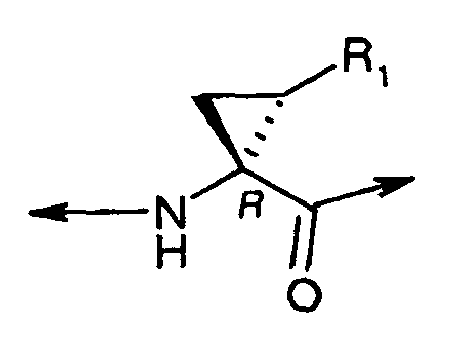
wherein R 1 is Et or -CH=CH2 or -CH=CHBr; and
W is hydroxy or -NH-(S)CH(Me)Ph,
or a pharmaceutically acceptable salt or ester thereof. - An even further preferred group of compounds is represented by formula I wherein B is acetyl; R 6 , when present, is the side chain of Asp; R 5 , when present, is the side chain of D-Glu; Y is H; R 4 is the side chain of Chg; R 3 is the side chain of Val or Tbg; R 2 is :

- P1 is:

W is hydroxy, or a pharmaceutically acceptable salt or ester thereof. - Finally, included in the scope of the invention is each compound of formula I presented in Tables 1 to 5.
- According to an alternate embodiment, the pharmaceutical compositions of this invention may additionally comprise another anti-HCV agent. Examples of anti-HCV agents include α- or β-interferon, ribavirin and amantadine.
- According to another alternate embodiment, the pharmaceutical compositions of this invention may additionally comprise other inhibitors of HCV protease.
- According to yet another alternate embodiment, the pharmaceutical compositions of this invention may additionally comprise an inhibitor of other targets in the HCV life cycle, including but not limited to, such as helicase, polymerase, metalloprotease or internal ribosome entry site (IRES).
- The pharmaceutical compositions of this invention may be administered orally, parenterally or via an implanted reservoir. Oral administration or administration by injection is preferred. The pharmaceutical compositions of this invention may contain any conventional non-toxic pharmaceutically-acceptable carriers, adjuvants or vehicles. In some cases, the pH of the formulation may be adjusted with pharmaceutically acceptable acids, bases or buffers to enhance the stability of the formulated compound or its delivery form. The term parenteral as used herein includes subcutaneous, intracutaneous, intravenous, intramuscular, intra-articular, intrasynovial, intrasternal, intrathecal, and intralesional injection or infusion techniques.
- The pharmaceutical compositions may be in the form of a sterile injectable preparation, for example, as a sterile injectable aqueous or oleaginous suspension. This suspension may be formulated according to techniques known in the art using suitable dispersing or wetting agents (such as, for example Tween® 80) and suspending agents.
- The pharmaceutical compositions of this invention may be orally administered in any orally acceptable dosage form including, but not limited to, capsules, tablets, and aqueous suspensions and solutions. In the case of tablets for oral use, carriers which are commonly used include lactose and corn starch. Lubricating agents, such as magnesium stearate, are also typically added. For oral administration in a capsule form, useful diluents include lactose and dried corn starch. When aqueous suspensions are administered orally, the active ingredient is combined with emulsifying and suspending agents. If desired, certain sweetening and/or flavoring and/or coloring agents may be added.
- Other suitable vehicles or carriers for the above noted formulations and compositions can be found in standard pharmaceutical texts, e.g. in "Remington's Pharmaceutical Sciences", The Science and Practice of Pharmacy, 19th Ed. Mack Publishing Company, Easton, Penn., (1995).
- Dosage levels of between about 0.01 and about 100 mg/kg body weight per day, preferably between about 0.5 and about 75 mg/kg body weight per day of the protease inhibitor compounds described herein are useful in a monotherapy for the prevention and treatment of HCV mediated disease. Typically, the pharmaceutical compositions of this invention will be administered from about 1 to about 5 times per day or alternatively, as a continuous infusion. Such administration can be used as a chronic or acute therapy. The amount of active ingredient that may be combined with the carrier materials to produce a single dosage form will vary depending upon the host treated and the particular mode of administration. A typical preparation will contain from about 5% to about 95% active compound (w/w). Preferably, such preparations contain from about 20% to about 80% active compound.
- As the skilled artisan will appreciate, lower or higher doses than those recited above may be required. Specific dosage and treatment regimens for any particular patient will depend upon a variety of factors, including the activity of the specific compound employed, the age, body weight, general health status, sex, diet, time of administration, rate of excretion, drug combination, the severity and course of the infection, the patient's disposition to the infection and the judgment of the treating physician. Generally, treatment is initiated with small dosages substantially less than the optimum dose of the peptide. Thereafter, the dosage is increased by small increments until the optimum effect under the circumstances is reached. In general, the compound is most desirably administered at a concentration level that will generally afford antivirally effective results without causing any harmful or deleterious side effects.
- When the compositions of this invention comprise a combination of a compound of formula I and one or more additional therapeutic or prophylactic agent, both the compound and the additional agent should be present at dosage levels of between about 10 to 100%, and more preferably between about 10 and 80% of the dosage normally administered in a monotherapy regimen.
- When these compounds or their pharmaceutically acceptable salts are formulated together with a pharmaceutically acceptable carrier, the resulting composition may be administered in vivo to mammals, such as man, to inhibit HCV NS3 protease or to treat or prevent HCV virus infection. Such treatment may also be achieved using the compounds of this invention in combination with agents which include, but are not limited to: immunomodulatory agents, such as α-, β-, or γ-interferons; other antiviral agents such as ribavirin, amantadine; other inhibitors of HCV NS3 protease; inhibitors of other targets in the HCV life cycle, which include but not limited to, helicase, polymerase, metalloprotease, or internal ribosome entry site (IRES); or combinations thereof. The additional agents may be combined with the compounds of this invention to create a single dosage form. Alternatively these additional agents may be separately administered to a mammal as part of a multiple dosage form.
- Accordingly, this invention provides methods of inhibiting HVC NS3 protease activity in mammals by administering a compound of the formula I, wherein the substituents are as defined above.
- Preferred methods are useful in decreasing HCV NS3 protease activity in a mammal. If the pharmaceutical composition comprises only a compound of this invention as the active component, such methods may additionally comprise the step of administering to said mammal an agent selected from an immunomodulatory agent, an antiviral agent, a HCV protease inhibitor, or an inhibitor of other targets in the HCV life cycle such as helicase, polymerase, metalloprotease or IRES. Such additional agent may be administered to the mammal prior to, concurrently with, or following the administration of the compositions of this invention.
- Alternate methods are useful for inhibiting viral replication in a mammal. Such methods are useful in treating or preventing HCV disease. If the pharmaceutical composition comprises only a compound of this invention as the active component, such methods may additionally comprise the step of administering to said mammal an agent selected from an immunomodulatory agent, an antiviral agent, a HCV protease inhibitor, or an inhibitor of other targets in the HCV life cycle. Such additional agent may be administered to the mammal prior to, concurrently with, or following the administration of the composition according to this invention.
- The compounds set forth herein may also be used as laboratory reagents. The compounds of this invention may also be used to treat or prevent viral contamination of materials and therefore reduce the risk of viral infection of laboratory or medical personnel or patients who come in contact with such materials (e.g. blood, tissue, surgical instruments and garments, laboratory instruments and garments, and blood collection apparatuses and materials).
- The compounds set forth herein may also be used as research reagents. The compounds of this invention may also be used as positive control to validate surrogate cell-based assays or in vitro or in vivo viral replication assays.
- The compounds of the present invention were synthesized according to the process as illustrated in scheme I (wherein CPG is a carboxyl protecting group and APG is an amino protecting group):

- Briefly, the P1, P2, P3, P4, and optionally P5 and P6 can be linked by well known peptide coupling techniques. The P1, P2, P3, P4, and P5 and P6 groups may be linked together in any order as long as the final compound corresponds to peptides of formula I. For example, P6 can be linked to P5 to give P5-P6 that is linked to P4-P3-P2-P1 ; or P6 linked to P5-P4-P3-P2 then linked to an appropriately C-terminal protected P1.
- Generally, peptides are elongated by deprotecting the α-amino group of the N-terminal residue and coupling the unprotected carboxyl group of the next suitably N-protected amino acid through a peptide linkage using the methods described. This deprotection and coupling procedure is repeated until the desired sequence is obtained. This coupling can be performed with the constituent amino acids in stepwise fashion, as depicted in Scheme I, or by condensation of fragments (two or several amino acids), or combination of both processes, or by solid phase peptide synthesis according to the method originally described in Merrifield, J. Am. Chem. Soc. (1963), 85, 2149-2154.
- Coupling between two amino acids, an amino acid and a peptide, or two peptide fragments can be carried out using standard coupling procedures such as the azide method, mixed carbonic-carboxylic acid anhydride (isobutyl chloroformate) method, carbodiimide (dicyclohexylcarbodiimide, diisopropylcarbodiimide, or water-soluble carbodiimide) method, active ester (p-nitrophenyl ester, N-hydroxysuccinic imido ester) method, Woodward reagent K-method, carbonyldiimidazole method, phosphorus reagents or oxidation-reduction methods. Some of these methods (especially the carbodiimide method) can be enhanced by adding 1-hydroxybenzotriazole. These coupling reactions can be performed in either solution (liquid phase) or solid phase.
- More explicitly, the coupling step involves the dehydrative coupling of a free carboxyl of one reactant with the free amino group of the other reactant in the presence of a coupling agent to form a linking amide bond. Descriptions of such coupling agents are found in general textbooks on peptide chemistry, for example, M. Bodanszky, "Peptide Chemistry", 2nd rev ed., Springer-Verlag, Berlin, Germany, (1993). Examples of suitable coupling agents are N,N'-dicyclohexylcarbodiimide, 1-hydroxybenzotriazole in the presence of N,N'-dicyclohexylcarbodiimide or N-ethyl-N'-[(3-dimethylamino)propyl]carbodiimide. A very practical and useful coupling agent is the commercially available (benzotriazol-1-yloxy)tris-(dimethylamino)phosphonium hexafluorophosphate, either by itself or in the presence of 1-hydroxybenzotriazole. Another very practical and useful coupling agent is commercially available 2-(1H-benzotriazol-1-yl)-N,N,N',N'-tetramethyluronium tetrafluoroborate. Still another very practical and useful coupling agent is commercially available O-(7-azabenzotriazol-1-yl)-N,N,N',N'-tetramethyluronium hexafluorophosphate.
- The coupling reaction is conducted in an inert solvent, e.g. dichloromethane, acetonitrile or dimethylformamide. An excess of a tertiary amine, e.g. diisopropylethylamine, N-methylmorpholine or N-methylpyrrolidine, is added to maintain the reaction mixture at a pH of about 8. The reaction temperature usually ranges between 0°C and 50°C and the reaction time usually ranges between 15 min and 24 h.
- When a solid phase synthetic approach is employed, the C-terminal carboxylic acid is attached to an insoluble carrier (usually polystyrene). These insoluble carriers contain a group that will react with the carboxylic group to form a bond that is stable to the elongation conditions but readily cleaved later. Examples of which are: chloro- or bromomethyl resin, hydroxymethyl resin, and aminomethyl resin. Many of these resins are commercially available with the desired C-terminal amino acid already incorporated. Alternatively, the amino acid can be incorporated on the solid support by known methods Wang, S.-S., J. Am. Chem. Soc., (1973), 95, 1328; Atherton, E.; Shepard, R.C. "Solid-phase peptide synthesis; a practical approach" IRL Press: Oxford, (1989); 131-148. In addition to the foregoing, other methods of peptide synthesis are described in Stewart and Young, "Solid Phase Peptide Synthesis", 2nd ed., Pierce Chemical Co., Rockford, IL (1984); Gross, Meienhofer, Udenfriend, Eds., "The Peptides: Analysis, Synthesis, Biology". Vol. 1, 2, 3, 5, and 9, Academic Press, New-York, (1980-1987); Bodansky et al., "The Practice of Peptide Synthesis" Springer-Veriag, New-York (1984).
- The functional groups of the constituent amino acids generally must be protected during the coupling reactions to avoid formation of undesired bonds. The protecting groups that can be used are listed in Greene, "Protective Groups in Organic Chemistry", John Wiley & Sons, New York (1981) and "The Peptides: Analysis, Synthesis, Biology", Vol. 3, Academic Press, New York (1981).
- The α-carboxyl group of the C-terminal residue is usually protected as an ester (CPG) that can be cleaved to give the carboxylic acid. Protecting groups that can be used include: 1) alkyl esters such as methyl, trimethylsilylethyl and t-butyl, 2) aralkyl esters such as benzyl and substituted benzyl, or 3) esters that can be cleaved by mild base treatment or mild reductive means such as trichloroethyl and phenacyl esters.
- The α-amino group of each amino acid to be coupled to the growing peptide chain must be protected (APG). Any protecting group known in the art can be used. Examples of such groups include: 1) acyl groups such as formyl, trifluoroacetyl, phthalyl, and ρ-toluenesulfonyl; 2) aromatic carbamate groups such as benzyloxycarbonyl (Cbz or Z) and substituted benzyloxycarbonyls, and 9-fluorenylmethyloxycarbonyl (Fmoc); 3) aliphatic carbamate groups such as tert-butyloxycarbonyl (Boc), ethoxycarbonyl, diisopropylmethoxycarbonyl, and allyloxycarbonyl; 4) cyclic alkyl carbamate groups such as cyclopentyloxycarbonyl and adamantyloxycarbonyl; 5) alkyl groups such as triphenylmethyl and benzyl; 6) trialkylsilyl such as trimethylsilyl; and 7) thiol containing groups such as phenylthiocarbonyl and dithiasuccinoyl. The preferred α-amino protecting group is either Boc or Fmoc. Many amino acid derivatives suitably protected for peptide synthesis are commercially available.
- The α-amino protecting group of the newly added amino acid residue is cleaved prior to the coupling of the next amino acid. When the Boc group is used, the methods of choice are trifluoroacetic acid, neat or in dichloromethane, or HCl in dioxane or in ethyl acetate. The resulting ammonium salt is then neutralized either prior to the coupling or in situ with basic solutions such as aqueous buffers, or tertiary amines in dichloromethane or acetonitrile or dimethylformamide. When the Fmoc group is used, the reagents of choice are piperidine or substituted piperidine in dimethylformamide, but any secondary amine can be used. The deprotection is carried out at a temperature between 0°C and room temperature (RT), usually 20-22°C.
- Any of the amino acids having side chain functionalities must be protected during the preparation of the peptide using any of the above-described groups. Those skilled in the art will appreciate that the selection and use of appropriate protecting groups for these side chain functionalities depend upon the amino acid and presence of other protecting groups in the peptide. The selection of such protecting groups is important in that the group must not be removed during the deprotection and coupling of the α-amino group.
- For example, when Boc is used as the α-amino protecting group, the following side chain protecting group are suitable: p-toluenesulfonyl (tosyl) moieties can be used to protect the amino side chain of amino acids such as Lys and Arg; acetamidomethyl, benzyl (Bn), or t-butylsulfonyl moieties can be used to protect the sulfide containing side chain of cysteine; benzyl (Bn) ethers can be used to protect the hydroxy containing side chains of serine, threonine or hydroxyproline; and benzyl esters can be used to protect the carboxy containing side chains of aspartic acid and glutamic acid.
- When Fmoc is chosen for the α-amine protection, usually tert-butyl based protecting groups are acceptable. For instance, Boc can be used for lysine and arginine, tert-butyl ether for serine, threonine and hydroxyproline, and tert-butyl ester for aspartic acid and glutamic acid. Triphenylmethyl (Trityl) moiety can be used to protect the sulfide containing side chain of cysteine.
- When W is an amide (w), P1 is coupled to an appropriate amine prior to the coupling to P2. Such amination will be readily recognized by persons skilled in the art.
- Once the elongation of the peptide is completed all of the protecting groups are removed. When a liquid phase synthesis is used, the protecting groups are removed in whatever manner is dictated by the choice of protecting groups. These procedures are well known to those skilled in the art.
- When a solid phase synthesis is used, the peptide is cleaved from the resin simultaneously with the removal of the protecting groups. When the Boc protection method is used in the synthesis, treatment with anhydrous HF containing additives such as dimethyl sulfide, anisole, thioanisole, or p-cresol at 0°C is the preferred method for cleaving the peptide from the resin. The cleavage of the peptide can also be accomplished by other acid reagents such as trifluoromethanesulfonic acid/trifluoroacetic acid mixtures. If the Fmoc protection method is used, the N-terminal Fmoc group is cleaved with reagents described earlier. The other protecting groups and the peptide are cleaved from the resin using solution of trifluoroacetic acid and various additives such as anisole, etc.
- Different capping groups B are introduced to protected P4, P5 or P6 or to any peptide segment with an appropriate acyl chloride or sulfonyl chloride that is either commercially available or for which the synthesis is well known in the art.
- Different P6 to P3 moieties are available commercially or the synthesis is well known in the art.
- The preparation of halomethyl-8-quinoline IId was done according to the procedure of K.N. Campbell et al., J. Amer. Chem. Soc., (1946), 68, 1844.

- Briefly, 8-quinoline carboxylic acid IIa was converted to the corresponding alcohol IIc by reduction of the corresponding acyl halide IIb with a reducing agent such as lithium aluminium hydride. Treatment of alcohol IIb with the appropriate hydrohaloacid gives the desired halo derivative IId. A specific embodiment of this process is presented in Example 1A.
- 2-phenyl-4-hydroxyquinoline derivatives IIIc were prepared according to Giardina et al. (J. Med. Chem., (1997), 40, 1794-1807).

R 22 & R 21B = alkyl, OH, SH, halo, NH2, NO2. - Benzoylacetamide (IIIa) was condensed with the appropriate aniline (IIIb) and the imine obtained was cyclized with polyphosphoric acid to give the corresponding 2-phenyl-4-hydroxyquinoline (IIIc). A specific embodiment of this process is presented in Example 1B and 1C.
-
- A) The synthesis of 4-substituted proline (wherein R 2 is attached to the ring via a carbon atom) (with the stereochemistry as shown):

is done as shown in Scheme IV according to the procedures described by J. Ezquerra et al. (Tetrahedron, (1993), 38, 8665-8678) and C. Pedregal et al. (Tetrahedron Lett., (1994), 35, 2053-2056).
Briefly, Boc-pyroglutamic acid is protected as a benzyl ester. Treatment with a strong base such as lithium diisopropylamide followed by addition of an alkylating agent (Br-R 20 or I-R 20 ) gives the desired compounds IVe after reduction of the amide and deprotection of the ester. - B) The synthesis of O-aralkylated 4-(R)-hydroxyproline:
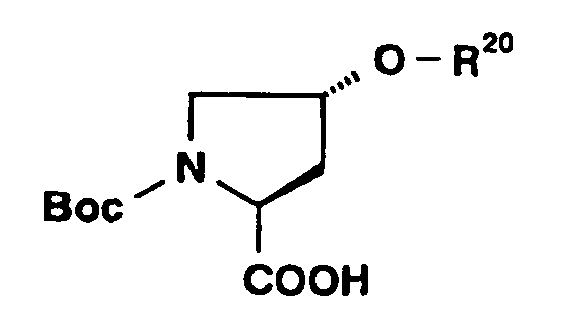
When R 20 is aryl, Het, aralkyl, or (lower alkyl)-Het, the process can be carried out according to the procedure described by E.M. Smith et al. (J. Med. Chem. (1988), 31, 875-885). Briefly, commercially available Boc-4(R)-hydroxyproline is treated with a base such as sodium hydride or K-tBuO and the resulting alkoxide reacted with an halo-R 20 (Br-R 20, I-R 20, etc..) to give the desired compounds. Specific embodiments of this process are presented in Examples 2, 3 and 4B. - C) Alternatively, when R 20 is aryl or Het, the compounds can also be prepared via a Mitsunobu reaction (Mitsunobu (1981), Synthesis, January, 1-28; Rano et al., (1995), Tet. Lett. 36(22), 3779-3792; Krchnak et al., (1995), Tet. Lett. 36(5), 62193-6196; Richter et al., (1994), Tet. Lett. 35(27), 4705-4706). Briefly, commercially available Boc-4(S)-hydroxyproline methyl ester is treated with the appropriate aryl alcohol or thiol in the presence of triphenylphosphine and diethylazodicarboxylate (DEAD) and the resulting ester is hydrolyzed to the acid. Specific embodiment of this process is presented in Example 4A.

- Alternatively, the Mitsunobu reaction can be produced in solid phase (Scheme V). The 96-well block of the Model 396 synthesizer (advanced ChemTech) is provided with aliquots of resin-bound compound (Va) and a variety of aryl alcohols or thiols and appropriate reagents are added. After incubation, each resin-bound product (Vb) is washed, dried, and cleaved from the resin.
A Suzuki reaction (Miyaura et al., (1981), Synth. Comm. 11, 513; Sato et al., (1989), Chem. Lett., 1405; Watanabe et al., (1992), Synlett., 207; Takayuki et al., (1993), J. Org. Chem. 58, 2201; Frenette et al., (1994), Tet. Lett. 35(49), 9177-9180; Guiles et al., (1996), J. Org. Chem. 61, 5169-5171) can also be used to further functionalize the aryl substituent. - The synthesis was done according to scheme VI.
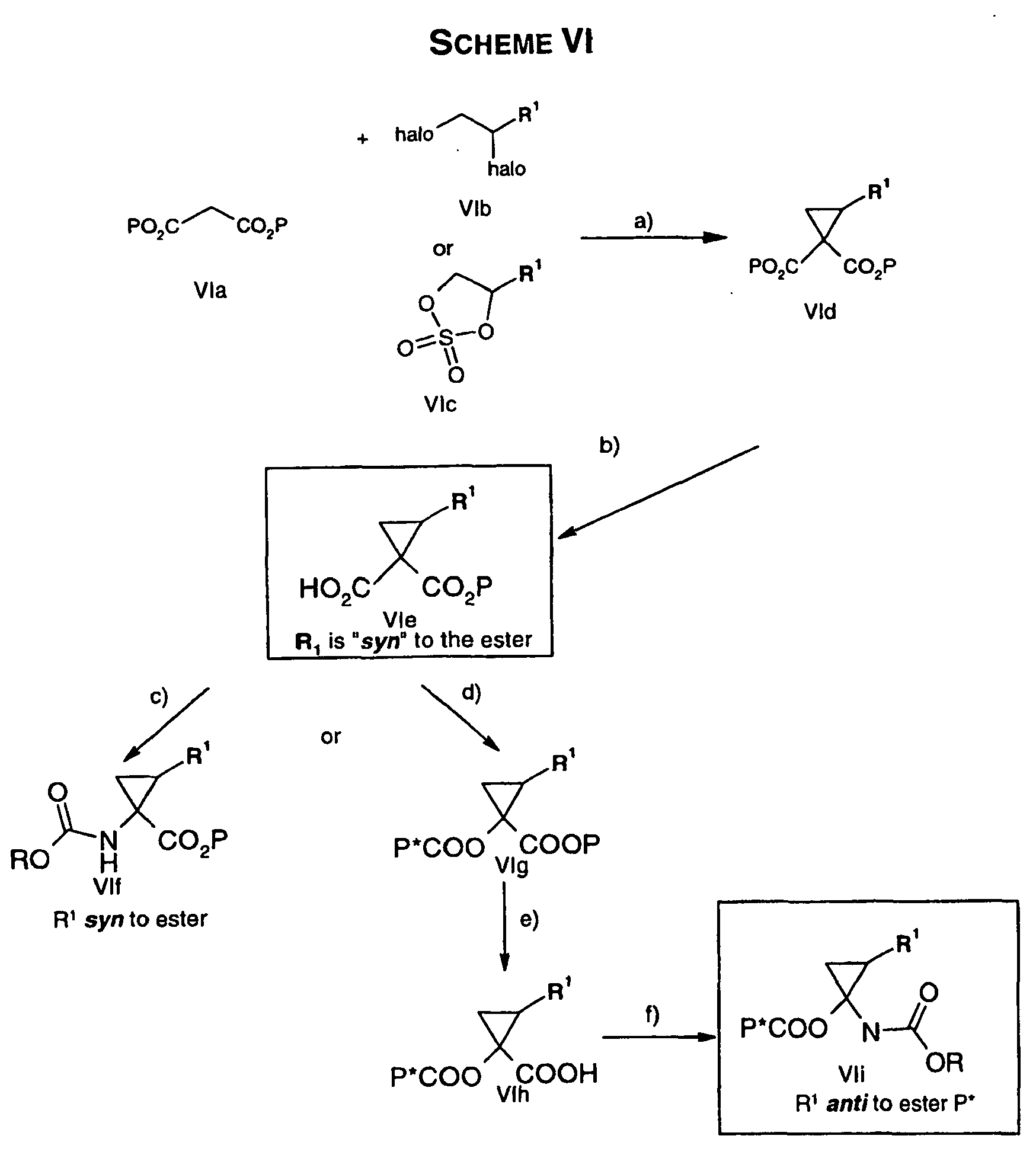
- a) Briefly, di-protected malonate VIa and 1,2-dihaloalkane VIb or cyclic sulfate VIc (synthesized according to K. Burgess and Chun-Yen KE (Synthesis, (1996), 1463-1467) are reacted under basic conditions to give the diester VId.
- b) A regioselective hydrolysis of the less hindered ester is performed to give the acid VIe.
- c) This acid VIe is subjected to a Curtius rearrangement to give a racemic mixture of 1-aminocyclopropylcarboxylic acid derivatives VIf with R 1 being syn to the carboxyl group. A specific embodiment for this synthesis is presented in Example 5.
- d, e) Alternatively, selective ester formation from the acid VIe with an appropriate halide (P*CI) or alcohol (P*OH) forms diester Vlg in which the P* ester is compatible with the selective hydrolysis of the P ester. Hydrolysis of P ester provides acid Vlh.
- f) A Curtius rearrangement on Vlh gives a racemic mixture of 1-aminocyclopropylcarboxylic acid derivatives VIi with R1 group being anti to the carboxyl group. A specific embodiment for this synthesis is presented in Example 10.
- An alternative synthesis for the preparation of derivatives Vlf (when R1 is vinyl, syn to the carboxyl group) is described below.
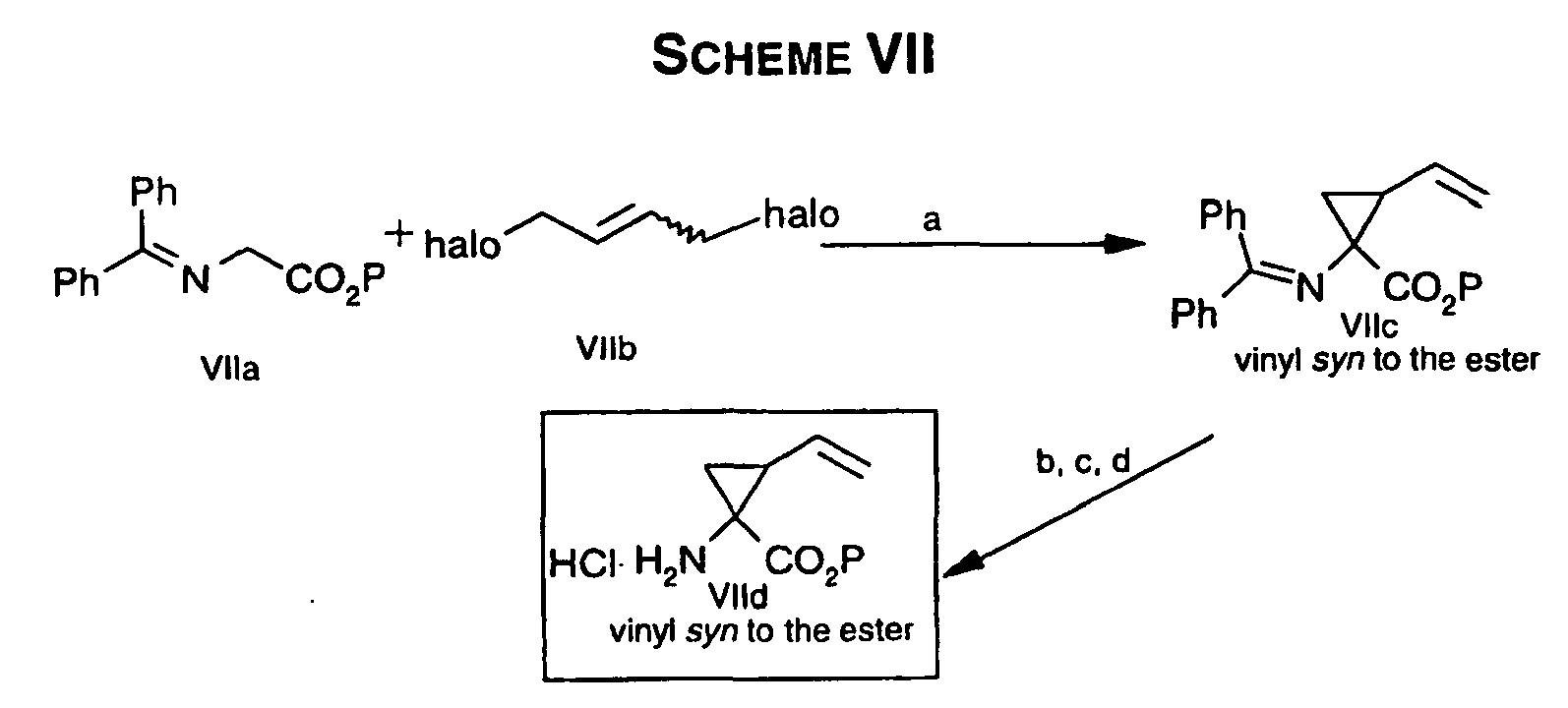
- Treatment of commercially available imine VIIa with 1,4-dihalobutene Vllb in presence of a base produces, after hydrolysis of the resulting imine VIIc, VIId having the allyl substituent syn to the carboxyl group This process is presented in Example 11.
- Resolution of all of the above enantiomeric mixtures at carbon 1 (VIe and VIId) can be carried out via:
- 1) enzymatic separation (Examples 9 and 13);
- 2) crystallization with a chiral acid (Example 14); or
- 3) chemical derivatization (Example 6).
- Following resolution, determination of the absolute stereochemistry can be carried out as presented in Example 7.
- Resolution and stereochemistry determination can be carried out in the same manner for the enantiomeric mixtures at carbon 1 wherein the substituent at C2 is anti to the carboxyl group (Vii).
- Accordingly, the invention further comprises a process for the preparation of a peptide analog of formula (I) wherein P1 is a substituted aminocyclopropyl carboxylic acid residue, comprising the step of:
- coupling a peptide selected from the group consisting of: APG-P6-P5-P4-P3-P2; APG-P5-P4-P3-P2; APG-P4-P3-P2; APG-P3-P2; and APG-P2;
- with a P1 intermediate of formula:

wherein R 1 is C1-6 alkyl or C2-6 alkenyl optionally substituted with halogen, CPG is a carboxyl protecting group and APG is an amino protecting group, and P6 to P2 are as defined above. - Finally, the invention also comprises the use of an intermediate of formula:

wherein R 1 is C1-6 alkyl or C2-6 alkenyl optionally substituted with halogen, for the preparation of a compound of formula I as defined above. - The present invention is illustrated in further detail by the following non-limiting examples.
- Temperatures are given in degrees Celsius. Solution percentages express a weight to volume relationship, and solution ratios express a volume to volume relationship, unless stated otherwise. Nuclear magnetic resonance (NMR) spectra were recorded on a Bruker 400 MHz spectrometer; the chemical shifts (δ) are reported in parts per million. Flash chromatography was carried out on silica gel (SiO2) according to Still's flash chromatography technique (W.C. Still et al., J. Org. Chem. (1978), 43, 2923).
- Abbreviations used in the examples include Bn: benzyl; Boc: tert-butyloxycarbonyl {Me3COC(O)}; BSA: bovine serum albumin; CHAPS: 3-[(3-cholamidopropyl)-dimethylammonio]-1-propanesulfonate; DBU: 1,8-diazabicyclo[5.4.0]undec-7-ene; CH2Cl2= DCM: methylene chloride; DEAD: diethylazodicarboxylate; DIAD: diisopropylazodicarboxylate; DIPEA: diisopropylethylamine; DMAP: dimethylaminopyridine; DCC: 1,3-dicyclohexylcarbodiimide; DME: 1,2-dimethyoxyethane; DMF: dimethylformamide; DMSO: dimethylsulfoxide; DTT: dithiothreitol or threo-1,4-dimercapto-2,3-butanediol; DPPA: diphenylphosphoryl azide; EDTA: ethylenediaminetetraacetic acid; Et: ethyl; EtOH: ethanol; EtOAc: ethyl acetate; Et2O: diethyl ether; HATU: [O-7-azabenzotriazol-1-yl)-1,1,3,3-tetramethyluronium hexafluorophosphate]; HPLC: high performance liquid chromatography; MS: mass spectrometry (MALDI-TOF: Matrix Assisted Laser Disorption Ionization-Time of Flight, FAB: Fast Atom Bombardment); LAH: lithium aluminum hydride; Me: methyl; MeOH: methanol; MES: (2-{N-morpholino}ethanesulfonic acid); NaHMDS: sodium bis(trimethylsilyl)amide; NMM: N-methylmorpholine; NMP: N-methylpyrrolidine; Pr: propyl; Succ: 3-carboxypropanoyl; PNA: 4-nitrophenylamino or p-nitroaniline; TBAF: tetra-n-butylammonium fluoride; TBTU: 2-(1H-benzotriazole-1-yl)-1,1,3,3-tetramethyluronium tetrafluoroborate; TCEP: tris(2-carboxyethyl) phosphine hydrochloride; TFA: trifluoroacetic acid; THF: tetrahydrofuran; TIS: triisopropylsilane; TLC: thin layer chromatography; TMSE: trimethylsilylethyl; Tris/HCl: tris(hydroxymethyl)aminomethane hydrochloride.
-

- To commercially available 8-quinoline carboxylic acid (2.5 g, 14.4 mmol) was added neat thionyl chloride (10 ml, 144 mmol). This mixture was heated at 80°C for 1 h before the excess thionyl chloride was distilled off under reduced pressure. To the resulting brownish solid was added absolute EtOH (15 mL) which was heated at 80°C for 1 h before being concentrated in vacuo. The residue was partitioned between EtOAc and saturated aqueous NaHCO3, and the organic phase dried (MgSO4), filtered and concentrated to give a brownish oil (2.8 g). This material (ca. 14.4 mmol) was added dropwise over 35 min to a LAH (0.76 g, 20.2 mmol)/Et2O suspension which was cooled to -60°C. The reaction mixture was slowly warmed to -35°C over 1.5 h before the reaction was complete. The reaction was quenched with MgSO4.10H2O slowly over 30 min and then wet THF. The mixture was partitioned between Et2O and 10% aqueous NaHCO3.The organic phase was dried (MgSO4), filtered and concentrated to give a yellowish solid (2.31 g, 80% over 2 steps) corresponding to the alcohol. The alcohol (2.3 g, 11.44 mmol) was dissolved in AcOH/HBr (20 mL, 30% solution from Aldrich) and heated at 70°C for 2.5 h. The mixture was concentrated in vacuo to dryness, partitioned between EtOAc (100 mL) and saturated aqueous NaHCO3 before being dried (MgSO4), filtered and concentrated to give the desired compound (1A) as a brownish solid (2.54 g, 100%).
-

- Commercially available ethyl benzoylacetate (6.00 g, 31.2 mmol) was heated at 85°C (sealed tube) in 75 mL of 30% NH4OH for 2 hours. The solid formed upon cooling was filtered and refluxed in water for 2 hours. The solution was extracted three times with CH2Cl2. The organic layers were combined, dried over MgSO4, filtered and concentrated. The yellow residue was flash chromatographed on silica gel, eluting with EtOAc:hexane (3:7), to give the corresponding amide as a white solid, 1.60 g, 31 % yield.
- This amide (250 mg, 1.53 mmol) was refluxed using a Dean-Stark apparatus with aniline (143 mg, 1.53 mmol) and aniline•HCl (10 mg, 0.08 mmol) in toluene (10 mL) for 16 h. The solution was concentrated to afford a brown oil that was mixed with polyphosphoric acid (2 g) and heated at 135°C for 20 min. The reaction mixture was poured into water and adjusted to pH 8 with 5 M NaOH. The aqueous suspension was extracted twice with ethyl acetate. The organic layers were combined, washed with brine, dried over MgSO4, filtered and concentrated. The residue was flash chromatographed on silica gel, eluting with 3% MeOH in ethyl acetate, to give 2-phenyl-4-hydroxyquinoline (1B), 67 mg, 20% yield.
- 1H NMR (DMSO-d6) δ 8.11 (d, J = 7 Hz, 1 H), 7.86-7.83 (m, 2 H), 7.77 (d, J = 8 Hz, 1 H), 7.68 (dd, J = 8, 7 Hz, 1 H), 7.61-7.58 (m, 3 H), 7.35 (dd, J = 8, 7 Hz, 1 H), 6.34 (s, 1 H).
-

- A solution of ethyl benzoylacetate (b) (100.0 g, 0.52 mol), m-anisidine (a) (128.1 g, 1.04 mol) and 4N HCl / dioxane (5.2 mL) in toluene (1.0 L) was refluxed for 6.25 h in a Dean-Stark apparatus. The cooled toluene solution was successively washed with aqueous 10% HCl (2 × 300 mL), 1N NaOH (2 × 300 mL), H2O (300 mL) and brine (150 mL). The toluene phase was dried (MgSO4), filtered and concentrated under reduced pressure to give a 1.2:1.0 mixture of ester c and amide d (144.6 g, 45% / 38% crude yield) as a dark brown oil. The crude oil was heated to 280 °C for 80 min while distilling generated EtOH. The cooled dark solid obtained was triturated with CH2Cl2 (200 mL). The suspension was filtered and the resulting solid washed with CH2Cl2 to give e (22.6 g, 17% from a) as a beige solid: 1H NMR (DMSO-d6) δ 8.00 (d, J = 9.0 Hz, 1H), 7.81-7.82 (m, 2H), 7.57-7.59 (m, 3H), 7.20 (d, J = 2.2 Hz, 1H), 6.94 (dd, J = 9.0, 2.2 Hz, 1H), 6.26 (s, 1H), 3.87 (s, 3H).
- A suspension of e (8.31 g, 33.1 mmol) in POCl3 (90 mL) was heated to reflux for 2 h (clear solution obtained upon heating). The reaction mixture was concentrated under reduced pressure. The residue was partitioned between 1N NaOH (exothermic, 10N NaOH added to maintain high pH) and EtOAc (500 mL). The organic layer was washed with H2O (100 mL) and brine (100 mL) then was dried (MgSO4), filtered and concentrated under reduced pressure to give 1C (8.60 g, 96%) as a pale yellow solid: 1H NMR (DMSO-d6) δ 8.28-8.30 (m, 2H), 8.20 (s, 1H), 8.10 (d, J = 9.1 Hz, 1H), 7.54-7.58 (m, 3H), 7.52 (d, J = 2.5 Hz, 1H), 7.38 (dd, J = 9.1, 2.5 Hz, 1H), 3.98 (s, 3H). This reaction was repeated three times and always gave 96-98% yield which is significantly higher that the 68% yield reported in J. Med. Chem. 1997, 40, 1794.
-

- Commercially available Boc-4(R)-hydroxyproline (5.00 g, 21.6 mmol) was dissolved in THF (100 mL) and cooled to 0°C. Sodium hydride (60% dispersion in oil, 1.85 g, 45.4 mmol) was added portionwise over 10 minutes and the suspension was stirred at RT for 1 h. Then, 1-(bromamethyl)naphthalene (8.00 g, 36.2 mmol) (prepared as described in E.A. Dixon et al. Can. J. Chem., (1981), 59, 2629-2641) was added and the mixture was heated at reflux for 18 h. The mixture was poured into water (300 mL) and washed with hexane. The aqueous layer was acidified with 10% aqueous HCl and extracted twice with ethyl acetate. The organic layers were combined and washed with brine, dried (MgSO4), filtered and concentrated. The residue was purified by flash chromatography (49:49:2 hexane: ethyl acetate: acetic acid) to give the title compound as a colorless oil (4.51 g, 56% yield). 1H NMR (DMSO-d6) indicated the presence of two rotamers: δ 8.05 (m, 1H), 7.94 (m, 1H), 7.29 (d, J=14 Hz, 1H), 7.55-7.45 (m, 4H), 4.96 (m, 2H), 4.26 (br. s, 1H), 4.12 (dd, J=J=8 Hz, 1H), 3.54-3.42 (m, 2H), 2.45-2.34 (m, 1H), 2.07-1.98 (m, 1H) 1.36 (s, (3/9) 9H), 1.34 (s, (6/9) 9H).
-

- Boc-4(R)-hydroxyproline (1.96 g, 8.5 mmol) in anhydrous THF (20 mL) was added to a suspension of NaH (1.4 g, 60% in oil, 34 mmol) in THF (100 mL). This mixture was stirred 30 min before bromomethyl-8-quinoline from Example 1 A (2.54 g, 11.44 mmol) was added in THF (30 mL). The reaction mixture was heated at 70°C (5 h) before the excess NaH was destroyed carefully with wet THF. The reaction was concentrated in vacuo and the resulting material was dissolved in EtOAc and H2O. The basic aqueous phase was separated and acidified with 10% aqueous HCl to pH ∼5 before being extracted with EtOAc (150 mL). The organic phase was dried (MgSO4), filtered and concentrated to give a brown oil. Purification by flash chromatography (eluent: 10% MeOH/CHCl3) gave the desired compound as a pale yellow solid (2.73 g, 86%). HPLC (97.5%); 1H-NMR (DMSO-d6) shows rotamer populations in a 6:4 ratio, δ 12-11.4 (bs, 1H). 8.92 (2 x d, J = 4.14 and 4.14 Hz, 1H), 8.38 (2 x d, J = 8.27 and 8.27 Hz, 1H), 7.91 (d, J = 7.94 Hz, 1H), 7.77 (d, J = 7.0 Hz, 1H), 7.63-7.54 (m, 2H), 5.14 (2 x s, 2H), 4.32-4.29 (m, 1H), 4.14-4.07 (m, 1H), 3.52-3.44 (m, 2H), 2.43-2.27 (m, 1H), 2.13-2.04 (m, 1H), 1.36 and 1.34 (2 x s, 9H).
-

- Commercially available Boc-4(S)-hydroxyproline methyl ester (500 mg, 2.04 mmol) and 7-chloro-4-hydroxyquinoline (440 mg, 2.45 mmol) were placed in dry THF (10 mL) at 0°C. Triphenylphosphine (641 mg, 2.95 mmol) was added, followed by slow addition of DIAD (426 mg, 2.45 mmol). The mixture was stirred at RT for 20 h. The reaction mixture was then concentrated, taken up in ethyl acetate and extracted three times with HCl 1N. The aqueous phase was basified with Na2CO3 and extracted twice with ethyl acetate. The organic layers were combined, dried over MgSO4, filtered and concentrated to give a yellow oil. The oil was purified by flash chromatography to give compound 4A methyl ester as a white solid, 498 mg, 58% yield.
- This methyl ester (400 mg, 0.986 mmol) was hydrolyzed with 1 M aqueous sodium hydroxide (1.7 mL, 1.7 mmol) in methanol (4 mL), at 0°C, for 3 h. The solution was concentrated to remove the methanol and neutralized with 1 M aqueous HCl. The suspension was concentrated to dryness and taken up in methanol (20 mL), the salts were filtered off and the filtrate concentrated to give the desired compound 4A as a white solid, 387 mg, quant. yield.
- 1H NMR (DMSO-d6) (ca. 1:1 mixture of rotamers) δ 8.74 (d, J = 5 Hz, 1 H), 8.13-8.09 (m, 1 H), 7.99 and 7.98 (s, 1 H), 7.58 (d, J = 9 Hz, 1 H), 7.02 (d, J = 5 Hz, 1 H), 5.26-5.20 (m, 1 H), 4.10- 4.01 (m, 1 H), 3.81-3.72 (m, 1 H), 3.59 (dd, J = 12, 10 Hz, 1 H), 2.41-2.31 (m, 2 H), 1.34 and 1.31 (s, 9H).
-

- Potassium tert-butoxide (8.16 g, 72.7 mmol) was added in small portions, over 15 min, to a solution of commercially available 4-(S)-hydroxyproline (6.73 g, 29.1 mmol) in DMSO (83 mL) maintained at 25°C. The mixture was stirred at 25°C for 1.5 h. Chloro-2-phenyl-7-methoxyquinoline 1C (8.61 g, 32.0 mmol) was added in 4 portions over 15 min to the reaction mixture. The reaction mixture was stirred at 25°C for 19 h. The resulting suspension was poured in H2O (650 mL) and the mixture was washed with Et2O (3 x 150 mL) to remove excess chloroquinoline (EtOAc was later found to be more efficient). The aqueous layer was acidified with aqueous 1 N HCl (38 mL of calculated 1.5 equiv. required, 43.6 mL) to pH 4 - 5. The white solid that precipitated was recovered by filtration. The moist solid was dried under reduced pressure over P2O5 to give the proline derivative 4B (12.6 g, 91%, contains 2.3% w/w of DMSO) as a beige solid:
- 1H NMR (DMSO-d6) δ (2:1 mixture of rotamers) 8.27 (d, J = 7.0 Hz, 2H), 8.00, 7.98 (2d, J = 9.2, -9.2 Hz, 1H), 7.48-7.56 (m, 3H), 7.45, 7.43 (2s, 1H), 7.39 (d, J = 2.5 Hz, 1H), 7.17 (dd, J = 9.2, 2.5 Hz, 1H), 5.53-5.59 (m, 1H), 4.34-4.41 (m, 1H), 3.93 (s, 3H), 3.76 (broad s, 2H), 2.63-2.73 (m, 1H), 2.32-2.43 (m, 1H), 1.36, 1.33 (2s, 9H).
-

- a) To a suspension of benzyltriethylammonium chloride (21.0 g, 92.19 mmol) in a 50% aqueous NaOH solution (92.4 g in 185 mL H2O) were successively added di-tert-butylmalonate (20.0 g, 92.47 mmol) and 1,2-dibromobutane (30.0 g, 138.93 mmol). The reaction mixture was vigorously stirred overnight at RT, a mixture of ice and water was then added. The crude product was extracted with CH2Cl2 (3x) and sequentially washed with water (3x) and brine. The organic layer was dried (MgSO4), filtered and concentrated. The residue was flash chromatographed (7 cm, 2 to 4 % Et2O in hexane) to afford the desired cyclopropane derivative 5c (19.1 g, 70.7 mmol, 76% yield). 1H NMR (CDCl3) δ 1.78-1.70 (m, 1H), 1.47 (s, 9H), 1.46 (s, 9H), 1.44-1.39 (m, 1H), 1.26-1.64 (m, 3H), 1.02 (t, 3H, J= 7.6 Hz).
- b) To a suspension of potassium tert-butoxide (6.71 g, 59.79 mmol, 4.4 eq.) in dry ether (100 mL) at 0°C was added H2O (270 µL, 15.00 mmol, 1.1 eq.). After 5 min diester 5c (3.675 g, 13.59 mmol) in ether (10 mL) was added to the suspension. The reaction mixture was stirred overnight at RT, then poured in a mixture of ice and water and washed with ether (3x). The aqueous layer was acidified with a 10% aq. citric acid solution at 0°C and extracted with AcOEt (3x). The combined organic layer was successively washed with water (2x) and brine. After the usual treatment (Na2SO4, filtration, concentration), the desired acid 5d was isolated as a pale yellow oil (1.86g, 8.68 mmol, 64% yield). 1H NMR (CDCl3) δ 2.09-2.01 (m, 1H), 1.98 (dd, J= 3.8, 9.2 Hz, 1H), 1.81- 1.70 (m, 1H), 1.66 (dd, J= 3.0, J= 8.2 Hz, 1H), 1.63-1.56 (m, 1H), 1.51 (s, 9H), 1.0 (t, J= 7.3 Hz, 3H).
- c) To the acid 5d (2.017 g, 9.414 mmol) in dry benzene (32 mL) were successively added Et3N (1.50 mL, 10.76 mmol, 1.14 eq.) and DPPA (2.20 mL, 10.21 mmol, 1.08 eq.). The reaction mixture was refluxed for 3.5 h then 2-trimethylsilylethanol (2.70 mL, 18.84 mmol, 2.0 eq.) was added. The reflux was maintained overnight then the reaction mixture was diluted with Et2O and successively washed with a 10 % aqueous citric acid solution, water, saturated aqueous NaHCO3, water (2x) and brine. After the usual treatment (MgSO4, filtration, concentration) the residue was purified by flash chromatography (5 cm, 10% AcOEt- hexane) to afford the desired carbamate 5e (2.60 g, 7.88 mmol, 84% yield) as a pale yellow oil. MS (FAB) 330 (MH+); 1H NMR (CDCl3) δ 5.1 (bs, 1H), 4.18-4.13 (m, 2H), 1.68-1.38 (m, 4H), 1.45 (s, 9H), 1.24-1.18 (m, 1H), 1.00-0.96 (m, 5H), 0.03 (s, 9H).
- d) To carbamate 5e (258 mg, 0.783 mmol) was added a 1.0 M TBAF solution in THF (940 µL, 0.94 mmol, 1.2 eq.). After 4.5 h an additional amount of 1.0 M TBAF was added (626 µL, 0.63 mmol, 0.8 eq.). The reaction mixture was stirred overnight at RT, refluxed for 30 min and then diluted with AcOEt. The solution was successively washed with water (2x) and brine. After the usual treatment (MgSO4, filtration and concentration) the desired amine 5f was isolated (84 mg, 0.453 mmol, 58 % yield) as a pale yellow liquid. 1H NMR (CDCl3) δ 1.96 (bs, 2H), 1.60-1.40 (m, 2H), 1.47 (s, 9H), 1.31-1.20 (m, 1H), 1.14 (dd, J= 4.1, 7.3 Hz, 1H), 1.02 (dd, J= 4.1, 9.2 Hz, 1H), 0.94 (t, J= 7.3 Hz, 3H).
-

- Compound 5e from Example 5 (8.50 g , 25.86 mmol) was treated with 1M TBAF/THF (26 mL) at reflux for 45 min. The cooled reaction mixture was diluted with EtOAc, washed with water (3x) and brine (1 x), then, dried (MgSO4), filtered and evaporated to provide the free amine as a light yellow oil. The free amine was dissolved in anhydrous CH2Cl2 (120 mL), NMM (8.5 mL, 77.57 mmol), compound 2 (Example 2) (10.08 g, 27.15 mmol) and HATU (11.79 g , 31.03 mmol) were added successively. The reaction mixture was stirred at RT overnight, then worked up as described previously. The crude diastereomeric mixture was separated by flash chromatography (eluent - hexane : Et2O ; 25 : 75) to provide the dipeptide 6a (the less polar eluting spot) as a white foam (4.42 g ; 64% of the theoretical yield) and 6b (the more polar eluting spot) as an ivory foam (4 g., 57% of theoretical yield). At this time both isomers were separated but the absolute stereochemistry was still not known.
-

- Prof . A. Charette , from the University of Montreal , provided compound 7a having the absolute stereochemistry as shown, which was determined by X-ray crystallography (J. Am. Chem. Soc., 1995, 117, 12721) . Compound 7a (13.2 mg , 0.046 mmol) was dissolved in 1 M HCl/EtOAc (240 µL) and stirred approximately 48 hours. The mixture was evaporated to dryness to provide compound 7b as a light yellow paste and was coupled to compound 2 (18 mg , 0.049 mmol) as described in Example 6, using NMM (20.3 µL, 0.185 mmol) and HATU (21.1 mg, 0.056 mmol) in CH2Cl2. The crude material was purified by flash chromatography (eluent - hexane : Et2O ; 50:50) to provide the dipeptide 7c as an oil (7.7 mg ; 31%). By TLC, HPLC and NMR comparison , dipeptide 7c, was found to be identical to the less polar compound 6a obtained in Example 6, thus identifying the absolute stereochemistry of 6a as (1R,2R).
-

- The carbamate 5e from example 5 (2.6 g, 7.88 mmol) was stirred for 40 min in TFA at 0°C. The mixture was then concentrated and diluted with THF (10 mL). An aqueous NaOH solution (700 mg, 17.5 mmol in 8.8 mL of H2O) was added followed by a THF (13 mL) solution of (Boc)2O (2.06 g, 9.44 mmol, 1.2 eq.). The reaction mixture was stirred overnight at RT (the pH was maintained at 8 by adding a 10 % aqueous NaOH solution when needed), then diluted with H2O, washed with Et2O (3X) and acidified at 0°C with a 10 % aq. citric acid solution. The aqueous layer was extracted with EtOAc (3X) and successively washed with H2O (2X) and brine. After the usual treatment (MgSO4, filtration and concentration) the desired Boc-protected amino acid (8a) (788 mg, 3.44 mmol, 44 % yield) was isolated. 1H NMR (CDCl3) δ 5.18 (bs, 1H), 1.64-1.58 (m, 2H), 1.55-1.42 (m, 2H), 1.45 (s, 9H), 1.32-1.25 (m, 1H), 0.99 (t, 3H, J= 7.3 Hz).
-

- The Boc derivative 8a (0.30 g, 1.31 mmol) was dissolved in Et2O (10 mL) and treated with freshly prepared diazomethane in Et2O at 0°C until the yellow color of a slight excess of diazomethane remained. After stirring for 20 min at RT the reaction mixture was concentrated to dryness to give 8b as a clear colorless oil (0.32 g, 100%). 1H NMR (CDCl3) δ 5.1 (bs, 1H), 3.71 (s, 3H), 1.62-1.57 (m, 2H), 1.55 (s, 9H), 1.53-1.43 (m, 1H), 1.28-1.21 (m, 2H), 0.95 (t, J = 7.3 Hz, 3H).
-

- a) The enantiomeric mixture of (1S, 2R)/(1R, 2R) 1-Boc-amino-2-ethylcarboxylic acid methyl ester of Example 8 (0.31 g, 1.27 mmol) was dissolved in acetone (3 mL) and then diluted with water (7 mL) while being rapidly stirred. The pH of the solution was adjusted to 7.5 with 0.05M aqueous NaOH before Alcalase® [2.4L extract from Novo Nordisk Industrials] (300 mg) was added. During incubation pH was stabilized with NaOH and a pH stat was set up to monitor the addition of the NaOH solution. After 40 h the mixture was diluted with EtOAc and H2O (with 5 mL sat. NaHCO3) and the phases separated. The aqueous phase was acidified with 10% aqueous HCl and extracted with EtOAc, dried (MgSO4), filtered and concentrated to give acid 9a (48.5 mg). The absolute stereochemistry was determined using the correlation described in Examples 6 and 7.
- b) Treatment of an aliquot of acid 9a with diazomethane in Et2O to give the methyl ester followed by analysis by HPLC using a chiral column [Chiralcel® OD-H, 2.5% Isopropanol/hexane, isocratic] showed a 51:1 ratio of the (1S,2R) isomer.
- a')The organic phase was dried (MgSO4), filtered and concentrated to give the unhydrolyzed esters (0.248 g). This material was re-subjected to the above enzyme protocol until the pH remained stable (98 h). After extraction as before, 0.146 mg (100%) of unhydrolyzed ester was recovered. Analysis by HPLC using a chiral column showed a ratio of >50:1 in favor of the (1R,2R) isomer.
- b') The aqueous phase was acidified with 10% aqueous HCl and extracted with EtOAc, dried (MgSO4), filtered and concentrated to give the acid analog (82 mg). A portion of this material was treated with diazomethane and then analyzed by HPLC using a chiral column as before which showed a ratio of 65:1 of the (1S,2R) derivative.
-

- Starting from acid 5d described in Example 5:
- c) To 5d (1.023 g, 4.77 mmol) in CH3CN (25 mL) were successively added DBU (860 µL, 5.75 mmol, 1.2 eq.) and allyl bromide (620 µL, 7.16 mmol, 1.5 eq.). The reaction mixture was stirred for 4 h at RT and then concentrated. The residue was diluted with Et2O and successively washed with a 10 % aq. citric acid solution (2x), H2O, saturated aqueous NaHCO3, H2O (2x) and brine. After the usual treatment (MgSO4, filtration and concentration) the desired ester 10a was isolated (1.106 g, 3.35 mmol, 91 % yield) as a colorless oil. MS (FAB) 255 (MH+); 1H NMR (CDCl3) δ 5.96-5.86 (m, 1H), 5.37-5.22 (m, 2H), 4.70-4.65 (m, 1H), 4.57-4.52 (m, 1H), 1.87-1.79 (m, 1H), 1.47 (s, 9H), 1.45-1.40 (m, 1H), 1.33-1.24 (m, 3H), 1.03 (t, J=7.3 Hz, 3H).
- d) To ester 10a (1.106 g, 4.349 mmol) in dry CH2Cl2 (5 mL) at RT was added TFA (5 mL). The reaction mixture was stirred for 1.5 h and then concentrated to afford 10b (854 mg, 4.308 mmol, 99 % yield). MS (FAB) 199 (MH+); 1H NMR (GDCl3) δ 5.99-5.79 (m, 1H), 5.40-5.30 (m, 2H), 4.71-4.62 (m, 2H), 2.22-2.00 (m, 2H), 1.95-1.88 (m, 1H), 1.84-1.57 (m, 2H), 0.98 (t, J= 7.3 Hz, 3H).
- e) To acid 10b (853 mg, 4.30 mmol) in dry benzene (14.8 mL) were successively added Et3N (684 µL, 4.91 mmol, 1.14 eq.) and DPPA (992 µL, 4.60 mmol, 1.07 eq.). The reaction mixture was refluxed for 4.5 h then 2-trimethylsilylethanol (1.23 mL, 8.58 mmol, 2.0 eq.) was added. The reflux was maintained overnight then the reaction mixture was diluted with Et2O and successively washed with a 10 % aqueous citric acid solution, water, saturated aq. NaHCO3, water (2x) and brine. After the usual treatment (MgSO4, filtration, concentration) the residue was flash chromatographed (5 cm, 10 to 15 % AcOEt- hexane) to afford carbamate 10c (1.212g, 3.866 mmol, 90 % yield) as a pale yellow oil. MS (FAB) 314 (MH+); 1H NMR (CDCl3) δ 5.93-5.84 (m, 1H), 5.32-5.20 (m, 2H), 5.05 (bs, 1H), 4.60-4.56 (m, 2H), 4.20-4.11 (m, 2H), 1.71-1.60 (m, 3H), 1.39-1.22 (m, 1H), 1.03 (t, J= 7.6 Hz, 3H), 0.96-0.86 (m, 1H), 0.04 (s, 9H).
- f) To carbamate 10c (267 mg, 0.810 mmol) was added a 1.0 M TBAF solution in THF (1.62 mL, 1.62 mmol, 2.0 eq.). The reaction mixture was stirred overnight at RT, refluxed for 30 min and then diluted with AcOEt. The solution was successively washed with water (2x) and brine. After the usual treatment (MgSO4, filtration and concentration) the desired amine 10d was isolated (122 mg, 0.721 mmol, 89 % yield) as a pale yellow liquid. 1H NMR (CDCl3) δ 5.94-5.86 (m,1H), 5.31-5.22 (m, 2H), 4.58 (d, J= 5.7 Hz, 2H), 1.75 (bs, 2H), 1.61-1.53 (m, 2H), 1.51-1.42 (m, 2H), 1.00 (t, J= 7.3 Hz, 3H), 0.70-0.62 (m, 1H).
-
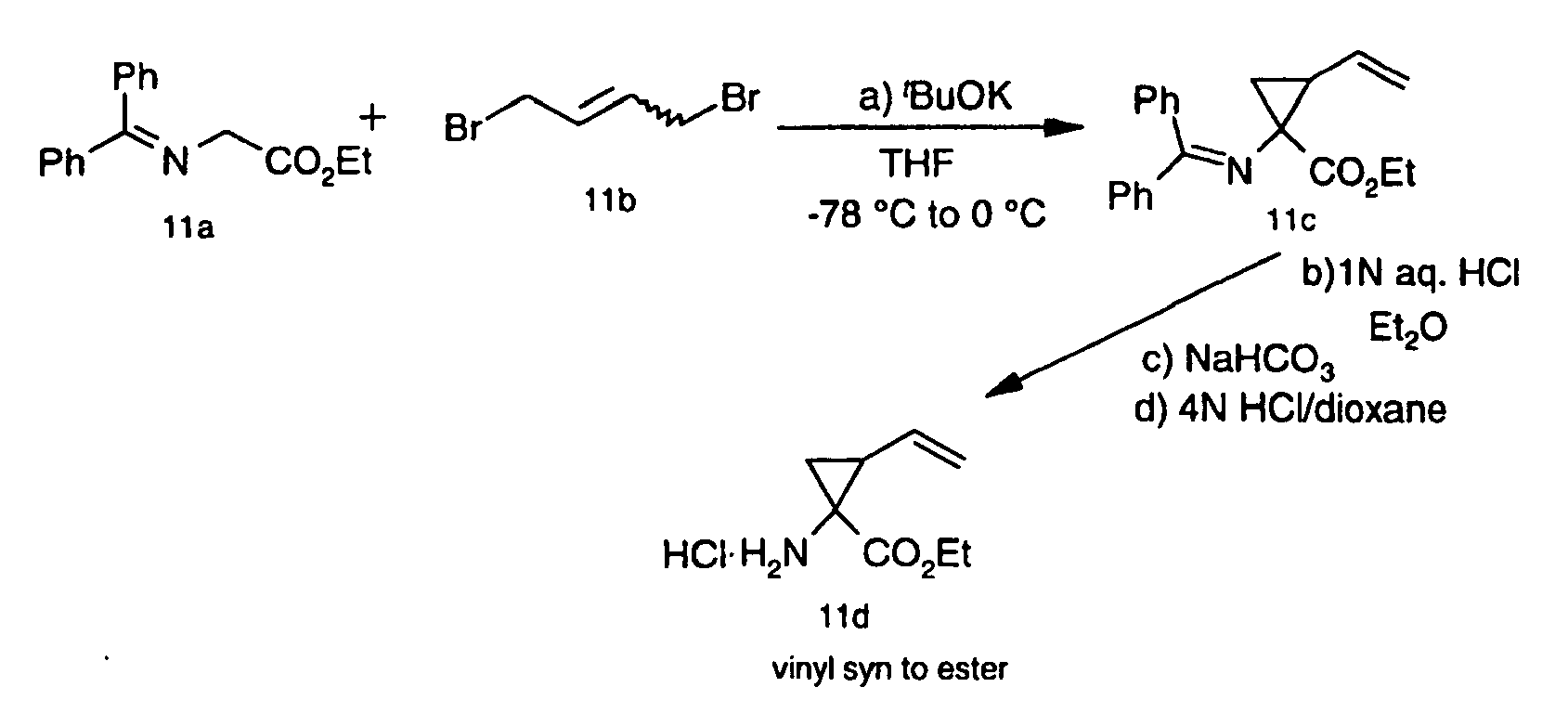
- a) To a THF solution (180 mL) of potassium tert-butoxide (4.62 g, 41.17 mmol, 1.1 eq.) at -78°C was added commercially available imine 11 a (10.0 g, 37.41 mmol) in THF (45 mL). The reaction mixture was warmed to 0°C and stirred at this temperature for 40 min. The mixture was then cooled back to -78°C for the addition of 1,4-dibromobutene 11b (8.0 g, 37.40 mmol) and then stirred at 0°C for 1 h and cooled back to -78 °C for the addition of potassium tert-butoxide (4.62 g, 41.17 mmol, 1.1 eq.). The reaction mixture was finally stirred one more hour at 0°C and concentrated to yield compound 11c.
- b, c, d) 11c was taken up in Et2O (265 mL) and treated with a 1N aq. HCl solution (106 mL). After 3.5 h at RT, the layers were separated and the aqueous layer was washed with Et2O (2x) and basified with a saturated aq. NaHCO3 solution. The desired amine was extracted with Et2O (3x) and the combined organic extract was washed with brine. After the usual treatment (MgSO4, filtration and concentration) the residue was treated with a 4N HCl solution in dioxane (187 mL, 748 mmol). After concentration, hydrochloride salt 11d was isolated as a brown solid (2.467 g, 12.87 mmol, 34 % yield). 1H NMR (CDCl3) δ 9.17 (bs, 3H), 5.75-5.66 (m, 1H), 5.39 (d, J= 17.2 Hz, 1H), 5.21 (d, J= 10.2 Hz, 1H), 4.35-4.21 (m, 2H), 2.77-2.70 (m, 1H), 2.05 (dd, J= 6.4, 10.2 Hz, 1H), 1.75 (dd, J= 6.4, 8.3 Hz, 1H), 1.33 (t, J= 7.0 Hz, 3H).
-

- The hydrochloride salt 11d (1.0 g, 5.2 mmol) and (Boc)2O (1.2 g, 5.7 mmol) were dissolved in THF (30 mL) and treated with DMAP (0.13 g, 1.04 mmol, 0.2 equiv.) and diisopropylethylamine (2.8 mL, 15.6 mmol). The reaction mixture was stirred 24 h before being diluted with EtOAc (40 mL) and washed successively with sat. NaHCO3 (aq), 5% aqueous HCl, and sat. brine. The organic phase was dried (MgSO4), filtered and concentrated to give after purification by flash chromatography (15% EtOAc/hexane), 12a (0.29 g, 23%). 1H NMR (CDCl3) δ 5.80-5.72 (m, 1H), 5.29-5.25 (dd, J =17.2, 17.2 Hz, 1H), 5.24-5.1 (bs, 1H), 5.10 (dd, J = 9.2, 9.2 Hz, 1H), 4.22-4.13 (m, 2H), 2.15-2.04 (m, 1H), 1.85-1.73 (bs, 1H), 1.55-1.5 (m, 1H), 1.49 (s, 9H), 1.26 (t, J = 7.3 Hz, 3H).
-

- a) Racemic derivative 12a (0.29 g, 1.14 mmol) was dissolved in acetone (5 mL) and diluted with H2O (10 mL). The pH was adjusted with 0.2N aqueous NaOH to 7.2 before Alcalase® was added (300 mg). To keep the pH constant during incubation, a NaOH solution was added by a pH stat titrator over 9 days until the theoretical amount of base had been added. Following acid/base extraction as described in Example 9, the unhydrolyzed ester (0.15 g, 100%) and the hydrolyzed material (0.139 g, 95%) were isolated. Analysis of the unhydrolyzed ester by HPLC using a chiral column showed a ratio of 43:1 of the desired compound 13c. Compound 206 (wherein R 1 is vinyl, Table 2) was hydrogenated (10.8 mg, 0.015 mmol in 1 mL of EtOH with about 1mL of 20% Pd(OH)2 under 1 atm of H2 for 45 min) to yield compound 214 (wherein R 1 is ethyl, Table 2). Compound 214 had been assigned the (1R,2R) stereochemistry based on chemical correlation as described in Examples 6 and 7 indicating that compound 206 (R 1 = vinyl) has the same absolute configuration as represented by 13c (albeit 1R,2S because R 1 =vinyl).
- Conditions for HPLC analysis: Chiralcel® OD-H (4.6 mm x 25 cm), isocratic conditions using a mobile phase of 2.5% isopropanol/hexane.
-

- To a solution of crude racemic (1S,2S and 1R, 2S) ethyl 1-amino-2-vinylcyclopropyl carboxylate [obtained from N-(diphenylmethylene)glycine ethyl ester (25.0 g, 93.5 mol) as described in Example 13] in EtOAc (800 mL) was added dibenzoyl-D-tartaric acid (33.5 g, 93.5 mol). The mixture was heated to reflux, left at RT for 15 min then cooled to 0°C. A white solid was obtained after 30 min. The solid was filtered, washed with EtOAc (100 mL) and air-dried. The solid was suspended in acetone (70 mL), sonicated and filtered (3x). The solid was next recrystallized twice in hot acetone (crop A). The mother liquors were concentrated and the residue was recrystallized three times in hot acetone (crop B). The two crops of the amorphous white solids of dibenzoyl-D-tartaric acid salt were combined (5.53 g) and suspended in a mixture of Et2O (250 mL) and saturated NaHCO3 solution (150 mL). The organic layer was washed with brine, dried (MgSO4) and filtered. The filtrate was diluted with 1 N HCl/Et2O (100 mL) and concentrated under reduced pressure. The oily residue was evaporated with CCl4 to afford ethyl 1(R)-amino-2(S)-vinyl cyclopropanecarboxylate hydrochloride (940 mg, 11 % yield) as a white hygroscopic solid for which absolute stereochemistry was assigned by correlation with compound 13c of Example 13.
-


-

- Compound 15a (same as compound 2 from Example 2)(4.45 g, 11.98 mmol) was dissolved in anhydrous CH3CN (60 mL), DBU (2.2 mL, 14.38 mmol) and allyl bromide (1.1 mL, 13.18 mmol) were added successively and the reaction mixture was stirred 24 h at RT. The mixture was concentrated, the resulting oil was diluted with EtOAc and water and successively washed with water (2x) and brine (1x). The EtOAc layer was dried (MgSO4), filtered and evaporated to dryness. The yellow oil was purified by flash chromatography (eluent:hexane:EtOAc;90:10 to 85:15) to provide the product 15b as a yellow oil (2, 4.17 g; 85% yield). MS (FAB) 412 MH+
- 1H NMR (CDCl3), mixture of rotamers ca.1:2 , δ (d, J= 8Hz, 1H), 7.87 (d, J= 8Hz, 1H), 7.82 (d, J= 8Hz, 1H), 7.55-7.41 (m, 4H), 5.95-5.85 (m, 1H), 5.34-5.21 (m, 2H), 5.03-4.88 (m, 2H), 4.70-4.56 (m, 2H), 4.48 & 4.39 (t, J= 8, 15Hz, 1H), 4.28-4.23 (m, 1H), 3.81-3.55 (m, 2H), 2.46-2.36 (m, 1H), 2.13-2.05 (m, 1H), 1.44 &1.41 (s, 9H).
- Compound 15b (2.08 g , 5.05 mmol) was treated for 30 min at RT with 4N HCl / dioxane. Evaporation to dryness provided the corresponding amine-HCl as an oil. The amine-HCl 15c was dissolved in anhydrous DCM (25 mL) and NMM (2.2 mL, 20.22 mmol), Boc-Chg-OH • H2O (1.53 g, 5.56 mmol) and TBTU (1.95 g, 6.07 mmol) were added successively. The reaction mixture was stirred at RT overnight, then, diluted with EtOAc and successively washed with 10% aqueous citric acid (2x), saturated aqueous NaHCO3 (2x), water (2x), and brine (1x). The EtOAc layer was dried (MgSO4), filtered and evaporated to dryness to provide the crude product 15d as a yellowish-white foam (ca 2.78 g, 100% yield). MS (FAB) 551.4 MH+. 1H NMR (CDCl3) δ 8.03(d, J= 8Hz, 1H), 7.86 (b d, J= 8.5Hz, 1H), 7.84 (d, J= 8Hz, 1H), 7.56-7.40 (m, 4H), 5.92-5.85 (m, 1H), 5.31 (dd, J= 1, 17Hz, 1H), 5.22 (dd, J= 1, 10Hz, 1H), 5.17 (d, J= 9Hz, 1H), 5.05 (d, J= 12Hz, 1H), 4.91 (d, J= 12Hz, 1H), 4.67-4.60 (m, 3H), 4.31-4.27 (m, 2H), 4.16 (b d, J= 11Hz, 1H), 3.71 (dd, J= 4, 11Hz, 1H), 2.47-2.41 (m, 1H), 2.08-1.99 (m, 1H), 1.85-1.63 (m, 5H), 1.44-1.40 (m, 1H), 1.36 (s, 9H), 1.28-1.00 (m, 5H).
- The crude dipeptide 15d (ca.5.05 mmol) was treated with 4N HCl/dioxane (25 mL) as described for the synthesis of compound 15c. The crude hydrochloride salt was coupled to Boc-Chg-OH • H2O (1.53 g, 5.55 mmol) with NMM (2.22 mL, 20.22 mmol) and TBTU (1.95 g, 6.07 mmol) in DCM (25 mL) as described for the synthesis of compound 15d to yield crude tripeptide 15e as a yellow-oil foam. The crude material was purified by flash chromatography (eluent:hexane:EtOAc;80:20 to 75:25) to provide the tripeptide 15e as a white foam (2.75 g; 79% yield over 2 steps). MS (FAB) 690.5 MH+. 1H NMR (CDCl3), mainly one rotamer, δ 8.06 (d, J= 8Hz, 1H), 7.87 (b d, J= 8.5Hz, 1H), 7.82 (d, J= 8Hz, 1H), 7.57-7.40 (m, 4H), 6.41 (d, J= 8.5Hz, 1H), 5.92-5.84 (m, 1H), 5.31 (dd, J= 1, 17Hz, 1H), 5.23 (dd, J= 1, 10.5Hz, 1H), 5.04 (d, J= 12Hz, 1H), 4.98 (b d; J= 7Hz, 1H), 4.93 (d, J=12Hz, 1H), 4.63-4.58 (m, 4H), 4.29-4.25 (m, 1H), 4.10-4.07 (m, 1H), 3.90-3.84 (m, 1H), 3.72 (dd, J= 4, 11Hz, 1H), 2.48-2.40 (m, 1H), 2.07-1.99 (m, 1H), 1.83-1.55 (m, 12H), 1.43 (s, 9H), 1.23-0.89 (m, 10H).
- The tripeptide 15e (2.75 g , 3.99 mmol) was treated with 4N HCl/dioxane (20 mL) as described for the synthesis of compound 15c. The crude hydrochloride salt was dissolved in anhydrous DCM (20 mL). NMM (1.75 mL, 15.94 mmol) and acetic anhydride (752 µl, 7.97mmol) were added successively. The reaction mixture was stirred overnight at RT, then diluted with EtOAc. The organic layer was washed successively with 10% aqueous citric acid (2x), saturated aqueous NaHCO3 (2x), water (2x) and brine (1x), dried (MgSO4), filtered, and evaporated to dryness to provide the crude tripeptide 15f as a white foam (2.48g, 98% yield).
- MS (FAB) 632.4 MH+I. 1H NMR (CDCl3), mainly one rotamer, δ 8.06(b d, J= 8Hz, 1H), 7.87 (b d, J= 8Hz, 1H), 7.83 (d, J= 8Hz, 1H), 7.58-7.40 (m, 4H), 6.36 (d, J= 9Hz, 1H), 6.01 (d, J= 9Hz, 1H), 5.94-5.83 (m, 1H), 5.34-5.28 (m, 1H), 5.25-5.21 (m, 1H), 5.05 (d, J= 12Hz, 1H), 4.94 (d, J= 12Hz, 1H), 4.64-4.57 (m, 4H), 4.30-4.23 (m, 2H), 4.12-4.08 (m, 1H), 3.73 (dd, J= 4, 11Hz, 1H), 2.49-2.42 (m, 1H), 2.08-2.01 (m, 1H), 1.99 (s, 3H), 1.85-1.53 (m, 11H), 1.25-0.88 (m, 11H).
- The crude tripeptide 15f (2.48 g, 3.93 mmol) was dissolved in an anhydrous mixture of CH3CN : DCM (20 mL). Triphenylphosphine (53.5 mg, 0.200 mmol) and tetrakis(triphenylphosphine)-palladium (0) catalyst (117.9 mg, 0.102 mmol) were added successively, followed by pyrrolidine (353.9 µL, 4.24 mmol). The reaction mixture was stirred at RT for 18 h. Thereafter, the solvent was evaporated. The residue was dissolved in EtOAc and 10% aqueous citric acid, and further washed twice more with 10% aqueous citric acid, water (2x), and brine (1x). The organic layer was dried (MgSO4), filtered and evaporated. The crude product was triturated in Et2O: DCM (85:15) to provide after filtration the tripeptide 15g as a white solid (2.09 g, 90% yield). MS (FAB) 592.4 MH+ 614.3 (M+Na)+. 1H NMR (CDCl3), mainly one rotamer, δ 8.08 (d, J= 8Hz, 1H), 7.93 (b d, J= 9Hz, 1H), 7.88 (b d, J= 8Hz, 1H), 7.82 (d, J= 8Hz, 1H), 7.57-7.41 (m, 4H), 6.47 (d, J= 8.5Hz, 1H), 5.05 (d, J= 12.5Hz, 1H), 4.94 (d, J= 12.5Hz, 1H), 4.73 (t, J= 9.5, 19Hz, 1H), 4.44-4.35 (m, 2H), 4.26 (b s, 1H), 4.19 (d, J= 11.5Hz, 1H), 3.75 (dd, J= 4, 11Hz, 1H), 2.47 (b dd, J= 7.5, 13.5Hz, 1H), 2.20-2.11 (m, 1H), 2.04 (s, 3H), 1.88-1.41 (m, 11H), 1.30-0.80 (11H).
-

- Compound 16a (2.89 g, 7.02 mmol) was treated with 4N HCl/dioxane (30 mL) as described for the synthesis of compound 15c. The crude hydrochloride salt was coupled to Boc-Val-OH (1.53 g, 7.73 mmol) with NMM (3.1 mL, 28.09 mmol) and TBTU (2.71 g, 8.43 mmol) in DCM (35 mL) for 3 1/2 h as described for the synthesis of compound 15d to provide the crude dipeptide 16b as an ivory oil-foam (ca.3.60 g, 100% yield). MS (FAB) 509.3 MH- 511.3 MH+ 533.2 (M+Na)+. 1H NMR (CDCl3) δ 8.04 (b d, J= 8Hz, 1H), 7.87 (b d, J= 7Hz, 1H), 7.82 (d, J= 8Hz, 1H), 7.56-7.40 (m, 4H), 5.93-5.85 (m, 1H), 5.34-5.28 (m, 1H), 5.24-5.19 (m, 2H), 5.04 (d, J= 12Hz, 1H), 4.92 (d, J= 12Hz, 1H), 4.67-4.60 (m, 3H), 4.31-4.26 (m, 2H), 4.11-4.09 (m, 1H), 3.72 (dd, J= 4, 11Hz, 1H), 2.48-2.41 (m, 1H), 2.07-1.99 (m, 1H), 1.44-1.36 (m, 1H), 1.37 (s, 9H), 1.01 (d, J= 7Hz, 3H), 0.93 (d, J= 7Hz, 3H).
- The crude dipeptide 16b (ca.7.02 mmol) was treated with 4N HCl/dioxane (30mL) as described for the synthesis of compound 15c. The crude hydrochloride salt was coupled to Boc-Chg-OH H2O (2.13 g, 7.73 mmol) with NMM (3.1 mL, 28.09 mmol) and TBTU (2.71 g, 8.43 mmol) in CH2Cl2 (35 mL) as described for the synthesis of compound 15d to provide the crude tripeptide 16c as an ivory foam (ca.4.6 g, 100% yield). MS (FAB) 648.5 MH- 672.4 (M+Na)+. 1H NMR (CDCl3) δ 8.06 (b d, J=8Hz, 1H), 7.87 (b d, J= 7.5 Hz, 1H), 7.82 (b d , J= 8Hz, 1H), 7.57-7.40 (m, 4H), 6.46 (b d, J= 8.5Hz, 1H), 5.94-5.84 (m, 1H), 5.31 (dd, J= 1, 17Hz, 1H), 5.23 (dd, J= 1, 10.5Hz, 1H), 5.03 (d, J= 12Hz, 1H), 5.00-4.97 (m, 1H), 4.93 (d, J=, 12Hz, 1H), 4.63-4.59 (m, 4H), 4.29-4.27 (m, 1H), 4.10-4.07 (m, 1H), 3.92-3.86 (m, 1H), 3.72 (dd, J= 5, 11Hz, 1H), 2.48-2.41 (m, 1H), 2.10-1.99 (m, 1H), 1.76-1.57 (m, 6H), 1.43 (s, 9H), 1.20-0.92 (m, 6H), 1.00 (d, J= 7Hz, 3H), 0.93 (d, J= 7Hz, 3H).
- The crude tripeptide 16c (ca.7.02 mmol) was treated with 4N HCl/dioxane (30 mL) as described for the synthesis of compound 15c. The crude hydrochloride salt was further treated with acetic anhydride (1.33 mL, 14.05 mmol) and NMM (3.1 mL, 28.09 mmol) in CH2Cl2 (35 mL) as described for the synthesis of compound 15d. The crude product was flash purified (eluent:hexane:EtOAc;30:70) to provide the acetylated protected tripeptide 16d as a white foam (3.39 g, 81% yield over 3 steps). MS (FAB) 590.3 MH- 592.4 MH+ 614.4 (M+Na)+
- 1H NMR (CDCl3), mainly one rotamer, δ 8.06 (d, J= 8Hz, 1H), 7.88 (b d, J= 8Hz, 1H), 7.83 (d, J= 8Hz, 1H), 7.58-7.41 (m, 4H), 6.37 (d, J= 9Hz, 1H), 5.97 (d, J= 8.5 Hz, 1H), 5.94-5.84 (m, 1H), 5.31 (dd, J= 1, 17Hz, 1H), 5.24 (dd, J= 1, 10.5 Hz, 1H), 5.05 (d, J= 12Hz, 1H), 4.94 (d, J= 12Hz, 1H), 4.66-4.57 (m, 4H), 4.31-4.22 (m, 2H), 4.11-4.05 (m, 1H), 3.73 (dd, J= 4.5, 11Hz, 1H), 2.50-2.43 (m, 1H), 2.09-2.01 (m, 2H), 2.00 (s, 3H), 1.68-1.55 (m, 5H), 1.15-0.89 (m, 6H), 0.99 (d, J= 7Hz, 3H), 0.91 (d, J= 7Hz, 3H).
- The acetylated tripeptide 16d (3.39 g, 5.73 mmol) was deprotected by tetrakis(triphenylphosphine)- palladium (0) catalyst (172.1 mg, 0.149 mmol) with triphenylphosphine (78.1 mg, 0.298 mmol) and pyrrolidine (516 µL, 6.19 mmol) in a 1:1 mixture of anhydrous CH3CN : DCM (30 mL) as described for the synthesis of compound 15g. The crude light yellow foam product was triturated in Et2O : DCM (85:15) to provide after filtration the tripeptide 16e as an off-white solid (3.0g ; 95% yield). MS (FAB) 550.3 MH-
- 1H NMR (CDCl3) δ 8.08 (d, J= 8Hz, 1H), 8.04 (b d, J= 9Hz, 1H), 7.88 (b d, J= 7.5Hz, 1H), 7.82 (d, J= 8Hz, 1H), 7.58-7.37 (m, 5H), 5.05 (d, J= 12Hz, 1H), 4.94 (d, J= 12Hz, 1H), 4.61 (t, J= 9.5, 19.5Hz, 1H), 4.46-4.37 (m, 2H), 4.27 (b s, 1H), 4.17 (d, J= 11Hz, 1H), 3.74 (dd, J= 4, 11Hz, 1H), 2.49 (b dd, J= 7.5, 13Hz, 1H), 2.17-2.09 (m, 1H), 2.04 (s, 3H), 2.03-1.94 (m, 1H), 1.79 (b d, J= 12.5Hz, 1H), 1.62-1.43 (m, 5H), 1.08-0.85 (m, 5H), 1.00 (d, J= 7Hz, 3H), 0.90 (d, J= 7Hz, 3H).
-


- Compound 17a (4.27 g, 7.93 mmol, described as compound 6a in Example 6) was treated with 4N HCl/dioxane (40 mL) for 5 h as described for compound 15c. The crude hydrochloride salt was dissolved in THF (10 mL) and a solution of NaOH (348.7 mg, 8.72 mmol) in H2O (5 mL) was added, followed by a dropwise addition of (Boc)2O (1.73 g, 7.93 mmol) dissolved in THF (13 mL). The pH was maintained at 8 by the addition of 10% aqueous NaOH as required. The reaction mixture was stirred vigorously, then diluted with Et2O and H2O and extracted one time more with Et2O. The water layer was acidified to pH 3 with 10% aqueous citric acid. The mixture was extracted with EtOAc (3x). The combined EtOAc extracts were washed with H2O (2x), brine(1x), dried (MgSO4), filtered and evaporated to dryness to provide crude compound 17b as an ivory foam (ca.7.93mmol). MS (FAB) 481.3 MH- 1H NMR (CDCl3), ca.1:1 mixture of rotamers, δ 8.04 (bd, J= 7.5Hz, 1H), 7.87 (b d, J= 7.5Hz, 1H), 7.82 (d, J= 7.5Hz, 1H), 7.56-7.40 (m, 5H), 4.96 (b s, 2H), 4.33 (t, J= 7.5, 14.5Hz, 1H), 4.21-4.09 (m, 0.5H), 3.99-3.84 (m, 0.5H), 3.78-3.75 (m, 0.5H), 3.68-3.62 (m, 0.5H), 3.61-3.42 (m, 1H), 2.55-2.41 (m, 1H), 2.22-2.1 (m, 1H), 1.61-1.52 (m, 3H), 1.43 (s, 9H), 1.40-1.31 (m, 1H), 1.25-1.19 (m, 1H), 0.99 (t, J= 7.5, 14.5Hz, 3H).
- Compound 17b (ca.7.93 mmol) was treated with DBU (1.18 mL, 93 mmol) and allylbromide (4.12 mL, 47.61 mmol) in anhydrous CH3CN (40 mL) for 48 h as described for compound 15b to provide the allylated dipeptide 17c as an ivory foam (3.54 g; 86% yield over 2 steps). MS (FAB) 521.3 MH- 545.2 (M+Na)+. 1H NMR (CDCl3), ca.1:1 mixture of rotamers, δ 8.05 (b d, J= 8Hz, 1H), 7.86 (b d, J= 7.5Hz, 1H), 7.82 (d, J= 8Hz, 1H), 7.55-7.40 (m, 5H), 5.88-5.79 (m, 1H), 5.27 (b d, J= 17.5Hz, 1H), 5.18 (b d, J= 10Hz, 1H), 5.03-4.89 (m, 2H), 4.63-4.50 (m, 2H), 4.44-4.19 (m, 2H), 4.00-3.40 (m, 2H), 2.70-2.02 (m, 2H), 1.66-1.35 (m, 5H), 1.44 (s, 9H), 0.95 (t, J= 7.5, 14.5Hz, 3H).
- The crude dipeptide 17c (1.18 g, 2.26 mmol) was treated with 4N HCl/dioxane (35 mL) as described for compound 15c. The crude hydrochloride salt was coupled to Boc-Chg-OH • H2O (684 mg, 2.48 mmol) with NMM (993 µL, 9.03 mmol) and TBTU (870 mg, 2.71 mmol) in DCM (11 mL) as described for compound 15d to provide the crude tripeptide 17d as an ivory foam (1.41 g; 95%). MS (FAB) 660.4 MH- 662.3 MH+. 1H NMR (CDCl3), mainly one rotamer, δ 8.03 (b d, J= 8Hz, 1H), 7.85 (b d, J= 8Hz, 1H), 7.81 (d, J= 8Hz, 1H), 7.56-7.39 (m, 5H), 5.88-5.77 (m, 1H), 5.26 (dd, J= 1.5, 17Hz, 1H), 5.15 (dd, J= 1.5, 10.5Hz, 1H), 5.12 (s, 1H), 5.02-4.92 (m, 2H), 4.72-4.59 (m, 1H), 4.57-4.46 (m, 1H), 4.42-4.35 (m, 1H), 4.33-4.20 (m, 1H), 4.02-3.90 (m, 1H), 3.78-3.70 (m, 1H), 3.67-3.51 (m, 1H), 2.71-2.61 (m, 1H), 2.12-2.02 (m, 1H), 1.79-1.48 (m, 10H), 1.45-1.39 (m, 1H), 1.38 (s, 9H), 1.25-1.01 (m, 5H), 0.94 (t, J=7.5, 14Hz, 3H).
- The crude tripeptide 17d (265 mg, 0.400 mmol) was treated with 4N HCl/dioxane (3 mL) as described for compound 15c. The crude hydrochloride salt was coupled to Boc-Chg-OH • H2O (143.3 mg, 0.521 mmol) with NMM (176 µL, 1.60 mmol) and TBTU (154.3 mg, 0.481 mmol) in DCM (3 mL) as described for compound 15d to provide crude tetrapeptide 17e as an ivory foam (ca.0.400 mmol ; 100%). MS (FAB) 799.5 MH- 801.5 MH+ 823 (M+Na)+. 1H NMR (CDCl3), ca. 1 : 1 mixture of rotamers, δ 8.05 (b d, J= 8.5Hz, 1H), 7.87 (b d, J= 7.5Hz, 1H), 7.81 (d, J= 8.5Hz, 1H), 7.55-7.40 (m, 4H), 7.37 (s, 1H), 6.58-6.41 (m, 1H), 5.89-5.78 (m, 1H), 5.26 (b dd, J= 1.5, 17Hz, 1H), 5.16 (b dd, J= 1.5, 10.5Hz, 1H), 5.20-4.92 (m, 3H), 4.68-4.58 (m, 2H), 4.57-4.47 (m, 1H), 4.43-4.26 (m, 1H), 3.99-3.81 (m, 2H), 3.78-3.60 (m, 2H), 2.67-2.60 (m, 1H), 2.11-2.02 (m, 1H), 1.78-1.42 (m, 14H), 1.44 &1.43 (s, 9H), 1.25-0.91 (m, 13H), 0.95 (t, J= 7.5, 15Hz, 3H).
- The crude tetrapeptide 17e (ca.0.400 mmol) was treated with 4N HCl/dioxane (3 mL) as described for compound 15c. The crude hydrochloride salt was further treated with acetic anhydride (83 µL, 0.884 mmol) and NMM (194 µL, 1.77 mmol) in DCM (3 mL) as described for compound 15f to provide the crude acetylated tetrapeptide 17f as an ivory foam (ca.0.400 mmol).
- MS (FAB) 741.5 MH- 743.4 MH+ 765.4 (M+Na)+.
- 1H NMR (CDCl3) δ 8.05 (b d, J= 8.5Hz, 1H), 7.87 (b d, J= 7.5Hz, 1H), 7.82 (d, J= 8.5Hz, 1H), 7.55-7.41 (m, 4H), 7.39 (s, 1H), 6.63-6.48 (m, 1H), 6.01 (d, J= 8.5Hz, 1H), 5.90-5.79 (m, 1H), 5.27 (b dd, J= 1.5, 17Hz, 1H), 5.16 (b dd, J= 1.5, 10.5Hz, 1H), 5.01 (d, J= 12Hz, 1H), 4.96 (d, J= 12Hz, 1H), 4.69-4.48 (m, 3H), 4.44-4.37 (m, 1H), 4.36-4.22 (m, 1H), 3.96 (dd, J= 4, 11Hz, 1H), 3.78-3.60 (m, 2H), 2.67-2.59 (m, 1H), 2.10-2.00 (m, 1H), 2.01 (s, 3H), 1.78-1.48 (m, 13H), 1.45-1.35 (m, 1H), 1.26-0.89 (m, 13H), 0.95 (t, J= 7.5, 15Hz, 3H).
- The acetylated tetrapeptide 17f (ca.0.400 mmol) was deprotected by tetrakis(triphenylphosphine)- palladium (0) catalyst (11.3 mg, 0.010 mmol) with triphenylphosphine (5.12 mg , 0.020 mmol) and pyrrolidine (34 µL, 0.406 mmol) in a 1:1 mixture of anhydrous CH3CN : DCM (2 mL) as described for compound 15g. The crude product was purified by flash chromatography (eluent - 1st EtOAc, then, 2nd 1.92% HOAc, 3.85% MeOH in DCM) to provide, after lyophilization, the tetrapeptide compound 104 of Table 1 as an off-white amorphous solid (193.1 mg; 73% yield over 5 steps).
- MS (FAB) 701.4 MH- 703.4 MH+ 725.4 (M+Na)+.
- 1H NMR (DMSO), ca.1 : 5 mixture of rotamers, δ 8.57 & 8.32 (s, 1H), 8.04 (d, J= 7.5Hz, 1H), 7.94 (b d, J= 7.5Hz, 1H), 7.88 (d, J= 8Hz, 1H), 7.83-7.78 (m, 2H), 7.58-7.30 (m, 4H), 4.99 (d, J= 12Hz, 1H), 4.90 (d, J= 12Hz, 1H), 4.44-4.29 (m, 2H), 4.29-4.05 (m, 3H), 3.87-3.73 (m, 1H). 2.23-2.13 (m, 1H). 2.05-1.95 (m, 1H), 1.91 & 1.84 (s, 3H), 1.75-1.40 (m, 15H), 1.29-0.84 (m, 12H), 0.91 (t, J= 7.5, 14.5Hz, 3H).
-
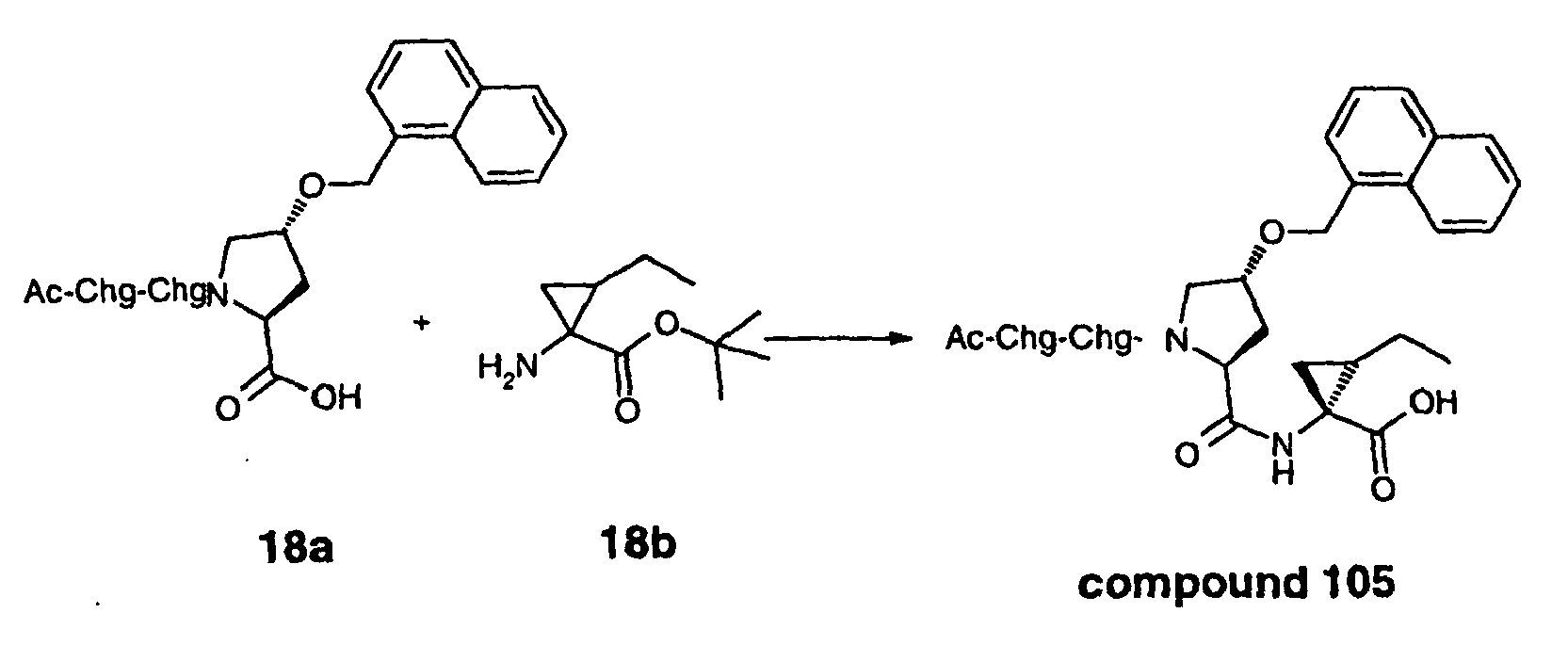
- Compound 18b, i.e. corresponding to compound 5f of Example 5, was coupled to the preformed tripeptide 18a described previously in Example 15. More specifically, compound 18b (ca.0.521 mmol) was combined with compound 18a (323.6 mg, 0.547 mmol) in DCM (3 mL) and NMM (172 µL, 1.562 mmol), followed by the addition of HATU (237.6 mg, 0.625 mmol). The reaction mixture was stirred at RT for 18 h, after which it was worked up as described for compound 15d to give the crude tetrapeptide as a racemic mixture at P1. Both isomers were partially separated by flash chromatography (eluent- toluene : EtOAc ; 40:60). Combination of the first eluting fractions gave a 9:1 mixture in which analogous tert-butyl ester of 17f was the major component (58 mg). The middle fractions contain different ratios of the corresponding tert-butyl esters of 17f and compound 105 t-butyl ester (163 mg). The latter eluting fractions provided the corresponding tert-butyl ester of compound 105 as the major isomer (75.8 mg).
- The latter ester (74 mg, 0.0975 mmol) was dissolved in 4N HCl/dioxane (2 mL), stirred at RT for 5.5 h then evaporated to dryness to give an oil. Purification by flash chromatography (eluent - 1st EtOAc, then 2nd 1.92% HOAc, 3.85% MeOH, in DCM) yielded, after lyophilization, compound 105 as a white-amorphous solid (38.7 mg, 56% yield). HPLC analysis indicated a 3 : 1 ratio of compound 105 and compound 104. MS and NMR data for compound 105: MS (FAB) 701.5 MH- 703.5 MH+ 725.6 (M+Na)+. 1H NMR (DMSO), ca.1 : 2.5 mixture of rotamers, δ 8.76 & 8.34 (s, 1H), 8.05(b d, J= 7.5Hz, 1H), 7.94 (b d, J= 8Hz, 1H), 7.88 (d, J=8.5Hz, 1H), 7.85-7.78 (m, 2H), 7.59-7.43 (m, 4H), 4.99 (d, J= 12Hz, 1H), 4.89 (d, J= 12Hz, 1H), 4.41-4.05 (m, 5H), 3.82-3.66 (m, 1H), 2.25-2.11 (m, 1H), 2.11-1.98 (m, 1H), 1.90 & 1.84 (s, 3H), 1.78-1.40 (m, 15H), 1.39-0.82 (m, 12H), 0.90 (t, J= 7, 14Hz, 3H).
- Following the procedure described for the synthesis of compound 104 of Example 17, the mixtures of 1(R), 2(R) and 1(R),2(S) isomers of intermediate compound 10d, prepared in Example 10, were coupled with compound 2 to give a mixture of isomeric intermediate compounds 19a and 19b

- Following the procedures of Example 18, isomeric compounds 19a and 19b were separated and transformed into their corresponding compound of formula 1; to isolate the corresponding compound 103 of Table 1.
- Spectral data:
Compound 103: Rotamer population by NMR ca. (1:8.7):
MS (FAB) m/z: 703 (MH+); 1H-NMR (DMSO-d6) δ8.21-8.09 (bs, 1H), 8.05 (bd, J = 7.63 Hz, 1H), 7.94 (bd, J = 7.0 Hz, 1H), 7.91-7.83 (m, 2H), 7.83-7.76 (m, 1H), 7.59-7.5 (m, 3H), 7.5-7.43 (m, 1H), 4.99 (d, J = 11.8 Hz, 1H), 4.89 (d, J = 11.8 Hz, 1H), 4.43-4.30 (m, 3H), 4.23-4.16 (m, 1H), 4.13 (bd, J = 10.8 Hz, 1H), 3.71 (dd, J = 11.1, 4 Hz, 1H), 2.2-2.02 (m, 2H), 1.87 and 1.84 (2 x s, 3H), 1.81-1.71 (m, 2H), 1.70-1.40 (m, 12H), 1.26-1.06 (m, 4H), 1.04-0.83 (m, 11H), 0.59 (m, 1H). -


- The crude tetrapeptide 17e from Example 17 (ca.0.963 mmol) was treated with 4N HCl /dioxane solution (5 mL) as described for compound 15c. The crude hydrochloride salt was coupled to Boc-(D)Glu(O-allyl)-OH (331.9 mg, 1.155 mmol) with NMM (423 µl, 3.850 mmol) and TBTU (370.8 mg, 1.155 mmol) in DCM (5 mL) for 3 h at RT as described for compound 15d. The crude pentapeptide 20b was obtained as an ivory foam (ca.933.9 mg, 0.963 mmol). MS (FAB) 968.6 MH- 970.6 MH+ 992.5 (M+Na).
- 1H NMR (CDCl3), ca.1 : 4 mixture of rotamers, δ 8.05 (d, J= 8.5Hz, 1H), 7.87 (b d, J= 7.5Hz, 1H), 7.81 (d, J= 8.5Hz, 1H), 7.58-7.34 (m, 5H), 6.77-6.25 (m, 2H), 5.98-5.77 (m, 2H), 5.38-5.21 (m, 4H), 5.16 (dd, J= 1.5, 10.5Hz, 1H), 5.06-4.89 (m, 2H), 4.68-4.13 (m, 7H), 3.96-3.52 (m, 4H), 2.69-2.38 (m, 3H), 2.23-1.87 (m, 2H), 1.78-1.37 (m, 17H), 1.46 & 1.44 (s, 9H), 1.22-0.87 (m, 11H), 0.95 (t, J= 7, 14.5Hz, 3H).
- The crude pentapeptide 20b (ca.0.963 mmol) was treated with 4N HCl /dioxane solution (5 mL) as described for compound 15c. The crude hydrochloride salt was coupled to Boc-Asp(O-allyl)-OH (315.6 mg, 1.155 mmol) with NMM (423 µl, 3.85 mmol) and TBTU (370.8 mg, 1.155 mmol) in DCM (5 mL) as described for compound 15d. The crude hexapeptide 20c was obtained as an ivory foam (ca.1.083 g, 0.963 mmol). MS (FAB) 1147.6 (M+Na)+. 1H NMR (CDCl3), ca.1:1 mixture of rotamers, δ 8.06 (b d, J= 8Hz, 1H), 7.86 (d, J= 8Hz, 1H), 7.81 (d, J= 8Hz, 1H), 7.59-7.39 (m, 5H), 7.39-6.34 (m, 4H), 5.98-5.76 (m, 3H), 5.38-5.10 (m, 6H), 5.10-4.89 (m, 2H), 4.66-4.05 (m, 10H), 3.87-3.58 (m, 4H), 3.30-2.65 (m, 2H), 2.65-1.89 (m 3H), 1.79-1.33 (m, 19H), 1.47 & 1.45 (s, 9H), 1.33-0.86 (m, 14H).
- The crude hexapeptide 20c (ca.0.963 mmol) was treated with 4N HCl /dioxane solution (5 mL) as described for compound 15c. The crude hydrochloride was acetylated with acetic anhydride (182 µl, 1.193 mmol) and NMM (423.5 µL, 3.850 mmol) in DCM (5 mL) as described for compound 15f to provide the crude acetylated tetrapeptide. The foam residue was purified by flash chromatography (eluent : 1st hexane : EtOAc 20:80 to 10:90 and 2nd pure EtOAc) to provide the acetylated hexapeptide 20d as an ivory foam (528 mg, 51% yield over 4 steps). MS (FAB) 1067.6 (MH+) 1089.6 (M+Na).
- The acetylated hexapeptide 20d (528 mg, 0.495 mmol) was dissolved in DCM (3 mL) and treated with a premixed, 15 min stirred solution of tetrakis(triphenylphosphine)-palladium (0) catalyst (90 mg, 0.078 mmol) and pyrrolidine (134 µL, 1.603 mmol) in DCM (3 mL). The reaction mixture was stirred at RT for 48 h after which the solvent was evaporated. The crude product was purified partially by trituration in Et2O: DCM (85:15), then, purified in two batches by preparatory HPLC. Half of the partially purified material was dissolved in glacial HOAc (5 mL), filtered through a Millipore®: Millex®- HV 0.45µm filter and injected onto an equilibrated Whatman Partisil® 10-ODS-3 (2.2 x50cm) C18 reverse phase column. Purification program : linear gradient at 15 mL/min, 230µm, injected at 5% A; once all HOAc had eluted the program was begun - at 5% A for 10 min, 5-58% A in 70 min; A: 0.06%TFA / CH3CN; B : 0.06%TFA / H2O. Fractions were analyzed by analytical HPLC, appropriate fractions from both HPLC purifications were collected and lyophilized to provide the desired hexapeptide compound 108, as a white amorphous solid (218.3 mg, 47% yield).
- MS (FAB) 945.5 MH- 947.4 MH+ 969.5 (M+Na)+ 985.4 (M+K)+. 1H NMR (DMSO), ca.1:9 mixture of rotamers, δ 8.55 & 8.31 (s, 1H), 8.16 (d, J= 7.5Hz, 1H), 8.11 (d, J= 8Hz, 1H), 8.05 (d, J= 8.5Hz, 1H), 7.97-7.85 (m, 2H), 7.88 (d, J= 8.5Hz, 1H), 7.75 (d, J= 9Hz, 1H), 7.59-7.39 (m, 4H), 4.99 (d, J= 12Hz, 1H), 4.89 (d, J= 12Hz, 1H), 4.53 (dd, J= 7, 14Hz, 1H), 4.08-4.45 (m, 6H), 3.77 (b dd, J= 4, 11Hz, 1H), 2.64 (dd, J= 6.5, 16.5Hz, 1H), 2.48-2.41 (m, 1H), 2.25-2.12 (m, 3H), 2.07 & 1.82 (s, 3H), 2.04-1.86 (m, 2H), 1.80-1.35 (m, 14H), 1.32-0.80 (m, 14H), 0.91 (t, J= 7.5, 14.5Hz, 3H).
-

- A solution of lithium hydroxide monohydrate (23 mg, 0.56 mmol) in H2O (4 mL) was added to a solution of the ester compound 21a (45 mg, 0.185 mmol, described previously as the (R,R) isomer 9c) in MeOH (3.5 mL) and THF (3.5 mL). The resulting solution was stirred vigorously for 16 h and then partitioned between EtOAc (60 mL) and 10% aqueous HCl (20 mL). The organic phase was separated, dried (MgSO4), filtered and concentrated to give the corresponding acid in quantitative yield.
- This material (ca. 0.185 mmol) was combined with (S)-(-)-α-methylbenzylamine (27 mg, 0.22 mmol), HATU (77 mg, 0.20 mmol), and DIPEA (0.11 mL, 0.65 mmol) in DMF (5 mL). After 20 h, the reaction was concentrated. The residue dissolved in EtOAc and the solution was washed sequentially with saturated aqueous NaHCO3, 10% aqueous HCl, and brine before being dried (MgSO4), filtered and concentrated in vacuo. Purification by flash chromatography (eluent: 35% EtOAc/hexane) gave 11 mg (28%) of the coupled product 21b. This material (11 mg, 0.033 mmol) was treated with 4N HCl/dioxane for 35 min. The reaction mixture thereafter was concentrated to dryness to give the hydrochloride salt of the corresponding amine. The latter product was coupled with:

- (33 mg, 0.036 mmol, prepared by procedures analogous to those of Example 15 and 20), HATU (14 mg, 0.036 mmol) and DIPEA (0.116 mL, 0.02 mmol) in DMF (4 mL). After the reaction mixture has been stirred 16 h, the mixture was concentrated. The residue was dissolved in EtOAc. The solution was washed sequentially with saturated aqueous NaHCO3, 10% aqueous HCl and brine, dried (MgSO4), filtered and concentrated in vacuo to give a white solid. This material (ca. 0.033) was dissolved in EtOH (6 mL) and treated with ammonium acetate (7 mg, 0.09 mmol) and 10% Pd/C (10 mg) under an atmosphere of hydrogen gas. After 3 h, the reaction mixture was filtered through diatomaceous earth. The filtrate was concentrated to dryness. The residue was then dissolved in DMSO and purified by preparative HPLC to give a white solid after lyophilization (17.6 mg, 57% yield over two steps).
- Spectral data: MS (FAB) ES- 932.6 (M-H)-, 954.5 (M-Na)-; HRMS calcd for C48H67N7O12 (MH+) 934.49261, found: 934.49010; 1H-NMR (DMSO,d6) δ 8.90 (s, 1H), 8.24 (d, J = 7.95 Hz, 1H), 8.14 (d, J = 7.63 Hz, 1H), 7.99 (d, J = 8.26 Hz, 1H), 7.79 (d, J = 8.9 Hz, 1H), 7.75 (d, J = 8.26 Hz, 1H), 7.42-7.17 (m, 10 H), 5.00 (quintet, J = 7.63 Hz, 1H), 4.7 (m, 1H), 4.52 (d, J = 11.76 Hz, 1H), 4.43 (d, J = 11.4 Hz, 1H), 4.33-4.2 (m, 6H), 3.70 (dd, J = 11.4 and 11.1 Hz, 2H), 2.63 (dd, J = 5.7 and 5.7 Hz, 1H), 2.45 (dd, J = 7.95 and 7.95 Hz, 1H), 2.21-2.11 (m, 3H), 2.07-1.97 (m, 1H), 1.93-1.83 (m, 2H), 1.81 (s, 3H), 1.78-1.63 (m, 2H), 1.54-1.41 (m, 2H), 1.39 (d, J = 7.0 Hz, 3H), 1.29 (dd, J = 7.94 and 7.63 Hz, 1H), 1.15 (quintet, J = 7.0 Hz, 1H), 1.05 (m, 1H), 0.90 (d, J = 6.36 Hz, 6H), 0.88-0.83 (m, 1H), 0.71 (m, 9H).
- Compound 107 of Table 1 was synthesized according to the protocol described in Example 17.
- MS (FAB) m/z: 675 (MH+); 1H-NMR (DMSO-d6) δ 8.35-8.19 (bs, 1H), 8.04 (d, J = 7.63 Hz, 1H), 7.93 (bd, J = 7.31 Hz, 1H), 7.88 (d, J = 8.27 Hz, 1H), 7.86-7.79 (m, 2H), 7.59-7.49 (m, 3H), 7.46 (dd, J = 7.95, 7.95 Hz, 1H), 4.98 (d, J = 11.8 Hz, 1H), 4.89 (d, J = 11.8 Hz, 1H), 4.40-4.34 (m, 1H), 4.32 (bs, 1H), 4.29-4.24 (m, 1H), 4.22-4.15 (m, 1H), 4.09 (d, J = 11.8 Hz, 1H), 3.74 (dd, J = 11.1, 4 Hz, 1H), 2.20-2.12 (m, 1H), 2.05-1.94 (m, 2H), 1.84 (s, 3H), 1.72-1.42 (m, 7H), 1.20-1.13 (m, 1H), 1.08-0.87 (m, 13H), 0.85 (d, J = 6.68 Hz, 6H).
- Compound 114 of Table 1 was synthesized according to the protocol described in Example 17.
- MS (FAB) m/z: 747 (M+Na+); 1H-NMR (DMSO-d6) δ 8.40-8.24 (bs, 1H), 8.07-8.01 (m, 1H), 7.96-7.91 (m, 1H), 7.87 (d J = 8.26 Hz, 1H), 7.85-7.78 (m, 2H), 7.58-7.49 (m, 3H), 7.46 (dd, J = 7.95, 7.95 Hz, 1H), 7.30-7.21 (m, 4H), 7.20-7.14 (m, 1H), 4.98 (d, J = 11.8 Hz, 1H), 4.89 (d, J = 11.8 Hz, 1H), 4.40-4.34 (m, 1H), 4.34-4.29 (m, 1H), 4.29-4.25 (m, 1H), 4.22-4.15 (m,1H), 4.09 (d, J = 11.8 Hz, 1H), 3.74 (dd, J = 11.1, 4 Hz, 1H), 2.95-2.79 (m, 2H), 2.21-2.11 (m, 1H), 2.05-1.94 (m, 2H), 1.89-1.83 (2 x s, 3H), 1.63-1.41 (m, 7H), 1.38-1.30 (m, 1H), 1.27-1.22 (m, 1H), 1.12-0.94 (m, 5H), 0.89 (d, J = 6.4 Hz, 3H), 0.84 (d, J = 6.4 Hz, 3H).
- Compound 118 of Table 1 was synthesized according to the protocol described in Example 17.
- MS (FAB) m/z: 677.4 (MH+); 1H-NMR (DMSO-d6) δ 8.58 and 8.38 (2 x bs, 1H), 8.04 (d, J = 7.63 Hz, 1H), 7.93 (d, J = 7.63 Hz, 1H), 7.91-7.81 (m, 3H), 7.59-7.49 (m, 3H), 7.49-7.43 (m, 1H), 4.98 (d, J = 12.1 Hz, 1H), 4.89 (d, J = 12.1 Hz, 1H), 4.41-4.29 (m, 2H), 4.29-4.14 (m, 2H), 4.1 (d, J = 10.8 Hz, 1H), 3.74 (bd, J = 7.63 Hz, 1H), 2.21-2.12 (m, 1H), 2.04-1.92 (m, 2H), 1.90 and 1.84 (2 x s, 3H), 1.63-1.41 (m, 9H), 1.39-1.26 (m, 3H), 1.21-1.15 (m, 1H), 1.06-0.92 (m, 5H), 0.92-0.80 (m, 9H).
- Compound 116 of Table 1 was synthesized according to the protocol described in Example 17.
- 1H NMR (DMSO-d6) δ 8.36 (s, 1H), 8.14 (d, J = 8 Hz, 1H), 8.04 (d, J = 8 Hz, 1H), 7.99 (d, J = 9 Hz, 1 H), 7.79 (d, J = 9 Hz, 1 H), 7.33-7.26 (m, 5 H), 4.54-4.42 (m, 3 H), 4.30-4.21 (m, 5 H), 4.06 (d, J = 11 Hz, 1 H), 3.69 (dd, J = Hz, 1 H), 2.62 (dd, J = 16, 10 Hz, 1 H), 2.47-2.42 (m, 1 H), 2.18-2.14 (m, 3 H), 2.02-1.87 (m, 2 H), 1.82 (s, 3 H), 1.74-1.66 (m, 2 H), 1.54-1.47 (m, 2 H), 1.38-1.27 (m, 2 H), 1.21-1.18 (m, 1 H), 0.97-0.85 (m, 11 H), 0.80-0.70 (m, 7 H).
- Compound 121 of Table 1 was synthesized according to the protocol described in Example 17.
- 1H NMR (DMSO-d6) δ 9.12 (d, J = 6 Hz, 1 H), 8.64 (s, 1 H), 8.30 (d, J = 8 Hz, 1 H), 8.12 (d, J = 9 Hz, 1 H), 8.05 (dd, J = 8, 7 Hz, 1 H), 7.97 (d, J = 8 Hz, 1 H), 7.80 (dd, J = 8, 7 Hz, 1 H), 7.66 (d, J = 9 Hz, 1 H), 7.54 (d, J = 6 Hz, 1 H), 5.70-5.61 (m, 2 H), 5.26 (d, J = 17 Hz, 1 H), 5.07 (d, J = 12 Hz, 1 H), 4.52 (d, J = 12 Hz, 1 H), 4.39 (dd, J = 9, 8 Hz, 1 H), 4.23-4.12 (m, 2 H), 4.03-3.99 (m, 1 H), 2.66-2.54 (m, 1 H), 2.35-2.28 (m, 1 H), 2.08 (dd, J = 9, 17 Hz, 1 H), 2.01-1.93 (m, 1 H), 1.83 (s, 3 H), 1.65-1.46 (m, 5 H), 1.41-1.38 (m, 1 H), 1.24-1.20 (dd, J = 9, 5 Hz, 1 H), 01.05-0.78 (m, 12 H).
- Compound 205 of Table 2 was synthesized according to the protocol described in Example 17.
- 1H NMR (DMSO-d6) δ 9.14 (d, J = 6 Hz, 1 H), 8.60 (s, 1 H), 8.32 (d, J = 8 Hz, 1 H), 8.14-8.06 (m, 2 H), 7.98 (d, J = 8 Hz, 1 H), 7.82 (dd, J = 8, 7 Hz, 1 H), 7.66 (d, J = 9 Hz, 1 H), 7.55 (d, J = 8 Hz, 1 H), 5.75-5.66 (m, 2 H), 5.22 (d, J = 17 Hz, 1 H), 5.07 (d, J = 10 Hz, 1 H), 4.50 (d, J = 12 Hz, 1 H), 4.39 (dd, J = 9, 9 Hz, 1 H), 4.23-4.08 (m, 3 H), 2.56-2.50 (m, 1 H), 2.36-2.28 (m, 1 H), 2.04-1.97 (m, 1 H), 1.82 (s, 3 H), 1.62-1.41 (m, 7 H), 1.24 (dd, J = 5, 4 Hz, 1 H), 0.94-0.75 (m, 12 H).
- Compound 117 of Table 1 was synthesized according to the protocol described in Example 20.
- 1H NMR (DMSO-d6) δ 8.36 (s, 1 H), 8.17 (d, J = 8 Hz, 1 H), 8.09 (d, J = 8 Hz, 1 H), 8.04 (d, J = 8 Hz, 1 H), 7.96-7.92 (m, 2 H), 7.87 (d, J = 8 Hz, 1 H), 7.77 (d, J = 9 Hz, 1 H), 7.56-7.45 (m, 4 H), 4.99 (d, J = 12 Hz, 1 H), 4.89 (d, J = 12 Hz, 1 H), 4.52 (dd, J = 14, 7 Hz, 1 H), 4.37-4.12 (m, 6 H), 3.78-3.73 (m, 1 H), 2.63 (dd, J = 17, 6 Hz, 1 H), 2.47-2.42 (m, 1 H), 2.22-2.16 (m, 3 H), 2.04-1.86 (m, 2 H), 1.82 (s, 3 H), 1.77-1.71 (m, 1 H), 1.69-1.42 (m, 8 H), 1.30 (quint., J = 8 Hz, 1 H), 1.20 (dd, J = 12, 8 Hz, 1 H), 1.10-0.85 (m, 15 H), 0.76-0.72 (m, 1 H).
- Compound 120 of Table 1 was synthesized according to the protocol described in Example 20.
- 1H NMR (DMSO-d6) δ 8.34 (s, 1 H), 8.12 (d, J = 8 Hz, 1 H), 8.05 (d, J = 8 Hz, 1 H), 7.95-7.87 (m, 3 H), 7.81 (d, J = 9 Hz, 1 H), 7.64-7.52 (m, 4 H), 7.46 (dd, J = 8, 7 Hz, 1 H), 4.99 (d, J = 12 Hz, 1 H), 4.89 (d, J = 12 Hz, 1 H), 4.63 (dd, J = 14, 7 Hz, 1 H), 4.37-4.14 (m, 4 H), 3.74 (dd, J = 11, 4 Hz, 1 H), 3.41-3.35 (m, 2 H), 2.61 (dd, J = 16, 7 Hz, 1 H), 2.44 (dd, J = 16, 8 Hz, 1 H), 2.20-2.15 (m, 1 H), 2.04-1.96 (m, 3 H), 1.82 (s, 3 H), 1.70-1.64 (m, 1 H), 1.56-1.43 (m, 7 H), 1.30 (quint., J = 8 Hz, 1 H), 1.20 (dd, J = 8, 5 Hz, 1 H), 0.99-0.72 (m, 21 H).
- Serum from an HCV-infected patient was obtained through an external collaboration (Bernard Willems MD, Hôpital St-Luc, Montréal, Canada and Dr. Donald Murphy, Laboratoire de Santé Publique du Québec, Ste-Anne de Bellevue, Canada). An engineered full-length cDNA template of the HCV genome was constructed from DNA fragments obtained by reverse transcription-PCR (RT-PCR) of serum RNA and using specific primers selected on the basis of homology between other genotype 1b strains. From the determination of the entire genomic sequence, a genotype 1 b was assigned to the HCV isolate according to the classification of Simmonds et al. (J. Clin. Microbiol., (1993), 31, p.1493-1503). The amino acid sequence of the non-structural region, NS2-NS4B, was shown to be greater than 93% identical to HCV genotype 1 b (BK, JK and 483 isolates) and 88% identical to HCV genotype 1a (HCV-1 isolate). A DNA fragment encoding the polyprotein precursor (NS3/NS4A/NS4B/NS5A/NS5B) was generated by PCR and introduced into eukaryotic expression vectors. After transient transfection, the polyprotein processing mediated by the HCV NS3 protease was demonstrated by the presence of the mature NS3 protein using Western blot analysis. The mature NS3 protein was not observed with expression of a polyprotein precursor containing the mutation S1165A, which inactivates the NS3 protease, confirming the functionality of the HCV NS3 protease.
- The DNA fragment encoding the recombinant HCV NS3 protease (amino acid 1027 to 1206) was cloned in the pET11d bacterial expression vector. The NS3 protease expression in E. coli BL21 (DE3)pLysS was induced by incubation with 1 mM IPTG for 3 h at 22°C. A typical fermentation (18 L) yielded approximately 100 g of wet cell paste. The cells were resuspended in lysis buffer (3.0 mUg) consisting of 25 mM sodium phosphate, pH 7.5, 10% glycerol (v/v), 1 mM EDTA, 0.01% NP-40 and stored at -80°C. Cells were thawed and homogenized following the addition of 5 mM DTT. Magnesium chloride and DNase were then added to the homogenate at final concentrations of 20 mM and 20 µg/mL respectively. After a 25 min incubation at 4°C, the homogenate was sonicated and centrifuged at 15000 x g for 30 min at 4°C. The pH of the supernatant was then adjusted to 6.5 using a 1M sodium phosphate solution.
- An additional gel filtration chromatography step was added to the 2 step purification procedure described in WO 95/22985 (incorporated herein by reference). Briefly, the supernatant from the bacterial extract was loaded on a SP HiTrap column (Pharmacia) previously equilibrated at a flow rate of 2 mL/min in buffer A (50 mM sodium phosphate, pH 6.5, 10% glycerol, 1 mM EDTA, 5 mM DTT, 0.01% NP-40). The column was then washed with buffer A containing 0.15 M NaCl and the protease eluted by applying 10 column volumes of a linear 0.15 to 0.3 M NaCl gradient. NS3 protease-containing fractions were pooled and diluted to a final NaCl concentration of 0.1 M. The enzyme was further purified on a HiTrap Heparin column (Pharmacia) equilibrated in buffer B (25 mM sodium phosphate, pH 7.5, 10% glycerol, 5 mM DTT, 0.01% NP-40). The sample was loaded at a flow rate of 3 mL/min. The column was then washed with buffer B containing 0.15 M NaCl at a flow rate of 1.5 mL/min. Two step washes were performed in the presence of buffer B containing 0.3 or 1 M NaCl. The protease was recovered in the 0.3M NaCl wash, diluted 3-fold with buffer B, reapplied on the HiTrap Heparin column and eluted with buffer B containing 0.4 M NaCl. Finally, the NS3 protease-containing fractions were applied on a Superdex 75 HiLoad 16/60 column (Pharmacia) equilibrated in buffer B containing 0.3 M NaCl. The purity of the HCV NS3 protease obtained from the pooled fractions was judged to be greater than 95% by SDS-PAGE followed by densitometry analysis.
- The enzyme was stored at -80°C and was thawed on ice and diluted just prior to use.
- The enzyme was cloned, expressed and prepared according to the protocol described in Example 30. The enzyme was stored at -80°C, thawed on ice and diluted just prior to use in the assay buffer containing the NS4A cofactor peptide.
- The substrate used for the NS3 protease/ NS4A cofactor peptide radiometric assay, DDIVPC-SMSYTW, is cleaved between the cysteine and the serine residues by the enzyme. The sequence DDIVPC-SMSYTW corresponds to the NS5A/NS5B natural cleavage site in which the cysteine residue in P2 has been substituted for a proline. The peptide substrate DDIVPC-SMSYTW and the tracer biotin-DDIVPC-SMS[125I-Y]TW are incubated with the recombinant NS3 protease and the NS4A peptide cofactor KKGSVVIVGRIILSGRK (molar ratio enzyme: cofactor 1:100) in the absence or presence of inhibitors. The separation of substrate from products is performed by adding avidin-coated agarose beads to the assay mixture followed by filtration. The amount of SMS[125I-Y]TW product found in the filtrate allows for the calculation of the percentage of substrate conversion and of the percentage of inhibition.
- Tris and Tris-HCl (UltraPure) were obtained from Gibco-BRL. Glycerol (UltraPure), MES and BSA were purchased from Sigma. TCEP was obtained from Pierce, DMSO from Aldrich and NaOH from Anachemia.
- Assay buffer: 50 mM Tris HCl, pH 7.5, 30% (w/v) glycerol, 1 mg/mL BSA, 1 mM TCEP (TCEP added just prior to use from a 1 M stock solution in water).
- Substrate: DDIVPCSMSYTW, 25 µM final concentration (from a 2 mM stock solution in DMSO stored at -20°C to avoid oxidation).
- Tracer: reduced mono iodinated substrate biotin DDIVPC SMS[125I Y]TW (∼1 nM final concentration).
- HCV NS3 protease type 1b, 25 nM final concentration (from a stock solution in 50 mM sodium phosphate, pH 7.5, 10% glycerol, 300 mM NaCl, 5 mM DTT, 0.01% NP-40).
- NS4A Cofactor peptide: KKGSVVIVGRIILSGRK, 2.5 µM final concentration (from a 2 mM stock solution in DMSO stored at -20°C).
- The assay was performed in a 96-well polypropylene plate from Costar. Each well contained:
- ■ 20 µL substrate/tracer in assay buffer;
- ■ 10 µL ± inhibitor in 20% DMSO/assay buffer;
- ■ 10 µL NS3 protease 1 b/NS4 cofactor peptide (molar ratio 1:100).
- Blank (no inhibitor and no enzyme) and control (no inhibitor) were also prepared on the same assay plate.
- The enzymatic reaction was initiated by the addition of the enzyme/NS4A peptide solution and the assay mixture was incubated for 40 min at 23°C under gentle agitation. Ten (10) µL of 0.5N NaOH were added and 10 µL 1 M MES, pH 5.8 were added to quench the enzymatic reaction.
- Twenty (20) µL of avidin-coated agarose beads (purchased from Pierce) were added in a Millipore MADP N65 filtration plate. The quenched assay mixture was transferred to the filtration plate, and incubated for 60 min at 23°C under gentle agitation.
- The plates were filtered using a Millipore MultiScreen Vacuum Manifold Filtration apparatus, and 40 µL of the filtrate was transferred in an opaque 96-well plate containing 60 µL of scintillation fluid per well.
- The filtrates were counted on a Packard TopCount instrument using a 125I-liquid protocol for 1 minute.
- The % inhibition was calculated with the following equation:

- A non-linear curve fit with the Hill model was applied to the inhibition-concentration data, and the 50% effective concentration (IC50) was calculated by the use of SAS software (Statistical Software System; SAS Institute, Inc. Cary, N.C.).
- The NS2-NS5B-3' non coding region was cloned by RT-PCR into the pCR®3 vector (Invitrogen) using RNA extracted from the serum of an HCV genotype 1b infected individual (provided by Dr. Bernard Willems, Hôpital St-Luc, Montréal, Québec, Canada). The NS3-NS4A DNA region was then subcloned by PCR into the pFastBac™ HTa baculovirus expression vector (Gibco/BRL). The vector sequence includes a region encoding a 28-residue N-terminal sequence which contains a hexahistidine tag. The Bac-to-Bac™ baculovirus expression system (Gibco/BRL) was used to produce the recombinant baculovirus. The full length mature NS3 and NS4A heterodimer protein (His-NS3-NS4AFL) was expressed by infecting 106 Sf21 cells/mL with the recombinant baculovirus at a multiplicity of infection of 0.1-0.2 at 27°C. The infected culture was harvested 48 to 64 h later by centrifugation at 4°C. The cell pellet was homogenized in 50mM NaPO4, pH 7.5, 40% glycerol (w/v), 2mM β-mercaptoethanol, in presence of a cocktail of protease inhibitors. His-NS3-NS4AFL was then extracted from the cell lysate with 1.5% NP-40, 0.5% Triton X-100, 0.5M NaCl, and a DNase treatment. After ultracentrifugation, the soluble extract was diluted 4-fold and bound on a Pharmacia Hi-Trap Ni-chelating column. The His-NS3-NS4AFL was eluted in a >90% pure form (as judged by SDS-PAGE), using a 50 to 400 mM imidazole gradient. The His-NS3-NS4AFL was stored at -80°C in 50 mM sodium phosphate, pH 7.5, 10% (w/v) glycerol, 0.5 M NaCl, 0.25 M imidazole, 0.1 % NP-40. It was thawed on ice and diluted just prior to use.
- The protease activity of His-NS3-NS4AFL was assayed in 50 mM Tris-HCl, pH 8.0, 0.25 M sodium citrate, 0.01% (w/v) n-dodecyl-β-D-maltoside, 1 mM TCEP. Five (5) µM of the internally quenched substrate anthranilyl-DDIVPAbu[C(O)-O]-AMY(3-NO2)TW-OH in presence of various concentrations of inhibitor were incubated with 1.5 nM of His-NS3-NS4AFL for 45 min at 23°C. The final DMSO concentration did not exceed 5.25%. The reaction was terminated with the addition of 1M MES, pH 5.8. Fluorescence of the N-terminal product was monitored on a Perkin-Elmer LS-50B fluorometer equipped with a 96-well plate reader (excitation wavelength: 325 nm; emission wavelength: 423 nm). A non-linear curve fit using the Hill model was then applied to the % inhibition-concentration data and 50% effective concentration (IC50) was calculated through the use of SAS (Statistical Software System, SAS Institute Inc., Cary, N.C.).
- This assay was done with Huh-7 cells, a human cell line derived from a hepatoma, co-transfected with 2 DNA constructs:
- one expressing a polyprotein comprising the HCV non-structural proteins fused to tTA in the following order: NS3-NS4A-NS4B-NS5A-tTA (called NS3);
- the other expressing the reporter protein, secreted alkaline phosphatase, under the control of tTA (called SEAP).
- The polyprotein must be cleaved by the NS3 protease for the mature proteins to be released. Upon release of the mature proteins, it is believed that the viral proteins will form a complex at the membrane of the endoplasmic reticulum while tTA will migrate to the nucleus and transactivate the SEAP gene. Therefore, reduction of NS3 proteolytic activity should lead to reduction of mature tTA levels and concomitant decrease in SEAP activity.
- To control for other effects of the compounds, a parallel transfection was done where a construct expressing tTA alone (called tTA) was co-transfected with the SEAP construct such that SEAP activity is independent of NS3 proteolytic activity.
- Protocol of the assay: Huh-7 cells, grown in CHO-SFMII + 10% FCS (fetal calf serum), were co-transfected with either NS3 and SEAP or tTA and SEAP, using the FuGene protocol (Boehringer Mannheim). After 5 h at 37°, the cells were washed, trypsinized and plated (at 80 000 cells/well) in 96-well plates containing a range of concentrations of the compounds to be tested. After a 24-h incubation period, an aliquot of the medium was drawn and the SEAP activity in this aliquot was measured with the Phospha-Light kit (Tropix).
- Analysis of the percent inhibition of SEAP activity with respect to compound concentration was performed with the SAS software to obtain the EC50.
- The toxicity of the compound (TC50) was then assessed using the MTT assay as follows:
- 20µL of a MTT solution (5mg/ml medium) was added per well and incubated at 37° for 4 hrs;
the medium was removed and 50 µl of 0.01 N HCl + 10% Triton X-100 was added;
after shaking at RT for at least 1 hr, the OD of each well was read at 595 nm wavelength. - The TC50 was calculated in the same way as the EC50.
- The specificity of the compounds was determined against a variety of serine proteases: human leukocyte elastase, porcine pancreatic elastase and bovine pancreatic α-chymotrypsin and one cysteine protease: human liver cathepsin B. In all cases a 96-well plate format protocol using a colorimetric p-nitroaniline (pNA) substrate specific for each enzyme was used. Each assay included a 1 h enzyme-inhibitor pre-incubation at 30°C followed by addition of substrate and hydrolysis to ≈30% conversion as measured on a UV Thermomax® microplate reader. Substrate concentrations were kept as low as possible compared to KM to reduce substrate competition. Compound concentrations varied from 300 to 0.06 µM depending on their potency. The final conditions for each assay were as follows:
- 50 mM Tris-HCl pH 8, 0.5 M Na2SO4, 50 mM NaCl, 0.1 mM EDTA, 3% DMSO, 0.01% Tween® 20 with;
- [100 µM Succ-AAPF-pNA and 250 pM α-chymotrypsin], [133 µM Succ-AAA-pNA and 8 nM porcine elastase], [133 µM Succ-AAV-pNA and 8 nM leukocyte elastase]; or
- [100 mM NaHPO4 pH 6, 0.1 mM EDTA, 3% DMSO, 1 mM TCEP, 0.01% Tween® 20, 30 µM Z-FR-pNA and 5 nM cathepsin B (the stock enzyme was activated in buffer containing 20 mM TCEP before use)).
- A representative example is summarized below for porcine pancreatic elastase:
In a polystyrene flat-bottom 96-well plate were added using a Biomek liquid handler (Beckman): - 40 µL of assay buffer (50 mM Tris-HCl pH 8, 50 mM NaCl, 0.1 mM EDTA);
- 20 µL of enzyme solution (50 mM Tris-HCl pH 8, 50 mM NaCl, 0.1 mM EDTA. 0.02% Tween® 20, 40 nM porcine pancreatic elastase); and
- 20 µL of inhibitor solution (50 mM Tris-HCl, pH 8, 50 mM NaCl, 0.1 mM EDTA, 0.02% Tween® 20, 1.5 mM-0.3 µM inhibitor, 15% v/v DMSO).
- After 60 min pre-incubation at 30°C, 20 µL of substrate solution (50 mM Tris/HCl, pH 8, 0.5 M Na2SO4. 50 mM NaCl, 0.1 mM EDTA, 665 µM Succ-AAA-pNA) were added to each well and the reaction was further incubated at 30°C for 60 min after which time the absorbance was read on the UV Thermomax® plate reader. Rows of wells were allocated for controls (no inhibitor) and for blanks (no inhibitor and no enzyme).
- The sequential 2-fold dilutions of the inhibitor solution were performed on a separate plate by the liquid handler using 50 mM Tris-HCl pH 8, 50 mM NaCl, 0.1 mM EDTA, 0.02% Tween® 20, 15% DMSO. All other specificity assays were performed in a similar fashion.
- The percentage of inhibition was calculated using the formula:

- A non-linear curve fit with the Hill model was applied to the inhibition-concentration data, and the 50% effective concentration (IC50) was calculated by the use of SAS software (Statistical Software System; SAS Institute, Inc., Cary, N.C.).
- Compounds of the invention were assayed either in one or both of the assays of Examples 31 and 32 and were found to be active with IC50 below 50µM (A); below 5µM (B) or below 0.5µM (C).
- Representative compounds of the invention were also tested in the surrogate cell-based assay of Example 33, and in one or several assays of Example 34. For example, compound 233 from Table 2 was found to have an IC50 of 1 nM in the assay of Example 32. The EC50 as determined by the assay of Example 33 is 5.4 µM whereas other effects (tTA) were not detectable at concentrations up to 120µM. Compound 233 has also been tested in the MTT assay and its TC50 was determined to be greater than 120µM, indicating that this compound is non toxic at its effective concentration. In the specificity assays of Example 34, the same compound was found to have the following activity: HLE >75µM; PPE >75µM; α-Chym. >75 µM; Cat. B >75µM.
- These results indicate that this family of compounds is highly specific for the NS3 protease.
- The following tables list representative of the invention. he following abbreviations are used: MS: Mass spectrometric data; Ac: acetyl; Bn: benzyl; Chg: cyclohexylglycine (2-amino-2-cyclohexyl-acetic acid); Dnl: Dansyl; O-Bn: benzyloxy; Pip: pipecolic acid; Tbg: tert-butylglycine.


or a pharmaceutically acceptable salt or ester thereof.
Claims (70)
- A compound of formula (I), including racemates, diastereoisomers and optical isomers:

whereina is 0 or 1; b is 0 or 1; Y is H or C1-6 alkyl;B is H, an acyl derivative of formula R 7-C(O)- or a sulfonyl of formula R 7-SO2 wherein
R 7 is (i) C1-10 alkyl optionally substituted with carboxyl, C1-6 alkanoyloxy or C1-6 alkoxy;(ii) C3-7 cycloalkyl optionally substituted with carboxyl, (C1-6 alkoxy)carbonyl or phenylmethoxycarbonyl;(iii) C6 or C10 aryl or C7-16 aralkyl optionally substituted with C1-6 alkyl, hydroxy, or amino optionally substituted with C1-6 alkyl; or(iv) Het optionally substituted with C1-6 alkyl, hydroxy, amino optionally substituted with C1-6alkyl, or amido optionally substituted with C1-6 alkyl;R 6 is C1-6 alkyl substituted with carboxyl;R 5 is C1-6 alkyl optionally substituted with carboxyl;R 4 is C1-10 alkyl, C3-7 cycloalkyl or C4-10 (alkylcycloalkyl);R 3 is C1-10 alkyl, C3-7 cycloalkyl or C4-10 (alkylcycloalkyl);R 2 is CH2-R 20 , NH-R 20 , O-R 20 or S-R 20 , wherein R 20 is a saturated or unsaturated C3-7 cycloalkyl or C4-10 (alkyl cycloalkyl) being optionally mono-, di- or tri-substituted with R 21 , or R 20 is a C6 or C10 aryl or C7-16 aralkyl optionally mono-, di- or tri-substituted with R 21 , or R 20 is Het or (lower alkyl)-Het optionally mono-, di- or tri-substituted with R 21 ,
wherein each R 21 is independently C1-6 alkyl; C1-6alkoxy; amino optionally mono- or di-substituted with C1-6 alkyl; sulfonyl; NO2; OH; SH; halo; haloalkyl; amido optionally mono-substituted with C1-6 alkyl, C6 or C10 aryl, C7-16 aralkyl, Het or (lower alkyl)-Het; carboxyl; carboxy(lower alkyl); C6 or C10 aryl, C7-16 aralkyl or Het, said aryl, aralkyl or Het being optionally substituted with R 22 ;
wherein R 22 is C1-6alkyl; C1-6 alkoxy; amino optionally mono- or di-substituted with C1-6 alkyl; sulfonyl; NO2; OH; SH; halo; haloalkyl; carboxyl; amide or (lower alkyl)amide;R 1 is C1-6 alkyl or C2-6 alkenyl optionally substituted with halogen; andW is hydroxy or a N-substituted amino;
or a pharmaceutically acceptable salt or ester thereof, with the proviso that the compound of formula (I) is excluded,
wherein
B is acetyl,
a and b are 0,
P4 represents the amino acid cyclohexylglycine (Chg);
P3 represents the amino acid valine (Val);
R2 represents benzyloxy (O-Bn);
P1 represents a racemic group of formula
and W represents OH. - The compound according to claim 1, wherein B is H or an acyl derivative of formula R 7 C(O)-, wherein R 7 is C1-6 alkyl; C1-6 alkoxy; C3-7 cycloalkyl optionally substituted with hydroxy; amido optionally substituted with C1-6 alkyl or Het; C6 or C10 aryl, C7-16 aralkyl or Het all optionally substituted with C1-6 alkyl or hydroxy.
- The compound according to claim 2, wherein R 7 is C1-6 alkyl or Het.
- The compound according to claim 3, wherein said Het is selected from the group consisting of:


- The compound according to claim 2, wherein B is selected from the group consisting of: H. acetyl;

- The compound according to claim 5, wherein B is acetyl.
- The compound according to claim 1, wherein B is R 7 -SO2 and R 7 is C 6 or C10 aryl, a C7-16 aralkyl or Het, all optionally substituted with C1-6 alkyl.
- The compound according to claim 1, wherein R 6 when present, is the side chain of Asp or Glu.
- The compound according to claim 8, wherein R 6 , when present, is the side chain of Asp.
- The compound according to claim 1, wherein a is 0 and then R 6 is absent.
- The compound according to claim 1, wherein R 5 , when present, is the side chain of an amino acid selected from the group consisting of: D-Asp, L-Asp, D-Glu, L-Glu, D-Val, L-Val, D-tert-butylglycine (Tbg), and L-Tbg.
- The compound according to claim 11, wherein R 5 , when present, is the side chain of D-Asp, D-Val, or D-Glu.
- The compound according to claim 12, wherein R 5 , when present, is the side chain of D-Glu.
- The compound according to claim 1, wherein R 4 is the side chain of an amino acid selected from the group consisting of: Val, cyclohexylglycine (Chg), Tbg, Ile or Leu.
- The compound according to claim 14, wherein R 4 is the side chain of Chg or Ile.
- The compound according to claim 15, wherein R 4 is the side chain of Chg.
- The compound according to claim 1, wherein Y is H, or Me.
- The compound according to claim 17, wherein Y is H.
- The compound according to claim 1, wherein R 3 is the side chain of an amino acid selected from the group consisting of: Ile, Chg, Val or Tbg.
- The compound according to claim 19, wherein R 3 is the side chain of Val, Chg or Tbg.
- The compound according to claim 20, wherein R 3 is the side chain of Val or Tbg.
- The compound according to claim 1, wherein R 2 is S-R 20, O-R 20 wherein R 20 is C6 or C10 aryl, C7-16 aralkyl, Het or -CH2-Het, all optionally mono-, di- or tri-substituted with R 21 ;
wherein R 21 is C1-6 alkyl, C1-6 alkoxy; amino, mono- or di-(lower alkyl)amino; amido optionally mono-substituted with C1-6 alkyl, C6 or C10 aryl, C7-16 aralkyl, Het or (lower alkyl)-Het; NO2; OH; halo; trifluoromethyl; carboxyl; C6 or C10 aryl, C7-16 aralkyl, or Het, said aryl aralkyl or Het being optionally substituted with R 22 ;
wherein R 22 is C1-6 alkyl; C1-6 alkoxy; amino; mono- or di-(lower alkyl)amino; (lower alkyl)amide; NO2; OH; halo; trifluoromethyl; or carboxyl. - The compound according to claim 22, wherein R 21 is C1-6 alkyl; C1-6 alkoxy; amino; di(lower alkyl)amino; (lower alkyl)amide; C6 or C10 aryl, or Het, said aryl or Het optionally substituted with R 22 , wherein R 22 is C1-6 alkoxy; amino; di(lower alkyl)amino; (lower alkyl)amide; halo or trifluoromethyl.
- The compound according to claim 22, wherein R 2 is 1-naphthylmethoxy; 2-naphthylmethoxy; benzyloxy, 1-naphthyloxy; 2-naphtyloxy; or quinolinoxy unsubstituted, mono- or di-substituted with R 21 wherein R 21 is as defined in claim 23.
- The compound according to claim 22, wherein R 2 is 1-naphtylmethoxy; or quinolinoxy unsubstituted, mono- or di-substituted with R 21 wherein R 21 is as defined in claim 23.
- The compound according to claim 25, wherein R 2 is :

wherein R 21A is amido optionally substituted with C1-6 alkyl, C6 or C10 aryl, C7-16 aralkyl or Het; C6 or C10 aryl or Het optionally substituted with R 22 , and R 22 is amino, di(lower alkyl)amino; or (lower alkyl)amide; and R 21B is C1-6 alkyl; C1-6alkoxy; amino; di(lower alkyl)amino; (lower alkyl)amide; NO2; OH; halo; trifluoromethyl; or carboxyl. - The compound according to claim 26, wherein R 21A is C6 or C10 aryl or Het, all optionally substituted with R 22 and R 22 is amino, dimethylamino, or acetamido.
- The compound according to claim 26, wherein R 21B is C1-6 alkoxy or di(lower alkyl)amino.
- The compound according to claim 28, wherein R 21B is methoxy.
- The compound according to claim 1, wherein the asymmetric carbon at position 1 has the R configuration, represented by the following absolute configurations:
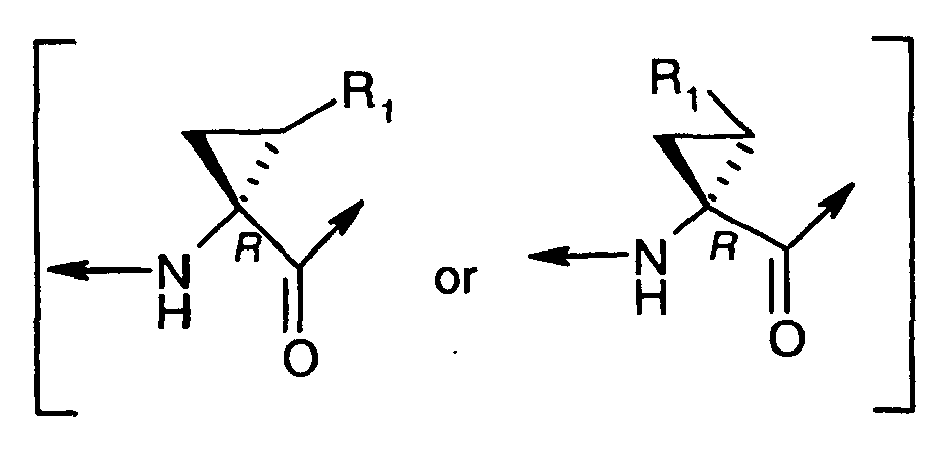
wherein R 1 is as defined in claim 1. - The compound according to claim 30, wherein the R 1 substituent on P1 is oriented syn to the carbonyl group as represented by the following absolute configuration:

wherein R 1 is methyl, ethyl, propyl, vinyl, all of which optionally substituted with halo. - The compound according to claim 31, wherein R 1 is ethyl, vinyl or bromovinyl.
- The compound according to claim 32, wherein R 1 is vinyl.
- The compound according to claim 1, wherein W is hydroxy or a pharmaceutically acceptable salt or ester thereof; or (lower alkyl)amino, di(lower alkyl)amino or amino aralkyl.
- The compound according to claim 32, wherein W is hydroxy, or N(R 13a)R 13b wherein R 13a and R 13b are independently H, aryl or C1-6 alkyl optionally substituted with hydroxy or phenyl; or a pharmaceutically acceptable salt thereof.
- The compound according to claim 35, wherein W is -OH, -NH-benzyl or -NH-CH(Me)Ph.
- The compound according to claim 36, wherein W is -OH or -NH-(S)CH(Me)-phenyl.
- The compound according to claim 37, wherein when W is an ester, said ester is selected from the group consisting of: C1-6 alkoxy, phenoxy, or aryl(C1-6 alkoxy).
- The compound according to claim 38, wherein said ester is methoxy, ethoxy, phenoxy, benzyloxy, or PhCH(Me)-O-.
- The compound of formula I according to claim 1, wherein B is H, lower alkyl-C(O)- or Het-C(O)-;
R 6 , when present, is the side chain of Asp or Glu;
R 5 , when present, is the side chain of D- or L-: Asp, Glu, Val, or Tbg;
Y is H or methyl;
R 4 is the side chain of Val, Chg, Tbg, Ile or Leu;
R 3 is hydrogen or the side chain of Ile, Chg, Val, or Tbg;
R 2 is 1-naphthylmethoxy, 2-naphthylmethoxy, O-Bn,


wherein R 22 is amino, di(lower alkyl)amino, (lower alkyl)amide, NO2, OH, halo, CF3, or COOH;
P1 is a cyclopropyl ring system of formula
wherein R 1 is ethyl, vinyl or bromovinyl; and
W is hydroxy or N(R 13a )R 13b wherein R 13a and R 13b are independently H, aryl or C1-6 alkyl optionally substituted with hydroxy or phenyl; or a pharmaceutically acceptable salt or ester thereof. - The compound of formula I according to claim 1, wherein B is H, acetyl or Het-C(O)-; R 6 , when present, is the side chain of Asp; R 5 , when present, is the side chain of D-Asp, D-Glu or D-Val; Y is H; R 4 is the side chain of Chg or Ile; R 3 is the side chain of Val, Chg or Tbg; R 2 is 1-naphthylmethoxy, benzyloxy, 4-quinolinoxy, or

P1 is a cyclopropyl ring system of formula
wherein R 1 is Et or CH=CH2 or CH=CHBr; and
W is hydroxy or NH-(S)-CHMePh, or a pharmaceutically acceptable salt thereof. - The compound of formula I according to claim 1, wherein B is acetyl; R 6 , when present, is the side chain of Asp; R 5 , when present, is the side chain of D-Glu; Y is H; R 4 is the side chain of Chg; R 3 is the side chain of Val or Tbg; R 2 is:

P1 is:
and
W is hydroxy, or a pharmaceutically acceptable salt or ester thereof. - The compound according to claim 40 represented by formula:

wherein B, P6, P5, P4, P3, R 2 , and R 1 are as defined below:

- The compound according to claim 40 represented by formula:

wherein P6, P5, P4, P3, R 2 , and R 1 are as defined below:


- The compound according to claim 40 represented by formula:

wherein B, P6, P5, P4, P3, R 2 , R 1 and W are as defined below:
- The compound according to claim 40 represented by formula:

wherein B, Y, P4, P3, R 2 , and R 1 are as defined below:
- The compound according to claim 40 represented by formula:

wherein B, and R 20 , are as defined below:

- A hexapeptide of formula I according to claim 43, selected from the group consisting of compound #:108; 116; 117; and 120.
- A hexapeptide of formula I according to claim 44, selected from the group consisting of compound #: 212; 222; 236; and 238.
- A hexapeptide of formula I according to claim 45, selected from the group consisting of compound #: 301 and 302.
- A tetrapeptide of formula I according to claim 43 selected from the group consisting of compound #: 122; and 123.
- A tetrapeptide of formula I according to claim, 44 selected from the group consisting of compound #: 202; 203; 205; 206; 207; 208; 209; 210; 211; 214; 215; 216; 218; 219; 220; 221; 223; 224; 225; 226; 228; 229; 230; 231; 232; 233; 234; 235.
- A tetrapeptide of formula I according to claim, 46 selected from the group consisting of compound #: 401.
- A tetrapeptide of formula I according to claim 47, selected from the group consisting of compound #: 501; 502; 503; 504; 505; 506; 507; 508; 509; 510; and 511.
- A compound according to any one of claims 1 to 54 as medicament.
- A pharmaceutical composition comprising an anti-hepatitis C virally effective amount of a compound of formula I according to claim 1, or a therapeutically acceptable salt or ester thereof, in admixture with a pharmaceutically acceptable carrier medium or auxiliary agent.
- The use of a compound of formula I according to claim 1, or a therapeutically acceptable salt or ester thereof for the preparation of a medicament for the treatment of a hepatitis C viral infection.
- An in vitro method of inhibiting the replication of hepatitis C virus by exposing the virus to a hepatitis C viral NS3 protease inhibiting amount of the compound of formula I according to claim 1, or a therapeutically acceptable salt or ester thereof or a composition according to claim 56.
- The use of a combination of the compound of formula I according to claim 1, or a therapeutically acceptable salt or ester thereof, and an interferon for the preparation of a medicament for the treatment of a hepatitis C viral infection..
- The pharmaceutical composition according to claim 56, further comprising a second antiviral agent.
- The pharmaceutical composition according to claim 60, wherein said second antiviral agent is ribavirin or amantadine.
- The pharmaceutical composition according to claim 56, further comprising other inhibitors of HCV protease.
- The pharmaceutical composition according to claim 56, further comprising an inhibitor of other targets in the HCV life cycle, selected from: helicase, polymerase, metalloprotease or IRES.
- A process for the preparation of a peptide analog of formula (I) according to claim 1, wherein P1 is a substituted aminocyclopropyl carboxylic acid residue, comprising the step of:■ coupling a peptide selected from the group consisting of: APG-P6-P5-P4-P3-P2; APG-P5-P4-P3-P2; APG-P4-P3-P2; APG-P3-P2; and APG-P2;■ with a P1 intermediate of formula:

wherein R 1 is C1-6 alkyl or C2-6 alkenyl optionally substituted with halogen, CPG is a carboxyl protecting group and P6 to P2 are as defined in claim 1. - A process for the preparation of a peptide analog of formula (I) according to claim 1, wherein P1 is a substituted aminocyclopropyl carboxylic acid residue, comprising the step of:■ coupling a peptide selected from the group consisting of: APG-P6-P5-P4-P3-P2; APG-P5-P4-P3-P2; APG-P4-P3-P2; APG-P3-P2; and APG-P2;■ with a P1 intermediate of formula:

wherein R 1 is ethyl, vinyl or bromovinyl, CPG is a carboxyl protecting group and P6 to P2 are as defined in claim 1. - A process for the preparation of a peptide analog of formula (I) according to claim 1, wherein P1 is a substituted aminocyclopropyl carboxylic acid residue, comprising the step of:■ coupling a peptide selected from the group consisting of: APG-P6-P5-P4-P3-P2; APG-P5-P4-P3-P2; APG-P4-P3-P2; APG-P3-P2; and APG-P2;■ with a P1 intermediate of formula:

wherein CPG is a carboxyl protecting group and P6 to P2 are as defined in claim 1. - The process according to claim 64, 65 or 66 wherein said carboxyl protecting group (CPG) is selected from the group consisting of:alkyl esters, aralkyl esters, and esters being cleavable by mild base treatment or mild reductive means.
- Use of an amino acid analog of formula:

wherein R 1 is C1-6 alkyl or C2-6 alkenyl optionally substituted with halogen, for the preparation of a compound of formula I according to claim 1. - Use of an amino acid analog of formula:

wherein R 1 is ethyl, vinyl or bromovinyl, for the preparation of a compound of formula I according to claim 1. - Use of an amino acid analog of formula:

for the preparation of a compound of formula I according to claim 1.
Applications Claiming Priority (3)
| Application Number | Priority Date | Filing Date | Title |
|---|---|---|---|
| US9594598P | 1998-08-10 | 1998-08-10 | |
| US95945P | 1998-08-10 | ||
| PCT/CA1999/000737 WO2000009558A1 (en) | 1998-08-10 | 1999-08-09 | Hepatitis c inhibitor peptides |
Publications (2)
| Publication Number | Publication Date |
|---|---|
| EP1105422A1 EP1105422A1 (en) | 2001-06-13 |
| EP1105422B1 true EP1105422B1 (en) | 2006-02-15 |
Family
ID=22254308
Family Applications (1)
| Application Number | Title | Priority Date | Filing Date |
|---|---|---|---|
| EP99938085A Expired - Lifetime EP1105422B1 (en) | 1998-08-10 | 1999-08-09 | Hepatitis c inhibitor peptides |
Country Status (33)
| Country | Link |
|---|---|
| EP (1) | EP1105422B1 (en) |
| JP (1) | JP4435982B2 (en) |
| KR (1) | KR100629791B1 (en) |
| CN (1) | CN1166690C (en) |
| AR (1) | AR022061A1 (en) |
| AT (1) | ATE317854T1 (en) |
| AU (1) | AU764655B2 (en) |
| BG (1) | BG64956B1 (en) |
| BR (1) | BR9912943A (en) |
| CA (1) | CA2336597C (en) |
| CO (1) | CO5180537A1 (en) |
| CZ (1) | CZ301405B6 (en) |
| DE (1) | DE69929887T2 (en) |
| DK (1) | DK1105422T3 (en) |
| EA (1) | EA004765B1 (en) |
| EE (1) | EE200100080A (en) |
| ES (1) | ES2257066T3 (en) |
| HK (1) | HK1039947B (en) |
| HR (1) | HRP20010101A2 (en) |
| HU (1) | HUP0104548A3 (en) |
| ID (1) | ID27784A (en) |
| IL (2) | IL141011A0 (en) |
| MY (1) | MY125014A (en) |
| NO (1) | NO20010604L (en) |
| NZ (1) | NZ510395A (en) |
| PL (1) | PL199419B1 (en) |
| RS (1) | RS49819B (en) |
| SK (1) | SK286846B6 (en) |
| TR (1) | TR200100438T2 (en) |
| TW (1) | TW577895B (en) |
| UA (1) | UA73480C2 (en) |
| WO (1) | WO2000009558A1 (en) |
| ZA (1) | ZA200100972B (en) |
Families Citing this family (154)
| Publication number | Priority date | Publication date | Assignee | Title |
|---|---|---|---|---|
| AR022061A1 (en) * | 1998-08-10 | 2002-09-04 | Boehringer Ingelheim Ca Ltd | INHIBITING PEPTIDES OF HEPATITIS C, A PHARMACEUTICAL COMPOSITION CONTAINING THEM, THE USE OF THE SAME TO PREPARE A PHARMACEUTICAL COMPOSITION, THE USE OF AN INTERMEDIATE PRODUCT FOR THE PREPARATION OF THESE PEPTIDES AND A PROCEDURE FOR THE PREPARATION OF ANOGRAPH . |
| UA74546C2 (en) * | 1999-04-06 | 2006-01-16 | Boehringer Ingelheim Ca Ltd | Macrocyclic peptides having activity relative to hepatitis c virus, a pharmaceutical composition and use of the pharmaceutical composition |
| US6608027B1 (en) | 1999-04-06 | 2003-08-19 | Boehringer Ingelheim (Canada) Ltd | Macrocyclic peptides active against the hepatitis C virus |
| JP4748911B2 (en) * | 2000-04-05 | 2011-08-17 | シェーリング コーポレイション | Macrocyclic NS3-serine protease inhibitor of hepatitis C virus containing N-cyclic P2 moiety |
| NZ521456A (en) | 2000-04-19 | 2004-07-30 | Schering Corp | Macrocyclic NS3-Serine protease inhibitors of hepatitis C virus comprising alkyl and aryl alanine P2 moieties |
| WO2002008187A1 (en) | 2000-07-21 | 2002-01-31 | Schering Corporation | Novel peptides as ns3-serine protease inhibitors of hepatitis c virus |
| AR029851A1 (en) | 2000-07-21 | 2003-07-16 | Dendreon Corp | NEW PEPTIDES AS INHIBITORS OF NS3-SERINA PROTEASA DEL VIRUS DE HEPATITIS C |
| MXPA03000627A (en) * | 2000-07-21 | 2004-07-30 | Schering Corp | Novel peptides as ns3-serine protease inhibitors of hepatitis c virus. |
| SV2003000617A (en) * | 2000-08-31 | 2003-01-13 | Lilly Co Eli | INHIBITORS OF PROTEASA PEPTIDOMIMETICA REF. X-14912M |
| US6846806B2 (en) | 2000-10-23 | 2005-01-25 | Bristol-Myers Squibb Company | Peptide inhibitors of Hepatitis C virus NS3 protein |
| HUP0303436A2 (en) | 2000-12-12 | 2004-01-28 | Schering Corp. | Diaryl peptides as ns3-serine protease inhibitors of hepatitis c virus, pharmaceutical compositions containing them and their use |
| CA2449504A1 (en) * | 2001-07-11 | 2003-01-23 | Vertex Pharmaceuticals Incorporated | Bridged bicyclic serine protease inhibitors |
| NZ531681A (en) * | 2001-10-24 | 2007-05-31 | Vertex Pharma | Inhibitors of serine protease, particularly hepatitis C virus NS3-NS4A protease, incorporating a fused ring system |
| AU2003207625B2 (en) * | 2002-01-23 | 2006-09-07 | Schering Corporation | Proline compounds as NS3-serine protease inhibitors for use in treatment of hepatites C virus infection |
| US7119072B2 (en) | 2002-01-30 | 2006-10-10 | Boehringer Ingelheim (Canada) Ltd. | Macrocyclic peptides active against the hepatitis C virus |
| US6642204B2 (en) | 2002-02-01 | 2003-11-04 | Boehringer Ingelheim International Gmbh | Hepatitis C inhibitor tri-peptides |
| US7091184B2 (en) | 2002-02-01 | 2006-08-15 | Boehringer Ingelheim International Gmbh | Hepatitis C inhibitor tri-peptides |
| JP2005535574A (en) | 2002-04-11 | 2005-11-24 | バーテックス ファーマシューティカルズ インコーポレイテッド | Inhibitors of serine proteases, particularly HCV NS3-NS4A protease |
| MY140680A (en) | 2002-05-20 | 2010-01-15 | Bristol Myers Squibb Co | Hepatitis c virus inhibitors |
| US6878722B2 (en) | 2002-05-20 | 2005-04-12 | Bristol-Myers Squibb Company | Substituted cycloalkyl P1′ hepatitis C virus inhibitors |
| EP1506000B9 (en) | 2002-05-20 | 2011-08-31 | Bristol-Myers Squibb Company | Heterocyclicsulfonamide hepatitis c virus inhibitors |
| WO2004032827A2 (en) | 2002-05-20 | 2004-04-22 | Bristol-Myers Squibb Company | Hepatitis c virus inhibitors |
| US20050075279A1 (en) | 2002-10-25 | 2005-04-07 | Boehringer Ingelheim International Gmbh | Macrocyclic peptides active against the hepatitis C virus |
| JP4682140B2 (en) | 2003-03-05 | 2011-05-11 | ベーリンガー インゲルハイム インターナショナル ゲゼルシャフト ミット ベシュレンクテル ハフツング | Hepatitis C inhibitor peptide analogues |
| EP1601685A1 (en) * | 2003-03-05 | 2005-12-07 | Boehringer Ingelheim International GmbH | Hepatitis c inhibiting compounds |
| KR100971347B1 (en) * | 2003-03-08 | 2010-07-20 | 주식회사유한양행 | NS3 protease inhibitor for the treatment of hepatitis A virus infection |
| JP4231524B2 (en) * | 2003-04-10 | 2009-03-04 | ベーリンガー インゲルハイム インターナショナル ゲゼルシャフト ミット ベシュレンクテル ハフツング | Process for producing macrocyclic compounds |
| US7176208B2 (en) | 2003-04-18 | 2007-02-13 | Enanta Pharmaceuticals, Inc. | Quinoxalinyl macrocyclic hepatitis C serine protease inhibitors |
| HRP20080014T3 (en) | 2003-05-21 | 2008-02-29 | Boehringer Ingelheim International Gmbh | Hepatitis c inhibitor compounds |
| WO2005021584A2 (en) | 2003-08-26 | 2005-03-10 | Schering Corporation | Novel peptidomimetic ns3-serine protease inhibitors of hepatitis c virus |
| PE20050374A1 (en) | 2003-09-05 | 2005-05-30 | Vertex Pharma | SERINE PROTEASE INHIBITORS, IN PARTICULAR HCV PROTEASE NS3-NS4A |
| RS20060197A (en) | 2003-09-22 | 2008-09-29 | Boehringer Ingelheim International Gmbh., | Macrocyclic peptides active against the hepatitis c virus |
| KR20060085248A (en) | 2003-09-26 | 2006-07-26 | 쉐링 코포레이션 | Macrocyclic Inhibitors of Hepatitis C Virus NS3 Serine Protease |
| US7491794B2 (en) | 2003-10-14 | 2009-02-17 | Intermune, Inc. | Macrocyclic compounds as inhibitors of viral replication |
| TW201245229A (en) | 2003-10-14 | 2012-11-16 | Hoffmann La Roche | Macrocyclic carboxylic acids and acylsulfonamides as inhibitors of HCV replication |
| JP4890254B2 (en) | 2003-10-27 | 2012-03-07 | バーテックス ファーマシューティカルズ インコーポレイテッド | HCVNS3-NS4A protease resistant mutant |
| US8187874B2 (en) | 2003-10-27 | 2012-05-29 | Vertex Pharmaceuticals Incorporated | Drug discovery method |
| US7132504B2 (en) | 2003-11-12 | 2006-11-07 | Bristol-Myers Squibb Company | Hepatitis C virus inhibitors |
| US7309708B2 (en) | 2003-11-20 | 2007-12-18 | Birstol-Myers Squibb Company | Hepatitis C virus inhibitors |
| US7135462B2 (en) | 2003-11-20 | 2006-11-14 | Bristol-Myers Squibb Company | Hepatitis C virus inhibitors |
| JP2007532479A (en) * | 2003-11-20 | 2007-11-15 | シェーリング コーポレイション | Depeptideization inhibitor of hepatitis C virus NS3 protease |
| CA2547770A1 (en) | 2003-12-08 | 2005-06-23 | Fabrice Gallou | Removal of ruthenium by-product by supercritical fluid processing |
| GB0500020D0 (en) | 2005-01-04 | 2005-02-09 | Novartis Ag | Organic compounds |
| ATE495185T1 (en) | 2004-01-21 | 2011-01-15 | Boehringer Ingelheim Int | MACROCYCLIC PEPTIDES ACTIVE AGAINST HEPATITIS C VIRUS |
| KR20120090077A (en) | 2004-01-30 | 2012-08-16 | 얀센 알 앤드 디 아일랜드 | Hcv ns-3 serine protease inhibitors |
| UY28758A1 (en) | 2004-02-20 | 2005-09-30 | Boehringer Ingelheim Int | VIRAL POLYMERASE INHIBITORS |
| US20070049593A1 (en) | 2004-02-24 | 2007-03-01 | Japan Tobacco Inc. | Tetracyclic fused heterocyclic compound and use thereof as HCV polymerase inhibitor |
| PT1719773E (en) | 2004-02-24 | 2009-06-03 | Japan Tobacco Inc | Fused heterotetracyclic compounds and use tehreof as hcv polymerase inhibitor |
| DE602005023224D1 (en) | 2004-02-27 | 2010-10-07 | Schering Corp | Novel compounds as inhibitors of hepatitis C virus NS3 serine protease |
| ES2328589T3 (en) * | 2004-02-27 | 2009-11-16 | Schering Corporation | PROLIN 3.4 COMPOUNDS (CYCLOPENTIL) FUSED AS INHIBITORS OF THE SERINE PROTEASE NS3 OF THE HEPATITIS VIRUS C. |
| US7816326B2 (en) | 2004-02-27 | 2010-10-19 | Schering Corporation | Sulfur compounds as inhibitors of hepatitis C virus NS3 serine protease |
| US7205330B2 (en) | 2004-02-27 | 2007-04-17 | Schering Corporation | Inhibitors of hepatitis C virus NS3 protease |
| MY145081A (en) | 2004-02-27 | 2011-12-15 | Schering Corp | Sulfur compounds as inhibitors of hepatitis c virus ns3 serine protease |
| US7192957B2 (en) | 2004-02-27 | 2007-03-20 | Schering Corporation | Compounds as inhibitors of hepatitis C virus NS3 serine protease |
| JP4654239B2 (en) | 2004-03-15 | 2011-03-16 | ベーリンガー インゲルハイム インターナショナル ゲゼルシャフト ミット ベシュレンクテル ハフツング | Method for preparing macrocyclic dipeptide suitable for treatment of hepatitis C virus infection |
| AU2005228894B9 (en) * | 2004-03-30 | 2011-10-13 | Intermune, Inc. | Macrocyclic compounds as inhibitors of viral replication |
| CN1984922A (en) | 2004-05-20 | 2007-06-20 | 先灵公司 | Substituted prolines as inhibitors of hepatitis c virus NS3 serine protease |
| WO2005116054A1 (en) | 2004-05-25 | 2005-12-08 | Boehringer Ingelheim International, Gmbh | Process for preparing acyclic hcv protease inhibitors |
| UY29016A1 (en) | 2004-07-20 | 2006-02-24 | Boehringer Ingelheim Int | ANALOGS OF INHIBITING DIPEPTIDES OF HEPATITIS C |
| JP4914355B2 (en) | 2004-07-20 | 2012-04-11 | ベーリンガー インゲルハイム インターナショナル ゲゼルシャフト ミット ベシュレンクテル ハフツング | Hepatitis C inhibitor peptide analog |
| US7597884B2 (en) | 2004-08-09 | 2009-10-06 | Alios Biopharma, Inc. | Hyperglycosylated polypeptide variants and methods of use |
| CA2577812A1 (en) | 2004-08-27 | 2006-03-09 | Schering Corporation | Acylsulfonamide compounds as inhibitors of hepatitis c virus ns3 serine protease |
| WO2006030892A1 (en) * | 2004-09-17 | 2006-03-23 | Nippon Shinyaku Co., Ltd. | Process for production of heterocyclic compounds |
| CA2583472A1 (en) | 2004-10-01 | 2006-04-13 | Chao Lin | Hcv ns3-ns4a protease inhibition |
| US7659263B2 (en) | 2004-11-12 | 2010-02-09 | Japan Tobacco Inc. | Thienopyrrole compound and use thereof as HCV polymerase inhibitor |
| US7323447B2 (en) | 2005-02-08 | 2008-01-29 | Bristol-Myers Squibb Company | Hepatitis C virus inhibitors |
| NZ562167A (en) | 2005-03-08 | 2011-01-28 | Boehringer Ingelheim Int | Process for preparing macrocyclic compounds |
| US7592336B2 (en) | 2005-05-10 | 2009-09-22 | Bristol-Myers Squibb Company | Hepatitis C virus inhibitors |
| CN101218224B (en) | 2005-05-13 | 2013-05-08 | Viro化学制药公司 | Compositions and methods for treating or preventing flavivirus infection |
| US7601686B2 (en) | 2005-07-11 | 2009-10-13 | Bristol-Myers Squibb Company | Hepatitis C virus inhibitors |
| JP5249028B2 (en) | 2005-07-25 | 2013-07-31 | インターミューン・インコーポレーテッド | Novel macrocyclic inhibitor of hepatitis C virus replication |
| PE20070211A1 (en) | 2005-07-29 | 2007-05-12 | Medivir Ab | MACROCYCLIC COMPOUNDS AS INHIBITORS OF HEPATITIS C VIRUS |
| JP5015154B2 (en) | 2005-08-12 | 2012-08-29 | ベーリンガー インゲルハイム インターナショナル ゲゼルシャフト ミット ベシュレンクテル ハフツング | Viral polymerase inhibitor |
| JP5190364B2 (en) | 2005-09-09 | 2013-04-24 | ベーリンガー インゲルハイム インターナショナル ゲゼルシャフト ミット ベシュレンクテル ハフツング | Ring-closing metathesis process for the preparation of macrocyclic peptides |
| GEP20104956B (en) | 2005-10-11 | 2010-04-12 | Array Biopharma Inc | Compounds for inhibiting hepatitis c viral replication and use thereof |
| US7772183B2 (en) | 2005-10-12 | 2010-08-10 | Bristol-Myers Squibb Company | Hepatitis C virus inhibitors |
| US7741281B2 (en) | 2005-11-03 | 2010-06-22 | Bristol-Myers Squibb Company | Hepatitis C virus inhibitors |
| US7705138B2 (en) | 2005-11-11 | 2010-04-27 | Vertex Pharmaceuticals Incorporated | Hepatitis C virus variants |
| US7816348B2 (en) | 2006-02-03 | 2010-10-19 | Boehringer Ingelheim International Gmbh | Viral polymerase inhibitors |
| US8017612B2 (en) | 2006-04-18 | 2011-09-13 | Japan Tobacco Inc. | Piperazine compound and use thereof as a HCV polymerase inhibitor |
| US7951823B2 (en) | 2006-05-23 | 2011-05-31 | Irm Llc | Compounds and compositions as channel activating protease inhibitors |
| EP2049474B1 (en) | 2006-07-11 | 2015-11-04 | Bristol-Myers Squibb Company | Hepatitis c virus inhibitors |
| EP1886685A1 (en) | 2006-08-11 | 2008-02-13 | INSERM (Institut National de la Santé et de la Recherche Médicale) | Methods, uses and compositions for modulating replication of hcv through the farnesoid x receptor (fxr) activation or inhibition |
| JP2010500978A (en) | 2006-08-17 | 2010-01-14 | ベーリンガー インゲルハイム インターナショナル ゲゼルシャフト ミット ベシュレンクテル ハフツング | Viral polymerase inhibitor |
| US8343477B2 (en) | 2006-11-01 | 2013-01-01 | Bristol-Myers Squibb Company | Inhibitors of hepatitis C virus |
| US7772180B2 (en) | 2006-11-09 | 2010-08-10 | Bristol-Myers Squibb Company | Hepatitis C virus inhibitors |
| PT2104674E (en) | 2006-11-15 | 2013-07-26 | Virochem Pharma Inc | Thiophene analogues for the treatment or prevention of flavivirus infections |
| US7763584B2 (en) | 2006-11-16 | 2010-07-27 | Bristol-Myers Squibb Company | Hepatitis C virus inhibitors |
| US8003604B2 (en) | 2006-11-16 | 2011-08-23 | Bristol-Myers Squibb Company | Hepatitis C virus inhibitors |
| US7888464B2 (en) | 2006-11-16 | 2011-02-15 | Bristol-Myers Squibb Company | Hepatitis C virus inhibitors |
| MX2009013827A (en) | 2007-06-29 | 2010-03-01 | Gilead Sciences Inc | Antiviral compounds. |
| MX2009013830A (en) | 2007-06-29 | 2010-03-01 | Gilead Sciences Inc | Antiviral compounds. |
| EP2188274A4 (en) | 2007-08-03 | 2011-05-25 | Boehringer Ingelheim Int | Viral polymerase inhibitors |
| CA2708150A1 (en) | 2007-12-05 | 2009-06-18 | Enanta Pharmaceuticals, Inc. | Fluorinated tripeptide hcv serine protease inhibitors |
| WO2009076747A1 (en) | 2007-12-19 | 2009-06-25 | Boehringer Ingelheim International Gmbh | Viral polymerase inhibitors |
| US8202996B2 (en) | 2007-12-21 | 2012-06-19 | Bristol-Myers Squibb Company | Crystalline forms of N-(tert-butoxycarbonyl)-3-methyl-L-valyl-(4R)-4-((7-chloro-4-methoxy-1-isoquinolinyl)oxy)-N- ((1R,2S)-1-((cyclopropylsulfonyl)carbamoyl)-2-vinylcyclopropyl)-L-prolinamide |
| US8163921B2 (en) | 2008-04-16 | 2012-04-24 | Bristol-Myers Squibb Company | Hepatitis C virus inhibitors |
| US7964560B2 (en) | 2008-05-29 | 2011-06-21 | Bristol-Myers Squibb Company | Hepatitis C virus inhibitors |
| US8044023B2 (en) | 2008-05-29 | 2011-10-25 | Bristol-Myers Squibb Company | Hepatitis C virus inhibitors |
| US8207341B2 (en) | 2008-09-04 | 2012-06-26 | Bristol-Myers Squibb Company | Process or synthesizing substituted isoquinolines |
| UY32099A (en) | 2008-09-11 | 2010-04-30 | Enanta Pharm Inc | HEPATITIS C SERINA PROTEASAS MACROCYCLIC INHIBITORS |
| AU2009293494B2 (en) | 2008-09-16 | 2014-04-24 | Boehringer Ingelheim International Gmbh | Crystalline forms of a 2-thiazolyl- 4-quinolinyl-oxy derivative, a potent HCV inhibitor |
| US8563505B2 (en) | 2008-09-29 | 2013-10-22 | Bristol-Myers Squibb Company | Hepatitis C virus inhibitors |
| US8044087B2 (en) | 2008-09-29 | 2011-10-25 | Bristol-Myers Squibb Company | Hepatitis C virus inhibitors |
| WO2010039801A2 (en) | 2008-10-02 | 2010-04-08 | The J. David Gladstone Institutes | Methods of treating hepatitis c virus infection |
| US8283310B2 (en) | 2008-12-15 | 2012-10-09 | Bristol-Myers Squibb Company | Hepatitis C virus inhibitors |
| WO2010080874A1 (en) | 2009-01-07 | 2010-07-15 | Scynexis, Inc. | Cyclosporine derivative for use in the treatment of hcv and hiv infection |
| US8975247B2 (en) | 2009-03-18 | 2015-03-10 | The Board Of Trustees Of The Leland Stanford Junion University | Methods and compositions of treating a flaviviridae family viral infection |
| US8377962B2 (en) | 2009-04-08 | 2013-02-19 | Idenix Pharmaceuticals, Inc. | Macrocyclic serine protease inhibitors |
| US8512690B2 (en) * | 2009-04-10 | 2013-08-20 | Novartis Ag | Derivatised proline containing peptide compounds as protease inhibitors |
| CN102458444A (en) | 2009-05-13 | 2012-05-16 | 英安塔制药有限公司 | Macrocyclic compounds as hepatitis c virus inhibitors |
| US9284307B2 (en) | 2009-08-05 | 2016-03-15 | Idenix Pharmaceuticals Llc | Macrocyclic serine protease inhibitors |
| JP5476859B2 (en) * | 2009-08-25 | 2014-04-23 | 住友化学株式会社 | Process for producing optically active ethyl 1-amino-2-ethenylcyclopropane-1-carboxylate or acid addition salt thereof, and intermediate used in the process |
| JP2013512247A (en) | 2009-11-25 | 2013-04-11 | バーテックス ファーマシューティカルズ インコーポレイテッド | 5-Alkynyl-thiophene-2-carboxylic acid derivatives and their use for the treatment or prevention of flavivirus infections |
| US20130072523A1 (en) | 2009-12-24 | 2013-03-21 | Vertex Pharmaceuticals Incorporated | Analogues for the treatment or prevention of flavivirus infections |
| KR101781789B1 (en) | 2010-01-27 | 2017-09-26 | 에이비 파르마 리미티드. | Polyheterocyclic compounds highly potent as hcv inhibitors |
| WO2011119870A1 (en) | 2010-03-24 | 2011-09-29 | Vertex Pharmaceuticals Incorporated | Analogues for the treatment or prevention of flavivirus infections |
| MX2012010918A (en) | 2010-03-24 | 2013-01-18 | Vertex Pharma | Analogues for the treatment or prevention of flavivirus infections. |
| TW201141857A (en) | 2010-03-24 | 2011-12-01 | Vertex Pharma | Analogues for the treatment or prevention of flavivirus infections |
| TW201139438A (en) | 2010-03-24 | 2011-11-16 | Vertex Pharma | Analogues for the treatment or prevention of flavivirus infections |
| WO2011156545A1 (en) | 2010-06-09 | 2011-12-15 | Vertex Pharmaceuticals Incorporated | Viral dynamic model for hcv combination therapy |
| WO2011159826A2 (en) | 2010-06-15 | 2011-12-22 | Vertex Pharmaceuticals Incorporated | Hcv ns5b protease mutants |
| WO2012006070A1 (en) | 2010-06-28 | 2012-01-12 | Vertex Pharmaceuticals Incorporated | Compounds and methods for the treatment or prevention of flavivirus infections |
| EP2585447A2 (en) | 2010-06-28 | 2013-05-01 | Vertex Pharmaceuticals Incorporated | Compounds and methods for the treatment or prevention of flavivirus infections |
| JP2013531011A (en) | 2010-06-28 | 2013-08-01 | バーテックス ファーマシューティカルズ インコーポレイテッド | Compounds and methods for the treatment or prevention of flavivirus infections |
| MX2013001869A (en) | 2010-08-17 | 2013-06-28 | Vertex Pharma | Compounds and methods for the treatment or prevention of flaviviridae viral infections. |
| HUE028384T2 (en) | 2010-09-21 | 2016-12-28 | Enanta Pharm Inc | HCV serine protease inhibitors derived from macrocyclic proline |
| EP2624826B1 (en) | 2010-10-08 | 2018-07-18 | Novartis AG | Vitamin e formulations of sulfamide ns3 inhibitors |
| CN103534256B (en) | 2010-12-30 | 2016-08-10 | 益安药业 | Macrocyclic hepatitis c serine protease inhibitors |
| WO2012092411A2 (en) | 2010-12-30 | 2012-07-05 | Enanta Pharmaceuticals, Inc. | Phenanthridine macrocyclic hepatitis c serine protease inhibitors |
| US9353100B2 (en) | 2011-02-10 | 2016-05-31 | Idenix Pharmaceuticals Llc | Macrocyclic serine protease inhibitors, pharmaceutical compositions thereof, and their use for treating HCV infections |
| WO2012107589A1 (en) | 2011-02-11 | 2012-08-16 | INSERM (Institut National de la Santé et de la Recherche Médicale) | Methods and pharmaceutical compositions for the treatment and prevention of hcv infections |
| CN103402972A (en) * | 2011-03-10 | 2013-11-20 | 住友化学株式会社 | Method of producing optically active 1-amino-2-vinylcyclopropane carboxylic acid ester |
| US8957203B2 (en) | 2011-05-05 | 2015-02-17 | Bristol-Myers Squibb Company | Hepatitis C virus inhibitors |
| US10201584B1 (en) | 2011-05-17 | 2019-02-12 | Abbvie Inc. | Compositions and methods for treating HCV |
| US8691757B2 (en) | 2011-06-15 | 2014-04-08 | Bristol-Myers Squibb Company | Hepatitis C virus inhibitors |
| WO2012171332A1 (en) | 2011-06-16 | 2012-12-20 | 爱博新药研发(上海)有限公司 | Macrocyclic heterocyclic compound for inhibiting hepatitis c virus and preparation and use thereof |
| CN102807607B (en) * | 2011-07-22 | 2013-10-23 | 爱博新药研发(上海)有限公司 | Fused ring heterocycle compound for restraining hepatitis c virus, midbody and application of fused ring heterocycle compound |
| WO2013016499A1 (en) | 2011-07-26 | 2013-01-31 | Vertex Pharmaceuticals Incorporated | Methods for preparation of thiophene compounds |
| AU2012286853A1 (en) | 2011-07-26 | 2013-05-02 | Vertex Pharmaceuticals Incorporated | Thiophene compounds |
| AU2012347785B2 (en) | 2011-12-06 | 2017-03-16 | The Board Of Trustees Of The Leland Stanford Junior University | Methods and compositions for treating viral diseases |
| EP2827876A4 (en) | 2012-03-22 | 2015-10-28 | Alios Biopharma Inc | Pharmaceutical combinations comprising a thionucleotide analog |
| SI2909205T1 (en) | 2012-10-19 | 2017-02-28 | Bristol-Myers Squibb Company | 9-methyl substituted hexadecahydrocyclopropa(e)pyrrolo(1,2-a)(1,4)diazacyclopentadecinyl carbamate derivatives as non-structural 3 (ns3) protease inhibitors for the treatment of hepatitis c virus infections |
| EP2914598B1 (en) | 2012-11-02 | 2017-10-18 | Bristol-Myers Squibb Company | Hepatitis c virus inhibitors |
| EP2914613B1 (en) | 2012-11-02 | 2017-11-22 | Bristol-Myers Squibb Company | Hepatitis c virus inhibitors |
| US9643999B2 (en) | 2012-11-02 | 2017-05-09 | Bristol-Myers Squibb Company | Hepatitis C virus inhibitors |
| US9409943B2 (en) | 2012-11-05 | 2016-08-09 | Bristol-Myers Squibb Company | Hepatitis C virus inhibitors |
| TW201526899A (en) | 2013-02-28 | 2015-07-16 | Alios Biopharma Inc | Pharmaceutical compositions |
| US9580463B2 (en) | 2013-03-07 | 2017-02-28 | Bristol-Myers Squibb Company | Hepatitis C virus inhibitors |
| WO2014138374A1 (en) | 2013-03-08 | 2014-09-12 | Boehringer Ingelheim International Gmbh | Oral combination therapy for treating hcv infection in specific patient sub-population |
| WO2015103490A1 (en) | 2014-01-03 | 2015-07-09 | Abbvie, Inc. | Solid antiviral dosage forms |
| EP2899207A1 (en) | 2014-01-28 | 2015-07-29 | Amikana.Biologics | New method for testing HCV protease inhibition |
| US20220099637A1 (en) | 2018-12-04 | 2022-03-31 | Bristol-Myers Squibb Company | Methods of analysis using in-sample calibration curve by multiple isotopologue reaction monitoring |
| WO2023149981A1 (en) * | 2022-02-07 | 2023-08-10 | Purdue Research Foundation | Compounds for the treatment of sars |
Family Cites Families (3)
| Publication number | Priority date | Publication date | Assignee | Title |
|---|---|---|---|---|
| CZ298749B6 (en) * | 1996-10-18 | 2008-01-16 | Vertex Pharmaceuticals Incorporated | Inhibitors of serine proteases and pharmaceutical compositions in which the inhibitors are comprised |
| DE69829381T2 (en) * | 1997-08-11 | 2006-04-13 | Boehringer Ingelheim (Canada) Ltd., Laval | HEPATITIS C INHIBITOR PEPTIDE |
| AR022061A1 (en) * | 1998-08-10 | 2002-09-04 | Boehringer Ingelheim Ca Ltd | INHIBITING PEPTIDES OF HEPATITIS C, A PHARMACEUTICAL COMPOSITION CONTAINING THEM, THE USE OF THE SAME TO PREPARE A PHARMACEUTICAL COMPOSITION, THE USE OF AN INTERMEDIATE PRODUCT FOR THE PREPARATION OF THESE PEPTIDES AND A PROCEDURE FOR THE PREPARATION OF ANOGRAPH . |
-
1999
- 1999-08-06 AR ARP990103927A patent/AR022061A1/en active IP Right Grant
- 1999-08-09 EE EEP200100080A patent/EE200100080A/en unknown
- 1999-08-09 EP EP99938085A patent/EP1105422B1/en not_active Expired - Lifetime
- 1999-08-09 HU HU0104548A patent/HUP0104548A3/en unknown
- 1999-08-09 ES ES99938085T patent/ES2257066T3/en not_active Expired - Lifetime
- 1999-08-09 HK HK02101472.3A patent/HK1039947B/en not_active IP Right Cessation
- 1999-08-09 ID IDW20010311A patent/ID27784A/en unknown
- 1999-08-09 BR BR9912943-4A patent/BR9912943A/en not_active Application Discontinuation
- 1999-08-09 CZ CZ20010515A patent/CZ301405B6/en not_active IP Right Cessation
- 1999-08-09 MY MYPI99003390A patent/MY125014A/en unknown
- 1999-08-09 JP JP2000565004A patent/JP4435982B2/en not_active Expired - Fee Related
- 1999-08-09 HR HR20010101A patent/HRP20010101A2/en not_active Application Discontinuation
- 1999-08-09 SK SK205-2001A patent/SK286846B6/en not_active IP Right Cessation
- 1999-08-09 AU AU52732/99A patent/AU764655B2/en not_active Ceased
- 1999-08-09 CN CNB998104493A patent/CN1166690C/en not_active Expired - Fee Related
- 1999-08-09 PL PL346051A patent/PL199419B1/en not_active IP Right Cessation
- 1999-08-09 WO PCT/CA1999/000737 patent/WO2000009558A1/en not_active Ceased
- 1999-08-09 KR KR1020017001787A patent/KR100629791B1/en not_active Expired - Fee Related
- 1999-08-09 DK DK99938085T patent/DK1105422T3/en active
- 1999-08-09 EA EA200100229A patent/EA004765B1/en not_active IP Right Cessation
- 1999-08-09 RS YUP-93/01A patent/RS49819B/en unknown
- 1999-08-09 AT AT99938085T patent/ATE317854T1/en not_active IP Right Cessation
- 1999-08-09 IL IL14101199A patent/IL141011A0/en unknown
- 1999-08-09 CA CA002336597A patent/CA2336597C/en not_active Expired - Fee Related
- 1999-08-09 DE DE69929887T patent/DE69929887T2/en not_active Expired - Lifetime
- 1999-08-09 TR TR2001/00438T patent/TR200100438T2/en unknown
- 1999-08-09 TW TW088113587A patent/TW577895B/en not_active IP Right Cessation
- 1999-08-09 NZ NZ510395A patent/NZ510395A/en not_active IP Right Cessation
- 1999-08-10 CO CO99050711D patent/CO5180537A1/en unknown
- 1999-09-08 UA UA2001031604A patent/UA73480C2/en unknown
-
2001
- 2001-01-22 IL IL141011A patent/IL141011A/en not_active IP Right Cessation
- 2001-02-05 ZA ZA200100972A patent/ZA200100972B/en unknown
- 2001-02-05 NO NO20010604A patent/NO20010604L/en not_active Application Discontinuation
- 2001-02-08 BG BG105230A patent/BG64956B1/en unknown
Also Published As
Similar Documents
| Publication | Publication Date | Title |
|---|---|---|
| AU764655B2 (en) | Hepatitis C inhibitor peptides | |
| US6767991B1 (en) | Hepatitis C inhibitor peptides | |
| EP1105413B1 (en) | Hepatitis c inhibitor tri-peptides | |
| EP1012180B1 (en) | Hepatitis c inhibitor peptide analogues | |
| EP1003775B1 (en) | Hepatitis c inhibitor peptides | |
| MXPA01001422A (en) | Hepatitis c inhibitor peptides |
Legal Events
| Date | Code | Title | Description |
|---|---|---|---|
| PUAI | Public reference made under article 153(3) epc to a published international application that has entered the european phase |
Free format text: ORIGINAL CODE: 0009012 |
|
| 17P | Request for examination filed |
Effective date: 20010312 |
|
| AK | Designated contracting states |
Kind code of ref document: A1 Designated state(s): AT BE CH CY DE DK ES FI FR GB GR IE IT LI LU MC NL PT SE |
|
| AX | Request for extension of the european patent |
Free format text: AL;LT PAYMENT 20010312;LV PAYMENT 20010312;MK;RO PAYMENT 20010312;SI PAYMENT 20010312 |
|
| 17Q | First examination report despatched |
Effective date: 20030718 |
|
| GRAP | Despatch of communication of intention to grant a patent |
Free format text: ORIGINAL CODE: EPIDOSNIGR1 |
|
| GRAS | Grant fee paid |
Free format text: ORIGINAL CODE: EPIDOSNIGR3 |
|
| RAP1 | Party data changed (applicant data changed or rights of an application transferred) |
Owner name: BOEHRINGER INGELHEIM (CANADA) LTD. |
|
| GRAA | (expected) grant |
Free format text: ORIGINAL CODE: 0009210 |
|
| AK | Designated contracting states |
Kind code of ref document: B1 Designated state(s): AT BE CH CY DE DK ES FI FR GB GR IE IT LI LU MC NL PT SE |
|
| AX | Request for extension of the european patent |
Extension state: LT LV RO SI |
|
| PG25 | Lapsed in a contracting state [announced via postgrant information from national office to epo] |
Ref country code: FI Free format text: LAPSE BECAUSE OF FAILURE TO SUBMIT A TRANSLATION OF THE DESCRIPTION OR TO PAY THE FEE WITHIN THE PRESCRIBED TIME-LIMIT Effective date: 20060215 |
|
| REG | Reference to a national code |
Ref country code: GB Ref legal event code: FG4D Ref country code: CH Ref legal event code: EP |
|
| REG | Reference to a national code |
Ref country code: IE Ref legal event code: FG4D |
|
| REG | Reference to a national code |
Ref country code: CH Ref legal event code: NV Representative=s name: SCHMAUDER & PARTNER AG PATENTANWALTSBUERO |
|
| REF | Corresponds to: |
Ref document number: 69929887 Country of ref document: DE Date of ref document: 20060420 Kind code of ref document: P |
|
| REG | Reference to a national code |
Ref country code: SE Ref legal event code: TRGR |
|
| REG | Reference to a national code |
Ref country code: DK Ref legal event code: T3 |
|
| REG | Reference to a national code |
Ref country code: ES Ref legal event code: FG2A Ref document number: 2257066 Country of ref document: ES Kind code of ref document: T3 |
|
| PG25 | Lapsed in a contracting state [announced via postgrant information from national office to epo] |
Ref country code: PT Free format text: LAPSE BECAUSE OF FAILURE TO SUBMIT A TRANSLATION OF THE DESCRIPTION OR TO PAY THE FEE WITHIN THE PRESCRIBED TIME-LIMIT Effective date: 20060717 |
|
| LTIE | Lt: invalidation of european patent or patent extension |
Effective date: 20060215 |
|
| PG25 | Lapsed in a contracting state [announced via postgrant information from national office to epo] |
Ref country code: IE Free format text: LAPSE BECAUSE OF NON-PAYMENT OF DUE FEES Effective date: 20060809 |
|
| PG25 | Lapsed in a contracting state [announced via postgrant information from national office to epo] |
Ref country code: MC Free format text: LAPSE BECAUSE OF NON-PAYMENT OF DUE FEES Effective date: 20060831 |
|
| ET | Fr: translation filed | ||
| PLBE | No opposition filed within time limit |
Free format text: ORIGINAL CODE: 0009261 |
|
| STAA | Information on the status of an ep patent application or granted ep patent |
Free format text: STATUS: NO OPPOSITION FILED WITHIN TIME LIMIT |
|
| 26N | No opposition filed |
Effective date: 20061116 |
|
| PG25 | Lapsed in a contracting state [announced via postgrant information from national office to epo] |
Ref country code: GR Free format text: LAPSE BECAUSE OF FAILURE TO SUBMIT A TRANSLATION OF THE DESCRIPTION OR TO PAY THE FEE WITHIN THE PRESCRIBED TIME-LIMIT Effective date: 20060516 |
|
| PG25 | Lapsed in a contracting state [announced via postgrant information from national office to epo] |
Ref country code: LU Free format text: LAPSE BECAUSE OF NON-PAYMENT OF DUE FEES Effective date: 20060809 |
|
| PG25 | Lapsed in a contracting state [announced via postgrant information from national office to epo] |
Ref country code: CY Free format text: LAPSE BECAUSE OF FAILURE TO SUBMIT A TRANSLATION OF THE DESCRIPTION OR TO PAY THE FEE WITHIN THE PRESCRIBED TIME-LIMIT Effective date: 20060215 |
|
| REG | Reference to a national code |
Ref country code: CH Ref legal event code: PCAR Free format text: SCHMAUDER & PARTNER AG PATENT- UND MARKENANWAELTE VSP;ZWAENGIWEG 7;8038 ZUERICH (CH) |
|
| PGFP | Annual fee paid to national office [announced via postgrant information from national office to epo] |
Ref country code: ES Payment date: 20090821 Year of fee payment: 11 Ref country code: DK Payment date: 20090811 Year of fee payment: 11 |
|
| PGFP | Annual fee paid to national office [announced via postgrant information from national office to epo] |
Ref country code: SE Payment date: 20090813 Year of fee payment: 11 Ref country code: NL Payment date: 20090814 Year of fee payment: 11 Ref country code: GB Payment date: 20090827 Year of fee payment: 11 Ref country code: DE Payment date: 20090821 Year of fee payment: 11 Ref country code: CH Payment date: 20090825 Year of fee payment: 11 Ref country code: AT Payment date: 20090814 Year of fee payment: 11 |
|
| PGFP | Annual fee paid to national office [announced via postgrant information from national office to epo] |
Ref country code: BE Payment date: 20090915 Year of fee payment: 11 |
|
| PGFP | Annual fee paid to national office [announced via postgrant information from national office to epo] |
Ref country code: IT Payment date: 20090821 Year of fee payment: 11 |
|
| BERE | Be: lapsed |
Owner name: *BOEHRINGER INGELHEIM (CANADA) LTD Effective date: 20100831 |
|
| REG | Reference to a national code |
Ref country code: NL Ref legal event code: V1 Effective date: 20110301 |
|
| REG | Reference to a national code |
Ref country code: DK Ref legal event code: EBP |
|
| EUG | Se: european patent has lapsed | ||
| REG | Reference to a national code |
Ref country code: CH Ref legal event code: PL |
|
| GBPC | Gb: european patent ceased through non-payment of renewal fee |
Effective date: 20100809 |
|
| PG25 | Lapsed in a contracting state [announced via postgrant information from national office to epo] |
Ref country code: CH Free format text: LAPSE BECAUSE OF NON-PAYMENT OF DUE FEES Effective date: 20100831 Ref country code: LI Free format text: LAPSE BECAUSE OF NON-PAYMENT OF DUE FEES Effective date: 20100831 |
|
| REG | Reference to a national code |
Ref country code: FR Ref legal event code: ST Effective date: 20110502 |
|
| PG25 | Lapsed in a contracting state [announced via postgrant information from national office to epo] |
Ref country code: NL Free format text: LAPSE BECAUSE OF NON-PAYMENT OF DUE FEES Effective date: 20110301 Ref country code: IT Free format text: LAPSE BECAUSE OF NON-PAYMENT OF DUE FEES Effective date: 20100809 Ref country code: AT Free format text: LAPSE BECAUSE OF NON-PAYMENT OF DUE FEES Effective date: 20100809 |
|
| REG | Reference to a national code |
Ref country code: DE Ref legal event code: R119 Ref document number: 69929887 Country of ref document: DE Effective date: 20110301 |
|
| PG25 | Lapsed in a contracting state [announced via postgrant information from national office to epo] |
Ref country code: DE Free format text: LAPSE BECAUSE OF NON-PAYMENT OF DUE FEES Effective date: 20110301 Ref country code: FR Free format text: LAPSE BECAUSE OF NON-PAYMENT OF DUE FEES Effective date: 20100831 Ref country code: BE Free format text: LAPSE BECAUSE OF NON-PAYMENT OF DUE FEES Effective date: 20100831 |
|
| PG25 | Lapsed in a contracting state [announced via postgrant information from national office to epo] |
Ref country code: GB Free format text: LAPSE BECAUSE OF NON-PAYMENT OF DUE FEES Effective date: 20100809 Ref country code: DK Free format text: LAPSE BECAUSE OF NON-PAYMENT OF DUE FEES Effective date: 20100831 |
|
| PGFP | Annual fee paid to national office [announced via postgrant information from national office to epo] |
Ref country code: FR Payment date: 20090914 Year of fee payment: 11 |
|
| REG | Reference to a national code |
Ref country code: ES Ref legal event code: FD2A Effective date: 20111020 |
|
| PG25 | Lapsed in a contracting state [announced via postgrant information from national office to epo] |
Ref country code: ES Free format text: LAPSE BECAUSE OF NON-PAYMENT OF DUE FEES Effective date: 20100810 |
|
| PG25 | Lapsed in a contracting state [announced via postgrant information from national office to epo] |
Ref country code: SE Free format text: LAPSE BECAUSE OF NON-PAYMENT OF DUE FEES Effective date: 20100810 |