EP1105359B1 - Festphasesynthese von verbindungen mittels mitsunobu-reaktionen unter bildung von kohlenstoff kohlenstoff bindungen - Google Patents
Festphasesynthese von verbindungen mittels mitsunobu-reaktionen unter bildung von kohlenstoff kohlenstoff bindungen Download PDFInfo
- Publication number
- EP1105359B1 EP1105359B1 EP99943811A EP99943811A EP1105359B1 EP 1105359 B1 EP1105359 B1 EP 1105359B1 EP 99943811 A EP99943811 A EP 99943811A EP 99943811 A EP99943811 A EP 99943811A EP 1105359 B1 EP1105359 B1 EP 1105359B1
- Authority
- EP
- European Patent Office
- Prior art keywords
- group
- support
- compounds
- solid phase
- reagents
- Prior art date
- Legal status (The legal status is an assumption and is not a legal conclusion. Google has not performed a legal analysis and makes no representation as to the accuracy of the status listed.)
- Expired - Lifetime
Links
- 150000001875 compounds Chemical class 0.000 title claims abstract description 63
- 239000011203 carbon fibre reinforced carbon Substances 0.000 title description 9
- 238000006751 Mitsunobu reaction Methods 0.000 title description 5
- 238000010532 solid phase synthesis reaction Methods 0.000 title description 2
- 239000003153 chemical reaction reagent Substances 0.000 claims abstract description 79
- 238000005804 alkylation reaction Methods 0.000 claims abstract description 47
- 238000000034 method Methods 0.000 claims abstract description 42
- 230000008569 process Effects 0.000 claims abstract description 33
- 239000007787 solid Substances 0.000 claims abstract description 32
- -1 phosphorus compound Chemical class 0.000 claims description 50
- 238000006243 chemical reaction Methods 0.000 claims description 35
- 239000007788 liquid Substances 0.000 claims description 20
- 239000007790 solid phase Substances 0.000 claims description 17
- 238000001914 filtration Methods 0.000 claims description 16
- 239000004793 Polystyrene Substances 0.000 claims description 15
- 229920002223 polystyrene Polymers 0.000 claims description 15
- VLSDXINSOMDCBK-BQYQJAHWSA-N (E)-1,1'-azobis(N,N-dimethylformamide) Chemical compound CN(C)C(=O)\N=N\C(=O)N(C)C VLSDXINSOMDCBK-BQYQJAHWSA-N 0.000 claims description 13
- 125000003118 aryl group Chemical group 0.000 claims description 13
- TUQOTMZNTHZOKS-UHFFFAOYSA-N tributylphosphine Chemical compound CCCCP(CCCC)CCCC TUQOTMZNTHZOKS-UHFFFAOYSA-N 0.000 claims description 13
- 125000000217 alkyl group Chemical group 0.000 claims description 9
- 150000001408 amides Chemical class 0.000 claims description 7
- 150000002367 halogens Chemical class 0.000 claims description 7
- 229910052698 phosphorus Inorganic materials 0.000 claims description 7
- 239000011574 phosphorus Substances 0.000 claims description 7
- OAICVXFJPJFONN-UHFFFAOYSA-N Phosphorus Chemical compound [P] OAICVXFJPJFONN-UHFFFAOYSA-N 0.000 claims description 6
- 239000004698 Polyethylene Substances 0.000 claims description 6
- 125000006575 electron-withdrawing group Chemical group 0.000 claims description 6
- RIOQSEWOXXDEQQ-UHFFFAOYSA-N triphenylphosphine Chemical compound C1=CC=CC=C1P(C=1C=CC=CC=1)C1=CC=CC=C1 RIOQSEWOXXDEQQ-UHFFFAOYSA-N 0.000 claims description 6
- 150000001732 carboxylic acid derivatives Chemical class 0.000 claims description 5
- 150000002148 esters Chemical class 0.000 claims description 5
- 239000012535 impurity Substances 0.000 claims description 5
- 229920000573 polyethylene Polymers 0.000 claims description 5
- 125000001424 substituent group Chemical group 0.000 claims description 5
- 150000001299 aldehydes Chemical class 0.000 claims description 4
- FAMRKDQNMBBFBR-BQYQJAHWSA-N diethyl azodicarboxylate Substances CCOC(=O)\N=N\C(=O)OCC FAMRKDQNMBBFBR-BQYQJAHWSA-N 0.000 claims description 4
- FAMRKDQNMBBFBR-UHFFFAOYSA-N ethyl n-ethoxycarbonyliminocarbamate Chemical compound CCOC(=O)N=NC(=O)OCC FAMRKDQNMBBFBR-UHFFFAOYSA-N 0.000 claims description 4
- 238000001704 evaporation Methods 0.000 claims description 4
- 229910052736 halogen Inorganic materials 0.000 claims description 4
- 125000003107 substituted aryl group Chemical group 0.000 claims description 4
- 229920001577 copolymer Polymers 0.000 claims description 3
- 125000000449 nitro group Chemical group [O-][N+](*)=O 0.000 claims description 3
- 125000001997 phenyl group Chemical group [H]C1=C([H])C([H])=C(*)C([H])=C1[H] 0.000 claims description 3
- 229920000058 polyacrylate Polymers 0.000 claims description 3
- BDHFUVZGWQCTTF-UHFFFAOYSA-M sulfonate Chemical compound [O-]S(=O)=O BDHFUVZGWQCTTF-UHFFFAOYSA-M 0.000 claims description 3
- 150000003462 sulfoxides Chemical class 0.000 claims description 3
- 229910019142 PO4 Inorganic materials 0.000 claims description 2
- 239000004952 Polyamide Substances 0.000 claims description 2
- 125000005362 aryl sulfone group Chemical group 0.000 claims description 2
- 125000004104 aryloxy group Chemical group 0.000 claims description 2
- 239000005289 controlled pore glass Substances 0.000 claims description 2
- 125000004093 cyano group Chemical group *C#N 0.000 claims description 2
- 125000000951 phenoxy group Chemical group [H]C1=C([H])C([H])=C(O*)C([H])=C1[H] 0.000 claims description 2
- NBIIXXVUZAFLBC-UHFFFAOYSA-K phosphate Chemical compound [O-]P([O-])([O-])=O NBIIXXVUZAFLBC-UHFFFAOYSA-K 0.000 claims description 2
- 239000010452 phosphate Substances 0.000 claims description 2
- UEZVMMHDMIWARA-UHFFFAOYSA-M phosphonate Chemical compound [O-]P(=O)=O UEZVMMHDMIWARA-UHFFFAOYSA-M 0.000 claims description 2
- 229920002647 polyamide Polymers 0.000 claims description 2
- 125000005017 substituted alkenyl group Chemical group 0.000 claims description 2
- 125000004426 substituted alkynyl group Chemical group 0.000 claims description 2
- 229940124530 sulfonamide Drugs 0.000 claims description 2
- 150000003456 sulfonamides Chemical class 0.000 claims description 2
- 150000003457 sulfones Chemical class 0.000 claims description 2
- 229910052717 sulfur Inorganic materials 0.000 claims description 2
- RXJKFRMDXUJTEX-UHFFFAOYSA-N triethylphosphine Chemical compound CCP(CC)CC RXJKFRMDXUJTEX-UHFFFAOYSA-N 0.000 claims description 2
- 125000003837 (C1-C20) alkyl group Chemical group 0.000 claims 6
- 150000001733 carboxylic acid esters Chemical class 0.000 claims 3
- 230000008020 evaporation Effects 0.000 claims 3
- 238000001556 precipitation Methods 0.000 claims 3
- 229910052739 hydrogen Inorganic materials 0.000 claims 2
- 125000003860 C1-C20 alkoxy group Chemical group 0.000 claims 1
- 229910002092 carbon dioxide Inorganic materials 0.000 claims 1
- 125000002915 carbonyl group Chemical group [*:2]C([*:1])=O 0.000 claims 1
- 229910052760 oxygen Inorganic materials 0.000 claims 1
- 238000003786 synthesis reaction Methods 0.000 abstract description 47
- 230000015572 biosynthetic process Effects 0.000 abstract description 45
- 238000010485 C−C bond formation reaction Methods 0.000 abstract description 4
- 239000002243 precursor Substances 0.000 abstract description 2
- YMWUJEATGCHHMB-UHFFFAOYSA-N Dichloromethane Chemical compound ClCCl YMWUJEATGCHHMB-UHFFFAOYSA-N 0.000 description 68
- WYURNTSHIVDZCO-UHFFFAOYSA-N Tetrahydrofuran Chemical compound C1CCOC1 WYURNTSHIVDZCO-UHFFFAOYSA-N 0.000 description 60
- ZMXDDKWLCZADIW-UHFFFAOYSA-N N,N-Dimethylformamide Chemical compound CN(C)C=O ZMXDDKWLCZADIW-UHFFFAOYSA-N 0.000 description 57
- 239000000047 product Substances 0.000 description 36
- 238000003776 cleavage reaction Methods 0.000 description 34
- 230000007017 scission Effects 0.000 description 34
- 239000000203 mixture Substances 0.000 description 33
- YLQBMQCUIZJEEH-UHFFFAOYSA-N tetrahydrofuran Natural products C=1C=COC=1 YLQBMQCUIZJEEH-UHFFFAOYSA-N 0.000 description 30
- 230000029936 alkylation Effects 0.000 description 29
- XEKOWRVHYACXOJ-UHFFFAOYSA-N Ethyl acetate Chemical compound CCOC(C)=O XEKOWRVHYACXOJ-UHFFFAOYSA-N 0.000 description 24
- OKKJLVBELUTLKV-UHFFFAOYSA-N Methanol Chemical compound OC OKKJLVBELUTLKV-UHFFFAOYSA-N 0.000 description 24
- LFQSCWFLJHTTHZ-UHFFFAOYSA-N Ethanol Chemical compound CCO LFQSCWFLJHTTHZ-UHFFFAOYSA-N 0.000 description 23
- RTZKZFJDLAIYFH-UHFFFAOYSA-N Diethyl ether Chemical compound CCOCC RTZKZFJDLAIYFH-UHFFFAOYSA-N 0.000 description 21
- 125000005647 linker group Chemical group 0.000 description 21
- 239000012300 argon atmosphere Substances 0.000 description 17
- 125000002887 hydroxy group Chemical group [H]O* 0.000 description 17
- 238000011068 loading method Methods 0.000 description 17
- XKRFYHLGVUSROY-UHFFFAOYSA-N Argon Chemical compound [Ar] XKRFYHLGVUSROY-UHFFFAOYSA-N 0.000 description 16
- 239000011324 bead Substances 0.000 description 16
- 125000001570 methylene group Chemical group [H]C([H])([*:1])[*:2] 0.000 description 16
- XTHFKEDIFFGKHM-UHFFFAOYSA-N Dimethoxyethane Chemical compound COCCOC XTHFKEDIFFGKHM-UHFFFAOYSA-N 0.000 description 15
- 238000005406 washing Methods 0.000 description 14
- NQRYJNQNLNOLGT-UHFFFAOYSA-N Piperidine Chemical compound C1CCNCC1 NQRYJNQNLNOLGT-UHFFFAOYSA-N 0.000 description 12
- WATHJYSOJDZZDD-UHFFFAOYSA-N ethyl 2-(4-carbamoylphenyl)-3-oxobutanoate Chemical compound CCOC(=O)C(C(C)=O)C1=CC=C(C(N)=O)C=C1 WATHJYSOJDZZDD-UHFFFAOYSA-N 0.000 description 12
- DTQVDTLACAAQTR-UHFFFAOYSA-N Trifluoroacetic acid Chemical compound OC(=O)C(F)(F)F DTQVDTLACAAQTR-UHFFFAOYSA-N 0.000 description 11
- RUOQGKVHPFVLAM-UHFFFAOYSA-N ethyl 2-(4-carbamoylphenyl)-2-cyanoacetate Chemical compound CCOC(=O)C(C#N)C1=CC=C(C(N)=O)C=C1 RUOQGKVHPFVLAM-UHFFFAOYSA-N 0.000 description 11
- 239000011521 glass Substances 0.000 description 11
- DUWPPWGJIWOQPQ-UHFFFAOYSA-N 4-[1-(benzenesulfonyl)-2-oxo-2-phenylethyl]benzamide Chemical compound C1=CC(C(=O)N)=CC=C1C(S(=O)(=O)C=1C=CC=CC=1)C(=O)C1=CC=CC=C1 DUWPPWGJIWOQPQ-UHFFFAOYSA-N 0.000 description 10
- VZFUPIHOQZTHPZ-UHFFFAOYSA-N 4-[benzenesulfonyl(cyano)methyl]benzamide Chemical compound C1=CC(C(=O)N)=CC=C1C(C#N)S(=O)(=O)C1=CC=CC=C1 VZFUPIHOQZTHPZ-UHFFFAOYSA-N 0.000 description 10
- 238000001035 drying Methods 0.000 description 10
- WEVYAHXRMPXWCK-UHFFFAOYSA-N Acetonitrile Chemical compound CC#N WEVYAHXRMPXWCK-UHFFFAOYSA-N 0.000 description 9
- OFOBLEOULBTSOW-UHFFFAOYSA-N Malonic acid Chemical compound OC(=O)CC(O)=O OFOBLEOULBTSOW-UHFFFAOYSA-N 0.000 description 9
- 238000004949 mass spectrometry Methods 0.000 description 9
- XZXBLASACLMYAJ-UHFFFAOYSA-N methyl 2-(4-carbamoylphenyl)-2-nitroacetate Chemical compound COC(=O)C([N+]([O-])=O)C1=CC=C(C(N)=O)C=C1 XZXBLASACLMYAJ-UHFFFAOYSA-N 0.000 description 9
- 125000003088 (fluoren-9-ylmethoxy)carbonyl group Chemical group 0.000 description 8
- 238000005160 1H NMR spectroscopy Methods 0.000 description 8
- HEDRZPFGACZZDS-MICDWDOJSA-N Trichloro(2H)methane Chemical compound [2H]C(Cl)(Cl)Cl HEDRZPFGACZZDS-MICDWDOJSA-N 0.000 description 8
- 229910052786 argon Inorganic materials 0.000 description 8
- 230000008878 coupling Effects 0.000 description 8
- 238000010168 coupling process Methods 0.000 description 8
- 238000005859 coupling reaction Methods 0.000 description 8
- MGMNPSAERQZUIM-UHFFFAOYSA-N 2-(hydroxymethyl)benzoic acid Chemical compound OCC1=CC=CC=C1C(O)=O MGMNPSAERQZUIM-UHFFFAOYSA-N 0.000 description 7
- 0 C*(C1C=CC(C)=CC1)=O Chemical compound C*(C1C=CC(C)=CC1)=O 0.000 description 7
- 229960004132 diethyl ether Drugs 0.000 description 7
- 125000004177 diethyl group Chemical group [H]C([H])([H])C([H])([H])* 0.000 description 7
- 238000004128 high performance liquid chromatography Methods 0.000 description 7
- 239000000843 powder Substances 0.000 description 7
- 239000000243 solution Substances 0.000 description 7
- QTBSBXVTEAMEQO-UHFFFAOYSA-N Acetic acid Chemical compound CC(O)=O QTBSBXVTEAMEQO-UHFFFAOYSA-N 0.000 description 6
- 239000002253 acid Substances 0.000 description 6
- NPZTUJOABDZTLV-UHFFFAOYSA-N hydroxybenzotriazole Substances O=C1C=CC=C2NNN=C12 NPZTUJOABDZTLV-UHFFFAOYSA-N 0.000 description 6
- 230000014759 maintenance of location Effects 0.000 description 6
- 125000002496 methyl group Chemical group [H]C([H])([H])* 0.000 description 6
- 239000000376 reactant Substances 0.000 description 6
- 238000007363 ring formation reaction Methods 0.000 description 6
- 239000002904 solvent Substances 0.000 description 6
- MYRTYDVEIRVNKP-UHFFFAOYSA-N 1,2-Divinylbenzene Chemical compound C=CC1=CC=CC=C1C=C MYRTYDVEIRVNKP-UHFFFAOYSA-N 0.000 description 5
- BDNKZNFMNDZQMI-UHFFFAOYSA-N 1,3-diisopropylcarbodiimide Chemical compound CC(C)N=C=NC(C)C BDNKZNFMNDZQMI-UHFFFAOYSA-N 0.000 description 5
- 150000001412 amines Chemical class 0.000 description 5
- 230000008901 benefit Effects 0.000 description 5
- BGRWYRAHAFMIBJ-UHFFFAOYSA-N diisopropylcarbodiimide Natural products CC(C)NC(=O)NC(C)C BGRWYRAHAFMIBJ-UHFFFAOYSA-N 0.000 description 5
- 239000002245 particle Substances 0.000 description 5
- ASOKPJOREAFHNY-UHFFFAOYSA-N 1-Hydroxybenzotriazole Chemical compound C1=CC=C2N(O)N=NC2=C1 ASOKPJOREAFHNY-UHFFFAOYSA-N 0.000 description 4
- GOUHYARYYWKXHS-UHFFFAOYSA-N 4-formylbenzoic acid Chemical compound OC(=O)C1=CC=C(C=O)C=C1 GOUHYARYYWKXHS-UHFFFAOYSA-N 0.000 description 4
- ZZOKVYOCRSMTSS-UHFFFAOYSA-N 9h-fluoren-9-ylmethyl carbamate Chemical compound C1=CC=C2C(COC(=O)N)C3=CC=CC=C3C2=C1 ZZOKVYOCRSMTSS-UHFFFAOYSA-N 0.000 description 4
- 239000002202 Polyethylene glycol Substances 0.000 description 4
- 230000002378 acidificating effect Effects 0.000 description 4
- 230000001773 anti-convulsant effect Effects 0.000 description 4
- 239000001961 anticonvulsive agent Substances 0.000 description 4
- 229960003965 antiepileptics Drugs 0.000 description 4
- 239000006227 byproduct Substances 0.000 description 4
- 125000000524 functional group Chemical group 0.000 description 4
- IPWFJLQDVFKJDU-UHFFFAOYSA-N pentanamide Chemical compound CCCCC(N)=O IPWFJLQDVFKJDU-UHFFFAOYSA-N 0.000 description 4
- 229920001223 polyethylene glycol Polymers 0.000 description 4
- FKIGUIDDCUFESY-UHFFFAOYSA-N (11-hydroxy-2,4-dimethyl-3-oxoundecan-4-yl)-methoxyphosphinic acid Chemical compound COP(O)(=O)C(C)(C(=O)C(C)C)CCCCCCCO FKIGUIDDCUFESY-UHFFFAOYSA-N 0.000 description 3
- IMMCAKJISYGPDQ-UHFFFAOYSA-N 1-chloro-9,10-bis(phenylethynyl)anthracene Chemical compound C12=CC=CC=C2C(C#CC=2C=CC=CC=2)=C2C(Cl)=CC=CC2=C1C#CC1=CC=CC=C1 IMMCAKJISYGPDQ-UHFFFAOYSA-N 0.000 description 3
- LTMRRSWNXVJMBA-UHFFFAOYSA-L 2,2-diethylpropanedioate Chemical compound CCC(CC)(C([O-])=O)C([O-])=O LTMRRSWNXVJMBA-UHFFFAOYSA-L 0.000 description 3
- VUCNQOPCYRJCGQ-UHFFFAOYSA-N 2-[4-(hydroxymethyl)phenoxy]acetic acid Chemical compound OCC1=CC=C(OCC(O)=O)C=C1 VUCNQOPCYRJCGQ-UHFFFAOYSA-N 0.000 description 3
- ZKDXHLFLKKWCBY-UHFFFAOYSA-N 4-Hydroxymethyl-3-methoxyphenoxyacetic acid Chemical compound COC1=CC(OCC(O)=O)=CC=C1CO ZKDXHLFLKKWCBY-UHFFFAOYSA-N 0.000 description 3
- FZTIWOBQQYPTCJ-UHFFFAOYSA-N 4-[4-(4-carboxyphenyl)phenyl]benzoic acid Chemical compound C1=CC(C(=O)O)=CC=C1C1=CC=C(C=2C=CC(=CC=2)C(O)=O)C=C1 FZTIWOBQQYPTCJ-UHFFFAOYSA-N 0.000 description 3
- HXOYWJCDYVODON-UHFFFAOYSA-N 4-[4-(hydroxymethyl)-3-methoxyphenoxy]butanoic acid Chemical compound COC1=CC(OCCCC(O)=O)=CC=C1CO HXOYWJCDYVODON-UHFFFAOYSA-N 0.000 description 3
- RHWJMSPTWIEGII-UHFFFAOYSA-N 5-[4-(hydroxymethyl)-3-methoxyphenoxy]pentanoic acid Chemical compound COC1=CC(OCCCCC(O)=O)=CC=C1CO RHWJMSPTWIEGII-UHFFFAOYSA-N 0.000 description 3
- YXFVVABEGXRONW-UHFFFAOYSA-N Toluene Chemical compound CC1=CC=CC=C1 YXFVVABEGXRONW-UHFFFAOYSA-N 0.000 description 3
- XSQUKJJJFZCRTK-UHFFFAOYSA-N Urea Chemical compound NC(N)=O XSQUKJJJFZCRTK-UHFFFAOYSA-N 0.000 description 3
- 238000004458 analytical method Methods 0.000 description 3
- 230000001754 anti-pyretic effect Effects 0.000 description 3
- 239000002221 antipyretic Substances 0.000 description 3
- 238000013459 approach Methods 0.000 description 3
- 238000003556 assay Methods 0.000 description 3
- 229910052799 carbon Inorganic materials 0.000 description 3
- 125000004432 carbon atom Chemical group C* 0.000 description 3
- 125000004122 cyclic group Chemical group 0.000 description 3
- JHTKGDJXVXJOAW-UHFFFAOYSA-N diethyl 2-(4-carbamoylphenyl)propanedioate Chemical compound CCOC(=O)C(C(=O)OCC)C1=CC=C(C(N)=O)C=C1 JHTKGDJXVXJOAW-UHFFFAOYSA-N 0.000 description 3
- 230000000694 effects Effects 0.000 description 3
- 239000000543 intermediate Substances 0.000 description 3
- 150000003018 phosphorus compounds Chemical class 0.000 description 3
- 125000002924 primary amino group Chemical group [H]N([H])* 0.000 description 3
- 108090000765 processed proteins & peptides Proteins 0.000 description 3
- 102000004196 processed proteins & peptides Human genes 0.000 description 3
- 230000009467 reduction Effects 0.000 description 3
- 239000011347 resin Substances 0.000 description 3
- 229920005989 resin Polymers 0.000 description 3
- 238000012360 testing method Methods 0.000 description 3
- FDKXTQMXEQVLRF-ZHACJKMWSA-N (E)-dacarbazine Chemical compound CN(C)\N=N\c1[nH]cnc1C(N)=O FDKXTQMXEQVLRF-ZHACJKMWSA-N 0.000 description 2
- UPMGJEMWPQOACJ-UHFFFAOYSA-N 2-[4-[(2,4-dimethoxyphenyl)-(9h-fluoren-9-ylmethoxycarbonylamino)methyl]phenoxy]acetic acid Chemical compound COC1=CC(OC)=CC=C1C(C=1C=CC(OCC(O)=O)=CC=1)NC(=O)OCC1C2=CC=CC=C2C2=CC=CC=C21 UPMGJEMWPQOACJ-UHFFFAOYSA-N 0.000 description 2
- SJBBYBOPDYNQTJ-UHFFFAOYSA-N 2-dimethoxyphosphoryl-4-methylpentan-3-one Chemical compound COP(=O)(OC)C(C)C(=O)C(C)C SJBBYBOPDYNQTJ-UHFFFAOYSA-N 0.000 description 2
- QGZKDVFQNNGYKY-UHFFFAOYSA-N Ammonia Chemical compound N QGZKDVFQNNGYKY-UHFFFAOYSA-N 0.000 description 2
- 241001156002 Anthonomus pomorum Species 0.000 description 2
- IJGRMHOSHXDMSA-UHFFFAOYSA-N Atomic nitrogen Chemical compound N#N IJGRMHOSHXDMSA-UHFFFAOYSA-N 0.000 description 2
- OKTJSMMVPCPJKN-UHFFFAOYSA-N Carbon Chemical compound [C] OKTJSMMVPCPJKN-UHFFFAOYSA-N 0.000 description 2
- KRHYYFGTRYWZRS-UHFFFAOYSA-M Fluoride anion Chemical compound [F-] KRHYYFGTRYWZRS-UHFFFAOYSA-M 0.000 description 2
- OAKJQQAXSVQMHS-UHFFFAOYSA-N Hydrazine Chemical compound NN OAKJQQAXSVQMHS-UHFFFAOYSA-N 0.000 description 2
- SIKJAQJRHWYJAI-UHFFFAOYSA-N Indole Chemical compound C1=CC=C2NC=CC2=C1 SIKJAQJRHWYJAI-UHFFFAOYSA-N 0.000 description 2
- JUJWROOIHBZHMG-UHFFFAOYSA-N Pyridine Chemical compound C1=CC=NC=C1 JUJWROOIHBZHMG-UHFFFAOYSA-N 0.000 description 2
- VYPSYNLAJGMNEJ-UHFFFAOYSA-N Silicium dioxide Chemical compound O=[Si]=O VYPSYNLAJGMNEJ-UHFFFAOYSA-N 0.000 description 2
- 238000010521 absorption reaction Methods 0.000 description 2
- 238000007792 addition Methods 0.000 description 2
- 125000003545 alkoxy group Chemical group 0.000 description 2
- 150000003973 alkyl amines Chemical class 0.000 description 2
- 229920001222 biopolymer Polymers 0.000 description 2
- 125000003178 carboxy group Chemical group [H]OC(*)=O 0.000 description 2
- 239000002131 composite material Substances 0.000 description 2
- ZUOUZKKEUPVFJK-UHFFFAOYSA-N diphenyl Chemical compound C1=CC=CC=C1C1=CC=CC=C1 ZUOUZKKEUPVFJK-UHFFFAOYSA-N 0.000 description 2
- 238000005516 engineering process Methods 0.000 description 2
- 125000004185 ester group Chemical group 0.000 description 2
- 238000002474 experimental method Methods 0.000 description 2
- 125000003983 fluorenyl group Chemical group C1(=CC=CC=2C3=CC=CC=C3CC12)* 0.000 description 2
- 239000000499 gel Substances 0.000 description 2
- 239000008241 heterogeneous mixture Substances 0.000 description 2
- XXMIOPMDWAUFGU-UHFFFAOYSA-N hexane-1,6-diol Chemical compound OCCCCCCO XXMIOPMDWAUFGU-UHFFFAOYSA-N 0.000 description 2
- 150000002429 hydrazines Chemical class 0.000 description 2
- 125000004435 hydrogen atom Chemical group [H]* 0.000 description 2
- 230000001788 irregular Effects 0.000 description 2
- 238000004519 manufacturing process Methods 0.000 description 2
- 239000000463 material Substances 0.000 description 2
- SNVLJLYUUXKWOJ-UHFFFAOYSA-N methylidenecarbene Chemical compound C=[C] SNVLJLYUUXKWOJ-UHFFFAOYSA-N 0.000 description 2
- OQJBFFCUFALWQL-UHFFFAOYSA-N n-(piperidine-1-carbonylimino)piperidine-1-carboxamide Chemical compound C1CCCCN1C(=O)N=NC(=O)N1CCCCC1 OQJBFFCUFALWQL-UHFFFAOYSA-N 0.000 description 2
- 239000012038 nucleophile Substances 0.000 description 2
- 238000010647 peptide synthesis reaction Methods 0.000 description 2
- 239000012071 phase Substances 0.000 description 2
- 229920002401 polyacrylamide Polymers 0.000 description 2
- 238000010992 reflux Methods 0.000 description 2
- 238000012216 screening Methods 0.000 description 2
- 150000003384 small molecules Chemical class 0.000 description 2
- 230000008961 swelling Effects 0.000 description 2
- 238000001308 synthesis method Methods 0.000 description 2
- FPGGTKZVZWFYPV-UHFFFAOYSA-M tetrabutylammonium fluoride Chemical compound [F-].CCCC[N+](CCCC)(CCCC)CCCC FPGGTKZVZWFYPV-UHFFFAOYSA-M 0.000 description 2
- UMGDCJDMYOKAJW-UHFFFAOYSA-N thiourea Chemical compound NC(N)=S UMGDCJDMYOKAJW-UHFFFAOYSA-N 0.000 description 2
- 235000012431 wafers Nutrition 0.000 description 2
- UHPQFNXOFFPHJW-UHFFFAOYSA-N (4-methylphenyl)-phenylmethanamine Chemical compound C1=CC(C)=CC=C1C(N)C1=CC=CC=C1 UHPQFNXOFFPHJW-UHFFFAOYSA-N 0.000 description 1
- JVVRJMXHNUAPHW-UHFFFAOYSA-N 1h-pyrazol-5-amine Chemical class NC=1C=CNN=1 JVVRJMXHNUAPHW-UHFFFAOYSA-N 0.000 description 1
- DREVPGKOIZVPQV-UHFFFAOYSA-N 2-(benzenesulfonyl)-1-phenylethanone Chemical compound C=1C=CC=CC=1C(=O)CS(=O)(=O)C1=CC=CC=C1 DREVPGKOIZVPQV-UHFFFAOYSA-N 0.000 description 1
- ZFCFFNGBCVAUDE-UHFFFAOYSA-N 2-(benzenesulfonyl)acetonitrile Chemical compound N#CCS(=O)(=O)C1=CC=CC=C1 ZFCFFNGBCVAUDE-UHFFFAOYSA-N 0.000 description 1
- AOPRXJXHLWYPQR-UHFFFAOYSA-N 2-phenoxyacetamide Chemical compound NC(=O)COC1=CC=CC=C1 AOPRXJXHLWYPQR-UHFFFAOYSA-N 0.000 description 1
- OEBIVOHKFYSBPE-UHFFFAOYSA-N 4-Benzyloxybenzyl alcohol Chemical compound C1=CC(CO)=CC=C1OCC1=CC=CC=C1 OEBIVOHKFYSBPE-UHFFFAOYSA-N 0.000 description 1
- 150000005008 5-aminopyrimidines Chemical class 0.000 description 1
- RWQUWTMOHXGTNN-UHFFFAOYSA-N 9-n,10-n-bis(4-butylphenyl)-9-n,10-n-bis(4-methylphenyl)phenanthrene-9,10-diamine Chemical compound C1=CC(CCCC)=CC=C1N(C=1C2=CC=CC=C2C2=CC=CC=C2C=1N(C=1C=CC(C)=CC=1)C=1C=CC(CCCC)=CC=1)C1=CC=C(C)C=C1 RWQUWTMOHXGTNN-UHFFFAOYSA-N 0.000 description 1
- VEXZGXHMUGYJMC-UHFFFAOYSA-M Chloride anion Chemical compound [Cl-] VEXZGXHMUGYJMC-UHFFFAOYSA-M 0.000 description 1
- FBPFZTCFMRRESA-KVTDHHQDSA-N D-Mannitol Chemical compound OC[C@@H](O)[C@@H](O)[C@H](O)[C@H](O)CO FBPFZTCFMRRESA-KVTDHHQDSA-N 0.000 description 1
- IAYPIBMASNFSPL-UHFFFAOYSA-N Ethylene oxide Chemical compound C1CO1 IAYPIBMASNFSPL-UHFFFAOYSA-N 0.000 description 1
- QIVBCDIJIAJPQS-VIFPVBQESA-N L-tryptophane Chemical class C1=CC=C2C(C[C@H](N)C(O)=O)=CNC2=C1 QIVBCDIJIAJPQS-VIFPVBQESA-N 0.000 description 1
- 239000006091 Macor Substances 0.000 description 1
- 229930195725 Mannitol Natural products 0.000 description 1
- 238000007126 N-alkylation reaction Methods 0.000 description 1
- 238000005481 NMR spectroscopy Methods 0.000 description 1
- 101100109871 Neurospora crassa (strain ATCC 24698 / 74-OR23-1A / CBS 708.71 / DSM 1257 / FGSC 987) aro-8 gene Proteins 0.000 description 1
- 238000010934 O-alkylation reaction Methods 0.000 description 1
- 108091034117 Oligonucleotide Proteins 0.000 description 1
- 229920003171 Poly (ethylene oxide) Polymers 0.000 description 1
- 239000004743 Polypropylene Substances 0.000 description 1
- 229910020175 SiOH Inorganic materials 0.000 description 1
- XUIMIQQOPSSXEZ-UHFFFAOYSA-N Silicon Chemical compound [Si] XUIMIQQOPSSXEZ-UHFFFAOYSA-N 0.000 description 1
- PPBRXRYQALVLMV-UHFFFAOYSA-N Styrene Chemical compound C=CC1=CC=CC=C1 PPBRXRYQALVLMV-UHFFFAOYSA-N 0.000 description 1
- NINIDFKCEFEMDL-UHFFFAOYSA-N Sulfur Chemical compound [S] NINIDFKCEFEMDL-UHFFFAOYSA-N 0.000 description 1
- ZCDNRPPFBQDQHR-SSYATKPKSA-N Syrosingopine Chemical compound C1=C(OC)C(OC(=O)OCC)=C(OC)C=C1C(=O)O[C@H]1[C@H](OC)[C@@H](C(=O)OC)[C@H]2C[C@@H]3C(NC=4C5=CC=C(OC)C=4)=C5CCN3C[C@H]2C1 ZCDNRPPFBQDQHR-SSYATKPKSA-N 0.000 description 1
- JLCPHMBAVCMARE-UHFFFAOYSA-N [3-[[3-[[3-[[3-[[3-[[3-[[3-[[3-[[3-[[3-[[3-[[5-(2-amino-6-oxo-1H-purin-9-yl)-3-[[3-[[3-[[3-[[3-[[3-[[5-(2-amino-6-oxo-1H-purin-9-yl)-3-[[5-(2-amino-6-oxo-1H-purin-9-yl)-3-hydroxyoxolan-2-yl]methoxy-hydroxyphosphoryl]oxyoxolan-2-yl]methoxy-hydroxyphosphoryl]oxy-5-(5-methyl-2,4-dioxopyrimidin-1-yl)oxolan-2-yl]methoxy-hydroxyphosphoryl]oxy-5-(6-aminopurin-9-yl)oxolan-2-yl]methoxy-hydroxyphosphoryl]oxy-5-(6-aminopurin-9-yl)oxolan-2-yl]methoxy-hydroxyphosphoryl]oxy-5-(6-aminopurin-9-yl)oxolan-2-yl]methoxy-hydroxyphosphoryl]oxy-5-(6-aminopurin-9-yl)oxolan-2-yl]methoxy-hydroxyphosphoryl]oxyoxolan-2-yl]methoxy-hydroxyphosphoryl]oxy-5-(5-methyl-2,4-dioxopyrimidin-1-yl)oxolan-2-yl]methoxy-hydroxyphosphoryl]oxy-5-(4-amino-2-oxopyrimidin-1-yl)oxolan-2-yl]methoxy-hydroxyphosphoryl]oxy-5-(5-methyl-2,4-dioxopyrimidin-1-yl)oxolan-2-yl]methoxy-hydroxyphosphoryl]oxy-5-(5-methyl-2,4-dioxopyrimidin-1-yl)oxolan-2-yl]methoxy-hydroxyphosphoryl]oxy-5-(6-aminopurin-9-yl)oxolan-2-yl]methoxy-hydroxyphosphoryl]oxy-5-(6-aminopurin-9-yl)oxolan-2-yl]methoxy-hydroxyphosphoryl]oxy-5-(4-amino-2-oxopyrimidin-1-yl)oxolan-2-yl]methoxy-hydroxyphosphoryl]oxy-5-(4-amino-2-oxopyrimidin-1-yl)oxolan-2-yl]methoxy-hydroxyphosphoryl]oxy-5-(4-amino-2-oxopyrimidin-1-yl)oxolan-2-yl]methoxy-hydroxyphosphoryl]oxy-5-(6-aminopurin-9-yl)oxolan-2-yl]methoxy-hydroxyphosphoryl]oxy-5-(4-amino-2-oxopyrimidin-1-yl)oxolan-2-yl]methyl [5-(6-aminopurin-9-yl)-2-(hydroxymethyl)oxolan-3-yl] hydrogen phosphate Polymers Cc1cn(C2CC(OP(O)(=O)OCC3OC(CC3OP(O)(=O)OCC3OC(CC3O)n3cnc4c3nc(N)[nH]c4=O)n3cnc4c3nc(N)[nH]c4=O)C(COP(O)(=O)OC3CC(OC3COP(O)(=O)OC3CC(OC3COP(O)(=O)OC3CC(OC3COP(O)(=O)OC3CC(OC3COP(O)(=O)OC3CC(OC3COP(O)(=O)OC3CC(OC3COP(O)(=O)OC3CC(OC3COP(O)(=O)OC3CC(OC3COP(O)(=O)OC3CC(OC3COP(O)(=O)OC3CC(OC3COP(O)(=O)OC3CC(OC3COP(O)(=O)OC3CC(OC3COP(O)(=O)OC3CC(OC3COP(O)(=O)OC3CC(OC3COP(O)(=O)OC3CC(OC3COP(O)(=O)OC3CC(OC3COP(O)(=O)OC3CC(OC3CO)n3cnc4c(N)ncnc34)n3ccc(N)nc3=O)n3cnc4c(N)ncnc34)n3ccc(N)nc3=O)n3ccc(N)nc3=O)n3ccc(N)nc3=O)n3cnc4c(N)ncnc34)n3cnc4c(N)ncnc34)n3cc(C)c(=O)[nH]c3=O)n3cc(C)c(=O)[nH]c3=O)n3ccc(N)nc3=O)n3cc(C)c(=O)[nH]c3=O)n3cnc4c3nc(N)[nH]c4=O)n3cnc4c(N)ncnc34)n3cnc4c(N)ncnc34)n3cnc4c(N)ncnc34)n3cnc4c(N)ncnc34)O2)c(=O)[nH]c1=O JLCPHMBAVCMARE-UHFFFAOYSA-N 0.000 description 1
- 230000004913 activation Effects 0.000 description 1
- 125000004442 acylamino group Chemical group 0.000 description 1
- 238000013019 agitation Methods 0.000 description 1
- 125000003342 alkenyl group Chemical group 0.000 description 1
- 125000004414 alkyl thio group Chemical group 0.000 description 1
- 125000000304 alkynyl group Chemical group 0.000 description 1
- PNEYBMLMFCGWSK-UHFFFAOYSA-N aluminium oxide Inorganic materials [O-2].[O-2].[O-2].[Al+3].[Al+3] PNEYBMLMFCGWSK-UHFFFAOYSA-N 0.000 description 1
- YLFIGGHWWPSIEG-UHFFFAOYSA-N aminoxyl Chemical compound [O]N YLFIGGHWWPSIEG-UHFFFAOYSA-N 0.000 description 1
- 229910021529 ammonia Inorganic materials 0.000 description 1
- 125000002178 anthracenyl group Chemical group C1(=CC=CC2=CC3=CC=CC=C3C=C12)* 0.000 description 1
- 230000000845 anti-microbial effect Effects 0.000 description 1
- 239000003443 antiviral agent Substances 0.000 description 1
- 238000003491 array Methods 0.000 description 1
- 125000004429 atom Chemical group 0.000 description 1
- HNYOPLTXPVRDBG-UHFFFAOYSA-N barbituric acid Chemical compound O=C1CC(=O)NC(=O)N1 HNYOPLTXPVRDBG-UHFFFAOYSA-N 0.000 description 1
- 125000001797 benzyl group Chemical group [H]C1=C([H])C([H])=C(C([H])=C1[H])C([H])([H])* 0.000 description 1
- 230000004071 biological effect Effects 0.000 description 1
- 239000004305 biphenyl Substances 0.000 description 1
- 235000010290 biphenyl Nutrition 0.000 description 1
- DNSISZSEWVHGLH-UHFFFAOYSA-N butanamide Chemical compound CCCC(N)=O DNSISZSEWVHGLH-UHFFFAOYSA-N 0.000 description 1
- 239000004202 carbamide Substances 0.000 description 1
- 150000001718 carbodiimides Chemical class 0.000 description 1
- CREMABGTGYGIQB-UHFFFAOYSA-N carbon carbon Chemical compound C.C CREMABGTGYGIQB-UHFFFAOYSA-N 0.000 description 1
- 150000003857 carboxamides Chemical class 0.000 description 1
- 125000005518 carboxamido group Chemical group 0.000 description 1
- 150000001735 carboxylic acids Chemical class 0.000 description 1
- 150000001768 cations Chemical class 0.000 description 1
- 229920002678 cellulose Polymers 0.000 description 1
- 239000001913 cellulose Substances 0.000 description 1
- 238000001311 chemical methods and process Methods 0.000 description 1
- 239000007795 chemical reaction product Substances 0.000 description 1
- 125000001309 chloro group Chemical group Cl* 0.000 description 1
- 125000004218 chloromethyl group Chemical group [H]C([H])(Cl)* 0.000 description 1
- 238000004132 cross linking Methods 0.000 description 1
- 230000007423 decrease Effects 0.000 description 1
- 238000010511 deprotection reaction Methods 0.000 description 1
- UPQZOUHVTJNGFK-UHFFFAOYSA-N diethyl 2-methylpropanedioate Chemical compound CCOC(=O)C(C)C(=O)OCC UPQZOUHVTJNGFK-UHFFFAOYSA-N 0.000 description 1
- 229950001902 dimevamide Drugs 0.000 description 1
- 230000008034 disappearance Effects 0.000 description 1
- 239000002532 enzyme inhibitor Substances 0.000 description 1
- 229940125532 enzyme inhibitor Drugs 0.000 description 1
- ZIUSEGSNTOUIPT-UHFFFAOYSA-N ethyl 2-cyanoacetate Chemical compound CCOC(=O)CC#N ZIUSEGSNTOUIPT-UHFFFAOYSA-N 0.000 description 1
- OSUHJPCHFDQAIT-UHFFFAOYSA-N ethyl 2-{4-[(6-chloroquinoxalin-2-yl)oxy]phenoxy}propanoate Chemical compound C1=CC(OC(C)C(=O)OCC)=CC=C1OC1=CN=C(C=C(Cl)C=C2)C2=N1 OSUHJPCHFDQAIT-UHFFFAOYSA-N 0.000 description 1
- XYIBRDXRRQCHLP-UHFFFAOYSA-N ethyl acetoacetate Chemical compound CCOC(=O)CC(C)=O XYIBRDXRRQCHLP-UHFFFAOYSA-N 0.000 description 1
- 125000002541 furyl group Chemical group 0.000 description 1
- 150000004820 halides Chemical class 0.000 description 1
- 125000001072 heteroaryl group Chemical group 0.000 description 1
- 125000005553 heteroaryloxy group Chemical group 0.000 description 1
- 150000002391 heterocyclic compounds Chemical class 0.000 description 1
- 238000013537 high throughput screening Methods 0.000 description 1
- 238000012188 high-throughput screening assay Methods 0.000 description 1
- 238000012988 high-throughput synthesis Methods 0.000 description 1
- 230000002209 hydrophobic effect Effects 0.000 description 1
- XLYOFNOQVPJJNP-UHFFFAOYSA-M hydroxide Chemical compound [OH-] XLYOFNOQVPJJNP-UHFFFAOYSA-M 0.000 description 1
- PZOUSPYUWWUPPK-UHFFFAOYSA-N indole Natural products CC1=CC=CC2=C1C=CN2 PZOUSPYUWWUPPK-UHFFFAOYSA-N 0.000 description 1
- RKJUIXBNRJVNHR-UHFFFAOYSA-N indolenine Natural products C1=CC=C2CC=NC2=C1 RKJUIXBNRJVNHR-UHFFFAOYSA-N 0.000 description 1
- 239000011261 inert gas Substances 0.000 description 1
- 238000002347 injection Methods 0.000 description 1
- 239000007924 injection Substances 0.000 description 1
- 230000003993 interaction Effects 0.000 description 1
- 150000002500 ions Chemical class 0.000 description 1
- 238000010829 isocratic elution Methods 0.000 description 1
- 238000002955 isolation Methods 0.000 description 1
- 239000004816 latex Substances 0.000 description 1
- 229920000126 latex Polymers 0.000 description 1
- 239000003446 ligand Substances 0.000 description 1
- 239000000594 mannitol Substances 0.000 description 1
- 235000010355 mannitol Nutrition 0.000 description 1
- 239000011159 matrix material Substances 0.000 description 1
- 239000004005 microsphere Substances 0.000 description 1
- 230000004048 modification Effects 0.000 description 1
- 238000012986 modification Methods 0.000 description 1
- 238000012544 monitoring process Methods 0.000 description 1
- 239000000178 monomer Substances 0.000 description 1
- 238000007040 multi-step synthesis reaction Methods 0.000 description 1
- 125000001624 naphthyl group Chemical group 0.000 description 1
- 239000006199 nebulizer Substances 0.000 description 1
- FEMOMIGRRWSMCU-UHFFFAOYSA-N ninhydrin Chemical compound C1=CC=C2C(=O)C(O)(O)C(=O)C2=C1 FEMOMIGRRWSMCU-UHFFFAOYSA-N 0.000 description 1
- 229910052757 nitrogen Inorganic materials 0.000 description 1
- 108020004707 nucleic acids Proteins 0.000 description 1
- 102000039446 nucleic acids Human genes 0.000 description 1
- 150000007523 nucleic acids Chemical class 0.000 description 1
- 238000006053 organic reaction Methods 0.000 description 1
- 239000003960 organic solvent Substances 0.000 description 1
- 239000008188 pellet Substances 0.000 description 1
- DDBREPKUVSBGFI-UHFFFAOYSA-N phenobarbital Chemical class C=1C=CC=CC=1C1(CC)C(=O)NC(=O)NC1=O DDBREPKUVSBGFI-UHFFFAOYSA-N 0.000 description 1
- 238000006116 polymerization reaction Methods 0.000 description 1
- 229920001155 polypropylene Polymers 0.000 description 1
- 230000001376 precipitating effect Effects 0.000 description 1
- 238000002360 preparation method Methods 0.000 description 1
- VVWRJUBEIPHGQF-UHFFFAOYSA-N propan-2-yl n-propan-2-yloxycarbonyliminocarbamate Chemical compound CC(C)OC(=O)N=NC(=O)OC(C)C VVWRJUBEIPHGQF-UHFFFAOYSA-N 0.000 description 1
- QLNJFJADRCOGBJ-UHFFFAOYSA-N propionamide Chemical compound CCC(N)=O QLNJFJADRCOGBJ-UHFFFAOYSA-N 0.000 description 1
- 229940080818 propionamide Drugs 0.000 description 1
- 239000003586 protic polar solvent Substances 0.000 description 1
- 229940001470 psychoactive drug Drugs 0.000 description 1
- 239000004089 psychotropic agent Substances 0.000 description 1
- 150000003217 pyrazoles Chemical class 0.000 description 1
- UMJSCPRVCHMLSP-UHFFFAOYSA-N pyridine Natural products COC1=CC=CN=C1 UMJSCPRVCHMLSP-UHFFFAOYSA-N 0.000 description 1
- 125000004076 pyridyl group Chemical group 0.000 description 1
- 229940083082 pyrimidine derivative acting on arteriolar smooth muscle Drugs 0.000 description 1
- 150000003230 pyrimidines Chemical class 0.000 description 1
- 125000000714 pyrimidinyl group Chemical group 0.000 description 1
- 230000009257 reactivity Effects 0.000 description 1
- 238000013341 scale-up Methods 0.000 description 1
- 229910052710 silicon Inorganic materials 0.000 description 1
- 239000010703 silicon Substances 0.000 description 1
- 239000000377 silicon dioxide Substances 0.000 description 1
- 239000012279 sodium borohydride Substances 0.000 description 1
- 229910000033 sodium borohydride Inorganic materials 0.000 description 1
- QDRKDTQENPPHOJ-UHFFFAOYSA-N sodium ethoxide Chemical compound [Na+].CC[O-] QDRKDTQENPPHOJ-UHFFFAOYSA-N 0.000 description 1
- 230000003381 solubilizing effect Effects 0.000 description 1
- 238000005507 spraying Methods 0.000 description 1
- 239000000126 substance Substances 0.000 description 1
- 239000000758 substrate Substances 0.000 description 1
- 239000011593 sulfur Substances 0.000 description 1
- 230000002194 synthesizing effect Effects 0.000 description 1
- 238000010189 synthetic method Methods 0.000 description 1
- 125000001544 thienyl group Chemical group 0.000 description 1
- JOXIMZWYDAKGHI-UHFFFAOYSA-N toluene-4-sulfonic acid Chemical compound CC1=CC=C(S(O)(=O)=O)C=C1 JOXIMZWYDAKGHI-UHFFFAOYSA-N 0.000 description 1
- 230000009466 transformation Effects 0.000 description 1
- AVBGNFCMKJOFIN-UHFFFAOYSA-N triethylammonium acetate Chemical compound CC(O)=O.CCN(CC)CC AVBGNFCMKJOFIN-UHFFFAOYSA-N 0.000 description 1
- 125000002221 trityl group Chemical group [H]C1=C([H])C([H])=C([H])C([H])=C1C([*])(C1=C(C(=C(C(=C1[H])[H])[H])[H])[H])C1=C([H])C([H])=C([H])C([H])=C1[H] 0.000 description 1
- 150000003672 ureas Chemical class 0.000 description 1
- XLYOFNOQVPJJNP-UHFFFAOYSA-N water Substances O XLYOFNOQVPJJNP-UHFFFAOYSA-N 0.000 description 1
- 125000001834 xanthenyl group Chemical group C1=CC=CC=2OC3=CC=CC=C3C(C12)* 0.000 description 1
Images


Classifications
-
- C—CHEMISTRY; METALLURGY
- C07—ORGANIC CHEMISTRY
- C07D—HETEROCYCLIC COMPOUNDS
- C07D239/00—Heterocyclic compounds containing 1,3-diazine or hydrogenated 1,3-diazine rings
- C07D239/02—Heterocyclic compounds containing 1,3-diazine or hydrogenated 1,3-diazine rings not condensed with other rings
- C07D239/24—Heterocyclic compounds containing 1,3-diazine or hydrogenated 1,3-diazine rings not condensed with other rings having three or more double bonds between ring members or between ring members and non-ring members
- C07D239/28—Heterocyclic compounds containing 1,3-diazine or hydrogenated 1,3-diazine rings not condensed with other rings having three or more double bonds between ring members or between ring members and non-ring members with hetero atoms or with carbon atoms having three bonds to hetero atoms with at the most one bond to halogen, directly attached to ring carbon atoms
- C07D239/46—Two or more oxygen, sulphur or nitrogen atoms
- C07D239/47—One nitrogen atom and one oxygen or sulfur atom, e.g. cytosine
-
- C—CHEMISTRY; METALLURGY
- C07—ORGANIC CHEMISTRY
- C07B—GENERAL METHODS OF ORGANIC CHEMISTRY; APPARATUS THEREFOR
- C07B37/00—Reactions without formation or introduction of functional groups containing hetero atoms, involving either the formation of a carbon-to-carbon bond between two carbon atoms not directly linked already or the disconnection of two directly linked carbon atoms
- C07B37/04—Substitution
-
- C—CHEMISTRY; METALLURGY
- C07—ORGANIC CHEMISTRY
- C07C—ACYCLIC OR CARBOCYCLIC COMPOUNDS
- C07C233/00—Carboxylic acid amides
- C07C233/64—Carboxylic acid amides having carbon atoms of carboxamide groups bound to carbon atoms of six-membered aromatic rings
- C07C233/65—Carboxylic acid amides having carbon atoms of carboxamide groups bound to carbon atoms of six-membered aromatic rings having the nitrogen atoms of the carboxamide groups bound to hydrogen atoms or to carbon atoms of unsubstituted hydrocarbon radicals
-
- C—CHEMISTRY; METALLURGY
- C07—ORGANIC CHEMISTRY
- C07C—ACYCLIC OR CARBOCYCLIC COMPOUNDS
- C07C235/00—Carboxylic acid amides, the carbon skeleton of the acid part being further substituted by oxygen atoms
- C07C235/70—Carboxylic acid amides, the carbon skeleton of the acid part being further substituted by oxygen atoms having carbon atoms of carboxamide groups and doubly-bound oxygen atoms bound to the same carbon skeleton
- C07C235/84—Carboxylic acid amides, the carbon skeleton of the acid part being further substituted by oxygen atoms having carbon atoms of carboxamide groups and doubly-bound oxygen atoms bound to the same carbon skeleton with the carbon atom of at least one of the carboxamide groups bound to a carbon atom of a six-membered aromatic ring
-
- C—CHEMISTRY; METALLURGY
- C07—ORGANIC CHEMISTRY
- C07C—ACYCLIC OR CARBOCYCLIC COMPOUNDS
- C07C255/00—Carboxylic acid nitriles
- C07C255/01—Carboxylic acid nitriles having cyano groups bound to acyclic carbon atoms
- C07C255/32—Carboxylic acid nitriles having cyano groups bound to acyclic carbon atoms having cyano groups bound to acyclic carbon atoms of a carbon skeleton containing at least one six-membered aromatic ring
- C07C255/41—Carboxylic acid nitriles having cyano groups bound to acyclic carbon atoms having cyano groups bound to acyclic carbon atoms of a carbon skeleton containing at least one six-membered aromatic ring the carbon skeleton being further substituted by carboxyl groups, other than cyano groups
-
- C—CHEMISTRY; METALLURGY
- C07—ORGANIC CHEMISTRY
- C07C—ACYCLIC OR CARBOCYCLIC COMPOUNDS
- C07C317/00—Sulfones; Sulfoxides
- C07C317/44—Sulfones; Sulfoxides having sulfone or sulfoxide groups and carboxyl groups bound to the same carbon skeleton
-
- C—CHEMISTRY; METALLURGY
- C07—ORGANIC CHEMISTRY
- C07D—HETEROCYCLIC COMPOUNDS
- C07D231/00—Heterocyclic compounds containing 1,2-diazole or hydrogenated 1,2-diazole rings
- C07D231/02—Heterocyclic compounds containing 1,2-diazole or hydrogenated 1,2-diazole rings not condensed with other rings
- C07D231/10—Heterocyclic compounds containing 1,2-diazole or hydrogenated 1,2-diazole rings not condensed with other rings having two or three double bonds between ring members or between ring members and non-ring members
- C07D231/14—Heterocyclic compounds containing 1,2-diazole or hydrogenated 1,2-diazole rings not condensed with other rings having two or three double bonds between ring members or between ring members and non-ring members with hetero atoms or with carbon atoms having three bonds to hetero atoms with at the most one bond to halogen, e.g. ester or nitrile radicals, directly attached to ring carbon atoms
- C07D231/18—One oxygen or sulfur atom
- C07D231/20—One oxygen atom attached in position 3 or 5
-
- C—CHEMISTRY; METALLURGY
- C07—ORGANIC CHEMISTRY
- C07D—HETEROCYCLIC COMPOUNDS
- C07D239/00—Heterocyclic compounds containing 1,3-diazine or hydrogenated 1,3-diazine rings
- C07D239/02—Heterocyclic compounds containing 1,3-diazine or hydrogenated 1,3-diazine rings not condensed with other rings
- C07D239/24—Heterocyclic compounds containing 1,3-diazine or hydrogenated 1,3-diazine rings not condensed with other rings having three or more double bonds between ring members or between ring members and non-ring members
- C07D239/28—Heterocyclic compounds containing 1,3-diazine or hydrogenated 1,3-diazine rings not condensed with other rings having three or more double bonds between ring members or between ring members and non-ring members with hetero atoms or with carbon atoms having three bonds to hetero atoms with at the most one bond to halogen, directly attached to ring carbon atoms
- C07D239/46—Two or more oxygen, sulphur or nitrogen atoms
- C07D239/60—Three or more oxygen or sulfur atoms
-
- C—CHEMISTRY; METALLURGY
- C07—ORGANIC CHEMISTRY
- C07F—ACYCLIC, CARBOCYCLIC OR HETEROCYCLIC COMPOUNDS CONTAINING ELEMENTS OTHER THAN CARBON, HYDROGEN, HALOGEN, OXYGEN, NITROGEN, SULFUR, SELENIUM OR TELLURIUM
- C07F9/00—Compounds containing elements of Groups 5 or 15 of the Periodic Table
- C07F9/02—Phosphorus compounds
- C07F9/28—Phosphorus compounds with one or more P—C bonds
- C07F9/38—Phosphonic acids [RP(=O)(OH)2]; Thiophosphonic acids ; [RP(=X1)(X2H)2(X1, X2 are each independently O, S or Se)]
- C07F9/40—Esters thereof
- C07F9/4003—Esters thereof the acid moiety containing a substituent or a structure which is considered as characteristic
- C07F9/4006—Esters of acyclic acids which can have further substituents on alkyl
-
- C—CHEMISTRY; METALLURGY
- C40—COMBINATORIAL TECHNOLOGY
- C40B—COMBINATORIAL CHEMISTRY; LIBRARIES, e.g. CHEMICAL LIBRARIES
- C40B40/00—Libraries per se, e.g. arrays, mixtures
- C40B40/04—Libraries containing only organic compounds
-
- C—CHEMISTRY; METALLURGY
- C40—COMBINATORIAL TECHNOLOGY
- C40B—COMBINATORIAL CHEMISTRY; LIBRARIES, e.g. CHEMICAL LIBRARIES
- C40B50/00—Methods of creating libraries, e.g. combinatorial synthesis
- C40B50/14—Solid phase synthesis, i.e. wherein one or more library building blocks are bound to a solid support during library creation; Particular methods of cleavage from the solid support
-
- C—CHEMISTRY; METALLURGY
- C07—ORGANIC CHEMISTRY
- C07B—GENERAL METHODS OF ORGANIC CHEMISTRY; APPARATUS THEREFOR
- C07B2200/00—Indexing scheme relating to specific properties of organic compounds
- C07B2200/11—Compounds covalently bound to a solid support
Definitions
- the invention relates generally to the field of organic chemistry using combinatorial synthesis methods. More specifically, the invention relates to conducting Mitsunobu carbon-carbon bond forming reactions on solid-phase beads and surfaces.
- a particularly powerful carbon-carbon bond forming reaction is the "Mitsunobu” alkylation reaction.
- the classic Mitsunobu reaction employs a trivalent phosphorus reagent 1 and an azo-containing reagent 2 to activate a functional group (e.g. hydroxyl) of reactant 3.
- Reaction with a nucleophile reactant 4 e.g. RCO 2 H, RCOSH, R 2 NH, ArOH, TsOH, R 3 SiOH, halide
- a nucleophile reactant 4 e.g. RCO 2 H, RCOSH, R 2 NH, ArOH, TsOH, R 3 SiOH, halide
- An obvious advantage of Mitsunobu reactions over other carbon-carbon bond forming methods is that no prior activation of either reactant is necessary.
- the simple combination of the azo-containing reagent and the trivalent phosphorus reagent suffice, and in the case of esters, proceeds rapidly and in high yield.
- the technical problem underlying the present invention is to provide a process for forming carbon-carbon bonds on solid supports by the Mitsunobu alkylation reaction.
- Desirable features include (i) efficient loading of supports with appropriate functionality, (ii) efficient and high yield Mitsunobu alkylation reaction, (iii) efficient cleavage of products from the support, (iv) parallel, automated synthesis of loading, reactions, and cleavage, and (v) screening of libraries in either solution phase or on supports.
- the present invention is directed toward a novel process and reagents for conducting a Mitsunobu alkylation reaction on a solid phase support.
- the support-bound Mitsunobu alkylation products are well suited for use as intermediates for high-throughput synthesis and screening of biologically active compounds.
- a solid phase support is loaded with compounds to prepare a support-bound hydroxyl reagent and a support-bound active methylene reagent.
- a functionalized solid phase support is reacted or derivatized with reagents to provide hydroxyl and active methylene functional groups.
- a first embodiment of this aspect of the present invention comprises a process for forming a carbon-carbon bond between a solid phase support-bound hydroxyl reagent and a soluble active methylene reagent (Scheme 3).
- a second embodiment of this aspect of the present invention comprises a process for forming a carbon-carbon bond between a solid phase support-bound active methylene reagent and a soluble hydroxyl reagent (Scheme 4). Each process is conducted with a trivalent phosphorus reagent, and an azo-containing reagent and forms a Mitsunobu alkylation product.
- impurities and excess reagents are separated and removed from solid support bound products by filtering, aspirating, withdrawing liquids, precipitating, or evaporating the products or the impurities and excess reagents.
- the support-bound products of a solid phase Mitsunobu alkylation are cleaved from the solid support with acidic, basic, or other cleavage reagents, such as fluoride.
- the resulting cleaved products possess a broad variety of molecular diversity and utility.
- a broad variety of Mitsunobu product compounds are synthesized in parallel using manual methods or robotic synthesis technology.
- the present invention is useful for the generation and rapid screening of a large number of chemically diverse new compounds.
- Mitsunobu alkylation products are useful intermediates for biologically active and industrially important compounds.
- Small molecules synthesized by the methods of the present invention may be used to form arrays which may be screened for binding affinity as ligands in cell- and protein-receptor assays.
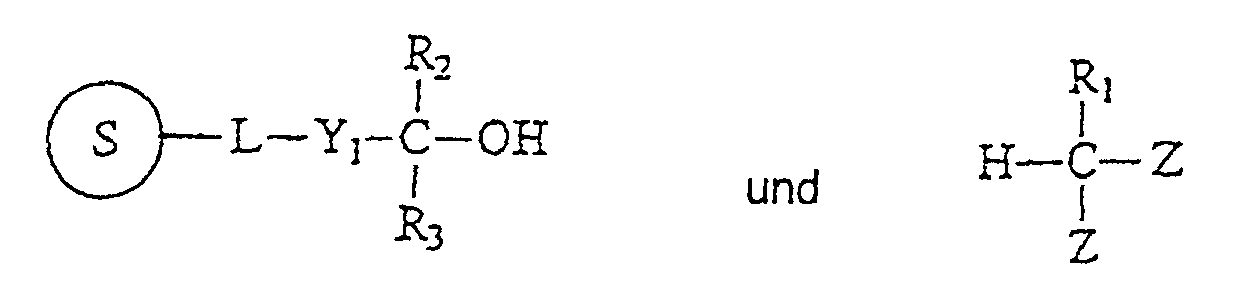
- the present invention includes support-bound, Mitsunobu alkylation products having the structures I, II, and III wherein S is a solid support, L is a linker, Y 1 is substituted lower alkyl and substituted aryl, R 1 , R 2 , R 3 , and R 4 are H, lower alkyl, aryl, and halogen, and Z is an electron-withdrawing group.
- split and mix refers to a combinatorial synthesis method whereby solid supports, typically beads, are reacted with reagents to contain successive precursors to the target compounds that form the library and alternately combined, separated, and distributed (Furka, 1991).
- Linker refers to one or more atoms comprising a chain connecting a solid support to a chemically reactive moiety.
- Electron-withdrawing and “electron-withdrawing group” refer to an electronegative functional group which draws electrons away from a reactive site of a molecule. "Electronegativity” is defined according to the Pauling Index (Pauling, 1967). Electron-withdrawing groups as used here are electronegative relative to a methylene carbon.
- diethyl malonate has electron-withdrawing ester groups which increase the acidity, and thus the nucleophilicity, of the methylene carbon.
- the "active methylene" of diethyl malonate is activated by the electron-withdrawing ester groups.
- the present invention comprises processes for Mitsunobu alkylation on solid supports. Additionally, the present invention comprises Mitsunobu alkylation products on solid-supports. The processes are generally conducted by bringing liquid reagents into contact with a solid support for a period of time for the Mitsunobu alkylation reaction to proceed to completion, followed by removal of excess reagents and isolation of the solid support.
- a Mitsunobu solid-phase alkylation reaction forms a carbon-carbon bound between a support with hydroxyl or active methylene functionality and a soluble reagent with hydroxyl or active methylene functionality.
- the solid-support, , or "support” is a reactant in the process and can be a substrate for reactions prior and subsequent to the Mitsunobu reaction step.
- the support is comprised of materials having a rigid or semi-rigid character and may be any shape, e.g. spherical, as in beads, rectangular, irregular particles, resins, gels, microspheres, or substantially flat.
- synthesis regions on the support may be desirable to physically separate synthesis regions on the support with, for example, wells, raised regions, dimples, pins, trenches, rods, pins, inner or outer walls of cylinders, and the like.
- the spatial arrangement of the synthesis regions is termed an "array", e.g. a two-dimensional surface addressable by a programmed, robotic automated liquid delivery apparatus.
- supports are attached by covalent bonds, ionic bonds, or other affinity interactions, to chemically reactive compounds.
- Preferred support materials include polystyrene, controlled-pore-glass, polyacrylate, hydroxethylmethacrylate, polyamide, polyethylene, polyethyleneoxy, or copolymers and grafts of such.
- a particularly preferred solid support of the present invention, and used extensively for small molecule and peptide synthesis is polystyrene in bead form, cross-linked with 1-2% divinylbenzene, such as the Merrifield chloromethyl polystyrene (Scheme 2). Hydrophobic organic solvents swell this support to many times its dry volume. This gel-like state is essential for reactive species in solution to gain access to the reactive sites in the beads (Fields, 1990). The extent of swelling decreases as the percentage of crosslinking increases (Hodge, 1997).
- Functionalized solid supports 7 are created by reacting the solid support 6 with reagents to provide functionality such as protected amines, e.g. Rink Fmoc linker, hydroxyl, e.g. Wang linker, or chloro, e.g. chlorotrityl linker (Scheme 2).
- the linker, L connects the support to the chemically reactive moiety.
- L can be amino, oxygen, sulfur, or a functional group such as ester, amide, sulfonate, and the like.
- the substituent Y 1 in 7 connects the linker, L, of the support to the functionality that reacts in the Mitsunobu alkylation reaction (Scheme 3).
- Y 1 is a group such as substituted lower alkyl, substituted alkenyl, substituted alkynyl, and substituted aryl.
- R 2 and R 3 are H, lower alkyl, aryl, and halogen substituents.
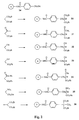
- Specific examples of general support 7 include supports 24-29 ( Figure 1).
- the polystyrene-Rink Fmoc linker (Scheme 2) is treated with 20% piperidine in dimethylformamide to remove the Fmoc group and provide the amino functionality (L).
- the Wang linker (Scheme 2) bears a hydroxyl group for conversion to an ester upon coupling with a carboxylic acid.
- Coupling of the support-amino group of the Rink linker with the carboxylic acid activated by a carbodiimide reagent, e.g. diisopropylcarbodiimide under standard amide forming conditions, with a variety of carboxylic acid-hydroxyl compounds (e.g. 18-23 ) provides the hydroxyl functionality supports 24-29 ( Figure 1 and Examples 1-7).
- the reactions can be monitored for disappearance of free amine by the Kaiser or ninhydrin colormetric tests. Gentle agitation of the support by mechanical shaking facilitates optimal loading.
- supports 11 and 12 may be prepared from 6 where R 4 is H, lower alkyl, aryl, and halogen substituents (Scheme 4). Supports 11 and 12 bear active methylene groups for reaction with soluble hydroxyl reagents 13. Supports 11 and 12 differ by the electron-withdrawing group Z in a non-bridging ( 11 ) or bridging ( 12 ) arrangement.
- the loading range for functionality on 7, 11, and 12 is typically 0.05 to 1.5 mmol per gram of support.
- the preferred loading range is 0.2 to 0.7 mmol per gram, and the most preferred loading range is 0.25 to 0.40 mmol per gram.
- An embodiment of the present invention is a process for forming a carbon-carbon bond between a solid support-bound hydroxyl reagent 7 and an active methylene reagent 8, where Z are electron-withdrawing substituents, such as carboxylic acid, ester, amide, alkylketone, arylketone, aldehyde, cyano, aldehyde, alkylsulfone, arylsulfone, sulfoxide, sulfonamide, sulfonate, nitro, aryl, phosphonate, and phosphate and the like, and R 1 is H, lower alkyl, aryl, and halogen substituents, with a trivalent phosphorus reagent 1 and an azo-containing reagent 2 to form Mitsunobu alkylation product 9 , according to Scheme 3.
- Z are electron-withdrawing substituents, such as carboxylic acid, ester, amide, alkylketone, arylketone, al
- Another embodiment of the invention includes processes for loading solid supports with compounds to prepare solid support-bound active methylene reagents.
- support 6 is loaded with reagents to provide active methylene supports 11 and 12 (Scheme 4).
- Processes are provided for forming carbon-carbon bonds between 11 and 12 and a hydroxyl reagent 13 by the Mitsunobu alkylation where the reactants are reversed relative to that in Scheme 3 to yield products 14 and 15, respectively.
- An azo-containing compound and a trivalent phosphorous compound are reagents used in the Mitsunobu alkylation reaction to activate the hydroxyl functionality of one of the reactants. Any azo-containing compound and any trivalent phosphorous compound capable of leading to the Mitsunobu alkylation reaction product may be employed.
- Preferred compounds include tetramethylazodicarboxamide (TMAD), diethylazodicarboxylate (DEAD), diisopropylazodicarboxylate, and 1,1'-(azodicarbonyl)dipiperidine (Tsunoda, 1994).
- Trivalent phosphorus compounds have three substituents R in the general structure, PR 3 .
- Substituents R include lower alkyl, phenyl, aryl, lower alkoxy, phenoxy, and aryloxy.
- Preferred compounds include tributylphosphine, triethylphosphine, and triphenylphosphine. A particularly preferred combination is TMAD and tributyl phosphine (Ito, 1994).
- the Mitsunobu alkylation reaction of the present invention can be conducted in any solvent capable of solubilizing the reagents, other than the support.
- Preferred solvents include tetrahydrofuran (THF), dimethoxyethane (DME), dichloromethane, dimethylformamide, acetonitrile, and other non-protic solvents.
- Compounds 30-36 synthesized by Mitsunobu alkylation are illustrated in Figure 2 and Examples 8-14.
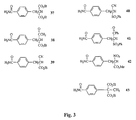
- the products of solid support Mitsunobu alkylation may be cleaved from the solid supports 9, 14, and 15 with acidic, basic, or specific cleavage reagents, depending on the nature of the linker, L, and functionality bonded to the linker, Y 1 to give cleaved products 10, 16, and 17, respectively, where Y 2 is a group resulting from cleavage of the linker and Y 1 , possess a broad variety of molecular diversity and utility (Schemes 2 and 3). Specific examples of cleaved products are illustrated by 37-43 in Figure 3 and Examples 16-22.
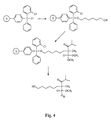
- Alkoxysilane linkages can be selectively cleaved under anhydrous and mild conditions with fluoride ion (Greene, 1991).
- a typical reagent for cleavage of trialkylsilylether linkages is tetra n-butylammonium fluoride in tetrahydrofuran (Aldrich Chemical Co., Milwaukee, WI).
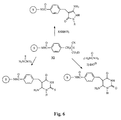
- 1,3-ketonitriles react with alkylhydrazine, urea, and thiourea reagents to form 5-aminopyrazoles, 5-aminopyrimidines, and 5-amino-2-thiopyrimidines, respectively (Watson, 1997), as illustrated by cyclization reactions of 32 ( Figure 6).
- O -nitroarylacetonitriles reported as excellent active methylene compounds for Mitsunobu alkylation (Macor, 1991), lead to a wide variety of indole and tryptophan derivatives after nitro reduction and cyclization.
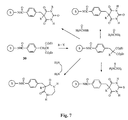
- Figure 7 shows 1,3-diester compounds, resulting from Mitsunobu alkylation, such as 30 , can be alkylated and cyclized to form 6- and 7-membered rings, yielding barbiturate- and diazepam-type structures.
- Mitsunobu alkylation products on the support, such as 30-36, or cleaved in solution, such as 37-43, can be further reacted with other reagents and converted to compounds with antipyretic, barbituric, and antimicrobial activity (Katsuyama, 1997).
- the Mitsunobu alkylation reaction on solid support can be applied to the combinatorial chemistry method for synthesis of large numbers of compounds (Houghten, 1991). Compounds can be made rapidly in parallel processes, rather than by sequential reiteration of individual syntheses. As a versatile and efficient chemical reaction, the Mitsunobu alkylation can be conducted with a large number of reagents with similar or identical functionality and reactivity. When activity is noted, then active species are identified, either by positional deconvolution or an encoded tag scheme (Baldwin, 1998; Brenner, 1992).
- the present invention may be practiced on devices that automate some or all of the chemistry and/or manipulations with robotic arms, liquid dispensing units, and inert gas enclosures for delivery of reagents and movement of the solid supports on a computer-directed, work surface array.
- Examples 24 and 25 the synthesis of libraries of compounds by parallel and the "split and mix" approach, respectively.
- the solid-phase Mitsunobu alkylation reaction provides molecular diversity in the production of many compounds due to its efficiency and versatility.
- high-throughput parallel synthesis of compounds by the Mitsunobu alkylation reaction can be conducted on supports with surfaces which have been derivatized with functionality by chemical treatment, radioisotope bombardment, e.g. 60 Co, or other high-energy radical treatment.
- inorganic surfaces include silicon wafers, glass, silica, and alumina.
- organic surfaces include polyethylene, polypropylene, polyacrylates, polyacrylamides, polystyrene, polyfluoroethylene, latex, cellulose, polyethylene glycol, or grafts, co-polymers, and composites of such.
- a derivatized solid surface may bear a large number and high-density array of reaction sites, which may be individually addressed by delivering different or common reagents by robotic liquid dispensing apparatus or by ink-jet, micro-droplet spraying technology.
- the reaction sites of a two-dimensional array may yield 10-1000, or more, compounds segregated in a grid-like configuration, often termed a "library".
- the beads may be collected from their reaction sites, mixed, redistributed, and further reacted. In this manner, heterogeneous mixtures of uncharacterized compounds are synthesized. Iterating this "split and mix" method yields a large number of compounds, represented by extensive molecular diversity of structure, shape, and other properties.
- the compounds may be cleaved and collected individually or pooled. Alternatively, the compounds may remain on the solid support and undergo heterogeneous assay.
- An advantage of the "split and mix" method is that each bead contains only one compound, allowing the compounds to be screened on the beads themselves. However, the identity of the compounds on each bead must be independently determined, often by a tagging scheme whereby compounds more readily analyzable than the library themselves are selectively attached to the beads (Brenner, 1992).
- Solid supports can be in the form of beads of 1-1000 ⁇ m diameter, pellets, disks, wafers, frits, and planar or irregular surfaces.
- the preferred embodiment of the solid support for the present invention is microporous polystyrene beads, cross-linked with 1-2% of divinylbenzene. Beads, and other loose particles, of the solid synthesis supports may also be configured in an array configuration whereby they reside in wells, chambers, or columns addressable by liquid dispensing apparatus.
- a common dimensional format is the 96 well microtiter plate.
- Mass Spectroscopy mass analyses were performed on a PE-Sciex API-100 single-quadrupole (Perkin-Elmer, Norwalk, CT) operating in heated nebulizer mode with corona discharge and positive ion APCI, at 400 °C. Positive-ion mode scanning, m/z 50-600, step at 0.25 amu, dwell 1.0 ms.
- Example 1 Using the conditions and reagent proportions of Example 1, the above support 24 is obtained.
- Example 1 Using the conditions and reagent proportions of Example 1, the above support 26 is obtained.
- Example 1 Using the conditions and reagent proportions of Example 1, the above support 28 is obtained.
- Low cross-link polystyrene is grafted with polyethylene glycol (PEG), by polymerization with ethylene oxide.
- PEG chains are terminated with amino Fmoc functionality (TentaGel S RAM Fmoc, available from Rapp Polymere).
- Fmoc functionality TetraGel S RAM Fmoc, available from Rapp Polymere.
- Deprotection of the Fmoc group with 20% piperidine in DMF generates free amine.
- the resin is washed with DMF, methanol, and dichloromethane in a fritted funnel under vacuum. Coupling with 4-hydroxymethylbenzoic acid can give polystyrene/polyethylene glycol-hydroxymethylbenzamide (Rano, 1995).
- Polystyrene-Rink linker-hydroxymethylbenzamide 24 (1.00 gm, 1.1 mmol OH/gm) was swollen in 15 ml tetrahydrofuran (THF) for 10 minutes under an argon atmosphere at room temperature in a sintered glass filter reaction vessel with inlet and exit ports.
- Tributylphosphine (1.37 ml, 5.5 mmol)
- tetramethylazodicarboxamide (0.95 gm in 5 ml THF, 5.5 mmol
- diethyl malonate (0.84 ml, 5.5 mmol
- Polystyrene-Rink linker-hydroxymethylbenzamide 24 (1.00 gm, 1.1 mmol OH/gm) was swollen in 15 ml THF for 10 minutes under an argon atmosphere at room temperature in a sintered glass filter reaction vessel with inlet and exit ports.
- Triphenylphosphine (1.44 gm, 5.5 mmol), tetramethylazodicarboxamide (0.95 gm in 5 ml THF, 5.5 mmol), and ethyl acetoacetate (0.70 ml, 5.5 mmol) were added successively by syringe through the inlet port.
- Polystyrene-Rink linker-hydroxymethylbenzamide 24 (1.00 gm, 1.1 mmol OH/gm) was swollen in 15 ml THF for 10 minutes under an argon atmosphere at room temperature in a sintered glass filter reaction vessel with inlet and exit ports.
- Tributylphosphine (1.37 ml, 5.5 mmol)
- diethylazodicarboxylate (0.87 ml, 5.5 mmol
- ethyl cyanoacetate (0.59 ml, 5.5 mmol
- Polystyrene-Rink linker-hydroxymethylbenzamide 24 (1.00 gm, 1.1 mmol OH/gm) was swollen in 15 ml THF for 10 minutes under an argon atmosphere at room temperature in a sintered glass filter reaction vessel with inlet and exit ports.
- Tributylphosphine (1.37 ml, 5.5 mmol)
- 1,1'-(azodicarbonyl)dipiperidine (1.39 gm in 5 ml THF, 5.5 mmol)
- (phenylsulfonyl)acetonitrile (1.00 gm in 5 ml THF, 5.5 mmol) were added successively by syringe through the inlet port.
- Polystyrene-Rink linker-hydroxymethylbenzamide 24 (1.00 gm, 1.1 mmol OH/gm) was swollen in 15 ml 1,2-dimethoxyethane (DME) for 10 minutes under an argon atmosphere at room temperature in a sintered glass filter reaction vessel with inlet and exit ports.
- DME 1,2-dimethoxyethane
- Tributylphosphine (1.37 ml, 5.5 mmol)
- tetramethylazodicarboxamide (0.95 gm in 5 ml THF, 5.5 mmol
- 2-(Phenylsulfonyl)acetophenone (1.43 gm in 5 ml DME, 5.5 mmol) were added successively by syringe through the inlet port.
- Polystyrene-Rink linker-hydroxymethylbenzamide 24 (1.00 gm, 1.1 mmol OH/gm) was swollen in 15 ml DME for 10 minutes under an argon atmosphere at room temperature in a sintered glass filter reaction vessel with inlet and exit ports.
- Tributylphosphine (1.37 ml, 5.5 mmol)
- tetramethylazodicarboxamide (0.95 gm in 5 ml DME, 5.5 mmol)
- methyl nitroacetate (0.51 gm, 5.5 mmol
- Polystyrene-Rink linker-hydroxymethylbenzamide 24 (1.00 gm, 1.1 mmol OH/gm) was swollen in 15 ml tetrahydrofuran (THF) for 10 minutes under an argon atmosphere at room temperature in a sintered glass filter reaction vessel with inlet and exit ports.
- Tributylphosphine (1.37 ml, 5.5 mmol)
- tetramethylazodicarboxamide (0.95 gm in 5 ml THF, 5.5 mmol
- diethyl methyl malonate (0.95 ml, 5.5 mmol) were added successively by syringe through the inlet port.
- a 0.3M solution (22 ml) of 4-carboxybenzaldehyde (3 equivalents), 3.3 equivalents diisopropylcarbodiimide (DICD) and 3.3 equivalents of N-hydroxybenzotriazole (HOBt) in DMF at room temperature may be reacted at room temperature for 40 minutes to preactivate the acid.
- the activated acid solution is added to the polystyrene-Rink linker amine in the vessel and the vessel is agitated by a wrist-action shaker. The coupling is complete in two hours, when the Kaiser test for free amine on a small sample of support is negative (Kaiser, 1970).
- the reagents are removed by filtration under vacuum and the support, washed successively with 20 ml portions of DMF, ethanol, and diethylether, and dried under vacuum to give 1.95 gm of polystyrene-Rink linker-(benzamide-4-carboxaldehye).
- the support is swollen in THF and stirred with 10 equivalents NaBH 4 in 20 ml MeOH:DCM:THF / 0.5:1:1 for 12 hr.
- the solvent was aspirated off and the reduction was continued for another 12 hr using fresh reagent and solvent. After 12 hr, the solvent was removed and the support was sequentially washed with 10% aqueous mannitol, water, MeOH, and DCM (each 3 x 10 ml).
- Support 30 (1.0 gm) is treated with 10 ml of a mixture of TFA:dichloromethane (DCM) / 1:4 and shaken for 1 hour at room temperature under an argon atmosphere. The cleavage mixture liquid was drained and collected. The support is washed with 5 ml THF and the wash is combined with the cleavage mixture and rotary evaporated under reduced pressure.
- DCM TFA:dichloromethane
- Support 31 (1.0 gm) is treated with 10 ml of a mixture of TFA:dichloromethane (DCM) / 1:4 for 1 hour at room temperature under an argon atmosphere. The cleavage mixture liquid was drained and collected. The support is washed with 5 ml THF and the wash is combined with the cleavage mixture and rotary evaporated under reduced pressure.
- DCM TFA:dichloromethane
- Support 32 (1.0 gm) is treated with 10 ml of a mixture of TFA:dichloromethane (DCM) / 1:4 for 1 hour at room temperature under an argon atmosphere. The cleavage mixture liquid was drained and collected. The support is washed with 5 ml THF and the wash is combined with the cleavage mixture and rotary evaporated under reduced pressure. The residue is taken up in 10 ml ethyl acetate and evaporated to give ethyl 2-(4-carbamoylphenyl)-2-cyanoacetate 39 (0.255 gm), identified by 1 H NMR and mass spectroscopy: 247.3, M+1, and assessed for purity by HPLC: 11.2 minute retention time.
- DCM TFA:dichloromethane
- Support 33 (1.0 gm) is treated with 10 ml of a mixture of TFA:dichloromethane (DCM) / 1:4 for 1 hour at room temperature under an argon atmosphere. The cleavage mixture liquid was drained and collected. The support is washed with 5 ml THF and the wash is combined with the cleavage mixture and rotary evaporated under reduced pressure.
- DCM TFA:dichloromethane
- Support 34 (1.0 gm) is treated with 10 ml of a mixture of TFA:dichloromethane (DCM) / 1:4 for 1 hour at room temperature under an argon atmosphere. The cleavage mixture liquid was drained and collected. The support is washed with 5 ml THF and the wash is combined with the cleavage mixture and rotary evaporated under reduced pressure.
- DCM TFA:dichloromethane
- Support 35 (1.0 gm) is treated with 10 ml of a mixture of TFA:dichloromethane (DCM) / 1:4 for 1 hour at room temperature under an argon atmosphere. The cleavage mixture liquid was drained and collected. The support is washed with 5 ml THF and the wash is combined with the cleavage mixture and rotary evaporated under reduced pressure. The residue is taken up in 10 ml ethyl acetate and evaporated to give methyl 2-(4-carbamoylphenyl)-2-nitroacetate 42 (0.262 gm), identified by 1 H NMR and mass spectroscopy.
- DCM TFA:dichloromethane
- Support 36 (1.0 gm) is treated with 10 ml of a mixture of TFA:dichloromethane (DCM) / 1:4 and shaken for 1 hour at room temperature under an argon atmosphere. The cleavage mixture liquid was drained and collected. The support is washed with 5 ml THF and the wash is combined with the cleavage mixture and rotary evaporated under reduced pressure.
- DCM TFA:dichloromethane
- the support is treated with 25 ml of acetic acid:DCM / 1:4 for 1 hr at room temperature.
- the cleavage mixture liquid was drained and collected.
- the support is washed with 5 ml DCM and the wash is combined with the cleavage mixture and rotary evaporated under preduced pressure.
- the residue is taken up in 10 ml ethyl acetate and evaporated to give 11-hydroxy-4-(methoxy(hydroxyphosphoryl))-2,4-dimethylundecan-3-one (0.79 gm) identifed by 1 H NMR and mass spectroscopy.
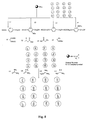
- the synthesis of sixteen biologically active compounds with anticonvulsant activity is performed in a parallel array on a robotic liquid handler synthesizer (SolarisTM 530 Organic Synthesizer).
- the additions, aspirations, and washings are performed using a robotic arm possessing four alternate aspirating and coaxial tips.
- Fifty milligrams of the Rink Amide resin, loaded at 0.6 mmol Fmoc-amine/gm, is placed in each of 16 round-bottomed flasks in a 4x4 array ( Figure 8).
- the Fmoc groups are cleaved with 20% piperidine in DMF for 10 min.
- the support is subjected to a series of washing (3x5 ml) with each of DMF, MeOH, and DCM.
- Tributyl phosphine and TMAD in THF are delivered to each of the 16 flasks. After 12hr of shaking at room temperature, excess liquid reagents are drained and the resin is subjected to washing and drying. Finally, the cyclization reaction is conducted with four urea derivatives (U1-U4) in refluxing sodium ethoxide in THF/EtOH. As in the delivery of A1-A4, U1-U4 are delivered to create 16 unique compounds in the 16 flask array. The products cleaved from the support with 20% TFA in DCM gives the 16 anticonvulsant compounds.
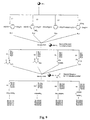
- Figure 9 illustrates the synthesis of 64 biologically active antipyretic compounds in a 16 reaction vessel array.
- the synthesis protocol is similar to what is described in the parallel approach (Example 24, Figure 8). However, in this example, after each transformation the support from each flask is combined, thoroughly mixed, and divided (distributed) into equal-sized portions in each of the 16 reaction vessels. Fifty milligrams of polystyrene-Rink amide, loaded at 0.6 mmol Fmoc-amine/gm, is placed in each of 16 round bottomed flasks in a 4x4 array and subjected to Fmoc cleavage with 20% piperidine in DMF for 10 min.
- the support is then washed (3x5 ml) with DMF, MeOH, and DCM.
- Various carboxylic acid-hydroxyl reagents (L1-L4) are coupled to the amino support using 3 equivalents each of DIC and HOBt in DMA for 4 hr.
- Each of the four reagents, L1-L4 are delivered to a row of four flasks.
- the solvent is drained and each flask is subjected to a standard washing routine and dried under vacuum.
- the support from each flask is retrieved, thoroughly mixed together and redistributed in equal-size portions in the 16 flasks.
- the next step is the Mitsunobu alkylation with four different active methylene compounds (A1-A4) with five equivalents each of tributyl phosphine and TMAD in THE at room temperature.
- Each of the four reagents, A1-A4 are delivered to a row of four flasks. After 12hr of shaking at room temperature, excess reagents are drained and the support is subjected to washing and drying. The support from each flask is again retrieved, mixed and redistributed into the flasks. Finally, cyclization of the Mitsunobu alkylation products is conducted with hydrazine derivatives (H1-H4) in refluxing toluene.
- H1-H4 hydrazine derivatives
- Each of the four reagents, H1-H4, are delivered to a row of four flasks.
- the antipyretic compounds are cleaved with 20% TFA in DCM and isolated by aspiration of the compounds from the insoluble support.
- Each of the 16 reaction flasks contains a mixture of 16 compounds. There are 64 total number of unique compounds in the array in this experiment.
Landscapes
- Chemical & Material Sciences (AREA)
- Organic Chemistry (AREA)
- Molecular Biology (AREA)
- Chemical Kinetics & Catalysis (AREA)
- Health & Medical Sciences (AREA)
- Life Sciences & Earth Sciences (AREA)
- Biochemistry (AREA)
- Medicinal Chemistry (AREA)
- General Chemical & Material Sciences (AREA)
- General Health & Medical Sciences (AREA)
- Engineering & Computer Science (AREA)
- Structural Engineering (AREA)
- Organic Low-Molecular-Weight Compounds And Preparation Thereof (AREA)
- Low-Molecular Organic Synthesis Reactions Using Catalysts (AREA)
Claims (17)
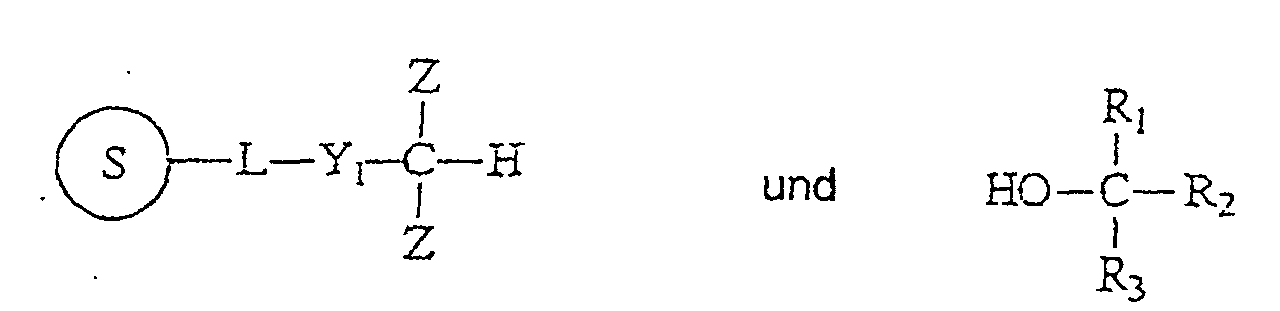
- Festphasen-Mitsunobu-Alkylierungsreaktion, umfassend:wobei sich Produkt I ergibt:
 oder
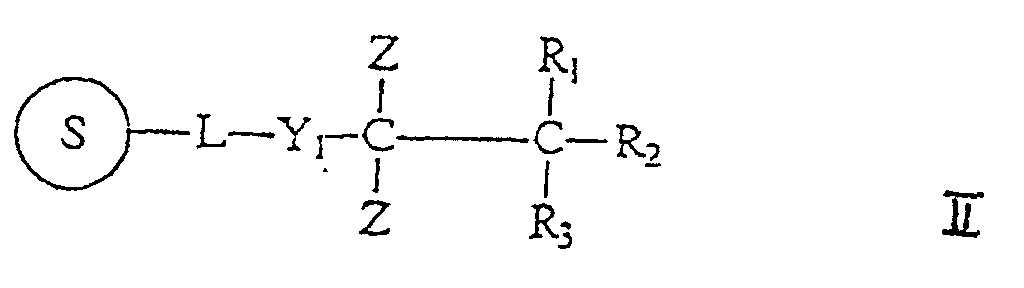
 wobei sich Produkt II ergibt:
 oder
 wobei sich Produkt III ergibt:
 wobei
 wobei die Reaktion in Gegenwart einer azohaltigen Verbindungen und einer trivalenten Phosphorverbindung erfolgt.S eine Festphase ist,L ein Linker ist,Y1 ein Substituent ist, ausgewählt aus der Gruppe bestehend aus einer substituierten niederen Alkyl-, substituierten Alkenyl-, substituierten Alkinyl- und substituierten Arylgruppe,R1, R2, R3 und R4 ausgewählt werden aus der Gruppe bestehend aus H, C1-C20-Alkyl-, Arylgruppe und Halogenatom, undZ eine elektronenziehende Gruppe ist;
- Verfahren nach Anspruch 1, wobei Verunreinigungen und Überschussreagenzien von den Produkten I, II, III durch Filtration, Aspiration, Entfernung von Flüssigkeiten, Präzipitation oder Verdampfung getrennt werden.
- Verfahren nach Anspruch 1, wobei Z ausgewählt wird aus der Gruppe bestehend aus Carbonsäure-, Ester-, Amid-, Alkyketon-, Arylketon-, Carbonyl-, Aldehyd-, Cyano-, Aldehyd-, Alkylsulfon-, Arylsulfon-, Sulfon-, Sulfoxid, Sulfonamid-, Sulfonat-, Nitro-, Aryl-, Phosphonatund Phosphatgruppe.
- Verfahren nach Anspruch 1, wobei die azohaltigen Verbindungen ausgewählt werden aus der Gruppe bestehend aus Tetramethylazodicarboxamid oder Diethylazodicarboxylat.
- Verfahren nach Anspruch 1, wobei R der trivalenten phosphorhaltigen Reagenzien ausgewählt wird aus der Gruppe bestehend aus C1-C20-Alkyl-, Phenyl-, Aryl-, C1-C20-Alkoxy-, Phenoxy- und Aryloxygruppe.
- Verfahren nach Anspruch 5, wobei die trivalenten phosphorhaltigen Reagenzien ausgewählt werden aus der Gruppe bestehend aus Tributylphosphin, Triethylphosphin oder Triphenylphosphin.
- Verfahren nach Anspruch 1, wobei S ausgewählt wird aus der Gruppe bestehend aus Polystyrol, kontrolliertem Porenglas, Polyacrylat, Hydroxyethylmethacrylat, Polyamid, Polyethylen, Polyethylenoxid oder Copolymeren und Pfropf-Copolymeren.
- Verfahren nach Anspruch 1, wobei S aus nicht-porösen Oberflächen besteht.
- Verfahren nach Anspruch 1, wobei L ausgewählt wird aus der Gruppe bestehend aus NH, O, S und CO2.
- Verfahren nach Anspruch 1, wobei Y1 ausgewählt wird aus der Gruppe bestehend aus



- Verfahren nach Anspruch 1, das weiter den Schritt des Abspaltens einer Verbindung von einem Festphasenträger, umfassend I, II und III, mit Spaltungsreagenzien umfasst, wobei sich Verbindungen ergeben, umfassendwobei
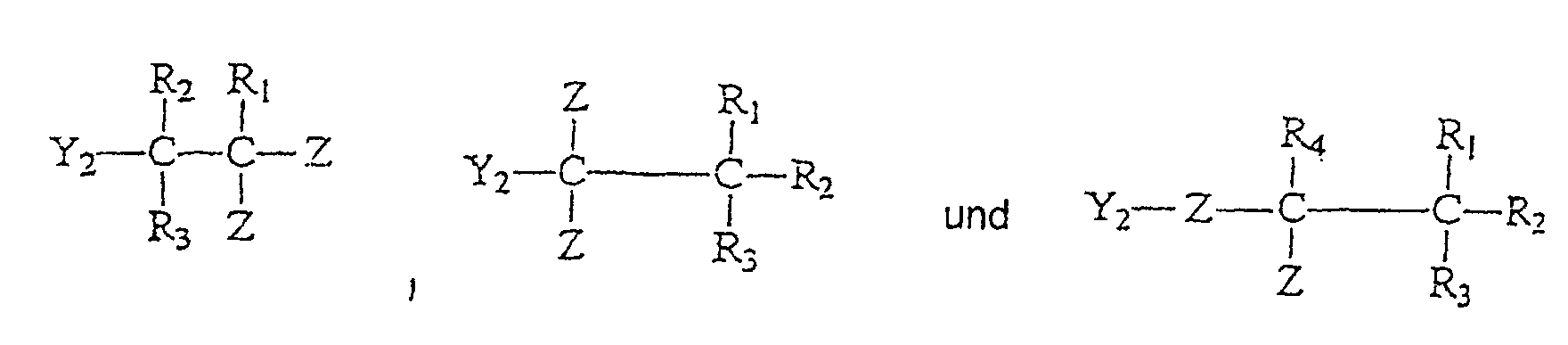 Y2 ausgewählt wird aus der Gruppe bestehend aus Amino-, Hydroxy-, Carboxy-, Carbonsäureester-, substituierte C1-C20-Alkyl- und substituierte Arylgruppe,R1, R2, R3 und R4 ausgewählt werden aus der Gruppe bestehend aus H, C1-C20-Alkyl-, Arylgruppe und Halogenatom,Z ausgewählt wird aus der Gruppe bestehend aus elektronenziehenden Gruppen.
- Verfahren nach Anspruch 1, umfassend weiter die Schritte:a) Verteilen von Festphasenträgern umfassend I, II und III auf individuell adressierbare Positionen auf einer Anordnung,b) Umsetzen der Verbindungen umfassend:wobei S, L, Y1, R1, R2, R3, R4 und Z gleich oder verschieden sein können und die Reaktionen im Wesentlichen parallel erfolgen,
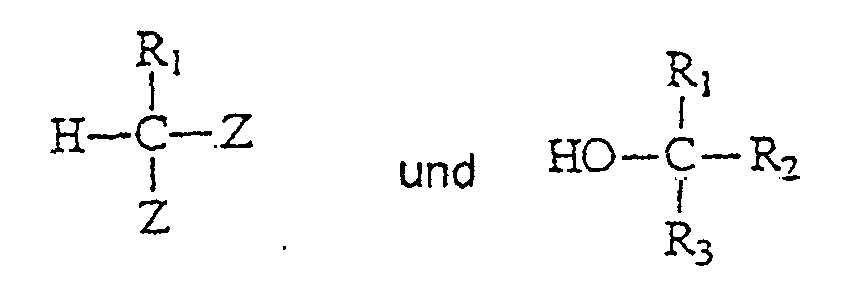 c) Abtrennen von Verunreinigungen und Überschussreagenzien von dem Produkt durch Filtration, Aspiration, Abziehen von Flüssigkeiten, Präzipitation oder Verdampfung,d) Abspalten der erhaltenen Produkte im Wesentlichen gleichzeitig unde) Sammeln, Identifizieren oder Analysieren der Produkte auf den Positionen.
- Verfahren nach Anspruch 1, umfassend weiterhin die Schritte:a) Verteilen von Festphasenträgern umfassend I, II und III auf individuell adressierbare Positionen auf einer Anordnung,b) Umsetzen der Verbindungen umfassend:wobei S, L, Y1, R1, R2, R3, R4 und Z gleich oder verschieden sein können und die Reaktionen im Wesentlichen gleichzeitig erfolgen,
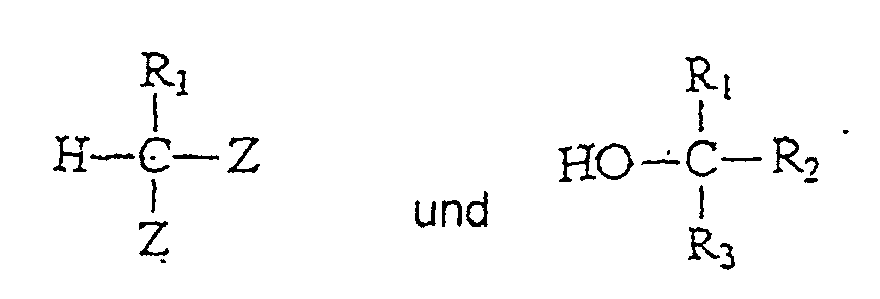 c) Abtrennen von Verunreinigungen und Überschussreagenzien von dem Produkt durch Filtration, Aspiration, Abziehen von Flüssigkeiten, Präzipitation oder Verdampfung,d) Vereinigen und Mischen der Festphasenträger,e) Verteilen eines Teils der vereinigten Träger auf die Positionen,f) Spalten der erhaltenen Produkte im Wesentlichen gleichzeitig undg) Sammeln, Identifizieren oder Analysieren der Produkte auf den Positionen.
- Verfahren nach Anspruch 1, wobei das Verfahren simultan an einer Vielzahl von Festphasenträgern mit individuell adressierbaren Positionen auf einer Anordnung erfolgt.
- Verfahren nach Anspruch 14, wobei nach dem in-Kontakt-Bringen mindestens ein trägergebundenes Produkt gespalten wird, um ein Addukt der Formfreizusetzen, wobei Y2 ausgewählt wird aus der Gruppe bestehend aus Amino-, Hydroxy-, Carboxy-, Carbonsäureester-, substituierter oder unsubstituierter C1-C20-Alkyl- und substituierter oder unsubstituierter Arylgruppe.

- Verfahren nach Anspruch 1, wobei (a) das Verfahren simultan an einer Vielzahl von Festphasenträgern mit individuell adressierbaren Positionen auf einer Anordnung erfolgt, (b) nach dem In-Kontakt-Bringen die Festphasenträger zusammengemischt und dann in eine Vielzahl von Aliquots aufgeteilt werden.
- Verfahren nach Anspruch 16, wobei sofort nach der Teilung mindestens ein trägergebundenes Produkt gespalten wird, um ein Addukt der Formfreizusetzen, wobei Y2 ausgewählt wird aus der Gruppe bestehend aus Amino-, Hydroxy-, Carboxy-, Carbonsäureester-, substituierter oder unsubstituierter C1-C20-Alkyl- und substituierter oder unsubstituierter Arylgruppe.

Applications Claiming Priority (3)
| Application Number | Priority Date | Filing Date | Title |
|---|---|---|---|
| US13843398A | 1998-08-21 | 1998-08-21 | |
| US138433 | 1998-08-21 | ||
| PCT/US1999/019076 WO2000010942A1 (en) | 1998-08-21 | 1999-08-19 | Solid phase synthesis of compounds by carbon-carbon bond forming mitsunobu reactions |
Publications (2)
| Publication Number | Publication Date |
|---|---|
| EP1105359A1 EP1105359A1 (de) | 2001-06-13 |
| EP1105359B1 true EP1105359B1 (de) | 2002-10-30 |
Family
ID=22481991
Family Applications (1)
| Application Number | Title | Priority Date | Filing Date |
|---|---|---|---|
| EP99943811A Expired - Lifetime EP1105359B1 (de) | 1998-08-21 | 1999-08-19 | Festphasesynthese von verbindungen mittels mitsunobu-reaktionen unter bildung von kohlenstoff kohlenstoff bindungen |
Country Status (7)
| Country | Link |
|---|---|
| EP (1) | EP1105359B1 (de) |
| JP (1) | JP2002523384A (de) |
| AT (1) | ATE226928T1 (de) |
| AU (1) | AU754599B2 (de) |
| CA (1) | CA2338563A1 (de) |
| DE (1) | DE69903740T2 (de) |
| WO (1) | WO2000010942A1 (de) |
Family Cites Families (2)
| Publication number | Priority date | Publication date | Assignee | Title |
|---|---|---|---|---|
| GB8709887D0 (en) * | 1987-04-27 | 1987-06-03 | Univ Alberta | Alkyl azodicarboxylates |
| US5958792A (en) * | 1995-06-07 | 1999-09-28 | Chiron Corporation | Combinatorial libraries of substrate-bound cyclic organic compounds |
-
1999
- 1999-08-19 AU AU56837/99A patent/AU754599B2/en not_active Ceased
- 1999-08-19 JP JP2000566218A patent/JP2002523384A/ja not_active Withdrawn
- 1999-08-19 DE DE69903740T patent/DE69903740T2/de not_active Expired - Fee Related
- 1999-08-19 AT AT99943811T patent/ATE226928T1/de not_active IP Right Cessation
- 1999-08-19 CA CA002338563A patent/CA2338563A1/en not_active Abandoned
- 1999-08-19 EP EP99943811A patent/EP1105359B1/de not_active Expired - Lifetime
- 1999-08-19 WO PCT/US1999/019076 patent/WO2000010942A1/en not_active Ceased
Also Published As
| Publication number | Publication date |
|---|---|
| AU754599B2 (en) | 2002-11-21 |
| DE69903740T2 (de) | 2003-07-17 |
| EP1105359A1 (de) | 2001-06-13 |
| AU5683799A (en) | 2000-03-14 |
| WO2000010942A1 (en) | 2000-03-02 |
| JP2002523384A (ja) | 2002-07-30 |
| DE69903740D1 (de) | 2002-12-05 |
| CA2338563A1 (en) | 2000-03-02 |
| ATE226928T1 (de) | 2002-11-15 |
Similar Documents
| Publication | Publication Date | Title |
|---|---|---|
| Früchtel et al. | Organic chemistry on solid supports | |
| US5549974A (en) | Methods for the solid phase synthesis of thiazolidinones, metathiazanones, and derivatives thereof | |
| US5646285A (en) | Combinatorial non-peptide libraries | |
| AU719584C (en) | A method of generating a plurality of chemical compounds in a spatially arranged array | |
| US5908960A (en) | Compounds | |
| WO1995016712A1 (en) | Compounds and methods | |
| EP0896590A1 (de) | Schnellreinigung mittels eines polymergestütztes abschreckprozesses | |
| Debaene et al. | Synthesis of a PNA-encoded cysteine protease inhibitor library | |
| CA2221508A1 (en) | Combinatorial libraries of substrate-bound cyclic organic compounds | |
| AU754599B2 (en) | Solid phase synthesis of compounds by carbon-carbon bond forming mitsunobu reactions | |
| EP1119529B1 (de) | Chemische konstruktionen | |
| US6372885B1 (en) | Solid-phase technology for the preparation of amides | |
| US6127191A (en) | Aminobenzenedicarboxylic acid-based combinatorial libraries | |
| US5773512A (en) | Compounds and methods | |
| US6583318B2 (en) | Method for synthesis of α-sulfonamido amide, carboxylic acid and hydroxamic acid derivatives | |
| US6600016B1 (en) | Multifunctionalized solid support resins for synthesis of combinatorial libraries and method for using the same | |
| US6004823A (en) | Compounds | |
| GB2316941A (en) | Combinatorial sythesis on soluble polyvalent supports | |
| Rastogi et al. | Combinatorial synthesis of unsymmetrical secondary amines. Application to arylethanolamines, arylpropanolamines and aryloxypropanolamines | |
| AU1907401A (en) | New functionalized polymeric reagents | |
| US20020028466A1 (en) | Fast scale-up using solid phase chemistry | |
| Dax | General overview | |
| Kettley | Novel derivatives of sporopollenin for potential applications in solid phase organic synthesis and drug delivery | |
| Mjalli et al. | Rapid Discovery and Optimization of Biologically Active Small Molecules Using Automated Synthesis Methods | |
| WO1999011676A1 (en) | Formulation |
Legal Events
| Date | Code | Title | Description |
|---|---|---|---|
| PUAI | Public reference made under article 153(3) epc to a published international application that has entered the european phase |
Free format text: ORIGINAL CODE: 0009012 |
|
| 17P | Request for examination filed |
Effective date: 20010313 |
|
| AK | Designated contracting states |
Kind code of ref document: A1 Designated state(s): AT BE CH CY DE DK ES FI FR GB GR IE IT LI LU MC NL PT SE |
|
| 17Q | First examination report despatched |
Effective date: 20010531 |
|
| GRAG | Despatch of communication of intention to grant |
Free format text: ORIGINAL CODE: EPIDOS AGRA |
|
| GRAG | Despatch of communication of intention to grant |
Free format text: ORIGINAL CODE: EPIDOS AGRA |
|
| GRAH | Despatch of communication of intention to grant a patent |
Free format text: ORIGINAL CODE: EPIDOS IGRA |
|
| GRAH | Despatch of communication of intention to grant a patent |
Free format text: ORIGINAL CODE: EPIDOS IGRA |
|
| GRAA | (expected) grant |
Free format text: ORIGINAL CODE: 0009210 |
|
| AK | Designated contracting states |
Kind code of ref document: B1 Designated state(s): AT BE CH CY DE DK ES FI FR GB GR IE IT LI LU MC NL PT SE |
|
| PG25 | Lapsed in a contracting state [announced via postgrant information from national office to epo] |
Ref country code: LI Free format text: LAPSE BECAUSE OF FAILURE TO SUBMIT A TRANSLATION OF THE DESCRIPTION OR TO PAY THE FEE WITHIN THE PRESCRIBED TIME-LIMIT Effective date: 20021030 Ref country code: IT Free format text: LAPSE BECAUSE OF FAILURE TO SUBMIT A TRANSLATION OF THE DESCRIPTION OR TO PAY THE FEE WITHIN THE PRESCRIBED TIME-LIMIT;WARNING: LAPSES OF ITALIAN PATENTS WITH EFFECTIVE DATE BEFORE 2007 MAY HAVE OCCURRED AT ANY TIME BEFORE 2007. THE CORRECT EFFECTIVE DATE MAY BE DIFFERENT FROM THE ONE RECORDED. Effective date: 20021030 Ref country code: GR Free format text: LAPSE BECAUSE OF FAILURE TO SUBMIT A TRANSLATION OF THE DESCRIPTION OR TO PAY THE FEE WITHIN THE PRESCRIBED TIME-LIMIT Effective date: 20021030 Ref country code: FI Free format text: LAPSE BECAUSE OF FAILURE TO SUBMIT A TRANSLATION OF THE DESCRIPTION OR TO PAY THE FEE WITHIN THE PRESCRIBED TIME-LIMIT Effective date: 20021030 Ref country code: CH Free format text: LAPSE BECAUSE OF FAILURE TO SUBMIT A TRANSLATION OF THE DESCRIPTION OR TO PAY THE FEE WITHIN THE PRESCRIBED TIME-LIMIT Effective date: 20021030 Ref country code: BE Free format text: LAPSE BECAUSE OF FAILURE TO SUBMIT A TRANSLATION OF THE DESCRIPTION OR TO PAY THE FEE WITHIN THE PRESCRIBED TIME-LIMIT Effective date: 20021030 Ref country code: AT Free format text: LAPSE BECAUSE OF FAILURE TO SUBMIT A TRANSLATION OF THE DESCRIPTION OR TO PAY THE FEE WITHIN THE PRESCRIBED TIME-LIMIT Effective date: 20021030 |
|
| REF | Corresponds to: |
Ref document number: 226928 Country of ref document: AT Date of ref document: 20021115 Kind code of ref document: T |
|
| REG | Reference to a national code |
Ref country code: GB Ref legal event code: FG4D |
|
| REG | Reference to a national code |
Ref country code: CH Ref legal event code: EP |
|
| REG | Reference to a national code |
Ref country code: IE Ref legal event code: FG4D |
|
| REF | Corresponds to: |
Ref document number: 69903740 Country of ref document: DE Date of ref document: 20021205 |
|
| PG25 | Lapsed in a contracting state [announced via postgrant information from national office to epo] |
Ref country code: SE Free format text: LAPSE BECAUSE OF FAILURE TO SUBMIT A TRANSLATION OF THE DESCRIPTION OR TO PAY THE FEE WITHIN THE PRESCRIBED TIME-LIMIT Effective date: 20030130 Ref country code: PT Free format text: LAPSE BECAUSE OF FAILURE TO SUBMIT A TRANSLATION OF THE DESCRIPTION OR TO PAY THE FEE WITHIN THE PRESCRIBED TIME-LIMIT Effective date: 20030130 Ref country code: DK Free format text: LAPSE BECAUSE OF FAILURE TO SUBMIT A TRANSLATION OF THE DESCRIPTION OR TO PAY THE FEE WITHIN THE PRESCRIBED TIME-LIMIT Effective date: 20030130 |
|
| PG25 | Lapsed in a contracting state [announced via postgrant information from national office to epo] |
Ref country code: ES Free format text: LAPSE BECAUSE OF FAILURE TO SUBMIT A TRANSLATION OF THE DESCRIPTION OR TO PAY THE FEE WITHIN THE PRESCRIBED TIME-LIMIT Effective date: 20030429 |
|
| REG | Reference to a national code |
Ref country code: CH Ref legal event code: PL |
|
| ET | Fr: translation filed | ||
| RAP2 | Party data changed (patent owner data changed or rights of a patent transferred) |
Owner name: APPLERA CORPORATION |
|
| NLS | Nl: assignments of ep-patents |
Owner name: APPLERA CORPORATION |
|
| NLT2 | Nl: modifications (of names), taken from the european patent patent bulletin |
Owner name: APPLERA CORPORATION |
|
| PGFP | Annual fee paid to national office [announced via postgrant information from national office to epo] |
Ref country code: NL Payment date: 20030801 Year of fee payment: 5 |
|
| PGFP | Annual fee paid to national office [announced via postgrant information from national office to epo] |
Ref country code: GB Payment date: 20030813 Year of fee payment: 5 |
|
| PG25 | Lapsed in a contracting state [announced via postgrant information from national office to epo] |
Ref country code: LU Free format text: LAPSE BECAUSE OF NON-PAYMENT OF DUE FEES Effective date: 20030819 Ref country code: IE Free format text: LAPSE BECAUSE OF NON-PAYMENT OF DUE FEES Effective date: 20030819 Ref country code: CY Free format text: LAPSE BECAUSE OF FAILURE TO SUBMIT A TRANSLATION OF THE DESCRIPTION OR TO PAY THE FEE WITHIN THE PRESCRIBED TIME-LIMIT Effective date: 20030819 |
|
| PGFP | Annual fee paid to national office [announced via postgrant information from national office to epo] |
Ref country code: FR Payment date: 20030820 Year of fee payment: 5 |
|
| PG25 | Lapsed in a contracting state [announced via postgrant information from national office to epo] |
Ref country code: MC Free format text: LAPSE BECAUSE OF NON-PAYMENT OF DUE FEES Effective date: 20030831 |
|
| PLBE | No opposition filed within time limit |
Free format text: ORIGINAL CODE: 0009261 |
|
| STAA | Information on the status of an ep patent application or granted ep patent |
Free format text: STATUS: NO OPPOSITION FILED WITHIN TIME LIMIT |
|
| PGFP | Annual fee paid to national office [announced via postgrant information from national office to epo] |
Ref country code: DE Payment date: 20030930 Year of fee payment: 5 |
|
| 26N | No opposition filed |
Effective date: 20030731 |
|
| REG | Reference to a national code |
Ref country code: IE Ref legal event code: MM4A |
|
| REG | Reference to a national code |
Ref country code: FR Ref legal event code: TP |
|
| PG25 | Lapsed in a contracting state [announced via postgrant information from national office to epo] |
Ref country code: GB Free format text: LAPSE BECAUSE OF NON-PAYMENT OF DUE FEES Effective date: 20040819 |
|
| REG | Reference to a national code |
Ref country code: GB Ref legal event code: 732E |
|
| PG25 | Lapsed in a contracting state [announced via postgrant information from national office to epo] |
Ref country code: NL Free format text: LAPSE BECAUSE OF NON-PAYMENT OF DUE FEES Effective date: 20050301 Ref country code: DE Free format text: LAPSE BECAUSE OF NON-PAYMENT OF DUE FEES Effective date: 20050301 |
|
| GBPC | Gb: european patent ceased through non-payment of renewal fee |
Effective date: 20040819 |
|
| PG25 | Lapsed in a contracting state [announced via postgrant information from national office to epo] |
Ref country code: FR Free format text: LAPSE BECAUSE OF NON-PAYMENT OF DUE FEES Effective date: 20050429 |
|
| NLV4 | Nl: lapsed or anulled due to non-payment of the annual fee |
Effective date: 20050301 |
|
| REG | Reference to a national code |
Ref country code: FR Ref legal event code: ST |