EP1104764A1 - 1h-imidazopyridine derivatives - Google Patents
1h-imidazopyridine derivatives Download PDFInfo
- Publication number
- EP1104764A1 EP1104764A1 EP99937053A EP99937053A EP1104764A1 EP 1104764 A1 EP1104764 A1 EP 1104764A1 EP 99937053 A EP99937053 A EP 99937053A EP 99937053 A EP99937053 A EP 99937053A EP 1104764 A1 EP1104764 A1 EP 1104764A1
- Authority
- EP
- European Patent Office
- Prior art keywords
- group
- substituted
- ethyl
- imidazo
- solvent
- Prior art date
- Legal status (The legal status is an assumption and is not a legal conclusion. Google has not performed a legal analysis and makes no representation as to the accuracy of the status listed.)
- Withdrawn
Links
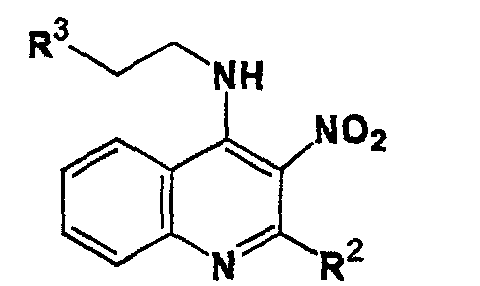
- 0 *CCNc(c1ccccc1nc1*)c1N Chemical compound *CCNc(c1ccccc1nc1*)c1N 0.000 description 6
Classifications
-
- C—CHEMISTRY; METALLURGY
- C07—ORGANIC CHEMISTRY
- C07D—HETEROCYCLIC COMPOUNDS
- C07D471/00—Heterocyclic compounds containing nitrogen atoms as the only ring hetero atoms in the condensed system, at least one ring being a six-membered ring with one nitrogen atom, not provided for by groups C07D451/00 - C07D463/00
- C07D471/02—Heterocyclic compounds containing nitrogen atoms as the only ring hetero atoms in the condensed system, at least one ring being a six-membered ring with one nitrogen atom, not provided for by groups C07D451/00 - C07D463/00 in which the condensed system contains two hetero rings
- C07D471/04—Ortho-condensed systems
-
- A—HUMAN NECESSITIES
- A61—MEDICAL OR VETERINARY SCIENCE; HYGIENE
- A61P—SPECIFIC THERAPEUTIC ACTIVITY OF CHEMICAL COMPOUNDS OR MEDICINAL PREPARATIONS
- A61P11/00—Drugs for disorders of the respiratory system
- A61P11/06—Antiasthmatics
-
- A—HUMAN NECESSITIES
- A61—MEDICAL OR VETERINARY SCIENCE; HYGIENE
- A61P—SPECIFIC THERAPEUTIC ACTIVITY OF CHEMICAL COMPOUNDS OR MEDICINAL PREPARATIONS
- A61P19/00—Drugs for skeletal disorders
- A61P19/02—Drugs for skeletal disorders for joint disorders, e.g. arthritis, arthrosis
-
- A—HUMAN NECESSITIES
- A61—MEDICAL OR VETERINARY SCIENCE; HYGIENE
- A61P—SPECIFIC THERAPEUTIC ACTIVITY OF CHEMICAL COMPOUNDS OR MEDICINAL PREPARATIONS
- A61P25/00—Drugs for disorders of the nervous system
- A61P25/28—Drugs for disorders of the nervous system for treating neurodegenerative disorders of the central nervous system, e.g. nootropic agents, cognition enhancers, drugs for treating Alzheimer's disease or other forms of dementia
-
- A—HUMAN NECESSITIES
- A61—MEDICAL OR VETERINARY SCIENCE; HYGIENE
- A61P—SPECIFIC THERAPEUTIC ACTIVITY OF CHEMICAL COMPOUNDS OR MEDICINAL PREPARATIONS
- A61P29/00—Non-central analgesic, antipyretic or antiinflammatory agents, e.g. antirheumatic agents; Non-steroidal antiinflammatory drugs [NSAID]
-
- A—HUMAN NECESSITIES
- A61—MEDICAL OR VETERINARY SCIENCE; HYGIENE
- A61P—SPECIFIC THERAPEUTIC ACTIVITY OF CHEMICAL COMPOUNDS OR MEDICINAL PREPARATIONS
- A61P35/00—Antineoplastic agents
-
- A—HUMAN NECESSITIES
- A61—MEDICAL OR VETERINARY SCIENCE; HYGIENE
- A61P—SPECIFIC THERAPEUTIC ACTIVITY OF CHEMICAL COMPOUNDS OR MEDICINAL PREPARATIONS
- A61P37/00—Drugs for immunological or allergic disorders
-
- A—HUMAN NECESSITIES
- A61—MEDICAL OR VETERINARY SCIENCE; HYGIENE
- A61P—SPECIFIC THERAPEUTIC ACTIVITY OF CHEMICAL COMPOUNDS OR MEDICINAL PREPARATIONS
- A61P37/00—Drugs for immunological or allergic disorders
- A61P37/02—Immunomodulators
-
- A—HUMAN NECESSITIES
- A61—MEDICAL OR VETERINARY SCIENCE; HYGIENE
- A61P—SPECIFIC THERAPEUTIC ACTIVITY OF CHEMICAL COMPOUNDS OR MEDICINAL PREPARATIONS
- A61P37/00—Drugs for immunological or allergic disorders
- A61P37/08—Antiallergic agents
-
- A—HUMAN NECESSITIES
- A61—MEDICAL OR VETERINARY SCIENCE; HYGIENE
- A61P—SPECIFIC THERAPEUTIC ACTIVITY OF CHEMICAL COMPOUNDS OR MEDICINAL PREPARATIONS
- A61P43/00—Drugs for specific purposes, not provided for in groups A61P1/00-A61P41/00
Definitions
- the present invention relates to novel 1H-imidazopyridine derivatives or salts thereof which have a potent inhibitory action against production of tumor necrotizing factor (TNF) or interleukin-1 (IL-1) and are useful as medicaments for preventive or therapeutic treatment of diseases of humans and animals, in which a cytokine such as TNF, IL-1 is mediated, which include chronic inflammatory diseases (e.g., rheumatic arthritis, osteoarthritis, etc.), allergic rhinitis, atopic dermatitis, contact dermatitis, asthma, sepsis, septic shock, various autoimmune diseases [autoimmune hemic diseases (e.g., hemolytic anemia, anaplastic anemia, idiopathic thrombocythemia, etc.), autoimmune intestinal diseases (e.g., ulcerative colitis, Crohn's disease, etc.), autoimmune corneitis (e.g., keratoconjunctivitis sicca, spring catarrh, etc.), en
- the aforementioned imiquimod has been known to have an inducing action of a few kinds of cytokines such as interferon (IFN), TNF, IL-1 and the like, which is described in Journal of Interferon Research, Vol. 14, p. 81 (1994).
- IFN interferon
- TNF TNF
- IL-1 IL-1
- 1H-imidazopyridine derivatives or 1H-imidazoquinoline derivatives having an inhibitory action against production of TNF or IL-1 which action is totally opposite to those taught by the aforementioned prior arts, have never been known so far.
- An object of the present invention is to provide novel compounds which have excellent inhibitory actions against production of cytokines such as TNF and IL-1 and the like are useful as medicaments.
- the inventors of the present invention made intensive studies to achieve the object. As a result, they found novel 1H-imidazopyridine derivatives which have an excellent inhibitory action against production of TNF or IL-1 and achieved the present invention.
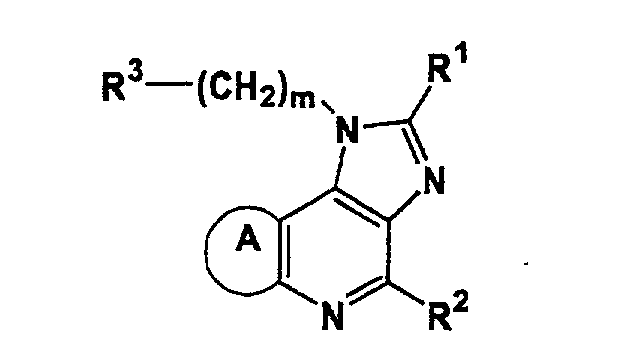
- the present invention thus relates to novel 1H-imidazopyridine derivatives represented by the following general formula (I) or salts thereof: wherein R 1 represents hydrogen atom, hydroxyl group, an alkyl group which may have one or more substituents, a cycloalkyl group which may be substituted, a styryl group which may be substituted, or an aryl group which may have one or more substituents; R 2 represents hydrogen atom, an alkyl group, a halogen atom, hydroxyl group, an amino group which may have one or two substituents, a cyclic amino group which may be substituted, or a phenoxy group which may be substituted; ring A represents a homocyclic or heterocyclic ring which may be substituted with one or more alkyl groups, alkoxyl groups, or halogen atoms; R 3 represents a saturated nitrogen-containing heterocyclic group which may be substituted; and m represents an integer of from 0 to 3; provided that, when R 3 represents un
- novel 1H-imidazopyridine derivatives represented by the following general formula (II) or salts thereof: wherein R 1 , R 2 , ring A and m have the same meanings as those defined above;
- R 4 represents hydrogen atom, an alkyl group, benzyl group, triphenylmethyl group, an alkanoyl group which may be substituted, an alkoxycarbonyl group, benzyloxycarbonyl group, a thiocarbamoyl group which may be substituted, an alkanesulfonyl group, a benzenesulfonyl group which may be substituted, or amidino group;
- Y represents methylene group, oxygen atom, sulfur atom, nitrogen atom, a group represented by NH, or a single bond; and
- n represents an integer of from 0 to 2.
- a medicament which comprises as an active ingredient the compound represented by the aforementioned general formula (I) or (II), or a pharmacologically acceptable salt thereof.
- the medicament is useful for preventive or therapeutic treatment of diseases of mammals including humans, in which a cytokine such as TNF, IL-1 is mediated, which include chronic inflammatory diseases (e.g., rheumatic arthritis, osteoarthritis, etc.), allergic rhinitis, atopic dermatitis, contact dermatitis, asthma, sepsis, septic shock, various autoimmune diseases [autoimmune hemic diseases (e.g., hemolytic anemia, anaplastic anemia, idiopathic thrombocythemia, etc.), autoimmune intestinal diseases (e.g., ulcerative colitis, Crohn's disease, etc.), autoimmune corneitis (e.g., keratoconjunctivitis sicca, spring catarrh, etc.), endocrine ophthalmopathy,
- a use of the compound represented by the aforementioned general formula (I) or (II), or a pharmacologically acceptable salt thereof for the manufacture of the aforementioned medicament and a method for the preventive or therapeutic treatment of diseases in which a cytokine such as TNF, IL-1 is mediated, which comprises the step of administering a preventively or therapeutically effective amount of the compound represented by the aforementioned general formula (I) or (II), or a pharmacologically acceptable salt thereof to a mammal including a human.
- the present invention provides an inhibitor against production of tumor necrotizing factor (TNF) or interleukin-1 (IL-1) which comprises as an active ingredient the compound represented by the aforementioned general formula (I) or (II), or a pharmacologically acceptable salt thereof.
- TNF tumor necrotizing factor
- IL-1 interleukin-1
- the compounds represented by the aforementioned general formula (II) are characterized in that they have a specific saturated nitrogen-containing heterocyclic group which may have specific substituents as R 3 among the compounds represented by the aforementioned general formula (I).
- the scope of the present invention is not limited to the compounds represented by the aforementioned general formula (II), and it should be understood that any compounds having as R 3 a saturated nitrogen-containing heterocyclic group which may be substituted fall within the scope of the present invention.
- examples of the alkyl group represented by R 1 , R 2 or R 4 include, for example, methyl group, ethyl group, n-propyl group, isopropyl group, n-butyl group, isobutyl group, sec-butyl group, tert-butyl group, n-pentyl group, isopentyl group, neopentyl group, n-hexyl group and the like.
- Examples of the cycloalkyl group represented by R 1 include, for example, cyclopropyl group, cyclobutyl group, cyclopentyl group, cyclohexyl group, cycloheptyl group and the like.
- Examples of the aryl group represented by R 1 include, for example, phenyl group, 2-pyridyl group, 3-pyridyl group, 4-pyridyl group, 3-pyridazinyl group, 4-pyridazinyl group, 2-pyrimidinyl group, 4-pyrimidinyl group, 5-pyrimidinyl group, pyrazinyl group, 2-furyl group, 3-furyl group, 2-thienyl group, 3-thienyl group, 1-pyrrolyl group, 2-pyrrolyl group, 3-pyrrolyl group, 1-imidazolyl group, 2-imidazolyl group, 4-imidazolyl group, 1-pyrazolyl group, 3-pyrazolyl group, 4-pyrazolyl group, 5-pyrazolyl group, 2-oxazolyl group, 4-oxazolyl group, 3-isoxazolyl group, 4-isoxazolyl group, 5-isoxazolyl group, 2-thiazolyl group, 4-thiazolyl group,
- Examples of the halogen atom represented by R 2 include, for example, fluorine atom, chlorine atom, bromine atom, and iodine atom.
- Examples of the amino group which may have one or two substituents that is represented by R 2 include, for example, amino group, methylamino group, ethylamino group, n-propylamino group, isopropylamino group, cyclopropylamino group, cyclobutylamino group, cyclopentylamino group, cyclohexylamino group, dimethylamino group, diethylamino group, anilino group, pyridylamino group, 4-pyridylmethylamino group, benzylamino group, p-methoxybenzylamino group, dibenzylamino group and the like.
- Examples of the cyclic amino group represented by R 2 include, for example, 1-aziridinyl group, 1-azetidinyl group, 1-pyrrolidinyl group, piperidino group, 1-piperazinyl group, hexahydro-1H-azepin-1-yl group, hexahydro-1H-1,4-diazepin-1-yl group, morpholino group, 4-thiomorpholinyl group and the like.
- Examples of the homocyclic or heterocyclic ring represented by ring A in the aforementioned general formulas (I) and (II) include, for example, benzene ring, cyclopentene ring, cyclohexene ring, cycloheptene ring, cyclooctene ring, cycloheptadiene ring, thiophene ring, furan ring, pyridine ring, pyrazine ring, pyrrole ring, thiazole ring, oxazole ring, azepine ring and the like.
- alkyl group which may be substituted on the homocyclic or heterocyclic ring examples include, for example, methyl group, ethyl group, n-propyl group, isopropyl group, n-butyl group, isobutyl group, sec-butyl group, tert-butyl group, n-pentyl group, isopentyl group, neopentyl group, n-hexyl group and the like.
- halogen atom which may be substituted on the said ring include, for example, fluorine atom, chlorine atom, bromine atom, and iodine atom. The number and kind of these substituents are not particularly limited, and when two or more substituents exist, they may be the same or different.
- the saturated nitrogen-containing heterocyclic group represented by R 3 means a saturated nitrogen-containing heterocyclic group which has one or more nitrogen atoms as ring-constituting atom(s), and which may further have one or more oxygen atoms or sulfur atoms as ring-constituting atoms.
- Examples include 1-aziridinyl group, 2-aziridinyl group, 1-azetidinyl group, 2-azetidinyl group, 3-azetidinyl group, 1-pyrrolidinyl group, 2-pyrrolidinyl group, 3-pyrrolidinyl group, pyrazolidinyl group, imidazolidinyl group, piperidino group, 2-piperidyl group, 3-piperidyl group, 4-piperidyl group, 1-piperazinyl group, 2-piperazinyl group, hexahydro-1H-azepin-1-yl group, hexahydro-1H-azepin-2-yl group, hexahydro-1H-azepin-3-yl group, hexahydro-1H-azepin-4-yl group, hexahydro-1H-1,4-diazepin-1-yl group, hexahydro-1H-1,4-diazepin-2-yl
- examples of the alkanoyl group which may be substituted that is represented by R 4 include, for example, formyl group, acetyl group, propionyl group, n-butyryl group, isobutyryl group, valeryl group, isovaleryl group, pivaloyl group, fluoroacetyl group, difluoroacetyl group, trifluoroacetyl group, chloroacetyl group, dichloroacetyl group, trichloroacetyl group and the like.
- alkoxycarbonyl group represented by R 4 examples include, for example, methoxycarbonyl group, ethoxycarbonyl group, n-propoxycarbonyl group, isopropoxycarbonyl group, n-butoxycarbonyl group, isobutoxycarbonyl group, sec-butoxycarbonyl group, tert-butoxycarbonyl group, n-pentyloxycarbonyl group, n-hexyloxycarbonyl group and the like.
- Examples of the thiocarbamoyl group which may be substituted that is represented by R 4 include, for example, thiocarbamoyl group, methylthiocarbamoyl group, ethylthiocarbamoyl group, n-propylthiocarbamoyl group, isopropylthiocarbamoyl group, n-butylthiocarbamoyl group, isobutylthiocarbamoyl group, sec-butylthiocarbamoyl group, tert-butylthiocarbamoyl group and the like.
- alkanesulfonyl group represented by R 4 examples include, for example, methanesulfonyl group, ethanesulfonyl group, n-propanesulfonyl group, n-butanesulfonyl group and the like.
- the terms herein used encompass any groups in their meanings which may substitute/bind at any position on a substitutable/bondable element among ring-constituting atoms, so long as the substituting/binding position is not particularly limited, as some examples are shown above.
- Examples include halogen atoms such as fluorine atom, chlorine atom, and bromine atom; hydroxyl group; alkyl groups such as methyl group, ethyl group, n-propyl group, isopropyl group, n-butyl group, isobutyl group, sec-butyl group, tert-butyl group, n-pentyl group, isopentyl group, neopentyl group, and n-hexyl group; trifluoromethyl group; aryl groups such as phenyl group, naphthyl group, and pyridyl group; alkoxyl groups such as methoxy group, ethoxy group, n-propoxy group, isopropoxy group, n-butoxy group, isobutoxy group, sec-butoxy group, and tert-butoxy group; aryloxy groups such as phenoxy group; amino groups which may be substituted such as amino group, methylamino group,
- the compounds represented by the aforementioned general formulas (I) and (II) of the present invention can be converted into salts, preferably, pharmacologically acceptable salts, if desired; or free bases can be generated from the resulting salts.
- salts preferably, the pharmacologically acceptable salts, of the compounds represented by the aforementioned general formulas (I) and (II) of the present invention
- acid-addition salts for example, salts with mineral acids such as hydrochloric acid, hydrobromic acid, hydroiodic acid, nitric acid, sulfuric acid, and phosphoric acid
- organic acids such as acetic acid, propionic acid, butyric acid, formic acid, valeric acid, maleic acid, fumaric acid, citric acid, oxalic acid, malic acid, succinic acid, lactic acid, methanesulfonic acid, ethanesulfonic acid, benzenesulfonic acid, p-toluenesulfonic acid, mandelic acid, 10-camphorsulfonic acid, tartaric acid, stearic acid, gluconic acid, nicotinic acid, trifluoroacetic acid, and benzoic acid
- mineral acids such as
- optical isomers may exist for compounds having asymmetric carbons. These optical active compounds and mixtures thereof fall within the scope of the present invention.
- the compounds represented by the aforementioned general formulas (I) and (II) or the salts thereof according to the present invention can exist as any crystalline form depending on manufacturing conditions, or exist as any hydrate or solvate. These crystalline forms, hydrates or solvates, and mixtures thereof fall within the scope of the present invention.
- Preferred compounds of the present invention include, for example, the following compounds and salts thereof; however, the present invention is not limited to these examples:
- novel 1H-imidazopyridine derivatives represented by the aforementioned general formula (I) or (II) according to the present invention can be prepared by various methods; however, the preparation methods of the compounds of the present invention are not limited thereto.
- preparation methods specific explanations for the compounds represented by the aforementioned general formula (I) will be given, and it is obvious that these preparation methods include the compounds represented by the aforementioned general formula (II).
- the following synthetic method can be used in accordance with the method disclosed in Japanese Patent Unexamined Publication (KOKAI) No. Hei 3-206078/1991 or Tetrahedron, Vol. 51, p. 5813 (1995): wherein R 5 represents hydroxyl group or an alkyl group; R 6 represents chlorine atom or an alkyl group; R 1' has the same meaning as that defined for R 1 (except for hydroxyl group); and R 3 , m and ring A have the same meanings as those defined above.
- KKAI Japanese Patent Unexamined Publication
- R 6 represents chlorine atom or an alkyl group
- R 1' has the same meaning as that defined for R 1 (except for hydroxyl group)
- R 3 , m and ring A have the same meanings as those defined above.
- the compound of the general formula (IV) can be obtained by allowing the compound represented by the general formula (III) to react with a nitrating agent such as concentrated nitric acid and fuming nitric acid in the presence or absence of acetic acid, sulfuric acid or the like at a temperature ranging from 0°C to 200°C.
- a nitrating agent such as concentrated nitric acid and fuming nitric acid in the presence or absence of acetic acid, sulfuric acid or the like at a temperature ranging from 0°C to 200°C.
- the compound of the general formula (V) can be obtained by allowing the compound of the general formula (IV) to react with an appropriate chlorinating agent, for example, phosphorus oxychloride, thionyl chloride, phosgene, oxalyl chloride, phosphorus pentachloride or the like, in the presence or absence of a solvent such as toluene at a temperature ranging from 0°C to 200°C.
- an appropriate chlorinating agent for example, phosphorus oxychloride, thionyl chloride, phosgene, oxalyl chloride, phosphorus pentachloride or the like
- the compound of the general formula (VII) can be obtained by reacting the amine represented by the general formula (VI) with the compound of the general formula (V) in a solvent such as N,N-dimethylformamide and toluene in the presence or absence of a base such as triethylamine and potassium carbonate at a temperature ranging from -10°C to the reflux temperature of a solvent.
- a solvent such as N,N-dimethylformamide and toluene
- a base such as triethylamine and potassium carbonate
- the compound of the general formula (VIII) can be obtained by reducing the nitro group in the compound of the general formula (VII) according to an appropriate reducing method, for example, catalytic reduction using a metal catalyst such as platinum, Raney nickel, and palladium/carbon; reduction using nickel chloride and sodium borohydride; reduction using iron powder and hydrochloric acid and the like.
- a metal catalyst such as platinum, Raney nickel, and palladium/carbon
- reduction using nickel chloride and sodium borohydride reduction using iron powder and hydrochloric acid and the like.
- the reduction can be carried out in a solvent such as water, methanol, ethanol, and tetrahydrofuran, as well as a mixed solvent thereof, at a temperature ranging from 0°C to the reflux temperature of the solvent.
- a solvent such as water, methanol, ethanol, and tetrahydrofuran, as well as a mixed solvent thereof, at a temperature ranging from 0°C to the reflux temperature of the solvent.
- the compound of the general formula (IX) can be obtained by reacting the compound of the general formula (VIII) with a compound represented by the following general formula (XI), (XII) or (XIII): R 1' C(OR) 3 R 1' COX (R 1' CO) 2 O wherein R represents a lower alkyl group; X represents a halogen atom; R 1' has the same meaning as that defined for R 1 (except for hydroxyl group), in the presence or absence of a basic catalyst such as triethylamine, or an acid catalyst such as hydrochloric acid and p-toluenesulfonic acid, in the presence or absence of a solvent such as N,N-dimethylformamide, tetrahydrofuran, acetonitrile, xylene and toluene, at a temperature ranging from 0°C to 200°C.
- a basic catalyst such as triethylamine
- an acid catalyst such as hydrochloric acid and p
- Step 6 as a method in place of Step 5, the compound of the general formula (IX) can be obtained by reacting the compound of the general formula (VIII) with a compound represented by the following general formula (XIV): R 1' CHO wherein R 1' has the same meaning as that defined for R 1 (except for hydroxyl group), in the presence of2,3-dichloro-5,6-dicyano-1,4-benzoquinone in a solvent such as acetonitrile, 1,4-dioxane and tetrahydrofuran at a temperature ranging from 0°C to the reflux temperature of the solvent.
- a solvent such as acetonitrile, 1,4-dioxane and tetrahydrofuran
- Step 7 as a method in place of Step 5 or 6, the compound of the general formula (X) can be obtained by reacting the compound of the aforementioned general formula (VIII) with a compound represented by the following general formula (XV): R 1' COOH wherein R 1 ' has the same meaning as that defined for R 1 (except for hydroxyl group), in the presence or absence of an acid catalyst such as hydrochloric acid and sulfuric acid, in the presence or absence of a solvent such as N,N-dimethylformamide and toluene, at a temperature ranging from 0°C to 200°C.
- R 5 represents hydroxyl group in the general formula (X)
- the compound of the general formula (IX) can be obtained by carrying out chlorination in Step 8.
- the chlorination is carried out by protecting the compound of the general formula (X), if desired, at the nitrogen atom not bound to the (CH 2 ) m group, that is adjacent to the saturated nitrogen-containing heterocyclic group represented by R 3 , with a protecting group such as alkanoyl groups in a conventional manner, then reacting with an appropriate chlorinating agent, for example, phosphorus oxychloride, thionyl chloride, phosgene, oxalyl chloride, phosphorus pentachloride or the like in the presence or absence of a solvent such as toluene at a temperature ranging from 0°C to 200°C, and further deprotecting in a conventional manner, if desired, to obtain the compound of the general formula (IX) wherein R 6 is chlorine atom.
- an appropriate chlorinating agent for example, phosphorus oxychloride, thionyl chloride, phosgene, oxalyl chloride, phosphorus pentachloride
- the compound of the general formula (XVI): wherein R 3 , R 6 , m and ring A have the same meanings as those defined above, can be obtained by allowing the compound of the general formula (VIII) to react together with triphosgene in the presence of a base such as triethylamine and potassium carbonate in a solvent such as 1,2-dichloroethane, 1,4-dioxane, tetrahydrofuran, N,N-dimethylformamide and toluene at a temperature ranging from 0°C to the reflux temperature of a solvent.
- a base such as triethylamine and potassium carbonate
- a solvent such as 1,2-dichloroethane, 1,4-dioxane, tetrahydrofuran, N,N-dimethylformamide and toluene
- the compound of the general formula (XVII): wherein Z represents an aromatic ring; the symbol "a” represents an integer of 1 or 2; and R 3 , R 6 , m and ring A have the same meanings as those defined above, can be obtained by carrying out suitable oxidation of the compound of the general formula (IX) which has an aryl group substituted with methylthio group as R 1' , after protecting, if desired, the nitrogen atom not bound to the (CH 2 ) m group, that is adjacent to the saturated nitrogen-containing heterocyclic group represented by R 3 , with a protecting group such as alkanoyl groups in a conventional manner, and further deprotecting in a conventional manner, if desired.
- the oxidation can be carried out in various manners according to the desired product. More specifically, the preparation can be made, when the symbol "a" represents an integer of 1, by reacting with an oxidizing agent, for example, chromic acid, hydrogen peroxide, m-chloroperbenzoic acid, sodium periodate, potassium periodate or the like, or when the symbol "a” represents an integer of 2, with an oxidizing agent, for example, chromic acid, hydrogen peroxide, m-chloroperbenzoic acid, osmium tetraoxide, ruthenium tetraoxide or the like, in a solvent such as tetrahydrofuran, 1,4-dioxane, 1,2-dichloroethane, methanol, acetone, and water, as well as a mixed solvent thereof, at a temperature ranging from 0°C to the reflux temperature of a solvent.
- an oxidizing agent for example, chromic acid, hydrogen peroxide, m-chlor
- the compound of the general formula (I) wherein R 2 is hydroxyl group can be obtained by allowing a compound of the general formula (I) wherein R 2 is chlorine atom to react with water and an appropriate acid or base in a solvent at a temperature ranging from 0°C to the reflux temperature of a solvent.
- the appropriate acid include, for example, organic acids such as formic acid, acetic acid, and trifluoroacetic acid, and mineral acids such as hydrochloric acid, sulfuric acid, and hydrobromic acid.
- the appropriate base include, for example, hydroxides, carbonates and hydrogencarbonates of alkali metal such as sodium and potassium and of alkaline-earth metal such as magnesium and calcium and the like.
- the solvent examples include, for example, alcohols such as methanol, ethanol and n-propanol, N,N-dimethylformamide, 1,4-dioxane, tetrahydrofuran and the like, and water-containing solvents thereof.
- the compound of the general formula (I) wherein R 2 is fluorine atom, bromine atom or iodine atom and R 1 is R 1' can be obtained by allowing a compound which is obtained by reacting the compound of the general formula (I) wherein R 2 is chlorine atom and R 1 is R 1' or wherein R 2 is hydroxyl group and R 1 is R 1' with trifluoromethanesulfonic anhydride, methanesulfonyl chloride or p-toluenesulfonyl chloride to react with a metal halide (e.g., potassium fluoride, sodium fluoride, lithium fluoride, potassium bromide, sodium bromide, potassium iodide, sodium iodide, etc.) in an aprotic solvent such as dimethylsulfoxide, N,N-dimethylformamide, and acetonitrile in the presence or absence of a phase-transfer catalyst such
- a metal halide e.g
- the compound of the general formula (I), wherein R 3 is a saturated nitrogen-containing heterocyclic group of which the nitrogen atom that is not bound to the adjacent (CH 2 ) m group is deprotected can be obtained by subjecting the compound of the general formula (I), wherein R 3 is a saturated nitrogen-containing heterocyclic group having a protecting group such as alkanoyl groups, alkoxycarbonyl groups, benzyl group and trifluoromethyl group on the nitrogen atom which is not bound to the adjacent (CH 2 ) m group, to deprotection with an acid or alkali, or to catalytic reduction with a metal catalyst, according to the type of the protecting group of the nitrogen atom.
- a protecting group such as alkanoyl groups, alkoxycarbonyl groups, benzyl group and trifluoromethyl group
- the deprotection by using an acid or alkali can be carried out with an appropriate acid or base in the presence or absence of a cation scavenger such as anisole and thioanisole in a solvent.
- a cation scavenger such as anisole and thioanisole
- the solvent used include, for example, ethyl acetate, methylene chloride, 1,2-dichloroethane, 1,4-dioxane, methanol, ethanol, n-propanol, N,N-dimethylformamide, tetrahydrofuran, and water, as well as a mixed solvent thereof.
- Examples of the acid used include, for example, hydrochloric acid, an ethyl acetate solution of hydrogen chloride, an ethanolic solution of hydrogen chloride, sulfuric acid, hydrobromic acid, trifluoroacetic acid, methanesulfonic acid, p-toluenesulfonic acid, formic acid, acetic acid and the like.
- Examples of the base include, for example, hydroxides, carbonates and hydrogencarbonates of alkali metal such as sodium and potassium, and of alkaline-earth metal such as magnesium and calcium and the like. The reaction can be carried out at a temperature ranging from 0°C to the reflux temperature of a solvent.
- the catalytic reduction can be carried out by using an appropriate metal catalyst such as platinum, palladium/carbon, Raney nickel, Pearlman's reagent in water, an alcohol such as methanol, ethanol and n-propanol, and acetic acid, as well as a mixed solvent thereof in the presence or absence of an acid such as hydrochloric acid at a temperature ranging from room temperature to the reflux temperature of the solvent under a pressure ranging from normal pressure to 200 kg/cm 2 .
- an appropriate metal catalyst such as platinum, palladium/carbon, Raney nickel, Pearlman's reagent in water, an alcohol such as methanol, ethanol and n-propanol, and acetic acid, as well as a mixed solvent thereof in the presence or absence of an acid such as hydrochloric acid at a temperature ranging from room temperature to the reflux temperature of the solvent under a pressure ranging from normal pressure to 200 kg/cm 2 .
- the compound of the general formula (I) wherein R 2 is phenoxy group which may be substituted can be obtained by reacting the compound of the general formula (I) wherein R 2 is chlorine atom with a phenol derivative which may be substituted in the presence of a base such as sodium hydroxide and potassium hydroxide in the presence or absence of a solvent such as N,N-dimethylformamide and toluene at a temperature ranging from 0°C to 200°C.
- a base such as sodium hydroxide and potassium hydroxide
- a solvent such as N,N-dimethylformamide and toluene
- the compound of the general formula (I) wherein R 2 is amino group can be obtained by subjecting the compound of the general formula (I) wherein R 2 is phenoxy group which may be substituted, that is obtained by the seventh synthetic method, to reaction together with ammonium acetate in the presence or absence of a solvent such as N,N-dimethylformamide and toluene at a temperature ranging from 0°C to 200°C.
- a solvent such as N,N-dimethylformamide and toluene
- the compound of the general formula (I) wherein R 2 is amino group which may have one or two substituents or a cyclic amino group which may be substituted can be obtained by subjecting the compound of the general formula (I) wherein R 2 is chlorine atom to reaction together with an amine derivative which may have one or two substituents or a cyclic amine derivative which may be substituted in the presence or absence of a base such as triethylamine, potassium carbonate and sodium hydride in the presence or absence of a solvent such as water, alcohols including methanol, ethanol and n-propanol, methylene chloride, 1,2-dichlroethane, N,N-dimethylformamide, 1,4-dioxane, tetrahydrofuran and toluene at a temperature ranging from 0°C to 200°C under normal pressure or a pressurized condition.
- a base such as triethylamine, potassium carbonate and sodium hydride
- a solvent such
- the compound of the general formula (I) wherein R 2 is amino group can be obtained by subjecting the compound of the general formula (I) wherein R 2 is benzylamino group, dibenzylamino group, or p-methoxybenzylamino group, which is obtained in the ninth synthetic method, to catalytic reduction by using an appropriate metal catalyst, or by subjecting the compound of the general formula (I) wherein R 2 is p-methoxybenzylamino group to deprotection using an acid.
- the catalytic reduction can be carried out with a metal catalyst such as palladium/carbon and Pearlman's reagent in a solvent such as alcohols including methanol and ethanol, and water, as well as a mixed solvent thereof at a temperature ranging from room temperature to the reflux temperature of a solvent in the presence or absence of an acid such as hydrochloric acid, acetic acid and formic acid, ammonium formate, cyclohexene, and cyclohexadiene under a pressure ranging from normal pressure to 200 kg/cm 2 .
- a metal catalyst such as palladium/carbon and Pearlman's reagent
- a solvent such as alcohols including methanol and ethanol, and water
- an acid such as hydrochloric acid, acetic acid and formic acid, ammonium formate, cyclohexene, and cyclohexadiene under a pressure ranging from normal pressure to 200 kg/cm 2 .
- the deprotection using an acid can be carried out with an acid such as hydrochloric acid, sulfuric acid, trifluoroacetic acid and trifluoromethanesulfonic acid in a solvent such as alcohols including methanol and ethanol, methylene chloride, 1,2-dichloroethane, 1,4-dioxane, tetrahydrofuran, toluene, and N,N-dimethylformamide in the presence or absence of a cation scavenger such as anisole and thioanisole at a temperature ranging from 0°C to the reflux temperature of a solvent.
- an acid such as hydrochloric acid, sulfuric acid, trifluoroacetic acid and trifluoromethanesulfonic acid
- a solvent such as alcohols including methanol and ethanol, methylene chloride, 1,2-dichloroethane, 1,4-dioxane, tetrahydrofuran, toluene, and N
- the compound of the general formula (I) wherein R 3 is a saturated nitrogen-containing heterocyclic group which is substituted with oxo group can be obtained by reacting the compound of the general formula (I) wherein R 3 is a saturated nitrogen-containing heterocyclic group which is substituted with ethylenedioxy group, with an acid such as hydrochloric acid, an ethyl acetate solution of hydrogen chloride, an ethanolic solution of hydrogen chloride, sulfuric acid, hydrobromic acid, trifluoroacetic acid, p-toluenesulfonic acid, formic acid and acetic acid in the presence or absence of a solvent such as ethyl acetate, methylene chloride, 1,4-dioxane, tetrahydrofuran, methanol, ethanol, n-propanol and N,N-dimethylformamide, or a water-containing solvent thereof at a temperature ranging from 0°C to
- the compound of the general formula (I) wherein R 3 is a saturated nitrogen-containing heterocyclic group which is substituted with hydroxyimino group or an alkoxyimino group can be obtained by reacting the compound of the general formula (I) wherein R 3 is a saturated nitrogen-containing heterocyclic group which is substituted with oxo group, that is obtained by the eleventh synthetic method, with a compound represented by the following general formula (XVIII): R 7 -O-NH 2 wherein R 7 represents hydrogen atom or an alkyl group, in the presence or absence of a base such as triethylamine, diisopropylethylamine, sodium carbonate, potassium carbonate, sodium hydrogencarbonate and sodium acetate in a solvent such as alcohols including methanol, ethanol and n-propanol, N,N-dimethylformamide, 1,4-dioxane, tetrahydrofuran, and toluen
- the compound of the general formula (I) wherein R 2 is hydrogen atom can be obtained by subjecting the compound of the general formula (I) wherein R 2 is chlorine atom to catalytic reduction using a metal catalyst such as platinum and palladium/carbon in the presence or absence of an acid such as hydrochloric acid and acetic acid in an alcohol solvent such as methanol and ethanol or a water-containing solvent thereof under normal pressure at a temperature ranging from room temperature to the reflux temperature of a solvent.
- a metal catalyst such as platinum and palladium/carbon
- an acid such as hydrochloric acid and acetic acid
- an alcohol solvent such as methanol and ethanol or a water-containing solvent thereof
- the compound of the general formula (I), wherein R 3 is a saturated nitrogen-containing heterocyclic group having an appropriate substituent on the nitrogen atom which is not bound to the adjacent (CH 2 ) m group can be obtained by reacting an appropriate reagent with the compound of the general formula (I) wherein R 3 is a saturated nitrogen-containing heterocyclic group not having a protecting group on the nitrogen atom which is not bound to the adjacent (CH 2 ) m group.
- the reaction can be carried out in the presence or absence of a solvent such as N,N-dimethylformamide, methylene chloride, tetrahydrofuran, toluene, pyridine, nitrobenzene, 1,2-dichloroethane, 1,4-dioxane, methanol, ethanol, n-propanol and water, as well as a mixed solvent thereof, in the presence or absence of a base such as triethylamine and potassium carbonate at a temperature ranging from 0°C to 200°C.
- a solvent such as N,N-dimethylformamide, methylene chloride, tetrahydrofuran, toluene, pyridine, nitrobenzene, 1,2-dichloroethane, 1,4-dioxane, methanol, ethanol, n-propanol and water, as well as a mixed solvent thereof, in the presence or absence of a base such as triethylamine and potassium
- Examples of the appropriate reagent include, for example, alkyl halides, triphenylmethyl chloride, benzyl chloride, benzhydryl chloride, a mixture of formic acid and formalin, acetyl chloride, acetic anhydride, trifluoroacetic anhydride, benzoyl chloride, benzyl chlorocarbonate, ethyl chlorocarbonate, di-tert-butyl dicarbonate, sodium cyanate, alkyl isocyanates, sodium thiocyanate, alkyl isothiocyanates, 1H-pyrazole-1-carboxamidine, methanesulfonyl chloride, p-toluenesulfonyl chloride, p-fluorobenzenesulfonyl chloride, urethanes, alkylurethanes, thiourethanes, alkylthiourethanes and the like.
- alkyl halides triphenylmethyl
- the compound of the general formula (I), wherein R 3 is a saturated nitrogen-containing heterocyclic group substituted with an alkoxycarbonyl group or benzyloxycarbonyl group on the nitrogen atom which is not bound to the adjacent (CH 2 ) m group can be obtained by reacting the compound of the general formula (I) wherein R 3 is a saturated nitrogen-containing heterocyclic group substituted with an alkyl group or benzyl group on the nitrogen atom which is not bound to the adjacent (CH 2 ) m group with an alkyl chlorocarbonate or benzyl chlorocarbonate in the presence or absence of a solvent such as methylene chloride and toluene in the presence or absence of a base such as triethylamine and potassium carbonate at a temperature ranging from 0°C to 200°C.
- a solvent such as methylene chloride and toluene
- a base such as triethylamine and potassium carbonate
- the medicaments which comprise as an active ingredient the novel 1H-imidazopyridine derivative represented by the aforementioned general formula (I) or (II) or a salt thereof are generally administered as oral preparations in the forms of capsules, tablets, fine granules, granules, powders, syrups, dry syrups and the like, or as parenteral preparations in the forms of injections, suppositories, eye drops, eye ointments, ear drops, nasal drops, dermal preparations, inhalations and the like.
- These formulations can be manufactured according to conventional methods by addition of pharmacologically and pharmaceutically acceptable additives.
- pharmaceutical ingredients may be used such as excipients such as lactose, D-mannitol, corn starch, and crystalline cellulose; disintegrators such as carboxymethylcellulose and carboxymethylcellulose calcium; binders such as hydroxypropylcellulose, hydroxypropylmethylcellulose, and polyvinylpyrrolidone; lubricants such as magnesium stearate and talc; coating agents such as hydroxypropylmethylcellulose, sucrose, and titanium oxide; bases such as polyethylene glycol and hard fat and the like.
- excipients such as lactose, D-mannitol, corn starch, and crystalline cellulose
- disintegrators such as carboxymethylcellulose and carboxymethylcellulose calcium
- binders such as hydroxypropylcellulose, hydroxypropylmethylcellulose, and polyvinylpyrrolidone
- lubricants such as magnesium stearate and talc
- coating agents such as hydroxypropylmethylcellulose, sucrose, and titanium oxide
- bases such as polyethylene glyco
- pharmaceutical ingredients may be used such as solubilizers or solubilizing aids which may constitute aqueous preparations or those dissolved upon use such as distilled water for injection, physiological saline, and propylene glycol; pH modifiers such as inorganic or organic acids or bases; isotonicities such as sodium chloride, glucose, and glycerin; stabilizers and the like; and in eye ointments and dermal preparations, pharmaceutical ingredients which are suitable for ointments, creams and patches such as white vaseline, macrogols, glycerin, and cotton cloth.
- a dose of the compounds of the present invention to a patient under therapeutic treatment is generally from about 0.1 to 1,000 mg in oral administration, and from about 0.01 to 500 mg in parenteral administration for an adult, which may depend on the symptoms of the patient.
- the aforementioned dose can be administered once a day or several times a day as divided portions. However, it is desirable that the aforementioned dose may suitably be increased or decreased according to a purpose of a therapeutic or preventive treatment, part or type of a disease, and the age or symptoms of a patient.
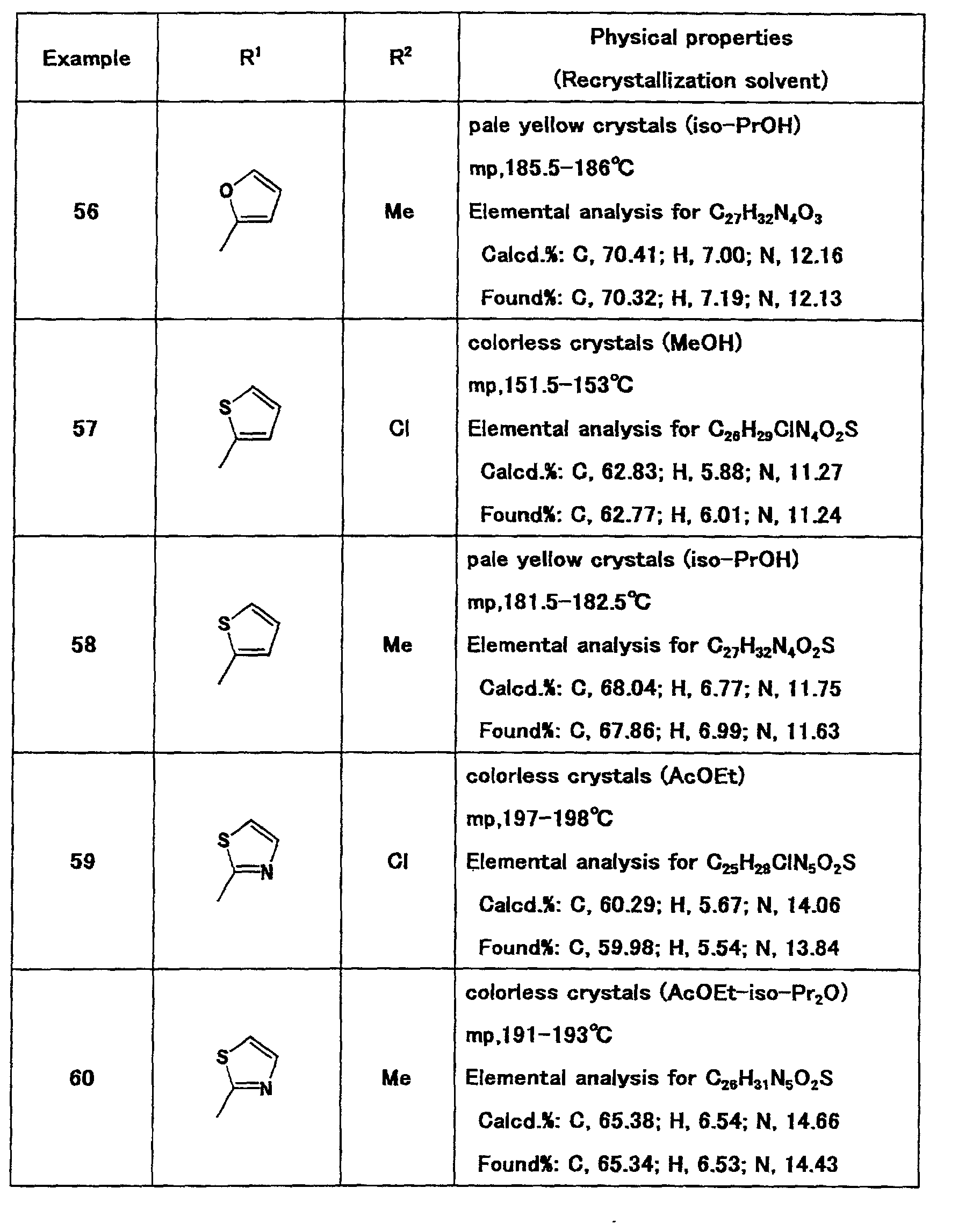
- Example R 1 B m Physical properties (Recrystallization solvent) 4 H H 1 colorless crystals (MeOH) mp,232-239°C (decomposition) Elemental analysis for C 35 H 31 ClN 4 Calcd.%: C, 77.40; H, 5.75; N, 10.32 Found%: C, 77.35; H, 5.79; N, 10.19 5 Ph H 1 pale yellow crystals (AcOEt) mp,165-168°C (decomposition) Elemental analysis for C 41 H 35 ClN 4 Calcd.%: C, 79.53; H, 5.70; N, 9.05 Found%: G, 79.29; H, 5.74; N, 9.05 6 H Cl 2 colorless crystals (MeOH) mp,266-268°C (decomposition) Elemental analysis for C 36 H 32 Cl 2 N 4 Calcd.%: C, 73.09; H, 5.45; N, 9.47 Found
- Example 76 In accordance with the method of Example 76, the compounds of Examples 77 through 79 were obtained.
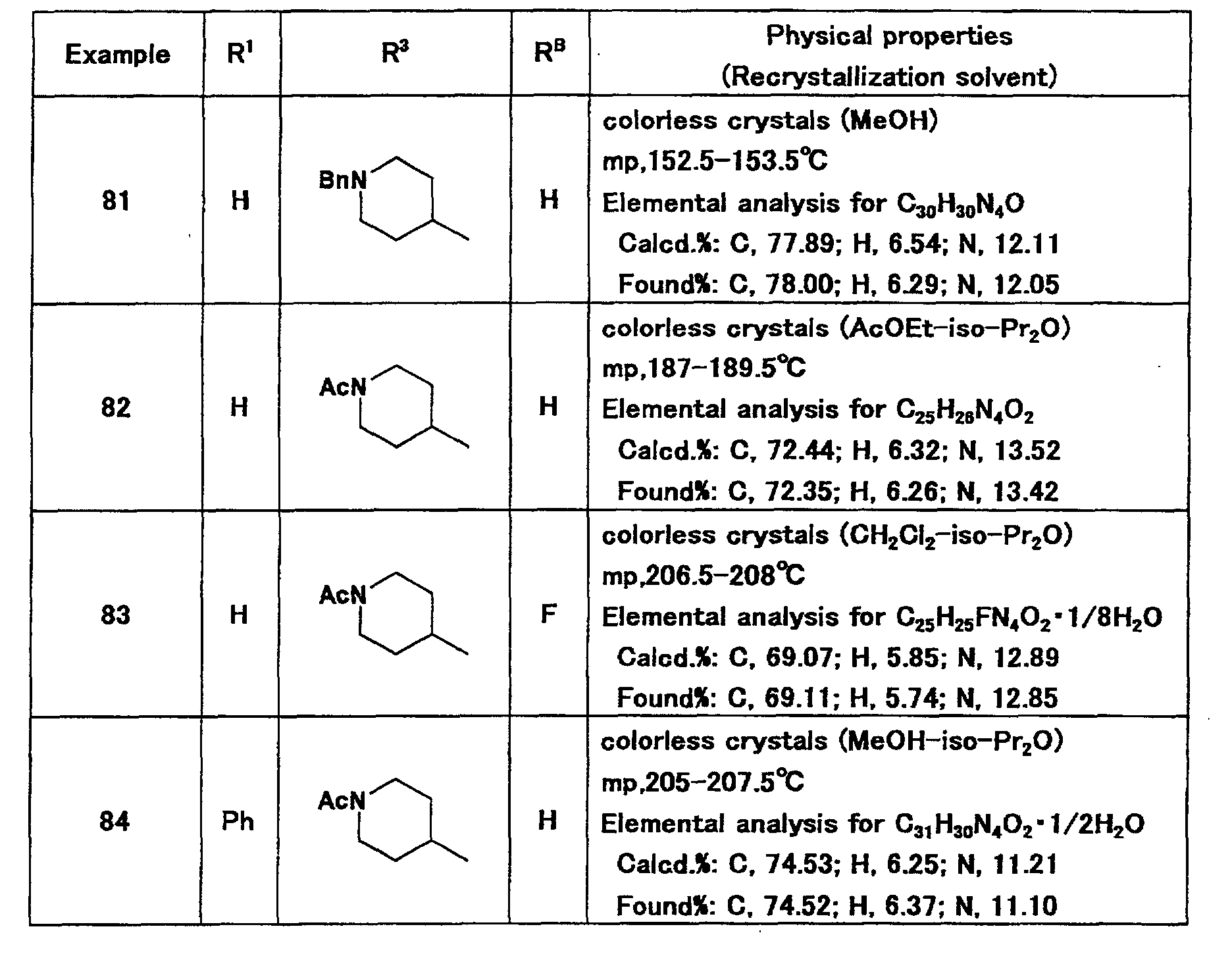
- Example 80 In accordance with the method of Example 80, the compounds of Examples 81 through 87 were obtained.
- Example 88 In accordance with the method of Example 88, the compounds of Examples 89 through 92 were obtained.
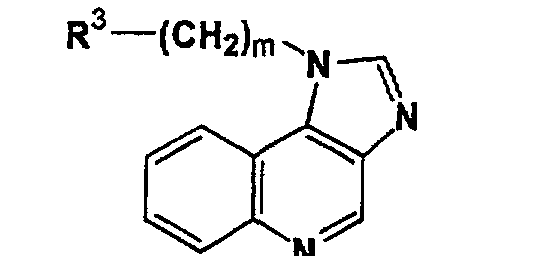
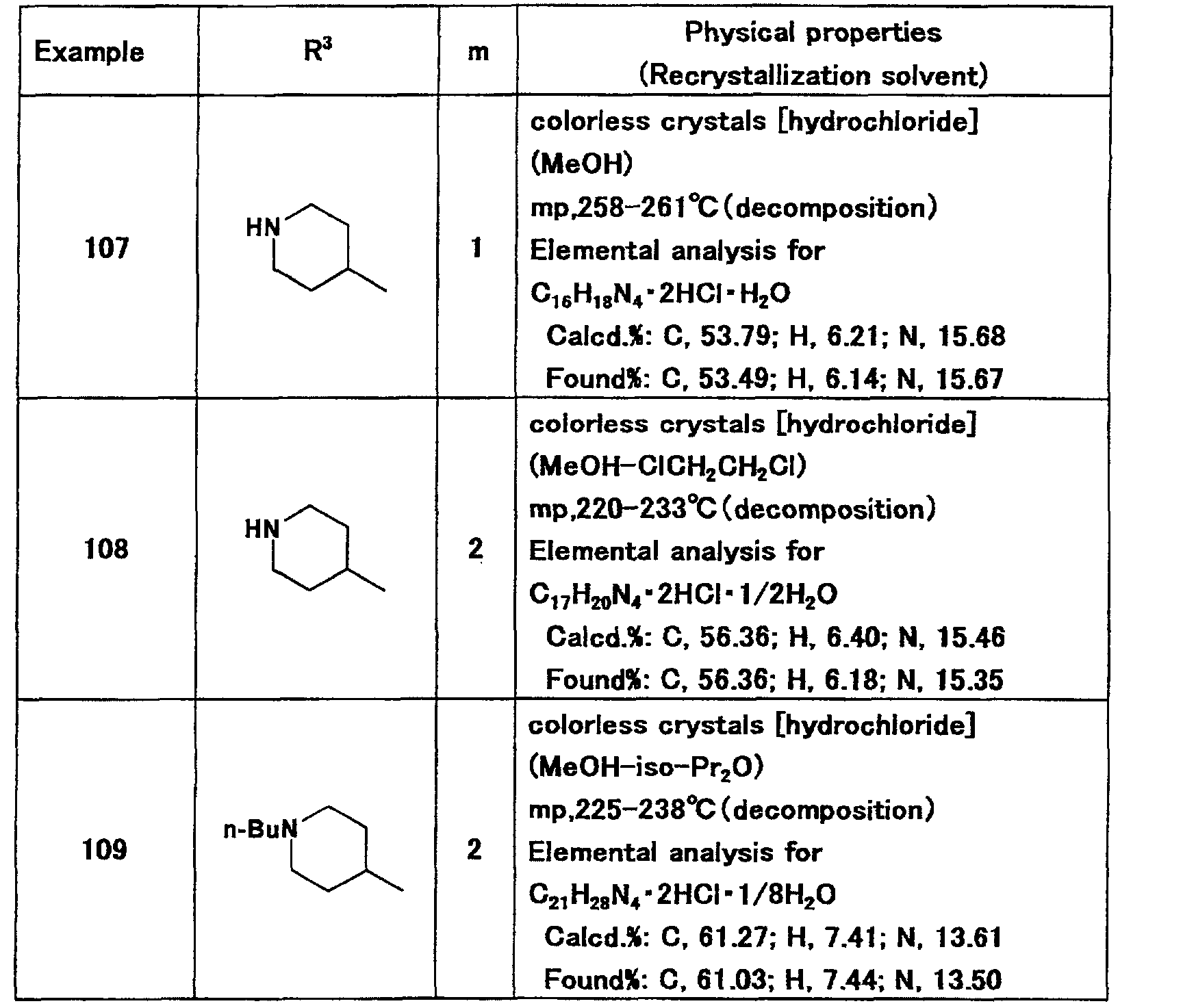
- Example 106 In accordance with the method of Example 106, the compounds of Examples 107 through 109 were obtained.
- the aqueous layer was adjusted to pH 11 with 10% aqueous sodium hydroxide solution, and extracted with a mixture of 1,2-dichloroethane and methanol. The extract was washed with saturated brine, and dried, and then the solvent was evaporated to give 1.74 g of a colorless liquid. A part of the colorless liquid was converted into hydrochloride in a conventional method. Recrystallization from methanol gave colorless crystals having the melting point of from 257 to 265°C (decomposition). In the same manner, fumarate was prepared in a conventional method. Recrystallization from methanol gave colorless crystals having the melting point of from 185.5 to 186.5°C (decomposition).
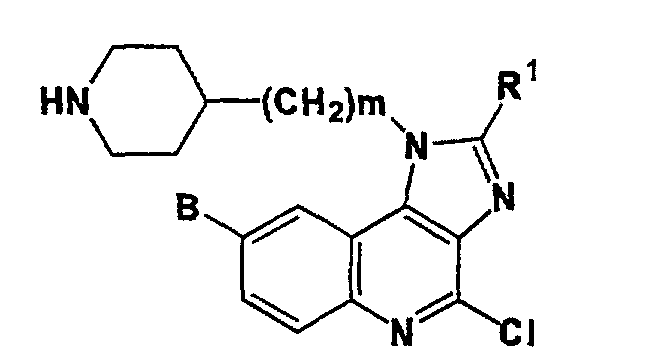
- Example R 1 B m Physical properties (Recrystallization solvent) 114 Ph H 0 colorless crystals (ClCH 2 CH 2 Cl-AcOEt) mp,253-256°C (decomposition) Elemental analysis for C 21 H 19 ClN 4 Calcd.%: C, 69.51; H, 5.28; N, 15.44 Found%: C, 69.29; H, 5.19; N, 15.27 115 H H 1 colorless crystals [hydrochloride] (MeOH-EtOH) mp,273-286°C (decomposition) Elemental analysis for C 16 H 17 ClN 4 -2HCl Calcd.%: C, 51.42; H, 5.12; N, 14.99 Found%: C, 51.47; H, 5.08; N, 14.85 116 Ph H 1 colorless crystals [fumarate](MeOH) mp,268-271.5°C (decomposition
- Example R A Physical properties (Recrystallization solvent) 197 Ts colorless crystals (AcOEt-iso-Pr 2 O) mp,201.5-202°C Elemental analysis for C 30 H 30 N 4 O 3 S Calcd.%: C, 68.42; H, 5.74; N, 10.64 Found%: C, 68.46; H, 5.83; N, 10.53 198 EtO 2 C colorless crystals (AcOEt-iso-Pr 2 O) mp,132-133°C Elemental analysis for C 26 H 28 N 4 O 3 Calcd.%: C, 70.25; H, 6.35; N, 12.60 Found%: C, 70.13; H, 6.34; N, 12.50 199 BnO 2 C yellow liquid NMR spectrum ⁇ (CDCl 3 )ppm: 1.31 (2H,brs),1.50-1.70(1H,m),1.78(2H,br
- Example 200 the compound of Example 201 was obtained.
- PBMCs Peripheral Blood Mononuclear Cells
- LeucoPREPTM Becton Dickinson
- RPMI-1640 medium containing 2 mM L -glutamine (Life Technologies), 2.5 U/ml penicillin-2.5 ⁇ g/mL streptomycin solution (Life Technologies) supplemented with 10% fetal calf serum (Intergen Company) at 1x10 6 cells/mL.
- Test compounds were dissolved in distilled ultra-pure water, dimethyl sulfoxide, or 0.1 N hydrochloric acid at 20 ⁇ M, and then sequentially diluted with saline and used. The compounds were examined at concentrations ranging from 10 -10 M to 10 -5 M.
- An enzyme immunoassay by the sandwich method was performed to determine the human TNF- ⁇ and human IL-1 ⁇ in the culture supernatant.
- the anti-cytokine antibody (the first-antibody) was diluted and placed in a 96-well microtiter plates for coating. After the wells were washed, the culture supernatant was appropriately diluted, and then added to each well and incubated. Then the second-antibody against cytokine and the third-antibody against the second-antibody were successively added while applying washing processes between the operations. After the final washing process, a tetramethylbenzidine solution (DAKO) was added to each well to start the coloring reaction.
- DAKO tetramethylbenzidine solution
- the coloring reaction was quenched with 1 N sulfuric acid, and then the absorbance at 450 nm of each well was measured by a microplate reader, M-VmaxTM (Molecular Devices).
- concentrations of the cytokines were determined by quantification software, SoftmaxTM (Molecular Devices), in comparison with the calibration curves obtained by using the recombinant cytokines as the standards.
- For determination of human TNF- ⁇ monoclonal anti-human TNF- ⁇ (ENDOGEN), polyclonal rabbit anti-human TNF- ⁇ (Pharma Biotechnologie Hannover), peroxidase conjugated donkey anti-rabbit IgG (Jackson ImmunoRes.
- recombinant human TNF- ⁇ (INTERGEN Company) were used for the first-, second- and third-antibodys and the standard for the calibration curve, respectively.
- monoclonal anti-human IL-1 ⁇ (Cistron), polyclonal sheep anti-human IL-1 ⁇ (Biogenesis), HRP conjugated donkey anti-goat IgG (Chemicon International), and recombinant human IL-1 ⁇ (R&D Systems) were used for the first-, second- and third-antibodys and the standard for the calibration curve, respectively.
- the compounds of the present invention have excellent inhibitory actions against production of TNF or IL-1 and are extreamely useful as preventive or therapeutic agents of diseases mediated by these cytokines.
Landscapes
- Health & Medical Sciences (AREA)
- Chemical & Material Sciences (AREA)
- Organic Chemistry (AREA)
- Public Health (AREA)
- Chemical Kinetics & Catalysis (AREA)
- General Chemical & Material Sciences (AREA)
- Medicinal Chemistry (AREA)
- Nuclear Medicine, Radiotherapy & Molecular Imaging (AREA)
- Pharmacology & Pharmacy (AREA)
- Life Sciences & Earth Sciences (AREA)
- Animal Behavior & Ethology (AREA)
- General Health & Medical Sciences (AREA)
- Veterinary Medicine (AREA)
- Bioinformatics & Cheminformatics (AREA)
- Engineering & Computer Science (AREA)
- Immunology (AREA)
- Pulmonology (AREA)
- Biomedical Technology (AREA)
- Neurology (AREA)
- Neurosurgery (AREA)
- Rheumatology (AREA)
- Hospice & Palliative Care (AREA)
- Psychiatry (AREA)
- Pain & Pain Management (AREA)
- Orthopedic Medicine & Surgery (AREA)
- Physical Education & Sports Medicine (AREA)
- Pharmaceuticals Containing Other Organic And Inorganic Compounds (AREA)
- Nitrogen Condensed Heterocyclic Rings (AREA)
- Heterocyclic Carbon Compounds Containing A Hetero Ring Having Oxygen Or Sulfur (AREA)
Abstract
Description


in the presence or absence of a basic catalyst such as triethylamine, or an acid catalyst such as hydrochloric acid and p-toluenesulfonic acid, in the presence or absence of a solvent such as N,N-dimethylformamide, tetrahydrofuran, acetonitrile, xylene and toluene, at a temperature ranging from 0°C to 200°C.

can be obtained by allowing the compound of the general formula (VIII) to react together with triphosgene in the presence of a base such as triethylamine and potassium carbonate in a solvent such as 1,2-dichloroethane, 1,4-dioxane, tetrahydrofuran, N,N-dimethylformamide and toluene at a temperature ranging from 0°C to the reflux temperature of a solvent.

in the presence or absence of a base such as triethylamine, diisopropylethylamine, sodium carbonate, potassium carbonate, sodium hydrogencarbonate and sodium acetate in a solvent such as alcohols including methanol, ethanol and n-propanol, N,N-dimethylformamide, 1,4-dioxane, tetrahydrofuran, and toluene at a temperature ranging from 0°C to the reflux temperature of a solvent.
| Elemental analysis for C27H29NO2 | |||
| Calculated % | C, 81.17; | H, 7.32; | N, 3.51 |
| Found % | C, 81.19; | H, 7.22; | N, 3.44 |
| Elemental analysis for C25H27NO | |||
| Calculated % | C, 83.99; | H, 7.61; | N, 3.92 |
| Found % | C, 83.79; | H, 7.74; | N, 3.94 |
| Elemental analysis for C26H29NO3S | |||
| Calculated % | C, 71.69; | H, 6.71; | N, 3.22 |
| Found % | C, 71.68; | H, 6.47; | N, 3.19 |
| Elemental analysis for C27H31NO3S | |||
| Calculated % | C, 72.13; | H, 6.95; | N, 3.12 |
| Found % | C, 72.03; | H, 7.12; | N, 3.14 |
| Elemental analysis for C25H26N4 | |||
| Calculated % | C, 78.50; | H, 6.85; | N, 14.65 |
| Found % | C, 78.45; | H, 6.74; | N, 14.82 |
| Elemental analysis for C12H21N3O2 | |||
| Calculated % | C, 60.23; | H, 8.84; | N, 17.56 |
| Found % | C, 60.08; | H, 8.63; | N, 17.55 |
| Elemental analysis for C26H26N2 | |||
| Calculated % | C, 85.21; | H, 7.15; | N, 7.64 |
| Found % | C, 85.35; | H, 7.26; | N, 7.62 |
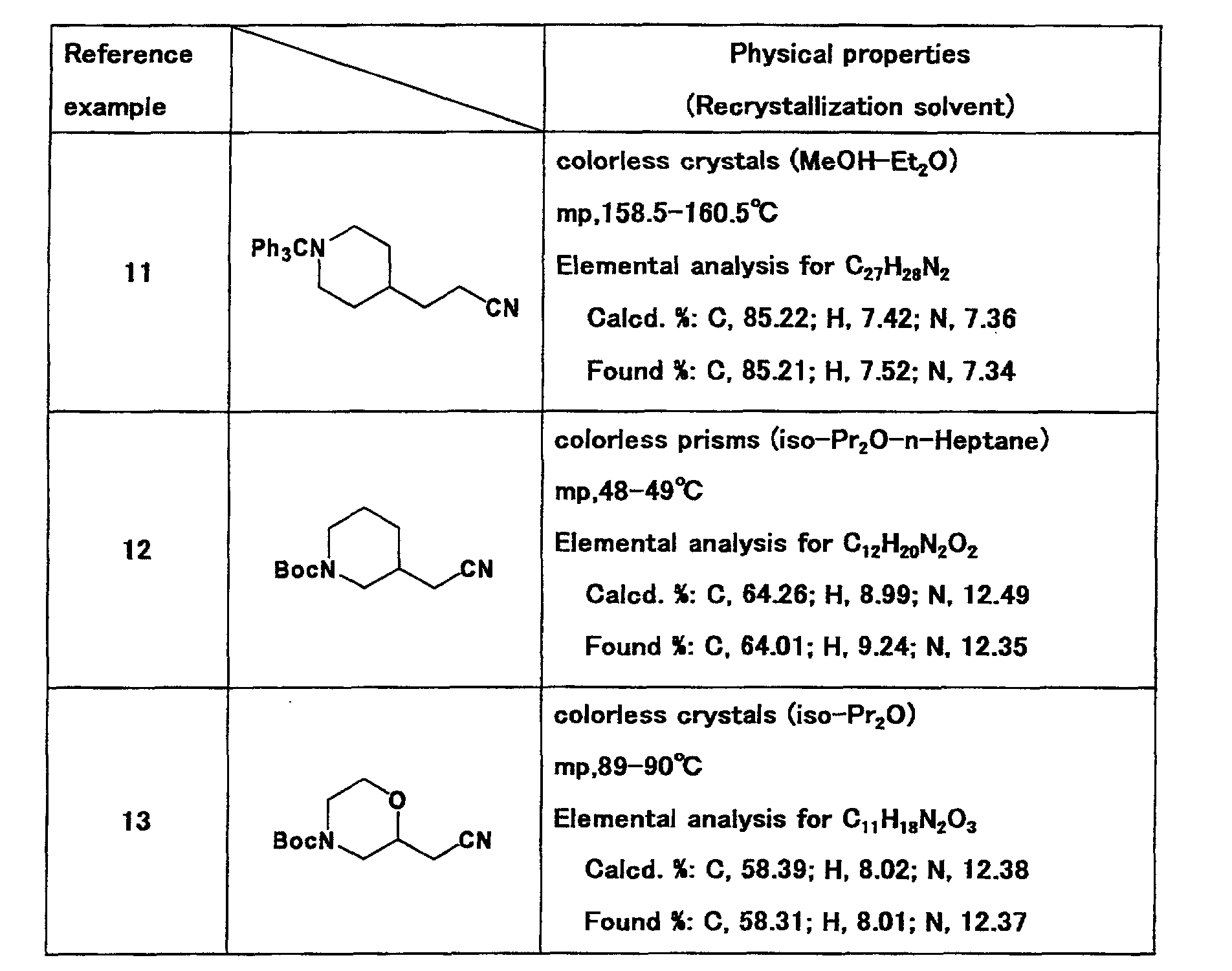
| Elemental analysis for C26H27NO2 | |||
| Calculated % | C, 81.01; | H, 7.06; | N, 3.63 |
| Found % | C, 80.85; | H, 7.17; | N, 3.70 |
| Elemental analysis for C28H31NO2 | |||
| Calculated % | C, 81.32; | H, 7.56; | N, 3.39 |
| Found % | C, 81.08; | H, 7.69; | N, 3.43 |
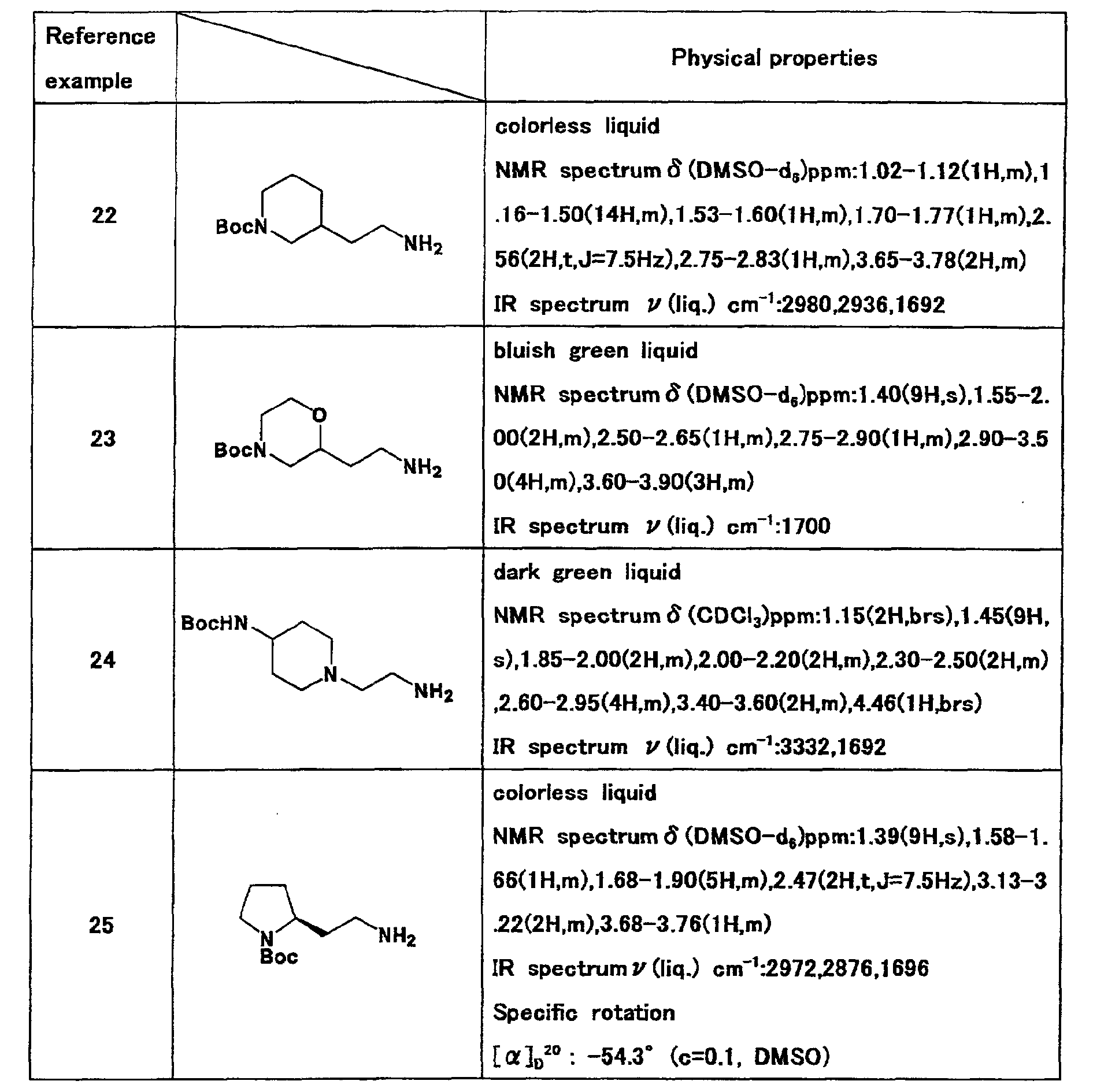
IR spectrum ν (liq.)cm-1: 2976,2936,1692
NMR spectrum δ (DMSO-d6)ppm : 1.58(4H,t,J=6Hz),2.37(2H,t,J=6.5Hz),2.42(4H,t,J= 6Hz),2.57(2H,t,J=6.5Hz),3.84(4H,s)
IR spectrum ν (liq.)cm-1: 2956,2884,1094

| Elemental analysis for C35H33ClN4O2 | |||
| Calculated % | C, 72.84; | H, 5.76; | N, 9.71 |
| Found % | C, 72.64; | H, 5.80; | N, 9.82 |



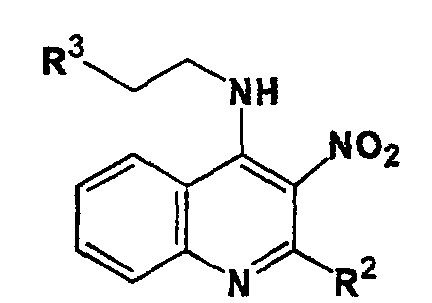
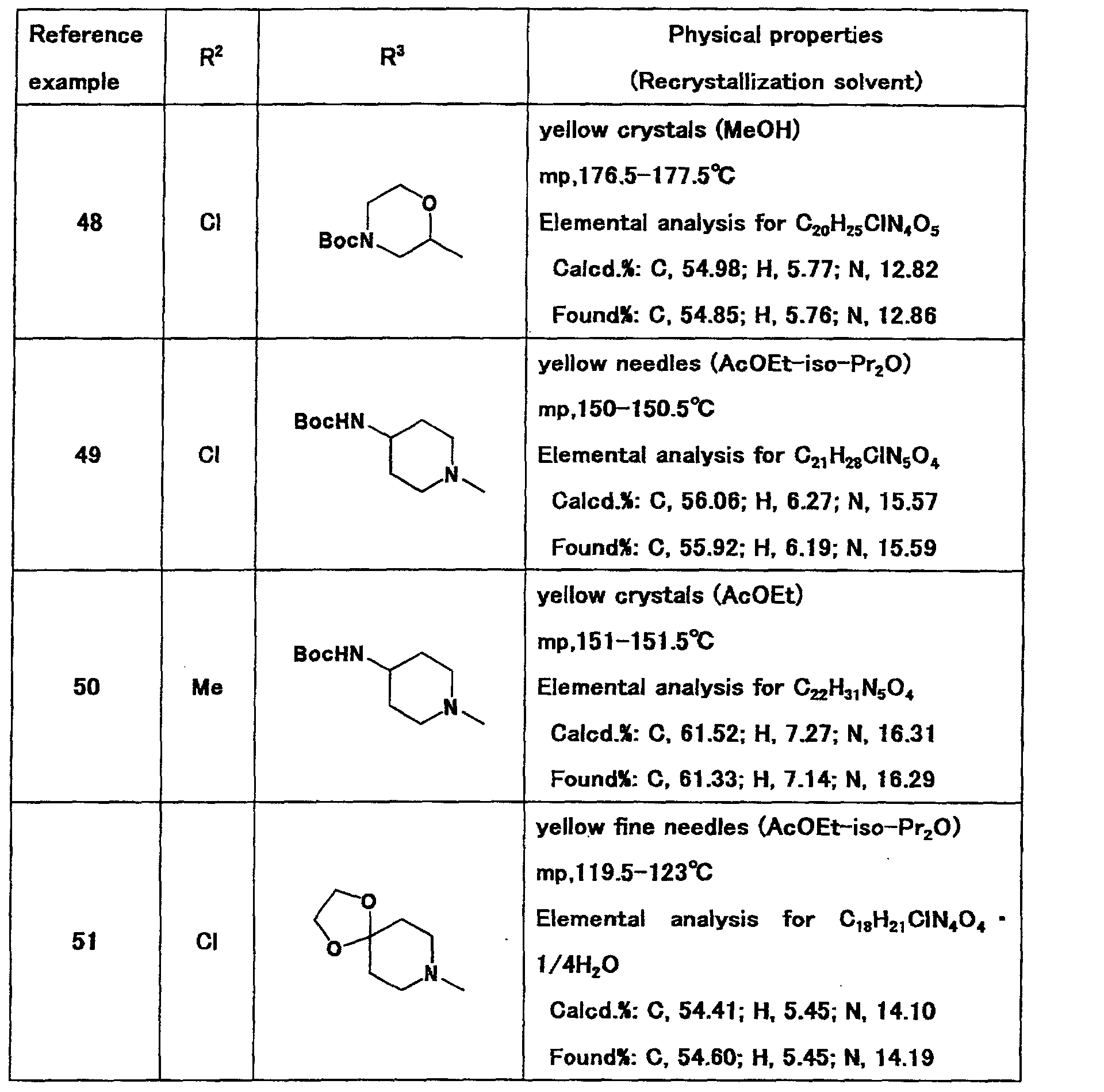
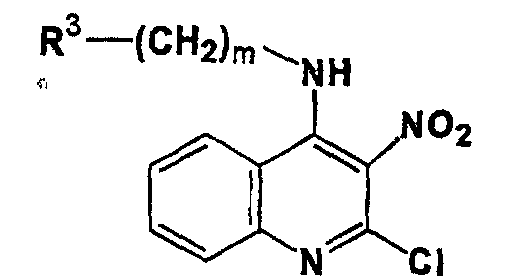


| Elemental analysis for C35H35ClN4 | |||
| Calculated % | C, 76.83; | H, 6.45; | N, 10.24 |
| Found % | C, 76.74; | H, 6.54; | N, 10.17 |
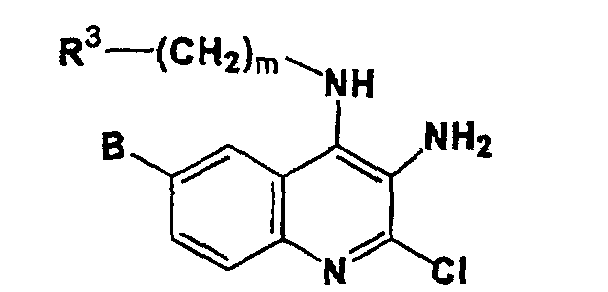
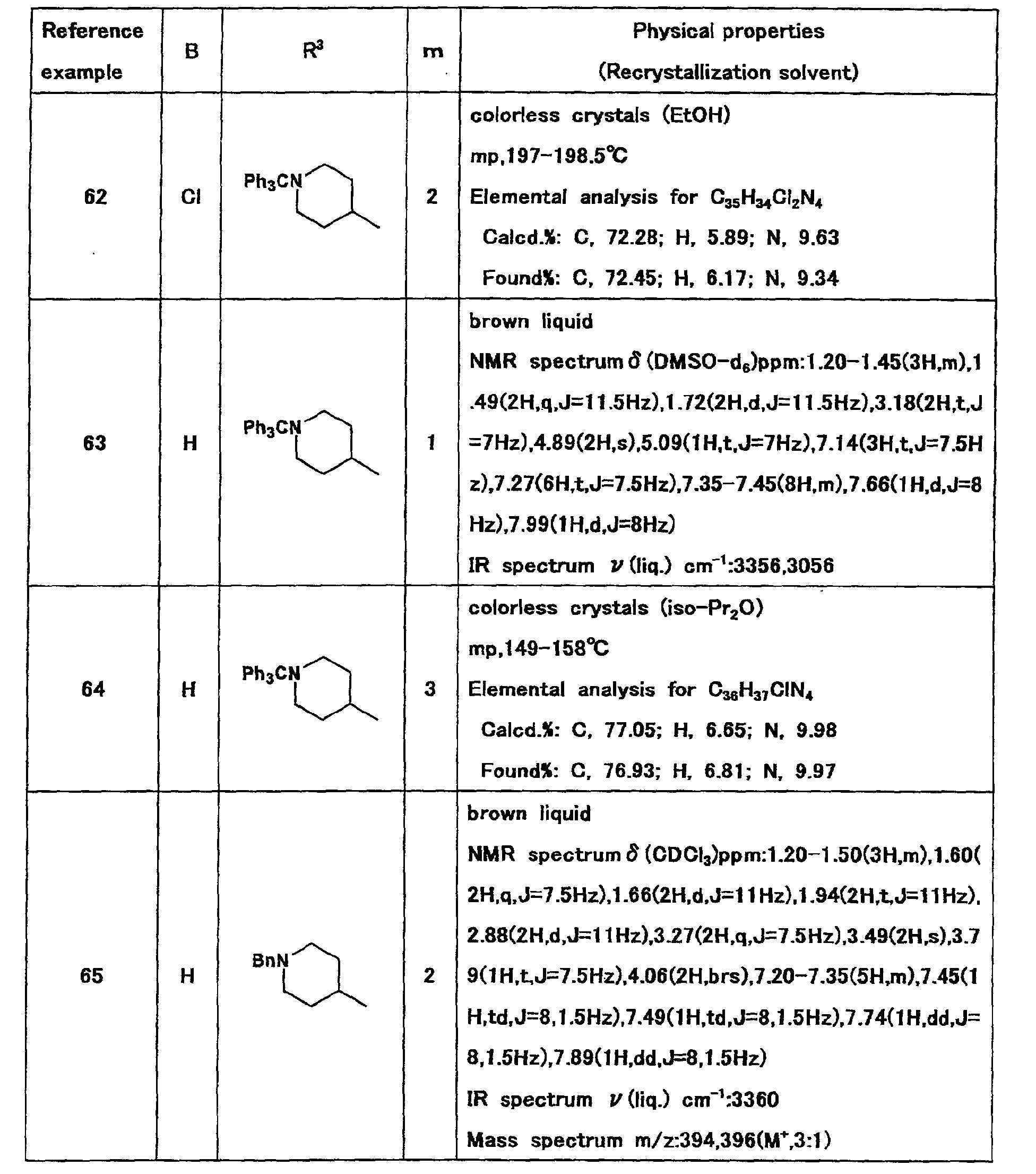




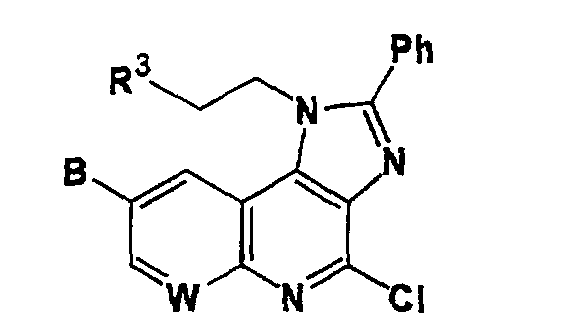
| Elemental analysis for C36H33ClN4 | |||
| Calculated % | C, 77.61; | H, 5.97; | N, 10.06 |
| Found % | C, 77.50; | H, 5.98; | N, 9.95 |
NMR spectrum δ (DMSO-d6)ppm : 1.35-1.55(3H,m),1.59(2H,q,J=11Hz),1.77(2H,d,J=11Hz),1.80-1.90(2H,m),2.98(2H,brs),4.75(2H,t,J=8.5Hz),7.17(3H,t,J=8Hz),7.30(6H,t,J=8Hz),7.41(6H,brs),7.84(1H,td,J=7.5,2Hz),7.87(1H,td,J=7.5,2Hz),8.16(1H,dd,J=7.5,2Hz ),8.34(1H,dd,J=7.5,2Hz)
| Elemental analysis for C29H34N4O2 | |||
| Calculated % | C, 74.01; | H, 7.28; | N, 11.91 |
| Found % | C, 73.95; | H, 7.54; | N, 11.84 |

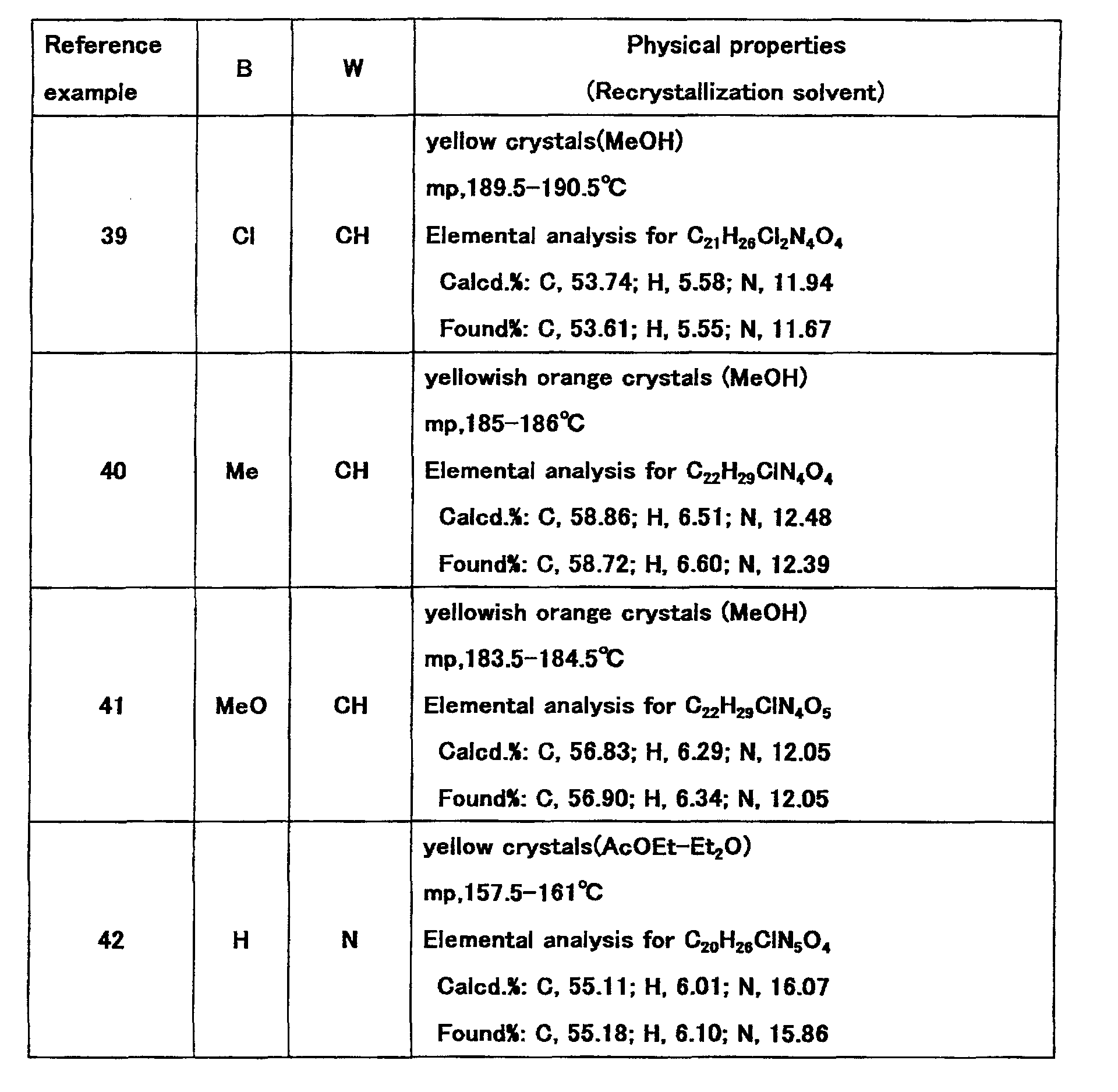
| Example | R1 | B | m | Physical properties (Recrystallization solvent) |
| 4 | H | H | 1 | colorless crystals (MeOH) mp,232-239°C (decomposition) Elemental analysis for C35H31ClN4 Calcd.%: C, 77.40; H, 5.75; N, 10.32 Found%: C, 77.35; H, 5.79; N, 10.19 |
| 5 | Ph | H | 1 | pale yellow crystals (AcOEt) mp,165-168°C (decomposition) Elemental analysis for C41H35ClN4 Calcd.%: C, 79.53; H, 5.70; N, 9.05 Found%: G, 79.29; H, 5.74; N, 9.05 |
| 6 | H | Cl | 2 | colorless crystals (MeOH) mp,266-268°C (decomposition) Elemental analysis for C36H32Cl2N4 Calcd.%: C, 73.09; H, 5.45; N, 9.47 Found%: C, 73.15; H, 5.54; N, 9.41 |
| 7 | Ph | H | 2 | pale yellow crystals (CH2Cl2-EtOH) mp,246.5-249°C Elemental analysis for C42H37ClN4 Calcd.%: C, 79.66; H, 5.89; N, 8.85 Found%: C, 79.55; H, 6.12; N, 8.71 |
| 8 | Ph | H | 3 | colorless crystals (AcOEt) mp,227.5-231°C (decomposition) Elemental analysis for C43H39ClN4-1/4H2O Calcd.%: C, 79.24; H, 6.11; N, 8.60 Found%: C, 79.26; H, 6.09; N, 8.55 |

| Example | R1 | B | RA | m | Physical properties (Recrystallization solvent) |
| 9 | H | H | Bn | 2 | colorless crystals (AcOEt) mp,124.5-125°C Elemental analysis for C24H25ClN4 Calcd.%: C, 71.19; H, 6.22; N, 13.84 Found%: C, 71.22; H, 5.97; N, 13.79 |
| 10 | Ph | H | Boc | 0 | colorless crystals (AcOEt-MeOH) mp,250-255°C (decomposition) Elemental analysis for C26H27ClN4O2 Calcd.%: C, 67.45; H, 5.88; N, 12.10 Found%: C, 67.42; H, 5.88; N, 12.02 |
| 11 | H | H | Boc | 2 | colorless crystals (AcOEt) mp,188-189°C Elemental analysis for C22H27ClN4O2 Calcd.%: C, 63.68; H, 6.56; N, 13.50 Found%: C, 63.45; H, 6.60: N, 13.40 |
| 12 | Ph | Cl | Boc | 2 | colorless crystals (AcOEt) mp,192-193°C Elemental analysis for C28H30Cl2N4O2 Calcd.%: C, 64.00; H, 5.75; N, 10.66 Found%: C, 64.04; H, 5.59; N, 10.61 |
| 13 | Ph | Me | Boc | 2 | colorless crystals (AcOEt) mp,182.5-183.5°C Elemental analysis for C29H33ClN4O2 Calcd.%: C, 68.97; H, 6.59; N, 11.09 Found%: C, 68.91; H, 6.41; N, 11.06 |


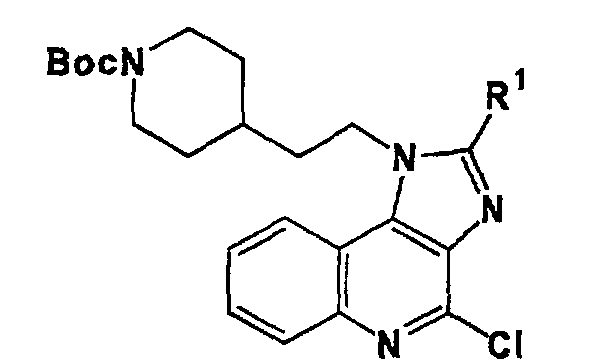


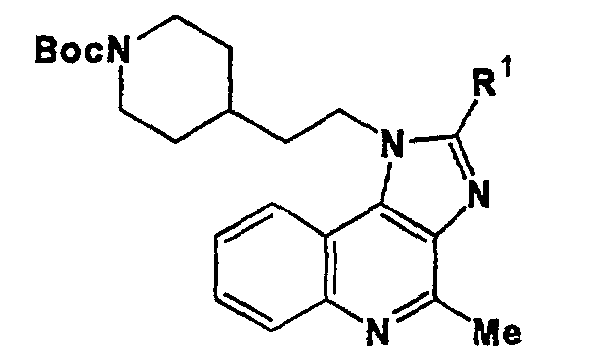
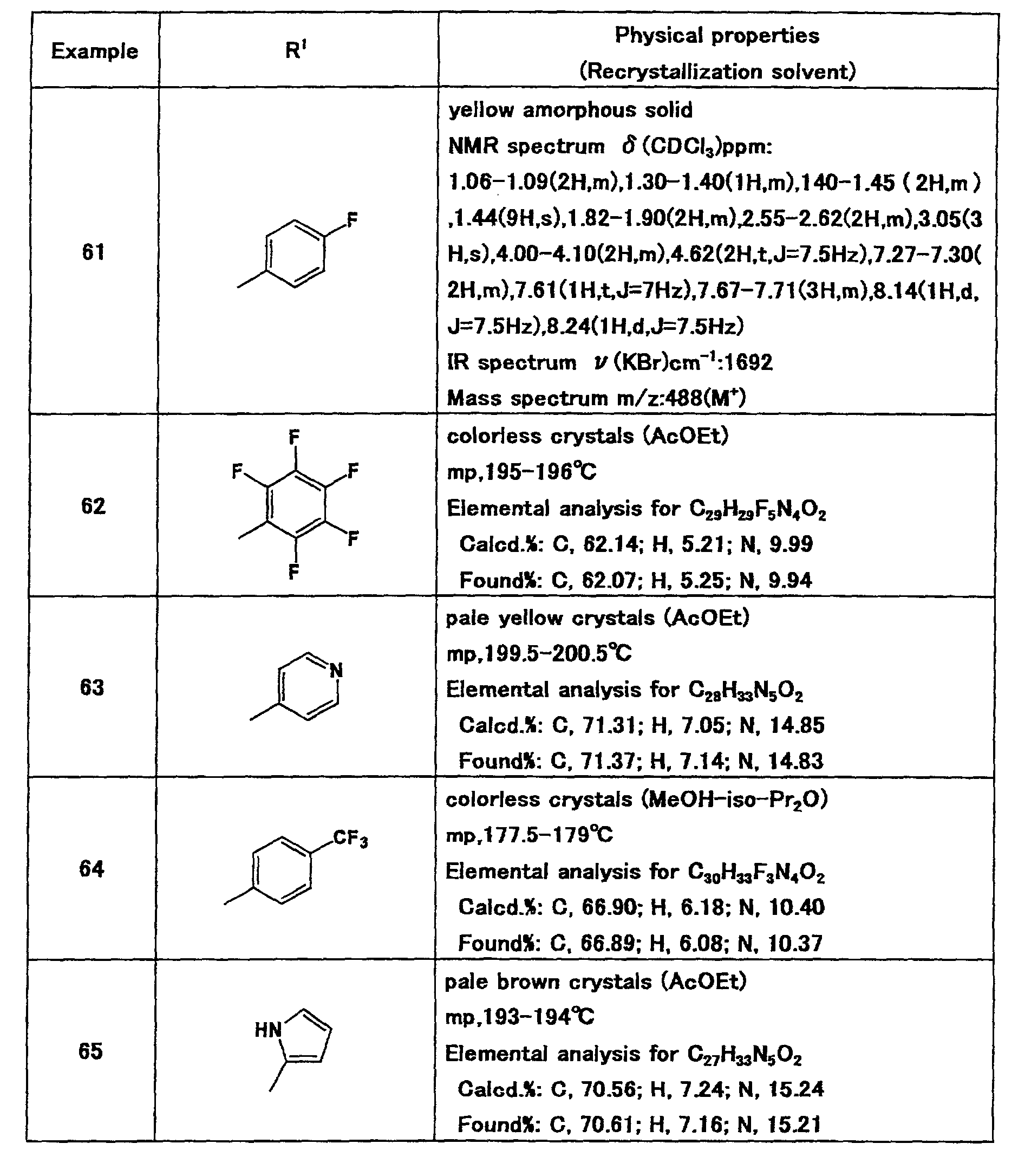


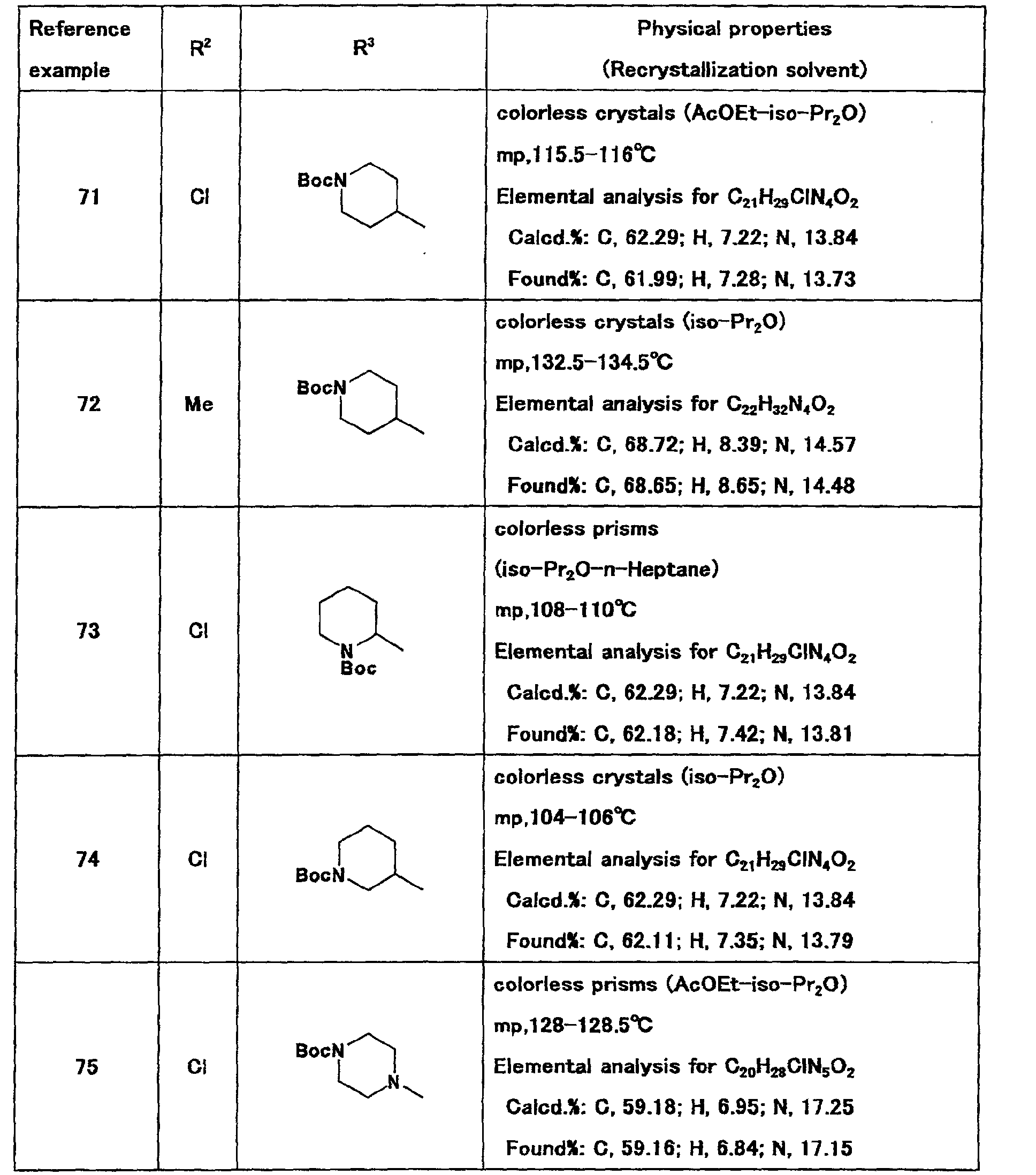
| Elemental analysis for C22H27ClN4O3 | |||
| Calculated % | C, 61.32; | H, 6.32; | N, 13.00 |
| Found % | C, 61.15; | H, 6.34; | N, 13.00 |
| Elemental analysis for C29H33ClN4O3S · 1/4H2O | |||
| Calculated % | C, 62.46; | H, 6.06; | N, 10.05 |
| Found % | C, 62.33; | H, 5.90; | N, 9.91 |
| Elemental analysis for C29H33ClN4O4S · 1/4H2O | |||
| Calculated % | C, 60.72; | H, 5.89; | N, 9.77 |
| Found % | C, 60.72; | H, 5.81; | N, 9.67 |
| Elemental analysis for C23H24N4O · 1/4H2O | |||
| Calculated % | C, 73.28; | H, 6.55; | N, 14.86 |
| Found % | C, 73.32; | H, 6.45; | N, 14.77 |


| Elemental analysis for C28H32N4O3 | |||
| Calculated % | C, 71.16; | H, 6.83; | N, 11.86 |
| Found % | C, 71.10; | H, 7.10; | N, 11.69 |
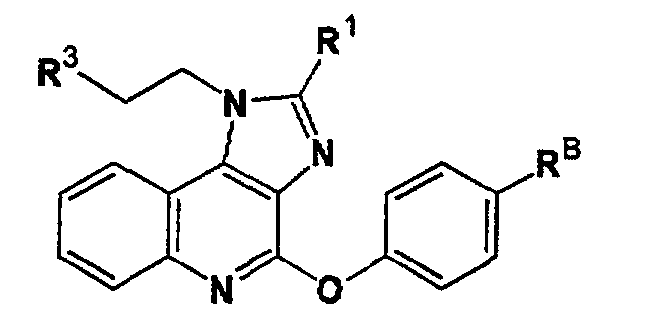


| Elemental analysis for C22H29N5O2 | |||
| Calculated % | C, 66.81; | H, 7.39; | N, 17.71 |
| Found % | C, 66.93; | H, 7.48; | N, 17.66 |


| Elemental analysis for C30H37N5O2 | |||
| Calculated % | C, 72.12; | H, 7.46; | N, 14.02 |
| Found % | C, 71.95; | H, 7.72; | N, 13.83 |
| Elemental analysis for C33H42N6O2 | |||
| Calculated % | C, 71.45; | H, 7.63; | N, 15.15 |
| Found % | C, 71.23; | H, 7.65; | N, 14.99 |

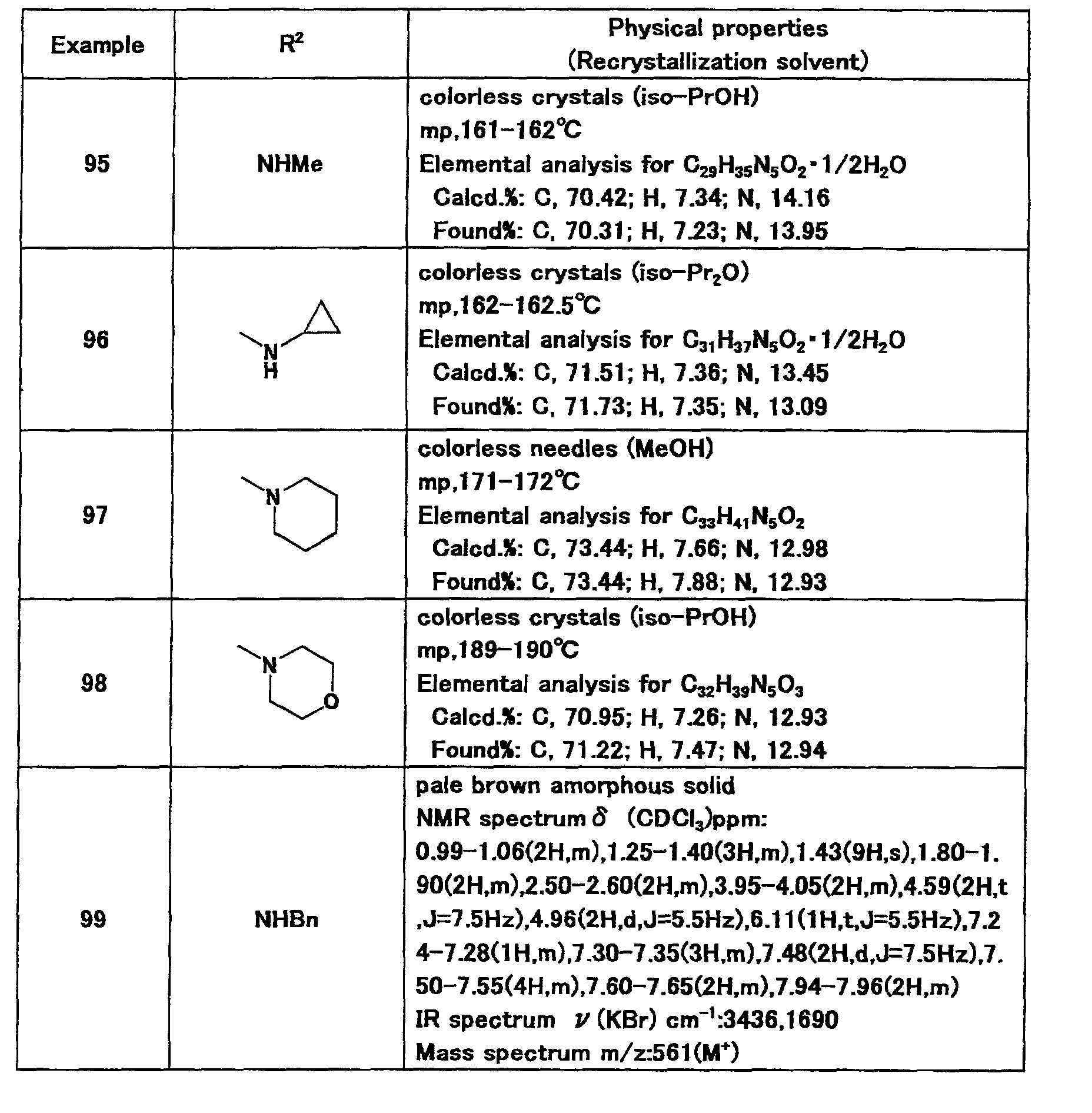
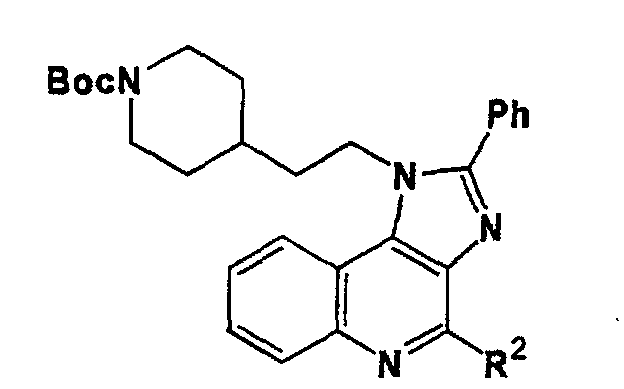
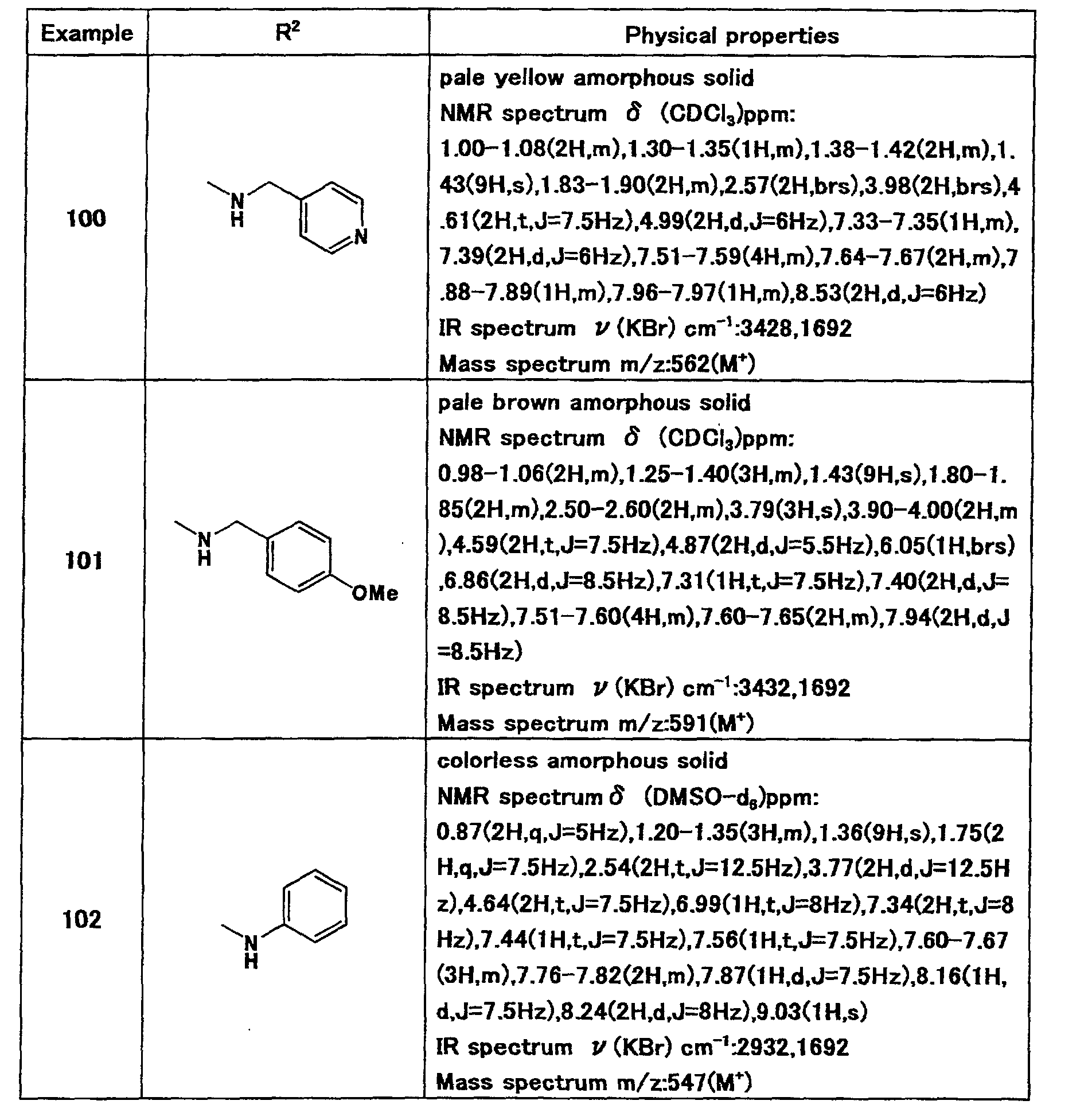
| Elemental analysis for C23H25N5 · 2CF3CO2H · H2O | |||
| Calculated % | C, 52.51; | H, 4.73; | N, 11.34 |
| Found % | C, 52.61; | H, 4.45; | N, 11.61 |
| Elemental analysis for C23H21ClN4O | |||
| Calculated % | C, 68.23; | H, 5.23; | N, 13.84 |
| Found % | C, 68.26; | H, 5.31; | N, 13.78 |
| Elemental analysis for C23H22ClN5O · 1/2H2O | |||
| Calculated % | C, 64.41; | H, 5.40; | N, 16.33 |
| Found % | C, 64.75; | H, 5.32; | N, 16.09 |
| Elemental analysis for C28H32N4O2 | |||
| Calculated % | C, 73.66; | H, 7.06; | N, 12.27 |
| Found % | C, 73.46; | H, 7.21; | N, 12.17 |
| Elemental analysis for C23H23ClN4 · HCl · H2O | |||
| Calculated % | C, 62.02; | H, 5.88; | N, 12.58 |
| Found % | C, 62.08; | H, 5.77; | N, 12.60 |
| Elemental analysis for C23H23ClN4 · C4H4O4 · H2O | |||
| Calculated % | C, 61.77; | H, 5.57; | N, 10.67 |
| Found % | C, 62.04; | H, 5.40; | N, 10.70 |
| Elemental analysis for C23H24N4O · CF3CO2H · 1/8H2O | |||
| Calculated % | C, 61.44; | H, 5.21; | N, 11.46 |
| Found % | C, 61.26; | H, 5.05; | N, 11.47 |
| Elemental analysis for C22H22ClN5 · 2CH3SO3H | |||
| Calculated % | C, 49.35; | H, 5.18; | N, 11.99 |
| Found % | C, 49.60; | H, 5.11; | N, 12.16 |
| Elemental analysis for C17H21N5 · HCl · 3/4H2O | |||
| Calculated % | C, 59.12; | H, 6.86; | N, 20.28 |
| Found % | C, 59.10; | H, 6.83; | N, 20.30 |
| Example | R1 | B | m | Physical properties (Recrystallization solvent) |
| 114 | Ph | H | 0 | colorless crystals (ClCH2CH2Cl-AcOEt) mp,253-256°C (decomposition) Elemental analysis for C21H19ClN4 Calcd.%: C, 69.51; H, 5.28; N, 15.44 Found%: C, 69.29; H, 5.19; N, 15.27 |
| 115 | H | H | 1 | colorless crystals [hydrochloride] (MeOH-EtOH) mp,273-286°C (decomposition) Elemental analysis for C16H17ClN4-2HCl Calcd.%: C, 51.42; H, 5.12; N, 14.99 Found%: C, 51.47; H, 5.08; N, 14.85 |
| 116 | Ph | H | 1 | colorless crystals [fumarate](MeOH) mp,268-271.5°C (decomposition) Elemental analysis for C22H21ClN4-1/2C4H4O4-3/2H2O Calcd.%: C, 62.40; H, 5.67; N, 12.13 Found%: C, 62.52; H, 5.28; N, 12.15 |
| 117 | H | H | 2 | colorless crystals [hydrochloride] (EtOH) mp,258-267°C (decomposition) Elemental analysis for C17H19ClN4-HCl Calcd.%: C, 58.13; H, 5.74; N, 15.95 Found%: C, 57.88; H, 5.46; N, 15.78 |
| 118 | H | Cl | 2 | colorless crystals [trifluoroacetate] (MeOH-iso-Pr2O) mp,204-207.5°C Elemental analysis for C17H18Cl2N4-CF3CO2H-1/4H2O Calcd.%: C, 48.78; H, 4.20; N, 11.98 Found%: C, 48.76; H, 4.34; N, 11.89 |

| Example | R1 | R2 | m | Physical properties (Recrystallization solvent) |
| 119 | OH | Cl | 2 | pale brown crystals (ClCH2CH2Cl-MeOH) mp,240-245°C (decomposition) Elemental analysis for C17H19ClN4O-1/2H2O Calcd.%: C, 60.09; H, 5.93; N, 16.49 Found%: C, 60.32; H, 5.72; N, 16.41 |
| 120 | Me | Cl | 2 | pale brown crystals [trifluoroacetate] (EtOH) mp,201-202°C Elemental analysis for C18H21ClN4-CF3CO2H·5/4H2O Calcd.%: C, 51.62; H, 5.31; N, 12.04 Found%: C, 51.82; H, 5.12; N, 12.22 |
| 121 | CF3 | Cl | 2 | colorless crystals [trifluoroacetate] (EtOH) mp,233-235°C Elemental analysis for C18H18ClF3N4-CF3CO2H Calcd.%: C, 48.35; H, 3.85; N, 11.28 Found%: C, 48.31; H, 3.88; N, 11.21 |
| 122 | Ph | H | 2 | colorless crystals [hydrochloride](EtOH) mp,191.5-192.5°C Elemental analysis for C23H24N4-2HCl-H2O Calcd.%: C, 61.74; H, 6.31; N, 12.52 Found%: C, 61.69; H, 6.51; N, 12.44 |
| 123 | Ph | Cl | 3 | colorless fine needles[trifluoroacetate] (EtOH) mp,260-263°C (decomposition) Elemental analysis for C24H25ClN4 · CF3CO2H Calcd.%: C, 60.17; H, 5.05; N, 10.80 Found%: C, 59.94; H, 5.08; N, 10.80 |
| Example | R2 | B | W | Physical properties (Recrystallization solvent) |
| 124 | Me | H | CH | colorless crystals [hydrochloride](EtOH) mp,199-201 °C Elemental analysis for C24H26N4-HCl-7/2H2O Calcd.%: C, 61.33; H, 7.29; N, 11.92 Found%: C, 61.21; H, 7.26; N, 11.80 |
| 125 | Cl | Cl | CH | colorless crystals [trifluoroacetate](MeOH) mp,249-255°C (decomposition) Elemental analysis for C23H22Cl2N4-CF3CO2H Calcd.%: C, 55.67; H, 4.30; N, 10.39 Found%: C, 55.75; H, 4.00; N, 10.47 |
| 126 | Cl | Me | CH | colorless fine needles[trifluoroacetate] (MeOH) mp,255-262°C (decomposition) Elemental analysis for C24H25ClN4- CF3CO2H Calcd.%: C, 60.17; H, 5.05; N, 10.80 Found%: C, 59.95; H, 5.03; N, 10.79 |
| 127 | Cl | MeO | CH | pale yellow crystals (EtOH) mp,169-170°C Elemental analysis for C24H25ClN4O-1/2H2O Calcd.%: C, 67.05; H, 6.10; N, 13.03 Found%: C, 67.32; H, 6.06; N, 13.02 |
| 128 | Cl | H | N | colorless crystals [trifluoroacetate](MeOH) mp,260-268°C (decomposition) Elemental analysis for C22H22ClN5-CF3CO2H Calcd.%: C, 56.98; H, 4.58; N, 13.84 Found%: C, 56.76; H, 4.47; N, 13.82 |


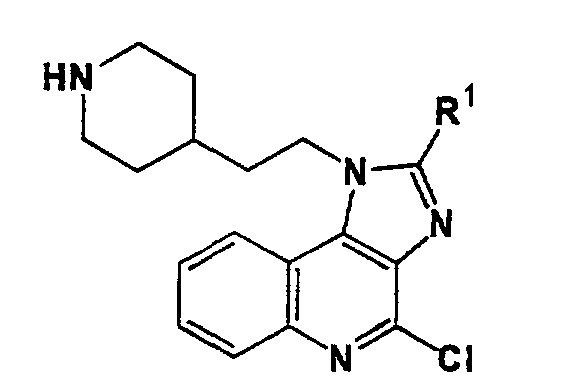


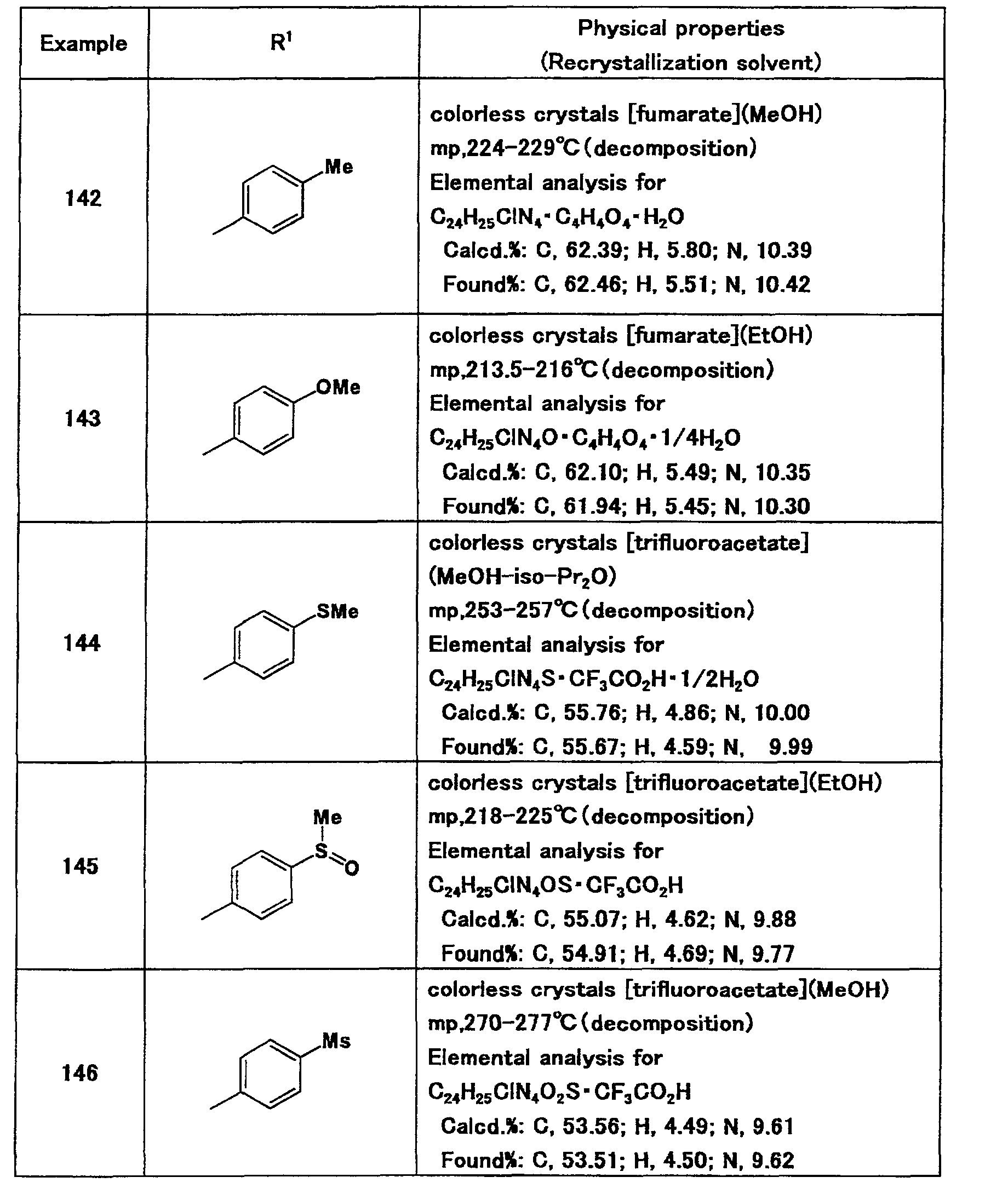
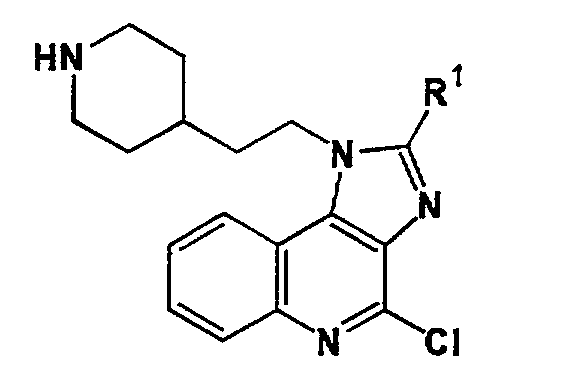


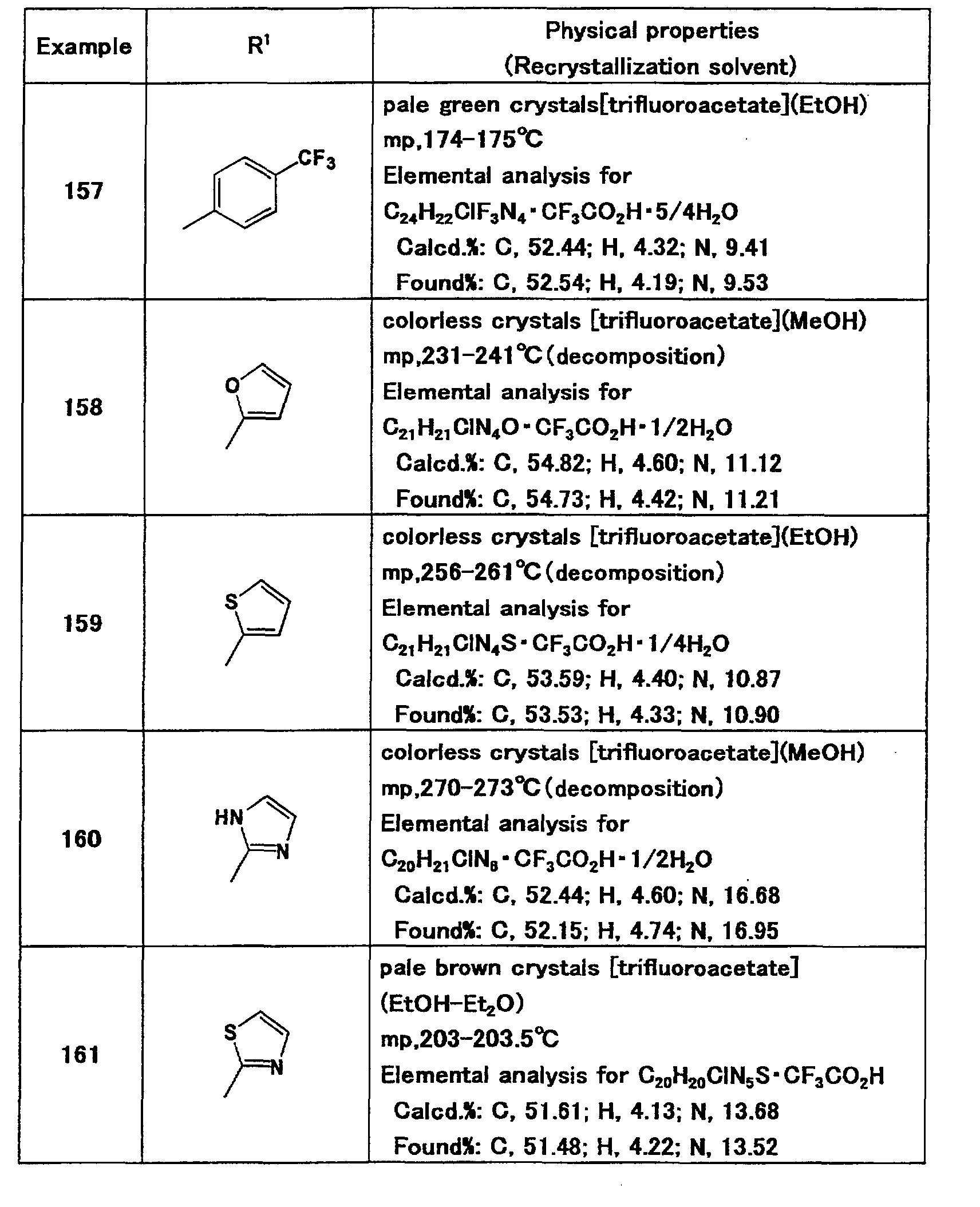


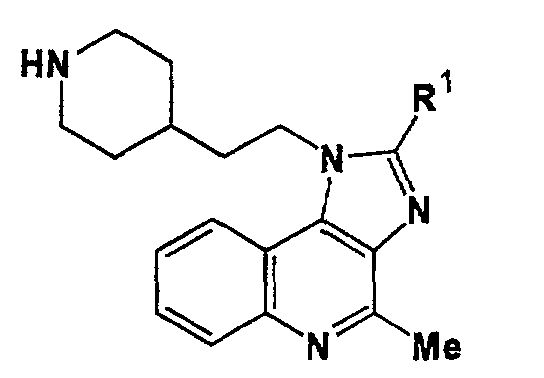


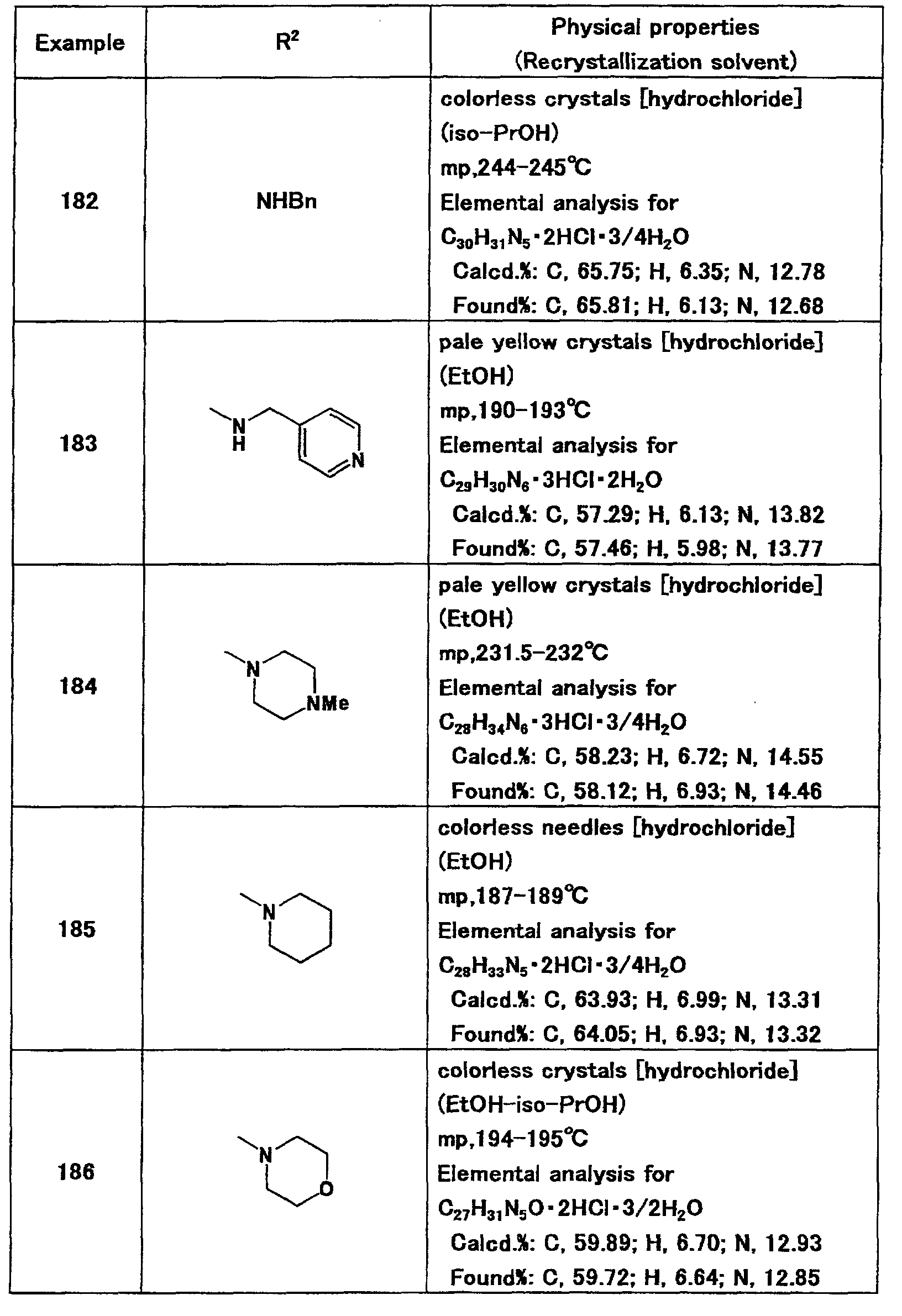
| Elemental analysis for C21H27ClN4 · 2HCl · 1/2H2O | |||
| Calculated % | C, 55.70; | H, 6.68; | N, 12.37 |
| Found % | C, 55.80; | H, 6.65; | N, 12.44 |
| Elemental analysis for C19H21ClN4O | |||
| Calculated % | C, 63.95; | H, 5.93; | N, 15.70 |
| Found % | C, 63.81; | H, 5.87; | N, 15.61 |
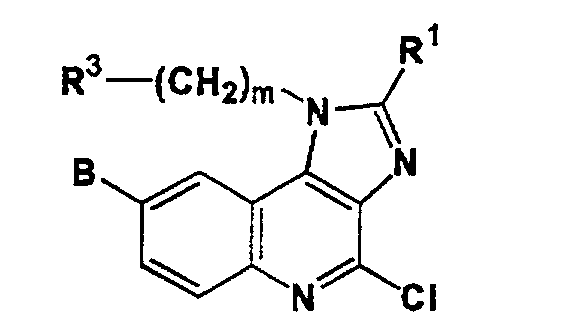
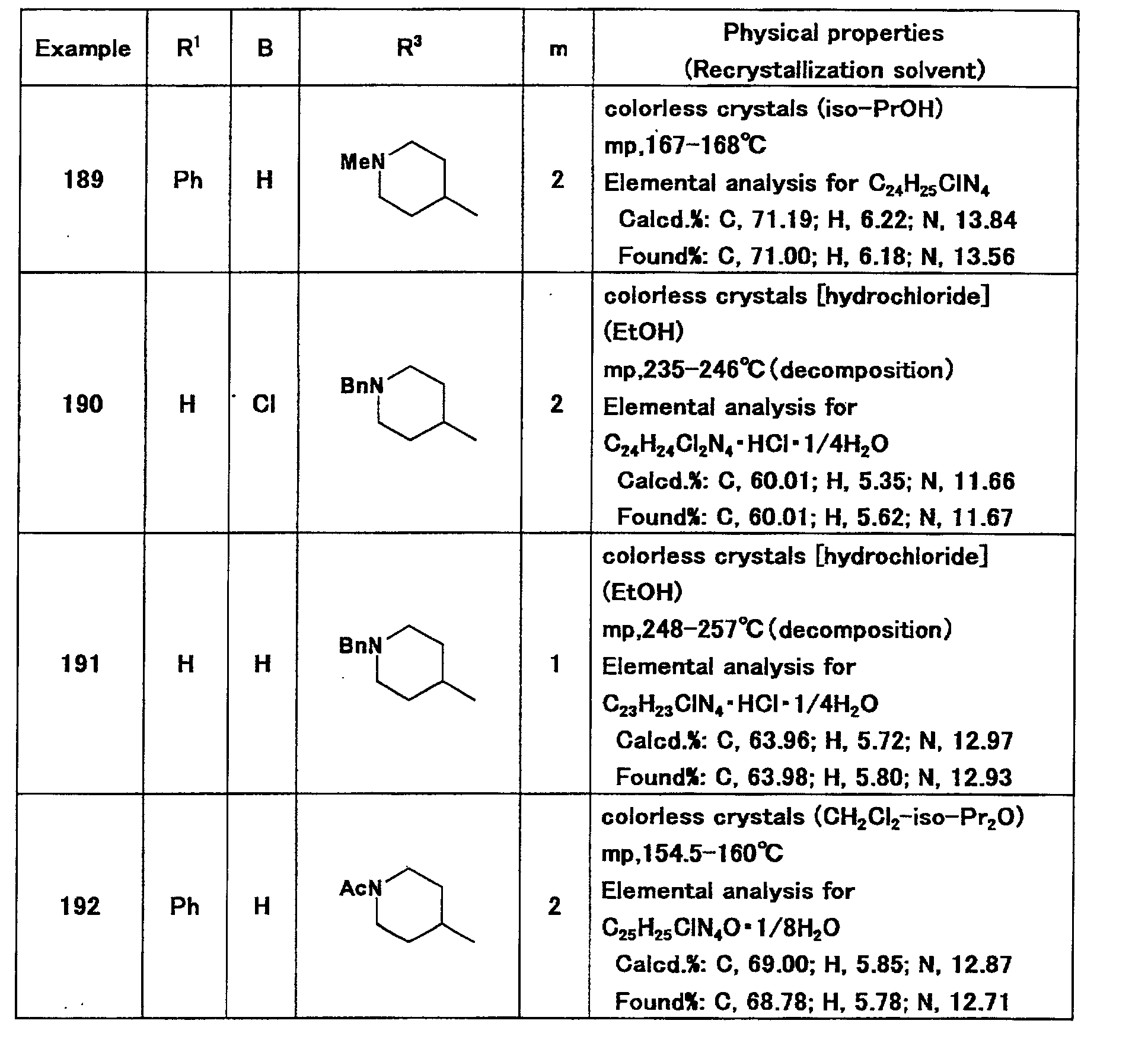

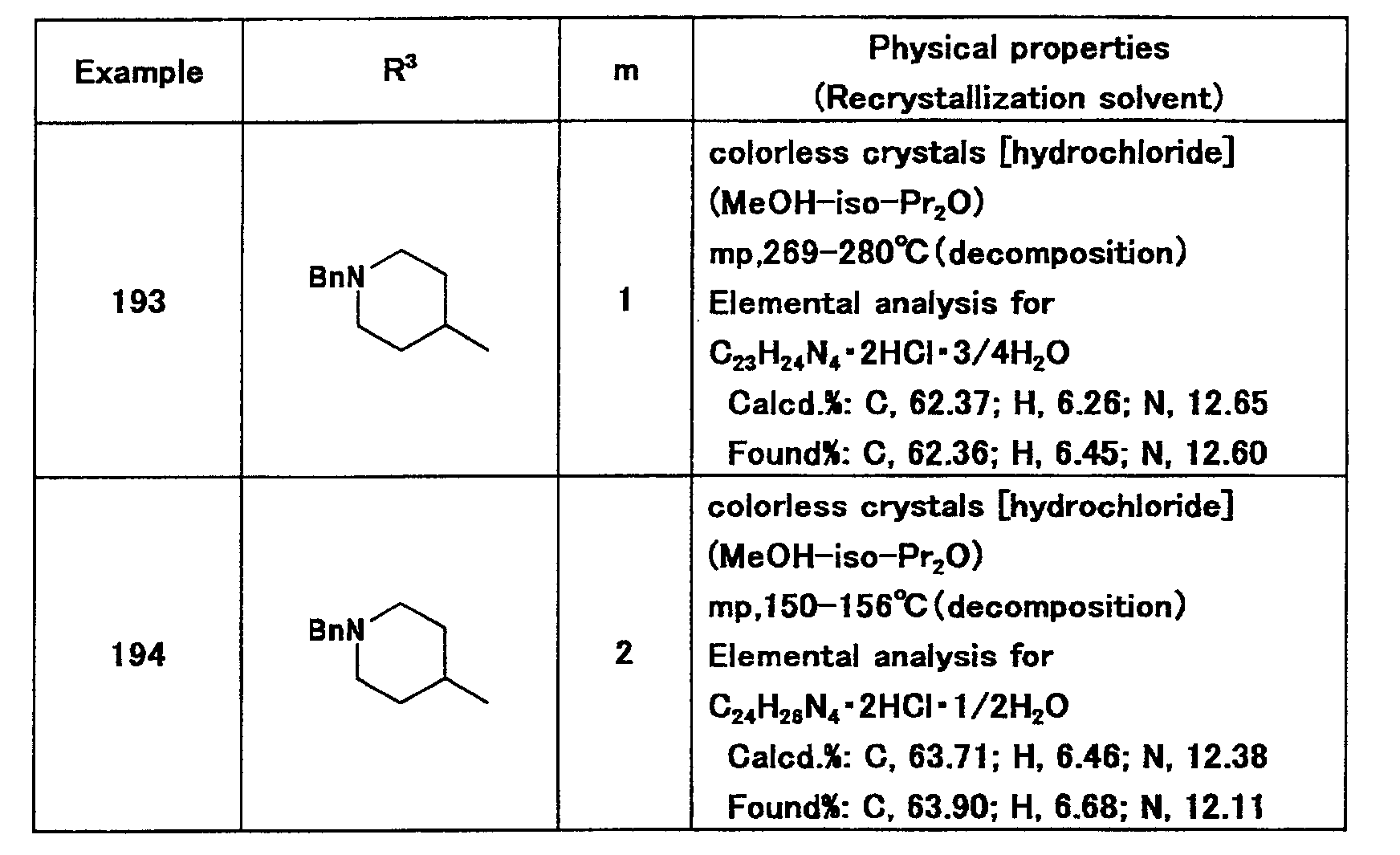
| Elemental analysis for C23H22ClFN4O2S | |||
| Calculated % | C, 58.41; | H, 4.69; | N, 11.85 |
| Found % | C, 58.43; | H, 4.52; | N, 11.88 |
| Elemental analysis for C24H26N4O3S | |||
| Calculated % | C, 63.98; | H, 5.82; | N, 12.44 |
| Found % | C, 64.01; | H, 5.96; | N, 12.28 |
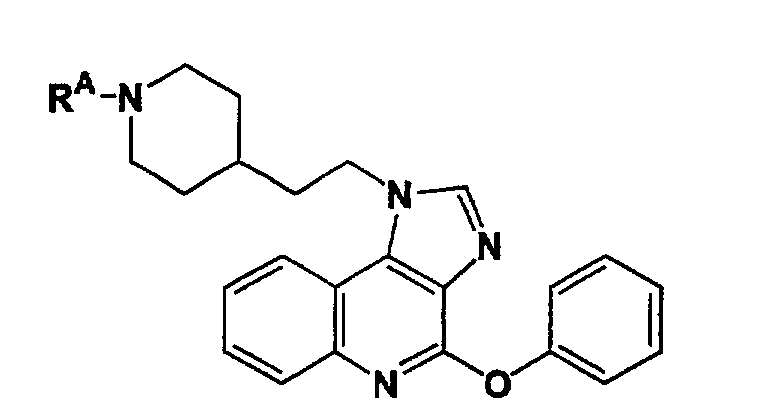
| Example | RA | Physical properties (Recrystallization solvent) |
| 197 | Ts | colorless crystals (AcOEt-iso-Pr2O) mp,201.5-202°C Elemental analysis for C30H30N4O3S Calcd.%: C, 68.42; H, 5.74; N, 10.64 Found%: C, 68.46; H, 5.83; N, 10.53 |
| 198 | EtO2C | colorless crystals (AcOEt-iso-Pr2O) mp,132-133°C Elemental analysis for C26H28N4O3 Calcd.%: C, 70.25; H, 6.35; N, 12.60 Found%: C, 70.13; H, 6.34; N, 12.50 |
| 199 | BnO2C | yellow liquid NMR spectrum δ (CDCl3)ppm: 1.31 (2H,brs),1.50-1.70(1H,m),1.78(2H,brs),2.00(2H,q,J= 7.5Hz),2.81(2H,brs),4.23(2H,brs),4.63(2H,t,J=7.5Hz),5.1 3(2H,s),7.25(1H,t,J=7Hz),7.30-7.40(5H,m),7.39(2H,d,J= 7Hz),7.44(2H,t,J=7Hz),7.50(1H,td,J=8.5,1Hz),7.57(1H,t d,J=8.5,1Hz),7.90(1H,dd,J=8.5,1Hz),7.94(1H,s),8.04(1H, dd,J=8.5,1Hz) IR spectrum ν (liq.) cm-1:1698 Mass spectrum m/z:506(M+) |
| Elemental analysis for C19H24N6S · 1/2H2O | |||
| Calculated % | C, 60.45; | H, 6.67; | N, 22.26 |
| Found % | C, 60.79; | H, 6.66; | N, 21.97 |
| Elemental analysis for C25H26ClN5S | |||
| Calculated % | C, 64.71; | H, 5.65; | N, 15.09 |
| Found % | C, 64.80; | H, 5.62; | N, 14.96 |
| Elemental analysis for C24H25ClN6 · HCl · 1/2H2O | |||
| Calculated % | C, 60.25; | H, 5.69; | N, 17.57 |
| Found % | C, 60.47; | H, 5.61; | N, 17.36 |
| Inhibitory action against TNF- α production in human cells | |||||
| Compounds | Administered concentration (µmol/L) | ||||
| 0.001 | 0.01 | 0.10 | 1.0 | 10 | |
| Example 89 | 91 | 86 | 90 | 84 | 17 |
| Example 110 | 80 | 77 | 26 | 1 | 0 |
| Example 113 | 68 | 81 | 86 | 69 | 29 |
| Example 117 | 117 | 77 | 71 | 24 | 0 |
| Example 118 | 79 | 91 | 88 | 51 | 3 |
| Example 121 | 81 | 91 | 49 | 0 | 0 |
| Inhibitory action against IL-1 β production in human cells | |||||
| Compounds | Administered concentration (µmol/L) | ||||
| 0.001 | 0.01 | 0.10 | 1.0 | 10 | |
| Example 89 | 112 | 102 | 96 | 63 | 0 |
| Example 110 | 119 | 105 | 85 | 64 | 14 |
| Example 113 | 104 | 109 | 116 | 96 | 30 |
| Example 117 | 119 | 106 | 111 | 72 | 8 |
| Example 118 | 96 | 106 | 102 | 59 | 0 |
| Example 121 | 102 | 108 | 87 | 24 | 0 |
Claims (5)
- A 1H-imidazopyridine derivative represented by the following general formula or a salt thereof:wherein R1 represents hydrogen atom, hydroxyl group, an alkyl group which may have one or more substituents, a cycloalkyl group which may be substituted, a styryl group which may be substituted, or an aryl group which may have one or more substitutents; R2 represents hydrogen atom, an alkyl group, a halogen atom, hydroxyl group, an amino group which may have one or two substituents, a cyclic amino group which may be substituted, or a phenoxy group which may be substituted; ring A represents a homocyclic or a heterocyclic ring which may be substituted with one or more alkyl groups, alkoxyl groups, or halogen atoms; R3 represents a saturated nitrogen-containing heterocyclic group which may be substituted; and m represents an integer of from 0 to 3; provided when R3 represents unsubstituted piperidino group, at least one of R1 and R2 is not hydrogen atom.
- A 1H-imidazopyridine derivative represented by the following general formula or a salt thereof:wherein R1 represents hydrogen atom, hydroxyl group, an alkyl group which may have one or more substituents, a cycloalkyl group which may be substituted, a styryl group which may be substituted, or an aryl group which may have one or more substitutents; R2 represents hydrogen atom, an alkyl group, a halogen atom, hydroxyl group, an amino group which may have one or two substituents, a cyclic amino group which may be substituted, or a phenoxy group which may be substituted; ring A represents a homocyclic or heterocyclic ring which may be substituted with one or more alkyl groups, alkoxyl groups, or halogen atoms; m represents an integer of from 0 to 3; R4 represents hydrogen atom, an alkyl group, benzyl group, triphenylmethyl group, an alkanoyl group which may be substituted, an alkoxycarbonyl group, benzyloxycarbonyl group, a thiocarbamoyl group which may be substituted, an alkanesulfonyl group, a benzenesulfonyl group which may be substituted, or amidino group; Y represents methylene group, oxygen atom, sulfur atom, nitrogen atom, a group represented by NH, or a single bond; and n represents an integer of from 0 to 2.

- The compound or the salt thereof according to claim 1 or claim 2, wherein the ring A is benzene ring or thiophene ring.
- A medicament which comprises as an active ingredient the 1H-imidazopyridine derivative or a pharmacologically acceptable salt thereof according to claim 1 or claim 2.
- The medicament according to claim 4 which is used for preventive or therapeutic treatment of a disease in which a cytokine is mediated.
Applications Claiming Priority (5)
| Application Number | Priority Date | Filing Date | Title |
|---|---|---|---|
| JP24106298 | 1998-08-12 | ||
| JP24106298 | 1998-08-12 | ||
| JP21612599 | 1999-07-30 | ||
| JP11216125A JP2000119271A (en) | 1998-08-12 | 1999-07-30 | 1H-imidazopyridine derivative |
| PCT/JP1999/004381 WO2000009506A1 (en) | 1998-08-12 | 1999-08-12 | 1h-imidazopyridine derivatives |
Publications (2)
| Publication Number | Publication Date |
|---|---|
| EP1104764A1 true EP1104764A1 (en) | 2001-06-06 |
| EP1104764A4 EP1104764A4 (en) | 2003-01-15 |
Family
ID=26521247
Family Applications (1)
| Application Number | Title | Priority Date | Filing Date |
|---|---|---|---|
| EP99937053A Withdrawn EP1104764A4 (en) | 1998-08-12 | 1999-08-12 | 1H-imidazopyridine DERIVATIVES |
Country Status (21)
| Country | Link |
|---|---|
| US (1) | US6518265B1 (en) |
| EP (1) | EP1104764A4 (en) |
| JP (1) | JP2000119271A (en) |
| CN (1) | CN1323307A (en) |
| AU (1) | AU744388B2 (en) |
| BG (1) | BG105271A (en) |
| BR (1) | BR9914306A (en) |
| CA (1) | CA2339562A1 (en) |
| CZ (1) | CZ292544B6 (en) |
| EA (1) | EA200100230A1 (en) |
| HK (1) | HK1042295A1 (en) |
| HR (1) | HRP20010144A2 (en) |
| HU (1) | HUP0103406A3 (en) |
| IL (1) | IL141226A0 (en) |
| NO (1) | NO20010676L (en) |
| NZ (1) | NZ509939A (en) |
| PL (1) | PL346155A1 (en) |
| SK (1) | SK1942001A3 (en) |
| TR (1) | TR200100439T2 (en) |
| TW (1) | TW533209B (en) |
| WO (1) | WO2000009506A1 (en) |
Cited By (116)
| Publication number | Priority date | Publication date | Assignee | Title |
|---|---|---|---|---|
| WO2002024684A1 (en) * | 2000-09-21 | 2002-03-28 | Smithkline Beecham P.L.C. | Quinoline derivatives as antibacterials |
| WO2002020489A3 (en) * | 2000-09-06 | 2002-06-06 | Bristol Myers Squibb Co | QUINOLINE INHIBITORS OF cGMP PHOSPHODIESTERASE |
| US6525064B1 (en) | 2000-12-08 | 2003-02-25 | 3M Innovative Properties Company | Sulfonamido substituted imidazopyridines |
| US6534654B2 (en) | 1996-06-21 | 2003-03-18 | 3M Innovative Properties Company | Process for preparing imidazoquinolinamines |
| US6545017B1 (en) | 2000-12-08 | 2003-04-08 | 3M Innovative Properties Company | Urea substituted imidazopyridines |
| US6545016B1 (en) | 2000-12-08 | 2003-04-08 | 3M Innovative Properties Company | Amide substituted imidazopyridines |
| US6660735B2 (en) | 2000-12-08 | 2003-12-09 | 3M Innovative Properties Company | Urea substituted imidazoquinoline ethers |
| US6664265B2 (en) | 2000-12-08 | 2003-12-16 | 3M Innovative Properties Company | Amido ether substituted imidazoquinolines |
| US6667312B2 (en) | 2000-12-08 | 2003-12-23 | 3M Innovative Properties Company | Thioether substituted imidazoquinolines |
| US6677348B2 (en) | 2000-12-08 | 2004-01-13 | 3M Innovative Properties Company | Aryl ether substituted imidazoquinolines |
| US6677347B2 (en) | 2000-12-08 | 2004-01-13 | 3M Innovative Properties Company | Sulfonamido ether substituted imidazoquinolines |
| US6677349B1 (en) | 2001-12-21 | 2004-01-13 | 3M Innovative Properties Company | Sulfonamide and sulfamide substituted imidazoquinolines |
| US6699878B2 (en) | 1997-12-11 | 2004-03-02 | 3M Innovative Properties Company | Imidazonaphthyridines |
| WO2003097641A3 (en) * | 2002-05-21 | 2004-05-06 | Novartis Ag | 1h-imidazo[4,5-c] quinoline derivatives in the treatment of protein kinase dependent diseases |
| US6780873B2 (en) | 1999-06-10 | 2004-08-24 | 3M Innovative Properties Company | Urea substituted imidazoquinolines |
| US6784188B2 (en) | 1999-06-10 | 2004-08-31 | 3M Innovative Properties Company | Urea substituted imidazoquinolines |
| US6797718B2 (en) | 2002-06-07 | 2004-09-28 | 3M Innovative Properties Company | Ether substituted imidazopyridines |
| US6818650B2 (en) | 2002-09-26 | 2004-11-16 | 3M Innovative Properties Company | 1H-imidazo dimers |
| US6825350B2 (en) | 1999-06-10 | 2004-11-30 | 3M Innovative Properties Company | Sulfonamide and sulfamide substituted imidazoquinolines and methods for the treatment of periodontal disease using these and other immune response modifiers |
| WO2005054237A1 (en) * | 2003-11-21 | 2005-06-16 | Novartis Ag | 1h-imidazoquinoline derivatives as protein kinase inhibitors |
| US6916925B1 (en) | 1999-11-05 | 2005-07-12 | 3M Innovative Properties Co. | Dye labeled imidazoquinoline compounds |
| US6921826B2 (en) | 2000-12-08 | 2005-07-26 | 3M Innovative Properties Co. | Thioether substituted imidazoquinolines |
| US6943255B2 (en) | 2003-06-06 | 2005-09-13 | 3M Innovative Properties Company | Process for imidazo[4,5-c]pyridin-4-amines |
| US6953804B2 (en) | 2000-12-08 | 2005-10-11 | 3M Innovative Properties Co. | Aryl ether substituted imidazoquinolines |
| EP1490371A4 (en) * | 2002-04-03 | 2006-03-22 | Bristol Myers Squibb Co | Thiopene-based tricyclic compounds and pharmaceutical compositions comprising same |
| US7030129B2 (en) | 2002-02-22 | 2006-04-18 | 3M Innovative Properties Company | Method of reducing and treating UVB-induced immunosuppression |
| US7091214B2 (en) | 2002-12-20 | 2006-08-15 | 3M Innovative Properties Co. | Aryl substituted Imidazoquinolines |
| WO2006107851A1 (en) * | 2005-04-01 | 2006-10-12 | Coley Pharmaceutical Group, Inc. | 1-substituted pyrazolo (3,4-c) ring compounds as modulators of cytokine biosynthesis for the treatment of viral infections and neoplastic diseases |
| WO2006070408A3 (en) * | 2004-12-27 | 2006-12-21 | Usv Ltd | A process for the preparation of substantially pure 4-amino-1-isobutyl-1h-imidazo[4,5-c]-quinoline (imiquimod) |
| US7163947B2 (en) | 2003-03-07 | 2007-01-16 | 3M Innovative Properties Company | 1-Amino 1H-imidazoquinolines |
| US7179253B2 (en) | 2003-03-13 | 2007-02-20 | 3M Innovative Properties Company | Method of tattoo removal |
| WO2007056112A2 (en) | 2005-11-04 | 2007-05-18 | Coley Pharmaceutical Group, Inc. | Hydroxy and alkoxy substituted 1h-imidazoquinolines and methods |
| US7226928B2 (en) | 2001-06-15 | 2007-06-05 | 3M Innovative Properties Company | Methods for the treatment of periodontal disease |
| US7299453B2 (en) | 2001-12-20 | 2007-11-20 | International Business Machines Corporation | Testing measurements |
| US7375180B2 (en) | 2003-02-13 | 2008-05-20 | 3M Innovative Properties Company | Methods and compositions related to IRM compounds and Toll-like receptor 8 |
| US7387271B2 (en) | 2002-12-30 | 2008-06-17 | 3M Innovative Properties Company | Immunostimulatory combinations |
| US7393859B2 (en) | 1999-06-10 | 2008-07-01 | Coley Pharmaceutical Group, Inc. | Amide substituted imidazoquinolines |
| US7427629B2 (en) | 2002-08-15 | 2008-09-23 | 3M Innovative Properties Company | Immunostimulatory compositions and methods of stimulating an immune response |
| US7485432B2 (en) | 2003-02-27 | 2009-02-03 | 3M Innovative Properties Company | Selective modulation of TLR-mediated biological activity |
| WO2009019473A1 (en) * | 2007-08-08 | 2009-02-12 | Imperial Innovations Limited | Treatments for inflammatory arthritis |
| US7544697B2 (en) | 2003-10-03 | 2009-06-09 | Coley Pharmaceutical Group, Inc. | Pyrazolopyridines and analogs thereof |
| US7579359B2 (en) | 2004-09-02 | 2009-08-25 | 3M Innovative Properties Company | 1-alkoxy 1H-imidazo ring systems and methods |
| US7648997B2 (en) | 2003-08-12 | 2010-01-19 | Coley Pharmaceutical Group, Inc. | Hydroxylamine substituted imidazoquinolines |
| US7691877B2 (en) | 2006-02-17 | 2010-04-06 | Pfizer Inc. | Pharmaceuticals |
| US7696159B2 (en) | 2003-03-25 | 2010-04-13 | Graceway Pharmaceuticals, Llc | Treatment for basal cell carcinoma |
| US7699057B2 (en) | 2003-03-13 | 2010-04-20 | 3M Innovative Properties Company | Methods for treating skin lesions |
| US7799800B2 (en) | 2003-08-14 | 2010-09-21 | 3M Innovative Properties Company | Lipid-modified immune response modifiers |
| US7884207B2 (en) | 2004-06-18 | 2011-02-08 | 3M Innovative Properties Company | Substituted imidazoquinolines, imidazopyridines, and imidazonaphthyridines |
| US7888349B2 (en) | 2003-12-29 | 2011-02-15 | 3M Innovative Properties Company | Piperazine, [1,4]Diazepane, [1,4]Diazocane, and [1,5]Diazocane fused imidazo ring compounds |
| US7897609B2 (en) | 2004-06-18 | 2011-03-01 | 3M Innovative Properties Company | Aryl substituted imidazonaphthyridines |
| US7897597B2 (en) | 2003-08-27 | 2011-03-01 | 3M Innovative Properties Company | Aryloxy and arylalkyleneoxy substituted imidazoquinolines |
| US7897767B2 (en) | 2003-11-14 | 2011-03-01 | 3M Innovative Properties Company | Oxime substituted imidazoquinolines |
| US7906506B2 (en) | 2006-07-12 | 2011-03-15 | 3M Innovative Properties Company | Substituted chiral fused [1,2] imidazo [4,5-c] ring compounds and methods |
| US7915281B2 (en) | 2004-06-18 | 2011-03-29 | 3M Innovative Properties Company | Isoxazole, dihydroisoxazole, and oxadiazole substituted imidazo ring compounds and method |
| US7923560B2 (en) | 2003-04-10 | 2011-04-12 | 3M Innovative Properties Company | Delivery of immune response modifier compounds |
| US7923429B2 (en) | 2003-09-05 | 2011-04-12 | 3M Innovative Properties Company | Treatment for CD5+ B cell lymphoma |
| US7939526B2 (en) | 2003-12-04 | 2011-05-10 | 3M Innovative Properties Company | Sulfone substituted imidazo ring ethers |
| US7943610B2 (en) | 2005-04-01 | 2011-05-17 | 3M Innovative Properties Company | Pyrazolopyridine-1,4-diamines and analogs thereof |
| US7943609B2 (en) | 2004-12-30 | 2011-05-17 | 3M Innovative Proprerties Company | Chiral fused [1,2]imidazo[4,5-C] ring compounds |
| US7968563B2 (en) | 2005-02-11 | 2011-06-28 | 3M Innovative Properties Company | Oxime and hydroxylamine substituted imidazo[4,5-c] ring compounds and methods |
| US7968562B2 (en) | 2001-11-29 | 2011-06-28 | 3M Innovative Properties Company | Pharmaceutical formulations comprising an immune response modifier |
| US7994170B2 (en) | 2005-05-20 | 2011-08-09 | Novartis Ag | 1,3-dihydro-imidazo[4,5-C]quinolin-2-ones as lipid kinase inhibitors |
| US8017779B2 (en) | 2004-06-15 | 2011-09-13 | 3M Innovative Properties Company | Nitrogen containing heterocyclyl substituted imidazoquinolines and imidazonaphthyridines |
| US8026366B2 (en) | 2004-06-18 | 2011-09-27 | 3M Innovative Properties Company | Aryloxy and arylalkyleneoxy substituted thiazoloquinolines and thiazolonaphthyridines |
| US8034938B2 (en) | 2004-12-30 | 2011-10-11 | 3M Innovative Properties Company | Substituted chiral fused [1,2]imidazo[4,5-c] ring compounds |
| US8110582B2 (en) | 2003-03-04 | 2012-02-07 | 3M Innovative Properties Company | Prophylactic treatment of UV-induced epidermal neoplasia |
| US8143270B2 (en) | 2004-09-02 | 2012-03-27 | 3M Innovative Properties Company | 2-amino 1H-in-imidazo ring systems and methods |
| US8158794B2 (en) | 2005-02-23 | 2012-04-17 | 3M Innovative Properties Company | Hydroxyalkyl substituted imidazoquinoline compounds and methods |
| US8178677B2 (en) | 2005-02-23 | 2012-05-15 | 3M Innovative Properties Company | Hydroxyalkyl substituted imidazoquinolines |
| US8178539B2 (en) | 2006-09-06 | 2012-05-15 | 3M Innovative Properties Company | Substituted 3,4,6,7-tetrahydro-5H-1,2a,4a,8-tetraazacyclopenta[cd]phenalenes and methods |
| US8188111B2 (en) | 2005-09-09 | 2012-05-29 | 3M Innovative Properties Company | Amide and carbamate derivatives of alkyl substituted N-[4-(4-amino-1H-imidazo[4,5-c]quinolin-1-yl)butyI]methanesulfonamides and methods |
| US8221771B2 (en) | 2003-08-05 | 2012-07-17 | 3M Innovative Properties Company | Formulations containing an immune response modifier |
| US8329721B2 (en) | 2006-03-15 | 2012-12-11 | 3M Innovative Properties Company | Hydroxy and alkoxy substituted 1H-imidazonaphthyridines and methods |
| US8354424B2 (en) | 2005-03-14 | 2013-01-15 | Medicis Pharmaceutical Corporation | Method of treating actinic keratosis |
| US8378102B2 (en) | 2005-02-09 | 2013-02-19 | 3M Innovative Properties Company | Oxime and hydroxylamine substituted thiazolo[4,5-c] ring compounds and methods |
| US8426457B2 (en) | 2003-03-13 | 2013-04-23 | Medicis Pharmaceutical Corporation | Methods of improving skin quality |
| US8436176B2 (en) | 2004-12-30 | 2013-05-07 | Medicis Pharmaceutical Corporation | Process for preparing 2-methyl-1-(2-methylpropyl)-1H-imidazo[4,5-c][1,5]naphthyridin-4-amine |
| US8436177B2 (en) | 2006-11-20 | 2013-05-07 | Novartis Ag | Salts and crystall forms of 2-methyl-2-[4-(3-methyl-2-oxo-8-quinolin-3-yl-2,3-dihydro-imidazo[4,5-c]quinolin-1-yl)-phenyl]-propionitrile |
| US8461174B2 (en) | 2004-12-30 | 2013-06-11 | 3M Innovative Properties Company | Treatment for cutaneous metastases |
| US8476292B2 (en) | 2005-09-09 | 2013-07-02 | 3M Innovative Properties Company | Amide and carbamate derivatives of N-{2-[4-amino-2-(ethoxymethyl)-1H-imidazo[4,5-c] quinolin-1-Yl]-1,1-dimethylethyl}methanesulfonamide and methods |
| US8541438B2 (en) | 2004-06-18 | 2013-09-24 | 3M Innovative Properties Company | Substituted imidazoquinolines, imidazopyridines, and imidazonaphthyridines |
| US8598192B2 (en) | 2003-11-14 | 2013-12-03 | 3M Innovative Properties Company | Hydroxylamine substituted imidazoquinolines |
| US8658666B2 (en) | 2005-02-11 | 2014-02-25 | 3M Innovative Properties Company | Substituted imidazoquinolines and imidazonaphthyridines |
| US8691837B2 (en) | 2003-11-25 | 2014-04-08 | 3M Innovative Properties Company | Substituted imidazo ring systems and methods |
| US8697873B2 (en) | 2004-03-24 | 2014-04-15 | 3M Innovative Properties Company | Amide substituted imidazopyridines, imidazoquinolines, and imidazonaphthyridines |
| WO2014071031A1 (en) * | 2012-11-01 | 2014-05-08 | Incyte Corporation | Tricyclic fused thiophene derivatives as jak inhibitors |
| US8735421B2 (en) | 2003-12-30 | 2014-05-27 | 3M Innovative Properties Company | Imidazoquinolinyl sulfonamides |
| US8778963B2 (en) | 2003-11-25 | 2014-07-15 | 3M Innovative Properties Company | Hydroxylamine and oxime substituted imidazoquinolines, imidazopyridines, and imidazonaphthyridines |
| US8802853B2 (en) | 2003-12-29 | 2014-08-12 | 3M Innovative Properties Company | Arylalkenyl and arylalkynyl substituted imidazoquinolines |
| US8846710B2 (en) | 2005-02-23 | 2014-09-30 | 3M Innovative Properties Company | Method of preferentially inducing the biosynthesis of interferon |
| US8871782B2 (en) | 2003-10-03 | 2014-10-28 | 3M Innovative Properties Company | Alkoxy substituted imidazoquinolines |
| US8940755B2 (en) | 2003-12-02 | 2015-01-27 | 3M Innovative Properties Company | Therapeutic combinations and methods including IRM compounds |
| US8961477B2 (en) | 2003-08-25 | 2015-02-24 | 3M Innovative Properties Company | Delivery of immune response modifier compounds |
| EP2763677A4 (en) * | 2011-10-04 | 2015-05-20 | Janus Biotherapeutics Inc | NEW MODULATORS OF IMIDAZOLE QUINOLINE IMMUNE SYSTEM |
| US9079912B2 (en) | 2005-12-13 | 2015-07-14 | Incyte Corporation | Heteroaryl substituted pyrrolo[2,3-B] pyridines and pyrrolo[2,3-B] pyrimidines as Janus kinase inhibitors |
| US9107958B2 (en) | 2011-06-03 | 2015-08-18 | 3M Innovative Properties Company | Hydrazino 1H-imidazoquinolin-4-amines and conjugates made therefrom |
| US9145410B2 (en) | 2003-10-03 | 2015-09-29 | 3M Innovative Properties Company | Pyrazolopyridines and analogs thereof |
| US9242980B2 (en) | 2010-08-17 | 2016-01-26 | 3M Innovative Properties Company | Lipidated immune response modifier compound compositions, formulations, and methods |
| US9248127B2 (en) | 2005-02-04 | 2016-02-02 | 3M Innovative Properties Company | Aqueous gel formulations containing immune response modifiers |
| US9475804B2 (en) | 2011-06-03 | 2016-10-25 | 3M Innovative Properties Company | Heterobifunctional linkers with polyethylene glycol segments and immune response modifier conjugates made therefrom |
| US9546184B2 (en) | 2005-02-09 | 2017-01-17 | 3M Innovative Properties Company | Alkyloxy substituted thiazoloquinolines and thiazolonaphthyridines |
| US9586959B2 (en) | 2011-09-30 | 2017-03-07 | C&C Research Laboratories | Substituted tricyclic heterocycles as histamine 4 receptor inhibitors |
| US9611269B2 (en) | 2011-06-20 | 2017-04-04 | Incyte Corporation | Azetidinyl phenyl, pyridyl or pyrazinyl carboxamide derivatives as JAK inhibitors |
| US9623029B2 (en) | 2009-05-22 | 2017-04-18 | Incyte Holdings Corporation | 3-[4-(7H-pyrrolo[2,3-d]pyrimidin-4-yl)-1H-pyrazol-1-yl]octane- or heptane-nitrile as JAK inhibitors |
| US9655854B2 (en) | 2013-08-07 | 2017-05-23 | Incyte Corporation | Sustained release dosage forms for a JAK1 inhibitor |
| US9718834B2 (en) | 2011-09-07 | 2017-08-01 | Incyte Corporation | Processes and intermediates for making a JAK inhibitor |
| US9801947B2 (en) | 2003-04-10 | 2017-10-31 | 3M Innovative Properties Company | Methods and compositions for enhancing immune response |
| US9802957B2 (en) | 2014-04-30 | 2017-10-31 | Incyte Corporation | Processes of preparing a JAK1 inhibitor and new forms thereto |
| US10005772B2 (en) | 2006-12-22 | 2018-06-26 | 3M Innovative Properties Company | Immune response modifier compositions and methods |
| US10166191B2 (en) | 2012-11-15 | 2019-01-01 | Incyte Corporation | Sustained-release dosage forms of ruxolitinib |
| IL265358A (en) * | 2016-10-03 | 2019-05-30 | Tll Pharmaceutical Llc | Selective jak1 inhibitors and their uses |
| US10640506B2 (en) | 2010-11-19 | 2020-05-05 | Incyte Holdings Corporation | Cyclobutyl substituted pyrrolopyridine and pyrrolopyrimidines derivatives as JAK inhibitors |
| US11285140B2 (en) | 2010-03-10 | 2022-03-29 | Incyte Corporation | Piperidin-4-yl azetidine derivatives as JAK1 inhibitors |
| US11304949B2 (en) | 2018-03-30 | 2022-04-19 | Incyte Corporation | Treatment of hidradenitis suppurativa using JAK inhibitors |
| US11306083B2 (en) | 2017-12-20 | 2022-04-19 | 3M Innovative Properties Company | Amide substituted imidazo[4,5-C]quinoline compounds with a branched chain linking group for use as an immune response modifier |
| US11833155B2 (en) | 2020-06-03 | 2023-12-05 | Incyte Corporation | Combination therapy for treatment of myeloproliferative neoplasms |
Families Citing this family (98)
| Publication number | Priority date | Publication date | Assignee | Title |
|---|---|---|---|---|
| US6518280B2 (en) | 1998-12-11 | 2003-02-11 | 3M Innovative Properties Company | Imidazonaphthyridines |
| NZ512628A (en) | 1999-01-08 | 2004-03-26 | 3M Innovative Properties Co | Formulations and methods for treatment of mucosal associated conditions with an immune response modifier |
| US20020058674A1 (en) | 1999-01-08 | 2002-05-16 | Hedenstrom John C. | Systems and methods for treating a mucosal surface |
| US6486168B1 (en) | 1999-01-08 | 2002-11-26 | 3M Innovative Properties Company | Formulations and methods for treatment of mucosal associated conditions with an immune response modifier |
| US6558951B1 (en) * | 1999-02-11 | 2003-05-06 | 3M Innovative Properties Company | Maturation of dendritic cells with immune response modifying compounds |
| US6451810B1 (en) | 1999-06-10 | 2002-09-17 | 3M Innovative Properties Company | Amide substituted imidazoquinolines |
| AU7922900A (en) | 1999-10-27 | 2001-05-08 | Novartis Ag | Thiazole and imidazo (4,5-b) pyridine compounds and their pharmaceutical use |
| US6376669B1 (en) | 1999-11-05 | 2002-04-23 | 3M Innovative Properties Company | Dye labeled imidazoquinoline compounds |
| JP3436512B2 (en) * | 1999-12-28 | 2003-08-11 | 株式会社デンソー | Accelerator device |
| EP1256582A1 (en) * | 2000-02-09 | 2002-11-13 | Hokuriku Seiyaku Co., Ltd. | 1h-imidazopyridine derivatives |
| US6894060B2 (en) | 2000-03-30 | 2005-05-17 | 3M Innovative Properties Company | Method for the treatment of dermal lesions caused by envenomation |
| WO2002016370A1 (en) * | 2000-08-22 | 2002-02-28 | Hokuriku Seiyaku Co., Ltd. | 1h-imidazopyridine derivatives |
| US7087224B2 (en) * | 2000-10-31 | 2006-08-08 | Amgen Inc. | Method of treating anemia by administering IL-1ra |
| US6664260B2 (en) | 2000-12-08 | 2003-12-16 | 3M Innovative Properties Company | Heterocyclic ether substituted imidazoquinolines |
| US20060142202A1 (en) * | 2000-12-08 | 2006-06-29 | 3M Innovative Properties Company | Compositions and methods for targeted delivery of immune response modifiers |
| US6660747B2 (en) * | 2000-12-08 | 2003-12-09 | 3M Innovative Properties Company | Amido ether substituted imidazoquinolines |
| AU2003271185A1 (en) * | 2002-10-15 | 2004-05-04 | Takeda Pharmaceutical Company Limited | Imidazopyridine derivative, process for producing the same, and use |
| US8034831B2 (en) * | 2002-11-06 | 2011-10-11 | Celgene Corporation | Methods for the treatment and management of myeloproliferative diseases using 4-(amino)-2-(2,6-Dioxo(3-piperidyl)-isoindoline-1,3-dione in combination with other therapies |
| US7563810B2 (en) * | 2002-11-06 | 2009-07-21 | Celgene Corporation | Methods of using 3-(4-amino-1-oxo-1,3-dihydroisoindol-2-yl)-piperidine-2,6-dione for the treatment and management of myeloproliferative diseases |
| US7608716B2 (en) * | 2002-11-06 | 2009-10-27 | Aska Pharmaceutical Co., Ltd. | Pyrazolonaphthyridine derivative |
| WO2004080398A2 (en) * | 2003-03-07 | 2004-09-23 | 3M Innovative Properties Company | 1-amino 1h-imidazoquinolines |
| WO2004096144A2 (en) * | 2003-04-28 | 2004-11-11 | 3M Innovative Properties Company | Compositions and methods for induction of opioid receptors |
| WO2004110992A2 (en) * | 2003-06-06 | 2004-12-23 | 3M Innovative Properties Company | Process for imidazo[4,5-c] pyridin-4-amines |
| MY157827A (en) * | 2003-06-27 | 2016-07-29 | 3M Innovative Properties Co | Sulfonamide substituted imidazoquinolines |
| KR20060054371A (en) * | 2003-07-31 | 2006-05-22 | 쓰리엠 이노베이티브 프로퍼티즈 컴파니 | Compositions for Encapsulation and Controlled Release |
| US7678909B1 (en) * | 2003-08-13 | 2010-03-16 | Takeda Pharmaceutical Company Limited | Dipeptidyl peptidase inhibitors |
| AU2004266162A1 (en) * | 2003-08-25 | 2005-03-03 | 3M Innovative Properties Company | Immunostimulatory combinations and treatments |
| WO2005020995A1 (en) * | 2003-09-02 | 2005-03-10 | 3M Innovative Properties Company | Methods related to the treatment of mucosal associated conditions |
| US20090075980A1 (en) * | 2003-10-03 | 2009-03-19 | Coley Pharmaceutical Group, Inc. | Pyrazolopyridines and Analogs Thereof |
| EP1680080A4 (en) * | 2003-10-31 | 2007-10-31 | 3M Innovative Properties Co | Neutrophil activation by immune response modifier compounds |
| US20050226878A1 (en) * | 2003-12-02 | 2005-10-13 | 3M Innovative Properties Company | Therapeutic combinations and methods including IRM compounds |
| EP1699398A4 (en) * | 2003-12-30 | 2007-10-17 | 3M Innovative Properties Co | Enhancement of immune responses |
| WO2005087775A1 (en) * | 2004-03-15 | 2005-09-22 | Ono Pharmaceutical Co., Ltd. | Tricyclic heterocyclic compound and medicinal composition containing the compound as active ingredient |
| ES2665342T3 (en) | 2004-03-15 | 2018-04-25 | Meda Ab | Formulations and methods for immune response modifiers |
| US20070166384A1 (en) * | 2004-04-09 | 2007-07-19 | Zarraga Isidro Angelo E | Methods , composition and preparations for delivery of immune response modifiers |
| EP1755665A4 (en) * | 2004-04-28 | 2010-03-03 | 3M Innovative Properties Co | Compositions and methods for mucosal vaccination |
| AU2005294805B2 (en) | 2004-05-28 | 2012-02-16 | Oryxe | A mixture for transdermal delivery of low and high molecular weight compounds |
| US20050267145A1 (en) * | 2004-05-28 | 2005-12-01 | Merrill Bryon A | Treatment for lung cancer |
| US20080015184A1 (en) * | 2004-06-14 | 2008-01-17 | 3M Innovative Properties Company | Urea Substituted Imidazopyridines, Imidazoquinolines, and Imidazonaphthyridines |
| EP1786450A4 (en) * | 2004-08-27 | 2009-11-11 | 3M Innovative Properties Co | Hiv immunostimulatory compositions |
| WO2006026760A2 (en) * | 2004-09-02 | 2006-03-09 | 3M Innovative Properties Company | 1-amino imidazo-containing compounds and methods |
| US20080193468A1 (en) * | 2004-09-08 | 2008-08-14 | Children's Medical Center Corporation | Method for Stimulating the Immune Response of Newborns |
| JP2008515928A (en) * | 2004-10-08 | 2008-05-15 | スリーエム イノベイティブ プロパティズ カンパニー | Adjuvants for DNA vaccines |
| CA2592897A1 (en) * | 2004-12-30 | 2006-07-13 | Takeda Pharmaceutical Company Limited | 1-(2-methylpropyl)-1h-imidazo[4,5-c][1,5]naphthyridin-4-amine ethanesulfonate and 1-(2-methylpropyl)-1h-imidazo[4,5-c][1,5]naphthyridin-4-amine methanesulfonate |
| US7683171B2 (en) | 2005-02-04 | 2010-03-23 | Bristol-Myers Squibb Company | 1H-imidazo[4,5-d]thieno[3,2-b]pyridine based tricyclic compounds and pharmaceutical compositions comprising same |
| CA2598639A1 (en) | 2005-02-23 | 2006-08-31 | Coley Pharmaceutical Group, Inc. | Hydroxyalkyl substituted imidazonaphthyridines |
| JP2008539252A (en) * | 2005-04-25 | 2008-11-13 | スリーエム イノベイティブ プロパティズ カンパニー | Immune activation composition |
| JP2008545008A (en) * | 2005-06-30 | 2008-12-11 | プロシディオン・リミテッド | GPCR agonist |
| EP1948185A4 (en) * | 2005-11-10 | 2010-04-21 | Glaxosmithkline Llc | Inhibitors of akt activity |
| WO2007058879A2 (en) * | 2005-11-10 | 2007-05-24 | Smithkline Beecham Corporation | Inhibitors of akt activity |
| EP1988896A4 (en) | 2006-02-22 | 2011-07-27 | 3M Innovative Properties Co | Immune response modifier conjugates |
| HUE029236T2 (en) | 2007-06-13 | 2017-02-28 | Incyte Holdings Corp | Crystalline salts of the janus kinase inhibitor (r)-3-(4-(7h-pyrrolo[2,3-d]pyrimidin-4-yl)-1h-pyrazol-1-yl)-3-cyclopentylpropanenitrile |
| WO2009125808A1 (en) * | 2008-04-11 | 2009-10-15 | 第一三共株式会社 | Aminocyclohexyl derivative |
| WO2009125809A1 (en) * | 2008-04-11 | 2009-10-15 | 第一三共株式会社 | Piperidine derivatives |
| MY156727A (en) | 2009-05-22 | 2016-03-15 | Incyte Corp | N-(hetero)aryl-pyrrolidine derivatives of pyrazol-4-yl-pyrrolo[2,3-d]pyrimidines and pyrrol-3-yl-pyrrolo[2,3-d]pyrimidines as janus kinase inhibitors |
| US20110033515A1 (en) * | 2009-08-04 | 2011-02-10 | Rst Implanted Cell Technology | Tissue contacting material |
| TW201113285A (en) | 2009-09-01 | 2011-04-16 | Incyte Corp | Heterocyclic derivatives of pyrazol-4-yl-pyrrolo[2,3-d]pyrimidines as janus kinase inhibitors |
| AR084691A1 (en) | 2010-05-21 | 2013-06-05 | Incyte Corp | TOPICAL USE FORMULATION FOR A JAK INHIBITOR AND METHOD TO TREAT SKIN DISORDER |
| KR20140014104A (en) * | 2010-12-06 | 2014-02-05 | 피라말 엔터프라이지즈 리미티드 | Substituted imidazoquinoline derivatives |
| US20130023736A1 (en) | 2011-07-21 | 2013-01-24 | Stanley Dale Harpstead | Systems for drug delivery and monitoring |
| TW201313721A (en) | 2011-08-18 | 2013-04-01 | Incyte Corp | Cyclohexyl azetidine derivatives as JAK inhibitors |
| WO2013162828A1 (en) | 2012-04-27 | 2013-10-31 | The United States Of America, As Represented By The Secretary, Department Of Health & Human Services | Use of cpg oligonucleotides co-formulated with an antibiotic to accelarate wound healing |
| TW201406761A (en) | 2012-05-18 | 2014-02-16 | Incyte Corp | Piperidinylcyclobutyl substituted pyrrolopyridine and pyrrolopyrimidine derivatives as JAK inhibitors |
| AU2014203896B2 (en) | 2013-01-07 | 2018-05-31 | The Trustees Of The University Of Pennsylvania | Compositions and methods for treating cutaneous T cell lymphoma |
| MX384910B (en) | 2013-03-06 | 2025-03-14 | Incyte Holdings Corp | PROCESSES AND INTERMEDIATE FOR MAKING A JAK INHIBITOR. |
| WO2014201245A1 (en) | 2013-06-12 | 2014-12-18 | The United States Of America, As Represented By The Secretary, Department Of Health And Human Services | Tlr-9 agonist with tlr-7 and/or tlr-8 agonist for treating tumors |
| US9227969B2 (en) * | 2013-08-14 | 2016-01-05 | Novartis Ag | Compounds and compositions as inhibitors of MEK |
| WO2015171526A2 (en) * | 2014-05-05 | 2015-11-12 | Global Blood Therapeutics, Inc. | Tricyclic pyrazolopyridine compounds |
| WO2015184305A1 (en) | 2014-05-30 | 2015-12-03 | Incyte Corporation | TREATMENT OF CHRONIC NEUTROPHILIC LEUKEMIA (CNL) AND ATYPICAL CHRONIC MYELOID LEUKEMIA (aCML) BY INHIBITORS OF JAK1 |
| WO2016183371A1 (en) | 2015-05-13 | 2016-11-17 | The United States Of America, As Represented By The Secretary, Department Of Health & Human Services | Methods for the treatment or prevention of ischemic tissue damage |
| US10799580B2 (en) | 2015-09-09 | 2020-10-13 | The United States Of America, As Represented By The Secretary, Department Of Health And Human Services | Expression vector delivery system and use thereof for inducing an immune response |
| US11260018B2 (en) | 2015-09-17 | 2022-03-01 | Jrx Biotechnology, Inc. | Approaches for improving skin hydration and moisturization |
| WO2017059280A1 (en) | 2015-10-02 | 2017-04-06 | The University Of North Carolina At Chapel Hill | Novel pan-tam inhibitors and mer/axl dual inhibitors |
| US11191821B2 (en) | 2016-02-27 | 2021-12-07 | The United States Of America As Represented By The Secretary, Department Of Health And Human Services | Peptide vaccine formulations and use thereof for inducing an immune response |
| KR102009756B1 (en) * | 2017-01-06 | 2019-08-12 | 고려대학교 세종산학협력단 | Novel quinolinone derivatives and pharmaceutical composition for prevention or treatment of allergic diseases including asthma or atopic dermatitis comprising the same |
| WO2018128407A1 (en) * | 2017-01-06 | 2018-07-12 | 고려대학교 세종산학협력단 | Novel quinolinone derivative and pharmaceutical composition for preventing or treating allergic disease such as asthma or atopy comprising same as active ingredient |
| CA3057715A1 (en) | 2017-04-04 | 2018-10-11 | Avidea Technologies, Inc. | Peptide-based vaccines, methods of manufacturing, and uses thereof for inducing an immune response |
| US10596161B2 (en) | 2017-12-08 | 2020-03-24 | Incyte Corporation | Low dose combination therapy for treatment of myeloproliferative neoplasms |
| JP7393348B2 (en) | 2018-01-30 | 2023-12-06 | インサイト・コーポレイション | Process and intermediates for producing (1-(3-fluoro-2(trifluoromethyl)isonicotinyl)piperidin-4-one) |
| WO2019166946A1 (en) | 2018-02-28 | 2019-09-06 | Pfizer Inc. | Il-15 variants and uses thereof |
| EP3796943A2 (en) | 2018-05-22 | 2021-03-31 | Avidea Technologies, Inc. | Improved methods of manufacturing peptide-based vaccines |
| BR112020022595A2 (en) | 2018-05-23 | 2021-02-09 | Pfizer Inc. | specific antibodies to gucy2c and uses thereof |
| DK3797121T3 (en) | 2018-05-23 | 2024-07-08 | Pfizer | Antibodies specific for CD3 and uses thereof |
| WO2020061564A1 (en) | 2018-09-23 | 2020-03-26 | The United States Of America, As Represented By The Secretary, Department Of Health And Human Services | Hiv-1 env fusion peptide nanoparticle carrier conjugates and their use |
| US20210393523A1 (en) | 2018-10-03 | 2021-12-23 | Avldea Technologies, Inc. | Aromatic ring substituted amphiphilic polymers as drug delivery systems |
| WO2020128893A1 (en) | 2018-12-21 | 2020-06-25 | Pfizer Inc. | Combination treatments of cancer comprising a tlr agonist |
| WO2020214858A1 (en) | 2019-04-17 | 2020-10-22 | Avidea Technologies, Inc. | Compositions and methods of manufacturing star polymers for ligand display and/or drug delivery |
| US11702474B2 (en) | 2019-12-17 | 2023-07-18 | Pfizer Inc. | Antibodies specific for CD47, PD-L1, and uses thereof |
| CA3189590A1 (en) | 2020-07-17 | 2022-01-20 | Pfizer Inc. | Therapeutic antibodies and their uses |
| CA3193244A1 (en) | 2020-09-22 | 2022-03-31 | Geoffrey Martin Lynn | Compositions and methods of manufacturing amphiphilic block copolymers that form nanoparticles in situ |
| ES3054165T3 (en) | 2020-10-16 | 2026-01-30 | Shanghai De Novo Pharmatech Co Ltd | Triheterocyclic derivative, and pharmaceutical composition and application thereof |
| AU2021364709A1 (en) | 2020-10-19 | 2023-06-01 | Barinthus Biotherapeutics North America, Inc. | Star polymer drug conjugates |
| EP4263553A4 (en) * | 2020-12-17 | 2025-03-12 | Zymeworks BC Inc. | IMIDAZOTHIENOPYRIDINE COMPOUNDS AND METHODS OF USE THEREOF |
| AU2022224567A1 (en) | 2021-02-16 | 2023-08-24 | Barinthus Biotherapeutics North America, Inc. | Self-assembling nanoparticles based on amphiphilic peptides |
| AU2023367778A1 (en) | 2022-10-25 | 2025-05-01 | Barinthus Biotherapeutics North America, Inc. | Combination treatment regimes for treating cancer |
| EP4608455A1 (en) | 2022-10-25 | 2025-09-03 | Barinthus Biotherapeutics North America, Inc. | Self-assembling nanoparticles |
| KR20250102088A (en) | 2022-11-09 | 2025-07-04 | 메르크 파텐트 게엠베하 | Toll-like receptor 7 agonist as an immunostimulant for inducing innate antitumor immunity |
| WO2025104289A1 (en) | 2023-11-17 | 2025-05-22 | Medincell S.A. | Antineoplastic combinations |
Family Cites Families (13)
| Publication number | Priority date | Publication date | Assignee | Title |
|---|---|---|---|---|
| US346905A (en) * | 1886-08-10 | Heney gulick | ||
| CA1271477A (en) | 1983-11-18 | 1990-07-10 | John F. Gerster | 1h-imidazo[4,5-c]quinolin-4-amines |
| IL73534A (en) * | 1983-11-18 | 1990-12-23 | Riker Laboratories Inc | 1h-imidazo(4,5-c)quinoline-4-amines,their preparation and pharmaceutical compositions containing certain such compounds |
| EP0223124B1 (en) | 1985-11-06 | 1991-06-12 | Merck & Co. Inc. | Substituted aminosulfonyl 6-nitrobenzoic-esters or amides, processes for their preparation and pharmaceutical compositions containing them |
| US4988815A (en) | 1989-10-26 | 1991-01-29 | Riker Laboratories, Inc. | 3-Amino or 3-nitro quinoline compounds which are intermediates in preparing 1H-imidazo[4,5-c]quinolines |
| CA2043715C (en) | 1990-06-01 | 1997-01-07 | Fumio Suzuki | Imidazonaphthyridine derivatives |
| US5389640A (en) | 1991-03-01 | 1995-02-14 | Minnesota Mining And Manufacturing Company | 1-substituted, 2-substituted 1H-imidazo[4,5-c]quinolin-4-amines |
| US5268376A (en) * | 1991-09-04 | 1993-12-07 | Minnesota Mining And Manufacturing Company | 1-substituted 1H-imidazo[4,5-c]quinolin-4-amines |
| JP3206078B2 (en) | 1992-01-28 | 2001-09-04 | 株式会社ノーリツ | Combustor model selection device |
| US5352784A (en) | 1993-07-15 | 1994-10-04 | Minnesota Mining And Manufacturing Company | Fused cycloalkylimidazopyridines |
| AU7626496A (en) | 1995-12-01 | 1997-06-27 | Ciba-Geigy Ag | Heteroaryl compounds |
| JPH09208584A (en) * | 1996-01-29 | 1997-08-12 | Terumo Corp | Amide derivative, pharmaceutical preparation containing the same, and intermediate for synthesizing the same |
| JP4101302B2 (en) | 1997-01-09 | 2008-06-18 | テルモ株式会社 | Novel amide derivatives and synthetic intermediates |
-
1999
- 1999-07-30 JP JP11216125A patent/JP2000119271A/en active Pending
- 1999-08-11 TW TW088113701A patent/TW533209B/en active
- 1999-08-12 TR TR2001/00439T patent/TR200100439T2/en unknown
- 1999-08-12 CA CA002339562A patent/CA2339562A1/en not_active Abandoned
- 1999-08-12 EP EP99937053A patent/EP1104764A4/en not_active Withdrawn
- 1999-08-12 WO PCT/JP1999/004381 patent/WO2000009506A1/en not_active Ceased
- 1999-08-12 HR HR20010144A patent/HRP20010144A2/en not_active Application Discontinuation
- 1999-08-12 BR BR9914306-2A patent/BR9914306A/en not_active IP Right Cessation
- 1999-08-12 US US09/744,959 patent/US6518265B1/en not_active Expired - Fee Related
- 1999-08-12 HK HK02103246.4A patent/HK1042295A1/en unknown
- 1999-08-12 AU AU51974/99A patent/AU744388B2/en not_active Ceased
- 1999-08-12 SK SK194-2001A patent/SK1942001A3/en unknown
- 1999-08-12 PL PL99346155A patent/PL346155A1/en unknown
- 1999-08-12 IL IL14122699A patent/IL141226A0/en unknown
- 1999-08-12 CN CN99812056A patent/CN1323307A/en active Pending
- 1999-08-12 CZ CZ2001503A patent/CZ292544B6/en not_active IP Right Cessation
- 1999-08-12 HU HU0103406A patent/HUP0103406A3/en unknown
- 1999-08-12 EA EA200100230A patent/EA200100230A1/en unknown
- 1999-08-12 NZ NZ509939A patent/NZ509939A/en unknown
-
2001
- 2001-02-09 NO NO20010676A patent/NO20010676L/en unknown
- 2001-02-19 BG BG105271A patent/BG105271A/en unknown
Cited By (224)
| Publication number | Priority date | Publication date | Assignee | Title |
|---|---|---|---|---|
| US6613902B2 (en) | 1996-06-21 | 2003-09-02 | 3M Innovative Properties Company | Process for preparing imidazoquinolinamines |
| US6897314B2 (en) | 1996-06-21 | 2005-05-24 | 3M Innovative Properties Company | Process for preparing imidazoquinolinamines |
| US7026482B2 (en) | 1996-06-21 | 2006-04-11 | Gerster John F | Process for preparing imidazoquinolinamines |
| US6534654B2 (en) | 1996-06-21 | 2003-03-18 | 3M Innovative Properties Company | Process for preparing imidazoquinolinamines |
| US6624305B2 (en) | 1996-06-21 | 2003-09-23 | 3M Innovative Properties Company | Process for preparing imidazoquinolinamines |
| US7038051B2 (en) | 1997-12-11 | 2006-05-02 | 3M Innovative Properties Company | Imidazonaphthyridines |
| US6699878B2 (en) | 1997-12-11 | 2004-03-02 | 3M Innovative Properties Company | Imidazonaphthyridines |
| US6747040B2 (en) | 1997-12-11 | 2004-06-08 | 3M Innovative Properties Company | Imidazonaphthyridines |
| US7678918B2 (en) | 1997-12-11 | 2010-03-16 | 3M Innovative Properties Company | Intermediates for imidazonaphthyridines |
| US6797716B2 (en) | 1997-12-11 | 2004-09-28 | 3M Innovative Properties Company | Imidazonaphthyridines |
| US7335773B2 (en) | 1997-12-11 | 2008-02-26 | Graceway Pharmaceuticals, Llc | Intermediates for imidazonaphthyridines |
| US6894165B2 (en) * | 1997-12-11 | 2005-05-17 | 3M Innovative Properties Company | Imidazonaphthyridines |
| US6949646B2 (en) | 1997-12-11 | 2005-09-27 | 3M Innovative Properties Co. | Imidazonaphthyridines |
| US6784188B2 (en) | 1999-06-10 | 2004-08-31 | 3M Innovative Properties Company | Urea substituted imidazoquinolines |
| US6897221B2 (en) | 1999-06-10 | 2005-05-24 | 3M Innovative Properties Company | Urea substituted imidazoquinolines |
| US7393859B2 (en) | 1999-06-10 | 2008-07-01 | Coley Pharmaceutical Group, Inc. | Amide substituted imidazoquinolines |
| US6825350B2 (en) | 1999-06-10 | 2004-11-30 | 3M Innovative Properties Company | Sulfonamide and sulfamide substituted imidazoquinolines and methods for the treatment of periodontal disease using these and other immune response modifiers |
| US7157453B2 (en) | 1999-06-10 | 2007-01-02 | 3M Innovation Properties Company | Urea substituted imidazoquinolines |
| US6780873B2 (en) | 1999-06-10 | 2004-08-24 | 3M Innovative Properties Company | Urea substituted imidazoquinolines |
| US6916925B1 (en) | 1999-11-05 | 2005-07-12 | 3M Innovative Properties Co. | Dye labeled imidazoquinoline compounds |
| WO2002020489A3 (en) * | 2000-09-06 | 2002-06-06 | Bristol Myers Squibb Co | QUINOLINE INHIBITORS OF cGMP PHOSPHODIESTERASE |
| WO2002024684A1 (en) * | 2000-09-21 | 2002-03-28 | Smithkline Beecham P.L.C. | Quinoline derivatives as antibacterials |
| EP1719770A3 (en) * | 2000-09-21 | 2008-03-05 | Smithkline Beecham Plc | Quinoline derivatives as antibacterials |
| US6720334B2 (en) | 2000-12-08 | 2004-04-13 | 3M Innovative Properties Company | Urea substituted imidazopyridines |
| US7612083B2 (en) | 2000-12-08 | 2009-11-03 | Coley Pharmaceutical Group, Inc. | Urea substituted imidazoquinoline ethers |
| US6525064B1 (en) | 2000-12-08 | 2003-02-25 | 3M Innovative Properties Company | Sulfonamido substituted imidazopyridines |
| US6545017B1 (en) | 2000-12-08 | 2003-04-08 | 3M Innovative Properties Company | Urea substituted imidazopyridines |
| US6545016B1 (en) | 2000-12-08 | 2003-04-08 | 3M Innovative Properties Company | Amide substituted imidazopyridines |
| US6878719B2 (en) | 2000-12-08 | 2005-04-12 | 3M Innovative Properties Company | Sulfonamido substituted imidazopyridines |
| US7288550B2 (en) | 2000-12-08 | 2007-10-30 | 3M Innovative Properties Company | Thioether substituted imidazoquinolines |
| US6720422B2 (en) | 2000-12-08 | 2004-04-13 | 3M Innovative Properties Company | Amide substituted imidazopyridines |
| US6720333B2 (en) | 2000-12-08 | 2004-04-13 | 3M Innovative Properties Company | Amide substituted imidazopyridines |
| US6716988B2 (en) | 2000-12-08 | 2004-04-06 | 3M Innovative Properties Company | Urea substituted imidazopyridines |
| US6903113B2 (en) | 2000-12-08 | 2005-06-07 | 3M Innovative Properties Company | Urea substituted imidazopyridines |
| US7276515B2 (en) | 2000-12-08 | 2007-10-02 | Coley Pharmaceutical Group, Inc. | Thioether substituted imidazoquinolines |
| US6696465B2 (en) | 2000-12-08 | 2004-02-24 | 3M Innovative Properties Company | Sulfonamido substituted imidazopyridines |
| US6921826B2 (en) | 2000-12-08 | 2005-07-26 | 3M Innovative Properties Co. | Thioether substituted imidazoquinolines |
| US7214675B2 (en) | 2000-12-08 | 2007-05-08 | 3M Innovative Properties Company | Urea substituted imidazoquinoline ethers |
| US6660735B2 (en) | 2000-12-08 | 2003-12-09 | 3M Innovative Properties Company | Urea substituted imidazoquinoline ethers |
| US6677347B2 (en) | 2000-12-08 | 2004-01-13 | 3M Innovative Properties Company | Sulfonamido ether substituted imidazoquinolines |
| US6949649B2 (en) | 2000-12-08 | 2005-09-27 | 3M Innovative Properties Co. | Thioether substituted imidazoquinolines |
| US6953804B2 (en) | 2000-12-08 | 2005-10-11 | 3M Innovative Properties Co. | Aryl ether substituted imidazoquinolines |
| US6969722B2 (en) | 2000-12-08 | 2005-11-29 | 3M Innovative Properties Company | Amide substituted imidazopyridines |
| US6989389B2 (en) | 2000-12-08 | 2006-01-24 | 3M Innovative Properties Co. | Aryl ether substituted imidazoquinolines |
| US6664265B2 (en) | 2000-12-08 | 2003-12-16 | 3M Innovative Properties Company | Amido ether substituted imidazoquinolines |
| US6677348B2 (en) | 2000-12-08 | 2004-01-13 | 3M Innovative Properties Company | Aryl ether substituted imidazoquinolines |
| US7132429B2 (en) | 2000-12-08 | 2006-11-07 | 3M Innovative Properties Company | Sulfonamido ether substituted imidazoquinolines |
| US6667312B2 (en) | 2000-12-08 | 2003-12-23 | 3M Innovative Properties Company | Thioether substituted imidazoquinolines |
| US7115622B2 (en) | 2000-12-08 | 2006-10-03 | 3M Innovative Properties Company | Amido ether substituted imidazoquinolines |
| US7049439B2 (en) | 2000-12-08 | 2006-05-23 | 3M Innovative Properties Co. | Urea substituted imidazoquinoline ethers |
| US7078523B2 (en) | 2000-12-08 | 2006-07-18 | 3M Innovative Properties Company | Urea substituted imidazoquinoline ethers |
| US7098221B2 (en) | 2000-12-08 | 2006-08-29 | 3M Innovative Properties Company | Amide substituted imidazopyridines |
| US7226928B2 (en) | 2001-06-15 | 2007-06-05 | 3M Innovative Properties Company | Methods for the treatment of periodontal disease |
| US7968562B2 (en) | 2001-11-29 | 2011-06-28 | 3M Innovative Properties Company | Pharmaceutical formulations comprising an immune response modifier |
| US7299453B2 (en) | 2001-12-20 | 2007-11-20 | International Business Machines Corporation | Testing measurements |
| US6677349B1 (en) | 2001-12-21 | 2004-01-13 | 3M Innovative Properties Company | Sulfonamide and sulfamide substituted imidazoquinolines |
| US6888000B2 (en) | 2001-12-21 | 2005-05-03 | 3M Innovative Properties Company | Sulfonamide and sulfamide substituted imidazoquinolines |
| US6924293B2 (en) | 2001-12-21 | 2005-08-02 | 3M Innovative Properties Company | Sulfonamide and sulfamide substituted imidazoquinolines |
| US7199131B2 (en) | 2001-12-21 | 2007-04-03 | 3M Innovative Properties Company | Sulfonamide and sulfamide substituted imidazoquinolines |
| US7030129B2 (en) | 2002-02-22 | 2006-04-18 | 3M Innovative Properties Company | Method of reducing and treating UVB-induced immunosuppression |
| EP1490371A4 (en) * | 2002-04-03 | 2006-03-22 | Bristol Myers Squibb Co | Thiopene-based tricyclic compounds and pharmaceutical compositions comprising same |
| WO2003097641A3 (en) * | 2002-05-21 | 2004-05-06 | Novartis Ag | 1h-imidazo[4,5-c] quinoline derivatives in the treatment of protein kinase dependent diseases |
| US7998972B2 (en) | 2002-05-21 | 2011-08-16 | Novartis Ag | 1H-imidazo[4,5-c]quinoline derivatives in the treatment of protein kinase dependent diseases |
| US7125890B2 (en) | 2002-06-07 | 2006-10-24 | 3M Innovative Properties Company | Ether substituted imidazopyridines |
| US7220758B2 (en) | 2002-06-07 | 2007-05-22 | 3M Innovative Properties Company | Ether substituted imidazopyridines |
| US6797718B2 (en) | 2002-06-07 | 2004-09-28 | 3M Innovative Properties Company | Ether substituted imidazopyridines |
| US7427629B2 (en) | 2002-08-15 | 2008-09-23 | 3M Innovative Properties Company | Immunostimulatory compositions and methods of stimulating an immune response |
| US6818650B2 (en) | 2002-09-26 | 2004-11-16 | 3M Innovative Properties Company | 1H-imidazo dimers |
| US7112677B2 (en) | 2002-09-26 | 2006-09-26 | 3M Innovative Properties Company | 1H-imidazo dimers |
| US7091214B2 (en) | 2002-12-20 | 2006-08-15 | 3M Innovative Properties Co. | Aryl substituted Imidazoquinolines |
| US7598382B2 (en) | 2002-12-20 | 2009-10-06 | Coley Pharmaceutical Group, Inc. | Aryl substituted imidazoquinolines |
| US8329197B2 (en) | 2002-12-30 | 2012-12-11 | 3M Innovative Properties Company | Ex vivo uses of immunostimulatory combinations |
| US7387271B2 (en) | 2002-12-30 | 2008-06-17 | 3M Innovative Properties Company | Immunostimulatory combinations |
| US10105426B2 (en) | 2002-12-30 | 2018-10-23 | Trustees Of Dartmouth College | Immunostimulatory combinations |
| US7375180B2 (en) | 2003-02-13 | 2008-05-20 | 3M Innovative Properties Company | Methods and compositions related to IRM compounds and Toll-like receptor 8 |
| US7485432B2 (en) | 2003-02-27 | 2009-02-03 | 3M Innovative Properties Company | Selective modulation of TLR-mediated biological activity |
| US8110582B2 (en) | 2003-03-04 | 2012-02-07 | 3M Innovative Properties Company | Prophylactic treatment of UV-induced epidermal neoplasia |
| US7163947B2 (en) | 2003-03-07 | 2007-01-16 | 3M Innovative Properties Company | 1-Amino 1H-imidazoquinolines |
| US8426457B2 (en) | 2003-03-13 | 2013-04-23 | Medicis Pharmaceutical Corporation | Methods of improving skin quality |
| US7699057B2 (en) | 2003-03-13 | 2010-04-20 | 3M Innovative Properties Company | Methods for treating skin lesions |
| US7179253B2 (en) | 2003-03-13 | 2007-02-20 | 3M Innovative Properties Company | Method of tattoo removal |
| US7696159B2 (en) | 2003-03-25 | 2010-04-13 | Graceway Pharmaceuticals, Llc | Treatment for basal cell carcinoma |
| US8835394B2 (en) | 2003-03-25 | 2014-09-16 | Medicis Pharmaceutical Corporation | Treatment for basal cell carcinoma |
| US9801947B2 (en) | 2003-04-10 | 2017-10-31 | 3M Innovative Properties Company | Methods and compositions for enhancing immune response |
| US7923560B2 (en) | 2003-04-10 | 2011-04-12 | 3M Innovative Properties Company | Delivery of immune response modifier compounds |
| US7038053B2 (en) | 2003-06-06 | 2006-05-02 | 3M Innovative Properties Company | Process for imidazo[4,5-c]pyridin-4-amines |
| US6943255B2 (en) | 2003-06-06 | 2005-09-13 | 3M Innovative Properties Company | Process for imidazo[4,5-c]pyridin-4-amines |
| US8221771B2 (en) | 2003-08-05 | 2012-07-17 | 3M Innovative Properties Company | Formulations containing an immune response modifier |
| US7648997B2 (en) | 2003-08-12 | 2010-01-19 | Coley Pharmaceutical Group, Inc. | Hydroxylamine substituted imidazoquinolines |
| US8673932B2 (en) | 2003-08-12 | 2014-03-18 | 3M Innovative Properties Company | Oxime substituted imidazo-containing compounds |
| US7799800B2 (en) | 2003-08-14 | 2010-09-21 | 3M Innovative Properties Company | Lipid-modified immune response modifiers |
| US8961477B2 (en) | 2003-08-25 | 2015-02-24 | 3M Innovative Properties Company | Delivery of immune response modifier compounds |
| US7897597B2 (en) | 2003-08-27 | 2011-03-01 | 3M Innovative Properties Company | Aryloxy and arylalkyleneoxy substituted imidazoquinolines |
| US7923429B2 (en) | 2003-09-05 | 2011-04-12 | 3M Innovative Properties Company | Treatment for CD5+ B cell lymphoma |
| US9365567B2 (en) | 2003-10-03 | 2016-06-14 | 3M Innovative Properties Company | Alkoxy substituted imidazoquinolines |
| US9856254B2 (en) | 2003-10-03 | 2018-01-02 | 3M Innovative Properties Company | Alkoxy substituted imidazoquinolines |
| US7544697B2 (en) | 2003-10-03 | 2009-06-09 | Coley Pharmaceutical Group, Inc. | Pyrazolopyridines and analogs thereof |
| US9145410B2 (en) | 2003-10-03 | 2015-09-29 | 3M Innovative Properties Company | Pyrazolopyridines and analogs thereof |
| US8871782B2 (en) | 2003-10-03 | 2014-10-28 | 3M Innovative Properties Company | Alkoxy substituted imidazoquinolines |
| US7879849B2 (en) | 2003-10-03 | 2011-02-01 | 3M Innovative Properties Company | Pyrazolopyridines and analogs thereof |
| US7897767B2 (en) | 2003-11-14 | 2011-03-01 | 3M Innovative Properties Company | Oxime substituted imidazoquinolines |
| US8598192B2 (en) | 2003-11-14 | 2013-12-03 | 3M Innovative Properties Company | Hydroxylamine substituted imidazoquinolines |
| AU2004295061B2 (en) * | 2003-11-21 | 2008-11-20 | Novartis Ag | 1H-imidazoquinoline derivatives as protein kinase inhibitors |
| WO2005054237A1 (en) * | 2003-11-21 | 2005-06-16 | Novartis Ag | 1h-imidazoquinoline derivatives as protein kinase inhibitors |
| US9328110B2 (en) | 2003-11-25 | 2016-05-03 | 3M Innovative Properties Company | Substituted imidazo ring systems and methods |
| US9765071B2 (en) | 2003-11-25 | 2017-09-19 | 3M Innovative Properties Company | Substituted imidazo ring systems and methods |
| US8691837B2 (en) | 2003-11-25 | 2014-04-08 | 3M Innovative Properties Company | Substituted imidazo ring systems and methods |
| US8778963B2 (en) | 2003-11-25 | 2014-07-15 | 3M Innovative Properties Company | Hydroxylamine and oxime substituted imidazoquinolines, imidazopyridines, and imidazonaphthyridines |
| US8940755B2 (en) | 2003-12-02 | 2015-01-27 | 3M Innovative Properties Company | Therapeutic combinations and methods including IRM compounds |
| US7939526B2 (en) | 2003-12-04 | 2011-05-10 | 3M Innovative Properties Company | Sulfone substituted imidazo ring ethers |
| US7888349B2 (en) | 2003-12-29 | 2011-02-15 | 3M Innovative Properties Company | Piperazine, [1,4]Diazepane, [1,4]Diazocane, and [1,5]Diazocane fused imidazo ring compounds |
| US8802853B2 (en) | 2003-12-29 | 2014-08-12 | 3M Innovative Properties Company | Arylalkenyl and arylalkynyl substituted imidazoquinolines |
| US8735421B2 (en) | 2003-12-30 | 2014-05-27 | 3M Innovative Properties Company | Imidazoquinolinyl sulfonamides |
| US8697873B2 (en) | 2004-03-24 | 2014-04-15 | 3M Innovative Properties Company | Amide substituted imidazopyridines, imidazoquinolines, and imidazonaphthyridines |
| US8017779B2 (en) | 2004-06-15 | 2011-09-13 | 3M Innovative Properties Company | Nitrogen containing heterocyclyl substituted imidazoquinolines and imidazonaphthyridines |
| US8026366B2 (en) | 2004-06-18 | 2011-09-27 | 3M Innovative Properties Company | Aryloxy and arylalkyleneoxy substituted thiazoloquinolines and thiazolonaphthyridines |
| US7897609B2 (en) | 2004-06-18 | 2011-03-01 | 3M Innovative Properties Company | Aryl substituted imidazonaphthyridines |
| US7915281B2 (en) | 2004-06-18 | 2011-03-29 | 3M Innovative Properties Company | Isoxazole, dihydroisoxazole, and oxadiazole substituted imidazo ring compounds and method |
| US9006264B2 (en) | 2004-06-18 | 2015-04-14 | 3M Innovative Properties Company | Substituted imidazoquinolines, imidazopyridines, and imidazonaphthyridines |
| US7884207B2 (en) | 2004-06-18 | 2011-02-08 | 3M Innovative Properties Company | Substituted imidazoquinolines, imidazopyridines, and imidazonaphthyridines |
| US9550773B2 (en) | 2004-06-18 | 2017-01-24 | 3M Innovative Properties Company | Substituted imidazoquinolines, imidazopyridines, and imidazonaphthyridines |
| US9938275B2 (en) | 2004-06-18 | 2018-04-10 | 3M Innovative Properties Company | Substituted imidazoquinolines, imidazopyridines, and imidazonaphthyridines |
| US8541438B2 (en) | 2004-06-18 | 2013-09-24 | 3M Innovative Properties Company | Substituted imidazoquinolines, imidazopyridines, and imidazonaphthyridines |
| US8143270B2 (en) | 2004-09-02 | 2012-03-27 | 3M Innovative Properties Company | 2-amino 1H-in-imidazo ring systems and methods |
| US7579359B2 (en) | 2004-09-02 | 2009-08-25 | 3M Innovative Properties Company | 1-alkoxy 1H-imidazo ring systems and methods |
| WO2006070408A3 (en) * | 2004-12-27 | 2006-12-21 | Usv Ltd | A process for the preparation of substantially pure 4-amino-1-isobutyl-1h-imidazo[4,5-c]-quinoline (imiquimod) |
| US8207162B2 (en) | 2004-12-30 | 2012-06-26 | 3M Innovative Properties Company | Chiral fused [1,2]imidazo[4,5-c] ring compounds |
| US8546383B2 (en) | 2004-12-30 | 2013-10-01 | 3M Innovative Properties Company | Chiral fused [1,2]imidazo[4,5-c] ring compounds |
| US8436176B2 (en) | 2004-12-30 | 2013-05-07 | Medicis Pharmaceutical Corporation | Process for preparing 2-methyl-1-(2-methylpropyl)-1H-imidazo[4,5-c][1,5]naphthyridin-4-amine |
| US7943609B2 (en) | 2004-12-30 | 2011-05-17 | 3M Innovative Proprerties Company | Chiral fused [1,2]imidazo[4,5-C] ring compounds |
| US8461174B2 (en) | 2004-12-30 | 2013-06-11 | 3M Innovative Properties Company | Treatment for cutaneous metastases |
| US8034938B2 (en) | 2004-12-30 | 2011-10-11 | 3M Innovative Properties Company | Substituted chiral fused [1,2]imidazo[4,5-c] ring compounds |
| US8350034B2 (en) | 2004-12-30 | 2013-01-08 | 3M Innovative Properties Company | Substituted chiral fused [1,2]imidazo[4,5-C] ring compounds |
| US9248127B2 (en) | 2005-02-04 | 2016-02-02 | 3M Innovative Properties Company | Aqueous gel formulations containing immune response modifiers |
| US10071156B2 (en) | 2005-02-04 | 2018-09-11 | 3M Innovative Properties Company | Aqueous gel formulations containing immune response modifiers |
| US8378102B2 (en) | 2005-02-09 | 2013-02-19 | 3M Innovative Properties Company | Oxime and hydroxylamine substituted thiazolo[4,5-c] ring compounds and methods |
| US9546184B2 (en) | 2005-02-09 | 2017-01-17 | 3M Innovative Properties Company | Alkyloxy substituted thiazoloquinolines and thiazolonaphthyridines |
| US8658666B2 (en) | 2005-02-11 | 2014-02-25 | 3M Innovative Properties Company | Substituted imidazoquinolines and imidazonaphthyridines |
| US7968563B2 (en) | 2005-02-11 | 2011-06-28 | 3M Innovative Properties Company | Oxime and hydroxylamine substituted imidazo[4,5-c] ring compounds and methods |
| US8846710B2 (en) | 2005-02-23 | 2014-09-30 | 3M Innovative Properties Company | Method of preferentially inducing the biosynthesis of interferon |
| US8178677B2 (en) | 2005-02-23 | 2012-05-15 | 3M Innovative Properties Company | Hydroxyalkyl substituted imidazoquinolines |
| US8158794B2 (en) | 2005-02-23 | 2012-04-17 | 3M Innovative Properties Company | Hydroxyalkyl substituted imidazoquinoline compounds and methods |
| US8354424B2 (en) | 2005-03-14 | 2013-01-15 | Medicis Pharmaceutical Corporation | Method of treating actinic keratosis |
| US7943610B2 (en) | 2005-04-01 | 2011-05-17 | 3M Innovative Properties Company | Pyrazolopyridine-1,4-diamines and analogs thereof |
| WO2006107851A1 (en) * | 2005-04-01 | 2006-10-12 | Coley Pharmaceutical Group, Inc. | 1-substituted pyrazolo (3,4-c) ring compounds as modulators of cytokine biosynthesis for the treatment of viral infections and neoplastic diseases |
| US7943636B2 (en) | 2005-04-01 | 2011-05-17 | 3M Innovative Properties Company | 1-substituted pyrazolo (3,4-C) ring compounds as modulators of cytokine biosynthesis for the treatment of viral infections and neoplastic diseases |
| US7994170B2 (en) | 2005-05-20 | 2011-08-09 | Novartis Ag | 1,3-dihydro-imidazo[4,5-C]quinolin-2-ones as lipid kinase inhibitors |
| US8431592B2 (en) | 2005-05-20 | 2013-04-30 | Novartis Ag | 1,3-dihydro-imidazo[4,5-c]quinolin-2-ones as lipid kinase inhibitors |
| US8476292B2 (en) | 2005-09-09 | 2013-07-02 | 3M Innovative Properties Company | Amide and carbamate derivatives of N-{2-[4-amino-2-(ethoxymethyl)-1H-imidazo[4,5-c] quinolin-1-Yl]-1,1-dimethylethyl}methanesulfonamide and methods |
| US8188111B2 (en) | 2005-09-09 | 2012-05-29 | 3M Innovative Properties Company | Amide and carbamate derivatives of alkyl substituted N-[4-(4-amino-1H-imidazo[4,5-c]quinolin-1-yl)butyI]methanesulfonamides and methods |
| WO2007056112A2 (en) | 2005-11-04 | 2007-05-18 | Coley Pharmaceutical Group, Inc. | Hydroxy and alkoxy substituted 1h-imidazoquinolines and methods |
| EP1948173A4 (en) * | 2005-11-04 | 2011-08-17 | 3M Innovative Properties Co | Hydroxy and alkoxy substituted 1h-imidazoquinolines and methods |
| US8088790B2 (en) | 2005-11-04 | 2012-01-03 | 3M Innovative Properties Company | Hydroxy and alkoxy substituted 1H-imidazoquinolines and methods |
| US8377957B2 (en) | 2005-11-04 | 2013-02-19 | 3M Innovative Properties Company | Hydroxy and alkoxy substituted 1H-imidazoquinolines and methods |
| US9079912B2 (en) | 2005-12-13 | 2015-07-14 | Incyte Corporation | Heteroaryl substituted pyrrolo[2,3-B] pyridines and pyrrolo[2,3-B] pyrimidines as Janus kinase inhibitors |
| US10639310B2 (en) | 2005-12-13 | 2020-05-05 | Incyte Corporation | Heteroaryl substituted pyrrolo[2,3-b]pyridines and pyrrolo[2,3-b]pyrimidines as Janus kinase inhibitors |
| US11331320B2 (en) | 2005-12-13 | 2022-05-17 | Incyte Holdings Corporation | Heteroaryl substituted pyrrolo[2,3-b]pyridines and pyrrolo[2,3-b]pyrimidines as Janus kinase inhibitors |
| US9814722B2 (en) | 2005-12-13 | 2017-11-14 | Incyte Holdings Corporation | Heteroaryl substituted pyrrolo[2,3-B] pyridines and pyrrolo[2,3-B] pyrimidines as janus kinase inhibitors |
| US11744832B2 (en) | 2005-12-13 | 2023-09-05 | Incyte Corporation | Heteroaryl substituted pyrrolo[2,3-b]pyridines and pyrrolo[2,3-b]pyrimidines as Janus kinase inhibitors |
| US9662335B2 (en) | 2005-12-13 | 2017-05-30 | Incyte Holdings Corporation | Heteroaryl substituted pyrrolo[2,3-B] pyridines and pyrrolo[2,3-B] pyrimidines as janus kinase inhibitors |
| US10398699B2 (en) | 2005-12-13 | 2019-09-03 | Incyte Holdings Corporation | Heteroaryl substituted pyrrolo[2,3-b]pyridines and pyrrolo[2,3-b]pyrimidines as janus kinase inhibitors |
| US7691877B2 (en) | 2006-02-17 | 2010-04-06 | Pfizer Inc. | Pharmaceuticals |
| US8329721B2 (en) | 2006-03-15 | 2012-12-11 | 3M Innovative Properties Company | Hydroxy and alkoxy substituted 1H-imidazonaphthyridines and methods |
| US7906506B2 (en) | 2006-07-12 | 2011-03-15 | 3M Innovative Properties Company | Substituted chiral fused [1,2] imidazo [4,5-c] ring compounds and methods |
| US8178539B2 (en) | 2006-09-06 | 2012-05-15 | 3M Innovative Properties Company | Substituted 3,4,6,7-tetrahydro-5H-1,2a,4a,8-tetraazacyclopenta[cd]phenalenes and methods |
| US8436177B2 (en) | 2006-11-20 | 2013-05-07 | Novartis Ag | Salts and crystall forms of 2-methyl-2-[4-(3-methyl-2-oxo-8-quinolin-3-yl-2,3-dihydro-imidazo[4,5-c]quinolin-1-yl)-phenyl]-propionitrile |
| US10144735B2 (en) | 2006-12-22 | 2018-12-04 | 3M Innovative Properties Company | Immune response modifier compositions and methods |
| US10005772B2 (en) | 2006-12-22 | 2018-06-26 | 3M Innovative Properties Company | Immune response modifier compositions and methods |
| WO2009019473A1 (en) * | 2007-08-08 | 2009-02-12 | Imperial Innovations Limited | Treatments for inflammatory arthritis |
| US9623029B2 (en) | 2009-05-22 | 2017-04-18 | Incyte Holdings Corporation | 3-[4-(7H-pyrrolo[2,3-d]pyrimidin-4-yl)-1H-pyrazol-1-yl]octane- or heptane-nitrile as JAK inhibitors |
| US11285140B2 (en) | 2010-03-10 | 2022-03-29 | Incyte Corporation | Piperidin-4-yl azetidine derivatives as JAK1 inhibitors |
| US12201688B2 (en) | 2010-08-17 | 2025-01-21 | Solventum Intellectual Properties Company | Lipidated immune response modifier compound compositions, formulations, and methods |
| US10383938B2 (en) | 2010-08-17 | 2019-08-20 | 3M Innovative Properties Company | Lipidated immune response modifier compound compositions, formulations, and methods |
| US11524071B2 (en) | 2010-08-17 | 2022-12-13 | 3M Innovative Properties Company | Lipidated immune response modifier compound compositions, formulations, and methods |
| US9242980B2 (en) | 2010-08-17 | 2016-01-26 | 3M Innovative Properties Company | Lipidated immune response modifier compound compositions, formulations, and methods |
| US10052380B2 (en) | 2010-08-17 | 2018-08-21 | 3M Innovative Properties Company | Lipidated immune response modifier compound compositions, formulations, and methods |
| US10821176B2 (en) | 2010-08-17 | 2020-11-03 | 3M Innovative Properties Company | Lipidated immune response modifier compound compositions, formulations, and methods |
| US10640506B2 (en) | 2010-11-19 | 2020-05-05 | Incyte Holdings Corporation | Cyclobutyl substituted pyrrolopyridine and pyrrolopyrimidines derivatives as JAK inhibitors |
| US9902724B2 (en) | 2011-06-03 | 2018-02-27 | 3M Innovative Properties Company | Heterobifunctional linkers with polyethylene glycol segments and immune response modifier conjugates made therefrom |
| US10723731B2 (en) | 2011-06-03 | 2020-07-28 | 3M Innovative Properties Company | Heterobifunctional linkers with polyethylene glycol segments and immune response modifier conjugates made therefrom |
| US9475804B2 (en) | 2011-06-03 | 2016-10-25 | 3M Innovative Properties Company | Heterobifunctional linkers with polyethylene glycol segments and immune response modifier conjugates made therefrom |
| US9107958B2 (en) | 2011-06-03 | 2015-08-18 | 3M Innovative Properties Company | Hydrazino 1H-imidazoquinolin-4-amines and conjugates made therefrom |
| US9585968B2 (en) | 2011-06-03 | 2017-03-07 | 3M Innovative Properties Company | Hydrazino 1H-imidazoquinolin-4-amines and conjugates made therefrom |
| US10406142B2 (en) | 2011-06-03 | 2019-09-10 | 3M Lnnovative Properties Company | Hydrazino 1H-imidazoquinolin-4-amines and conjugates made therefrom |
| US11214573B2 (en) | 2011-06-20 | 2022-01-04 | Incyte Holdings Corporation | Azetidinyl phenyl, pyridyl or pyrazinyl carboxamide derivatives as JAK inhibitors |
| US9611269B2 (en) | 2011-06-20 | 2017-04-04 | Incyte Corporation | Azetidinyl phenyl, pyridyl or pyrazinyl carboxamide derivatives as JAK inhibitors |
| US9718834B2 (en) | 2011-09-07 | 2017-08-01 | Incyte Corporation | Processes and intermediates for making a JAK inhibitor |
| US9586959B2 (en) | 2011-09-30 | 2017-03-07 | C&C Research Laboratories | Substituted tricyclic heterocycles as histamine 4 receptor inhibitors |
| EP2763677A4 (en) * | 2011-10-04 | 2015-05-20 | Janus Biotherapeutics Inc | NEW MODULATORS OF IMIDAZOLE QUINOLINE IMMUNE SYSTEM |
| US9873694B2 (en) | 2011-10-04 | 2018-01-23 | Janus Biotherapeutics, Inc. | Imidazole quinoline-based immune system modulators |
| WO2014071031A1 (en) * | 2012-11-01 | 2014-05-08 | Incyte Corporation | Tricyclic fused thiophene derivatives as jak inhibitors |
| EA031882B1 (en) * | 2012-11-01 | 2019-03-29 | Инсайт Холдингс Корпорейшн | Tricyclic fused thiophene derivatives as jak inhibitors |
| US11851442B2 (en) | 2012-11-01 | 2023-12-26 | Incyte Corporation | Tricyclic fused thiophene derivatives as JAK inhibitors |
| AU2013337824B2 (en) * | 2012-11-01 | 2018-03-08 | Incyte Holdings Corporation | Tricyclic fused thiophene derivatives as JAK inhibitors |
| US9777017B2 (en) | 2012-11-01 | 2017-10-03 | Incyte Holdings Corporation | Tricyclic fused thiophene derivatives as JAK inhibitors |
| US10370387B2 (en) | 2012-11-01 | 2019-08-06 | Incyte Holdings Corporation | Tricyclic fused thiophene derivatives as JAK inhibitors |
| US9908895B2 (en) | 2012-11-01 | 2018-03-06 | Incyte Corporation | Tricyclic fused thiophene derivatives as JAK inhibitors |
| US9181271B2 (en) | 2012-11-01 | 2015-11-10 | Incyte Holdings Corporation | Tricyclic fused thiophene derivatives as JAK inhibitors |
| TWI646099B (en) * | 2012-11-01 | 2019-01-01 | 英塞特控股公司 | Tricyclic fused thiophene derivatives as JAK inhibitors |
| US11161855B2 (en) | 2012-11-01 | 2021-11-02 | Incyte Corporation | Tricyclic fused thiophene derivatives as JAK inhibitors |
| US11576865B2 (en) | 2012-11-15 | 2023-02-14 | Incyte Corporation | Sustained-release dosage forms of ruxolitinib |
| US10874616B2 (en) | 2012-11-15 | 2020-12-29 | Incyte Corporation | Sustained-release dosage forms of ruxolitinib |
| US10166191B2 (en) | 2012-11-15 | 2019-01-01 | Incyte Corporation | Sustained-release dosage forms of ruxolitinib |
| US11337927B2 (en) | 2012-11-15 | 2022-05-24 | Incyte Holdings Corporation | Sustained-release dosage forms of ruxolitinib |
| US11576864B2 (en) | 2012-11-15 | 2023-02-14 | Incyte Corporation | Sustained-release dosage forms of ruxolitinib |
| US11896717B2 (en) | 2012-11-15 | 2024-02-13 | Incyte Holdings Corporation | Sustained-release dosage forms of ruxolitinib |
| US9655854B2 (en) | 2013-08-07 | 2017-05-23 | Incyte Corporation | Sustained release dosage forms for a JAK1 inhibitor |
| US12151026B2 (en) | 2013-08-07 | 2024-11-26 | Incyte Corporation | Sustained release dosage forms for a JAK1 inhibitor |
| US10561616B2 (en) | 2013-08-07 | 2020-02-18 | Incyte Corporation | Sustained release dosage forms for a JAK1 inhibitor |
| US11045421B2 (en) | 2013-08-07 | 2021-06-29 | Incyte Corporation | Sustained release dosage forms for a JAK1 inhibitor |
| US10450325B2 (en) | 2014-04-30 | 2019-10-22 | Incyte Corporation | Processes of preparing a JAK1 inhibitor and new forms thereto |
| US9802957B2 (en) | 2014-04-30 | 2017-10-31 | Incyte Corporation | Processes of preparing a JAK1 inhibitor and new forms thereto |
| EP3509591A4 (en) * | 2016-10-03 | 2020-03-25 | TLL Pharmaceutical, LLC | NOVEL SELECTIVE INHIBITORS OF JAK1 AND USES THEREOF |
| AU2017339417C1 (en) * | 2016-10-03 | 2022-06-02 | Hangzhou Highlightll Pharmaceutical Co., Ltd. | Novel Jak1 selective inhibitors and uses thereof |
| US10738060B2 (en) | 2016-10-03 | 2020-08-11 | TLL Pharmaceutical, LLC | JAK1 selective inhibitors and uses thereof |
| USRE49834E1 (en) | 2016-10-03 | 2024-02-13 | Hangzhou Highlightll Pharmaceutical Co., Ltd. | Jak1 selective inhibitors and uses thereof |
| IL265358A (en) * | 2016-10-03 | 2019-05-30 | Tll Pharmaceutical Llc | Selective jak1 inhibitors and their uses |
| AU2017339417B2 (en) * | 2016-10-03 | 2021-11-18 | Hangzhou Highlightll Pharmaceutical Co., Ltd. | Novel Jak1 selective inhibitors and uses thereof |
| USRE50799E1 (en) | 2016-10-03 | 2026-02-17 | Hangzhou Highlightll Pharmaceutical Co., Ltd | JAK1 selective inhibitors and uses thereof |
| US11306083B2 (en) | 2017-12-20 | 2022-04-19 | 3M Innovative Properties Company | Amide substituted imidazo[4,5-C]quinoline compounds with a branched chain linking group for use as an immune response modifier |
| US11304949B2 (en) | 2018-03-30 | 2022-04-19 | Incyte Corporation | Treatment of hidradenitis suppurativa using JAK inhibitors |
| US12280054B2 (en) | 2018-03-30 | 2025-04-22 | Incyte Corporation | Treatment of hidradenitis suppurativa using JAK inhibitors |
| US11833155B2 (en) | 2020-06-03 | 2023-12-05 | Incyte Corporation | Combination therapy for treatment of myeloproliferative neoplasms |
| US12440495B2 (en) | 2020-06-03 | 2025-10-14 | Incyte Corporation | Combination therapy for treatment of myeloproliferative neoplasms |
Also Published As
| Publication number | Publication date |
|---|---|
| JP2000119271A (en) | 2000-04-25 |
| SK1942001A3 (en) | 2001-12-03 |
| HRP20010144A2 (en) | 2002-04-30 |
| BG105271A (en) | 2001-11-30 |
| CZ2001503A3 (en) | 2001-11-14 |
| NO20010676D0 (en) | 2001-02-09 |
| CZ292544B6 (en) | 2003-10-15 |
| HUP0103406A3 (en) | 2002-11-28 |
| WO2000009506A1 (en) | 2000-02-24 |
| AU744388B2 (en) | 2002-02-21 |
| NO20010676L (en) | 2001-04-10 |
| HUP0103406A2 (en) | 2002-02-28 |
| TW533209B (en) | 2003-05-21 |
| NZ509939A (en) | 2002-08-28 |
| BR9914306A (en) | 2002-05-21 |
| CN1323307A (en) | 2001-11-21 |
| EP1104764A4 (en) | 2003-01-15 |
| CA2339562A1 (en) | 2000-02-24 |
| TR200100439T2 (en) | 2001-05-21 |
| IL141226A0 (en) | 2002-03-10 |
| US6518265B1 (en) | 2003-02-11 |
| HK1042295A1 (en) | 2002-08-09 |
| AU5197499A (en) | 2000-03-06 |
| PL346155A1 (en) | 2002-01-28 |
| EA200100230A1 (en) | 2001-10-22 |
Similar Documents
| Publication | Publication Date | Title |
|---|---|---|
| US6518265B1 (en) | 1H-imidazopyridine derivatives | |
| EP1256582A1 (en) | 1h-imidazopyridine derivatives | |
| US10358446B2 (en) | Bruton's tyrosine kinase inhibitors | |
| EP1753748B1 (en) | Proline derivatives and their use as dipeptidyl peptidase iv inhibitors | |
| KR100958830B1 (en) | Pyrrolo [2,3-c] pyridine derivatives and preparation method thereof | |
| CN101528711A (en) | Hydantoin derivatives useful as antibacterial agents | |
| WO2002016370A1 (en) | 1h-imidazopyridine derivatives | |
| EP1926734A1 (en) | Pyrazolopyridine and pyrazolopyrimidine compounds useful as kinase enzymes modulators | |
| SK179899A3 (en) | Imidazopyrimidines and imidazopyridines for the treatment of neurological disorders | |
| JP2013534229A (en) | Substituted cyclic carboxamide derivatives and urea derivatives as vanilloid receptor ligands | |
| US7884112B2 (en) | Pyrrolopyridine-2-carboxylic acid hydrazides | |
| KR101013303B1 (en) | Pyrazole-isoquinoline urea derivatives as P3K kinase inhibitors | |
| CN114206856A (en) | Antimalarial hexahydropyrimidine analogs | |
| US10399979B2 (en) | Janus kinase inhibitors and uses thereof | |
| HK1044341A1 (en) | Optically active pyrrolopyridazine compounds | |
| US20080188472A1 (en) | Indole-2-Carboxylic Acid Hydrazides | |
| MXPA01001378A (en) | 1h-imidazopyridine derivatives | |
| JP2003002890A (en) | 1H-imidazopyridine derivative | |
| JP2013053070A (en) | Dihydro pyrroloquinoline derivative | |
| JP2002161095A (en) | 1H-imidazopyridine derivative | |
| HK1087103A1 (en) | Anilinopyrazole derivatives useful for the treatment of diabetes | |
| HK1087103B (en) | Anilinopyrazole derivatives useful for the treatment of diabetes |
Legal Events
| Date | Code | Title | Description |
|---|---|---|---|
| PUAI | Public reference made under article 153(3) epc to a published international application that has entered the european phase |
Free format text: ORIGINAL CODE: 0009012 |
|
| 17P | Request for examination filed |
Effective date: 20010215 |
|
| AK | Designated contracting states |
Kind code of ref document: A1 Designated state(s): AT BE CH CY DE DK ES FI FR GB GR IE IT LI LU MC NL PT SE |
|
| AX | Request for extension of the european patent |
Free format text: AL;LT;LV;MK;RO PAYMENT 20010215;SI PAYMENT 20010215 |
|
| A4 | Supplementary search report drawn up and despatched |
Effective date: 20021203 |
|
| AK | Designated contracting states |
Kind code of ref document: A4 Designated state(s): AT BE CH CY DE DK ES FI FR GB GR IE IT LI LU MC NL PT SE |
|
| RIC1 | Information provided on ipc code assigned before grant |
Free format text: 7C 07D 471/04 A, 7C 07D 471/14 B, 7C 07D 491/113 B, 7C 07D 495/14 B, 7C 07D 519/00 B, 7A 61K 31/435 B, 7A 61K 31/47 B |
|
| 17Q | First examination report despatched |
Effective date: 20030306 |
|
| STAA | Information on the status of an ep patent application or granted ep patent |
Free format text: STATUS: THE APPLICATION IS DEEMED TO BE WITHDRAWN |
|
| 18D | Application deemed to be withdrawn |
Effective date: 20030717 |