This invention relates generally to a multifunctional printing system
with one or more queues and, more particularly, to a job contention
management architecture which manages the printing system's resources to
enable a service to process a job for multiple video capabilities using
commonly shared resources.
Electronic printing systems typically include an input section,
sometimes referred to as an input image terminal ("IIT"), a controller, and an
output section or print engine, sometimes referred to as an image output
terminal ("IOT"). In one type of electronic printing system, manufactured by
Xerox® Corporation, known as the DocuTech® electronic printing system, a
job can be inputted to the printing system from, among other sources, a
network or a scanner. An example of a printing system with both network and
scanner inputs is found in US-A-5,170,340.
When a scanner is employed to generate the job, image bearing
documents are scanned so that the images therein are converted to image
data for use in making prints. When a network is used to generate the job, a
stream of data, including various job related instructions and image data,
expressed in terms of a page description language is captured, decomposed
and stored for printing. As is known, a network job can have its origin in a
remote client, such as a workstation, or a print server with a storage device.
Jobs provided at the IIT may be stored in a memory section, sometimes
referred to as "electronic precollation memory". An example of electronic
precollation memory may be found US-A-5,047,955.
In one area related to electronic printing, namely digital copying, a
demand for "multifunctionality" continues to grow. As illustrated in US-A-3,957,071,
a multifunctional digital copier can assume the form of an
arrangement in which a single electrostatic processing printer is coupled with
a plurality of different image input devices, with such devices being adapted
to produce image related information for use by the printer.
US-A-3,957,071 discloses that the image related information, in one
example, could have its origin in video facsimile signals, microfilm, data
processing information, light scanning platens for full size documents,
aperture cards and microfiche.
The following patents also relate to the area of multifunctional digital
copying: US-A-4,821,107, US-A-5,021,892, US-A-5,175,633, US-A-5,223,948,
US-A-5,276,799 and US-A-5,307,458.
Multifunctional copying devices are typically adapted to store a
plurality of jobs for eventual printing. In one example, jobs are ordered for
printing in an arrangement referred to as a "print queue". Xerox Network
Systems have employed the concept of the print queue for at least a decade
to manage jobs at network printers. See US-A-5,436,730.
The concept of a print queue is integral to the operation of various
digital reproduction systems. Through appropriate queue management, a job
currently in the process of being printed can be interrupted with an interrupt
job as disclosed in US-A-5,206,735.
Referring particularly to the '735 Patent, a special job is obtained from
a mass memory, shown by way of a "job file", and inserted into the queue at a
"logical point" with respect to the job currently being processed. When
printing reaches the logical point at which the special job was inserted, the
job currently being processed is interrupted so that the special job is
processed. Upon completion of the processing of the special job, processing
of the interrupted job is resumed. The queue disclosed in the '735 Patent is
managed, in the normal case, on a first-come-first-serve ("FIFO") basis
except when special or interrupt jobs are inserted into the queue. In the
illustrated embodiment of the '735 Patent, the interrupt job is inserted into the
queue as described above except when an interrupt job is currently in the
process of printing. When an interrupt job is currently printing, a second
interrupt job is placed behind the interrupt job in process. Essentially, priority
is given to the interrupt job currently in process. The concerns associated
with interrupting a first interrupt job with a second interrupt job are also
addressed in US-A-5,535,009.
The queue management arrangement of the '735 Patent is not
optimally suited for use in a multifunctional context because it does not
differentiate among job types for the purpose of managing the queue.
Consequently, a print job cannot, in many common instances, be given
priority over a copy job, or vice versa. Systems particularly well suited for use
with a multifunctional printing systems are disclosed in US-A-4,947,345 and
Japanese Application 58-152821.
Referring particularly to the '345 Patent, a first queue is used to store
copy and print jobs, while a second queue, communicating with the first
queue, is used to store facsimile ("fax") jobs in parallel with the first queue.
After a pre-selected number of one or more fax jobs is stored in the second
queue, the stored job(s) is placed in front of the jobs of the first queue so that
the one or more fax jobs can be printed ahead of the currently queued
copy/print jobs. While the queue management scheme of the '345 Patent
accommodates for job differentiation, it only does so in a limited manner. For
instance, the fax queue can be given preferential treatment relative to the
copy/print queue, so that one or more fax jobs can be printed ahead of a copy
or print jobs. No mechanism for treating a given copy or print job
preferentially, however, is suggested. Even though US-A-5,511,150
accommodates for preferential treatment of copy jobs relative to print jobs, it
does not do so in a queue context as discussed in the references above.
Additionally, in the approach of the '345 Patent, a copy or print job can get
"stuck" in the copy/print job queue when multiple fax jobs are given
preferential processing treatment relative to the copy/print jobs.
Other prior art of interest can be found in US-A-5,113,355, US-A-5,327,526,
US-A-5,377,016 and US-A-5,923,826.
The aforenoted queuing approaches, while well intended for their
limited purposes, lack the sort of efficient queue management that is required
to make multifunctional printing systems having shared resources fully
productive. Multifunction printing system's capabilities and uses are
expanding at an ever-increasing rate. It is desirable to provide a
multifunctional printing system that gives improved productivity by utilizing
queue management at the capability and resource sub-job levels in order to
maximize the productivity of the system. At the same time, it is desirable to
provide a queue management system for a multifunctional printing system
facilitating the efficient thruput of all types of jobs which might be encountered
by the multifunctional printing system.
The Xerox Corporation Digital Copier Multifunction Systems
comprising the DC 240 ST and the DC 265 ST include a Job Contention
Manager which provides queue management at the Basic Job Service level.
This approach has the ability to concurrently process sub-jobs which do not
conflict at the basic resource level. For example, a scan sub-job and a mark
sub-job can be carried out concurrently, however, all the capabilities
associated with each basic resource for the sub-job are tied up until the sub-job
is completed.
In accordance with the presently disclosed invention there is provided
a method and apparatus for prioritizing the use of multifunctional printing
system's basic processing resources to enable a job service to process a
sub-job for multiple video capabilities (e.g. using various image processing
packages) using commonly shared resources. and thus streamlining the
process. Improved performance and efficiency in processing jobs is provided
by the streamlining resulting from the process and apparatus of this
invention. It provides the ability to perform more extensive and complicated
job processing by a job service. When a job service's sub-job is made
"Active", it is made active for all the capabilities the service has proposed for
the sub-job.
In accordance with a preferred aspect of this invention, the printing
system employs a controller with an improved job contention manager (JCM).
The process in accordance with a preferred embodiment of the invention
comprises providing each of a plurality of basic resources of the printing
system with a queue. One or more job services, at desired times, signals the
JCM to carry out a sub-job of a given job. The signal for each of the sub-jobs
includes information about the respective sub-job and its, priority and
requesting job service. Responsive to the signal, the JCM adds, for a first
video capability required by a first sub-job, a corresponding first basic job
resource to the queues of each basic resource which the first video capability
will require in order to perform the first sub-job. The JCM places the first
basic job resources for the first sub-job in an "Active" state ready for
processing, if the first basic job resources are at the top of all of the queues,
of all the basic resources, required by the first video capability. Responsive
to the signal, the JCM adds, for a second video capability required by the first
sub-job, a corresponding second basic job resource sub-job to the queues of
each basic resource which the second video capability will require in order to
perform the first sub-job. The JCM places the second basic job resources,
which follow the first basic job resource in a basic resource queue, in an
"Active" state ready for processing after the first basic job resource, if the first
and second basic job resources in the queue are submitted by the same job
service and if the second basic job resource is for the same sub-job as the
first basic job resource's sub-job.
In accordance with another alternative preferred embodiment of the
present invention there is provided a method of managing the processing of a
plurality of jobs in a multifunctional printing system in which at least one job is
inputted for processing at one or more job services. The process comprises
providing a controller with a job contention manager (JCM) for prioritizing the
printing system's basic processing resources to enable the JCM to process a
job for multiple video capabilities. A plurality of capability resources are
provided for carrying out the one or more job services. A plurality of basic
resources of the printing system are also provided. Each capability resource
contains a list of the basic resources it needs to carry out its capability and
each basic resource contains a list of the capability resources that depend
upon it. A sub-job queue is provided for each capability resource and each
basic resource.
Each respective job service, at a desired time, signals the JCM to carry
out a sub-job of said at least one job. The signal for each of the sub-jobs
includes information about the respective sub-job and its priority (FIFO or job
based priority) and requesting job service. Responsive to a signal, the JCM
creates for the at least one sub-job received from the job service, respective
capability job resources containing the information, and adds each such
capability job resource, based on priority, to the respective capability
resource, job queue. Thereafter the JCM adds, for each capability job
resource, component basic job resources to the queues of each basic
resource which a respective capability resource will require. The JCM places
the first basic job resources, which are components of a first capability
resource, for the at least one sub-job, in an "Active" state ready for
processing, if the first basic job resources are at the top of all of the queues,
of all the basic resources, required by the first capability resource. The JCM
then places the second basic job resources, which are components of a
second capability resource, which follow the first basic job resource in a basic
resource queue, in an "Active" state ready for processing after the first basic
job resource, if the first and second basic job resources in the queue are
submitted by the same job service and if the second basic job resource is for
the same sub-job as the first basic job resource's sub-job.
In accordance with another preferred embodiment of this invention an
apparatus is provided for prioritizing the use of multifunctional printing
system's basic processing resources. The apparatus employs a controller
having a job contention manager (JCM). The apparatus includes: a plurality
of basic resources of the printing system with each such resource having a
queue; signal means, for one or more job services, at desired times, to signal
the JCM to carry out a sub-job of a given job, the signal for each of the sub-jobs
including information about the respective job and its job service and
priority.
The apparatus further includes means for each respective job service,
at a desired time, to send a signal to the JCM to carry out a sub-job of the at
least one job, the signal for each of the sub-jobs including information about
the respective sub-job and its job service and priority. The JCM includes:
means for creating respective capability job resources containing the
information, and for adding each such capability job resource, based on
priority, to the respective capability resource, job queue; means for adding,
for each capability job resource, component basic job resources to the
queues of each basic resource which a respective capability resource will
require; means for placing first basic job resources, which are components of
a first capability resource, for the at least one sub-job, in an "Active" state
ready for processing, if the first basic job resources are at the top of all of the
queues, of all the basic resources, required by the first capability resource;
means for placing the second basic job resources, which are components of a
second capability resource, and which follow the first basic job resource in a
basic resource queue, in an "Active" state ready for processing after the first
basic job resource, if the first and second basic job resources in the queue
are submitted by the same job service and if the second basic job resource is
for the same sub-job as the first basic job resource's sub-job.
An alternative apparatus in accordance with a further preferred
embodiment of this invention is provided for managing the processing of a
plurality of jobs in a multifunctional printing system in which at least one job is
inputted for processing at one or more job services. The apparatus includes
a controller having a job contention manager (JCM) for prioritizing the printing
system's basic processing resources. The apparatus comprises: a database
which is associated with the JCM. The database includes a plurality of
capability resources for carrying out the one or more job services and a
plurality of basic resources of the printing system, with each capability
resource containing a list of the basic resources it needs to carry out its
capability and each basic resource containing a list of the capability
resources that depend upon it. The database includes a sub-job queue for
each capability resource and each basic resource. Signal means are
provided, for permitting each respective job service, at a desired time, to
signal the JCM to carry out a sub-job of the at least one job, with the signal
for each of the sub-jobs including information about the respective job and its
priority and requesting job service.
Each respective job service including means, at a desired time, for
sending a signal to the JCM to carry out a sub-job of the at least one job, the
signal for each of the sub-jobs including information about the respective sub-job
and its job service and priority. The JCM includes: means for creating
respective capability job resources containing the information, and adding
each such capability job resource, based on priority, to the respective
capability resource, job queue; means for adding, for each capability job
resource, component basic job resources to the queues of each basic
resource which a respective capability resource will require; means for
placing first basic job resources, which are components of a first capability
resource, for the at least one sub-job, in an "Active" state ready for
processing, if the first basic job resources are at the top of all of the queues,
of all the basic resources, required by the first capability resource; and means
for placing second basic job resources, which are components of a second
capability resource, which follow the first basic job resource in a basic
resource queue, in an "Active" state ready for processing after the first basic
job resource, if the first and second basic job resources in the queue are
submitted by the same job service and if the second basic job resource is for
the same sub-job as the first basic job resource's sub-job.
The prioritization approach used by the JCM in the process and
apparatus of this invention can be FIFO or a combination of FIFO and job
based priority as desired.
Some examples of methods and apparatus according to the present
invention will now be described with reference to the accompanying
drawings, in which::-
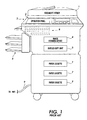
Referring to Figure 1 of the drawings, there is shown a digital copier
system of a known type suitable for use with a preferred embodiment of the
invention. As shown, the system includes a document feeder 1 and an
operation (and display) panel 2. After desired conditions have been entered
on the operation panel 2, the document feeder 1 conveys a document to a
predetermined reading position on an image reading device 3 and, after the
document has been read, drives it away from the reading position. The
image reading device 3 illuminates the document brought to the reading
position thereof. The resulting reflection from the document is transformed to
a corresponding electric signal, or image signal, by a solid state imaging
device, e.g., a CCD (Charge Coupled Device) image sensor. An image
forming device 4 forms an image represented by the image signal on a plain
paper or a thermosensitive paper by an electrophotographic, thermosensitive,
heat transfer, ink jet or similar conventional system.
As a paper is fed from any one of paper cassettes 7 to the image on
forming device 4, the device 4 forms an image on one side of the paper. A
duplex copy unit 5 is constructed to turn over the paper carrying the image on
one side thereof and again feed it to the image forming device 4. As a result,
an image is formed on the other side of the paper to complete a duplex copy.
The duplex copy unit 5 has customarily been designed to refeed the paper
immediately or to sequentially refeed a plurality of papers stacked one upon
the other, from the bottom paper to the top paper. The papers, or duplex
copies, driven out of the image forming device 4 are sequentially sorted by a
output device 6 in order of page or page by page.
Applications, generally 8, share the document feeder 1, operation
panel 2, image reading device 3, image forming device 4, duplex unit 5,
output device 6, and paper cassettes 7 which are the resources built in the
copier system. As will appear, the applications include a copier application, a
printer (IOT) application, a facsimile (Fax) application and other applications.
Additionally, the digital copier system is coupled with a network by way of a
conventional network connection 9.
Referring to Figure 2, a multifunctional, network adaptive printing
system is designated by the numeral 10. The printing system 10 includes a
printing machine 12 operatively coupled with a network service module 14.
The printing machine 12 includes an electronic subsystem 16, referred to as
a video control module (VCM), communicating with a scanner 18 and a
printer 20. In one example, the VCM 16, which will be described in further
detail below, coordinates the operation of the scanner and printer in a digital
copying arrangement. In a digital copying arrangement, the scanner 18 (also
referred to as image input terminal (IIT)) reads an image on an original
document by using a CCD full width array and converts analog video signals,
as gathered, into digital signals. In turn, an image processing system (IP) 22
(Figure 3), associated with the scanner 18, executes signal correction and
the like, converts the corrected signals into multi-level signals (e.g. binary
signals), compresses the multi-level signals and preferably stores the same in
electronic precollation (EPC) memory 24.
Referring again to Figure 2, the printer 20 (also referred to as image
output terminal (IOT)) preferably includes a xerographic print engine. In one
example, the print engine has a multi-pitch belt (not shown) which is written
on with an imaging source, such as a synchronous source (e.g. laser raster
output scanning device) or an asynchronous source (e.g. LED print bar). In a
printing context, the multi-level image data is read out of the EPC memory 24
(Figure 3) while the imaging source is turned on and off, in accordance with
the image data, forming a latent image on the photoreceptor. In turn, the
latent image is developed with, for example, a hybrid jumping development
technique and transferred to a print media sheet. Upon fusing the resulting
print, it may be inverted for duplexing or simply outputted. It will be
appreciated by those skilled in the art that the printer can assume other forms
besides a xerographic print engine without altering the concept upon which
the disclosed embodiment is based. For example, the printing system 10
could be implemented with a thermal ink jet or ionographic printer.
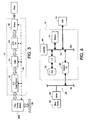
Referring specifically to Figure 3, the VCM 16 is discussed in further
detail. The VCM 16 includes a video bus (VBus) 28 with which various I/O,
data transfer and storage components communicate. Preferably, the VBus is
a high speed, 32 bit data burst transfer bus which is expandable to 64 bit.
The 32 bit implementation has a sustainable maximum bandwidth of
approximately 60 MBytes/sec. In one example, the bandwidth of the VBus is
as high as 100 Mbytes/sec.
The storage components of the VCM reside in the EPC memory
section 30 and the mass memory section 32. The EPC memory section
includes the EPC memory 24, the EPC memory being coupled with the VBus
by way of a DRAM controller 33. The EPC memory, which is preferably
DRAM, provides expansion of up to 64 MBytes, by way of two high density 32
bit SIMM modules, however, any desired amount of memory could be
employed. The mass memory section 32 includes a SCSI hard drive device
34 coupled to the VBus by way of a transfer module 36a. As will appear,
other I/O and processing components are coupled respectively to the VBus
by way of transfer modules 36. It will be appreciated that other devices (e.g.
a workstation) could be coupled to the VBus by way of the transfer module
36a through use of a suitable interface and a SCSI line.
Referring to Figure 4, the structure of one of the transfer modules 36 is
discussed in further detail. The illustrated transfer module of Figure 4
includes a packet buffer 38, a VBus interface 40 and DMA transfer unit 42 .
The transfer module 36, which was designed with "VHSIC" Hardware
Description Language (VHDL), is a programmable arrangement permitting
packets of image data to be transmitted along the VBus at a relatively high
transfer rate. In particular, the packet buffer is programmable so that the
segment or packet can be varied according to the available bandwidth of the
VBus. In one example, the packet buffer can be programmed to handle
packets of up to 64 Bytes Preferably, the packet size would be reduced for
times when the VBus is relatively busy and increased for times when activity
on the bus is relatively low.
Adjustment of the packet size is achieved with the VBus interface 40
(Figure 4) and a system controller 44 (Figure 6). Essentially, the VBus
interface is an arrangement of logical components, including, among others,
address counters, decoders and state machines, which provides the transfer
module with a selected degree of intelligence. The interface 40
communicates with the system controller to keep track of desired packet size
and, in turn, this knowledge is used to adjust the packet size of the packet
buffer 38, in accordance with bus conditions. That is, the controller, in view
of its knowledge regarding conditions on the VBus 28, passes directives to
the interface 40 so that the interface can adjust packet size accordingly.
Further discussion regarding operation of the transfer module 36 is provided
below.
More particularly, image transfer is facilitated with a DMA transfer unit
which employs a conventional DMA transfer strategy to transfer the packets.
In other words, the beginning and end addresses of the packet are used by
the transfer unit in implementing a given transfer. When a transfer is
complete, the interface 40 transmits a signal back to the system controller 44
so that further information, such as desired packet size and address
designations, can be obtained.
Referring to Figures 2 and 3, three I/O components are shown as
being coupled operatively to the VBus 28, namely a FAX module 48, the
scanner or IIT 18, and the printer or IOT 20; however, it should be recognized
that a wide variety of components could be coupled to the VBus by way an
expansion slot 50. Referring to Figure 5, an implementation for the FAX
module, which is coupled to the VBus 28 by way of transfer module 36b, is
discussed in further detail. In the preferred embodiment, a facsimile device
(FAX) 51 includes a chain of components, namely a section 52 for performing
Xerox adaptive compression/decompression, a section 54 for scaling
compressed image data, a section 56 for converting compressed image data
to or from CCITT format, and a modem 58, preferably manufactured by
Rockwell Corporation, for transmitting CCITT formatted data from or to a
telephone, by way of a conventional communication line.
Referring still to Figure 5, each of the sections 52, 54 and 56 as well
as modem 58 are coupled with the transfer module 36b by way of a control
line 60. This permits transfers to be made to and from the FAX module 48
without involving a processor. As should be understood, the transfer module
36b can serve as a master or slave for the FAX module in that the transfer
module can provide image data to the FAX for purposes of transmission or
receive an incoming FAX. In operation, the transfer module 36b reacts to the
FAX module in the same manner that it would react to any other I/O
component. For example, to transmit a FAX job, the transfer module 36b
feeds packets to the section 52 through use of the DMA transfer unit 42 and,
once a packet is fed, the transfer module transmits an interrupt signal to the
system processor 44 requesting another packet. In one embodiment, two
packets are maintained in the packet buffer 38 so that "ping-ponging" can
occur between the two packets. In this way, the transfer module 36b does
not run out of image data even when the controller cannot get back to it
immediately upon receiving an interrupt signal.
Referring again to Figure 3, the IIT 18 and IOT 20 are operatively
coupled to the VBus 28 by way of transfer modules 36c and 36d.
Additionally, the IIT 18 and the IOT 20 are operatively coupled with a
compressor 62 and a decompressor 64, respectively. The compressor and
decompressor are preferably provided by way of a single module that
employs Xerox adaptive compression devices. Xerox adaptive compression
devices have been used for compression/decompression operations by Xerox
Corporation in its DocuTech® printing system. In practice, at least some of
the functionality of the transfer modules is provided by way of a 3 channel
DVMA device, which device provides local arbitration for the
compression/decompression module.
As further illustrated by Figure 3, the scanner 18, which includes the
image processing section 22, is coupled with an annotate/merge module 66.
Preferably, the image processing section includes one or more dedicated
processors programmed to perform various desired functions, such as image
enhancement, thresholding/screening, rotation, resolution conversion and
TRC adjustment. Thresholding and screening are common imaging functions
relating to the concept of applying an image screen to improve the quality of
the image. The selective activation of each of these functions can be
coordinated by a group of image processing control registers, the registers
being programmed by the system controller 44. Preferably, the functions are
arranged along a "pipeline" in which image data is inputted to one end of the
pipe, and image processed image data is outputted at the other end of the
pipe. To facilitate throughput, transfer module 36e is positioned at one end
of the image processing section 22 and transfer module 36c is positioned at
another end of the section 22. As will appear, positioning of transfer modules
36c and 36e in this manner greatly facilitates the concurrency of a loopback
process.
Referring still to Figure 3, arbitration of the various bus masters of the
VCM 16 is implemented by way of a VBus arbiter 70 disposed in a VBus
arbiter/bus gateway 71. The arbiter determines which bus master (e.g. FAX
module, Scanner, Printer, SCSI Hard Drive, EPC Memory or Network Service
Component) can access the VBus at one given time. The arbiter is made up
of two main sections and a third control section. The first section, i.e., the
"Hi-Pass" section, receives input bus requests and current priority selection,
and outputs a grant corresponding to the highest priority request pending.
The current priority selection input is the output from the second section of
the arbiter and is referred to as "Priority Select". This section implements
priority rotation and selection algorithm. At any given moment, the output of
the logic for priority select determines the order in which pending requests
will be serviced. The input to Priority Select is a register which holds an
initial placement of devices on a priority chain. On servicing requests, this
logic moves the devices up and down the priority chain thereby selecting the
position of a device's next request. Control logic synchronizes the tasks of
the Hi-Pass and the Priority Select by monitoring signals regarding
request/grant activity. It also prevents the possibility of race conditions.
Referring to Figure 6, the network service module 14 is discussed in
further detail. As will be recognized by those skilled in the art, the
architecture of the network service module is similar to that of a known "PC
clone". More particularly, in the preferred embodiment, the controller 44,
which preferably assumes the form of a SPARC processor, manufactured by
Sun Microsystems, Inc., is coupled with a standard SBus 72. In the illustrated
embodiment of Figure 6, a host memory 74, which preferably assumes the
form of DRAM, and a SCSI disk drive device 76 are coupled operatively to
the SBus 72. While not shown in Figure 6, a storage or I/O device could be
coupled with the SBus with a suitable interface chip. As further shown in
Figure 6, the SBus is coupled with a network 78 by way of an appropriate
network interface 80. In one example, the network interface includes all of
the hardware and software necessary to relate the hardware/software
components of the controller 44 with the hardware/software components of
the network 78. For instance, to interface various protocols between the
network service module 14 and the network 78, the network interface could
be provided with, among other software, Netware® from Novell Corp.
In one example, the network 78 includes a client, such as a
workstation 82 with an emitter or driver 84. In operation, a user may generate
a job including a plurality of electronic pages and a set of processing
instructions. In turn, the job is converted, with the emitter, into a
representation written in a page description language, such as PostScript.
The job is then transmitted to the controller 44 where it is interpreted with a
decomposer, such as one provided by Adobe Corporation. Some of the
principles underlying the concept of interpreting a PDL job are provided in
U.S. Patent No. 5,493,634 to Bonk et al. and U.S. Patent No. 5,226,112 to
Mensing et al., the disclosures of both references being incorporated herein
by reference. Further details regarding a technique for generating a job in a
PDL may be obtained by reference to the following text, the pertinent portions
of which are incorporated herein by reference:
PostScript® Language Reference Manual
Second Edition
Addison-Wesley Publishing Co.
1990
Referring again to Figure 3, the network service module 14 is coupled
with the VCM 16 via a bus gateway 88 of the VBus arbiter/bus gateway 71.
In one example, the bus gateway comprises a field programmable gate array
provided by XILINX corporation. The bus gateway device provides the
interface between the host SBus and the VCM VBus. It provides VBus
address translation for accesses to address spaces in the VBus real address
range, and passes a virtual address to the host SBus for virtual addresses in
the host address range. A DMA channel for memory to memory transfers is
also implemented in the bus gateway. Among other things, the bus gateway
provides seamless access between the VBus and SBus, and decodes virtual
addresses from bus masters, such as one of the transfer modules 36, so that
an identifier can be obtained from a corresponding slave component. It will
be appreciated by those skilled in the art that many components of the
printing system 10 are implemented in the form of a single ASIC.
Referring to Figures 3, 4 and 6, further discussion regarding DMA
transfer of each of the transfer modules 36 is provided. In particular, in one
example, the images of a job are stored in the host memory 74 as a series of
blocks. Preferably, each block comprises a plurality of packets. In operation,
one of the transfer modules 36 is provided, by the controller 44, with the
beginning address of a block and the size of the block. In turn, for that block,
the transfer module 36 effects a packet transfer and increments/decrements a
counter. This procedure is repeated for each packet of the block until the
interface 40 determines, by reference to the counter, that the last packet of
the block has been transferred. Typically, for each stored image, several
blocks are transferred, in a packet-by-packet manner, as described
immediately above.
As previously noted the Xerox Corporation Digital Copier Multifunction
Systems comprising the DC 240 ST and the DC 265 ST include a Job
Contention Manager which provides queue management at the External or
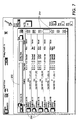
Basic Job Service levels. Referring to Figure 7, those systems include a
queue of jobs 200 ready for processing with the printer 20 as shown in Figure
1. As with other conventional print queues, the job currently being printed is
displayed in a window 202 and buttons 204 can be employed to scroll the list
of jobs up or down. It should be appreciated that in a multifunctional machine
of the this type and those discussed in the Background above, more than one
queue is employed to accommodate for the various Basic Job Services
offered. For example, jobs waiting to be scanned would reside in a scan
queue while jobs waiting to be faxed would reside in a fax queue. Essentially
the print or mark queue of Figure 7 may be just one of the plurality of Basic
Job Service queues employed in a multifunction printing system.
Additionally, it should be appreciated that jobs may be inserted into the
queues in a manner consistent with that disclosed by US-A-5,206,735.
Finally, it will be appreciated that the queues could be maintained in, among
other locations, the VCM of Figure 3 or the Network Service Module of Figure
6.
In any multifunctional product (also referred to below as "MF Engine"),
such as the printing system 10 described above, there is always the potential
of multiple users requiring access to one or more subsystems at the same
time. This access contention can occur in several areas of the MF Engine,
either as contention for a single resource e.g., EPC memory 24 (Figure 3), or
as a contention for multiple kinds of resources e.g., EPC memory and IIT.
When a contention situation arises, the printing system must respond in a
predictable, and controlled manner that satisfies the various users.
In the Xerox DC 240 ST and the DC 265 ST Multifunction Systems, at
least two contention management methods are contemplated, as more fully
described in US-A-5970224 to Salgado et al., which is incorporated by
reference herein, (hereinafter the "Salgado Application").
1. First In First Out (FIFO) Job Management.
In this method contention is handled on a first come first serve basis.
Jobs submitted ahead of other jobs have first use of the required Basic Job
Service. Other jobs requesting that service are numerically ordered by their
time of arrival and eventually have the opportunity to use the service.
2. Prioritized Job Management
In this method access to resources is managed with a "Key
Operator/System Administrator ("KO/SA") defined algorithm. With this
algorithm, the KO/SA can arrange to have jobs defined according to job type,
immediate walkup need, history of interruptions and other relevant factors.
The algorithm can be configured to manage job contention in accordance with
the desires of a typical printing system user. Since it is flexibly
programmable, the algorithm can be made to accommodate for FIFO. In other
words, FIFO is a subset of the capabilities of this algorithm.
The Salgado Application discloses at least five job types that are
handled by the KO/SA priority algorithm:
The approach of the Salgado Application. provides a system job which
corresponds to a work request made by a user. The user's work request is
made at the MF Engine's user interface or External Job Service (EJS). For
example, a copy job corresponds to a user's request to perform a copy
operation. Each EJS job breaks down into multiple sub-jobs. Each sub-job
corresponds to the work responsible for a basic job operation which is
processed by a Basic Job Service (BJS). Copy jobs break down into scan,
image processing, and mark sub-jobs.
Processing a job by a Basic Job Service requires use of video 111
hardware. Video 111 hardware includes the compressor, decompressor, ips1
board, input channel, output channel, and loopback channel. Multiple sub-jobs
can require the use of the same video 111 hardware. The Job
Contention Manager of the Salgado Application manages the use of the video
111 hardware and which sub-job acquires the hardware when a contention
decision is required at the level of the Basic Job Service, based on the
priority schemes noted above.
The following terminology should be useful in obtaining a more
complete understanding of the present description:
This invention embodies many of the elements disclosed in EP Patent
Application Serial No. (Attorney's Docket No. RSJ06858EP), to Salgado et
al., entitled METHOD AND APPARATUS FOR MANAGING JOB
CONTENTION FOR SYSTEM RESOURCES IN AN ELECTRONIC
REPROGRAPHIC SYSTEM, filed of even date herewith, ("Salgado 66
Application") and those elements are included hereafter in an effort to more
clearly describe the various embodiments of this invention. This invention
proposes an expansion of the method and apparatus described in the
Salgado 66 Application to enable a job service to process a job for multiple
video capabilities using commonly shared resources. This invention provides
the ability to perform more extensive and complicated job processing by a job
service.
In accordance with this invention the improved method and apparatus
for managing contention for a system's resources among multiple sub-jobs
provides more efficient processing of a job using multiple video capabilities.
In accordance with preferred embodiments of this invention it is also possible
to do one or more of the following: 1) process multiple sub-job requests for
resources, 2) provide concurrent job processing when a contention condition
does not exit, 3) assign basic resources to a sub- job based on its priority, 4)
suspend a sub-job's use of resources in favor of a higher priority job, 5)
transfer resources from a lower priority sub-job to a higher priority sub-job, 6)
provide quick processing of BJS' video resource request for each image, and
7) expand for additional video resources and video capabilities.
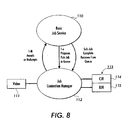
Referring to Figure 8, the Job Contention Manager (JCM) 112 of this
invention controls the allocation of resources at the level of the basic
resources. As shown in Figure 8 it tracks and assigns video resource
requests received by the
JCM 112 from the
BJS 110. The requests between
the
JCM 112 and the
BJS 110 use a Propose/Accept/No Accept protocol.
Table 1 provides examples of typical External Job Services and the BJS sub-jobs
which they entail for an exemplary Multifunction Printer (MFP). It is
within the scope of this invention to provide additional EJS and
BJS 110
services as may be desired and Table 1 is provided only by way of Example.
| JOB SERVICES |
| EXTERNAL JOB SERVICES | COPY | PRINT | FAX PRINT | FILE | FAX OUT | REPORT PRINT | TEST PATTERN PRINT |
| BASIC JOB SERVICES | Scan | ESS Input | ESS Input | Scan | Scan | Report Generator | Internal Image Generator |
| ±IP | Mark | Mark | ±IP | ±IP | Mark | Mark |
| Mark | | | ESS Output | ESS Output |
The Basic Job Service (BJS) breaks up the External Job Service
request into a series of sub-job requests as shown in Table 1. As shown in
Figure 8, in accordance with this invention, for each sub-job the
BJS 10 calls
upon the Job Contention Manager (JCM) 12 with a "Propose" for video
resources. The JCM provides a set of video capabilities or Capability
Resources (CR) for use by the BJS as exemplified by Tables 2a and 2b.
Each CR uses a specific set of video 111 hardware or Basic Resources (BR).
| VIDEO CAPABILITIES |
| CAPABILITY RESOURCES | PRE-SCAN | SCAN COMPRESSED | IP ANNOTATE | MARK DECOMPRESSED |
| BASIC RESOURCES | Loopback Channel | Compressor | Input Channel | Output Channel |
| IPS1 | Input Channel | Loopback Channel | Decompressor |
| | | Output Channel |
| | | Compressor |
| | | Decompressor |
| CAPABILITY RESOURCES |
| CAPABILITY RESOURCES | ESS INPUT NONRESCONVE RSIONS | ESS OUTPUT | REPORT GENERATOR | INTERNAL IMAGE |
| BASIC RESOURCES | Loopback Channel | Output Channel | Decompressor | IPS1 |
| Compressor | | Output Channel | Input Channel |
Tables 2a and 2b provide examples of typical Capability Resources
(CR) and the Basic Resources (BR) or video resources which they utilize in
an exemplary Multifunction Printer (MFP). It is within the scope of this
invention to provide additional CRs and BRs as may be desired and Tables
2a and 2b are provided only by way of Example. By way of example, as
shown in Tables 2a and 2b the Scan capability (CR) uses the compressor
and the input channel Basic Resources and the ESS Input capability (CR)
uses the loopback channel and compressor BRs.
The basic architecture of the system for carrying out the method of this
invention for managing contention for a system's resources among multiple
sub-jobs and how those resources are shared will now be described in detail
by reference to Figures 8, 9, 10, 11 and 15. The flow diagrams shown in
these Figures comprise a first preferred embodiment of the invention which
uses a simple First In / First Out (FIFO) prioritization scheme.
Referring to Figure 8, when the Basic Job Service 110 is ready to
process a sub-job, it sends an image "Propose" as described above, for each
image it needs to process, to the Job Contention Manager 112. The Job
Contention Manager 112 maintains at least a two-level interconnected
database 113. The first level 114 corresponds to the Capability Resources
(CR). The second level 115 corresponds to the Basic Resources (BR) which
are essentially the video resources (Video 111). The database 113 may have
any desired number of levels and the two level database is described by way
of example. Each Capability Resource in the database 114 contains a list of
the Basic Resources it needs. Correspondingly, each Basic Resource in the
database 115 maintains a list of the CRs that depend upon it. This
interconnected database is created on system power up.
The Job Contention Manager 112 also owns the system's contention
algorithm (settable by SA/KO) which in a preferred embodiment is essentially
similar to the algorithm proposed in the Salgado Application, which is
incorporated by reference herein, however, it may be any desired contention
algorithm as determined by the SA/KO. In the Salgado Application the
contention algorithm is FIFO or job service priority based or a combination of
both. When a job is created, the job contains priority ordering data elements
including priority, submission time, and last modification time.
When a Basic Job Service 110 is ready to process a sub-job, the BJS
110 calls or signals the JCM 112 with an image "Propose" request as in
Figure 8 for each image it needs to process. The "Propose" request
preferably includes the job identifier, its priority information, the video
capability required, and the requesting BJS identification. For example, the
Scan BJS needs to scan a copy job (id: 3-1) form the DADH (document
handler). For each image the scanner needs to input, the Scan BJS 110 calls
the JCM 112 with a "Propose" (e.g. BJS service: Scan, job: 3-1, job priority:
XXX, capability: ScanCompressed, ...).
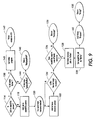
Referring now to Figure 9 a simplified FIFO only version of a Job
Contention Manager (JCM) 112 for managing contention for a system's
resources among multiple sub-jobs is described. On the first request from a
BJS 110 for a sub-job, the element 116 determines that the sub-job is not in a
capability job service queue in the database 114 and signals element 118 to
that effect. The JCM 112 then creates a Capability Job Resource (CJR)
containing the above data. Element 118 adds the CJR to the CR's job list or
queue in the database 114. The JCM 112 then walks or scans through the
list of basic resources (the capability to basic resources mapping is
determined by reading a table defining these mappings, see Table 2a and
2b), required for the CR, for each basic resource the CR needs. This is
accomplished by cycling through elements 120, 122 and 124. The capability
to basic resources mapping is determined by reading a table defining these
mappings. For each basic resource the CR needs as determined by element
120 a Basic Job Resource (BJR) is created and added to each basic
resource's job list or queue in database 115 by element 122.
For a specific sub-job request, the set of data common to the
Capability Job Resource (CJR) and Basic Job Resource (BJR) is termed a
job resource. A resource's job list is the list or queue of requesting sub-jobs
needing the capability or basic resource. When a BJR is added to a basic
resource's queue, the BJR is placed in a position based on job priority. The
top of the queue is the highest priority job with each subsequent job having a
decreasing priority. The priority of the sub-job may be preferably determined
as in the Salgado Application, namely FIFO or job based priority or a
combination thereof, however, it may be determined in accordance with any
desired conventional prioritizing approach. For this exemplary embodiment it
is FIFO based.
For each added BJR, the JCM 112 determines the state of the Basic
Job Resource. If the BJR is the highest priority job within the basic
resource's job list (top of the queue), the state is "bjsActive" if no other
"bjsActive" BJR is in the list. If there is another "bjsActive" BJR, then the
added Basic Job Resource's state is "bjsAcquiring". If the added Basic Job
Resource is not at the top of the queue, then the state is "bjsQueued".
At this point, the JCM 112 needs to determine the overall state of the
BJS' "Propose" request (in this invention, it is the state of the CJR). If all its
component BJR's are "bjsActive" as determined by element 126 then element
128 sets all BJR's states to "bjsActive". Element 130 then sets the CJR's
state to "cjsActive". The JCM 112 at 132 then forwards the BJS Propose to
the component basic services (Video 111) for processing. Video 111
processes the request as normal and sends an Accept 135 to the BJS via the
JCM.
In certain scenarios, a job service uses multiple capability resources to
process a sub-job. For example, the Image Processing BJS may need to use
several capability resources such as ipCreateBlanklmage, ipAnnotatelmage,
ipRotatelmage to process a particular sub-job. To enable a job service to
efficiently process a sub-job for multiple video capabilities in accordance with
this invention the JCM 112 follows its normal rules and places a CJR and
appropriate component BJRs for each sub-job capability request from the
BJS 110. As normal the CJR and BJRs are placed in the corresponding sub-job
queues in priority order. However, in accordance with this invention the
determination of whether or not a BJR is "bjsActive" is modified as follows: in
addition to the above method to make a BJR "bjsActive", a new sub-job will
be "bjsActive" if, the currently active BJR (BJR A) is for the same sub-job as
the new BJR (BJR B) and if BJR A and BJR B are submitted by the same
basic service. As with the algorithm of the Salgado 66 Application the new
CJR's state is active if all its BJRs are "bjsActive". In this way the JCM
enables the BJS to use multiple video capabilities when processing a sub-job.
Therefore, a BJS service can "Propose" for multiple capabilities prior to the
completion of its current sub-job. This allows a job service to perform more
complicated job processing than it otherwise could.
If the BJS' component BJRs have a combination of "bjsActive" and
'bjsAcquiring" states, the CJR's state is "cjsAcquiring". Otherwise, the CJR's
state is "cjsQueued". The JCM 112 then updates all of the CJR's respective
BJRs to reflect the overall state. In other words, if the Capability Job
Resource's (CJR's) state is "cjsQueued", all component Basic Job Resource's
(BJR's) states are set to "bjsQueued".
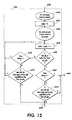
Referring now to Figure 15 element 126 is shown in greater detail in
order to illustrate multiple capability resources can be streamed in
accordance with a preferred embodiment of this invention. The signal 450
from element 124 is coupled to element 452. For each basic resource
needed by a sub-job an index 454 is set at 0. For each sub-job in a BR
queue element 456 signals index 458 to increment by 1. Element 460 then
determines if the sub-job at the index position of element 458 is the new sub-job.
If it is, then element 462 determines if the index position is 1, which is
the top job in the BR queue. If it is, then signal 464 is coupled to element
128. Then as described above element 128 sets all BJR's states to
"bjsActive". Element 130 then sets the CJR's state to "cjsActive". The JCM
112 at 132 then forwards the BJS Propose to the component basic services
(Video 111) for processing. Video 111 processes the request as normal and
sends an Accept 135 to the BJS via the JCM.
If element 462 determines that the index position is not 1, then it
signals element 466, which determines if the new sub-job is from the same
service and for the same job as the 1st sub-job. If the new sub-job is from the
same service and job, element 466 provides a signal 464 to element 128.
Then as described above element 128 sets all of the new sub-job's BJR
states to "bjsActive". Element 130 then sets the CJR's state to "cjsActive".
The JCM 112 at 132 then forwards the BJS Propose to the component basic
services (Video 111) for processing immediately after the prior "bjsActive"
sub-job submitted by the same service and for the same job. Video 111
processes the request in a capability resource streaming sequence, and
sends an Accept 135 to the BJS via the JCM. If element 466 determines that
the new sub-job is not from the same service and job as the first sub-job in
the BJR queue then it forwards signal 468 to element 136 so that the JCM
112 provides a "NoAccept" to the BJS 110. In this case, the BJS 110 has not
acquired all the video 111 (basic) resources necessary for sub-job
processing. The BJS 110 then proposes again at a future time based on an
internal timer (not shown).
If element 460 determines that the sub-job at the index position of 458
is not the new sub-job, then element 470 determines if the index position of
element 458 is equal to 1. If it is, then element 470 recycles the sub-job to
element 458 which increases the index position by 1. If the index 458 does
not equal 1 then element 470 signals element 472, which determines if the
sub-job is from the same service and job as the 1st sub-job. If it is, then
element 472 recycles the sub-job to the index 458 until the index 458 reaches
the position of the new sub-job. If the sub-job is not from the same service
and job as the 1st sub-job, then element 472 forwards a signal 468 to element
136 so that the JCM 112 provides a "NoAccept" to the BJS 110. In this case,
the BJS 110 has not acquired all the video 111 (basic) resources necessary
for sub-job processing. The BJS 110 then proposes again at a future time
based on an internal timer (not shown).
If element 126 determines that the BJRs for a new sub-job follows prior
BJRs in their queues which are "bjsActive", and if it determines that the BJRs
were submitted by the same BJS and for the same sub-job as the top job in
the queue, then element 128 sets the new job's BJRs to "bjsActive" and then
element 130 sets the corresponding CJR to "cjsActive" and the JCM 112 at
132 then forwards the BJS Propose to the component basic services (Video
111) for processing immediately after the prior sub-job in the queue. Video
111 processes the request as normal and sends an Accept 460 to the BJS
via the JCM..
Once, the BJS 110 "Proposes" for a sub-job, the JCM 112 tracks the
BJS' sub-job request using its corresponding capability and Basic Job
Resources (CJRs and BJRs) in the databases 114 and 115. For all
subsequent Proposes from the BJS 110 for this sub-job, the JCM 112 uses
the corresponding CJR's state to determine acceptance (Accept) or rejection
(NoAccept). In this case the JCM 112 determines at element 116 that the
sub-job is already in a queue (capability job list). If the sub-job is in the
capability queue the JCM 112 then determines at element 138 if the
capability's job state is "cjsActive". If it is, then the JCM 112 forwards the BJS
Propose to the component basic services (Video 111) for processing. Video
111 processes the request as normal and sends an Accept to the BJS 110
via the JCM 112.
If the job state of the sub-job is not "cjsActive" as determined by
element 138 then the JCM 112 determines at element 144 if it is
"cjsAcquiring" or "cjsQueued". If it is "cjsAcquiring" or "cjsQueued" then the
JCM 112 element 146 returns a "NoAccept" to the BJS 110, which proposes
again at a future time based on an internal timer (not shown).
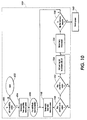
Referring now to Figures 10 and 11 the portion of the Job Contention
Manager 112 associated with deleting a sub-job is shown. If the operator of
the Multi Function Printer wishes to delete a job, he or she enter the delete or
abort command at the External Job Service. The abort signal is fed to
element 140 of the JCM 112 to determine if job is in a capability queue of the
database 114. If it is not then element 142 causes the inquiry to terminate by
exiting the JCM 112.
On the other hand if the aborting job is in the CR job queue then
element 144 removes it from the Capability Resource job queue in the
database 114. Element 146 then searches for each Basic Job Resource
which was needed by the aborting CJR. The JCM 112 then walks through
each such BR and removes the aborting sub-job from each respective BR job
queue. This is accomplished by elements 148 through 158 of the JCM 112.
Element 148 removes the aborting sub-job from each succeeding BR job
queue. Upon removing a sub-job from a BR job queue it signals element 150
which decides if the deleted job is the top job in the respective BR job queue.
If it was at the top of the queue then element 152 determines if there are any
sub-jobs left in the respective queue. If there are sub-jobs remaining, then
element 154 moves the next sub-job to the top of the queue. Element 154
then signals element 156 to delete the aborting sub-job from the BR job
queue. If the aborting BR sub-job was not first in the queue then element 150
signals element 156 to delete the sub-job from BR job queue. If the aborting
BR sub-job was first in the queue but there are no other jobs left in the queue
then element 152 signals element 156 to delete the sub-job from the BR job
queue. After the last BR sub-job for the aborting BJS sub-job is removed
from the BR job queue of the database 115 a signal is sent by element 158 to
the reset queues portion 160 of the JCM 112.
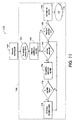
Referring to Figure 11 the reset queues portion 160 of the JCM 112 is
shown in greater detail. When the last basic resource of the aborting sub-job
is deleted from the respective BR job queues then element 158 of the portion
159 of the JCM 112 which determines remaining jobs after a job is aborted,
signals element 162 which identifies each sub-job in the CR job queue in
database 114. Element 164 then determines the state of each of the sub-jobs
in the CR job queue and signals element 166 which then determines if the
new state is the same as the old. If it is, then element 168 determines if the
sub-job is the last job in the CR job queue. If it is not the last job, then the
JCM 112 walks through all the remaining sub-jobs in the CR job queue by
sending a signal from element 168 back to element 166 to repeat the cycle. If
it is the last job in the CR job queue then element 168 signals element 170 to
call a "Sub-jobComplete" and exit at 172.
If element 166 determines that the new state is not the same as the old
state then it signals element 174 which sets the CJR's state to the new state.
Element 174 signals element 176 which determines if the new state is
"bjsActive". If the new state is "bjsActive then element 178 sets all
corresponding BJR states to "bjsActive". If element 178 sets all BJR states to
"bjsActive" then it signals element 168 which determines if the sub-job is the
last job in the CR job queue. If it is, element 170 is signaled to call "Sub-jobComplete"
and exit at 172. If element 176 determines that the new state is
not "bjsActive" then it signals element 168 which will recycle it since it is not
the last item in the queue.
Referring now to Figures 12 and 13 the architecture of a preferred
embodiment of the process and apparatus of this invention, for managing
contention for a system's resources among multiple sub-jobs, using FIFO
and/or job based priority will now be described in detail. In this preferred
embodiment of the invention, access to resources is managed with a "Key
Operator/System Administrator ("KO/SA") defined algorithm similar to that
described in the Salgado Application. With this algorithm, the KO/SA can
arrange to have jobs defined according to job type, immediate walkup need,
history of interruptions and other relevant factors. The algorithm can be
configured to manage job contention in accordance with the desires of a
typical printing system user. Since it is flexibly programmable, the algorithm
can be made to accommodate for FIFO. In other words, FIFO is a subset of
the capabilities of this algorithm. This invention prioritizes at the level of the
basic resources thereby providing more efficient use of those resources.
In Figures 12, 13 and 14 many common elements from the previously
disclosed embodiment of Figures 9, 10 and 11 have been given
corresponding reference numbers and have the same function as described
heretofore. Figure 12 shows the portion of the JCM 112A which deals with
sub-jobs which are " Proposed" but are not already in the CR job queue.
Once again when a Basic Job Service 110 is ready to process a sub-job,
the BJS 110 calls or signals the JCM 112A with an image "Propose"
request as in Figure 8 for each image it needs to process. The "Propose"
request includes the job identifier, its priority information, the video capability
required, and the requesting BJS identification. For example, the Scan BJS
needs to scan a copy job (id: 3-1) form the DADH (document handler). For
each image the scanner needs to input, the Scan BJS 110 calls the JCM 112
with a "Propose" (e.g. BJS service: Scan, job: 3-1, job priority: XXX,
capability: ScanCompressed, ...)
Referring now to Figures 12 and 13 a job based priority version of a
Job Contention Manager (JCM) 112 for managing contention for a system's
resources among multiple sub-jobs is described. On the first request from a
BJS 110 for a sub-job, the element 116 determines that the sub-job is not in a
capability job service queue in the database 114 and signals element 118 to
that effect. The JCM 112A then creates a Capability Job Resource (CJR)
containing the above data. Element 118 adds the CJR to the CR's job list or
queue in the database 114. The JCM 112A then walks or scans through the
list of basic resources (see Table 2a and 2b), required for the CR, for each
basic resource the CR needs. This is accomplished by cycling through
elements 120, 122 124 and 300. For each basic resource the CR needs as
determined by element 120 a Basic Job Resource (BJR) is created by
element 122 and added to each basic resource's job list or queue in database
115.
New element 300 then determines if the sub-job is first in the queue of
the BR, namely, the highest priority job. If it is not, it signals element 124. If
element 300 determines that the relevant sub-job is first in the queue it
signals element 302 which determines if there is a "bjsActive" job in the
respective queue. If there is not such a "bjsActive" job then element 302
signals element 124. If element 302 determines that there is a "bjsActive" job
in the respective queue then it signals element 304 to set all "bjsActive" jobs
to "bjsSuspending" and notifies element 306 to set the CJR parent of the
suspending BJR to "bjsSuspending". Element 306 then signals element 124.
If the last component BJR has been added then element 124 signals element
126 which determines if the CJR has acquired all the BJR's it needs to carry
out the sub-job.
Elements 300 - 306 serve to allow a higher priority job (as determined
by the SA/KO algorithm) to suspend an active job until the higher priority job
is completed. When a new sub-job request results in the need to suspend
another sub-job's request, the JCM 112A sets the existing sub-job's CJR's
state to "cjsSuspending". Upon the next Propose for the suspending sub-job,
the JCM transitions the basic resources from the suspending sub-job to the
acquiring sub-job. The BJS that Proposed for the suspending sub-job
receives a "NoAccept" from the JCM 112A. When a BJS has completed its
processing of a sub-job, it notifies the JCM 112 via a "Sub-jobCompleted".
On receiving a "Sub-jobCompleted", the JCM 112 deletes the sub-job's
information (CJRs and BJRs). For each BJR component used by the sub-job,
the JCM 112 assigns the basic resource to the next sub-job in the BR's job
queue (the state initially goes to 'bjsActive'). The JCM 112 then recalculates
the state of these BJR's parent CJRs. If the BJS has Proposed for resources,
the BJS also calls "Sub-jobCompleted" when the job is deleted by the user or
terminated by the system.
At this point, the JCM 112A needs to determine the overall state of the
BJS' "Propose" request (in this invention, it is the state of the CJR). If all its
component BJR's are "bjsActive" as determined by element 126 then element
128 sets all BJR's states to "bjsActive". Element 130 then sets the CJR's
state to "cjsActive". The JCM 112A at 132 then forwards the BJS Propose to
the component basic services (Video 111) for processing. Video 111
processes the request as normal and sends an Accept to the BJS via the
JCM.
As noted above for each added BJR, the JCM 112 determines the
state of the Basic Job Resource. If the BJR is the highest priority job within
the basic resource's job list (top of the queue), the state is "bjsActive" if no
other "bjsActive" BJR is in the list. If there is another "bjsActive" BJR, then
the added Basic Job Resource's state is "bjsAcquiring". If the added Basic
Job Resource is not at the top of the queue, then the state is "bjsQueued". If
the BJS' component BJRs have a combination of "bjsActive" and
'bjsAcquiring" states, the CJR's state is "cjsAcquiring". Otherwise, the CJR's
state is "cjsQueued". The JCM 112 then updates all of the CJR's respective
BJRs to reflect the overall state. In other words, if the Capability Job
Resource's (CJR's) state is "cjsQueued", all component Basic Job Resource's
(BJR's) states are set to "bjsQueued".
As described above to enable capability resource streaming in
accordance with this invention the JCM 112 can have multiply active
capability job resources for a basic resource (BR) under a specific condition.
Therefore, a BJS service can "Propose" for multiple capability resources.
The JCM follows its normal algorithm and sets up a CJR and component
BJR's for the sub-job. The CJR and BJR's are placed in their corresponding
sub-job queues for this sub-job. However, in accordance with this invention
the determination of whether a new BJR sub-job is "bjsActive" may be based
on determining that the BJR sub-job prior to the new BJR sub-job is
"bjsActive" and that both BJR sub-jobs were submitted by the same basic job
service and for the same job. In other words, if the next BJR is submitted by
the same service and for the same job as the BJR above it, it acquires the
state of the BJR above it. Therefore two or more CJRs can achieve a
"bjsActive" state if they meet the aforenoted conditions and thereby allow the
BJS to "Propose" for multiple capability resources.
Referring again to Figure 15 element 126 is shown in greater detail in
order to illustrate how multiple capability resources can be streamed in
accordance with a preferred embodiment of this invention. The signal 450
from element 124 is coupled to element 452. For each basic resource
needed by a sub-job an index 454 is set at 0. For each sub-job in a BR
queue element 456 signals index 458 to increment by 1. Element 460 then
determines if the sub-job at the index position of element 458 is the new sub-job.
If it is, then element 462 determines if the index position is 1, which is
the top job in the BR queue. If it is, then signal 464 is coupled to element
128. Then as described above element 128 sets all BJR's states to
"bjsActive". Element 130 then sets the CJR's state to "cjsActive". The JCM
112 at 132 then forwards the BJS Propose to the component basic services
(Video 111) for processing. Video 111 processes the request as normal and
sends an Accept 135 to the BJS via the JCM.
If element 462 determines that the index position is not 1, then it
signals element 466, which determines if the new sub-job is from the same
service and for the same job as the 1st sub-job. If the new sub-job is from the
same service and job, element 466 provides a signal 464 to element 128.
Then as described above element 128 sets all of the new sub-job's BJR
states to "bjsActive". Element 130 then sets the CJR's state to "cjsActive".
The JCM 112 at 132 then forwards the BJS Propose to the component basic
services (Video 111) for processing immediately after the prior "bjsActive"
sub-job submitted by the same service and for the same job. Video 111
processes the request in a capability resource streaming sequence, and
sends an Accept 135 to the BJS via the JCM. If element 466 determines that
the new sub-job is not from the same service and job as the first sub-job in
the BJR queue then it forwards signal 468 to element 308 to determine if the
sub-job is acquiring all its component basic resources.
If element 460 determines that the sub-job at the index position of 458
is not the new sub-job, then element 470 determines if the index position of
element 458 is equal to 1. If it is, then element 470 recycles the sub-job to
element 458 which increases the index position by 1. If the index 458 does
not equal 1 then element 470 signals element 472, which determines if the
sub-job is from the same service and job as the 1st sub-job. If it is, then
element 472 recycles the sub-job to the index 458 until the index 458 reaches
the position of the new sub-job. If the sub-job is not from the same service
and job as the 1st sub-job, then element 472 forwards a signal 468 to
element 308 to determine if the sub-job is acquiring all its component basic
resources.
If element 126 determines that the BJRs for a new sub-job immediately
follow prior BJRs in their queues which are "bjsActive", and if it determines
that the BJRs were submitted by the same BJS and for the same sub-job as
the top job in the queue, then element 128 sets the new job's BJRs to
"bjsActive" and then element 130 sets the corresponding CJR to "cjsActive"
and the JCM 112 at 132 then forwards the BJS Propose to the component
basic services (Video 111) for processing immediately after the prior sub-job
in the queue. Video 111 processes the request as normal and sends an
Accept 460 to the BJS via the JCM..
If the element 126 determines that the CJR has not acquired all the
BJR's it needs since its state is "cjsAcquiring" or cjsQueued" it forwards
signal 468 to element 308 which determines if the sub-job is acquiring all the
basic resources it needs. If it determines that the CJR is not acquiring all the
BJR's it needs then element 310 sets the CJR to "bjsQueuedHalted" and the
JCM 112A returns a "NoAcceptHalt" 312 to the proposing BJS. If element
308 determines that the CJR's state is "bjsAcquiring" it signals element 136 to
return a "NoAccept" to the BJS. As in the previous embodiment the BJS after
receiving a "No Accept" will propose again at a later time based on a timing
signal.
If element 116 of Figure 12 determines that the sub-job is already in
the CR queue then part A of the JCM 112 signals element 138 in part B of
JCM 112 which determines if the job state of the CJR is "cjsActive". If it is, it
notifies element 140 and the JCM 112B then forwards the BJS Propose to the
component basic services (Video 111) for processing. Video 111 processes
the request as normal and sends an Accept to the BJS via the JCM. The BJS
sends a Sub-jobComplete to the JCM which deletes the sub-job from the BR
and CR job queues at 314. On the other hand if element 138 determines that
the job state of the CJR is not active then it signals element 144 which
determines if the sub-job state is "cjsQueuedHalted". If it is, then element
144 signals element 316 to delete the sub-job request and element 146
returns a "NoAcceptHalt".
If element 144 determines that the job state is not "cjsQueuedHalted" it
signals element 318 which determines if the job state is "cjsSuspending". If it
is, it signals element 320 which determines if it is the first band of the image.
If it is not the first band of the image then element 320 signals element 140
and the JCM 112B then forwards the BJS Propose to the component basic
services (Video 111) for processing. Video 111 processes the request as
normal and sends an Accept to the BJS via the JCM. The BJS sends a "Sub-jobComplete"
to the JCM, which deletes the sub-job from the BR and CR job
queues at 314. On the other hand if element 138 determines that the job
state of the CJR is not "cjsActive" then it signals element 144 which
determines if the sub-job state is "cjsQueued".
If element 320 determines that the sub-job is the first band of the
image then it signals element 322 to set the CJR state to "cjsQueuedHalted"
which in turn causes element 324 to set the component BJR's to
"bjsQueued". Element 326 then deletes the job request and the JCM returns
a "NoAcceptHalt" at 328 to the BJS.
If element 318 determines that the sub-job is not suspending it notifies
element 330 which determines the CJR's new state. Element 332 then sets
the CJR to the new state which is forwarded to element 334 which determines
if the new state is "cjsActive". If it is, then element 336 sets the component
BJR's to "bjsActive". The JCM 112B at 338 then forwards the BJS' Propose
to the component basic services (Video 111) for processing. Video 111
processes the request as normal and sends an Accept to the BJS 110 via the
JCM. Upon completion of the sub-job the BJS 110 signals the JCM, "Sub-jobComplete"
and element 340 deletes the job request from the CR and BR
job queues.
If element 334 determines that the new state is not "cjsActive" it
notifies element 342 which determines if the new state is "cjsQueuedHalted".
If it is, then element 344 deletes the job request and the JCM 112B returns a
"NoAcceptHalt" to the BJS 110 at element 346. If the new state is not
"cjsQueuedHalted" then element 342 notifies element 348 which then
forwards the BJS' "Propose" to the component basic services (Video 111) for
processing. Video 111 processes the request as normal and sends an
Accept to the BJS 110 via the JCM 112. Upon completion of the sub-job the
BJS 110 signals the JCM "Sub-jobComplete" and element 350 deletes the job
request from the CR and BR job queues.
Referring now to Figure 14 the portion of the Job Contention Manager
112 associated with deleting a sub-job in the job based priority alternative is
shown. If the operator of the Multi-Function Printer wishes to delete a job, he
or she enters the delete or abort command at the External Job Service. The
abort signal is fed to element 360 of the JCM 112 to determine if the job is in
a CR job queue of the database 114. If it is not, then element 362 causes the
inquiry to terminate by exiting the JCM 112.
On the other hand if the aborting job is in the CR job queue then
element 364 removes it from the Capability Resource queue in the database
114. Element 366 then searches for each Basic Job Resource which was
needed by the aborting CJR. The JCM 112 then walks through each such
BJR and removes the aborting sub-job from each respective BR job queue.
This is accomplished by elements 368 through 380 of the JCM 112. Element
368 removes the aborting sub-job from each succeeding BR job queue.
Upon removing a sub-job from a BR job queue it signals element 370 which
decides if the deleted job is the top job in the respective BR job queue. If it
was at the top of the queue, then element 372 determines if there are any
sub-jobs left in the respective queue. If there are sub-jobs remaining, then
element 374 determines if the new top job is "bjsActive". If it is not, then
element 376 moves the next sub-job to the top of the queue. Element 376
then signals element 378 to delete the aborting sub-job from the BR job
queue.
If the aborting BJR sub-job was not first in the queue, then element
370 signals element 378 to delete the sub-job from BR job queue. If the
aborting BJR sub-job was first in the queue but there are no other jobs left in
the queue, then element 372 signals element 378 to delete the sub-job from
the BR job queue. If the aborting BJR sub-job was first in the queue and
there are other sub-jobs left in the queue and element 374 determines that
the new top sub-job is "bjsActive", then it signals element 378 to delete the
aborting sub-job from the BR job queue.
After the last BJR sub-job for the aborting BJS sub-job is removed from
the BR job queue of the database 115 a signal is sent by element 380 to the
reset queues portion 112B of the JCM 112. When the last basic resource of
the aborting sub-job is deleted from the respective BR job queues then
element 380 of the portion 112A of the JCM 112 signals element 382 which
identifies each sub-job remaining in the CR job queue in database 114.
Element 384 then determines the state of each of the sub-jobs in the CR job
queue and signals element 386, which then determines if the new state is the
same as the old. If it is, then element 388 determines if the sub-job is the last
job in the CR job queue. If it is not the last job, then the JCM 112 walks
through all the remaining sub-jobs in the CR job queue by sending a signal
from element 388 back to element 386 to repeat the cycle. If it is the last job
in the CR job queue, then element 388 signals element 390 to delete the
CJR. Element 400 then calls a "Sub-jobComplete" and exits the JCM at 402.
If element 386 determines that the new state is not the same as the old
state then it signals element 404 which sets the CJR's state to the new state.
Element 404 signals element 406 which determines if the new state is
"cjsActive". If the new state is "cjsActive then element 408 sets all basic job
states to "bjsActive". If the new state is not "cjsActive" then element 410
determines if the new state is "cjsAcquiring". If it is then element 412
determines if the old state of the CJR was "cjsQueuedHalted". If it was, then
element 414 calls the client to remove the halt (i.e. Propose again).
If element 408 sets all BJR states to "bjsActive" then it signals element 412
which determines if the old state was "bjsQueuedHalted". If it was, then
element 414 calls the client to remove the halt (i.e. Propose again).
Element 414 or element 412 if the old state is not "cjsQueuedHalted"
or element 410 if the new state is not "cjsAcquiring" signal element 388 which
determines if the sub-job is the last job in the CR job queue. If it is not the
last job, then the JCM 112 walks through all the remaining sub-jobs in the CR
job queue by sending a signal from element 388 back to element 386 to
repeat the cycle. If it is the last job in the CR job queue then element 388
signals element 390 to delete the CJR. Element 400 then calls a "Sub-jobComplete"
and then exits the JCM at 402.
The method and apparatus for prioritizing the use of a Multi-Functional
Printer may employ any desired number of capabilities. Those set forth
above are only by way of example. The following table illustrates by way of a
further example a wider range of capabilities than heretofore described which
could be employed, however, additional capabilities as desired could also be
employed.
| Capabilities |
| CAPABILITY RESOURCES | BASIC JOB RESOURCES |
| EssBandRes-Conversion | compressor | Loopback channel | IPS1 |
| EssBandNoRes-Conversion | compressor | Loopback channel |
| EssBand-BusGate | compressor | Loopback channel |
| Illnternallmage-FirstOriginal | Input channel | IPS1 |
| Illntemallmage | Input channel | IPS1 |
| llnulllmage | Input channel | IPS1 |
| IPBlanklmage | compressor | decompressor | Input channel | Output channel | Loopback channel |
| IPCompression | compressor | decompressor | Input channel | Output channel | Loopback channel |
| IPDecompression | compressor | decompressor | Input channel | Output channel | Loopback channel |
| lPlmageRepeat | compressor | decompressor | Input channel | Output channel | Loopback channel |
| IPNUplmage | compressor | decompressor | Input channel | Output channel | Loopback channel |
| IPRotation | compressor | decompressor | Input channel | Output channel | Loopback channel |
| IPCreateText | compressor | decompressor | Input channel | Output channel | Loopback channel |
| IPDiskText | compressor | decompressor | Input channel | Output channel | Loopback channel |
| IPAnnotation | compressor | decompressor | Input channel | Output channel | Loopback channel |
| PGOriginal | decompressor | Output channel |
| ScanOriginal | compressor | Input channel | IPS1 |
| PreScan | | | IPS1 |
| ScanToFile | Output channel |
| MarkOutput | decompressor | Output channel |
The method and apparatus for prioritizing the use of a Multi-Functional
Printer of this invention provides a significant improvement over the prior art
approaches by extending the queuing process down to the level of the basic
resources for carrying out the sub-job. This allows basic resources to be
reallocated to other sub-jobs as soon as the basic resource is available rather
than having to wait for a basic job service to complete its operation as in
previous machines. For an MFP with shared basic resources this provides
better thruput since the basic shared video resources of the printer can carry
out multiple sub-jobs when there is no contention at the level of the basic
resources.
This invention is particularly useful for providing capability resource
streaming for video resources which enables processing of a sub-job with
multiply active capability job resources for a basic resource if it is from the
same service and for the same job as the currently active basic job resource.
In order to better illustrate the improved performance of the present
invention the following example is provided. The contention algorithm is
"priority based". In this example, copy jobs have a priority 8 and
testPatternPrint jobs have a priority 5. Thus, copy jobs are higher priority
than testPatternPrint jobs. Note: jobs can begin outputting after 4 images
have inputted.
The user programs a copy job such that every other page is rotated.
The
Copy Job 1, having a
priority 8, is entered at the EJS. The Basic Job
Service divides the
Copy Job 1 into Scan, Image Processing, and Marking
sub-jobs. The Scan Service requires the "ScanOriginal" capability that uses
the Compressor, IPS1, and Input Channel basic resources. The Image
Processing Service requires the "IPBlanklmage" and "IPRotatation"
capabilities that use the compressor, decompressor, input channel, output
channel, and loopback channel. The Mark service requires the "MarkOutput"
capability that uses the Output Channel and Decompressor basic resources.
The
BJS 110 sends the JCM 112 a "Propose" for the scan sub-job CJ1 for
capability "ScanOriginal". The
JCM 112 enters the CJ1 sub-job in the
"ScanOriginal" CR job queue as the top job.
| CAPABILITY RESOURCE | SCANORIGINAL |
| QUEUE POSITION |
| 1 | Job: CJ1 Service: scan |
| QUEUE POSITION 2 |
| QUEUE POSITION 3 |
While only three queue positions are shown in this example the data
base 114 may have any desired number of queue positions.
The
JCM 112 then enters the scan service's CJ1 sub-job in the
Compressor, IPS1 and Input Channel BR job queues.
| BASIC JOB RESOURCE | COMPRESSOR | INPUT CHANNEL | IPS1 |
| QUEUE POSITION |
| 1 | Job: CJ1 Service: scan Capability: ScanOriginal State: active | Job: CJ1 Service: scan Capability: ScanOriginal State: active | Job: CJ1 Service: scan Capability: ScanOriginal State: active |
| QUEUE POSITION |
| 2 |
| QUEUE POSITION 3 |
Next a test pattern print job TJ1 is entered at the EJS, having a priority
of 5. The Basic Job Service divides the Test
Pattern Print Job 1 into Internal
Image Gen and Mark sub-jobs. The Internal Image Gen Service requires the
Illnternallmage capability that uses the IPS1 and Input Channel basic
resources. The Mark Service requires the "MarkOutput" capability that uses
the Output Channel and Decompressor basic resources. The
BJS 110 sends
the JCM 112 a "Propose" for the internal image gen sub-job TJ1 for the
capability "Illnternallmage". The
JCM 112 enters the TJ1 sub-job in the
Illnternallmage CR job queue ..
| CAPABILITY RESOURCE | SCANORIGINAL | IIINTERNALIMAGE |
| QUEUE POSITION |
| 1 | Job: CJ1 Service: scan | Job: TJ1 Service: internal image gen |
| QUEUE POSITION |
| 2 |
| QUEUE POSITION 3 |
The
JCM 112 then enters the TJ1 sub-job in the BR IPS1 and Input
Channel queues as the second in line since the TP1 job is lower priority than
CJ1.
| BASIC JOB RESOURCE | COMPRESSOR | INPUT CHANNEL | IPS1 |
| QUEUE POSITION |
| 1 | Job: CJ1 Service: scan Capability: ScanOriginal State: active | Job: CJ1 Service: scan Capability: ScanOriginal State: active | Job: CJ1 Service: scan Capability: ScanOriginal State: active |
| QUEUE POSITION |
| 2 | | Job: TJ1 Service: internal image gen Capability: Illnternallmage State: queuedHalted | Job: TJ1 Service: internal image gen Capability: Illnternallmage State: queuedHalted |
| QUEUE POSITION |
| 3 |
At this point CJ1 since it is first in the queue has a cjsActive state and
an Accept is sent to video 111 to process the CJ1 sub-job. The TJ1 job has a
cjsQueuedHalted state and a NoAcceptHalt is sent to the BJS. As soon as
the scan sub-job CJ1 is completed the BJS forwards a Sub-jobComplete to
the
JCM 112 which removes CJ1 from the CR and BR job queues. As soon
as this occurs the internal image gen sub-job TJ1 state is changed from
bjsQueuedHalted to bjsActive at both the CJR and BJR levels. The
JCM 112
notifies the BJR to remove the halt and the BJS forwards a Propose to the
JCM which sends back an Accept so that the TJ1 sub-job is generated.
| CAPABILITY RESOURCE | IIINTERNALIMAGE |
| QUEUE POSITION |
| 1 | Job: TJ1 Service: internal image gen |
| QUEUE POSITION |
| 2 |
| QUEUE POSITION 3 |
| BASIC RESOURCE | INPUT CHANNEL | IPS1 |
| QUEUE POSITION |
| 1 | Job: TJ1 Service: internal image gen Capability: Illnternallmage State: active | Job: TJ1 Service: internal image gen Capability: Illnternallmage State: active |
| QUEUE POSITION |
| 2 |
| QUEUE POSITION 3 |
Since
Copy Job 1 is scanned, image processing can begin.
Image
Processing BJS 110 sends the JCM 112 a "Propose" for the image
processing sub-job CJ1 using the "ipBlanklmage" capability. The
JCM 112
enters the CJ1 sub-job in the "IPBlanklmage" CR job queue.
| CAPABILITY RESOURCE | IPBLANKIMAGE | IIINTERNALIMAGE |
| QUEUE POSITION |
| 1 | Job: CJ1 Service: image processing | Job: TJ1 Service: internal image gen |
| QUEUE POSITION |
| 2 |
| QUEUE POSITION 3 |
The
JCM 112 then enters the CJ1 sub-job in the BR compressor,
decompressor, input channel, output channel, and loopback channel job
queues. Since CJ1 is higher priority than TJ1, the CJ1 sub-job is placed
ahead of the TJ1 sub-job and the TJ1 sub-jobs are set to suspending.
| BR | INPUT CHANNEL | IPS1 | COMPRESSOR | DECOMPRESSOR | LOOPBACK CHANNEL | OUTPUT CHANNEL |
| Q |
| 1 | Job: CJ1 Service: image processing Capability: IPBlanklmage State: queued | Job: TJ1 Service: internal image gen Capability: Illnternal- Image State: suspending | Job: CJ1 Service: image processing Capability: IPBlanklmage State: queued | Job: CJ1 Service: image processing Capability: IPBlanklmage State: queued | Job: CJ1 Service: image processing Capability: IPBlanklmage State: queued | Job: CJ1 Service: image processing Capability: IPBlank-lmage State: queued |
| Q2 | Job: TJ1 Service: internal image gen Capability: Illnternallmage State: suspending |
| Q3 |
The next time the Internal Image Service proposes for the TJ1 sub-job,
the TJ1 sub-jobs are set to 'queuedHalted' and the CJ1 is set to 'active'.
When Image Processing Service proposes for CJ1 (after the time has
elapsed), the JCM accepts the Propose.
| BR | INPUT CHANNEL | IPS1 | COMPRESSOR | DECOMPRESSOR | LOOPBACK CHANNEL | OUTPUT CHANNEL |
| Q |
| 1 | Job: CJ1 Service: image processing Capability: IPBlankimage State: active | Job: TJ1 Service: internal image gen Capability: Illnternallmage State: queuedHalted | Job: CJ1 Service: image processing Capability: IPBlankimage State: active | Job: CJ1 Service: image processing Capability: IPBlanklmage State: active | Job: CJ1 Service: image processing Capability: IPBlanklmage State: active | Job: CJ1 Service: image processing Capability: IPBlanklmage State: active |
| Q |
| 2 | Job: TJ1 Service: internal image gen Capability: Illnternallmage State: queuedHalted |
| Q |
| 3 |
To continue processing the CJ1 job, the Image Processing Service
requires the use of the "IPRotation" capability. The Image Processing
Service sends a Propose for the "IPRotation" capability on CJ1 to the JCM.
The JCM adds the CJ1 job to the "IPRotation" capability queue.
| CAPABILITY RESOURCE | IPBLANKIMAG E | IPROTATION | IIINTERNALIMAGE |
| QUEUE POSITION |
| 1 | Job: CJ1 Service: image processing | Job: CJ1 Service: image processing | Job: TJ1 Service: internal image gen |
| QUEUE POSITION |
| 2 |
| QUEUE POSITION 3 |
The
JCM 112 then enters the CJ1 sub-job for capability "IPRotation" in
the BR compressor, decompressor, input channel, output channel, and
loopback channel job queues. Based on priority, this job is placed between
the existing 2 sub-jobs. With this invention, the state of this new sub-job is
active since it is from the same service (Image Processing) and for the same
job (CJ1) as the active sub-job. In prior concepts, a BJS would not have
been allowed to use 2 different capabilities to process a job.
| BR | INPUT CHANNEL | IPS1 | COMPRESSOR | DECOMPRESSOR | LOOPBACK CHANNEL | OUTPUT CHANNEL |
| Q |
| 1 | Job: CJ1 Service: image processing Capability: IPBlanklmage State: active | Job: TJ1 Service: internal image gen Capability: Illnternal-Image State: queuedHalted | Job: CJ1 Service: image processing Capability: IPBlanklmage State: active | Job: CJ1 Service: image processing Capability: IPBlanklmage State: active | Job: CJ1 Service: image processing Capability: IPBlanklmage State: active | Job: CJ1 Service: image processing Capability: IPBlanklmage State: active |
| Q |
| 2 | Job: CJ1 Service: image processing Capability: IPRotation State: active | | Job: CJ1 Service: image processing Capability: IPRotation State: active | Job: CJ1 Service: image processing Capability: IPRotation State: active | Job: CJ1 Service: image processing Capability: IPRotation State: active | Job: CJ1 Service: image processing Capability: IPRotation State: active |
| Q |
| 3 | Job: TJ1 Service: internal image gen Capability: Illnternallmage State: queuedHalted |
In accordance with this invention the second sub-job submitted by the
same service and for the same sub-job must be in consecutive order in the
queue with the first sub-job so that there are no other active sub-jobs
between them.
The aforenoted algorithms as embodied in Figures 8-15 can be carried
out by any desired computer processing and MFP hardware which includes
software to carry out the functions as described in these Figures.
While the invention has been described with respect to two levels of
queued resources, namely, CRs and BRs, it may include any desired number
of levels of queued resources and corresponding data base levels. For
example, it may be possible to further break down the BRs into a sub BR
level or levels in an effort to gain increased productivity.
The terms Propose, Accept, NoAccept, NoAcceptHalt,
SubJobComplete, Image Complete, as used herein generally refer to a signal
or software request or software notification and the terms Active, Queued,
queuedHalted, suspending, refer to states of a sub-job or a propose. These
terms are used in a generic sense and other terms could be used in their
place as desired as a name for their function and use.
The term ESS as used herein refers to an electronic subsystem used
for network connectivity and decomposition of images. The term SCS as
used herein refers to the strategic control system which is the digital copier
control platform. They are part of the electronic control system of the MFP.
The names used for capabilities in Table 3 are provided for
convenience and any desired name could be used as the name of a
capability. Generally the capabilities in Table 3 are just abbreviations for the
capability's descriptive name. Some of the names may not be as intuitive as
others, and therefore in Table 4 there are provided brief descriptions of the
capabilities of Table 3.
| CAPABILITY RESOURCES | Description |
| EssBandRes-Conversion | Transfer of network image that requires the resolution to be modified. |
| EssBandNoRes-Conversion | Transfer of network image that doesn't require resolution modification. |
| EssBand-BusGate | Transfer of a network image (without compressing image). |
| Illnternallmage-FirstOriginal | Prepare for generation of test pattern images. |
| Illnternallmage | Generate test pattern images. |
| linulllmage | Generate a blank test pattern. |
| IPBlanklmage | Generate a white image. |
| IPCompression | Compress an image. |
| IPDecompression | Decompress an image. |
| IPlmageRepeat | Produce a m x n pattern of a single image. |
| IPNUplmage | Produce a m x n pattern of mn images. |
| IPRotation | Rotate image. |
| IPCreateText | Add text to an image in memory. |
| IPDiskText | Add text to an image on disk. |
| IPAnnotation | Annotate | 2 images together. |
| PGOriginal | Create an image from text. |
| ScanOriginal | Scan an original into EPC. |
| PreScan | Pre-scan an original. |
| ScanToFile | Transfer an image to the ESS for sending across the network. |
| MarkOutput | Mark an image. |