EP1103906A2 - Worst case performance modeling of analog circuits - Google Patents
Worst case performance modeling of analog circuits Download PDFInfo
- Publication number
- EP1103906A2 EP1103906A2 EP00310538A EP00310538A EP1103906A2 EP 1103906 A2 EP1103906 A2 EP 1103906A2 EP 00310538 A EP00310538 A EP 00310538A EP 00310538 A EP00310538 A EP 00310538A EP 1103906 A2 EP1103906 A2 EP 1103906A2
- Authority
- EP
- European Patent Office
- Prior art keywords
- circuit
- worst case
- values
- performances
- vector
- Prior art date
- Legal status (The legal status is an assumption and is not a legal conclusion. Google has not performed a legal analysis and makes no representation as to the accuracy of the status listed.)
- Withdrawn
Links
Images

Classifications
-
- G—PHYSICS
- G06—COMPUTING OR CALCULATING; COUNTING
- G06F—ELECTRIC DIGITAL DATA PROCESSING
- G06F30/00—Computer-aided design [CAD]
- G06F30/30—Circuit design
- G06F30/36—Circuit design at the analogue level
- G06F30/367—Design verification, e.g. using simulation, simulation program with integrated circuit emphasis [SPICE], direct methods or relaxation methods
Definitions
- This invention is in the field of analog circuit design, and is more specifically directed to the modelling of the performance of analog circuits.
- Performance modelling has become an important process in the design and manufacture of integrated circuits, both of the digital and analog type.
- the realization of an electronic circuit design requires the definition of the layout of the circuit, as physically-realizable devices, according to a selected set of design rules and manufacturing process parameters.
- the actual manufacture of the designed circuit will involve variations in the manufacturing process from nominal values in the design, and these variations will affect the eventual performance of the manufactured device.
- Performance modelling refers to a modelling or simulation technique in which the performance of the designed circuit may be modelled over the set of variations in the process parameters. This modelling can be used to determine the worst case circuit performance that can be expected from a given manufacturing process, to ensure that the circuit, as it will be manufactured, will meet product specifications and design goals. Additionally, one may use the results of the modelling to determine the sensitivity of circuit performance to various process parameters.
- worst case vectors are heuristically determined, based on the observed effects of process and environmental parameters upon delay and current in digital circuits, from which the best case and worst case vectors are determined for the delay and current performance parameters.
- Models resulting from these vectors are also known as the "weak” and “strong” models.
- current trends of smaller device sizes and lower power supply voltage have greatly reduced the accuracy of historically valid vectors when applied to modern circuits.
- a recent approach toward producing valid worst case vectors for digital circuits is based upon a quasi-empirical approach, in which a set of circuits such as inverter chains, ring oscillators, and the like are identified as "Figure of Merit" ("FOM”) circuits.
- the circuit designers determine the desired performance from the FOM circuits, extrapolating the determined performance to the overall performance of the larger-scale circuit under design.
- Statistical models for the corresponding manufacturing process are then applied to the FOM circuits by way of a Monte Carlo experiment, to provide the endpoints of the performance distribution over the process variations.
- the historically-used worst case vectors are then applied to a Design of Experiment ("DoE") exercise around the worst case vectors, to derive the DoE point most closely corresponding to the upper and lower bounds of the performance distribution from the Monte Carlo experiment.
- DoE vectors are then magnified (i.e., multiplied) so that the Monte Carlo performance values fall within the range of the magnified DoE vectors.
- the invention provides a method of modelling the performance of an electronic circuit, comprising the steps of:
- the step of operating the computer to derive a Jacobian matrix comprises:
- the step of deriving a worst case vector of process parameters comprises, for each of the plurality of circuit performances:
- the method further comprises: before the solving step, multiplying the singular values by a scalar corresponding to a desired statistical level to which the worst case performances are to be modelled.
- the method further comprises:
- the electronic circuit is an analog circuit.
- the retrieved manufacturing process parameter values comprise at least one physical measurement and at least one transistor electrical parameter.
- the plurality of circuit performances comprises at least one gain measurement.
- the invention provides, also, a computer system for modelling the performance of an electronic circuit, comprising:
- the computer is programmed to perform the operation of deriving the Jacobian matrix by a sequence of operations comprising:
- the computer is programmed to perform the operation of deriving a worst case vector of process parameters by a sequence of operations comprising, for each of the plurality of circuit performances:
- the computer is so programmed that, before the solving operation, it performs the operation of multiplying the singular values by a scalar corresponding to a desired statistical level to which the worst case performances are to be modelled.
- the computer is so programmed that the sequence of operations further comprises:
- the invention further provides a computer-readable memory having a storage medium so configured that, when read and used by a computer, the computer is directed to model the performance of an electronic circuit by a plurality of operations comprising:
- the storage medium of the computer-readable memory is so configured that the operation of deriving a Jacobian matrix comprises:
- the storage medium of the computer-readable memory is so configured that the operation of deriving a worst case vector of process parameters comprises, for each of the plurality of circuit performances:
- the storage medium of the computer-readable memory is so configured that the sequence of operations further comprises: before the solving operation, multiplying the singular values by a scalar corresponding to a desired statistical level to which the worst case performances are to be modelled.
- the storage medium of the computer-readable memory is so configured that the sequence of operations further comprises:
- a modelling approach is provided that can be readily automated, with applicability to a wide range of circuits and process flows.
- the present invention may be implemented into a computerized method for determining combinations of worst case process parameters for an integrated circuit of either the analog or digital type.
- a designed experiment is performed relative to manufacturing process parameters according to which the circuit is to be realized, from which a transformation vector is derived as a Jacobian matrix, in which each element corresponds to the dependence (e.g., first partial derivative) of a performance relative to a process parameter.
- Singular value decomposition is then performed to identify the worst case vectors in the process parameter space that cover the range of the performance distributions. These worst case vectors are then scaled to the desired statistical level, and applied to the designed circuit to determine the worst case performance values for that manufacturing process.
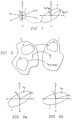
- Figure 1 is a Cartesian diagram illustrating an example of the mapping of vectors from a process parameter space into a circuit performance space.
- Figure 2 is a set diagram illustrating an example of the mapping of vectors from process parameter space into circuit performance space where certain of the process parameters do not have a significant effect upon the performance values.
- Figures 3a and 3b are Cartesian diagrams illustrating an example of worst case performance values of an analog circuit relative to performance axes in performance space.
- Figure 4 is an electrical diagram, in block form, of a computer system for performing circuit modelling according to the preferred embodiment of the invention.
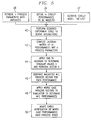
- Figure 5 is a flow diagram illustrating the operation of a modelling process according to the preferred embodiment of the invention.
- Figure 6 is a flow diagram illustrating the operation of the generation of worst case process parameter vectors in the method of Figure 5 according to the preferred embodiment of the invention.
- the present invention will be described herein according to a preferred embodiment thereof, specifically an embodiment in which the worst case manufacturing process conditions, and the resulting worst case circuit performance, are derived for an analog circuit.
- An analog circuit is selected for use in this exemplary description, considering that conventional worst case modelling techniques are not particularly useful in connection with analog circuits, while the present invention is particularly well-suited for use in the analog domain.
- the present invention may also be applied to digital and mixed-signal (i.e., both analog and digital) circuits. It is therefore contemplated that those skilled in the art, and having reference to this specification, will be readily able to utilize the present invention with these and other circuits and applications.
- a vector x in an n-dimensional linear time invariant inner product space (i.e., x ⁇ n ) is utilized to represent a combination of process parameter values.
- the process parameters represented by vector x include parameters that correspond to the physical construction of devices in the circuit under design (e.g., gate oxide thickness, transistor channel length reduction (from patterned), dopant concentrations), and also include parameters that correspond to measurable electrical parameters having a relatively well-behaved relationship with physical device features (e.g., transistor threshold voltages, flat-band voltages).
- the elements of vector x which are the settings of the n independent parameters, have a distribution of N(0,1), with the null vector 0 corresponding to the nominal values of these process parameters.
- a vector y corresponds to a combination of circuit performances, for the analog circuit to be modeled, an m-dimensional linear time invariant inner product space (i.e., y m ).
- the elements of y are deviations from nominal performance values, such that the null vector 0 in space m corresponds to the set of nominal circuit performances.
- One may represent a Jacobian matrix of circuit performance values y i with respect to process parameters x j at a current design point as follows:
- circuit performance vector y J T x
- the Jacobian matrix J (or its transpose, as the case may be) thus provides a mapping of values from process parameter space R n to the circuit performance space m .
- the singular value decomposition of this Jacobian matrix J provides singular values ⁇ from which the worst case vectors may be identified.
- J n ⁇ m U n ⁇ m ⁇ m ⁇ m V m ⁇ m in which the subscripts indicate the dimension of the matrices.
- it is useful to arrange these singular values in decreasing magnitude: ⁇ i ⁇ i+1 > 0, for i 1,...,m-1
- Figure 1 illustrates singular vectors u 1 and u 2 in a three-dimensional process parameter space (i.e., having axes x 1 , x 2 , x 3 ).
- Singular vectors u 1 and u 2 are unit vectors, and hence lie upon unit sphere 2 (which will be an n-dimensional hypersphere, in the general case).
- vectors u 1 and u 2 are orthonormal relative to one another.
- the three-dimensional process space X is to be mapped into a two-dimensional performance space Y, represented by axes y 1 , y 2 .
- Singular vector u 3 is therefore not shown in Figure 1.
- the mapping from process space X into a two-dimensional performance space Y carried out by application of the Jacobian matrix J T , maps unit sphere 2, upon which singular vectors u 1 and u 2 lie, into an ellipse in the two-dimensional space (an m-dimensional hyper-ellipsoid generally).
- this mapping permits identification of the worst case vector v WC that causes the greatest deviation on ellipse 4 from the origin of nominal parameters in performance space Y; additionally, one may identify best case vector v BC that is orthonormal to worst case vector v WC , and that corresponds to the smallest deviation on ellipse 4 from the nominal parameter point at the origin.
- a set X of points P may be defined as those points P that lie on the unit hypersphere in the x process parameter space, and that satisfy: In the statistical sense, each of the points P lying on the unit hypersphere have an equal probability of occurring in the process parameter space.
- vector x in process parameter space X corresponds to the case in which:
- Vector x' in Figure 2 is an example of such a general vector.
- the vectors x in subset R therefore do not have any influence upon performance space Y, and therefore map to the null vector 0 in space Y, as shown in Figure 2.
- subset Q forms an envelope encompassing all vectors y meeting the constraints of mapping from the Jacobian matrix and for which the sum of the squares of their p elements equals unity. Since subset Q can be derived by mapping from subset P in process parameter space X, only the vectors x in subset P are of concern:
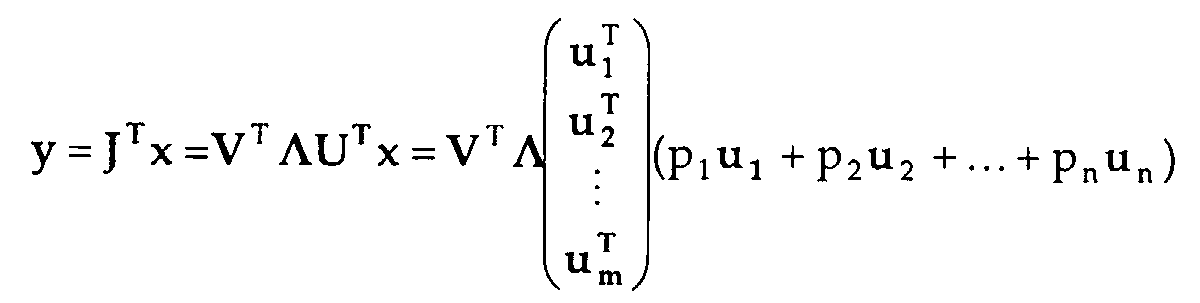
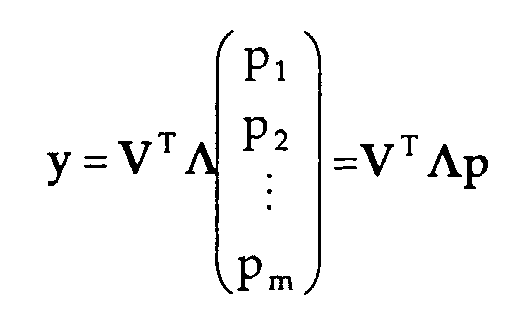
- the mapping of the set of vectors in subset P of Figure 2 from process parameter space X to performance space Y may be considered as performing the sequence of operations of:
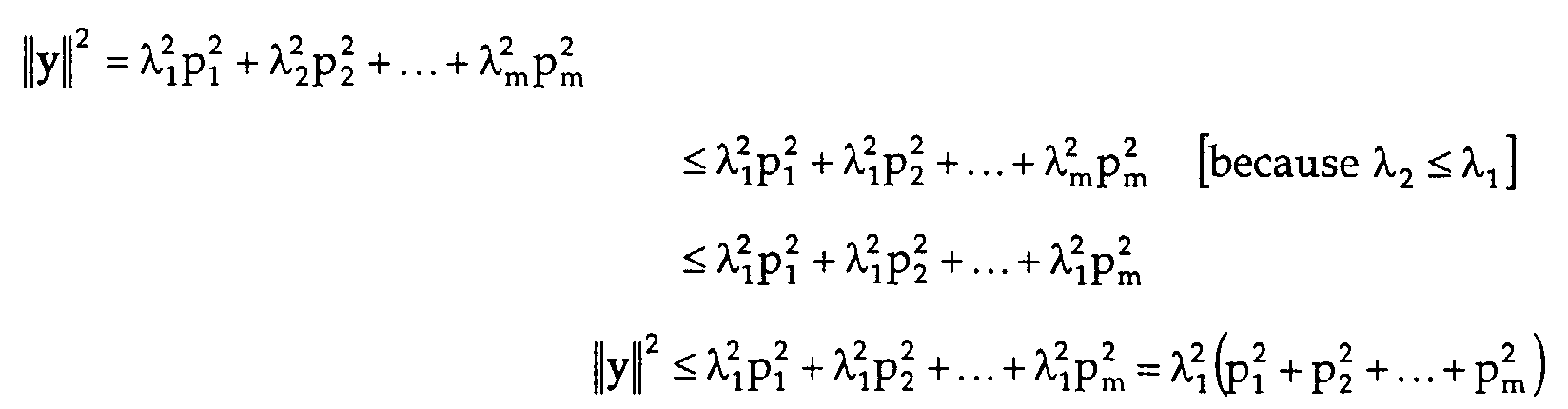
- analog circuits typically do not have such highly correlated behavior, instead having their larger singular values (e.g., ⁇ 1 , ⁇ 2 ) comparable in magnitude.
- the length (magnitude) of a vector y provides no indication of its direction, and as such the foregoing magnitude considerations can fall short of providing a worst case solution. In such a case, more than one pair of worst cases may exist, and the larger axes of the hyper-ellipsoid in performance space Y may not approximate the worst case conditions.
- Figures 3a and 3b illustrate an example of such a condition, as can be encountered in analog circuit simulation.
- FIG 3a a two-dimensional (dimensions y 1 and y 2 ) performance space Y is shown, in which vectors q 1 and q 2 are mapped from corresponding singular vectors u 1 , u 2 in process parameter space (not shown).
- the worst case value of performance y 2 i.e., the largest deviation of performance space Y in the y 2 dimension
- Figure 3b illustrates an alternative mapping, in which different vectors q 1 and q 2 are mapped from their corresponding singular vectors u 1 , u 2 .
- the distance y 2 (q 2 ) in the y 2 direction for vector q 2 is less than the distance y 2 (q 1 ) for vector q 1
- the distance y 2 (q 2 ) in the y 2 direction for vector q 2 is greater than the distance y 2 (q 1 ) for vector q 1
- the distances y 2 (q 2 ) and y 2 (q 1 ) are less than the true worst case distance in the y 2 dimension, namely y 2 (q m ). The similarity in the singular values giving rise to the mappings of Figures 3a and 3b thus prevent the direct determination of the true worst case performance.
- a known set of singular (or worst case) vectors e.g., ⁇ 3u 1 and ⁇ 3u 2
- the loss of coverage may be tolerable considering that both the vector endpoints q i (where i corresponds to the index of decreasing magnitude singular values) and also the true worst case performances (e.g., q m ) lie close to the edge of the statistical distribution of the performance space Y.
- the Jacobian matrix for a given set of process parameters and their resulting circuit performances may be readily derived by way of several circuit simulations.
- classical or Taguchi Design of Experiment techniques may be used to minimize the number of simulation runs that are performed.
- first order effects i.e., first partial derivatives
- a level 2 Orthogonal Array-based design is contemplated to be sufficient to evaluate the Jacobian matrix.
- the Jacobian matrix by way of which partial derivatives of circuit performances with respect to process parameters can then be derived by conventional techniques. Singular value decomposition of the Jacobian, as noted above, can then render the matrix of singular values ⁇ i in process parameter space X.
- L(p, ⁇ ) f(p)+ ⁇ g(p)
- f(p) ⁇ 1 v k1 p 1 + ⁇ 2 v k2 p 2 + . . .+ ⁇ m v km p m
- g(p) p 2 1 + p 2 2 + p 2 3 + . . .
- Figure 4 illustrates the generalized construction of computer system 30 suitable for performing the design evaluation according to the preferred embodiment of the invention.
- Computer system 30 includes system computer 22, which executes the appropriate operations necessary for performing the operations to be described hereinbelow.
- system computer 22 executes the appropriate operations necessary for performing the operations to be described hereinbelow.
- any conventional high performance personal computer or workstation either in standalone form or in a network configuration, and that is suitable for circuit simulation according to conventional techniques is contemplated to be of sufficient computational capacity for also performing the method described herein.
- workstations such as the Ultra 10 workstations available from Sun Microsystems, are contemplated to have sufficient computational power for use in connection with the present invention.
- system computer 22 is connected to various fixed disk storage devices 29, 31, 32, 33, which may correspond to logical disk storage partitions or to actual separate disk storage units, either provided within the workstation of computer system 30 or connected thereto by way a network.
- Program storage device 33 includes the program instructions by way of which system computer 22 is programmed to perform the circuit evaluation operations described hereinbelow according to the preferred embodiment of the invention. It is contemplated that these program instructions are preferably written in a high level language, such as Java, Perl, C++, Python, or the like; different modules of these program instructions may, if desired, be written in different languages.
- Java is particularly preferred for use in connection with the preferred embodiment of the present invention, considering its support for object oriented programming constructs, ease of implementation of graphical user interface (GUI) features, and portability of the class files across different platforms.
- GUI graphical user interface
- the memory medium storing the computer program may be of any conventional type used for the storage of computer programs, including hard disk drives (e.g., disk storage device 33), floppy disks, CD-ROM disks, magnetic tape, and the like.
- Data to be used by system computer 22 in executing the program instructions stored in program storage device 33 includes a data base of the circuit under design and evaluation, as well as identification of those circuit performances to be evaluated, as stored in circuit storage device 31.
- the input data further includes a data base of the process parameters representing the manufacturing process by way of which the circuit is to be fabricated, as well as statistical variations thereof, as stored in process parameter data base storage device 32.
- Disk storage device 29 is provided for storage of the results of the evaluation performed by system computer 22 according to the preferred embodiment of the invention.
- disk storage devices 29, 31, 32, 33 are illustrated as separate devices, a single disk storage device may of course be used to store any and all of the program instructions, measurement data, and results as desired.
- system computer 22 presents output primarily onto graphics display 27, or alternatively via printer 28. Further in the alternative, as noted above, system computer 22 may store the results of the analysis described hereinbelow on disk storage device 29, for later use and further analysis.
- Keyboard 26 and pointing device 25 e.g., a mouse, trackball, or the like are provided with system computer 22 to enable interactive operation.
- the result desired from this process is a determination of the worst case values of certain performance parameters of a designed electronic circuit, for a given manufacturing process. These worst case performances can then be analyzed by the circuit designer to determine whether the designed circuit will meet its desired specifications and, if not, to make certain modifications to the design.
- the present invention is particularly applicable to analog circuit such as operational amplifiers, power amplifiers, transceivers, equalizers, oscillators, level shifters, and the like, given that conventional modeling approaches are not sufficient for accurate worst case modeling of such circuits; of course, the present invention may also be applied to digital circuits and to mixed-signal circuits, as well.
- process 36 the human user, by reference to the data stored in circuit design and performance storage device 31, defines and selects the m circuit performances that are to be modeled. These circuit performances includes parameters by way of which the functionality of the designed circuit may be measured.
- Examples of useful performances for analog circuits include low frequency gain, high frequency gain, phase margin, gain margin, noise immunity at low and high frequency, common-mode rejection ratio (CMRR), power supply noise rejection ratio for both power supplies, settling time, and the like; in addition, if desired, the specific statistical bounds for which the modeling is to be performed (e.g., evaluation of the worst case performances to ⁇ 3 ⁇ , or three standard deviations) may also be specified in process 46.
- process 37 the details of the design of the circuit are retrieved from circuit design and performance storage device 31. For example, a netlist of the nodes in the circuit, such as used in SPICE modelling, may be retrieved in process 37.
- system computer 22 retrieves the process specifications and parameters, including measures (e.g., standard deviation) of the variability of the process parameters, from process parameter data base storage device 32.
- the number n of the retrieved process parameters is generally larger than the number m of the performances to be modeled.
- the process parameters retrieved in process 38 includes both actual physical process measurements and also electrical parameters that strongly correlate to the physical construction of an integrated circuit.
- the retrieved process parameters may include such parameters as gate oxide thickness, doping concentrations, diffusion thickness, transistor channel length reduction, and other physical measurements.
- the retrieved process parameters may include electrical transistor parameters such as threshold voltage, flatband voltages, resistivities, and the like, as parameters such as these correlate directly and strongly with the physical construction of the integrated circuit.
- system computer 22 generates a Design of Experiment by way of which the dependence of each of the m performances upon each of the n process parameters is evaluated. This evaluation is carried out by execution of a simulation of the designed circuit for each of multiple sets of process parameters, where each set of process parameter values generally corresponds to a combination of statistical extremes (i.e., plus or minus a selected number of standard deviations from nominal) of the process parameters to be. In a brute force fashion, of course, the effect of the process parameters may be determined by applying each combination of extreme values of the parameters; however, the number of simulations required in this approach for m process parameters is 2 m .
- the technique of Orthogonal Array Design of Experiment (also referred to as DoE, and a subset of which is referred as Taguchi experimental designs or Taguchi matrices) is used in process 40 to select an informative number of simulations from which the necessary conclusions may be drawn.
- the use of Orthogonal Array Design of Experiment techniques may select sixteen combinations of eight process parameters for simulation, while still providing accurate and informative results.
- Process 40 selects the sets of process parameter values according to the appropriate DoE technique, and then performs simulation of the designed circuit for each set.
- the simulation program executed by system computer 22 will correspond to the conventional simulation product used in connection with the desired circuit. These simulations will thus provide an array of performance values, with each column resulting from the application of an input vector of process parameter values.
- system computer 22 computes the Jacobian matrix of the m performances with respect to the n process parameters, based upon the results of the DoE simulations performed in process 40.
- the derivation of the Jacobian in process 42 may be performed according to conventional techniques that determine the gradient of each performance with respect to each process parameter. Numerical techniques for determining the Jacobian are well known in the art, and may be readily performed by system computer 22 of modern construction.
- system computer 22 next performs singular value decomposition of the Jacobian matrix.
- Numerous well known numerical techniques are available for use by
- the singular values ⁇ i are known, along with the elements of each of the matrices U, V. These elements are then stored in the memory of computer system 30, for further use in the determination of the worst case performances of the designed circuit.
- system computer 22 next performs process 46 to derive the magnified worst case process vector for each of the m performances being modelled for the designed circuit.
- the desired result of this process is the identification of a vector Pk in the process space that, when mapped to the performance space, corresponds to a worst case vector for the kth circuit performance.
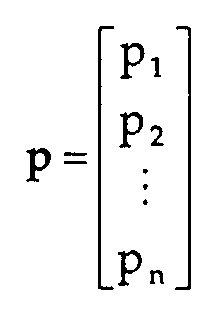
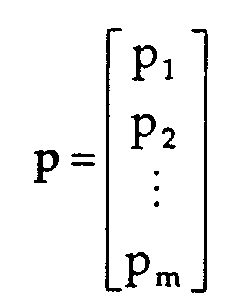
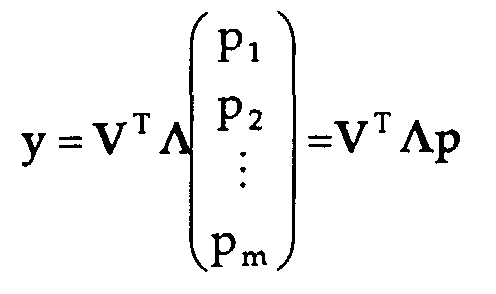
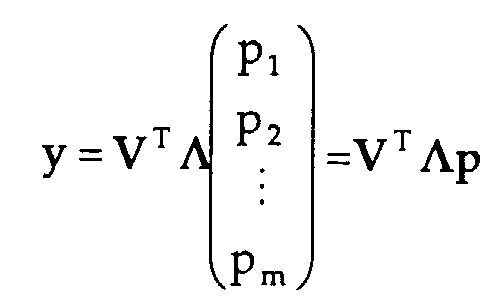
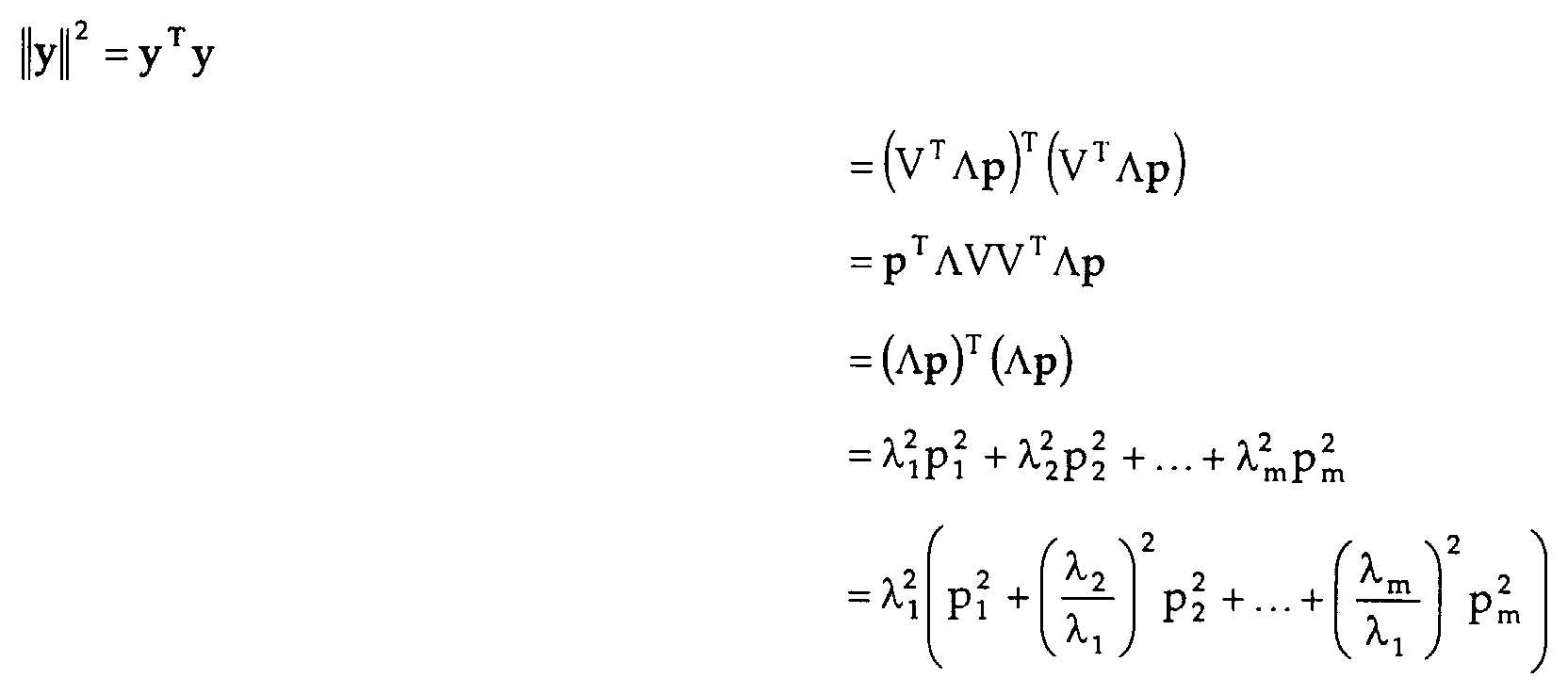
- a vector p may be expressed as p 1 u 1 + p 2 u 2 +...+ p m u m where each u i is a basis vector in the process parameter space (and with coefficients p i for i > m all being zero).
- process 46 is the derivation of a vector p (specifically, the values of its p i terms) for each performance, that maps to the worst case value for that performance. Attention is directed to Figure 6, in connection with which the steps involved in process 46 according to the preferred embodiment of the invention will now be described in detail.
- the singular values ⁇ i for i > m are, as noted above, equal to zero, and as such correspond to unit vectors in process parameter space that have no effect upon the circuit performances.
- system computer 22 multiplies these singular values ⁇ i by a factor corresponding to the desired performance statistic.
- a factor corresponding to the desired performance statistic.
- worst case simulations are typically carried out for a given statistical limit. For example, a conservative design methodology will often seek the worst case performance of a circuit to ⁇ 3 standard deviations from the nominal value.
- system computer 22 executes process 54 to multiply each of the singular vectors by the selected factor.
- system computer 22 next selects those singular values ⁇ i that have a sufficiently large magnitude as to be significant in the derivation of the worst case performances.
- the selection of singular values ⁇ i , or the threshold magnitude for making such selection may be made in an automated manner, according to a preselected threshold value or other criteria (e.g., considering a singular value ⁇ i as insignificant when it is less than a preselected percentage, such as 5%, of the largest singular value).
- the singular values ⁇ i may be selected in an interactive manner by a human user, for example by way of keyboard 26 and pointing device 27 directing operations by way of a graphical user interface with system computer 22.
- System computer 22 next performs process 58, by way of which the value of the constant ⁇ is determined for one of the circuit performances being modelled.
- the negative value of ⁇ derives the process space vector p for the maximum value of y k for the kth performance, which is the worst case performance sought to be identified according to the preferred embodiment of the invention. This negative value of ⁇ is thus calculated by system computer 22 and stored in its memory, for the kth performance, in process 58 by way of this summation.
- system computer determines the coefficients p i for the process space vector pk which renders the worst case value of the kth performance.
- Decision 61 is then performed to determine if additional ones of the m performances remain to have their worst case process vectors defined. If so (decision 61 is YES), processes 58 and 60 are repeated for the next performance in the set, with the resulting worst case process vector coefficients p i stored in memory in association therewith. Upon the worst case determination for each of the m desired performances (decision 61 is NO), control passes to process 48, as shown in Figure 5.
- system computer 22 evaluates the modelled worst case performance of the designed circuit by applying the worst case vectors determined in process 48 to the circuit simulation program (e.g., SPICE, etc.).
- Process 48 is carried out by the retrieval of the worst case vectors (i.e., the m sets of vector coefficients p i that were derived in process 46) from memory, and applying each worst case vector from process space as an input to the simulation.
- the result of the simulation, for a given worst case process space vector will output the simulated worst case performance value (i.e., for the one of the m performances associated with the given worst case process space vector) of the designed circuit.
- Process 48 repeats this simulation for each of the performances for which simulation is desired, and for which a worst case process space vector was determined in process 46. These worst case performances are then stored in disk storage device 29, or output by way of graphics display 27 or printer 28, as desired.
- the circuit designer obtains an accurate determination of the worst case performances of the designed circuit, as may be expected from the manufacturing process of which the process parameters were applied. Armed with this information, the designer can take such actions as are appropriate in response to the worst case performance results. For example, the worst case performances can be compared against the product specifications of the circuit to determine whether the designed circuit can meet these specifications (or, if not, an expected yield of the circuit to the specification). Additionally, if the worst case performance of the designed circuit is not acceptable, changes in the design or selection of a different manufacturing process may be indicated.
- an optional verification process 50 may be executed as desired.
- Process 50 which may also be performed by system computer 22, is a Monte Carlo test that is executed by randomly selecting process parameter values (i.e., randomly selecting vectors in process space) and applying the selected values to the simulation program to model the performances of the designed circuit for the process parameters. The random selection and simulation is repeated for a statistically significant number of repetitions (e.g., on the order of 500 to 1000), such that statistical worst case values of circuit performances may be estimated.
- Such Monte Carlo simulation of circuit performance is, of course, a well-known technique in the art. In this manner, the accuracy of the worst case modeling performed according to the preferred embodiment of the invention can be evaluated.
- Monte Carlo verification process 50 will not be performed for every circuit design and process combination, as the large number of simulations performed in process 50 will themselves be costly and cumbersome.
- the applicability of the modeling approach according to the preferred embodiment of the invention may be verified by Monte Carlo testing for a few to several circuit and process combinations, such that the process may be used with confidence for other designs and processes.
- the present invention is contemplated to be particularly well-suited for analog circuits in which performance values generally are not well-correlated with one another or with process and manufacturing parameters, such poor correlation resulting in the shortfall of conventional modeling technologies.
- the worst case modelling of these difficult circuits is quite efficient.
- the number of simulations necessary for the worst case modelling is quite low, as simulations are only required in the Orthogonal Array DoE generation of the Jacobian matrix, and for the application of the derived worst case process space vectors to evaluate the worst case performances.
- the worst case modelling of up to eight performances relative to eight process parameters may be carried out by twenty-two simulations: sixteen simulations required by the DoE of the eight process parameters, and six simulations for the magnified vectors corresponding to the three highest singular values.
Landscapes
- Engineering & Computer Science (AREA)
- Computer Hardware Design (AREA)
- Physics & Mathematics (AREA)
- Theoretical Computer Science (AREA)
- Microelectronics & Electronic Packaging (AREA)
- Evolutionary Computation (AREA)
- Geometry (AREA)
- General Engineering & Computer Science (AREA)
- General Physics & Mathematics (AREA)
- Feedback Control In General (AREA)
- Complex Calculations (AREA)
- Management, Administration, Business Operations System, And Electronic Commerce (AREA)
Abstract
Description
before the solving step, multiplying the singular values by a scalar corresponding to a desired statistical level to which the worst case performances are to be modelled.
before the solving operation, it performs the operation of multiplying the singular values by a scalar corresponding to a desired statistical level to which the worst case performances are to be modelled.
before the solving operation, multiplying the singular values by a scalar corresponding to a desired statistical level to which the worst case performances are to be modelled.















Claims (18)
- A method of modelling the performance of an electronic circuit, comprising the steps of:retrieving, from a memory, model parameters of the circuit;retrieving, from a memory, manufacturing process parameters corresponding to a manufacturing process by way of which the circuit may be fabricated;operating a computer to derive a Jacobian matrix corresponding to the dependence of a plurality of circuit performances in response to variations in values of the process parameters;operating the computer to perform singular value decomposition of the Jacobian matrix to provide an ordered set of singular values and a rotation vector;selecting a subset of the ordered set of singular values, the subset including those singular values of significant magnitude;for each of the plurality of circuit performances, deriving a worst case vector of process parameters from the selected subset of singular values and the rotation vector; andoperating the computer to simulate the operation of the circuit for each of the worst case vectors of process parameters, to evaluate worst case modelled values for each of the plurality of circuit performances.
- The method of claim 1, wherein the step of operating the computer to derive a Jacobian matrix comprises:selecting a set of process parameter combinations according to an Orthogonal Array Design of Experiment; andoperating the computer to simulate the operation of the circuit for each of the process parameter combinations.
- The method of claim 1 or claim 2, wherein the step of deriving a worst case vector of process parameters comprises, for each of the plurality of circuit performances:solving for a constant value as one-half the square root of the sum of the products of each selected singular value and a corresponding element of the rotation vector; andderiving each coefficient of the worst case process vector from a ratio of the product of a corresponding singular value and a corresponding element of the rotation vector to the constant value.
- The method of claim 3, further comprising:
before the solving step, multiplying the singular values by a scalar corresponding to a desired statistical level to which the worst case performances are to be modelled. - The method of any one of claims 1 to 4, further comprising:operating the computer to simulate the operation of the circuit for each of a plurality of randomly selected vectors of process parameters to evaluate each of the plurality of circuit performances;selecting the worst case values of each of the plurality of circuit performances evaluated in the step of operating the computer to simulate the operation of the circuit for each of a plurality of randomly selected vectors; andcomparing the results of the selected worst case values to the evaluated worst case modelled values, to verify the accuracy of the worst case modelled values.
- The method of any one of claims 1 to 5, wherein the electronic circuit is an analog circuit.
- The method of any one of claims 1 to 6, wherein the retrieved manufacturing process parameter values comprise at least one physical measurement and at least one transistor electrical parameter.
- The method of any one of claims 1 to 7, wherein the plurality of circuit performances comprises at least one gain measurement.
- A computer system for modelling the performance of an electronic circuit, comprising:a memory for storing program instructions;a memory for storing model parameters indicative of the design of the electronic circuit to be modelled;a memory for storing manufacturing process parameters corresponding to a manufacturing process by way of which the circuit may be fabricated;at least one output device, for presenting the results of the modelling process to a human user; anda computer, coupled to each of the memories and to the at least one output device, and operable in response to the program instructions to perform a sequence of operations comprising:retrieving model parameters of the circuit;retrieving distributions of the manufacturing process parameters;deriving a Jacobian matrix corresponding to the dependence of a plurality of circuit performances in response to variations in values of the process parameters;performing singular value decomposition of the Jacobian matrix to provide an ordered set of singular values and a rotation vector;selecting a subset of the ordered set of singular values, the subset including those singular values of significant magnitude;for each of the plurality of circuit performances, deriving a worst case vector of process parameters from the selected subset of singular values and the rotation vector;simulating the operation of the circuit for each of the worst case vectors of process parameters, to evaluate worst case modeled values for each of the plurality of circuit performances; andcommunicating the worst case modeled values to the at least one output device.
- The system of claim 9, wherein the computer is programmed to perform the operation of deriving the Jacobian matrix by a sequence of operations comprising:selecting a set of process parameter combinations according to an Orthogonal Array Design of Experiment; andsimulating the operation of the circuit for each of the process parameter combinations.
- The system of claim 9 or claim 10, wherein the computer is programmed to perform the operation of deriving a worst case vector of process parameters by a sequence of operations comprising, for each of the plurality of circuit performances:solving for a constant value as one-half the square root of the sum of the products of each selected singular value and a corresponding element of the rotation vector; andderiving each coefficient of the worst case process vector from a ratio of the product of a corresponding singular value and a corresponding element of the rotation vector to the constant value.
- The system of claim 11, further comprising:
before the solving operation, multiplying the singular values by a scalar corresponding to a desired statistical level to which the worst case performances are to be modelled. - The system of any one of claims 9 to 12, wherein the sequence of operations further comprises:simulating the operation of the circuit for each of a plurality of randomly selected vectors of process parameters to evaluate each of the plurality of circuit performances;selecting the worst case values of each of the plurality of circuit performances evaluated in the simulating of the operation of the circuit for each of a plurality of randomly selected vectors; andcomparing the results of the selected worst case values to the evaluated worst case modelled values, to verify the accuracy of the worst case modelled values.
- A computer-readable memory having a storage medium so configured that, when read and used by a computer, the computer is directed to model the performance of an electronic circuit by a plurality of operations comprising:retrieving, from a memory, model parameters of the circuit;retrieving, from a memory, manufacturing process parameters corresponding to a manufacturing process by way of which the circuit may be fabricated;deriving a Jacobian matrix corresponding to the dependence of a plurality of circuit performances in response to variations in values of the process parameters;performing singular value decomposition of the Jacobian matrix to provide an ordered set of singular values and a rotation vector;selecting a subset of the ordered set of singular values, the subset including those singular values of significant magnitude;for each of the plurality of circuit performances, deriving a worst case vector of process parameters from the selected subset of singular values and the rotation vector; andsimulating the operation of the circuit for each of the worst case vectors of process parameters, to evaluate worst case modelled values for each of the plurality of circuit performances.
- The computer-readable memory of claim 14, wherein the operation of deriving a Jacobian matrix comprises:selecting a set of process parameter combinations according to an Orthogonal Array Design of Experiment; andsimulating the operation of the circuit for each of the process parameter combinations.
- The computer-readable memory of claim 14 or claim 15, wherein the operation of deriving a worst case vector of process parameters comprises, for each of the plurality of circuit performances:solving for a constant value as one-half the square root of the sum of the products of each selected singular value and a corresponding element of the rotation vector; andderiving each coefficient of the worst case process vector from a ratio of the product of a corresponding singular value and a corresponding element of the rotation vector to the constant value.
- The computer-readable memory of claim 16, wherein the sequence of operations further comprises:
before the solving operation, multiplying the singular values by a scalar corresponding to a desired statistical level to which the worst case performances are to be modelled. - The computer-readable memory of any one of claims 14 to 17, wherein the sequence of operations further comprises:simulating the operation of the circuit for each of a plurality of randomly selected vectors of process parameters to evaluate each of the plurality of circuit performances;selecting the worst case values of each of the plurality of circuit performances evaluated in the step of operating the computer to simulate the operation of the circuit for each of a plurality of randomly selected vectors; andcomparing the results of the selected worst case values to the evaluated worst case modelled values, to verify the accuracy of the worst case modelled values.
Applications Claiming Priority (2)
| Application Number | Priority Date | Filing Date | Title |
|---|---|---|---|
| US16783799P | 1999-11-29 | 1999-11-29 | |
| US167837P | 1999-11-29 |
Publications (2)
| Publication Number | Publication Date |
|---|---|
| EP1103906A2 true EP1103906A2 (en) | 2001-05-30 |
| EP1103906A3 EP1103906A3 (en) | 2002-07-03 |
Family
ID=22609045
Family Applications (1)
| Application Number | Title | Priority Date | Filing Date |
|---|---|---|---|
| EP00310538A Withdrawn EP1103906A3 (en) | 1999-11-29 | 2000-11-28 | Worst case performance modeling of analog circuits |
Country Status (3)
| Country | Link |
|---|---|
| EP (1) | EP1103906A3 (en) |
| JP (1) | JP2001195445A (en) |
| KR (1) | KR20010061988A (en) |
Cited By (1)
| Publication number | Priority date | Publication date | Assignee | Title |
|---|---|---|---|---|
| EP1577801A1 (en) * | 2004-03-15 | 2005-09-21 | Infineon Technologies AG | Device characterization concept |
Families Citing this family (3)
| Publication number | Priority date | Publication date | Assignee | Title |
|---|---|---|---|---|
| WO2008102681A1 (en) * | 2007-02-19 | 2008-08-28 | Nec Corporation | Circuit operation worst condition decision system, method, and program |
| JP5267398B2 (en) * | 2009-09-25 | 2013-08-21 | 富士通株式会社 | Pareto data generation program, method and apparatus for automatic circuit design, and automatic circuit design program, method and apparatus |
| JP5500049B2 (en) * | 2010-11-09 | 2014-05-21 | 富士通株式会社 | Design support program, design support apparatus, and design support method |
Family Cites Families (1)
| Publication number | Priority date | Publication date | Assignee | Title |
|---|---|---|---|---|
| US5790436A (en) * | 1995-04-28 | 1998-08-04 | Bta Technology, Inc. | Realistic worst-case circuit simulation system and method |
-
2000
- 2000-11-28 EP EP00310538A patent/EP1103906A3/en not_active Withdrawn
- 2000-11-28 JP JP2000361256A patent/JP2001195445A/en active Pending
- 2000-11-29 KR KR1020000071528A patent/KR20010061988A/en not_active Withdrawn
Cited By (1)
| Publication number | Priority date | Publication date | Assignee | Title |
|---|---|---|---|---|
| EP1577801A1 (en) * | 2004-03-15 | 2005-09-21 | Infineon Technologies AG | Device characterization concept |
Also Published As
| Publication number | Publication date |
|---|---|
| KR20010061988A (en) | 2001-07-07 |
| JP2001195445A (en) | 2001-07-19 |
| EP1103906A3 (en) | 2002-07-03 |
Similar Documents
| Publication | Publication Date | Title |
|---|---|---|
| US6850877B1 (en) | Worst case performance modeling of analog circuits | |
| US7493574B2 (en) | Method and system for improving yield of an integrated circuit | |
| Sharma et al. | An information theoretic alternative to model a natural system using observational information alone | |
| US8286120B2 (en) | Non-invasive leakage power device characterization of integrated circuits using device grouping and compressive sensing | |
| US8176454B2 (en) | Non-invasive timing characterization of integrated circuits using sensitizable signal paths and sparse equations | |
| US20150149128A1 (en) | Systems and methods for analyzing model parameters of electrical power systems using trajectory sensitivities | |
| US8990749B2 (en) | Method and apparatus for optimizing memory-built-in-self test | |
| US8719761B2 (en) | Method and apparatus for optimizing memory-built-in-self test | |
| TW201218005A (en) | Methods, systems, and articles of manufacture for implementing electronic circuit designs with electro-migration awareness | |
| CN113853614B (en) | Unsupervised clustering using quantum similarity matrices in quantum feature space | |
| US7003745B2 (en) | Performance modeling for circuit design | |
| US20090327989A1 (en) | Statistical Interconnect Corner Extraction | |
| Gu et al. | An efficient, fully nonlinear, variability-aware non-Monte-Carlo yield estimation procedure with applications to SRAM cells and ring oscillators | |
| US20080300848A1 (en) | Efficient simulation of dominantly linear circuits | |
| CN117933183A (en) | Integrated circuit wafer test optimization method and system | |
| CN118468772B (en) | Integrated circuit failure boundary processing method and device, electronic equipment and medium | |
| US9471733B1 (en) | Solving a circuit network in multicore or distributed computing environment | |
| CN114880987A (en) | Modeling method and device of mismatch model of semiconductor device | |
| CN117940929A (en) | Method and electronic device for identifying a target circuit in a circuit system | |
| Zhang et al. | An efficient method for chip-level statistical capacitance extraction considering process variations with spatial correlation | |
| JP7466665B2 (en) | Design of dynamic random access memory pass transistors with statistical variations in leakage current. | |
| WO2023155203A1 (en) | Method for simulating circuit, electronic device, computer-readable storage medium, and program product | |
| Krishnan et al. | Stochastic behavioral modeling of analog/mixed-signal circuits by maximizing entropy | |
| CN112513861B (en) | Method and system for hierarchical circuit simulation using parallel processing | |
| US20120330883A1 (en) | Pareto sampling using simplicial refinement by derivative pursuit |
Legal Events
| Date | Code | Title | Description |
|---|---|---|---|
| PUAI | Public reference made under article 153(3) epc to a published international application that has entered the european phase |
Free format text: ORIGINAL CODE: 0009012 |
|
| AK | Designated contracting states |
Kind code of ref document: A2 Designated state(s): AT BE CH CY DE DK ES FI FR GB GR IE IT LI LU MC NL PT SE TR |
|
| AX | Request for extension of the european patent |
Free format text: AL;LT;LV;MK;RO;SI |
|
| PUAL | Search report despatched |
Free format text: ORIGINAL CODE: 0009013 |
|
| AK | Designated contracting states |
Kind code of ref document: A3 Designated state(s): AT BE CH CY DE DK ES FI FR GB GR IE IT LI LU MC NL PT SE TR |
|
| AX | Request for extension of the european patent |
Free format text: AL;LT;LV;MK;RO;SI |
|
| AKX | Designation fees paid |
Designated state(s): AT |
|
| REG | Reference to a national code |
Ref country code: DE Ref legal event code: 8566 |
|
| STAA | Information on the status of an ep patent application or granted ep patent |
Free format text: STATUS: THE APPLICATION IS DEEMED TO BE WITHDRAWN |
|
| 18D | Application deemed to be withdrawn |
Effective date: 20030104 |