EP1102184A2 - Verarbeitung von Datenbanksätzen für die Vorhersage von zukünftigen Daten-Werten - Google Patents
Verarbeitung von Datenbanksätzen für die Vorhersage von zukünftigen Daten-Werten Download PDFInfo
- Publication number
- EP1102184A2 EP1102184A2 EP00309548A EP00309548A EP1102184A2 EP 1102184 A2 EP1102184 A2 EP 1102184A2 EP 00309548 A EP00309548 A EP 00309548A EP 00309548 A EP00309548 A EP 00309548A EP 1102184 A2 EP1102184 A2 EP 1102184A2
- Authority
- EP
- European Patent Office
- Prior art keywords
- variables
- parameters
- variable
- distributions
- distribution
- Prior art date
- Legal status (The legal status is an assumption and is not a legal conclusion. Google has not performed a legal analysis and makes no representation as to the accuracy of the status listed.)
- Withdrawn
Links
Images


Classifications
-
- G—PHYSICS
- G06—COMPUTING OR CALCULATING; COUNTING
- G06Q—INFORMATION AND COMMUNICATION TECHNOLOGY [ICT] SPECIALLY ADAPTED FOR ADMINISTRATIVE, COMMERCIAL, FINANCIAL, MANAGERIAL OR SUPERVISORY PURPOSES; SYSTEMS OR METHODS SPECIALLY ADAPTED FOR ADMINISTRATIVE, COMMERCIAL, FINANCIAL, MANAGERIAL OR SUPERVISORY PURPOSES, NOT OTHERWISE PROVIDED FOR
- G06Q10/00—Administration; Management
- G06Q10/06—Resources, workflows, human or project management; Enterprise or organisation planning; Enterprise or organisation modelling
-
- G—PHYSICS
- G06—COMPUTING OR CALCULATING; COUNTING
- G06F—ELECTRIC DIGITAL DATA PROCESSING
- G06F17/00—Digital computing or data processing equipment or methods, specially adapted for specific functions
- G06F17/10—Complex mathematical operations
- G06F17/15—Correlation function computation including computation of convolution operations
-
- G—PHYSICS
- G06—COMPUTING OR CALCULATING; COUNTING
- G06F—ELECTRIC DIGITAL DATA PROCESSING
- G06F17/00—Digital computing or data processing equipment or methods, specially adapted for specific functions
- G06F17/10—Complex mathematical operations
- G06F17/18—Complex mathematical operations for evaluating statistical data, e.g. average values, frequency distributions, probability functions, regression analysis
Definitions
- the present invention relates to a method and apparatus for processing entries stored in an electronic database where each entry comprises a succession of data values of correlated variables.
- the entries are processed in order to provide predictions of future data values of the correlated variables.
- the invention has particular application to processing data entries that relate to customers of a bank or retail business so as to predict future data values of attributes of the customers. The future profitability of each customer may then be calculated by reference to the predicted values for the customer attributes.
- An individual facility such as a current account has an overhead cost to a bank that depends upon the number and type of transactions that pass through the account and the balance within the account.
- the bank will be able to determine a cost to be assigned to each account transaction whether it is processing a cheque or a cash withdrawal from an automated teller machine.
- the bank can also determine any profit from charging interest when an account is in deficit or the use of funds when the account is in credit.
- An individual customer of the bank may have accepted other financial products such as a loan or an insurance product and the profitability of that customer will depend on the number, the type and the value of those products.
- a bank will have been able to develop a profitability algorithm which relates the profit v(t) for a customer at any one time t to a number of variables relating to that customer.
- the variables may include continuous variables X such as a bank account balance and discrete variables Y such as a number of credit card transactions.
- Personal attributes that are explanatory of the customer, such as age, sex, occupation or address may be included in the data relating to each customer although they do not contribute directly to the algorithm of profitability used by the bank.
- v (t) G(X(t),Y(t)) (1)
- v ( t ) represents the profitability of the customer at time t
- G is a mathematical function defined by the bank
- X represents a continuous variable such as an account balance
- Y represents a discrete variable such as a number of credit card transactions.
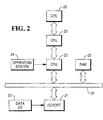
- data processing apparatus to process variables stored in an electronic database so as to provide predictions of future values of the variables, the apparatus comprising;
- a database 10 concerns a set of customers of an enterprise such as a bank.
- the database 10 is shown in three dimensions arranged along a vertical axis 11, a horizontal axis 13 and a time axis 12.
- the vertical axis 11 is subdivided to include fields for each of five customers A to E although it will be understood that in practice the database would have fields along the vertical axis for a multiplicity of customers far in excess of five.
- Each customer has attributes that include personal information such as age, type of job and salary and financial attributes such as the number and types of bank accounts, including investment accounts, deposit and current accounts and holdings of credit cards.
- the data in the database includes data values relating to quantifiable items such as the balance in each account, the number of transactions in each account, the number of credit card transactions and so on.
- the data values in the database constitute variables some of which are continuous variables and others of which are discrete variables.
- the balance in a bank account is an example of a continuous variable and the number of credit card transactions per month is an example of a discrete variable.
- the customer attributes are arranged along the horizontal axis 13. Whilst only five fields of attributes for each customer are shown in Figure 1, it will be understood that, in practice, provision would be made for a number of attributes for each customer far in excess of five.
- the time axis 12 of the database shows that the customer attributes are recorded as a succession of values at regular time intervals.
- the time intervals can conveniently be intervals of one month although intervals other than monthly intervals may be used.
- a portion of the entry for a customer A is illustrated in the following table A.
- the table A includes fields relating to age, salary and transactions in a current account including the number of ATM transactions, the balance and the settlement of a visa credit card bill.
- a table B illustrates the corresponding fields for a customer B.
- Banks have developed profitability algorithms to calculate the profit from each of their customers.
- the algorithm takes account of continuous variables such as the balance in an account and discrete variables such as the number of times an ATM has been used to conduct transactions.
- the profitability algorithm may not take into account variables such as the age of a customer that do not contribute directly to a determination of profit.
- the continuous variable X may be the account balance in Table A and the discrete variable Y may be the number of ATM transactions in Table A.
- the present invention is based on the realisation that use can be made of the correlation between customer attributes to obtain accurate predictions of the variables X , Y and Z .
- Two attributes are said to be correlated if the variable value of one affects the value of the other and vice versa.
- a customer with a higher bank balance can be expected to make more credit card transactions than a customer with a lower bank balance for example.
- the continuous variable of bank balance in an account is correlated with the discrete variable of the number of credit card transactions.
- Correlations can be found between two continuous variables, two discrete variables as well as between a continuous and a discrete variable and the present invention is not limited to the type of variables that are correlated.
- the correlation between the different variables will be referred to as the correlation structure and each variable which is correlated with one or more other variables will be referred to as a covariate.
- the posterior predictive distributions for each covariate are given by; X ( t + 1) ⁇ p ( X ( t + 1)
- the expressions (2) indicate that the predictive distribution of a covariate X at time ( t + 1) given that we are at time t , (i.e.
- This process can be continued for all the covariates in the database and the predicted profit at time t + 1 can then be calculated from the profitability algorithm using the predicted values of the covariates at time t + 1.
- the process of prediction may be repeated the required number of times.
- the predicted profit at these future times may be calculated from the profitability algorithm using the appropriate predicted values of the covariates.
- the further into the future the predictions go the less certain the predictions become (i.e. the greater the variance).
- the expressions (2) make the implicit assumption that the covariates exhibit Markovian properties, that is to say that the value of a covariate at the nth step is dependent only on its value at the (n - 1)th step and not on any previous values.
- the invention is not limited to covariates exhibiting Markovian properties and may be extended to take the values at earlier time points into account.
- the distributions and the parameters in the expressions (2) may be modelled by first assuming that continuous variables such as X follow a normal distribution and discrete variables such as Y follow a Poisson distribution.
- the data is entered by means of an I/O device 20 through an I/O port 21 for entry to a data bus 22.
- a group of central processing units (CPU) 23 are controlled by an operating system 24 to control the entry of data onto the data bus.
- a random access memory 25 is connected to the I/O bus 22 to receive and store data supplied by the bus 22.
- the parallel operating CPU's are programmed to enter the data into the memory 25.
- the data in the memory 25 is a set of data values representing each of the variables for each of the customers included in the database.
- the data are available to be processed in a series of processing operations as represented in the block flow diagram of Figures 3A and 3B.
- the process begins at the start 30 and proceeds to a step 31 in which, working within a Bayesian framework, a prior distribution over the parameters of a first of the variables is specified and accessed. If the first variable is a continuous variable, the parameters are those of If the first variable is a discrete variable, the parameters are those of The prior distribution covers all the customers in the database.
- step 32 the data values of the first variable are accessed up to the most current value at time t so as to derive in step 33 a posterior distribution over the parameters of the first variable.
- a test is conducted in step 34 to determine whether a posterior distribution has been derived for all the variables. If not, the process reverts to step 31 for the next variable until all the variables that contribute to the profitability algorithm of the bank have been dealt with.
- step 34 will take the process to step 35.
- step 35 statistical samples of the parameters of the posterior distribution of the first variable are taken to provide estimates of the parameters.
- the samples may be taken using the known Markov Chain Monte Carlo (MCMC) sampler e.g. a Gibbs sampler.
- MCMC Markov Chain Monte Carlo
- a test is taken in step 36 to determine whether there are samples to be taken for further variables. If there are more samples to be taken, the process loops round to step 35. By this means, parameter sampling continues until the samples for all of the continuous variables and all of the discrete variables have been taken.
- step 37 a calculation is made of the predicted values of the variables for an individual customer at time t + 1 using the parameter samples and the data values for that customer as represented in equations (3). The predictions are computed for each customer until the test in step 38 indicates that all the customers have been dealt with.
- step 39 the profit expected for an individual customer is calculated from the profitability algorithm at time t + 1 using the predicted values for that customer of each variable.
- the profit for each customer is computed in turn until a test in step 40 indicates that the profit for all of the customers has been calculated.
- the step 41 indicates the end of the process.
- the predictions in step 37 may be extended beyond time t + 1 to succeeding time points t + 2, t + 3 and so on.
- the predictions can then be used in step 39 to calculate profit at these succeeding time points. It will be appreciated that the predictions in step 37 and the calculations in step 40 become less certain the further into the future the predictions are made.
- What has been described is a method and apparatus for providing predictions of future values of the variables in the database. Whilst the predictions have been described as providing the input to the calculation of profitability, they may be seen to be useful in their own right as extrapolations into the future from known values of individual variables. Furthermore the predictions may be useful to calculate results other than profitability, for example to plan the resources needed by the bank to service individual customers.
- the invention may use functions other than those described for ⁇ and ⁇ such as functions with squared or exponential terms for example and may use distributions other than those specifically described.
- the Dirichlet process prior essentially splits the database into distinct clusters of similar customers and a separate analysis can be performed to predict values in relation to each cluster. In essence the modelling process at each step would be local to each cluster. Other clustering techniques are available to perform local modelling and may be preferred to the Dirichlet process by reason of computational efficiency.
Landscapes
- Engineering & Computer Science (AREA)
- Physics & Mathematics (AREA)
- General Physics & Mathematics (AREA)
- Data Mining & Analysis (AREA)
- Theoretical Computer Science (AREA)
- Mathematical Physics (AREA)
- Computational Mathematics (AREA)
- Pure & Applied Mathematics (AREA)
- Mathematical Optimization (AREA)
- Mathematical Analysis (AREA)
- Business, Economics & Management (AREA)
- Entrepreneurship & Innovation (AREA)
- General Engineering & Computer Science (AREA)
- Software Systems (AREA)
- Databases & Information Systems (AREA)
- Human Resources & Organizations (AREA)
- Economics (AREA)
- Algebra (AREA)
- Strategic Management (AREA)
- Operations Research (AREA)
- Game Theory and Decision Science (AREA)
- Bioinformatics & Computational Biology (AREA)
- Quality & Reliability (AREA)
- Development Economics (AREA)
- Educational Administration (AREA)
- General Business, Economics & Management (AREA)
- Computing Systems (AREA)
- Life Sciences & Earth Sciences (AREA)
- Marketing (AREA)
- Bioinformatics & Cheminformatics (AREA)
- Tourism & Hospitality (AREA)
- Evolutionary Biology (AREA)
- Probability & Statistics with Applications (AREA)
- Management, Administration, Business Operations System, And Electronic Commerce (AREA)
- Information Retrieval, Db Structures And Fs Structures Therefor (AREA)
Applications Claiming Priority (2)
| Application Number | Priority Date | Filing Date | Title |
|---|---|---|---|
| GB9927371 | 1999-11-20 | ||
| GBGB9927371.6A GB9927371D0 (en) | 1999-11-20 | 1999-11-20 | Processing database entries to provide predictions of future data values |
Publications (2)
| Publication Number | Publication Date |
|---|---|
| EP1102184A2 true EP1102184A2 (de) | 2001-05-23 |
| EP1102184A3 EP1102184A3 (de) | 2004-03-17 |
Family
ID=10864794
Family Applications (1)
| Application Number | Title | Priority Date | Filing Date |
|---|---|---|---|
| EP00309548A Withdrawn EP1102184A3 (de) | 1999-11-20 | 2000-10-30 | Verarbeitung von Datenbanksätzen für die Vorhersage von zukünftigen Daten-Werten |
Country Status (4)
| Country | Link |
|---|---|
| US (1) | US6725210B1 (de) |
| EP (1) | EP1102184A3 (de) |
| CA (1) | CA2326296A1 (de) |
| GB (1) | GB9927371D0 (de) |
Cited By (1)
| Publication number | Priority date | Publication date | Assignee | Title |
|---|---|---|---|---|
| US7376603B1 (en) * | 1997-08-19 | 2008-05-20 | Fair Isaac Corporation | Method and system for evaluating customers of a financial institution using customer relationship value tags |
Families Citing this family (37)
| Publication number | Priority date | Publication date | Assignee | Title |
|---|---|---|---|---|
| US7249138B1 (en) * | 2000-06-29 | 2007-07-24 | Ncr Corporation | Parallel selection processing for financial processing in a relational database management system |
| AU2002243431A1 (en) | 2000-10-23 | 2002-06-24 | Deloitte And Touche Llp | Commercial insurance scoring system and method |
| US8868448B2 (en) * | 2000-10-26 | 2014-10-21 | Liveperson, Inc. | Systems and methods to facilitate selling of products and services |
| US9819561B2 (en) | 2000-10-26 | 2017-11-14 | Liveperson, Inc. | System and methods for facilitating object assignments |
| US7526439B2 (en) | 2001-08-06 | 2009-04-28 | Proficient Systems, Incorporated | Systems and methods to facilitate selling of products and services |
| US8200511B2 (en) * | 2001-11-28 | 2012-06-12 | Deloitte Development Llc | Method and system for determining the importance of individual variables in a statistical model |
| US8036919B2 (en) | 2002-07-10 | 2011-10-11 | Deloitte & Touche Llp | Licensed professional scoring system and method |
| US20060136273A1 (en) * | 2004-09-10 | 2006-06-22 | Frank Zizzamia | Method and system for estimating insurance loss reserves and confidence intervals using insurance policy and claim level detail predictive modeling |
| US20070024580A1 (en) * | 2005-07-29 | 2007-02-01 | Microsoft Corporation | Interactive display device, such as in context-aware environments |
| US20070027806A1 (en) * | 2005-07-29 | 2007-02-01 | Microsoft Corporation | Environment-driven applications in a customer service environment, such as a retail banking environment |
| US20070055708A1 (en) * | 2005-09-07 | 2007-03-08 | Ncr Corporation | Processing formulae in rules for profitability calculations for financial processing in a relational database management system |
| US8738732B2 (en) | 2005-09-14 | 2014-05-27 | Liveperson, Inc. | System and method for performing follow up based on user interactions |
| US9432468B2 (en) | 2005-09-14 | 2016-08-30 | Liveperson, Inc. | System and method for design and dynamic generation of a web page |
| US8762313B2 (en) | 2008-07-25 | 2014-06-24 | Liveperson, Inc. | Method and system for creating a predictive model for targeting web-page to a surfer |
| US8799200B2 (en) | 2008-07-25 | 2014-08-05 | Liveperson, Inc. | Method and system for creating a predictive model for targeting webpage to a surfer |
| US8805844B2 (en) | 2008-08-04 | 2014-08-12 | Liveperson, Inc. | Expert search |
| US20100082384A1 (en) * | 2008-10-01 | 2010-04-01 | American Express Travel Related Services Company, Inc. | Systems and methods for comprehensive consumer relationship management |
| US9892417B2 (en) | 2008-10-29 | 2018-02-13 | Liveperson, Inc. | System and method for applying tracing tools for network locations |
| US8275683B2 (en) * | 2009-03-20 | 2012-09-25 | Fiserv, Inc. | Systems and methods for deposit predictions based upon Monte Carlo analysis |
| US8417630B2 (en) * | 2009-03-20 | 2013-04-09 | Fiserv, Inc. | Systems and methods for deposit predictions based upon template matching |
| WO2010129571A2 (en) * | 2009-05-04 | 2010-11-11 | Visa International Service Association | Demographic analysis using time-based consumer transaction histories |
| JP5941903B2 (ja) | 2010-04-07 | 2016-06-29 | ライブパーソン, インコーポレイテッド | カスタマイズされたウェブコンテンツおよびアプリケーションを動的にイネーブルにするためのシステムおよび方法 |
| US8688557B2 (en) * | 2010-09-29 | 2014-04-01 | Fiserv, Inc. | Systems and methods for customer value optimization involving relationship optimization |
| US20120078766A1 (en) * | 2010-09-29 | 2012-03-29 | Fiserv, Inc. | Systems and methods for customer value optimization involving product/service optimization |
| US9350598B2 (en) | 2010-12-14 | 2016-05-24 | Liveperson, Inc. | Authentication of service requests using a communications initiation feature |
| US8918465B2 (en) | 2010-12-14 | 2014-12-23 | Liveperson, Inc. | Authentication of service requests initiated from a social networking site |
| US8635134B2 (en) | 2011-09-07 | 2014-01-21 | Fiserv, Inc. | Systems and methods for optimizations involving insufficient funds (NSF) conditions |
| US8943002B2 (en) | 2012-02-10 | 2015-01-27 | Liveperson, Inc. | Analytics driven engagement |
| US8744899B2 (en) | 2012-02-28 | 2014-06-03 | Fiserv, Inc. | Systems and methods for migrating customers to alternative financial products |
| US8762194B2 (en) | 2012-02-28 | 2014-06-24 | Fiserv, Inc. | Systems and methods for evaluating alternative financial products |
| US8805941B2 (en) | 2012-03-06 | 2014-08-12 | Liveperson, Inc. | Occasionally-connected computing interface |
| US9563336B2 (en) | 2012-04-26 | 2017-02-07 | Liveperson, Inc. | Dynamic user interface customization |
| US9672196B2 (en) | 2012-05-15 | 2017-06-06 | Liveperson, Inc. | Methods and systems for presenting specialized content using campaign metrics |
| US9235555B2 (en) * | 2013-03-15 | 2016-01-12 | Internationl Business Machines Corporation | Computing polychoric and polyserial correlations between random variables using NORTA |
| US11386442B2 (en) | 2014-03-31 | 2022-07-12 | Liveperson, Inc. | Online behavioral predictor |
| JP6762963B2 (ja) | 2015-06-02 | 2020-09-30 | ライブパーソン, インコーポレイテッド | 一貫性重み付けおよびルーティング規則に基づく動的通信ルーティング |
| CN109844717B (zh) | 2016-08-14 | 2023-05-23 | 利维帕尔森有限公司 | 用于移动应用程序的实时远程控制的系统和方法 |
Family Cites Families (2)
| Publication number | Priority date | Publication date | Assignee | Title |
|---|---|---|---|---|
| US5855011A (en) * | 1996-09-13 | 1998-12-29 | Tatsuoka; Curtis M. | Method for classifying test subjects in knowledge and functionality states |
| US6601055B1 (en) * | 1996-12-27 | 2003-07-29 | Linda M. Roberts | Explanation generation system for a diagnosis support tool employing an inference system |
-
1999
- 1999-11-20 GB GBGB9927371.6A patent/GB9927371D0/en not_active Ceased
-
2000
- 2000-10-30 EP EP00309548A patent/EP1102184A3/de not_active Withdrawn
- 2000-11-15 US US09/713,368 patent/US6725210B1/en not_active Expired - Lifetime
- 2000-11-17 CA CA002326296A patent/CA2326296A1/en not_active Abandoned
Non-Patent Citations (1)
| Title |
|---|
| No Search * |
Cited By (1)
| Publication number | Priority date | Publication date | Assignee | Title |
|---|---|---|---|---|
| US7376603B1 (en) * | 1997-08-19 | 2008-05-20 | Fair Isaac Corporation | Method and system for evaluating customers of a financial institution using customer relationship value tags |
Also Published As
| Publication number | Publication date |
|---|---|
| US6725210B1 (en) | 2004-04-20 |
| EP1102184A3 (de) | 2004-03-17 |
| CA2326296A1 (en) | 2001-05-20 |
| GB9927371D0 (en) | 2000-01-19 |
Similar Documents
| Publication | Publication Date | Title |
|---|---|---|
| US6725210B1 (en) | Process database entries to provide predictions of future data values | |
| Ackerberg et al. | Quantifying equilibrium network externalities in the ACH banking industry | |
| Muhammad et al. | IMPACT OF INFORMATION AND COMMUNICATION TECHNOLOGY ON BANK PERFORMANCE: A STUDY OF SELECTED COMMERCIAL BANKS IN NIGERIA (2001– | |
| US8543499B2 (en) | Reducing risks related to check verification | |
| US20060242050A1 (en) | Method and apparatus for targeting best customers based on spend capacity | |
| Anyfantaki et al. | Diversification, integration and cryptocurrency market | |
| MX2007012294A (es) | Metodo y aparato para evaluar valores garantizados por activos. | |
| Machado et al. | Applying hybrid machine learning algorithms to assess customer risk-adjusted revenue in the financial industry | |
| Amadi et al. | Stochastic analysis of stock price changes as markov chain in finite states | |
| Osazevbaru et al. | Cashless policy and banks’ profitability in Nigeria | |
| Cabello | Money Leaks in Banking ATM’s Cash-Management Systems | |
| EP2589008A1 (de) | Verfahren und system zur analyse und optimierung der arbeitsverteilung aus mehreren warteschlangen | |
| Zaccheaus | Effect of Electronic Payment System on Economic Growth in Nigeria | |
| Machova et al. | Estimation of the development of Czech Koruna to Chinese Yuan exchange rate using artificial neural networks | |
| Caldeira et al. | Measuring risk in fixed income portfolios using yield curve models | |
| JP2003114977A (ja) | 顧客生涯価値算出方法およびシステム | |
| Aguirregabiria et al. | Decentralized decision-making in retail chains: Evidence from inventory management | |
| CN1971610A (zh) | 一种用于评价银行贷款风险的系统及方法 | |
| UCHENNA et al. | Stochastic Analysis of Markov Chain in Finite State: Empirical Evidence on Nigerian Current Account Net Movements | |
| EP0987645A2 (de) | Vorhersage eines zukünftigen Werts einer mit einer Dateneingabesequenz assoziierten Variablen | |
| Singh et al. | A review on machine learning approach for predicting cryptocurrency prices | |
| Prabodhi et al. | Impact of electronic banking on operational performance of commercial banks in Sri Lanka | |
| Coulibaly | Effects of Information and Communication Technologies on the Banking Inclusion of Populations in the West African Economic and Monetary Union | |
| Gurgul et al. | Using trigonometric seasonal models in forecasting the size of withdrawals from automated teller machines | |
| US20110270743A1 (en) | Financial transaction systems |
Legal Events
| Date | Code | Title | Description |
|---|---|---|---|
| PUAI | Public reference made under article 153(3) epc to a published international application that has entered the european phase |
Free format text: ORIGINAL CODE: 0009012 |
|
| AK | Designated contracting states |
Kind code of ref document: A2 Designated state(s): AT BE CH CY DE DK ES FI FR GB GR IE IT LI LU MC NL PT SE |
|
| AX | Request for extension of the european patent |
Free format text: AL;LT;LV;MK;RO;SI |
|
| PUAL | Search report despatched |
Free format text: ORIGINAL CODE: 0009013 |
|
| AK | Designated contracting states |
Kind code of ref document: A3 Designated state(s): AT BE CH CY DE DK ES FI FR GB GR IE IT LI LU MC NL PT SE |
|
| AX | Request for extension of the european patent |
Extension state: AL LT LV MK RO SI |
|
| 17P | Request for examination filed |
Effective date: 20040917 |
|
| AKX | Designation fees paid |
Designated state(s): DE FR GB |
|
| 17Q | First examination report despatched |
Effective date: 20050204 |
|
| STAA | Information on the status of an ep patent application or granted ep patent |
Free format text: STATUS: THE APPLICATION IS DEEMED TO BE WITHDRAWN |
|
| 18D | Application deemed to be withdrawn |
Effective date: 20050615 |