EP1101653A2 - Turn signal cancel device - Google Patents
Turn signal cancel device Download PDFInfo
- Publication number
- EP1101653A2 EP1101653A2 EP00124950A EP00124950A EP1101653A2 EP 1101653 A2 EP1101653 A2 EP 1101653A2 EP 00124950 A EP00124950 A EP 00124950A EP 00124950 A EP00124950 A EP 00124950A EP 1101653 A2 EP1101653 A2 EP 1101653A2
- Authority
- EP
- European Patent Office
- Prior art keywords
- ratchet
- bracket
- movable portion
- cancel
- moderation
- Prior art date
- Legal status (The legal status is an assumption and is not a legal conclusion. Google has not performed a legal analysis and makes no representation as to the accuracy of the status listed.)
- Withdrawn
Links
- 230000007935 neutral effect Effects 0.000 claims description 22
- 230000008602 contraction Effects 0.000 abstract description 5
- 238000010586 diagram Methods 0.000 description 11
- 240000002853 Nelumbo nucifera Species 0.000 description 2
- 235000006508 Nelumbo nucifera Nutrition 0.000 description 2
- 235000006510 Nelumbo pentapetala Nutrition 0.000 description 2
- 230000002093 peripheral effect Effects 0.000 description 2
- 210000000078 claw Anatomy 0.000 description 1
Images



Classifications
-
- B—PERFORMING OPERATIONS; TRANSPORTING
- B60—VEHICLES IN GENERAL
- B60Q—ARRANGEMENT OF SIGNALLING OR LIGHTING DEVICES, THE MOUNTING OR SUPPORTING THEREOF OR CIRCUITS THEREFOR, FOR VEHICLES IN GENERAL
- B60Q1/00—Arrangement of optical signalling or lighting devices, the mounting or supporting thereof or circuits therefor
- B60Q1/26—Arrangement of optical signalling or lighting devices, the mounting or supporting thereof or circuits therefor the devices being primarily intended to indicate the vehicle, or parts thereof, or to give signals, to other traffic
- B60Q1/34—Arrangement of optical signalling or lighting devices, the mounting or supporting thereof or circuits therefor the devices being primarily intended to indicate the vehicle, or parts thereof, or to give signals, to other traffic for indicating change of drive direction
- B60Q1/40—Arrangement of optical signalling or lighting devices, the mounting or supporting thereof or circuits therefor the devices being primarily intended to indicate the vehicle, or parts thereof, or to give signals, to other traffic for indicating change of drive direction having mechanical, electric or electronic automatic return to inoperative position
- B60Q1/42—Arrangement of optical signalling or lighting devices, the mounting or supporting thereof or circuits therefor the devices being primarily intended to indicate the vehicle, or parts thereof, or to give signals, to other traffic for indicating change of drive direction having mechanical, electric or electronic automatic return to inoperative position having mechanical automatic return to inoperative position due to steering-wheel position, e.g. with roller wheel control
- B60Q1/425—Arrangement of optical signalling or lighting devices, the mounting or supporting thereof or circuits therefor the devices being primarily intended to indicate the vehicle, or parts thereof, or to give signals, to other traffic for indicating change of drive direction having mechanical, electric or electronic automatic return to inoperative position having mechanical automatic return to inoperative position due to steering-wheel position, e.g. with roller wheel control using a latching element for resetting a switching element
Definitions
- the present invention relates to a turn signal cancel device adapted to automatically return a turn lever, which has been turned to a left turn indicating position or to a right turn indicating position, to a neutral position according to the fact that a steering wheel is rotated in a direction opposite to the direction indicated by the turn lever.
- a cancel cam 1 is a cylindrically shaped member, which has a cancel convex portion la on the outer peripheral portion thereof, and adapted to be integrally rotated with a steering wheel (not shown).
- a rectangular box body 2 having opening portions at both lateral end portions is provided in a fixed manner on the right side of this cancel cam 1.
- a bracket 3 is provided in the body 2 in such a way as to be able to rotate around a shaft portion 3a.
- a base portion of a turn lever 4 is connected to the bracket 3.
- a moderation surface portion 5 having alternate formed ridge portions and valley portions is provided on the left-hand inner surface of the body 2.
- a moderation piece 6b is provided at the end portion of the bracket 3 and is pushed by a moderation spring 6a in a direction which the moderation piece 6b is press-contacted with the moderation surface portions.
- a moderation mechanism 7 includes the moderation surface portion 5, the moderation spring 6a, and the moderation piece 6b.
- the bracket 3 and the turn lever 4 are held selectively at a neutral position, a left turn indicating position (see Fig. 10) to which the turn lever 4 is turned therefrom in a direction of an arrow Al, and a right turn indicating position (not shown) to which the turn lever 4 is turned therefrom in a direction of an arrow A2 whose direction is opposite to the direction of the arrow A1, as illustrated in FIGS. 8 and 9.
- a turn signal switch whose contacts are switched according to the position of the bracket 3, is provided in the body 2.
- a back plate 8 is nearly U-shaped as a whole, and includes pressed portions 8a and 8b at both end portions thereof.
- the back plate is attached onto a nearly central part of the top surface portion of the bracket 3 in such a manner as to be able to slide in the directions of arrows B1 and B2.
- a back-plate holding spring 9 for holding the back plate 8 at an intermediate position illustrated in FIG. 8 by a predetermined force is provided between the back plate 8 and the bracket 3.
- a cam portion 10 having a crest part is provided on a left-hand side portion of the top surface of the bracket 3.
- a ratchet 11 is disposed in the top surface portion of the bracket 3.
- a shaft portion lla is provided on the middle portion of the ratchet 11 so that the top end of the shaft portion lla is inserted into a guide hole 12a, which is an elongated hole formed in a cover 12 (see FIG. 9) attached to the top surface portion of the body 2 in such a manner as to be able to move and rotate, and so that the bottom part of the shaft portion lla moves along the cam portion 10.
- the ratchet 11 is pushed by a ratchet pushing spring 13 in a direction of an arrow C, that is, to the side of the cancel cam 1.
- the ratchet 11 When the turn lever 4 is turned from the neutral position thereof in the direction of, for instance, the arrow A1, and the bracket 3 is placed at the left turn indicating position illustrated in FIG. 10, the ratchet 11 is caused by the pushing force of the ratchet pushing spring 13 to frontwardly move in the direction of the arrow C during the bottom part of the shaft portion 11a moves along a slope of the cam portion 10. Then, the ratchet 11 is put into a state in which the leading end portion 11b thereof moves inside the rotational lotus K of the cancel convex portion 1a.
- the related cancel device has the following problem. That is, let F1 denote a vector representing the pushing force transmitted from the ratchet 11 to the back plate 8 when the cancel operation is performed as illustrated in FIG. 10.
- a vector F2 representing the force acting on the back-plate holding spring 9 is established as illustrated in FIG. 10.
- a vector F3 is a vector representing a vertical reaction force transmitted from the back plate 8 to the ratchet 11.
- the direction of the vector F1 representing the pushing force transmitted from the back plate 8 to the ratchet 11 is close to the direction of expansion and contraction of the back-plate holding spring 9 (that is, the direction of the arrow B1 or B2, in which the back plate 8 moves).
- the vector F2 acting on the back-plate holding spring 9 has a large magnitude and exerts a large influence on the back-plate holding spring 9.
- an object of the present invention is to provide a turn signal cancel device, which has a function of avoiding occurrences of phenomena of grabby brakes in a turn lever, and which can prevent occurrences of cancel errors as much as possible.
- a turn signal cancel device that includes:
- the direction of a vector representing a force transmitted from the ratchet movable portion to the pressed portion of the bracket differs by nearly 90 degrees from the direction of movement of the ratchet movable portion, which is caused so as to relieve an excessive pushing force to be made to act on the pressed portion, or from the direction of expansion and contraction of the movable portion pushing spring.
- the magnitude of a vector representing a force acting on the movable portion pushing spring is relatively small. Consequently, this force exerts a small influence on the movable portion pushing spring.
- the ratchet movable portion has a pair of first abutting contact portions adapted to abut against the pressed portion when the bracket is returned to the neutral position, and also has a second abutting contact portion, disposed between the pair of first abutting contact portions and adapted to the pressed portion when the ratchet movable portion frontwardly moves against a spring force of the movable portion pushing spring.
- an engaging area (that is, a region, on which the ratchet movable portion abuts) of the pressed portion can be secured in such a manner as not to have a large area.
- FIG. 1 is a primary portion of an embodiment of the present invention, for illustrating a cancel operation performed in a state in which a bracket is at a left turn indicating position.
- FIG. 2 is a transverse sectional plan diagram illustrating a state in which the bracket is at a neutral position.
- FIG. 3 is an exploded perspective diagram of a ratchet body portion, a ratchet movable portion, and a movable portion pushing spring.
- FIG. 4 is a plan diagram illustrating a state in which a movable portion pushing spring and the ratchet movable portion are incorporated into the ratchet body.
- FIG. 5 is a plan diagram of the primary portion, which illustrates a state thereof just before the bracket is turned from the left turn indicating position to the neutral position.
- FIG. 6 is a plan diagram of the primary portion, which illustrates a state in which a cancel convex portion is permitted to pass when the bracket is fixed at the left turn indicating position (that is, when a phenomenon of a grabby brake occurs).
- FIG. 7 is a diagram illustrating the relation between the rotation speed of a cancel cam and the amount of movement of the ratchet movable portion.
- FIG. 8 is a diagram corresponding to FIG. 2, which illustrates a related turn signal cancel device.
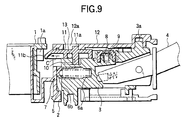
- FIG. 9 is a longitudinal sectional diagram illustrating the related device.
- FIG. 10 is a diagram corresponding to FIG. 1.
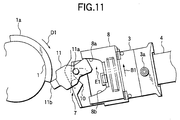
- FIG. 11 is a diagram corresponding to FIG. 6.
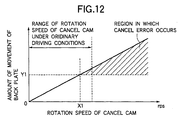
- FIG. 12 is a diagram corresponding to FIG. 7.
- FIG. 2 The configuration of a primary portion of a turn signal cancel device according to this embodiment, which is provided in a steering column of a vehicle, is illustrated in FIG. 2.
- a cancel cam 21 is a cylindrical member, which has a cancel convex portion la on the outer peripheral portion thereof, and adapted to be integrally rotated with a steering wheel (not shown).
- a rotational locus K of a projecting end portion of the cancel convex portion 21a is indicated by a chain double-dashed line.
- a rectangular box-like body 22 having opening portions at both lateral end portions is provided in a fixed manner on the right side of this cancel cam 21.
- a cover (not shown) is attached to the top surface portion of this body 22.
- Opening portions 22a and 22b are formed in a left-hand side portion and a right-hand side portion, respectively.
- a bracket 23 is provided in the body 22 in such a way as to be able to rotate around a shaft portion 23a.
- a base portion of a turn lever 24 is connected to this bracket 23. The turn lever 24 projects to the right-hand side from the opening portion 22b.
- a moderation surface portion 25 having alternate formed ridge portions and valley portions is provided on the left-hand inner surface of the body 22.
- a known moderation mechanism 27 includes the moderation surface portion 25, the moderation spring, and the moderation piece 26.
- bracket 23 and also the turn lever 24 are held selectively at a neutral position shown in FIG. 2, a left turn indicating position (see Fig. 1) to which the turn lever 24 is turned therefrom in a direction of an arrow A1, and a right turn indicating position (not shown) to which the turn lever 24 is turned therefrom in a direction of an arrow A2 whose direction is opposite to the arrow A1.
- a turn signal switch whose contacts are switched according to the position of the bracket 23, is provided in the body 22.
- a cam portion 28 having a crest part is provided on a front-side part (that is, a part at the side of the cancel cam 21) of the top surface portion of the bracket 23.
- Two convex portions 30 each having a pressed portion 29 is provided at the right side of this cam portion 28.
- each of the convex portions 30 is shaped like a rectangular triangle. A part corresponding to the oblique side of the rectangular triangle is used as the pressed portion 29.
- a ratchet body portion 31 and a ratchet movable portion 32 are disposed in the top surface portion of the bracket 23.
- a shaft portion 33 protruding upwardly and downwardly from the ratchet body portion 31 is provided on a rearward portion of the ratchet body portion 31, as illustrated in FIG. 3.
- the top end part of the shaft portion 33 is movably and rotatably inserted into a guide hole 34 formed in the cover (not shown) as an elongated hole.
- the bottom part of the shaft portion 33 is provided so as to move along the cam portion 10.
- a spring engaging groove portion 35 is formed in the lower part of the ratchet body portion 31.
- This ratchet body portion 31 is pushed in the direction of the arrow C (that is, to the side of the cancel cam 21) by a ratchet pushing spring 36, which is engaged with the engaging groove portion 35.
- the leading end portion 31a leftwardly projects from the opening portion 22a, as viewed in this figure. Both end portions of the ratchet pushing spring 36 are supported by the body 22.
- a storage portion 37 opened in the back thereof is formed in the ratchet body portion 31.
- the front portion of the ratchet movable portion 32 is accommodated in this storage portion 37 in such a way as to be able to move in the front and rear directions of the ratchet body portion 31.
- the rear portion of the ratchet movable portion 32 backwardly projects therefrom.
- the ratchet movable portion 32 is attached to the ratchet body portion 31 by engaging each of elastic engaging claws with a corresponding one of engaging holes 39 formed in the ratchet body portion 31 so that the ratchet movable portion 32 is prevented from slipping off from the ratchet body portion 31.
- the ratchet movable portion 32 is provided therein in such a way as to be placed between the pair of the pressed portions 29, and as to be able to move in the front and rear directions of the ratchet body portion 31 in the rear portion thereof, and as to be rotated together with the ratchet body portion 31.
- a movable portion pushing spring 40 constituted by a coil spring is disposed between the ratchet body portion 31 and the ratchet movable portion 32. Under ordinary conditions, the ratchet movable portion 32 is rearwardly pushed by the spring force of this movable portion pushing spring 40. A rear portion of the ratchet movable portion 32 is formed like a chevron. Corner parts provided at both sides of the ratchet movable portion 32 are used as a pair of first abutting contact portions 41. A central rear end portion disposed between the pair of first abutting contact portions 41 is used as a second abutting contact portion 42.
- the ratchet body portion 31 and the ratchet movable portion 32 are caused by the pushing force of the ratchet pushing spring 36 to frontwardly move in the direction of the arrow C during the bottom part of the shaft portion 33 moves along a slope of the cam portion 28. Then, the ratchet body portion 31 is put into a state in which the leading end portion 31a thereof moves into the rotational lotus K of the cancel convex portion 21a.
- FIG. 5 illustrates a state of the device just before the bracket 23 (thus, the turn lever 24) is turned from the left turn indicating position to the neutral position.
- the turn lever 4 is held by a driver at the left turn indicating position when the cancel operation is performed, an excessive pushing force acts on the pressed portion 29 from the ratchet movable portion 32.
- the ratchet movable portion 32 moves to the front of the ratchet body portion 31 (that is, in the direction of the arrow G1) against the spring force of the movable portion pushing spring 40.
- the movable portion pushing spring 40 permits the ratchet movable portion 32 to move frontwardly (namely, in the direction of the arrow G1) and allows the cancel convex portion 21a to pass therethrough in the direction of the arrow D1.
- the second abutting contact portion 42 of the ratchet movable portion 32 abuts against the pressed portion 29.
- F1 denote a vector representing the pushing force transmitted from the ratchet movable portion 32 to the pressed portion 29 of the bracket 23 when the cancel operation is performed as illustrated in FIG. 1.
- a vector F4 representing a force acting on the movable portion pushing spring 40 for relieving the excessive force generated at an occurrence of a phenomenon of what is called a grabby brake is established as illustrated in FIG. 1.
- a vector F5 is a vector representing a vertical reaction force transmitted from the pressed portion 29 to the ratchet movable portion 32.
- the direction of the vector F1 representing the force transmitted from the ratchet movable portion 32 to the pressed portion 29 differs by nearly 90 degrees from the direction of expansion and contraction of the movable portion pushing spring 40 (or the direction of the arrow G1, that is, the direction of movement of the ratchet movable portion 32).
- the magnitude of the vector F4 representing the force acting on the movable portion pushing spring 40 is small in comparison with the magnitude of the vector F2 representing the force acting on the back-plate holding spring 9 (F4 ⁇ F2). Consequently, a small influence is exerted on the movable portion pushing spring 40.
- the direction of a vector representing a force transmitted from the ratchet movable portion to the pressed portion of the bracket largely differs from the direction of movement of the ratchet movable portion, which is caused so as to relieve the excessive pushing force to be made to act on the pressed portion, or from the direction of expansion and contraction of the movable portion pushing spring.
- the magnitude of a vector representing a force acting on the movable portion spring is relatively small. Consequently, this force exerts a small influence on the movable portion pushing spring. Therefore, when a cancel operation isperformed at the ordinary rotation speed of the cancel cam (thus, the ordinary rotation speed of the steering wheel), the ratchet movable portion is difficult to move. Thus, an occurrence of a cancel error is prevented as much as possible.
Landscapes
- Engineering & Computer Science (AREA)
- Mechanical Engineering (AREA)
- Lighting Device Outwards From Vehicle And Optical Signal (AREA)
Abstract
A canceling ratchet consists of a ratchet body portion 31, and
a ratchet movable portion 32 enabled to move in the front and
rear directions of the ratchet body portion 31. Further, a
movable portion pushing spring 40 is provided between these
portions. When a phenomenon of a grabby brake occur in a turn
lever 24, the ratchet movable portion 32 moves in the direction
of an arrow G1 against a spring force of the movable portion
pushing spring 40. When a cancel operation is performed, the
direction of a vector F1 representing a force transmitted from
the ratchet movable portion 32 to a pressed portion 29 differs
by nearly 90 degrees from the direction of movement of the
ratchet movable portion 32 and from the direction of expansion
and contraction of the movable portion pushing spring 40. Thus,
the magnitude of a vector F4 representing a force acting on
the movable portion spring 40 is relatively small.
Consequently, this force exerts a small influence on the
movable portion pushing spring.
Description
- The present invention relates to a turn signal cancel device adapted to automatically return a turn lever, which has been turned to a left turn indicating position or to a right turn indicating position, to a neutral position according to the fact that a steering wheel is rotated in a direction opposite to the direction indicated by the turn lever.
- The configuration of a related turn signal cancel device of such a kind is described hereinafter with reference to FIGS. 8 to 12. As shown in FIGS. 8 and 9, a
cancel cam 1 is a cylindrically shaped member, which has a cancel convex portion la on the outer peripheral portion thereof, and adapted to be integrally rotated with a steering wheel (not shown). - A
rectangular box body 2 having opening portions at both lateral end portions is provided in a fixed manner on the right side of this cancelcam 1. Abracket 3 is provided in thebody 2 in such a way as to be able to rotate around ashaft portion 3a. A base portion of aturn lever 4 is connected to thebracket 3. Amoderation surface portion 5 having alternate formed ridge portions and valley portions is provided on the left-hand inner surface of thebody 2. Amoderation piece 6b is provided at the end portion of thebracket 3 and is pushed by amoderation spring 6a in a direction which themoderation piece 6b is press-contacted with the moderation surface portions. Amoderation mechanism 7 includes themoderation surface portion 5, themoderation spring 6a, and themoderation piece 6b. - The
bracket 3 and theturn lever 4 are held selectively at a neutral position, a left turn indicating position (see Fig. 10) to which theturn lever 4 is turned therefrom in a direction of an arrow Al, and a right turn indicating position (not shown) to which theturn lever 4 is turned therefrom in a direction of an arrow A2 whose direction is opposite to the direction of the arrow A1, as illustrated in FIGS. 8 and 9. Incidentally, although not shown, a turn signal switch, whose contacts are switched according to the position of thebracket 3, is provided in thebody 2. - A
back plate 8 is nearly U-shaped as a whole, and includes pressedportions bracket 3 in such a manner as to be able to slide in the directions of arrows B1 and B2. A back-plate holdingspring 9 for holding theback plate 8 at an intermediate position illustrated in FIG. 8 by a predetermined force is provided between theback plate 8 and thebracket 3. Acam portion 10 having a crest part is provided on a left-hand side portion of the top surface of thebracket 3. - A
ratchet 11 is disposed in the top surface portion of thebracket 3. A shaft portion lla is provided on the middle portion of theratchet 11 so that the top end of the shaft portion lla is inserted into aguide hole 12a, which is an elongated hole formed in a cover 12 (see FIG. 9) attached to the top surface portion of thebody 2 in such a manner as to be able to move and rotate, and so that the bottom part of the shaft portion lla moves along thecam portion 10. Theratchet 11 is pushed by aratchet pushing spring 13 in a direction of an arrow C, that is, to the side of thecancel cam 1. - In a state in which the bracket 3 (thus, the turn lever 4) is placed at the neutral position illustrated in FIG. 8 in the aforementioned configuration, the bottom part of the shaft portion lla of the
ratchet 11 is placed at the top of the crest part of thecam portion 10. Theratchet 11 is held at a position where the leading end portion llb thereof retreats from a rotational locus K (see the position indicated by a chain double-dashed line in FIG. 8) of acancel convex portion 1a. - When the
turn lever 4 is turned from the neutral position thereof in the direction of, for instance, the arrow A1, and thebracket 3 is placed at the left turn indicating position illustrated in FIG. 10, theratchet 11 is caused by the pushing force of theratchet pushing spring 13 to frontwardly move in the direction of the arrow C during the bottom part of theshaft portion 11a moves along a slope of thecam portion 10. Then, theratchet 11 is put into a state in which the leadingend portion 11b thereof moves inside the rotational lotus K of thecancel convex portion 1a. - When the
cancel cam 1 is turned in the direction of the arrow Dl opposed to the indicated direction of thebracket 3 by the steering wheel during this state, the leading end portion llb of theratchet 11 is pushed in the same direction, so that theratchet 11 is turned around theshaft portion 11a in the direction of an arrow E, and that the rear end thereof pushes the pressedportion 8a of theback plate 8. In the case that this pushing force exceeds the holding force of themoderation mechanism 7, the bracket 3 (thus, the turn lever 4) is turned and returned to the neutral position. - In the case that a phenomenon of what is called a grabby brake occurs, for example, the
turn lever 4 is held by a driver at the left turn indicating position when the cancel operation is performed, anexcessive pushing force 8a, which exceeds the holding force of the back-plate holdingspring 9, of theback plate 8 acts on the pressedportion 8a of theback plate 8 from the rear end portion of theratchet 11. Then, as illustrated in FIG. 11, theback plate 8 moves in the direction of the arrow B1. This permits the cancel convex portion la to pass therethrough in the direction of an arrow D1. Consequently, theratchet 11 and theback plate 8 are prevented from being damaged when the phenomena of grabby brakes occur. - Incidentally, although the aforementioned operation is performed when the bracket 3 (thus, the turn lever 4) is turned to the left turn indicating position, a similar operation is performed when the bracket 3 (thus, the turn lever 4) is turned to the right turn indicating position.
- However, the related cancel device has the following problem. That is, let F1 denote a vector representing the pushing force transmitted from the
ratchet 11 to theback plate 8 when the cancel operation is performed as illustrated in FIG. 10. In this case, a vector F2 representing the force acting on the back-plate holdingspring 9 is established as illustrated in FIG. 10. A vector F3 is a vector representing a vertical reaction force transmitted from theback plate 8 to theratchet 11. In this case, the direction of the vector F1 representing the pushing force transmitted from theback plate 8 to theratchet 11 is close to the direction of expansion and contraction of the back-plate holding spring 9 (that is, the direction of the arrow B1 or B2, in which theback plate 8 moves). Thus, when the cancel operation is performed, the vector F2 acting on the back-plate holdingspring 9 has a large magnitude and exerts a large influence on the back-plate holdingspring 9. - Thus, even when the cancel operation is performed at the rotational speed of the steering wheel (or of the cancel cam) under ordinary driving conditions, the
back plate 8 easily moves. Therefore, as illustrated in FIG. 12, an amount of movement of theback plate 8 increases with increase in the rotational speed of the cancel cam 1 (or of the steering wheel) . Consequently, a cancel error (that is, even when theratchet 11 is turned by the cancel convex portion la, thebracket 3 is not returned to the neutral position thereof) easily occurs. - The present invention is accomplished in view of such circumstances. Accordingly, an object of the present invention is to provide a turn signal cancel device, which has a function of avoiding occurrences of phenomena of grabby brakes in a turn lever, and which can prevent occurrences of cancel errors as much as possible.
- To achieve the foregoing object, according to the present invention, there is provided a turn signal cancel device that includes:
- a cancel cam having a cancel convex portion defining a rotational locus by rotating and adapted to be rotated by a steering wheel;
- a bracket rotatably provided in vicinity of the cancel cam, and turned among a left turn indicating position, a neutral position, and a right turn indicating position by operating a turn lever;
- a pressed portion provided in the bracket;
- moderation mechanism which holds the bracket selectively at the positions;
- a ratchet body portion adapted to move frontward so that a leading end portion of the ratchet body portion is inside the rotational locus when the bracket is placed at the left turn indicating position or the right turn indicating position, and to be turned by the cancel convex portion when the cancel cam is rotated during the leading end portion is inside the rotational locus;
- a ratchet movable portion provided in a rear part of the ratchet body portion, movable in front and rear directions of the ratchet body portion, and rotatable with the ratchet body portion, wherein the ratchet movable portion is rotated together with the ratchet body portion and pushes the pressed portion to return the bracket to the neutral position when the ratchet movable portion is rotated in a direction opposite to a direction indicated by the bracket in a state in which the bracket is placed at the left turn indicating position or the right turn indicating position; and
- a movable portion pushing spring provided between the ratchet movable portion and the ratchet body portion, wherein the movable portion pushing spring permits the ratchet movable portion to move frontward to allow the cancel convex portion to pass therethrough when the bracket is prevented from turning during the ratchet movable portion causes a turning force to act on the bracket through the pressed portion in a direction in which the bracket is returned to the neutral position.
-
- With the aforementioned configuration, under ordinary conditions, in a state in which the bracket is placed at the left turn indicating position or the right turn indicating position, when the cancel cam is rotated in a direction opposite to the indicated direction, the ratchet body portion and the ratchet movable portion are turned by the cancel convex portion. Then, the ratchet movable portion pushes the pressed portion to thereby return the bracket to the neutral position. In contrast, at an occurrence of a phenomenon of what is called a grabby brake, in which the turn lever is fixed, the excessive pushing force acting from the ratchet movable portion to the pressed portion is relieved by forward movement of the ratchet movable portion, which is performed against the spring force of the movable portion pushing spring.
- In this case, the direction of a vector representing a force transmitted from the ratchet movable portion to the pressed portion of the bracket differs by nearly 90 degrees from the direction of movement of the ratchet movable portion, which is caused so as to relieve an excessive pushing force to be made to act on the pressed portion, or from the direction of expansion and contraction of the movable portion pushing spring. Thus, when a cancel operation is performed, the magnitude of a vector representing a force acting on the movable portion pushing spring is relatively small. Consequently, this force exerts a small influence on the movable portion pushing spring. Therefore, when a cancel operation is performed at the rotation speed of the cancel cam (thus, the rotation speed of the steering wheel) under ordinary driving conditions, the ratchet movable portion is difficult to move. Thus, an occurrence of a cancel error is prevented as much as possible.
- According to an embodiment of this turn signal cancel device of the present invention, the ratchet movable portion has a pair of first abutting contact portions adapted to abut against the pressed portion when the bracket is returned to the neutral position, and also has a second abutting contact portion, disposed between the pair of first abutting contact portions and adapted to the pressed portion when the ratchet movable portion frontwardly moves against a spring force of the movable portion pushing spring.
- Consequently, when the degree of inclination of the ratchet movable portion with respect to the pressed portion is large, the abutting contact portion to be made to abut the pressed portion changes from each of the first abutting contact portions to the second abutting contact portion. Thus, an engaging area (that is, a region, on which the ratchet movable portion abuts) of the pressed portion can be secured in such a manner as not to have a large area.
- FIG. 1 is a primary portion of an embodiment of the present invention, for illustrating a cancel operation performed in a state in which a bracket is at a left turn indicating position.
- FIG. 2 is a transverse sectional plan diagram illustrating a state in which the bracket is at a neutral position.
- FIG. 3 is an exploded perspective diagram of a ratchet body portion, a ratchet movable portion, and a movable portion pushing spring.
- FIG. 4 is a plan diagram illustrating a state in which a movable portion pushing spring and the ratchet movable portion are incorporated into the ratchet body.
- FIG. 5 is a plan diagram of the primary portion, which illustrates a state thereof just before the bracket is turned from the left turn indicating position to the neutral position.
- FIG. 6 is a plan diagram of the primary portion, which illustrates a state in which a cancel convex portion is permitted to pass when the bracket is fixed at the left turn indicating position (that is, when a phenomenon of a grabby brake occurs).
- FIG. 7 is a diagram illustrating the relation between the rotation speed of a cancel cam and the amount of movement of the ratchet movable portion.
- FIG. 8 is a diagram corresponding to FIG. 2, which illustrates a related turn signal cancel device.
- FIG. 9 is a longitudinal sectional diagram illustrating the related device.
- FIG. 10 is a diagram corresponding to FIG. 1.
- FIG. 11 is a diagram corresponding to FIG. 6.
- FIG. 12 is a diagram corresponding to FIG. 7.
- Hereinafter, an embodiment of the present invention will be described by referring to FIGS. 1 to 7. The configuration of a primary portion of a turn signal cancel device according to this embodiment, which is provided in a steering column of a vehicle, is illustrated in FIG. 2. As shown in FIG. 2, a cancel
cam 21 is a cylindrical member, which has a cancel convex portion la on the outer peripheral portion thereof, and adapted to be integrally rotated with a steering wheel (not shown). A rotational locus K of a projecting end portion of the cancelconvex portion 21a is indicated by a chain double-dashed line. - A rectangular box-
like body 22 having opening portions at both lateral end portions is provided in a fixed manner on the right side of this cancelcam 21. A cover (not shown) is attached to the top surface portion of thisbody 22.Opening portions bracket 23 is provided in thebody 22 in such a way as to be able to rotate around ashaft portion 23a. A base portion of aturn lever 24 is connected to thisbracket 23. Theturn lever 24 projects to the right-hand side from theopening portion 22b. - A
moderation surface portion 25 having alternate formed ridge portions and valley portions is provided on the left-hand inner surface of thebody 22. Amoderation piece 26 pushed by a moderation spring (not shown) in a direction, in which themoderation piece 26 is press-contacted with themoderation surface portion 25, is provided at the leading end portion of thebracket 23. A knownmoderation mechanism 27 includes themoderation surface portion 25, the moderation spring, and themoderation piece 26. - Thus, the
bracket 23 and also theturn lever 24 are held selectively at a neutral position shown in FIG. 2, a left turn indicating position (see Fig. 1) to which theturn lever 24 is turned therefrom in a direction of an arrow A1, and a right turn indicating position (not shown) to which theturn lever 24 is turned therefrom in a direction of an arrow A2 whose direction is opposite to the arrow A1. Incidentally, although not shown, a turn signal switch, whose contacts are switched according to the position of thebracket 23, is provided in thebody 22. - Further, a
cam portion 28 having a crest part is provided on a front-side part (that is, a part at the side of the cancel cam 21) of the top surface portion of thebracket 23. Twoconvex portions 30 each having a pressedportion 29 is provided at the right side of thiscam portion 28. When viewed from above, each of theconvex portions 30 is shaped like a rectangular triangle. A part corresponding to the oblique side of the rectangular triangle is used as the pressedportion 29. - A
ratchet body portion 31 and a ratchetmovable portion 32 are disposed in the top surface portion of thebracket 23. Ashaft portion 33 protruding upwardly and downwardly from theratchet body portion 31 is provided on a rearward portion of theratchet body portion 31, as illustrated in FIG. 3. The top end part of theshaft portion 33 is movably and rotatably inserted into aguide hole 34 formed in the cover (not shown) as an elongated hole. The bottom part of theshaft portion 33 is provided so as to move along thecam portion 10. A spring engaginggroove portion 35 is formed in the lower part of theratchet body portion 31. Thisratchet body portion 31 is pushed in the direction of the arrow C (that is, to the side of the cancel cam 21) by aratchet pushing spring 36, which is engaged with the engaginggroove portion 35. Theleading end portion 31a leftwardly projects from theopening portion 22a, as viewed in this figure. Both end portions of theratchet pushing spring 36 are supported by thebody 22. - A
storage portion 37 opened in the back thereof is formed in theratchet body portion 31. As illustrated in FIG. 4, the front portion of the ratchetmovable portion 32 is accommodated in thisstorage portion 37 in such a way as to be able to move in the front and rear directions of theratchet body portion 31. The rear portion of the ratchetmovable portion 32 backwardly projects therefrom. The ratchetmovable portion 32 is attached to theratchet body portion 31 by engaging each of elastic engaging claws with a corresponding one of engagingholes 39 formed in theratchet body portion 31 so that the ratchetmovable portion 32 is prevented from slipping off from theratchet body portion 31. Therefore, the ratchetmovable portion 32 is provided therein in such a way as to be placed between the pair of the pressedportions 29, and as to be able to move in the front and rear directions of theratchet body portion 31 in the rear portion thereof, and as to be rotated together with theratchet body portion 31. - A movable
portion pushing spring 40 constituted by a coil spring is disposed between theratchet body portion 31 and the ratchetmovable portion 32. Under ordinary conditions, the ratchetmovable portion 32 is rearwardly pushed by the spring force of this movableportion pushing spring 40. A rear portion of the ratchetmovable portion 32 is formed like a chevron. Corner parts provided at both sides of the ratchetmovable portion 32 are used as a pair of firstabutting contact portions 41. A central rear end portion disposed between the pair of firstabutting contact portions 41 is used as a secondabutting contact portion 42. - Next, an operation of the device of the aforementioned configuration is described hereinafter. In a state in which the bracket 23 (thus, the turn lever 24) is placed at the neutral position illustrated in FIG. 2, the bottom part of the
shaft portion 33 of theratchet body portion 31 is placed at the top of the crest part of thecam portion 28. Theratchet body portion 31 is held at a position where theleading end portion 31a thereof retreats from the rotational locus K of the cancelconvex portion 21a. - When the
turn lever 24 is turned from this neutral position thereof in the direction of, for instance, the arrow A1, and thebracket 23 is placed at the left turn indicating position illustrated in FIG. 1, theratchet body portion 31 and the ratchetmovable portion 32 are caused by the pushing force of theratchet pushing spring 36 to frontwardly move in the direction of the arrow C during the bottom part of theshaft portion 33 moves along a slope of thecam portion 28. Then, theratchet body portion 31 is put into a state in which theleading end portion 31a thereof moves into the rotational lotus K of the cancelconvex portion 21a. - When the cancel
cam 21 is turned in the direction of the arrow D1, which is opposite to the indicated direction of thebracket 23, by the steering wheel during this state, theleading end portion 31a of theratchet body portion 31 is pushed in the same direction by the cancelconvex portion 21a as illustrated in FIG. 1, so that theratchet body portion 31 and the ratchetmovable portion 32 are turned around theshaft portion 33 in the direction of the arrow E1, and that one of the firstabutting contact portions 41 of the ratchetmovable portion 32 pushes a corresponding one of the pressedportions 29. In the case that this pushing force exceeds the holding force of themoderation mechanism 27, the bracket 23 (thus, the turn lever 24) is turned and returned to the neutral position (see FIG. 2) . FIG. 5 illustrates a state of the device just before the bracket 23 (thus, the turn lever 24) is turned from the left turn indicating position to the neutral position. - Meanwhile, in the case that a phenomenon of what is called a grabby brake occurs, for example, the
turn lever 4 is held by a driver at the left turn indicating position when the cancel operation is performed, an excessive pushing force acts on the pressedportion 29 from the ratchetmovable portion 32. Then, as illustrated in FIG. 6, the ratchetmovable portion 32 moves to the front of the ratchet body portion 31 (that is, in the direction of the arrow G1) against the spring force of the movableportion pushing spring 40. Thus, the movableportion pushing spring 40 permits the ratchetmovable portion 32 to move frontwardly (namely, in the direction of the arrow G1) and allows the cancelconvex portion 21a to pass therethrough in the direction of the arrow D1. At that time, the secondabutting contact portion 42 of the ratchetmovable portion 32 abuts against the pressedportion 29. - Incidentally, although the aforementioned operation is performed when the bracket 23 (thus, the turn lever 24) is turned to the left turn indicating position, a similar operation is performed when the bracket 23 (thus, the turn lever 24) is turned to the right turn indicating position.
- Additionally, let F1 denote a vector representing the pushing force transmitted from the ratchet
movable portion 32 to the pressedportion 29 of thebracket 23 when the cancel operation is performed as illustrated in FIG. 1. In this case, a vector F4 representing a force acting on the movableportion pushing spring 40 for relieving the excessive force generated at an occurrence of a phenomenon of what is called a grabby brake is established as illustrated in FIG. 1. Incidentally, in this figure, a vector F5 is a vector representing a vertical reaction force transmitted from the pressedportion 29 to the ratchetmovable portion 32. - In this case, the direction of the vector F1 representing the force transmitted from the ratchet
movable portion 32 to the pressedportion 29 differs by nearly 90 degrees from the direction of expansion and contraction of the movable portion pushing spring 40 (or the direction of the arrow G1, that is, the direction of movement of the ratchet movable portion 32). Thus, when a cancel operation is performed, the magnitude of the vector F4 representing the force acting on the movableportion pushing spring 40 is small in comparison with the magnitude of the vector F2 representing the force acting on the back-plate holding spring 9 (F4<F2). Consequently, a small influence is exerted on the movableportion pushing spring 40. - Therefore, as illustrated in FIG. 7, when a cancel operation is performed at the rotation speed of the cancel cam (thus, the rotation speed of the steering wheel) under ordinary driving conditions, the ratchet
movable portion 3 is difficult to move. Thus, an occurrence of a cancel error is prevented as much as possible. - Further, in the case of the aforementioned embodiment, when the degree of inclination of the ratchet
movable portion 32 with respect to the pressedportion 29 is large, the abutting contact portion to be made to abut the pressedportion 29 changes from the firstabutting contact portion 41 to the secondabutting contact portion 42. Thus, an engaging area (that is, a region, on which the ratchetmovable portion 32 abuts) of the pressedportion 29 can be secured in such a manner as not to have a large area. - As is apparent from the foregoing description, in the case of the device of the present invention, the direction of a vector representing a force transmitted from the ratchet movable portion to the pressed portion of the bracket largely differs from the direction of movement of the ratchet movable portion, which is caused so as to relieve the excessive pushing force to be made to act on the pressed portion, or from the direction of expansion and contraction of the movable portion pushing spring. Thus, the magnitude of a vector representing a force acting on the movable portion spring is relatively small. Consequently, this force exerts a small influence on the movable portion pushing spring. Therefore, when a cancel operation isperformed at the ordinary rotation speed of the cancel cam (thus, the ordinary rotation speed of the steering wheel), the ratchet movable portion is difficult to move. Thus, an occurrence of a cancel error is prevented as much as possible.
Claims (3)
- A turn signal cancel device comprising:a cancel cam having a cancel convex portion defining a rotational locus by rotating and adapted to be rotated by a steering wheel;a bracket rotatably provided in vicinity of said cancel cam, and turned among a left turn indicating position, a neutral position, and a right turn indicating position by operating a turn lever;a pressed portion provided in said bracket;moderation mechanism which holds said bracket selectively at said positions;a ratchet body portion adapted to move frontward so that a leading end portion of said ratchet body portion is inside said rotational locus when said bracket is placed at said left turn indicating position or said right turn indicating position, and to be turned by said cancel convex portion when said cancel cam is rotated during said leading end portion is inside said rotational locus;a ratchet movable portion provided in a rear part of said ratchet body portion, movable in front and rear directions of said ratchet body portion, and rotatable with said ratchet body portion, wherein said ratchet movable portion is rotated together with said ratchet body portion and pushes said pressed portion to return said bracket to said neutral position when said ratchet movable portion is rotated in a direction opposite to a direction indicated by said bracket in a state in which said bracket is placed at said left turn indicating position or said right turn indicating position; anda movable portion pushing spring provided between said ratchet movable portion and said ratchet body portion, wherein said movable portion pushing spring permits said ratchet movable portion to move frontward to allow said cancel convex portion to pass therethrough when said bracket is prevented from turning during said ratchet movable portion causes a turning force to act on said bracket through said pressed portion in a direction in which said bracket is returned to said neutral position.
- A turn signal cancel device according to claim 1, wherein said ratchet movable portion includes a pair of first abutting contact portions abutting against said pressed portion when said bracket is returned to said neutral position, and a second abutting contact portion disposed between said pair of first abutting contact portion and abutting against said pressed portion when said ratchet movable portion moves frontward against a spring force of said movable portion pushing spring.
- A turn signal cancel device according to claim 1, wherein said moderation mechanism includes a moderation surface portion having at least ridge portion and valley portion, a moderation piece provided at said bracket, and a moderation spring pushing said moderation piece toward said moderation surface portion, so that said moderation piece is pressed with said moderation surface portion.
Applications Claiming Priority (2)
| Application Number | Priority Date | Filing Date | Title |
|---|---|---|---|
| JP32816899 | 1999-11-18 | ||
| JP32816899A JP4139027B2 (en) | 1999-11-18 | 1999-11-18 | Turn signal canceling device |
Publications (1)
| Publication Number | Publication Date |
|---|---|
| EP1101653A2 true EP1101653A2 (en) | 2001-05-23 |
Family
ID=18207253
Family Applications (1)
| Application Number | Title | Priority Date | Filing Date |
|---|---|---|---|
| EP00124950A Withdrawn EP1101653A2 (en) | 1999-11-18 | 2000-11-15 | Turn signal cancel device |
Country Status (4)
| Country | Link |
|---|---|
| US (1) | US6472623B1 (en) |
| EP (1) | EP1101653A2 (en) |
| JP (1) | JP4139027B2 (en) |
| CN (1) | CN1186221C (en) |
Families Citing this family (11)
| Publication number | Priority date | Publication date | Assignee | Title |
|---|---|---|---|---|
| JP2003127762A (en) * | 2001-10-19 | 2003-05-08 | Alps Electric Co Ltd | Turn signal switch device |
| JP2003127764A (en) * | 2001-10-24 | 2003-05-08 | Niles Parts Co Ltd | Cancel structure of combination switch |
| JP4181024B2 (en) * | 2003-12-08 | 2008-11-12 | 株式会社東海理化電機製作所 | Vehicle direction indication device |
| ATE385476T1 (en) * | 2005-10-10 | 2008-02-15 | Delphi Tech Inc | DIRECTION INDICATORS FOR MOTOR VEHICLES |
| JP2010143391A (en) * | 2008-12-18 | 2010-07-01 | Tokai Rika Co Ltd | Direction indicator |
| JP5509832B2 (en) * | 2009-12-17 | 2014-06-04 | パナソニック株式会社 | Turning direction indicator |
| JP5138022B2 (en) * | 2010-11-18 | 2013-02-06 | 古河電気工業株式会社 | Cancel cam structure and rotary connector device |
| CN102381490B (en) * | 2011-09-24 | 2013-03-20 | 威海广泰空港设备股份有限公司 | Transition steering device for detecting rodless aircraft tractor |
| JP6786357B2 (en) * | 2016-10-31 | 2020-11-18 | 株式会社東海理化電機製作所 | Direction indicator |
| US10829037B2 (en) | 2018-11-09 | 2020-11-10 | William Gibson | Turn signal reset device |
| KR20220087485A (en) | 2019-10-25 | 2022-06-24 | 지에이치에스피, 아이엔씨. | Turn signal automatic release mechanism with axially actuable toggle |
Family Cites Families (13)
| Publication number | Priority date | Publication date | Assignee | Title |
|---|---|---|---|---|
| JPS55108626U (en) * | 1979-01-24 | 1980-07-30 | ||
| US4426951A (en) * | 1981-09-14 | 1984-01-24 | Nihon Plast Co., Ltd. | Turn signal cancellation apparatus for use with steering wheel and shaft assembly |
| JPS609138U (en) * | 1983-06-30 | 1985-01-22 | アルプス電気株式会社 | Direction indicator |
| JPS6139648U (en) * | 1984-08-16 | 1986-03-13 | 株式会社東海理化電機製作所 | Vehicle direction indicator operation lever return device |
| JPH079310Y2 (en) * | 1986-06-16 | 1995-03-06 | アルプス電気株式会社 | Cancel signal mechanism of turn signal switch |
| JPH048033Y2 (en) * | 1987-08-12 | 1992-03-02 | ||
| US4859816A (en) * | 1988-02-22 | 1989-08-22 | Metro Denso Kabushiki Kaisha | Self canceller for a turn signal indicator |
| JPH0621789Y2 (en) * | 1989-02-22 | 1994-06-08 | 株式会社東海理化電機製作所 | Turn signal switch self-cancel device |
| JP2675949B2 (en) * | 1992-04-30 | 1997-11-12 | 株式会社東海理化電機製作所 | Vehicle turn signal device |
| JP2585025Y2 (en) * | 1993-09-28 | 1998-11-11 | 株式会社東海理化電機製作所 | Turn signal cancellation device |
| JPH0950735A (en) * | 1995-08-07 | 1997-02-18 | Niles Parts Co Ltd | Cancel mechanism of turn signal switch for vehicle |
| US5808546A (en) * | 1996-03-28 | 1998-09-15 | Kabushiki Kaisha Tokai Rika Denki Seisakusho | Cancel mechanism of turn indicator |
| JPH10203234A (en) * | 1997-01-20 | 1998-08-04 | Tokai Rika Co Ltd | Turn signal cancellation mechanism |
-
1999
- 1999-11-18 JP JP32816899A patent/JP4139027B2/en not_active Expired - Fee Related
-
2000
- 2000-11-13 US US09/709,522 patent/US6472623B1/en not_active Expired - Fee Related
- 2000-11-15 EP EP00124950A patent/EP1101653A2/en not_active Withdrawn
- 2000-11-20 CN CNB001326449A patent/CN1186221C/en not_active Expired - Fee Related
Non-Patent Citations (1)
| Title |
|---|
| None |
Also Published As
| Publication number | Publication date |
|---|---|
| CN1186221C (en) | 2005-01-26 |
| US6472623B1 (en) | 2002-10-29 |
| JP2001138805A (en) | 2001-05-22 |
| JP4139027B2 (en) | 2008-08-27 |
| CN1296891A (en) | 2001-05-30 |
Similar Documents
| Publication | Publication Date | Title |
|---|---|---|
| EP1101653A2 (en) | Turn signal cancel device | |
| US5806374A (en) | Operation switch device for use with lawnmower | |
| US5672855A (en) | Canceling mechanism for a vehicular turn signal switch | |
| EP1060949B1 (en) | Turn signal switch device | |
| US20210134542A1 (en) | Rocker switch | |
| US5949040A (en) | Turn signal switch | |
| US4859816A (en) | Self canceller for a turn signal indicator | |
| JPH0144361Y2 (en) | ||
| JP4139317B2 (en) | Vehicle direction indication device | |
| JP2003127764A (en) | Cancel structure of combination switch | |
| JPS61132441A (en) | Steering arm switch for direction indicator of automobile | |
| CZ226898A3 (en) | Switch on steering wheel rod with automatic return | |
| JPH09132081A (en) | Cansel device of turn signal switch | |
| US12059998B2 (en) | Turn signal auto cancel mechanism having axially-operable toggle | |
| JP3493814B2 (en) | Turn signal switch cancellation device | |
| JP4284121B2 (en) | Turn signal switch device | |
| JP2000185594A (en) | Cancel mechanism of direction indicator lever | |
| JP4002667B2 (en) | Direction indicator lever cancellation mechanism | |
| JPH10236225A (en) | Cancelling mechanism of turn lever switch device for vehicle | |
| KR200144655Y1 (en) | Neutral return device for switching gear for cassette deck | |
| JP4230349B2 (en) | Turn signal switch device | |
| JP2001006494A (en) | Stalk switch device | |
| JP4002668B2 (en) | Direction indicator lever cancellation mechanism | |
| JP4481955B2 (en) | Vehicle direction indication device | |
| KR101262107B1 (en) | Switch apparatus for turn-signal of vehicles |
Legal Events
| Date | Code | Title | Description |
|---|---|---|---|
| PUAI | Public reference made under article 153(3) epc to a published international application that has entered the european phase |
Free format text: ORIGINAL CODE: 0009012 |
|
| AK | Designated contracting states |
Kind code of ref document: A2 Designated state(s): AT BE CH CY DE DK ES FI FR GB GR IE IT LI LU MC NL PT SE TR |
|
| AX | Request for extension of the european patent |
Free format text: AL;LT;LV;MK;RO;SI |
|
| STAA | Information on the status of an ep patent application or granted ep patent |
Free format text: STATUS: THE APPLICATION HAS BEEN WITHDRAWN |
|
| 18W | Application withdrawn |
Effective date: 20041014 |