EP1101514A2 - Football robot control system using infrared modules - Google Patents
Football robot control system using infrared modules Download PDFInfo
- Publication number
- EP1101514A2 EP1101514A2 EP00250353A EP00250353A EP1101514A2 EP 1101514 A2 EP1101514 A2 EP 1101514A2 EP 00250353 A EP00250353 A EP 00250353A EP 00250353 A EP00250353 A EP 00250353A EP 1101514 A2 EP1101514 A2 EP 1101514A2
- Authority
- EP
- European Patent Office
- Prior art keywords
- receiving
- signal
- control signal
- section
- football robot
- Prior art date
- Legal status (The legal status is an assumption and is not a legal conclusion. Google has not performed a legal analysis and makes no representation as to the accuracy of the status listed.)
- Withdrawn
Links
Images

Classifications
-
- B—PERFORMING OPERATIONS; TRANSPORTING
- B25—HAND TOOLS; PORTABLE POWER-DRIVEN TOOLS; MANIPULATORS
- B25J—MANIPULATORS; CHAMBERS PROVIDED WITH MANIPULATION DEVICES
- B25J9/00—Program-controlled manipulators
-
- A—HUMAN NECESSITIES
- A63—SPORTS; GAMES; AMUSEMENTS
- A63F—CARD, BOARD, OR ROULETTE GAMES; INDOOR GAMES USING SMALL MOVING PLAYING BODIES; VIDEO GAMES; GAMES NOT OTHERWISE PROVIDED FOR
- A63F9/00—Games not otherwise provided for
- A63F9/24—Games using electronic circuits not otherwise provided for
-
- A—HUMAN NECESSITIES
- A63—SPORTS; GAMES; AMUSEMENTS
- A63F—CARD, BOARD, OR ROULETTE GAMES; INDOOR GAMES USING SMALL MOVING PLAYING BODIES; VIDEO GAMES; GAMES NOT OTHERWISE PROVIDED FOR
- A63F9/00—Games not otherwise provided for
- A63F9/24—Games using electronic circuits not otherwise provided for
- A63F2009/2483—Other characteristics
- A63F2009/2488—Remotely playable
- A63F2009/2489—Remotely playable by radio transmitters, e.g. using RFID
-
- A—HUMAN NECESSITIES
- A63—SPORTS; GAMES; AMUSEMENTS
- A63F—CARD, BOARD, OR ROULETTE GAMES; INDOOR GAMES USING SMALL MOVING PLAYING BODIES; VIDEO GAMES; GAMES NOT OTHERWISE PROVIDED FOR
- A63F7/00—Indoor games using small moving playing bodies, e.g. balls, discs or blocks
- A63F7/06—Games simulating outdoor ball games, e.g. hockey
-
- A—HUMAN NECESSITIES
- A63—SPORTS; GAMES; AMUSEMENTS
- A63H—TOYS, e.g. TOPS, DOLLS, HOOPS OR BUILDING BLOCKS
- A63H30/00—Remote-control arrangements specially adapted for toys, e.g. for toy vehicles
- A63H30/02—Electrical arrangements
- A63H30/04—Electrical arrangements using wireless transmission
Definitions
- the present invention relates to a football robot control system for paying a football game using football robots.
- a robot kit is generally radio-controlled using infrared (IR) modules or radio frequency (RF) modules.
- IR infrared
- RF radio frequency
- the conventional amplited shift keying (ASK) type IR module has a low communication speed (i.e., 9600 bps at maximum), it is difficult to control the robot kit to meet the game situations.
- the RF module has a superior performance, its cost is high and its circuit construction is complicated. Thus, it costs much to manufacture the football robot control system, and there is some difficulty in designing the robot control system. Also, its used frequency region is limited to two varieties, and thus only two football teams can play the game.
- an object of the present invention is to provide a football robot control system using IR modules which achieves the same transmission speed as RF modules, and whose circuit construction is simplified but the manufacturing cost of robot control system is lowered.
- a football robot control system comprising a repeater for receiving a football robot control signal from a host computer and outputting a specified control signal, infrared (IR) modules for radio-transmitting the specified control signal outputted from the repeater, a football robot kit equipped with a baseband type receiving section for receiving the specified control signal radio-transmitted from the IR modules, and a camera for obtaining and transmitting to the host computer image information on a position and direction of the robot kit controlled based on the control signal.
- IR infrared
- the present invention adopts an infrared data association (IrDA) method which has a faster communication speed than the conventional amplited shift keying (ASK) method, and enables data communication using the IR module.
- IrDA infrared data association
- ASK amplited shift keying
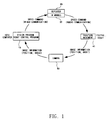
- the football robot control system comprises a repeater (20) for receiving a control command for controlling the football robot from a host computer (10), and IR modules (30) for transmitting infrared data association 1.0(IrDA1.0) type IR signals based on the control signal from the repeater (20).
- the IR module (30) is installed at each corner of the "H"-shaped supporter as like FIG. 4, and the repeater (20) is installed at the center of the supporter.
- a camera (50) for photographing the controlled state of the football robot which has received the IR signal of the IrDA1.0 type, and transmitting image information on the position, direction, etc., of the photographed football robot to the host computer (10) is provided in another supporter installed on an upper part of a football playing ground.
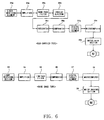
- a football robot receiving section which receives the control signal from the IR module (30) is constructed with a baseband type receiving circuit, and the construction includes a light-receiving element (33) for receiving the signal transmitted from the IR module, an amplifier (34) for amplifying the received signal, a low pass filter (33) for removing high-frequency components, which act as noise, from the amplified signal, a microcomputer (38) for receiving an output signal of the low pass filter (33), a motor driving section (39) for driving a motor based on an output signal of the microcomputer (38), and a power supply section for supplying the power to the football robot.
- a light-receiving element for receiving the signal transmitted from the IR module
- an amplifier for amplifying the received signal
- a low pass filter (33) for removing high-frequency components, which act as noise, from the amplified signal
- a microcomputer (38) for receiving an output signal of the low pass filter (33)
- a motor driving section (39) for driving a motor based on an output
- the host computer (10) radio-transmits all the information on the position of a ball and the football robot (40) in the playing ground, the position, speed, and operational and tactical commands to the football robot (40) through the repeater (20) and the IR module (30). In this case, the control commands of the host computer (10) are transmitted to the football robot at a start, stop, and restart time of the game only.
- the host computer (10) transmits the control commands to the football robot (40) through the repeater (20) and the IR module (30).
- the present invention uses the IrDA1.0 method having the communication speed of 19200 bps, while the conventional football robot control system uses the ASK method having the communication speed of 9600 bps at maximum.
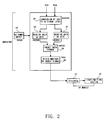
- the repeater (20 converts an input voltage of more than 9V from a host computer receiver (21), which receives the control signal of the host computer (10), into a logic level signal of 5V, and outputs the logic signal to the microcomputer (25) built in the repeater (20) through an asynchronous communication section (22) as an interrupt signal.
- the microcomputer (25) based on the interrupt signal inputted from the asynchronous communication sections (22) and (23), reads out data stored in the asynchronous communication sections (22, 23) byte by byte, and then stores the read data to complete a data packet.
- the microcomputer (25) outputs the signals from the data packet through an inverter (26).
- the inverter (26) may invert or may not invert its output signal according to a jumper connected thereto. In case of using the IR module (30), a non-inverted signal is outputted to the IR module (30).
- the football robot (40) receives the output signal of the IR module (30), which is composed of an encoding section (27) and a light-emitting section (28), through the football robot receiving section mounted on the football robot (40), and proceeds the game in accordance with the received control signal. Also, the position, angel, etc., of the football robot controlled by the received control signal are photographed by the camera to obtain the image information. Thus, proper tactics according to the situations are computed by the host computer (10), and transferred to the respective football robot.
- the IR module (30) Since the IR module (30) has only one transmission channel, it is impossible that two football teams commonly use the IR module in a playing ground. However, if the two teams have the same data packet, it is possible to commonly use the channel of the IR module (30) through the repeater (20).
- the repeater (20) can be commonly used by two football teams which can have 5 output sections at maximum. For instance, if all the data packets of a specified form are received from a first computer PC1 and a second computer PC2, the received signal is outputted from the repeater (20) in the order of reception, and thus the two football teams can commonly use the IR module (30).
- the asynchronous communication sections (22, 23) are the elements for effecting the asynchronous communication, and are called UART chips.
- FIG. 3 is a view illustrating that by using the "H"-shaped module supporter, the IR module (30) is mounted at each corner of the supporter, and the repeater (20) is installed at the center thereof.
- FIG. 4 is a view explaining the viewing angle in the IR communication.
- the data signal In the IR communication method, if the data signal is transmitted from the light-emitting section to the light-receiving section, the data signal can be accurately received within the viewing angle. However, if the data signal is transmitted over the viewing angle, it cannot be accurately received.
- the viewing angle range wherein the IR module can accurately send and receive the data is about 14°. This refers to the angle wherein the data can be accurately received at a 50-centimeter distance in a vertical direction from the camera mounted on the supporter having a height of 2 meters.
- the light material should be used to hang to the supporter of the camera after making the IR modules (30), which are mounted on the "H"-shaped module supporter as shown in FIG. 3.
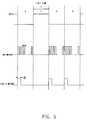
- FIG. 5 is a views showing waveforms produced by the ASK method having the communication speed of 9600 bps at maximum, and the IrDA1.0 method having the communication speed of 19200 bps in transmitting the data through the IR module 30.
- the ASK method transmits the information carried by a sub-carrier, and the IrDA1.0 method directly emits the infrared rays or not in accordance with the information signal. For example, as shown in FIG. 4, the ASK method produces a signal of 50KHz when the data is "0", and no signal when the data is "1".
- the IrDA1.0 method produces a signal for a 3/16 of a one-bit time period when the data is "0", and no signal when the data is "1".
- the football robot (40) from the IR module by the IrDA1.0 method makes a goal to the opposite goal post based on the position, angle, and speed information transmitted.
- the camera (50) obtains and transmits to the host computer (10) the image information on the position, angle, etc., of the football robot (40) being controlled according to the received signal. And this image information is used for producing the commands for the next operation of the football robot (40).
- the strength of light emission should be heightened, and the receiving sensitivity should be lowered to reduce an external noise.
- the viewing angle wherein the light-emitting element and the light-receiving element can mutually transmit and receive the data signals is limited. This is for not interfering with output signals of other IR modules (30).
- the receiving section constructed in the football robot (40) that receives the control signal of the IR module (30) is of a baseband type. Thus, it is possible to communicate with a speed of 115.2Kbps at maximum, and the football robot (40) can communicate with the host computer (10) with a speed of 19200 bps.
- the IR modules using the IrDA type IR communication method are used instead of the conventional ASK method, the high communication speed similar to that of the existing RF module can be achieved. Also, by replacing the expensive RF modules with the inexpensive IR modules, the cost for manufacturing the robot football control system is lowered. Also, since the receiving section adopts the baseband type communication, the construction of the receiving section is simplified.
Landscapes
- Engineering & Computer Science (AREA)
- Multimedia (AREA)
- Robotics (AREA)
- Mechanical Engineering (AREA)
- Optical Communication System (AREA)
- Manipulator (AREA)
- Toys (AREA)
- Control Of Position, Course, Altitude, Or Attitude Of Moving Bodies (AREA)
- Mobile Radio Communication Systems (AREA)
Abstract
Description
Claims (3)
- A football robot control system comprising:a repeater for receiving a football robot control signal from a host computer and outputting a specified control signal;infrared (IR) modules for radio-transmitting the specified control signal outputted from the repeater;a football robot provided with a baseband type receiving section for receiving the specified control signal radio-transmitted from the IR modules; anda camera for obtaining and transmitting to the host computer image information on a position and direction of the football robot controlled based on the control signal.
- The football robot control system of claim 1, wherein the baseband type receiving section of the football robot for receiving the control signal from the IR modules comprises:a light-receiving element for receiving the IR module signal;an amplifier for amplifying the received signal with a predetermined amplification factor;a low pass filter for removing a high-frequency noise component from the amplified signal;a comparing section for comparing the control signal passed the low pass filter with a predetermined reference value;a digital circuit section for converting a signal of, the comparing section into a digital signal to output to a microcomputer; and,a microcomputer for receiving an output signal of the digital circuit section, and controls a motor driving section based on an output signal of the digital circuit section.
- The football robot control system of claim 1, wherein the IR module comprises:an encoding section for encoding the control signal received from the host computer through the repeater; anda light-emitting section and a light-receiving section, integrally formed, for transmitting and receiving an output signal of the encoding section to infrared rays.
Applications Claiming Priority (2)
| Application Number | Priority Date | Filing Date | Title |
|---|---|---|---|
| KR1019990047713A KR100338493B1 (en) | 1999-10-30 | 1999-10-30 | Football robot communication system using IR module |
| KR9947713 | 1999-10-30 |
Publications (2)
| Publication Number | Publication Date |
|---|---|
| EP1101514A2 true EP1101514A2 (en) | 2001-05-23 |
| EP1101514A3 EP1101514A3 (en) | 2003-01-29 |
Family
ID=19617812
Family Applications (1)
| Application Number | Title | Priority Date | Filing Date |
|---|---|---|---|
| EP00250353A Withdrawn EP1101514A3 (en) | 1999-10-30 | 2000-10-26 | Football robot control system using infrared modules |
Country Status (3)
| Country | Link |
|---|---|
| EP (1) | EP1101514A3 (en) |
| JP (1) | JP2001191286A (en) |
| KR (1) | KR100338493B1 (en) |
Cited By (3)
| Publication number | Priority date | Publication date | Assignee | Title |
|---|---|---|---|---|
| CN100406088C (en) * | 2005-06-15 | 2008-07-30 | 中国科学院沈阳自动化研究所 | The Method of Remote Operation Robot Soccer Game Based on Internet |
| CN102566432A (en) * | 2012-01-17 | 2012-07-11 | 上海交通大学 | Bang-bang control strategy-based optimal time tracking and capturing system and method |
| CN105108757B (en) * | 2015-09-09 | 2016-09-07 | 三峡大学 | Wheeled Soccer Robot based on smart mobile phone and method of operating thereof |
Families Citing this family (9)
| Publication number | Priority date | Publication date | Assignee | Title |
|---|---|---|---|---|
| KR20030073429A (en) * | 2002-03-11 | 2003-09-19 | 주식회사 보스텍 | A communication system and method between intelligent toy robots |
| KR100590549B1 (en) | 2004-03-12 | 2006-06-19 | 삼성전자주식회사 | Remote Control Method of Robot Using 3D Pointing Method and Robot Control System Implementing It |
| CN102306026B (en) * | 2010-08-02 | 2013-02-20 | 重庆大学 | Perception system of soccer robot |
| CN102566574B (en) * | 2012-01-20 | 2014-12-31 | 北人机器人系统(苏州)有限公司 | Robot trajectory generation method and device based on laser sensing |
| JP6921488B2 (en) * | 2016-06-09 | 2021-08-18 | キヤノン株式会社 | Signal transmission equipment, signal transmission systems and equipment |
| CN107617220B (en) * | 2017-09-06 | 2023-12-01 | 滨州学院 | An intelligent football robot control system and control method |
| CN109976330A (en) * | 2017-12-28 | 2019-07-05 | 沈阳新松机器人自动化股份有限公司 | Control system, control method and the Soccer robot of Soccer robot |
| CN109794937B (en) * | 2019-01-29 | 2021-10-01 | 南京邮电大学 | A Reinforcement Learning-Based Collaborative Method for Soccer Robots |
| CN113222805B (en) * | 2021-05-08 | 2023-04-07 | 西北工业大学 | Rapid high-accuracy NAO type football robot vision processing method |
Family Cites Families (4)
| Publication number | Priority date | Publication date | Assignee | Title |
|---|---|---|---|---|
| JPS6197715A (en) * | 1984-10-18 | 1986-05-16 | Casio Comput Co Ltd | Infrared-ray tracking robot system |
| JPS6197712A (en) * | 1984-10-18 | 1986-05-16 | Casio Comput Co Ltd | Target of infrared-ray tracking robot |
| KR0152096B1 (en) * | 1992-10-26 | 1998-10-15 | 윤종용 | Obstacle detecting device of movable watching robot |
| JP3474372B2 (en) * | 1995-10-18 | 2003-12-08 | 理化学研究所 | Sensor system |
-
1999
- 1999-10-30 KR KR1019990047713A patent/KR100338493B1/en not_active Expired - Fee Related
-
2000
- 2000-10-19 JP JP2000319875A patent/JP2001191286A/en active Pending
- 2000-10-26 EP EP00250353A patent/EP1101514A3/en not_active Withdrawn
Cited By (4)
| Publication number | Priority date | Publication date | Assignee | Title |
|---|---|---|---|---|
| CN100406088C (en) * | 2005-06-15 | 2008-07-30 | 中国科学院沈阳自动化研究所 | The Method of Remote Operation Robot Soccer Game Based on Internet |
| CN102566432A (en) * | 2012-01-17 | 2012-07-11 | 上海交通大学 | Bang-bang control strategy-based optimal time tracking and capturing system and method |
| CN102566432B (en) * | 2012-01-17 | 2014-07-30 | 上海交通大学 | Bang-bang control strategy-based optimal time tracking and capturing system and method |
| CN105108757B (en) * | 2015-09-09 | 2016-09-07 | 三峡大学 | Wheeled Soccer Robot based on smart mobile phone and method of operating thereof |
Also Published As
| Publication number | Publication date |
|---|---|
| KR100338493B1 (en) | 2002-05-30 |
| JP2001191286A (en) | 2001-07-17 |
| KR20010039352A (en) | 2001-05-15 |
| EP1101514A3 (en) | 2003-01-29 |
Similar Documents
| Publication | Publication Date | Title |
|---|---|---|
| US5734328A (en) | Apparatus for switching communication method based on detected communication distance | |
| US6826370B2 (en) | IR receiver using IR transmitting diode | |
| KR100338493B1 (en) | Football robot communication system using IR module | |
| US6256060B1 (en) | Still video camera system with remote controller | |
| US5267073A (en) | Amplifier adapter for optical lines | |
| US5861969A (en) | Infrared signal transmitting apparatus | |
| US7059933B1 (en) | Ultrasonic signaling interactive toy | |
| US11245831B2 (en) | Wireless camera system | |
| EP0431654B1 (en) | Adapter for amplified optical lines | |
| JPS60246061A (en) | Optical disc player remote control device | |
| CN222281379U (en) | Infrared code matching wireless microphone suite | |
| JPH09294108A (en) | Infrared communication adapter device | |
| JPH05183515A (en) | Optical space transmitter | |
| US20030222990A1 (en) | Video camera for transmitting video, audio and control signals to a remote recording device | |
| JPH04245240A (en) | camera | |
| JP2003234498A (en) | Infrared data communication module | |
| JP2000270381A (en) | Data communication equipment and data communication system | |
| JPH05183514A (en) | Optical space transmission device | |
| KR100476070B1 (en) | Apparatus for interfacing between game terminal and computer | |
| NHU | Microprocessor chip incorporating optical signal coupling receiver(Patent Application) | |
| JPH04350981A (en) | Laser diode drive current setting device | |
| JPH04293328A (en) | Automatic adjustment device for optical space transmission direction | |
| JPS61240798A (en) | Infrared radiation remote controlling device | |
| JPH09294110A (en) | Optical signal transmission equipment | |
| JPH06152535A (en) | Optical transceiver circuit |
Legal Events
| Date | Code | Title | Description |
|---|---|---|---|
| PUAI | Public reference made under article 153(3) epc to a published international application that has entered the european phase |
Free format text: ORIGINAL CODE: 0009012 |
|
| AK | Designated contracting states |
Kind code of ref document: A2 Designated state(s): AT BE CH CY DE DK ES FI FR GB GR IE IT LI LU MC NL PT SE |
|
| AX | Request for extension of the european patent |
Free format text: AL;LT;LV;MK;RO;SI |
|
| PUAL | Search report despatched |
Free format text: ORIGINAL CODE: 0009013 |
|
| AK | Designated contracting states |
Designated state(s): AT BE CH CY DE DK ES FI FR GB GR IE IT LI LU MC NL PT SE |
|
| AX | Request for extension of the european patent |
Extension state: AL LT LV MK RO SI |
|
| RIC1 | Information provided on ipc code assigned before grant |
Ipc: 7H 04B 10/22 B Ipc: 7G 05D 1/03 B Ipc: 7A 63F 9/24 A |
|
| 17P | Request for examination filed |
Effective date: 20030717 |
|
| AKX | Designation fees paid |
Designated state(s): DE |
|
| 17Q | First examination report despatched |
Effective date: 20030909 |
|
| STAA | Information on the status of an ep patent application or granted ep patent |
Free format text: STATUS: THE APPLICATION IS DEEMED TO BE WITHDRAWN |
|
| 18D | Application deemed to be withdrawn |
Effective date: 20040501 |