EP1099868A2 - Sliding member and process for producing the same - Google Patents
Sliding member and process for producing the same Download PDFInfo
- Publication number
- EP1099868A2 EP1099868A2 EP00124649A EP00124649A EP1099868A2 EP 1099868 A2 EP1099868 A2 EP 1099868A2 EP 00124649 A EP00124649 A EP 00124649A EP 00124649 A EP00124649 A EP 00124649A EP 1099868 A2 EP1099868 A2 EP 1099868A2
- Authority
- EP
- European Patent Office
- Prior art keywords
- ultra
- fine
- sliding member
- sliding
- particles
- Prior art date
- Legal status (The legal status is an assumption and is not a legal conclusion. Google has not performed a legal analysis and makes no representation as to the accuracy of the status listed.)
- Granted
Links
- 238000000034 method Methods 0.000 title claims abstract description 16
- 230000008569 process Effects 0.000 title claims abstract description 12
- 239000002245 particle Substances 0.000 claims abstract description 46
- 229910052751 metal Inorganic materials 0.000 claims abstract description 38
- 239000002184 metal Substances 0.000 claims abstract description 38
- 238000000576 coating method Methods 0.000 claims abstract description 22
- 229910001111 Fine metal Inorganic materials 0.000 claims abstract description 20
- 239000002923 metal particle Substances 0.000 claims abstract description 19
- 229910052709 silver Inorganic materials 0.000 claims abstract description 19
- 239000004332 silver Substances 0.000 claims abstract description 19
- 239000002904 solvent Substances 0.000 claims abstract description 8
- 239000010946 fine silver Substances 0.000 claims description 32
- 239000011248 coating agent Substances 0.000 claims description 18
- BQCADISMDOOEFD-UHFFFAOYSA-N Silver Chemical compound [Ag] BQCADISMDOOEFD-UHFFFAOYSA-N 0.000 claims description 17
- 239000011882 ultra-fine particle Substances 0.000 claims description 7
- 238000001035 drying Methods 0.000 claims description 4
- 238000010438 heat treatment Methods 0.000 claims description 3
- 150000003839 salts Chemical class 0.000 claims description 3
- 238000009713 electroplating Methods 0.000 abstract description 11
- 238000007733 ion plating Methods 0.000 abstract description 6
- 239000010687 lubricating oil Substances 0.000 description 8
- 239000000463 material Substances 0.000 description 8
- 125000000217 alkyl group Chemical group 0.000 description 6
- 239000000314 lubricant Substances 0.000 description 6
- 238000007747 plating Methods 0.000 description 6
- SQGYOTSLMSWVJD-UHFFFAOYSA-N silver(1+) nitrate Chemical compound [Ag+].[O-]N(=O)=O SQGYOTSLMSWVJD-UHFFFAOYSA-N 0.000 description 6
- 238000010586 diagram Methods 0.000 description 5
- 239000007788 liquid Substances 0.000 description 5
- 238000004519 manufacturing process Methods 0.000 description 5
- OKTJSMMVPCPJKN-UHFFFAOYSA-N Carbon Chemical compound [C] OKTJSMMVPCPJKN-UHFFFAOYSA-N 0.000 description 4
- 230000008901 benefit Effects 0.000 description 4
- 238000000354 decomposition reaction Methods 0.000 description 4
- 238000010304 firing Methods 0.000 description 4
- 229910002804 graphite Inorganic materials 0.000 description 4
- 239000010439 graphite Substances 0.000 description 4
- 230000001050 lubricating effect Effects 0.000 description 4
- 150000002894 organic compounds Chemical class 0.000 description 4
- HEMHJVSKTPXQMS-UHFFFAOYSA-M Sodium hydroxide Chemical compound [OH-].[Na+] HEMHJVSKTPXQMS-UHFFFAOYSA-M 0.000 description 3
- 150000001875 compounds Chemical class 0.000 description 3
- 230000000694 effects Effects 0.000 description 3
- 238000005461 lubrication Methods 0.000 description 3
- CWQXQMHSOZUFJS-UHFFFAOYSA-N molybdenum disulfide Chemical compound S=[Mo]=S CWQXQMHSOZUFJS-UHFFFAOYSA-N 0.000 description 3
- 229910052982 molybdenum disulfide Inorganic materials 0.000 description 3
- 239000003960 organic solvent Substances 0.000 description 3
- 238000005096 rolling process Methods 0.000 description 3
- 229910001961 silver nitrate Inorganic materials 0.000 description 3
- 239000007787 solid Substances 0.000 description 3
- XDTMQSROBMDMFD-UHFFFAOYSA-N Cyclohexane Chemical compound C1CCCCC1 XDTMQSROBMDMFD-UHFFFAOYSA-N 0.000 description 2
- 239000012530 fluid Substances 0.000 description 2
- 230000036541 health Effects 0.000 description 2
- 229910000464 lead oxide Inorganic materials 0.000 description 2
- 239000007769 metal material Substances 0.000 description 2
- YEXPOXQUZXUXJW-UHFFFAOYSA-N oxolead Chemical compound [Pb]=O YEXPOXQUZXUXJW-UHFFFAOYSA-N 0.000 description 2
- IEQIEDJGQAUEQZ-UHFFFAOYSA-N phthalocyanine Chemical compound N1C(N=C2C3=CC=CC=C3C(N=C3C4=CC=CC=C4C(=N4)N3)=N2)=C(C=CC=C2)C2=C1N=C1C2=CC=CC=C2C4=N1 IEQIEDJGQAUEQZ-UHFFFAOYSA-N 0.000 description 2
- 239000004033 plastic Substances 0.000 description 2
- 229920003023 plastic Polymers 0.000 description 2
- 231100000614 poison Toxicity 0.000 description 2
- 230000007096 poisonous effect Effects 0.000 description 2
- 125000005480 straight-chain fatty acid group Chemical group 0.000 description 2
- 239000000126 substance Substances 0.000 description 2
- WRIDQFICGBMAFQ-UHFFFAOYSA-N (E)-8-Octadecenoic acid Natural products CCCCCCCCCC=CCCCCCCC(O)=O WRIDQFICGBMAFQ-UHFFFAOYSA-N 0.000 description 1
- TWJNQYPJQDRXPH-UHFFFAOYSA-N 2-cyanobenzohydrazide Chemical compound NNC(=O)C1=CC=CC=C1C#N TWJNQYPJQDRXPH-UHFFFAOYSA-N 0.000 description 1
- LQJBNNIYVWPHFW-UHFFFAOYSA-N 20:1omega9c fatty acid Natural products CCCCCCCCCCC=CCCCCCCCC(O)=O LQJBNNIYVWPHFW-UHFFFAOYSA-N 0.000 description 1
- QSBYPNXLFMSGKH-UHFFFAOYSA-N 9-Heptadecensaeure Natural products CCCCCCCC=CCCCCCCCC(O)=O QSBYPNXLFMSGKH-UHFFFAOYSA-N 0.000 description 1
- 229910052582 BN Inorganic materials 0.000 description 1
- PZNSFCLAULLKQX-UHFFFAOYSA-N Boron nitride Chemical compound N#B PZNSFCLAULLKQX-UHFFFAOYSA-N 0.000 description 1
- 235000021360 Myristic acid Nutrition 0.000 description 1
- TUNFSRHWOTWDNC-UHFFFAOYSA-N Myristic acid Natural products CCCCCCCCCCCCCC(O)=O TUNFSRHWOTWDNC-UHFFFAOYSA-N 0.000 description 1
- ZQPPMHVWECSIRJ-UHFFFAOYSA-N Oleic acid Natural products CCCCCCCCC=CCCCCCCCC(O)=O ZQPPMHVWECSIRJ-UHFFFAOYSA-N 0.000 description 1
- 239000005642 Oleic acid Substances 0.000 description 1
- 235000021355 Stearic acid Nutrition 0.000 description 1
- 238000005299 abrasion Methods 0.000 description 1
- 230000033228 biological regulation Effects 0.000 description 1
- 238000009835 boiling Methods 0.000 description 1
- 125000004432 carbon atom Chemical group C* 0.000 description 1
- 230000008859 change Effects 0.000 description 1
- 238000010276 construction Methods 0.000 description 1
- 230000000515 cyanogenic effect Effects 0.000 description 1
- 230000008034 disappearance Effects 0.000 description 1
- 238000009826 distribution Methods 0.000 description 1
- PCHJSUWPFVWCPO-UHFFFAOYSA-N gold Chemical compound [Au] PCHJSUWPFVWCPO-UHFFFAOYSA-N 0.000 description 1
- 229910052737 gold Inorganic materials 0.000 description 1
- 239000010931 gold Substances 0.000 description 1
- 230000009931 harmful effect Effects 0.000 description 1
- 230000020169 heat generation Effects 0.000 description 1
- 229910052738 indium Inorganic materials 0.000 description 1
- APFVFJFRJDLVQX-UHFFFAOYSA-N indium atom Chemical compound [In] APFVFJFRJDLVQX-UHFFFAOYSA-N 0.000 description 1
- 229910010272 inorganic material Inorganic materials 0.000 description 1
- 239000011147 inorganic material Substances 0.000 description 1
- 238000009434 installation Methods 0.000 description 1
- QXJSBBXBKPUZAA-UHFFFAOYSA-N isooleic acid Natural products CCCCCCCC=CCCCCCCCCC(O)=O QXJSBBXBKPUZAA-UHFFFAOYSA-N 0.000 description 1
- 230000007246 mechanism Effects 0.000 description 1
- 238000002844 melting Methods 0.000 description 1
- 230000008018 melting Effects 0.000 description 1
- 230000004048 modification Effects 0.000 description 1
- 238000012986 modification Methods 0.000 description 1
- 239000012299 nitrogen atmosphere Substances 0.000 description 1
- QIQXTHQIDYTFRH-UHFFFAOYSA-N octadecanoic acid Chemical compound CCCCCCCCCCCCCCCCCC(O)=O QIQXTHQIDYTFRH-UHFFFAOYSA-N 0.000 description 1
- OQCDKBAXFALNLD-UHFFFAOYSA-N octadecanoic acid Natural products CCCCCCCC(C)CCCCCCCCC(O)=O OQCDKBAXFALNLD-UHFFFAOYSA-N 0.000 description 1
- ZQPPMHVWECSIRJ-KTKRTIGZSA-N oleic acid Chemical compound CCCCCCCC\C=C/CCCCCCCC(O)=O ZQPPMHVWECSIRJ-KTKRTIGZSA-N 0.000 description 1
- 239000005416 organic matter Substances 0.000 description 1
- 230000003647 oxidation Effects 0.000 description 1
- 238000007254 oxidation reaction Methods 0.000 description 1
- HKSGQTYSSZOJOA-UHFFFAOYSA-N potassium argentocyanide Chemical compound [K+].[Ag+].N#[C-].N#[C-] HKSGQTYSSZOJOA-UHFFFAOYSA-N 0.000 description 1
- 238000000746 purification Methods 0.000 description 1
- 230000009467 reduction Effects 0.000 description 1
- 230000008439 repair process Effects 0.000 description 1
- 239000011347 resin Substances 0.000 description 1
- 229920005989 resin Polymers 0.000 description 1
- 238000007127 saponification reaction Methods 0.000 description 1
- 238000000926 separation method Methods 0.000 description 1
- 238000010008 shearing Methods 0.000 description 1
- GGCZERPQGJTIQP-UHFFFAOYSA-N sodium;9,10-dioxoanthracene-2-sulfonic acid Chemical compound [Na+].C1=CC=C2C(=O)C3=CC(S(=O)(=O)O)=CC=C3C(=O)C2=C1 GGCZERPQGJTIQP-UHFFFAOYSA-N 0.000 description 1
- 239000007779 soft material Substances 0.000 description 1
- 239000008117 stearic acid Substances 0.000 description 1
- 239000000725 suspension Substances 0.000 description 1
- 239000011345 viscous material Substances 0.000 description 1
Images


Classifications
-
- F—MECHANICAL ENGINEERING; LIGHTING; HEATING; WEAPONS; BLASTING
- F16—ENGINEERING ELEMENTS AND UNITS; GENERAL MEASURES FOR PRODUCING AND MAINTAINING EFFECTIVE FUNCTIONING OF MACHINES OR INSTALLATIONS; THERMAL INSULATION IN GENERAL
- F16C—SHAFTS; FLEXIBLE SHAFTS; ELEMENTS OR CRANKSHAFT MECHANISMS; ROTARY BODIES OTHER THAN GEARING ELEMENTS; BEARINGS
- F16C33/00—Parts of bearings; Special methods for making bearings or parts thereof
- F16C33/02—Parts of sliding-contact bearings
- F16C33/04—Brasses; Bushes; Linings
- F16C33/06—Sliding surface mainly made of metal
- F16C33/14—Special methods of manufacture; Running-in
-
- F—MECHANICAL ENGINEERING; LIGHTING; HEATING; WEAPONS; BLASTING
- F16—ENGINEERING ELEMENTS AND UNITS; GENERAL MEASURES FOR PRODUCING AND MAINTAINING EFFECTIVE FUNCTIONING OF MACHINES OR INSTALLATIONS; THERMAL INSULATION IN GENERAL
- F16C—SHAFTS; FLEXIBLE SHAFTS; ELEMENTS OR CRANKSHAFT MECHANISMS; ROTARY BODIES OTHER THAN GEARING ELEMENTS; BEARINGS
- F16C33/00—Parts of bearings; Special methods for making bearings or parts thereof
- F16C33/02—Parts of sliding-contact bearings
- F16C33/04—Brasses; Bushes; Linings
- F16C33/06—Sliding surface mainly made of metal
-
- F—MECHANICAL ENGINEERING; LIGHTING; HEATING; WEAPONS; BLASTING
- F16—ENGINEERING ELEMENTS AND UNITS; GENERAL MEASURES FOR PRODUCING AND MAINTAINING EFFECTIVE FUNCTIONING OF MACHINES OR INSTALLATIONS; THERMAL INSULATION IN GENERAL
- F16C—SHAFTS; FLEXIBLE SHAFTS; ELEMENTS OR CRANKSHAFT MECHANISMS; ROTARY BODIES OTHER THAN GEARING ELEMENTS; BEARINGS
- F16C33/00—Parts of bearings; Special methods for making bearings or parts thereof
- F16C33/02—Parts of sliding-contact bearings
- F16C33/04—Brasses; Bushes; Linings
- F16C33/06—Sliding surface mainly made of metal
- F16C33/12—Structural composition; Use of special materials or surface treatments, e.g. for rust-proofing
-
- F—MECHANICAL ENGINEERING; LIGHTING; HEATING; WEAPONS; BLASTING
- F16—ENGINEERING ELEMENTS AND UNITS; GENERAL MEASURES FOR PRODUCING AND MAINTAINING EFFECTIVE FUNCTIONING OF MACHINES OR INSTALLATIONS; THERMAL INSULATION IN GENERAL
- F16C—SHAFTS; FLEXIBLE SHAFTS; ELEMENTS OR CRANKSHAFT MECHANISMS; ROTARY BODIES OTHER THAN GEARING ELEMENTS; BEARINGS
- F16C2223/00—Surface treatments; Hardening; Coating
- F16C2223/30—Coating surfaces
-
- Y—GENERAL TAGGING OF NEW TECHNOLOGICAL DEVELOPMENTS; GENERAL TAGGING OF CROSS-SECTIONAL TECHNOLOGIES SPANNING OVER SEVERAL SECTIONS OF THE IPC; TECHNICAL SUBJECTS COVERED BY FORMER USPC CROSS-REFERENCE ART COLLECTIONS [XRACs] AND DIGESTS
- Y10—TECHNICAL SUBJECTS COVERED BY FORMER USPC
- Y10T—TECHNICAL SUBJECTS COVERED BY FORMER US CLASSIFICATION
- Y10T428/00—Stock material or miscellaneous articles
- Y10T428/12—All metal or with adjacent metals
- Y10T428/12493—Composite; i.e., plural, adjacent, spatially distinct metal components [e.g., layers, joint, etc.]
- Y10T428/12771—Transition metal-base component
- Y10T428/12861—Group VIII or IB metal-base component
- Y10T428/12896—Ag-base component
Definitions
- the present invention relates to a sliding member usable under sliding conditions, for example, in vacuum, high temperature, or ultraclean environment, where none of liquids, viscous materials, and solid lubricants can be used, and a process for producing the same.
- sliding members and rolling members such as sliding bearings, seal mechanisms, bolts, nuts, pistons, crankshaft fulcrums, pins, cams, links, jack shafts, gears, shaft seal parts, and rolling element bearings
- two planes in pair cause relative movement while they are in contact with each other. This creates friction or microscopic collision between the surface of one of the members and the surface of the other member.
- plane pressure When the pressure of contact between two planes (plane pressure) is high and the relative movement speed is high, local heat generation or scratch of the counter material by projections, damage by abrasion and the like occur. In extreme cases, seizing or adhesion occurs, often leading to suspension of operation.
- a liquid or a viscous lubricating oil may be provided between two planes in pair to acquire satisfactory lubricity.
- the two planes in pair are placed in a fluid film lubrication state or a boundary lubrication state. This can avoid adhesion between the two planes.
- solid lubricants have hitherto been used as alternative to liquid or viscous lubricants.
- Representative examples thereof include 1 ⁇ graphite, 2 ⁇ compounds such as molybdenum disulfide, phthalocyanine, lead oxide, and boron nitride, and 3 ⁇ plastics.
- a suitable material is selected among these materials by taking into consideration the environment (for example, temperature, degree of vacuum, corrosiveness, chemical activity, pressure of the plane of contact, and sliding speed) and used. Since, these alternative materials have both advantageous and disadvantageous properties respectively, the use of them under severe conditions in such required environments is limited naturally.
- graphite can be used in the air without causing any problem at a temperature of about 400°C, which is higher temperature where conventional lubricating oils can be used. Further, graphite is suitable for use where electrical conductivity is required. However, graphite is almost useless under vacuum environment.
- molybdenum disulfide can be used at a temperature of 1100°C or above under vacuum environment, and can be used in the air at a temperature of 300°C or below without undergoing oxidation. Molybdenum disulfide, however, has low durability against repeated use for a long period of time. Phthalocyanine can withstand a temperature up to 600°C, and lead oxide can withstand a temperature up to 500°C.
- plastics have a low coefficient of friction even in bulk.
- fluororesins have a very low coefficient of friction of 0.04, but on the other hand, due to the nature of the resins, the maximum temperature at which they can withstand is 250°C (starting temperature of decomposition), which is very inferior comparing to the inorganic materials and metallic materials.
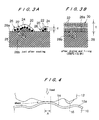
- FIG. 4 shows a general construction of this type of conventional sliding member, wherein one sliding surface 10a in a pair of sliding members 10, 12, is thinly coated with a soft metal layer 14 formed of a soft material such as lead, indium, gold, or silver.
- the sliding members 10, 12 are formed of a hard metal and moved each other while they are in contact with the soft metal layer 14. This concept is based on such an idea that lubricating action is caused by the soft metal, in which low shearing stress of the soft metal is utilized.
- a true contact area A between the sliding members 10, 12 is determined by the hardness of a harder metal member (sliding member 12).
- silver as a soft metal is said to be the best material for use in high load slide bearings, because silver is highly compatible with the hard metal member, and at the same time, has good thermal conductivity and toughness.
- Electroplating is generally used for coating a soft metal on a sliding member formed of a hard metal.
- a commonly used method is such that plating is carried out using a plating solution composed mainly of silver potassium cyanide at a current density of not less than 20 A/dm 2 by taking advantage of high stability of the cyan complex.
- the electroplating can be satisfactorily brought its advantage only for mass-produced objects having a simple shape.
- the electroplating cannot be satisfactorily used for members having a complicate shape and deformed members having a labyrinth contour.
- the electroplating cannot be satisfactorily used for objects, which are required to execute the plating on customer's site (in particular, for example, in the case of assembling, installation, and repair), but not within the production plant.
- the development of a method, other than electroplating which can surely and easily form a soft metal layer on a sliding member in its sliding surface, has been strongly desired. Further, harmful effects of highly poisonous cyanogenic compounds contained in conventional plating solutions on the health of workers have also been strongly pointed out.
- the present invention has been made in view of the above drawbacks. It is therefore an object of the present invention to provide a sliding member and a process for producing the same, wherein a high-quality soft metal layer is evenly coated on a sliding surface by a process alternative to electroplating or ion plating.
- a sliding member comprising: a sliding member having a sliding surface thereon; and a metal layer covering said sliding surface.
- the metal layer has been formed by ultra-fine metal particles, which have been melt and bonded to one another.
- the ultra-fine metal particles are preferably ultra-fine silver particles and the average particle diameter of the ultra-fine silver particles is 1 to 20 nm, and in particular 1 to 10 nm.
- a process for producing a sliding member having a metal layer on its sliding surface which comprises: providing an ultra-fine particle solution of ultra-fine metal particles dispersed in a predetermined solvent; bringing the ultra-fine particle solution into contact with said sliding surface of said sliding member; drying the ultra-fine particle solution deposited on said sliding surface to form dried coating; and heat treating said dried coating to melt and bond the ultra-fine metal particles to one another.
- the sliding surface can be evenly covered with a thin metal (for example, silver) layer of orderly arranged pure ultra-fine metal particles produced by decomposing, through firing.
- the whole organic matter has been contained in a solvent with ultra-fine metal particles being homogeneously mixed and dispersed therein.
- the whole metal coating process can be carried out in the air at room temperature to about 200-300°C.
- a sliding surface of the sliding member can be covered with a metal layer at much lower cost in a simpler manner with higher reliability.
- FIG. 1 shows an example of a production process of ultra-fine silver particles (ultra-fine metal particles), for example, having an average particle diameter of 1 to 20 nm, preferably about 1 to 10 nm.
- ultra-fine silver particles ultra-fine metal particles
- the straight-chain fatty acid salt is denatured by heating at about 250°C in a nitrogen atmosphere for 4h, followed by purification to produce ultra-fine silver particles, the periphery of which has been covered with an alkyl chain shell.
- silver nitrate metal salt
- a naphthenic high-boiling solvent a nonaqueous solvent
- oleic acid an ionic organic compound
- the ultra-fine silver particles thus produced, the periphery of the particles covered with the alkyl chain shell or the ionic organic compound. Therefore, when the ultra-fine silver particles are added to an organic solvent, for example, cyclohexane, they do not mutually agglomerate and are stably and homogeneously dispersed in the solvent to create a transparent state, that is, a solubilized state.
- an organic solvent for example, cyclohexane
- the melting point of the metal particles lowers with reducing the particle diameter.
- the particle diameter in which this effect appears is less than 20 nm. This effect is significant when the particle diameter is less than 10 nm.
- the average particle diameter of the ultra-fine silver particles is preferably 1 to 20 nm, particularly preferably 1 to 10 nm.
- the use of ultra-fine silver particles having a size on a level of a cluster that is, ultra-fine silver particles having an average particle diameter of about 5 nm, permits the ultra-fine silver particles to be melt and bonded to one another by heating at about 200°C.
- FIG. 2 shows, in the order of steps, the production process of a sliding member according to an embodiment of the present invention
- FIG. 3 is a schematic diagram illustrating of coating of a metal layer on a sliding member.
- FIG. 3A shows the state of the sliding member just after coating of an ultra-fine silver particle solution on its sliding surface
- FIG. 3B shows the state of the sliding member after drying and firing the ultra-fine silver particles.
- This ultra-fine silver particle solution 26 is coated on and brought into contact with the sliding member 28 in its sliding surface 28a.
- the ultra-fine silver particles 22 can be homogeneously dispersed as a simple metallic substance, are less likely to agglomerate, and are highly conformable to concaves and convexes on the sliding surface 28a and thus can fully enter fine concaves 28b present originally on the sliding surface 28a.
- the ultra-fine silver particle solution 26 coated on the sliding surface 28 is dried at room temperature to evaporate the organic solvent. Thereafter, the dried coating on the sliding surface 28 is then held at a temperature above the decomposition temperature of the alkyl chain shell 20 covering the periphery of the ultra-fine silver particles 22, for example, at a temperature of 200°C, for example, for 0.5h to fire the coating.
- silver layer (a metal layer) 30 consisting of ultra-fine silver particles 22 alone is formed on the sliding member 28 in its sliding surface 28a.
- the alkyl chain shell 20 covering the periphery of the ultra-fine silver particles 22 can be decomposed and consequently allowed to disappear.
- the ultra-fine silver particles 22 can be melt to be bonded to one another to form a silver layer 30 having even thickness.
- the ultra-fine silver particles 22 fully enter fine concaves 28b originally present on the sliding surface 28a. This can improve the adhesion of the silver layer 30 to the sliding surface 28a.
- the thickness t of the silver layer 30 formed by a single procedure of coating of the ultra-fine silver particle solution 26 followed by firing is about 0.1 ⁇ m at the maximum.
- the regulation of the thickness of the silver layer 30 is a critical factor in providing the optimum lubricating action. Therefore, as shown in step (d) in FIG. 2, a judgment is done on whether or not the thickness of the silver layer 30 reached a predetermined thickness. If the layer thickness does not yet reach the predetermined thickness, the above step is repeated by a necessary number of times to form a silver layer 30 having a thickness compatible with service conditions of the member used.
- the sliding member 28 having a sliding surface 28a covered with a silver layer 30 having a predetermined thickness according to the above procedure is actually built in, for example, for use as a sliding member, for example, under high-temperature or vacuum environment.
- the whole silver coating process in this embodiment can be carried out in the air at room temperature to 200°C. Therefore, unlike the conventional electroplating and ion plating, the silver coating process in this embodiment is very simple, and, at the same time, is highly reliable. That is, a specialty power source is unnecessary, and, in addition, the use of a very small amount of an ultra-fine silver particle solution suffices for satisfactory results. Therefore, highly reliable coating operation can be easily carried out particularly even in the case of sliding members having a complicate shape and even in sites of which the environment is not suitable for conventional coating operation. Further, the coating can be carried out without using any highly poisonous material, such as cyanogens compounds, at all. Thus, the present invention can provide a process and a sliding member, which are also advantageous in ensuring safety and health of workers.
- a sliding surface of the sliding member can be covered with a metal layer at much lower cost in a simpler manner with higher reliability as compared with the conventional electroplating and ion plating.
Landscapes
- Engineering & Computer Science (AREA)
- General Engineering & Computer Science (AREA)
- Mechanical Engineering (AREA)
- Sliding-Contact Bearings (AREA)
- Lubricants (AREA)
- Electroplating Methods And Accessories (AREA)
- Electroplating And Plating Baths Therefor (AREA)
- Paints Or Removers (AREA)
Abstract
Description
Claims (10)
- A sliding member comprising:a sliding member having a sliding surface thereon; anda metal layer covering said sliding surface, said metal layer having been formed by ultra-fine metal particles, which have been melt and bonded to one another.
- A sliding member according to claim 1, wherein said ultra-fine metal particles are ultra-fine silver particles.
- A sliding member according to claim 1, wherein an average particle diameter of the ultra-fine metal particles is 1 to 20 nm.
- A sliding member according to claim 1, wherein said metal layer has been formed by bringing an ultra-fine particle solution of ultra-fine metal particles dispersed in a predetermined solvent into contact with said sliding surface of said sliding member, and drying the coating and then heat treating the dried coating.
- A sliding member according to claim 1, wherein said ultra-fine silver particles are produced by heat decomposing a metal-containing organic complex or metallic salt.
- A process for producing a sliding member having a metal layer on its sliding surface, comprising:providing an ultra-fine particle solution of ultra-fine metal particles dispersed in a predetermined solvent;bringing said ultra-fine particle solution into contact with said sliding surface of said sliding member;drying said ultra-fine particle solution deposited on said sliding surface to form dried coating; andheat treating said dried coating to melt and bond said ultra-fine metal particles to one another.
- A process according to claim 6, wherein said ultra-fine metal particles are ultra-fine silver particles.
- A process according to claim 6, wherein an average particle diameter of the ultra-fine metal particles is 1 to 20 nm.
- A sliding member according to claim 6, wherein said ultra-fine metal particles are produced by heat decomposing a silver-containing organic complex or metallic salt.
- A process according to claim 6, wherein said ultra-fine metal particles are melt and bonded to one another by heating at about 200 to 300°C.
Applications Claiming Priority (2)
| Application Number | Priority Date | Filing Date | Title |
|---|---|---|---|
| JP32271099 | 1999-11-12 | ||
| JP32271099A JP2001141183A (en) | 1999-11-12 | 1999-11-12 | Sliding member and manufacturing method thereof |
Publications (3)
| Publication Number | Publication Date |
|---|---|
| EP1099868A2 true EP1099868A2 (en) | 2001-05-16 |
| EP1099868A3 EP1099868A3 (en) | 2004-05-12 |
| EP1099868B1 EP1099868B1 (en) | 2006-09-27 |
Family
ID=18146767
Family Applications (1)
| Application Number | Title | Priority Date | Filing Date |
|---|---|---|---|
| EP00124649A Expired - Lifetime EP1099868B1 (en) | 1999-11-12 | 2000-11-10 | Process for producing a sliding member |
Country Status (4)
| Country | Link |
|---|---|
| US (1) | US6455475B1 (en) |
| EP (1) | EP1099868B1 (en) |
| JP (1) | JP2001141183A (en) |
| DE (1) | DE60030936T2 (en) |
Cited By (1)
| Publication number | Priority date | Publication date | Assignee | Title |
|---|---|---|---|---|
| EP1102522A3 (en) * | 1999-11-17 | 2004-01-14 | Ebara Corporation | Substrate coated with a conductive layer and manufacturing method thereof |
Families Citing this family (4)
| Publication number | Priority date | Publication date | Assignee | Title |
|---|---|---|---|---|
| WO2005120703A1 (en) * | 2004-06-10 | 2005-12-22 | Sumitomo Electric Industries, Ltd. | Metal catalyst and method for preparation thereof |
| WO2012032869A1 (en) * | 2010-09-09 | 2012-03-15 | 本田技研工業株式会社 | Process for producing sliding member, and sliding member |
| CN114891413B (en) * | 2021-02-28 | 2024-01-02 | 营口赛斯德型材有限公司 | Self-lubricating wear-resistant coating |
| JP7641537B2 (en) * | 2021-04-05 | 2025-03-07 | 学校法人 名城大学 | Manufacturing method of sliding parts |
Family Cites Families (9)
| Publication number | Priority date | Publication date | Assignee | Title |
|---|---|---|---|---|
| US3296693A (en) * | 1962-09-21 | 1967-01-10 | Shirley J Carter | Tungsten carbide brazing |
| US4241483A (en) * | 1979-05-07 | 1980-12-30 | Eastern Fusecoat Incorporated | Method of making drill, bushings, pump seals and similar articles |
| JPS60135564A (en) * | 1983-12-23 | 1985-07-18 | Nippon Seiko Kk | Wear-resistant metal sliding parts |
| JP2620976B2 (en) * | 1989-07-07 | 1997-06-18 | 株式会社豊田中央研究所 | Sliding member |
| JP2601555B2 (en) * | 1989-11-20 | 1997-04-16 | 大同メタル工業 株式会社 | Multi-layer slide bearing material |
| DE4211642C2 (en) * | 1992-04-07 | 1997-11-13 | Braunschweiger Huettenwerk | Process for the production of plain bearing layer material or plain bearing layer workpieces |
| JP2726796B2 (en) * | 1993-12-28 | 1998-03-11 | 大同メタル工業株式会社 | Multi-layer sliding member and manufacturing method thereof |
| JPH08253826A (en) * | 1994-10-19 | 1996-10-01 | Sumitomo Electric Ind Ltd | Sintered friction material, composite copper alloy powder used therein, and method for producing the same |
| US5938864A (en) * | 1995-03-03 | 1999-08-17 | Taiho Kogyo Co., Ltd. | Sliding material and surface treating method thereof |
-
1999
- 1999-11-12 JP JP32271099A patent/JP2001141183A/en active Pending
-
2000
- 2000-11-10 DE DE60030936T patent/DE60030936T2/en not_active Expired - Fee Related
- 2000-11-10 EP EP00124649A patent/EP1099868B1/en not_active Expired - Lifetime
- 2000-11-13 US US09/709,732 patent/US6455475B1/en not_active Expired - Fee Related
Cited By (1)
| Publication number | Priority date | Publication date | Assignee | Title |
|---|---|---|---|---|
| EP1102522A3 (en) * | 1999-11-17 | 2004-01-14 | Ebara Corporation | Substrate coated with a conductive layer and manufacturing method thereof |
Also Published As
| Publication number | Publication date |
|---|---|
| DE60030936D1 (en) | 2006-11-09 |
| EP1099868B1 (en) | 2006-09-27 |
| EP1099868A3 (en) | 2004-05-12 |
| JP2001141183A (en) | 2001-05-25 |
| DE60030936T2 (en) | 2007-06-06 |
| US6455475B1 (en) | 2002-09-24 |
Similar Documents
| Publication | Publication Date | Title |
|---|---|---|
| US6815400B2 (en) | Method for forming solid film lubricant | |
| US5028492A (en) | Composite coating for electrical connectors | |
| Clauss | Solid lubricants and self-lubricating solids | |
| Lancaster | Dry bearings: a survey of materials and factors affecting their performance | |
| Sharma et al. | Graphite particles reinforced ZA-27 alloy composite materials for journal bearing applications | |
| US5141702A (en) | Method of making coated electrical connectors | |
| CN1079920C (en) | Sliding bearing material and its use | |
| Reeves et al. | Tribology of solid lubricants | |
| US3787294A (en) | Process for producing a solid lubricant self-supplying-type co-deposited metal film | |
| CA2056540A1 (en) | Curable dry film lubricant for titanium alloys | |
| KR20110042117A (en) | Sliding Elements with Composite Layers | |
| JPH08512342A (en) | Metal-encapsulated solid lubricant coating system | |
| HUP0302324A2 (en) | Sliding material | |
| KR20020047238A (en) | Plain bearing | |
| JPH08100819A (en) | Grease lubrication rolling device bearing with solid lubricant coating | |
| WO1999043963A1 (en) | Sliding bearing for internal combustion engine | |
| EP1649207B1 (en) | Bearing having anodic nanoparticle lubricant | |
| US6455475B1 (en) | Sliding member and process for producing the same | |
| US6588934B2 (en) | Silver-containing copper alloys for journal bearings | |
| GB2337306A (en) | Sliding member with Cu, Ag and resin layers | |
| Bisson | Friction, wear, and surface damage of metals as affected by solid surface films | |
| JPH06330392A (en) | Composite plated metal material having excellent wear resistance and slidability, and method for producing the same | |
| CN100558867C (en) | Grease, rolling bearings, constant velocity couplings and rotating parts | |
| Hua et al. | Friction properties and lubrication mechanism of self-lubricating composite solid lubricant on laser textured AISI 52100 surface in sliding contact | |
| CN108061097A (en) | A kind of unleaded Sliding bush and production technology |
Legal Events
| Date | Code | Title | Description |
|---|---|---|---|
| PUAI | Public reference made under article 153(3) epc to a published international application that has entered the european phase |
Free format text: ORIGINAL CODE: 0009012 |
|
| AK | Designated contracting states |
Kind code of ref document: A2 Designated state(s): AT BE CH CY DE DK ES FI FR GB GR IE IT LI LU MC NL PT SE TR |
|
| AX | Request for extension of the european patent |
Free format text: AL;LT;LV;MK;RO;SI |
|
| PUAL | Search report despatched |
Free format text: ORIGINAL CODE: 0009013 |
|
| AK | Designated contracting states |
Kind code of ref document: A3 Designated state(s): AT BE CH CY DE DK ES FI FR GB GR IE IT LI LU MC NL PT SE TR |
|
| AX | Request for extension of the european patent |
Extension state: AL LT LV MK RO SI |
|
| 17P | Request for examination filed |
Effective date: 20041110 |
|
| AKX | Designation fees paid |
Designated state(s): DE FR GB |
|
| 17Q | First examination report despatched |
Effective date: 20050509 |
|
| GRAP | Despatch of communication of intention to grant a patent |
Free format text: ORIGINAL CODE: EPIDOSNIGR1 |
|
| RTI1 | Title (correction) |
Free format text: PROCESS FOR PRODUCING A SLIDING MEMBER |
|
| GRAS | Grant fee paid |
Free format text: ORIGINAL CODE: EPIDOSNIGR3 |
|
| GRAA | (expected) grant |
Free format text: ORIGINAL CODE: 0009210 |
|
| AK | Designated contracting states |
Kind code of ref document: B1 Designated state(s): DE FR GB |
|
| REG | Reference to a national code |
Ref country code: GB Ref legal event code: FG4D |
|
| REF | Corresponds to: |
Ref document number: 60030936 Country of ref document: DE Date of ref document: 20061109 Kind code of ref document: P |
|
| EN | Fr: translation not filed | ||
| PLBE | No opposition filed within time limit |
Free format text: ORIGINAL CODE: 0009261 |
|
| STAA | Information on the status of an ep patent application or granted ep patent |
Free format text: STATUS: NO OPPOSITION FILED WITHIN TIME LIMIT |
|
| GBPC | Gb: european patent ceased through non-payment of renewal fee |
Effective date: 20061227 |
|
| 26N | No opposition filed |
Effective date: 20070628 |
|
| PG25 | Lapsed in a contracting state [announced via postgrant information from national office to epo] |
Ref country code: GB Free format text: LAPSE BECAUSE OF NON-PAYMENT OF DUE FEES Effective date: 20061227 |
|
| PGFP | Annual fee paid to national office [announced via postgrant information from national office to epo] |
Ref country code: DE Payment date: 20071128 Year of fee payment: 8 |
|
| PG25 | Lapsed in a contracting state [announced via postgrant information from national office to epo] |
Ref country code: FR Free format text: LAPSE BECAUSE OF FAILURE TO SUBMIT A TRANSLATION OF THE DESCRIPTION OR TO PAY THE FEE WITHIN THE PRESCRIBED TIME-LIMIT Effective date: 20070525 |
|
| PG25 | Lapsed in a contracting state [announced via postgrant information from national office to epo] |
Ref country code: FR Free format text: LAPSE BECAUSE OF FAILURE TO SUBMIT A TRANSLATION OF THE DESCRIPTION OR TO PAY THE FEE WITHIN THE PRESCRIBED TIME-LIMIT Effective date: 20060927 |
|
| PG25 | Lapsed in a contracting state [announced via postgrant information from national office to epo] |
Ref country code: DE Free format text: LAPSE BECAUSE OF NON-PAYMENT OF DUE FEES Effective date: 20090603 |