EP1099387A1 - Method and device for freeze drying and freeze-dried matter - Google Patents
Method and device for freeze drying and freeze-dried matter Download PDFInfo
- Publication number
- EP1099387A1 EP1099387A1 EP00927813A EP00927813A EP1099387A1 EP 1099387 A1 EP1099387 A1 EP 1099387A1 EP 00927813 A EP00927813 A EP 00927813A EP 00927813 A EP00927813 A EP 00927813A EP 1099387 A1 EP1099387 A1 EP 1099387A1
- Authority
- EP
- European Patent Office
- Prior art keywords
- freeze
- dry ice
- treated
- freezing
- materials
- Prior art date
- Legal status (The legal status is an assumption and is not a legal conclusion. Google has not performed a legal analysis and makes no representation as to the accuracy of the status listed.)
- Withdrawn
Links
- 238000004108 freeze drying Methods 0.000 title claims abstract description 29
- 238000000034 method Methods 0.000 title claims abstract description 28
- 239000000463 material Substances 0.000 claims abstract description 142
- CURLTUGMZLYLDI-UHFFFAOYSA-N Carbon dioxide Chemical group O=C=O CURLTUGMZLYLDI-UHFFFAOYSA-N 0.000 claims abstract description 81
- 235000011089 carbon dioxide Nutrition 0.000 claims abstract description 68
- 238000007710 freezing Methods 0.000 claims abstract description 65
- 230000008014 freezing Effects 0.000 claims abstract description 65
- 238000001291 vacuum drying Methods 0.000 claims abstract description 28
- 230000008569 process Effects 0.000 claims abstract description 21
- 235000013305 food Nutrition 0.000 claims description 21
- 239000010410 layer Substances 0.000 claims description 20
- 238000001816 cooling Methods 0.000 claims description 10
- 239000002131 composite material Substances 0.000 claims description 8
- 239000000538 analytical sample Substances 0.000 claims description 6
- 238000004458 analytical method Methods 0.000 claims description 5
- 230000015572 biosynthetic process Effects 0.000 claims description 3
- 230000000887 hydrating effect Effects 0.000 claims description 3
- 239000002356 single layer Substances 0.000 claims description 3
- 238000003825 pressing Methods 0.000 abstract description 19
- 238000004925 denaturation Methods 0.000 abstract description 16
- 230000036425 denaturation Effects 0.000 abstract description 16
- QVGXLLKOCUKJST-UHFFFAOYSA-N atomic oxygen Chemical compound [O] QVGXLLKOCUKJST-UHFFFAOYSA-N 0.000 abstract description 13
- 239000001301 oxygen Substances 0.000 abstract description 13
- 229910052760 oxygen Inorganic materials 0.000 abstract description 13
- 102000004190 Enzymes Human genes 0.000 abstract description 11
- 108090000790 Enzymes Proteins 0.000 abstract description 11
- 230000000694 effects Effects 0.000 abstract description 9
- 239000000047 product Substances 0.000 description 94
- 244000298697 Actinidia deliciosa Species 0.000 description 14
- 235000009436 Actinidia deliciosa Nutrition 0.000 description 14
- 239000000126 substance Substances 0.000 description 13
- 239000007788 liquid Substances 0.000 description 10
- 239000003814 drug Substances 0.000 description 9
- 235000015110 jellies Nutrition 0.000 description 9
- 239000008274 jelly Substances 0.000 description 9
- 239000011368 organic material Substances 0.000 description 9
- 239000002245 particle Substances 0.000 description 9
- 229940079593 drug Drugs 0.000 description 8
- 238000001035 drying Methods 0.000 description 8
- 210000001519 tissue Anatomy 0.000 description 8
- 238000005345 coagulation Methods 0.000 description 7
- 230000015271 coagulation Effects 0.000 description 7
- 235000013399 edible fruits Nutrition 0.000 description 7
- 239000007789 gas Substances 0.000 description 7
- 239000002994 raw material Substances 0.000 description 7
- XLYOFNOQVPJJNP-UHFFFAOYSA-N water Substances O XLYOFNOQVPJJNP-UHFFFAOYSA-N 0.000 description 7
- 241000220223 Fragaria Species 0.000 description 6
- 235000016623 Fragaria vesca Nutrition 0.000 description 6
- 235000011363 Fragaria x ananassa Nutrition 0.000 description 6
- 239000012472 biological sample Substances 0.000 description 6
- 229910002092 carbon dioxide Inorganic materials 0.000 description 6
- 239000001569 carbon dioxide Substances 0.000 description 6
- 210000002421 cell wall Anatomy 0.000 description 6
- 230000002349 favourable effect Effects 0.000 description 6
- 238000002156 mixing Methods 0.000 description 6
- 238000012545 processing Methods 0.000 description 6
- 241000219173 Carica Species 0.000 description 5
- 235000009467 Carica papaya Nutrition 0.000 description 5
- 230000009471 action Effects 0.000 description 5
- 235000018102 proteins Nutrition 0.000 description 5
- 102000004169 proteins and genes Human genes 0.000 description 5
- 108090000623 proteins and genes Proteins 0.000 description 5
- IJGRMHOSHXDMSA-UHFFFAOYSA-N Atomic nitrogen Chemical compound N#N IJGRMHOSHXDMSA-UHFFFAOYSA-N 0.000 description 4
- 241000195649 Chlorella <Chlorellales> Species 0.000 description 4
- 235000008429 bread Nutrition 0.000 description 4
- 210000004027 cell Anatomy 0.000 description 4
- 235000013365 dairy product Nutrition 0.000 description 4
- 239000002657 fibrous material Substances 0.000 description 4
- 239000003205 fragrance Substances 0.000 description 4
- 238000010438 heat treatment Methods 0.000 description 4
- 238000000859 sublimation Methods 0.000 description 4
- 230000008022 sublimation Effects 0.000 description 4
- 235000013311 vegetables Nutrition 0.000 description 4
- 235000000832 Ayote Nutrition 0.000 description 3
- 241000894006 Bacteria Species 0.000 description 3
- 235000009854 Cucurbita moschata Nutrition 0.000 description 3
- 235000009804 Cucurbita pepo subsp pepo Nutrition 0.000 description 3
- 244000000626 Daucus carota Species 0.000 description 3
- 235000002767 Daucus carota Nutrition 0.000 description 3
- 241000196324 Embryophyta Species 0.000 description 3
- 241001465754 Metazoa Species 0.000 description 3
- 239000002253 acid Substances 0.000 description 3
- 230000006378 damage Effects 0.000 description 3
- 235000013336 milk Nutrition 0.000 description 3
- 239000008267 milk Substances 0.000 description 3
- 210000004080 milk Anatomy 0.000 description 3
- 238000000465 moulding Methods 0.000 description 3
- MFOUDYKPLGXPGO-UHFFFAOYSA-N propachlor Chemical compound ClCC(=O)N(C(C)C)C1=CC=CC=C1 MFOUDYKPLGXPGO-UHFFFAOYSA-N 0.000 description 3
- 235000015136 pumpkin Nutrition 0.000 description 3
- 239000011347 resin Substances 0.000 description 3
- 229920005989 resin Polymers 0.000 description 3
- 238000000926 separation method Methods 0.000 description 3
- 239000002002 slurry Substances 0.000 description 3
- 239000007787 solid Substances 0.000 description 3
- 238000013517 stratification Methods 0.000 description 3
- BFKJFAAPBSQJPD-UHFFFAOYSA-N tetrafluoroethene Chemical group FC(F)=C(F)F BFKJFAAPBSQJPD-UHFFFAOYSA-N 0.000 description 3
- 230000002747 voluntary effect Effects 0.000 description 3
- 240000004244 Cucurbita moschata Species 0.000 description 2
- 241000238371 Sepiidae Species 0.000 description 2
- 239000000853 adhesive Substances 0.000 description 2
- 230000001070 adhesive effect Effects 0.000 description 2
- 230000001580 bacterial effect Effects 0.000 description 2
- 239000005018 casein Substances 0.000 description 2
- BECPQYXYKAMYBN-UHFFFAOYSA-N casein, tech. Chemical compound NCCCCC(C(O)=O)N=C(O)C(CC(O)=O)N=C(O)C(CCC(O)=N)N=C(O)C(CC(C)C)N=C(O)C(CCC(O)=O)N=C(O)C(CC(O)=O)N=C(O)C(CCC(O)=O)N=C(O)C(C(C)O)N=C(O)C(CCC(O)=N)N=C(O)C(CCC(O)=N)N=C(O)C(CCC(O)=N)N=C(O)C(CCC(O)=O)N=C(O)C(CCC(O)=O)N=C(O)C(COP(O)(O)=O)N=C(O)C(CCC(O)=N)N=C(O)C(N)CC1=CC=CC=C1 BECPQYXYKAMYBN-UHFFFAOYSA-N 0.000 description 2
- 235000021240 caseins Nutrition 0.000 description 2
- 238000013329 compounding Methods 0.000 description 2
- 238000010276 construction Methods 0.000 description 2
- 239000006071 cream Substances 0.000 description 2
- 230000029087 digestion Effects 0.000 description 2
- 239000010408 film Substances 0.000 description 2
- 239000000796 flavoring agent Substances 0.000 description 2
- 235000019634 flavors Nutrition 0.000 description 2
- 235000011389 fruit/vegetable juice Nutrition 0.000 description 2
- 229910010272 inorganic material Inorganic materials 0.000 description 2
- 239000011147 inorganic material Substances 0.000 description 2
- 230000010354 integration Effects 0.000 description 2
- 239000011229 interlayer Substances 0.000 description 2
- 238000004519 manufacturing process Methods 0.000 description 2
- 244000005700 microbiome Species 0.000 description 2
- 210000003205 muscle Anatomy 0.000 description 2
- -1 nets Substances 0.000 description 2
- 229910052757 nitrogen Inorganic materials 0.000 description 2
- 239000004745 nonwoven fabric Substances 0.000 description 2
- 239000000123 paper Substances 0.000 description 2
- 239000006072 paste Substances 0.000 description 2
- 239000012071 phase Substances 0.000 description 2
- 230000002265 prevention Effects 0.000 description 2
- 238000005507 spraying Methods 0.000 description 2
- 235000000346 sugar Nutrition 0.000 description 2
- 150000008163 sugars Chemical class 0.000 description 2
- 239000010409 thin film Substances 0.000 description 2
- 235000019222 white chocolate Nutrition 0.000 description 2
- 240000008574 Capsicum frutescens Species 0.000 description 1
- 241000219122 Cucurbita Species 0.000 description 1
- 240000007594 Oryza sativa Species 0.000 description 1
- 235000007164 Oryza sativa Nutrition 0.000 description 1
- 108091005804 Peptidases Proteins 0.000 description 1
- 239000004365 Protease Substances 0.000 description 1
- 102100037486 Reverse transcriptase/ribonuclease H Human genes 0.000 description 1
- 240000004808 Saccharomyces cerevisiae Species 0.000 description 1
- 241000469217 Spirillina Species 0.000 description 1
- 229920002472 Starch Polymers 0.000 description 1
- 239000004809 Teflon Substances 0.000 description 1
- 229920006362 Teflon® Polymers 0.000 description 1
- 238000010521 absorption reaction Methods 0.000 description 1
- 150000007513 acids Chemical class 0.000 description 1
- 239000000654 additive Substances 0.000 description 1
- 230000000996 additive effect Effects 0.000 description 1
- 239000012080 ambient air Substances 0.000 description 1
- 239000000427 antigen Substances 0.000 description 1
- 102000036639 antigens Human genes 0.000 description 1
- 108091007433 antigens Proteins 0.000 description 1
- 229920006231 aramid fiber Polymers 0.000 description 1
- 239000011324 bead Substances 0.000 description 1
- 229920002678 cellulose Polymers 0.000 description 1
- 239000001913 cellulose Substances 0.000 description 1
- 239000000919 ceramic Substances 0.000 description 1
- 230000008859 change Effects 0.000 description 1
- 235000013351 cheese Nutrition 0.000 description 1
- 239000003795 chemical substances by application Substances 0.000 description 1
- 235000019219 chocolate Nutrition 0.000 description 1
- 239000011248 coating agent Substances 0.000 description 1
- 238000000576 coating method Methods 0.000 description 1
- 239000013065 commercial product Substances 0.000 description 1
- 239000000470 constituent Substances 0.000 description 1
- 230000008602 contraction Effects 0.000 description 1
- 238000010411 cooking Methods 0.000 description 1
- 239000002826 coolant Substances 0.000 description 1
- 238000005520 cutting process Methods 0.000 description 1
- 235000005911 diet Nutrition 0.000 description 1
- 230000000378 dietary effect Effects 0.000 description 1
- 238000010828 elution Methods 0.000 description 1
- 230000007717 exclusion Effects 0.000 description 1
- 230000001747 exhibiting effect Effects 0.000 description 1
- 239000000835 fiber Substances 0.000 description 1
- 238000011049 filling Methods 0.000 description 1
- 239000010419 fine particle Substances 0.000 description 1
- 235000012055 fruits and vegetables Nutrition 0.000 description 1
- 125000000524 functional group Chemical group 0.000 description 1
- 238000002309 gasification Methods 0.000 description 1
- 239000003365 glass fiber Substances 0.000 description 1
- 238000000265 homogenisation Methods 0.000 description 1
- 230000036571 hydration Effects 0.000 description 1
- 238000006703 hydration reaction Methods 0.000 description 1
- 238000005470 impregnation Methods 0.000 description 1
- 238000003475 lamination Methods 0.000 description 1
- 239000007791 liquid phase Substances 0.000 description 1
- 235000013372 meat Nutrition 0.000 description 1
- 150000007524 organic acids Chemical class 0.000 description 1
- 235000005985 organic acids Nutrition 0.000 description 1
- 235000015927 pasta Nutrition 0.000 description 1
- 239000000843 powder Substances 0.000 description 1
- 230000002062 proliferating effect Effects 0.000 description 1
- 230000002035 prolonged effect Effects 0.000 description 1
- 238000011084 recovery Methods 0.000 description 1
- 230000009467 reduction Effects 0.000 description 1
- 230000000717 retained effect Effects 0.000 description 1
- 235000009566 rice Nutrition 0.000 description 1
- 239000000523 sample Substances 0.000 description 1
- 239000007779 soft material Substances 0.000 description 1
- 235000019698 starch Nutrition 0.000 description 1
- 239000004753 textile Substances 0.000 description 1
- 229960005486 vaccine Drugs 0.000 description 1
- 235000013618 yogurt Nutrition 0.000 description 1
Images


Classifications
-
- F—MECHANICAL ENGINEERING; LIGHTING; HEATING; WEAPONS; BLASTING
- F26—DRYING
- F26B—DRYING SOLID MATERIALS OR OBJECTS BY REMOVING LIQUID THEREFROM
- F26B5/00—Drying solid materials or objects by processes not involving the application of heat
- F26B5/04—Drying solid materials or objects by processes not involving the application of heat by evaporation or sublimation of moisture under reduced pressure, e.g. in a vacuum
- F26B5/06—Drying solid materials or objects by processes not involving the application of heat by evaporation or sublimation of moisture under reduced pressure, e.g. in a vacuum the process involving freezing
-
- A—HUMAN NECESSITIES
- A23—FOODS OR FOODSTUFFS; TREATMENT THEREOF, NOT COVERED BY OTHER CLASSES
- A23B—PRESERVATION OF FOODS, FOODSTUFFS OR NON-ALCOHOLIC BEVERAGES; CHEMICAL RIPENING OF FRUIT OR VEGETABLES
- A23B2/00—Preservation of foods or foodstuffs, in general
- A23B2/90—Preservation of foods or foodstuffs, in general by drying or kilning; Subsequent reconstitution
- A23B2/92—Freeze drying
-
- A—HUMAN NECESSITIES
- A23—FOODS OR FOODSTUFFS; TREATMENT THEREOF, NOT COVERED BY OTHER CLASSES
- A23B—PRESERVATION OF FOODS, FOODSTUFFS OR NON-ALCOHOLIC BEVERAGES; CHEMICAL RIPENING OF FRUIT OR VEGETABLES
- A23B7/00—Preservation of fruit or vegetables; Chemical ripening of fruit or vegetables
- A23B7/02—Dehydrating; Subsequent reconstitution
- A23B7/024—Freeze-drying, i.e. cryodesiccation or lyophilisation
Definitions
- the present invention relates to a process for freezing or freeze-drying a material to be treated susceptible to denaturing, such as a food or drink, a living organism, organic material, drug, biological sample, feed or industrial raw material, into a frozen or freeze-dried product obtained by such a process and to an apparatus for effecting the freezing or freeze-drying.
- a material to be treated susceptible to denaturing such as a food or drink, a living organism, organic material, drug, biological sample, feed or industrial raw material
- materials susceptible to denaturing comprising organic substances, such as foods and drinks, living organisms, such as animals, plants and microbes, organic materials, drugs, biological samples, feeds and industrial raw materials
- they are often subjected to freeze-drying.
- foods and drinks, especially food products are freeze-dried for storing and transporting and are brought into dietary services in the freeze-dried state as such or after being hydrated with addition of water or further processed.
- a biological samples they are prepared by a series of operations for processing a living organism by, for example, freezing, drying, crushing and homogenization.
- the freezing procedure for freeze-drying may generally be realized using a refrigerator. Here, it takes a prolonged period of time till the freezing temperature is reached, during which the material to be processed may suffer from a denaturation due to the action of oxygen or enzymes. Even if the frozen material is subjected to vacuum drying, a freeze-dried product without subjected to denaturation may difficultly obtainable.
- shrinkage phenomenon When a food is frozen in a refrigerator and, then, freeze-dried, so-called shrinkage phenomenon may occur, in which, due to shrinkage and drying of, for example, cellulosic tissues of brake, tissues of, for example, muscles of cuttlefish and cell walls of chlorella, they are converted into dried brake, dried cuttlefish and chlorella beads or in which, due to contraction of internal mass of, for example, cheese, into isolate solid lump inside the mass to form an internal cavity, whereby decrease in the taste or feel in mouth results undesirably with concurrent lowering of digestion of such food.
- shrinkage phenomenon may occur, in which, due to shrinkage and drying of, for example, cellulosic tissues of brake, tissues of, for example, muscles of cuttlefish and cell walls of chlorella, they are converted into dried brake, dried cuttlefish and chlorella beads or in which, due to contraction of internal mass of, for example, cheese, into isolate solid lump inside the mass to form an internal cavity, whereby decrease in the taste or feel in mouth results undesirably with
- Freeze-drying may often be practised after the material to be processed has preliminarily been treated by, for example, crushing and forming into thin films, in order to increase the drying efficiency.
- Such a crushing operation may cause a temperature elevation of the material due to a heat evolution upon crushing.
- the material to be processed may suffer from denaturing due to such a temperature elevation and due to enzymes present in the system, so that the freeze-drying may not be realized under crushing and forming into thin films while preserving the original quality and condition of the material.
- An object of the present invention is to provide a method for producing a freeze-dried product of a material to be processed, by subjecting it to freezing and vacuum drying by a simple apparatus and simple operations, in a state in which the intrinsic quality and properties etc. of the original material are preserved without suffering from denaturing of the material due to the actions of oxygen, enzymes, heat and so on; to provide an apparatus therefor; and to provide a freeze-dried product obtained therefrom.
- Another object of the present invention is to provide a process for producing a freeze-dried product of a material in a bonded or in a stratified state, by subjecting the material to freeze-drying under bonding or stratifying the material, while preserving the intrinsic quality and properties etc. of the original material using a simple apparatus by simple procedures without suffering from denaturing of the material due to the actions of oxygen, enzymes, heat and so on; an apparatus therefor; and freeze-dried product obtained therefrom.
- the present invention consists in the following process for freeze-drying, apparatus therefor and freeze-dried product:
- the materials to be treated by freeze-drying according to the present invention are those susceptible to denaturation, including foods and drinks, organisms, organic materials, drugs, biological samples, feeds and industrial raw materials, in particular those comprising organic materials having reducing functional groups susceptible to denaturing by the actions of oxygen, enzymes, heat and so on. They may be present in any voluntary form, such as lump, liquid, jelly, paste or slurry, including crushed or pulverized form. Typical materials to be treated may be in a hydrated state, though dried materials may be included so long as they permit to be processed, e.g. homogenized, by mixing with water or with hydrated materials.
- materials which are not susceptible to denaturation including filter paper, textiles, non-woven fabrics, nets, films, sheets and plates, may also be used for subjecting to the freeze-drying by treating them together with the above-mentioned material susceptible to denaturation in a state integrated bodily therewith.
- the foods and drinks, organisms, organic materials, drugs, biological samples, feeds and industrial raw materials and so on are not enumerated as parallel concepts but fall under a mere exemplification of materials capable of being treated.
- the foods and drinks may be in a solid or liquid state, wherein those having consistencies or water contents permitting stratification may be used for being stratified as the material to be treated.
- the foods and drinks may be composed essentially of organic materials, though inorganic materials may also be included.
- As the organism whole body or a part (a tissue) of an individual of an animal or plant, cells and microorganisms, such as chlorella, Spirillina and so on, may be dealt with.
- As the organic materials not only such organisms as above, but also those organic substances derived from such organisms may be dealt with.
- feeds, drugs and industrial raw materials may comprise generally living organisms and organic materials
- inorganic materials may also be dealt with in accordance with the present invention so long as they are susceptible to denaturation.
- the biological samples may, in general, be analytical samples consisting of organisms, though other samples may also be dealt with.
- Dry ice may be a compacted product of solid carbon dioxide which sublimates at -78.5°C under atmospheric pressure. Any commercial product sold as a coolant or the like may be used as dry ice. Such dry ice product can be crushed easily by applying a compressive force thereto in a mixer-crusher and, thus, can be used in a voluntary form and size, wherein, for example, a product having particle sizes of about 1 - 10 mm may be preferable.
- the amount of dry ice to be used may vary depending on the kind, moisture content, consistency and so on of the material to be treated, while it may in general range from 0.01 to 5 parts, preferably from 0.05 to 1 part by weight per one part by weight of the material to be treated.
- one single material or a plurality of materials to be treated are cooled by dry ice in a state separated from or in contact with each other to cause them to freeze and, by subjecting the frozen product to vacuum freezing, a freeze-dried product is produced.
- the material to be treated is frozen in the original state as such, the material can be frozen in a sole piece or in pieces each isolated from each other.
- fruits, vegetables and the like may be frozen as the whole body or in cut pieces.
- a material to be treated which is in a form of liquid, slurry, paste or so on can be frozen into a single layer of frozen product by filling or piling it in or on a vessel.
- the plurality of materials to be treated are subjected to freezing under a state in which the materials are in contact with each other to thereby cause the materials to adhere to each other at the contacted areas, whereby a frozen product in which a plurality of matarials are bonded together is obtained, from which a freeze-dried product containing a plurality of materials to be treated in a state adhered to each other is obtained by vacuum drying.
- the materials to be bonded together may be of either the same or different kind.
- the material may have a skin as in the case of a fruit and may favorably have a water content of 10 % by weight or more, preferably 10 - 90 % by weight.
- a hydrous or a fibrous material with an oily material.
- a hydrous material such as a vegetable or a fruit
- a fatty substance may be bonded to a fatty substance to freeze-dry the bonded product.
- the support material may be bonded with the hydrous material to be treated under intermediation by dry ice or by cooling with dry ice to effect freeze-drying, in order to obtain a freeze-dried product in which they are integrated.
- the integrated product can be served for, for example, analytical sample, since 100 % recovery of the freeze-dried product of the material to be treated can be attained.
- the material to be treated may be recovered as a freeze-dried product in a state in which it is caused to collapse by the hard substance at an ultralow temperature or in which fibers are stuck into the material, so that it can be used, for example, for extracting a sample for analysis and for extracting a food constituent, such as flavor or so on.
- bonding may be attained even for those having each a convexing face to be bonded, so long as these faces can be deformed by pressing together into faces adapted to be bonded together and, in particular, the bonding adhesion may be increased when water exudes from inside by pressing together and is frozen.
- the pressing of the materials onto each other may be effected by the own weight of the material or in a mechanical way.
- the materials to be treated are cooled and frozen within a short period of time by bringing the materials and dry ice placed in a freezing apparatus into contact with each other.
- a freezing apparatus any one may be used so long as it is constructed so as to permit to accommodate the materials to be treated and dry ice therein in a mixed state and to bring them into contact, wherein it is favorable that the apparatus is so constructed as to subject the materials and dry ice to be pressed by the own weight of them or by an adequate mechanical and other means.
- Dry ice may preferably be mixed in a form of crushed fine particles with the material to be treated, whereby the ambient air is replaced by the carbon dioxide gas evolved by the heat absorption upon contact with the material to build up inert atmosphere while causing the material to be frozen instantaneously.
- freezing may require somewhat longer time.
- the freezing progresses also from the broken sites, whereby the freezing will be completed within a short period of time.
- the freezing starts from a portion exposed to outside or a portion contacting with dry ice.
- pressurizing also in this case, frozen portions become broken to cause thereby the region of liquid state to be exposed, which is then frozen upon contact with dry ice.
- Such processes proceed within a relatively short period of time, whereby freezing occurs as a whole substantially instantaneously.
- such plurality of materials held in contact with each other may be brought into contact with dry ice to cool them, whereby they adhere to each other and are frozen in this state.
- Such a phenomenon resembles to the case where naked hand adheres onto a chilly wall surface in cold season.
- the materials to be treated adhere to each other and are frosen in this state, whereby a bonded frozen product is obtained.
- the material to be treated will be deformed by pressing the bonded boundary face to spread the adhering interface to intensify the adhesion. If a liquid exudes from inside by pressing, the adhesive strength is further increased due to freezing of the liquid.
- the freezing apparatus there may be employed those having a structure in which the material to be treated is accommodated simply together with dry ice to achieve cooling, those having a structure in which a means for blending and/or breaking is installed and those having a structure in which a pressurizing means is arranged.
- the pressurizing means there may be exemplified those in which the pressurization is effected in order to destroy the material partly and those in which the pressurization is effected in order to cause bonding of a plurality of materials to be treated.
- the pressurization there may be recited, for example, use of a piston-like pressing means and a technique in which the material to be treated is caused to travel for the extent over the pressing means under a condition of being pinched in between pressing boards.
- One favorable method for stratifying and freezing the material consists in settling a piece of the material to be treated on a lower mold half (concave mold) made of Tefron (tetrafluoroethylene resin) cooled by dry ice or liquid nitrogen or in a refrigerator, roughly spraying dry ice partly over the upper face of the material to be treated, placing thereon another piece of the material to be bonded therewith at normal temperature before the entire upper face of the first said piece of the material has been frozen, performing, if necessary, stratification on the so-stratified product by similar procedures to obtain multilayer and spraying dry ice perticles on the uppermost layer to effect freezing of the multilayer while pressing the multilayer from above by an upper mold half (convex mold).
- the pressure in the pressurizing section may range from 0.001 to 200 kN and may be 0.001 - 0.1 kN for a soft material, such as strawberry, and 30 - 200 kN for a material having hard cell walls, such as chlorella.
- the frozen product obtained as above may be subjected, directly or after having been stored and transported in the frozen state, to a vacuum drying under the frozen state using a vacuum drying apparatus to produce a freeze-dried product.
- a vacuum drying apparatus to maintain it under a vacuum condition
- the freeze-dried product is obtained by drying under sublimation of humidity and of dry ice contained in the frozen product.
- the degree of vacuum during the vacuum drying may be 1 - 50 Pa, preferably 1 - 5 Pa.
- there is no fear of suffering from denaturation since the drying is realized in an inert atmosphere without passing through liquid phase.
- a high vacuum drying efficiency may be attained and the drying can be realized within a short period of time, since the sublimation of ice is effected in a state of being rendered porous by the precedingly occured sublimation of dry ice.
- the so-obtained freeze-dried product is held under a condition in which the components, color, gustative taste, fragrance, flavour, mouth feel, physico-chemical properties and so on of the original material before the treatment are maintained and may be brought into a finished product after having been subjected, if necessary, to processing operations, such as cutting, crushing and so on.
- the freeze-dried product is obtained under a condition of not contacting with oxygen and can be stored, transported and served for practical use in the inert state as such, while it may scarcely suffer from denaturation even if it is stored and transported under a condition of being sealed with addition of deoxidant so long as it is not caused to absorb humidity.
- a freeze-dried product obtained by freeze-drying a plurality of materials to be treated under a condition of contacting with each other or being stratified into a multilayer may preserve its bonded or stratified state without separation of the bonded part.
- the surface area of contact will be increased to thereby increase the strength of adhesion between the materials to be treated, with simultaneous attainment of prevention of separation of the bonded part due to shrinkage, hardening or the like, whereby it is able to alter the tissue structure in such a manner that the internal contents of the tissue or the contents of the cells of the material to be treated can easily exude out to increase the rate of digestion together with softer mouth feel.
- any voluntary substance including bodies of organisms and organic materials may be enumerated.
- Concrete examples include foods, such as vegetables, fruits, meats and dairy products; medicines, such as crude drugs obtainable from organisms; bodies of organisms; samples of organisms for analytical purpose in which tissues or so on are homogenized; bacterial cells of, such as yeasts and bacteria; and industrial raw materials, such as doughs, starches and proteins.
- Bacterial cells will lose their proliferative activity by the formation of cracks in the cell walls and may occasionally become extinct by the destruction of the cell walls, while, in such cases, use as vaccines may be permitted, since the destruction of cell walls can be realized without any damage of corresponding proteins to be served as the antigen.
- miscellaneous bacteria are extinct by increasing the impressed pressure, safety of foods and so on are increased.
- the freeze-dried product can be used in the dried state as such in accordance with the purpose, while it may be used in the restored state by hydrating it or, further, after being subjected to processings, such as heating etc.
- the material to be treated will be restored by hydration to the original state before the freeze-drying and the taste, gustative taste, fragrance and so on will also be regained.
- a bonded product obtained by bonding a plurality of materials to be treated or a multilayered product resulting from the stratification of them will maintain the bonded or stratified state without causing any peeling-off even after having been regained by water and the bonded or stratified state is kept even after having been subjected to processing operations, such as heating etc.
- freeze-dried product can be used in the state as such or after having been hydrated or processed, as given above, it may be used under compounding with other materials.
- a superior composite food or drink can be obtained by compounding or processing and cooking it together with a jelly, chocolate, juice, milk, cream, bread dough, cake dough, pasta, rice, vegetable or so on.
- the freeze-dried product maintains its fresh state before the freeze drying and elution of soluble components, such as sugars, acids, enzymes and so on is scarce.
- a material to be treated can be freeze-dried while maintaining the quality, properties and so on before the treatment, without suffering from denaturation by oxygen, heat and so on, together with reduction of the time required for the drying, and, in addition, by subjecting a plurality of materials to be treated with each other in a contacted or stratified state, a freeze-dried product in which the materials to be treated are bonded or stratified can be obtained, since one single material or a plurality of materials to be treated are vacuum-dried after having been cooled and frozen by dry ice in a state of being isolated from or contacted with each other.
- the freeze-dried product according to the present invention is inert and maintains the original quality, properties and so on before the treatment and a freeze-dried product in which a plurality of materials to be treated are bonded together or stratified one over another can be obtained. It can be stored, transported and used as such and can be utilized for a food, medicine, feed or so on having high functional performaces. Here, a food or so on which is safe for a long period of time can be obtained by causing bacteria to be extinct.
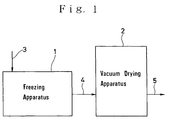
- Fig. 1 shows the structure of an embodiment of freeze-drying apparatus in an exploded view.
- Figs. 2 and 3 show another embodiment of the freezing apparatus each in a sectional view.
- Fig. 1 denotes a freezing apparatus and 2 is a vacuum drying apparatus. They are so constructed that the material to be treated and dry ice are supplied to the freezing apparatus 1 via a supply line 3 to effect freezing and the resulting frozen product is transferred to the vacuum drying apparatus 2 via a transfer line 4 to subject it to vacuum drying, whereupon the freeze-dried product is taken out via a take-out line 5.
- a casing 11 of a cylindrical form has a support 12, on which a ram top 13 served as a pressurizing element is supported slidably so as to permit to move in vertical direction by a hydraulic cylinder 15 via a ram rod 14 connected underneath.
- a ram top 13 served as a pressurizing element is arranged slidably, which is permitted to move in vertical direction by a hydraulic cylinder 18 via a ram rod 17 connected above.
- the supply line 3 and the transfer line 4 both in a form of belt conveyer are disposed. 19 is a pusher.
- dry ice 6a of a particle size of, for example, 1 - 5 mm is supplied on the ram top 13 over the entire surface thereof, while the ram top 16 is held at an elevated position where it is receded somewhat from the upper end of the casing 11, so as to pile up to a depth of, for example, 3 - 7 mm.
- a material to be treated 7a in a layered form for example, sliced pieces of kiwi fruit each having a thickness of 5 - 10 mm, on which dry ice particles 6b are piled sparsely (partly), whereupon, for example, strawberry slices, as a material to be treated 7b, are placed thereon, on which, further, dry ice particles 6c are piled sparsely, whereupon, furthermore, a material to be treated 7c is placed thereon, which is then covered by dry ice particles 6d up to a depth of 5 - 15 mm.
- the ram top 16 is caused to descend using the hydraulic cylinder 18 to effect pressing to thereby cause the materials to be treated 7a, 7b and 7c to adhere to each other at the portions devoid of dry ice 6b and 6c and to cause at the same time to freeze the entire composite.
- the dry ice piles 6a and 6d present above and underneath cause cooling from outside, while cooling is effected also from inside by the interlayer dry ice piles 6b and 6c with simultaneous replacement of gas phase, whereby the materials to be treated 7a, 7b and 7c are frozen in a state adhered to each other to obtain a frozen product.
- the frozen product is moved up by causing the ram top 16 to ascend while moving up the ram top 13, whereupon it is taken out on the transfer line 4 by protruding the pusher 19 and is transferred to the vacuum drying apparatus 2, where it is subjected to vacuum drying to produce a feeze-dried product.
- the freezing apparatus shown in Fig. 3 is so constructed that a plurality of pressurizing rollers 23a are arranged upwardly each supported by means of a bearing element 24a on a bed plate 22 disposed on a basement 21, in which each roller 23a rotates in the same rotational sense (for example, counterclockwise, seen on the Figure) by means of a motor M.
- a deck 26 provided thereon with a hydraulic cylinder 27 is supported on support flames 25.
- 31 and 32 represent each a lower mold half (concave mold half) and an upper mold half (convex mold half) of a forming mold made of Teflon (tetrafluoroethylene resin), respectively, as the pressurizing elements.
- the lower mold half 31 is charged with dry ice 6a - 6d and the material to be treated 7a - 7c in a similar construction as in Fig. 2, whereupon the end of the upper mold half 32 is inserted in the lower mold half and, in this state, the lower mold half 31 and the upper mold half 32 of the forming mold are moved in in the direction indicated by the arrow 'a' between the pressurizing rollers 23a and 23b, before bonding, molding and freezing are effected by pressing the ram top 29 downwards by actuating the hydraulic cylinder 27 in the manner similar to the case of Fig. 2. Since the pressurizing rollers 23a rotate in the same direction by the motor M, the mold is moved out in the direction indicated by the arrow 'b'.
- a freeze-dried product is obtained.
- a fluororesin such as tetrafluoroethylene resin or the like
- Dry ice piles 6a and 6d may facilitate mold parting, since dry ice functions also as a parting agent.
- the vacuum drying apparatus 2 is an apparatus for effecting a vacuum-drying under a reduced pressure established by a vacuum pump, for which a commercial unit comprising a heating unit for increasing the sublimation velocity by heating the material to be treated at a temperature of 20 - 30 °C and a refrigerator for cooling the cooling coil served for trapping the sublimated moisture at minus 50 °C may be employed.
- a freeze-dried product was produced.
- the materials to be treated 7a and 7c slices of kiwi fruit each having a thickness of 5 - 10 mm and, as the material to be treated 7b, slices of strawberry having each a thickness of 5 - 10 mm were employed.
- For dry ice product one having a particle size of 3 mm was used and was piled in a thickness of 5 mm for the lower layer 6a and in a thickness of 10 mm for the upper layer 6d and was scattered in the interlayer portions 6b and 6c sparsely in an amount of 1 - 2 particles per cm 2 .
- a frozen product was obtained under impression of a pressure of 10 N for 60 seconds.
- the frozen product was transferred to a commercial vacuum drying apparatus and was subjected to a vacuum drying under a degree of vacuum of 2 Pa for 48 hours at a drying tray temperature of 20 °C to produce a freeze dried product.
- the resulting freeze-dried product consisted of a multilayer in which the materials to be treated 7a, 7b and 7c are bonded to each other and no separation occured after they were restored with water, wherein the color, taste and fragrance were maintained under the original state.
- pieces of raw kiwi fruit (major diameter of 30 - 60 mm, minor diameter of 30 - 45 mm) cut in a thickness of 10 mm and pieces of cylindrically cut raw papaya (diameter about 20 mm, thickness 10 mm) inserted each in the central portion of each piece of kiwi fruit, as the materials to be treated, were placed on a layer of dry ice spread in a pressing vessel and, then, granular dry ice was scattered sparsely over the surface, whereupon the composite was subjected to a weak pressing at 10 N for one minute to cause a partial breaking down of the materials to be treated, in order to subject it to a freeze-drying under a condition in which slight cracks were formed.
- the process for freeze-drying according to the present invention can be applied for preserving, for transporting and for practical use by freeze-drying bodies of organisms, organic substances, drugs, samples of organisms, industrial raw materials and so on, which are subject to denaturation by the actions of oxygen, enzymes, heat and so on, in a state preserving the original quality, properties and so on before the treatment.
Landscapes
- Engineering & Computer Science (AREA)
- Life Sciences & Earth Sciences (AREA)
- Chemical & Material Sciences (AREA)
- Wood Science & Technology (AREA)
- Zoology (AREA)
- Food Science & Technology (AREA)
- Polymers & Plastics (AREA)
- Molecular Biology (AREA)
- Health & Medical Sciences (AREA)
- Mechanical Engineering (AREA)
- General Engineering & Computer Science (AREA)
- Chemical Kinetics & Catalysis (AREA)
- General Chemical & Material Sciences (AREA)
- Freezing, Cooling And Drying Of Foods (AREA)
- Sampling And Sample Adjustment (AREA)
- Drying Of Solid Materials (AREA)
Abstract
Description
Claims (17)
- A process for freeze-drying, comprisingcooling one or more materials to be treated, in a state separated from or in contact with each other, by dry ice to freeze the material(s) and subjecting the frozen product to vacuum drying.
- A process for freeze-drying, comprisingstratifying materials of the same or different kind to be treated into a multilayer, freezing the multilayer in a state in which dry ice is interposed between the layers and subjecting the frozen multilayer to vacuum drying.
- The process as claimed in claim 2, wherein dry ice is interposed between the layers partly so as to leave the portions devoid of dry ice in a state adhered to each other, in order to form a vacant space at the portion where dry ice is interposed.
- The process as claimed in any one of claims 1 to 3, wherein the freezing is effected under a condition pressurized by the own weight or by an external pressure.
- The process as claimed in any one of claims 1 to 4, wherein the freezing is effected while breaking the material to be treated by pressurizing it so as to cause formation of cracks.
- A freeze-dried product obtained by the process as claimed in any one of claims 1 to 5.
- Foods and drinks comprising the freeze-dried product as claimed in claim 6.
- A composite product in which the freeze-dried product as claimed in claim 6 is compounded with other material(s).
- A hydrated product obtained by hydrating the freeze-dried product as claimed in claim 6.
- A composite product in which the hydrated product as claimed in claim 9 is compounded with other material(s).
- An apparatus for effecting freeze-drying, comprisinga freezing apparatus in which one or more materials to be treated are cooled in a state separated from or in contact with each other by dry ice to freeze the material(s) anda vacuum drying apparatus in which the frozen product obtained by the freezing apparatus is subjected to vacuum drying.
- The apparatus as claimed in claim 11, wherein the freezing apparatus operates to freeze a multilayer of the material to be treated under a condition in which dry ice is interposed between the layers partly.
- The apparatus as claimed in claim 11 or 12, wherein the freezing apparatus comprises a pressurizing means.
- The apparatus as claimed in claim 13, wherein the freezing apparatus comprises pressurizing elements which operate to impress a pressure onto a single layer or a multilayer of the material placed therebetween together with dry ice.
- The apparatus as claimed in claim 14, wherein the freezing apparatus comprises a travelling means operable to cause the pressurizing elements to travel within a pressurization unit.
- A method of analysis, in which the freeze-dried product claimed in claim 6 is used as the analytical sample.
- An apparatus for analysis, in which the freeze-dried product claimed in claim 6 is used as the analytical sample.
Applications Claiming Priority (3)
| Application Number | Priority Date | Filing Date | Title |
|---|---|---|---|
| JP13919799 | 1999-05-19 | ||
| JP13919799 | 1999-05-19 | ||
| PCT/JP2000/003209 WO2000070973A1 (en) | 1999-05-19 | 2000-05-19 | Method and device for freeze drying and freeze-dried matter |
Publications (2)
| Publication Number | Publication Date |
|---|---|
| EP1099387A1 true EP1099387A1 (en) | 2001-05-16 |
| EP1099387A4 EP1099387A4 (en) | 2005-07-06 |
Family
ID=15239827
Family Applications (1)
| Application Number | Title | Priority Date | Filing Date |
|---|---|---|---|
| EP00927813A Withdrawn EP1099387A4 (en) | 1999-05-19 | 2000-05-19 | METHOD AND DEVICE FOR FREEZED DRYING AND FREEZER-DRIED MATERIAL |
Country Status (5)
| Country | Link |
|---|---|
| US (1) | US6635295B1 (en) |
| EP (1) | EP1099387A4 (en) |
| JP (1) | JP3626986B2 (en) |
| AU (1) | AU4614800A (en) |
| WO (1) | WO2000070973A1 (en) |
Cited By (1)
| Publication number | Priority date | Publication date | Assignee | Title |
|---|---|---|---|---|
| WO2012012350A1 (en) * | 2010-07-19 | 2012-01-26 | Nestec S.A. | Textured, freeze-dried products and methods for making same |
Families Citing this family (10)
| Publication number | Priority date | Publication date | Assignee | Title |
|---|---|---|---|---|
| EP1249487B1 (en) * | 2001-04-14 | 2005-11-23 | Franz Zentis Gmbh & Co. | Method and use of an apparatus for making chocolate particles |
| JP4526838B2 (en) * | 2004-03-04 | 2010-08-18 | エーザイ・アール・アンド・ディー・マネジメント株式会社 | Method for preparing sample for compoundability test and kit used therefor |
| GB0525115D0 (en) * | 2005-12-09 | 2006-01-18 | Oxford Biosensors Ltd | Freeze drying of target substances |
| US7943189B2 (en) * | 2007-10-26 | 2011-05-17 | Lee Ferrell | Food preservation packaging system |
| KR20100023538A (en) * | 2008-08-22 | 2010-03-04 | 삼성전자주식회사 | Manufacturing method of solid state reagent and microfluidic device accommodating the reagebt therein |
| RU2014135538A (en) * | 2012-03-08 | 2016-03-20 | Сони Корпорейшн | METHOD FOR PRODUCING MICROCHIP FOR THE REACTION OF AMPLICATION OF NUCLEIC ACIDS |
| US11369119B2 (en) * | 2017-01-25 | 2022-06-28 | David Sandelman | Vapor pressure control system for drying and curing products |
| US12467724B1 (en) * | 2020-07-21 | 2025-11-11 | Kecs, Llc | Biodegradable and edible disc target |
| CN111973644A (en) * | 2020-08-20 | 2020-11-24 | 文山御美堂生物技术开发有限公司 | Fresh pseudo-ginseng slice freeze-drying and preparation method thereof |
| JP7575776B2 (en) * | 2020-12-09 | 2024-10-30 | アスザックフーズ株式会社 | Dry food manufacturing method |
Family Cites Families (13)
| Publication number | Priority date | Publication date | Assignee | Title |
|---|---|---|---|---|
| US2215265A (en) * | 1937-03-19 | 1940-09-17 | Earl W Flosdorf | Apparatus for the concentration and preservation of food products and biological substances |
| JPS4969818A (en) * | 1972-11-08 | 1974-07-05 | ||
| FR2388509A1 (en) * | 1977-04-25 | 1978-11-24 | Air Liquide | METHOD AND APPARATUS FOR RAPID FREEZING OF LIQUID OR PASTA FOOD PRODUCTS |
| JPS53139749A (en) * | 1977-05-10 | 1978-12-06 | Yoshinari Masuyama | Production of powdered fermented soybeans |
| JPS5668351A (en) * | 1979-11-07 | 1981-06-09 | Morinaga & Co Ltd | Preparation of granular freeze dried coffee having shape of coffee bean |
| CA1130963A (en) * | 1980-07-28 | 1982-09-07 | Don Andrews | Apparatus for drying fish, especially squid |
| SU1532781A1 (en) * | 1988-03-31 | 1989-12-30 | Московский технологический институт мясной и молочной промышленности | Method of sublimation drying of plastic products |
| US5023096A (en) * | 1989-10-19 | 1991-06-11 | Naturestar Foods, Inc. | Food product and method for making the same |
| JPH05320941A (en) * | 1992-05-22 | 1993-12-07 | Nagoya Kogyo Univ | Film forming method |
| JPH07250663A (en) * | 1994-03-14 | 1995-10-03 | Nippon Sanso Kk | Food freezing equipment |
| US5520004A (en) * | 1994-06-28 | 1996-05-28 | Jones, Iii; Robert H. | Apparatus and methods for cryogenic treatment of materials |
| JP3040703B2 (en) * | 1995-10-06 | 2000-05-15 | ハウス食品株式会社 | Method for producing porous food |
| JP3005657B2 (en) * | 1997-11-19 | 2000-01-31 | 彰 堀金 | Lyophilization method, apparatus and lyophilizate |
-
2000
- 2000-05-19 AU AU46148/00A patent/AU4614800A/en not_active Abandoned
- 2000-05-19 US US09/744,045 patent/US6635295B1/en not_active Expired - Fee Related
- 2000-05-19 EP EP00927813A patent/EP1099387A4/en not_active Withdrawn
- 2000-05-19 JP JP2000619293A patent/JP3626986B2/en not_active Expired - Lifetime
- 2000-05-19 WO PCT/JP2000/003209 patent/WO2000070973A1/en not_active Ceased
Cited By (4)
| Publication number | Priority date | Publication date | Assignee | Title |
|---|---|---|---|---|
| WO2012012350A1 (en) * | 2010-07-19 | 2012-01-26 | Nestec S.A. | Textured, freeze-dried products and methods for making same |
| US20130216658A1 (en) * | 2010-07-19 | 2013-08-22 | Nestec S.A. | Textured, freeze-dried products and methods for making same |
| AU2011279788B2 (en) * | 2010-07-19 | 2013-11-28 | Société des Produits Nestlé S.A. | Textured, freeze-dried products and methods for making same |
| RU2544619C2 (en) * | 2010-07-19 | 2015-03-20 | Нестек С.А. | Texturised lyophilised products and their production methods |
Also Published As
| Publication number | Publication date |
|---|---|
| WO2000070973A1 (en) | 2000-11-30 |
| JP3626986B2 (en) | 2005-03-09 |
| US6635295B1 (en) | 2003-10-21 |
| EP1099387A4 (en) | 2005-07-06 |
| AU4614800A (en) | 2000-12-12 |
Similar Documents
| Publication | Publication Date | Title |
|---|---|---|
| US6635295B1 (en) | Method for freeze-drying and freeze-dried product | |
| JP3005657B2 (en) | Lyophilization method, apparatus and lyophilizate | |
| SU1220614A1 (en) | Method of processing fruit and berry raw material | |
| US20080274234A1 (en) | Processing cocoa beans and other seeds | |
| TWI552687B (en) | Processing of brown rice, fermented food and processing of brown rice manufacturing methods | |
| KR102062196B1 (en) | Manufacturing method for cheese baguette bread and cheese baguette bread manufactured by the same | |
| JPWO2000070973A1 (en) | Freeze-drying method, apparatus and freeze-dried product | |
| EP2219463A1 (en) | Method for the automatable production of raw sausage | |
| Sarkar et al. | Pineapple [Ananas comosus (L.)] product processing techniques and packaging: a Review | |
| KR101889685B1 (en) | Method for manufacturing pork cutlet with low calorie | |
| KR101920179B1 (en) | Method for manufacturing pork cutlet comprising pork sirloin or pork loin muscle using individual quick-freezing process | |
| RU2337557C1 (en) | Method of manufacturing berry-fruit puree | |
| EP0009219A1 (en) | Dry chip-like slices of food or luxury food and process for their production | |
| US3732627A (en) | Removal of a liquid phase from a material | |
| RU2154969C1 (en) | Method of producing powdered product from garden beet | |
| RU2152743C1 (en) | Method of processing green-head cabbage | |
| JPH08511429A (en) | Method and apparatus for producing stuffed stone fruits before the cooking stage | |
| RU2328124C1 (en) | Production method of mashed apple concentrate | |
| JPS6053590B2 (en) | Manufacturing method of health nutritional food | |
| US4704291A (en) | Method of preparation of fish-noodle | |
| US2363193A (en) | Process of dehydrating tomatoes and the juices thereof | |
| US3297455A (en) | Method of freeze drying liquid milk products | |
| KR101927816B1 (en) | Manufaturing method for powdered sauce | |
| SU1750587A1 (en) | Sour cabbage production method | |
| FR2630890A1 (en) | Method for manufacturing a food product based on the meat and skin of fatty palmipeds, having the appearance of a fillet or cutlet |
Legal Events
| Date | Code | Title | Description |
|---|---|---|---|
| PUAI | Public reference made under article 153(3) epc to a published international application that has entered the european phase |
Free format text: ORIGINAL CODE: 0009012 |
|
| 17P | Request for examination filed |
Effective date: 20010124 |
|
| AK | Designated contracting states |
Kind code of ref document: A1 Designated state(s): AT BE CH CY DE DK ES FI FR GB GR IE IT LI LU MC NL PT SE |
|
| RAP1 | Party data changed (applicant data changed or rights of an application transferred) |
Owner name: NATIONAL AGRICULTURAL RESEARCH ORGANISATION (NARO) Owner name: HORIGANE, AKIRA |
|
| RAP1 | Party data changed (applicant data changed or rights of an application transferred) |
Owner name: HORIGANE, AKIRA Owner name: NATIONAL AGRICULTURAL RESEARCH ORGANIZATION (NARO) |
|
| RAP1 | Party data changed (applicant data changed or rights of an application transferred) |
Owner name: TSUKUBA FOOD SCIENCE, INC. Owner name: NATIONAL AGRICULTURAL RESEARCH ORGANIZATION (NARO) |
|
| RAP1 | Party data changed (applicant data changed or rights of an application transferred) |
Owner name: INCORPORATED ADMINISTRATIVE AGENCY NATIONAL AGRICU Owner name: TSUKUBA FOOD SCIENCE, INC. |
|
| RBV | Designated contracting states (corrected) |
Designated state(s): DE FR GB |
|
| A4 | Supplementary search report drawn up and despatched |
Effective date: 20050525 |
|
| 17Q | First examination report despatched |
Effective date: 20080225 |
|
| STAA | Information on the status of an ep patent application or granted ep patent |
Free format text: STATUS: THE APPLICATION IS DEEMED TO BE WITHDRAWN |
|
| 18D | Application deemed to be withdrawn |
Effective date: 20080708 |