EP1098595B1 - Gerät zur gewinnung einer transpithelialen probe einer körperoberfläche ohne diese aufzureissen - Google Patents
Gerät zur gewinnung einer transpithelialen probe einer körperoberfläche ohne diese aufzureissen Download PDFInfo
- Publication number
- EP1098595B1 EP1098595B1 EP99937396A EP99937396A EP1098595B1 EP 1098595 B1 EP1098595 B1 EP 1098595B1 EP 99937396 A EP99937396 A EP 99937396A EP 99937396 A EP99937396 A EP 99937396A EP 1098595 B1 EP1098595 B1 EP 1098595B1
- Authority
- EP
- European Patent Office
- Prior art keywords
- epithelial tissue
- bristles
- brush
- cells
- body according
- Prior art date
- Legal status (The legal status is an assumption and is not a legal conclusion. Google has not performed a legal analysis and makes no representation as to the accuracy of the status listed.)
- Expired - Lifetime
Links
- 238000000034 method Methods 0.000 title abstract description 20
- 210000000981 epithelium Anatomy 0.000 claims description 50
- 238000005070 sampling Methods 0.000 claims description 37
- 210000002469 basement membrane Anatomy 0.000 claims description 15
- 210000004876 tela submucosa Anatomy 0.000 claims description 9
- 230000001680 brushing effect Effects 0.000 claims description 8
- 238000007790 scraping Methods 0.000 claims description 8
- 230000000149 penetrating effect Effects 0.000 claims description 6
- 210000004027 cell Anatomy 0.000 description 47
- 230000003902 lesion Effects 0.000 description 45
- 210000000214 mouth Anatomy 0.000 description 19
- 210000001519 tissue Anatomy 0.000 description 19
- 239000010410 layer Substances 0.000 description 18
- 206010028980 Neoplasm Diseases 0.000 description 16
- 238000001574 biopsy Methods 0.000 description 16
- 208000025157 Oral disease Diseases 0.000 description 14
- 201000011510 cancer Diseases 0.000 description 12
- 238000012360 testing method Methods 0.000 description 11
- 230000002380 cytological effect Effects 0.000 description 9
- 208000003445 Mouth Neoplasms Diseases 0.000 description 8
- 210000003679 cervix uteri Anatomy 0.000 description 8
- 230000001413 cellular effect Effects 0.000 description 7
- 201000010099 disease Diseases 0.000 description 7
- 208000037265 diseases, disorders, signs and symptoms Diseases 0.000 description 7
- 208000012987 lip and oral cavity carcinoma Diseases 0.000 description 7
- 239000000463 material Substances 0.000 description 7
- 102000011782 Keratins Human genes 0.000 description 6
- 108010076876 Keratins Proteins 0.000 description 6
- 238000005299 abrasion Methods 0.000 description 6
- 238000003745 diagnosis Methods 0.000 description 6
- 230000002159 abnormal effect Effects 0.000 description 5
- 230000000740 bleeding effect Effects 0.000 description 5
- 239000004033 plastic Substances 0.000 description 5
- 229920003023 plastic Polymers 0.000 description 5
- 241000904500 Oxyspora paniculata Species 0.000 description 4
- 238000003491 array Methods 0.000 description 4
- 210000002919 epithelial cell Anatomy 0.000 description 4
- 230000036210 malignancy Effects 0.000 description 4
- 206010027476 Metastases Diseases 0.000 description 3
- 238000005520 cutting process Methods 0.000 description 3
- 230000006378 damage Effects 0.000 description 3
- 230000034994 death Effects 0.000 description 3
- 231100000517 death Toxicity 0.000 description 3
- 208000014674 injury Diseases 0.000 description 3
- 239000002184 metal Substances 0.000 description 3
- 210000003097 mucus Anatomy 0.000 description 3
- 230000036407 pain Effects 0.000 description 3
- 238000009595 pap smear Methods 0.000 description 3
- 239000000126 substance Substances 0.000 description 3
- 208000035143 Bacterial infection Diseases 0.000 description 2
- 206010008342 Cervix carcinoma Diseases 0.000 description 2
- 229920000742 Cotton Polymers 0.000 description 2
- 206010017533 Fungal infection Diseases 0.000 description 2
- 208000034693 Laceration Diseases 0.000 description 2
- 208000031888 Mycoses Diseases 0.000 description 2
- 229910000831 Steel Inorganic materials 0.000 description 2
- 208000006105 Uterine Cervical Neoplasms Diseases 0.000 description 2
- 208000036142 Viral infection Diseases 0.000 description 2
- 239000003082 abrasive agent Substances 0.000 description 2
- 230000009471 action Effects 0.000 description 2
- 238000004458 analytical method Methods 0.000 description 2
- 230000001580 bacterial effect Effects 0.000 description 2
- 208000022362 bacterial infectious disease Diseases 0.000 description 2
- 230000008901 benefit Effects 0.000 description 2
- 201000010881 cervical cancer Diseases 0.000 description 2
- 238000010276 construction Methods 0.000 description 2
- 230000003111 delayed effect Effects 0.000 description 2
- 238000013461 design Methods 0.000 description 2
- 238000001514 detection method Methods 0.000 description 2
- 235000012489 doughnuts Nutrition 0.000 description 2
- 230000000694 effects Effects 0.000 description 2
- 210000005081 epithelial layer Anatomy 0.000 description 2
- 238000004299 exfoliation Methods 0.000 description 2
- 230000002757 inflammatory effect Effects 0.000 description 2
- 210000004379 membrane Anatomy 0.000 description 2
- 239000012528 membrane Substances 0.000 description 2
- 238000012986 modification Methods 0.000 description 2
- 230000004048 modification Effects 0.000 description 2
- 208000030194 mouth disease Diseases 0.000 description 2
- 230000035515 penetration Effects 0.000 description 2
- 230000008569 process Effects 0.000 description 2
- 230000037390 scarring Effects 0.000 description 2
- 210000003491 skin Anatomy 0.000 description 2
- 239000007779 soft material Substances 0.000 description 2
- 239000010959 steel Substances 0.000 description 2
- 238000001356 surgical procedure Methods 0.000 description 2
- 230000004083 survival effect Effects 0.000 description 2
- 230000009885 systemic effect Effects 0.000 description 2
- 230000008733 trauma Effects 0.000 description 2
- 230000003612 virological effect Effects 0.000 description 2
- 210000003905 vulva Anatomy 0.000 description 2
- 210000002268 wool Anatomy 0.000 description 2
- 244000153158 Ammi visnaga Species 0.000 description 1
- 235000010585 Ammi visnaga Nutrition 0.000 description 1
- 206010060999 Benign neoplasm Diseases 0.000 description 1
- 206010005003 Bladder cancer Diseases 0.000 description 1
- 241000251730 Chondrichthyes Species 0.000 description 1
- 241000870659 Crassula perfoliata var. minor Species 0.000 description 1
- 102000004190 Enzymes Human genes 0.000 description 1
- 108090000790 Enzymes Proteins 0.000 description 1
- 241000282326 Felis catus Species 0.000 description 1
- 208000017604 Hodgkin disease Diseases 0.000 description 1
- 208000010747 Hodgkins lymphoma Diseases 0.000 description 1
- 244000280244 Luffa acutangula Species 0.000 description 1
- 235000009814 Luffa aegyptiaca Nutrition 0.000 description 1
- 206010058467 Lung neoplasm malignant Diseases 0.000 description 1
- 208000002720 Malnutrition Diseases 0.000 description 1
- 241001481166 Nautilus Species 0.000 description 1
- 239000004677 Nylon Substances 0.000 description 1
- 208000007457 Oral Manifestations Diseases 0.000 description 1
- 241000721454 Pemphigus Species 0.000 description 1
- 240000007643 Phytolacca americana Species 0.000 description 1
- 239000004743 Polypropylene Substances 0.000 description 1
- 206010036790 Productive cough Diseases 0.000 description 1
- 241000238371 Sepiidae Species 0.000 description 1
- 208000025865 Ulcer Diseases 0.000 description 1
- 208000007097 Urinary Bladder Neoplasms Diseases 0.000 description 1
- 208000027418 Wounds and injury Diseases 0.000 description 1
- 230000005856 abnormality Effects 0.000 description 1
- 239000002253 acid Substances 0.000 description 1
- 150000007513 acids Chemical class 0.000 description 1
- 230000001154 acute effect Effects 0.000 description 1
- 239000000853 adhesive Substances 0.000 description 1
- 230000001070 adhesive effect Effects 0.000 description 1
- 238000005276 aerator Methods 0.000 description 1
- 210000003484 anatomy Anatomy 0.000 description 1
- 238000013459 approach Methods 0.000 description 1
- 210000000270 basal cell Anatomy 0.000 description 1
- 210000001124 body fluid Anatomy 0.000 description 1
- 239000010839 body fluid Substances 0.000 description 1
- 210000000988 bone and bone Anatomy 0.000 description 1
- 238000001311 chemical methods and process Methods 0.000 description 1
- 238000002512 chemotherapy Methods 0.000 description 1
- 230000002759 chromosomal effect Effects 0.000 description 1
- 238000003759 clinical diagnosis Methods 0.000 description 1
- 239000011248 coating agent Substances 0.000 description 1
- 238000000576 coating method Methods 0.000 description 1
- 208000035250 cutaneous malignant susceptibility to 1 melanoma Diseases 0.000 description 1
- 208000036654 deficiency anemia Diseases 0.000 description 1
- 230000000994 depressogenic effect Effects 0.000 description 1
- 238000005553 drilling Methods 0.000 description 1
- 210000002615 epidermis Anatomy 0.000 description 1
- 230000009841 epithelial lesion Effects 0.000 description 1
- 238000011156 evaluation Methods 0.000 description 1
- 229920002457 flexible plastic Polymers 0.000 description 1
- 210000005224 forefinger Anatomy 0.000 description 1
- 239000011521 glass Substances 0.000 description 1
- 239000003365 glass fiber Substances 0.000 description 1
- 238000003306 harvesting Methods 0.000 description 1
- 210000003128 head Anatomy 0.000 description 1
- 238000007689 inspection Methods 0.000 description 1
- 230000001788 irregular Effects 0.000 description 1
- 238000002357 laparoscopic surgery Methods 0.000 description 1
- 201000011486 lichen planus Diseases 0.000 description 1
- 239000003589 local anesthetic agent Substances 0.000 description 1
- 201000005202 lung cancer Diseases 0.000 description 1
- 208000020816 lung neoplasm Diseases 0.000 description 1
- 210000001165 lymph node Anatomy 0.000 description 1
- 230000003211 malignant effect Effects 0.000 description 1
- 201000001441 melanoma Diseases 0.000 description 1
- 238000007431 microscopic evaluation Methods 0.000 description 1
- 235000018343 nutrient deficiency Nutrition 0.000 description 1
- 229920001778 nylon Polymers 0.000 description 1
- 230000003287 optical effect Effects 0.000 description 1
- 238000010422 painting Methods 0.000 description 1
- 210000003800 pharynx Anatomy 0.000 description 1
- -1 polypropylene Polymers 0.000 description 1
- 229920001155 polypropylene Polymers 0.000 description 1
- 239000000843 powder Substances 0.000 description 1
- 239000008262 pumice Substances 0.000 description 1
- 230000005855 radiation Effects 0.000 description 1
- 238000001959 radiotherapy Methods 0.000 description 1
- 150000003839 salts Chemical class 0.000 description 1
- 230000036573 scar formation Effects 0.000 description 1
- 238000005201 scrubbing Methods 0.000 description 1
- 238000000926 separation method Methods 0.000 description 1
- 208000037974 severe injury Diseases 0.000 description 1
- 230000009528 severe injury Effects 0.000 description 1
- 230000020509 sex determination Effects 0.000 description 1
- 239000002356 single layer Substances 0.000 description 1
- 239000007787 solid Substances 0.000 description 1
- 210000003802 sputum Anatomy 0.000 description 1
- 208000024794 sputum Diseases 0.000 description 1
- 239000004575 stone Substances 0.000 description 1
- 238000010998 test method Methods 0.000 description 1
- 210000003813 thumb Anatomy 0.000 description 1
- 238000012546 transfer Methods 0.000 description 1
- 230000000472 traumatic effect Effects 0.000 description 1
- 230000006384 traumatic process Effects 0.000 description 1
- 230000036269 ulceration Effects 0.000 description 1
- 238000002604 ultrasonography Methods 0.000 description 1
- 201000005112 urinary bladder cancer Diseases 0.000 description 1
- 210000002700 urine Anatomy 0.000 description 1
Images




Classifications
-
- A—HUMAN NECESSITIES
- A61—MEDICAL OR VETERINARY SCIENCE; HYGIENE
- A61B—DIAGNOSIS; SURGERY; IDENTIFICATION
- A61B10/00—Instruments for taking body samples for diagnostic purposes; Other methods or instruments for diagnosis, e.g. for vaccination diagnosis, sex determination or ovulation-period determination; Throat striking implements
- A61B10/02—Instruments for taking cell samples or for biopsy
-
- A—HUMAN NECESSITIES
- A46—BRUSHWARE
- A46B—BRUSHES
- A46B3/00—Brushes characterised by the way in which the bristles are fixed or joined in or on the brush body or carrier
- A46B3/18—Brushes characterised by the way in which the bristles are fixed or joined in or on the brush body or carrier the bristles being fixed on or between belts or wires
-
- A—HUMAN NECESSITIES
- A61—MEDICAL OR VETERINARY SCIENCE; HYGIENE
- A61B—DIAGNOSIS; SURGERY; IDENTIFICATION
- A61B10/00—Instruments for taking body samples for diagnostic purposes; Other methods or instruments for diagnosis, e.g. for vaccination diagnosis, sex determination or ovulation-period determination; Throat striking implements
- A61B10/02—Instruments for taking cell samples or for biopsy
- A61B10/0291—Instruments for taking cell samples or for biopsy for uterus
-
- A—HUMAN NECESSITIES
- A61—MEDICAL OR VETERINARY SCIENCE; HYGIENE
- A61B—DIAGNOSIS; SURGERY; IDENTIFICATION
- A61B17/00—Surgical instruments, devices or methods
- A61B17/24—Surgical instruments, devices or methods for use in the oral cavity, larynx, bronchial passages or nose; Tongue scrapers
-
- A—HUMAN NECESSITIES
- A61—MEDICAL OR VETERINARY SCIENCE; HYGIENE
- A61B—DIAGNOSIS; SURGERY; IDENTIFICATION
- A61B10/00—Instruments for taking body samples for diagnostic purposes; Other methods or instruments for diagnosis, e.g. for vaccination diagnosis, sex determination or ovulation-period determination; Throat striking implements
- A61B10/02—Instruments for taking cell samples or for biopsy
- A61B2010/0216—Sampling brushes
-
- A—HUMAN NECESSITIES
- A61—MEDICAL OR VETERINARY SCIENCE; HYGIENE
- A61B—DIAGNOSIS; SURGERY; IDENTIFICATION
- A61B17/00—Surgical instruments, devices or methods
- A61B17/32—Surgical cutting instruments
- A61B2017/320004—Surgical cutting instruments abrasive
- A61B2017/320012—Brushes
-
- A—HUMAN NECESSITIES
- A61—MEDICAL OR VETERINARY SCIENCE; HYGIENE
- A61B—DIAGNOSIS; SURGERY; IDENTIFICATION
- A61B17/00—Surgical instruments, devices or methods
- A61B17/32—Surgical cutting instruments
- A61B17/320068—Surgical cutting instruments using mechanical vibrations, e.g. ultrasonic
- A61B2017/320084—Irrigation sleeves
Definitions
- the present invention is directed to an apparatus for obtaining transepithelial specimens of body surfaces using a non-lacerating technique according to the preamble of claim 1.
- Such a device is known from document US-A-4 759 376 .
- Cancers of the oral cavity and pharynx are a major cause of death from cancer in the U.S., exceeding the U.S. death rates for cervical cancer, malignant melanoma and Hodgkin's disease. According to the American Cancer Society's Department of Epidemiology and Surveillance, an estimated 30,750 new cases of oral cancer were diagnosed in the U.S. during 1997, a figure which accounts for 2% to 4% of all cancers diagnosed annually.
- a diverse group of oral lesions may be easily confused with malignancy, and conversely, malignancy may be mistaken for a benign lesion.
- Benign tumors, reactive processes, traumatic lesions, oral manifestations or systemic diseases, inflammatory oral disorders, and bacterial, viral and fungal infections all display similar oral features thereby impeding establishment of an accurate clinical diagnosis.
- cytology In many body sites, but not the oral cavity, a technique known as cytology is commonly utilized as an alternative to performing a lacerating biopsy and histological evaluation. In these body sites, pre-cancerous and cancerous cells or cell clusters tend to spontaneously exfoliate, or "slough off" from the surface of the epithelium. These cells or cell clusters are then collected and examined under the microscope for evidence of disease.
- Exfoliated or shed cells can often be obtained directly from the body fluid which is contiguous with the epithelium. Urine can thus be examined for evidence of bladder cancer, and sputum for lung cancer. Alternatively, exfoliated or shed cells may be obtained by gently scraping or brushing the surface of a mucus membrane epithelium to remove the surrounding mucus using a spatula or soft brush. This is the basis for the well known procedure known as the Pap smear used to detect early stage cervical cancer.
- prior-art cytology is typically utilized to screen asymptomatic populations for the presence of early stage disease.
- the entire surface area of the cervical regions where cancer generally occurs is gently scraped or brushed to collect and test the mucus from those regions.
- Abrasion of the underlying cervical epithelium is undesired, as it can cause bleeding and discomfort to the patient. This procedure is thus typically performed when no particular part of the cervix appears diseased, and when no suspect lesion is visible.
- prior art cytology sampling instruments reflects their use to sweep up cells which were spontaneously exfoliated and present on the superficial epithelial surface. Since prior-art cytology brushes need only to gently remove surface material, they are designed of various soft materials which can collect the cervical mucous with minimal abrasion to the underlying epithelium. These cytology sampling instruments therefore either have soft bristles, soft flexible fimbriated or fringed ends, or even, as in the case of the cotton swab or spatula, no bristles at all.
- Examples of prior art cytological sampling tools include the wooden, metal or plastic spatula. According to the traditional method of Pap smear sampling, the spatula is placed onto the surface of the cervix and lightly depressed or scraped across the surface of the cervix to pick up exfoliated cells.
- cytological sampling tools include the laparoscopy sampling apparatus disclosed in WO-A-97/05826 , as well as the Cytobrush ® ; a device which uses soft and tapered bristles to sample shed cells from the cervical canal.
- U.S. Patent No. 4,769,376 which allegedly covers this product, likewise describes a conical tapered soft bristle brush (a mascara brush shape) which is placed into the cervical canal and rotated for endocervical sampling.
- cytological sampling tools designed to obtain a cytological sample from the cervix may combine both endocervical and exocervical sampling regions into one device.
- These devices swab the surface of mucous-covered tissue by soft brushing the mucous layer of the endocervix and exocervix at the same time, thereby collecting the cells contained in the mucous layer tissue of those surfaces.
- These devices include the Unimar ® -Cervex BrushTM, a brush that has a contoured flat comb-like head with a single layer of flexible plastic bristles (similar to a flat paint brush having only one row of bristles) in which the center bristles are longer than the bristles on the ends.
- the center bristles are inserted into the cervical canal until the lateral bristles bend against the exocervix. The device is then removed and the cells are swabbed across a microscope slide similar to painting with a paintbrush.
- the Bayne Pap BrushTM which Medical Dynamics, Inc. represents is covered by U.S. Patent No. 4,762,133 , contains a center arm, made of soft DuPont bristles, running horizontal to the cervical canal and a second arm of soft bristles at ninety degrees to the first arm, creating an L-shape.
- the center arm is placed within the cervical canal and then rotated.
- the soft bristles of the second arm automatically sweep the surface of the exocervix in a circular motion thereby sampling the exocervix along with the endocervix.
- cytology has been adopted for use in several other body sites, it has not been found useful to test questionable lesions of the oral cavity. This is in large part due to the fact that the prior art devices and methods used to obtain a cellular sample for cytology are unsatisfactory when used to sample lesions of the oral cavity and similar epithelia.
- questionable lesions of the oral cavity and similar epithelia may be typically coated with multiple layers of keratinized cells. This "keratin layer" forms a relatively hard "skin-like" coating over the surface of the lesion and may thus hide the abnormal cells lying underneath it and prevent their exfoliation from the surface.
- prior art cytology sampling instruments reflect their use in tissues where spontaneously exfoliated abnormal cells are commonly present on the surface of an area of epithelium that harbors disease. These cytology sampling instruments therefore either have soft bristles, soft flexible fimbriated ends, or even no bristles at all. Since prior-art cytology brushes only need to gently remove surface material, they are designed of various soft materials which can collect the cervical mucous with minimal abrasion to the underlying epithelium.
- the present invention provides apparatus to obtain cells in epithelial tissue of the body as defined in claim 1, the apparatus comprising:
- the prior art scalpel procedure is defined as lacerational, whereas the novel invention herein is non-lacerational and therefore minimally invasive.
- an abrasive brush has characteristics that may cause minor discomfort and/or bleeding, there is substantial difference between the prior art scalpel trauma and the minimal trauma associated with the use of the present invention.
- Focal sampling of questionable lesions of the oral cavity and of similar epithelia is provided using a specialized, stiff-bristled, brush device disclosed herein.
- a specialized, stiff-bristled, brush device disclosed herein.
- use of the device allows cell sampling which can readily and consistently produce a trans-epithelial cytologic sample .
- cells can readily and consistently be obtained from all levels of the epithelium (basal, intermediate and superficial) of a suspect lesion, thus overcoming the limitation in the prior art of abnormal epithelial cells being inaccessible to cytology for a variety of reasons, including because they are covered by a keratin layer.
- the resulting cellular sample functionally approximates the cellular sample of a lacerating biopsy device, but is obtained with the ease of a swab application, and without discomfort to the patient.
- the subject invention therefore makes practical the routine testing of questionable lesions of the oral cavity, thus allowing early detection and treatment of oral cancer and pre-cancer.
- the invention can be utilized in testing benign neoplasms, a diverse group of inflammatory oral diseases such as pemphigus and lichen planus, oral lesions which represent manifestations of systemic diseases such as nutritional deficiencies and anemia, viral, bacterial, and fungal infections, reactive and traumatic processes, and chromosomal sex determination.
- benign neoplasms a diverse group of inflammatory oral diseases such as pemphigus and lichen planus
- oral lesions which represent manifestations of systemic diseases such as nutritional deficiencies and anemia, viral, bacterial, and fungal infections, reactive and traumatic processes, and chromosomal sex determination.
- the present invention generally describes an apparatus for obtaining transepithelial specimens of a body surface.
- the invention relates to a non-lacerational apparatus to obtain such a specimen.
- suspect cells appearing at the superficial layer of the epithelium originate at the basal layer within the tissue.
- basal cells originate in the general area of the basement membrane separating the epithelial tissue from the tissue below the membrane known as the submucosa.
- transepithelial specimen without laceration
- electromagnetic, optical, microwave, ultrasound, mechanical and chemical With regard to chemical, it is possible that the enzyme hyaluronadase could be used since this chemical could separate the epithelium from between the basement membrane. If one could actually obtain the entirety of a transepithelial layer, the cell architecture would be readily apparent, but such an approach would also materially harm the patient. Therefore, obtaining a more limited specimen and collection of cells is what is desired, and the preferred embodiment of using the brush is identified.
- the present invention can comprise a toroidal or donut shaped brush is provided for cell sampling, as disclosed below.
- the brush provides a more complete sampling of the epithelium than the brushes of the prior art.
- a method is also disclosed for sampling epithelial cells.
- the brush of the present invention may be rotated against or brushed parallel to, an epithelial surface, to burrow into and deeply sample epithelial cells.
- a rotation motion or other scrub motion essentially operates to scrub across the lesion thereby causing cells to be lifted from the surrounding tissues and adhere to the bristles of the brush.
- the structure of the brush and bristles including the stiffness thereof as well as the shape of the bristle tips contribute to the effectiveness of the brushing or scrubbing action in retrieving cells from the trans epithelial layers.
- the shape of the bristle tips is determined by the bristle cutting process.
- the bristle tips preferably, have scraping edges.
- the tips of the brush and the brush itself may be considered as an assemblage of pentrating edges.
- Figures 1-3 were submitted with the original provisional patent application.
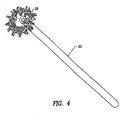
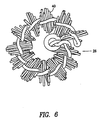
- Figures 4-6 are more detailed and more accurate representations of the brush and bristle structure including its specific construction. Submitted in this detailed description are photographs taken by an electron microscope of the ends of the bristles further illuminating the structural aspects of the bristles which contribute to the effectiveness of the brush in obtaining transepithelial samples.
- a device which comprises a handle or elongate member 20, having both a proximal end 22 and a distal end 24.
- the total length of the device is approximately six inches.
- Handle 20 is designed for gripping by a user, and is of a sufficient length to allow the user to manipulate the device within a body cavity from a location just outside the body.
- handle 20 is semi-rigid so as to assist in reaching the target tissue notwithstanding difficult angles or narrow passages.
- the handle is approximately 5 inches long.
- the brush handle can be constructed of a plastic, such as polypropylene, or any other suitable semi-rigid material.
- the handle can be solid, but is hollow in the preferred embodiment. It is further preferred that handle 20 also have at least one area whose cross-section is substantially circular such that the elongate member may be readily twirled between the thumb and forefinger while pressed against a lesion. Another way to reach areas that are somewhat difficult in the oral cavity would be to hold the handle short and rotate and scrub the side of the brush, rather than its end, against the lesion area. This will also be effective in the brush bristles passing through the transepithelial layers to retrieve cells in the lesion area.
- the device is provided with a brush head 26.
- Brush head 26 is preferably a substantially toroidal or "donut" shaped brush which presents bristles both towards its end and side, and can be formed from one or more twisted or braided wires, backbone or cables 30. Wires or cables 30 are preferably secured to handle 20 by affixation to backbone or the wire 30 in a recess 36 located in the proximal end 24 of the handle.
- the brush can be formed from conventional twisted wire brush construction. In a preferred embodiment, the total length of the twisted wire is approximately 1.1 inches, with approximately 0.2 inches inserted in the handle, and approximately 0.9 inches exposed as part of the toroid.
- Wires or cables 30 are preferably bent to form an incomplete toroid 34 which is perpendicular to the longitudinal axis of handle 20.
- toroid 34 preferably defines a circular plane, the plane being provided perpendicular to the longitudinal axis of the handle 20 of brush head 26.
- a cross-section of the brush forms a nautilus or spiral shape at ninety degrees to the handle or elongate member 20.
- the brush could be curled into an outward spiral in the same plane.
- the metallic spine of the brush spirals out in a plane which is perpendicular to the handle. This is more clearly seen in Figs. 4-6 .
- Brush head 26 may be integral with handle 20, or may be detachable. It may be a reusable sterilizable or surgical holder. Alternatively, the proximal end 22 of the handle 20 may be detachable from the distal end 24. The detachable portion of the brush may be scored, to easily break away, may be provided with screw threads to screw off the remainder of the device, or so forth. In either embodiment, detachment of either the brush head or of a portion of the handle connected to the brush head, can allow the distal end of the brush, having sampled cells collected therein, to be separated from the proximal end. This allows the handle or the proximal end thereof to be discarded while the distal end of the apparatus is forwarded to the laboratory for analysis.
- the bristles are also used to collect cells as well as perform the transepithelial activity. For example, the distal portion of the device can be dropped into a transfer solution, while the proximal portion is thrown away.
- Brush head 26 is further provided with a plurality of bristles 40.
- bristles 40 are approximately 6.35 mm (0.25 inches) from tip to tip, protrude 1.27-5.08 mm (.05 - .2 inches) from the toroidal wire and as required by the present invention, have a cantilever stiffness of between 0.3-1.4 kPa (.04 - .2 lbs/inch). Cantilever stiffness is otherwise referred to as lateral tip deflection stiffness.
- Each end of the bristle protrudes a distance of about 2.54 mm (.10 inches) from the wire spine.
- the bristles are approximately 0.15 mm (.006 inches) thick.
- the sampling brushes provided have been soft brushes with soft bristles
- bristles 40 are specifically made stiff or semi-rigid, going against the teachings of the art.
- U.S. Patent No. 4,759,376 teaches that the bristles of the brush should be relatively soft and should readily bend
- the brush disclosed in U.S. Patent No. 4,762,133 is also meant to be soft, as is it provided for sampling the exocervix along with the endocervix. This preference heretofore in the art to use a soft brush prevents damage to tissue. While this is generally desirable in the cervix, it is not helpful when the lesions are keratinized, as in the oral cavity.
- bristles 40 of brush head 26 are each stiff or semi-rigid.
- the bristles are preferably made of Tynex ® brand nylon laid in a double layer and have a diameter of between 0.010 cm and 0.022 cm.
- the Tynex ® brand bristles have their own cantilever stiffness which may be at a modulus of 3447.4 MPa (500,000 psi).
- the bristles Preferably, the bristles have a diameter of approximately 0.016 cm and protrude 2.54 mm (.10 inches) from the wire spine.
- triple and single row densities may be used, double row density bristles are preferred.
- a range of protruding lengths of 2.03 to 4.06 (.08 to .16 inches) could be used.
- Bristles 40 are preferably provided in a series of arrays 42. As shown in Figure 1 , each array 42 is composed of a series of bristles 40, the bristles extending radially from a center 44, to form each of the arrays 42. At center 44, the end of each bristle 40 is secured within the twisted wire 30 backbone.
- Arrays 42 preferably extend around the entire perimeter of toroid 34. In one embodiment, viewing the apparatus head-on, from the perspective "A" in Figures 1 or 2 , tufts of bristles are evenly arranged around the perimeter of the toroid. Thus, the arrays are arranged at 30 degrees spacings along the twisted wire of the brush head.
- the bristles do not form a plane, but rather preferably extend upward from center 44 at an acute angle to wire 30. As a result of this bristle orientation, rotation will result in a degree of bristle abrasion that is effected by the bristles splaying under load. Rotation in the opposite direction will result in abrasion that is greatly accentuated by maximizing the direct piercing of the skin with the stiff bristle ends.
- an advantage and feature of this invention achieved with the brush is that a rather large area around the lesion area is subject to the action of the brush which enhances the cell collection process to provide a more effective sampling.
- Figs. 7 and 8 are cross sectional views of alternate brush structures with the front edges of the bristles 70 being squared as in Fig. 7 or "file card wire brush type edges" 80 which are aligned as in Fig. 8 .
- the squared britles of Fig. 7 form non-penetrating scraping edges and even generate negative rake angles when the bristles bend over.
- Both brushes are attached to handles 72 and 82 respectively. It is preferable to have a large number of such bristles to spread the pressure as the brush structure is being used.
- An alternative structure in Fig. 9 illustrates a plurality of small rigid scrapers 90 which could be employed at the edge of the brush and attached to handle 92. Such scrapers would extend from handle 92.
- Figs. 10A or 10B illustrate conventional brush arrangements 94 and 96 adjoined to a handle allowing end or side pressure. These brushes can be rubbed back and forth to dislodge and remove the cells for their collection.
- a plurality of different abrasive materials such as finely ribbed or bumpy materials could be employed, where the protrusions may be shaped with edges to apply highly localized pressure, and catch against cell clusters rather than sliding over them.
- Figs. 4 through 6 are respectively perspective side and end views of an enlargement of the brush of this invention.
- the bristles 40 are seen collected and captured in the metallic wire 30 to form a relatively irregular surface although the side view in Fig. 5 illustrates that the front plane 52 of the brush head 26 presents a relatively flat planar surface.
- the outer front plane 52 or the edge planes 54 of the brush head will be used to retrieve cells from the epithelial tissue structure.
- the following is a list of alternative models for materials which could sample cells. Such materials would generally not be introduced into a patient's mouth.
- the present invention allows for limited space between the points of abrasive contact upon brush rotation, while maintaining enough separation between the bristles to trap a clinically effective amount of cells.
- the length of the stiff bristles of the brush may also vary but is similarly balanced between: 1) the requirement to keep the bristles stiff enough to grind the tissue into its cellular components during rotation; 2) the requirement that the bristles be long enough to trap the removed cells with these extending .1 inch from the wire toroid; and 3) soft enough to bend.
- the flat distal end of the handle of the brush is placed directly on the site of the suspect lesion 37.
- the stiff dense bristles are then pushed firmly against the lesion site while the handle is simultaneously rotated clockwise at least once, and preferably several times about its axis.
- the metal or twisted wire of the brush head assists in the application of pressure to the epithelial surface. The trained user will continue rubbing until pinpoint bleeding is observed.
- Rotation of the bristles against the lesion results in the scraping detachment of cells from multiple layers of the epithelium.
- the detached cells become collected between the stiff bristles and are trapped there. These cells can then be inspected by a suitable laboratory.
- the present invention is particularly advantageous due to the fact that, as no laceration of the epithelium is required, the discomfort experienced by the patient is considerably less than that of a surgical biopsy, and is generally minimal. Further, this invention effects sampling over a large area.
- the present invention poses yet a further advantage over the prior art lacerating technique.
- a sample can be obtained from the entire surface of a multifocal lesion to provide a broad sample of cells from the entire lesion for further testing.
- incision surgical biopsy a tissue core is taken of only a section of a lesion to test the lesion for malignancy. Accordingly, due to the fact that the particular portion of the lesion sampled by the surgical technique may be benign, while a non-sampled portion of the lesion may be malignant, false negatives may potentially occur The present invention's broad sampling of a lesion avoids this potential problem. In this manner, then invention avoids the disadvantages of the prior art.
- Figure 11 is a cross-section of the basement membrane 110 and submucosa 112 therebelow with the scraping or abrading unit 26 shown penetrating slightly below the basement membrane. Such penetration is preferred to obtain and harvest cells for analysis.
- Use of the subject invention is not limited to the oral cavity, but extends to other epithelia where a lesion requiring diagnosis may be observed, where exfoliation of cells is limited by the presence of keratin or other factors, and where an alternative to a lacerating biopsy is desired. Cytological testing of observed lesions of the vulva is one such example of an alternate potential use of the subject invention.
Landscapes
- Health & Medical Sciences (AREA)
- Life Sciences & Earth Sciences (AREA)
- Surgery (AREA)
- Animal Behavior & Ethology (AREA)
- Biomedical Technology (AREA)
- Heart & Thoracic Surgery (AREA)
- Medical Informatics (AREA)
- Molecular Biology (AREA)
- Pathology (AREA)
- Engineering & Computer Science (AREA)
- General Health & Medical Sciences (AREA)
- Public Health (AREA)
- Veterinary Medicine (AREA)
- Investigating Or Analysing Biological Materials (AREA)
- Apparatus Associated With Microorganisms And Enzymes (AREA)
- Sampling And Sample Adjustment (AREA)
- Analysing Materials By The Use Of Radiation (AREA)
Claims (17)
- Gerät, das für die Gewinnung von Zellen im Epithelgewebe des Körpers ausgebildet ist, das aufweist:ein Gerät für die transepitheliale nichtverletzende Probenahme, um Zellen aus mindestens zwei Schichten des Epithelgewebes aufzunehmen, wobei das Gerät für die transepitheliale nichtverletzende Probenahme eine Bürste aufweist, wobei die Bürste Borsten (40) mit einer ausreichenden Steifigkeit aufweist, um mindestens die zwei Schichten des Epithelgewebes zu durchdringen, dadurch gekennzeichnet, dass die Borsten (40) eine Cantilever-Steifigkeit der Enden von zwischen 714,17 g/m und 3571,65 g/m aufweisen.
- Gerät zur Gewinnung von Zellen im Epithelgewebe des Körpers nach Anspruch 1, bei dem die Borsten (40) ausgebildet sind, um Zellen aus drei Schichten des Epithelgewebes aufzunehmen, wobei die drei Schichten eine Oberflächenschicht, Zwischenschicht und Basalschicht aufweisen, wobei die Basalschicht von der Submukosa durch eine Basalmembran getrennt ist.
- Gerät zur Gewinnung von Zellen im Epithelgewebe des Körpers nach Anspruch 2, bei dem die Borsten (40) der Bürste eine ausreichende Steifigkeit aufweisen, um die Basalmembran zu durchdringen und die Submukosa zu erreichen.
- Gerät zur Gewinnung von Zellen im Epithelgewebe des Körpers nach Anspruch 1, bei dem das Epithelgewebe eine Oberflächenschicht, Zwischenschicht und Basalschicht aufweist und eine Basalmembran zwischen der Basalschicht und der Submukosa angeordnet ist, wobei das Gerät für die nichtverletzende Probenahme eine Einrichtung aufweist, um sich über die Oberflächenschicht, Zwischenschicht und Basalschicht zu bewegen, und um Zellen aus den drei Schichten aufzunehmen.
- Gerät zur Gewinnung von Zellen im Epithelgewebe des Körpers nach Anspruch 4, bei dem die Einrichtung, um sich über die drei Schichten zu bewegen, eine ausreichende Steifigkeit aufweist, um sich über die Basalmembran zu bewegen und in die Submukosa zu gelangen.
- Gerät zur Gewinnung von Zellen im Epithelgewebe des Körpers nach einem der vorhergehenden Ansprüche, bei dem die Borsten (40) Enden aufweisen, wobei die Enden abschabende Ränder aufweisen.
- Gerät zur Gewinnung von Zellen im Epithelgewebe des Körpers nach einem der vorhergehenden Ansprüche, das einen Kopfabschnitt (26) aufweist, der Borsten aufweist, die vom Kopfabschnitt aus nach außen gerichtet sind.
- Gerät zur Gewinnung von Zellen im Epithelgewebe des Körpers nach einem der vorhergehenden Ansprüche, bei dem die Bürste einen Griff und einen Kopfabschnitt aufweist, wobei der Kopfabschnitt die Borsten (40) aufweist, wobei der Griff ein distales Ende und ein proximales Ende aufweist, und die außerdem Drähte aufweist, die mit dem distalen Ende verbunden sind und sich von dort aus erstrecken, wobei die Bürsten (40) durch die Drähte gehalten werden, um Bürstflächen an den Enden der Borsten (40) zu bilden, wobei die Bürstflächen ausgebildet sind, um das Epithelgewebe abzutragen, wobei die Borsten (40) um zwischen 0,00127 m und 0,00508 m aus den Drähten vorstehen, in denen die Borsten (40) gehalten werden.
- Gewinnung von Zellen im Epithelgewebe des Körpers nach einem der Ansprüche 1 bis 7, bei dem die Bürste einen Griff (20) aufweist, wobei der Griff ein distales Ende (24) und ein proximales Ende (22) aufweist, wobei die Bürste mit dem distalen Ende verbunden ist, wobei die Borsten der Bürste eine abtragende Fläche bilden.
- Gerät zur Gewinnung von Zellen im Epithelgewebe des Körpers nach Anspruch 9, das außerdem Drähte (30) aufweist, die mit dem distalen Ende (24) verbunden sind und sich von dort aus erstrecken, wobei die Borsten durch die Drähte (30) gehalten werden, um Bürstflächen an den Enden der Borsten zu bilden, wobei die Bürstflächen das Epithelgewebe abtragen.
- Gerät zur Gewinnung von Zellen im Epithelgewebe des Körpers nach Anspruch 8 oder Anspruch 10, bei dem die Drähte (30) eine Ring- oder Spiralform bilden, die im Wesentlichen senkrecht zur Achse des Griffes verläuft.
- Gerät zur Gewinnung von Zellen im Epithelgewebe des Körpers nach einem der Ansprüche 1 bis 10, bei dem die Bürste einen runden Kopf aufweist.
- Gerät zur Gewinnung von Zellen im Epithelgewebe des Körpers nach einem der Ansprüche 8 bis 11, bei dem das proximale Ende (22) des Griffes (20) vom distalen Ende (24) lösbar ist.
- Gerät zur Gewinnung von Zellen im Epithelgewebe des Körpers nach einem der Ansprüche 8 bis 11, bei dem ein Bürstenkopf (26) des Gerätes vom Griff (20) lösbar ist.
- Gerät zur Gewinnung von Zellen im Epithelgewebe des Körpers nach Anspruch 1, das außerdem ein System von durchdringenden Rändern aufweist, um mindestens die zwei Schichten des Epithelgewebes zu durchdringen.
- Gerät zum Nachweisen von Zellen im Epithelgewebe des Körpers nach Anspruch 15, bei dem das System von durchdringenden Rändern ausgebildet ist, um Zellen aus drei Schichten des Epithelgewebes aufzunehmen, wobei die drei Schichten die Oberflächenschicht, Zwischenschicht und Basalschicht aufweisen, wobei die Basalschicht durch eine Basalmembran von der Submukosa getrennt ist.
- Gerät zum Nachweisen von Zellen im Epithelgewebe des Körpers nach Anspruch 16, bei dem das System von durchdringenden Rändern ausgebildet ist, um die Basalmembran zu durchdringen und die Submukosa zu erreichen.
Applications Claiming Priority (3)
| Application Number | Priority Date | Filing Date | Title |
|---|---|---|---|
| US9391098P | 1998-07-23 | 1998-07-23 | |
| US93910P | 1998-07-23 | ||
| PCT/US1999/016620 WO2000004833A1 (en) | 1998-07-23 | 1999-07-23 | Apparatus and method for obtaining transepithelial specimen of a body surface using a non-lacerating technique |
Publications (3)
| Publication Number | Publication Date |
|---|---|
| EP1098595A1 EP1098595A1 (de) | 2001-05-16 |
| EP1098595A4 EP1098595A4 (de) | 2004-12-15 |
| EP1098595B1 true EP1098595B1 (de) | 2010-11-10 |
Family
ID=22241676
Family Applications (1)
| Application Number | Title | Priority Date | Filing Date |
|---|---|---|---|
| EP99937396A Expired - Lifetime EP1098595B1 (de) | 1998-07-23 | 1999-07-23 | Gerät zur gewinnung einer transpithelialen probe einer körperoberfläche ohne diese aufzureissen |
Country Status (10)
| Country | Link |
|---|---|
| US (1) | US6258044B1 (de) |
| EP (1) | EP1098595B1 (de) |
| CN (1) | CN1325287A (de) |
| AT (1) | ATE487423T1 (de) |
| AU (1) | AU5223799A (de) |
| CA (1) | CA2355661C (de) |
| DE (1) | DE69942935D1 (de) |
| ES (1) | ES2358783T3 (de) |
| IL (1) | IL141739A (de) |
| WO (1) | WO2000004833A1 (de) |
Families Citing this family (48)
| Publication number | Priority date | Publication date | Assignee | Title |
|---|---|---|---|---|
| DE60044604D1 (de) * | 1999-02-23 | 2010-08-12 | Cdx Lab Inc | Minimal-invasiver apparat und verfahren zum test zum auffinden von läsionen in der mundhöhle und in ähnlichem epithel |
| US6623440B1 (en) * | 1999-11-22 | 2003-09-23 | Leonard Weldon | Topical anesthetic applicator and method of use |
| CA2390794C (en) * | 1999-12-03 | 2010-04-27 | University Of Leeds | Fixation technology |
| FR2809611B1 (fr) * | 2000-05-30 | 2002-12-20 | Bernard Letellier | Dispositif pour le prelevement cytologique de l'exocol et de l'endocol |
| EP1234543B1 (de) * | 2000-08-04 | 2011-04-20 | Olympus Optical Co., Ltd. | Probenentnehmer |
| WO2002018658A1 (en) * | 2000-08-14 | 2002-03-07 | Oralscan Laboratories, Inc. | Detection of epithelial dysplasia |
| USD561333S1 (en) * | 2000-10-25 | 2008-02-05 | Rovers Medical Devices B.V. | Mouth swab |
| US6494845B2 (en) * | 2001-05-04 | 2002-12-17 | Oralscan Laboratories, Inc. | Retractable brush for use with endoscope for brush biopsy |
| DE10232589A1 (de) * | 2002-07-18 | 2004-01-29 | Geka Brush Gmbh | Mascara-Bürstchen |
| FR2846221B1 (fr) * | 2002-10-28 | 2005-07-15 | Oreal | Dispositif pour effectuer un prelevement de matiere a sec |
| US7776042B2 (en) | 2002-12-03 | 2010-08-17 | Trans1 Inc. | Methods and apparatus for provision of therapy to adjacent motion segments |
| US20040137551A1 (en) * | 2003-01-13 | 2004-07-15 | Markovic Nenad S. | Cervical acid phosphatase - papanicolaou (CAP-PAP) test kit, method and accesories, processes for producing and using the same |
| US7226457B2 (en) * | 2003-02-19 | 2007-06-05 | Unilever Home & Personal Care Usa, Division Of Conopco, Inc. | Epidermal sampling apparatus and method |
| US7087063B2 (en) | 2003-02-19 | 2006-08-08 | Unilever Home & Personal Care Usa, Division Of Conopco, Inc. | Abrasion device and method |
| US20040260201A1 (en) * | 2003-06-23 | 2004-12-23 | Mueller Richard L. | Cytology brush with releasable end portion |
| USD500553S1 (en) * | 2003-09-26 | 2005-01-04 | Ashwood Timber & Plastics Ltd. | Cervical sampler |
| JP2007516738A (ja) | 2003-10-23 | 2007-06-28 | トランスワン インコーポレイティッド | 背骨に対して最小の侵入処理を行うための道具及び道具キット |
| CA2564822A1 (en) * | 2004-04-30 | 2005-11-17 | Burrell E. Clawson | Apparatus and methods for isolating human body areas for localized cooling |
| US8323211B2 (en) * | 2006-06-01 | 2012-12-04 | Daniel Larkin | Sexually transmitted infection sampling device |
| US8439847B2 (en) | 2006-06-01 | 2013-05-14 | Daniel Larkin | Method and apparatus for simultaneously collecting exocervical and endocervical samples |
| US7749173B2 (en) * | 2006-06-01 | 2010-07-06 | Daniel Larkin | Apparatus for simultaneously collecting exocervical and endocervical samples |
| US8795197B2 (en) * | 2007-07-17 | 2014-08-05 | Histologics, LLC | Frictional trans-epithelial tissue disruption collection apparatus and method of inducing an immune response |
| KR20100105829A (ko) | 2007-07-17 | 2010-09-30 | 히스톨로직스 엘엘씨 | 마찰성 경-상피 조직의 분리 및 수집 장치 및 면역 반응을 유도 및/또는 증강시키는 방법 |
| US8152739B1 (en) | 2007-09-19 | 2012-04-10 | Christine A. McCully | Adjustable dual-brush cervical cytology collection device |
| US20100111398A1 (en) * | 2008-10-31 | 2010-05-06 | Texas Instruments Incorporated | Method and system for detection of oral sub-mucous fibrosis using microscopic image analysis of oral biopsy samples |
| US8348856B1 (en) | 2008-12-16 | 2013-01-08 | Zanetta Malanowska-Stega | Simultaneous multiple method out-patient uterus biopsy device and method |
| US9044213B1 (en) | 2010-03-26 | 2015-06-02 | Histologics, LLC | Frictional tissue sampling and collection method and device |
| CN102138810B (zh) * | 2010-12-24 | 2016-09-07 | 江苏世泰实验器材有限公司 | 制造定量生物采样植绒拭子的方法 |
| CN102087172B (zh) * | 2010-12-24 | 2016-09-07 | 江苏世泰实验器材有限公司 | 定量生物采样植绒拭子 |
| CN203710054U (zh) * | 2011-03-14 | 2014-07-16 | 医疗资源共享有限公司 | 从上皮组织获取样本的设备及诊断宫颈采样的一次性套件 |
| GB201201645D0 (en) * | 2012-01-31 | 2012-03-14 | Ge Healthcare Ltd | Improvements in and relating to biological sample collection |
| WO2013132400A1 (en) | 2012-03-08 | 2013-09-12 | Koninklijke Philips N.V. | Apparatus for determining a property of a tissue |
| US10201332B1 (en) | 2012-12-03 | 2019-02-12 | Healoe Llc | Device and method of orienting a biopsy device on epithelial tissue |
| US9039637B2 (en) * | 2013-03-13 | 2015-05-26 | Cook Medical Technologies Llc | Flexible cytology coil |
| WO2014159225A2 (en) | 2013-03-14 | 2014-10-02 | Baxano Surgical, Inc. | Spinal implants and implantation system |
| USD714557S1 (en) * | 2013-05-08 | 2014-10-07 | Weber-Stephen Products Llc | U-brush |
| JP5686853B2 (ja) * | 2013-06-13 | 2015-03-18 | デンカ生研株式会社 | 生物学的検体の採取用スワブ、該スワブの製造方法及び該スワブを用いたキット |
| EP4074243A1 (de) | 2014-05-02 | 2022-10-19 | United States Endoscopy Group, Inc. | Reinigungsvorrichtung für eine endoskopvorrichtung |
| USD809140S1 (en) * | 2015-06-19 | 2018-01-30 | Nipro Corporation | Cell collection device |
| USD780919S1 (en) * | 2015-06-19 | 2017-03-07 | Nipro Corporation | Cell collection device |
| US11013466B2 (en) | 2016-01-28 | 2021-05-25 | Healoe, Llc | Device and method to control and manipulate a catheter |
| EP3551084A4 (de) | 2016-12-09 | 2020-12-30 | Malanowska-Stega, Zanetta | Pinselbiopsievorrichtung, -kit und -verfahren |
| US11528988B2 (en) * | 2017-11-14 | 2022-12-20 | Georgia Tech Research Corporation | Separation systems, devices and methods |
| US12114840B2 (en) * | 2019-03-15 | 2024-10-15 | Sapphiros Laboratories Llc | DNA collection device |
| USD936370S1 (en) * | 2019-10-28 | 2021-11-23 | Brushtech, Inc. | Grill brush with coil springs |
| USD931620S1 (en) * | 2019-10-28 | 2021-09-28 | Brushtech, Inc. | Grill brush with coil springs |
| USD931621S1 (en) * | 2019-10-28 | 2021-09-28 | Brushtech, Inc. | Grill brush with coil spring |
| US20230190297A1 (en) * | 2020-05-22 | 2023-06-22 | Clearstream Technologies Limited | Embolisation devices and methods of manufacturing the same |
Family Cites Families (17)
| Publication number | Priority date | Publication date | Assignee | Title |
|---|---|---|---|---|
| US2675572A (en) * | 1950-08-22 | 1954-04-20 | Frank K Nomiya | Annular brush |
| US2763104A (en) * | 1952-07-19 | 1956-09-18 | Anton Vonnegut | Flexible abrasive brush |
| US2839049A (en) | 1954-03-25 | 1958-06-17 | Kenneth S Maclean | Abrasive cytologic brush |
| US2955591A (en) | 1954-05-20 | 1960-10-11 | Kenneth S Maclean | Abrasive cytologic instruments |
| US4227537A (en) * | 1978-03-08 | 1980-10-14 | Tucson Medical Instruments, Inc. | Endometrial brush with slidable protective sleeve |
| JPS5615731A (en) * | 1979-07-20 | 1981-02-16 | Olympus Optical Co | Manufacture of cell diagnosing brush |
| US4759376A (en) | 1984-05-29 | 1988-07-26 | Nils Stormby | Endocervical sampling brush and smear method |
| US4762133A (en) | 1987-03-20 | 1988-08-09 | Medical Dynamics, Inc. | Cervical cytology device |
| US4873992A (en) * | 1987-03-20 | 1989-10-17 | Medical Dynamics, Inc. | Cervical cytology device |
| US5623941A (en) * | 1988-05-10 | 1997-04-29 | Nils Stormby | Cervical sampling velour brush |
| US5067195A (en) * | 1989-01-25 | 1991-11-26 | Sussman Harold I | Device for cleaning dental implant posts |
| US5257182B1 (en) | 1991-01-29 | 1996-05-07 | Neuromedical Systems Inc | Morphological classification system and method |
| US5184626A (en) | 1991-05-21 | 1993-02-09 | Hicken William J | Brush overlay Pap smear |
| DE4446521A1 (de) * | 1994-12-24 | 1996-06-27 | Estee Lauder Inc | Mascara-Bürstchen |
| WO1997005826A1 (en) * | 1995-08-08 | 1997-02-20 | Laser Centers Of America | System for extracting tissue samples in laparoscopy |
| US5713369A (en) * | 1995-09-13 | 1998-02-03 | Vance Products Inc. | Uterine endometrial tissue sample brush |
| FR2753614B1 (fr) * | 1996-09-26 | 1998-10-30 | Brosse pour l'application d'un produit cosmetique et dispositif de maquillage la comprenant |
-
1999
- 1999-07-23 CA CA002355661A patent/CA2355661C/en not_active Expired - Lifetime
- 1999-07-23 AT AT99937396T patent/ATE487423T1/de not_active IP Right Cessation
- 1999-07-23 AU AU52237/99A patent/AU5223799A/en not_active Abandoned
- 1999-07-23 ES ES99937396T patent/ES2358783T3/es not_active Expired - Lifetime
- 1999-07-23 US US09/360,425 patent/US6258044B1/en not_active Expired - Lifetime
- 1999-07-23 CN CN99811254.2A patent/CN1325287A/zh active Pending
- 1999-07-23 DE DE69942935T patent/DE69942935D1/de not_active Expired - Lifetime
- 1999-07-23 EP EP99937396A patent/EP1098595B1/de not_active Expired - Lifetime
- 1999-07-23 WO PCT/US1999/016620 patent/WO2000004833A1/en not_active Ceased
-
2001
- 2001-03-01 IL IL141739A patent/IL141739A/en not_active IP Right Cessation
Also Published As
| Publication number | Publication date |
|---|---|
| CA2355661C (en) | 2006-04-11 |
| IL141739A (en) | 2006-06-11 |
| ES2358783T3 (es) | 2011-05-13 |
| CA2355661A1 (en) | 2000-02-03 |
| ATE487423T1 (de) | 2010-11-15 |
| EP1098595A4 (de) | 2004-12-15 |
| WO2000004833A1 (en) | 2000-02-03 |
| AU5223799A (en) | 2000-02-14 |
| EP1098595A1 (de) | 2001-05-16 |
| CN1325287A (zh) | 2001-12-05 |
| US6258044B1 (en) | 2001-07-10 |
| WO2000004833A9 (en) | 2000-05-18 |
| DE69942935D1 (de) | 2010-12-23 |
Similar Documents
| Publication | Publication Date | Title |
|---|---|---|
| EP1098595B1 (de) | Gerät zur gewinnung einer transpithelialen probe einer körperoberfläche ohne diese aufzureissen | |
| US6676609B1 (en) | Retractable brush for use with endoscope for brush biopsy | |
| US7004913B1 (en) | Retractable brush for use with endoscope for brush biopsy | |
| US12349876B2 (en) | Frictional trans-epithelial tissue disruption collection apparatus and method of inducing an immune response | |
| US20220175352A1 (en) | Frictional tissue sampling and collection method and device | |
| US9895140B1 (en) | Frictional trans-epithelial tissue disruption collection apparatus and method of inducing an immune response | |
| CN203710054U (zh) | 从上皮组织获取样本的设备及诊断宫颈采样的一次性套件 | |
| US20180035983A1 (en) | Cell and tissue collection method and device | |
| US20200093467A1 (en) | Scrape and sweep frictional tissue sampling and collection method and device | |
| US20200229802A1 (en) | Scrape and sweep frictional tissue sampling and collection method and device | |
| US20230210505A1 (en) | Scrape and sweep frictional tissue sampling and collection method and device | |
| US20020120214A1 (en) | Spatula for biological sampling |
Legal Events
| Date | Code | Title | Description |
|---|---|---|---|
| PUAI | Public reference made under article 153(3) epc to a published international application that has entered the european phase |
Free format text: ORIGINAL CODE: 0009012 |
|
| 17P | Request for examination filed |
Effective date: 20010223 |
|
| AK | Designated contracting states |
Kind code of ref document: A1 Designated state(s): AT BE CH CY DE DK ES FI FR GB GR IE IT LI LU MC NL PT SE |
|
| AX | Request for extension of the european patent |
Free format text: AL;LT;LV;MK;RO;SI |
|
| A4 | Supplementary search report drawn up and despatched |
Effective date: 20041029 |
|
| RAP1 | Party data changed (applicant data changed or rights of an application transferred) |
Owner name: CDX LABORATORIES, INC. Owner name: SHARED MEDICAL RESOURCES, LLC |
|
| GRAP | Despatch of communication of intention to grant a patent |
Free format text: ORIGINAL CODE: EPIDOSNIGR1 |
|
| RTI1 | Title (correction) |
Free format text: APPARATUS FOR OBTAINING TRANSEPITHELIAL SPECIMEN OF A BODY SURFACE USING A NON-LACERATING TECHNIQUE |
|
| DAX | Request for extension of the european patent (deleted) | ||
| GRAS | Grant fee paid |
Free format text: ORIGINAL CODE: EPIDOSNIGR3 |
|
| GRAA | (expected) grant |
Free format text: ORIGINAL CODE: 0009210 |
|
| AK | Designated contracting states |
Kind code of ref document: B1 Designated state(s): AT BE CH CY DE DK ES FI FR GB GR IE IT LI LU MC NL PT SE |
|
| REG | Reference to a national code |
Ref country code: GB Ref legal event code: FG4D |
|
| REG | Reference to a national code |
Ref country code: CH Ref legal event code: EP |
|
| REG | Reference to a national code |
Ref country code: IE Ref legal event code: FG4D |
|
| REF | Corresponds to: |
Ref document number: 69942935 Country of ref document: DE Date of ref document: 20101223 Kind code of ref document: P |
|
| REG | Reference to a national code |
Ref country code: SE Ref legal event code: TRGR |
|
| REG | Reference to a national code |
Ref country code: NL Ref legal event code: T3 |
|
| REG | Reference to a national code |
Ref country code: ES Ref legal event code: FG2A Ref document number: 2358783 Country of ref document: ES Kind code of ref document: T3 Effective date: 20110503 |
|
| PG25 | Lapsed in a contracting state [announced via postgrant information from national office to epo] |
Ref country code: AT Free format text: LAPSE BECAUSE OF FAILURE TO SUBMIT A TRANSLATION OF THE DESCRIPTION OR TO PAY THE FEE WITHIN THE PRESCRIBED TIME-LIMIT Effective date: 20101110 Ref country code: PT Free format text: LAPSE BECAUSE OF FAILURE TO SUBMIT A TRANSLATION OF THE DESCRIPTION OR TO PAY THE FEE WITHIN THE PRESCRIBED TIME-LIMIT Effective date: 20110310 Ref country code: CY Free format text: LAPSE BECAUSE OF FAILURE TO SUBMIT A TRANSLATION OF THE DESCRIPTION OR TO PAY THE FEE WITHIN THE PRESCRIBED TIME-LIMIT Effective date: 20101110 Ref country code: FI Free format text: LAPSE BECAUSE OF FAILURE TO SUBMIT A TRANSLATION OF THE DESCRIPTION OR TO PAY THE FEE WITHIN THE PRESCRIBED TIME-LIMIT Effective date: 20101110 |
|
| PG25 | Lapsed in a contracting state [announced via postgrant information from national office to epo] |
Ref country code: GR Free format text: LAPSE BECAUSE OF FAILURE TO SUBMIT A TRANSLATION OF THE DESCRIPTION OR TO PAY THE FEE WITHIN THE PRESCRIBED TIME-LIMIT Effective date: 20110211 |
|
| PG25 | Lapsed in a contracting state [announced via postgrant information from national office to epo] |
Ref country code: BE Free format text: LAPSE BECAUSE OF FAILURE TO SUBMIT A TRANSLATION OF THE DESCRIPTION OR TO PAY THE FEE WITHIN THE PRESCRIBED TIME-LIMIT Effective date: 20101110 |
|
| PG25 | Lapsed in a contracting state [announced via postgrant information from national office to epo] |
Ref country code: DK Free format text: LAPSE BECAUSE OF FAILURE TO SUBMIT A TRANSLATION OF THE DESCRIPTION OR TO PAY THE FEE WITHIN THE PRESCRIBED TIME-LIMIT Effective date: 20101110 |
|
| PLBE | No opposition filed within time limit |
Free format text: ORIGINAL CODE: 0009261 |
|
| STAA | Information on the status of an ep patent application or granted ep patent |
Free format text: STATUS: NO OPPOSITION FILED WITHIN TIME LIMIT |
|
| 26N | No opposition filed |
Effective date: 20110811 |
|
| REG | Reference to a national code |
Ref country code: DE Ref legal event code: R097 Ref document number: 69942935 Country of ref document: DE Effective date: 20110811 |
|
| PG25 | Lapsed in a contracting state [announced via postgrant information from national office to epo] |
Ref country code: MC Free format text: LAPSE BECAUSE OF NON-PAYMENT OF DUE FEES Effective date: 20110731 |
|
| REG | Reference to a national code |
Ref country code: CH Ref legal event code: PL |
|
| REG | Reference to a national code |
Ref country code: IE Ref legal event code: MM4A |
|
| PG25 | Lapsed in a contracting state [announced via postgrant information from national office to epo] |
Ref country code: CH Free format text: LAPSE BECAUSE OF NON-PAYMENT OF DUE FEES Effective date: 20110731 Ref country code: LI Free format text: LAPSE BECAUSE OF NON-PAYMENT OF DUE FEES Effective date: 20110731 |
|
| PG25 | Lapsed in a contracting state [announced via postgrant information from national office to epo] |
Ref country code: IE Free format text: LAPSE BECAUSE OF NON-PAYMENT OF DUE FEES Effective date: 20110723 |
|
| PG25 | Lapsed in a contracting state [announced via postgrant information from national office to epo] |
Ref country code: LU Free format text: LAPSE BECAUSE OF NON-PAYMENT OF DUE FEES Effective date: 20110723 |
|
| REG | Reference to a national code |
Ref country code: FR Ref legal event code: PLFP Year of fee payment: 18 |
|
| REG | Reference to a national code |
Ref country code: FR Ref legal event code: PLFP Year of fee payment: 19 |
|
| PGFP | Annual fee paid to national office [announced via postgrant information from national office to epo] |
Ref country code: NL Payment date: 20170717 Year of fee payment: 19 |
|
| PGFP | Annual fee paid to national office [announced via postgrant information from national office to epo] |
Ref country code: GB Payment date: 20170718 Year of fee payment: 19 Ref country code: ES Payment date: 20170804 Year of fee payment: 19 Ref country code: DE Payment date: 20170731 Year of fee payment: 19 Ref country code: FR Payment date: 20170726 Year of fee payment: 19 Ref country code: IT Payment date: 20170717 Year of fee payment: 19 |
|
| PGFP | Annual fee paid to national office [announced via postgrant information from national office to epo] |
Ref country code: SE Payment date: 20170717 Year of fee payment: 19 |
|
| REG | Reference to a national code |
Ref country code: DE Ref legal event code: R119 Ref document number: 69942935 Country of ref document: DE |
|
| REG | Reference to a national code |
Ref country code: NL Ref legal event code: MM Effective date: 20180801 |
|
| GBPC | Gb: european patent ceased through non-payment of renewal fee |
Effective date: 20180723 |
|
| PG25 | Lapsed in a contracting state [announced via postgrant information from national office to epo] |
Ref country code: FR Free format text: LAPSE BECAUSE OF NON-PAYMENT OF DUE FEES Effective date: 20180731 Ref country code: GB Free format text: LAPSE BECAUSE OF NON-PAYMENT OF DUE FEES Effective date: 20180723 Ref country code: DE Free format text: LAPSE BECAUSE OF NON-PAYMENT OF DUE FEES Effective date: 20190201 |
|
| PG25 | Lapsed in a contracting state [announced via postgrant information from national office to epo] |
Ref country code: SE Free format text: LAPSE BECAUSE OF NON-PAYMENT OF DUE FEES Effective date: 20180724 Ref country code: NL Free format text: LAPSE BECAUSE OF NON-PAYMENT OF DUE FEES Effective date: 20180801 |
|
| PG25 | Lapsed in a contracting state [announced via postgrant information from national office to epo] |
Ref country code: IT Free format text: LAPSE BECAUSE OF NON-PAYMENT OF DUE FEES Effective date: 20180723 |
|
| REG | Reference to a national code |
Ref country code: ES Ref legal event code: FD2A Effective date: 20190917 |
|
| PG25 | Lapsed in a contracting state [announced via postgrant information from national office to epo] |
Ref country code: ES Free format text: LAPSE BECAUSE OF NON-PAYMENT OF DUE FEES Effective date: 20180724 |