EP1098546A2 - Methods and apparatus for derivative based optimization of wireless network performance - Google Patents
Methods and apparatus for derivative based optimization of wireless network performance Download PDFInfo
- Publication number
- EP1098546A2 EP1098546A2 EP00309586A EP00309586A EP1098546A2 EP 1098546 A2 EP1098546 A2 EP 1098546A2 EP 00309586 A EP00309586 A EP 00309586A EP 00309586 A EP00309586 A EP 00309586A EP 1098546 A2 EP1098546 A2 EP 1098546A2
- Authority
- EP
- European Patent Office
- Prior art keywords
- network
- coverage
- wireless
- traffic
- objective function
- Prior art date
- Legal status (The legal status is an assumption and is not a legal conclusion. Google has not performed a legal analysis and makes no representation as to the accuracy of the status listed.)
- Granted
Links
- 238000000034 method Methods 0.000 title claims abstract description 90
- 238000005457 optimization Methods 0.000 title claims abstract description 69
- 230000008569 process Effects 0.000 claims abstract description 43
- 230000006870 function Effects 0.000 claims description 37
- 238000004422 calculation algorithm Methods 0.000 claims description 26
- 238000009826 distribution Methods 0.000 claims description 21
- 238000004891 communication Methods 0.000 claims description 16
- 230000000903 blocking effect Effects 0.000 claims description 15
- 238000005259 measurement Methods 0.000 claims description 4
- 238000004519 manufacturing process Methods 0.000 claims 1
- 238000013461 design Methods 0.000 description 27
- 230000000694 effects Effects 0.000 description 9
- 230000006872 improvement Effects 0.000 description 8
- 238000010586 diagram Methods 0.000 description 7
- 238000003860 storage Methods 0.000 description 7
- 238000011156 evaluation Methods 0.000 description 6
- 238000004364 calculation method Methods 0.000 description 5
- 238000012545 processing Methods 0.000 description 5
- 230000003595 spectral effect Effects 0.000 description 4
- 239000013598 vector Substances 0.000 description 4
- 238000013459 approach Methods 0.000 description 3
- 230000008901 benefit Effects 0.000 description 3
- 230000003993 interaction Effects 0.000 description 3
- 239000011159 matrix material Substances 0.000 description 3
- 238000012360 testing method Methods 0.000 description 3
- 230000001413 cellular effect Effects 0.000 description 2
- 238000012512 characterization method Methods 0.000 description 2
- 230000001419 dependent effect Effects 0.000 description 2
- 238000005562 fading Methods 0.000 description 2
- 238000009472 formulation Methods 0.000 description 2
- 230000010365 information processing Effects 0.000 description 2
- 239000000203 mixture Substances 0.000 description 2
- 230000000877 morphologic effect Effects 0.000 description 2
- 230000005855 radiation Effects 0.000 description 2
- 238000011084 recovery Methods 0.000 description 2
- 238000013179 statistical model Methods 0.000 description 2
- 230000006399 behavior Effects 0.000 description 1
- 210000004556 brain Anatomy 0.000 description 1
- 239000000969 carrier Substances 0.000 description 1
- 230000008859 change Effects 0.000 description 1
- 238000007796 conventional method Methods 0.000 description 1
- 238000007620 mathematical function Methods 0.000 description 1
- 238000010295 mobile communication Methods 0.000 description 1
- 230000003287 optical effect Effects 0.000 description 1
- 230000035515 penetration Effects 0.000 description 1
- 230000002093 peripheral effect Effects 0.000 description 1
- 238000011002 quantification Methods 0.000 description 1
- 238000004513 sizing Methods 0.000 description 1
- 230000036962 time dependent Effects 0.000 description 1
- 230000000007 visual effect Effects 0.000 description 1
Images


Classifications
-
- H—ELECTRICITY
- H04—ELECTRIC COMMUNICATION TECHNIQUE
- H04W—WIRELESS COMMUNICATION NETWORKS
- H04W24/00—Supervisory, monitoring or testing arrangements
- H04W24/02—Arrangements for optimising operational condition
-
- H—ELECTRICITY
- H04—ELECTRIC COMMUNICATION TECHNIQUE
- H04W—WIRELESS COMMUNICATION NETWORKS
- H04W16/00—Network planning, e.g. coverage or traffic planning tools; Network deployment, e.g. resource partitioning or cells structures
- H04W16/18—Network planning tools
Definitions
- the present invention relates generally to wireless communication networks, and more particularly to characterization, adjustment and optimization techniques for use in the design, implementation and operation of such wireless networks.
- a typical wireless network includes a multitude of interconnected base stations providing wireless traffic to a varying number of fixed or mobile users distributed over a geographically well-defined coverage area.
- the wireless interface generally has to operate under conditions including demand for multiple access to the network, uncontrollable signal propagation, and a limited bandwidth.
- the demand for multiple access to the network means that location and time of service requests are not known a priori . Therefore, the network has to provide the required level of service with sufficient capacity over a large geographical area.
- the above-noted uncontrollable signal propagation condition indicates that a wireless link between a base station and a user relies on signal propagation in an environment that is typically associated with high propagation loss, and reflection, diffraction, or scattering effects at clutter, terrain, and other types of obstacles.
- TDMA time division multiple access
- FDMA frequency division multiple access
- spectral efficiency can be increased by reducing the frequency reuse factor. This also reduces the average physical distance between cells operating at the same frequency and therefore increases their mutual interference.
- CDMA code division multiple access
- the various communication channels are distinguished by codes. Due to propagation effects in the environment, orthogonality between codes may be washed out, such that interference between communication channels increases with traffic load.
- the amount of traffic that can be handled by the network highly depends on how well the spatial distribution of capacity matches that of the offered traffic load. This sets an additional constraint on allocating and sizing cells in the network, which, of course, is highly dependent on the local propagation environment.
- constraints that can influence network performance include, e.g., time-dependent variations of the traffic pattern, hardware limitations, external interference effects like thermal noise, morphological issues like requirements for building penetration, etc.
- a multitude of other system parameters also have to be considered when a network is designed or adjusted. These parameters include, e.g., base station locations, number of sectors per base station, antenna parameters such as height, orientation, tilt, antenna gain, and antenna pattern, transmit power levels per communication channel and base station, frequency plan, handoff thresholds, number of carriers per base station or sector, etc.
- base station locations or antenna heights that may be predetermined by the local morphological environment, e.g., availability of real estate, high buildings for antennas, etc.
- certain parameters such as antenna tilt or antenna orientation, can be easily adjusted in the design phase, but are cost- and time-intensive when they have to be changed afterwards.
- Other parameters such as frequency plan, power levels and handoff thresholds, can easily be changed or tuned, even when the network is in service.
- RF link metrics e.g., signal strength or signal-to-interference ratio, which are of significance for particular network performance attributes.
- the accuracy of these predictions mostly depends on the accuracy of the propagation models and the precision of modeling the environment, e.g., terrain, clutter etc.
- the Asset tool includes a frequency planning algorithm.
- TDMA and FDMA networks i.e., networks that have a frequency reuse factor larger than one
- algorithms usually have an objective that aims for improvement of spectral efficiency.
- Such an algorithm may try to minimize the amount of frequencies used while serving a given traffic density.
- These algorithms generally do not provide information about the network performance for each frequency plan, unless they have been linked to a network design tool such as the above-noted PLANET tool.
- a well-known conventional approach to network optimization is in-field optimization. Since design tools do not perfectly reflect all propagation effects in the environment, networks can be improved by in-field drive tests. However, drive tests have to be regarded merely as an alternative data acquisition procedure, and inferring network improvements is subjected to the same problems as above. Further, drive-test data can be gained only from limited areas, they are cost and time intensive.
- the present invention provides a derivative-based wireless network optimization process that may be utilized to optimize an objective function of a network performance metric with respect to a number of mathematically continuous network tuning parameter variables.
- the optimization process attempts to optimize the objective function using first or higher order derivatives of the objective function with respect to variables corresponding to network tuning parameters.
- Example objective functions include (i) a maximization of network coverage, (ii) a maximization of network capacity, and (iii) a minimization of network resources, as well as linear combinations of two or more of these functions.
- the network tuning parameters include, e.g., antenna parameters such as location, height, orientation, tilt and beamwidth, transmit power levels, handoff thresholds, the number of channel units per cell or cell sector, power amplifier scaling factor, etc. Additional network parameters which are not variables in optimization process serve as constraints to the optimization process.
- the invention substantially improves the process of designing, adjusting and optimizing the performance of wireless networks.
- the present invention may be implemented in one or more software programs running on a personal computer, workstation, microcomputer, mainframe computer or any other type of programmable digital processor.
- wireless network information processing techniques implemented in a computer-based processing system. It should be understood, however, that the invention is not limited to use with any particular type of processing system.
- the disclosed techniques are suitable for use with a wide variety of other systems and in numerous alternative applications.
- the described techniques are applicable to many different types of wireless networks, including TDMA, FDMA and CDMA networks, with mobile subscriber units, fixed subscriber units or combinations of mobile and fixed units.
- wireless network as used herein is intended to include these and other types of networks, as well as sub-networks or other portions of such networks and combinations of multiple networks.
- optically should be understood to include any type of improvement in network performance, e.g., an improvement which provides performance deemed to be acceptable for a given application. These terms as used herein therefore do not require any type of true optimum, such as an actual minimum or maximum of a particular performance function.
- the present invention is directed to a processor-implemented method and apparatus for optimization of a wireless network.
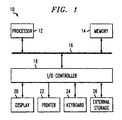
- FIG. 1 shows an exemplary processing system 10 in which optimization techniques in accordance with the present invention may be implemented.
- the processing system 10 includes a processor 12 and a memory 14, connected to communicate via a bus 16.
- the system 10 further includes an input/output (I/O) controller 18 which is connected to the bus 16 in order to communicate with the processor 12 and memory 14.
- the I/O controller 18 in conjunction with the processor 12 directs the operation of a number of peripheral components including a display 20, a printer 22, a keyboard 24 and an external storage device 26.
- One or more of the elements of system 10 may represent portions of a desktop or portable personal computer, a workstation, a microcomputer, a mainframe computer, or other type of processor-based information processing device.
- the memory 14 and external storage device 26 may be electronic, magnetic or optical storage devices.
- the external storage device 26 may include a database of wireless network information, e.g., a database of information on wireless network operating parameters, etc. that is utilized to generate graphical displays that will be described below.
- the external storage device 26 may be a single device, or may be distributed, e.g., distributed across multiple computers or similar devices.
- database as used herein is intended to include any arrangement of stored data that may be used in conjunction with a network optimization technique.
- the present invention may be implemented at least in part in the form of a computer software program stored in memory 14 or external storage 26.
- a program may be executed by processor 12 in accordance with user-supplied input data to produce a desired output in a predetermined format, e.g., on display 20 or on a print-out generated by printer 22.
- the user-supplied input data may be entered at the keyboard 24, read from one or more files of external storage device 26, or obtained over a network connection from a server or other information source.
- the present invention provides improved techniques for optimizing the overall performance of a wireless network.
- the overall network performance for a particular network configuration is characterized by a vector with two components, one representing network coverage and another representing network capacity.
- network coverage is advantageously defined by the likelihood of service under load, including interference, and may be further weighted by traffic density.
- Network capacity is advantageously defined by the amount of traffic with a given spatial distribution that can be served at a given overall target-blocking rate. It has been determined that these definitions provide an accurate and efficient quantification of how well network resources are being used.
- FIG. 2A shows an example of a two-dimensional capacity/coverage diagram which may be generated by the system of FIG. 1 in accordance with the invention.
- the diagram plots overall network performance vectors, each including a network capacity component and a network coverage component, for various network configurations.
- the diagram thus allows comparison of various network configurations with respect to their overall network performance in a visually very clear and efficient way. It also provides a visual understanding of the tradeoff between the two competing network performance attributes of the illustrative embodiment, i.e.., network capacity and network coverage.
- the unshaded circles represent the network performance vectors associated with arbitrary network settings, and the shaded circles represent tradeoff points for maximum overall network performance.
- the overall network performance thus may be improved or optimized with respect to a given subset of network parameters by utilizing an overall network performance classification based on network capacity and network coverage. This may be done by using an optimization algorithm that proposes potential network configurations and evaluates them with respect to their overall network performance. The corresponding network performance points are plotted into a capacity/coverage diagram. Those network configurations that form the outer envelope of all configurations considered relevant by the algorithm represent the best tradeoff curve for the network found in this process.
- FIG. 2B shows an example set of tradeoff curves generated in this manner, with each of the tradeoff curves corresponding to use of a different amount of network resources, e.g., a different number of cells.
- the tradeoff curves depict in a very clear way the improvement that can be made to the overall network performance by increasing the amount of resources.
- the above-described optimization process in the illustrative embodiment can utilize any algorithm that is capable of determining a sufficient variety of network configurations.
- the algorithm may be a mathematical optimization algorithm that directly searches for the network configurations leading to the best tradeoff curve. Such an algorithm usually finds better tradeoff curves in a shorter period of time.
- a mathematical algorithm can be used that tries to optimize for different objectives.
- a frequency planning algorithm can be used. Each frequency plan produces one point on the tradeoff plot, and the tradeoff curve represents the set of best frequency plans generated by the frequency planning algorithm.
- an example of such a frequency planning algorithm is that provided by the Asset network design tool, from Aircom, www.aircom.co.uk. Even a routine that alters certain network configurations by a random process can be used.
- the above-described concept is independent of the particular optimization algorithm used, it represents a methodology for improving and/or optimizing overall network performance. Based on this methodology, more refined algorithms can be developed. The quality of a particular algorithm can be measured by the improvement it can make to a network within the above-described capacity/coverage classification of overall network performance.
- the overall bandwidth and other significant network resources should advantageously be constraints for the improvement/optimization process for a particular tradeoff curve.
- using different sets of resources e.g. more base stations or bandwidth, results in different tradeoff curves, which visualized in one plot shows the associated change in overall network performance very clearly.
- Such a plot also reveals how overall performance differs between various network designs using comparable resources.
- network coverage and network capacity properties in the illustrative embodiment can be replaced by related properties in other embodiments.
- network coverage can be related to statistical network metrics such as "call origination failures," and network capacity can be related to "overall blocking rate at given traffic load” or simply “blocked call rate.”
- Such properties, as well as other similar properties derived from network statistics, are closely related to network coverage and network capacity, and carry basically the same or similar information.
- the terms "network coverage” and “network capacity” as used herein are therefore intended to include any such related properties.
- a location is considered covered when a communication link can be properly originated and terminated, and when the link traffic has sufficient link quality during the time when the link is up. These conditions may involve several communication channels with different link requirements.
- a location has coverage when both the forward and reverse link have coverage. These conditions have to be met for each user only with respect to one cell or cell sector, i.e., the strongest server.
- additional diversity gain can be obtained from soft-handoff. This gain can be added into the overall link budget.
- the overall traffic-weighted coverage better represents the statistical network performance, since it weighs high-traffic areas more than low traffic areas.
- Equations (4) and (5) can be replaced by sums if a discrete set of locations is evaluated rather than a continuum.
- the number of locations should be large enough and dense enough for a statistical representative coverage evaluation.
- the evaluation can be done using a road-based mesh as described in the above-cited U.S. Patent Application of K.L. Clarkson et al. entitled "Road-Based Evaluation and Interpolation of Wireless Network Parameters.”
- the individual power levels at the receiver input can be obtained, e.g, from conventional network design tools, from in-field measurements, from network performance statistics, or from a combination of these and other techniques.
- overall capacity of a network is defined with respect to the spatially varying traffic distribution. This avoids providing too many resources in places where there is no traffic while resources are lacking in high traffic areas. Such a situation would lead to under-use of resources in some areas and to high blocking rates in others.
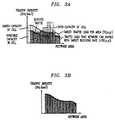
- FIG. 3A illustrates a situation in which the above network capacity definition may lead to significantly lower capacity values for a network with a given traffic distribution than those obtained by simply adding up the resources of all cells.
- the spatial distribution of a target traffic load (solid line) is not matched by the spatial distribution of available network capacity (blocks). Therefore, some cells have too little capacity (cells at the left and right), while other cells have over-capacity (cells in the center).
- the total traffic has to be reduced significantly (dotted line).
- simply adding up the capacity of all cells would lead to a total capacity value that meets the initial traffic distribution (area under solid line) and is much higher than that obtained using the above network capacity definition.
- FIG. 3B illustrates the same situation for an optimized network. Since distribution of capacity and traffic match each other in this case, the traffic that can be handled at the target blocking rate (dotted line) is maximal.
- TCA TD ( x , y ) TCap , where TCap is the target capacity of the network, and TCA is the target coverage area. This traffic distribution will be given in units of Erlangs.
- the traffic distribution TD ( x , y ) is normalized to the target capacity, the traffic that can be handled by the network at the overall target blocking rate BR 0 is ⁇ ⁇ TD ( x , y ), which may be significantly lower.
- the associated blocking rate BR k ( ⁇ TD k , ⁇ k ) for cell or cell sector k is:
- BT k ( ⁇ TD k , ⁇ k ) ⁇ TD k ⁇ BR k ( ⁇ TD k , ⁇ k )
- the total amount of blocked traffic in the entire network is the sum over the blocked traffic in each cell:
- BT tot k ⁇ TD k ⁇ BR k ( ⁇ TD k , ⁇ k )
- BR tot k ⁇ TD k ⁇ BR k ( ⁇ TD k , ⁇ k )/ ⁇ TC
- This equation defines a function BR to
- ⁇ represents the capacity of the network at target blocking rate for a given traffic distribution.
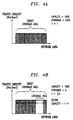
- FIGS. 4A and 4B illustrate the influence of network coverage in this case. Both figures show a situation where the distribution of traffic density and offered capacity per cell match each other perfectly. The capacity should therefore be 100% in both cases.
- the network has a large coverage hole. The unused capacity resources in this area have been redistributed and are available in the covered areas of the network. This increases ⁇ by 1/coverage (dotted line with respect to solid line). The total amount of traffic that can be served, however, has not been increased. To account for this, network capacity should be defined in accordance with Equation (12).
- a user can be assigned to a cell or cell sector if the condition of Equation (1) it met in the forward link. If this condition is met for several cells or cell sectors, the user is in soft handoff, i.e., uses resources from all of these cells or cell sectors.
- a user in an IS95 network can be assigned to a maximum of three cells. The coverage area C ( k ) in such a network therefore defines the area where the pilot of k is among the three strongest pilots that meet the condition of Equation (1).
- the individual pilot level can be obtained from network design tools, from in-field measurements or from a combination of these and other techniques.
- the corresponding overall performance point can be found by calculating coverage and capacity as described above.
- any objective function can be used in conjunction with any optimization procedure to optimize the network in the manner described above.
- New Objective a ⁇ Coverage + (1 - a ) ⁇ Capacity, a ⁇ [0,1]. Optimizing for the new objective will lead to a point on the tradeoff curve. Repeating this procedure for different values of a will provide the full tradeoff curve.
- RF link metrics of a network under traffic are evaluated for one particular set of network parameters, e.g., an initial configuration, using a conventional design tool. This evaluation may be done on a geographical grid. The number of grid points should be dense enough for statistically significant representation of the network performance. From all RF link metrics data on this grid and the initial network configurations, the overall network performance is calculated in accordance with the above-described classification. The resulting overall-network performance point is plotted into the capacity/coverage plot.
- At least a subset of the tunable network parameters that are subjected to the optimization process are altered within a random process.
- the RF link metrics are recalculated with the design tool for each random set of network parameters.
- the overall network performance is evaluated as above and plotted into the capacity/coverage plot. The outer envelope of all overall performance points defines the tradeoff gained in this optimization procedure.
- FIG. 5 shows an example of a plot of overall network performance points for various network configurations obtained in the above-described Monte Carlo process.
- the outer envelope forms the optimum tradeoff gained in this process.
- a design tool can be used in conjunction with a frequency-planning algorithm (e.g., the above-noted Asset frequency planning tool).
- a frequency-planning algorithm e.g., the above-noted Asset frequency planning tool.
- the RF link metrics are calculated over a sufficiently fine grid using the design tool. From each grid of RF link metrics, overall network performance is determined in accordance with the above classification. From the set of resulting points, the optimum tradeoff is determined in the manner previously described.
- a tradeoff curve can be determined in the following manner. Assume a set of points is given in the overall-performance plot (e.g., FIG. 5). This set of points may be the result from an optimization algorithm. The tradeoff curve, representing the points for best network performance, can be found by the following algorithm: The remaining non-zero points form the above-noted tradeoff curve.
- This optimization process optimizes the performance of a wireless network with respect to a multitude of mathematically continuous network parameters for an objective addressing an overall network performance metric.
- This objective in this optimization process is formulated as a mathematical or numerical function of a set of network tuning parameters that are considered variables to the optimization process.
- the optimization process may be based on exact or approximate first or higher order derivatives of the objective function with respect to the network tuning parameters. This leads to reliable results since the tuning parameters are mathematically continuous and the overall network performance metric is locally differentiable, i.e., small changes of parameter settings cause only small changes in network performance.
- Examples of numerical optimization programs suitable for use in conjunction with the present invention include, e.g., the programs described in Robert Fourer, David M. Gay, Brain W. Kernigham, "AMPL - A Modeling Language for Mathematical Programming," The Scientific Press (1993), Philip E. Gill, Walter Murray and Michael A.
- the above-described optimization process has a number of advantages. For example, by writing the overall network performance as a function of a multitude of tuning parameters, their interdependent effect on the network performance is captured and considered in the optimization process. Another advantage is that using the analytical behavior of the overall network performance metric with respect to the network tuning parameters allows standard optimization algorithms to be exploited so as to attain optimal overall network performance.
- the optimization may be done for a large set of these parameters, e.g., antenna tilts of all cell sectors, etc. This allows their interdependent effects on the overall network performance to be captured and considered in the optimization procedure.
- All parameters that are not variables should be treated as constants to the optimization process, e.g., fixed network parameters, parameters associated with propagation in the environment, spatial traffic distribution, communication standard, etc.
- the other objectives should be treated as constraints. For example, network coverage can be optimized for a given overall traffic served, which constrains network capacity, etc.
- the range of all tuning parameters is preferably constrained to the actual range these parameters can or should be operated in.
- Modeling the functional dependence between a given objective and the network tuning parameter variables involves propagation effects, mutual interactions between communication channels, and standard-specific parameters. Since the overall network performance metric captures time-averaged network performance, statistical models can be used to formulate propagation effects and mutual interactions. Such models have been described in general terms for conventional network design tools and can therefore easily be developed for a particular network. Propagation prediction can be improved by, e.g., ray-tracing models, or by incorporating actual in-field measurements.
- the optimization algorithm itself may be, e.g., any conventional algorithm that optimizes a numerical or mathematical function based on exact or approximate first or higher order derivatives.
- the derivatives can be calculated numerically or analytically.
- a network coverage objective is defined as follows. A location is considered covered when a communication link can be properly originated and terminated, and when the link traffic has sufficient link quality during the time when the link is up, i.e., local coverage exists. These conditions may involve several communication channels with different link requirements.
- Network capacity and network coverage objectives in this exemplary implementation of the derivative-based optimization process may be defined in the manner described previously in conjunction with the tradeoff of network coverage with network capacity.
- a network resources objective can be defined in the following manner. There can be various resources that are minimized. For example, the total hardware costs for power amplifiers, represented by the power-level requirements per cell sector or cell, may be minimized. In an IS-95 CDMA system, the power-level requirement per sector is given by the number of traffic channels and their average power level P Traffic, and the overhead needed for pilot, synch, and paging channels, P Pilot , P Synch , and P Page , respectively.
- the cost per power amplifier is a monotonic function of its power COG k ( Ptot k ). This function should be analytical.
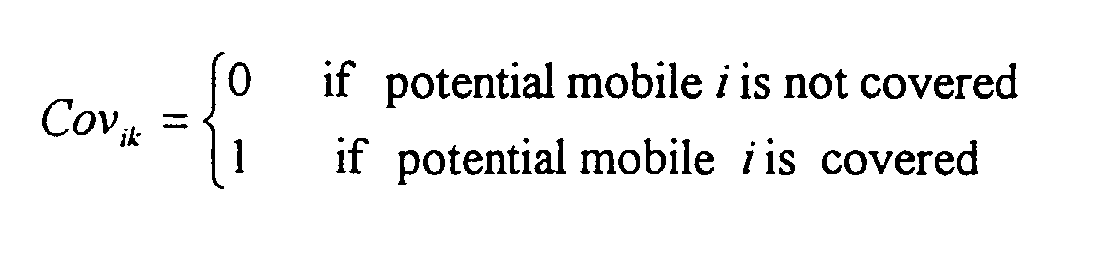
- the RF environment may be modeled in the following manner. This example modeling procedure is for an IS-95 CDMA system, and considers links between potential user locations, e.g., mobiles, and base stations or base station sectors.
- network tuning parameter variables suitable for optimization in this implementation of the derivative-based optimization process.
- the following network parameters can be used as variables for the optimization:
- the formulation of the derivative functions will now be described.
- d d ⁇ k Cov tot ( ⁇ k 0 ) Cov tot ( ⁇ k 0 + ⁇ k )- Cov tot ( ⁇ k 0 ) ⁇ k
- the objective function, the constraints, and the derivative functions of the objective function with respect to all network tuning parameter may be generated as, e.g., numerical functions.
- the resulting functions can be processed by any conventional numerical optimization program that is commercially available in order to perform the optimization.
- examples of numerical optimization programs suitable for use in conjunction with the present invention include AMPL and SNOPT.
- the graphical displays of FIGS. 2A, 2B, 3A, 3B, 4A, 4B and 5 may be generated in accordance with, e.g., software program instructions executed by processor 12 of system 10.
- An appropriately-configured software program in accordance with the invention may, e.g., obtain network parameter data from one or more sources, process the network parameter data in accordance with the optimization process of the invention, and generate a display which plots the resulting network configuration information in a desired format.
- the above-described embodiments of the invention are intended to be illustrative only.
- the above-described techniques can be used to design a wireless network, or to optimize or otherwise improve an existing network that is already under operation.
- the invention can be applied to sub-networks, e.g., to designated portions of a given wireless network, and to many different types of networks, e.g., networks with mobile subscriber units or fixed subscriber units or combinations of mobile and fixed units.
Landscapes
- Engineering & Computer Science (AREA)
- Computer Networks & Wireless Communication (AREA)
- Signal Processing (AREA)
- Mobile Radio Communication Systems (AREA)
Abstract
Description
- Sik : Signal power from mobile i at antenna port of sector k.
- Iik : Interference power at antenna port of sector k with respect to pilot from mobile i.
- NFk : Mobile noise figure.
- N 0 : Thermal noise floor.
- RVS : Threshold for proper mobile-signal recovery in reverse link.


As part of this step, a general path-loss matrix Lik is determined that includes, besides the path loss, all parameters in the link budget from the antenna connector at BS k to the antenna connector at mobile i. This also includes antenna pattern and gain for the mobile and base station antennas. Since the propagation model in this example is a statistical model, Lik should also include margins for Raleigh fading and log-normal shadow fading, as described in, e.g., "Cellular System, Design & Optimization," Clint Smith, P.E., and Curt Gervelis, Editor: McGraw-Hill (1996), and William C.Y. Lee, "Mobile Communications, Design Fundamentals," 2nd edition, John Wiley & Sons, Inc. (1993). The general path-loss matrix is given by:
Claims (21)
- A processor-implemented method for providing a desired level of performance in a wireless network, the method comprising the steps of:selecting one or more network parameters as variables; andoptimizing an objective function of the wireless network based on first or higher order derivatives of the objective function with respect to the selected network parameter variables.
- The method of claim 1 wherein one or more of the selected network parameters are characterized by continuous functions.
- The method of claim 1 wherein the optimizing step utilizes an optimization algorithm to implement the optimization based on first or higher order derivatives of the objective function with respect to the selected network parameter variables.
- The method of claim 1 wherein the objective function comprises at least one of: (i) a maximization of network coverage, (ii) a maximization of network capacity, and (iii) a minimization of network resources.
- The method of claim 4 wherein the objective function comprises a linear combination of at least two of: (i) the maximization of network coverage, (ii) the maximization of network capacity, and (iii) the minimization of network resources.
- The method of claim 4 wherein network coverage is defined at least in part as a fraction of area in which quality of service is above a specified threshold, with respect to a target coverage area.
- The method of claim 6 wherein network coverage is weighted in accordance with a weighting factor representative of traffic density within a particular coverage area.
- The method of claim 4 wherein network capacity is defined at least in part by an amount of traffic having a given spatial distribution, and represents the ability of the wireless network to match the spatial traffic distribution.
- The method of claim 8 wherein network capacity component further represents the amount of traffic having the given spatial distribution that can be carried by the network with a specified target blocking rate.
- The method of claim 1 wherein the selected network parameters comprise at least one antenna parameter including at least one of antenna location, antenna height, antenna orientation, antenna tilt, and antenna beamwidth.
- The method of claim 1 wherein the selected network parameters comprise a transmit power level for at least one communication channel and link of the wireless system.
- The method of claim 1 wherein the selected network parameters comprise a handoff threshold for at least one communication channel and link of the wireless system.
- The method of claim 1 wherein the selected network parameters comprise a number of channel units per cell or cell sector of the wireless system.
- The method of claim 1 wherein the selected network parameters comprise a scaling factor for a power amplifier of the wireless system.
- The method of claim 1 wherein additional network parameters which are not variables in optimization process serve as constraints to the optimization process.
- The method of claim 1 wherein the optimizing step utilizes a propagation environment model based on statistical path loss.
- The method of claim 1 wherein the optimizing step utilizes at least one of predicted propagation data and actual propagation data determined from in-field measurements.
- The method of claim 1 wherein the wireless network comprises a network which supports mobile wireless subscriber units.
- The method of claim 1 wherein the wireless network comprises a network which supports fixed wireless subscriber units.
- An apparatus for providing a desired level of performance in a wireless network, the apparatus comprising:a processor-based system operative (i) to identify one or more network parameters as variables; and (ii) to optimize an objective function of the wireless network based on first or higher order derivatives of the objective function with respect to the selected network parameter variables.
- An article of manufacture comprising a computer-readable medium storing one or more software programs for use in providing a desired level of performance in a wireless network, wherein the one or more programs when executed by a processor include:selecting one or more network parameters as variables; andoptimizing an objective function of the wireless network based on first or higher order derivatives of the objective function with respect to the selected network parameter variables.
Applications Claiming Priority (2)
| Application Number | Priority Date | Filing Date | Title |
|---|---|---|---|
| US434578 | 1999-11-04 | ||
| US09/434,578 US6611500B1 (en) | 1999-11-04 | 1999-11-04 | Methods and apparatus for derivative-based optimization of wireless network performance |
Publications (3)
| Publication Number | Publication Date |
|---|---|
| EP1098546A2 true EP1098546A2 (en) | 2001-05-09 |
| EP1098546A3 EP1098546A3 (en) | 2001-10-31 |
| EP1098546B1 EP1098546B1 (en) | 2007-09-05 |
Family
ID=23724795
Family Applications (1)
| Application Number | Title | Priority Date | Filing Date |
|---|---|---|---|
| EP00309586A Expired - Lifetime EP1098546B1 (en) | 1999-11-04 | 2000-10-30 | Methods and apparatus for derivative based optimization of wireless network performance |
Country Status (9)
| Country | Link |
|---|---|
| US (1) | US6611500B1 (en) |
| EP (1) | EP1098546B1 (en) |
| JP (1) | JP2001204082A (en) |
| KR (1) | KR20010051456A (en) |
| CN (1) | CN1295417A (en) |
| AU (1) | AU6958600A (en) |
| BR (1) | BR0006771A (en) |
| CA (1) | CA2324189A1 (en) |
| DE (1) | DE60036263T2 (en) |
Cited By (19)
| Publication number | Priority date | Publication date | Assignee | Title |
|---|---|---|---|---|
| EP1178694A1 (en) * | 2000-07-31 | 2002-02-06 | Lucent Technologies Inc. | Methods and apparatus for design, adjustment or operation of wireless networks using pre-frequency-assignment optimization |
| WO2002082846A1 (en) * | 2001-04-03 | 2002-10-17 | Telia Ab (Publ) | Procedure and system for determination of parameters in radio communication networks |
| EP1283644A1 (en) * | 2001-08-10 | 2003-02-12 | Societé Française du Radiotéléphone | Method for determining a radio coverage map |
| WO2003037018A1 (en) * | 2001-10-25 | 2003-05-01 | Nokia Corporation | Method and system for optimising the performance of a network |
| WO2004002181A1 (en) * | 2002-06-25 | 2003-12-31 | Nokia Corporation | Method and system to optimise soft handover gain in networks such as cdma networks |
| WO2005069666A1 (en) * | 2004-01-15 | 2005-07-28 | Radioplan Gmbh | Method and device for adapting a radio network model to the conditions of a real radio network |
| EP1624709A1 (en) * | 2004-08-05 | 2006-02-08 | Evolium Sas | Method and system for managing a cellular mobile communication network |
| WO2006033603A1 (en) * | 2004-09-24 | 2006-03-30 | Telefonaktiebolaget L M Ericsson (Publ) | Method for dimensioning or evaluating a radio network |
| EP1879413A3 (en) * | 2002-10-23 | 2008-08-13 | Nec Corporation | Base-station cell design method and base-station cell design apparatus, and program thereof in mobile communication system |
| EP2088813A3 (en) * | 2008-02-07 | 2010-08-11 | Optimi Corporation | Method, system and apparatus for modifying a mobile network signal propagation prediction |
| CN101155380B (en) * | 2006-09-29 | 2010-09-08 | 中国移动通信集团北京有限公司 | System and method for integrating wireless network test data |
| EP2477435A1 (en) * | 2011-01-12 | 2012-07-18 | Fujitsu Limited | Method and apparatus for adjusting bandwidth allocations in a wireless network |
| CN102932802A (en) * | 2011-08-11 | 2013-02-13 | 中国科学技术大学苏州研究院 | Terminal reconfiguration method based on fuzzy optimization theory in software radio environment |
| US8620341B2 (en) | 2010-04-12 | 2013-12-31 | Fujitsu Limited | Method and apparatus for adjusting bandwidth allocations in a wireless network |
| WO2014029892A1 (en) * | 2012-08-24 | 2014-02-27 | Actix Gmbh | Method for joint and coordinated load balancing and coverage and capacity optimization in cellular communication networks |
| US8995922B2 (en) | 2008-06-04 | 2015-03-31 | Telefonaktiebolaget L M Ericsson (Publ) | Method and apparatus relating to spectrum sensing |
| WO2017142588A1 (en) | 2016-02-15 | 2017-08-24 | Spidercloud Wireless, Inc. | Ue-measurement assisted closed loop learning approach for real-time optimization of system metrics |
| CN111030770A (en) * | 2019-12-23 | 2020-04-17 | 湘潭大学 | A Method for Predicting Electromagnetic Radiation of Base Stations in Mountainous Areas |
| CN112203317A (en) * | 2020-10-20 | 2021-01-08 | 中国联合网络通信集团有限公司 | Network coverage analysis method and device |
Families Citing this family (32)
| Publication number | Priority date | Publication date | Assignee | Title |
|---|---|---|---|---|
| US6925066B1 (en) * | 2000-07-31 | 2005-08-02 | Lucent Technologies Inc. | Methods and apparatus for design, adjustment or operation of wireless networks using multi-stage optimization |
| US7123893B1 (en) * | 2001-04-24 | 2006-10-17 | Bellsouth Intellectual Property Corp. | Wireless frequency re-use determination systems and methods |
| US20030041125A1 (en) * | 2001-08-16 | 2003-02-27 | Salomon Kirk C. | Internet-deployed wireless system |
| US8977284B2 (en) | 2001-10-04 | 2015-03-10 | Traxcell Technologies, LLC | Machine for providing a dynamic data base of geographic location information for a plurality of wireless devices and process for making same |
| US20040266442A1 (en) * | 2001-10-25 | 2004-12-30 | Adrian Flanagan | Method and system for optimising the performance of a network |
| US6965674B2 (en) * | 2002-05-21 | 2005-11-15 | Wavelink Corporation | System and method for providing WLAN security through synchronized update and rotation of WEP keys |
| US20030229861A1 (en) * | 2002-06-10 | 2003-12-11 | Quigley Aaron J. | Semi-automatic antenna design via random sampling and visualization |
| US7965842B2 (en) * | 2002-06-28 | 2011-06-21 | Wavelink Corporation | System and method for detecting unauthorized wireless access points |
| US7606242B2 (en) * | 2002-08-02 | 2009-10-20 | Wavelink Corporation | Managed roaming for WLANS |
| US7522906B2 (en) * | 2002-08-09 | 2009-04-21 | Wavelink Corporation | Mobile unit configuration management for WLANs |
| US7120689B2 (en) * | 2003-01-23 | 2006-10-10 | Sbc Properties, L.P. | Receiving network metrics data from disparate devices and displaying in a host format |
| US20050003827A1 (en) * | 2003-02-13 | 2005-01-06 | Whelan Robert J. | Channel, coding and power management for wireless local area networks |
| US20040165561A1 (en) * | 2003-02-21 | 2004-08-26 | Chiou Ta-Gang | System for constructing a mobility model for use in mobility management in a wireless communication system and method thereof |
| FI20035235A0 (en) * | 2003-12-12 | 2003-12-12 | Nokia Corp | Arrangement for processing files at a terminal |
| KR100598460B1 (en) * | 2004-02-27 | 2006-07-11 | 삼성전자주식회사 | Optimization method of base station or base station antenna location according to subscriber distribution in building |
| US7577103B2 (en) * | 2005-06-30 | 2009-08-18 | Alcatel-Lucent Usa Inc. | Dynamic methods for improving a wireless network |
| US20070115916A1 (en) * | 2005-11-07 | 2007-05-24 | Samsung Electronics Co., Ltd. | Method and system for optimizing a network based on a performance knowledge base |
| US7512382B2 (en) * | 2005-11-22 | 2009-03-31 | Alcatel-Lucent Usa Inc. | Modeling power amplifier and spreading code limits in a wireless system |
| WO2007066727A1 (en) * | 2005-12-09 | 2007-06-14 | Nec Corporation | Positioning method, positioning device, and program |
| US7966011B2 (en) * | 2007-03-26 | 2011-06-21 | Qualcomm Incorporated | Determining per sector received power level |
| CN101207887B (en) * | 2007-12-17 | 2013-01-02 | 浪潮通信信息系统有限公司 | Multi-manufacturer parameter matching method based on common model |
| US8676133B2 (en) * | 2008-09-19 | 2014-03-18 | Qualcomm Incorporated | Reference signal design for LTE A |
| CN101651956B (en) * | 2009-09-07 | 2015-04-01 | 中兴通讯股份有限公司 | Device, system and method for adjusting parameters of wireless resource |
| CN104010320B (en) * | 2011-04-21 | 2018-09-04 | 中国移动通信集团湖南有限公司 | Determine the method and apparatus of wireless network coverage rate |
| GB2492364B (en) * | 2011-06-29 | 2016-03-30 | Fujitsu Ltd | Re-selecting network parameters in a cellular wireless network |
| US8700077B2 (en) * | 2012-01-17 | 2014-04-15 | Spectrum Bridge, Inc. | System and method for determining noise floor in a wireless communications environment |
| CN102685760B (en) * | 2012-04-28 | 2014-10-15 | 黄林果 | Low design cost based wireless network reliability improving method |
| CN103685380B (en) * | 2012-09-12 | 2017-12-08 | 北京超图软件股份有限公司 | The distribution method of servicing and system of geographic information data |
| CN103812584B (en) * | 2012-11-15 | 2015-11-11 | 中国移动通信集团河南有限公司 | A kind of system of selection of the antenna type of antenna feeder community altogether and device |
| EP2934037B1 (en) * | 2014-04-15 | 2016-04-13 | Telefonaktiebolaget LM Ericsson (publ) | Technique for Evaluation of a Parameter Adjustment in a Mobile Communications Network |
| US9642039B2 (en) * | 2014-08-13 | 2017-05-02 | Huawei Technologies Canada Co., Ltd. | System and method for wireless load balancing |
| CN105357681B (en) * | 2015-10-29 | 2018-09-07 | 哈尔滨工业大学 | Things-internet gateway dispositions method based on multiple-objection optimization |
Family Cites Families (13)
| Publication number | Priority date | Publication date | Assignee | Title |
|---|---|---|---|---|
| US4744028A (en) * | 1985-04-19 | 1988-05-10 | American Telephone And Telegraph Company, At&T Bell Laboratories | Methods and apparatus for efficient resource allocation |
| SE9402059D0 (en) * | 1994-06-13 | 1994-06-13 | Ellemtel Utvecklings Ab | Methods and apparatus for telecommunications |
| US5764740A (en) * | 1995-07-14 | 1998-06-09 | Telefonaktiebolaget Lm Ericsson | System and method for optimal logical network capacity dimensioning with broadband traffic |
| US6058307A (en) * | 1995-11-30 | 2000-05-02 | Amsc Subsidiary Corporation | Priority and preemption service system for satellite related communication using central controller |
| US5884147A (en) * | 1996-01-03 | 1999-03-16 | Metawave Communications Corporation | Method and apparatus for improved control over cellular systems |
| US5884174A (en) * | 1996-06-07 | 1999-03-16 | Lucent Technologies Inc. | Call admission control for wireless networks |
| US5831998A (en) * | 1996-12-13 | 1998-11-03 | Northern Telecom Limited | Method of testcase optimization |
| EP0960158A1 (en) | 1997-02-07 | 1999-12-01 | Eastman Chemical Company | Method for preventing photodegradation of polymers containing naphthalenedicarboxylic acid residues |
| US6011780A (en) * | 1997-05-23 | 2000-01-04 | Stevens Institute Of Technology | Transparant non-disruptable ATM network |
| US6331986B1 (en) * | 1998-04-24 | 2001-12-18 | Lucent Technologies Inc. | Method for resource allocation and routing in multi-service virtual private networks |
| US7025209B2 (en) * | 1998-05-29 | 2006-04-11 | Palmsource, Inc. | Method and apparatus for wireless internet access |
| US20020064142A1 (en) * | 1998-10-13 | 2002-05-30 | Franklin P. Antonio | Base station architecture |
| US6487404B1 (en) * | 1999-12-30 | 2002-11-26 | Ericsson Inc. | Automated radio network trend detection |
-
1999
- 1999-11-04 US US09/434,578 patent/US6611500B1/en not_active Expired - Fee Related
-
2000
- 2000-10-24 CA CA002324189A patent/CA2324189A1/en not_active Abandoned
- 2000-10-26 BR BR0006771-7A patent/BR0006771A/en not_active Application Discontinuation
- 2000-10-27 AU AU69586/00A patent/AU6958600A/en not_active Abandoned
- 2000-10-30 DE DE60036263T patent/DE60036263T2/en not_active Expired - Fee Related
- 2000-10-30 EP EP00309586A patent/EP1098546B1/en not_active Expired - Lifetime
- 2000-11-03 CN CN00133825A patent/CN1295417A/en active Pending
- 2000-11-04 KR KR1020000065379A patent/KR20010051456A/en not_active Abandoned
- 2000-11-06 JP JP2000336932A patent/JP2001204082A/en active Pending
Cited By (34)
| Publication number | Priority date | Publication date | Assignee | Title |
|---|---|---|---|---|
| EP1178694A1 (en) * | 2000-07-31 | 2002-02-06 | Lucent Technologies Inc. | Methods and apparatus for design, adjustment or operation of wireless networks using pre-frequency-assignment optimization |
| US7142523B1 (en) | 2000-07-31 | 2006-11-28 | Lucent Technologies Inc. | Methods and apparatus for design, adjustment or operation of wireless networks using pre-frequency-assignment optimization |
| WO2002082846A1 (en) * | 2001-04-03 | 2002-10-17 | Telia Ab (Publ) | Procedure and system for determination of parameters in radio communication networks |
| US6876856B2 (en) | 2001-08-10 | 2005-04-05 | Societe Francaise Du Radiotelephone | Method for establishing a radio coverage map |
| EP1283644A1 (en) * | 2001-08-10 | 2003-02-12 | Societé Française du Radiotéléphone | Method for determining a radio coverage map |
| FR2828623A1 (en) * | 2001-08-10 | 2003-02-14 | Radiotelephone Sfr | METHOD FOR ESTABLISHING A RADIO COVERAGE CARD |
| WO2003037018A1 (en) * | 2001-10-25 | 2003-05-01 | Nokia Corporation | Method and system for optimising the performance of a network |
| WO2003037019A1 (en) * | 2001-10-25 | 2003-05-01 | Nokia Corporation | Method and system for optimising the performance of a network |
| CN100348071C (en) * | 2001-10-25 | 2007-11-07 | 诺基亚公司 | Method and system for optimising the performance of a network |
| WO2004002181A1 (en) * | 2002-06-25 | 2003-12-31 | Nokia Corporation | Method and system to optimise soft handover gain in networks such as cdma networks |
| US7248875B2 (en) | 2002-06-25 | 2007-07-24 | Nokia Corporation | Method and system to optimise soft handover gain in networks |
| EP1879413A3 (en) * | 2002-10-23 | 2008-08-13 | Nec Corporation | Base-station cell design method and base-station cell design apparatus, and program thereof in mobile communication system |
| US8135421B2 (en) | 2002-10-23 | 2012-03-13 | Nec Corporation | Base-station cell design method and base-station cell design apparatus, and program thereof in mobile communication system |
| WO2005069666A1 (en) * | 2004-01-15 | 2005-07-28 | Radioplan Gmbh | Method and device for adapting a radio network model to the conditions of a real radio network |
| EP1624709A1 (en) * | 2004-08-05 | 2006-02-08 | Evolium Sas | Method and system for managing a cellular mobile communication network |
| FR2874148A1 (en) * | 2004-08-05 | 2006-02-10 | Evolium Sas Soc Par Actions Si | METHOD AND SYSTEM FOR OPERATING A CELLULAR MOBILE COMMUNICATIONS NETWORK |
| WO2006033603A1 (en) * | 2004-09-24 | 2006-03-30 | Telefonaktiebolaget L M Ericsson (Publ) | Method for dimensioning or evaluating a radio network |
| US7873362B2 (en) | 2004-09-24 | 2011-01-18 | Telefonaktiebolaget L M Ericsson (Publ) | Method for dimensioning or evaluating a radio network |
| CN101155380B (en) * | 2006-09-29 | 2010-09-08 | 中国移动通信集团北京有限公司 | System and method for integrating wireless network test data |
| EP2088813A3 (en) * | 2008-02-07 | 2010-08-11 | Optimi Corporation | Method, system and apparatus for modifying a mobile network signal propagation prediction |
| US8385908B2 (en) | 2008-02-07 | 2013-02-26 | Optimi Corporation | Modifying mobile network signal propagation predictions |
| US8995922B2 (en) | 2008-06-04 | 2015-03-31 | Telefonaktiebolaget L M Ericsson (Publ) | Method and apparatus relating to spectrum sensing |
| US8620341B2 (en) | 2010-04-12 | 2013-12-31 | Fujitsu Limited | Method and apparatus for adjusting bandwidth allocations in a wireless network |
| EP2477435A1 (en) * | 2011-01-12 | 2012-07-18 | Fujitsu Limited | Method and apparatus for adjusting bandwidth allocations in a wireless network |
| CN102932802B (en) * | 2011-08-11 | 2015-10-07 | 中国科学技术大学苏州研究院 | Based on the terminal reconstruction method of theory of fuzzy optimization under software wireless electrical environment |
| CN102932802A (en) * | 2011-08-11 | 2013-02-13 | 中国科学技术大学苏州研究院 | Terminal reconfiguration method based on fuzzy optimization theory in software radio environment |
| WO2014029892A1 (en) * | 2012-08-24 | 2014-02-27 | Actix Gmbh | Method for joint and coordinated load balancing and coverage and capacity optimization in cellular communication networks |
| US9775068B2 (en) | 2012-08-24 | 2017-09-26 | Actix Gmbh | Method for joint and coordinated load balancing and coverage and capacity optimization in cellular communication networks |
| WO2017142588A1 (en) | 2016-02-15 | 2017-08-24 | Spidercloud Wireless, Inc. | Ue-measurement assisted closed loop learning approach for real-time optimization of system metrics |
| EP3417644A4 (en) * | 2016-02-15 | 2019-09-11 | Corning Optical Communications LLC | CLOSED LOOP LEARNING APPROACH ASSISTED BY USER EQUIPMENT MEASUREMENT (UE) FOR REAL TIME SYSTEM METRIC OPTIMIZATION |
| CN111030770A (en) * | 2019-12-23 | 2020-04-17 | 湘潭大学 | A Method for Predicting Electromagnetic Radiation of Base Stations in Mountainous Areas |
| CN111030770B (en) * | 2019-12-23 | 2022-02-11 | 湘潭大学 | Electromagnetic radiation prediction method for mountain area base station |
| CN112203317A (en) * | 2020-10-20 | 2021-01-08 | 中国联合网络通信集团有限公司 | Network coverage analysis method and device |
| CN112203317B (en) * | 2020-10-20 | 2022-04-08 | 中国联合网络通信集团有限公司 | Network coverage analysis method and device |
Also Published As
| Publication number | Publication date |
|---|---|
| CN1295417A (en) | 2001-05-16 |
| JP2001204082A (en) | 2001-07-27 |
| CA2324189A1 (en) | 2001-05-04 |
| KR20010051456A (en) | 2001-06-25 |
| US6611500B1 (en) | 2003-08-26 |
| EP1098546A3 (en) | 2001-10-31 |
| AU6958600A (en) | 2001-05-10 |
| DE60036263D1 (en) | 2007-10-18 |
| DE60036263T2 (en) | 2008-05-29 |
| EP1098546B1 (en) | 2007-09-05 |
| BR0006771A (en) | 2001-08-14 |
Similar Documents
| Publication | Publication Date | Title |
|---|---|---|
| EP1098546B1 (en) | Methods and apparatus for derivative based optimization of wireless network performance | |
| EP1098545B1 (en) | Methods and apparatus for characterization, adjustment and optimization of wireless networks | |
| US7142523B1 (en) | Methods and apparatus for design, adjustment or operation of wireless networks using pre-frequency-assignment optimization | |
| JP3888954B2 (en) | CDMA wireless network planning and evaluation method and system | |
| Akl et al. | Multicell CDMA network design | |
| Staehle et al. | Approximating the othercell interference distribution in inhomogeneous UMTS networks | |
| US6925066B1 (en) | Methods and apparatus for design, adjustment or operation of wireless networks using multi-stage optimization | |
| US7096040B1 (en) | Passive shapable sectorization antenna gain determination | |
| Gerdenitsch et al. | A Rule‐Based Algorithm for Common Pilot Channel and Antenna Tilt Optimization in UMTS FDD Networks | |
| US6512933B1 (en) | Iterative system and method for optimizing CDMA load distribution using reverse interference measurements | |
| US20030134641A1 (en) | Method and system for planning and/or evaluation of cell capacity in (CDMA) radio networks | |
| Wacker et al. | Automated and remotely optimization of antenna subsystem based on radio network performance | |
| EP1444852B1 (en) | Method for providing cell contouring in a communication network | |
| EP1488540B1 (en) | Method for configuring the power output of the pilot channels in a cellular radio network | |
| Nawrocki et al. | Optimal site and antenna location for UMTS output results of 3G network simulation software | |
| Majewski et al. | Analytical cell load assessment in OFDM radio networks | |
| Hoppe et al. | Fast planning of efficient WCDMA radio networks | |
| Staehle et al. | An Approximation of Othercell Interference Distributions for UMTS Systems Using Fixed Point Equations | |
| Ni | Distributed channel allocation algorithm with power control | |
| Aydin et al. | A comparative investigation on heuristic optimization of WCDMA radio networks | |
| Staehle | Analytic method for coverage prediction in UMTS radio network planning process | |
| Datta | UMTS radio network optimisation. | |
| Gerdenitsch et al. | An adaptive algorithm for CPICH power and antenna tilt optimization in UMTS FDD networks | |
| Warrier et al. | System level transmit power analysis in cellular systems | |
| Olafsson et al. | Situation-Aware Wireless Networks |
Legal Events
| Date | Code | Title | Description |
|---|---|---|---|
| PUAI | Public reference made under article 153(3) epc to a published international application that has entered the european phase |
Free format text: ORIGINAL CODE: 0009012 |
|
| AK | Designated contracting states |
Kind code of ref document: A2 Designated state(s): AT BE CH CY DE DK ES FI FR GB GR IE IT LI LU MC NL PT SE Kind code of ref document: A2 Designated state(s): DE FI FR GB SE |
|
| AX | Request for extension of the european patent |
Free format text: AL;LT;LV;MK;RO;SI |
|
| PUAL | Search report despatched |
Free format text: ORIGINAL CODE: 0009013 |
|
| AK | Designated contracting states |
Kind code of ref document: A3 Designated state(s): AT BE CH CY DE DK ES FI FR GB GR IE IT LI LU MC NL PT SE |
|
| AX | Request for extension of the european patent |
Free format text: AL;LT;LV;MK;RO;SI |
|
| 17P | Request for examination filed |
Effective date: 20020420 |
|
| AKX | Designation fees paid |
Free format text: DE FI FR GB SE |
|
| GRAP | Despatch of communication of intention to grant a patent |
Free format text: ORIGINAL CODE: EPIDOSNIGR1 |
|
| GRAS | Grant fee paid |
Free format text: ORIGINAL CODE: EPIDOSNIGR3 |
|
| GRAA | (expected) grant |
Free format text: ORIGINAL CODE: 0009210 |
|
| AK | Designated contracting states |
Kind code of ref document: B1 Designated state(s): DE FI FR GB SE |
|
| REG | Reference to a national code |
Ref country code: GB Ref legal event code: FG4D |
|
| REF | Corresponds to: |
Ref document number: 60036263 Country of ref document: DE Date of ref document: 20071018 Kind code of ref document: P |
|
| ET | Fr: translation filed | ||
| PG25 | Lapsed in a contracting state [announced via postgrant information from national office to epo] |
Ref country code: FI Free format text: LAPSE BECAUSE OF FAILURE TO SUBMIT A TRANSLATION OF THE DESCRIPTION OR TO PAY THE FEE WITHIN THE PRESCRIBED TIME-LIMIT Effective date: 20070905 |
|
| PG25 | Lapsed in a contracting state [announced via postgrant information from national office to epo] |
Ref country code: SE Free format text: LAPSE BECAUSE OF FAILURE TO SUBMIT A TRANSLATION OF THE DESCRIPTION OR TO PAY THE FEE WITHIN THE PRESCRIBED TIME-LIMIT Effective date: 20071205 |
|
| PLBE | No opposition filed within time limit |
Free format text: ORIGINAL CODE: 0009261 |
|
| STAA | Information on the status of an ep patent application or granted ep patent |
Free format text: STATUS: NO OPPOSITION FILED WITHIN TIME LIMIT |
|
| PG25 | Lapsed in a contracting state [announced via postgrant information from national office to epo] |
Ref country code: DE Free format text: LAPSE BECAUSE OF NON-PAYMENT OF DUE FEES Effective date: 20080501 |
|
| 26N | No opposition filed |
Effective date: 20080606 |
|
| GBPC | Gb: european patent ceased through non-payment of renewal fee |
Effective date: 20071205 |
|
| REG | Reference to a national code |
Ref country code: FR Ref legal event code: ST Effective date: 20081020 |
|
| PG25 | Lapsed in a contracting state [announced via postgrant information from national office to epo] |
Ref country code: GB Free format text: LAPSE BECAUSE OF NON-PAYMENT OF DUE FEES Effective date: 20071205 |
|
| PG25 | Lapsed in a contracting state [announced via postgrant information from national office to epo] |
Ref country code: FR Free format text: LAPSE BECAUSE OF NON-PAYMENT OF DUE FEES Effective date: 20071031 |