EP1098224A1 - Photosensitive printing plate and method of producing the same - Google Patents
Photosensitive printing plate and method of producing the same Download PDFInfo
- Publication number
- EP1098224A1 EP1098224A1 EP00309861A EP00309861A EP1098224A1 EP 1098224 A1 EP1098224 A1 EP 1098224A1 EP 00309861 A EP00309861 A EP 00309861A EP 00309861 A EP00309861 A EP 00309861A EP 1098224 A1 EP1098224 A1 EP 1098224A1
- Authority
- EP
- European Patent Office
- Prior art keywords
- photosensitive
- printing plate
- meth
- photosensitive printing
- copolymer
- Prior art date
- Legal status (The legal status is an assumption and is not a legal conclusion. Google has not performed a legal analysis and makes no representation as to the accuracy of the status listed.)
- Granted
Links
- 238000007639 printing Methods 0.000 title claims abstract description 81
- 238000000034 method Methods 0.000 title claims abstract description 25
- 229920001577 copolymer Polymers 0.000 claims abstract description 44
- 239000002245 particle Substances 0.000 claims abstract description 43
- 150000003926 acrylamides Chemical class 0.000 claims abstract description 30
- 239000011248 coating agent Substances 0.000 claims abstract description 24
- 238000000576 coating method Methods 0.000 claims abstract description 24
- 239000000758 substrate Substances 0.000 claims abstract description 23
- 239000002904 solvent Substances 0.000 claims abstract description 14
- 239000000203 mixture Substances 0.000 claims description 47
- 229920005989 resin Polymers 0.000 claims description 47
- 239000011347 resin Substances 0.000 claims description 47
- 150000001875 compounds Chemical class 0.000 claims description 28
- HRPVXLWXLXDGHG-UHFFFAOYSA-N Acrylamide Chemical compound NC(=O)C=C HRPVXLWXLXDGHG-UHFFFAOYSA-N 0.000 claims description 23
- XLYOFNOQVPJJNP-UHFFFAOYSA-N water Substances O XLYOFNOQVPJJNP-UHFFFAOYSA-N 0.000 claims description 12
- 150000001989 diazonium salts Chemical class 0.000 claims description 11
- 239000003999 initiator Substances 0.000 claims description 10
- 239000000470 constituent Substances 0.000 claims description 6
- FQPSGWSUVKBHSU-UHFFFAOYSA-N methacrylamide Chemical compound CC(=C)C(N)=O FQPSGWSUVKBHSU-UHFFFAOYSA-N 0.000 claims description 5
- 238000007610 electrostatic coating method Methods 0.000 claims description 3
- 229940088644 n,n-dimethylacrylamide Drugs 0.000 claims description 3
- YLGYACDQVQQZSW-UHFFFAOYSA-N n,n-dimethylprop-2-enamide Chemical compound CN(C)C(=O)C=C YLGYACDQVQQZSW-UHFFFAOYSA-N 0.000 claims description 3
- QRWZCJXEAOZAAW-UHFFFAOYSA-N n,n,2-trimethylprop-2-enamide Chemical compound CN(C)C(=O)C(C)=C QRWZCJXEAOZAAW-UHFFFAOYSA-N 0.000 claims description 2
- 125000000542 sulfonic acid group Chemical group 0.000 claims 1
- 238000003860 storage Methods 0.000 abstract description 13
- NIXOWILDQLNWCW-UHFFFAOYSA-M Acrylate Chemical compound [O-]C(=O)C=C NIXOWILDQLNWCW-UHFFFAOYSA-M 0.000 description 40
- -1 amine salt Chemical class 0.000 description 29
- 239000000243 solution Substances 0.000 description 17
- 239000000975 dye Substances 0.000 description 12
- 239000003960 organic solvent Substances 0.000 description 11
- LFQSCWFLJHTTHZ-UHFFFAOYSA-N Ethanol Chemical compound CCO LFQSCWFLJHTTHZ-UHFFFAOYSA-N 0.000 description 10
- WSFSSNUMVMOOMR-UHFFFAOYSA-N formaldehyde Substances O=C WSFSSNUMVMOOMR-UHFFFAOYSA-N 0.000 description 10
- OKKJLVBELUTLKV-UHFFFAOYSA-N Methanol Chemical compound OC OKKJLVBELUTLKV-UHFFFAOYSA-N 0.000 description 9
- 125000000664 diazo group Chemical group [N-]=[N+]=[*] 0.000 description 8
- 239000000463 material Substances 0.000 description 8
- 239000003921 oil Substances 0.000 description 8
- 239000007787 solid Substances 0.000 description 8
- 125000002887 hydroxy group Chemical group [H]O* 0.000 description 7
- ZWEHNKRNPOVVGH-UHFFFAOYSA-N 2-Butanone Chemical compound CCC(C)=O ZWEHNKRNPOVVGH-UHFFFAOYSA-N 0.000 description 6
- XLLIQLLCWZCATF-UHFFFAOYSA-N 2-methoxyethyl acetate Chemical compound COCCOC(C)=O XLLIQLLCWZCATF-UHFFFAOYSA-N 0.000 description 6
- CSCPPACGZOOCGX-UHFFFAOYSA-N Acetone Chemical compound CC(C)=O CSCPPACGZOOCGX-UHFFFAOYSA-N 0.000 description 6
- UHOVQNZJYSORNB-UHFFFAOYSA-N Benzene Chemical compound C1=CC=CC=C1 UHOVQNZJYSORNB-UHFFFAOYSA-N 0.000 description 6
- XEKOWRVHYACXOJ-UHFFFAOYSA-N Ethyl acetate Chemical compound CCOC(C)=O XEKOWRVHYACXOJ-UHFFFAOYSA-N 0.000 description 6
- LYCAIKOWRPUZTN-UHFFFAOYSA-N Ethylene glycol Chemical compound OCCO LYCAIKOWRPUZTN-UHFFFAOYSA-N 0.000 description 6
- KFZMGEQAYNKOFK-UHFFFAOYSA-N Isopropanol Chemical compound CC(C)O KFZMGEQAYNKOFK-UHFFFAOYSA-N 0.000 description 6
- ZMXDDKWLCZADIW-UHFFFAOYSA-N N,N-Dimethylformamide Chemical compound CN(C)C=O ZMXDDKWLCZADIW-UHFFFAOYSA-N 0.000 description 6
- DNIAPMSPPWPWGF-UHFFFAOYSA-N Propylene glycol Chemical compound CC(O)CO DNIAPMSPPWPWGF-UHFFFAOYSA-N 0.000 description 6
- YXFVVABEGXRONW-UHFFFAOYSA-N Toluene Chemical compound CC1=CC=CC=C1 YXFVVABEGXRONW-UHFFFAOYSA-N 0.000 description 6
- 239000002253 acid Substances 0.000 description 6
- 150000002148 esters Chemical class 0.000 description 6
- 235000019441 ethanol Nutrition 0.000 description 6
- 239000000178 monomer Substances 0.000 description 6
- VLKZOEOYAKHREP-UHFFFAOYSA-N n-Hexane Chemical compound CCCCCC VLKZOEOYAKHREP-UHFFFAOYSA-N 0.000 description 6
- 229920001225 polyester resin Polymers 0.000 description 6
- 239000004645 polyester resin Substances 0.000 description 6
- 150000001252 acrylic acid derivatives Chemical class 0.000 description 5
- 239000000654 additive Substances 0.000 description 5
- 239000000126 substance Substances 0.000 description 5
- RYHBNJHYFVUHQT-UHFFFAOYSA-N 1,4-Dioxane Chemical compound C1COCCO1 RYHBNJHYFVUHQT-UHFFFAOYSA-N 0.000 description 4
- UZKWTJUDCOPSNM-UHFFFAOYSA-N 1-ethenoxybutane Chemical compound CCCCOC=C UZKWTJUDCOPSNM-UHFFFAOYSA-N 0.000 description 4
- ZPVFWPFBNIEHGJ-UHFFFAOYSA-N 2-octanone Chemical compound CCCCCCC(C)=O ZPVFWPFBNIEHGJ-UHFFFAOYSA-N 0.000 description 4
- LRHPLDYGYMQRHN-UHFFFAOYSA-N Butanol Natural products CCCCO LRHPLDYGYMQRHN-UHFFFAOYSA-N 0.000 description 4
- DKPFZGUDAPQIHT-UHFFFAOYSA-N Butyl acetate Natural products CCCCOC(C)=O DKPFZGUDAPQIHT-UHFFFAOYSA-N 0.000 description 4
- YMWUJEATGCHHMB-UHFFFAOYSA-N Dichloromethane Chemical compound ClCCl YMWUJEATGCHHMB-UHFFFAOYSA-N 0.000 description 4
- IAZDPXIOMUYVGZ-UHFFFAOYSA-N Dimethylsulphoxide Chemical compound CS(C)=O IAZDPXIOMUYVGZ-UHFFFAOYSA-N 0.000 description 4
- IMNFDUFMRHMDMM-UHFFFAOYSA-N N-Heptane Chemical compound CCCCCCC IMNFDUFMRHMDMM-UHFFFAOYSA-N 0.000 description 4
- WYURNTSHIVDZCO-UHFFFAOYSA-N Tetrahydrofuran Chemical compound C1CCOC1 WYURNTSHIVDZCO-UHFFFAOYSA-N 0.000 description 4
- YRKCREAYFQTBPV-UHFFFAOYSA-N acetylacetone Chemical compound CC(=O)CC(C)=O YRKCREAYFQTBPV-UHFFFAOYSA-N 0.000 description 4
- RDOXTESZEPMUJZ-UHFFFAOYSA-N anisole Chemical compound COC1=CC=CC=C1 RDOXTESZEPMUJZ-UHFFFAOYSA-N 0.000 description 4
- 239000011230 binding agent Substances 0.000 description 4
- 125000003178 carboxy group Chemical group [H]OC(*)=O 0.000 description 4
- JHIVVAPYMSGYDF-UHFFFAOYSA-N cyclohexanone Chemical compound O=C1CCCCC1 JHIVVAPYMSGYDF-UHFFFAOYSA-N 0.000 description 4
- DIOQZVSQGTUSAI-UHFFFAOYSA-N decane Chemical compound CCCCCCCCCC DIOQZVSQGTUSAI-UHFFFAOYSA-N 0.000 description 4
- SWXVUIWOUIDPGS-UHFFFAOYSA-N diacetone alcohol Chemical compound CC(=O)CC(C)(C)O SWXVUIWOUIDPGS-UHFFFAOYSA-N 0.000 description 4
- 150000008049 diazo compounds Chemical class 0.000 description 4
- DOIRQSBPFJWKBE-UHFFFAOYSA-N dibutyl phthalate Chemical compound CCCCOC(=O)C1=CC=CC=C1C(=O)OCCCC DOIRQSBPFJWKBE-UHFFFAOYSA-N 0.000 description 4
- 238000001035 drying Methods 0.000 description 4
- LZCLXQDLBQLTDK-UHFFFAOYSA-N ethyl 2-hydroxypropanoate Chemical compound CCOC(=O)C(C)O LZCLXQDLBQLTDK-UHFFFAOYSA-N 0.000 description 4
- AOGQPLXWSUTHQB-UHFFFAOYSA-N hexyl acetate Chemical compound CCCCCCOC(C)=O AOGQPLXWSUTHQB-UHFFFAOYSA-N 0.000 description 4
- ZXEKIIBDNHEJCQ-UHFFFAOYSA-N isobutanol Chemical compound CC(C)CO ZXEKIIBDNHEJCQ-UHFFFAOYSA-N 0.000 description 4
- 229910052751 metal Inorganic materials 0.000 description 4
- 239000002184 metal Substances 0.000 description 4
- YKYONYBAUNKHLG-UHFFFAOYSA-N n-Propyl acetate Natural products CCCOC(C)=O YKYONYBAUNKHLG-UHFFFAOYSA-N 0.000 description 4
- BDERNNFJNOPAEC-UHFFFAOYSA-N n-propyl alcohol Natural products CCCO BDERNNFJNOPAEC-UHFFFAOYSA-N 0.000 description 4
- XNLICIUVMPYHGG-UHFFFAOYSA-N pentan-2-one Chemical compound CCCC(C)=O XNLICIUVMPYHGG-UHFFFAOYSA-N 0.000 description 4
- FDPIMTJIUBPUKL-UHFFFAOYSA-N pentan-3-one Chemical compound CCC(=O)CC FDPIMTJIUBPUKL-UHFFFAOYSA-N 0.000 description 4
- 239000000049 pigment Substances 0.000 description 4
- 229920000728 polyester Polymers 0.000 description 4
- 229920000642 polymer Polymers 0.000 description 4
- 229920005749 polyurethane resin Polymers 0.000 description 4
- XNWFRZJHXBZDAG-UHFFFAOYSA-N 2-METHOXYETHANOL Chemical compound COCCO XNWFRZJHXBZDAG-UHFFFAOYSA-N 0.000 description 3
- NLHHRLWOUZZQLW-UHFFFAOYSA-N Acrylonitrile Chemical compound C=CC#N NLHHRLWOUZZQLW-UHFFFAOYSA-N 0.000 description 3
- CERQOIWHTDAKMF-UHFFFAOYSA-N Methacrylic acid Chemical compound CC(=C)C(O)=O CERQOIWHTDAKMF-UHFFFAOYSA-N 0.000 description 3
- MUBZPKHOEPUJKR-UHFFFAOYSA-N Oxalic acid Chemical compound OC(=O)C(O)=O MUBZPKHOEPUJKR-UHFFFAOYSA-N 0.000 description 3
- HEMHJVSKTPXQMS-UHFFFAOYSA-M Sodium hydroxide Chemical compound [OH-].[Na+] HEMHJVSKTPXQMS-UHFFFAOYSA-M 0.000 description 3
- NIXOWILDQLNWCW-UHFFFAOYSA-N acrylic acid group Chemical group C(C=C)(=O)O NIXOWILDQLNWCW-UHFFFAOYSA-N 0.000 description 3
- 239000003513 alkali Substances 0.000 description 3
- 229910052782 aluminium Inorganic materials 0.000 description 3
- XAGFODPZIPBFFR-UHFFFAOYSA-N aluminium Chemical compound [Al] XAGFODPZIPBFFR-UHFFFAOYSA-N 0.000 description 3
- 150000003863 ammonium salts Chemical class 0.000 description 3
- HUMNYLRZRPPJDN-UHFFFAOYSA-N benzaldehyde Chemical compound O=CC1=CC=CC=C1 HUMNYLRZRPPJDN-UHFFFAOYSA-N 0.000 description 3
- 238000006243 chemical reaction Methods 0.000 description 3
- KRKNYBCHXYNGOX-UHFFFAOYSA-N citric acid Chemical compound OC(=O)CC(O)(C(O)=O)CC(O)=O KRKNYBCHXYNGOX-UHFFFAOYSA-N 0.000 description 3
- MTHSVFCYNBDYFN-UHFFFAOYSA-N diethylene glycol Chemical compound OCCOCCO MTHSVFCYNBDYFN-UHFFFAOYSA-N 0.000 description 3
- 239000003822 epoxy resin Substances 0.000 description 3
- 239000000945 filler Substances 0.000 description 3
- 238000009472 formulation Methods 0.000 description 3
- 238000004519 manufacturing process Methods 0.000 description 3
- 229920003986 novolac Polymers 0.000 description 3
- 239000004014 plasticizer Substances 0.000 description 3
- 229920006122 polyamide resin Polymers 0.000 description 3
- 229920000647 polyepoxide Polymers 0.000 description 3
- 150000003839 salts Chemical class 0.000 description 3
- 239000007921 spray Substances 0.000 description 3
- WSLDOOZREJYCGB-UHFFFAOYSA-N 1,2-Dichloroethane Chemical compound ClCCCl WSLDOOZREJYCGB-UHFFFAOYSA-N 0.000 description 2
- LZDKZFUFMNSQCJ-UHFFFAOYSA-N 1,2-diethoxyethane Chemical compound CCOCCOCC LZDKZFUFMNSQCJ-UHFFFAOYSA-N 0.000 description 2
- RPUJTMFKJTXSHW-UHFFFAOYSA-N 1-(methoxymethoxy)ethanol Chemical compound COCOC(C)O RPUJTMFKJTXSHW-UHFFFAOYSA-N 0.000 description 2
- DURPTKYDGMDSBL-UHFFFAOYSA-N 1-butoxybutane Chemical compound CCCCOCCCC DURPTKYDGMDSBL-UHFFFAOYSA-N 0.000 description 2
- RWNUSVWFHDHRCJ-UHFFFAOYSA-N 1-butoxypropan-2-ol Chemical compound CCCCOCC(C)O RWNUSVWFHDHRCJ-UHFFFAOYSA-N 0.000 description 2
- RRQYJINTUHWNHW-UHFFFAOYSA-N 1-ethoxy-2-(2-ethoxyethoxy)ethane Chemical compound CCOCCOCCOCC RRQYJINTUHWNHW-UHFFFAOYSA-N 0.000 description 2
- CNJRPYFBORAQAU-UHFFFAOYSA-N 1-ethoxy-2-(2-methoxyethoxy)ethane Chemical compound CCOCCOCCOC CNJRPYFBORAQAU-UHFFFAOYSA-N 0.000 description 2
- JOLQKTGDSGKSKJ-UHFFFAOYSA-N 1-ethoxypropan-2-ol Chemical compound CCOCC(C)O JOLQKTGDSGKSKJ-UHFFFAOYSA-N 0.000 description 2
- LIPRQQHINVWJCH-UHFFFAOYSA-N 1-ethoxypropan-2-yl acetate Chemical compound CCOCC(C)OC(C)=O LIPRQQHINVWJCH-UHFFFAOYSA-N 0.000 description 2
- ARXJGSRGQADJSQ-UHFFFAOYSA-N 1-methoxypropan-2-ol Chemical compound COCC(C)O ARXJGSRGQADJSQ-UHFFFAOYSA-N 0.000 description 2
- JLIDVCMBCGBIEY-UHFFFAOYSA-N 1-penten-3-one Chemical compound CCC(=O)C=C JLIDVCMBCGBIEY-UHFFFAOYSA-N 0.000 description 2
- AWBIJARKDOFDAN-UHFFFAOYSA-N 2,5-dimethyl-1,4-dioxane Chemical compound CC1COC(C)CO1 AWBIJARKDOFDAN-UHFFFAOYSA-N 0.000 description 2
- SBASXUCJHJRPEV-UHFFFAOYSA-N 2-(2-methoxyethoxy)ethanol Chemical compound COCCOCCO SBASXUCJHJRPEV-UHFFFAOYSA-N 0.000 description 2
- PTTPXKJBFFKCEK-UHFFFAOYSA-N 2-Methyl-4-heptanone Chemical compound CC(C)CC(=O)CC(C)C PTTPXKJBFFKCEK-UHFFFAOYSA-N 0.000 description 2
- LBLYYCQCTBFVLH-UHFFFAOYSA-N 2-Methylbenzenesulfonic acid Chemical compound CC1=CC=CC=C1S(O)(=O)=O LBLYYCQCTBFVLH-UHFFFAOYSA-N 0.000 description 2
- QQZOPKMRPOGIEB-UHFFFAOYSA-N 2-Oxohexane Chemical compound CCCCC(C)=O QQZOPKMRPOGIEB-UHFFFAOYSA-N 0.000 description 2
- POAOYUHQDCAZBD-UHFFFAOYSA-N 2-butoxyethanol Chemical compound CCCCOCCO POAOYUHQDCAZBD-UHFFFAOYSA-N 0.000 description 2
- NQBXSWAWVZHKBZ-UHFFFAOYSA-N 2-butoxyethyl acetate Chemical compound CCCCOCCOC(C)=O NQBXSWAWVZHKBZ-UHFFFAOYSA-N 0.000 description 2
- ZNQVEEAIQZEUHB-UHFFFAOYSA-N 2-ethoxyethanol Chemical compound CCOCCO ZNQVEEAIQZEUHB-UHFFFAOYSA-N 0.000 description 2
- SVONRAPFKPVNKG-UHFFFAOYSA-N 2-ethoxyethyl acetate Chemical compound CCOCCOC(C)=O SVONRAPFKPVNKG-UHFFFAOYSA-N 0.000 description 2
- XLLXMBCBJGATSP-UHFFFAOYSA-N 2-phenylethenol Chemical compound OC=CC1=CC=CC=C1 XLLXMBCBJGATSP-UHFFFAOYSA-N 0.000 description 2
- ZFCNOKDRWHSHNR-UHFFFAOYSA-N 3-[2-(2-carboxyethenyl)phenyl]prop-2-enoic acid Chemical group OC(=O)C=CC1=CC=CC=C1C=CC(O)=O ZFCNOKDRWHSHNR-UHFFFAOYSA-N 0.000 description 2
- 229920000178 Acrylic resin Polymers 0.000 description 2
- 239000004925 Acrylic resin Substances 0.000 description 2
- PLXMOAALOJOTIY-FPTXNFDTSA-N Aesculin Natural products OC[C@@H]1[C@@H](O)[C@H](O)[C@@H](O)[C@H](O)[C@H]1Oc2cc3C=CC(=O)Oc3cc2O PLXMOAALOJOTIY-FPTXNFDTSA-N 0.000 description 2
- IJGRMHOSHXDMSA-UHFFFAOYSA-N Atomic nitrogen Chemical compound N#N IJGRMHOSHXDMSA-UHFFFAOYSA-N 0.000 description 2
- 239000004342 Benzoyl peroxide Substances 0.000 description 2
- OMPJBNCRMGITSC-UHFFFAOYSA-N Benzoylperoxide Chemical compound C=1C=CC=CC=1C(=O)OOC(=O)C1=CC=CC=C1 OMPJBNCRMGITSC-UHFFFAOYSA-N 0.000 description 2
- KAKZBPTYRLMSJV-UHFFFAOYSA-N Butadiene Chemical compound C=CC=C KAKZBPTYRLMSJV-UHFFFAOYSA-N 0.000 description 2
- XDTMQSROBMDMFD-UHFFFAOYSA-N Cyclohexane Chemical compound C1CCCCC1 XDTMQSROBMDMFD-UHFFFAOYSA-N 0.000 description 2
- MQIUGAXCHLFZKX-UHFFFAOYSA-N Di-n-octyl phthalate Natural products CCCCCCCCOC(=O)C1=CC=CC=C1C(=O)OCCCCCCCC MQIUGAXCHLFZKX-UHFFFAOYSA-N 0.000 description 2
- RTZKZFJDLAIYFH-UHFFFAOYSA-N Diethyl ether Chemical compound CCOCC RTZKZFJDLAIYFH-UHFFFAOYSA-N 0.000 description 2
- ZAFNJMIOTHYJRJ-UHFFFAOYSA-N Diisopropyl ether Chemical compound CC(C)OC(C)C ZAFNJMIOTHYJRJ-UHFFFAOYSA-N 0.000 description 2
- VEXZGXHMUGYJMC-UHFFFAOYSA-N Hydrochloric acid Chemical compound Cl VEXZGXHMUGYJMC-UHFFFAOYSA-N 0.000 description 2
- XEEYBQQBJWHFJM-UHFFFAOYSA-N Iron Chemical compound [Fe] XEEYBQQBJWHFJM-UHFFFAOYSA-N 0.000 description 2
- RRHGJUQNOFWUDK-UHFFFAOYSA-N Isoprene Chemical compound CC(=C)C=C RRHGJUQNOFWUDK-UHFFFAOYSA-N 0.000 description 2
- AFVFQIVMOAPDHO-UHFFFAOYSA-N Methanesulfonic acid Chemical compound CS(O)(=O)=O AFVFQIVMOAPDHO-UHFFFAOYSA-N 0.000 description 2
- CTQNGGLPUBDAKN-UHFFFAOYSA-N O-Xylene Chemical compound CC1=CC=CC=C1C CTQNGGLPUBDAKN-UHFFFAOYSA-N 0.000 description 2
- NBIIXXVUZAFLBC-UHFFFAOYSA-N Phosphoric acid Chemical compound OP(O)(O)=O NBIIXXVUZAFLBC-UHFFFAOYSA-N 0.000 description 2
- 239000002202 Polyethylene glycol Substances 0.000 description 2
- XBDQKXXYIPTUBI-UHFFFAOYSA-M Propionate Chemical compound CCC([O-])=O XBDQKXXYIPTUBI-UHFFFAOYSA-M 0.000 description 2
- VYPSYNLAJGMNEJ-UHFFFAOYSA-N Silicium dioxide Chemical compound O=[Si]=O VYPSYNLAJGMNEJ-UHFFFAOYSA-N 0.000 description 2
- PPBRXRYQALVLMV-UHFFFAOYSA-N Styrene Chemical compound C=CC1=CC=CC=C1 PPBRXRYQALVLMV-UHFFFAOYSA-N 0.000 description 2
- QAOWNCQODCNURD-UHFFFAOYSA-N Sulfuric acid Chemical compound OS(O)(=O)=O QAOWNCQODCNURD-UHFFFAOYSA-N 0.000 description 2
- YSMRWXYRXBRSND-UHFFFAOYSA-N TOTP Chemical compound CC1=CC=CC=C1OP(=O)(OC=1C(=CC=CC=1)C)OC1=CC=CC=C1C YSMRWXYRXBRSND-UHFFFAOYSA-N 0.000 description 2
- ZFOZVQLOBQUTQQ-UHFFFAOYSA-N Tributyl citrate Chemical compound CCCCOC(=O)CC(O)(C(=O)OCCCC)CC(=O)OCCCC ZFOZVQLOBQUTQQ-UHFFFAOYSA-N 0.000 description 2
- DHKHKXVYLBGOIT-UHFFFAOYSA-N acetaldehyde Diethyl Acetal Natural products CCOC(C)OCC DHKHKXVYLBGOIT-UHFFFAOYSA-N 0.000 description 2
- 150000001242 acetic acid derivatives Chemical class 0.000 description 2
- KXKVLQRXCPHEJC-UHFFFAOYSA-N acetic acid trimethyl ester Natural products COC(C)=O KXKVLQRXCPHEJC-UHFFFAOYSA-N 0.000 description 2
- DZBUGLKDJFMEHC-UHFFFAOYSA-N acridine Chemical compound C1=CC=CC2=CC3=CC=CC=C3N=C21 DZBUGLKDJFMEHC-UHFFFAOYSA-N 0.000 description 2
- 150000001298 alcohols Chemical class 0.000 description 2
- SRSXLGNVWSONIS-UHFFFAOYSA-N benzenesulfonic acid Chemical compound OS(=O)(=O)C1=CC=CC=C1 SRSXLGNVWSONIS-UHFFFAOYSA-N 0.000 description 2
- 229940092714 benzenesulfonic acid Drugs 0.000 description 2
- 235000019400 benzoyl peroxide Nutrition 0.000 description 2
- BJQHLKABXJIVAM-UHFFFAOYSA-N bis(2-ethylhexyl) phthalate Chemical compound CCCCC(CC)COC(=O)C1=CC=CC=C1C(=O)OCC(CC)CCCC BJQHLKABXJIVAM-UHFFFAOYSA-N 0.000 description 2
- 238000009835 boiling Methods 0.000 description 2
- FUSUHKVFWTUUBE-UHFFFAOYSA-N buten-2-one Chemical compound CC(=O)C=C FUSUHKVFWTUUBE-UHFFFAOYSA-N 0.000 description 2
- 239000003795 chemical substances by application Substances 0.000 description 2
- MVPPADPHJFYWMZ-UHFFFAOYSA-N chlorobenzene Chemical compound ClC1=CC=CC=C1 MVPPADPHJFYWMZ-UHFFFAOYSA-N 0.000 description 2
- 239000013078 crystal Substances 0.000 description 2
- FLKPEMZONWLCSK-UHFFFAOYSA-N diethyl phthalate Chemical compound CCOC(=O)C1=CC=CC=C1C(=O)OCC FLKPEMZONWLCSK-UHFFFAOYSA-N 0.000 description 2
- 229940019778 diethylene glycol diethyl ether Drugs 0.000 description 2
- SBZXBUIDTXKZTM-UHFFFAOYSA-N diglyme Chemical compound COCCOCCOC SBZXBUIDTXKZTM-UHFFFAOYSA-N 0.000 description 2
- WJJMNDUMQPNECX-UHFFFAOYSA-N dipicolinic acid Chemical compound OC(=O)C1=CC=CC(C(O)=O)=N1 WJJMNDUMQPNECX-UHFFFAOYSA-N 0.000 description 2
- FJKIXWOMBXYWOQ-UHFFFAOYSA-N ethenoxyethane Chemical compound CCOC=C FJKIXWOMBXYWOQ-UHFFFAOYSA-N 0.000 description 2
- 150000002170 ethers Chemical class 0.000 description 2
- SHZIWNPUGXLXDT-UHFFFAOYSA-N ethyl hexanoate Chemical compound CCCCCC(=O)OCC SHZIWNPUGXLXDT-UHFFFAOYSA-N 0.000 description 2
- 229940116333 ethyl lactate Drugs 0.000 description 2
- JVICFMRAVNKDOE-UHFFFAOYSA-M ethyl violet Chemical compound [Cl-].C1=CC(N(CC)CC)=CC=C1C(C=1C=CC(=CC=1)N(CC)CC)=C1C=CC(=[N+](CC)CC)C=C1 JVICFMRAVNKDOE-UHFFFAOYSA-M 0.000 description 2
- 238000011156 evaluation Methods 0.000 description 2
- VOOLKNUJNPZAHE-UHFFFAOYSA-N formaldehyde;2-methylphenol Chemical compound O=C.CC1=CC=CC=C1O VOOLKNUJNPZAHE-UHFFFAOYSA-N 0.000 description 2
- 150000004820 halides Chemical class 0.000 description 2
- CATSNJVOTSVZJV-UHFFFAOYSA-N heptan-2-one Chemical compound CCCCCC(C)=O CATSNJVOTSVZJV-UHFFFAOYSA-N 0.000 description 2
- JTHNLKXLWOXOQK-UHFFFAOYSA-N hex-1-en-3-one Chemical compound CCCC(=O)C=C JTHNLKXLWOXOQK-UHFFFAOYSA-N 0.000 description 2
- 229920001519 homopolymer Polymers 0.000 description 2
- 229930195733 hydrocarbon Natural products 0.000 description 2
- 150000002430 hydrocarbons Chemical class 0.000 description 2
- 238000010348 incorporation Methods 0.000 description 2
- GJRQTCIYDGXPES-UHFFFAOYSA-N iso-butyl acetate Natural products CC(C)COC(C)=O GJRQTCIYDGXPES-UHFFFAOYSA-N 0.000 description 2
- 229940035429 isobutyl alcohol Drugs 0.000 description 2
- FGKJLKRYENPLQH-UHFFFAOYSA-M isocaproate Chemical compound CC(C)CCC([O-])=O FGKJLKRYENPLQH-UHFFFAOYSA-M 0.000 description 2
- 229960004592 isopropanol Drugs 0.000 description 2
- JMMWKPVZQRWMSS-UHFFFAOYSA-N isopropanol acetate Natural products CC(C)OC(C)=O JMMWKPVZQRWMSS-UHFFFAOYSA-N 0.000 description 2
- 229940011051 isopropyl acetate Drugs 0.000 description 2
- GWYFCOCPABKNJV-UHFFFAOYSA-M isovalerate Chemical compound CC(C)CC([O-])=O GWYFCOCPABKNJV-UHFFFAOYSA-M 0.000 description 2
- OQAGVSWESNCJJT-UHFFFAOYSA-N isovaleric acid methyl ester Natural products COC(=O)CC(C)C OQAGVSWESNCJJT-UHFFFAOYSA-N 0.000 description 2
- 150000002576 ketones Chemical class 0.000 description 2
- 229940107698 malachite green Drugs 0.000 description 2
- FDZZZRQASAIRJF-UHFFFAOYSA-M malachite green Chemical compound [Cl-].C1=CC(N(C)C)=CC=C1C(C=1C=CC=CC=1)=C1C=CC(=[N+](C)C)C=C1 FDZZZRQASAIRJF-UHFFFAOYSA-M 0.000 description 2
- UAEPNZWRGJTJPN-UHFFFAOYSA-N methylcyclohexane Chemical compound CC1CCCCC1 UAEPNZWRGJTJPN-UHFFFAOYSA-N 0.000 description 2
- CXKWCBBOMKCUKX-UHFFFAOYSA-M methylene blue Chemical compound [Cl-].C1=CC(N(C)C)=CC2=[S+]C3=CC(N(C)C)=CC=C3N=C21 CXKWCBBOMKCUKX-UHFFFAOYSA-M 0.000 description 2
- 229960000907 methylthioninium chloride Drugs 0.000 description 2
- XZSZONUJSGDIFI-UHFFFAOYSA-N n-(4-hydroxyphenyl)-2-methylprop-2-enamide Chemical compound CC(=C)C(=O)NC1=CC=C(O)C=C1 XZSZONUJSGDIFI-UHFFFAOYSA-N 0.000 description 2
- ZCYXXKJEDCHMGH-UHFFFAOYSA-N nonane Chemical compound CCCC[CH]CCCC ZCYXXKJEDCHMGH-UHFFFAOYSA-N 0.000 description 2
- BKIMMITUMNQMOS-UHFFFAOYSA-N normal nonane Natural products CCCCCCCCC BKIMMITUMNQMOS-UHFFFAOYSA-N 0.000 description 2
- TVMXDCGIABBOFY-UHFFFAOYSA-N octane Chemical compound CCCCCCCC TVMXDCGIABBOFY-UHFFFAOYSA-N 0.000 description 2
- 150000007524 organic acids Chemical class 0.000 description 2
- WXZMFSXDPGVJKK-UHFFFAOYSA-N pentaerythritol Chemical compound OCC(CO)(CO)CO WXZMFSXDPGVJKK-UHFFFAOYSA-N 0.000 description 2
- ISWSIDIOOBJBQZ-UHFFFAOYSA-N phenol group Chemical group C1(=CC=CC=C1)O ISWSIDIOOBJBQZ-UHFFFAOYSA-N 0.000 description 2
- KJFMBFZCATUALV-UHFFFAOYSA-N phenolphthalein Chemical compound C1=CC(O)=CC=C1C1(C=2C=CC(O)=CC=2)C2=CC=CC=C2C(=O)O1 KJFMBFZCATUALV-UHFFFAOYSA-N 0.000 description 2
- 239000002985 plastic film Substances 0.000 description 2
- 229920006255 plastic film Polymers 0.000 description 2
- 229920001223 polyethylene glycol Polymers 0.000 description 2
- 229920006324 polyoxymethylene Polymers 0.000 description 2
- 229920001451 polypropylene glycol Polymers 0.000 description 2
- LLHKCFNBLRBOGN-UHFFFAOYSA-N propylene glycol methyl ether acetate Chemical compound COCC(C)OC(C)=O LLHKCFNBLRBOGN-UHFFFAOYSA-N 0.000 description 2
- PYWVYCXTNDRMGF-UHFFFAOYSA-N rhodamine B Chemical compound [Cl-].C=12C=CC(=[N+](CC)CC)C=C2OC2=CC(N(CC)CC)=CC=C2C=1C1=CC=CC=C1C(O)=O PYWVYCXTNDRMGF-UHFFFAOYSA-N 0.000 description 2
- 229940043267 rhodamine b Drugs 0.000 description 2
- 238000005507 spraying Methods 0.000 description 2
- 150000005846 sugar alcohols Polymers 0.000 description 2
- BDHFUVZGWQCTTF-UHFFFAOYSA-M sulfonate Chemical compound [O-]S(=O)=O BDHFUVZGWQCTTF-UHFFFAOYSA-M 0.000 description 2
- CXVGEDCSTKKODG-UHFFFAOYSA-N sulisobenzone Chemical compound C1=C(S(O)(=O)=O)C(OC)=CC(O)=C1C(=O)C1=CC=CC=C1 CXVGEDCSTKKODG-UHFFFAOYSA-N 0.000 description 2
- 239000004094 surface-active agent Substances 0.000 description 2
- 229920003002 synthetic resin Polymers 0.000 description 2
- 239000000057 synthetic resin Substances 0.000 description 2
- YLQBMQCUIZJEEH-UHFFFAOYSA-N tetrahydrofuran Natural products C=1C=COC=1 YLQBMQCUIZJEEH-UHFFFAOYSA-N 0.000 description 2
- 238000012719 thermal polymerization Methods 0.000 description 2
- ZMZDMBWJUHKJPS-UHFFFAOYSA-N thiocyanic acid Chemical compound SC#N ZMZDMBWJUHKJPS-UHFFFAOYSA-N 0.000 description 2
- 125000000391 vinyl group Chemical group [H]C([*])=C([H])[H] 0.000 description 2
- 229920002554 vinyl polymer Polymers 0.000 description 2
- 239000008096 xylene Substances 0.000 description 2
- JIRHAGAOHOYLNO-UHFFFAOYSA-N (3-cyclopentyloxy-4-methoxyphenyl)methanol Chemical compound COC1=CC=C(CO)C=C1OC1CCCC1 JIRHAGAOHOYLNO-UHFFFAOYSA-N 0.000 description 1
- MUTGBJKUEZFXGO-OLQVQODUSA-N (3as,7ar)-3a,4,5,6,7,7a-hexahydro-2-benzofuran-1,3-dione Chemical compound C1CCC[C@@H]2C(=O)OC(=O)[C@@H]21 MUTGBJKUEZFXGO-OLQVQODUSA-N 0.000 description 1
- KMOUUZVZFBCRAM-OLQVQODUSA-N (3as,7ar)-3a,4,7,7a-tetrahydro-2-benzofuran-1,3-dione Chemical compound C1C=CC[C@@H]2C(=O)OC(=O)[C@@H]21 KMOUUZVZFBCRAM-OLQVQODUSA-N 0.000 description 1
- QGKMIGUHVLGJBR-UHFFFAOYSA-M (4z)-1-(3-methylbutyl)-4-[[1-(3-methylbutyl)quinolin-1-ium-4-yl]methylidene]quinoline;iodide Chemical compound [I-].C12=CC=CC=C2N(CCC(C)C)C=CC1=CC1=CC=[N+](CCC(C)C)C2=CC=CC=C12 QGKMIGUHVLGJBR-UHFFFAOYSA-M 0.000 description 1
- BJEPYKJPYRNKOW-REOHCLBHSA-N (S)-malic acid Chemical compound OC(=O)[C@@H](O)CC(O)=O BJEPYKJPYRNKOW-REOHCLBHSA-N 0.000 description 1
- QYOJZFBQEAZNEW-UHFFFAOYSA-N 1-(2-methylphenyl)pyrrole-2,5-dione Chemical compound CC1=CC=CC=C1N1C(=O)C=CC1=O QYOJZFBQEAZNEW-UHFFFAOYSA-N 0.000 description 1
- SISSUXBAXLLSEO-UHFFFAOYSA-N 1-(benzenesulfonyl)pyrrole-2,5-dione Chemical compound O=C1C=CC(=O)N1S(=O)(=O)C1=CC=CC=C1 SISSUXBAXLLSEO-UHFFFAOYSA-N 0.000 description 1
- MKRBAPNEJMFMHU-UHFFFAOYSA-N 1-benzylpyrrole-2,5-dione Chemical compound O=C1C=CC(=O)N1CC1=CC=CC=C1 MKRBAPNEJMFMHU-UHFFFAOYSA-N 0.000 description 1
- SXTILEHINBCKSS-UHFFFAOYSA-N 1-chloro-3-phenylpyrrole-2,5-dione Chemical compound O=C1N(Cl)C(=O)C=C1C1=CC=CC=C1 SXTILEHINBCKSS-UHFFFAOYSA-N 0.000 description 1
- BQTPKSBXMONSJI-UHFFFAOYSA-N 1-cyclohexylpyrrole-2,5-dione Chemical compound O=C1C=CC(=O)N1C1CCCCC1 BQTPKSBXMONSJI-UHFFFAOYSA-N 0.000 description 1
- SJLLJZNSZJHXQN-UHFFFAOYSA-N 1-dodecylpyrrole-2,5-dione Chemical compound CCCCCCCCCCCCN1C(=O)C=CC1=O SJLLJZNSZJHXQN-UHFFFAOYSA-N 0.000 description 1
- HWCLMKDWXUGDKL-UHFFFAOYSA-N 1-ethenoxy-2-ethoxyethane Chemical compound CCOCCOC=C HWCLMKDWXUGDKL-UHFFFAOYSA-N 0.000 description 1
- GXZPMXGRNUXGHN-UHFFFAOYSA-N 1-ethenoxy-2-methoxyethane Chemical compound COCCOC=C GXZPMXGRNUXGHN-UHFFFAOYSA-N 0.000 description 1
- TWWWGBSUPNNTMJ-UHFFFAOYSA-N 1-ethenoxy-2-methylbenzene Chemical compound CC1=CC=CC=C1OC=C TWWWGBSUPNNTMJ-UHFFFAOYSA-N 0.000 description 1
- XXCVIFJHBFNFBO-UHFFFAOYSA-N 1-ethenoxyoctane Chemical compound CCCCCCCCOC=C XXCVIFJHBFNFBO-UHFFFAOYSA-N 0.000 description 1
- OVGRCEFMXPHEBL-UHFFFAOYSA-N 1-ethenoxypropane Chemical compound CCCOC=C OVGRCEFMXPHEBL-UHFFFAOYSA-N 0.000 description 1
- OZFIGURLAJSLIR-UHFFFAOYSA-N 1-ethenyl-2h-pyridine Chemical compound C=CN1CC=CC=C1 OZFIGURLAJSLIR-UHFFFAOYSA-N 0.000 description 1
- FBPVUBVZRPURIU-UHFFFAOYSA-N 1-hexylpyrrole-2,5-dione Chemical compound CCCCCCN1C(=O)C=CC1=O FBPVUBVZRPURIU-UHFFFAOYSA-N 0.000 description 1
- BUXKULRFRATXSI-UHFFFAOYSA-N 1-hydroxypyrrole-2,5-dione Chemical compound ON1C(=O)C=CC1=O BUXKULRFRATXSI-UHFFFAOYSA-N 0.000 description 1
- HOLZCMFSCBLOLX-UHFFFAOYSA-N 1-octadecylpyrrole-2,5-dione Chemical compound CCCCCCCCCCCCCCCCCCN1C(=O)C=CC1=O HOLZCMFSCBLOLX-UHFFFAOYSA-N 0.000 description 1
- CZUQOPAKOZMIPQ-UHFFFAOYSA-N 1-pentylpyrrole-2,5-dione Chemical compound CCCCCN1C(=O)C=CC1=O CZUQOPAKOZMIPQ-UHFFFAOYSA-N 0.000 description 1
- KUIZKZHDMPERHR-UHFFFAOYSA-N 1-phenylprop-2-en-1-one Chemical compound C=CC(=O)C1=CC=CC=C1 KUIZKZHDMPERHR-UHFFFAOYSA-N 0.000 description 1
- HIDBROSJWZYGSZ-UHFFFAOYSA-N 1-phenylpyrrole-2,5-dione Chemical compound O=C1C=CC(=O)N1C1=CC=CC=C1 HIDBROSJWZYGSZ-UHFFFAOYSA-N 0.000 description 1
- FCBZNZYQLJTCKR-UHFFFAOYSA-N 1-prop-2-enoxyethanol Chemical compound CC(O)OCC=C FCBZNZYQLJTCKR-UHFFFAOYSA-N 0.000 description 1
- DABFKTHTXOELJF-UHFFFAOYSA-N 1-propylpyrrole-2,5-dione Chemical compound CCCN1C(=O)C=CC1=O DABFKTHTXOELJF-UHFFFAOYSA-N 0.000 description 1
- LXFQSRIDYRFTJW-UHFFFAOYSA-N 2,4,6-trimethylbenzenesulfonic acid Chemical compound CC1=CC(C)=C(S(O)(=O)=O)C(C)=C1 LXFQSRIDYRFTJW-UHFFFAOYSA-N 0.000 description 1
- SMZOUWXMTYCWNB-UHFFFAOYSA-N 2-(2-methoxy-5-methylphenyl)ethanamine Chemical compound COC1=CC=C(C)C=C1CCN SMZOUWXMTYCWNB-UHFFFAOYSA-N 0.000 description 1
- YEVQZPWSVWZAOB-UHFFFAOYSA-N 2-(bromomethyl)-1-iodo-4-(trifluoromethyl)benzene Chemical compound FC(F)(F)C1=CC=C(I)C(CBr)=C1 YEVQZPWSVWZAOB-UHFFFAOYSA-N 0.000 description 1
- FALRKNHUBBKYCC-UHFFFAOYSA-N 2-(chloromethyl)pyridine-3-carbonitrile Chemical compound ClCC1=NC=CC=C1C#N FALRKNHUBBKYCC-UHFFFAOYSA-N 0.000 description 1
- UIUSRIAANRCPGF-UHFFFAOYSA-N 2-(ethenoxymethyl)oxolane Chemical compound C=COCC1CCCO1 UIUSRIAANRCPGF-UHFFFAOYSA-N 0.000 description 1
- RCSBILYQLVXLJG-UHFFFAOYSA-N 2-Propenyl hexanoate Chemical compound CCCCCC(=O)OCC=C RCSBILYQLVXLJG-UHFFFAOYSA-N 0.000 description 1
- TXBCBTDQIULDIA-UHFFFAOYSA-N 2-[[3-hydroxy-2,2-bis(hydroxymethyl)propoxy]methyl]-2-(hydroxymethyl)propane-1,3-diol Chemical compound OCC(CO)(CO)COCC(CO)(CO)CO TXBCBTDQIULDIA-UHFFFAOYSA-N 0.000 description 1
- SBYMUDUGTIKLCR-UHFFFAOYSA-N 2-chloroethenylbenzene Chemical compound ClC=CC1=CC=CC=C1 SBYMUDUGTIKLCR-UHFFFAOYSA-N 0.000 description 1
- 125000001340 2-chloroethyl group Chemical group [H]C([H])(Cl)C([H])([H])* 0.000 description 1
- WBIQQQGBSDOWNP-UHFFFAOYSA-N 2-dodecylbenzenesulfonic acid Chemical compound CCCCCCCCCCCCC1=CC=CC=C1S(O)(=O)=O WBIQQQGBSDOWNP-UHFFFAOYSA-N 0.000 description 1
- PLWQJHWLGRXAMP-UHFFFAOYSA-N 2-ethenoxy-n,n-diethylethanamine Chemical compound CCN(CC)CCOC=C PLWQJHWLGRXAMP-UHFFFAOYSA-N 0.000 description 1
- VUIWJRYTWUGOOF-UHFFFAOYSA-N 2-ethenoxyethanol Chemical compound OCCOC=C VUIWJRYTWUGOOF-UHFFFAOYSA-N 0.000 description 1
- 125000000954 2-hydroxyethyl group Chemical group [H]C([*])([H])C([H])([H])O[H] 0.000 description 1
- KXGFMDJXCMQABM-UHFFFAOYSA-N 2-methoxy-6-methylphenol Chemical compound [CH]OC1=CC=CC([CH])=C1O KXGFMDJXCMQABM-UHFFFAOYSA-N 0.000 description 1
- NGYXHOXRNFKMRL-UHFFFAOYSA-N 2-methyl-n-(2-sulfamoylphenyl)prop-2-enamide Chemical compound CC(=C)C(=O)NC1=CC=CC=C1S(N)(=O)=O NGYXHOXRNFKMRL-UHFFFAOYSA-N 0.000 description 1
- BTOVVHWKPVSLBI-UHFFFAOYSA-N 2-methylprop-1-enylbenzene Chemical compound CC(C)=CC1=CC=CC=C1 BTOVVHWKPVSLBI-UHFFFAOYSA-N 0.000 description 1
- FWMKPJYJDJSEHR-UHFFFAOYSA-N 2-propylnaphthalene-1-sulfonic acid Chemical compound C1=CC=CC2=C(S(O)(=O)=O)C(CCC)=CC=C21 FWMKPJYJDJSEHR-UHFFFAOYSA-N 0.000 description 1
- WJQOZHYUIDYNHM-UHFFFAOYSA-N 2-tert-Butylphenol Chemical compound CC(C)(C)C1=CC=CC=C1O WJQOZHYUIDYNHM-UHFFFAOYSA-N 0.000 description 1
- PYSRRFNXTXNWCD-UHFFFAOYSA-N 3-(2-phenylethenyl)furan-2,5-dione Chemical compound O=C1OC(=O)C(C=CC=2C=CC=CC=2)=C1 PYSRRFNXTXNWCD-UHFFFAOYSA-N 0.000 description 1
- REEBWSYYNPPSKV-UHFFFAOYSA-N 3-[(4-formylphenoxy)methyl]thiophene-2-carbonitrile Chemical compound C1=CC(C=O)=CC=C1OCC1=C(C#N)SC=C1 REEBWSYYNPPSKV-UHFFFAOYSA-N 0.000 description 1
- JBTDFRNUVWFUGL-UHFFFAOYSA-N 3-aminopropyl carbamimidothioate;dihydrobromide Chemical compound Br.Br.NCCCSC(N)=N JBTDFRNUVWFUGL-UHFFFAOYSA-N 0.000 description 1
- IQOJIHIRSVQTJJ-UHFFFAOYSA-N 3-chlorobenzenesulfonic acid Chemical compound OS(=O)(=O)C1=CC=CC(Cl)=C1 IQOJIHIRSVQTJJ-UHFFFAOYSA-N 0.000 description 1
- CXJAFLQWMOMYOW-UHFFFAOYSA-N 3-chlorofuran-2,5-dione Chemical compound ClC1=CC(=O)OC1=O CXJAFLQWMOMYOW-UHFFFAOYSA-N 0.000 description 1
- IWTYTFSSTWXZFU-UHFFFAOYSA-N 3-chloroprop-1-enylbenzene Chemical compound ClCC=CC1=CC=CC=C1 IWTYTFSSTWXZFU-UHFFFAOYSA-N 0.000 description 1
- VCYDIDJFXXIUCY-UHFFFAOYSA-N 3-ethoxyprop-1-enylbenzene Chemical compound CCOCC=CC1=CC=CC=C1 VCYDIDJFXXIUCY-UHFFFAOYSA-N 0.000 description 1
- MWKAGZWJHCTVJY-UHFFFAOYSA-N 3-hydroxyoctadecan-2-one Chemical compound CCCCCCCCCCCCCCCC(O)C(C)=O MWKAGZWJHCTVJY-UHFFFAOYSA-N 0.000 description 1
- OFNISBHGPNMTMS-UHFFFAOYSA-N 3-methylideneoxolane-2,5-dione Chemical compound C=C1CC(=O)OC1=O OFNISBHGPNMTMS-UHFFFAOYSA-N 0.000 description 1
- JLBJTVDPSNHSKJ-UHFFFAOYSA-N 4-Methylstyrene Chemical compound CC1=CC=C(C=C)C=C1 JLBJTVDPSNHSKJ-UHFFFAOYSA-N 0.000 description 1
- AXDJCCTWPBKUKL-UHFFFAOYSA-N 4-[(4-aminophenyl)-(4-imino-3-methylcyclohexa-2,5-dien-1-ylidene)methyl]aniline;hydron;chloride Chemical compound Cl.C1=CC(=N)C(C)=CC1=C(C=1C=CC(N)=CC=1)C1=CC=C(N)C=C1 AXDJCCTWPBKUKL-UHFFFAOYSA-N 0.000 description 1
- FUGYGGDSWSUORM-UHFFFAOYSA-N 4-hydroxystyrene Chemical compound OC1=CC=C(C=C)C=C1 FUGYGGDSWSUORM-UHFFFAOYSA-N 0.000 description 1
- VGVHNLRUAMRIEW-UHFFFAOYSA-N 4-methylcyclohexan-1-one Chemical compound CC1CCC(=O)CC1 VGVHNLRUAMRIEW-UHFFFAOYSA-N 0.000 description 1
- YLKCHWCYYNKADS-UHFFFAOYSA-N 5-hydroxynaphthalene-1-sulfonic acid Chemical compound C1=CC=C2C(O)=CC=CC2=C1S(O)(=O)=O YLKCHWCYYNKADS-UHFFFAOYSA-N 0.000 description 1
- HWTDMFJYBAURQR-UHFFFAOYSA-N 80-82-0 Chemical compound OS(=O)(=O)C1=CC=CC=C1[N+]([O-])=O HWTDMFJYBAURQR-UHFFFAOYSA-N 0.000 description 1
- RSWGJHLUYNHPMX-UHFFFAOYSA-N Abietic-Saeure Natural products C12CCC(C(C)C)=CC2=CCC2C1(C)CCCC2(C)C(O)=O RSWGJHLUYNHPMX-UHFFFAOYSA-N 0.000 description 1
- LSNNMFCWUKXFEE-UHFFFAOYSA-M Bisulfite Chemical compound OS([O-])=O LSNNMFCWUKXFEE-UHFFFAOYSA-M 0.000 description 1
- RYGMFSIKBFXOCR-UHFFFAOYSA-N Copper Chemical compound [Cu] RYGMFSIKBFXOCR-UHFFFAOYSA-N 0.000 description 1
- FEWJPZIEWOKRBE-JCYAYHJZSA-N Dextrotartaric acid Chemical compound OC(=O)[C@H](O)[C@@H](O)C(O)=O FEWJPZIEWOKRBE-JCYAYHJZSA-N 0.000 description 1
- 239000004593 Epoxy Substances 0.000 description 1
- YCKRFDGAMUMZLT-UHFFFAOYSA-N Fluorine atom Chemical compound [F] YCKRFDGAMUMZLT-UHFFFAOYSA-N 0.000 description 1
- WOBHKFSMXKNTIM-UHFFFAOYSA-N Hydroxyethyl methacrylate Chemical compound CC(=C)C(=O)OCCO WOBHKFSMXKNTIM-UHFFFAOYSA-N 0.000 description 1
- VQTUBCCKSQIDNK-UHFFFAOYSA-N Isobutene Chemical group CC(C)=C VQTUBCCKSQIDNK-UHFFFAOYSA-N 0.000 description 1
- OAZWDJGLIYNYMU-UHFFFAOYSA-N Leucocrystal Violet Chemical compound C1=CC(N(C)C)=CC=C1C(C=1C=CC(=CC=1)N(C)C)C1=CC=C(N(C)C)C=C1 OAZWDJGLIYNYMU-UHFFFAOYSA-N 0.000 description 1
- WZKXBGJNNCGHIC-UHFFFAOYSA-N Leucomalachite green Chemical compound C1=CC(N(C)C)=CC=C1C(C=1C=CC(=CC=1)N(C)C)C1=CC=CC=C1 WZKXBGJNNCGHIC-UHFFFAOYSA-N 0.000 description 1
- VVQNEPGJFQJSBK-UHFFFAOYSA-N Methyl methacrylate Chemical compound COC(=O)C(C)=C VVQNEPGJFQJSBK-UHFFFAOYSA-N 0.000 description 1
- WHNWPMSKXPGLAX-UHFFFAOYSA-N N-Vinyl-2-pyrrolidone Chemical compound C=CN1CCCC1=O WHNWPMSKXPGLAX-UHFFFAOYSA-N 0.000 description 1
- GHAZCVNUKKZTLG-UHFFFAOYSA-N N-ethyl-succinimide Natural products CCN1C(=O)CCC1=O GHAZCVNUKKZTLG-UHFFFAOYSA-N 0.000 description 1
- HDFGOPSGAURCEO-UHFFFAOYSA-N N-ethylmaleimide Chemical compound CCN1C(=O)C=CC1=O HDFGOPSGAURCEO-UHFFFAOYSA-N 0.000 description 1
- QECVIPBZOPUTRD-UHFFFAOYSA-N N=S(=O)=O Chemical group N=S(=O)=O QECVIPBZOPUTRD-UHFFFAOYSA-N 0.000 description 1
- 229930040373 Paraformaldehyde Natural products 0.000 description 1
- PCNDJXKNXGMECE-UHFFFAOYSA-N Phenazine Natural products C1=CC=CC2=NC3=CC=CC=C3N=C21 PCNDJXKNXGMECE-UHFFFAOYSA-N 0.000 description 1
- LGRFSURHDFAFJT-UHFFFAOYSA-N Phthalic anhydride Natural products C1=CC=C2C(=O)OC(=O)C2=C1 LGRFSURHDFAFJT-UHFFFAOYSA-N 0.000 description 1
- 229930182556 Polyacetal Natural products 0.000 description 1
- 239000004698 Polyethylene Substances 0.000 description 1
- 239000004793 Polystyrene Substances 0.000 description 1
- 229920001328 Polyvinylidene chloride Polymers 0.000 description 1
- NRCMAYZCPIVABH-UHFFFAOYSA-N Quinacridone Chemical compound N1C2=CC=CC=C2C(=O)C2=C1C=C1C(=O)C3=CC=CC=C3NC1=C2 NRCMAYZCPIVABH-UHFFFAOYSA-N 0.000 description 1
- KHPCPRHQVVSZAH-HUOMCSJISA-N Rosin Natural products O(C/C=C/c1ccccc1)[C@H]1[C@H](O)[C@@H](O)[C@@H](O)[C@@H](CO)O1 KHPCPRHQVVSZAH-HUOMCSJISA-N 0.000 description 1
- 229920001800 Shellac Polymers 0.000 description 1
- 239000004115 Sodium Silicate Substances 0.000 description 1
- 229920002125 Sokalan® Polymers 0.000 description 1
- 229920000147 Styrene maleic anhydride Polymers 0.000 description 1
- FEWJPZIEWOKRBE-UHFFFAOYSA-N Tartaric acid Natural products [H+].[H+].[O-]C(=O)C(O)C(O)C([O-])=O FEWJPZIEWOKRBE-UHFFFAOYSA-N 0.000 description 1
- GWEVSGVZZGPLCZ-UHFFFAOYSA-N Titan oxide Chemical compound O=[Ti]=O GWEVSGVZZGPLCZ-UHFFFAOYSA-N 0.000 description 1
- XTXRWKRVRITETP-UHFFFAOYSA-N Vinyl acetate Chemical compound CC(=O)OC=C XTXRWKRVRITETP-UHFFFAOYSA-N 0.000 description 1
- QYKIQEUNHZKYBP-UHFFFAOYSA-N Vinyl ether Chemical class C=COC=C QYKIQEUNHZKYBP-UHFFFAOYSA-N 0.000 description 1
- HCHKCACWOHOZIP-UHFFFAOYSA-N Zinc Chemical compound [Zn] HCHKCACWOHOZIP-UHFFFAOYSA-N 0.000 description 1
- YMOONIIMQBGTDU-VOTSOKGWSA-N [(e)-2-bromoethenyl]benzene Chemical compound Br\C=C\C1=CC=CC=C1 YMOONIIMQBGTDU-VOTSOKGWSA-N 0.000 description 1
- MZVQCMJNVPIDEA-UHFFFAOYSA-N [CH2]CN(CC)CC Chemical group [CH2]CN(CC)CC MZVQCMJNVPIDEA-UHFFFAOYSA-N 0.000 description 1
- MPGOFFXRGUQRMW-UHFFFAOYSA-N [N-]=[N+]=[N-].[N-]=[N+]=[N-].O=C1C=CC=CC1=O Chemical compound [N-]=[N+]=[N-].[N-]=[N+]=[N-].O=C1C=CC=CC1=O MPGOFFXRGUQRMW-UHFFFAOYSA-N 0.000 description 1
- 239000002250 absorbent Substances 0.000 description 1
- 230000002745 absorbent Effects 0.000 description 1
- 239000006096 absorbing agent Substances 0.000 description 1
- 238000010521 absorption reaction Methods 0.000 description 1
- 239000011354 acetal resin Substances 0.000 description 1
- IKHGUXGNUITLKF-XPULMUKRSA-N acetaldehyde Chemical compound [14CH]([14CH3])=O IKHGUXGNUITLKF-XPULMUKRSA-N 0.000 description 1
- 150000001241 acetals Chemical class 0.000 description 1
- 230000002378 acidificating effect Effects 0.000 description 1
- 238000007259 addition reaction Methods 0.000 description 1
- 238000007754 air knife coating Methods 0.000 description 1
- 229910052783 alkali metal Inorganic materials 0.000 description 1
- 150000001447 alkali salts Chemical class 0.000 description 1
- 150000001336 alkenes Chemical class 0.000 description 1
- XYLMUPLGERFSHI-UHFFFAOYSA-N alpha-Methylstyrene Chemical compound CC(=C)C1=CC=CC=C1 XYLMUPLGERFSHI-UHFFFAOYSA-N 0.000 description 1
- BJEPYKJPYRNKOW-UHFFFAOYSA-N alpha-hydroxysuccinic acid Natural products OC(=O)C(O)CC(O)=O BJEPYKJPYRNKOW-UHFFFAOYSA-N 0.000 description 1
- PNEYBMLMFCGWSK-UHFFFAOYSA-N aluminium oxide Inorganic materials [O-2].[O-2].[O-2].[Al+3].[Al+3] PNEYBMLMFCGWSK-UHFFFAOYSA-N 0.000 description 1
- 229910000147 aluminium phosphate Inorganic materials 0.000 description 1
- 230000003321 amplification Effects 0.000 description 1
- 238000007743 anodising Methods 0.000 description 1
- 239000007864 aqueous solution Substances 0.000 description 1
- 125000003118 aryl group Chemical group 0.000 description 1
- 239000012298 atmosphere Substances 0.000 description 1
- JPIYZTWMUGTEHX-UHFFFAOYSA-N auramine O free base Chemical compound C1=CC(N(C)C)=CC=C1C(=N)C1=CC=C(N(C)C)C=C1 JPIYZTWMUGTEHX-UHFFFAOYSA-N 0.000 description 1
- IVRMZWNICZWHMI-UHFFFAOYSA-N azide group Chemical group [N-]=[N+]=[N-] IVRMZWNICZWHMI-UHFFFAOYSA-N 0.000 description 1
- HRBFQSUTUDRTSV-UHFFFAOYSA-N benzene-1,2,3-triol;propan-2-one Chemical compound CC(C)=O.OC1=CC=CC(O)=C1O HRBFQSUTUDRTSV-UHFFFAOYSA-N 0.000 description 1
- SBRNNFKJRZCFRF-UHFFFAOYSA-N benzene-1,4-diol;2-methylprop-2-enoic acid Chemical compound CC(=C)C(O)=O.OC1=CC=C(O)C=C1 SBRNNFKJRZCFRF-UHFFFAOYSA-N 0.000 description 1
- 125000001797 benzyl group Chemical group [H]C1=C([H])C([H])=C(C([H])=C1[H])C([H])([H])* 0.000 description 1
- ZFMQKOWCDKKBIF-UHFFFAOYSA-N bis(3,5-difluorophenyl)phosphane Chemical compound FC1=CC(F)=CC(PC=2C=C(F)C=C(F)C=2)=C1 ZFMQKOWCDKKBIF-UHFFFAOYSA-N 0.000 description 1
- ZLSMCQSGRWNEGX-UHFFFAOYSA-N bis(4-aminophenyl)methanone Chemical compound C1=CC(N)=CC=C1C(=O)C1=CC=C(N)C=C1 ZLSMCQSGRWNEGX-UHFFFAOYSA-N 0.000 description 1
- JHIWVOJDXOSYLW-UHFFFAOYSA-N butyl 2,2-difluorocyclopropane-1-carboxylate Chemical compound CCCCOC(=O)C1CC1(F)F JHIWVOJDXOSYLW-UHFFFAOYSA-N 0.000 description 1
- VFGRALUHHHDIQI-UHFFFAOYSA-N butyl 2-hydroxyacetate Chemical compound CCCCOC(=O)CO VFGRALUHHHDIQI-UHFFFAOYSA-N 0.000 description 1
- 125000000484 butyl group Chemical group [H]C([*])([H])C([H])([H])C([H])([H])C([H])([H])[H] 0.000 description 1
- 239000004202 carbamide Substances 0.000 description 1
- 150000001728 carbonyl compounds Chemical class 0.000 description 1
- 150000001244 carboxylic acid anhydrides Chemical group 0.000 description 1
- 239000001913 cellulose Substances 0.000 description 1
- 229920002678 cellulose Polymers 0.000 description 1
- 235000015165 citric acid Nutrition 0.000 description 1
- 239000003086 colorant Substances 0.000 description 1
- 230000000052 comparative effect Effects 0.000 description 1
- 239000002131 composite material Substances 0.000 description 1
- 238000009833 condensation Methods 0.000 description 1
- 238000010276 construction Methods 0.000 description 1
- 238000007796 conventional method Methods 0.000 description 1
- 229910052802 copper Inorganic materials 0.000 description 1
- 239000010949 copper Substances 0.000 description 1
- XCJYREBRNVKWGJ-UHFFFAOYSA-N copper(II) phthalocyanine Chemical compound [Cu+2].C12=CC=CC=C2C(N=C2[N-]C(C3=CC=CC=C32)=N2)=NC1=NC([C]1C=CC=CC1=1)=NC=1N=C1[C]3C=CC=CC3=C2[N-]1 XCJYREBRNVKWGJ-UHFFFAOYSA-N 0.000 description 1
- OBRMNDMBJQTZHV-UHFFFAOYSA-N cresol red Chemical compound C1=C(O)C(C)=CC(C2(C3=CC=CC=C3S(=O)(=O)O2)C=2C=C(C)C(O)=CC=2)=C1 OBRMNDMBJQTZHV-UHFFFAOYSA-N 0.000 description 1
- 125000000853 cresyl group Chemical group C1(=CC=C(C=C1)C)* 0.000 description 1
- 239000003431 cross linking reagent Substances 0.000 description 1
- ZXJXZNDDNMQXFV-UHFFFAOYSA-M crystal violet Chemical compound [Cl-].C1=CC(N(C)C)=CC=C1[C+](C=1C=CC(=CC=1)N(C)C)C1=CC=C(N(C)C)C=C1 ZXJXZNDDNMQXFV-UHFFFAOYSA-M 0.000 description 1
- IOJUPLGTWVMSFF-UHFFFAOYSA-N cyclobenzothiazole Natural products C1=CC=C2SC=NC2=C1 IOJUPLGTWVMSFF-UHFFFAOYSA-N 0.000 description 1
- 125000000113 cyclohexyl group Chemical group [H]C1([H])C([H])([H])C([H])([H])C([H])(*)C([H])([H])C1([H])[H] 0.000 description 1
- 238000007791 dehumidification Methods 0.000 description 1
- 239000012954 diazonium Substances 0.000 description 1
- ZEFVHSWKYCYFFL-UHFFFAOYSA-N diethyl 2-methylidenebutanedioate Chemical compound CCOC(=O)CC(=C)C(=O)OCC ZEFVHSWKYCYFFL-UHFFFAOYSA-N 0.000 description 1
- XSBSXJAYEPDGSF-UHFFFAOYSA-N diethyl 3,5-dimethyl-1h-pyrrole-2,4-dicarboxylate Chemical compound CCOC(=O)C=1NC(C)=C(C(=O)OCC)C=1C XSBSXJAYEPDGSF-UHFFFAOYSA-N 0.000 description 1
- IEPRKVQEAMIZSS-AATRIKPKSA-N diethyl fumarate Chemical compound CCOC(=O)\C=C\C(=O)OCC IEPRKVQEAMIZSS-AATRIKPKSA-N 0.000 description 1
- 238000007865 diluting Methods 0.000 description 1
- ZWWQRMFIZFPUAA-UHFFFAOYSA-N dimethyl 2-methylidenebutanedioate Chemical compound COC(=O)CC(=C)C(=O)OC ZWWQRMFIZFPUAA-UHFFFAOYSA-N 0.000 description 1
- LDCRTTXIJACKKU-ARJAWSKDSA-N dimethyl maleate Chemical compound COC(=O)\C=C/C(=O)OC LDCRTTXIJACKKU-ARJAWSKDSA-N 0.000 description 1
- 238000003618 dip coating Methods 0.000 description 1
- 229940060296 dodecylbenzenesulfonic acid Drugs 0.000 description 1
- 230000000694 effects Effects 0.000 description 1
- 239000000839 emulsion Substances 0.000 description 1
- 230000002708 enhancing effect Effects 0.000 description 1
- YQGOJNYOYNNSMM-UHFFFAOYSA-N eosin Chemical compound [Na+].OC(=O)C1=CC=CC=C1C1=C2C=C(Br)C(=O)C(Br)=C2OC2=C(Br)C(O)=C(Br)C=C21 YQGOJNYOYNNSMM-UHFFFAOYSA-N 0.000 description 1
- NHOGGUYTANYCGQ-UHFFFAOYSA-N ethenoxybenzene Chemical compound C=COC1=CC=CC=C1 NHOGGUYTANYCGQ-UHFFFAOYSA-N 0.000 description 1
- AZDCYKCDXXPQIK-UHFFFAOYSA-N ethenoxymethylbenzene Chemical compound C=COCC1=CC=CC=C1 AZDCYKCDXXPQIK-UHFFFAOYSA-N 0.000 description 1
- XJELOQYISYPGDX-UHFFFAOYSA-N ethenyl 2-chloroacetate Chemical compound ClCC(=O)OC=C XJELOQYISYPGDX-UHFFFAOYSA-N 0.000 description 1
- ZJIHUSWGELHYBJ-UHFFFAOYSA-N ethenyl 2-chlorobenzoate Chemical compound ClC1=CC=CC=C1C(=O)OC=C ZJIHUSWGELHYBJ-UHFFFAOYSA-N 0.000 description 1
- AFIQVBFAKUPHOA-UHFFFAOYSA-N ethenyl 2-methoxyacetate Chemical compound COCC(=O)OC=C AFIQVBFAKUPHOA-UHFFFAOYSA-N 0.000 description 1
- ZEYMDLYHRCTNEE-UHFFFAOYSA-N ethenyl 3-oxobutanoate Chemical compound CC(=O)CC(=O)OC=C ZEYMDLYHRCTNEE-UHFFFAOYSA-N 0.000 description 1
- MEGHWIAOTJPCHQ-UHFFFAOYSA-N ethenyl butanoate Chemical compound CCCC(=O)OC=C MEGHWIAOTJPCHQ-UHFFFAOYSA-N 0.000 description 1
- LZWYWAIOTBEZFN-UHFFFAOYSA-N ethenyl hexanoate Chemical compound CCCCCC(=O)OC=C LZWYWAIOTBEZFN-UHFFFAOYSA-N 0.000 description 1
- UHESRSKEBRADOO-UHFFFAOYSA-N ethyl carbamate;prop-2-enoic acid Chemical class OC(=O)C=C.CCOC(N)=O UHESRSKEBRADOO-UHFFFAOYSA-N 0.000 description 1
- 125000001495 ethyl group Chemical group [H]C([H])([H])C([H])([H])* 0.000 description 1
- 125000000816 ethylene group Chemical group [H]C([H])([*:1])C([H])([H])[*:2] 0.000 description 1
- 239000011737 fluorine Substances 0.000 description 1
- 229910052731 fluorine Inorganic materials 0.000 description 1
- ANSXAPJVJOKRDJ-UHFFFAOYSA-N furo[3,4-f][2]benzofuran-1,3,5,7-tetrone Chemical compound C1=C2C(=O)OC(=O)C2=CC2=C1C(=O)OC2=O ANSXAPJVJOKRDJ-UHFFFAOYSA-N 0.000 description 1
- 239000011521 glass Substances 0.000 description 1
- VANNPISTIUFMLH-UHFFFAOYSA-N glutaric anhydride Chemical compound O=C1CCCC(=O)O1 VANNPISTIUFMLH-UHFFFAOYSA-N 0.000 description 1
- 125000003055 glycidyl group Chemical group C(C1CO1)* 0.000 description 1
- 238000007756 gravure coating Methods 0.000 description 1
- 238000010438 heat treatment Methods 0.000 description 1
- ACCCMOQWYVYDOT-UHFFFAOYSA-N hexane-1,1-diol Chemical compound CCCCCC(O)O ACCCMOQWYVYDOT-UHFFFAOYSA-N 0.000 description 1
- 125000001165 hydrophobic group Chemical group 0.000 description 1
- 125000002768 hydroxyalkyl group Chemical group 0.000 description 1
- 125000004464 hydroxyphenyl group Chemical group 0.000 description 1
- 125000005462 imide group Chemical group 0.000 description 1
- 239000003112 inhibitor Substances 0.000 description 1
- 229910052742 iron Inorganic materials 0.000 description 1
- ZFSLODLOARCGLH-UHFFFAOYSA-N isocyanuric acid Chemical compound OC1=NC(O)=NC(O)=N1 ZFSLODLOARCGLH-UHFFFAOYSA-N 0.000 description 1
- 238000003475 lamination Methods 0.000 description 1
- FPYJFEHAWHCUMM-UHFFFAOYSA-N maleic anhydride Chemical compound O=C1OC(=O)C=C1 FPYJFEHAWHCUMM-UHFFFAOYSA-N 0.000 description 1
- 239000001630 malic acid Substances 0.000 description 1
- 235000011090 malic acid Nutrition 0.000 description 1
- 239000006224 matting agent Substances 0.000 description 1
- 229940098779 methanesulfonic acid Drugs 0.000 description 1
- WSFSSNUMVMOOMR-NJFSPNSNSA-N methanone Chemical compound O=[14CH2] WSFSSNUMVMOOMR-NJFSPNSNSA-N 0.000 description 1
- 125000002496 methyl group Chemical group [H]C([H])([H])* 0.000 description 1
- GYNNXHKOJHMOHS-UHFFFAOYSA-N methyl-cycloheptane Natural products CC1CCCCCC1 GYNNXHKOJHMOHS-UHFFFAOYSA-N 0.000 description 1
- 125000001570 methylene group Chemical group [H]C([H])([*:1])[*:2] 0.000 description 1
- 150000007522 mineralic acids Chemical class 0.000 description 1
- 239000011259 mixed solution Substances 0.000 description 1
- 239000012046 mixed solvent Substances 0.000 description 1
- 238000012986 modification Methods 0.000 description 1
- 230000004048 modification Effects 0.000 description 1
- JESXATFQYMPTNL-UHFFFAOYSA-N mono-hydroxyphenyl-ethylene Natural products OC1=CC=CC=C1C=C JESXATFQYMPTNL-UHFFFAOYSA-N 0.000 description 1
- NQAWGTOHYUGFGZ-UHFFFAOYSA-N n-(benzenesulfonyl)-2-methylprop-2-enamide Chemical compound CC(=C)C(=O)NS(=O)(=O)C1=CC=CC=C1 NQAWGTOHYUGFGZ-UHFFFAOYSA-N 0.000 description 1
- SEEYREPSKCQBBF-UHFFFAOYSA-N n-methylmaleimide Chemical compound CN1C(=O)C=CC1=O SEEYREPSKCQBBF-UHFFFAOYSA-N 0.000 description 1
- 125000000740 n-pentyl group Chemical group [H]C([H])([H])C([H])([H])C([H])([H])C([H])([H])C([H])([H])* 0.000 description 1
- PSZYNBSKGUBXEH-UHFFFAOYSA-N naphthalene-1-sulfonic acid Chemical compound C1=CC=C2C(S(=O)(=O)O)=CC=CC2=C1 PSZYNBSKGUBXEH-UHFFFAOYSA-N 0.000 description 1
- 125000001624 naphthyl group Chemical group 0.000 description 1
- SLCVBVWXLSEKPL-UHFFFAOYSA-N neopentyl glycol Chemical compound OCC(C)(C)CO SLCVBVWXLSEKPL-UHFFFAOYSA-N 0.000 description 1
- 229910052757 nitrogen Inorganic materials 0.000 description 1
- 238000003199 nucleic acid amplification method Methods 0.000 description 1
- 125000002347 octyl group Chemical group [H]C([*])([H])C([H])([H])C([H])([H])C([H])([H])C([H])([H])C([H])([H])C([H])([H])C([H])([H])[H] 0.000 description 1
- 230000003287 optical effect Effects 0.000 description 1
- 235000006408 oxalic acid Nutrition 0.000 description 1
- RVTZCBVAJQQJTK-UHFFFAOYSA-N oxygen(2-);zirconium(4+) Chemical compound [O-2].[O-2].[Zr+4] RVTZCBVAJQQJTK-UHFFFAOYSA-N 0.000 description 1
- AZQWKYJCGOJGHM-UHFFFAOYSA-N para-benzoquinone Natural products O=C1C=CC(=O)C=C1 AZQWKYJCGOJGHM-UHFFFAOYSA-N 0.000 description 1
- QNGNSVIICDLXHT-UHFFFAOYSA-N para-ethylbenzaldehyde Natural products CCC1=CC=C(C=O)C=C1 QNGNSVIICDLXHT-UHFFFAOYSA-N 0.000 description 1
- 229920002866 paraformaldehyde Polymers 0.000 description 1
- HVAMZGADVCBITI-UHFFFAOYSA-M pent-4-enoate Chemical compound [O-]C(=O)CCC=C HVAMZGADVCBITI-UHFFFAOYSA-M 0.000 description 1
- UCUUFSAXZMGPGH-UHFFFAOYSA-N penta-1,4-dien-3-one Chemical class C=CC(=O)C=C UCUUFSAXZMGPGH-UHFFFAOYSA-N 0.000 description 1
- 229920001568 phenolic resin Polymers 0.000 description 1
- 125000001997 phenyl group Chemical group [H]C1=C([H])C([H])=C(*)C([H])=C1[H] 0.000 description 1
- IEQIEDJGQAUEQZ-UHFFFAOYSA-N phthalocyanine Chemical compound N1C(N=C2C3=CC=CC=C3C(N=C3C4=CC=CC=C4C(=N4)N3)=N2)=C(C=CC=C2)C2=C1N=C1C2=CC=CC=C2C4=N1 IEQIEDJGQAUEQZ-UHFFFAOYSA-N 0.000 description 1
- 229920002037 poly(vinyl butyral) polymer Polymers 0.000 description 1
- 239000004584 polyacrylic acid Substances 0.000 description 1
- 229920000515 polycarbonate Polymers 0.000 description 1
- 239000004417 polycarbonate Substances 0.000 description 1
- 229920000573 polyethylene Polymers 0.000 description 1
- 229920000139 polyethylene terephthalate Polymers 0.000 description 1
- 239000005020 polyethylene terephthalate Substances 0.000 description 1
- 229920001228 polyisocyanate Polymers 0.000 description 1
- 239000005056 polyisocyanate Substances 0.000 description 1
- 239000002952 polymeric resin Substances 0.000 description 1
- 229920001296 polysiloxane Polymers 0.000 description 1
- 229920002223 polystyrene Polymers 0.000 description 1
- 229920005990 polystyrene resin Polymers 0.000 description 1
- 229920002689 polyvinyl acetate Polymers 0.000 description 1
- 239000011118 polyvinyl acetate Substances 0.000 description 1
- 239000004800 polyvinyl chloride Substances 0.000 description 1
- 229920000915 polyvinyl chloride Polymers 0.000 description 1
- 239000005033 polyvinylidene chloride Substances 0.000 description 1
- 239000000843 powder Substances 0.000 description 1
- 239000002244 precipitate Substances 0.000 description 1
- 239000000047 product Substances 0.000 description 1
- HPCIWDZYMSZAEZ-UHFFFAOYSA-N prop-2-enyl octadecanoate Chemical compound CCCCCCCCCCCCCCCCCC(=O)OCC=C HPCIWDZYMSZAEZ-UHFFFAOYSA-N 0.000 description 1
- 125000001436 propyl group Chemical group [H]C([*])([H])C([H])([H])C([H])([H])[H] 0.000 description 1
- 239000007870 radical polymerization initiator Substances 0.000 description 1
- 229920003987 resole Polymers 0.000 description 1
- 238000007650 screen-printing Methods 0.000 description 1
- 230000035945 sensitivity Effects 0.000 description 1
- 239000004208 shellac Substances 0.000 description 1
- ZLGIYFNHBLSMPS-ATJNOEHPSA-N shellac Chemical compound OCCCCCC(O)C(O)CCCCCCCC(O)=O.C1C23[C@H](C(O)=O)CCC2[C@](C)(CO)[C@@H]1C(C(O)=O)=C[C@@H]3O ZLGIYFNHBLSMPS-ATJNOEHPSA-N 0.000 description 1
- 229940113147 shellac Drugs 0.000 description 1
- 235000013874 shellac Nutrition 0.000 description 1
- 239000000377 silicon dioxide Substances 0.000 description 1
- 235000012239 silicon dioxide Nutrition 0.000 description 1
- 229910052709 silver Inorganic materials 0.000 description 1
- 239000004332 silver Substances 0.000 description 1
- 229910052708 sodium Inorganic materials 0.000 description 1
- 239000011734 sodium Substances 0.000 description 1
- NTHWMYGWWRZVTN-UHFFFAOYSA-N sodium silicate Chemical compound [Na+].[Na+].[O-][Si]([O-])=O NTHWMYGWWRZVTN-UHFFFAOYSA-N 0.000 description 1
- 229910052911 sodium silicate Inorganic materials 0.000 description 1
- PNGLEYLFMHGIQO-UHFFFAOYSA-M sodium;3-(n-ethyl-3-methoxyanilino)-2-hydroxypropane-1-sulfonate;dihydrate Chemical compound O.O.[Na+].[O-]S(=O)(=O)CC(O)CN(CC)C1=CC=CC(OC)=C1 PNGLEYLFMHGIQO-UHFFFAOYSA-M 0.000 description 1
- 239000003381 stabilizer Substances 0.000 description 1
- 229910001220 stainless steel Inorganic materials 0.000 description 1
- 239000010935 stainless steel Substances 0.000 description 1
- 150000003440 styrenes Chemical class 0.000 description 1
- 125000005504 styryl group Chemical group 0.000 description 1
- 229940014800 succinic anhydride Drugs 0.000 description 1
- NVBFHJWHLNUMCV-UHFFFAOYSA-N sulfamide Chemical group NS(N)(=O)=O NVBFHJWHLNUMCV-UHFFFAOYSA-N 0.000 description 1
- 150000003871 sulfonates Chemical class 0.000 description 1
- 239000011975 tartaric acid Substances 0.000 description 1
- 235000002906 tartaric acid Nutrition 0.000 description 1
- ISIJQEHRDSCQIU-UHFFFAOYSA-N tert-butyl 2,7-diazaspiro[4.5]decane-7-carboxylate Chemical compound C1N(C(=O)OC(C)(C)C)CCCC11CNCC1 ISIJQEHRDSCQIU-UHFFFAOYSA-N 0.000 description 1
- 125000003718 tetrahydrofuranyl group Chemical group 0.000 description 1
- OGIDPMRJRNCKJF-UHFFFAOYSA-N titanium oxide Inorganic materials [Ti]=O OGIDPMRJRNCKJF-UHFFFAOYSA-N 0.000 description 1
- KHPCPRHQVVSZAH-UHFFFAOYSA-N trans-cinnamyl beta-D-glucopyranoside Natural products OC1C(O)C(O)C(CO)OC1OCC=CC1=CC=CC=C1 KHPCPRHQVVSZAH-UHFFFAOYSA-N 0.000 description 1
- STCOOQWBFONSKY-UHFFFAOYSA-N tributyl phosphate Chemical compound CCCCOP(=O)(OCCCC)OCCCC STCOOQWBFONSKY-UHFFFAOYSA-N 0.000 description 1
- AAAQKTZKLRYKHR-UHFFFAOYSA-N triphenylmethane Chemical compound C1=CC=CC=C1C(C=1C=CC=CC=1)C1=CC=CC=C1 AAAQKTZKLRYKHR-UHFFFAOYSA-N 0.000 description 1
- HQUQLFOMPYWACS-UHFFFAOYSA-N tris(2-chloroethyl) phosphate Chemical compound ClCCOP(=O)(OCCCl)OCCCl HQUQLFOMPYWACS-UHFFFAOYSA-N 0.000 description 1
- FKVXIGHJGBQFIH-UHFFFAOYSA-K trisodium 5-amino-3-[[4-[4-[(7-amino-1-hydroxy-3-sulfonatonaphthalen-2-yl)diazenyl]phenyl]phenyl]diazenyl]-4-hydroxynaphthalene-2,7-disulfonate Chemical compound C1=CC(=CC=C1C2=CC=C(C=C2)N=NC3=C(C=C4C=CC(=CC4=C3[O-])N)S(=O)(=O)O)N=NC5=C(C6=C(C=C(C=C6C=C5S(=O)(=O)O)S(=O)(=O)[O-])N)[O-].[Na+].[Na+].[Na+] FKVXIGHJGBQFIH-UHFFFAOYSA-K 0.000 description 1
- 238000001771 vacuum deposition Methods 0.000 description 1
- ROVRRJSRRSGUOL-UHFFFAOYSA-N victoria blue bo Chemical compound [Cl-].C12=CC=CC=C2C(NCC)=CC=C1C(C=1C=CC(=CC=1)N(CC)CC)=C1C=CC(=[N+](CC)CC)C=C1 ROVRRJSRRSGUOL-UHFFFAOYSA-N 0.000 description 1
- KOZCZZVUFDCZGG-UHFFFAOYSA-N vinyl benzoate Chemical compound C=COC(=O)C1=CC=CC=C1 KOZCZZVUFDCZGG-UHFFFAOYSA-N 0.000 description 1
- 229920001567 vinyl ester resin Polymers 0.000 description 1
- 229910052725 zinc Inorganic materials 0.000 description 1
- 239000011701 zinc Substances 0.000 description 1
- 229910001928 zirconium oxide Inorganic materials 0.000 description 1
Images

Classifications
-
- G—PHYSICS
- G03—PHOTOGRAPHY; CINEMATOGRAPHY; ANALOGOUS TECHNIQUES USING WAVES OTHER THAN OPTICAL WAVES; ELECTROGRAPHY; HOLOGRAPHY
- G03F—PHOTOMECHANICAL PRODUCTION OF TEXTURED OR PATTERNED SURFACES, e.g. FOR PRINTING, FOR PROCESSING OF SEMICONDUCTOR DEVICES; MATERIALS THEREFOR; ORIGINALS THEREFOR; APPARATUS SPECIALLY ADAPTED THEREFOR
- G03F7/00—Photomechanical, e.g. photolithographic, production of textured or patterned surfaces, e.g. printing surfaces; Materials therefor, e.g. comprising photoresists; Apparatus specially adapted therefor
- G03F7/004—Photosensitive materials
- G03F7/09—Photosensitive materials characterised by structural details, e.g. supports, auxiliary layers
- G03F7/115—Photosensitive materials characterised by structural details, e.g. supports, auxiliary layers having supports or layers with means for obtaining a screen effect or for obtaining better contact in vacuum printing
Definitions
- the present invention relates to a photosensitive printing plate and a method of producing the same and, more particularly, to a photosensitive printing plate which is superior in vacuum contact properties and is free from tack on the surface when used, and is also superior in storage stability, and a method of producing the same.
- Japanese Patent Application, First Publication No. Sho 51-111102 has suggested a photosensitive printing plate produced by coating the surface of a photosensitive layer with a matting agent to form a fine pattern (mat particles) in which a coated portion and a non-coated portion are simultaneously present
- Japanese Patent Application, First Publication No. Sho 55-12974 has suggested a photosensitive printing plate produced by thermally fusing solid powders to the surface of a photosensitive layer to form mat particles.
- materials of the mat particles in these photosensitive printing plates had drawbacks that the mat particles are fractured by various pressures applied during the production, storage and use because of poor mechanical strength, thereby lengthening the vacuum close contact time.
- Japanese Patent Application, First Publication No. Sho 57-34558 has suggested a photosensitive printing plate produced by spraying an aqueous solution, which is prepared by dissolving or dispersing a carboxyl group-containing water-soluble resin, over the surface of a photosensitive layer to form mat particles on the surface of the photosensitive layer.
- the mat particles of this photosensitive printing plate are superior in adhesion with the photosensitive layer and are hardly peeled from the surface of the photosensitive layer by friction or pressure.
- a water-soluble resin is used as mat particles in view of the safety during the production.
- used water-soluble resin exhibits stickiness (tackiness) under the conditions of high temperature and high humidity, the mat particles on the photosensitive layer are adhered to the back surface of a substrate of the photosensitive printing plate, which is in contact with said mat particles, thereby making it impossible to transport using an automatic plate making machine, when a pressure is applied on the surface of the photosensitive layer for a long period of time in the state where the photosensitive printing plates are stacked without interleaving paper between them.
- Japanese Patent Application, First Publication No. Sho 57-58152 has suggested, as a photosensitive printing plate having improved tack on the surface, a photosensitive printing plate produced by using a water-soluble resin containing an ammonium salt of acrylic acid unit as the resin for mat particles.
- a photosensitive material in the photosensitive layer is decomposed with a lapse of time, thereby making it impossible to partially develop the photosensitive layer, resulting in poor storage stability.
- Japanese Patent Application, First Publication No. Sho 58-182636 has suggested a photosensitive printing plate produced by using a water-soluble resin having a sulfonic group as the resin for mat particles.
- a water-soluble resin having a sulfonic group as the resin for mat particles.
- the tack and storage stability under the conditions of high temperature and high humidity are improved but are still to be poor. That is, there were drawbacks that a large content of the sulfonic group causes tack, while a large content of an alkali salt, an ammonium salt and a water-soluble amine salt causes poor storage stability.
- An object of the present invention is to provide a photosensitive printing plate which has excellent vacuum contact properties and resistance to friction and pressure and is free from tack on the surface when used, and which causes no problem in developing properties during the storage for a long period of time.
- the present inventors have intensively studied to attain the above object and found that the above object can be attained by using, as mat particles, a copolymer containing (meth)acrylamides as a unit. Thus, the present invention has been completed.
- the photosensitive printing plate of the present invention comprises a substrate, a photosensitive layer formed on said substrate, and mat particles formed on said photosensitive layer, wherein said mat particles contain a copolymer which contains at least one (meth)acrylamides as a unit.
- the method of producing the photosensitive printing plate of the present invention is a method of producing a photosensitive printing plate comprising a substrate, a photosensitive layer formed on said substrate, and mat particles formed on said photosensitive layer, said method comprises dissolving a copolymer containing at least one (meth)acrylamides as a unit in a solvent to prepare a solution, and coating said photosensitive layer with said solution to form mat particles.
- the photosensitive printing plate of the present invention has excellent vacuum contact properties and resistance to friction and pressure and is free from tack on the surface when used, and also causes no problem in developing properties during the storage for a long period of time and is superior in solubility in an exhausted developer.
- mat particles on the photosensitive layer are not adhered to the back surface of a substrate of the photosensitive printing plate, which is in contact with said mat particles, when a pressure is applied on the surface of the photosensitive layer for a long period of time in the state where the photosensitive printing plates are stacked without interleaving paper between them. Therefore the photosensitive printing plate of the present invention preferably used in an automatic plate making machine.
- the method of producing the photosensitive printing plate of the present invention there can be produced a photosensitive printing plate which has excellent vacuum contact properties and resistance to friction and pressure and is free from tack on the surface when used, and also causes no problem in developing properties during the storage for a long period of time and is superior in solubility in an exhausted developer.
- Fig. 1 is a schematic cross sectional view showing one embodiment of the photosensitive printing late according to the present invention.
- the photosensitive printing plate of the present invention is a photosensitive printing plate belonging to a type of exposing to light in the state where an original film are layered on the photosensitive printing plate.
- Examples of the photosensitive printing plate include photosensitive metal relief printing plate, photosensitive resin relief printing plate, various photosensitive planographic printing plates, various photosensitive intaglio printing plates, photosensitive flexographic printing plate, photosensitive screen printing plate, various silver halide emulsion type printing plates and the like.
- the construction of the present invention will be described by way of the photosensitive planographic printing plate.
- Fig. 1 is a schematic cross sectional view showing one embodiment of the photosensitive planographic printing plate according to the present invention.
- This photosensitive planographic printing plate 1 is schematically comprising a substrate 2, a photosensitive layer 3 formed on the substrate 2, and a plurality of mat particles 4 formed on the photosensitive layer 3.
- the mat particles 4 contain a copolymer which contains at least one (meth)acrylamides as a constituent unit.
- (meth)acrylamides refer to a generic name of methacrylamide and compounds derived therefrom as well as acrylamide and compounds derived therefrom, whereas, the term “(meth)acrylamide” refers to a generic name of methacrylamide and acrylamide.
- the (meth)acrylamides include (meth)acrylamide, N-methyl (meth)acrylamide, N-ethyl (meth)acrylamide, N-propyl (meth)acrylamide, N-butyl (meth)acrylamide, N-hexyl (meth)acrylamide, N-octyl (meth)acrylamide, N-cyclohexyl (meth)acrylamide, N-methylol (meth)acrylamide, N-hydroxyethyl (meth)acrylamide, N-benzyl (meth)acrylamide, N-phenyl (meth)acrylamide, N-nitrophenyl (meth)acrylamide, N-tolyl (meth)acrylamide, N-hydroxyphenyl (meth)acrylamide, N,N-dimethyl (meth)acrylamide, N,N-diethyl (meth)acrylamide, N,N-dicyclohexyl (meth)acrylamide and the like.
- These (meth) acrylamides
- (meth)acrylamides for example, acrylamide, methacrylamide, N,N-dimethylacrylamide and N,N-dimethylmethacrylamide are preferable, and methacrylamide, N,N-dimethylacrylamide are more preferable.
- These (meth)acrylamides can be available at cheap price, and mat particles containing a copolymer which contains these (meth)acrylamides as a unit have comparatively low cost and good contact properties to the photosensitive layer, and also have high strength and less tack. Accordingly, the photosensitive planographic printing plate with such mat particles formed on the surface are particularly superior in vacuum contact properties and has less tack on the surface.
- the (meth)acrylamides provide the copolymer with enough strength to maintain good vacuum contact properties, though the (meth)acrylamides provide the copolymer with the solubility in a coating solvent and solubility in a developer.
- the copolymer containing the (meth)acrylamides as the constituent unit has good contact properties to the photosensitive layer 3 and less tack under the conditions of high temperature and high humidity. Furthermore, it does not decompose a photosensitive material in the photosensitive layer 3 with a lapse of time.
- Enough amount of the monomer of the (meth)acrylamides to exert these effects is within a range of 20 to 90% by mole, and preferably within a range of 35 to 85% by mole, based on the total constituent components of the copolymer.
- the amount of the (meth)acrylamides in the copolymer components is less than 20% by mole, sufficient solubility in the coating solvent and developer is not obtained.
- the amount of the (meth)acrylamides exceeds 90% by mole, the copolymer exhibits tack sometimes during the storage under the conditions of high temperature and high humidity.
- the copolymer for mat particles 4 does not have a sulfonic group.
- the copolymer has a sulfonic group, the copolymer is likely to exhibit tack during the storage under the conditions of high temperature and high humidity.
- the copolymer contains an alkali metal salt, an ammonium salt or a water-soluble amine salt of sulfonic acid, there is a fear that the photosensitive layer 3 can not be developed partially during the storage for a long time.
- the copolymer for mat particles 4 can be produced by a known conventional method.
- the copolymer can be produced by adding a conventional radical polymerization initiator to (meth)acrylamides and, if necessary, an addition-polymerizable unsaturated compound capable of copolymerizing with the (meth)acrylamides in an organic solvent, followed by thermal polymerization.
- Examples of the addition-polymerizable unsaturated compound capable of copolymerizing with the (meth)acrylamides include (meth)acrylates such as methyl (meth)acrylate, ethyl (meth)acrylate, propyl (meth)acrylate, butyl (meth)acrylate, amyl (meth)acrylate, 2-ethylhexyl (meth)acrylate, octyl (meth)acrylate, 2-chloroethyl (meth)acrylate, cyclohexyl (meth)acrylate, 2-hydroxyethyl (meth)acrylate, 2-hydroxypropyl (meth)acrylate, 2-hydroxybutyl (meth)acrylate, diethylene glycol mono(meth)acrylate, 2-hydroxy-3-phenoxypropyl (meth)acrylate, glycidyl (meth)acrylate, diethylaminoethyl (meth)acrylate, furfuryl (meth)acrylate,
- the substrate 2 examples include metal plate made of aluminum, zinc, copper, stainless steel, and iron; plastic film made of polyethylene terephthalate, polycarbonate, polyvinyl acetal, and polyethylene; paper coated with a molten synthetic resin or a synthetic resin solution, and composite made by forming a metal layer on a plastic film using a technique such as vacuum deposition or lamination; and materials used as the substrate of the printing plate.
- the substrate having a surface made of metal, especially aluminum is preferably surface-treated by graining, anodizing, hydrophilization or the like.
- the photosensitive layer 3 is a layer made of a photosensitive composition
- the photosensitive planographic printing plate 1 includes positive and negative working photosensitive planographic printing plates, which differ in formulation of the photosensitive composition used in the photosensitive layer 3.
- the photosensitive composition for positive working photosensitive planographic printing plate may be any photosensitive composition as far as the solubility or swell characteristics in developer vary before and after exposure, and Examples thereof include various known photosensitive materials such as positive working photosensitive composition containing an alkali-soluble resin and an o-quinonediazide compound, three-component chemical amplification type positive working photosensitive composition and the like.
- the positive working photosensitive composition containing an alkali-soluble resin and an o-quinonediazide compound can be used in the present invention, particularly preferably.
- the positive working photosensitive composition will be described below by way of this composition.
- the o-quinonediazide compound is a compound having at least one o-quinonediazide group and is preferably a compound in which the solubility in aqueous alkali solution is enhanced by active light.
- a compound those having various structures are known and described, for example, in "Light-Sensitive Systems” (John Wiley & Sons, Inc., published on 1965), pp. 336-352, edited by J. KOSAR.
- sulfonates of various hydroxyl compounds and o-benzoquinonediazide or o-naphthoquinonediazide are preferable.
- Examples of the o-quinonediazide compound include ester of 1,2-naphthoquinone-2-diazide-5-sulfonyl chloride and phenolformaldehyde resin or cresol-formaldehyde resin; ester of 1,2-naphthoquinone-2-diazide-5-sulfonyl chloride and pyrogallol-acetone resin described in U.S. Patent No. 3,635,709; ester of 1,2-naphthoquinone-2-diazide-5-sulfonyl chloride and resorcine-benzaldehyde resin described in Japanese Patent Application, Second Publication No.
- Sho 56-45127 compound obtained by esterifying a homopolymer of N-(4-hydroxyphenyl) methacrylamide or a copolymer of other copolymerizable monomer with 1,2-naphthoquinone-2-diazide-5-sulfonyl chloride described in Japanese Patent Application, Second Publication No. Sho 50-24641; ester of 1,2-naphthoquinone-2-diazide-5-sulfonyl chloride and bisphenol-formaldehyde resin described in Japanese Patent Application, Second Publication No.
- Sho 54-29922 compound obtained by esterifying a homopolymer of p-hydroxystyrene or a copolymer of other copolymerizable monomer with 1,2-naphthoquinone-2-diazide-5-sulfonyl chloride described in Japanese Patent Application, Second Publication No. Sho 52-36043; and ester of 1,2-naphthoquinone-2-diazide-5-sulfonyl chloride and polyhydroxybenzophenone.
- Examples of known o-quinonediazide compound further include those described in Japanese Patent Application, First Publication No. Sho 63-80254, Japanese Patent Application, First Publication No. Sho 58-5737, Japanese Patent Application, First Publication No. Sho 57-111530, Japanese Patent Application, First Publication No. Sho 57-111531, Japanese Patent Application, First Publication No. Sho 57-114138, Japanese Patent Application, First Publication No. Sho 57-142635, Japanese Patent Application, First Publication No. Sho 51-36129, Japanese Patent Application, Second Publication No. Sho 62-3411, Japanese Patent Application, Second Publication No. Sho 62-51459, and Japanese Patent Application, Second Publication No. Sho 51-483.
- the amount of the o-quinonediazide compound is usually within a range of 5 to 60% by weight, and preferably within a range of 10 to 40% by weight, based on the total solid content of the photosensitive composition.
- a resin which is insoluble in water and soluble in an aqueous alkali solution (hereinafter referred to as an "alkali-soluble resin”) can be used as a binder resin, thereby making it possible to improve properties such as developing properties, durability, solvent resistance, and chemical resistance.
- alkali-soluble resin examples include novolak resins or resol resins, such as phenyl-formaldehyde resin, cresolformaldehyde resin, and phenol-cresol-formaldehyde resin; acrylic resin containing one or more monomers having an acidic group, such as polyhydroxystyrene, polyhalogenated hydroxystyrene, N-(4-hydroxyphenyl)methacrylamide, hydroquinone monomethacrylate, N-(sulfamoylphenyl)methacrylamide, N-phenylsulfonylmethacrylamide, N-phenylsulfonylmaleimide, acrylic acid, and methacrylic acid; vinyl polymer resin such as active methylene group-containing resin described in Japanese Patent Application, First Publication No.
- cyclic acid anhydrides for enhancing the sensitivity, printing-out agents for forming a visible image immediately after exposure, dyes as an image colorant, and other fillers can be added in the positive working photosensitive composition.
- cyclic acid anhydride examples include succinic anhydride, glutaric anhydride, itaconic anhydride, phthalic anhydride, tetrahydrophthalic anhydride, hexahydrophthalic anhydride, maleic anhydride, chloromaleic anhydride, pyromellitic anhydride and the like. These cyclic acid anhydrides can be contained in the amount within a range of 1 to 15% by weight based on the total composition.
- Examples of the print-out agent for forming a visible image immediately after exposure include combination of a photosensitive compound capable of producing an acid by exposure and an organic dye capable of forming a salt with the acid thereby changing color tone.
- Examples of the photosensitive compound capable of producing an acid by exposure include o-naphthoquinonediazide-4-halogenide sulfonate described in Japanese Patent Application, First Publication No. Sho 50-36209; trihalomethyl-2-pyrone or trihalomethyl-s-triazinedescribedinJapanesePatentApplication, First Publication No. Sho 53-36223; various o-naphthoquinonediazide compounds described in Japanese Patent Application, First Publication No. Sho 55-62444; 2-trihalomethyl-5-aryl-1,3,4-oxadiazole compound described in Japanese Patent Application, First Publication No. Sho 55-77742; and diazonium salt. These compounds can be used alone or in combination and the amount is preferably within a range of 0.3 to 15% by weight based on the total weight of the composition.
- Examples of the organic dye capable of forming a salt include triphenylmethane dye, cyanine dye, diazo dye, styryl dye and the like. Specific examples thereof include Crystal Violet, Ethyl Violet, Methyl Violet, Methylene Blue, Victoria Blue BH, Victoria Pure Blue BOH, Malachite Green, Oil Blue #603, Oil Green BG, Brilliant Green, Fuchsine, Eosin, Rhodamine B, Oil Pink #312, Oil Red 5B, Oil Black BS, Oil Yellow #101, Phenolphthalein, Cresol Red, Auramine, Leucocrystal Violet, Leucomalachite Green and the like.
- the amount is preferably within a range of 0.3 to 15% by weight based on the total weight of the composition.
- various additives for example, various resins having a hydrophobic group for improving ink acceptability of image, such as octylphenol . formaldehyde resin, t-butylphenol .
- plasticizers for improving flexibility of coated film such as dibutyl phthalate, dioctyl phthalate, butyl glycolate, tricresyl phosphate, and dioctyl adipate for various purposes.
- the amount is preferably within a range of 0.01 to 30% by weight based on the total weight of the composition.
- Examples of the photosensitive material used as the photosensitive composition for producing a negative working photosensitive printing plate include system which can be preferably used, such as (1) photosensitive diazonium compound, (2) combination of addition-polymerizable unsaturated group-containing compound and photopolymerization initiator, and (3) combination of photosensitive diazonium compound, addition-polymerizable unsaturated group-containing compound and photopolymerization initiator.
- Examples of the photosensitive diazonium compound (1) include diazo resin such as salts of condensates of diazodiarylamine and active carbonyl compound, and preferred is a compound which is photosensitive and is also insoluble in water and soluble in an organic solvent.
- Examples of particularly preferable diazo resin include organic acid or inorganic acid salts of condensates of 4-diazodiphenylamine, 4-diazo-3-methyldiphenylamine, 4-diazo-4'-methyldiphenylamine, 4-diazo-3'-methyldiphenylamine, 4-diazo-4'-methoxyldiphenylamine, 4-diazo-3-methyl-4'-ethoxydiphenylamine or 4-diazo-3-methoxyldiphenylamine, and formaldehyde, paraformaldehyde, acetaldehyde, benzaldehyde or 4,4'-bis-methoxymethyl diphenyl ether.
- Examples of the organic acid of the diazo resin include methanesulfonic acid, benzenesulfonic acid, toluenesulfonic acid, xylenesulfonic acid, mesitylenesulfonic acid, dodecylbenzenesulfonic acid, naphthalenesulfonic acid, propylnaphthalenesulfonic acid, 1-naphthol-5-sulfonic acid, 2-nitrobenzenesulfonic acid, 3-chlorobenzenesulfonic acid, 2-hydroxy-4-methoxybenzophenone-5-sulfonic acid and the like.
- Examples of the inorganic acid include hexafluorophosphoric acid, tetrafluoroboric acid, thiocyanic acid and the like.
- the amount of the diazo resin is preferably within a range of 0 to 40% by weight based on the solid content of the composition and, if necessary, two or more diazo compounds may be used in combination.
- an organic polymeric binder is usually used in combination.
- the organic polymeric binder include acrylic resin, polyamide resin, polyester resin, epoxy resin, polyacetal resin, polystyrene resin, novolak resin and the like.
- additives such as thermal polymerization inhibitors, dyes, pigments, plasticizers, and stability improvers can be added.
- preferable dye examples include basic oil-soluble dyes such as Crystal Violet, Malachite Green, Victoria Blue, Methylene Blue, Ethyl Violet, Rhodamine B and the like.
- Commercially available products include, for example, "Victoria Blue BOH” (manufactured by Hodogaya Chemical Industries Co., Ltd.), “Oil Blue #603” (manufactured by Orient Chemical Industries Co., Ltd.) and the like.
- the pigment examples include Phthalocyanine Blue, Phthalocyanine Green, Dioxadine Violet, Quinacridone Red and the like.
- plasticizer examples include diethyl phthalate, dibutyl phthalate, dioctyl phthalate, tributyl phosphate, trioctyl phosphate, tricresyl phosphate, tri(2-chloroethyl) phosphate, tributyl citrate and the like.
- phosphoric acid phosphorous acid, oxalic acid, tartaric acid, malic acid, citric acid, dipicolinic acid, polyacrylic acid, benzenesulfonic acid and toluenesulfonic acid can also be used in combination as the known stability improver.
- the amount of various additives vary depending on the purposes, but is preferably within a range of 0 to 30% by weight based on the solid content of the photosensitive composition.
- the photosensitive composition containing an addition-polymerizable unsaturated group-containing compound and a photopolymerization initiator includes, for example, compositions comprising an addition-polymerizable unsaturated group-containing compound having two or more terminal ethylene groups and a photopolymerization initiator, which are described in U.S. Patent Nos. 2,760,863 and 3,060,023 and Japanese Patent Application, First Publication No. Sho 62-121448.
- addition-polymerizable unsaturated group-containing compound refers to a monomer or oligomer which has a boiling point of 100 oC or higher at normal pressure and has at least one, preferably two ormore addition-polymerizable ethylenic unsaturated groups, in a molecule.
- Examples of the monomer or oligomer include monofunctional (meth)acrylates such as polyethylene glycol mono(meth)acrylte [hereinafter methacerylate and acrylate are generically referred to as (meth)acrylate], polypropylene glycol mono(meth)acrylate, and phenoxyethyl (meth)acrylate; and polyfunctional (meth)acrylates such as polyethylene glycol di(meth)acrylate, polypropylene glycol di(meth)acrylate, trimethylolropane tri(meth)acrylate, neopentyl glycol di(meth)acrylate, pentaerythritol tri(meth)acrylate, pentaerythritol tetra(meth)acrylate, dipentaerythritol hexa(meth)acrylate, hexanediol di(meth)acrylate, tri(acryloyloxyethyl) isocyanurate, (meth)
- the amount of these compounds having an addition-polymerizable ethylenically unsaturated group is preferably within a range of 5 to 70% by weight based on the solid content of the composition.
- photopolymerization initiator examples include alpha-carbonyl compound described in U.S. Patent No. 2,367,661, acyloin ether described in U.S. Patent No. 2,448,828, alpha-hydrocarbon-substituted aromatic acyloin compound described in U.S. Patent No. 2,722,512, polynuclear quinone compound described in U.S. Patent No. 3,046,127, combination of triaryl biimidazole and p-aminophenylketone described in U.S. Patent No. 3,549,367, trihalomethyl-s-triazine compound described in U.S. Patent No. 4,239,850, oxadiazole compound described in U.S. Patent No.
- the amount of the photopolymerization initiator is preferably within a range of 0.5 to 20% by weight based on the solid content of the composition.
- the negative working photosensitive material described above is characterized in that (1) when using a photosensitive diazonium compound, adhesion between the photosensitive layer and substrate is good, (2) when using a combination of the addition-polymerizable unsaturated group-containing compound and photopolymerization initiator, a tough coated film can be obtained by exposure, and (3) when using a combination of the photosensitive diazomium compound, addition-polymerizable unsaturated group-containing compound and photopolymerization initiator, a coated film having features of the both can be obtained.
- binder resins for example, copolymer such as (meth)acrylic acid-(meth)acrylate copolymer, copolymer containing hydroxyalkyl (meth)acrylate and (meth) acrylonitrile having an acid value of 10 to 100 described in U.S. Patent No. 4,123,276, copolymer having an aromatic hydroxyl group described in Japanese Patent Application, Second Publication No. Sho 57-43890, and polymer having a 2-hydroxy-3-phenoxypropyl (meth)acrylate unit described in Japanese Patent Application, Second Publication No.
- copolymer such as (meth)acrylic acid-(meth)acrylate copolymer, copolymer containing hydroxyalkyl (meth)acrylate and (meth) acrylonitrile having an acid value of 10 to 100 described in U.S. Patent No. 4,123,276, copolymer having an aromatic hydroxyl group described in Japanese Patent Application, Second Publication No. Sho 57-43890, and polymer having a
- a photo-crosslinkable resin having affinity with an aqueous alkali developer is preferable as the photo-crosslinkable resin.
- the above negative working photosensitive composition is dissolved in a proper solvent after dyes, pigments, stabilizers, fillers and crosslinking agents are added, if necessary.
- the surface of a substrate 2 is coated with a solution prepared by dissolving or dispersing the above photosensitive composition in an organic solvent, and then the solution is dried to form a photosensitive layer 3 on the substrate 2.
- a copolymer containing (meth)acrylamides as a constituent unit is dissolved in a coating solvent to give a solution, and the photosensitive layer 3 is coated with the solution to form mat particles 4.
- organic solvent in which the photosensitive composition is dissolved or dispersed for example, any of conventionally known organic solvents can be used.
- organic solvent having a boiling point within a range of 40 to 200 o C, especially within a range of 60 to 160 o C, is selected in view of the advantage on drying.
- organic solvent examples include alcohols such as methyl alcohol, ethyl alcohol, n- or iso-propyl alcohol, n- or iso-butyl alcohol, and diacetone alcohol; ketones such as acetone, methyl ethyl ketone, methyl propyl ketone, methyl butyl ketone, methyl amyl ketone, methyl hexyl ketone, diethyl ketone, diisobutyl ketone, cyclohexanone, methylcyclohexane, and acetylacetone; hydrocarbons suchas hexane, cyclohexane, heptane, octane, nonane, decane, benzene, toluene, xylene, and methoxybenzene; acetates such as ethyl acetate, n- or iso-propyl acetate, n- or iso-butyl
- the method of coating with the photosensitive composition for example, there can be used methods such as roll coating, dip coating, air knife coating, gravure coating, gravure offset coating, hopper coating, blade coating, wire doctor coating, spray coating and the like.
- the coating weight of the photosensitive composition is preferably within a range of 10 to 100 ml/m 2 .
- the photosensitive composition, with which the substrate 2 was coated is usually dried by using a heated air.
- the heating is performed at a temperature within a range of 30 to 200 oC, and particularly within a range of 40 to 140 oC. Not only the method of maintaining the drying temperature at a fixed temperature during the drying, but also the method of increasing the drying temperature by stages can be carried out.
- Preferable results can be obtained sometimes by dehumidification of a dry air.
- the heated air is fed to the coated surface in a rate within a range of 0.1 to 30 m/second, and particularly within a range of 0.5 to 20 m/second.
- the coating weight of the photosensitive composition is usually within a range of about 0.5 to 5 g/m 2 on a dry weight basis.
- the coating solvent in which the copolymer containing (meth) acrylamides as a unit is dissolved or dispersed for example, water and various organic solvents are used alone or in combination.
- the organic solvent include alcohols such as methyl alcohol, ethyl alcohol, n- or iso-propyl alcohol, n- or iso-butyl alcohol, and diacetone alcohol; ketones such as acetone, methyl ethyl ketone, methyl propyl ketone, methyl butyl ketone, methyl amyl ketone, methyl hexyl ketone, diethyl ketone, diisobutyl ketone, cyclohexanone, methylcyclohexanone, and acetylacetone; hydrocarbons suchas hexane, cyclohexane, heptane, octane, nonane, decane, benzene, toluene, x
- additives can be added to the above solution.
- these additives include light absorbents having optical absorption within an active light range of a photosensitive layer 3 of a photosensitive planographic printing plate 1, dyes, pigments, ultraviolet absorbers, fluorine surfactants, silicone surfactants, diazo compounds, ethylenic unsaturated compounds, and fillers such as silicon dioxide, titanium oxide, zirconium oxide, glass particles, alumina and polymer particles.
- the method of coating the photosensitive layer 3 with a solution prepared by dissolving or dispersing a copolymer containing (meth)acrylamides as a unit for example, there can be used known methods such as air spray method, airless spray method, electrostatic air spray method, electrostatic coating method by electrostatic atomizing and the like.
- the number of mat particles formed by these methods is within a range of 1 to 1000/mm 2 , and preferably within a range of 5 to 500/m 2 .
- the height is preferably within a range of about 0.5 to 20 ⁇ m and the diameter is within a range of about 1 to 200 ⁇ m.
- An aluminum plate having a thickness of 0.30 mm was degreased by using an aqueous sodium hydroxide solution and then electrochemically grained in a 2% hydrochloric acid bath to obtain a grained plate of 0.6 ⁇ m in center line average roughness (Ra).
- the resulting grained plate was anodized in a 20% sulfuric acid bath at a current density of 2 A/dm 2 to form 2.7 g/m 2 of an oxide layer and, furthermore, the plate was passed through an aqueous 2.5% sodium silicate solution at 70 oC for 30 seconds, washed with water and then dried to obtain a substrate.
- the substrate was coated with a coating solution of the formulation shown in Table 1 at low speed using a roll coater, and then dried at 100 oC for three minutes to form a photosensitive layer.
- the dry coating weight was 2.0 g/m 2 .
- Coating solution of photosensitive composition Unit g 2-hydroxyethyl methacrylate copolymer (described in Example 1 of Japanese Patent Application, First Publication No.
- the 2-hydroxyetyl methacrylate copolymer in Table 1 was prepared in the following manner.
- the coating weight of the copolymer was about 0.1 g/m 2 and the number of the mat particles was within a range of 50 to 200/mm 2 and, furthermore, the height thereof was within a range of 5 to 20 ⁇ m and the diameter was within a range of 20 to 100 ⁇ m.
- the vacuum contact time was evaluated by using an exposure device manufactured by Dainippon Screen MFG.
- the respective photosensitive printing plates were allowed to stand under the conditions of a temperature of 60 oC and a humidity of 75% for 24 hours and developed at 30 oC for 20 seconds by an automatic processor PD-912 manufactured by Dainippon Screen MFG. Co., Ltd., Incorporation, using a developer prepared by diluting a developer ND-1 manufactured by Kodak Polychrome Graphics Japan Ltd. with water in a volume ratio of 1:3 (ND-1 : water) , and then the developing properties of the trace of the mat particles were confirmed.
- a developer in the state of being exhausted was prepared by treating a negative working photosensitive planographic printing plate NN-2 manufactured by Kodak Polychrome Graphics Japan Ltd. with a developer in a volume ratio of 1:3 (ND-1: water) . Using this exhausted developer, the respective photosensitive printing plates were developed, and then the developing properties of the trace of the mat particles were confirmed. Evaluation results HT developing properties Tack Developing properties for exhausted developer Examples 1 A A A 2 A A A 3 A A A 4 A A-B A-B 5 A-B A A-B 6 A-B A A 7 A-B A Comp. Examples 1 B A E 2 E A A-B 3 3 E A A-B
Landscapes
- Engineering & Computer Science (AREA)
- Architecture (AREA)
- Structural Engineering (AREA)
- Physics & Mathematics (AREA)
- General Physics & Mathematics (AREA)
- Photosensitive Polymer And Photoresist Processing (AREA)
- Materials For Photolithography (AREA)
- Printing Plates And Materials Therefor (AREA)
- Coating Of Shaped Articles Made Of Macromolecular Substances (AREA)
- Compositions Of Macromolecular Compounds (AREA)
Abstract
Description
- The present invention relates to a photosensitive printing plate and a method of producing the same and, more particularly, to a photosensitive printing plate which is superior in vacuum contact properties and is free from tack on the surface when used, and is also superior in storage stability, and a method of producing the same.
- This application is based on Japanese Patent Application No. Hei 11-317405, the content of which is incorporated herein by reference.
- There has hitherto been employed a method of making a photosensitive printing plate and an original film come closely into contact with each other under vacuum to make the original film and the surface of the photosensitive printing plate come closely into contact with each other, completely, when the photosensitive printing plate is exposed to light through the original film. In this method, since smooth surface of the photosensitive printing plate prevents the space between the photosensitive printing plate and the original film from being evacuated, the time required to make the original film and the whole surface of the photosensitive printing plate come closely into contact with each other is lengthened, thereby drastically lowering efficiency of a plate making operation.
- To reduce the time of making them come closely into contact with each other while evacuating (hereinafter referred to as "vacuum close contact time"), Japanese Patent Application, First Publication No. Sho 51-111102 has suggested a photosensitive printing plate produced by coating the surface of a photosensitive layer with a matting agent to form a fine pattern (mat particles) in which a coated portion and a non-coated portion are simultaneously present, while Japanese Patent Application, First Publication No. Sho 55-12974 has suggested a photosensitive printing plate produced by thermally fusing solid powders to the surface of a photosensitive layer to form mat particles. However, materials of the mat particles in these photosensitive printing plates had drawbacks that the mat particles are fractured by various pressures applied during the production, storage and use because of poor mechanical strength, thereby lengthening the vacuum close contact time.
- Japanese Patent Application, First Publication No. Sho 57-34558 has suggested a photosensitive printing plate produced by spraying an aqueous solution, which is prepared by dissolving or dispersing a carboxyl group-containing water-soluble resin, over the surface of a photosensitive layer to form mat particles on the surface of the photosensitive layer. The mat particles of this photosensitive printing plate are superior in adhesion with the photosensitive layer and are hardly peeled from the surface of the photosensitive layer by friction or pressure.
- In this photosensitive printing plate, a water-soluble resin is used as mat particles in view of the safety during the production. However, since used water-soluble resin exhibits stickiness (tackiness) under the conditions of high temperature and high humidity, the mat particles on the photosensitive layer are adhered to the back surface of a substrate of the photosensitive printing plate, which is in contact with said mat particles, thereby making it impossible to transport using an automatic plate making machine, when a pressure is applied on the surface of the photosensitive layer for a long period of time in the state where the photosensitive printing plates are stacked without interleaving paper between them.
- Japanese Patent Application, First Publication No. Sho 57-58152 has suggested, as a photosensitive printing plate having improved tack on the surface, a photosensitive printing plate produced by using a water-soluble resin containing an ammonium salt of acrylic acid unit as the resin for mat particles. However, when using such a resin, a photosensitive material in the photosensitive layer is decomposed with a lapse of time, thereby making it impossible to partially develop the photosensitive layer, resulting in poor storage stability.
- Japanese Patent Application, First Publication No. Sho 58-182636 has suggested a photosensitive printing plate produced by using a water-soluble resin having a sulfonic group as the resin for mat particles. However, when using such a resin, the tack and storage stability under the conditions of high temperature and high humidity are improved but are still to be poor. That is, there were drawbacks that a large content of the sulfonic group causes tack, while a large content of an alkali salt, an ammonium salt and a water-soluble amine salt causes poor storage stability.
- An object of the present invention is to provide a photosensitive printing plate which has excellent vacuum contact properties and resistance to friction and pressure and is free from tack on the surface when used, and which causes no problem in developing properties during the storage for a long period of time.
- The present inventors have intensively studied to attain the above object and found that the above object can be attained by using, as mat particles, a copolymer containing (meth)acrylamides as a unit. Thus, the present invention has been completed.
- The photosensitive printing plate of the present invention comprises a substrate, a photosensitive layer formed on said substrate, and mat particles formed on said photosensitive layer, wherein said mat particles contain a copolymer which contains at least one (meth)acrylamides as a unit.
- The method of producing the photosensitive printing plate of the present invention is a method of producing a photosensitive printing plate comprising a substrate, a photosensitive layer formed on said substrate, and mat particles formed on said photosensitive layer, said method comprises dissolving a copolymer containing at least one (meth)acrylamides as a unit in a solvent to prepare a solution, and coating said photosensitive layer with said solution to form mat particles.
- The photosensitive printing plate of the present invention has excellent vacuum contact properties and resistance to friction and pressure and is free from tack on the surface when used, and also causes no problem in developing properties during the storage for a long period of time and is superior in solubility in an exhausted developer. Regarding such a photosensitive printing plate, mat particles on the photosensitive layer are not adhered to the back surface of a substrate of the photosensitive printing plate, which is in contact with said mat particles, when a pressure is applied on the surface of the photosensitive layer for a long period of time in the state where the photosensitive printing plates are stacked without interleaving paper between them. Therefore the photosensitive printing plate of the present invention preferably used in an automatic plate making machine.
- According to the method of producing the photosensitive printing plate of the present invention, there can be produced a photosensitive printing plate which has excellent vacuum contact properties and resistance to friction and pressure and is free from tack on the surface when used, and also causes no problem in developing properties during the storage for a long period of time and is superior in solubility in an exhausted developer.
- Fig. 1 is a schematic cross sectional view showing one embodiment of the photosensitive printing late according to the present invention.
- The photosensitive printing plate of the present invention is a photosensitive printing plate belonging to a type of exposing to light in the state where an original film are layered on the photosensitive printing plate. Examples of the photosensitive printing plate include photosensitive metal relief printing plate, photosensitive resin relief printing plate, various photosensitive planographic printing plates, various photosensitive intaglio printing plates, photosensitive flexographic printing plate, photosensitive screen printing plate, various silver halide emulsion type printing plates and the like. The construction of the present invention will be described by way of the photosensitive planographic printing plate.
- Fig. 1 is a schematic cross sectional view showing one embodiment of the photosensitive planographic printing plate according to the present invention. This photosensitive
planographic printing plate 1 is schematically comprising asubstrate 2, aphotosensitive layer 3 formed on thesubstrate 2, and a plurality ofmat particles 4 formed on thephotosensitive layer 3. - The
mat particles 4 contain a copolymer which contains at least one (meth)acrylamides as a constituent unit. - As used herein, the term "(meth)acrylamides" refer to a generic name of methacrylamide and compounds derived therefrom as well as acrylamide and compounds derived therefrom, whereas, the term "(meth)acrylamide" refers to a generic name of methacrylamide and acrylamide.
- Specific examples of the (meth)acrylamides include (meth)acrylamide, N-methyl (meth)acrylamide, N-ethyl (meth)acrylamide, N-propyl (meth)acrylamide, N-butyl (meth)acrylamide, N-hexyl (meth)acrylamide, N-octyl (meth)acrylamide, N-cyclohexyl (meth)acrylamide, N-methylol (meth)acrylamide, N-hydroxyethyl (meth)acrylamide, N-benzyl (meth)acrylamide, N-phenyl (meth)acrylamide, N-nitrophenyl (meth)acrylamide, N-tolyl (meth)acrylamide, N-hydroxyphenyl (meth)acrylamide, N,N-dimethyl (meth)acrylamide, N,N-diethyl (meth)acrylamide, N,N-dicyclohexyl (meth)acrylamide and the like. These (meth) acrylamides may be used alone or in combination in the copolymer.
- Among these (meth)acrylamides, for example, acrylamide, methacrylamide, N,N-dimethylacrylamide and N,N-dimethylmethacrylamide are preferable, and methacrylamide, N,N-dimethylacrylamide are more preferable. These (meth)acrylamides can be available at cheap price, and mat particles containing a copolymer which contains these (meth)acrylamides as a unit have comparatively low cost and good contact properties to the photosensitive layer, and also have high strength and less tack. Accordingly, the photosensitive planographic printing plate with such mat particles formed on the surface are particularly superior in vacuum contact properties and has less tack on the surface.
- In the copolymer for
mat particles 4, the (meth)acrylamides provide the copolymer with enough strength to maintain good vacuum contact properties, though the (meth)acrylamides provide the copolymer with the solubility in a coating solvent and solubility in a developer. The copolymer containing the (meth)acrylamides as the constituent unit has good contact properties to thephotosensitive layer 3 and less tack under the conditions of high temperature and high humidity. Furthermore, it does not decompose a photosensitive material in thephotosensitive layer 3 with a lapse of time. Enough amount of the monomer of the (meth)acrylamides to exert these effects is within a range of 20 to 90% by mole, and preferably within a range of 35 to 85% by mole, based on the total constituent components of the copolymer. When the amount of the (meth)acrylamides in the copolymer components is less than 20% by mole, sufficient solubility in the coating solvent and developer is not obtained. On the other hand, when the amount of the (meth)acrylamides exceeds 90% by mole, the copolymer exhibits tack sometimes during the storage under the conditions of high temperature and high humidity. - It is preferable that the copolymer for
mat particles 4 does not have a sulfonic group. When the copolymer has a sulfonic group, the copolymer is likely to exhibit tack during the storage under the conditions of high temperature and high humidity. When the copolymer contains an alkali metal salt, an ammonium salt or a water-soluble amine salt of sulfonic acid, there is a fear that thephotosensitive layer 3 can not be developed partially during the storage for a long time. - The copolymer for
mat particles 4 can be produced by a known conventional method. For example, the copolymer can be produced by adding a conventional radical polymerization initiator to (meth)acrylamides and, if necessary, an addition-polymerizable unsaturated compound capable of copolymerizing with the (meth)acrylamides in an organic solvent, followed by thermal polymerization. - Examples of the addition-polymerizable unsaturated compound capable of copolymerizing with the (meth)acrylamides include (meth)acrylates such as methyl (meth)acrylate, ethyl (meth)acrylate, propyl (meth)acrylate, butyl (meth)acrylate, amyl (meth)acrylate, 2-ethylhexyl (meth)acrylate, octyl (meth)acrylate, 2-chloroethyl (meth)acrylate, cyclohexyl (meth)acrylate, 2-hydroxyethyl (meth)acrylate, 2-hydroxypropyl (meth)acrylate, 2-hydroxybutyl (meth)acrylate, diethylene glycol mono(meth)acrylate, 2-hydroxy-3-phenoxypropyl (meth)acrylate, glycidyl (meth)acrylate, diethylaminoethyl (meth)acrylate, furfuryl (meth)acrylate, tetrahydrofuryl (meth)acrylate, phenyl (meth)acrylate, hydroxyphenyl (meth)acrylate, cresyl (meth)acrylate, naphthyl (meth)acrylate, benzyl (meth)acrylate, methoxybenzyl (meth)acrylate, and the like; N-substituted maleimides such as N-methylmaleimide, N-ethylmaleimide, N-propylmaleimide, N-buthylmaleimide, N-pentylmaleimide, N-n-hexylmaleimide, N-laurylmaleimide, N-stearylmaleimide, N-cyclohexylmaleimide, N-phenylmaleimide, N-chlorophenylmaleimide, N-tolylmaleimide, N-hydroxymaleimide, N-benzylmaleimide, and the like; allyl compound such as allyl acetate, allyl caproate, allyl stearate, allyloxyethanol, and the like; vinyl ethers such as ethyl vinyl ether, propyl vinyl ether, butyl vinyl ether, octyl vinyl ether, methoxyethyl vinyl ether, ethoxyethyl vinyl ether, 2-chloroethyl vinyl ether, hydroxyethyl vinyl ether, benzyl vinyl ether, tetrahydrofurfuryl vinyl ether, phenyl vinyl ether, tolyl vinyl ether, diethylaminoethyl vinyl ether, and the like; vinyl esters such as vinyl acetate, vinyl butyrate, vinyl caproate, vinyl chloroacetate, vinyl methoxyacetate, vinyl phenylacetate, vinyl acetoacetate, vinyl benzoate, vinyl chlorobenzoate and the like; styrenes such as styrene, alpha-methylstyrene, methylstyrene, dimethylstyrene, chloromethylstyrene, ethoxymethylstyrene, hydroxystyrene, chlorostyrene, bromostyrene, and the like; vinyl ketones such as methyl vinyl ketone, ethyl vinyl ketone, propyl vinyl ketone, phenyl vinyl ketone, and the like; olefins such as isobutylene, butadiene, isoprene, and the like; butyl crotonate, dimethyl itaconate, diethyl itaconate, dimethyl maleate, diethyl fumarate, N-vinyl pyrrolidone, N-vinyl pyridine, and acrylonitrile.
- Examples of the
substrate 2 include metal plate made of aluminum, zinc, copper, stainless steel, and iron; plastic film made of polyethylene terephthalate, polycarbonate, polyvinyl acetal, and polyethylene; paper coated with a molten synthetic resin or a synthetic resin solution, and composite made by forming a metal layer on a plastic film using a technique such as vacuum deposition or lamination; and materials used as the substrate of the printing plate. - The substrate having a surface made of metal, especially aluminum is preferably surface-treated by graining, anodizing, hydrophilization or the like.
- The
photosensitive layer 3 is a layer made of a photosensitive composition, and the photosensitiveplanographic printing plate 1 includes positive and negative working photosensitive planographic printing plates, which differ in formulation of the photosensitive composition used in thephotosensitive layer 3. - The photosensitive composition for positive working photosensitive planographic printing plate may be any photosensitive composition as far as the solubility or swell characteristics in developer vary before and after exposure, and Examples thereof include various known photosensitive materials such as positive working photosensitive composition containing an alkali-soluble resin and an o-quinonediazide compound, three-component chemical amplification type positive working photosensitive composition and the like. Among these photosensitive compositions, the positive working photosensitive composition containing an alkali-soluble resin and an o-quinonediazide compound can be used in the present invention, particularly preferably. The positive working photosensitive composition will be described below by way of this composition.
- The o-quinonediazide compound is a compound having at least one o-quinonediazide group and is preferably a compound in which the solubility in aqueous alkali solution is enhanced by active light. As such a compound, those having various structures are known and described, for example, in "Light-Sensitive Systems" (John Wiley & Sons, Inc., published on 1965), pp. 336-352, edited by J. KOSAR.
- As the positive working photosensitive material, sulfonates of various hydroxyl compounds and o-benzoquinonediazide or o-naphthoquinonediazide are preferable.
- Examples of the o-quinonediazide compound include ester of 1,2-naphthoquinone-2-diazide-5-sulfonyl chloride and phenolformaldehyde resin or cresol-formaldehyde resin; ester of 1,2-naphthoquinone-2-diazide-5-sulfonyl chloride and pyrogallol-acetone resin described in U.S. Patent No. 3,635,709; ester of 1,2-naphthoquinone-2-diazide-5-sulfonyl chloride and resorcine-benzaldehyde resin described in Japanese Patent Application, Second Publication No. Sho 63-13528; ester of 1,2-naphthoquinone-2-diazide-5-sulfonyl chloride and resorcine-pyrogallol-acetone co-condensation resin described in Japanese Patent Application, Second Publication No. Sho 62-44257; compound obtained by esterifying a polyester having a hydroxyl group at terminal with 1,2-naphthoquinone-2-diazide-5-sulfonyl chloride described in Japanese Patent Application, Second Publication No. Sho 56-45127; compound obtained by esterifying a homopolymer of N-(4-hydroxyphenyl) methacrylamide or a copolymer of other copolymerizable monomer with 1,2-naphthoquinone-2-diazide-5-sulfonyl chloride described in Japanese Patent Application, Second Publication No. Sho 50-24641; ester of 1,2-naphthoquinone-2-diazide-5-sulfonyl chloride and bisphenol-formaldehyde resin described in Japanese Patent Application, Second Publication No. Sho 54-29922; compound obtained by esterifying a homopolymer of p-hydroxystyrene or a copolymer of other copolymerizable monomer with 1,2-naphthoquinone-2-diazide-5-sulfonyl chloride described in Japanese Patent Application, Second Publication No. Sho 52-36043; and ester of 1,2-naphthoquinone-2-diazide-5-sulfonyl chloride and polyhydroxybenzophenone.
- Examples of known o-quinonediazide compound further include those described in Japanese Patent Application, First Publication No. Sho 63-80254, Japanese Patent Application, First Publication No. Sho 58-5737, Japanese Patent Application, First Publication No. Sho 57-111530, Japanese Patent Application, First Publication No. Sho 57-111531, Japanese Patent Application, First Publication No. Sho 57-114138, Japanese Patent Application, First Publication No. Sho 57-142635, Japanese Patent Application, First Publication No. Sho 51-36129, Japanese Patent Application, Second Publication No. Sho 62-3411, Japanese Patent Application, Second Publication No. Sho 62-51459, and Japanese Patent Application, Second Publication No. Sho 51-483.
- The amount of the o-quinonediazide compound is usually within a range of 5 to 60% by weight, and preferably within a range of 10 to 40% by weight, based on the total solid content of the photosensitive composition.
- In the positive working photosensitive composition, a resin which is insoluble in water and soluble in an aqueous alkali solution (hereinafter referred to as an "alkali-soluble resin") can be used as a binder resin, thereby making it possible to improve properties such as developing properties, durability, solvent resistance, and chemical resistance.
- Examples of the alkali-soluble resin include novolak resins or resol resins, such as phenyl-formaldehyde resin, cresolformaldehyde resin, and phenol-cresol-formaldehyde resin; acrylic resin containing one or more monomers having an acidic group, such as polyhydroxystyrene, polyhalogenated hydroxystyrene, N-(4-hydroxyphenyl)methacrylamide, hydroquinone monomethacrylate, N-(sulfamoylphenyl)methacrylamide, N-phenylsulfonylmethacrylamide, N-phenylsulfonylmaleimide, acrylic acid, and methacrylic acid; vinyl polymer resin such as active methylene group-containing resin described in Japanese Patent Application, First Publication No. Sho 63-127237, and urea bond-containing resin described in Japanese Patent Application, First Publication No. Hei 8-339082; polyurethane resin such as polyurethane resin having a N-sulfonylamide group, a N-sulfonylureido group and a N-aminosulfonylamide group described in Japanese Patent Application, First Publication No. Sho 63-261350, and active imide group-containing polyurethane resin described in Japanese Patent Application, First Publication No. Hei 2-77748; polyamide resins such as polyhydroxypolyamide described in Japanese Patent Application, First Publication No. Hei 1-6947; and polyester resins such as polyester resin having a phenolic hydroxyl group described in Japanese Patent Application, First Publication No. Hei 6-236029. These alkali-soluble resins may be used alone or in combination, and are usually used in the amount of 90% by weight or less based on the total weight of the composition.
- If necessary, cyclic acid anhydrides for enhancing the sensitivity, printing-out agents for forming a visible image immediately after exposure, dyes as an image colorant, and other fillers can be added in the positive working photosensitive composition.
- Examples of the cyclic acid anhydride include succinic anhydride, glutaric anhydride, itaconic anhydride, phthalic anhydride, tetrahydrophthalic anhydride, hexahydrophthalic anhydride, maleic anhydride, chloromaleic anhydride, pyromellitic anhydride and the like. These cyclic acid anhydrides can be contained in the amount within a range of 1 to 15% by weight based on the total composition.
- Examples of the print-out agent for forming a visible image immediately after exposure include combination of a photosensitive compound capable of producing an acid by exposure and an organic dye capable of forming a salt with the acid thereby changing color tone.
- Examples of the photosensitive compound capable of producing an acid by exposure include o-naphthoquinonediazide-4-halogenide sulfonate described in Japanese Patent Application, First Publication No. Sho 50-36209; trihalomethyl-2-pyrone or trihalomethyl-s-triazinedescribedinJapanesePatentApplication, First Publication No. Sho 53-36223; various o-naphthoquinonediazide compounds described in Japanese Patent Application, First Publication No. Sho 55-62444; 2-trihalomethyl-5-aryl-1,3,4-oxadiazole compound described in Japanese Patent Application, First Publication No. Sho 55-77742; and diazonium salt. These compounds can be used alone or in combination and the amount is preferably within a range of 0.3 to 15% by weight based on the total weight of the composition.
- Examples of the organic dye capable of forming a salt include triphenylmethane dye, cyanine dye, diazo dye, styryl dye and the like. Specific examples thereof include Crystal Violet, Ethyl Violet, Methyl Violet, Methylene Blue, Victoria Blue BH, Victoria Pure Blue BOH, Malachite Green, Oil Blue #603, Oil Green BG, Brilliant Green, Fuchsine, Eosin, Rhodamine B, Oil Pink #312, Oil Red 5B, Oil Black BS, Oil Yellow #101, Phenolphthalein, Cresol Red, Auramine, Leucocrystal Violet, Leucomalachite Green and the like. The amount is preferably within a range of 0.3 to 15% by weight based on the total weight of the composition.
- In the positive working photosensitive composition, it is possible to add various additives, for example, various resins having a hydrophobic group for improving ink acceptability of image, such as octylphenol.formaldehyde resin, t-butylphenol. formaldehyde resin, t-butylphenol-benzaldehyde resin, rosin-modified noyolak resin, and o-naphthoquinonediazide sulfonate of the modified novolak resin; and plasticizers for improving flexibility of coated film, such as dibutyl phthalate, dioctyl phthalate, butyl glycolate, tricresyl phosphate, and dioctyl adipate for various purposes. The amount is preferably within a range of 0.01 to 30% by weight based on the total weight of the composition.
- Examples of the photosensitive material used as the photosensitive composition for producing a negative working photosensitive printing plate include system which can be preferably used, such as (1) photosensitive diazonium compound, (2) combination of addition-polymerizable unsaturated group-containing compound and photopolymerization initiator, and (3) combination of photosensitive diazonium compound, addition-polymerizable unsaturated group-containing compound and photopolymerization initiator.
- Examples of the photosensitive diazonium compound (1) include diazo resin such as salts of condensates of diazodiarylamine and active carbonyl compound, and preferred is a compound which is photosensitive and is also insoluble in water and soluble in an organic solvent.
- Examples of particularly preferable diazo resin include organic acid or inorganic acid salts of condensates of 4-diazodiphenylamine, 4-diazo-3-methyldiphenylamine, 4-diazo-4'-methyldiphenylamine, 4-diazo-3'-methyldiphenylamine, 4-diazo-4'-methoxyldiphenylamine, 4-diazo-3-methyl-4'-ethoxydiphenylamine or 4-diazo-3-methoxyldiphenylamine, and formaldehyde, paraformaldehyde, acetaldehyde, benzaldehyde or 4,4'-bis-methoxymethyl diphenyl ether.
- Examples of the organic acid of the diazo resin include methanesulfonic acid, benzenesulfonic acid, toluenesulfonic acid, xylenesulfonic acid, mesitylenesulfonic acid, dodecylbenzenesulfonic acid, naphthalenesulfonic acid, propylnaphthalenesulfonic acid, 1-naphthol-5-sulfonic acid, 2-nitrobenzenesulfonic acid, 3-chlorobenzenesulfonic acid, 2-hydroxy-4-methoxybenzophenone-5-sulfonic acid and the like. Examples of the inorganic acid include hexafluorophosphoric acid, tetrafluoroboric acid, thiocyanic acid and the like.
- There can also be used diazo resin having a polyester group at a principal chain described in Japanese Patent Application, First Publication No. Sho 54-30121; diazo resin obtained by reacting a polymer having a carboxylic anhydride group with a diazo compound having a hydroxyl group described in Japanese Patent Application, First Publication No. Sho 61-273538; and diazo resin obtained by reacting a polyisocyanate compound with a diazo compound having a hydroxyl group.
- The amount of the diazo resin is preferably within a range of 0 to 40% by weight based on the solid content of the composition and, if necessary, two or more diazo compounds may be used in combination.
- In case the negative working photosensitive composition is prepared, an organic polymeric binder is usually used in combination. Examples of the organic polymeric binder include acrylic resin, polyamide resin, polyester resin, epoxy resin, polyacetal resin, polystyrene resin, novolak resin and the like.
- To improve performances, for example, known additives such as thermal polymerization inhibitors, dyes, pigments, plasticizers, and stability improvers can be added.
- Examples of preferable dye include basic oil-soluble dyes such as Crystal Violet, Malachite Green, Victoria Blue, Methylene Blue, Ethyl Violet, Rhodamine B and the like. Commercially available products include, for example, "Victoria Blue BOH" (manufactured by Hodogaya Chemical Industries Co., Ltd.), "Oil Blue #603" (manufactured by Orient Chemical Industries Co., Ltd.) and the like. Examples of the pigment include Phthalocyanine Blue, Phthalocyanine Green, Dioxadine Violet, Quinacridone Red and the like.
- Examples of the plasticizer include diethyl phthalate, dibutyl phthalate, dioctyl phthalate, tributyl phosphate, trioctyl phosphate, tricresyl phosphate, tri(2-chloroethyl) phosphate, tributyl citrate and the like.
- Furthermore, phosphoric acid, phosphorous acid, oxalic acid, tartaric acid, malic acid, citric acid, dipicolinic acid, polyacrylic acid, benzenesulfonic acid and toluenesulfonic acid can also be used in combination as the known stability improver.
- The amount of various additives vary depending on the purposes, but is preferably within a range of 0 to 30% by weight based on the solid content of the photosensitive composition.
- (2) The photosensitive composition containing an addition-polymerizable unsaturated group-containing compound and a photopolymerization initiator includes, for example, compositions comprising an addition-polymerizable unsaturated group-containing compound having two or more terminal ethylene groups and a photopolymerization initiator, which are described in U.S. Patent Nos. 2,760,863 and 3,060,023 and Japanese Patent Application, First Publication No. Sho 62-121448.
- The term "addition-polymerizable unsaturated group-containing compound" refers to a monomer or oligomer which has a boiling point of 100 ºC or higher at normal pressure and has at least one, preferably two ormore addition-polymerizable ethylenic unsaturated groups, in a molecule. Examples of the monomer or oligomer include monofunctional (meth)acrylates such as polyethylene glycol mono(meth)acrylte [hereinafter methacerylate and acrylate are generically referred to as (meth)acrylate], polypropylene glycol mono(meth)acrylate, and phenoxyethyl (meth)acrylate; and polyfunctional (meth)acrylates such as polyethylene glycol di(meth)acrylate, polypropylene glycol di(meth)acrylate, trimethylolropane tri(meth)acrylate, neopentyl glycol di(meth)acrylate, pentaerythritol tri(meth)acrylate, pentaerythritol tetra(meth)acrylate, dipentaerythritol hexa(meth)acrylate, hexanediol di(meth)acrylate, tri(acryloyloxyethyl) isocyanurate, (meth)acrylate of polyhydric alcohol-alkylene oxide adduct, (meth)acrylate of polyhydric phenol-alkylene oxide adduct, urethane acrylates described in Japanese Patent Application, Second Publication No. Sho 48-41708, Japanese Patent Application, Second Publication No. Sho 50-6034 and Japanese Patent Application, Second Publication No. Sho 51-37193, polyester acrylates described in Japanese Patent Application, First PublicationNo. Sho 48-64183, Japanese Patent Application, Second Publication No. Sho 49-43191 and Japanese Patent Application, Second Publication No. Sho 52-30490, and epoxy acrylates obtained by addition reaction between epoxy resin and (meth)acrylic acid.
- The amount of these compounds having an addition-polymerizable ethylenically unsaturated group is preferably within a range of 5 to 70% by weight based on the solid content of the composition.
- Examples of the photopolymerization initiator include alpha-carbonyl compound described in U.S. Patent No. 2,367,661, acyloin ether described in U.S. Patent No. 2,448,828, alpha-hydrocarbon-substituted aromatic acyloin compound described in U.S. Patent No. 2,722,512, polynuclear quinone compound described in U.S. Patent No. 3,046,127, combination of triaryl biimidazole and p-aminophenylketone described in U.S. Patent No. 3,549,367, trihalomethyl-s-triazine compound described in U.S. Patent No. 4,239,850, oxadiazole compound described in U.S. Patent No. 4,212,970, acridine and phenazine compound described in U.S. Patent No. 3,751,259, benzothiazole compound described in Japanese Patent Application, Second Publication No. Sho 51-48516 and the like. The amount of the photopolymerization initiator is preferably within a range of 0.5 to 20% by weight based on the solid content of the composition.
- The negative working photosensitive material described above is characterized in that (1) when using a photosensitive diazonium compound, adhesion between the photosensitive layer and substrate is good, (2) when using a combination of the addition-polymerizable unsaturated group-containing compound and photopolymerization initiator, a tough coated film can be obtained by exposure, and (3) when using a combination of the photosensitive diazomium compound, addition-polymerizable unsaturated group-containing compound and photopolymerization initiator, a coated film having features of the both can be obtained.
- In the negative working photosensitive composition, there can be used binder resins, for example, copolymer such as (meth)acrylic acid-(meth)acrylate copolymer, copolymer containing hydroxyalkyl (meth)acrylate and (meth) acrylonitrile having an acid value of 10 to 100 described in U.S. Patent No. 4,123,276, copolymer having an aromatic hydroxyl group described in Japanese Patent Application, Second Publication No. Sho 57-43890, and polymer having a 2-hydroxy-3-phenoxypropyl (meth)acrylate unit described in Japanese Patent Application, Second Publication No. Sho 57-51656; epoxy resin; polyamide resin; halogenated vinyl, especially polyvinyl chloride and polyvinylidene chloride; polyvinyl acetate; polyester; acetal resin such as formal resin and butyral resin; soluble polyurethane resin marketed by the U.S. company B. F. Goodrich under the commercial name Estane; polystyrene; styrene-maleic anhydride copolymer or its half-ester; cellulose derivative; shellac; rosin or its modification; and copolymer having an unsaturated group at side chain described in Japanese Patent Application, First Publication No. Sho 61-285449.
- In case of the photosensitive composition containing a photo-crosslinkable resin, a photo-crosslinkable resin having affinity with an aqueous alkali developer is preferable as the photo-crosslinkable resin. There can be used, for example, copolymer having a cinnamic group and a carboxyl group described in Japanese Patent Application, Second Publication No. Sho 54-15711; polyester resin having a phenylenediacrylic acid residue and a carboxyl group described in Japanese Patent Application, First Publication No. Sho 60-165646; polyester resin having a phenylenediacrylic acid residue and a phenolic hydroxyl group described in Japanese Patent Application, First Publication No. Sho 60-203630; polyester resin having a phenylenediacrylic residue and a sodium iminodisulfonyl group described in Japanese Patent Application, Second Publication No. Sho 57-42858; and polymer having an azide group and a carboxyl group at side chain described in Japanese Patent Application, First Publication No. Sho 59-208552.
- The above negative working photosensitive composition is dissolved in a proper solvent after dyes, pigments, stabilizers, fillers and crosslinking agents are added, if necessary.
- The method of producing the photosensitive printing plate of the present invention will be described by way of a photosensitive
planographic printing plate 1. - First, the surface of a
substrate 2 is coated with a solution prepared by dissolving or dispersing the above photosensitive composition in an organic solvent, and then the solution is dried to form aphotosensitive layer 3 on thesubstrate 2. A copolymer containing (meth)acrylamides as a constituent unit is dissolved in a coating solvent to give a solution, and thephotosensitive layer 3 is coated with the solution to formmat particles 4. - As the organic solvent in which the photosensitive composition is dissolved or dispersed, for example, any of conventionally known organic solvents can be used. In particular, an organic solvent having a boiling point within a range of 40 to 200 o C, especially within a range of 60 to 160 o C, is selected in view of the advantage on drying.
- Examples of the organic solvent include alcohols such as methyl alcohol, ethyl alcohol, n- or iso-propyl alcohol, n- or iso-butyl alcohol, and diacetone alcohol; ketones such as acetone, methyl ethyl ketone, methyl propyl ketone, methyl butyl ketone, methyl amyl ketone, methyl hexyl ketone, diethyl ketone, diisobutyl ketone, cyclohexanone, methylcyclohexane, and acetylacetone; hydrocarbons suchas hexane, cyclohexane, heptane, octane, nonane, decane, benzene, toluene, xylene, and methoxybenzene; acetates such as ethyl acetate, n- or iso-propyl acetate, n- or iso-butyl acetate, ethylbutyl acetate, and hexyl acetate; halides such as methylene dichloride, ethylene dichloride, and monochlorobenzene; ethers such as isopropyl ether, n-butyl ether, dioxane, dimethyl dioxane, and tetrahydrofuran; polyhydric alcohols and derivatives thereof, such as ethylene glycol, methylcellosolve, methylcellosolve acetate, ethylcellosolve, diethylcellosolve, cellosolve acetate, butylcellosolve, butylcellosolve acetate, methoxymethoxy ethanol, diethylene glycol monomethyl ether, diethylene glycol dimethyl ether, diethylene glycol methyl ethyl ether, diethylene glycol diethyl ether, propylene glycol, propylene glycol monomethyl ether, propylene glycol monomethyl ether acetate, propylene glycol monoethyl ether, propylene glycol monoethyl ether acetate, propylene glycol monobutyl ether, and 3-mehyl-3-methoxybutanol; and special solvents such as dimethyl sulfoxide, N,N-dimethylformamide, methyl acetate, and ethyl lactate. These organic solvents are used alone or in combination. The concentration of the solid in the photosensitive composition used for coating is suitably controlled within a range of 2 to 50% by weight.
- As the method of coating with the photosensitive composition, for example, there can be used methods such as roll coating, dip coating, air knife coating, gravure coating, gravure offset coating, hopper coating, blade coating, wire doctor coating, spray coating and the like. The coating weight of the photosensitive composition is preferably within a range of 10 to 100 ml/m2.
- The photosensitive composition, with which the
substrate 2 was coated, is usually dried by using a heated air. The heating is performed at a temperature within a range of 30 to 200 ºC, and particularly within a range of 40 to 140 ºC. Not only the method of maintaining the drying temperature at a fixed temperature during the drying, but also the method of increasing the drying temperature by stages can be carried out. - Preferable results can be obtained sometimes by dehumidification of a dry air. The heated air is fed to the coated surface in a rate within a range of 0.1 to 30 m/second, and particularly within a range of 0.5 to 20 m/second.
- The coating weight of the photosensitive composition is usually within a range of about 0.5 to 5 g/m2 on a dry weight basis.
- As the coating solvent in which the copolymer containing (meth) acrylamides as a unit is dissolved or dispersed, for example, water and various organic solvents are used alone or in combination. Specific examples of the organic solvent include alcohols such as methyl alcohol, ethyl alcohol, n- or iso-propyl alcohol, n- or iso-butyl alcohol, and diacetone alcohol; ketones such as acetone, methyl ethyl ketone, methyl propyl ketone, methyl butyl ketone, methyl amyl ketone, methyl hexyl ketone, diethyl ketone, diisobutyl ketone, cyclohexanone, methylcyclohexanone, and acetylacetone; hydrocarbons suchas hexane, cyclohexane, heptane, octane, nonane, decane, benzene, toluene, xylene, and methoxybenzene; acetates such as ethyl acetate, n- or iso-propyl acetate, n- or iso-butyl acetate, ethylbutyl acetate, and hexyl acetate; halides such as methylene dichloride, ethylene dichloride, and monochlorobenzene; ethers such as isopropyl ether, n-butyl ether, dioxane, dimethyl dioxane, and tetrahydrofuran; polyhydric alcohols and derivatives thereof, such as ethylene glycol, methylcellosolve, methylcellosolve acetate, ethylcellosolve, diethylcellosolve, cellosolve acetate, butylcellosolve, butylcellosolve acetate, methoxymethoxy ethanol, diethylene glycol monomethyl ether, diethylene glycol dimethyl ether, diethylene glycol methyl ethyl ether, diethylene glycol diethyl ether, propylene glycol, propylene glycol monomethyl ether, propylene glycol monomethyl ether acetate, propylene glycol monoethyl ether, propylene glycol monoethyl ether acetate, propylene glycol monobutyl ether, and 3-mehyl-3-methoxybutanol; and special solvents such as dimethyl sulfoxide, N,N-dimethylformamide, methyl acetate, and ethyl lactate. Among these coating solvents, water is preferably used alone or in combination with other organic solvents in view of the safety.
- Various additives can be added to the above solution. Examples of these additives include light absorbents having optical absorption within an active light range of a
photosensitive layer 3 of a photosensitiveplanographic printing plate 1, dyes, pigments, ultraviolet absorbers, fluorine surfactants, silicone surfactants, diazo compounds, ethylenic unsaturated compounds, and fillers such as silicon dioxide, titanium oxide, zirconium oxide, glass particles, alumina and polymer particles. - As the method of coating the
photosensitive layer 3 with a solution prepared by dissolving or dispersing a copolymer containing (meth)acrylamides as a unit, for example, there can be used known methods such as air spray method, airless spray method, electrostatic air spray method, electrostatic coating method by electrostatic atomizing and the like. The number of mat particles formed by these methods is within a range of 1 to 1000/mm2, and preferably within a range of 5 to 500/m2. The height is preferably within a range of about 0.5 to 20 µm and the diameter is within a range of about 1 to 200 µm. - The following Examples further illustrate the present invention in detail, but the present invention is not limited by these Examples. In the Examples, percentages are by weight unless otherwise stated.
- An aluminum plate having a thickness of 0.30 mm was degreased by using an aqueous sodium hydroxide solution and then electrochemically grained in a 2% hydrochloric acid bath to obtain a grained plate of 0.6 µm in center line average roughness (Ra). The resulting grained plate was anodized in a 20% sulfuric acid bath at a current density of 2 A/dm2 to form 2.7 g/m2 of an oxide layer and, furthermore, the plate was passed through an aqueous 2.5% sodium silicate solution at 70 ºC for 30 seconds, washed with water and then dried to obtain a substrate.
- The substrate was coated with a coating solution of the formulation shown in Table 1 at low speed using a roll coater, and then dried at 100 ºC for three minutes to form a photosensitive layer. The dry coating weight was 2.0 g/m2.
Coating solution of photosensitive composition Unit: g 2-hydroxyethyl methacrylate copolymer (described in Example 1 of Japanese Patent Application, First Publication No. Sho 50-118802) 1.75 2-methoxy-4-hydroxy-5-benzoylbenzenesulfonate salt of condensate of p-diazodiphenylamine and formaldehyde 0.20 Oil Blue #603 (manufactured by Orient Chemical Industries Co., Ltd.) 0.05 Methyl glycol 28.0 Methylcellosolve acetate 20.0 - The 2-hydroxyetyl methacrylate copolymer in Table 1 was prepared in the following manner.
- Under a nitrogen flow, 300 g of dioxane was heated to 100 ºC and a mixed solution of 150 g of 2-hydroxyethyl methacrylate, 60 g of acrylonitrile, 79.5 g of methyl methacrylate, 10.5 g of methacrylic acid and 1.2 g of benzoyl peroxide was added dropwise over two hours. After 15 minutes have passed since the completion of the dropwise addition, 300 g of dioxane and 0.3 g of benzoyl peroxide were added and the reaction was performed for four hours. After the completion of the reaction, the reaction solution was diluted with methanol and poured into water, thereby to precipitate a copolymer. The precipitate was vacuum-dried at 70 ºC to obtain a 2-hydroxyetyl methacrylate copolymer described in Japanese Patent Application, First Publication No. 50-118802. The acid value was 20.
- A copolymer of the formulation shown in Table 2 was dissolved in a mixed solvent of water and ethanol (weight ratio of water to ethanol = 60:40) and the surface of a photosensitive layer was coated with the resulting solution (solid content: 20%) by an electrostatic coating method, and then dried in an atmosphere at a temperature of 90 ºC for five seconds to form mat particles on the surface of the photosensitive layer. The coating weight of the copolymer was about 0.1 g/m2 and the number of the mat particles was within a range of 50 to 200/mm2 and, furthermore, the height thereof was within a range of 5 to 20 µm and the diameter was within a range of 20 to 100 µm. The vacuum contact time was evaluated by using an exposure device manufactured by Dainippon Screen MFG. Co., Ltd., Incorporation in the state where a film of 550 mm × 650 mm in size was placed on the resulting photosensitive printing plate of 1030 mm × 800 mm in size. As a result, all samples showed the vacuum close contact time within a range of 10 to 15 seconds.
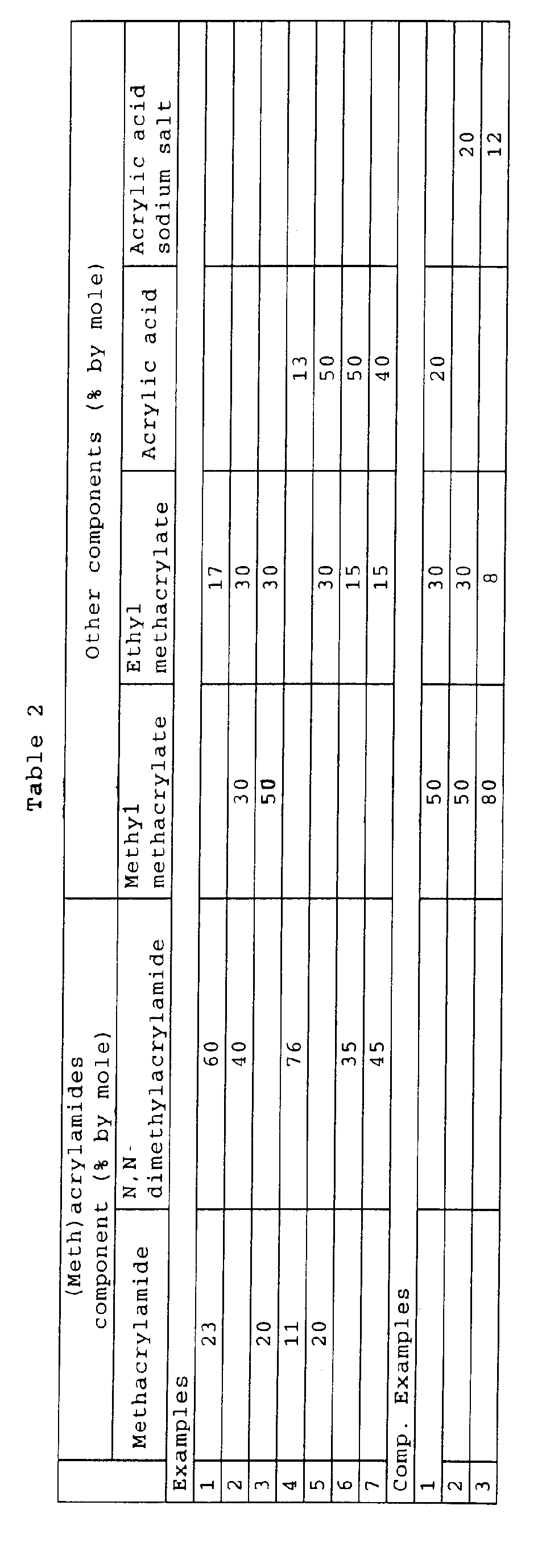
- With respect to the respective photosensitive printing plates thus obtained, the following items were evaluated and performances of the mat particles were confirmed. The results are shown in Table 3. The evaluation results of the respective items were judged by five ranks (A to E). The more the results approximate to A, the better. While the more the results approximate to E, the worse.
- The respective photosensitive printing plates were allowed to stand under the conditions of a temperature of 60 ºC and a humidity of 75% for 24 hours and developed at 30 ºC for 20 seconds by an automatic processor PD-912 manufactured by Dainippon Screen MFG. Co., Ltd., Incorporation, using a developer prepared by diluting a developer ND-1 manufactured by Kodak Polychrome Graphics Japan Ltd. with water in a volume ratio of 1:3 (ND-1 : water) , and then the developing properties of the trace of the mat particles were confirmed.
- Five photosensitive printing plates were stacked without interleaving paper between them and allowed to stand under the conditions of a temperature of 40 ºC and a humidity of 80% for five hours while applying a pressure of 0.2 kg/cm2, and then the state of contact between the plates was confirmed.
- A developer in the state of being exhausted was prepared by treating a negative working photosensitive planographic printing plate NN-2 manufactured by Kodak Polychrome Graphics Japan Ltd. with a developer in a volume ratio of 1:3 (ND-1: water) . Using this exhausted developer, the respective photosensitive printing plates were developed, and then the developing properties of the trace of the mat particles were confirmed.
Evaluation results HT developing properties Tack Developing properties for exhausted developer Examples 1 A A A 2 A A A 3 A A A 4 A A-B A-B 5 A-B A A-B 6 A-B A A 7 A-B A A Comp. Examples 1 B A E 2 E A A-B 3 3 E A A-B - As shown in Table 2, the use of a copolymer containing (meth)acrylamides as a unit afforded a photosensitive printing plate which is superior in stability during the storage and is free from tack, and which has excellent developing properties to the exhausted developer.
Claims (17)
- A photosensitive printing plate (1) comprising a substrate (2), a photosensitive layer (3) formed on said substrate (2), and mat particles (4) formed on said photosensitive layer (3),
wherein said mat particles (4) contain a copolymer which contains at least one (meth)acrylamides as a unit. - A photosensitive printing plate (1) according to claim 1, wherein said (meth) acrylamides comprise at least one selected from the group consisting of acrylamide, methacrylamide, N,N-dimethylacrylamide and N,N-dimethylmethacrylamide.
- A photosensitive printing plate (1) according to claim 1, wherein the amount of said (meth)acrylamides is within a range of 20 to 90% by mole, based on the total constituent components of the copolymer.
- A photosensitive printing plate (1) according to claim 1, wherein the amount of said (meth)acrylamides is within a range of 35 to 85% by mole, based on the total constituent components of the copolymer.
- A photosensitive printing plate (1) according to claim 1, wherein said copolymer does not have a sulfonic acid group.
- A photosensitive printing plate (1) according to claim 1, wherein said photosensitive layer (3) is a layer made of a positive working photosensitive composition.
- A photosensitive printing plate (1) according to claim 1, wherein said photosensitive layer (3) is a layer made of a negative working photosensitive composition.
- A photosensitive printing plate (1) according to claim 6, wherein said positive working photosensitive composition comprises an alkali-soluble resin and an o-quinonediazide compound.
- A photosensitive printing plate (1) according to claim 7, wherein said negative working photosensitive composition comprises a photosensitive diazonium compound.
- A photosensitive printing plate (1) according to claim 7, wherein said negative working photosensitive composition comprises an addition-polymerizable unsaturated group-containing compound and a photopolymerization initiator.
- A photosensitive printing plate (1) according to claim 7, wherein said negative working photosensitive composition comprises a photosensitive diazonium compound, an addition-polymerizable unsaturated group-containing compound and a photopolymerization initiator.
- A photosensitive printing plate (1) according to claim 1, wherein the number of said mat particles (4) is within a range of 1 to 1000/mm2.
- A photosensitive printing plate (1) according to claim 1, wherein the number of said mat particles (4) is within a range of 5 to 500/mm2.
- A photosensitive printing plate (1) according to claim 1, wherein the height of said mat particles (4) is within a range of 0.5 to 20µm.
- A method of producing a photosensitive printing plate (1), which comprises the steps of:forming a photosensitive layer (3) on a substrate (2), andcoating said photosensitive layer (3) with a solution prepared by dissolving a copolymer containing at least one (meth)acrylamides as a unit in a solvent to form mat particles (4).
- A method of producing a photosensitive printing plate (1) according to claim 16, wherein said solvent is a solvent containing water.
- A method of producing a photosensitive printing plate (1) according to claim 15, wherein said step of coating is performed by a electrostatic coating method.
Applications Claiming Priority (2)
| Application Number | Priority Date | Filing Date | Title |
|---|---|---|---|
| JP31740599 | 1999-11-08 | ||
| JP31740599A JP4361651B2 (en) | 1999-11-08 | 1999-11-08 | Photosensitive printing plate and method for producing the same |
Publications (2)
| Publication Number | Publication Date |
|---|---|
| EP1098224A1 true EP1098224A1 (en) | 2001-05-09 |
| EP1098224B1 EP1098224B1 (en) | 2007-03-14 |
Family
ID=18087885
Family Applications (1)
| Application Number | Title | Priority Date | Filing Date |
|---|---|---|---|
| EP00309861A Expired - Lifetime EP1098224B1 (en) | 1999-11-08 | 2000-11-06 | Photosensitive printing plate and method of producing the same |
Country Status (4)
| Country | Link |
|---|---|
| US (1) | US6461784B1 (en) |
| EP (1) | EP1098224B1 (en) |
| JP (1) | JP4361651B2 (en) |
| DE (1) | DE60033907T2 (en) |
Families Citing this family (3)
| Publication number | Priority date | Publication date | Assignee | Title |
|---|---|---|---|---|
| US6767693B1 (en) | 2002-07-30 | 2004-07-27 | Advanced Micro Devices, Inc. | Materials and methods for sub-lithographic patterning of contact, via, and trench structures in integrated circuit devices |
| US6884735B1 (en) * | 2002-08-21 | 2005-04-26 | Advanced Micro Devices, Inc. | Materials and methods for sublithographic patterning of gate structures in integrated circuit devices |
| JP6702251B2 (en) * | 2017-04-17 | 2020-05-27 | 信越化学工業株式会社 | Positive resist film laminate and pattern forming method |
Citations (4)
| Publication number | Priority date | Publication date | Assignee | Title |
|---|---|---|---|---|
| EP0154981A2 (en) * | 1984-03-12 | 1985-09-18 | Fuji Photo Film Co., Ltd. | Process for producing light-sensitive lithographic plate requiring no dampening solution |
| JPH04145437A (en) * | 1990-10-08 | 1992-05-19 | Konica Corp | Production of waterless planograph |
| US5576137A (en) * | 1993-10-18 | 1996-11-19 | Agfa-Gevaert Ag | Matted, radiation-sensitive recording material and printing plate |
| US5916741A (en) * | 1997-08-26 | 1999-06-29 | Eastman Kodak Company | Photographic elements containing elastomeric matting agent |
Family Cites Families (9)
| Publication number | Priority date | Publication date | Assignee | Title |
|---|---|---|---|---|
| GB1542131A (en) * | 1975-02-19 | 1979-03-14 | Fuji Photo Film Co Ltd | Light-sensitive printing plate precursors and process for the production thereof |
| JPS51111102A (en) | 1975-03-24 | 1976-10-01 | Fuji Photo Film Co Ltd | Photosensitive printing plates |
| JPS5512974A (en) | 1978-07-15 | 1980-01-29 | Konishiroku Photo Ind Co Ltd | Photosensitive printing plate |
| JPS5734558A (en) | 1980-08-11 | 1982-02-24 | Fuji Photo Film Co Ltd | Photosensitive printing plate |
| JPS5758152A (en) | 1980-09-25 | 1982-04-07 | Fuji Photo Film Co Ltd | Photosensitive printing plate |
| JPS57211146A (en) | 1981-06-23 | 1982-12-24 | Fuji Photo Film Co Ltd | Photopolymerizable composition |
| JPS58182636A (en) | 1982-04-20 | 1983-10-25 | Fuji Photo Film Co Ltd | Photosensitive printing plate |
| US5595862A (en) * | 1995-02-01 | 1997-01-21 | Eastman Kodak Company | Photographic elements containing matte particles of bimodal size distribution |
| JPH08286380A (en) * | 1995-04-11 | 1996-11-01 | Mitsubishi Chem Corp | Photosensitive lithographic printing plate and method for producing the same |
-
1999
- 1999-11-08 JP JP31740599A patent/JP4361651B2/en not_active Expired - Fee Related
-
2000
- 2000-11-06 EP EP00309861A patent/EP1098224B1/en not_active Expired - Lifetime
- 2000-11-06 DE DE60033907T patent/DE60033907T2/en not_active Expired - Fee Related
- 2000-11-08 US US09/708,888 patent/US6461784B1/en not_active Expired - Fee Related
Patent Citations (4)
| Publication number | Priority date | Publication date | Assignee | Title |
|---|---|---|---|---|
| EP0154981A2 (en) * | 1984-03-12 | 1985-09-18 | Fuji Photo Film Co., Ltd. | Process for producing light-sensitive lithographic plate requiring no dampening solution |
| JPH04145437A (en) * | 1990-10-08 | 1992-05-19 | Konica Corp | Production of waterless planograph |
| US5576137A (en) * | 1993-10-18 | 1996-11-19 | Agfa-Gevaert Ag | Matted, radiation-sensitive recording material and printing plate |
| US5916741A (en) * | 1997-08-26 | 1999-06-29 | Eastman Kodak Company | Photographic elements containing elastomeric matting agent |
Non-Patent Citations (1)
| Title |
|---|
| DATABASE WPI Section Ch Week 199226, Derwent World Patents Index; Class A14, AN 1992-214395, XP002159091 * |
Also Published As
| Publication number | Publication date |
|---|---|
| DE60033907D1 (en) | 2007-04-26 |
| EP1098224B1 (en) | 2007-03-14 |
| JP4361651B2 (en) | 2009-11-11 |
| JP2001133985A (en) | 2001-05-18 |
| DE60033907T2 (en) | 2007-11-22 |
| US6461784B1 (en) | 2002-10-08 |
Similar Documents
| Publication | Publication Date | Title |
|---|---|---|
| US6514657B1 (en) | Photosensitive composition for lithographic printing plate and photosensitive lithographic printing plate | |
| EP0737896B1 (en) | Photosensitive composition and photosensitive planographic printing plate | |
| US5393637A (en) | Photosensitive composition for offset printing comprising a binder, a photosensitive substance and a microgel made from an acrylic resin having carboxyl groups as the emulsifier | |
| JP2000250203A (en) | Pigment-containing recording material with back coating for the production of offset printing plates | |
| US4576893A (en) | Presensitized lithographic printing plate precursor | |
| US6689539B2 (en) | Photosensitive composition and photosensitive lithographic printing plate | |
| EP1167063B1 (en) | Presensitized printing plate with pigmented back coating | |
| EP1098224B1 (en) | Photosensitive printing plate and method of producing the same | |
| CA2203505C (en) | On-press developable printing plate with amphoteric hydrogen bond forming developability stabilizer | |
| EP0883028B1 (en) | Photosensitive lithographic plate and process for producing same | |
| EP0575802B1 (en) | Photopolymeric printing plates | |
| US5795698A (en) | On-press developable printing plate with amphoteric hydrogen bond forming developability stabilizer | |
| EP1468332B1 (en) | Photosensitive composition and photosensitive planographic printing plate | |
| JP3583217B2 (en) | Photosensitive composition and photosensitive lithographic printing plate | |
| JPH10319582A (en) | Photosensitive composition and photosensitive lithographic printing plate | |
| JPH1090886A (en) | Photosensitive resin composition for lithographic printing | |
| JPS61284759A (en) | Photosensitive composition for negative type lithographic plate | |
| JPS63116147A (en) | Photosensitive composition | |
| JPS6119027B2 (en) | ||
| JP4116145B2 (en) | Photosensitive composition and photosensitive lithographic printing plate | |
| JPH024253A (en) | Waterless photosensitive planographic plate | |
| JPH04110853A (en) | Photosensitive composition | |
| JPH10312058A (en) | Photosensitive composition and photosensitive lithographic printing plate | |
| JPH05303195A (en) | Fountain-free photosensitive lithographic printing plate and method for producing the same | |
| JPH0279043A (en) | Waterless photosensitive planographic printing plate |
Legal Events
| Date | Code | Title | Description |
|---|---|---|---|
| PUAI | Public reference made under article 153(3) epc to a published international application that has entered the european phase |
Free format text: ORIGINAL CODE: 0009012 |
|
| AK | Designated contracting states |
Kind code of ref document: A1 Designated state(s): DE FR GB IT |
|
| AX | Request for extension of the european patent |
Free format text: AL;LT;LV;MK;RO;SI |
|
| 17P | Request for examination filed |
Effective date: 20010924 |
|
| AKX | Designation fees paid |
Free format text: DE FR GB IT |
|
| 17Q | First examination report despatched |
Effective date: 20031222 |
|
| RAP1 | Party data changed (applicant data changed or rights of an application transferred) |
Owner name: KODAK POLYCHROME GRAPHICS COMPANY LTD. |
|
| GRAP | Despatch of communication of intention to grant a patent |
Free format text: ORIGINAL CODE: EPIDOSNIGR1 |
|
| GRAS | Grant fee paid |
Free format text: ORIGINAL CODE: EPIDOSNIGR3 |
|
| GRAA | (expected) grant |
Free format text: ORIGINAL CODE: 0009210 |
|
| AK | Designated contracting states |
Kind code of ref document: B1 Designated state(s): DE FR GB IT |
|
| REG | Reference to a national code |
Ref country code: GB Ref legal event code: FG4D |
|
| REF | Corresponds to: |
Ref document number: 60033907 Country of ref document: DE Date of ref document: 20070426 Kind code of ref document: P |
|
| ET | Fr: translation filed | ||
| PLBE | No opposition filed within time limit |
Free format text: ORIGINAL CODE: 0009261 |
|
| STAA | Information on the status of an ep patent application or granted ep patent |
Free format text: STATUS: NO OPPOSITION FILED WITHIN TIME LIMIT |
|
| 26N | No opposition filed |
Effective date: 20071217 |
|
| PGFP | Annual fee paid to national office [announced via postgrant information from national office to epo] |
Ref country code: IT Payment date: 20081124 Year of fee payment: 9 |
|
| PGFP | Annual fee paid to national office [announced via postgrant information from national office to epo] |
Ref country code: FR Payment date: 20081106 Year of fee payment: 9 |
|
| PGFP | Annual fee paid to national office [announced via postgrant information from national office to epo] |
Ref country code: DE Payment date: 20081128 Year of fee payment: 9 |
|
| PGFP | Annual fee paid to national office [announced via postgrant information from national office to epo] |
Ref country code: GB Payment date: 20081008 Year of fee payment: 9 |
|
| GBPC | Gb: european patent ceased through non-payment of renewal fee |
Effective date: 20091106 |
|
| REG | Reference to a national code |
Ref country code: FR Ref legal event code: ST Effective date: 20100730 |
|
| PG25 | Lapsed in a contracting state [announced via postgrant information from national office to epo] |
Ref country code: FR Free format text: LAPSE BECAUSE OF NON-PAYMENT OF DUE FEES Effective date: 20091130 |
|
| PG25 | Lapsed in a contracting state [announced via postgrant information from national office to epo] |
Ref country code: DE Free format text: LAPSE BECAUSE OF NON-PAYMENT OF DUE FEES Effective date: 20100601 |
|
| PG25 | Lapsed in a contracting state [announced via postgrant information from national office to epo] |
Ref country code: GB Free format text: LAPSE BECAUSE OF NON-PAYMENT OF DUE FEES Effective date: 20091106 |
|
| PG25 | Lapsed in a contracting state [announced via postgrant information from national office to epo] |
Ref country code: IT Free format text: LAPSE BECAUSE OF NON-PAYMENT OF DUE FEES Effective date: 20091106 |