EP1097985A1 - A Method of chromatographic isolation for non-glyceride components - Google Patents
A Method of chromatographic isolation for non-glyceride components Download PDFInfo
- Publication number
- EP1097985A1 EP1097985A1 EP00309745A EP00309745A EP1097985A1 EP 1097985 A1 EP1097985 A1 EP 1097985A1 EP 00309745 A EP00309745 A EP 00309745A EP 00309745 A EP00309745 A EP 00309745A EP 1097985 A1 EP1097985 A1 EP 1097985A1
- Authority
- EP
- European Patent Office
- Prior art keywords
- chromatographic isolation
- glyceride components
- esterification
- isolation according
- glyceride
- Prior art date
- Legal status (The legal status is an assumption and is not a legal conclusion. Google has not performed a legal analysis and makes no representation as to the accuracy of the status listed.)
- Granted
Links
Classifications
-
- C—CHEMISTRY; METALLURGY
- C07—ORGANIC CHEMISTRY
- C07C—ACYCLIC OR CARBOCYCLIC COMPOUNDS
- C07C403/00—Derivatives of cyclohexane or of a cyclohexene or of cyclohexadiene, having a side-chain containing an acyclic unsaturated part of at least four carbon atoms, this part being directly attached to the cyclohexane or cyclohexene or cyclohexadiene rings, e.g. vitamin A, beta-carotene, beta-ionone
- C07C403/24—Derivatives of cyclohexane or of a cyclohexene or of cyclohexadiene, having a side-chain containing an acyclic unsaturated part of at least four carbon atoms, this part being directly attached to the cyclohexane or cyclohexene or cyclohexadiene rings, e.g. vitamin A, beta-carotene, beta-ionone having side-chains substituted by six-membered non-aromatic rings, e.g. beta-carotene
-
- B—PERFORMING OPERATIONS; TRANSPORTING
- B01—PHYSICAL OR CHEMICAL PROCESSES OR APPARATUS IN GENERAL
- B01D—SEPARATION
- B01D15/00—Separating processes involving the treatment of liquids with solid sorbents; Apparatus therefor
- B01D15/08—Selective adsorption, e.g. chromatography
- B01D15/26—Selective adsorption, e.g. chromatography characterised by the separation mechanism
- B01D15/32—Bonded phase chromatography
- B01D15/325—Reversed phase
-
- B—PERFORMING OPERATIONS; TRANSPORTING
- B01—PHYSICAL OR CHEMICAL PROCESSES OR APPARATUS IN GENERAL
- B01D—SEPARATION
- B01D15/00—Separating processes involving the treatment of liquids with solid sorbents; Apparatus therefor
- B01D15/08—Selective adsorption, e.g. chromatography
- B01D15/26—Selective adsorption, e.g. chromatography characterised by the separation mechanism
- B01D15/36—Selective adsorption, e.g. chromatography characterised by the separation mechanism involving ionic interaction, e.g. ion-exchange, ion-pair, ion-suppression or ion-exclusion
- B01D15/361—Ion-exchange
-
- B—PERFORMING OPERATIONS; TRANSPORTING
- B01—PHYSICAL OR CHEMICAL PROCESSES OR APPARATUS IN GENERAL
- B01D—SEPARATION
- B01D15/00—Separating processes involving the treatment of liquids with solid sorbents; Apparatus therefor
- B01D15/08—Selective adsorption, e.g. chromatography
- B01D15/26—Selective adsorption, e.g. chromatography characterised by the separation mechanism
- B01D15/40—Selective adsorption, e.g. chromatography characterised by the separation mechanism using supercritical fluid as mobile phase or eluent
-
- B—PERFORMING OPERATIONS; TRANSPORTING
- B01—PHYSICAL OR CHEMICAL PROCESSES OR APPARATUS IN GENERAL
- B01J—CHEMICAL OR PHYSICAL PROCESSES, e.g. CATALYSIS OR COLLOID CHEMISTRY; THEIR RELEVANT APPARATUS
- B01J20/00—Solid sorbent compositions or filter aid compositions; Sorbents for chromatography; Processes for preparing, regenerating or reactivating thereof
- B01J20/281—Sorbents specially adapted for preparative, analytical or investigative chromatography
- B01J20/282—Porous sorbents
- B01J20/283—Porous sorbents based on silica
-
- B—PERFORMING OPERATIONS; TRANSPORTING
- B01—PHYSICAL OR CHEMICAL PROCESSES OR APPARATUS IN GENERAL
- B01J—CHEMICAL OR PHYSICAL PROCESSES, e.g. CATALYSIS OR COLLOID CHEMISTRY; THEIR RELEVANT APPARATUS
- B01J20/00—Solid sorbent compositions or filter aid compositions; Sorbents for chromatography; Processes for preparing, regenerating or reactivating thereof
- B01J20/281—Sorbents specially adapted for preparative, analytical or investigative chromatography
- B01J20/286—Phases chemically bonded to a substrate, e.g. to silica or to polymers
- B01J20/287—Non-polar phases; Reversed phases
-
- C—CHEMISTRY; METALLURGY
- C11—ANIMAL OR VEGETABLE OILS, FATS, FATTY SUBSTANCES OR WAXES; FATTY ACIDS THEREFROM; DETERGENTS; CANDLES
- C11B—PRODUCING, e.g. BY PRESSING RAW MATERIALS OR BY EXTRACTION FROM WASTE MATERIALS, REFINING OR PRESERVING FATS, FATTY SUBSTANCES, e.g. LANOLIN, FATTY OILS OR WAXES; ESSENTIAL OILS; PERFUMES
- C11B7/00—Separation of mixtures of fats or fatty oils into their constituents, e.g. saturated oils from unsaturated oils
- C11B7/0008—Separation of mixtures of fats or fatty oils into their constituents, e.g. saturated oils from unsaturated oils by differences of solubilities, e.g. by extraction, by separation from a solution by means of anti-solvents
- C11B7/005—Separation of mixtures of fats or fatty oils into their constituents, e.g. saturated oils from unsaturated oils by differences of solubilities, e.g. by extraction, by separation from a solution by means of anti-solvents in solvents used at superatmospheric pressures
-
- Y—GENERAL TAGGING OF NEW TECHNOLOGICAL DEVELOPMENTS; GENERAL TAGGING OF CROSS-SECTIONAL TECHNOLOGIES SPANNING OVER SEVERAL SECTIONS OF THE IPC; TECHNICAL SUBJECTS COVERED BY FORMER USPC CROSS-REFERENCE ART COLLECTIONS [XRACs] AND DIGESTS
- Y02—TECHNOLOGIES OR APPLICATIONS FOR MITIGATION OR ADAPTATION AGAINST CLIMATE CHANGE
- Y02P—CLIMATE CHANGE MITIGATION TECHNOLOGIES IN THE PRODUCTION OR PROCESSING OF GOODS
- Y02P20/00—Technologies relating to chemical industry
- Y02P20/50—Improvements relating to the production of bulk chemicals
- Y02P20/54—Improvements relating to the production of bulk chemicals using solvents, e.g. supercritical solvents or ionic liquids
Definitions
- the invention relates to a method of chromatographic isolation for non-glyceride components particularly squalenes, carotenes, vitamin E (sometimes abbreviated as Vit. E) sterols and/or the like, from crude palm oil, palm oils products and/or by-products, vegetable oils and/or the like non-glyceride components-comprising compounds.
- non-glyceride components particularly squalenes, carotenes, vitamin E (sometimes abbreviated as Vit. E) sterols and/or the like, from crude palm oil, palm oils products and/or by-products, vegetable oils and/or the like non-glyceride components-comprising compounds.
- Crude palm oil contains about 5 % of "non-glyceride components" which include carotenoids, tocols (tocopherols and tocotrienols), sterols and squalene.
- the carotenoids present at 500-700ppm and comprising mainly a and ⁇ carotenes, are important constituents with pro-vitamin A activity, possible antitumor formation properties, and other physiological activities.
- the tocols which are Vitamin E and also natural anti-oxidants, are present at approximately 600 to 1000 ppm in crude palm oil; the major component being the gamma-tocotrienol which has recently been found to have anti-cancer properties besides its known anti-oxidant activity. Tocotrienol has been found to lower blood cholesterol.
- the sterols consisting mainly of ⁇ -sitosterol, stigmasterol and campesterol, provide raw materials for steroid intermediates and drugs.
- ⁇ -Sitosterol also possesses hypocholesterolemic effect.
- Squalene is an important ingredient for cosmetics. It also shows beneficial physiological properties.
- the oil is saponified to give soap, glycerol and a non-saponifiable fraction containing carotenes.
- the iodine is added to a solution of palm oil in petroleum ether, an insoluble precipitate of carotene di-iodide is formed.
- the iodo-compound when treated with sodium thiosulphate however yields iso-carotene or dehydro-carotene which has no biological activity.
- the triglycerides are broken down to fatty acids and methyl esters which then form insoluble compounds with urea and thiourea, leaving the carotenoids in the remaining liquid.
- carotenes can also be obtained by molecular distillation (10 -3 - 10 -4 mm Hg). Fractions collected at 230°C have a carotene content of about five times that of the original oil.
- non-glyceride components i.e. carotenoids, tocols, sterols and squalene
- plant source such as CPO (crude palm oil), palm oil products and/or by-products, vegetable oils and fats and/or the like non-glyceride components-comprising compounds.
- a method of chromatographic isolation for non-glyceride components comprising the use of supercritical fluid (such as SC-CO 2 ) in combination with adsorbents (such as silica gel or C18 reverse phase silica gel).
- supercritical fluid such as SC-CO 2
- adsorbents such as silica gel or C18 reverse phase silica gel.
- High concentration of carotenes, vitamin E, sterols and squalene can be obtained by monitoring supercritical fluid process conditions such as temperature between 30°C-100°C, pressure from 50kg/cm 2 to 600kg/cm 2 , with and without an to entrainer ( co-solvent such as alcohols).
- supercritical fluid process conditions such as temperature between 30°C-100°C, pressure from 50kg/cm 2 to 600kg/cm 2 , with and without an to entrainer ( co-solvent such as alcohols).
- a main advantage of the invention lies in the use of liquified gas at supercritical conditions, hence avoiding or reducing the prior requirements for hazardous solvents.
- a method of chromatographic isolation for "minor non-glyceride components” including carotenoids, tocols, sterols and squalene) from CPO (crude palm oil), palm oil products and/or by-products, vegetable oil and/.or the like non-glyceride components-comprising compounds, said method comprising the following steps for three different routes as described below:
- step (i) above is carried out employing
- step (ii) is carried out employing a basic catalyst .
- both the esterification and transesterification are carried out using an enzyme; for example candida rugosa and lipase. 1 to 20% by weight of catalyst may be employed depending upon the weight of the free fatty carboxylic to acid moiety present in the non-glyceride components-comprising compounds.
- the monohydric alcohols used in the esterification of step (i) or transesterification of step (ii) comprise one or more C 1 to C 8 alcohols, most preferably methanol.
- the selective adsorbent for the adsorption of the non-glyceride components comprise silica gel and/or C18 reverse phase silica gel.
- the adsorbents may be subjected to adsorption of the non-glyceride components present within anyone of the following;
- the solvents employed for the present method comprises;
- Carotene, tocols, sterols and squalene can be isolated with > 50% purity in a single run by varying pressure from 50 kg/cm 2 -600kg/cm 2 at temperatures 30°C-100°C.
- supercritical fluid applied to solid adsorbents such as silica gel and/or C18 reverse phase silica gel, provides a very satisfactory means for isolating non-glyceride components (including carotenoids, tocols, sterols and squalene) from CPO (crude palm oil), palm oil products and/or by-products, vegetable oil and/or the like non-glyceride components-comprising compounds.
- CPO crude palm oil
- palm oil products and/or by-products vegetable oil and/or the like non-glyceride components-comprising compounds.
- Crude palm oil methyl esters containing "minor" non-glyceride components including carotenes, vitamin E, squalene and sterols
- “minor” non-glyceride components including carotenes, vitamin E, squalene and sterols
- alkali bisulphate or sulphonated ion exchange resin for esterification
- methanol a mixture of methanol
- the carotene concentrate was subjected to saponification process to obtain unsaponifiable matters containing carotenes, vitamin E, sterols and squalene.
- Various fractions at different time intervals were collected and results are shown in Table 1.
- Squalene was collected at Pressure 100-180kg/cm 2
- sterols at >280 kg/cm 2 .
- Example 3 The procedure of Example 1 was repeated except that crude palm oil methyl esters were used directly to load onto supercritical fluid chromatography to recover carotenes, vitamin E, sterols and squalene separately in different fractions. The results are shown in Table 3.
- Example 1 The procedure of Example 1 using unsaponifiable matters of the carotene concentrate was repeated except that only 100% SC-CO2 (without entrainer) was used for adsorbing/desorbing carotenes, vitamin E, sterols and squalene. Results are shown in Table 4.
- Example 2 The procedure of Example 2 using palm carotene concentrate (4% concentration) was repeated except that only 100% SC-C02 (without entrainer) was used for adsorbing/desorbing carotenes, vitamin E, sterols and squalene. Results are shown in Table 5.
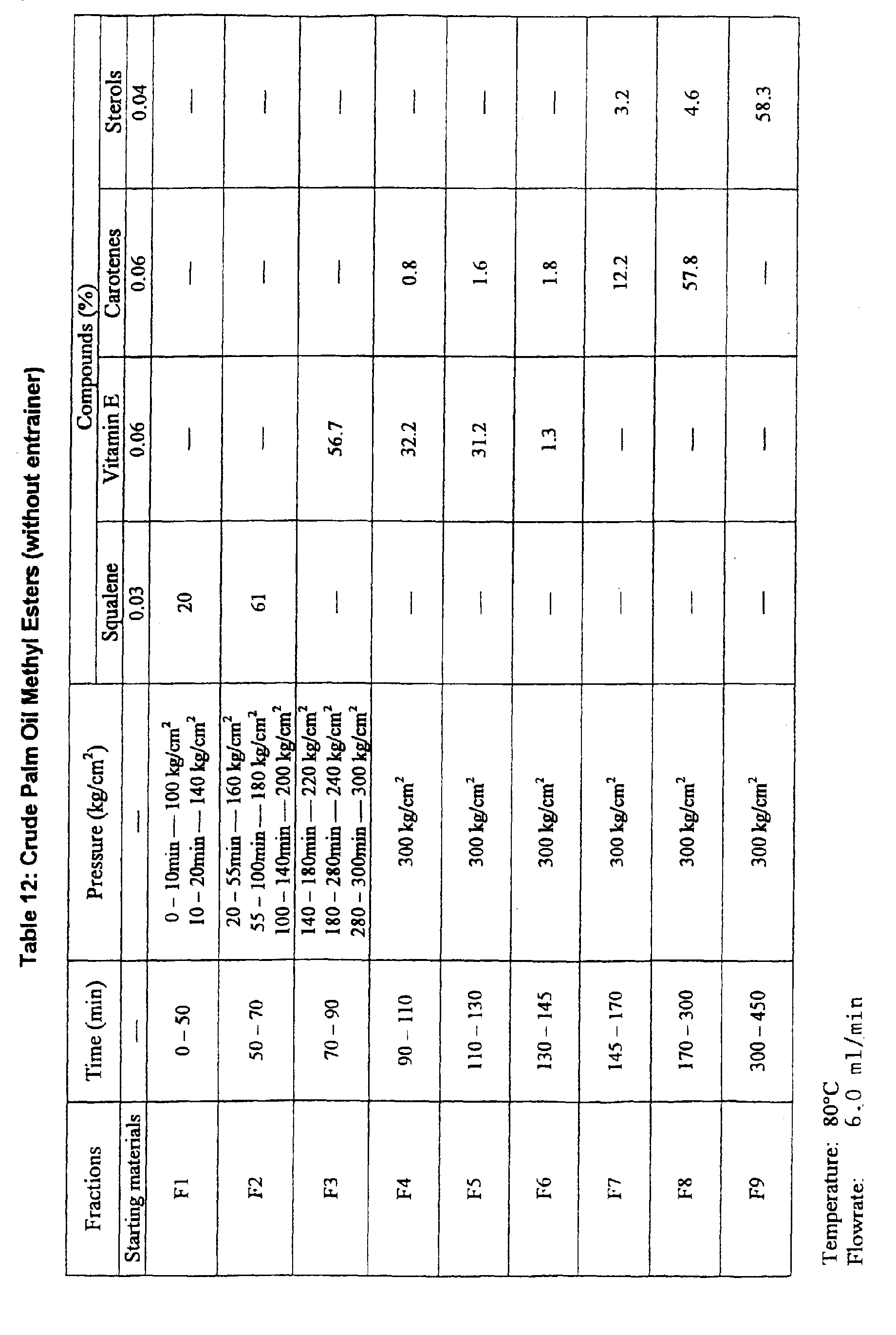
- Example 3 The procedure of Example 3 using crude palm oil methyl esters was repeated except that 100% of SC-C02 (without entrainer) was used. Results are shown in Table 6.
- Example 1 The procedure of Example 1 using unsaponifiable matters of the carotene concentrate was repeated except that the adsorbent used was C18 reverse phase silica gel instead of silica gel. Results are shown in Table 7.
- Example 2 The procedure of Example 2 using palm carotene concentrate (4% concentration) was repeated except that the adsorbent used was C18 reverse phase silica gel instead of silica gel. Results are shown in Table 8.
- Example 1 The procedure of Example 1, 2 and 3 were repeated except that other palm oil products such as neutralized palm oil, crude palm olein, crude palm stearin, palm fibre oil and palm fatty acid distillate were used.
- the results are shown in Table 13.
- Vitamin E concentrate (0.01 g; concentration: -50%) was dissolved in organic solvent, such as dichloromethane or ethanol and loaded onto a column (silica gel, with internal diameter 20mm and length 250mm).
- the Vitamin E concentrate mixture was eluted using a mixture of supercritical carbon dioxide (5ml, 95.2%) and an entrainer, ethanol (0.25ml, 4.8%) with a flowrate of 5.25ml/min.
- the four vitamin E isomers were collected at different time interval and are shown in Table 16. The presence and concentration of Vitamin E isomer were confirmed by HPLC as in Example 1.
- Example 17 Isolation of Carotenes, Vitamin E, sterols and squalene (Fixed pressure and temperature)
- Example 16 The procedure of Example 16 was repeated except the unsaponifiable matter of palm carotene concentrate (0.01 g) containing carotenes (21.6%), Vit E (2.7%), sterols (56.5%) and squalene (8.2%) was used. Carotenes, Vit E, sterols and squalene were separated into different fractions and the results are shown in Table 17. The difference between Example 17 and that of Example 1 is that carotenes, Vit E, sterols and squalene can be isolated at fixed temperature (70°C) and pressure (180 kg/cm 2 ).
Landscapes
- Chemical & Material Sciences (AREA)
- Analytical Chemistry (AREA)
- Organic Chemistry (AREA)
- Chemical Kinetics & Catalysis (AREA)
- Oil, Petroleum & Natural Gas (AREA)
- Engineering & Computer Science (AREA)
- Life Sciences & Earth Sciences (AREA)
- Wood Science & Technology (AREA)
- Organic Low-Molecular-Weight Compounds And Preparation Thereof (AREA)
- Acyclic And Carbocyclic Compounds In Medicinal Compositions (AREA)
- Steroid Compounds (AREA)
- Pyrane Compounds (AREA)
- Treatment Of Liquids With Adsorbents In General (AREA)
- Fats And Perfumes (AREA)
Abstract
the adsorption and/or desorption of the non-glyceride components is carried out under a supercritical fluid environment.
Description
- The invention relates to a method of chromatographic isolation for non-glyceride components particularly squalenes, carotenes, vitamin E (sometimes abbreviated as Vit. E) sterols and/or the like, from crude palm oil, palm oils products and/or by-products, vegetable oils and/or the like non-glyceride components-comprising compounds.
- Crude palm oil contains about 5 % of "non-glyceride components" which include carotenoids, tocols (tocopherols and tocotrienols), sterols and squalene. The carotenoids, present at 500-700ppm and comprising mainly a and β carotenes, are important constituents with pro-vitamin A activity, possible antitumor formation properties, and other physiological activities. The tocols which are Vitamin E and also natural anti-oxidants, are present at approximately 600 to 1000 ppm in crude palm oil; the major component being the gamma-tocotrienol which has recently been found to have anti-cancer properties besides its known anti-oxidant activity. Tocotrienol has been found to lower blood cholesterol. The sterols consisting mainly of β-sitosterol, stigmasterol and campesterol, provide raw materials for steroid intermediates and drugs. β-Sitosterol also possesses hypocholesterolemic effect. Squalene is an important ingredient for cosmetics. It also shows beneficial physiological properties.
- Several methods have been developed to extract these valuable compounds. In the case of the carotenoids, the known methods can be classified as follows:-
- (i) Extraction by saponification e.g. British Patent 567,682; U.S. Patent 2,460,796; U.S. Patent 2,440,029; U.S. Patent 2,572,467; U.S. Patent 2,652,433.
- (ii) Iodine method
- (iii) Urea process
- (iv) Extraction using Fuller's earth or activated carbon, e.g. British Patent 691,924; British Patent 1,562,794; U.S. Patent 2,484,040.
- (v) Extraction by selective solvents e.g. U.S. Patent 2,432,021.
- (vi) Molecular Distillation.
-
- In the saponification method (i) the oil is saponified to give soap, glycerol and a non-saponifiable fraction containing carotenes.
- In the iodine method (ii), the iodine is added to a solution of palm oil in petroleum ether, an insoluble precipitate of carotene di-iodide is formed. The iodo-compound when treated with sodium thiosulphate however yields iso-carotene or dehydro-carotene which has no biological activity.
- With the urea method (iii), the triglycerides are broken down to fatty acids and methyl esters which then form insoluble compounds with urea and thiourea, leaving the carotenoids in the remaining liquid.
- Extraction of carotenes using adsorbents has been carried out using Fuller's earth and activated carbon (method iv). However, the extraction of the carotenes from the earth gives oxidised or isomerised products of carotenes. Carotene is concentrated six times in the extract.
- Extraction of carotenes by selective solvents (method v) has been carried out using propane or furfural. The carotene is concentrated (three times that of the original oil) in the furfural phase.
- By method (vi) carotenes can also be obtained by molecular distillation (10-3- 10-4 mm Hg). Fractions collected at 230°C have a carotene content of about five times that of the original oil.
- To-date, there has not been any method which discloses the use of supercritical fluid in the adsorption/desorption chromatography isolation/separation of the non-glyceride components (i.e. carotenoids, tocols, sterols and squalene) from plant source such as CPO (crude palm oil), palm oil products and/or by-products, vegetable oils and fats and/or the like non-glyceride components-comprising compounds.
- All known method previously disclosed in the adsorption/desorption cromatographic separation solely involve the use of solvents (which are costly and hazardous). Thus, there is a need to provide a separation and/or an isolation process, which avoids or discourages the sole use of solvents and consequently rendering it "non-hazardous" for recovering these non-glyceride components.
- In accordance with the present invention, there is provided a method of chromatographic isolation for non-glyceride components (carotenes, vitamin E [sometimes abbreviated as Vit. E], sterols, squalene) from natural oils and fats, wherein the method comprises the use of supercritical fluid (such as SC-CO2) in combination with adsorbents (such as silica gel or C18 reverse phase silica gel). The present invention may be subjected directly and/or indirectly to
- (a) crude vegetable oil esters (via catalytic alcoholic esterification/transesterification of vegetable oils) or
- (b) concentrate (through removal of the bulk of the esters from (a) via vacuum
distillation including molecular distillation)
or - (c) the unsaponifiable matters of the concentrate in (b) (through saponification process)
-
- High concentration of carotenes, vitamin E, sterols and squalene can be obtained by monitoring supercritical fluid process conditions such as temperature between 30°C-100°C, pressure from 50kg/cm2 to 600kg/cm2 , with and without an to entrainer ( co-solvent such as alcohols).
- A main advantage of the invention lies in the use of liquified gas at supercritical conditions, hence avoiding or reducing the prior requirements for hazardous solvents.
- According to the present invention there is provided a method of chromatographic isolation for "minor non-glyceride components" (including carotenoids, tocols, sterols and squalene) from CPO (crude palm oil), palm oil products and/or by-products, vegetable oil and/.or the like non-glyceride components-comprising compounds, said method comprising the following steps for three different routes as described below:
-
- (i) Esterifying the free fatty acid component of the non-glyceride components-comprising compounds with one or more monohydric alcohols to form an esterified compound with a very low free fatty acid content;
- (ii) Trans-esterifying the glyceride components with one or more monohydirc alcohols to convert into monoesters;
- (iii) Introducing the non-glyceride components-comprising compounds (i.e. esters from steps (i) and (ii) above) to allow the adsorption of non-glyceride components (carotenoids, tocols, sterols and squalene) onto a selective adsorbent; and subsequently
- (iv) Desorbing the non-glyceride components from the adsorbent, wherein the adsorption/desorption of the non-glyceride components in steps (iii) - (iv) is carried out under a supercritical fluid environment.
-
-
- (i) Esterifying the free fatty acid components of the non-glyceride components-comprising compounds with one or more monohydric alcohols to form an esterified compound with a very low free fatty acid content;
- (ii) Trans-esterifying the glyceride components with one or more monohydirc alcohols to convert into monoesters;
- (iii) Removing bulk of the esters in step (i) and (ii) by vacuum distillation including molecular distillation to yield carotene concentrate of 1-8%;
- (iv) Introducing the non-glyceride components-comprising compounds (i.e. the carotene concentrate from step (iii) above) to allow the adsorption of non-glyceride components (carotenoids, tocols, sterols and squalene) onto a selective adsorbent; and subsequently
- (v) Desorbing the non-glyceride components from the adsorbent, wherein the adsorption/desorption of the non-glyceride components in steps (iv)- (v) is carried out under a supercritical fluid environment.
-
-
- (i) Esterifying the free fatty acid component of the non-glyceride components-comprising compounds with one or more monohydirc alcohols to form an esterifed compound with a very low free fatty acid content;
- (ii) Trans-esterifying the glyceride components with one or more monohydric alcohols to convert into monoesters;
- (iii) Removing bulk of the esters in step (i) and (ii) by vacuum distillation including molecular distillation to yield carotene concentrate of 1-8%.
- (iv) Saponifying the carotene concentrate in step (iii) to yield unsaponifiable matters;
- (v) Introducing the non-glyceride components-comprising compounds to allow the adsorption of non-glyceride components (carotenoids, tocols, sterols and squalene) onto a selective adsorbent; and subsequently
- (vi) Desorbing the non-glyceride components from the adsorbent, wherein the adsorption/desorption of the non-glyceride components in steps (v)-(vi) is carried out under a supercritical fluid environment.
-
- Preferably, the esterification of step (i) above is carried out employing
- (a) a solid alkali metal bisulphate or
- (b) a sulphate acid strongly-acidic ion-exchange resin.
-
- Preferably, the transesterification of step (ii) is carried out employing a basic catalyst .
- Alternatively, both the esterification and transesterification are carried out using an enzyme; for example candida rugosa and lipase. 1 to 20% by weight of catalyst may be employed depending upon the weight of the free fatty carboxylic to acid moiety present in the non-glyceride components-comprising compounds.
- Preferably, the monohydric alcohols used in the esterification of step (i) or transesterification of step (ii) comprise one or more C1 to C8 alcohols, most preferably methanol.
- Preferably, the selective adsorbent for the adsorption of the non-glyceride components comprise silica gel and/or C18 reverse phase silica gel. The adsorbents may be subjected to adsorption of the non-glyceride components present within anyone of the following;
- (i) the esterified palm oil; or
- (ii) the carotene concentrate (1-8%) wherein bulk of the esters have been removed through vacuum distillation or molecular distillation (short path distillation); or
- (iii) the unsaponifiable materials by saponifying the carotene concentrate of (ii).
-
- The solvents employed for the present method comprises;
- (i) Supercritical fluid, e.g. SC-CO2(100%), and/or
- (ii) Supercritical fluid (e.g. SC-CO2) in combination with an entrainer (solvent such as alcohol)
-
- Carotene, tocols, sterols and squalene can be isolated with > 50% purity in a single run by varying pressure from 50 kg/cm2-600kg/cm2 at temperatures 30°C-100°C.
- It shall therefore be illustrated, by means of the following examples, that supercritical fluid, applied to solid adsorbents such as silica gel and/or C18 reverse phase silica gel, provides a very satisfactory means for isolating non-glyceride components (including carotenoids, tocols, sterols and squalene) from CPO (crude palm oil), palm oil products and/or by-products, vegetable oil and/or the like non-glyceride components-comprising compounds.
- Crude palm oil methyl esters containing "minor" non-glyceride components (including carotenes, vitamin E, squalene and sterols), derived from alcoholic esterification/transesterification of crude palm oil with alkali bisulphate or sulphonated ion exchange resin (for esterification) and with 0.3-2% based catalyst and methanol was passed through molecular distillation at a temperature of 90°C-180° and pressure of less than 100mTorr to give a carotene concentrate of 1-8%. The carotene concentrate was subjected to saponification process to obtain unsaponifiable matters containing carotenes, vitamin E, sterols and squalene.
- A typical sample of the unsaponifiable matter of palm carotene concentrate (0.0368g) containing carotenes (21.6%), vitamin E (2.7%), sterols (56.5%) and squalene (8.2%) was dissolved in an organic solvent, such as dichloromethane (2ml) and loaded onto a column (silica gel, with internal diameter 20mm and length: 250mm). The sample mixture was eluted using a mixture of supercritical carbon dioxide (3.Oml, 98.4%) and entrainer, ethanol (0.05ml, 1.6%) with a flowrate of 3.05ml/min. The pressure of the supercritical fluid chromatography system was monitored from P=100kg/cm2 to 300kg/cm2 in 9 hours, keeping temperature constant at 80°C. Various fractions at different time intervals were collected and results are shown in Table 1. Squalene was collected at Pressure 100-180kg/cm2, Carotene at P=180-220kg/cm2; Vitamin E at P=220-280kg/cm2 and sterols at >280 kg/cm2. Total carotenes, vitamin E, sterols and squalene collected in each fraction was determined by UV-visible spectrophotometer at 446nm, HPLC (fluorescent detector, excitation 323nm, and emission 296nm), and GC (for sterols and squalene) respectively.
- The procedure of example 1 was repeated except that the palm carotene concentrate (4% concentration) was used instead of unsaponifiable matters of the concentrate to recover carotenes, vitamin E, sterols and squalene separately in different fractions. Results are shown in Table 2.
- The procedure of Example 1 was repeated except that crude palm oil methyl esters were used directly to load onto supercritical fluid chromatography to recover carotenes, vitamin E, sterols and squalene separately in different fractions. The results are shown in Table 3.
- The procedure of Example 1 using unsaponifiable matters of the carotene concentrate was repeated except that only 100% SC-CO2 (without entrainer) was used for adsorbing/desorbing carotenes, vitamin E, sterols and squalene. Results are shown in Table 4.
- The procedure of Example 2 using palm carotene concentrate (4% concentration) was repeated except that only 100% SC-C02 (without entrainer) was used for adsorbing/desorbing carotenes, vitamin E, sterols and squalene. Results are shown in Table 5.
- The procedure of Example 3 using crude palm oil methyl esters was repeated except that 100% of SC-C02 (without entrainer) was used. Results are shown in Table 6.
- The procedure of Example 1 using unsaponifiable matters of the carotene concentrate was repeated except that the adsorbent used was C18 reverse phase silica gel instead of silica gel. Results are shown in Table 7.
- The procedure of Example 2 using palm carotene concentrate (4% concentration) was repeated except that the adsorbent used was C18 reverse phase silica gel instead of silica gel. Results are shown in Table 8.
- The procedure of example 3 was repeated except that crude palm oil methyl esters were used directly to load onto supercritical fluid chromatography with C18 reverse phase silica gel to recover carotenes, vitamin E, sterols and squalene. Results are shown in Table 9.
- The procedure of example 7 using unsaponifiable matters of the carotene concentrate was repeated except that only 100% SC-C02 (without entrainer) was used for adsorbing/describing carotenes, vitamin E, sterols and squalene onto C18 reverse phase silica gel adsorbent. Results are shown in Table 10.
- The procedure of example 8 using palm carotene concentrate (4% concentration) was repeated except that only 100% SC-CO2 (without entrainer) was used for adsorbing/desorbing carotenes, vitamin E, sterols and squalene onto C18 reverse phase silica gel adsorbent. Results are shown in Table 11.
- The procedure of example 9 was repeated except that crude palm oil methyl esters (instead of concentrate), 100% SC-CO2 (without entrainer) and C18 reverse phase silica gel (instead of silica gel) were used. Results are shown in Table 12.
- The procedure of Example 1, 2 and 3 were repeated except that other palm oil products such as neutralized palm oil, crude palm olein, crude palm stearin, palm fibre oil and palm fatty acid distillate were used. The results are shown in Table 13. Squalene was collected at pressure 100-180kg/cm2; carotene at P= 180-220 kg/cm2; vitamin E at P=220-280 kg/cm2 and sterols at P> 280 kg/cm2.
- The procedure of Example 1, 2 and 3 were repeated except other vegetable oils such as soybean, canola, rapeseed, coconut, sunflower seed, corn oil, olive oil were used. The results are tabulated in Table 14. Squalene was collected at pressure 100-180kg/cm2; carotene at P= 180-220 kg/cm2 (if any); vitamin E at P=220 280 kg/cm2 and sterols at P> 280 kg/cm2.
- The procedure of Examples 7, 8, and 9 using the same starting materials as described therein were repeated and the results are presented in Table 15. Some variations to the operating conditions are also presented in Table 15 .
- Vitamin E concentrate (0.01 g; concentration: -50%) was dissolved in organic solvent, such as dichloromethane or ethanol and loaded onto a column (silica gel, with internal diameter 20mm and length 250mm). The Vitamin E concentrate mixture was eluted using a mixture of supercritical carbon dioxide (5ml, 95.2%) and an entrainer, ethanol (0.25ml, 4.8%) with a flowrate of 5.25ml/min. The pressure of the supercritical fluid chromatography system was kept constant right through the run at P=180kg/cm2, keeping temperature constant at 70°C. The four vitamin E isomers were collected at different time interval and are shown in Table 16. The presence and concentration of Vitamin E isomer were confirmed by HPLC as in Example 1.
- The procedure of Example 16 was repeated except the unsaponifiable matter of palm carotene concentrate (0.01 g) containing carotenes (21.6%), Vit E (2.7%), sterols (56.5%) and squalene (8.2%) was used. Carotenes, Vit E, sterols and squalene were separated into different fractions and the results are shown in Table 17. The difference between Example 17 and that of Example 1 is that carotenes, Vit E, sterols and squalene can be isolated at fixed temperature (70°C) and pressure (180 kg/cm2).
- The procedures of Examples 16 and 17 were repeated. Unsaponifiable matter of palm caroteneNit E concentrate (0.01g) was used and loaded onto a column (silica gel, with internal diameter 20mm and length 200mm). The results are shown in Table 18. Carotenes, Vit E., sterols and squalene were isolated in different fractions.
- The procedures of Examples 16, 17 and 18 were repeated except the temperature: 40°C, pressure: 160kg/cm2 and SC-CO2: ethanol (v/v=93.8%:6.2%). Unsaponifiable matter of palm carotene/vit. E concentrate (0.005g) was used and loaded onto a column (silica gel, with internal diameter: 4.6mm and length: 250mm). Carotenes, Vit. E, sterols and squalene were isolated in different fractions and results are presented in Table 19.
Unsaponifiable Matters (with entrainer) Pressure Fractions Time (kg/cm2) Squalene (%) Carotenes (%) Vitamin E (%) Sterols (%) - - 8.2 21.6 7.7 59.5 F1 0-135 100 86 - - - F2 135-195 180 9.4 83.4 - - F3 195-240 220 - 9.2 60.1 - F4 240-260 250 - 4.4 20.2 - F5 260-300 250 - 1.5 11.1 F6 300-360 280 - 0.8 8.8 5.0 F7 360-500 280 - - - 95.5 Carotene Concentrate (with entrainer) Fractions Time (min) Pressure (kg/cm2) Squalene (%) Carotenes (%) Vitamin E (%) Sterols (%) - - 9.8 4.1 2.3 5.3 F1 0-135 100 92 - - - F2 135-195 180 4.8 70.6 - - F3 195-240 220 - 8.2 13.8 - F4 240-260 250 - 3.1 57.3 - F5 260-300 250 - 3.2 22.5 - F6 300-360 280 - 1.4 6.6 2.4 F7 360-500 280 - - - 96.6 Crude Palm Oil Methyl Esters (with entrainer) Fractions Time (min) Pressure (kg/cm2) Squalene (%) Carotenes (%) Vitamin E (%) Sterols (%) - - 0.03 0.06 0.06 0.04 F1 0-135 100 3.6 - - - F2 135-195 180 - 10.2 - - F3 195-240 220 - 3.2 1.2 - F4 240-260 250 - 1.2 12.6 - F5 260-300 250 - 12.0 10.8 - F6 300-360 280 - - 2.8 0.8 F7 360-500 280 - - - 3.6 Unsaponifiable matters (without entrainer) Fractions Time (min) Pressure (kg/cm2) Squalene (%) Carotenes (%) Vitamin E (%) Sterols (%) - - 8.2 21.6 7.7 59.5 F1 0-100 100 36 - - - F2 100-160 180 88 2 - - F3 160-200 220 - 81.3 0.8 - F4 200-240 250 - 11.7 12.7 - F5 240-260 250 - 6.6 73.6 0.9 F6 260-300 300 - - 8.8 8.2 F7 300-450 300 - - - 90.2 Carotenes Concentrate (without entrainer) Fractions Time (min) Pressure (kg/cm2) Squalene (%) Carotenes (%) Vitamin E (%) Sterols (%) - - 9.8 4.1 2.3 5.3 F1 0-135 100 24 - - - F2 135-195 180 76 - - - F3 195-240 220 - 67.8 18.7 - F4 240-260 250 - 18.9 58.9 - F5 260-300 250 - 8.7 20.3 - F6 300-360 280 - 0.2 6.1 11.4 F7 360-500 280 - - - 83.3 Crude Palm Oil Methyl Esters (without entrainer) Fractions Time (min) Pressure (kg/cm2) Squalene (%) Carotenes (%) Vitamin E (%) Sterols (%) - - 0.03 0.06 0.06 0.04 F1 0-135 100 - - - - F2 135-195 180 8.6 - - - F3 195-240 220 - 10.8 - - F4 240-260 250 - 8.7 20.8 - F5 260-300 250 - 6.8 16.7 - F6 300-360 280 - - 6.6 1.5 F7 360-500 280 - - - 8.6 


(Palm oil products and bv-products) Palm Oil Products Compounds (%) Squalene Carotene Vitamin E Sterols 1. 0.012 0.032 0.042 0.026 28.7 24.4 18.2 26.7 Concentrate 56.2 48.8 44.3 56.8 Unsap. matters 76.8 63.3 60.5 80.1 2. 0.022 0.092 0.076 0.033 30.6 38.6 36.4 44.5 Concentrate 63.1 78.2 64.3 79.9 Unsap. matters 85.7 95.2 89.1 98.1 3. 0.034 0.065 0.066 0.044 32.1 40.4 41.1 55.4 Concentrate 65.0 62.5 60.6 88.2 Unsap. matters 88.1 81.8 80.7 96.9 4. 0.8 ― 0.78 1.12 36.7 ― 45.5 50.8 Concentrate 73.3 ― 79.4 80.6 Unsap. matters 92.6 ― 88.7 91.3 5. Residual fibre oil 0.056 0.52 0.23 0.48 fibre oil 30.2 38.9 38.8 57.7 Concentrate fibre oil 76.3 60.1 58.6 78.8 Unsap. matters fibre oil 90.7 88.3 82.1 93.3 Vegetable oils Vegetable Oils Compounds (%) Squalene Vitamin E Sterols 1. Soyabean Oil (SO) 0.116 0.320 ME SO ― 27.7 32.2 Concentrate SO 52.9 60.7 Unsap. matter SO 72.8 90.1 2. Sunflower seed (SU) 0.064 0.362 ME SU -― 20.1 33.3 Concentrate SU 50.3 61.8 Unsap. matter SU 63.9 91.5 3. Rapeseed oil (Ra) 0.027 0.582 ME Ra ― 21.0 35.7 Concentrate Ra 43.7 65.4 Unsap. matter Ra 58.5 89.5 4. Rice bran (Ri) . 0.098 1.52 ME Ri ― 21.6 46.3 Concentrate Ri 48.2 68.2 Unsap. matter Ri 65.8 96.1 5. Olive oil (OL) 0.688 0.01 0.11 ME OL 26.3 16.6 32.1 Concentrate OL 62.0 38.8 60.6 Unsap. matter OL 89.6 58.1 88.6 6. Corn Oil 0.060 1.02 ME corn oil ― 21.2 44.4 Concentrate corn oil 41.8 65.8 Unsap. matter corn oil 60.5 92.0 7. Coconut oil 0.10 ME coconut oil ― ― 31.3 Concentrate coconut oil 58.5 Unsap. matter coconut oil 84.7 Fractions Collctn time (min) Eluent CO2/ent. ml/min Cpds % (A) Unsap. matters m (B) Carotene Conc. (C) Crude Palm Oil Methyl Esters 1 0-90 6ml/0ml Methyl esters - 20 99.9 Squalene 95 80 0.02 2 90-190 6ml/0ml
&Vit. E 81 76.3 68.9 6ml/0.2ml Sterols 18.9 14.2 6.2% 3 190-210 6ml/0.2ml
&Sterols 80.2 54.2 26.1 6ml/0.4ml Vit. E 18.8 16.8 10.9 4 210-270 6ml/1ml Carotenes 96 82.3 54.7 Operating pressure: 180 kg/cm2 Isolation of Palm Vit. E isomers (α-T, α-T3, γ-T3 and δ-T3) Fractions Collection Time (min) Vit. E α-T Vit. E α-T3 Vit. E γ-T3 Vit. E δ-T3 S/M - 12.7 11.4 19 5.8 1 2 41-47 100 3 47-54 100 4 54-61 100 5 61-77 99 1 6 77-145 33 97 7 145- a. S/M: Starting material (Vit E concentrate∼50%) b. T: tocopherol c. T3: tocotrienol d. Conditions: P= 180kg/cm2, T= 70°C e. SC-CO2: ethanol = 5ml:0.25ml (95.2%:4.8%) Unsaponifiable matters (with entrainer) Fractions Time (min) Squalene (%) Carotenes (%) Vit. E (%) Sterols (%) S/M - 8.2 21.6 7.7 59.5 F1 0-34 98.0 F2 34-41 90.0 F3 41-47 20.0 (α-T) 80.0 F4 47-54 (α-T3) 100.0 F5 54-61 (α-T3) 100.0 F6 61-72 (γ-T3) 100.0 F7 72-77 (γ-T3) 10.0 90.0 F8 77-145 (δ-T3) 100.0 Conditions: P= 180kg/cm2, T=70°C SC-CO2: ethanol = 5ml: 0.25ml (95.2%:4.8%, v/v) Carotene and Vit. E Concentrate Fractions Time (min) Squalene (%) Carotenes (%) Vit. E (%) Sterols (%) S/M 8.2 21.6 48.8 21.3 F1 0-7 96 F2 7-11 90 (α-T) 10.0 F3 11-13 15 (α-T) 85.0 F4 13-14 (α-T3) 98.0 F5 15-20 (γ-T3) 98.0 F6 20-25 (δ-T3) 98.0 F7 25-40 98 Silica column: 20mm ID x 200 mm length Condition: P = 180 kg/cm2, T = 70°C SC-CO2: ethanol = (95%:5%, v/v) Fractions Time (min) Squalene (%) Carotenes (%) Vit. E (%) Sterols (%) S/M 8.2 21.6 48.8 21.3 1 0-1.5 98 2 1.5-2.5 92 3 2.5-3.2 (α-T) 96.0 4 3.2-3.8 (α-T3) 98.0 5 3.8-4.2 (γ-T3) 98.0 6 4.2-5 (δ-T3) 98.0 7 5-8 99 Conditions: P= 160 kg/cm2, T=40°C SC-CO2: ethanol = 3.0:0.2 (mls/min) (93.75%:6.25%, v/v)
Claims (19)
- A method of chromatographic isolation of non-glyceride components (squalenes, carotenes, vitamin E, sterols and/or the like) from a non-glyceride components-comprising compound by, said method including the steps ofa. introducing the non-glyceride components-comprising compound onto a selective adsorbent to allow an adsorption of the non-glyceride components, and subsequentlyb. desorbing the non-glyceride components from the adsorbent,
wherein the adsorption and/or desorption of the non-glyceride components is carried out under a supercritical fluid environment. - A method for chromatographic isolation according to claim 1, wherein the selective adsorbents includes silica gel, reverse phase C18 silica gel and/or the like.
- A method of chromatographic isolation according to claim 1, wherein the adsorption/desorption of the non-glyceride components are carried out under a supercritical fluid environment comprising an effective amount of CO2 as a solvent.
- A method of chromatographic isolation according to claim 1, wherein the adsorption/desorption of the non-glyceride components are carried out under a supercritical fluid environment comprising an effective amount of, a combination of C02 and an entrainer, as a solvent.
- A method of chromatographic isolation according to claim 4, wherein the entrainer comprises an organic solvent.
- A method of chromatographic isolation according to claim 5, wherein the organic solvent comprises an alky alcohol.
- A method of chromatographic isolation according to claims 3-6, wherein the supercritical fluid conditions comprise operating temperatures at T= 30°C-100°C and P = 50kg/cm2- 600kg/cm2.
- A method of chromatographic isolation according to claim 1, said method comprising the prior additional steps of(i) esterifying the free fatty acid components of the non-glyceride components comprising compounds with one or more monohydric alcohols to form an esterified non-glyceride components-containing compounds comprising a very low free fatty acid content;(ii) trans-esterifying the glyceride components into monoesters by employing one or more monohydric alcohols;
wherein the non-glyceride components-comprising compounds, introduced onto the selective adsorbent according to claim 1, contain or comprise the esters from steps (i) and (ii) above. - A method of chromatographic isolation according to claim 8, whereinor whereinstep (i) is carried out employing a solid alkali metal bisulfate and/or a sulfate acid strongly acidic ion-exchange resin as a catalyst;step (ii) is carried out employing basic catalyst;
both the esterification and trans-esterification of both steps (i)- (ii) are carried out using an enzyme. - A method of chromatographic isolation according to claim 8, wherein the esterification and/or trans-esterification of steps (i) - (ii) comprises the use of one or more C1 to C8 alcohols.
- A method of chromatographic isolation according to claim 10, wherein the esterification and/or trans-esterification comprises the use of methanol.
- A method of chromatographic isolation accoding to claim 8, wherein the selective adsorbent comprises silica gel and/or reverse-phase C18 silica gel.
- A method of chromatographic isolation according to claim 8, wherein the adsorption/desorption of the non-glyceride components subsequent to the esterification and/or trans-esterification steps are carried out under a supercritical fluid environment comprising an effective amount of C02 as a solvent.
- A method of chromatographic isolation according to claim 8, wherein the adsorption/desorption of the non-glyceride components subsequent to the esterification and/or trans-esterification steps are carried out under a supercritical fluid environment comprising an effective amount of, a combination of C02 and an entrainer, as a solvent.
- A method of chromatographic isolation according to claim 15, wherein the entrainer comprises an organic solvent.
- A method of chromatographic isolation according to claim 14, wherein the organic solvent comprises an alkyl alcohol.
- A method of chromatographic isolation according to claims 13-16, wherein the supercritical fluid conditions comprise operating temperatures of T= 30°C -100°C and P = 50kg/cm2- 600kg/cm2.
- A method of chromatographic isolation according to claim 8, said method comprising the additional step of removing bulk of the esters by vacuum distillation including molecular distillation to yield carotene concentrate of 1-8%, wherein this additional step is taken subsequent to the esterification and trans-esterification steps and prior to the introduction of the non-glyceride components-comprising compounds onto the selective adsorbent, and wherein the non-glyceride components-comprising compounds introduced onto the selective adsorbent contain or comprise the carotene concentrate from the distillation step.
- A method of chromatographic isolation according to claim 8, said method comprising the additional step of saponifying the carotene concentrate to yield unsaponifiable matters, wherein this additional step is taken subsequent to the esterification and trans-esterification steps and the distillation step, and prior to the introduction of the non-glyceride components-comprising compounds onto the selective adsorbent, and wherein the non-glyceride components-comprising compounds introduced onto the selective adsorbent contain or comprise the unsaponifiable matters.
Applications Claiming Priority (2)
| Application Number | Priority Date | Filing Date | Title |
|---|---|---|---|
| MYPI99004777A MY127954A (en) | 1999-11-04 | 1999-11-04 | A method of chromatographic isolation for non-glyceride components |
| ML99004777 | 1999-11-04 |
Publications (2)
| Publication Number | Publication Date |
|---|---|
| EP1097985A1 true EP1097985A1 (en) | 2001-05-09 |
| EP1097985B1 EP1097985B1 (en) | 2007-03-14 |
Family
ID=19749836
Family Applications (1)
| Application Number | Title | Priority Date | Filing Date |
|---|---|---|---|
| EP00309745A Expired - Lifetime EP1097985B1 (en) | 1999-11-04 | 2000-11-03 | A method of chromatographic separation of squalenes, steroids, vitamin E and carotenoids. |
Country Status (9)
| Country | Link |
|---|---|
| US (1) | US6586201B1 (en) |
| EP (1) | EP1097985B1 (en) |
| JP (1) | JP4038011B2 (en) |
| AU (1) | AU781701B2 (en) |
| CA (1) | CA2325224C (en) |
| DE (1) | DE60033904T2 (en) |
| MY (1) | MY127954A (en) |
| NO (1) | NO325423B1 (en) |
| SG (1) | SG97966A1 (en) |
Cited By (5)
| Publication number | Priority date | Publication date | Assignee | Title |
|---|---|---|---|---|
| US6586201B1 (en) | 1999-11-04 | 2003-07-01 | Choo Yuen May | Method of chromatographic isolation for non-glyceride components |
| EP1394144A1 (en) * | 2002-08-20 | 2004-03-03 | Malaysian Palm Oil Board | Extraction of vitamin E, phytosterols and squalene from palm oil |
| EP1424013A1 (en) * | 2002-11-27 | 2004-06-02 | Malaysian Palm Oil Board | A method of extracting and isolating minor components from vegetable oil |
| US8673967B2 (en) | 2007-05-24 | 2014-03-18 | Loders Croklaan B.V. | Process |
| WO2018073500A1 (en) | 2016-10-21 | 2018-04-26 | Novasep Process | Use of compressed gas for moving eluent applied to chromatography |
Families Citing this family (16)
| Publication number | Priority date | Publication date | Assignee | Title |
|---|---|---|---|---|
| MY127451A (en) * | 1999-11-04 | 2006-12-29 | Malaysian Palm Oil Board | A method of chromatographic isolation for vitamin e isomers |
| US7217546B1 (en) * | 2003-07-01 | 2007-05-15 | Sami Labs Ltd | Commercially viable process for high purity of fatty alcohol C24 to C36 and its cosmetic application for skin hair and nails |
| US7416756B2 (en) | 2003-09-10 | 2008-08-26 | Eastman Chemical Company | Process for the recovery of a phytolipid composition |
| MY146635A (en) * | 2004-09-01 | 2012-09-14 | Malaysian Palm Oil Board | Specialty palm oil products and other specialty vegetable oil products |
| JP2006181416A (en) * | 2004-12-27 | 2006-07-13 | Daikin Ind Ltd | Method for regenerating adsorbent and method for recovering fluorine-containing surfactant |
| US7828978B2 (en) * | 2006-01-11 | 2010-11-09 | Doug Geier | Simultaneous synthesis and purification of a fatty acid monoester biodiesel fuel |
| DE602006013933D1 (en) * | 2006-02-10 | 2010-06-10 | Carotech Sdn Bhd Chemor | A process for obtaining highly enriched natural product fractions from palm oil using supercritical and near supercritical fluid media |
| US8138047B2 (en) * | 2008-04-07 | 2012-03-20 | Inergy Technology Inc. | Super junction semiconductor device |
| US9039898B2 (en) | 2011-11-15 | 2015-05-26 | Engineering Research Associates, Inc. | Method for separating components in natural oil |
| GB2521071A (en) * | 2012-10-03 | 2015-06-10 | Waters Technologies Corp | Rapid analysis of steroids and steroid derivatives |
| JP6426192B2 (en) * | 2013-09-30 | 2018-11-21 | エイエイケイ、アクチボラグ (ピーユービーエル)Aak Ab (Publ) | Triterpene ester concentration |
| CN105367370B (en) * | 2014-08-27 | 2018-07-10 | 浙江医药股份有限公司新昌制药厂 | A kind of method that squalene is extracted in heel after the natural VE from extraction |
| MY193786A (en) * | 2015-01-12 | 2022-10-27 | Ho Sue San David | Recovery of tocopherols/tocotrienols, carotenoids, glycerols, sterols and fatty acid esters from crude vegetable oil and the process thereof |
| CN105628827A (en) * | 2016-02-29 | 2016-06-01 | 中国烟草总公司广东省公司 | Liquid sample preparation method for detecting squalene contained in cigarette smoke through high performance liquid chromatography method |
| CN105699561A (en) * | 2016-02-29 | 2016-06-22 | 中国烟草总公司广东省公司 | Method for detecting squalene in tobacco leaves |
| CN110412139A (en) * | 2018-04-27 | 2019-11-05 | 株式会社岛津制作所 | an analysis system |
Citations (2)
| Publication number | Priority date | Publication date | Assignee | Title |
|---|---|---|---|---|
| GB2218989A (en) * | 1987-12-15 | 1989-11-29 | Inst Penyelidikan Minyak Kelap | Recovery of carotenoids, tocopherols, tocotrienols and sterols from esterified palm oil |
| US5627289A (en) * | 1992-08-27 | 1997-05-06 | Henkel Kommanditgesellschaft Auf Aktien | Recovery of tocopherol and sterol from tocopherol and sterol containing mixtures of fats and fat derivatives |
Family Cites Families (16)
| Publication number | Priority date | Publication date | Assignee | Title |
|---|---|---|---|---|
| US2460796A (en) | 1942-05-04 | 1949-02-01 | Procter & Gamble | Process for preparing carotenoid concentrates from palm oil |
| GB567682A (en) | 1942-05-04 | 1945-02-27 | Procter & Gamble | Process for preparing carotenoid concentrates from palm oil |
| US2440029A (en) | 1943-10-13 | 1948-04-20 | Gen Biochemicals Inc | Method for extracting pigments |
| US2432021A (en) | 1944-04-06 | 1947-12-02 | Kellogg M W Co | Concentration of vitamin a carotenoids |
| US2484040A (en) | 1948-05-22 | 1949-10-11 | Procter & Gamble | Preparation of carotene concentrate |
| US2652433A (en) | 1949-02-10 | 1953-09-15 | Inst Rech S Pour Les Huiles De | Method of obtaining carotene from palm oil |
| NL74349C (en) | 1949-06-22 | 1953-06-15 | Unilever Nv | Process for separating carotene from carotene-containing oils and / or its derivatives and / or mixtures thereof |
| US2572467A (en) | 1949-08-04 | 1951-10-23 | Colgate Palmolive Peet Co | Concentration and recovery of carotenoid pigments from palm oil |
| US4122094A (en) | 1976-06-09 | 1978-10-24 | Lever Brothers Company | Separation of the isomers of tocopherol by liquid/solid chromatography |
| GB1562794A (en) | 1976-11-26 | 1980-03-19 | Univ Sains Malaysia | Method for the extraction of carotenes from palm oil |
| AU618791B2 (en) | 1988-03-16 | 1992-01-09 | Bioindustry Development Centre | Production of high concentration tocopherols and tocotrienols from palm oil by-product |
| JPH02157274A (en) | 1988-12-07 | 1990-06-18 | Sumitomo Heavy Ind Ltd | Separation and concentration of vitamin e from vegetable oil |
| US5157132A (en) | 1990-05-18 | 1992-10-20 | Carotech Associates | Integrated process for recovery of carotenoids and tocotrienols from oil |
| DE19934834A1 (en) * | 1999-07-24 | 2001-02-01 | Mueller Extract Company Gmbh & | Production of phytosqualene and phytosqualane compounds, useful for e.g. pharmaceutical/cosmetic industries, comprises integral carbon dioxide extraction, purification and optional hydrogenation of saponified and dried residues |
| MY127954A (en) | 1999-11-04 | 2007-01-31 | Malaysian Palm Oil Board | A method of chromatographic isolation for non-glyceride components |
| MY127451A (en) | 1999-11-04 | 2006-12-29 | Malaysian Palm Oil Board | A method of chromatographic isolation for vitamin e isomers |
-
1999
- 1999-11-04 MY MYPI99004777A patent/MY127954A/en unknown
-
2000
- 2000-11-02 US US09/703,881 patent/US6586201B1/en not_active Expired - Lifetime
- 2000-11-03 AU AU71426/00A patent/AU781701B2/en not_active Ceased
- 2000-11-03 EP EP00309745A patent/EP1097985B1/en not_active Expired - Lifetime
- 2000-11-03 DE DE60033904T patent/DE60033904T2/en not_active Expired - Lifetime
- 2000-11-03 SG SG200006375A patent/SG97966A1/en unknown
- 2000-11-03 NO NO20005543A patent/NO325423B1/en not_active IP Right Cessation
- 2000-11-06 CA CA2325224A patent/CA2325224C/en not_active Expired - Fee Related
- 2000-11-06 JP JP2000337915A patent/JP4038011B2/en not_active Expired - Fee Related
Patent Citations (2)
| Publication number | Priority date | Publication date | Assignee | Title |
|---|---|---|---|---|
| GB2218989A (en) * | 1987-12-15 | 1989-11-29 | Inst Penyelidikan Minyak Kelap | Recovery of carotenoids, tocopherols, tocotrienols and sterols from esterified palm oil |
| US5627289A (en) * | 1992-08-27 | 1997-05-06 | Henkel Kommanditgesellschaft Auf Aktien | Recovery of tocopherol and sterol from tocopherol and sterol containing mixtures of fats and fat derivatives |
Non-Patent Citations (3)
| Title |
|---|
| AN-L YEH ET AL: "SEPARATION OF FATTY ACID ESTERS FROM CHOLESTEROL IN ESTERIFIED NATURAL AND SYNTHETIC MIXTURES BY SUPERCRITICAL CARBON DIOXIDE", JOURNAL OF THE AMERICAN OIL CHEMISTS' SOCIETY,US,AMERICAN OIL CHEMISTS' SOCIETY. CHAMPAIGN, vol. 68, no. 4, 1 April 1991 (1991-04-01), pages 224 - 229, XP000205340, ISSN: 0003-021X * |
| CHOO Y M ET AL: "SEPARATION OF CRUDE PALM OIL COMPONENTS BY SEMIPREPARATIVE SUPERCRITICAL FLUID CHROMATOGRAPHY", JOURNAL OF THE AMERICAN OIL CHEMISTS' SOCIETY,US,AMERICAN OIL CHEMISTS' SOCIETY. CHAMPAIGN, vol. 73, no. 4, 1 April 1996 (1996-04-01), pages 523 - 525, XP000582501, ISSN: 0003-021X * |
| LEE, H., CHUNG, B. H., AND PARK, Y. H.: "Concentration of Tocopherols from Soybean Sludge by Supercritical Carbon Dioxide", JOURNAL OF THE AMERICAN OIL CHEMISTS' SOCIETY., vol. 68, no. 8, 1991, AMERICAN OIL CHEMISTS' SOCIETY. CHAMPAIGN., US, pages 571 - 573, XP002160342, ISSN: 0003-021X * |
Cited By (7)
| Publication number | Priority date | Publication date | Assignee | Title |
|---|---|---|---|---|
| US6586201B1 (en) | 1999-11-04 | 2003-07-01 | Choo Yuen May | Method of chromatographic isolation for non-glyceride components |
| EP1394144A1 (en) * | 2002-08-20 | 2004-03-03 | Malaysian Palm Oil Board | Extraction of vitamin E, phytosterols and squalene from palm oil |
| US7575767B2 (en) | 2002-08-20 | 2009-08-18 | Malaysian Palm Oil Board | Extraction of palm vitamin E, phytosterols and squalene from palm oil |
| EP1424013A1 (en) * | 2002-11-27 | 2004-06-02 | Malaysian Palm Oil Board | A method of extracting and isolating minor components from vegetable oil |
| US8673967B2 (en) | 2007-05-24 | 2014-03-18 | Loders Croklaan B.V. | Process |
| WO2018073500A1 (en) | 2016-10-21 | 2018-04-26 | Novasep Process | Use of compressed gas for moving eluent applied to chromatography |
| US11154795B2 (en) | 2016-10-21 | 2021-10-26 | Novasep Equipment Solutions | Use of compressed gas for moving eluent applied to chromatography |
Also Published As
| Publication number | Publication date |
|---|---|
| NO325423B1 (en) | 2008-04-21 |
| DE60033904D1 (en) | 2007-04-26 |
| AU7142600A (en) | 2002-07-25 |
| EP1097985B1 (en) | 2007-03-14 |
| DE60033904T2 (en) | 2007-12-06 |
| NO20005543L (en) | 2001-05-07 |
| MY127954A (en) | 2007-01-31 |
| CA2325224C (en) | 2011-03-15 |
| JP4038011B2 (en) | 2008-01-23 |
| US6586201B1 (en) | 2003-07-01 |
| JP2001208735A (en) | 2001-08-03 |
| AU781701B2 (en) | 2005-06-09 |
| NO20005543D0 (en) | 2000-11-03 |
| SG97966A1 (en) | 2003-08-20 |
| CA2325224A1 (en) | 2001-05-04 |
Similar Documents
| Publication | Publication Date | Title |
|---|---|---|
| EP1097985B1 (en) | A method of chromatographic separation of squalenes, steroids, vitamin E and carotenoids. | |
| AU783564B2 (en) | A method of chromatographic isolation for vitamin E isomers | |
| CA2143441C (en) | Recovery of tocopherol and sterol | |
| US6159347A (en) | Methods for separating a tocol from a tocol-containing mixture | |
| US7161055B2 (en) | Method of extracting and isolating minor components from vegetable oil | |
| EP1689353B1 (en) | Recovery of phytonutrients from oils | |
| GB2218989A (en) | Recovery of carotenoids, tocopherols, tocotrienols and sterols from esterified palm oil | |
| AU759309B2 (en) | Methods for separating a tocopherol from a tocopherol-containing mixture and compositions thereof | |
| JP3651935B2 (en) | How to recover carotene | |
| ES2959817T3 (en) | Procedure for the preparation of tocols and squalene | |
| JP2009143896A (en) | Method for concentrating fat-soluble vitamins | |
| ZA200106170B (en) | Methods for separating a tocopherol from a tocopherol-containing mixture and compositions thereof. |
Legal Events
| Date | Code | Title | Description |
|---|---|---|---|
| PUAI | Public reference made under article 153(3) epc to a published international application that has entered the european phase |
Free format text: ORIGINAL CODE: 0009012 |
|
| AK | Designated contracting states |
Kind code of ref document: A1 Designated state(s): CH DE GB LI |
|
| AX | Request for extension of the european patent |
Free format text: AL;LT;LV;MK;RO;SI |
|
| 17P | Request for examination filed |
Effective date: 20011109 |
|
| AKX | Designation fees paid |
Free format text: CH DE GB LI |
|
| 17Q | First examination report despatched |
Effective date: 20020218 |
|
| RTI1 | Title (correction) |
Free format text: A METHOD OF CHROMATOGRAPHIC SEPARATION OF SQUALENES, STEROIDS, VITAMIN E AND CAROTENOIDS. |
|
| GRAP | Despatch of communication of intention to grant a patent |
Free format text: ORIGINAL CODE: EPIDOSNIGR1 |
|
| GRAS | Grant fee paid |
Free format text: ORIGINAL CODE: EPIDOSNIGR3 |
|
| GRAA | (expected) grant |
Free format text: ORIGINAL CODE: 0009210 |
|
| AK | Designated contracting states |
Kind code of ref document: B1 Designated state(s): CH DE GB LI |
|
| REG | Reference to a national code |
Ref country code: GB Ref legal event code: FG4D |
|
| REG | Reference to a national code |
Ref country code: CH Ref legal event code: EP |
|
| REF | Corresponds to: |
Ref document number: 60033904 Country of ref document: DE Date of ref document: 20070426 Kind code of ref document: P |
|
| REG | Reference to a national code |
Ref country code: CH Ref legal event code: NV Representative=s name: BOVARD AG PATENTANWAELTE |
|
| PLBE | No opposition filed within time limit |
Free format text: ORIGINAL CODE: 0009261 |
|
| STAA | Information on the status of an ep patent application or granted ep patent |
Free format text: STATUS: NO OPPOSITION FILED WITHIN TIME LIMIT |
|
| 26N | No opposition filed |
Effective date: 20071217 |
|
| REG | Reference to a national code |
Ref country code: CH Ref legal event code: PFA Owner name: MALAYSIAN PALM OIL BOARD Free format text: MALAYSIAN PALM OIL BOARD#6, PERSIARAN INSTITUSI, BANDAR BARU BANGI#43000 KAJANG, SELANGOR (MY) -TRANSFER TO- MALAYSIAN PALM OIL BOARD#6, PERSIARAN INSTITUSI, BANDAR BARU BANGI#43000 KAJANG, SELANGOR (MY) |
|
| PGFP | Annual fee paid to national office [announced via postgrant information from national office to epo] |
Ref country code: DE Payment date: 20171117 Year of fee payment: 18 |
|
| PGFP | Annual fee paid to national office [announced via postgrant information from national office to epo] |
Ref country code: GB Payment date: 20171124 Year of fee payment: 18 Ref country code: CH Payment date: 20171120 Year of fee payment: 18 |
|
| REG | Reference to a national code |
Ref country code: DE Ref legal event code: R119 Ref document number: 60033904 Country of ref document: DE |
|
| REG | Reference to a national code |
Ref country code: CH Ref legal event code: PL |
|
| GBPC | Gb: european patent ceased through non-payment of renewal fee |
Effective date: 20181103 |
|
| PG25 | Lapsed in a contracting state [announced via postgrant information from national office to epo] |
Ref country code: LI Free format text: LAPSE BECAUSE OF NON-PAYMENT OF DUE FEES Effective date: 20181130 Ref country code: CH Free format text: LAPSE BECAUSE OF NON-PAYMENT OF DUE FEES Effective date: 20181130 |
|
| PG25 | Lapsed in a contracting state [announced via postgrant information from national office to epo] |
Ref country code: DE Free format text: LAPSE BECAUSE OF NON-PAYMENT OF DUE FEES Effective date: 20190601 |
|
| PG25 | Lapsed in a contracting state [announced via postgrant information from national office to epo] |
Ref country code: GB Free format text: LAPSE BECAUSE OF NON-PAYMENT OF DUE FEES Effective date: 20181103 |