EP1097153B1 - Novel triazolo[4,5-d]pyrimidine compounds - Google Patents
Novel triazolo[4,5-d]pyrimidine compounds Download PDFInfo
- Publication number
- EP1097153B1 EP1097153B1 EP99941925A EP99941925A EP1097153B1 EP 1097153 B1 EP1097153 B1 EP 1097153B1 EP 99941925 A EP99941925 A EP 99941925A EP 99941925 A EP99941925 A EP 99941925A EP 1097153 B1 EP1097153 B1 EP 1097153B1
- Authority
- EP
- European Patent Office
- Prior art keywords
- triazolo
- pyrimidin
- compound
- propylthio
- methyl
- Prior art date
- Legal status (The legal status is an assumption and is not a legal conclusion. Google has not performed a legal analysis and makes no representation as to the accuracy of the status listed.)
- Expired - Lifetime
Links
- GIIGHSIIKVOWKZ-UHFFFAOYSA-N 2h-triazolo[4,5-d]pyrimidine Chemical class N1=CN=CC2=NNN=C21 GIIGHSIIKVOWKZ-UHFFFAOYSA-N 0.000 title abstract description 6
- 238000000034 method Methods 0.000 claims abstract description 20
- 238000002360 preparation method Methods 0.000 claims abstract description 8
- 230000008569 process Effects 0.000 claims abstract description 8
- 150000001875 compounds Chemical class 0.000 claims description 101
- 125000004169 (C1-C6) alkyl group Chemical group 0.000 claims description 25
- 125000001559 cyclopropyl group Chemical group [H]C1([H])C([H])([H])C1([H])* 0.000 claims description 16
- 150000003839 salts Chemical class 0.000 claims description 16
- 238000006243 chemical reaction Methods 0.000 claims description 14
- -1 3,4-difluorophenyl Chemical group 0.000 claims description 12
- 125000002496 methyl group Chemical group [H]C([H])([H])* 0.000 claims description 12
- 125000000250 methylamino group Chemical group [H]N(*)C([H])([H])[H] 0.000 claims description 12
- 229910052739 hydrogen Inorganic materials 0.000 claims description 10
- 239000001257 hydrogen Substances 0.000 claims description 10
- 125000002924 primary amino group Chemical group [H]N([H])* 0.000 claims description 9
- 125000006239 protecting group Chemical group 0.000 claims description 8
- 125000003178 carboxy group Chemical group [H]OC(*)=O 0.000 claims description 6
- 125000005843 halogen group Chemical group 0.000 claims description 6
- 125000004435 hydrogen atom Chemical group [H]* 0.000 claims description 6
- 239000012453 solvate Substances 0.000 claims description 6
- 150000001412 amines Chemical class 0.000 claims description 5
- 125000001797 benzyl group Chemical group [H]C1=C([H])C([H])=C(C([H])=C1[H])C([H])([H])* 0.000 claims description 5
- OJEYDZBIAYMFFD-UHFFFAOYSA-N cyclopentanecarboxamide Chemical compound NC(=O)C1C[CH]CC1 OJEYDZBIAYMFFD-UHFFFAOYSA-N 0.000 claims description 5
- 125000005913 (C3-C6) cycloalkyl group Chemical group 0.000 claims description 4
- UFHFLCQGNIYNRP-UHFFFAOYSA-N Hydrogen Chemical compound [H][H] UFHFLCQGNIYNRP-UHFFFAOYSA-N 0.000 claims description 4
- 125000000524 functional group Chemical group 0.000 claims description 4
- 229910052736 halogen Inorganic materials 0.000 claims description 4
- 150000002367 halogens Chemical class 0.000 claims description 4
- 125000004356 hydroxy functional group Chemical group O* 0.000 claims description 4
- 125000001997 phenyl group Chemical group [H]C1=C([H])C([H])=C(*)C([H])=C1[H] 0.000 claims description 4
- 239000008194 pharmaceutical composition Substances 0.000 claims description 3
- 125000004178 (C1-C4) alkyl group Chemical group 0.000 claims description 2
- 125000006552 (C3-C8) cycloalkyl group Chemical group 0.000 claims description 2
- 239000003085 diluting agent Substances 0.000 claims description 2
- 229910052757 nitrogen Inorganic materials 0.000 claims description 2
- 125000004433 nitrogen atom Chemical group N* 0.000 claims description 2
- 125000003854 p-chlorophenyl group Chemical group [H]C1=C([H])C(*)=C([H])C([H])=C1Cl 0.000 claims description 2
- 125000001436 propyl group Chemical group [H]C([*])([H])C([H])([H])C([H])([H])[H] 0.000 claims description 2
- 229920006395 saturated elastomer Polymers 0.000 claims description 2
- 125000001424 substituent group Chemical group 0.000 claims description 2
- 238000002560 therapeutic procedure Methods 0.000 claims description 2
- PXGOKWXKJXAPGV-UHFFFAOYSA-N Fluorine Chemical group FF PXGOKWXKJXAPGV-UHFFFAOYSA-N 0.000 claims 1
- 229910052731 fluorine Chemical group 0.000 claims 1
- 239000011737 fluorine Chemical group 0.000 claims 1
- 239000000203 mixture Substances 0.000 abstract description 27
- 239000003814 drug Substances 0.000 abstract description 5
- XEKOWRVHYACXOJ-UHFFFAOYSA-N Ethyl acetate Chemical compound CCOC(C)=O XEKOWRVHYACXOJ-UHFFFAOYSA-N 0.000 description 51
- YMWUJEATGCHHMB-UHFFFAOYSA-N Dichloromethane Chemical compound ClCCl YMWUJEATGCHHMB-UHFFFAOYSA-N 0.000 description 44
- VYPSYNLAJGMNEJ-UHFFFAOYSA-N Silicium dioxide Chemical compound O=[Si]=O VYPSYNLAJGMNEJ-UHFFFAOYSA-N 0.000 description 34
- 239000000243 solution Substances 0.000 description 29
- 239000000047 product Substances 0.000 description 27
- OKKJLVBELUTLKV-UHFFFAOYSA-N Methanol Chemical compound OC OKKJLVBELUTLKV-UHFFFAOYSA-N 0.000 description 24
- LFQSCWFLJHTTHZ-UHFFFAOYSA-N Ethanol Chemical compound CCO LFQSCWFLJHTTHZ-UHFFFAOYSA-N 0.000 description 21
- WYURNTSHIVDZCO-UHFFFAOYSA-N Tetrahydrofuran Chemical compound C1CCOC1 WYURNTSHIVDZCO-UHFFFAOYSA-N 0.000 description 20
- QTBSBXVTEAMEQO-UHFFFAOYSA-N Acetic acid Chemical compound CC(O)=O QTBSBXVTEAMEQO-UHFFFAOYSA-N 0.000 description 18
- JGFZNNIVVJXRND-UHFFFAOYSA-N N,N-Diisopropylethylamine (DIPEA) Chemical compound CCN(C(C)C)C(C)C JGFZNNIVVJXRND-UHFFFAOYSA-N 0.000 description 18
- 229940093499 ethyl acetate Drugs 0.000 description 17
- 235000019439 ethyl acetate Nutrition 0.000 description 17
- 239000011541 reaction mixture Substances 0.000 description 16
- 239000000377 silicon dioxide Substances 0.000 description 16
- 239000002904 solvent Substances 0.000 description 15
- XLYOFNOQVPJJNP-UHFFFAOYSA-N water Substances O XLYOFNOQVPJJNP-UHFFFAOYSA-N 0.000 description 15
- AFABGHUZZDYHJO-UHFFFAOYSA-N 2-Methylpentane Chemical compound CCCC(C)C AFABGHUZZDYHJO-UHFFFAOYSA-N 0.000 description 14
- 229910052681 coesite Inorganic materials 0.000 description 14
- 229910052906 cristobalite Inorganic materials 0.000 description 14
- 229910052682 stishovite Inorganic materials 0.000 description 14
- 229910052905 tridymite Inorganic materials 0.000 description 14
- VEXZGXHMUGYJMC-UHFFFAOYSA-N Hydrochloric acid Chemical compound Cl VEXZGXHMUGYJMC-UHFFFAOYSA-N 0.000 description 13
- 238000004587 chromatography analysis Methods 0.000 description 13
- RTZKZFJDLAIYFH-UHFFFAOYSA-N Diethyl ether Chemical compound CCOCC RTZKZFJDLAIYFH-UHFFFAOYSA-N 0.000 description 12
- ZMXDDKWLCZADIW-UHFFFAOYSA-N N,N-Dimethylformamide Chemical compound CN(C)C=O ZMXDDKWLCZADIW-UHFFFAOYSA-N 0.000 description 11
- DTQVDTLACAAQTR-UHFFFAOYSA-N Trifluoroacetic acid Chemical compound OC(=O)C(F)(F)F DTQVDTLACAAQTR-UHFFFAOYSA-N 0.000 description 11
- IAZDPXIOMUYVGZ-WFGJKAKNSA-N Dimethyl sulfoxide Chemical compound [2H]C([2H])([2H])S(=O)C([2H])([2H])[2H] IAZDPXIOMUYVGZ-WFGJKAKNSA-N 0.000 description 10
- UIIMBOGNXHQVGW-UHFFFAOYSA-M Sodium bicarbonate Chemical compound [Na+].OC([O-])=O UIIMBOGNXHQVGW-UHFFFAOYSA-M 0.000 description 10
- YLQBMQCUIZJEEH-UHFFFAOYSA-N tetrahydrofuran Natural products C=1C=COC=1 YLQBMQCUIZJEEH-UHFFFAOYSA-N 0.000 description 10
- 238000011282 treatment Methods 0.000 description 10
- WEVYAHXRMPXWCK-UHFFFAOYSA-N Acetonitrile Chemical compound CC#N WEVYAHXRMPXWCK-UHFFFAOYSA-N 0.000 description 9
- XEEYBQQBJWHFJM-UHFFFAOYSA-N Iron Chemical compound [Fe] XEEYBQQBJWHFJM-UHFFFAOYSA-N 0.000 description 9
- 239000003146 anticoagulant agent Substances 0.000 description 9
- 239000002253 acid Substances 0.000 description 8
- 239000000284 extract Substances 0.000 description 8
- 239000000843 powder Substances 0.000 description 8
- RYHBNJHYFVUHQT-UHFFFAOYSA-N 1,4-Dioxane Chemical compound C1COCCO1 RYHBNJHYFVUHQT-UHFFFAOYSA-N 0.000 description 7
- WFDIJRYMOXRFFG-UHFFFAOYSA-N Acetic anhydride Chemical compound CC(=O)OC(C)=O WFDIJRYMOXRFFG-UHFFFAOYSA-N 0.000 description 7
- 239000001828 Gelatine Substances 0.000 description 7
- 208000037265 diseases, disorders, signs and symptoms Diseases 0.000 description 7
- 239000003480 eluent Substances 0.000 description 7
- 229920000159 gelatin Polymers 0.000 description 7
- 235000019322 gelatine Nutrition 0.000 description 7
- 230000001732 thrombotic effect Effects 0.000 description 7
- HEMHJVSKTPXQMS-UHFFFAOYSA-M Sodium hydroxide Chemical compound [OH-].[Na+] HEMHJVSKTPXQMS-UHFFFAOYSA-M 0.000 description 6
- 150000001266 acyl halides Chemical class 0.000 description 6
- 239000002585 base Substances 0.000 description 6
- 239000002775 capsule Substances 0.000 description 6
- 239000012043 crude product Substances 0.000 description 6
- 208000010110 spontaneous platelet aggregation Diseases 0.000 description 6
- 239000000725 suspension Substances 0.000 description 6
- 239000003826 tablet Substances 0.000 description 6
- 230000027455 binding Effects 0.000 description 5
- 208000035475 disorder Diseases 0.000 description 5
- 229910000030 sodium bicarbonate Inorganic materials 0.000 description 5
- NLXLAEXVIDQMFP-UHFFFAOYSA-N Ammonia chloride Chemical compound [NH4+].[Cl-] NLXLAEXVIDQMFP-UHFFFAOYSA-N 0.000 description 4
- 230000002776 aggregation Effects 0.000 description 4
- 238000004220 aggregation Methods 0.000 description 4
- 239000005557 antagonist Substances 0.000 description 4
- 230000000702 anti-platelet effect Effects 0.000 description 4
- 239000003795 chemical substances by application Substances 0.000 description 4
- JBDSSBMEKXHSJF-UHFFFAOYSA-N cyclopentanecarboxylic acid Chemical compound OC(=O)C1CCCC1 JBDSSBMEKXHSJF-UHFFFAOYSA-N 0.000 description 4
- 239000012442 inert solvent Substances 0.000 description 4
- 229910052742 iron Inorganic materials 0.000 description 4
- BWHMMNNQKKPAPP-UHFFFAOYSA-L potassium carbonate Chemical compound [K+].[K+].[O-]C([O-])=O BWHMMNNQKKPAPP-UHFFFAOYSA-L 0.000 description 4
- 239000002244 precipitate Substances 0.000 description 4
- 230000009467 reduction Effects 0.000 description 4
- 238000010992 reflux Methods 0.000 description 4
- QZAYGJVTTNCVMB-UHFFFAOYSA-N serotonin Chemical compound C1=C(O)C=C2C(CCN)=CNC2=C1 QZAYGJVTTNCVMB-UHFFFAOYSA-N 0.000 description 4
- 235000017557 sodium bicarbonate Nutrition 0.000 description 4
- LPXPTNMVRIOKMN-UHFFFAOYSA-M sodium nitrite Chemical compound [Na+].[O-]N=O LPXPTNMVRIOKMN-UHFFFAOYSA-M 0.000 description 4
- 238000005406 washing Methods 0.000 description 4
- VHUUQVKOLVNVRT-UHFFFAOYSA-N Ammonium hydroxide Chemical compound [NH4+].[OH-] VHUUQVKOLVNVRT-UHFFFAOYSA-N 0.000 description 3
- WVDDGKGOMKODPV-UHFFFAOYSA-N Benzyl alcohol Chemical compound OCC1=CC=CC=C1 WVDDGKGOMKODPV-UHFFFAOYSA-N 0.000 description 3
- PEDCQBHIVMGVHV-UHFFFAOYSA-N Glycerine Chemical compound OCC(O)CO PEDCQBHIVMGVHV-UHFFFAOYSA-N 0.000 description 3
- WMFOQBRAJBCJND-UHFFFAOYSA-M Lithium hydroxide Chemical compound [Li+].[OH-] WMFOQBRAJBCJND-UHFFFAOYSA-M 0.000 description 3
- DNIAPMSPPWPWGF-UHFFFAOYSA-N Propylene glycol Chemical compound CC(O)CO DNIAPMSPPWPWGF-UHFFFAOYSA-N 0.000 description 3
- 229920002472 Starch Polymers 0.000 description 3
- YXFVVABEGXRONW-UHFFFAOYSA-N Toluene Chemical compound CC1=CC=CC=C1 YXFVVABEGXRONW-UHFFFAOYSA-N 0.000 description 3
- ZMANZCXQSJIPKH-UHFFFAOYSA-N Triethylamine Chemical compound CCN(CC)CC ZMANZCXQSJIPKH-UHFFFAOYSA-N 0.000 description 3
- 229960004676 antithrombotic agent Drugs 0.000 description 3
- 210000004027 cell Anatomy 0.000 description 3
- 230000004087 circulation Effects 0.000 description 3
- 239000007822 coupling agent Substances 0.000 description 3
- 238000001914 filtration Methods 0.000 description 3
- 238000009472 formulation Methods 0.000 description 3
- 239000008187 granular material Substances 0.000 description 3
- 230000007062 hydrolysis Effects 0.000 description 3
- 238000006460 hydrolysis reaction Methods 0.000 description 3
- 229910052500 inorganic mineral Inorganic materials 0.000 description 3
- 239000007788 liquid Substances 0.000 description 3
- 229910052751 metal Inorganic materials 0.000 description 3
- 239000002184 metal Substances 0.000 description 3
- 239000011707 mineral Substances 0.000 description 3
- 235000010755 mineral Nutrition 0.000 description 3
- 208000010125 myocardial infarction Diseases 0.000 description 3
- 150000007524 organic acids Chemical class 0.000 description 3
- 230000010118 platelet activation Effects 0.000 description 3
- 210000004623 platelet-rich plasma Anatomy 0.000 description 3
- KAQKFAOMNZTLHT-OZUDYXHBSA-N prostaglandin I2 Chemical compound O1\C(=C/CCCC(O)=O)C[C@@H]2[C@@H](/C=C/[C@@H](O)CCCCC)[C@H](O)C[C@@H]21 KAQKFAOMNZTLHT-OZUDYXHBSA-N 0.000 description 3
- 239000007787 solid Substances 0.000 description 3
- 238000001228 spectrum Methods 0.000 description 3
- 235000019698 starch Nutrition 0.000 description 3
- 239000000126 substance Substances 0.000 description 3
- 235000000346 sugar Nutrition 0.000 description 3
- 239000006188 syrup Substances 0.000 description 3
- 235000020357 syrup Nutrition 0.000 description 3
- AELCINSCMGFISI-DTWKUNHWSA-N (1R,2S)-tranylcypromine Chemical compound N[C@@H]1C[C@H]1C1=CC=CC=C1 AELCINSCMGFISI-DTWKUNHWSA-N 0.000 description 2
- GUBGYTABKSRVRQ-XLOQQCSPSA-N Alpha-Lactose Chemical compound O[C@@H]1[C@@H](O)[C@@H](O)[C@@H](CO)O[C@H]1O[C@@H]1[C@@H](CO)O[C@H](O)[C@H](O)[C@H]1O GUBGYTABKSRVRQ-XLOQQCSPSA-N 0.000 description 2
- 206010002388 Angina unstable Diseases 0.000 description 2
- BSYNRYMUTXBXSQ-UHFFFAOYSA-N Aspirin Chemical compound CC(=O)OC1=CC=CC=C1C(O)=O BSYNRYMUTXBXSQ-UHFFFAOYSA-N 0.000 description 2
- UXVMQQNJUSDDNG-UHFFFAOYSA-L Calcium chloride Chemical compound [Cl-].[Cl-].[Ca+2] UXVMQQNJUSDDNG-UHFFFAOYSA-L 0.000 description 2
- FBPFZTCFMRRESA-FSIIMWSLSA-N D-Glucitol Natural products OC[C@H](O)[C@H](O)[C@@H](O)[C@H](O)CO FBPFZTCFMRRESA-FSIIMWSLSA-N 0.000 description 2
- FBPFZTCFMRRESA-KVTDHHQDSA-N D-Mannitol Chemical compound OC[C@@H](O)[C@@H](O)[C@H](O)[C@H](O)CO FBPFZTCFMRRESA-KVTDHHQDSA-N 0.000 description 2
- FBPFZTCFMRRESA-JGWLITMVSA-N D-glucitol Chemical compound OC[C@H](O)[C@@H](O)[C@H](O)[C@H](O)CO FBPFZTCFMRRESA-JGWLITMVSA-N 0.000 description 2
- 208000032843 Hemorrhage Diseases 0.000 description 2
- 241000282414 Homo sapiens Species 0.000 description 2
- 102100025306 Integrin alpha-IIb Human genes 0.000 description 2
- 101710149643 Integrin alpha-IIb Proteins 0.000 description 2
- KFZMGEQAYNKOFK-UHFFFAOYSA-N Isopropanol Chemical compound CC(C)O KFZMGEQAYNKOFK-UHFFFAOYSA-N 0.000 description 2
- GUBGYTABKSRVRQ-QKKXKWKRSA-N Lactose Natural products OC[C@H]1O[C@@H](O[C@H]2[C@H](O)[C@@H](O)C(O)O[C@@H]2CO)[C@H](O)[C@@H](O)[C@H]1O GUBGYTABKSRVRQ-QKKXKWKRSA-N 0.000 description 2
- TWRXJAOTZQYOKJ-UHFFFAOYSA-L Magnesium chloride Chemical compound [Mg+2].[Cl-].[Cl-] TWRXJAOTZQYOKJ-UHFFFAOYSA-L 0.000 description 2
- 229930195725 Mannitol Natural products 0.000 description 2
- BAVYZALUXZFZLV-UHFFFAOYSA-N Methylamine Chemical compound NC BAVYZALUXZFZLV-UHFFFAOYSA-N 0.000 description 2
- MZRVEZGGRBJDDB-UHFFFAOYSA-N N-Butyllithium Chemical compound [Li]CCCC MZRVEZGGRBJDDB-UHFFFAOYSA-N 0.000 description 2
- MUBZPKHOEPUJKR-UHFFFAOYSA-N Oxalic acid Chemical compound OC(=O)C(O)=O MUBZPKHOEPUJKR-UHFFFAOYSA-N 0.000 description 2
- KDLHZDBZIXYQEI-UHFFFAOYSA-N Palladium Chemical compound [Pd] KDLHZDBZIXYQEI-UHFFFAOYSA-N 0.000 description 2
- NBIIXXVUZAFLBC-UHFFFAOYSA-N Phosphoric acid Chemical compound OP(O)(O)=O NBIIXXVUZAFLBC-UHFFFAOYSA-N 0.000 description 2
- 239000002202 Polyethylene glycol Substances 0.000 description 2
- JUJWROOIHBZHMG-UHFFFAOYSA-N Pyridine Chemical compound C1=CC=NC=C1 JUJWROOIHBZHMG-UHFFFAOYSA-N 0.000 description 2
- 229930006000 Sucrose Natural products 0.000 description 2
- CZMRCDWAGMRECN-UGDNZRGBSA-N Sucrose Chemical compound O[C@H]1[C@H](O)[C@@H](CO)O[C@@]1(CO)O[C@@H]1[C@H](O)[C@@H](O)[C@H](O)[C@@H](CO)O1 CZMRCDWAGMRECN-UGDNZRGBSA-N 0.000 description 2
- 108090000190 Thrombin Proteins 0.000 description 2
- 208000007536 Thrombosis Diseases 0.000 description 2
- GWEVSGVZZGPLCZ-UHFFFAOYSA-N Titan oxide Chemical compound O=[Ti]=O GWEVSGVZZGPLCZ-UHFFFAOYSA-N 0.000 description 2
- 208000007814 Unstable Angina Diseases 0.000 description 2
- 206010047249 Venous thrombosis Diseases 0.000 description 2
- 229960001138 acetylsalicylic acid Drugs 0.000 description 2
- 230000002378 acidificating effect Effects 0.000 description 2
- 230000004913 activation Effects 0.000 description 2
- 239000002671 adjuvant Substances 0.000 description 2
- UCTWMZQNUQWSLP-UHFFFAOYSA-N adrenaline Chemical compound CNCC(O)C1=CC=C(O)C(O)=C1 UCTWMZQNUQWSLP-UHFFFAOYSA-N 0.000 description 2
- 239000000443 aerosol Substances 0.000 description 2
- 125000004414 alkyl thio group Chemical group 0.000 description 2
- 125000001118 alkylidene group Chemical group 0.000 description 2
- 125000003277 amino group Chemical group 0.000 description 2
- QGZKDVFQNNGYKY-UHFFFAOYSA-N ammonia Natural products N QGZKDVFQNNGYKY-UHFFFAOYSA-N 0.000 description 2
- 235000019270 ammonium chloride Nutrition 0.000 description 2
- 239000000908 ammonium hydroxide Substances 0.000 description 2
- 238000002399 angioplasty Methods 0.000 description 2
- 239000012298 atmosphere Substances 0.000 description 2
- 125000004429 atom Chemical group 0.000 description 2
- 230000000740 bleeding effect Effects 0.000 description 2
- ILAHWRKJUDSMFH-UHFFFAOYSA-N boron tribromide Chemical compound BrB(Br)Br ILAHWRKJUDSMFH-UHFFFAOYSA-N 0.000 description 2
- 239000001110 calcium chloride Substances 0.000 description 2
- 229910001628 calcium chloride Inorganic materials 0.000 description 2
- PFKFTWBEEFSNDU-UHFFFAOYSA-N carbonyldiimidazole Chemical compound C1=CN=CN1C(=O)N1C=CN=C1 PFKFTWBEEFSNDU-UHFFFAOYSA-N 0.000 description 2
- 239000003054 catalyst Substances 0.000 description 2
- 239000001913 cellulose Substances 0.000 description 2
- 229920002678 cellulose Polymers 0.000 description 2
- 235000010980 cellulose Nutrition 0.000 description 2
- 238000005119 centrifugation Methods 0.000 description 2
- XTHPWXDJESJLNJ-UHFFFAOYSA-N chlorosulfonic acid Substances OS(Cl)(=O)=O XTHPWXDJESJLNJ-UHFFFAOYSA-N 0.000 description 2
- 238000001816 cooling Methods 0.000 description 2
- 238000010511 deprotection reaction Methods 0.000 description 2
- 235000013681 dietary sucrose Nutrition 0.000 description 2
- 201000010099 disease Diseases 0.000 description 2
- 229940079593 drug Drugs 0.000 description 2
- 229940112141 dry powder inhaler Drugs 0.000 description 2
- 125000001495 ethyl group Chemical group [H]C([H])([H])C([H])([H])* 0.000 description 2
- 238000004992 fast atom bombardment mass spectroscopy Methods 0.000 description 2
- 239000000706 filtrate Substances 0.000 description 2
- 230000002140 halogenating effect Effects 0.000 description 2
- 239000000543 intermediate Substances 0.000 description 2
- 201000004332 intermediate coronary syndrome Diseases 0.000 description 2
- INQOMBQAUSQDDS-UHFFFAOYSA-N iodomethane Chemical compound IC INQOMBQAUSQDDS-UHFFFAOYSA-N 0.000 description 2
- OWFXIOWLTKNBAP-UHFFFAOYSA-N isoamyl nitrite Chemical compound CC(C)CCON=O OWFXIOWLTKNBAP-UHFFFAOYSA-N 0.000 description 2
- 239000008101 lactose Substances 0.000 description 2
- HQKMJHAJHXVSDF-UHFFFAOYSA-L magnesium stearate Chemical compound [Mg+2].CCCCCCCCCCCCCCCCCC([O-])=O.CCCCCCCCCCCCCCCCCC([O-])=O HQKMJHAJHXVSDF-UHFFFAOYSA-L 0.000 description 2
- 239000000594 mannitol Substances 0.000 description 2
- 235000010355 mannitol Nutrition 0.000 description 2
- 230000001404 mediated effect Effects 0.000 description 2
- 239000012528 membrane Substances 0.000 description 2
- 125000000449 nitro group Chemical group [O-][N+](*)=O 0.000 description 2
- 230000009871 nonspecific binding Effects 0.000 description 2
- 230000003287 optical effect Effects 0.000 description 2
- 239000012044 organic layer Substances 0.000 description 2
- CTSLXHKWHWQRSH-UHFFFAOYSA-N oxalyl chloride Chemical compound ClC(=O)C(Cl)=O CTSLXHKWHWQRSH-UHFFFAOYSA-N 0.000 description 2
- 238000007911 parenteral administration Methods 0.000 description 2
- 230000037361 pathway Effects 0.000 description 2
- 238000010647 peptide synthesis reaction Methods 0.000 description 2
- 239000000546 pharmaceutical excipient Substances 0.000 description 2
- 239000006187 pill Substances 0.000 description 2
- 229920001223 polyethylene glycol Polymers 0.000 description 2
- 229910000027 potassium carbonate Inorganic materials 0.000 description 2
- 230000002265 prevention Effects 0.000 description 2
- 238000000159 protein binding assay Methods 0.000 description 2
- 239000002464 receptor antagonist Substances 0.000 description 2
- 229940044551 receptor antagonist Drugs 0.000 description 2
- 239000011734 sodium Substances 0.000 description 2
- 239000012312 sodium hydride Substances 0.000 description 2
- 229910000104 sodium hydride Inorganic materials 0.000 description 2
- 235000010288 sodium nitrite Nutrition 0.000 description 2
- 239000000600 sorbitol Substances 0.000 description 2
- 235000010356 sorbitol Nutrition 0.000 description 2
- 230000009870 specific binding Effects 0.000 description 2
- 238000007920 subcutaneous administration Methods 0.000 description 2
- 229960004793 sucrose Drugs 0.000 description 2
- 239000006228 supernatant Substances 0.000 description 2
- 239000000829 suppository Substances 0.000 description 2
- FPGGTKZVZWFYPV-UHFFFAOYSA-M tetrabutylammonium fluoride Chemical compound [F-].CCCC[N+](CCCC)(CCCC)CCCC FPGGTKZVZWFYPV-UHFFFAOYSA-M 0.000 description 2
- 229960004072 thrombin Drugs 0.000 description 2
- 230000002537 thrombolytic effect Effects 0.000 description 2
- 229910052723 transition metal Inorganic materials 0.000 description 2
- 150000003624 transition metals Chemical class 0.000 description 2
- 230000002792 vascular Effects 0.000 description 2
- GVQFMUMLMYTBOF-OIBJUYFYSA-N (1r,2s)-2-(3,4-difluorophenyl)-n-methylcyclopropan-1-amine Chemical compound CN[C@@H]1C[C@H]1C1=CC=C(F)C(F)=C1 GVQFMUMLMYTBOF-OIBJUYFYSA-N 0.000 description 1
- CINUMWXERRAHTM-VHSXEESVSA-N (1r,2s)-2-(4-chlorophenyl)-n-methylcyclopropan-1-amine Chemical compound CN[C@@H]1C[C@H]1C1=CC=C(Cl)C=C1 CINUMWXERRAHTM-VHSXEESVSA-N 0.000 description 1
- VQLXPSANRSPTEZ-DTWKUNHWSA-N (1r,2s)-2-(4-chlorophenyl)cyclopropan-1-amine Chemical compound N[C@@H]1C[C@H]1C1=CC=C(Cl)C=C1 VQLXPSANRSPTEZ-DTWKUNHWSA-N 0.000 description 1
- IMUOMBQOBYEIIY-BAUSSPIASA-N (1r,2s)-n-methyl-2-phenylcyclopropan-1-amine;hydrochloride Chemical compound Cl.CN[C@@H]1C[C@H]1C1=CC=CC=C1 IMUOMBQOBYEIIY-BAUSSPIASA-N 0.000 description 1
- 0 *C(C1)C(*)C(*)C1[n]1nnc2c1nc(*)nc2* Chemical compound *C(C1)C(*)C(*)C1[n]1nnc2c1nc(*)nc2* 0.000 description 1
- NWUYHJFMYQTDRP-UHFFFAOYSA-N 1,2-bis(ethenyl)benzene;1-ethenyl-2-ethylbenzene;styrene Chemical compound C=CC1=CC=CC=C1.CCC1=CC=CC=C1C=C.C=CC1=CC=CC=C1C=C NWUYHJFMYQTDRP-UHFFFAOYSA-N 0.000 description 1
- PJUPKRYGDFTMTM-UHFFFAOYSA-N 1-hydroxybenzotriazole;hydrate Chemical compound O.C1=CC=C2N(O)N=NC2=C1 PJUPKRYGDFTMTM-UHFFFAOYSA-N 0.000 description 1
- CFLNQDUMSGRFDC-UHFFFAOYSA-N 2-(2-phenylcyclopropyl)acetamide Chemical compound NC(=O)CC1CC1C1=CC=CC=C1 CFLNQDUMSGRFDC-UHFFFAOYSA-N 0.000 description 1
- HZAXFHJVJLSVMW-UHFFFAOYSA-N 2-Aminoethan-1-ol Chemical compound NCCO HZAXFHJVJLSVMW-UHFFFAOYSA-N 0.000 description 1
- YRRZGBOZBIVMJT-UHFFFAOYSA-N 2-fluoroethanamine;hydron;chloride Chemical compound Cl.NCCF YRRZGBOZBIVMJT-UHFFFAOYSA-N 0.000 description 1
- 125000004777 2-fluoroethyl group Chemical group [H]C([H])(F)C([H])([H])* 0.000 description 1
- 125000000954 2-hydroxyethyl group Chemical group [H]C([*])([H])C([H])([H])O[H] 0.000 description 1
- FJXYZZRFMGRWLR-UHFFFAOYSA-N 2-methylpentane;propan-2-one Chemical compound CC(C)=O.CCCC(C)C FJXYZZRFMGRWLR-UHFFFAOYSA-N 0.000 description 1
- 125000001847 2-phenylcyclopropyl group Chemical group [H]C1=C([H])C([H])=C(C([H])=C1[H])C1([H])C([H])([H])C1([H])* 0.000 description 1
- NHQDETIJWKXCTC-UHFFFAOYSA-N 3-chloroperbenzoic acid Chemical compound OOC(=O)C1=CC=CC(Cl)=C1 NHQDETIJWKXCTC-UHFFFAOYSA-N 0.000 description 1
- DDEDQHVHVPJFAC-UHFFFAOYSA-N 4,6-dichloro-5-nitro-2-propylsulfanylpyrimidine Chemical compound CCCSC1=NC(Cl)=C([N+]([O-])=O)C(Cl)=N1 DDEDQHVHVPJFAC-UHFFFAOYSA-N 0.000 description 1
- UHINDSILDRKKIM-WDEREUQCSA-N 4-[(1S,2R)-2-(propanoylamino)cyclopropyl]benzenesulfonyl chloride Chemical compound CCC(=O)N[C@H]1[C@@H](C1)C1=CC=C(C=C1)S(=O)(=O)Cl UHINDSILDRKKIM-WDEREUQCSA-N 0.000 description 1
- WTLHWTIBHOCKBB-VHSXEESVSA-N 4-[(1s,2r)-2-(methylamino)cyclopropyl]benzenesulfonamide Chemical compound CN[C@@H]1C[C@H]1C1=CC=C(S(N)(=O)=O)C=C1 WTLHWTIBHOCKBB-VHSXEESVSA-N 0.000 description 1
- BTOJSYRZQZOMOK-UHFFFAOYSA-N 4-chloro-7-(4-methylphenyl)sulfonylpyrrolo[2,3-d]pyrimidine Chemical compound C1=CC(C)=CC=C1S(=O)(=O)N1C2=NC=NC(Cl)=C2C=C1 BTOJSYRZQZOMOK-UHFFFAOYSA-N 0.000 description 1
- STUQITWXBMZUGY-UHFFFAOYSA-N 6-hydroxy-2-sulfanylidene-1h-pyrimidin-4-one Chemical compound OC1=CC(O)=NC(S)=N1 STUQITWXBMZUGY-UHFFFAOYSA-N 0.000 description 1
- 206010001052 Acute respiratory distress syndrome Diseases 0.000 description 1
- 229920000945 Amylopectin Polymers 0.000 description 1
- 208000003343 Antiphospholipid Syndrome Diseases 0.000 description 1
- 206010003178 Arterial thrombosis Diseases 0.000 description 1
- 201000001320 Atherosclerosis Diseases 0.000 description 1
- 208000037260 Atherosclerotic Plaque Diseases 0.000 description 1
- FGUUSXIOTUKUDN-IBGZPJMESA-N C1(=CC=CC=C1)N1C2=C(NC([C@H](C1)NC=1OC(=NN=1)C1=CC=CC=C1)=O)C=CC=C2 Chemical compound C1(=CC=CC=C1)N1C2=C(NC([C@H](C1)NC=1OC(=NN=1)C1=CC=CC=C1)=O)C=CC=C2 FGUUSXIOTUKUDN-IBGZPJMESA-N 0.000 description 1
- 229920002134 Carboxymethyl cellulose Polymers 0.000 description 1
- 229920002261 Corn starch Polymers 0.000 description 1
- 206010051055 Deep vein thrombosis Diseases 0.000 description 1
- QOSSAOTZNIDXMA-UHFFFAOYSA-N Dicylcohexylcarbodiimide Chemical compound C1CCCCC1N=C=NC1CCCCC1 QOSSAOTZNIDXMA-UHFFFAOYSA-N 0.000 description 1
- 239000004150 EU approved colour Substances 0.000 description 1
- 206010014498 Embolic stroke Diseases 0.000 description 1
- 244000165918 Eucalyptus papuana Species 0.000 description 1
- 108010049003 Fibrinogen Proteins 0.000 description 1
- 102000008946 Fibrinogen Human genes 0.000 description 1
- KRHYYFGTRYWZRS-UHFFFAOYSA-N Fluorane Chemical compound F KRHYYFGTRYWZRS-UHFFFAOYSA-N 0.000 description 1
- KRHYYFGTRYWZRS-UHFFFAOYSA-M Fluoride anion Chemical compound [F-] KRHYYFGTRYWZRS-UHFFFAOYSA-M 0.000 description 1
- 206010018364 Glomerulonephritis Diseases 0.000 description 1
- WQZGKKKJIJFFOK-GASJEMHNSA-N Glucose Natural products OC[C@H]1OC(O)[C@H](O)[C@@H](O)[C@@H]1O WQZGKKKJIJFFOK-GASJEMHNSA-N 0.000 description 1
- 102000003886 Glycoproteins Human genes 0.000 description 1
- 108090000288 Glycoproteins Proteins 0.000 description 1
- 229920000084 Gum arabic Polymers 0.000 description 1
- 208000032759 Hemolytic-Uremic Syndrome Diseases 0.000 description 1
- HTTJABKRGRZYRN-UHFFFAOYSA-N Heparin Chemical compound OC1C(NC(=O)C)C(O)OC(COS(O)(=O)=O)C1OC1C(OS(O)(=O)=O)C(O)C(OC2C(C(OS(O)(=O)=O)C(OC3C(C(O)C(O)C(O3)C(O)=O)OS(O)(=O)=O)C(CO)O2)NS(O)(=O)=O)C(C(O)=O)O1 HTTJABKRGRZYRN-UHFFFAOYSA-N 0.000 description 1
- 102000007625 Hirudins Human genes 0.000 description 1
- 108010007267 Hirudins Proteins 0.000 description 1
- DGAQECJNVWCQMB-PUAWFVPOSA-M Ilexoside XXIX Chemical compound C[C@@H]1CC[C@@]2(CC[C@@]3(C(=CC[C@H]4[C@]3(CC[C@@H]5[C@@]4(CC[C@@H](C5(C)C)OS(=O)(=O)[O-])C)C)[C@@H]2[C@]1(C)O)C)C(=O)O[C@H]6[C@@H]([C@H]([C@@H]([C@H](O6)CO)O)O)O.[Na+] DGAQECJNVWCQMB-PUAWFVPOSA-M 0.000 description 1
- 206010061218 Inflammation Diseases 0.000 description 1
- 208000022559 Inflammatory bowel disease Diseases 0.000 description 1
- 208000019695 Migraine disease Diseases 0.000 description 1
- 208000014767 Myeloproliferative disease Diseases 0.000 description 1
- IOVCWXUNBOPUCH-UHFFFAOYSA-M Nitrite anion Chemical compound [O-]N=O IOVCWXUNBOPUCH-UHFFFAOYSA-M 0.000 description 1
- 229910019142 PO4 Inorganic materials 0.000 description 1
- 208000018262 Peripheral vascular disease Diseases 0.000 description 1
- 208000012322 Raynaud phenomenon Diseases 0.000 description 1
- 208000013616 Respiratory Distress Syndrome Diseases 0.000 description 1
- 206010040047 Sepsis Diseases 0.000 description 1
- 206010040621 Shunt occlusion Diseases 0.000 description 1
- KEAYESYHFKHZAL-UHFFFAOYSA-N Sodium Chemical compound [Na] KEAYESYHFKHZAL-UHFFFAOYSA-N 0.000 description 1
- NINIDFKCEFEMDL-UHFFFAOYSA-N Sulfur Chemical compound [S] NINIDFKCEFEMDL-UHFFFAOYSA-N 0.000 description 1
- QAOWNCQODCNURD-UHFFFAOYSA-N Sulfuric acid Chemical compound OS(O)(=O)=O QAOWNCQODCNURD-UHFFFAOYSA-N 0.000 description 1
- 239000005864 Sulphur Substances 0.000 description 1
- 229940122388 Thrombin inhibitor Drugs 0.000 description 1
- 206010043561 Thrombocytopenic purpura Diseases 0.000 description 1
- 208000005485 Thrombocytosis Diseases 0.000 description 1
- 206010043647 Thrombotic Stroke Diseases 0.000 description 1
- 206010052779 Transplant rejections Diseases 0.000 description 1
- 206010057469 Vascular stenosis Diseases 0.000 description 1
- 206010047115 Vasculitis Diseases 0.000 description 1
- 208000012346 Venoocclusive disease Diseases 0.000 description 1
- 239000000205 acacia gum Substances 0.000 description 1
- 235000010489 acacia gum Nutrition 0.000 description 1
- WETWJCDKMRHUPV-UHFFFAOYSA-N acetyl chloride Chemical compound CC(Cl)=O WETWJCDKMRHUPV-UHFFFAOYSA-N 0.000 description 1
- 239000012346 acetyl chloride Substances 0.000 description 1
- 125000002777 acetyl group Chemical group [H]C([H])([H])C(*)=O 0.000 description 1
- 150000008065 acid anhydrides Chemical class 0.000 description 1
- 238000005903 acid hydrolysis reaction Methods 0.000 description 1
- 230000003213 activating effect Effects 0.000 description 1
- 230000001154 acute effect Effects 0.000 description 1
- 238000011360 adjunctive therapy Methods 0.000 description 1
- 208000011341 adult acute respiratory distress syndrome Diseases 0.000 description 1
- 201000000028 adult respiratory distress syndrome Diseases 0.000 description 1
- 230000002411 adverse Effects 0.000 description 1
- 150000001298 alcohols Chemical class 0.000 description 1
- 229910052783 alkali metal Inorganic materials 0.000 description 1
- 150000008044 alkali metal hydroxides Chemical class 0.000 description 1
- 229910000272 alkali metal oxide Chemical group 0.000 description 1
- 150000001340 alkali metals Chemical group 0.000 description 1
- 229910001615 alkaline earth metal halide Inorganic materials 0.000 description 1
- 229910001860 alkaline earth metal hydroxide Chemical group 0.000 description 1
- 125000000217 alkyl group Chemical group 0.000 description 1
- 230000029936 alkylation Effects 0.000 description 1
- 238000005804 alkylation reaction Methods 0.000 description 1
- 230000000172 allergic effect Effects 0.000 description 1
- 229910000147 aluminium phosphate Inorganic materials 0.000 description 1
- 230000002785 anti-thrombosis Effects 0.000 description 1
- 229940127090 anticoagulant agent Drugs 0.000 description 1
- 229940127219 anticoagulant drug Drugs 0.000 description 1
- 229940127218 antiplatelet drug Drugs 0.000 description 1
- 239000011260 aqueous acid Substances 0.000 description 1
- 239000003125 aqueous solvent Substances 0.000 description 1
- 206010003230 arteritis Diseases 0.000 description 1
- 208000006673 asthma Diseases 0.000 description 1
- 230000003143 atherosclerotic effect Effects 0.000 description 1
- 208000010668 atopic eczema Diseases 0.000 description 1
- 235000019445 benzyl alcohol Nutrition 0.000 description 1
- 239000011230 binding agent Substances 0.000 description 1
- 238000004166 bioassay Methods 0.000 description 1
- 230000015572 biosynthetic process Effects 0.000 description 1
- 210000004369 blood Anatomy 0.000 description 1
- 239000008280 blood Substances 0.000 description 1
- 239000010836 blood and blood product Substances 0.000 description 1
- 230000017531 blood circulation Effects 0.000 description 1
- 229940125691 blood product Drugs 0.000 description 1
- 244000309464 bull Species 0.000 description 1
- CJZGTCYPCWQAJB-UHFFFAOYSA-L calcium stearate Chemical compound [Ca+2].CCCCCCCCCCCCCCCCCC([O-])=O.CCCCCCCCCCCCCCCCCC([O-])=O CJZGTCYPCWQAJB-UHFFFAOYSA-L 0.000 description 1
- 235000013539 calcium stearate Nutrition 0.000 description 1
- 239000008116 calcium stearate Substances 0.000 description 1
- 125000005392 carboxamide group Chemical group NC(=O)* 0.000 description 1
- 239000001768 carboxy methyl cellulose Substances 0.000 description 1
- 235000010948 carboxy methyl cellulose Nutrition 0.000 description 1
- 150000001732 carboxylic acid derivatives Chemical group 0.000 description 1
- 239000008112 carboxymethyl-cellulose Substances 0.000 description 1
- 230000002612 cardiopulmonary effect Effects 0.000 description 1
- 239000000969 carrier Substances 0.000 description 1
- 230000001010 compromised effect Effects 0.000 description 1
- 239000008120 corn starch Substances 0.000 description 1
- 238000007887 coronary angioplasty Methods 0.000 description 1
- 210000004351 coronary vessel Anatomy 0.000 description 1
- 238000004132 cross linking Methods 0.000 description 1
- 125000006317 cyclopropyl amino group Chemical group 0.000 description 1
- 230000006378 damage Effects 0.000 description 1
- 238000007405 data analysis Methods 0.000 description 1
- 239000012024 dehydrating agents Substances 0.000 description 1
- 230000001419 dependent effect Effects 0.000 description 1
- 239000008121 dextrose Substances 0.000 description 1
- 238000000502 dialysis Methods 0.000 description 1
- YWEUIGNSBFLMFL-UHFFFAOYSA-N diphosphonate Chemical compound O=P(=O)OP(=O)=O YWEUIGNSBFLMFL-UHFFFAOYSA-N 0.000 description 1
- 239000006185 dispersion Substances 0.000 description 1
- 208000009190 disseminated intravascular coagulation Diseases 0.000 description 1
- 230000000694 effects Effects 0.000 description 1
- 238000013171 endarterectomy Methods 0.000 description 1
- 229960001123 epoprostenol Drugs 0.000 description 1
- DQYBDCGIPTYXML-UHFFFAOYSA-N ethoxyethane;hydrate Chemical compound O.CCOCC DQYBDCGIPTYXML-UHFFFAOYSA-N 0.000 description 1
- 125000003720 ethoxymethylidene group Chemical group [H]C(=*)OC([H])([H])C([H])([H])[H] 0.000 description 1
- 238000002618 extracorporeal membrane oxygenation Methods 0.000 description 1
- 229940012952 fibrinogen Drugs 0.000 description 1
- 238000003818 flash chromatography Methods 0.000 description 1
- 239000000796 flavoring agent Substances 0.000 description 1
- 235000013355 food flavoring agent Nutrition 0.000 description 1
- 239000012458 free base Substances 0.000 description 1
- 238000004108 freeze drying Methods 0.000 description 1
- 239000003365 glass fiber Substances 0.000 description 1
- 150000004676 glycans Chemical class 0.000 description 1
- 150000004820 halides Chemical class 0.000 description 1
- 230000002489 hematologic effect Effects 0.000 description 1
- 229960002897 heparin Drugs 0.000 description 1
- 229920000669 heparin Polymers 0.000 description 1
- WQPDUTSPKFMPDP-OUMQNGNKSA-N hirudin Chemical compound C([C@@H](C(=O)N[C@@H](CCC(O)=O)C(=O)N[C@@H](CCC(O)=O)C(=O)N[C@@H]([C@@H](C)CC)C(=O)N1[C@@H](CCC1)C(=O)N[C@@H](CCC(O)=O)C(=O)N[C@@H](CCC(O)=O)C(=O)N[C@@H](CC=1C=CC(OS(O)(=O)=O)=CC=1)C(=O)N[C@@H](CC(C)C)C(=O)N[C@@H](CCC(N)=O)C(O)=O)NC(=O)[C@H](CC(O)=O)NC(=O)CNC(=O)[C@H](CC(O)=O)NC(=O)[C@H](CC(N)=O)NC(=O)[C@H](CC=1NC=NC=1)NC(=O)[C@H](CO)NC(=O)[C@H](CCC(N)=O)NC(=O)[C@H]1N(CCC1)C(=O)[C@H](CCCCN)NC(=O)[C@H]1N(CCC1)C(=O)[C@@H](NC(=O)CNC(=O)[C@H](CCC(O)=O)NC(=O)CNC(=O)[C@@H](NC(=O)[C@@H](NC(=O)[C@H]1NC(=O)[C@H](CCC(N)=O)NC(=O)[C@H](CC(N)=O)NC(=O)[C@H](CCCCN)NC(=O)[C@H](CCC(O)=O)NC(=O)CNC(=O)[C@H](CC(O)=O)NC(=O)[C@H](CO)NC(=O)CNC(=O)[C@H](CC(C)C)NC(=O)[C@H]([C@@H](C)CC)NC(=O)[C@@H]2CSSC[C@@H](C(=O)N[C@@H](CCC(O)=O)C(=O)NCC(=O)N[C@@H](CO)C(=O)N[C@@H](CC(N)=O)C(=O)N[C@H](C(=O)N[C@H](C(NCC(=O)N[C@@H](CCC(N)=O)C(=O)NCC(=O)N[C@@H](CC(N)=O)C(=O)N[C@@H](CCCCN)C(=O)N2)=O)CSSC1)C(C)C)NC(=O)[C@H](CC(C)C)NC(=O)[C@H]1NC(=O)[C@H](CC(C)C)NC(=O)[C@H](CC(N)=O)NC(=O)[C@H](CCC(N)=O)NC(=O)CNC(=O)[C@H](CO)NC(=O)[C@H](CCC(O)=O)NC(=O)[C@H]([C@@H](C)O)NC(=O)[C@@H](NC(=O)[C@H](CC(O)=O)NC(=O)[C@@H](NC(=O)[C@H](CC=2C=CC(O)=CC=2)NC(=O)[C@@H](NC(=O)[C@@H](N)C(C)C)C(C)C)[C@@H](C)O)CSSC1)C(C)C)[C@@H](C)O)[C@@H](C)O)C1=CC=CC=C1 WQPDUTSPKFMPDP-OUMQNGNKSA-N 0.000 description 1
- 229940006607 hirudin Drugs 0.000 description 1
- 150000003840 hydrochlorides Chemical class 0.000 description 1
- 229910000040 hydrogen fluoride Inorganic materials 0.000 description 1
- 238000005984 hydrogenation reaction Methods 0.000 description 1
- 238000007327 hydrogenolysis reaction Methods 0.000 description 1
- 230000003301 hydrolyzing effect Effects 0.000 description 1
- NPZTUJOABDZTLV-UHFFFAOYSA-N hydroxybenzotriazole Substances O=C1C=CC=C2NNN=C12 NPZTUJOABDZTLV-UHFFFAOYSA-N 0.000 description 1
- 239000005457 ice water Substances 0.000 description 1
- 230000006872 improvement Effects 0.000 description 1
- 238000000338 in vitro Methods 0.000 description 1
- 238000001727 in vivo Methods 0.000 description 1
- 230000004054 inflammatory process Effects 0.000 description 1
- 239000003112 inhibitor Substances 0.000 description 1
- 230000005764 inhibitory process Effects 0.000 description 1
- 230000000977 initiatory effect Effects 0.000 description 1
- 208000014674 injury Diseases 0.000 description 1
- 150000007529 inorganic bases Chemical class 0.000 description 1
- 229940030980 inova Drugs 0.000 description 1
- 239000003456 ion exchange resin Substances 0.000 description 1
- 229920003303 ion-exchange polymer Polymers 0.000 description 1
- 125000000654 isopropylidene group Chemical group C(C)(C)=* 0.000 description 1
- 239000000314 lubricant Substances 0.000 description 1
- 210000004072 lung Anatomy 0.000 description 1
- 229910001629 magnesium chloride Inorganic materials 0.000 description 1
- 235000019359 magnesium stearate Nutrition 0.000 description 1
- 238000004519 manufacturing process Methods 0.000 description 1
- 239000000463 material Substances 0.000 description 1
- 239000011159 matrix material Substances 0.000 description 1
- 230000007246 mechanism Effects 0.000 description 1
- 229910000000 metal hydroxide Inorganic materials 0.000 description 1
- 150000004692 metal hydroxides Chemical class 0.000 description 1
- 125000000325 methylidene group Chemical group [H]C([H])=* 0.000 description 1
- 206010027599 migraine Diseases 0.000 description 1
- 150000007522 mineralic acids Chemical class 0.000 description 1
- 229910000403 monosodium phosphate Inorganic materials 0.000 description 1
- 235000019799 monosodium phosphate Nutrition 0.000 description 1
- 210000003205 muscle Anatomy 0.000 description 1
- LIHCWZQXDNUXSX-NWDGAFQWSA-N n-[(1r,2s)-2-(4-chlorophenyl)cyclopropyl]-n-methylacetamide Chemical compound CC(=O)N(C)[C@@H]1C[C@H]1C1=CC=C(Cl)C=C1 LIHCWZQXDNUXSX-NWDGAFQWSA-N 0.000 description 1
- AFGJXWSPJDGOJX-WDEREUQCSA-N n-[(1r,2s)-2-(4-chlorophenyl)cyclopropyl]acetamide Chemical compound CC(=O)N[C@@H]1C[C@H]1C1=CC=C(Cl)C=C1 AFGJXWSPJDGOJX-WDEREUQCSA-N 0.000 description 1
- WOSUBCDPEAEDDK-VZXYPILPSA-N n-methyl-4-[(1s,2r)-2-(methylamino)cyclopropyl]benzenesulfonamide;hydrochloride Chemical compound Cl.CN[C@@H]1C[C@H]1C1=CC=C(S(=O)(=O)NC)C=C1 WOSUBCDPEAEDDK-VZXYPILPSA-N 0.000 description 1
- IDOKTLMEFDMKML-NWDGAFQWSA-N n-methyl-n-[(1r,2s)-2-phenylcyclopropyl]acetamide Chemical compound CC(=O)N(C)[C@@H]1C[C@H]1C1=CC=CC=C1 IDOKTLMEFDMKML-NWDGAFQWSA-N 0.000 description 1
- FFPQFZODWKFDSK-NEPJUHHUSA-N n-methyl-n-[(1s,2r)-2-(4-sulfamoylphenyl)cyclopropyl]acetamide Chemical compound CC(=O)N(C)[C@H]1C[C@@H]1C1=CC=C(S(N)(=O)=O)C=C1 FFPQFZODWKFDSK-NEPJUHHUSA-N 0.000 description 1
- OGKPOCONJTZVFN-OLZOCXBDSA-N n-methyl-n-[(1s,2r)-2-[4-(methylsulfamoyl)phenyl]cyclopropyl]acetamide Chemical compound C1=CC(S(=O)(=O)NC)=CC=C1[C@@H]1[C@@H](N(C)C(C)=O)C1 OGKPOCONJTZVFN-OLZOCXBDSA-N 0.000 description 1
- 238000006396 nitration reaction Methods 0.000 description 1
- 231100000252 nontoxic Toxicity 0.000 description 1
- 230000003000 nontoxic effect Effects 0.000 description 1
- 238000000655 nuclear magnetic resonance spectrum Methods 0.000 description 1
- 239000003921 oil Substances 0.000 description 1
- 235000019198 oils Nutrition 0.000 description 1
- 229940006093 opthalmologic coloring agent diagnostic Drugs 0.000 description 1
- 210000000056 organ Anatomy 0.000 description 1
- 150000007530 organic bases Chemical class 0.000 description 1
- 239000012074 organic phase Substances 0.000 description 1
- 239000003960 organic solvent Substances 0.000 description 1
- 229940019331 other antithrombotic agent in atc Drugs 0.000 description 1
- 235000006408 oxalic acid Nutrition 0.000 description 1
- 230000003647 oxidation Effects 0.000 description 1
- 238000007254 oxidation reaction Methods 0.000 description 1
- 239000012188 paraffin wax Substances 0.000 description 1
- 239000003182 parenteral nutrition solution Substances 0.000 description 1
- 239000008188 pellet Substances 0.000 description 1
- 239000012071 phase Substances 0.000 description 1
- 235000011007 phosphoric acid Nutrition 0.000 description 1
- DLYUQMMRRRQYAE-UHFFFAOYSA-N phosphorus pentoxide Inorganic materials O1P(O2)(=O)OP3(=O)OP1(=O)OP2(=O)O3 DLYUQMMRRRQYAE-UHFFFAOYSA-N 0.000 description 1
- FAIAAWCVCHQXDN-UHFFFAOYSA-N phosphorus trichloride Chemical compound ClP(Cl)Cl FAIAAWCVCHQXDN-UHFFFAOYSA-N 0.000 description 1
- 230000007505 plaque formation Effects 0.000 description 1
- 238000002616 plasmapheresis Methods 0.000 description 1
- 239000000106 platelet aggregation inhibitor Substances 0.000 description 1
- 229920000642 polymer Polymers 0.000 description 1
- 229920005862 polyol Polymers 0.000 description 1
- 150000003077 polyols Chemical class 0.000 description 1
- 229920001282 polysaccharide Polymers 0.000 description 1
- 239000005017 polysaccharide Substances 0.000 description 1
- 239000001267 polyvinylpyrrolidone Substances 0.000 description 1
- 229920000036 polyvinylpyrrolidone Polymers 0.000 description 1
- 235000013855 polyvinylpyrrolidone Nutrition 0.000 description 1
- TYJJADVDDVDEDZ-UHFFFAOYSA-M potassium hydrogencarbonate Chemical compound [K+].OC([O-])=O TYJJADVDDVDEDZ-UHFFFAOYSA-M 0.000 description 1
- 229920001592 potato starch Polymers 0.000 description 1
- 201000011461 pre-eclampsia Diseases 0.000 description 1
- 238000002953 preparative HPLC Methods 0.000 description 1
- 238000004321 preservation Methods 0.000 description 1
- 238000011321 prophylaxis Methods 0.000 description 1
- UMJSCPRVCHMLSP-UHFFFAOYSA-N pyridine Natural products COC1=CC=CN=C1 UMJSCPRVCHMLSP-UHFFFAOYSA-N 0.000 description 1
- 125000004527 pyrimidin-4-yl group Chemical group N1=CN=C(C=C1)* 0.000 description 1
- 125000001453 quaternary ammonium group Chemical group 0.000 description 1
- 239000002287 radioligand Substances 0.000 description 1
- 102000005962 receptors Human genes 0.000 description 1
- 108020003175 receptors Proteins 0.000 description 1
- 238000002278 reconstructive surgery Methods 0.000 description 1
- 230000002829 reductive effect Effects 0.000 description 1
- 230000008439 repair process Effects 0.000 description 1
- QEVHRUUCFGRFIF-MDEJGZGSSA-N reserpine Chemical compound O([C@H]1[C@@H]([C@H]([C@H]2C[C@@H]3C4=C(C5=CC=C(OC)C=C5N4)CCN3C[C@H]2C1)C(=O)OC)OC)C(=O)C1=CC(OC)=C(OC)C(OC)=C1 QEVHRUUCFGRFIF-MDEJGZGSSA-N 0.000 description 1
- 208000037803 restenosis Diseases 0.000 description 1
- 230000002441 reversible effect Effects 0.000 description 1
- CVHZOJJKTDOEJC-UHFFFAOYSA-N saccharin Chemical compound C1=CC=C2C(=O)NS(=O)(=O)C2=C1 CVHZOJJKTDOEJC-UHFFFAOYSA-N 0.000 description 1
- 238000003345 scintillation counting Methods 0.000 description 1
- 238000000926 separation method Methods 0.000 description 1
- 229940076279 serotonin Drugs 0.000 description 1
- 208000007056 sickle cell anemia Diseases 0.000 description 1
- 229910052708 sodium Inorganic materials 0.000 description 1
- 229910000033 sodium borohydride Inorganic materials 0.000 description 1
- 239000012279 sodium borohydride Substances 0.000 description 1
- 239000001509 sodium citrate Substances 0.000 description 1
- AJPJDKMHJJGVTQ-UHFFFAOYSA-M sodium dihydrogen phosphate Chemical compound [Na+].OP(O)([O-])=O AJPJDKMHJJGVTQ-UHFFFAOYSA-M 0.000 description 1
- HRZFUMHJMZEROT-UHFFFAOYSA-L sodium disulfite Chemical compound [Na+].[Na+].[O-]S(=O)S([O-])(=O)=O HRZFUMHJMZEROT-UHFFFAOYSA-L 0.000 description 1
- 229940001584 sodium metabisulfite Drugs 0.000 description 1
- 235000010262 sodium metabisulphite Nutrition 0.000 description 1
- RMBAVIFYHOYIFM-UHFFFAOYSA-M sodium methanethiolate Chemical compound [Na+].[S-]C RMBAVIFYHOYIFM-UHFFFAOYSA-M 0.000 description 1
- 239000008107 starch Substances 0.000 description 1
- 150000005846 sugar alcohols Chemical class 0.000 description 1
- 150000008163 sugars Chemical class 0.000 description 1
- 239000001117 sulphuric acid Substances 0.000 description 1
- 235000011149 sulphuric acid Nutrition 0.000 description 1
- 238000001356 surgical procedure Methods 0.000 description 1
- 238000003786 synthesis reaction Methods 0.000 description 1
- 239000000454 talc Substances 0.000 description 1
- 235000012222 talc Nutrition 0.000 description 1
- 229910052623 talc Inorganic materials 0.000 description 1
- 239000002562 thickening agent Substances 0.000 description 1
- 239000003868 thrombin inhibitor Substances 0.000 description 1
- 239000003634 thrombocyte concentrate Substances 0.000 description 1
- 206010043554 thrombocytopenia Diseases 0.000 description 1
- 208000014754 thrombocytosis disease Diseases 0.000 description 1
- RZWIIPASKMUIAC-VQTJNVASSA-N thromboxane Chemical compound CCCCCCCC[C@H]1OCCC[C@@H]1CCCCCCC RZWIIPASKMUIAC-VQTJNVASSA-N 0.000 description 1
- 210000001519 tissue Anatomy 0.000 description 1
- 239000004408 titanium dioxide Substances 0.000 description 1
- 235000010215 titanium dioxide Nutrition 0.000 description 1
- 230000008733 trauma Effects 0.000 description 1
- YNJBWRMUSHSURL-UHFFFAOYSA-N trichloroacetic acid Chemical compound OC(=O)C(Cl)(Cl)Cl YNJBWRMUSHSURL-UHFFFAOYSA-N 0.000 description 1
- 125000000026 trimethylsilyl group Chemical group [H]C([H])([H])[Si]([*])(C([H])([H])[H])C([H])([H])[H] 0.000 description 1
- HRXKRNGNAMMEHJ-UHFFFAOYSA-K trisodium citrate Chemical compound [Na+].[Na+].[Na+].[O-]C(=O)CC(O)(CC([O-])=O)C([O-])=O HRXKRNGNAMMEHJ-UHFFFAOYSA-K 0.000 description 1
- 229940038773 trisodium citrate Drugs 0.000 description 1
- 230000003966 vascular damage Effects 0.000 description 1
- 235000015112 vegetable and seed oil Nutrition 0.000 description 1
- 239000008158 vegetable oil Substances 0.000 description 1
- 125000000391 vinyl group Chemical group [H]C([*])=C([H])[H] 0.000 description 1
- 239000001993 wax Substances 0.000 description 1
Classifications
-
- C—CHEMISTRY; METALLURGY
- C07—ORGANIC CHEMISTRY
- C07D—HETEROCYCLIC COMPOUNDS
- C07D487/00—Heterocyclic compounds containing nitrogen atoms as the only ring hetero atoms in the condensed system, not provided for by groups C07D451/00 - C07D477/00
- C07D487/02—Heterocyclic compounds containing nitrogen atoms as the only ring hetero atoms in the condensed system, not provided for by groups C07D451/00 - C07D477/00 in which the condensed system contains two hetero rings
- C07D487/04—Ortho-condensed systems
-
- A—HUMAN NECESSITIES
- A61—MEDICAL OR VETERINARY SCIENCE; HYGIENE
- A61P—SPECIFIC THERAPEUTIC ACTIVITY OF CHEMICAL COMPOUNDS OR MEDICINAL PREPARATIONS
- A61P7/00—Drugs for disorders of the blood or the extracellular fluid
- A61P7/02—Antithrombotic agents; Anticoagulants; Platelet aggregation inhibitors
Definitions
- the present invention provides new triazolo[4,5- d ]pyrimidine compounds, their use as medicaments, compositions containing them and processes for their preparation.
- Platelet adhesion and aggregation are initiating events in arterial thrombosis. Although the process of platelet adhesion to the sub-endothelial surface may have an important role to play in the repair of damaged vessel walls, the platelet aggregation that this initiates can precipitate acute thrombotic occlusion of vital vascular beds, leading to events with high morbidity such as myocardial infarction and unstable angina. The success of interventions used to prevent or alleviate these conditions, such as thrombolysis and angioplasty is also compromised by platelet mediated occlusion or re-occlusion.
- GPIIb/IIIa glycoprotein IIb/IIIa
- Thrombin can produce platelet aggregation largely independently of other pathways but substantial quantities of thrombin are unlikely to be present without prior activation of platelets by other mechanisms.
- Thrombin inhibitors such as hirudin are highly effective anti-thrombotic agents, but again may produce excessive bleeding because they function as both anti-platelet and anti-coagulant agents (The TIMI 9a Investigators (1994), Circulation 90 , pp. 1624-1630; The Global Use of Strategies to Open Occluded Coronary Arteries (GUSTO) IIa Investigators (1994) Circulation 90 , pp. 1631-1637; Neuhaus K.L. et. al. (1994) Circulation 90 , pp.1638-1642).
- ADP acts as a key mediator of thrombosis.
- a pivotal role for ADP is supported by the fact that other agents, such as adrenaline and 5-hydroxytryptamine (5HT, serotonin) will only produce aggregation in the presence of ADP.
- the limited anti-thrombotic efficacy of aspirin may reflect the fact that it blocks only one source of ADP which is that released in a thromboxane-dependent manner following platelet adhesion (see e.g. Antiplatelet Trialists' Collaboration (1994), Br. Med. J . 308 , pp. 81-106; Antiplatelet' Trialists'Collaboration (1994), Br. Med. J. 308 , pp.159-168).
- Aspirin has no effect on aggregation produced by other sources of ADP, such as damaged cells or ADP released under conditions of turbulent blood flow.
- ADP-induced platelet aggregation is mediated by the P 2T -receptor subtype uniquely located on the platelet membrane.
- antagonists at this receptor offer significant improvements over other anti-thrombotic agents Accordingly there is a need to find P 2T -antagonists as anti-thrombotic agents.
- WO 9828399A discloses triazolo[4,5-d]pyrimidine compounds substituted in the 3 position with a 2,3-dihydroxcyclopentane carboxamide group, in the 5 position with an alkyl thiol group and in the 7 position with a monosubstituted amino group.
- the compounds are useful in the treatment of platelet aggregation disorders.
- WO9703084A discloses triazolo[4,5-d]pyrimidine compounds substituted in the 3 position with a 2,3-dihydroxcyclopentane group (substituted in the 1 position with a carboxylic acid derivative substituted ethyl or ethenyl group), in the 5 position with an alkyl thiol group and in the 7 position with a disubstituted amino group.
- the compounds are useful in the treatment of platelet aggregation disorders.
- Alkyl groups whether alone or as part of another group, can be straight chained or branched.
- the compound of formula (I) has the following stereochemistry:
- R is methyl or propyl.
- R 1 is methyl
- R 2 is cyclopropyl optionally substituted by phenyl, 4-chlorophenyl, 3,4-difluorophenyl, 4-(aminosulphonyl)phenyl or 4-(methylaminosulphonyl)phenyl.
- R 5 is hydrogen
- R 6 is C 1-6 alkyl optionally substituted by hydroxy or halogen. More preferably R 6 , ethyl, 2-hydroxyethyl or 2-fluoroethyl.
- Particularly preferred compounds of the invention include:
- a process for the preparation of a compound of formula (I) which comprises reaction of a compound of formula (II): where R, R 1 and R 2 are as defined in formula (I) or are protected derivatives thereof, P 1 and P 2 are hydrogen or protecting groups and Y is CO 2 H, with a compound of formula (III): R 5 R 6 NH where R 5 and R 6 are as defined in formula (I), and optionally thereafter in any order
- each P 1 and P 2 can independently represent are C 1-6 -alkyl (preferably methyl), benzyl, (C 1-6 -alkyl) 3 Si (preferably trimethylsilyl) and a C(O)C 1-6 -alkyl group (preferably acetyl).
- the two groups P 1 and P 2 together with the atoms to which they are attached complete a ring, for example the two groups P 1 and P 2 together represent an alkylidene such as methylidene or, more preferably, isopropylidene, or an alkoxy methylidene such as ethoxymethylidene.
- reaction of compounds of formula (II) and (III) is preferably carried out in the presence of a coupling agent using methods known from peptide synthesis (see M. Bodanszky and A. Bodanszky, The Practice of Peptide Synthesis, Springer-Verlag, 1984).
- Suitable coupling agents include 1,1'-carbonyldiimidazole and dicyclohexylcarbodiimide; the preferred coupling agent is bromo-tris-pyrrolidino-phosphonium hexafluorophosphate or benzotriazole- 1 -yl-oxy-tris-(dimethylamino)phosphoniumhexafluorophosphate, used in the presence of N,N -diisopropylethylamine, The reaction is preferably carried out in N,N -dimethylformamide (DMF) or tetrahydrofuran (THF) and preferably at a temperature of from -15° to 120°C, more preferably at a temperature of from 0°C to room temperature.
- DMF N,N -dimethylformamide
- THF tetrahydrofuran
- Protecting groups can be added and removed using known reaction conditions. The use of protecting groups is fully described in Protective Groups in Organic Chemistry, edited by J W F McOmie, Plenum Press (1973), and Protective Groups in Organic Synthesis, 2nd edition, T W Greene & P G M Wutz, Wiley-Interscience (1991).
- Alternative methods of activating a compound of formula (II) wherein Y is CO 2 H include formation of an acyl halide or an acetic anhydride.
- Acid anhydrides may be formed by treatment with an acyl halide, such as acetyl chloride in the presence of a base, such as pyridine or by treatment with a dehydrating agent such as acetic acid anhydride or phosphorus pentoxide in an inert solvent.
- Acyl halides may be formed by treatment of the acid with a halogenating agent, for example P(III), P(V) or S(IV) halides such as phosphorus trichloride.
- Acyl halides may also be prepared by an exchange reaction of the acid with an acyl halide such as oxalyl bromide.
- the reactions may be performed in the halogenating agent or acyl halide as solvent or in other inert solvents such as methylene chloride, at a temperature of from 0 to 150°C.
- Activation is preferably carried out by treatment with oxalyl chloride in dichloromethane at room temperature.
- Deprotection can be carried out using methods generally known in the art. For example for groups P 1 /P 2 deprotection is preferably carried out as follows:
- a compound of formula (II) wherein Y is CO 2 H, CONR 5 R 6 or CO 2 R' can be prepared by reacting a compound of formula (IV): wherein R, P 1 , P 2 R 5 and R 6 are as defined above, L 1 is a leaving group, for example a halogen atom and R' is a C 1-6 -alkyl or benzyl group, with an amine NHR 1 R 2 or a salt of NHR 1 R 2 wherein R 2 is as defined above, in the presence of a base.
- Suitable salts of NHR 1 R 2 include hydrochlorides.
- Suitable bases include an organic base such as triethylamine or an inorganic base such as potassium carbonate.
- the amines NHR 1 R 2 can be prepared using procedures described in H Nishiyama et al, Bull. Chem. Soc., Jpn., 1995, 68 , 1247, P. Newman, Optical Resolution Procedures for Chemical Compounds, Vol. 1, Amines and Related Compounds; Optical Resolution and Information Centre: Manhattan College, Riverdale, NY, 1978, p120, J. Vallgarda et al, J. Chem. Soc. Perkin 1, 1994, 461. Certain amines NHR 1 R 2 are novel compounds and form a further aspect of the invention.
- a compound of formula (IV) can be prepared by diazotising a compound of formula (V): wherein R, Y, L 1 , P 1 and P 2 are as defined above, with a metal nitrite, for example an alkali metal nitrite, especially sodium nitrite in dilute aqueous acid, for example 2M HCl, or with a C 1-6 -alkyl nitrite in an inert solvent, at a temperature of from -20 to 100°C; preferred conditions are isoamyl nitrite in acetonitrile at 80°C.
- a metal nitrite for example an alkali metal nitrite, especially sodium nitrite in dilute aqueous acid, for example 2M HCl, or with a C 1-6 -alkyl nitrite in an inert solvent, at a temperature of from -20 to 100°C; preferred conditions are isoamyl nitrite in acetonitrile at 80°C.
- a compound of formula (V) where Y is CO 2 H can be prepared by reducing and hydrolysing a compound of formula (VI): wherein R, L 1 , P 1 and P 2 are as defined above.
- the reduction may be carried out for example by using hydrogenation with a transition metal catalyst at a temperature around room temperature, for example palladium on charcoal under an atmosphere of hydrogen, preferably at a pressure from 1 to 5 atmospheres, in a solvent, for example ethanol, or by using iron in an acidic solvent such as acetic acid at a temperature of about 100°C.
- hydrolysis of the compound derived from the compound of formula (VI) may be performed by using a mineral acid such as HCl or a strong organic acid such as trifluoroacetic acid in a solvent such as aqueous 1,4-dioxane, at a temperature of from 20 to 150°C.
- a mineral acid such as HCl
- a strong organic acid such as trifluoroacetic acid
- a solvent such as aqueous 1,4-dioxane
- the reduction and hydrolysis are carried out simultaneously using iron in an acidic solvent, for example acetic acid, containing an alkaline earth metal halide, for example calcium chloride, at a temperature of about 80°C.
- a compound of formula (VI) can be prepared by reacting a compound of formula (VII): wherein L 1 and R are as defined above and L 2 is a leaving group, for example a halogen atom, wherein L 1 and L 2 are preferably the same, with a compound of formula (VIII): wherein P 1 and P 2 are as defined above, in the presence of a base such as C 1-6 -alkyl-M or MH wherein M is a metal, for example butyl lithium, in an inert solvent, such as tetrahydrofuran (THF), at a temperature of from -10 to 100°C.
- a base such as C 1-6 -alkyl-M or MH wherein M is a metal, for example butyl lithium
- THF tetrahydrofuran
- sodium hydride is used in THF at room temperature.
- the compound of formula (VIII) has the following stereochemistry such that the above reactions give a compound of formula (la):
- a compound of formula (VII) may be prepared from 4,6-dihydroxy-2-mercaptopyrimidine by alkylation with RL 3 wherein R is as defined above and L 3 is a suitable leaving group, for example a halogen atom, followed by nitration, whereafter the two alcohols are converted to leaving groups L 1 and L 2 .
- a compound of formula (V) where Y is CONR 5 R 6 can be prepared by reacting a compound of formula (IX): with a compound of formula (VII) where P 1 , P 2 , R 1 , R 5 , R 6 , L 1 , and L 2 are as defined above in a suitable solvent such as 1,4-dioxane in the presence of a base such as N,N -diisopropylethylamine followed by reduction of the nitro group.
- a suitable solvent such as 1,4-dioxane
- a base such as N,N -diisopropylethylamine followed by reduction of the nitro group.
- Compounds of formula (IX) may be prepared using procedures described in W09528160.
- the compound of formula (IX) has the following stereochemistry such that the above reactions give a compound of formula (Ia):
- the group SR can be interconverted by oxidation of the sulphur, for example using oxone® or mCPBA, followed by treatment with a compound RSM where R is a different R group and M is a metal such as sodium.
- Salts of the compounds of formula (I) may be formed by reacting the free acid, or a salt thereof, or the free base, or a salt or a derivative thereof, with one or more equivalents of the appropriate base (for example ammonium hydroxide optionally substituted by C 1-6 -alkyl or an alkali metal or alkaline earth metal hydroxide) or acid (for example a hydrohalic (especially HCI), sulphuric, oxalic or phosphoric acid).
- the reaction may be carried out in a solvent or medium in which the salt is insoluble or in a solvent in which the salt is soluble, e.g. water, ethanol, THF or diethyl ether, which may be removed in vacuo, or by freeze drying.
- the reaction may also be ametathetical process or it may be carried out on an ion exchange resin.
- the non-toxic physiologically acceptable salts are preferred, although other salts may be useful, e.g. in isolating or purifying the product
- the compounds of the invention act as P 2T -receptor antagonists. Accordingly, the compounds are useful in therapy, especially adjunctive therapy, particularly they are indicated for use as: inhibitors of platelet activation, aggregation and degranulation, anti-thrombotic agents or in the treatment or prophylaxis of unstable angina, coronary angioplasty (PTCA), myocardial infarction, perithrombolysis, primary arterial thrombotic complications of atherosclerosis such as thrombotic or embolic stroke, peripheral vascular disease, myocardial infarction with or without thrombolysis, arterial complications due to interventions in atherosclerotic disease such as angioplasty, endarterectomy, stent placement, coronary and other vascular graft surgery, thrombotic complications of surgical or mechanical damage such as tissue salvage following accidental or surgical trauma, reconstructive surgery including skin and muscle flaps, conditions with a diffuse thrombotic/platelet consumption component such as disseminated intravascular coagulation, thrombotic thrombocytop
- platelet concentrates, or shunt occlusion such as in renal dialysis and plasmapheresis, thrombosis secondary to vascular damage/inflammation such as vasculitis, arteritis, glomerulonephritis, inflammatory bowel disease and organ graft rejection, conditions such as migraine, Raynaud's phenomenon, atheromatous plaque formation/progression, vascular stenosis/restenosis and asthma, in which platelet-derived factors are implicated in the disease process.
- the use of a compound according to the invention in the manufacture of a medicament for the treatment of the above disorders also provides a method of treatment of the above disorders which comprises administering to a patient suffering from such a disorder a therapeutically effective amount of a compound according to the invention.
- the compounds may be administered topically, e.g. to the lung and/or the airways, in the form of solutions, suspensions, HFA aerosols and dry powder formulations; or systemically, e.g. by oral administration in the form of tablets, pills, capsules, syrups, powders or granules, or by parenteral administration in the form of sterile parenteral solutions or suspensions, by subcutaneous administration, or by rectal administration in the form of suppositories or transdermally.
- the compounds of the invention may be administered on their own or as a pharmaceutical composition comprising the compound of the invention in combination with a pharmaceutically acceptable diluent, adjuvant or carrier.
- a pharmaceutically acceptable diluent, adjuvant or carrier particularly preferred are compositions not containing material capable of causing an adverse, e.g. an allergic, reaction.
- Dry powder formulations and pressurised HFA aerosols of the compounds of the invention may be administered by oral or nasal inhalation.
- the compound is desirably finely divided.
- the compounds of the invention may also be administered by means of a dry powder inhaler.
- the inhaler may be a single or a multi dose inhaler, and may be a breath actuated dry powder inhaler.
- a carrier substance e.g. a mono-, di- or polysaccharide, a sugar alcohol or another polyol.
- Suitable carriers include sugars and starch.
- the finely divided compound may be coated by another substance.
- the powder mixture may also be dispensed into hard gelatine capsules, each containing the desired dose of the active compound.
- This spheronized powder may be filled into the drug reservoir of a multidose inhaler, e.g. that known as the Turbuhaler® in which a dosing unit meters the desired dose which is then inhaled by the patient.
- a multidose inhaler e.g. that known as the Turbuhaler®
- a dosing unit meters the desired dose which is then inhaled by the patient.
- the pharmaceutical composition comprising the compound of the invention may conveniently be tablets, pills, capsules, syrups, powders or granules for oral administration; sterile parenteral or subcutaneous solutions, suspensions for parenteral administration or suppositories for rectal administration.
- the active compound may be admixed with an adjuvant or a carrier, e.g. lactose, saccharose, sorbitol, mannitol, starches such as potato starch, corn starch or amylopectin, cellulose derivatives, a binder such as gelatine or polyvinylpyrrolidone, and a lubricant such as magnesium stearate, calcium stearate, polyethylene glycol, waxes, paraffin, and the like, and then compressed into tablets.
- a carrier e.g. lactose, saccharose, sorbitol, mannitol, starches such as potato starch, corn starch or amylopectin, cellulose derivatives, a binder such as gelatine or polyvinylpyrrolidone, and a lubricant such as magnesium stearate, calcium stearate, polyethylene glycol, waxes, paraffin, and the like, and then compressed into tablets.
- the compound may be admixed with e.g. a vegetable oil or polyethylene glycol.
- Hard gelatine capsules may contain granules of the compound using either the above mentioned excipients for tablets, e.g. lactose, saccharose, sorbitol , mannitol, starches, cellulose derivatives or gelatine. Also liquid or semisolid formulations of the drug may be filled into hard gelatine capsules.
- Liquid preparations for oral application may be in the form of syrups or suspensions, for example solutions containing the compound, the balance being sugar and a mixture of ethanol, water, glycerol and propylene glycol.
- Such liquid preparations may contain colouring agents, flavouring agents, saccharine and carboxymethylcellulose as a thickening agent or other excipients known to those skilled in art.
- the invention is illustrated by the following examples.
- the NMR spectra were measured on a Varian Unity Inova 300 or 400 spectrometer and the MS spectra were measured as follows: EI spectra were obtained on a VG 70-250S or Finnigan Mat Incos-XL spectrometer, APCI spectra were obtained on Finnigan Mat SSQ7000 or a Micromass Platform spectrometer. Preparative HPLC separations were generally performed using a Novapak® , Bondapak® or Hypersil® column packed with BDSC-18 reverse phase silica. Flash chromatography (indicated in the Examples as (SiO 2 )) was carried out using Fisher Matrix silica, 35-70 ⁇ m.
- Human venous blood (100 ml), obtained from a healthy volunteer, was divided equally between 3 tubes, each containing 3.2% trisodium citrate (4 ml) as an anti-coagulant.
- the tubes were centrifuged for 15 minutes at 240g to obtain platelet-rich plasma (PRP) to which prostacyclin (PGI 2 300 ng ⁇ ml -1 ) was added to stabilize platelets during the washing procedure.
- PRP platelet-rich plasma
- PKI 2 300 ng ⁇ ml -1 prostacyclin
- Red cell-free PRP was obtained by centrifugation for 10 minutes at 125g and, following further centrifugation for 15 minutes at 640g, the supernatant was discarded and the platelet pellet in each tube resuspended in modified, calcium-free, Tyrodes (CFT) solution (10 ml, composition: NaCI, 137.0 mM; NaHCO 3 , 11.9 mM; Na 2 PO 4 , 0.4 mM; KCl, 2.7 mM; MgCl 2 , 1.1 mM and dextrose, 5.55 mM), gassed with 95% O 2 /5% CO 2 and maintained at 37°C.
- CFT Tyrodes
- the pooled suspension was centrifuged once more for 15 minutes at 640g. The supernatant was discarded and the platelets resuspended in CFT to give a final platelet count of 200-250 x 10 3 ⁇ l -1 . The platelets were used within 30 minutes for radioligand binding studies.
- Binding assays were performed in 96-well plates, with each well containing aliquots of CFT (250 ⁇ l) consisting of 0.1 ⁇ Ci [ 125 I]-[1 S -[1 ⁇ ,2 ⁇ ,3 ⁇ ,4 ⁇ ( E )]]-2,3-dihydroxy-4-[7-(3-iodo-prop-2-enylamino)-5-(propylthio)-3 H -[ 1,2,3]triazolo[4,5-d]pyrimidin-3-yl]cyclopentanecarboxylic acid (50 ⁇ l, final concentration 0.18 nM) and washed platelets at a concentration of 200-250 x 10 3 ⁇ l -1 (200 ⁇ l, final concentration 160-200 x 10 3 ⁇ l -1 .
- the plates were incubated for 30 minutes at room temperature on a plate shaker (Stuart scientific; model SO1, setting 6) prior to terminating the reactions by filtration. Filtration was performed using either a MACHIII cell harvester with 2 x 2 second wash periods (with CFT) on to Whatman GF/B filter plates or a Wallac cell harvester using glass fibre printed filtermats type A, with a 7 second wash time (with CFT).
- the resultant filterplates were then, in the case of the MACHIII, sealed and Microscint 20 (50 ml) added prior to determination of [ 125 I] levels by scintillation counting on a Packard Topcounter or, in the case of the Wallac filtermats, the individual wells were punched into vials for determination of [ 125 I] in a Riastar gamma counter.
- Non-specific binding was determined in the presence of the standard P2Y ADP antagonist, 2-propylthio-D- ⁇ , ⁇ -dichloromethylene ATP (10 ⁇ M), as described by Humphries et al., Br. J. Pharmacology ( 1995 ), 115, 1110-1116. All compounds were tested in duplicate over the appropriate concentration range with solvent controls in parallel.
- Results were expressed as specific binding in CPM and were calculated by subtracting the non-specific binding from the total binding achieved at each concentration.
- a binding affinity (IC 50 ) was calculated by linear interpolation of the concentration/inhibition curve, using the software package Excel.
- the IC 50 value being the concentration at which a 50% reduction in specific binding of [ 125 I]-[1 S -[1 ⁇ ,2 ⁇ ,3 ⁇ ,4 ⁇ ( E )]]-2,3-dihydroxy-4-[7-(3-iodo-prop-2-enylamino-5-(propylthio)-3 H -[1,2,3]triazolo[4,5- d ]pyrimidin-3-yl]cyclopentanecarboxylic acid was achieved.
- Results were reported as pKi values which are equal to the negative logarithm of the IC 50 (pIC 5o ) in this system (Cheng Prusoff).
Landscapes
- Chemical & Material Sciences (AREA)
- Organic Chemistry (AREA)
- Health & Medical Sciences (AREA)
- Medicinal Chemistry (AREA)
- Engineering & Computer Science (AREA)
- Diabetes (AREA)
- Chemical Kinetics & Catalysis (AREA)
- General Chemical & Material Sciences (AREA)
- Bioinformatics & Cheminformatics (AREA)
- Nuclear Medicine, Radiotherapy & Molecular Imaging (AREA)
- Hematology (AREA)
- Pharmacology & Pharmacy (AREA)
- Life Sciences & Earth Sciences (AREA)
- Animal Behavior & Ethology (AREA)
- General Health & Medical Sciences (AREA)
- Public Health (AREA)
- Veterinary Medicine (AREA)
- Pharmaceuticals Containing Other Organic And Inorganic Compounds (AREA)
- Nitrogen Condensed Heterocyclic Rings (AREA)
Abstract
Description
- The present invention provides new triazolo[4,5-d]pyrimidine compounds, their use as medicaments, compositions containing them and processes for their preparation.
- Platelet adhesion and aggregation are initiating events in arterial thrombosis. Although the process of platelet adhesion to the sub-endothelial surface may have an important role to play in the repair of damaged vessel walls, the platelet aggregation that this initiates can precipitate acute thrombotic occlusion of vital vascular beds, leading to events with high morbidity such as myocardial infarction and unstable angina. The success of interventions used to prevent or alleviate these conditions, such as thrombolysis and angioplasty is also compromised by platelet mediated occlusion or re-occlusion.
- A number of converging pathways lead to platelet aggregation. Whatever the initial stimulus, the final common event is a cross linking of platelets by binding of fibrinogen to a membrane binding site, glycoprotein IIb/IIIa (GPIIb/IIIa). The high anti-platelet efficacy of antibodies or antagonists for GPIIb/IIIa is explained by their interference with this final common event. However, this efficacy may also explain the bleeding problems that have been observed with this class of agent. Thrombin can produce platelet aggregation largely independently of other pathways but substantial quantities of thrombin are unlikely to be present without prior activation of platelets by other mechanisms. Thrombin inhibitors such as hirudin are highly effective anti-thrombotic agents, but again may produce excessive bleeding because they function as both anti-platelet and anti-coagulant agents (The TIMI 9a Investigators (1994), Circulation 90, pp. 1624-1630; The Global Use of Strategies to Open Occluded Coronary Arteries (GUSTO) IIa Investigators (1994) Circulation 90, pp. 1631-1637; Neuhaus K.L. et. al. (1994) Circulation 90, pp.1638-1642).
- It has been found that ADP acts as a key mediator of thrombosis. A pivotal role for ADP is supported by the fact that other agents, such as adrenaline and 5-hydroxytryptamine (5HT, serotonin) will only produce aggregation in the presence of ADP. The limited anti-thrombotic efficacy of aspirin may reflect the fact that it blocks only one source of ADP which is that released in a thromboxane-dependent manner following platelet adhesion (see e.g. Antiplatelet Trialists' Collaboration (1994), Br. Med. J. 308, pp. 81-106; Antiplatelet' Trialists'Collaboration (1994), Br. Med. J. 308, pp.159-168). Aspirin has no effect on aggregation produced by other sources of ADP, such as damaged cells or ADP released under conditions of turbulent blood flow. ADP-induced platelet aggregation is mediated by the P 2T -receptor subtype uniquely located on the platelet membrane. Recently it has been shown that antagonists at this receptor offer significant improvements over other anti-thrombotic agents Accordingly there is a need to find P 2T -antagonists as anti-thrombotic agents.
- WO 9828399A discloses triazolo[4,5-d]pyrimidine compounds substituted in the 3 position with a 2,3-dihydroxcyclopentane carboxamide group, in the 5 position with an alkyl thiol group and in the 7 position with a monosubstituted amino group. The compounds are useful in the treatment of platelet aggregation disorders.
- WO9703084A discloses triazolo[4,5-d]pyrimidine compounds substituted in the 3 position with a 2,3-dihydroxcyclopentane group (substituted in the 1 position with a carboxylic acid derivative substituted ethyl or ethenyl group), in the 5 position with an alkyl thiol group and in the 7 position with a disubstituted amino group. The compounds are useful in the treatment of platelet aggregation disorders.
- It has now been found that a series of triazolo[4,5-d]pyrimidine derivatives are P 2T -receptor antagonists. In a first aspect the invention therefore provides a compound of formula (I):wherein:

- R is C1-6 alkyl, optionally substituted by one or more halogen, atoms
- R1 is C1-4 alkyl;
- R2 is C1-6-alkyl or a C3-8-cycloalkyl group optionally substituted by phenyl optionally substituted by one or more substituents selected from halogen, SO2NR8R9, and C1-6 alkyl which is optionally substituted by one or more halogen atoms,
- R3 and R4 are both hydroxy;
- R5 is hydrogen or C1-6 alkyl, and R6 is C1-6 alkyl optionally substituted by
- C3-6-cycloalkyl or R6 is C3-6-cycloalkyl or R5 and R6 together with the nitrogen atom to which they are attached form a 5- to 7-membered saturated ring;
- R8, R9 are independently hydrogen or C1-6 alkyl; or a pharmaceutically acceptable salt or solvate thereof.
-
- Alkyl groups, whether alone or as part of another group, can be straight chained or branched.
- Preferably the compound of formula (I) has the following stereochemistry:

- Preferably R is methyl or propyl.
- Preferably R1 is methyl.
- Preferably R2 is cyclopropyl optionally substituted by phenyl, 4-chlorophenyl, 3,4-difluorophenyl, 4-(aminosulphonyl)phenyl or 4-(methylaminosulphonyl)phenyl.
- Preferably R5 is hydrogen.
- Preferably R6 is C1-6 alkyl optionally substituted by hydroxy or halogen. More preferably R6, ethyl, 2-hydroxyethyl or 2-fluoroethyl.
- Particularly preferred compounds of the invention include:
- [ 1S-[1α,2β,3β,4α(1S*,2R*)]]-N-Ethyl-2,3-dihydroxy-4-[7-[methyl(2-phenylcyclopropyl)amino]-5-(propylthio)-3H-[1,2,3]triazolo[4,5-d]pyrimidin-3-yl]cyclopentanecarboxamide,
- [1S-[1α,2β,3β,4α(1S*,2R*)]]-N-Ethyl-2,3-dihydroxy-4-[7-[methyl(2-phenylcyclopropyl)amino]-5-(methylthio)-3H-[1,2,3]triazolo[4,5-d]pyrimidin-3-yl]cyclopentanecarboxamide,
- [1S-[1α,2β,3β,4α(1S*,2R*)]]-2,3-Dihydroxy-N-(2-hydroxyethyl)-4-[7-[methyl(2-phenylcyclopropyl)amino]-5-(propylthio)-3H-[ 1 ,2,3]triazolo[4,5-d]pyrimidin-3-yl]cyclopentanecarboxamide,
- [1S-[1α,2β,3β,4α(1S*,2R*)]]-2,3-Dihydroxy-4-[7-[methyl(2-phenylcyclopropyl)amino]-5-(propylthio)-3H-[ 1,2,3)triazolo[4,5-d)pyrimidin-3-yl]cyclopentanecarboxamide,
- [1S-[1α,2β,3β,4α(1S*,2R*)]]-4-[7-[[2-(3,4-difluorophenyl)cyclopropyl]methylamino]-5-(propylthio)-3H-[1,2,3)triazolo[4,5-d)pyrimidin-3-yl]-N-ethyl 2,3-dihydroxycyclopentanecarboxamide,
- [1S-[1α,2β,3β,4α( 1S*,2R*)]]-4-[7-[[2-(4-Chloropheny)cyclopropyl]methylamino]-5-(propylthio)-3H [1,2,3]triazolo[4,5-d]pyrimidin-3-yl]-N-ethyl-2,3-dihydroxycyclopentanecarboxamide,
- [1S-[1α,2β,3β,4α(1S*,2R*)]]-4-[7-[[2-(4-Aminosulfonylphenyl)cyclopropyl]methylamino]-5-(propylthio)-3H [1,2,3]triazolo[4,5-d]pyrimidin-3-yl]-N-ethyl-2,3-dihydroxycyclopentanecarboxamide,
- [1S-[1α,2β,3β,4α(1S*,2R*)]]-N-Ethyl-2,3-dihydroxy-4-[7-[methyl[2-(4-methylaminosulfonylphenyl)cyclopropyl]amino]-5-(propylthio)-3H-[ 1,2,3]triazolo[4,5-d]pyrimidin-3-yl]cyclopentanecarboxamide,
- [1S-[1α,2β,3β,4α(1S*,2R*)]]-N-(2-Fluoroethyl)-2,3-dihydroxy-4-[7-[methyl(2-phenylcyclopropyl)amino]-5-(propylthio)-3H [1,2,3]triazolo[4,5-d]pyrimidin-3-yl]cyclopentanecarboxamide or pharmaceutically acceptable salts or solvates thereof.
-
- According to the invention there is further provided a process for the preparation of a compound of formula (I) which comprises reaction of a compound of formula (II):where R, R1 and R2 are as defined in formula (I) or are protected derivatives thereof, P1 and P2 are hydrogen or protecting groups and Y is CO2H, with a compound of formula (III):
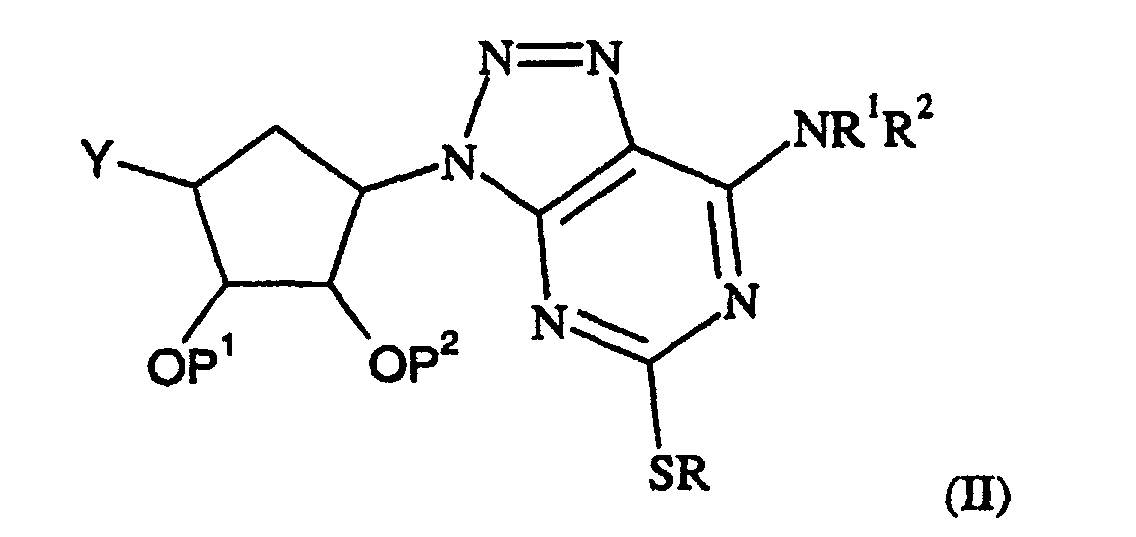
- converting one or more functional groups into a further functional group
- removing any protecting groups
- forming a pharmaceutically acceptable salt or solvate.
- Examples of suitable groups which each P1 and P2 can independently represent are C1-6-alkyl (preferably methyl), benzyl, (C1-6-alkyl)3Si (preferably trimethylsilyl) and a C(O)C1-6-alkyl group (preferably acetyl). Preferably the two groups P1 and P 2 together with the atoms to which they are attached complete a ring, for example the two groups P1 and P2 together represent an alkylidene such as methylidene or, more preferably, isopropylidene, or an alkoxy methylidene such as ethoxymethylidene.
- The reaction of compounds of formula (II) and (III) is preferably carried out in the presence of a coupling agent using methods known from peptide synthesis (see M. Bodanszky and A. Bodanszky, The Practice of Peptide Synthesis, Springer-Verlag, 1984). Suitable coupling agents include 1,1'-carbonyldiimidazole and dicyclohexylcarbodiimide; the preferred coupling agent is bromo-tris-pyrrolidino-phosphonium hexafluorophosphate or benzotriazole- 1 -yl-oxy-tris-(dimethylamino)phosphoniumhexafluorophosphate, used in the presence of N,N-diisopropylethylamine, The reaction is preferably carried out in N,N-dimethylformamide (DMF) or tetrahydrofuran (THF) and preferably at a temperature of from -15° to 120°C, more preferably at a temperature of from 0°C to room temperature.
- Protecting groups can be added and removed using known reaction conditions. The use of protecting groups is fully described in Protective Groups in Organic Chemistry, edited by J W F McOmie, Plenum Press (1973), and Protective Groups in Organic Synthesis, 2nd edition, T W Greene & P G M Wutz, Wiley-Interscience (1991).
- Alternative methods of activating a compound of formula (II) wherein Y is CO2H include formation of an acyl halide or an acetic anhydride. Acid anhydrides may be formed by treatment with an acyl halide, such as acetyl chloride in the presence of a base, such as pyridine or by treatment with a dehydrating agent such as acetic acid anhydride or phosphorus pentoxide in an inert solvent. Acyl halides may be formed by treatment of the acid with a halogenating agent, for example P(III), P(V) or S(IV) halides such as phosphorus trichloride. Acyl halides may also be prepared by an exchange reaction of the acid with an acyl halide such as oxalyl bromide. The reactions may be performed in the halogenating agent or acyl halide as solvent or in other inert solvents such as methylene chloride, at a temperature of from 0 to 150°C. Activation is preferably carried out by treatment with oxalyl chloride in dichloromethane at room temperature.
- Deprotection can be carried out using methods generally known in the art. For example for groups P1/P2 deprotection is preferably carried out as follows:
- (i) where one or both of P1 and P2 represent C(O)C1-6-alkyl, these groups can be removed by basic hydrolysis, for example by using a metal hydroxide, preferably an alkali metal hydroxide, such as sodium hydroxide or lithium hydroxide, or quaternary ammonium hydroxide in a solvent, such as aqueous ethanol or aqueous tetrahydrofuran, at a temperature of from 10° to 100°C, preferably the temperature is around room temperature; or by acidic hydrolysis using a mineral acid such as HCl or a strong organic acid such as trichloroacetic acid in a solvent such as aqueous 1,4-dioxane;
- (ii) where one or both of P1 and P2 represent (C1-6-alkyl)3Si, these can be removed by the use of, for example, a fluoride ion source, for example tetra-n-butylammonium fluoride or hydrogen fluoride;
- (iii) where one or both of P1 and P2 represent a C1-6-alkyl group, these groups can be removed by the use of, for example, boron tribromide;
- (iv) where one or both of P1 and P2 represent a benzyl group these can be removed by hydrogenolysis using a transition metal catalyst, for example palladium on charcoal, under an atmosphere of hydrogen, at a pressure of from 1 to 5 bar, in a solvent, such as acetic acid; and/or
- (v) where both P1 and P2 together represent alkylidene or an alkoxy alkylidene, they can be removed by the use of, for example, a mineral or organic acid, preferably by using 2M aqueous hydrochloric acid in methanol/ 1,4-dioxane or aqueous trifluoroacetic acid at room temperature.
-
- Compounds of formula (III) are commercially available.
- A compound of formula (II) wherein Y is CO2H, CONR5R6 or CO2 R' can be prepared by reacting a compound of formula (IV):wherein R, P1, P2 R5 and R6 are as defined above, L1 is a leaving group, for example a halogen atom and R' is a C1-6-alkyl or benzyl group, with an amine NHR1R2 or a salt of NHR1R2 wherein R2 is as defined above, in the presence of a base. Suitable salts of NHR1R2 include hydrochlorides. Suitable bases include an organic base such as triethylamine or an inorganic base such as potassium carbonate. The amines NHR1R2 can be prepared using procedures described in H Nishiyama et al, Bull. Chem. Soc., Jpn., 1995, 68, 1247, P. Newman, Optical Resolution Procedures for Chemical Compounds, Vol. 1, Amines and Related Compounds; Optical Resolution and Information Centre: Manhattan College, Riverdale, NY, 1978, p120, J. Vallgarda et al, J. Chem. Soc. Perkin 1, 1994, 461. Certain amines NHR1R2 are novel compounds and form a further aspect of the invention.

- A compound of formula (IV) can be prepared by diazotising a compound of formula (V):wherein R, Y, L1, P1 and P2 are as defined above, with a metal nitrite, for example an alkali metal nitrite, especially sodium nitrite in dilute aqueous acid, for example 2M HCl, or with a C1-6-alkyl nitrite in an inert solvent, at a temperature of from -20 to 100°C; preferred conditions are isoamyl nitrite in acetonitrile at 80°C.
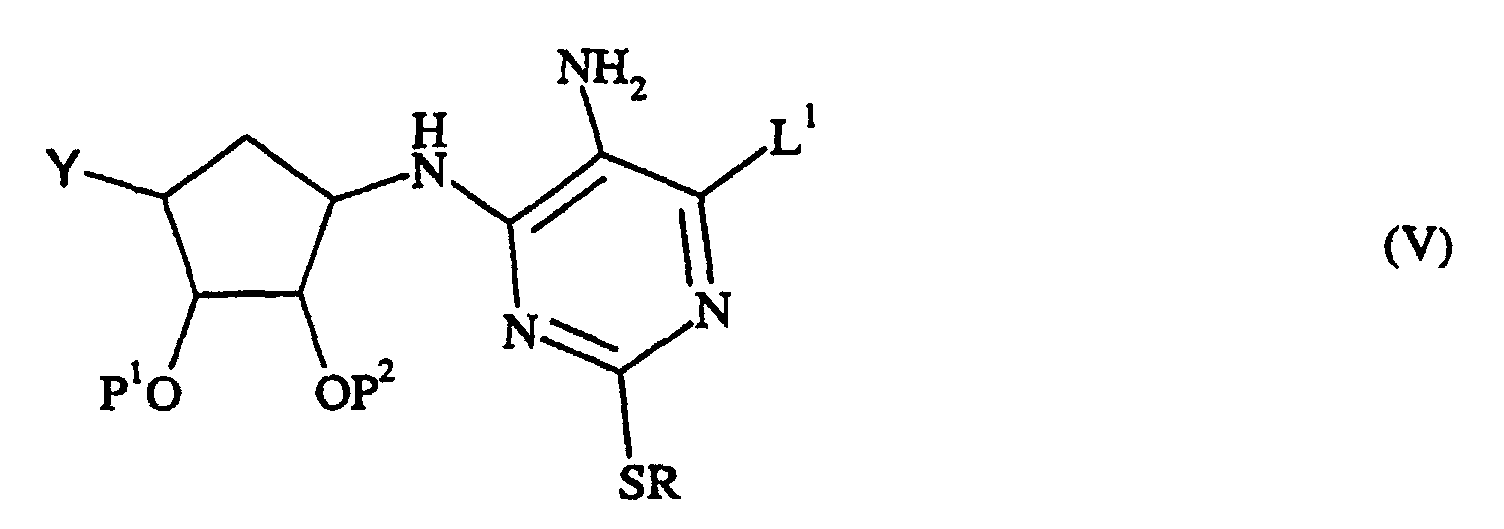
- A compound of formula (V) where Y is CO2H can be prepared by reducing and hydrolysing a compound of formula (VI):wherein R, L1 , P1 and P2 are as defined above. The reduction may be carried out for example by using hydrogenation with a transition metal catalyst at a temperature around room temperature, for example palladium on charcoal under an atmosphere of hydrogen, preferably at a pressure from 1 to 5 atmospheres, in a solvent, for example ethanol, or by using iron in an acidic solvent such as acetic acid at a temperature of about 100°C.

- To prepare a compound of formula (V) wherein Y is CO2H, following the above reaction, hydrolysis of the compound derived from the compound of formula (VI) may be performed by using a mineral acid such as HCl or a strong organic acid such as trifluoroacetic acid in a solvent such as aqueous 1,4-dioxane, at a temperature of from 20 to 150°C. Preferably the reduction and hydrolysis are carried out simultaneously using iron in an acidic solvent, for example acetic acid, containing an alkaline earth metal halide, for example calcium chloride, at a temperature of about 80°C.
- To prepare a compound of formula (V) wherein R9 is C1-6-alkyl or benzyl, the compound of formula (VI) is treated with iron in acetic acid at a temperature of from 50 to 80°C so that the nitro group is reduced. The resulting intermediate is then treated with sodium borohydride in a mixture of water and C1-6-alkyl alcohol or benzyl alcohol at around room temperature.
- A compound of formula (VI) can be prepared by reacting a compound of formula (VII):wherein L1 and R are as defined above and L2 is a leaving group, for example a halogen atom, wherein L1 and L2 are preferably the same, with a compound of formula (VIII):
 wherein P1 and P2 are as defined above, in the presence of a base such as C1-6-alkyl-M or MH wherein M is a metal, for example butyl lithium, in an inert solvent, such as tetrahydrofuran (THF), at a temperature of from -10 to 100°C. Preferably sodium hydride is used in THF at room temperature. Preferably the compound of formula (VIII) has the following stereochemistry such that the above reactions give a compound of formula (la):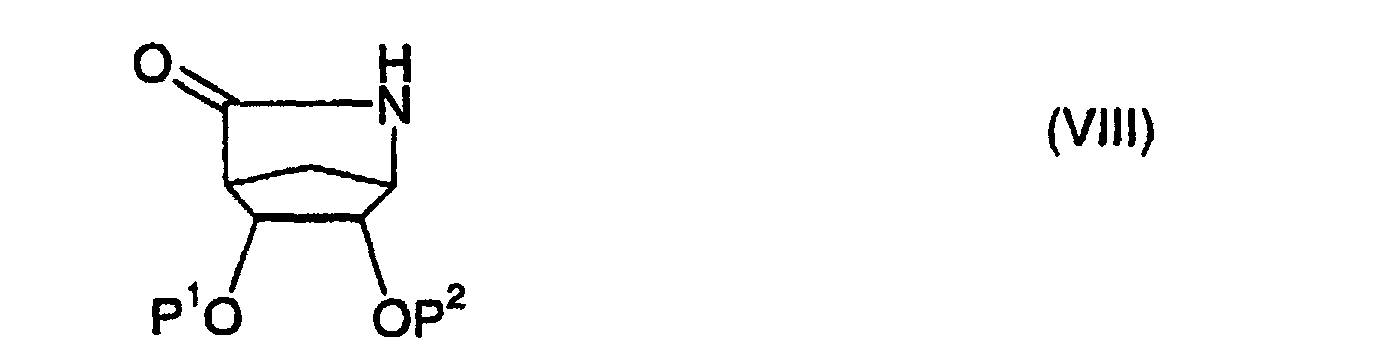

- A compound of formula (VII) may be prepared from 4,6-dihydroxy-2-mercaptopyrimidine by alkylation with RL3 wherein R is as defined above and L3 is a suitable leaving group, for example a halogen atom, followed by nitration, whereafter the two alcohols are converted to leaving groups L1 and L2.
- A compound of formula (V) where Y is CONR5R6 can be prepared by reacting a compound of formula (IX):with a compound of formula (VII) where P1, P2, R1, R5, R6, L1, and L2 are as defined above in a suitable solvent such as 1,4-dioxane in the presence of a base such as N,N-diisopropylethylamine followed by reduction of the nitro group. Compounds of formula (IX) may be prepared using procedures described in W09528160. Preferably the compound of formula (IX) has the following stereochemistry such that the above reactions give a compound of formula (Ia):

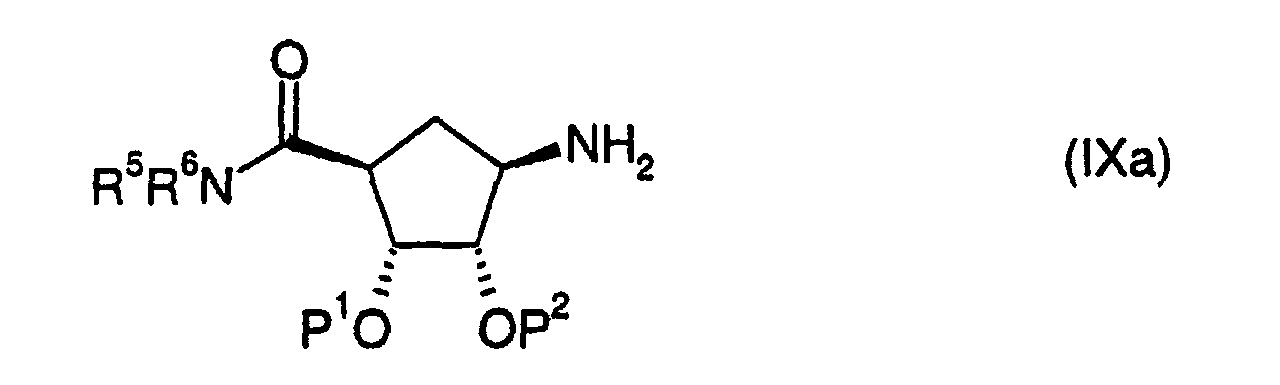
- The group SR can be interconverted by oxidation of the sulphur, for example using oxone® or mCPBA, followed by treatment with a compound RSM where R is a different R group and M is a metal such as sodium.
- All novel intermediates form a further aspect of the invention.
- Salts of the compounds of formula (I) may be formed by reacting the free acid, or a salt thereof, or the free base, or a salt or a derivative thereof, with one or more equivalents of the appropriate base (for example ammonium hydroxide optionally substituted by C1-6-alkyl or an alkali metal or alkaline earth metal hydroxide) or acid (for example a hydrohalic (especially HCI), sulphuric, oxalic or phosphoric acid). The reaction may be carried out in a solvent or medium in which the salt is insoluble or in a solvent in which the salt is soluble, e.g. water, ethanol, THF or diethyl ether, which may be removed in vacuo, or by freeze drying. The reaction may also be ametathetical process or it may be carried out on an ion exchange resin. The non-toxic physiologically acceptable salts are preferred, although other salts may be useful, e.g. in isolating or purifying the product.
- The compounds of the invention act as P 2T -receptor antagonists. Accordingly, the compounds are useful in therapy, especially adjunctive therapy, particularly they are indicated for use as: inhibitors of platelet activation, aggregation and degranulation, anti-thrombotic agents or in the treatment or prophylaxis of unstable angina, coronary angioplasty (PTCA), myocardial infarction, perithrombolysis, primary arterial thrombotic complications of atherosclerosis such as thrombotic or embolic stroke, peripheral vascular disease, myocardial infarction with or without thrombolysis, arterial complications due to interventions in atherosclerotic disease such as angioplasty, endarterectomy, stent placement, coronary and other vascular graft surgery, thrombotic complications of surgical or mechanical damage such as tissue salvage following accidental or surgical trauma, reconstructive surgery including skin and muscle flaps, conditions with a diffuse thrombotic/platelet consumption component such as disseminated intravascular coagulation, thrombotic thrombocytopaenic purpura, haemolytic uraemic syndrome, thrombotic complications of septicaemia, adult respiratory distress syndrome, anti-phospholipid syndrome, heparin-induced thrombocytopaenia and pre-eclampsia/eclampsia, or venous thrombosis such as deep vein thrombosis, venoocclusive disease, haematological conditions such as myeloproliferative disease, including thrombocythaemia, sickle cell disease; or in the prevention of mechanically-induced platelet activation in vivo, such as cardio-pulmonary bypass and extracorporeal membrane oxygenation (prevention of microthromboembolism), mechanically-induced platelet activation in vitro, such as use in the preservation of blood products, e.g. platelet concentrates, or shunt occlusion such as in renal dialysis and plasmapheresis, thrombosis secondary to vascular damage/inflammation such as vasculitis, arteritis, glomerulonephritis, inflammatory bowel disease and organ graft rejection, conditions such as migraine, Raynaud's phenomenon, atheromatous plaque formation/progression, vascular stenosis/restenosis and asthma, in which platelet-derived factors are implicated in the disease process.
- According to the invention there is further provided the use of a compound according to the invention in the manufacture of a medicament for the treatment of the above disorders. The invention also provides a method of treatment of the above disorders which comprises administering to a patient suffering from such a disorder a therapeutically effective amount of a compound according to the invention.
- The compounds may be administered topically, e.g. to the lung and/or the airways, in the form of solutions, suspensions, HFA aerosols and dry powder formulations; or systemically, e.g. by oral administration in the form of tablets, pills, capsules, syrups, powders or granules, or by parenteral administration in the form of sterile parenteral solutions or suspensions, by subcutaneous administration, or by rectal administration in the form of suppositories or transdermally.
- The compounds of the invention may be administered on their own or as a pharmaceutical composition comprising the compound of the invention in combination with a pharmaceutically acceptable diluent, adjuvant or carrier. Particularly preferred are compositions not containing material capable of causing an adverse, e.g. an allergic, reaction.
- Dry powder formulations and pressurised HFA aerosols of the compounds of the invention may be administered by oral or nasal inhalation. For inhalation the compound is desirably finely divided.
- The compounds of the invention may also be administered by means of a dry powder inhaler. The inhaler may be a single or a multi dose inhaler, and may be a breath actuated dry powder inhaler.
- One possibility is to mix the finely divided compound with a carrier substance, e.g. a mono-, di- or polysaccharide, a sugar alcohol or another polyol. Suitable carriers include sugars and starch. Alternatively the finely divided compound may be coated by another substance. The powder mixture may also be dispensed into hard gelatine capsules, each containing the desired dose of the active compound.
- Another possibility is to process the finely divided powder into spheres which break up during the inhalation procedure. This spheronized powder may be filled into the drug reservoir of a multidose inhaler, e.g. that known as the Turbuhaler® in which a dosing unit meters the desired dose which is then inhaled by the patient. With this system the active compound with or without a carrier substance is delivered to the patient.
- The pharmaceutical composition comprising the compound of the invention may conveniently be tablets, pills, capsules, syrups, powders or granules for oral administration; sterile parenteral or subcutaneous solutions, suspensions for parenteral administration or suppositories for rectal administration.
- For oral administration the active compound may be admixed with an adjuvant or a carrier, e.g. lactose, saccharose, sorbitol, mannitol, starches such as potato starch, corn starch or amylopectin, cellulose derivatives, a binder such as gelatine or polyvinylpyrrolidone, and a lubricant such as magnesium stearate, calcium stearate, polyethylene glycol, waxes, paraffin, and the like, and then compressed into tablets. If coated tablets are required, the cores, prepared as described above, may be coated with a concentrated sugar solution which may contain e.g. gum arabic, gelatine, talcum, titanium dioxide, and the like. Alternatively, the tablet may be coated with a suitable polymer dissolved in either a readily volatile organic solvent or an aqueous solvent.
- For the preparation of soft gelatine capsules, the compound may be admixed with e.g. a vegetable oil or polyethylene glycol. Hard gelatine capsules may contain granules of the compound using either the above mentioned excipients for tablets, e.g. lactose, saccharose, sorbitol , mannitol, starches, cellulose derivatives or gelatine. Also liquid or semisolid formulations of the drug may be filled into hard gelatine capsules.
- Liquid preparations for oral application may be in the form of syrups or suspensions, for example solutions containing the compound, the balance being sugar and a mixture of ethanol, water, glycerol and propylene glycol. Optionally such liquid preparations may contain colouring agents, flavouring agents, saccharine and carboxymethylcellulose as a thickening agent or other excipients known to those skilled in art.
- The invention is illustrated by the following examples. In the examples the NMR spectra were measured on a Varian Unity Inova 300 or 400 spectrometer and the MS spectra were measured as follows: EI spectra were obtained on a VG 70-250S or Finnigan Mat Incos-XL spectrometer, APCI spectra were obtained on Finnigan Mat SSQ7000 or a Micromass Platform spectrometer. Preparative HPLC separations were generally performed using a Novapak® , Bondapak® or Hypersil® column packed with BDSC-18 reverse phase silica. Flash chromatography (indicated in the Examples as (SiO2)) was carried out using Fisher Matrix silica, 35-70 µm.
-
- a) [3aR-(3aα,4α,6α,6aα]-6-[[6-Chloro-5-nitro-2-(propylthio)-4-pyrimidinyl]amino]-N-ethyl-tetrahydro-2,2-dimethyl-4H-cyclopenta-1,3-dioxole-4-carboxamideA solution of [3aR-(3aα,4α,6α,6aα)]-4-amino-N-ethyl-tetrahydro-2,2-dimethyl-4H-cyclopenta-1,3-dioxole-4-carboxamide
(14.0g) (prepared as described in WO 9528160) in
1,4-dioxane (15ml) was added over 5 minutes to a stirred solution of 4,6-dichloro-5-nitro-2-(propylthio)pyrimidine
(32.9g) (prepared as described in WO9703084) in 1,4-dioxane at
10°C. N,N-Diisopropylethylamine (16ml) was then added and the mixture allowed to warm
to room temperature overnight. The reaction mixture was concentrated and the residue
purified by chromatography (SiO2, ether:isohexane 4:1 as eluant) to afford the subtitle
compound (17.3g).
MS (APCI) 460 (M+H+, 100%). - b) [3aR-(3aα,4α,6α,6aα)]-6-[7-Chloro-5-(propylthio)-3H-[1,2,3]triazolo[4,5-d]pyrimidin-3-yl]-N-ethyl-tetrahydro-2,2-dimethyl-4H-cyclopenta-1,3-dioxole-4-carboxamideTo a solution of the product from step a) (32.0g) in acetic acid (300ml) was added iron
powder (40.0g). The mixture was stirred at room temperature for 2 hours then filtered
through Celite washing with ethyl acetate (3x150ml). The filtrate was concentrated to a
volume of 150ml then cooled to 10°C. Sodium nitrite (7.5g) in water (25ml) was added and
the solution allowed to warm to room temperature over 40 minutes. Water (200ml) was
then added and the resultant precipitate collected by filtration, washing with water (100ml)
and isohexane (100ml) afforded the subtitle compound (26.4g).
MS (APCI) 441 (M+H+, 100%). - c) [3aR-[3αa,4α,6α(1R*,2S*),6aα]]-N-Ethyl-tetrahydro-2,2-dimethyl-6-[7-[methyl(2-phenylcyclopropyl)amino]-5-(propylthio)-3H-[1,2,3]triazolo[4,5-d]pyrimidin-3-yl]-4H-cyclopenta-1,3-dioxole-4-carboxamideA mixture of the product of step b) (800mg), (1R-trans)-N-methyl-2-phenylcyclopropanamine
hydrochloride (prepared as described by C. Kaiser et al, J. Org.
Chem., 1962,27,768-773, using (1R-trans)-2-phenylcyclopropanamine, [R-(R*,R*)]-2,3-dihydroxybutanedioate
(1:1), prepared as described byL.A. Mitscher et al, J. Med. Chem.,
1986,29, 2044) (366mg) and N,N-diisopropylethylamine (1.5ml) in dichloromethane
(50ml) was stirred at room temperature for 16 hours. The reaction mixture was
concentrated and the residue purified by chromatography (SiO2, isohexane:ethylacetate 2:1
as eluant) to afford the subtitle compound (990mg).
MS (APCI) 552 (M+H+, 100%). - d) [1S-[1α,2β,3β,4α (1S*,2R*)]]-N-Ethyl-2,3-dihydroxy-4-[7-[methyl(2-phenylcyclopropyl)amino]-5-(propylthio)-3H-[1,2,3]triazolo[4,5-d]pyrimidin-3-yl]cyclopentanecarboxamideA solution of the product from step c) (275mg) in trifluoroacetic acid (16ml) and water
(4ml) was stirred at room temperature for 3 hours. The reaction mixture was concentrated,
neutralised with aqueous sodium bicarbonate solution and then extracted with
dichloromethane. The organic solution was dried, concentrated and the residue purified by
chromatography (SiO2, dichloromethane:methanol 97:3 as eluant) to afford the title
compound (242mg).
Mpt 154-157°C
MS (APCI) 512 (M+H+, 100%).
NMR δH (d6-DMSO, 90°) 7.58 (1H, s), 7.32-7.17 (5H, m), 4.98 (1H, q), 4.81 (1H, d), 4.66 (1H, d), 4.46 (1H, q), 4.18 (1H, q), 3.16-2.95 (8H, m), 2.77-2.72 (1H, m), 2.41-2.23 (3H, m), 1.66-1.52 (3H, m), 1.47-1.43 (1H, m), 1.04 (3H, t), 0.94 (3H, t). -
-
- a) [3aR-[3α,4α,6α(1R*,2S*),6α]]-N-Ethyl-tetrahydro-2,2-dimethyl-6-[7-[methyl(2-phenylcyclopropyl)amino]-5-(propylsulfonyl)-3H-[1,2,3]triazolo[4,5-d]pyrimidin-3-yl]-4H-cyclopenta-1,3-dioxole-4-carboxamide3-Chloroperoxybenzoic acid (85%, 1.0g) was added to a suspension of the product of
example 1, step c) (680mg) in ethanol (25ml) and the resulting solution stirred at room
temperature for 24 hours. The reaction mixture was concentrated and the residue taken up
in ethyl acetate (100ml), washed with 10% aqueous sodium metabisulfite solution (2 x
80ml) and 10% aqueous sodium bicarbonate solution (2x50ml) then dried and
concentrated. The residue was purified by chromatography (SiO2, ethyl acetate: isohexane
1:1 as eluant) to give the subtitle compound (780mg).
MS (APCI) 584 (M+H+, 100%). - b) [3aR-[3aα,4α,6α(1R*,2S*),6aα]-N-Ethyl-tetrahydro-2,2-dimethyl-6-[7-[methyl(2-phenylcyclopropyl)amino]-5-(methylthio)-3H-[1,2,3]triazolo[4,5-d]pyrimidin-3-yl-4H-cyclopenta-1,3-dioxole-4-carboxamideSodium thiomethoxide (300mg) was added to a stirred solution of the product from step a)
(390mg) in dry tetrahydrofuran (20ml). The mixture was stirred at room temperature for 24
hours, concentrated and the residue purified by chromatography (SiO2, isohexane:ethyl
acetate 2:1 as eluent) to afford the subtitle compound (329mg).
MS (APCI) 524 (M+H+, 100%). - c) [1S-[1α,2β,3β,4α(1S*,2R*)]]-N-Ethyl-2,3-dihydroxy-4-[7-[methyl(2-phenylcyclopropyl)amino]-5-(methylthio)-3H
[1,2,3]triazolo[4,5-d]pyrimidin-3-yl]-cyclopentanecarboxamideThe title compound was prepared according to the method of example 1, step d) using the
product of step b).
Mpt 152-153°C
MS (APCI) 484 (M+H+, 100%).
NMR δH (d6-DMSO, 90°) 7.59 (1H, s), 7.32-7.17 (5H, m), 5.00 (1H, q), 4.83 (1H, d), 4.68 (1H, d), 4.46 (1H, q), 4.19 (1H, q), 3.57 (4H, s), 3.16-2.95 (2H, m), 2.80-2.73 (1H, m), 2.40 (3H, s), 2.36-2.20 (3H, m), 1.59-1.52 (1H, m), 1.47-1.41 (1H, m), 1.04 (3H, t). -
-
- a) [3aR-(3aα,4α,6α,6aα)]-6-([5-Amino-6-chloro-2-(propylthio)-4- pyrimidinyl]amino]-tetrahydro-2,2-dimethyl-4H-cyclopenta-1,3-dioxole-4-carboxylic
acidIron powder (10.0g) was added to a stirred solution of [3aS-(3aα,4β,7β,7aα)] 5-[6-chloro-5-nitro-2-(propylthio)pyrimidin-4-yl]-tetrahydro-2,2-dimethyl-4,7-methano-1,3-diox6lo[4,5-c]pyridin-6(3aH)-one
(10.0g) (prepared as described in WO9703084) and
calcium chloride (4.45g) in ethanol (140ml). The reaction mixture was heated at reflux for
10 minutes then filtered through Celite, washing with hot ethanol. The filtrate was
concentrated to afford the subtitle compound (9.3g).
MS (FAB) 405, 403 (M+H+), 405 (100%). - b) [3aR-(3aα,4α,6α,6αa)]-6-[7-Chloro-5-(propylthio)-3H-[1,2,3]triazolo[4,5-d]pyrimidin-3-yl]-tetrahydro-2,2-dimethyl-4H-cyclopenta-1,3-dioxole-4-carboxylic
acidIsoamyl nitrite (6.02ml) was added to a solution of the product of step a) (9.28g) in
acetonitrile (80ml) and the solution heated at 70°C for 1 hour. The cooled reaction mixture
was concentrated and the residue purified by chromatography (SiO2, ethyl
acetate:isohexane 2:1 as eluant) to afford the subtitle compound (7.9g).
MS (FAB) 416, 414 (M+H+), 414 (100%). - c) [3aR-[3aα,4α,6α(1R*,2S*),6aα]]-Tetrahydro-2,2-dimethyl-6-[7-[2-phenylcyclopropyl)methylamino]-5-(propylthio)-3H-[1,2,3]triazolo[4,5-d]pyrimidin-3-yl]-4H-cyclopenta-1,3-dioxole-4-carboxylic
acid The sub-title compound was prepared according to the method of example I, step c) using
the product of step b).
MS (APCI) 525 M+H+, 100%). - d) [3aR-[3aα,4α,6α(1R*,2S*),6aα]]-Tetrahydro-N-(2-hydroxyethyl)-2,2-dimethyl-6-[7-[methyl(2-phenylcyclopropyl)amino]-5-(propylthio)-3H-[1,2,3]triazolo[4,5-d]pyrimidin-3-yl]-4H-cyclopenta-1,3-dioxole-4-carboxamideEthanolamine (0.06ml) was added to a solution of N,N-diisopropylethylamine (0.2ml),
bromo-tris-pyrrolidino-phosphonium hexafluorophosphate (224mg) and the product of step
c) (210mg) in dichloromethane (20ml). The reaction mixture was stirred at room
temperature for 4 hours then concentrated. The residue was purified by chromatography
(SiO2, dichloromethane:methanol 98:2 as eluant) to afford the subtitle compound (180mg).
MS (APCI) 568 (M+H+, 100%). - e) [1S-[1α,2β,3β,4α(1S*,2R*)]]-2,3-Dihydroxy-N-(2-hydroxyethyl)-4-[7-[methyl(2-phenylcyclopropyl)amino]-5-(propylthio)-3H-[1,2,3]triazolo[4,5-d]pyrimin-3-yl]cyclopentanecarboxamideA solution of the product from step d) (470mg) in 1,4-dioxane (5ml) and 2M aqueous
hydrochloric acid (5ml) was stirred at room temperature for 16 hours. The reaction mixture
was concentrated and the residue taken into ethyl acetate (50ml) and washed with water (2
x 50ml). The organic phase was dried and concentrated and the residue purified by
chromatography (SiO2, dichoromethane:methanol 97:3 as eluent) to afford the title
compound (90 mg).
MS (APCI) 568 (M+H+, 100%).
NMR δH (d6-DMSO, 90°) 7.59 (1H, t), 7.30-7.18 (5H, m), 4.90 (1H, m), 4.82 (1H, d), 4.68 (1H, d), 4.47 (1H, m), 4.35 (1H, m), 4.19 (1H, m), 3.59 (3H, s), 3.42 (2H, m), 3.20 (2H, m), 3.10-2.90 (2H, m), 2.80 (1H, m), 2.40-2.20 (3H, m), 1.64-1.50 (3H, m), 1.42 (1H, m), 0.93 (3H, t). -
-
- a) [3aR-[3aα,4α,6α(1R*,2S*),6aα]]-6-[7-[2-(3,4-Difluorophenyl)cyclopropylamino]-5-(propylthio)-3H-[1,2,3]triazolo[4,5-d]pyrimidin-3-yl]-tetrahydro-2,2-dimethyl
4H-cyclopenta-1,3-dioxole-4-carboxamideA mixture of the products of Example 1, step b) (299mg), (1R-trans)-2-(3,4-difluorophenyl)-N-methylcyclopropanamine,
[R-(R*,R*)]-2,3-dihydroxybutanedioate (1:1)
(prepared as described in WO9905143) (238mg) and N,N-diisopropylethylamine (0.47ml)
in dichloromethane (8ml) were stirred at room temperature for 16 hours. The reaction
mixture was dried and concentrated to afford the subtitle compound (330mg).
MS (APCI) 574 (M+H+, 100%). - b) 1S-1α,2β,3β,4α(1S*,2R*)]1-4-[7-[[2-(3,4-difluorophenyl)cyclopropyl]methylamino]-5-(propylthio)-3H-[1,2-3]triazolo[4,5-d]pyrimidin-3-yl]-N-ethyl
2,3-dihydroxycyclopentanecarboxamideA mixture of the product from step a) (180mg), methyl iodide (59µl) and potassium
carbonate (130mg) was stirred together in N,N dimethylformamide (2ml) at room
temperature for 5 hours. Aqueous ammonium chloride was added and the reaction mixture
extracted with ethyl acetate. The organic extracts were washed with water, dried and
concentrated. The resulting pale yellow solid was treated with TFA (3ml) in water (3ml)
and stirred at room temperature for 2 hours. Aqueous sodium bicarbonate was added and
the reaction mixture extracted with ethyl acetate. The organic extracts were dried and
concentrated to afford the title compound (103mg).
Mpt 183-185°C
MS (APCI) 548 (M+H+, 100%).
NMR δH (d6-DMSO) 7.61 (1H, s), 7.33-7.26 (2H, m), 7.10-7.07 (1H, m), 4.96-4.92 (1H, m), 4.83-4.82 (1H, m), 4.70-4.68 (1H, m), 4.48-4.20 (1H, m), 4.19-4.16 (1H, m), 3.55 (4H, s), 3.08-3.04 (4H, m), 3.01-2.93 (1H, m), 2.79-2.73 (1H, m), 2.40-2.21 (3H, m), 1.68-1.57 (3H, m), 1.49-1.44 (1H, m), 1.08 (3H, t), 0.94 (3H, t). -
-
- a) (1R-trans)-N-[2-(4-Chlorophenyl)cyclopropyl]acetamideAcetic anhydride (0.5ml) was added to a solution of (1R-trans)-2-(4-chlorophenyl)cyclopropanamine
(0.72g), (prepared as described in WO9905143) in 1M
sodium hydroxide (5ml) and stirred for 1 hour. The mixture was extracted with
dichloromethane and ethyl acetate (3 times each) and the combined organic extracts were
dried and evaporated to afford the subtitle compound (0.92g)
MS (APCI) 210,212 (M+H+) 210 (100%). - b) (1R-trans)-N-[2-(4-Chlorophenyl)cyclopropyl]-N-methylacetamideSodium hydride (228mg, 60% dispersion in oil) was added to a solution of the product
from step a) (0.92g) and methyl iodide (0.4ml) in THF (6ml) and the mixture was stirred
for 18 hours. Aqueous ammonium chloride was added and the mixture extracted with
diethyl ether (3 times). The combined organic extracts were dried and evaporated. The
crude product was purified by chromatography (SiO2, isohexane:ethyl acetate 1:3 as eluent)
to afford the subtitle compound (1.78g).
MS (APCI) 224,226 (M+H+) 224 (100%). - c) (1R-trans)-2-(4-chlorophenyl)-N-methylcyclopropanamine, hydrochlorideA solution of the product from step b) (914mg) in 4M hydrochloric acid (4ml) was heated
under reflux for 8 hours. The solvent was removed in vacuo and the residue was
azeotroped with toluene and then triturated with acetone-isohexane to afford the subtitle
compound (850mg)
Mpt 150-1°C
MS (APCI) 182 (M-Cl-, 100%). - d) [1S-[1α,2β,3β,4α(1S*,2R*)]]-4-[7-[[2-(4-Chlorophenyl)cyclopropyl]methylamino]-5-(propylthio)-3H-[1,2,3]triazolo[4,5-d]pyrimidin-3-yl]-N-ethyl-2,3-dihydroxycyclopentanecarboxamideA mixture of the products of step c) (120mg), Example 1, step b) (220mg) and N,N-diisopropylethylamine
(0.35ml) in dichloromethane (8ml) was stirred at room temperature
for 16 hours. The reaction mixture was concentrated and the residue treated with
trifluoroacetic acid (3ml) in water (3ml). The reaction mixture was stirred at room
temperature for I hour, neutralised with aqueous sodium bicarbonate solution and extracted
with ethyl acetate. The organic extracts were dried, concentrated and the crude product
recrystallised (acetonitrile) to afford the title compound (129mg).
Mpt 166-168°C
MS (APCI) 546, 548 (M+H+), 546 (100%).
NMR δH (d6-DMSO) 7.93 (1H, m), 7.37-7.35 (2H, m), 7.28-7.25 (2H, m), 5.12-5.10 (1H, m), 4.99-4.93 (2H, m), 4.47-4.40 (1H, m), 4.12-4.09 (1H, m), 3.33 (1H, s), 3.12-3.05 (3H, m), 2.76-2.70 (1H, m), 2.33-2.20 (3H, m), 1.65-1.48 (4H, m), 1.03 (3H, t), 0.95 (3H, t). -
-
- a) (1R-trans)-N 2-PhenylcyclopropylacetamideThe subtitle compound was prepared as described for Example 6, step a) using (1R-trans)-2-phenylcyclopropanamine,
[R-(R*,R*)]-2,3-dihydroxybutanedioate (1:1) (prepared as
described by L.A. Mitscher et al, J. Med. Chem., 1986,29, 2044).
MS (APCI) 176 (M+H+, 100%) - b) (1R-trans)-N-Methyl-N-2-phenylcyclopropylacetamide The subtitle compound was prepared as described for Example 6, step b) using the product
of step a).
MS (APCI) 190 (M+H+, 100%) - c) (1S-trans)-4-[2-(N-methylacetylamino)cyclopropyl]benzenesulfonylchlorideChlorosulfonic acid (8ml) was slowly added to the product from step b) (2.17g) at -78°C
and then allowed to warm to 20°C and stirred for 20 hours. The mixture was poured into
ice-water (100ml) and extracted with ethyl acetate (3 times). The combined organic
extracts were dried and evaporated to afford the subtitle compound (3.48g).
MS (APCI) 288, 290 (M+H+), 288 (100%) - d) (1S-trans)-N-[2-(4-Aminosulfonylphenyl)cyclopropyl]-N-methylacetamideA mixture of the product from step c) (1.74g) in conc. aqueous ammonia (5ml) was heated
at 50°C for 1.5 hours. The mixture was extracted with ethyl acetate (8 times) and the
combined organic layers were dried and evaporated. The crude product purified by
chromatography (SiO2, dichloromethane:methanol 14:1 as eluent) to afford the subtitle
compound (1.30g).
NMR δH (d6-DMSO) 7.73 (2H, d), 7.32 (2H, d), 7.25 (2H, s), 3.03-2.98 (1H, m), 2.84 (3H, s), 2.44-2.37 (1H, m), 2.00 (3H, s), 1.56-1.41 (2H, m). - e) (1S-trans)-4-[2-(Methylamino)cyclopropyl]benzenesulfonamide, hydrochlorideA solution of the product from step d) (1.19g) in 4M HCl (7ml) was heated under reflux for
6 hours. After cooling the precipitate was collected, washed with ether and dried to afford
the subtitle compound (782mg).
Mpt 173-4°C.
MS (APCI) 227 (M-Cl-, 100%). - f) [1S-[1α,2β,3β,4α(1S*,2R*)]]-4-[7-[[2-(4-Aminosulfonylphenyl)cyclopropyl]methylamino]-5-(propylthio)-3H-[1,2,3]triazolo[4,5-d]pyrimidin-3-yl]-N-ethyl-2,3-dihydroxycyclopentanecarboxamideA mixture of the product from step e) (144mg), the product from Example 1 step b)
(219mg) and N,N-diisopropylethylamine (0.21ml) in THF (5ml) was stirred at room
temperature for 16 hours. Aqueous sodium dihydrogen phosphate solution was added, the
mixture was extracted with ethyl acetate (3 times). The combined organic layers were
dried, evaporated and the residue dissolved in acetic acid (4ml) and water (1ml) and heated
at 80°C for 3 hours. The solvent was removed in vacuo, aqueous ammonia added and reevaporated.
The residue was purified by chromatography (SiO2, dichloromethane:methanol
11:1 as eluent) and the crude product triturated with ether to afford the title compound
(224mg).
Mpt 132-5°C.
MS (APCI) 591 (M+H+, 100%).
NMR δH (d6-DMSO) 7.92 (1H, t), 7.75 (2H, d), 7.42 (2H, d), 7.31 (2H, s), 4.98 (1H, q), 4.46-4.41 (1H, m), 4.11 (1H, t), 4.00-2.90 (9H, m), 3.09 (2H, quintet), 2.72 (1H, dq), 2.38-2.18 (2H, m), 1.80-1.44 (4H, m), 1.02 (3H, t), 0.91 (3H, s). -
-
- a) (1S-trans)-N-Methyl-N-[2-(4-methylaminosulfonylphenyl)cyclopropyl]acetamideA mixture of the product from Example 7, step c) (1.74g) in 40% aqueous methylamine
(6ml) was heated at 50°C for 1.5 hours. The mixture was extracted with ethyl acetate (7
times). The combined organic extracts were dried and evaporated and the crude product
purified by chromatography (SiO2, dichloromethane:methanol 11:1 as eluent) to afford the
subtitle compound (1.40g).
NMR δH (d6-DMSO) 7.67 (2H, d), 7.37 (2H, d), 7.31 (1H, s), 3.07-2.99 (1H, m), 2.83 (3H, s), 2.43-2.38 (4H, m), 2.00 (3H, s), 1.58-1.41 (2H, m). - b) (1S-trans)-N-Methyl-4-[2-(methylamino)cyclopropyl]benzenesulfonamide
hydrochlorideA solution of the product from step a) (1.37g) in 4M HCl (7ml) was heated under reflux for
8h. After cooling the solvent was removed in vacuo and the residue crystallised
(isopropanol) to afford the subtitle compound (1.01g).
Mpt 174-5°C.
MS (APCI) 241 (M-Cl-, 100%). - c) [1S-[1α,2β,3β,4α(1S*,2R*)]]-N-Ethyl-2,3-dihydroxy-4-[7-[methyl[2-(4-methylaminosulfonylphenyl)cyclopropyl]amino]-5-(propylthio)-3H-[1,2,3]triazolo[4,5,d]pyrimidin-3-yl]cyclopentanecarboxamide The title compound was prepared according to the method of Example 7, step f) using the
product from step b) and the product from Example 1, step b).
Mpt 124-6°C.
MS (APCI) 605 (M+H+, 100%).
NMR δH (d6-DMSO) 7.91 (1H, t), 7.70 (2H, d), 7.45 (2H, d), 7.39 (1H, q), 5.05 (1H. s), 4.97 (1H, q), 4.44 (1H, m), 4.11 (1H, q), 4.00-2.85 (7H, m), 3.12 (2H, quintet), 2.72 (1H. dt), 2.43-2.18 (3H, m), 2.41 (3H, d), 1.80-1.43 (4H, m), 1.03 (3H, t), 0.87 (3H, s). -
- 2-Fluoroethylamine hydrochloride (23mg) was added to a solution of N,N-diisopropylethylamine (110µl), 1-hydroxybenzotriazole hydrate (39mg), 2-(1H-benzotriole-1-yl)-1,1,3,3-tetramethyluroniumtetrafluoroborate (81mg) and the product of Example 3, step c) (110mg) in N,N-dimethylformamide (10ml). The reaction mixture was stirred at room temperature for 1.5 hours, poured into 2N HCl and the resulting precipitate washed with water and dried to afford a white solid. Trifluoroacetic acid (3ml) in water (2ml) were added to this solid in methanol (2ml) and the reaction mixture stirred at room temperature for 2 hours. The reaction mixture was basified with 2N potassium carbonate solution and extracted with ethyl acetate. The organic extracts were washed with water, dried and concentrated and the crude product purified by chromatography (SiO2, dichloromethane:methanol 98:2 as eluent) to afford the title compound (74mg).
Mpt 141-143°C
MS (APCI) 530 (M+H+, 100%). - NMR δH(d6-DMSO) 8.20-8.18 (1H, m), 7.34-7.20 (5H, m), 5.14-5.12 (1H, m), 5.02-4.98 (2H, m), 4.54-4.50 (1H, m), 4.56-4.43 (1H, m), 4.38-4.34 (1H, m), 4.14-4.13 (1H, m), 3.45-3.42 (2H, m), 3.19-2.89 (4H, m), 2.83-2.81 (2H, m), 2.35-2.25 (2H, m), 1.59-1.54 (3H, m), 0.93 (3H, t).
- Human venous blood (100 ml), obtained from a healthy volunteer, was divided equally between 3 tubes, each containing 3.2% trisodium citrate (4 ml) as an anti-coagulant. The tubes were centrifuged for 15 minutes at 240g to obtain platelet-rich plasma (PRP) to which prostacyclin (PGI2 300 ng·ml-1) was added to stabilize platelets during the washing procedure. Red cell-free PRP was obtained by centrifugation for 10 minutes at 125g and, following further centrifugation for 15 minutes at 640g, the supernatant was discarded and the platelet pellet in each tube resuspended in modified, calcium-free, Tyrodes (CFT) solution (10 ml, composition: NaCI, 137.0 mM; NaHCO3, 11.9 mM; Na2PO4, 0.4 mM; KCl, 2.7 mM; MgCl2, 1.1 mM and dextrose, 5.55 mM), gassed with 95% O2/5% CO2 and maintained at 37°C. Following addition of PGI2 (300 ng·ml-1), the pooled suspension was centrifuged once more for 15 minutes at 640g. The supernatant was discarded and the platelets resuspended in CFT to give a final platelet count of 200-250 x 103·µl-1. The platelets were used within 30 minutes for radioligand binding studies.
- Binding assays were performed in 96-well plates, with each well containing aliquots of CFT (250 µl) consisting of 0.1 µCi [125I]-[1S-[1α,2β,3β,4β(E)]]-2,3-dihydroxy-4-[7-(3-iodo-prop-2-enylamino)-5-(propylthio)-3H-[ 1,2,3]triazolo[4,5-d]pyrimidin-3-yl]cyclopentanecarboxylic acid (50 µl, final concentration 0.18 nM) and washed platelets at a concentration of 200-250 x 103·µl-1(200 µl, final concentration 160-200 x 103·µl-1. The plates were incubated for 30 minutes at room temperature on a plate shaker (Stuart scientific; model SO1, setting 6) prior to terminating the reactions by filtration. Filtration was performed using either a MACHIII cell harvester with 2 x 2 second wash periods (with CFT) on to Whatman GF/B filter plates or a Wallac cell harvester using glass fibre printed filtermats type A, with a 7 second wash time (with CFT). The resultant filterplates were then, in the case of the MACHIII, sealed and Microscint 20 (50 ml) added prior to determination of [125I] levels by scintillation counting on a Packard Topcounter or, in the case of the Wallac filtermats, the individual wells were punched into vials for determination of [125I] in a Riastar gamma counter.
- Non-specific binding was determined in the presence of the standard P2YADP antagonist, 2-propylthio-D-β,γ-dichloromethylene ATP (10 µM), as described by Humphries et al., Br. J. Pharmacology (1995), 115, 1110-1116. All compounds were tested in duplicate over the appropriate concentration range with solvent controls in parallel.
- Results were expressed as specific binding in CPM and were calculated by subtracting the non-specific binding from the total binding achieved at each concentration. For each compound, a binding affinity (IC50) was calculated by linear interpolation of the concentration/inhibition curve, using the software package Excel. The IC50 value being the concentration at which a 50% reduction in specific binding of [125I]-[1S-[1α,2β,3β,4α(E)]]-2,3-dihydroxy-4-[7-(3-iodo-prop-2-enylamino-5-(propylthio)-3H-[1,2,3]triazolo[4,5-d]pyrimidin-3-yl]cyclopentanecarboxylic acid was achieved. Results were reported as pKi values which are equal to the negative logarithm of the IC50 (pIC5o) in this system (Cheng Prusoff).
Claims (10)
- A compound of formula (I)wherein:
 R is C1-6 alkyl optionally substituted by one or more halogen atoms;R1 is C1-4 alkyl;R2 is C1-6-alkyl or a C3-8-cycloalkyl group optionally substituted by phenyl optionally substituted by one or more substituents selected from halogen, SO2NR8R9, and C1-6 alkyl which is optionally substituted by one or more halogen atoms;R3 and R4 are both hydroxy;R5 is hydrogen or C1-6 alkyl, and R6 is C1-6 alkyl optionally substituted by C3-6-cycloalkyl or R6 is C3-6-cycloalkyl or R5 and R6 together with the nitrogen atom to which they are attached form a 5- to 7-membered saturated ring;R8, R9 are independently hydrogen or C1-6 alkyl; or a pharmaceutically acceptable salt or solvate thereof.
 - A compound according to claim 1 in which R is methyl or propyl.
- A compound according to claim 1 or 2 in which R1 is methyl.
- A compound according to any one of claims 1 to 3 in which R2 is cyclopropyl optionally substituted by phenyl, 4-chlorophenyl, 3,4-difluorophenyl, 4-(aminosulphonyl)phenyl or 4-(methylaminosulphonyl)phenyl.
- A compound according to any one of claims 1 to 4 in which R5 is hydrogen and R6 is C1-6 alkyl optionally substituted by hydroxy or fluorine.
- A compound according to any one of claims 1 to 5 with the following stereochemistry

- A compound according to claims 1 to 6 which is:[1S [1α,2β,3β,4α(1S*,2R*)]]-N-Ethyl-2,3-dihydroxy-4-[7-[methyl(2-phenylcyclopropyl)amino]-5-(propylthio)-3H-[1,2,3]triazolo[4,5-d]pyrimidin-3- yl]cyclopentanecarboxamide,[1S-[1α,2β,3β,4α(1S*,2R*)]]-N-Ethyl-2,3-dihydroxy-4-[7-[methyl(2-phenylcyclopropyl)amino]-5-(methylthio)-3H-[1,2,3]triazolo[4,5-d]pyrimidin-3-yl]cyclopentanecarboxamide,[1S-[1α,2β,3β,4α(1S*,2R*)]]-2,3-Dihydroxy-N-(2-hydroxyethyl)-4-[7-[methyl(2-phenylcyclopropyl)amino]-5-(propylthio)-3H [1,2,3]triazolo[4,5-d]pyrimidin-3-yl]cyclopentanecarboxamide,[1S-[1α,2β,3β,4α(1S*,2R*)]]-2,3-Dihydroxy-4-[7-[methyl(2-phenylcyclopropyl)amino]-5-(propylthio)-3H-[1,2,3]triazolo [4,5-d]pyrimidin-3-yl]cyclopentanecarboxamide,[1S-[1α,2β,3β,4α(1S*,2R*)]]-4-[7-[[2-(3,4-difluorophenyl)cyclopropyl]methylamino]-5-(propylthio)-3H [1,2,3]triazolo[4,5-d]pyrimidin-3-yl]-N-ethyl 2,3-dihydroxycyclopentanecarboxamide,[ 1S-[1α,2β,3β,4α(1S*2R*)]]-4-[7-[[2-(4-Chlorophenyl]cyclopropyl]methylamino]-5-(propylthio)-3H-[1,2,3]triazolo[4,5-d]pyrimidin-3-yl]-N-ethyl-2,3-dihydroxycyclopentanecarboxamide,[ 1S-[1α,2β,3β,4α( 1S*,2R*)]]-4-[7-[[2-(4-Aminosulfonylphenyl)cyclopropyl]methylamino]-5-(propylthio)-3H-[1,2,3]triazolo[4,5-d]pyrimidin-3-yl]-N-ethyl-2,3-dihydroxycyclopentanecarboxamide,[1S-[1α,2β,3β,4α(1S*,2R*)]]-N-Ethyl-2,3-dihydroxy-4-[7-[methyl[2-(4-methylaminosulfonylphenyl)cyclopropyl] amino]-5-(propylthio)-3H-[1,2,3]triazolo[4,5-d]pyrimidin-3-yl]cyclopentanecarboxamide,[1S-[1α,2β,3β,4α(1S*,2R*)]]-N-(2-Fluoroethyl)-2,3-dihydroxy-4-[7-[methyl(2-phenylcyclopropyl)amino]-5-(propylthio)-3H [1,2,3]triazolo[4,5-d]pyrimidin-3-yl]cyclopentanecarboxamide or pharmaceutically acceptable salts or solvates thereof.
- A pharmaceutical composition comprising a compound according to any one of claims 1 to 7 in combination with a pharmaceutically acceptable diluent, adjuvent or carrier.
- A compound according to any one of claims 1 to 8 for use in therapy.
- A process for the preparation of a compound of formula (I) which comprises;wherein Y is CO2H, C02 R' or CONR5R6 and R, R5, R6, P1 and P2 are as defined above and L1 is a leaving group and R' is a C1-6-alkyl or benzyl group, with an amine NHR1R2 or a salt of NHR1R2 wherein R2 is as defined above and optionally thereafter (a) or (b) and in any order:(a) reaction of a compound of formula (II):where R, R1 and R2 are as defined in formula (I) or are protected derivatives thereof, P1 and P2 are hydrogen or protecting groups and L is a leaving group, with a compound of formula (III):
 (b) reacting a compound of formula (IV):
 converting one or more functional groups into a further functional groupsremoving any protecting groupsforming a pharmaceutically acceptable salt or solvate.
Applications Claiming Priority (3)
| Application Number | Priority Date | Filing Date | Title |
|---|---|---|---|
| SE9802574A SE9802574D0 (en) | 1998-07-17 | 1998-07-17 | Novel compounds |
| SE9802574 | 1998-07-17 | ||
| PCT/SE1999/001277 WO2000004021A1 (en) | 1998-07-17 | 1999-07-15 | NOVEL TRIAZOLO[4,5-d]PYRIMIDINE COMPOUNDS |
Publications (2)
| Publication Number | Publication Date |
|---|---|
| EP1097153A1 EP1097153A1 (en) | 2001-05-09 |
| EP1097153B1 true EP1097153B1 (en) | 2003-10-01 |
Family
ID=20412117
Family Applications (1)
| Application Number | Title | Priority Date | Filing Date |
|---|---|---|---|
| EP99941925A Expired - Lifetime EP1097153B1 (en) | 1998-07-17 | 1999-07-15 | Novel triazolo[4,5-d]pyrimidine compounds |
Country Status (7)
| Country | Link |
|---|---|
| EP (1) | EP1097153B1 (en) |
| JP (1) | JP2003519080A (en) |
| AT (1) | ATE251162T1 (en) |
| AU (1) | AU5539899A (en) |
| DE (1) | DE69911785T2 (en) |
| SE (1) | SE9802574D0 (en) |
| WO (1) | WO2000004021A1 (en) |
Cited By (1)
| Publication number | Priority date | Publication date | Assignee | Title |
|---|---|---|---|---|
| CN111116592A (en) * | 2019-11-27 | 2020-05-08 | 杭州沧海帆医药科技有限公司 | Pyrimidotriazole compounds and medical application thereof |
Families Citing this family (10)
| Publication number | Priority date | Publication date | Assignee | Title |
|---|---|---|---|---|
| SE9904129D0 (en) * | 1999-11-15 | 1999-11-15 | Astra Pharma Prod | Novel compounds |
| US7504497B2 (en) | 2003-10-21 | 2009-03-17 | Inspire Pharmaceuticals, Inc. | Orally bioavailable compounds and methods for inhibiting platelet aggregation |
| US7335648B2 (en) | 2003-10-21 | 2008-02-26 | Inspire Pharmaceuticals, Inc. | Non-nucleotide composition and method for inhibiting platelet aggregation |
| US7749981B2 (en) | 2003-10-21 | 2010-07-06 | Inspire Pharmaceuticals, Inc. | Drug-eluting stents coated with non-nucleotide P2Y12 receptor antagonist compound |
| US7749980B2 (en) | 2003-10-21 | 2010-07-06 | Inspire Pharmaceuticals, Inc. | Non-nucleotide compositions and method for treating pain |
| WO2005040174A1 (en) | 2003-10-21 | 2005-05-06 | Inspire Pharmaceuticals, Inc. | Tetrahydro-furo`3,4-d!dioxole compounds and compositions and method for inhibiting platelet aggregation |
| US7932376B2 (en) | 2005-05-05 | 2011-04-26 | Inspire Pharmaceuticals, Inc. | Pyrimidine-based non-nucleotide composition and method for inhibiting platelet aggregation |
| US7566722B2 (en) | 2006-10-31 | 2009-07-28 | Janssen Pharmaceutica, N.V. | Triazolopyrimidine derivatives as ADP P2Y12 receptor antagonists |
| WO2015162630A1 (en) * | 2014-04-25 | 2015-10-29 | Anlon Chemical Research Organization | Novel processes for preparing triazolo [4,5-d]- pyrimidines, including ticagrelor, vianew intermediates and new route of synthesis. |
| GEAP202014908A (en) | 2016-03-22 | 2020-03-10 | Merck Sharp & Dohme | Allosteric modulators of nicotinic acetylcholine receptors |
Family Cites Families (4)
| Publication number | Priority date | Publication date | Assignee | Title |
|---|---|---|---|---|
| HU221880B1 (en) * | 1995-07-11 | 2003-02-28 | Astrazeneca Ab, | Inhibitors of platelet aggregation, preparation and use thereof and pharmaceutical compositions |
| WO1998018430A2 (en) * | 1996-10-30 | 1998-05-07 | The University Of North Carolina At Chapel Hill | P2y receptor antagonists |
| ATE213245T1 (en) * | 1996-12-20 | 2002-02-15 | TRIAZOLO(4,5-D)PYRIMIDINYL DERIVATIVES AND THEIR USE AS MEDICATIONS | |
| SE9702772D0 (en) * | 1997-07-22 | 1997-07-22 | Astra Pharma Prod | Novel compounds |
-
1998
- 1998-07-17 SE SE9802574A patent/SE9802574D0/en unknown
-
1999
- 1999-07-15 WO PCT/SE1999/001277 patent/WO2000004021A1/en not_active Ceased
- 1999-07-15 AT AT99941925T patent/ATE251162T1/en not_active IP Right Cessation
- 1999-07-15 EP EP99941925A patent/EP1097153B1/en not_active Expired - Lifetime
- 1999-07-15 JP JP2000560127A patent/JP2003519080A/en active Pending
- 1999-07-15 AU AU55398/99A patent/AU5539899A/en not_active Abandoned
- 1999-07-15 DE DE69911785T patent/DE69911785T2/en not_active Expired - Fee Related
Cited By (1)
| Publication number | Priority date | Publication date | Assignee | Title |
|---|---|---|---|---|
| CN111116592A (en) * | 2019-11-27 | 2020-05-08 | 杭州沧海帆医药科技有限公司 | Pyrimidotriazole compounds and medical application thereof |
Also Published As
| Publication number | Publication date |
|---|---|
| DE69911785T2 (en) | 2004-07-29 |
| WO2000004021A1 (en) | 2000-01-27 |
| SE9802574D0 (en) | 1998-07-17 |
| AU5539899A (en) | 2000-02-07 |
| ATE251162T1 (en) | 2003-10-15 |
| EP1097153A1 (en) | 2001-05-09 |
| DE69911785D1 (en) | 2003-11-06 |
| JP2003519080A (en) | 2003-06-17 |
Similar Documents
| Publication | Publication Date | Title |
|---|---|---|
| EP0996620B1 (en) | Novel compounds | |
| AU766618B2 (en) | Novel triazolo(4,5-d)pyrimidine compounds | |
| US6297232B1 (en) | Triazolo[4,5-D]pyrimidinyl derivatives and their use as medicaments | |
| EP1056749B1 (en) | NOVEL TRIAZOLO(4,5-d)PYRIMIDINE COMPOUNDS | |
| SK188299A3 (en) | Triazolo [4,5-d]pyrimidine compounds, preparation thereof, pharmaceutical compositions containing them and their use | |
| WO2000004021A1 (en) | NOVEL TRIAZOLO[4,5-d]PYRIMIDINE COMPOUNDS | |
| US6767910B1 (en) | Triazolo[4,5-d]pyrimidinyl compounds | |
| WO2001036438A1 (en) | Novel ribose compounds | |
| US6844348B2 (en) | 2,3,4-cyclopentan-2,3,4-triol-1-yl compounds | |
| MXPA00000681A (en) | Novel compounds | |
| CZ2000231A3 (en) | Novel compounds | |
| HK1061684B (en) | Intermediates for the preparation of certain triazolopyrimidines as p2t antagonists | |
| HK1056361B (en) | Novel compounds |
Legal Events
| Date | Code | Title | Description |
|---|---|---|---|
| PUAI | Public reference made under article 153(3) epc to a published international application that has entered the european phase |
Free format text: ORIGINAL CODE: 0009012 |
|
| 17P | Request for examination filed |
Effective date: 20010219 |
|
| AK | Designated contracting states |
Kind code of ref document: A1 Designated state(s): AT BE CH CY DE DK ES FI FR GB GR IE IT LI LU MC NL PT SE |
|
| AX | Request for extension of the european patent |
Free format text: AL;LT PAYMENT 20010219;LV PAYMENT 20010219;MK PAYMENT 20010219;RO PAYMENT 20010219;SI PAYMENT 20010219 |
|
| 17Q | First examination report despatched |
Effective date: 20010622 |
|
| GRAH | Despatch of communication of intention to grant a patent |
Free format text: ORIGINAL CODE: EPIDOS IGRA |
|
| GRAH | Despatch of communication of intention to grant a patent |
Free format text: ORIGINAL CODE: EPIDOS IGRA |
|
| GRAA | (expected) grant |
Free format text: ORIGINAL CODE: 0009210 |
|
| AK | Designated contracting states |
Kind code of ref document: B1 Designated state(s): AT BE CH CY DE DK ES FI FR GB GR IE IT LI LU MC NL PT SE |
|
| AX | Request for extension of the european patent |
Extension state: AL LT LV MK RO SI |
|
| PG25 | Lapsed in a contracting state [announced via postgrant information from national office to epo] |
Ref country code: NL Free format text: LAPSE BECAUSE OF FAILURE TO SUBMIT A TRANSLATION OF THE DESCRIPTION OR TO PAY THE FEE WITHIN THE PRESCRIBED TIME-LIMIT Effective date: 20031001 Ref country code: FI Free format text: LAPSE BECAUSE OF FAILURE TO SUBMIT A TRANSLATION OF THE DESCRIPTION OR TO PAY THE FEE WITHIN THE PRESCRIBED TIME-LIMIT Effective date: 20031001 Ref country code: CY Free format text: LAPSE BECAUSE OF FAILURE TO SUBMIT A TRANSLATION OF THE DESCRIPTION OR TO PAY THE FEE WITHIN THE PRESCRIBED TIME-LIMIT Effective date: 20031001 Ref country code: BE Free format text: LAPSE BECAUSE OF FAILURE TO SUBMIT A TRANSLATION OF THE DESCRIPTION OR TO PAY THE FEE WITHIN THE PRESCRIBED TIME-LIMIT Effective date: 20031001 Ref country code: AT Free format text: LAPSE BECAUSE OF FAILURE TO SUBMIT A TRANSLATION OF THE DESCRIPTION OR TO PAY THE FEE WITHIN THE PRESCRIBED TIME-LIMIT Effective date: 20031001 |
|
| REG | Reference to a national code |
Ref country code: GB Ref legal event code: FG4D |
|
| REG | Reference to a national code |
Ref country code: CH Ref legal event code: EP |
|
| REG | Reference to a national code |
Ref country code: IE Ref legal event code: FG4D |
|
| REF | Corresponds to: |
Ref document number: 69911785 Country of ref document: DE Date of ref document: 20031106 Kind code of ref document: P |
|
| PG25 | Lapsed in a contracting state [announced via postgrant information from national office to epo] |
Ref country code: GR Free format text: LAPSE BECAUSE OF FAILURE TO SUBMIT A TRANSLATION OF THE DESCRIPTION OR TO PAY THE FEE WITHIN THE PRESCRIBED TIME-LIMIT Effective date: 20040101 Ref country code: DK Free format text: LAPSE BECAUSE OF FAILURE TO SUBMIT A TRANSLATION OF THE DESCRIPTION OR TO PAY THE FEE WITHIN THE PRESCRIBED TIME-LIMIT Effective date: 20040101 |
|
| PG25 | Lapsed in a contracting state [announced via postgrant information from national office to epo] |
Ref country code: ES Free format text: LAPSE BECAUSE OF FAILURE TO SUBMIT A TRANSLATION OF THE DESCRIPTION OR TO PAY THE FEE WITHIN THE PRESCRIBED TIME-LIMIT Effective date: 20040112 |
|
| REG | Reference to a national code |
Ref country code: SE Ref legal event code: TRGR |
|
| NLV1 | Nl: lapsed or annulled due to failure to fulfill the requirements of art. 29p and 29m of the patents act | ||
| LTIE | Lt: invalidation of european patent or patent extension |
Effective date: 20031001 |
|
| PG25 | Lapsed in a contracting state [announced via postgrant information from national office to epo] |
Ref country code: LU Free format text: LAPSE BECAUSE OF NON-PAYMENT OF DUE FEES Effective date: 20040715 Ref country code: IE Free format text: LAPSE BECAUSE OF NON-PAYMENT OF DUE FEES Effective date: 20040715 |
|
| ET | Fr: translation filed | ||
| PG25 | Lapsed in a contracting state [announced via postgrant information from national office to epo] |
Ref country code: MC Free format text: LAPSE BECAUSE OF NON-PAYMENT OF DUE FEES Effective date: 20040731 |
|
| PLBE | No opposition filed within time limit |
Free format text: ORIGINAL CODE: 0009261 |
|
| STAA | Information on the status of an ep patent application or granted ep patent |
Free format text: STATUS: NO OPPOSITION FILED WITHIN TIME LIMIT |
|
| 26N | No opposition filed |
Effective date: 20040702 |
|
| REG | Reference to a national code |
Ref country code: IE Ref legal event code: MM4A |
|
| PG25 | Lapsed in a contracting state [announced via postgrant information from national office to epo] |
Ref country code: PT Free format text: LAPSE BECAUSE OF NON-PAYMENT OF DUE FEES Effective date: 20040301 |
|
| PGFP | Annual fee paid to national office [announced via postgrant information from national office to epo] |
Ref country code: DE Payment date: 20080731 Year of fee payment: 10 Ref country code: CH Payment date: 20080708 Year of fee payment: 10 |
|
| PGFP | Annual fee paid to national office [announced via postgrant information from national office to epo] |
Ref country code: IT Payment date: 20080723 Year of fee payment: 10 Ref country code: FR Payment date: 20080707 Year of fee payment: 10 |
|
| PGFP | Annual fee paid to national office [announced via postgrant information from national office to epo] |
Ref country code: GB Payment date: 20080616 Year of fee payment: 10 |
|
| PGFP | Annual fee paid to national office [announced via postgrant information from national office to epo] |
Ref country code: SE Payment date: 20080708 Year of fee payment: 10 |
|
| REG | Reference to a national code |
Ref country code: CH Ref legal event code: PL |
|
| EUG | Se: european patent has lapsed | ||
| GBPC | Gb: european patent ceased through non-payment of renewal fee |
Effective date: 20090715 |
|
| REG | Reference to a national code |
Ref country code: FR Ref legal event code: ST Effective date: 20100331 |
|
| PG25 | Lapsed in a contracting state [announced via postgrant information from national office to epo] |
Ref country code: LI Free format text: LAPSE BECAUSE OF NON-PAYMENT OF DUE FEES Effective date: 20090731 Ref country code: FR Free format text: LAPSE BECAUSE OF NON-PAYMENT OF DUE FEES Effective date: 20090731 Ref country code: CH Free format text: LAPSE BECAUSE OF NON-PAYMENT OF DUE FEES Effective date: 20090731 |
|
| PG25 | Lapsed in a contracting state [announced via postgrant information from national office to epo] |
Ref country code: GB Free format text: LAPSE BECAUSE OF NON-PAYMENT OF DUE FEES Effective date: 20090715 |
|
| PG25 | Lapsed in a contracting state [announced via postgrant information from national office to epo] |
Ref country code: DE Free format text: LAPSE BECAUSE OF NON-PAYMENT OF DUE FEES Effective date: 20100202 |
|
| PG25 | Lapsed in a contracting state [announced via postgrant information from national office to epo] |
Ref country code: IT Free format text: LAPSE BECAUSE OF NON-PAYMENT OF DUE FEES Effective date: 20090715 |
|
| PG25 | Lapsed in a contracting state [announced via postgrant information from national office to epo] |
Ref country code: SE Free format text: LAPSE BECAUSE OF NON-PAYMENT OF DUE FEES Effective date: 20090716 |