EP1096710A2 - Spread code allocation method and base station in CDMA cellular network - Google Patents
Spread code allocation method and base station in CDMA cellular network Download PDFInfo
- Publication number
- EP1096710A2 EP1096710A2 EP00123393A EP00123393A EP1096710A2 EP 1096710 A2 EP1096710 A2 EP 1096710A2 EP 00123393 A EP00123393 A EP 00123393A EP 00123393 A EP00123393 A EP 00123393A EP 1096710 A2 EP1096710 A2 EP 1096710A2
- Authority
- EP
- European Patent Office
- Prior art keywords
- code
- priority
- channel quality
- combined
- base station
- Prior art date
- Legal status (The legal status is an assumption and is not a legal conclusion. Google has not performed a legal analysis and makes no representation as to the accuracy of the status listed.)
- Granted
Links
- 238000000034 method Methods 0.000 title claims abstract description 57
- 230000001413 cellular effect Effects 0.000 title claims abstract description 34
- 230000005540 biological transmission Effects 0.000 claims abstract description 272
- PCHJSUWPFVWCPO-UHFFFAOYSA-N gold Chemical compound [Au] PCHJSUWPFVWCPO-UHFFFAOYSA-N 0.000 claims description 7
- 239000010931 gold Substances 0.000 claims description 7
- 229910052737 gold Inorganic materials 0.000 claims description 7
- 238000010276 construction Methods 0.000 description 37
- 238000010586 diagram Methods 0.000 description 14
- 239000002131 composite material Substances 0.000 description 8
- 230000000694 effects Effects 0.000 description 4
- 230000015556 catabolic process Effects 0.000 description 2
- 238000006731 degradation reaction Methods 0.000 description 2
- 230000006866 deterioration Effects 0.000 description 2
- 230000001629 suppression Effects 0.000 description 2
- 230000001360 synchronised effect Effects 0.000 description 2
- 238000004891 communication Methods 0.000 description 1
- 230000001419 dependent effect Effects 0.000 description 1
- 238000009792 diffusion process Methods 0.000 description 1
- 230000000116 mitigating effect Effects 0.000 description 1
- 230000008054 signal transmission Effects 0.000 description 1
Images






Classifications
-
- H—ELECTRICITY
- H04—ELECTRIC COMMUNICATION TECHNIQUE
- H04J—MULTIPLEX COMMUNICATION
- H04J13/00—Code division multiplex systems
- H04J13/16—Code allocation
- H04J13/18—Allocation of orthogonal codes
-
- H—ELECTRICITY
- H04—ELECTRIC COMMUNICATION TECHNIQUE
- H04L—TRANSMISSION OF DIGITAL INFORMATION, e.g. TELEGRAPHIC COMMUNICATION
- H04L1/00—Arrangements for detecting or preventing errors in the information received
- H04L1/0001—Systems modifying transmission characteristics according to link quality, e.g. power backoff
- H04L1/0002—Systems modifying transmission characteristics according to link quality, e.g. power backoff by adapting the transmission rate
- H04L1/0003—Systems modifying transmission characteristics according to link quality, e.g. power backoff by adapting the transmission rate by switching between different modulation schemes
-
- H—ELECTRICITY
- H04—ELECTRIC COMMUNICATION TECHNIQUE
- H04L—TRANSMISSION OF DIGITAL INFORMATION, e.g. TELEGRAPHIC COMMUNICATION
- H04L1/00—Arrangements for detecting or preventing errors in the information received
- H04L1/0001—Systems modifying transmission characteristics according to link quality, e.g. power backoff
- H04L1/0023—Systems modifying transmission characteristics according to link quality, e.g. power backoff characterised by the signalling
- H04L1/0026—Transmission of channel quality indication
-
- H—ELECTRICITY
- H04—ELECTRIC COMMUNICATION TECHNIQUE
- H04J—MULTIPLEX COMMUNICATION
- H04J13/00—Code division multiplex systems
- H04J13/10—Code generation
- H04J13/102—Combining codes
- H04J13/107—Combining codes by concatenation
Definitions
- the present invention relates to a spread code allocation method and a base station in a CDMA cellular in which transmission signals directed from a base station to a plurality of mobile stations are spread and transmitted using spreading codes.
- transmission signals directed to a plurality of mobile stations are spread and multiplexed by different spreading codes at a base station and then transmitted in the lump.
- transmission signals can be synchronized with each other with ease because signals directed to the plurality of mobile stations are transmitted from the base station in the lump. It is therefore possible to suppress interference between transmission signals by spreading each transmission signal by a orthogonal synchronization code.
- a transmission signal Si (i: mobile station number) directed to a mobile station and a orthogonal code Co, i are multiplied at a multiplier 001, the multiplied output signal is added at an adder 002 and the output signal of the adder 002 is multiplied by a scramble code Cs at the multiplier 001 to output a composite spreading signal sd.
- the composite spreading signal sd is modulated at a modulation device 003 and then transmitted from an antenna 004 to each mobile station.
- Fig. 13 is a diagram showing a structure of a base station transmission device in a case where a number k of scramble codes are used.
- a spreading addition device spu-j j: scramble code number
- a transmission signal Si Si
- h orthogonal code number
- a orthogonal code Co orthogonal code Co
- h orthogonal code
- Cs scramble code
- nj in Fig. 13 denotes the number of uses of a orthogonal code generated by a j-th scramble code.
- the output sd-j of the composite spreading signal is modulated at a modulation device 003 and then output to each mobile station through an antenna 004.
- An object of the present invention is to provide a spread code allocation method and a base station in a CDMA cellular enabling control of interference between mobile stations having different required qualities and reception qualities, mitigation of inequality in signal reception qualities at mobile stations and suppression of deterioration by interference caused by inequality by changing priorities of spreading codes according to a required quality and a reception quality.
- a spread code allocation method in a CDMA cellular comprising the steps of
- the spread code allocation method in a CDMA cellular further comprising the step of,
- the spread code allocation method in a CDMA cellular further comprising the steps of
- the spread code allocation method in a CDMA cellular further comprising the steps of
- the spread code allocation method in a CDMA cellular further comprising the steps of
- the spread code allocation method in a CDMA cellular further comprising the steps of
- the spread code allocation method in a CDMA cellular further comprising the step of
- the spread code allocation method in a CDMA cellular further comprising the steps of
- the spread code allocation method in a CDMA cellular further comprising the steps of
- the spread code allocation method in a CDMA cellular further comprising the steps of
- the spread code allocation method in a CDMA cellular further comprising the steps of
- the spread code allocation method in a CDMA cellular further comprising the step of
- the spread code allocation method in a CDMA cellular further comprising the step of
- the spread code allocation method in a CDMA cellular further comprising the step of
- the mobile station measures a channel quality value and informs the base station of the channel quality value
- the mobile station measures a channel quality value and informs the base station of the channel quality value
- the mobile station measures a channel quality value and informs the base station of the channel quality value
- the transmission signal includes a common control signal.
- the transmission signal includes a common control signal, and to the common control signal, a combined code having he highest priority is allocated.
- the spread code allocation method in a CDMA cellular further comprising the step of,
- the spread code allocation method in a CDMA cellular further comprising the step of,
- the spread code allocation method in a CDMA cellular further comprising the step of,
- the spread code allocation method in a CDMA cellular further comprising the step of
- a orthogonal code is used as the first code set.
- the second code set a gold code or a part of the gold code is used.
- a base station in a CDMA cellular comprises
- the base station is informed of channel quality values measured at a plurality of the mobile stations to determine a priority of the combined code based on the channel quality values informed.
- the base station is informed of channel quality values measured at a plurality of the mobile stations to determine a priority of the combined code based on the channel quality values informed, and sets a priority to the second code according to the channel quality value and sets a priority of the combined code to be higher as the second code attains a higher priority.
- the base station is informed of channel quality values measured at a plurality of the mobile stations to determine a priority of the combined code based on the channel quality values informed
- the base station is informed of channel quality values measured at a plurality of the mobile stations and determines a priority of the combined code based on the channel quality values informed, and
- the base station is informed of channel quality values measured at a plurality of the mobile stations and determines a priority of the combined code based on the channel quality values informed
- the base station grasps a transmission quality required amount required by a mobile station receiving each the transmission signal to determine a priority of the combined code based on the transmission quality required amount.
- the base station grasps a transmission quality required amount required by a mobile station receiving each the transmission signal to determine a priority of the combined code based on the transmission quality required amount
- the base station grasps a transmission quality required amount required by a mobile station receiving each the transmission signal to determine a priority of the combined code based on the transmission quality required amount
- the base station grasps a transmission quality required amount required by a mobile station receiving each the transmission signal to determine a priority of the combined code based on the transmission quality required amount
- the base station grasps a transmission quality required amount required by a mobile station receiving each the transmission signal to determine a priority of the combined code based on the transmission quality required amount
- the base station is informed of a channel quality value measured at the mobile station
- the base station is informed of a channel quality value measured at the mobile station
- the base station is informed of a channel quality value measured at the mobile station
- a priority is given to a spreading code generated by multiplying a scramble code and a orthogonal code and the priority is changed according to a required quality and a reception quality of a mobile station.
- the present invention controls interference between mobile stations having different required qualities and reception qualities to alleviate inequality in signal reception qualities at the mobile stations, thereby suppressing degradation caused by interference derived from inequality.
- a first code set including a plurality of first codes and a second code set including one or a plurality of second codes are provided.
- the first code corresponds to a orthogonal code
- the second code corresponds to a scramble code.
- a scramble code a gold code, a part of the gold code or the like can be used.
- a combined code is assigned a priority. Then, a combined code having a higher priority is given preference for allocation to transmission signals.
- change a priority for each transmission signal More specifically, change a priority for each transmission signal based on channel quality value information and required quality value information from a mobile station.
- Fig. 1 is a diagram showing a structure of a base station transmission device in a case where a number k of scramble codes are used.
- the first embodiment of the present invention includes a spreading addition device spu-j (j: scramble code number), an adder 002, a modulation device 003 and an antenna 004.
- the spreading addition device spu-j allocates a combined code of a orthogonal code Co, h and a scramble code Cs, j to a transmission signal Sj, h (h: orthogonal code number) to output a composite spreading signal sd-j.
- nj in Fig. 1 denotes the number of uses of a orthogonal code generated by a j-th scramble code.
- transmission signals may include a common control signal.
- the adder 002 adds each output sd-j of a composite spreading signal.
- the modulation device 003 modulates composite spreading signals added at the adder 002.
- the antenna 004 sends out a composite spreading signal modulated at the modulation device 003 to each mobile station.
- a feedback information reception unit 005 receives channel quality information and required quality information as feedback information from a mobile station through an antenna 006.
- a priority determination unit 007 receives feedback information from the feedback information reception unit 005 to determine a priority of a combined code for each transmission signal based on the information.
- Fig. 2 shows a flow chart of allocation processing at a base station conducted at the time of allocating a combined code made up of a orthogonal code and a scramble code to a mobile station.
- the base station sets, at a variable ma, the number of a mobile station to which a code is to be allocated.
- receive transmission of feedback information from the mobile station ma are channel quality value information such as a reception power of a common control signal and a power ratio of a desired signal to an interference signal and required quality value information such as a transmission rate and a required error rate.
- the power ratio in question can be calculated by checking a reception power of a common control signal sent out from a base station being connected and checking a reception power of a common control signal sent out from of a base station not being connected to take a ratio of a reception power corresponding to the base station being connected to a reception power corresponding to the base station not being connected.
- a priority of a combined code based on the feedback information and further at the processing 104, set a priority variable p to be 1, that is, to be a highest priority.
- a priority variable p determines whether the combined code having the priority p is being used or not and when the combined code of the priority p is in use, add 1 to the priority variable p at the processing 105 to return to the processing 106.
- a transmission signal to be transmitted from the base station to the mobile station using an allocated code may include a common control signal and in this case, the common control signal is preferably allocated a combined code whose priority is the highest.
- Figs. 3, 4 and 5 show examples of setting of a priority of each combined code conducted at the priority determination unit 007 at the processing 103 of Fig. 2 according to the first embodiment of the present invention.
- priority is set based on a channel quality value.
- the abscissa of Fig. 3 represents a channel quality value observed by a mobile station and the channel quality values are divided by several threshold values as shown in Fig. 3.
- Among possible channel quality values are an interference power observed at the mobile station, a reception power of a common control signal received by the mobile station and a power ratio of a desire signal to an interference signal. These channel quality values measured by the mobile station are transmitted to the base station at the processing 102 of Fig. 2.
- channel quality value class As illustrated in Fig. 3, to a plurality of value areas divided by the threshold values, channel quality value class are set. As a result, to approximately the same channel quality value, an equal channel quality value class is applied. According to a channel quality value observed at the mobile station, a channel quality value class is selected from Fig. 3.
- the priority determination unit 007 determines a priority of a combined code based on the channel quality values, more specifically, for each channel quality value class. At that time, the unit 007 determines the priority of the combined code by assigning a priority to a scramble code as a second code or a priority to a first code which is a orthogonal code and a second code. At that time, for each channel quality value class, set the priority of the scramble code or the priorities of the scramble code and the orthogonal code to be the same.
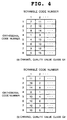
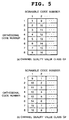
- Figs. 4 and 5 show examples of setting of a priority of each combined code in the channel quality value classes Q1 and Q2.
- the abscissa in each table shown in Figs. 4(a) and (b) and 5(a) and (b) represents the number of a scramble code and the ordinate represents the number of a orthogonal code and each element in the tables represents a priority of each combined code.
- the scramble codes are given priorities which are changed according to channel quality values.
- the priority of the scramble code 1 is set to be 1 and the priority of the scramble code 2 is set to be 2
- the priority of the scramble code 1 is set to be 2 and the priority of the scramble code 2 set to be 1. Then, the higher the priority of a scramble code is, the higher the priority of a combined code is set to be.
- a group of combined codes including the scramble code 1 in Fig. 4(a) is assigned the priorities 1 to 8
- a group of combined codes including the scramble code 2 in Fig. 4(a) is assigned the priorities 9 to 16
- a group of combined codes including the scramble code 1 in Fig. 4(b) is assigned the priorities 9 to 16
- a group of combined codes including the scramble code 2 in Fig. 4(b) is assigned the priorities 1 to 8.
- no orthogonal code is assigned a priority and to each scramble code, a orthogonal code is assigned at random.
- the scramble codes are given priorities which are changed according to channel quality values.
- the priority of the scramble code 1 is set to be 1 and the priority of the scramble code 2 is set to be 2
- the priority of the scramble code 1 is set to be 2
- the priority of the scramble code 2 is set to be 1. Then, the higher the priority of a scramble code is, the higher the priority of a combined code is set to be.
- a group of combined codes including the scramble code 1 in Fig. 5(a) is assigned the priorities 1 to 8
- a group of combined codes including the scramble code 2 in Fig. 5(a) is assigned the priorities 9 to 16
- a group of combined codes including the scramble code 1 in Fig. 5(b) is assigned the priorities 9 to 16
- a group of combined codes including the scramble code 2 in Fig. 5(b) is assigned the priorities 1 to 8.
- a orthogonal code is assigned a priority. More specifically, in Fig. 5(a) and (b), the orthogonal codes 1, 2, ..., 8 are assigned orthogonal code priorities 1, 2, ... 8, respectively. Then, the higher the priority of the orthogonal code is, the higher the priority of the combined code is set to be.
- the priorities of the group of combined codes including the scramble code 1 in Fig. 5(a) are set to be 1, 2, ..., 8 for the combined codes (1, 1), (1, 2) ... (1, 8)(scramble code number, orthogonal code number), respectively.
- Priorities of the group of combined codes including the scramble code 2 are set to be 9, 10, ... , 16 for the combined codes (2, 1), (2, 2) ... (2, 8), respectively.
- priorities of the group of combined codes including the scramble code 1 in Fig. 5(b) are set to be 9, 10, ..., 16 for the combined codes (1, 1), (1, 2) ... (1, 8), respectively.
- Priorities of the group of combined codes including the scramble code 2 are set to be 1, 2, ..., 8 for the combined codes (2, 1), (2, 2) ... (2, 8), respectively.
- priorities of the orthogonal codes are uniformly determined, they may be changed according to channel quality values similarly to the scramble codes.
- transmission power directed to each mobile station changes with a channel quality
- difference in transmission power causes inequality in the amount of interference from other downward transmission signals received by each mobile station.
- priority of a combined code is changed with a channel quality value class, and allocation of a transmission signal and a combined code is classified according to a channel quality as shown in Figs. 4 and 5. As a result, inequality of a call reception quality at each mobile station derived from a difference in a channel quality is suppressed.
- equal scramble codes are assigned to a mobile station having approximately the same common control signal reception power, that is, to a mobile station having approximately the same propagation loss between a base station and a mobile station. Between transmission signals allocated the same scramble code, interference therebetween is reduced because the same orthogonal code set is assigned.
- a transmission signal directed to a mobile station having a low common control signal reception power that is, a transmission signal directed to a mobile station having a large loss of propagation up to the base station, is discharged from the base station with a large output which will cause large interference to other radio lines.
- the transmission signals in question are assigned a combined code including the same orthogonal code set, interference between the transmission signals in question can be suppressed.
- a transmission power for compensating for a propagation loss can be set to be small.
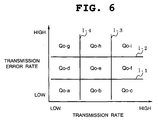
- Fig. 6 shows a second example of setting of a priority of each combined code conducted at the priority determination unit 007 of the base station at the processing 102 of Fig. 1 according to the first embodiment of the present invention.
- priority is set based on a transmission quality required amount.
- Possible transmission quality required amount includes a transmission rate, a transmission error rate, a function of a transmission rate and a transmission error rate.
- the abscissa and ordinate of Fig. 6 represent a transmission rate and a transmission error rate required by a mobile station, respectively.
- 1-1, 1-2, 1-3 and 1-4 in Fig. 6 are boundary lines for defining transmission quality required amount classes Qo - a to Qo - i. These transmission quality required amounts required by the mobile station are transmitted to the base station at the processing 102 of Fig. 2. In Fig. 6, to approximately the same transmission rate and transmission error rate, equal transmission quality required amount class is applied.
- a transmission quality required amount class is selected from Fig. 6.
- the priority determination unit 007 determines a priority of a combined code based on the transmission quality required amounts, more specifically, for each transmission quality required amount class. At that time, the unit 007 determines the priority of the combined code by assigning a priority to a scramble code as a second code or priority to a first code which is a orthogonal code and a second code. At that time, for each transmission quality required amount class, set the priority of the scramble code or the priorities of the scramble code and the orthogonal code to be the same.
- Figs. 7 and 8 show examples of setting of a priority of each combined code in the transmission quality required amount classes Qo - a and Qo - b.
- the abscissa in each table shown in Figs. 7(a) and (b) and 8(a) and (b) represents the number of a scramble code and the ordinate represents the number of a orthogonal code and each element in the tables represents a priority of each combined code.
- the transmission quality required amount class Qo - b is premised on transmission faster than that of Qo - a, in which an amount occupied by codes per call is set to be larger than that of Qo - a.
- a code generation method realizing such high-speed transmission well known is a method using a plurality of orthogonal codes simultaneously and a method using a hierarchical orthogonal code.
- the scramble codes are given priorities which are changed according to a transmission quality required amount.
- the priority of the scramble code 1 is set to be 1 and the priority of the scramble code 2 is set to be 2
- the priority of the scramble code 1 is set to be 2 and the priority of the scramble code 2 set to be 1. Then, the higher the priority of a scramble code is, the higher the priority of a combined code is set to be.
- a group of combined codes including the scramble code 1 in Fig. 7(a) is assigned the priorities 1 to 8
- a group of combined codes including the scramble code 2 in Fig.7(a) is assigned the priorities 9 to 16
- a group of combined codes including the scramble code 1 in Fig. 7(b) is assigned the priorities 5 to 8
- a group of combined codes including the scramble code 2 in Fig. 7(b) is assigned the priorities 1 to 4.
- no orthogonal code is assigned a priority and to each scramble code, a orthogonal code is assigned at random.
- the scramble codes are given priorities which are changed according to a transmission quality required amount.
- the priority of the scramble code 1 is set to be 1 and the priority of the scramble code 2 is set to be 2
- the priority of the scramble code 1 is set to be 2
- the priority of the scramble code 2 is set to be 1. Then, the higher the priority of a scramble code is, the higher the priority of a combined code is set to be.
- a group of combined codes including the scramble code 1 in Fig. 8(a) is assigned the priorities 1 to 8
- a group of combined codes including the scramble code 2 in Fig. 8(a) is assigned priorities 9 to 16
- a group of combined codes including the scramble code 1 in Fig. 8(b) is assigned the priorities 5 to 8
- a group of combined codes including the scramble code 2 in Fig. 8(b) is assigned the priorities 1 to 4.
- a orthogonal code is assigned a priority. More specifically, in Fig. 8(a), the orthogonal codes 1, 2, ..., 8 are assigned orthogonal code priorities 1, 2, ... 8, respectively. In Fig. 8(b), the orthogonal codes 1 and 2, 3 and 4, 5 and 6, and 7 and 8 are assigned orthogonal code priorities 1, 2, 3 and 4, respectively.
- the priorities of the group of combined codes including the scramble code 1 in Fig. 8(a) are set to be 1, 2, ..., 8 for the combined codes (1, 1), (1, 2) ... (1, 8) (scramble code number, orthogonal code number), respectively.
- Priorities of the group of combined codes including the scramble code 2 are set to be 9, 10, ..., 16 for the combined codes (2, 1), (2, 2) ... (2, 8), respectively.
- priorities of the group of combined codes including the scramble code 1 in Fig. 8(b) are set to be 5, 6, 7 and 8 for the combined codes (1, 1&2), (1, 3&4), (1, 5&6) and (1, 7&8), respectively.
- Priorities of the group of combined codes including the scramble code 2 are set to be 1, 2, 3 and 4 for the combined codes (2, 1&2), (2, 3&4), (2, 5&6) and (2, 7&8), respectively.
- the combined code (A, B&C) indicates that orthogonal codes B and C are simultaneously used for the scramble code A.
- a priority of a combined code is changed according to a transmission quality required amount class.
- a priority of a combined code is changed according to a transmission quality required amount given by a transmission rate, a transmission error rate, etc.
- allocation of transmission signals and combined codes is classified according to a transmission rate and a transmission error rate.
- a transmission signal allowing low-speed transmission or a high error rate receives large interference from a transmission signal which is assigned a different scramble code and requires high-speed transmission or a low error rate
- application of transmission power control overcomes the large interference.
- assigning a scramble code according to a transmission rate or an error rate enables suppression of inequality in received call quality.
- Figs. 9, 10 and 11 show a third example of setting of a priority of each combined code conducted at the priority determination unit 007 of the base station at the processing 102 of Fig. 1 according to the first embodiment of the present invention.
- priority is set based on a channel quality value and the number of uses of a second code.
- the base station checks the number of uses of each scramble code by a combined code in advance.
- Fig. 9 shows one example of the result, in which the abscissa represents the number of a scramble code and the ordinate represents the number of uses of each scramble code.
- Fig. 9 is premised on that the second scramble code is most frequently used and the fourth scramble code is least frequently used.
- the base station determines a priority of a combined code based on the number of uses of the relevant scramble code and a channel quality value transmitted from a mobile station.
- channel quality values interference power observed at the mobile station, a common control signal reception power at the mobile station and a power ratio of a desired signal to an interference signal are applied and the channel quality value information is transmitted from the mobile station to the base station at the processing 108 in Fig. 1.
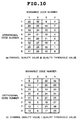
- Figs. 10 and 11 show examples of setting of a priority of each combined code under the condition of the number of uses of a scramble code given in Fig. 9.
- the ordinate represents the number of a orthogonal code and the abscissa represents the number of a scramble code.
- priorities 17 to 24 are allocated, to a group of combined codes including the scramble code 2, priorities 25 to 32 are allocated, to a group of combined codes including the scramble code 3, priorities 9 to 16 are allocated and to a group of combined codes including the scramble code 4, priorities 1 to 8 are allocated.
- priorities 9 to 16 are allocated, to a group of combined codes including the scramble code 2, priorities 1 to 8 are allocated, to a group of combined codes including the scramble code 3, priorities 17 to 24 are allocated and to a group of combined codes including the scramble code 4, priorities 25 to 32 are allocated.
- priorities 17 to 24 are allocated, to a group of combined codes including the scramble code 2, priorities 25 to 32 are allocated, to a group of combined codes including the scramble code 3, priorities 9 to 16 are allocated and to a group of combined codes including the scramble code 4, priorities 1 to 8 are allocated.
- priorities 9 to 16 are allocated, to a group of combined codes including the scramble code 2, priorities 1 to 8 are allocated, to a group of combined codes including the scramble code 3, priorities 17 to 24 are allocated and to a group of combined codes including the scramble code 4, priorities 25 to 32 are allocated.
- priority is allocated also to a orthogonal code. More specifically, priorities of the orthogonal codes 1, 2, ..., 8 are set to be 1, 2, ... 8, respectively. Then, the higher the priority of a orthogonal code is, the higher the priority of a combined code is set to be.
- priorities of a group of combined codes including the scramble code 1 in Fig. 11(a) are set to be 17, 18, ..., 24 for combined codes (1, 1), (1, 2) ... (1, 8) (scramble code number, orthogonal code number), respectively, priorities of a group of combined codes including the scramble code 2 are set to be 25, 26, ..., 32 for combined codes (2, 1), (2, 2) ... (2, 8), priorities of a group of combined codes including the scramble code 3 are set to be 9, 10, ..., 16 for combined codes (3, 1), (3, 2) ..., (3, 8) and priorities of a group of combined codes including the scramble code 4 are set to be 1, 2, ..., 8 for combined codes (4, 1), (4, 2) ... (4, 8).
- priorities of a group of combined codes including the scramble code 1 in Fig. 11(b) are set to be 9, 10, ..., 16 for combined codes (1, 1), (1, 2) ... (1, 8), respectively, priorities of a group of combined codes including the scramble code 2 are set to be 1, 2, ..., 8 for combined codes (2, 1), (2, 2) ... (2, 8), priorities of a group of combined codes including the scramble code 3 are set to be 17, 18, ..., 24 for combined codes (3, 1), (3, 2) ..., (3, 8) and priorities of a group of combined codes including the scramble code 4 are set to be 25, 26, ..., 32 for combined codes (4, 1), (4, 2) ... (4, 8).
- priority of a orthogonal code is uniformly determined, it may be changed according to the number of uses of each orthogonal code by a combined code similarly to a case of a scramble code.
- a channel quality value is a quality threshold value, that is, when reception quality at a mobile station is excellent
- transmission power directed to the mobile station in question can be set low.
- a transmission signal directed to the mobile station in question is allowed to endure interference without reaching its maximum transmission power. As a result, degradation due to interference can be suppressed.
Landscapes
- Engineering & Computer Science (AREA)
- Quality & Reliability (AREA)
- Computer Networks & Wireless Communication (AREA)
- Signal Processing (AREA)
- Mobile Radio Communication Systems (AREA)
- Radio Relay Systems (AREA)
Abstract
Description
Claims (39)
- A spread code allocation method in a CDMA cellular, comprising the steps of:having a first code set including a plurality of first codes and a second code set including one or a plurality of second codes,allocating the second code to said first code set and multiplying said plurality of first codes by said second code allocated to generate a plurality of combined codes,assigning a priority to said combined code for each transmission signal to be transmitted from a base station to a mobile station,allocating said combined code to said transmission signal based on said priority, anddiffusing said transmission signal by the allocated combined code to transmit said transmission signal diffused to said mobile station.
- The spread code allocation method in a CDMA cellular as set forth in claim 1, further comprising the step of,at a plurality of said mobile stations, measuring a channel quality value and informing said base station of said channel quality value and at said base station, determining a priority of said combined code based on said channel quality value informed.
- The method as set forth in claim 1 or 2, further comprising the steps of:at a plurality of said mobile stations, measuring a channel quality value and informing said base station of said channel quality value and at said base station, determining a priority of said combined code based on said channel quality value informed, andsetting a priority to said second code according to said channel quality value and setting a priority of said combined code to be higher as said second code attains a higher priority.
- The method as set forth in claim 1, 2 or 3, further comprising the steps of:at a plurality of said mobile stations, measuring a channel quality value and informing said base station of said channel quality value and at said base station, determining a priority of said combined code based on said channel quality value informed,setting a priority to said second code according to said channel quality value and setting a priority of said combined code to be higher as said second code attains a higher priority, andproviding an axis of a channel quality value representing said channel quality value and dividing the axis of a channel quality value by a plurality of threshold values to set a channel quality value within the same value area among a plurality of value areas generated by the division by said threshold values to have the same priority of said second code.
- The method as set forth in claim 1, 2, 3 or 4, further comprising the steps of:at a plurality of said mobile stations, measuring a channel quality value and informing said base station of said channel quality value and at said base station, determining a priority of said combined code based on said channel quality value informed, andsetting a priority to said first code and setting a priority of each combined code in a group of combined codes including the same second code to be higher as said first code attains a higher priority.
- The method asset forth in claim 1, 2, 3, 4 or 5, further comprising the steps of:at a plurality of said mobile stations, measuring a channel quality value and informing said base station of said channel quality value and at said base station, determining a priority of said combined code based on said channel quality value informed,setting a priority to said first code and setting a priority of each combined code in a group of combined codes including the same second code to be higher as said first code attains a higher priority, andproviding an axis of a channel quality value representing said channel quality value and dividing the axis of a channel quality value by a plurality of threshold values to set a channel quality value within the same value area among a plurality of value areas generated by the division by said threshold values to have the same priority of said first code.
- The method as set forth in anyone of claims 1 to 6, further comprising the step ofgrasping a transmission quality required amount required by a mobile station receiving each said transmission signal to determine a priority of said combined code based on said transmission quality required amount.
- The method as set forth in anyone of claims 1 to 7, further comprising the steps of:grasping a transmission quality required amount required by a mobile station receiving each said transmission signal to determine a priority of said combined code based on said transmission quality required amount, andsetting a priority to said second code according to said transmission quality required amount and setting a priority of said combined code to be higher as said second code attains a higher priority.
- The method asset forth in anyone of claims 1 to 8, further comprising the steps of:grasping a transmission quality required amount required by a mobile station receiving each said transmission signal to determine a priority of said combined code based on said transmission quality required amount,setting a priority to said second code according to said transmission quality required amount and setting a priority of said combined code to be higher as said second code attains a higher priority, andproviding an axis of a transmission quality required amount representing said transmission quality required amount and dividing the axis of a transmission quality required amount by a plurality of threshold values to set a transmission quality required amount within the same value area among a plurality of value areas generated by the division by said threshold values to have the same priority of said second code.
- The method as set forth in anyone of claims 1 to 9, further comprising the steps of:grasping a transmission quality required amount required by a mobile station receiving each said transmission signal to determine a priority of said combined code based on said transmission quality required amount, andsetting a priority to said first code according to said transmission quality required amount and setting a priority of each combined code in a group of said combined codes including the same second code to be higher as said first code attains a higher priority.
- The method as set forth in anyone of claims 1 to 10, further comprising the steps of:grasping a transmission quality required amount required by a mobile station receiving each said transmission signal to determine a priority of said combined code based on said transmission quality required amount,setting a priority to said first code according to said transmission quality required amount and setting a priority of each combined code in a group of said combined codes including the same second code to be higher as said first code attains a higher priority, andproviding an axis of a transmission quality required amount representing said transmission quality required amount and dividing the axis of a transmission quality required amount by a plurality of threshold values to set a transmission quality required amount within the same value area among a plurality of value areas generated by the division by said threshold values to have the same priority of said first code.
- The method as set forth in anyone of claims 1 to 11,further comprising the step ofgrasping a transmission quality required amount required by a mobile station receiving each said transmission signal to determine a priority of said combined code based on said transmission quality required amount, whereina transmission error rate is taken as said transmission quality required amount.
- The method as set forth in anyone of claims 1 to 12,further comprising the step ofgrasping a transmission quality required amount required by a mobile station receiving each said transmission signal to determine a priority of said combined code based on said transmission quality required amount, whereina transmission rate is taken as said transmission quality required amount.
- The method as set forth in anyone of claims 1 to 13, further comprising the step ofgrasping a transmission quality required amount required by a mobile station receiving each said transmission signal to determine a priority of said combined code based on said transmission quality required amount, whereinsaid transmission quality required amount is given by a function of a transmission rate and a transmission error rate.
- The method as set forth in anyone of claims 1 to 14, whereinsaid mobile station measures a channel quality value and informs said base station of said channel quality value, andsaid base station checks the number of uses of each second code by a combined code including the same second code and determines a priority of said combined code based on said channel quality value informed and said number of uses of each second code.
- The method as set forth in anyone of claims 1 to 15, whereinsaid mobile station measures a channel quality value and informs said base station of said channel quality value,said base station checks the number of uses of each second code by a combined code including the same second code and determines a priority of said combined code based on said channel quality value informed and said number of uses of each second code, and which further comprises the steps of:when said channel quality value is not less than a quality threshold value, setting a priority of a combined code to be higher that includes a second code whose said number of uses of each second code by said combined code is smaller, andwhen said channel quality value is less than said quality threshold value, setting a priority of a combined code to be higher that includes a second code whose said number of uses of each second code by said combined code is larger.
- The method as set forth in anyone of claims 1 to 16, whereinsaid mobile station measures a channel quality value and informs said base station of said channel quality value,said base station checks the number of uses of each second code by a combined code including the same second code and determines a priority of said combined code based on said channel quality value informed and said number of uses of each second code, and which further comprises the step of:setting a priority to said first code and setting a priority of each combined code in a group of combined codes including the same second code to be higher as said first code attains a higher priority.
- The method as set forth in anyone of claims 1 to 17, whereinsaid transmission signal includes a common control signal.
- The method as set forth in anyone of claims 1 to 18, whereinsaid transmission signal includes a common control signal, andto said common control signal, a combined code having he highest priority is allocated.
- The method as set forth in anyone of claims 1 to 19, further comprising the step of,at a plurality of said mobile stations, measuring a channel quality value and informing said base station of said channel quality value and at said base station, determining a priority of said combined code based on said channel quality value informed, whereinan interference signal power is taken as said channel quality value.
- The method as set forth in anyone of claims 1 to 20, further comprising the step of,at a plurality of said mobile stations, measuring a channel quality value and informing said base station of said channel quality value and at said base station, determining a priority of said combined code based on said channel quality value informed, whereina reception power of said common control signal is taken as said channel quality value.
- The method as set forth in anyone of claims 1 to 21, further comprising the step of,at a plurality of said mobile stations, measuring a channel quality value and informing said base station of said channel quality value and at said base station, determining a priority of said combined code based on said channel quality value informed, whereina power ratio of a desired signal to an interference signal is taken as said channel quality value.
- The method as set forth in anyone of claims 1 to 22, further comprising the step of:at a plurality of said mobile stations, measuring a channel quality value and informing said base station of said channel quality value and at said base station, determining a priority of said combined code based on said channel quality value informed, whereina power ratio of a desired signal to an interference signal is taken as said channel quality value, and further comprising the step of:checking a reception power of a common control signal sent out from a base station being connected and a reception power of said common control signal sent out from a base station not being connected to calculate a power ratio of a desired signal to an interference signal from a ratio of a reception power corresponding to said base station being connected to a reception power corresponding to said base station not being connected.
- The method as set forth in anyone of claims 1 to 23, whereinas said first code set, a orthogonal code is used.
- The method as set forth in anyone of claims 1 to 24, whereinas said second code set, a gold code or a part of the gold code is used.
- A base station in a CDMA cellular, comprising:a first code set including a plurality of first codes and a second code set including one or a plurality of second codes,means for allocating said second code to said first code set and multiplying said plurality of first codes by said second code allocated to generate a plurality of combined codes,means for assigning a priority to said combined code for each transmission signal to be transmitted from a base station to a mobile station,means for allocating said combined code to said transmission signal based on said priority, andmeans for diffusing said transmission signal by the allocated combined code to transmit said transmission signal diffused to said mobile station.
- The base station in a CDMA cellular as set forth in claim 26, whereinsaid base station is informed of channel quality values measured at a plurality of said mobile stations to determine a priority of said combined code based on said channel quality values informed.
- The base station in a CDMA cellular as set forth in claim 26 or 27, whereinsaid base station is informed of channel quality values measured at a plurality of said mobile stations to determine a priority of said combined code based on said channel quality values informed, andsets a priority to said second code according to said channel quality value and sets a priority of said combined code to be higher as said second code attains a higher priority.
- The base station in a CDMA cellular as set forth in claim 26, 27 or 28, whereinsaid base station is informed of channel quality values measured at a plurality of said mobile stations to determine a priority of said combined code based on said channel quality values informed,sets a priority to said second code according to said channel quality values and sets a priority of said combined code to be higher as said second code attains a higher priority, andprovides an axis of a channel quality value representing said channel quality value and divides the axis of a channel quality value by a plurality of threshold values to set a channel quality value within the same value area among a plurality of value areas generated by the division by said threshold values to have the same priority of said second code.
- The base station in a CDMA cellular as set forth in claim 26, 27, 28 or 29, whereinsaid base station is informed of channel quality values measured at a plurality of said mobile stations and determines a priority of said combined code based on said channel quality values informed, andsets a priority to said first code according to said channel quality value and sets a priority of each combined code in a group of combined codes including the same second code to be higher as said first code attains a higher priority.
- The base station in a CDMA cellular as set forth in claim 26, 27, 28, 29 or 30, whereinsaid base station is informed of channel quality values measured at a plurality of said mobile stations and determines a priority of said combined code based on said channel quality values informed,sets a priority to said first code according to said channel quality value and sets a priority of each combined code in a group of combined codes including the same second code to be higher as said first code attains a higher priority, andprovides an axis of a channel quality value representing said channel quality value and divides the axis of a channel quality value by a plurality of threshold values to set a channel quality value within the same value area among a plurality of value areas generated by the division by said threshold values to have the same priority of said first code.
- The base station as set forth in anyone of claims 26 to 31, whereinsaid base station grasps a transmission quality required amount required by a mobile station receiving each said transmission signal to determine a priority of said combined code based on said transmission quality required amount.
- The base station as set forth in anyone of claims 26 to 32, whereinsaid base station grasps a transmission quality required amount required by a mobile station receiving each said transmission signal to determine a priority of said combined code based on said transmission quality required amount, andsets a priority to said second code according to said transmission quality required amount and sets a priority of said combined code to be higher as said second code attains a higher priority.
- The base station as set forth in anyone of claims 26 to 33, whereinsaid base station grasps a transmission quality required amount required by a mobile station receiving each said transmission signal to determine a priority of said combined code based on said transmission quality required amount,sets a priority to said second code according to said transmission quality required amount and sets a priority of said combined code to be higher as said second code attains a higher priority, andprovides an axis of a transmission quality required amount representing said transmission quality required amount and divides the axis of a transmission quality required amount by a plurality of threshold values to set a transmission quality required amount within the same value area among a plurality of value areas generated by the division by said threshold values to have the same priority of said second code.
- The base station as set forth in anyone of claims 26 to 34, whereinsaid base station grasps a transmission quality required amount required by a mobile station receiving each said transmission signal to determine a priority of said combined code based on said transmission quality required amount, andsets a priority to said first code according to said transmission quality required amount and sets a priority of each combined code in a group of said combined codes including the same second code to be higher as said first code attains a higher priority.
- The base station in a CDMA cellular as set forth in anyone of claims 26 to 35, whereinsaid base station grasps a transmission quality required amount required by a mobile station receiving each said transmission signal to determine a priority of said combined code based on said transmission quality required amount,sets a priority to said first code according to said transmission quality required amount and sets a priority of each combined code in a group of said combined codes including the same second code to be higher as said first code attains a higher priority, andprovides an axis of a transmission quality required amount representing said transmission quality required amount and divides the axis of a transmission quality required amount by a plurality of threshold values to set a transmission quality required amount within the same value area among a plurality of value areas generated by the division by said threshold values to have the same priority of said first code.
- The base station as set forth in anyone of claims 26 to 36, whereinsaid base station is informed of a channel quality value measured at said mobile station, andchecks the number of uses of each second code by a combined code including the same second code and determines a priority of said combined code based on said channel quality value informed and said number of uses of each second code.
- The base station as set forth in anyone of claims 26 to 37, whereinsaid base station is informed of a channel quality value measured at said mobile station,checks the number of uses of each second code by a combined code including the same second code and determines a priority of said combined code based on said channel quality value informed and said number of uses of each second code,when said channel quality value is not less than a quality threshold value, sets a priority of a combined code to be higher that includes a second code whose said number of uses of each second code by said combined code is smaller, andwhen said channel quality value is less than said quality threshold value, sets a priority of a combined code to be higher that includes a second code whose said number of uses of each second code by said combined code is larger.
- The base station as set forth in anyone of claims 26 to 38, whereinsaid base station is informed of a channel quality value measured at said mobile station,checks the number of uses of each second code by a combined code including the same second code and determines a priority of said combined code based on said channel quality value informed and said number of uses of each second code, andsets a priority to said first code and sets a priority of each combined code in a group of combined codes including the same second code to be higher as said first code attains a higher priority.
Applications Claiming Priority (2)
| Application Number | Priority Date | Filing Date | Title |
|---|---|---|---|
| JP31160399A JP3769432B2 (en) | 1999-11-01 | 1999-11-01 | Spreading code allocation method and base station in code division multiplexing cellular |
| JP31160399 | 1999-11-01 |
Publications (3)
| Publication Number | Publication Date |
|---|---|
| EP1096710A2 true EP1096710A2 (en) | 2001-05-02 |
| EP1096710A3 EP1096710A3 (en) | 2003-09-03 |
| EP1096710B1 EP1096710B1 (en) | 2005-04-20 |
Family
ID=18019246
Family Applications (1)
| Application Number | Title | Priority Date | Filing Date |
|---|---|---|---|
| EP20000123393 Expired - Lifetime EP1096710B1 (en) | 1999-11-01 | 2000-10-31 | Spread code allocation method and base station in CDMA cellular network |
Country Status (5)
| Country | Link |
|---|---|
| US (1) | US7139284B1 (en) |
| EP (1) | EP1096710B1 (en) |
| JP (1) | JP3769432B2 (en) |
| CA (1) | CA2324842A1 (en) |
| DE (1) | DE60019528T2 (en) |
Cited By (3)
| Publication number | Priority date | Publication date | Assignee | Title |
|---|---|---|---|---|
| EP1235359A3 (en) * | 2001-02-27 | 2003-06-04 | Nokia Corporation | Dynamic reselection of CDMA spreading codes |
| EP1720273A1 (en) * | 2005-05-04 | 2006-11-08 | Siemens Aktiengesellschaft | Method for encoding of datablocks |
| DE10161641B4 (en) * | 2001-12-14 | 2007-07-12 | IAD Gesellschaft für Informatik, Automatisierung und Datenverarbeitung mbH | Method and device for securing the connection-oriented, bidirectional transmission of given data blocks by adaptive, targeted scrambling |
Families Citing this family (17)
| Publication number | Priority date | Publication date | Assignee | Title |
|---|---|---|---|---|
| US7499391B2 (en) * | 2002-02-19 | 2009-03-03 | Samsung Electronics Co., Ltd. | Apparatus and method for allocating walsh codes to mobile stations in an adaptive antenna array wireless network |
| JP3581357B2 (en) * | 2002-05-22 | 2004-10-27 | 松下電器産業株式会社 | Communication terminal apparatus and spreading code estimation method |
| US7260397B2 (en) * | 2002-12-27 | 2007-08-21 | Nokia Corporation | Reconfiguration of a mobile telecommunications network element |
| JP4127805B2 (en) * | 2003-04-11 | 2008-07-30 | 株式会社エヌ・ティ・ティ・ドコモ | Base station, mobile station, communication system, transmission control method, and mobile station control program |
| KR100548393B1 (en) | 2003-08-20 | 2006-02-02 | 엘지전자 주식회사 | Packet service performance improvement method of mobile communication terminal |
| US7907574B2 (en) * | 2004-01-29 | 2011-03-15 | Qualcomm Incorporated | Channel scheduling |
| JP2006115410A (en) * | 2004-10-18 | 2006-04-27 | Matsushita Electric Ind Co Ltd | Base station apparatus, mobile station apparatus, and transmission rate control method |
| US9374791B2 (en) | 2007-09-21 | 2016-06-21 | Qualcomm Incorporated | Interference management utilizing power and attenuation profiles |
| US8824979B2 (en) | 2007-09-21 | 2014-09-02 | Qualcomm Incorporated | Interference management employing fractional frequency reuse |
| US20090080499A1 (en) * | 2007-09-21 | 2009-03-26 | Qualcomm Incorporated | Interference management employing fractional code reuse |
| US9078269B2 (en) | 2007-09-21 | 2015-07-07 | Qualcomm Incorporated | Interference management utilizing HARQ interlaces |
| US9137806B2 (en) | 2007-09-21 | 2015-09-15 | Qualcomm Incorporated | Interference management employing fractional time reuse |
| US9066306B2 (en) | 2007-09-21 | 2015-06-23 | Qualcomm Incorporated | Interference management utilizing power control |
| US20090135754A1 (en) | 2007-11-27 | 2009-05-28 | Qualcomm Incorporated | Interference management in a wireless communication system using overhead channel power control |
| US8948095B2 (en) | 2007-11-27 | 2015-02-03 | Qualcomm Incorporated | Interference management in a wireless communication system using frequency selective transmission |
| US9065584B2 (en) | 2010-09-29 | 2015-06-23 | Qualcomm Incorporated | Method and apparatus for adjusting rise-over-thermal threshold |
| CN114095996A (en) | 2015-05-15 | 2022-02-25 | 北京三星通信技术研究有限公司 | Uplink power distribution method and user equipment |
Family Cites Families (19)
| Publication number | Priority date | Publication date | Assignee | Title |
|---|---|---|---|---|
| US5448750A (en) * | 1992-04-22 | 1995-09-05 | Telefonaktiebolaget Lm Ericsson | Segregation method of dynamic channel allocation in a mobile radio system |
| SE9301695L (en) * | 1993-05-17 | 1994-09-12 | Ericsson Telefon Ab L M | Method and apparatus for channel utilization in a radio communication system |
| US5491837A (en) * | 1994-03-07 | 1996-02-13 | Ericsson Inc. | Method and system for channel allocation using power control and mobile-assisted handover measurements |
| US5724378A (en) * | 1994-12-13 | 1998-03-03 | Nit Mobile Communications Network, Inc. | CDMA multiuser receiver and method |
| DE19505243A1 (en) * | 1995-02-16 | 1996-08-29 | Deutsche Telekom Mobil | Procedure for dynamic channel allocation in mobile radio networks |
| JP3039402B2 (en) * | 1996-12-05 | 2000-05-08 | 日本電気株式会社 | Transmission power control device for mobile communication system |
| US6091717A (en) * | 1997-05-05 | 2000-07-18 | Nokia Mobile Phones Limited | Method for scheduling packet data transmission |
| JPH1141192A (en) | 1997-07-17 | 1999-02-12 | Toshiba Corp | Channel allocation control method, spreading code allocation control method, carrier allocation control method, and wireless communication system for wireless communication system |
| JP2862527B1 (en) | 1997-11-18 | 1999-03-03 | 株式会社ワイ・アール・ピー移動通信基盤技術研究所 | Spread spectrum communication equipment |
| KR100294701B1 (en) * | 1998-03-25 | 2001-07-12 | 서평원 | method for removal interferemce seguential in CDMA system with multi transmission loss |
| CN100420314C (en) * | 1998-07-24 | 2008-09-17 | 株式会社东芝 | CDMA mobile terminal device |
| KR100429540B1 (en) * | 1998-08-26 | 2004-08-09 | 삼성전자주식회사 | Packet data communication apparatus and method of mobile communication system |
| JP3149399B2 (en) * | 1998-09-24 | 2001-03-26 | 松下電器産業株式会社 | CDMA base station apparatus and code allocation method |
| KR100383614B1 (en) * | 1998-10-19 | 2003-10-08 | 삼성전자주식회사 | Allocation Device and Method of Code Division Multiple Access Communication System |
| US6421335B1 (en) * | 1998-10-26 | 2002-07-16 | Nokia Telecommunications, Oy | CDMA communication system and method using priority-based SIMA quality of service class |
| US6389138B1 (en) * | 1998-11-12 | 2002-05-14 | Lucent Technologies Inc. | Method and apparatus for generating a complex scrambling code sequence |
| JP3565102B2 (en) * | 1999-08-13 | 2004-09-15 | 日本電気株式会社 | Downlink spreading code allocation method and base station |
| US6519461B1 (en) * | 1999-10-29 | 2003-02-11 | Telefonaktiebolaget Lm Ericsson (Publ) | Channel-type switching from a common channel to a dedicated channel based on common channel load |
| US6778943B2 (en) * | 2002-08-13 | 2004-08-17 | Xerox Corporation | Systems and methods for distributed fault diagnosis using precompiled finite state automata |
-
1999
- 1999-11-01 JP JP31160399A patent/JP3769432B2/en not_active Expired - Fee Related
-
2000
- 2000-10-31 US US09/699,648 patent/US7139284B1/en not_active Expired - Lifetime
- 2000-10-31 DE DE2000619528 patent/DE60019528T2/en not_active Expired - Lifetime
- 2000-10-31 CA CA 2324842 patent/CA2324842A1/en not_active Abandoned
- 2000-10-31 EP EP20000123393 patent/EP1096710B1/en not_active Expired - Lifetime
Cited By (5)
| Publication number | Priority date | Publication date | Assignee | Title |
|---|---|---|---|---|
| EP1235359A3 (en) * | 2001-02-27 | 2003-06-04 | Nokia Corporation | Dynamic reselection of CDMA spreading codes |
| DE10161641B4 (en) * | 2001-12-14 | 2007-07-12 | IAD Gesellschaft für Informatik, Automatisierung und Datenverarbeitung mbH | Method and device for securing the connection-oriented, bidirectional transmission of given data blocks by adaptive, targeted scrambling |
| EP1720273A1 (en) * | 2005-05-04 | 2006-11-08 | Siemens Aktiengesellschaft | Method for encoding of datablocks |
| WO2006117313A1 (en) * | 2005-05-04 | 2006-11-09 | Nokia Siemens Networks Gmbh & Co. Kg | Method for encoding data blocks |
| US8054740B2 (en) | 2005-05-04 | 2011-11-08 | Nokia Siemens Networks Gmbh & Co. Kg | Method for encoding data blocks |
Also Published As
| Publication number | Publication date |
|---|---|
| EP1096710A3 (en) | 2003-09-03 |
| DE60019528T2 (en) | 2006-04-27 |
| US7139284B1 (en) | 2006-11-21 |
| EP1096710B1 (en) | 2005-04-20 |
| DE60019528D1 (en) | 2005-05-25 |
| CA2324842A1 (en) | 2001-05-01 |
| JP3769432B2 (en) | 2006-04-26 |
| JP2001136573A (en) | 2001-05-18 |
Similar Documents
| Publication | Publication Date | Title |
|---|---|---|
| US7139284B1 (en) | Spread code allocation method and base station in CDMA cellular | |
| US9609650B2 (en) | Adaptive uplink/downlink timeslot assignment in a hybrid wireless time division multiple access/code division multiple access communication system | |
| JP4791592B2 (en) | Method and apparatus for determining, communicating and using information that can be used for interference control | |
| EP1282241B1 (en) | Mobile communication system and transmission power control method | |
| KR101096324B1 (en) | Method and base station for reducing shared downlink radio channel by transmitting to multiple mobile phones using multiple antenna beams | |
| KR20080063832A (en) | Method and apparatus for determining, communicating, and using information including loading factors for interference control | |
| US20070230428A1 (en) | Communication apparatus | |
| JP2002315049A (en) | Dynamic resource allocation method | |
| KR100332271B1 (en) | Cdma communication apparatus | |
| JP2007507979A (en) | Code tree fragmentation in call admission control | |
| US7161917B2 (en) | Method of allocating channel codes for a synchronous uplink of mobile communication system | |
| JP3565102B2 (en) | Downlink spreading code allocation method and base station | |
| JP3933084B2 (en) | Spreading code allocation method and base station in code division multiplexing cellular | |
| Santucci et al. | Power allocation in a multimedia CDMA wireless system with imperfect power control | |
| Varzakas | Spectral efficiency comparison of tdma and ds-cdma in cellular mobile radio systems | |
| KR100616356B1 (en) | Data Rate Determination Method for High Speed Forward Supplemental Channel in Spread Spectrum System |
Legal Events
| Date | Code | Title | Description |
|---|---|---|---|
| PUAI | Public reference made under article 153(3) epc to a published international application that has entered the european phase |
Free format text: ORIGINAL CODE: 0009012 |
|
| AK | Designated contracting states |
Kind code of ref document: A2 Designated state(s): AT BE CH CY DE DK ES FI FR GB GR IE IT LI LU MC NL PT SE |
|
| AX | Request for extension of the european patent |
Free format text: AL;LT;LV;MK;RO;SI |
|
| PUAL | Search report despatched |
Free format text: ORIGINAL CODE: 0009013 |
|
| AK | Designated contracting states |
Kind code of ref document: A3 Designated state(s): AT BE CH CY DE DK ES FI FR GB GR IE IT LI LU MC NL PT SE |
|
| AX | Request for extension of the european patent |
Extension state: AL LT LV MK RO SI |
|
| 17P | Request for examination filed |
Effective date: 20030729 |
|
| 17Q | First examination report despatched |
Effective date: 20031112 |
|
| AKX | Designation fees paid |
Designated state(s): DE FI FR GB IT SE |
|
| GRAP | Despatch of communication of intention to grant a patent |
Free format text: ORIGINAL CODE: EPIDOSNIGR1 |
|
| GRAS | Grant fee paid |
Free format text: ORIGINAL CODE: EPIDOSNIGR3 |
|
| GRAA | (expected) grant |
Free format text: ORIGINAL CODE: 0009210 |
|
| AK | Designated contracting states |
Kind code of ref document: B1 Designated state(s): DE FI FR GB IT SE |
|
| REG | Reference to a national code |
Ref country code: GB Ref legal event code: FG4D |
|
| REG | Reference to a national code |
Ref country code: IE Ref legal event code: FG4D |
|
| REF | Corresponds to: |
Ref document number: 60019528 Country of ref document: DE Date of ref document: 20050525 Kind code of ref document: P |
|
| REG | Reference to a national code |
Ref country code: SE Ref legal event code: TRGR |
|
| PLBE | No opposition filed within time limit |
Free format text: ORIGINAL CODE: 0009261 |
|
| STAA | Information on the status of an ep patent application or granted ep patent |
Free format text: STATUS: NO OPPOSITION FILED WITHIN TIME LIMIT |
|
| ET | Fr: translation filed | ||
| 26N | No opposition filed |
Effective date: 20060123 |
|
| PGFP | Annual fee paid to national office [announced via postgrant information from national office to epo] |
Ref country code: FI Payment date: 20081014 Year of fee payment: 9 |
|
| PGFP | Annual fee paid to national office [announced via postgrant information from national office to epo] |
Ref country code: SE Payment date: 20081022 Year of fee payment: 9 Ref country code: IT Payment date: 20081029 Year of fee payment: 9 |
|
| EUG | Se: european patent has lapsed | ||
| PG25 | Lapsed in a contracting state [announced via postgrant information from national office to epo] |
Ref country code: FI Free format text: LAPSE BECAUSE OF NON-PAYMENT OF DUE FEES Effective date: 20091031 |
|
| PG25 | Lapsed in a contracting state [announced via postgrant information from national office to epo] |
Ref country code: IT Free format text: LAPSE BECAUSE OF NON-PAYMENT OF DUE FEES Effective date: 20091031 |
|
| PG25 | Lapsed in a contracting state [announced via postgrant information from national office to epo] |
Ref country code: SE Free format text: LAPSE BECAUSE OF NON-PAYMENT OF DUE FEES Effective date: 20091101 |
|
| PGFP | Annual fee paid to national office [announced via postgrant information from national office to epo] |
Ref country code: FR Payment date: 20131009 Year of fee payment: 14 Ref country code: GB Payment date: 20131030 Year of fee payment: 14 |
|
| GBPC | Gb: european patent ceased through non-payment of renewal fee |
Effective date: 20141031 |
|
| PG25 | Lapsed in a contracting state [announced via postgrant information from national office to epo] |
Ref country code: GB Free format text: LAPSE BECAUSE OF NON-PAYMENT OF DUE FEES Effective date: 20141031 |
|
| REG | Reference to a national code |
Ref country code: FR Ref legal event code: ST Effective date: 20150630 |
|
| PG25 | Lapsed in a contracting state [announced via postgrant information from national office to epo] |
Ref country code: FR Free format text: LAPSE BECAUSE OF NON-PAYMENT OF DUE FEES Effective date: 20141031 |
|
| PGFP | Annual fee paid to national office [announced via postgrant information from national office to epo] |
Ref country code: DE Payment date: 20191015 Year of fee payment: 20 |
|
| REG | Reference to a national code |
Ref country code: DE Ref legal event code: R071 Ref document number: 60019528 Country of ref document: DE |