FIELD OF THE INVENTION
This invention relates to iron-aluminum
bimetallic liners for combustion engines, typically with
aluminum motor blocks, and their manufacture, and more
particularly it relates to bimetallic aluminum-iron
cylinder liners and for producing the liners by casting
methods bonding iron to aluminum.
BACKGROUND OF THE INVENTION
Cylinder liners are known in the art as
typified by U.S. Patent Nos. 4,523,554 to H. Ryu, June
18, 1985 and 5,183,025 to J.L. Jorstad, et al, February
2, 1993. These liners interface thermal energy transfer
between the piston and engine block. Cylinder liners are
also known to have provisions for introducing fluid flow
paths to control transfer of thermal energy from the
pistons to the engine block.
When aluminum cylinder liners are made in part
of iron forming a contact surface for interfacing the
engine block, with the aluminum portion interfacing with
the piston, there are considerable problems in bonding
the two metals together well enough to process the
considerable forces and temperatures encountered in use.
Such problems are in part introduced at the iron-aluminum
interfaces by the large differences in melting
temperatures of iron and aluminum, and thus make casting
of the bimetallic cylinder liners difficult.
Another problem of producing the cylinder
liners is the desire to have a roughened surface on the
iron interface which contacts the aluminum engine block
as a feature of handling thermal transfer of energy
between the piston and the engine block.
Accordingly, it has not been feasible
heretofore to make inexpensive cast aluminum cylinder
liners faced with iron liner surfaces, and in particular
those with iron surfaces having roughened insulation-type
contact surfaces.
One significant problem in producing thin iron
circumferential layers upon aluminum liner bodies, is the
provision of the precise tolerances necessary,
particularly for larger diameter pistons.
Thus, it is the objective of this invention to
correct these problems of the prior art with a novel
bimetallic iron-aluminum cylinder liner and its method of
manufacture.
BRIEF DESCRIPTION OF THE INVENTION
A generally hollow cylindrical piston liner for
insertion in an internal combustion engine between a
piston and an engine block has a cast aluminum piston
liner body with a cast iron engine block contact surface
member extending circumferentially from its outer
cylindrical surface. Thus, a thin iron layer is securely
thermally bonded to ribs extending from the liner body to
exhibit a roughened motor block contact surface.
The cast iron liner with the roughened surface
is generated by introducing onto a mold cavity surface a
mold wash substance that adheres to and forms a layer on
the mold cavity surface and in the process of casting
generates a substantially uniform bubble pattern to
thereby produce a roughened iron interface surface of
appropriate texture before molten iron is poured onto the
wash layer.
The aluminum piston liner is then bonded to the
iron liner by pouring molten aluminum over the iron liner
in a pre-heated piston liner mold. During the
solidification stages, the molds are centrifugally
rotated about the piston liner cylinder axis to establish
the required manufacturing precision for large diameter
piston liners. The piston liners have a series of
circumferential ribs spaced proportionately along the
liner length and these ribs are interfaced with the iron
liner surfaces.
This results in a cast aluminum piston liner
for insertion in an internal combustion engine between a
piston and an engine block comprising a hollow
cylindrical cast aluminum liner body for receiving the
piston having a plurality of spaced circumferential
aluminum ribs extending from its outer surface for
supporting a thermal contact iron interface surface
between the cylindrical liner body and a mating
surrounding engine block surface. The thermal contact
surface is formed as a cast iron engine block contact
member with a roughened outer surface, wherein the iron
member is thermally bonded onto the circumferential
aluminum ribs extending from the cylindrical liner body.
The invention provides a method of molding the
cylindrical cast aluminum piston liner having externally
protruding aluminum ribs covered by a cast surface layer
of iron roughened at the outer surface for interfacing
the resident engine block surface. Molds are prepared
and preheated, where necessary, before pouring the
respective molten iron and aluminum metals in a sequence
of corresponding casting steps.
For producing a roughened outer surface on the
cast iron layer, a layer of a mold wash substance is
adhered to the mold inner surface to produce, before the
pouring of molten iron into the mold, a mass of bubbles
at the outer surface contact interface of the molten iron
poured into the mold.
Placement of such cast iron liners into the
aluminum piston cylinder molds before pouring molten
aluminum then produces the bimetallic iron-aluminum
piston liner. The piston mold containing iron liners is
preheated to produce a better bonding at the iron-aluminum
merging interface.
To obtain the very demanding precise
cylindrical surfaces that are required in particular for
larger size pistons and diesel engine pistons, the loaded
molds are rotated about the cylindrical axis of the
piston liner during solidification of molten metal.
Other objects features and advantages of the
invention will be found throughout the following
description, drawings and claims.
BRIEF DESCRIPTION OF THE DRAWINGS
In the accompanying drawings, wherein like
reference characters refer to similar features throughout
the various views to facilitate comparison:
DETAILED DESCRIPTION OF THE
PRESENTLY PREFERRED EMBODIMENTS
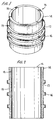
In FIGURES 1 and 2, the typical cylinder liner
preferred embodiment 15 is set forth. The flange 14 is
shown at the top of the liner 15. The size of the
cylinder varies for different engines and it has been
difficult in the prior art because of the difference in
melting temperatures of iron and aluminum to produce any
cylinder liner casting with a bonded-on iron surface
member 16, as displayed on the outer circumference of the
three symmetrically placed aluminum ribs 17 for
establishing thermal surface contact interface within a
receiving aluminum engine block. In such use, strict
dimensional tolerances of cylindrical roundness are
imposed which have been exceedingly difficult to achieve
in cast products, particularly for larger diameter
pistons such as used for Diesel engines for example. The
manner of meeting such tolerances by rotating molds about
the cylindrical axis of the liner is later discussed with
respect to the precision casting process for manufacture
of the cylinder liner afforded by this invention.
The interface bonding of the iron surface
member 16 onto the integrally extending and thus strongly
affixed cast aluminum ribs 17 is critical because of the
significantly different melting temperatures of iron and
aluminum. Note that the circumferential alignment of the
aluminum ribs 17 presents the bonded iron surface members
16 perpendicular to the movement of the piston in the
interior surface 18 of the aluminum liner body 15 to thus
encounter high stresses at the interface surface between
the liner body 15 and the aluminum engine block into
which it is mounted. Thus, the bonding strength between
the iron and aluminum components 16 and 17 provided in
the casting process of this invention is a significant
improvement in the art.
Consider in more detail the eccentricity
problems encountered in producing an acceptable product
when the ribs 17 extend only about five millimeters from
the generally cylindrical outer perimeter 19 of the liner
body. The thinner iron surface contact layers 16 of
about one millimeter thickness then present significant
problems of obtaining protection roundness in
manufacture. For this reason, expensive machining
processes and complex casting procedures would be
required using conventional prior art techniques that
would unduly increase the production costs of the
bimetallic iron-aluminum piston liners to which this
invention is directed.
FIGURE 3 is a flow diagram outlining the
process of manufacturing the cast cylinder liners 15.
The mold washing step 20 is critical in the formation of
the roughened porous surface characteristics of the iron
surface 16. The preferred wash constituency is obtained
using a mixture of 25 pounds of silica flour, 200 mesh,
with 0.875 pounds of western bentonite in 12 pounds of
water with 3 ounces of concentrated detergent, typically
Orvus brand marketed by Proctor & Gamble, is prepared at
block 21 and verified at block 22. In an initial molding
step for processing the iron liner member 16, this
mixture, after being diluted by water to a viscosity
range from 20 to 25 seconds, is then at block 20 washed
upon the surface of the mold, which is then pre-heated to
a processing temperature in the range of 140 to 160
degrees Centigrade in blocks 23 and 24. This wash being
appropriately applied to a thickness of one millimeter on
the mold surface at block 25 serves to generate a set of
substantially uniformly distributed bubbles in a solid
matrix pattern into which molten iron may be poured to
produce its roughened, porous surface characteristic.
The mold wash is applied to the internal mold
surface by the use of a pressure tank and a spray nozzle.
The appropriate bubble characteristics are controlled by
the choice of air pressure, spray nozzle and the movement
speed relative to the mold taking into account the mold
rotation speed at block 26. The air bubbles formed in
the dried wash surface provide a generally uniformly
distributed pattern of pores. By pouring molten iron
into the bubble formed pattern in the wash layer surface
at pouring station 27, these pores are filled with iron
to accordingly roughen the outer contact surface of the
iron.
During the solidification phase, the mold is
rotated about the axis of the liner cylinder at a desired
temperature range as accomplished in block 28. After
solidification (29) the mold cools to room temperature at
block 30. After inspection 31, the cooled casting is
machined at 32 to establish the specified length,
internal diameter and outside body diameter. Because of
the rotation of the molds, the precision tolerances
required without eccentricity at the thin iron layer
outer contact surface are achieved.
For charging the furnace with either molten
iron or molten aluminum, starting at block 35, the
melting is achieved by an electric induction furnace 36
or equivalent electric resistance furnace to provide a
charge which has a verified chemical constituency and
temperature (Block 37). Weight is controlled at block 38
for the tapping and ladle inoculation step at 39.
The pouring process for aluminum cylinder liner
block may be done in either a stationary sand or metallic
mold, which is rotated at 28 during the solidification
stage, piece shakeout and mold preparation at a
controlled rotation rate.
In the general method of this invention for
molding a cylindrical cast aluminum piston liner block
having externally protruding aluminum ribs with a cast
surface layer of iron, the process steps are as follows:
- fabricating, preparing and washing metal or
sand molds,
- preheating metal molds for the molding step,
- placement of sand cores into the mold,
- preheating iron liners made in the foregoing
way for processing the surface layer of iron in a mold,
- pouring the molten aluminum,
- solidifying and shaking out the cast aluminum
block.
For processing the iron rings, the method steps
comprise:
- producing a roughened outer surface on the
cast iron layer by introducing a mold wash substance that
produces a mass of bubbles in surface contact with molten
iron poured into the mold,
- placement of the iron liner into a piston
mold for producing the aluminum piston liner and pouring
aluminum after preheating the piston mold and iron liner,
and
- rotating the loads about the cylindrical axis
of the piston liner during solidification of molten
metal.
During the processing of the aluminum piston
liner block, the pores on the outer surface of the iron
rings may be filled with molten aluminum to strengthen
the bond between the iron and aluminum.
Having therefore introduced improvements to the
state of the art, those features of novelty relating to
the spirit and nature of this invention are defined with
particularity in the following claims.