EP1096000A2 - Liquid crystal composition - Google Patents
Liquid crystal composition Download PDFInfo
- Publication number
- EP1096000A2 EP1096000A2 EP00123338A EP00123338A EP1096000A2 EP 1096000 A2 EP1096000 A2 EP 1096000A2 EP 00123338 A EP00123338 A EP 00123338A EP 00123338 A EP00123338 A EP 00123338A EP 1096000 A2 EP1096000 A2 EP 1096000A2
- Authority
- EP
- European Patent Office
- Prior art keywords
- group
- liquid crystal
- general formula
- weight
- iii
- Prior art date
- Legal status (The legal status is an assumption and is not a legal conclusion. Google has not performed a legal analysis and makes no representation as to the accuracy of the status listed.)
- Granted
Links
Classifications
-
- C—CHEMISTRY; METALLURGY
- C09—DYES; PAINTS; POLISHES; NATURAL RESINS; ADHESIVES; COMPOSITIONS NOT OTHERWISE PROVIDED FOR; APPLICATIONS OF MATERIALS NOT OTHERWISE PROVIDED FOR
- C09K—MATERIALS FOR MISCELLANEOUS APPLICATIONS, NOT PROVIDED FOR ELSEWHERE
- C09K19/00—Liquid crystal materials
- C09K19/02—Liquid crystal materials characterised by optical, electrical or physical properties of the components, in general
-
- C—CHEMISTRY; METALLURGY
- C07—ORGANIC CHEMISTRY
- C07C—ACYCLIC OR CARBOCYCLIC COMPOUNDS
- C07C255/00—Carboxylic acid nitriles
- C07C255/49—Carboxylic acid nitriles having cyano groups bound to carbon atoms of six-membered aromatic rings of a carbon skeleton
- C07C255/50—Carboxylic acid nitriles having cyano groups bound to carbon atoms of six-membered aromatic rings of a carbon skeleton to carbon atoms of non-condensed six-membered aromatic rings
-
- C—CHEMISTRY; METALLURGY
- C09—DYES; PAINTS; POLISHES; NATURAL RESINS; ADHESIVES; COMPOSITIONS NOT OTHERWISE PROVIDED FOR; APPLICATIONS OF MATERIALS NOT OTHERWISE PROVIDED FOR
- C09K—MATERIALS FOR MISCELLANEOUS APPLICATIONS, NOT PROVIDED FOR ELSEWHERE
- C09K19/00—Liquid crystal materials
- C09K19/02—Liquid crystal materials characterised by optical, electrical or physical properties of the components, in general
- C09K19/0208—Twisted Nematic (T.N.); Super Twisted Nematic (S.T.N.); Optical Mode Interference (O.M.I.)
-
- C—CHEMISTRY; METALLURGY
- C09—DYES; PAINTS; POLISHES; NATURAL RESINS; ADHESIVES; COMPOSITIONS NOT OTHERWISE PROVIDED FOR; APPLICATIONS OF MATERIALS NOT OTHERWISE PROVIDED FOR
- C09K—MATERIALS FOR MISCELLANEOUS APPLICATIONS, NOT PROVIDED FOR ELSEWHERE
- C09K19/00—Liquid crystal materials
- C09K19/04—Liquid crystal materials characterised by the chemical structure of the liquid crystal components, e.g. by a specific unit
- C09K19/06—Non-steroidal liquid crystal compounds
- C09K19/08—Non-steroidal liquid crystal compounds containing at least two non-condensed rings
- C09K19/30—Non-steroidal liquid crystal compounds containing at least two non-condensed rings containing saturated or unsaturated non-aromatic rings, e.g. cyclohexane rings
- C09K19/3001—Cyclohexane rings
- C09K19/3003—Compounds containing at least two rings in which the different rings are directly linked (covalent bond)
-
- C—CHEMISTRY; METALLURGY
- C09—DYES; PAINTS; POLISHES; NATURAL RESINS; ADHESIVES; COMPOSITIONS NOT OTHERWISE PROVIDED FOR; APPLICATIONS OF MATERIALS NOT OTHERWISE PROVIDED FOR
- C09K—MATERIALS FOR MISCELLANEOUS APPLICATIONS, NOT PROVIDED FOR ELSEWHERE
- C09K19/00—Liquid crystal materials
- C09K19/04—Liquid crystal materials characterised by the chemical structure of the liquid crystal components, e.g. by a specific unit
- C09K19/42—Mixtures of liquid crystal compounds covered by two or more of the preceding groups C09K19/06 - C09K19/40
-
- C—CHEMISTRY; METALLURGY
- C09—DYES; PAINTS; POLISHES; NATURAL RESINS; ADHESIVES; COMPOSITIONS NOT OTHERWISE PROVIDED FOR; APPLICATIONS OF MATERIALS NOT OTHERWISE PROVIDED FOR
- C09K—MATERIALS FOR MISCELLANEOUS APPLICATIONS, NOT PROVIDED FOR ELSEWHERE
- C09K19/00—Liquid crystal materials
- C09K19/04—Liquid crystal materials characterised by the chemical structure of the liquid crystal components, e.g. by a specific unit
- C09K19/42—Mixtures of liquid crystal compounds covered by two or more of the preceding groups C09K19/06 - C09K19/40
- C09K19/46—Mixtures of liquid crystal compounds covered by two or more of the preceding groups C09K19/06 - C09K19/40 containing esters
-
- G—PHYSICS
- G02—OPTICS
- G02F—OPTICAL DEVICES OR ARRANGEMENTS FOR THE CONTROL OF LIGHT BY MODIFICATION OF THE OPTICAL PROPERTIES OF THE MEDIA OF THE ELEMENTS INVOLVED THEREIN; NON-LINEAR OPTICS; FREQUENCY-CHANGING OF LIGHT; OPTICAL LOGIC ELEMENTS; OPTICAL ANALOGUE/DIGITAL CONVERTERS
- G02F1/00—Devices or arrangements for the control of the intensity, colour, phase, polarisation or direction of light arriving from an independent light source, e.g. switching, gating or modulating; Non-linear optics
- G02F1/01—Devices or arrangements for the control of the intensity, colour, phase, polarisation or direction of light arriving from an independent light source, e.g. switching, gating or modulating; Non-linear optics for the control of the intensity, phase, polarisation or colour
- G02F1/13—Devices or arrangements for the control of the intensity, colour, phase, polarisation or direction of light arriving from an independent light source, e.g. switching, gating or modulating; Non-linear optics for the control of the intensity, phase, polarisation or colour based on liquid crystals, e.g. single liquid crystal display cells
-
- C—CHEMISTRY; METALLURGY
- C07—ORGANIC CHEMISTRY
- C07C—ACYCLIC OR CARBOCYCLIC COMPOUNDS
- C07C2601/00—Systems containing only non-condensed rings
- C07C2601/12—Systems containing only non-condensed rings with a six-membered ring
- C07C2601/14—The ring being saturated
-
- C—CHEMISTRY; METALLURGY
- C09—DYES; PAINTS; POLISHES; NATURAL RESINS; ADHESIVES; COMPOSITIONS NOT OTHERWISE PROVIDED FOR; APPLICATIONS OF MATERIALS NOT OTHERWISE PROVIDED FOR
- C09K—MATERIALS FOR MISCELLANEOUS APPLICATIONS, NOT PROVIDED FOR ELSEWHERE
- C09K2323/00—Functional layers of liquid crystal optical display excluding electroactive liquid crystal layer characterised by chemical composition
Definitions
- the present invention relates to a nematic liquid crystal composition useful as an electro-optical liquid crystal display material and a liquid crystal display device comprising such a nematic liquid crystal composition.
- a liquid crystal display device Since its appearance as a display for desk electronic calculator, a liquid crystal display device (LCD) has met the demand for display capacity, i.e., from TN-LCD (twisted-nematic liquid crystal display device) to STN-LCD, with the progress of development of computer.
- STN-LCD was developed Scheffer et al. [SID '85 Digest, page 120 (1985)] or Kinugawa et al. [SID '86 Digest, page 122 (1986)] and has been widely spread for display for high data processors such as word processor and personal computer.
- An active addressing drive system has been recently proposed for the purpose of improving the response in STN-LCD (see Proc. 12th International Display Research Conference p. 503 (1992)).
- Such a liquid crystal material is required to have a low viscosity and a low constant driving voltage over a wide temperature range.
- Such a liquid crystal material is also required to have no fluctuations in driving voltage within a frequency range corresponding to various time-division multiplexes.
- the background art liquid crystal material leaves something to be desired in response (switching time) and contrast developed when assembled into display device.
- new liquid crystal compounds or liquid crystal compositions are still proposed.
- LCD has been used more and more for indoor use but also for outdoor use under severe temperature conditions as in the case of portable terminal display for computer and display for on-board meter and outdoor measuring instrument.
- problems of deterioration of display quality have arisen due to the reduction of display contrast caused by the change of temperature in the atmosphere where LCD is installed and the reduction of response at low temperatures.
- LCD has also been required to have a high reliability in outdoor use.
- An object of the invention is to provide a liquid crystal composition which allows inhibited current flow and exhibits a high reliability without deteriorating various properties of liquid crystal such as threshold voltage and response.
- a further object of the invention is to attain desired display properties such as high stabilized contrast (steepness) over a wider temperature range by improving the temperature dependence of threshold voltage.
- a still further object of the invention is to provide a 2,6-difluorobenzonitrile derivative compound useful as a constituent material of such a liquid crystal composition.
- the use of such a liquid crystal composition for liquid crystal display device provides an effect of improving the properties of display, e.g., on 1/32 to 1/400 duty, preferably 1/80 to 1/250 duty, making it possible to provide a liquid crystal display device (STN-LCD) having enhanced contrast against increase of data or color display.
- liquid crystal compositions comprising various liquid crystal compounds.
- the following liquid crystal compositions were found.
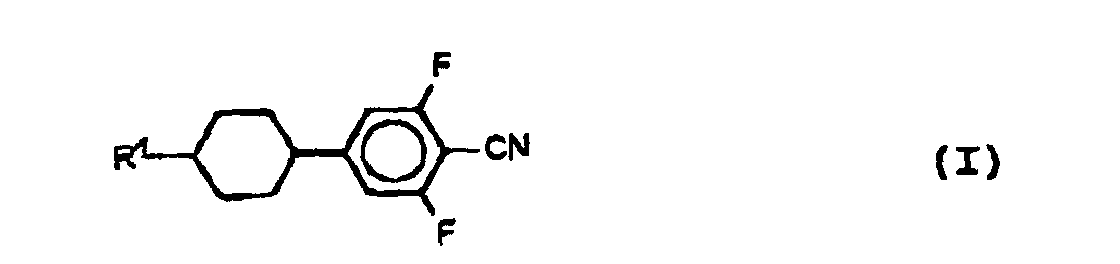
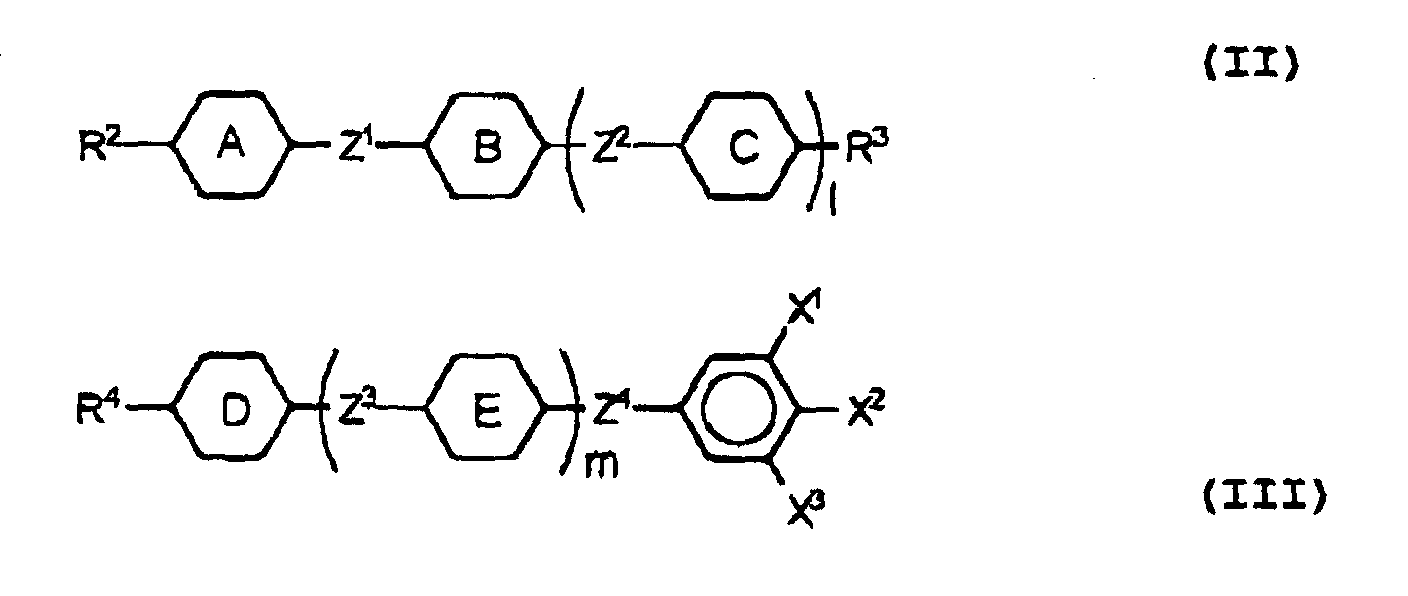
- a liquid crystal composition comprising as a first liquid crystal component at least one compound selected from the group consisting of compounds represented by the following general formula (I): wherein R 1 represents a C 2-16 alkenyl group or a C 3-16 alkenyloxy group and as a second liquid crystal component at least one compound selected from the group consisting of compounds represented by the following general formulae (II) and (III): wherein R 2 , R 3 and R 4 each independently representss a C 1-16 alkyl or alkoxyl group which may be substituted by a fluorine atom, a C 2-16 alkenyl group which may be substituted by a fluorine atom, a C 3-16 alkenyloxy group which may be substituted by a fluorine atom or a C 1-10 alkoxyl group-substituted C 1-12 alkyl group which may be substituted by a fluorine atom; the rings A, B, C, D and E each independently representss a 1,4-phenylene group, 2-methyl
- liquid crystal composition according to Invention 1 wherein the content of the at least one compound of the general formula (I) in the composition is from 5 to 40% by weight and the content of the at least one compound selected from the group consisting of compounds represented by the formulae (II) and (III) in the composition is from 5 to 95% by weight.
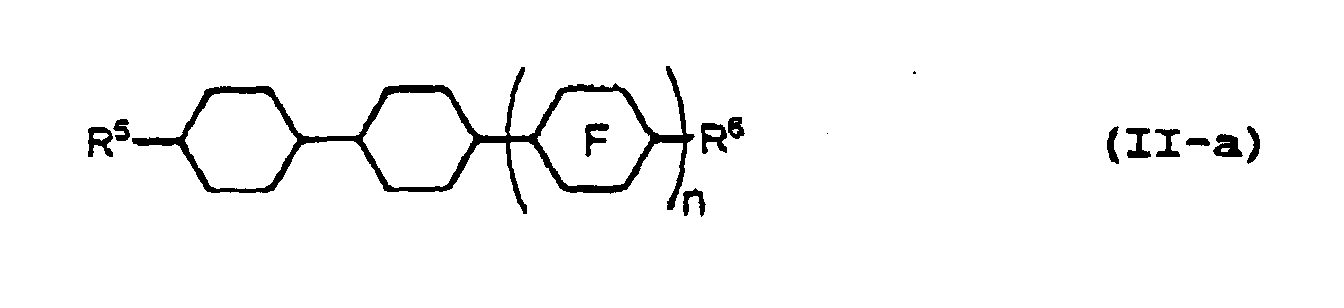
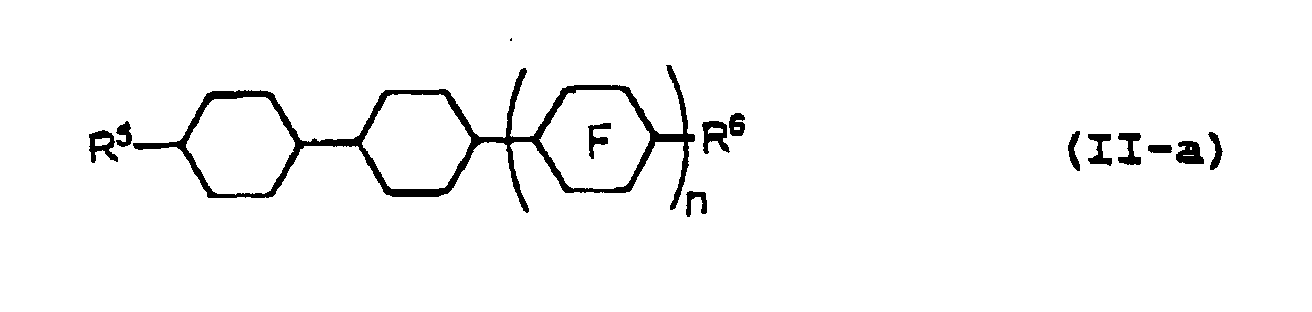
- liquid crystal composition according to Invention 1 or 2, wherein as the compound of the general formula (II) there is incorporated at least one compound selected from the group consisting of compounds of the following general formula (II-a): wherein R 5 and R 6 have the same meaning as R 2 and R 3 , respectively; the ring F represents a 1,4-phenylene group or trans-1,4-cyclohexylene group; and n represents 0 or 1.
- liquid crystal composition according to Invention 3 wherein the content of the at least one compound of the general formula (I) in the composition is from 5 to 40% by weight and the content of the at least one compound of the general formula (II-a) in the composition is from 5 to 95% by weight.
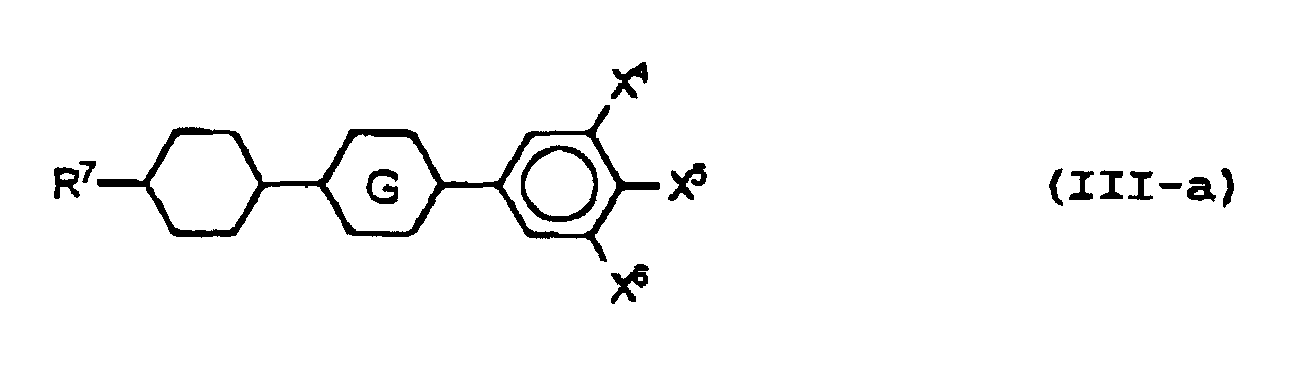
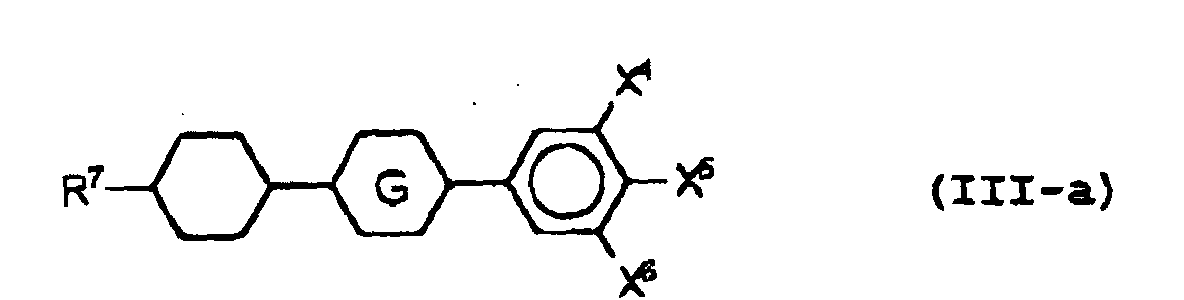
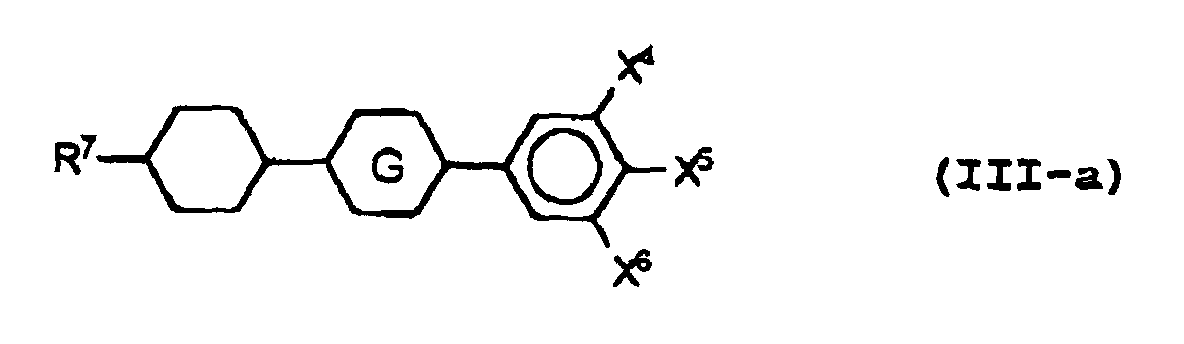
- liquid crystal composition according to any one of Inventions 1 to 4, wherein as the compound of the general formula (III) there is incorporated at least one compound selected from the group consisting of compounds of the following general formula (III-a): wherein R 7 represents a C 1-8 alkyl group or a C 2-8 alkenyl group; the ring G represents a 1,4-phenylene group or a trans-1,4-cyclohexylene group; X 5 represents a cyano group, a fluorine atom, a trifluoxomethoxy group or a difluoromethoxy group; and X 4 and X 6 each independently represents a hydrogen atom or a fluorine atom.
- R 7 represents a C 1-8 alkyl group or a C 2-8 alkenyl group
- the ring G represents a 1,4-phenylene group or a trans-1,4-cyclohexylene group
- X 5 represents a cyano group, a fluorine atom, a tri
- liquid crystal composition according to Invention 5 wherein the content of the at least one compound of the general formula (I) in the composition is from 5 to 40% by weight and the content of the at least one compound of the general formula (III-a) in the composition is from 5 to 95% by weight.
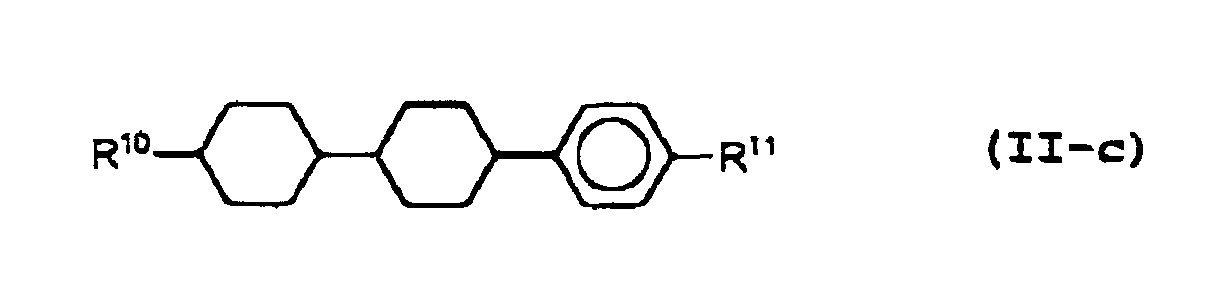
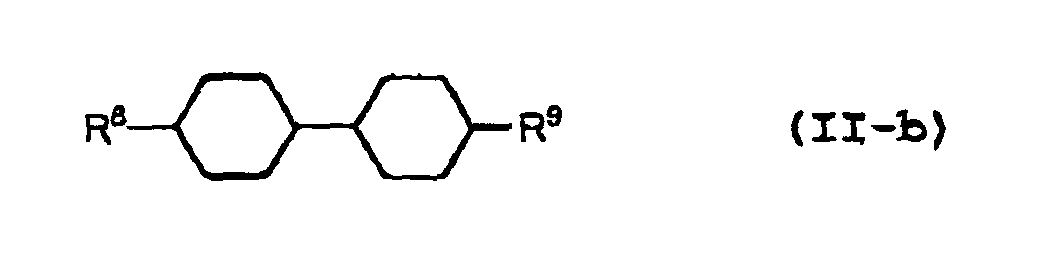
- liquid crystal composition according to any one of Inventions 1 to 6, wherein said composition comprises as the first liquid crystal component at least one compound of the general formula (I) in an amount of from 5 to 40% by weight, and as the second liquid crystal component at least one compound selected from the group consisting of compounds represented by the following general formula (II-b) in an amount of from 5 to 40% by weight: wherein R 8 and R 9 each independently representss a C 1-8 alkyl group or a C 2-8 alkenyl group and at least one compound selected from the group consisting of compounds represented by the following general formula (II-c) in an amount of from 5 to 60% by weight: wherein R 10 and R 11 each independently representss a C 1-8 alkyl group or a C 2-8 alkenyl group.
- liquid crystal composition according to any one of Inventions 1 to 7, wherein said composition comprises as the first liquid crystal component at least one compound of the general formula (I) in an amount of from 5 to 40% by weight and as the second liquid crystal component at least one compound selected from the group consisting of compounds represented by the following general formula (III-a) in an amount of from 5 to 40% by weight: wherein R 7 represents a C 1-8 alkyl group or a C 2-8 alkenyl group; the ring G represents a 1,4-phenylene group or a trans-1,4-cyclchexylene group; X 5 represents a cyano group, a fluorine atom, a trifluoromethoxy group or a difluoromethoxy group; and X 4 and X 6 each independently representss a hydrogen atom or a fluorine atom, and at least one compound selected from the group consisting of compounds represented by the following general formulae (II-b) and (II-c) in an amount of from 5 to 60% by weight: wherein R
- liquid crystal composition according to any one of Inventions 1 to 8, wherein said composition comprises as the first liquid crystal component at least one compound of the general formula (I) in an amount of from 5 to 40% by weight and as the second liquid crystal component at least one compound selected from the group consisting of compounds represented by the following general formula (III-a) in an amount of from 5 to 40% by weight: wherein R 7 represents a C 1-8 alkyl group or a C 2-8 alkenyl group; the ring G represents a 1,4-phenylene group or a trans-1,4-cyclohexylene group; X 5 represents a cyano group, a fluorine atom, a trifluoromethoxy group or a difluoromethoxy group; and X 4 and X 6 each independently representss a hydrogen atom or a fluorine atom, at least one compound selected from the group consisting of compounds represented by the following general formula (II-b) in an amount of from 5 to 40% by weight: wherein R 8 and R 9 each independently representss
- liquid crystal composition according to any one of Inventions 1 to 9, wherein as the compound of the general formula (III) there is incorporated at least one compound selected from the group consisting of compounds represented by the following general formula (III-b): wherein R 12 represents a C 1-16 alkyl group or a C 2-8 alkenyl group in an amount of from 5 to 40% by weight.
- liquid crystal composition according to any one of Inventions 1 to 9, wherein as the compound of the general formula (III) there is incorporated at least one compound selected from the group consisting of compounds represented by the following general formula (III-c): wherein R 12 represents a C 1-16 alkyl group or a C 2-8 alkenyl group in an amount of from 5 to 40% by weight.
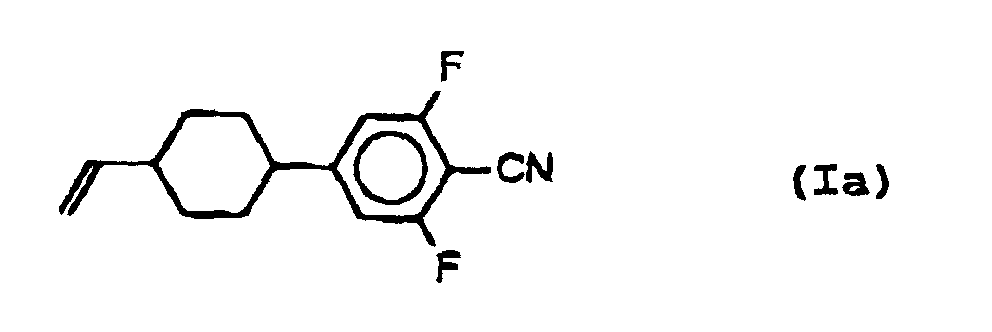
- liquid crystal composition according to any one of Inventions 1 to 11, wherein as said first component there is incorporated a compound represented by the general formula (Ia).
- nematic liquid crystal composition according to any one of Inventions 1 to 11 and 13, which satisfies at least one of the following requirements:
- a liquid crystal display device comprising the liquid crystal composition according to any one of Inventions 1 to 11, 13 and 14.
- a super-twisted nematic (STN) liquid crystal display device comprising the liquid crystal composition according to any one of Inventions 1 to 11, 13 and 14, having a twist angle of from 220° to 270° and satisfying at least one of the following requirements (i) to (iii) when the driving temperature falls within the range of from -20°C to 60°C:
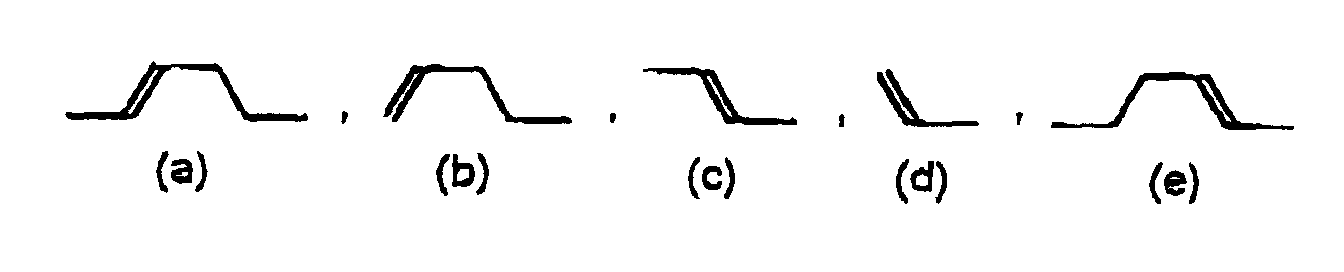
- R 1 represents a C 2-16 alkenyl group or a C 3-16 alkenyloxy group, preferably a C 2-16 alkenyl group, more preferably a C 2-8 alkenyl group, even more preferably any one of the following structures (a) to (e): (These structures are each connected to a ring at the right end thereof). Particularly preferred among these structures is (d).
- the liquid crystal composition of the invention further comprises as the second liquid crystal component one or more, preferably 3 or more, more preferably from 3 to 20, particularly from 5 to 15 compounds selected from the group consisting of compounds represented by the general formulae (II) and (III). Even more preferably, there are incorporated at least two compounds of the general formula (II).
- This liquid crystal composition is characterized by the nematic phase upper temperature limit of 75°C or higher, preferably 80°C or higher, particularly preferably 85°C or higher.
- the birefringence (optical anisotropy) ⁇ n is from 0.07 to 0.24, preferably from 0.08 to 0.22.
- R 2 , R 3 and R 4 each independently represents a C 1-16 alkyl or alkoxyl group which may be substituted by a fluorine atom, a C 2-16 alkenyl group which may be substituted by a fluorine atom, a C 3-16 alkenyloxy group which may be substituted by a fluorine atom or a C 1-10 alkoxyl group-substituted C 1-12 alkyl group which may be substituted by a fluorine atom, preferably a C 1-16 alkyl group or a C 2-16 alkenyl group, more preferably a C 1-8 alkyl group or a C 2-8 alkenyl group, particularly preferably a C 1-5 alkyl group or an alkenyl group having the above structure (a), (b), (c), (d) or (e).
- the rings A, B, C, D and E each independently represents a 1,4-phenylene group, 2-methyl-1,4-phenylene group, 3-methyl-1,4-phenylene group, naphthalene-2,6-diyl group, phenanthrene-2,7-diyl group, fluorene-2,7-diyl group, trans-1,4-cyclohexylene group, 1,2,3,4-tetrahydronaphthalene-2,6-diyl group, decahydronaphthalene-2,6-diyl group, trans-1,3-dioxane-2,5-diyl group, a pyridine-2,5-diyl group, pyrimidine-2,5-diyl group, pyrazine-2,5-diyl group or pyridazine-2,5-diyl group, each of which may be substituted by a fluorine atom, preferably a 1,4-phenylene
- Preferred among the groups represented by the rings A, B, D and E is a trans-1,4-cyclohexyl group.
- Preferred among the groups represented by the ring C is a 1,4-phenylene group.
- the suffixes l and m each independently represents 0, 1 or 2, preferably 0 or 1.
- Preferred among the groups represented by Z 1 and Z 2 is a single bond or -CH 2 CH 2 -, more preferably a single bond.
- Preferred among the groups represented by Z 3 and Z 4 is a single bond or -C ⁇ C-, more preferably a single bond.
- X 2 represents a cyano group, a fluorine atom, a chlorine atom, a trifluoromethoxy group, a trifluoromethyl group, a difluoromethoxy group, a hydrogen atom, a 3,3,3-trifluoroethoxy group, R' or -OR' in which R' represents a C 1-12 straight-chain alkyl group or a C 2-12 straight-chain alkenyl group, preferably a cyano group, a fluorine atom, a trifluoromethoxy group or a difluoromethoxy group, more preferably a fluorine atom, a trifluoromethoxy group or a difluoromethoxy group, particularly preferably a fluorine atom.
- X 1 and X 3 each represents a hydrogen atom, a fluorine atom or a chlorine atom, preferably a hydrogen atom or a fluorine atom, particularly preferably a fluorine atom.
- the content of the compound of the general formula (I) is from 5 to 40% by weight, preferably from 5 to 25% by weight, particularly preferably from 5 to 20% by weight.
- the content of the compound represented by the general formula (II) or (III) is from 5% to 95% by weight, preferably from 15% to 85% by weight, particularly preferably from 25% to 85% by weight.
- Invention 4 there are incorporated one or more compounds of the general formula (I) in an amount of from 5% to 40% by weight and one or mere compounds of the general formula (II-a) in an amount of from 5% to 95% by weight.
- one or two compounds of the general formula (I) in an amount of from 5% to 25% by weight, particularly preferably from 5% to 20% by weight, and two or more compounds of the general formula (II-a) in an amount of from 5% to 95% by weight, more preferably from 15% to 85% by weight, particularly preferably from 25% to 85% by weight.
- Invention 6 there are incorporated one or more compounds of the general formula (I) in an amount of from 5% to 40% by weight and one or more compounds of the general formula (III-a) as the second liquid crystal component in an amount of from 5% to 95% by weight
- one or two compounds of the general formula (I) in an amount of from 5% to 25% by weight, particularly preferably from 5% to 15% by weight
- two or more compounds of the general formula (III-a) in an amount of from 5% to 95% by weight, more preferably from 15% to 85% by weight, particularly preferably from 25% to 85% by weight.
- Invention 7 there are incorporated one or more compounds of the general formula (I) in an amount of from 5% to 40% by weight and one or more compounds selected from the group consisting of compounds represented by the general formula (II-b) in an amount of from 5% to 40% by weight, preferably from 5% to 25% by weight.
- R 8 , R 9 , R 10 and R 11 each independently represents a C 1-8 alkyl group or a C 2-8 alkenyl group. Particularly preferred are a C 1-5 alkyl group and an alkenyl group having the above structure (a), (b), (c), (d) or (e).
- Invention 8 there are incorporated one or more compounds of the general formula (I) of Invention 1 in an amount of from 5% to 40% by weight, one or more compounds of the general formula (III-a) in an amount of from 5% to 40% by weight, and one or more compounds of the general formula (II-b) or (II-c) in an amount of from 5% to 60% by weight.
- the content of the compounds of the general formula (III-a) is preferably from 5% to 35% by weight, more preferably from 5% to 25% by weight.
- the content of the compounds of the general formula (II-b) or (II-c) is preferably from 5% to 55% by weight, mere preferably from 5% to 45% by weight.
- Invention 9 there are incorporated one or more compounds of the general formula (I) of Invention 1 in an amount of from 5% to 40% by weight, one or more compounds of the general formula (III-a) in an amount of from 5% to 40% by weight, and one or more compounds of the general formula (II-b) or (II-c) in an amount of from 5% to 40% by weight.
- one or two compounds of the general formula (I) in an amount of from 5% to 20% by weight, one or more of each of the compounds of the general formulae (II-b) and (II-c) in an amount of from 5% to 20% by weight, and two or more compounds of the general formula (III-a) in an amount of from 5% to 25% by weight.
- Invention 10 there are incorporated as compounds of the general formula (III) of Invention 1 or (III-a) one or more compounds selected from the group consisting of compounds represented by the general formula (III-b) in an amount of from 5% to 40% by weight.
- R 12 represents a C 1-8 alkyl group or a C 2-8 alkenyl group. Particularly preferred are a C 1-5 alkyl group and an alkenyl group having the above structure (a), (b), (c), (d) or (e).
- Invention 11 there are incorporated as compounds of the general formula (III) of Invention 1 or (III-a) one or more compounds selected from the group consisting of compounds represented by the general formula (III-c) in an amount of from 5% to 40% by weight.
- R 12 represents a C 1-8 alkyl group or a C 2-8 alkenyl group. Particularly preferred are a C 1-5 alkyl group and an alkenyl group having the above structure (a), (b), (c), (d) or (e).
- Invention 13 there is a compound of the general formula (I-a) defined in Invention 12 in an amount of preferably from 5 to 40% by weight, more preferably from 5 to 20% by weight.
- the liquid crystal composition described above satisfies one or more of the following requirements (i) to (v).
- the measurement for the requirements (i) to (iv) are made at 20°C.
- the super-twisted nematic (STN) liquid crystal display device is preferably in the following embodiment.
- the twist angle of the super-twisted nematic liquid crystal display device can be predetermined to be from 180° to 360°, preferably from 220° to 270°.
- the liquid crystal display device of the invention preferably satisfies at least one of the following requirements when the driving temperature falls within the range of -20°C to 60°C.
- the liquid crystal display device described above is STN-LCD which shows little or no increase of current flow, reduced response at low temperatures and enhanced contrast against increase of data or color display during 1/60 to 1/400 duty, preferably 1/100 to 1/250 duty display.
- the foregoing nematic liquid crystal composition is useful for TN-LCD or STN-LCD, particularly STN-LCD.
- the foregoing nematic liquid crystal composition can be used also for transmission or reflection type liquid crystal display device.
- the liquid crystal composition of the invention may comprise an ordinary nematic liquid crystal compound, smectic liquid crystal compound, cholesteric liquid crystal compound or the like incorporated therein besides the foregoing compounds.
- Example 1 and Comparative Example 1 Example 1 (No.1) Comparative Example 1 Composition 0d1CCP1 14% 0d1CCP1 14% 0d3CCP1 15% 0d3CCP1 15% 3CPtP2 5% 3CPtP2 5% 3CCEPC3 6% 3CCEPC3 6% 3CCEPC4 6% 3CCEPC4 6% 2PEPCNf 6% 2PEPCNf 6% 3PEPCNf 6% 3PEPCNf 6% 4PEPCNf 10% 4PEPCNf 10% 5PEPCNf 10% 5PEPCNf 10% 0d1CCPFf 14% 0d1CCPFf 14% 0d1CPCNff 8% 5PEPCNff 8% T N-I (°C) 99.6 99.9 T ⁇ N (°C) -70 -70 Vth (V) 1.03
- Example 1 shows a drastically inhibited current and improved contrast as compared with the liquid crystal composition of Comparative Example 1.
- a nematic liquid crystal composition No. 2 was prepared (Example 2), and then measured for various properties. The data of properties thus measured are set forth in Table 2 below together with those of a comparative composition (Comparative Example 2).
- Example 2 and Comparative Example 2 Example 2 (No.2) Comparative Example 2 Composition Od1CC5 8% 0d1CC5 8% 3PtP2 2% 3PtP2 2% 0d1CCP1 12% 0d1CCP1 12% 0d3CCP1 13% 0d3CCP1 13% 3CCPO(d3)1 4% 3CCPO(d3)1 4% 3CCP(d3)0 3% 3CCP(d3)0 3% 3CPtP2 4% 3CPtP2 4% 3CEPtP1 5% 3CEPtP1 5% 2PEPCNf 5% 2PEPCNf 5% 3PEPCNf 5% 4PEPCNf 10% 4PEPCNf 10% 0d1CPCN 7% 0d
- Example 2 shows a drastically inhibited current and improved contrast as compared with the liquid crystal composition of Comparative Example 2.
- reaction solution was then extracted with 250 ml of ethyl acetate.
- the resulting organic phase was washed with water and saturated brine, and then dried over anhydrous sodium sulfate.
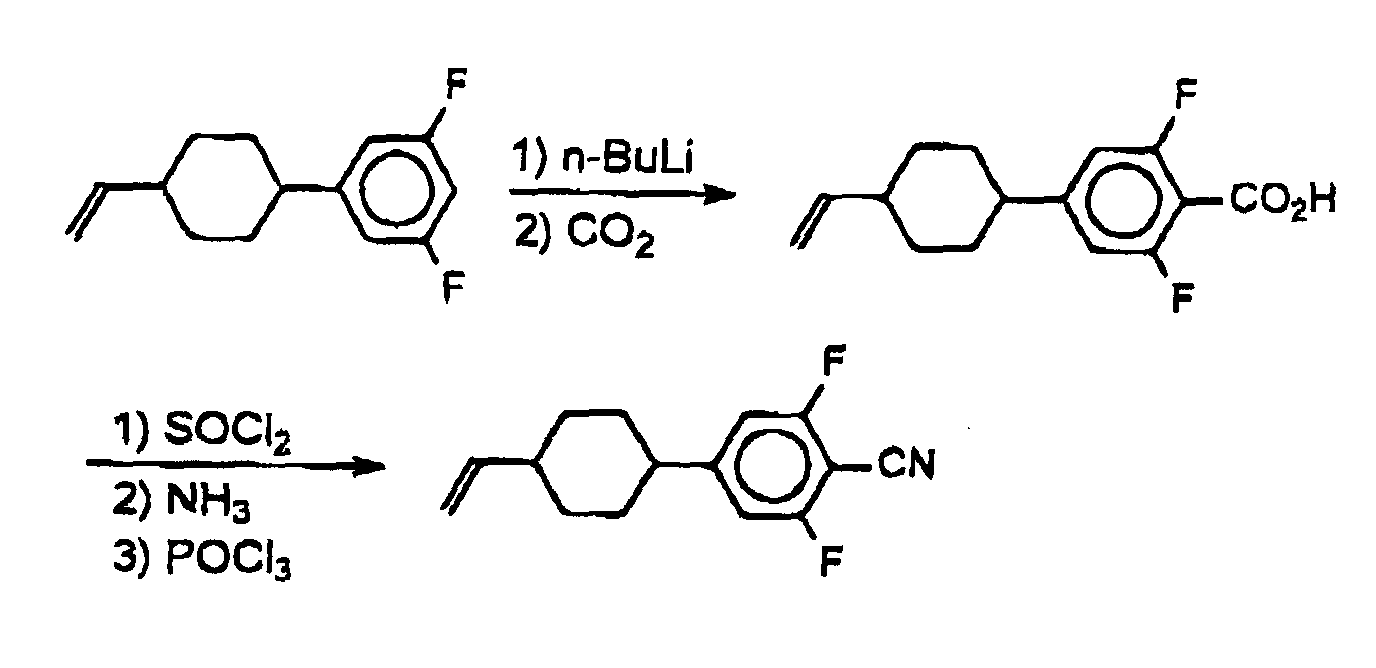
- the solvents were then distilled off to obtain 28.9 g of 2,6-difluoro-4-(trans-4-vinylcyclohexyl)benzoic acid.
- the crystal was then purified through silica gel column chromatography (solvent: toluene) to obtain 2,6-difluoro-4-(trans-4-vinylcyclohexyl)benzonitrile.
- the product was then recrystallized from ethanol to obtain 12.1 g of a purified product.
- the compound thus obtained had a melting point of 39°C.
- Example 4 Host Comparative Example 4 (No.3) Composition Od1CCPFf 50% 0d1CCPFf 40% 0d3CCPFf 50% 0d3CCPFf 40% (Ia) 20% T N-I (°C) 116.7 82.0 T ⁇ N (°C) 11 12 Vth (V) 2.14 1.26 ⁇ ⁇ 4.8 8.3 ⁇ n 0.090 0.091
- a nematic liquid crystal composition No. 4 was prepared (Example 5), and then measured for various properties.
- Example 5 a composition falling outside the scope of the invention having almost the same T N-I , threshold voltage and birefringence as that of Example 5 was prepared (Comparative Example 3).
- the composition ratio and data of properties of these compositions are set forth in Table 4 below.
- Example 5 is excellent in temperature dependence of threshold voltage and steepness ⁇ within the temperature of from -20°C to 60°C and shows a high contrast over a wide temperature range as compared with Comparative Example 3.
- Example 5 and Comparative Example 3 Example 5 (No.4) Comparative Example 3 Composition 2PEPCNff 8% 2PEPCNff 2% 3PEPCNff 5% 3PEPCNff - 4PEPCNff 14% 4PEPCNff - 4PffEPCNf - 4PffEPCNf 5% 5PffEPCNf - 5PffEPCNf 5% 5PEPCNff - 5PEPCNff 20% 0d1CPCNff 15% 0d1CPCNff - 1d1CPCN 5% 1d1CPCN 7% 1d3CPCN - 1d3CPCN 7% 0d1CCPff 21% 0d1CCPff - 0d3CCPff 6% 3CP
- a nematic liquid crystal composition No. 5 was prepared (Example 6), and then measured for various properties.
- Example 6 a composition falling outside the scope of the invention having almost the same T N-I , threshold voltage and birefringence as that of Example 5 was prepared (Comparative Example 4).
- the composition ratio and data of properties of these compositions are set forth in Table 5 below.
- Example 6 is excellent in temperature dependence of threshold voltage and steepness ⁇ within the temperature of from -20°C to 25°C and shows a high contrast over a wide temperature range as compared with Comparative Example 4. Example 6 was also observed to show reduced current flow as compared with Comparative Example 4.
- Example 6 and Comparative Example 4 Example 6 (No.5) Comparative Example 4 Composition 2PEPCNff 5% 2PEPCNff 5% 3PEPCNff 2% 3PEPCNff 2% 4PEPCNff 3% 4PEPCNff 3% 5PEPCNff - 5PEPCNff 15% 0d1CPCNff 20% 0d1CPCNff - 1d1CPCN 10% 1d1CPCN 10% 0d3CPCN 10% 0d3CPCN 10% 3PtPO2 - 3PtPO2 3% 4PtPO2 5% 4PtPO2 4.5% 5PtPO1 2% 5PtPO1 - 3CPO2 - 3CPO2 2.5% 3CPtP2 6% 3CPtP2 5% 4CPtP1 5% 4CPtP1 5% 3CEPtP1 6% 3CEPtP1 5% 3CEPtP5 5% 3CEPtP5 - 0d1CCP1 4% 0d1
- a nematic liquid crystal composition No. 6 was prepared (Example 7), and then measured for various properties.
- a composition falling outside the scope of the invention having almost the same T N-I , threshold voltage and birefringence as that of Example 5 was prepared (Comparative Example 5).
- the composition ratio and data of properties of these compositions are set forth in Table 6 below.
- Example 7 is excellent in temperature dependence of threshold voltage within the temperature range of from 25°C to 50°C and steepness ⁇ at 50°C and shows a high contrast over a wide temperature range as compared with Comparative Example 5.
- Example 7 and Comparative Example 5 Example 7 (No.6) Comparative Example 5 Composition 0d1CPCNff 10% 0d1CPCNff - 0d1CPCN - 0d1CPCN 7.2% 1d1CPCN 10% 1d1CPCN 6.512% 0d3CPCN - 0d3CPCN 4.04% 4PmPCN - 4PmPCN 2% 5PmPCN - 5PmPCN 2% 3CPCN - 3CPCN 5.952% 4CPCN - 4CPCN 1.6% 5CPCN - 5CPCN 2% 3PtP1 - 3PtP1 3.304% 4PtPO2 5% 4PtPO2 - 5PtPO1 - 5PtPO1 - Od3PZPOd3 15% Od3PZPOd3 14% 0d1CC5 20% 0d1CC5 20.792% 0d
- a nematic liquid crystal composition No. 7 was prepared (Example 8), and then measured for various properties. Further, a nematic liquid crystal composition No. 8 was prepared (Example 9), and then measured for various properties.
- the composition ratio and data of properties of these compositions are set forth in Table 7 below.
- Example 8 comprising 0d1CPCNff is excellent in temperature dependence of threshold voltage and steepness ⁇ within the temperature of from -20°C to 25°C and shows an enhancement of about 20% in response at low temperatures as compared with Example 9 comprising 1d1CPCNff.
- Example 8 and Example 9 Example 8 (No.7) Example 9 (No.8) Composition 2PEPCNff 4% 2PEPCNff 4% 3PEPCNff 3% 3PEPCNff 3% 4PEPCNff 10% 4PEPCNff 10% 0d1CPCNff 17% 0d1CPCNff - 1d1CPCNff - 1d1CPCNff 17% 3CPCN 3% 3CPCN 3% 0d1CC5 8% 0d1CC5 8% 3CPO2 2% 3CPO2 2% 4PtPO2 2% 4PtPO2 2% 0d1CCPff 9% 0d1CCPff 9% 3CPtP2 6% 3CPtP2 6% 4CPtP1 6% 4CPtP1 6% 3CEPtP1 6% 3CEPtP1 6% 0d1CCP1 6% 0d3CCP1 14% 0d3CCP1 14%
- a composition falling outside the invention comprising 2CPCNff instead of 0d1CPCNff of Example 8 was prepared (Comparative Example 6).
- the composition ratio and data of properties of Comparative Example 6 are set forth in Table 8 together with that of Example 8.
- Example 8 comprising 0d1CPCNff is excellent in temperature dependence of threshold voltage and steepness ⁇ within the temperature of from -20°C to 25°C and shows an enhancement of about 23% in response at low temperatures as compared with Comparative Example 6 comprising 2CPCNff.
- Example 8 and Comparative Example 6 Example 8 (No.7) Comparative Example 6 Composition 2PEPCNff 4% 2PEPCNff 4% 3PEPCNff 3% 3PEPCNff 3% 4PEPCNff 10% 4PEPCNff 10% 0d1CPCNff 17% 0d1CPCNff - 2CPCNff - 2CPCNff 17% 3CPCN 3% 3CPCN 3% 0d1CC5 8% 0d1CC5 8% 3CPO2 2% 3CPO2 2% 4PtPO2 2% 4PtPO2 2% 0d1CCPff 9% 0d1CCPff 9% 3CPtP2 6% 3CPtP2 6% 4CPtP1 6% 4CPtP1 6% 3CEPtP1 6% 3CEPtP1 6% 0d1CCP1 6% 0d1CCP1 6% 0d3CCP1 14% 0d3CCP1 4% 3CCE
- liquid crystal materials of the invention makes it possible to obtain a liquid crystal composition which shows reduced current flow and exhibits a high dielectric anisotropy.
- the liquid crystal composition of the invention exhibits a high contract and reliability and thus is excellent.
- This liquid crystal display is very useful as STN-LCD or TN-LCD.
Landscapes
- Chemical & Material Sciences (AREA)
- Organic Chemistry (AREA)
- Crystallography & Structural Chemistry (AREA)
- Engineering & Computer Science (AREA)
- Materials Engineering (AREA)
- Physics & Mathematics (AREA)
- Nonlinear Science (AREA)
- General Physics & Mathematics (AREA)
- Optics & Photonics (AREA)
- Liquid Crystal Substances (AREA)
Abstract
Description

and as a second liquid crystal component at least one compound selected from the group consisting of compounds represented by the following general formulae (II) and (III):
and said composition having a nematic phase upper temperature limit of 75°C or higher and a birefringence (Δn) of from 0.07 to 0.24.


and at least one compound selected from the group consisting of compounds represented by the following general formula (II-c) in an amount of from 5 to 60% by weight:



Particularly preferred among these structures is (d). The liquid crystal composition of the invention further comprises as the second liquid crystal component one or more, preferably 3 or more, more preferably from 3 to 20, particularly from 5 to 15 compounds selected from the group consisting of compounds represented by the general formulae (II) and (III). Even more preferably, there are incorporated at least two compounds of the general formula (II).
- TN-I:
- Nematic phase-isotropic phase transition temperature (°C)
- T→N:
- Solid phase or smectic phase-nematic phase transition temperature (°C)
- Vth:
- Threshold voltage (V) in the form of TN-LCD cell having a thickness of 6 µm
- Δε:
- Dielectric anisotropy
- Δn:
- Birefringence
- ΔV:
- Vth(60°C)-Vth(-20°C)(mV)
- ΔT:
- 60-(-20)(°C)
- ΔV/ΔT:
- | ΔV | /ΔT (mV/°C)
- η:
- Viscosity (mPa·s) at 20°C
- Ir:
- Current (µA/cm2) flowing through a composition comprising a 240° twisted STN-LCD having a liquid crystal composition vacuum-injected therein which has been heated to 80°C for 100 hours
- CR:
- Contrast shown when a composition comprising a 240° twisted STN-LCD having a liquid crystal composition vacuum-injected therein is driven with a 1/16 bias driving waveform on 1/200 duty
- Terminal n (figure)
- CnH2n+1-
- C
- Trans-1,4-cyclohexylene group
- C/
- 1,4-Cyclohexenediyl group
- P
- 1,4-Phenylene group
- Pm
- Pyrimidine-2,5-diyl group
- E
- -COO-
- e
- -OCO-
- A
- -CH2CH2-
- t
- -C≡C-
- -Z-
- -CH=N-N=CH-
- CN
- -C≡N
- On
- -OCnH2n+1
- F
- -F
- f
- F atom connected to terminal group in the ortho position
- ndm-
- CnH2n+1-C=C-(CH2)m-1-
- -O(dm)n
- -O(CH2)m-2-C=C-CnH2n+1

| Example 1 and Comparative Example 1 | ||||
| Example 1 (No.1) | Comparative Example 1 | |||
| Composition | 0d1CCP1 | 14% | 0d1CCP1 | 14% |
| 0d3CCP1 | 15% | 0d3CCP1 | 15% | |
| 3CPtP2 | 5% | 3CPtP2 | 5% | |
| 3CCEPC3 | 6% | 3CCEPC3 | 6% | |
| 3CCEPC4 | 6% | 3CCEPC4 | 6% | |
| 2PEPCNf | 6% | 2PEPCNf | 6% | |
| 3PEPCNf | 6% | 3PEPCNf | 6% | |
| 4PEPCNf | 10% | 4PEPCNf | 10% | |
| 5PEPCNf | 10% | 5PEPCNf | 10% | |
| 0d1CCPFf | 14% | 0d1CCPFf | 14% | |
| 0d1CPCNff | 8% | 5PEPCNff | 8% | |
| TN-I (°C) | 99.6 | 99.9 | ||
| T→N (°C) | -70 | -70 | ||
| Vth (V) | 1.03 | 0.95 | ||
| Δ ε | 15.2 | 15.79 | ||
| Δn | 0.130 | 0.134 | ||
| Ir(µA/cm2) | 0.10 | 0.25 | ||
| CR | 5 : 1 | 3 : 1 |
| Example 2 and Comparative Example 2 | ||||
| Example 2 (No.2) | Comparative Example 2 | |||
| Composition | Od1CC5 | 8% | 0d1CC5 | 8% |
| 3PtP2 | 2% | 3PtP2 | 2% | |
| 0d1CCP1 | 12% | 0d1CCP1 | 12% | |
| 0d3CCP1 | 13% | 0d3CCP1 | 13% | |
| 3CCPO(d3)1 | 4% | 3CCPO(d3)1 | 4% | |
| 3CCP(d3)0 | 3% | 3CCP(d3)0 | 3% | |
| 3CPtP2 | 4% | 3CPtP2 | 4% | |
| 3CEPtP1 | 5% | 3CEPtP1 | 5% | |
| 2PEPCNf | 5% | 2PEPCNf | 5% | |
| 3PEPCNf | 5% | 3PEPCNf | 5% | |
| 4PEPCNf | 10% | 4PEPCNf | 10% | |
| 0d1CPCN | 7% | 0d1CPCN | 7% | |
| 1d1CPCN | 7% | 1d1CPCN | 7% | |
| 0d1CPCNff | 15% | 5PEPCNff | 15% | |
| TN-I (°C) | 90.5 | 92.2 | ||
| T→N (°C) | -50 | -33 | ||
| Vth (V) | 1.25 | 1.17 | ||
| Δ ε | 11.7 | 14.9 | ||
| Δn | 0.134 | 0.141 | ||
| Ir(µA/cm2) | 0.15 | 0.32 | ||
| CR | 6 : 1 | 3 : 1 |
| Example 4 | ||||
| Host | Comparative Example 4 (No.3) | |||
| Composition | Od1CCPFf | 50% | 0d1CCPFf | 40% |
| 0d3CCPFf | 50% | 0d3CCPFf | 40% | |
| (Ia) | 20% | |||
| TN-I (°C) | 116.7 | 82.0 | ||
| T→N (°C) | 11 | 12 | ||
| Vth (V) | 2.14 | 1.26 | ||
| Δ ε | 4.8 | 8.3 | ||
| Δn | 0.090 | 0.091 |
| Example 5 and Comparative Example 3 | ||||||
| Example 5 (No.4) | Comparative Example 3 | |||||
| Composition | 2PEPCNff | 8% | 2PEPCNff | 2% | ||
| 3PEPCNff | 5% | 3PEPCNff | - | |||
| 4PEPCNff | 14% | 4PEPCNff | - | |||
| 4PffEPCNf | - | 4PffEPCNf | 5% | |||
| 5PffEPCNf | - | 5PffEPCNf | 5% | |||
| 5PEPCNff | - | 5PEPCNff | 20% | |||
| 0d1CPCNff | 15% | 0d1CPCNff | - | |||
| 1d1CPCN | 5% | 1d1CPCN | 7% | |||
| 1d3CPCN | - | 1d3CPCN | 7% | |||
| 0d1CCPff | 21% | 0d1CCPff | 18% | |||
| 0d3CCPff | - | 0d3CCPff | 6% | |||
| 3CPtP2 | 4% | 3CPtP2 | 3% | |||
| 4CPtP1 | 4% | 4CPtP1 | 3% | |||
| 3CEPtP1 | 3% | 3CEPtP1 | 3% | |||
| 3CEPtP5 | 3% | 3CEPtP5 | 3% | |||
| 3CCPO(d3)1 | - | 3CCPO(d3)1 | 2% | |||
| 4CCPO(d3)1 | - | 4CCPO(d3)1 | 2% | |||
| 3CCEPC2 | 4% | 3CCEPC2 | 4% | |||
| 3CCEPC3 | 5% | 3CCEPC3 | 5% | |||
| 3CCEPC4 | 5% | 3CCEPC4 | 5% | |||
| 3CCEPC5 | 4% | 3CCEPC5 | - | |||
| TN-I (°C) | 97.2 | 101.2 | ||||
| T→N (°C) | -40 | -35 | ||||
| Δn | 0.140 | 0.139 | ||||
| η | 49.0 | 50.7 | ||||
| STN properties | -20°C | 25°C | 60°C | -20°C | 25°C | 60°C |
| Vth | 1.420 | 1.200 | 1.179 | 1.412 | 1.193 | 1.160 |
| Vsat | 1.518 | 1.275 | 1.251 | 1.543 | 1.284 | 1.252 |
| γ | 1.069 | 1.063 | 1.051 | 1.093 | 1.076 | 1.079 |
| Example 6 and Comparative Example 4 | ||||
| Example 6 (No.5) | Comparative Example 4 | |||
| Composition | 2PEPCNff | 5% | 2PEPCNff | 5% |
| 3PEPCNff | 2% | 3PEPCNff | 2% | |
| 4PEPCNff | 3% | 4PEPCNff | 3% | |
| 5PEPCNff | - | 5PEPCNff | 15% | |
| 0d1CPCNff | 20% | 0d1CPCNff | - | |
| 1d1CPCN | 10% | 1d1CPCN | 10% | |
| 0d3CPCN | 10% | 0d3CPCN | 10% | |
| 3PtPO2 | - | 3PtPO2 | 3% | |
| 4PtPO2 | 5% | 4PtPO2 | 4.5% | |
| 5PtPO1 | 2% | 5PtPO1 | - | |
| 3CPO2 | - | 3CPO2 | 2.5% | |
| 3CPtP2 | 6% | 3CPtP2 | 5% | |
| 4CPtP1 | 5% | 4CPtP1 | 5% | |
| 3CEPtP1 | 6% | 3CEPtP1 | 5% | |
| 3CEPtP5 | 5% | 3CEPtP5 | - | |
| 0d1CCP1 | 4% | 0d1CCP1 | 15% | |
| 0d3CCP1 | 4% | 0d3CCP1 | 15% | |
| 3CCPO(d3)1 | 5% | 3CCPO(d3)1 | - | |
| 3CCEPC3 | 4% | 3CCEPC3 | - | |
| 3CCEPC4 | 4% | 3CCEPC4 | - | |
| TN-I (°C) | 93.3 | 91.1 | ||
| T→N (°C) | -45 | -47 | ||
| Δn | 0.160 | 0.160 | ||
| η | 31.2 | 30.3 | ||
| STN properties | -20°C | 25°C | -20°C | 25°C |
| Vth | 1.54 | 1.43 | 1.52 | 1.37 |
| Vsat | 1.67 | 1.54 | 1.70 | 1.50 |
| γ | 1.084 | 1.076 | 1.118 | 1.094 |
| Ir (µA/cm2) | - | 0.02 | 0.06 |
| Example 7 and Comparative Example 5 | ||||||
| Example 7 (No.6) | Comparative Example 5 | |||||
| Composition | 0d1CPCNff | 10% | 0d1CPCNff | - | ||
| 0d1CPCN | - | 0d1CPCN | 7.2% | |||
| 1d1CPCN | 10% | 1d1CPCN | 6.512% | |||
| 0d3CPCN | - | 0d3CPCN | 4.04% | |||
| 4PmPCN | - | 4PmPCN | 2% | |||
| 5PmPCN | - | 5PmPCN | 2% | |||
| 3CPCN | - | 3CPCN | 5.952% | |||
| 4CPCN | - | 4CPCN | 1.6% | |||
| 5CPCN | - | 5CPCN | 2% | |||
| 3PtP1 | - | 3PtP1 | 3.304% | |||
| 4PtPO2 | 5% | 4PtPO2 | - | |||
| 5PtPO1 | - | 5PtPO1 | - | |||
| Od3PZPOd3 | 15% | Od3PZPOd3 | 14% | |||
| 0d1CC5 | 20% | 0d1CC5 | 20.792% | |||
| 0d3CC3 | 8% | 0d3CC3 | 7.792% | |||
| 0d1CCPff | 10% | 0d1CCPff | - | |||
| 3CPtP2 | 5% | 3CPtP2 | 4.016% | |||
| 4CPtP1 | 5% | 4CPtP1 | - | |||
| 3CEPtP1 | - | 3CEPtP1 | 2.976% | |||
| 0d1CCP1 | 6% | 0d1CCP1 | 7% | |||
| 0d3CCP1 | 6% | 0d3CCP1 | 8.816% | |||
| TN-I (°C) | 87.8 | 86.4 | ||||
| T→N (°C) | -26 | -43 | ||||
| Δn | 0.145 | 0.145 | ||||
| η | 16.3 | 13.0 | ||||
| STN properties | 25°C | 50°C | ΔV/ΔT | 25°C | 50°C | ΔV/ΔT |
| Vth | 2.35 | 2.23 | 4.8mV | 2.32 | 2.08 | 9.6mV |
| Vsat | 2.46 | 2.34 | 2.41 | 2.21 | ||
| γ | 1.046 | 1.050 | 1.038 | 1.062 |
| Example 8 and Example 9 | ||||
| Example 8 (No.7) | Example 9 (No.8) | |||
| Composition | 2PEPCNff | 4% | 2PEPCNff | 4% |
| 3PEPCNff | 3% | 3PEPCNff | 3% | |
| 4PEPCNff | 10% | 4PEPCNff | 10% | |
| 0d1CPCNff | 17% | 0d1CPCNff | - | |
| 1d1CPCNff | - | 1d1CPCNff | 17% | |
| 3CPCN | 3% | 3CPCN | 3% | |
| 0d1CC5 | 8% | 0d1CC5 | 8% | |
| 3CPO2 | 2% | 3CPO2 | 2% | |
| 4PtPO2 | 2% | 4PtPO2 | 2% | |
| 0d1CCPff | 9% | 0d1CCPff | 9% | |
| 3CPtP2 | 6% | 3CPtP2 | 6% | |
| 4CPtP1 | 6% | 4CPtP1 | 6% | |
| 3CEPtP1 | 6% | 3CEPtP1 | 6% | |
| 0d1CCP1 | 6% | 0d1CCP1 | 6% | |
| 0d3CCP1 | 14% | 0d3CCP1 | 14% | |
| 3CCEPC3 | 2% | 3CCEPC3 | 2% | |
| 3CCEPC4 | 2% | 3CCEPC4 | 2% | |
| TN-I (°C) | 87.6 | 90.3 | ||
| T→N (°C) | -49 | -45 | ||
| Δn | 0.135 | 0.137 | ||
| η | 25.6 | 26.6 | ||
| STN properties | -20°C | 25°C | -20°C | 25°C |
| Vth | 1.483 | 1.471 | 1.498 | 1.480 |
| Vsat | 1.560 | 1.551 | 1.591 | 1.560 |
| γ | 1.052 | 1.054 | 1.062 | 1.054 |
| τ | 2,909 | 173 | 3,465 | 178 |
| Example 8 and Comparative Example 6 | ||||
| Example 8 (No.7) | Comparative Example 6 | |||
| Composition | 2PEPCNff | 4% | 2PEPCNff | 4% |
| 3PEPCNff | 3% | 3PEPCNff | 3% | |
| 4PEPCNff | 10% | 4PEPCNff | 10% | |
| 0d1CPCNff | 17% | 0d1CPCNff | - | |
| 2CPCNff | - | 2CPCNff | 17% | |
| 3CPCN | 3% | 3CPCN | 3% | |
| 0d1CC5 | 8% | 0d1CC5 | 8% | |
| 3CPO2 | 2% | 3CPO2 | 2% | |
| 4PtPO2 | 2% | 4PtPO2 | 2% | |
| 0d1CCPff | 9% | 0d1CCPff | 9% | |
| 3CPtP2 | 6% | 3CPtP2 | 6% | |
| 4CPtP1 | 6% | 4CPtP1 | 6% | |
| 3CEPtP1 | 6% | 3CEPtP1 | 6% | |
| 0d1CCP1 | 6% | 0d1CCP1 | 6% | |
| 0d3CCP1 | 14% | 0d3CCP1 | 4% | |
| 3CCEPC3 | 2% | 3CCEPC3 | 2% | |
| 3CCEPC4 | 2% | 3CCEPC4 | 2% | |
| TN-I (°C) | 87.6 | 88.0 | ||
| T→N (°C) | -49 | -40 | ||
| Δn | 0.135 | 0.136 | ||
| η | 25.6 | 27.5 | ||
| STN properties | -20°C | 25°C | -20°C | 25°C |
| Vth | 1.483 | 1.471 | 1.492 | 1.460 |
| Vsat | 1.560 | 1.551 | 1.598 | 1.553 |
| γ | 1.052 | 1.054 | 1.071 | 1.064 |
| τ | 2,909 | 173 | 3,534 | 178 |
Claims (19)
- A liquid crystal composition comprising as a first liquid crystal component at least one compound selected from the group consisting of compounds represented by the following general formula (I):wherein R1 represents a C2-16 alkenyl group or a C3-16 alkenyloxy group

and as a second liquid crystal component at least one compound selected from the group consisting of compounds represented by the following general formulae (II) and (III):wherein R2, R3 and R4 each independently representss a C1-16 alkyl or alkoxyl group which may be substituted by a fluorine atom, a C2-16 alkenyl group which may be substituted by a fluorine atom, a C3-16 alkenyloxy group which may be substituted by a fluorine atom or a C1-10 alkoxyl group-substituted C1-12 alkyl group which may be substituted by a fluorine atom; the rings A, B, C, D and E each independently representss a 1,4-phenylene group, 2-methyl-1,4-phenylene group, 3-methyl-1,4-phenylene group, naphthalene-2,6-diyl group, phenanthrene-2,7-diyl group, fiuorene-2,7-diyl group, trans-1,4-cyclohexylene group, 1,2,3,4-tetrahydronaphthalene-2,6-diyl group, decahydronaphthalene-2,6-diyl group, trans-1,3-dioxane-2,5-diyl group, pyridine-2,5-diyl group, pyrimidine-2,5-diyl group, pyrazine-2,5-diyl group or pyridazine-2,5-diyl group, each of which may be substituted by a fluorine atom; l and m each independently representss 0, 1 or 2; Z1, Z2, Z3 and Z4 each independently representss a single bond, -CH2CH2-, -(CH2)4-, -OCH2-, -CH2O-, -CH=CH-, -CH=N-N=CH-or -C≡C-; X2 represents a cyano group, a fluorine atom, a chlorine atom, a trifluoromethoxy group, a trifluoromethyl group, a difluoromethoxy group, a hydrogen atom, a 3,3,3-trifluoroethoxy group, R' or -OR' in which R' represents a C1-12 straight-chain alkyl group or a C2-12 straight-chain alkenyl group; and X1 and X3 each independently representss a hydrogen atom, a fluorine atom or a chlorine atom, with the proviso that when R4 is an alkenyl or alkenyloxy group, X2 is a cyano group, the ring D is a trans-1,4-cyclohexylene group, m is 0, and Z4 is a single bond, X1 and X3 are not a fluorine atom at the same time
and said composition having a nematic phase upper temperature limit of 75°C or higher and a birefringence (Δn) of from 0.07 to 0.24. - The liquid crystal composition according to Claim 1, wherein the content of the at least one compound of the general formula (I) in the composition is from 5 to 40% by weight and the content of the at least one compound selected from the group consisting of compounds represented by the formulae (II) and (III) in the composition is from 5 to 95% by weight.
- The liquid crystal composition according to Claim 1, wherein as the compound of the general formula (II) there is incorporated at least one compound selected from the group consisting of compounds of the following general formula (II-a):wherein R5 and R6 have the same meaning as R2 and R3, respectively; the ring F represents a 1,4-phenylene group or trans-1,4-cyclohexylene group; and n represents 0 or 1.
- The liquid crystal composition according to Claim 3, wherein the content of the at least one compound of the general formula (I) in the composition is from 5 to 40% by weight and the content of the at least one compound of the general formula (II-a) in the composition is from 5 to 95% by weight.
- The liquid crystal composition according to Claim 1, wherein as the compound of the general formula (III) there is incorporated at least one compound selected from the group consisting of compounds of the following general formula (III-a):wherein R7 represents a C1-8 alkyl group or a C2-8 alkenyl group; the ring G represents a 1,4-phenylene group or a trans-1,4-cyclohexylene group; X5 represents a cyano group, a fluorine atom, a trifluoromethoxy group or a difluoromethoxy group; and X4 and X6 each independently represents a hydrogen atom or a fluorine atom.
- The liquid crystal composition according to Claim 5, wherein the content of the at least one compound of the general formula (I) in the composition is from 5 to 40% by weight and the content of the at least one compound of the general formula (III-a) in the composition is from 5 to 95% by weight.
- The liquid crystal composition according to Claim 1, wherein said composition comprises as the first liquid crystal component at least one compound of the general formula (I) in an amount of from 5 to 40% by weight, and as the second liquid crystal component at least one compound selected from the group consisting of compounds represented by the following general formula (II-b) in an amount of from 5 to 40% by weight:wherein R8 and R9 each independently representss a C1-8 alkyl group or a C2-8 alkenyl group

and at least one compound selected from the group consisting of compounds represented by the following general formula (II-c) in an amount of from 5 to 60% by weight:wherein R10 and R11 each independently representss a C1-8 alkyl group or a C2-8 alkenyl group.
- The liquid crystal composition according to Claim 1, wherein said composition comprises as the first liquid crystal component at least one compound of the general formula (I) in an amount of from 5 to 40% by weight and as the second liquid crystal component at least one compound selected from the group consisting of compounds represented by the following general formula (III-a) in an amount of from 5 to 40% by weight:wherein R7 represents a C1-8 alkyl group or a C2-8 alkenyl group; the ring G represents a 1,4-phenylene group or a trans-1,4-cyclohexylene group; X5 represents a cyano group, a fluorine atom, a trifluoromethoxy group or a difluoromethoxy group; and X4 and X6 each independently representss a hydrogen atom or a fluorine atom, and at least one compound selected from the group consisting of compounds represented by the following general formulae (II-b) and (II-c) in an amount of from 5 to 60% by weight:
 wherein R8 and R9 each independently representss a C1-8 alkyl group or a C2-8 alkenyl group,
 wherein R10 and R11 each independently representss a C1-8 alkoxy group or a C2-8 alkenyl group.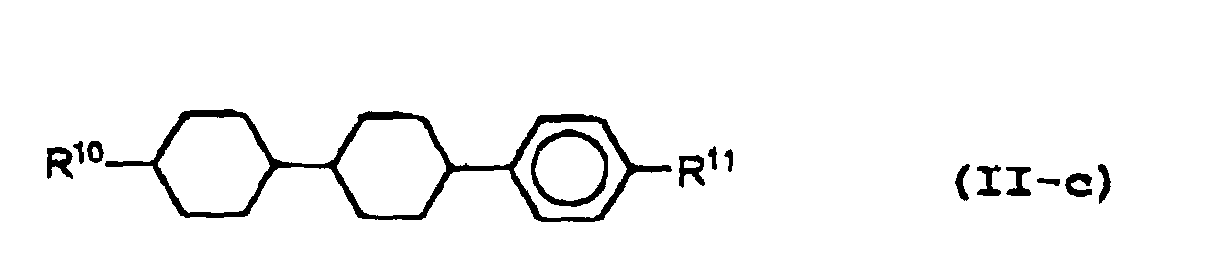
- The liquid crystal composition according to Claim 1, wherein said composition comprises as the first liquid crystal component at least one compound of the general formula (I) in an amount of from 5 to 40% by weight and as the second liquid crystal component at least one compound selected from the group consisting of compounds represented by the following general formula (III-a) in an amount of from 5 to 40% by weight:wherein R7 represents a C1-8 alkyl group or a C2-8 alkenyl group; the ring G represents a 1,4-phenylene group or a trans-1,4-cyclohexylene group; X5 represents a cyano group, a fluorine atom, a trifluoromethoxy group or a difluoromethoxy group; and X4 and X6 each independently representss a hydrogen atom or a fluorine atom, at least one compound selected from the group consisting of compounds represented by the following general formula (II-b) in an amount of from 5 to 40% by weight:
 wherein R8 and R9 each independently representss a C1-8 alkyl group or a C2-8 alkenyl group, and at least one compound selected from the group consisting of compounds represented by the following general formula (II-c) in an amount of from 5 to 40% by weight:
 wherein R10 and R11 each independently representss a C1-8 alkyl group or a C2-8 alkenyl group.
- The liquid crystal composition according to Claim 1, wherein as the compound of the general formula (III) there is incorporated at least one compound selected from the group consisting of compounds represented by the following general formula (III-b):wherein R12 represents a C1-16 alkyl group or a C2-8 alkenyl group in an amount of from 5 to 40% by weight.

- The liquid crystal composition according to Claim 1, wherein as the compound of the general formula (III) there is incorporated at least one compound selected from the group consisting of compounds represented by the following general formula (III-c):wherein R12 represents a C1-16 alkyl group or a C2-8 alkenyl group in an amount of from 5 to 40% by weight.

- A compound represented by the following general formula (Ia):

- The liquid crystal composition according to Claim 1, wherein as said first component there is incorporated a compound represented by the general formula (Ia).
- A liquid crystal composition comprises as the first liquid crystal component a compound represented by the general formula (I):and as the second liquid crystal component at least one compound represented by the following general formula (III-a) in an amount of from 5 to 40% by weight:
 wherein R7 represents a C1-8 alkyl group or a C2-8 alkenyl group; the ring G represents a 1,4-phenylene group or a trans-1,4-cyclohexylene group; X5 represents a cyano group, a fluorine atom, a trifluoromethoxy group or a difluoromethoxy group; and X4 and X6 each independently representss a hydrogen atom or a fluorine atom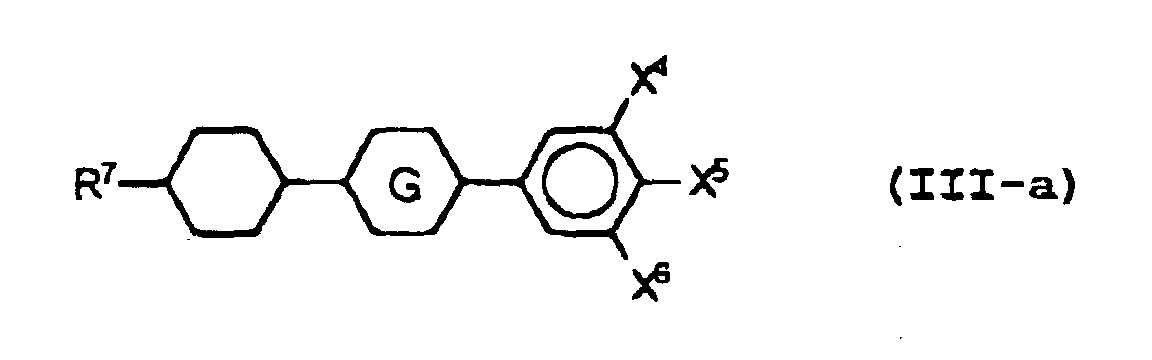
and at least one compound selected from the group consisting of compounds represented by the following general formulae (II-b) and (II-c) in an amount of from 5 to 60% by weight:wherein R8 and R9 each independently representss a C1-8 alkyl group or a C2-8 alkenyl group, wherein R10 and R11 each independently representss a C1-8 alkyl group or a C2-8 alkenyl group.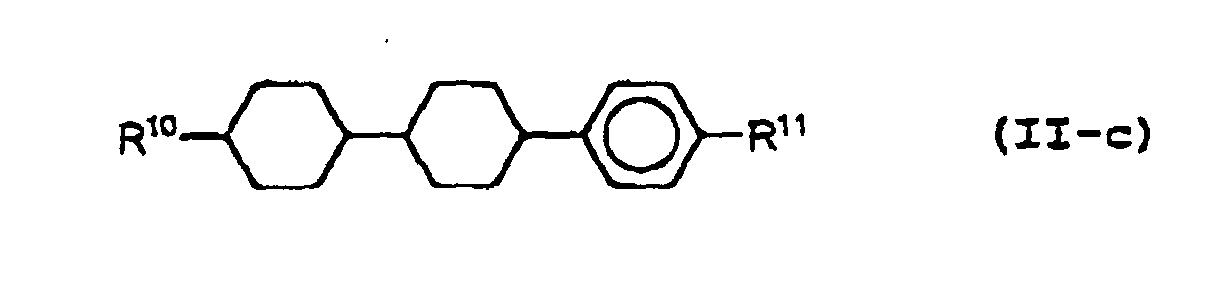
- The nematic liquid crystal composition according to Claim 1, which satisfies at least one of the following requirements:(i) 0.11 ≤ Δn ≤ 0.195;(ii) 4 ≤ Δε ≤ 60;(iii) 1.1 ≤ K33/K11 ≤ 3;(iv) 10 m·Pas ≤ η ≤ 80 m·Pas; and(v) 75°C ≤ TN-I ≤ 130°C wherein the measurement for the requirements (i) to (iv) are made at 20°C, Δn represents a birefringence, Δε represents a dielectric anisotropy, K33/K11 represents an elastic constant ratio, K33 represents a bend elastic constant, K11 represents a splay elastic constant, η represents a viscosity and TN-I represents nematic phase-isotropic liquid phase transition temperature.
- The nematic liquid crystal composition according to Claim 14, which satisfies at least one of the following requirements:(i) 0.11 ≤ Δn ≤ 0.195;(ii) 4 ≤ Δε ≤ 60;(iii) 1.1 ≤ K33/K11 ≤ 3;(iv) 10 m·Pas ≤ η ≤ 80 m·Pas; and(v) 75°C ≤ TN-I ≤ 130°C wherein the measurement for the requirements (i) to (iv) are made at 20°C, Δn represents a birefringence, Δε represents a dielectric anisotropy, K33/K11 represents an elastic constant ratio, K33 represents a bend elastic constant, K11 represents a splay elastic constant, η represents a viscosity and TN-I represents nematic phase-isotropic liquid phase transition temperature.
- A liquid crystal display device comprising the liquid crystal composition according to Claim 1.
- A super-twisted nematic (STN) liquid crystal display device comprising the liquid crystal composition according to Claim 1, having a twist angle of from 220° to 270° and satisfying at least one of the following requirements (i) to (iii) when the driving temperature falls within the range of from -20°C to 60°C:(i) ΔV/ΔT (temperature dependence of Vth) ≤ 7 mV/°C;(ii) Steepness γ (ratio of saturation voltage to threshold voltage (Vth)) ≤ 1.15; and(iii) Ratio of minimum to maximum of steepness γ in the foregoing temperature range ≤ 3%.
- A super-twisted nematic (STN) liquid crystal display device comprising the liquid crystal composition according to Claim 14, having a twist angle of from 220° to 270° and satisfying at least one of the following requirements (i) to (iii) when the driving temperature falls within the range of from -20°C to 60°C:(i) ΔV/ΔT (temperature dependence of Vth) ≤ 7 mV/°C;(ii) Steepness γ (ratio of saturation voltage to threshold voltage (Vth)) ≤ 1.15; and(iii) Ratio of minimum to maximum of steepness γ in the foregoing temperature range ≤ 3%.
Applications Claiming Priority (2)
| Application Number | Priority Date | Filing Date | Title |
|---|---|---|---|
| JP30682099A JP3856188B2 (en) | 1999-10-28 | 1999-10-28 | Liquid crystal composition |
| JP30682099 | 1999-10-28 |
Publications (3)
| Publication Number | Publication Date |
|---|---|
| EP1096000A2 true EP1096000A2 (en) | 2001-05-02 |
| EP1096000A3 EP1096000A3 (en) | 2001-09-26 |
| EP1096000B1 EP1096000B1 (en) | 2004-02-11 |
Family
ID=17961660
Family Applications (1)
| Application Number | Title | Priority Date | Filing Date |
|---|---|---|---|
| EP00123338A Expired - Lifetime EP1096000B1 (en) | 1999-10-28 | 2000-10-27 | Liquid crystal composition |
Country Status (7)
| Country | Link |
|---|---|
| US (1) | US6607791B1 (en) |
| EP (1) | EP1096000B1 (en) |
| JP (1) | JP3856188B2 (en) |
| KR (1) | KR100650359B1 (en) |
| CN (1) | CN1303904A (en) |
| DE (1) | DE60008185T2 (en) |
| TW (1) | TW554033B (en) |
Cited By (1)
| Publication number | Priority date | Publication date | Assignee | Title |
|---|---|---|---|---|
| WO2002097005A1 (en) * | 2001-05-25 | 2002-12-05 | Merck Patent Gmbh | Liquid crystal mixtures |
Families Citing this family (13)
| Publication number | Priority date | Publication date | Assignee | Title |
|---|---|---|---|---|
| CN100430457C (en) * | 2002-12-26 | 2008-11-05 | 大日本油墨化学工业株式会社 | Nematic liquid crystal composition and liquid crystal display element using the composition |
| CN100390250C (en) * | 2003-03-20 | 2008-05-28 | 大日本油墨化学工业株式会社 | liquid crystal composition |
| TWI349029B (en) | 2007-03-30 | 2011-09-21 | Au Optronics Corp | Liquid crystalline medium, liquid crystal display panel using the same, and method for manufacturing liquid crystal display panel |
| CN101045866B (en) * | 2007-04-23 | 2010-07-07 | 友达光电股份有限公司 | Liquid crystal material and method for manufacturing liquid crystal panel |
| CN101074379B (en) * | 2007-06-13 | 2011-01-19 | 江苏和成化学材料有限公司 | Liquid-crystal composition |
| JP5141947B2 (en) * | 2007-06-29 | 2013-02-13 | Dic株式会社 | Nematic liquid crystal composition and liquid crystal display device using the same |
| CN101407718B (en) * | 2007-10-12 | 2012-06-06 | 北京八亿时空液晶科技股份有限公司 | Nematic liquid crystal composition |
| KR101699744B1 (en) * | 2010-02-19 | 2017-02-14 | 삼성디스플레이 주식회사 | Display device and method of manufacturing the same |
| CN102899052B (en) * | 2012-10-13 | 2014-08-13 | 江苏和成显示科技股份有限公司 | Superwide-temperature TN liquid crystal composition |
| CN102890355B (en) * | 2012-10-13 | 2014-11-05 | 江苏和成显示科技股份有限公司 | Ultra-high temperature liquid crystal display |
| CN103351881B (en) * | 2013-06-18 | 2015-10-21 | 江苏和成显示科技股份有限公司 | Low dielectric frequency dependence liquid-crystal composition and comprise the PM indicating meter of said composition |
| CN106292053A (en) * | 2016-10-31 | 2017-01-04 | 亚世光电(鞍山)有限公司 | A kind of VA type high density display lattice lcd display |
| CN110862829B (en) * | 2019-11-19 | 2021-11-05 | 北京大学 | A kind of low driving voltage liquid crystal composition for PDLC and preparation method thereof |
Family Cites Families (2)
| Publication number | Priority date | Publication date | Assignee | Title |
|---|---|---|---|---|
| DE4025550B4 (en) * | 1989-08-16 | 2007-05-03 | Merck Patent Gmbh | Phenylcyclohexane and liquid crystalline medium |
| JP4989815B2 (en) | 1998-09-12 | 2012-08-01 | メルク パテント ゲゼルシャフト ミット ベシュレンクテル ハフツング | Liquid crystal medium and liquid crystal display containing the same |
-
1999
- 1999-10-28 JP JP30682099A patent/JP3856188B2/en not_active Expired - Fee Related
-
2000
- 2000-10-27 KR KR1020000063501A patent/KR100650359B1/en not_active Expired - Lifetime
- 2000-10-27 DE DE60008185T patent/DE60008185T2/en not_active Expired - Lifetime
- 2000-10-27 EP EP00123338A patent/EP1096000B1/en not_active Expired - Lifetime
- 2000-10-27 TW TW089122707A patent/TW554033B/en not_active IP Right Cessation
- 2000-10-27 CN CN00137326A patent/CN1303904A/en active Pending
- 2000-10-27 US US09/696,978 patent/US6607791B1/en not_active Expired - Lifetime
Cited By (2)
| Publication number | Priority date | Publication date | Assignee | Title |
|---|---|---|---|---|
| WO2002097005A1 (en) * | 2001-05-25 | 2002-12-05 | Merck Patent Gmbh | Liquid crystal mixtures |
| US7048974B2 (en) | 2001-05-25 | 2006-05-23 | Merck Patentgesellschaft Mit Beschrankter Haftung | Liquid crystal mixtures |
Also Published As
| Publication number | Publication date |
|---|---|
| KR20010040197A (en) | 2001-05-15 |
| CN1303904A (en) | 2001-07-18 |
| DE60008185T2 (en) | 2004-07-29 |
| TW554033B (en) | 2003-09-21 |
| US6607791B1 (en) | 2003-08-19 |
| JP2001123171A (en) | 2001-05-08 |
| JP3856188B2 (en) | 2006-12-13 |
| EP1096000B1 (en) | 2004-02-11 |
| KR100650359B1 (en) | 2006-11-27 |
| DE60008185D1 (en) | 2004-03-18 |
| EP1096000A3 (en) | 2001-09-26 |
| HK1035913A1 (en) | 2001-12-14 |
Similar Documents
| Publication | Publication Date | Title |
|---|---|---|
| EP1096000B1 (en) | Liquid crystal composition | |
| KR100565021B1 (en) | Nematic liquid crystal composition containing fluorine-substituted 4-alkenylbenzoic acid and derivative thereof, cyanophenylbenzoate derivative and liquid crystal display device using the same | |
| HK77692A (en) | Liquid crystal phase | |
| EP1176185B1 (en) | Liquid crystal display | |
| US6106908A (en) | Liquid crystalline (E, E)-butadiene compounds and mixtures and devices containing such compounds | |
| EP0385471B1 (en) | Alkylene glycol derivative and liquid crystal mixture containing the same | |
| HK1005313B (en) | Alkylene glycol derivative and liquid crystal mixture containing the same | |
| JP4984342B2 (en) | Liquid crystal composition | |
| JP4306190B2 (en) | Liquid crystal composition | |
| JP4973900B2 (en) | Nematic liquid crystal composition and liquid crystal display device using the same | |
| HK1035913B (en) | Liquid crystal composition | |
| JP4934899B2 (en) | Liquid crystal composition and liquid crystal display element | |
| JP2001294862A (en) | Supertwist nematic liquid crystal display | |
| JP4655317B2 (en) | Liquid crystal composition and liquid crystal display element | |
| JP2001316346A (en) | Benzene derivative | |
| JP4918734B2 (en) | Liquid crystal composition and liquid crystal display element | |
| JPH11199869A (en) | Nematic liquid crystal composition and liquid crystal display device using the same | |
| JP2000129260A (en) | Nematic liquid crystal composition and liquid crystal display device using the same | |
| JPH11106753A (en) | Nematic liquid crystal composition and liquid crystal display device using the same | |
| JPH0959625A (en) | Liquid crystal composition and liquid crystal display device | |
| JP4876314B2 (en) | Liquid crystal composition and liquid crystal display element | |
| JP4752083B2 (en) | Liquid crystal composition | |
| JP4788015B2 (en) | Liquid crystal composition | |
| JP4887560B2 (en) | Liquid crystal composition | |
| JP2003147362A (en) | Liquid crystal composition and liquid crystal display element |
Legal Events
| Date | Code | Title | Description |
|---|---|---|---|
| PUAI | Public reference made under article 153(3) epc to a published international application that has entered the european phase |
Free format text: ORIGINAL CODE: 0009012 |
|
| AK | Designated contracting states |
Kind code of ref document: A2 Designated state(s): DE FR GB Kind code of ref document: A2 Designated state(s): AT BE CH CY DE DK ES FI FR GB GR IE IT LI LU MC NL PT SE |
|
| AX | Request for extension of the european patent |
Free format text: AL;LT;LV;MK;RO;SI |
|
| PUAL | Search report despatched |
Free format text: ORIGINAL CODE: 0009013 |
|
| AK | Designated contracting states |
Kind code of ref document: A3 Designated state(s): AT BE CH CY DE DK ES FI FR GB GR IE IT LI LU MC NL PT SE |
|
| AX | Request for extension of the european patent |
Free format text: AL;LT;LV;MK;RO;SI |
|
| 17P | Request for examination filed |
Effective date: 20020110 |
|
| AKX | Designation fees paid |
Free format text: DE FR GB |
|
| 17Q | First examination report despatched |
Effective date: 20020807 |
|
| GRAP | Despatch of communication of intention to grant a patent |
Free format text: ORIGINAL CODE: EPIDOSNIGR1 |
|
| GRAS | Grant fee paid |
Free format text: ORIGINAL CODE: EPIDOSNIGR3 |
|
| GRAA | (expected) grant |
Free format text: ORIGINAL CODE: 0009210 |
|
| AK | Designated contracting states |
Kind code of ref document: B1 Designated state(s): DE FR GB |
|
| REG | Reference to a national code |
Ref country code: GB Ref legal event code: FG4D |
|
| REF | Corresponds to: |
Ref document number: 60008185 Country of ref document: DE Date of ref document: 20040318 Kind code of ref document: P |
|
| ET | Fr: translation filed | ||
| REG | Reference to a national code |
Ref country code: HK Ref legal event code: GR Ref document number: 1035913 Country of ref document: HK |
|
| PLBE | No opposition filed within time limit |
Free format text: ORIGINAL CODE: 0009261 |
|
| STAA | Information on the status of an ep patent application or granted ep patent |
Free format text: STATUS: NO OPPOSITION FILED WITHIN TIME LIMIT |
|
| 26N | No opposition filed |
Effective date: 20041112 |
|
| PGFP | Annual fee paid to national office [announced via postgrant information from national office to epo] |
Ref country code: GB Payment date: 20070904 Year of fee payment: 8 |
|
| PGFP | Annual fee paid to national office [announced via postgrant information from national office to epo] |
Ref country code: FR Payment date: 20071026 Year of fee payment: 8 |
|
| GBPC | Gb: european patent ceased through non-payment of renewal fee |
Effective date: 20081027 |
|
| REG | Reference to a national code |
Ref country code: FR Ref legal event code: ST Effective date: 20090630 |
|
| PG25 | Lapsed in a contracting state [announced via postgrant information from national office to epo] |
Ref country code: FR Free format text: LAPSE BECAUSE OF NON-PAYMENT OF DUE FEES Effective date: 20081031 |
|
| PG25 | Lapsed in a contracting state [announced via postgrant information from national office to epo] |
Ref country code: GB Free format text: LAPSE BECAUSE OF NON-PAYMENT OF DUE FEES Effective date: 20081027 |
|
| PGFP | Annual fee paid to national office [announced via postgrant information from national office to epo] |
Ref country code: DE Payment date: 20191015 Year of fee payment: 20 |
|
| REG | Reference to a national code |
Ref country code: DE Ref legal event code: R071 Ref document number: 60008185 Country of ref document: DE |