EP1093908A1 - Corrugator single-facer belt - Google Patents
Corrugator single-facer belt Download PDFInfo
- Publication number
- EP1093908A1 EP1093908A1 EP00309208A EP00309208A EP1093908A1 EP 1093908 A1 EP1093908 A1 EP 1093908A1 EP 00309208 A EP00309208 A EP 00309208A EP 00309208 A EP00309208 A EP 00309208A EP 1093908 A1 EP1093908 A1 EP 1093908A1
- Authority
- EP
- European Patent Office
- Prior art keywords
- base structure
- belt
- machine
- facer
- staple fiber
- Prior art date
- Legal status (The legal status is an assumption and is not a legal conclusion. Google has not performed a legal analysis and makes no representation as to the accuracy of the status listed.)
- Granted
Links
Images

Classifications
-
- B—PERFORMING OPERATIONS; TRANSPORTING
- B65—CONVEYING; PACKING; STORING; HANDLING THIN OR FILAMENTARY MATERIAL
- B65G—TRANSPORT OR STORAGE DEVICES, e.g. CONVEYORS FOR LOADING OR TIPPING, SHOP CONVEYOR SYSTEMS OR PNEUMATIC TUBE CONVEYORS
- B65G15/00—Conveyors having endless load-conveying surfaces, i.e. belts and like continuous members, to which tractive effort is transmitted by means other than endless driving elements of similar configuration
- B65G15/30—Belts or like endless load-carriers
- B65G15/32—Belts or like endless load-carriers made of rubber or plastics
- B65G15/34—Belts or like endless load-carriers made of rubber or plastics with reinforcing layers, e.g. of fabric
-
- B—PERFORMING OPERATIONS; TRANSPORTING
- B31—MAKING ARTICLES OF PAPER, CARDBOARD OR MATERIAL WORKED IN A MANNER ANALOGOUS TO PAPER; WORKING PAPER, CARDBOARD OR MATERIAL WORKED IN A MANNER ANALOGOUS TO PAPER
- B31F—MECHANICAL WORKING OR DEFORMATION OF PAPER, CARDBOARD OR MATERIAL WORKED IN A MANNER ANALOGOUS TO PAPER
- B31F1/00—Mechanical deformation without removing material, e.g. in combination with laminating
- B31F1/12—Crêping
- B31F1/16—Crêping by elastic belts
-
- B—PERFORMING OPERATIONS; TRANSPORTING
- B31—MAKING ARTICLES OF PAPER, CARDBOARD OR MATERIAL WORKED IN A MANNER ANALOGOUS TO PAPER; WORKING PAPER, CARDBOARD OR MATERIAL WORKED IN A MANNER ANALOGOUS TO PAPER
- B31F—MECHANICAL WORKING OR DEFORMATION OF PAPER, CARDBOARD OR MATERIAL WORKED IN A MANNER ANALOGOUS TO PAPER
- B31F1/00—Mechanical deformation without removing material, e.g. in combination with laminating
- B31F1/20—Corrugating; Corrugating combined with laminating to other layers
- B31F1/24—Making webs in which the channel of each corrugation is transverse to the web feed
- B31F1/26—Making webs in which the channel of each corrugation is transverse to the web feed by interengaging toothed cylinders cylinder constructions
- B31F1/28—Making webs in which the channel of each corrugation is transverse to the web feed by interengaging toothed cylinders cylinder constructions combined with uniting the corrugated webs to flat webs ; Making double-faced corrugated cardboard
- B31F1/2845—Details, e.g. provisions for drying, moistening, pressing
- B31F1/2877—Pressing means for bringing facer sheet and corrugated webs into contact or keeping them in contact, e.g. rolls, belts
-
- B—PERFORMING OPERATIONS; TRANSPORTING
- B65—CONVEYING; PACKING; STORING; HANDLING THIN OR FILAMENTARY MATERIAL
- B65G—TRANSPORT OR STORAGE DEVICES, e.g. CONVEYORS FOR LOADING OR TIPPING, SHOP CONVEYOR SYSTEMS OR PNEUMATIC TUBE CONVEYORS
- B65G2201/00—Indexing codes relating to handling devices, e.g. conveyors, characterised by the type of product or load being conveyed or handled
- B65G2201/02—Articles
-
- Y—GENERAL TAGGING OF NEW TECHNOLOGICAL DEVELOPMENTS; GENERAL TAGGING OF CROSS-SECTIONAL TECHNOLOGIES SPANNING OVER SEVERAL SECTIONS OF THE IPC; TECHNICAL SUBJECTS COVERED BY FORMER USPC CROSS-REFERENCE ART COLLECTIONS [XRACs] AND DIGESTS
- Y10—TECHNICAL SUBJECTS COVERED BY FORMER USPC
- Y10S—TECHNICAL SUBJECTS COVERED BY FORMER USPC CROSS-REFERENCE ART COLLECTIONS [XRACs] AND DIGESTS
- Y10S162/00—Paper making and fiber liberation
- Y10S162/904—Paper making and fiber liberation with specified seam structure of papermaking belt
-
- Y—GENERAL TAGGING OF NEW TECHNOLOGICAL DEVELOPMENTS; GENERAL TAGGING OF CROSS-SECTIONAL TECHNOLOGIES SPANNING OVER SEVERAL SECTIONS OF THE IPC; TECHNICAL SUBJECTS COVERED BY FORMER USPC CROSS-REFERENCE ART COLLECTIONS [XRACs] AND DIGESTS
- Y10—TECHNICAL SUBJECTS COVERED BY FORMER USPC
- Y10T—TECHNICAL SUBJECTS COVERED BY FORMER US CLASSIFICATION
- Y10T442/00—Fabric [woven, knitted, or nonwoven textile or cloth, etc.]
- Y10T442/30—Woven fabric [i.e., woven strand or strip material]
- Y10T442/3707—Woven fabric including a nonwoven fabric layer other than paper
- Y10T442/3724—Needled
- Y10T442/3732—Including an additional nonwoven fabric
-
- Y—GENERAL TAGGING OF NEW TECHNOLOGICAL DEVELOPMENTS; GENERAL TAGGING OF CROSS-SECTIONAL TECHNOLOGIES SPANNING OVER SEVERAL SECTIONS OF THE IPC; TECHNICAL SUBJECTS COVERED BY FORMER USPC CROSS-REFERENCE ART COLLECTIONS [XRACs] AND DIGESTS
- Y10—TECHNICAL SUBJECTS COVERED BY FORMER USPC
- Y10T—TECHNICAL SUBJECTS COVERED BY FORMER US CLASSIFICATION
- Y10T442/00—Fabric [woven, knitted, or nonwoven textile or cloth, etc.]
- Y10T442/30—Woven fabric [i.e., woven strand or strip material]
- Y10T442/3707—Woven fabric including a nonwoven fabric layer other than paper
- Y10T442/3724—Needled
- Y10T442/3764—Coated, impregnated, or autogenously bonded
-
- Y—GENERAL TAGGING OF NEW TECHNOLOGICAL DEVELOPMENTS; GENERAL TAGGING OF CROSS-SECTIONAL TECHNOLOGIES SPANNING OVER SEVERAL SECTIONS OF THE IPC; TECHNICAL SUBJECTS COVERED BY FORMER USPC CROSS-REFERENCE ART COLLECTIONS [XRACs] AND DIGESTS
- Y10—TECHNICAL SUBJECTS COVERED BY FORMER USPC
- Y10T—TECHNICAL SUBJECTS COVERED BY FORMER US CLASSIFICATION
- Y10T442/00—Fabric [woven, knitted, or nonwoven textile or cloth, etc.]
- Y10T442/30—Woven fabric [i.e., woven strand or strip material]
- Y10T442/3707—Woven fabric including a nonwoven fabric layer other than paper
- Y10T442/378—Coated, impregnated, or autogenously bonded
- Y10T442/3813—Coating or impregnation contains synthetic polymeric material
Definitions
- the present invention relates to corrugated paper board manufacture and to the belts required by the machines used to manufacture that variety of paper board. More specifically, the present invention relates to the belts that may be used on the single-facer section of a corrugated board production line. The present invention is particularly concerned with the provision of a woven endless, needlepunched corrugator single-facer belt.
- a so-called core paper is heated by steam, which makes it more pliable, and is then fed into a nip formed between a pair of toothed rollers whose teeth mesh, thereby corrugating the core paper in a uniform, undulating pattern.
- Starch paste is subsequently applied to the crests of the corrugated core paper, which is then mated to a liner paper in a press nip. There, the corrugated core paper and liner paper are bonded together to form a completed sheet, which can then be further processed as desired.
- the press nip is formed by one of the toothed or corrugating rolls and a pressure roll.
- the press nip is extended in the running direction through the use of a press belt instead of a pressure roll.
- the press belt holds the corrugated core paper and liner paper together against the corrugating roll for a significant portion of its circumference.
- the press belt experiences severe operating conditions. Because heat is used to vaporize moisture in the core paper, the belt operates in a high-temperature environment. Further, the belt continually runs against the teeth on the corrugating roll to develop the required bonding pressure between the core paper and the liner paper. Moreover, the belt must be flexible yet have lengthwise strength and widthwise rigidity sufficient to withstand wrinkling, which may cause the belt to drift undesirably from side to side.
- Steel belts that is, belts woven from steel wire, have been proposed for use on this kind of machine.
- Steel belts are strong and rigid, but are prone to flex fatigue.
- steel belts cannot be woven endless and must be seamed into endless form, the seam being a weak point in the endless belt. Were such a belt to fail, injury to personnel and damage to equipment may result.
- European Publication No. 0 630 739 A1 shows a belt intended for use in place of a steel belt on a belted single-facer machine.
- the belt is endless, and has an inside surface, an outside surface, a length (L) and a width (W).
- the belt has an endless woven inner layer, an elastomer layer outside of the endlessly woven inner layer, a canvas outer layer that is expansible lengthwise of the belt outside of the elastomer layer, and a coating on the canvas outer layer. The coating is exposed on the outside surface of the endless belt and resists the bonding of foreign material thereto.
- the canvas outer layer is not endless, but includes two or more sections joined to one another with overlapped seams.
- the belt disclosed in this publication performs poorly in the environment of the machine.
- the belt is a composite structure which includes an endless inner fabric layer and a canvas outer layer.
- the two layers have different stress-strain behaviours under tension.
- the belt is placed under very high operating tensions in excess of 200 pli (pounds per linear inch).
- pli pounds per linear inch
- the belt is very rigid, stiff and incompressible, making it difficult to track and guide in operation.
- the present invention provides a solution to the problems inherent in the use of a belt of the foregoing variety.
- the present invention provides a single-facer section of a corrugated board production line, said single-facer section comprising an unlaminated single-facer belt, which belt is trained around at least two spaced rollers and forms an extended nip with a roll having uniformly spaced, peripheral teeth by running thereagainst, said belt having:
- the present invention further provides the use of an unlaminated single-facer belt in a single-facer section of a corrugated board production line, said single-facer section being of the variety in which the belt is trained around at least two spaced rollers and forms an extended nip with a roll having uniformly spaced, peripheral teeth by running thereagainst, said belt having:
- the present invention is an improvement for a single-facer section of a corrugated board production line of the foregoing type.
- the present invention relates, in particular, to the provision of an unlaminated single-facer belt.
- the unlaminated single-facer belt has a single base structure in the form of an endless loop lacking a seam and having an inside and an outside, a machine, or running, direction and a cross-machine direction.
- the base structure is formed by machine-direction and cross-machine-direction yarns, and is either woven from these yarns or is a nonwoven structure assembled from them.
- At least one layer of staple fiber material is needled into the outside of the base structure and extends at least partly therethrough, preferably forming a layer on the outside of the base structure.
- the base structure and staple fiber material are impregnated with a polymeric resin material.
- the yarns of the base structure, the staple fiber material and the polymeric resin material are all of high-temperature-resistant materials to enable the belt to withstand the conditions under which it must operate on a corrugator machine.
- FIG 1 is a schematic view of a typical belted single-facer section 10 of a corrugated board production line.
- a core paper 12 previously exposed to steam which makes it more pliable, is fed continuously between a pair of cooperating rolls 14, 16.
- the rolls 14, 16 have uniformly spaced, peripheral teeth 18,20, which mesh as the rolls 14,16 rotate about their respective, parallel axes 22,24.
- the meshing teeth 18,20 produce corrugations 26 in the core paper 12.
- a coating mechanism 28 applies a starch paste 30 to the crests 32 of the corrugations 26 in the core paper 12.
- the corrugated core paper 12 is continuously applied to a liner paper 34 at point 36, where a belt 40, which is trained around a pair of spaced rollers 42,44, passes around roller 42.
- the spaced rollers 42,44 are so disposed that belt 40 bears against roll 16, and may both form nips with roll 16, so that the belt 40, trained thereabout, bears against roll 16 for the entire interval between spaced rollers 42,44 forming an extended nip between roll 16 and belt 40.
- Heat is applied to the corrugated core paper 12 and liner paper 34 through at least one of the rollers 42,44, belt 40 and roll 16. The heat vaporizes water absorbed by the corrugated core paper 12 when the corrugated core paper 12 was exposed to steam and dries the starch paste 30.
- the rollers 42,44 are situated so that the teeth 20 on roll 16 bear against the outside surface of the belt 40 over a substantial circumferential extent as the system operates.
- the teeth 20 maintain the proper registration of the corrugated core paper 12 as it is advanced.
- the roll 16 firmly presses the side of the core paper 12 with the paste thereon against the liner paper 34 to effect bonding therebetween.
- the corrugated core paper 12 with the liner paper 34 attached thereto exits as a completed product 50 from between the roll 16 and the roller 44.
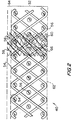
- FIG. 2 is a cross-sectional view, taken in a direction transverse to the running, or machine, direction, of an improved belt 40 according to the present invention.
- the belt 40 as illustrated, has a base structure 52 which is woven endless in a 21 ⁇ 2-layer weave, wherein the warp yarns 54 extend in the transverse, or cross-machine, direction of the endless belt 40, and the weft yarns 56 extend in the running, or machine, direction.
- base structure 52 lacks a seam, and is therefor not subject to seam failure, a common shortcoming in the single-facer belts of the prior art.
- the base structure 52 may have from one to three layers of weft yarns 56, and may be woven in a pattern like that illustrated in Figure 2, that is, in a weave giving the surfaces of the belt the appearance of a plain weave.
- the base structure 52 instead of being woven, may be assembled on a mandrel.
- Such a nonwoven base structure 52 may comprise several layers of yarns oriented in the machine- and cross-machine directions and joined to one another by some means, such as a polymeric resin material, at their crossing points.
- the machine-direction yarns of such a structure would be wound around the mandrel; the cross-machine-direction yarns would be laid crosswise upon previously wound machine-direction yarns. Additional layers of yarns could be built up in a similar manner. Once these yarns were adequately joined to one another at their crossing points, the nonwoven base structure 52 so assembled would be removed from the mandrel for further processing.
- the base structure 52 of the single-facer belt 40 according to the present invention is typically on the order of 0.12 inch thick, much thicker than the single-facer belts of the prior art.
- the unlaminated nature of the base structure 52, along with its increased thickness, avoids the delamination and tracking problems which plague the belts of the prior art.
- the base structure 52 may be woven, or otherwise assembled, from warp yarns 54 and weft yarns 56 comprising yarns of any of the varieties used in the manufacture of paper machine clothing and industrial process fabrics. That is to say, the base structure 52 may include monofilament, plied monofilament, multifilament, plied multifilament or yarns spun from staple fibers of any of the synthetic polymeric resins used by those skilled in the art in the manufacture of fabrics intended for use in high-temperature environments.
- the base structure 42 may be manufactured from yarns of the following materials: polyaramids, such as NOMEX® and KEVLAR®; polyphenylene sulfide (PPS), which is more commonly known as RYTON®; an aromatic polyester, which is commonly known as VECTRAN; polyetheretherketone (PEEK); polyester and blends thereof.
- polyaramids such as NOMEX® and KEVLAR®
- PPS polyphenylene sulfide
- RYTON® an aromatic polyester, which is commonly known as VECTRAN
- PEEK polyetheretherketone
- the base structure 52 may comprise yarns of KEVLAR® in the machine direction and RYTON® or polyester monofilament yarns in the cross-machine direction.
- the base structure 52 is endless, it has an inside and an outside, which are the inner and outer surfaces, respectively, of the endless loop formed by the base structure 52.
- the outside, or outer surface, 58 of the base structure 52 is needled with a web 60 of staple fiber material in such a manner that some of the fibers are driven into the base structure 52.
- One or more layers of staple fiber material may be needled into the outside 58 of the base structure 52, and the web 60 may extend partially or completely therethrough.
- the web 60 of staple fiber material also forms a layer 64 covering the outside 58 of the base structure 52.
- one or more layers of staple fiber material may also be needled into the inside, or inner surface, 62 of the base structure 52.
- the web 60 is included in only a portion of Figure 2.
- the needling provides the present single-facer belt 40 with a fiber-reinforced, protective and cushioning layer on the outside 58, and perhaps also on the inside 62, of the base structure 52.
- the result is a belt 40 which is much less rigid than those of the prior art.
- the staple fiber material needled into the base structure 52 is also of any of the synthetic polymeric resins used by those skilled in the art in the manufacture of fabrics intended for use in high-temperature environments.
- the staple fiber material may comprise staple fibers of any of the following materials: polyaramids, such as NOMEX® and KEVLAR®; polyphenylene sulfide (PPS), which is more commonly known as RYTON®; polyetheretherketone (PEEK); polyester; polyamides and modified polyamides; and blends thereof.
- a modified polyamide is meant a polyamide material which has been subjected to a treatment with an aqueous solution of aldehyde in the presence of a catalyst to effect partial cross-linking of the polyamide to provide a gel content thereof within the range of 0.1 to 75% accompanied by a reduction in crystallinity in the range of 1 to 65% compared with the uncrosslinked material, as disclosed and claimed in commonly assigned U.S. Patent No. 5,316,833 to Davis et al., the teachings of which are incorporated herein by reference.
- the denier of staple fibers making up the web 60 is preferably in the range from 1.5 to 40.
- the areal density of the web 60 applied to the base structure 52 is preferably in the range from 3.0 to 30.0 oz/yd 2 .
- the integrity and durability of the present single-facer belt 40 is improved by coating and impregnating the base structure 52 with a polymeric resin material 66. Complete impregnation of the needled base structure 52 is preferred rather than a distinct layer on the outside 58 of the base structure.
- Coating materials include polyurethane, silicone, amide-imides, and fluoropolymers, such as polytetrafluorethylene (PTFE), which is commonly known as TEFLON®.
- coating enhancers or fillers may be included in the coating and impregnating material to improve fabric abrasion resistance and/or to alter release properties, such as soil release properties.
- coating enhancers or fillers include silicone, if not already included, clay particles, and PTFE particles.
- the coating is preferably applied to the needled base structure 52 in an areal density in the range from 1.0 to 15.0 oz/ft 2 .
- the present single-facer belt 40 is both more compliant and more compressible than the prior-art belt shown in European Publication No. 0 630 739 A1, which was discussed above.
- a diagonal stress-strain test has been developed at Albany International Corp. and standard procedures have been written for the test. Under the test, typical ultra-rigid fabrics distort less than 2% when a "4 inch by 4 inch" sample is held in an Instron and a 50-lb. force is applied.
- the prior-art belt has a rigidity (2.023%) just outside this range. This is believed to be one of the reasons for the poor guidability of that belt.
- the present single-facer belt has a rigidity in the range from 5% to 10%.
- the needled base structure 52 allows for the construction of far less rigid belts 40 while satisfying other demands of the belt in operation.
- Standard compressibility tests have also been developed at Albany International. Under these tests, the amount of Z-direction deformation of the fabric is measured when a controlled force is applied in that direction, or perpendicular to the direction of travel in operation and perpendicular to the widthwise dimension of the belt.
- the prior-art belt is extremely incompressible and tests 5%.
- the present single-facer belt ranges in compressibility from 7% to 25%. It is believed that the compressibility level can be predetermined by varying the amount of fiber needled into the base structure; the amount of needle energy used during this process, needle energy being a function of the depth to which the needles penetrate the base structure and the number of penetrations per unit area; and the coatings applied after the needling process.
- the compressibility range of the present belt provides a proper nip on the single-facer portion of a corrugating machine and a single-facer belt that is easy to operate.
- a belt constructed in accordance with the present invention was assembled from an endlessly woven base structure having a 21 ⁇ 2-layer weave. KEVLAR® yarns were used in the machine direction, and NOMEX® yarns were used in the cross-machine direction.
- the base structure was needled with a web of 5.5 denier NOMEX® fiber material. The real density of the web was uniform and in the range from 9.0 to 12.0 oz/yd 2 . Following needling, the needled surface was flame-singed to remove loose fibers and to make the surface more compact. The needled base structure was finally saturated and impregnated with silicone. The resulting belt operated with excellent results on the single-facer section of a corrugated board production line.
Landscapes
- Engineering & Computer Science (AREA)
- Mechanical Engineering (AREA)
- Machines For Manufacturing Corrugated Board In Mechanical Paper-Making Processes (AREA)
- Woven Fabrics (AREA)
- Laminated Bodies (AREA)
- Paper (AREA)
- Treatments For Attaching Organic Compounds To Fibrous Goods (AREA)
- Details Of Garments (AREA)
- Belt Conveyors (AREA)
- Looms (AREA)
- Nonwoven Fabrics (AREA)
- Structure Of Belt Conveyors (AREA)
Abstract
Description
- The present invention relates to corrugated paper board manufacture and to the belts required by the machines used to manufacture that variety of paper board. More specifically, the present invention relates to the belts that may be used on the single-facer section of a corrugated board production line. The present invention is particularly concerned with the provision of a woven endless, needlepunched corrugator single-facer belt.
- In the manufacture of corrugated paper board, a so-called core paper is heated by steam, which makes it more pliable, and is then fed into a nip formed between a pair of toothed rollers whose teeth mesh, thereby corrugating the core paper in a uniform, undulating pattern. Starch paste is subsequently applied to the crests of the corrugated core paper, which is then mated to a liner paper in a press nip. There, the corrugated core paper and liner paper are bonded together to form a completed sheet, which can then be further processed as desired.
- In one machine used for this purpose in the prior art, the press nip is formed by one of the toothed or corrugating rolls and a pressure roll. In another machine of a more recent design, the press nip is extended in the running direction through the use of a press belt instead of a pressure roll. The press belt holds the corrugated core paper and liner paper together against the corrugating roll for a significant portion of its circumference.
- The press belt experiences severe operating conditions. Because heat is used to vaporize moisture in the core paper, the belt operates in a high-temperature environment. Further, the belt continually runs against the teeth on the corrugating roll to develop the required bonding pressure between the core paper and the liner paper. Moreover, the belt must be flexible yet have lengthwise strength and widthwise rigidity sufficient to withstand wrinkling, which may cause the belt to drift undesirably from side to side.
- Steel belts, that is, belts woven from steel wire, have been proposed for use on this kind of machine. Steel belts are strong and rigid, but are prone to flex fatigue. Moreover, steel belts cannot be woven endless and must be seamed into endless form, the seam being a weak point in the endless belt. Were such a belt to fail, injury to personnel and damage to equipment may result.
- European Publication No. 0 630 739 A1 shows a belt intended for use in place of a steel belt on a belted single-facer machine. The belt is endless, and has an inside surface, an outside surface, a length (L) and a width (W). The belt has an endless woven inner layer, an elastomer layer outside of the endlessly woven inner layer, a canvas outer layer that is expansible lengthwise of the belt outside of the elastomer layer, and a coating on the canvas outer layer. The coating is exposed on the outside surface of the endless belt and resists the bonding of foreign material thereto. The canvas outer layer is not endless, but includes two or more sections joined to one another with overlapped seams.
- Experience has shown that the belt disclosed in this publication performs poorly in the environment of the machine. The belt is a composite structure which includes an endless inner fabric layer and a canvas outer layer. The two layers have different stress-strain behaviours under tension. In use, the belt is placed under very high operating tensions in excess of 200 pli (pounds per linear inch). As the belt travels around a closed loop and as the individual fabrics are tensioned simultaneously but occupy different path lengths, delamination becomes likely. Moreover, the belt is very rigid, stiff and incompressible, making it difficult to track and guide in operation.
- The present invention provides a solution to the problems inherent in the use of a belt of the foregoing variety.
- The present invention provides a single-facer section of a corrugated board production line, said single-facer section comprising an unlaminated single-facer belt, which belt is trained around at least two spaced rollers and forms an extended nip with a roll having uniformly spaced, peripheral teeth by running thereagainst, said belt having:
- a single base structure, said base structure being in the form of an endless loop lacking a seam and having an inside and an outside, a machine, or running, direction and a cross-machine direction; said base structure being formed by machine-direction and cross-machine-direction yarns;
- at least one layer of staple fiber material needled into said outside of said base structure and extending at least partly therethrough;
- said base structure and said staple fiber material being impregnated with a polymeric resin material,
- said yarns of said base structure, said staple fiber material and said polymeric resin material being of high-temperature-resistant materials.
-
- The present invention further provides the use of an unlaminated single-facer belt in a single-facer section of a corrugated board production line, said single-facer section being of the variety in which the belt is trained around at least two spaced rollers and forms an extended nip with a roll having uniformly spaced, peripheral teeth by running thereagainst, said belt having:
- a single base structure, said base structure being in the form of an endless loop lacking a seam and having an inside and an outside, a machine, or running, direction and a cross-machine direction; said base structure being formed by machine-direction and cross-machine-direction yarns;
- at least one layer of staple fiber material needled into said outside of said base structure and extending at least partly therethrough;
- said base structure and said staple fiber material being impregnated with a polymeric resin material,
- said yarns of said base structure, said staple fiber material and said polymeric resin material being of high-temperature-resistant materials.
-
- The present invention is an improvement for a single-facer section of a corrugated board production line of the foregoing type. The present invention relates, in particular, to the provision of an unlaminated single-facer belt. The unlaminated single-facer belt has a single base structure in the form of an endless loop lacking a seam and having an inside and an outside, a machine, or running, direction and a cross-machine direction. The base structure is formed by machine-direction and cross-machine-direction yarns, and is either woven from these yarns or is a nonwoven structure assembled from them.
- At least one layer of staple fiber material is needled into the outside of the base structure and extends at least partly therethrough, preferably forming a layer on the outside of the base structure.
- Finally, the base structure and staple fiber material are impregnated with a polymeric resin material.
- The yarns of the base structure, the staple fiber material and the polymeric resin material are all of high-temperature-resistant materials to enable the belt to withstand the conditions under which it must operate on a corrugator machine.
- A preferred embodiment of the present invention will now be described in more detail by way of example only with appropriate reference being made to the figures identified below:
- Figure 1 is a schematic view of a contemporary single-facer section of a corrugated board production line; and
- Figure 2 is a cross-sectional view of a single-facer belt constructed according to the present invention.
-
- Turning now to these figures, Figure 1 is a schematic view of a typical belted single-facer section 10 of a corrugated board production line. A
core paper 12, previously exposed to steam which makes it more pliable, is fed continuously between a pair of cooperatingrolls rolls peripheral teeth rolls parallel axes teeth corrugations 26 in thecore paper 12. - A
coating mechanism 28 applies astarch paste 30 to thecrests 32 of thecorrugations 26 in thecore paper 12. - The
corrugated core paper 12 is continuously applied to aliner paper 34 atpoint 36, where abelt 40, which is trained around a pair of spacedrollers roller 42. The spacedrollers belt 40 bears againstroll 16, and may both form nips withroll 16, so that thebelt 40, trained thereabout, bears againstroll 16 for the entire interval between spacedrollers roll 16 andbelt 40. Heat is applied to thecorrugated core paper 12 andliner paper 34 through at least one of therollers belt 40 androll 16. The heat vaporizes water absorbed by thecorrugated core paper 12 when thecorrugated core paper 12 was exposed to steam and dries thestarch paste 30. - The
rollers teeth 20 onroll 16 bear against the outside surface of thebelt 40 over a substantial circumferential extent as the system operates. Theteeth 20 maintain the proper registration of thecorrugated core paper 12 as it is advanced. At the same time, theroll 16 firmly presses the side of thecore paper 12 with the paste thereon against theliner paper 34 to effect bonding therebetween. Thecorrugated core paper 12 with theliner paper 34 attached thereto exits as a completedproduct 50 from between theroll 16 and theroller 44. - Figure 2 is a cross-sectional view, taken in a direction transverse to the running, or machine, direction, of an improved
belt 40 according to the present invention. Thebelt 40, as illustrated, has abase structure 52 which is woven endless in a 2½-layer weave, wherein thewarp yarns 54 extend in the transverse, or cross-machine, direction of theendless belt 40, and theweft yarns 56 extend in the running, or machine, direction. As a consequence of having been woven endless,base structure 52 lacks a seam, and is therefor not subject to seam failure, a common shortcoming in the single-facer belts of the prior art. - In general, the
base structure 52 may have from one to three layers ofweft yarns 56, and may be woven in a pattern like that illustrated in Figure 2, that is, in a weave giving the surfaces of the belt the appearance of a plain weave. Alternatively, thebase structure 52, instead of being woven, may be assembled on a mandrel. Such anonwoven base structure 52 may comprise several layers of yarns oriented in the machine- and cross-machine directions and joined to one another by some means, such as a polymeric resin material, at their crossing points. The machine-direction yarns of such a structure would be wound around the mandrel; the cross-machine-direction yarns would be laid crosswise upon previously wound machine-direction yarns. Additional layers of yarns could be built up in a similar manner. Once these yarns were adequately joined to one another at their crossing points, thenonwoven base structure 52 so assembled would be removed from the mandrel for further processing. - In any event, the
base structure 52 of the single-facer belt 40 according to the present invention is typically on the order of 0.12 inch thick, much thicker than the single-facer belts of the prior art. The unlaminated nature of thebase structure 52, along with its increased thickness, avoids the delamination and tracking problems which plague the belts of the prior art. - The
base structure 52 may be woven, or otherwise assembled, fromwarp yarns 54 andweft yarns 56 comprising yarns of any of the varieties used in the manufacture of paper machine clothing and industrial process fabrics. That is to say, thebase structure 52 may include monofilament, plied monofilament, multifilament, plied multifilament or yarns spun from staple fibers of any of the synthetic polymeric resins used by those skilled in the art in the manufacture of fabrics intended for use in high-temperature environments. For example, thebase structure 42 may be manufactured from yarns of the following materials: polyaramids, such as NOMEX® and KEVLAR®; polyphenylene sulfide (PPS), which is more commonly known as RYTON®; an aromatic polyester, which is commonly known as VECTRAN; polyetheretherketone (PEEK); polyester and blends thereof. - For example, the
base structure 52 may comprise yarns of KEVLAR® in the machine direction and RYTON® or polyester monofilament yarns in the cross-machine direction. - Bearing in mind that the
base structure 52 is endless, it has an inside and an outside, which are the inner and outer surfaces, respectively, of the endless loop formed by thebase structure 52. The outside, or outer surface, 58 of thebase structure 52 is needled with aweb 60 of staple fiber material in such a manner that some of the fibers are driven into thebase structure 52. One or more layers of staple fiber material may be needled into the outside 58 of thebase structure 52, and theweb 60 may extend partially or completely therethrough. Theweb 60 of staple fiber material also forms alayer 64 covering the outside 58 of thebase structure 52. In addition, one or more layers of staple fiber material may also be needled into the inside, or inner surface, 62 of thebase structure 52. For the sake of clarity, theweb 60 is included in only a portion of Figure 2. - The needling provides the present single-
facer belt 40 with a fiber-reinforced, protective and cushioning layer on the outside 58, and perhaps also on the inside 62, of thebase structure 52. The result is abelt 40 which is much less rigid than those of the prior art. - The staple fiber material needled into the
base structure 52 is also of any of the synthetic polymeric resins used by those skilled in the art in the manufacture of fabrics intended for use in high-temperature environments. For example, the staple fiber material may comprise staple fibers of any of the following materials: polyaramids, such as NOMEX® and KEVLAR®; polyphenylene sulfide (PPS), which is more commonly known as RYTON®; polyetheretherketone (PEEK); polyester; polyamides and modified polyamides; and blends thereof. By a modified polyamide is meant a polyamide material which has been subjected to a treatment with an aqueous solution of aldehyde in the presence of a catalyst to effect partial cross-linking of the polyamide to provide a gel content thereof within the range of 0.1 to 75% accompanied by a reduction in crystallinity in the range of 1 to 65% compared with the uncrosslinked material, as disclosed and claimed in commonly assigned U.S. Patent No. 5,316,833 to Davis et al., the teachings of which are incorporated herein by reference. - The denier of staple fibers making up the
web 60 is preferably in the range from 1.5 to 40. The areal density of theweb 60 applied to thebase structure 52 is preferably in the range from 3.0 to 30.0 oz/yd2. - The integrity and durability of the present single-
facer belt 40 is improved by coating and impregnating thebase structure 52 with apolymeric resin material 66. Complete impregnation of the needledbase structure 52 is preferred rather than a distinct layer on the outside 58 of the base structure. Coating materials include polyurethane, silicone, amide-imides, and fluoropolymers, such as polytetrafluorethylene (PTFE), which is commonly known as TEFLON®. - Other coating enhancers or fillers may be included in the coating and impregnating material to improve fabric abrasion resistance and/or to alter release properties, such as soil release properties. Examples are silicone, if not already included, clay particles, and PTFE particles.
- The coating is preferably applied to the needled
base structure 52 in an areal density in the range from 1.0 to 15.0 oz/ft2. - The present single-
facer belt 40 is both more compliant and more compressible than the prior-art belt shown in European Publication No. 0 630 739 A1, which was discussed above. A diagonal stress-strain test has been developed at Albany International Corp. and standard procedures have been written for the test. Under the test, typical ultra-rigid fabrics distort less than 2% when a "4 inch by 4 inch" sample is held in an Instron and a 50-lb. force is applied. The prior-art belt has a rigidity (2.023%) just outside this range. This is believed to be one of the reasons for the poor guidability of that belt. By way of contrast, the present single-facer belt has a rigidity in the range from 5% to 10%. The needledbase structure 52 allows for the construction of far lessrigid belts 40 while satisfying other demands of the belt in operation. - Standard compressibility tests have also been developed at Albany International. Under these tests, the amount of Z-direction deformation of the fabric is measured when a controlled force is applied in that direction, or perpendicular to the direction of travel in operation and perpendicular to the widthwise dimension of the belt. The prior-art belt is extremely incompressible and tests 5%. The present single-facer belt ranges in compressibility from 7% to 25%. It is believed that the compressibility level can be predetermined by varying the amount of fiber needled into the base structure; the amount of needle energy used during this process, needle energy being a function of the depth to which the needles penetrate the base structure and the number of penetrations per unit area; and the coatings applied after the needling process. The compressibility range of the present belt provides a proper nip on the single-facer portion of a corrugating machine and a single-facer belt that is easy to operate.
- A belt constructed in accordance with the present invention was assembled from an endlessly woven base structure having a 2½-layer weave. KEVLAR® yarns were used in the machine direction, and NOMEX® yarns were used in the cross-machine direction. The base structure was needled with a web of 5.5 denier NOMEX® fiber material. The real density of the web was uniform and in the range from 9.0 to 12.0 oz/yd2. Following needling, the needled surface was flame-singed to remove loose fibers and to make the surface more compact. The needled base structure was finally saturated and impregnated with silicone. The resulting belt operated with excellent results on the single-facer section of a corrugated board production line.
- Modifications to the above would be obvious to those of ordinary skill in the art, but would not bring the invention so modified beyond the scope of the appended claims.
Claims (18)
- A single-facer section of a corrugated board production line, said single-facer section comprising an unlaminated single-facer belt, which belt is trained around at least two spaced rollers and forms an extended nip with a roll having uniformly spaced, peripheral teeth by running thereagainst, said belt having:a single base structure, said base structure being in the form of an endless loop lacking a seam and having an inside and an outside, a machine, or running, direction and a cross-machine direction; said base structure being formed by machine-direction and cross-machine-direction yarns;at least one layer of staple fiber material needled into said outside of said base structure and extending at least partly therethrough;said base structure and said staple fiber material being impregnated with a polymeric resin material,said yarns of said base structure, said staple fiber material and said polymeric resin material being of high-temperature-resistant materials.
- A single-facer section as claimed in claim 1, wherein in said belt said base structure is woven from said machine-direction and cross-machine-direction yarns.
- A single-facer section as claimed in claim 2, wherein in said belt said base structure has from one to three layers of machine-direction yarns.
- A single-facer section as claimed in claim 1, wherein in said belt said base structure is an unwoven structure, said machine-direction and cross-machine-direction yarns being joined at points where they cross one another.
- A single-facer section as claimed in claim 4, wherein in said belt said base structure has at least two layers of machine-direction yarns.
- A single-facer section as claimed in any preceding claim, wherein in said belt said machine-direction and cross-machine-direction yarns are selected from the group consisting of monofilament, plied monofilament, multifilament, plied multifilament and spun yarns.
- A single-facer section as claimed in any preceding claim, wherein in said belt said machine-direction and cross-machine-direction yarns are of a high-temperature-resistant synthetic polymeric resin selected from the group consisting of polyaramids, polyphenylene sulfide (PPS), aromatic polyesters, polyetheretherketone (PEEK), modified polyamides, polyesters and blends thereof.
- A single-facer section as claimed in any preceding claim, wherein in said belt said staple fiber material is a high-temperature-resistant synthetic polymeric resin selected from the group consisting of polyaramids, polyphenylene sulfide (PPS), polyetheretherketone (PEEK), polyesters, polyamides and modified polyamides, and blends thereof.
- A single-facer section as claimed in any preceding claim wherein said belt further comprises at least one layer of staple fiber material needled into said inside of said base structure.
- A single-facer section as claimed in any preceding claim, wherein in said belt said staple fiber material comprises fibers having a denier in the range from 1.5 to 40.
- A single-facer section as claimed in any preceding claim, wherein in said belt the areal density of said staple fiber material relative to said base structure is in the range from 3.0 to 30.0 oz/yd2.
- A single-facer section as claimed in any preceding claim, wherein in said belt said polymeric resin material impregnating said base structure and said staple fiber material is selected from the group consisting of polyurethane, silicone, amide-imide, and fluoropolymers.
- A single-facer section as claimed in any preceding claim, wherein in said belt said polymeric resin material impregnating said base structure and said staple fiber material further comprises at least one of silicone, clay particles and PTFE particles as a coating enhancer or filler.
- A single-facer section as claimed in any preceding claim, wherein the areal density of said polymeric resin material relative to said base structure is in the range from 1.0 to 15.0 oz/ft2.
- A single-facer section as claimed in any preceding claim, wherein said belt has a rigidity in the range from 5% to 10%.
- A single-facer section as claimed in any preceding claim, wherein said belt has a Z-direction compressibility in the range from 7% to 25%.
- The use of an unlaminated single-facer belt in a single-facer section of a corrugated board production line, said single-facer section being of the variety in which the belt is trained around at least two spaced rollers and forms an extended nip with a roll having uniformly spaced, peripheral teeth by running thereagainst, said belt having:a single base structure, said base structure being in the form of an endless loop lacking a seam and having an inside and an outside, a machine, or running, direction and a cross-machine direction; said base structure being formed by machine-direction and cross-machine-direction yarns;at least one layer of staple fiber material needled into said outside of said base structure and extending at least partly therethrough;said base structure and said staple fiber material being impregnated with a polymeric resin material,said yarns of said base structure, said staple fiber material and said polymeric resin material being of high-temperature-resistant materials.
- A single-facer belt for use in a single-facer section of a corrugated board production line, said belt having:a single base structure, said base structure being in the form of an endless loop and having an inside and an outside, a machine, or running, direction and a cross-machine direction; said base structure being formed by machine-direction and cross-machine-direction yarns;at least one layer of staple fiber material needled into said outside of said base structure and extending at least partly therethrough;said base structure and said staple fiber material being impregnated with a polymeric resin material,said yarns of said base structure, said staple fiber material and said polymeric resin material being of high-temperature-resistant materials.
Applications Claiming Priority (2)
| Application Number | Priority Date | Filing Date | Title |
|---|---|---|---|
| US421741 | 1999-10-20 | ||
| US09/421,741 US6470944B1 (en) | 1999-10-20 | 1999-10-20 | Woven endless and needlepunched corrugator single facer belt |
Publications (2)
| Publication Number | Publication Date |
|---|---|
| EP1093908A1 true EP1093908A1 (en) | 2001-04-25 |
| EP1093908B1 EP1093908B1 (en) | 2004-01-02 |
Family
ID=23671840
Family Applications (1)
| Application Number | Title | Priority Date | Filing Date |
|---|---|---|---|
| EP00309208A Expired - Lifetime EP1093908B1 (en) | 1999-10-20 | 2000-10-19 | Corrugator single-facer belt |
Country Status (17)
| Country | Link |
|---|---|
| US (1) | US6470944B1 (en) |
| EP (1) | EP1093908B1 (en) |
| JP (1) | JP3917358B2 (en) |
| KR (1) | KR100661664B1 (en) |
| CN (1) | CN1208181C (en) |
| AT (1) | ATE257079T1 (en) |
| AU (1) | AU767029B2 (en) |
| BR (1) | BR0004900A (en) |
| CA (1) | CA2323778C (en) |
| DE (1) | DE60007495T2 (en) |
| ES (1) | ES2213545T3 (en) |
| ID (1) | ID27696A (en) |
| NO (1) | NO324078B1 (en) |
| NZ (1) | NZ507632A (en) |
| PT (1) | PT1093908E (en) |
| TW (1) | TW558499B (en) |
| ZA (1) | ZA200005704B (en) |
Cited By (6)
| Publication number | Priority date | Publication date | Assignee | Title |
|---|---|---|---|---|
| WO2004016969A1 (en) * | 2002-08-14 | 2004-02-26 | Albany International Corp. | On-machine-seamable industrial belt comprising a coated spiral base |
| KR100450983B1 (en) * | 2002-03-12 | 2004-10-02 | 크린에어테크놀로지 주식회사 | Method for preparing foam-coating woven fabrics filter having superior air-permeability |
| GB2440399A (en) * | 2006-07-26 | 2008-01-30 | Gavin Agar | Scaffolding erection conveyor |
| FR2928154A1 (en) * | 2008-03-03 | 2009-09-04 | E Bourgeois Soc Par Actions Si | Woven conveyor belt for heat treatment of e.g. textile yarns, has warp yarns and weft yarns made of polyphenylene sulfide having tenacity equal to specific centiNewton/tex, where belt is extended between upstream and downstream rollers |
| EP2530766B1 (en) * | 2011-05-30 | 2017-07-19 | Heimbach GmbH & Co. KG | Battery pasting belt |
| WO2021190680A1 (en) * | 2020-03-27 | 2021-09-30 | Gkd - Gebr. Kufferath Ag | Process belt having a planar structure, apparatus comprising a revolving endless belt, and use of a process belt |
Families Citing this family (16)
| Publication number | Priority date | Publication date | Assignee | Title |
|---|---|---|---|---|
| IT1318095B1 (en) * | 2000-06-30 | 2003-07-23 | Feltri Marone S P A | MACHINE FOR THE MANUFACTURE OF CORRUGATED CARDBOARD. |
| CN100540290C (en) * | 2003-01-10 | 2009-09-16 | 赫世普罗股份有限公司 | Reinforced fiber board, method for manufacturing the same, and decorative board using the same |
| US7654296B2 (en) * | 2003-11-24 | 2010-02-02 | Albany International Corp. | Grooved single facer belt |
| US20050124247A1 (en) * | 2003-11-24 | 2005-06-09 | Billings Alan L. | Metal spiral fabrics for corrugator machines |
| EP1886897A4 (en) * | 2005-05-20 | 2010-03-17 | Nsk Ltd | Electric power steering system device controller |
| ATE414817T1 (en) * | 2005-08-26 | 2008-12-15 | Voith Patent Gmbh | POLYMER PARTICLES MIXED WITH FIBERS, METHOD FOR PRODUCING THE SAME AND PRODUCTS MADE THEREFROM, SUCH AS PRESSED FELT |
| US7814955B2 (en) * | 2006-10-24 | 2010-10-19 | Voith Patent Gmbh | Hydrolysis resistant woven corrugator fabric |
| KR100868727B1 (en) * | 2007-07-18 | 2008-11-13 | 주식회사 보우 | Pressurized Belt Endless Belt for Single Sided Corrugated Cardboard Machine |
| US7896034B2 (en) * | 2009-03-18 | 2011-03-01 | Voith Patent Gmbh | Heat- and corrosion-resistant fabric |
| US11168759B2 (en) * | 2009-07-02 | 2021-11-09 | Gates Corporation | Fabric for toothed power transmission belt and belt |
| JP5518188B2 (en) * | 2009-07-02 | 2014-06-11 | ザ ゲイツ コーポレイション | Improved cloth and belt for toothed power transmission belts |
| US20130008552A1 (en) * | 2011-07-06 | 2013-01-10 | Hans Peter Breuer | Felt for forming fiber cement articles and related methods |
| ITTO20120080A1 (en) * | 2012-01-31 | 2013-08-01 | Dayco Europe Srl | USE OF A TRANSMISSION BELT IN OIL AND ITS RELATIVE TRANSMISSION SYSTEM |
| CN102562944A (en) * | 2012-02-13 | 2012-07-11 | 朱秀祥 | Circular seamless belt |
| RU2525813C1 (en) * | 2013-02-28 | 2014-08-20 | Открытое акционерное общество "Научно-исследовательский институт технических тканей" | Hose fabric for reinforcement of endless transmission belts |
| CN111876875A (en) * | 2020-07-02 | 2020-11-03 | 安第斯智能科技(广东)有限公司 | Single-face corrugated board bonding paper-pressing high-temperature-resistant belt |
Citations (5)
| Publication number | Priority date | Publication date | Assignee | Title |
|---|---|---|---|---|
| US4604310A (en) * | 1983-08-03 | 1986-08-05 | Industrie Tessili Bresciane S.P.A. | Endless belts for battery pasting machines and method for manufacturing the same |
| EP0630739A1 (en) * | 1993-06-18 | 1994-12-28 | Mitsuboshi Belting Ltd. | Wide endless belt |
| WO1997046470A1 (en) * | 1996-06-04 | 1997-12-11 | Lohmann Gmbh & Co. Kg | Conveyor belt for foodstuffs |
| US5840636A (en) * | 1995-11-25 | 1998-11-24 | Forbo International S.A. | Conveyor belt having a woven fabric backing |
| WO1999064228A1 (en) * | 1998-06-06 | 1999-12-16 | Scapa Group Plc | Belt constructions |
Family Cites Families (12)
| Publication number | Priority date | Publication date | Assignee | Title |
|---|---|---|---|---|
| US4070519A (en) * | 1976-04-27 | 1978-01-24 | Huyck Corporation | High temperature filter fabrics |
| US4467839A (en) * | 1981-04-28 | 1984-08-28 | Scapa Inc. | Papermakers fabric using differential melt yarns |
| FI64959C (en) * | 1982-10-08 | 1984-02-10 | Tamfelt Oy Ab | PRESSFILT FOER TRANSPORT AV EN FIBERBANA GENOM PRESSPARTIET I N PAPPERSMASKIN OCH FOERFARANDE FOER PRESSFILTENS TILLVER KNNG |
| USRE33023E (en) * | 1984-07-05 | 1989-08-15 | Lydall, Inc. | Integral textile composite fabric |
| US4571359A (en) * | 1984-12-18 | 1986-02-18 | Albany International Corp. | Papermakers wet-press felt and method of manufacture |
| JPS61252389A (en) * | 1985-04-25 | 1986-11-10 | 市川毛織株式会社 | Papermaking press belt |
| US4675229A (en) * | 1986-01-24 | 1987-06-23 | Scapa Inc. | Spiral coil corrugator belt |
| JP2930138B2 (en) | 1991-02-18 | 1999-08-03 | オールバニー インターナショナル コーポレイション | Improvements on paper machine cloth |
| DE69228487T2 (en) | 1991-12-20 | 1999-09-02 | Minnesota Mining And Mfg. Co. | COVERED SANDING BELT WITH ENDLESS, NON-BANDLESS CARRIER AND MANUFACTURING METHOD |
| US5298124A (en) * | 1992-06-11 | 1994-03-29 | Albany International Corp. | Transfer belt in a press nip closed draw transfer |
| EP0836930B1 (en) * | 1996-10-16 | 2001-06-20 | INDUSTRIE TESSILI BRESCIANE S.p.A. | A transport and support means for heavy, high temperature articles and its manufacturing process |
| US6027615A (en) * | 1997-05-06 | 2000-02-22 | Albany International Corp. | Belts for compliant calendering |
-
1999
- 1999-10-20 US US09/421,741 patent/US6470944B1/en not_active Expired - Fee Related
-
2000
- 2000-10-09 AU AU64087/00A patent/AU767029B2/en not_active Ceased
- 2000-10-16 ZA ZA200005704A patent/ZA200005704B/en unknown
- 2000-10-18 BR BR0004900-0A patent/BR0004900A/en not_active IP Right Cessation
- 2000-10-18 NZ NZ507632A patent/NZ507632A/en unknown
- 2000-10-19 DE DE60007495T patent/DE60007495T2/en not_active Expired - Lifetime
- 2000-10-19 ES ES00309208T patent/ES2213545T3/en not_active Expired - Lifetime
- 2000-10-19 EP EP00309208A patent/EP1093908B1/en not_active Expired - Lifetime
- 2000-10-19 ID IDP20000898A patent/ID27696A/en unknown
- 2000-10-19 PT PT00309208T patent/PT1093908E/en unknown
- 2000-10-19 CA CA002323778A patent/CA2323778C/en not_active Expired - Fee Related
- 2000-10-19 KR KR1020000061460A patent/KR100661664B1/en not_active Expired - Fee Related
- 2000-10-19 JP JP2000319517A patent/JP3917358B2/en not_active Expired - Fee Related
- 2000-10-19 NO NO20005260A patent/NO324078B1/en not_active IP Right Cessation
- 2000-10-19 AT AT00309208T patent/ATE257079T1/en active
- 2000-10-20 CN CNB001344137A patent/CN1208181C/en not_active Expired - Fee Related
- 2000-12-04 TW TW089121925A patent/TW558499B/en not_active IP Right Cessation
Patent Citations (5)
| Publication number | Priority date | Publication date | Assignee | Title |
|---|---|---|---|---|
| US4604310A (en) * | 1983-08-03 | 1986-08-05 | Industrie Tessili Bresciane S.P.A. | Endless belts for battery pasting machines and method for manufacturing the same |
| EP0630739A1 (en) * | 1993-06-18 | 1994-12-28 | Mitsuboshi Belting Ltd. | Wide endless belt |
| US5840636A (en) * | 1995-11-25 | 1998-11-24 | Forbo International S.A. | Conveyor belt having a woven fabric backing |
| WO1997046470A1 (en) * | 1996-06-04 | 1997-12-11 | Lohmann Gmbh & Co. Kg | Conveyor belt for foodstuffs |
| WO1999064228A1 (en) * | 1998-06-06 | 1999-12-16 | Scapa Group Plc | Belt constructions |
Cited By (6)
| Publication number | Priority date | Publication date | Assignee | Title |
|---|---|---|---|---|
| KR100450983B1 (en) * | 2002-03-12 | 2004-10-02 | 크린에어테크놀로지 주식회사 | Method for preparing foam-coating woven fabrics filter having superior air-permeability |
| WO2004016969A1 (en) * | 2002-08-14 | 2004-02-26 | Albany International Corp. | On-machine-seamable industrial belt comprising a coated spiral base |
| GB2440399A (en) * | 2006-07-26 | 2008-01-30 | Gavin Agar | Scaffolding erection conveyor |
| FR2928154A1 (en) * | 2008-03-03 | 2009-09-04 | E Bourgeois Soc Par Actions Si | Woven conveyor belt for heat treatment of e.g. textile yarns, has warp yarns and weft yarns made of polyphenylene sulfide having tenacity equal to specific centiNewton/tex, where belt is extended between upstream and downstream rollers |
| EP2530766B1 (en) * | 2011-05-30 | 2017-07-19 | Heimbach GmbH & Co. KG | Battery pasting belt |
| WO2021190680A1 (en) * | 2020-03-27 | 2021-09-30 | Gkd - Gebr. Kufferath Ag | Process belt having a planar structure, apparatus comprising a revolving endless belt, and use of a process belt |
Also Published As
| Publication number | Publication date |
|---|---|
| EP1093908B1 (en) | 2004-01-02 |
| DE60007495T2 (en) | 2004-12-02 |
| KR20010060161A (en) | 2001-07-06 |
| CA2323778C (en) | 2007-12-18 |
| ES2213545T3 (en) | 2004-09-01 |
| AU767029B2 (en) | 2003-10-30 |
| PT1093908E (en) | 2004-05-31 |
| US6470944B1 (en) | 2002-10-29 |
| NO20005260L (en) | 2001-04-23 |
| DE60007495D1 (en) | 2004-02-05 |
| NO324078B1 (en) | 2007-08-06 |
| CN1294048A (en) | 2001-05-09 |
| JP3917358B2 (en) | 2007-05-23 |
| NO20005260D0 (en) | 2000-10-19 |
| AU6408700A (en) | 2001-04-26 |
| NZ507632A (en) | 2002-07-26 |
| TW558499B (en) | 2003-10-21 |
| KR100661664B1 (en) | 2006-12-26 |
| BR0004900A (en) | 2001-05-29 |
| CA2323778A1 (en) | 2001-04-20 |
| ZA200005704B (en) | 2001-05-17 |
| CN1208181C (en) | 2005-06-29 |
| JP2001171025A (en) | 2001-06-26 |
| ID27696A (en) | 2001-04-26 |
| ATE257079T1 (en) | 2004-01-15 |
Similar Documents
| Publication | Publication Date | Title |
|---|---|---|
| US6470944B1 (en) | Woven endless and needlepunched corrugator single facer belt | |
| EP2895322B1 (en) | Seamed press felt including an elastic carrier layer and method of making | |
| AU2001294976B2 (en) | Method for producing paper machine clothing | |
| TW509740B (en) | Base substrates for coated belts | |
| TWI488735B (en) | Improved multiaxial fabrics | |
| US10385510B2 (en) | Seamless press felt with intermediate elastic carrier layer | |
| JP2007524768A (en) | Base material for endless belts used in paper machines | |
| KR100453604B1 (en) | Corrugator belt for corrugator machine | |
| CA2546374C (en) | Grooved single facer belt | |
| KR101514199B1 (en) | Multilayer fabric and manufacturing method thereof | |
| KR101037352B1 (en) | Monofilament Low Caliper 1 and 1/2 Layer Seamed Pressed Fabric | |
| MXPA00010229A (en) | Corrugator single-facer belt | |
| EP3109360B1 (en) | Felt for industrial ironing system | |
| WO1999064228A1 (en) | Belt constructions |
Legal Events
| Date | Code | Title | Description |
|---|---|---|---|
| PUAI | Public reference made under article 153(3) epc to a published international application that has entered the european phase |
Free format text: ORIGINAL CODE: 0009012 |
|
| AK | Designated contracting states |
Kind code of ref document: A1 Designated state(s): AT BE CH CY DE DK ES FI FR GB GR IE IT LI LU MC NL PT SE |
|
| AX | Request for extension of the european patent |
Free format text: AL;LT;LV;MK;RO;SI |
|
| 17P | Request for examination filed |
Effective date: 20010605 |
|
| AKX | Designation fees paid |
Free format text: AT BE CH CY DE DK ES FI FR GB GR IE IT LI LU MC NL PT SE |
|
| 17Q | First examination report despatched |
Effective date: 20011212 |
|
| GRAH | Despatch of communication of intention to grant a patent |
Free format text: ORIGINAL CODE: EPIDOS IGRA |
|
| GRAH | Despatch of communication of intention to grant a patent |
Free format text: ORIGINAL CODE: EPIDOS IGRA |
|
| GRAA | (expected) grant |
Free format text: ORIGINAL CODE: 0009210 |
|
| AK | Designated contracting states |
Kind code of ref document: B1 Designated state(s): AT BE CH CY DE DK ES FI FR GB GR IE IT LI LU MC NL PT SE |
|
| PG25 | Lapsed in a contracting state [announced via postgrant information from national office to epo] |
Ref country code: LI Free format text: LAPSE BECAUSE OF FAILURE TO SUBMIT A TRANSLATION OF THE DESCRIPTION OR TO PAY THE FEE WITHIN THE PRESCRIBED TIME-LIMIT Effective date: 20040102 Ref country code: CH Free format text: LAPSE BECAUSE OF FAILURE TO SUBMIT A TRANSLATION OF THE DESCRIPTION OR TO PAY THE FEE WITHIN THE PRESCRIBED TIME-LIMIT Effective date: 20040102 Ref country code: CY Free format text: LAPSE BECAUSE OF FAILURE TO SUBMIT A TRANSLATION OF THE DESCRIPTION OR TO PAY THE FEE WITHIN THE PRESCRIBED TIME-LIMIT Effective date: 20040102 |
|
| REG | Reference to a national code |
Ref country code: GB Ref legal event code: FG4D |
|
| REG | Reference to a national code |
Ref country code: CH Ref legal event code: EP |
|
| REG | Reference to a national code |
Ref country code: IE Ref legal event code: FG4D |
|
| REF | Corresponds to: |
Ref document number: 60007495 Country of ref document: DE Date of ref document: 20040205 Kind code of ref document: P |
|
| PG25 | Lapsed in a contracting state [announced via postgrant information from national office to epo] |
Ref country code: DK Free format text: LAPSE BECAUSE OF FAILURE TO SUBMIT A TRANSLATION OF THE DESCRIPTION OR TO PAY THE FEE WITHIN THE PRESCRIBED TIME-LIMIT Effective date: 20040402 Ref country code: GR Free format text: LAPSE BECAUSE OF FAILURE TO SUBMIT A TRANSLATION OF THE DESCRIPTION OR TO PAY THE FEE WITHIN THE PRESCRIBED TIME-LIMIT Effective date: 20040402 |
|
| REG | Reference to a national code |
Ref country code: SE Ref legal event code: TRGR |
|
| REG | Reference to a national code |
Ref country code: PT Ref legal event code: SC4A Free format text: AVAILABILITY OF NATIONAL TRANSLATION Effective date: 20040325 |
|
| REG | Reference to a national code |
Ref country code: CH Ref legal event code: PL |
|
| REG | Reference to a national code |
Ref country code: ES Ref legal event code: FG2A Ref document number: 2213545 Country of ref document: ES Kind code of ref document: T3 |
|
| ET | Fr: translation filed | ||
| PG25 | Lapsed in a contracting state [announced via postgrant information from national office to epo] |
Ref country code: IE Free format text: LAPSE BECAUSE OF NON-PAYMENT OF DUE FEES Effective date: 20041019 Ref country code: LU Free format text: LAPSE BECAUSE OF NON-PAYMENT OF DUE FEES Effective date: 20041019 |
|
| PG25 | Lapsed in a contracting state [announced via postgrant information from national office to epo] |
Ref country code: MC Free format text: LAPSE BECAUSE OF NON-PAYMENT OF DUE FEES Effective date: 20041031 |
|
| PLBE | No opposition filed within time limit |
Free format text: ORIGINAL CODE: 0009261 |
|
| STAA | Information on the status of an ep patent application or granted ep patent |
Free format text: STATUS: NO OPPOSITION FILED WITHIN TIME LIMIT |
|
| 26N | No opposition filed |
Effective date: 20041005 |
|
| REG | Reference to a national code |
Ref country code: IE Ref legal event code: MM4A |
|
| PGFP | Annual fee paid to national office [announced via postgrant information from national office to epo] |
Ref country code: GB Payment date: 20101025 Year of fee payment: 11 |
|
| PGFP | Annual fee paid to national office [announced via postgrant information from national office to epo] |
Ref country code: ES Payment date: 20111026 Year of fee payment: 12 Ref country code: BE Payment date: 20111028 Year of fee payment: 12 Ref country code: NL Payment date: 20111028 Year of fee payment: 12 |
|
| PGFP | Annual fee paid to national office [announced via postgrant information from national office to epo] |
Ref country code: FR Payment date: 20121107 Year of fee payment: 13 |
|
| PGFP | Annual fee paid to national office [announced via postgrant information from national office to epo] |
Ref country code: PT Payment date: 20120419 Year of fee payment: 13 |
|
| BERE | Be: lapsed |
Owner name: ALBANY *INTERNATIONAL CORP. Effective date: 20121031 |
|
| REG | Reference to a national code |
Ref country code: NL Ref legal event code: V1 Effective date: 20130501 |
|
| GBPC | Gb: european patent ceased through non-payment of renewal fee |
Effective date: 20121019 |
|
| PG25 | Lapsed in a contracting state [announced via postgrant information from national office to epo] |
Ref country code: GB Free format text: LAPSE BECAUSE OF NON-PAYMENT OF DUE FEES Effective date: 20121019 Ref country code: BE Free format text: LAPSE BECAUSE OF NON-PAYMENT OF DUE FEES Effective date: 20121031 |
|
| PG25 | Lapsed in a contracting state [announced via postgrant information from national office to epo] |
Ref country code: NL Free format text: LAPSE BECAUSE OF NON-PAYMENT OF DUE FEES Effective date: 20130501 |
|
| REG | Reference to a national code |
Ref country code: ES Ref legal event code: FD2A Effective date: 20140116 |
|
| REG | Reference to a national code |
Ref country code: PT Ref legal event code: MM4A Free format text: LAPSE DUE TO NON-PAYMENT OF FEES Effective date: 20140421 |
|
| PG25 | Lapsed in a contracting state [announced via postgrant information from national office to epo] |
Ref country code: ES Free format text: LAPSE BECAUSE OF NON-PAYMENT OF DUE FEES Effective date: 20121020 |
|
| REG | Reference to a national code |
Ref country code: FR Ref legal event code: ST Effective date: 20140630 |
|
| PG25 | Lapsed in a contracting state [announced via postgrant information from national office to epo] |
Ref country code: FR Free format text: LAPSE BECAUSE OF NON-PAYMENT OF DUE FEES Effective date: 20131031 Ref country code: PT Free format text: LAPSE BECAUSE OF NON-PAYMENT OF DUE FEES Effective date: 20140421 |
|
| PGFP | Annual fee paid to national office [announced via postgrant information from national office to epo] |
Ref country code: SE Payment date: 20141029 Year of fee payment: 15 |
|
| PGFP | Annual fee paid to national office [announced via postgrant information from national office to epo] |
Ref country code: FI Payment date: 20151028 Year of fee payment: 16 |
|
| PGFP | Annual fee paid to national office [announced via postgrant information from national office to epo] |
Ref country code: AT Payment date: 20151002 Year of fee payment: 16 |
|
| REG | Reference to a national code |
Ref country code: SE Ref legal event code: EUG |
|
| PG25 | Lapsed in a contracting state [announced via postgrant information from national office to epo] |
Ref country code: SE Free format text: LAPSE BECAUSE OF NON-PAYMENT OF DUE FEES Effective date: 20151020 |
|
| REG | Reference to a national code |
Ref country code: AT Ref legal event code: MM01 Ref document number: 257079 Country of ref document: AT Kind code of ref document: T Effective date: 20161019 |
|
| PG25 | Lapsed in a contracting state [announced via postgrant information from national office to epo] |
Ref country code: FI Free format text: LAPSE BECAUSE OF NON-PAYMENT OF DUE FEES Effective date: 20161019 |
|
| PG25 | Lapsed in a contracting state [announced via postgrant information from national office to epo] |
Ref country code: AT Free format text: LAPSE BECAUSE OF NON-PAYMENT OF DUE FEES Effective date: 20161019 |
|
| PGFP | Annual fee paid to national office [announced via postgrant information from national office to epo] |
Ref country code: DE Payment date: 20171027 Year of fee payment: 18 |
|
| PGFP | Annual fee paid to national office [announced via postgrant information from national office to epo] |
Ref country code: IT Payment date: 20171024 Year of fee payment: 18 |
|
| REG | Reference to a national code |
Ref country code: DE Ref legal event code: R119 Ref document number: 60007495 Country of ref document: DE |
|
| PG25 | Lapsed in a contracting state [announced via postgrant information from national office to epo] |
Ref country code: DE Free format text: LAPSE BECAUSE OF NON-PAYMENT OF DUE FEES Effective date: 20190501 |
|
| PG25 | Lapsed in a contracting state [announced via postgrant information from national office to epo] |
Ref country code: IT Free format text: LAPSE BECAUSE OF NON-PAYMENT OF DUE FEES Effective date: 20181019 |