EP1093581B1 - Procede et dispositif de prediction de la tendrete d'une viande - Google Patents
Procede et dispositif de prediction de la tendrete d'une viande Download PDFInfo
- Publication number
- EP1093581B1 EP1093581B1 EP99925076A EP99925076A EP1093581B1 EP 1093581 B1 EP1093581 B1 EP 1093581B1 EP 99925076 A EP99925076 A EP 99925076A EP 99925076 A EP99925076 A EP 99925076A EP 1093581 B1 EP1093581 B1 EP 1093581B1
- Authority
- EP
- European Patent Office
- Prior art keywords
- meat
- piece
- branch
- transmitting
- tenderness
- Prior art date
- Legal status (The legal status is an assumption and is not a legal conclusion. Google has not performed a legal analysis and makes no representation as to the accuracy of the status listed.)
- Expired - Lifetime
Links
- 235000013372 meat Nutrition 0.000 title claims abstract description 91
- 238000000034 method Methods 0.000 title claims abstract description 23
- 241001465754 Metazoa Species 0.000 claims abstract description 40
- 230000003595 spectral effect Effects 0.000 claims abstract description 34
- 238000001228 spectrum Methods 0.000 claims abstract description 17
- 230000003287 optical effect Effects 0.000 claims abstract description 14
- 239000000126 substance Substances 0.000 claims abstract description 9
- 241000283690 Bos taurus Species 0.000 claims description 24
- 239000000523 sample Substances 0.000 claims description 23
- 230000005855 radiation Effects 0.000 claims description 20
- 239000013307 optical fiber Substances 0.000 claims description 18
- 238000005259 measurement Methods 0.000 claims description 16
- 230000035515 penetration Effects 0.000 claims description 14
- 210000003205 muscle Anatomy 0.000 claims description 4
- 230000001953 sensory effect Effects 0.000 claims description 4
- 238000000513 principal component analysis Methods 0.000 claims description 3
- 238000010008 shearing Methods 0.000 claims description 2
- 238000006243 chemical reaction Methods 0.000 claims 3
- 238000000411 transmission spectrum Methods 0.000 claims 2
- 238000007619 statistical method Methods 0.000 claims 1
- 230000009466 transformation Effects 0.000 abstract description 12
- 235000015278 beef Nutrition 0.000 abstract description 3
- 229920005994 diacetyl cellulose Polymers 0.000 description 18
- 230000005540 biological transmission Effects 0.000 description 16
- 239000010985 leather Substances 0.000 description 9
- 238000012545 processing Methods 0.000 description 8
- 230000000149 penetrating effect Effects 0.000 description 7
- VYPSYNLAJGMNEJ-UHFFFAOYSA-N Silicium dioxide Chemical compound O=[Si]=O VYPSYNLAJGMNEJ-UHFFFAOYSA-N 0.000 description 5
- 230000002596 correlated effect Effects 0.000 description 5
- 238000005520 cutting process Methods 0.000 description 5
- 238000003307 slaughter Methods 0.000 description 5
- 238000012360 testing method Methods 0.000 description 5
- 239000003795 chemical substances by application Substances 0.000 description 4
- 230000006978 adaptation Effects 0.000 description 3
- 230000001066 destructive effect Effects 0.000 description 3
- 238000001514 detection method Methods 0.000 description 3
- 239000000835 fiber Substances 0.000 description 3
- 238000013178 mathematical model Methods 0.000 description 3
- 239000010453 quartz Substances 0.000 description 3
- 238000002835 absorbance Methods 0.000 description 2
- 238000000862 absorption spectrum Methods 0.000 description 2
- 239000003086 colorant Substances 0.000 description 2
- 230000006835 compression Effects 0.000 description 2
- 238000007906 compression Methods 0.000 description 2
- 239000000049 pigment Substances 0.000 description 2
- 238000002360 preparation method Methods 0.000 description 2
- XLYOFNOQVPJJNP-UHFFFAOYSA-N water Substances O XLYOFNOQVPJJNP-UHFFFAOYSA-N 0.000 description 2
- 238000005303 weighing Methods 0.000 description 2
- 101100388212 Arabidopsis thaliana DSP3 gene Proteins 0.000 description 1
- 102000008186 Collagen Human genes 0.000 description 1
- 108010035532 Collagen Proteins 0.000 description 1
- 101150115013 DSP1 gene Proteins 0.000 description 1
- 101150052726 DSP2 gene Proteins 0.000 description 1
- 101150062184 DSP4 gene Proteins 0.000 description 1
- 230000003321 amplification Effects 0.000 description 1
- 238000004458 analytical method Methods 0.000 description 1
- 229920001436 collagen Polymers 0.000 description 1
- 238000010411 cooking Methods 0.000 description 1
- 230000000875 corresponding effect Effects 0.000 description 1
- 235000013365 dairy product Nutrition 0.000 description 1
- SDJLVPMBBFRBLL-UHFFFAOYSA-N dsp-4 Chemical compound ClCCN(CC)CC1=CC=CC=C1Br SDJLVPMBBFRBLL-UHFFFAOYSA-N 0.000 description 1
- 230000000694 effects Effects 0.000 description 1
- 238000011156 evaluation Methods 0.000 description 1
- 238000002474 experimental method Methods 0.000 description 1
- 239000000796 flavoring agent Substances 0.000 description 1
- 235000019634 flavors Nutrition 0.000 description 1
- 229910052732 germanium Inorganic materials 0.000 description 1
- GNPVGFCGXDBREM-UHFFFAOYSA-N germanium atom Chemical compound [Ge] GNPVGFCGXDBREM-UHFFFAOYSA-N 0.000 description 1
- 229910052736 halogen Inorganic materials 0.000 description 1
- 150000002367 halogens Chemical class 0.000 description 1
- 244000309465 heifer Species 0.000 description 1
- JEIPFZHSYJVQDO-UHFFFAOYSA-N iron(III) oxide Inorganic materials O=[Fe]O[Fe]=O JEIPFZHSYJVQDO-UHFFFAOYSA-N 0.000 description 1
- 238000004519 manufacturing process Methods 0.000 description 1
- 238000003199 nucleic acid amplification method Methods 0.000 description 1
- 238000003672 processing method Methods 0.000 description 1
- 108090000623 proteins and genes Proteins 0.000 description 1
- 102000004169 proteins and genes Human genes 0.000 description 1
- 238000011160 research Methods 0.000 description 1
- 229910052710 silicon Inorganic materials 0.000 description 1
- 239000010703 silicon Substances 0.000 description 1
- 239000000377 silicon dioxide Substances 0.000 description 1
- 229910001220 stainless steel Inorganic materials 0.000 description 1
- 239000010935 stainless steel Substances 0.000 description 1
- WFKWXMTUELFFGS-UHFFFAOYSA-N tungsten Chemical compound [W] WFKWXMTUELFFGS-UHFFFAOYSA-N 0.000 description 1
- 229910052721 tungsten Inorganic materials 0.000 description 1
- 239000010937 tungsten Substances 0.000 description 1
- 238000011144 upstream manufacturing Methods 0.000 description 1
Images

Classifications
-
- A—HUMAN NECESSITIES
- A22—BUTCHERING; MEAT TREATMENT; PROCESSING POULTRY OR FISH
- A22B—SLAUGHTERING
- A22B5/00—Accessories for use during or after slaughtering
- A22B5/0064—Accessories for use during or after slaughtering for classifying or grading carcasses; for measuring back fat
- A22B5/007—Non-invasive scanning of carcasses, e.g. using image recognition, tomography, X-rays, ultrasound
-
- G—PHYSICS
- G01—MEASURING; TESTING
- G01N—INVESTIGATING OR ANALYSING MATERIALS BY DETERMINING THEIR CHEMICAL OR PHYSICAL PROPERTIES
- G01N21/00—Investigating or analysing materials by the use of optical means, i.e. using sub-millimetre waves, infrared, visible or ultraviolet light
- G01N21/84—Systems specially adapted for particular applications
- G01N21/85—Investigating moving fluids or granular solids
- G01N21/8507—Probe photometers, i.e. with optical measuring part dipped into fluid sample
-
- G—PHYSICS
- G01—MEASURING; TESTING
- G01N—INVESTIGATING OR ANALYSING MATERIALS BY DETERMINING THEIR CHEMICAL OR PHYSICAL PROPERTIES
- G01N33/00—Investigating or analysing materials by specific methods not covered by groups G01N1/00 - G01N31/00
- G01N33/02—Food
- G01N33/12—Meat; Fish
-
- G—PHYSICS
- G01—MEASURING; TESTING
- G01N—INVESTIGATING OR ANALYSING MATERIALS BY DETERMINING THEIR CHEMICAL OR PHYSICAL PROPERTIES
- G01N21/00—Investigating or analysing materials by the use of optical means, i.e. using sub-millimetre waves, infrared, visible or ultraviolet light
- G01N21/84—Systems specially adapted for particular applications
- G01N21/85—Investigating moving fluids or granular solids
- G01N21/8507—Probe photometers, i.e. with optical measuring part dipped into fluid sample
- G01N2021/8528—Immerged light conductor
-
- Y—GENERAL TAGGING OF NEW TECHNOLOGICAL DEVELOPMENTS; GENERAL TAGGING OF CROSS-SECTIONAL TECHNOLOGIES SPANNING OVER SEVERAL SECTIONS OF THE IPC; TECHNICAL SUBJECTS COVERED BY FORMER USPC CROSS-REFERENCE ART COLLECTIONS [XRACs] AND DIGESTS
- Y10—TECHNICAL SUBJECTS COVERED BY FORMER USPC
- Y10S—TECHNICAL SUBJECTS COVERED BY FORMER USPC CROSS-REFERENCE ART COLLECTIONS [XRACs] AND DIGESTS
- Y10S250/00—Radiant energy
- Y10S250/91—Food sample analysis using invisible radiant energy source
Definitions
- the present invention relates to the prediction of tenderness meat, in particular of the bovine type, on the site of transformation, using biological information and / or physico-chemical and optical measurements in the field of visible and near infrared.
- tenderness is considered to be the quality factor that provides the most satisfaction to the consumer.
- a probe determines the colors of a meat by means of a light transmitted by a part meat subject to observation.
- the instrument includes a transmitting branch and receiving branch intended for be introduced into the meat.
- a lamp delivers a light by the emission branch located opposite the receiving branch.
- Such a document does not specify the wavelengths of the light used.
- only the colors of the meat are determined, which is insufficient to predict the tenderness of the meat with a satisfactory degree of reliability. insufficient to predict the tenderness of the meat with a satisfactory degree of reliability.
- the present invention aims to improve the reliability of previous quality prediction techniques and more precisely to determine tenderness at the processing site.
- It relates to a process for predicting the quality of a meat, in particular of the bovine type, which can be used online at the transformation site.
- the Applicant has observed that certain parameters of the animal and its carcass, such as breed, age, and grade of the animal, as well as the weight, conformation, condition fattening, pH, carcass color, and the thickness of the leather, etc., are data which are correlated tenderness.
- Data (breed, age, category of animal, weight, conformation, fat cover, pH, carcass color, thickness of the leather, etc.), are hereinafter called “data Expert”, because they come from knowledge understanding of the animal and the characteristics that influence tenderness.
- the method according to the invention makes it possible to provide a prediction objective and non-destructive of the tenderness of a meat, can be set up online on the transformation site in an industrial environment without using sophisticated and expensive devices.
- results of the prediction according to the invention are reliable enough to guarantee the tenderness with a high probability out of the site of meat processing in an industrial environment.
- step b) is carried out in reflection mode and / or in transmission mode.
- the probe In reflection mode, the probe includes a single branch ensuring the emission and reception of incident light and reflected light respectively.
- the law of prediction is established on a series significant from different pieces of meat from different animals for each of which spectral data and not spectral are obtained according to steps a) and b) and compared to a reference scale established by means sensory information and / or shear force and / or compression force measured on said series significant of different pieces of meat.
- the prediction is carried out according to a method multidimensional statistics such as the method of partial least squares, in order to obtain a mathematical model predictor to be used on each song meat whose tenderness is to be predicted.
- a method multidimensional statistics such as the method of partial least squares
- step b) is carried out on carcass, quarters, muscles, or steaks.
- the present invention also relates to a device for prediction of the quality of a meat, in particular type cattle, on the processing site.
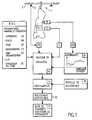
- the present invention is intended more particularly for be implemented on a meat processing site (slaughter and cutting), for example on the continuous line an industrial slaughterhouse.
- a slaughter and cutting site includes a station for receiving live animals, a station slaughterhouses, preparation stations for animals slaughtered in carcass, cutting stations at least half-carcass, a penetrant testing phase, and, where appropriate, cutting and preparation into quarters, muscles, or steaks.
- race RA (Charolais, limousine, ...)
- age GA (young cattle, beef, cow, heifer, %)
- CA category (young cattle, beef, cow, heifer, %) of the animal are collected at the reception station of the living animal. This information, as well as the origin of the animal NE, are available on the identity card of the animal.
- characteristics or parameters biological and / or physicochemical of the carcass of the animals are measured at the processing site, in particular on the continuous line 1 of an industrial slaughterhouse.
- the CO conformation of the CC carcass is also evaluated. 5 levels of CO conformation are provided according to the EUROP classification, the criteria of which are in particular described in Regulation No. 1208/81 of the Council of the Communities Europeans of April 28, 1981 establishing the grid Community classification of carcasses of adult bovine animals as well as in Regulation No. 1026/91 of the Council of the Communities European women from April 22, 1991.
- the state of fattening EE of the carcass CC is also evaluated. 5 levels vary between "very poor” and “very good”. In practice, the level of fattening EE is evaluated before the penetrant test station according to the criteria notably described in Regulation No. 1208/81 of the Council of the European Communities of April 28, 1981 mentioned above.
- the color CL of the carcass CC is also measured, by example before the penetrant station.
- Color measurement CL can be obtained by a colorimeter 7.
- An expert can also, with the naked eye, measure the color CL of the carcass CC.
- the pH (degree of acidity) of the CC carcass can also be measured using an acidity measuring instrument (not shown), at different times after slaughter, by example at 1, 2, 3, 8, 12, or 24 hours after slaughter.
- the pH of the carcass is measured according to the standard French NF V 46-001 of December 1996, entitled "Viandes de adult cattle - conditions for developing the potential of tenderness”.
- Another interesting data for the prediction of the tenderness is the thickness of the EC leather which can be taken up after slaughter by weighing leather combined or not with a measurement from the surface of it.
- DAC data All of this DAC data, called Expert data, is recorded and stored in a memory of a computer 11 connected to a printer and a screen 13.
- the prediction results are further improved when this DAC expert data is combined with DSP spectral optical data relating to reflection and / or transmission of meat in the visible area and near infrared.
- the number of biological and / or physico-chemical characteristics to combine depends on how reliable the prediction of the tenderness to achieve.
- DSP spectral measurements can be obtained on site processing, before, during or after penetrant testing, and on carcass, quarters, muscles or steaks, using a appropriate apparatus.
- the computer 11 is able to predict the tenderness of the piece of meat thus observed according to a law of prediction of tenderness predetermined, in order to display or print the level of tenderness of the piece of meat on an appropriate device 13.
- DSP spectral data is obtained using at least an optical measurement of the transmitted and / or reflected light by the piece of meat in transmission and / or reflection mode an example of which will be described in more detail.
- Optical measurement is advantageously carried out in the 400-2500 nm range, the if necessary limited to 400-2100 nm.
- DSP spectral data of different pieces of meat different animals are stored in a memory 21 in association with the non-spectral DAC data of each animal. All of this DAC and DSP data is managed in a database 17.
- the reference scale 19 is established using sensory information and / or shear force and / or compression force obtained on each piece of meat of each animal involved in establishing the law of prediction.
- Reference tenderness information 19 is stored in the database 17 connected to the computer 11.
- shear forces are established for example according to a WARNER BRATZLER type method, defined by WHEELER, KOOHMARAIE, CUNDIF and DIKE in 1994 in their study entitled “Effects of cooking and shearing methodology on variation in Warner Bratzler shear force values in beef “published in the journal “Journal of Animal Science", No. 72, 1994.
- the compressive force is established on strips of boiled steaks according to the VOLODKEWICH method.
- the reference scale 19 can also be evaluated using of a tasting jury, as described in "Research Guidelines for Cookery, Sensory Evaluation and Instrumental Tenderness Measurements of Fresh Meat”, published by the American Meat Science Association, 1995 edition.
- PCA Principal Component Analysis
- each parameter (DSP spectral data or DAC Expert) is considered an individual variable used in a mathematical model 12 (eg regression multiple) to predict tenderness.
- the main components 3, 7, 11, 5, 10, and 2 are the most significant. They include the wavelengths generally used for the prediction of proteins, fat, water content, collagen as well as meat pigment. For example, these are the following wavelengths: 460, 660, 800, 880, 980, 1020, 1120, 1320, 1580, 1920 nm. Each of these parameters is significantly correlated with tenderness. However, on their own, they do not guarantee tenderness with high probability. Thus, for example, the color of the sirloin is correlated with tenderness with a correlation coefficient R 2 of 0.65 while the thickness of the leather is correlated with tenderness with a coefficient of 0.43.
- the Applicant has demonstrated that the DSP spectral data in transmission mode make it possible to obtain a good prediction of the tenderness (R 2 of the order of 0.6), on circles of heel of 100 young cattle. This coefficient is improved by integrating certain DAC expert data. For example, a correlation coefficient of 0.95 was obtained for heel rounds (semitendinosus) of 24 young dairy cattle.
- certain lengths of predominant waves correspond to wavelengths generally used for the prediction of the pigment of the meat (560 nm), fat (930 and 1215 nm) and the water content (1682 nm).
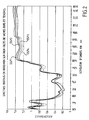
- the DSP1 spectrum is that of a sirloin of a cow whose tenderness is evaluated at 6.10 on the reference scale of type WARNER BRATZLER, ie a hard sirloin.
- the DSP2 spectrum is that of a sirloin of a cow whose tenderness is evaluated at 6.90 on the reference scale of type WARNER BRATZLER, ie a hard sirloin.
- the DSP3 spectrum is that of a sirloin of a cow whose tenderness is evaluated at 2.9 on the type reference scale WARNER BRATZLER, ie tender tenderloin.
- the DSP4 spectrum is that of a sirloin of a cow whose tenderness is evaluated at 3.30 on the reference scale of WARNER BRATZLER type, ie tender tenderloin.
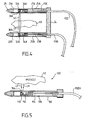
- the device for obtaining spectral data 15 comprises for example a 20 pistol-type instrument comprising a housing 22 and a probe 23 with two branches 23A and 23B, one 23A being dedicated to the broadcast and the other 23B being dedicated to reception. Branches 23A and 23B of the probe are intended to be inserted into a piece of chosen meat, at a chosen depth.
- the branches 23A and 23B are parallel to each other and spaced from each other from a predetermined distance.
- the two branches are connected to each other by a base 24 forming a support and integral of the housing 22.
- the base 24 also acts as an interface for optical fibers which will be described in more detail below.
- the center distance 26 between the two branches 23A and 23B is adjustable, between a minimum distance of the order of 10 mm and a maximum distance of 40 mm.
- center distance 26 between the two branches is adjustable but always fixed during the measurement.
- the probe penetration depth can be adjusted between 5 and 15 cm.
- the diameter of the penetrating branches is about 1 cm.
- the penetrating ends of the branches are fitted with 29 stainless steel plugs.
- the lengths of the branches 23A and 23B are of the order of 20cm.
- the branch 23A comprises a window 30A disposed on the side internal of its penetrating end, perpendicular to the axis of penetration while the branch 23B comprises a window 30B arranged on the internal side of its end penetrating, perpendicular to the axis of penetration, and window 30A look.
- Each branch includes a tube, referenced 25A for the branch 23A, and 25B for branch 23B.
- the tubes are hollow, for example made of silica.
- LE light radiation is emitted by a light source remote 40.
- LE light radiation is routed to the non end penetrating branch 23A by a sheathed optical fiber FOE.
- the light radiation LE is first guided by an optical fiber 27A, and then routed in free space up to window 30A. Finally, the influence LE light is guided in free space from window 30A to the piece of meat VI.
- LE light radiation illuminates VI meat at 90 ° by relative to the longitudinal axis of penetration of the branch 23A.
- the diameter of the light emission LE is the order of a few mm through window 30A, which is by example in quartz 1 to 2 mm thick.
- a mirror 32A is placed between the outlet of the fiber 27A and the window 30A.
- the mirror 32A is oriented at 45 ° relative to the longitudinal axis of penetration of the emission branch 23A to reflect at 90 ° the light coming from the optical fiber 27A.
- An adaptation optic 34A of the lens type for example, is placed between the output of the emission optical fiber 27A and the mirror 30A to adapt the light emission radiation LE to the volume of meat to be observed.
- the light transmitted LT by the piece of meat VI is received in free space through window 30B, arranged perpendicularly relative to the axis of penetration of the branch of reception 23B.
- the diameter of the transmitted light radiation LT is the order of a few mm. Reception of light radiation transmitted LT takes place through a 30B quartz window of 1 to 2 mm thick.
- a 32B mirror is oriented at 45 ° to the longitudinal axis 23B receiving branch penetration for reflect the light transmitted LT to an optical fiber of reception 27B, arranged parallel to the longitudinal axis of branch penetration 23B.
- An adaptation optic 34B of the lens type for example, is provided between the 32B mirror and the fiber entry optics 27B, to adapt the light radiation transmitted to the opening of the optical fiber 27B.
- the transmitted light LT is then routed to means of measurement 50 by a sheathed reception optical fiber FOR.
- the measuring means 50 comprise a SPH spectrophotometer, equipped with an array (not shown) which disperses light in different wavelengths from visible to near infrared.
- the light diffracted by the network strikes a bar of detection of type photodiodes each capable of recording the intensity light transmitted in a range of wavelengths chosen.
- the detection strip includes detectors made of silicon for wavelengths less than 1050 nm and in germanium for lengths greater than 1050 nm.
- An amplification block (not shown) is provided after the detection block to reach a signal level between 1 and 10 volts for example.
- the light source 40 is a halogen lamp with tungsten with a power of 20 to 40 Watts.
- the particularity of such a lamp is to be able to emit in a wide frequency band light radiation going for example from visible to near infrared.
- the probe 23 can be used manually. In that case, it may not be integral with the light source 40 and measuring means 50.
- the light source and the measuring means are assembled in a common block 52, connected to a computer 11.
- FOE and FOR optical fibers have a length of the order of 1 to 2m in order to minimize the attenuations.
- the diameters of optical fibers are on the order of a few mm.
- the LE light emission is advantageously cut off by a rotating disc (not shown) located on the path emission optics, rotating for example at the frequency of 20 at 60 Hertz, to allow measurements of the signal transmitted in the absence or presence of light emitted.
- This clocked shutter overcomes variations outside light.
- the device according to the invention can be made in the form of a housing comprising a lamp 40 and measuring means 50 integrated into the probe 23 in a only case that can be worn.
- Spectral measurements can also be obtained in mode reflection, with the application of a probe on the surface or in penetration into meat whose tenderness is to be predicted.
- a probe operating in reflection is simpler than a probe operating in transmission.
- the probe 100 generally comprises a single branch 102 ensuring the outward and return path of incident light LI and LR reflected light.
- the branch 102 comprises a single window 104 arranged on the internal side of its penetrating end, perpendicularly to the axis of penetration.
- the branch includes a tube 106, similar to those described in reference to figure 4.
- the light radiation LI is emitted by a source of light. LI light radiation is routed to the end non-penetrating branch 102 by an optical fiber sheathed FOER. In the tube 106, the light radiation LI is first guided by an optical fiber 114, and then routed in free space up to window 104. Finally, the radiation luminous LI is guided in free space from window 104 to the piece of meat VI.
- LI light radiation illuminates VI meat at 90 ° by relative to the longitudinal axis of penetration of the branch.
- the diameter of the light emission radiation LI is the order of a few mm through window 104, which is by example in quartz 1 to 2 mm thick.
- a mirror 110 is placed between the outlet of the fiber 114 and the window 104.
- the mirror 104 is oriented at 45 ° relative to the longitudinal axis of penetration of the branch 102 for reflect 90 ° the light from the optical fiber 114.
- An adaptation optic 112 of the lens type for example, is placed between the output of the optical fiber 114 and the mirror 110 to adapt the light emission radiation LI to the volume of meat to be observed.
- the light reflected LR by the piece of meat VI is received in free space through window 104 and crosses the branch in the opposite direction to that of the propagation of light incidental LI.
- the reflected light LR is then routed to the measurement means by means of optical fiber FOER transmission / reception.
- the probe 100 is connected to a light source and a spectrophotometer which may be similar to those described in reference to Figures 3 and 4.
- the source and spectrophotometer are gathered in a common block connected to the probe by a single FOER optical fiber ensuring transport incident light as well as the transport of light reflected.
- the light source may include a monochromator upstream whose dispersive principle allows the scanning of the spectral range from 400 to 2500 nm.
- the prediction according to the invention is objective, non-destructive, and set up on the environment transformation site industrial without using sophisticated devices and expensive. Generally speaking, reliability is better when a lot of DSP and non-spectral data DACs are integrated into the prediction model. However, some parameters (1 to 5 for example) of DAC type (which may vary from one prediction model to another depending on the piece of meat analyzed, the animal, and the homogeneity of population) in association with DSP spectral data may be sufficient to achieve satisfactory reliability.
Landscapes
- Life Sciences & Earth Sciences (AREA)
- Engineering & Computer Science (AREA)
- Health & Medical Sciences (AREA)
- Chemical & Material Sciences (AREA)
- Food Science & Technology (AREA)
- Immunology (AREA)
- General Health & Medical Sciences (AREA)
- General Physics & Mathematics (AREA)
- Physics & Mathematics (AREA)
- Pathology (AREA)
- Biochemistry (AREA)
- Analytical Chemistry (AREA)
- Medicinal Chemistry (AREA)
- Computer Vision & Pattern Recognition (AREA)
- Biophysics (AREA)
- Investigating Or Analysing Materials By Optical Means (AREA)
- Meat, Egg Or Seafood Products (AREA)
- Processing Of Meat And Fish (AREA)
- Other Investigation Or Analysis Of Materials By Electrical Means (AREA)
Description
- b1) prévoir une sonde comprenant une branche d'émission et une branche de réception, espacées l'une de l'autre d'une distance prédéterminée ;
- b2) insérer les branches d'émission et de réception dans un morceau de viande choisi, à une profondeur choisie;
- b3) éclairer le morceau de viande à l'aide de la branche d'émission ainsi insérée dans le morceau de viande, selon un rayonnement lumineux large bande en fréquence allant du visible jusqu'au proche infrarouge;
- b4) recevoir la lumière transmise par le morceau de viande à l'aide de la branche réceptrice ainsi insérée dans le morceau de viande ; et
- b5) enregistrer un spectre de transmission du morceau de viande allant du visible jusqu'au moins le proche infrarouge.
- des moyens pour recueillir, sur le site de transformation, des données relatives à des paramètres appartenant au groupe formé par la race, l'âge, et la catégorie de l'animal, ainsi qu'à des paramètres biologiques et/ou physico-chimiques de la carcasse de l'animal appartenant au groupe formé par le poids, la conformation, l'état d'engraissement, le pH et la couleur de la carcasse, ainsi que l'épaisseur du cuir,
- des moyens pour obtenir au moins un spectre optique de la viande à des longueurs d'onde appartenant à une plage spectrale allant du visible jusqu'au proche infra-rouge, et
- des moyens de traitement pour combiner les données obtenues lors des étapes a) et b) en vue de prédire la tendreté de la viande selon une loi de prédiction prédéterminée établie par rapport à une échelle de référence de tendreté prédéterminée.
- la figure 1 illustre schématiquement une ligne en continu d'un abattoir industriel sur laquelle est mise en place l'invention;
- la figure 2 représente des spectres d'absorbance en réflexion obtenus sur des vaches de tendreté différente selon l'invention;
- la figure 3 illustre schématiquement les moyens essentiels et constitutifs d'un dispositif d'obtention d'un spectre d'une viande en transmission selon l'invention;
- la figure 4 est une vue en coupe illustrant une sonde en transmission selon l'invention; et
- la figure 5 est une vue en coupe illustrant les moyens constitutifs d'une sonde en réflexion selon l'invention.
a1 à an sont des coefficients, et X1 à Xn sont les variables spectrales DSP et non spectrales DAC.
- couleur du faux filet CL,
- épaisseur du cuir EC,
- poids de la carcasse PD,
- conformation CO,
- pH au cours du ressuage,
- âge de l'animal AG.
Chacun de ces paramètres est corrélé de façon significative à la tendreté. Toutefois, à eux seuls ils ne permettent pas de garantir la tendreté avec une forte probabilité. Ainsi, par exemple, la couleur du faux filet est correlée à la tendreté avec un coefficient de corrélation R2 de 0.65 tandis que l'épaisseur du cuir est corrélée à la tendreté avec un coefficient de 0.43.
- pH au cours du ressuage,
- couleur de la carcasse CL,
- état d'engraissement EE,
- épaisseur du cuir EC,
- poids de la carcasse PD,
- âge de l'animal AG.
Claims (13)
- Procédé de prédiction de la qualité d'une viande en particulier de type bovin, sur le site de transformation, caractérisé en ce qu'il comprend les étapes suivantes :- a) recueillir, sur le site de transformation, des données relatives à des paramètres appartenant au groupe formé par la race, l'âge, et la catégorie de l'animal, ainsi qu'à des paramètres biologiques et/ou physico-chimiques de la carcasse de l'animal appartenant au groupe formé par le poids, la conformation, l'état d'engraissement, le pH et la couleur de la carcasse, ainsi que l'épaisseur du cuir,- b) obtenir au moins un spectre optique de la viande à des longueurs d'onde appartenant à une plage spectrale allant du visible jusqu'au proche infrarouge, et- c) combiner les données obtenues lors des étapes a) et b), en vue de prédire la tendreté de la viande selon une loi de prédiction prédéterminée établie par rapport à une échelle de référence de tendreté prédéterminée.
- Procédé selon la revendication 1, caractérisé en ce que l'étape b) est réalisée en mode réflexion et/ou en mode transmission.
- Procédé selon la revendication 2, caractérisé en ce que l'étape b) comprend les étapes suivantes:b1) prévoir une sonde (23) comprenant une branche d'émission (23A) et une branche de réception (23B), espacées l'une de l'autre d'une distance prédéterminée (26);b2) insérer les branches d'émission et de réception (23A et 23B) dans un morceau de viande choisi (VI), à une profondeur choisie;b3) éclairer le morceau de viande à l'aide de la branche d'émission (23A) ainsi insérée dans le morceau de viande, selon un rayonnement lumineux (LE) large bande en fréquence allant du visible jusqu'au proche infrarouge;b4) recevoir la lumière transmise (LT) par le morceau de viande à l'aide de la branche réceptrice (23B) ainsi insérée dans le morceau de viande ; etb5) enregistrer un spectre de transmission du morceau de viande allant du visible jusqu'au proche infrarouge.
- Procédé selon la revendication 1, caractérisé en ce que la loi de prédiction est établie sur une série significative de différentes viandes pour chacune desquelles des données spectrales et non spectrales sont obtenues selon les étapes a) et b) et sont comparées à l'échelle de référence établie au moyen d'informations sensorielles et/ou de force de cisaillement et/ou de force de compression mesurées sur ladite série significative de différentes viandes.
- Procédé selon la revendication 1, caractérisé en ce que la loi de prédiction est réalisée selon une méthode statistique multidimensionnelle du type méthode des moindres carrés partiels, en vue d'obtenir un modèle mathématique de prédiction destiné à être utilisé sur chaque morceau de viande dont la tendreté est à prédire.
- Procédé selon la revendication 1, caractérisé en ce que les variables spectrales sont traitées selon une analyse du type composantes principales ou analogue.
- Procédé selon la revendication 1, caractérisé en ce que l'étape b) est réalisée sur carcasses, quartiers, muscles ou steaks.
- Dispositif de prédiction de la qualité d'une viande, en particulier de type bovin sur le site de transformation, caractérisé en ce qu'il comprend :des moyens pour recueillir des données relatives à des paramètres appartenant au groupe formé par la race, l'âge, et la catégorie de l'animal, ainsi qu'à des paramètres biologiques et/ou physico-chimiques de la carcasse de l'animal appartenant au groupe formé par le poids, la conformation, l'état d'engraissement, le pH et la couleur de la carcasse, ainsi que l'épaisseur du cuir,des moyens pour obtenir au moins un spectre optique de la viande à des longueurs d'ondes appartenant à une plage spectrale allant du visible jusqu'au proche infrarouge, etdes moyens de traitement pour combiner les données obtenues lors des étapes a) et b), en vue de prédire la tendreté de la viande, selon une loi de prédiction établie par rapport à une échelle de référence de tendreté prédéterminée.
- Dispositif selon la revendication 8, caractérisé en ce que les moyens d'obtention de spectre comprennent:une sonde (23) comprenant une branche d'émission (23A) et une branche de réception (23B), espacées l'une de l'autre d'une distance prédéterminée (26), et aptes à être insérées dans un morceau de viande choisi (VI), à une profondeur choisie;une source de lumière (40) apte à délivrer un rayonnement lumineux large bande en fréquence allant du visible jusqu'au proche infrarouge, et optiquement connectée à la branche d'émission (23A) pour éclairer le morceau de viande à l'aide de ladite branche d'émission ainsi insérée dans le morceau de viande;des moyens de mesure (50) aptes à enregistrer un spectre de transmission du morceau de viande allant du visible jusqu'au proche infrarouge et optiquement connectés à la branche réceptrice pour mesurer l'intensité de la lumière transmise par le morceau de viande et reçue par ladite branche réceptrice ainsi insérée dans le morceau de viande.
- Dispositif selon la revendication 9, caractérisé en ce que la branche d'émission (23A) comprend une fenêtre (30A) disposée perpendiculairement à l'axe longitudinal de pénétration de la branche d'émission et au moins une fibre optique d'émission (FOE) reliant optiquement la source de lumière (40) à la fenêtre (30A) de la première branche (23A).
- Dispositif selon la revendication 9, caractérisé en ce que la branche de réception (23B) comprend une fenêtre (30B) disposée perpendiculairement à l'axe longitudinal de pénétration de la branche de réception, en regard de la fenêtre (30A) de la branche d'émission, et au moins une fibre optique de réception (FOR) reliant optiquement la fenêtre (30B) de la seconde branche (23B) aux moyens de mesure (50).
- Dispositif selon la revendication 9, caractérisé en ce que la distance (26) entre les deux branches (23A et 23B) est réglable afin de réaliser des mesures optiques dans un volume de viande (VI) de l'ordre de quelques cm3.
- Dispositif selon la revendication 8, caractérisé en ce que les moyens d'obtention de spectre comprennent:une sonde (100) comprenant une branche d'émission/réception (102) apte à être insérée dans un morceau de viande choisi (VI), à une profondeur choisie;une source de lumière apte à délivrer un rayonnement lumineux (LI) large bande en fréquence allant du visible jusqu'au proche infrarouge, et optiquement connectée à la branche d'émission/réception (102) pour éclairer le morceau de viande à l'aide de ladite branche d'émission/réception ainsi insérée dans le morceau de viande; etdes moyens de mesure aptes à enregistrer un spectre de réflexion du morceau de viande allant du visible jusqu'au proche infrarouge et optiquement connectés à la branche d'émission/réception (102) pour mesurer l'intensité de la lumière réfléchie (LR) par le morceau de viande et reçue par ladite branche d'émission/réception ainsi insérée dans le morceau de viande.
Applications Claiming Priority (3)
| Application Number | Priority Date | Filing Date | Title |
|---|---|---|---|
| FR9808536 | 1998-07-03 | ||
| FR9808536A FR2780790B1 (fr) | 1998-07-03 | 1998-07-03 | Procede et dispositif de prediction de la tendrete d'une viande sur le site de transformation a l'aide d'informations biologiques et/ou physico-chimiques et de mesures optiques dans le domaine du visible et du proche infrarouge |
| PCT/FR1999/001404 WO2000002043A1 (fr) | 1998-07-03 | 1999-06-14 | Procede et dispositif de prediction de la tendrete d'une viande |
Publications (2)
| Publication Number | Publication Date |
|---|---|
| EP1093581A1 EP1093581A1 (fr) | 2001-04-25 |
| EP1093581B1 true EP1093581B1 (fr) | 2004-07-07 |
Family
ID=9528229
Family Applications (1)
| Application Number | Title | Priority Date | Filing Date |
|---|---|---|---|
| EP99925076A Expired - Lifetime EP1093581B1 (fr) | 1998-07-03 | 1999-06-14 | Procede et dispositif de prediction de la tendrete d'une viande |
Country Status (13)
| Country | Link |
|---|---|
| US (1) | US6563580B1 (fr) |
| EP (1) | EP1093581B1 (fr) |
| JP (1) | JP2002519698A (fr) |
| AT (1) | ATE270778T1 (fr) |
| AU (1) | AU747561B2 (fr) |
| CA (1) | CA2336172A1 (fr) |
| DE (1) | DE69918555T2 (fr) |
| DK (1) | DK1093581T3 (fr) |
| ES (1) | ES2220063T3 (fr) |
| FR (1) | FR2780790B1 (fr) |
| NZ (1) | NZ509049A (fr) |
| PT (1) | PT1093581E (fr) |
| WO (1) | WO2000002043A1 (fr) |
Cited By (1)
| Publication number | Priority date | Publication date | Assignee | Title |
|---|---|---|---|---|
| CN102519906A (zh) * | 2011-12-19 | 2012-06-27 | 中国农业大学 | 多通道近红外光谱牛肉品质多参数同时检测方法 |
Families Citing this family (30)
| Publication number | Priority date | Publication date | Assignee | Title |
|---|---|---|---|---|
| DE10131701A1 (de) * | 2001-06-29 | 2003-01-16 | Biforce Anstalt Vaduz | Aufschneideverfahren und -vorrichtung |
| US6859282B1 (en) * | 2002-01-04 | 2005-02-22 | Sandia Corporation | Optical probe for determining the fat/lean interface in cuts of meat |
| US6877460B1 (en) * | 2003-11-14 | 2005-04-12 | Pheno Imaging, Inc. | Animal sorting and grading system using MRI to predict maximum value |
| CN100357725C (zh) * | 2004-11-02 | 2007-12-26 | 江苏大学 | 近红外技术快速检测牛肉嫩度的方法和装置 |
| WO2006057990A2 (fr) * | 2004-11-29 | 2006-06-01 | Cargill, Incorporated | Procede de prevision de la force de cisaillement de la viande rassise |
| CA2597071C (fr) | 2005-02-08 | 2013-07-30 | Cargill, Incorporated | Tri de viande |
| US7444961B1 (en) * | 2005-04-11 | 2008-11-04 | Ellis James S | Animal sorting and grading system using an internal evaluation to predict maximum value |
| WO2007000165A1 (fr) * | 2005-06-27 | 2007-01-04 | Sfk Technology A/S | Enregistrement en ligne de spectres d'absorption de longueur d'onde dans la viande |
| CA2612947A1 (fr) * | 2005-06-27 | 2007-01-04 | Sfk Technology A/S | Enregistrement de spectres d'absorption de longueur d'onde specifiques a la position |
| JP4674309B2 (ja) * | 2005-08-18 | 2011-04-20 | 国立大学法人三重大学 | 食品の味覚情報の取得装置 |
| RU2346272C2 (ru) * | 2006-08-30 | 2009-02-10 | Степан Степанович Данч | Способ определения качества мяса |
| CA2665834C (fr) * | 2006-09-21 | 2013-04-02 | The Board Of Trustees Of The University Of Arkansas | Appareil et procede permettant de prevoir la tendrete de la viande |
| US8280144B2 (en) * | 2007-02-21 | 2012-10-02 | Goldfinch Solutions, Llc | System and method for analyzing material properties using hyperspectral imaging |
| WO2010081116A2 (fr) | 2009-01-10 | 2010-07-15 | Goldfinch Solutions, Llc | Systeme et procede pour analyser des proprietes d'une viande par imagerie multispectrale |
| KR101057730B1 (ko) | 2009-07-20 | 2011-08-18 | (주)코아로직 | 육질 판별시스템 및 이를 사용한 육질 판별방법 |
| US20110128373A1 (en) * | 2009-11-28 | 2011-06-02 | Tenera Technology, Llc | Determining Meat Tenderness |
| CN102435574B (zh) * | 2011-09-01 | 2013-12-18 | 中国农业科学院农产品加工研究所 | 一种羊胴体产量的无损分级方法 |
| DE102012018357A1 (de) * | 2012-09-17 | 2014-03-20 | Liebherr-Hausgeräte Ochsenhausen GmbH | Kühl- und/oder Gefriergerät |
| US20170184493A1 (en) * | 2014-04-28 | 2017-06-29 | Sintef Tto As | Measurement of properties of an organic material |
| AU2015292225B2 (en) * | 2014-07-21 | 2020-06-25 | 7386819 Manitoba Ltd. | Method and device for bone scan in meat |
| DE102014117572A1 (de) * | 2014-12-01 | 2016-06-02 | Barbara Erdmann | Verfahren und Vorrichtung zum Erkennen und Aussortieren von geruchsauffälligen geschlachteten Ebern in einer Schlachtlinie |
| CN104458594B (zh) * | 2014-12-16 | 2017-02-22 | 中国农业大学 | 一种生鲜肉品质参数多点同时检测的系统及方法 |
| GB201600445D0 (en) * | 2016-01-11 | 2016-02-24 | Cairns Intellectual Property Ltd | Methods and apparatuses for temperature measurement |
| CN105806232B (zh) * | 2016-03-23 | 2018-10-23 | 南京航空航天大学 | 一种基于近红外光的猪劈半胴体脂肪/瘦肉厚度无损测量系统 |
| FR3052260B1 (fr) * | 2016-06-07 | 2018-05-25 | Cooperl Innovation Sas | Installation et procede d'aide a la determination de la qualite de pieces de viande provenant d'animaux abattus precedemment |
| WO2018081911A1 (fr) * | 2016-11-07 | 2018-05-11 | Irystec Software Inc. | Système et procédé de mappage de gamme basé sur l'âge |
| EP3625546B1 (fr) * | 2017-05-16 | 2024-10-30 | MEQ Probe Pty Ltd | Procédés et systèmes pour évaluer la qualité d'un produit de viande |
| DE112017008284A5 (de) * | 2017-12-19 | 2020-10-08 | Horst Eger | Optische Bewertung von Körpereigenschaften |
| ES2729733B2 (es) | 2018-05-04 | 2020-06-03 | Aira Robotics S L | Sistema y procedimiento para determinar la calidad de un producto carnico |
| CN111175230B (zh) * | 2020-02-11 | 2023-03-31 | 陕西铜川润民达康食品有限公司 | 一种猪肉检测设备 |
Family Cites Families (8)
| Publication number | Priority date | Publication date | Assignee | Title |
|---|---|---|---|---|
| NL137286C (fr) | 1966-08-23 | |||
| US4009390A (en) * | 1975-10-23 | 1977-02-22 | The Regents Of The University Of Nebraska | Process for measuring tenderness of cooked meat |
| DK163453C (da) * | 1989-06-12 | 1992-07-20 | Slagteriernes Forskningsinst | Fremgangsmaade og apparat til fotometrisk bestemmelse af individuelle koedemners egenskaber |
| JPH0396838A (ja) * | 1989-09-08 | 1991-04-22 | Sumitomo Electric Ind Ltd | 食肉鮮度測定装置 |
| DK163382C (da) * | 1990-02-28 | 1992-08-03 | Slagteriernes Forskningsinst | Fremgangsmaade til bestemmelse af individuelle koedemners kvalitetsegenskaber |
| EP0649282B1 (fr) * | 1992-07-03 | 1998-09-30 | NEWMAN, Paul Bernard David | Systeme de controle de la qualite et de classification de la viande |
| CA2189817A1 (fr) * | 1996-11-07 | 1998-05-07 | Howard J. Swatland | Appareil servant a determiner la tendrete d'une viande |
| WO1999042823A1 (fr) * | 1998-02-20 | 1999-08-26 | Colorado State University Research Foundation | Systeme de formation d'images de couleur de viande permettant d'en prevoir l'appetibilite et le rendement |
-
1998
- 1998-07-03 FR FR9808536A patent/FR2780790B1/fr not_active Expired - Fee Related
-
1999
- 1999-06-14 NZ NZ509049A patent/NZ509049A/xx unknown
- 1999-06-14 PT PT99925076T patent/PT1093581E/pt unknown
- 1999-06-14 WO PCT/FR1999/001404 patent/WO2000002043A1/fr not_active Ceased
- 1999-06-14 AU AU41488/99A patent/AU747561B2/en not_active Ceased
- 1999-06-14 DE DE69918555T patent/DE69918555T2/de not_active Expired - Fee Related
- 1999-06-14 US US09/743,022 patent/US6563580B1/en not_active Expired - Fee Related
- 1999-06-14 DK DK99925076T patent/DK1093581T3/da active
- 1999-06-14 EP EP99925076A patent/EP1093581B1/fr not_active Expired - Lifetime
- 1999-06-14 AT AT99925076T patent/ATE270778T1/de not_active IP Right Cessation
- 1999-06-14 ES ES99925076T patent/ES2220063T3/es not_active Expired - Lifetime
- 1999-06-14 JP JP2000558388A patent/JP2002519698A/ja active Pending
- 1999-06-14 CA CA002336172A patent/CA2336172A1/fr not_active Abandoned
Cited By (2)
| Publication number | Priority date | Publication date | Assignee | Title |
|---|---|---|---|---|
| CN102519906A (zh) * | 2011-12-19 | 2012-06-27 | 中国农业大学 | 多通道近红外光谱牛肉品质多参数同时检测方法 |
| CN102519906B (zh) * | 2011-12-19 | 2013-07-31 | 中国农业大学 | 多通道近红外光谱牛肉品质多参数同时检测方法 |
Also Published As
| Publication number | Publication date |
|---|---|
| DE69918555T2 (de) | 2004-11-25 |
| FR2780790A1 (fr) | 2000-01-07 |
| CA2336172A1 (fr) | 2000-01-13 |
| AU747561B2 (en) | 2002-05-16 |
| DK1093581T3 (da) | 2004-09-27 |
| WO2000002043A1 (fr) | 2000-01-13 |
| DE69918555D1 (de) | 2004-08-12 |
| US6563580B1 (en) | 2003-05-13 |
| NZ509049A (en) | 2003-06-30 |
| PT1093581E (pt) | 2004-09-30 |
| ES2220063T3 (es) | 2004-12-01 |
| JP2002519698A (ja) | 2002-07-02 |
| FR2780790B1 (fr) | 2000-08-18 |
| HK1039176A1 (en) | 2002-04-12 |
| EP1093581A1 (fr) | 2001-04-25 |
| ATE270778T1 (de) | 2004-07-15 |
| AU4148899A (en) | 2000-01-24 |
Similar Documents
| Publication | Publication Date | Title |
|---|---|---|
| EP1093581A1 (fr) | Procede et dispositif de prediction de la tendrete d'une viande | |
| Greensill et al. | A remote acceptance probe and illumination configuration for spectral assessment of internal attributes of intact fruit | |
| Lammertyn et al. | Light penetration properties of NIR radiation in fruit with respect to non-destructive quality assessment | |
| CA2402669C (fr) | Appareil et procede de mesure et de correlation de caracteristiques de fruits avec un spectre visible/infrarouge proche | |
| US6649412B1 (en) | Method and apparatus for determining quality properties of fish | |
| Wold et al. | Atlantic salmon average fat content estimated by near‐infrared transmittance spectroscopy | |
| FR3023617A1 (fr) | Dispositif non invasif de determination de la fertilite et/ou du sexe d’un oeuf, et procede correspondant. | |
| Rust et al. | Predicting beef tenderness using near-infrared spectroscopy | |
| EP1451573B1 (fr) | Procede et dispositif de mesure de la tendrete de la viande animale ou de la fraicheur du poisson | |
| US6118542A (en) | Method and apparatus for determination of a quality property of a piece of meat | |
| Peng et al. | Hyperspectral scattering profiles for prediction of beef tenderness | |
| Lin et al. | Bruise detection in Pacific pink salmon (Oncorhynchus gorbuscha) by visible and short-wavelength near-infrared (SW-NIR) spectroscopy (600− 1100 nm) | |
| CN110389104A (zh) | 基于光谱差分组合消除果皮影响的水果品质检测方法 | |
| WO2007000165A1 (fr) | Enregistrement en ligne de spectres d'absorption de longueur d'onde dans la viande | |
| Pink et al. | Evaluation of the quality of frozen minced red hake: use of Fourier transform near-infrared spectroscopy | |
| JP2021014991A (ja) | クロロフィル含有量の測定方法及び果実の熟度判定方法 | |
| EP0939316A2 (fr) | Procédé et installation pour la mesure de la teneur, notamment en sucre, de fruits et légumes | |
| Noferini et al. | NIRS evaluation of peach and nectarine fruit quality in pre-and post-harvest conditions | |
| Swatland et al. | Effect of wavelength on spatial measurements of light scattering for the measurement of pork quality | |
| FR2878424A1 (fr) | Procede d'observation d'un tissu biologique, notamment de la peau humaine | |
| Swatland | Connective and adipose tissue detection by simultaneous fluorescence and reflectance measurements with an on-line meat probe | |
| Lu | Near-infrared multispectral scattering for assessing internal quality of apple fruit | |
| WO2004044558A2 (fr) | Procede et appareil de determination d'une propriete d'un echantillon | |
| JPH09119894A (ja) | 牛肉の成分含量測定方法及び測定装置 | |
| FR2971339A1 (fr) | Procede et appareil d'estimation du degre de cuisson d'un aliment |
Legal Events
| Date | Code | Title | Description |
|---|---|---|---|
| PUAI | Public reference made under article 153(3) epc to a published international application that has entered the european phase |
Free format text: ORIGINAL CODE: 0009012 |
|
| 17P | Request for examination filed |
Effective date: 20001221 |
|
| AK | Designated contracting states |
Kind code of ref document: A1 Designated state(s): AT BE CH CY DE DK ES FI FR GB GR IE IT LI LU MC NL PT SE |
|
| GRAP | Despatch of communication of intention to grant a patent |
Free format text: ORIGINAL CODE: EPIDOSNIGR1 |
|
| GRAS | Grant fee paid |
Free format text: ORIGINAL CODE: EPIDOSNIGR3 |
|
| GRAA | (expected) grant |
Free format text: ORIGINAL CODE: 0009210 |
|
| AK | Designated contracting states |
Kind code of ref document: B1 Designated state(s): AT BE CH CY DE DK ES FI FR GB GR IE IT LI LU MC NL PT SE |
|
| REG | Reference to a national code |
Ref country code: GB Ref legal event code: FG4D Free format text: NOT ENGLISH |
|
| REG | Reference to a national code |
Ref country code: CH Ref legal event code: EP |
|
| GBT | Gb: translation of ep patent filed (gb section 77(6)(a)/1977) |
Effective date: 20040707 |
|
| REG | Reference to a national code |
Ref country code: CH Ref legal event code: NV Representative=s name: KATZAROV S.A. |
|
| REG | Reference to a national code |
Ref country code: IE Ref legal event code: FG4D Free format text: FRENCH |
|
| REF | Corresponds to: |
Ref document number: 69918555 Country of ref document: DE Date of ref document: 20040812 Kind code of ref document: P |
|
| REG | Reference to a national code |
Ref country code: SE Ref legal event code: TRGR |
|
| REG | Reference to a national code |
Ref country code: DK Ref legal event code: T3 |
|
| REG | Reference to a national code |
Ref country code: PT Ref legal event code: SC4A Free format text: AVAILABILITY OF NATIONAL TRANSLATION Effective date: 20040730 |
|
| REG | Reference to a national code |
Ref country code: GR Ref legal event code: EP Ref document number: 20040403063 Country of ref document: GR |
|
| REG | Reference to a national code |
Ref country code: ES Ref legal event code: FG2A Ref document number: 2220063 Country of ref document: ES Kind code of ref document: T3 |
|
| REG | Reference to a national code |
Ref country code: HK Ref legal event code: GR Ref document number: 1039176 Country of ref document: HK |
|
| PLBE | No opposition filed within time limit |
Free format text: ORIGINAL CODE: 0009261 |
|
| STAA | Information on the status of an ep patent application or granted ep patent |
Free format text: STATUS: NO OPPOSITION FILED WITHIN TIME LIMIT |
|
| PGFP | Annual fee paid to national office [announced via postgrant information from national office to epo] |
Ref country code: FR Payment date: 20050601 Year of fee payment: 7 |
|
| PGFP | Annual fee paid to national office [announced via postgrant information from national office to epo] |
Ref country code: PT Payment date: 20050603 Year of fee payment: 7 Ref country code: GR Payment date: 20050603 Year of fee payment: 7 Ref country code: CY Payment date: 20050603 Year of fee payment: 7 |
|
| PGFP | Annual fee paid to national office [announced via postgrant information from national office to epo] |
Ref country code: ES Payment date: 20050606 Year of fee payment: 7 |
|
| PGFP | Annual fee paid to national office [announced via postgrant information from national office to epo] |
Ref country code: SE Payment date: 20050607 Year of fee payment: 7 |
|
| PGFP | Annual fee paid to national office [announced via postgrant information from national office to epo] |
Ref country code: MC Payment date: 20050609 Year of fee payment: 7 Ref country code: GB Payment date: 20050609 Year of fee payment: 7 |
|
| PGFP | Annual fee paid to national office [announced via postgrant information from national office to epo] |
Ref country code: NL Payment date: 20050616 Year of fee payment: 7 |
|
| PGFP | Annual fee paid to national office [announced via postgrant information from national office to epo] |
Ref country code: FI Payment date: 20050620 Year of fee payment: 7 |
|
| PGFP | Annual fee paid to national office [announced via postgrant information from national office to epo] |
Ref country code: BE Payment date: 20050622 Year of fee payment: 7 |
|
| PGFP | Annual fee paid to national office [announced via postgrant information from national office to epo] |
Ref country code: AT Payment date: 20050623 Year of fee payment: 7 |
|
| PGFP | Annual fee paid to national office [announced via postgrant information from national office to epo] |
Ref country code: LU Payment date: 20050627 Year of fee payment: 7 Ref country code: IE Payment date: 20050627 Year of fee payment: 7 Ref country code: DK Payment date: 20050627 Year of fee payment: 7 |
|
| 26N | No opposition filed |
Effective date: 20050408 |
|
| PGFP | Annual fee paid to national office [announced via postgrant information from national office to epo] |
Ref country code: DE Payment date: 20050629 Year of fee payment: 7 |
|
| PGFP | Annual fee paid to national office [announced via postgrant information from national office to epo] |
Ref country code: CH Payment date: 20050701 Year of fee payment: 7 |
|
| PG25 | Lapsed in a contracting state [announced via postgrant information from national office to epo] |
Ref country code: IE Free format text: LAPSE BECAUSE OF NON-PAYMENT OF DUE FEES Effective date: 20060614 Ref country code: GB Free format text: LAPSE BECAUSE OF NON-PAYMENT OF DUE FEES Effective date: 20060614 Ref country code: FI Free format text: LAPSE BECAUSE OF NON-PAYMENT OF DUE FEES Effective date: 20060614 Ref country code: CY Free format text: LAPSE BECAUSE OF NON-PAYMENT OF DUE FEES Effective date: 20060614 Ref country code: AT Free format text: LAPSE BECAUSE OF NON-PAYMENT OF DUE FEES Effective date: 20060614 |
|
| PG25 | Lapsed in a contracting state [announced via postgrant information from national office to epo] |
Ref country code: SE Free format text: LAPSE BECAUSE OF NON-PAYMENT OF DUE FEES Effective date: 20060615 Ref country code: ES Free format text: LAPSE BECAUSE OF NON-PAYMENT OF DUE FEES Effective date: 20060615 |
|
| PG25 | Lapsed in a contracting state [announced via postgrant information from national office to epo] |
Ref country code: MC Free format text: LAPSE BECAUSE OF NON-PAYMENT OF DUE FEES Effective date: 20060630 Ref country code: LI Free format text: LAPSE BECAUSE OF NON-PAYMENT OF DUE FEES Effective date: 20060630 Ref country code: DK Free format text: LAPSE BECAUSE OF NON-PAYMENT OF DUE FEES Effective date: 20060630 Ref country code: CH Free format text: LAPSE BECAUSE OF NON-PAYMENT OF DUE FEES Effective date: 20060630 Ref country code: BE Free format text: LAPSE BECAUSE OF NON-PAYMENT OF DUE FEES Effective date: 20060630 |
|
| PGFP | Annual fee paid to national office [announced via postgrant information from national office to epo] |
Ref country code: IT Payment date: 20060630 Year of fee payment: 8 |
|
| PG25 | Lapsed in a contracting state [announced via postgrant information from national office to epo] |
Ref country code: PT Free format text: LAPSE BECAUSE OF NON-PAYMENT OF DUE FEES Effective date: 20061214 |
|
| PG25 | Lapsed in a contracting state [announced via postgrant information from national office to epo] |
Ref country code: NL Free format text: LAPSE BECAUSE OF NON-PAYMENT OF DUE FEES Effective date: 20070101 |
|
| PG25 | Lapsed in a contracting state [announced via postgrant information from national office to epo] |
Ref country code: DE Free format text: LAPSE BECAUSE OF NON-PAYMENT OF DUE FEES Effective date: 20070103 |
|
| REG | Reference to a national code |
Ref country code: DK Ref legal event code: EBP |
|
| REG | Reference to a national code |
Ref country code: PT Ref legal event code: MM4A Free format text: LAPSE DUE TO NON-PAYMENT OF FEES Effective date: 20061214 |
|
| REG | Reference to a national code |
Ref country code: CH Ref legal event code: PL |
|
| EUG | Se: european patent has lapsed | ||
| GBPC | Gb: european patent ceased through non-payment of renewal fee |
Effective date: 20060614 |
|
| NLV4 | Nl: lapsed or anulled due to non-payment of the annual fee |
Effective date: 20070101 |
|
| REG | Reference to a national code |
Ref country code: IE Ref legal event code: MM4A |
|
| REG | Reference to a national code |
Ref country code: FR Ref legal event code: ST Effective date: 20070228 |
|
| REG | Reference to a national code |
Ref country code: ES Ref legal event code: FD2A Effective date: 20060615 |
|
| BERE | Be: lapsed |
Owner name: SOC. VITREENNE D'*ABATTAGE Effective date: 20060630 |
|
| PG25 | Lapsed in a contracting state [announced via postgrant information from national office to epo] |
Ref country code: FR Free format text: LAPSE BECAUSE OF NON-PAYMENT OF DUE FEES Effective date: 20060630 |
|
| PG25 | Lapsed in a contracting state [announced via postgrant information from national office to epo] |
Ref country code: LU Free format text: LAPSE BECAUSE OF NON-PAYMENT OF DUE FEES Effective date: 20060614 |
|
| PG25 | Lapsed in a contracting state [announced via postgrant information from national office to epo] |
Ref country code: GR Free format text: LAPSE BECAUSE OF NON-PAYMENT OF DUE FEES Effective date: 20070104 |
|
| PG25 | Lapsed in a contracting state [announced via postgrant information from national office to epo] |
Ref country code: IT Free format text: LAPSE BECAUSE OF NON-PAYMENT OF DUE FEES Effective date: 20070614 |