EP1093260A2 - Method for flow control - Google Patents
Method for flow control Download PDFInfo
- Publication number
- EP1093260A2 EP1093260A2 EP00308121A EP00308121A EP1093260A2 EP 1093260 A2 EP1093260 A2 EP 1093260A2 EP 00308121 A EP00308121 A EP 00308121A EP 00308121 A EP00308121 A EP 00308121A EP 1093260 A2 EP1093260 A2 EP 1093260A2
- Authority
- EP
- European Patent Office
- Prior art keywords
- data message
- receive data
- transmission
- buffer memory
- queue
- Prior art date
- Legal status (The legal status is an assumption and is not a legal conclusion. Google has not performed a legal analysis and makes no representation as to the accuracy of the status listed.)
- Withdrawn
Links
Images


Classifications
-
- H—ELECTRICITY
- H04—ELECTRIC COMMUNICATION TECHNIQUE
- H04L—TRANSMISSION OF DIGITAL INFORMATION, e.g. TELEGRAPHIC COMMUNICATION
- H04L12/00—Data switching networks
- H04L12/54—Store-and-forward switching systems
-
- H—ELECTRICITY
- H04—ELECTRIC COMMUNICATION TECHNIQUE
- H04L—TRANSMISSION OF DIGITAL INFORMATION, e.g. TELEGRAPHIC COMMUNICATION
- H04L47/00—Traffic control in data switching networks
- H04L47/70—Admission control; Resource allocation
- H04L47/82—Miscellaneous aspects
- H04L47/824—Applicable to portable or mobile terminals
-
- H—ELECTRICITY
- H04—ELECTRIC COMMUNICATION TECHNIQUE
- H04L—TRANSMISSION OF DIGITAL INFORMATION, e.g. TELEGRAPHIC COMMUNICATION
- H04L47/00—Traffic control in data switching networks
- H04L47/10—Flow control; Congestion control
-
- H—ELECTRICITY
- H04—ELECTRIC COMMUNICATION TECHNIQUE
- H04L—TRANSMISSION OF DIGITAL INFORMATION, e.g. TELEGRAPHIC COMMUNICATION
- H04L47/00—Traffic control in data switching networks
- H04L47/10—Flow control; Congestion control
- H04L47/15—Flow control; Congestion control in relation to multipoint traffic
-
- H—ELECTRICITY
- H04—ELECTRIC COMMUNICATION TECHNIQUE
- H04L—TRANSMISSION OF DIGITAL INFORMATION, e.g. TELEGRAPHIC COMMUNICATION
- H04L47/00—Traffic control in data switching networks
- H04L47/10—Flow control; Congestion control
- H04L47/28—Flow control; Congestion control in relation to timing considerations
-
- H—ELECTRICITY
- H04—ELECTRIC COMMUNICATION TECHNIQUE
- H04L—TRANSMISSION OF DIGITAL INFORMATION, e.g. TELEGRAPHIC COMMUNICATION
- H04L47/00—Traffic control in data switching networks
- H04L47/10—Flow control; Congestion control
- H04L47/30—Flow control; Congestion control in combination with information about buffer occupancy at either end or at transit nodes
-
- H—ELECTRICITY
- H04—ELECTRIC COMMUNICATION TECHNIQUE
- H04L—TRANSMISSION OF DIGITAL INFORMATION, e.g. TELEGRAPHIC COMMUNICATION
- H04L47/00—Traffic control in data switching networks
- H04L47/70—Admission control; Resource allocation
-
- H—ELECTRICITY
- H04—ELECTRIC COMMUNICATION TECHNIQUE
- H04L—TRANSMISSION OF DIGITAL INFORMATION, e.g. TELEGRAPHIC COMMUNICATION
- H04L47/00—Traffic control in data switching networks
- H04L47/70—Admission control; Resource allocation
- H04L47/76—Admission control; Resource allocation using dynamic resource allocation, e.g. in-call renegotiation requested by the user or requested by the network in response to changing network conditions
- H04L47/762—Admission control; Resource allocation using dynamic resource allocation, e.g. in-call renegotiation requested by the user or requested by the network in response to changing network conditions triggered by the network
-
- H—ELECTRICITY
- H04—ELECTRIC COMMUNICATION TECHNIQUE
- H04L—TRANSMISSION OF DIGITAL INFORMATION, e.g. TELEGRAPHIC COMMUNICATION
- H04L47/00—Traffic control in data switching networks
- H04L47/70—Admission control; Resource allocation
- H04L47/80—Actions related to the user profile or the type of traffic
- H04L47/805—QOS or priority aware
-
- H—ELECTRICITY
- H04—ELECTRIC COMMUNICATION TECHNIQUE
- H04L—TRANSMISSION OF DIGITAL INFORMATION, e.g. TELEGRAPHIC COMMUNICATION
- H04L47/00—Traffic control in data switching networks
- H04L47/70—Admission control; Resource allocation
- H04L47/83—Admission control; Resource allocation based on usage prediction
Definitions
- This invention relates to a method for controlling data flow associated with a communications node; more specifically a communications node that services a wireless communications system.
- a communications node is a computer or another network element that communicates with a communications network.
- a communications node may be configured to control store-and-forward operations between an input and an output of the communications node.
- the communications node may manage buffer memory to control store-and-forward operations.
- the management of the buffer memory may include an admission control approach for admitting data messages with time-out constraints.
- a time-out constraint provides an indication of the freshness or staleness of a data message stored in the communications node.
- a time-out constraint defines a maximum desired time difference between admittance of the data message to buffer memory and the transmittance of the data message from the buffer memory.
- Some admission control approaches waste buffer memory resources. For example, if data messages are admitted whenever storage space is available in the buffer memory, the communications node will sometimes waste storage space by admitting a data message which cannot be forwarded within its time-out constraint. Further, the storage space occupied by the held data message blocks prevents other messages from entering the buffer memory for a duration exceeding the time-out constraint of the held data message, reducing space available for other data messages which could meet their time-out constraints.
- Some communication nodes may be fortified with supplemental buffer memory in an attempt to compensate for the foregoing inefficiencies in the management of the buffer memory.
- the cost of a communications node generally increases with the complexity and quantity of buffer memory.
- the communications nodes may suffer reduced throughput because their memory capacity can not be expanded beyond a limit.
- a method for controlling data flow in a store-and-forward communication node includes deciding whether to grant or deny admission of data messages to the communications node.
- the communications node may use a zero loss approach or a variant of the zero-loss approach.
- an overload controller of the communications node predicts a transmission-departure time of a receive data message from an output upon reception of the receive data message at an input of the communications node. The overload controller determines if the receive data message would remain stored within the communications node for a latent duration longer than a waiting-time limit based on the predicted transmission-departure time.
- the receive data message is admitted if the receive data message would be transmitted prior to expiration of the waiting-time limit, or according to another suitable criterion.
- the overload controller cooperates with a processing system to admit the receive data message for storage in a buffer memory of the communications node for prospective transmission over the output.
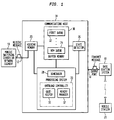
- FIG. 1 shows a store-and-forward communications node 14 that receives receive data messages from a mobile switching center 10, or another network element at an input 12. If the receive data messages are accepted in accordance with an admission priority scheme, the store-and-forward communications node 14 stores the receive data messages in a buffer memory 36.
- the buffer memory 36 is logically organized into a group of queues, ranging from a first queue 22 to an nth queue 24.
- the communications node 14 selects receive data messages from one or more queues to be transmitted as transmit data messages in accordance with a transmission priority scheme.
- the output 16 of the store-and-forward communications node 14 is coupled to a base station transmitter for a downlink transmission to one or more mobile stations 20.
- the communications node 14 is shown coupled between the mobile switching center 10 and the base station 18, in an alternate embodiment the communications node may be integrated with a mobile switching center or a base station system.
- the overload controller 33 may include an gatekeeper 30 , a memory manager 32, or both.
- the gatekeeper 30 controls the admittance of a receive data message to the buffer memory 36 of the store-and-forward communications node 14 from the holding memory 23 based on a status of the buffer memory 36. For example, if the buffer memory 36 is full, the gatekeeper 30 may refuse to admit a receive data message to the buffer memory 36 for processing. If the buffer memory 36 is not full, the gatekeeper 30 may admit the receive data message for processing or storage by the communications node 14. Further, the gatekeeper 30 executes additional conditions, imposed by the processing system 34, for admittance into the buffer memory 36.
- the memory manager 32 may delete an existing message in the buffer memory 36 to make room for a more recent receive data message currently at the input 12 of the communications node 14.
- the average arrival rate of receive data messages at the input 12 of the communications node 14 is less than or equal to the average output 16 rate of corresponding transmit data messages associated with the receive data messages such that deletion of data messages is not necessary.
- the transient or average arrival rate may be greater than the average output rate of the data messages such that the deletion of one or more data messages may become a practical necessity.
- the buffer memory manager 32 makes preemptive deletions of data messages where existing data messages in the buffer memory 36 are deleted before a queue fills.
- the buffer memory manager 32 may establish preemptive deletions to preserve space for "important" messages and/or simplify processing. The preservation of such space can be configured to meet anticipated demand during peak busy periods.
- the queues may have static maximum sizes, dynamic maximum sizes are preferable to enhance the flexibility of the memory management.
- the communications node 14 may configure dynamic maximum queue lengths on demand to cover the ongoing traffic patterns of data messages through the communications node 14, rather than fixing static maximum queue lengths based on a potentially arbitrary prediction of actual traffic patterns.
- the overload controller 33 may entail a wide variety of admission control algorithms, overload control algorithms, or both.
- the gatekeeper 30 includes a "zero loss" admission control algorithm or a variant of the zero loss admission control algorithm. Under the direction of an admission control algorithm or an overload control algorithm of the invention, the overload controller 33 facilitates the efficient use of the buffer memory 36. Further, the overload controller 33 manages the allocation of the existing buffer memory 36 to satisfy throughput demands under specified time constraints.
- the processing system 34 may format or structure the receive or stored data message into a format as a transmit data message that is compatible for transmission over a downlink channel to the mobile stations 20.
- the data messages may be transmitted over any type of communications channel, including a voice, data, or control channel.
- the processing system 34 may facilitate the transmission of transmit data messages over a downlink digital control channel (DCCH ) and a subchannel (e.g., short messaging service/paging channel (SPACH)) of the digital control channel.
- DCCH digital control channel
- SPACH short messaging service/paging channel
- the SPACH provides channel assignments over a downlink signal and may support one-way or two-way short messaging service.
- the DCCH airlink protocol over a TDMA system provides a maximum number of time slots (e.g., 21) in each superframe interval (e.g., 640 millisecond interval) for transmitting a data message.
- the communications node 14 can readily predict a transmission departure time for a receive data message where the communications node 14 communicates to a downstream TDMA wireless system
- other wireless communication systems e.g., Global System for Mobile Communications (GSM) or code-division, multiple-access systems
- GSM Global System for Mobile Communications
- code-division, multiple-access systems may use the system and method for controlling data flow; hence, fall within the scope of the invention.
- the scheduler 28 assigns transmit priorities to receive data messages waiting in the buffer memory 36 for transmission as transmit data messages.
- the scheduler 28 may use any type of priority scheme for the data messages, in one example the scheduler 28 assigns receive data messages transmission priorities based on graduated priority rules that vary with different occupancy rates of the queues (22, 24). The occupancy rates of the queues (22, 24) are provided by the state detector 26.
- Graduated priority rules encompass schemes, for example, where as the occupancy rates of queues in the buffer memory 36 increase, the assignment of transmission priorities for newly received messages may vary from the previously received messages. Transmission priorities could be assigned such that only critical data messages receive high transmission priorities, while all other data messages receive artificially low transmission priorities by comparison to previously or historically received messages.
- Critical data messages may be data messages related to public safety, emergency operations, "911" systems, or the like.
- the scheduler 28 only assigns transmit priorities to data messages where more than one message is waiting in the buffer memory 36 or a given queue. If only one receive data message is waiting in a buffer memory 36 or an active queue, no judgment on transmit priority needs to be made and the single receive data message may be transmitted immediately or when the next transmit opportunity arises.
- a superframe for transmission from the communications node may contain special-purpose time slots and all purpose time-slots. The special service time-slots are restricted to serving some subset of the queues, whereas the general purpose time slots serve any of the queues.
- the communications node 14 For TDMA applications of the communications node 14, a precise understanding of transmit opportunities for the transmit data messages requires knowledge of the DCCH downlink operation. Under current TDMA standards, for example, during every superframe interval duration (e.g., 640 millisecond interval), the communications node 14 has a maximum number (e.g., 21) of time slots in which it can send messages. For reasons of battery conservation, mobiles typically "sleep" (power down) during all but one of these slots; this "listening" time slot for each mobile is randomly assigned among the first group of time slots (.e.g., 19) within the superframe interval so as to evenly distribute the mobiles. The initial communication with a mobile to set up a voice or data transmission must occur in this slot. In many cases, when a mobile receives one of these messages, it remains awake and listens to all time slots within the superframe interval.
- a maximum number e.g. 21
- FIG. 2A illustrates operation of the overload controller 33 under a zero-loss approach to control the admission of receive data messages into the buffer memory 36 from the input 12 of the communications node 14 or at the holding memory 23.
- a true zero-loss approach signifies that all receive data messages that can meet their time-out constraints are admitted to a communications node.
- the communications node 14 defines or observes a priority rank and a waiting-time limit for each data message.
- the waiting-time limit refers to a maximum permitted latent duration, after which a stored data message is not ordinarily transmitted from the buffer memory 36, but deleted, overwritten, or displaced.
- the priority rank of a data message is preferably classified within a hierarchy of priority classes. Each message class may be associated with a corresponding queue. For example, a first message class may be organized to include paging messages; a second message class may be organized to include channel assignment messages.
- Each priority class may contain one or more data messages with comparable admission value ratings.
- each message has an intra-class admission rank to establish a priority ranking for the receive data messages allocated to an individual priority class.
- the intra-class admission rank may represent an arrival time of arrival of each receive data message relative to the other data messages within the individual priority class.
- the priority rank and the waiting-time limit may be defined so that all of the data messages within a class have a homogenous waiting-time limit and a homogeneous priority rank.
- an intra-queue priority ranking may be organized such that the priority within each queue is first-in, first-out (FIFO).
- the intra-queue priority ranking may represent a last-in, first-out (LIFO) scheme, or any other suitable intra-queue priority ranking.
- the intra-queue priority ranking may be impacted by the transmission scheduling algorithm.
- the overload controller 33 may assign a higher value rating to a first receive message representing a channel assignment than a second receive data message representing a paging request, regardless of the order of arrival of the first receive message and the second receive message at the communications node 14.
- the channel assignment nearly always results in a billable call-completion, whereas only a fractional number of paging messages, less than one, to mobile stations 20 result in a completed call. Mobile stations may be turned-off or out of range which leads to the lack of call completions originating from paging requests.
- the overload controller 33 may recognize a low priority class for paging data messages and one or more higher priority classes for channel assignment data messages.
- the admission value rating may be based upon a first-come, first-serve time priority technique, a waiting-time limit of the receive data message, a data packing constraint associated with transmission of the receive data message as a transmit data message, size of the receive data message, or by any other suitable technique.
- a data packing constraint may consider allocations of time slots in a frame or superframe to certain corresponding queues within the buffer memory 36. The foregoing allocations can impact data messages awaiting delivery in the queues.
- receive data messages of smaller size may be assigned a higher value rating than receive data messages of a larger size or longer length.
- step S14 the overload controller 33 predicts (e.g., computes) a transmission-departure time of a receive data message from the output 16 upon reception of the receive data message at the input 12 of the communications node 14.
- the receive data message is evaluated in the holding memory 23 which provides a staging area for determining whether the receive data message should be admitted to the buffer memory 36.
- step S14 the determination of the departure time considers data messages currently in the queues of the buffer memory 36, rather than data messages which have not yet arrived or may arrive.
- Step S14 preferably represents a global estimate of the transmission departure time that depends upon (1) the number of data messages in a local queue, (2) the number of data messages in higher priority queues than the local queue (3) amount of time required to transmit a current message being transmitted from the communications node or from both the communications node 14 and an associated base station system 18.
- An estimate of work to be done in storing and forwarded the data messages is represented by the data messages in front of each arriving data message at any given point in time.
- TDMA airlink The operation of a TDMA airlink is temporally deterministic in that time slots occur over the air interface of the base station system at regular intervals, periodic intervals, or at other predictable times.
- the deterministic nature of a TDMA air-interface may determine the timing of the transmit data messages at the output port 16 to the base station system 18.
- step S14 is readily executed for a communications node 14 used in conjunction with a time-division multiple access wireless communications system.
- the overload controller 33 determines whether or not the receive data message would remain stored within the communications node 14 for a latent duration longer than a waiting-time limit.
- the latent duration represents the time period from admittance of a receive data message to the buffer memory 36 to transmission from the output 16 based on the predicted transmission-departure time predicted in step S14.
- the waiting-time limit refers to a maximum permitted latent duration, after which a stored data message is not ordinarily transmitted from the buffer memory 36, but deleted, overwritten, or displaced.
- the waiting-time results from the throughput limitations of the communications node 14 for data messages or from the throughput limitations of downstream network elements, such as the base station system with its attendant air interface capacity limitations.
- the overload controller 33 may provide an indicator with a first state indicating that the latent period is greater than a waiting-time limit and a second state indicating the latent period is less than or equal to the waiting-time limit.
- Step S16 prepares the gatekeeper 30 for step S18 by indicating the result of a comparison of the predicted transmission departure time of step S14 to the relative time associated with the waiting-time limit.
- step S16 the receive data message would not be transmitted prior to the expiration of the waiting-time limit
- step S20 the gatekeeper 30 refuses to admit the receive data message for storage in the buffer memory 36. Accordingly, the gatekeeper 30 may delete or authorize deletion of the receive data message as is necessary. Alternately, the gatekeeper 30 may redirect the receive data message from the communications node 14, rather than deleting the receive data message.
- step S16 the receive data message would not remain stored within the buffer memory 36 of the communications node 14 for a latent duration longer than a waiting-time limit, then after step S16 the method continues with step S18 in which the data message is admitted from the holding memory 23 to the buffer memory 36.
- the overload controller 33 evaluates the transmission-departure time of data messages waiting in one or more queues behind of the currently local queue, which is the queue that accepted the newly admitted message in step S18.
- the overload controller 33 doesn't need to calculate the transmission departure times of data messages waiting in higher priority queues because their transmission departure times are not affected by the newly admitted message. If a newly admitted data message in step S18 is placed at the end of the local queue, the newly admitted data message has no impact on the other data messages within the queue for a FIFO scheme. Thus, the overload controller 33 does not need to recompute the transmission-departure times of data messages in equal priority queues, but only data messages in lower priority queues. However, if an intra-queue priority scheme other than FIFO is used, transmission departure times for equal priority queues may need to be computed as well as transmission departure times for the lower priority queues.
- Step S22 cooperates with step S14 to facilitate the zero-loss property of the algorithm of FIG. 2A.
- Step S22 simplifies the calculation in step S14 and ensures that buffer memory 36 is not wasted for data messages that will not meet their waiting-time limit based on the existing data messages in the buffer memory 36.
- Step S22 requires processing resources of sufficient data capacity and through-put within the communications node 14 for real-time execution of the zero-loss algorithm of FIG. 2A. For example, recomputing the impacted transmission departure time of existing data messages in step S22 could represent a recomputation for each lower priority message in the queues (22, 24).
- the estimated transmission time of the lower priority messages is lengthened by at least a transmit duration of the admitted data message.
- the estimated transmission time of the higher priority messages is not affected.
- step S22 is replaced with deleting one or more data messages having an estimated transmission duration equal to or exceeding the estimated transmission duration of a held data message to be admitted or a newly admitted data message admitted in step S18.
- a data message has a transmission-departure time that is predicted to meet its waiting-time limit (i.e. time-out constraint)
- the data message is not deleted from the holding memory 23, but rather is admitted to the buffer memory 36.
- the storage of data messages in the buffer memory 36 or the queues becomes a linear function of the time-out thresholds.
- a true zero-loss priority scheme never rejects a data message that could have been transmitted within its waiting-time limit.
- the zero-loss method of FIG. 2A operates on actual sample path and is not based on a traffic model.
- the sample path refers to an actual realization of a random system or a stochastic process.
- the zero-loss method produces reliable results regardless of actual traffic because the zero-loss method adapts to actual traffic conditions. For example, if traffic surges during peak busy hours, the zero-loss method discards or deletes more data messages consistent with steps S16 and S20 of FIG. 2A.
- the zero-loss method requires a total number of computations that are linearly based on the number of arrivals of data messages in the holding memory 23.
- Each transmitted data message may be handled as few as three times. First, when or after the data message arrives at the input 12 or the holding memory 23 and the transmission-departure time is predicted. Second, when or after the decision is made whether or not to admit the held data message into the buffer memory 36 from the holding memory 23. Third, when the data message reaches the top or head of the queue (while the queue is being serviced). When the data message is handled, just a few comparisons and pointer operations are required.
- the computational rate is a linear function of the message rate, as opposed to an exponential function, such that the communications node 14 is readily equipped to provide real-time admission decisions on data messages arriving at the communications node 14.
- admission is based only on the current queue contents of multiple queues in the buffer memory 36, ignoring the effect of future arrival of receive data messages at the input 12 of the communications node 14. Nevertheless, the actual transmission time of an earlier arriving message within its time constraint may be adversely affected by a later arriving, higher-priority, data message that, in effect, jumps into the queue in front of the earlier arriving data message. Thus, the later arriving data message may force or require the purging in S22 of a lower-priority message, such as the earlier arriving data message.
- the gatekeeper 30 may execute a variant of the above zero-loss algorithm that reduces or avoids purging as shown in FIG. 2B.
- the zero loss algorithm of FIG. 2A bases admission on the total length of equal-and-higher priority queues
- the variant of the zero-loss algorithm of FIG. 2B considers only the length of the local queue to be assigned the arriving message.
- the zero-loss property is preserved in the variant algorithm, but the requirements for buffer memory 36 tend to increase over that of FIG. 2A to store some number of receive data messages that are admitted, but do not later meet their waiting-time limits.
- the variant of the algorithm increases the requirement for buffer memory 36, white reducing the computational load on the processing system 34 of the communications node 14.
- Like steps in FIG. 2A and FIG. 2B are indicated by like reference numerals.
- the transmission-departure time of the local queue establishes a lower bound estimate of the transmission departure time that ignores higher priority queues. "Lower bound" means that the actual departure time may be longer because the actual departure time of the data message may be affected actually by one or more higher priority queues in the buffer memory 36.
- Estimating the transmission departure time in step S15 involves looking at all data messages in front of (i.e., of higher priority than) the data message being evaluated for admission. For example, the sum of the waiting-time limit of the higher priority data messages than the held data message represents an initial estimate of the transmission departure time.
- step S26 the overload controller determines if any existing messages with the same priority rank, a lower priority rank, or both are in the buffer memory.
- the "no" path originating from S26 represents the conditions of no data messages being present in the local queue in the buffer memory 36.
- step S28 if an existing message with the same priority rank (as the held data message) is stored in the buffer memory 36, the overload controller 33 discards the oldest such data message and admits the arriving or held data message. Alternately, if an existing message with a lower priority rank (than the held data message) is stored in the buffer memory, the overload controller 33 discards the oldest data message of the lower priority rank and admits the arriving data message with the higher priority rank.
- step S28 may operate in the following manner, among others. Assume a first queue has a higher priority ranking than a second queue. Assume that the transmission scheduler is servicing the first queue, such that messages in the second queue become stale. Once the transmission scheduling of the first queue is completed, the overload controller discards one or more stale messages within the second queue. The stale messages may be identified in terms of the oldest data messages. Accordingly, the arriving data message may be admitted into the available space of the first queue or the second queue consistent with the priority of the arriving data message.
- step S26 if an existing message with the same priority or a lower priority than the held or arriving data message is not present in the buffer memory, the overload controller discards the held or arriving message in step S30.
- step S24 following step S18 in FIG. 2B, the overload controller recomputes any impacted transmission-departure time estimates for existing messages and discards or redirects any messages that will now exceed their waiting-time limit.
- the recomputation is required because of admission of the data messages in step S18.
- Step S24 of FIG. 2B involves a reduced volume of computations compared to step S22 of FIG. 2A. Only partial buffer state information is used in step S24 to recompute the impacted transmission-departure time.
- the volume of the computations in accordance with step S24 is limited in at least two aspects.
- impacted refers to transmission departure times whose associated partial buffer state information (in step S15 or otherwise) is altered by the admission of the arriving or held data message.
- impacted may refer to queues of lower priority than the local queue for reception/storage of the admitted data message.
- the impacted queue may also include equivalent priority queues that are lower in intra-queue priority than the admitted data message.
- the estimate of transmission-departure time uses only a local queue or a local queue and a subset of the higher priority queues to recompute the recomputed transmission departure time.
- the admitted data message may be transmitted as a transmit data message from the output 16 prior to the expiration of the waiting-time limit. Finally, after transmission from the output 16, the admitted data message may be transmitted via the base station system 18 to the mobile station 20.
- Both methods of FIG. 2A and FIG. 2B prevent the communications node from throwing away an arriving data message that could have been sent within its waiting-time limit.
- the method of FIG. 2A prevents the communications node from accepting a data message that actually is not sent within the waiting-time limit.
- the method of FIG. 2B generally features less computational complexity and requires more memory capacity of the buffer memory 36 than does the method of FIG. 2A. Because admission into the buffer memory 36 or queues may be based on local information, the overload control scheme may be independent of the general priority scheme of the scheduler. No adjustment is needed for alternating or state-dependent priority schemes. The overload control and transmission priority schemes can be modified independently.
Landscapes
- Engineering & Computer Science (AREA)
- Computer Networks & Wireless Communication (AREA)
- Signal Processing (AREA)
- Mobile Radio Communication Systems (AREA)
- Data Exchanges In Wide-Area Networks (AREA)
- Computer And Data Communications (AREA)
- Communication Control (AREA)
Abstract
Description
Claims (15)
- A method for controlling data flow in a store-and-forward communications node, the method comprising the steps of:predicting a transmission-departure time of a receive data message from an output upon reception of the receive data message at an input of the communications node;determining if the receive data message would remain stored within the communications node for a latent duration longer than a waiting-time limit based on the predicted transmission-departure time; andadmitting the receive data message for storage in the buffer memory for prospective transmission over the output if the receive data message would be transmitted prior to expiration of the waiting-time limit.
- The method according to claim 1 wherein the predicting step comprises considering data messages currently in a local queue defined by the buffer memory to determine the transmission-departure time.
- The method according to claim 1 wherein the predicting step comprises considering data messages currently in a local queue defined by the buffer memory and data messages in higher priority class queues to determine the transmission-departure time.
- The method according to claim 1 wherein the predicting step comprises considering data messages currently in a local queue defined by the buffer memory and data messages in a highest priority class queue to determine the transmission-departure time.
- The method according to claim 1 further comprising the steps of:after admitting the receive data message, re-determining an impacted transmission-departure time associated with a corresponding existing data messages stored within the buffer memory;discarding the existing data message if the impacted transmission-departure time exceeds its waiting-time limit.
- The method according to claim 1 further comprising the steps of:after admitting the receive data message, re-determining an impacted transmission-departure time for an existing data message stored within the buffer memory;redirecting the existing data message if the impacted transmission-departure time exceeds its waiting-time limit.
- The method according to claim 1 further comprising the step of:after admitting the receive data message, re-determining an impacted transmission-departure time for an existing data message stored in a local queue that received the admitted receive data message.
- The method according to claim 1 further comprising the step of:after admitting the receive data message, re-determining an impacted transmission-departure time for an existing data message stored in a local queue that received the admitted receive data message and at least one lower priority queue within the buffer memory.
- The method according to claim 1 further comprising the steps of:deleting an oldest message within a local queue of the same priority as the receive data message if such an oldest message exists and if the transmission-departure time of the receive data message would exceed its waiting-time limit without the deletion;admitting the receive data message into the local queue during or after deleting the oldest message.
- The method according to claim 1 further comprising the step of:defining a priority rank for the receive data message.
- The method according to claim 1 further comprising the step of:prioritizing the transmission of the receive data messages as transmit data messages via the output independently from the admitting step.
- A communications node comprising:a holding memory for holding a receive data message;an overload controller for predicting a transmission-departure time of the receive data message from an output upon reception of the receive data message at the holding memory;a buffer memory coupled to the holding memory for storing the receive data messages associated with a corresponding waiting-time limit;a gatekeeper for admitting the receive data message for storage in the buffer memory for prospective transmission over the output if the receive data message would be transmitted prior to expiration of the waiting-time limit.
- The communications node according to claim 12 wherein the buffer memory is organized into a local queue, and wherein the gatekeeper admits the receive data message to the local queue based on a transmission-departure time determined with reference to contents of the local queue.
- The communications node according to claim 12 wherein the buffer memory is organized into a local queue and higher priority class queues, and wherein the gatekeeper admits the receive data message to the local queue based on a transmission-departure time determined with reference to contents of the local queue and the higher priority class queues.
- The communications node according to claim 12 wherein the buffer memory is organized into a local queue and a highest priority class queue, and wherein the gatekeeper admits the receive data message to the local queue based on a transmission-departure time determined with reference to contents of the local queue and the highest priority class queue.
Applications Claiming Priority (2)
| Application Number | Priority Date | Filing Date | Title |
|---|---|---|---|
| US411007 | 1999-10-01 | ||
| US09/411,007 US6501733B1 (en) | 1999-10-01 | 1999-10-01 | Method for controlling data flow associated with a communications node |
Publications (2)
| Publication Number | Publication Date |
|---|---|
| EP1093260A2 true EP1093260A2 (en) | 2001-04-18 |
| EP1093260A3 EP1093260A3 (en) | 2003-10-01 |
Family
ID=23627170
Family Applications (1)
| Application Number | Title | Priority Date | Filing Date |
|---|---|---|---|
| EP00308121A Withdrawn EP1093260A3 (en) | 1999-10-01 | 2000-09-18 | Method for flow control |
Country Status (7)
| Country | Link |
|---|---|
| US (1) | US6501733B1 (en) |
| EP (1) | EP1093260A3 (en) |
| JP (1) | JP2001160831A (en) |
| KR (1) | KR20010050689A (en) |
| AU (1) | AU6126100A (en) |
| BR (1) | BR0004508A (en) |
| CA (1) | CA2320693C (en) |
Cited By (3)
| Publication number | Priority date | Publication date | Assignee | Title |
|---|---|---|---|---|
| DE10151720B4 (en) * | 2001-10-19 | 2006-04-27 | Siemens Ag | Overload protection for control units in communication networks |
| EP1853017A1 (en) * | 2006-05-01 | 2007-11-07 | Agere Systems, Inc. | Wireless network scheduling method and apparatus based on waiting time and queue occupancy |
| US20160006780A1 (en) * | 2014-07-02 | 2016-01-07 | Abb Technology Ag | Method for processing data streams including time-critical messages of a power network |
Families Citing this family (39)
| Publication number | Priority date | Publication date | Assignee | Title |
|---|---|---|---|---|
| US7933249B2 (en) * | 2000-02-08 | 2011-04-26 | Ipr Licensing, Inc. | Grade of service and fairness policy for bandwidth reservation system |
| US8374218B2 (en) | 2000-12-05 | 2013-02-12 | Google Inc. | Combining signals with a shuffled-hadamard function |
| US8385470B2 (en) * | 2000-12-05 | 2013-02-26 | Google Inc. | Coding a signal with a shuffled-Hadamard function |
| US7142536B1 (en) * | 2000-12-14 | 2006-11-28 | Google, Inc. | Communications network quality of service system and method for real time information |
| JP4336062B2 (en) * | 2001-05-30 | 2009-09-30 | パイオニア株式会社 | Information communication device and information communication method |
| US7170900B2 (en) * | 2001-07-13 | 2007-01-30 | Telefonaktiebolaget Lm Ericsson (Publ) | Method and apparatus for scheduling message processing |
| US7154903B2 (en) * | 2001-10-19 | 2006-12-26 | Telefonaktiebolaget Lm Ericsson (Publ) | System and method for management of data associated with a dormant mobile terminal |
| US20030125040A1 (en) * | 2001-11-06 | 2003-07-03 | Walton Jay R. | Multiple-access multiple-input multiple-output (MIMO) communication system |
| US7453921B1 (en) | 2001-12-11 | 2008-11-18 | Google Inc. | LPC filter for removing periodic and quasi-periodic interference from spread spectrum signals |
| US7385993B2 (en) * | 2001-12-21 | 2008-06-10 | International Business Machines Corporation | Queue scheduling mechanism in a data packet transmission system |
| US6947756B2 (en) * | 2001-12-24 | 2005-09-20 | Telefonaktiebolaget Lm Ericsson | Method of balancing backhaul delays for a series of daisy chained radio base stations |
| KR100434053B1 (en) * | 2001-12-31 | 2004-06-04 | 엘지전자 주식회사 | Is-95a/b vocoder |
| CN1640095A (en) * | 2002-04-08 | 2005-07-13 | 三菱电机株式会社 | Data transmission device and data transmission method |
| US6885638B2 (en) * | 2002-06-13 | 2005-04-26 | Motorola, Inc. | Method and apparatus for enhancing the quality of service of a wireless communication |
| US7272144B2 (en) * | 2002-06-26 | 2007-09-18 | Arris International, Inc. | Method and apparatus for queuing data flows |
| KR20050083685A (en) * | 2002-09-13 | 2005-08-26 | 패씨브 엘티디. | Operations method in an ethernet passive optical network that includes a network unit with multiple entities |
| US7352833B2 (en) * | 2002-11-18 | 2008-04-01 | Google Inc. | Method and system for temporal autocorrelation filtering |
| KR100665457B1 (en) * | 2003-04-30 | 2007-01-04 | 삼성전자주식회사 | System and method for state transition control in sleep mode and awake mode in broadband wireless access communication system |
| JP3732497B2 (en) * | 2004-01-14 | 2006-01-05 | コナミ株式会社 | Message output device, message control method, and program |
| US20050232153A1 (en) * | 2004-04-16 | 2005-10-20 | Vieo, Inc. | Method and system for application-aware network quality of service |
| US20060028988A1 (en) * | 2004-08-09 | 2006-02-09 | Kumar Gopal N | Decreased random opening procedure for overload control |
| US8762567B2 (en) * | 2004-08-13 | 2014-06-24 | Alcatel Lucent | Adaptive permutation group method for overload control |
| US8306952B2 (en) * | 2005-03-29 | 2012-11-06 | Sap Ag | Technique for managing messages |
| US8849752B2 (en) * | 2005-07-21 | 2014-09-30 | Google Inc. | Overloaded communication session |
| US7809009B2 (en) * | 2006-02-21 | 2010-10-05 | Cisco Technology, Inc. | Pipelined packet switching and queuing architecture |
| JP4739080B2 (en) * | 2006-03-30 | 2011-08-03 | 富士通株式会社 | Retransmission control configuration in data communication system |
| US7616960B2 (en) * | 2006-03-31 | 2009-11-10 | Sap Ag | Channel selection for wireless transmission from a remote device |
| US9154421B2 (en) * | 2006-05-30 | 2015-10-06 | Intel Corporation | Network based data traffic detection and control |
| US9349114B2 (en) * | 2006-10-31 | 2016-05-24 | Hewlett Packard Enterprise Development Lp | Systems and methods for managing event messages |
| US8089970B2 (en) * | 2006-12-14 | 2012-01-03 | Ntt Docomo, Inc. | Method and apparatus for managing admission and routing in multi-hop 802.11 networks taking into consideration traffic shaping at intermediate hops |
| KR101609395B1 (en) | 2007-08-27 | 2016-04-05 | 애플 인크. | Communication system using mimo based network coding |
| US8589605B2 (en) * | 2008-06-06 | 2013-11-19 | International Business Machines Corporation | Inbound message rate limit based on maximum queue times |
| US8073014B2 (en) * | 2009-03-02 | 2011-12-06 | Motorola Mobility, Inc. | Method and apparatus for synchronizing nodes |
| US8965291B2 (en) | 2010-07-13 | 2015-02-24 | United Technologies Corporation | Communication of avionic data |
| US9998394B2 (en) * | 2015-07-03 | 2018-06-12 | Veritas Technologies Llc | Systems and methods for scalable network buffer management |
| US11055027B1 (en) * | 2019-11-15 | 2021-07-06 | Rapid7, Inc. | Dynamic queue management |
| US12388760B2 (en) * | 2021-09-14 | 2025-08-12 | Intel Corporation | Packet transmission scheduling fairness |
| US12425352B2 (en) * | 2022-08-23 | 2025-09-23 | Mellanox Technologies, Ltd. | Mice-elephant aware shared buffer schema |
| WO2025000386A1 (en) * | 2023-06-29 | 2025-01-02 | 西门子股份公司 | Network congestion control method and apparatus based on hardware, and storage medium |
Family Cites Families (9)
| Publication number | Priority date | Publication date | Assignee | Title |
|---|---|---|---|---|
| US5042032A (en) * | 1989-06-23 | 1991-08-20 | At&T Bell Laboratories | Packet route scheduling in a packet cross connect switch system for periodic and statistical packets |
| US5097499A (en) | 1990-08-22 | 1992-03-17 | At&T Bell Laboratories | Autonomous registration overload control for cellular mobile radio systems |
| US5528513A (en) | 1993-11-04 | 1996-06-18 | Digital Equipment Corp. | Scheduling and admission control policy for a continuous media server |
| WO1995018415A1 (en) * | 1993-12-30 | 1995-07-06 | International Business Machines Corporation | Queue management in a data processing link |
| EP0684719A1 (en) * | 1994-05-25 | 1995-11-29 | International Business Machines Corporation | Method and apparatus for transmission of high priority traffic on low speed communication links |
| US5506898A (en) * | 1994-07-12 | 1996-04-09 | At&T Corp. | Expected wait-time indication arrangement |
| US5982873A (en) * | 1997-03-07 | 1999-11-09 | Lucent Technologies Inc. | Waiting-call selection based on objectives |
| US5905793A (en) * | 1997-03-07 | 1999-05-18 | Lucent Technologies Inc. | Waiting-call selection based on anticipated wait times |
| US6094435A (en) * | 1997-06-30 | 2000-07-25 | Sun Microsystems, Inc. | System and method for a quality of service in a multi-layer network element |
-
1999
- 1999-10-01 US US09/411,007 patent/US6501733B1/en not_active Expired - Lifetime
-
2000
- 2000-09-18 EP EP00308121A patent/EP1093260A3/en not_active Withdrawn
- 2000-09-22 AU AU61261/00A patent/AU6126100A/en not_active Abandoned
- 2000-09-26 CA CA002320693A patent/CA2320693C/en not_active Expired - Fee Related
- 2000-09-28 KR KR1020000056935A patent/KR20010050689A/en not_active Ceased
- 2000-09-28 BR BR0004508-0A patent/BR0004508A/en not_active Application Discontinuation
- 2000-10-02 JP JP2000302082A patent/JP2001160831A/en not_active Abandoned
Cited By (4)
| Publication number | Priority date | Publication date | Assignee | Title |
|---|---|---|---|---|
| DE10151720B4 (en) * | 2001-10-19 | 2006-04-27 | Siemens Ag | Overload protection for control units in communication networks |
| EP1853017A1 (en) * | 2006-05-01 | 2007-11-07 | Agere Systems, Inc. | Wireless network scheduling method and apparatus based on waiting time and queue occupancy |
| US7769038B2 (en) | 2006-05-01 | 2010-08-03 | Agere Systems Inc. | Wireless network scheduling methods and apparatus based on both waiting time and occupancy |
| US20160006780A1 (en) * | 2014-07-02 | 2016-01-07 | Abb Technology Ag | Method for processing data streams including time-critical messages of a power network |
Also Published As
| Publication number | Publication date |
|---|---|
| BR0004508A (en) | 2001-05-29 |
| KR20010050689A (en) | 2001-06-15 |
| AU6126100A (en) | 2001-04-05 |
| US6501733B1 (en) | 2002-12-31 |
| EP1093260A3 (en) | 2003-10-01 |
| CA2320693A1 (en) | 2001-04-01 |
| JP2001160831A (en) | 2001-06-12 |
| CA2320693C (en) | 2003-12-30 |
Similar Documents
| Publication | Publication Date | Title |
|---|---|---|
| CA2320693C (en) | Method for controlling data flow associated with a communications node | |
| US6700869B1 (en) | Method for controlling data flow associated with a communications node | |
| US7453801B2 (en) | Admission control and resource allocation in a communication system supporting application flows having quality of service requirements | |
| US6229795B1 (en) | System for allocating resources in a communication system | |
| EP2654341B1 (en) | Priority Queues Starvation Avoidance In Wireless Communication Systems | |
| US8804743B2 (en) | Cellular communication system, apparatus and method for management of backhaul resources | |
| US6282424B1 (en) | Resource controllers for use in a non-unitary service system | |
| JP2001274839A (en) | A method of packet scheduling with improved delay performance for wireless networks | |
| KR20050095307A (en) | Apparatus and method of scheduling for processing packet data in a wireless communication system | |
| KR19980018091A (en) | Adaptive Rate-based Congestion Control in Packet Networks | |
| EP1326463A1 (en) | Method and apparatus for packet transmission scheduling by performing load control functionality | |
| US20060140115A1 (en) | Resource allocation management | |
| CN109618375B (en) | UAV ad hoc network time slot scheduling method based on service priority and channel interruption probability | |
| US5966372A (en) | Methods for resource control in a non-unitary service system | |
| CN100369524C (en) | CDMA system up-bag dispatching method | |
| US9204457B2 (en) | Resource allocation in a communication network | |
| US6801537B1 (en) | Adaptive contention algorithm based on truncated binary exponential back-off | |
| US7082115B2 (en) | Radio telecommunications system with improved use of timeslots | |
| JP2000069548A (en) | Communication bandwidth allocation method | |
| Peden et al. | Performance of priorities on an 802.5 token ring | |
| Thng et al. | A robust M/M/1/k scheme for providing handoff dropping QoS in multi-service mobile networks | |
| Fry et al. | A Markov Model for Performance Analysis of a TDMA/FDMA System with Mixed Voice and Data Traffic | |
| JP2000349729A (en) | Transmission apparatus and method for communication system | |
| Cleary | DIESIGN AND PERFORMANCE EVALUATION OF A SCHEME FOR VOICE-DATA CHANNEL ACCESS IN THIRD GENERATION MICROCELLULAR WIRELESS NETWORKS |
Legal Events
| Date | Code | Title | Description |
|---|---|---|---|
| PUAI | Public reference made under article 153(3) epc to a published international application that has entered the european phase |
Free format text: ORIGINAL CODE: 0009012 |
|
| AK | Designated contracting states |
Kind code of ref document: A2 Designated state(s): AT BE CH CY DE DK ES FI FR GB GR IE IT LI LU MC NL PT SE |
|
| AX | Request for extension of the european patent |
Free format text: AL;LT;LV;MK;RO;SI |
|
| PUAL | Search report despatched |
Free format text: ORIGINAL CODE: 0009013 |
|
| AK | Designated contracting states |
Kind code of ref document: A3 Designated state(s): AT BE CH CY DE DK ES FI FR GB GR IE IT LI LU MC NL PT SE |
|
| AX | Request for extension of the european patent |
Extension state: AL LT LV MK RO SI |
|
| RIC1 | Information provided on ipc code assigned before grant |
Ipc: 7H 04L 29/06 B Ipc: 7H 04L 12/56 A |
|
| 17P | Request for examination filed |
Effective date: 20040313 |
|
| 17Q | First examination report despatched |
Effective date: 20040408 |
|
| AKX | Designation fees paid |
Designated state(s): DE FI FR GB SE |
|
| STAA | Information on the status of an ep patent application or granted ep patent |
Free format text: STATUS: THE APPLICATION HAS BEEN WITHDRAWN |
|
| 18W | Application withdrawn |
Effective date: 20050921 |