TECHNICAL FIELD
The present invention relates to a thermosetting powder
coating composition. Particularly the present invention relates to a
thermosetting powder coating composition which is less affected by
mixing of other powder coating composition at coating.
BACKGROUND ART
Powder coating compositions containing a fluorine-containing
resin are known in various patent publications such as JP-B-6-104792,
JP-A-1-103670 and JP-A-8-41131, and can give a coated
article being excellent in weather resistance and having a good
appearance.
In an actual coating site of a powder coating, from the
viewpoint of productivity, coating and baking of plural powder coatings
are carried out on one coating line, and operation of the line is changed
over for each powder coating.
However only by mixing of a small amount of the powder
coating containing a fluorine-containing resin to other resin powder
coating, various defects arise on a coating film of the other resin. This
is one of the reasons why fluorine-containing resin-based powder
coatings are not spread on the market irrespective of excellent physical
properties of a coating film thereof.
The present inventors have continued their studies to find
out a fluorine-containing resin powder coating composition which is less
affected by mixing of other coating composition on a coating line and
have found that the above-mentioned defects attributes to miscibility of
a fluorine-containing resin with other resin and further that a fluorine-containing
copolymer featured by insolubility in tetrahydrofuran (THF)
can solve the above-mentioned problem. Thus the present invention
was completed.
DISCLOSURE OF INVENTION
Namely the present invention relates to the thermosetting
powder coating composition characterized in that the composition
comprises (A) a fluorine-containing copolymer having crosslinkable
functional group and (B) a curing agent and that the fluorine-containing
copolymer (A) has a perfluoroolefin unit, has a fluorine content of not
less than 10 % by weight and is not dissolved in THF substantially.
It is preferable that the fluorine-containing copolymer (A)
having crosslinkable functional group has a melting point of not more
than 160°C and a melt flow rate (MFR) of from 1 to 1,000 g/10 min when
measured at 130°C at a load of 2.1 kg.
Examples of the preferred fluorine-containing copolymer (A)
having crosslinkable functional group are those comprising
tetrafluoroethylene (TFE), hexafluoropropylene (HFP), ethylene (ET) and
monomer unit having crosslinkable functional group and being
copolymerizable therewith or those comprising TFE, HFP, isobutylene
(IB) and monomer unit having crosslinkable functional group and being
copolymerizable therewith.
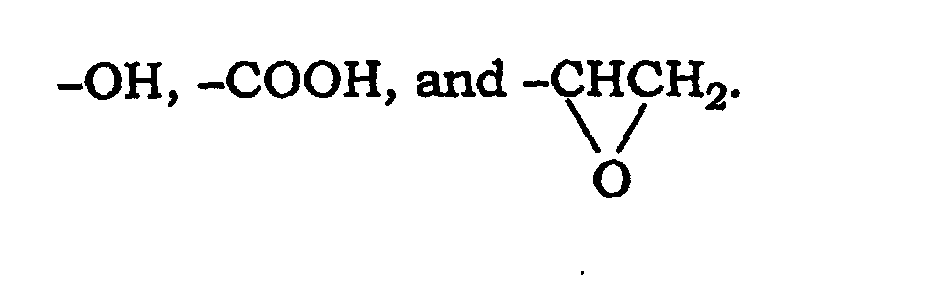
Example of the preferred crosslinkable functional group is at
least one of hydroxyl, carboxyl and epoxy.
Further it is preferable to introduce a vinyl ester compound
unit, for example, vinyl benzoate unit and/or vinyl pivalate unit as a unit
constituting the copolymer (A).
The present invention also relates to a coated article obtained
by coating the above-mentioned thermosetting powder coating
composition to a substrate and then baking it.
BEST MODE FOR CARRYING OUT THE INVENTION
First the fluorine-containing copolymer (A) having
crosslinkable functional group and used in the present invention is
explained below.
The fluorine-containing copolymer (A) having crosslinkable
functional group is one which has at least the following characteristics
(1) to (4).
(1) having a perfluoroolefin unit
Example of perfluoroolefin is, for instance, at least one of
perfluoroolefins such as TFE, HFP and perfluoro(vinyl ether).
Particularly TFE and HFP are preferred. When the copolymer has a
perfluoroolefin unit, a coating film being excellent in weather resistance,
water resistance and stain-proofing property can be obtained. It is
preferable that the perfluoroolefin unit is contained in the copolymer in
an amount of not less than 5 % by mole, especially 10 to 95 % by mole.
(2) having a fluorine content of not less than 10 % by weight
The fluorine content derives from the perfluoroolefin unit
and/or other fluorine-containing monomer. The fluorine content is not
less than 10 % by weight, preferably 20 to 75 % by weight for the same
reason as in (1) above.
Examples of the other fluorine-containing monomer are, for
instance, vinylidene fluoride, trifluoroethylene, monofluoroethylene,
chlorotrifluoroethylene, and the like. Those other fluorine-containing
monomer units are optional units. A content thereof is not more than
30 % by mole, usually 0 to 10 % by mole.
(3) being insoluble in THF substantially
Being insoluble in THF means being inferior in compatibility
with a resin soluble in THF. Namely when after coating of a powder
coating of a resin soluble in THF, the powder coating of the present
invention is coated on the same coating line, or when carrying out
coating in the reverse order, the fluorine-containing copolymer (A) is less
affected by other resin, and the influence of mixing of the fluorine-containing
copolymer (A) on the other powder coating can be decreased.
Being insoluble substantially encompasses the case of being
soluble in THF in a concentration of less than 0.5 % by weight. This is
because when substantially measuring an intrinsic viscosity [η] of the
resin in THF solution, a reliable intrinsic viscosity [η] cannot be
measured unless the copolymer has a solubility of about 0.5% by weight
or more.
Examples of the resin which is soluble in THF and is used for
a powder coating are, for instance, an acrylic resin, polyester resin,
epoxy resin, fluorine-containing resin described in JP-B-6-104792, and
the like.
(4) having crosslinkable functional group
The crosslinkable functional group has functions of giving a
curing site to the fluorine-containing copolymer (A) and giving a highly
hard coating film subjected to thermosetting by a reaction with a curing
agent, thus increasing a surface hardness while maintaining good
flexibility.
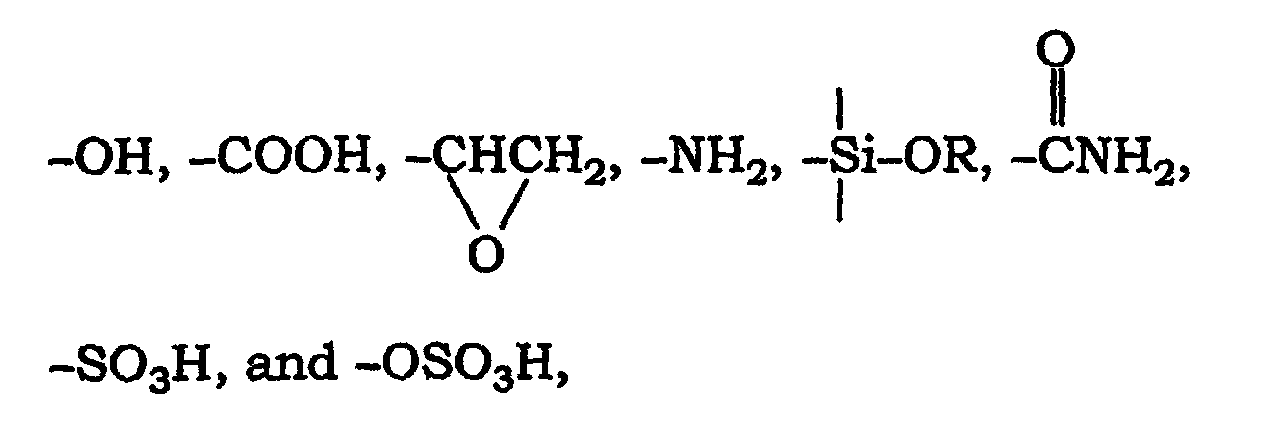
In the present invention, examples of the crosslinkable
functional group are, for instance, functional groups represented by the
formulae (i):
wherein R is an alkyl group having 1 to 3 carbon atoms.
Among the above-mentioned functional groups, preferred are
those represented by the formulae (ii):
Examples of the monomer capable of introducing such a
functional group are, for instance, perfluorobutenoic acid (PFBA), a
fluorine-containing monomer having an ether unit described in JP-A-8-67795
and in addition, non-fluorine-containing monomer having
carboxyl such as maleic anhydride (MAL); hydroxyl-containing monomer
such as hydroxybutyl vinyl ether (HBVE) and allyl alcohol; epoxy-containing
monomer such as glycidyl vinyl ether (GVE);
vinylmethoxysilane, vinylethoxysilane, monomer having hydrolyzable
silyl group described in JP-A-8-120211, monomer having aminopropoxy
group, and the like.
From the viewpoint of reactivity in the baking temperature
range in case of combination use with a known curing agent, preferred
are PFBA, carboxyl-containing monomer such as maleic anhydride,
hydroxyl-containing monomer such as HBVE and glycidyl-containing
monomer such as GVE.
The crosslinkable functional group forms a curing site, and
its amount varies depending on reactivity of the functional group and
kind of a curing agent. It is preferable that based on the whole
fluorine-containing resin, an acid value is from 1 to 300 mgKOH/g, a
hydroxyl value is from 1 to 200 mgKOH/g or an equivalent of epoxy is
from 5 to 15,000 equivalents.
It is further preferable that the copolymer has the following
characteristics.
(5) having a melting point of not more than 160°C
When the melting point is in this range, a good flow
characteristic is given at baking.
(6) MFR being from 1 to 1,000 g/10 min when measured at 130°C at a
load of 2.1 kg (The measuring conditions are hereinafter the same)
MFR is an important factor at melt-kneading or baking,
particularly at baking. The larger the MFR is, the more the flowing
property of molten resin increases. Therefore a smooth and uniform
coating film is easily formed. But on the other hand, dripping easily
occurs, and at kneading, shearing is not applied to a kneaded
composition and uniform kneading is difficult. There occurs a defect
that water resistance and impact resistance of a coating film are lowered.
When the MFR is too small, flowability at baking is insufficient and a
coating film does not become smooth and uniform. A preferred MFR is
from 5 to 100 g/10 min.
From the above-mentioned points of view, a content of the
unit giving crosslinkable functional group may be selected in the range
of from 0.1 to 30 % by mole, especially 1 to 20 % by mole based on the
fluorine-containing copolymer.
Also when the fluorine-containing copolymer (A) contains a
vinyl ester compound unit as a constitutive unit thereof, adhesion of the
obtained coating film to a substrate is enhanced, and also compatibility
with a curing agent is improved, thus giving a coating film having a high
gloss. Examples of the vinyl ester compound are non-fluorine-containing
vinyl esters, for instance, vinyl benzoate (VBz), vinyl pivalate
(VPi) and a mixture thereof. It is desirable that the vinyl ester
compound is introduced in the copolymer (A) in an amount of 0.1 to
25 % by mole, preferably 0.5 to 20 % by mole.
The fluorine-containing copolymer having crosslinkable
functional group can be obtained by copolymerizing each of the above-mentioned
monomers. The polymerization may be carried out by usual
polymerization methods such as emulsion polymerization, suspension
polymerization and solution polymerization. Also a monomer having
crosslinkable functional group may be grafted on the copolymer.
Non-restricted examples of the fluorine-containing copolymer
having crosslinkable functional group of the present invention are those
having the following combinations of monomers and satisfy the
requirements (1) to (4) and further preferably (5) and (6).
| (I) 1 ○ Perfluoroolefin | not less than 5 % by mole |
| 2 ○ Other fluorine-containing monomer | 0 to 95 % by mole |
| 3 ○ Other non-fluorine-containing monomer | 0 to 95 % by mole |
| 4 ○ Crosslinkable functional group-containing monomer | not less than 0.1 % by mole |
| (II) 1 ○ At least one of TFE and HFP | not less than 5 % by mole |
| 2 ○ Other fluorine-containing monomer | 0 to 95 % by mole |
| 3 ○ Non-fluorine-containing olefin | 0 to 95 % by mole |
| 4 ○ Monomer containing functional group represented by the above-mentioned formula (i) | not less than 0.1 % by mole |
| (III) 1 ○ At least one of TFE and HFP | not less than 10 % by mole |
| 2 ○ Other fluorine-containing monomer | 0 to 20 % by mole |
| 3 ○ Non-fluorine-containing olefin | 10 to 70 % by mole |
| 4 ○ Monomer containing functional group represented by the above-mentioned formula (i) | not less than 0.1 % by mole |
| (IV) 1 ○ At least one of TFE and HFP | not less than 20 % by mole |
| 2 ○ Other fluorine-containing monomer | 0 to 5 % by mole |
| 3 ○ Ethylene (ET) | 20 to 50 % by mole |
| 4 ○ Monomer containing functional group represented by the above-mentioned formula (ii) | not less than 0.1 % by mole |
| (V) 1 ○ At least one of TFE and HFP | not less than 20 % by mole |
| 2 ○ Other fluorine-containing monomer | 0 to 5 % by mole |
| 3 ○ Isobutylene (IB) | 20 to 50 % by mole |
| 4 ○ Monomer containing functional group represented by the above-mentioned formula (ii) | not less than 0.1 % by mole |
| (VI) 1 ○ At least one of TFE and HFP | not less than 10 % by mole |
| 2 ○ Other fluorine-containing monomer | 0 to 20 % by mole |
| 3 ○ Non-fluorine-containing olefin | 10 to 70 % by mole |
| 4 ○ Monomer containing functional group represented by the above-mentioned formula (i) | not less than 0.1 % by mole |
| 5 ○ Vinyl ester compound | 1 to 15 % by mole |
| (VII) 1 ○ At least one of TFE and HFP | not less than 20 % by mole |
| 2 ○ Other fluorine-containing monomer | 0 to 5 % by mole |
| 3 ○ At least one of ET and IB | 20 to 50% by mole |
| 4 ○ Monomer containing functional group represented by the above-mentioned formula (ii) | not less than 0.1 % by mole |
| 5 ○ At least one of VBz and VPi | 1 to 15 % by mole |
Non-restricted examples of more concrete copolymer are as
follows.
TFE/HFP/ET/PFBA copolymer (mole ratio: 25 to 40/10 to
20/35 to 48/0.1 to 10), TFE/HFP/ET/HBVE copolymer (mole ratio: 25
to 40/10 to 20/35 to 48/0.1 to 10), TFE/HFP/ET/GVE copolymer (mole
ratio: 25 to 40/10 to 20/35 to 48/0.1 to 10), TFE/HFP/IB/HBVE
copolymer (mole ratio: 25 to 40/10 to 20/35 to 48/0.1 to 10),
TFE/HFP/ET/HBVE/VBz copolymer (mole ratio: 25 to 40/10 to 20/35
to 48/0.1 to 10/3 to 8), TFE/HFP/ET/HBVE/VBz/VPi copolymer (mole
ratio: 25 to 40/10 to 20/35 to 48/0.1 to 10/3 to 8/3 to 8)
TFE/HFP/ET copolymer described in JP-A-8-41131 does not
have functional group and does not satisfy the Requirement (4). A
fluorine-containing copolymer (JP-A-9-165535) mainly comprising
vinylidene fluoride (VdF) does not satisfy insolubility in THF
(Requirement (3)).
It is preferable that the fluorine-containing copolymer having
crosslinkable functional group and used in the present invention further
has the following physical property.
Glass transition temperature (Tg): It is preferable that the
glass transition temperature is not more than 150°C, especially 40° to
120°C (measured with DSC) from the viewpoint of giving a coating film
being excellent in leveling property and appearance even at relatively low
baking temperature.
The above-mentioned fluorine-containing copolymer having
crosslinkable functional group not only gives excellent weather
resistance, chemical resistance and stain removable property to an
obtained coating film but also improves impact resistance and flexibility.
Then the curing agent which is another component of the
thermosetting powder coating composition of the present invention is
explained below.
A curing agent to be used may be selected optionally
depending on kind of the above-mentioned crosslinkable functional
group, a melt-kneading temperature at making a coating, a baking
temperature, etc. In former thermosetting powder coating
compositions containing a fluorine-containing copolymer, selection of a
curing agent was difficult from the viewpoint of its compatibility with the
copolymer, and kind of usable curing agent, particularly a combination
with a resin was limited. According to the present invention, since
crosslinkable functional group is introduced into the above-mentioned
fluorine-containing copolymer, kind and combination of usable curing
agent can be extended.
Examples of the usable curing agent are, for instance, epoxy
or glycidyl compounds such as alicyclic epoxy resin, GMA acryl,
aliphatic oxysilane, triglycidyl isocyanurate (TGIC), diglycidyl
terephthalate, diglycidyl p-hydroxybenzoate, spiroglycol diglycidylether
and hydantoin compounds; isophorone diisocyanate, tolylene
diisocyanate, xylilene diisocyanate, 4,4'-diphenylmethane diisocyanate,
hexamethylene diisocyanate, dimers thereof and blocked isocyanates
obtained by blocking an isocyanate group of alcohol-modified
polyisocyanate with a blocking agent (for example, ε-caprolactam,
phenol, benzyl alcohol, methyl ethyl ketone oxime, etc.); polybasic acid
curing agent such as β-hydroxyalkylamide; polycarboxylic acids, e.g.
aliphatic dibasic acids such as fumaric acid, succinic acid, adipic acid,
azelaic acid, sebacic acid and dodecandioic acid (DDA) and acid
anhydrides such as phthalic anhydride, trimellitic anhydride and
pyromellitic anhydride; tetramethoxymethylglycoluryl, isocyanate-modified
silane coupling agent, and other curing agents described in
JP-B-6-104792, JP-A-7-188587 and JP-A-1-103670.
Among them, particularly from the viewpoint of compatibility
with the crosslinkable functional group in the fluorine-containing
copolymer (A), preferred combinations are as follows.
It is preferable that an amount of the curing agent is from 0.1
to 1.2 equivalents, especially 0.5 to 1.0 equivalent to an amount of
functional group contained in the fluorine-containing copolymer (A).
When less than 0.1 equivalent, an effect of improvement by crosslinking
in crack resistance at bending and impact resistance is not sufficient
and water resistance is also lowered. When more than 1.2 equivalents,
it results in lowering of appearance of a coating film.
In addition to the curing agent, a curing catalyst may be
blended. Examples of the curing catalyst are, for instance, quaternary
ammonium salts such as tetrabutylammonium chloride,
tetrabutylammonium bromide and tetrabutylammonium iodide;
quaternary phosphonium salts such as ethyltriphenylphosphonium
acetate; phosphines such as triphenylphosphine; imidazoles such as 2-methylimidazole;
organotin compounds such as dibutyltindilaurate and
stannous octanoate; methyltolylsulfoneimide and stannous
methanesulfonate, and the like. The curing catalyst may be blended in
an amount of from about 0.1 part (part by weight, hereinafter the same)
to about 3 parts to 100 parts of the fluorine-containing copolymer (A).
In addition to those additives, to the powder coating
composition of the present invention may be blended various additives
usually added in the field of paints, in an amount not lowering an effect
of the present invention. Examples of such other additives are a
pigment, extended pigment, flow control agent, antioxidant, thermal
deterioration preventive agent, ultraviolet ray absorber, foaming
inhibiting agent, flatting control agent, defoaming agent, electric charge
control agent, antistatic agent, and the like.
Since a coating film formed with the fluorine-containing
copolymer (A) of the present invention is transparent, various kinds of
pigments can be used. For example, there are organic pigments such
as condensed azo compounds, isoindolinone, quinacridone,
diketopyrrolopyrol, anthraquinone, dioxazine and various organometal
complexes; inorganic pigments such as titanium oxide (Preferred are one
having rutile-type structure, and further preferable are alumina-treated,
silica-treated or zirconia-treated titanium oxides), red iron oxide, yellow
iron oxide, black iron oxide, carbon, chromium oxide, lead chromate,
white lead and molybdenum orange; metal powders such as aluminum
powder and stainless steel powder; and the like. Among them,
inorganic pigments are preferred from the viewpoint of weather
resistance which is one of the features of the present invention,
particularly to maintain a gloss retention ratio and inhibit fading of color.
A preferred content of the pigment is not more than 80 parts on the basis
of 100 parts of the resin.
Examples of the extended pigment are, for instance, talc,
silica, calcium carbonate, barium sulfate, mica, diatomaceous silica,
asbestos, basic silicate, and the like.
Examples of the flow control agent are, for instance, acrylate
polymers such as polylauryl acrylate, polybutyl acrylate and poly-2-ethylexyl
acrylate; ester of polyethylene glycol and perfluorocarboxylic
acid and fluorine-containing polymers having a low melting point such
as VdF/TFE/HFP copolymer (excluding VdF polymers having
crosslinkable functional group); silicone polymers such as
polydimethylsiloxane and polymethylphenylsiloxane; and the like.
Then the process for preparing the powder coating
composition of the present invention is explained below. As mentioned
above, one of the features of the composition of the present invention is
such that coating defects attributable to contamination are hard to arise
when changing to or from a powder coating of other resin on a powder
coating line.
The preparation process comprises the basic steps such as a
pre-pulverizing step, dry blending step, melt-kneading step, pulverizing
step and classifying step.
(Pre-pulverizing step)
As mentioned above, the fluorine-containing copolymer
having crosslinkable functional group can be obtained in various forms
such as powder, flake, bulk, and the like. In order to obtain good
mixing in the following dry blending step, the copolymers are formed into
pellets of not more than 5 mm or pulverized into an average particle size
of about 50 µm to about 100 µm.
(Dry blending step)
The fluorine-containing copolymer having crosslinkable
functional group in the form of powder or pellet, curing agent, curing
catalyst and additives such as a pigment are dry-blended. A mixer to
be used is usually a high speed mixer, low speed mixer or Henschel
mixer. If a temperature inside the mixer is elevated too high, a reaction
of the crosslinkable functional group with the curing agent advances.
Therefore it is preferable that the inside temperature is maintained at a
temperature of not more than 80°C by controlling time and mixer
temperature.
(Melt-kneading step)
The above-mentioned dry-blended product is put in a melt-kneader,
melted at a temperature of not less than a melting point or Tg
of the fluorine-containing copolymer (A) to knead sufficiently, and then
extruded in the form of sheet. In that case, an extruder which is high in
productivity in continuous production is used preferably. Examples of
usual melt-kneader are a single screw extruding kneader, two screw
extruding kneader, heating kneader and heating roll. A melt-kneading
temperature and time are 80° to 120°C and usually several tens of
seconds, respectively so that the reaction of the functional group in the
resin and the curing agent does not advance too much.
(Pulverizing step)
The sheet melt-extruded in a specified form is, after cooling
and solidifying, roughly pulverized into chips of about 5 mm to about 15
mm and then finely pulverized. In that case, it is preferable that the
pulverizer is maintained at a constant temperature with very low
temperature pulverizing, air-cooling or water-cooling means. As the
pulverizer, a high speed impact pulverizer, high speed pin type
pulverizer, or the like is used preferably.
(Classifying step)
The finely pulverized powder is classified with a centrifugal
classifier, blower type sieving machine, sieve shaking machine, or the
like. A narrow particle size distribution is preferable. It is preferable
that an average particle size of the powder coating composition is from 1
to 100 µm, especially 10 to 50 µm. When less than 1 µm, it is difficult to
control a coating thickness because the particles are subject to
electrostatic repulsion, and there occur problems with lowering of a
coating efficiency due to lowering of collecting efficiency with a cyclone in
case of recycling and also lowering of safety workability due to
permeation through a protection mask. When more than 100 µm,
leveling property is lowered, thereby causing problems that appearance
of a coating film becomes poor and coating thin cannot be carried out.
An average particle size is determined by a desired coating thickness.
For example, in case of a coating thickness of about 40 µm to about 50
µm, the average particle size is preferably 25 to 30 µm. The smaller the
average particle size is, the more the appearance of coating film is
enhanced, and coating thin is possible, but a blockage occurs at spray-coating,
thereby causing lowering of workability and adhesion of a
coating.
The thermosetting powder coating composition of the present
invention can be prepared in such a manner mentioned above.
The thermosetting powder coating composition of the present
invention can be coated on various substrates by known applying
methods. Then the coating film obtained by baking the coated film is
excellent in its appearance such as smoothness and gloss, surface
hardness, mechanical properties such as flexibility and impact
resistance, adhesion to a substrate, weather resistance, stain-proofing
property and water resistance.
Namely the present invention relates to the coated article
obtained by coating the above-mentioned thermosetting powder coating
composition on a substrate and then baking it for curing.
For coating, known coating methods can be employed. For
example, there are electrostatic powder spray coating method, fluid bed
coating method, electrostatic dip coating method, and the like. A
coating thickness is usually in the range of from 20 to 100 µm.
Then the coating film is baked. A baking temperature is not
more than 200°C, usually not less than 150°C, preferably 160° to 200°C.
A baking time is from 10 to 30 minutes, usually 15 to 20 minutes. At
that baking temperature, the powder coating composition of the present
invention exhibits excellent flowability and gives a smooth and uniform
baked coating film.
The powder coating composition of the present invention is
also excellent in adhesion to a substrate. The preferable substrate is
one which has electric conductivity to enable electrostatic coating.
Examples thereof are, for instance, various metal plates such as
stainless steel plate, aluminum plate, steel plate and galvanized steel
plate, and in addition, heat resistant engineering plastics such as
polycarbonate, polyphenylene oxide, polyethylene terephthalate,
polyether sulfone, polyamideimide and polyether ether ketone which are
endowed with electric conductivity by dispersing a conductive carbon
therein. It is preferable that those substrates are subjected to removal
of rust by sand blasting or acid washing, baking, degreasing by washing
with a solvent, with emulsion type cleaner or alkali, phosphating with
zinc phosphate, calcium phosphate or iron phosphate, or chemical
conversion treatment such as chromate treatment, alumite treatment or
chromium phosphate treatment. In that case, though the coating
composition of the present invention has enough adhesion to those
substrates even in case of a single use thereof, as case demands, it is
possible to carry out intermediate coating of zinc rich rust-preventive
primer or various primers such as an epoxy resin and acrylic resin
together. The intermediate coating may be applied in any form of
solvent type coating, aqueous coating, powder coating or the like. It is
preferable to apply in the form of powder coating from the viewpoint of
workability in the present invention.
The coated article of the present invention is used for various
applications. Non-restricted examples of the application are, for
instance, applications described in "Handbook of Powder Coating
Techniques" edited by Nippon Funtai Toso Kogyo Kyokai (1994), pp 169 to
173 such as construction and building material, electric communication
device, vehicles, road materials, water and gas service materials, metal
products, domestic appliances, machines, tools, measuring instruments,
medical instruments, utensils for maintenance, agricultural materials,
ships, sports and leisure products, and the like.
Then the present invention is explained by means of
examples, but is not limited to them.
PREPARATION EXAMPLE 1
A 4-liter pressure resistant reactor equipped with a stirrer
was charged with 1,000 ml of deionized water, and feeding of
pressurized nitrogen and deairing were repeated to remove dissolved
oxygen. Then the reactor was charged with 407 g of chlorofluoroethane
(HCFC-141b), 15 g of perfluorobutenoic acid (PFBA) and 794 g of
hexafluoropropane (HFP) successively. A pressure inside the reactor
was increased up to 12 kgf/cm
2 at 35°C with a monomer mixture of
tetrafluoroethylene (TFE)/ethylene (ET) in a % by mole ratio of 82/18.
Then the reactor was charged with 4 g of cyclohexane and 48 g of 25 %
flon 225 solution of isobutyryl peroxide, and the above-mentioned
monomer mixture was supplied continuously so that the inside pressure
became constant at 12 kgf/cm
2. Every three hours after starting of the
reaction, 8 g of 25 % flon 225 solution of isobutyryl peroxide and 3 g of
PFBA were added three times. After 12-hour reaction, the inside of the
reactor was restored to normal temperature and normal pressure to
terminate the reaction. After the obtained solid was washed and
dehydrated, it was vacuum-dried at 80°C to give 133 g of
TFE/HFP/ET/PFBA copolymer (white powder). Components, melting
point (Tm), glass transition temperature (Tg), MFR and solubility in THF
of the obtained copolymer were measured by the methods mentioned
below.
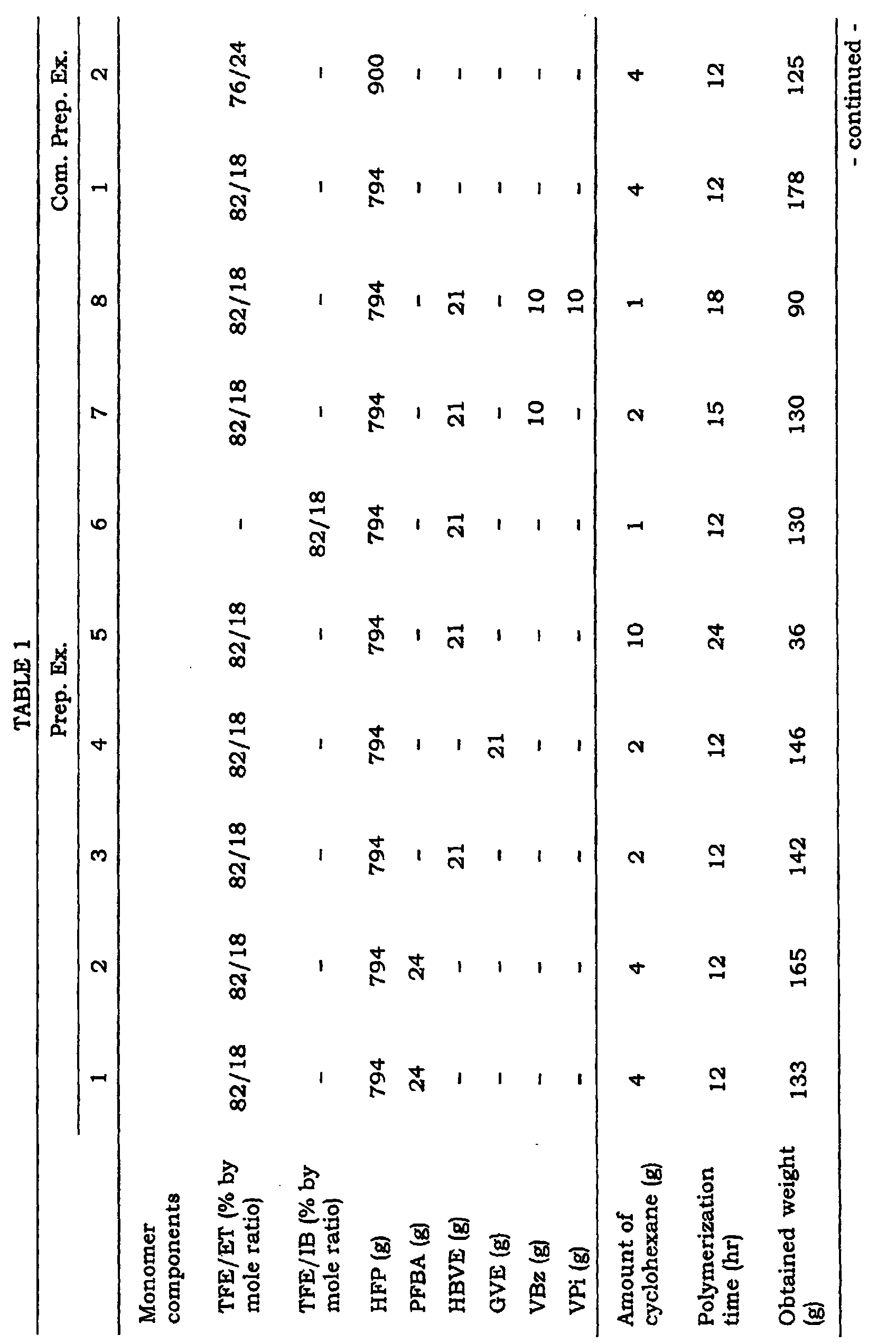
The results are shown in Table 1.
PREPARATION EXAMPLES 2 to 8 and
COMPARATIVE PREPARATION EXAMPLES 1 to 2
Polymerization was carried out in the same manner as in
Preparation Example 1 except that monomers, amount of cyclohexane
and polymerization time were changed as shown in Table 1. The same
measurements as in Preparation Example 1 were carried out with
respect to the obtained fluorine-containing copolymer. The results are
shown in Table 1.
Abbreviations in Table 1 represent the following compounds.
COMPARATIVE PREPARATION EXAMPLE 3
A 1-liter pressure resistant reactor was charged with 523 g of
t-butanol (t-BA), 53 g of cyclohexyl vinyl ether (CHVE), 30 g of isobutyl
vinyl ether (IBVE), 83 g of hydroxybutyl vinyl ether (HBVE), 3.3 g of
potassium carbonate and 0.23 g of azobisisobutylonitrile, followed by
solidifying with liquid nitrogen and deairing to remove dissolved oxygen.
After that, 167 g of pressurized CTFE was introduced and the reactor
was heated up to continue a reaction at 65°C over 10 hours. Then after
cooling, residual monomer was distilled off, a solution was collected and
a dispersion medium was distilled off at 60°C under reduced pressure to
give a resin. This resin dissolved in THF. A glass transition
temperature and MFR thereof were 24°C and 116, respectively.
EXAMPLE 1
100 Gram of fluorine-containing copolymer having
crosslinkable functional group which was obtained in Preparation
Example 1, 4 g of triglycidyl isocyanurate (TGIC available from Rhom &
Haas Co., Ltd.), 15 g of titanium oxide, 0.5 g of flowability control agent
(MODAFLOW available from Monsanto Chemical Co., Ltd.) and 0.5 g of
benzoin were dry-blended at 25°C for 15 minutes with Henschel mixer to
give a uniform mixture. The mixture was melt-kneaded at 100°C for
one minute with Buss Co-kneader (available from Buss Co., Ltd.),
extruded into a sheet and then pelletized. Then 20 g of pellets was
pulverized at room temperature (about 20°C) for five minutes with Micro
Hammer Mill (available from IKA Co., Ltd.). The obtained powder was
passed through a 200 mesh screen for classification to give a powder
coating composition having an average particle size of 50 µm.
EXAMPLES 2 to 8 and COMPARATIVE EXAMPLES 1 to 3
Powder coating compositions were obtained in the same
manner as in Example 1 except that fluorine-containing copolymer and
curing agent were changed as shown in Table 2.
With respect to those powder coating compositions, an effect
of a remaining other resin on the composition was determined in the
manner mentioned below.
To 100 g each of the powder coating compositions of
Examples 1 to 8 and Comparative Examples 1 to 3, was mixed 0.5 g of
polyester resin powder (FINEDIC M-8026 available from Dai-Nippon Ink
Co., Ltd.) having an average particle size of 50 µm. Then the
compositions were coated on a 0.3 mm thick JIS 2003 A 714 chemical
conversion-treated aluminum sheet at an applied voltage of 60 kV with a
corona discharge type powder coating gun (GX3300 available from
Onoda Cement Kabushiki Kaisha), and then immediately baked at
180°C for 20 minutes to give a coated article.
Appearance of the coated article was observed with naked
eyes. The results are shown in Table 2.
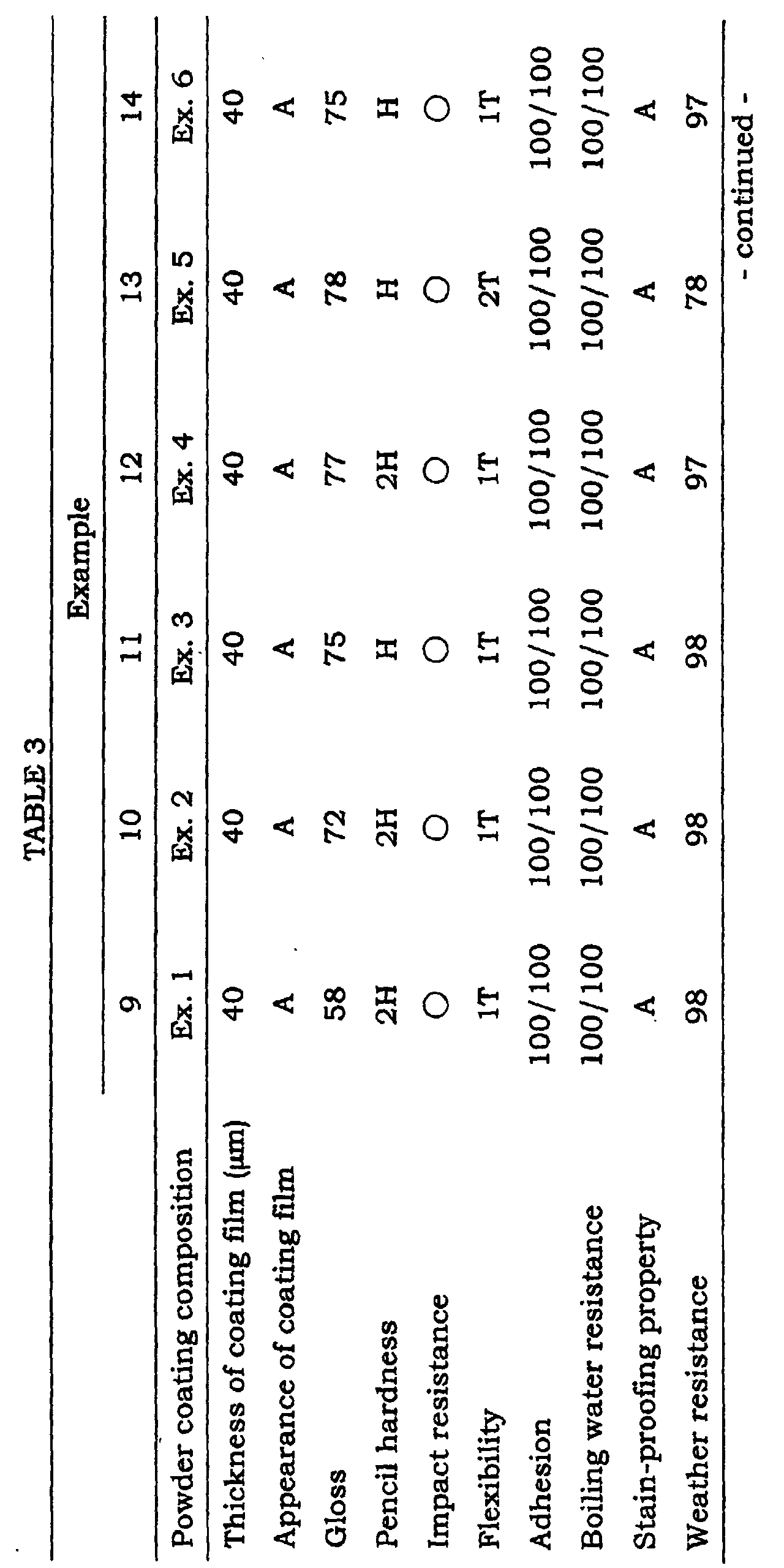
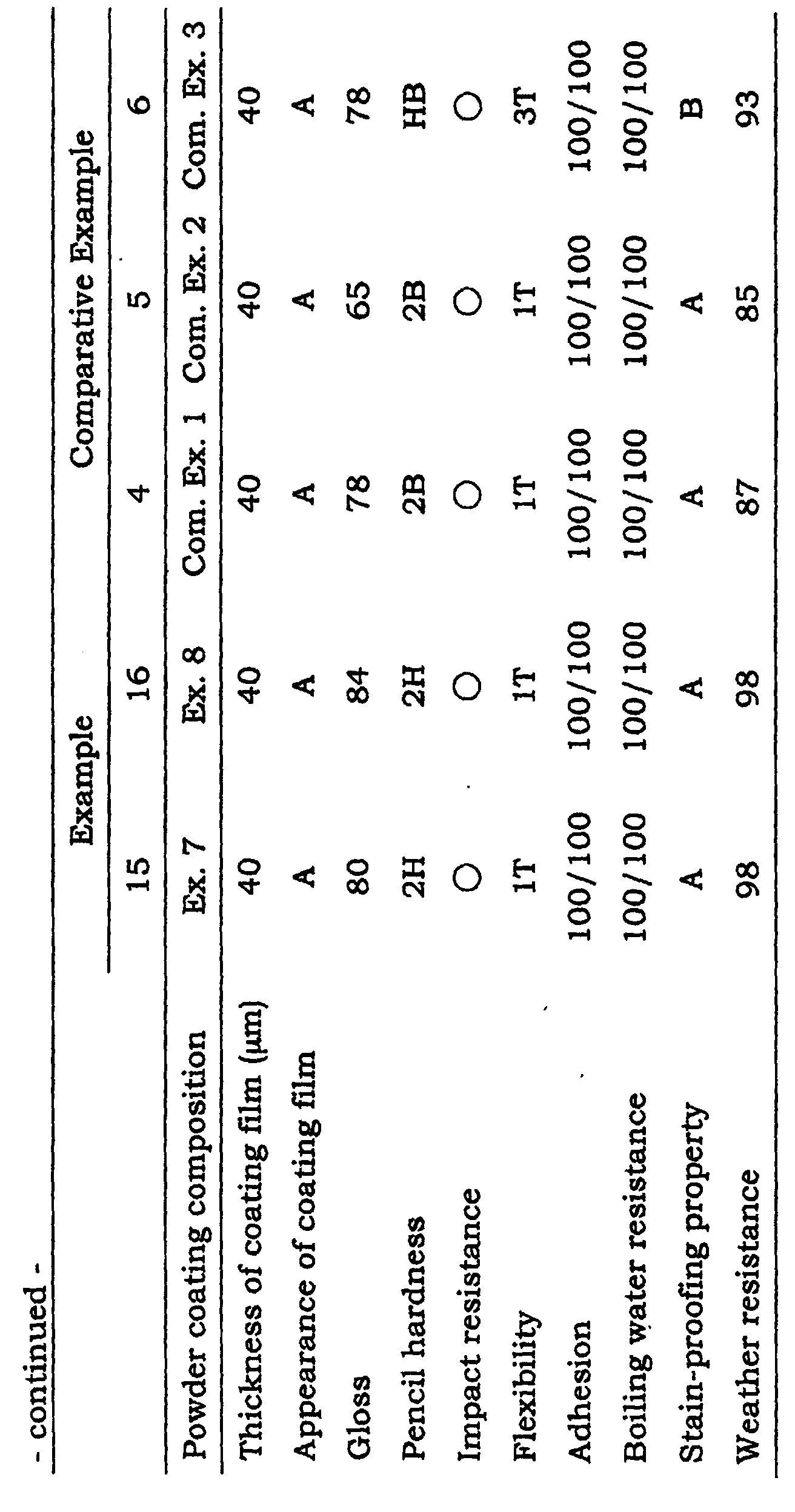
The powder coating compositions shown in Table 3 were
coated on a 0.3 mm thick JIS 2003 A 714 chemical conversion-treated
aluminum sheet at an applied voltage of 60 kV with a corona discharge
type powder coating gun (GX3300 available from Onoda Cement
Kabushiki Kaisha), and then immediately baked at 180°C for 20 minutes
to give a coated article.
The following characteristics of the coated article were
determined. The results are shown in Table 3.
(Thickness of coating film)
Coating thickness is measured with an eddy-current
instrument EL10D for measuring a coating thickness (available from
Kabushiki Kaisha Sanko Denshi Kenkyusho).
(Appearance of coating film)
Fluorescent light is emitted to the coated article and a shape
of the light reflected on the surface of the coating film is evaluated with
naked eyes.
(Gloss)
A specular gloss at an angle of 60 degrees is measured
according to JIS K 5400-6.7.
(Pencil hardness)
A pencil hardness is measured according to JIS K 5400.
(Impact resistance)
After carrying out a falling ball impact test according to
AAMA605, peeling test is conducted and impact resistance is evaluated
under the following criteria.
(Flexibility)
A bending test is carried out according to AAMA605.
(Adhesion)
A cross cut test for adhesion is carried out according to
AAMA605.
(Boiling water resistance)
After a test of dipping in boiling water according to AAMA605,
adhesion is evaluated.
(Stain-proofing property)
An oily ink (red) is applied to the coated plate, and after
allowed to stand at room temperature for 24 hours, is wiped off with a
cloth impregnated with ethanol. Stain-proofness is evaluated with a
color difference ΔE before and after the test under the following criteria.
(Weather resistance)
A gloss retention is measured after a lapse of 2,000 hours by
using an accelerated weather resistance tester (sunshine weather-o-meter).
When the powder coating composition of the present
invention is used, a coating line can be shared with other powder coating
composition, and yet a coated article having a coating film excellent in
physical properties can be provided.