EP1090911A2 - Bis(aminostyryl) anthracene compound, synthesis intermediate thereof, and process for production thereof - Google Patents
Bis(aminostyryl) anthracene compound, synthesis intermediate thereof, and process for production thereof Download PDFInfo
- Publication number
- EP1090911A2 EP1090911A2 EP00121754A EP00121754A EP1090911A2 EP 1090911 A2 EP1090911 A2 EP 1090911A2 EP 00121754 A EP00121754 A EP 00121754A EP 00121754 A EP00121754 A EP 00121754A EP 1090911 A2 EP1090911 A2 EP 1090911A2
- Authority
- EP
- European Patent Office
- Prior art keywords
- group
- saturated
- denotes
- represented
- general formula
- Prior art date
- Legal status (The legal status is an assumption and is not a legal conclusion. Google has not performed a legal analysis and makes no representation as to the accuracy of the status listed.)
- Granted
Links
- 0 *C1C=CC(N(c2ccccc2)c2ccc(*=*c(cc3)cc4c3cc(cc(C=Cc(cc3)ccc3N(c3ccccc3)c3ccc(*)cc3)cc3)c3c4C#N)cc2)=CC1 Chemical compound *C1C=CC(N(c2ccccc2)c2ccc(*=*c(cc3)cc4c3cc(cc(C=Cc(cc3)ccc3N(c3ccccc3)c3ccc(*)cc3)cc3)c3c4C#N)cc2)=CC1 0.000 description 23
- VFSFCYAQBIPUSL-UHFFFAOYSA-N C(C1)C1c1ccccc1 Chemical compound C(C1)C1c1ccccc1 VFSFCYAQBIPUSL-UHFFFAOYSA-N 0.000 description 1
- QMFJIJFIHIDENY-UHFFFAOYSA-N CC1=CC=CCC1 Chemical compound CC1=CC=CCC1 QMFJIJFIHIDENY-UHFFFAOYSA-N 0.000 description 1
- BALPRPNPEFSMBO-UHFFFAOYSA-N CCCCC1=CCCC=C1 Chemical compound CCCCC1=CCCC=C1 BALPRPNPEFSMBO-UHFFFAOYSA-N 0.000 description 1
- ZEZOIRFVLXEXBC-UHFFFAOYSA-N CCN1CCC1 Chemical compound CCN1CCC1 ZEZOIRFVLXEXBC-UHFFFAOYSA-N 0.000 description 1
- WHCKFZOMBDMRLO-UHFFFAOYSA-N CCc1c(CCCC2)c2ccc1 Chemical compound CCc1c(CCCC2)c2ccc1 WHCKFZOMBDMRLO-UHFFFAOYSA-N 0.000 description 1
- GDFJTZFSMFVMKX-UHFFFAOYSA-N Cc1ccc(C2CCCCC2)cc1 Chemical compound Cc1ccc(C2CCCCC2)cc1 GDFJTZFSMFVMKX-UHFFFAOYSA-N 0.000 description 1
- YXFVVABEGXRONW-UHFFFAOYSA-N Cc1ccccc1 Chemical compound Cc1ccccc1 YXFVVABEGXRONW-UHFFFAOYSA-N 0.000 description 1
Images


Classifications
-
- C—CHEMISTRY; METALLURGY
- C07—ORGANIC CHEMISTRY
- C07F—ACYCLIC, CARBOCYCLIC OR HETEROCYCLIC COMPOUNDS CONTAINING ELEMENTS OTHER THAN CARBON, HYDROGEN, HALOGEN, OXYGEN, NITROGEN, SULFUR, SELENIUM OR TELLURIUM
- C07F9/00—Compounds containing elements of Groups 5 or 15 of the Periodic Table
- C07F9/02—Phosphorus compounds
- C07F9/28—Phosphorus compounds with one or more P—C bonds
- C07F9/54—Quaternary phosphonium compounds
- C07F9/5456—Arylalkanephosphonium compounds
-
- C—CHEMISTRY; METALLURGY
- C07—ORGANIC CHEMISTRY
- C07C—ACYCLIC OR CARBOCYCLIC COMPOUNDS
- C07C255/00—Carboxylic acid nitriles
- C07C255/49—Carboxylic acid nitriles having cyano groups bound to carbon atoms of six-membered aromatic rings of a carbon skeleton
- C07C255/52—Carboxylic acid nitriles having cyano groups bound to carbon atoms of six-membered aromatic rings of a carbon skeleton to carbon atoms of six-membered aromatic rings being part of condensed ring systems
-
- C—CHEMISTRY; METALLURGY
- C07—ORGANIC CHEMISTRY
- C07C—ACYCLIC OR CARBOCYCLIC COMPOUNDS
- C07C255/00—Carboxylic acid nitriles
- C07C255/49—Carboxylic acid nitriles having cyano groups bound to carbon atoms of six-membered aromatic rings of a carbon skeleton
- C07C255/58—Carboxylic acid nitriles having cyano groups bound to carbon atoms of six-membered aromatic rings of a carbon skeleton containing cyano groups and singly-bound nitrogen atoms, not being further bound to other hetero atoms, bound to the carbon skeleton
-
- C—CHEMISTRY; METALLURGY
- C07—ORGANIC CHEMISTRY
- C07C—ACYCLIC OR CARBOCYCLIC COMPOUNDS
- C07C255/00—Carboxylic acid nitriles
- C07C255/49—Carboxylic acid nitriles having cyano groups bound to carbon atoms of six-membered aromatic rings of a carbon skeleton
- C07C255/58—Carboxylic acid nitriles having cyano groups bound to carbon atoms of six-membered aromatic rings of a carbon skeleton containing cyano groups and singly-bound nitrogen atoms, not being further bound to other hetero atoms, bound to the carbon skeleton
- C07C255/59—Carboxylic acid nitriles having cyano groups bound to carbon atoms of six-membered aromatic rings of a carbon skeleton containing cyano groups and singly-bound nitrogen atoms, not being further bound to other hetero atoms, bound to the carbon skeleton the carbon skeleton being further substituted by singly-bound oxygen atoms
-
- C—CHEMISTRY; METALLURGY
- C07—ORGANIC CHEMISTRY
- C07F—ACYCLIC, CARBOCYCLIC OR HETEROCYCLIC COMPOUNDS CONTAINING ELEMENTS OTHER THAN CARBON, HYDROGEN, HALOGEN, OXYGEN, NITROGEN, SULFUR, SELENIUM OR TELLURIUM
- C07F9/00—Compounds containing elements of Groups 5 or 15 of the Periodic Table
- C07F9/02—Phosphorus compounds
- C07F9/28—Phosphorus compounds with one or more P—C bonds
- C07F9/38—Phosphonic acids [RP(=O)(OH)2]; Thiophosphonic acids ; [RP(=X1)(X2H)2(X1, X2 are each independently O, S or Se)]
- C07F9/40—Esters thereof
- C07F9/4003—Esters thereof the acid moiety containing a substituent or a structure which is considered as characteristic
- C07F9/4025—Esters of poly(thio)phosphonic acids
Definitions
- the present invention relates to a bis(aminostyryl)anthracene compound, a synthesis intermediate thereof, and a process for production thereof, the anthracene compound being suitable for use as an organic luminescent material which emits light of desired color.
- R a and R b may be identical or different, each denoting a hydrogen atom, saturated or unsaturated hydrocarbon group, aryl group which may have a substituent, cyano group, halogen atom, nitro group, or alkoxyl group.
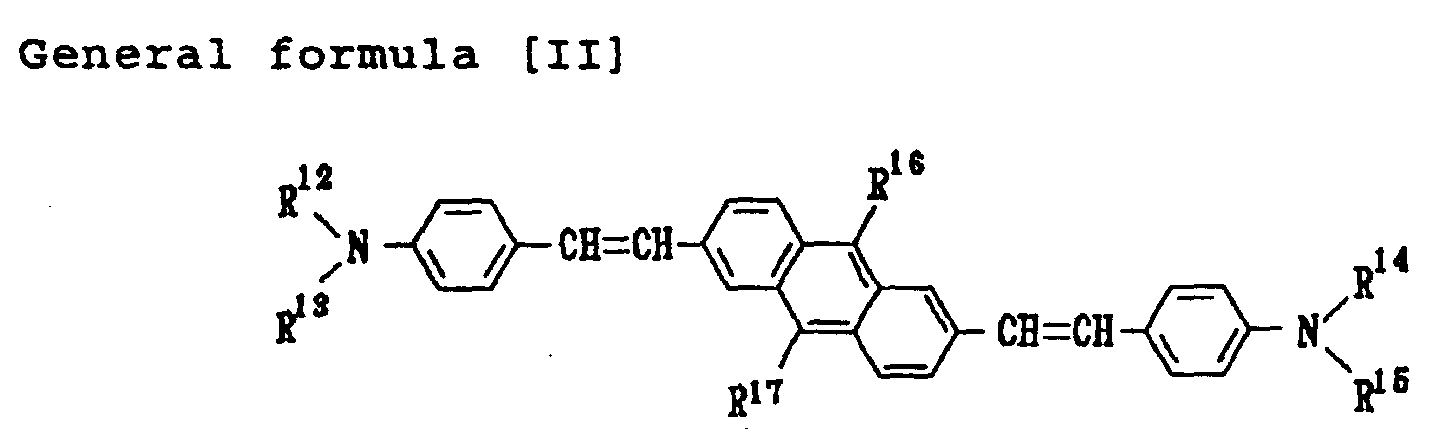
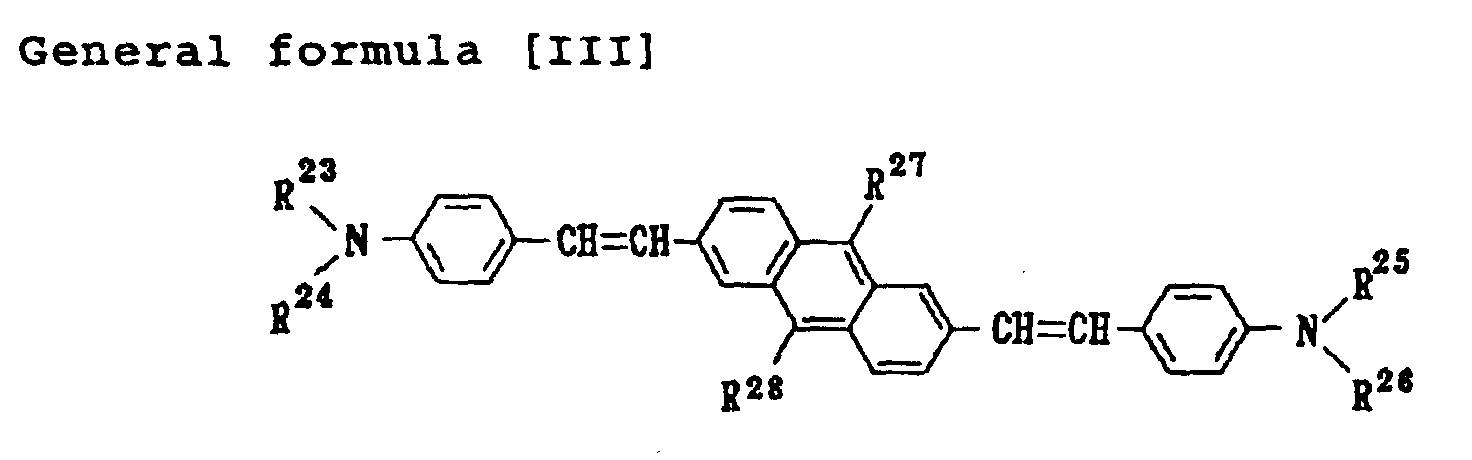
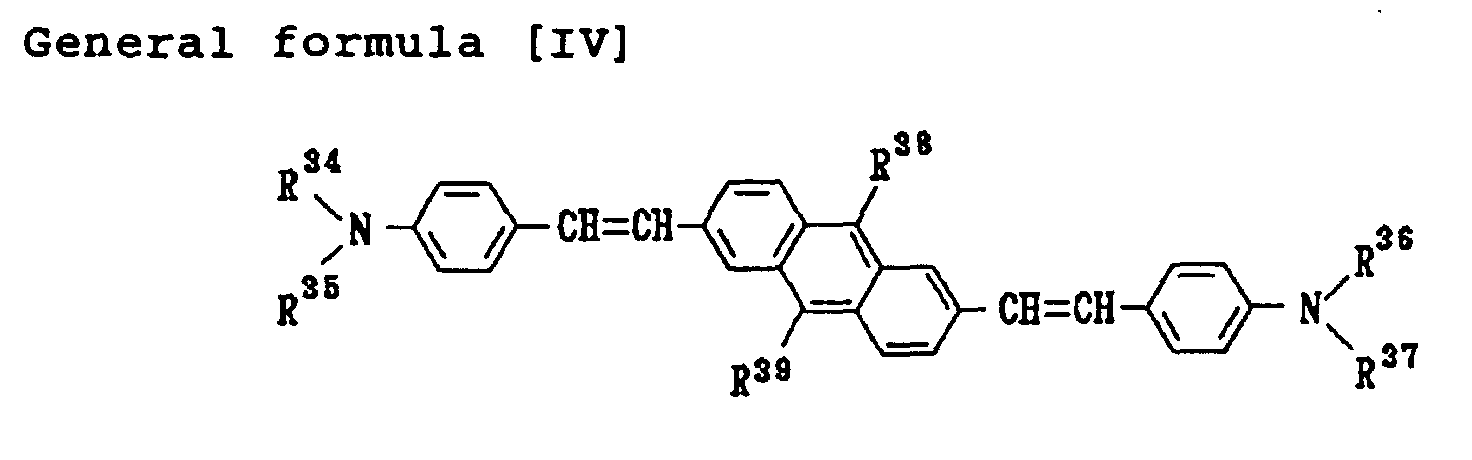
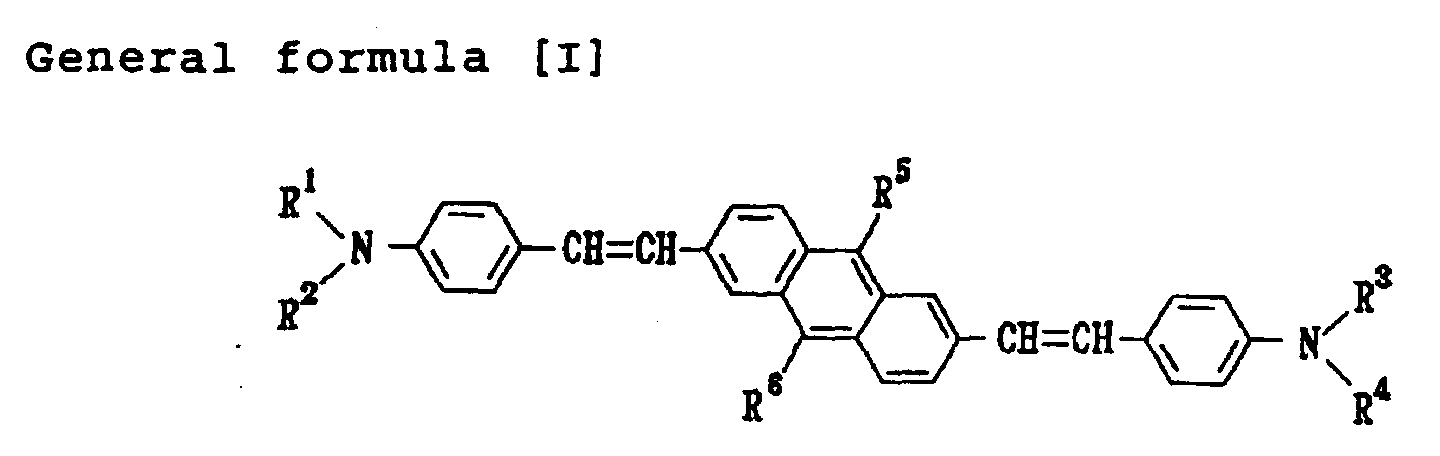
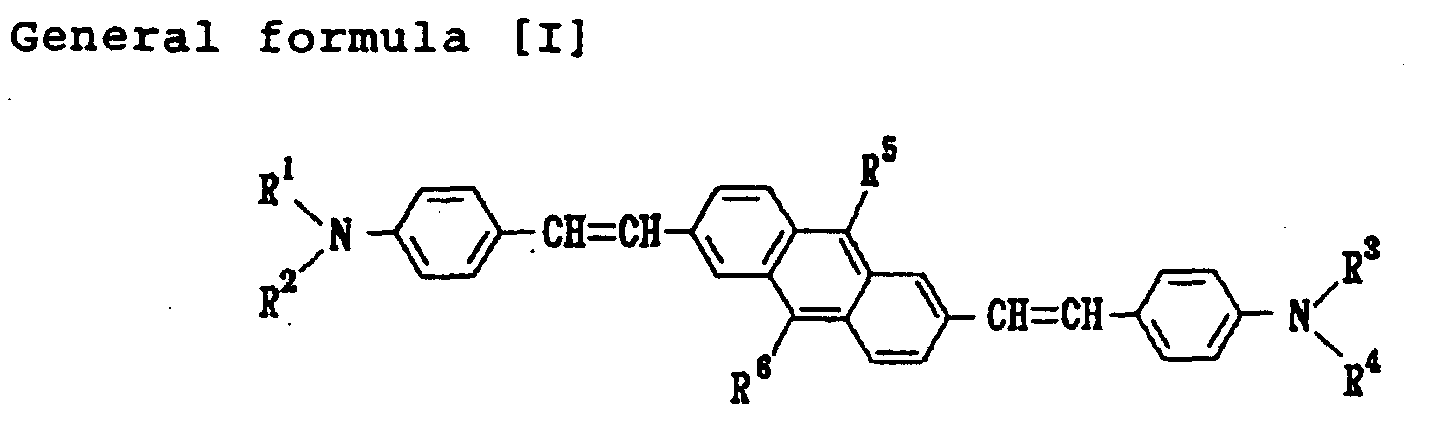
- the present inventors carried out extensive studies to solve the above-mentioned problems. As the result, it was found that a bis(aminostyryl)anthracene compound represented by the general formula [I], [II], [III], or [IV] below emits intense light and hence can be used as a luminescent material for yellow to red colors. In addition, the present inventors established a process for its efficient production. These findings led to the present invention.
- the present invention is directed to a bis(aminostyryl)anthracene compound represented by the general formula [I], [II], [III], or [IV] below.
- This compound will be referred to as "the compound of the present invention” hereinafter.
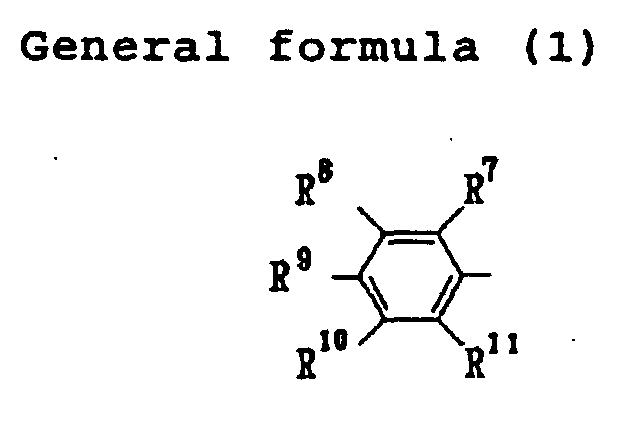
- R 2 and R 3 each denotes an unsubstituted aryl group, and R 1 and R 4 each denotes an aryl group represented by the general formula (1) below.
- R 7 , R 8 , R 9 , R 10 , and R 11 are identical or different groups, at least one of them being a saturated or unsaturated hydrocarbon oxy group or hydrocarbon group having at least one carbon; and R 5 and R 6 are identical or different groups, at least one of them being a hydrogen atom, cyano group, nitro group, trifluoromethyl group, or halogen atom (such as F, Cl, Br, and I.) [The definition of halogen atom shall be applied hereinafter.]
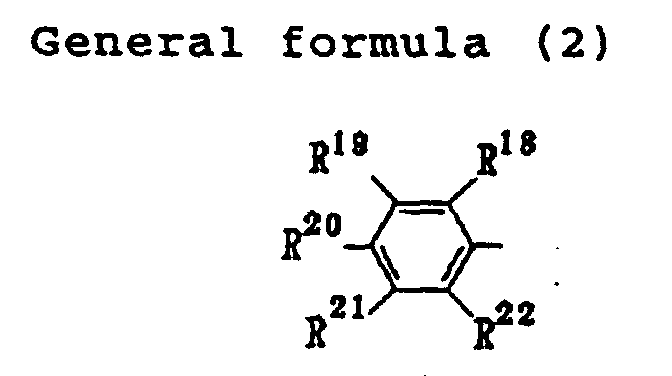
- R 12 , R 13 , R 14 , and R 15 are identical or different groups, each denoting an aryl group represented by the general formula (2) below.
- R 18 , R 19 , R 20 , R 21 , and R 22 are identical or different groups, at least one of them being a saturated
- the compound of the present invention can be effectively used as an organic luminescent material which emits light ranging from yellow to red in color.
- it has a high glass transition point and a high melting point. It is electrically, thermally, and chemically stable. It readily assumes an amorphous glass state and hence it permits vapor deposition.
- the compound of the present invention should preferably be one which is represented by the general formula (6) below.
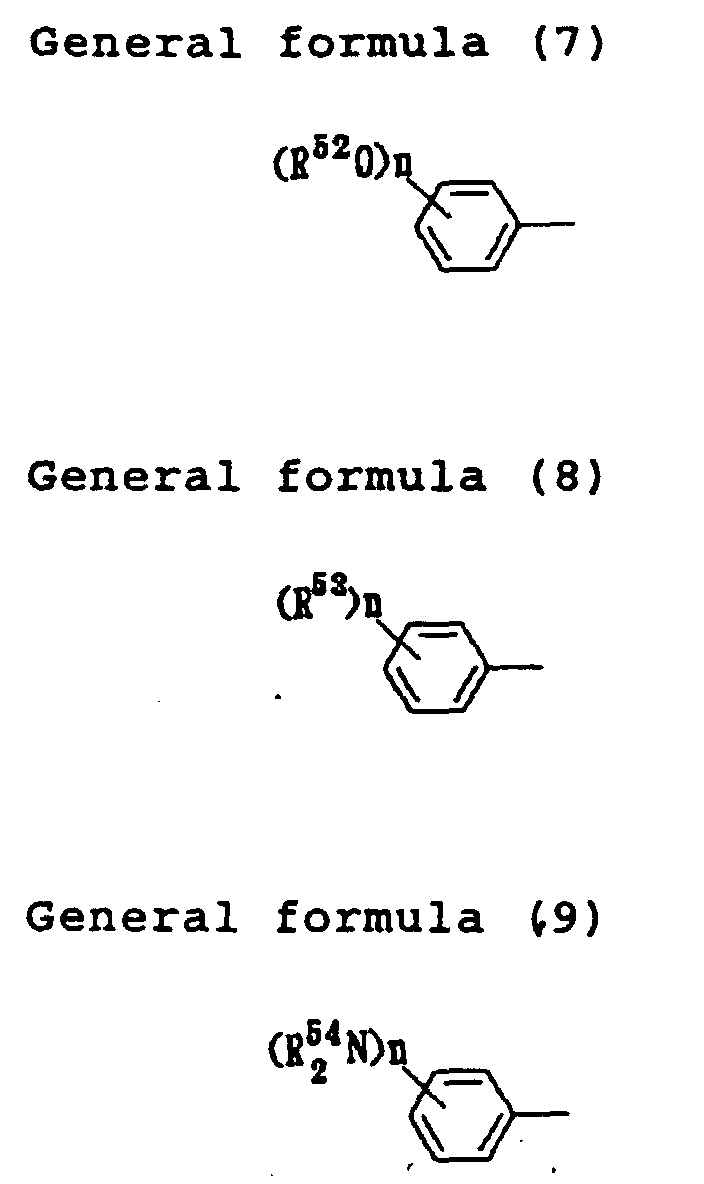
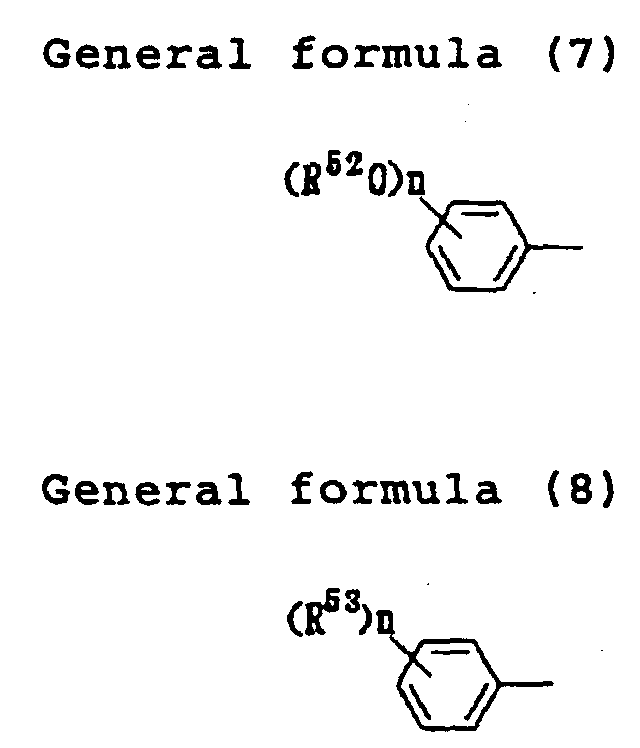
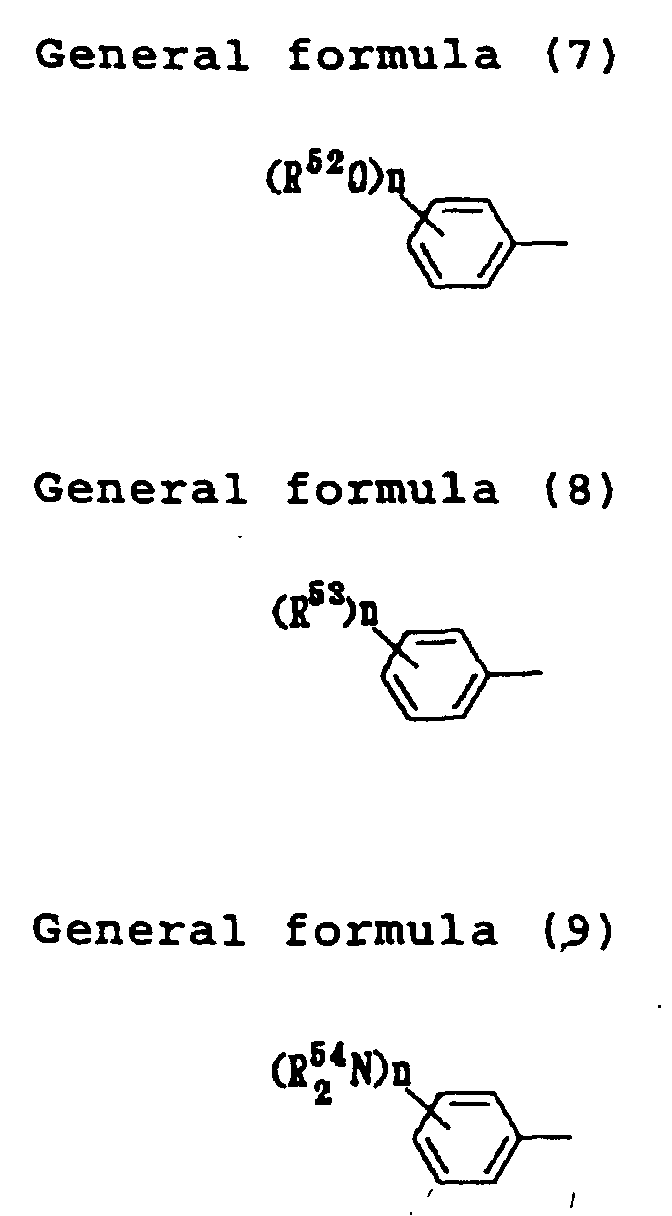
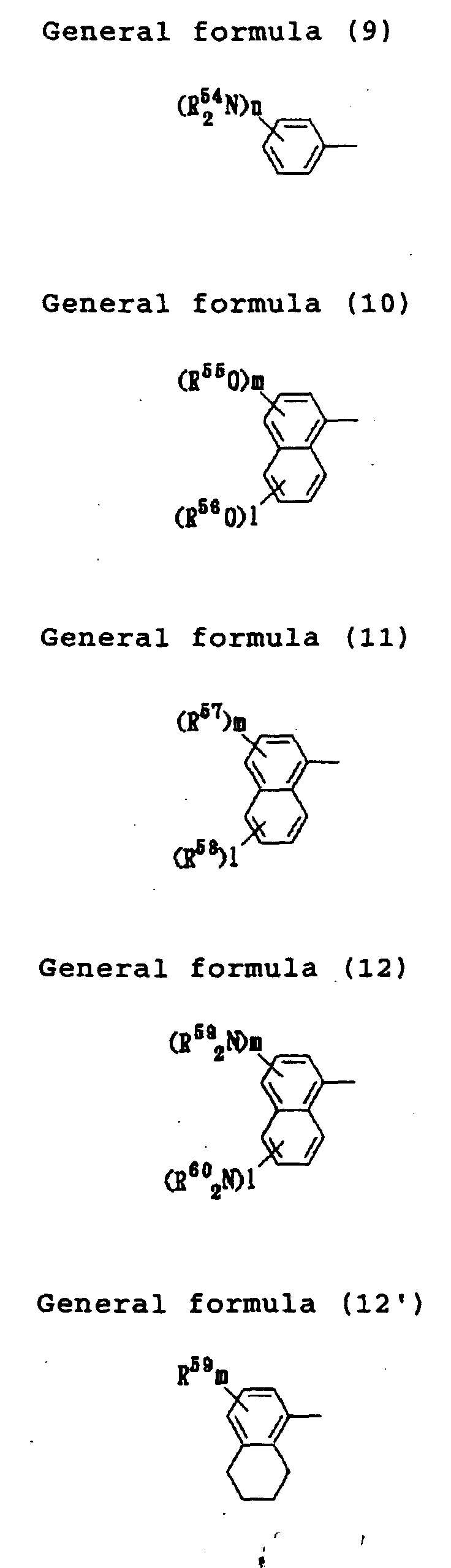
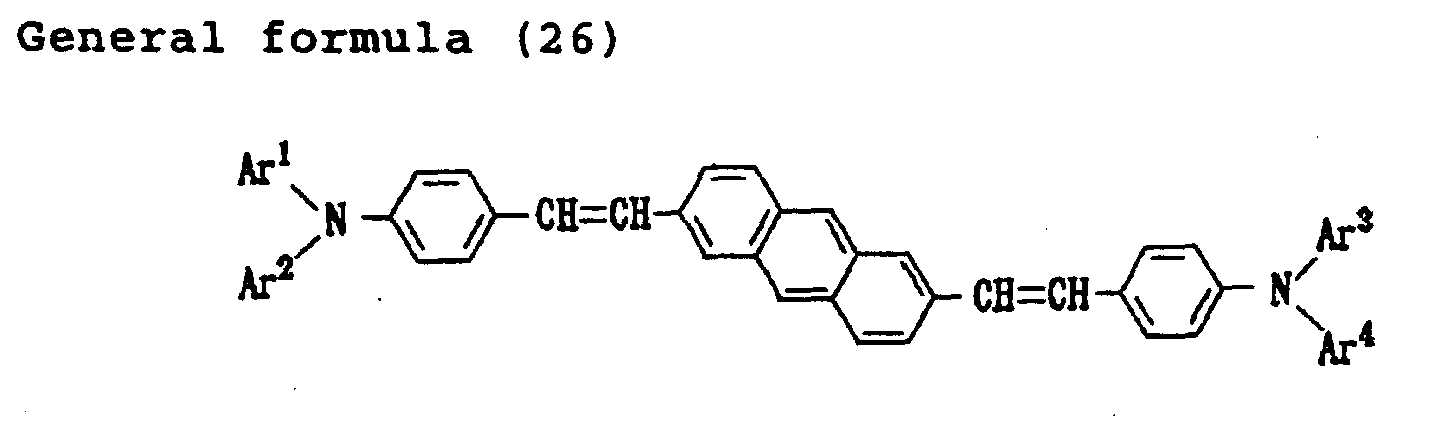
- Ar 1 , Ar 2 , Ar 3 , and Ar 4 are identical or different, each denoting an aryl group which may have a substituent, and if a substituent is present, the aryl group being one which is selected from aryl groups represented by the general formula (7), (8), (9), (10), (11), (12), (12'), or (12'') below.
- R 52 , R 53 , and R 54 each denotes a saturated or unsaturated hydrocarbon group having one or more carbons (preferably 6 or less carbons, an unsubstituted group has 0 carbon, the same shall apply hereinafter);
- R 55 , R 56 , R 57 , R 58 , R 59 , and R 60 are identical or different, each denoting a saturated or unsaturated hydrocarbon group having one or more carbons (preferably 6 or less carbons, an unsubstituted group has 0 carbon, the same shall apply hereinafter);
- n is an integer of 0 to 6;
- m is an integer of 0 to 3; and
- l is an integer of 0 to 4.
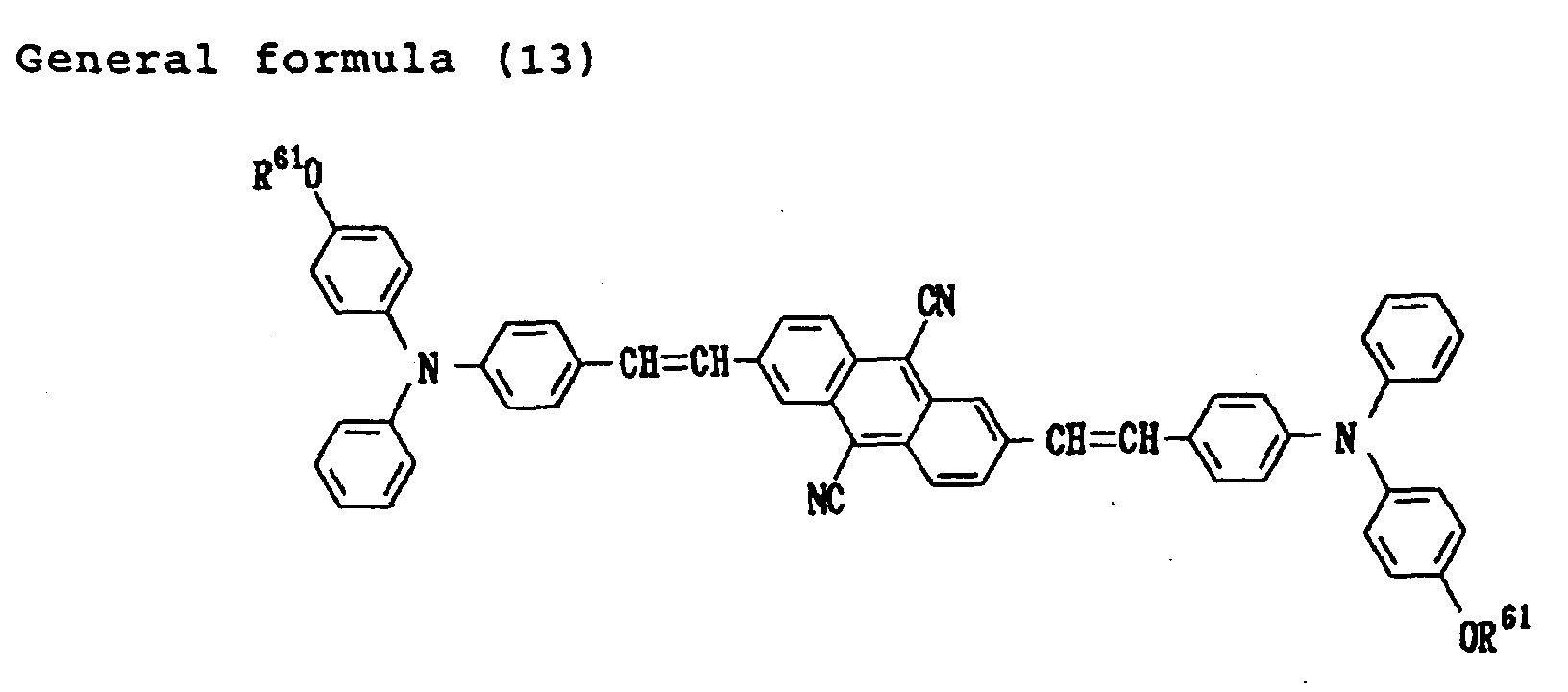
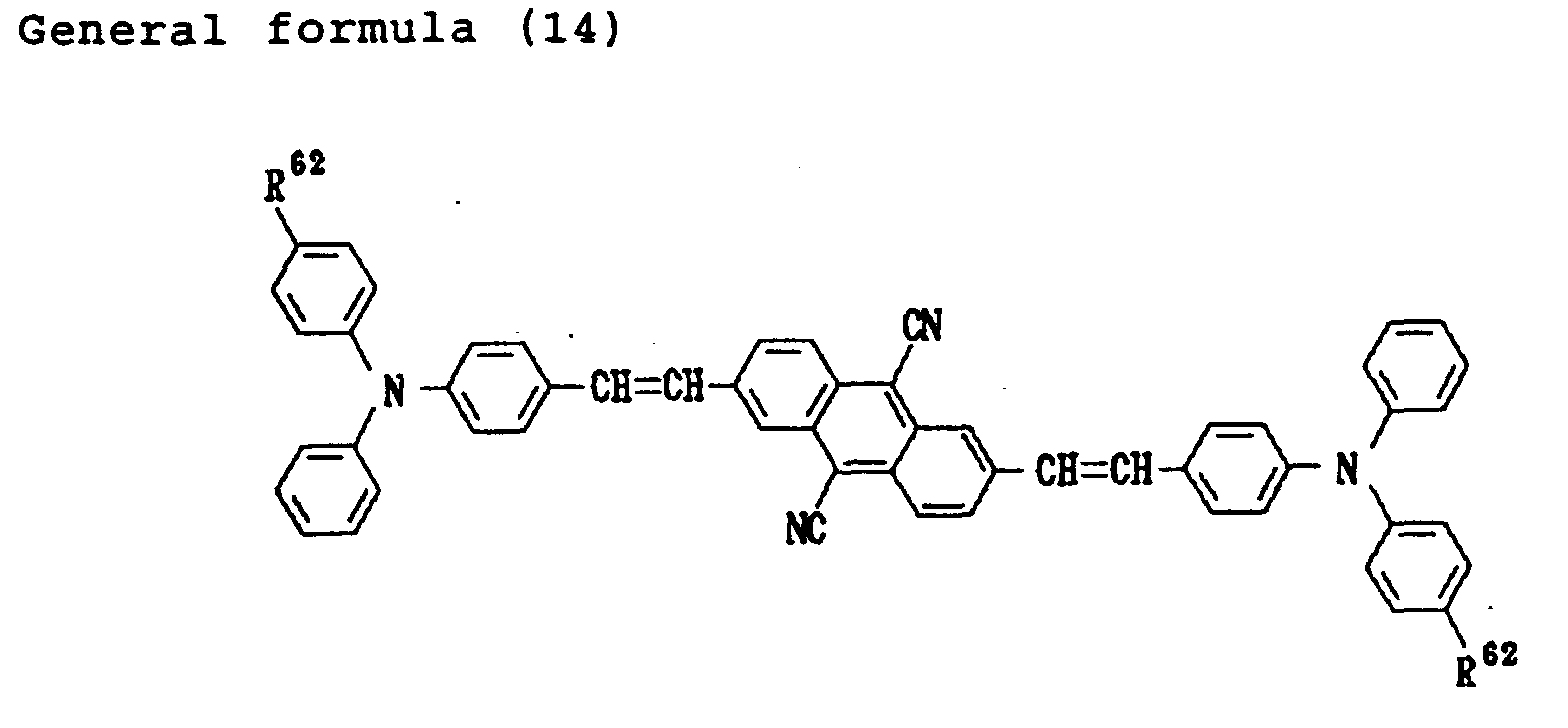
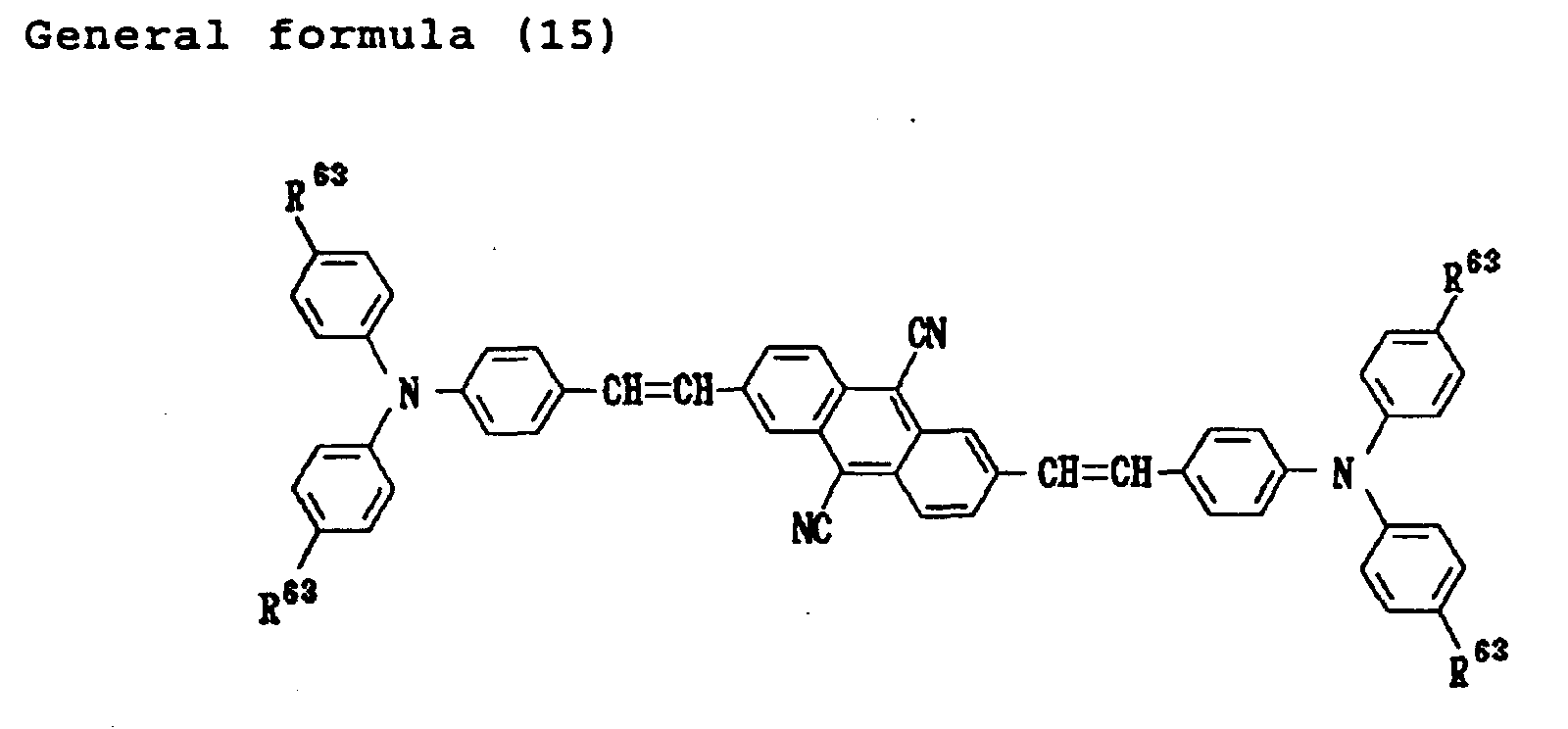
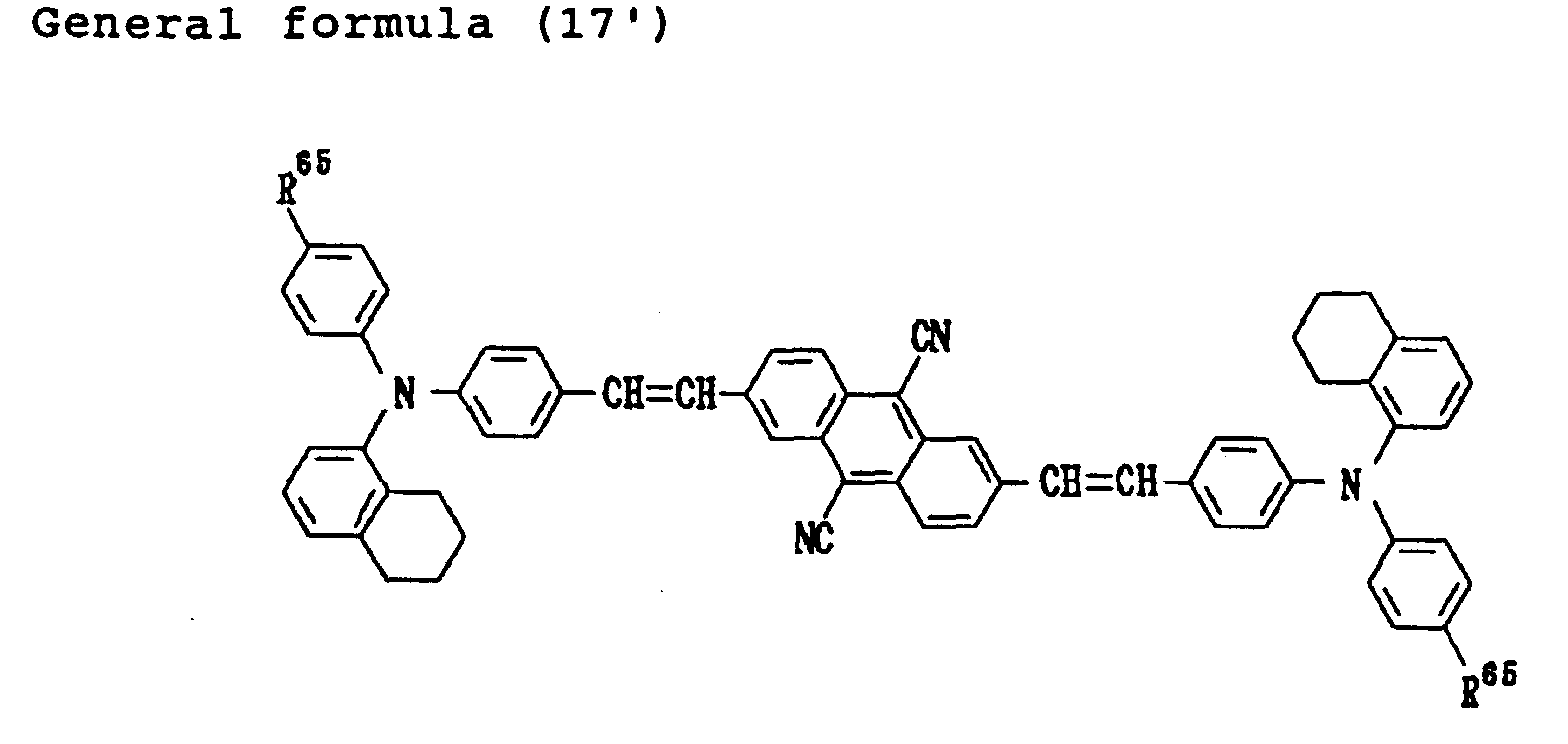
- the compound of the present invention should preferably be one which is represented by the general formula (13), (14), (15), (16), (17), (17'), or (17'') below.
- R 61 denotes a saturated or unsaturated hydrocarbon group having 1 to 6 carbon atoms.
- R 62 denotes a saturated or unsaturated hydrocarbon group having 1 to 6 carbon atoms.
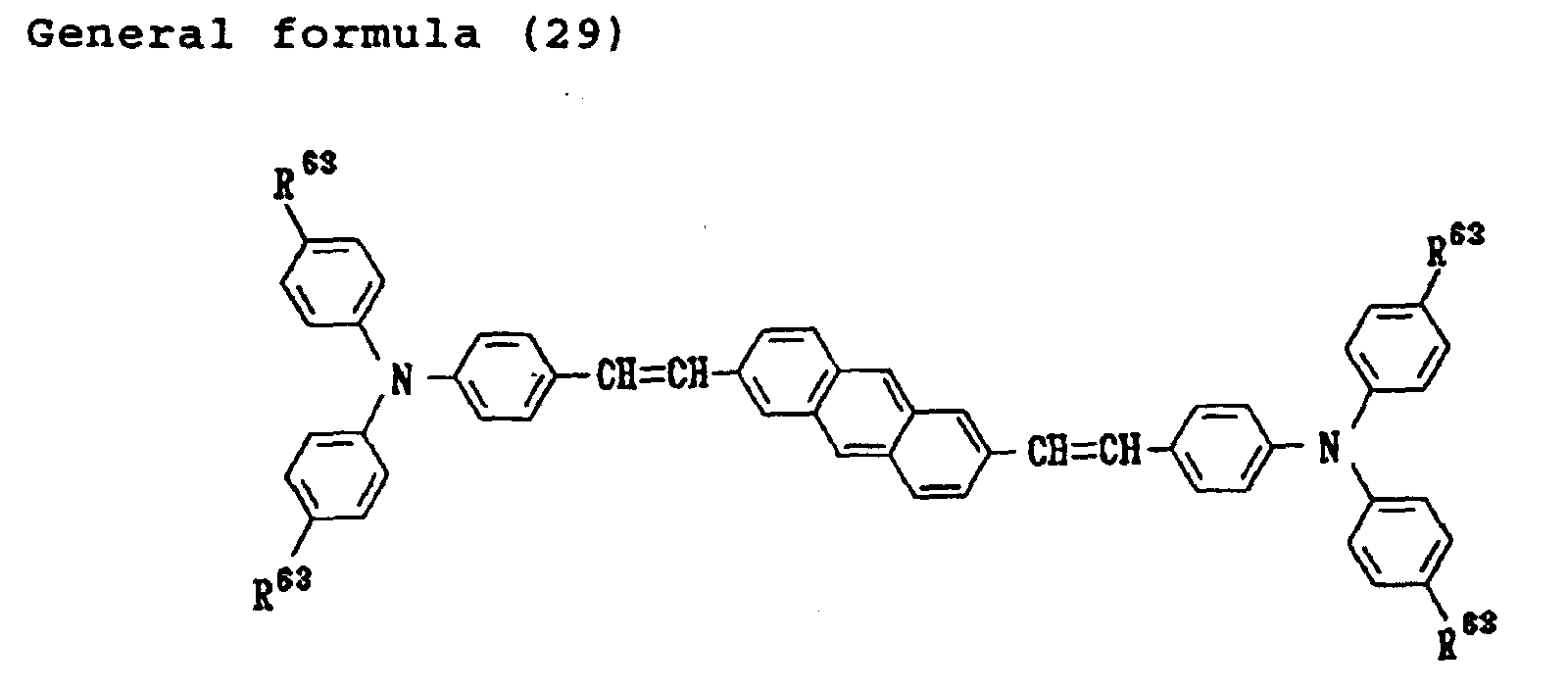
- R 63 denotes a saturated or unsaturated hydrocarbon group or hydrocarbon oxy group having 1 to 6 carbon atoms.
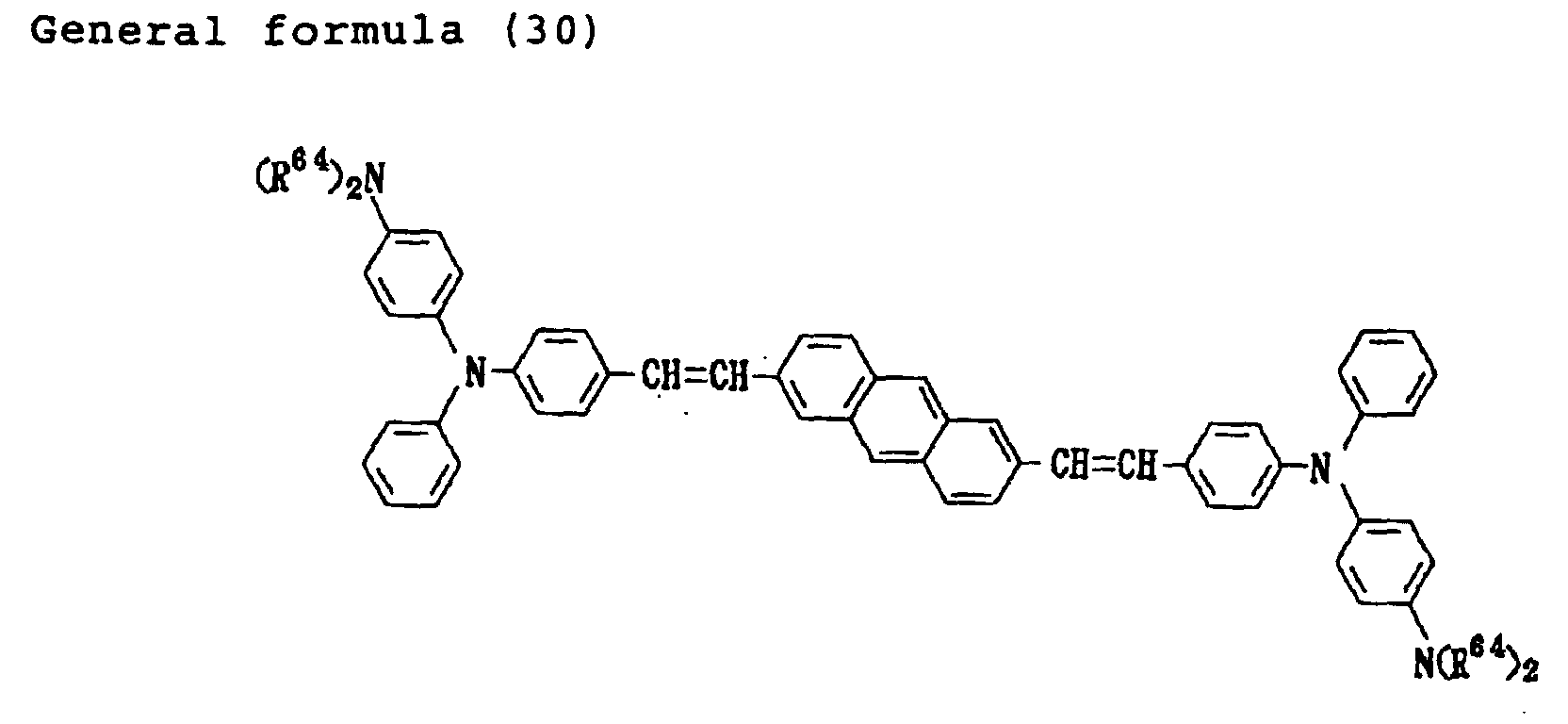
- R 64 denotes a saturated or unsaturated hydrocarbon group having 1 to 6 carbon atoms.
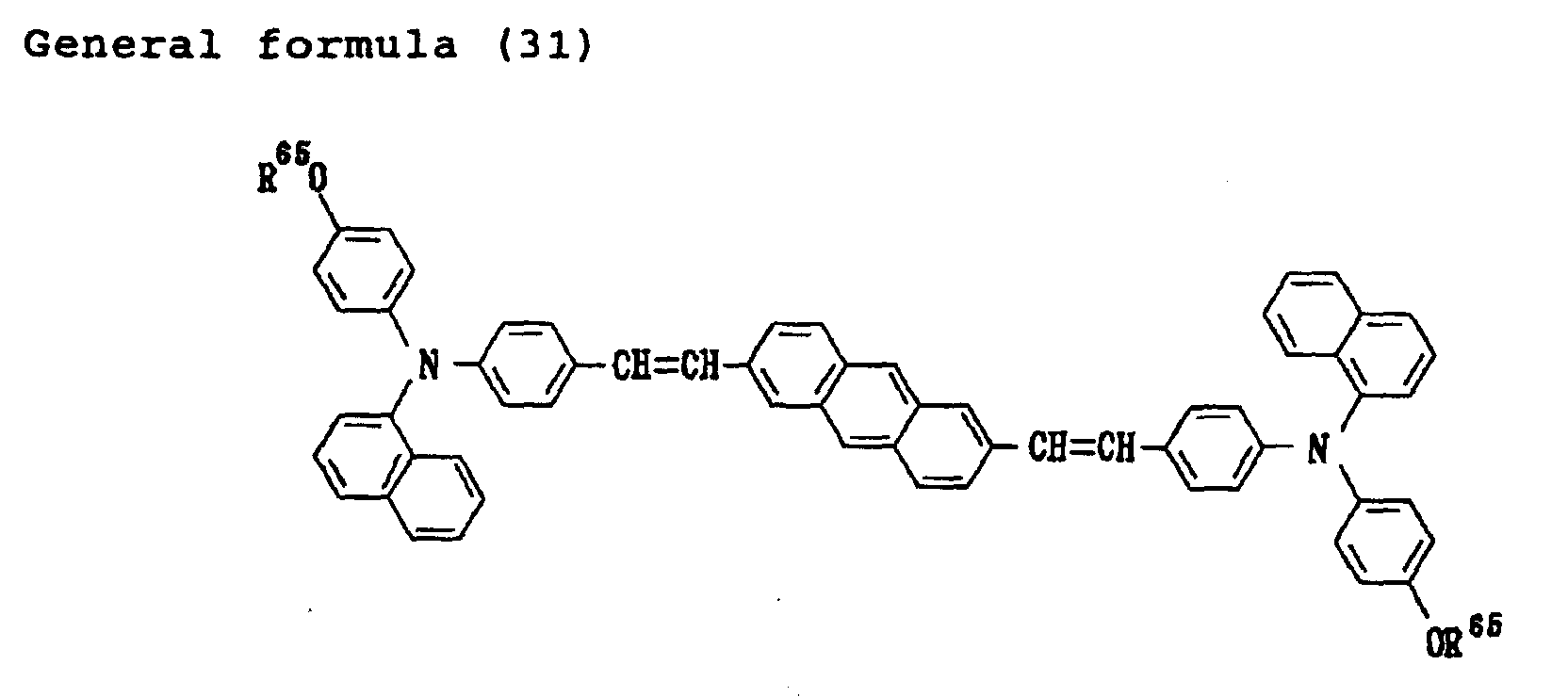
- R 65 denotes a saturated or unsaturated hydrocarbon group having 1 to 6 carbon atoms.
- R 65 denotes a saturated or unsaturated hydrocarbon group having 1 to 6 carbon atoms.
- R 65 denotes a saturated or unsaturated hydrocarbon group having 1 to 6 carbon atoms.
- R 65 denotes a saturated or unsaturated hydrocarbon group having 1 to 6 carbon
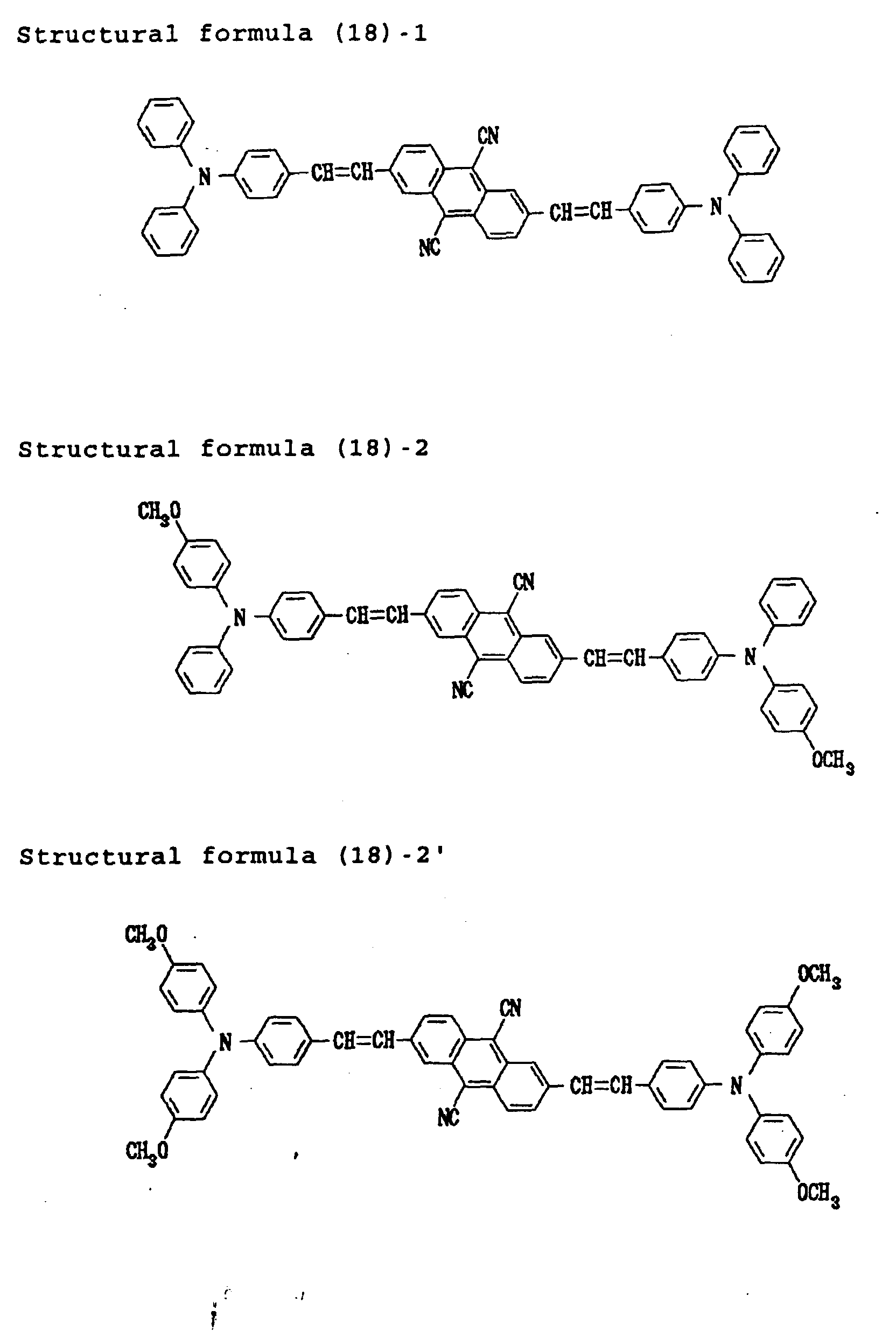
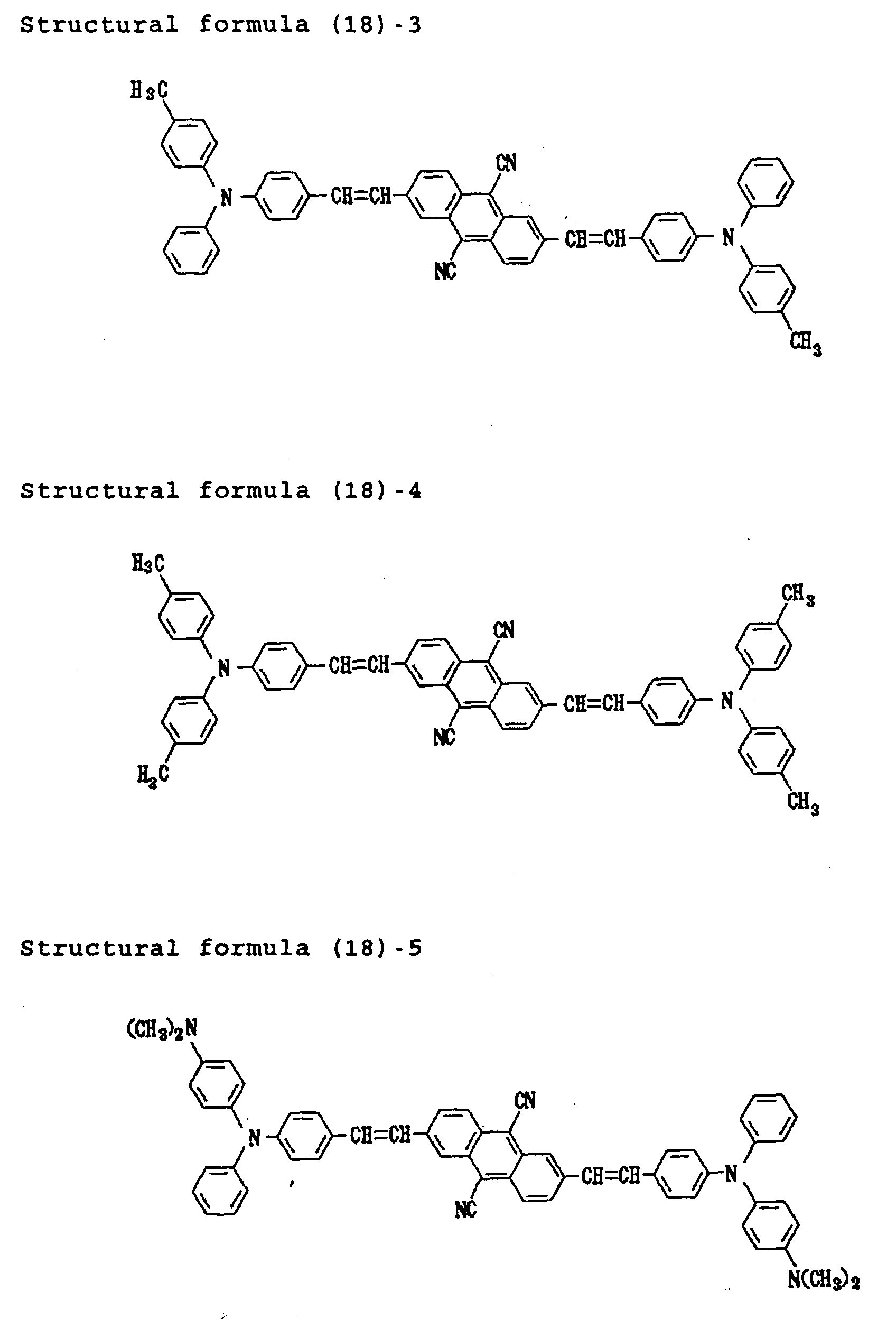
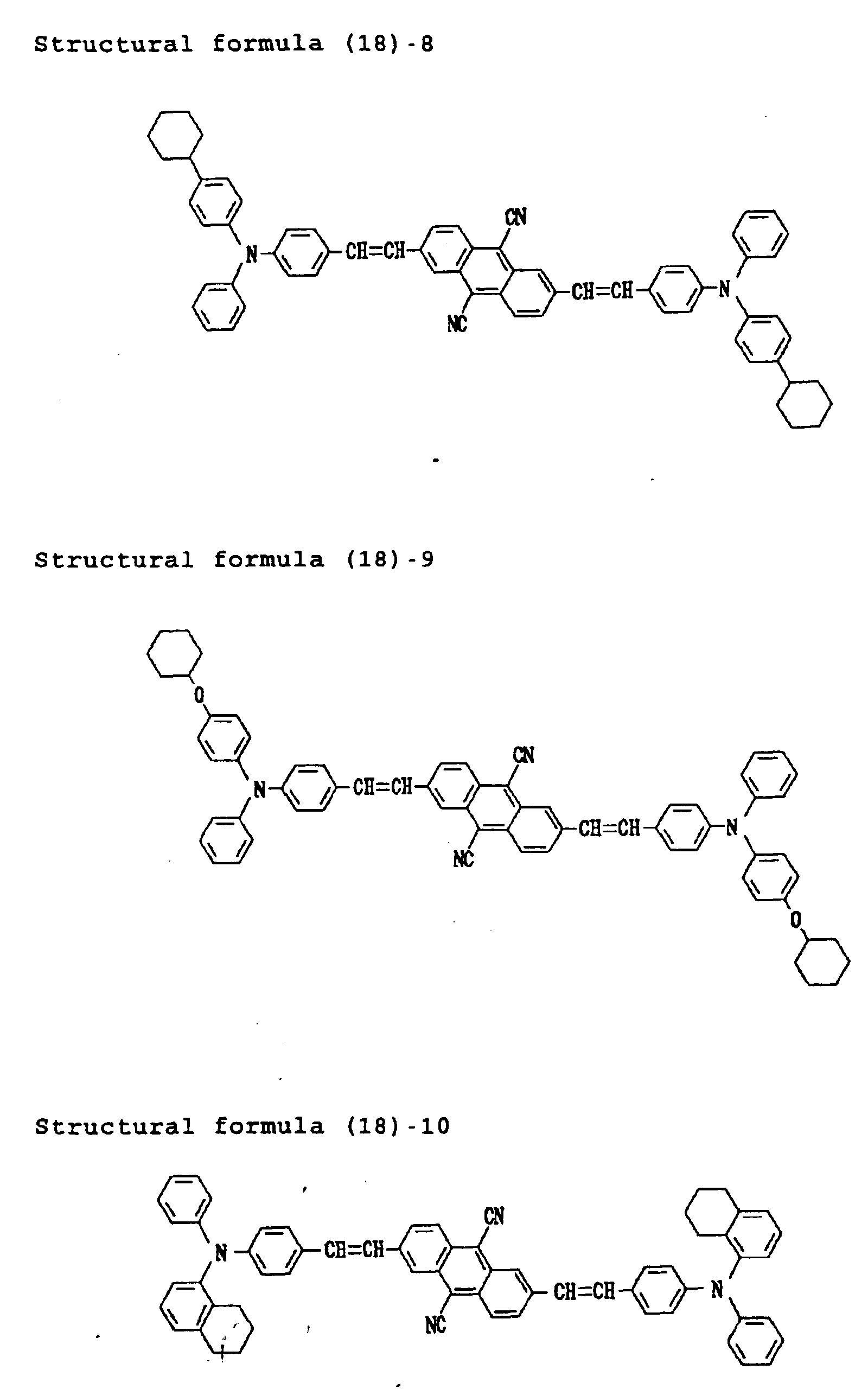
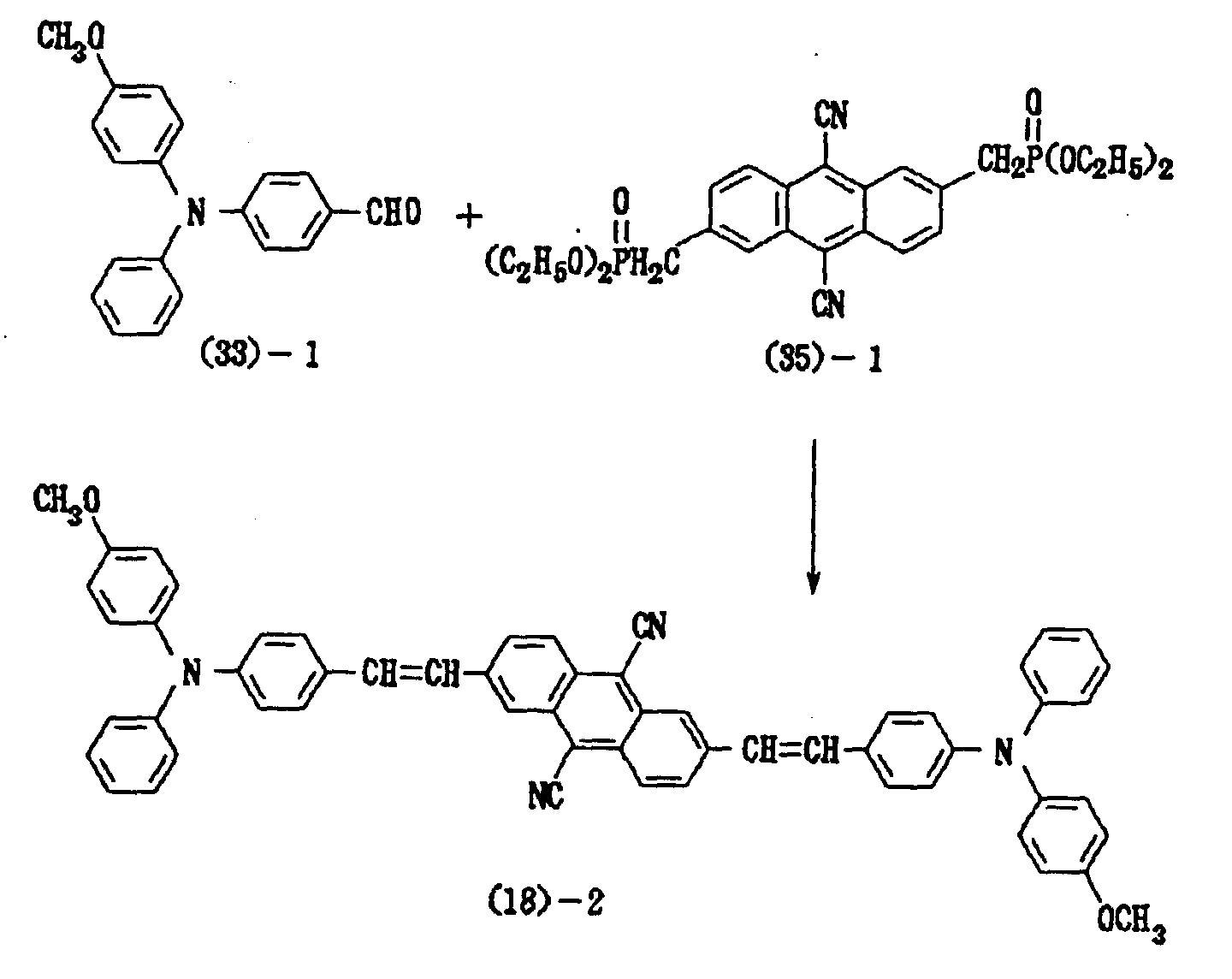
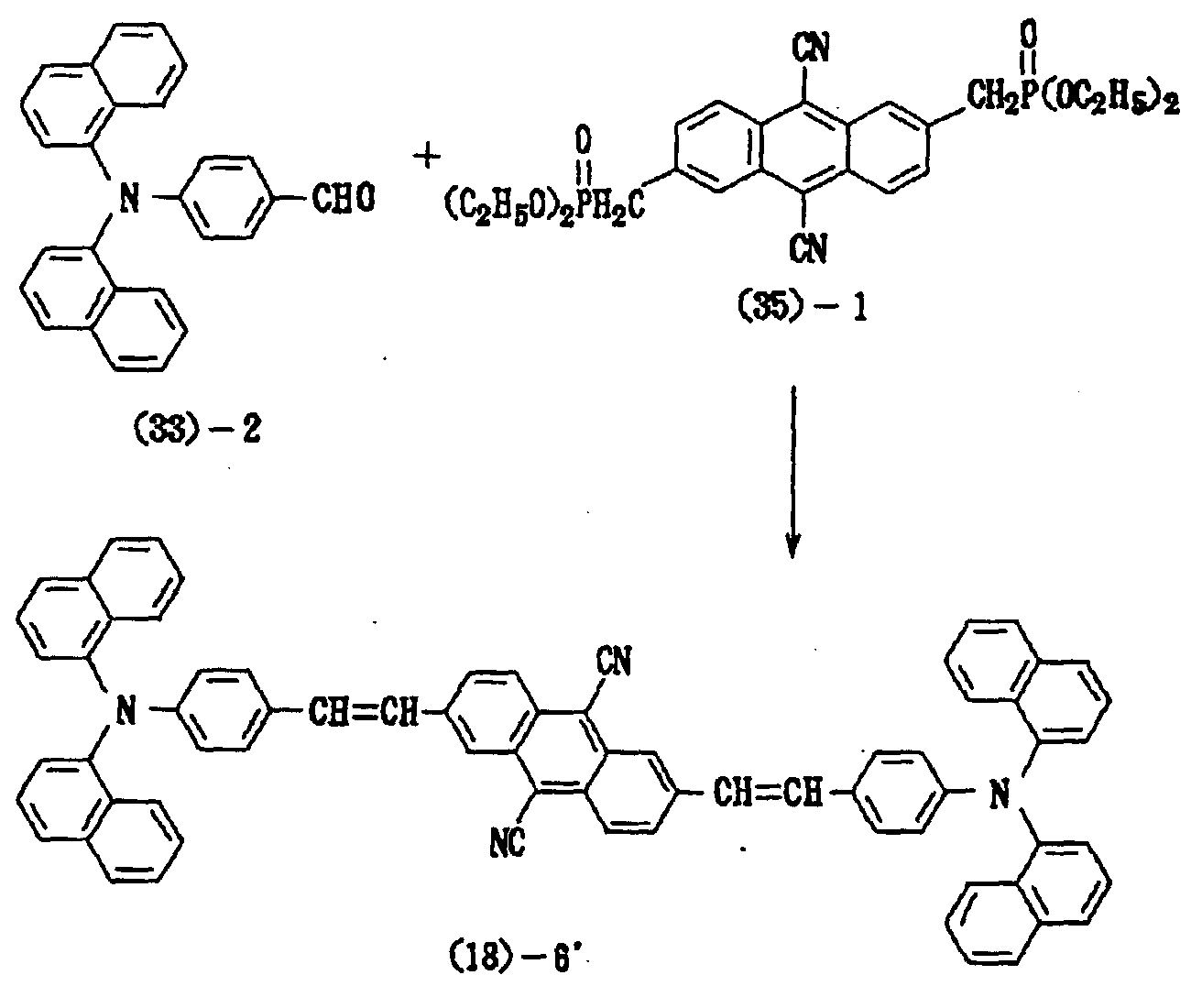
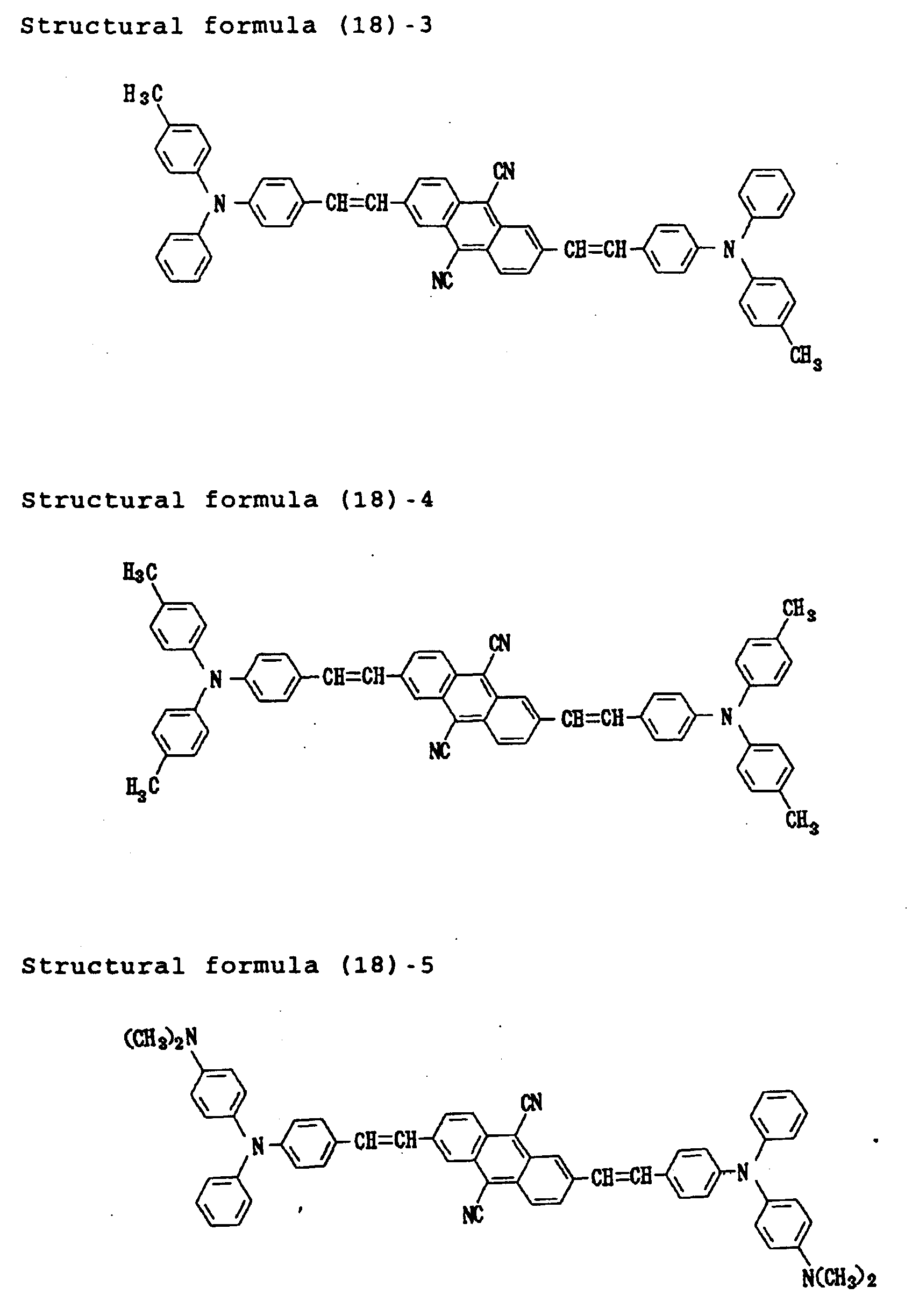
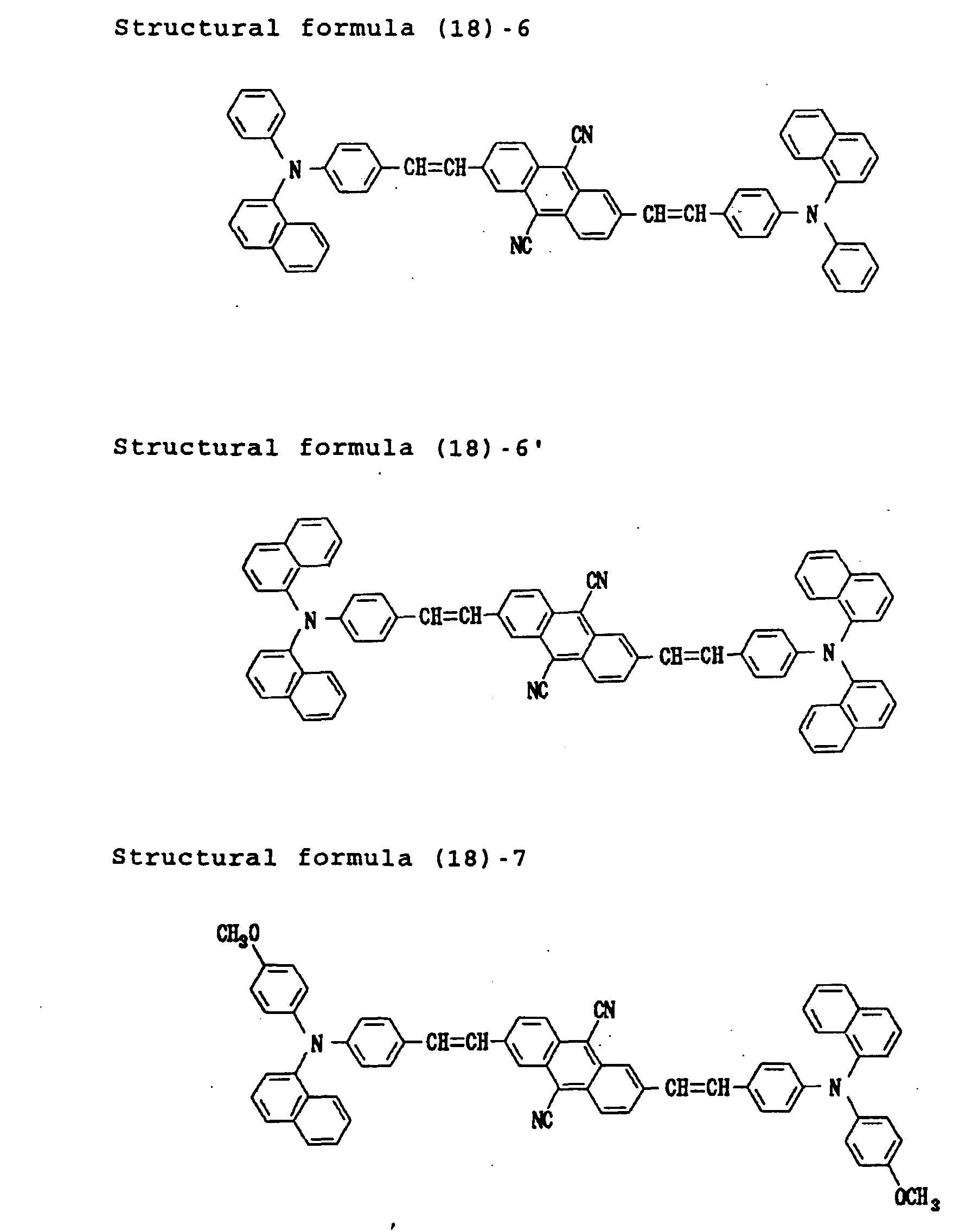
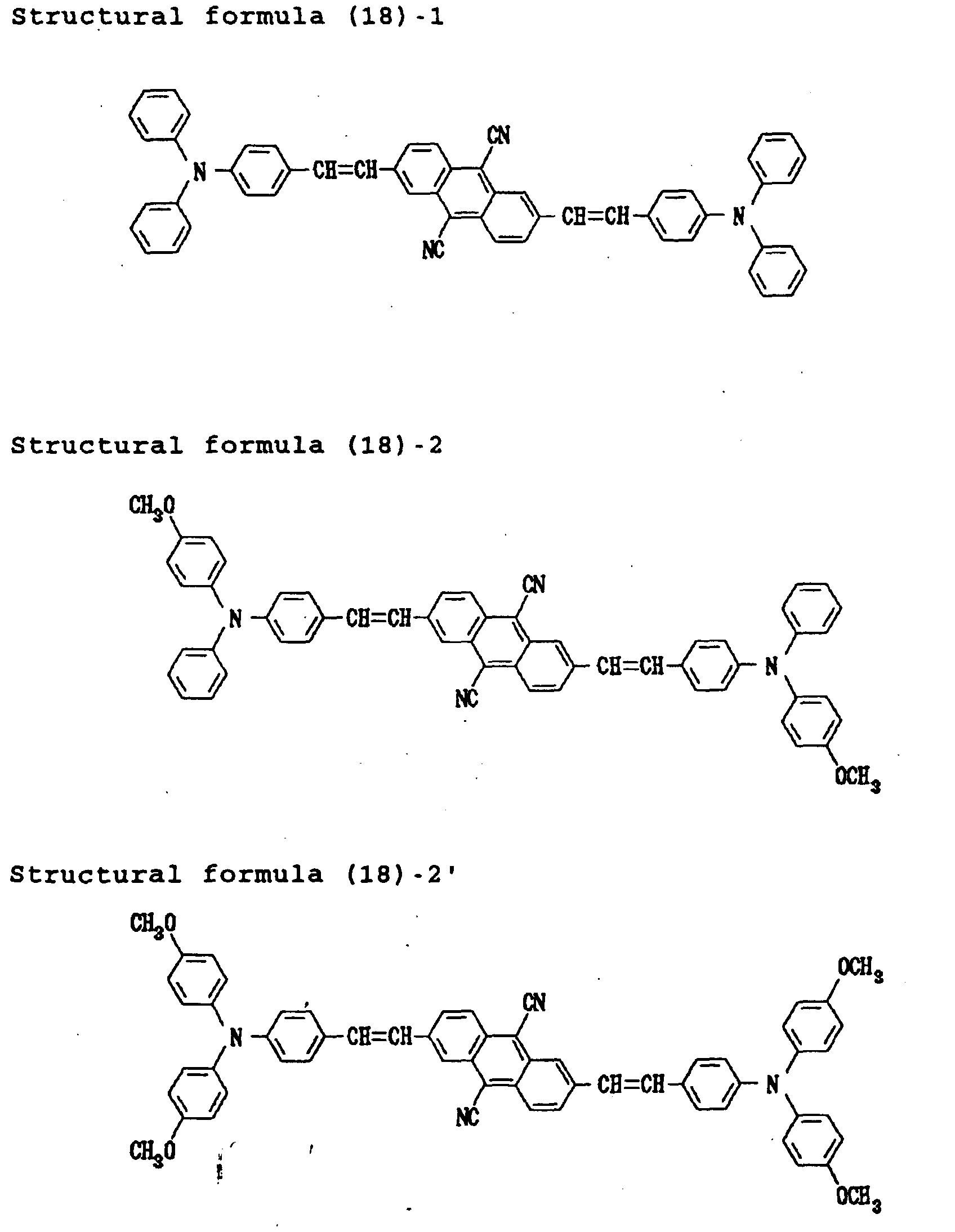
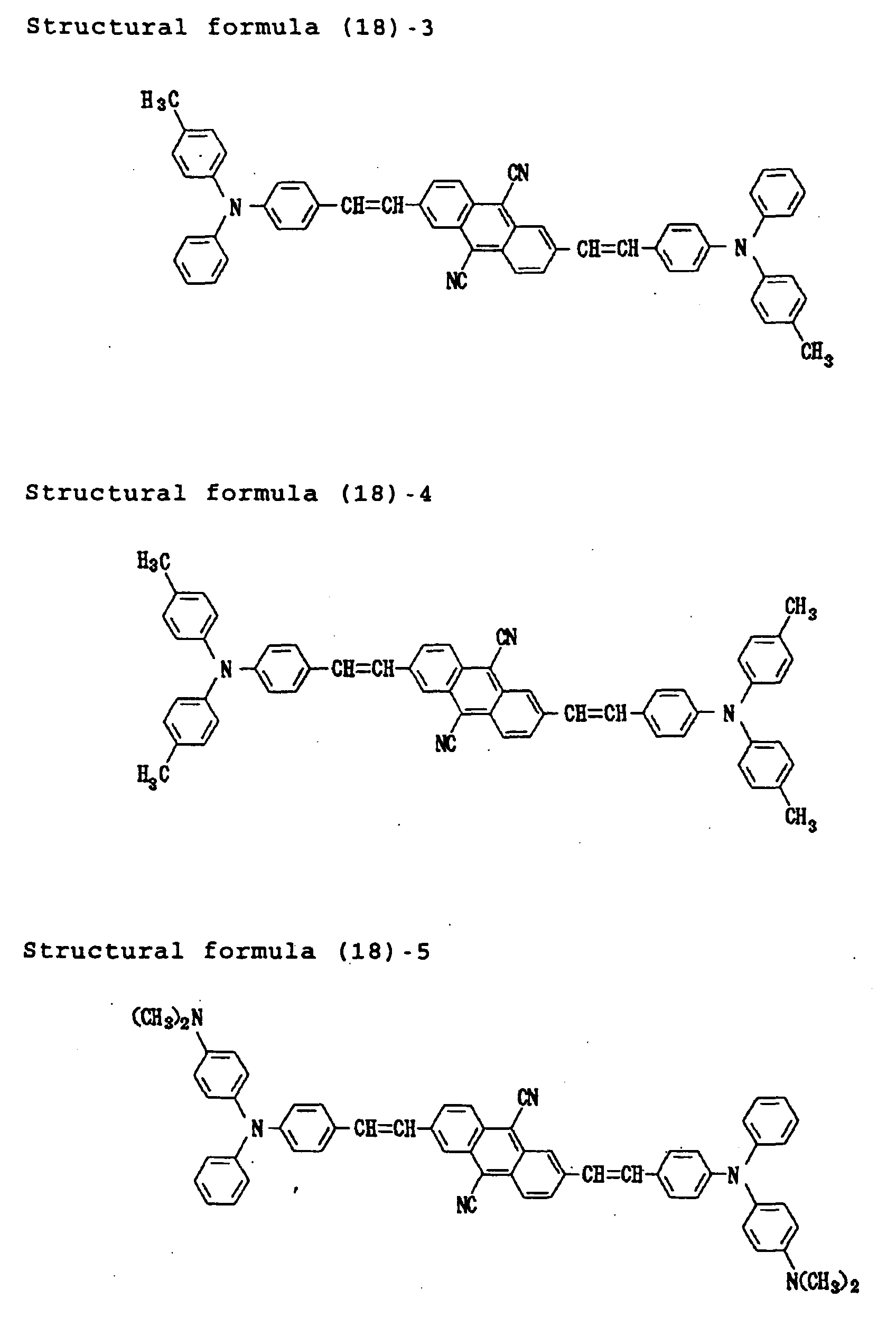
- the compound of the present invention is exemplified by those which are represented by the structural formula (18)-1, (18)-2, (18)-2', (18)-3, (18)-4, (18)-5, (18)-6, (18)-6', (18)-7, (18)-8, (18)-9, (18)-10, (18)-10', (18)-10'', or (18)-11 below.
- the compound of the present invention should preferably be one which is represented by the general formula below.
- Ar 1 , Ar 2 , Ar 3 , and Ar 4 are identical or different, each denoting an aryl group which may have a substituent, and if a substituent is present, the aryl group being one which is selected from aryl groups represented by the general formula (7), (8), (9), (10), (11), (12), (12'), or (12'') below.
- R 52 , R 53 , and R 54 each denotes a saturated or unsaturated hydrocarbon group having one or more carbons; R 55 , R 56 , R 57 , R 58 , R 59 , and R 60 are identical or different, each denoting a saturated or unsaturated hydrocarbon group having one or more carbons; n is an integer of 0 to 6; m is an integer of 0 to 3; and l is an integer of 0 to 4.)
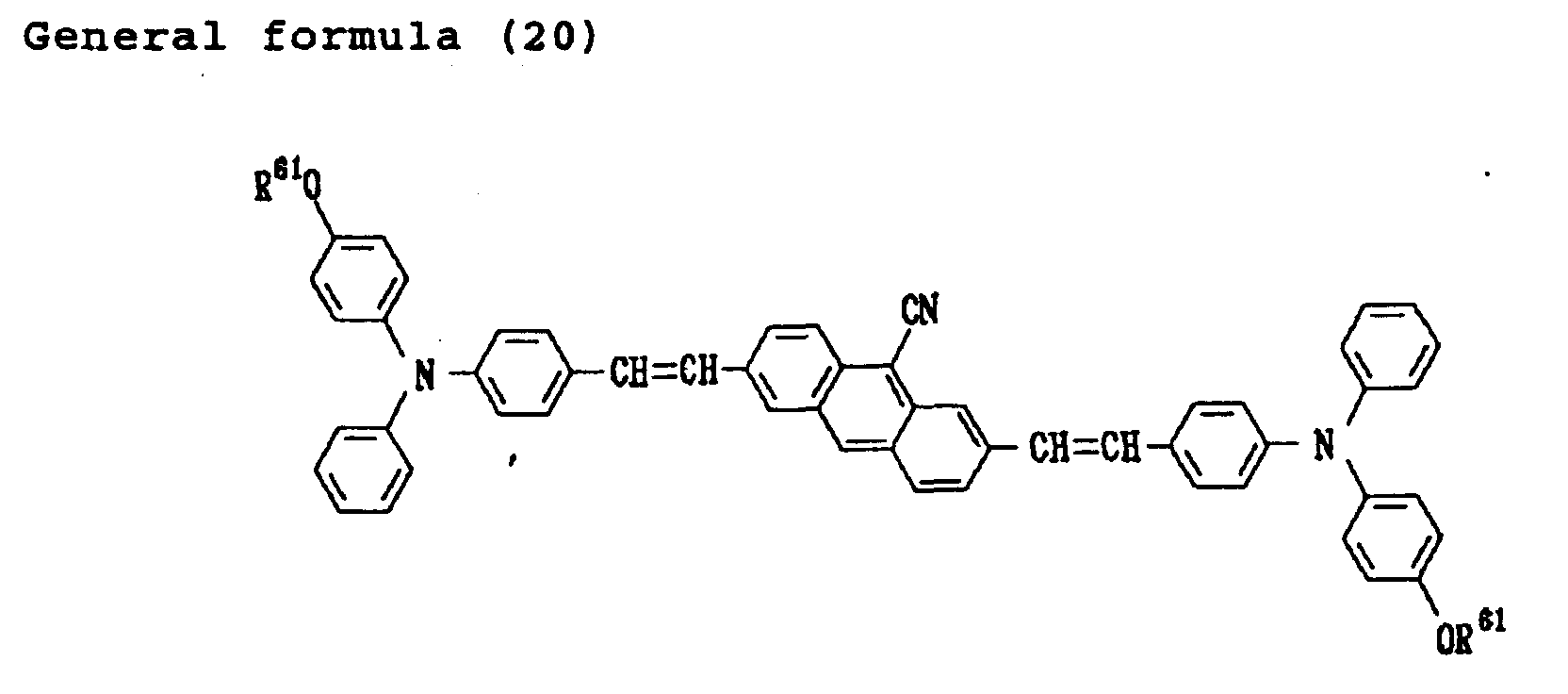
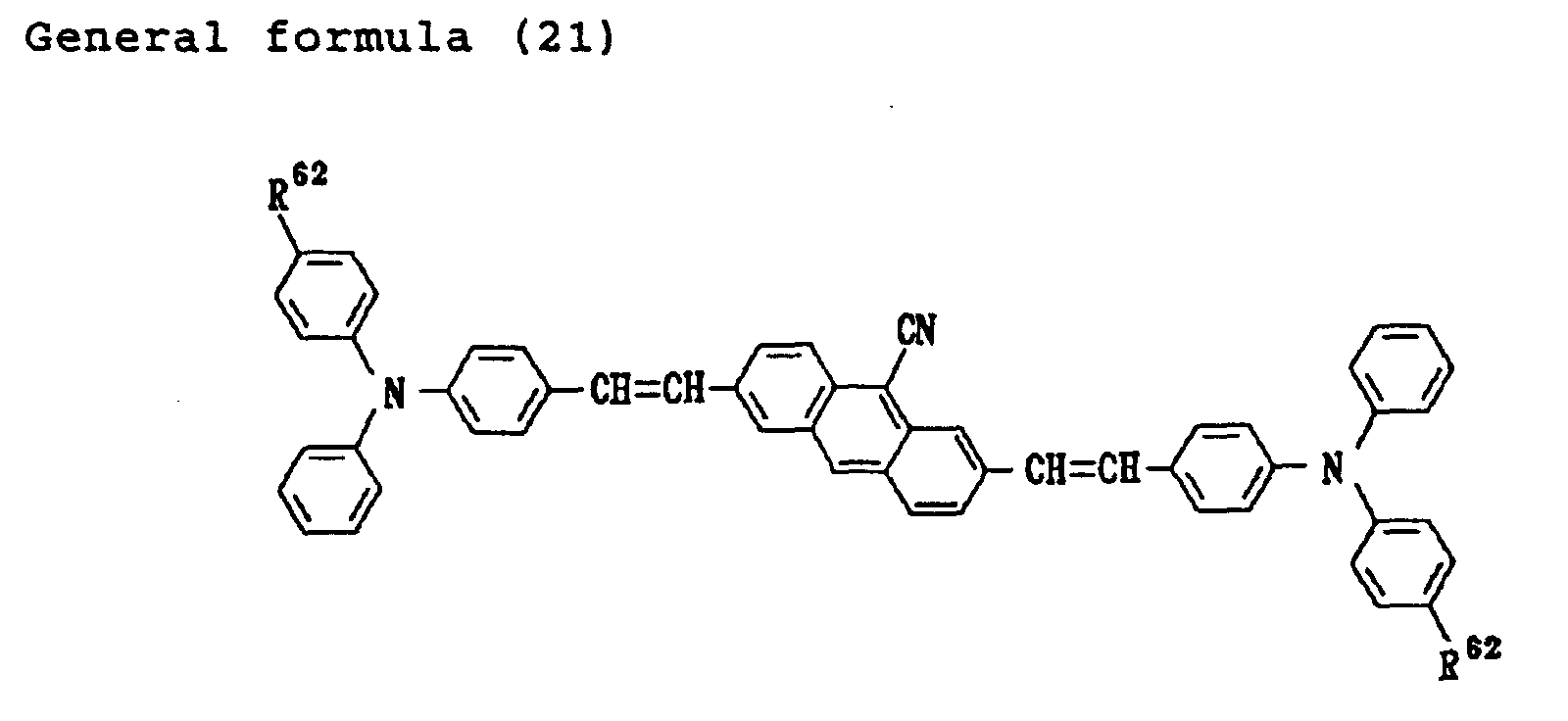
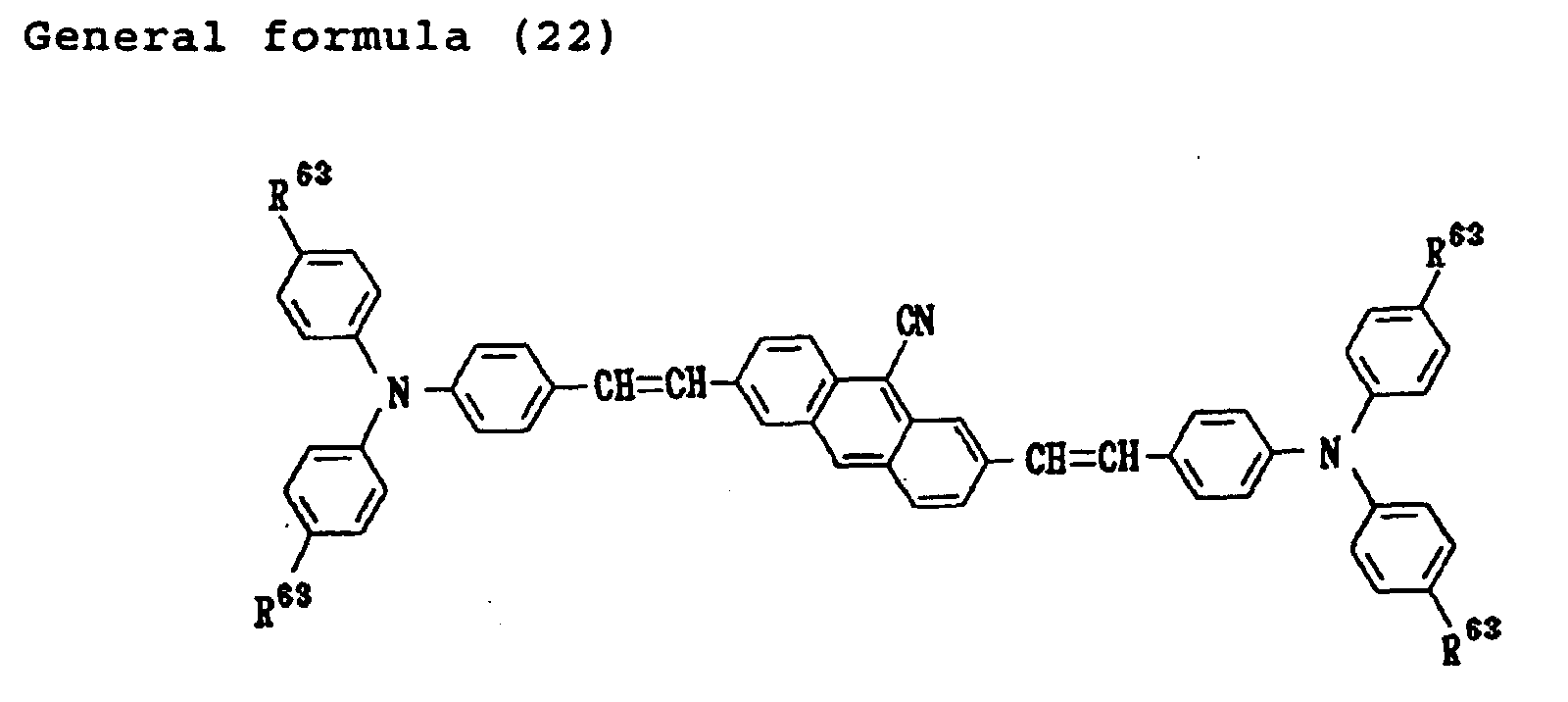
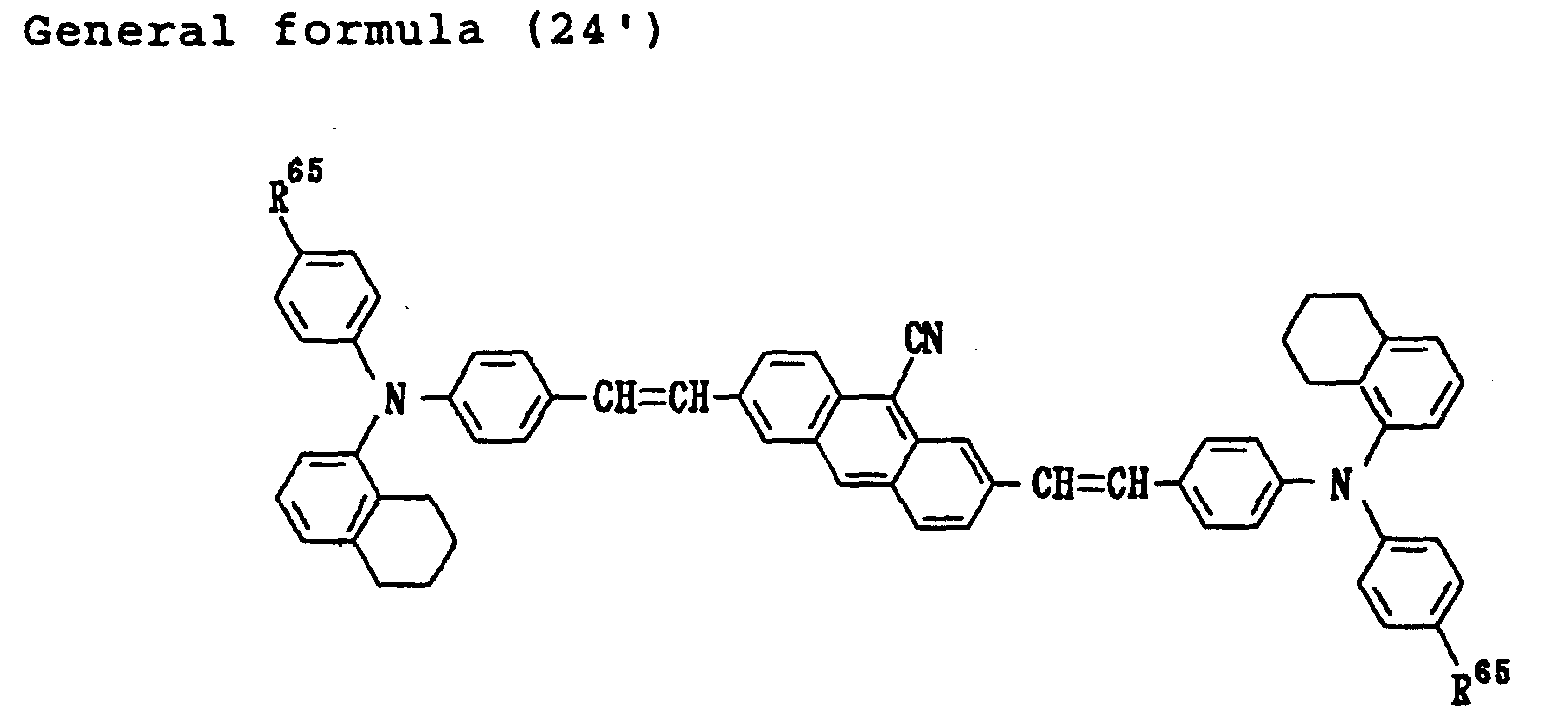
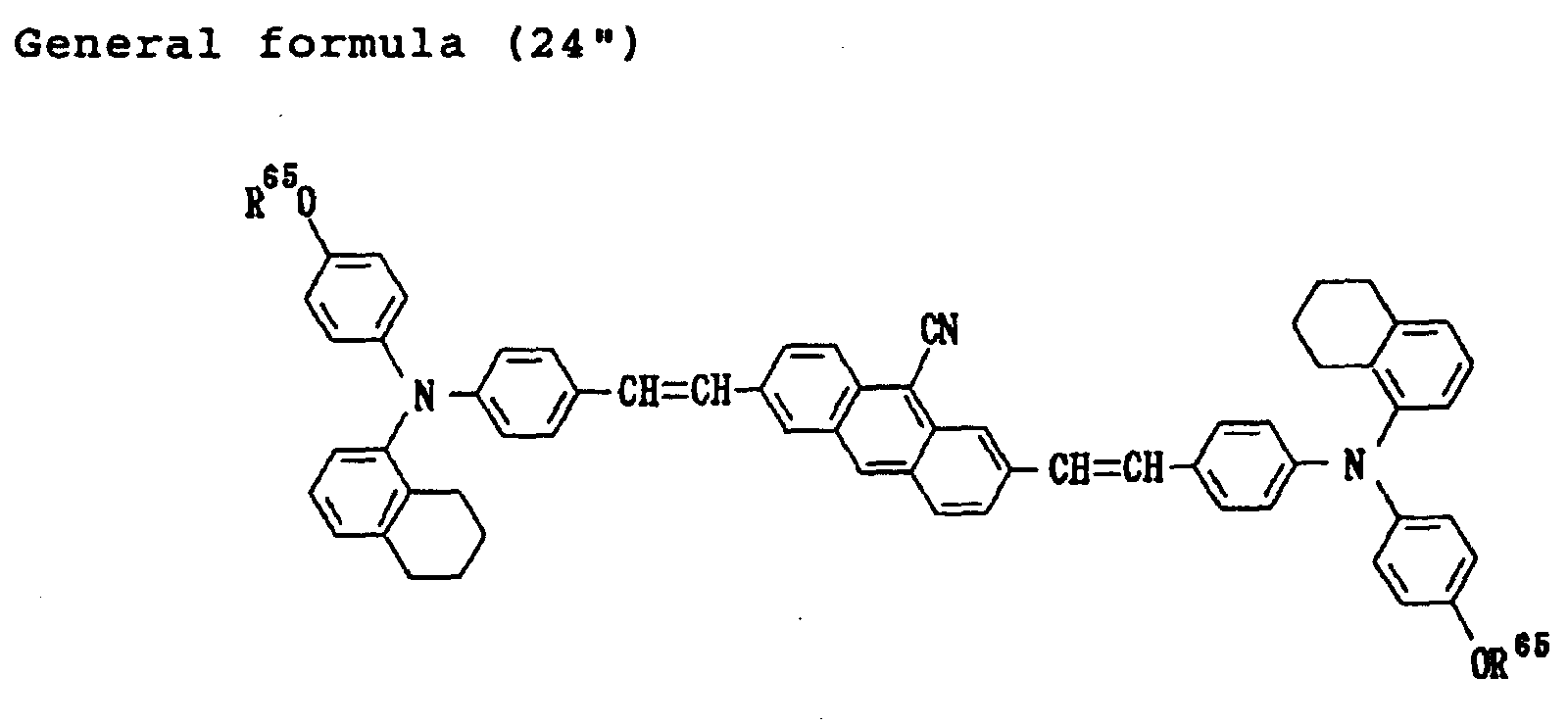
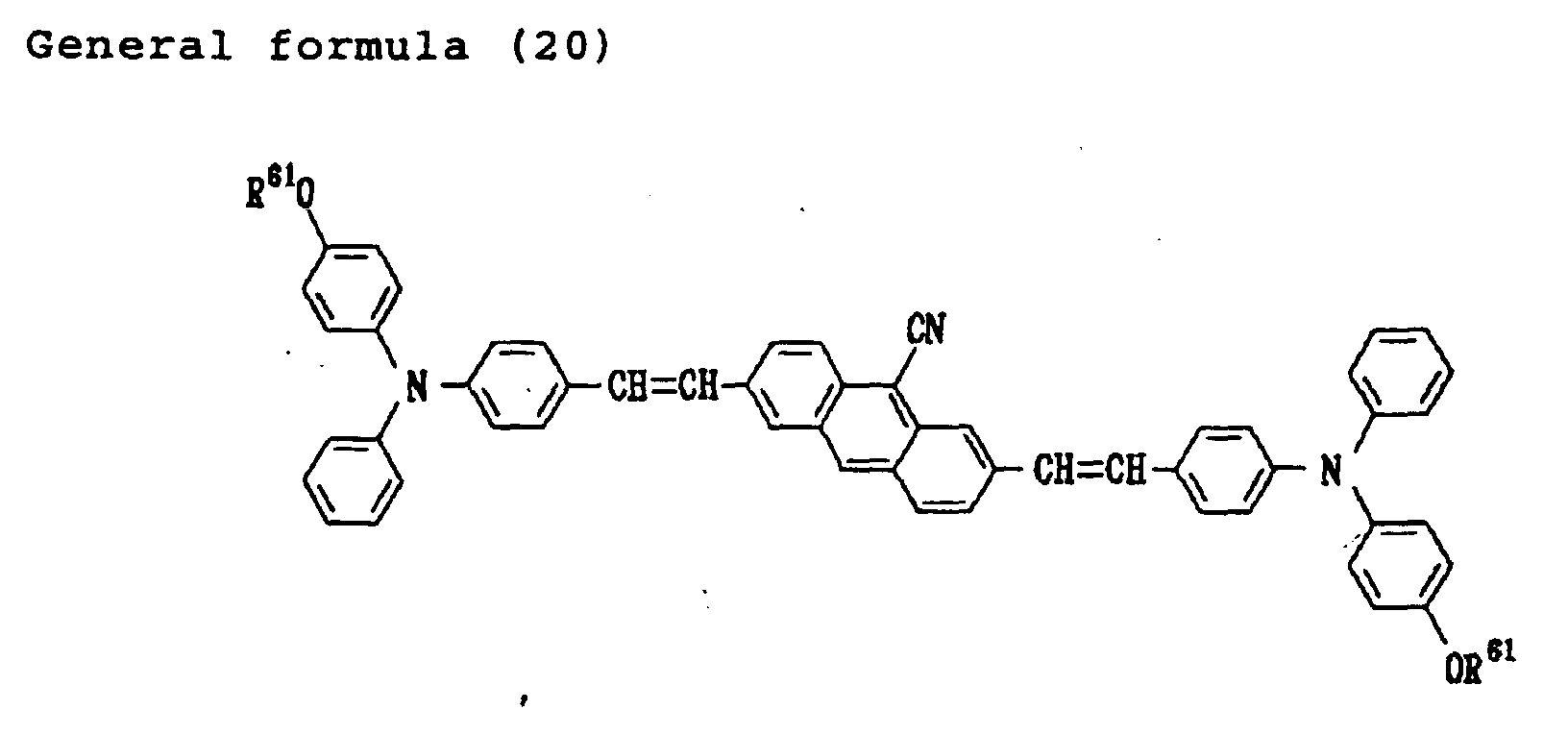
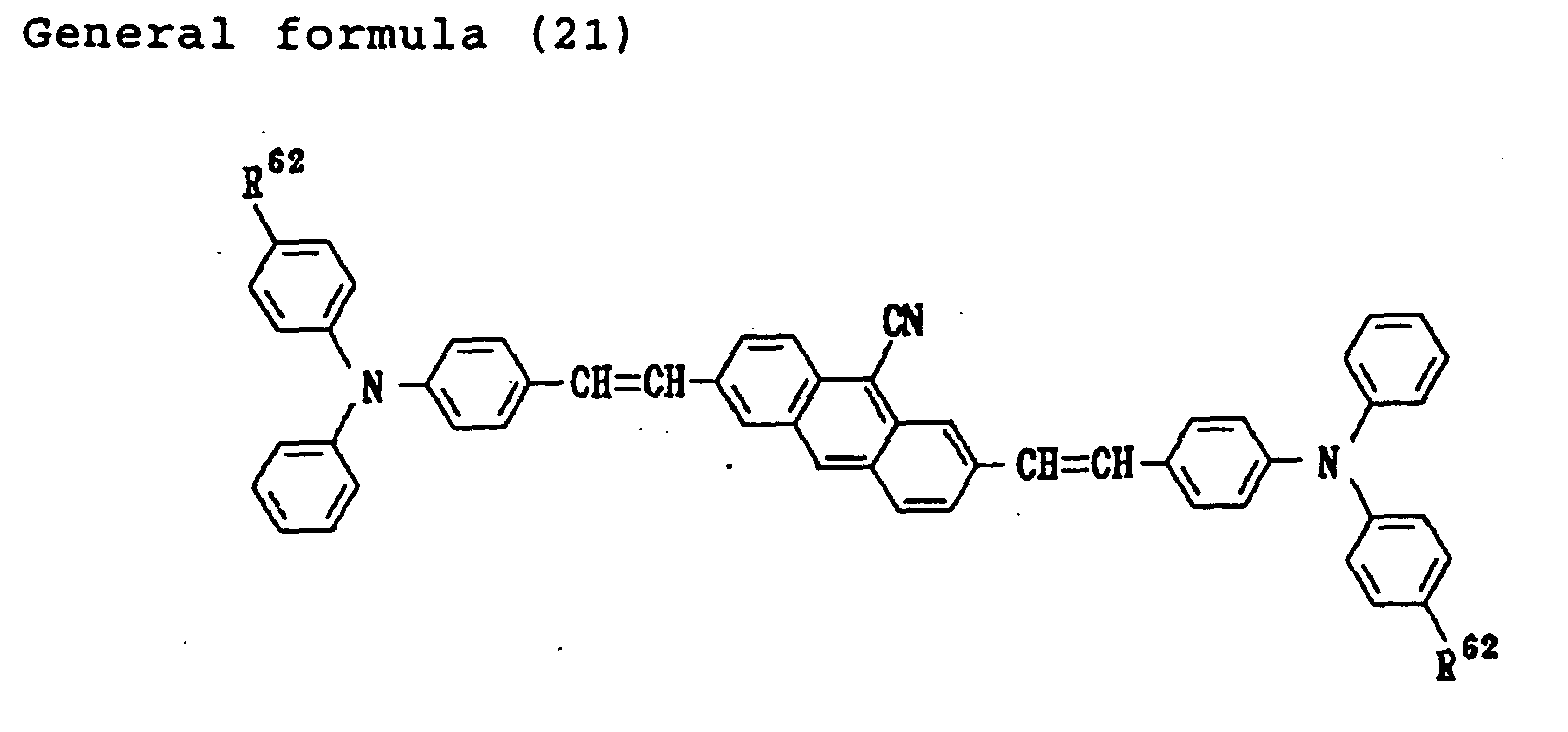
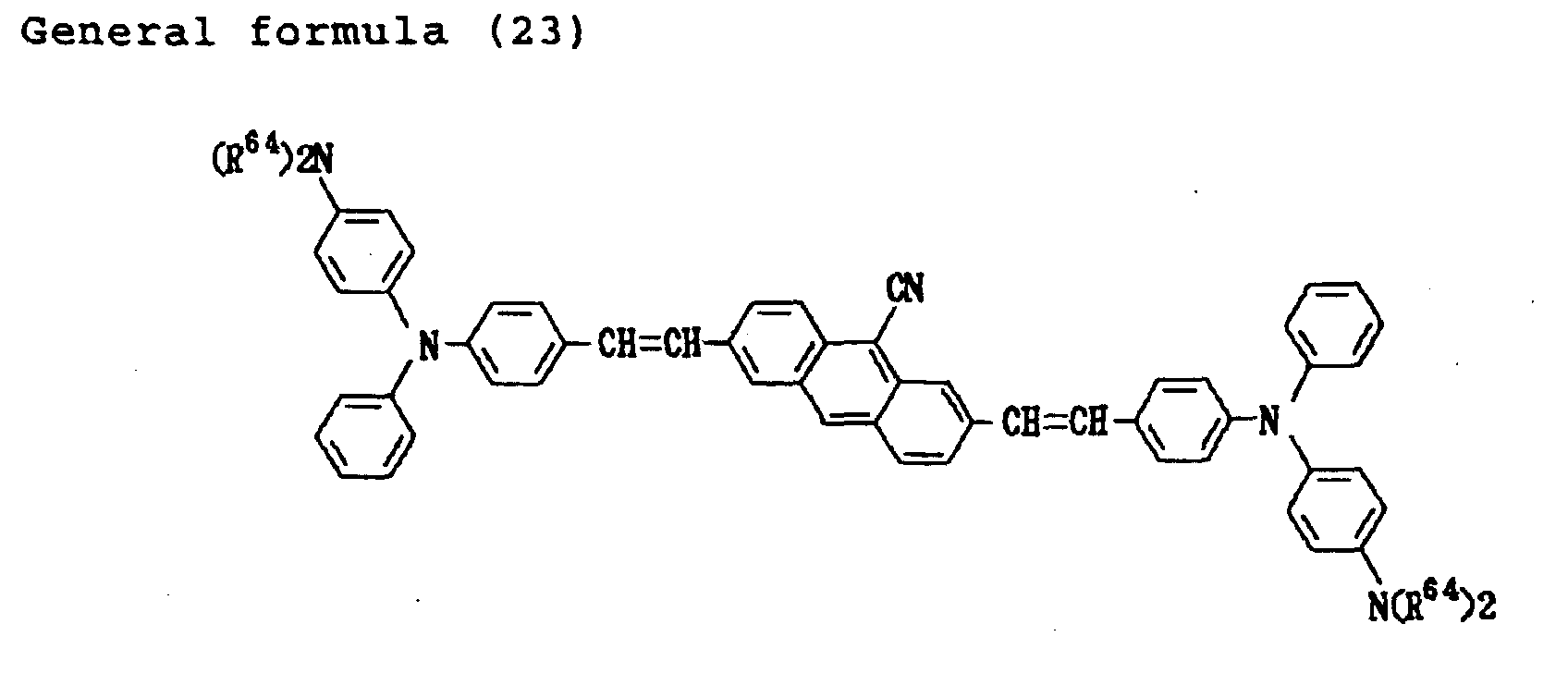
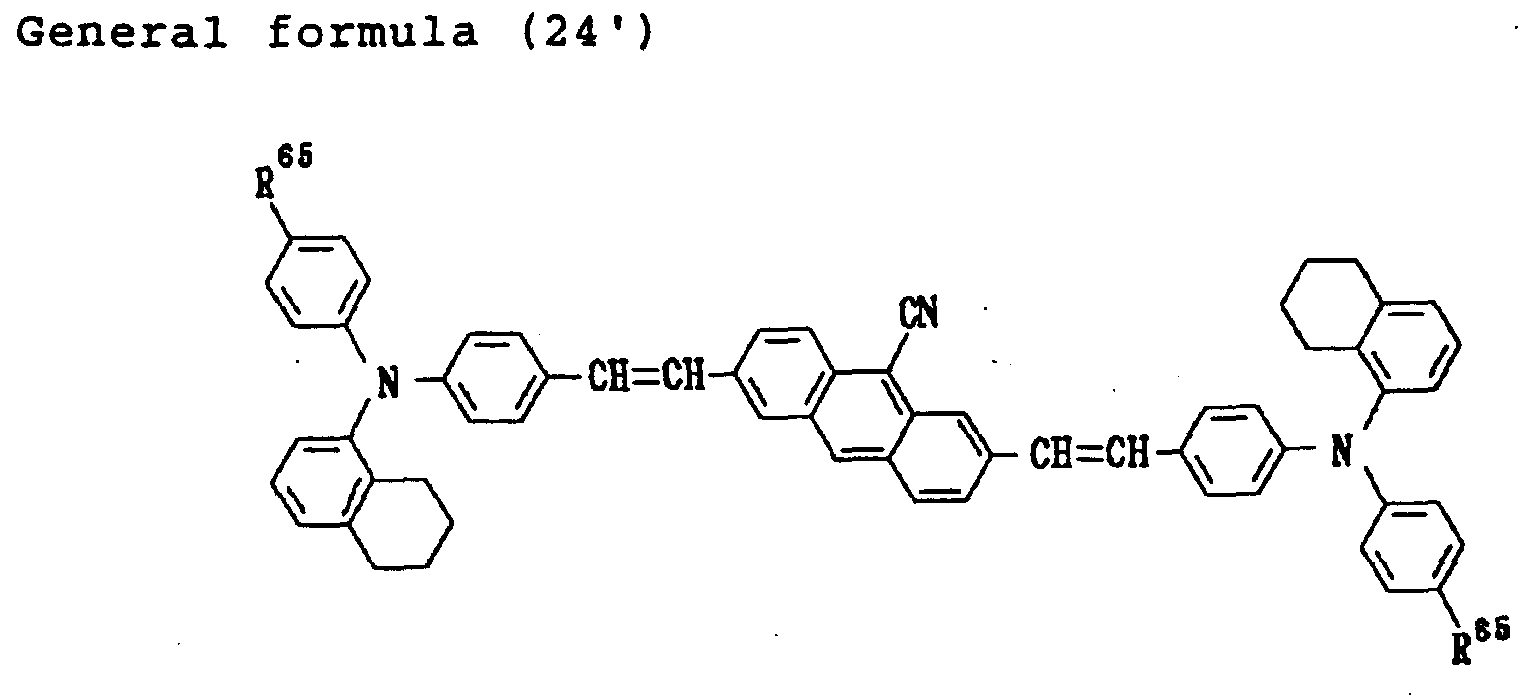
- the compound of the present invention should preferably be one which is represented by the general formula (20), (21), (22), (23), (24), (24') or (24'') below.
- R 61 denotes a saturated or unsaturated hydrocarbon group having 1 to 6 carbon atoms.
- R 62 denotes a saturated or unsaturated hydrocarbon group having 1 to 6 carbon atoms.
- R 63 denotes a saturated or unsaturated hydrocarbon group or hydrocarbon oxy group having 1 to 6 carbon atoms.
- R 64 denotes a saturated or unsaturated hydrocarbon group having 1 to 6 carbon atoms.
- R 65 denotes a saturated or unsaturated hydrocarbon group having 1 to 6 carbon atoms.
- R 65 denotes a saturated or unsaturated hydrocarbon group having 1 to 6 carbon atoms.
- R 65 denotes a saturated or unsaturated hydrocarbon group having 1 to 6 carbon atoms.
- R 65 denotes a saturated or unsaturated hydrocarbon group having 1
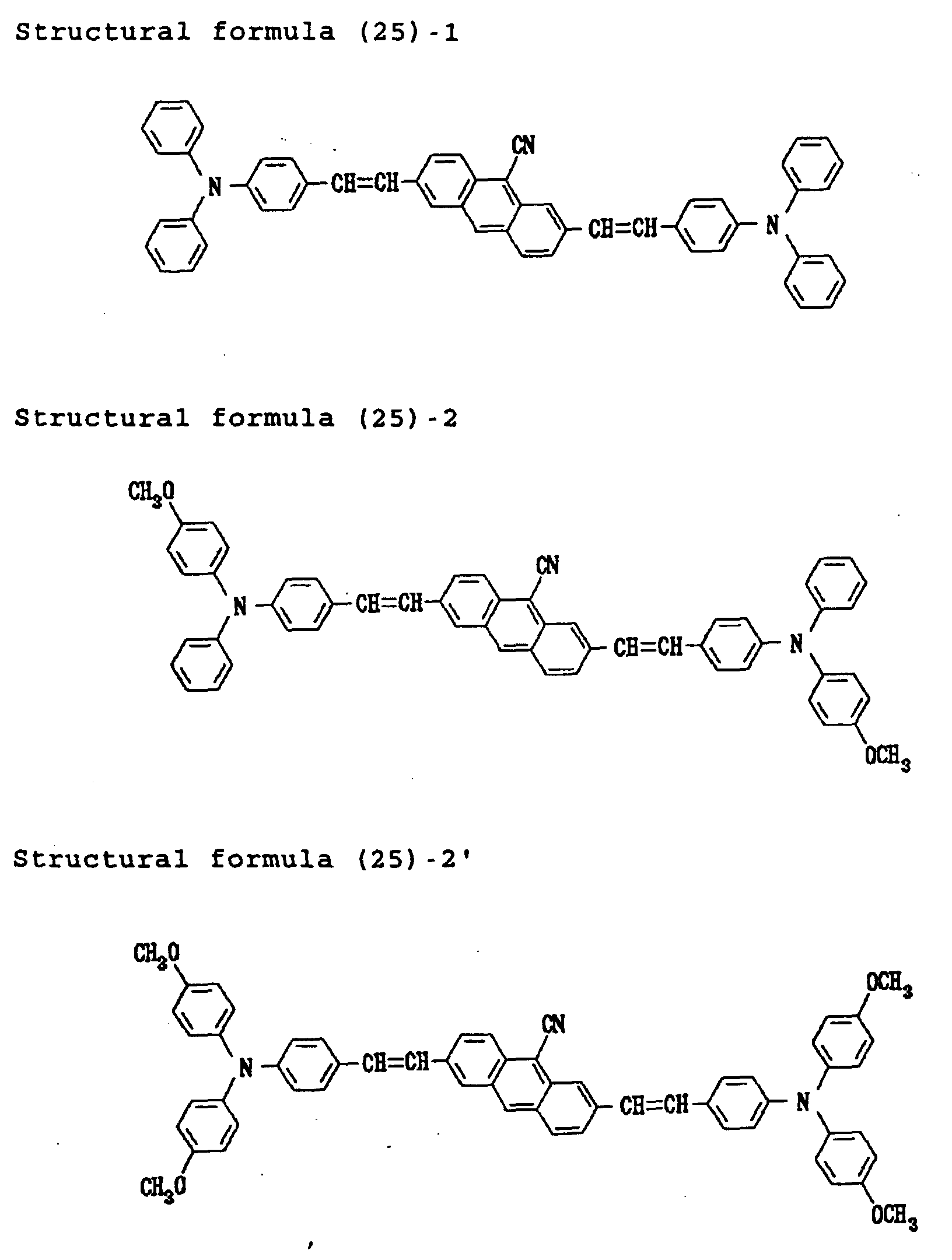
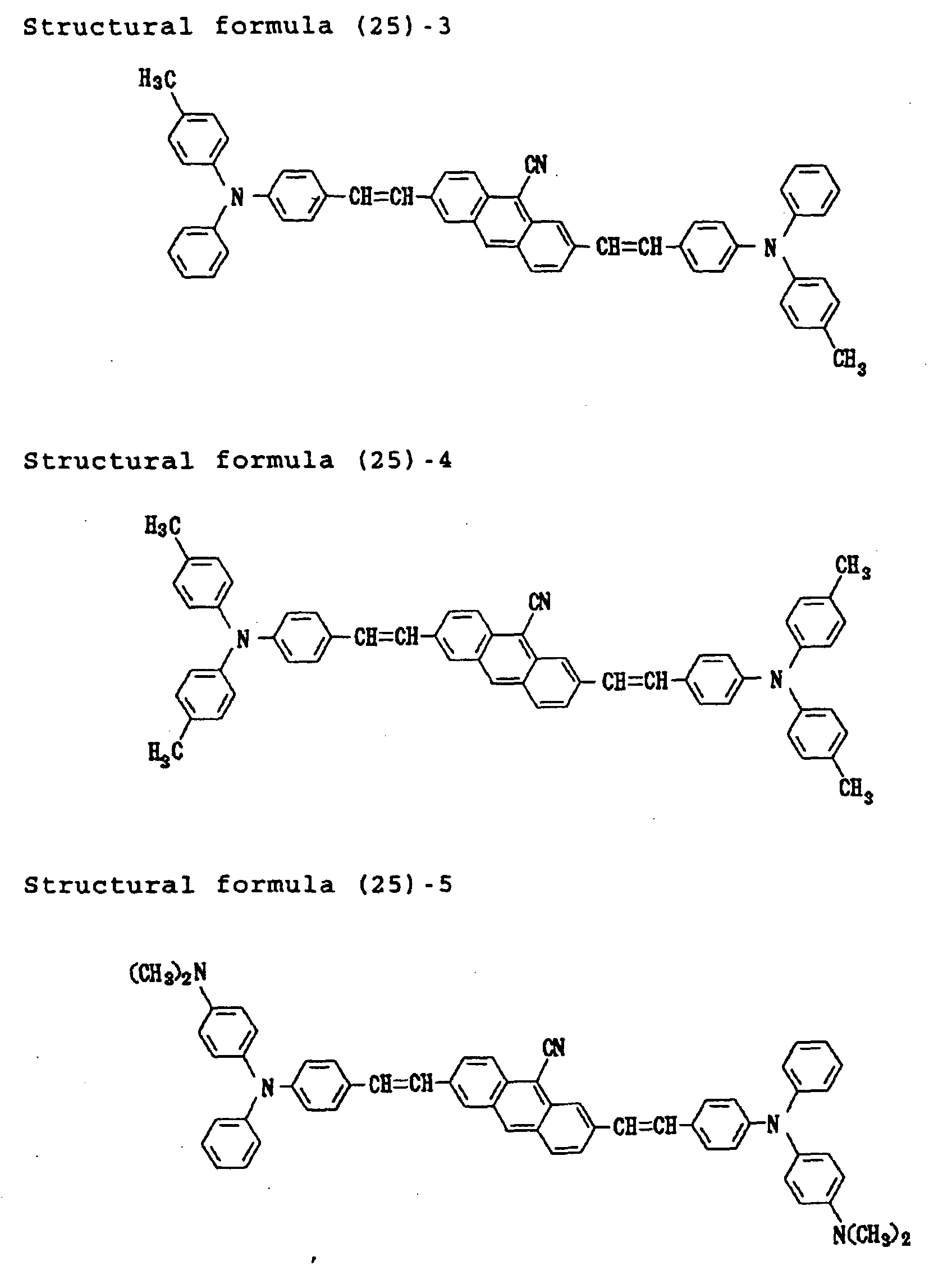
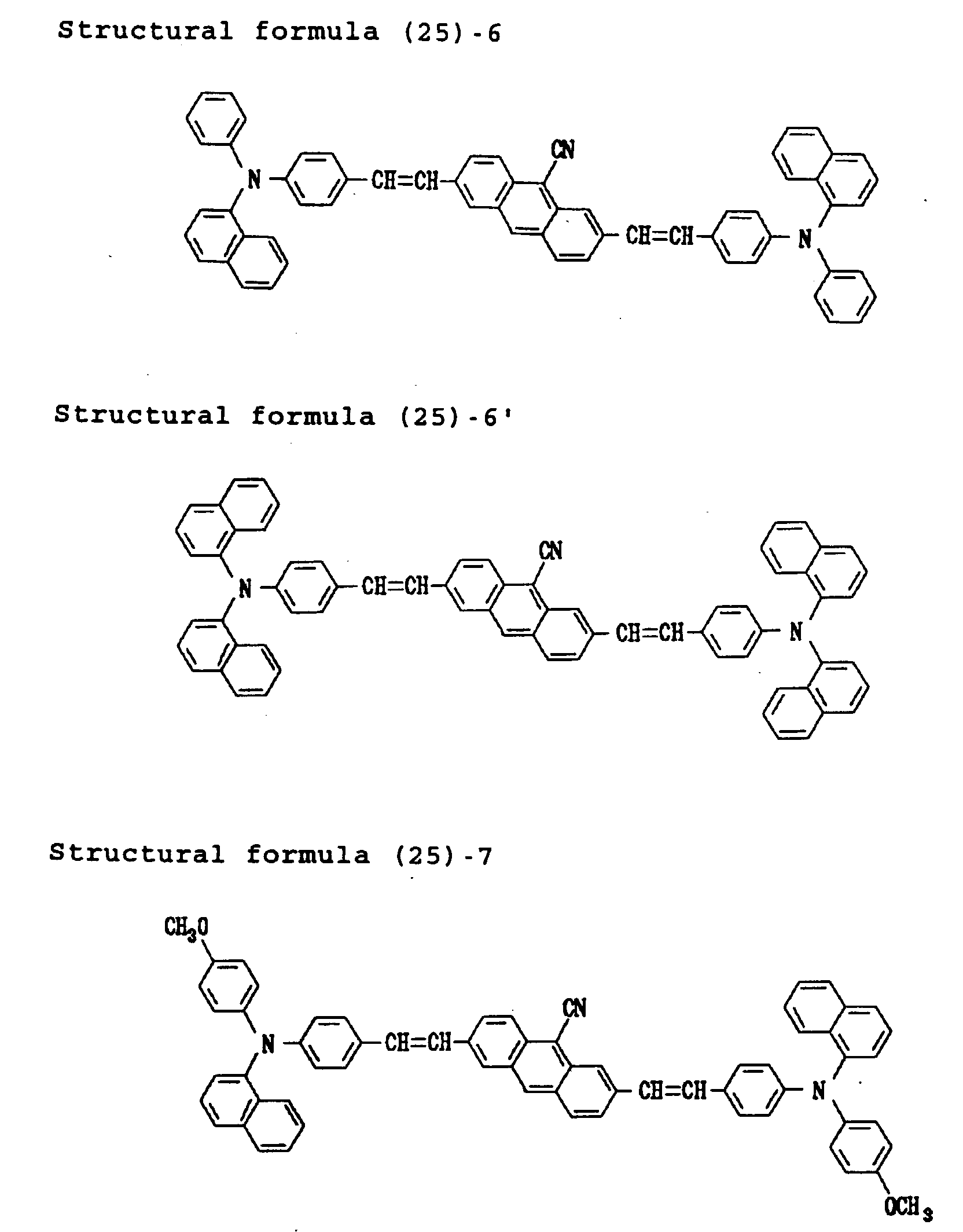
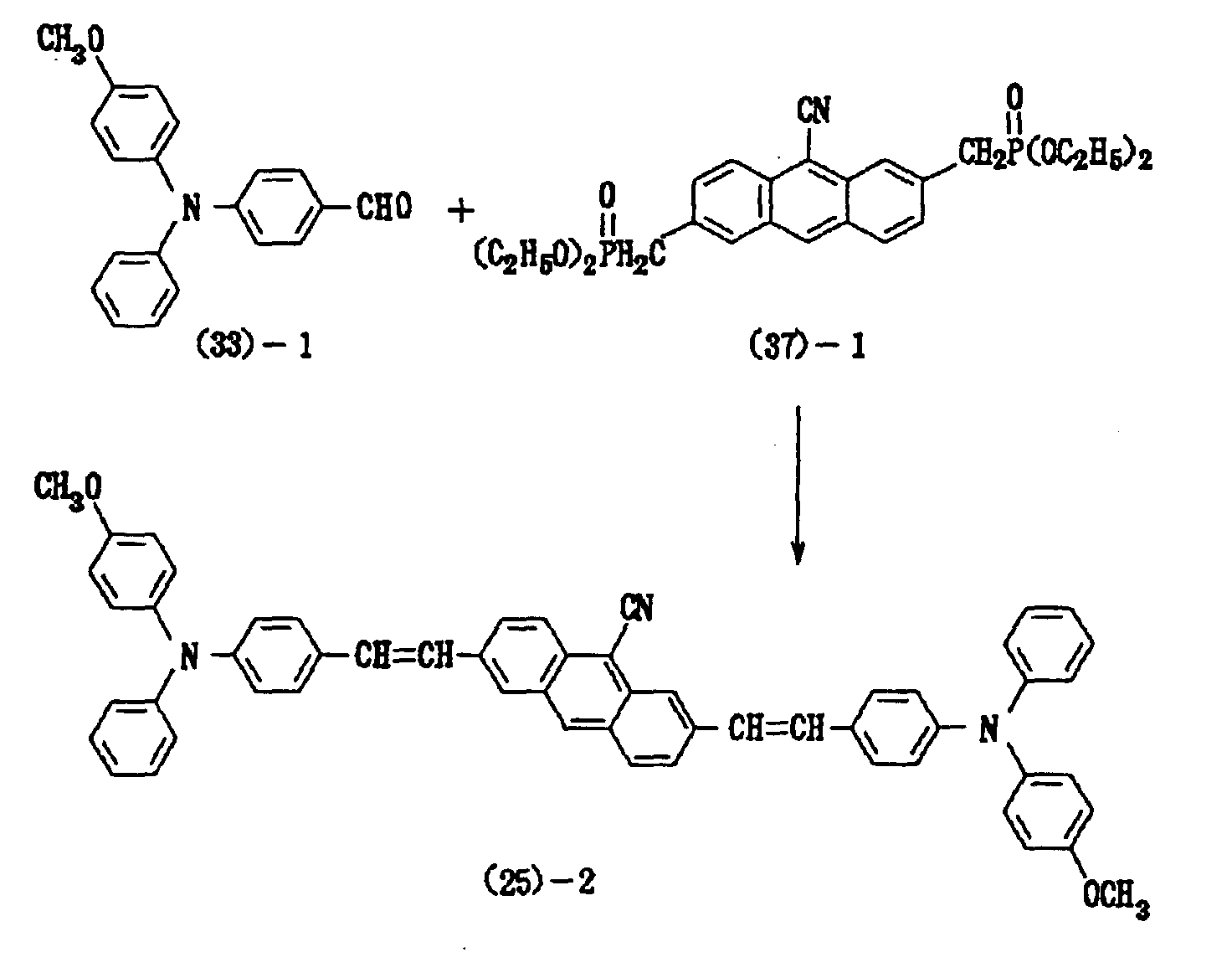
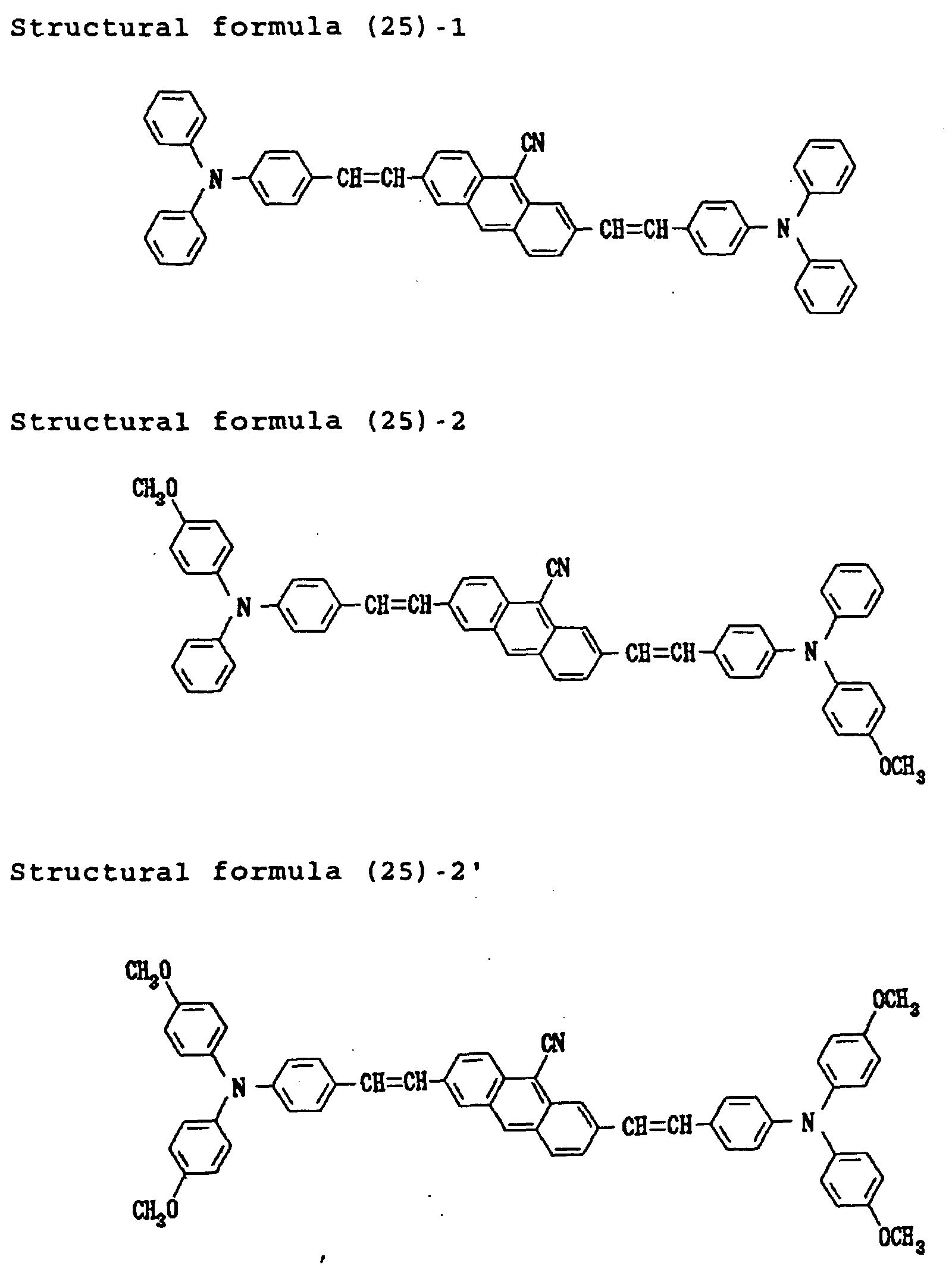
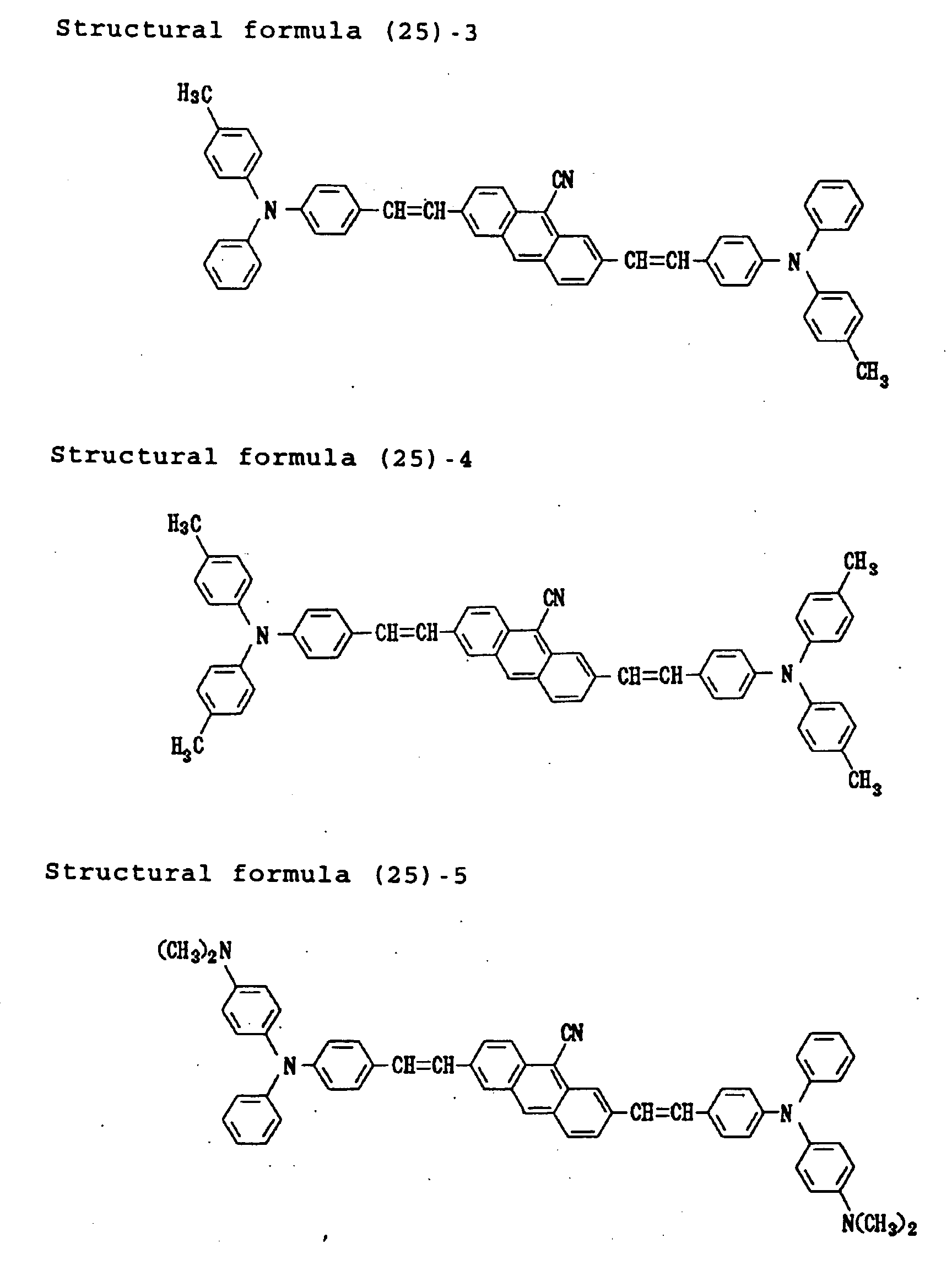
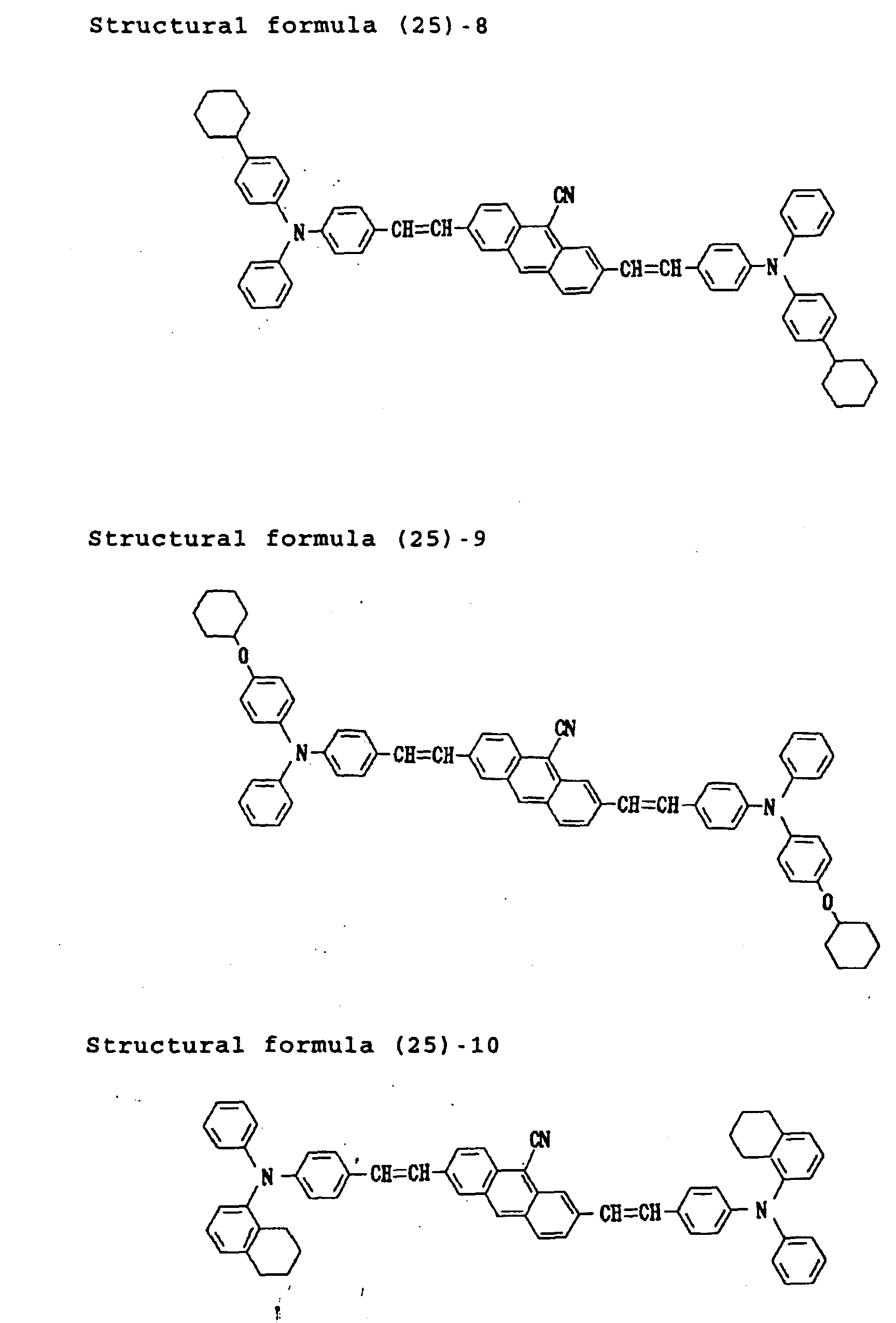
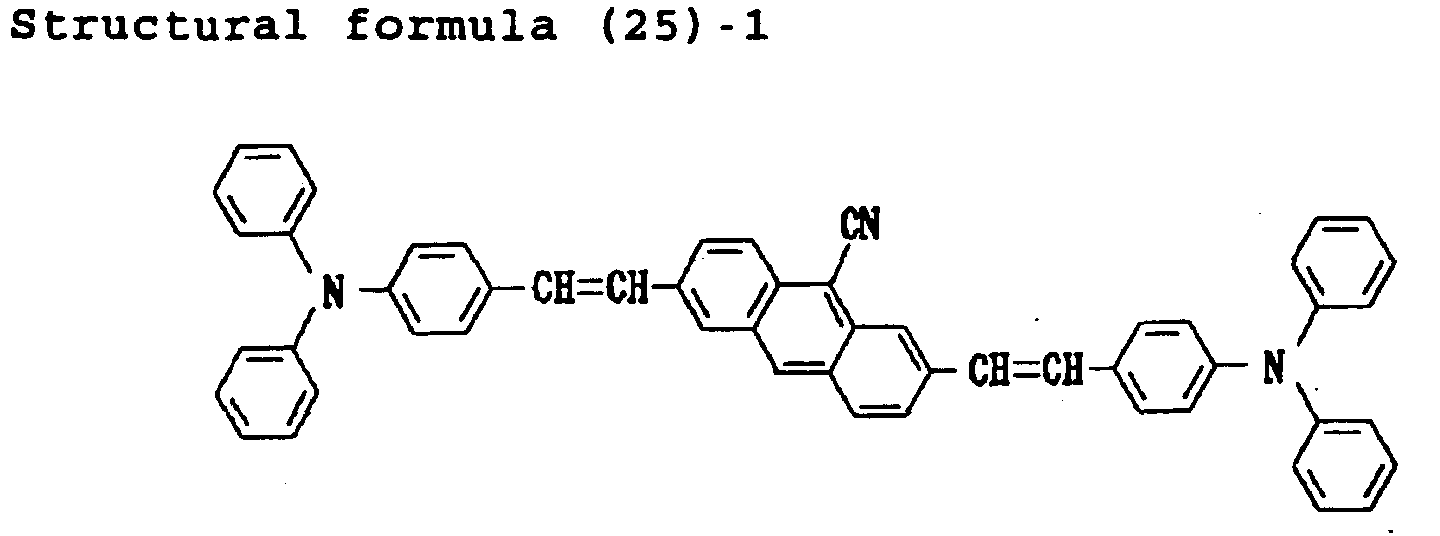
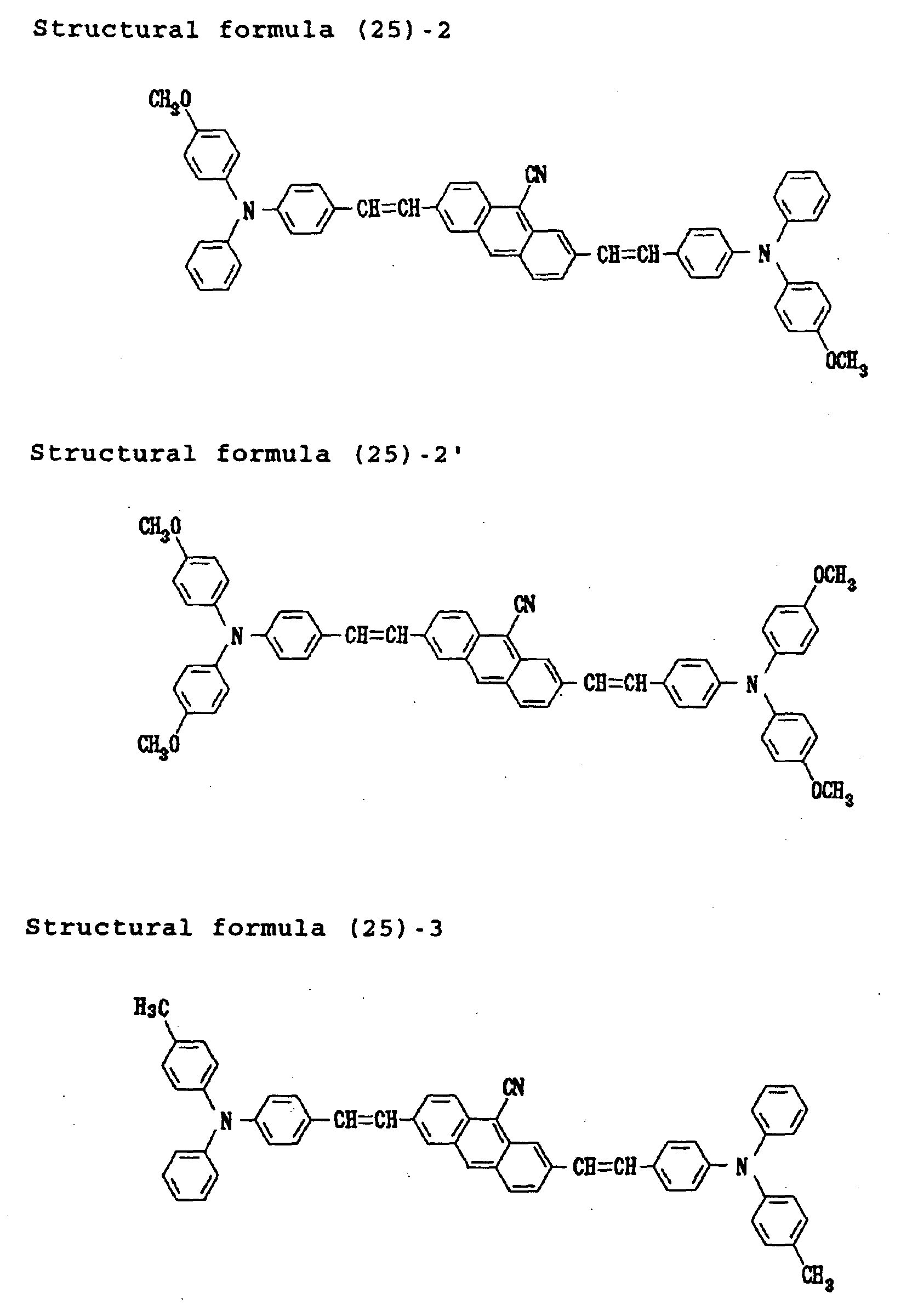
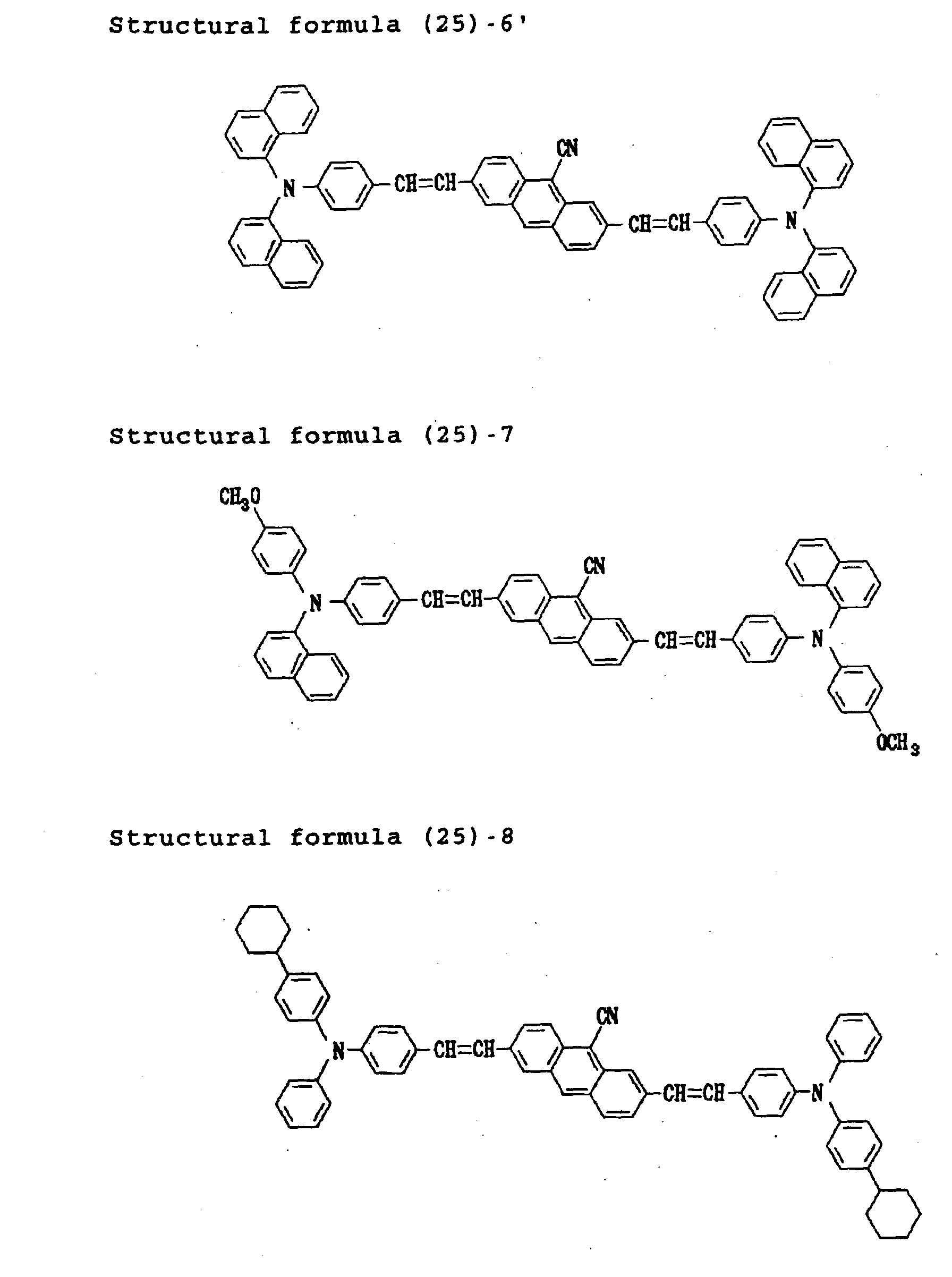
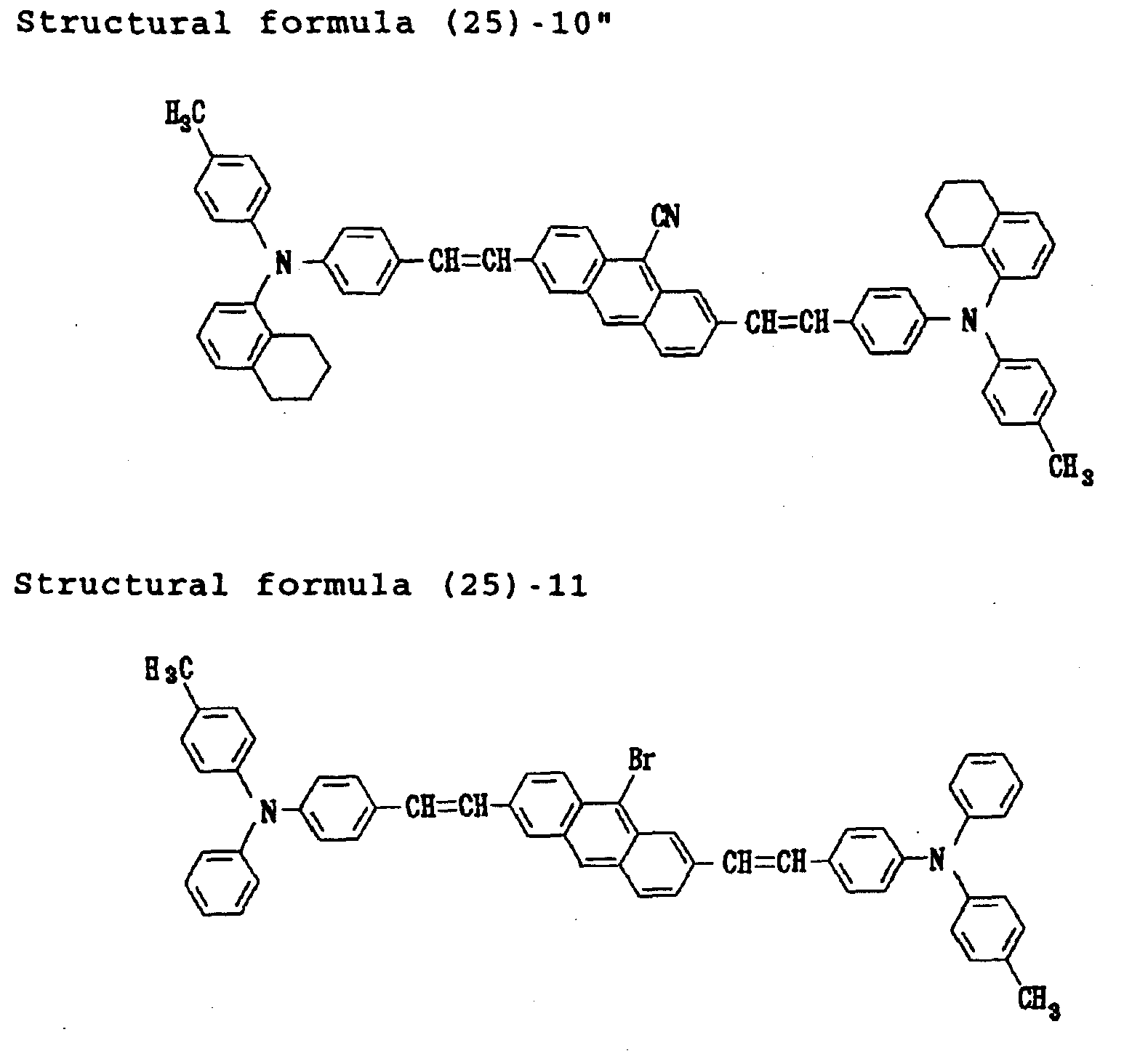
- the compound of the present invention is exemplified by those which are represented by the structural formula (25)-1, (25)-2, (25)-2', (25)-3, (25)-4, (25)-5, (25)-6, (25)-6', (25)-7, (25)-8, (25)-9, (25)-10, (25)-10', (25)-10'', or (25)-11 below.
- R 52 , R 53 , and R 54 each denotes a saturated or unsaturated hydrocarbon group having one or more carbons;
- R 55 , R 56 , R 57 , R 58 , R 59 , and R 60 are identical or different, each denoting a saturated or unsaturated hydrocarbon group having one or more carbon atoms;
- n is an integer of 0 to 6;
- m is an integer of 0 to 3; and
- l is an integer of 0 to 4.
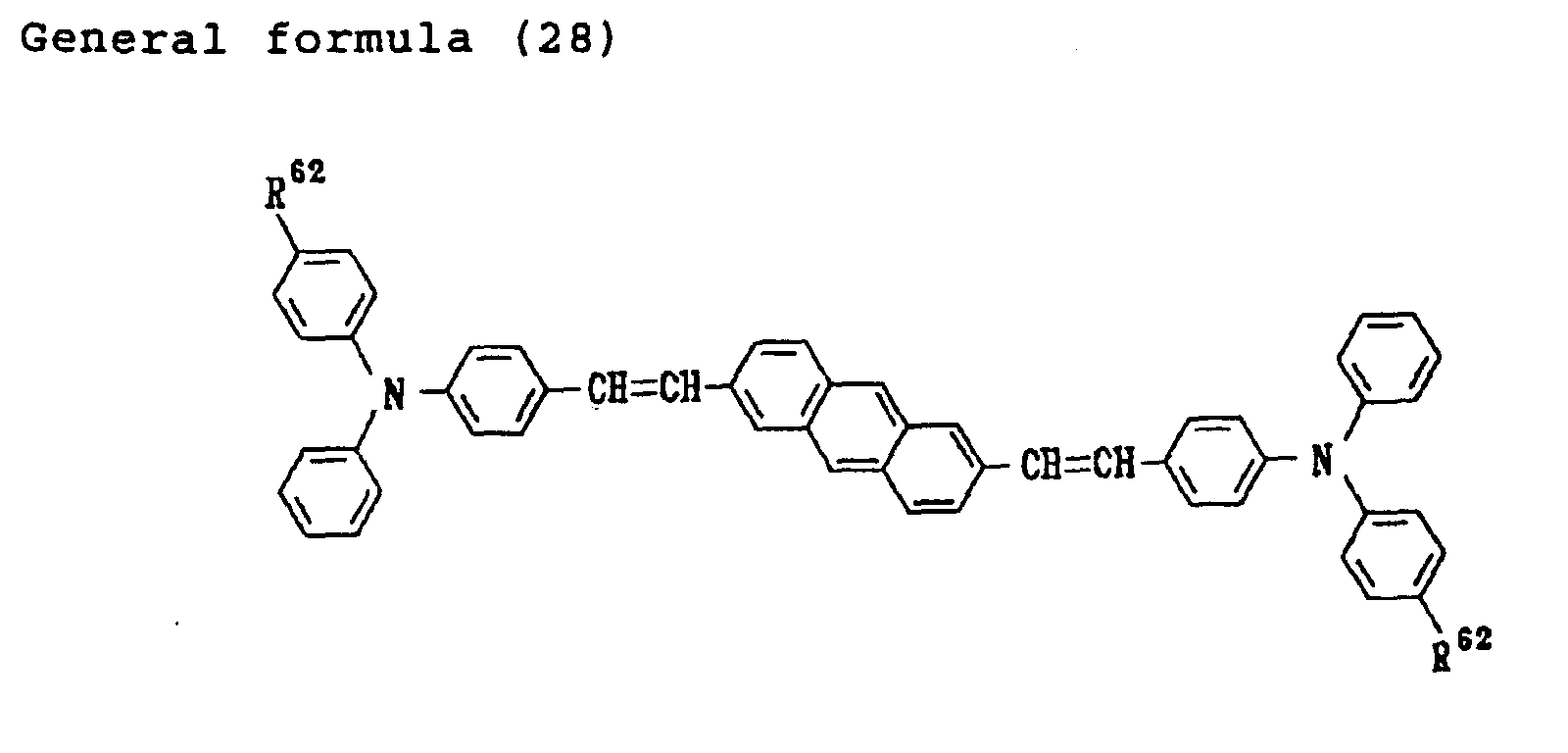
- the compound of the present invention should preferably be one which is represented by the general formula (27), (28), (29), (30), (31), (31') or (31'') below.
- R 61 denotes a saturated or unsaturated hydrocarbon group having 1 to 6 carbon atoms.
- R 62 denotes a saturated or unsaturated hydrocarbon group having 1 to 6 carbon atoms.
- R 63 denotes a saturated or unsaturated hydrocarbon group or hydrocarbon oxy group having 1 to 6 carbon atoms.
- R 64 denotes a saturated or unsaturated hydrocarbon group having 1 to 6 carbon atoms.
- R 65 denotes a saturated or unsaturated hydrocarbon group having 1 to 6 carbon atoms.
- R 65 denotes a saturated or unsaturated hydrocarbon group having 1 to 6 carbon atoms.
- R 65 denotes a saturated or unsaturated hydrocarbon group having 1 to 6 carbon atoms.
- R 65 denotes a saturated or unsaturated hydrocarbon group having 1
- the present invention is directed also to a process for efficiently producing the compound of the present invention.
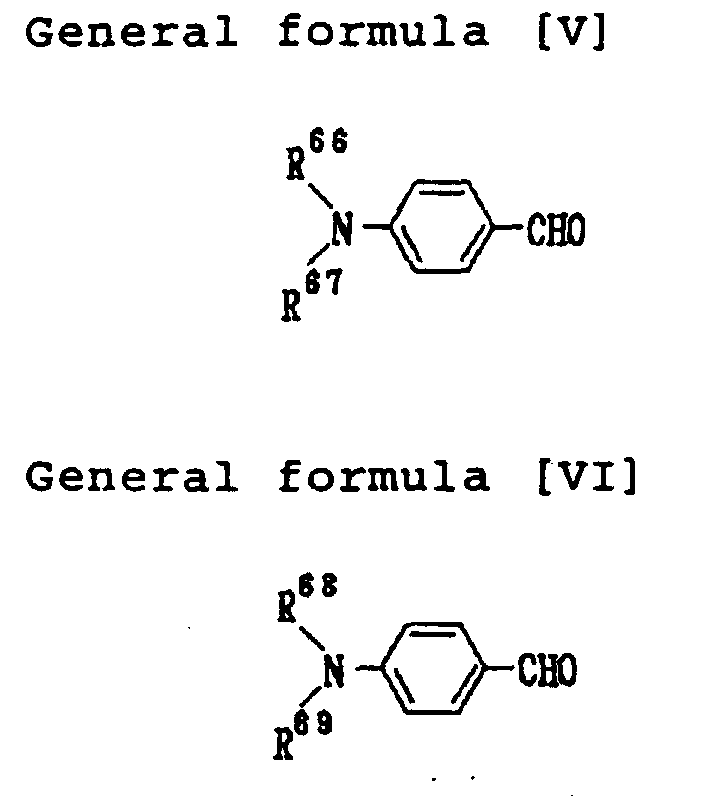
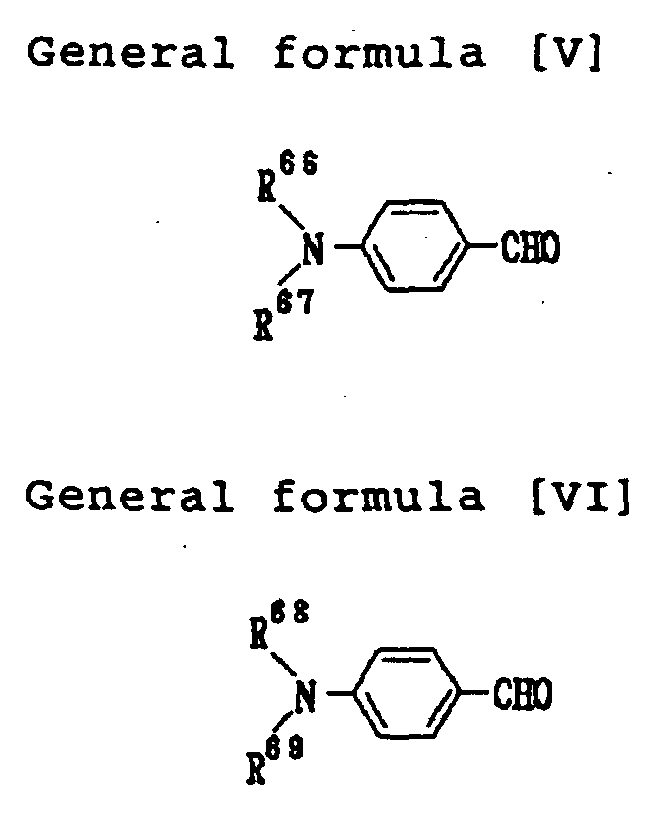
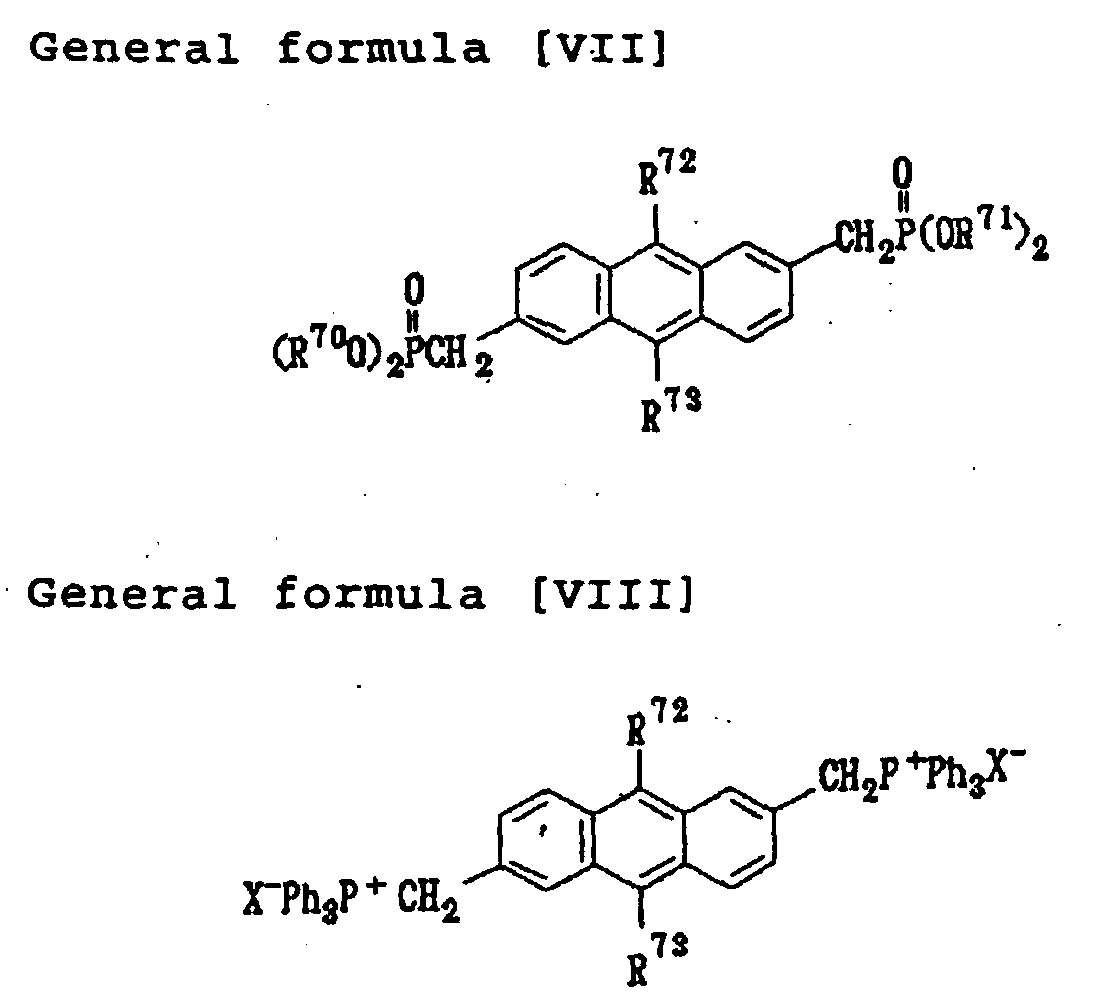
- This process yields a bis(aminostyryl)anthracene compound represented by the general formula [I], [II], [III], or [IV] given above by condensation from at least one species of 4-(N,N-diarylamino)benzaldehyde represented by the general formula [V] or [VI] below and diphosphonic ester represented by the general formula [VII] below or diphosphonium represented by the general formula [VIII] below.
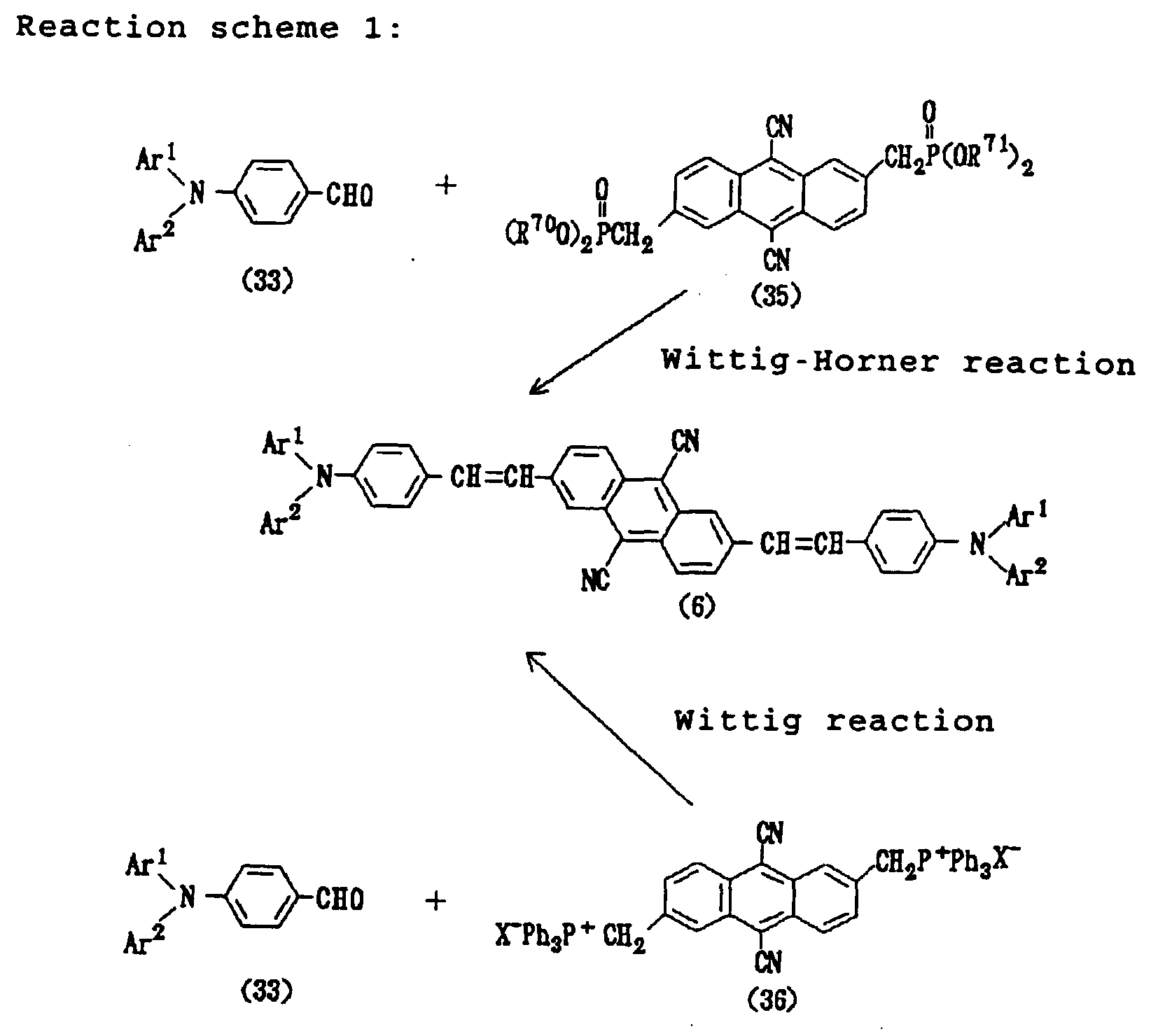
- the process for producing the compound of the present invention consists of treating the diphosphonic ester or diphosphonium with a base in a solvent, thereby giving carboanion, and condensing this carboanion with the 4-(N,N-diarylamino)benzaldehyde by Wittig-Horner reaction or Wittig reaction.
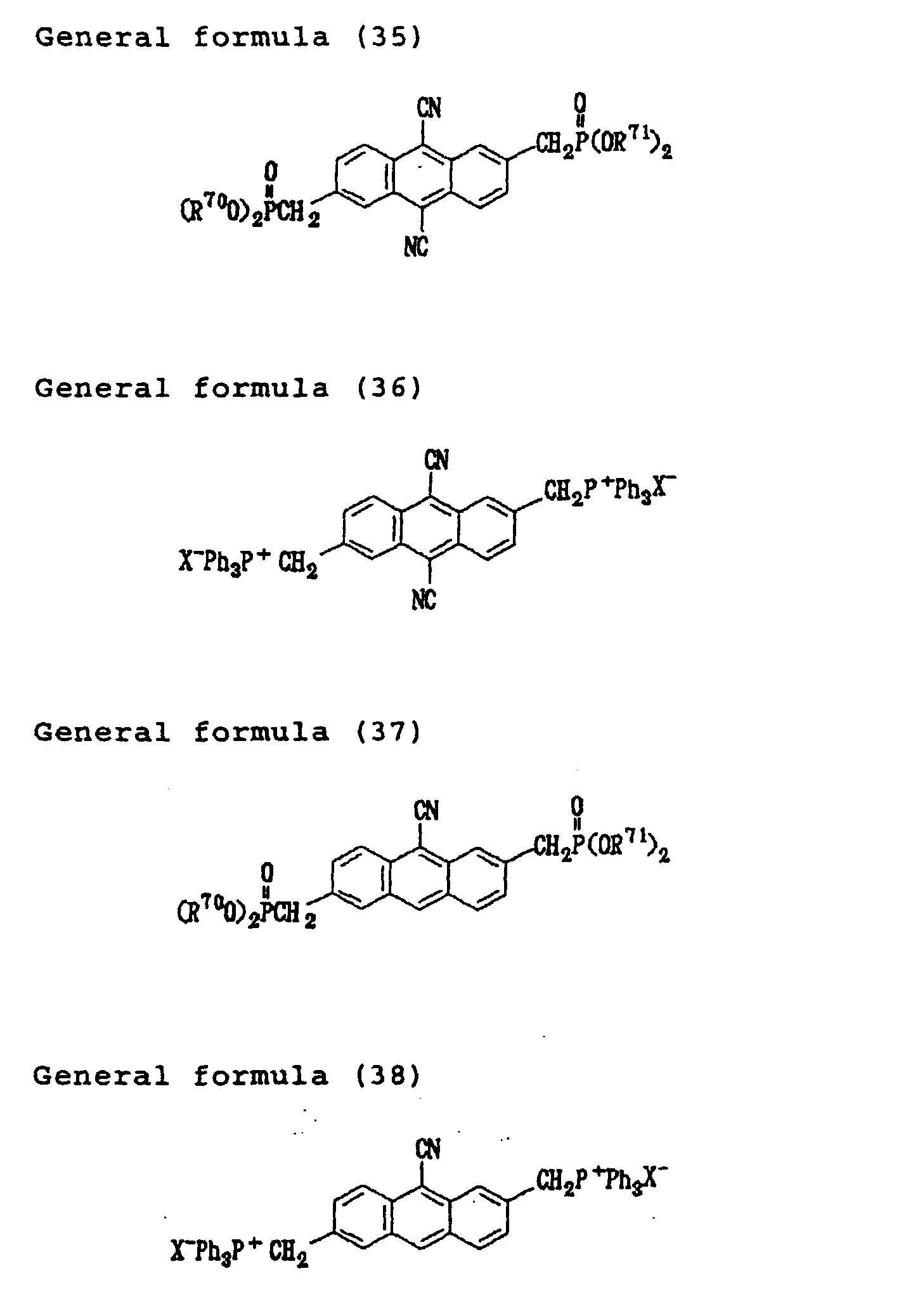
- a bis(aminostyryl)anthracene compound represented by the general formula (6) below (where Ar 1 , Ar 2 , Ar 3 , and Ar 4 are defined as above.) is produced by condensing at least one species of 4-(N,N-diarylamino)benzaldehyde represented by the general formula (33) or (34) below with diphosphonic ester represented by the general formula (35) below or diphosphonium represented by the general formula (36) below.
- Ar 1 , Ar 2 , Ar 3 , Ar 4 , R 70 , R 71 and X are defined as above.
- This reaction may be shown by the following reaction scheme 1.
- This reaction is started by treating the compound of the general formula (35) or (36) with a base in a solvent, thereby giving carboanion, and is completed by condensing this carboanion with the aldehyde of the general formula (33).
- Possible combinations of a base and a solvent are as follows.
- This reaction proceeds at a comparatively low temperature (-30°C to 30°C) and proceeds selectively. Therefore, the desired product can be purified easily by chromatography.
- the compound of the present invention represented by the general formula (6) is highly crystalline and hence it can be purified easily by recrystallization.
- the method of recrystallization is not specifically restricted. A simple way is by dissolution in acetone and subsequent addition of hexane, or by dissolution in toluene with heating and subsequent concentration and cooling. This reaction may be carried out under normal pressure for 3-24 hours.
- the process of the present invention yields a bis(aminostyryl)anthracene compound represented by the general formula (13), (13'), (14), (15), (16), (17), (17'), (17''), (20), (21), (22), (23), (24), (24'), (24''), (27), (28), (29), (30), or (31) given above.
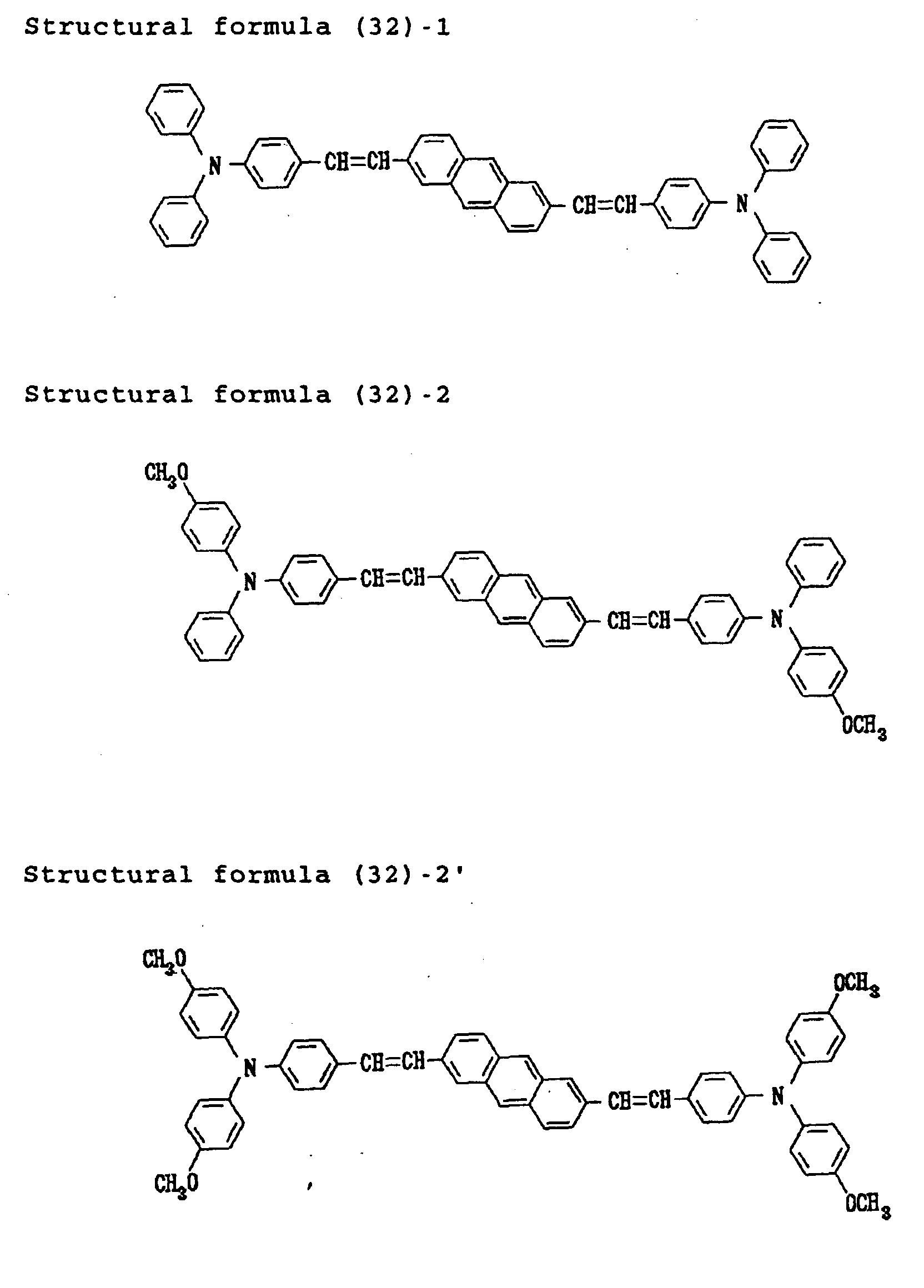
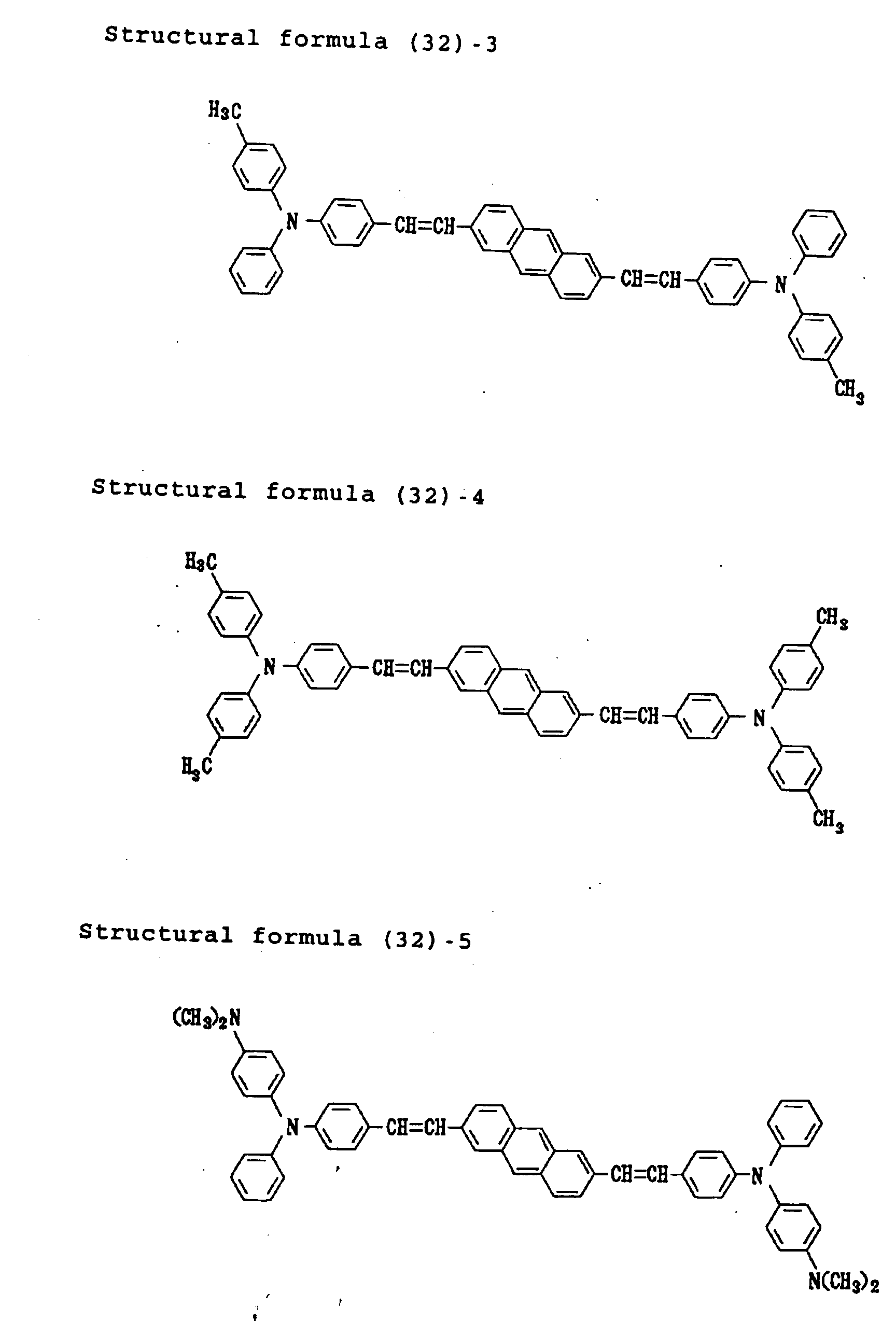
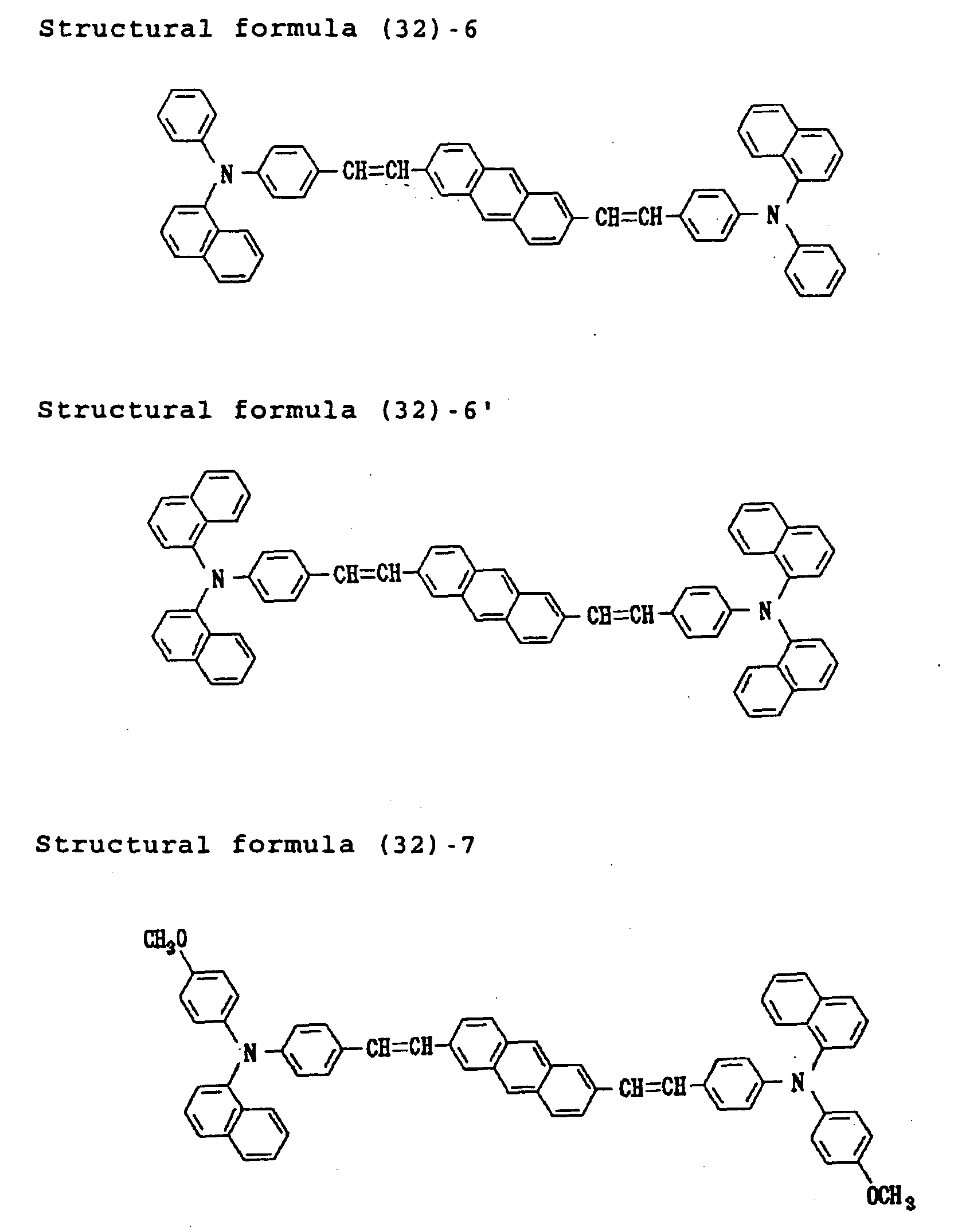
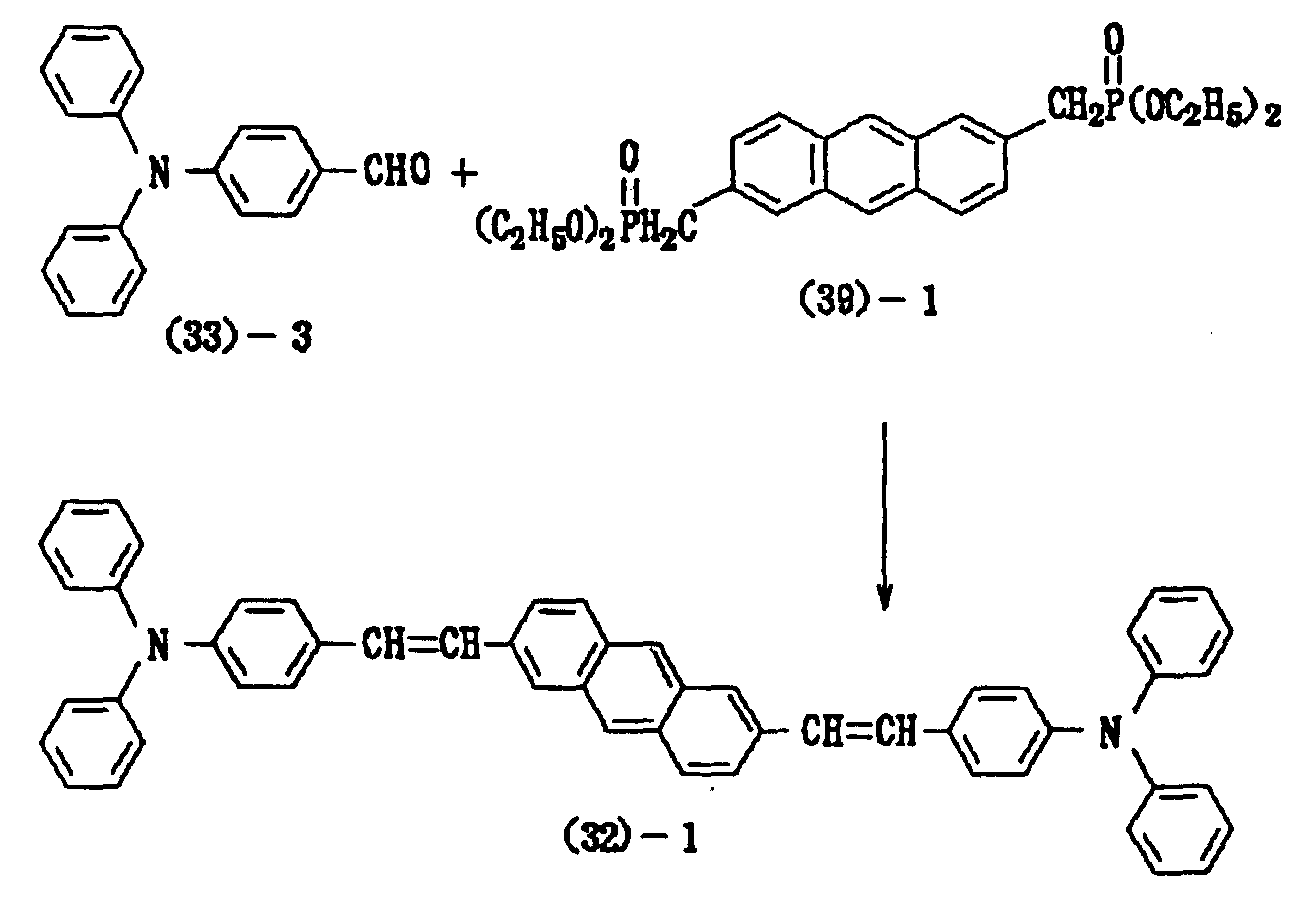
- the process of the present invention yields a bis(aminostyryl)anthracene compound represented by the structural formula (18)-1, (18)-2, (18)-2', (18)-3, (18)-4, (18)-5, (18)-6, (18)-7, (18)-8, (18)-9, (18)-10, (18)-10', (18)-10'', (18)-11, (25)-1, (25)-2, (25)-2', (25)-3, (25)-4, (25)-5, (25)-6, (25)-7, (25)-8, (25)-9, (25)-10, (25)-10', (25)-10'', (25)-11, (32)-1, (32)-2, (32)-2', (32)-3, (32)-4, (32)-5, (32)-6, (32)-7, (32)-8, (32)-9, (32)-10, (32)-10', or (32)-10'' given above.
- the present invention also provides a variety of compounds suitable as intermediates for synthesis of the compound of the present invention.
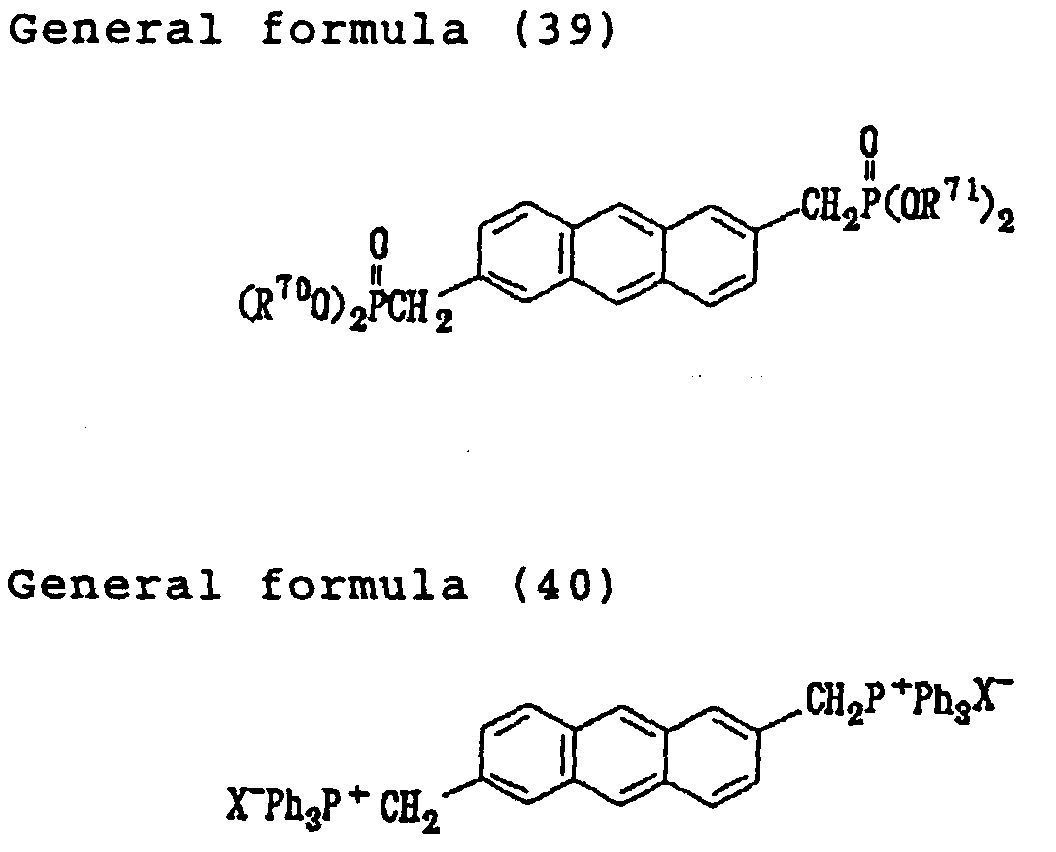
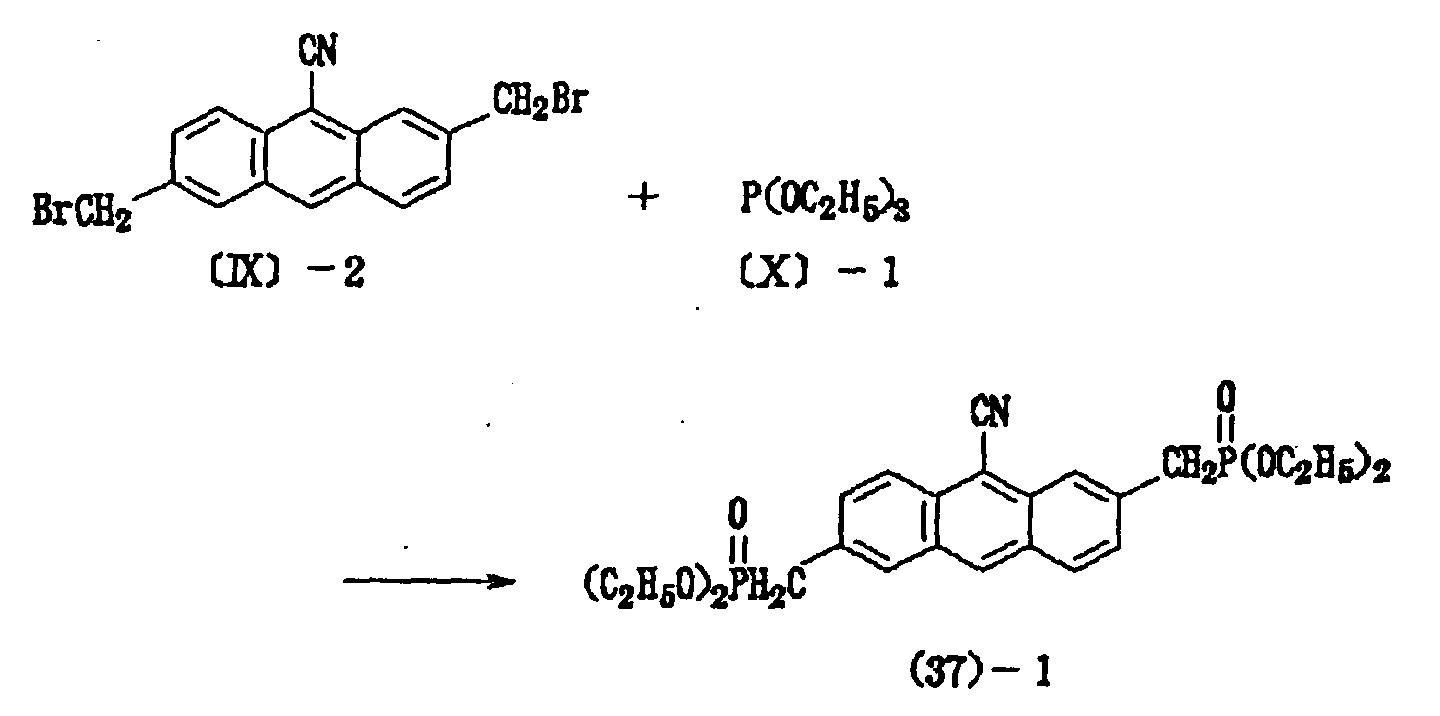
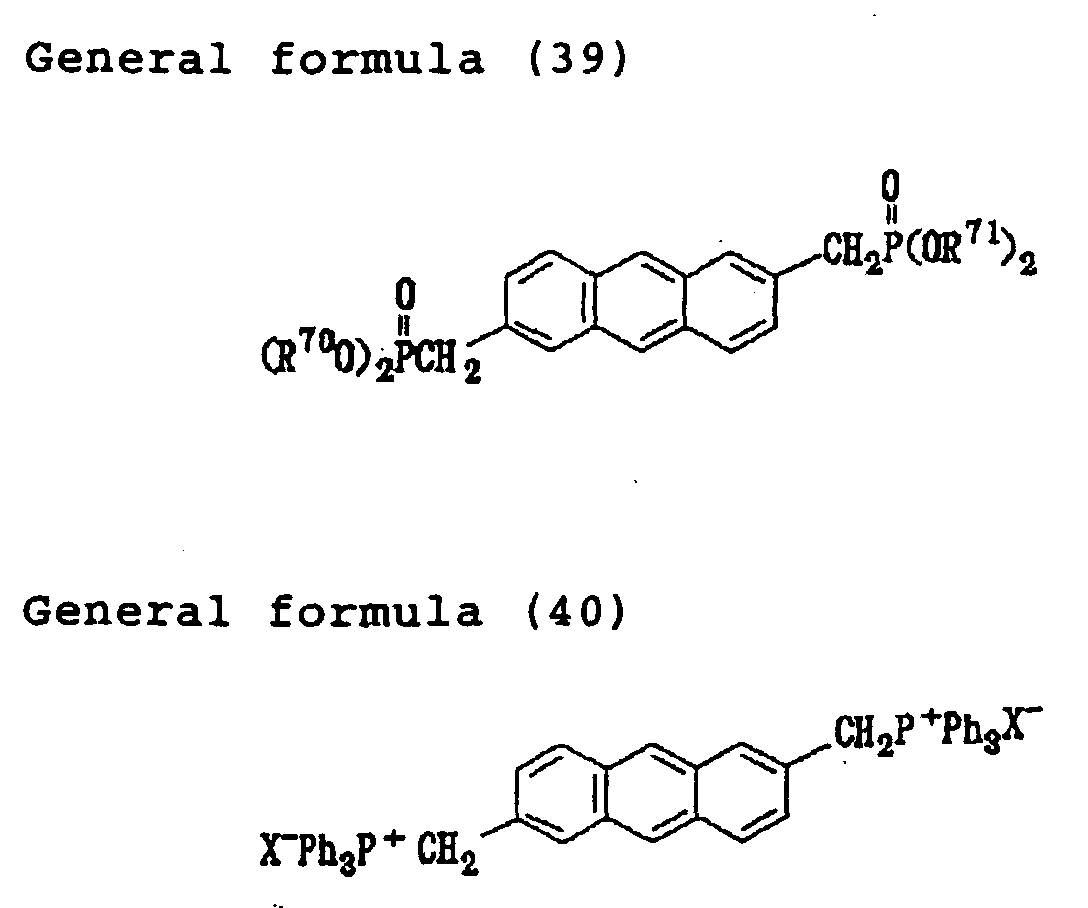
- this synthesis intermediate (referred to as the synthesis intermediate 1 of the present invention) is represented by the general formula (35), (36), (37), (38), (39), or (40) below. (where R 70 , R 71 , and X are defined as above.)
- the synthesis intermediate 1 of the present invention may be derived from its precursor as follows.
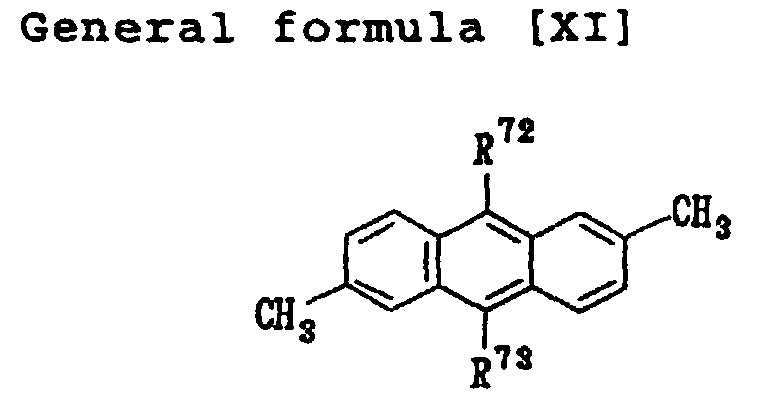
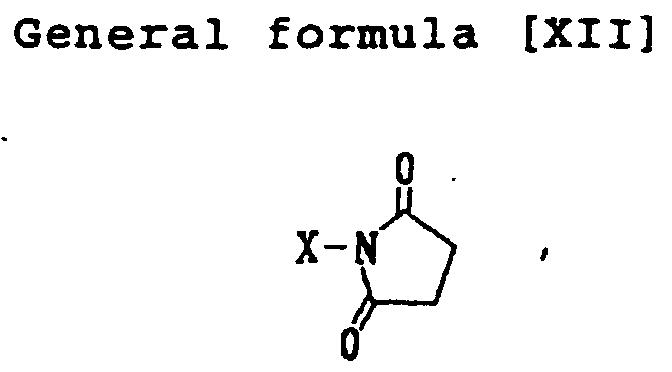
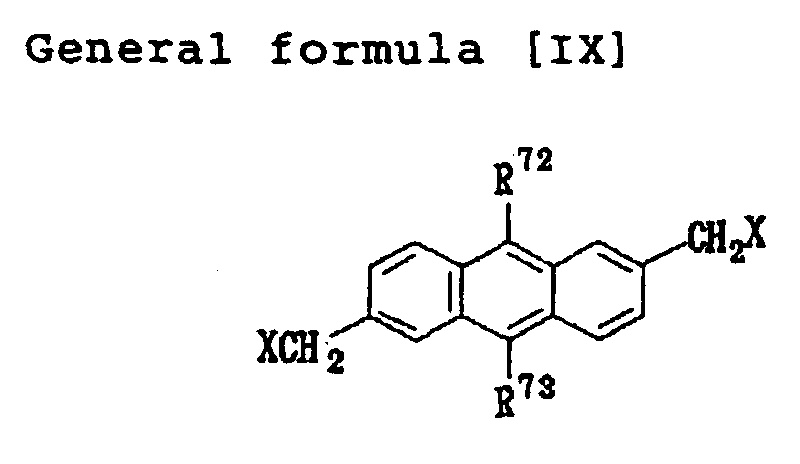
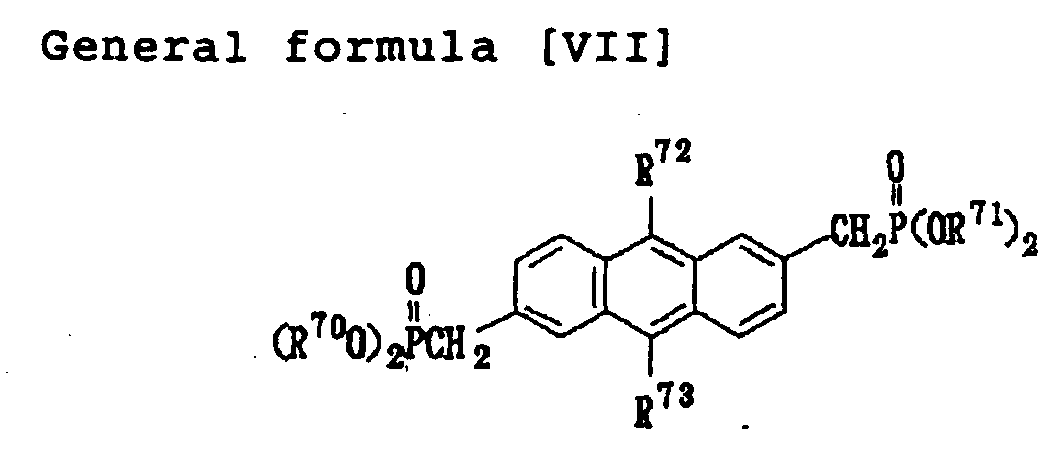
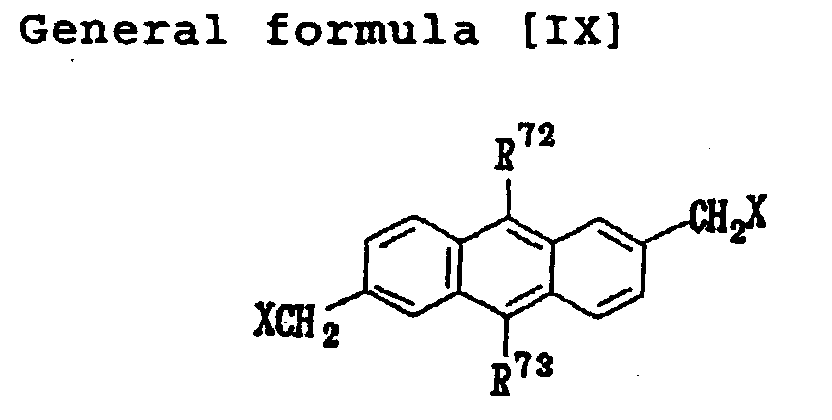
- reaction between an aryl halide compound represented by the general formula [IX] and a trialkyl phosphite represented by the general formula [X] or triphenyl phosphine (PPh 3 ) yields diphosphonic ester represented by the general formula [VII] above or diphosphonium represented by the general formula [VIII] above as the synthesis intermediate.
- This reaction may be carried out without solvent or in a solvent (such as xylene) having a boiling point higher than 120°C.
- This reaction may also be carried out in a large excess of trialkyl phosphite under normal pressure at 120-160°C for 30 minutes to 24 hours.
- R 72 and R 73 are identical or different, at least one of them denoting a hydrogen atom, cyano group, nitro group, trifluoromethyl group, or halogen atom, and X denotes a halogen atom.
- P(OR 74 ) 3 or P(OR 75 ) 3 (where R 74 and R 75 are identical or different, each denoting a hydrocarbon group, particularly a saturated or unsaturated hydrocarbon group having 1 to 4 carbon atoms.)
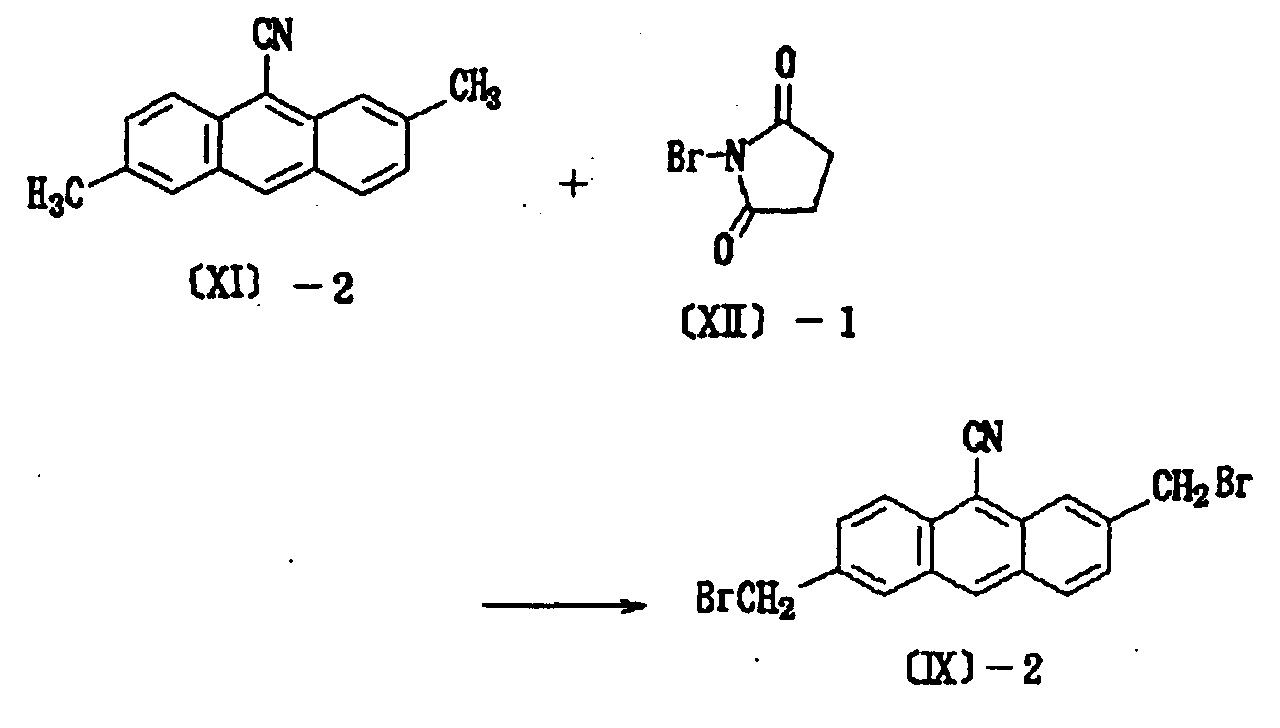
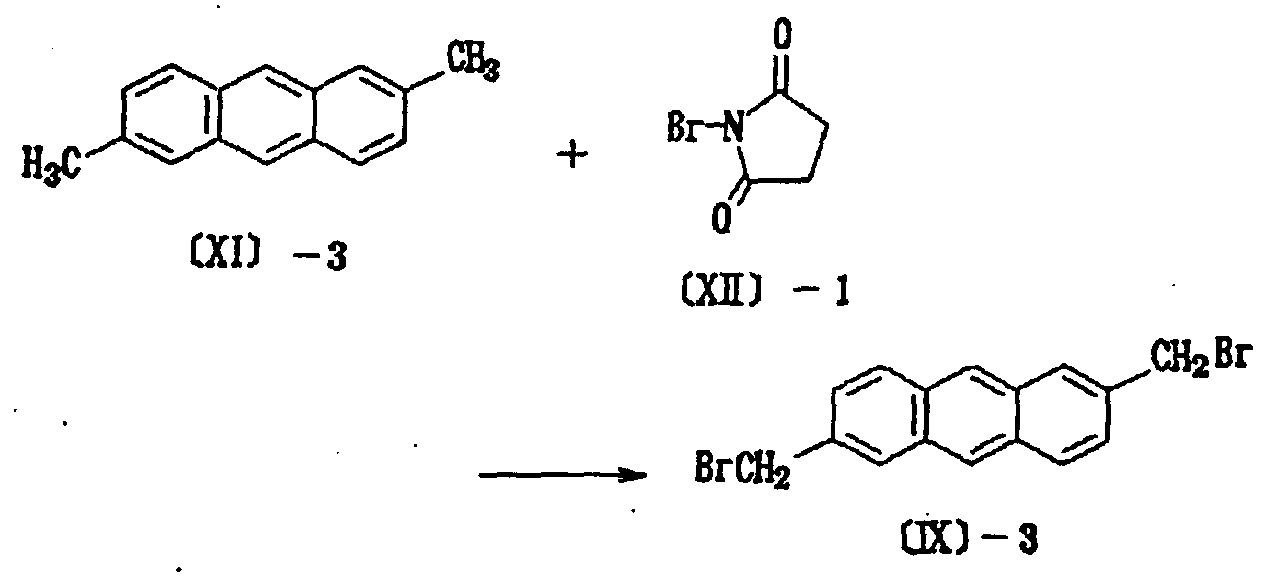
- the present invention also provides an aryl halide compound (referred to as the synthesis intermediate 2 of the present invention) represented by the general formula [IX] above, which is used as a synthesis intermediate to give the synthesis intermediate 1 of the present invention.
- an aryl halide compound referred to as the synthesis intermediate 2 of the present invention represented by the general formula [IX] above, which is used as a synthesis intermediate to give the synthesis intermediate 1 of the present invention.
- Figs. 11 to 14 show some examples of the organic electroluminescent element (EL element) which employs the compound of the present invention as an organic luminescent material.
- EL element organic electroluminescent element
- Fig. 11 shows an organic electroluminescent element A of transmission type which is designed such that the cathode 3 transmits the emitted light 20 or the emitted light 20 is visible through the protective film 4.
- Fig. 12 shows an organic electroluminescent element B which is designed such that the cathode 3 reflects the emitted light 20.
- the reference number 1 indicates a substrate on which is formed the organic electroluminescent element.
- the substrate may be formed from glass, plastics, and any other adequate material.
- the organic electroluminescent element is used in combination with other display element, a single substrate may be used in common for both of them.
- the reference number 2 denotes a transparent electrode (anode), which is made from ITO (indium tin oxide) or SnO 2 .
- the reference number 5 denotes an organic luminescent layer which contains the compound of the present invention as the luminescent material.
- the luminescent layer may have any known layer structure for obtaining the emitted light 20.
- it may be formed from thin films of hole transfer layer and electron transfer layer.
- One or both of these layers may be combined with other thin films or mixed with other materials so as to improve the charge transfer performance.
- a thin film made of one or more fluorescent materials may be interposed between the hole transfer layer and the electron transfer layer.
- one or more fluorescent materials may be incorporated into the hole transfer layer or the electron transfer layer or both.
- the layer structure may include a thin film to control the hole transfer or electron transfer so as to improve the light-emitting efficiency.
- the compound of the present invention may be used as the light-emitting layer which also functions as the electron transfer layer or it may be used as the light emitting-layer which also functions as the hole transfer layer.
- Another possible structure is such that the compound of the present invention constitutes the light-emitting layer which is interposed between the electron transfer layer and the hole transfer layer.
- the substrate 1 may be formed from any transparent material such as glass and plastics. This substrate may serve for another display element combined with the electroluminescent element. This substrate may also serve for the electroluminescent elements of laminate structure (as shown in Figs. 13 and 14) which are arranged in array.
- the elements C and D may be of transmission type or reflection type.
- the anode 2 is a transparent electrode made of ITO (indium tin oxide) or SnO 2 . Adjoining the anode 2 is the hole transfer layer 6 (or 10). There may be interposed between them a thin film of organic compound or organo-metallic compound for improvement in charge injection efficiency.
- the protective film 4 is made of electrically-conductive material (such as metal)
- the anode 2 may have an insulating layer on its sides.
- the hole transfer layer 6 or the electron transfer layer 7 or the light-emitting layer 11 is made entirely of the compound of the present invention.
- they may be formed from the compound of the present invention and a hole or electron transfer material (such as aromatic amine and pyrazoline) which undergo vapor deposition simultaneously.
- the hole transfer layer may be composed of several hole transfer layers of different kind so that it has improved hole transfer performance.
- the cathode 3 may be formed from an alloy of active metal (such as Li, Mg, and Ca) and metal (such as Ag, Al, and In). Alternatively, it may be a laminate of these metals in the form of thin film.
- the cathode may vary in thickness and material according to the intended use of the electroluminescent element.
- the protective layer 4 functions as a sealing film. It should entirely cover the organic electroluminescent element for improvement in electron injection efficiency and light-emitting efficiency. It may be formed from any material (such as aluminum, gold, and chromium in the form of metal or alloy) so long as it provides hermetic seal.
- organic electroluminescent elements are usually given direct current. However, they may also be given pulsating current or alternating current. The magnitude of current and voltage is not specifically restricted so long as it is not large enough to destroy the element. Efficient light emission with minimal electric energy is desirable in view of the power consumption and life of the organic electroluminescent elements.
- Fig. 15 is a schematic diagram showing the structure of a flat display composed of the organic electroluminescent elements.
- an organic layer 5 (5a, 5b) which emits thee primary colors -- red (R), green (G), and blue (B).
- the cathodes 3 and the anodes 2 are arranged at right angles each other. They are connected to the luminance signal circuit 14 and the control circuit 15 containing shift registers, so that they select a specific pixel at the intersection of the cathode 3 and the anode 2 and apply a signal voltage to it to make the organic layer to emit light.
- the display shown in Fig. 15 is that of simple matrix type (8 ⁇ 3 RGB). It has a laminate 5 interposed between the cathode 3 and the anode 2. This laminate is composed of at least one of the hole transfer layer, light-emitting layer, and electron transfer layer. (See Figs. 13 and 14.)
- the cathodes and anodes are patterned in strips and crossed each other at right angles so that they form a matrix. They are given signal voltage sequentially by the control circuits 15 and 14 containing shift registers, so that they emit light at their intersection.
- EL elements constructed in this way can be used as a display for characters and codes. They can also be used as an image-reproducing unit. In addition, they may form a solid-state multicolor or full-color flat panel display if each pattern consisting of cathodes and anodes is arranged individually for red, green, and blue colors.
- This compound gives a toluene solution which has the maximum visible absorption at 566 nm and the fluorescence maximum wavelength at 645 nm.
- reaction product was purified by silica gel chromatography (WAKO-gel C-300, toluene) and then recrystallized from toluene.
- silica gel chromatography WAKO-gel C-300, toluene
- recrystallized from toluene thus there was obtained the desired bis(aminostyryl)anthracene compound (represented by the structural formula (18)-6') in the form of red crystals(0.419 g).
- This compound gives a toluene solution which has the maximum visible absorption at 566 nm and the fluorescence maximum wavelength at 615 nm.
- recrystallized from acetone-hexane
- This compound gives a toluene solution which has the maximum visible absorption at 490 nm and the fluorescence maximum wavelength at 610 nm.
- Example 1 represented by the structural formula (18)-2) was repeated to give the desired bis(aminostyryl)anthracene compound (represented by the structural formula (32)-1).
- recrystallized from acetone-hexane
Landscapes
- Chemical & Material Sciences (AREA)
- Organic Chemistry (AREA)
- Health & Medical Sciences (AREA)
- Life Sciences & Earth Sciences (AREA)
- Biochemistry (AREA)
- General Health & Medical Sciences (AREA)
- Molecular Biology (AREA)
- Organic Low-Molecular-Weight Compounds And Preparation Thereof (AREA)
- Electroluminescent Light Sources (AREA)
Abstract

Description




























3.83(6H,s), 6.87(4H,d), 6.90(4H,m), 7.12(8H,d), 7.18-7.39(4H,m), 7.45(4H,d), 8.04(2H,d), 8.32(4H,s), 8.40(2H,d).
6.68(4H,d), 7.12(d,2H), 7.26-7.42(22H,m), 7.48(4H,t), 7.73(4H,d), 7.89(4H,d), 7.96(2H,d), 8.05(4H,d), 8.24(2H,s), 8.33(2H,d)
3.83(6H,s), 6.87(4H,d), 7.03(6H,m), 7.14(8H,d), 7.18-7.35(2H,d), 7.44(4H,m), 7.83(1H,d), 7.95-8.01(3H,m), 8.28(1H,s), 8.33(1H,d), 8.51(1H,s)
6.99(2H,d), 7.04-7.31(10H,m), 7.45(4H,d), 7.73(2H,d), 7.91(2H,s), 7.94(2H,d), 8.30(2H,s)

2.35(6H,s), 7.02-7.15(16H,m), 7.25(2H,d), 7.46(4H,d), 7.89(2H,d), 8.43(2H,s), 8.53(2H,d)

1.29(12H,t), 3.45(4H,d), 4.11(8H,q), 7.82(2H,d), 8.36(2H,s), 8.46(2H,d)
1.27(12H,m), 3.40(4H,m), 4.07(8H,m), 7.61(1H,d), 7.68(1H,d), 7.99-8.06(2H,m), 8.26(1H,s), 8.37(1H,d), 8.61(1H,s)

1.29(12H,t), 3.43(4H,d), 4.08(8H,q), 7.61(2H,d), 8.45(2H,s), 8.53(2H,d)

4.73(4H,s), 7.90(2H,d), 8.45-8.53(4H,m)
4.70(2H,s), 7.64(1H,d), 7.75(1H,d), 8.05-8.10(2H,m), 8.38-8.44(2H,m), 8.63(1H,m)
Claims (42)
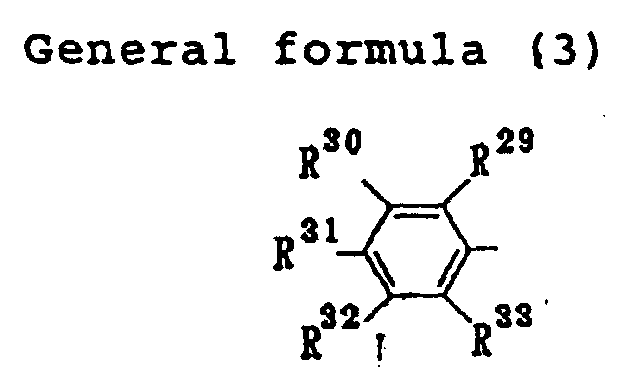
- A bis(aminostyryl)anthracene compound represented by the general formula [I], [II], [III], or [IV] below.(where R2 and R3 each denotes an unsubstituted aryl group, and R1 and R4 each denotes an aryl group represented by the general formula (1) below.)
 (where R7, R8, R9, R10, and R11 are identical or different groups, at least one of them being a saturated or unsaturated hydrocarbon oxy group or hydrocarbon group having at least one carbon; and R5 and R6 are identical or different groups, at least one of them being a hydrogen atom, cyano group, nitro group, trifluoromethyl group, or halogen atom.)
 (where R12, R13, R14, and R15 are identical or different groups, each denoting an aryl group represented by the general formula (2) below.)
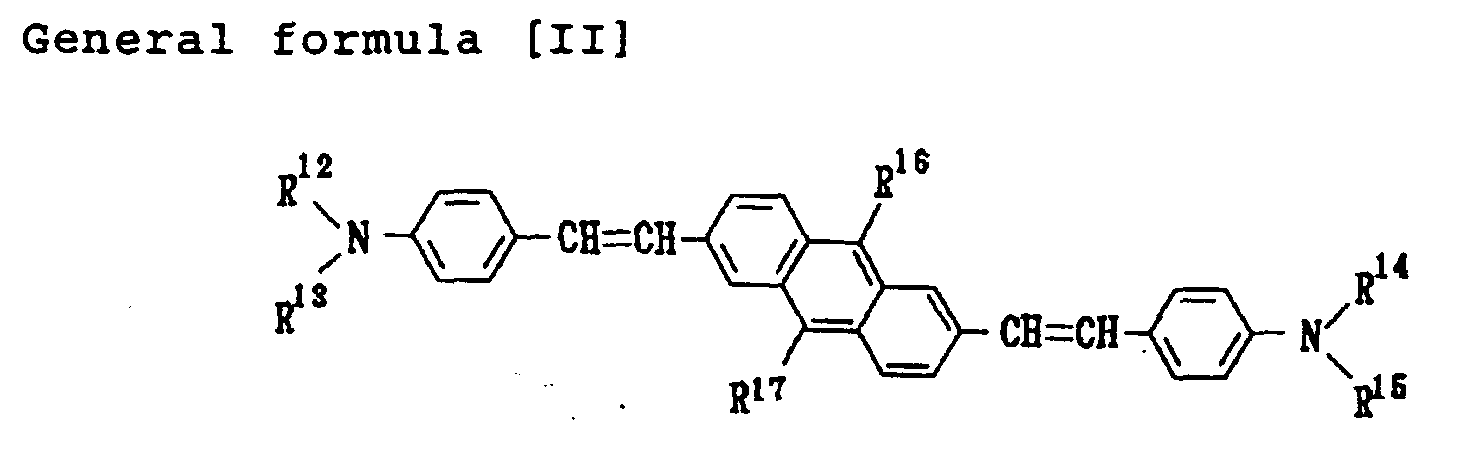 (where R18, R19, R20, R21, and R22 are identical or different groups, at least one of them being a saturated or unsaturated hydrocarbon oxy group or hydrocarbon group having at least one carbon; and R16 and R17 are identical or different groups, at least one of them being a hydrogen atom, cyano group, nitro group, trifluoromethyl group, or halogen atom.)
 (where at least one of R23, R24, R25, and R26 denotes an aryl group represented by the general formula (3) below, with the remainder being an unsubstituted aryl group.)
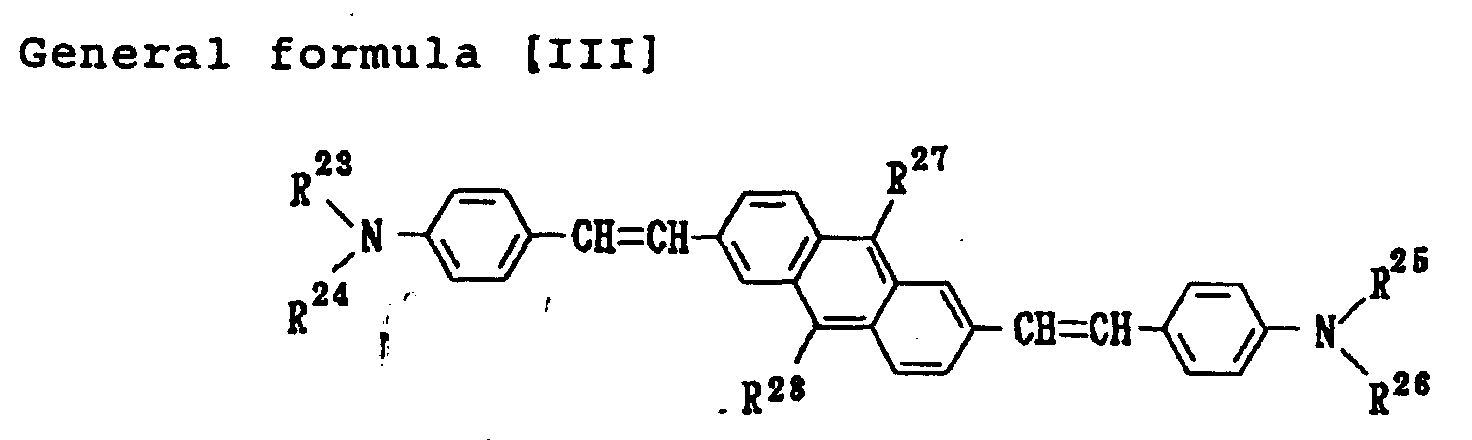 (where R29, R30, R31, R32, and R33 are identical or different groups, at least one of them being a saturated or unsaturated hydrocarbon amino group; and R27 and R28 are identical or different groups, at least one of them being a hydrogen atom, cyano group, nitro group, trifluoromethyl group, or halogen atom.)
 (where R35 and R36 are identical or different groups, each denoting an aryl group represented by the general formula (4) below.)
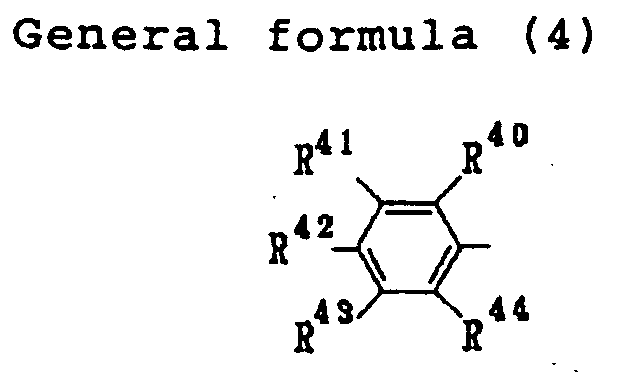
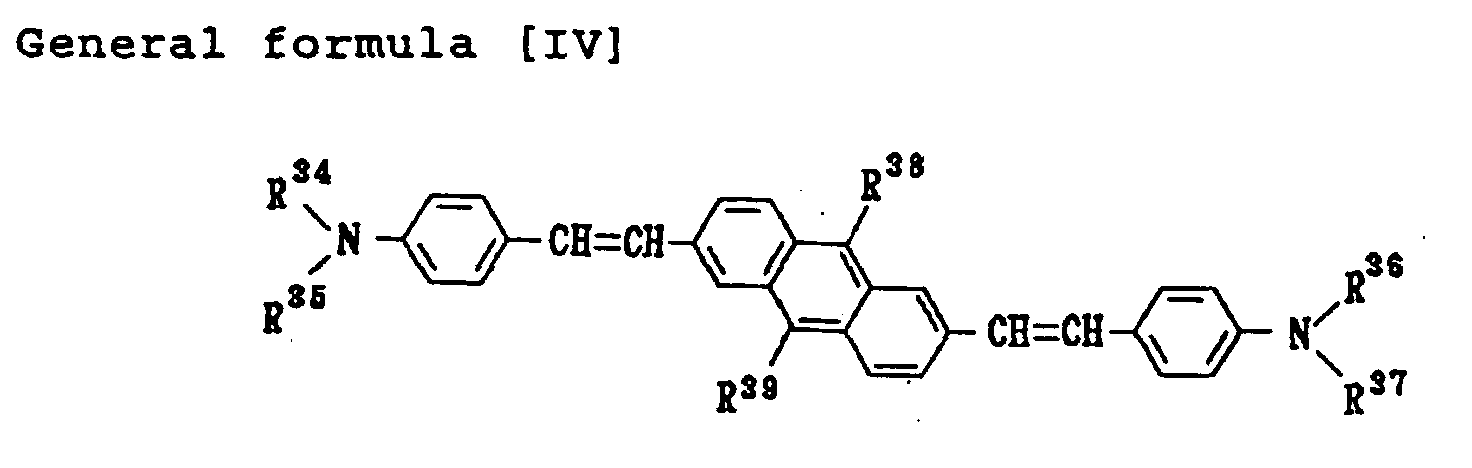 (where R40, R41, R42, R43, and R44 are identical or different groups, each denoting hydrogen or at least one of them being a saturated or unsaturated hydrocarbon oxy group or hydrocarbon group having one or more carbons; and R34 and R37 are identical or different groups, at least one of them being an aryl group represented by the general formula (5) below.)
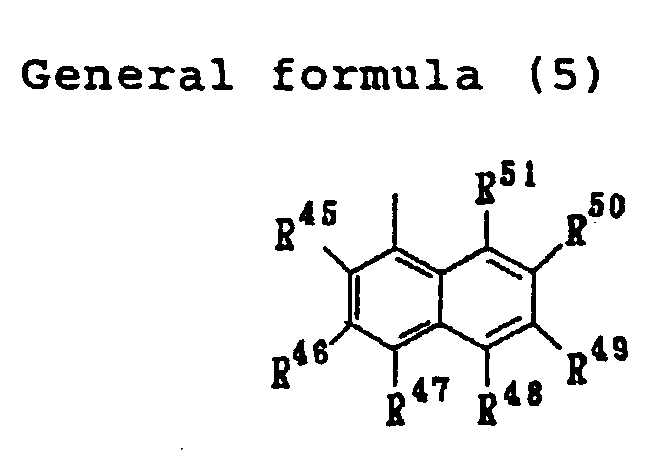
 (where R45, R46, R47, R48, R49, R50, and R51 are identical or different groups, each denoting a hydrogen atom or at least one of them being a saturated or unsaturated hydrocarbon oxy group or hydrocarbon group, or hydrocarbon amino group having one or more carbons; and R38 and R39 are identical or different groups, at least one of them being a hydrogen atom, cyano group, nitro group, trifluoromethyl group, or halogen atom.)
- A bis(aminostyryl)anthracene compound represented by the general formula (6) below.(where Ar1, Ar2, Ar3, and Ar4 are identical or different, each denoting an aryl group which may have a substituent, and if a substituent is present, said aryl group being one which is selected from aryl groups represented by the general formula (7), (8), (9), (10), (11), (12), (12'), or (12'') below.

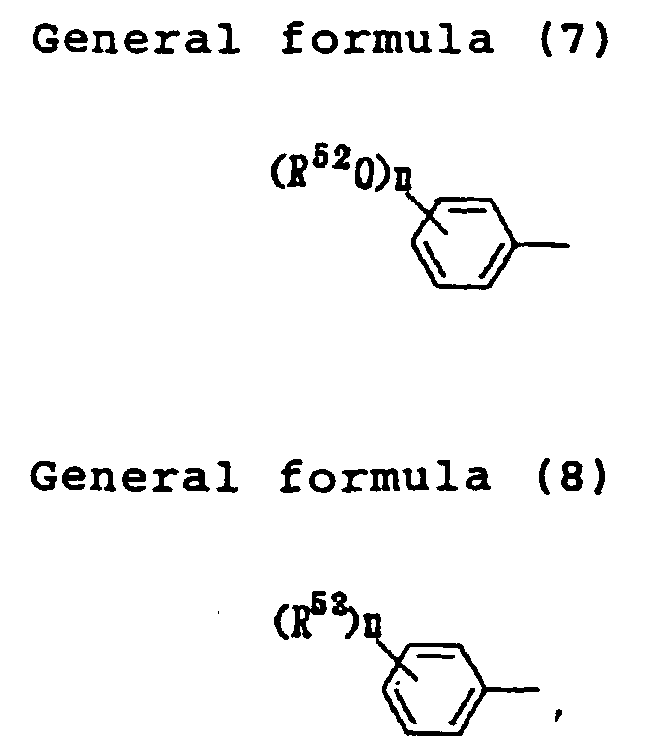
 (where R52, R53, and R54 each denotes a saturated or unsaturated hydrocarbon group having one or more carbons; R55, R56, R57, R58, R59, and R60 are identical or different, each denoting a saturated or unsaturated hydrocarbon group having one or more carbons; n is an integer of 0 to 6; m is an integer of 0 to 3; and l is an integer of 0 to 4.)
- A bis(aminostyryl)anthracene compound as defined in Claim 2, wherein R52, R53, R54, R55, R56, R57, R58, R59, and R60 each has a carbon number of 1 to 6.
- A bis(aminostyryl)anthracene compound as defined in Claim 1 or 2 which is represented by the general formula (13), (13'), (14), (15), (16), (17), (17'), or (17'') below.(where R61 denotes a saturated or unsaturated hydrocarbon group having 1 to 6 carbon atoms.)
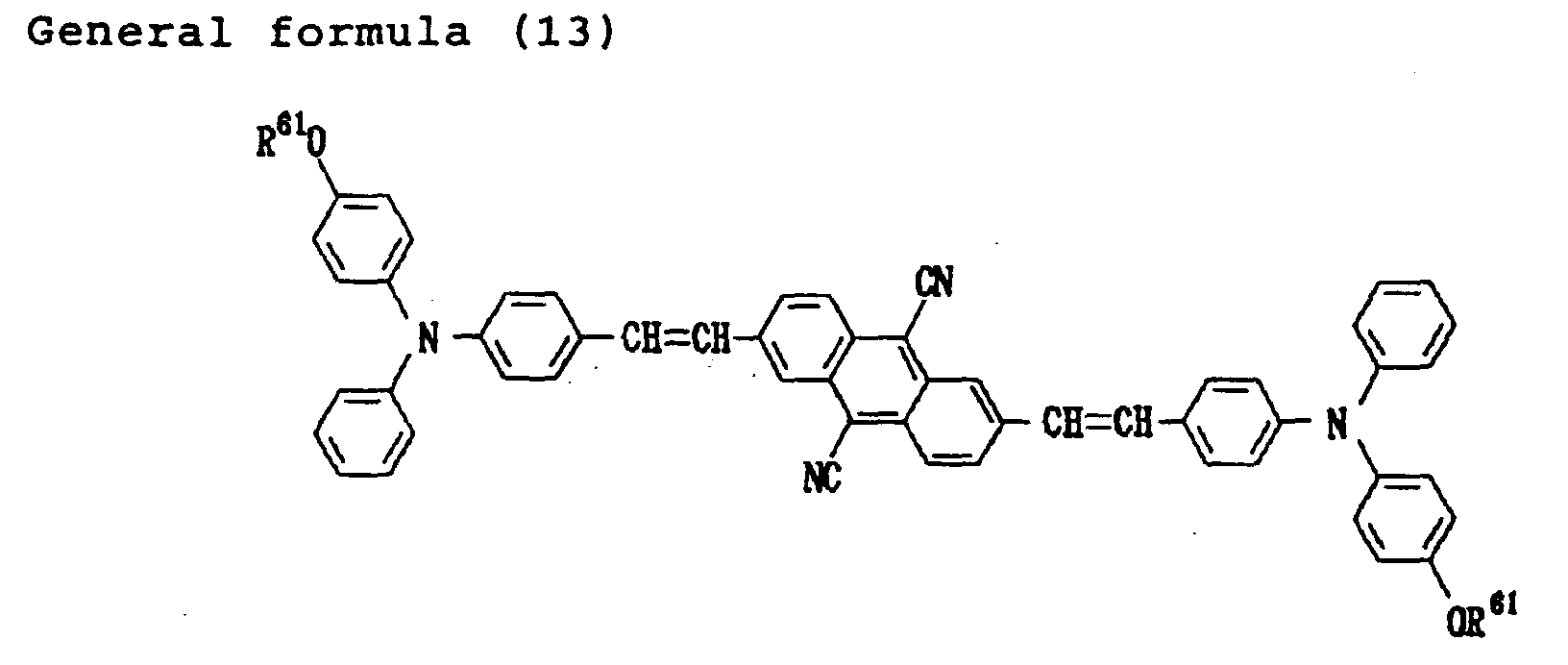 (where R61 denotes a saturated or unsaturated hydrocarbon group having 1 to 6 carbon atoms.)
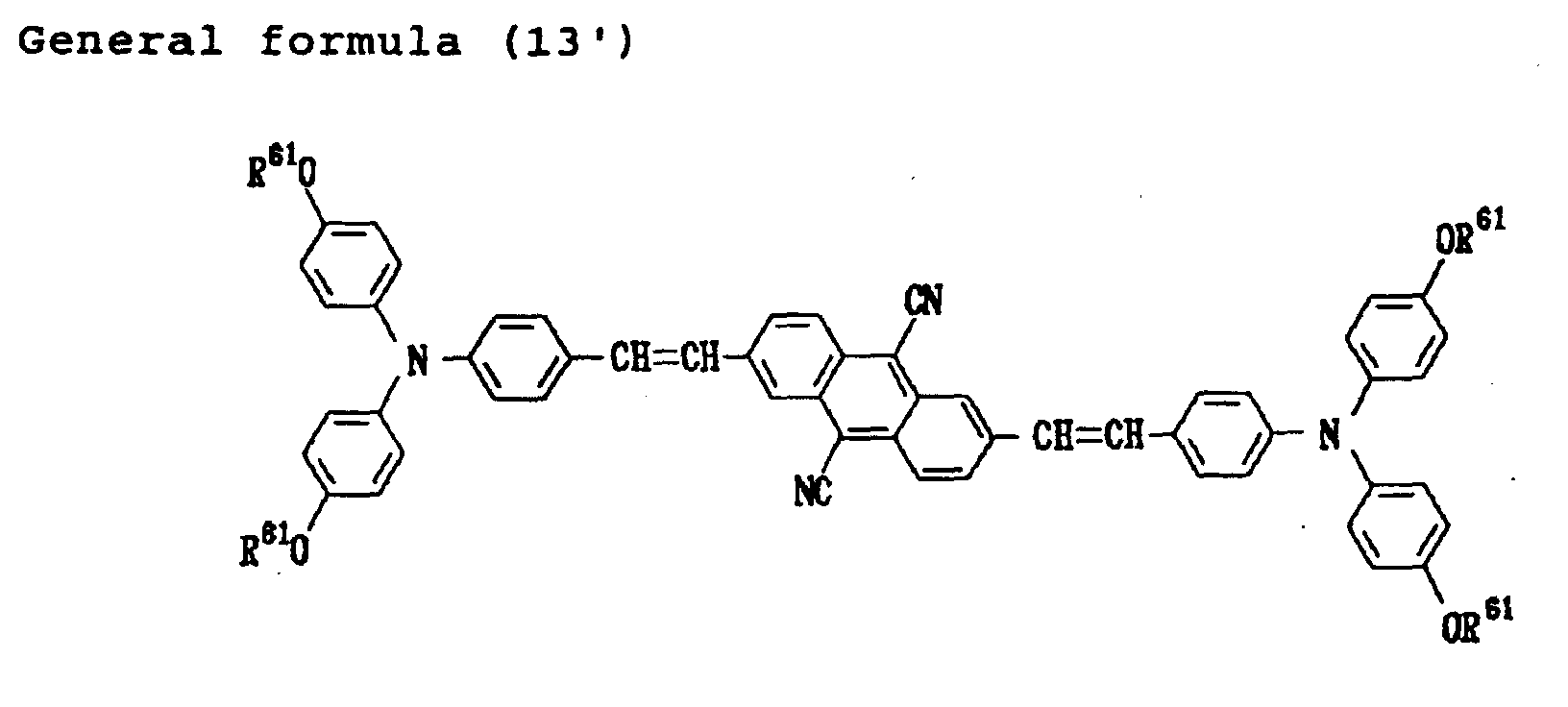 (where R62 denotes a saturated or unsaturated hydrocarbon group having 1 to 6 carbon atoms.)
 (where R63 denotes a saturated or unsaturated hydrocarbon group or hydrocarbon oxy group having 1 to 6 carbon atoms.)
 (where R64 denotes a saturated or unsaturated hydrocarbon group having 1 to 6 carbon atoms.)
 (where R65 denotes a saturated or unsaturated hydrocarbon group having 1 to 6 carbon atoms.)
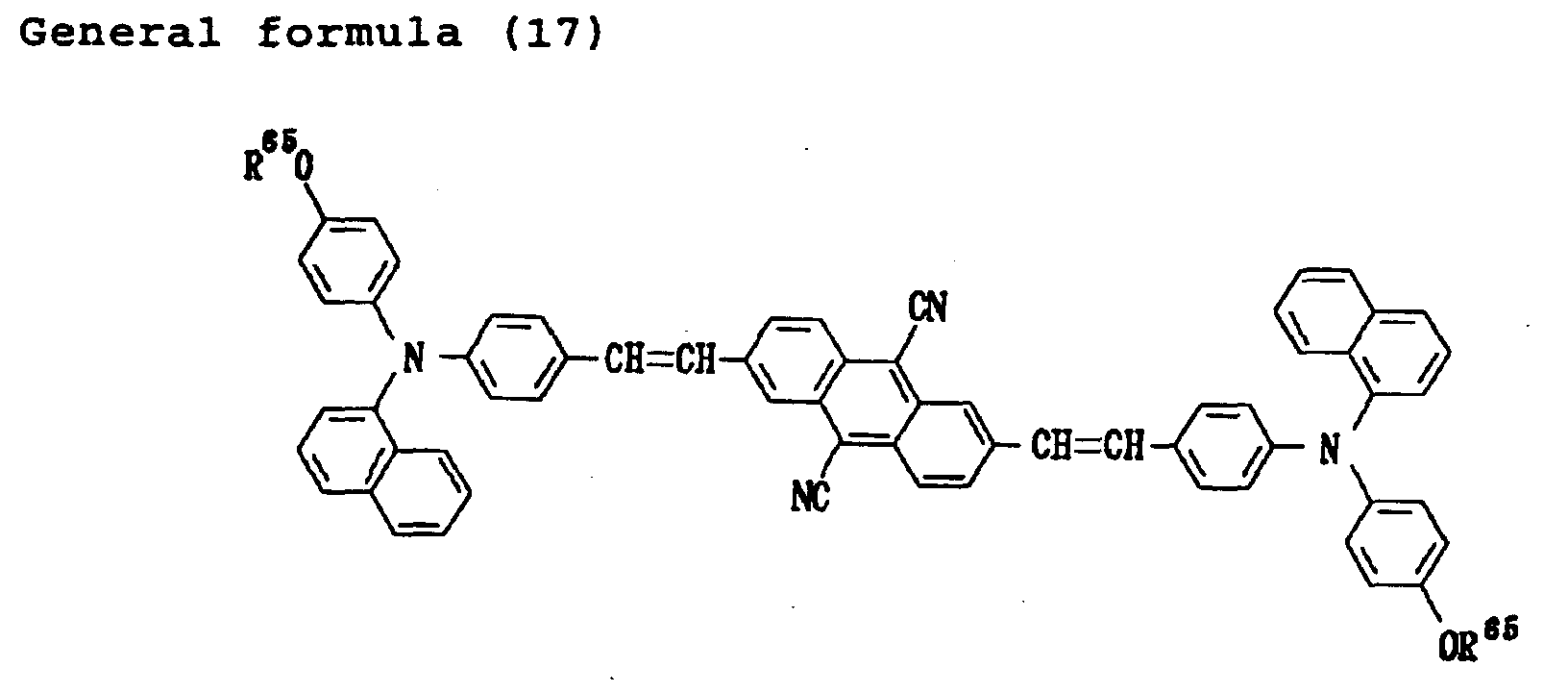 (where R65 denotes a hydrogen atom or a saturated or unsaturated hydrocarbon group having 1 to 6 carbon atoms.)
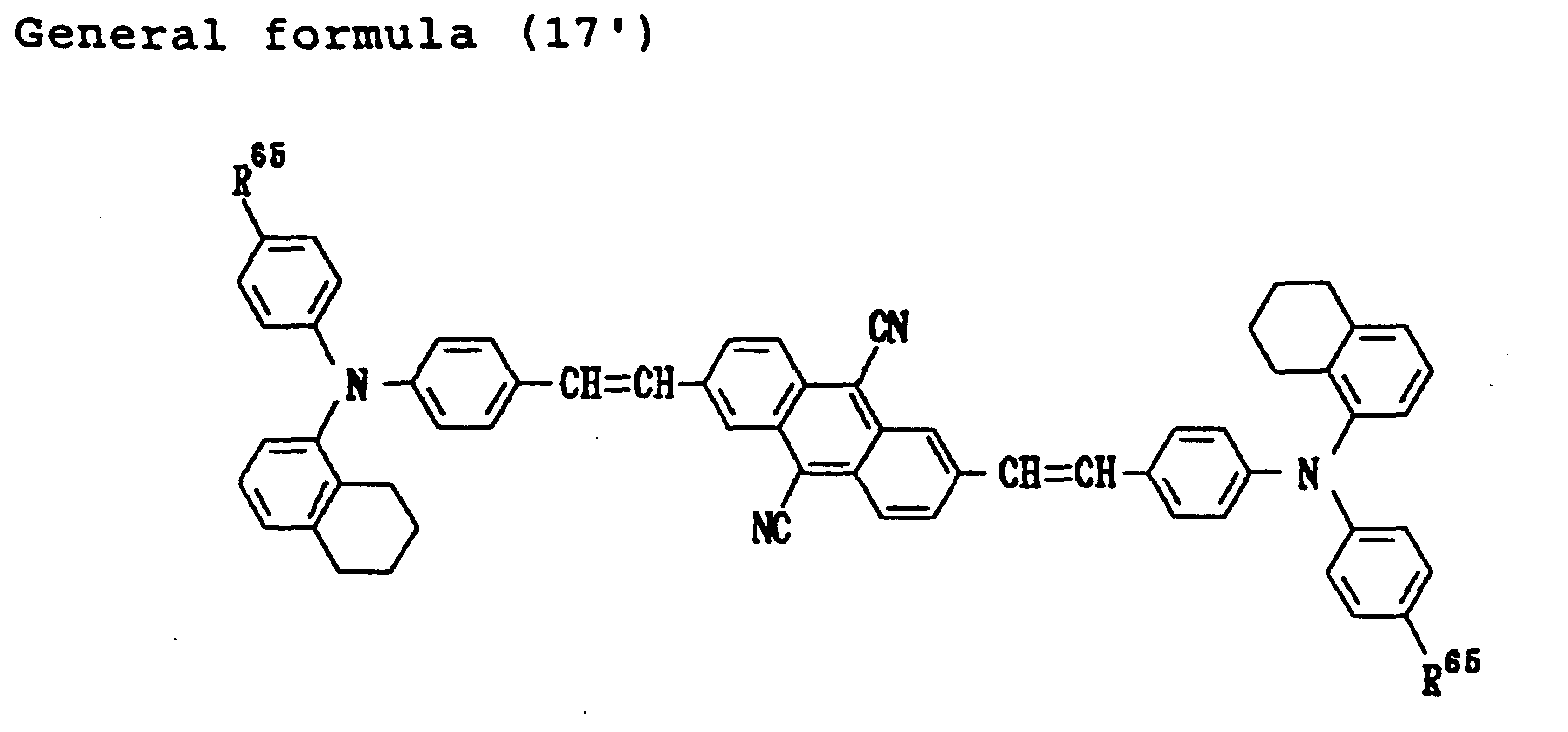 (where R65 denotes a saturated or unsaturated hydrocarbon group having 1 to 6 carbon atoms.)
- A bis(aminostyryl)anthracene compound as defined in Claim 1 or 2 which is represented by the structural formula (18)-1, (18)-2, (18)-2', (18)-3, (18)-4, (18)-5, (18)-6, (18)-6', (18)-7, (18)-8, (18)-9, (18)-10, (18)-10', (18)-10'', or (18)-11 below.



- A bis(aminostyryl)anthracene compound represented by the general formula (19) below.(where Ar1, Ar2, Ar3, and Ar4 are identical or different, each denoting an aryl group which may have a substituent, and if a substituent is present, said aryl group being one which is selected from aryl groups represented by the general formula (7), (8), (9), (10), (11), (12), (12'), or (12'') below.

 (where R52, R53, and R54 each denotes a saturated or unsaturated hydrocarbon group having one or more carbons; R55, R56, R57, R58, R59, and R60 are identical or different, each denoting a saturated or unsaturated hydrocarbon group having one or more carbons; n is an integer of 0 to 6; m is an integer of 0 to 3; and l is an integer of 0 to 4.)
- A bis(aminostyryl)anthracene compound as defined in Claim 6, wherein R52, R53, R54, R55, R56, R57, R58, R59, and R60 each has 1 to 6 carbon atoms.
- A bis(aminostyryl)anthracene compound as defined in Claim 1 or 6 which is represented by the general formula (20), (21), (22), (23), (24), (24') or (24'') below.(where R61 denotes a saturated or unsaturated hydrocarbon group having 1 to 6 carbon atoms.)
 (where R62 denotes a saturated or unsaturated hydrocarbon group having 1 to 6 carbon atoms.)
 (where R63 denotes a saturated or unsaturated hydrocarbon group or hydrocarbon oxy group having 1 to 6 carbon atoms.)
 (where R64 denotes a saturated or unsaturated hydrocarbon group having 1 to 6 carbon atoms.)
 (where R65 denotes a saturated or unsaturated hydrocarbon group having 1 to 6 carbon atoms.)
 (where R65 denotes a saturated or unsaturated hydrocarbon group having 1 to 6 carbon atoms.)
 (where R65 denotes a saturated or unsaturated hydrocarbon group having 1 to 6 carbon atoms.)
- A bis(aminostyryl)anthracene compound as defined in Claim 1 or 6 which is represented by the structural formula (25)-1, (25)-2, (25)-2', (25)-3, (25)-4, (25)-5, (25)-6, (25)-6', (25)-7, (25)-8, (25)-9, (25)-10, (25)-10', (25)-10'', or (25)-11 below.


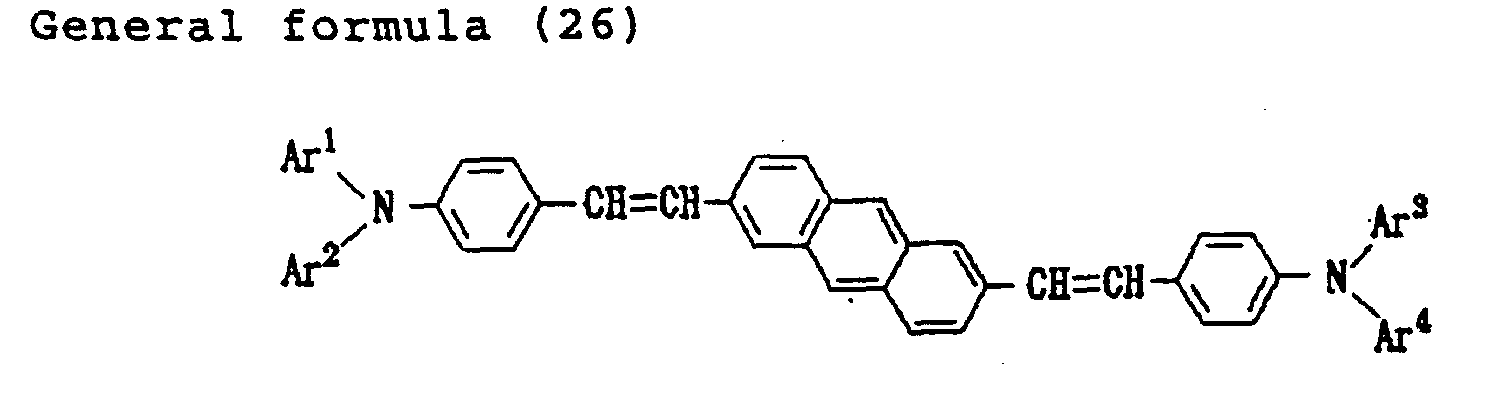
- A bis(aminostyryl)anthracene compound which is represented by the general formula (26) below.(where Ar1, Ar2, Ar3, and Ar4 are identical or different, each denoting an aryl group which may have a substituent, and if a substituent is present, said aryl group being one which is selected from aryl groups represented by the general formula (7), (8), (9), (10), (11), (12), (12'), or (12'') below.

 (where R52, R53, and R54 each denotes a saturated or unsaturated hydrocarbon group having one or more carbons; R55, R56, R57, R58, R59, and R60 are identical or different, each denoting a saturated or unsaturated hydrocarbon group having one or more carbons; n is an integer of 0 to 6; m is an integer of 0 to 3; and l is an integer of 0 to 4.)
- A bis(aminostyryl)anthracene compound as defined in Claim 10, wherein R52, R53, R54, R55, R56, R57, R58, R59, and R60 each has 1 to 6 carbon atoms.
- A bis(aminostyryl)anthracene compound as defined in Claim 1 or 10 which is represented by the general formula (27), (28), (29), (30), (31), (31') or (31'') below.(where R61 denotes a saturated or unsaturated hydrocarbon group having 1 to 6 carbon atoms.)
 (where R62 denotes a saturated or unsaturated hydrocarbon group having 1 to 6 carbon atoms.)
 (where R63 denotes a saturated or unsaturated hydrocarbon group or hydrocarbon oxy group having 1 to 6 carbon atoms.)
 (where R64 denotes a saturated or unsaturated hydrocarbon group having 1 to 6 carbon atoms.)
 group having 1 to 6 carbon atoms.)
 (where R65 denotes a saturated or unsaturated hydrocarbon group having 1 to 6 carbon atoms.)
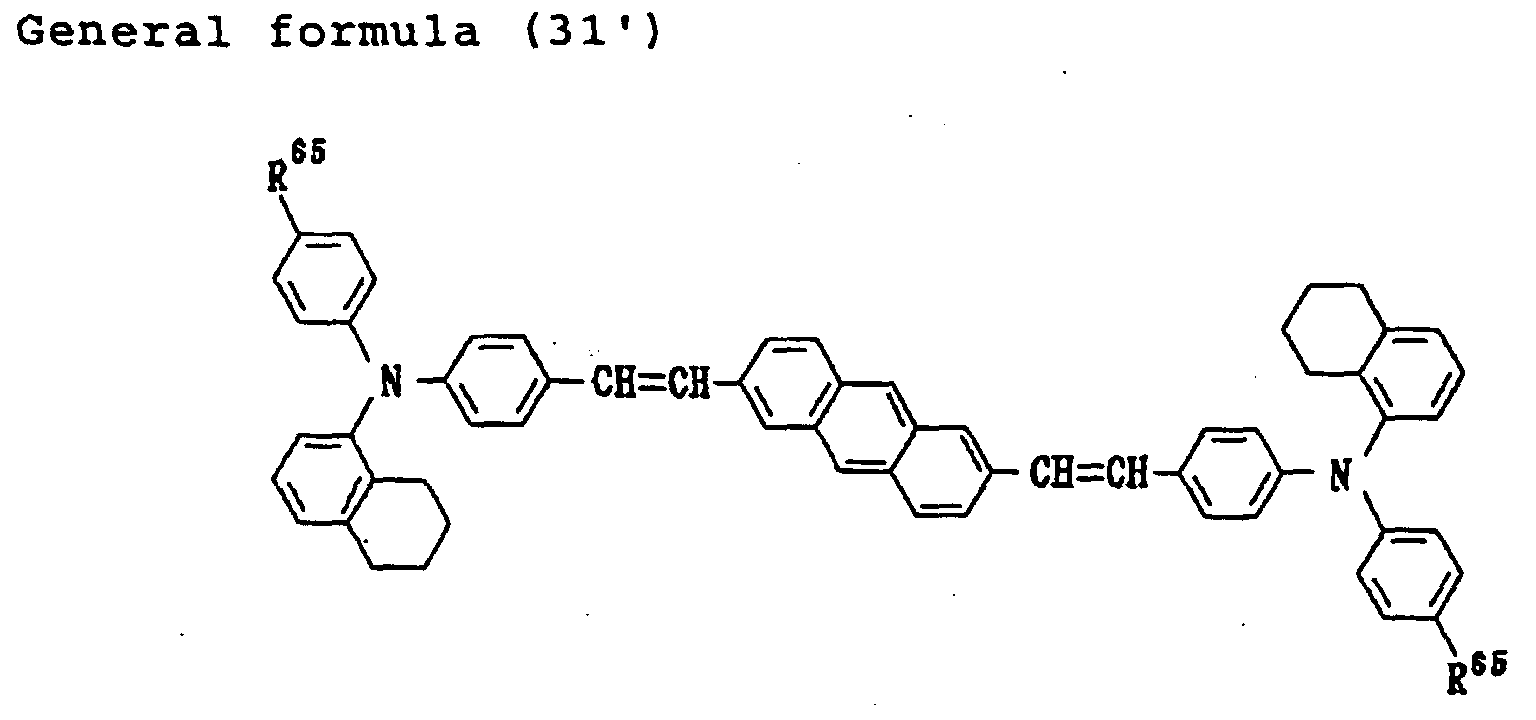 (where R65 denotes a saturated or unsaturated hydrocarbon group having 1 to 6 carbon atoms.)
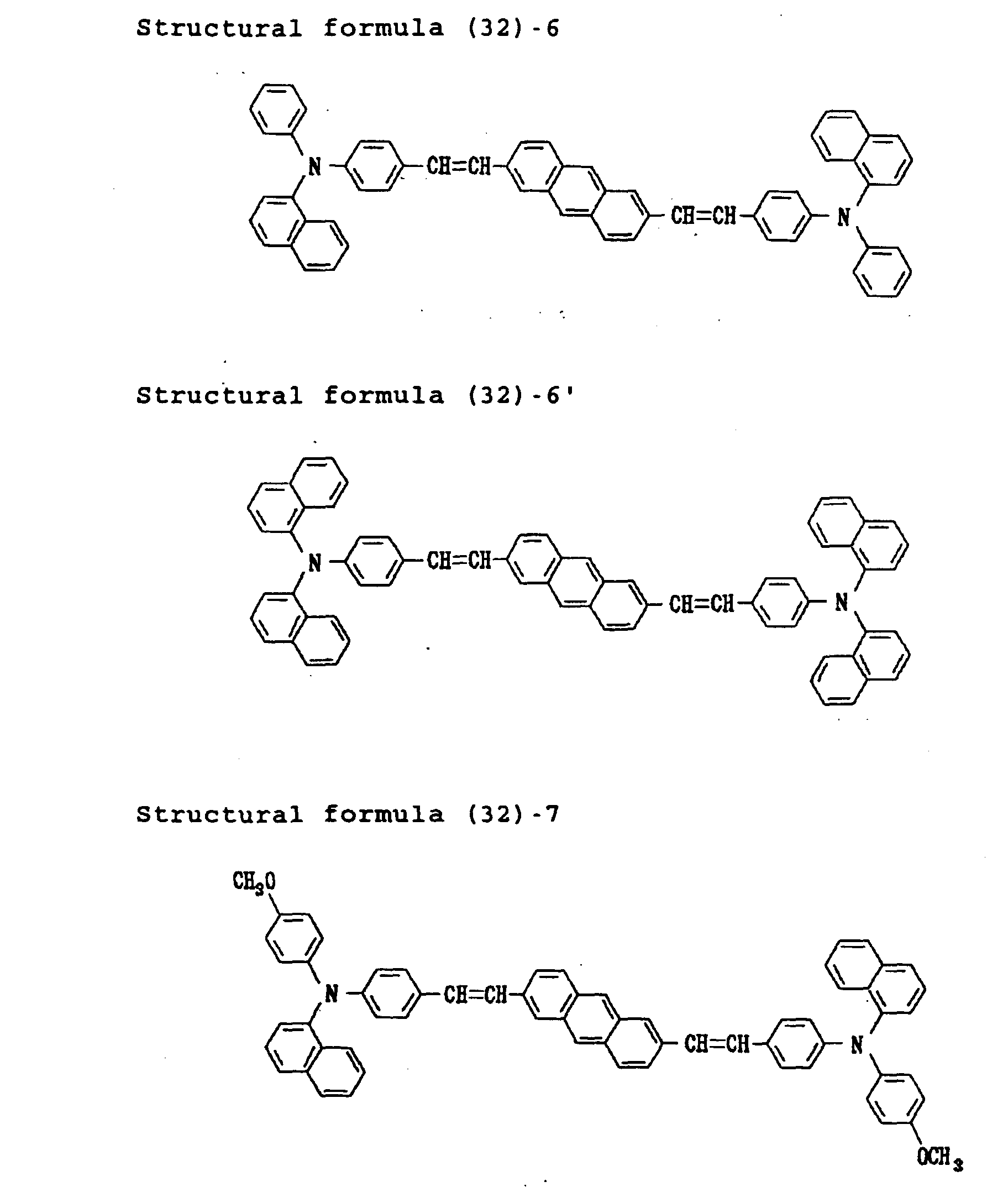
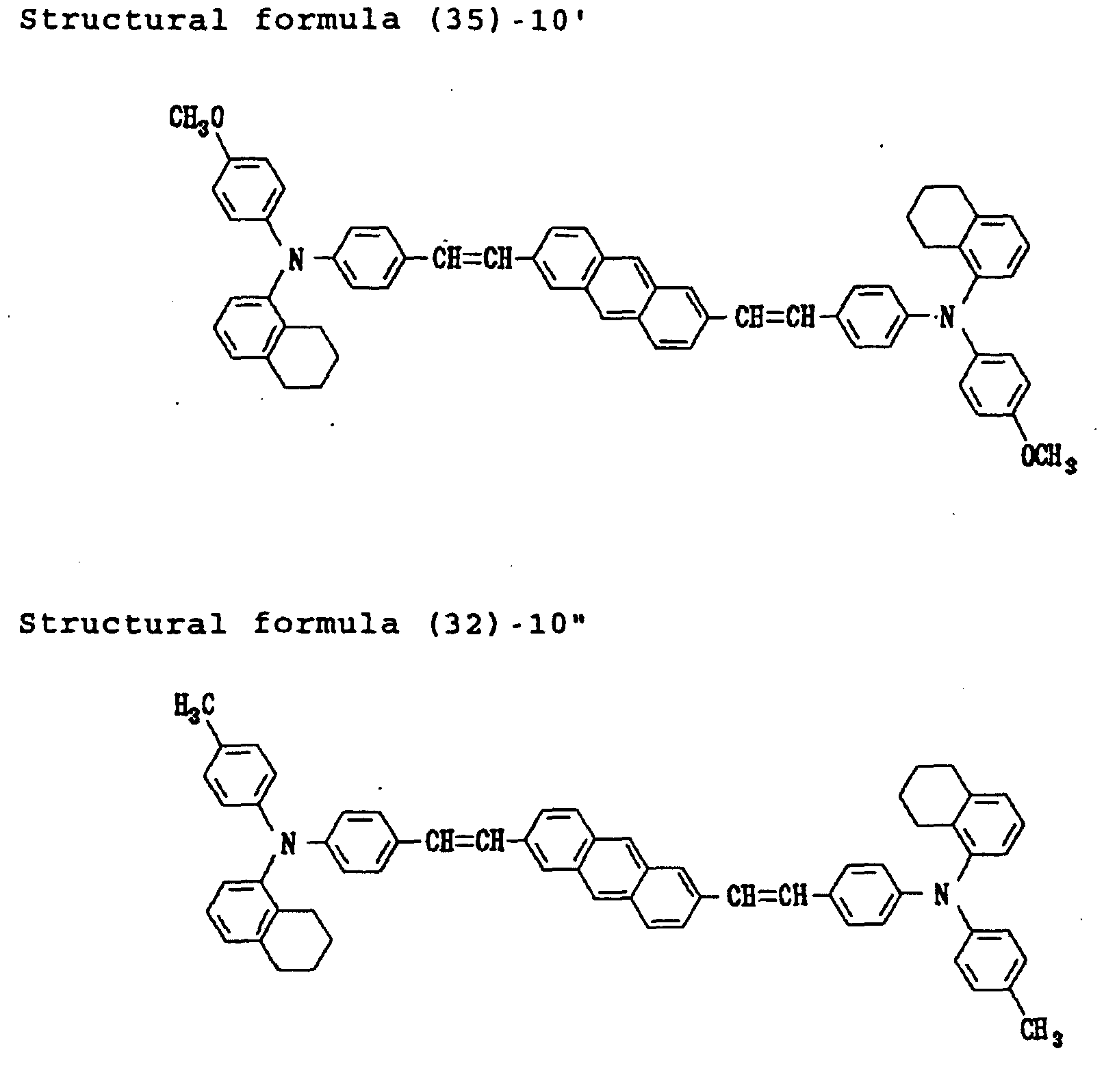
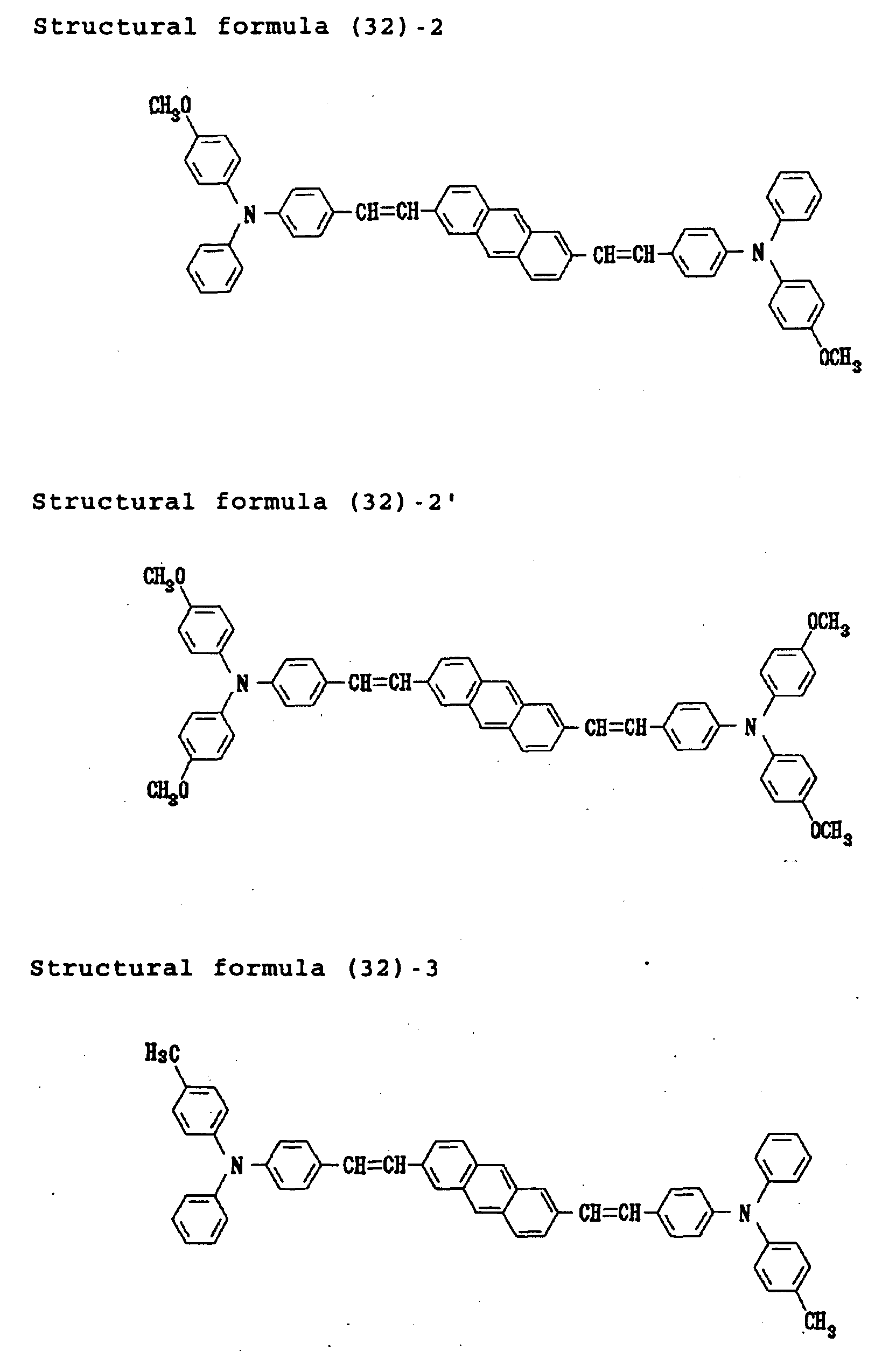
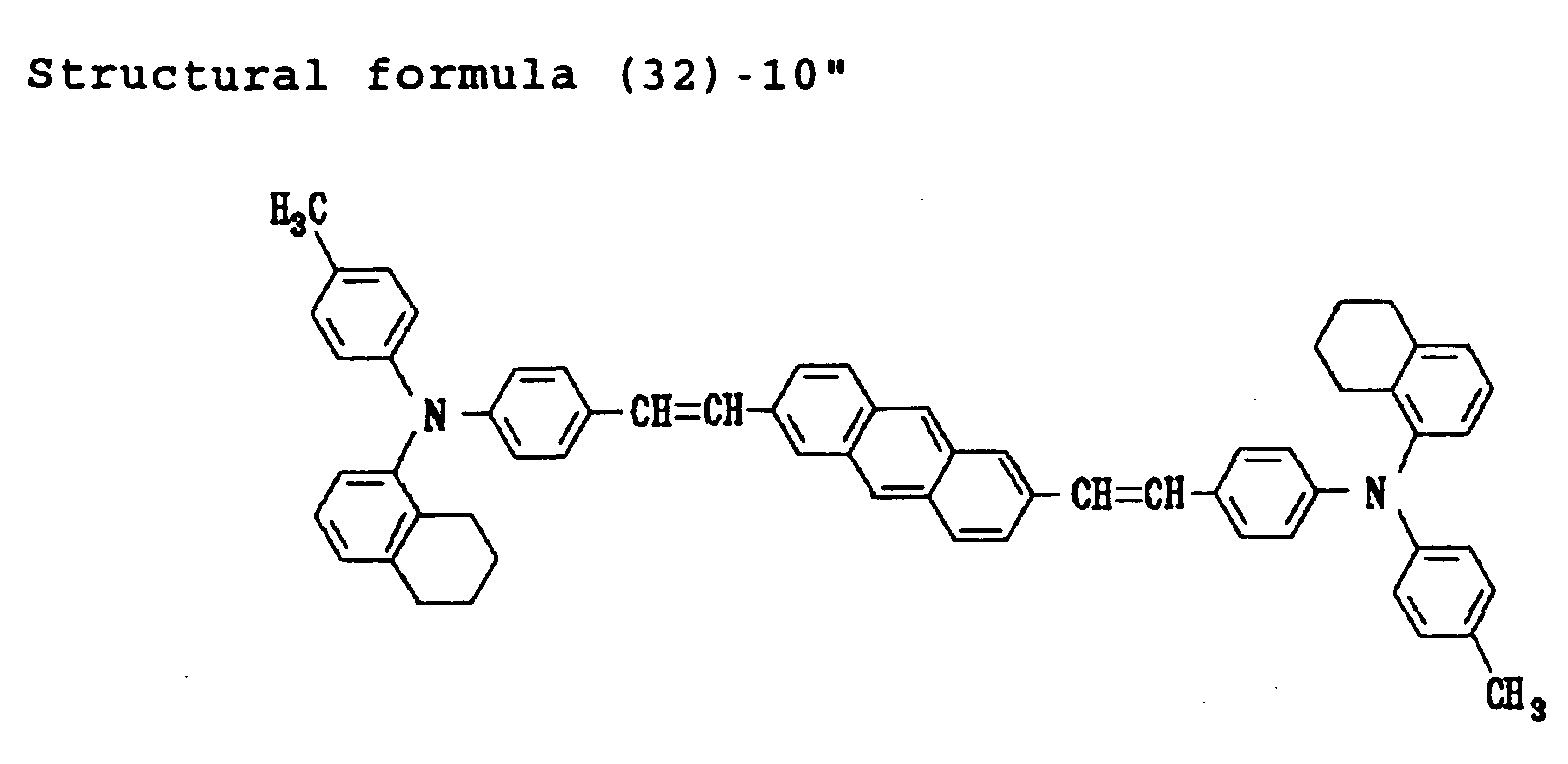
- A bis(aminostyryl)anthracene compound as defined in Claim 1 or 10 which is represented by the structural formula (32)-1, (32)-2, (32)-2', (32)-3, (32)-4, (32)-5, (32)-6, (32)-6', (32)-7, (32)-8, (32)-9, (32)-10, (32)-10', or (32)-10'' below.



- A process for producing a bis(aminostyryl) anthracene compound represented by the general formula [I], [II], [III], or [IV] below, said process comprising condensing at least one species of 4-(N,N-diarylamino)benzaldehyde represented by the general formula [V] or [VI] below and diphosphonic ester represented by the general formula [VII] below or diphosphonium represented by the general formula [VIII] below.(where R66 and R67 each denotes an aryl group corresponding to R1, R2, R12, R13, R23, R24, R34, or R35 given below; and R68 and R69 each denotes an aryl group corresponding to R3, R4, R14, R15, R25, R26, R36, or R37 given below.)
 (where R70 and R71 are identical or different, each denoting a hydrocarbon group; R72 and R73 each denotes a group corresponding to R5, R6, R16, R17, R27, R28, R38, or R39 given below; and X denotes a halogen atom.)
 (where R2 and R3 each denotes an unsubstituted aryl group, and R1 and R4 each denotes an aryl group represented by the general formula (1) below.)
 (where R7, R8, R9, R10, and R11 are identical or different groups, at least one of them being a saturated or unsaturated hydrocarbon oxy group or hydrocarbon group having one or more carbons; and R5 and R6 are identical or different groups, at least one of them being a hydrogen atom, cyano group, nitro group, trifluoromethyl group, or halogen atom.)
 (where R12, R13, R14, and R15 are identical or different groups, each denoting an aryl group represented by the general formula (2) below.)
 (where R18, R19, R20, R21, and R22 are identical or different groups, at least one of them being a saturated or unsaturated hydrocarbon oxy group or hydrocarbon group having one or more carbons; and R16 and R17 are identical or different groups, at least one of them being a hydrogen atom, cyano group, nitro group, trifluoromethyl group, or halogen atom.)
 (where at least one of R23, R24, R25, and R26 denotes an aryl group represented by the general formula (3) below, with the remainder being an unsubstituted aryl group.)
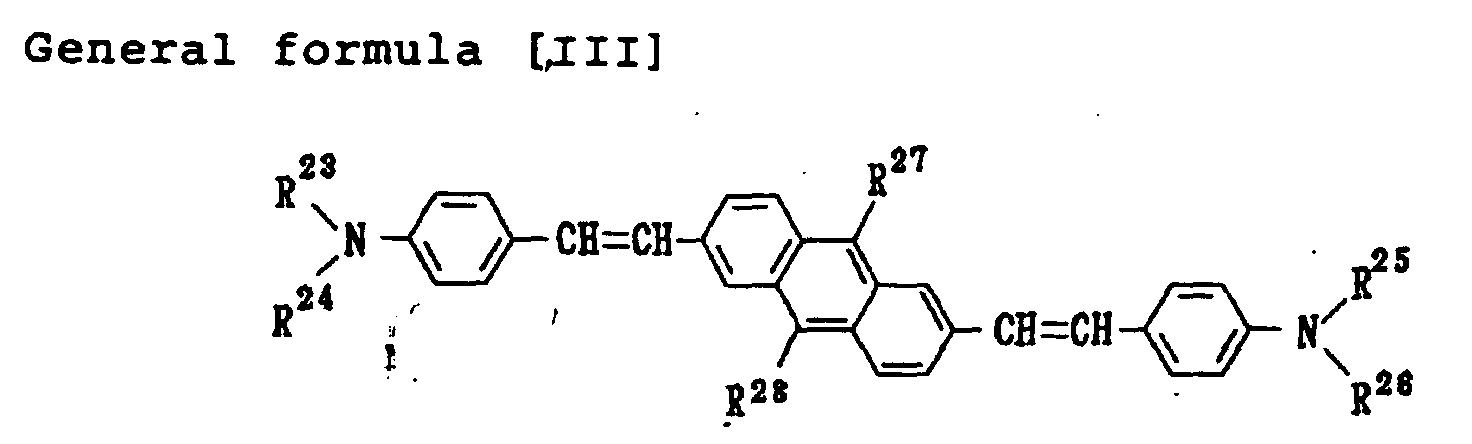 (where R29, R30, R31, R32, and R33 are identical or different groups, at least one of them being a saturated or unsaturated hydrocarbon amino group; and R27 and R28 are identical or different groups, at least one of them being a hydrogen atom, cyano group, nitro group, trifluoromethyl group, or halogen atom.)
 (where R35 and R36 are identical or different groups, each denoting an aryl group represented by the general formula (4) below.)
 (where R40, R41, R42, R43, and R44 are identical or different groups, each denoting hydrogen or at least one of them being a saturated or unsaturated hydrocarbon oxy group or hydrocarbon group having one or more carbons; and R34 and R37 are identical or different groups, being an aryl group represented by the general formula (5) below.)
 (where R45, R46, R47, R48, R49, R50, and R51 are identical or different groups, each denoting a hydrogen atom or at least one of them being a saturated or unsaturated hydrocarbon oxy group or hydrocarbon group, or hydrocarbon amino group having one or more carbons; and R38 and R39 are identical or different groups, at least one of them being a hydrogen atom, cyano group, nitro group, trifluoromethyl group, or halogen atom.)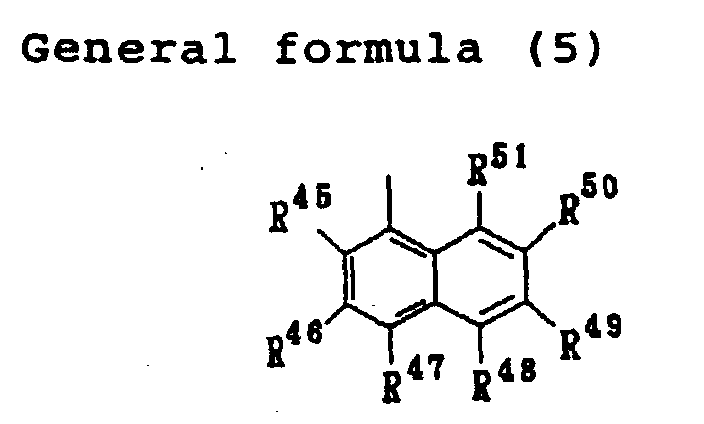
- A process for producing a bis(aminostyryl) anthracene compound as defined in Claim 14, wherein said condensation is accomplished by Wittig-Horner reaction or Wittig reaction, which involves treating the diphosphonic ester and/or diphosphonium with a base in a solvent, thereby giving carboanion, and condensing this carboanion with the 4-(N,N-diarylamino)benzaldehyde.
- A process for producing a bis(aminostyryl) anthracene compound as defined in Claim 14, wherein said bis(aminostyryl) anthracene is represented by the general formula (6) below.(where Ar1, Ar2, Ar3, and Ar4 are identical or different, each denoting an aryl group which may have a substituent, and if a substituent is present, said aryl group being one which is selected from aryl groups represented by the general formula (7), (8), (9), (10), (11), (12), (12'), or (12'') below.

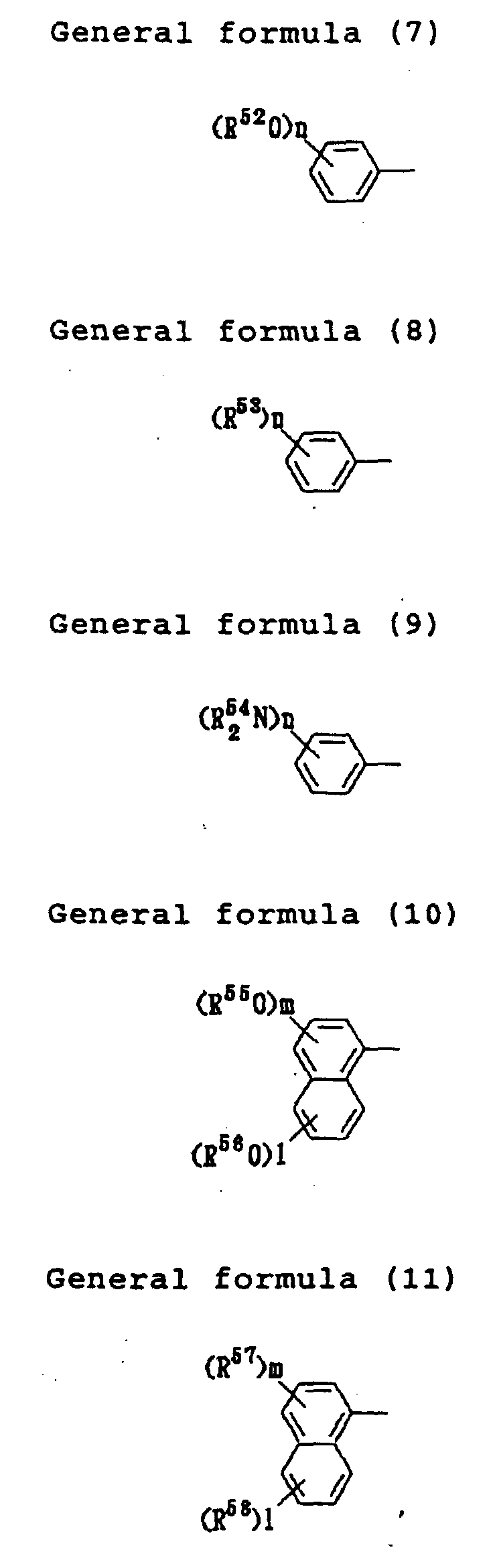 (where R52, R53, and R54 each denotes a saturated or unsaturated hydrocarbon group having one or more carbons; R55, R56, R57, R58, R59, and R60 are identical or different, each denoting a saturated or unsaturated hydrocarbon group having one or more carbons; n is an integer of 0 to 6; m is an integer of 0 to 3; and l is an integer of 0 to 4.)
said process comprising condensing at least one species of 4-(N,N-diarylamino)benzaldehyde represented by the general formula (33) or (34) below with diphosphonic ester represented by the general formula (35) below or diphosphonium represented by the general formula (36) below.(where Ar1, Ar2, Ar3, Ar4, R70, R71 and X are defined as above.)
- A process for producing a bis(aminostyryl) anthracene compound as defined in Claim 16, wherein R70 and R71 each denotes a saturated hydrocarbon group having 1 to 4 carbon atoms.
- A process for producing a bis(aminostyryl) anthracene compound as defined in Claim 16, wherein R52, R53, R54, R55, R56, R57, R58, R59, and R60 each has 0 to 6 carbon atoms.
- A process for producing a bis(aminostyryl) anthracene compound as defined in Claim 14 or 16, wherein said process yields a bis(aminostyryl)anthracene compound represented by the general formula (13), (14), (15), (16), (17), (17'), or (17'') below.(where R61 denotes a saturated or unsaturated hydrocarbon group having 1 to 6 carbon atoms.)
 (where R62 denotes a saturated or unsaturated hydrocarbon group having 1 to 6 carbon atoms.)
 (where R63 denotes a saturated or unsaturated hydrocarbon group or hydrocarbon oxy group having 1 to 6 carbon atoms.)
 (where R64 denotes a saturated or unsaturated hydrocarbon group having 1 to 6 carbon atoms.)
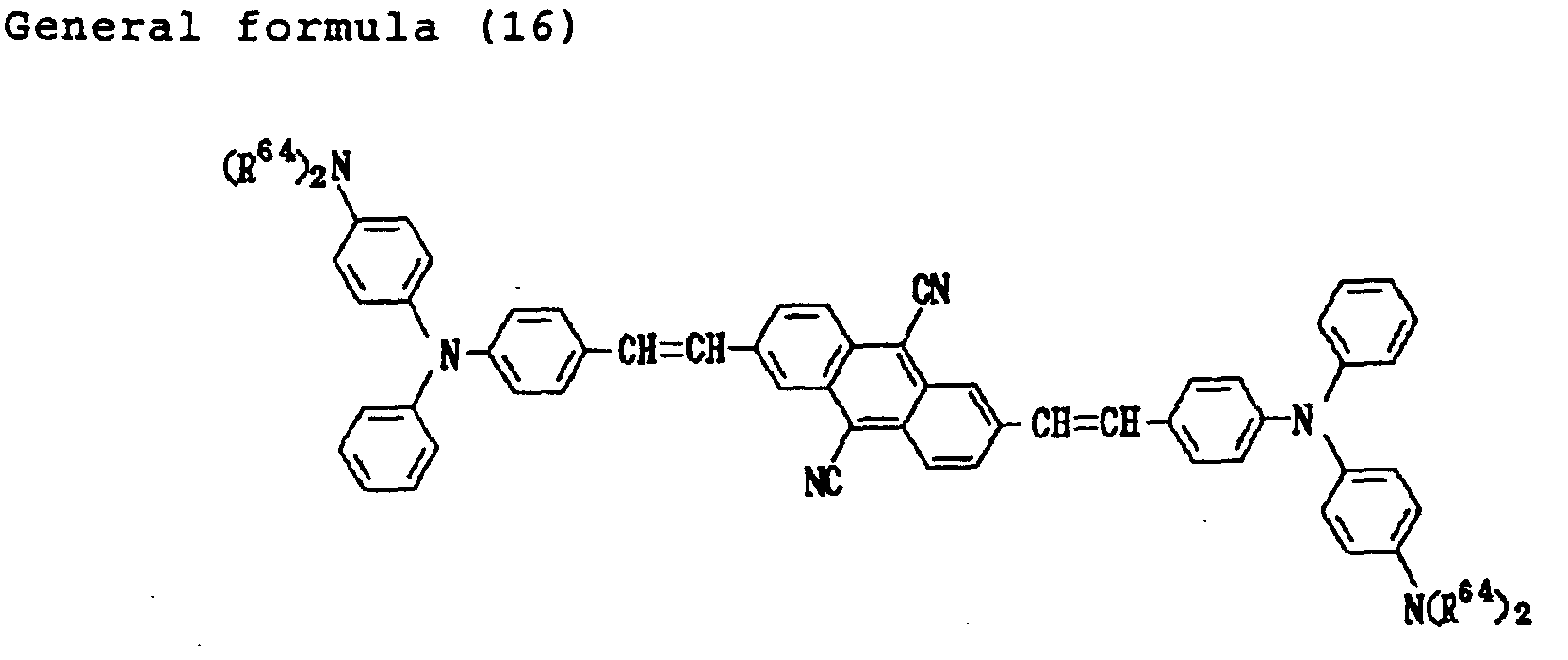 (where R65 denotes a saturated or unsaturated hydrocarbon group having 1 to 6 carbon atoms.)
 (where R65 denotes a hydrogen atom or a saturated or unsaturated hydrocarbon group having 1 to 6 carbon atoms.)
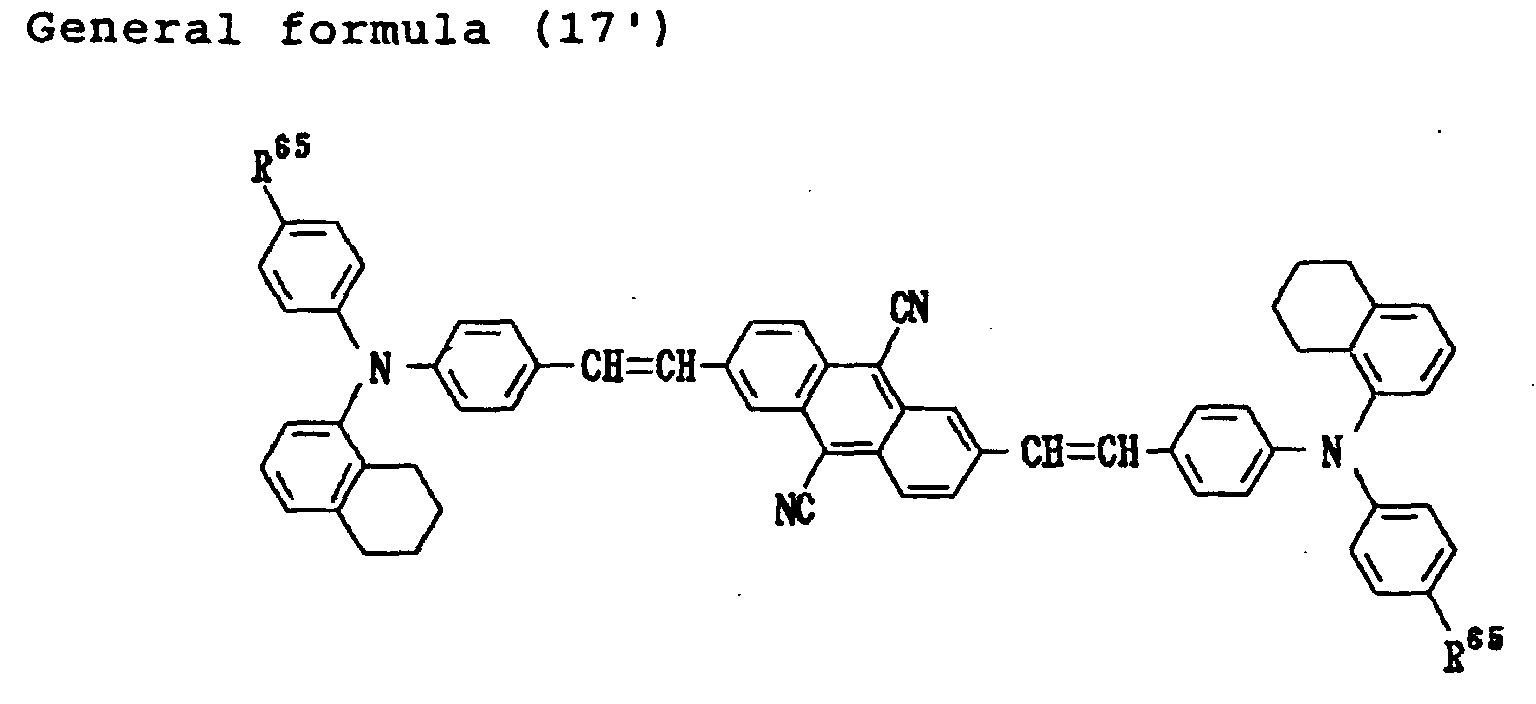 (where R65 denotes a saturated or unsaturated hydrocarbon group having 1 to 6 carbon atoms.)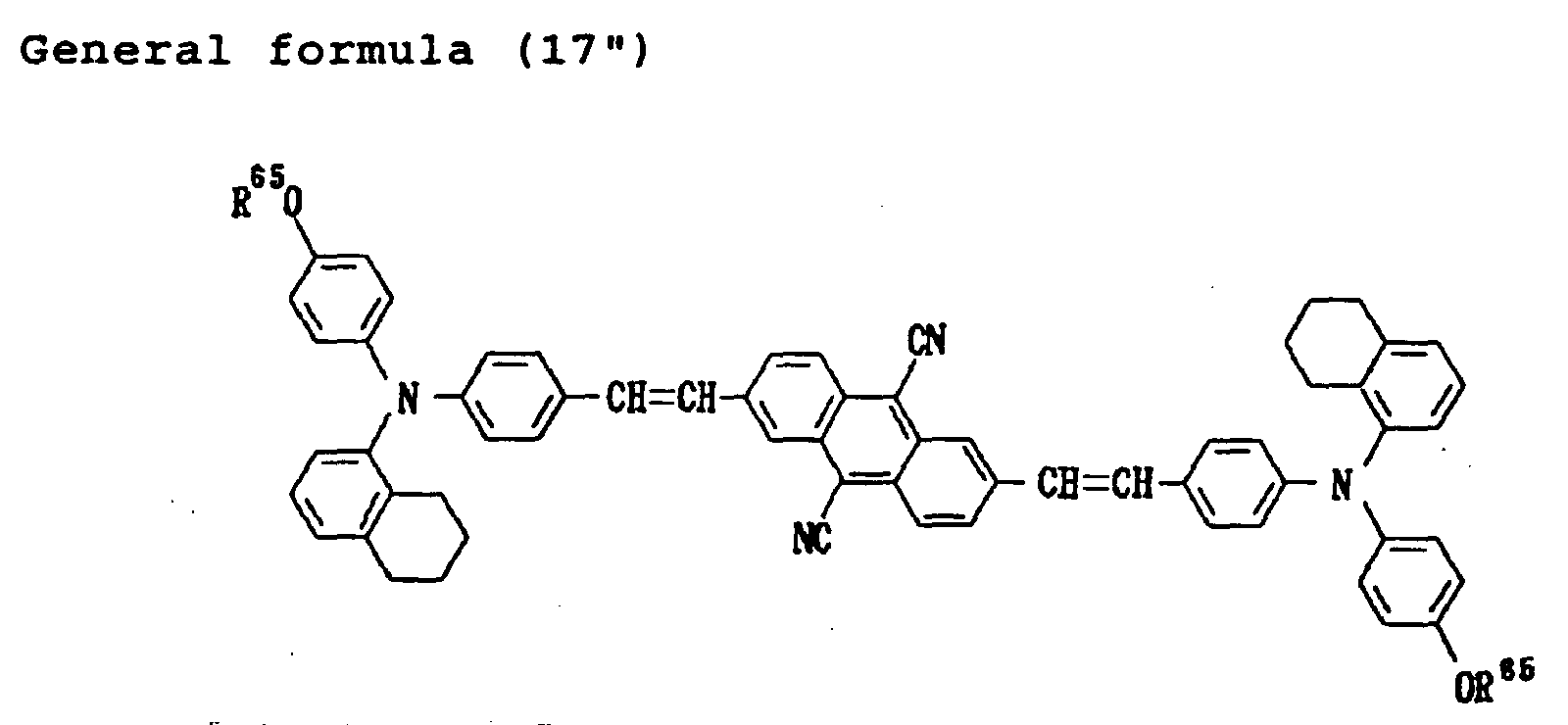
- A process for producing a bis(aminostyryl) anthracene compound as defined in Claim 14 or 16, wherein said process yields a bis(aminostyryl)anthracene compound represented by the structural formula (18)-1, (18)-2, (18)-2', (18)-3, (18)-4, (18)-5, (18)-6, (18)-6', (18)-7, (18)-8, (18)-9, (18)-10, (18)-10', (18)-10'', or (18)-11 below.


- A process for producing a bis(aminostyryl)anthracene compound as defined in Claim 14, wherein said bis(aminostyryl)anthracene is represented by the general formula (19) below.(where Ar1, Ar2, Ar3, and Ar4 are identical or different, each denoting an aryl group which may have a substituent, and if a substituent is present, said aryl group being one which is selected from aryl groups represented by the general formula (7), (8), (9), (10), (11), (12), (12'), or (12'') below.


 (where R52, R53, and R54 each denotes a saturated or unsaturated hydrocarbon group having one or more carbons; R55, R56, R57, R58, R59, and R60 are identical or different, each denoting a saturated or unsaturated hydrocarbon group having one or more carbons; n is an integer of 0 to 6; m is an integer of 0 to 3; and l is an integer of 0 to 4.)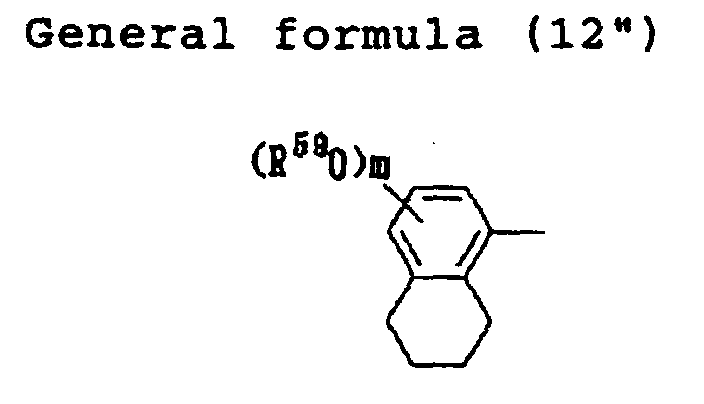
said process comprising condensing at least one species of 4-(N,N-diarylamino)benzaldehyde represented by the general formula (33) or (34) below with diphosphonic ester represented by the general formula (37) below or diphosphonium represented by the general formula (38) below. (where Ar1, Ar2, Ar3, Ar4, R70, R71 and X are defined as above.)
- A process for producing a bis(aminostyryl)anthracene compound as defined in Claim 21, wherein R70 and R71 each denotes a saturated hydrocarbon group having 1 to 4 carbon atoms.
- A process for producing a bis(aminostyryl)anthracene compound as defined in Claim 21, wherein R52, R53, R54, R55, R56, R57, R58, R59, and R60 each has 0 to 6 carbon atoms.
- A process for producing a bis(aminostyryl)anthracene compound as defined in Claim 14 or 21, said process yielding a bis(aminostyryl)anthracene compound represented by the general formula (20), (21), (22), (23), (24), (24') or (24'') below.(where R61 denotes a saturated or unsaturated hydrocarbon group having 1 to 6 carbon atoms.)
 (where R62 denotes a saturated or unsaturated hydrocarbon group having 1 to 6 carbon atoms.)
 (where R63 denotes a saturated or unsaturated hydrocarbon group or hydrocarbon oxy group having 1 to 6 carbon atoms.)
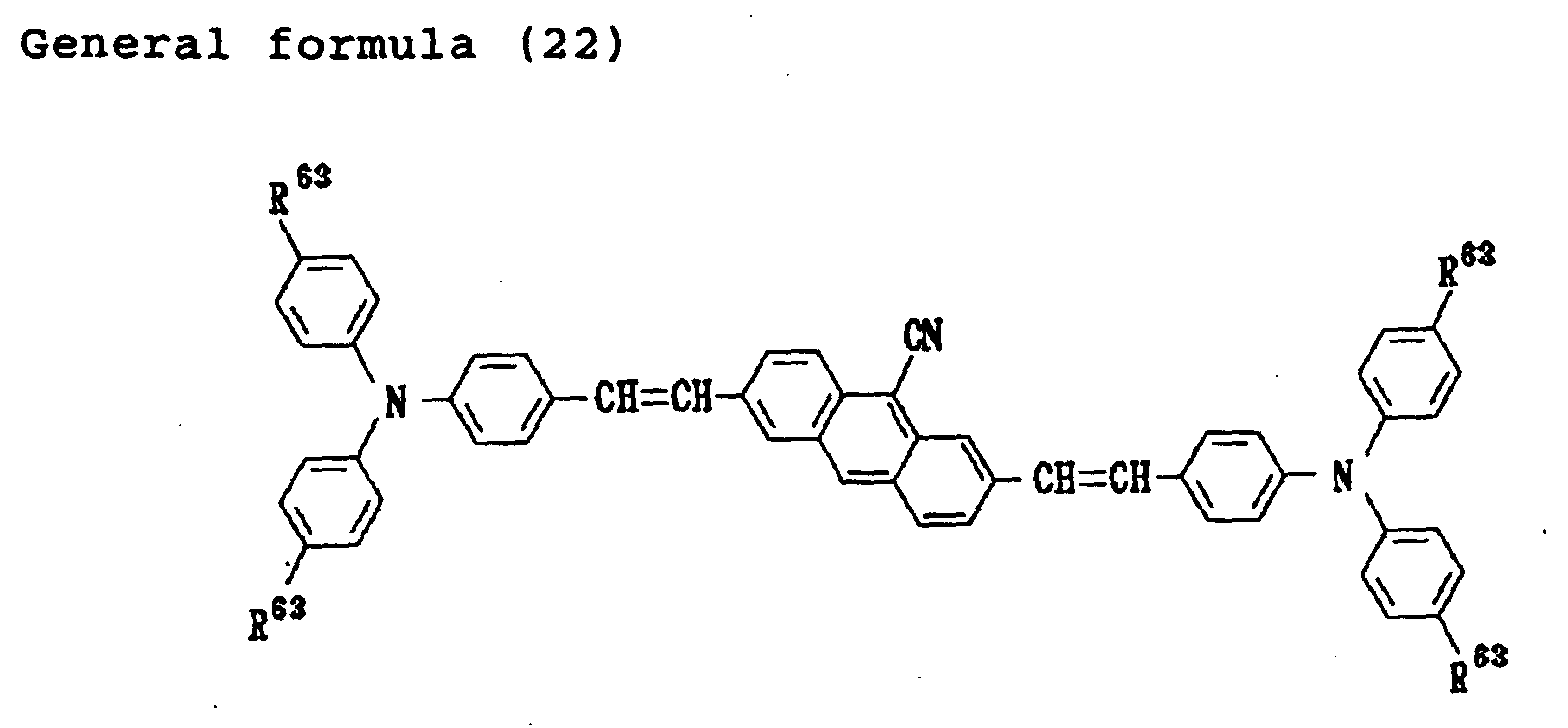 (where R64 denotes a saturated or unsaturated hydrocarbon group having 1 to 6 carbon atoms.)
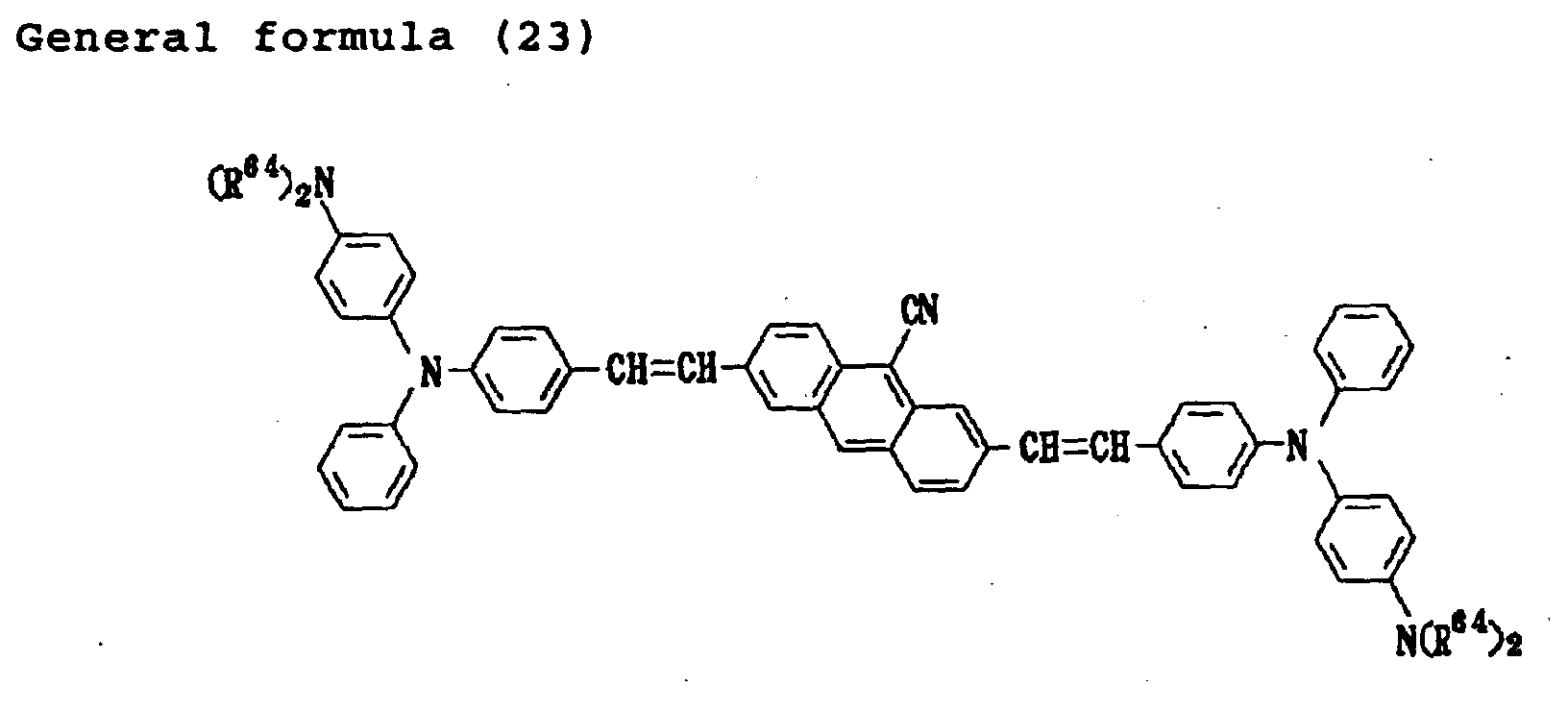 (where R65 denotes a saturated or unsaturated hydrocarbon group having 1 to 6 carbon atoms.)
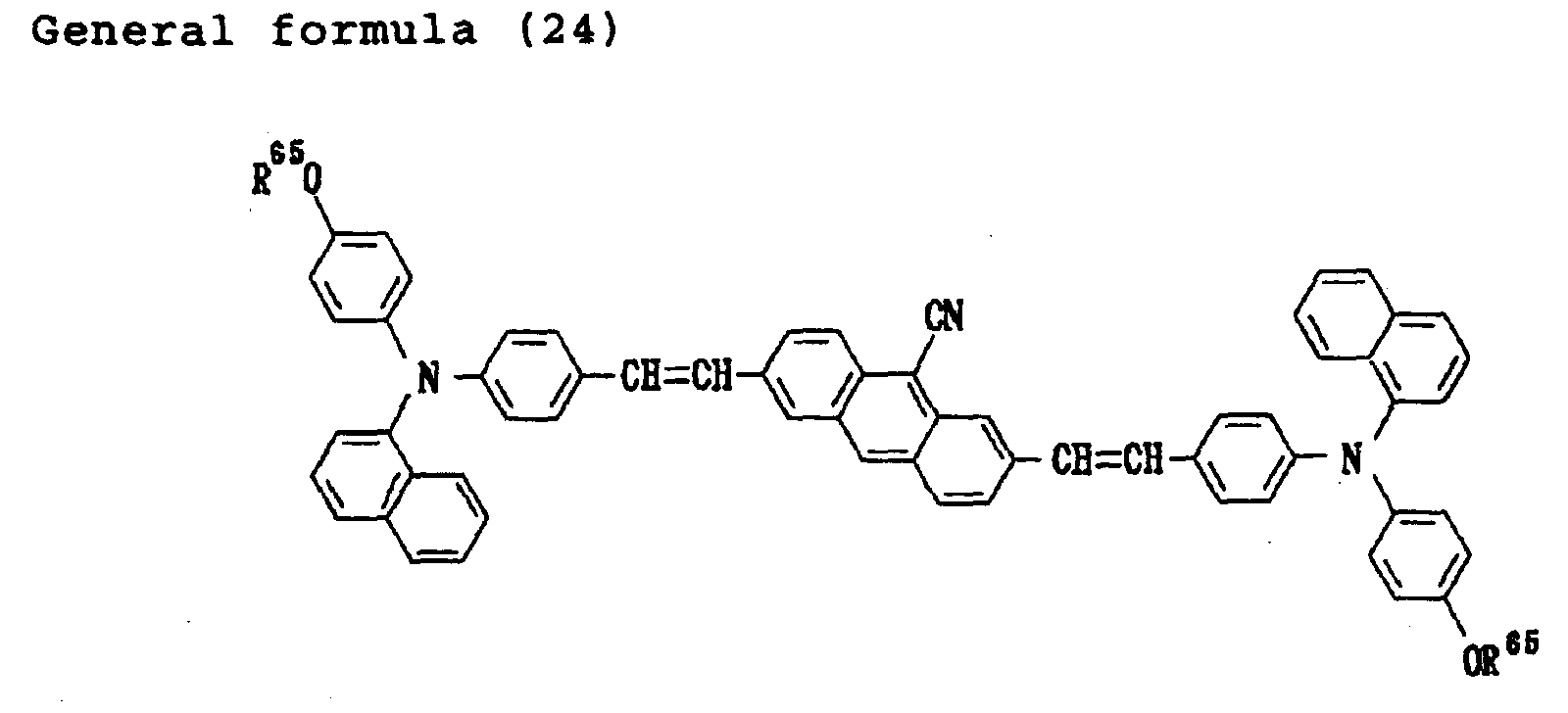 (where R65 denotes a saturated or unsaturated hydrocarbon group having 1 to 6 carbon atoms.)
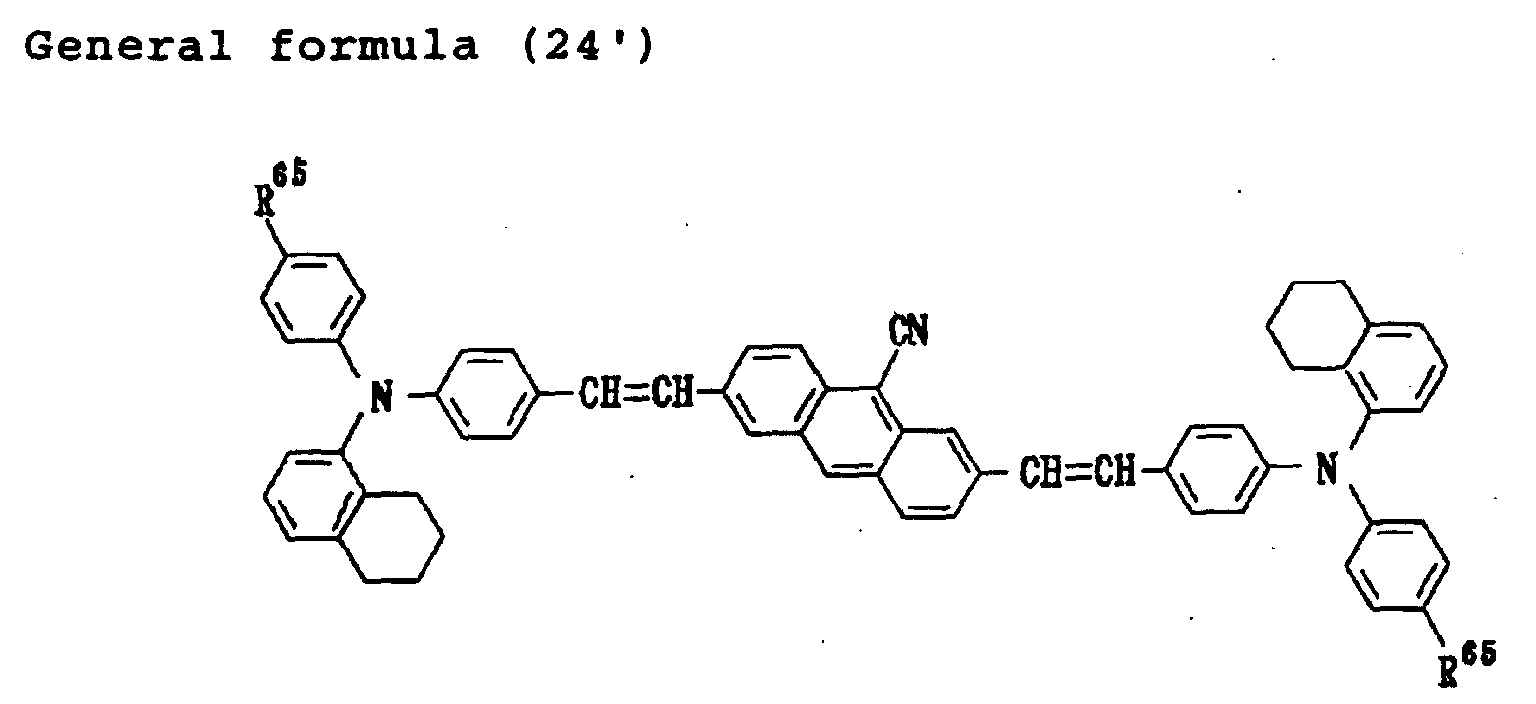 (where R65 denotes a saturated or unsaturated hydrocarbon group having 1 to 6 carbon atoms.)
- A process for producing a bis(aminostyryl)anthracene compound as defined in Claim 14 or 21, said process yielding a bis(aminostyryl)anthracene compound represented by the structural formula (25)-1, (25)-2, (25)-2', (25)-3, (25)-4, (25)-5, (25)-6, (25)-6', (25)-7, (25)-8, (25)-9, (25)-10, (25)-10', (25)-10'', or (25)-11 below.


- A process for producing a bis(aminostyryl)anthracene compound as defined in Claim 14, wherein said bis(aminostyryl)anthracene is represented by the general formula (26) below.(where Ar1, Ar2, Ar3, and Ar4 are identical or different, each denoting an aryl group which may have a substituent, and if a substituent is present, said aryl group being one which is selected from aryl groups represented by the general formula (7), (8), (9), (10), (11), (12), (12'), or (12'') below.
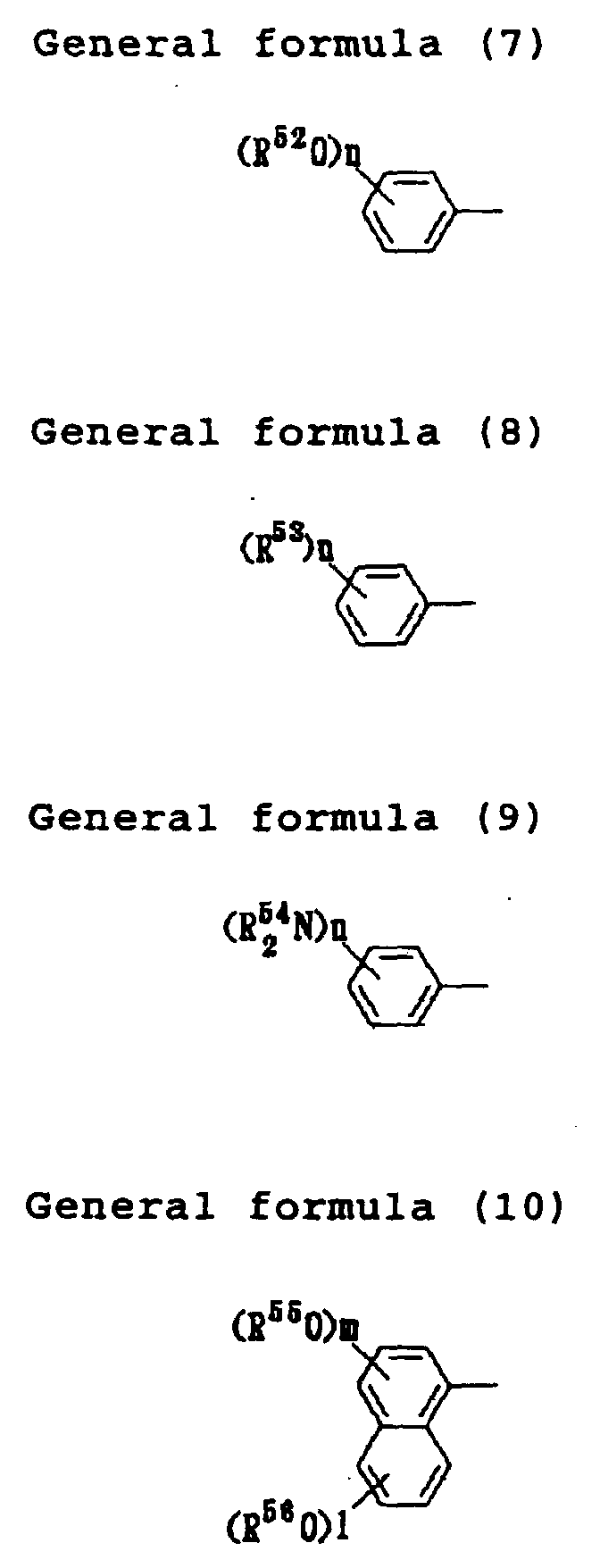 (where R52, R53, and R54 each denotes a saturated or unsaturated hydrocarbon group having one or more carbons; R55, R56, R57, R58, R59, and R60 are identical or different, each denoting a saturated or unsaturated hydrocarbon group having one or more carbons; n is an integer of 0 to 6; m is an integer of 0 to 3; and l is an integer of 0 to 4.)
said process comprising condensing at least one species of 4-(N,N-diarylamino)benzaldehyde represented by the general formula (33) or (34) below with diphosphonic ester represented by the general formula (39) below or diphosphonium represented by the general formula (40) below. (where Ar1, Ar2, Ar3, Ar4, R70, R71 and X are defined as above.)
- A process for producing a bis(aminostyryl)anthracene compound as defined in Claim 26, wherein R70 and R71 each denotes a saturated hydrocarbon group having 1 to 4 carbon atoms.
- A process for producing a bis(aminostyryl)anthracene compound as defined in Claim 26, wherein R52, R53, R54, R55, R56, R57, R58, R59, and R60 each has 1 to 6 carbon atoms.
- A process for producing a bis(aminostyryl)anthracene compound as defined in Claim 14 or 26, said process yielding a bis(aminostyryl)anthracene compound represented by the general formula (27), (28), (29), (30), (31), (31') or (31'') below.(where R61 denotes a saturated or unsaturated hydrocarbon group having 1 to 6 carbon atoms.)
 (where R62 denotes a saturated or unsaturated hydrocarbon group having 1 to 6 carbon atoms.)
 (where R63 denotes a saturated or unsaturated hydrocarbon group or hydrocarbon oxy group having 1 to 6 carbon atoms.)
 (where R64 denotes a saturated or unsaturated hydrocarbon group having 1 to 6 carbon atoms.)
 (where R65 denotes a saturated or unsaturated hydrocarbon group having 1 to 6 carbon atoms.)
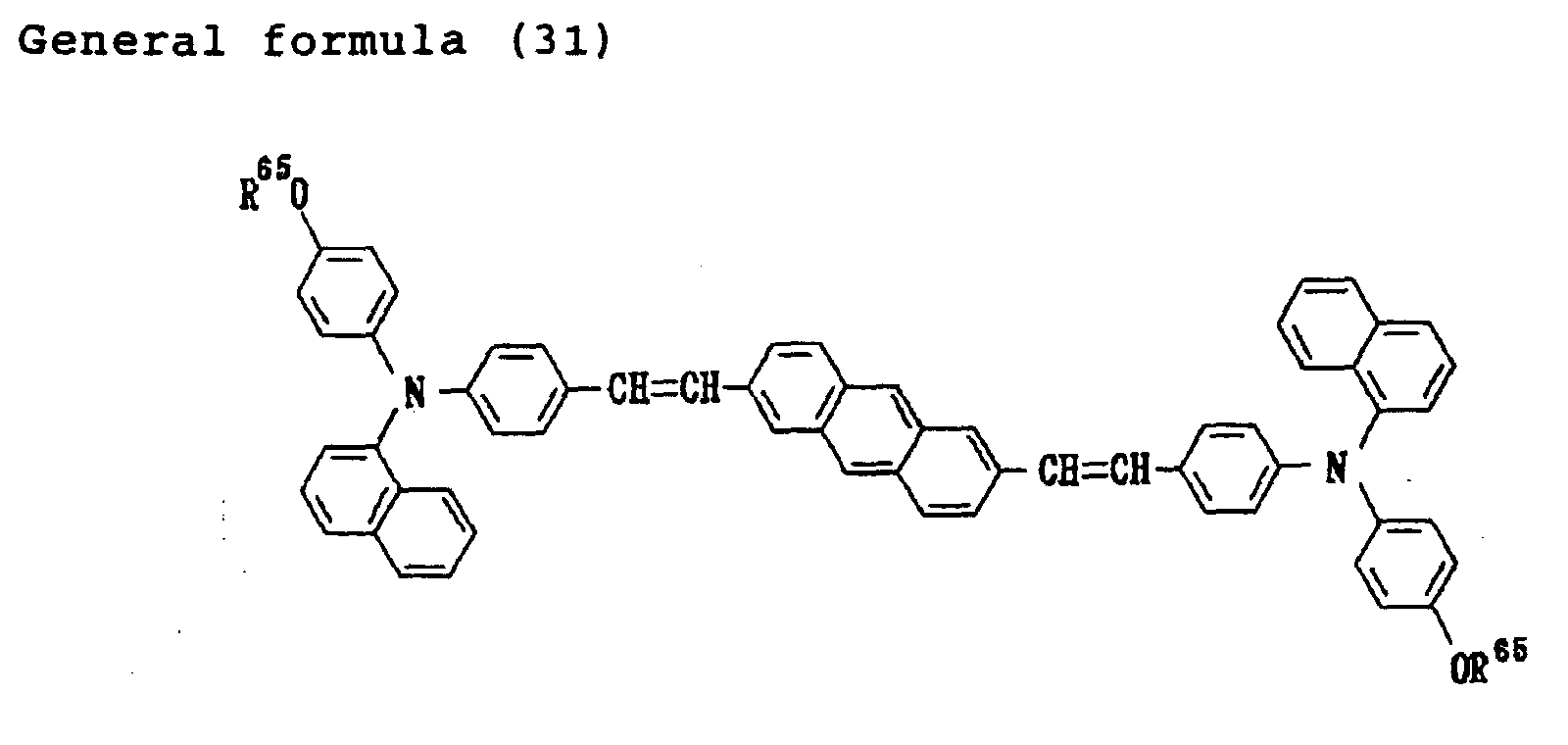 (where R65 denotes a saturated or unsaturated hydrocarbon group having 1 to 6 carbon atoms.)
 (where R65 denotes a saturated or unsaturated hydrocarbon group having 1 to 6 carbon atoms.)
- A process for producing a bis(aminostyryl)anthracene compound as defined in Claim 14 or 26, said process yielding a bis(aminostyryl)anthracene compound represented by the structural formula (32)-1, (32)-2, (32)-2', (32)-3, (32)-4, (32)-5, (32)-6, (32)-6', (32)-7, (32)-8, (32)-9, (32)-10, (32)-10', or (32)-10'' below.



- A diphosphonic ester or diphosphonium represented by the general formula [VII] or [VIII] below.(where R70 and R71 are identical or different, each denoting a hydrocarbon group; R72 and R73 are identical or different, at least one of them denoting a hydrogen atom, cyano group, nitro group, trifluoromethyl group, or halogen atom, and X denotes a halogen atom.)
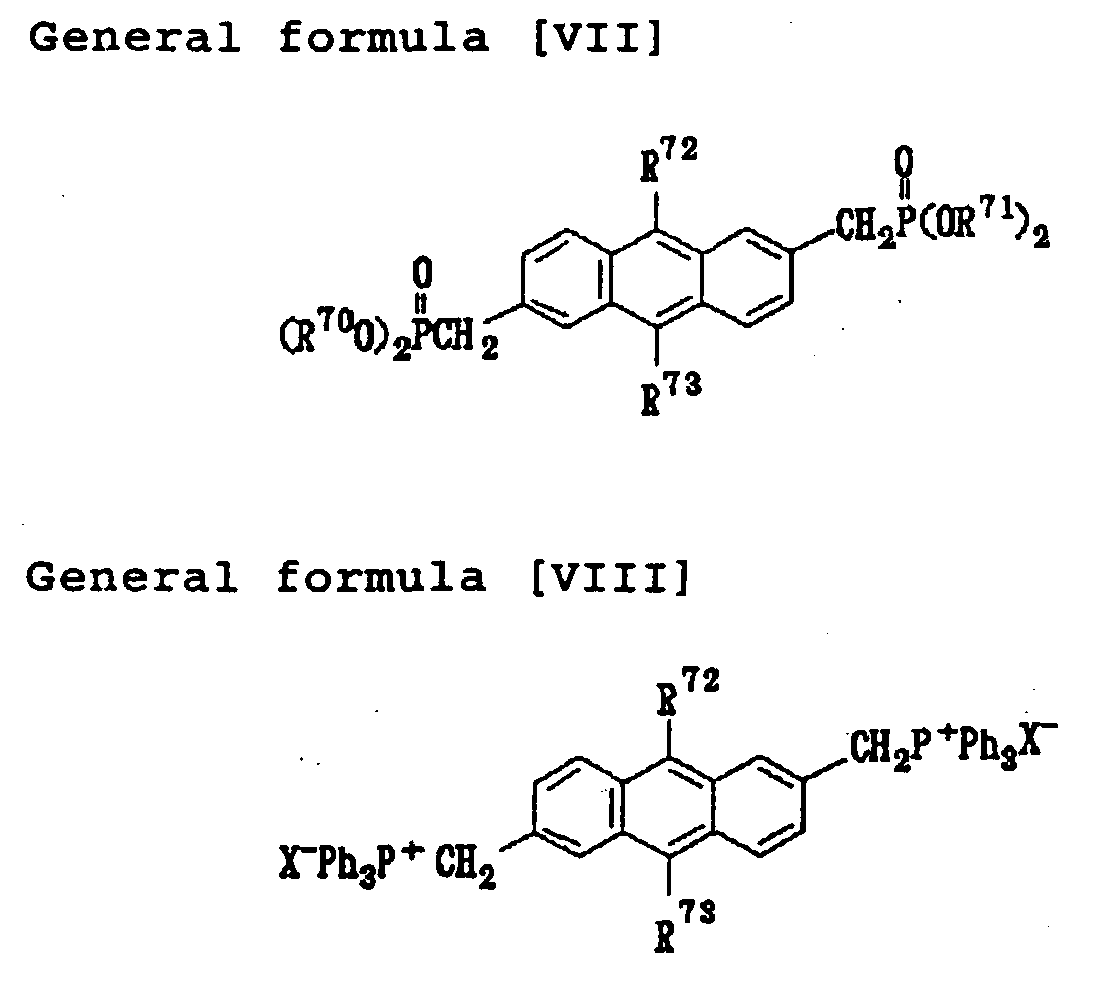
- A diphosphonic ester or diphosphonium as defined in Claim 31, wherein R70 and R71 each denotes a saturated hydrocarbon group having 1 to 4 carbon atoms.
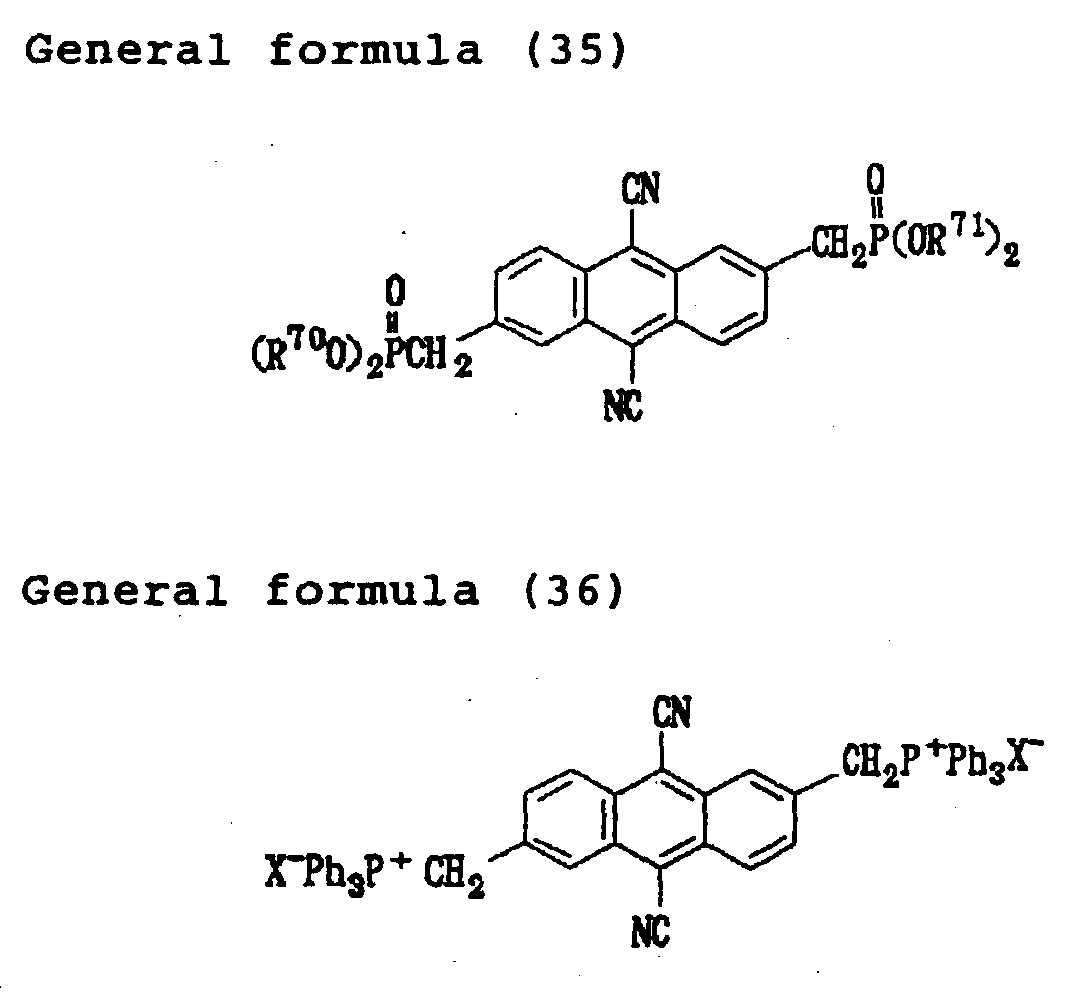
- A diphosphonic ester or diphosphonium as defined in Claim 31, which is represented by the general formula (35) or (36) below.(where R70, R71, and X are defined as above.)
- A diphosphonic ester or diphosphonium as defined in Claim 31, which is represented by the general formula (37) or (38) below.(where R70, R71, and X are defined as above.)
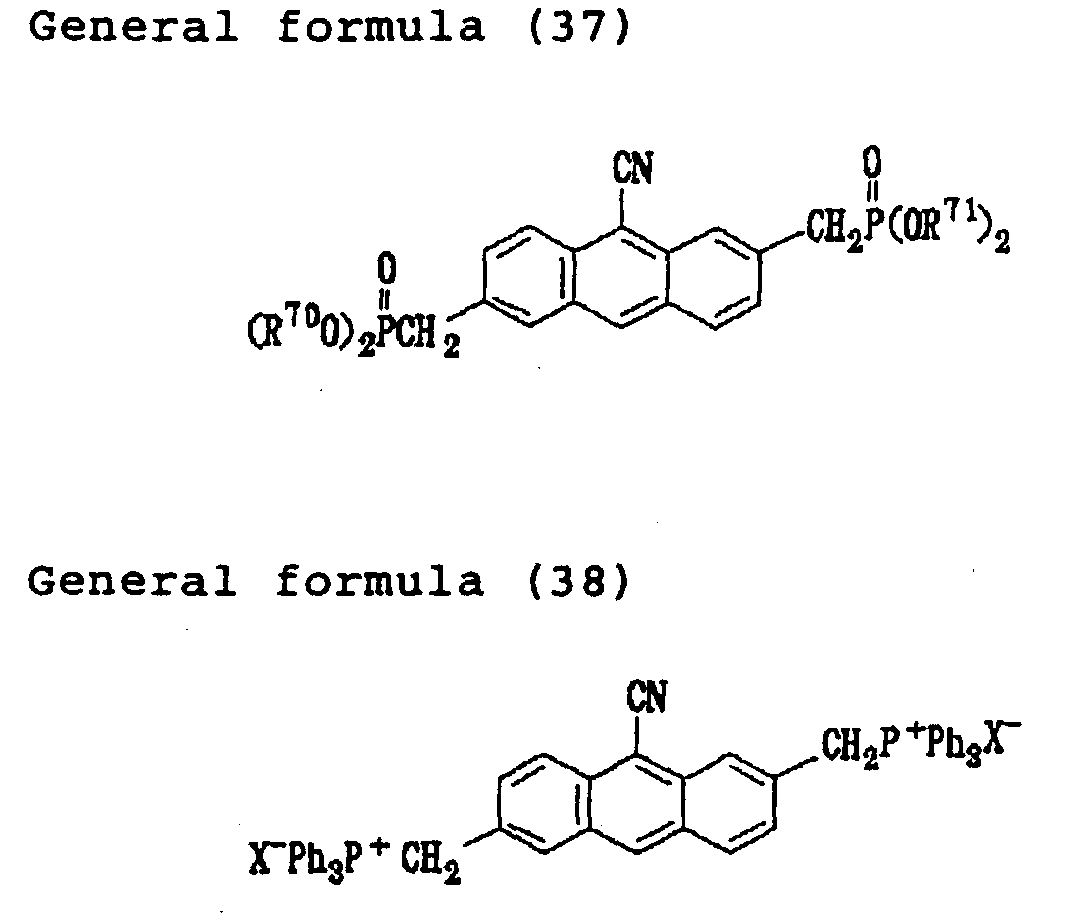
- A diphosphonic ester or diphosphonium as defined in Claim 31, which is represented by the general formula (39) or (40) below.(where R70, R71, and X are defined as above.)

- A process for producing a diphosphonic ester or diphosphonium represented by the general formula [VII] or [VIII] below, said process comprising reacting an aryl halide compound represented by the general formula [IX] below and a trialkyl phosphite represented by the general formula [X] below or triphenyl phosphine (PPh3).(where R72 and R73 are identical or different, at least one of them denoting a hydrogen atom, cyano group, nitro group, trifluoromethyl group, or halogen atom, and X denotes a halogen atom.)
 (where R70 and R71 are identical or different, each denoting a hydrocarbon group; and R72, R73, and X are defined as above.)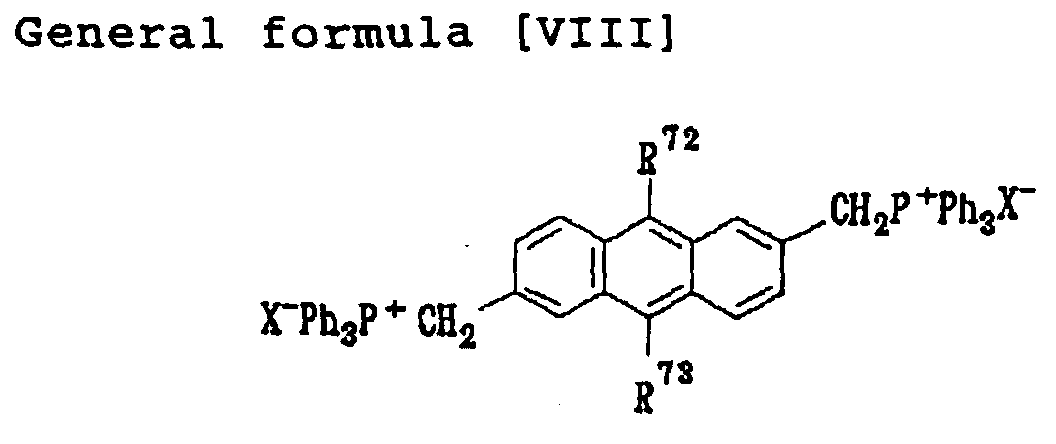
- A process for producing a diphosphonic ester or diphosphonium as defined in Claim 36, wherein R70 and R71 each denotes a saturated hydrocarbon group having 1 to 4 carbon atoms.
- A process for producing a diphosphonic ester or diphosphonium as defined in Claim 36, said process yielding a diphosphonic ester or diphosphonium represented by the general formula (35) or (36).
 (where R70, R71, and X are defined as above.)
- A process for producing a diphosphonic ester or diphosphonium as defined in Claim 36, said process yielding a diphosphonic ester or diphosphonium represented by the general formula (37) or (38).(where R70, R71, and X are defined as above.)

- A process for producing a diphosphonic ester or diphosphonium as defined in Claim 36, said process yielding a diphosphonic ester or diphosphonium represented by the general formula (39) or (40).(where R70, R71, and X are defined as above.)
- An aryl halide compound represented by the general formula [IX] below.(where R72 and R73 are identical or different, at least one of them denoting a hydrogen atom, cyano group, nitro group, trifluoromethyl group, or halogen atom.)
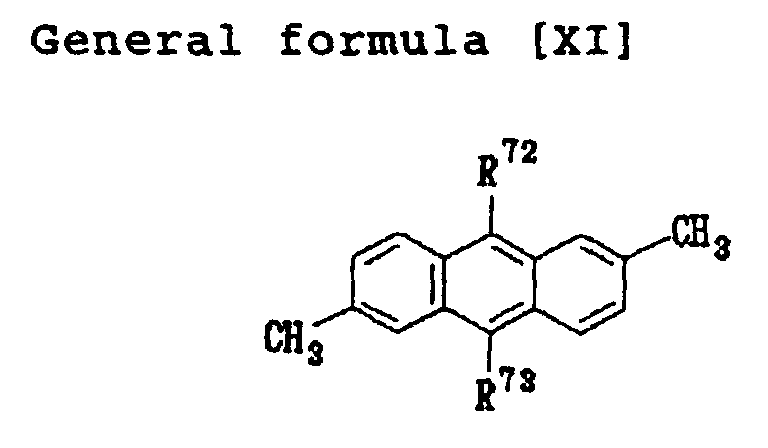
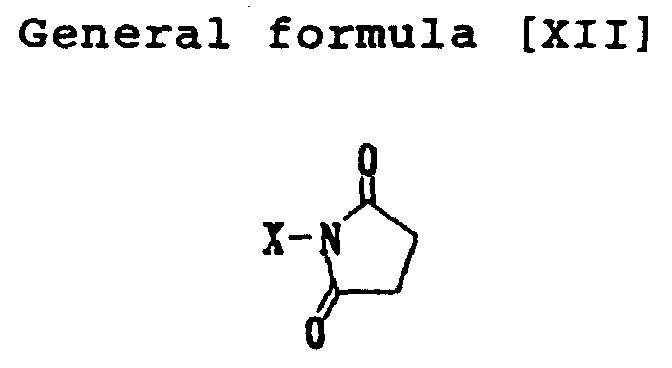
- A process for producing an aryl halide compound represented by the general formula [IX] below, said process comprising reacting an anthracene compound represented by the general formula [XI] below with an N-halogenated succinimide represented by the general formula [XII] below.(where R72 and R73 are identical or different, at least one of them denoting a hydrogen atom, cyano group, nitro group, trifluoromethyl group, or halogen atom.)
 (where X denotes a halogen atom.)
 (where R72 and R73 are defined as above, and X denotes a halogen atom.)
Applications Claiming Priority (2)
| Application Number | Priority Date | Filing Date | Title |
|---|---|---|---|
| JP28525499A JP4164717B2 (en) | 1999-10-06 | 1999-10-06 | Bis (aminostyryl) anthracene compound, synthetic intermediate thereof, and production method thereof |
| JP28525499 | 1999-10-06 |
Publications (3)
| Publication Number | Publication Date |
|---|---|
| EP1090911A2 true EP1090911A2 (en) | 2001-04-11 |
| EP1090911A3 EP1090911A3 (en) | 2001-08-08 |
| EP1090911B1 EP1090911B1 (en) | 2006-08-30 |
Family
ID=17689128
Family Applications (1)
| Application Number | Title | Priority Date | Filing Date |
|---|---|---|---|
| EP00121754A Expired - Lifetime EP1090911B1 (en) | 1999-10-06 | 2000-10-05 | Bis(aminostyryl) anthracene compound, synthesis intermediate thereof, and process for production thereof |
Country Status (4)
| Country | Link |
|---|---|
| US (2) | US7049470B1 (en) |
| EP (1) | EP1090911B1 (en) |
| JP (1) | JP4164717B2 (en) |
| DE (1) | DE60030380T2 (en) |
Cited By (5)
| Publication number | Priority date | Publication date | Assignee | Title |
|---|---|---|---|---|
| WO2001077065A1 (en) * | 2000-04-06 | 2001-10-18 | Sony Corporation | Aminostyrylanthracene compounds, intermediates for the preparation thereof, and processes for the preparation of both |
| WO2003091357A1 (en) * | 2000-10-30 | 2003-11-06 | Sony Corporation | Organic electroluminescent element |
| WO2005005572A1 (en) * | 2003-07-10 | 2005-01-20 | Merck Patent Gmbh | Substituted anthracenes |
| CN101781234A (en) * | 2010-03-05 | 2010-07-21 | 淮海工学院 | Triphenylethylene compound containing cyanogen and preparation method thereof |
| US8362464B2 (en) | 2008-07-09 | 2013-01-29 | Samsung Electronics Co., Ltd. | Organic nanofiber structure based on self-assembled organogel, organic nanofiber transistor using the same, and method of manufacturing the organic nanofiber transistor |
Families Citing this family (4)
| Publication number | Priority date | Publication date | Assignee | Title |
|---|---|---|---|---|
| JP4001118B2 (en) | 2003-03-24 | 2007-10-31 | ソニー株式会社 | Organic electroluminescent device and amino monostyryl naphthalene compound |
| JP4865258B2 (en) * | 2005-06-21 | 2012-02-01 | キヤノン株式会社 | 1,8-naphthyridine compound and organic light-emitting device using the same |
| JP4623166B2 (en) | 2008-08-25 | 2011-02-02 | ソニー株式会社 | Labeled compound and detection method using the same |
| KR20100028168A (en) * | 2008-09-04 | 2010-03-12 | 다우어드밴스드디스플레이머티리얼 유한회사 | Novel organic electroluminescent compounds and organic electroluminescent device using the same |
Family Cites Families (5)
| Publication number | Priority date | Publication date | Assignee | Title |
|---|---|---|---|---|
| US5811834A (en) * | 1996-01-29 | 1998-09-22 | Toyo Ink Manufacturing Co., Ltd. | Light-emitting material for organo-electroluminescence device and organo-electroluminescence device for which the light-emitting material is adapted |
| JP3503403B2 (en) * | 1997-03-17 | 2004-03-08 | 東洋インキ製造株式会社 | Light emitting material for organic electroluminescent device and organic electroluminescent device using the same |
| JP2000012228A (en) * | 1998-06-26 | 2000-01-14 | Sony Corp | Organic electroluminescent device |
| JP3820752B2 (en) * | 1998-06-26 | 2006-09-13 | ソニー株式会社 | Organic electroluminescence device |
| TW463520B (en) | 1999-07-30 | 2001-11-11 | Sony Corp | Organic electroluminescent device |
-
1999
- 1999-10-06 JP JP28525499A patent/JP4164717B2/en not_active Expired - Fee Related
-
2000
- 2000-10-05 EP EP00121754A patent/EP1090911B1/en not_active Expired - Lifetime
- 2000-10-05 DE DE60030380T patent/DE60030380T2/en not_active Expired - Lifetime
- 2000-10-05 US US09/680,371 patent/US7049470B1/en not_active Expired - Fee Related
-
2005
- 2005-06-15 US US11/153,878 patent/US7196225B2/en not_active Expired - Fee Related
Cited By (9)
| Publication number | Priority date | Publication date | Assignee | Title |
|---|---|---|---|---|
| WO2001077065A1 (en) * | 2000-04-06 | 2001-10-18 | Sony Corporation | Aminostyrylanthracene compounds, intermediates for the preparation thereof, and processes for the preparation of both |
| US6790975B2 (en) | 2000-04-06 | 2004-09-14 | Sony Corporation | Aminostyrylanthracene compound, synthetic intermediate thereof, and process for the production thereof |
| WO2003091357A1 (en) * | 2000-10-30 | 2003-11-06 | Sony Corporation | Organic electroluminescent element |
| WO2005005572A1 (en) * | 2003-07-10 | 2005-01-20 | Merck Patent Gmbh | Substituted anthracenes |
| US7998540B2 (en) | 2003-07-10 | 2011-08-16 | Merck Patent Gesellschaft Mit Beschrankter Haftung | Substituted anthracenes |
| US8362464B2 (en) | 2008-07-09 | 2013-01-29 | Samsung Electronics Co., Ltd. | Organic nanofiber structure based on self-assembled organogel, organic nanofiber transistor using the same, and method of manufacturing the organic nanofiber transistor |
| US9029840B2 (en) | 2008-07-09 | 2015-05-12 | Samsung Electronics Co., Ltd. | Organic nanofiber structure based on self-assembled organogel, organic nanofiber transistor using the same, and method of manufacturing the organic nanofiber transistor |
| CN101781234A (en) * | 2010-03-05 | 2010-07-21 | 淮海工学院 | Triphenylethylene compound containing cyanogen and preparation method thereof |
| CN101781234B (en) * | 2010-03-05 | 2013-04-03 | 淮海工学院 | Triphenylethylene compound containing cyanogen and preparation method thereof |
Also Published As
| Publication number | Publication date |
|---|---|
| US7196225B2 (en) | 2007-03-27 |
| US20060178522A1 (en) | 2006-08-10 |
| US7049470B1 (en) | 2006-05-23 |
| EP1090911A3 (en) | 2001-08-08 |
| JP2001106657A (en) | 2001-04-17 |
| JP4164717B2 (en) | 2008-10-15 |
| DE60030380D1 (en) | 2006-10-12 |
| DE60030380T2 (en) | 2007-08-30 |
| EP1090911B1 (en) | 2006-08-30 |
Similar Documents
| Publication | Publication Date | Title |
|---|---|---|
| US6765108B2 (en) | Bis (aminostyryl) naphthalene compound, synthesis intermediate thereof, and process for production thereof | |
| EP1090911B1 (en) | Bis(aminostyryl) anthracene compound, synthesis intermediate thereof, and process for production thereof | |
| US6492557B1 (en) | Bis (aminostyryl) naphthalene compound, synthesis intermediate thereof, and process for production thereof | |
| EP1191015A1 (en) | Aminostyrylanthracene compounds, intermediates for the preparation thereof, and processes for the preparation of both | |
| US6337167B1 (en) | Bis(aminostyryl)benzene compounds and synthetic intermediates thereof, and process for preparing the compounds and intermediates | |
| JP4158078B2 (en) | Aminostyrylphenanthrene compounds and synthetic intermediates thereof | |
| JP2004307472A (en) | Organic electroluminescent device, aminostyrylnaphthalene compound, synthetic intermediate thereof, and production method thereof | |
| KR100717696B1 (en) | Organic electroluminescent device | |
| US6525212B1 (en) | Bis(aminostyryl)benzene compounds and synthetic intermediates thereof, and process for preparing the compounds and intermediates | |
| JP4386140B2 (en) | Bis (aminostyryl) benzene compound | |
| US20030229242A1 (en) | Aminostyrylanthracene compound, synthetic intermediate thereof, and process for production thereof | |
| JP2001131128A (en) | Bis (aminostyryl) stilbene-based compounds and synthetic intermediates thereof, methods for their production, and organic electroluminescent devices | |
| US20050258743A1 (en) | Aminostyrylanthracene compound, synthetic intermediate thereof, and process for production thereof |
Legal Events
| Date | Code | Title | Description |
|---|---|---|---|
| PUAI | Public reference made under article 153(3) epc to a published international application that has entered the european phase |
Free format text: ORIGINAL CODE: 0009012 |
|
| AK | Designated contracting states |
Kind code of ref document: A2 Designated state(s): DE FR GB |
|
| AX | Request for extension of the european patent |
Free format text: AL;LT;LV;MK;RO;SI |
|
| PUAL | Search report despatched |
Free format text: ORIGINAL CODE: 0009013 |
|
| AK | Designated contracting states |
Kind code of ref document: A3 Designated state(s): AT BE CH CY DE DK ES FI FR GB GR IE IT LI LU MC NL PT SE |
|
| AX | Request for extension of the european patent |
Free format text: AL;LT;LV;MK;RO;SI |
|
| 17P | Request for examination filed |
Effective date: 20020108 |
|
| AKX | Designation fees paid |
Free format text: DE FR GB |
|
| 17Q | First examination report despatched |
Effective date: 20030916 |
|
| GRAP | Despatch of communication of intention to grant a patent |
Free format text: ORIGINAL CODE: EPIDOSNIGR1 |
|
| GRAS | Grant fee paid |
Free format text: ORIGINAL CODE: EPIDOSNIGR3 |
|
| GRAA | (expected) grant |
Free format text: ORIGINAL CODE: 0009210 |
|
| AK | Designated contracting states |
Kind code of ref document: B1 Designated state(s): DE FR GB |
|
| REG | Reference to a national code |
Ref country code: GB Ref legal event code: FG4D |
|
| REF | Corresponds to: |
Ref document number: 60030380 Country of ref document: DE Date of ref document: 20061012 Kind code of ref document: P |
|
| ET | Fr: translation filed | ||
| PLBE | No opposition filed within time limit |
Free format text: ORIGINAL CODE: 0009261 |
|
| STAA | Information on the status of an ep patent application or granted ep patent |
Free format text: STATUS: NO OPPOSITION FILED WITHIN TIME LIMIT |
|
| 26N | No opposition filed |
Effective date: 20070531 |
|
| REG | Reference to a national code |
Ref country code: GB Ref legal event code: 746 Effective date: 20091130 |
|
| PGFP | Annual fee paid to national office [announced via postgrant information from national office to epo] |
Ref country code: FR Payment date: 20121031 Year of fee payment: 13 Ref country code: DE Payment date: 20121023 Year of fee payment: 13 |
|
| PGFP | Annual fee paid to national office [announced via postgrant information from national office to epo] |
Ref country code: GB Payment date: 20121019 Year of fee payment: 13 |
|
| GBPC | Gb: european patent ceased through non-payment of renewal fee |
Effective date: 20131005 |
|
| PG25 | Lapsed in a contracting state [announced via postgrant information from national office to epo] |
Ref country code: GB Free format text: LAPSE BECAUSE OF NON-PAYMENT OF DUE FEES Effective date: 20131005 |
|
| REG | Reference to a national code |
Ref country code: DE Ref legal event code: R119 Ref document number: 60030380 Country of ref document: DE Effective date: 20140501 |
|
| REG | Reference to a national code |
Ref country code: FR Ref legal event code: ST Effective date: 20140630 |
|
| PG25 | Lapsed in a contracting state [announced via postgrant information from national office to epo] |
Ref country code: FR Free format text: LAPSE BECAUSE OF NON-PAYMENT OF DUE FEES Effective date: 20131031 Ref country code: DE Free format text: LAPSE BECAUSE OF NON-PAYMENT OF DUE FEES Effective date: 20140501 |