EP1090881A1 - Coal-based molded activated carbon and process for the treatment of waste gas containing dioxins using same - Google Patents
Coal-based molded activated carbon and process for the treatment of waste gas containing dioxins using same Download PDFInfo
- Publication number
- EP1090881A1 EP1090881A1 EP00121292A EP00121292A EP1090881A1 EP 1090881 A1 EP1090881 A1 EP 1090881A1 EP 00121292 A EP00121292 A EP 00121292A EP 00121292 A EP00121292 A EP 00121292A EP 1090881 A1 EP1090881 A1 EP 1090881A1
- Authority
- EP
- European Patent Office
- Prior art keywords
- activated carbon
- dioxins
- waste gas
- molded
- molded activated
- Prior art date
- Legal status (The legal status is an assumption and is not a legal conclusion. Google has not performed a legal analysis and makes no representation as to the accuracy of the status listed.)
- Withdrawn
Links
Images


Classifications
-
- B—PERFORMING OPERATIONS; TRANSPORTING
- B01—PHYSICAL OR CHEMICAL PROCESSES OR APPARATUS IN GENERAL
- B01D—SEPARATION
- B01D53/00—Separation of gases or vapours; Recovering vapours of volatile solvents from gases; Chemical or biological purification of waste gases, e.g. engine exhaust gases, smoke, fumes, flue gases, aerosols
- B01D53/02—Separation of gases or vapours; Recovering vapours of volatile solvents from gases; Chemical or biological purification of waste gases, e.g. engine exhaust gases, smoke, fumes, flue gases, aerosols by adsorption, e.g. preparative gas chromatography
-
- C—CHEMISTRY; METALLURGY
- C01—INORGANIC CHEMISTRY
- C01B—NON-METALLIC ELEMENTS; COMPOUNDS THEREOF; METALLOIDS OR COMPOUNDS THEREOF NOT COVERED BY SUBCLASS C01C
- C01B32/00—Carbon; Compounds thereof
- C01B32/30—Active carbon
- C01B32/312—Preparation
- C01B32/336—Preparation characterised by gaseous activating agents
-
- C—CHEMISTRY; METALLURGY
- C01—INORGANIC CHEMISTRY
- C01B—NON-METALLIC ELEMENTS; COMPOUNDS THEREOF; METALLOIDS OR COMPOUNDS THEREOF NOT COVERED BY SUBCLASS C01C
- C01B32/00—Carbon; Compounds thereof
- C01B32/30—Active carbon
- C01B32/354—After-treatment
- C01B32/382—Making shaped products, e.g. fibres, spheres, membranes or foam
-
- B—PERFORMING OPERATIONS; TRANSPORTING
- B01—PHYSICAL OR CHEMICAL PROCESSES OR APPARATUS IN GENERAL
- B01D—SEPARATION
- B01D2253/00—Adsorbents used in seperation treatment of gases and vapours
- B01D2253/10—Inorganic adsorbents
- B01D2253/102—Carbon
-
- B—PERFORMING OPERATIONS; TRANSPORTING
- B01—PHYSICAL OR CHEMICAL PROCESSES OR APPARATUS IN GENERAL
- B01D—SEPARATION
- B01D2253/00—Adsorbents used in seperation treatment of gases and vapours
- B01D2253/30—Physical properties of adsorbents
- B01D2253/302—Dimensions
- B01D2253/306—Surface area, e.g. BET-specific surface
-
- B—PERFORMING OPERATIONS; TRANSPORTING
- B01—PHYSICAL OR CHEMICAL PROCESSES OR APPARATUS IN GENERAL
- B01D—SEPARATION
- B01D2253/00—Adsorbents used in seperation treatment of gases and vapours
- B01D2253/30—Physical properties of adsorbents
- B01D2253/302—Dimensions
- B01D2253/308—Pore size
-
- B—PERFORMING OPERATIONS; TRANSPORTING
- B01—PHYSICAL OR CHEMICAL PROCESSES OR APPARATUS IN GENERAL
- B01D—SEPARATION
- B01D2253/00—Adsorbents used in seperation treatment of gases and vapours
- B01D2253/30—Physical properties of adsorbents
- B01D2253/302—Dimensions
- B01D2253/311—Porosity, e.g. pore volume
-
- B—PERFORMING OPERATIONS; TRANSPORTING
- B01—PHYSICAL OR CHEMICAL PROCESSES OR APPARATUS IN GENERAL
- B01D—SEPARATION
- B01D2257/00—Components to be removed
- B01D2257/70—Organic compounds not provided for in groups B01D2257/00 - B01D2257/602
- B01D2257/702—Hydrocarbons
- B01D2257/7027—Aromatic hydrocarbons
-
- B—PERFORMING OPERATIONS; TRANSPORTING
- B01—PHYSICAL OR CHEMICAL PROCESSES OR APPARATUS IN GENERAL
- B01D—SEPARATION
- B01D2259/00—Type of treatment
- B01D2259/40—Further details for adsorption processes and devices
- B01D2259/40083—Regeneration of adsorbents in processes other than pressure or temperature swing adsorption
- B01D2259/40088—Regeneration of adsorbents in processes other than pressure or temperature swing adsorption by heating
Definitions
- the present invention relates to a molded activated carbon capable of efficiently removing dioxins from a waste gas and a process for the treatment of a waste gas containing dioxins using the molded activated carbon.
- a waste gas produced by the combustion of city refuse or industrial wastes contains harmful substances, including acidic gases such as hydrogen chloride and sulfur oxide and heavy metals such as mercury, as well as dioxins, which are deadly poisonous. How the discharged amount of dioxins can be reduced has been a global assignment. The mechanism of reaction of production of dioxins in the combustion process is complicated and has not yet been made clear. It is thought that precursor materials produced by the combustion of wastes containing chlorine undergo resynthesis reaction in the waste gas cooling process to produce dioxins. As the most effective method for the removal of dioxins thus produced there may be used a method involving the removal of dioxins with an activated carbon. Such a treatment method with an activated carbon is advantageous in that it can remove dioxins as well as many other harmful materials such as mercury.
- the method for the treatment of a waste gas with an activated carbon can be roughly divided into two main methods, i.e., (1) a method which comprises spraying a powdered activated,carbon onto a flue, and then collecting the activated carbon having harmful materials adsorbed thereto together with scattered ash using a dust collector and (2) a method which involves the adsorption and removal of harmful materials using a separately provided adsorption tower filled with an activated carbon in the form of e.g. grains installed downstream from the dust collector.
- the former method can use the same apparatus as slaked lime powder sprayer used to remove an acidic gas such as hydrochloric acid and sulfur oxide in ordinary incineration plant and thus requires no large-scale facility remodeling construction.
- this method has been introduced into many existing incineration facilities.
- the latter method using an adsorption tower requires a large-scale apparatus and hence a raised facility cost.
- this method attains a higher percent of removal of dioxins than the blowing method and thus can invariably keep the concentration of dioxins at a low level.
- the adsorption tower used in this method acts as a desulfurization/denitration catalyst as well.
- this method is likely to remove undiscovered and unknown harmful materials.
- this method is considered to be a very effective method. Accordingly, taking into account the future environmental issue, it is necessary that a technique for putting the latter method in practical use be established.
- the activated carbon which has been used in the adsorption in the packed column needs to be regenerated. It is essential in this regeneration process that dioxins thus adsorbed be securely decomposed and the molded activated carbon be recovered in recyclable form.
- various methods have been proposed such as a method which comprises putting the activated carbon into an incinerator, a method involving regeneration with water vapor and a method which comprises heating the activated carbon under deficiency of oxygen so that it is re-used (JP-A-64-500330 and JP-A-5-301022).
- the method which comprises heating the activated carbon having dioxins adsorbed thereto under deficiency of oxygen so that dioxins are heat-decomposed at low temperatures to regenerate the activated carbon allows regeneration at a relatively low temperature and thus has been noted as an economically effective method.
- JP-A-11-104488 proposes a granular recyclable dioxin adsorption/decomposition activated carbon.
- Activated carbons are divided into two groups, i.e., coconut shell-based activated carbon and coal-based activated carbon. Since the activated carbon to be used for the treatment of a large amount of a waste gas must be inexpensive, it is natural that coal-based activated carbon should be used.
- coal-based molded activated carbon is disadvantageous in that when used repeatedly for adsorption/decomposition of dioxins in the treatment of a waste gas, it undergoes cracking and pulverization. Once pulverized, the activated carbon exhibits a deteriorated adsorptivity that prevents fair treatment of waste gas.
- the essence of the present invention lies in a coal-based molded activated carbon having a Ca content of 0.2 wt% or less being capable of adsorbing dioxins and a process for the treatment of a waste gas using this coal-based molded activated carbon.
- activated carbons For the adsorption of dioxins, various activated carbons have heretofore been used. These activated carbons have different Ca contents. Coal-based molded activated carbons which are generally used have a Ca content of about 0.6 wt%.
- the coal-based molded activated carbon according to the present invention needs to be capable of adsorbing dioxins.
- the activated carbon there is preferably used one having pores with a pore diameter of from 10 ⁇ to 20 ⁇ , normally having a pore volume of 0.01 cc/g or more, preferably 0.03 cc/g or more.
- the activated carbon according to the invention normally has a specific surface area of from 300 m 2 /g or more, preferably 400 m 2 /g or more, to 2,000 m 2 /g or less, preferably 1,500 m 2 /g or less.
- the specific surface area of the activated carbon is too small, the activated carbon exhibits a deteriorated dioxin adsorptivity.
- the specific surface area of the activated carbon is too great, the resulting molded activated carbon exhibits a deteriorated strength to disadvantage.
- the molded activated carbon according to the invention should be prepared from a coal-based raw material because of quality and price of product and stable availability in a large amount.
- a molded activated carbon By molding this raw material charcoal in powder form into a predetermined shape and size, and then subjecting the molded product to carbonization and activation, a molded activated carbon can be obtained.
- the molding of the raw material charcoal is normally carried out by consolidation molding free from binder. If necessary, a small amount of a binder may be added. As such a binder there may be normally used a tar-based adhesive.
- the molding may be optionally effected after activation.
- the carbonization is effected at a temperature of from 500°C to 900°C according to normal process.
- the material is heated and carbonized so that carbon-based organic materials are decomposed and carbonized.
- Activation is roughly divided into two groups, i.e., activation with gas and activation with chemical.
- activated carbon obtained by activation with gas is desirable.
- Activation with gas is called physical activation while activation with chemical is called chemical activation.
- Activation with gas involves the catalytic reaction of a carbonized raw material with water vapor, carbon dioxide gas, oxygen or other oxidizing gas at an elevated temperature resulting in the production of a microporous adsorbent charcoal.
- Activation with water vapor is mainly used on an industrial basis.
- Activation with chemical comprises heating a raw material uniformly impregnated with an activating chemical in an inert gas atmosphere to cause dehydration and oxidation reaction of the chemical resulting in the production of a microporous adsorbent charcoal.
- Examples of the chemical employable herein include zinc chloride, phosphoric acid, sodium phosphate, calcium chloride, potassium sulfite, potassium hydroxide, sodium hydroxide, potassium carbonate, sodium carbonate, sodium sulfate, potassium sulfate, and calcium carbonate.
- the molded activated carbon according to the invention is normally in the form of columns, grains or discs.
- the size of the molded activated carbon according to the invention may be normally arbitrary so far as it is acceptable as filler to be packed in a packed column.
- the average diameter is normally from 3 mm or more, preferably 4 mm or more, to 10 mm or less, preferably 9 mm or less
- the average length is normally from 3 mm or more, preferably 4 mm or more, to 30 mm or less, preferably 20 mm or less.
- the average grain diameter is normally from 3 mm or more, preferably 4 mm or more, to 10 mm or less, preferably 9 mm or less.
- the molded activated carbon according to the invention is normally packed in a column before use. Therefore, the molded activated carbon according to the invention preferably has a strength high enough to maintain its shape without being pulverized during packing or withdrawal.
- coal-based molded activated carbon there be used one having a Ca content of 0.2 wt% or less, preferably 0.15 wt% or less.
- the resulting molded activated carbon can crack and undergo pulverization during recycling, resulting in troubles with treatment of waste gas such as increase of pressure loss in the packed column and scattering of fine powder. Further, dioxins cannot be efficiently removed.
- the use of a molded activated carbon having a Ca content of not more than the above defined value makes it possible to continue fair removal of dioxins.
- the content of Ca can be measured, e.g., by wet decomposition ICP-AES.
- the molded activated carbon according to the invention has an ash content of normally 9 wt% or less, preferably 8 wt% or less.
- the process for the production of the activated carbon having a low Ca content there may be used a process involving the washing of a coal-based molded activated carbon having a Ca content of about 0.6 wt% with an aqueous solution of an acid.
- the acid employable herein include inorganic acids such as hydrochloric acid, nitric acid, sulfuric acid and hydrofluoric acid. Preferred among these inorganic acids is hydrochloric acid.
- the activated carbon thus acid-washed is preferably then washed with water to remove the acid.
- the coal-based molded activated carbon according to the invention is used as an adsorbent for various waste gases containing dioxins.
- the coal-based molded activated carbon according to the invention exerts its effect remarkably when used in a waste gas treatment apparatus which operates by a process involving the repetition (e.g., 10 times or more) of cycle consisting of adsorption and regeneration.
- the waste gas treatment apparatus which operates by recycling activated carbon is a treatment apparatus which operates by a process involving a step of allowing an activated carbon to adsorb substances from a waste gas and a step of separating the substances from the activated carbon and decomposing the substances thus separated.
- a representative example of such a treatment apparatus is one proposed in JP-A-11-104488.
- An apparatus which operates by a process involving the adsorption step and the separation and decomposition step which are switched in the same system, too, corresponds to the recycle type waste gas treatment apparatus of the invention.
- the waste gas to be treated in the present invention is normally a gas containing dioxins.
- the waste gas has a dioxin concentration of normally from 100 to 0.1 ng-TEQ/Nm 3 . While such a waste gas generally contains a SO 2 gas, the waste gas normally has an SO 2 concentration of from 1 to 3,000 ppm.
- the waste gas may not necessarily contain SO 2 .
- the activated carbon used is liable to problems such as cracking and pulverization.
- the molded activated carbon according to the invention can exert its effect remarkably when the waste gas to be treated contains SO 2 .
- the shape and type of the adsorption tower to be used in the treatment of combustion gas are not specifically limited. In practice, however, the adsorption tower to be used herein may be of AE&E type, WKV type or the type proposed in JP-A-7-763.
- the temperature of the adsorption tower is normally from 70°C or more, preferably 100°C or more, to 200°C or less, preferably 180°C or less.
- the molded activated carbon according to the invention can be used in any type of adsorption tower such as fluidized bed type adsorption tower and fixed bed type adsorption tower.
- the decomposition of dioxins can be carried out, e.g., by a process which comprises heating dioxins normally to a temperature of from 350°C or more, preferably 400°C or more, to 550°C or less, preferably 500°C or less, in a reaction tank filled with an activated carbon under the deficiency of oxygen, preferably in the presence of oxygen in an amount of 1% or less.
- the decomposition of dioxins makes it possible to re-use the activated carbon.
- the use of the molded activated carbon according to the invention makes it possible to prevent the pulverization of the molded activated carbon even after repetition of adsorption of dioxins from the waste gas and decomposition of dioxins thus adsorbed and hence continue fair treatment of the waste gas.
- Coal as a starting material was subjected to activation with water vapor to produce a columnar activated carbon having an average diameter of 4 mm and an average length of 5 mm.
- the columnar activated carbon thus produced was then washed with hydrochloric acid to obtain a molded activated carbon having a low Ca content.
- the columnar activated carbon thus obtained was then measured for specific surface area, ash content and Ca content and subjected to adsorption/decomposition cycle test with an imitation gas.
- the measurement of ash content was carried out by the following method. In some detail, into a porcelain crucible was charged from 1 g to 2 g of an activated carbon sample. The sample was then heated to a temperature of 815°C in the air for 6 hours. The sample was then allowed to cool. The weight of the residual ash content was then measured. The percentage of the weight of the ash content based on the weight of the activated carbon charged was then determined. From this percentage was calculated ash content. The ash content thus determined was 7.5 wt%.
- a wet decomposition ICP-AES (apparatus: JY38S, produced by JOBIN YVON INC.) was used.
- the Ca content thus determined was 0.11 wt%.
- the sample was subjected to adsorption at a temperature of 90°C in an imitation combustion gas having an SO 2 content of 1,050 ppm, an H 2 O content of 10% and an O 2 content of 15% and comprising N 2 as a base gas for 40 hours.
- the sample was then heated to a temperature of 450°C in N 2 gas in 3 hours.
- the sample was then kept at a temperature of 450°C for 2 hours to undergo separation.
- Coal as a starting material was subjected to activation with water vapor to produce a columnar activated carbon having an average diameter of 4 mm and an average length of 5 mm.
- the columnar activated carbon thus obtained was then measured for physical properties in the same manner as in Example 1.
- the specific surface area was 1,090 m 2 /g
- the ash content was 9.2 wt%
- the Ca content was 0.61 wt%.
- the columnar activated carbon was then subjected to cycle test. At the 10th cycle, the sample was examined to see if it underwent cracking. As a result, 80% of the grains was observed to have cracks.
- an activated carbon having a Ca content of 0.2 wt% or less is used as a recyclable dioxin adsorption/decomposition activated carbon for apparatus for the treatment of combustion gas containing SO 2 , the grains constituting the activated carbon are less liable to cracking, enabling the repetition of adsorption/decomposition of dioxins over an extended period of time.
- a coal-based molded activated carbon which can withstand the repetition of adsorption/decomposition of dioxins can be provided. Accordingly, the process for the treatment of a waste gas using this coal-based molded activated carbon allows stable adsorption and removal of dioxins from a waste gas over an extended period of time.
Landscapes
- Chemical & Material Sciences (AREA)
- Organic Chemistry (AREA)
- Inorganic Chemistry (AREA)
- Engineering & Computer Science (AREA)
- Analytical Chemistry (AREA)
- General Chemical & Material Sciences (AREA)
- Oil, Petroleum & Natural Gas (AREA)
- Chemical Kinetics & Catalysis (AREA)
- Solid-Sorbent Or Filter-Aiding Compositions (AREA)
- Treating Waste Gases (AREA)
Abstract
Description
- The present invention relates to a molded activated carbon capable of efficiently removing dioxins from a waste gas and a process for the treatment of a waste gas containing dioxins using the molded activated carbon.
- A waste gas produced by the combustion of city refuse or industrial wastes contains harmful substances, including acidic gases such as hydrogen chloride and sulfur oxide and heavy metals such as mercury, as well as dioxins, which are deadly poisonous. How the discharged amount of dioxins can be reduced has been a global assignment. The mechanism of reaction of production of dioxins in the combustion process is complicated and has not yet been made clear. It is thought that precursor materials produced by the combustion of wastes containing chlorine undergo resynthesis reaction in the waste gas cooling process to produce dioxins. As the most effective method for the removal of dioxins thus produced there may be used a method involving the removal of dioxins with an activated carbon. Such a treatment method with an activated carbon is advantageous in that it can remove dioxins as well as many other harmful materials such as mercury.
- The method for the treatment of a waste gas with an activated carbon can be roughly divided into two main methods, i.e., (1) a method which comprises spraying a powdered activated,carbon onto a flue, and then collecting the activated carbon having harmful materials adsorbed thereto together with scattered ash using a dust collector and (2) a method which involves the adsorption and removal of harmful materials using a separately provided adsorption tower filled with an activated carbon in the form of e.g. grains installed downstream from the dust collector. The former method can use the same apparatus as slaked lime powder sprayer used to remove an acidic gas such as hydrochloric acid and sulfur oxide in ordinary incineration plant and thus requires no large-scale facility remodeling construction. Because of this advantage in facilities, this method has been introduced into many existing incineration facilities. The latter method using an adsorption tower requires a large-scale apparatus and hence a raised facility cost. However, this method attains a higher percent of removal of dioxins than the blowing method and thus can invariably keep the concentration of dioxins at a low level. Further, the adsorption tower used in this method acts as a desulfurization/denitration catalyst as well. Moreover, this method is likely to remove undiscovered and unknown harmful materials. Thus, from the environmental standpoint of view, this method is considered to be a very effective method. Accordingly, taking into account the future environmental issue, it is necessary that a technique for putting the latter method in practical use be established.
- In the latter method, the activated carbon which has been used in the adsorption in the packed column needs to be regenerated. It is essential in this regeneration process that dioxins thus adsorbed be securely decomposed and the molded activated carbon be recovered in recyclable form. For this regeneration process, various methods have been proposed such as a method which comprises putting the activated carbon into an incinerator, a method involving regeneration with water vapor and a method which comprises heating the activated carbon under deficiency of oxygen so that it is re-used (JP-A-64-500330 and JP-A-5-301022). In particular, the method which comprises heating the activated carbon having dioxins adsorbed thereto under deficiency of oxygen so that dioxins are heat-decomposed at low temperatures to regenerate the activated carbon allows regeneration at a relatively low temperature and thus has been noted as an economically effective method.
- Further, JP-A-11-104488 proposes a granular recyclable dioxin adsorption/decomposition activated carbon. Activated carbons are divided into two groups, i.e., coconut shell-based activated carbon and coal-based activated carbon. Since the activated carbon to be used for the treatment of a large amount of a waste gas must be inexpensive, it is natural that coal-based activated carbon should be used. However, coal-based molded activated carbon is disadvantageous in that when used repeatedly for adsorption/decomposition of dioxins in the treatment of a waste gas, it undergoes cracking and pulverization. Once pulverized, the activated carbon exhibits a deteriorated adsorptivity that prevents fair treatment of waste gas.
- Therefore, a tough recyclable molded activated carbon which can withstand the repetition of adsorption/decomposition of dioxins has been desired.
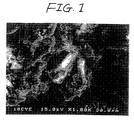
- Under these circumstances, the inventors made SEM-EDX analysis and powder X-ray diffractometry on the cracked portion of a cracked activated carbon to make clear the mechanism of occurrence of cracking on molded activated carbon. As a result, it was found that a columnar crystal having a diameter of few micrometers and scores of micrometers occurs at the cracking site as shown in Fig. 1. EDX analysis (Fig. 2) shows that this crystal is a compound containing Ca and S. The cracked portion was then scraped to give a specimen. The specimen was then subjected to powder X-ray diffractometry (Fig. 3). As a result, it was found that the crystal containing Ca and S is CaSO4. Accordingly, this demonstrates that cracking occurs according to the mechanism that at the step of heating the molded activated carbon to cause heat decomposition of dioxins at low temperatures Ca in ash content scattered in the activated carbon reacts with SOx in the waste gas adsorbed by the activated carbon to cause CaSO4 to grow in the form of columnar crystal, thereby causing an increase of volume that leads to cracking. Then, the inventors found that an activated carbon having a Ca content low enough to inhibit the crystal growth of CaSO4, which causes cracking, is desirable as a recyclable dioxin adsorption/decomposition activated carbon.
- In other words, the essence of the present invention lies in a coal-based molded activated carbon having a Ca content of 0.2 wt% or less being capable of adsorbing dioxins and a process for the treatment of a waste gas using this coal-based molded activated carbon.
- For the adsorption of dioxins, various activated carbons have heretofore been used. These activated carbons have different Ca contents. Coal-based molded activated carbons which are generally used have a Ca content of about 0.6 wt%.
- Fig. 1 is SEM photograph illustrating the cracked portion of the cracked activated carbon of Comparative Example 1.
- Fig. 2 is a chart illustrating SEM-EDX analysis of the cracked portion of the cracked activated carbon of Comparative Example 1.
- Fig. 3 is a chart illustrating powder X-ray diffractometry of the cracked portion of the cracked activated carbon of Comparative Example 1.
-
- The coal-based molded activated carbon according to the present invention needs to be capable of adsorbing dioxins. As the activated carbon there is preferably used one having pores with a pore diameter of from 10Å to 20 Å, normally having a pore volume of 0.01 cc/g or more, preferably 0.03 cc/g or more. The activated carbon according to the invention normally has a specific surface area of from 300 m2/g or more, preferably 400 m2/g or more, to 2,000 m2/g or less, preferably 1,500 m2/g or less. When the specific surface area of the activated carbon is too small, the activated carbon exhibits a deteriorated dioxin adsorptivity. On the contrary, when the specific surface area of the activated carbon is too great, the resulting molded activated carbon exhibits a deteriorated strength to disadvantage.
- It is essential that the molded activated carbon according to the invention should be prepared from a coal-based raw material because of quality and price of product and stable availability in a large amount. By molding this raw material charcoal in powder form into a predetermined shape and size, and then subjecting the molded product to carbonization and activation, a molded activated carbon can be obtained. The molding of the raw material charcoal is normally carried out by consolidation molding free from binder. If necessary, a small amount of a binder may be added. As such a binder there may be normally used a tar-based adhesive. The molding may be optionally effected after activation. The carbonization is effected at a temperature of from 500°C to 900°C according to normal process. In some detail, the material is heated and carbonized so that carbon-based organic materials are decomposed and carbonized. Activation is roughly divided into two groups, i.e., activation with gas and activation with chemical. In the present invention, activated carbon obtained by activation with gas is desirable. Activation with gas is called physical activation while activation with chemical is called chemical activation. Activation with gas involves the catalytic reaction of a carbonized raw material with water vapor, carbon dioxide gas, oxygen or other oxidizing gas at an elevated temperature resulting in the production of a microporous adsorbent charcoal. Activation with water vapor is mainly used on an industrial basis. Activation with chemical comprises heating a raw material uniformly impregnated with an activating chemical in an inert gas atmosphere to cause dehydration and oxidation reaction of the chemical resulting in the production of a microporous adsorbent charcoal. Examples of the chemical employable herein include zinc chloride, phosphoric acid, sodium phosphate, calcium chloride, potassium sulfite, potassium hydroxide, sodium hydroxide, potassium carbonate, sodium carbonate, sodium sulfate, potassium sulfate, and calcium carbonate.
- The molded activated carbon according to the invention is normally in the form of columns, grains or discs.
- The size of the molded activated carbon according to the invention may be normally arbitrary so far as it is acceptable as filler to be packed in a packed column. For example, if the activated carbon is in the form of column, the average diameter is normally from 3 mm or more, preferably 4 mm or more, to 10 mm or less, preferably 9 mm or less, and the average length is normally from 3 mm or more, preferably 4 mm or more, to 30 mm or less, preferably 20 mm or less. If the activated carbon is in the form of grains, the average grain diameter is normally from 3 mm or more, preferably 4 mm or more, to 10 mm or less, preferably 9 mm or less. When the activated carbon is too small, the pressure loss in the packed column may be increased. On the contrary, when the activated carbon is too large, the contact area of the waste gas with the particulate activated carbon decreases, occasionally deteriorating the adsorptivity.
- The molded activated carbon according to the invention is normally packed in a column before use. Therefore, the molded activated carbon according to the invention preferably has a strength high enough to maintain its shape without being pulverized during packing or withdrawal.
- In the present invention, it is essential that as the foregoing coal-based molded activated carbon there be used one having a Ca content of 0.2 wt% or less, preferably 0.15 wt% or less. In other words, when the content of Ca is too great, the resulting molded activated carbon can crack and undergo pulverization during recycling, resulting in troubles with treatment of waste gas such as increase of pressure loss in the packed column and scattering of fine powder. Further, dioxins cannot be efficiently removed. However, the use of a molded activated carbon having a Ca content of not more than the above defined value makes it possible to continue fair removal of dioxins. The content of Ca can be measured, e.g., by wet decomposition ICP-AES.
- The molded activated carbon according to the invention has an ash content of normally 9 wt% or less, preferably 8 wt% or less.
- As the process for the production of the activated carbon having a low Ca content there may be used a process involving the washing of a coal-based molded activated carbon having a Ca content of about 0.6 wt% with an aqueous solution of an acid. Examples of the acid employable herein include inorganic acids such as hydrochloric acid, nitric acid, sulfuric acid and hydrofluoric acid. Preferred among these inorganic acids is hydrochloric acid. The activated carbon thus acid-washed is preferably then washed with water to remove the acid.
- The coal-based molded activated carbon according to the invention is used as an adsorbent for various waste gases containing dioxins. The coal-based molded activated carbon according to the invention exerts its effect remarkably when used in a waste gas treatment apparatus which operates by a process involving the repetition (e.g., 10 times or more) of cycle consisting of adsorption and regeneration. The waste gas treatment apparatus which operates by recycling activated carbon is a treatment apparatus which operates by a process involving a step of allowing an activated carbon to adsorb substances from a waste gas and a step of separating the substances from the activated carbon and decomposing the substances thus separated. A representative example of such a treatment apparatus is one proposed in JP-A-11-104488. An apparatus which operates by a process involving the adsorption step and the separation and decomposition step which are switched in the same system, too, corresponds to the recycle type waste gas treatment apparatus of the invention.
- The waste gas to be treated in the present invention is normally a gas containing dioxins. The waste gas has a dioxin concentration of normally from 100 to 0.1 ng-TEQ/Nm3. While such a waste gas generally contains a SO2 gas, the waste gas normally has an SO2 concentration of from 1 to 3,000 ppm. The waste gas may not necessarily contain SO2. When the waste gas contains SO2, the activated carbon used is liable to problems such as cracking and pulverization. Thus, the molded activated carbon according to the invention can exert its effect remarkably when the waste gas to be treated contains SO2.
- The shape and type of the adsorption tower to be used in the treatment of combustion gas are not specifically limited. In practice, however, the adsorption tower to be used herein may be of AE&E type, WKV type or the type proposed in JP-A-7-763. The temperature of the adsorption tower is normally from 70°C or more, preferably 100°C or more, to 200°C or less, preferably 180°C or less. The molded activated carbon according to the invention can be used in any type of adsorption tower such as fluidized bed type adsorption tower and fixed bed type adsorption tower.
- On the other hand, the decomposition of dioxins can be carried out, e.g., by a process which comprises heating dioxins normally to a temperature of from 350°C or more, preferably 400°C or more, to 550°C or less, preferably 500°C or less, in a reaction tank filled with an activated carbon under the deficiency of oxygen, preferably in the presence of oxygen in an amount of 1% or less. The decomposition of dioxins makes it possible to re-use the activated carbon.
- The use of the molded activated carbon according to the invention makes it possible to prevent the pulverization of the molded activated carbon even after repetition of adsorption of dioxins from the waste gas and decomposition of dioxins thus adsorbed and hence continue fair treatment of the waste gas.
- The present invention will be further described in the following example and comparative example, but the present invention should not be construed as being limited thereto so far as these examples fall within the scope of the invention.
- Coal as a starting material was subjected to activation with water vapor to produce a columnar activated carbon having an average diameter of 4 mm and an average length of 5 mm. The columnar activated carbon thus produced was then washed with hydrochloric acid to obtain a molded activated carbon having a low Ca content. The columnar activated carbon thus obtained was then measured for specific surface area, ash content and Ca content and subjected to adsorption/decomposition cycle test with an imitation gas.
- For the measurement of specific surface area, nitrogen adsorption was effected using a Type Soaptomatic 1800 measuring instrument produced by Carlo Erba Strumentezione. BET process was used to calculate specific surface area. The specific surface area thus determined was 1,100 m2/g.
- The measurement of ash content was carried out by the following method. In some detail, into a porcelain crucible was charged from 1 g to 2 g of an activated carbon sample. The sample was then heated to a temperature of 815°C in the air for 6 hours. The sample was then allowed to cool. The weight of the residual ash content was then measured. The percentage of the weight of the ash content based on the weight of the activated carbon charged was then determined. From this percentage was calculated ash content. The ash content thus determined was 7.5 wt%.
- For the measurement of Ca content, a wet decomposition ICP-AES (apparatus: JY38S, produced by JOBIN YVON INC.) was used. The Ca content thus determined was 0.11 wt%.
- The adsorption/decomposition cycle test with an imitation gas was effected under the following conditions. The occurrence of cracking on the columnar activated carbon was visually confirmed.
- In some detail, the sample was subjected to adsorption at a temperature of 90°C in an imitation combustion gas having an SO2 content of 1,050 ppm, an H2O content of 10% and an O2 content of 15% and comprising N2 as a base gas for 40 hours. The sample was then heated to a temperature of 450°C in N2 gas in 3 hours. The sample was then kept at a temperature of 450°C for 2 hours to undergo separation. These steps constitutes a cycle. This cycle was repeated 10 times. As a result, little or no cracks occurred on the columnar activated carbon.
- Coal as a starting material was subjected to activation with water vapor to produce a columnar activated carbon having an average diameter of 4 mm and an average length of 5 mm. The columnar activated carbon thus obtained was then measured for physical properties in the same manner as in Example 1. As a result, the specific surface area was 1,090 m2/g, the ash content was 9.2 wt%, and the Ca content was 0.61 wt%. The columnar activated carbon was then subjected to cycle test. At the 10th cycle, the sample was examined to see if it underwent cracking. As a result, 80% of the grains was observed to have cracks.
- As can be seen in the foregoing example and comparative example, when an activated carbon having a Ca content of 0.2 wt% or less is used as a recyclable dioxin adsorption/decomposition activated carbon for apparatus for the treatment of combustion gas containing SO2, the grains constituting the activated carbon are less liable to cracking, enabling the repetition of adsorption/decomposition of dioxins over an extended period of time.
- In accordance with the present invention, a coal-based molded activated carbon which can withstand the repetition of adsorption/decomposition of dioxins can be provided. Accordingly, the process for the treatment of a waste gas using this coal-based molded activated carbon allows stable adsorption and removal of dioxins from a waste gas over an extended period of time.
Claims (13)
- A coal-based molded activated carbon having a Ca content of 0.2 wt% or less and being capable of adsorbing dioxins.
- The molded activated carbon according to Claim 1, which has a specific surface area of 300 m2/g to 2,000 m2/g.
- The molded activated carbon according to Claim 1, which has a pore volume of 0.01 cc/g or more.
- The molded activated carbon according to any one of Claims 1 to 3, which has a column shape having an average diameter of from 3 mm to 10 mm and an average length of from 3 mm to 30 mm.
- The molded activated carbon according to any one of Claims 1 to 3, which has a granular shape having an average diameter of from 3 mm to 10 mm.
- The molded activated carbon according to any one of Claims 1 to 5, which has an ash content of 9 wt% or less.
- The molded activated carbon according to any one of Claims 1 to 6, which has a Ca content of 0.15 wt% or less.
- The molded activated carbon according to any one of Claims 1 to 7, which is obtained by a process which comprises molding a coal powder as a raw material, subjecting the molded powder to carbonization and activation to produce a molded activated carbon, and washing the molded activated carbon with an aqueous solution of an acid.
- The molded activated carbon according to any one of Claims 1 to 8, which is for use in the adsorption of waste gas containing dioxins.
- The molded activated carbon according to any one of Claims 1 to 9, which is for use in a waste gas treatment system which comprises: allowing an activated carbon to adsorb a waste gas containing dioxins; and subjecting the activated carbon used for the adsorption to decomposition of dioxins at a temperature of from 350°C to 550°C under deficiency of oxygen.
- A process for the treatment of a waste gas containing dioxins, which comprises: allowing an activated carbon to adsorb a waste gas containing dioxins; heating the activated carbon used for the adsorption to decompose dioxins and regenerate the activated carbon; and re-using the activated carbon thus regenerated, wherein a coal-based molded activated carbon having a Ca content of 0.2 wt% or less and being capable of adsorbing dioxins is used as the activated carbon.
- The process for the treatment of a waste gas according to Claim 11, wherein the adsorption of dioxins in the waste gas is effected at a temperature of from 70°C to 200°C.
- The process for the treatment of a waste gas according to Claim 11, wherein the heat decomposition of dioxins in the activated carbon used for adsorption is effected at a temperature of from 350°C to 550°C under deficiency of oxygen.
Applications Claiming Priority (2)
| Application Number | Priority Date | Filing Date | Title |
|---|---|---|---|
| JP28537899 | 1999-10-06 | ||
| JP28537899 | 1999-10-06 |
Publications (1)
| Publication Number | Publication Date |
|---|---|
| EP1090881A1 true EP1090881A1 (en) | 2001-04-11 |
Family
ID=17690782
Family Applications (1)
| Application Number | Title | Priority Date | Filing Date |
|---|---|---|---|
| EP00121292A Withdrawn EP1090881A1 (en) | 1999-10-06 | 2000-10-06 | Coal-based molded activated carbon and process for the treatment of waste gas containing dioxins using same |
Country Status (2)
| Country | Link |
|---|---|
| EP (1) | EP1090881A1 (en) |
| CN (1) | CN1307931A (en) |
Cited By (4)
| Publication number | Priority date | Publication date | Assignee | Title |
|---|---|---|---|---|
| TWI424877B (en) * | 2011-11-09 | 2014-02-01 | Univ Nat Central | System and method for reduction of dioxin |
| US9089834B2 (en) | 2010-08-30 | 2015-07-28 | Albemarle Corporation | Brominated sorbents for removing mercury from emissions produced during fuel combustion |
| CN106215685A (en) * | 2016-09-06 | 2016-12-14 | 清华大学 | A kind of calcio modified activated carbon and its preparation method and application |
| CN116550289A (en) * | 2023-04-21 | 2023-08-08 | 广东誉谱检测科技有限公司 | A modified activated carbon suitable for adsorbing dioxins and its preparation method |
Families Citing this family (1)
| Publication number | Priority date | Publication date | Assignee | Title |
|---|---|---|---|---|
| CN108404863B (en) * | 2018-04-04 | 2020-11-10 | 成都达奇环境科技有限公司 | A kind of activated carbon for adsorbing dioxin and preparation method thereof |
Citations (6)
| Publication number | Priority date | Publication date | Assignee | Title |
|---|---|---|---|---|
| US4014817A (en) * | 1975-04-03 | 1977-03-29 | Calgon Corporation | Manufacture of activated carbon from sized coal |
| US4105752A (en) * | 1976-12-20 | 1978-08-08 | Aluminum Company Of America | Aluminum chloride production |
| US5013698A (en) * | 1989-12-27 | 1991-05-07 | Lonsinger Deborah A | Method of reducing carbon loss in regeneration process |
| RU2111165C1 (en) * | 1997-03-20 | 1998-05-20 | Открытое акционерное общество "ЗАРЯ" | Method of preparing activated carbon for making alcoholic beverages |
| JPH1157389A (en) * | 1997-08-13 | 1999-03-02 | Mitsubishi Chem Corp | Hot gas treatment method |
| JPH11104488A (en) * | 1997-10-01 | 1999-04-20 | Sumitomo Heavy Ind Ltd | Activated carbon for dioxin adsorption and decomposition |
-
2000
- 2000-10-05 CN CN00135325A patent/CN1307931A/en active Pending
- 2000-10-06 EP EP00121292A patent/EP1090881A1/en not_active Withdrawn
Patent Citations (6)
| Publication number | Priority date | Publication date | Assignee | Title |
|---|---|---|---|---|
| US4014817A (en) * | 1975-04-03 | 1977-03-29 | Calgon Corporation | Manufacture of activated carbon from sized coal |
| US4105752A (en) * | 1976-12-20 | 1978-08-08 | Aluminum Company Of America | Aluminum chloride production |
| US5013698A (en) * | 1989-12-27 | 1991-05-07 | Lonsinger Deborah A | Method of reducing carbon loss in regeneration process |
| RU2111165C1 (en) * | 1997-03-20 | 1998-05-20 | Открытое акционерное общество "ЗАРЯ" | Method of preparing activated carbon for making alcoholic beverages |
| JPH1157389A (en) * | 1997-08-13 | 1999-03-02 | Mitsubishi Chem Corp | Hot gas treatment method |
| JPH11104488A (en) * | 1997-10-01 | 1999-04-20 | Sumitomo Heavy Ind Ltd | Activated carbon for dioxin adsorption and decomposition |
Non-Patent Citations (3)
| Title |
|---|
| DATABASE WPI Section Ch Week 199850, Derwent World Patents Index; Class B06, AN 1998-592883, XP002158854 * |
| PATENT ABSTRACTS OF JAPAN vol. 1999, no. 08 30 June 1999 (1999-06-30) * |
| PATENT ABSTRACTS OF JAPAN vol. 1999, no. 09 30 July 1999 (1999-07-30) * |
Cited By (4)
| Publication number | Priority date | Publication date | Assignee | Title |
|---|---|---|---|---|
| US9089834B2 (en) | 2010-08-30 | 2015-07-28 | Albemarle Corporation | Brominated sorbents for removing mercury from emissions produced during fuel combustion |
| TWI424877B (en) * | 2011-11-09 | 2014-02-01 | Univ Nat Central | System and method for reduction of dioxin |
| CN106215685A (en) * | 2016-09-06 | 2016-12-14 | 清华大学 | A kind of calcio modified activated carbon and its preparation method and application |
| CN116550289A (en) * | 2023-04-21 | 2023-08-08 | 广东誉谱检测科技有限公司 | A modified activated carbon suitable for adsorbing dioxins and its preparation method |
Also Published As
| Publication number | Publication date |
|---|---|
| CN1307931A (en) | 2001-08-15 |
Similar Documents
| Publication | Publication Date | Title |
|---|---|---|
| US6858192B2 (en) | Activated carbon for odor control and method for making same | |
| US7101417B2 (en) | Activated carbon for odor control and method for making same | |
| US6962616B1 (en) | Preparation of adsorbents from organic fertilizer and mineral oil and their application for removal of acidic gases from sulfur containing wet gas streams | |
| JP2002102689A (en) | Carbonaceous adsorbent | |
| WO1992011202A1 (en) | Process for producing formed active coke for desulfurization and denitrification with high denitrification performance | |
| JP2015521539A (en) | Fluid purification means, its production method, its use | |
| WO2002098793A1 (en) | Activated carbon and method for production thereof | |
| EP1132341A1 (en) | Improved activated carbon by acid treatment and its use in gas separation | |
| Edathil et al. | Alginate-pyrolyzed porous carbon as efficient gas phase elemental mercury scavenger | |
| JP2001170481A (en) | Coal-based shaped activated carbon and method for treating dioxin-containing exhaust gas using the same | |
| JP3947285B2 (en) | Manufacturing method of activated carbon for desulfurization and denitration with high denitration performance | |
| JP2000225320A (en) | Hot gas treatment method and activated carbon | |
| JP3521730B2 (en) | How to remove organic chlorine compounds | |
| CN1307931A (en) | Coal-based shaped activated carbon and method for treating waste gas containing dioxins using the activated carbon | |
| JP3381226B2 (en) | How to remove carbon dioxide from exhaust gas | |
| JP4628752B2 (en) | Activated carbon for treating organic halogen compounds and method for treating exhaust gas containing organic halogen compounds using the same | |
| JP3436092B2 (en) | Hot gas treatment method | |
| JP4711831B2 (en) | Exhaust gas treatment agent, exhaust gas treatment method, and exhaust gas treatment apparatus | |
| US4239742A (en) | Process for improving a gas containing a minor amount of sulfur dioxide impurity and producing a hydrogen sulfide-rich gas | |
| JP2000246057A (en) | High temperature gas treating agent and treating method | |
| JP5827457B2 (en) | Nitrogen oxide removing material and nitrogen oxide removing method | |
| JP5994079B2 (en) | Decomposition method of volatile organic gas | |
| JP2006263587A (en) | Combustion exhaust gas treatment method | |
| JPH03501461A (en) | How to treat fluids with adsorbents | |
| CN104310676A (en) | Method for removing mercury compound in waste liquid at normal temperature and normal pressure |
Legal Events
| Date | Code | Title | Description |
|---|---|---|---|
| PUAI | Public reference made under article 153(3) epc to a published international application that has entered the european phase |
Free format text: ORIGINAL CODE: 0009012 |
|
| AK | Designated contracting states |
Kind code of ref document: A1 Designated state(s): AT BE CH CY DE DK ES FI FR GB GR IE IT LI LU MC NL PT SE |
|
| AX | Request for extension of the european patent |
Free format text: AL;LT;LV;MK;RO;SI |
|
| 17P | Request for examination filed |
Effective date: 20010522 |
|
| AKX | Designation fees paid |
Free format text: AT BE CH CY DE DK ES FI FR GB GR IE IT LI LU MC NL PT SE |
|
| RAP1 | Party data changed (applicant data changed or rights of an application transferred) |
Owner name: MITSUBISHI CHEMICAL CORPORATION |
|
| STAA | Information on the status of an ep patent application or granted ep patent |
Free format text: STATUS: THE APPLICATION IS DEEMED TO BE WITHDRAWN |
|
| 18D | Application deemed to be withdrawn |
Effective date: 20040501 |