EP1088801A1 - Aluminum nitride sintered bodies and semiconductor-producing members including same - Google Patents
Aluminum nitride sintered bodies and semiconductor-producing members including same Download PDFInfo
- Publication number
- EP1088801A1 EP1088801A1 EP00308212A EP00308212A EP1088801A1 EP 1088801 A1 EP1088801 A1 EP 1088801A1 EP 00308212 A EP00308212 A EP 00308212A EP 00308212 A EP00308212 A EP 00308212A EP 1088801 A1 EP1088801 A1 EP 1088801A1
- Authority
- EP
- European Patent Office
- Prior art keywords
- aluminum nitride
- sintered body
- nitride sintered
- set forth
- less
- Prior art date
- Legal status (The legal status is an assumption and is not a legal conclusion. Google has not performed a legal analysis and makes no representation as to the accuracy of the status listed.)
- Granted
Links
Images
Classifications
-
- C—CHEMISTRY; METALLURGY
- C04—CEMENTS; CONCRETE; ARTIFICIAL STONE; CERAMICS; REFRACTORIES
- C04B—LIME, MAGNESIA; SLAG; CEMENTS; COMPOSITIONS THEREOF, e.g. MORTARS, CONCRETE OR LIKE BUILDING MATERIALS; ARTIFICIAL STONE; CERAMICS; REFRACTORIES; TREATMENT OF NATURAL STONE
- C04B35/00—Shaped ceramic products characterised by their composition; Ceramics compositions; Processing powders of inorganic compounds preparatory to the manufacturing of ceramic products
- C04B35/515—Shaped ceramic products characterised by their composition; Ceramics compositions; Processing powders of inorganic compounds preparatory to the manufacturing of ceramic products based on non-oxide ceramics
- C04B35/58—Shaped ceramic products characterised by their composition; Ceramics compositions; Processing powders of inorganic compounds preparatory to the manufacturing of ceramic products based on non-oxide ceramics based on borides, nitrides, i.e. nitrides, oxynitrides, carbonitrides or oxycarbonitrides or silicides
- C04B35/581—Shaped ceramic products characterised by their composition; Ceramics compositions; Processing powders of inorganic compounds preparatory to the manufacturing of ceramic products based on non-oxide ceramics based on borides, nitrides, i.e. nitrides, oxynitrides, carbonitrides or oxycarbonitrides or silicides based on aluminium nitride
-
- H—ELECTRICITY
- H10—SEMICONDUCTOR DEVICES; ELECTRIC SOLID-STATE DEVICES NOT OTHERWISE PROVIDED FOR
- H10W—GENERIC PACKAGES, INTERCONNECTIONS, CONNECTORS OR OTHER CONSTRUCTIONAL DETAILS OF DEVICES COVERED BY CLASS H10
- H10W70/00—Package substrates; Interposers; Redistribution layers [RDL]
- H10W70/60—Insulating or insulated package substrates; Interposers; Redistribution layers
- H10W70/67—Insulating or insulated package substrates; Interposers; Redistribution layers characterised by their insulating layers or insulating parts
- H10W70/69—Insulating materials thereof
- H10W70/692—Ceramics or glasses
-
- Y—GENERAL TAGGING OF NEW TECHNOLOGICAL DEVELOPMENTS; GENERAL TAGGING OF CROSS-SECTIONAL TECHNOLOGIES SPANNING OVER SEVERAL SECTIONS OF THE IPC; TECHNICAL SUBJECTS COVERED BY FORMER USPC CROSS-REFERENCE ART COLLECTIONS [XRACs] AND DIGESTS
- Y10—TECHNICAL SUBJECTS COVERED BY FORMER USPC
- Y10T—TECHNICAL SUBJECTS COVERED BY FORMER US CLASSIFICATION
- Y10T279/00—Chucks or sockets
- Y10T279/23—Chucks or sockets with magnetic or electrostatic means
Definitions
- the present invention relates to aluminum nitride sintered bodies and semiconductor-producing members using the same.
- an electrostatically chucking system utilizing the Johnsen-Rahbek force is useful.
- the volume resistivity of a substrate of the electrostatic chuck is set at 10 8 ⁇ cm to 10 12 ⁇ cm, high attracting force and high response can be obtained. Therefore, what is important in developing the electrostatic chucks is to control the volume resistivity of the substrate to 10 8 ⁇ cm to 10 12 ⁇ cm in a use temperature range.
- NGK disclosed in JP-A 9-315,867 (U.S.P. 6001760) that the volume resistivity can be controlled to 10 8 ⁇ cm to 10 12 ⁇ cm at room temperature by adding a very small amount of yttrium oxide to aluminum nitride having a high purity.
- Such a non-ohmic voltage-current behavior is not preferable for parts for the semiconductor-producing apparatus, particularly for the semiconductor susceptor containing the electrostatic electrode.
- a dielectric layer is present between the electrostatically chucking electrode and the surface of the chuck, the thickness of the dielectric layer slightly varies or deviates. Since the voltage is constant between the electrostatically chucking electrode and the surface of the electrostatic chuck, the voltage applied (V/mm) is smaller in a thicker portion of the dielectric layer and larger in a thinner portion thereof.
- the present invention relates to an aluminum nitride sintered body composed mainly of aluminum nitride, having a polycrystalline structure of aluminum nitride crystals, and containing not less than 0.01 wt% to not more than 1.0 wt% of cerium when calculated as an oxide thereof.
- the present inventors discovered that when a small amount of cerium is incorporated into the aluminum nitride sintered body, the volume resistivity of the sintered body can be reduced, and the non-ohmic behavior between the voltage applied and the leak current can be suppressed, and as the case may be, almost the ohmic behavior can be realized.
- the inventors reached the present invention based on this discovery.
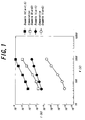
- Fig. 1 is a graph showing the relationship between the voltage V applied and the leak current I in a sintered body in each sample.
- the content of aluminum in the sintered body according to the present invention needs to be so high as to make aluminum nitride grains present as a main phase, preferably not less than 35 wt%, and more preferably not less than 50 wt%.
- the content of cerium needs to be not less than 0.01 wt% when calculated as an oxide thereof. From this point of view, the content of cerium is preferably not less than 0.1 wt% when calculated as an oxide thereof.
- the content of cerium is set at not more than 1.0 wt% from the standpoint of view for reducing the volume resistivity. From this point of view, the content of cerium is preferably not more than 0.7 wt% when calculated as an oxide thereof.
- JP-A 11-100,271 discloses aluminum nitride ceramics containing cerium in an amount of 2 to 20 mol% when calculated as its oxide as well as CeAlO 3 and having a low volume resistivity.
- the content of cerium of the aluminum nitride ceramics is converted to about 7.9 wt% to 51 wt%. This means that when a large amount of cerium is incorporated into the aluminum nitride ceramics, a large amount of CeAlO 3 (cerium aluminate) is precipitated in grain boundaries of aluminum nitride grains to form a continuous phase of cerium aluminate in the grain boundaries, and electricity is flown through this continuous phase.
- the measurement of the aluminum nitride sintered bodies according to the present invention reveals that some of them comprise a single phase of aluminum nitride and other comprise an aluminum nitride phase and a cerium aluminate phase. In general, there is a tendency that as the content of cerium in the sintered body increases, the cerium aluminate comes out.
- measurement of the sintered bodies with a high power XRD sometimes detects either one of or both of the aluminum nitride phase and the cerium aluminate phase and the CeAl 11 O 18 phase. Measuring condition for the high power XRD will be described later.
- the content of metal impurities excluding cerium is preferably not more than 100 ppm, more preferably not more than 50 ppm. This case can provide highly corrosion-resistant sintered bodies suitable for applications disliking impurities to a high extent, such as for application in semiconductors.
- the content of rare earth element(s) excluding cerium in the aluminum nitride sintered body when calculated as oxide(s) thereof is not less than 0.01 wt% and not more than 0.5 wt%.
- the present inventors found out that uneven colors ranging from redish brown to brown appeared on parts of surfaces of the aluminum nitride sintered bodies according to the present invention added with a very small amount of cerium, as the case may be. However, completely no change in various characteristics have been observed corresponding to such uneven colors.
- the present inventors discovered that when a very small amount of rare earth element(s) excluding cerium is (are) added together with cerium in such an amount that not less than 0.01 wt% of the rare earth element(s) may be incorporated as calculated in the form of oxide(s) thereof, such uneven colors can be prevented or controlled without almost changing various characteristics of the sintered body.
- the content of rare earth element(s) excluding cerium is more preferably not less than 0.03 wt% when calculated as the oxide(s) thereof.
- the content of the rare earth element(s) is preferably not more than 0.5 wt% when calculated as the oxide(s) thereof.
- the content of metal element(s) excluding aluminum and the rare earth elements (including cerium) is preferably not more than 100 ppm, more preferably not more than 50 ppm.
- the rare earth elements are preferably yttrium, neodymium, samarium, gadolinium, dysprosium, erbium, and ytterbium, and yttrium is particularly preferred.
- the content of carbon is preferably not more than 0.05 wt%.
- the average particle diameter of the aluminum nitride crystals constituting the aluminum nitride sintered body according to the present invention is preferably not less than 5 ⁇ m and not more than 20 ⁇ m.
- the relative density of the aluminum nitride sintered body is preferably not less than 95 %.
- a value of ⁇ in an I-V relational equation: I kV ⁇ (V to the ⁇ th power) is not less than 1.0 and not more than 1.5 in case of V being in a range of not less than 100 V/mm and not more than 1000 V/mm, I being a leak current when a voltage V is applied to the aluminum nitride sintered body, k being a constant and ⁇ being a non-linear coefficient.
- oxygen impurity existing in the form of alumina contained in the aluminum nitride raw powder reacts with cerium oxide, so that a phase of cerium-aluminum oxide occurs to promote the liquid-phase sintering of aluminum nitride.
- the aluminum nitride grains become coarse.
- cerium-aluminum oxide remains in the grain boundaries as a precipitate.
- a part of oxygen contained in the raw powder is solid solved into the aluminum nitride grains, so that a donor level is formed with oxygen within the aluminum nitride grain to reduce the electrical resistance in the grain.
- the aluminum nitride grains become coarse to reduce the number of the grain boundaries having high resistance and to decrease the electrical resistance in the grains, thereby decreasing the volume resistivity for the bulk sintered body.
- the raw material for aluminum nitride ones obtained by various producing methods such as direct nitriding, reduction nitriding and gas phase synthesis from alkyl aluminium may be used.
- cerium oxide precursors such as cerium nitrate, cerium sulfate and cerium oxalate, which produce cerium oxide by heating
- the cerium oxide precursor may be added in the form of powder.
- a solution may prepared by dissolving a compound such as cerium nitrate or cerium sulfate into a solvent, and this solution added to the raw powder.
- cerium oxide precursor is dissolved into the solvent in this way, cerium can be highly dispersed among the aluminum nitride grains. This is particularly useful when the addition amount of cerium is small.
- a preform of aluminum nitride to be sintered can be formed by a known method such as dry pressing, doctor blade, extruding or casting.
- the sintered body according to the present invention is preferably obtained by hot press sintering.
- the preform to be sintered is preferably hot press sintered under pressure of 50 kgf/cm 2 or more.
- the sintered bodies according to the present invention can be favorably used as various parts in semiconductor-producing apparatuses such as silicon wafer-treating apparatuses and liquid crystal display-producing apparatuses.
- the sintered bodies according to the present invention are particularly suitable as corrosion-resistance parts such as susceptors in the semiconductor-producing apparatuses. Further, the sintered bodies are suitable for metal-buried products in which metallic parts are buried in the above corrosion-resistance parts.
- the corrosion-resistance members susceptors, rings, dooms, etc. to be arranged inside the semiconductors may be recited, for example.
- a heater electrode, an electrostatically chucking electrode, a high frequency voltage generating electrode or the like may be buried.
- the sintered body according to the present invention has a low resistance, high purity and the relationship between the voltage applied and the leak current being near the ohmic behavior, the sintered body is particularly useful for a substrate for the electrostatic chuck. Inside the substrate for the electrostatic chuck, a heater electrode, a plasma-generating electrode or the like may be buried besides the electrostatic chuck electrode.
- Sintered bodies in Examples and Comparative Examples in Tables 2 to 6 were prepared by using commercially available reduction nitridation powder and commercially available cerium nitrate. The composition of that powder is shown in Table 1.
- the raw powder was uniaxially press molded under pressure of 200 kgf/cm 2 , thereby obtaining a discoid molded body having a diameter of 100 mm and a thickness of 20 mm.
- This molded body was placed in a graphite mold, and the molded product was sintered by hot press.
- the pressing pressure was 200 kgf/mm 2
- the firing temperature was 1900 or 2000°C
- the sintered body was held at 1900°C or 2000°C for 4 hours, and cooled. Vacuum was kept between room temperature and 1000°C, and nitrogen gas was introduced at pressure of 1.5 kgf/cm 2 between 1000°C and 1900°C or 2000°C.
- Density was measured with pure water as a medium by the Archimedean method.
- the content of metal impurities was quantitatively determined by an induction coupling plasma spectrum.
- the oxygen content was quantitatively determined by an inert gas melting infrared absorptiometry.
- the carbon content was quantitatively determined by a high frequency heating infrared absorptiometry.
- the content of CeO 2 was calculated from the quantitative amount of cerium determined by the induction coupling plasma spectrum.
- the volume resistivity was measured in vacuum according to the volume resistivity-measuring method in JIS C2141 for insulating materials.
- the dimension of the test piece was 50 mm x 50 mm x 1 mm, and the diameter of a main electrode 20 mm, the inner diameter and the outer diameter of a guard electrode 30 mm and 40 mm, respectively, the diameter of a voltage-applying electrode 45 mm, and silver was used as a material for the electrodes.
- the voltage applied was varied in a range of 50 V/mm to 1000 V/mm. One minute after the application of the voltage, the intensity of electric current was red, and the volume resistivity was calculated.
- the columns "Volume resistivity at room temperature” in Tables 2 to 5 give volume resistivity at the applied voltage of 500 V/mm.
- the indication "9E + 11" in Tables means “9 x 10 11 ", and other have similar meanings.
- the thermal conductivity was measured by the laser flush method.
- Bending strength was determined by four-point bending strength test in JIS R 1601 at room temperature.
- Average AlN grain diameter was determined by measuring diameters of 30 AlN grains using a scanning electron microscope.
- the contents of CeO 2 in the sintered bodies are 0.05 to 0.74 wt%, which show a tendency that the content of CeO 2 slightly decreases than in the formulation of a raw material.
- the content of oxygen is 0.80 to 0.94 wt%, which is relatively large.
- Sintered bodies in which the content of CeO 2 is not more than 0.20 wt% is almost a single phase of aluminum nitride, but when the content of CeO 2 exceeds 0.20 wt%, a cerium aluminate phase comes to be precipitated.
- the volume resistivity at room temperature is relatively low and ⁇ is small.
- Comparative Example 1 Although the content of CeO 2 is less than 0.0001 wt%, the volume resistivity is high and ⁇ is large. In Comparative Examples 2 and 3, the contents of CeO 2 are more than 1 wt%, but the volume resistivity is high.
- the contents of CeO 2 in the sintered bodies are 0.01 to 0.98 wt%.
- the content of oxygen is 0.58 to 0.82 wt%, which is relatively large.
- the volume resistivity at room temperature is relatively low and ⁇ is small.
- Comparative Example 4 the content of CeO 2 in the sintered body is less than 0.0001 wt%, the volume resistivity is high, and ⁇ is large.
- Comparative Example 5 the content of CeO 2 in the sintered body is high, and the volume resistivity is high.
- Comparative Example 6 no cerium oxide was added to a raw powder, and instead 0.3 wt. parts of yttrium oxide was added to reduce the volume resistivity of the sintered body.
- the sintered body contains 0.28 wt% of yttrium oxide, but the content of cerium oxide was less than 0.0001 wt%. As a result, the volume resistivity at room temperature conspicuously decreased, but ⁇ was 2.
- yttrium oxide was added with cerium oxide in Examples 16-19, but no conspicuous change was observed with respect to characteristics such as the crystalline phase, volume resistivity, thermal conductivity, bending strength and ⁇ . In Examples 16-19, color uniformity was kept.
- the volume resistivity can be lowered, and the non-ohmic behavior can be suppressed between the voltage applied and the leak current.
- the invention further consists in use of the aluminum nitride bodies of the invention in semiconductor manufacture and in semiconductor manufacturing apparatus.
Landscapes
- Engineering & Computer Science (AREA)
- Chemical & Material Sciences (AREA)
- Ceramic Engineering (AREA)
- Manufacturing & Machinery (AREA)
- Materials Engineering (AREA)
- Structural Engineering (AREA)
- Organic Chemistry (AREA)
- Ceramic Products (AREA)
- Container, Conveyance, Adherence, Positioning, Of Wafer (AREA)
Abstract
Description
- The present invention relates to aluminum nitride sintered bodies and semiconductor-producing members using the same.
- As a method for attracting and holding a semiconductor wafer, an electrostatically chucking system utilizing the Johnsen-Rahbek force is useful. When the volume resistivity of a substrate of the electrostatic chuck is set at 108Ω·cm to 1012Ω·cm, high attracting force and high response can be obtained. Therefore, what is important in developing the electrostatic chucks is to control the volume resistivity of the substrate to 108Ω·cm to 1012Ω·cm in a use temperature range.
- For instance, NGK disclosed in JP-A 9-315,867 (U.S.P. 6001760) that the volume resistivity can be controlled to 108Ω·cm to 1012Ω·cm at room temperature by adding a very small amount of yttrium oxide to aluminum nitride having a high purity.
- In the aluminum nitride sintered body disclosed in JP-A 9-315,867, the resistance can be reduced. However, it is revealed that when the voltage applied varies, the leak current largely changes, which exhibits a behavior like a so-called varistor. That is, it is clarified that the value of α in a I-V relational equation:
- It is an object of the present invention to reduce the volume resistivity and suppress the non-ohmic behavior between the voltage applied and the leak current in a sintered body of aluminum nitride having a high purity.
- The present invention relates to an aluminum nitride sintered body composed mainly of aluminum nitride, having a polycrystalline structure of aluminum nitride crystals, and containing not less than 0.01 wt% to not more than 1.0 wt% of cerium when calculated as an oxide thereof.
- The present inventors discovered that when a small amount of cerium is incorporated into the aluminum nitride sintered body, the volume resistivity of the sintered body can be reduced, and the non-ohmic behavior between the voltage applied and the leak current can be suppressed, and as the case may be, almost the ohmic behavior can be realized. The inventors reached the present invention based on this discovery.
- For a better understanding of the invention, reference is made to the drawing, wherein Fig. 1 is a graph showing the relationship between the voltage V applied and the leak current I in a sintered body in each sample.
- The content of aluminum in the sintered body according to the present invention needs to be so high as to make aluminum nitride grains present as a main phase, preferably not less than 35 wt%, and more preferably not less than 50 wt%.
- Besides the aluminum nitride crystals, a very small amount of other crystal phase(s) may be contained in the polycrystalline structure of the aluminum nitride crystals.
- In order to exhibits the effects of the present invention, the content of cerium needs to be not less than 0.01 wt% when calculated as an oxide thereof. From this point of view, the content of cerium is preferably not less than 0.1 wt% when calculated as an oxide thereof.
- If the content of cerium exceeds 1.0 wt%, the volume resistivity of the aluminum nitride sintered body tends to increase. Therefore, the content of cerium is set at not more than 1.0 wt% from the standpoint of view for reducing the volume resistivity. From this point of view, the content of cerium is preferably not more than 0.7 wt% when calculated as an oxide thereof.
- JP-A 11-100,271 discloses aluminum nitride ceramics containing cerium in an amount of 2 to 20 mol% when calculated as its oxide as well as CeAlO3 and having a low volume resistivity. The content of cerium of the aluminum nitride ceramics is converted to about 7.9 wt% to 51 wt%. This means that when a large amount of cerium is incorporated into the aluminum nitride ceramics, a large amount of CeAlO3 (cerium aluminate) is precipitated in grain boundaries of aluminum nitride grains to form a continuous phase of cerium aluminate in the grain boundaries, and electricity is flown through this continuous phase.
- The measurement of the aluminum nitride sintered bodies according to the present invention reveals that some of them comprise a single phase of aluminum nitride and other comprise an aluminum nitride phase and a cerium aluminate phase. In general, there is a tendency that as the content of cerium in the sintered body increases, the cerium aluminate comes out.
- In particular, measurement of the sintered bodies with a high power XRD sometimes detects either one of or both of the aluminum nitride phase and the cerium aluminate phase and the CeAl11O18 phase. Measuring condition for the high power XRD will be described later.
- The content of metal impurities excluding cerium is preferably not more than 100 ppm, more preferably not more than 50 ppm. This case can provide highly corrosion-resistant sintered bodies suitable for applications disliking impurities to a high extent, such as for application in semiconductors.
- According to a preferred embodiment of the present invention, the content of rare earth element(s) excluding cerium in the aluminum nitride sintered body when calculated as oxide(s) thereof is not less than 0.01 wt% and not more than 0.5 wt%.
- The present inventors found out that uneven colors ranging from redish brown to brown appeared on parts of surfaces of the aluminum nitride sintered bodies according to the present invention added with a very small amount of cerium, as the case may be. However, completely no change in various characteristics have been observed corresponding to such uneven colors.
- The present inventors discovered that when a very small amount of rare earth element(s) excluding cerium is (are) added together with cerium in such an amount that not less than 0.01 wt% of the rare earth element(s) may be incorporated as calculated in the form of oxide(s) thereof, such uneven colors can be prevented or controlled without almost changing various characteristics of the sintered body.
- From the standpoint of view of keeping the color uniformity of the sintered body, the content of rare earth element(s) excluding cerium is more preferably not less than 0.03 wt% when calculated as the oxide(s) thereof.
- From the standpoint of view of providing highly corrosion-resistant sintered bodies suitable for applications disliking impurities to a high degree, such as for application in semiconductors and from the standpoint of view of obtaining a low volume resistivity, the content of the rare earth element(s) is preferably not more than 0.5 wt% when calculated as the oxide(s) thereof.
- Further, from the standpoint of view of providing highly corrosion-resistant sintered bodies suitable for applications disliking impurities to a high degree, such as for application in semiconductors, the content of metal element(s) excluding aluminum and the rare earth elements (including cerium) is preferably not more than 100 ppm, more preferably not more than 50 ppm.
- Although not limited to any one, the rare earth elements are preferably yttrium, neodymium, samarium, gadolinium, dysprosium, erbium, and ytterbium, and yttrium is particularly preferred.
- In the aluminum nitride sintered body according to the present invention, the content of carbon is preferably not more than 0.05 wt%.
- Further, the average particle diameter of the aluminum nitride crystals constituting the aluminum nitride sintered body according to the present invention is preferably not less than 5 µm and not more than 20 µm.
- The relative density of the aluminum nitride sintered body is preferably not less than 95 %.
- In the aluminum nitride sintered body according to the present invention, the non-ohmic behavior between the voltage applied and the leak current is suppressed. More specifically, a value of α in an I-V relational equation:
- A reason why such conspicuous function and effect appear is not clear, but is considered as follows.
- It is considered that when powdery aluminum nitride having a high purity is sintered, a barrier is high at grain boundaries and the electrical conduction at the grain boundaries is of a tunnel effect, so that the sintered body exhibits a non-ohmic electrical conduction characteristic.
- For example, when highly pure aluminum nitride powder, to which a very small amount of yttrium oxide is added, is sintered, oxygen impurity of aluminum nitride powder is solid-solved into the aluminum nitride grains of the sintered body, so that the electrical resistance in the grains decreases. However, it is considered that the barrier is high at the grain boundaries and the electrical conduction at the grain boundaries is of a tunnel effect, so that the sintered body exhibits a non-ohmic electrical conduction characteristic.
- To the contrary, when highly pure aluminum nitride powder, to which a very small amount of cerium oxide is added, is sintered, oxygen impurity (existing in the form of alumina) contained in the aluminum nitride raw powder reacts with cerium oxide, so that a phase of cerium-aluminum oxide occurs to promote the liquid-phase sintering of aluminum nitride.
- Due to the promoted liquid-phase sintering, the aluminum nitride grains become coarse. In the final sintered bodies, it is confirmed that cerium-aluminum oxide remains in the grain boundaries as a precipitate. Further, a part of oxygen contained in the raw powder is solid solved into the aluminum nitride grains, so that a donor level is formed with oxygen within the aluminum nitride grain to reduce the electrical resistance in the grain. In this way, it is considered that the aluminum nitride grains become coarse to reduce the number of the grain boundaries having high resistance and to decrease the electrical resistance in the grains, thereby decreasing the volume resistivity for the bulk sintered body.
- In addition to this, it is considered that the barrier at the grain boundary is decreased by adding cerium oxide, so that the aluminum nitride grains are brought into ohmic contact with one another. However, much of controlling the resistance in such grain boundaries is unclear.
- As the raw material for aluminum nitride, ones obtained by various producing methods such as direct nitriding, reduction nitriding and gas phase synthesis from alkyl aluminium may be used.
- To the raw powder for aluminum nitride, compounds (cerium oxide precursors) such as cerium nitrate, cerium sulfate and cerium oxalate, which produce cerium oxide by heating, can be added. The cerium oxide precursor may be added in the form of powder. Alternatively, a solution may prepared by dissolving a compound such as cerium nitrate or cerium sulfate into a solvent, and this solution added to the raw powder. When the cerium oxide precursor is dissolved into the solvent in this way, cerium can be highly dispersed among the aluminum nitride grains. This is particularly useful when the addition amount of cerium is small.
- A preform of aluminum nitride to be sintered can be formed by a known method such as dry pressing, doctor blade, extruding or casting.
- The sintered body according to the present invention is preferably obtained by hot press sintering. The preform to be sintered is preferably hot press sintered under pressure of 50 kgf/cm2 or more.
- The sintered bodies according to the present invention can be favorably used as various parts in semiconductor-producing apparatuses such as silicon wafer-treating apparatuses and liquid crystal display-producing apparatuses.
- The sintered bodies according to the present invention are particularly suitable as corrosion-resistance parts such as susceptors in the semiconductor-producing apparatuses. Further, the sintered bodies are suitable for metal-buried products in which metallic parts are buried in the above corrosion-resistance parts. As the corrosion-resistance members, susceptors, rings, dooms, etc. to be arranged inside the semiconductors may be recited, for example. In the susceptor, a heater electrode, an electrostatically chucking electrode, a high frequency voltage generating electrode or the like may be buried.
- Further, as mentioned above, the sintered body according to the present invention has a low resistance, high purity and the relationship between the voltage applied and the leak current being near the ohmic behavior, the sintered body is particularly useful for a substrate for the electrostatic chuck. Inside the substrate for the electrostatic chuck, a heater electrode, a plasma-generating electrode or the like may be buried besides the electrostatic chuck electrode.
- In the following, aluminum nitride sintered bodies were actually produced, and their characteristics were evaluated.
- Sintered bodies in Examples and Comparative Examples in Tables 2 to 6 were prepared by using commercially available reduction nitridation powder and commercially available cerium nitrate. The composition of that powder is shown in Table 1.
Aluminum nitride powder SI 4 ppm Fe 3 ppm Ti less than 1 ppm Ca 7 ppm Mg 5 ppm K less than 0.5 ppm Na 1 ppm P less than 1 ppm Cr 1 ppm Mn less than 0.1 ppm Ni less than 1 ppm Cu less than 1 ppm Zn less than 0.1 ppm Y less than 0.5 ppm W 1 ppm B less than 1 ppm N 33.87 wt% O 0.93 wt% C 0.03 wt% - One hundred weight parts of the aluminum nitride powder and cerium nitrate in a weight given in Tables 2-6 (shown by weight part unit, as calculated in the form of oxide) were weighed, added into isopropyl alcohol, and wet mixed for 4 hours by using a nylon pot and media. After mixing, the resulting slurry was taken out, and dried at 110°C. The dried powder was heated at 450°C in air for 5 hours, thereby obtaining a raw powder for sintering with the nylon contaminant during mixing being burnt out. Cerium nitrate is dissolved in isopropyl alcohol.
- The raw powder was uniaxially press molded under pressure of 200 kgf/cm2, thereby obtaining a discoid molded body having a diameter of 100 mm and a thickness of 20 mm. This molded body was placed in a graphite mold, and the molded product was sintered by hot press. The pressing pressure was 200 kgf/mm2, the firing temperature was 1900 or 2000°C, and the sintered body was held at 1900°C or 2000°C for 4 hours, and cooled. Vacuum was kept between room temperature and 1000°C, and nitrogen gas was introduced at pressure of 1.5 kgf/cm2 between 1000°C and 1900°C or 2000°C.
- Following evaluations were made with respect to the thus obtained sintered bodies, and evaluation results are shown in Tables 2 to 6.
- Density was measured with pure water as a medium by the Archimedean method.
- The content of metal impurities was quantitatively determined by an induction coupling plasma spectrum.
- The oxygen content was quantitatively determined by an inert gas melting infrared absorptiometry.
- The carbon content was quantitatively determined by a high frequency heating infrared absorptiometry.
- The content of CeO2 was calculated from the quantitative amount of cerium determined by the induction coupling plasma spectrum.
- The crystalline phase was identified by XRD. Measuring conditions were that CuKα was used, 35 kV, 20 mA, 2= 20°-70°.
- The crystalline phase was identified by XRD. Measuring conditions were that CuKα was used, 50 kV, 300 mA, 2= 20°-70°.
- The volume resistivity was measured in vacuum according to the volume resistivity-measuring method in JIS C2141 for insulating materials. The dimension of the test piece was 50 mm x 50 mm x 1 mm, and the diameter of a main electrode 20 mm, the inner diameter and the outer diameter of a guard electrode 30 mm and 40 mm, respectively, the diameter of a voltage-applying electrode 45 mm, and silver was used as a material for the electrodes. The voltage applied was varied in a range of 50 V/mm to 1000 V/mm. One minute after the application of the voltage, the intensity of electric current was red, and the volume resistivity was calculated. The columns "Volume resistivity at room temperature" in Tables 2 to 5 give volume resistivity at the applied voltage of 500 V/mm. The indication "9E + 11" in Tables means "9 x 1011", and other have similar meanings.
- The thermal conductivity was measured by the laser flush method.
- Bending strength was determined by four-point bending strength test in JIS R 1601 at room temperature.
- Average AlN grain diameter was determined by measuring diameters of 30 AlN grains using a scanning electron microscope.
- Voltage applied was varied between 50 V and 1000 V, and leak currents were plotted as shown in Fig. 1. In Fig. 1, graphical lines were shown for Examples 1 and 10 and Comparative Examples 1 and 6, respectively. In Fig. 1, the ordinate I gives the leak current as a logarithm. The abscissa V gives the voltage applied as a logarithm. Plots in each of samples were approximated to a straight line according to the method of least squares, and the gradient of this straight line between 100 V and 1000 V was calculated and shown as α in Tables.
- Following cases were judged as having no good color uniformity.
- (a) A sample had different hue classes and/or different brightness classes according to indication signs in "Standard Paint Colors" published by Japan Paint Manufactures Association.
- (b) A sample had an identical hue class and an identical brightness class but chroma classes different by two or more levels according to indication signs in "Standard Paint Colors" published by Japan Paint Manufactures Association.
-
- In Examples 1 to 6, the contents of CeO2 in the sintered bodies are 0.05 to 0.74 wt%, which show a tendency that the content of CeO2 slightly decreases than in the formulation of a raw material. The content of oxygen is 0.80 to 0.94 wt%, which is relatively large. Sintered bodies in which the content of CeO2 is not more than 0.20 wt% is almost a single phase of aluminum nitride, but when the content of CeO2 exceeds 0.20 wt%, a cerium aluminate phase comes to be precipitated. In each Example, the volume resistivity at room temperature is relatively low and α is small.
- In Comparative Example 1, although the content of CeO2 is less than 0.0001 wt%, the volume resistivity is high and α is large. In Comparative Examples 2 and 3, the contents of CeO2 are more than 1 wt%, but the volume resistivity is high.
- In Examples 7 to 15, the contents of CeO2 in the sintered bodies are 0.01 to 0.98 wt%. The content of oxygen is 0.58 to 0.82 wt%, which is relatively large. In each Example, the volume resistivity at room temperature is relatively low and α is small.
- In Comparative Example 4, the content of CeO2 in the sintered body is less than 0.0001 wt%, the volume resistivity is high, and α is large. In Comparative Example 5, the content of CeO2 in the sintered body is high, and the volume resistivity is high. In Comparative Example 6, no cerium oxide was added to a raw powder, and instead 0.3 wt. parts of yttrium oxide was added to reduce the volume resistivity of the sintered body. The sintered body contains 0.28 wt% of yttrium oxide, but the content of cerium oxide was less than 0.0001 wt%. As a result, the volume resistivity at room temperature conspicuously decreased, but α was 2.
- Measurement with the high power XRD detected a CeAl11O18 phase in addition to the AlN phase in Examples 1, 2, 7 and 8, a CeAlO3 phase in addition to the AlN phase in Examples 11-15, and the CeAl11O18 phase and the CeAlO3 phase in addition to the AlN phase in Examples 3, 4, 5, 6, 9 and 10.
- Further, yttrium oxide was added with cerium oxide in Examples 16-19, but no conspicuous change was observed with respect to characteristics such as the crystalline phase, volume resistivity, thermal conductivity, bending strength and α. In Examples 16-19, color uniformity was kept.
- As mentioned above, according to the present invention, in the aluminum nitride sintered body having a high purity, the volume resistivity can be lowered, and the non-ohmic behavior can be suppressed between the voltage applied and the leak current.
- The invention further consists in use of the aluminum nitride bodies of the invention in semiconductor manufacture and in semiconductor manufacturing apparatus.
| Example 1 | Example 2 | Example 3 | Example 4 | Example 5 | |||
| Formulated composition of raw materials wt. | AlN | 100 | 100 | 100 | 100 | 100 | |
| CeO2 | 0.06 | 0.15 | 0.3 | 0.5 | 0.6 | ||
| Sintering Temp. (°C) | 1900 | 1900 | 1900 | 1900 | 1900 | ||
| Density (g/cm3) | 3.26 | 3.27 | 3.26 | 3.27 | 3.27 | ||
| Contents of metal impurities (ppm) | less than 30 | less than 30 | less than 30 | less than 30 | less than 50 | ||
| Oxygen content (wt%) | 0.81 | 0.82 | 0.83 | 0.83 | 0.85 | ||
| Carbon content (wt%) | 0.03 | 0.04 | 0.04 | 0.04 | 0.03 | ||
| CeO2 content (wt%) | 0.05 | 0.15 | 0.28 | 0.45 | 0.52 | ||
| Crystalline phase (XRD) | AlN | AlN | AlN CeAlO3 | AlN CeAlO3 | AlN CeAlO3 | ||
| Crystalline phase (High power XRD) | AlN CeAl11018 | AlN CeAl11018 | AlN CeAlO3 CeAl11018 | AlN CeAlO3 CeAl11018 | AlN CeAlO3 CeAl11018 | ||
| Volume resistivity at room temp. (Ω·cm) | 9E+11 | 2E+10 | 2E+10 | 7E+10 | 1E+11 | ||
| Thermal conductivity (W/mK) | 98 | 95 | 95 | 100 | 108 | ||
| Bending Strength (MPa) | 370 | 340 | 350 | 310 | 310 | ||
| AlN grain diameter (µm) | 5.4 | 5.9 | 6.1 | 6.3 | 6.5 | ||
| α | 1 | 1 | 1 | 1 | 1 | ||
| Color uniformity | Good | Good | Good | Good | Good |
| Example 6 | Comparative Example 1 | Comparative Example 2 | Comparative Example 3 | Example 7 | |||
| Formulated composition of raw materials wt. | AlN | 100 | 100 | 100 | 100 | 100 | |
| CeO2 | 0.8 | 0 | 1.5 | 4.6 | 0.03 | ||
| Sintering Temp. (°C) | 1900 | 1900 | 1900 | 1900 | 2000 | ||
| Density (g/cm3) | 3.28 | 3.26 | 3.28 | 3.35 | 3.27 | ||
| Contents of metal impurities (ppm) | less than 50 | less than 30 | less than 50 | less than 50 | less than 30 | ||
| Oxygen content (wt%) | 0.94 | 0.81 | 1.15 | 1.82 | 0.61 | ||
| Carbon content (wt%) | 0.04 | 0.03 | 0.04 | 0.05 | 0.03 | ||
| CeO2 content (wt%) | 0.74 | less than 0.0001 | 1.41 | 3.93 | 0.01 | ||
| Crystalline phase (XRD) | AlN+ CeAlO3 | AlN | AlN CeAlO3 | AlN CeAlO3 | AlN | ||
| Crystalline phase (High power XRD) | AlN CeAlO3 CeAl11018 | AlN | AlN CeAlO3 | AlN CeAlO3 | AlN+ CeAl11018 | ||
| Volume resistivity at room temp. (Ω·cm) | 5E+11 | 2E+14 | 2E+13 | 1E+15 | 1E+09 | ||
| Thermal conductivity (W/mK) | 110 | 92 | 115 | 120 | 90 | ||
| Bending Strength (MPa) | 330 | 370 | 390 | 420 | 290 | ||
| AlN grain diameter (µm) | 6.6 | 3.5 | 6.4 | 6.5 | 7.2 | ||
| α | 1 | 2 | 1 | 1 | 1.5 | ||
| Color uniformity | No good | No good | No good | Good | Good |
| Example 8 | Example 9 | Example 10 | Example 11 | Example 12 | |||
| Formulated composition of raw materials wt. | AlN | 100 | 100 | 100 | 100 | 100 | |
| CeO2 | 0.06 | 0.15 | 0.3 | 0.5 | 0.6 | ||
| Sintering Temp. (°C) | 2000 | 2000 | 2000 | 2000 | 2000 | ||
| Density (g/cm3) | 3.27 | 3.27 | 3.27 | 3.26 | 3.27 | ||
| Contents of metal impurities (ppm) | less than 30 | less than 30 | less than 30 | less than 30 | less than 30 | ||
| Oxygen content (wt%) | 0.62 | 0.61 | 0.60 | 0.58 | 0.60 | ||
| Carbon content (wt%) | 0.03 | 0.04 | 0.04 | 0.04 | 0.04 | ||
| CeO2 content (wt%) | 0.02 | 0.05 | 0.11 | 0.15 | 0.21 | ||
| Crystalline phase (XRD) | AlN | AlN | AlN | AlN CeAlO3 | AlN CeAlO3 | ||
| Crystalline phase (High power XRD) | AlN CeAl11018 | AlN CeAlO3 CeAl11018 | AlN CeAlO3 CeAl11018 | AlN CeAlO3 | AlN CeAlO3 | ||
| Volume resistivity at room temp. (Ω·cm) | 2E+9 | 3E+9 | 6E+9 | 1E+10 | 7E+9 | ||
| Thermal conductivity (W/mK) | 90 | 90 | 92 | 96 | 96 | ||
| Bending Strength (MPa) | 300 | 300 | 310 | 320 | 310 | ||
| AlN grain diameter (µm) | 7.6 | 7.6 | 7.5 | 7.7 | 7.6 | ||
| α | 1.5 | 1.5 | 1.5 | 1 | 1 | ||
| Color uniformity | Good | No good | No good | No good | No good |
| Example 13 | Example 14 | Example 15 | Comparative Example 4 | Comparative Example 5 | Comparative Example 6 | |||
| Formulated composition of raw materials wt. | AlN | 100 | 100 | 100 | 100 | 100 | 100 | |
| CeO2 | 0.8 | 1.5 | 4.6 | 0.0 | 7.6 | - | ||
| Y2O3 | - | - | - | - | - | 0.3 | ||
| Sintering Temp. (°C) | 2000 | 2000 | 2000 | 2000 | 2000 | 1900 | ||
| Density (g/cm3) | 3.27 | 3.27 | 3.34 | 3.26 | 3.41 | 3.27 | ||
| Contents of metal impurities (ppm) | less than 30 | less than 50 | less than 50 | less than 30 | less than 50 | less than 30 | ||
| Oxygen content (wt%) | 0.59 | 0.65 | 0.82 | 0.79 | 1.03 | 0.84 | ||
| Carbon content (wt%) | 0.04 | 0.04 | 0.04 | 0.03 | 0.05 | 0.03 | ||
| CeO2 content (wt%) | 0.27 | 0.55 | 0.98 | less than 0.0001 | 2.05 | less than 0.0001 | ||
| Crystalline phase (XRD) | AlN+ CeAlO3 | AlN+ CeAlO3 | AlN+ CeAlO3 | AlN | AlN CeAlO3 | AlN | ||
| Crystalline phase (High power XRD) | AlN CeAlO3 | AlN CeAlO3 | AlN CeAlO3 | |||||
| Volume resistivity at room temp. (Ω·cm) | 2E+10 | 7E+10 | 2E+11 | 8E+12 | 5E+13 | 8E+10 | ||
| Thermal conductivity (W/mK) | 100 | 108 | 115 | 86 | 148 | 92 | ||
| Bending Strength (MPa) | 320 | 330 | 350 | 340 | 360 | 330 | ||
| AlN grain diameter (µm) | 7.7 | 7.8 | 8.2 | 5.2 | 8.5 | 6.6 | ||
| α | 1 | 1 | 1 | 2 | 1 | 2 | ||
| Color uniformity | No good | No good | No good | No good | Good | Good |
| Example 16 | Example 17 | Example 18 | Example 19 | |||
| Formulated composition of raw materials wt. | AlN | 100 | 100 | 100 | 100 | |
| CeO2 | 0.08 | 0.15 | 0.15 | 0.08 | ||
| Y2O3 | 0.1 | 0.1 | 0.1 | 0.05 | ||
| Sintering Temp. (°C) | 2000 | 2000 | 1900 | 2000 | ||
| Density (g/cm3) | 3.26 | 3.26 | 3.27 | 3.26 | ||
| Contents of metal impurities (ppm) | less than 30 | less than 30 | less than 30 | less than 30 | ||
| Oxygen content (wt%) | 0.62 | 0.63 | 0.85 | 0.62 | ||
| Carbon content (wt%) | 0.04 | 0.04 | 0.04 | 0.04 | ||
| CeO2 content (wt%) | 0.03 | 0.05 | 0.13 | 0.03 | ||
| Y2O3 content (wt%) | 0.06 | 0.04 | 0.09 | 0.03 | ||
| Crystalline phase (High power XRD) | AlN CeAlO3 | AlN CeAlO3 | AlN CeAlO3 CeAl11018 Y3A15012 | AlN CeAlO3 CeAl11018 | ||
| Volume resistivity at room temp. (Ω·cm) | 3E+10 | 8E+11 | 9E+11 | 6E+10 | ||
| Thermal conductivity (W/mK) | 90 | 93 | 95 | 90 | ||
| Bending Strength (MPa) | 300 | 340 | 360 | 360 | ||
| AlN grain diameter (µm) | 7.7 | 7.5 | 6.1 | 7.7 | ||
| α | 1.5 | 1 | 1 | 1 | ||
| Color uniformity | Good | Good | Good | Good |
Claims (14)
- An aluminum nitride sintered body composed mainly of aluminum nitride, having a polycrystalline structure of aluminum nitride crystals, and containing not less than 0.01 wt% to not more than 1.0 wt% of cerium when calculated as an oxide thereof.
- The aluminum nitride sintered body set forth in claim 1, which has a volume resistivity at room temperature of not less than 1 x 10⁸Ω·cm and not more than 1 x 10¹²Ω·cm under application of 500 V/mm.
- The aluminum nitride sintered body set forth in claim 1 or 2, wherein the content of metal element or elements excluding aluminum and cerium is not more than 100 ppm.
- The aluminum nitride sintered body set forth in claim 1 or 2, wherein the content of rare earth element or elements excluding cerium when calculated as oxide or oxides thereof is not less than 0.01 wt% to not more than 0.5 wt%.
- The aluminum nitride sintered body set forth in claim 4, wherein the content of metal element or elements excluding aluminum and the rare earth element or elements is not more than 100 ppm.
- The aluminum nitride sintered body set forth in claim 4 or 5, wherein the rare earth element is yttrium.
- The aluminum nitride sintered body set forth in any one of claims 1 to 6, wherein the content of carbon is not more than 0.05 wt%.
- The aluminum nitride sintered body set forth in any one of claims 1 to 7, wherein the average particle diameter of the aluminum nitride crystals constituting the aluminum nitride sintered body is not less than 5 µm and not more than 20 µm.
- The aluminum nitride sintered body set forth in any one of claims 1 to 8, wherein a value of α in an I-V relational equation: I = kVα (V to the αth power) is not less than 1.0 and not more than 1.5 in case of V being in a range of not less than 100 V/mm and not more than 1000 V/mm, I being a leak current when a voltage V is applied to the aluminum nitride sintered body, k being a constant and α being a non-linear coefficient.
- The aluminum nitride sintered body set forth in any one of claims 1 to 9, which is a single phase of aluminum nitride when observed by an X-ray diffraction method.
- The aluminum nitride sintered body set forth in any one of claims 1 to 10, which comprises a phase of aluminum nitride and at least one of a phase of cerium aluminate and a phase of CeAl11O18 when observed by an X-ray diffraction method.
- A semiconductor-producing member at least partially comprising the aluminum nitride sintered body set forth in any one of claims 1 to 11.
- The semiconductor-producing member set forth in claim 12, which comprises a substrate made of said aluminum nitride sintered body and a metallic part buried in the substrate.
- The semiconductor-producing member set forth in claim 13, wherein said metallic part comprises an electrostatic chuck electrode.
Applications Claiming Priority (4)
| Application Number | Priority Date | Filing Date | Title |
|---|---|---|---|
| JP27872799 | 1999-09-30 | ||
| JP27872799 | 1999-09-30 | ||
| JP2000232598 | 2000-08-01 | ||
| JP2000232598A JP4447750B2 (en) | 1999-09-30 | 2000-08-01 | Aluminum nitride sintered body and semiconductor manufacturing member |
Publications (2)
| Publication Number | Publication Date |
|---|---|
| EP1088801A1 true EP1088801A1 (en) | 2001-04-04 |
| EP1088801B1 EP1088801B1 (en) | 2012-03-07 |
Family
ID=26553015
Family Applications (1)
| Application Number | Title | Priority Date | Filing Date |
|---|---|---|---|
| EP00308212A Expired - Lifetime EP1088801B1 (en) | 1999-09-30 | 2000-09-20 | Aluminum nitride sintered bodies and semiconductor-producing members including same |
Country Status (4)
| Country | Link |
|---|---|
| US (1) | US6486085B1 (en) |
| EP (1) | EP1088801B1 (en) |
| JP (1) | JP4447750B2 (en) |
| TW (1) | TW593203B (en) |
Cited By (3)
| Publication number | Priority date | Publication date | Assignee | Title |
|---|---|---|---|---|
| EP1314707A3 (en) * | 2001-11-26 | 2003-10-01 | Ngk Insulators, Ltd. | Aluminum nitride ceramics, members for use in a system for producing semiconductors, corrosion resistant members and conductive members |
| CN103468257A (en) * | 2013-10-11 | 2013-12-25 | 电子科技大学 | Blue light-ultraviolet continuously-adjustable aluminate fluorescent powder and preparation method thereof |
| WO2014084334A1 (en) * | 2012-11-29 | 2014-06-05 | 京セラ株式会社 | Electrostatic chuck |
Families Citing this family (26)
| Publication number | Priority date | Publication date | Assignee | Title |
|---|---|---|---|---|
| JP3228924B2 (en) | 2000-01-21 | 2001-11-12 | イビデン株式会社 | Ceramic heater for semiconductor manufacturing and inspection equipment |
| JP4493264B2 (en) * | 2001-11-26 | 2010-06-30 | 日本碍子株式会社 | Aluminum nitride ceramics, semiconductor manufacturing members and corrosion resistant members |
| JP4243943B2 (en) * | 2002-04-22 | 2009-03-25 | 日本碍子株式会社 | Aluminum nitride material and semiconductor manufacturing member |
| US6982125B2 (en) * | 2002-12-23 | 2006-01-03 | Saint-Gobain Ceramics & Plastics, Inc. | ALN material and electrostatic chuck incorporating same |
| JP4499431B2 (en) | 2003-07-07 | 2010-07-07 | 日本碍子株式会社 | Aluminum nitride sintered body, electrostatic chuck, conductive member, member for semiconductor manufacturing apparatus, and method for manufacturing aluminum nitride sintered body |
| EP1518843A3 (en) * | 2003-09-25 | 2007-05-23 | Tokuyama Corporation | Aluminum nitride sintered body and method of producing the same |
| JP2006044980A (en) * | 2004-08-04 | 2006-02-16 | Sumitomo Electric Ind Ltd | Aluminum nitride sintered body |
| JP4831953B2 (en) * | 2004-10-20 | 2011-12-07 | 住友電気工業株式会社 | Aluminum nitride sintered body |
| JP5084155B2 (en) * | 2005-03-11 | 2012-11-28 | 日本碍子株式会社 | Alumina sintered body and method for manufacturing the same, electrostatic chuck using the alumina sintered body, and method for manufacturing the same |
| JP4773744B2 (en) * | 2005-03-30 | 2011-09-14 | 株式会社トクヤマ | Method for producing aluminum nitride sintered body |
| CN101198566A (en) * | 2005-06-15 | 2008-06-11 | 德山株式会社 | Aluminum nitride sintered body, slurry, green body and degreased body |
| JP4740002B2 (en) * | 2006-03-20 | 2011-08-03 | 日本碍子株式会社 | Aluminum nitride sintered body, member for semiconductor manufacturing apparatus, and method for manufacturing aluminum nitride sintered body |
| JP2008091353A (en) * | 2006-09-07 | 2008-04-17 | Ngk Insulators Ltd | Electrostatic chuck |
| JP5121268B2 (en) | 2007-03-27 | 2013-01-16 | 日本碍子株式会社 | Aluminum nitride sintered body and member for semiconductor manufacturing apparatus |
| JP2008044846A (en) * | 2007-10-19 | 2008-02-28 | Taiheiyo Cement Corp | Aluminum nitride sintered compact and electrostatic chuck using the same |
| JP5225043B2 (en) * | 2008-11-26 | 2013-07-03 | 京セラ株式会社 | Electrostatic chuck |
| US8580593B2 (en) * | 2009-09-10 | 2013-11-12 | Micron Technology, Inc. | Epitaxial formation structures and associated methods of manufacturing solid state lighting devices |
| WO2012056807A1 (en) * | 2010-10-25 | 2012-05-03 | 日本碍子株式会社 | Ceramic material, laminated body, member for semiconductor manufacturing device, and sputtering target member |
| KR101762752B1 (en) * | 2012-01-26 | 2017-07-28 | 쿄세라 코포레이션 | Electrostatic chuck |
| JP6166205B2 (en) * | 2014-03-27 | 2017-07-19 | 京セラ株式会社 | Sample holder |
| US10403535B2 (en) | 2014-08-15 | 2019-09-03 | Applied Materials, Inc. | Method and apparatus of processing wafers with compressive or tensile stress at elevated temperatures in a plasma enhanced chemical vapor deposition system |
| KR102339550B1 (en) | 2017-06-30 | 2021-12-17 | 주식회사 미코세라믹스 | Aluminum nitride sintered compact and members for semiconductor manufacturing apparatus including the same |
| CN109920725B (en) * | 2019-02-13 | 2021-10-15 | 保定中创燕园半导体科技有限公司 | Preparation method of near-single-crystal double-layer transparent AlN ceramic composite substrate |
| JP7584248B2 (en) * | 2019-07-31 | 2024-11-15 | 京セラ株式会社 | Semiconductor manufacturing equipment component and semiconductor manufacturing equipment using the same |
| JP7488712B2 (en) * | 2020-07-22 | 2024-05-22 | デンカ株式会社 | Ceramic plate and manufacturing method thereof, and method for adjusting volume resistivity of ceramic sintered body |
| US12651855B2 (en) | 2024-02-02 | 2026-06-09 | International Business Machines Corporation | Connector with integrated pin protection mechanism |
Citations (4)
| Publication number | Priority date | Publication date | Assignee | Title |
|---|---|---|---|---|
| GB2127390A (en) * | 1982-09-17 | 1984-04-11 | Tokuyama Soda Kk | Aluminium nitride powder and sintered product |
| EP0798278A2 (en) * | 1996-03-29 | 1997-10-01 | Ngk Insulators, Ltd. | Aluminium nitride sintered body, metal embedded article, electronic functional material and electrostatic chuck |
| JPH11100271A (en) * | 1997-07-31 | 1999-04-13 | Kyocera Corp | Ceramic resistor and electrostatic chuck using the same |
| US5958813A (en) * | 1996-11-26 | 1999-09-28 | Kyocera Corporation | Semi-insulating aluminum nitride sintered body |
Family Cites Families (15)
| Publication number | Priority date | Publication date | Assignee | Title |
|---|---|---|---|---|
| JPS5310543B2 (en) * | 1972-04-25 | 1978-04-14 | ||
| JPS491427A (en) * | 1972-04-25 | 1974-01-08 | ||
| JPS61286266A (en) * | 1985-06-13 | 1986-12-16 | 住友電気工業株式会社 | Manufacturing method of aluminum nitride sintered body |
| JPH0627034B2 (en) * | 1985-07-18 | 1994-04-13 | 住友電気工業株式会社 | Method for manufacturing aluminum nitride sintered body |
| JP2547767B2 (en) * | 1987-05-08 | 1996-10-23 | 株式会社東芝 | High thermal conductivity aluminum nitride sintered body |
| CA1318691C (en) * | 1987-08-28 | 1993-06-01 | Akira Yamakawa | Sintered body of aluminum nitride and method for producing the same |
| JP2620260B2 (en) * | 1987-10-27 | 1997-06-11 | 住友電気工業株式会社 | Manufacturing method of aluminum nitride sintered body |
| JPS63215569A (en) * | 1987-12-24 | 1988-09-08 | 株式会社東芝 | Manufacture of high heat-conductive aluminum nitride sintered body |
| JP2567491B2 (en) * | 1990-04-17 | 1996-12-25 | 住友電気工業株式会社 | High thermal conductivity colored aluminum nitride sintered body and method for producing the same |
| JP2943275B2 (en) * | 1990-08-07 | 1999-08-30 | 住友電気工業株式会社 | High thermal conductive colored aluminum nitride sintered body and method for producing the same |
| JP3670416B2 (en) * | 1995-11-01 | 2005-07-13 | 日本碍子株式会社 | Metal inclusion material and electrostatic chuck |
| JP3670444B2 (en) | 1997-06-06 | 2005-07-13 | 日本碍子株式会社 | Aluminum nitride matrix composite, electronic functional material, electrostatic chuck, and aluminum nitride matrix composite manufacturing method |
| JP3318514B2 (en) * | 1997-08-06 | 2002-08-26 | 日本碍子株式会社 | Semiconductor support device |
| JP3433063B2 (en) | 1997-09-29 | 2003-08-04 | 日本碍子株式会社 | Aluminum nitride sintered body, electronic functional material and electrostatic chuck |
| JP4641569B2 (en) * | 1998-07-24 | 2011-03-02 | 日本碍子株式会社 | Aluminum nitride sintered body, corrosion resistant member, metal burying and semiconductor holding device |
-
2000
- 2000-08-01 JP JP2000232598A patent/JP4447750B2/en not_active Expired - Lifetime
- 2000-08-18 TW TW089116747A patent/TW593203B/en not_active IP Right Cessation
- 2000-09-12 US US09/659,529 patent/US6486085B1/en not_active Expired - Lifetime
- 2000-09-20 EP EP00308212A patent/EP1088801B1/en not_active Expired - Lifetime
Patent Citations (4)
| Publication number | Priority date | Publication date | Assignee | Title |
|---|---|---|---|---|
| GB2127390A (en) * | 1982-09-17 | 1984-04-11 | Tokuyama Soda Kk | Aluminium nitride powder and sintered product |
| EP0798278A2 (en) * | 1996-03-29 | 1997-10-01 | Ngk Insulators, Ltd. | Aluminium nitride sintered body, metal embedded article, electronic functional material and electrostatic chuck |
| US5958813A (en) * | 1996-11-26 | 1999-09-28 | Kyocera Corporation | Semi-insulating aluminum nitride sintered body |
| JPH11100271A (en) * | 1997-07-31 | 1999-04-13 | Kyocera Corp | Ceramic resistor and electrostatic chuck using the same |
Non-Patent Citations (1)
| Title |
|---|
| PATENT ABSTRACTS OF JAPAN vol. 1999, no. 09 30 July 1999 (1999-07-30) * |
Cited By (4)
| Publication number | Priority date | Publication date | Assignee | Title |
|---|---|---|---|---|
| EP1314707A3 (en) * | 2001-11-26 | 2003-10-01 | Ngk Insulators, Ltd. | Aluminum nitride ceramics, members for use in a system for producing semiconductors, corrosion resistant members and conductive members |
| US6884742B2 (en) | 2001-11-26 | 2005-04-26 | Ngk Insulators, Ltd. | Aluminum nitride ceramics, members for use in a system for producing semiconductors, corrosion resistant members and conductive members |
| WO2014084334A1 (en) * | 2012-11-29 | 2014-06-05 | 京セラ株式会社 | Electrostatic chuck |
| CN103468257A (en) * | 2013-10-11 | 2013-12-25 | 电子科技大学 | Blue light-ultraviolet continuously-adjustable aluminate fluorescent powder and preparation method thereof |
Also Published As
| Publication number | Publication date |
|---|---|
| TW593203B (en) | 2004-06-21 |
| JP2001163672A (en) | 2001-06-19 |
| US6486085B1 (en) | 2002-11-26 |
| EP1088801B1 (en) | 2012-03-07 |
| JP4447750B2 (en) | 2010-04-07 |
Similar Documents
| Publication | Publication Date | Title |
|---|---|---|
| US6486085B1 (en) | Aluminum nitride sintered bodies and semiconductor-producing members including same | |
| US11230502B2 (en) | Composite sintered body, semiconductor manufacturing apparatus member, and method of manufacturing composite sintered body | |
| EP1496033B1 (en) | Aluminum nitride sintered body containing carbon fibers and method of manufacturing the same | |
| US8236722B2 (en) | Aluminum oxide sintered product and method for producing the same | |
| US5958813A (en) | Semi-insulating aluminum nitride sintered body | |
| US7122490B2 (en) | Aluminum nitride materials and members for use in the production of semiconductors | |
| EP0905106B1 (en) | Aluminum nitride sintered body, electronic functional material, and electrostatic chuck | |
| KR100459296B1 (en) | A material of low volume resistivity, an aluminum nitride sintered body and a member used for the production of semiconductors | |
| US5993699A (en) | Aluminum nitride based composite body electronic functional material, electrostatic chuck and method of producing aluminum nitride based composite body | |
| US6800576B2 (en) | Aluminum nitride sintered bodies and members for semiconductor-producing apparatuses | |
| US8231964B2 (en) | Aluminum oxide sintered body, method for producing the same and member for semiconductor producing apparatus | |
| EP1837318B1 (en) | Aluminium nitride sintered body, member for semiconductor manufacturing device, and method of manufacturing aluminum nitride sintered body | |
| EP2189431A2 (en) | Aluminum nitride sintered product, method for producing the same and electrostatic chuck including the same | |
| US20020110709A1 (en) | Material of low volume resistivity, an aluminum nitride sintered body and a member used for the production of semiconductors | |
| EP1357097B1 (en) | Aluminium nitride materials and members used for the production of semiconductors | |
| KR20200106180A (en) | Composite sintered body, semiconductor manufacturing device member, and manufacturing method of composite sintered body | |
| JP2000327424A (en) | Aluminum nitride based sintered body, method for producing the same, and susceptor using the same | |
| JP2025028348A (en) | Compound sintered body and method for producing the same | |
| JP3740383B2 (en) | Holding device | |
| KR100381589B1 (en) | Aluminum nitride sintered bodies and semiconductor-producing members including same | |
| US6541406B1 (en) | Silicon nitride sintered material and process for production thereof | |
| EP1452510B1 (en) | Aluminium nitride materials and members for use in the production of semiconductors |
Legal Events
| Date | Code | Title | Description |
|---|---|---|---|
| PUAI | Public reference made under article 153(3) epc to a published international application that has entered the european phase |
Free format text: ORIGINAL CODE: 0009012 |
|
| AK | Designated contracting states |
Kind code of ref document: A1 Designated state(s): DE FR GB |
|
| AX | Request for extension of the european patent |
Free format text: AL;LT;LV;MK;RO;SI |
|
| 17P | Request for examination filed |
Effective date: 20010319 |
|
| AKX | Designation fees paid |
Free format text: DE FR GB |
|
| 17Q | First examination report despatched |
Effective date: 20070704 |
|
| GRAP | Despatch of communication of intention to grant a patent |
Free format text: ORIGINAL CODE: EPIDOSNIGR1 |
|
| GRAS | Grant fee paid |
Free format text: ORIGINAL CODE: EPIDOSNIGR3 |
|
| GRAA | (expected) grant |
Free format text: ORIGINAL CODE: 0009210 |
|
| AK | Designated contracting states |
Kind code of ref document: B1 Designated state(s): DE FR GB |
|
| REG | Reference to a national code |
Ref country code: GB Ref legal event code: FG4D |
|
| REG | Reference to a national code |
Ref country code: DE Ref legal event code: R096 Ref document number: 60046975 Country of ref document: DE Effective date: 20120503 |
|
| PLBE | No opposition filed within time limit |
Free format text: ORIGINAL CODE: 0009261 |
|
| STAA | Information on the status of an ep patent application or granted ep patent |
Free format text: STATUS: NO OPPOSITION FILED WITHIN TIME LIMIT |
|
| 26N | No opposition filed |
Effective date: 20121210 |
|
| REG | Reference to a national code |
Ref country code: DE Ref legal event code: R097 Ref document number: 60046975 Country of ref document: DE Effective date: 20121210 |
|
| REG | Reference to a national code |
Ref country code: FR Ref legal event code: PLFP Year of fee payment: 17 |
|
| REG | Reference to a national code |
Ref country code: FR Ref legal event code: PLFP Year of fee payment: 18 |
|
| REG | Reference to a national code |
Ref country code: FR Ref legal event code: PLFP Year of fee payment: 19 |
|
| PGFP | Annual fee paid to national office [announced via postgrant information from national office to epo] |
Ref country code: FR Payment date: 20190815 Year of fee payment: 20 Ref country code: DE Payment date: 20190910 Year of fee payment: 20 |
|
| PGFP | Annual fee paid to national office [announced via postgrant information from national office to epo] |
Ref country code: GB Payment date: 20190920 Year of fee payment: 20 |
|
| REG | Reference to a national code |
Ref country code: DE Ref legal event code: R071 Ref document number: 60046975 Country of ref document: DE |
|
| REG | Reference to a national code |
Ref country code: GB Ref legal event code: PE20 Expiry date: 20200919 |
|
| PG25 | Lapsed in a contracting state [announced via postgrant information from national office to epo] |
Ref country code: GB Free format text: LAPSE BECAUSE OF EXPIRATION OF PROTECTION Effective date: 20200919 |