EP1087960B1 - Macrocyclic analogs and methods of their use and preparation - Google Patents
Macrocyclic analogs and methods of their use and preparation Download PDFInfo
- Publication number
- EP1087960B1 EP1087960B1 EP99928746A EP99928746A EP1087960B1 EP 1087960 B1 EP1087960 B1 EP 1087960B1 EP 99928746 A EP99928746 A EP 99928746A EP 99928746 A EP99928746 A EP 99928746A EP 1087960 B1 EP1087960 B1 EP 1087960B1
- Authority
- EP
- European Patent Office
- Prior art keywords
- mmol
- alkyl
- pharmaceutically acceptable
- acceptable salt
- added
- Prior art date
- Legal status (The legal status is an assumption and is not a legal conclusion. Google has not performed a legal analysis and makes no representation as to the accuracy of the status listed.)
- Expired - Lifetime
Links
- 0 CC(C)(C(*)C(CCC(CC1[O-])(O[C@@]1C(C1)OC2CC3)OC1C2OC3CC(C)(C(*)(*)C(C(CC(C1(O)O)=CC)N)C(C2)NC1N)N)O1)C1IC(CC1O)OC2C1(C)I Chemical compound CC(C)(C(*)C(CCC(CC1[O-])(O[C@@]1C(C1)OC2CC3)OC1C2OC3CC(C)(C(*)(*)C(C(CC(C1(O)O)=CC)N)C(C2)NC1N)N)O1)C1IC(CC1O)OC2C1(C)I 0.000 description 41
- WUPLYDUVSCMDJI-UHFFFAOYSA-N C=C1COCCC1 Chemical compound C=C1COCCC1 WUPLYDUVSCMDJI-UHFFFAOYSA-N 0.000 description 1
- YSGPYVWACGYQDJ-UHFFFAOYSA-N CC(C)(OC1)OC1C=O Chemical compound CC(C)(OC1)OC1C=O YSGPYVWACGYQDJ-UHFFFAOYSA-N 0.000 description 1
- KYULZPKZWKMMTI-UHFFFAOYSA-O CC(C1C)C(CCOC(C)(C)[OH2+])OC1=O Chemical compound CC(C1C)C(CCOC(C)(C)[OH2+])OC1=O KYULZPKZWKMMTI-UHFFFAOYSA-O 0.000 description 1
- FZRPDKQBWYEDQV-KAVNDROISA-N CC1C(C)[C@@H](C)OCC1 Chemical compound CC1C(C)[C@@H](C)OCC1 FZRPDKQBWYEDQV-KAVNDROISA-N 0.000 description 1
Classifications
-
- C—CHEMISTRY; METALLURGY
- C07—ORGANIC CHEMISTRY
- C07D—HETEROCYCLIC COMPOUNDS
- C07D493/00—Heterocyclic compounds containing oxygen atoms as the only ring hetero atoms in the condensed system
- C07D493/22—Heterocyclic compounds containing oxygen atoms as the only ring hetero atoms in the condensed system in which the condensed system contains four or more hetero rings
-
- A—HUMAN NECESSITIES
- A61—MEDICAL OR VETERINARY SCIENCE; HYGIENE
- A61P—SPECIFIC THERAPEUTIC ACTIVITY OF CHEMICAL COMPOUNDS OR MEDICINAL PREPARATIONS
- A61P35/00—Antineoplastic agents
Definitions
- Halichondrin B is a potent anticancer agent originally isolated from the marine sponge Halichondria okadai, and subsequently found in Axinella sp., Phakellia carteri, and Lissondendryx sp..
- Halichondrin B has demonstrated in vitro inhibition of tubulin polymerization, microtubule assembly, beta s -tubulin crosslinking, GTP and vinblastine binding to tubulin, and tubulin-dependent GTP hydrolysis and has shown in vitro and in vivo anti-cancer properties.
- EP-A-0572 109 discloses halichondrin derivatives of the formula: in which R 1 and R 2 together form certain bi- or tricyclic oxygen-containing fused ring systems substituted with a hydroxylated alkyl chain. These halichondrin derivatives have been found to have cytoxic activity.
- WO 93/17690 discloses certain halichondrin derivatives that can be used to synthesise halichondrin B and norhalichondrin B. Some of these derivatives also exhibit anti-tumour activity.
- halichondrin analogs having pharmaceutical activity, such as anticancer or antimitotic (mitosis-blocking) activity. These compounds are substantially smaller than halichondrin B.
- the invention features a compound having the formula (I):
- A is a C 1-6 saturated or C 2-6 unsaturated hydrocarbon skeleton, the skeleton being unsubstituted or having between 1 and 10 substituents, e.g., at least one substituent selected from cyano, halo, azido, Q i , and oxo.
- Each Q 1 is independently selected from OR 1 , SR 1 , SO 2 R 1 , OSO 2 R 1 , NR 2 R 1 , NR 2 (CO)R 1 , NR 2 (CO)(CO)R 1 .
- the number of substituents can be, for example, between 1, and 6, 1 and 8, 2 and 5, or 1 and 4. Throughout the disclosure, numerical ranges are understood to be inclusive.
- R 1 , R 2 and R 4 is independently selected from H, C 1-5 alkyl, C 1-6 haloalkyl, C 1-5 hydroxyalkyl, C 1-5 aminoalkyl, C 6-10 aryl, C 6-10 haloaryl (e.g., p-fluorophenyl or p-chlorophenyl), C 6-10 hydroxyaryl, C 1-3 alkoxy-C 6 aryl (e.g., p-methoxyphenyl, 3,4,5-trimethoxphenyl, p-ethoxyphenyl, or 3,5-diethoxyphenyl), C 6-10 aryl-C 1-5 alkyl (e.g., benzyl or phenethyl), C 1-6 alkyl-C 6-10 aryl, C 6-10 haloaryl-C 1-6 alkyl, C 1-6 alkyl-C 6-10 haloaryl, (C 1-3 alkoxy-C 6 aryl)-C 1-3
- Examples of A include 2,3-dihydroxypropyl, 2-hydroxyethyl, 3-hydroxy-4-perfluorobutyl, 2,4,5-trihydroxypentyl, 3-amino-2-hydroxypropyl, 1,2-dihydroxyethyl, 2,3-dihydroxy-4-perfluorobutyl, 3-cyano-2-hydroxypropyl, 2-amino-1-hydroxy ethyl, 3-azido-2-hydroxypropyl, 3,3-difluoro-2,4-dihydroxybutyl, 2,4-dihydroxybutyl, 2-hydzoxy-2(p-fluorophenyl)-ethyl, -CH 2 (CO)(substituted or unsubstituted aryl), -CH 2 (CO)(alkyl or substituted alkyl, such as haloalkyl or hydroxyalkyl) and 3,3-difluoro-2-hydroxypent-4-enyl.
- Q 1 examples include -NH(CO)(CO)-(heterocyclic radical or heteroaryl), -OSO 2 -(aryl or substituted aryl), -O(CO)NH-(aryl or substituted aryl), aminoalkyl, hydroxyalkyl, -NH(CO)(CO)-(aryl or substituted aryl), -NH(CO)(alkyl)(heteroaryl or Heterocyclic radical), O(substituted or unsubstituted alkyl)(substituted or unsubstituted aryl), and -NH(CO)(alkyl)(aryl or substituted aryl).
- Each of D and D' is independently selected from R 3 and OR 3 , wherein R 3 is H, C 1-3 alkyl, or C 1-3 haloalkyl.
- Examples of D and D' are methoxy, methyl, ethoxy, and ethyl. In some embodiments, one of D and D' is H.
- n is 1 or preferably 0, thereby forming either a six-membered or five-membered ring.
- This ring can be unsubstituted or substituted, e.g., where E is R 5 or OR 5 , wherein R 5 is independently selected from H, C 1-6 alkyl, C 1-6 haloalkyl, C 1-6 hydroxyalkyl and C 1-6 aminoalkyl, and is a heterocyclic radical where G is O.
- Q is C 1-3 alkyl, and is preferably methyl.
- T is ethylene or ethenylene.
- X is H or C 1-6 alkoxy.
- the invention features compounds of sufficient stability to be suitable for pharmaceutical development.
- the invention also features pharmaceutically acceptable salts of disclosed compounds, disclosed novel synthetic intermediates, pharmaceutical compositions containing one or more disclosed compounds, methods of making the disclosed compounds or intermediates, and uses of the disclosed compounds or compositions. Uses include use of the disclosed compounds for the manufacture of a medicament for reversibly or irreversibly inhibiting mitosis in a cell, and for inhibiting cancer or tumor growth in vitro, in vivo, or in a patient.
- Hydrocarbon skeletons contain carbon and hydrogen atoms and may be linear, branched, or cyclic.
- Unsaturated hydrocarbons include one, two, three or more C-C double bonds (sp 2 ) or C-C triple bonds (sp).
- unsaturated hydrocarbon radicals include ethynyl, 2-propynyl, I-propenyl, 2-butenyl, 1,3-butadienyl, 2-pentenyl, vinyl (ethenyl), allyl, and isopropenyl.
- bivalent unsaturated hydrocarbon radicals include alkenylenes and alkylidenes such as methylidyne, ethylidene, ethylidyne, vinylidene, and isopropylidene.
- compounds of the invention have hydrocarbon skeletons ("A" in formula (I)) that are substituted, e.g., with hydroxy, amino, cyano, azido, heteroaryl, aryl, and other moieties described herein.
- C 1-6 alkyl includes linear, branched, and cyclic hydrocarbons, such as methyl, ethyl, propyl, isopropyl, butyl, isobutyl, sec-butyl, tert-butyl, pentyl, isopentyl, sec-pentyl, neopentyl, tert-pentyl, cyclopentyl, hexyl, isohexyl, sec-hexyl, cycloboxyl, 2-methylpentyl, terthexyl, 2,3-dimethylbutyl, 3,3-dimethylbutyl,1,3-dimethylbutyl, and 2,3-dimethyl but-2-yl.
- cyclic hydrocarbons such as methyl, ethyl, propyl, isopropyl, butyl, isobutyl, sec-butyl, tert-butyl, pentyl, isopenty
- Alkoxy (-OR), alkylthio (-SR), and other alkyl-derived moieties (substituted, unsaturated, or bivalent) are analogous to alkyl groups (R).
- Alkyl groups, and alkyl-derived groups such as the representative alkoxy, haloalkyl, hydroxyalkyl, alkenyl, alkylidene, and alkylene groups, can be C 2-6 , C 3-6 , C 1-3 , or C 2-4 .
- Alkyls substituted with halo, hydroxy, amino, cyano, azido, and so on can have 1, 2, 3, 4, 5 or more substituents, which are independently selected (may or may not be the same) and may or may not be on the same carbon atom.
- haloalkyls are alkyl groups with at least one substituent selected from fluoro, chloro, bromo, and iodo.
- Haloalkyls may have two or more halo substituents which may or may not be the same halogen and may or may not be on the same carbon atom. Examples include chloromethyl, periodomethyl, 3,3-dichloropropyl, 1,3-difluorobutyl, and 1-bromo-2-chloropropyl.
- Heterocyclic radicals and heteroaryls include furyl, pyranyl, isobenzofuranyl, chromenyl, xanthenyl, phenoxathienyl, 2H-pyrrolyl, pyrrolyl, imidazolyl (e.g., 1-, 2- or 4-imidazolyl), pyrazolyl, isothiazolyl, isoxazolyl, pyridyl (e.g., 1-, 2-, or 3- pyridyl), pyrazinyl, pyrimidinyl, pyridazinyl, indolizinyl, isoindolyl, 3H-indolyl, indolyl (e.g., 1-, 2-, or 3-indolyl), indazolyl, purinyl, 4H-quinolizinyl, isoquinolyl, quinolyl, phthalazinyl, naphthyridinyl, quinoxaliny
- Heterocyclic radicals and heteroaryls may be linked to the rest of the molecule at any position along the ring.
- Heterocyclic radicals and heteroaryls can be C 2-9 , or smaller, such as C 3-6 , C 2-5 , or C 3-7 .
- Aryl groups include phenyl, benzyl, naphthyl, tolyl, mesityl, xylyl, and cumenyl.
- heterocyclic radical include those having 1, 2, 3, 4, or more substituents independently selected from lower alkyl, lower alkoxy, amino, halo, cyano, nitro, azido, and hydroxyl.
- Heterocyclic radicals, heteroaryls, and aryls may also be bivalent substituents of hydrocarbon skeleton "A" in formula (I).
- embodiments of the invention include compounds wherein n is 0; wherein each of D and D' is independently selected from R 3 , C 1-3 alkoxy, and C 1-3 haloalkyloxy; and combinations thereof.
- A is a C 1-4 saturated or C 2-6 unsaturated hydrocarbon skeleton, the skeleton having at least one substituent selected from cyano, halo. azido, Q 1 , and oxo:
- each Q 1 is independently selected from OR 1 , SR 1 , SO 1 R 1 , OSO 2 R 1 , NR 2 R 1 , NR 2 (CO)R 1 , and O(CO)NR 2 R 1 ;
- Z and Z' taken together are O;
- each Q 1 is independently selected from OR 1 , SR 1 , SO 2 R 1 , OSO 2 R 1 , NH(CO)R 1 , NH(CO)(CO)R 1 , and O(CO)NHR 1 ;
- each R 1 is independently selected from C 1-6 alkyl, C 1-6 haloalkyl, C 6 aryl, C 6 haloaryl, C
- Another embodiment includes compounds wherein Q, is independently selected from OR 1 , SR 1 , SO 2 R 1 , and OSO 2 R 1 ; and each R 1 is independently selected from C 1-6 alkyl, C 1-6 haloalkyl, C 6 aryl, C 6 haloaryl, C 1-3 alkoxy-C 6 aryl, C 6 aryl-C 1-3 alkyl, C 1-3 alkyl-C 6 aryl, C 6 haloaryl-C 1-3 alkyl, C 1-3 alkyl-C 6 haloaryl, and (C 1-3 alkoxy-C 6 aryl)-C 1-3 alkyl.
- Other embodiments include compounds wherein: one of D and D' is alkyl or alkoxy, where n is 1: (f) as above, where n is 1; E is alkoxy, where n is 1; n is 0, where one of D and D' is hydroxy and the other is H; and (f) as above, where n is 1 and E is ethyl.
- the invention also features compounds wherein: (1) A has at least one substituent selected from hydroxyl, amino, azido, halo, and oxo; (2) A is a saturated hydrocarbon skeleton having at least one substituent selected from hydroxyl, amino, and azido (e.g., B1793, B1939, B2042, B1794, and B1922); (3) A has at least two substituents independently selected from hydroxyl, amino, and azido (e.g., B2090 and B2136); (4) A has at least two substituents independently selected from hydroxyl and amino (e.g..).
- A has at least one hydroxyl substituent and at least one amino substituent (e.g., B1939 and B2136); (6) A has at least two hydroxyl substituents (e.g., B1793 and B1794); (7) A is a C 1-4 hydrocarbon skeleton that is substituted (e.g., B2004, B2037, B1920, B2039, B2070, B2090, and B2043); (8) A is a C, hydrocarbon skeleton that is substituted (e.g., B1793, B1920, B 1984.
- A has an (S)-hydroxyl alpha to the carbon atom linking A to the ring containing G (e.g., B1793, B 1939 or B1920) or an (R)-hydroxyl (e.g. B2102, B2013, B2042); and (10) A is a C 1-6 saturated hydrocarbon skeleton having at least one substituent selected from hydroxyl and cyano (e,g., B2013, B2037, B2102, B2086, and B2091).
- (S)-hydroxyl is meant the configuration of the carbon atom having the hydroxyl group is (S)
- Embodiments of the invention also include compounds which have at least two substituents on the carbon atoms (1) alpha and gamma, (2) beta and gamma, or preferably (3) alpha and beta to the carbon atom linking A to the ring containing G.
- the alpha, beta, and gamma carbon atoms can have an (R) or (S) configuration
- the invention further provides preferred compounds having the formula (1) -A, shown below, wherein the substituents are identical to those defined above.
- the following monosaccharide intermediate having formula (II) is also disclosed: wherein R is methyl or methoxy, and each of P1, P2, and P3 is independently selected from H and primary alcohol protecting groups.
- the diol sidechain is below the plane of the page and OP2 is above the plane of the page.
- Primary alcohol protecting groups include esters, ethers, silyl ethers, alkyl ethers, and alkoxyalkyl ethers.
- esters include formates, acetates, carbonates, and sulfonates. Specific examples include formate, benzoyl formate, chloroacetate, trifluoroacetate, methoxyacetate, triphenylmethoxyacetate, p-chlorophenoxyacetate, 3-phenylpropionate, 4-oxopentanoate, 4,4-(ethylenedithio)pentanoate, pivaloate, crotonate, 4-methoxy- crotonate, benzoate, p-phenylbenzoate, 2,4,6-trimethylbenzoate, carbonates such as methyl, 9-fluorenylmethyl, ethyl, 2,2,2-trichloroethyl, 2-(trimethylsilyl)ethyl, 2-(phenylsulfonyl)ethyl, vinyl, allyl, and p-nitrobenzyl.
- silyl ethers include trimethylsilyl. triethylsilyl, t-butyldimethylsilyl, t-butyldiphenylsilyl, triisopropylsilyl, and other trialkylsilyl ethers.
- Alkyl ethers include methyl, benzyl, p-methoxybenzyl, 3,4-dimethoxybenzyl, trityl, t-butyl, allyl, and allyloxycarbonyl ethers or derivatives.
- Alkoxyalkyl ethers include acetals such as methoxymethyl, methylthiomethyl, (2-methoxyethoxy)methyl, benzyloxymethyl, beta-(trimethylsilyl)ethoxymethyl, and tetrahydropyranyl ethers.
- benzyl ethers include p-methoxybenzyl (MPM), 3,4-dimethoxybenzyl, o-nitrobenzyl, p-nitrobenzyl, p-halobenzyl, 2,6-dichlorobenzyl, p-cyanobenzyl, 2- and 4-picolyl.
- each of P1 and P2 are TBS and P3 is MPM (see alcohol 19 below).
- formula (II) can be modified so the hydroxyethyl sidechain can also be a protected hydroxyl, CH 2 CH 2 O-P4, wherein P4 is independently selected from values for P1.
- a related intermediate is alcohol 17, where the hydroxyethyl sidechain is a hydroxymethyl sidechain.
- a corresponding hydroxypropyl sidechain, or aminoalkyl side chain, can be similarly prepared.
- P1 and P2 taken together can be a diol protecting group, such as cyclic acetals and ketals (methylene, ethylidene, benzylidenes, isopropylidene, cyclohexylidene, and cyclopentylidene), silylene derivatives such as di-t-butylsilylene and 1,1,3,3-tetra-isopropyldisiloxanylidene derivatives, cyclic carbonates, and cyclic boronates.
- Methods of adding and removing such hydroxyl protecting groups, and additional protecting groups are well-known in the art and available, for example, in P.J. Kocienski, Protecting Groups. Thieme, 1994 , and in T.W. Greene and P.G.M. Wuts, Protective Groups in Organic Synthesis, 2nd edition, John Wiley & Sons, 1992 .
- Key fragment F-3 can be obtained by DIBALH reduction of the corresponding methyl ester, XF3, prepared according to the procedure of Stamos, et al (Scheme 2). [Synthetic studies on halichondrins: a practical synthesis of the C.1-C.13 segment. Stamos, D. P.; Kishi, Y. Tetrahedron Lett. 1996, 37, 8643-8646 ]. Synthesis of key fragment F-1 exemplified by compound 20 can be synthesized as described in Scheme 3 or Scheme 4.
- Aryl groups can be incorporated into the C32 sidechain (e.g. B2043) as exemplified in Scheme 7.
- Intermediate B2318 was deprotected and the resulting diol oxidatively cleaved to the corresponding aldehyde.
- Treatment with a Crignard reagent e.g. p-F-PhMgBr. separation of the resulting diastereomers and silylation furnished 204, which was converted to final product in a manner similar to that described in Scheme 6.
- Ether analogs can be prepared from B1793 by treatment with an appropriate alkylating agent (e.g. Scheme 8). Similarly, sulfonates, esters, carbamates, etc. can be prepared from B1793 by treatment with an activated carbonyl component. Oxidative diol cleavage and reduction or selective hydroxyl group oxidation could furnish derivatives such as B2037 and B1934, respectively.
- an appropriate alkylating agent e.g. Scheme 8
- sulfonates, esters, carbamates, etc. can be prepared from B1793 by treatment with an activated carbonyl component. Oxidative diol cleavage and reduction or selective hydroxyl group oxidation could furnish derivatives such as B2037 and B1934, respectively.
- one or more hydroxyl groups could be converted to the corresponding amino groups with subsequent coupling with an activated carbonyl component (Scheme 9).
- Displacement of the sulfonyl intermediate (e.g. B1920) by carbon or heteroatom nucleophiles could also be readily accomplished (Scheme 10).
- Fluorine atoms could be introduced as described in Schemes 12 - 14. Beginning with the appropriate tetrahydrofuran intermediate, fluorinated key fragment F1 was obtained and carried to final compound in a manner analogous to that illustrated in Scheme 6.
- Triol derivatives could be similarly prepares from the tetrahydrofuran intermediate.
- allyltributylstannane addition to aldehyde X32 furnished homoallylic alcohol 33a that was carried to final compound in a similar manner to that described in Scheme 6.
- These triols could be further modified as exemplified in Scheme 6.
- the 1,3 (diol derivatives could be prepared from intermediates previously described.
- B2086 could be oxidatively cleaved and reduced to afford 1,3-diol B2091 (Scheme 16).
- Triol 1 A solution of TBDPSCl (444 mL, 1.7 mol) in DMF (0.5 L) was added in three portions to a suspension of L-arabinose (250.0 g, 1.66 mol), imidazole (231.4 g, 3.40 mol) and DMF (2.5 L). The addition of each portion took 1.5 h with a 30 min and a 15 h interval separating the second and third portions, respectively. The resulting solution was stirred for 3 h, concentrated and purified by flash chromatography (5% to 33% EtOAc-hexanes) to provide triol 1 (394 g, 61%).
- Triacetate 2 Acetic anhydride (6.06 mol) was added over 1.5 h to triol 1 (1.01 mol) in pyridine (1.0 L) at 15°C. The solution was stirred for 1 h, concentrated and purified by flash chromatography (15% to 25% EtOAc-hexanes) to afford triacetate 2 (518 g, 97%).
- Alcohol 5 Imidazole (16.75 g, 246 mmol) and TBSCI (16.08 g, 107 mmol) were added to a solution of diol 4a (33.86 g, 82 mmol) in CH 2 Cl 2 (250 mL) at 0 °C. After 18 h at 0 °C and 5 h at rt, the reaction mixture was diluted with saturated aqueous NaHCO 3 (250 mL), stirred for 30 min and the layers were allowed to separate.
- Methyl ether 6 Iodomethane (16.5 mL, 265 mmol) and NaH (60% in mineral oil, 5.28 g, 132 mmol) were added to a solution of alcohol 5 (34.93 g, 66 mmol), THF (320 mL) and DMF (80 mL) at 0 °C. After 19 h at 0 °C, the reaction was quenched with saturated aqueous NH 4 Cl and saturated aqueous Na 2 S 2 O 3 . The resulting mixture was stirred for 20 min and the layers were allowed to separate.
- Alcohol 8 A solution of pivaloyl chloride (8.4 mL, 67 mmol) in pyridine (50 mL) was added over 1.5 h to a solution of diol 7 (12.24 g, 65 mmol) in pyridine (100 mL) at 0 °C. After 1 h at 0 °C and 18 h at rt, the mixture was diluted with saturated aqueous NH 4 Cl and extracted with EtOAc (3 ⁇ 800 mL). The combined organic layers were dried over Na 2 SO 4 , concentrated and purified by flash chromatography (50% EtOAc-hexanes) to furnish alcohol 8 (16.9 g, 96%).
- Olefin 9 Benzyl bromide (62 mL, 521 mmol) and Bu 4 NHSO 4 (10.6 g, 31 mmol) were added to a solution of alcohol 8 (16.9 g, 62 mmol) in CH 2 Cl 2 (100 mL) at 0 °C.
- a solution of NaOH (9.95 g, 248 mmol) in H 2 O (10 mL) was added to the reaction mixture over 15 min. After 30 min at 0 °C and 18 h at rt, the reaction mixture was diluted with saturated aqueous NH 4 Cl and extracted with CH 2 Cl 2 (3 ⁇ 100 mL). The combined organic layers were dried over Na 2 SO 4 , concentrated and purified by flash chromatography (hexanes to 30% EtOAc-hexanes) to afford olefin 9 (22.1 g, 98%).
- Silyl ether 11 Imidazote (21 g, 308 mmol) and TBSCl (26.5 g, 176 mmol) were added to a solution of diol 10a (17.4 g, 44 mmol) in DMF (90 mL) at rt. After 18 h, the reaction mixture was diluted with saturated aqueous NaHCO, (250 mL), stirred for 1 h and extracted with CH 2 Cl 2 (3 ⁇ 100 mL). The combined organic layers were dried over Na 2 SO 4 , concentrated and purified by flash chromatography (5% EtOAchexanes) to afford silyl ether 11 (25.7 g, 94%).
- Alcohol 12 A mixture of silyl ether 11 (21.2 g, 33.8 mmol), Pd(OH) 2 (20%, 4.7 g, 33.8 mmol) and EtOAc (200 mL) was stirred at rt under 1 atm H 2 for 3 h. The mixture was filtered through Celite, concentrated and purified by flash chromatography (10% to 20% EtOAc-hexanes) to afford alcohol 12 (17.4 g, 96%).
- Tebbe reagent was prepared by stirring bis(cyclopentadienyl)titanium (11.36 g, 45.6 mmol) and Me 3 A1 (2.0 M in toluene. 45.6 mL, 91.2 mmol) for 4 days at rt. This material was cooled to -25°C and a solution of crude ketone in THF (150 mL) was added. The reaction mixture was warmed to 0°C, stirred for 30 minn quanched by slow addition of 0.1 N NaOH (3.5 mL), and then stirred for an additional 20 min at rt. The mixture was diluted with Et 2 O, filtered through Celite and concentrated. The residue was disolved in CH 2 Cl 2 , filtered through basic Al 2 O 3 , concentrated and purified by flash chromatography (5% EtOAc-hexanes) to give olefin 13 (12.8 g, 74% for two steps).
- Alcohol 14 9-BBN (0.5 M in THF, 165 mL, 83 mmol) was added to a solution of olefin 13 (12.78 g, 24 mmol) in THF (280 mL) at 0°C. After stirring for 5 h at rt, the reaction mixture was recooled to 0°C at which time H 2 O (200 mL), THF (100 mL) and NaBO 3 , 4H 2 O (75 g) were added. The mixture was warmed to rt, stirred for 16 h and then concentrated. The aqueous residue was extracted with EtOAc (4 ⁇ 300 mL) and the combined organic layers were dried over Na 2 SO 4 . Concentration and purification by flash chromatography (20% to 35% EtOAc-hexanes) afforded alcohol 14 (12.05 g, 91%).
- Alcohol 15 DMSO (9 mL, 127 mmol) was added to a solution of oxalyl chloride (5.6 mL, 64 mmol) in CH 2 Cl 2 (350 mL) at -78 °C. After stirring for 15 min, a solution of alcohol 14 (11.7 g, 0.021 mmol) in CH 2 Cl 2 (50 mL) was added and stirring was continued for 1 h, after which Et 3 N (26.7 mL, 192 mmol) was added. The reaction mixture was warmed to 0 °C, stirred for 15 min, diluted with saturated aqueous NH 4 Cl, and extracted with CH 2 Cl 2 (3 ⁇ 200 mL). The combined organic layers were dried over Na 2 SO 4 and concentrated to furnish the desired crude aldehyde.
- the aldehyde was dissolved in Et 2 O-EtOH (1:1, 100 mL), cooled to 0 °C and treated with sodium borohydride (1.21 g, 32 mmol). The mixture was stirred for 20 min, carefully diluted with saturated aqueous NH 4 Cl, stirred for 30 min at rt and extracted with CH 2 Cl 2 (3 ⁇ 150 mL). The combined extracts were dried over Na 2 SO 4 , concentrated and purified by flash chromatography (20% EtOAc-hexanes) to afford alcohol 15 (9.95 g, 85% for three steps).
- Alcohol 17 LAH (1 M in THF, 22.5 mL, 22.5 mmol) was added to a solution of MPM-ether 16 (10.05 g, 15 mmol) in Et 2 O (1.0 L) at 0 °C. After 30 min, the reaction was cautiously quenched with H 2 O (1.3 mL), and 1 N aqueous NaOH (1.3 mL). After stirring for 1 h at rt, the suspension was filtered through Celite, concentrated and purified by flash chromatography (20% EtOAc-hexanes) to afford alcohol 17 (8.18 g, 93%).
- Olefin 18 DMSO (5.8 mL, 82.4 mmol) was added to a solution of oxalyl chloride (3.6 mL, 41.2 mmol) in CH 2 Cl 2 (100 mL) at -78 °C. After 15 min, a solution of alcohol 17 (7.94 g, 13.5 mmol) in CH 2 Cl 2 (35 mL) was added to the reaction mixture. After stirring for 1 h, Et 3 N (17 mL. 122 mmol) was added, the mixture was warmed to 0 °C, stirred for 20 min, diluted with saturated aqueous NH 4 Cl and then extracted with CH 2 Cl 2 , (3 ⁇ 100 mL). The combined organic extracts were dried over Na 2 SO 4 , concentrated and filtered through a short SiO 2 column (20% EtOAc-hexanes) to furnish the desired crude aldehyde.
- n -BuLi (1.6 M, 20 mL, 30 mmol) was added dropwise to a solution of CH 3 PPh 3 Br (10.1 g, 30 mmol) in THF (350 mL) and DMSO (100 mL) at 0 °C. After 1 h, a solution of the crude aldehyde in THF (50 mL) was added. The reaction mixture was warmed to rt and stirred for 3 h. Saturated aqueous NH 4 Cl was added and the mixture was extracted with EtOAc (3 ⁇ 500 mL). The combined extracts were washed with brine, dried over Na 2 SO 4 , concentrated and purified by flash chromatography (7% EtOAc-hexanes) to afford olefin 18 (5.57 g, 71% yield for 2 steps).
- Alcohol 19 9-BBN (0.5 M in THF, 65 mL. 33 mmol) was added to a solution of olefin 18 (5.56 g. 9.6 mmol) in THF (85 mL) at 0 °C. The mixture was stirred for 5 h at rt and then recooled to 0 °C. H 2 O (200 mL). THF (100 mL), and NaBO 3 •4 H 2 O (30 g) were sequentially added. After stirring overnight at rt, the organic volatiles were removed under reduced pressure. The aqueous residue was extracted with EtOAc (3 ⁇ 200 mL) and the combined organic layers were dried over Na 2 SO 4 . Concentration and purification by flash chromatography (30% EtOAc-hexanes) afforded alcohol 19 (12.05 g, 92%).
- B2314 MMTrCl (0.70 g, 2.26 mmol) was added to a solution of B2315 (1.33 g, 1.51 mmol) in CH 2 Cl 2 (25 mL) and iPr 2 NEt (0.79 mL, 4.53 mmol) at rt. The resulting mixture was stirred for I h and then poured into a mixture of saturated aqueous NaHCO 3 (20 mL), H 2 O (10 mL) and Et 2 O (50 mL). The separated aqueous layer was extracted with Et 2 O (3 ⁇ ). The combined organic phases were dried over Na 2 SO 4 , concentrated and purified by column chromatography (CH 2 Cl 2 followed by 15% to 30% EtOAc-hexanes) to give B2314 (1.65 g, 95%) as a solid foam.
- B2313 A mixture of B2314 (1.60 g, 1.39 mmol) and NaI (3.10 g, 20.8 mmol) in acetone (50 mL) was heated under reflux for 13 h. After cooling to rt, the reaction mixture was diluted with EtOAc, and concentrated. H 2 O (5 mL), brine (20 mL) and Na 2 S 2 O 3 (200 mg) were added and the resulting mixture was extracted with Et 2 O (4 ⁇ ). The combined extracts were dried over Na 2 SO 4 , concentrated and purified by column chromatography (10% EtOAc-hexanes) to give B2313 (1.50 g, 97%) as an oil.
- B2305 and B2306 The mixture of B2307B2308 (1.80 g, 1.05 mmol) was dissolved in EtOH (20 mL), treated with PPTS (10.0 mg, 0.04 mmol), stirred at rt for 11 h and then quenched with NaHCO 3 (20.0 mg, 0.24 mmol). After stirring for 15 min, the mixture was concentrated, azeotroped with toluene (15 mL), and purified by column chromatography (20% to 30°b EtOAc-hexanes) to give a mixture of B2305 and B2306 (1.22 g, 81%) as a solid foam. Although the isomers could be separated by prep TLC (30% EtOAc-hexanes), they were carried forward as a mixture.
- B2304 A mixture of B2305/B2306 (1.16 g, 0.68 mmol), and Dess-Martin periodinane (0.61 g,1.44 mmol) in CH 2 Cl 2 (35 mL) was stirred at rt for 1 h. Additional Dess-Martin periodinane (0.54 g, 1.27 mmol) was added to the mixture and stirring was continued for an additional 1h. The mixture was diluted with Et 2 O (100 mL), stirred for 20 min and filtered through Celite with Et 2 O. The colorless filtrate was washed with saturated aqueous NaHCO 3 (100 mL) and the separated aqueous layer was extracted with Et 2 O (3X). The combined organic phases were dried over Na 2 SO 4 , concentrated and purified by column chromatography (10% to 15% EtOAc-hexanes) to give B2304 (0.98 g, 84%) as a solid foam.
- B2304 may be prepared as follows and in fact the synthesis described below is superior to that given above.
- NMO N-methylmorpholine oxide
- TPAP tetrapropylammonium perruthenate
- NiCl 2 /CrCl 2 (1% w/w, 1.09 g, 8.86 mmol) was added to a solution of B2304 (1.01 g, 0.70 mmol) in THF (600 mL) and DMF (150 mL) at rt. After stirring for 2 days the reaction mixture was taken out of the glove box, cooled to 0 °C, quenched with saturated aqueous NH 4 Cl (300 mL) and stirred at 0 °C for 20 min. After addition of H 2 O (100 mL), the two layers were separated and the aqueous layer was extracted with EtOAc (5 ⁇ ).
- B1918 A mixture of B1793 (2.0 mg, 2.74 ⁇ mol). NaIO 4 (35 mg, 0.16 mmol), MeOH (0.8 mL) and H 2 O (0.2 mL) was stirred at rt for 40 min. The reaction mixture was diluted with H 2 O (1 mL), extracted with CH 2 Cl 2 (6 ⁇ ), dried over Na 2 SO 4 , concentrated and purified by column chromatography (5% MeOH-CH 2 Cl 2 ) to give B1918 (1.9 mg. 100%).
- Dess-Martin periodinane (-3 mg, 0.007 mmol) was added to a solution of the above product (0.95 mg, 0.0012 mmol) in CH 2 Cl 2 (300 ⁇ L) and the mixture was stirred at n for 20 min. Additional Dess-Martin periodinane (-3 mg, 0.007 mmol) and CH 2 Cl 2 (300 ⁇ L) were added and after another 40 min Et 2 O, saturated aqueous NaHCO 3 (4 mL) and saturated aqueous Na 2 S 2 O 3 (1 mL) were added.
- DIBALH (1 M in toluene, 3.28 mL, 3.28 mmol) was added to a solution of 104 (0.53 g, 1.64 mmol) in toluene (10 mL) at -78 °C and the mixture was stirred at -78°C for 10 min.
- the reaction was quenched by careful addition of MeOH (0.40 mL, 9.84 mmol) and H 2 O (0.17 mL, 9.84 mmol), warmed to rt and stirred for 20 min.
- the white suspension was filtered through a mixture of Celite and SiO 2 with 1:1 CH 2 Cl 2 -Et 2 O and concentrated to give 106 (0.53 g, 100%) as an oil.
- Diol 201 TBAF (1 M in THF, 383 ⁇ L, 0.383 mmol) was added to a solution of X2318 (350-LS-218 )(80.8 mg, 0.0765 mmol) in THF (7 mL) and stirred at rt for 16 h. After partial concentration, the residue was loaded directly onto a SiO 2 column packed using 30% EtOAc-hexanes. Gradient elution (30% EtOAc-hexanes to EtOAc) furnished diol 201 (49.7 mg, 92%).
- Aldehyde 202 A mixture of diol 201 (49.7 mg, 0.0707 mmol). NaIO 4 (100 mg, 0.47 mmol), MeOH (10 mL) and H 2 O (2.5 mL) was stirred at rt for 30 min. H 2 O was added and the mixture was extracted with CH 2 Cl 2 (4 ⁇ ). The combined organic extracts were dried over Na 2 SO 4 , concentrated and purified by column chromatography (30% EtOAc-hexanes) to provide aldehyde 202 (41.7 mg. 88%).
- Alcohol 203 4-Fluorophenylmagnesium bromide (2 M in Et 2 O, 155 ⁇ L, 0.31 mmol) was added to a solution of aldehyde 202 (41.7 mg, 0.062 mmol) in THF (6 mL). After 15 min at rt, the reaction was quenched with saturated aqueous NH 4 Cl and extracted with CH 2 Cl 2 (4 ⁇ ). The combined organic extracts were dried over Na 2 SO 4 , concentrated and purified by preparative TLC (40% EtOAc-hexanes) to provide alcohol 203 (32.4 mg. 68%) as a 1:1 mixture of C34 isomers. The minor undesired C27 isomer was separated at this stage and was also isolated as a 1:1 mixture of C34 isomers (8.4 mg, 18%).
- Ether 204 Et 3 N (18 ⁇ L, 0.13 mmol) and TBSOTf (15 ⁇ L, 0.063 mmol) were added to a solution of alcohol 203 (32.4 mg, 0.042 mmol) in CH 2 Cl 2 (5 mL) at 0 °C. After 20 min the reaction was quenched by the addition of saturated aqueous NH 4 Cl and extracted with CH 2 Cl 2 (3 ⁇ ). The combined organic extracts were dried over Na 2 SO 4 . concentrated and purified by column chromatography (20% EtOAc-hexanes) to provide ether 204 (33.1 mg. 89%).
- Alcohol 205 LAH (1 M in THF, 113 ⁇ L, 0.113 mmol) was added dropwise to a solution of ether 204 (33.1 mg, 0.0375 mmol) in Et 3 O (10 mL) at 0 °C. After 20 min, H 2 O and 1 M NaOH were added and the mixture was stirred at rt for 10 min. Filtration through Celite, concentration and purification by column chromatography (40% EtOAc-hexanes) furnished alcohol 205 (28.4 mg, 95%).
- Ether 206 Diisopropylethylamine (31 ⁇ L, 0.18 mmol) and MMTrCl (22 mg, 0.071 mmol) were added to a solution of alcohol 205 (28.4 mg, 0.0356 mmol) in CH 2 Cl 2 (4 mL) at 0 °C. After 15 h at rt, H 2 O was added and the mixture was extracted with CH 2 Cl 2 (3 ⁇ ). The combined extracts were washed with brine, dried over Na 2 SO 4 , concentrated and purified by preparative TLC (40% EtOAc-hexanes) to provide ether 206 as a ⁇ 1.5:1 mixture of C34 epimers (45 mg, quant), which contained a small amount of close-running impurities.
- Alcohol 207 DDQ (40 mg, 0.18 mmol) was added to a solution of ether 206 (37 mg, 0.034 mmol) in CH 2 Cl 2 (4 mL) and a 1:10 mixture of t BuOH:pH 7 phosphate buffer (2 mL) at 0 °C. The mixture was stirred vigorously in the dark for 15 min. Three additional portions of DDQ (40 mg, 0.18 mmol) were added at 10 min intervals, then the reaction was diluted with saturated aqueous NaHCO 3 and extracted with CH 2 Cl 2 (3 ⁇ ).
- Alcohol X-20 NaIO 4 (1.16 g, 5.4 mmol) was added to a solution of diols 10 a, b (1.19 g, 3.0 mmol) in MeOH-H 2 O (4:1, 75 mL) at 0 °C.
- the reaction mixture was allowed to warm to rt. After stirring for 40 min, the mixture was diluted with EtOAc. filtered through Celite, concentrated, and partitioned between brine and CH 2 Cl 2 . The separated aqueous layer was extracted with CH 2 Cl 2 (2 ⁇ ). The combined organic layers were dried over Na 2 SO 4 and concentrated to furnish the crude aldehyde intermediate.
- Silyl ether 21 Imidazole (0.94 g, 13.9 mmol), and TBSCl (0.59 g, 3.89 mmol) were added sequentially to a solution of alcohol X-20 (1.02 g, 2.78 mmol) in DMF (10 mL) at rt. After 14 h, the reaction mixture was diluted with saturated aqueous NH 4 Cl and extracted with EtOAc (3 ⁇ ). The combined organic extracts were washed with H 2 O, brine, dried over Na 2 SO 4 , concentrated and purified by flash chromatography (5% to 15% EtOAc-hexanes) to afford silyl ether 21 (1.3 g, 98%).
- Alcohol 22 A mixture of Pd(OH) 2 (20%, 0.8 g), silyl ether 21 (1.3 g, 2.70 mmol) and EtOAc (30 mL) was stirred for I h under 1 atm H 2 at rt, filtered through Celite, concentrated and purified by flash chromatography (20% to 40% EtOAc-hexanes) to afford alcohol 22 (0.96 g, 91 %).
- Alcohol 25 4-Methylmorpholine N-oxide (980 mg. 8.4 mmol) and TPAP (131 mg, 3.26 mmol) were added sequentially to a solution of alcohol 22 (1.78 g, 4.6 mmol) in CH 2 Cl 2 (45 mL) at rt. A cold bath was necessary to control the exotherm. After 20 min, the reaction mixture was diluted with hexanes, filtered through a short SiO 2 column (15% EtOAc-hexanes) and concentrated to give the crude ketone.
- Tebbe reagent (14.9 mL, 9.0 mmol) was added over 10 min to a solution of the crude ketone in THF (60 mL) at 0 °C. After 20 min, the reaction mixture was poured into Et 2 O (100 mL) that was precooled to -78 °C, quenched by slow addition of H 2 O (30 mL), warmed to rt., stirred for 30 min and extracted with Et 2 O (4 ⁇ ). The combined extracts were washed with brine, dried over Na 2 SO 4 , concentrated and purified by flash chromatography (10% EtOAc-hexanes) to afford the desired olefin contaminated by the' gem-dimethyl product (1.07 g). This mixture was used directly in the next step.
- Alcohol 26 Using the procedure previously described, alcohol 25 (604 mg, 1.49 mmol) was sequentially oxidized, isomerized, and reduced. Purification by flash chromatogaphy (20% to 40% EtOAc-hexanes) afforded alcohol 26 (550 mg, 91% for three steps).
- MPM-ether 27 BF 3 ⁇ OEt 2 (0.05 M in CH 2 Cl 2 , 270 ⁇ L, 0.013 mmol) was added to a solution of alcohol 26 (545 mg, 1.35 mmol) and MPM-trichloroimidate (1.14 g, 4.0 mmol) in CH 2 Cl 2 (40 mL) at 0 °C. After 1 h. the reaction was quenched with saturated aqueous NaHCO 3 , extracted with CH 2 Cl 2 , dried over Na 2 SO 4 , concentrated and purified by flash chromatography (10% to 15% EtOAc-hexanes) to afford MPM-ether 27 (580 mg, 82%).
- Alcohol 28 LAH (1 M in THF, 1.9 mL, 1.9 mmol) was added to a solution of MPM-ether 27 (580 mg, 1.11 mmol) in Et 2 O (100 mL) at 0 °C. After 30 min, the reaction was quenched carefully with H 2 O (0.5 mL), and I N aqueous NaOH (0.5 mL). stirred for 1 h at rt, filtered through Celite, concentrated and purified by flash chromatography (30% to 50% EtOAc-hexanes) to afford alcohol 28 (460 mg, 95%).
- Olefin 29 DMSO (441 ⁇ L, 6.23 mmol) was added to a solution of oxalyl chloride (272 ⁇ L, 3.12 mmol) in CH 2 Cl 2 (30 mL) at -78 °C. After 15 min, a solution of alcohol 28 (458 mg, 1.04 mmol) in CH 2 Cl 2 (15 mL) was added to the reaction mixture. After stirring for 1 h at -78 °C, Et 3 N (1.3 mL, 9.35 mmol) was added. The reaction mixture was warmed to 0 °C, stirred for 10 min, diluted with saturated aqueous NH 4 Cl an extracted with CH 2 Cl 2 (3 ⁇ ). The combined organic extracts were dried over Na 2 SO 4 , concentrated and filtered through a short SiO 2 column (20% to 30% EtOAc-hexanes) to provide the crude aldehyde.
- n -BuLi (1.63 M. 1.4 mL. 2,28 mmol) was added dropwise to a solution of CH,PPh,Br (815 mg. 2.28 mmol).
- THF (20 mL) and DMSO (7.5 mL) at 0 °C After 1 h. a solution of the aldehyde in THF (10 mL) was added. The reaction mixture was warmed to rt and stirred for 3 h. Saturated aqueous NH 4 Cl was added and the mixture was extracted with EtOAc (4 ⁇ ).
- Alcohol 32 TBAF (1M in THF, 1.14 mL, 1.14 mmol) was added to a solution of 31 (410 mg. 0.761 mmol) in THF (5 mL) at rt. After 1.5 h. the reaction mixture was concentrated and purified by flash chromatography (40% EtOAc-hexanes to 100% EtOAc) to afford alcohol 32 (320 mg 100%).
- Alcohols 33a and 33b Dess-Martin periodinane (925 mg. 2.18 mmol) was added to a solution of alcohol 32 (309 mg, 0.727 mmol) in CH 2 Cl 2 (19 mL) at rt. After 1 h, the reaction was diluted with Et 2 O and filtered through Celite. The filtrate was washed sequentially with a 1:9 mixture of saturated aqueous NaHCO 3 -Na 2 S 2 O 3 and brine, dried over Na 2 SO 4 , concentrated and purified by flash chromatography (20% to 30% EtOAc-hexanes) to afford the desired aldehyde, which was taken immediately through the next step.
- Diols 35a and 35b OsO 4 (0.1 M solution in toluene, 32 ⁇ L. 3.2 ⁇ mol) was added to a solution of K 2 CO 3 (168 mg, 1.22 mmol), K 3 Fe(CN) 6 (400 mg, 1.32 mmol), (DHQ) 2 PYR (11 mg, 12 ⁇ mol), H 2 O (3.2 mL) and t-BuOH (2.2 mL) at 0 °C. Then a solution of olefin 34 (200 mg, 0.345 mmol) in t-BuOH (1 mL) was added to the reaction mixture. After 5 h at 0 °C, Na 2 S 2 O 5 •5 H 2 O (200 mg) was added.
- Alcohol 37 Using the procedure described previously for the preparation of alcohol 28 , compound 36 (161 mg, 0.192 mmol) afforded alcohol 37 (135 mg, 93%) after purification by flash chromatography (20% to 40% EtOAc-hexanes).
- Aldehyde 38 Dess-Martin periodinane (227 mg, 0.535 mmol) was added to a solution of alcohol 37 (135 mg, 0.178 mmol) in CH 2 Cl 2 (5 mL) at rt. After 1 h, the reaction mixture was diluted with Et 2 O and filtered through Celite. The filtrate was washed sequentially with a 1:9 mixture of saturated aqueous NaHCO 3 -Na 2 S 2 O 3 and brine, dried over Na 2 SO 4 concentrated and purified by flash chromatography (10% to 20% EtOAc-hexanes) to afford aldehyde 38 (127 mg, 95%).
- Each of the diastereomers obtained above were separately carried to final product in a manner similar to that described in scheme 6 for 81794 .
- Diastereomer 35a afforded B2086 .
- Diastereomer 35b afforded B2102 .
- B2088 NalO 4 was added to a solution of B2086 (1 mg, 1.29 ⁇ mol) in MeOH-H 2 O (4:1, 1 mL) at rt. After 30 min, the reaction mixture was diluted with H 2 O, extracted with CH 2 Cl 2 (6 ⁇ ), dried over Na 2 SO 4 , and concentrated to afford B2088 (1.2 mg).
- Alcohol 303 9-BBN (0.5 M in THF, 23 mL. 0.012 mol) was added dropwise over 30 min to a solution of alkene 302 (1.51 g, 0.00386 mol) in THE (40 mL) at 0 °C. After stirring at rt for 80 min, the mixture was cooled to 0 °C and H 2 O (80 mL) was cautiously added followed by NaBO 3 •4 H 2 O (4.2 g, 0.027 mol). The mixture was stirred vigorously at rt for 2.3 h, then extracted with EtOAc (3 ⁇ ). The combined organic extracts were washed with brine, dried over Na 2 SO 4 , concentrated and purified by column chromatography (50% EtOAc-hexanes) to provide alcohol 303 (1.37 g, 87%).
- Alcohol 305 TBAF (1 M in THF, 5 ⁇ L. 0.005 mmol) was added to a solution of aldehyde 304 (0.114 g, 0.27 mmol) in CF 3 TMS (0.5 M in THF, 1.1 mL, 0.54 mmol) at 0 °C. After 20 min, a second portion of TBAF (1 M in THF, 100 ⁇ L, 0.1 mmol) was added and the mixture was stirred for 10 min at which point excess TBAF (1 M in THF, 270 ⁇ L, 0.27 mmol) was added dropwise to cleave the intermediate silyl ether. After 30 min, the mixture was diluted with H 2 O and extracted with EtOAc (3 ⁇ ).
- Silyl ether 306 TBSOTf (265 ⁇ L, 1.16 mmol) was added to a solution of alcohol 305 (123 mg, 0.257 mmol) and Et 3 N (430 ⁇ L, 3.08 mmol) in CH 2 Cl 2 (8 mL) at 0 °C. After stirring at rt for 20 h, saturated aqueous NaHCO 3 was added, and the mixture was extracted with CH 3 Cl 3 (3 ⁇ ). The combined organic extracts were washed with brine, dried over Na 2 SO 4 , concentrated and purified by column chromatography (20% EtOAc-heacanes) to provide silyl ether 306 (148 mg, 97%).
- Alcohol 307 LAH (1 M in THF. 220 ⁇ L, 0.22 mmol) was added dropwise to a solution of silyl ether 306 (131 mg, 0.22 mmol) in Et 2 O (5 mL) at 0 °C. After 20 min. H 2 O and 1 M NaOH were cautiously added. The mixture was stirred at rt 30 min, filtered through glass wool, concentrated and purified by column chromatography (50% EtOAc-hexanes) to provide alcohol 307 (112 mg, quant.).
- Alcohol 310 9-BHN (0.5 M in THF, 17 mL, 8.45 mmol) was added dropwise to a solution of alkene 309 (1.06 g, 2.11 mmol) in THF (30 mL) at 0 °C. After stirring for 2.5 h at rt, the reaction was cooled to 0 °C and H 2 O (60 mL) followed by NaBO 3 •4 H 2 O (3.25 g, 21.1 mmol) were cautiously added. The mixture was stirred vigorously at rt for 2 h, then diluted with H 2 O and extracted with EtOAc (3 ⁇ ). The combined organic extracts were washed with brine, dried over Na 2 SO 4 , concentrated and purified by column chromatography (20% to 30% EtOAc-hexanes) to provide alcohol 310 (0.920 g, 84%).
- Pivaloate 311 A mixture of alcohol 310 (65.8 mg. 0.0126 mmol), pyridine (61 ⁇ L, 0.76 mmol) and PvCl (23 ⁇ L, 0.189 mmol) in CH 2 Cl 2 (3 mL) was stirred at rt for 5 h. A second reaction utilizing alcohol 310 (0.92 g, 1.76 mmol) was run under similar conditions and both reactions were combined during the work-up: saturated aqueous NH 4 Cl was added and the mixture was extracted with CH 2 Cl 2 (3 ⁇ ). The combined organic extracts were washed with brine, dried over Na 2 SO 4 , concentrated and purified by column chromatography (20% EtOAc-hexanes) to provide pivaloate 311 (1.08 g, quant).
- Alcohol 312 A mixture of ether 311 (0.811 g. 1.33 mmol). DDQ (6.1 g. 27 mmol) and 10:1 BuOH: pH 7 phosphate buffer (42 mL) in CH 2 Cl 2 (84 mL) was stirred vigorously in the dark at rt for 1.5 h, at which point additional DDQ (1.0 g. 4.4 mmol) was added. After 1h, saturated aqueous NaHCO 3 was added and the mixture was extracted with CH 2 Cl 2 (4 ⁇ ).
- Ketone 313 Oxalyl chloride (21 ⁇ L, 0.12 mmol) was added dropwise to a solution of DMSO (34 ⁇ L, 0.48 mmol) in CH 2 Cl 3 (3 mL) at -78 °C. After 1h, a solution of alcohol 312 (39.4 mg, 0.081 mmol) in CH 2 Cl 2 (1.5 mL) was added and the mixture was stirred for 1.5 h. Et 3 N (100 ⁇ L, 0.73 mmol) was added, and after 10 min the mixture was warmed to 0 °C. Saturated aqueous NH 4 Cl was added and the mixture was extracted with CF 2 Cl 3 (3 ⁇ ).
- Alcohol 316 Oxalyl chloride (246 ⁇ L, 2.82 mmol) was added dropwise to a solution of DMSO (400 ⁇ L, 5.64 mmol) in CH 2 Cl 2 (40 mL) at -78 °C. After 1h, a solution of alcohol 315 (0.47 g, 0.94 mmol) in CH 2 Cl 2 (10 mL) was added and the mixture was stirred for 1h. Et 3 N (1.2 mL, 8.5 mmol) was added, and after 10 min the mixture was warmed to 0 °C and stirred for 10 min. Saturated aqueous NH 4 Cl was added and the mixture was extracted with CH 2 Cl 2 (3 ⁇ ).
- Ether 317 Alcohol 316 (60.7 mg, 0.12 mmol) and MPMOTCI (0.10 g, 0.36 mmol) were combined, azeotroped from toluene (3 ⁇ ) and dried under high vacuum overnight. CH 2 Cl 2 (3 mL) was added and the mixture was cooled to 0 °C. BF 3 •OEt 2 (approx. 1 ⁇ L, 0.01 mmol) was added and after stirring for 10 min the reaction was quenched with saturated aqueous NH 4 CL.
- Alcohol 318 LAH (1 M in THF, 104 ⁇ L. 0.104 mmol) was added dropwise to a solution of ether 317 (54 mg, 0.087 mmol) in Et 2 O (5 mL) at 0 °C. After 30 min. H 2 O and 1 M NaOH were cautiously added. The mixture was stirred at rt for 10 min, filrered through glass wool, concentrated and purified by column chromatography (30%-50% EtOAc-hexanes) to provide alcohol 318 (45.5 mg. 98%).
- Diol 402 A mixture of OsO 4 (1 xstal), alcohol 401 (605 mg, 1.28 mmol), 4-methyl-morpholine N -oxide (0.45 g, 3.84 mmol), acetone (30 mL) and H 2 O (6 mL) was stirred at rt for 29 h. Additional OsO 4 (3 xtals) and 4-methylmorpholine N -oxide (0.1 g, 0.8 mmol) were added and after 2 days saturated aqueous Na 2 S 2 O 3 was added. The mixture was extracted with CH 2 Cl 2 (6x) and the combined organic extracts were dried over Na 2 SO 4 and concentrated.
- the crude intermediate triol was immediately dissolved in 4:1::MeOH:H 2 O (25 mL) and NalO 4 (0.41 g.1.9 mmol) was added. After stirring vigorously at rt for 2 h, the mixture was diluted with H 2 O, extracted with CH 2 Cl 2 (3 ⁇ ) and the combined organic extracts were dried over Na 2 SO 4 and concentrated to provide the intermediate aldehyde which was immediately dissolved in 1:1 EtOH-Et 2 O (30 mL) and cooled to 0 °C. NaBH 4 (48 mg. 1.3 mmol) was added and after 20 min the reaction was quenched with H 2 O and extracted with CH 2 Cl 2 (4 ⁇ ). The combined organic extracts were dried over Na 2 SO 4 , concentrated and purified by column chromatography (50% EtOAc-hexanes) to provide diol 402 (485 mg. 80% for 3 steps).
- Silyl ether 403 TBSOTf (2.3 mL, 10 mmol) was added dropwise to a mixture of diol 402 (485 mg, 1.0 mmol), Et 3 N (2.8 mL, 20 mmol) and CH 2 Cl 2 (30 mL) at 0 °C. After stirring for 1 h at rt, saturated aqueous NH 4 Cl was added and the mixture was extracted with CH 2 Cl 2 (3 ⁇ ). The combined organic extracts were washed with brine, dried over Na 2 SO 4 , concentrated and purified by column chromatography (20% EtOAc-hexanes) to provide silyl ether 403 (668 mg, 95%).
- Alcohol 404 LAH (1 M in THF, 2.8 mL, 2.8 mmol) was added dropwise to a solution of silyl ether 403 (668 mg, 0.948 mmol) in Et 2 O (60 mL) at 0 °C. After 15 min, H 2 O and 1 M NaOH were cautiously added. The mixture was stirred at rt for 20 min, filtered through glass wool, concentrated and purified by column chromatography (30% EtOAc-hexanes) to provide alcohol 404 (500 mg, 85%).
- Ester 407 9-BBN (0.5 M in THF, 9.0 mL, 4.5 mmol) was added dropwise to a solution of alkene 406 (0.460 g. 0.746 mmol) in THF (10 mL) at 0 °C. After warming to rt, the mixture was stirred for 3 h and two additional portions of 9-BBN (0.5 M in THF. 3.0 mL. 1.5 mmol) were added at 30 min intervals. The reaction mixture was recooled to 0 °C. whereupon THF (10 mL), H 2 O (10 mL) and NaBO 3 ⁇ 4 H 2 O (1.72 g. 11.3 mmol) were cautiously added.
- ester 407 (423 mg, 79% for 2 steps).
- Alcohol 408 A mixture of ester 407 (11 mg. 0.015 mmol) and Pd(OH) 2 /C (10 mg) in EtOAc (500 ⁇ L) was stirred vigorously under a H 2 atmosphere at rt for 6 h. The mixture was filtered through Celite, concentrated and purified by column chromatography (30% EtOAc-hexanes) to provide alcohol 408 (9.4 mg, quant).
- Alcohol 410 9-BBN (0.5 M in THF, 1.5 mL. 0.72 mmol) was added dropwise to a solution of alkene 409 (0.144 g. 0.242 mmol) in THF (2 mL) at 0 °C. After warming to rt, the mixture was stirred for 3 h. The reaction mixture was recooled to 0 °C. whereupon THF (2 mL), H 2 O (2 mL) and NaBO 3 ⁇ 4 H 2 O (0.38 g. 2.4 mmol) were cautiously added. The mixture was stirred vigorously at rt for 4 h, diluted with H 2 O and extracted with EtOAc (3 ⁇ ). The combined extracts were washed with brine, dried over Na 2 SO 4 , concentrated and purified by column chromatography (20% EtOAc-hexanes) to provide alcohol 410 (0.140 g, 94%).
- Alcohol 411 Oxalyl chloride (26 ⁇ L. 0.30 mL) was added dropwise to a solution of DMSO (43 ⁇ L. 0.60 mmol) in CH 2 Cl 2 (4 mL) at -78 °C. After 1 h. u solution of alcohol 410 (57 mg, 0.093 mmol) in CH 2 Cl 2 (2 mL) was added. After 45 min. Et 3 N (125 ⁇ L 0.90 mmol) was added. After stirring at -78°C for 10 min. the reaction mixture was warmed to 0 °C and stirred for an additional 10 min. Saturated aqueous NH 4 Cl was added and the mixture was extracted with CH 2 Cl 2 (3 ⁇ ).
- Diol 501 (64) Saturated aqueous NaHCO 3 (21 mL) and KBr (89 mg, 0.75 mmol) were added to a solution of diol 10a (1.35 g, 3.4 mmol) in CH 2 Cl 2 (34 mL). The mixture was cooled to 0 °C, and 4-methoxy-2,2,6,6-tetramethyl-1-piperidinyloxy (0.05 M in CH 2 Cl 2 , 7.45 mL, 0.37 mmol) and NaOCl (0.07 M in H 2 O, 5.6 mL, 0.39 mmol) were sequentially added.
- reaction mixture was quenched with saturated aqueous Na 2 S 2 O 3 , diluted with saturated aqueous NaHCO 3 and extracted with CH 2 Cl 2 (3x). The combined extracts were dried over Na 2 SO 4 , concentrated and dissolved in THF (21 mL).
- Screening methods included a standard in vitro cell growth inhibition assay using DLD-1 human colon cancer cells (ATCC accession number CCL 221) in a 96-well microtiter plate format ( Finlay, GJ. et al Analytical Biochemistry 139:272-277, 1984 ), a U937 (ATCC accession number CRL 1593) mitotic block reversibility assay (described below), and in some cases, a LOX human melanoma tumor xenograft in vivo growth inhibition assay (see Table 1). Chemical stability to esterase degradation was also examined.
- U937 human histiocytic lymphoma cells were added to 75 cm 2 tissue culture flasks as 2.5 x 10 6 cells in 22.5 mL of RPMI Medium 1640 containing 10% Fetal Bovine Serum. Cells were allowed to adapt to the culture during 36 h of incubation at 37°C in a humidified atmosphere containing 5% CO 2 . Each test drug was then added to a flask as 2.5 mL of lOx final concentration. Final concentrations achieved were 0.1 1000 nM, in half log-increments, for a total of 10 concentration steps including a drug-free control flask which received 2.5 mL of media. Cells were incubated with drug for 12 h pretreatment period at 37 °C in a humidified atmosphere containing 5% CO 2 .
- Ethanol treated cells were centrifuged 300 x g for 10 min, ethanol removed and cells then washed in 10 mL Phosphate Buffered Saline (PBS). Cells were resuspended in 0.5 mL of 0.2 mg/mL Ribonuclease A (Sigma No. R-5503) in PBS and incubated in 37 °C water bath for 30 min.
- PBS Phosphate Buffered Saline
- the intensity of PI staining is dependent on the amount of DNA in the cell so it is possible to identify cells in various phases of the cell cycle, such as cells that have not yet synthesized DNA since the last mitosis (G, phase), cells that are in intermediate stages of DNA synthesis (S phase), and cells that have doubled their complement of DNA and are ready to divide (G 2 phase).
- G, phase cells that have not yet synthesized DNA since the last mitosis
- S phase intermediate stages of DNA synthesis
- G 2 phase cells that have doubled their complement of DNA and are ready to divide
- Cells that are blocked in the mitosis phase of the cell cycle also have double the amount of DNA compared to G, phase cells. If all cells are blocked in mitosis there are no G, phase cells, but if the block is removed when compound is removed, cells complete mitosis and reappear in the G, phase.
- the number of cells so reappearing in the G 1 or S phase is thus a measure of the number of cells which have recently completed mitosis.
- the percentage of cells completing mitosis was quantified (as the number of cells reappearing in the G, phase) and plotted as a function of the initial concentration of compound used during the 12 hour pretreatment period.
- the percentage of cells still viable 5 days after drug washout was superimposed on the same graph.
- a ratio can be determined between the compound concentration required to completely block all cells in mitosis at 0 hour and the concentration required to maintain the block 10 hours after compound removal.
- the disclosed compounds have pharmacological activity, including anti-tumor and anti-mitotic activity as demonstrated in section D above.
- tumors include melanoma, fibrosarcoma, monocytic leukemia, colon carcinoma, ovarian carcinoma, breast carcinoma, osteosarcoma, prostate carcinoma, lung carcinoma and ras-transformed fibroblasts.
- compositions which include a compound of formula (I) and a pharmaceutically-acceptable carrier.
- Compositions can also include a combination of disclosed compounds, or a combination of one or more disclosed compounds and other pharmaceutically-active agents, such as an anti-tumor agent, an immune-stimulating agent, an interferon, a cytokine, an anti-MDR agent or an anti-angiogenesis agent.
- Compositions can be formulated for oral, topical, parenteral, intravenous, or intramuscular administration, or administration by injection or inhalation. Formulations can also be prepared for controlled-release, including transdermal patches.
- Use of the disclosed compounds for the manufacture of a medicament for inhibiting tumor growth in a patient includes the formulation of a medicament containing an effective, anti-tumor amount of a disclosed compound or composition. Such use also contemplates manufacture of a medicament for use in combination therapies, including the co-administration of a compound of formula (I) before, during, or after administration of another pharmaceutically active agent. The methods of administration may be the same or different.
- Inhibition of tumor growth includes a growth of the cell or tissue exposed to the test compound that is at least 20% less, and preferably 30%, 50%, or 75% less than the growth of the control (absence of known inhibitor or test compound).
Landscapes
- Organic Chemistry (AREA)
- Chemical & Material Sciences (AREA)
- Health & Medical Sciences (AREA)
- Veterinary Medicine (AREA)
- Nuclear Medicine, Radiotherapy & Molecular Imaging (AREA)
- General Chemical & Material Sciences (AREA)
- Pharmacology & Pharmacy (AREA)
- Life Sciences & Earth Sciences (AREA)
- Animal Behavior & Ethology (AREA)
- General Health & Medical Sciences (AREA)
- Public Health (AREA)
- Chemical Kinetics & Catalysis (AREA)
- Medicinal Chemistry (AREA)
- Pharmaceuticals Containing Other Organic And Inorganic Compounds (AREA)
- Nitrogen And Oxygen Or Sulfur-Condensed Heterocyclic Ring Systems (AREA)
- Medicines That Contain Protein Lipid Enzymes And Other Medicines (AREA)
- Nitrogen Condensed Heterocyclic Rings (AREA)
- Heterocyclic Carbon Compounds Containing A Hetero Ring Having Oxygen Or Sulfur (AREA)
- Medicinal Preparation (AREA)
- Medicines Containing Material From Animals Or Micro-Organisms (AREA)
- Steroid Compounds (AREA)
- Saccharide Compounds (AREA)
- Peptides Or Proteins (AREA)
- Acyclic And Carbocyclic Compounds In Medicinal Compositions (AREA)
Abstract
Description
- The invention relates to pharmaceutically active macrolides. Halichondrin B is a potent anticancer agent originally isolated from the marine sponge Halichondria okadai, and subsequently found in Axinella sp., Phakellia carteri, and Lissondendryx sp..
- A total synthesis of Halichondrin B was published in 1992 (Aicher, T.D. et al., J. Am. Chem. Soc. 114:3162-3164). Halichondrin B has demonstrated in vitro inhibition of tubulin polymerization, microtubule assembly, betas-tubulin crosslinking, GTP and vinblastine binding to tubulin, and tubulin-dependent GTP hydrolysis and has shown in vitro and in vivo anti-cancer properties.
-
EP-A-0572 109 discloses halichondrin derivatives of the formula:
-
WO 93/17690 - The invention provides halichondrin analogs having pharmaceutical activity, such as anticancer or antimitotic (mitosis-blocking) activity. These compounds are substantially smaller than halichondrin B. The invention features a compound having the formula (I):

- In formula (I), A is a C1-6 saturated or C2-6 unsaturated hydrocarbon skeleton, the skeleton being unsubstituted or having between 1 and 10 substituents, e.g., at least one substituent selected from cyano, halo, azido, Qi, and oxo. Each Q1 is independently selected from OR1, SR1, SO2R1, OSO2R1, NR2R1, NR2(CO)R1, NR2(CO)(CO)R1. NR4(CO)NR2R1, NR2(CO)OR1, (CO)OR1, O(CO)R1, (CO)NR2R1, aud O(CO)NR2R1. The number of substituents can be, for example, between 1, and 6, 1 and 8, 2 and 5, or 1 and 4. Throughout the disclosure, numerical ranges are understood to be inclusive.
- Each of R1, R2 and R4 is independently selected from H, C1-5alkyl, C1-6haloalkyl, C1-5hydroxyalkyl, C1-5 aminoalkyl, C6-10 aryl, C6-10 haloaryl (e.g., p-fluorophenyl or p-chlorophenyl), C6-10 hydroxyaryl, C1-3alkoxy-C6aryl (e.g., p-methoxyphenyl, 3,4,5-trimethoxphenyl, p-ethoxyphenyl, or 3,5-diethoxyphenyl), C6-10aryl-C1-5alkyl (e.g., benzyl or phenethyl), C1-6 alkyl-C6-10 aryl, C6-10 haloaryl-C1-6alkyl, C1-6 alkyl-C6-10 haloaryl, (C1-3 alkoxy-C6aryl)-C1-3 alkyl, C2-9 heterocyclic radical, C2-9 heterocyclic radical-C1-6 alkyl, C2-9 heteroaryl, and C2-9 heteroaryl-C1-6 alkyl. There may be more than one R1, for example, if A is substituted with two different alkoxy (OR1) groups such as butoxy and 2-aminoethoxy.
- Examples of A include 2,3-dihydroxypropyl, 2-hydroxyethyl, 3-hydroxy-4-perfluorobutyl, 2,4,5-trihydroxypentyl, 3-amino-2-hydroxypropyl, 1,2-dihydroxyethyl, 2,3-dihydroxy-4-perfluorobutyl, 3-cyano-2-hydroxypropyl, 2-amino-1-hydroxy ethyl, 3-azido-2-hydroxypropyl, 3,3-difluoro-2,4-dihydroxybutyl, 2,4-dihydroxybutyl, 2-hydzoxy-2(p-fluorophenyl)-ethyl, -CH2(CO)(substituted or unsubstituted aryl), -CH2(CO)(alkyl or substituted alkyl, such as haloalkyl or hydroxyalkyl) and 3,3-difluoro-2-hydroxypent-4-enyl.
- Examples of Q1 include -NH(CO)(CO)-(heterocyclic radical or heteroaryl), -OSO2-(aryl or substituted aryl), -O(CO)NH-(aryl or substituted aryl), aminoalkyl, hydroxyalkyl, -NH(CO)(CO)-(aryl or substituted aryl), -NH(CO)(alkyl)(heteroaryl or Heterocyclic radical), O(substituted or unsubstituted alkyl)(substituted or unsubstituted aryl), and -NH(CO)(alkyl)(aryl or substituted aryl).
- Each of D and D' is independently selected from R3 and OR3, wherein R3 is H, C1-3 alkyl, or C1-3 haloalkyl. Examples of D and D' are methoxy, methyl, ethoxy, and ethyl. In some embodiments, one of D and D' is H.
- The value for n is 1 or preferably 0, thereby forming either a six-membered or five-membered ring. This ring can be unsubstituted or substituted, e.g., where E is R5 or OR5, wherein R5 is independently selected from H, C1-6 alkyl, C1-6 haloalkyl, C1-6 hydroxyalkyl and C1-6 aminoalkyl, and is a heterocyclic radical where G is O.
- Each of J and J' is independently H, C1-6 alkoxy, or C1-6 alkyl; or J and J' taken together are =CH2, Q is C1-3 alkyl, and is preferably methyl. T is ethylene or ethenylene. Each of U and U' is independently H, C1-6 alkoxy, or C1-6 alkyl; or U and U' taken together are =CH2. X is H or C1-6 alkoxy. Each of Y and Y' is independently H or C1-6 alkoxy; or Y and Y' taken together are =O. Each of Z and Z' is independently H or C1-6 alkoxy; or Z and Z' taken together are =O.
- The invention features compounds of sufficient stability to be suitable for pharmaceutical development. The invention also features pharmaceutically acceptable salts of disclosed compounds, disclosed novel synthetic intermediates, pharmaceutical compositions containing one or more disclosed compounds, methods of making the disclosed compounds or intermediates, and uses of the disclosed compounds or compositions. Uses include use of the disclosed compounds for the manufacture of a medicament for reversibly or irreversibly inhibiting mitosis in a cell, and for inhibiting cancer or tumor growth in vitro, in vivo, or in a patient.
- A.
- Definitions
- B.
- Halichondrin Analogs
- C.
- Synthesis of Halichondrin Analogs
- D.
- Pharmacological Activity
- E.
- Uses
- The following terms are defined in part below and by their usage herein.
- Hydrocarbon skeletons contain carbon and hydrogen atoms and may be linear, branched, or cyclic. Unsaturated hydrocarbons include one, two, three or more C-C double bonds (sp2) or C-C triple bonds (sp). Examples of unsaturated hydrocarbon radicals include ethynyl, 2-propynyl, I-propenyl, 2-butenyl, 1,3-butadienyl, 2-pentenyl, vinyl (ethenyl), allyl, and isopropenyl. Examples of bivalent unsaturated hydrocarbon radicals include alkenylenes and alkylidenes such as methylidyne, ethylidene, ethylidyne, vinylidene, and isopropylidene. In general, compounds of the invention have hydrocarbon skeletons ("A" in formula (I)) that are substituted, e.g., with hydroxy, amino, cyano, azido, heteroaryl, aryl, and other moieties described herein. Hydrocarbon skeletons may have two geminal hydrogen atoms replaced with oxo, a bivalent carbonyl oxygen atom (=O), or a ring-forming substituent, such as -0-(straight or branched alkylene or alkylidene-O- to form an acetal or ketal.
- C1-6 alkyl includes linear, branched, and cyclic hydrocarbons, such as methyl, ethyl, propyl, isopropyl, butyl, isobutyl, sec-butyl, tert-butyl, pentyl, isopentyl, sec-pentyl, neopentyl, tert-pentyl, cyclopentyl, hexyl, isohexyl, sec-hexyl, cycloboxyl, 2-methylpentyl, terthexyl, 2,3-dimethylbutyl, 3,3-dimethylbutyl,1,3-dimethylbutyl, and 2,3-dimethyl but-2-yl. Alkoxy (-OR), alkylthio (-SR), and other alkyl-derived moieties (substituted, unsaturated, or bivalent) are analogous to alkyl groups (R). Alkyl groups, and alkyl-derived groups such as the representative alkoxy, haloalkyl, hydroxyalkyl, alkenyl, alkylidene, and alkylene groups, can be C2-6, C3-6, C1-3, or C2-4.
- Alkyls substituted with halo, hydroxy, amino, cyano, azido, and so on can have 1, 2, 3, 4, 5 or more substituents, which are independently selected (may or may not be the same) and may or may not be on the same carbon atom. For example, haloalkyls are alkyl groups with at least one substituent selected from fluoro, chloro, bromo, and iodo. Haloalkyls may have two or more halo substituents which may or may not be the same halogen and may or may not be on the same carbon atom. Examples include chloromethyl, periodomethyl, 3,3-dichloropropyl, 1,3-difluorobutyl, and 1-bromo-2-chloropropyl.
- Heterocyclic radicals and heteroaryls include furyl, pyranyl, isobenzofuranyl, chromenyl, xanthenyl, phenoxathienyl, 2H-pyrrolyl, pyrrolyl, imidazolyl (e.g., 1-, 2- or 4-imidazolyl), pyrazolyl, isothiazolyl, isoxazolyl, pyridyl (e.g., 1-, 2-, or 3- pyridyl), pyrazinyl, pyrimidinyl, pyridazinyl, indolizinyl, isoindolyl, 3H-indolyl, indolyl (e.g., 1-, 2-, or 3-indolyl), indazolyl, purinyl, 4H-quinolizinyl, isoquinolyl, quinolyl, phthalazinyl, naphthyridinyl, quinoxalinyl, quinazolinyl, cinnolinyl, pteridinyl, pyrrolinyl, pyrrolidinyl, imidazolidinyl, pyrazolidinyl, pyrazolinyl, piperidyl, piperazinyl, indolinyl, isoindolinyl, and morpholinyl. Heterocyclic radicals and heteroaryls may be linked to the rest of the molecule at any position along the ring. Heterocyclic radicals and heteroaryls can be C2-9, or smaller, such as C3-6, C2-5, or C3-7.
- Aryl groups include phenyl, benzyl, naphthyl, tolyl, mesityl, xylyl, and cumenyl.
- It is understood that "heterocyclic radical", "aryl", and "heteroaryl" include those having 1, 2, 3, 4, or more substituents independently selected from lower alkyl, lower alkoxy, amino, halo, cyano, nitro, azido, and hydroxyl. Heterocyclic radicals, heteroaryls, and aryls may also be bivalent substituents of hydrocarbon skeleton "A" in formula (I).
- Referring to formula (I) above, embodiments of the invention include compounds wherein n is 0; wherein each of D and D' is independently selected from R3, C1-3 alkoxy, and C1-3 haloalkyloxy; and combinations thereof.
- Other embodiments include compounds having one or more of the following characteristics: (a) wherein A is a C1-4 saturated or C2-6 unsaturated hydrocarbon skeleton, the skeleton having at least one substituent selected from cyano, halo. azido, Q1, and oxo: (b) each Q1 is independently selected from OR1, SR1, SO1R1, OSO2R1, NR2R1, NR2(CO)R1, and O(CO)NR2R1; (c) Z and Z' taken together are =O; (d) wherein each Q1 is independently selected from OR1, SR1, SO2R1, OSO2R1, NH(CO)R1, NH(CO)(CO)R1, and O(CO)NHR1; (e) each R1 is independently selected from C1-6 alkyl, C1-6 haloalkyl, C6 aryl, C6 haloaryl, C1-3 alkoxy-C6 aryl, C6 aryl-C1-3 alkyl, C1-3 alkyl-C6 aryl, C6 haloaryl-C1-3 alkyl, C1-3 alkyl-C6 haloaryl, (C1-3 alkoxy-C6 aryl)-C1-3 alkyl, C2-9 heterocyclic radical, C2-9 heteroaryl, and C3-9 heteroaryl-C1-6 alkyl; (f) one of D and D' is methyl or methoxy and the other is H; (g) n is 0; (i) J and J' taken together are =CH2; (j) Q is methyl; (k) T is ethylene; (I) U and U' taken together are =CH2; (m) X is H; (n) each of Y and Y' is H; and (o) Z and Z' taken together are =O. Examples of combinations are the combination of (i)-(m), and the combination of (a) and (b). Two particularly preferred compounds are B1793 and B1939.
- Another embodiment includes compounds wherein Q, is independently selected from OR1, SR1, SO2R1, and OSO2R1; and each R1 is independently selected from C1-6 alkyl, C1-6 haloalkyl, C6 aryl, C6 haloaryl, C1-3 alkoxy-C6 aryl, C6 aryl-C1-3 alkyl, C1-3 alkyl-C6 aryl, C6 haloaryl-C1-3 alkyl, C1-3 alkyl-C6 haloaryl, and (C1-3 alkoxy-C6 aryl)-C1-3 alkyl. Other embodiments include compounds wherein: one of D and D' is alkyl or alkoxy, where n is 1: (f) as above, where n is 1; E is alkoxy, where n is 1; n is 0, where one of D and D' is hydroxy and the other is H; and (f) as above, where n is 1 and E is ethyl.
- The invention also features compounds wherein: (1) A has at least one substituent selected from hydroxyl, amino, azido, halo, and oxo; (2) A is a saturated hydrocarbon skeleton having at least one substituent selected from hydroxyl, amino, and azido (e.g., B1793, B1939, B2042, B1794, and B1922); (3) A has at least two substituents independently selected from hydroxyl, amino, and azido (e.g., B2090 and B2136); (4) A has at least two substituents independently selected from hydroxyl and amino (e.g.. B2042 and B2090); (5) A has at least one hydroxyl substituent and at least one amino substituent (e.g., B1939 and B2136); (6) A has at least two hydroxyl substituents (e.g., B1793 and B1794); (7) A is a C1-4 hydrocarbon skeleton that is substituted (e.g., B2004, B2037, B1920, B2039, B2070, B2090, and B2043); (8) A is a C, hydrocarbon skeleton that is substituted (e.g., B1793, B1920, B 1984. B1988, B1939, B1940, B2014); (9) A has an (S)-hydroxyl alpha to the carbon atom linking A to the ring containing G (e.g., B1793, B 1939 or B1920) or an (R)-hydroxyl (e.g. B2102, B2013, B2042); and (10) A is a C1-6 saturated hydrocarbon skeleton having at least one substituent selected from hydroxyl and cyano (e,g., B2013, B2037, B2102, B2086, and B2091). By (S)-hydroxyl is meant the configuration of the carbon atom having the hydroxyl group is (S), Embodiments of the invention also include compounds which have at least two substituents on the carbon atoms (1) alpha and gamma, (2) beta and gamma, or preferably (3) alpha and beta to the carbon atom linking A to the ring containing G. The alpha, beta, and gamma carbon atoms can have an (R) or (S) configuration
- The invention further provides preferred compounds having the formula (1) -A, shown below, wherein the substituents are identical to those defined above.

- The following monosaccharide intermediate having formula (II) is also disclosed:

- Examples of esters include formates, acetates, carbonates, and sulfonates. Specific examples include formate, benzoyl formate, chloroacetate, trifluoroacetate, methoxyacetate, triphenylmethoxyacetate, p-chlorophenoxyacetate, 3-phenylpropionate, 4-oxopentanoate, 4,4-(ethylenedithio)pentanoate, pivaloate, crotonate, 4-methoxy- crotonate, benzoate, p-phenylbenzoate, 2,4,6-trimethylbenzoate, carbonates such as methyl, 9-fluorenylmethyl, ethyl, 2,2,2-trichloroethyl, 2-(trimethylsilyl)ethyl, 2-(phenylsulfonyl)ethyl, vinyl, allyl, and p-nitrobenzyl.
- Examples of silyl ethers include trimethylsilyl. triethylsilyl, t-butyldimethylsilyl, t-butyldiphenylsilyl, triisopropylsilyl, and other trialkylsilyl ethers. Alkyl ethers include methyl, benzyl, p-methoxybenzyl, 3,4-dimethoxybenzyl, trityl, t-butyl, allyl, and allyloxycarbonyl ethers or derivatives. Alkoxyalkyl ethers include acetals such as methoxymethyl, methylthiomethyl, (2-methoxyethoxy)methyl, benzyloxymethyl, beta-(trimethylsilyl)ethoxymethyl, and tetrahydropyranyl ethers. Examples of benzyl ethers include p-methoxybenzyl (MPM), 3,4-dimethoxybenzyl, o-nitrobenzyl, p-nitrobenzyl, p-halobenzyl, 2,6-dichlorobenzyl, p-cyanobenzyl, 2- and 4-picolyl. Preferably, each of P1 and P2 are TBS and P3 is MPM (see alcohol 19 below). In one aspect, formula (II) can be modified so the hydroxyethyl sidechain can also be a protected hydroxyl, CH2CH2O-P4, wherein P4 is independently selected from values for P1. A related intermediate is alcohol 17, where the hydroxyethyl sidechain is a hydroxymethyl sidechain. A corresponding hydroxypropyl sidechain, or aminoalkyl side chain, can be similarly prepared.
- P1 and P2, taken together, can be a diol protecting group, such as cyclic acetals and ketals (methylene, ethylidene, benzylidenes, isopropylidene, cyclohexylidene, and cyclopentylidene), silylene derivatives such as di-t-butylsilylene and 1,1,3,3-tetra-isopropyldisiloxanylidene derivatives, cyclic carbonates, and cyclic boronates. Methods of adding and removing such hydroxyl protecting groups, and additional protecting groups, are well-known in the art and available, for example, in P.J. Kocienski, Protecting Groups. Thieme, 1994, and in T.W. Greene and P.G.M. Wuts, Protective Groups in Organic Synthesis, 2nd edition, John Wiley & Sons, 1992.
- The following section provides representative syntheses of intermediates of formula (II) and halichondrin analogs of formula (I).
- An overview is provided below, followed by synthetic schemes 1-16, and several detailed protocols.
- Compounds of general formula 4 can be prepared by the route outlined in Scheme 1. Key fragment F-2 exemplified by vinyl iodide compound X2 can be prepared according to the procedure of Kishi, et al (Total synthesis of halichondrin B and norhalichondrin B. Aicher, T. D.: Buszek, K. R.; Fang, F. G.; Forsvth. C. J.; Jung. S. H.; Kishi, Y.; Matelich, M. C.; Scola, P. M.; Spero, D. M.; Yoon, S. K. J. Am. Chem. Soc. 1992, 114. 3162-4).


[Synthetic studies on halichondrins: a practical synthesis of the C.1-C.13 segment. Stamos, D. P.; Kishi, Y. Tetrahedron Lett. 1996, 37, 8643-8646]. Synthesis of key fragment F-1 exemplified by compound 20 can be synthesized as described in Scheme 3 or Scheme 4. - Using B1793 as a representative example, coupling of the three key fragments proceeded as outlined in Scheme 5: Nozaki-Hiyama-Kishi coupling of fragments 20 and X2 followed by intramolecular Williamson ether formation furnished tetrahydropyran B2318. Protecting group modification as described in Scheme 5 or alternatively in Scheme 6 afforded Primary iodide B2313. Halogen-metal exchange reaction and coupling with key fragment F-3 furnished a mixture of diastereomeric alcohols B2308. Additional protecting group manipulation and oxidation followed by an intramolecular Nozaki-Hiyama-Kishi reaction afforded an intermediate, which when oxidized and treated with TBAF underwent intramolecular hetero-Michael ring closure. PPTs mediated acetal formation furnished B1793.
- Aryl groups can be incorporated into the C32 sidechain (e.g. B2043) as exemplified in Scheme 7. Intermediate B2318 was deprotected and the resulting diol oxidatively cleaved to the corresponding aldehyde. Treatment with a Crignard reagent (e.g. p-F-PhMgBr). separation of the resulting diastereomers and silylation furnished 204, which was converted to final product in a manner similar to that described in Scheme 6.
- Ether analogs can be prepared from B1793 by treatment with an appropriate alkylating agent (e.g. Scheme 8). Similarly, sulfonates, esters, carbamates, etc. can be prepared from B1793 by treatment with an activated carbonyl component. Oxidative diol cleavage and reduction or selective hydroxyl group oxidation could furnish derivatives such as B2037 and B1934, respectively.
- Alternatively, one or more hydroxyl groups could be converted to the corresponding amino groups with subsequent coupling with an activated carbonyl component (Scheme 9). Displacement of the sulfonyl intermediate (e.g. B1920) by carbon or heteroatom nucleophiles could also be readily accomplished (Scheme 10).
- C31 methyl analogs can be prepared as outlined in Scheme 11. Indium mediated coupling of an allyl bromide ester with 2,3-O-(3-isopropylidine)-D-glyceraldehyde furnished lactone 103. Hetero Michael addition, lactone reduction, Wittig coupling and intramolecular Michael addition furnished tetrahydrofuran 107. Pummerer rearrangement, protecting group adjustment and DIBALH reduction furnished key fragment F1 (e.g., 114), which was converted to final compound in a manner analogous to that described in Scheme 6.
- Fluorine atoms could be introduced as described in Schemes 12 - 14. Beginning with the appropriate tetrahydrofuran intermediate, fluorinated key fragment F1 was obtained and carried to final compound in a manner analogous to that illustrated in Scheme 6.
- Triol derivatives could be similarly prepares from the tetrahydrofuran intermediate. For example, as outlined in Scheme 15 allyltributylstannane addition to aldehyde X32 furnished homoallylic alcohol 33a that was carried to final compound in a similar manner to that described in Scheme 6. These triols could be further modified as exemplified in Scheme 6.
- The 1,3 (diol derivatives could be prepared from intermediates previously described. For example, B2086 could be oxidatively cleaved and reduced to afford 1,3-diol B2091 (Scheme 16).


-

- Key Fragment F-3. DIBALH (1 M in toluene, 3.86 mL) was added to a solution of XF-3 (1,46 g, 1.93 mmol) in toluene (37 mL) at -78 °C. After stirring for 10 min, the reaction was quenched by careful addition of MeOH (0.46 mL) and H2O (0.21 mL), warmed to rt and stirred for 15 min. The white suspension was filtered through Celite with 1:1 CH2Cl2/Et2O. The filtrate was concentrated and purified by column chromatography (10% EtOAc-hexanes) to give key fragment F-3 (1.34 g, 96%) as an oil.
-

- Triol 1 A solution of TBDPSCl (444 mL, 1.7 mol) in DMF (0.5 L) was added in three portions to a suspension of L-arabinose (250.0 g, 1.66 mol), imidazole (231.4 g, 3.40 mol) and DMF (2.5 L). The addition of each portion took 1.5 h with a 30 min and a 15 h interval separating the second and third portions, respectively. The resulting solution was stirred for 3 h, concentrated and purified by flash chromatography (5% to 33% EtOAc-hexanes) to provide triol 1 (394 g, 61%).

- Triacetate 2 Acetic anhydride (6.06 mol) was added over 1.5 h to triol 1 (1.01 mol) in pyridine (1.0 L) at 15°C. The solution was stirred for 1 h, concentrated and purified by flash chromatography (15% to 25% EtOAc-hexanes) to afford triacetate 2 (518 g, 97%).

- Diacetates 3 Allyltrimethylsilane (1.11 mol) followed by BF3·OEt2 (1.11 mmol) was added over 1.5 h to triacetate 2 (164 g, 0.32 mol) in toluene (1.5 L) at 0 °C. The orange solution was stirred for 1 h at 0 °C and for 2 h at rt. The mixture was slowly poured into saturated aqueous NaHCO3 (1.7 L) at 0 °C and stirred for 30 min. The separated aqueous layer was extracted with EtOAc (3 × 600 mL) and the combined organic layers were dried over Na2SO4, concentrated and purified by flash chromatography (5% to 10% EtOAc-hexanes) to furnish a mixture of diacetates 3 (108 g, 69%).

- Diol 4a Solid K2CO3 (72 mmol) was added to diacetates 3 (108 g, 218 mmol) in MeOH (0.5 L) at rt. The suspension was stirred for 2.5 h and then concentrated. The orange residue was suspended in saturated aqueous NH4Cl (150 mL), extracted with EtOAc (3 × 150 mL) and the combined organic layers were dried over Na2SO4, concentrated and purified by flash chromatograph (15% to 50% EtOAc-hexanes) to afford alpha-isomer 4a (33.86 g, 37%), and beta-isomer 4b (58 g, 63%).

- Alcohol 5 Imidazole (16.75 g, 246 mmol) and TBSCI (16.08 g, 107 mmol) were added to a solution of diol 4a (33.86 g, 82 mmol) in CH2Cl2 (250 mL) at 0 °C. After 18 h at 0 °C and 5 h at rt, the reaction mixture was diluted with saturated aqueous NaHCO3 (250 mL), stirred for 30 min and the layers were allowed to separate. The aqueous layer was extracted with EtOAc (3 × 250 mL) and the combined organic layers were dried over Na2SO4, concentrated and purified by flash chromatography (2% to 50% EtOAc-hexanes) to furnish alcohol 5 (36.0 g, 83%).

- Methyl ether 6 Iodomethane (16.5 mL, 265 mmol) and NaH (60% in mineral oil, 5.28 g, 132 mmol) were added to a solution of alcohol 5 (34.93 g, 66 mmol), THF (320 mL) and DMF (80 mL) at 0 °C. After 19 h at 0 °C, the reaction was quenched with saturated aqueous NH4Cl and saturated aqueous Na2S2O3. The resulting mixture was stirred for 20 min and the layers were allowed to separate. The aqueous phase was extracted with EtOAc (3 × 200 mL) and the combined organic layers were dried over Na2SO4, concentrated and purified by flash chromatography (3% EtOAc-hexanes) to afford methyl ether 6 (34.23 g, 96%).

- Diol 7 HCl (37% aqueous solution,12.75 mL, 153 mmol) was added to a solution of methyl ether 6 (32.93 g, 61 mmol) in MeOH (110 mL) at rt. After 17 h, NaHCO3 (17 g) was added to the reaction mixture. The mixture was stirred for 30 min, concentrated, suspended in EtOAc and filtered. The filtrate was concentrated and purified by flash chromatography (50% EtOAc-hexanes to EtOAc) to give diol 7 (10.0 g, 87%).

- Alcohol 8 A solution of pivaloyl chloride (8.4 mL, 67 mmol) in pyridine (50 mL) was added over 1.5 h to a solution of diol 7 (12.24 g, 65 mmol) in pyridine (100 mL) at 0 °C. After 1 h at 0 °C and 18 h at rt, the mixture was diluted with saturated aqueous NH4Cl and extracted with EtOAc (3 × 800 mL). The combined organic layers were dried over Na2SO4, concentrated and purified by flash chromatography (50% EtOAc-hexanes) to furnish alcohol 8 (16.9 g, 96%).

- Olefin 9 Benzyl bromide (62 mL, 521 mmol) and Bu4NHSO4 (10.6 g, 31 mmol) were added to a solution of alcohol 8 (16.9 g, 62 mmol) in CH2Cl2 (100 mL) at 0 °C. A solution of NaOH (9.95 g, 248 mmol) in H2O (10 mL) was added to the reaction mixture over 15 min. After 30 min at 0 °C and 18 h at rt, the reaction mixture was diluted with saturated aqueous NH4Cl and extracted with CH2Cl2 (3 × 100 mL). The combined organic layers were dried over Na2SO4, concentrated and purified by flash chromatography (hexanes to 30% EtOAc-hexanes) to afford olefin 9 (22.1 g, 98%).

- Diol 10a OsO4 (0.1 M solution in toluene, 7.3 mL, 0.73 mmol) and a solution of olefin 9 (24.9 g, 69 mmol) in t-BuOH (165 mL) were added to a solution of K2CO3 (31.3 g, 161 mmol), K3Fe(CN)6 (74.4 g. 161 mmol), (DHQ)2PYR (1.33 g, 1.50 mmol), H2O (500 mL) and i-BuOH (330 mL) at 0°C. After 3 h at 0 °C. Na2S2O5•5 H2O (37.3 g, 150 mmol) was added. The reaction mixture was warmed to rt, stirred for I h and extracted with EtOAc (3 × 300 mL). The combined organic layers were dried over Na2SO4, concentrated and purified by flash chromatography (5% isopropanol- CH2Cl2) to provide diol 10a (17.98 g, 75%).

- Silyl ether 11 Imidazote (21 g, 308 mmol) and TBSCl (26.5 g, 176 mmol) were added to a solution of diol 10a (17.4 g, 44 mmol) in DMF (90 mL) at rt. After 18 h, the reaction mixture was diluted with saturated aqueous NaHCO, (250 mL), stirred for 1 h and extracted with CH2Cl2 (3 × 100 mL). The combined organic layers were dried over Na2SO4, concentrated and purified by flash chromatography (5% EtOAchexanes) to afford silyl ether 11 (25.7 g, 94%).

- Alcohol 12 A mixture of silyl ether 11 (21.2 g, 33.8 mmol), Pd(OH)2 (20%, 4.7 g, 33.8 mmol) and EtOAc (200 mL) was stirred at rt under 1 atm H2 for 3 h. The mixture was filtered through Celite, concentrated and purified by flash chromatography (10% to 20% EtOAc-hexanes) to afford alcohol 12 (17.4 g, 96%).

- Olefin 13 4-Methylmorpholine N-oxide (7.66 g, 65 mmol) and TPAP (1.15 g, 3.26 mmol) was added in four portions over 20 min to a solution of alcohol 12 (17.4 g. 32.5 mmol) in CH2Cl2 (145 mL) at 0°C. After 20 min, the reaction mixture was diluted with Et2O (50 mL) and saturated aqueous Na2S2O5 (50 mL) and filtered through Celite. The organic layer was separated. washed sequentially with saturated aqueous CuSO4-brine (1:1) and brine, dried over Na2SO4. filtered through Celite, and concentrated to afford the desired crude ketone.
- Tebbe reagent was prepared by stirring bis(cyclopentadienyl)titanium (11.36 g, 45.6 mmol) and Me3A1 (2.0 M in toluene. 45.6 mL, 91.2 mmol) for 4 days at rt. This material was cooled to -25°C and a solution of crude ketone in THF (150 mL) was added. The reaction mixture was warmed to 0°C, stirred for 30 minn quanched by slow addition of 0.1 N NaOH (3.5 mL), and then stirred for an additional 20 min at rt. The mixture was diluted with Et2O, filtered through Celite and concentrated. The residue was disolved in CH2Cl2, filtered through basic Al2O3, concentrated and purified by flash chromatography (5% EtOAc-hexanes) to give olefin 13 (12.8 g, 74% for two steps).

- Alcohol 14 9-BBN (0.5 M in THF, 165 mL, 83 mmol) was added to a solution of olefin 13 (12.78 g, 24 mmol) in THF (280 mL) at 0°C. After stirring for 5 h at rt, the reaction mixture was recooled to 0°C at which time H2O (200 mL), THF (100 mL) and NaBO3, 4H2O (75 g) were added. The mixture was warmed to rt, stirred for 16 h and then concentrated. The aqueous residue was extracted with EtOAc (4 × 300 mL) and the combined organic layers were dried over Na2SO4. Concentration and purification by flash chromatography (20% to 35% EtOAc-hexanes) afforded alcohol 14 (12.05 g, 91%).
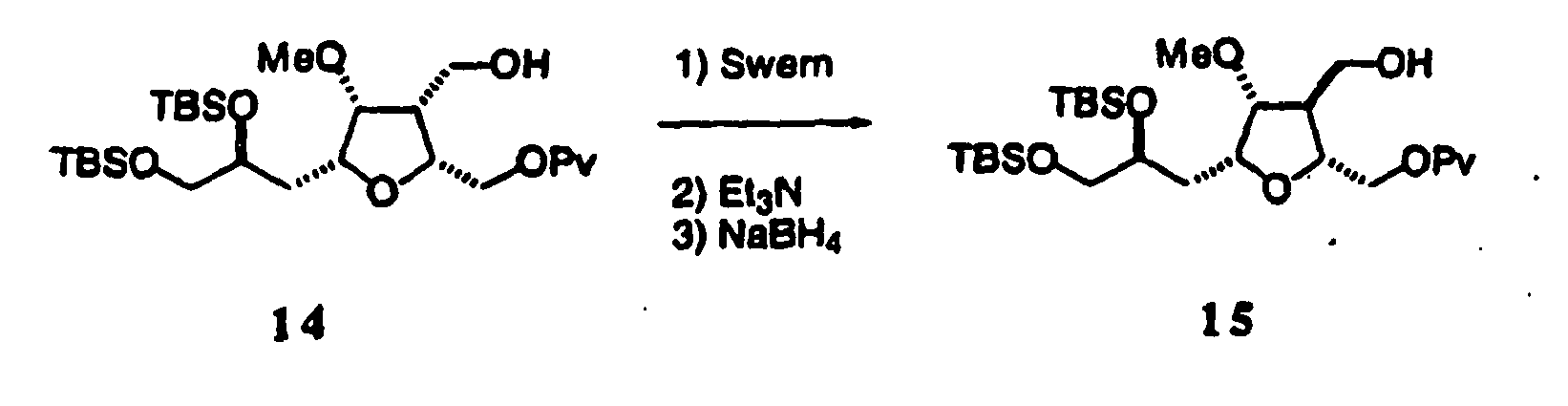
- Alcohol 15 DMSO (9 mL, 127 mmol) was added to a solution of oxalyl chloride (5.6 mL, 64 mmol) in CH2Cl2 (350 mL) at -78 °C. After stirring for 15 min, a solution of alcohol 14 (11.7 g, 0.021 mmol) in CH2Cl2 (50 mL) was added and stirring was continued for 1 h, after which Et3N (26.7 mL, 192 mmol) was added. The reaction mixture was warmed to 0 °C, stirred for 15 min, diluted with saturated aqueous NH4Cl, and extracted with CH2Cl2 (3 × 200 mL). The combined organic layers were dried over Na2SO4 and concentrated to furnish the desired crude aldehyde.
- This material was dissolved in CH2Cl2 (200 mL) and treated with Et3N (20 mL) at rt. After stirring overnight, the reaction mixture was diluted with saturated aqueous NH4Cl and extracted with CH2Cl2 (3 × 200 mL). The combined organic layers were dried over Na2SO4, concentrated and filtered through a short SiO2 column (20% EtOAchexanes) to afford the crude epimerized product.
- The aldehyde was dissolved in Et2O-EtOH (1:1, 100 mL), cooled to 0 °C and treated with sodium borohydride (1.21 g, 32 mmol). The mixture was stirred for 20 min, carefully diluted with saturated aqueous NH4Cl, stirred for 30 min at rt and extracted with CH2Cl2 (3 × 150 mL). The combined extracts were dried over Na2SO4, concentrated and purified by flash chromatography (20% EtOAc-hexanes) to afford alcohol 15 (9.95 g, 85% for three steps).

- MPM-ether 16 BF3•OEt2 (0.1 M in CH2Cl2, 1.8 mL, 0.18 mmol) was added to a solution of alcohol 15 (9.87 g, 18 mmol), MPM-trichloroimidate (4.9 mL, 27 mmol) and CH2Cl2 (175 mL) at 0 °C. After 40 min, a second portion of BF3•OEt2 (0.1 M in CH2Cl2, 0.9 mL, 0.09 mmol) was added to the reaction mixture. After 20 min, the reaction was quenched with saturated aqueous NH4Cl, stirred for 1 h at rt and diluted with Et2O (600 mL). The organic layer was separated and the aqueous layer was extracted with Et2O (150 mL). The combined organic extracts were washed sequentially with 0.1 N aqueous NaOH, saturated aqueous NaHCO3, brine, dried over Na2SO4, concentrated and purified by flash chromatography (20% EtOAc-hexanes) to give MPM-ether 16 (10.20 g, 85%).

- Alcohol 17 LAH (1 M in THF, 22.5 mL, 22.5 mmol) was added to a solution of MPM-ether 16 (10.05 g, 15 mmol) in Et2O (1.0 L) at 0 °C. After 30 min, the reaction was cautiously quenched with H2O (1.3 mL), and 1 N aqueous NaOH (1.3 mL). After stirring for 1 h at rt, the suspension was filtered through Celite, concentrated and purified by flash chromatography (20% EtOAc-hexanes) to afford alcohol 17 (8.18 g, 93%).

- Olefin 18 DMSO (5.8 mL, 82.4 mmol) was added to a solution of oxalyl chloride (3.6 mL, 41.2 mmol) in CH2Cl2 (100 mL) at -78 °C. After 15 min, a solution of alcohol 17 (7.94 g, 13.5 mmol) in CH2Cl2 (35 mL) was added to the reaction mixture. After stirring for 1 h, Et3N (17 mL. 122 mmol) was added, the mixture was warmed to 0 °C, stirred for 20 min, diluted with saturated aqueous NH4Cl and then extracted with CH2Cl2, (3 × 100 mL). The combined organic extracts were dried over Na2SO4, concentrated and filtered through a short SiO2 column (20% EtOAc-hexanes) to furnish the desired crude aldehyde.
- n-BuLi (1.6 M, 20 mL, 30 mmol) was added dropwise to a solution of CH3PPh3Br (10.1 g, 30 mmol) in THF (350 mL) and DMSO (100 mL) at 0 °C. After 1 h, a solution of the crude aldehyde in THF (50 mL) was added. The reaction mixture was warmed to rt and stirred for 3 h. Saturated aqueous NH4Cl was added and the mixture was extracted with EtOAc (3 × 500 mL). The combined extracts were washed with brine, dried over Na2SO4, concentrated and purified by flash chromatography (7% EtOAc-hexanes) to afford olefin 18 (5.57 g, 71% yield for 2 steps).

- Alcohol 19 9-BBN (0.5 M in THF, 65 mL. 33 mmol) was added to a solution of olefin 18 (5.56 g. 9.6 mmol) in THF (85 mL) at 0 °C. The mixture was stirred for 5 h at rt and then recooled to 0 °C. H2O (200 mL). THF (100 mL), and NaBO3•4 H2O (30 g) were sequentially added. After stirring overnight at rt, the organic volatiles were removed under reduced pressure. The aqueous residue was extracted with EtOAc (3 × 200 mL) and the combined organic layers were dried over Na2SO4. Concentration and purification by flash chromatography (30% EtOAc-hexanes) afforded alcohol 19 (12.05 g, 92%).

- Aldehyde 20. DMSO (1.36 mL, 19.2 mmol) was added dropwise over 4 min to a solution of oxalyl chloride (1.26 mL, 14.4 mmol) in CH2Cl2 (120 mL) at -78 °C. After stirring for 10 min, a solution of alcohol 19 (5.76 g, 9.61 mmol) in CH2Cl2 (20 mL) was added via cannula- The transfer was completed by rinsing with additional CH2Cl2 (2 × 5 mL). After stirring for 20 min, the mixture was treated with Et3N (5.36 mL, 38.4 mmol) and stirred for 10 min at -78 °C, 30 min at 0°C and 10 min at rt. The reaction mixture was poured into saturated aqueous NaHCO3 (200 mL) and the separated aqueous layer was extracted with CH2Cl2 (3×) followed by EtOAc (100 mL). The combined organic phases were dried over Na2SO4, concentrated and purified by column chromatography (10% to 20% EtOAc-hexanes) to furnish aldehyde compound 20 (5.28 g, 92%) as an oil.

- B2318. 0.1% NiCl2/CrCl2, (w/w. 3.21 g) and 1% NiCl2/CrCl2 (w/w, 4.31 g) was added to a solution of aldehyde 20 (3.73 g, 6.25 mmol), key fragment F-2 exemplified by vinyl iodide X2. (5.10 g. 9.16 mmol), THF (85 mL) and DMF (21 mL) at rt in a glove box. The reaction mixture was stirred for 24 h. removed from the glove box, cooled to 0°C, diluted with EtOAc (100 mL), quenched with saturated NH4Cl (200 mL) and stirred for 30 min. The separated aqueous phase was extracted with EtOAc (6×) and the combined organic layers were dried over Na2SO4 concentrated and purified by column chromatography (20% to 30%) to give B2318 (-3 g) contaminated with close running impurities and the uncyclized intermediate (4.61 g). The latter (4.51 g, 4.48 mmol,) was dissolved in THF(150 mL), cooled to 0 °C and treated with KHMDS (0.5 M in toluene, 14 mL, 7.0 mmol) over a 2 min period. After stirring at 0 °C for 15 min, the reaction was quenched with saturated aqueous NH4Cl (150 mL) and warmed to rt. The separated aqueous layer was extracted with EtOAc (3×) and the combined organic phases were dried over Na2SO4, concentrated and combined with the partially purified product obtained above. Column chromatography (10% EtOAc-hexanes) afforded B2318 (3.17 g, 55%) as an inseparable -3:1 mixture of C27 diastereomers.

- B2317. DDQ (1.45 g, 6.42 mmol) was added portion-wise over 30 min to a stirred solution of B2318 (3.12 g, 3.35 mmol) in CH2Cl2 (50 mL) and pH 7 phosphate buffer (5 mL) at rt. The reaction was quenched with saturated aqueous NaHCO3 (50 mL), stirred for 5 min, diluted with additional saturated aqueous NaHCO3 (100 mL), H2O (200 mL) and extracted with Et2O (5×). The combined organic phases were dried over Na2SO4, concentrated and purified by column chromatography (15% to 30% EtOAc-hexanes) to give recovered B2318 (1.40 g) and a mixture of the C27 isomeric products. The recovered B2318 was resubmitted to the reaction conditions described above to afford additional product. Recovered starting material was again cycled through the deprotection conditions. All of the desired material was combined and separated by MPLC to afford B2317 (1.65 g. 61%).

- B2316. TsCl (0.63 g, 3.30 mmol) was added to a solution of B2317 (1.60 g. 1.97 mmol) in CH2Cl2 (8 mL) and pyridine (2 mL) at rt. After stirring for 29 h, the reaction was quenched with saturated aqueous NaHCO3 (30 mL) and H2O (10 mL). The separated aqueous layer was extracted with Et2O and the combined organic layers were dried over Na2SO4, concentrated and purified by column chromatography (15% to 30% EtOAc-hexanes) to give B2316 (2.01 g, 92%) as an oil along with recovered B2317 (92 mg, 5.8%).

- B2315, LAH (1 M in THF, 2.61 mL, 2.61 mmol) was added over 1 min to a solution of B2316 (1.68 g, 1.74 mmol) in Et2O (80 mL) at 0 °C. After stirring for 7 min, the reaction was quenched by careful addition of MeOH (0.42 mL, 10.4 mmol) and H2O (0.19 mL, 10 mmol), warmed to rt and stirred for 20 min. Filtration through Celite with 1:1 CH2Cl2-Et2O, concentration and purification by column chromatography (30% to 40% EtOAc-hexanes) gave B2315 (1.38 g, 90%) as an oil.

- B2314. MMTrCl (0.70 g, 2.26 mmol) was added to a solution of B2315 (1.33 g, 1.51 mmol) in CH2Cl2 (25 mL) and iPr2NEt (0.79 mL, 4.53 mmol) at rt. The resulting mixture was stirred for I h and then poured into a mixture of saturated aqueous NaHCO3 (20 mL), H2O (10 mL) and Et2O (50 mL). The separated aqueous layer was extracted with Et2O (3×). The combined organic phases were dried over Na2SO4, concentrated and purified by column chromatography (CH2Cl2 followed by 15% to 30% EtOAc-hexanes) to give B2314 (1.65 g, 95%) as a solid foam.

- B2313. A mixture of B2314 (1.60 g, 1.39 mmol) and NaI (3.10 g, 20.8 mmol) in acetone (50 mL) was heated under reflux for 13 h. After cooling to rt, the reaction mixture was diluted with EtOAc, and concentrated. H2O (5 mL), brine (20 mL) and Na2S2O3 (200 mg) were added and the resulting mixture was extracted with Et2O (4×). The combined extracts were dried over Na2SO4, concentrated and purified by column chromatography (10% EtOAc-hexanes) to give B2313 (1.50 g, 97%) as an oil.

- B2307 and B2308. Tert-BuLi (1.7 M in pentane, 1.00 mL, 1.7 mmol) was added over 1 min to a solution of B2313 (0.90 g, 0.81 mmol) in Et2O (14 mL) at -78 °C. After stirring for 9 min. the mixture was transferred via cannula over 4 min to a solution of key fragment F-3 (0.83 g, 1.14 mmol) in Et2O (4 mL) at -78 °C. The transfer was completed by rinsing with additional Et2O (2 mL). The resultant mixture was stirred at - 78°C for 5 min and then at 0 °C for 10 min, quenched with saturated aqueous NAHCO3 (30 mL) and warmed to rt. The separated aqueous layer was extracted with Et2O (3×) and the combined organic phases were dried over Na2SO4 and concentrated. The residue was combined with those of other two batches (corresponding to 0.11 g and 0.44 g of B2313) and purified by column chromatography (10% to 20% EtOAchexanes) to give a mixture of B2307 and B2308 (1.86 g, 83%) as a solid foam. Although the isomers could be separated by prep TLC (20% EtOAc-hexanes), they were carried forward as a mixture.

- B2305 and B2306. The mixture of B2307B2308 (1.80 g, 1.05 mmol) was dissolved in EtOH (20 mL), treated with PPTS (10.0 mg, 0.04 mmol), stirred at rt for 11 h and then quenched with NaHCO3 (20.0 mg, 0.24 mmol). After stirring for 15 min, the mixture was concentrated, azeotroped with toluene (15 mL), and purified by column chromatography (20% to 30°b EtOAc-hexanes) to give a mixture of B2305 and B2306 (1.22 g, 81%) as a solid foam. Although the isomers could be separated by prep TLC (30% EtOAc-hexanes), they were carried forward as a mixture.

- B2304. A mixture of B2305/B2306 (1.16 g, 0.68 mmol), and Dess-Martin periodinane (0.61 g,1.44 mmol) in CH2Cl2 (35 mL) was stirred at rt for 1 h. Additional Dess-Martin periodinane (0.54 g, 1.27 mmol) was added to the mixture and stirring was continued for an additional 1h. The mixture was diluted with Et2O (100 mL), stirred for 20 min and filtered through Celite with Et2O. The colorless filtrate was washed with saturated aqueous NaHCO3 (100 mL) and the separated aqueous layer was extracted with Et2O (3X). The combined organic phases were dried over Na2SO4, concentrated and purified by column chromatography (10% to 15% EtOAc-hexanes) to give B2304 (0.98 g, 84%) as a solid foam.
- Alternatively, B2304 may be prepared as follows and in fact the synthesis described below is superior to that given above.

- To a solution of the alcohol, 2.4 g, in methylene chloride, 29 mL, was added methanesulfonyl anhydride, 770 mg. The mixture was stirred for 15 minutes, extracted with saturated sodium bicarbonate, dried and chromatographed to give 2.737 g, 100%.

- To a solution of the mesylate, 405 mg, in DMF, 0.06 mL, was added diisopropylethylamine, 0.130 mL, followed by benzenethiol, 0.061 mL. After 4 hours and after 22 hours, additional amine, 0.03 mL, and benzenethiol, 0.015 mL, were added After 24 hours, the mixture was diluted with 5% ethyl acetate/hexane, 1 mL and chromatographed to give 409 mg.

- To a solution of the sulfide, 1.97 g, in acetonitrile, 16 mL, was added N-methylmorpholine oxide (NMO), and then a solution of 1.02 g, tetrapropylammonium perruthenate(VII), (TPAP), 38 mg, in acetonitrile, 1 mL. After 3.5 hours at room temperature, the mixture was heated to 40 °C for 1 hour. The mixture was cooled and aqueous satd. Sodium thiosulfate was added and the mixture partitioned between water and ethyl acetate. The usual work-up gave 1.567 g of a brown oil.

- To a solution of the pivaloate ester, 1.567 g, in methylene chloride, 11.2 mL, at - 78 °C in was added DIBAL, 2.5 mL of a 1 M solution in toluene. After 15 minutes, additional DIBAL, 0.8 mL, was added. After an additional 5 minutes, methanol, 0.46 mL, was slowly added followed by water, 0.2 mL. The mixture was filtered through Celite and chromatographed to give 1.386 g of an oil.

- To a solution of the sulfone, 36 mg, in DME. 1 mL, at -40 °C was added n-butyllithium, 2.8 equivalents. After 35 minutes, a solution of the aldehyde, 42 mg, in DMB, 0.5 mL) was added. After 40 minutes, saturated aqueous ammonium chloride was added and the mixture extracted with ethyl acetate. The usual work-up, followed by chromatography gave 52 mg of an oil.

- To a solution of the alcohol, 42 mg, in methylene chloride, 2 mL, was added the Dess Martin reagent, 36.4 mg. The mixture was stirred for 30 minutes and ether was added. The mixture was filtered through Celite, washed with saturated sodium bicarbonate, with saturated sodium thiosulfate, worked up in the usual way and chromatographed to give 38 mg of an oil.

- Preparation of SmI2 Solution
A solution of 1,2-di-iodoethane in 10 mL of THF was added to a suspension of Sm, 0.16 g, in THF, 1 mL. The mixture was stirred for 1 hour. - An aliquot of this solution, 0.03 mL, was added to a solution of the sulfone in THF at -78 °C. After 5 minutes, additional SmI2 reagent, 0.05 mL, was added. After a few additional minutes, more reagent, 0.25 mL, was added. The cooling bath was removed and saturated aqueous sodium bicarbonate. 3 mL, was added. The mixture was partitioned between ether and water and the usual work-up gave 9.1 mg, 81%, of an oil.

- B2302 and B2303. In a glove box, NiCl2/CrCl2 (1% w/w, 1.09 g, 8.86 mmol) was added to a solution of B2304 (1.01 g, 0.70 mmol) in THF (600 mL) and DMF
(150 mL) at rt. After stirring for 2 days the reaction mixture was taken out of the glove box, cooled to 0 °C, quenched with saturated aqueous NH4Cl (300 mL) and stirred at 0 °C for 20 min. After addition of H2O (100 mL), the two layers were separated and the aqueous layer was extracted with EtOAc (5×). The combined organic phases were washed with brine, dried over Na2SO4, concentrated and purified by column chromatography (15% EtOAc-hexanes) to furnish a mixture of B2302 and B2303 (0.84 g, 92%) as a solid foam. Although the isomers could be separated by prep TLC (20% EtOAc-hexanes), they were carried forward as a mixture.
- B2301. A mixture of B2302/B2303 (0.79 g, 0.60 mmol) and Dess-Martin periodinane (0.26 g, 0.60 mmol) in CH2Cl2 (30 mL) at rt was stirred for 30 min. Additional Dess-Martin periodinane (0.26 g, 0.60 mmol) was added to the mixture and stirring was continued for additional 1.5 h. The mixture was then diluted with Et2O (100 mL), stirred for 15 min and filtered through Celite. The filtrate was washed with saturated aqueous NaHCO3 (100 mL) and the separated aqueous layer was extracted with Et2O (3×). The combined organic phases were dried over Na2SO4, concentrated and purified by column chromatography (10% to 155% EtOAc-hexanes) to give B2301 (0.67 g, 85%) as an oil.

- B1793. TBAF (1 M in THF containing 0.5 M imidazole HCl, 4.60 mL, 4.60 mmol) was added over 2 min to a solution of B2301 (0.62 g, 0.48 mmol,) in THF (29 mL) at rt and the resulting mixture was stirred for 18 h. After dilution with hexanes (10 mL), the reaction mixture was directly loaded onto a SiO2 column packed with 50% EtOAc-hexanes and eluted with 50% EtOAc-hexanes (1 L) followed by 10% MeOH/EtOAc to collect a mixture of intermediates. After solvent removal, the residue was dissolved in CH2Cl2 (15 mL) and treated with PPTS (645 mg). After stirring for 1 h at rt, additional PPTS (414 mg) was added and the resulting white suspension was stirred for 4.5 h. The reaction mixture was then directly loaded onto a SiO2 column packed with 70% EtOAc-hexanes and eluted with 70% EtOAc/hexanes (0.5 L), EtOAc (1 L). Elution with 5% to 10% MeOH/EtOAc furnished pure B1793 (181 mg) and elution with 15% MeOH-EtOAc gave additional semi-pure product, which after purification by preparative TLC (10% MeOH-EtOAc) provided additional pure B1793 (42 mg). B1793 (total 223 mg, 64%) was obtained as a white solid. HRMS: calcd for C40H58O12 + Na 753.3826. Found: 753.3808.
-

- B1794. Except for stereochemical and protecting group differences (Schemes 4 and 6), arabinose was converted to B1794 in a manner similar to that described for B1793 (see schemes 3 and 5). HRMS: calcd for C40H58O12 + Na 753.3826. Found: 753.3856.
-

- B1920 and B1921 TsCl (9.9 mg, 0.052 mmol) was added to a solution of diol B1793 (7.6 mg, 0.010 mmol) in CH2Cl2 (1 mL) and pyridine (0.1 mL) at rt. After 48 h, the reaction was quenched with a 1:4 mixture of saturated aqueous NaHCO3-brine and extracted with CH2Cl2 (4×). The combined extracts were dried over Na2SO4 and concentrated. Purification by preparative TLC (80% EtOAc-hexanes) afforded monotosylate B1920 (6.0 mg, 67%), and ditosylate B1921 (1.8 mg, 18%).

- B2294 MsCl (0.3 M in CH2Cl2, 98 µL, 0.030 mmol) was added dropwise over 40 min to a mixture of collidine (7 µL, 0.054 mmol), B1793 (20.8 mg, 0.028 mmol) and CH2Cl2 (1 mL) at 0 °C. After 76 h at 4 °C, the reaction was quenched with a 1:4 mixture of saturated aqueous NaHCO3-brine and extracted with CH2Cl2 (4×). The combined extracts were dried over Na2SO4 and concentrated. The crude product was dissolved in toluene. (3 mL) concentrated and purified by preparative TLC (1.5% MeOH-EtOAc) to afford mesylate B2294 (21.4 mg, 95%).

- B2014 and B2015 A 0.016 M solution of 4-fluorobenzyl bromide in Et2O (800 µL, 13 µmol) and Ag2O (10 mg, 43 µmol) were each added in three portions at 1 h intervals to a rt solution of B1793 (1.7 mg, 2.3 µmol) in Et2O (1.2 mL). The mixture was protected from light, stirred for 7 h and then filtered through Celite. Concentration and purification by preparative TLC (EtOAc) afforded primary ether B2014 (1.1 mg, 56%), and secondary ether B2015 (0.6 mg, 31%). HRMS (FAB): calcd for C47H63FO12 + Na 861.4201. Found: for B2014 861.4178, for B2015 861.4160.

- General. A mixture of B1793 (1 mg, 1.37 micromol), Et3N (10 microL, 72 micromol) and ArNCO (2 to 4 equiv.) in CH2Cl2 (0.2 mL) was stirred at rt for 4 h to overnight until the reaction was judged to be complete by TLC. The reaction mixture was diluted with saturated NaHCO3 (3 mL), extracted with CH2Cl2 (3×) and EtOAc (2×), dried over Na2SO4 and purified by preparative TLC (5% MeOH-CH2CH2Cl2) to afford the products:
- B1984. (1.0 mg, 86%) HRMS (FAB): calcd for C47H63NO13 + Na 872.4197. Found: 872.4214.
- B1990. (1.1 mg, 92%) HRMS (FAB): calcd for C47H62ClNO13 + Na 906.3807. Found: 906.3826.
- B1992. (1.0 mg, 83%) HRMS (FAB): calcd for C48H65NO14 + Na 902.4303. Found: 902.4269.

- B2042 DEAD (0.4 M in ether, 50 µL, 19 µmol) was added to a solution of B1793 (2.0 mg, 2.7 µmol), triphenylphosphine (5 mg, 19 µmol), 4-nitrobenzoic acid (3.2 mg, 19 µmol) and Et2O (500 µL) at rt. After 22 h, the reaction mixture was loaded directly onto a preparative TLC plate and eluted with 60% EtOAc-hexanes to give the intermediate diester (3.0 mg). This material was taken up in MeOH (300 µL) and treated with K2CO3 (approximately 1 mg). After stirring at rt for 30 min, the reaction mixture was diluted with brine and extracted with CH2Cl2 (5×). The combined extracts were dried over Na2SO4, concentrated and purified by preparative TLC (5% MeOH-EtOAc) to afford B2042 (1.2 mg, 60% for two steps). HRMS (FAB): calcd for C40H58O12 + Na 753.3826. Found: 753.3810.

- B1896 and B1897. NaBH4 (3 mg, 0.08 mmol) was added to a solution of B1793 (2.30 mg, 3.15 µmol) in 1:1 CH2Cl2-MeOH (0.2 mL) at rt. Concentration of the reaction mixture and purification by preparative TLC (8% MeOH-EtOAc) provided B1896 (0.80 mg, 35%) and B1897 (2:1 mixture, 0.15 mg, 6.5%). HRMS (FAB) for B1896: calcd for C40H60O12 + Na 755.3983. Found: 753.3969.

- B1918. A mixture of B1793 (2.0 mg, 2.74 µmol). NaIO4 (35 mg, 0.16 mmol), MeOH (0.8 mL) and H2O (0.2 mL) was stirred at rt for 40 min. The reaction mixture was diluted with H2O (1 mL), extracted with CH2Cl2 (6×), dried over Na2SO4, concentrated and purified by column chromatography (5% MeOH-CH2Cl2) to give B1918 (1.9 mg. 100%).

- B2037. A 0.034 M solution of NaBH4 (0.1 mL, 3.4 µmol) in EtOH was added portion-wise to a solution of B1918 (1.9 mg, 2.72 µmol) in MeOH (0.8 mL) and CH2Cl2 (0.2 mL) at -78°C to rt until the reaction was judged to be complete by TLC. The reaction was quenched with saturated aqueous NH4Cl (2 mL) at -78 °C, warmed to rt, extracted with CH2Cl2 (6×), dried over Na2SO4 and purified by preparative TLC (5% MeOH- CH2Cl2) to afford B2037 (1.7 mg, 89%). HRMS (FAB): calcd for C39H56O15 + Na 723.3720. Found: 723.3749.

- NaIO4 (35 mg, 0.16 mmol) was added to a solution of B1793 (1.7 mg, 0.0023 mmol), MeOH (800 µL) and H2O (200 µL) and after 15 min, the mixture was diluted with H2O and extracted with CH2Cl2 (5×). The organic extracts were dried over Na2SO4, concentrated and the intermediate aldehyde was immediately dissolved in DMF (300 µL). 3-Bromo-3,3-difluoropropene (3µL, 0.023 mmol) and indium powder (3 mg, 0.23 mmol) were added and after 24 h additional 3-bromo-3,3-difluoropropene (1 µL, 0.008 mmol) was added. After 18 h, H2O was added the mixture was extracted with EtOAc (3×). The combined organic extracts were washed successively with H2O and brine, dried over Na2SO4, concentrated and purified by preparative TLC (80% EtOAc-hexanes) to provide B2035 (0.74 mg, 41% for 2 steps) as a mixture of isomers. HRMS (FAB): calcd for C42H58F2O11 + Na 799.3845. Found: 799.3883.

- NaBH4 (2 mg, 0.05 mmol) was added to a solution of B1793 (2.2 mg, 0.003 mmol) in 1:1 CH2Cl2-MeOH (200 µL) at rt. After 15 min saturated aqueous NH4Cl and H2O were added, and the mixture was extracted with CH2Cl2 (6×) and EtOAc (2×). The combined organic extracts were dried over Na2SO4, concentrated and purified by column chromatography (10% MeOH-EtOAc) to provide an intermediate triol, which was dissolved in MeOH (800 µL) and H2O (200 µL). NaIO4 (35 mg, 0.16 mmol) was added and after 20 min, the mixture was diluted with H2O and extracted with CH2Cl2 (6×). The organic extracts were dried over Na2SO4, concentrated and the intermediate aldehyde was immediately dissolved in THF (500 µL). 4-Fluorophenylmagnesium bromide (2M in Et2O, 12 µL, 0.024 mmol) was added and after 20 min the reaction was quenched with saturated aqueous NH4Cl. The mixture was extracted with CH2Cl2 (6×) and the combined organic extracts were dried over Na2SO4 and concentrated. Purification by preparative TLC (EtOAc) provided the desired product as a mixture of 4 isomers (1.32 mg, 55% for 3 steps).
- Dess-Martin periodinane (-3 mg, 0.007 mmol) was added to a solution of the above product (0.95 mg, 0.0012 mmol) in CH2Cl2 (300 µL) and the mixture was stirred at n for 20 min. Additional Dess-Martin periodinane (-3 mg, 0.007 mmol) and CH2Cl2 (300 µL) were added and after another 40 min Et2O, saturated aqueous NaHCO3 (4 mL) and saturated aqueous Na2S2O3 (1 mL) were added. The mixture was extracted with Et2O (3×) and the combined extracts were washed with brine, dried over Na3SO4, concentrated and purified by column chromatography (20% BtOAc-hexanes) to provide B2008 (0.58 mg. 61%). HRMS (FAB): calcd for C45H57FO11 + Na 815.3783. Found: 815.3758.
- B2011. In an analogous manner, B1793 (1.9 mg. 0.003 mmol) was converted to B2011 (0.87 mg. 42% for 4 steps). HRMS (FAB): calcd for C45H58O11 + Na 797.3877. Found: 797.3877.

- A solution of B1920 (1.4 mg, 0.0016 mmol), KCN (1 mg, 0.016 mmol) and DMSO
(500 µL) was heated at 60 °C for 8 h. After cooling to rt, H2O was added and the mixture was extracted with EtOAc (3×). The combined organic extracts were washed successively with H2O and brine, dried over Na2SO4, concentrated and purified by preparative TLC (80% EtOAc-hexanes) to provide B2013 (0.78 mg, 67%). HRMS (FAB): calcd for C41H57NO11 + Na 762.3829. Found: 762.3848.
- A mixture of B1920 (1.3 mg, 1.47 µmol), NaI (30 mg, excess) and acetone (1 mL) was stirred at 60 °C for 3.5 h. After cooling to rt, the reaction mixture was diluted with saturated aqueous NaHCO3 (3 mL), extracted with CH2Cl2 (5×) and EtOAc, dried over Na2SO4 and purified by column chromatography (50% EtOAc-CH2Cl2 to 80% EtOAc-hexanes) to give the iodide X1920 (1.3 mg, 100%).

- General. A mixture of iodide X1920 (1.0 equiv.), iPr2EtN (11 to 22 equiv.), ArSH (9 to 46 equiv.) and DMF (0.3 mL) was stirred at rt until the reaction was judged to be complete by TLC (typically 24 to 48 h). The reaction mixture was diluted with saturated aqueous NaHCO3 (2 mL), extracted with CH2Cl2 and EtOAc, dried over Na2SO4 and purified by preparative TLC (80% EtOAc-hexanes or 5% MeOH-CH2Cl2), to afford the sulfide products:
- B1998. (1.3 mg gave 1.1 mg, 85%) HRMS (FAB): calcd for C46H61ClO11S + Na 897.3521. Found: 897.3533.
- B2010. (1.1 mg gave 0.7 mg, 59%). HRMS (FAB): calcd for C47H64O12S + Na 875.4016. Found: 875.4057.
- B2019. (1.1 mg gave 0.7 mg, 61 %) MS (FAB): M + Na

- General. A 0.01 M solution of mCPHA (1.2 equiv.) in CH2Cl2 was added to a solution of a sulfide (1.0 equiv.) in CH2Cl2 (0.5 mL) at 0 °C for 30 min. The reaction mixture was diluted with saturated NaHCO3 (2 mL), extracted with CH2Cl2 and EtOAc, dried over Na2SO4 and purified by preparative TLC (80% EtOAc-hexanes or EtOAc) to afford the products:
- B2016. (0.9 mg gave 0.7 mg, 74%)
- B2030. (1.0 mg gave 0.6 mg, 61%) HRMS (FAB): calcd for C47H64O14S + Na 907.3914. Found: 907.3950.

- B1934. TBDPSCI (3.0 µL, 12 µmol) was added to a solution of B1793 (1.3 mg, 1.78 µmol), imidazole (10 mg, 166 µmol) and DMF (0.10 mL) at rt. After stirring for 1 h, the reaction mixture was diluted with saturated aqueous NaHCO3 (2 mL), extracted with CH2Cl2 (3×) and EtOAc (2×), dried over Na2SO4 and purified by preparative TLC (5% MeOH-CH2Cl2) to give the intermediate silyl ether (1.3 mg, 77%).
- This material was dissolved in CH2Cl2 (0.5 mL) and treated with Dess-Martin periodinane (10 mg, 24 µmol) for 1.5 h at rt, diluted with Et2O and filtered through Celite. The filtrate was concentrated and purified by preparative TLC (50% EtOAc-hexanes) to afford the diketone intermediate (1.0 mg, 77%), which was dissolved in THF (0.5 mL) and treated with 0.02 M TBAF containing 0.01 M imidazole hydrochloride (THF solution, 75 µL, 1.5 µmol) at rt for 15 min. The reaction mixture was eluted through a SiO2 column (50% EtOAc-hexanes to 5% MeOH-CH2Cl2) and the desired product was further purified by preparative TLC (5% MeOH-CH2Cl2) to afford B1934 (0.75 mg, 100%). HRMS (FAB): calcd for C40H36O12 + Na 751.3669. Found: 751.3690.
-

- B1922 Tetra-n-butylaminonium azide (0.2 M in DMF, 0.5 mL, 0.10 mmol) was added to a solution of mesylate B2294 (21.4 mg, 0.026 mmol) in DMF (2 mL) at rt. After stirring at 83°C for 3.5 h, the reaction mixture was cooled to rt, diluted with toluene, concentrated and purified by preparative TLC (80% ethyl acetate-hexanes) to furnish B1922 (18 mg, 92%).

- B1939 Me3P (1 M in THF) and H2O (0.8 mL) were sequentially added to a solution of azide B1922 (24.6 mg. 0.032 mmol) in THF (3.2 mL) at rt. The mixture was stirred for 22 h, diluted with toluene, concentrated and purified by flash chromatography [step gradient. 10% MeOH-EtOAc followed by MeOH-EtOAc-30% aqueous NH4OH (9:86:5)] to provide the desired primary amine (23.3 mg), which by 1H-NMR container -1% trimethylphosphine oxide. Lyophilization from benzene and standing under high vacuum for 2 d furnished B1939 (20.3 mg, 87%).
-

- B1930 Me3P (1 M in THF, 13 µL, 0.013 mmol) was added to a solution of B1922 (1.6 mg, 2.1 µmol). THF (400 µL) and H2O (100 µL) at n. The mixture was stirred for 22 h. diluted with toluene, concentrated, and azeotropically dried with toluene (2×) to give the crude amine which was used directly in the next step.
- EDC (0.06 M in CH2Cl2, 100 µL. 11 µmol) was added to a solution of the crude amine, benzoylformic acid (0.8 mg, 5.3 µmol) and CH2Cl2 (200 µL) at rt. After 30 min. the reaction was quenched with a 1:4 mixture of saturated aqueous NaHCO3-brine and extracted with CH2Cl2 (5×). The combined extracts were dried over Na2SO4 and concentrated and purified by preparative TLC (EtOAc) to afford B1930 (1.5 mg. 83% for two steps). HRMS (FAB): calcd for C48H63NO13 + Na 884.4197. Found: 884.4166.
- B1940 Using the procedure described above for B1930, B1922 was reduced, coupled with 3-pyridylacetic acid hydrochloride and purified by preparative TLC [(MeOH-EtOAc-30% aqueous NH4OH (9:86:5)] to afford B1940 (0.8 mg, 67% for two steps). HRMS (FAB): calcd for C47H64N2O12 + Na 871.4357. Found: 871.4362.
- B1973 Using the procedure described above. B1922 (0.9 mg, 1.2 µmol) was reduced, coupled with phenylacetic acid and purified by preparative TLC (5% MeOH-EtOAc) to afford B1973 (0.44 mg, 44% for two steps). HRMS (FAB): calcd for C48H65NO12 + Na 870.4404. Found: 870.4447.
- B1987 Using the procedure described above, B1922 (0.9 mg, 1.2 µmol) was reduced. coupled with 3-indoleglyoxylic acid and purified by preparative TLC (3% MeOH-EtOAc) to afford B1987 (0.8 mg, 75% for two steps). HRMS (FAB): calcd for C50H64N2O13 + Na 923.4306. Found: 923.4338.
- B1991 Using the procedure described above, B1922 (1.0 mg, 1.3 µmol) was reduced, coupled with 4-chlorobenzoic acid and purified by preparative TLC (3% MeOH-EtOAc) to afford B1991 (0.8 mg, 70% for two steps). HRMS (FAB): calcd for C47H62ClNO12 + Na 890.3858. Found: 890.3843.
- B2003 Using the procedure described above. B1922 (1.0 mg, 1.3 µmol) was reduced, coupled with 3,4,5-trimethoxybenzoylformic acid and purified by preparative TLC (EtOAc) to afford B2003 (0.7 mg, 56% for two steps). HRMS (FAB): calcd for C51H69NO16 + Na 974.4514. Found: 974.4525.
- B2004 Using the procedure described above. B1922 (1.0 mg. 1.3 µmol) was reduced, coupled with 3,4,5-trimethoxybenzoic acid and purified by preparative TLC (5% MeOH-EtOAc) to afford B2004 (0.7 mg, 58 % for two steps). HRMS (FAB): calcd C50H69NO15 + Na 946.4565. Found: 946.4599.

- B1988 Dess-Martin periodinane (1 mg, 2.3 µmol) was added to a solution of B1930 (0.80 mg, 0.93 µmol) in CH2Cl2 (500 µL) at rt. After 1 h, the reaction was diluted with Et2O and filtered through Celite. The filtrate was washed sequentially with a 1:9 mixture of saturated aqueous NaHCO3-Na2S2O, and brine, dried over Na2SO4, concentrated and purified by preparative TLC (80% EtOAc-hexanes) to afford B1938 (0.45 mg, 56%). HRMS (FAB): caled for C18H61NO13 + Na 882.4041. Found: 884.4012.
-

- Compound 103. Indium powder (1.35 g, 11.8 mmol) was added to a solution of 102 (3.38 g, 17.6 mmol) in DMF (20 mL) at rt. After stirring for 30 min, the reaction mixture was cooled to 0 °C. Neat aldehyde 101 (3.72 g. 28.6 mmol) was then added and the mixture was stirred overnight while allowing the temperature to warm to rt. The reaction mixture was recooled to 0 °C and then quenched carefully with saturated aqueous NH4Cl (100 mL). After stirring for 30 min, the resulting mixture was extracted with Et2O (3×), dried over Na2SO4, concentrated and purified by column chromatography (10% to 20% EtOAc-hexanes) to give pure crystalline 103 (2.20 g, 59%).

- Compound 104. Et3N (12µL. 0.51 µmol) was added to a solution of 103 (1.09 g, 5.13 mmol) and thiophenol (0.63 mL, 7.16 mmol) in CH2Cl2 and the resulting mixture was stirred at 0 °C for 1 h. Filtration through SiO2 gave a mixture of 104 and 105, which after MPLC (15% to 20% EtOAc-hexanes) afforded 104 (0.53 g, 32%) and 105 (0.92 g, 56%).


- Compound 107. A mixture of 106 (0.53 g, 1.64 mmol) and ethyl (triphenylphosphoranylidene)acetate (1.15 g. 3.29 mmol) in toluene (10 mL) was heated to 80°C for 15 h. The mixture was cooled to rt and DBU (25 µL. 0.16 mmol) was introduced. The mixture was heated to 80 °C for 1.5 h, cooled to rt, concentrated and purified by column chromatography (10% to 20% EtOAc-hexanes) to give 107 (0.54 g, 83%) as an oil (3: ratio of α:β isomers).


- Compound 109. A mixture of 108 (0.51 g. 1.24 mmol) and NaOAc (1.00 g, 12.4 mmol) in Ac2O (10 mL) was stirred at 140 °C for 12 h, cooled to rt and then concentrated. The residue was partitioned between saturated aqueous NaHCO3 (20 mL) and Et2O (30 mL), and stirred vigorously at rt for 30 min. The separated aqueous layer was extracted with Et2O (2×), and the combined organic phases were dried over Na2SO4, concentrated and purified by column chromatography (5% to 15% EtOAc-hexanes) to give 109 (0.41 g. 73%) as an oil.

- Compound 110. A mixture of 109 (0.41 g, 0.91 mmol and K2CO3 (44.3 mg. 0.32 mmol) in EtOH (5 mL) was heated to 60-70 °C for 1 d. After cooling to rt, the reaction mixture was concentrated and eluted through a SiO2 column (10% to 20% EtOAc-hexanes) to give the partially purified aldehyde intermediate. This material was dissolved in EtOH (2.5 mL), treated with NaBH4 (50 mg, 1.33 mmol) and stirred at rt for 30 min. The mixture was concentrated and purified by column chromatography (40% EtOAc-hexanes) to give 110 (181 mg, 66%).

- Compound 111. BF3·OEt2 (0.05 M in CH2Cl2, 175 µL, 8.75 µmol) was added to a solution of 110 (181 mg, 0.60 mmol) and p-methoxybenzyl 2,2,2-trichloroacetimidate (0.50 mL, 1.80 mmol) in CH2Cl2 (5 mL) at 0 °C. The resulting mixture was stirred for 1.5 h at 0 °C and for 2 h at rt until the reaction was complete. The mixture was quenched with saturated aqueous NaHCO3 (25 mL) and extracted with Et2O (5×). The combined organic phases were dried over Na2SO4, concentrated and purified by column chromatography (CH2Cl2 and then 20% EtOAc-hexanes) to give semi-pure 111 (0.37 g. >100%) as an oil.

- Compound 112. A mixture of 111 (0.37 g, max.= 0.60 mmol) and TsOH·H2O (36 mg) in EtOH (5 mL) was stirred initially at rt overnight and then at 60 °C for 1 h. Additional TsOH·H2O (31 mg) was added at rt and the reaction mixture was stirred for 1 h at rt. The mixture was then concentrated, quenched with saturated aqueous NaHCO3 and extracted with EtOAc (5×). The combined organic phases were dried over Na2SO4, concentrated and purified by column chromatography (20% to 50% EtOAc-hexanes and then 5% MeOH-CH2Cl2) to give 112 (121 mg, 53%) as an oil along with recovered 111 (49 mg. 21%).

- Compound 113. TBSOTf (250 µL, 1.09 mmol) was added to a solution of 112 (121 mg, 0.32 mmol) and Et3N (176 µL, 1.26 mmol) in CH2Cl2 at 0 °C and the resulting mixture was stirred for 25 min. The reaction was quenched with saturated aqueous NaHCO3 (15 mL) and the separated aqueous layer was extracted with ether (3×). The combined organic phases were dried over Na2SO4. concentrated and purified by column chromatography (5% to 10% EtOAc/hexanes) to give 113 (165 mg, 85%) as an oil.

- Compound 114. DIBALH (1 M in toluene, 0.54 mL, 0.54 mmol) was added to a solution of 113 (165 mg, 0.27 mmol) in toluene (5 mL) at -78 °C and the resulting mixture was stirred at -78 °C for 10 min. The reaction was quenched by careful addition of MeOH (65 µL, 0.81 mmol) and H2O (29 µL, 0.81 mmol), warmed to rt and stirred for 25 min. The white suspension was filtered through Celite with 1:1 CH2Cl2-Et2O. Concentration and purification by column chromatography (10% to 20% EtOAc-hexanes) gave 114 (153 mg, 100%) as an oil.

- B2090. In a manner similar to that described in Scheme 6 for the synthesis of B1794, intermediate 114 was converted to B2090. HRMS (FAB): calcd for C39H56O11+Na 723.3720. Found: 723.3731.
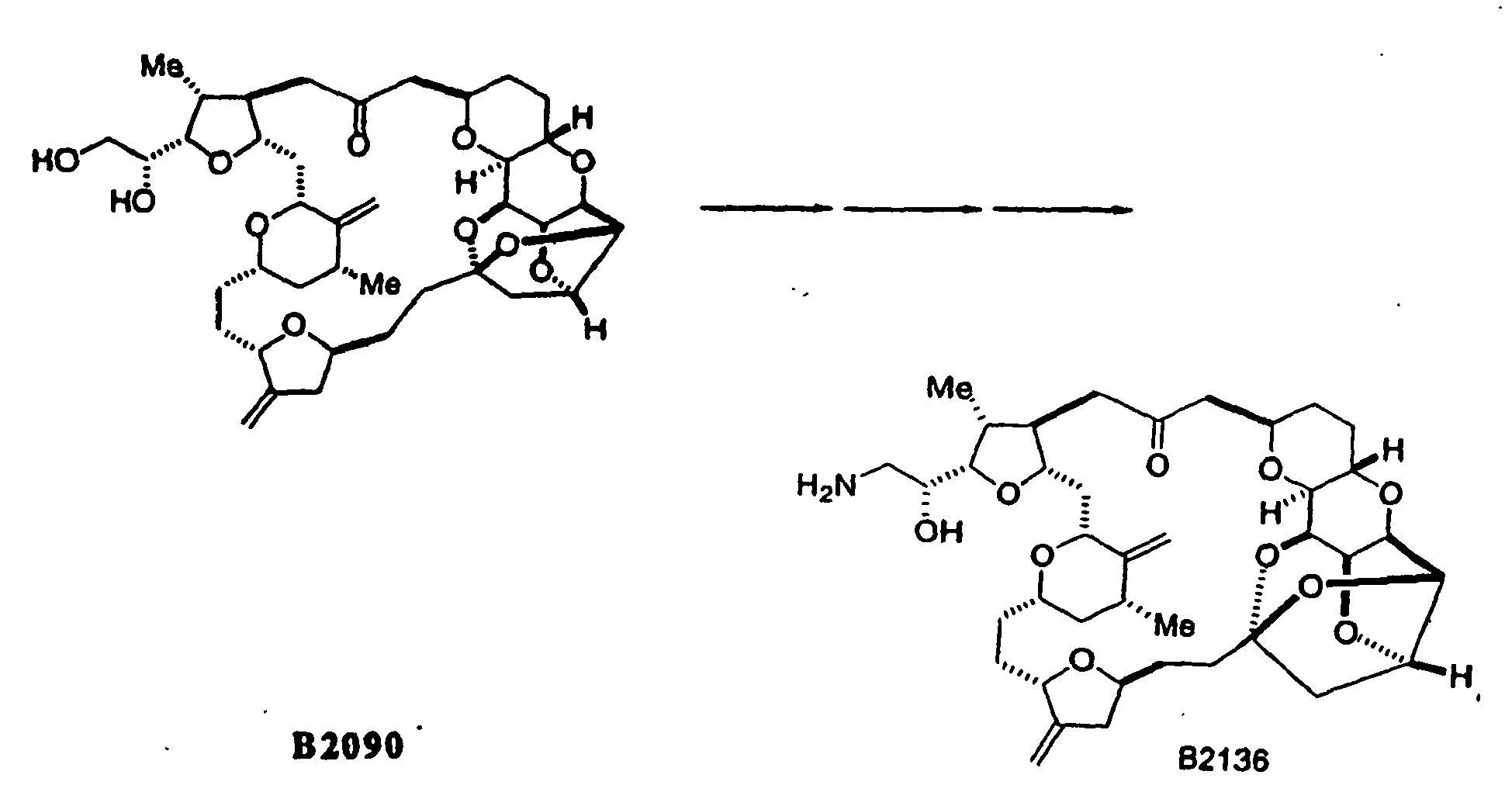
- B2136. In a manner analogous to that of B1939, B2090 was converted to B2136. HRMS (FAB): calcd for C39H57NO10 + Na 722.3880. Found: 722.3907.
-

- Diol 201 TBAF (1 M in THF, 383 µL, 0.383 mmol) was added to a solution of X2318 (350-LS-218)(80.8 mg, 0.0765 mmol) in THF (7 mL) and stirred at rt for 16 h. After partial concentration, the residue was loaded directly onto a SiO2 column packed using 30% EtOAc-hexanes. Gradient elution (30% EtOAc-hexanes to EtOAc) furnished diol 201 (49.7 mg, 92%).

- Aldehyde 202 A mixture of diol 201 (49.7 mg, 0.0707 mmol). NaIO4 (100 mg, 0.47 mmol), MeOH (10 mL) and H2O (2.5 mL) was stirred at rt for 30 min. H2O was added and the mixture was extracted with CH2Cl2 (4×). The combined organic extracts were dried over Na2SO4, concentrated and purified by column chromatography (30% EtOAc-hexanes) to provide aldehyde 202 (41.7 mg. 88%).

- Alcohol 203 4-Fluorophenylmagnesium bromide (2 M in Et2O, 155 µL, 0.31 mmol) was added to a solution of aldehyde 202 (41.7 mg, 0.062 mmol) in THF (6 mL). After 15 min at rt, the reaction was quenched with saturated aqueous NH4Cl and extracted with CH2Cl2 (4×). The combined organic extracts were dried over Na2SO4, concentrated and purified by preparative TLC (40% EtOAc-hexanes) to provide alcohol 203 (32.4 mg. 68%) as a 1:1 mixture of C34 isomers. The minor undesired C27 isomer was separated at this stage and was also isolated as a 1:1 mixture of C34 isomers (8.4 mg, 18%).

- Ether 204 Et3N (18 µL, 0.13 mmol) and TBSOTf (15 µL, 0.063 mmol) were added to a solution of alcohol 203 (32.4 mg, 0.042 mmol) in CH2Cl2 (5 mL) at 0 °C. After 20 min the reaction was quenched by the addition of saturated aqueous NH4Cl and extracted with CH2Cl2 (3×). The combined organic extracts were dried over Na2SO4. concentrated and purified by column chromatography (20% EtOAc-hexanes) to provide ether 204 (33.1 mg. 89%).

- Alcohol 205 LAH (1 M in THF, 113 µL, 0.113 mmol) was added dropwise to a solution of ether 204 (33.1 mg, 0.0375 mmol) in Et3O (10 mL) at 0 °C. After 20 min, H2O and 1 M NaOH were added and the mixture was stirred at rt for 10 min. Filtration through Celite, concentration and purification by column chromatography (40% EtOAc-hexanes) furnished alcohol 205 (28.4 mg, 95%).

- Ether 206 Diisopropylethylamine (31 µL, 0.18 mmol) and MMTrCl (22 mg, 0.071 mmol) were added to a solution of alcohol 205 (28.4 mg, 0.0356 mmol) in CH2Cl2 (4 mL) at 0 °C. After 15 h at rt, H2O was added and the mixture was extracted with CH2Cl2 (3×). The combined extracts were washed with brine, dried over Na2SO4, concentrated and purified by preparative TLC (40% EtOAc-hexanes) to provide ether 206 as a ~1.5:1 mixture of C34 epimers (45 mg, quant), which contained a small amount of close-running impurities.

- Alcohol 207 DDQ (40 mg, 0.18 mmol) was added to a solution of ether 206 (37 mg, 0.034 mmol) in CH2Cl2 (4 mL) and a 1:10 mixture of tBuOH:pH 7 phosphate buffer (2 mL) at 0 °C. The mixture was stirred vigorously in the dark for 15 min. Three additional portions of DDQ (40 mg, 0.18 mmol) were added at 10 min intervals, then the reaction was diluted with saturated aqueous NaHCO3 and extracted with CH2Cl2 (3×). The combined organic extracts were washed with brine, dried over Na2SO4, concentrated and purified by preparative TLC (30% EtOAc-hexanes) to provide alcohol 207 (19.2 mg, 59%) as well as recovered ether 206 (9.7 mg, 26%).
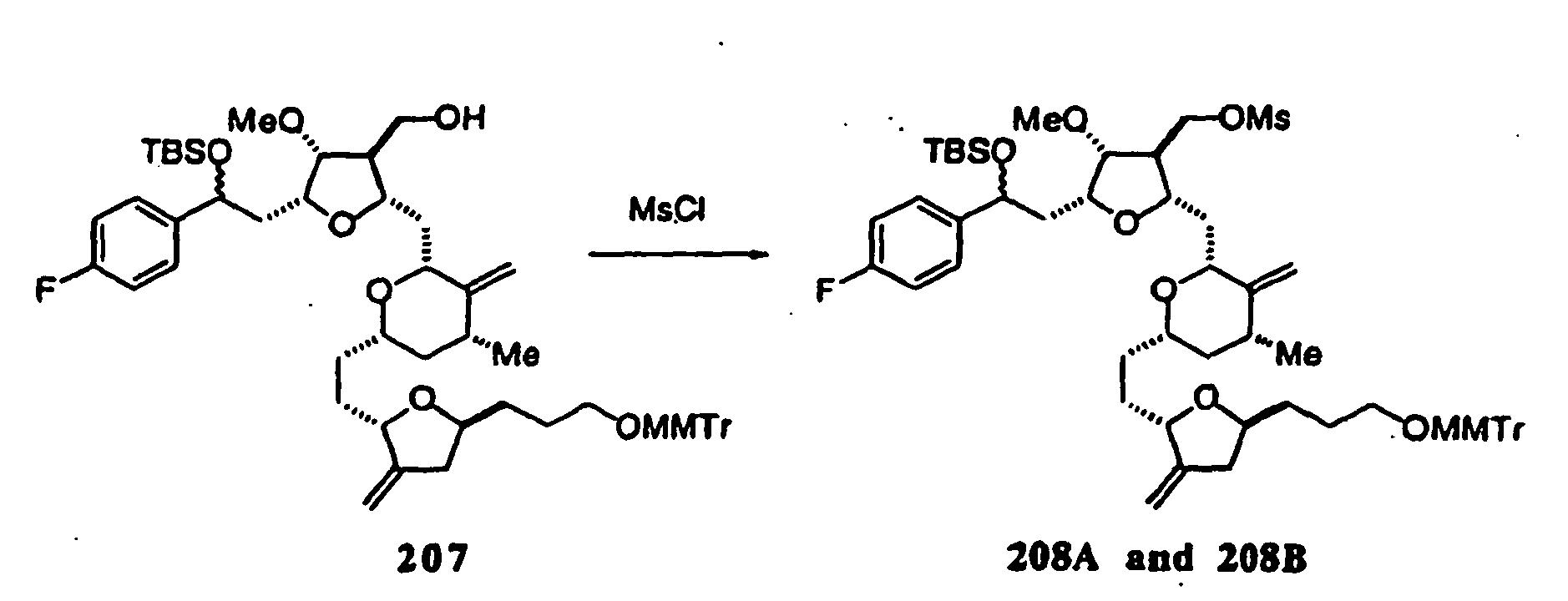
- Mesylates 208A and 208B Et3N (19 µL, 0.13 mmol) and Ms2O (10 mg, 0.056 mmol) were sequentially added to a solution of alcohol 207 (21.3 mg, 0.022 mmol) in CH2Cl2 (6 mL) at 0 °C. After 30 min, saturated aqueous NaHCO3 was added and the mixture was extracted with CH2Cl2 (3×). The combined extracts were washed with brine, dried over Na2SO4. concentrated and purified by preparative TLC (30% EtOAc-hexanes) to provide mesylates 208A (11.7 mg, 51%) and 208B (6.5 mg, 28%) as single C34 isomers.

- B2039 and B2043. In a manner similar to that described in Scheme 6 for the synthesis of B1794, both diastereomers 208A and 208B were independently converted to B2039 and B2043. HRMS (FAB): calcd for C45H59F11 + Na 817.3939. Found: for B2039 817.3896, 82043 817.3910.
-

- Alcohol X-20 NaIO4 (1.16 g, 5.4 mmol) was added to a solution of diols 10 a, b (1.19 g, 3.0 mmol) in MeOH-H2O (4:1, 75 mL) at 0 °C. The reaction mixture was allowed to warm to rt. After stirring for 40 min, the mixture was diluted with EtOAc. filtered through Celite, concentrated, and partitioned between brine and CH2Cl2. The separated aqueous layer was extracted with CH2Cl2 (2×). The combined organic layers were dried over Na2SO4 and concentrated to furnish the crude aldehyde intermediate.
- NaBH4 (228 mg, 6.0 mmol) was added to a solution of the aldehyde in MeOH-Et2O (1:1, 40 mL) at 0 °C. The mixture was stirred for 30 min, carefully quenched with saturated aqueous NH4Cl, stirred for 20 min at rt and extracted with CH2Cl2 (3×). The combined extracts were dried over Na2SO4. concentrated and purified by flash chromatography (40% to 50% EtOAc-hexanes) to afford alcohol X-20 (1.03 g. 93% for two steps).

- Silyl ether 21 Imidazole (0.94 g, 13.9 mmol), and TBSCl (0.59 g, 3.89 mmol) were added sequentially to a solution of alcohol X-20 (1.02 g, 2.78 mmol) in DMF (10 mL) at rt. After 14 h, the reaction mixture was diluted with saturated aqueous NH4Cl and extracted with EtOAc (3×). The combined organic extracts were washed with H2O, brine, dried over Na2SO4, concentrated and purified by flash chromatography (5% to 15% EtOAc-hexanes) to afford silyl ether 21 (1.3 g, 98%).

- Alcohol 22 A mixture of Pd(OH)2 (20%, 0.8 g), silyl ether 21 (1.3 g, 2.70 mmol) and EtOAc (30 mL) was stirred for I h under 1 atm H2 at rt, filtered through Celite, concentrated and purified by flash chromatography (20% to 40% EtOAc-hexanes) to afford alcohol 22 (0.96 g, 91 %).

- Alcohol 25 4-Methylmorpholine N-oxide (980 mg. 8.4 mmol) and TPAP (131 mg, 3.26 mmol) were added sequentially to a solution of alcohol 22 (1.78 g, 4.6 mmol) in CH2Cl2 (45 mL) at rt. A cold bath was necessary to control the exotherm. After 20 min, the reaction mixture was diluted with hexanes, filtered through a short SiO2 column (15% EtOAc-hexanes) and concentrated to give the crude ketone.
- Tebbe reagent (14.9 mL, 9.0 mmol) was added over 10 min to a solution of the crude ketone in THF (60 mL) at 0 °C. After 20 min, the reaction mixture was poured into Et2O (100 mL) that was precooled to -78 °C, quenched by slow addition of H2O (30 mL), warmed to rt., stirred for 30 min and extracted with Et2O (4×). The combined extracts were washed with brine, dried over Na2SO4, concentrated and purified by flash chromatography (10% EtOAc-hexanes) to afford the desired olefin contaminated by the' gem-dimethyl product (1.07 g). This mixture was used directly in the next step.
- 9-BBN (0.5 M in THF, 11.6 mL, 5.8 mmol) was added to a solution of the olefin in THF (15 mL) at 0 °C. The reaction mixture was allowed to warm to rt, stirred for 5 h and then recooled to 0 °C. H2O (60 mL), THF (60 mL) and NaBO3·4 H2O (5.7 g) were added. After stirring for 5 h at rt, the THF was removed under reduced pressure and the aqueous residue was extracted with EtOAc (4×). The combined organic extracts were washed with brine, dried over Na2SO4, concentrated and purified by flash chromatography (20% to 40% EtOAc-hexanes) to furnish alcohol 25 (605 mg, 18% for three steps).

- Alcohol 26 Using the procedure previously described, alcohol 25 (604 mg, 1.49 mmol) was sequentially oxidized, isomerized, and reduced. Purification by flash chromatogaphy (20% to 40% EtOAc-hexanes) afforded alcohol 26 (550 mg, 91% for three steps).

- MPM-ether 27 BF3·OEt2 (0.05 M in CH2Cl2, 270 µL, 0.013 mmol) was added to a solution of alcohol 26 (545 mg, 1.35 mmol) and MPM-trichloroimidate (1.14 g, 4.0 mmol) in CH2Cl2 (40 mL) at 0 °C. After 1 h. the reaction was quenched with saturated aqueous NaHCO3, extracted with CH2Cl2, dried over Na2SO4, concentrated and purified by flash chromatography (10% to 15% EtOAc-hexanes) to afford MPM-ether 27 (580 mg, 82%).

- Alcohol 28 LAH (1 M in THF, 1.9 mL, 1.9 mmol) was added to a solution of MPM-ether 27 (580 mg, 1.11 mmol) in Et2O (100 mL) at 0 °C. After 30 min, the reaction was quenched carefully with H2O (0.5 mL), and I N aqueous NaOH (0.5 mL). stirred for 1 h at rt, filtered through Celite, concentrated and purified by flash chromatography (30% to 50% EtOAc-hexanes) to afford alcohol 28 (460 mg, 95%).
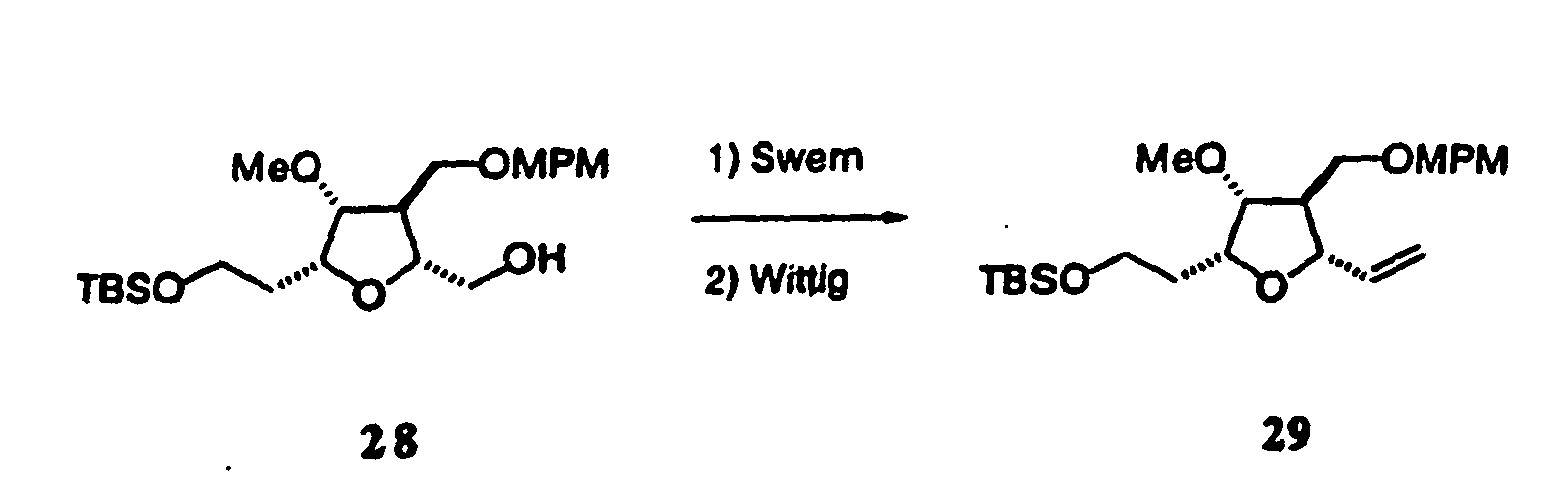
- Olefin 29 DMSO (441 µL, 6.23 mmol) was added to a solution of oxalyl chloride (272 µL, 3.12 mmol) in CH2Cl2 (30 mL) at -78 °C. After 15 min, a solution of alcohol 28 (458 mg, 1.04 mmol) in CH2Cl2 (15 mL) was added to the reaction mixture. After stirring for 1 h at -78 °C, Et3N (1.3 mL, 9.35 mmol) was added. The reaction mixture was warmed to 0 °C, stirred for 10 min, diluted with saturated aqueous NH4Cl an extracted with CH2Cl2 (3×). The combined organic extracts were dried over Na2SO4, concentrated and filtered through a short SiO2 column (20% to 30% EtOAc-hexanes) to provide the crude aldehyde.
- n-BuLi (1.63 M. 1.4 mL. 2,28 mmol) was added dropwise to a solution of CH,PPh,Br (815 mg. 2.28 mmol). THF (20 mL) and DMSO (7.5 mL) at 0 °C After 1 h. a solution of the aldehyde in THF (10 mL) was added. The reaction mixture was warmed to rt and stirred for 3 h. Saturated aqueous NH4Cl was added and the mixture was extracted with EtOAc (4×). The combined organic extracts were washed with H2O, brine, dried over Na2SO4, concentrated and purified by flash chromatography (10% to 15% EtOAc-hexanes) to afford olefin 29 (380 mg, 95% yield for 2 steps).

- Compound 31 9-BBN (0.5 M in THF. 6 mL. 3 mmol) was added to a solution of olefin 29 (370 mg, 0.85 mmol) in THF (7 mL) at 0 °C. The mixture was allowed to warm to rt and stirred for 1 h. After recooling to 0 °C, H2O (30 mL). THF (20 mL), and NaBO3•4 H2O (2.8 g) were added. After stirring for 3 h at rt, the THF was removed under reduced pressure. The aqueous residue was extracted with EtOAc (4×), dried over Na2SO4, concentrated and purified by flash chromatography (25% to 50% EtOAc-hexanes) to afford alcohol 30 which was used directly in the next step.
- Pivaloyl chloride (157 µL, 1.27 mmol) was added to a solution of alcohol 30 in CH2Cl2-pyridine (1:1 mixture, 10 mL) at rt. After 18 h. additional pivaloyl chloride (100 µL, 0.81 mmol) was added. After 1h, the reaction mixture was cooled to 0 °C, quenched with MeOH (0.5 mL). concentrated, diluted with brine and extracted with CH2Cl2 (4×). The combined organic extracts were dried over Na2SO4, concentrated and purified by flash chromatography (10% to 15% EtOAc-hexanes) to afford compound 31 (410 mg, 90% for two steps).

- Alcohol 32 TBAF (1M in THF, 1.14 mL, 1.14 mmol) was added to a solution of 31 (410 mg. 0.761 mmol) in THF (5 mL) at rt. After 1.5 h. the reaction mixture was concentrated and purified by flash chromatography (40% EtOAc-hexanes to 100% EtOAc) to afford alcohol 32 (320 mg 100%).

- Alcohols 33a and 33b Dess-Martin periodinane (925 mg. 2.18 mmol) was added to a solution of alcohol 32 (309 mg, 0.727 mmol) in CH2Cl2 (19 mL) at rt. After 1 h, the reaction was diluted with Et2O and filtered through Celite. The filtrate was washed sequentially with a 1:9 mixture of saturated aqueous NaHCO3-Na2S2O3 and brine, dried over Na2SO4, concentrated and purified by flash chromatography (20% to 30% EtOAc-hexanes) to afford the desired aldehyde, which was taken immediately through the next step.
- BF2•OEt2 (135 µL, 1.1 mmol) was added to a solution of the crude aldehyde, tri-n-butylallyltin (337 µL, 1.08 mmol) and CH2Cl2 (16 mL) at -78 °C. After 1h, the reaction was quenched with saturated aqueous NaHCO3, and extracted with CH2Cl2 (3×). The combined organic extracts were dried over Na2SO4, concentrated and purified by MPLC (25% to 30% EtOAc-hexanes) to afford the major more polar alcohol 33a (165 mg, 49% for two steps) and the minor less polar product 33b (90 mg, 27% for two steps).

- Compound 34. TBSOTf (163 µL, 0.710 mmol) was added to u solution of alcohol 33a (165 mg, 0.355 mmol). Et3N (247 µL, 1.78 mmol) and CH2Cl2 (5 mL) at 0 °C. After 25 min, the reaction was quenched with saturated aqueous NaHCO2, extracted with CH2Cl2 (3×), dried over Na2SO4, concentrated and purified by flash chromatography (15% to 20% EtOAc-hexbnes) to afford compound 34 (200 mg. 98%).

- Diols 35a and 35b OsO4 (0.1 M solution in toluene, 32 µL. 3.2 µmol) was added to a solution of K2CO3 (168 mg, 1.22 mmol), K3Fe(CN)6 (400 mg, 1.32 mmol), (DHQ)2PYR (11 mg, 12 µmol), H2O (3.2 mL) and t-BuOH (2.2 mL) at 0 °C. Then a solution of olefin 34 (200 mg, 0.345 mmol) in t-BuOH (1 mL) was added to the reaction mixture. After 5 h at 0 °C, Na2S2O5•5 H2O (200 mg) was added. The reaction mixture was warmed to rt, stirred for 30 min and extracted with CH2Cl2 (5×). The combined organic extracts were washed with brine, dried over N42SO4, concentrated and purified by preparative TLC (70% EtOAc- hexanes) to afford the major, less polar diol 35a (118 mg, 56%), and minor, more polar diastereomeric product 35b (74 mg, 35%). The individual diastereomers were each carried forward separately.

- Compound 36. TBSOTf (177 µL, 0.77 mmol) was added to a solution of diol 35a (118 mg, 0.192 mmol), Et,N (267 µL, 1.92 mmol) and CH2Cl2 (5 mL) at 0 °C. After 25 min, the reaction was quenched with saturated aqueous NaHCO3 extracted with CH2Cl2 (3×), dried over Na2SO4, concentrated and purified by flash chromatography (10% to 15% EtOAc-hexanes) to afford compound 36 (161 mg, 100%).

- Alcohol 37 Using the procedure described previously for the preparation of alcohol 28, compound 36 (161 mg, 0.192 mmol) afforded alcohol 37 (135 mg, 93%) after purification by flash chromatography (20% to 40% EtOAc-hexanes).

- Aldehyde 38 Dess-Martin periodinane (227 mg, 0.535 mmol) was added to a solution of alcohol 37 (135 mg, 0.178 mmol) in CH2Cl2 (5 mL) at rt. After 1 h, the reaction mixture was diluted with Et2O and filtered through Celite. The filtrate was washed sequentially with a 1:9 mixture of saturated aqueous NaHCO3-Na2S2O3 and brine, dried over Na2SO4 concentrated and purified by flash chromatography (10% to 20% EtOAc-hexanes) to afford aldehyde 38 (127 mg, 95%).

- B2086, B2102. Each of the diastereomers obtained above were separately carried to final product in a manner similar to that described in scheme 6 for 81794. Diastereomer 35a afforded B2086. Diastereomer 35b afforded B2102.

1 mL) at rt. After 30 min, the reaction mixture was diluted with H2O, extracted with CH2Cl2 (6×), dried over Na2SO4, and concentrated to afford B2088 (1.2 mg).
- B2091 NaBH4 (0.013 M in EtOH, 20 µL. 0.27 µmol) was added to a solution of B2088 (1 mg. 1.29 µmol) in MeOH-CH2Cl2 (4:1. 0.5 mL) at -78 °C. Additional NaHH4 was periodically added with close monitoring of the reaction by TLC (total of 220 µL of the NaBH4 solution was required). The reaction mixture was quenched at 0 °C with saturated aqueous NH4Cl. stirred for 20 min at rt and extracted with CH2Cl2 (6×). The combined extracts were dried over Na2SO4 , concentrated and purified by preparative TLC (7% MeOH-EtOAc) to furnish B2091 (0.40 mg, 50%).
-

- Alcohol 303 9-BBN (0.5 M in THF, 23 mL. 0.012 mol) was added dropwise over 30 min to a solution of alkene 302 (1.51 g, 0.00386 mol) in THE (40 mL) at 0 °C. After stirring at rt for 80 min, the mixture was cooled to 0 °C and H2O (80 mL) was cautiously added followed by NaBO3•4 H2O (4.2 g, 0.027 mol). The mixture was stirred vigorously at rt for 2.3 h, then extracted with EtOAc (3×). The combined organic extracts were washed with brine, dried over Na2SO4, concentrated and purified by column chromatography (50% EtOAc-hexanes) to provide alcohol 303 (1.37 g, 87%).

- Aldehyde 304 Oxalyl chloride (88 µL 1.00 mmol) was added dropwise to a solution of DMSO (142 µL, 2.00 mmol) in CH2Cl2 (20 mL) at -78 °C. After 30 min, a solution of alcohol 303 (137 mg, 0.335 mmol) in CH2Cl2 (5 mL) was added and stirred at -78 °C for 1 h. Et3N (420 µL, 3.01 mmol) was added and after 10 min the reaction was stirred for 10 min at 0 °C at which point saturated aqueous NH4Cl was added and the resulting mixture was extracted with CH2Cl2 (3×). The combined organic extracts were washed with brine dried over Na2SO4, concentrated and purified by flash chromatography (50% EtOAc-hexanes) to provide intermediate aldehyde 304 (0.114 g, 84%) which was immediately used in the next step.

- Alcohol 305 TBAF (1 M in THF, 5 µL. 0.005 mmol) was added to a solution of aldehyde 304 (0.114 g, 0.27 mmol) in CF3TMS (0.5 M in THF, 1.1 mL, 0.54 mmol) at 0 °C. After 20 min, a second portion of TBAF (1 M in THF, 100 µL, 0.1 mmol) was added and the mixture was stirred for 10 min at which point excess TBAF (1 M in THF, 270 µL, 0.27 mmol) was added dropwise to cleave the intermediate silyl ether. After 30 min, the mixture was diluted with H2O and extracted with EtOAc (3×). The organic extracts were washed with H2O, brine, dried over Na2SO4, concentrated and purified by column chromatography (50% EtOAc-hexanes) to provide alcohol 305 (123 mg, 95%) as an inseparable 1:1 mixture of isomers.

- Silyl ether 306 TBSOTf (265 µL, 1.16 mmol) was added to a solution of alcohol 305 (123 mg, 0.257 mmol) and Et3N (430 µL, 3.08 mmol) in CH2Cl2 (8 mL) at 0 °C. After stirring at rt for 20 h, saturated aqueous NaHCO3 was added, and the mixture was extracted with CH3Cl3 (3×). The combined organic extracts were washed with brine, dried over Na2SO4, concentrated and purified by column chromatography (20% EtOAc-heacanes) to provide silyl ether 306 (148 mg, 97%).

- Alcohol 307 LAH (1 M in THF. 220 µL, 0.22 mmol) was added dropwise to a solution of silyl ether 306 (131 mg, 0.22 mmol) in Et2O (5 mL) at 0 °C. After 20 min. H2O and 1 M NaOH were cautiously added. The mixture was stirred at rt 30 min, filtered through glass wool, concentrated and purified by column chromatography (50% EtOAc-hexanes) to provide alcohol 307 (112 mg, quant.).

- Alkene 309 Oxalyl chloride (58 µL, 0.66 mmol) was added dropwise to a solution of DMSO (94 µL, 1.3 mmol) in CHCl2 (10 mL) at -78 °C. After 30 min. a solution of alcohol 307 (112 mg, 0.22 mmol) in CH2Cl2 (3 mL) was added After 1h, Et3N (276 µL, 1.98 mmol) was added, and after 10 min at -78 °C the reaction was stirred at 0 °C for 10 main. Saturated aqueous NH4Cl was added and the mixture was extracted with CH2Cl2 (3×). The combined organic extracts were washed with brine, dried over Na2SO4, concentrated and purified by flash chromatography (50% EtOAc-hexanes) to provide aldehyde 308 (101 mg, 91%) which was immediately used in the next step.
- nBuLi (1.63 M in THF, 200 µL. 0.33 mmol) was added dropwise to a solution of CH3PPh3Br (118 mg, 0.33 mmol) in THF (3 mL) and DMSO (1.2 mL) at 0 °C. After 70 min, a solution of aldehyde 308 (101 mg, 0.20 mmol) in THF (3 mL) was added and after 10 min at
0 °C, the reaction was stirred at rt for 1 h. Saturated aqueous NH4Cl was added and the mixture was extracted with EtOAc (3×). The combined organic extracts were washed with brine, dried over Na2SO4, concentrated and purified by column chromatography (20% EtOAc-hexanes) to provide alkene 309 (90.9 mg, 90%).
- Alcohol 310 9-BHN (0.5 M in THF, 17 mL, 8.45 mmol) was added dropwise to a solution of alkene 309 (1.06 g, 2.11 mmol) in THF (30 mL) at 0 °C. After stirring for 2.5 h at rt, the reaction was cooled to 0 °C and H2O (60 mL) followed by NaBO3•4 H2O (3.25 g, 21.1 mmol) were cautiously added. The mixture was stirred vigorously at rt for 2 h, then diluted with H2O and extracted with EtOAc (3×). The combined organic extracts were washed with brine, dried over Na2SO4, concentrated and purified by column chromatography (20% to 30% EtOAc-hexanes) to provide alcohol 310 (0.920 g, 84%).

- Pivaloate 311 A mixture of alcohol 310 (65.8 mg. 0.0126 mmol), pyridine (61 µL, 0.76 mmol) and PvCl (23 µL, 0.189 mmol) in CH2Cl2 (3 mL) was stirred at rt for 5 h. A second reaction utilizing alcohol 310 (0.92 g, 1.76 mmol) was run under similar conditions and both reactions were combined during the work-up: saturated aqueous NH4Cl was added and the mixture was extracted with CH2Cl2 (3×). The combined organic extracts were washed with brine, dried over Na2SO4, concentrated and purified by column chromatography (20% EtOAc-hexanes) to provide pivaloate 311 (1.08 g, quant).

- Alcohol 312 A mixture of ether 311 (0.811 g. 1.33 mmol). DDQ (6.1 g. 27 mmol) and 10:1 BuOH: pH 7 phosphate buffer (42 mL) in CH2Cl2 (84 mL) was stirred vigorously in the dark at rt for 1.5 h, at which point additional DDQ (1.0 g. 4.4 mmol) was added. After 1h, saturated aqueous NaHCO3 was added and the mixture was extracted with CH2Cl2 (4×). The combined organic extracts were washed successively with saturated aqueous NaHCO2 and brine, dried over Na2SO4, concentrated and purified by column chromatography (20% EtOAc-hexanes) to provide alcohol 312 (0.56 g, 87%) as well as recovered starting material 311 (97 mg, 12%).

- Ketone 313 Oxalyl chloride (21 µL, 0.12 mmol) was added dropwise to a solution of DMSO (34 µL, 0.48 mmol) in CH2Cl3 (3 mL) at -78 °C. After 1h, a solution of alcohol 312 (39.4 mg, 0.081 mmol) in CH2Cl2 (1.5 mL) was added and the mixture was stirred for 1.5 h. Et3N (100 µL, 0.73 mmol) was added, and after 10 min the mixture was warmed to 0 °C. Saturated aqueous NH4Cl was added and the mixture was extracted with CF2Cl3 (3×). The combined organic extracts were washed with brine, dried over Na2SO4, concentrated and purified by flash chromatography (30% EtOAc-hexanes) to provide ketone 313 (36.6 mg. 93%) which was used immediately in the next step.

- Alkene 314 Tebbe reagent (∼0.65 M in toluene. 720 µL, 0.47 mmol) was added dropwise to a solution of ketone 313 (151 mg. 0.31 mmol) in THP (5 mL) at 0 °C. After 15 min. H2O was cautiously added and the mixture was extracted with EtoAc (3×). The combined organic extracts were washed with brine, dried over Na2SO4, concentrated and purified by column chromatography (10% EtOAc-hexanes) to provide alkene 314 (139 mg. 93%).

- alcohol 315 9-BBN (0.5 M in THF, 6.0 mL, 2.9 mmol) was added dropwise to a solution of alkene 314 (468 mg, 0.97 mmol) in THF (10 mL) at 0 °C. The mixture was stirred at rt for 2 h at which point additional 9-BBN (0.5 M in THF, 500 µL. 0.25 mmol) was added. After 2.5 h, the mixture was cooled to 0 °C and H2O (10 mL) followed by NaBO3•4 H2O (1.5 g, 9.7 mmol) were cautiously added The mixture was stirred vigorously at rt for 5 h, diluted with H2O and extracted with EtOAc (3×). The combined organic extracts were washed with brine, dried over Na2SO4, concentrated and purified by column chromatography (gradient 20% to 30% EtOAc-hexanes) to provide alcohol 315 (0.47 g. 97%).

- Alcohol 316 Oxalyl chloride (246 µL, 2.82 mmol) was added dropwise to a solution of DMSO (400 µL, 5.64 mmol) in CH2Cl2 (40 mL) at -78 °C. After 1h, a solution of alcohol 315 (0.47 g, 0.94 mmol) in CH2Cl2 (10 mL) was added and the mixture was stirred for 1h. Et3N (1.2 mL, 8.5 mmol) was added, and after 10 min the mixture was warmed to 0 °C and stirred for 10 min. Saturated aqueous NH4Cl was added and the mixture was extracted with CH2Cl2 (3×). The combined organic extracts were washed with brine, dried over Na2SO4 and concentrated. The crude aldehyde was stirred in CH2Cl2 (20 mL) and Et3N (2 mL) at rt overnight. Saturated aqueous NH4Cl was added and the mixture was extracted with CH2Cl2 (3×). The combined organic extracts were washed with brine, dried over Na2SO4, concentrated and purified by flash chromatography (30% EtOAc-hexanes) provided the epimerized aldehyde which was immediately dissolved in 1: 1 Et2O:EtOH (10 mL) and cooled to 0 °C. NaBH4 (35 mg. 0.94 mmol) was added and after 10 min the reaction was quenched with saturated aqueous NH4Cl. The mixture was extracted with EtOAc (3×) and the combined organic extracts were washed with brine, dried over Na2SO4, concentrated and purified by column chromatography (30% EtOAc-hexanes) to provide alcohol 316 (0.410 g, 87% yield for 3 steps).

- Ether 317 Alcohol 316 (60.7 mg, 0.12 mmol) and MPMOTCI (0.10 g, 0.36 mmol) were combined, azeotroped from toluene (3×) and dried under high vacuum overnight. CH2Cl2 (3 mL) was added and the mixture was cooled to 0 °C. BF3•OEt2 (approx. 1 µL, 0.01 mmol) was added and after stirring for 10 min the reaction was quenched with saturated aqueous NH4CL. The mixture was extracted with CH2Cl2 (3×) and the combined extracts were washed with brine, dried over Na2SO4, concentrated and purified by preparative TLC (30% EtOAc-hexanes) to provide ether 317 (55.4 mg, 74%).
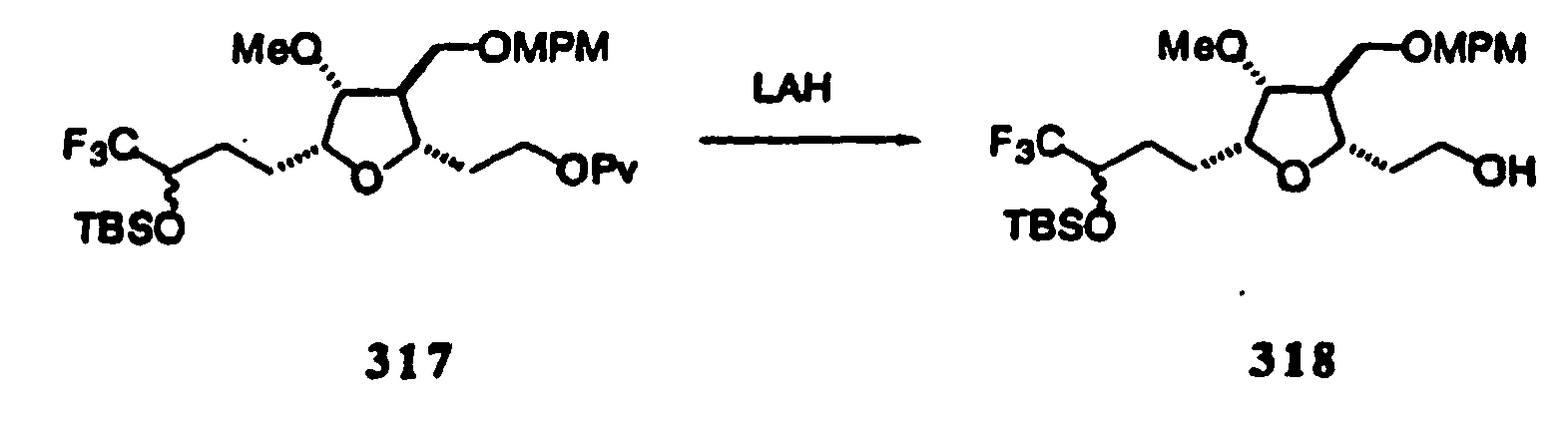
- Alcohol 318 LAH (1 M in THF, 104 µL. 0.104 mmol) was added dropwise to a solution of ether 317 (54 mg, 0.087 mmol) in Et2O (5 mL) at 0 °C. After 30 min. H2O and 1 M NaOH were cautiously added. The mixture was stirred at rt for 10 min, filrered through glass wool, concentrated and purified by column chromatography (30%-50% EtOAc-hexanes) to provide alcohol 318 (45.5 mg. 98%).

- Aldehyde 319 Oxalyl chloride (11 µL, 0.13 mmol) was added dropwise to a solution of DMSO (18 µL, 0.25 mmol) in CH2Cl2 (2 mL) at -78°C. After 1.8 h, a solution of alcohol 318 (22.6 mg, 0.042 mmol) in CH2Cl2 (1 mL) was added and the mixture was stirred for 1 h. Et3N (53 µL, 0.38 mmol) was added and after 10 min, the reaction was warmed to 0 °C and stirred 10 min. Saturated aqueous NH4Cl was added and the mixture was extracted with CH2Cl3 (3×). The combined organic extracts were washed with brine, dried over Na2SO4, concentrated and purified by flash chromatography (20% EtOAc-hexanes) to provide aldehyde 319 (21.7 mg, 97%).

- B1933. In a manner similar to that described in Scheme 6 for the synthesis of B1794. intermediate 319 was converted to B1933. HRMS (FAB): calcd for CH41H57F3O11 + H 783.3931. Found: 783.3940.

- B1942. A mixture of B1896/ B1897 (2 mg, 2.73 µmol), NaIO4 (35 mg, 0.16 mml), MeOH (0.8 mL) and H2O (0.2 mL) was stirred at rt for 30 min. The reaction mixture was then diluted with H2O (3 mL) and extracted with CH2Cl2 (6×) and EtOAc (2×).
The combined organic phases were dried over Na2SO4 and purified by column chromatography (5% MeOH- CH2Cl2) to give the desired aldehyde. - This material was dissolved in THF (0.1 mL), cooled to at 0 °C and treated with 0.5 M CF3TMS in THF (30 µL, 15 mmol) followed by 0.05 M TBAF in THP (5 mL, 0.025 mmol). After stirring for 30 min, the reaction mixture was diluted with saturated aqueous NaHCO3 (2 mL) and H2O (1 mL), extracted with EtOAc (6×), dried over Na2SO4, filtered and concentrated to give the crude bis-TMS ether.
- This material was dissolved in THP (0.5 mL) and treated with 1 M TBAF in THF containing 0.5 M imidazole hydrochloride (8 µL, 8 µmo) at rt for 30 min. The reaction mixture was eluted through a SiO2 column (50% EtOAc-hexanes to EtOAc) to afford the diol intermediate.
- A mixture of this product and Dess-Martin periodinane (10 mg, 24 mmol) in CH2Cl2 (0.5 mL) was stirred at rt for 1h, diluted with Et2O (5 mL) and filtered through Celite. The filtrate was concentrated and purified by preparative TLC (50% EtOAc-hexanes) to furnish B1942 (1.5 mg, 72% for 5 steps). HRMS (FAB): calcd for C̅40H53F3O11 + H 767.3516. Found: 767.3542
-

- Alcohol 401 A mixture of NaIO4, (375 mg, 1.74 mmol), X400 (674 mg, 1.58 mmol), MeOH (16 mL) and H2O (4 mL) was stirred at rt for 1 h. After dilution with H2O, the mixture was extracted with CH2Cl2 (4x) and the combined organic extracts were dried over Na3SO4, concentrated and purified by flash chromatography (30% EtOAc-hexanes) to provide the intermediate aldehyde (570 mg), which was immediately dissolved in DMF (15 mL). Indium
(275 mg, 2.4 mmol) and 3-bromo-3,3-difluoropropene (240 µL, 2.4 mmol) were added and after stirring at rt for 17 h, H2O and 0.1 M HCl were added. The mixture was extracted with EtOAc (3x) and the combined organic extracts were washed successively with H2O and brine, dried over Na2SO4, concentrated and purified by column chromatography (20% to 30% EtOAc-hexanes) to provide alcohol 401 as a 1: 1 mixture of C34 isomers (605 mg, 81% for 2 steps).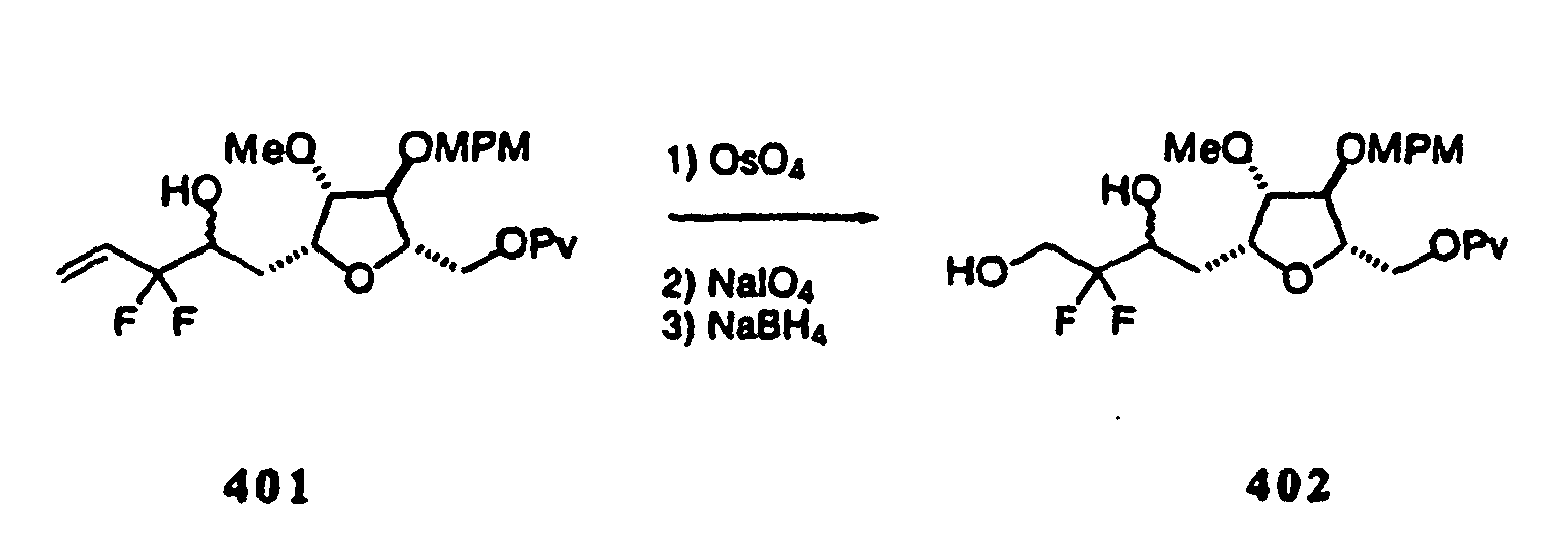
- Diol 402 A mixture of OsO4 (1 xstal), alcohol 401 (605 mg, 1.28 mmol), 4-methyl-morpholine N-oxide (0.45 g, 3.84 mmol), acetone (30 mL) and H2O (6 mL) was stirred at rt for 29 h. Additional OsO4 (3 xtals) and 4-methylmorpholine N-oxide (0.1 g, 0.8 mmol) were added and after 2 days saturated aqueous Na2S2O3 was added. The mixture was extracted with CH2Cl2 (6x) and the combined organic extracts were dried over Na2SO4 and concentrated. The crude intermediate triol was immediately dissolved in 4:1::MeOH:H2O (25 mL) and NalO4 (0.41 g.1.9 mmol) was added. After stirring vigorously at rt for 2 h, the mixture was diluted with H2O, extracted with CH2Cl2 (3×) and the combined organic extracts were dried over Na2SO4 and concentrated to provide the intermediate aldehyde which was immediately dissolved in 1:1 EtOH-Et2O (30 mL) and cooled to 0 °C. NaBH4 (48 mg. 1.3 mmol) was added and after 20 min the reaction was quenched with H2O and extracted with CH2Cl2 (4×). The combined organic extracts were dried over Na2SO4, concentrated and purified by column chromatography (50% EtOAc-hexanes) to provide diol 402 (485 mg. 80% for 3 steps).

- Silyl ether 403 TBSOTf (2.3 mL, 10 mmol) was added dropwise to a mixture of diol 402 (485 mg, 1.0 mmol), Et3N (2.8 mL, 20 mmol) and CH2Cl2 (30 mL) at 0 °C. After stirring for 1 h at rt, saturated aqueous NH4Cl was added and the mixture was extracted with CH2Cl2 (3×). The combined organic extracts were washed with brine, dried over Na2SO4, concentrated and purified by column chromatography (20% EtOAc-hexanes) to provide silyl ether 403 (668 mg, 95%).

- Alcohol 404 LAH (1 M in THF, 2.8 mL, 2.8 mmol) was added dropwise to a solution of silyl ether 403 (668 mg, 0.948 mmol) in Et2O (60 mL) at 0 °C. After 15 min, H2O and 1 M NaOH were cautiously added. The mixture was stirred at rt for 20 min, filtered through glass wool, concentrated and purified by column chromatography (30% EtOAc-hexanes) to provide alcohol 404 (500 mg, 85%).
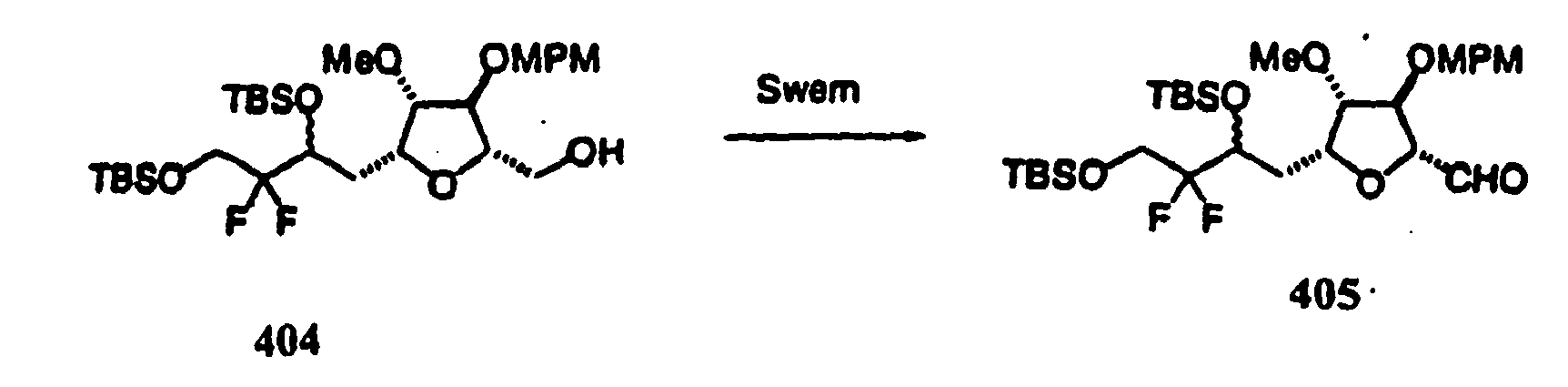
- Aldehyde 405 Oxalyl chloride (210 µL, 2.42 mmol) was added dropwise to a solution of DMSO (345 µL. 4.84 mmol) in CH2Cl2 (30 mL) at -78 °C. After 1 h, a solution of alcohol 404 (500 mg. 0.806 mmol) in CH2Cl2 (10 mL) was added. After 40 min. Et3N (1.0 mL, 7.2 mmol) was added. After stirring at -78°C for 10 min, the reaction mixture was warmed to 0 °C and stirred for an additional 10 min. Saturated aqueous NH4Cl was added and the mixture was extracted with CH2Cl2 (3×). The combined organic extracts were washed successively with H2O, brine, dried over Na2SO4 and concentrated. Purification by flash chromatography (30% EtOAc-hexanes) provided aldehyde 405 (486 mg, 98%) which was immediately used in the next step.

- Alkene 406 nBuLi (1.63 M, 860 µL, 1.4 mmol) was added dropwise to a solution of CH3PPh3Br (500 mg, 1.4 mmol) in THF (15 mL) and DMSO (6 mL) at 0 °C. After 1 h, a solution of aldehyde 405 (486 mg) in THF (15 mL) was added. The reaction mixture was warmed to rt and stirred for 30 min. Saturated aqueous NH4Cl was added, the mixture was extracted with EtOAc (3x) and the combined extracts were washed successively with H2O and brine, dried over Na2SO4, concentrated and purified by column chromatography (20% EtOAc-hexanes) to provide alkene 406 (450 mg, 93%).

- Ester 407 9-BBN (0.5 M in THF, 9.0 mL, 4.5 mmol) was added dropwise to a solution of alkene 406 (0.460 g. 0.746 mmol) in THF (10 mL) at 0 °C. After warming to rt, the mixture was stirred for 3 h and two additional portions of 9-BBN (0.5 M in THF. 3.0 mL. 1.5 mmol) were added at 30 min intervals. The reaction mixture was recooled to 0 °C. whereupon THF
(10 mL), H2O (10 mL) and NaBO3·4 H2O (1.72 g. 11.3 mmol) were cautiously added.
The mixture was stirred vigorously at rt for 1.5 h. and additional NaBO3·4 H2O(1.0 g. 6.5 mmol) was added. After 2 h the mixture was diluted with H2O and extracted with EtOAc (3×). The combined extracts were washed with brine, dried over Na2SO4, concentrated and purified by column chromatography (20% to 30% EtOAc-hexanes) to provide the intermediate alcohol (509 mg) which was immediately dissolved in CH2Cl2 (10 mL) and treated with pyridine (600 µL, 7.5 mmol) and PvCl (275 µL, 2.2 mmol). After 6 h, saturated aqueous NH4Cl was added and the mixture was extracted with CH2Cl2 (3×). The combined organic extracts were washed with brine, dried over Na2SO4, concentrated and purified by column chromatography (20% to 30% EtOAc-hexanes) to provide ester 407 (423 mg, 79% for 2 steps).
- Alcohol 408 A mixture of ester 407 (11 mg. 0.015 mmol) and Pd(OH)2/C (10 mg) in EtOAc (500 µL) was stirred vigorously under a H2 atmosphere at rt for 6 h. The mixture was filtered through Celite, concentrated and purified by column chromatography (30% EtOAc-hexanes) to provide alcohol 408 (9.4 mg, quant).

- Alkene 409 Oxalyl chloride (7 µL, 0.075 mmol) was added dropwise to a solution of DMSO (11 µL. 0.15 mmol) in CH2Cl2 (2 mL) at -78°C under N2. After 40 min, a solution of alcohol 408 (15.2 mg, 0.025 mmol) in CH2Cl2 (1 mL) was added and the reaction was stirred at -78 °C for 1 h. Et3N (31 µL. 0.22 mmol) was added. and after stirring for 10 min the mixture was warmed to 0 °C. After 10 min. the reaction mixture was quenched with saturated aqueous NH4Cl and extracted with CH2Cl2 (3×) The combined extracts were washed successively with H2O and brine, dried over Na2SO4 and concentrated. After flash chromatography (30% EtOAc-hexanes). the intermediate ketone (13 mg) was immediately dissolved in THF (500 µL) and treated with Tebbe reagent (~0.65 M in toluene. 62 µL. 0.040 mmol) at 0°C. After 1.5 h Additional Tebbe reagent (~0.65 M in toluene. 62 µL. 0.040 mmol) was added and after 10 min H2O and then brine were cautiously added. The mixture was extracted with EtOAc (3×) and the combined organic extracts were washed with brine, dried over Na2SO4, concentrated and purified by column chromatography (10% EtOAc-hexanes) to provide alkene 409 (11.9 mg, 80% for 2 steps).

- Alcohol 410 9-BBN (0.5 M in THF, 1.5 mL. 0.72 mmol) was added dropwise to a solution of alkene 409 (0.144 g. 0.242 mmol) in THF (2 mL) at 0 °C. After warming to rt, the mixture was stirred for 3 h. The reaction mixture was recooled to 0 °C. whereupon THF (2 mL), H2O (2 mL) and NaBO3·4 H2O (0.38 g. 2.4 mmol) were cautiously added. The mixture was stirred vigorously at rt for 4 h, diluted with H2O and extracted with EtOAc (3×). The combined extracts were washed with brine, dried over Na2SO4, concentrated and purified by column chromatography (20% EtOAc-hexanes) to provide alcohol 410 (0.140 g, 94%).

- Alcohol 411 Oxalyl chloride (26 µL. 0.30 mL) was added dropwise to a solution of DMSO (43 µL. 0.60 mmol) in CH2Cl2 (4 mL) at -78 °C. After 1 h. u solution of alcohol 410 (57 mg, 0.093 mmol) in CH2Cl2 (2 mL) was added. After 45 min. Et3N (125 µL 0.90 mmol) was added. After stirring at -78°C for 10 min. the reaction mixture was warmed to 0 °C and stirred for an additional 10 min. Saturated aqueous NH4Cl was added and the mixture was extracted with CH2Cl2 (3×). The combined organic extracts were washed with brine, dried over Na2SO4 and concentrated. The crude product was dissolved in CH2Cl2 (4 mL). treated with Et3N (400 µL) and stirred at rt for 15 h. Saturated aqueous NH4Cl was added and the mixture was extracted with CH2Cl2 (3x). The combined organic extracts were washed with brine, dried over Na2SO4, concentrated and purified by flash chromatography (30% EtOAc-hexanes) to provide the intermediate aldehyde (48 mg), which was immediately dissolved in 1:1 Et2O-EtOH (4 mL), cooled to 0 °C and treated with solid NaBH4 (-4 mg, 0.09 mmol). After stirring for 15 min, saturated aqueous NH4Cl was cautiously added and the mixture was extracted with EtOAc (3x). The combined extracts were washed with brine, dried over Na2SO4, concentrated and purified by column chromatography (20% to 30% EtOAc-hexanes) to provide alcohol 411 (45.6 mg, 80% for 3 steps).
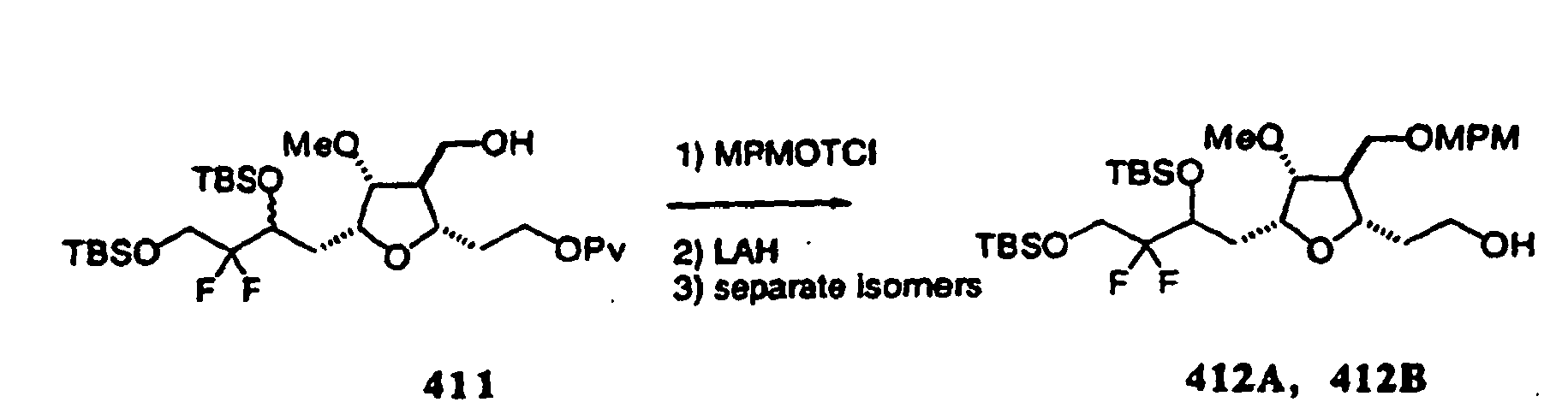
- 412A and 412B Alcohol 411 (120 mg, 0.196 mmol) and MPMOTCI (0.17 g, 0.59 mmol) were combined azeotroped from toluene (3x) and dried under high vacuum for 1 h. CH2Cl2 (9 mL) was added and the mixture was cooled to 0 °C. BF3·OEt2 (0.016 M in CH2Cl2, 125 µL, 0.002 mmol) was added dropwise and after stirring for 20 min, the reaction was quenched with saturated aqueous NH4Cl. The mixture was extracted with CH2Cl2 (3x) and the combined extracts were washed with brine, dried over Na2SO4, concentrated and purified by preparative TLC (20% EtOAc-hexanes) to provide the intermediate MPM ether which contained some close-running impurities. This material was immediately dissolved in Et2O (10 mL) and treated with LAH (1M in THF, 300 µL, 0.300 mmol) at 0 °C. After 10 min. H2O and 1 M NaOH were added, and after stirring for 10 min at rt, the mixture was filtered through Celite, concentrated and purified by preparative TLC (35% EtOAc-hexanes) to provide 412A (49 mg, 39% for 2 steps) as a single C34 isomer and 412B (46 mg, 36% for 2 steps) as a ~9:1 mixture or C34 isomers.

- B2070 and B2073. In a manner similar to that described in Schemes 4 and 6 for the synthesis of B1794, intermediates 412A and 412B were converted to B2070 and B2073, respectively. For B2070: HRMS (FAB): calcd for C41H58F2O12 + Na 803.3794. Found: 803.3801. For B2073: HRMS (FAB): calcd for C41H58F2O12 + Na 803.3793. Found: 803.3781
-

- Diol 501 (64) Saturated aqueous NaHCO3 (21 mL) and KBr (89 mg, 0.75 mmol) were added to a solution of diol 10a (1.35 g, 3.4 mmol) in CH2Cl2 (34 mL). The mixture was cooled to 0 °C, and 4-methoxy-2,2,6,6-tetramethyl-1-piperidinyloxy (0.05 M in CH2Cl2, 7.45 mL, 0.37 mmol) and NaOCl (0.07 M in H2O, 5.6 mL, 0.39 mmol) were sequentially added. After 1 h, the reaction mixture was quenched with saturated aqueous Na2S2O3, diluted with saturated aqueous NaHCO3 and extracted with CH2Cl2 (3x). The combined extracts were dried over Na2SO4, concentrated and dissolved in THF (21 mL).
- After cooling to 0 °C, CF3TMS (1.5 g, 10.5 mmol) and TBAF (0.1 M in THF, 680 µL. 0.068 mmol) were sequentially added. After stirring for 40 min, additional TB AF (1 M in THF, 8.3 mL, 8.3 mmol) was added. After 30 min. the reaction was quenched with H2O and extracted with EtOAc (3×). The combined organic extracts were washed with brine, dried over Na2SO4, concentrated and purified by flash chromatography (30%, 40%, 50% EtOAc-hexanes followed by EtOAc) to afford a 2:1 mixture of diols (553 mg, 35%). Separation by MPLC (1.5% MeOH- CH2Cl2) gave the major, more polar isomer 501 (64) (340 mg, 22%) and the minor, less polar isomer (152 mg, 10%).

- B1963. In a manner similar to that described in Schemes 4 and 6 for the synthesis of B1794, intermediate 501 was converted to B1963.
-

- These compounds are made by treating B2294 with an appropriate amine in a solvent such as methanol for a period of a few hours to several days. Progress of the reaction may be monitored by thin layer chromatography. A standard work-up procedure, well known to those of skill in the art, provides the desired compounds. The procedure below is to prepare ER803868: however this procedure is general and can be used to prepare any desired analog.
- To a solution of B2294, 1.2 mg, in methanol, 0.5 mL, was added morpholine, 0.012 mL. The mixture was stirred for 10 days with additional morpholine, 0.012 mL. being added on days 1,2,3,4 and 8. The mixture was then chromatographed to give 1.4 mg of the desired compound.

B2320 R = N,N-dimethylamino B2330 R = N-isopropylamino B2336 R = N-methylamino B2339 R = N-t-butylamino B2417 R = N-2-hydroxyethylamino B2418 R = N-piperazinyl B2489 R = N,N-bis-(2-hydroxyethyl)amino B2490 R = N-1,3-dihydroxy-2-propylamino B2491 R = N-benzylamino ER803834 R = N-piperidinyl ER803835 R N-pyrrolidinyl ER803836 R = N-3-(R)-hydroxypyrrolidinyl ER803843 R = N-homopiperidinyl ER803845 R = N-para-methoxybenzylamino ER803846 R = N-phenethylamino ER803851 R = N-2-(S-hydroxymethyl)pyrrolidinyl ER803852 R = N-2-(R-hydroxymethyl)pyrrolidinyl ER803868 R = N-morpholinyl ER803869 R = N-ethylamino ER803870 R = N-imidazoyl ER803883 R = N,N-diethylamino ER803884 R = N-para-chlorobenzylamino - Many of the individually disclosed drugs were tested for in vitro and in vivo activity (see Table 1, below). Screening methods included a standard in vitro cell growth inhibition assay using DLD-1 human colon cancer cells (ATCC accession number CCL 221) in a 96-well microtiter plate format (Finlay, GJ. et al Analytical Biochemistry 139:272-277, 1984), a U937 (ATCC accession number CRL 1593) mitotic block reversibility assay (described below), and in some cases, a LOX human melanoma tumor xenograft in vivo growth inhibition assay (see Table 1). Chemical stability to esterase degradation was also examined.
- U937 human histiocytic lymphoma cells were added to 75 cm2 tissue culture flasks as 2.5 x 10⁶ cells in 22.5 mL of RPMI Medium 1640 containing 10% Fetal Bovine Serum. Cells were allowed to adapt to the culture during 36 h of incubation at 37°C in a humidified atmosphere containing 5% CO2. Each test drug was then added to a flask as 2.5 mL of lOx final concentration. Final concentrations achieved were 0.1 1000 nM, in half log-increments, for a total of 10 concentration steps including a drug-free control flask which received 2.5 mL of media. Cells were incubated with drug for 12 h pretreatment period at 37 °C in a humidified atmosphere containing 5% CO2.
- The contents were removed from each flask and centrifuged at 300 x g for 10 min at room temperature, after which drug-containing media was removed from cell pellet. Cells were resuspended in 25 mL of warm drug-free media and centrifuged at 300 x g for 10 min at room temperature. After removing media from cell pellet, cells were resuspended in 35 mL of warm drug-free media, transferred to fresh flasks, and a 10 mL sample of cells immediately removed from each flask, immediately processed as described below and stored for later cell cycle analysis (0 hours of drug washout).
- Incubation of the remaining 25 mL of cells continued in drug-free media for another 10 h. A 10 mL sample of cells was removed from each flask. immediately processed and stored for later cell cycle analysis (10 hours of drug washout) and 10 mL. fresh replacement media was added to each incubation flask. Incubation of cells in drug-free media continued for 5 days. At day two, 20 mL of media and cells was removed from each flask and replaced with 20 mL fresh media. Viability of cells was quantified after 5 days by trypan blue exclusion techniques using hemacytometer counting.
- Cells were processed for cell cycle analysis using modifications of the method published in Becton Dickinson Immunocytometry Systems source book section 1.11 (Preparation of Alcohol-Fixed Whole Cells From Suspensions For DNA Analysis). Briefly each 10 mL sample of cells removed from the flasks at 0 and 10 hours of drug washout was separately centrifuged at 300 x g for 10 min. After removing the media from the cell pellet, cells were resuspended in 3 mL cold saline. Seven milliliters cold 100 % ethanol was slowly added with vigorous vortexing. Ethanol treated cell samples from 0 hour and 10 hour periods of compound washout were stored overnight at 4 °C. Ethanol treated cells were centrifuged 300 x g for 10 min, ethanol removed and cells then washed in 10 mL Phosphate Buffered Saline (PBS). Cells were resuspended in 0.5 mL of 0.2 mg/mL Ribonuclease A (Sigma No. R-5503) in PBS and incubated in 37 °C water bath for 30 min.
- Cells were transferred to appropriate flow cytometry tubes and 0.5 mL of 10 mg/mL. propidium iodide (PI) (Sigma No. P4170) in PBS was added to each tube. Cells were incubated with PI at room temperature in the dark for at least 15 min prior to analysis with a flow cytometer (Becton Dickinson FACScan flow cytometer or equivalent). Cells should be analyzed within an hour and kept in the dark at 4 °C until ready. Cell cycle analysis was performed on 0 hour and 10 hour cells using flow cytometric measurement of the intensity of cellular fluorescence. The intensity of propidium iodide fluorescence for each cell was measured on a linear amplification scale with doublet events ignored using doublet discrimination. The results obtained from analyzing 15,000 cells were presented as a histogram with increasing fluorescence intensity on the x-axis and the number of cells at a particular intensity level on the y-axis.
- The intensity of PI staining is dependent on the amount of DNA in the cell so it is possible to identify cells in various phases of the cell cycle, such as cells that have not yet synthesized DNA since the last mitosis (G, phase), cells that are in intermediate stages of DNA synthesis (S phase), and cells that have doubled their complement of DNA and are ready to divide (G2 phase). Cells that are blocked in the mitosis phase of the cell cycle also have double the amount of DNA compared to G, phase cells. If all cells are blocked in mitosis there are no G, phase cells, but if the block is removed when compound is removed, cells complete mitosis and reappear in the G, phase. The number of cells so reappearing in the G1 or S phase is thus a measure of the number of cells which have recently completed mitosis. For each sample at 0 and 10 hours after compound removal, the percentage of cells completing mitosis was quantified (as the number of cells reappearing in the G, phase) and plotted as a function of the initial concentration of compound used during the 12 hour pretreatment period. The percentage of cells still viable 5 days after drug washout was superimposed on the same graph. A ratio can be determined between the compound concentration required to completely block all cells in mitosis at 0 hour and the concentration required to maintain the block 10 hours after compound removal. This was taken as a measure of a compound's reversibility, with ratios close to or equal to one indicating likely potent in vivo anti-tumor compounds (see Table 1, columns 4-6).
Table 1 In Vitro Inhibition and Reversibility Data DLD-1* Complete Mitotic Block Reversibility Ratio compound mean IC50, mn SB 0 hour, nM** 10 hour, uM‡ B1793 0.93 0.04 3 44 14.7 B1794 12.20 0.72 B1918 1.27 0.12 B1920 2.00 0.15 B1921 24.00 1.15 B1922 0.53 0.01 3 30 10.0 B1930 0.87 0.03 B1933 0.79 0.16 B1934 1.05 0.21 3 30 10.0 B1939 19.34 2.36 12 12 1.0 B1940 5.43 0.62 - B1942 0.60 0.03 3 30 10.0 B1963 0.56 0.04 3 20 6.7 B1973 1.15 0.24 B1984 1.01 0.15 B1987 1.82 0.21 B1988 2.67 1.02 B1990 1.30 0.06 B1991 0.69 0.03 B1992 0.86 0.07 B1998 1.23 0.13 B2003 1.21 0.12 B2004 0.63 0.04 B2008 2.63 0.63 B2010 0.71 0.12 B2011 1.81 0.52 B2013 0.49 0.07 2 30 15.0 B2014 0.87 0.09 B2015 2.78 0.23 B2016 0.66 0.06 B2019 0.82 0.07 B2034 0.74 0.03 B2035 0.76 0.09 B2037 0.66 0.11 B2039 0.91 0.08 B2042 1.93 0.11 3 100 33.3 B2043 1.70 0.06 B2070 0.64 0.09 3 30 10.0 B2073 0.89 0.15 B2086 11.17 1.96 B2088 1.23 0.12 B2090 0.52 0.04 2 10 5.0 B2091 1.36 0.07 3 30 10.0 B2103 3.47 0.22 B2136 5.23 1.04 3 3 1.0 B2294 0.80 0.01 B2320 1.20 0.17 1 10 10.0 B2330 4.40 0.42 7 7 1.0 B2336 3.33 0.09 10 10 1.0 B1339 4.30 0.21 3 3 1.0 B2417 12.67 0.33 10 10 1.0 B2418 3.63 0.17 10 10 1.0 B2489 14.67 2.03 10 10 1.0 B2490 35.67 3.33 100 100 1.0 B2491 0.92 0.14 2 10 6.7 ER803834 0.47 0.08 1 10 10.0 ER803835 15.33 0.33 10 10 1.0 ER803836 1.97 0.12 3 10 3.3 ER803843 0.49 0.05 1 10 10.0 ER803845 1.50 0.20 3 10 3.3 ER803846 1.16 0.10 1 10 10.0 ER803851 3.33 0.26 3 3 1.0 ER803852 3.03 0.50 3 10 3.3 ER803868 0.43 0.03 3 10 3.3 ER803869 4.13 0.64 3 3 1.0 ER803970 1.27 0.12 3 30 10.0 ER803883 1.02 0.04 1 10 10.0 ER803884 0.59 0.03 1 10 10.0 * = in vitro cell growth inhibition ** = before washout ‡ = after washout - The disclosed compounds have pharmacological activity, including anti-tumor and anti-mitotic activity as demonstrated in section D above. Examples of tumors include melanoma, fibrosarcoma, monocytic leukemia, colon carcinoma, ovarian carcinoma, breast carcinoma, osteosarcoma, prostate carcinoma, lung carcinoma and ras-transformed fibroblasts.
- The invention features pharmaceutical compositions which include a compound of formula (I) and a pharmaceutically-acceptable carrier. Compositions can also include a combination of disclosed compounds, or a combination of one or more disclosed compounds and other pharmaceutically-active agents, such as an anti-tumor agent, an immune-stimulating agent, an interferon, a cytokine, an anti-MDR agent or an anti-angiogenesis agent. Compositions can be formulated for oral, topical, parenteral, intravenous, or intramuscular administration, or administration by injection or inhalation. Formulations can also be prepared for controlled-release, including transdermal patches.
- Use of the disclosed compounds for the manufacture of a medicament for inhibiting tumor growth in a patient includes the formulation of a medicament containing an effective, anti-tumor amount of a disclosed compound or composition. Such use also contemplates manufacture of a medicament for use in combination therapies, including the co-administration of a compound of formula (I) before, during, or after administration of another pharmaceutically active agent. The methods of administration may be the same or different. Inhibition of tumor growth includes a growth of the cell or tissue exposed to the test compound that is at least 20% less, and preferably 30%, 50%, or 75% less than the growth of the control (absence of known inhibitor or test compound).
- The essential features of the invention can be easily discerned from the above description and the claims below.
Claims (39)
- A compound having the formula:

each Q1 is independently selected from OR1, SR1, SO2R1, OSO2R1, NR2R1, NR2(CO)R1, NR2(CO)(CO)R1, NR4(CO)NR2R1, NR2(CO)OR1, (CO)OR1, O(CO)R1, (CO)NR2R1, and O(CO)NR2R1;
each of R1, R2 and R4 is independently selected from H, C1-6 alkyl, C1-6 haloalkyl, C1-6 hydroxyalkyl, C1-6 aminoalkyl, C6-10 aryl, C6-10 haloaryl, C6-10 hydroxyaryl, C1-3 alkoxy-C6 aryl, C6-10 aryl-C1-6 alkyl, C1-6 alkyl-C6-10 aryl, C6-10 haloaryl-C1-6 alkyl, C1-6 alkyl-C6-10 haloaryl, (C1-3 alkoxy-C6 aryl)-C1-3 alkyl, C2-9 heterocyclic radical, C2-9 heterocyclic radical-C1-6 alkyl, C2-9 heteroaryl, and C2-9 heteroaryl-C1-6 alkyl;
each of D and D' is independently selected from R3 and OR3, wherein R3 is H, C1-3 alkyl, or C1-3 haloalkyl;
n is 0 or 1;
E is R5 or OR5, wherein R5 is independently selected from H, C1-6 alkyl, C1-6 haloalkyl, C1-6 hydroxyalkyl and C1-6 aminoalkyl;
G is O;
each of J and J' is independently H, C1-6 alkoxy, or C1-6 alkyl; or J and J' taken together are =CH2;
Q is C1-3 alkyl;
T is ethylene or ethenylene;
each of U and U' is independently H, C1-6 alkoxy, or C1-6 alkyl; or U and U' taken together are =CH2;
X is H or C1-6 alkoxy;
each of Y and Y' is independently H or C1-6 alkoxy; or Y and Y' taken together are =O;
and
each of Z and Z' is independently H or C1-6 alkoxy; or Z and Z' taken together are =O; or a pharmaceutically acceptable salt thereof. - A compound according to claim 1, wherein n is 0; or a pharmaceutically acceptable salt thereof.
- A compound according to claim 1 or claim 2, wherein each of D and D' is independently selected from R3, C1-3 alkoxy, and C1-3 haloalkyloxy; or a pharmaceutically acceptable salt thereof.
- A compound according to any one of the preceding claims, wherein A comprises a C1-6 saturated or C2-6 unsaturated hydrocarbon skeleton, said skeleton having at least one substituent selected from cyano, halo, azido, oxo, and Q1;
each Q1 is independently selected from OR1, SR1, SO2R1, OSO2R1, NR2R1, NR2(CO)R1, and O(CO)NR2R1;
n is 0;
J and J' taken together are =CH2;
Q is methyl;
T is ethylene;
U and U' taken together are =CH2;
X is H;
each of Y and Y' is H; and
Z and Z' taken together are =O;
or a pharmaceutically acceptable salt thereof. - A compound according to any one of the preceding claims, wherein A has at least one substituent selected from hydroxyl, amino, azido, halo, and oxp; or a pharmaceutically acceptably salt thereof.
- A compound according to any one of the preceding claims, wherein A comprises a saturated hydrocarbon skeleton having at least one substituent selected from hydroxyl, amino and azido; or a pharmaceutically acceptable salt thereof.
- A compound according to any one of the preceding claims, wherein A has at least two substituent independently selected from hydroxyl, amino, and azido; or a pharmaceutically acceptable salt thereof.
- A compound according to any one of the preceding claims, wherein A has at least two substituent independently selected from hydroxyl and amino; or a pharmaceutically acceptable salt thereof.
- A compound according to any one of the preceding claims, wherein A has at least one hydroxy substituent and at least one amino substituent; or a pharmaceutically acceptable salt thereof.
- A compound according to any one of claims 1 to 8, wherein A has at least two hydroxyl substituents; or a pharmaceutically acceptable salt thereof.
- A compound according to any one of the preceding claims, wherein A comprises a C2-4 hydrocarbon skeleton; or a pharmaceutically acceptable salt thereof.
- A compound according to any one of the preceding claims, wherein A comprises a C3 hydrocarbon skeleton; or a pharmaceutically acceptable salt thereof.
- A compound according to any one of the preceding claims, wherein A has an (S)- hydroxyl on the carbon atom alpha to the carbon atom linking A to the ring containing G; or a pharmaceutically acceptable salt thereof.
- A compound according to any one of claims 1 to 4, wherein A comprises a C1-6 saturated hydrocarbon skeleton having at least one substituent selected from hydroxyl and cyano; or a pharmaceutically acceptable salt thereof.
- A compound according to any one of claims 1 to 3, wherein each Q1 is independently elected from OR1, SR1, SO2R1, OSO2R1, NH(CO)R1, NH(CO)(CO)R1, and O(CO)NHR1;
each R1 is independently selected from C1-6 alkyl, C1-6 haloalkyl, C6 aryl, C6 haloaryl, C1-3 alkoxy-C6 aryl, C6 aryl-C1-3 alkyl, C1-3 alkyl-C6 aryl, C6haloaryl-C1-3 alkyl, C1-3 alkyl-C6 haloaryl, (C1-3 alkoxy-C6 aryl)-C1-3 alkyl, C2-9 heterocyclic radical, C2-9 heteroaryl, and C2-9 heteroaryl-C1-6 alkyl;
one of D and D' is methyl or methoxy, and the other is H;
n is 0;
J and J' taken together are =CH2;
Q is methyl;
T is ethylene;
U and U' taken together are =CH2;
XisH;
each of Y and Y' is H; and
Z and Z' taken together are =O;
or a pharmaceutically acceptable salt thereof. - A compound according to claim 15, wherein Q1 is independently selected from OR1, SR1, SO2R1, and OSO2R1 where each R1 is independently selected from C1-6 alkyl, C1-6 haloalkyl, C6 aryl, C6 haloaryl, C1-3 alkoxy-C6 aryl, C6 aryl-C1-3 alkyl, C1-3 alkyl-C6 aryl, C6haloaryl-C1-3alkyl, C1-3 alkyl-C6 haloaryl, and (C1-3 alkoxy-C6 aryl)-C1-3 alkyl; or a pharmaceutically acceptable thereof.
- A compound of the following structure

- A compound of the following structure

- A compound according to any one of the preceding claims or a pharmaceutically acceptable salt thereof for use as a medicament.
- A compound according to any one of claims 1 to 18 or a pharmaceutically acceptable salt thereof for use in inhibiting tumour growth or cancer.
- A compound according to any one of claims 1 to 18 or a pharmaceutically acceptable salt thereof for use in the treatment of cancer.
- A compound according to claim 20 or claim 21 or a pharmaceutically acceptable salt thereof, wherein the tumour or cancer is melanoma, fibrosarcoma, monocytic leukemia, colon carcinoma, ovarian carcinoma, breast carcinoma, osteosarcoma, prostate carcinoma, or lung carcinoma.
- A compound according to any one of claims 20 to 22 or a pharmaceutically acceptable salt thereof, wherein the tumour or cancer is breast carcinoma.
- A compound according to any one of claims 20 to 22 or a pharmaceutically acceptable salt thereof, wherein the tumour or cancer is lung carcinoma.
- A compound according to any one of claims 20 to 22 or a pharmaceutically acceptable salt thereof, wherein the tumour or cancer is ovarian carcinoma.
- A compound according to any one of claims 20 to 22 or a pharmaceutically acceptable salt thereof, wherein the tumour or cancer is prostate carcinoma.
- A compound according to any one of claims 1 to 18 or a pharmaceutically acceptable salt thereof for use in inhibiting mitosis in a cell.
- Use of a compound according to any one of claims 1 to 18 or a pharmaceutically acceptable salt thereof for the manufacture of a medicament for use in inhibiting tumour growth or cancer.
- Use of a compound according to any one of claims 1 to 18 or a pharmaceutically acceptable salt thereof for the manufacture of a medicament for use in the treatment of cancer.
- Use according to claim 28 or claim 29, wherein the tumour or cancer is melanoma, fibrosarcoma, monocytic leukemia, colon carcinoma, ovarian carcinoma, breast carcinoma, osteosarcoma, prostate carcinoma, or lung carcinoma.
- Use according to any one of claims 28 to 30, wherein the tumour or cancer is breast carcinoma.
- Use according to any one of claims 28 to 30, wherein the tunour or cancer is lung carcinoma.
- Use according to any one of claims 28 to 30, wherein the tumour or cancer is ovarian carcinoma.
- Use according to any one of claims 28 to 30, wherein the tumour or cancer is prostate carcinoma.
- Use of a compound according to any one of claims 1 to 18 or a pharmaceutically acceptable salt thereof for the manufacture of a medicament for use in inhibiting mitosis in a cell.
- A pharmaceutical composition which comprises a compound according to any one of claims 1 to 18 or a pharmaceutically acceptable salt thereof and a pharmaceutically acceptable carrier.
- A compound having the formula:

- A compound having the formula:

- A compound having the formula:

Priority Applications (6)
| Application Number | Priority Date | Filing Date | Title |
|---|---|---|---|
| EP10010773A EP2272839B1 (en) | 1998-06-17 | 1999-06-16 | Intermediate compounds for the preparation of halichondrin analogs |
| EP10010772A EP2277873B1 (en) | 1998-06-17 | 1999-06-16 | Intermediate compound for the preparation of halichondrin analogs |
| EP10010774A EP2272840B1 (en) | 1998-06-17 | 1999-06-16 | Intermediate compound for the preparation of halichondrin analogs |
| CY20111100530T CY1111516T1 (en) | 1998-06-17 | 2011-06-01 | MACROCYCLE ANALOGES AND METHODS OF USE AND PREPARATION |
| BE2011C028C BE2011C028I2 (en) | 1998-06-17 | 2011-09-02 | Macrocyclic analogs and methods of their use and preparation |
| FR11C0038C FR11C0038I2 (en) | 1998-06-17 | 2011-09-09 | MACROCYCLIC ANALOGS, THEIR METHODS OF USE AND PREPARATION |
Applications Claiming Priority (3)
| Application Number | Priority Date | Filing Date | Title |
|---|---|---|---|
| US8968298P | 1998-06-17 | 1998-06-17 | |
| US89682P | 1998-06-17 | ||
| PCT/US1999/013677 WO1999065894A1 (en) | 1998-06-17 | 1999-06-16 | Macrocyclic analogs and methods of their use and preparation |
Related Child Applications (5)
| Application Number | Title | Priority Date | Filing Date |
|---|---|---|---|
| EP10010773A Division EP2272839B1 (en) | 1998-06-17 | 1999-06-16 | Intermediate compounds for the preparation of halichondrin analogs |
| EP10010774A Division EP2272840B1 (en) | 1998-06-17 | 1999-06-16 | Intermediate compound for the preparation of halichondrin analogs |
| EP10010772.1 Division-Into | 2010-09-27 | ||
| EP10010774.7 Division-Into | 2010-09-27 | ||
| EP10010773.9 Division-Into | 2010-09-27 |
Publications (3)
| Publication Number | Publication Date |
|---|---|
| EP1087960A1 EP1087960A1 (en) | 2001-04-04 |
| EP1087960A4 EP1087960A4 (en) | 2004-12-01 |
| EP1087960B1 true EP1087960B1 (en) | 2011-03-23 |
Family
ID=22219026
Family Applications (4)
| Application Number | Title | Priority Date | Filing Date |
|---|---|---|---|
| EP10010772A Expired - Lifetime EP2277873B1 (en) | 1998-06-17 | 1999-06-16 | Intermediate compound for the preparation of halichondrin analogs |
| EP10010774A Expired - Lifetime EP2272840B1 (en) | 1998-06-17 | 1999-06-16 | Intermediate compound for the preparation of halichondrin analogs |
| EP99928746A Expired - Lifetime EP1087960B1 (en) | 1998-06-17 | 1999-06-16 | Macrocyclic analogs and methods of their use and preparation |
| EP10010773A Expired - Lifetime EP2272839B1 (en) | 1998-06-17 | 1999-06-16 | Intermediate compounds for the preparation of halichondrin analogs |
Family Applications Before (2)
| Application Number | Title | Priority Date | Filing Date |
|---|---|---|---|
| EP10010772A Expired - Lifetime EP2277873B1 (en) | 1998-06-17 | 1999-06-16 | Intermediate compound for the preparation of halichondrin analogs |
| EP10010774A Expired - Lifetime EP2272840B1 (en) | 1998-06-17 | 1999-06-16 | Intermediate compound for the preparation of halichondrin analogs |
Family Applications After (1)
| Application Number | Title | Priority Date | Filing Date |
|---|---|---|---|
| EP10010773A Expired - Lifetime EP2272839B1 (en) | 1998-06-17 | 1999-06-16 | Intermediate compounds for the preparation of halichondrin analogs |
Country Status (22)
| Country | Link |
|---|---|
| US (4) | US6214865B1 (en) |
| EP (4) | EP2277873B1 (en) |
| JP (1) | JP4454151B2 (en) |
| KR (1) | KR100798600B1 (en) |
| CN (1) | CN1216051C (en) |
| AT (1) | ATE502932T1 (en) |
| AU (1) | AU762998B2 (en) |
| BE (1) | BE2011C028I2 (en) |
| BR (1) | BRPI9911326B8 (en) |
| CA (3) | CA2335300C (en) |
| CY (2) | CY1111516T1 (en) |
| DE (2) | DE122011100031I1 (en) |
| DK (1) | DK1087960T3 (en) |
| FR (1) | FR11C0038I2 (en) |
| HU (1) | HU227912B1 (en) |
| IL (1) | IL139960A0 (en) |
| LU (1) | LU91854I2 (en) |
| NO (5) | NO328280B1 (en) |
| NZ (1) | NZ508597A (en) |
| PT (1) | PT1087960E (en) |
| WO (1) | WO1999065894A1 (en) |
| ZA (1) | ZA200007159B (en) |
Families Citing this family (99)
| Publication number | Priority date | Publication date | Assignee | Title |
|---|---|---|---|---|
| US8097648B2 (en) * | 1998-06-17 | 2012-01-17 | Eisai R&D Management Co., Ltd. | Methods and compositions for use in treating cancer |
| HU227912B1 (en) * | 1998-06-17 | 2012-05-29 | Eisai R & D Man Co | Halichondrin analogs and methods of their use and preparation |
| US6653341B1 (en) * | 1998-06-17 | 2003-11-25 | Eisai Co., Ltd. | Methods and compositions for use in treating cancer |
| DE10037310A1 (en) | 2000-07-28 | 2002-02-07 | Asta Medica Ag | New indole derivatives and their use as medicines |
| AU2003224644A1 (en) * | 2002-02-27 | 2003-09-09 | The Government Of The United States Of America, Represented By The Secretary, Department Of Healtan | Conjugates of ligand, linker and cytotoxic agent and related compositions and methods of use |
| CA2479764C (en) | 2002-03-22 | 2013-07-30 | Eisai Co., Ltd. | Hemiasterlin derivatives and uses thereof |
| US20050075395A1 (en) * | 2003-05-28 | 2005-04-07 | Gary Gordon | Continuous dosing regimen |
| EP1644008B1 (en) * | 2003-05-29 | 2011-12-21 | Abbott Laboratories | Continuous dosing regimen with abt-751 |
| EP1653953A4 (en) * | 2003-07-29 | 2010-05-05 | Eisai R&D Man Co Ltd | Drug delivery methods and devices |
| PL2522663T3 (en) | 2004-06-03 | 2015-08-31 | Eisai R&D Man Co Ltd | Intermediates for the preparation of halichondrin B |
| CN109180615A (en) * | 2004-06-03 | 2019-01-11 | 卫材R&D管理有限公司 | Intermediates for the preparation of analogs of halichondrin B |
| US20060045846A1 (en) * | 2004-08-30 | 2006-03-02 | Horstmann Thomas E | Reagents and methods for labeling terminal olefins |
| EP1831697A4 (en) * | 2004-12-09 | 2011-01-26 | Eisai R&D Man Co Ltd | SCREENING OF TUBULIN ISOTYPE IN CANCER THERAPY USING ANALOGUES OF HALICHONDRIN B |
| CN108948039B (en) | 2007-10-03 | 2021-12-31 | 卫材R&D管理有限公司 | Intermediates and methods for the synthesis of halichondrin B analogs |
| CN105801599A (en) * | 2008-04-04 | 2016-07-27 | 卫材R&D管理有限公司 | Halichondrin b analogs |
| HRP20161157T1 (en) | 2009-03-30 | 2016-11-18 | Eisai R&D Management Co., Ltd. | Liposome composition |
| RU2476216C1 (en) * | 2009-03-30 | 2013-02-27 | Эйсай Ар Энд Ди Менеджмент Ко., Лтд. | Liposomal composition |
| EP2415464B1 (en) | 2009-03-30 | 2017-05-10 | Eisai R&D Management Co., Ltd. | Method for producing liposome composition |
| JP5556811B2 (en) * | 2009-04-14 | 2014-07-23 | 日産化学工業株式会社 | Method for producing tetrahydropyran compound |
| BR112012003592B8 (en) | 2009-08-19 | 2021-05-25 | Eisai R&D Man Co Ltd | pharmaceutical composition containing quinoline derivative |
| CN102803254B (en) | 2010-01-26 | 2016-09-14 | 卫材R&D管理有限公司 | furo [3,2-B ] pyran derivatives for halichondrin B analog synthesis |
| WO2012129100A1 (en) | 2011-03-18 | 2012-09-27 | Eisai R&D Management Co., Ltd. | Methods and compositions for predicting response to eribulin |
| WO2012147900A1 (en) | 2011-04-28 | 2012-11-01 | Eisai R&D Management Co., Ltd. | Microreactor process for halichondrin b analog synthesis |
| WO2012166899A2 (en) | 2011-06-03 | 2012-12-06 | Eisai R&D Management Co., Ltd. | Biomarkers for predicting and assessing responsiveness of thyroid and kidney cancer subjects to lenvatinib compounds |
| CA2857385A1 (en) | 2011-11-30 | 2013-06-06 | Alphora Research Inc. | Process for preparation of (3r)-2,4-di-leaving group-3-methylbut-1-ene |
| US9174956B2 (en) | 2011-12-16 | 2015-11-03 | Alphora Research Inc. | Process for preparation of 3-((2S,5S)-4-methylene-5-(3-oxopropyl)tetrahydrofuran-2-yl)propanol derivatives and intermediates useful thereof |
| JP6300030B2 (en) * | 2011-12-29 | 2018-03-28 | サンド アクツィエンゲゼルシャフト | 2-((2S, 3S, 4R, 5R) -5-((S) -3-Amino-2-hydroxyprop-1-yl) -4-methoxy-3- (phenylsulfonylmethyl) tetrahydrofuran-2-yl ) Acetaldehyde derivatives and processes for preparing them |
| US9278979B2 (en) | 2012-03-30 | 2016-03-08 | Alphora Research Inc. | Synthetic process for preparation of macrocyclic C1-keto analogs of halichondrin B and intermediates useful therein |
| MX2015007185A (en) | 2012-12-04 | 2017-09-05 | Eisai R&D Man Co Ltd | Use of eribulin in the treatment of breast cancer. |
| AU2014268086A1 (en) | 2013-05-15 | 2015-11-05 | Alphora Research Inc. | 3-((2S,5S)-4-methylene-5-(3-oxopropyl)tetrahydrofuran-2-yl)propanol derivatives, their preparation and intermediates useful thereof |
| AU2014299699B2 (en) | 2013-06-26 | 2019-10-10 | Eisai R&D Management Co., Ltd. | Use of eribulin and lenvatinib as combination therapy for treatment of cancer |
| US9850254B2 (en) | 2013-07-03 | 2017-12-26 | Sandoz Ag | Synthetic process for preparation of macrocyclic C1-keto analogs of Halichondrin B and intermediates useful therein including intermediates containing-SO2-(p-tolyl) groups |
| CN103483352A (en) * | 2013-10-18 | 2014-01-01 | 李友香 | Medicinal bulk drug for resisting tumors |
| CN105683198B (en) | 2013-11-04 | 2019-03-12 | 卫材R&D管理有限公司 | Macrocyclization reactions and intermediates useful in the synthesis of analogs of halichondrin B |
| HUE043088T2 (en) * | 2013-12-06 | 2019-08-28 | Eisai R&D Man Co Ltd | Methods for the synthesis of halicondrin B analogs |
| CN104860978A (en) * | 2014-02-20 | 2015-08-26 | 正大天晴药业集团股份有限公司 | Synthesis intermediates of halichondrin B analog |
| TW201617326A (en) | 2014-03-06 | 2016-05-16 | Alphora研發股份有限公司 | Crystalline derivatives of (S)-1-((2R,3R,4S,5S)-5-allyl-3-methoxy-4-(tosylmethyl)tetrahydrofuran-2-yl)-3-aminopropan-2-ol |
| JP2017516802A (en) | 2014-05-28 | 2017-06-22 | エーザイ・アール・アンド・ディー・マネジメント株式会社 | Use of eribulin in the treatment of cancer |
| EP3160970A4 (en) | 2014-06-30 | 2017-12-27 | President and Fellows of Harvard College | Synthesis of halichondrin analogs and uses thereof |
| CA2957005C (en) | 2014-08-28 | 2021-10-12 | Eisai R&D Management Co., Ltd. | High-purity quinoline derivative and method for manufacturing same |
| EP3191479B1 (en) * | 2014-09-09 | 2020-04-08 | Cipla Limited | "process for the preparation of macrocyclic ketone analogs of halichondrin b or pharmaceutically acceptable salts and intermediates thereof" |
| CN105713031B (en) * | 2014-12-05 | 2021-05-07 | 正大天晴药业集团股份有限公司 | Intermediate for preparing eribulin and preparation method thereof |
| SG11201706630UA (en) | 2015-02-25 | 2017-09-28 | Eisai R&D Man Co Ltd | Method for suppressing bitterness of quinoline derivative |
| WO2016140717A1 (en) | 2015-03-04 | 2016-09-09 | Merck Sharp & Dohme Corp. | Combination of a pd-1 antagonist and a vegfr/fgfr/ret tyrosine kinase inhibitor for treating cancer |
| KR20170122810A (en) | 2015-03-04 | 2017-11-06 | 머크 샤프 앤드 돔 코포레이션 | A combination of PD-1 antagonist and eribulin for treating cancer |
| WO2016176560A1 (en) | 2015-04-30 | 2016-11-03 | President And Fellows Of Harvard College | Chromium-mediated coupling and application to the synthesis of halichondrins |
| RU2020141025A (en) * | 2015-05-07 | 2020-12-28 | Эйсай Ар Энд Ди Менеджмент Ко., Лтд. | MACROCYCLIZATION REACTIONS AND INTERMEDIATE COMPOUNDS AND OTHER FRAGMENTS USEFUL IN THE SYNTHESIS OF HALIKHONDRIN MACROLIDES |
| US10597401B2 (en) | 2015-05-08 | 2020-03-24 | Albany Molecular Research, Inc. | Methods and intermediates for the preparation of omacetaxine and cephalotaxine derivatives thereof |
| BR112017027227B1 (en) | 2015-06-16 | 2023-12-12 | Eisai R&D Management Co., Ltd | ANTI-CANCER AGENT |
| JP6553726B2 (en) | 2015-08-20 | 2019-07-31 | エーザイ・アール・アンド・ディー・マネジメント株式会社 | Tumor therapeutic agent |
| US10676481B2 (en) | 2016-02-12 | 2020-06-09 | Eisai R&D Management Co., Ltd. | Intermediates in the synthesis of eribulin and related methods of synthesis |
| WO2017188350A1 (en) | 2016-04-28 | 2017-11-02 | エーザイ・アール・アンド・ディー・マネジメント株式会社 | Method for inhibiting tumor growth |
| WO2017203459A1 (en) | 2016-05-26 | 2017-11-30 | Dr. Reddy's Laboratories Limited | Process for preparation of eribulin and intermediates thereof |
| SG11201811671XA (en) | 2016-06-30 | 2019-01-30 | Eisai R&D Man Co Ltd | Prins reaction and intermediates useful in the synthesis of halichondrin macrolides and analogs thereof |
| EP3525818A1 (en) | 2016-10-14 | 2019-08-21 | Merck Sharp & Dohme Corp. | Combination of a pd-1 antagonist and eribulin for treating urothelial cancer |
| JP6978758B2 (en) | 2016-11-11 | 2021-12-08 | プレジデント アンド フェローズ オブ ハーバード カレッジ | Palladium-mediated ketolization |
| WO2018096478A2 (en) | 2016-11-23 | 2018-05-31 | Dr. Reddy’S Laboratories Limited | Process for preparation of eribulin and intermediates thereof |
| KR101880939B1 (en) | 2017-01-02 | 2018-08-17 | 연성정밀화학(주) | Intermediate for Preparing Eribulin Mesylate and Process for Preapring the Same |
| JP6920699B2 (en) * | 2017-01-02 | 2021-08-18 | ヨンスン ファイン ケミカル カンパニー,リミテッド | Eribulin mesylate production intermediate and its production method |
| KR101991710B1 (en) | 2017-12-14 | 2019-06-21 | 연성정밀화학(주) | Intermediate for Preparing Eribulin Mesylate and Process for Preparing the Same |
| CN108341828B (en) * | 2017-01-24 | 2021-04-06 | 江苏恒瑞医药股份有限公司 | Process for the preparation of eribulin and intermediates thereof |
| CN108341738B (en) * | 2017-01-24 | 2022-10-21 | 江苏恒瑞医药股份有限公司 | Process for the preparation of eribulin and intermediates thereof |
| US12303505B2 (en) | 2017-02-08 | 2025-05-20 | Eisai R&D Management Co., Ltd. | Tumor-treating pharmaceutical composition |
| KR102836514B1 (en) | 2017-04-05 | 2025-07-22 | 프레지던트 앤드 펠로우즈 오브 하바드 칼리지 | Macrocyclic compound and uses thereof |
| US9938288B1 (en) | 2017-04-05 | 2018-04-10 | President And Fellows Of Harvard College | Macrocyclic compound and uses thereof |
| BR112019023064A2 (en) | 2017-05-16 | 2020-06-09 | Eisai R&D Man Co Ltd | treatment of hepatocellular carcinoma |
| HUE061306T2 (en) | 2017-07-06 | 2023-06-28 | Harvard College | Synthesis of halichondrins |
| US11498892B2 (en) | 2017-07-06 | 2022-11-15 | President And Fellows Of Harvard College | Fe/Cu-mediated ketone synthesis |
| US20190046513A1 (en) | 2017-08-10 | 2019-02-14 | Huya Bioscience International, Llc | Combination therapies of hdac inhibitors and tubulin inhibitors |
| CN109694379B (en) * | 2017-10-24 | 2020-09-11 | 江苏恒瑞医药股份有限公司 | Intermediate for preparing eribulin and preparation method thereof |
| US11142509B2 (en) | 2017-11-09 | 2021-10-12 | Yonsung Fine Chemical Co., Ltd. | Intermediate for preparing eribulin mesylate and process for preparing the same |
| ES2974243T3 (en) | 2017-11-15 | 2024-06-26 | Harvard College | Macrocyclic compounds and their uses |
| EP3713565A1 (en) | 2017-11-20 | 2020-09-30 | Basilea Pharmaceutica International AG | Pharmaceutical combinations for use in the treatment of neoplastic diseases |
| US11008296B2 (en) | 2017-11-21 | 2021-05-18 | Natco Pharma Limited | Intermediates for the preparation of eribulin thereof |
| KR20250057138A (en) | 2018-01-03 | 2025-04-28 | 에자이 알앤드디 매니지먼트 가부시키가이샤 | Prins reaction and compounds useful in the synthesis of halichondrin macrolides and analogs thereof |
| WO2019211877A1 (en) | 2018-05-03 | 2019-11-07 | Cipla Limited | Process for the preparation of macrocyclic ketone analogs of halichondrin b |
| WO2020008382A1 (en) * | 2018-07-04 | 2020-01-09 | Dr. Reddy’S Laboratories Limited | Process for preparation of eribulin and intermediates thereof |
| JP2021532102A (en) * | 2018-07-20 | 2021-11-25 | ドクター レディズ ラボラトリーズ リミテッド | Purification process for the preparation of eribulin and its intermediates |
| US20210340156A1 (en) * | 2018-10-09 | 2021-11-04 | Dr. Reddy's Laboratories Limited | Process for preparation of eribulin and intermediates thereof |
| WO2020110146A1 (en) * | 2018-11-28 | 2020-06-04 | Natco Pharma Limited | Process for the preparation of high pure eribulin and its mesylate salt |
| BR112021012138A2 (en) | 2018-12-20 | 2021-08-31 | Auransa Inc. | PENTAMIDINE ANALOGS AND THEIR USES |
| US11447499B2 (en) | 2019-06-14 | 2022-09-20 | Rk Pharma Inc. | Process for the preparation of eribulin mesylate intermediate |
| WO2020255164A1 (en) | 2019-06-21 | 2020-12-24 | Council Of Scientific And Industrial Research | A chemo-enzymatic process for the preparation of homopropargylic alcohol |
| US12036204B2 (en) | 2019-07-26 | 2024-07-16 | Eisai R&D Management Co., Ltd. | Pharmaceutical composition for treating tumor |
| US11083705B2 (en) | 2019-07-26 | 2021-08-10 | Eisai R&D Management Co., Ltd. | Pharmaceutical composition for treating tumor |
| CN114729042B (en) | 2019-11-07 | 2026-03-03 | 卫材R&D管理有限公司 | Anti-m Pi Suai day bulin antibody-drug conjugates and methods of use |
| CN113135876B (en) * | 2020-01-16 | 2024-05-17 | 南通诺泰生物医药技术有限公司 | Preparation method of eribulin and intermediate thereof |
| WO2021148003A1 (en) * | 2020-01-22 | 2021-07-29 | 上海森辉医药有限公司 | Drug conjugate of eribulin derivative, preparation method therefor and application thereof in medicine |
| KR102377262B1 (en) | 2020-05-11 | 2022-03-22 | 연성정밀화학(주) | Crystalline Eribulin Salt |
| IL279168B (en) * | 2020-12-02 | 2022-04-01 | Finetech Pharmaceutical Ltd | Process for the preparation of eribulin |
| CN113354659B (en) | 2021-06-08 | 2022-04-08 | 江苏慧聚药业股份有限公司 | Synthesis of eribulin mesylate |
| KR20240037267A (en) * | 2021-07-22 | 2024-03-21 | 상하이 센후이 메디슨 컴퍼니 리미티드 | Drug conjugates of eribulin derivatives |
| WO2023212746A2 (en) * | 2022-04-30 | 2023-11-02 | William Marsh Rice University | A unified strategy for the total syntheses of eribulin and a macrolactam analogue of halichondrin b |
| KR20250133788A (en) * | 2023-01-17 | 2025-09-08 | 시스트이뮨, 인코포레이티드 | Eribulin drug conjugate |
| WO2024251240A1 (en) | 2023-06-09 | 2024-12-12 | 徕特康(苏州)生物制药有限公司 | Anti-her2 complementary bispecific antibody-drug conjugate, preparation method therefor and use thereof |
| CN118834221B (en) * | 2023-08-08 | 2025-10-21 | 浙江星月药物科技有限公司 | A halichondrin B analogue |
| TW202518024A (en) | 2023-10-13 | 2025-05-01 | 日商衛材R&D企管股份有限公司 | Antibody-drug conjugate metabolites |
| WO2025106586A1 (en) * | 2023-11-13 | 2025-05-22 | Luxvitae Therapeutics Inc. | Macrocyclic ketone compounds and applications thereof |
| WO2025228172A1 (en) * | 2024-04-28 | 2025-11-06 | 上海拓济医药有限责任公司 | Eribulin derivative and antibody-drug conjugate thereof, and medical use thereof |
Family Cites Families (11)
| Publication number | Priority date | Publication date | Assignee | Title |
|---|---|---|---|---|
| US5338865A (en) * | 1992-03-12 | 1994-08-16 | President And Fellows Of Harvard College | Synthesis of halichondrin B and norhalichondrin B |
| US5436238A (en) | 1992-03-12 | 1995-07-25 | President And Fellows Of Harvard College | Halichondrins and related compounds |
| GB9206244D0 (en) * | 1992-03-23 | 1992-05-06 | Pharma Mar Sa | Cytotoxic compound from a marine sponge |
| US5426194A (en) * | 1993-01-19 | 1995-06-20 | Arizona Board Of Regents, A Body Corporate Acting On Behalf Of Arizona State University | Isolation and structure of Halistatin 1 |
| HU227912B1 (en) | 1998-06-17 | 2012-05-29 | Eisai R & D Man Co | Halichondrin analogs and methods of their use and preparation |
| US6653341B1 (en) * | 1998-06-17 | 2003-11-25 | Eisai Co., Ltd. | Methods and compositions for use in treating cancer |
| PL2522663T3 (en) | 2004-06-03 | 2015-08-31 | Eisai R&D Man Co Ltd | Intermediates for the preparation of halichondrin B |
| CN108948039B (en) | 2007-10-03 | 2021-12-31 | 卫材R&D管理有限公司 | Intermediates and methods for the synthesis of halichondrin B analogs |
| US20090203771A1 (en) | 2007-11-16 | 2009-08-13 | Eisai R&D Management Co., Ltd. | Novel intermediate for halichondrin b analog synthesis and novel desulfonylation reaction used for the intermediate |
| CN105801599A (en) | 2008-04-04 | 2016-07-27 | 卫材R&D管理有限公司 | Halichondrin b analogs |
| CN102803254B (en) | 2010-01-26 | 2016-09-14 | 卫材R&D管理有限公司 | furo [3,2-B ] pyran derivatives for halichondrin B analog synthesis |
-
1999
- 1999-06-16 HU HU0103357A patent/HU227912B1/en active Protection Beyond IP Right Term
- 1999-06-16 AT AT99928746T patent/ATE502932T1/en active
- 1999-06-16 KR KR1020007014229A patent/KR100798600B1/en not_active Expired - Lifetime
- 1999-06-16 CA CA002335300A patent/CA2335300C/en not_active Expired - Lifetime
- 1999-06-16 DE DE201112100031 patent/DE122011100031I1/en active Pending
- 1999-06-16 CA CA2632433A patent/CA2632433C/en not_active Expired - Lifetime
- 1999-06-16 EP EP10010772A patent/EP2277873B1/en not_active Expired - Lifetime
- 1999-06-16 CA CA2755266A patent/CA2755266C/en not_active Expired - Lifetime
- 1999-06-16 AU AU45739/99A patent/AU762998B2/en not_active Expired
- 1999-06-16 CN CN99809658XA patent/CN1216051C/en not_active Expired - Lifetime
- 1999-06-16 EP EP10010774A patent/EP2272840B1/en not_active Expired - Lifetime
- 1999-06-16 WO PCT/US1999/013677 patent/WO1999065894A1/en not_active Ceased
- 1999-06-16 US US09/334,488 patent/US6214865B1/en not_active Expired - Lifetime
- 1999-06-16 DE DE69943296T patent/DE69943296D1/en not_active Expired - Lifetime
- 1999-06-16 BR BRPI9911326A patent/BRPI9911326B8/en not_active IP Right Cessation
- 1999-06-16 EP EP99928746A patent/EP1087960B1/en not_active Expired - Lifetime
- 1999-06-16 PT PT99928746T patent/PT1087960E/en unknown
- 1999-06-16 JP JP2000554719A patent/JP4454151B2/en not_active Expired - Lifetime
- 1999-06-16 NZ NZ508597A patent/NZ508597A/en not_active IP Right Cessation
- 1999-06-16 EP EP10010773A patent/EP2272839B1/en not_active Expired - Lifetime
- 1999-06-16 IL IL13996099A patent/IL139960A0/en active Protection Beyond IP Right Term
- 1999-06-16 DK DK99928746.9T patent/DK1087960T3/en active
-
2000
- 2000-10-02 US US09/677,485 patent/US6365759B1/en not_active Expired - Lifetime
- 2000-12-04 ZA ZA200007159A patent/ZA200007159B/en unknown
- 2000-12-12 NO NO20006316A patent/NO328280B1/en not_active IP Right Cessation
-
2001
- 2001-04-26 US US09/843,617 patent/US6469182B1/en not_active Expired - Lifetime
-
2009
- 2009-10-26 NO NO20093217A patent/NO331183B1/en active Protection Beyond IP Right Term
-
2010
- 2010-08-12 US US12/855,412 patent/US8148554B2/en not_active Expired - Fee Related
-
2011
- 2011-06-01 CY CY20111100530T patent/CY1111516T1/en unknown
- 2011-08-12 CY CY2011010C patent/CY2011010I1/en unknown
- 2011-08-17 LU LU91854C patent/LU91854I2/en unknown
- 2011-09-02 BE BE2011C028C patent/BE2011C028I2/en unknown
- 2011-09-09 FR FR11C0038C patent/FR11C0038I2/en active Active
- 2011-09-16 NO NO2011018C patent/NO2011018I1/en unknown
- 2011-12-14 NO NO2011026C patent/NO2011026I2/en unknown
-
2022
- 2022-06-03 NO NO2022019C patent/NO2022019I1/en unknown
Also Published As
Similar Documents
| Publication | Publication Date | Title |
|---|---|---|
| US6469182B1 (en) | Intermediates in the preparation of macrocyclic analogs | |
| EP2949652B1 (en) | Intermediates for the preparation of halichondrin B | |
| AU784589B2 (en) | Bryostatin analogues, synthetic methods and uses | |
| EP0642345B1 (en) | Halichondrins and related compounds | |
| US5436238A (en) | Halichondrins and related compounds | |
| CN108997267A (en) | Intermediates for the preparation of analogues of halichondrin B | |
| HK1035534B (en) | Macrocyclic analogs and methods of their use and preparation | |
| ES2364696T3 (en) | MACROCYCLIC ANALOGS AND PROCEDURES FOR USE AND PREPARATION. | |
| RU2822750C2 (en) | Macrocyclic analogues and methods of their application and preparation | |
| MXPA00012534A (en) | Macrocyclic analogs and methods of their use and preparation | |
| Henryon et al. | Formal convergent synthesis of ivermectin aglycone-A synthetic approach to the C10-C25 subunit of avermectins 2b | |
| Modolo | Studies toward completion of the C1-C28 segment of spongistatin 1. Synthesis and photochemistry of 4bH-pyrido [2, 1-a] isoindol-6-one | |
| TTX | The present invention refers to a process for rearranging a spirolactam to 5 yield an oxabicyclo [4.3. 0] none or a l-aza-2-oxaspiro derivative. The present invention also refers said oxabicyclo [4.3. 0] none and 1-aza-2-oxaspiro derivatives. | |
| KR20050053599A (en) | Total synthesis of myriaporones |
Legal Events
| Date | Code | Title | Description |
|---|---|---|---|
| PUAI | Public reference made under article 153(3) epc to a published international application that has entered the european phase |
Free format text: ORIGINAL CODE: 0009012 |
|
| 17P | Request for examination filed |
Effective date: 20010117 |
|
| AK | Designated contracting states |
Kind code of ref document: A1 Designated state(s): AT BE CH CY DE DK ES FI FR GB GR IE IT LI LU MC NL PT SE |
|
| RIC1 | Information provided on ipc code assigned before grant |
Free format text: 7C 07D 313/00 A, 7C 07D 323/00 B, 7C 07D 325/00 B, 7C 07D 493/22 B, 7A 61K 31/35 B, 7G 01N 33/48 B |
|
| RIC1 | Information provided on ipc code assigned before grant |
Ipc: 7G 01N 33/50 B Ipc: 7G 01N 33/48 B Ipc: 7A 61K 31/35 B Ipc: 7C 07D 493/22 B Ipc: 7C 07D 325/00 B Ipc: 7C 07D 323/00 B Ipc: 7C 07D 313/00 A |
|
| A4 | Supplementary search report drawn up and despatched |
Effective date: 20041011 |
|
| 17Q | First examination report despatched |
Effective date: 20060621 |
|
| 17Q | First examination report despatched |
Effective date: 20060621 |
|
| 17Q | First examination report despatched |
Effective date: 20060621 |
|
| RAP1 | Party data changed (applicant data changed or rights of an application transferred) |
Owner name: EISAI R&D MANAGEMENT CO., LTD. |
|
| GRAP | Despatch of communication of intention to grant a patent |
Free format text: ORIGINAL CODE: EPIDOSNIGR1 |
|
| GRAS | Grant fee paid |
Free format text: ORIGINAL CODE: EPIDOSNIGR3 |
|
| GRAA | (expected) grant |
Free format text: ORIGINAL CODE: 0009210 |
|
| AK | Designated contracting states |
Kind code of ref document: B1 Designated state(s): AT BE CH CY DE DK ES FI FR GB GR IE IT LI LU MC NL PT SE |
|
| REG | Reference to a national code |
Ref country code: GB Ref legal event code: FG4D |
|
| REG | Reference to a national code |
Ref country code: CH Ref legal event code: EP |
|
| REG | Reference to a national code |
Ref country code: IE Ref legal event code: FG4D |
|
| REF | Corresponds to: |
Ref document number: 69943296 Country of ref document: DE Date of ref document: 20110505 Kind code of ref document: P |
|
| REG | Reference to a national code |
Ref country code: DE Ref legal event code: R096 Ref document number: 69943296 Country of ref document: DE Effective date: 20110505 |
|
| REG | Reference to a national code |
Ref country code: CH Ref legal event code: NV Representative=s name: NOVAGRAAF INTERNATIONAL SA |
|
| REG | Reference to a national code |
Ref country code: DK Ref legal event code: T3 |
|
| REG | Reference to a national code |
Ref country code: PT Ref legal event code: SC4A Free format text: AVAILABILITY OF NATIONAL TRANSLATION Effective date: 20110608 |
|
| REG | Reference to a national code |
Ref country code: SE Ref legal event code: TRGR |
|
| REG | Reference to a national code |
Ref country code: NL Ref legal event code: T3 |
|
| REG | Reference to a national code |
Ref country code: HK Ref legal event code: GR Ref document number: 1035534 Country of ref document: HK |
|
| REG | Reference to a national code |
Ref country code: NL Ref legal event code: KC1 Free format text: PRODUCT NAME: ERIBULIN, ALSMEDE FARMACEUTISCHE ZOUTEN ERVAN, IN HET BIJZONDER HET MESYLAAT; REGISTRATION NO/DATE: EU/1/11/678/001-002 20110317 Spc suppl protection certif: C300493 Filing date: 20110815 Extension date: 20240615 |
|
| REG | Reference to a national code |
Ref country code: GR Ref legal event code: EP Ref document number: 20110401376 Country of ref document: GR Effective date: 20110714 |
|
| REG | Reference to a national code |
Ref country code: IT Ref legal event code: SPCF Ref document number: 502011901951435 Country of ref document: IT Free format text: PRODUCT NAME: ERIBULINA(HALAVEN); AUTHORISATION NUMBER(S) AND DATE(S): EU/1/11/678/001-002, 20110317 Spc suppl protection certif: 132011901976051 |
|
| REG | Reference to a national code |
Ref country code: FR Ref legal event code: CP Free format text: PRODUCT NAME: ERIBULINE, SES SELS PHARMACEUTIQUEMENT ACCEPTABLES, EN PARTICULIER MESYLATE D'ERIBULINE; REGISTRATION NO/DATE: EU/1/11/678/001 20110317 Spc suppl protection certif: 11C0038 Filing date: 20110909 Extension date: 20241215 Ref country code: FR Ref legal event code: CP Spc suppl protection certif: 11C0038 Filing date: 20110909 |
|
| REG | Reference to a national code |
Ref country code: ES Ref legal event code: FG2A Ref document number: 2364696 Country of ref document: ES Kind code of ref document: T3 Effective date: 20110912 |
|
| REG | Reference to a national code |
Ref country code: SE Ref legal event code: SPCF Free format text: PRODUCT NAME: ERIBULIN OCH FARMACEUTISKT ACCEPTABLA SALTER DAERAVI SYNNERHET ERIBULINMESYLAT; REG. NO/DATE: EU/1/11/678/001-002 " EESGODKLANDKOD="EG" EESGODKDATUM="2011-03-17" SEGODKNR="EU/1/11/678/001-002 " SEGODKLANDKOD="EG" SEGODKDATUM="2011-03-17" FLAG="L" SPCNR="1190021-4" 20110317 Spc suppl protection certif: 1190021-4.L |
|
| REG | Reference to a national code |
Ref country code: AT Ref legal event code: UEP Ref document number: 502932 Country of ref document: AT Kind code of ref document: T |
|
| REG | Reference to a national code |
Ref country code: GB Ref legal event code: CTFF Free format text: PRODUCT NAME: ERIBULIN, OPTIONALLY IN THE FORM OF A PHARMACEUTICALLY ACCEPTABLE SALT.; REGISTERED: UK EU/1/11/678/001 20110317; UK EU/1/11/678/002 20110317 Spc suppl protection certif: SPC/GB11/039 Filing date: 20110816 |
|
| REG | Reference to a national code |
Ref country code: IE Ref legal event code: SPCF Free format text: SPC026/2011: 20110902 Spc suppl protection certif: SPC026/2011 Filing date: 20110902 |
|
| REG | Reference to a national code |
Ref country code: CH Ref legal event code: SPCF Free format text: PRODUCT NAME: ERIBULIN; REGISTRATION NUMBER/DATE: SWISSMEDIC 59489 13.05.2011 Filing date: 20110915 |
|
| REG | Reference to a national code |
Ref country code: FR Ref legal event code: CR Free format text: PRODUCT NAME: ERIBULINE, SES SELS PHARMACEUTIQUEMENT ACCEPTABLES, EN PARTICULIER MESYLATE D?ERIBULINE; REGISTRATION NO/DATE IN FRANCE: EU/1/11/678/001 DU 20110317; REGISTRATION NO/DATE AT EEC: EU/1/11/678/001 DU 20110317 Spc suppl protection certif: 11C0038 Filing date: 20110909 Ref country code: FR Ref legal event code: CP Effective date: 20110914 |
|
| REG | Reference to a national code |
Ref country code: LU Ref legal event code: CCP Free format text: 91854, EXPIRES: 20240616 Spc suppl protection certif: 91854 Expiry date: 20240616 |
|
| REG | Reference to a national code |
Ref country code: IT Ref legal event code: SPCG Ref document number: 502011901951435 Country of ref document: IT Free format text: PRODUCT NAME: ERIBULINA(HALAVEN); AUTHORISATION NUMBER(S) AND DATE(S): EU/1/11/678/001-002, 20110317 Spc suppl protection certif: 132011901976051 Extension date: 20240616 |
|
| REG | Reference to a national code |
Ref country code: DK Ref legal event code: CTFF Spc suppl protection certif: CA 2011 00022 Filing date: 20110812 Expiry date: 20240616 |
|
| REG | Reference to a national code |
Ref country code: AT Ref legal event code: ESZA Ref document number: 502932 Country of ref document: AT Kind code of ref document: T Free format text: PRODUCT NAME: ERIBULIN UND PHARMAZEUTISCH ANNEHMBARE SALZE DAVON Spc suppl protection certif: SZ 25/2011 Filing date: 20110818 |
|
| REG | Reference to a national code |
Ref country code: IE Ref legal event code: SPCG Free format text: SPC026/2011: 20111128, EXPIRES: 20240615 Spc suppl protection certif: SPC026/2011 Filing date: 20111128 Expiry date: 20240615 |
|
| REG | Reference to a national code |
Ref country code: NL Ref legal event code: KC1 Free format text: PRODUCT NAME: ERIBULIN, ALSMEDE FARMACEUTISCHE ZOUTEN ERVAN, IN HET BIJZONDER HET MESYLAAT; REGISTRATION NO/DATE: EU/1/11/678/001-002 20110317 Spc suppl protection certif: C300493 Filing date: 20110815 Extension date: 20240615 |
|
| PLBE | No opposition filed within time limit |
Free format text: ORIGINAL CODE: 0009261 |
|
| STAA | Information on the status of an ep patent application or granted ep patent |
Free format text: STATUS: NO OPPOSITION FILED WITHIN TIME LIMIT |
|
| 26N | No opposition filed |
Effective date: 20111227 |
|
| REG | Reference to a national code |
Ref country code: SE Ref legal event code: SPCG Free format text: PRODUCT NAME: ERIBULIN OCH FARMACEUTISKT ACCEPTABLA SALTER DAERAV, I SYNNERHET ERIBULINMESYLAT; REG. NO/DATE: EU/1/11/678/001-002 20110317 Spc suppl protection certif: 1190021-4 Expiry date: 20190617 Extension date: 20240616 |
|
| REG | Reference to a national code |
Ref country code: DE Ref legal event code: R097 Ref document number: 69943296 Country of ref document: DE Effective date: 20111227 |
|
| REG | Reference to a national code |
Ref country code: DK Ref legal event code: CTFG Spc suppl protection certif: CA 2011 00022 Filing date: 20110812 Expiry date: 20240616 |
|
| REG | Reference to a national code |
Ref country code: FR Ref legal event code: CT Free format text: PRODUCT NAME: ERIBULINE, SES SELS PHARMACEUTIQUEMENT ACCEPTABLES, EN PARTICULIER MESYLATE D'ERIBULINE; REGISTRATION NO/DATE: EU/1/11/678/001 20110317 Spc suppl protection certif: 11C0038 Filing date: 20110909 Extension date: 20240615 |
|
| REG | Reference to a national code |
Ref country code: FR Ref legal event code: AV Effective date: 20121212 |
|
| REG | Reference to a national code |
Ref country code: FI Ref legal event code: SPCG Spc suppl protection certif: 394 Extension date: 20240616 |
|
| REG | Reference to a national code |
Ref country code: CH Ref legal event code: SPCG Free format text: PRODUCT NAME: ERIBULIN; REGISTRATION NO/DATE: SWISSMEDIC 59489 20110513 Spc suppl protection certif: C01087960/01 Extension date: 20240615 |
|
| REG | Reference to a national code |
Ref country code: GB Ref legal event code: CTFG Free format text: PRODUCT NAME: ERIBULIN, OPTIONALLY IN THE FORM OF A PHARMACEUTICALLY ACCEPTABLE SALT.; REGISTERED: UK EU/1/11/678/001 20110317; UK EU/1/11/678/002 20110317 Spc suppl protection certif: SPC/GB11/039 Filing date: 20110816 Extension date: 20240615 Effective date: 20140206 |
|
| REG | Reference to a national code |
Ref country code: AT Ref legal event code: SPCG Ref document number: 502932 Country of ref document: AT Kind code of ref document: T Free format text: PRODUCT NAME: ERIBULIN UND PHARMAZEUTISCH ANNEHMBARE SALZE DAVON; REGISTRATION NO/DATE: EU/1/11/678/001-002 20110317 Spc suppl protection certif: 25/2011 Filing date: 20110818 Expiry date: 20190616 Extension date: 20240616 Effective date: 20160615 |
|
| REG | Reference to a national code |
Ref country code: FR Ref legal event code: PLFP Year of fee payment: 18 |
|
| REG | Reference to a national code |
Ref country code: FR Ref legal event code: PLFP Year of fee payment: 19 |
|
| REG | Reference to a national code |
Ref country code: FR Ref legal event code: PLFP Year of fee payment: 20 |
|
| PGFP | Annual fee paid to national office [announced via postgrant information from national office to epo] |
Ref country code: IE Payment date: 20180628 Year of fee payment: 20 Ref country code: FI Payment date: 20180627 Year of fee payment: 20 Ref country code: MC Payment date: 20180604 Year of fee payment: 20 Ref country code: PT Payment date: 20180601 Year of fee payment: 20 Ref country code: LU Payment date: 20180627 Year of fee payment: 20 Ref country code: NL Payment date: 20180626 Year of fee payment: 20 |
|
| REG | Reference to a national code |
Ref country code: BE Ref legal event code: SPCF Free format text: PRODUCT NAME: HALAVEN-ERIBULIN; AUTHORISATION NUMBER AND DATE: EU/1/11/678/001 20110317 Spc suppl protection certif: 2011C/028 Filing date: 20110902 Expiry date: 20190616 Extension date: 20240616 |
|
| PGFP | Annual fee paid to national office [announced via postgrant information from national office to epo] |
Ref country code: FR Payment date: 20180626 Year of fee payment: 20 Ref country code: AT Payment date: 20180601 Year of fee payment: 20 Ref country code: GR Payment date: 20180627 Year of fee payment: 20 Ref country code: BE Payment date: 20180627 Year of fee payment: 20 |
|
| PGFP | Annual fee paid to national office [announced via postgrant information from national office to epo] |
Ref country code: SE Payment date: 20180627 Year of fee payment: 20 |
|
| REG | Reference to a national code |
Ref country code: BE Ref legal event code: SPCG Free format text: PRODUCT NAME: ERIBULIN; AUTHORISATION NUMBER AND DATE: EU/1/11/678/001 20110317 Spc suppl protection certif: 2011C/028 Filing date: 20110902 Expiry date: 20190616 Extension date: 20240616 Effective date: 20180824 |
|
| PGFP | Annual fee paid to national office [announced via postgrant information from national office to epo] |
Ref country code: DE Payment date: 20180627 Year of fee payment: 20 Ref country code: IT Payment date: 20180621 Year of fee payment: 20 Ref country code: GB Payment date: 20180627 Year of fee payment: 20 Ref country code: ES Payment date: 20180702 Year of fee payment: 20 |
|
| PGFP | Annual fee paid to national office [announced via postgrant information from national office to epo] |
Ref country code: CH Payment date: 20180704 Year of fee payment: 20 Ref country code: DK Payment date: 20180625 Year of fee payment: 20 |
|
| PGFP | Annual fee paid to national office [announced via postgrant information from national office to epo] |
Ref country code: CY Payment date: 20180606 Year of fee payment: 20 |
|
| REG | Reference to a national code |
Ref country code: DE Ref legal event code: R071 Ref document number: 69943296 Country of ref document: DE |
|
| REG | Reference to a national code |
Ref country code: DK Ref legal event code: EUP Effective date: 20190616 |
|
| REG | Reference to a national code |
Ref country code: NL Ref legal event code: MK Effective date: 20190615 |
|
| REG | Reference to a national code |
Ref country code: FR Ref legal event code: SPAY Free format text: PRODUCT NAME: ERIBULINE, SES SELS PHARMACEUTIQUEMENT ACCEPTABLES, EN PARTICULIER MESYLATE D'ERIBULINE; REGISTRATION NO/DATE: EU/1/11/678/001 20110317 Spc suppl protection certif: 11C0038 Filing date: 20110909 Year of fee payment: 1 Extension date: 20240615 |
|
| REG | Reference to a national code |
Ref country code: CH Ref legal event code: PL |
|
| REG | Reference to a national code |
Ref country code: GB Ref legal event code: PE20 Expiry date: 20190615 Ref country code: GB Ref legal event code: CTFE Free format text: PRODUCT NAME: ERIBULIN, OPTIONALLY IN THE FORM OF A PHARMACEUTICALLY ACCEPTABLE SALT.; REGISTERED: UK EU/1/11/678/001 20110317; UK EU/1/11/678/002 20110317 Spc suppl protection certif: SPC/GB11/039 Filing date: 20110816 Expiry date: 20190616 Extension date: 20240615 |
|
| REG | Reference to a national code |
Ref country code: SE Ref legal event code: EUG |
|
| REG | Reference to a national code |
Ref country code: IE Ref legal event code: MK9A |
|
| REG | Reference to a national code |
Ref country code: AT Ref legal event code: MK07 Ref document number: 502932 Country of ref document: AT Kind code of ref document: T Effective date: 20190616 |
|
| PG25 | Lapsed in a contracting state [announced via postgrant information from national office to epo] |
Ref country code: IE Free format text: LAPSE BECAUSE OF EXPIRATION OF PROTECTION Effective date: 20190616 Ref country code: PT Free format text: LAPSE BECAUSE OF EXPIRATION OF PROTECTION Effective date: 20190723 Ref country code: GB Free format text: LAPSE BECAUSE OF EXPIRATION OF PROTECTION Effective date: 20190615 |
|
| REG | Reference to a national code |
Ref country code: FR Ref legal event code: SPAY Free format text: PRODUCT NAME: ERIBULINE, SES SELS PHARMACEUTIQUEMENT ACCEPTABLES, EN PARTICULIER MESYLATE D'ERIBULINE; REGISTRATION NO/DATE: EU/1/11/678/001 20110317 Spc suppl protection certif: 11C0038 Filing date: 20110909 Year of fee payment: 2 Extension date: 20240615 |
|
| REG | Reference to a national code |
Ref country code: ES Ref legal event code: FD2A Effective date: 20200723 |
|
| PG25 | Lapsed in a contracting state [announced via postgrant information from national office to epo] |
Ref country code: ES Free format text: LAPSE BECAUSE OF EXPIRATION OF PROTECTION Effective date: 20190617 |
|
| REG | Reference to a national code |
Ref country code: FR Ref legal event code: SPAY Free format text: PRODUCT NAME: ERIBULINE, SES SELS PHARMACEUTIQUEMENT ACCEPTABLES, EN PARTICULIER MESYLATE D'ERIBULINE; REGISTRATION NO/DATE: EU/1/11/678/001 20110317 Spc suppl protection certif: 11C0038 Filing date: 20110909 Year of fee payment: 3 Extension date: 20240615 |
|
| REG | Reference to a national code |
Ref country code: DE Ref legal event code: R420 Ref document number: 69943296 Country of ref document: DE Free format text: PRODUCT NAME: ERIBULIN UND PHARMAZEUTISCH ANNEHMBARE SALZE HIERVON, INSBESONDERE ERIBULINMESYLAT; REGISTRATION NO/DATE: EU/1/11/678/001-002 20110317 Spc suppl protection certif: 122011100031 Filing date: 20110811 Expiry date: 20190617 Extension date: 20241216 Ref country code: FR Ref legal event code: SPCY Free format text: PRODUCT NAME: ERIBULINE, SES SELS PHARMACEUTIQUEMENT ACCEPTABLES, EN PARTICULIER MESYLATE D'ERIBULINE; REGISTRATION NO/DATE: EU/1/11/678/001 20110317 Spc suppl protection certif: 11C0038 Filing date: 20110909 Extension date: 20241215 Ref country code: FI Ref legal event code: SPCF Spc suppl protection certif: C20110018 Ref country code: FR Ref legal event code: SPCY Free format text: PRODUCT NAME: ERIBULINE, SES SELS PHARMACEUTIQUEMENT ACCEPTABLES, EN PARTICULIER MESYLATE D'ERIBULINE; REGISTRATION NO/DATE: EU/1/11/678/001 20110317 Spc suppl protection certif: 11C0038 Filing date: 20110909 Extension date: 20240615 Ref country code: DE Ref legal event code: R420 Ref document number: 69943296 Country of ref document: DE Free format text: PRODUCT NAME: ERIBULIN UND PHARMAZEUTISCH ANNEHMBARE SALZE HIERVON, INSBESONDERE ERIBULINMESYLAT; REGISTRATION NO/DATE: EU/1/11/678/001-002 20110317 Spc suppl protection certif: 122011100031 Filing date: 20110811 Expiry date: 20190617 Extension date: 20240616 |
|
| REG | Reference to a national code |
Ref country code: NL Ref legal event code: SPCE Free format text: PRODUCT NAME: ERIBULIN, ALSMEDE FARMACEUTISCHE ZOUTEN ERVAN, IN HET BIJZONDER HET MESYLAAT; REGISTRATION NO/DATE: EU/1/11/678/001-002 20110317 Spc suppl protection certif: 300493 Filing date: 20110815 Expiry date: 20190615 Effective date: 20220602 |
|
| REG | Reference to a national code |
Ref country code: NL Ref legal event code: SPCZ Free format text: PRODUCT NAME: ERIBULIN, ALSMEDE FARMACEUTISCHE ZOUTEN ERVAN, IN HET BIJZONDER HET MESYLAAT; REGISTRATION NO/DATE: EU/1/11/678/001-002 20110317 Spc suppl protection certif: 300493 Filing date: 20110815 Expiry date: 20190615 Effective date: 20220609 |
|
| REG | Reference to a national code |
Ref country code: IE Ref legal event code: SPCE Free format text: PRODUCT NAME: ERIBULIN AND PHARMACEUTICALLY ACCEPTABLE SALTS THEREOF, IN PARTICULAR ERIBULIN MESYLATE.; REGISTRATION NO/DATE: EU/1/11/678/001/ EU/1/11/678/002 20110317 Spc suppl protection certif: 2011/026 Effective date: 20220524 |
|
| REG | Reference to a national code |
Ref country code: BE Ref legal event code: SPCE Free format text: PRODUCT NAME: ERIBULIN; AUTHORISATION NUMBER AND DATE: EU/1/11/678/001 20110317 Spc suppl protection certif: 2011C/028 Effective date: 20220602 |
|
| REG | Reference to a national code |
Ref country code: FR Ref legal event code: SPAY Free format text: PRODUCT NAME: ERIBULINE, SES SELS PHARMACEUTIQUEMENT ACCEPTABLES, EN PARTICULIER MESYLATE D'ERIBULINE; REGISTRATION NO/DATE: EU/1/11/678/001 20110317 Spc suppl protection certif: 11C0038 Filing date: 20110909 Year of fee payment: 4 Extension date: 20241215 Ref country code: FR Ref legal event code: SPAY Free format text: PRODUCT NAME: ERIBULINE, SES SELS PHARMACEUTIQUEMENT ACCEPTABLES, EN PARTICULIER MESYLATE D'ERIBULINE; REGISTRATION NO/DATE: EU/1/11/678/001 20110317 Spc suppl protection certif: 11C0038 Filing date: 20110909 Year of fee payment: 4 Extension date: 20240615 |
|
| REG | Reference to a national code |
Ref country code: SE Ref legal event code: SPCE Free format text: PRODUCT NAME: ERIBULIN OCH FARMACEUTISKT ACCEPTABLA SALTER DAERAV, I SYNNERHET ERIBULINMESYLAT; REG:NO:/DATE: EG EU/1/11/678/001-002, 2011-03-17 Spc suppl protection certif: 1190021-4 |
|
| REG | Reference to a national code |
Ref country code: LU Ref legal event code: SPCE Free format text: PRODUCT NAME: ERIBULIN ET SES DERIVES PHARMACEUTIQUEMENT ACCEPTABLES (HALAVEN ); AUTHORISATION NUMBER AND DATE: EU/1/11/678/001-002, 17.03.2011 Spc suppl protection certif: 91854 Filing date: 20220603 |
|
| REG | Reference to a national code |
Ref country code: GB Ref legal event code: SPCY Free format text: PRODUCT NAME: ERIBULIN, OPTIONALLY IN THE FORM OF A PHARMACEUTICALLY ACCEPTABLE SALT.; REGISTERED: UK EU/1/11/678/001 20110317; UK EU/1/11/678/002 20110317 Spc suppl protection certif: SPC/GB11/039 Filing date: 20220608 Expiry date: 20190616 |
|
| REG | Reference to a national code |
Ref country code: FR Ref legal event code: SPCJ Free format text: PRODUCT NAME: ERIBULINE, SES SELS PHARMACEUTIQUEMENT ACCEPTABLES, EN PARTICULIER MESYLATE D'ERIBULINE; REGISTRATION NO/DATE: EU/1/11/678/001 20110317 Spc suppl protection certif: 11C0038 Filing date: 20110909 Extension date: 20241215 Ref country code: FR Ref legal event code: SPCJ Free format text: PRODUCT NAME: ERIBULINE, SES SELS PHARMACEUTIQUEMENT ACCEPTABLES, EN PARTICULIER MESYLATE D'ERIBULINE; REGISTRATION NO/DATE: EU/1/11/678/001 20110317 Spc suppl protection certif: 11C0038 Filing date: 20110909 Extension date: 20240615 Ref country code: AT Ref legal event code: SPCE Ref document number: 502932 Country of ref document: AT Kind code of ref document: T Free format text: PRODUCT NAME: ERIBULIN UND PHARMAZEUTISCH ANNEHMBARE SALZE DAVON; REGISTRATION NO/DATE: EU/1/11/678/001-002 20110317 Spc suppl protection certif: 25/2011 Filing date: 20110818 Expiry date: 20190616 Extension date: 20240616 Effective date: 20220715 |
|
| REG | Reference to a national code |
Ref country code: ES Ref legal event code: SPCA Free format text: PRODUCT NAME: ERIBULINA; NATIONAL AUTHORISATION NUMBER: EU/1/11/678/001-002; DATE OF AUTHORISATION: 20110317; NUMBER OF FIRST AUTHORISATION IN EUROPEAN ECONOMIC AREA (EEA): EU/1/11/678/001-002; DATE OF FIRST AUTHORISATION IN EEA: 20110317 Spc suppl protection certif: C201100037 Extension date: 20240616 Effective date: 20220603 |
|
| REG | Reference to a national code |
Ref country code: AT Ref legal event code: SPCZ Ref document number: 502932 Country of ref document: AT Kind code of ref document: T Free format text: PRODUCT NAME: ERIBULIN UND PHARMAZEUTISCH ANNEHMBARE SALZE DAVON; REGISTRATION NO/DATE: EU/1/11/678/001-002 20110317 Spc suppl protection certif: 25/2011 Filing date: 20110818 Expiry date: 20190616 Extension date: 20241216 Effective date: 20220915 |
|
| REG | Reference to a national code |
Ref country code: ES Ref legal event code: SPCZ Free format text: PRODUCT NAME: ERIBULINA; NATIONAL AUTHORISATION NUMBER: EU/1/11/678/001-002; DATE OF AUTHORISATION: 20110317; NUMBER OF FIRST AUTHORISATION IN EUROPEAN ECONOMIC AREA (EEA): EU/1/11/678/001-002; DATE OF FIRST AUTHORISATION IN EEA: 20110317 Spc suppl protection certif: C201100037 Extension date: 20240616 Effective date: 20221003 |
|
| REG | Reference to a national code |
Ref country code: FI Ref legal event code: SPCP Spc suppl protection certif: 394 Extension date: 20241216 |
|
| REG | Reference to a national code |
Ref country code: IE Ref legal event code: SPCZ Spc suppl protection certif: 2011/026 |
|
| REG | Reference to a national code |
Ref country code: DE Ref legal event code: R454 Ref document number: 69943296 Country of ref document: DE Free format text: PRODUCT NAME: ERIBULIN UND PHARMAZEUTISCH ANNEHMBARE SALZE HIERVON, INSBESONDERE ERIBULINMESYLAT; REGISTRATION NO/DATE: EU/1/11/678/001-002 20110317 Spc suppl protection certif: 122011100031 Filing date: 20110811 Expiry date: 20190617 Extension date: 20241216 Ref country code: DE Ref legal event code: R454 Ref document number: 69943296 Country of ref document: DE Free format text: PRODUCT NAME: ERIBULIN UND PHARMAZEUTISCH ANNEHMBARE SALZE HIERVON, INSBESONDERE ERIBULINMESYLAT; REGISTRATION NO/DATE: EU/1/11/678/001-002 20110317 Spc suppl protection certif: 122011100031 Filing date: 20110811 Expiry date: 20190617 Extension date: 20240616 |
|
| REG | Reference to a national code |
Ref country code: DE Ref legal event code: R422 Ref document number: 69943296 Country of ref document: DE Free format text: PRODUCT NAME: ERIBULIN UND PHARMAZEUTISCH ANNEHMBARE SALZE HIERVON, INSBESONDERE ERIBULINMESYLAT; REGISTRATION NO/DATE: EU/1/11/678/001-002 20110317 Spc suppl protection certif: 122011100031 Filing date: 20110811 Expiry date: 20190617 Extension date: 20241216 Ref country code: FR Ref legal event code: SPCZ Free format text: PRODUCT NAME: ERIBULINE, SES SELS PHARMACEUTIQUEMENT ACCEPTABLES, EN PARTICULIER MESYLATE D'ERIBULINE; REGISTRATION NO/DATE: EU/1/11/678/001 20110317 Spc suppl protection certif: 11C0038 Filing date: 20110909 Extension date: 20241215 |
|
| REG | Reference to a national code |
Ref country code: SE Ref legal event code: SPCZ Free format text: PRODUCT NAME: ERIBULIN OCH FARMACEUTISKT ACCEPTABLA SALTER DAERAV, I SYNNERHET ERIBULINMESYLAT EU/1/11/678/001-002, 2011-03-17 EG Spc suppl protection certif: 1191021-3 Extension date: 20241216 |
|
| REG | Reference to a national code |
Ref country code: BE Ref legal event code: SPCZ Free format text: PRODUCT NAME: ERIBULIN; AUTHORISATION NUMBER AND DATE: EU/1/11/678/001 20110317 Spc suppl protection certif: 2011C/028 Effective date: 20230307 |
|
| P01 | Opt-out of the competence of the unified patent court (upc) registered |
Effective date: 20230418 |
|
| REG | Reference to a national code |
Ref country code: GB Ref legal event code: SPCZ Free format text: PRODUCT NAME: ERIBULIN, OPTIONALLY IN THE FORM OF A PHARMACEUTICALLY ACCEPTABLE SALT.; REGISTERED: UK EU/1/11/678/001 20110317; UK EU/1/11/678/002 20110317 Spc suppl protection certif: SPC/GB11/039 Filing date: 20220608 Expiry date: 20190616 Extension date: 20241215 |
|
| REG | Reference to a national code |
Ref country code: FR Ref legal event code: SPAY Free format text: PRODUCT NAME: ERIBULINE, SES SELS PHARMACEUTIQUEMENT ACCEPTABLES, EN PARTICULIER MESYLATE D'ERIBULINE; REGISTRATION NO/DATE: EU/1/11/678/001 20110317 Spc suppl protection certif: 11C0038 Filing date: 20110909 Year of fee payment: 5 Extension date: 20241215 |
|
| REG | Reference to a national code |
Ref country code: CH Ref legal event code: SPCZ Spc suppl protection certif: C01087960/01 |
|
| REG | Reference to a national code |
Ref country code: CH Ref legal event code: SPCC Spc suppl protection certif: C01087960 |
|
| REG | Reference to a national code |
Ref country code: CH Ref legal event code: SPCZ Spc suppl protection certif: C01087960/01 |
|
| REG | Reference to a national code |
Ref country code: CH Ref legal event code: SPCN Spc suppl protection certif: C01087960/01 Representative=s name: E. BLUM AND CO. AG, CH |
|
| REG | Reference to a national code |
Ref country code: FR Ref legal event code: SPAY Free format text: PRODUCT NAME: ERIBULINE, SES SELS PHARMACEUTIQUEMENT ACCEPTABLES, EN PARTICULIER MESYLATE D'ERIBULINE; REGISTRATION NO/DATE: EU/1/11/678/001 20110317 Spc suppl protection certif: 11C0038 Filing date: 20110909 Year of fee payment: 6 Extension date: 20241215 |
|
| REG | Reference to a national code |
Ref country code: DE Ref legal event code: R088 Ref document number: 69943296 Country of ref document: DE Free format text: PRODUCT NAME: ERIBULIN UND PHARMAZEUTISCH ANNEHMBARE SALZE HIERVON, INSBESONDERE ERIBULINMESYLAT; REGISTRATION NO/DATE: EU/1/11/678/001-002 20110317 Spc suppl protection certif: 122011100031 Filing date: 20110811 Expiry date: 20190617 Extension date: 20241216 |
|
| REG | Reference to a national code |
Ref country code: GB Ref legal event code: 732E Free format text: REGISTERED BETWEEN 20240912 AND 20240918 |
|
| REG | Reference to a national code |
Ref country code: FR Ref legal event code: SPCS Free format text: PRODUCT NAME: ERIBULINE, SES SELS PHARMACEUTIQUEMENT ACCEPTABLES, EN PARTICULIER MESYLATE D'ERIBULINE; REGISTRATION NO/DATE: EU/1/11/678/001 20110317 Spc suppl protection certif: 11C0038 Filing date: 20110909 |
|
| REG | Reference to a national code |
Ref country code: DE Ref legal event code: R071 Ref document number: 69943296 Country of ref document: DE Free format text: PRODUCT NAME: ERIBULIN UND PHARMAZEUTISCH ANNEHMBARE SALZE HIERVON, INSBESONDERE ERIBULINMESYLAT; REGISTRATION NO/DATE: EU/1/11/678/001-002 20110317 Spc suppl protection certif: 122011100031 Filing date: 20110811 Expiry date: 20190617 Extension date: 20241216 |
|
| REG | Reference to a national code |
Ref country code: NL Ref legal event code: SPCX Free format text: PRODUCT NAME: ERIBULIN, ALSMEDE FARMACEUTISCHE ZOUTEN ERVAN, IN HET BIJZONDER HET MESYLAAT; REGISTRATION NO/DATE: EU/1/11/678/001-002 20110317 Spc suppl protection certif: 300493 Filing date: 20110815 Expiry date: 20190615 Extension date: 20240615 |
|
| REG | Reference to a national code |
Ref country code: CH Ref legal event code: SPCL Spc suppl protection certif: C01087960/01 |
|
| REG | Reference to a national code |
Ref country code: BE Ref legal event code: SPCX Free format text: PRODUCT NAME: ERIBULIN; AUTHORISATION NUMBER AND DATE: EU/1/11/678/001 20110317 Spc suppl protection certif: 2011C/028 Extension date: 20240616 |
|
| REG | Reference to a national code |
Ref country code: AT Ref legal event code: SPCX Ref document number: 502932 Country of ref document: AT Kind code of ref document: T Free format text: PRODUCT NAME: ERIBULIN UND PHARMAZEUTISCH ANNEHMBARE SALZE DAVON; REGISTRATION NO/DATE: EU/1/11/678/001-002 20110317 Spc suppl protection certif: 25/2011 Filing date: 20110818 Expiry date: 20190616 Extension date: 20241216 Effective date: 20241216 |
|
| REG | Reference to a national code |
Ref country code: BE Ref legal event code: SPCC Free format text: DETAILS LICENCE: LICENCE, NEW LICENCE REGISTRATION Spc suppl protection certif: 2011C/028 Name of requester: EISAI CO., LTD. Effective date: 20241202 Ref country code: BE Ref legal event code: QB Free format text: DETAILS LICENCE: LICENCE, NEW LICENCE REGISTRATION Name of requester: EISAI CO., LTD. Effective date: 20241202 |