EP1087327A2 - Interactive display presentation system - Google Patents
Interactive display presentation system Download PDFInfo
- Publication number
- EP1087327A2 EP1087327A2 EP00116708A EP00116708A EP1087327A2 EP 1087327 A2 EP1087327 A2 EP 1087327A2 EP 00116708 A EP00116708 A EP 00116708A EP 00116708 A EP00116708 A EP 00116708A EP 1087327 A2 EP1087327 A2 EP 1087327A2
- Authority
- EP
- European Patent Office
- Prior art keywords
- image
- presentation
- laser spot
- control system
- display
- Prior art date
- Legal status (The legal status is an assumption and is not a legal conclusion. Google has not performed a legal analysis and makes no representation as to the accuracy of the status listed.)
- Granted
Links
Images




Classifications
-
- G—PHYSICS
- G09—EDUCATION; CRYPTOGRAPHY; DISPLAY; ADVERTISING; SEALS
- G09G—ARRANGEMENTS OR CIRCUITS FOR CONTROL OF INDICATING DEVICES USING STATIC MEANS TO PRESENT VARIABLE INFORMATION
- G09G5/00—Control arrangements or circuits for visual indicators common to cathode-ray tube indicators and other visual indicators
-
- G—PHYSICS
- G06—COMPUTING OR CALCULATING; COUNTING
- G06F—ELECTRIC DIGITAL DATA PROCESSING
- G06F3/00—Input arrangements for transferring data to be processed into a form capable of being handled by the computer; Output arrangements for transferring data from processing unit to output unit, e.g. interface arrangements
- G06F3/01—Input arrangements or combined input and output arrangements for interaction between user and computer
- G06F3/03—Arrangements for converting the position or the displacement of a member into a coded form
- G06F3/033—Pointing devices displaced or positioned by the user, e.g. mice, trackballs, pens or joysticks; Accessories therefor
- G06F3/038—Control and interface arrangements therefor, e.g. drivers or device-embedded control circuitry
- G06F3/0386—Control and interface arrangements therefor, e.g. drivers or device-embedded control circuitry for light pen
-
- G—PHYSICS
- G06—COMPUTING OR CALCULATING; COUNTING
- G06V—IMAGE OR VIDEO RECOGNITION OR UNDERSTANDING
- G06V40/00—Recognition of biometric, human-related or animal-related patterns in image or video data
- G06V40/20—Movements or behaviour, e.g. gesture recognition
Definitions
- the present invention is related to presentation systems using a display computer, a computer-controlled image projector, and a projection screen and, more particularly, to an interactive display presentation system in which control is accomplished by moving a laser pointer beam across the projection screen in a pre-established spatial pattern.
- Charts, text, and various graphical images are commonly presented to an audience in meetings and in classrooms by optically projecting these images onto a projection screen or a wall.
- An LCD (liquid crystal display) projector is commonly used as the image source, where the charts, text, and graphical images are electronically generated by a display computer, such as a personal computer (PC) or a laptop computer, which typically execute presentation-generating software, such as Microsoft PowerPoint®.
- the PC provides video outputs such as standard VGA, Super VGA, or XGA.
- a conventional system requires the operator to return to the display computer, or to have an assistant seated at the computer, so as to provide control for the presentation.
- the presenter or the assistant controls the displayed image by means of keystrokes or by "mouse commands" with a cursor in the appropriate area of the computer monitor display screen.
- the actions of the operator moving to the display computer, or communicating with the assistant detracts from a natural progression and flow of the presentation. It can be appreciated that the operator develops a closer rapport with the audience the more he is able to interactively control the display presentation or to modify the image appearing on the projection screen without repeatedly redirecting his attention from the screen to an assistant or moving to the display computer.
- the prior art does not appear to have provided an interactive display presentation system in which the operator is able to control the presentation, such as by providing mouse commands, while retaining a high degree of interaction with the audience. It is therefore an object of the present invention to provide such a presentation system which overcomes these and other limitations of conventional display presentation systems.
- mouse commands and other presentation functions such as advancing to a subsequent image, underlining, zooming in, or highlighting
- the present invention provides an interactive presentation control system in which a presenter controls the presentation by projecting pre-established spatial patterns onto a projection screen by means of a laser spot emitted by a laser pointer.
- the pre-established spatial patterns are acquired and interpreted by the control system which subsequently issues display commands to a projector.
- a display computer generates on its local display a bitmap corresponding to the presentation. This bitmap is then transmitted to the LCD projector and the bitmap is then projected onto the screen.
- the display of the presentation is controlled by the monitoring of the laser spots that are also projected onto the screen. Laser spot control is achieved through a control system.
- the control system comprises a digital camera which acquires successive images of the laser spot and a control module comprising a processing section which analyzes the positions of the laser spot across the presentation images.
- a control module comprising a processing section which analyzes the positions of the laser spot across the presentation images.
- the processing section matches the successive laser spot positions with a pre-established spatial pattern, the corresponding display command is issued.
- the display command may be transmitted to the display computer which responds by an action such as advancing to the next electronic image, or the display command may perform a function within the control module, such as highlighting text or zooming in on a portion of the presentation image.
- Fig. 1 shows a first embodiment of an interactive display presentation system 10 comprising a display computer 21, a computer-controlled image projector 23, a projection screen 12, a laser pointer 11, and a presentation control system 30 in accordance with the present invention.
- Image projector 23 typically comprises an illumination source 25 and an image panel 27 disposed between illumination source 25 and projection screen 12.
- Presentation control system 30 comprises a digital camera 31, or similar imaging device, and a control module 33.
- display computer 21 generates an initial electronic image 22a from the presentation being run by the presentation-generating software resident in display computer 21.
- the presentation program comprises a set of electronic images 22a, 22b,...,22k intended for projection during the display presentation.
- Initial electronic image 22a is transmitted by display computer 21 to control module 33, preferably as a bit-map image, for subsequent transmission to image panel 27 as a projection image 29.
- Projection image 29 is subsequently projected onto projection screen 12 as a corresponding initial presentation image 13.
- a presenter 37 interactively controls presentation system 10 by using laser pointer 11 to project a laser beam 15 impinging on presentation image 13 as a laser spot 16.
- Laser pointer 11 is preferably a commercially-available device capable of emitting both a continuous and a pulsing radiation beam whose wavelength lies between 630 and 670 nm.
- Presenter 37 moves laser spot 16 across projection screen 12 to trace out a pre-established gesture spatial pattern and, thus, provide control to display presentation system 10.
- the gesture spatial pattern which may comprise a horizontal underscore, an arrowhead, a box enclosing an image portion, or some other pre-assigned geometric shape, is subsequently identified by control module 33, which then selects a corresponding pre-determined display command.
- the display command may perform a function within control module 33, or may be transmitted to display computer 21, as explained in greater detail below.
- display computer 21 receives the display command and responds by calling up a subsequent slide 22b for transmittal to image projector 23 via control module 33.
- an operator 17 interacts primarily with display computer 21, or with an assistant seated at display computer 21, to control the presentation on projection screen 12, as indicated by solid arrow 41. Operator 17 thus has limited interaction with the presentation on screen 12, as indicated by dashed arrow 46.
- the members of an audience 19 direct their attention primarily to the presentation, as represented by solid arrow 43, and to a lesser degree with operator 17, as represented by dashed arrow 45.
- a presenter 37 requires little or no interaction with, either display computer 21 or with presentation control system 30, and is thus able to interact both with audience 19, as represented by solid arrow 47, and with the presentation on projection screen 12 via laser pointer 11, as represented by solid arrow 48.
- digital camera 31 is directed at projection screen 12 so as to continuously sample presentation image 13 currently on view, preferably at a sampling rate of approximately ten frames per second.
- Control module 33 receives these sampled images as a corresponding succession of acquired images 63a, 63b,...,63n.
- acquired images 63a, 63b,...,63n are essentially identical to one another, while presentation image 13 remains on projection screen 12, except for any changes in the position of laser spot 16 between successive acquired images.
- These successive positions of laser spot 16 are isolated, retained in a memory 34 and analyzed to identify the gesture spatial pattern presenter 37 has projected onto projection screen 12.
- Control module 33 comprises a processing section 35 which detects the presence of laser spot 16 within successive acquired images 63a, 63b,...,63n. Because laser spot 16 comprises image elements having a brightness greater than any image elements comprising presentation image 13, processing section 35 is able to locate laser spot 16 by detecting image elements having a brightness exceeding a predetermined threshold, where the threshold is greater than the maximum brightness level present in presentation image. Processing section 35 analyzes presentation image 13 for a contiguous aggregate of such bright image elements, where the aggregate has a height or a width approximating the size of laser spot 16.
- detection of laser spot 16 is performed first in a lower-resolution mode (e.g., where acquired images 63a, 63b,...,63n are viewed as 80 ⁇ 60 pixel images) to find the approximate location of laser spot 16 within presentation image 13.
- a lower-resolution mode e.g., where acquired images 63a, 63b,...,63n are viewed as 80 ⁇ 60 pixel images
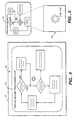
- Fig. 4 shows projection screen 12 having laser spot 16 lying within a flow chart comprising presentation image 13.
- presentation image 13 is analyzed at a higher resolution of 160 ⁇ 120 pixels, shown in Fig. 5, and the location of laser spot 16 is determined to a correspondingly greater precision, here at positional coordinates (128, 114).
- Processing section 35 assigns successive positional coordinates to the location of laser spot 16 for each acquired image 63a, 63b,...,63n in which laser spot 16 is detected.
- the series of positional coordinates are captured, or stored, in memory 34 and analyzed for the occurrence of a spatial pattern.
- Control module 33 further comprises a reference section 36 in which are stored a set of pre-established gesture spatial patterns and a set of pre-assigned display commands, each display command assigned, or correlated, to one of the pre-established gesture spatial patterns.
- processing section 35 compares the identified spatial pattern with the set of pre-established gesture spatial patterns. If a match is found, processing section 35 selects the display command assigned to the matching pre-established gesture spatial pattern and executes the selected display command.
- input port 65 comprises a serial port, the display command being transmitted via a serial or a USB cable 39.
- processing section 35 may reside in control module 33 as shown or, alternatively, may be resident in either digital camera 31 or display computer 21, may be retrieved as computer-readable instructions from a storage medium 67, or may be distributed among any of digital camera 31, control module 33, and display computer 21.
- processing section 35 assigns positional coordinates (e.g., x i , y i ) to the successive positions of laser spot 16 motion to determine whether laser spot 16 is moving, and, if moving, whether the movement is random or whether the movement correlates to one of a number of pre-established shapes or patterns. Movement and direction can be determined by analyzing the corresponding sequence of displacement vectors, r i (( x i +1 ⁇ x i ),( y i +1 ⁇ y i )).
- a spatial pattern recognition tool known in the relevant art as a Freeman chain code
- a Freeman chain code assigns a number to the translational vector of laser spot 16, that is, to a vector describing movement from one acquired image 63 i to next acquired image 63 i+1 .
- a vertical movement represented by a directional vector 71 at ⁇ / 2
- a diagonal movement in the third quadrant represented by a directional vector 73 at 5 ⁇ / 4
- Processing section 35 discriminates between random movement of laser spot 16 and an intentional gesture made by presenter 37 by analyzing the resulting sequence of Freeman chain codes.
- Fig. 7 illustrates how a captured gesture spatial pattern is described by a Freeman chain code.
- Control module 33 has captured the positional coordinates of laser spot 16 in five initial consecutive images in which the motion of laser spot in four successive image pairs is described by a series of four "code 4s" represented by directional vectors 75a, 75b, 75c, and 75d.
- the motion of laser spot 16 in five subsequent images is described by a series of five "code 6s” represented by directional vectors 77a, 77b, 77c, 77d, and 77e respectively.
- Processing section 35 compares the captured gesture spatial pattern sequence of four consecutive "code 4" vectors followed by a series of five consecutive "code 6" vectors with pre-established gesture spatial pattern entries provided to processing section 35 from reference section 36, which may be a random-access memory, firmware, or a look-up table. A match determines that the captured gesture comprises a right-hand arrow 51. For a captured gesture spatial pattern comprising a random series of different Freeman chain codes, processing section 35 would determine that random laser spot movement is occurring and no display command would be issued.
- Display presentation system 10 can be used in a "mouse mode" to project a series of PowerPoint® slides as presentation images 13.
- display computer may respond by calling up the next in the series of presentation slides for transmittal to image projector 23. That is, the display command of "Advance to next slide” would be correlated, or assigned, to right-hand arrow 51.
- the gesture spatial pattern comprises a left-hand arrowhead
- the previous image may be recalled and provided as projection image 29.
- an arrowhead indicator can be assigned to change the volume of the audio, or change some other slide characteristic of the presentation via a pre-established display command.
- Presenter 37 may also position laser spot 16 in a particular region of presentation image 13, such as on an icon or over a menu entry.
- Processing section 35 interprets this condition as a selection of the surrounding icon or menu entry, equivalent to a first mouse click.
- a second mouse click, subsequent to the action of selection, is effected by pulsing laser pointer 11 for a pre-establisbed time interval, preferably three seconds, while laser spot 16 remains in the icon or menu entry.
- positioning laser spot 16 in the border of presentation image 13 produces a drop-down menu for subsequent selection and action.
- a subsequent single pulsing of laser spot 16 on the selected region is subsequently interpreted by processing section 35 as a second mouse click.
- the projection of laser beam 15 onto presentation image 13 serves to control the display presentation, by opening a new file, cutting, or pasting, for example, from essentially any location in the presentation room.
- laser pointer 11 is used with presentation control system 30 much in the same way as a mouse, a keyboard, or other peripheral device would be used to control projection image 29 via direct input to display computer 21. This method of control is especially useful in presentations where presenter 37 needs to access and navigate Internet web links while speaking and moving about.
- a "drawing mode" can be accessed when laser pointer 11 is pulsed to produce three consecutive mouse clicks.
- laser spot 16 can be used to draw lines or curves on presentation image 13.
- laser pointer 11 is pulsed to produce four mouse clicks.
- additional functions can be executed during the presentation.
- processing section 35 when presenter 37 traces out a horizontal line in the text or graphics portion of presentation image 13, for example, processing section 35 generates a subsequent electronic image 24 by combining initial electronic image 22a with an overlay, where the overlay provides a highlighting or underlining corresponding to the horizontal line traced out by laser spot 16.
- Subsequent electronic image 24 is then transmitted to projector 23 for projection as presentation image 13 having the corresponding text portion or graphic portion underscored or highlighted. Additionally, when presenter 37 traces out a rectangular shape enclosing a portion of presentation image 13, the corresponding portion of initial slide 22 is enlarged and transmitted as subsequent electronic image 24, so as to result in a zoom-in operation.
- image projector 23 is directly connected to display computer 21.
- This configuration can be used when control system 30 provides only mouse commands to display computer 21. Operation is similar to the embodiment described above, with laser spot 16 projected onto presentation image 13 to provide control.
- Digital camera 31 samples presentation image 13 and acquired images 63a, 63b,...,63n are analyzed by processing section 35 in control module 33. When a match is found between an identified gesture spatial pattern and a pre-established gesture spatial pattern from reference section 36, a corresponding mouse command is transmitted to display computer 21 via serial cable 39.
- processing section 35 instructions and reference section 36 data may be retrieved from storage medium 67.
- control system 30 may be calibrated by using processing section 35 to correlate the image elements and positional coordinates of presentation image 13 to the corresponding elements and coordinates comprising initial electronic image 22a resident in display computer 21. This may be done, for example, by, i) generating an embedded predetermined pattern (not shown) in projection image 29, ii) acquiring presentation image 13, including the embedded pattern, by means of electronic camera 31, iii) detecting the predetermined pattern and establishing relevant positional coordinates within the image acquired by electronic camera 31, and iv) analyzing the pattern coordinates to mathematically correlate the coordinates of presentation image 13 to the coordinates of initial electronic image 22a.
- Processing section 35 may additionally function to determine the ambient light level in the presentation area, as sensed by electronic camera 31, so as to provide for an optimal setting of the brightness and contrast of presentation image 13.
- the color balance of presentation image 13 is optimized with image projector 23 projecting a standardized color calibration chart (not shown) onto projection screen 12, and comparing the values of the projected colors, as acquired by electronic camera 31, with the known values for the chart colors. From the comparison results, processing section 35 determines the color corrections to be made and adjusts presentation image 13 accordingly.
Landscapes
- Engineering & Computer Science (AREA)
- Theoretical Computer Science (AREA)
- Physics & Mathematics (AREA)
- General Physics & Mathematics (AREA)
- General Engineering & Computer Science (AREA)
- Human Computer Interaction (AREA)
- General Health & Medical Sciences (AREA)
- Computer Vision & Pattern Recognition (AREA)
- Health & Medical Sciences (AREA)
- Psychiatry (AREA)
- Social Psychology (AREA)
- Multimedia (AREA)
- Computer Hardware Design (AREA)
- Controls And Circuits For Display Device (AREA)
- Position Input By Displaying (AREA)
- User Interface Of Digital Computer (AREA)
- Projection Apparatus (AREA)
Abstract
Description
Claims (41)
- A display presentation control system suitable for use in providing control to a projection display apparatus including a display computer for generating initial and successive electronic images, a computer-controlled image projector, a projection screen, and a laser pointer operating in pulsing and continuous-radiation modes, the projector for receiving the initial electronic image for projection onto the projection screen as an initial presentation image, and the laser pointer for providing the control when used by a presenter to emit a laser spot onto the projection screen and project a spatial pattern on the initial presentation image, said control system comprising:an electronic camera directed at the initial presentation image and producing a sequence of acquired images thereof, each said acquired image comprising image elements; and,a control module responsive to said acquired images, said control module comprising:means for locating the laser spot in said acquired images;means for assigning positional coordinates to each said located laser spot so as to produce a sequence of positional coordinates (xi ,yi ) corresponding to sequential positions of the laser spot in the initial presentation image;means for analyzing said sequence of positional coordinates so as to capture a gesture spatial pattern formed by said sequence of positional coordinates;means for matching said captured gesture spatial pattern to one of a set of pre-established gesture spatial patterns;means for selecting a display command, said selected display command correlated to said matched pre-established gesture spatial pattern; andmeans for generating a subsequent electronic image in response to said selected display command, said subsequent electronic image transmitted to the image projector for projection onto the projection screen as a subsequent presentation image.
- The control system of claim 1 wherein said means for locating the laser spot comprises means for identifying a bright image element, said bright image element comprising an acquired image element having a brightness exceeding a predetermined threshold value.
- The control system of claim 2 wherein said means for locating the laser spot further comprises means for identifying a cluster of said bright image elements, said cluster comprising a contiguous image element aggregate having a linear dimension exceeding a predetermined value.
- The control system of claim 1 wherein said means for assigning positional coordinates comprises means for analyzing said acquired image in a decreased-resolution mode.
- The control system of claim 1 wherein said means for analyzing positional coordinates comprises means for deriving a sequence of displacement vectors
r i ((xi +1 ― xi ),(yi +1 ― yi )), each said displacement vector corresponding to the difference in successive said positional coordinates. - The control system of claim 5 wherein said means for analyzing positional coordinates comprises means for describing said sequence of displacement vectors by a sequence of Freeman chain codes.
- The control system of claim 1 further comprising means for detecting a laser spot pulse, said laser spot pulse produced by operating the laser pointer in its pulsing mode for a pre-established time interval.
- The control system of claim 7 wherein said pre-established time interval is approximately three seconds.
- The control system of claim 7 wherein said display command comprises a first mouse click when an essentially stationary laser spot is detected in a pre-defined region of the initial presentation image by said means for analyzing positional coordinates, said first mouse click transmitted to the display computer.
- The control system of claim 9 wherein said pre-defined region comprises an icon.
- The control system of claim 9 wherein said first mouse click provides a drop-down menu in said subsequent presentation image.
- The control system of claim 9 wherein said display command further comprises a second mouse click when said laser spot pulse is detected, said second mouse click transmitted to the display computer.
- The control system of claim 12 wherein said second mouse click initiates a selection of said pre-defined region of the initial presentation image in said subsequent presentation image.
- The control system of claim 7 wherein said selected display command comprises an overlay command correlated to the receipt of three said laser spot pulses, said overlay command producing a subsequent electronic image comprising an overlay image superimposed on the initial electronic image.
- The control system of claim 14 wherein said overlay image comprises one or more curves corresponding to translational movements of the laser spot across the initial presentation image.
- The control system of claim 14 wherein said overlay image comprises a highlighting region, said highlighting region corresponding to translational movements of the laser spot across the initial presentation image.
- The control system of claim 15 wherein said selected display command comprises a zoom-in command when said one or more curves define an enclosed portion of the initial presentation image, said zoom-in command producing a subsequent electronic image comprising an enlarged portion of the initial electronic image, said enlarged portion corresponding to said enclosed portion of the initial presentation image.
- The control system of claim 1 wherein said means for generating a subsequent electronic image comprises means for transmitting a mouse command to the display computer, said subsequent electronic image transmitted to the image projector by the display computer.
- The control system of claim 18 wherein said mouse command comprises a command for advancing to the next successive electronic image when said matched pre-established gesture spatial pattern comprises a right-hand arrowhead.
- The control system of claim 1 further comprising memory means for storing said positional coordinates.
- The control system of claim 20 wherein said memory means comprises a reference section for storing said display commands and said pre-established images.
- A display presentation control system suitable for use in providing control to a projection display apparatus including a display computer for generating initial and successive electronic images, a computer-controlled image projector, a projection screen, and a laser pointer operating in pulsing and continuous-radiation modes, the projector for receiving the initial electronic image for projection onto the projection screen as an initial presentation image, and the laser pointer for providing the control when used by a presenter to emit a laser spot onto the projection screen and project a spatial pattern on the initial presentation image, said control system comprising:an electronic camera directed at the initial presentation image and producing a sequence of acquired images thereof, each said acquired image comprising image elements; and,a control module responsive to said acquired images, said control module comprising:a memory section comprising a set of pre-established gesture spatial patterns and a set of display commands, each said display command corresponding to one of said pre-established gesture spatial patterns;locating circuitry for locating the laser spot in said acquired images;image processing circuitry responsive to the locating of the laser spot in said acquired images, said image processing circuitry for assigning positional coordinates to each said located laser spot, for producing a sequence of positional coordinates (xi ,yi ) corresponding to sequential positions of the laser spot in the initial presentation image, and for analyzing said sequence of positional coordinates so as to capture a gesture spatial pattern formed by said sequence of positional coordinates; andcommand circuitry responsive to said captured gesture spatial pattern for matching said captured gesture spatial pattern to one of said pre-established gesture spatial patterns, for selecting one of said display commands corresponding to said matched gesture spatial pattern; and for generating a mouse command in response to said selected display command;said mouse command transmitted to the display computer such that a subsequent presentation image is projected onto the projection screen.
- The control system of claim 22 wherein said locating circuitry comprises brightness detection circuitry for identifying a bright image element, said bright image element comprising an acquired image element having a brightness exceeding a predetermined threshold value.
- The control system of claim 23 wherein said locating circuitry further comprises cluster detection circuitry for identifying a cluster of said bright image elements, said cluster comprising a contiguous image element aggregate having a linear dimension exceeding a predetermined value.
- The control system of claim 23 wherein said image processing circuitry comprises computational circuitry for deriving a sequence of displacement vectors
r i ((xi +1 ― xi ),(yi +1 ― yi )), each said displacement vector corresponding to the difference in successive said positional coordinates. - The control system of claim 25 wherein said computational circuitry further comprises conversion circuitry for converting said sequence of displacement vectors into a sequence of Freeman chain codes.
- A computer-readable storage medium containing instructions to direct a computer to function as a control system for:receiving a continuous sampling of images, each said image comprising a plurality of image elements;detecting a contiguous aggregate of bright image elements within each of a series of said images;assigning successive positional coordinates (xi ,yi ) to successive said detected bright image elements;analyzing said series of positional coordinates so as to identify a gesture spatial pattern; andgenerating a presentation command in accordance with said identification of said gesture spatial pattern.
- A storage medium as defined in claim 27 wherein said operation of analyzing said series of positional coordinates includes an operation of deriving a sequence of displacement vectors
r i ((xi +1 ― xi ),(yi +1 ― yi )), each said displacement vector corresponding to the difference in successive said positional coordinates. - A storage medium as defined in claim 28 wherein said operation of deriving a sequence of displacement vectors included an operation of describing said sequence of displacement vectors by a sequence of Freeman chain codes.
- A storage medium as defined in claim 27 wherein said presentation command comprises a mouse command.
- A method for controlling a display presentation apparatus comprising a computer-controlled image projector projecting a sequence of presentation images onto a projection screen, control effected by means of a presenter using a laser pointer to project a laser spot onto the projection screen, the laser spot moved across the presentation image in a pre-established gesture spatial pattern, said method comprising the steps of:acquiring a series of images corresponding to the projected presentation image and laser spot, each said acquired image comprising a plurality of image elements;assigning a series of positional coordinates to the location of the laser spot within each acquired image;analyzing said, series of positional coordinates so as to identify the gesture spatial pattern produced by the laser spot; and,generating a presentation command in accordance with said identification of the gesture spatial pattern.
- The method of claim 31 further comprising the step of matching said identified gesture spatial pattern to the pre-established gesture spatial pattern.
- The method of claim 31 wherein said step of analyzing said positional coordinates comprises the step of detecting bright acquired image elements, each said bright acquired image element having a brightness exceeding a predetermined threshold value.
- The method of claim 33 further comprising the step of identifying a cluster of bright acquired image elements as the laser spot, said cluster comprising a contiguous acquired image element aggregate having a linear dimension exceeding a predetermined value.
- The method of claim 33 further comprising the step of detecting an essentially stationary laser spot.
- The method of claim 33 further comprising the step of selecting a portion of said initial slide in response to said detection of an essentially stationary laser spot.
- The method of claim. 35 further comprising the step of detecting a pulsing laser spot.
- The method of claim 37 further comprising the step of providing a drawn curve in said subsequent presentation image in response to the detection of said pulsing laser spot, said drawn curve corresponding to the movement of said laser spot.
- The method of claim 38 further comprising the step of highlighting a portion of said subsequent presentation image, said highlighted portion corresponding to said drawn curve.
- The method of claim 31 wherein said step of analyzing comprises the step of describing said identified gesture spatial pattern by means of a Freeman chain code.
- The method of claim 40 wherein said step of generating comprises the step of producing a sequential presentation image when said identified gesture spatial pattern comprises an arrowhead shape.
Applications Claiming Priority (2)
| Application Number | Priority Date | Filing Date | Title |
|---|---|---|---|
| US09/399,933 US6346933B1 (en) | 1999-09-21 | 1999-09-21 | Interactive display presentation system |
| US399933 | 1999-09-21 |
Publications (3)
| Publication Number | Publication Date |
|---|---|
| EP1087327A2 true EP1087327A2 (en) | 2001-03-28 |
| EP1087327A3 EP1087327A3 (en) | 2002-01-23 |
| EP1087327B1 EP1087327B1 (en) | 2006-06-21 |
Family
ID=23581532
Family Applications (1)
| Application Number | Title | Priority Date | Filing Date |
|---|---|---|---|
| EP00116708A Expired - Lifetime EP1087327B1 (en) | 1999-09-21 | 2000-08-02 | Interactive display presentation system |
Country Status (6)
| Country | Link |
|---|---|
| US (1) | US6346933B1 (en) |
| EP (1) | EP1087327B1 (en) |
| JP (1) | JP3909554B2 (en) |
| KR (1) | KR100456999B1 (en) |
| CN (1) | CN1143205C (en) |
| DE (1) | DE60028894T2 (en) |
Cited By (23)
| Publication number | Priority date | Publication date | Assignee | Title |
|---|---|---|---|---|
| WO2002031753A1 (en) * | 2000-10-10 | 2002-04-18 | Cetin, Ahmet, Enis | Character entry apparatus based on character recognition in the video signal |
| EP1441514A3 (en) * | 2003-01-21 | 2004-08-18 | Hewlett-Packard Development Company, L.P. | Interactive image projector |
| FR2853485A1 (en) * | 2003-04-07 | 2004-10-08 | Hewlett Packard Development Co | DIGITAL CAMERA USER INTERFACE USING HAND GESTURES |
| EP1463283A3 (en) * | 2003-03-04 | 2005-04-27 | Kabushiki Kaisha Toshiba | Information processing apparatus and program |
| EP1681619A1 (en) * | 2005-01-18 | 2006-07-19 | Topseed Technology Corp. | System for real-time identifying and recording laser manuscript |
| WO2007020549A3 (en) * | 2005-08-12 | 2007-08-02 | Koninkl Philips Electronics Nv | Method of calibrating a control system for controlling a device |
| WO2008044195A3 (en) * | 2006-10-12 | 2008-06-12 | Koninkl Philips Electronics Nv | System and method for light control |
| ITRM20090153A1 (en) * | 2009-04-01 | 2010-10-02 | Stark Srl | INTEGRATED INTERACTIVE PROJECTOR MODULE |
| GB2470651A (en) * | 2009-05-26 | 2010-12-01 | Elmo Co Ltd | Document camera presentation device with remote control highlighting mode |
| EP2296081A1 (en) * | 2009-09-14 | 2011-03-16 | Samsung Electronics Co., Ltd. | Image processing apparatus and method of controlling the same |
| WO2011062716A1 (en) * | 2009-11-17 | 2011-05-26 | Qualcomm Incorporated | User interface methods and systems for providing gesturing on projected images |
| DE102010013719A1 (en) | 2010-03-31 | 2011-10-06 | Mikko Mannila | Presentation system i.e. flip chart, for presentation of text and information during e.g. meeting, has adhesion elements exhibiting smaller size than presentation film, where rear side of each element is displaceable on surface of film |
| EP2383609A1 (en) * | 2010-04-30 | 2011-11-02 | Samsung Electronics Co., Ltd. | Interactive display apparatus and operating method thereof |
| AT506618B1 (en) * | 2008-01-25 | 2013-02-15 | Stumpfl Reinhold | INTERACTIVE MULTIMEDIA PRESENTATION DEVICE |
| CN102939617A (en) * | 2010-06-15 | 2013-02-20 | 索尼公司 | Gesture recognition device, gesture recognition method and program |
| US8538367B2 (en) | 2009-06-29 | 2013-09-17 | Qualcomm Incorporated | Buffer circuit with integrated loss canceling |
| DE102012210065A1 (en) | 2012-06-14 | 2013-12-19 | Robert Bosch Gmbh | Apparatus and method for identifying a laser pointer |
| US8682920B2 (en) | 2009-03-17 | 2014-03-25 | Konica Minolta Business Technologies, Inc. | Information providing apparatus, information providing method, and information providing program embodied on computer readable medium |
| WO2014101779A1 (en) * | 2012-12-26 | 2014-07-03 | Huawei Technologies Co., Ltd. | Laser beam based gesture control interface for mobile devices |
| US9270917B2 (en) | 2005-12-24 | 2016-02-23 | Samsung Electronics Co., Ltd. | Apparatus and method for controlling home network devices |
| US9811166B2 (en) | 2007-09-14 | 2017-11-07 | Intellectual Ventures Holding 81 Llc | Processing of gesture-based user interactions using volumetric zones |
| AT520234A1 (en) * | 2017-07-27 | 2019-02-15 | Ulrich Emanuel Andel Mag | Device for the interactive presentation of visual content |
| US10831278B2 (en) | 2008-03-07 | 2020-11-10 | Facebook, Inc. | Display with built in 3D sensing capability and gesture control of tv |
Families Citing this family (191)
| Publication number | Priority date | Publication date | Assignee | Title |
|---|---|---|---|---|
| US8352400B2 (en) | 1991-12-23 | 2013-01-08 | Hoffberg Steven M | Adaptive pattern recognition based controller apparatus and method and human-factored interface therefore |
| US7966078B2 (en) | 1999-02-01 | 2011-06-21 | Steven Hoffberg | Network media appliance system and method |
| US6927756B1 (en) * | 1999-11-05 | 2005-08-09 | Cypress Semiconductor Corp. | Apparatus and method for controlling an electronic presentation |
| US6597410B1 (en) * | 1999-11-10 | 2003-07-22 | International Business Machines Corporation | System for the automatic adaptation of projector images and a method for the implementation thereof |
| US6618076B1 (en) * | 1999-12-23 | 2003-09-09 | Justsystem Corporation | Method and apparatus for calibrating projector-camera system |
| JP3842515B2 (en) * | 2000-03-24 | 2006-11-08 | セイコーエプソン株式会社 | Pointed position detection by multi-resolution image analysis |
| JP4018326B2 (en) * | 2000-08-07 | 2007-12-05 | キヤノン株式会社 | Coordinate input device, control method therefor, and computer-readable memory |
| JP3497805B2 (en) * | 2000-08-29 | 2004-02-16 | オリンパス株式会社 | Image projection display device |
| US20020080999A1 (en) * | 2000-11-03 | 2002-06-27 | Ali Bani-Hashemi | System and method for highlighting a scene under vision guidance |
| US6704000B2 (en) * | 2000-11-15 | 2004-03-09 | Blue Iris Technologies | Method for remote computer operation via a wireless optical device |
| US6731330B2 (en) * | 2001-01-30 | 2004-05-04 | Hewlett-Packard Development Company, L.P. | Method for robust determination of visible points of a controllable display within a camera view |
| GB2374663A (en) * | 2001-04-18 | 2002-10-23 | Nokia Corp | Presentation of images |
| US6729731B2 (en) * | 2001-06-11 | 2004-05-04 | Info Valley Corporation | Untethered laser pointer for use with computer display |
| US7830362B2 (en) * | 2001-07-05 | 2010-11-09 | Michael Cain Finley | Laser and digital camera computer pointer device system |
| JP2003108305A (en) * | 2001-09-28 | 2003-04-11 | Fuji Photo Optical Co Ltd | Presentation system |
| RU2216766C2 (en) * | 2002-02-11 | 2003-11-20 | Талыгин Алексей Константинович | Computer remote control system |
| US7113169B2 (en) * | 2002-03-18 | 2006-09-26 | The United States Of America As Represented By The Secretary Of The Air Force | Apparatus and method for a multiple-user interface to interactive information displays |
| US7176881B2 (en) * | 2002-05-08 | 2007-02-13 | Fujinon Corporation | Presentation system, material presenting device, and photographing device for presentation |
| US20040001082A1 (en) * | 2002-06-26 | 2004-01-01 | Amir Said | System and method of interaction with a computer controlled image display system using a projected light source |
| WO2004006221A1 (en) * | 2002-07-05 | 2004-01-15 | Lixin Ran | A laser pointer with a touching-controlled panel and a wireless transceiver |
| JP3867205B2 (en) * | 2002-08-30 | 2007-01-10 | カシオ計算機株式会社 | Pointed position detection device, pointed position detection system, and pointed position detection method |
| US20040135974A1 (en) * | 2002-10-18 | 2004-07-15 | Favalora Gregg E. | System and architecture for displaying three dimensional data |
| US6802611B2 (en) * | 2002-10-22 | 2004-10-12 | International Business Machines Corporation | System and method for presenting, capturing, and modifying images on a presentation board |
| US6979087B2 (en) * | 2002-10-31 | 2005-12-27 | Hewlett-Packard Development Company, L.P. | Display system with interpretable pattern detection |
| JP4243248B2 (en) * | 2002-11-20 | 2009-03-25 | コーニンクレッカ フィリップス エレクトロニクス エヌ ヴィ | User interface system based on pointing device |
| US20040095312A1 (en) * | 2002-11-20 | 2004-05-20 | Sean Chen | Infrared remote-control laser pointer |
| EP1443777A1 (en) * | 2003-01-28 | 2004-08-04 | Gretag-Macbeth AG | Profiling method, electronic projector therewith and system for profiling an electronic display device |
| US20060176274A1 (en) * | 2003-02-25 | 2006-08-10 | Chiu-Hao Cheng | Photographic type pointer positioning device |
| US7559656B2 (en) * | 2003-03-03 | 2009-07-14 | Panasonic Corporation | Projector system |
| US7193608B2 (en) * | 2003-05-27 | 2007-03-20 | York University | Collaborative pointing devices |
| JP4175234B2 (en) * | 2003-10-07 | 2008-11-05 | セイコーエプソン株式会社 | Display control apparatus, portable information terminal, and display control method |
| TWI226784B (en) * | 2003-10-20 | 2005-01-11 | Ind Tech Res Inst | Multi-trails spot click-event detection method |
| US7221374B2 (en) * | 2003-10-21 | 2007-05-22 | Hewlett-Packard Development Company, L.P. | Adjustment of color in displayed images based on identification of ambient light sources |
| US7420540B2 (en) * | 2003-12-01 | 2008-09-02 | Olbrich Craig A | Determining positioning and/or relative movement of graphical-user interface element based on display images |
| BRPI0417655A (en) * | 2003-12-18 | 2007-04-03 | Koninkl Philips Electronics Nv | method for controlling a device, user interface for controlling a device, pointing device, control unit, and, device |
| US7221407B2 (en) * | 2004-01-06 | 2007-05-22 | Sharp Laboratories Of America, Inc. | Television having a java engine and a removable device port |
| US7746357B2 (en) * | 2004-01-06 | 2010-06-29 | Sharp Laboratories Of America, Inc. | Dual-plane graphics |
| US8442331B2 (en) | 2004-02-15 | 2013-05-14 | Google Inc. | Capturing text from rendered documents using supplemental information |
| US7707039B2 (en) | 2004-02-15 | 2010-04-27 | Exbiblio B.V. | Automatic modification of web pages |
| US20050174337A1 (en) * | 2004-02-11 | 2005-08-11 | Nielsen Paul S. | Electronic handheld drawing and gaming system using television monitor |
| US7812860B2 (en) * | 2004-04-01 | 2010-10-12 | Exbiblio B.V. | Handheld device for capturing text from both a document printed on paper and a document displayed on a dynamic display device |
| US20060041484A1 (en) * | 2004-04-01 | 2006-02-23 | King Martin T | Methods and systems for initiating application processes by data capture from rendered documents |
| US20060041605A1 (en) * | 2004-04-01 | 2006-02-23 | King Martin T | Determining actions involving captured information and electronic content associated with rendered documents |
| US10635723B2 (en) | 2004-02-15 | 2020-04-28 | Google Llc | Search engines and systems with handheld document data capture devices |
| US20060122983A1 (en) * | 2004-12-03 | 2006-06-08 | King Martin T | Locating electronic instances of documents based on rendered instances, document fragment digest generation, and digest based document fragment determination |
| US20060053097A1 (en) * | 2004-04-01 | 2006-03-09 | King Martin T | Searching and accessing documents on private networks for use with captures from rendered documents |
| US9143638B2 (en) | 2004-04-01 | 2015-09-22 | Google Inc. | Data capture from rendered documents using handheld device |
| US20060098900A1 (en) | 2004-09-27 | 2006-05-11 | King Martin T | Secure data gathering from rendered documents |
| US8146156B2 (en) | 2004-04-01 | 2012-03-27 | Google Inc. | Archive of text captures from rendered documents |
| US20060081714A1 (en) | 2004-08-23 | 2006-04-20 | King Martin T | Portable scanning device |
| US7990556B2 (en) | 2004-12-03 | 2011-08-02 | Google Inc. | Association of a portable scanner with input/output and storage devices |
| US9008447B2 (en) | 2004-04-01 | 2015-04-14 | Google Inc. | Method and system for character recognition |
| US20080313172A1 (en) * | 2004-12-03 | 2008-12-18 | King Martin T | Determining actions involving captured information and electronic content associated with rendered documents |
| US7894670B2 (en) | 2004-04-01 | 2011-02-22 | Exbiblio B.V. | Triggering actions in response to optically or acoustically capturing keywords from a rendered document |
| US8081849B2 (en) * | 2004-12-03 | 2011-12-20 | Google Inc. | Portable scanning and memory device |
| US9116890B2 (en) | 2004-04-01 | 2015-08-25 | Google Inc. | Triggering actions in response to optically or acoustically capturing keywords from a rendered document |
| US20050239037A1 (en) * | 2004-04-06 | 2005-10-27 | Surapong Lertsithichai | Convertible podium system |
| US8713418B2 (en) * | 2004-04-12 | 2014-04-29 | Google Inc. | Adding value to a rendered document |
| US8489624B2 (en) | 2004-05-17 | 2013-07-16 | Google, Inc. | Processing techniques for text capture from a rendered document |
| US8620083B2 (en) | 2004-12-03 | 2013-12-31 | Google Inc. | Method and system for character recognition |
| US8874504B2 (en) | 2004-12-03 | 2014-10-28 | Google Inc. | Processing techniques for visual capture data from a rendered document |
| JP2005311598A (en) * | 2004-04-20 | 2005-11-04 | Elmo Co Ltd | Document presentation device |
| US7707399B2 (en) * | 2004-04-23 | 2010-04-27 | Intel Corporation | Adjusting depiction of user interface based upon state |
| JP2005318177A (en) * | 2004-04-28 | 2005-11-10 | Elmo Co Ltd | Document presentation device |
| US7683881B2 (en) * | 2004-05-24 | 2010-03-23 | Keytec, Inc. | Visual input pointing device for interactive display system |
| WO2005119356A2 (en) | 2004-05-28 | 2005-12-15 | Erik Jan Banning | Interactive direct-pointing system and calibration method |
| US8346620B2 (en) | 2004-07-19 | 2013-01-01 | Google Inc. | Automatic modification of web pages |
| CN101002165B (en) * | 2004-08-12 | 2010-06-23 | 皇家飞利浦电子股份有限公司 | Method and system for controlling a display |
| CN101006415B (en) | 2004-10-05 | 2010-08-18 | 株式会社尼康 | Electronic equipment with projector device |
| US8117544B2 (en) * | 2004-10-26 | 2012-02-14 | Fuji Xerox Co., Ltd. | System and method for detecting user actions in a video stream |
| US7657117B2 (en) * | 2004-12-20 | 2010-02-02 | Palo Alto Research Center Incorporated | Method and apparatus for calibrating a camera-based whiteboard scanner |
| US20060228018A1 (en) * | 2005-04-12 | 2006-10-12 | Gil Abramovich | Reconfigurable machine vision system |
| US8427426B2 (en) * | 2005-05-27 | 2013-04-23 | Sony Computer Entertainment Inc. | Remote input device |
| US7548230B2 (en) | 2005-05-27 | 2009-06-16 | Sony Computer Entertainment Inc. | Remote input device |
| JP4991154B2 (en) * | 2005-06-03 | 2012-08-01 | 株式会社リコー | Image display device, image display method, and command input method |
| JP4626416B2 (en) * | 2005-06-20 | 2011-02-09 | セイコーエプソン株式会社 | projector |
| US9285897B2 (en) | 2005-07-13 | 2016-03-15 | Ultimate Pointer, L.L.C. | Easily deployable interactive direct-pointing system and calibration method therefor |
| CN100462937C (en) * | 2005-10-09 | 2009-02-18 | 深圳市巨龙科教高技术股份有限公司 | Computer projection auxiliary positioning method and interactive demonstration system using said method |
| KR100740660B1 (en) * | 2005-11-16 | 2007-07-19 | 한양대학교 산학협력단 | Mobile communication terminal having laser pointer and presentation providing system using same |
| US7996776B2 (en) * | 2006-02-27 | 2011-08-09 | Microsoft Corporation | Shared telepointer |
| US8736547B2 (en) * | 2006-04-20 | 2014-05-27 | Hewlett-Packard Development Company, L.P. | Method and system for interfacing a digital device with an interactive display surface |
| JP2008009572A (en) * | 2006-06-27 | 2008-01-17 | Fuji Xerox Co Ltd | Document processing system, document processing method, and program |
| US7916129B2 (en) * | 2006-08-29 | 2011-03-29 | Industrial Technology Research Institute | Interactive display system |
| EP2067119A2 (en) | 2006-09-08 | 2009-06-10 | Exbiblio B.V. | Optical scanners, such as hand-held optical scanners |
| US8035630B2 (en) | 2006-10-13 | 2011-10-11 | Seiko Epson Corporation | USB image transmission system and device |
| US8356254B2 (en) * | 2006-10-25 | 2013-01-15 | International Business Machines Corporation | System and method for interacting with a display |
| US8089455B1 (en) | 2006-11-28 | 2012-01-03 | Wieder James W | Remote control with a single control button |
| KR100820573B1 (en) * | 2006-12-18 | 2008-04-07 | 옥은호 | Computer input device that recognizes position and flicker by comparing laser pointed image and computer image using camera |
| EP2124133B1 (en) * | 2007-01-12 | 2015-10-07 | Capcom Co., Ltd. | Display control device, program for implementing the display control device, and recording medium containing the program |
| JP2009043139A (en) * | 2007-08-10 | 2009-02-26 | Mitsubishi Electric Corp | Position detection device |
| US9418538B2 (en) * | 2007-08-14 | 2016-08-16 | Jeffrey D. Antos | Self-contained, pocket-sized presentation apparatus |
| US20090058805A1 (en) * | 2007-08-25 | 2009-03-05 | Regina Eunice Groves | Presentation system and method for making a presentation |
| JP4829855B2 (en) * | 2007-09-04 | 2011-12-07 | キヤノン株式会社 | Image projection apparatus and control method thereof |
| US7874681B2 (en) | 2007-10-05 | 2011-01-25 | Huebner Kenneth J | Interactive projector system and method |
| US9292092B2 (en) * | 2007-10-30 | 2016-03-22 | Hewlett-Packard Development Company, L.P. | Interactive display system with collaborative gesture detection |
| JP5446085B2 (en) * | 2007-11-05 | 2014-03-19 | カシオ計算機株式会社 | Projection apparatus, projection method, and program |
| US20090132926A1 (en) * | 2007-11-21 | 2009-05-21 | Samsung Electronics Co., Ltd. | Interactive presentation system and authorization method for voice command controlling interactive presentation process |
| US8055003B2 (en) | 2008-04-01 | 2011-11-08 | Apple Inc. | Acoustic systems for electronic devices |
| DE112008003807T5 (en) * | 2008-04-09 | 2011-02-10 | Hewlett-Packard Development Company, L.P., Houston | Remote controlled pointing |
| US9082117B2 (en) * | 2008-05-17 | 2015-07-14 | David H. Chin | Gesture based authentication for wireless payment by a mobile electronic device |
| JPWO2009150786A1 (en) * | 2008-06-09 | 2011-11-10 | 株式会社村田製作所 | Surface acoustic wave device and manufacturing method thereof |
| US20090309834A1 (en) * | 2008-06-16 | 2009-12-17 | Upmc | Laser Pointer Mouse |
| JP5317630B2 (en) * | 2008-11-07 | 2013-10-16 | キヤノン株式会社 | Image distribution apparatus, method and program |
| US8887052B1 (en) | 2009-01-09 | 2014-11-11 | Google Inc. | Presentation remote control |
| WO2010096191A2 (en) | 2009-02-18 | 2010-08-26 | Exbiblio B.V. | Automatically capturing information, such as capturing information using a document-aware device |
| US20100218100A1 (en) * | 2009-02-25 | 2010-08-26 | HNTB Holdings, Ltd. | Presentation system |
| EP2406767A4 (en) | 2009-03-12 | 2016-03-16 | Google Inc | Automatically providing content associated with captured information, such as information captured in real-time |
| US8447066B2 (en) | 2009-03-12 | 2013-05-21 | Google Inc. | Performing actions based on capturing information from rendered documents, such as documents under copyright |
| US8902280B2 (en) * | 2009-04-16 | 2014-12-02 | Hewlett-Packard Development Company, L.P. | Communicating visual representations in virtual collaboration systems |
| US8054290B2 (en) | 2009-05-27 | 2011-11-08 | Microsoft Corporation | Image contrast enhancement in depth sensor |
| CA2707286A1 (en) * | 2009-06-11 | 2010-12-11 | X2O Media Inc. | System and method for generating multimedia presentations |
| JP2011053468A (en) * | 2009-09-02 | 2011-03-17 | Sony Corp | Video/character simultaneous display device, and head-mounted display |
| JP5209795B2 (en) * | 2009-09-09 | 2013-06-12 | シャープ株式会社 | Gesture determination device and method |
| CN101661329B (en) * | 2009-09-22 | 2015-06-03 | 北京中星微电子有限公司 | Operating control method and device of intelligent terminal |
| US20110099476A1 (en) * | 2009-10-23 | 2011-04-28 | Microsoft Corporation | Decorating a display environment |
| US9081799B2 (en) | 2009-12-04 | 2015-07-14 | Google Inc. | Using gestalt information to identify locations in printed information |
| US9323784B2 (en) | 2009-12-09 | 2016-04-26 | Google Inc. | Image search using text-based elements within the contents of images |
| US9244533B2 (en) * | 2009-12-17 | 2016-01-26 | Microsoft Technology Licensing, Llc | Camera navigation for presentations |
| US9373265B2 (en) * | 2009-12-31 | 2016-06-21 | Richard M. Jeffrey | Conditioning apparatus and related method |
| JP5560721B2 (en) * | 2010-01-12 | 2014-07-30 | セイコーエプソン株式会社 | Image processing apparatus, image display system, and image processing method |
| US20110207504A1 (en) * | 2010-02-24 | 2011-08-25 | Anderson Glen J | Interactive Projected Displays |
| JP5693022B2 (en) * | 2010-03-04 | 2015-04-01 | キヤノン株式会社 | Display control device, display control system, and control method, program, and storage medium thereof |
| US8217997B2 (en) * | 2010-03-16 | 2012-07-10 | Interphase Corporation | Interactive display system |
| US20110230238A1 (en) * | 2010-03-17 | 2011-09-22 | Sony Ericsson Mobile Communications Ab | Pointer device to navigate a projected user interface |
| US8434873B2 (en) * | 2010-03-31 | 2013-05-07 | Hong Kong Applied Science and Technology Research Institute Company Limited | Interactive projection device |
| CN102262733B (en) * | 2010-05-28 | 2014-03-19 | 株式会社理光 | Laser point detection method and apparatus thereof |
| CN102402368B (en) * | 2010-09-10 | 2017-05-24 | 联想(北京)有限公司 | Display control method and device |
| CN102419658A (en) * | 2010-09-27 | 2012-04-18 | 南京芒冠光电科技股份有限公司 | Interactive projector system |
| CN101943947A (en) * | 2010-09-27 | 2011-01-12 | 鸿富锦精密工业(深圳)有限公司 | Interactive display system |
| JP2012108479A (en) * | 2010-10-28 | 2012-06-07 | Seiko Epson Corp | Projection type display device and control method thereof |
| WO2012108552A1 (en) * | 2011-02-08 | 2012-08-16 | Lg Electronics Inc. | Display device and control method thereof |
| US9179182B2 (en) | 2011-04-12 | 2015-11-03 | Kenneth J. Huebner | Interactive multi-display control systems |
| WO2012143043A1 (en) * | 2011-04-19 | 2012-10-26 | Abb Research Ltd | Method and system for controlling an industrial system |
| CN102156859B (en) * | 2011-04-21 | 2012-10-03 | 刘津甦 | Perception method of hand posture and spatial position |
| CN102760011B (en) * | 2011-04-28 | 2016-06-29 | 东友科技股份有限公司 | Interactive projection system and interactive method of projection system |
| JP5482740B2 (en) * | 2011-07-11 | 2014-05-07 | コニカミノルタ株式会社 | Presentation system, presentation device, and program |
| JP5790229B2 (en) * | 2011-07-19 | 2015-10-07 | 株式会社リコー | Information processing apparatus and information processing method |
| TWI446255B (en) * | 2011-07-28 | 2014-07-21 | Wistron Corp | Display device with on-screen display menu function |
| JP2013037420A (en) * | 2011-08-04 | 2013-02-21 | Dainippon Printing Co Ltd | Content display system, content display control method, content display control device, and program |
| KR101255977B1 (en) | 2011-08-18 | 2013-04-23 | 연세대학교 산학협력단 | Gesture based collaboration system for construction site |
| TWI452509B (en) * | 2011-08-25 | 2014-09-11 | 3D sensing method and system of touch panel | |
| JP6088127B2 (en) * | 2011-10-13 | 2017-03-01 | セイコーエプソン株式会社 | Display device, display device control method, and program |
| CN102361495B (en) * | 2011-10-21 | 2014-06-18 | 青岛海信信芯科技有限公司 | Projection control method and projection equipment |
| US8866828B2 (en) * | 2011-11-01 | 2014-10-21 | Apple Inc. | Enabling display commands from an electronic device to an integrated display on a computer system |
| US9501152B2 (en) | 2013-01-15 | 2016-11-22 | Leap Motion, Inc. | Free-space user interface and control using virtual constructs |
| US10691219B2 (en) | 2012-01-17 | 2020-06-23 | Ultrahaptics IP Two Limited | Systems and methods for machine control |
| US11493998B2 (en) | 2012-01-17 | 2022-11-08 | Ultrahaptics IP Two Limited | Systems and methods for machine control |
| US12260023B2 (en) | 2012-01-17 | 2025-03-25 | Ultrahaptics IP Two Limited | Systems and methods for machine control |
| US8638989B2 (en) | 2012-01-17 | 2014-01-28 | Leap Motion, Inc. | Systems and methods for capturing motion in three-dimensional space |
| US9070019B2 (en) | 2012-01-17 | 2015-06-30 | Leap Motion, Inc. | Systems and methods for capturing motion in three-dimensional space |
| US8693731B2 (en) | 2012-01-17 | 2014-04-08 | Leap Motion, Inc. | Enhanced contrast for object detection and characterization by optical imaging |
| US9679215B2 (en) | 2012-01-17 | 2017-06-13 | Leap Motion, Inc. | Systems and methods for machine control |
| US20150253428A1 (en) | 2013-03-15 | 2015-09-10 | Leap Motion, Inc. | Determining positional information for an object in space |
| JP5929387B2 (en) * | 2012-03-22 | 2016-06-08 | 株式会社リコー | Information processing apparatus, history data generation program, and projection system |
| CN102724464B (en) * | 2012-05-23 | 2014-12-17 | 海信集团有限公司 | Projection display device, projection display system and projection display control method |
| US8973095B2 (en) * | 2012-06-25 | 2015-03-03 | Intel Corporation | Authenticating a user of a system via an authentication image mechanism |
| CN103543820B (en) * | 2012-07-09 | 2017-04-12 | 宏碁股份有限公司 | Wireless interactive projection method and system |
| CN102779014B (en) * | 2012-07-17 | 2017-02-15 | 海信集团有限公司 | Interactive protection system and protector adjusting control method |
| JP2014021933A (en) * | 2012-07-23 | 2014-02-03 | Ricoh Co Ltd | Projection device, and projection method |
| TWI537775B (en) * | 2012-07-26 | 2016-06-11 | 群邁通訊股份有限公司 | System and method for controlling a mouse icon |
| KR20140024769A (en) * | 2012-08-21 | 2014-03-03 | 삼성전자주식회사 | Method for event handling of projector by using direction pointer and an electronic device thereof |
| WO2014034049A1 (en) * | 2012-08-30 | 2014-03-06 | パナソニック株式会社 | Stylus detection device, and stylus detection method |
| CN102968178B (en) * | 2012-11-07 | 2015-08-26 | 电子科技大学 | A kind of PPT control system based on gesture |
| JP6255810B2 (en) * | 2013-09-06 | 2018-01-10 | セイコーエプソン株式会社 | Display device and control method of display device |
| US9459697B2 (en) | 2013-01-15 | 2016-10-04 | Leap Motion, Inc. | Dynamic, free-space user interactions for machine control |
| US9916009B2 (en) | 2013-04-26 | 2018-03-13 | Leap Motion, Inc. | Non-tactile interface systems and methods |
| CN104166509B (en) * | 2013-05-20 | 2017-08-25 | 华为技术有限公司 | A kind of contactless screen exchange method and system |
| CN104217415B (en) * | 2013-05-30 | 2018-03-09 | 台达电子工业股份有限公司 | Interactive projection system and interactive image detection method |
| TW201445433A (en) * | 2013-05-30 | 2014-12-01 | Univ Nat Taiwan Normal | Interactive display system |
| DE102013211904A1 (en) * | 2013-06-24 | 2014-12-24 | Robert Bosch Gmbh | Method and device for determining gestures in the beam area of a projector |
| EP3015961B1 (en) | 2013-06-26 | 2021-07-14 | Sony Corporation | Information processing device, control method, program, and storage medium |
| US9762868B2 (en) | 2013-06-28 | 2017-09-12 | Thomson Licensing | Highlighting an object displayed by a pico projector |
| US10281987B1 (en) | 2013-08-09 | 2019-05-07 | Leap Motion, Inc. | Systems and methods of free-space gestural interaction |
| US10846942B1 (en) | 2013-08-29 | 2020-11-24 | Ultrahaptics IP Two Limited | Predictive information for free space gesture control and communication |
| US9632572B2 (en) | 2013-10-03 | 2017-04-25 | Leap Motion, Inc. | Enhanced field of view to augment three-dimensional (3D) sensory space for free-space gesture interpretation |
| US9996638B1 (en) | 2013-10-31 | 2018-06-12 | Leap Motion, Inc. | Predictive information for free space gesture control and communication |
| TWI506483B (en) | 2013-12-13 | 2015-11-01 | Ind Tech Res Inst | Interactive writing device and operating method thereof using adaptive color identification mechanism |
| JP2014134803A (en) * | 2014-02-05 | 2014-07-24 | Seiko Epson Corp | Projector |
| US9679197B1 (en) | 2014-03-13 | 2017-06-13 | Leap Motion, Inc. | Biometric aware object detection and tracking |
| US9785247B1 (en) | 2014-05-14 | 2017-10-10 | Leap Motion, Inc. | Systems and methods of tracking moving hands and recognizing gestural interactions |
| US9741169B1 (en) | 2014-05-20 | 2017-08-22 | Leap Motion, Inc. | Wearable augmented reality devices with object detection and tracking |
| JP2016038889A (en) | 2014-08-08 | 2016-03-22 | リープ モーション, インコーポレーテッドLeap Motion, Inc. | Extended reality followed by motion sensing |
| US10656720B1 (en) | 2015-01-16 | 2020-05-19 | Ultrahaptics IP Two Limited | Mode switching for integrated gestural interaction and multi-user collaboration in immersive virtual reality environments |
| EP3461451B1 (en) | 2015-01-28 | 2020-03-04 | Brainlab AG | Laser pointer system for radiotherapy |
| CN105138131B (en) * | 2015-09-01 | 2017-03-08 | 冯仕昌 | A kind of general gesture command transmitting and operational approach |
| KR101911676B1 (en) * | 2016-12-23 | 2018-10-26 | (주)넥스젠 | Apparatus and Method for Presentation Image Processing considering Motion of Indicator |
| CN107239248B (en) * | 2017-06-05 | 2020-06-19 | 京东方科技集团股份有限公司 | Display device and method |
| US11368212B2 (en) * | 2018-09-14 | 2022-06-21 | Arizona Board Of Regents On Behalf Of The University Of Arizona | Laser beam for external position control and traffic management of on-orbit satellites |
| CN111757074A (en) * | 2019-03-29 | 2020-10-09 | 福建天泉教育科技有限公司 | Image sharing marking system |
| CN112822468B (en) * | 2020-12-31 | 2023-02-17 | 成都极米科技股份有限公司 | Projection control method and device, projection equipment and laser controller |
| US12125407B2 (en) * | 2023-01-27 | 2024-10-22 | Kibeam Learning, Inc. | Systems and methods to specify interactive page locations by pointing a light beam using a handheld device |
Family Cites Families (28)
| Publication number | Priority date | Publication date | Assignee | Title |
|---|---|---|---|---|
| US4280135A (en) | 1979-06-01 | 1981-07-21 | Schlossberg Howard R | Remote pointing system |
| US5181015A (en) | 1989-11-07 | 1993-01-19 | Proxima Corporation | Method and apparatus for calibrating an optical computer input system |
| US5504501A (en) | 1989-11-07 | 1996-04-02 | Proxima Corporation | Optical input arrangement and method of using same |
| JP2622620B2 (en) | 1989-11-07 | 1997-06-18 | プロクシマ コーポレイション | Computer input system for altering a computer generated display visible image |
| US5489923A (en) | 1989-11-07 | 1996-02-06 | Proxima Corporation | Method and apparatus for calibrating an optical computer input system |
| US5502459A (en) | 1989-11-07 | 1996-03-26 | Proxima Corporation | Optical auxiliary input arrangement and method of using same |
| US5594468A (en) | 1989-11-07 | 1997-01-14 | Proxima Corporation | Optical system auxiliary input calibration arrangement and method of using same |
| US5235363A (en) | 1991-05-10 | 1993-08-10 | Nview Corporation | Method and apparatus for interacting with a computer generated projected image |
| US5982352A (en) * | 1992-09-18 | 1999-11-09 | Pryor; Timothy R. | Method for providing human input to a computer |
| IL109674A0 (en) | 1993-05-24 | 1994-08-26 | Hughes Aircraft Co | System and method for automatically correcting X-Y image distortion in a display |
| US5682181A (en) | 1994-04-29 | 1997-10-28 | Proxima Corporation | Method and display control system for accentuating |
| US5712658A (en) | 1993-12-28 | 1998-01-27 | Hitachi, Ltd. | Information presentation apparatus and information display apparatus |
| US5661667A (en) | 1994-03-14 | 1997-08-26 | Virtek Vision Corp. | 3D imaging using a laser projector |
| KR0142783B1 (en) | 1994-03-19 | 1998-07-15 | 구자홍 | Image correction device and method when projecting the inclined plane of the projector |
| EP1168232B1 (en) * | 1994-06-09 | 2004-03-03 | Corporation for National Research Initiatives | Pointing interface |
| US5528263A (en) | 1994-06-15 | 1996-06-18 | Daniel M. Platzker | Interactive projected video image display system |
| JPH0876082A (en) * | 1994-06-28 | 1996-03-22 | Sharp Corp | Projection display device |
| US5796386A (en) | 1995-01-23 | 1998-08-18 | International Business Machines Corporation | Precise calibration procedure for sensor-based view point control system |
| US5782548A (en) * | 1995-04-07 | 1998-07-21 | Seiko Epson Corporation | Image projection system and a method of controlling a projected pointer |
| US5663795A (en) | 1995-09-07 | 1997-09-02 | Virtek Vision Corp. | Method of calibrating laser positions relative to workpieces |
| GB9608770D0 (en) * | 1996-04-27 | 1996-07-03 | Philips Electronics Nv | Projection display system |
| US5859623A (en) * | 1996-05-14 | 1999-01-12 | Proxima Corporation | Intelligent display system presentation projection arrangement and method of using same |
| US5803570A (en) | 1996-12-10 | 1998-09-08 | Raytheon Company | Calibration system and method for display optical systems |
| US5914783A (en) * | 1997-03-24 | 1999-06-22 | Mistubishi Electric Information Technology Center America, Inc. | Method and apparatus for detecting the location of a light source |
| US6050690A (en) * | 1998-01-08 | 2000-04-18 | Siemens Information And Communication Networks, Inc. | Apparatus and method for focusing a projected image |
| DE19880483C1 (en) * | 1998-10-21 | 2000-03-30 | Vlg Virtual Laser Systems Gmbh | Input device for computer with graphical operating surface detects location and/or direction of light beam directed at large screen |
| KR100325805B1 (en) * | 1998-12-29 | 2002-06-28 | 윤종용 | Display system |
| US6292171B1 (en) * | 1999-03-31 | 2001-09-18 | Seiko Epson Corporation | Method and apparatus for calibrating a computer-generated projected image |
-
1999
- 1999-09-21 US US09/399,933 patent/US6346933B1/en not_active Expired - Lifetime
-
2000
- 2000-08-02 EP EP00116708A patent/EP1087327B1/en not_active Expired - Lifetime
- 2000-08-02 DE DE60028894T patent/DE60028894T2/en not_active Expired - Lifetime
- 2000-09-08 KR KR10-2000-0053558A patent/KR100456999B1/en not_active Expired - Fee Related
- 2000-09-21 CN CNB001288016A patent/CN1143205C/en not_active Expired - Fee Related
- 2000-09-21 JP JP2000287540A patent/JP3909554B2/en not_active Expired - Fee Related
Cited By (33)
| Publication number | Priority date | Publication date | Assignee | Title |
|---|---|---|---|---|
| WO2002031753A1 (en) * | 2000-10-10 | 2002-04-18 | Cetin, Ahmet, Enis | Character entry apparatus based on character recognition in the video signal |
| EP1441514A3 (en) * | 2003-01-21 | 2004-08-18 | Hewlett-Packard Development Company, L.P. | Interactive image projector |
| US6840627B2 (en) | 2003-01-21 | 2005-01-11 | Hewlett-Packard Development Company, L.P. | Interactive display device |
| EP1463283A3 (en) * | 2003-03-04 | 2005-04-27 | Kabushiki Kaisha Toshiba | Information processing apparatus and program |
| US7123880B2 (en) | 2003-03-04 | 2006-10-17 | Kabushiki Kaisha Toshiba | Voice command-operable information processing apparatus and program for external data presentation |
| FR2853485A1 (en) * | 2003-04-07 | 2004-10-08 | Hewlett Packard Development Co | DIGITAL CAMERA USER INTERFACE USING HAND GESTURES |
| EP1681619A1 (en) * | 2005-01-18 | 2006-07-19 | Topseed Technology Corp. | System for real-time identifying and recording laser manuscript |
| WO2007020549A3 (en) * | 2005-08-12 | 2007-08-02 | Koninkl Philips Electronics Nv | Method of calibrating a control system for controlling a device |
| US9270917B2 (en) | 2005-12-24 | 2016-02-23 | Samsung Electronics Co., Ltd. | Apparatus and method for controlling home network devices |
| WO2008044195A3 (en) * | 2006-10-12 | 2008-06-12 | Koninkl Philips Electronics Nv | System and method for light control |
| RU2485573C2 (en) * | 2006-10-12 | 2013-06-20 | Конинклейке Филипс Электроникс Н.В. | System and method of controlling light |
| US10564731B2 (en) | 2007-09-14 | 2020-02-18 | Facebook, Inc. | Processing of gesture-based user interactions using volumetric zones |
| US9811166B2 (en) | 2007-09-14 | 2017-11-07 | Intellectual Ventures Holding 81 Llc | Processing of gesture-based user interactions using volumetric zones |
| US10990189B2 (en) | 2007-09-14 | 2021-04-27 | Facebook, Inc. | Processing of gesture-based user interaction using volumetric zones |
| AT506618B1 (en) * | 2008-01-25 | 2013-02-15 | Stumpfl Reinhold | INTERACTIVE MULTIMEDIA PRESENTATION DEVICE |
| US10831278B2 (en) | 2008-03-07 | 2020-11-10 | Facebook, Inc. | Display with built in 3D sensing capability and gesture control of tv |
| US8682920B2 (en) | 2009-03-17 | 2014-03-25 | Konica Minolta Business Technologies, Inc. | Information providing apparatus, information providing method, and information providing program embodied on computer readable medium |
| ITRM20090153A1 (en) * | 2009-04-01 | 2010-10-02 | Stark Srl | INTEGRATED INTERACTIVE PROJECTOR MODULE |
| GB2470651A (en) * | 2009-05-26 | 2010-12-01 | Elmo Co Ltd | Document camera presentation device with remote control highlighting mode |
| US8538367B2 (en) | 2009-06-29 | 2013-09-17 | Qualcomm Incorporated | Buffer circuit with integrated loss canceling |
| US8446428B2 (en) | 2009-09-14 | 2013-05-21 | Samsung Electronics Co., Ltd. | Image processing apparatus and method of controlling the same |
| EP2296081A1 (en) * | 2009-09-14 | 2011-03-16 | Samsung Electronics Co., Ltd. | Image processing apparatus and method of controlling the same |
| WO2011062716A1 (en) * | 2009-11-17 | 2011-05-26 | Qualcomm Incorporated | User interface methods and systems for providing gesturing on projected images |
| DE102010013719A1 (en) | 2010-03-31 | 2011-10-06 | Mikko Mannila | Presentation system i.e. flip chart, for presentation of text and information during e.g. meeting, has adhesion elements exhibiting smaller size than presentation film, where rear side of each element is displaceable on surface of film |
| EP2383609A1 (en) * | 2010-04-30 | 2011-11-02 | Samsung Electronics Co., Ltd. | Interactive display apparatus and operating method thereof |
| CN102939617A (en) * | 2010-06-15 | 2013-02-20 | 索尼公司 | Gesture recognition device, gesture recognition method and program |
| DE102012210065A1 (en) | 2012-06-14 | 2013-12-19 | Robert Bosch Gmbh | Apparatus and method for identifying a laser pointer |
| US9477325B2 (en) | 2012-06-14 | 2016-10-25 | Robert Bosch Gmbh | Device and method for identifying a laser pointer |
| WO2013185964A1 (en) | 2012-06-14 | 2013-12-19 | Robert Bosch Gmbh | Apparatus and method for identifying a laser pointer |
| US9733713B2 (en) | 2012-12-26 | 2017-08-15 | Futurewei Technologies, Inc. | Laser beam based gesture control interface for mobile devices |
| WO2014101779A1 (en) * | 2012-12-26 | 2014-07-03 | Huawei Technologies Co., Ltd. | Laser beam based gesture control interface for mobile devices |
| AT520234A1 (en) * | 2017-07-27 | 2019-02-15 | Ulrich Emanuel Andel Mag | Device for the interactive presentation of visual content |
| AT520234B1 (en) * | 2017-07-27 | 2019-05-15 | Ulrich Emanuel Andel Mag | Device for the interactive presentation of visual content |
Also Published As
| Publication number | Publication date |
|---|---|
| DE60028894T2 (en) | 2006-11-09 |
| HK1035790A1 (en) | 2001-12-07 |
| KR20010050407A (en) | 2001-06-15 |
| CN1143205C (en) | 2004-03-24 |
| DE60028894D1 (en) | 2006-08-03 |
| JP2001125738A (en) | 2001-05-11 |
| US6346933B1 (en) | 2002-02-12 |
| CN1289086A (en) | 2001-03-28 |
| KR100456999B1 (en) | 2004-11-10 |
| EP1087327A3 (en) | 2002-01-23 |
| EP1087327B1 (en) | 2006-06-21 |
| JP3909554B2 (en) | 2007-04-25 |
Similar Documents
| Publication | Publication Date | Title |
|---|---|---|
| US6346933B1 (en) | Interactive display presentation system | |
| US11625876B2 (en) | Presentation system and display device for use in the presentation system | |
| US6292171B1 (en) | Method and apparatus for calibrating a computer-generated projected image | |
| US6840627B2 (en) | Interactive display device | |
| US6323839B1 (en) | Pointed-position detecting apparatus and method | |
| US6431711B1 (en) | Multiple-surface display projector with interactive input capability | |
| US5115230A (en) | Light-pen system for projected images | |
| US7830362B2 (en) | Laser and digital camera computer pointer device system | |
| US20050162384A1 (en) | Pointing device, method for displaying point image, and program therefor | |
| JP2004185007A (en) | Method of controlling display device | |
| US6731330B2 (en) | Method for robust determination of visible points of a controllable display within a camera view | |
| US20020136455A1 (en) | System and method for robust foreground and background image data separation for location of objects in front of a controllable display within a camera view | |
| EP1356423B1 (en) | System and method for extracting a point of interest of an object in front of a computer controllable display captured by an imaging device | |
| US20130162518A1 (en) | Interactive Video System | |
| JP2017182109A (en) | Display system, information processing apparatus, projector, and information processing method | |
| JPH1153111A (en) | Information input / output device | |
| JP3198783B2 (en) | Information display device | |
| KR100858138B1 (en) | Control system using remote pointing device | |
| JP2006010950A (en) | Image display system | |
| WO2009108123A1 (en) | Laser pointer based interactive display system and method thereof | |
| HK1035790B (en) | Interactive display presentation system | |
| US20180260933A1 (en) | Display apparatus and control method thereof | |
| KR20200059598A (en) | Method of extracting a Input Information to a Computer capable of minimizing an Image Processing Module and a Computer Input System implementing the method | |
| JP2006040110A (en) | Pointing device, and method for displaying point image |
Legal Events
| Date | Code | Title | Description |
|---|---|---|---|
| PUAI | Public reference made under article 153(3) epc to a published international application that has entered the european phase |
Free format text: ORIGINAL CODE: 0009012 |
|
| AK | Designated contracting states |
Kind code of ref document: A2 Designated state(s): DE FR GB Kind code of ref document: A2 Designated state(s): AT BE CH CY DE DK ES FI FR GB GR IE IT LI LU MC NL PT SE |
|
| AX | Request for extension of the european patent |
Free format text: AL;LT;LV;MK;RO;SI |
|
| PUAL | Search report despatched |
Free format text: ORIGINAL CODE: 0009013 |
|
| AK | Designated contracting states |
Kind code of ref document: A3 Designated state(s): AT BE CH CY DE DK ES FI FR GB GR IE IT LI LU MC NL PT SE |
|
| AX | Request for extension of the european patent |
Free format text: AL;LT;LV;MK;RO;SI |
|
| 17P | Request for examination filed |
Effective date: 20020404 |
|
| AKX | Designation fees paid |
Free format text: DE FR GB |
|
| GRAP | Despatch of communication of intention to grant a patent |
Free format text: ORIGINAL CODE: EPIDOSNIGR1 |
|
| RIC1 | Information provided on ipc code assigned before grant |
Ipc: G06F 3/033 20060101AFI20051222BHEP |
|
| GRAS | Grant fee paid |
Free format text: ORIGINAL CODE: EPIDOSNIGR3 |
|
| GRAA | (expected) grant |
Free format text: ORIGINAL CODE: 0009210 |
|
| AK | Designated contracting states |
Kind code of ref document: B1 Designated state(s): DE FR GB |
|
| REG | Reference to a national code |
Ref country code: GB Ref legal event code: FG4D |
|
| REF | Corresponds to: |
Ref document number: 60028894 Country of ref document: DE Date of ref document: 20060803 Kind code of ref document: P |
|
| ET | Fr: translation filed | ||
| PLBE | No opposition filed within time limit |
Free format text: ORIGINAL CODE: 0009261 |
|
| STAA | Information on the status of an ep patent application or granted ep patent |
Free format text: STATUS: NO OPPOSITION FILED WITHIN TIME LIMIT |
|
| 26N | No opposition filed |
Effective date: 20070322 |
|
| REG | Reference to a national code |
Ref country code: FR Ref legal event code: PLFP Year of fee payment: 17 |
|
| REG | Reference to a national code |
Ref country code: FR Ref legal event code: PLFP Year of fee payment: 18 |
|
| PGFP | Annual fee paid to national office [announced via postgrant information from national office to epo] |
Ref country code: GB Payment date: 20170802 Year of fee payment: 18 Ref country code: DE Payment date: 20170725 Year of fee payment: 18 Ref country code: FR Payment date: 20170714 Year of fee payment: 18 |
|
| REG | Reference to a national code |
Ref country code: DE Ref legal event code: R119 Ref document number: 60028894 Country of ref document: DE |
|
| GBPC | Gb: european patent ceased through non-payment of renewal fee |
Effective date: 20180802 |
|
| PG25 | Lapsed in a contracting state [announced via postgrant information from national office to epo] |
Ref country code: DE Free format text: LAPSE BECAUSE OF NON-PAYMENT OF DUE FEES Effective date: 20190301 |
|
| PG25 | Lapsed in a contracting state [announced via postgrant information from national office to epo] |
Ref country code: FR Free format text: LAPSE BECAUSE OF NON-PAYMENT OF DUE FEES Effective date: 20180831 |
|
| PG25 | Lapsed in a contracting state [announced via postgrant information from national office to epo] |
Ref country code: GB Free format text: LAPSE BECAUSE OF NON-PAYMENT OF DUE FEES Effective date: 20180802 |