EP1086943A1 - A process for producing norbornane dimethylene amines - Google Patents
A process for producing norbornane dimethylene amines Download PDFInfo
- Publication number
- EP1086943A1 EP1086943A1 EP00308470A EP00308470A EP1086943A1 EP 1086943 A1 EP1086943 A1 EP 1086943A1 EP 00308470 A EP00308470 A EP 00308470A EP 00308470 A EP00308470 A EP 00308470A EP 1086943 A1 EP1086943 A1 EP 1086943A1
- Authority
- EP
- European Patent Office
- Prior art keywords
- norbornane
- reaction
- dicarbonitriles
- catalyst
- yield
- Prior art date
- Legal status (The legal status is an assumption and is not a legal conclusion. Google has not performed a legal analysis and makes no representation as to the accuracy of the status listed.)
- Granted
Links
- 238000000034 method Methods 0.000 title claims abstract description 45
- -1 norbornane dimethylene amines Chemical class 0.000 title claims abstract description 45
- 239000003054 catalyst Substances 0.000 claims abstract description 93
- UMRZSTCPUPJPOJ-KNVOCYPGSA-N norbornane Chemical compound C1C[C@H]2CC[C@@H]1C2 UMRZSTCPUPJPOJ-KNVOCYPGSA-N 0.000 claims abstract description 76
- XLYOFNOQVPJJNP-UHFFFAOYSA-N water Substances O XLYOFNOQVPJJNP-UHFFFAOYSA-N 0.000 claims abstract description 29
- 239000011572 manganese Substances 0.000 claims abstract description 25
- 229910017052 cobalt Inorganic materials 0.000 claims abstract description 21
- 239000010941 cobalt Substances 0.000 claims abstract description 21
- GUTLYIVDDKVIGB-UHFFFAOYSA-N cobalt atom Chemical compound [Co] GUTLYIVDDKVIGB-UHFFFAOYSA-N 0.000 claims abstract description 21
- PWHULOQIROXLJO-UHFFFAOYSA-N Manganese Chemical compound [Mn] PWHULOQIROXLJO-UHFFFAOYSA-N 0.000 claims abstract description 18
- 229910052748 manganese Inorganic materials 0.000 claims abstract description 18
- QGZKDVFQNNGYKY-UHFFFAOYSA-N Ammonia Chemical compound N QGZKDVFQNNGYKY-UHFFFAOYSA-N 0.000 claims description 58
- 238000005984 hydrogenation reaction Methods 0.000 claims description 46
- 229910021529 ammonia Inorganic materials 0.000 claims description 24
- 229910052739 hydrogen Inorganic materials 0.000 claims description 23
- 229910052751 metal Inorganic materials 0.000 claims description 16
- 239000002184 metal Substances 0.000 claims description 16
- 150000002739 metals Chemical class 0.000 claims description 7
- XEEYBQQBJWHFJM-UHFFFAOYSA-N Iron Chemical compound [Fe] XEEYBQQBJWHFJM-UHFFFAOYSA-N 0.000 claims description 4
- XXJGBENTLXFVFI-UHFFFAOYSA-N 1-amino-methylene Chemical compound N[CH2] XXJGBENTLXFVFI-UHFFFAOYSA-N 0.000 claims description 2
- VYZAMTAEIAYCRO-UHFFFAOYSA-N Chromium Chemical compound [Cr] VYZAMTAEIAYCRO-UHFFFAOYSA-N 0.000 claims description 2
- RYGMFSIKBFXOCR-UHFFFAOYSA-N Copper Chemical compound [Cu] RYGMFSIKBFXOCR-UHFFFAOYSA-N 0.000 claims description 2
- ZOKXTWBITQBERF-UHFFFAOYSA-N Molybdenum Chemical compound [Mo] ZOKXTWBITQBERF-UHFFFAOYSA-N 0.000 claims description 2
- ATJFFYVFTNAWJD-UHFFFAOYSA-N Tin Chemical compound [Sn] ATJFFYVFTNAWJD-UHFFFAOYSA-N 0.000 claims description 2
- RTAQQCXQSZGOHL-UHFFFAOYSA-N Titanium Chemical compound [Ti] RTAQQCXQSZGOHL-UHFFFAOYSA-N 0.000 claims description 2
- 229910052804 chromium Inorganic materials 0.000 claims description 2
- 239000011651 chromium Substances 0.000 claims description 2
- 229910052802 copper Inorganic materials 0.000 claims description 2
- 239000010949 copper Substances 0.000 claims description 2
- 229910052742 iron Inorganic materials 0.000 claims description 2
- 229910052750 molybdenum Inorganic materials 0.000 claims description 2
- 239000011733 molybdenum Substances 0.000 claims description 2
- 229910052709 silver Inorganic materials 0.000 claims description 2
- 239000004332 silver Substances 0.000 claims description 2
- 239000010936 titanium Substances 0.000 claims description 2
- 229910052719 titanium Inorganic materials 0.000 claims description 2
- WFKWXMTUELFFGS-UHFFFAOYSA-N tungsten Chemical compound [W] WFKWXMTUELFFGS-UHFFFAOYSA-N 0.000 claims description 2
- 229910052721 tungsten Inorganic materials 0.000 claims description 2
- 239000010937 tungsten Substances 0.000 claims description 2
- 229910052720 vanadium Inorganic materials 0.000 claims description 2
- LEONUFNNVUYDNQ-UHFFFAOYSA-N vanadium atom Chemical compound [V] LEONUFNNVUYDNQ-UHFFFAOYSA-N 0.000 claims 1
- 238000006243 chemical reaction Methods 0.000 description 139
- YXFVVABEGXRONW-UHFFFAOYSA-N Toluene Chemical compound CC1=CC=CC=C1 YXFVVABEGXRONW-UHFFFAOYSA-N 0.000 description 21
- 239000001257 hydrogen Substances 0.000 description 21
- 230000006866 deterioration Effects 0.000 description 17
- UFHFLCQGNIYNRP-UHFFFAOYSA-N Hydrogen Chemical compound [H][H] UFHFLCQGNIYNRP-UHFFFAOYSA-N 0.000 description 16
- 150000001408 amides Chemical class 0.000 description 16
- 239000002904 solvent Substances 0.000 description 16
- IJGRMHOSHXDMSA-UHFFFAOYSA-N Atomic nitrogen Chemical compound N#N IJGRMHOSHXDMSA-UHFFFAOYSA-N 0.000 description 15
- 125000004093 cyano group Chemical group *C#N 0.000 description 15
- 239000007788 liquid Substances 0.000 description 9
- 229910052757 nitrogen Inorganic materials 0.000 description 9
- 229910020639 Co-Al Inorganic materials 0.000 description 8
- 229910020675 Co—Al Inorganic materials 0.000 description 8
- 229910045601 alloy Inorganic materials 0.000 description 8
- 239000000956 alloy Substances 0.000 description 8
- 239000000203 mixture Substances 0.000 description 7
- RTZKZFJDLAIYFH-UHFFFAOYSA-N Diethyl ether Chemical compound CCOCC RTZKZFJDLAIYFH-UHFFFAOYSA-N 0.000 description 6
- 239000007858 starting material Substances 0.000 description 6
- 230000000052 comparative effect Effects 0.000 description 5
- 239000007792 gaseous phase Substances 0.000 description 5
- 150000002431 hydrogen Chemical class 0.000 description 5
- 239000010935 stainless steel Substances 0.000 description 5
- 229910001220 stainless steel Inorganic materials 0.000 description 5
- 238000003756 stirring Methods 0.000 description 5
- 239000006228 supernatant Substances 0.000 description 5
- NPNGOVIDFDNVBP-UHFFFAOYSA-N bicyclo[2.2.1]heptane-3,4-dicarbonitrile Chemical compound C1CC2(C#N)C(C#N)CC1C2 NPNGOVIDFDNVBP-UHFFFAOYSA-N 0.000 description 4
- 239000006227 byproduct Substances 0.000 description 4
- 150000001875 compounds Chemical class 0.000 description 4
- KIDHWZJUCRJVML-UHFFFAOYSA-N putrescine Chemical compound NCCCCN KIDHWZJUCRJVML-UHFFFAOYSA-N 0.000 description 4
- UHOVQNZJYSORNB-UHFFFAOYSA-N Benzene Chemical compound C1=CC=CC=C1 UHOVQNZJYSORNB-UHFFFAOYSA-N 0.000 description 3
- LFQSCWFLJHTTHZ-UHFFFAOYSA-N Ethanol Chemical compound CCO LFQSCWFLJHTTHZ-UHFFFAOYSA-N 0.000 description 3
- KFZMGEQAYNKOFK-UHFFFAOYSA-N Isopropanol Chemical compound CC(C)O KFZMGEQAYNKOFK-UHFFFAOYSA-N 0.000 description 3
- OKKJLVBELUTLKV-UHFFFAOYSA-N Methanol Chemical compound OC OKKJLVBELUTLKV-UHFFFAOYSA-N 0.000 description 3
- LRHPLDYGYMQRHN-UHFFFAOYSA-N N-Butanol Chemical compound CCCCO LRHPLDYGYMQRHN-UHFFFAOYSA-N 0.000 description 3
- PXHVJJICTQNCMI-UHFFFAOYSA-N Nickel Chemical compound [Ni] PXHVJJICTQNCMI-UHFFFAOYSA-N 0.000 description 3
- 230000015572 biosynthetic process Effects 0.000 description 3
- BTANRVKWQNVYAZ-UHFFFAOYSA-N butan-2-ol Chemical compound CCC(C)O BTANRVKWQNVYAZ-UHFFFAOYSA-N 0.000 description 3
- 238000009776 industrial production Methods 0.000 description 3
- 150000002825 nitriles Chemical class 0.000 description 3
- QJGQUHMNIGDVPM-UHFFFAOYSA-N nitrogen group Chemical group [N] QJGQUHMNIGDVPM-UHFFFAOYSA-N 0.000 description 3
- 150000003141 primary amines Chemical class 0.000 description 3
- 239000000047 product Substances 0.000 description 3
- BDERNNFJNOPAEC-UHFFFAOYSA-N propan-1-ol Chemical compound CCCO BDERNNFJNOPAEC-UHFFFAOYSA-N 0.000 description 3
- 238000011084 recovery Methods 0.000 description 3
- IAHFWCOBPZCAEA-UHFFFAOYSA-N succinonitrile Chemical compound N#CCCC#N IAHFWCOBPZCAEA-UHFFFAOYSA-N 0.000 description 3
- KVNYFPKFSJIPBJ-UHFFFAOYSA-N 1,2-diethylbenzene Chemical compound CCC1=CC=CC=C1CC KVNYFPKFSJIPBJ-UHFFFAOYSA-N 0.000 description 2
- XKRFYHLGVUSROY-UHFFFAOYSA-N Argon Chemical compound [Ar] XKRFYHLGVUSROY-UHFFFAOYSA-N 0.000 description 2
- YNQLUTRBYVCPMQ-UHFFFAOYSA-N Ethylbenzene Chemical compound CCC1=CC=CC=C1 YNQLUTRBYVCPMQ-UHFFFAOYSA-N 0.000 description 2
- VYPSYNLAJGMNEJ-UHFFFAOYSA-N Silicium dioxide Chemical compound O=[Si]=O VYPSYNLAJGMNEJ-UHFFFAOYSA-N 0.000 description 2
- PNEYBMLMFCGWSK-UHFFFAOYSA-N aluminium oxide Inorganic materials [O-2].[O-2].[O-2].[Al+3].[Al+3] PNEYBMLMFCGWSK-UHFFFAOYSA-N 0.000 description 2
- 238000009835 boiling Methods 0.000 description 2
- 230000000694 effects Effects 0.000 description 2
- LELOWRISYMNNSU-UHFFFAOYSA-N hydrogen cyanide Chemical compound N#C LELOWRISYMNNSU-UHFFFAOYSA-N 0.000 description 2
- 230000002401 inhibitory effect Effects 0.000 description 2
- 238000004519 manufacturing process Methods 0.000 description 2
- VNWKTOKETHGBQD-UHFFFAOYSA-N methane Chemical compound C VNWKTOKETHGBQD-UHFFFAOYSA-N 0.000 description 2
- 230000000737 periodic effect Effects 0.000 description 2
- BASFCYQUMIYNBI-UHFFFAOYSA-N platinum Chemical compound [Pt] BASFCYQUMIYNBI-UHFFFAOYSA-N 0.000 description 2
- 230000002035 prolonged effect Effects 0.000 description 2
- 238000000926 separation method Methods 0.000 description 2
- HVLLSGMXQDNUAL-UHFFFAOYSA-N triphenyl phosphite Chemical compound C=1C=CC=CC=1OP(OC=1C=CC=CC=1)OC1=CC=CC=C1 HVLLSGMXQDNUAL-UHFFFAOYSA-N 0.000 description 2
- RYHBNJHYFVUHQT-UHFFFAOYSA-N 1,4-Dioxane Chemical compound C1COCCO1 RYHBNJHYFVUHQT-UHFFFAOYSA-N 0.000 description 1
- 206010008428 Chemical poisoning Diseases 0.000 description 1
- 229910000531 Co alloy Inorganic materials 0.000 description 1
- CTQNGGLPUBDAKN-UHFFFAOYSA-N O-Xylene Chemical compound CC1=CC=CC=C1C CTQNGGLPUBDAKN-UHFFFAOYSA-N 0.000 description 1
- 229910000564 Raney nickel Inorganic materials 0.000 description 1
- NPXOKRUENSOPAO-UHFFFAOYSA-N Raney nickel Chemical compound [Al].[Ni] NPXOKRUENSOPAO-UHFFFAOYSA-N 0.000 description 1
- KJTLSVCANCCWHF-UHFFFAOYSA-N Ruthenium Chemical compound [Ru] KJTLSVCANCCWHF-UHFFFAOYSA-N 0.000 description 1
- 150000001298 alcohols Chemical class 0.000 description 1
- 125000002947 alkylene group Chemical group 0.000 description 1
- 150000001412 amines Chemical class 0.000 description 1
- 238000004458 analytical method Methods 0.000 description 1
- 229910052786 argon Inorganic materials 0.000 description 1
- 150000004945 aromatic hydrocarbons Chemical class 0.000 description 1
- BMAXQTDMWYDIJX-UHFFFAOYSA-N bicyclo[2.2.1]hept-2-ene-5-carbonitrile Chemical compound C1C2C(C#N)CC1C=C2 BMAXQTDMWYDIJX-UHFFFAOYSA-N 0.000 description 1
- BKRNMGBZNLHGEG-UHFFFAOYSA-N bicyclo[2.2.1]heptane-2,5-dicarbonitrile Chemical compound C1C2C(C#N)CC1C(C#N)C2 BKRNMGBZNLHGEG-UHFFFAOYSA-N 0.000 description 1
- RIPQHIVDERITLZ-UHFFFAOYSA-N bicyclo[2.2.1]heptane-3,5-dicarbonitrile Chemical compound C1C(C#N)C2C(C#N)CC1C2 RIPQHIVDERITLZ-UHFFFAOYSA-N 0.000 description 1
- VBJYLXXUKGFOBL-UHFFFAOYSA-N bicyclo[2.2.1]heptane;methanamine Chemical compound NC.NC.C1CC2CCC1C2 VBJYLXXUKGFOBL-UHFFFAOYSA-N 0.000 description 1
- 230000003197 catalytic effect Effects 0.000 description 1
- 238000010276 construction Methods 0.000 description 1
- 230000018044 dehydration Effects 0.000 description 1
- 238000006297 dehydration reaction Methods 0.000 description 1
- 150000004985 diamines Chemical class 0.000 description 1
- 238000004821 distillation Methods 0.000 description 1
- 239000007789 gas Substances 0.000 description 1
- 238000004817 gas chromatography Methods 0.000 description 1
- 239000001307 helium Substances 0.000 description 1
- 229910052734 helium Inorganic materials 0.000 description 1
- SWQJXJOGLNCZEY-UHFFFAOYSA-N helium atom Chemical compound [He] SWQJXJOGLNCZEY-UHFFFAOYSA-N 0.000 description 1
- AUHZEENZYGFFBQ-UHFFFAOYSA-N mesitylene Substances CC1=CC(C)=CC(C)=C1 AUHZEENZYGFFBQ-UHFFFAOYSA-N 0.000 description 1
- 125000001827 mesitylenyl group Chemical group [H]C1=C(C(*)=C(C([H])=C1C([H])([H])[H])C([H])([H])[H])C([H])([H])[H] 0.000 description 1
- 229910052759 nickel Inorganic materials 0.000 description 1
- 239000003960 organic solvent Substances 0.000 description 1
- 229910052697 platinum Inorganic materials 0.000 description 1
- 229920000768 polyamine Polymers 0.000 description 1
- 239000000843 powder Substances 0.000 description 1
- 238000000746 purification Methods 0.000 description 1
- 230000008929 regeneration Effects 0.000 description 1
- 238000011069 regeneration method Methods 0.000 description 1
- 229910052707 ruthenium Inorganic materials 0.000 description 1
- 150000003335 secondary amines Chemical class 0.000 description 1
- 239000000377 silicon dioxide Substances 0.000 description 1
- 150000003512 tertiary amines Chemical class 0.000 description 1
- GPPXJZIENCGNKB-UHFFFAOYSA-N vanadium Chemical compound [V]#[V] GPPXJZIENCGNKB-UHFFFAOYSA-N 0.000 description 1
- 239000008096 xylene Substances 0.000 description 1
Classifications
-
- C—CHEMISTRY; METALLURGY
- C07—ORGANIC CHEMISTRY
- C07C—ACYCLIC OR CARBOCYCLIC COMPOUNDS
- C07C209/00—Preparation of compounds containing amino groups bound to a carbon skeleton
- C07C209/24—Preparation of compounds containing amino groups bound to a carbon skeleton by reductive alkylation of ammonia, amines or compounds having groups reducible to amino groups, with carbonyl compounds
-
- C—CHEMISTRY; METALLURGY
- C07—ORGANIC CHEMISTRY
- C07C—ACYCLIC OR CARBOCYCLIC COMPOUNDS
- C07C209/00—Preparation of compounds containing amino groups bound to a carbon skeleton
- C07C209/44—Preparation of compounds containing amino groups bound to a carbon skeleton by reduction of carboxylic acids or esters thereof in presence of ammonia or amines, or by reduction of nitriles, carboxylic acid amides, imines or imino-ethers
- C07C209/48—Preparation of compounds containing amino groups bound to a carbon skeleton by reduction of carboxylic acids or esters thereof in presence of ammonia or amines, or by reduction of nitriles, carboxylic acid amides, imines or imino-ethers by reduction of nitriles
-
- C—CHEMISTRY; METALLURGY
- C07—ORGANIC CHEMISTRY
- C07C—ACYCLIC OR CARBOCYCLIC COMPOUNDS
- C07C2602/00—Systems containing two condensed rings
- C07C2602/36—Systems containing two condensed rings the rings having more than two atoms in common
- C07C2602/42—Systems containing two condensed rings the rings having more than two atoms in common the bicyclo ring system containing seven carbon atoms
Definitions
- the present invention relates to a process for producing norbornane dimethylene amines (bicyclo[2.2.1]heptane bis(methylamine)'s) by hydrogenating norbornane dicarbonitriles (bicyclo[2.2.1]heptane dicarbonitriles).
- diamines are produced by hydrogenating dinitriles in the presence of a metal catalyst such as cobalt, nickel or platinum, but the present situation is that the preferable reaction conditions, reaction yields etc. are greatly varied depending on the type of individual dinitriles and thus the process fails to satisfy industrial production levels.
- a metal catalyst such as cobalt, nickel or platinum
- JP-B Japanese patent publication No. 1-52381 has reported a method of hydrogenating aliphatic nitriles, alkylene oxynitriles or alkylene aminonitriles into primary amines wherein the hydrogenation is carried out using a cobalt or ruthenium catalyst in an ammonia-containing ether solvent and in the presence of water in an amount ranging about 5 to 15 % by volume of the ether solvent, whereby the life of the catalyst is prolonged about twice as long as that of the catalyst in the absence of water.
- the type of dinitrile used in the method described in the above publication is different from the type of dinitrile used as the starting material in the present invention, and further even if the life of the catalyst is improved, its life is still not satisfactory.
- the ether solvent is required in an amount of about 75 to 95 % by weight relative to the starting nitrile while water is required in an amount of about 20 to 300 % by weight relative to the starting nitrile in order to achieve a sufficient yield of the primary amines to be produced.
- JP-B Japanese patent publication No. 54-40524 discloses production of tetramethylene diamine by hydrogenating succinonitrile wherein the reaction is carried out in the presence of a Raney cobalt catalyst containing manganese. It is described in the Examples therein that the catalyst was able to be used repeatedly up to 50 times in the hydrogenation reaction.
- the type of dinitrile described in the publication mentioned above is different from the starting material used in the present invention, and even if the catalyst can be used repeatedly, this result could be achieved under those conditions where the catalyst, a solvent and ammonia are used in very large amounts, that is, the amount of metal cobalt as the catalyst is 39 % by weight, the amount of dioxane used as the solvent is 600 % by weight, and the amount of liquid ammonia used is 600 % by weight each ralative to the starting material, succinonitrile.
- this method is a method in which not only the catalyst but also the solvent and liquid ammonia are used in large amounts relative to the starting succinonitrile, so that the productivity of the desired tetramethylene diamine is lowered and enormous energy is necessary for separation or recovery of the used solvent and ammonia after the reaction.
- this prior art cannot be deemed to be a method capable of producing the product efficiently, economically and inexpensively on the industrial scale.
- a preferred embodiment of the present invention may provide a process for producing the desired norbornane dimethylene amines efficiently, economically and inexpensively with the sufficiently longer life of the catalyst used for the reaction than in the prior art described above.
- the present invention encompasses:
- the norbornane dicarbonitriles as a starting material are compounds represented by formula (I) above, which include 2,5-norbornane dicarbonitrile, 2,6-norbornane dicarbonitrile, and a mixture of these compounds. Furhter these norbornane dicarbonitriles have stereoisomers, and any of these stereoisomers and a mixture thereof can also be used as the starting material in the present invention.
- the norbornane dicarbonitriles described above can be obtained for example by a method of adding hydrogen cyanide to bicyclo[2.2.1]-5-heptene-2-carbonitrile in the presence of a nickel catalyst and triphenyl phosphite, as described in Japanese patent publication No. (JP-B) 7-94422.
- the hydrogenation of norbornane dicarbonitriles is carried out preferably in the presence of ammonia.
- This ammonia has the function of improving selectivity by inhibiting formation of high-boiling byproducts such as secondary amines, tertiary amines or polyamines other than the desired norbornane dimethylene amines.
- the amount of ammonia used is preferably in the range of 0.05 to 5 moles, more preferably 0.1 to 2.5 moles per mole of the starting norbornane dicarbonitriles.
- the catalyst used in the present invention is a Raney cobalt catalyst containing one or more metals selected from the group consisting of metals of groups Ib, IVa, IVb, Va, VIa, VIIa and VIII in the periodic table, and preferably these metals are silver and copper in group Ib, titanium in group IVa, tin and lead in group IVb, vanadium in group Va, chromium, molybdenum and tungsten in group VIa, manganese in group VIIa and iron in group VIII, among which manganese is particularly preferable.
- the catalyst containing manganese is a Raney cobalt catalyst containing manganese preferably in an amount of 0.1 to 15 % by weight, more preferably 0.5 to 10 % by weight, and a catalyst obtained by alkali-development of Raney cobalt alloy powder containing manganese in a usual manner (e.g., Catalytic Engineering, vol. 10, Catalyst Handbook Classified by Element, page 528) can be used.
- the amount of the catalyst charged into a reaction vessel is not particularly limited, but from the viewpoint of maintaining good fluidity of the reaction solution and simultaneously reducing the catalyst cost, the catalyst is used preferably in an amount of up to about 10 % by weight, more specifically 0.1 to 10 % by weight, relative to the starting norbornane dicarbonitriles.
- the total amount of the catalyst used may be added in one portion, but for controlling the chemical poisoning of the catalyst, it is preferable that the catalyst is added first in an amount necessary for one reaction and then added successively every repeated reaction.
- the hydrogenation in the present invention is carried out in the presence of water.
- the amount of water used is preferably in the range of 0.1 to 1.5 moles, more preferably in the range of 0.2 to 1.5 moles, relative to 1 mole of the starting norbornane dicarbonitriles. If its amount is less than 0.1 mole, a sufficient life of the catalyst can hardly be achieved. Its amount of more than 1.5 moles is not preferable because byproducts such as amide derivatives other than the desired product are formed in a significantly large amount, and either because much energy is necessary in the steps of dehydration and purification after the reaction. So the reaction is conducted preferably in the presence of water in an amount within the range defined above.
- the temperature for carrying out the hydrogenation in the present invention is preferably in the range of 50 to 250 °C, more preferably in the range of 80 to 200 °C for keeping good productivity of norbornane dimethylene amines and simultaneously suppressing formation of byproducts.
- hydrogen used in the hydrogenation is usually of 100 % purity, but gases inert to the reaction, such as nitrogen, argon, helium or methane may be contained therein.
- the pressure during hydrogenation is preferably in the range of 0.5 to 20 MPaG, more preferably in the range of 1 to 10 MPaG. At a pressure of less than 0.5 MPaG, it will take a lot of time to complete the hydrogenation, thus worsening the productivity of the desired norbornane dimethylene amines.
- a pressure of more than 20 MPaG is not preferable because the increase of the pressure brings about virtually no effect, merely resulting in higher costs for construction of high-pressure facilities.
- the hydrogenation in the present invention can also be carried out without using a solvent, but because the norbornane dicarbonitriles as the starting material are relatively highly viscous, a solvent may be used to improve operability, fluidity of the catalyst in the reaction vessel and others.
- the usable solvent shall be a compound inert to this hydrogenation reaction, and preferable examples include aromatic hydrocarbons such as benzene, toluene, xylene, ethyl benzene, diethyl benzene, mesitylene etc., alcohols such as methanol, ethanol, 1-propanol, 2-propanol, 1-butanol, 2-butanol etc., and analogous compounds thereto.
- the above-described solvent when used, it can be used in an optional amount,but its amount is preferably in the range of up to 50 % by weight, more preferably in the range of up to 20 % by weight, most preferably in the range of up to 10 % by weight relative to the starting norbornane dicarbonitriles in order to maintain good productivity of the resulting norbornane dimethylene amines and to lower the energy for removal of the solvent by distillation.
- the reaction system for hydrogenation of norbornane dicarbonitriles is not particularly limited, and the hydrogenation can be carried out in any system such as a batch system, a semi-batch system, or a flow system.
- the autoclave was cooled to room temperature, and the hydrogen and ammonia in the gaseous phase were released.
- the precipitated catalyst was left in the autoclave, and the supernatant in the reaction solution was taken out.
- Another norbornane dicarbonitriles solution, ammonia and water were charged into the autoclave in the same amounts as above and subjected to the hydrogenation reaction. This operation was conducted repeatedly 20 times without adding any further catalyst.
- the conversion of norbornane dicarbonitriles and the yield of norbornane dimethylene amines in the first reaction were 100 % and 94.5 % respectively, and the conversion and the yield in the 20th reaction were 100 % and 94.3 % respectively, and no deterioration in the catalyst was observed.
- the yield of an amide derivative where cyano groups in the starting norbornane dicarbonitriles had been hydrolyzed was 0.4 % in the first reaction, and there was no change in the yield even in the 20th reaction.
- Example 1 Following the procedure in Example 1, the operation of charging norbornane dicarbonitriles solution, ammonia and water in the same amounts as every reaction in Example 1 and then performing the hydrogenation reaction was repeatedly carried out 50 times in the same manner as in Example 1.
- the catalyst was added by 0.5 g in the 21st, 31st, and 41st reactions, respectively.
- the conversion of norbornane dicarbonitriles and the yield of norbornane dimethylene amines in the 21st reaction were 100 % and 94.3 % respectively, and the conversion and the yield in the 50th reaction were 100 % and 94.0 % respectively, and no deterioration in the catalyst was observed.
- the yield of an amide derivative where cyano groups in the starting norbornane dicarbonitriles had been hydrolyzed was 0.4 % in the 21st reaction and 0.5 % in the 50th reaction.
- the autoclave was cooled to room temperature, and the hydrogen and ammonia in the gaseous phase were released.
- the precipitated catalyst was left in the autoclave, and the supernatant in the reaction solution was taken out.
- Another norbornane dicarbonitriles solution, ammonia and water were charged into the autoclave in the same amounts as above and subjected to the hydrogenation reaction. This operation was conducted repeatedly 20 times without adding any further catalyst.
- the conversion of norbornane dicarbonitriles and the yield of norbornane dimethylene amines in the first reaction were 100 % and 94.6 % respectively, and the conversion and the yield in the 20th reaction were 100 % and 93.3 % respectively, and no deterioration in the catalyst was observed.
- the yield of an amide derivative where cyano groups in the starting norbornane dicarbonitriles had been hydrolyzed was 1.8 % in the first reaction and 2.1 % in the 20th reaction.
- Example 3 The same operation as in Example 3 was carried out except that the amount of water charged into the autoclave was 12.3 g (0.68 mol) and the hydrogenation reaction was cattied out at the liquid temperature of 140 °C for 3 hours.
- the conversion of norbornane dicarbonitriles and the yield of norbornane dimethylene amines in the first reaction were 100 % and 93.8 % respectively, and the conversion and the yield in the 20th reaction were 100 % and 91.1 % respectively, and no deterioration in the catalyst was observed.
- the yield of an amide derivative where cyano groups in the starting norbornane dicarbonitriles had been hydrolyzed was 0.4 % in the first reaction, and there was no change in the yield even in the 20th reaction.
- the autoclave was cooled to room temperature, and the hydrogen and ammonia in the gaseous phase were released.
- the precipitated catalyst was left in the autoclave, and the supernatant in the reaction solution was taken out.
- Another norbornane dicarbonitriles solution, ammonia and water were charged into the autoclave in the same amounts as above and subjected to the hydrogenation reaction. This operation was conducted repeatedly 20 times without adding any further catalyst.
- Example 2 The same operation as in Example 1 was carried out except that the amount of the catalyst charged into the autoclave was 4.5 g, and the reaction was carried out for 3 hours.
- the conversion of norbornane dicarbonitriles and the yield of norbornane dimethylene amines in the first reaction were 100 % and 94.5 % respectively, and the conversion and the yield in the 20th reaction were 100 % and 94.4 % respectively, and no deterioration in the catalyst was observed.
- the yield of an amide derivative where cyano groups in the starting norbornane dicarbonitriles had been hydrolyzed was 0.6 % in the first reaction, and there was no change in the yield even in the 20th reaction.
- Example 2 The same operation as in Example 1 was carried out except that the norbornane dicarbonitriles charged into the autoclave was free of toluene and the hydrogenation reaction was carried out at the liquid temperature of 160 °C for 4 hours.
- the conversion of norbornane dicarbonitriles and the yield of norbornane dimethylene amines in the first reaction were 100 % and 93.5 % respectively, and the conversion and the yield in the 20th reaction were 100 % and 93.2 % respectively, and no deterioration in the catalyst was observed.
- the yield of an amide derivative where cyano groups in the starting norbornane dicarbonitriles had been hydrolyzed was 0.4 % in the first reaction, and there was no change in the yield even in the 20th reaction.
- Example 2 The same operation as in Example 1 was carried out except that the amount of the catalyst charged into the autoclave was 4.5 g, and the liquid temperature for the hydrogenation reaction was 100 °C.
- the conversion of norbornane dicarbonitriles and the yield of norbornane dimethylene amines in the first reaction were 100 % and 96.2 % respectively, and the conversion and the yield in the 20th reaction were 100 % and 95.6 % respectively, and no deterioration in the catalyst was observed.
- the yield of an amide derivative where cyano groups in the starting norbornane dicarbonitriles had been hydrolyzed was 0.4 % in the first reaction, and there was no change in the yield even in the 20th reaction.
- the autoclave was cooled to room temperature, and the hydrogen and ammonia in the gaseous phase were released.
- the precipitated catalyst was left in the autoclave, and the supernatant in the reaction solution was taken out.
- Another norbornane dicarbonitrile solution, ammonia and water were charged into the autoclave in the same amounts as above and subjected to the hydrogenation reaction. This operation was conducted repeatedly 20 times without adding any further catalyst.
- the conversion of norbornane dicarbonitriles and the yield of norbornane dimethylene amines in the first reaction were 100 % and 93.3 % respectively, and the conversion and the yield in the 20th reaction were 100 % and 93.1 % respectively, and no deterioration in the catalyst was observed.
- the yield of an amide derivative where cyano groups in the starting norbornane dicarbonitriles had been hydrolyzed was 0.8 % in the first reaction, and there was no change in the yield even in the 20th reaction.
- Example 9 The same operation as in Example 9 was carried out except that the amount of the catalyst charged into the autoclave was 0.6 g and the hydrogenation reaction was carried out at the liquid temperature of 180 °C for 8 hours.
- the conversion of norbornane dicarbonitriles and the yield of norbornane dimethylene amines in the first reaction were 100 % and 92.2 % respectively, and the conversion and the yield in the 20th reaction were 100 % and 91.4 % respectively, and no deterioration in the catalyst was observed.
- the yield of an amide derivative where cyano groups in the starting norbornane dicarbonitriles had been hydrolyzed was 1.0 % in the first reaction, and there was no change in the yield even in the 20th reaction.
- Example 9 The same operation as in Example 9 was carried out except that the amount of liquid ammonia charged into the autoclave was 3.6 g (0.2 mol), and the reaction was carried out for 3 hours.
- the conversion of norbornane dicarbonitriles and the yield of norbornane dimethylene amines in the first reaction were 100 % and 91.2 % respectively, and the conversion and the yield in the 20th reaction were 100 % and 90.7 % respectively, and no deterioration in the catalyst was observed.
- the yield of an amide derivative where cyano groups in the starting norbornane dicarbonitriles had been hydrolyzed was 0.6 % in the first reaction, and there was no change in the yield even in the 20th reaction.
- the autoclave was cooled to room temperature, and the hydrogen and ammonia in the gaseous phase were released.
- the precipitated catalyst was left in the autoclave, and the supernatant in the reaction solution was taken out.
- Another norbornane dicarbonitrile solution, ammonia and water were charged into the autoclave in the same amounts as above and subjected to the hydrogenation reaction. This operation was conducted repeatedly 20 times without adding any further catalyst.
- the conversion of norbornane dicarbonitriles and the yield of norbornane dimethylene amines in the first reaction were 100 % and 92.2 % respectively, and the conversion and the yield in the 20th reaction were 100 % and 92.1 % respectively, and no deterioration in the catalyst was observed.
- the yield of an amide derivative where cyano groups in the starting norbornane dicarbonitriles had been hydrolyzed was 0.7 % in the first reaction, and there was no change in the yield even in the 20th reaction.
- Example 9 The same operation as in Example 9 was carried out except that 4.5 g of a Raney cobalt catalyst (Co, 76.0 % by weight; Al, 4.0 % by weight; Mn, 0.2 % by weight) obtained by developing a Co-Al alloy containing manganese was used as the catalyst charged into the autoclave, the amount of liquid ammonia was 65.8 g (3.9 mol), and the reaction was carried out for 4 hours.
- a Raney cobalt catalyst Co, 76.0 % by weight; Al, 4.0 % by weight; Mn, 0.2 % by weight
- the conversion of norbornane dicarbonitriles and the yield of norbornane dimethylene amines in the first reaction were 100 % and 93.8 % respectively, and the conversion and the yield in the 20th reaction were 100 % and 93.5 % respectively, and no deterioration in the catalyst was observed.
- the yield of an amide derivative where cyano groups in the starting norbornane dicarbonitriles had been hydrolyzed was 0.9 % in the first reaction, and there was no change in the yield even in the 20th reaction.
- Example 9 The same operation as in Example 9 was carried out except that 4.5 g of a Raney cobalt catalyst (Co, 57.5 % by weight; Al, 3.7 % by weight; Mn, 11.7 % by weight) obtained by developing a Co-Al alloy containing manganese was used as the catalyst charged into the autoclave, the amount of liquid ammonia was 131.6 g (7.7 mol), and the reaction was carried out for 6 hours.
- a Raney cobalt catalyst Co, 57.5 % by weight; Al, 3.7 % by weight; Mn, 11.7 % by weight
- the conversion of norbornane dicarbonitriles and the yield of norbornane dimethylene amines in the first reaction were 100 % and 94.1 % respectively, and the conversion and the yield in the 20th reaction were 100 % and 93.9 % respectively, and no deterioration in the catalyst was observed.
- the yield of an amide derivative where cyano groups in the starting norbornane dicarbonitriles had been hydrolyzed was 1.0 % in the first reaction, and there was no change in the yield even in the 20th reaction.
- Example 1 The same operation as in Example 1 was carried out except that the hydrogenation reaction was performed without charging water into the autoclave.
- Example 2 The same operation as in Example 1 was carried out except that the amount of water charged into the autoclave was 1.7 g (0.1 mol).
- the conversion of norbornane dicarbonitriles and the yield of norbornane dimethylene amines in the first reaction were 100 % and 81.6 %, respectively, and the conversion and the yield in the 20th reaction were 100 % and 79.0 % respectively, indicating a low yield.
- the yield of an amide derivative where cyano groups in the starting norbornane dicarbonitriles had been hydrolyzed was as high as 9.7 % in the first reaction and 11.9 % in the 20th reaction.
- Example 9 The same operation as in Example 9 was carried out except that a Raney cobalt catalyst (Co, 76.9 % by weight; Al, 4.2 % by weight) obtained by developing a manganese-free Co-Al alloy was used as the catalyst charged into the autoclave, and the reaction was carried out for 4 hours.
- a Raney cobalt catalyst Co, 76.9 % by weight; Al, 4.2 % by weight
Landscapes
- Chemical & Material Sciences (AREA)
- Organic Chemistry (AREA)
- Organic Low-Molecular-Weight Compounds And Preparation Thereof (AREA)
- Low-Molecular Organic Synthesis Reactions Using Catalysts (AREA)
Abstract
Description
- The present invention relates to a process for producing norbornane dimethylene amines (bicyclo[2.2.1]heptane bis(methylamine)'s) by hydrogenating norbornane dicarbonitriles (bicyclo[2.2.1]heptane dicarbonitriles).
- Heretofore, it has been known that diamines are produced by hydrogenating dinitriles in the presence of a metal catalyst such as cobalt, nickel or platinum, but the present situation is that the preferable reaction conditions, reaction yields etc. are greatly varied depending on the type of individual dinitriles and thus the process fails to satisfy industrial production levels.
- As a method of producing norbornane dimethylene amines by hydrogenating norbornane dicarbonitriles, a method of using a Raney cobalt catalyst (Japanese Patent No. 2713612) or a method of using a Raney nickel catalyst (Japanese Patent No. 2713615), in the presence of an organic solvent and ammonia, are known.
- In connection with the foregoing, it is known that when a cobalt-carried catalyst having cobalt carried on a carrier such as silica, alumina or silica-alumina is used, the catalyst can maintain its activity for a prolonged period of time and thus can be repeatedly used several times (Japanese Patent No. 2713623).
- Although the catalyst is re-usable in the method described in Japanese Patent No. 2713623 supra, it cannot be said in consideration of industrial production that the number of times the catalyst can be repeatedly used is sufficient, and thus a considerable amount of the catalyst is still required in production of norbornane dimethylene amines by hydrogenation of norbornane dicarbonitriles. Further, because of requiring not only a large amount of the catalyst but also high costs in the disposal of the used catalyst or in the process of regeneration of the catalyst, this method needs further improvement in order to achieve economical and industrial production of norbornane dimethylene amines.
- Meanwhile, Japanese patent publication No. (JP-B) 1-52381 has reported a method of hydrogenating aliphatic nitriles, alkylene oxynitriles or alkylene aminonitriles into primary amines wherein the hydrogenation is carried out using a cobalt or ruthenium catalyst in an ammonia-containing ether solvent and in the presence of water in an amount ranging about 5 to 15 % by volume of the ether solvent, whereby the life of the catalyst is prolonged about twice as long as that of the catalyst in the absence of water.
- However, the type of dinitrile used in the method described in the above publication is different from the type of dinitrile used as the starting material in the present invention, and further even if the life of the catalyst is improved, its life is still not satisfactory. In addition, it is shown therein that the ether solvent is required in an amount of about 75 to 95 % by weight relative to the starting nitrile while water is required in an amount of about 20 to 300 % by weight relative to the starting nitrile in order to achieve a sufficient yield of the primary amines to be produced.
- That is, in the method described in JP-B 1-52381 supra, the solvent and water are used in large amounts relative to the starting nitrile so that the productivity of the desired primary amines is lowered and enormous energy is necessary for separation or recovery of the solvent and water after the reaction. Hence, this prior art cannot be deemed to be a method capable of producing the product efficiently, economically and inexpensively on the industrial scale.
- Further, Japanese patent publication No. (JP-B) 54-40524 discloses production of tetramethylene diamine by hydrogenating succinonitrile wherein the reaction is carried out in the presence of a Raney cobalt catalyst containing manganese. It is described in the Examples therein that the catalyst was able to be used repeatedly up to 50 times in the hydrogenation reaction.
- However, the type of dinitrile described in the publication mentioned above is different from the starting material used in the present invention, and even if the catalyst can be used repeatedly, this result could be achieved under those conditions where the catalyst, a solvent and ammonia are used in very large amounts, that is, the amount of metal cobalt as the catalyst is 39 % by weight, the amount of dioxane used as the solvent is 600 % by weight, and the amount of liquid ammonia used is 600 % by weight each ralative to the starting material, succinonitrile.
- That is, in view of the amount of the catalyst used, the number of times the catalyst can be repeatedly used can be evaluated to be insufficient in the method described in JP-B 54-40524 supra. Further, this method is a method in which not only the catalyst but also the solvent and liquid ammonia are used in large amounts relative to the starting succinonitrile, so that the productivity of the desired tetramethylene diamine is lowered and enormous energy is necessary for separation or recovery of the used solvent and ammonia after the reaction. Hence, this prior art cannot be deemed to be a method capable of producing the product efficiently, economically and inexpensively on the industrial scale.
- To produce norbornane dimethylene amines economically and inexpensively by hydrogenation of norbornane dicarbonitriles in the industrial scale, it is essential for the life of the catalyst used for hydrogenation to be long. In the prior art methods, however, the life of the catalyst cannot be sufficiently long, as described above, and even in the method of using a large amount of solvent and water, the life of the catalyst is still unsatisfactory.
- A preferred embodiment of the present invention may provide a process for producing the desired norbornane dimethylene amines efficiently, economically and inexpensively with the sufficiently longer life of the catalyst used for the reaction than in the prior art described above.
- As a result of intensive study, the present inventors found that it is advantageous for hydrogenation to be conducted by particularly using a Raney cobalt catalyst containing manganese in the presence of water in an amount within a specified range, and thus the present invention was completed.
- That is, the present invention encompasses:
- (1) A process for producing norbornane dimethylene amines
represented by formula (II):
wherein Y1 and Y2 represent H or CH2NH2 and are not the same, wherein norbornane dicarbonitriles represented by formula (I):
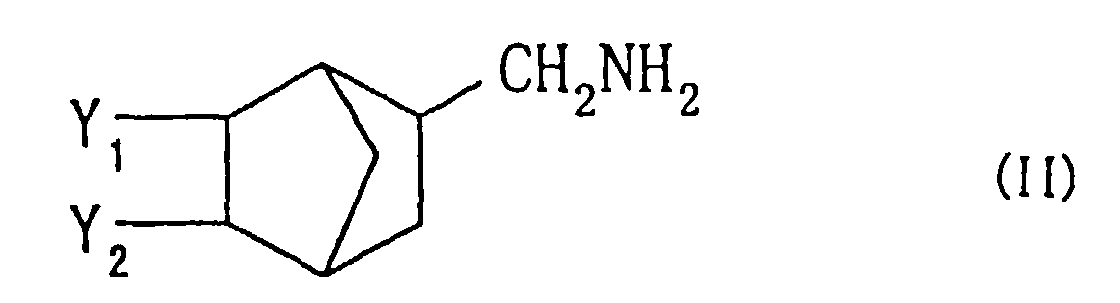 wherein X1 and X2 represent H or CN and are not the same, are hydrogenated by using a Raney cobalt catalyst containing one or more metals, particularly manganese which is or are selected from the group consisting of metals in groups Ib, IVa, IVb, Va, VIa, VIIa and VIII in the periodic table, in the presence of water in an amount of 0.1 to 1.5 moles per mole of the norbornane dicarbonitriles;
- (2) The process according to the above item (1), wherein the hydrogenation is carried out in the presence of ammonia;
- (3) The process according to the above item (2), wherein the amount of ammonia is 0.05 to 5 moles per mole of the norbornane dicarbonitriles;
- (4) The process according to any one of the above items (1) to (3), wherein the amount of the catalyst is 0.1 to 10 % by weight relative to the norbornane dicarbonitriles;
- (5) The process according to any one of the above items (1) to (4), wherein the temperature for the hydrogenation is from 50 to 250 °C; and
- (6) The process according to any one of the above items (1) to (5), wherein the pressure for the hydrogenation is from 0.5 to 20 MPaG.
-
- According to the present invention, there can be provided an industrially extremely useful process wherein norbornane dimethylene amines can be produced inexpensively with a long life of the catalyst and in the presence of extremely smaller amounts of ammonia, the catalyst and the solvent used in hydrogenation than in the prior art method.
- In the present invention, the norbornane dicarbonitriles as a starting material are compounds represented by formula (I) above, which include 2,5-norbornane dicarbonitrile, 2,6-norbornane dicarbonitrile, and a mixture of these compounds. Furhter these norbornane dicarbonitriles have stereoisomers, and any of these stereoisomers and a mixture thereof can also be used as the starting material in the present invention.
- The norbornane dicarbonitriles described above can be obtained for example by a method of adding hydrogen cyanide to bicyclo[2.2.1]-5-heptene-2-carbonitrile in the presence of a nickel catalyst and triphenyl phosphite, as described in Japanese patent publication No. (JP-B) 7-94422.
- In the present invention, the hydrogenation of norbornane dicarbonitriles is carried out preferably in the presence of ammonia. This ammonia has the function of improving selectivity by inhibiting formation of high-boiling byproducts such as secondary amines, tertiary amines or polyamines other than the desired norbornane dimethylene amines. For inhibiting formation of these high-boiling byproducts, preventing the reduction of the rate of hydrogenation, and facilitating the treatment or recovery of ammonia after the reaction, the amount of ammonia used is preferably in the range of 0.05 to 5 moles, more preferably 0.1 to 2.5 moles per mole of the starting norbornane dicarbonitriles.
- The catalyst used in the present invention is a Raney cobalt catalyst containing one or more metals selected from the group consisting of metals of groups Ib, IVa, IVb, Va, VIa, VIIa and VIII in the periodic table, and preferably these metals are silver and copper in group Ib, titanium in group IVa, tin and lead in group IVb, vanadium in group Va, chromium, molybdenum and tungsten in group VIa, manganese in group VIIa and iron in group VIII, among which manganese is particularly preferable.
- The catalyst containing manganese is a Raney cobalt catalyst containing manganese preferably in an amount of 0.1 to 15 % by weight, more preferably 0.5 to 10 % by weight, and a catalyst obtained by alkali-development of Raney cobalt alloy powder containing manganese in a usual manner (e.g., Catalytic Engineering, vol. 10, Catalyst Handbook Classified by Element, page 528) can be used.
- The amount of the catalyst charged into a reaction vessel is not particularly limited, but from the viewpoint of maintaining good fluidity of the reaction solution and simultaneously reducing the catalyst cost, the catalyst is used preferably in an amount of up to about 10 % by weight, more specifically 0.1 to 10 % by weight, relative to the starting norbornane dicarbonitriles.
- For adding the catalyst to the reaction vessel, the total amount of the catalyst used may be added in one portion, but for controlling the chemical poisoning of the catalyst, it is preferable that the catalyst is added first in an amount necessary for one reaction and then added successively every repeated reaction.
- The hydrogenation in the present invention is carried out in the presence of water. The amount of water used is preferably in the range of 0.1 to 1.5 moles, more preferably in the range of 0.2 to 1.5 moles, relative to 1 mole of the starting norbornane dicarbonitriles. If its amount is less than 0.1 mole, a sufficient life of the catalyst can hardly be achieved. Its amount of more than 1.5 moles is not preferable because byproducts such as amide derivatives other than the desired product are formed in a significantly large amount, and either because much energy is necessary in the steps of dehydration and purification after the reaction. So the reaction is conducted preferably in the presence of water in an amount within the range defined above.
- The temperature for carrying out the hydrogenation in the present invention is preferably in the range of 50 to 250 °C, more preferably in the range of 80 to 200 °C for keeping good productivity of norbornane dimethylene amines and simultaneously suppressing formation of byproducts.
- It is preferable that hydrogen used in the hydrogenation is usually of 100 % purity, but gases inert to the reaction, such as nitrogen, argon, helium or methane may be contained therein. The pressure during hydrogenation is preferably in the range of 0.5 to 20 MPaG, more preferably in the range of 1 to 10 MPaG. At a pressure of less than 0.5 MPaG, it will take a lot of time to complete the hydrogenation, thus worsening the productivity of the desired norbornane dimethylene amines. A pressure of more than 20 MPaG is not preferable because the increase of the pressure brings about virtually no effect, merely resulting in higher costs for construction of high-pressure facilities.
- The hydrogenation in the present invention can also be carried out without using a solvent, but because the norbornane dicarbonitriles as the starting material are relatively highly viscous, a solvent may be used to improve operability, fluidity of the catalyst in the reaction vessel and others. The usable solvent shall be a compound inert to this hydrogenation reaction, and preferable examples include aromatic hydrocarbons such as benzene, toluene, xylene, ethyl benzene, diethyl benzene, mesitylene etc., alcohols such as methanol, ethanol, 1-propanol, 2-propanol, 1-butanol, 2-butanol etc., and analogous compounds thereto.
- Further, when the above-described solvent is used, it can be used in an optional amount,but its amount is preferably in the range of up to 50 % by weight, more preferably in the range of up to 20 % by weight, most preferably in the range of up to 10 % by weight relative to the starting norbornane dicarbonitriles in order to maintain good productivity of the resulting norbornane dimethylene amines and to lower the energy for removal of the solvent by distillation.
- In the present invention, the reaction system for hydrogenation of norbornane dicarbonitriles is not particularly limited, and the hydrogenation can be carried out in any system such as a batch system, a semi-batch system, or a flow system.
- Next, the usefulness of the present invention is described in further detail with reference to Examples. Hereinafter, analysis of a reaction solution was conducted by gas chromatography.
- An autoclave made of stainless steel having an internal volume of 0.5 L with an electromagnetic stirrer was charged with 304 g of norbornane dicarbonitriles solution (1.93 mol of norbornane dicarbonitriles) containing about 7 % by weight of toluene, 24.9 g (1.38 mol) of water, and 1.5 g (dry weight) of a Raney cobalt catalyst (Co, 75.7 % by weight; Al, 2.7 % by weight; Mn, 1.5 % by weight) obtained by developing a Co-Al alloy containing manganese. The system was purged sufficiently by nitrogen and then the netrogen was replaced by hydrogen, and 10.2 g (0.6 mol) of liquid ammonia was injected thereto. Then, hydrogen was introduced until the pressure in the autoclave reached 2.5 MPaG, and the mixture was heated to 120 °C under stirring to initiate hydrogenation reaction. Because the pressure in the autoclave was reduced as the reaction proceeded, hydrogen was fed continuously such that the pressure was kept at 3.4 MPaG, while the liquid temperature was kept at 120 °C, and the hydrogenation reaction was carried out for 8 hours.
- After the reaction, the autoclave was cooled to room temperature, and the hydrogen and ammonia in the gaseous phase were released. The precipitated catalyst was left in the autoclave, and the supernatant in the reaction solution was taken out. Another norbornane dicarbonitriles solution, ammonia and water were charged into the autoclave in the same amounts as above and subjected to the hydrogenation reaction. This operation was conducted repeatedly 20 times without adding any further catalyst.
- As a result, the conversion of norbornane dicarbonitriles and the yield of norbornane dimethylene amines in the first reaction were 100 % and 94.5 % respectively, and the conversion and the yield in the 20th reaction were 100 % and 94.3 % respectively, and no deterioration in the catalyst was observed. Further, the yield of an amide derivative where cyano groups in the starting norbornane dicarbonitriles had been hydrolyzed was 0.4 % in the first reaction, and there was no change in the yield even in the 20th reaction.
- Following the procedure in Example 1, the operation of charging norbornane dicarbonitriles solution, ammonia and water in the same amounts as every reaction in Example 1 and then performing the hydrogenation reaction was repeatedly carried out 50 times in the same manner as in Example 1. The catalyst was added by 0.5 g in the 21st, 31st, and 41st reactions, respectively.
- As a result, the conversion of norbornane dicarbonitriles and the yield of norbornane dimethylene amines in the 21st reaction were 100 % and 94.3 % respectively, and the conversion and the yield in the 50th reaction were 100 % and 94.0 % respectively, and no deterioration in the catalyst was observed. Further, the yield of an amide derivative where cyano groups in the starting norbornane dicarbonitriles had been hydrolyzed was 0.4 % in the 21st reaction and 0.5 % in the 50th reaction.
- An autoclave made of stainless steel having an internal volume of 0.5 L with an electromagnetic stirrer was charged with 304 g of norbornane dicarbonitriles solution (1.93 mol of norbornane dicarbonitriles) containing about 7 % by weight of toluene, 49.6 g (2.75 mol) of water, and 1.5 g of a Raney cobalt catalyst (Co, 75.7 % by weight; Al, 2.7 % by weight; Mn, 1.5 % by weight) obtained by developing a Co-Al alloy containing manganese. The system was purged sufficiently by nitrogen and then the nitrogen was replaced by hydrogen, and 10.2 g (0.6 mol) of liquid ammonia was injected thereto. Then, hydrogen was introduced until the pressure in the autoclave reached 3.9 MPaG, and the mixture was heated to 120 °C under stirring to initiate hydrogenation reaction. Because the pressure in the autoclave was reduced as the reaction proceeded, hydrogen was fed continuously such that the pressure was kept at 4.9 MPaG, while the liquid temperature was kept at 120 °C, and the hydrogenation reaction was carried out for 8 hours.
- After the reaction, the autoclave was cooled to room temperature, and the hydrogen and ammonia in the gaseous phase were released. The precipitated catalyst was left in the autoclave, and the supernatant in the reaction solution was taken out. Another norbornane dicarbonitriles solution, ammonia and water were charged into the autoclave in the same amounts as above and subjected to the hydrogenation reaction. This operation was conducted repeatedly 20 times without adding any further catalyst.
- As a result, the conversion of norbornane dicarbonitriles and the yield of norbornane dimethylene amines in the first reaction were 100 % and 94.6 % respectively, and the conversion and the yield in the 20th reaction were 100 % and 93.3 % respectively, and no deterioration in the catalyst was observed. Further, the yield of an amide derivative where cyano groups in the starting norbornane dicarbonitriles had been hydrolyzed was 1.8 % in the first reaction and 2.1 % in the 20th reaction.
- The same operation as in Example 3 was carried out except that the amount of water charged into the autoclave was 12.3 g (0.68 mol) and the hydrogenation reaction was cattied out at the liquid temperature of 140 °C for 3 hours.
- As a result, the conversion of norbornane dicarbonitriles and the yield of norbornane dimethylene amines in the first reaction were 100 % and 93.8 % respectively, and the conversion and the yield in the 20th reaction were 100 % and 91.1 % respectively, and no deterioration in the catalyst was observed. Further, the yield of an amide derivative where cyano groups in the starting norbornane dicarbonitriles had been hydrolyzed was 0.4 % in the first reaction, and there was no change in the yield even in the 20th reaction.
- An autoclave made of stainless steel having an internal volume of 0.5 L with an electromagnetic stirrer was charged with 304 g of norbornane dicarbonitriles solution (1.93 mol of norbornane dicarbonitriles) containing about 7 % by weight of toluene, 5.2 g (0.29 mol) of water, and 1.5 g of a Raney cobalt catalyst (Co, 75.7 % by weight; Al, 2.7 % by weight; Mn, 1.5 % by weight) obtained by developing a Co-Al alloy containing manganese. The system was purged sufficiently by nitrogen and then the nitrogen was replaced by hydrogen, and 10.2 g (0.6 mol) of liquid ammonia was injected thereto. Then, hydrogen was introduced until the pressure in the autoclave reached 6.9 MPaG, and the mixture was heated to 120 °C under stirring to initiate hydrogenation reaction. Because the pressure in the autoclave was reduced as the reaction proceeded, hydrogen was fed continuously such that the pressure was kept at 7.8 MPaG, while the liquid temperature was kept at 120 °C, and the hydrogenation reaction was carried out for 3 hours.
- After the reaction, the autoclave was cooled to room temperature, and the hydrogen and ammonia in the gaseous phase were released. The precipitated catalyst was left in the autoclave, and the supernatant in the reaction solution was taken out. Another norbornane dicarbonitriles solution, ammonia and water were charged into the autoclave in the same amounts as above and subjected to the hydrogenation reaction. This operation was conducted repeatedly 20 times without adding any further catalyst.
- As a result, the conversion of norbornane dicarbonitriles and the yield of norbornane dimethylene amines in the first reaction were 100 % and 95.1 % respectively, and the conversion and the yield in the 20th reaction were 100 % and 90.2 % respectively, and no deterioration in the catalyst was observed. Further, the yield of an amide derivative where cyano groups in the starting norbornane dicarbonitriles had been hydrolyzed was 0.3 % in the first reaction, and there was no change in the yield even in the 20th reaction.
- The same operation as in Example 1 was carried out except that the amount of the catalyst charged into the autoclave was 4.5 g, and the reaction was carried out for 3 hours.
- As a result, the conversion of norbornane dicarbonitriles and the yield of norbornane dimethylene amines in the first reaction were 100 % and 94.5 % respectively, and the conversion and the yield in the 20th reaction were 100 % and 94.4 % respectively, and no deterioration in the catalyst was observed. Further, the yield of an amide derivative where cyano groups in the starting norbornane dicarbonitriles had been hydrolyzed was 0.6 % in the first reaction, and there was no change in the yield even in the 20th reaction.
- The same operation as in Example 1 was carried out except that the norbornane dicarbonitriles charged into the autoclave was free of toluene and the hydrogenation reaction was carried out at the liquid temperature of 160 °C for 4 hours.
- As a result, the conversion of norbornane dicarbonitriles and the yield of norbornane dimethylene amines in the first reaction were 100 % and 93.5 % respectively, and the conversion and the yield in the 20th reaction were 100 % and 93.2 % respectively, and no deterioration in the catalyst was observed. Further, the yield of an amide derivative where cyano groups in the starting norbornane dicarbonitriles had been hydrolyzed was 0.4 % in the first reaction, and there was no change in the yield even in the 20th reaction.
- The same operation as in Example 1 was carried out except that the amount of the catalyst charged into the autoclave was 4.5 g, and the liquid temperature for the hydrogenation reaction was 100 °C.
- As a result, the conversion of norbornane dicarbonitriles and the yield of norbornane dimethylene amines in the first reaction were 100 % and 96.2 % respectively, and the conversion and the yield in the 20th reaction were 100 % and 95.6 % respectively, and no deterioration in the catalyst was observed. Further, the yield of an amide derivative where cyano groups in the starting norbornane dicarbonitriles had been hydrolyzed was 0.4 % in the first reaction, and there was no change in the yield even in the 20th reaction.
- An autoclave made of stainless steel having an internal volume of 0.5 L with an electromagnetic stirrer was charged with 304 g of norbornane dicarbonitrile solution (1.93 mol of norbornane dicarbonitriles) containing about 7 % by weight of toluene, 24.9 g (1.38 mol) of water, and 4.5 g of a Raney cobalt catalyst (Co, 68.5 % by weight; Al, 3.1 % by weight; Mn, 5.5 % by weight) obtained by developing a Co-Al alloy containing manganese. The system was purged sufficiently by nitrogen and then the netrogen was replaced by hydrogen, and 10.2 g (0.6 mol) of liquid ammonia was injected thereto. Then, hydrogen was introduced until the pressure in the autoclave reached 3.9 MPaG, and the mixture was heated to 140 °C under stirring to initiate hydrogenation reaction. Because the pressure in the autoclave was reduced as the reaction proceeded, hydrogen was fed continuously such that the pressure was kept at 4.9 MPaG, while the liquid temperature was kept at 140 °C, and the hydrogenation reaction was carried out for 2 hours.
- After the reaction, the autoclave was cooled to room temperature, and the hydrogen and ammonia in the gaseous phase were released. The precipitated catalyst was left in the autoclave, and the supernatant in the reaction solution was taken out. Another norbornane dicarbonitrile solution, ammonia and water were charged into the autoclave in the same amounts as above and subjected to the hydrogenation reaction. This operation was conducted repeatedly 20 times without adding any further catalyst.
- As a result, the conversion of norbornane dicarbonitriles and the yield of norbornane dimethylene amines in the first reaction were 100 % and 93.3 % respectively, and the conversion and the yield in the 20th reaction were 100 % and 93.1 % respectively, and no deterioration in the catalyst was observed. Further, the yield of an amide derivative where cyano groups in the starting norbornane dicarbonitriles had been hydrolyzed was 0.8 % in the first reaction, and there was no change in the yield even in the 20th reaction.
- The same operation as in Example 9 was carried out except that the amount of the catalyst charged into the autoclave was 0.6 g and the hydrogenation reaction was carried out at the liquid temperature of 180 °C for 8 hours.
- As a result, the conversion of norbornane dicarbonitriles and the yield of norbornane dimethylene amines in the first reaction were 100 % and 92.2 % respectively, and the conversion and the yield in the 20th reaction were 100 % and 91.4 % respectively, and no deterioration in the catalyst was observed. Further, the yield of an amide derivative where cyano groups in the starting norbornane dicarbonitriles had been hydrolyzed was 1.0 % in the first reaction, and there was no change in the yield even in the 20th reaction.
- The same operation as in Example 9 was carried out except that the amount of liquid ammonia charged into the autoclave was 3.6 g (0.2 mol), and the reaction was carried out for 3 hours.
- As a result, the conversion of norbornane dicarbonitriles and the yield of norbornane dimethylene amines in the first reaction were 100 % and 91.2 % respectively, and the conversion and the yield in the 20th reaction were 100 % and 90.7 % respectively, and no deterioration in the catalyst was observed. Further, the yield of an amide derivative where cyano groups in the starting norbornane dicarbonitriles had been hydrolyzed was 0.6 % in the first reaction, and there was no change in the yield even in the 20th reaction.
- An autoclave made of stainless steel having an internal volume of 0.5 L with an electromagnetic stirrer was charged with 304 g of norbornane dicarbonitrile solution (1.93 mol of norbornane dicarbonitriles) containing about 7 % by weight of toluene, 24.9 g (1.38 mol) of water, and 4.5 g of a Raney cobalt catalyst (Co, 64.0 % by weight; Al, 3.3 % by weight; Mn, 8.5 % by weight) obtained by developing a Co-Al alloy containing manganese. The system was purged sufficiently by nitrogen and then the nitrogen was replaced by hydrogen, and 30.6 g (1.8 mol) of liquid ammonia was injected. Then, hydrogen was introduced until the pressure in the autoclave reached 2.0 MPaG, and the mixture was heated to 140 °C under stirring to initiate hydrogenation reaction. Because the pressure in the autoclave was reduced as the reaction proceeded, hydrogen was fed continuously such that the pressure was kept at 2.5 MPaG, while the liquid temperature was kept at 140 °C, and the hydrogenation reaction was carried out for 5 hours.
- After the reaction, the autoclave was cooled to room temperature, and the hydrogen and ammonia in the gaseous phase were released. The precipitated catalyst was left in the autoclave, and the supernatant in the reaction solution was taken out. Another norbornane dicarbonitrile solution, ammonia and water were charged into the autoclave in the same amounts as above and subjected to the hydrogenation reaction. This operation was conducted repeatedly 20 times without adding any further catalyst.
- As a result, the conversion of norbornane dicarbonitriles and the yield of norbornane dimethylene amines in the first reaction were 100 % and 92.2 % respectively, and the conversion and the yield in the 20th reaction were 100 % and 92.1 % respectively, and no deterioration in the catalyst was observed. Further, the yield of an amide derivative where cyano groups in the starting norbornane dicarbonitriles had been hydrolyzed was 0.7 % in the first reaction, and there was no change in the yield even in the 20th reaction.
- The same operation as in Example 9 was carried out except that 4.5 g of a Raney cobalt catalyst (Co, 76.0 % by weight; Al, 4.0 % by weight; Mn, 0.2 % by weight) obtained by developing a Co-Al alloy containing manganese was used as the catalyst charged into the autoclave, the amount of liquid ammonia was 65.8 g (3.9 mol), and the reaction was carried out for 4 hours.
- As a result, the conversion of norbornane dicarbonitriles and the yield of norbornane dimethylene amines in the first reaction were 100 % and 93.8 % respectively, and the conversion and the yield in the 20th reaction were 100 % and 93.5 % respectively, and no deterioration in the catalyst was observed. Further, the yield of an amide derivative where cyano groups in the starting norbornane dicarbonitriles had been hydrolyzed was 0.9 % in the first reaction, and there was no change in the yield even in the 20th reaction.
- The same operation as in Example 9 was carried out except that 4.5 g of a Raney cobalt catalyst (Co, 57.5 % by weight; Al, 3.7 % by weight; Mn, 11.7 % by weight) obtained by developing a Co-Al alloy containing manganese was used as the catalyst charged into the autoclave, the amount of liquid ammonia was 131.6 g (7.7 mol), and the reaction was carried out for 6 hours.
- As a result, the conversion of norbornane dicarbonitriles and the yield of norbornane dimethylene amines in the first reaction were 100 % and 94.1 % respectively, and the conversion and the yield in the 20th reaction were 100 % and 93.9 % respectively, and no deterioration in the catalyst was observed. Further, the yield of an amide derivative where cyano groups in the starting norbornane dicarbonitriles had been hydrolyzed was 1.0 % in the first reaction, and there was no change in the yield even in the 20th reaction.
- The same operation as in Example 1 was carried out except that the hydrogenation reaction was performed without charging water into the autoclave.
- As a result, the conversion of norbornane dicarbonitriles and the yield of norbornane dimethylene amines in the first reaction were 100 % and 93.2 %, respectively, but in the third reaction, the yield was 37.3 % with the starting norbornane dicarbonitriles still remained, and the deterioration in the catalyst was observed.
- The same operation as in Example 1 was carried out except that the amount of water charged into the autoclave was 1.7 g (0.1 mol).
- As a result, the conversion of norbornane dicarbonitriles and the yield of norbornane dimethylene amines in the first reaction were 100 % and 93.3 %, respectively, but in the fifth reaction, the yield was 42.5 % with the starting norbornane dicarbonitriles still remained, and the deterioration in the catalyst was observed.
- The same operation as in Example 1 was carried out except that the amount of water charged into the autoclave was 70.1 g (3.9 mol).
- As a result, the conversion of norbornane dicarbonitriles and the yield of norbornane dimethylene amines in the first reaction were 100 % and 81.6 %, respectively, and the conversion and the yield in the 20th reaction were 100 % and 79.0 % respectively, indicating a low yield. Further, the yield of an amide derivative where cyano groups in the starting norbornane dicarbonitriles had been hydrolyzed was as high as 9.7 % in the first reaction and 11.9 % in the 20th reaction.
- The same operation as in Example 9 was carried out except that a Raney cobalt catalyst (Co, 76.9 % by weight; Al, 4.2 % by weight) obtained by developing a manganese-free Co-Al alloy was used as the catalyst charged into the autoclave, and the reaction was carried out for 4 hours.
- As a result, the conversion of norbornane dicarbonitriles and the yield of norbornane dimethylene amines in the first reaction were 100 % and 89.8 %, respectively, but in the fifth reaction, the yield was 47.6 % with the starting norbornane dicarbonitriles still remained, and the deterioration in the catalyst was observed.
- As can be seen from the foregoing description, particularly Examples 1 to 14 and Comparative Examples 1 to 4, an extremely long life of the catalyst can be achieved in the process of the present invention wherein the hydrogenation of norbornane dicarbonitriles is carried out by using a Raney cobalt catalyst containing manganese in the presence of water in an amount of 0.1 to 1.5 moles per mole of the norbornane dicarbonitriles.
Claims (13)
- A process for producing norbornane dimethylene amines represented by formula (II):wherein Y1 and Y2 represent H or CH2NH2 and are not the same, wherein norbornane dicarbonitriles represented by formula (I):
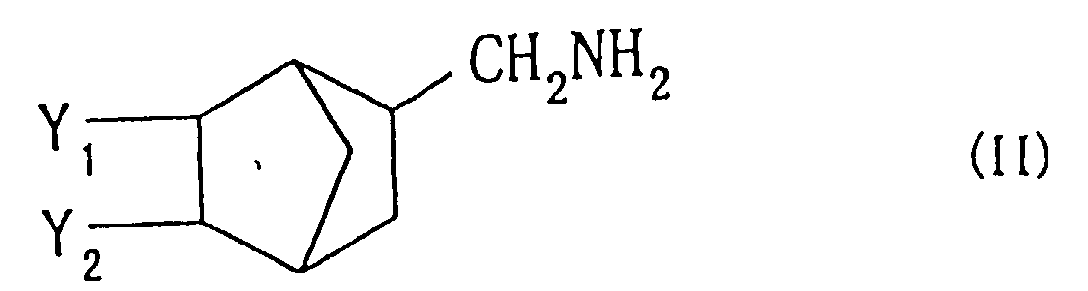 wherein X1 and X2 represent H or CN and are not the same, are hydrogenated by using a Raney cobalt catalyst containing one or more metals selected from the group consisting of metals in the groups Ib, IVa, IVb, Va, VIa, VIIa and VIII, in the presence of water in an amount of 0.1 to 1.5 moles per mole of the norbornane dicarbonitriles.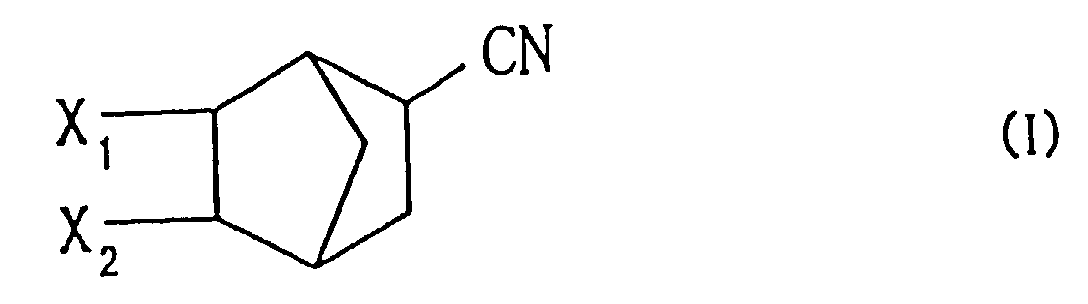
- The process for producing norbornane dimethylene amines according to claim 1, wherein the metal in group Ib is copper or silver.
- The process for producing norbornane dimethylene amines according to claim 1, wherein the metal in group IVa is titanium.
- The process for producing norbornane dimethylene amines according to claim 1, wherein the metal in group IVb is tin or lead.
- The process for producing norbornane dimethylene amines according to claim 1, wherein the metal in group Va is vanadium.
- The process for producing norbornane dimethylene amines according to claim 1, wherein the metal in group VIa is chromium, molybdenum or tungsten.
- The process for producing norbornane dimethylene amines according to claim 1, wherein the metal in group VIIa is manganese.
- The process for producing norbornane dimethylene amines according to claim 1, wherein the metal in group VIII is iron.
- The process for producing norbornane dimethylene amines according to any one of claims 1 to 8, wherein the hydrogenation is carried out in the presence of ammonia.
- The process for producing norbornane dimethylene amines according to claim 9, wherein the amount of ammonia is 0.05 to 5 moles per mole of the norbornane dicarbonitriles.
- The process for producing norbornane dimethylene amines according to any one of claims 1 to 10, wherein the amount of the catalyst is 0.1 to 10 % by weight relative to the norbornane dicarbonitriles.
- The process for producing norbornane dimethylene amines according to any one of claims 1 to 11, wherein the temperature for the hydrogenation is from 50 to 250 °C.
- The process for producing norbornane dimethylene amines according to any one of claims 1 to 12, wherein the pressure for the hydrogenation is from 0.5 to 20 MPaG.
Applications Claiming Priority (2)
| Application Number | Priority Date | Filing Date | Title |
|---|---|---|---|
| JP27154299A JP3930207B2 (en) | 1999-09-27 | 1999-09-27 | Method for producing norbornanedimethyleneamines |
| JP27154299 | 1999-09-27 |
Publications (2)
| Publication Number | Publication Date |
|---|---|
| EP1086943A1 true EP1086943A1 (en) | 2001-03-28 |
| EP1086943B1 EP1086943B1 (en) | 2003-01-02 |
Family
ID=17501526
Family Applications (1)
| Application Number | Title | Priority Date | Filing Date |
|---|---|---|---|
| EP00308470A Expired - Lifetime EP1086943B1 (en) | 1999-09-27 | 2000-09-27 | A process for producing norbornane dimethylene amines |
Country Status (6)
| Country | Link |
|---|---|
| US (1) | US6262309B1 (en) |
| EP (1) | EP1086943B1 (en) |
| JP (1) | JP3930207B2 (en) |
| KR (1) | KR100365534B1 (en) |
| CN (1) | CN1264806C (en) |
| DE (1) | DE60001090T2 (en) |
Cited By (1)
| Publication number | Priority date | Publication date | Assignee | Title |
|---|---|---|---|---|
| WO2006080905A1 (en) * | 2005-01-20 | 2006-08-03 | E.I. Du Pont De Nemours And Company | Norbornane based cycloaliphatic compounds containing methylene amine groups |
Families Citing this family (1)
| Publication number | Priority date | Publication date | Assignee | Title |
|---|---|---|---|---|
| JP4455282B2 (en) * | 2003-11-28 | 2010-04-21 | キヤノン株式会社 | Inkjet head manufacturing method, inkjet head, and inkjet cartridge |
Citations (3)
| Publication number | Priority date | Publication date | Assignee | Title |
|---|---|---|---|---|
| JPH0381255A (en) * | 1989-08-24 | 1991-04-05 | Mitsui Toatsu Chem Inc | Production of bis(aminomethyl) norcamphane |
| JPH03109361A (en) * | 1989-09-22 | 1991-05-09 | Mitsui Toatsu Chem Inc | Preparation of bis(aminomethyl)norcamphanes |
| JPH04282347A (en) * | 1991-03-11 | 1992-10-07 | Mitsui Toatsu Chem Inc | Production of norbornanediaminomethyls |
Family Cites Families (3)
| Publication number | Priority date | Publication date | Assignee | Title |
|---|---|---|---|---|
| JPS6040072B2 (en) | 1977-09-07 | 1985-09-09 | 株式会社リコー | Card positioning device |
| JPS6452381A (en) | 1987-08-22 | 1989-02-28 | Fuji Electric Co Ltd | Anode of molten carbonate fuel cell |
| KR930011149B1 (en) * | 1989-12-27 | 1993-11-24 | 미쯔이도오아쯔가가꾸 가부시기가이샤 | Method for producing norcamphandicarbonitriles |
-
1999
- 1999-09-27 JP JP27154299A patent/JP3930207B2/en not_active Expired - Lifetime
-
2000
- 2000-09-21 KR KR1020000055448A patent/KR100365534B1/en not_active Expired - Lifetime
- 2000-09-22 US US09/667,801 patent/US6262309B1/en not_active Expired - Lifetime
- 2000-09-27 DE DE60001090T patent/DE60001090T2/en not_active Expired - Lifetime
- 2000-09-27 CN CNB001288865A patent/CN1264806C/en not_active Expired - Lifetime
- 2000-09-27 EP EP00308470A patent/EP1086943B1/en not_active Expired - Lifetime
Patent Citations (3)
| Publication number | Priority date | Publication date | Assignee | Title |
|---|---|---|---|---|
| JPH0381255A (en) * | 1989-08-24 | 1991-04-05 | Mitsui Toatsu Chem Inc | Production of bis(aminomethyl) norcamphane |
| JPH03109361A (en) * | 1989-09-22 | 1991-05-09 | Mitsui Toatsu Chem Inc | Preparation of bis(aminomethyl)norcamphanes |
| JPH04282347A (en) * | 1991-03-11 | 1992-10-07 | Mitsui Toatsu Chem Inc | Production of norbornanediaminomethyls |
Non-Patent Citations (3)
| Title |
|---|
| PATENT ABSTRACTS OF JAPAN vol. 015, no. 252 (C - 0844) 26 June 1991 (1991-06-26) * |
| PATENT ABSTRACTS OF JAPAN vol. 015, no. 297 (C - 0854) 29 July 1991 (1991-07-29) * |
| PATENT ABSTRACTS OF JAPAN vol. 017, no. 086 (C - 1028) 19 February 1993 (1993-02-19) * |
Cited By (1)
| Publication number | Priority date | Publication date | Assignee | Title |
|---|---|---|---|---|
| WO2006080905A1 (en) * | 2005-01-20 | 2006-08-03 | E.I. Du Pont De Nemours And Company | Norbornane based cycloaliphatic compounds containing methylene amine groups |
Also Published As
| Publication number | Publication date |
|---|---|
| DE60001090T2 (en) | 2003-09-25 |
| KR100365534B1 (en) | 2002-12-18 |
| DE60001090D1 (en) | 2003-02-06 |
| JP2001089424A (en) | 2001-04-03 |
| CN1290688A (en) | 2001-04-11 |
| EP1086943B1 (en) | 2003-01-02 |
| CN1264806C (en) | 2006-07-19 |
| JP3930207B2 (en) | 2007-06-13 |
| KR20010067211A (en) | 2001-07-12 |
| US6262309B1 (en) | 2001-07-17 |
Similar Documents
| Publication | Publication Date | Title |
|---|---|---|
| US7915454B2 (en) | Method for producing ethylenediamine | |
| US4739051A (en) | Preparation of morpholine | |
| JP5377335B2 (en) | Method for producing tetraethylenepentamine | |
| JPH0347156A (en) | Reductive amination of carbonitrile and analogous compound | |
| CN102803213B (en) | Methyl-substituted TETA Compounds | |
| EP0971876B1 (en) | A process for continuous hydrogenation of adiponitrile | |
| US3418375A (en) | Preparation of trimethylhexamethylenediamine | |
| JPH032145A (en) | Production of polyamine | |
| US6881864B2 (en) | Production method of xylylenediamine | |
| US7132562B2 (en) | Use of modifiers in a dinitrile hydrogenation process | |
| US20080154061A1 (en) | Method For Producing a Xylylenediamine | |
| EP1086943B1 (en) | A process for producing norbornane dimethylene amines | |
| EP0908447B1 (en) | Process for the preparation of cyanoarylmethylamine | |
| JP2003327563A (en) | Process for producing aromatic dimethylamine | |
| JP4291483B2 (en) | Method for producing cyclohexanebis (methylamine) s | |
| JP2713623B2 (en) | Method for producing bis (aminomethyl) norcamphans | |
| JPH0959226A (en) | Production of 3-aminomethyl-3,5,5-trimethylcyclohexylamine | |
| JP2713615B2 (en) | Method for producing bis (aminomethyl) norcamphans | |
| JP2944793B2 (en) | Amine production method | |
| WO2006062496A1 (en) | Use of modifiers in a dinitrile hydrogenation process at high pressures | |
| CA2250770C (en) | Process for preparing cyano group-containing aromatic methylamines | |
| KR900001197B1 (en) | Method for preparing 2-alkyl-4-amino-5-aminomethylpyrimidine | |
| JP2001261621A (en) | Method for producing bicyclo[2.2.1]heptane-2-methanamine | |
| KR100549701B1 (en) | Method for producing cyano group-containing aromatic methylamine | |
| JP2000327637A (en) | Method for producing low molecular weight ethyleneamine |
Legal Events
| Date | Code | Title | Description |
|---|---|---|---|
| PUAI | Public reference made under article 153(3) epc to a published international application that has entered the european phase |
Free format text: ORIGINAL CODE: 0009012 |
|
| 17P | Request for examination filed |
Effective date: 20001016 |
|
| AK | Designated contracting states |
Kind code of ref document: A1 Designated state(s): DE FR NL |
|
| AX | Request for extension of the european patent |
Free format text: AL;LT;LV;MK;RO;SI |
|
| AKX | Designation fees paid |
Free format text: DE FR NL |
|
| GRAG | Despatch of communication of intention to grant |
Free format text: ORIGINAL CODE: EPIDOS AGRA |
|
| 17Q | First examination report despatched |
Effective date: 20020516 |
|
| GRAG | Despatch of communication of intention to grant |
Free format text: ORIGINAL CODE: EPIDOS AGRA |
|
| GRAH | Despatch of communication of intention to grant a patent |
Free format text: ORIGINAL CODE: EPIDOS IGRA |
|
| GRAH | Despatch of communication of intention to grant a patent |
Free format text: ORIGINAL CODE: EPIDOS IGRA |
|
| GRAA | (expected) grant |
Free format text: ORIGINAL CODE: 0009210 |
|
| AK | Designated contracting states |
Kind code of ref document: B1 Designated state(s): DE FR NL |
|
| REF | Corresponds to: |
Ref document number: 60001090 Country of ref document: DE Date of ref document: 20030206 Kind code of ref document: P |
|
| ET | Fr: translation filed | ||
| PLBE | No opposition filed within time limit |
Free format text: ORIGINAL CODE: 0009261 |
|
| STAA | Information on the status of an ep patent application or granted ep patent |
Free format text: STATUS: NO OPPOSITION FILED WITHIN TIME LIMIT |
|
| 26N | No opposition filed |
Effective date: 20031003 |
|
| REG | Reference to a national code |
Ref country code: FR Ref legal event code: PLFP Year of fee payment: 17 |
|
| REG | Reference to a national code |
Ref country code: FR Ref legal event code: PLFP Year of fee payment: 18 |
|
| REG | Reference to a national code |
Ref country code: FR Ref legal event code: PLFP Year of fee payment: 19 |
|
| PGFP | Annual fee paid to national office [announced via postgrant information from national office to epo] |
Ref country code: NL Payment date: 20190918 Year of fee payment: 20 Ref country code: DE Payment date: 20190918 Year of fee payment: 20 Ref country code: FR Payment date: 20190925 Year of fee payment: 20 |
|
| REG | Reference to a national code |
Ref country code: DE Ref legal event code: R071 Ref document number: 60001090 Country of ref document: DE |
|
| REG | Reference to a national code |
Ref country code: NL Ref legal event code: MK Effective date: 20200926 |