EP1086808A2 - Resin film laminated metal sheet for can and method for fabricating the same - Google Patents
Resin film laminated metal sheet for can and method for fabricating the same Download PDFInfo
- Publication number
- EP1086808A2 EP1086808A2 EP00120151A EP00120151A EP1086808A2 EP 1086808 A2 EP1086808 A2 EP 1086808A2 EP 00120151 A EP00120151 A EP 00120151A EP 00120151 A EP00120151 A EP 00120151A EP 1086808 A2 EP1086808 A2 EP 1086808A2
- Authority
- EP
- European Patent Office
- Prior art keywords
- resin film
- metal sheet
- laminated metal
- making
- film laminated
- Prior art date
- Legal status (The legal status is an assumption and is not a legal conclusion. Google has not performed a legal analysis and makes no representation as to the accuracy of the status listed.)
- Granted
Links
Images


Classifications
-
- B—PERFORMING OPERATIONS; TRANSPORTING
- B32—LAYERED PRODUCTS
- B32B—LAYERED PRODUCTS, i.e. PRODUCTS BUILT-UP OF STRATA OF FLAT OR NON-FLAT, e.g. CELLULAR OR HONEYCOMB, FORM
- B32B15/00—Layered products comprising a layer of metal
- B32B15/04—Layered products comprising a layer of metal comprising metal as the main or only constituent of a layer, which is next to another layer of the same or of a different material
- B32B15/08—Layered products comprising a layer of metal comprising metal as the main or only constituent of a layer, which is next to another layer of the same or of a different material of synthetic resin
- B32B15/09—Layered products comprising a layer of metal comprising metal as the main or only constituent of a layer, which is next to another layer of the same or of a different material of synthetic resin comprising polyesters
-
- B—PERFORMING OPERATIONS; TRANSPORTING
- B32—LAYERED PRODUCTS
- B32B—LAYERED PRODUCTS, i.e. PRODUCTS BUILT-UP OF STRATA OF FLAT OR NON-FLAT, e.g. CELLULAR OR HONEYCOMB, FORM
- B32B15/00—Layered products comprising a layer of metal
- B32B15/04—Layered products comprising a layer of metal comprising metal as the main or only constituent of a layer, which is next to another layer of the same or of a different material
- B32B15/08—Layered products comprising a layer of metal comprising metal as the main or only constituent of a layer, which is next to another layer of the same or of a different material of synthetic resin
-
- B—PERFORMING OPERATIONS; TRANSPORTING
- B32—LAYERED PRODUCTS
- B32B—LAYERED PRODUCTS, i.e. PRODUCTS BUILT-UP OF STRATA OF FLAT OR NON-FLAT, e.g. CELLULAR OR HONEYCOMB, FORM
- B32B15/00—Layered products comprising a layer of metal
- B32B15/18—Layered products comprising a layer of metal comprising iron or steel
-
- B—PERFORMING OPERATIONS; TRANSPORTING
- B32—LAYERED PRODUCTS
- B32B—LAYERED PRODUCTS, i.e. PRODUCTS BUILT-UP OF STRATA OF FLAT OR NON-FLAT, e.g. CELLULAR OR HONEYCOMB, FORM
- B32B15/00—Layered products comprising a layer of metal
- B32B15/20—Layered products comprising a layer of metal comprising aluminium or copper
-
- B—PERFORMING OPERATIONS; TRANSPORTING
- B32—LAYERED PRODUCTS
- B32B—LAYERED PRODUCTS, i.e. PRODUCTS BUILT-UP OF STRATA OF FLAT OR NON-FLAT, e.g. CELLULAR OR HONEYCOMB, FORM
- B32B27/00—Layered products comprising a layer of synthetic resin
- B32B27/36—Layered products comprising a layer of synthetic resin comprising polyesters
-
- B—PERFORMING OPERATIONS; TRANSPORTING
- B32—LAYERED PRODUCTS
- B32B—LAYERED PRODUCTS, i.e. PRODUCTS BUILT-UP OF STRATA OF FLAT OR NON-FLAT, e.g. CELLULAR OR HONEYCOMB, FORM
- B32B37/00—Methods or apparatus for laminating, e.g. by curing or by ultrasonic bonding
- B32B37/04—Methods or apparatus for laminating, e.g. by curing or by ultrasonic bonding characterised by the partial melting of at least one layer
-
- B—PERFORMING OPERATIONS; TRANSPORTING
- B32—LAYERED PRODUCTS
- B32B—LAYERED PRODUCTS, i.e. PRODUCTS BUILT-UP OF STRATA OF FLAT OR NON-FLAT, e.g. CELLULAR OR HONEYCOMB, FORM
- B32B2250/00—Layers arrangement
- B32B2250/03—3 layers
-
- B—PERFORMING OPERATIONS; TRANSPORTING
- B32—LAYERED PRODUCTS
- B32B—LAYERED PRODUCTS, i.e. PRODUCTS BUILT-UP OF STRATA OF FLAT OR NON-FLAT, e.g. CELLULAR OR HONEYCOMB, FORM
- B32B2250/00—Layers arrangement
- B32B2250/40—Symmetrical or sandwich layers, e.g. ABA, ABCBA, ABCCBA
-
- B—PERFORMING OPERATIONS; TRANSPORTING
- B32—LAYERED PRODUCTS
- B32B—LAYERED PRODUCTS, i.e. PRODUCTS BUILT-UP OF STRATA OF FLAT OR NON-FLAT, e.g. CELLULAR OR HONEYCOMB, FORM
- B32B2274/00—Thermoplastic elastomer material
-
- B—PERFORMING OPERATIONS; TRANSPORTING
- B32—LAYERED PRODUCTS
- B32B—LAYERED PRODUCTS, i.e. PRODUCTS BUILT-UP OF STRATA OF FLAT OR NON-FLAT, e.g. CELLULAR OR HONEYCOMB, FORM
- B32B2307/00—Properties of the layers or laminate
- B32B2307/50—Properties of the layers or laminate having particular mechanical properties
- B32B2307/514—Oriented
- B32B2307/518—Oriented bi-axially
-
- B—PERFORMING OPERATIONS; TRANSPORTING
- B32—LAYERED PRODUCTS
- B32B—LAYERED PRODUCTS, i.e. PRODUCTS BUILT-UP OF STRATA OF FLAT OR NON-FLAT, e.g. CELLULAR OR HONEYCOMB, FORM
- B32B2307/00—Properties of the layers or laminate
- B32B2307/70—Other properties
- B32B2307/746—Slipping, anti-blocking, low friction
-
- B—PERFORMING OPERATIONS; TRANSPORTING
- B32—LAYERED PRODUCTS
- B32B—LAYERED PRODUCTS, i.e. PRODUCTS BUILT-UP OF STRATA OF FLAT OR NON-FLAT, e.g. CELLULAR OR HONEYCOMB, FORM
- B32B2309/00—Parameters for the laminating or treatment process; Apparatus details
- B32B2309/02—Temperature
-
- B—PERFORMING OPERATIONS; TRANSPORTING
- B32—LAYERED PRODUCTS
- B32B—LAYERED PRODUCTS, i.e. PRODUCTS BUILT-UP OF STRATA OF FLAT OR NON-FLAT, e.g. CELLULAR OR HONEYCOMB, FORM
- B32B2309/00—Parameters for the laminating or treatment process; Apparatus details
- B32B2309/04—Time
-
- B—PERFORMING OPERATIONS; TRANSPORTING
- B32—LAYERED PRODUCTS
- B32B—LAYERED PRODUCTS, i.e. PRODUCTS BUILT-UP OF STRATA OF FLAT OR NON-FLAT, e.g. CELLULAR OR HONEYCOMB, FORM
- B32B2311/00—Metals, their alloys or their compounds
-
- B—PERFORMING OPERATIONS; TRANSPORTING
- B32—LAYERED PRODUCTS
- B32B—LAYERED PRODUCTS, i.e. PRODUCTS BUILT-UP OF STRATA OF FLAT OR NON-FLAT, e.g. CELLULAR OR HONEYCOMB, FORM
- B32B2311/00—Metals, their alloys or their compounds
- B32B2311/30—Iron, e.g. steel
-
- B—PERFORMING OPERATIONS; TRANSPORTING
- B32—LAYERED PRODUCTS
- B32B—LAYERED PRODUCTS, i.e. PRODUCTS BUILT-UP OF STRATA OF FLAT OR NON-FLAT, e.g. CELLULAR OR HONEYCOMB, FORM
- B32B2323/00—Polyalkenes
- B32B2323/10—Polypropylene
-
- B—PERFORMING OPERATIONS; TRANSPORTING
- B32—LAYERED PRODUCTS
- B32B—LAYERED PRODUCTS, i.e. PRODUCTS BUILT-UP OF STRATA OF FLAT OR NON-FLAT, e.g. CELLULAR OR HONEYCOMB, FORM
- B32B2367/00—Polyesters, e.g. PET, i.e. polyethylene terephthalate
-
- B—PERFORMING OPERATIONS; TRANSPORTING
- B32—LAYERED PRODUCTS
- B32B—LAYERED PRODUCTS, i.e. PRODUCTS BUILT-UP OF STRATA OF FLAT OR NON-FLAT, e.g. CELLULAR OR HONEYCOMB, FORM
- B32B2439/00—Containers; Receptacles
- B32B2439/40—Closed containers
- B32B2439/66—Cans, tins
-
- B—PERFORMING OPERATIONS; TRANSPORTING
- B32—LAYERED PRODUCTS
- B32B—LAYERED PRODUCTS, i.e. PRODUCTS BUILT-UP OF STRATA OF FLAT OR NON-FLAT, e.g. CELLULAR OR HONEYCOMB, FORM
- B32B2439/00—Containers; Receptacles
- B32B2439/70—Food packaging
-
- Y—GENERAL TAGGING OF NEW TECHNOLOGICAL DEVELOPMENTS; GENERAL TAGGING OF CROSS-SECTIONAL TECHNOLOGIES SPANNING OVER SEVERAL SECTIONS OF THE IPC; TECHNICAL SUBJECTS COVERED BY FORMER USPC CROSS-REFERENCE ART COLLECTIONS [XRACs] AND DIGESTS
- Y10—TECHNICAL SUBJECTS COVERED BY FORMER USPC
- Y10T—TECHNICAL SUBJECTS COVERED BY FORMER US CLASSIFICATION
- Y10T428/00—Stock material or miscellaneous articles
- Y10T428/31504—Composite [nonstructural laminate]
- Y10T428/31678—Of metal
-
- Y—GENERAL TAGGING OF NEW TECHNOLOGICAL DEVELOPMENTS; GENERAL TAGGING OF CROSS-SECTIONAL TECHNOLOGIES SPANNING OVER SEVERAL SECTIONS OF THE IPC; TECHNICAL SUBJECTS COVERED BY FORMER USPC CROSS-REFERENCE ART COLLECTIONS [XRACs] AND DIGESTS
- Y10—TECHNICAL SUBJECTS COVERED BY FORMER USPC
- Y10T—TECHNICAL SUBJECTS COVERED BY FORMER US CLASSIFICATION
- Y10T428/00—Stock material or miscellaneous articles
- Y10T428/31504—Composite [nonstructural laminate]
- Y10T428/31678—Of metal
- Y10T428/31681—Next to polyester, polyamide or polyimide [e.g., alkyd, glue, or nylon, etc.]
-
- Y—GENERAL TAGGING OF NEW TECHNOLOGICAL DEVELOPMENTS; GENERAL TAGGING OF CROSS-SECTIONAL TECHNOLOGIES SPANNING OVER SEVERAL SECTIONS OF THE IPC; TECHNICAL SUBJECTS COVERED BY FORMER USPC CROSS-REFERENCE ART COLLECTIONS [XRACs] AND DIGESTS
- Y10—TECHNICAL SUBJECTS COVERED BY FORMER USPC
- Y10T—TECHNICAL SUBJECTS COVERED BY FORMER US CLASSIFICATION
- Y10T428/00—Stock material or miscellaneous articles
- Y10T428/31504—Composite [nonstructural laminate]
- Y10T428/31678—Of metal
- Y10T428/31692—Next to addition polymer from unsaturated monomers
-
- Y—GENERAL TAGGING OF NEW TECHNOLOGICAL DEVELOPMENTS; GENERAL TAGGING OF CROSS-SECTIONAL TECHNOLOGIES SPANNING OVER SEVERAL SECTIONS OF THE IPC; TECHNICAL SUBJECTS COVERED BY FORMER USPC CROSS-REFERENCE ART COLLECTIONS [XRACs] AND DIGESTS
- Y10—TECHNICAL SUBJECTS COVERED BY FORMER USPC
- Y10T—TECHNICAL SUBJECTS COVERED BY FORMER US CLASSIFICATION
- Y10T428/00—Stock material or miscellaneous articles
- Y10T428/31504—Composite [nonstructural laminate]
- Y10T428/31786—Of polyester [e.g., alkyd, etc.]
-
- Y—GENERAL TAGGING OF NEW TECHNOLOGICAL DEVELOPMENTS; GENERAL TAGGING OF CROSS-SECTIONAL TECHNOLOGIES SPANNING OVER SEVERAL SECTIONS OF THE IPC; TECHNICAL SUBJECTS COVERED BY FORMER USPC CROSS-REFERENCE ART COLLECTIONS [XRACs] AND DIGESTS
- Y10—TECHNICAL SUBJECTS COVERED BY FORMER USPC
- Y10T—TECHNICAL SUBJECTS COVERED BY FORMER US CLASSIFICATION
- Y10T428/00—Stock material or miscellaneous articles
- Y10T428/31504—Composite [nonstructural laminate]
- Y10T428/31855—Of addition polymer from unsaturated monomers
Definitions
- the present invention relates to a resin film laminated metal sheet to be mainly used to drums and caps of food stuffed cans, in particular a resin film laminated metal sheet for can, which has excellent formability and adhesion while can-making and superior taking-out property of stuffed food contents, and to a method for fabricating the same.
- the object of these methods is to improve formability and adhesion of resin film laminated metal sheets, mainly 1 ⁇ by applying a resin film having a polar group such as a polyester resin (for example Japanese Patent Laid Open No. 63-236640) or 2 ⁇ by carrying out a treatment such as corona discharge on a surface of resin film so as to increase a surface free energy ⁇ s of resin film (for example, Japanese Patent Laid Open No. 5-200961).
- Japanese Patent Laid Open No. 5-200961 discloses that the ⁇ s of resin film should be specified in a range of 38 to 54 dyn/cm for securing adhesion after forming polyethylene film laminated metal sheets.
- This object can be accomplished by such a resin film laminated metal sheet for can, in which both faces of the metal sheet have resin film laminated layers, and a surface free energy ⁇ s of a face of the resin film is 10 dyn/cm or more to less than 30 dyn/cm, the face becoming an inside of can after can-making and being contacted with stuffed food contents.
- the resin film available is, for example, a polypropylene film or a propylene ethylene based random copolymer film of polypropylene being a main component.
- the resin film laminated metal sheet for can having such a resin film may be fabricated by a method comprising a step of laminating a resin film composed of a polypropylene film or a propylene ethylene based random copolymer film of polypropylene being a main component on the surface of the metal sheet which will become an inside of can after can-making, wherein the temperature of the metal sheet is above the melting point of the resin film after passing laminating rolls; otherwise by another method comprising a step of laminating a resin film of polyester being a main component on the surface of the metal sheet, wherein the temperature of the face of the resin film to be adhered to the metal sheet is above the melting point of the resin film between 1 and 20 msec.
- the taking-out property has a close relation with a surface free energy ⁇ s of the resin film, and if the ⁇ s is more than 30 dyn/cm, the sticking between the resin film and the stuffed contents is excessive so that the taking-out property of stuffed food contents is poor. Accordingly, if the resin film of ⁇ s being less than 30 dyn/cm, more preferably less than 22 dyn/cm is, as seen in Fig.
- the ⁇ s of the face S1 contacting stuffed food contents can be less than 30 dyn/cm, whereby it is possible to provide a resin film laminated metal sheet for can excellent in taking-out property of stuffed food contents.
- an ordinary resin film to be used to a resin film laminated metal sheet receives a surface activation treatment such as corona discharge, its ⁇ s is more than 30 dyn/cm.
- ⁇ s is more than 30 dyn/cm.
- the taking-out property is almost saturated, and since the fabrication of the resin film having such a ⁇ s is difficult, it should be 10 dyn/cm or more.
- the ⁇ s of the face of the resin film contacting an atmospheric air should be preferably determined to be 25 dyn/cm or higher.
- the ⁇ s of the faces S2 and S4 of the resin film shown in Figs. 1A and 1B to be adhered to the metal sheet is smaller than the ⁇ s of the metal sheet so as to further improve the adhesion.
- the resin film of ⁇ s being 10 to less than 30 dyn/cm, available is a polypropylene film or a propylene ethylene based random copolymer film of polypropylene being a main component. Since these resin films have a molecular structure containing no polar group, the ⁇ s is low, and having good elongation and strength, they are advantageous for formability while can-making.
- a resin film having an adherent layer comprising a polar group composed of a polypropylene film modified with maleic acid anhydride or a propylene ethylene based random copolymer film modified with maleic acid anhydride
- the adhesion is improved while can-making and such a resin film can be applied to beverage cans requiring more excellent adhesion.
- the degree of crystallization of the resin film is more than 70 %, the formability of the resin film is deteriorated and often causes breakage of film, and therefore preferably the degree of crystallization should be less than 70 %, more preferably less than 60 %.
- the resin film of polyester being a main component may be used as the resin film where the ⁇ s of the face to be an outside of can after can-making is 25 dyn/cm or higher.
- the resin film of polyester being a main component is defined by such a resin film containing polyester 50 mass % or more and further containing polyolefin and the like.
- PET polyethylene terephthalate
- PET polyethylene terephthalate
- These resin films may be produced by melting a polymer resin under heating and shearing force through an extrusion machine, forming a wide and thin film through a T type die, instantly cooling by a chilled roll and coiling it, otherwise by an ordinary method of subjecting the resin film to biaxial orienting of longitudinal and lateral directions after passing through a T type die. Then, with respect to the resin film to be an inside of can after can-making, the treatment such as corona discharge for activating one surface is omitted.
- the resin film of polyester being a main component to the face contacting stuffed food contents, and containing a wax component of 0.1 to 2.0 % in the resin film to be an inside of can after can-making, it is possible not only to lower ⁇ s of the resin film, but also to improve lubricity of the film surface, so that the taking-out property of stuffed food contents is improved by leaps and bounds, provided that if the wax component is contained less than 0.1 %, an effect thereby is small, and if exceeding 2.0 %, the effect is saturated and the film fabrication is difficult.
- the effect of the wax component cannot be provided by coating the wax component on the surface of the resin film. This is because the wax component pre-coated on the surface of the resin film is absorbed into the stuffed contents while retort-treatment which is conducted for sterilizing the contents after stuffing. If the wax component is contained in the resin film, as is the case of the present invention, the wax component is gradually thickened on the surface during the retort treatment, and therefore it is not all absorbed into the stuffed contents but the effect thereof can be usefully brought out.
- the wax component both of an organic and an inorganic lubricants are available, and the organic lubricant such as fatty acid ester is desirable, and among them, more preferable is a carnauba wax [a main component is CH 3 (CH 2 ) 24 COO(CH 2 ) 29 CH 3 and the other various components composed of aliphtic material and alcohol are contained] which is one of vegetable waxes and a natural wax, or stearic acid ester.
- a carnauba wax a main component is CH 3 (CH 2 ) 24 COO(CH 2 ) 29 CH 3 and the other various components composed of aliphtic material and alcohol are contained
- These wax components are easily added to the resin film of polyester being a main component due to their molecular structure.
- the polyester film containing the wax component is produced by mixing the wax component of a predetermined amount with polyester and passing through an ordinary film forming method.
- the resin film of polyester being a main component is a biaxial oriented polyester film where a relaxation time T1 ⁇ of benzene ring carbon of 1,4 coordination measured by a solid high resolution NMR is 150 msec or more.
- a relaxation time T1 ⁇ of benzene ring carbon of 1,4 coordination measured by a solid high resolution NMR is 150 msec or more.
- the biaxial oriented film is more excellent than a non-oriented film in characteristics such as tensile strength, tearing strength, impact strength, steam permeability, gas permeability and others.
- the relaxation time T1 ⁇ shows molecular maneuverability, and if the relaxation time T1 ⁇ is increased, the restraint force of non crystal parts in the resin film is increased.
- the relaxation time T1 ⁇ is set to be 150 msec or more, the above mentioned excellent effects can be exhibited, and even if a severe forming is performed after lamination, the excellent formability and the impact resistance can be provided.
- a high temperature preheating method and a high temperature orienting method are combined in the longitudinal orienting procedure when the resin film is produced. Otherwise, this is enabled by rationalizing, for example, an intrinsic viscosity of resin, a catalyst, an amount of diethylene glycol, orienting conditions, heat treating conditions and the like.
- the preheating temperature of the longitudinal orienting when producing the resin film is preferably 90 °C or higher, more preferably 100 °C or higher, and still more preferably 110 °C or higher.
- the orientating temperature is preferably 105 °C or higher, more preferably 110 °C or higher, and still more preferably 115 °C or higher.
- Polyester as the main component of the resin film is polymer composed of dicarboxylic acid and glycol.
- dicarboxylic acid applicable is terephthalic acid, isophthalic acid, naphthalene dicarboxylic acid, or diphenyldicarboxylic acid, and among them, terephthalic acid or isophthalic acid is preferable.
- glycol there are enumerated ethylene glycol, propanediol and butanediol, and among them, ethylene glycol is preferable. More than two kinds of dicarboxylic acid or glycol may be used together.
- polyester may be, if required, mixed with anti-oxidant, heat stabilizer, ultraviolet asborbent, plasticizer, pigment, antistatic agent, or crystal nucleus.
- Polyester has excellent mechanical characteristics such as tensile strength, elastic modulus and impact strength, and has polarity, and therefore the formability and the adhesion of the resin film of polyester being a main component are improved up to the level durable to can-making and improve the impact resistance after can-making.
- the metal sheet applicable are aluminum sheets or soft steel sheets.
- optimum is a surface treated steel sheet (TFS) formed with double layered films comprising a lower layer of metallic chrome and an upper layer of chrome hydroxide.
- TFS surface treated steel sheet
- the metallic chrome layer is, in terms of chrome, 70 to 200 mg/m 2 and the chrome hydroxide is 10 to 30 mg/m 2 .
- the temperature of the metal sheet after passing laminating rolls should be above the melting point of the resin film.
- the resin film is substantially completely melted to increase fluidity, so that a wettability is improved to increase a contacting area with the metal surface, and the adhesion is improved. Since the crystal structure in the film is destroyed in company with melting of the film, crystal component obstructing the formability can be changed into non-crystal components securing the formability of the resin film necessary for can-making.
- a time until cooling after passing the laminating rolls is 1 to 5 seconds. Being less than 1 second, since a wetting time is short, an enough contacting area cannot be secured, while exceeding 5 seconds, recrystallization of the film advances after passing the laminating rolls.
- the temperature of the metal sheet is set to be (the melting point of the resin film - 30) °C, the wetting on the metal surface is made more secure, and the recrystallization is validly controlled, enabling the degree of crystallization to be less than 70%.
- This effect is made more effective by setting to be (the melting point of the resin film - 10) °C, enabling the degree of crystallization to be less than 60%.
- An upper limit of the temperature is not especially defined, but it is desirable to be set at least less than (the melting point of the resin film + 90) °C.
- the lamination should be carried out under the same conditions as mentioned above.
- a cooling is also effective during adhering.
- a surface pressure is preferably 1 to 30 kg/cm 2 . If the surface pressure is too low, the sufficient adhesion is difficult to realize because a time is short though being above the melting point, while if the surface pressure is large, a force loading to the laminating rolls is large, necessitating strength in facility and inviting a large scale in facility.
- a method of laminating the resin film on the metal surface is not limited to the above mentioned thermal adhesion method.
- the chrome plating was performed in a bath of CrO 3 , F - and SO 4 2- , subjected to an intermediate rinse and thereafter to an electrolysis in a chemical conversion treatment solution containing CrO 3 and F - .
- electrolyzing conditions such as current density, amount of electricity
- the ⁇ s of the chrome plated steel sheet was evaluated by measuring a contact angle after a surface free energy-known liquid (pure water, glycerol, formamide, ethyleneglycol, dimethylglycol) was dropped on the steel surface at a humidity of 55 to 65 % and at a temperature of 20 °C.
- a surface free energy-known liquid pure water, glycerol, formamide, ethyleneglycol, dimethylglycol
- the resin film laminating apparatus for metal sheet shown in Fig. 2 was used in which the above mentioned chrome plated steel sheets 1 were heated in the heating apparatus 2, and then laminated by the laminating rolls 3 with each kind of film 4a shown in Table 1 on the face to be an inside of can after can-making and with PET film 4b of ⁇ s being all 32 dyn/cm on the face to be an outside of can after can-making respectively through the thermal adhesion method.
- the resin film laminated metal sheets having 100 mm blank diameter were formed into cups at a drawing ratio (diameter before forming/diameter after forming) of 1.88 using a drawing machine.
- the contents of uniformly mixed eggs, meats oatmeals were stuffed in the cups, covered and followed by retort treatments (130 °C ⁇ 90 minutes). Thereafter, the cups were turned over, manually shaked two or three times, and after the contents were taken out, degrees of the contents remained within the cups were observed, and the taking-out properties of stuffed food contents were evaluated as follows.
- the resin film laminated metal sheet was coated with wax, punched into discs of 179 mm diameter, and formed into cups at a drawing ratio of 1.65.
- the cups were redrawn at a drawing ratio of 1.40.
- the observation of resin film of the above deep drawn cups was conducted, and the formability was evaluated as follows.
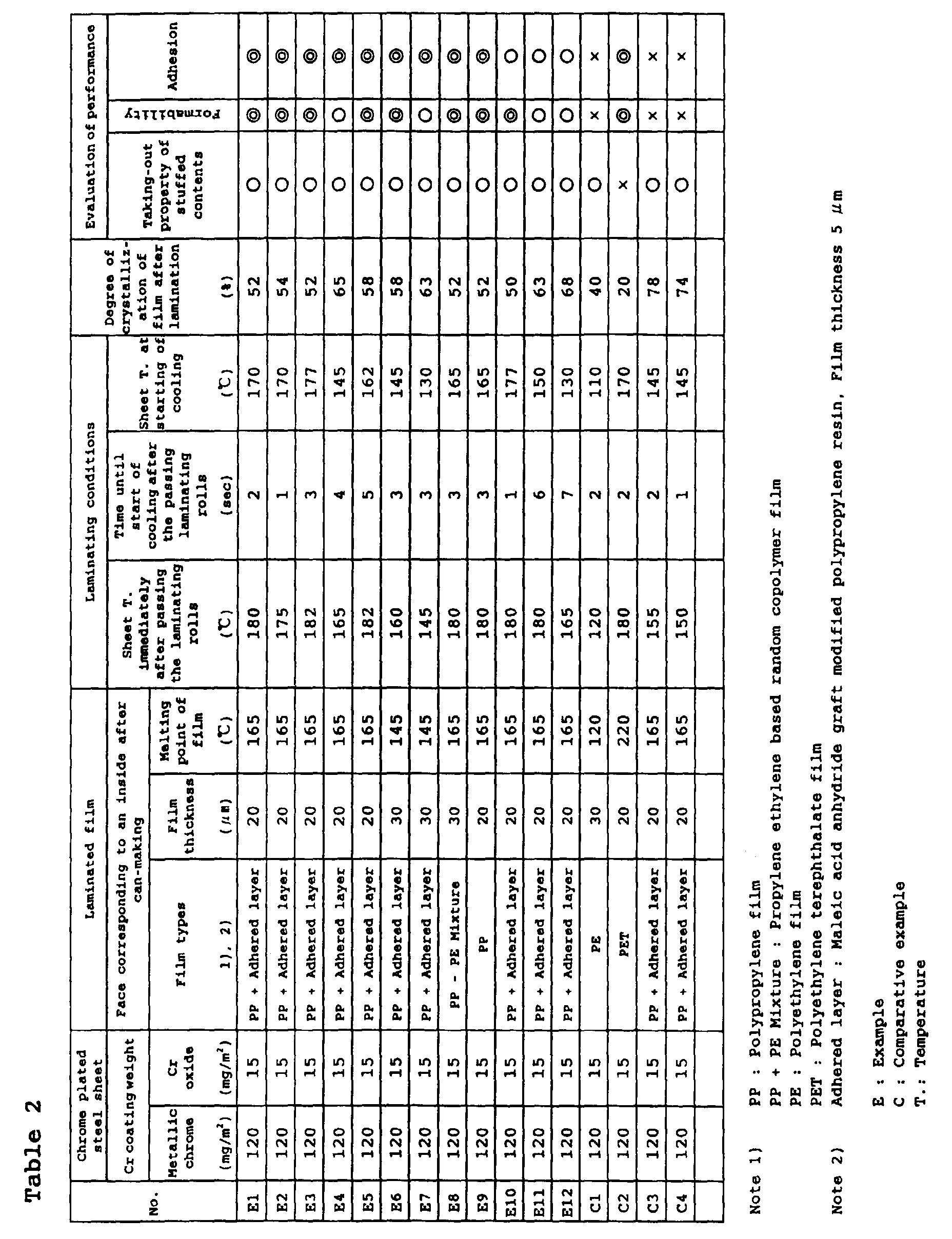
- the resin film laminating apparatus for metal sheet shown in Fig. 3 was used in which the same chrome plated steel sheets 1 as those of Example 1 were heated in the heating apparatus 2, laminated by the laminating rolls 3 with various kinds of film 4a shown in Table 2 on the face to be an inside of can after can-making and with PET film 4b on the face to be an outside of can after can-making respectively, sprayed with the cooled water 8 controlled to be at constant temperature by the heat exchanger 13 from the spraying apparatus 14 in the cooling apparatus 5 so as to cool the films, and then pulled upward via the sink roll 7 from the cooling water tank 6.
- the sheet temperature at the inlet of the laminating rolls 3, the temperature of the laminating rolls 3 and the position of the spray apparatus 14 were controlled so as to variously change the sheet temperature immediately after passing the laminating rolls 3, the time until starting of cooling after passing the laminating rolls 3, and the sheet temperature at starting of cooling as shown in Table 2.
- the melting point of the resin film was calculated from the endothermic peaks obtained by means of a differential scanning calorimeter (DSC-2 made by Perkin-Elmar Inc.) under the conditions where samples were heated to 300 °C at a nitrogen flowing amount of 20 ml/min and at a heating rate of 10 °C/min.
- DSC-2 differential scanning calorimeter
- the degree of crystallization of the resin film was measured as follows.
- the density of the resin film adopted by melting the metal part of the resin film laminated metal sheet was obtained by a density gradient method, and the degree of crystallization of the resin film was calculated by the following equation.
- X [ ⁇ (1/dam) - (1/d ⁇ / ⁇ (1/dam) - (1/dc) ⁇ ] ⁇ 100
- the density gradient method was carried out by the density gradient pipe of JIS K 7112 as follows.
- the inventive examples show that the degrees of crystallization of the resin film are all less than 70%, and each of the properties is excellent.
- the degree of crystallization of the film is less than 60 °C, and more excellent formability and adhesion may be obtained.
- the degrees of crystallization of the films of the comparative examples 1, 3, 4 are 70% or more, and the formability and the adhesion are inferior.
- the taking-out property is poor.
- the resin film laminating apparatus for metal sheet shown in Fig. 2 was used in which the chrome plated steel sheets of the chrome amount being 120 mg/m 2 and the chrome hydroxide amount being 15 mg/m 2 fabricated in the same method in Example 1 were heated in the metal sheet heating apparatus 2, and the laminating rolls 3 laminated the film 4a on the face of the steel sheets to be an inside of can after can-making and laminated the resin film 4b on the face of them to be an outside of can after can-making. At that time, as the resin film 4a on the inside of can after can-making, the resin film 4b on the outside of can after can-making which was added with wax was used.
- Table 3 shows the laminated resin films and the laminating temperature conditions.
- the laminating rolls 3 were internal cooling rolls, and the cooling water was forcibly circulated during laminating so as to carry out the cooling while adhering the film.
- Example 1 With respect to the thus produced resin film laminated metal sheets, the formability and the adhesion after forming were evaluated in the same ways as Example 1. The taking-out properties of stuffed food contents were evaluated in the following 3 steps more in detail than Example 1.
- a spectrometer JNM-GX270 made by Japan Electron Optics Laboratory Co., Ltd.
- a solid amplifier made by the same
- MAS controller NM-GSH27MU a probe NM-GSH27T made by the same.
- T1 ⁇ vertical relaxation in the rotational coordinate
- the measuring conditions were temperature of 24.5 °C, humidity of 50 % RH, static magnetic field of 6.34 T (Tesla), and resonant frequencies of 1 H, 13 C being 270.2 MHz and 67.9 MHz respectively.
- MAS rotation of magic angle
- the rotation number was 3.5 to 3.7 kHz.
- the conditions of pulse series were 90° for 1 H, pulse width of 4 ⁇ sec, the strength of rocking magnetic field of 62.5 kHz.
- the contacting time of CP (cross polarization) for shifting the polarization of 1 H to 13 C was 1.5 msec.
- As the holding times ⁇ 0.001, 0.5, 0.7, 1.3, 7, 10, 20, 30, 40, 50 msec were used.
- Free induction decrement (FID) of 13 C magnetization vector after the holding time ⁇ was measured (a high output coupling was done for removing influences of dipole mutual action by 1 H during measuring FID. For improving S/N, integrations were made 512 times.).
- the pulse repeating time was between 5 and 15 sec.
- T1 ⁇ values can be ordinarily described by the following equation and can be obtained from the slope when the peak strength measured for each of the holding times is plotted in a scale of semi-logarithm.
- I(t) ⁇ (Ai) exp (-t/T1 ⁇ i)
- T1 ⁇ 1 Non-crystal component
- T1 ⁇ 2 Crystal component
- the melting point was measured at a heating rate of 10 °C/min by the same differential scanning calorimeter as described above.
Landscapes
- Laminated Bodies (AREA)
Abstract
Description
- ○:
- The taking-out is easy, and no stuck food remains in the inside of the cup.
- X:
- The taking-out is hard by shaking by hands, and the stuck food can not be taken out without using a spoon or the like.
- o○:
- No injury exists in the film after forming, and no whiting is recognized therein.
- ○:
- The forming is possible, but the whiting is recognized.
- X:
- The cup is broken at the barrel, and the forming is impossible.
- o○:
- 0.15 kg/15 mm or more
- ○:
- 0.10 kg/15 mm or more to less than 0.15 kg/15 mm
- X:
- Less than 0.10 kg/15 mm

- X
- : Degree (%) of crystallization of the film
- dam
- : Density (0.860 g/cc) of completely amorphous polypropylene resin
- dc
- : Density (0.938 g/cc) of completely crystallized polypropylene resin
- d
- : Density (g/cc) of the resin film after lamination
- o○:
- The taking-out is easy, and no stuck food remains in the inside of the cup.
- ○:
- The taking-out is hard only by shaking by hands, but stuck food can be taken out by a spoon or the like, and little food stuck to the inside of the cup are left.
- X:
- The taking-out is hard only by shaking by hands, and stuck food can be taken out by a spoon or the like. Much food is left in the inside of the cup after taking out.
- Ai:
- Percentage of components with respect to T1 ρ i
- fa1:
- Percentage of components with respect to
T1 ρ 1 - fa2:
- Percentage of components with respect to
T1 ρ 2
- o○:
- Less than 0.01 mA
- ○:
- 0.01 mA or more to less than 0.1 mA
- X:
- 0.1 mA or more

Claims (15)
- A resin film laminated metal sheet for can, wherein both faces of the metal sheet have resin film laminated layers, and a surface free energy γs of a face of the resin film is 10 dyn/cm or more to less than 30 dyn/cm, said face becoming an inside of can after can-making and being contacted with stuffed food contents.
- The resin film laminated metal sheet for can according to claim 1, wherein the γs of a face of the resin film is 25 dyn/cm or more, said face becoming an outside of can after can-making and being contacted with an atmospheric air.
- The resin film laminated metal sheet for can according to claim 1 or 2, wherein the γs of a face of the resin film to be adhered to said metal sheet is smaller than the γs of said metal sheet.
- The resin film laminated metal sheet for can according to any of claims 1 to 3, wherein the resin film is a polypropylene film or a propylene ethylene based random copolymer film of polypropylene being a main component.
- The resin film laminated metal sheet for can according to any of claims 1 to 4, wherein the resin film has an adherent layer containing a polar group in a side contracting said metal sheet.
- The resin film laminated metal sheet according to claim 5, wherein the adherent layer containing the polar group comprises polypropylene modified with maleic acid anhydride or propylene ethylene based random copolymer modified with maleic acid anhydride.
- The resin film laminated metal sheet according to any of claims 1 to 6, wherein a degree of crystallization of the laminated resin film is less than 70%.
- The resin film laminated metal sheet according to any of claims 1 to 7, wherein a main component of the resin film to be on an outside of can after can-making is polyester.
- A resin film laminated metal sheet, wherein the resin film has a main component of polyester, and said resin film to be on an inside of can after can-making contains a wax of 0.1 to 2.0%.
- The resin film laminated metal sheet according to claim 9, wherein carnauba wax or stearic acid ester is contained as the wax component.
- The resin film laminated metal sheet according to claim 9 or 10, wherein the resin film of polyester being a main component is a biaxial oriented polyester film where a relaxation time T1 ρ of benzene ring carbon of 1,4 coordination measured by a solid high resolution NMR is 150 msec or more.
- A method for fabricating a resin film laminated metal sheet for can, comprising a step of laminating a resin film composed of polypropylene film or propylene being a main component on the surface of a metal sheet to be an inside of can after can-making, wherein the temperature of the metal sheet after passing laminating rolls is above the melting point of the resin film.
- The method according to claim 12, wherein a time when the metal sheet is cooled after passing the laminating rolls is 1 to 5 seconds, and the temperature of the metal sheet at starting of cooling is (the melting point of the resin film - 30)°C or higher.
- The method according to claim 12 or 13, wherein the surface of a metal sheet to be an outside of can after can-making is laminated with a resin film of polyester being a main component.
- A method for fabricating a resin film laminated metal sheet for can, comprising a step of laminating a resin film of polyester being a main component on the surface of the metal sheet, wherein the temperature of a face of the resin film to contact the metal sheet is above the melting point of the resin film between 1 and 20 msec.
Priority Applications (2)
| Application Number | Priority Date | Filing Date | Title |
|---|---|---|---|
| DE2000636992 DE60036992T3 (en) | 1999-09-22 | 2000-09-21 | Plastic film laminated metal foil for cans and manufacturing processes |
| EP20070021544 EP1886803B2 (en) | 1999-09-22 | 2000-09-21 | Resin film laminated metal sheet for can and method for fabricating the same |
Applications Claiming Priority (6)
| Application Number | Priority Date | Filing Date | Title |
|---|---|---|---|
| JP26898999 | 1999-09-22 | ||
| JP26898999A JP3491574B2 (en) | 1999-09-22 | 1999-09-22 | Film laminated metal plate for containers |
| JP2000074316 | 2000-03-16 | ||
| JP2000074316 | 2000-03-16 | ||
| JP2000238166 | 2000-08-07 | ||
| JP2000238166 | 2000-08-07 |
Related Child Applications (2)
| Application Number | Title | Priority Date | Filing Date |
|---|---|---|---|
| EP20070021544 Division EP1886803B2 (en) | 1999-09-22 | 2000-09-21 | Resin film laminated metal sheet for can and method for fabricating the same |
| EP07021544.7 Division-Into | 2007-11-06 |
Publications (4)
| Publication Number | Publication Date |
|---|---|
| EP1086808A2 true EP1086808A2 (en) | 2001-03-28 |
| EP1086808A3 EP1086808A3 (en) | 2002-08-07 |
| EP1086808B1 EP1086808B1 (en) | 2007-11-07 |
| EP1086808B2 EP1086808B2 (en) | 2013-10-09 |
Family
ID=27335690
Family Applications (2)
| Application Number | Title | Priority Date | Filing Date |
|---|---|---|---|
| EP20000120151 Expired - Lifetime EP1086808B2 (en) | 1999-09-22 | 2000-09-21 | Resin film laminated metal sheet for can and method for fabricating the same |
| EP20070021544 Expired - Lifetime EP1886803B2 (en) | 1999-09-22 | 2000-09-21 | Resin film laminated metal sheet for can and method for fabricating the same |
Family Applications After (1)
| Application Number | Title | Priority Date | Filing Date |
|---|---|---|---|
| EP20070021544 Expired - Lifetime EP1886803B2 (en) | 1999-09-22 | 2000-09-21 | Resin film laminated metal sheet for can and method for fabricating the same |
Country Status (3)
| Country | Link |
|---|---|
| US (3) | US6723441B1 (en) |
| EP (2) | EP1086808B2 (en) |
| DE (2) | DE60045226D1 (en) |
Cited By (5)
| Publication number | Priority date | Publication date | Assignee | Title |
|---|---|---|---|---|
| EP1270214A3 (en) * | 2001-06-25 | 2003-12-17 | Rasselstein Hoesch GmbH | Method for coating the surface of a metallic band with a plastic film |
| EP1449883A1 (en) * | 2003-02-18 | 2004-08-25 | Corus Technology BV | Polymer packaging layer with improved release properties |
| WO2005016631A1 (en) * | 2003-08-18 | 2005-02-24 | Nippon Steel Corporation | Laminated metal sheet and process for producing the same |
| WO2017196664A1 (en) * | 2016-05-10 | 2017-11-16 | Novelis Inc. | Laminated can end stock with elevated temperature annealing |
| EP4082929A1 (en) | 2019-12-23 | 2022-11-02 | JFE Steel Corporation | Resin-coated metal plate and resin-coated di can and manufacturing methods thereof |
Families Citing this family (31)
| Publication number | Priority date | Publication date | Assignee | Title |
|---|---|---|---|---|
| US6723441B1 (en) * | 1999-09-22 | 2004-04-20 | Nkk Corporation | Resin film laminated metal sheet for can and method for fabricating the same |
| KR100721323B1 (en) * | 1999-12-03 | 2007-05-25 | 도레이 가부시끼가이샤 | Biaxially Stretched Polyester Film for Molding Processing |
| JP3982385B2 (en) * | 2001-11-27 | 2007-09-26 | Jfeスチール株式会社 | Resin film for laminating metal plate, method for producing the same, resin laminated metal plate and method for producing the same |
| RU2336173C2 (en) * | 2003-03-28 | 2008-10-20 | Корус Стал Б.В. | Sheet material for blanking, metal container made of such sheet material, and method of sheet material production |
| EP1757439B1 (en) * | 2004-05-31 | 2016-07-06 | JFE Steel Corporation | Resin-coated metal plate |
| DK1908583T3 (en) * | 2005-07-28 | 2015-11-09 | Jfe Steel Corp | The resin-coated metal sheet |
| JP4961696B2 (en) * | 2005-08-12 | 2012-06-27 | Jfeスチール株式会社 | Two-piece can manufacturing method and two-piece laminated can |
| KR100982120B1 (en) * | 2005-08-12 | 2010-09-14 | 제이에프이 스틸 가부시키가이샤 | 2-piece cans and manufacturing method thereof, and steel sheet for 2-piece cans |
| JP4622737B2 (en) * | 2005-08-12 | 2011-02-02 | Jfeスチール株式会社 | Laminated steel sheet for 2-piece can and 2-piece laminated can |
| JP4972771B2 (en) * | 2006-12-05 | 2012-07-11 | Jfeスチール株式会社 | Method for producing aerosol drawn can and aerosol drawn can |
| JP4091963B1 (en) * | 2007-01-12 | 2008-05-28 | 古河スカイ株式会社 | Resin-coated aluminum alloy sheet for aluminum electrolytic capacitor case, aluminum electrolytic capacitor case, aluminum electrolytic capacitor |
| CN104369466B (en) * | 2008-11-25 | 2018-04-17 | 威士伯采购公司 | Packing articles and laminate |
| CN105588236B (en) | 2010-05-25 | 2019-07-09 | 7Ac技术公司 | The method and system of air conditioning and other processing is carried out using liquid drier |
| US9101875B2 (en) | 2012-06-11 | 2015-08-11 | 7Ac Technologies, Inc. | Methods and systems for turbulent, corrosion resistant heat exchangers |
| EP2929256A4 (en) | 2012-12-04 | 2016-08-03 | 7Ac Technologies Inc | METHODS AND SYSTEMS FOR COOLING BUILDINGS WITH HIGH THERMAL LOADS THROUGH DESICCANT COOLERS |
| KR20200009148A (en) | 2013-03-01 | 2020-01-29 | 7에이씨 테크놀로지스, 아이엔씨. | Desiccant air conditioning methods and systems |
| US10434763B2 (en) * | 2013-03-14 | 2019-10-08 | Crown Packaging Technology, Inc. | Ink jet printing on a metal can substrate |
| KR102099693B1 (en) | 2013-03-14 | 2020-05-15 | 7에이씨 테크놀로지스, 아이엔씨. | Methods and systems for mini-split liquid desiccant air conditioning |
| EP3008396B1 (en) | 2013-06-12 | 2019-10-23 | 7AC Technologies, Inc. | Liquid desiccant air conditioning system |
| CN110594883B (en) | 2014-03-20 | 2022-06-14 | 艾默生环境优化技术有限公司 | Combined heat exchanger and water injection system |
| KR20170086496A (en) | 2014-11-21 | 2017-07-26 | 7에이씨 테크놀로지스, 아이엔씨. | Methods and systems for mini-split liquid desiccant air conditioning |
| US10576712B2 (en) * | 2015-03-26 | 2020-03-03 | Jfe Steel Corporation | Resin-coated metal sheet for container |
| US11420801B2 (en) * | 2016-03-10 | 2022-08-23 | Nippon Steel Corporation | Metal sheet for containers and method for manufacturing same |
| US20190116977A1 (en) * | 2017-10-24 | 2019-04-25 | Streater LLC | Cover for store shelves |
| EP3704415A4 (en) | 2017-11-01 | 2021-11-03 | 7AC Technologies, Inc. | TANK SYSTEM FOR AN AIR CONDITIONING SYSTEM WITH LIQUID DRYING AGENTS |
| WO2019089957A1 (en) | 2017-11-01 | 2019-05-09 | 7Ac Technologies, Inc. | Methods and apparatus for uniform distribution of liquid desiccant in membrane modules in liquid desiccant air-conditioning systems |
| CN111511545B (en) | 2017-12-15 | 2022-09-20 | 杰富意钢铁株式会社 | Resin-coated metal plate for container |
| US11022330B2 (en) | 2018-05-18 | 2021-06-01 | Emerson Climate Technologies, Inc. | Three-way heat exchangers for liquid desiccant air-conditioning systems and methods of manufacture |
| US12030702B2 (en) * | 2019-02-07 | 2024-07-09 | Nippon Steel Corporation | Can lid made of resin laminate steel sheet for resin-metal composite container, can bottom made of resin laminate steel sheet for resin-metal composite container, and resin-metal composite container |
| WO2021006024A1 (en) * | 2019-07-05 | 2021-01-14 | 日本製鉄株式会社 | Resin film laminate metal sheet and method for manufacturing same |
| WO2024062103A1 (en) * | 2022-09-23 | 2024-03-28 | Basf Se | Process for producing a composite component comprising at least one metal layer and one polymer layer |
Family Cites Families (22)
| Publication number | Priority date | Publication date | Assignee | Title |
|---|---|---|---|---|
| GB1134876A (en) * | 1966-03-29 | 1968-11-27 | Ici Ltd | Production of coated film |
| GB1471397A (en) | 1976-05-28 | 1977-04-27 | British Cellophane Ltd | Application of synthetic thermoplastic film to metal and coated metal sheets |
| US4661185A (en) * | 1985-03-05 | 1987-04-28 | Signode Corporation | Method and apparatus for heat sealing strap in a strapping machine |
| IT1187646B (en) * | 1985-03-25 | 1987-12-23 | Moplefan Spa | POLYOLEFINIC FILMS HAVING IMPROVED WATERPROOFING CHARACTERISTICS WITH GASES AND VAPORS AND PROCEDURE FOR THEIR PRODUCTION |
| DE3778727D1 (en) | 1986-02-27 | 1992-06-11 | Nippon Kokan Kk | BASE COATED METAL PLATE. |
| US5296127A (en) * | 1986-04-25 | 1994-03-22 | Saunders William T | Composite-coated flat-rolled sheet metal manufacture |
| JPH0639146B2 (en) | 1987-03-25 | 1994-05-25 | 東洋鋼鈑株式会社 | Metal plate coated with printed polyester resin film |
| GB8724244D0 (en) | 1987-10-15 | 1987-11-18 | Metal Box Plc | Producing laminated materials |
| US4956241A (en) * | 1988-12-30 | 1990-09-11 | Mobil Oil Corporation | Slip coated thermoplastic films |
| DE4132083A1 (en) * | 1991-09-26 | 1993-04-01 | Basf Lacke & Farben | METHOD FOR THE ELECTROPHORETIC INTERIOR COATING OF METAL TANKS FOR STORING FOODS AND BEVERAGES |
| JP2835386B2 (en) | 1992-01-28 | 1998-12-14 | 東洋鋼鈑 株式会社 | Method for producing polyethylene resin-coated metal sheet excellent in hot water resistance |
| US5424121A (en) * | 1992-09-06 | 1995-06-13 | Teijin Limited | Biaxially oriented polyester film |
| DE69328163T2 (en) * | 1992-12-25 | 2000-12-14 | Toyo Seikan Kaisha, Ltd. | Coated metal plate for cans and dozen made from them |
| DE4303833A1 (en) * | 1993-02-10 | 1994-10-06 | Wolff Walsrode Ag | Multi-layer coating of polar film substrates through a single application of material |
| EP0664209A1 (en) | 1994-01-24 | 1995-07-26 | TOYO KOHAN Co., Ltd | Metal sheet laminated with resin films |
| GB2289864A (en) | 1994-05-27 | 1995-12-06 | Metal Box Plc | Laminate of metal and biaxially oriented polypropylene film |
| MY127653A (en) * | 1996-05-16 | 2006-12-29 | Toray Industries | Biaxially stretched polyester film for forming container and method of producing the film |
| EP0875298B1 (en) | 1997-05-02 | 2001-07-04 | Rasselstein Hoesch GmbH | Method and device for extrusion coating a metal strip with plastic |
| ATE321658T1 (en) * | 1998-01-06 | 2006-04-15 | Toyo Boseki | POLYESTER MULTILAYER FILM, A METAL PLATE COATED WITH THIS FILM AND A METAL CONTAINER COATED WITH A FILM |
| US6723441B1 (en) * | 1999-09-22 | 2004-04-20 | Nkk Corporation | Resin film laminated metal sheet for can and method for fabricating the same |
| KR100721323B1 (en) * | 1999-12-03 | 2007-05-25 | 도레이 가부시끼가이샤 | Biaxially Stretched Polyester Film for Molding Processing |
| CA2440334C (en) * | 2001-03-14 | 2010-08-17 | Jfe Steel Corporation | Film-laminated metal sheet for container |
-
2000
- 2000-09-19 US US09/665,323 patent/US6723441B1/en not_active Expired - Lifetime
- 2000-09-21 DE DE60045226T patent/DE60045226D1/en not_active Expired - Lifetime
- 2000-09-21 EP EP20000120151 patent/EP1086808B2/en not_active Expired - Lifetime
- 2000-09-21 DE DE2000636992 patent/DE60036992T3/en not_active Expired - Lifetime
- 2000-09-21 EP EP20070021544 patent/EP1886803B2/en not_active Expired - Lifetime
-
2003
- 2003-11-20 US US10/719,797 patent/US20040101698A1/en not_active Abandoned
-
2006
- 2006-05-23 US US11/439,469 patent/US20060210817A1/en not_active Abandoned
Cited By (10)
| Publication number | Priority date | Publication date | Assignee | Title |
|---|---|---|---|---|
| EP1270214A3 (en) * | 2001-06-25 | 2003-12-17 | Rasselstein Hoesch GmbH | Method for coating the surface of a metallic band with a plastic film |
| EP1449883A1 (en) * | 2003-02-18 | 2004-08-25 | Corus Technology BV | Polymer packaging layer with improved release properties |
| WO2004074376A1 (en) * | 2003-02-18 | 2004-09-02 | Corus Staal Bv | Polymer packaging layer with improved release properties |
| WO2005016631A1 (en) * | 2003-08-18 | 2005-02-24 | Nippon Steel Corporation | Laminated metal sheet and process for producing the same |
| US8551281B2 (en) | 2003-08-18 | 2013-10-08 | Nippon Steel & Sumitomo Metal Corporation | Laminated metal sheet and method of production of same |
| WO2017196664A1 (en) * | 2016-05-10 | 2017-11-16 | Novelis Inc. | Laminated can end stock with elevated temperature annealing |
| CN109789672A (en) * | 2016-05-10 | 2019-05-21 | 诺维尔里斯公司 | High temperature annealed laminated can end stock |
| AU2017264579B2 (en) * | 2016-05-10 | 2020-08-06 | Novelis Inc. | Laminated can end stock with elevated temperature annealing |
| US11241871B2 (en) | 2016-05-10 | 2022-02-08 | Novelis Inc. | Laminated can end stock with elevated temperature annealing |
| EP4082929A1 (en) | 2019-12-23 | 2022-11-02 | JFE Steel Corporation | Resin-coated metal plate and resin-coated di can and manufacturing methods thereof |
Also Published As
| Publication number | Publication date |
|---|---|
| EP1086808B1 (en) | 2007-11-07 |
| DE60036992T3 (en) | 2014-02-06 |
| EP1886803B1 (en) | 2010-11-10 |
| EP1086808A3 (en) | 2002-08-07 |
| EP1886803A3 (en) | 2008-03-26 |
| US6723441B1 (en) | 2004-04-20 |
| US20060210817A1 (en) | 2006-09-21 |
| DE60045226D1 (en) | 2010-12-23 |
| US20040101698A1 (en) | 2004-05-27 |
| EP1886803A2 (en) | 2008-02-13 |
| DE60036992T2 (en) | 2008-08-21 |
| EP1086808B2 (en) | 2013-10-09 |
| DE60036992D1 (en) | 2007-12-20 |
| EP1886803B2 (en) | 2014-08-06 |
Similar Documents
| Publication | Publication Date | Title |
|---|---|---|
| EP1886803B1 (en) | Resin film laminated metal sheet for can and method for fabricating the same | |
| CA2440334C (en) | Film-laminated metal sheet for container | |
| JP5673860B2 (en) | Laminated metal plate and canned food containers | |
| EP3278980A1 (en) | Laminate metal plate for container | |
| CA2546947C (en) | Laminated metal sheet for can end having excellent appearance after retorting | |
| JP3692953B2 (en) | Film laminated metal plate for containers | |
| EP1908583B1 (en) | Resin-coated metal plate | |
| JP2003236985A (en) | Film laminated metal plate for containers | |
| WO2021131765A1 (en) | Resin-coated metal plate and resin-coated di can and manufacturing methods thereof | |
| JP4806933B2 (en) | Polyester resin laminated metal container | |
| JP5082269B2 (en) | Resin-coated metal plate for containers | |
| JP5076385B2 (en) | Resin-coated metal plate for container and resin-coated metal can | |
| JP3812589B2 (en) | Film laminated metal plate for containers | |
| JP4779295B2 (en) | Resin-coated metal plate for container and method for producing the same | |
| JP3780905B2 (en) | Film laminated metal plate for containers | |
| JP2005096473A (en) | Film laminated metal plate for container and method for producing the same | |
| JP2874582B2 (en) | Laminate and container using the same | |
| JP2006069212A (en) | Film laminated metal plate for containers | |
| JP2803837B2 (en) | Manufacturing method of polyester resin film laminated steel sheet | |
| JP5050838B2 (en) | Resin-coated metal plate for containers | |
| JP2003225969A (en) | Film laminated metal plate for containers | |
| JP2002264256A (en) | Film laminated metal plate for containers | |
| CA2562146C (en) | Resin-coated metal sheet | |
| JP2002264258A (en) | Film laminated metal plate for containers | |
| US20060172099A1 (en) | Metal plate coated with polyester resin, and can using the same |
Legal Events
| Date | Code | Title | Description |
|---|---|---|---|
| PUAI | Public reference made under article 153(3) epc to a published international application that has entered the european phase |
Free format text: ORIGINAL CODE: 0009012 |
|
| 17P | Request for examination filed |
Effective date: 20000921 |
|
| AK | Designated contracting states |
Kind code of ref document: A2 Designated state(s): AT BE CH CY DE DK ES FI FR GB GR IE IT LI LU MC NL PT SE |
|
| AX | Request for extension of the european patent |
Free format text: AL;LT;LV;MK;RO;SI |
|
| RIC1 | Information provided on ipc code assigned before grant |
Free format text: 7B 32B 15/08 A, 7B 65D 65/40 B |
|
| RIC1 | Information provided on ipc code assigned before grant |
Free format text: 7B 32B 15/08 A, 7B 65D 65/40 B, 7B 32B 31/00 B |
|
| PUAL | Search report despatched |
Free format text: ORIGINAL CODE: 0009013 |
|
| AK | Designated contracting states |
Kind code of ref document: A3 Designated state(s): AT BE CH CY DE DK ES FI FR GB GR IE IT LI LU MC NL PT SE |
|
| AX | Request for extension of the european patent |
Free format text: AL;LT;LV;MK;RO;SI |
|
| AKX | Designation fees paid |
Designated state(s): DE GB |
|
| RAP1 | Party data changed (applicant data changed or rights of an application transferred) |
Owner name: JFE STEEL CORPORATION |
|
| 17Q | First examination report despatched |
Effective date: 20050630 |
|
| GRAP | Despatch of communication of intention to grant a patent |
Free format text: ORIGINAL CODE: EPIDOSNIGR1 |
|
| RIC1 | Information provided on ipc code assigned before grant |
Ipc: B65D 65/40 20060101ALI20070507BHEP Ipc: B32B 15/08 20060101AFI20070507BHEP Ipc: B32B 33/00 20060101ALI20070507BHEP |
|
| GRAS | Grant fee paid |
Free format text: ORIGINAL CODE: EPIDOSNIGR3 |
|
| GRAA | (expected) grant |
Free format text: ORIGINAL CODE: 0009210 |
|
| AK | Designated contracting states |
Kind code of ref document: B1 Designated state(s): DE GB |
|
| REG | Reference to a national code |
Ref country code: GB Ref legal event code: FG4D |
|
| REF | Corresponds to: |
Ref document number: 60036992 Country of ref document: DE Date of ref document: 20071220 Kind code of ref document: P |
|
| PLBI | Opposition filed |
Free format text: ORIGINAL CODE: 0009260 |
|
| PLAX | Notice of opposition and request to file observation + time limit sent |
Free format text: ORIGINAL CODE: EPIDOSNOBS2 |
|
| 26 | Opposition filed |
Opponent name: CORUS STAAL BV Effective date: 20080807 |
|
| PLAF | Information modified related to communication of a notice of opposition and request to file observations + time limit |
Free format text: ORIGINAL CODE: EPIDOSCOBS2 |
|
| PLBB | Reply of patent proprietor to notice(s) of opposition received |
Free format text: ORIGINAL CODE: EPIDOSNOBS3 |
|
| APBM | Appeal reference recorded |
Free format text: ORIGINAL CODE: EPIDOSNREFNO |
|
| APBP | Date of receipt of notice of appeal recorded |
Free format text: ORIGINAL CODE: EPIDOSNNOA2O |
|
| APAH | Appeal reference modified |
Free format text: ORIGINAL CODE: EPIDOSCREFNO |
|
| APBQ | Date of receipt of statement of grounds of appeal recorded |
Free format text: ORIGINAL CODE: EPIDOSNNOA3O |
|
| PLAB | Opposition data, opponent's data or that of the opponent's representative modified |
Free format text: ORIGINAL CODE: 0009299OPPO |
|
| R26 | Opposition filed (corrected) |
Opponent name: TATA STEEL IJMUIDEN BV Effective date: 20080807 |
|
| APBU | Appeal procedure closed |
Free format text: ORIGINAL CODE: EPIDOSNNOA9O |
|
| APAN | Information on closure of appeal procedure modified |
Free format text: ORIGINAL CODE: EPIDOSCNOA9O |
|
| PUAH | Patent maintained in amended form |
Free format text: ORIGINAL CODE: 0009272 |
|
| STAA | Information on the status of an ep patent application or granted ep patent |
Free format text: STATUS: PATENT MAINTAINED AS AMENDED |
|
| 27A | Patent maintained in amended form |
Effective date: 20131009 |
|
| AK | Designated contracting states |
Kind code of ref document: B2 Designated state(s): DE GB |
|
| REG | Reference to a national code |
Ref country code: DE Ref legal event code: R102 Ref document number: 60036992 Country of ref document: DE Effective date: 20131009 |
|
| REG | Reference to a national code |
Ref country code: DE Ref legal event code: R082 Ref document number: 60036992 Country of ref document: DE Representative=s name: HOFFMANN - EITLE, DE Ref country code: DE Ref legal event code: R082 Ref document number: 60036992 Country of ref document: DE Representative=s name: HOFFMANN - EITLE PATENT- UND RECHTSANWAELTE PA, DE |
|
| PGFP | Annual fee paid to national office [announced via postgrant information from national office to epo] |
Ref country code: DE Payment date: 20190910 Year of fee payment: 20 |
|
| PGFP | Annual fee paid to national office [announced via postgrant information from national office to epo] |
Ref country code: GB Payment date: 20190920 Year of fee payment: 20 |
|
| REG | Reference to a national code |
Ref country code: DE Ref legal event code: R071 Ref document number: 60036992 Country of ref document: DE |
|
| REG | Reference to a national code |
Ref country code: GB Ref legal event code: PE20 Expiry date: 20200920 |
|
| PG25 | Lapsed in a contracting state [announced via postgrant information from national office to epo] |
Ref country code: GB Free format text: LAPSE BECAUSE OF EXPIRATION OF PROTECTION Effective date: 20200920 |