EP1086272B1 - Method for manufacture of paper and a paper machine - Google Patents
Method for manufacture of paper and a paper machine Download PDFInfo
- Publication number
- EP1086272B1 EP1086272B1 EP99929347A EP99929347A EP1086272B1 EP 1086272 B1 EP1086272 B1 EP 1086272B1 EP 99929347 A EP99929347 A EP 99929347A EP 99929347 A EP99929347 A EP 99929347A EP 1086272 B1 EP1086272 B1 EP 1086272B1
- Authority
- EP
- European Patent Office
- Prior art keywords
- paper
- web
- wire part
- calender
- porosity
- Prior art date
- Legal status (The legal status is an assumption and is not a legal conclusion. Google has not performed a legal analysis and makes no representation as to the accuracy of the status listed.)
- Expired - Lifetime
Links
- 238000000034 method Methods 0.000 title claims abstract description 44
- 238000004519 manufacturing process Methods 0.000 title claims abstract description 18
- 238000003490 calendering Methods 0.000 claims abstract description 34
- 239000000945 filler Substances 0.000 claims abstract description 23
- 239000011248 coating agent Substances 0.000 claims abstract description 17
- 238000000576 coating method Methods 0.000 claims abstract description 15
- 238000009826 distribution Methods 0.000 claims abstract description 14
- 238000007639 printing Methods 0.000 claims abstract description 14
- 239000000654 additive Substances 0.000 claims abstract description 11
- 239000000843 powder Substances 0.000 claims abstract description 11
- XLYOFNOQVPJJNP-UHFFFAOYSA-N water Substances O XLYOFNOQVPJJNP-UHFFFAOYSA-N 0.000 claims abstract description 6
- 239000000203 mixture Substances 0.000 claims abstract description 4
- 238000001035 drying Methods 0.000 claims description 20
- 230000015572 biosynthetic process Effects 0.000 claims description 12
- 238000012546 transfer Methods 0.000 claims description 11
- 230000014759 maintenance of location Effects 0.000 claims description 8
- 239000003795 chemical substances by application Substances 0.000 claims description 7
- 238000003825 pressing Methods 0.000 claims 1
- 239000010410 layer Substances 0.000 description 22
- 239000004744 fabric Substances 0.000 description 9
- 230000000694 effects Effects 0.000 description 5
- 239000007787 solid Substances 0.000 description 5
- 238000012360 testing method Methods 0.000 description 3
- 238000007645 offset printing Methods 0.000 description 2
- 230000035699 permeability Effects 0.000 description 2
- 230000000485 pigmenting effect Effects 0.000 description 2
- 239000002994 raw material Substances 0.000 description 2
- 230000000717 retained effect Effects 0.000 description 2
- 238000004513 sizing Methods 0.000 description 2
- 239000000126 substance Substances 0.000 description 2
- BVKZGUZCCUSVTD-UHFFFAOYSA-L Carbonate Chemical compound [O-]C([O-])=O BVKZGUZCCUSVTD-UHFFFAOYSA-L 0.000 description 1
- 235000000391 Lepidium draba Nutrition 0.000 description 1
- 238000007605 air drying Methods 0.000 description 1
- 239000011247 coating layer Substances 0.000 description 1
- 238000010276 construction Methods 0.000 description 1
- 230000008030 elimination Effects 0.000 description 1
- 238000003379 elimination reaction Methods 0.000 description 1
- 238000005516 engineering process Methods 0.000 description 1
- 239000007888 film coating Substances 0.000 description 1
- 238000009501 film coating Methods 0.000 description 1
- 239000012467 final product Substances 0.000 description 1
- 239000012535 impurity Substances 0.000 description 1
- 238000005259 measurement Methods 0.000 description 1
- 239000003595 mist Substances 0.000 description 1
- 239000002245 particle Substances 0.000 description 1
- 238000012545 processing Methods 0.000 description 1
- 239000000454 talc Substances 0.000 description 1
- 229910052623 talc Inorganic materials 0.000 description 1
- 238000009827 uniform distribution Methods 0.000 description 1
- 239000002023 wood Substances 0.000 description 1
Images





Classifications
-
- D—TEXTILES; PAPER
- D21—PAPER-MAKING; PRODUCTION OF CELLULOSE
- D21F—PAPER-MAKING MACHINES; METHODS OF PRODUCING PAPER THEREON
- D21F9/00—Complete machines for making continuous webs of paper
- D21F9/003—Complete machines for making continuous webs of paper of the twin-wire type
- D21F9/006—Complete machines for making continuous webs of paper of the twin-wire type paper or board consisting of two or more layers
-
- D—TEXTILES; PAPER
- D21—PAPER-MAKING; PRODUCTION OF CELLULOSE
- D21F—PAPER-MAKING MACHINES; METHODS OF PRODUCING PAPER THEREON
- D21F11/00—Processes for making continuous lengths of paper, or of cardboard, or of wet web for fibre board production, on paper-making machines
- D21F11/02—Processes for making continuous lengths of paper, or of cardboard, or of wet web for fibre board production, on paper-making machines of the Fourdrinier type
- D21F11/04—Processes for making continuous lengths of paper, or of cardboard, or of wet web for fibre board production, on paper-making machines of the Fourdrinier type paper or board consisting on two or more layers
Definitions
- the invention concerns a method as defined in the preamble of claim 1.
- the invention also concerns a paper machine as defined in the preamble of claim 10.
- Paper grades manufactured by means of prior-art methods and paper machines do not meet all present-day or future needs in respect of paper grades.
- One important need is glossy porous paper, which is well suited for colour-powder based printing.
- This need arises, among other things, from the fact that, along with increasing speeds and improved printing quality of colour copiers, in colour-powder based printing, colour copiers have started competing with sheet-offset printing and, on the other hand, this need also arises from the fact that, in black/white printing, digital processing of image and laser technology have improved the quality of the picture to the level of offset printing.
- One problem in printing with a colour copier is inadequate gloss of the paper to be used.
- Coated paper is not directly suitable for use in sheet-feed colour copiers, but one of the problems is a so-called glass-sheet effect between two sheets, i.e. the sheets tend to adhere to each other.
- coated papers do not operate at all, and also in vacuum-based feeders they operate poorly.
- colour-powder printing such a coated or compacted paper is needed as does not adhere to the colour powder fixing unit and in whose use said problem of glass-sheet effect does not occur. It has also been a problem that humidity may remain in the interior of compacted paper when the paper is dried from both sides.
- said paper grades are manufactured in paper machines in which the headbox is, for example, a hydraulic headbox, for example SymFloTM or some other conventional headbox of the same type.
- the wire part that is used is a fourdrinier wire or a hybrid wire part, for example SymFormerTM, in which there are a fourdrinier wire and an upper-wire unit.
- gap formers have been used in the manufacture of paper grades of different types.
- a method is also known for application of additives, fillers and chemicals as layers. This method is described in the patent EP 0 651 092 . As a press section, presses of many types are used, usually roll presses.
- the calender has, as a rule, been a soft calender with one or two nips and combinations formed out of them. Also, supercalendering has been used for the manufacture of the final product.
- the reel-up has been a suitable reel-up.
- Paper machines of the types described above and component units of said machines have been described, for example, in the following published patent applications and patents: FI 75, 377, FI 83,540, FI 98,540, US 4, 075, 056, EP O 770 727, FI 98,387, FI 901967, and FI 924960 . By means of these machines, a paper grade well suited for colour-powder based printing has, however, not been achieved, owing to the above problems.
- the prior art does not know a suitable paper machine or an applicable method for manufacture of paper that has, first, copying paper properties and good gloss and suitable porosity for colour-powder printing. Further, among traditional properties of copying paper, important properties are, among other things, properties of electric charge and resistivity and dimensional stability. It is, however, expected that the need of paper grades of this type will increase in the near future, so that a method and a paper machine are needed for manufacture of such papers:
- the object of the present invention is to provide a method and a paper machine by whose means it is possible to manufacture especially a paper of this type with suitable gloss and suitable porosity.
- the paper web is formed as layers in the Z-direction so that the desired distributions of additives and fillers are obtained in the different layers in the Z-direction in the web.
- the web is calendered in at least one calendering nip, which maintains or at least substantially retains the porosity of the web preceding the calendering.
- the web is calendered in a shoe calender which comprises an extended calendering nip. Successive calendering operations can be carried out in the same calendering device or in separate successive devices.
- the headbox and the wire part of the paper machine have been formed so that the desired composition of layers is obtained for the paper in the Z-direction.
- the calender is a calender device that maintains or at least substantially retains the porosity of the web preceding the calendering, for example a device provided with an extended calendering nip or a device provided with an extensible calendering nip and controlled in compliance with the load, favourably a shoe calender.
- the porosity of the paper that is aimed at and most appropriately manufactured by means of the method and the paper machine in accordance with the invention is higher than 150 Bendtsen units, measured in compliance with the Scan-P 60:87 standard, and the gloss is higher than 25 Hunter gloss units, measured in compliance with the Tappi 4/80 M-90 method. Characteristics of prior-art papers less well suited for multi-colour printing are, among other things:
- a gap former is suitable for this purpose, but formers of other types are also suitable for use, at least to a limited extent.
- the desired distribution of fillers is substantially U-shaped. This form of distribution of fillers is obtained by means of said formation of layers in the paper. Thus, in this way, a better gloss is obtained after calendering.
- an extended-nip press for example a shoe press.
- An extended nip is particularly well suited for this purpose, because in it the paper is compacted uniformly while the porosity is retained. Thus, in the Z-direction, a uniform distribution of density is obtained. If, for example, a roll press were used, the surface of the paper would be compacted to a higher extent than the middle.
- the film transfer method is used, in which case the paper remains more porous. In such a case, a uniform layer of coating agent is obtained, and the electric charge on the X/Y axis is even. If necessary, the web can also be pre-calendered before the film coating.
- a calender is used that substantially retains the porosity of the web preceding the calendering, preferably a shoe calender, in which case the porosity of the paper is retained and the gloss and the smoothness can be brought to the desired levels.
- a so-called belt calender it is also possible to use a so-called belt calender.
- OptiLoadTM calenders and soft calenders are suitable for the arrangement in accordance with the invention, but their use is not equally advantageous as the use of a shoe calender.
- pre-calendering before coating, in a way in itself known, in order to provide a low extent of pigmenting.
- An important part in a paper machine in accordance with the invention is the headbox and the wire part, by whose means the formation of layers is produced, and a second important unit is the calender, by whose means the retaining of the porosity that has been achieved and the desired gloss are secured.
- the porosity and the gloss and the other properties of the paper grade to be produced are, of course, also affected by means of the surface sizing unit, the press section, and by means of the drying method. It has, however, been noticed that the formation of layers in the web and calendering of a correct type are the essential factors.
- the advantageous exemplifying embodiment of the paper machine in accordance with the present invention shown in Fig. 1 first, comprises a headbox 100, which is most appropriately a multi-layer headbox in accordance with what is shown in the figure. This is followed by the wire part 200.
- the headbox 100 and the wire part 200 have such constructions that, in the Z-direction, a structure of paper consisting of layers and/or the desired distribution of additives or fillers in the Z-direction is/are achieved (see the applicant's patent EP 0 651 092 ).
- a retention agent suitable for the purpose and vacuums are employed in the wire part 200, the formation of porosity is promoted. It is, however, also important that good formation is achieved.
- the former 200 must be such that it does not damage the layer formation that has been produced.
- the gap former 250 shown in the figure is well suited for this purpose, but formers of other types are also suitable for use, at least to a limited extent.
- an extended-nip press is used, for example a shoe press 350,360, and in this way possibilities are created for retaining of the porosity.
- the press section 300 as shown in the figure comprises two presses 350,360.
- a forward dryer section 400 is composed of an impingement dryer 450 and of a conventional cylinder dryer 460, which comprises dryer groups R 1...N which make use of single-wire draw.
- At least one of the dryer groups is composed of a large-diameter cylinder 420 placed in the basement space and of an impingement drying equipment 422 fitted in connection with said cylinder 420.
- a film size press 500 which is followed by an after-dryer 600 consisting of dryer groups R J1 , R j2 that apply single-wire draw, as well as a shoe calender 700 and a reel-up 800.
- the paper web W runs as follows. Out of the multi-layer headbox 100 the stock is fed into the gap formed between the former rolls 210,220 of the gap former 250 in the wire part 200, from which gap the web is passed, between the wires 215 and 216, over water drain devices 230 further, while supported by the wire 215, to the press section 300.
- the press section 300 comprises two presses 350 and 360, and on the upper fabric 315 of the first press the web W is passed to between the press rolls 311,310 of the press 350 while supported by the lower fabric 316.
- the web W is passed onto the upper fabric 317 of the following press 360 and further, between the upper fabric 317 and the lower fabric 318, to between the press rolls 321,320 of the press 360.
- Each press 350,360 has been formed as a shoe press.
- the web W is passed by means of a transfer fabric 390, while a suction box 391 keeps the web W in contact with the fabric, to the impingement drying unit in the dryer section 400, in which unit the web W runs on support of the lower fabric 451 over the impingement drying equipment 450 into the dryer groups R 1 ...R N with single-wire draw in the dryer section 400.
- the group R 2 has been formed such that it comprises a large-diameter cylinder 420 placed in the basement, in connection with which cylinder impingement drying 422 has been arranged, in which dryer group the web runs on support of the wire 425.
- the drying wire of the dryer groups with single-wire draw is denoted with the reference numeral 415, and the heated drying cylinders in the upper row with the reference numeral 410, and the reversing cylinders or rolls in the lower row with the reference numeral 411.
- the web W runs meandering from the reversing cylinders/rolls 411 in the lower row onto the heated drying cylinders 410 in the upper row, on which cylinders the web W is in direct contact with the heated cylinder face.
- the web W is passed through a measurement device 490 to a film size press 500, whose rolls are denoted with the reference numerals 545 and 547, and whose film transfer means are denoted with the reference numerals 548 and 549.
- a contact-free turning device 580 the web W is passed through an infra/airborne-web dryer 590 to an after-dryer section 600, which comprises two dryer groups R J1 ,R J2 which make use of single-wire draw and which comprise drying wires 651 and heated drying cylinders 610 as well as reversing cylinders/rolls 611.
- the web is moistened either with water mist or with steam in view of elimination of possible curl by means of the device 650.
- the web W is passed into a calender 700, which has been formed as a shoe calender, and its rolls are denoted with the reference numerals 750,751.
- the web W is passed into a reel-up, in which the paper web W is reeled on the reeling drums 809,810 of the reel-up into paper reels 811,812.
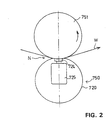
- Fig. 2 shows a shoe calender, in which an extended calendering nip N is formed between a hot hard roll 750 and a shoe roll 751.
- the shoe roll 751 again comprises a press shoe 724 supported by a stationary beam 725 as well as a calendering belt 720 passed around the press shoe 724 and the beam 725 and formed as an endless loop.
- the press shoe 724 the necessary load is produced in the nip N.
- Fig. 3 is a schematic illustration of a preferred solution of the short circulation, in which three stocks at different mixing ratios are passed into the inlet headers in the multi-layer headbox 100 in view of formation of layers.
- a mixing tank 111 the stock is passed into the machine tank 112, from which it is passed through a wire pit 113 and through removal of impurities 118 to deaeration 114, after which the stock is divided into three ducts, each of which has pumps 119 and 120 of its own.
- retention agents, fillers and additives can be passed in the desired ratios at three points 115,116,117 before the stock is passed into the headbox 100. In this way the desired layers of compositions are produced in the Z-direction of the web.
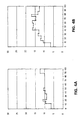
- Figs. 4A...4D illustrate distributions of fillers in different papers.
- Figs. 4A...4C illustrate distributions of fillers in colour copying papers, in which in Fig. 4A the filler content is 8.8 %, in Fig. 4B 13.2 %, and in Fig. 4C 8.7 %.
- Fig. 4D illustrates a distribution of fillers obtained with an arrangement in accordance with the invention in a test run, wherein the filler content was 20 %, the weight 97.9 grams per square metre, and the speed of manufacture was 18 metres per second.
- the desired distribution of fillers is U-shaped.
- the vertical axis represents the filler content as a percentage
- the horizontal axis represents the percentage proportion in the basis weight of the paper.
- Fig. 5 illustrates the porosity of paper obtained with different presses as a function of the dry solids content.
- the vertical axis represents the porosity as Bendtsen units, and the horizontal axis represents the dry solids content of the paper.
- the lower curve 31 has been produced with a roll press, and the upper two curves 32,33 have been produced with a shoe press used in connection with an arrangement in accordance with the invention.
- a shoe press is advantageous in view of porosity.
- With the same dry solids content after the press with a shoe press it is possible to obtain a considerably more porous web than with a roll press; for example, in the case of Fig. 5, when the dry solids content is 45 %, the shoe press provides a paper whose porosity is 300 Bendtsen units higher.
- blade coating Fig. 6A
- Fig. 6B has been compared with coating carried out by means of the film transfer method, Fig. 6B, and, as comes out from Figs. 6C...6D, with the film transfer method more even coating layers 541 are provided on the paper 542.
- the roll is denoted with the reference numeral 543 and the blade coater with the reference numeral 544, the paper web 542 that passes by being coated by means of said blade coater 544.
- Fig. 6B shows a film transfer equipment 500, in which the rolls are denoted with the reference numerals 545 and 547, and by means of said rolls 545,547 coating agent is transferred from the coating device 546,548 onto the face of the paper web 542.
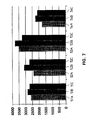
- the vertical axis represents the permeability to air of paper with different coating procedures: columns 51A...51C a short-dwell coater, columns 52A...52C a blade coater, columns 53A...53C a nozzle applicator, and columns 54A...54C a film transfer method.
- the letter A refers to 0 % DIP, B to 40 %, and C to 60 %.
- the film transfer method provides the best porosity, which comes from a more uniform layer of coating agent and from less oriented particles.
- offset paper of 58 g/m 2 was used, the weight of the coating was 8 g/m 2 .
- the vertical axis represents the Curley-Hill penetrability to air, and the unit is seconds per 100 millilitres.
- Fig. 8 illustrates a comparison of calendering, and the horizontal axis represents the linear load, the unit being kN/m, and the vertical axis represents the resistance to air, the unit being seconds per 100 millilitres.
- the moisture content of the paper used in the test before calendering was 4.1...4.7 %, and the ultimate moisture content was 3.2...4.1 %.
- shoe calendering was used (curves OptiDwell Shoe 1...2 nips, temperatures 160/200 °C) there were no losses in porosity.
Landscapes
- Paper (AREA)
- Making Paper Articles (AREA)
Abstract
Description
- basis weight: 80...200 g/m2 (grams per sq.metre), typically about 100 g/m2,
- porosity: 150...1200 Bendtsen, typically 150...350 Bendtsen,
- roughness: about 30...100 Bendtsen, typically about 50 Bendtsen,
- thickness: 50...200 microns, typically about 100 microns,
- gloss: 10...20 Hunter 75°,
- non-coated, because coated papers are too dense, or
- slightly (2...6 grams per sq.m per side) pigmented.
Claims (18)
- A method for manufacture of paper, most appropriately for manufacture of glossy and porous paper for colour powder printing, in which method paper is manufactured by means of a paper machine, in which method the paper stock is fed out of the headbox (100) into the wire part (200), in which wire part (200) water is drained out of the paper web in both directions, and in which method the paper web (W) is passed from the wire part (200) into the press section (300) in order to press water out of the paper web (W), and in which, after the press section (300), the paper web (W) is dried in the dryer section (400) and coated/pigmented in the coating section (500), dried in an after-dryer section (600) and calendered in a calender (600), and reeled in a reel-up (800), characterized in that additives, retention agents and fillers of paper are fed to the wire part from a multi-layer headbox (100), whereby the paper web (W) is made of layers in the Z-direction so that the desired distributions of additives and fillers are obtained in the different layers in the Z-direction of the paper web (W), that the paper web (W) is calendered in at least one calendering nip, which maintains or at least substantially retains the porosity of the web preceding the calendaring, and that by means of the method, a paper is produced whose porosity is 200...1200 Bendtsen units and whose gloss is higher than 20 Hunter 75°.
- A method as claimed in claim 1, characterized in that the web is calendered in a shoe calender (700).
- A method as claimed in claim 1 or 2, characterized in that a gap former (250) is employed in the wire part (200).
- A method as claimed in any of the claims 1 to 3, characterized in that, in the wire part (200), retention agents and a vacuum are employed in order to promote formation of porosity.
- A method as claimed in any of the preceding claims, characterized in that the paper web (W) is coated by means of a film transfer method.
- A method as claimed in any of the preceding claims, characterized in that extended-nip pressing is used in the press section (300) so as to retain the porosity.
- A method as claimed in any of the preceding claims, characterized in that the paper web (W) is dried in the dryer section (400) while making use of impingement drying (450,422).
- A method as claimed in any of the claims 1 to 6, characterized in that a U-shaped distribution of fillers is formed into the paper web (W) by means of layers.
- A method as claimed in any of the claims 1 to 6, characterized in that, by means of the method, a paper is produced whose porosity is 200...500 Bendtsen units, and whose gloss is higher than 25 Hunter 75°.
- A paper machine, most appropriately for manufacture of glossy and porous paper for colour powder based printing, which paper machine comprises a headbox (100), a wire part (200), a press section (300), a dryer section (400), a coating section (500), an after-dryer section (600), a calender (700), and a reel-up (800), characterized in that the headbox (100) is a multi-layer headbox, that the headbox (100) and the wire part (200) have been formed such that additives, retention agents and fillers of paper can be fed from the headbox to the wire part so that the desired layers with different compositions in the Z-direction are provided in the paper, that the calender (700) is a calender device that maintains or at least substantially retains the porosity of the paper web (W) preceding the calendering, and that the paper machine has been arranged to manufacture paper whose porosity is 200...1200 Bendtsen units and whose gloss is higher than 20 Hunter 75°.
- A paper machine as claimed in claim 10, characterized in that the calender device (700) is provided with an extended calendering nip.
- A paper machine as claimed in claim 10, characterized in that the calender device (700) is controlled in compliance with loading and provided with an extensible calendering nip.
- A paper machine as claimed in any of the claims 10 to 12, characterized in that the calender device is a shoe calender (700).
- A paper machine as claimed in any of the claims 10 to 13, characterized in that the coating section (500) is based on a film transfer method.
- A paper machine as claimed in any of the claims 10 to 14, characterized in that the press section (300) comprises at least one extended-nip press (350;360).
- A paper machine as claimed in any of the claims 10 to 14, characterized in that the former in the wire part (200) is a gap former (250).
- A paper machine as claimed in any of the claims 10 to 16, characterized in that the paper machine is provided with a short circulation for application of additives and fillers as layers.
- A paper machine as claimed in any of the claims 10 to 17, characterized in that the dryer section (400) comprises at least one impingement drying unit (450; 422).
Applications Claiming Priority (3)
| Application Number | Priority Date | Filing Date | Title |
|---|---|---|---|
| FI981331A FI115649B (en) | 1998-06-10 | 1998-06-10 | Procedure for making paper and a paper machine |
| FI981331 | 1998-06-10 | ||
| PCT/FI1999/000466 WO1999064672A1 (en) | 1998-06-10 | 1999-05-28 | Method for manufacture of paper and a paper machine |
Publications (2)
| Publication Number | Publication Date |
|---|---|
| EP1086272A1 EP1086272A1 (en) | 2001-03-28 |
| EP1086272B1 true EP1086272B1 (en) | 2004-02-18 |
Family
ID=8551955
Family Applications (1)
| Application Number | Title | Priority Date | Filing Date |
|---|---|---|---|
| EP99929347A Expired - Lifetime EP1086272B1 (en) | 1998-06-10 | 1999-05-28 | Method for manufacture of paper and a paper machine |
Country Status (7)
| Country | Link |
|---|---|
| US (1) | US6413371B1 (en) |
| EP (1) | EP1086272B1 (en) |
| AT (1) | ATE259911T1 (en) |
| AU (1) | AU4618499A (en) |
| DE (1) | DE69914904T2 (en) |
| FI (1) | FI115649B (en) |
| WO (1) | WO1999064672A1 (en) |
Families Citing this family (23)
| Publication number | Priority date | Publication date | Assignee | Title |
|---|---|---|---|---|
| FI105118B (en) | 1999-05-12 | 2000-06-15 | Valmet Corp | Method for manufacture of paper or cardboard web and a paper or cardboard making machine |
| FI991096A7 (en) * | 1999-05-12 | 2000-11-13 | Valmet Corp | Method for producing paper, especially fine paper, and paper machine line, especially for producing fine paper |
| FI991108A7 (en) * | 1999-05-14 | 2000-11-15 | Metso Paper Inc | Method and arrangement for producing calendered paper or board |
| FI106966B (en) * | 2000-02-24 | 2001-05-15 | Metso Paper Inc | System for keeping calender rolls of a papermaking machine clean |
| FI108241B (en) * | 2000-08-10 | 2001-12-14 | Metso Paper Inc | Process for the manufacture of coated fiber web, improved paper or paperboard machine and coated paper or paperboard |
| FI118811B (en) | 2000-11-06 | 2008-03-31 | Metso Paper Inc | Blow drying section and drying group |
| WO2002038858A2 (en) * | 2000-11-09 | 2002-05-16 | Metso Paper, Inc. | A method and a paper machine line for the manufacture of coated fine paper |
| FI20011291A7 (en) * | 2001-06-18 | 2002-12-19 | Metso Paper Inc | Method and paper machine for producing coated paper |
| FI111281B (en) * | 2001-12-12 | 2003-06-30 | Metso Paper Inc | Cardboard finishing procedure |
| DE10228113A1 (en) * | 2002-06-24 | 2004-01-15 | Voith Paper Patent Gmbh | Process for converting a machine for producing and treating a material web, preferably made of paper or cardboard, and correspondingly converted machine with a contactless application device instead of a size press |
| FI20025051A0 (en) * | 2002-11-27 | 2002-11-27 | Metso Paper Inc | LWC paper and process for its production |
| GB0324755D0 (en) * | 2003-10-23 | 2003-11-26 | Arjo Wiggins Ltd | Pressure sensitive record material |
| DE10358833A1 (en) * | 2003-12-16 | 2005-07-21 | Voith Paper Patent Gmbh | paper machine |
| EP1697584A1 (en) * | 2003-11-28 | 2006-09-06 | Voith Paper Patent GmbH | Paper machine |
| DE102004003921A1 (en) * | 2004-01-27 | 2005-11-24 | Voith Paper Patent Gmbh | Method and arrangement for producing a wood-free coated, matt or semi-matt paper web |
| DE102004010894A1 (en) | 2004-03-06 | 2005-09-22 | Voith Paper Patent Gmbh | Method and device for treating a web of paper or cardboard |
| DE102004020069C5 (en) | 2004-04-24 | 2013-12-05 | Voith Patent Gmbh | Method for satinizing a paper web |
| DE102004022416B4 (en) * | 2004-05-06 | 2013-02-21 | Voith Patent Gmbh | Method and device for treating a web of paper or cardboard |
| US20070137815A1 (en) * | 2005-12-20 | 2007-06-21 | Shearer Dwayne M | Smooth low density paperboard |
| US7504002B2 (en) * | 2006-01-20 | 2009-03-17 | Newpage Corporation | Method of producing coated paper with reduced gloss mottle |
| WO2008018819A1 (en) | 2006-08-10 | 2008-02-14 | Metso Paper Karlstad Ab | Unit in a forming section of a papermaking machine |
| DE102008000134A1 (en) * | 2008-01-23 | 2009-07-30 | Voith Patent Gmbh | Method and device for producing coated papers |
| DE102010064297A1 (en) * | 2010-12-29 | 2012-07-05 | Voith Patent Gmbh | Drying section of a machine for producing a fibrous web |
Family Cites Families (20)
| Publication number | Priority date | Publication date | Assignee | Title |
|---|---|---|---|---|
| US3607486A (en) * | 1969-05-01 | 1971-09-21 | Nat Gypsum Co | Process for making water repellent paper and gypsum sheathing board and coating composition useful therein |
| US4075056A (en) | 1974-08-15 | 1978-02-21 | Beloit Corporation | Press section structure |
| US4510019A (en) * | 1981-05-12 | 1985-04-09 | Papeteries De Jeand'heurs | Latex containing papers |
| SE428811B (en) * | 1981-12-03 | 1983-07-25 | Karlstad Mekaniska Ab | PROCEDURE AND DEVICE FOR PREPARING A MULTILAYER PAPER COAT |
| US4687548A (en) | 1984-10-31 | 1987-08-18 | Valmet Oy | Method and apparatus for controlling distortion of fibre orientation in a paper web |
| US4666516A (en) | 1986-01-21 | 1987-05-19 | Elkem Metals Company | Gray cast iron inoculant |
| FI98540C (en) | 1989-05-08 | 1997-07-10 | Valmet Corp | Device for forming a paper or board web of fibrous material |
| FI88421C (en) | 1990-04-19 | 1993-05-10 | Valmet Paper Machinery Inc | Coating device for coating roll in an adhesive press, paper or cardboard |
| FI96789C (en) | 1990-11-23 | 1996-08-26 | Valmet Paper Machinery Inc | Method and apparatus for dewatering a paper web by pressing |
| FI94883C (en) | 1992-11-03 | 1995-11-10 | Valmet Paper Machinery Inc | Method and apparatus for double-sided coating of a thin printing paper web containing mechanical pulp |
| ATE176508T1 (en) | 1992-11-03 | 1999-02-15 | Valmet Corp | METHOD AND DEVICE FOR COATING ON BOTH SIDES OF A THIN WEB OF PRINTING PAPER |
| DE4321268C2 (en) * | 1993-06-28 | 1996-08-14 | Voith Gmbh J M | Headbox and method for producing a multi-layer and multi-layer paper web |
| FI92729C (en) | 1993-10-29 | 1994-12-27 | Valmet Paper Machinery Inc | Multilayer headbox pulp feed system and method in multilayer headbox operation |
| FI98387C (en) | 1995-02-01 | 1997-06-10 | Valmet Corp | Process for making surface-treated paper, especially fine paper, and dry end for a paper machine |
| SE503580C2 (en) * | 1995-03-16 | 1996-07-08 | Korsnaes Ab | Coated cardboard for shaped articles, production line for production of coated cardboard, method for making coated cardboard and ways to reduce the cracking propensity when folding a coated cardboard |
| JP3036420B2 (en) | 1995-12-18 | 2000-04-24 | 富士ゼロックス株式会社 | Recording paper and recording method |
| US5858076A (en) * | 1996-06-07 | 1999-01-12 | Albion Kaolin Company | Coating composition for paper and paper boards containing starch and smectite clay |
| US5770013A (en) * | 1996-06-21 | 1998-06-23 | Potlatch Corporation | Method for manufacturing paper and paper fabricated from the same method |
| US6027615A (en) * | 1997-05-06 | 2000-02-22 | Albany International Corp. | Belts for compliant calendering |
| US5916419A (en) * | 1997-12-01 | 1999-06-29 | Westvaco Corporation | Calendering system using hard and soft nips |
-
1998
- 1998-06-10 FI FI981331A patent/FI115649B/en active IP Right Grant
-
1999
- 1999-05-28 US US09/719,346 patent/US6413371B1/en not_active Expired - Fee Related
- 1999-05-28 WO PCT/FI1999/000466 patent/WO1999064672A1/en not_active Ceased
- 1999-05-28 AT AT99929347T patent/ATE259911T1/en not_active IP Right Cessation
- 1999-05-28 EP EP99929347A patent/EP1086272B1/en not_active Expired - Lifetime
- 1999-05-28 AU AU46184/99A patent/AU4618499A/en not_active Abandoned
- 1999-05-28 DE DE69914904T patent/DE69914904T2/en not_active Expired - Lifetime
Also Published As
| Publication number | Publication date |
|---|---|
| AU4618499A (en) | 1999-12-30 |
| FI981331A7 (en) | 1999-12-11 |
| DE69914904D1 (en) | 2004-03-25 |
| FI115649B (en) | 2005-06-15 |
| ATE259911T1 (en) | 2004-03-15 |
| WO1999064672A1 (en) | 1999-12-16 |
| US6413371B1 (en) | 2002-07-02 |
| DE69914904T2 (en) | 2005-01-05 |
| FI981331A0 (en) | 1998-06-10 |
| EP1086272A1 (en) | 2001-03-28 |
Similar Documents
| Publication | Publication Date | Title |
|---|---|---|
| US6413371B1 (en) | Method for manufacture of paper and a paper machine | |
| US6699362B1 (en) | Method for the manufacture of paper, and paper machine line | |
| EP1054100B1 (en) | Method for manufacturing a paper or board web and a paper or board machine | |
| EP1417377B1 (en) | Method, paper machine and base paper for the manufacture of lwc printing paper coated once | |
| EP1086271B1 (en) | Integrated paper machine | |
| EP1337705B1 (en) | Method for the manufacture of paper, in particular of coated fine paper, and a paper machine line in particular for the manufacture of coated fine paper | |
| EP1238155B1 (en) | Method and arrangement for producing calendered paper or board | |
| CN114318930B (en) | Machine and method for manufacturing a fibrous web | |
| US20040026054A1 (en) | Method for manufacturing a coated fibre web, improved paper or board machine and coated paper or board | |
| FI111476B (en) | Method and apparatus for making coated paper and coated paper | |
| CA2266780C (en) | Method for drying a surface-treated paper web or equivalent in an after-dryer of a paper machine and after-dryer carrying out the method in a paper machine | |
| US20040020618A1 (en) | Precalendering method, fininshing method and apparatus for implementing the methods | |
| US5925407A (en) | Method for drying a surface-treated paper web in an after-dryer of a paper machine and after-dryer of a paper machine | |
| US20100119714A1 (en) | Method and device for producing an at least essentially wood-free coated paper web | |
| Poirier et al. | Papermaking | |
| WO2010018302A1 (en) | A method for making printing paper | |
| US8277610B2 (en) | Mechanical fiber paper with controlled curl | |
| US20060249266A1 (en) | Machine for making/treating a sheet of material |
Legal Events
| Date | Code | Title | Description |
|---|---|---|---|
| PUAI | Public reference made under article 153(3) epc to a published international application that has entered the european phase |
Free format text: ORIGINAL CODE: 0009012 |
|
| 17P | Request for examination filed |
Effective date: 20001122 |
|
| AK | Designated contracting states |
Kind code of ref document: A1 Designated state(s): AT DE FI FR GB IT SE |
|
| RAP1 | Party data changed (applicant data changed or rights of an application transferred) |
Owner name: METSO PAPER, INC. |
|
| 17Q | First examination report despatched |
Effective date: 20021216 |
|
| GRAP | Despatch of communication of intention to grant a patent |
Free format text: ORIGINAL CODE: EPIDOSNIGR1 |
|
| GRAS | Grant fee paid |
Free format text: ORIGINAL CODE: EPIDOSNIGR3 |
|
| GRAA | (expected) grant |
Free format text: ORIGINAL CODE: 0009210 |
|
| AK | Designated contracting states |
Kind code of ref document: B1 Designated state(s): AT DE FI FR GB IT SE |
|
| PG25 | Lapsed in a contracting state [announced via postgrant information from national office to epo] |
Ref country code: IT Free format text: LAPSE BECAUSE OF FAILURE TO SUBMIT A TRANSLATION OF THE DESCRIPTION OR TO PAY THE FEE WITHIN THE PRESCRIBED TIME-LIMIT;WARNING: LAPSES OF ITALIAN PATENTS WITH EFFECTIVE DATE BEFORE 2007 MAY HAVE OCCURRED AT ANY TIME BEFORE 2007. THE CORRECT EFFECTIVE DATE MAY BE DIFFERENT FROM THE ONE RECORDED. Effective date: 20040218 Ref country code: FR Free format text: LAPSE BECAUSE OF FAILURE TO SUBMIT A TRANSLATION OF THE DESCRIPTION OR TO PAY THE FEE WITHIN THE PRESCRIBED TIME-LIMIT Effective date: 20040218 Ref country code: FI Free format text: LAPSE BECAUSE OF FAILURE TO SUBMIT A TRANSLATION OF THE DESCRIPTION OR TO PAY THE FEE WITHIN THE PRESCRIBED TIME-LIMIT Effective date: 20040218 |
|
| REG | Reference to a national code |
Ref country code: GB Ref legal event code: FG4D |
|
| REF | Corresponds to: |
Ref document number: 69914904 Country of ref document: DE Date of ref document: 20040325 Kind code of ref document: P |
|
| PG25 | Lapsed in a contracting state [announced via postgrant information from national office to epo] |
Ref country code: SE Free format text: LAPSE BECAUSE OF FAILURE TO SUBMIT A TRANSLATION OF THE DESCRIPTION OR TO PAY THE FEE WITHIN THE PRESCRIBED TIME-LIMIT Effective date: 20040518 |
|
| PG25 | Lapsed in a contracting state [announced via postgrant information from national office to epo] |
Ref country code: GB Free format text: LAPSE BECAUSE OF NON-PAYMENT OF DUE FEES Effective date: 20040528 |
|
| PLBE | No opposition filed within time limit |
Free format text: ORIGINAL CODE: 0009261 |
|
| STAA | Information on the status of an ep patent application or granted ep patent |
Free format text: STATUS: NO OPPOSITION FILED WITHIN TIME LIMIT |
|
| GBPC | Gb: european patent ceased through non-payment of renewal fee | ||
| EN | Fr: translation not filed | ||
| 26N | No opposition filed |
Effective date: 20041119 |
|
| PGFP | Annual fee paid to national office [announced via postgrant information from national office to epo] |
Ref country code: AT Payment date: 20080515 Year of fee payment: 10 |
|
| PG25 | Lapsed in a contracting state [announced via postgrant information from national office to epo] |
Ref country code: AT Free format text: LAPSE BECAUSE OF NON-PAYMENT OF DUE FEES Effective date: 20090528 |
|
| PGFP | Annual fee paid to national office [announced via postgrant information from national office to epo] |
Ref country code: DE Payment date: 20130522 Year of fee payment: 15 |
|
| REG | Reference to a national code |
Ref country code: DE Ref legal event code: R119 Ref document number: 69914904 Country of ref document: DE |
|
| REG | Reference to a national code |
Ref country code: DE Ref legal event code: R119 Ref document number: 69914904 Country of ref document: DE Effective date: 20141202 |
|
| PG25 | Lapsed in a contracting state [announced via postgrant information from national office to epo] |
Ref country code: DE Free format text: LAPSE BECAUSE OF NON-PAYMENT OF DUE FEES Effective date: 20141202 |