EP1085764A1 - Décodage et affichage à répétition d'images MPEG - Google Patents
Décodage et affichage à répétition d'images MPEG Download PDFInfo
- Publication number
- EP1085764A1 EP1085764A1 EP00410113A EP00410113A EP1085764A1 EP 1085764 A1 EP1085764 A1 EP 1085764A1 EP 00410113 A EP00410113 A EP 00410113A EP 00410113 A EP00410113 A EP 00410113A EP 1085764 A1 EP1085764 A1 EP 1085764A1
- Authority
- EP
- European Patent Office
- Prior art keywords
- frame
- image
- display
- images
- decoding
- Prior art date
- Legal status (The legal status is an assumption and is not a legal conclusion. Google has not performed a legal analysis and makes no representation as to the accuracy of the status listed.)
- Granted
Links
- 230000003252 repetitive effect Effects 0.000 title description 9
- 238000000034 method Methods 0.000 claims abstract description 9
- 230000002457 bidirectional effect Effects 0.000 claims description 20
- 238000013479 data entry Methods 0.000 description 2
- 238000005259 measurement Methods 0.000 description 1
- 238000012986 modification Methods 0.000 description 1
- 230000004048 modification Effects 0.000 description 1
Images


Classifications
-
- H—ELECTRICITY
- H04—ELECTRIC COMMUNICATION TECHNIQUE
- H04N—PICTORIAL COMMUNICATION, e.g. TELEVISION
- H04N19/00—Methods or arrangements for coding, decoding, compressing or decompressing digital video signals
- H04N19/42—Methods or arrangements for coding, decoding, compressing or decompressing digital video signals characterised by implementation details or hardware specially adapted for video compression or decompression, e.g. dedicated software implementation
- H04N19/423—Methods or arrangements for coding, decoding, compressing or decompressing digital video signals characterised by implementation details or hardware specially adapted for video compression or decompression, e.g. dedicated software implementation characterised by memory arrangements
- H04N19/426—Methods or arrangements for coding, decoding, compressing or decompressing digital video signals characterised by implementation details or hardware specially adapted for video compression or decompression, e.g. dedicated software implementation characterised by memory arrangements using memory downsizing methods
- H04N19/427—Display on the fly, e.g. simultaneous writing to and reading from decoding memory
-
- H—ELECTRICITY
- H04—ELECTRIC COMMUNICATION TECHNIQUE
- H04N—PICTORIAL COMMUNICATION, e.g. TELEVISION
- H04N19/00—Methods or arrangements for coding, decoding, compressing or decompressing digital video signals
- H04N19/42—Methods or arrangements for coding, decoding, compressing or decompressing digital video signals characterised by implementation details or hardware specially adapted for video compression or decompression, e.g. dedicated software implementation
- H04N19/423—Methods or arrangements for coding, decoding, compressing or decompressing digital video signals characterised by implementation details or hardware specially adapted for video compression or decompression, e.g. dedicated software implementation characterised by memory arrangements
-
- H—ELECTRICITY
- H04—ELECTRIC COMMUNICATION TECHNIQUE
- H04N—PICTORIAL COMMUNICATION, e.g. TELEVISION
- H04N19/00—Methods or arrangements for coding, decoding, compressing or decompressing digital video signals
- H04N19/60—Methods or arrangements for coding, decoding, compressing or decompressing digital video signals using transform coding
- H04N19/61—Methods or arrangements for coding, decoding, compressing or decompressing digital video signals using transform coding in combination with predictive coding
Definitions
- the present invention relates to decoding circuits and display of images coded according to the MPEG standard, and more particularly an integrated circuit allowing to repeat two times each image decoded.
- the MPEG coding standard allows images to be stored of a sequence of digital images in a reduced memory space.
- MPEG coding plans to digitize the images of a sequence according to three categories.
- the extreme images of the sequence are coded independently and are called “intra” images.
- a number of intermediate images, called images “predicted” are coded taking into account their difference with the intra or predicted image that precedes them.
- the other images, called “bidirectional” images are coded taking into account intra or predicted images that frame them.
- a sequence of images thus coded can be stored, for example in a first memory, and an MPEG decoder is used to decode it.
- the MPEG decoder must store two successive images in a buffer memory intra / predict that it has just decoded in order to be able to decode the following bidirectional images.
- the first memory and the buffer can be merged into the same memory.
- FIG. 1 schematically shows a circuit of decoding and display of images coded according to the MPEG standard.
- This circuit includes in particular a decoder 2 connected to a memory 4, comprising a buffer memory and a data memory compressed, via a bidirectional bus 6 for receive coded and decoded images respectively on a CDI encoded data entry and decoded data entry DDI.
- the decoder 2 also supplies images decoded to the memory 4 from a DDO decoded data output connected to the bus 6.
- a display device 8 for example a screen television (SCRN), displays decoded images read in the memory 4 via a display circuit 10 connected at bus 6.
- SCRN screen television
- FIGS. 2A, 2B and 2C respectively illustrate the decoding, storage and display of a sequence of images coded according to the MPEG standard. It is assumed, for simplicity, that there are only two bidirectional images between an intra image and a predicted image, and between two successive predicted images. It is also assumed that the decoding and the display of each image take the same time.
- the sequence taken as an example, illustrated in FIG. 2C, comprises an intra image I 1 , two bidirectional images B 1 and B 2 then a predicted image P 1 .
- a second predicted image P 2 corresponds to bidirectional images not shown of a continuation of the sequence.
- the images I 1 , B 1 , B 2 and P 1 are displayed respectively between times t 200 , t 300 , t 400 , t 500 and t 600 .
- the display shown is a simple display and each image is displayed once. To allow this display, it is first necessary to decode the images I 1 and P 1 then the images B 1 and B 2 (FIG. 2A). As the images I 1 and P 1 are needed to decode the images B 1 and B 2 , they must be memorized (FIG. 2B). On the other hand, bidirectional images can, for this type of display, be decoded as they are displayed and do not need to be stored.
- Figures 2D and 2E respectively illustrate the storing and repeatedly displaying a sequence of images such as that described above.
- the decoding of the sequence is done at normal speed, as illustrated in FIG. 2A, and the repeated display of the decoded images is done with a some delay.
- the image B 1 is displayed 2 times from the end of its decoding, between the instant t 400 and an instant t 450 , located at the half of the interval t 400 -t 500 , then between times t 450 and t 500 .
- the image B 2 is displayed at the same speed twice between the instants t 500 and t 550 , and t 550 and t 600 .
- Image I 1 is displayed 2 times before image B 1 , between times t 300 and t 350 , and t 350 and t 400 .
- the image P 1 is displayed twice after the image B 2 , between the instants t 600 and t 650 , and t 650 and t 700 .
- FIG. 2D illustrates the storage of the sequence, in which the images B 1 and B 2 are both stored in buffer memory.
- This memory must therefore be able to contain four decoded images. Note that it is sufficient to store only two decoded bidirectional images. Indeed, a third bidirectional image following the image B 2 would be decoded after the display of the image B 1 , and it could be stored in its place in buffer memory. If we consider the display of images having 720 x 576 pixels, a decoded image occupies a large space in the buffer memory. A system such as the one just described, which should allow the decoding and the repetitive display of such images, should thus use a large, expensive buffer memory. However, there is a need for an inexpensive circuit allowing such an operation, intended for inexpensive television sets.
- An object of the present invention is to provide a repeating decoding and display circuit using a inexpensive memory.
- the present invention provides such a circuit which implements a decoding method and display to reduce the memory size.
- the image is a bidirectional image coded according to the standard MPEG.
- the present invention also relates to a circuit intended to implement the above method, comprising a decoder MPEG and a memory having a corresponding storage capacity the number of data contained in two decoded images and half.
- FIGS. 2D and 2E have been mentioned the decoding and the repetitive display of a sequence of images coded according to the MPEG standard.
- these figures did not detail either the structure of the images or their display.
- an image intended to be displayed on a television screen is conventionally divided into two interlaced "fields", each field being substantially composed of one line of the image out of two.
- the two frames of an image are each displayed once in a predetermined period, for example 1/50 th of a second in the case of a television operating at 50 hertz.
- the first and second frames of an image are each displayed twice during this predetermined period.
- a first display mode called ABAB type display, a succession of the first and second frames is displayed twice.
- a digital image comprising a first and a second frame can be encoded according to the MPEG standard in two different ways.
- a first way consists in coding the first and the second frame separately ("FIELD” image)
- a second way consists in coding in a single time the complete image (“FRAME” image). It will be noted that to display a frame of a FIELD image, it will only be necessary to decode this frame, whereas to display a frame of a FRAME image, it will be necessary to decode the entire image.
- the MPEG decoders produced according to the state of the art make it possible to decode a FRAME image of 720 x 576 pixels in half of a display period of a complete image, ie twice the time necessary for the display of a frame.
- the present invention applies to the decoding of a sequence of such FRAME images and to its repetitive display of the AABB type.
- Figures 3A, 3B and 3C respectively illustrate decoding, storage and repetitive display under such conditions.
- the images I 1 , P 1 , B 1 and B 2 are each coded in the form of two interlaced frames, respectively I 1T and I 1B , P 1T and P 1B , B 1T and B 1B , and B 2T and B 2B .
- the first frame B 1T of the image B 1 is displayed for the first time between an instant t 325 situated at the half of the interval t 300 -t 350 , and the instant t 350 .
- the first frame B 1T is displayed a second time between the instants t 350 and t 375 .
- its second frame B 1B is displayed twice between times t 375 and t 400 , and t 400 and t 425 .
- the first and second fields of the second bidirectional image B 2 are displayed twice respectively between the instants t 425 and t 450 , t 450 and t 475 , t 475 and t 500 , and t 500 and t 525 .
- the two frames of image I1 are displayed in the same way before image B 1 , between times t 225 and t 325 , and the two frames of image P 1 are displayed in the same way after image B 2 , from time t 525 .
- the image B 1 is decoded and its two frames are stored between the instants t 300 and t 350 .
- the image B 1 is half decoded and stored in buffer memory when one begins to display the first frame B 1T .
- the decoding and storage of the image ends at the same time as the end of this first display. Note that there is a delay, not shown, between the storage of a decoded line in buffer memory and its display. Thus, the last line of the first frame B 1T is stored in the buffer memory, then displayed.
- the image B 2 is decoded and its two frames are stored between the instants t 400 and t 450 .
- the cutting and storage of the image B 2 begins when the second display of the second frame B 1B is displayed.
- the storage of image B 2 in the buffer memory is organized so that it is done only in zones of the buffer memory to replace lines of the previous image already displayed. It is thus possible to store the decoded bidirectional images in the same space of the buffer memory, which means that the buffer memory must contain only three decoded images.
- the present invention provides a method for decoding and AABB-type display of a sequence of images FRAME which allows to use a memory which must contain only two and a half decoded images.
- FIGS. 4A, 4B and 4C respectively illustrate the decoding, storage and display of the previous sequence according to such a method.
- Each bidirectional image is completely decoded twice (FIG. 4A), and only one frame is stored each time (FIG. 4B).
- the decoding and storage of the images I 1 and P 1 are the same as in FIG. 3A.
- the image B 1 is decoded a first time between the instants t 300 and t 350 and a second time between the instants t 350 and t 400 .
- the image B 2 is decoded a first time between the instants t 400 and t 450 and a second time between the instants t 450 and t 500 .
- first frame B 1T of the image B 1 is stored between the instants t 300 and t 350 and only the second frame B 1B of the image B 1 is stored between the instants t 350 and t 400 .
- first frame B 2T of the image B 2 is stored between the instants t 400 and t 450 and the second frame B 2B of the image B 2 is stored between the instants t 450 and t 500 .
- the first frame B 1T is displayed for the second time, it is replaced in memory by the second frame B 1B which is decoded with measurement.
- only one frame of a bidirectional image is stored in memory, as it is decoded, and the memory must contain only two and a half decoded images.
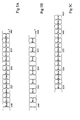
- FIGS. 5A, 5B and 5C illustrate in more detail the decoding, storage and display of the previous bidirectional image B 1 .
- an image B 1 is shown comprising only eight lines: four lines B 1T1 to B 1T4 in the first frame, interspersed with four lines B 1B1 to B 1B4 in the second frame.
- line B 1B1 is the first decoded line.
- the first frame is displayed a first time between times t 325 and t 350 , and a second time between times t 350 and t 375 .
- the second frame is displayed a first time between times t 375 and t 400 , and a second time between times t 400 and t 425 .
- the first lines of the two frames, B 1B1 , B 1T1 , B 1B2 , B 1T2 are decoded consecutively between times t 300 and t 325 and then the last lines of the two frames, B 1B3 , B 1T3 , B 1B4 , B 1T4 , are decoded between times t 325 and t 350 .
- the first lines of the two frames are decoded a second time between the instants t 350 and t 375 and the last lines of the two frames are decoded a second time between the instants t 375 and t 400 .
- the first line of the first frame B 1T1 is displayed for the second time
- the first line of the second frame B 1B1 is decoded and stored in memory. It is expected to store the line B 1B1 only after the first line B 1T1 of the first frame is supplied to the display circuit 10 to be displayed. This writing in particular memory is only necessary for the storage of the first line of the second frame.
- the decoding and the storage of the second line of the second frame B 1B2 is done while the third line of the first frame B 1T3 is already displayed and there is no longer any possibility of conflict between the storage and read in buffer memory.
- the image following the image B 1 is the bidirectional image B 2 , but it could equally be an intra or predicted image without the operation which has just been described being modified.
- the present invention is capable of various variants and modifications which will appear to the man of art.
- FIGS. 4A to 5C a AABB type display in which the first frame of images is displayed before the second frame
- the skilled person will easily adapt the present invention to a type display AABB in which the second frame of images is displayed before the first frame.
- the present invention has not been described that in connection with decoding and displaying images FRAME type, but those skilled in the art will easily adapt the circuit according to the present invention, which uses a memory containing two and a half decoded images, one circuit capable also decode and display type images FIELD under the same conditions.
- the present invention has been described in connection with a 100-120 hertz display but it can easily be adapted to other types of image display to be decoded twice as slowly as they do are displayed.
Landscapes
- Engineering & Computer Science (AREA)
- Multimedia (AREA)
- Signal Processing (AREA)
- Compression Or Coding Systems Of Tv Signals (AREA)
Abstract
Description
Claims (3)
- Procédé de décodage et d'affichage d'une image numérique (B1) codée sous forme de deux trames entrelacées (B1T, B1B), le décodage de l'image étant deux fois plus long que l'affichage d'une trame, caractérisé en ce qu'il comprend notamment les étapes consistant à :a/ décoder la première moitié de l'image en stockant progressivement la première moitié de la première trame (B1T1, B1T2),b/ décoder la seconde moitié de l'image en stockant progressivement la seconde moitié de la première trame (B1T3, B1T4), tout en affichant une première fois la première trame (B1T),c/ afficher une seconde fois la première trame (B1T), tout en décodant à nouveau la première moitié de l'image et en remplaçant progressivement en mémoire la première moitié de la première trame (B1T1, B1T2) par la première moitié de la seconde trame (B1B1, B1B2),d/ décoder la seconde moitié de l'image en remplaçant progressivement la seconde moitié de la première trame (B1T3, B1T4) par la seconde moitié de la seconde trame (B1B3, B1B4), tout en affichant une première fois la seconde trame (B1B), ete/ afficher une seconde fois la seconde trame (B1B) tandis que l'on répète l'étape a/.
- Procédé de décodage et d'affichage d'une image numérique selon la revendication 1, caractérisé en ce que l'image est une image bidirectionnelle codée suivant la norme MPEG.
- Circuit destiné à mettre en oeuvre le procédé de décodage et d'affichage selon la revendication 2, caractérisé en ce qu'il comprend : un décodeur MPEG (2) et une mémoire (4) ayant une capacité de mémorisation correspondant au nombre de données contenues dans deux images décodées et demie.
Applications Claiming Priority (2)
| Application Number | Priority Date | Filing Date | Title |
|---|---|---|---|
| FR9911608 | 1999-09-14 | ||
| FR9911608A FR2798547B1 (fr) | 1999-09-14 | 1999-09-14 | Decodage et affichage a repetition d'images mpeg |
Publications (2)
| Publication Number | Publication Date |
|---|---|
| EP1085764A1 true EP1085764A1 (fr) | 2001-03-21 |
| EP1085764B1 EP1085764B1 (fr) | 2006-08-09 |
Family
ID=9549933
Family Applications (1)
| Application Number | Title | Priority Date | Filing Date |
|---|---|---|---|
| EP20000410113 Expired - Lifetime EP1085764B1 (fr) | 1999-09-14 | 2000-09-12 | Décodage et affichage à répétition d'images MPEG |
Country Status (3)
| Country | Link |
|---|---|
| EP (1) | EP1085764B1 (fr) |
| DE (1) | DE60029889T2 (fr) |
| FR (1) | FR2798547B1 (fr) |
Citations (4)
| Publication number | Priority date | Publication date | Assignee | Title |
|---|---|---|---|---|
| EP0786906A2 (fr) * | 1996-01-29 | 1997-07-30 | International Business Machines Corporation | Décodeur MPEG |
| US5818533A (en) * | 1996-08-08 | 1998-10-06 | Lsi Logic Corporation | Method and apparatus for decoding B frames in video codecs with minimal memory |
| US5828412A (en) * | 1994-12-07 | 1998-10-27 | U.S. Philips Corporation | Method and receiving apparatus for decoding compressed frames |
| US5892522A (en) * | 1996-02-29 | 1999-04-06 | Sgs-Thomson Microelectronics S.A. | Method and apparatus for addressing a memory area of an MPEG decoder |
-
1999
- 1999-09-14 FR FR9911608A patent/FR2798547B1/fr not_active Expired - Fee Related
-
2000
- 2000-09-12 EP EP20000410113 patent/EP1085764B1/fr not_active Expired - Lifetime
- 2000-09-12 DE DE2000629889 patent/DE60029889T2/de not_active Expired - Fee Related
Patent Citations (4)
| Publication number | Priority date | Publication date | Assignee | Title |
|---|---|---|---|---|
| US5828412A (en) * | 1994-12-07 | 1998-10-27 | U.S. Philips Corporation | Method and receiving apparatus for decoding compressed frames |
| EP0786906A2 (fr) * | 1996-01-29 | 1997-07-30 | International Business Machines Corporation | Décodeur MPEG |
| US5892522A (en) * | 1996-02-29 | 1999-04-06 | Sgs-Thomson Microelectronics S.A. | Method and apparatus for addressing a memory area of an MPEG decoder |
| US5818533A (en) * | 1996-08-08 | 1998-10-06 | Lsi Logic Corporation | Method and apparatus for decoding B frames in video codecs with minimal memory |
Also Published As
| Publication number | Publication date |
|---|---|
| DE60029889D1 (de) | 2006-09-21 |
| DE60029889T2 (de) | 2007-03-08 |
| FR2798547B1 (fr) | 2002-03-29 |
| FR2798547A1 (fr) | 2001-03-16 |
| EP1085764B1 (fr) | 2006-08-09 |
Similar Documents
| Publication | Publication Date | Title |
|---|---|---|
| EP0618722B1 (fr) | Procédé et dispositif pour décoder des images comprimées | |
| EP0858066A1 (fr) | Procédé et dispositif de conversion de debit d'images numériques | |
| FR2738651A1 (fr) | Systeme de conversion de frequence d'echantillonnage | |
| EP0793391B1 (fr) | Adressage d'une zone mémoire d'un décodeur MPEG | |
| FR2904444A1 (fr) | Terminal mobile et procede pour acquerir une image | |
| EP0732857A1 (fr) | Décodeur MPEG à capacité mémoire réduite | |
| EP1282078A1 (fr) | Dispositif de traitement graphique d'objet vidéo | |
| FR2650718A1 (fr) | Dispositif de transformation d'une information de mouvement en un signal de detection de mouvement a la frequence trame et au nombre de lignes souhaites pour un recepteur de television haute definition | |
| EP1840751B1 (fr) | Traitement de données avec transfert de données entre mémoires | |
| EP1085764B1 (fr) | Décodage et affichage à répétition d'images MPEG | |
| EP3423978A1 (fr) | Procede de d'affichage d'une animation lors de la phase de demarrage d'un dispositif electronique et dispositif electronique associe | |
| EP0716395B1 (fr) | Procédé pour le décodage d'images comprimées | |
| EP0732845A1 (fr) | Procédé et dispositif de synchronisation d'un signal vidéo numérique | |
| EP0967576A1 (fr) | Adressage de mémoire d'un décodeur MPEG | |
| EP1513106A3 (fr) | Appareil et procédé de traitement d'image, programme de traitement d'image et support de stockage comprenant ce programme | |
| EP0322058A1 (fr) | Dispositif de régulation de débit conjointe à au moins deux composantes de signaux vidéo numériques | |
| EP1098524B1 (fr) | Circuit de décodage MPEG et d'affichage d'images et d'images incrustées | |
| EP0391760B1 (fr) | Dispositif de conversion de fréquence trame pour un récepteur de télévision haute définition, et procédé de détection du mouvement dans une image de télévision codée | |
| EP2157797A1 (fr) | Appareil et procédé de traitement vidéo | |
| FR2655793A1 (fr) | Procede et dispositif de decodage d'images animees. | |
| FR2804274A1 (fr) | Decodeur mpeg d'images de sequences multiples | |
| BE1004491A3 (fr) | Procede et dispositif de traitement de signaux video. | |
| FR2826226A1 (fr) | Circuit memoire concu pour un acces parallele en lecture ou en ecriture de donnees a plusieurs composantes | |
| BE1005197A3 (fr) | Dispositif de prise de vues et de reproduction d'au moins une image. | |
| EP0680015A1 (fr) | Dispositif d'alimentation en pixels d'une série d'opérateurs d'un circuit de compression d'images mobiles |
Legal Events
| Date | Code | Title | Description |
|---|---|---|---|
| PUAI | Public reference made under article 153(3) epc to a published international application that has entered the european phase |
Free format text: ORIGINAL CODE: 0009012 |
|
| AK | Designated contracting states |
Kind code of ref document: A1 Designated state(s): DE FR GB IT |
|
| AX | Request for extension of the european patent |
Free format text: AL;LT;LV;MK;RO;SI |
|
| 17P | Request for examination filed |
Effective date: 20010913 |
|
| AKX | Designation fees paid |
Free format text: DE FR GB IT |
|
| RAP1 | Party data changed (applicant data changed or rights of an application transferred) |
Owner name: STMICROELECTRONICS S.A. |
|
| 17Q | First examination report despatched |
Effective date: 20050503 |
|
| GRAP | Despatch of communication of intention to grant a patent |
Free format text: ORIGINAL CODE: EPIDOSNIGR1 |
|
| GRAS | Grant fee paid |
Free format text: ORIGINAL CODE: EPIDOSNIGR3 |
|
| GRAA | (expected) grant |
Free format text: ORIGINAL CODE: 0009210 |
|
| AK | Designated contracting states |
Kind code of ref document: B1 Designated state(s): DE FR GB IT |
|
| REG | Reference to a national code |
Ref country code: GB Ref legal event code: FG4D Free format text: NOT ENGLISH |
|
| PGFP | Annual fee paid to national office [announced via postgrant information from national office to epo] |
Ref country code: GB Payment date: 20060905 Year of fee payment: 7 |
|
| PGFP | Annual fee paid to national office [announced via postgrant information from national office to epo] |
Ref country code: DE Payment date: 20060908 Year of fee payment: 7 |
|
| REF | Corresponds to: |
Ref document number: 60029889 Country of ref document: DE Date of ref document: 20060921 Kind code of ref document: P |
|
| GBT | Gb: translation of ep patent filed (gb section 77(6)(a)/1977) |
Effective date: 20060831 |
|
| PGFP | Annual fee paid to national office [announced via postgrant information from national office to epo] |
Ref country code: IT Payment date: 20060930 Year of fee payment: 7 |
|
| PLBE | No opposition filed within time limit |
Free format text: ORIGINAL CODE: 0009261 |
|
| STAA | Information on the status of an ep patent application or granted ep patent |
Free format text: STATUS: NO OPPOSITION FILED WITHIN TIME LIMIT |
|
| 26N | No opposition filed |
Effective date: 20070510 |
|
| GBPC | Gb: european patent ceased through non-payment of renewal fee |
Effective date: 20070912 |
|
| PG25 | Lapsed in a contracting state [announced via postgrant information from national office to epo] |
Ref country code: DE Free format text: LAPSE BECAUSE OF NON-PAYMENT OF DUE FEES Effective date: 20080401 |
|
| REG | Reference to a national code |
Ref country code: FR Ref legal event code: ST Effective date: 20080531 |
|
| PG25 | Lapsed in a contracting state [announced via postgrant information from national office to epo] |
Ref country code: FR Free format text: LAPSE BECAUSE OF NON-PAYMENT OF DUE FEES Effective date: 20071001 |
|
| PGFP | Annual fee paid to national office [announced via postgrant information from national office to epo] |
Ref country code: FR Payment date: 20060928 Year of fee payment: 7 |
|
| PG25 | Lapsed in a contracting state [announced via postgrant information from national office to epo] |
Ref country code: GB Free format text: LAPSE BECAUSE OF NON-PAYMENT OF DUE FEES Effective date: 20070912 |
|
| PG25 | Lapsed in a contracting state [announced via postgrant information from national office to epo] |
Ref country code: IT Free format text: LAPSE BECAUSE OF NON-PAYMENT OF DUE FEES Effective date: 20070912 |