EP1085730A1 - Access control method to the functionality of a portable communication device utilizing a key battery - Google Patents
Access control method to the functionality of a portable communication device utilizing a key battery Download PDFInfo
- Publication number
- EP1085730A1 EP1085730A1 EP00117092A EP00117092A EP1085730A1 EP 1085730 A1 EP1085730 A1 EP 1085730A1 EP 00117092 A EP00117092 A EP 00117092A EP 00117092 A EP00117092 A EP 00117092A EP 1085730 A1 EP1085730 A1 EP 1085730A1
- Authority
- EP
- European Patent Office
- Prior art keywords
- battery
- access control
- radio
- key
- control system
- Prior art date
- Legal status (The legal status is an assumption and is not a legal conclusion. Google has not performed a legal analysis and makes no representation as to the accuracy of the status listed.)
- Withdrawn
Links
Images


Classifications
-
- H—ELECTRICITY
- H04—ELECTRIC COMMUNICATION TECHNIQUE
- H04M—TELEPHONIC COMMUNICATION
- H04M1/00—Substation equipment, e.g. for use by subscribers
- H04M1/02—Constructional features of telephone sets
- H04M1/0202—Portable telephone sets, e.g. cordless phones, mobile phones or bar type handsets
- H04M1/026—Details of the structure or mounting of specific components
- H04M1/0262—Details of the structure or mounting of specific components for a battery compartment
-
- H—ELECTRICITY
- H04—ELECTRIC COMMUNICATION TECHNIQUE
- H04M—TELEPHONIC COMMUNICATION
- H04M1/00—Substation equipment, e.g. for use by subscribers
- H04M1/72—Mobile telephones; Cordless telephones, i.e. devices for establishing wireless links to base stations without route selection
- H04M1/724—User interfaces specially adapted for cordless or mobile telephones
- H04M1/72403—User interfaces specially adapted for cordless or mobile telephones with means for local support of applications that increase the functionality
- H04M1/72409—User interfaces specially adapted for cordless or mobile telephones with means for local support of applications that increase the functionality by interfacing with external accessories
Definitions
- This invention relates in general to two-way radio and more particularly to controlling access to functionality by means of a key battery.
- a common method employed to restrict access to radio functionality is a password. Correct entry of a password will enable access to one or more restricted features.
- the password technique is easy to implement and use, it does have a security disadvantage. If the password is learned by an unauthorized party, it can be used to gain unauthorized access until the radio is re-programmed with a new password. Due to practical considerations, it is typical for a group or "fleet" of radios to have the same access password, so a compromised password could be used against any radio. In such a case, the security disadvantage of the password access method is a serious concern.
- An alternate method involves the use of a hardware key that attaches to the device.
- the radio detects the presence of a valid hardware key, the radio will allow access to restricted features.
- This technique offers some improvement over a password-only scheme, because physical possession of the hardware key is required.
- the hardware key approach may be combined with the password approach for added security.
- An example of the use of a hardware key involves a Front Panel Programmable (FPP) two-way radio.
- FPP Front Panel Programmable
- Such a radio is capable of being programmed directly using the radio's own keypad and display. Since a commercial two-way radio is capable of transmitting on a large number of frequencies, including those used by police and public safety agencies, it is desirable to restrict access to the front panel programmable feature to minimize the impact of a malicious user.
- the Federal Communication Commission (FCC) requires radio manufacturers utilize a hardware key mechanism to control access to the FPP feature.
- Portable communications devices today often utilize battery packs that contain one or more primary or secondary cells, a memory device, and sensors, such as for battery temperature.
- the memory device is typically a non-volatile device, such as a PROM or serial EEPROM. To minimize the number of electrical connections to the battery, serial devices are commonly utilized.
- the memory devices typically contain parameters about the battery, such as chemistry type, charging rates, etc. This information, which is generally programmed when the battery is manufactured, is used by the battery charger to properly and safely charge the battery. This information can also contain thresholds to be used by the radio to provide a multi-segment battery gauge, or "battery life remaining" indicator.
- a portable communication device or radio consists of radio transceiver 110 which is powered by radio battery 120 which is typically included in a housing that is physically attached to the radio.
- a number of connections may exist between transceiver 110 and battery 120 , including ground connection 140 and battery voltage supply 130 .
- data connection 150 provides read capability for the radio to access stored information in radio battery 120 .
- Data connection 150 is sufficient for "one wire" serial memory devices, but those skilled in the art will recognize that some serial devices require multiple lines for clock, control signals, etc.
- a transceiver 290 consists of a receiver 260 and transmitter 240 , both connected to antenna 280 via antenna switch 270 .
- Receiver 260 and transmitter 240 are both connected to controller 250 , a microprocessor or similar device responsible for operating transceiver 290 .
- Controller 250 operates using memory 230 , which is accessed using data bus 220 .
- Portable radio transceiver 290 is powered by Radio battery 200 , which contains memory device 210 that is also accessible by controller 250 on data bus 220 . It should be recognized that controller 250 may use both a serial and a parallel instantiation of data bus 220 to accommodate the various choices for the memory devices 210 , 230 .
- memory device 210 in radio battery 200 is read-only. In an alternate embodiment memory device 210 is read/write capable, thus allowing the communication device or battery charger to update information in radio battery memory device 210 .
- memory device 210 typically contains information about the operational characteristics about the battery, including charging information. Manufacturing information such as model number, serial number, and manufacturing date may also be present. In accordance with the present invention, battery memory device 210 also contains one or more sets of access control data or authorization "keys.”
- Each software key stored in battery memory device 210 corresponds to a restricted feature or capability of the communication device.
- Controller 250 is able to detect the presence of one or more software keys. Detected keys, which may optionally be encrypted are then validated. The presence of a given key permits access or use of a predetermined set of device functions, and the absence of the key denies access.
- FIG. 3 is a flowchart diagram depicting the detection and processing of battery keys in accordance with the present invention.
- the communication device When the communication device is powered on 300, the device performs initialization and self check tasks commonly associated with power-up of microprocessor-controlled devices. Upon completion of these tasks, the radio attempts to read data 310 from the attached battery. This battery data, if available, may contain one or more keys. Lack of battery data may indicate the use of a non-key battery, a third-party manufactured battery, or a malfunctioning battery. The radio then parses the data 320 received from the battery to determine if any keys are present. If no battery data is present, or if no battery keys are detected in the battery data 330, then normal operation 380 of the device begins without access being granted to any restricted features.
- the radio will validate 340 the first detected key. Validation involves decoding and possible decryption. If the key is validated 350 , then a feature enable flag is set corresponding to the validated key. A feature enable flag exists for every restricted feature or set of restricted features controlled by a key, and is used to enable the associated functionality in the radio. Upon setting of a feature validation flag 360 , or if the first detected key was not valid 350 , the radio determines if there are more keys to validate 370 . If more keys are present, then the validation process 340 , 350 is repeated for each additional key detected, and the feature enable flag corresponding to each validated key is enabled 360 . Once all detected keys have been validated normal operation 380 begins. Any restricted feature will now be accessible if the corresponded feature enable flag is set.
Landscapes
- Engineering & Computer Science (AREA)
- Signal Processing (AREA)
- Human Computer Interaction (AREA)
- Computer Networks & Wireless Communication (AREA)
- Mobile Radio Communication Systems (AREA)
Abstract
Description
- This invention relates in general to two-way radio and more particularly to controlling access to functionality by means of a key battery.
- It is not uncommon for certain features or capabilities of a portable communication device to be restricted from general use. Such features or capabilities may be appropriate for only users with authorization or appropriate training. A general feature set would be available to all users, but an extended feature set, including one or more restricted features or capabilities, would be available to select users through the use of an access control mechanism.
- A common method employed to restrict access to radio functionality is a password. Correct entry of a password will enable access to one or more restricted features. Although the password technique is easy to implement and use, it does have a security disadvantage. If the password is learned by an unauthorized party, it can be used to gain unauthorized access until the radio is re-programmed with a new password. Due to practical considerations, it is typical for a group or "fleet" of radios to have the same access password, so a compromised password could be used against any radio. In such a case, the security disadvantage of the password access method is a serious concern.
- An alternate method involves the use of a hardware key that attaches to the device. When the radio detects the presence of a valid hardware key, the radio will allow access to restricted features. This technique offers some improvement over a password-only scheme, because physical possession of the hardware key is required. The hardware key approach may be combined with the password approach for added security.
- An example of the use of a hardware key involves a Front Panel Programmable (FPP) two-way radio. Such a radio is capable of being programmed directly using the radio's own keypad and display. Since a commercial two-way radio is capable of transmitting on a large number of frequencies, including those used by police and public safety agencies, it is desirable to restrict access to the front panel programmable feature to minimize the impact of a malicious user. In fact, the Federal Communication Commission (FCC) requires radio manufacturers utilize a hardware key mechanism to control access to the FPP feature.
- The addition of a hardware key to a portable communication device such as a two-way radio has, however, a number of disadvantages:
- The form factor of the device is altered. This may often make the device less comfortable to hold and use.
- The hardware key must be designed and tooled, which is costly, and changes in industrial design in successive products may preclude the re-use of the hardware key.
- The key requires the addition of a connector on the radio, or the key occupies an existing connector that can no longer be used for other purposes while the key is present. Radio accessories, for example, may be unusable if the hardware key occupies this connector.
- Thus, it is highly desirable to implement an access control mechanism using a hardware key that is inexpensive to design and manufacture, does not alter the form factor of the device, and does not prevent the use of accessories or other capabilities. Therefore, the need exists for an access control system and method utilizing a key battery.
-
- FIG. 1 shows a communication device consisting of a radio transceiver and a radio battery pack.
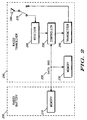
- FIG. 2 is a block diagram of selected radio transceiver components and radio battery including a memory component.
- FIG 3 is a flowchart in accordance with the present invention.
-
- While the specification concludes with claims defining the features of the invention that are regarded as novel, it is believed that the invention will be better understood from a consideration of the following description in conjunction with the drawing figures, in which like reference numerals are carried forward.
- Portable communications devices today often utilize battery packs that contain one or more primary or secondary cells, a memory device, and sensors, such as for battery temperature. The memory device is typically a non-volatile device, such as a PROM or serial EEPROM. To minimize the number of electrical connections to the battery, serial devices are commonly utilized. The memory devices typically contain parameters about the battery, such as chemistry type, charging rates, etc. This information, which is generally programmed when the battery is manufactured, is used by the battery charger to properly and safely charge the battery. This information can also contain thresholds to be used by the radio to provide a multi-segment battery gauge, or "battery life remaining" indicator.
- Referring now to FIG. 1, a portable communication device, or radio, consists of
radio transceiver 110 which is powered byradio battery 120 which is typically included in a housing that is physically attached to the radio. A number of connections may exist betweentransceiver 110 andbattery 120 , includingground connection 140 andbattery voltage supply 130. In addition,data connection 150 provides read capability for the radio to access stored information inradio battery 120.Data connection 150 is sufficient for "one wire" serial memory devices, but those skilled in the art will recognize that some serial devices require multiple lines for clock, control signals, etc. - A block diagram of a typical portable radio is depicted in FIG 2. Referring now to FIG 2, a
transceiver 290 consists of areceiver 260 andtransmitter 240, both connected toantenna 280 viaantenna switch 270.Receiver 260 andtransmitter 240 are both connected tocontroller 250, a microprocessor or similar device responsible foroperating transceiver 290.Controller 250 operates usingmemory 230, which is accessed usingdata bus 220. -
Portable radio transceiver 290 is powered byRadio battery 200, which containsmemory device 210 that is also accessible bycontroller 250 ondata bus 220. It should be recognized thatcontroller 250 may use both a serial and a parallel instantiation ofdata bus 220 to accommodate the various choices for thememory devices - In the preferred embodiment,
memory device 210 inradio battery 200 is read-only. In an alternateembodiment memory device 210 is read/write capable, thus allowing the communication device or battery charger to update information in radiobattery memory device 210. - As previously explained,
memory device 210 typically contains information about the operational characteristics about the battery, including charging information. Manufacturing information such as model number, serial number, and manufacturing date may also be present. In accordance with the present invention,battery memory device 210 also contains one or more sets of access control data or authorization "keys." - Each software key stored in
battery memory device 210 corresponds to a restricted feature or capability of the communication device.Controller 250 is able to detect the presence of one or more software keys. Detected keys, which may optionally be encrypted are then validated. The presence of a given key permits access or use of a predetermined set of device functions, and the absence of the key denies access. - Figure 3 is a flowchart diagram depicting the detection and processing of battery keys in accordance with the present invention. When the communication device is powered on 300, the device performs initialization and self check tasks commonly associated with power-up of microprocessor-controlled devices. Upon completion of these tasks, the radio attempts to read
data 310 from the attached battery. This battery data, if available, may contain one or more keys. Lack of battery data may indicate the use of a non-key battery, a third-party manufactured battery, or a malfunctioning battery. The radio then parses thedata 320 received from the battery to determine if any keys are present. If no battery data is present, or if no battery keys are detected in thebattery data 330, thennormal operation 380 of the device begins without access being granted to any restricted features. - If battery data was read and at least one key was detected 330, then the radio will validate 340 the first detected key. Validation involves decoding and possible decryption. If the key is validated 350, then a feature enable flag is set corresponding to the validated key. A feature enable flag exists for every restricted feature or set of restricted features controlled by a key, and is used to enable the associated functionality in the radio. Upon setting of a
feature validation flag 360, or if the first detected key was not valid 350, the radio determines if there are more keys to validate 370. If more keys are present, then thevalidation process normal operation 380 begins. Any restricted feature will now be accessible if the corresponded feature enable flag is set. - While the preferred embodiments of the invention have been illustrated and described, it will be clear that the invention is not so limited. Numerous modifications, changes, variations, substitutions and equivalents will occur to those skilled in the art without departing from the spirit and scope of the present invention as defined by the appended claims.
Claims (7)
- An access control system for enabling functionality to a portable communications device comprising:at least one battery for providing access control data to the portable communications device; andat least one data connection between the at least one battery and the portable communications device for providing access control data to the portable communications device and enabling access to a predetermined set of device functions.
- An access control system as in claim 1, wherein the portable communications device is a two-way radio.
- An access control system as in claim 1, wherein the battery includes a housing that is physically attached to the portable communications device.
- An access control system as in claim 1, wherein the access control data is a software key.
- An access control system as in claim 4, wherein the software key is encrypted.
- An access control system as in claim 1, wherein the at least one data connection is a separate terminal on the at least one battery.
- An access control system as in claim 1, wherein the predetermined set of device functions includes front panel programming (FPP) using an attached keypad.
Applications Claiming Priority (2)
| Application Number | Priority Date | Filing Date | Title |
|---|---|---|---|
| US398303 | 1982-07-14 | ||
| US39830399A | 1999-09-20 | 1999-09-20 |
Publications (1)
| Publication Number | Publication Date |
|---|---|
| EP1085730A1 true EP1085730A1 (en) | 2001-03-21 |
Family
ID=23574864
Family Applications (1)
| Application Number | Title | Priority Date | Filing Date |
|---|---|---|---|
| EP00117092A Withdrawn EP1085730A1 (en) | 1999-09-20 | 2000-08-09 | Access control method to the functionality of a portable communication device utilizing a key battery |
Country Status (4)
| Country | Link |
|---|---|
| EP (1) | EP1085730A1 (en) |
| CN (1) | CN1289185A (en) |
| BR (1) | BR0004249A (en) |
| TW (1) | TW496064B (en) |
Families Citing this family (1)
| Publication number | Priority date | Publication date | Assignee | Title |
|---|---|---|---|---|
| CN105151222B (en) * | 2015-09-21 | 2017-06-23 | 南通振华重型装备制造有限公司 | A kind of jack up lifting platform mounting process |
Citations (5)
| Publication number | Priority date | Publication date | Assignee | Title |
|---|---|---|---|---|
| JPH05292165A (en) * | 1992-04-10 | 1993-11-05 | Toshiba Corp | Portable wireless communication device |
| EP0622935A1 (en) * | 1993-04-26 | 1994-11-02 | Nec Corporation | Portable telephone apparatus having option circuits in a battery pack |
| US5465401A (en) * | 1992-12-15 | 1995-11-07 | Texas Instruments Incorporated | Communication system and methods for enhanced information transfer |
| WO1997003534A1 (en) * | 1995-07-11 | 1997-01-30 | Goldtron Telecommunications Pte Ltd. | Battery powered device |
| US5771448A (en) * | 1995-06-26 | 1998-06-23 | Ericsson Inc. | Battery pack having personality data stored therein |
-
2000
- 2000-08-02 TW TW089115499A patent/TW496064B/en not_active IP Right Cessation
- 2000-08-09 EP EP00117092A patent/EP1085730A1/en not_active Withdrawn
- 2000-09-14 CN CN00127010A patent/CN1289185A/en active Pending
- 2000-09-18 BR BR0004249-8A patent/BR0004249A/en not_active IP Right Cessation
Patent Citations (5)
| Publication number | Priority date | Publication date | Assignee | Title |
|---|---|---|---|---|
| JPH05292165A (en) * | 1992-04-10 | 1993-11-05 | Toshiba Corp | Portable wireless communication device |
| US5465401A (en) * | 1992-12-15 | 1995-11-07 | Texas Instruments Incorporated | Communication system and methods for enhanced information transfer |
| EP0622935A1 (en) * | 1993-04-26 | 1994-11-02 | Nec Corporation | Portable telephone apparatus having option circuits in a battery pack |
| US5771448A (en) * | 1995-06-26 | 1998-06-23 | Ericsson Inc. | Battery pack having personality data stored therein |
| WO1997003534A1 (en) * | 1995-07-11 | 1997-01-30 | Goldtron Telecommunications Pte Ltd. | Battery powered device |
Non-Patent Citations (1)
| Title |
|---|
| PATENT ABSTRACTS OF JAPAN vol. 018, no. 084 (E - 1506) 10 February 1994 (1994-02-10) * |
Also Published As
| Publication number | Publication date |
|---|---|
| CN1289185A (en) | 2001-03-28 |
| TW496064B (en) | 2002-07-21 |
| BR0004249A (en) | 2001-04-10 |
Similar Documents
| Publication | Publication Date | Title |
|---|---|---|
| KR960009898B1 (en) | Selective call receiver | |
| US5964877A (en) | Method and system for programming a security system to protect a protected unit | |
| US7555286B2 (en) | Authentication card and wireless authentication system performing mutual authentication by means of the authentication card | |
| EP1374613B1 (en) | Securing information in memory of an electronic device | |
| US4494114A (en) | Security arrangement for and method of rendering microprocessor-controlled electronic equipment inoperative after occurrence of disabling event | |
| US7512795B2 (en) | Method and apparatus for authenticating components | |
| EP1609043B1 (en) | Apparatus for authorising access to an electronic device | |
| US20130300534A1 (en) | Automated control system for multi-level authority to operate electronic and electrical devices | |
| US20070260892A1 (en) | System and method for authenticating a power source | |
| EP0436518B1 (en) | Radiotelephone controller configured for coresident secure and nonsecure modes | |
| US8000755B2 (en) | Information-communication terminal device and automatic backup system including the same | |
| US20190332813A1 (en) | Modular system for controlling usability of a device | |
| EP1352368B1 (en) | Theft prevention using location determination | |
| US8041340B2 (en) | Personal information protecting method and mobile terminal | |
| US5771448A (en) | Battery pack having personality data stored therein | |
| US7149554B2 (en) | Access control method utilizing a key battery | |
| WO2004112363A1 (en) | Anti-theft system for mobile electronic devices | |
| FI110388B (en) | Method and arrangement for limiting the use of a display device | |
| GB2396261A (en) | Secure charger and portable electronic device | |
| CN121664223A (en) | Integrated circuit card | |
| US7711118B2 (en) | Security system | |
| KR20060036981A (en) | Electronic Key Function Implementation System and Operation Method | |
| TW496064B (en) | Access control method utilizing a key battery | |
| JP2000129977A (en) | Transmitter and receiver for controlling auto-lock mechanism and method of operating the same | |
| JP4075070B2 (en) | Security system and security program |
Legal Events
| Date | Code | Title | Description |
|---|---|---|---|
| PUAI | Public reference made under article 153(3) epc to a published international application that has entered the european phase |
Free format text: ORIGINAL CODE: 0009012 |
|
| AK | Designated contracting states |
Kind code of ref document: A1 Designated state(s): AT BE CH CY DE DK ES FI FR GB GR IE IT LI LU MC NL PT SE |
|
| AX | Request for extension of the european patent |
Free format text: AL;LT;LV;MK;RO;SI |
|
| 17P | Request for examination filed |
Effective date: 20010921 |
|
| AKX | Designation fees paid |
Free format text: AT BE CH CY DE DK ES FI FR GB GR IE IT LI LU MC NL PT SE |
|
| 17Q | First examination report despatched |
Effective date: 20080609 |
|
| GRAP | Despatch of communication of intention to grant a patent |
Free format text: ORIGINAL CODE: EPIDOSNIGR1 |
|
| STAA | Information on the status of an ep patent application or granted ep patent |
Free format text: STATUS: THE APPLICATION IS DEEMED TO BE WITHDRAWN |
|
| 18D | Application deemed to be withdrawn |
Effective date: 20090311 |