EP1085008A1 - Process for the preparation of vitamin a, intermediates, and process for the preparation of the intermediates - Google Patents
Process for the preparation of vitamin a, intermediates, and process for the preparation of the intermediates Download PDFInfo
- Publication number
- EP1085008A1 EP1085008A1 EP00913075A EP00913075A EP1085008A1 EP 1085008 A1 EP1085008 A1 EP 1085008A1 EP 00913075 A EP00913075 A EP 00913075A EP 00913075 A EP00913075 A EP 00913075A EP 1085008 A1 EP1085008 A1 EP 1085008A1
- Authority
- EP
- European Patent Office
- Prior art keywords
- group
- formula
- sulfone
- derivative
- derivative represented
- Prior art date
- Legal status (The legal status is an assumption and is not a legal conclusion. Google has not performed a legal analysis and makes no representation as to the accuracy of the status listed.)
- Withdrawn
Links
- 0 CC1(C)C(C(CC(C)=CC=CC(C)=CCO*)S(*)(=O)=O)=C(C)CCC1 Chemical compound CC1(C)C(C(CC(C)=CC=CC(C)=CCO*)S(*)(=O)=O)=C(C)CCC1 0.000 description 1
Images




Classifications
-
- C—CHEMISTRY; METALLURGY
- C07—ORGANIC CHEMISTRY
- C07C—ACYCLIC OR CARBOCYCLIC COMPOUNDS
- C07C69/00—Esters of carboxylic acids; Esters of carbonic or haloformic acids
- C07C69/02—Esters of acyclic saturated monocarboxylic acids having the carboxyl group bound to an acyclic carbon atom or to hydrogen
-
- C—CHEMISTRY; METALLURGY
- C07—ORGANIC CHEMISTRY
- C07C—ACYCLIC OR CARBOCYCLIC COMPOUNDS
- C07C403/00—Derivatives of cyclohexane or of a cyclohexene or of cyclohexadiene, having a side-chain containing an acyclic unsaturated part of at least four carbon atoms, this part being directly attached to the cyclohexane or cyclohexene or cyclohexadiene rings, e.g. vitamin A, beta-carotene, beta-ionone
- C07C403/06—Derivatives of cyclohexane or of a cyclohexene or of cyclohexadiene, having a side-chain containing an acyclic unsaturated part of at least four carbon atoms, this part being directly attached to the cyclohexane or cyclohexene or cyclohexadiene rings, e.g. vitamin A, beta-carotene, beta-ionone having side-chains substituted by singly-bound oxygen atoms
- C07C403/08—Derivatives of cyclohexane or of a cyclohexene or of cyclohexadiene, having a side-chain containing an acyclic unsaturated part of at least four carbon atoms, this part being directly attached to the cyclohexane or cyclohexene or cyclohexadiene rings, e.g. vitamin A, beta-carotene, beta-ionone having side-chains substituted by singly-bound oxygen atoms by hydroxy groups
-
- C—CHEMISTRY; METALLURGY
- C07—ORGANIC CHEMISTRY
- C07C—ACYCLIC OR CARBOCYCLIC COMPOUNDS
- C07C403/00—Derivatives of cyclohexane or of a cyclohexene or of cyclohexadiene, having a side-chain containing an acyclic unsaturated part of at least four carbon atoms, this part being directly attached to the cyclohexane or cyclohexene or cyclohexadiene rings, e.g. vitamin A, beta-carotene, beta-ionone
- C07C403/22—Derivatives of cyclohexane or of a cyclohexene or of cyclohexadiene, having a side-chain containing an acyclic unsaturated part of at least four carbon atoms, this part being directly attached to the cyclohexane or cyclohexene or cyclohexadiene rings, e.g. vitamin A, beta-carotene, beta-ionone having side-chains substituted by sulfur atoms
-
- C—CHEMISTRY; METALLURGY
- C07—ORGANIC CHEMISTRY
- C07C—ACYCLIC OR CARBOCYCLIC COMPOUNDS
- C07C67/00—Preparation of carboxylic acid esters
- C07C67/28—Preparation of carboxylic acid esters by modifying the hydroxylic moiety of the ester, such modification not being an introduction of an ester group
- C07C67/287—Preparation of carboxylic acid esters by modifying the hydroxylic moiety of the ester, such modification not being an introduction of an ester group by introduction of halogen; by substitution of halogen atoms by other halogen atoms
-
- C—CHEMISTRY; METALLURGY
- C07—ORGANIC CHEMISTRY
- C07C—ACYCLIC OR CARBOCYCLIC COMPOUNDS
- C07C2601/00—Systems containing only non-condensed rings
- C07C2601/12—Systems containing only non-condensed rings with a six-membered ring
- C07C2601/16—Systems containing only non-condensed rings with a six-membered ring the ring being unsaturated
-
- Y—GENERAL TAGGING OF NEW TECHNOLOGICAL DEVELOPMENTS; GENERAL TAGGING OF CROSS-SECTIONAL TECHNOLOGIES SPANNING OVER SEVERAL SECTIONS OF THE IPC; TECHNICAL SUBJECTS COVERED BY FORMER USPC CROSS-REFERENCE ART COLLECTIONS [XRACs] AND DIGESTS
- Y02—TECHNOLOGIES OR APPLICATIONS FOR MITIGATION OR ADAPTATION AGAINST CLIMATE CHANGE
- Y02P—CLIMATE CHANGE MITIGATION TECHNOLOGIES IN THE PRODUCTION OR PROCESSING OF GOODS
- Y02P20/00—Technologies relating to chemical industry
- Y02P20/50—Improvements relating to the production of bulk chemicals
- Y02P20/55—Design of synthesis routes, e.g. reducing the use of auxiliary or protecting groups
Definitions
- the present invention relates to a process for producing vitamin A which is important in the fields of pharmaceutical preparations, feed or food additives, intermediates thereof, and a process for producing the same.
- ⁇ -ionone (C 13) as the starting material is very expensive on the market, and in the latter method, a very expensive acetaldehyde derivative is used as an oxidizing agent particularly in an oxidation step in a process for producing the C10 aldehyde, and thus these methods are not always industrially excellent methods.
- the present inventors have extensively studied to develop a process for producing vitamin A from inexpensive starting materials, and as a result, they have found that a novel dihalogen derivative can be readily obtained from a triene derivative which can be readily and economically produced from C10 alcohols such as geraniol or linalool. They have also found that vitamin A can be produced via sulfone derivatives from said dihalogen derivatives, thus arriving at the present invention.
- the present invention provides:
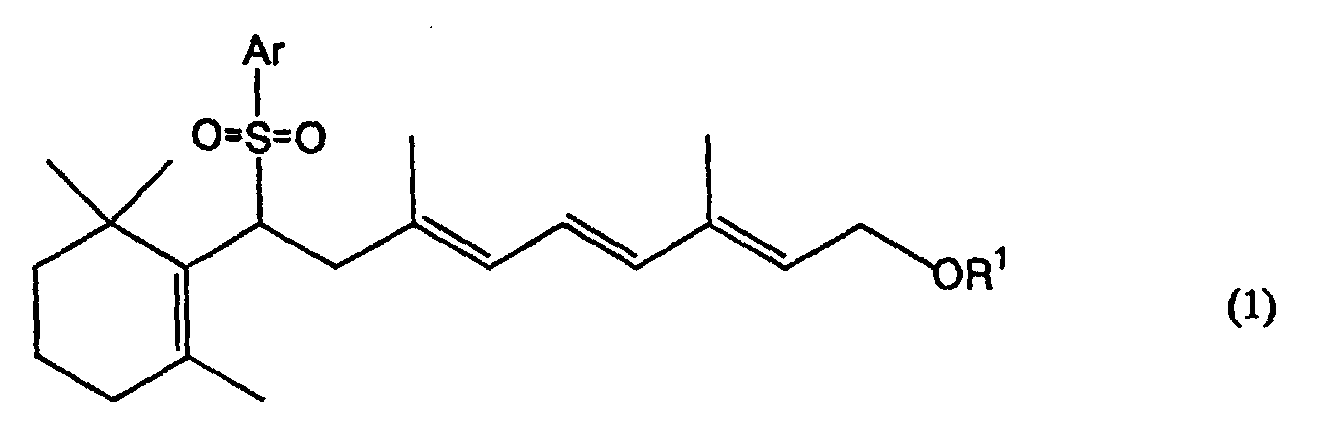
- the substituent group R 1 in formula (1) represents a hydrogen atom or a protective group for a hydroxyl group
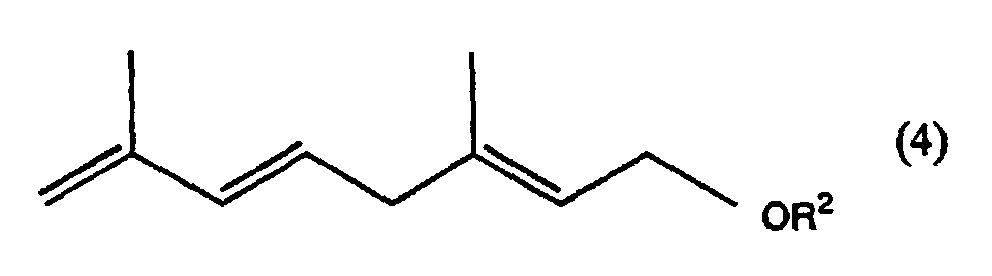
- the substituent group R 2 in formulae (2) and (4) represents a protective group for a hydroxyl group.
- the protective group for a hydroxyl group in both groups include an acyl group which may be substituted, a tri-substituted silyl group, a saturated or unsaturated hydrocarbyloxycarbonyl group which may be substituted, an alkoxymethyl group, a benzyl group which may be substituted, and a group having tertiary carbon substituted with an aryl or alkyl group.
- a C1-C7 acyl group e.g. an alkanoyl group, or a benzoyl group
- a substituent group selected from a halogen atom, a (C1-C3) alkoxy group, a (C1-C3) alkanoyloxy group, a nitro group and a hydroxyl group.
- Specific examples thereof include a formyl, acetyl, ethoxyacetyl, fluoroacetyl, difluoroacetyl, trifluoroacetyl, chloroacetyl, dichloroacetyl, trichloroacetyl, bromoacetyl, dibromoacetyl, tribromoacetyl, propionyl, 2-chloropropionyl, 3-chloropropionyl, butyryl, 2-chlorobutyryl, 3-chlorobutyryl, 4-chlorobutyryl, 2-methylbutyryl, 2-ethylbutyryl, valeryl, 2-methylvaleryl, 4-methylvaleryl, hexanoyl, isobutyryl, isovaleryl, pivaloyl, beuzoyl, o-chlorobenzoyl, m-chlorobenzoyl, p-chlorobenzoyl, o-hydroxybenz
- the tri-substituted silyl group includes silyl groups substituted with 3 substituent groups selected from a phenyl group and a (C1-C4) alkyl groups.
- silyl group examples include a trimethylsilyl, triethylsilyl, t-butyldimethylsilyl, t-butyldiphenylsilyl group and the like.
- alkoxymethyl group examples include tetrahydropyranyl, methoxymethyl, methoxyethoxymethyl and 1-ethoxyethyl.
- saturated or unsaturated hydrocarbyloxycarbonyl group which may be substituted include a (C1-C4) alkoxycarbonyl group which may be substituted with a halogen atom or atoms (e.g., a methoxycarbonyl group, an ethoxycarbonyl group, a 2,2,2-trichloroethoxycarbonyl group), and an allyloxycarbonyl group.
- a halogen atom or atoms e.g., a methoxycarbonyl group, an ethoxycarbonyl group, a 2,2,2-trichloroethoxycarbonyl group
- benzyl group which may be substituted include a p-methoxybenzyl group and a benzyl group.
- Examples of the group having a tertiary carbon substituted with an aryl or alkyl group include a group having tertiary carbon substituted with 3 substituent groups selected from an aryl group (e.g. phenyl group) and a (C1-C3) alkyl group, and specific examples thereof include a trityl group and a t-butyl group.
- Examples of the substituent group Ar in formulae (1) and (3) include an aryl group which may have substituent group.
- Examples of said aryl group include a phenyl group and a naphthyl group, and the examples of the substituent group include a C1 to C5 straight-chain or branched alkyl group, C1 to C5 straight-chain or branched alkoxy group, a halogen atom and a nitro group.
- substituent group Ar examples include a phenyl, naphthyl, o-tolyl, m-tolyl, p-tolyl, o-methoxyphenyl, m-methoxyphenyl, p-methoxyphenyl, o-chlorophenyl, m-chlorophenyl, p-chlorophenyl, o-bromophenyl, m-bromophenyl, p-bromophenyl, o-iodophenyl, m-iodophenyl, p -iodophenyl, o-fluorophenyl, m-fluorophenyl, p-fluorophenyl, o-nitrophenyl, m-nitrophenyl, p-nitrophenyl group and the like.
- the halogen atom represented by X includes a chlorine atom, a bromine atom and an iodine atom. Preferred is a bromine atom.
- the triene derivatives of formula (4) used as a starting compound in the present invention can be produced from geraniol or linalool according to a reaction route shown in e.g. the following scheme 1 (JP-A 11-130730).
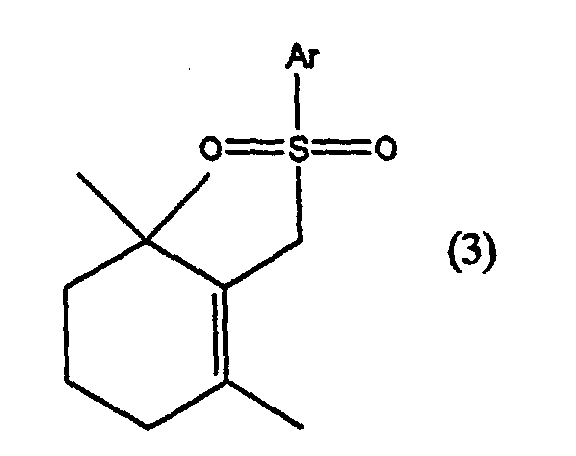
- the sulfone of formula (3) used as another starting compound in the present invention can be produced by a method shown in Chemistry Letters 479 (1975).
- the dihalogen derivative of formula (2) in the present invention can be produced by allowing a halogenating agent to react with the triene derivative of formula (4).
- the halogenating agent used in this reaction includes iodine, bromine and chlorine. Particularly, bromine is preferably used.
- the amount thereof to be used is usually about 1 to 2 moles, preferably about 1.05 to 1.3 moles per mol of the triene derivative of formula (4).
- an inert organic solvent is usually used, and examples of such an inert organic solvent include hydrocarbon solvents such as n-hexane, cyclohexane, n-pentane, n-heptane, benzene or the like.
- the reaction temperature is usually in the range of -78°C to the boiling point of the solvent used, preferably in the range of about -40 to 30°C.
- the resulting reaction mixture may be washed, if necessary, with an aqueous solution of sodium sulfite or sodium thiosulfate and extracted with an organic solvent, and the organic layer is concentrated to give the dihalogen derivative of formula (2).
- this product can be purified by various kinds of chromatography, but the product is used preferably as it is in a crude form in the subsequent reaction.
- the sulfone derivative of formula (1) in the present invention can be obtained by reacting the sulfone of formula (3) with the dihalogen derivative of formula (2) in the presence of a base.
- the base to be used in this reaction includes an alkali metal alkoxide, an alkali metal hydride, alkyl lithium and a Grignard reagent. Specific examples thereof include sodium methoxide, potassium methoxide, sodium ethoxide, potassium ethoxide, potassium t-butoxide, sodium t-butoxide, sodium hydride, potassium hydride, n-butyl lithium, methyl magnesium bromide, methyl magnesium chloride, ethyl magnesium bromide, ethyl magnesium chloride and the like.
- the amount of the base to be used is about 1 to 5 moles per mol of the sulfone (3).
- an organic solvent is usually used, and examples of such an organic solvent include aprotic polar solvents such as N,N-dimethylformamide, dimethyl sulfoxide, N,N-dimethylacetamide, acetonitrile, hexamethylphosphoric triamide or the like, hydrocarbon solvents such as n-hexane, n-heptane, cyclohexane, n-pentane, toluene, xylene or the like, and ether solvents such as diethyl ether, tetrahydrofuran, 1,4-dioxane, anisole or the like. A mixture of two or more of the solvents may also be used.
- aprotic polar solvents such as N,N-dimethylformamide, dimethyl sulfoxide, N,N-dimethylacetamide, acetonitrile, hexamethylphosphoric triamide or the like
- hydrocarbon solvents such as n-hexan
- the reaction temperature is usually in the range of -78°C to the boiling point of the solvent used, and lower temperatures, particularly - 40°C or less are preferred.
- the sulfone derivative (1) can be obtained by carrying out conventional post-treatment such as extraction and various kinds of chromatography.
- the protective group for the resulting sulfone derivative (1) can be removed suitably by acid or alkali hydrolysis or by ester exchange reaction by an acid or basic catalyst, if necessary.
- the benzyl group etc. can also be removed by hydrogenation or reduction reaction with alkali metal-ammonia.
- the silyl group can be removed, for example, by use of a solution of tetra-n-butyl ammonium fluoride in tetrahydrofuran or a mixed solution of acetic acid, water and tetrahydrofuran.
- the protective groups and deprotection reactions thereof reference can be made to the disclosure of Greene: T. W. Protective Groups in Organic Synthesis, 3rd Edition (Wiley) and the like.
- the sulfone derivative of formula (1) wherein R 1 is a hydrogen atom can be obtained by performing the above-described de-protection reaction, if necessary.
- Vitamin A can be obtained by allowing a base to react with the sulfone derivative (1) thus obtained.
- Examples of the base to be used in this reaction include an alkali metal hydroxide, an alkali metal hydride and an alkali metal alkoxide, among which the alkali metal hydroxide and the alkali metal alkoxide are preferably used.
- Specific examples thereof include sodium hydroxide, potassium hydroxide, sodium methoxide, sodium ethoxide, potassium methoxide, potassium ethoxide, sodium t-butoxide, and potassium t-butoxide.
- the amount of the base to be used is usually about 2 to 20 moles per mol of the sulfone derivative (1).
- an organic solvent is usually used, and such solvent includes hydrocarbon solvents such as n-hexane, n-heptane, cyclohexane, n-pentane, toluene, xylene or the like, ether solvents such as diethyl ether, tetrahydrofuran, dimethoxyethane, anisole or the like, and aprotic polar solvents such as acetonitrile, N,N-dimethylformamide, dimethyl sulfoxide, N, N-dimethylacetamide, hexamethylphosphoric triamide or the like.
- hydrocarbon solvents such as n-hexane, n-heptane, cyclohexane, n-pentane, toluene, xylene or the like
- ether solvents such as diethyl ether, tetrahydrofuran, dimethoxyethane, anisole or the like
- the reaction temperature is usually in the range of -20°C to the boiling point of the solvent used, preferably in the range of about 0 to 100°C.
- the reaction time is varied depending on the type of base and the reaction temperature used in the reaction, but is usually in the range of about 1 to 24 hours.
- vitamin A can be obtained by carrying out conventional post-treatment. If necessary, the product can be purified by crystallization and various kinds of chromatography.
- the resulting vitamin A can be introduced with a protective group for a hydroxyl group by a conventional manner, and for example, vitamin A acetate can be obtained by acetylation.
- the organic layer was washed with an aqueous solution of sodium sulfite and then with an aqueous saturated solution of sodium chloride and dried over anhydrous magnesium sulfate, and the solvent was distilled off to give the dihalogen derivative (II) in about 94 % yield.
- the organic layer was washed with an aqueous solution of sodium sulfite and then with an aqueous saturated solution of sodium chloride and dried over anhydrous magnesium sulfate, and the solvent was distilled off to give the dihalogen derivative (II) in about 90 % yield.
- the organic layer was washed with an aqueous saturated solution of ammonium chloride and then with a saturated saline solution and dried over anhydrous magnesium sulfate, and the solvent was distilled off to give a crude product containing the sulfone derivative (III).
- the resulting crude product was subjected to a quantitative analysis by liquid chromatography, which showed that the reaction yield was 34 %.
- the resulting crude product was purified by silica gel column chromatography to give the sulfone derivative (III).
- novel dihalogen derivatives and sulfone derivatives which are useful in the fields of pharmaceutical preparations, feed or food additives can be produced industrially advantageously from inexpensive starting materials.
Landscapes
- Chemical & Material Sciences (AREA)
- Organic Chemistry (AREA)
- Organic Low-Molecular-Weight Compounds And Preparation Thereof (AREA)
Abstract
There are provided a dihalogen derivative represented by formula (2): <CHEM> wherein X represents a halogen atom and R<2> represents a protective group for a hydroxyl group; a process for producing the same; and a process for producing vitamin A by use of said dihalogen derivative.
Description
The present invention relates to a process for producing vitamin
A which is important in the fields of pharmaceutical preparations, feed or
food additives, intermediates thereof, and a process for producing the
same.
As conventional processes for producing vitamin A, there have
been known a method of a carbon-increment reaction in a side chain of
β-ionone (C13) as a starting material (Pure & Appl. Chem. 66, 1509
(1994)) and a method of coupling C10 sulfones with C10 aldehydes and
then eliminating the sulfone group (JP-B 4-3388, JP-B 5-61265 etc.). In
the former method, however, β-ionone (C 13) as the starting material is
very expensive on the market, and in the latter method, a very expensive
acetaldehyde derivative is used as an oxidizing agent particularly in an
oxidation step in a process for producing the C10 aldehyde, and thus
these methods are not always industrially excellent methods.
Under these circumstances, the present inventors have
extensively studied to develop a process for producing vitamin A from
inexpensive starting materials, and as a result, they have found that a
novel dihalogen derivative can be readily obtained from a triene
derivative which can be readily and economically produced from C10
alcohols such as geraniol or linalool. They have also found that vitamin
A can be produced via sulfone derivatives from said dihalogen derivatives,
thus arriving at the present invention.
That is, the present invention provides:


Hereinafter, the present invention is described in detail.
The substituent group R1 in formula (1) represents a hydrogen
atom or a protective group for a hydroxyl group, and the substituent
group R2 in formulae (2) and (4) represents a protective group for a
hydroxyl group. Examples of the protective group for a hydroxyl group
in both groups include an acyl group which may be substituted, a tri-substituted
silyl group, a saturated or unsaturated
hydrocarbyloxycarbonyl group which may be substituted, an
alkoxymethyl group, a benzyl group which may be substituted, and a
group having tertiary carbon substituted with an aryl or alkyl group.
Examples of the acyl group which may be substituted include a
C1-C7 acyl group (e.g. an alkanoyl group, or a benzoyl group) which may
be substituted with a substituent group selected from a halogen atom, a
(C1-C3) alkoxy group, a (C1-C3) alkanoyloxy group, a nitro group and a
hydroxyl group.
Specific examples thereof include a formyl, acetyl, ethoxyacetyl,
fluoroacetyl, difluoroacetyl, trifluoroacetyl, chloroacetyl, dichloroacetyl,
trichloroacetyl, bromoacetyl, dibromoacetyl, tribromoacetyl, propionyl,
2-chloropropionyl, 3-chloropropionyl, butyryl, 2-chlorobutyryl,
3-chlorobutyryl, 4-chlorobutyryl, 2-methylbutyryl, 2-ethylbutyryl,
valeryl, 2-methylvaleryl, 4-methylvaleryl, hexanoyl, isobutyryl,
isovaleryl, pivaloyl, beuzoyl, o-chlorobenzoyl, m-chlorobenzoyl, p-chlorobenzoyl,
o-hydroxybenzoyl, m-hydroxybenzoyl, p-hydroxybenzoyl,
o-acetoxybenzoyl, o-methoxybenzoyl, m-methoxybenzoyl,
p-methoxybenzoyl, p-nitrobenzoyl group and the like.
The tri-substituted silyl group includes silyl groups substituted
with 3 substituent groups selected from a phenyl group and a (C1-C4)
alkyl groups.
Specific examples of such a silyl group include a trimethylsilyl,
triethylsilyl, t-butyldimethylsilyl, t-butyldiphenylsilyl group and the
like.
Examples of the alkoxymethyl group include tetrahydropyranyl,
methoxymethyl, methoxyethoxymethyl and 1-ethoxyethyl.
Examples of the saturated or unsaturated
hydrocarbyloxycarbonyl group which may be substituted include a (C1-C4)
alkoxycarbonyl group which may be substituted with a halogen atom
or atoms (e.g., a methoxycarbonyl group, an ethoxycarbonyl group, a
2,2,2-trichloroethoxycarbonyl group), and an allyloxycarbonyl group.
Examples of the benzyl group which may be substituted include
a p-methoxybenzyl group and a benzyl group.
Examples of the group having a tertiary carbon substituted with
an aryl or alkyl group include a group having tertiary carbon substituted
with 3 substituent groups selected from an aryl group (e.g. phenyl group)
and a (C1-C3) alkyl group, and specific examples thereof include a trityl
group and a t-butyl group.
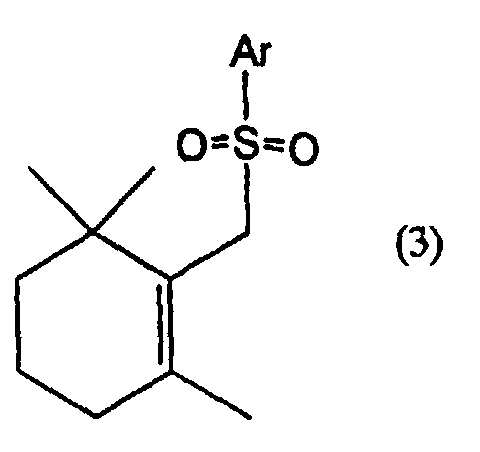
Examples of the substituent group Ar in formulae (1) and (3)
include an aryl group which may have substituent group. Examples of
said aryl group include a phenyl group and a naphthyl group, and the
examples of the substituent group include a C1 to C5 straight-chain or
branched alkyl group, C1 to C5 straight-chain or branched alkoxy group,
a halogen atom and a nitro group.
Examples of the substituent group Ar include a phenyl, naphthyl,
o-tolyl, m-tolyl, p-tolyl, o-methoxyphenyl, m-methoxyphenyl,
p-methoxyphenyl, o-chlorophenyl, m-chlorophenyl, p-chlorophenyl,
o-bromophenyl, m-bromophenyl, p-bromophenyl, o-iodophenyl,
m-iodophenyl, p -iodophenyl, o-fluorophenyl, m-fluorophenyl,
p-fluorophenyl, o-nitrophenyl, m-nitrophenyl, p-nitrophenyl group and
the like.
The halogen atom represented by X includes a chlorine atom, a
bromine atom and an iodine atom. Preferred is a bromine atom.
The triene derivatives of formula (4) used as a starting
compound in the present invention can be produced from geraniol or
linalool according to a reaction route shown in e.g. the following scheme 1
(JP-A 11-130730).

The sulfone of formula (3) used as another starting compound in
the present invention can be produced by a method shown in Chemistry
Letters 479 (1975).
The dihalogen derivative of formula (2) in the present invention
can be produced by allowing a halogenating agent to react with the triene
derivative of formula (4).
The halogenating agent used in this reaction includes iodine,
bromine and chlorine. Particularly, bromine is preferably used. The
amount thereof to be used is usually about 1 to 2 moles, preferably about
1.05 to 1.3 moles per mol of the triene derivative of formula (4).
In the reaction described above, an inert organic solvent is
usually used, and examples of such an inert organic solvent include
hydrocarbon solvents such as n-hexane, cyclohexane, n-pentane,
n-heptane, benzene or the like.
The reaction temperature is usually in the range of -78°C to the
boiling point of the solvent used, preferably in the range of about -40 to
30°C.
After completion of the reaction, the resulting reaction mixture
may be washed, if necessary, with an aqueous solution of sodium sulfite
or sodium thiosulfate and extracted with an organic solvent, and the
organic layer is concentrated to give the dihalogen derivative of formula
(2). Further, this product can be purified by various kinds of
chromatography, but the product is used preferably as it is in a crude
form in the subsequent reaction.
The sulfone derivative of formula (1) in the present invention
can be obtained by reacting the sulfone of formula (3) with the dihalogen
derivative of formula (2) in the presence of a base.
The base to be used in this reaction includes an alkali metal
alkoxide, an alkali metal hydride, alkyl lithium and a Grignard reagent.
Specific examples thereof include sodium methoxide, potassium
methoxide, sodium ethoxide, potassium ethoxide, potassium t-butoxide,
sodium t-butoxide, sodium hydride, potassium hydride, n-butyl lithium,
methyl magnesium bromide, methyl magnesium chloride, ethyl
magnesium bromide, ethyl magnesium chloride and the like. The
amount of the base to be used is about 1 to 5 moles per mol of the
sulfone (3).
In the reaction described above, an organic solvent is usually
used, and examples of such an organic solvent include aprotic polar
solvents such as N,N-dimethylformamide, dimethyl sulfoxide, N,N-dimethylacetamide,
acetonitrile, hexamethylphosphoric triamide or the
like, hydrocarbon solvents such as n-hexane, n-heptane, cyclohexane, n-pentane,
toluene, xylene or the like, and ether solvents such as diethyl
ether, tetrahydrofuran, 1,4-dioxane, anisole or the like. A mixture of
two or more of the solvents may also be used.
The reaction temperature is usually in the range of -78°C to the
boiling point of the solvent used, and lower temperatures, particularly -
40°C or less are preferred.
After the reaction, the sulfone derivative (1) can be obtained by
carrying out conventional post-treatment such as extraction and various
kinds of chromatography.
The protective group for the resulting sulfone derivative (1) can
be removed suitably by acid or alkali hydrolysis or by ester exchange
reaction by an acid or basic catalyst, if necessary. In addition, the
benzyl group etc. can also be removed by hydrogenation or reduction
reaction with alkali metal-ammonia. The silyl group can be removed,
for example, by use of a solution of tetra-n-butyl ammonium fluoride in
tetrahydrofuran or a mixed solution of acetic acid, water and
tetrahydrofuran. With respect to the protective groups and deprotection
reactions thereof, reference can be made to the disclosure of Greene: T. W.
Protective Groups in Organic Synthesis, 3rd Edition (Wiley) and the like.
The sulfone derivative of formula (1) wherein R1 is a hydrogen atom can
be obtained by performing the above-described de-protection reaction, if
necessary.
Vitamin A can be obtained by allowing a base to react with the
sulfone derivative (1) thus obtained.
Examples of the base to be used in this reaction include an alkali
metal hydroxide, an alkali metal hydride and an alkali metal alkoxide,
among which the alkali metal hydroxide and the alkali metal alkoxide
are preferably used. Specific examples thereof include sodium
hydroxide, potassium hydroxide, sodium methoxide, sodium ethoxide,
potassium methoxide, potassium ethoxide, sodium t-butoxide, and
potassium t-butoxide. The amount of the base to be used is usually
about 2 to 20 moles per mol of the sulfone derivative (1).
In the reaction described above, an organic solvent is usually
used, and such solvent includes hydrocarbon solvents such as n-hexane,
n-heptane, cyclohexane, n-pentane, toluene, xylene or the like, ether
solvents such as diethyl ether, tetrahydrofuran, dimethoxyethane,
anisole or the like, and aprotic polar solvents such as acetonitrile, N,N-dimethylformamide,
dimethyl sulfoxide, N, N-dimethylacetamide,
hexamethylphosphoric triamide or the like. Preferred is cyclohexane.
The reaction temperature is usually in the range of -20°C to the
boiling point of the solvent used, preferably in the range of about 0 to
100°C. The reaction time is varied depending on the type of base and
the reaction temperature used in the reaction, but is usually in the range
of about 1 to 24 hours.
After completion of the reaction, vitamin A can be obtained by
carrying out conventional post-treatment. If necessary, the product can
be purified by crystallization and various kinds of chromatography.
The resulting vitamin A can be introduced with a protective
group for a hydroxyl group by a conventional manner, and for example,
vitamin A acetate can be obtained by acetylation.
Hereinafter, the present invention is described in more detail by
reference to the Examples, which however are not intended to limit the
present invention. The structures of compounds (I) to (IV) described in
the Examples are shown after the Examples.
0.3 g (1.54 mmol) of triene (IV) was dissolved in 4 ml
tetrahydrofuran and cooled to -60°C under stirring, and a solution of 0.3
g (1.85 mmol) bromine in 2 ml acetonitrile was added dropwise thereto.
Thereafter, the mixture was stirred at the same temperature for 5 hours.
Then, the reaction mixture was poured into water and extracted with
ethyl acetate. The organic layer was washed with an aqueous solution
of sodium sulfite and then with an aqueous saturated solution of sodium
chloride and dried over anhydrous magnesium sulfate, and the solvent
was distilled off to give the dihalogen derivative (II) in about 94 % yield.
1.73 (3H, s), 1.83 (3H, s), 2.05 (3H, s), 2.58 (1H, dd, J=8Hz, 12Hz), 2.73 (1H, dd, J=8Hz, 12Hz), 3.90 (1H, d, J=10Hz), 3.95 (1H, d, J=10Hz), 4.57 (2H, d, J=7Hz), 4.80-4.86 (1H, m), 5.39-5.44 (1H, m), 5.75 (1H, d, J=7Hz)
15.5, 16.9, 21.3, 39.6, 47.3, 49.3, 61.2, 123.0, 131.5, 135.8, 137.8, 171.3
0.3 g (1.54 mmol) of triene (IV) was dissolved in 4 ml toluene and
cooled to -20°C under stirring. A solution of 0.3 g (1.85 mmol) bromine
in 4 ml acetonitrile was added dropwise thereto at -20°C. Thereafter,
the mixture was stirred at the same temperature for 5 hours. Then, the
reaction mixture was poured into water and extracted with ethyl acetate.
The organic layer was washed with an aqueous solution of sodium sulfite
and then with an aqueous saturated solution of sodium chloride and
dried over anhydrous magnesium sulfate, and the solvent was distilled
off to give the dihalogen derivative (II) in about 90 % yield.
0.13 g (0.43 mmol) of sulfone (I) was dissolved in 3 ml N,N-dimethylformamide
(DMF), and 3 ml solution of 0.36 g (0.87 mmol) of the
dihalogen derivative (II) in DMF and 3 ml solution of 0.10g (0.87 mmol)
of potassium t-butoxide in DMF were simultaneously poured into it at -
60°C, and thereafter, the mixture was stirred at the same temperature
for 3 hours. Then, the reaction solution was poured into water and
extracted with ethyl acetate. The organic layer was washed with an
aqueous saturated solution of ammonium chloride and then with a
saturated saline solution and dried over anhydrous magnesium sulfate,
and the solvent was distilled off to give a crude product containing the
sulfone derivative (III). The resulting crude product was subjected to a
quantitative analysis by liquid chromatography, which showed that the
reaction yield was 34 %. The resulting crude product was purified by
silica gel column chromatography to give the sulfone derivative (III).
0.87 (3H, s), 1.08 (3H, s), 1.41-1.64 (4H, m), 1.39 (3H, s), 1.84 (3H, s), 2.04 (3H, s), 2.06 (3H, s), 2.05-2.13 (2H, m), 2.42 (3H, s), 2.65 (1H, dd, J=7Hz, 11Hz), 3.09 (1H, dd, J=7Hz, 11Hz), 3.94 (1H, t, J=7Hz), 4.72 (2H, d, J=7Hz), 5.60 (1H, d, J=6Hz), 5.88 (1H, d, J=10Hz), 6.08-6.24 (2H, m), 7.27 (2H, d, J=8Hz), 7.73(2H, d, J=8Hz)
11.2, 14.8, 17.6, 19.6, 20.1, 21.9, 26.8, 27.7, 33.1, 34.7, 38.3, 40.2, 59.8, 64.1, 123.2, 123.6, 127.2, 127.9, 128.0, 129.4, 132.8, 134.1, 136.2, 137.3, 137.9, 142.4, 169.5
calcd for C29H39O4S 483.2559
0.13 g (0.43 mmol) of sulfone (I) was dissolved in 3 ml DMF and
cooled at -60°C. 3 ml solution of 0.10g (0.87 mmol) potassium t-butoxide
in DMF was added dropwise thereto at the same temperature, and then 3
ml solution of 0.36 g (0.87 mmol) of the dihalogen derivative (II) in DMF
was added dropwise thereto. Thereafter, the mixture was stirred at the
same temperature for 3 hours. The reaction solution was poured into
water and extracted with ethyl acetate. The organic layer was washed
with an aqueous saturated solution of ammonium chloride and then with
a saturated saline solution and dried over anhydrous magnesium sulfate,
and the solvent was distilled off to give a crude product containing the
sulfone derivative (III). The resulting crude product was subjected to
quantitative analysis by liquid chromatography, which showed that the
reaction yield was 26 %.
The same reaction and post-treatment were conducted in the
same manner as in Example 4 except that sodium t-butoxide was used in
place of potassium t-butoxide, whereby a crude product containing the
sulfone derivative (III) was obtained. The resulting crude product was
subjected to quantitative analysis by liquid chromatography, which
showed that the reaction yield was 25 %.
The same reaction and post-treatment were conducted in the
same manner as in Example 4 except that 1.6 M n-butyl lithium solution
in hexane was used in place of potassium t-butoxide, whereby a crude
product containing the sulfone derivative (III) was obtained. The
resulting crude product was subjected to quantitative analysis by liquid
chromatography, which showed that the reaction yield was 15 %.
After 0.10 g (0.2 mmol) of the sulfone derivative (III) was
dissolved in 3 ml cyclohexane, 0.14 g (2.1 mmol) potassium methoxide
was added thereto and stirred at 40°C for 5 hours. The reaction solution
was poured into an aqueous saturated solution of ammonium chloride
and extracted with ethyl acetate. The organic layer was washed with an
aqueous saturated solution of ammonium chloride and dried over
anhydrous magnesium sulfate followed by distilling off the solvent to
give a crude red oily product. The resulting crude product was subjected
to a quantitative analysis by liquid chromatography, which showed that
the yield of vitamin A was 85 %.
The structural formulae of the compounds in the Examples are
as follows:
 wherein Ts is a p-tolylsulfonyl group.
According to the present invention, novel dihalogen derivatives
and sulfone derivatives which are useful in the fields of pharmaceutical
preparations, feed or food additives can be produced industrially
advantageously from inexpensive starting materials.
Claims (15)
- A dihalogen derivative represented by formula (2):wherein X represents a halogen atom and R2 represents a protective group for a hydroxyl group.

- The dihalogen derivative according to claim 1, wherein X is a bromine atom.
- A process for producing a dihalogen derivative represented by formula (2) as defined in claim 1, which comprises allowing a halogenating agent to react with a triene derivative represented by formula (4): wherein R2 represents a protective group for a hydroxyl group.
- A process for producing a sulfone derivative represented by formula (1):wherein Ar represents an aryl group which may have a substituent group, and R1 represents a hydrogen atom or a protective group for a hydroxyl group, which comprises allowing a sulfone represented by formula (3):
 wherein Ar represents an aryl group which may have a substituent group, to react in the presence of a base with a dihalogen derivative represented by formula (2) as defined in claim 1.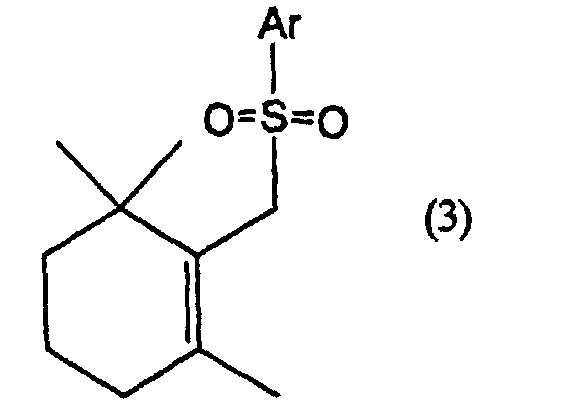
- A sulfone derivative represented by formula (1) as defined in claim 4.
- The sulfone derivative according to claim 5, wherein R1 is an acetyl group.
- A process for producing vitamin A, which comprises allowing a sulfone derivative represented by formula (1) as defined in claim 4 to react with a base.
- The process according to claim 4, which further comprises the step of allowing the formed sulfone derivative of formula (1) to react with a base to give vitamin A.
- The process according to claim 3, which further comprises the step of allowing the formed dihalogen derivative to react in the presence of base with a sulfone represented by formula (3):wherein Ar represents an aryl group which may have a substituent group, to give a sulfone derivative represented by formula (1):
 wherein Ar has the same meaning as defined above, and R1 represents a halogen atom or a protective group for a hydroxyl group.
- The process according to claim 9, which further comprises the step of allowing a sulfone derivative represented by formula (1) to react with a base to give vitamin A.
- The process according to claim 4, 8, 9 or 10, wherein the reaction of a sulfone represented by formula (3) with a dihalogen derivative represented by formula (2) is conducted in the presence of a base selected from the group consisting of an alkali metal alkoxide, an alkali metal hydride, alkyl lithium and a Grignard reagent.
- The process according to claim 7, 8 or 10, wherein a base selected from the group consisting of an alkali metal hydroxide, an alkali metal hydride and an alkali metal alkoxide is reacted with a sulfone derivative represented by formula (1).
- The process according to claim 4, 8 or 9, wherein X in the dihalogen derivative of formula (2) is a bromine atom.
- The process according to claim 3 or 9, wherein the halogenating agent is bromine, and X in the dihalogen derivative of formula (2) is a bromine atom.
- The process according to claim 3, 4, 7, 8 or 9, wherein R2 is an acetyl group.
Applications Claiming Priority (5)
| Application Number | Priority Date | Filing Date | Title |
|---|---|---|---|
| JP9756999 | 1999-04-05 | ||
| JP9756999 | 1999-04-05 | ||
| JP14029499 | 1999-05-20 | ||
| JP14029499 | 1999-05-20 | ||
| PCT/JP2000/002146 WO2000059860A1 (en) | 1999-04-05 | 2000-04-03 | Process for the preparation of vitamin a, intermediates, and process for the preparation of the intermediates |
Publications (1)
| Publication Number | Publication Date |
|---|---|
| EP1085008A1 true EP1085008A1 (en) | 2001-03-21 |
Family
ID=26438729
Family Applications (1)
| Application Number | Title | Priority Date | Filing Date |
|---|---|---|---|
| EP00913075A Withdrawn EP1085008A1 (en) | 1999-04-05 | 2000-04-03 | Process for the preparation of vitamin a, intermediates, and process for the preparation of the intermediates |
Country Status (6)
| Country | Link |
|---|---|
| US (1) | US6552219B1 (en) |
| EP (1) | EP1085008A1 (en) |
| KR (1) | KR20010052544A (en) |
| CN (1) | CN1300275A (en) |
| AU (1) | AU3459200A (en) |
| WO (1) | WO2000059860A1 (en) |
Cited By (2)
| Publication number | Priority date | Publication date | Assignee | Title |
|---|---|---|---|---|
| EP1120398A3 (en) * | 2000-01-28 | 2003-11-12 | Sumitomo Chemical Company, Limited | Dihalo-compound and process for producing vitamin A derivative |
| US6660888B2 (en) | 2000-10-18 | 2003-12-09 | Sumitomo Chemical Company, Limited | Process for producing retinol and intermediate compounds for producing the same |
Families Citing this family (1)
| Publication number | Priority date | Publication date | Assignee | Title |
|---|---|---|---|---|
| CN104733657A (en) * | 2015-03-31 | 2015-06-24 | 昆山艾可芬能源科技有限公司 | Sealing material for solid oxide fuel battery stack |
Family Cites Families (5)
| Publication number | Priority date | Publication date | Assignee | Title |
|---|---|---|---|---|
| EP0187259B2 (en) | 1985-01-10 | 1996-05-15 | Kuraray Co., Ltd. | Process for producing vitamin A or its carboxylic acid esters, and intermediate compounds useful for the process |
| US4977001A (en) | 1986-08-01 | 1990-12-11 | Vesuvius Crucible Company | Protective cladding for a molybdenum substrate |
| JPH029857A (en) | 1988-06-27 | 1990-01-12 | Kuraray Co Ltd | Production of halosulfone |
| JPH06345689A (en) * | 1993-06-14 | 1994-12-20 | Takeda Chem Ind Ltd | Production of aldehyde derivative |
| RU2188193C2 (en) * | 1997-08-25 | 2002-08-27 | Сумитомо Кемикал Компани, Лимитед | Compound related to vitamin a and methods of its synthesis |
-
2000
- 2000-04-03 US US09/701,873 patent/US6552219B1/en not_active Expired - Fee Related
- 2000-04-03 CN CN00800503A patent/CN1300275A/en active Pending
- 2000-04-03 EP EP00913075A patent/EP1085008A1/en not_active Withdrawn
- 2000-04-03 KR KR1020007013693A patent/KR20010052544A/en not_active Withdrawn
- 2000-04-03 WO PCT/JP2000/002146 patent/WO2000059860A1/en not_active Ceased
- 2000-04-03 AU AU34592/00A patent/AU3459200A/en not_active Abandoned
Non-Patent Citations (1)
| Title |
|---|
| See references of WO0059860A1 * |
Cited By (3)
| Publication number | Priority date | Publication date | Assignee | Title |
|---|---|---|---|---|
| EP1120398A3 (en) * | 2000-01-28 | 2003-11-12 | Sumitomo Chemical Company, Limited | Dihalo-compound and process for producing vitamin A derivative |
| US6660888B2 (en) | 2000-10-18 | 2003-12-09 | Sumitomo Chemical Company, Limited | Process for producing retinol and intermediate compounds for producing the same |
| US6784321B2 (en) | 2000-10-18 | 2004-08-31 | Sumitomo Chemical Company, Limited | Process for producing retinol and intermediate compounds for producing the same |
Also Published As
| Publication number | Publication date |
|---|---|
| KR20010052544A (en) | 2001-06-25 |
| WO2000059860A1 (en) | 2000-10-12 |
| US6552219B1 (en) | 2003-04-22 |
| CN1300275A (en) | 2001-06-20 |
| AU3459200A (en) | 2000-10-23 |
Similar Documents
| Publication | Publication Date | Title |
|---|---|---|
| US6699911B2 (en) | Catalytic reduction of alkyne compounds | |
| JP3745716B2 (en) | Selective reduction of alkyne compounds | |
| US6552219B1 (en) | Process for the preparation of vitamin a, intermediates, and process for the preparation of the intermediates | |
| KR20010066956A (en) | Process for producing lycopene and intermediate thereof | |
| KR20010067310A (en) | Process for producing vitamin a aldehyde and intermediate for producing the same | |
| US6388124B2 (en) | Dihalo-compound and process for producing vitamin A derivative | |
| US20040034257A1 (en) | Novel sulfone derivatives and process for producing these | |
| JP2001114756A (en) | Method for producing β-carotene | |
| EP1199303B1 (en) | Process for producing retinol and intermediate compounds for producing the same | |
| JP2001328978A (en) | Method for producing vitamin A, intermediate and method for producing the same | |
| Hayama et al. | Synthesis of 2-nitroalkyl phenyl selenides and their conversion to nitroalkenes | |
| EP1125921A1 (en) | Process for the preparation of retinol and intermediates therefor | |
| JP2001328977A (en) | Method for producing vitamin A | |
| JP4250882B2 (en) | Sulfone derivative and process for producing the same | |
| KR0179320B1 (en) | (±) -2- (tolylsulfinyl) -cyclopentadecan-1-one and its preparation | |
| EP0983998B1 (en) | Tetraene derivative and process for producing the same | |
| De Buyck et al. | Structure and Reactivity of a Stable Oxirane Derived from 2, 2, 6, 6‐Tetrachloro‐3, 3, 5‐Trimethylcyclohexanone and Methanolic Sodium Methoxide | |
| DE69802465T2 (en) | Polyalcohol derivatives and process for the preparation thereof | |
| JP2000198770A (en) | Method for producing retinol and intermediate | |
| JP2002047219A (en) | Vinyl halide derivative and production method | |
| US5196608A (en) | Use of an allylchloride for preparing an aldehyde | |
| KR100570279B1 (en) | Intermediates of coenzyme Qn and methods for preparing the intermediate | |
| JPH11315065A (en) | Sulfone derivative and production method thereof | |
| JP2000063351A (en) | Method for producing retinal, intermediate and method for producing the same | |
| JP2000080073A (en) | Sulfone derivative and method for producing the same |
Legal Events
| Date | Code | Title | Description |
|---|---|---|---|
| PUAI | Public reference made under article 153(3) epc to a published international application that has entered the european phase |
Free format text: ORIGINAL CODE: 0009012 |
|
| 17P | Request for examination filed |
Effective date: 20001205 |
|
| AK | Designated contracting states |
Kind code of ref document: A1 Designated state(s): AT BE CH CY DE DK ES FI FR GB GR IE IT LI LU MC NL PT SE |
|
| RBV | Designated contracting states (corrected) |
Designated state(s): CH DE DK FR LI |
|
| RAP1 | Party data changed (applicant data changed or rights of an application transferred) |
Owner name: SUMITOMO CHEMICAL COMPANY, LIMITED |
|
| STAA | Information on the status of an ep patent application or granted ep patent |
Free format text: STATUS: THE APPLICATION IS DEEMED TO BE WITHDRAWN |
|
| 18D | Application deemed to be withdrawn |
Effective date: 20041102 |