EP1085003A1 - High-purity 1,3-propanediol derivative solvent, process for producing the same, and use thereof - Google Patents
High-purity 1,3-propanediol derivative solvent, process for producing the same, and use thereof Download PDFInfo
- Publication number
- EP1085003A1 EP1085003A1 EP00912993A EP00912993A EP1085003A1 EP 1085003 A1 EP1085003 A1 EP 1085003A1 EP 00912993 A EP00912993 A EP 00912993A EP 00912993 A EP00912993 A EP 00912993A EP 1085003 A1 EP1085003 A1 EP 1085003A1
- Authority
- EP
- European Patent Office
- Prior art keywords
- solvent
- resist
- propanol
- weight
- acetate
- Prior art date
- Legal status (The legal status is an assumption and is not a legal conclusion. Google has not performed a legal analysis and makes no representation as to the accuracy of the status listed.)
- Withdrawn
Links
- 239000002904 solvent Substances 0.000 title claims abstract description 251
- 238000000034 method Methods 0.000 title claims description 31
- DNIAPMSPPWPWGF-VKHMYHEASA-N (+)-propylene glycol Chemical class C[C@H](O)CO DNIAPMSPPWPWGF-VKHMYHEASA-N 0.000 title abstract description 17
- 239000000203 mixture Substances 0.000 claims abstract description 143
- LFQSCWFLJHTTHZ-UHFFFAOYSA-N Ethanol Chemical compound CCO LFQSCWFLJHTTHZ-UHFFFAOYSA-N 0.000 claims abstract description 97
- -1 1,3-propanediol alkylether Chemical class 0.000 claims abstract description 81
- 238000006243 chemical reaction Methods 0.000 claims abstract description 75
- HGINCPLSRVDWNT-UHFFFAOYSA-N Acrolein Chemical compound C=CC=O HGINCPLSRVDWNT-UHFFFAOYSA-N 0.000 claims abstract description 69
- BDERNNFJNOPAEC-UHFFFAOYSA-N 1-propanol Substances CCCO BDERNNFJNOPAEC-UHFFFAOYSA-N 0.000 claims abstract description 59
- 238000001459 lithography Methods 0.000 claims abstract description 50
- 150000001875 compounds Chemical class 0.000 claims abstract description 47
- 238000005984 hydrogenation reaction Methods 0.000 claims abstract description 47
- LLHKCFNBLRBOGN-UHFFFAOYSA-N propylene glycol methyl ether acetate Chemical compound COCC(C)OC(C)=O LLHKCFNBLRBOGN-UHFFFAOYSA-N 0.000 claims abstract description 43
- 239000012535 impurity Substances 0.000 claims abstract description 42
- XLYOFNOQVPJJNP-UHFFFAOYSA-N water Substances O XLYOFNOQVPJJNP-UHFFFAOYSA-N 0.000 claims abstract description 40
- 239000012459 cleaning agent Substances 0.000 claims abstract description 39
- 229920001577 copolymer Polymers 0.000 claims abstract description 39
- 239000007788 liquid Substances 0.000 claims abstract description 39
- 230000001476 alcoholic effect Effects 0.000 claims abstract description 35
- YPFDHNVEDLHUCE-UHFFFAOYSA-N 1,3-propanediol Substances OCCCO YPFDHNVEDLHUCE-UHFFFAOYSA-N 0.000 claims abstract description 28
- 229920000166 polytrimethylene carbonate Polymers 0.000 claims abstract description 28
- NBBJYMSMWIIQGU-UHFFFAOYSA-N Propionic aldehyde Chemical compound CCC=O NBBJYMSMWIIQGU-UHFFFAOYSA-N 0.000 claims abstract description 26
- 150000001732 carboxylic acid derivatives Chemical class 0.000 claims abstract description 25
- 238000004821 distillation Methods 0.000 claims abstract description 21
- 239000003054 catalyst Substances 0.000 claims abstract description 19
- 239000002994 raw material Substances 0.000 claims abstract description 19
- OKTJSMMVPCPJKN-UHFFFAOYSA-N Carbon Chemical compound [C] OKTJSMMVPCPJKN-UHFFFAOYSA-N 0.000 claims abstract description 17
- 229910052799 carbon Inorganic materials 0.000 claims abstract description 17
- 150000001298 alcohols Chemical class 0.000 claims abstract description 15
- 150000005215 alkyl ethers Chemical class 0.000 claims abstract description 15
- QTBSBXVTEAMEQO-UHFFFAOYSA-M Acetate Chemical compound CC([O-])=O QTBSBXVTEAMEQO-UHFFFAOYSA-M 0.000 claims abstract description 13
- ZTQSAGDEMFDKMZ-UHFFFAOYSA-N butyric aldehyde Natural products CCCC=O ZTQSAGDEMFDKMZ-UHFFFAOYSA-N 0.000 claims abstract description 13
- 239000004593 Epoxy Substances 0.000 claims abstract description 12
- UFHFLCQGNIYNRP-UHFFFAOYSA-N Hydrogen Chemical compound [H][H] UFHFLCQGNIYNRP-UHFFFAOYSA-N 0.000 claims abstract description 8
- 239000001257 hydrogen Substances 0.000 claims abstract description 8
- 229910052739 hydrogen Inorganic materials 0.000 claims abstract description 8
- 239000012045 crude solution Substances 0.000 claims abstract description 6
- 239000012456 homogeneous solution Substances 0.000 claims abstract description 5
- 125000001931 aliphatic group Chemical group 0.000 claims abstract description 3
- OKKJLVBELUTLKV-UHFFFAOYSA-N Methanol Chemical compound OC OKKJLVBELUTLKV-UHFFFAOYSA-N 0.000 claims description 143
- DNIAPMSPPWPWGF-UHFFFAOYSA-N monopropylene glycol Natural products CC(O)CO DNIAPMSPPWPWGF-UHFFFAOYSA-N 0.000 claims description 63
- LZCLXQDLBQLTDK-UHFFFAOYSA-N ethyl 2-hydroxypropanoate Chemical compound CCOC(=O)C(C)O LZCLXQDLBQLTDK-UHFFFAOYSA-N 0.000 claims description 60
- 229920005989 resin Polymers 0.000 claims description 57
- 239000011347 resin Substances 0.000 claims description 57
- PFNHSEQQEPMLNI-UHFFFAOYSA-N 2-methyl-1-pentanol Chemical compound CCCC(C)CO PFNHSEQQEPMLNI-UHFFFAOYSA-N 0.000 claims description 52
- JDFDHBSESGTDAL-UHFFFAOYSA-N 3-methoxypropan-1-ol Chemical compound COCCCO JDFDHBSESGTDAL-UHFFFAOYSA-N 0.000 claims description 52
- ARXJGSRGQADJSQ-UHFFFAOYSA-N 1-methoxypropan-2-ol Chemical compound COCC(C)O ARXJGSRGQADJSQ-UHFFFAOYSA-N 0.000 claims description 40
- 238000002360 preparation method Methods 0.000 claims description 34
- 229940116333 ethyl lactate Drugs 0.000 claims description 30
- 239000003960 organic solvent Substances 0.000 claims description 30
- LYCAIKOWRPUZTN-UHFFFAOYSA-N ethylene glycol Natural products OCCO LYCAIKOWRPUZTN-UHFFFAOYSA-N 0.000 claims description 24
- 125000000217 alkyl group Chemical group 0.000 claims description 19
- KFZMGEQAYNKOFK-UHFFFAOYSA-N Isopropanol Chemical compound CC(C)O KFZMGEQAYNKOFK-UHFFFAOYSA-N 0.000 claims description 18
- CATSNJVOTSVZJV-UHFFFAOYSA-N heptan-2-one Chemical compound CCCCCC(C)=O CATSNJVOTSVZJV-UHFFFAOYSA-N 0.000 claims description 13
- DKPFZGUDAPQIHT-UHFFFAOYSA-N butyl acetate Chemical compound CCCCOC(C)=O DKPFZGUDAPQIHT-UHFFFAOYSA-N 0.000 claims description 10
- LIPRQQHINVWJCH-UHFFFAOYSA-N 1-ethoxypropan-2-yl acetate Chemical compound CCOCC(C)OC(C)=O LIPRQQHINVWJCH-UHFFFAOYSA-N 0.000 claims description 9
- RXKJFZQQPQGTFL-UHFFFAOYSA-N dihydroxyacetone Chemical compound OCC(=O)CO RXKJFZQQPQGTFL-UHFFFAOYSA-N 0.000 claims description 8
- JOLQKTGDSGKSKJ-UHFFFAOYSA-N 1-ethoxypropan-2-ol Chemical compound CCOCC(C)O JOLQKTGDSGKSKJ-UHFFFAOYSA-N 0.000 claims description 7
- SVONRAPFKPVNKG-UHFFFAOYSA-N 2-ethoxyethyl acetate Chemical compound CCOCCOC(C)=O SVONRAPFKPVNKG-UHFFFAOYSA-N 0.000 claims description 7
- XLYOFNOQVPJJNP-DYCDLGHISA-N deuterium hydrogen oxide Chemical compound [2H]O XLYOFNOQVPJJNP-DYCDLGHISA-N 0.000 claims description 7
- JSGVZVOGOQILFM-UHFFFAOYSA-N 3-methoxy-1-butanol Chemical compound COC(C)CCO JSGVZVOGOQILFM-UHFFFAOYSA-N 0.000 claims description 5
- BDJSOPWXYLFTNW-UHFFFAOYSA-N methyl 3-methoxypropanoate Chemical compound COCCC(=O)OC BDJSOPWXYLFTNW-UHFFFAOYSA-N 0.000 claims description 5
- DMFAHCVITRDZQB-UHFFFAOYSA-N 1-propoxypropan-2-yl acetate Chemical compound CCCOCC(C)OC(C)=O DMFAHCVITRDZQB-UHFFFAOYSA-N 0.000 claims description 4
- FENFUOGYJVOCRY-UHFFFAOYSA-N 1-propoxypropan-2-ol Chemical compound CCCOCC(C)O FENFUOGYJVOCRY-UHFFFAOYSA-N 0.000 claims description 3
- UHKJHMOIRYZSTH-UHFFFAOYSA-N ethyl 2-ethoxypropanoate Chemical compound CCOC(C)C(=O)OCC UHKJHMOIRYZSTH-UHFFFAOYSA-N 0.000 claims description 3
- JVTAAEKCZFNVCJ-UHFFFAOYSA-M Lactate Chemical compound CC(O)C([O-])=O JVTAAEKCZFNVCJ-UHFFFAOYSA-M 0.000 claims 2
- 239000010410 layer Substances 0.000 description 108
- 230000000052 comparative effect Effects 0.000 description 48
- 238000000576 coating method Methods 0.000 description 43
- 239000011248 coating agent Substances 0.000 description 40
- 239000000243 solution Substances 0.000 description 39
- 239000002585 base Substances 0.000 description 37
- NIXOWILDQLNWCW-UHFFFAOYSA-M Acrylate Chemical compound [O-]C(=O)C=C NIXOWILDQLNWCW-UHFFFAOYSA-M 0.000 description 32
- 229940035437 1,3-propanediol Drugs 0.000 description 24
- 238000004090 dissolution Methods 0.000 description 22
- HEMHJVSKTPXQMS-UHFFFAOYSA-M Sodium hydroxide Chemical compound [OH-].[Na+] HEMHJVSKTPXQMS-UHFFFAOYSA-M 0.000 description 21
- 239000002253 acid Substances 0.000 description 20
- 239000000047 product Substances 0.000 description 20
- 239000007787 solid Substances 0.000 description 20
- 239000011247 coating layer Substances 0.000 description 18
- OXGJKCALURPRCN-UHFFFAOYSA-N 3-methoxypropanal Chemical compound COCCC=O OXGJKCALURPRCN-UHFFFAOYSA-N 0.000 description 17
- CCTFMNIEFHGTDU-UHFFFAOYSA-N 3-methoxypropyl acetate Chemical compound COCCCOC(C)=O CCTFMNIEFHGTDU-UHFFFAOYSA-N 0.000 description 17
- WTQZSMDDRMKJRI-UHFFFAOYSA-N 4-diazoniophenolate Chemical compound [O-]C1=CC=C([N+]#N)C=C1 WTQZSMDDRMKJRI-UHFFFAOYSA-N 0.000 description 17
- 239000003795 chemical substances by application Substances 0.000 description 17
- 238000004817 gas chromatography Methods 0.000 description 16
- 229920002120 photoresistant polymer Polymers 0.000 description 16
- 238000012360 testing method Methods 0.000 description 16
- 239000007864 aqueous solution Substances 0.000 description 14
- 238000001704 evaporation Methods 0.000 description 14
- 239000000126 substance Substances 0.000 description 14
- 230000008020 evaporation Effects 0.000 description 13
- QTBSBXVTEAMEQO-UHFFFAOYSA-N Acetic acid Chemical compound CC(O)=O QTBSBXVTEAMEQO-UHFFFAOYSA-N 0.000 description 12
- 238000007259 addition reaction Methods 0.000 description 12
- 230000015572 biosynthetic process Effects 0.000 description 12
- 239000012487 rinsing solution Substances 0.000 description 12
- 238000004528 spin coating Methods 0.000 description 12
- 238000009835 boiling Methods 0.000 description 11
- 238000004140 cleaning Methods 0.000 description 11
- 239000000706 filtrate Substances 0.000 description 11
- 238000002156 mixing Methods 0.000 description 11
- 239000011342 resin composition Substances 0.000 description 11
- NIXOWILDQLNWCW-UHFFFAOYSA-N 2-Propenoic acid Natural products OC(=O)C=C NIXOWILDQLNWCW-UHFFFAOYSA-N 0.000 description 10
- RTZKZFJDLAIYFH-UHFFFAOYSA-N Diethyl ether Chemical compound CCOCC RTZKZFJDLAIYFH-UHFFFAOYSA-N 0.000 description 10
- 238000011161 development Methods 0.000 description 10
- 229920003986 novolac Polymers 0.000 description 10
- 229920001296 polysiloxane Polymers 0.000 description 10
- WGTYBPLFGIVFAS-UHFFFAOYSA-M tetramethylammonium hydroxide Chemical compound [OH-].C[N+](C)(C)C WGTYBPLFGIVFAS-UHFFFAOYSA-M 0.000 description 10
- SMZOUWXMTYCWNB-UHFFFAOYSA-N 2-(2-methoxy-5-methylphenyl)ethanamine Chemical compound COC1=CC=C(C)C=C1CCN SMZOUWXMTYCWNB-UHFFFAOYSA-N 0.000 description 9
- WSFSSNUMVMOOMR-UHFFFAOYSA-N Formaldehyde Chemical compound O=C WSFSSNUMVMOOMR-UHFFFAOYSA-N 0.000 description 9
- 229920000642 polymer Polymers 0.000 description 9
- 238000006116 polymerization reaction Methods 0.000 description 9
- ZWEHNKRNPOVVGH-UHFFFAOYSA-N 2-Butanone Chemical compound CCC(C)=O ZWEHNKRNPOVVGH-UHFFFAOYSA-N 0.000 description 8
- 238000007922 dissolution test Methods 0.000 description 8
- 238000005530 etching Methods 0.000 description 8
- 230000035945 sensitivity Effects 0.000 description 8
- 239000007858 starting material Substances 0.000 description 8
- PXHVJJICTQNCMI-UHFFFAOYSA-N Nickel Chemical compound [Ni] PXHVJJICTQNCMI-UHFFFAOYSA-N 0.000 description 7
- ISWSIDIOOBJBQZ-UHFFFAOYSA-N Phenol Chemical compound OC1=CC=CC=C1 ISWSIDIOOBJBQZ-UHFFFAOYSA-N 0.000 description 7
- 150000001412 amines Chemical class 0.000 description 7
- 125000002887 hydroxy group Chemical group [H]O* 0.000 description 7
- 239000012046 mixed solvent Substances 0.000 description 7
- XHMWPVBQGARKQM-UHFFFAOYSA-N 3-ethoxy-1-propanol Chemical compound CCOCCCO XHMWPVBQGARKQM-UHFFFAOYSA-N 0.000 description 6
- WFDIJRYMOXRFFG-UHFFFAOYSA-N Acetic anhydride Chemical compound CC(=O)OC(C)=O WFDIJRYMOXRFFG-UHFFFAOYSA-N 0.000 description 6
- CSCPPACGZOOCGX-UHFFFAOYSA-N Acetone Chemical compound CC(C)=O CSCPPACGZOOCGX-UHFFFAOYSA-N 0.000 description 6
- IJGRMHOSHXDMSA-UHFFFAOYSA-N Atomic nitrogen Chemical compound N#N IJGRMHOSHXDMSA-UHFFFAOYSA-N 0.000 description 6
- KWYUFKZDYYNOTN-UHFFFAOYSA-M Potassium hydroxide Chemical compound [OH-].[K+] KWYUFKZDYYNOTN-UHFFFAOYSA-M 0.000 description 6
- ZMANZCXQSJIPKH-UHFFFAOYSA-N Triethylamine Chemical compound CCN(CC)CC ZMANZCXQSJIPKH-UHFFFAOYSA-N 0.000 description 6
- 239000011324 bead Substances 0.000 description 6
- BTANRVKWQNVYAZ-UHFFFAOYSA-N butan-2-ol Chemical compound CCC(C)O BTANRVKWQNVYAZ-UHFFFAOYSA-N 0.000 description 6
- 238000001914 filtration Methods 0.000 description 6
- 239000003999 initiator Substances 0.000 description 6
- 239000004973 liquid crystal related substance Substances 0.000 description 6
- RLSSMJSEOOYNOY-UHFFFAOYSA-N m-cresol Chemical compound CC1=CC=CC(O)=C1 RLSSMJSEOOYNOY-UHFFFAOYSA-N 0.000 description 6
- 125000002496 methyl group Chemical group [H]C([H])([H])* 0.000 description 6
- IWDCLRJOBJJRNH-UHFFFAOYSA-N p-cresol Chemical compound CC1=CC=C(O)C=C1 IWDCLRJOBJJRNH-UHFFFAOYSA-N 0.000 description 6
- 239000002244 precipitate Substances 0.000 description 6
- WQGWDDDVZFFDIG-UHFFFAOYSA-N pyrogallol Chemical compound OC1=CC=CC(O)=C1O WQGWDDDVZFFDIG-UHFFFAOYSA-N 0.000 description 6
- 230000002829 reductive effect Effects 0.000 description 6
- CERQOIWHTDAKMF-UHFFFAOYSA-N Methacrylic acid Chemical compound CC(=C)C(O)=O CERQOIWHTDAKMF-UHFFFAOYSA-N 0.000 description 5
- LRHPLDYGYMQRHN-UHFFFAOYSA-N N-Butanol Chemical compound CCCCO LRHPLDYGYMQRHN-UHFFFAOYSA-N 0.000 description 5
- 229910000564 Raney nickel Inorganic materials 0.000 description 5
- 150000001299 aldehydes Chemical class 0.000 description 5
- 238000004458 analytical method Methods 0.000 description 5
- 239000006227 byproduct Substances 0.000 description 5
- BGTOWKSIORTVQH-UHFFFAOYSA-N cyclopentanone Chemical compound O=C1CCCC1 BGTOWKSIORTVQH-UHFFFAOYSA-N 0.000 description 5
- 230000000694 effects Effects 0.000 description 5
- 238000004070 electrodeposition Methods 0.000 description 5
- 238000010894 electron beam technology Methods 0.000 description 5
- 150000002148 esters Chemical class 0.000 description 5
- 239000003112 inhibitor Substances 0.000 description 5
- 239000000463 material Substances 0.000 description 5
- 238000011282 treatment Methods 0.000 description 5
- 229920002554 vinyl polymer Polymers 0.000 description 5
- QQZOPKMRPOGIEB-UHFFFAOYSA-N 2-Oxohexane Chemical compound CCCCC(C)=O QQZOPKMRPOGIEB-UHFFFAOYSA-N 0.000 description 4
- LDMRLRNXHLPZJN-UHFFFAOYSA-N 3-propoxypropan-1-ol Chemical compound CCCOCCCO LDMRLRNXHLPZJN-UHFFFAOYSA-N 0.000 description 4
- IKHGUXGNUITLKF-UHFFFAOYSA-N Acetaldehyde Chemical compound CC=O IKHGUXGNUITLKF-UHFFFAOYSA-N 0.000 description 4
- 241000196324 Embryophyta Species 0.000 description 4
- QIGBRXMKCJKVMJ-UHFFFAOYSA-N Hydroquinone Chemical compound OC1=CC=C(O)C=C1 QIGBRXMKCJKVMJ-UHFFFAOYSA-N 0.000 description 4
- 239000007868 Raney catalyst Substances 0.000 description 4
- CDBYLPFSWZWCQE-UHFFFAOYSA-L Sodium Carbonate Chemical compound [Na+].[Na+].[O-]C([O-])=O CDBYLPFSWZWCQE-UHFFFAOYSA-L 0.000 description 4
- 238000000998 batch distillation Methods 0.000 description 4
- 125000001797 benzyl group Chemical group [H]C1=C([H])C([H])=C(C([H])=C1[H])C([H])([H])* 0.000 description 4
- MLUCVPSAIODCQM-NSCUHMNNSA-N crotonaldehyde Chemical compound C\C=C\C=O MLUCVPSAIODCQM-NSCUHMNNSA-N 0.000 description 4
- MLUCVPSAIODCQM-UHFFFAOYSA-N crotonaldehyde Natural products CC=CC=O MLUCVPSAIODCQM-UHFFFAOYSA-N 0.000 description 4
- 239000003085 diluting agent Substances 0.000 description 4
- 238000001035 drying Methods 0.000 description 4
- 238000005516 engineering process Methods 0.000 description 4
- FKRCODPIKNYEAC-UHFFFAOYSA-N ethyl propionate Chemical compound CCOC(=O)CC FKRCODPIKNYEAC-UHFFFAOYSA-N 0.000 description 4
- 239000007789 gas Substances 0.000 description 4
- 125000004435 hydrogen atom Chemical group [H]* 0.000 description 4
- NWVVVBRKAWDGAB-UHFFFAOYSA-N p-methoxyphenol Chemical compound COC1=CC=C(O)C=C1 NWVVVBRKAWDGAB-UHFFFAOYSA-N 0.000 description 4
- XNLICIUVMPYHGG-UHFFFAOYSA-N pentan-2-one Chemical compound CCCC(C)=O XNLICIUVMPYHGG-UHFFFAOYSA-N 0.000 description 4
- PGMYKACGEOXYJE-UHFFFAOYSA-N pentyl acetate Chemical compound CCCCCOC(C)=O PGMYKACGEOXYJE-UHFFFAOYSA-N 0.000 description 4
- 239000003505 polymerization initiator Substances 0.000 description 4
- 230000005855 radiation Effects 0.000 description 4
- 238000011084 recovery Methods 0.000 description 4
- RIOQSEWOXXDEQQ-UHFFFAOYSA-N triphenylphosphine Chemical compound C1=CC=CC=C1P(C=1C=CC=CC=1)C1=CC=CC=C1 RIOQSEWOXXDEQQ-UHFFFAOYSA-N 0.000 description 4
- FKZYYYDRLJCHGL-UHFFFAOYSA-N 1,1,3-trimethoxypropane Chemical compound COCCC(OC)OC FKZYYYDRLJCHGL-UHFFFAOYSA-N 0.000 description 3
- HFZLSTDPRQSZCQ-UHFFFAOYSA-N 1-pyrrolidin-3-ylpyrrolidine Chemical compound C1CCCN1C1CNCC1 HFZLSTDPRQSZCQ-UHFFFAOYSA-N 0.000 description 3
- 239000004925 Acrylic resin Substances 0.000 description 3
- 229920000178 Acrylic resin Polymers 0.000 description 3
- GAWIXWVDTYZWAW-UHFFFAOYSA-N C[CH]O Chemical group C[CH]O GAWIXWVDTYZWAW-UHFFFAOYSA-N 0.000 description 3
- RYGMFSIKBFXOCR-UHFFFAOYSA-N Copper Chemical compound [Cu] RYGMFSIKBFXOCR-UHFFFAOYSA-N 0.000 description 3
- XEKOWRVHYACXOJ-UHFFFAOYSA-N Ethyl acetate Chemical compound CCOC(C)=O XEKOWRVHYACXOJ-UHFFFAOYSA-N 0.000 description 3
- OFOBLEOULBTSOW-UHFFFAOYSA-N Propanedioic acid Natural products OC(=O)CC(O)=O OFOBLEOULBTSOW-UHFFFAOYSA-N 0.000 description 3
- DKGAVHZHDRPRBM-UHFFFAOYSA-N Tert-Butanol Chemical compound CC(C)(C)O DKGAVHZHDRPRBM-UHFFFAOYSA-N 0.000 description 3
- 239000003513 alkali Substances 0.000 description 3
- 125000002947 alkylene group Chemical group 0.000 description 3
- 150000001408 amides Chemical class 0.000 description 3
- 230000003321 amplification Effects 0.000 description 3
- 229910052787 antimony Inorganic materials 0.000 description 3
- WATWJIUSRGPENY-UHFFFAOYSA-N antimony atom Chemical compound [Sb] WATWJIUSRGPENY-UHFFFAOYSA-N 0.000 description 3
- 239000012295 chemical reaction liquid Substances 0.000 description 3
- 229910052802 copper Inorganic materials 0.000 description 3
- 239000010949 copper Substances 0.000 description 3
- 238000000354 decomposition reaction Methods 0.000 description 3
- 229940079593 drug Drugs 0.000 description 3
- 239000003814 drug Substances 0.000 description 3
- 239000000975 dye Substances 0.000 description 3
- 238000005886 esterification reaction Methods 0.000 description 3
- 238000011156 evaluation Methods 0.000 description 3
- 238000010438 heat treatment Methods 0.000 description 3
- 238000004519 manufacturing process Methods 0.000 description 3
- 229940017219 methyl propionate Drugs 0.000 description 3
- 239000000178 monomer Substances 0.000 description 3
- 229910052757 nitrogen Inorganic materials 0.000 description 3
- 238000003199 nucleic acid amplification method Methods 0.000 description 3
- 230000000704 physical effect Effects 0.000 description 3
- 238000012643 polycondensation polymerization Methods 0.000 description 3
- 229940079877 pyrogallol Drugs 0.000 description 3
- 230000009257 reactivity Effects 0.000 description 3
- 238000010992 reflux Methods 0.000 description 3
- 239000011877 solvent mixture Substances 0.000 description 3
- 125000001412 tetrahydropyranyl group Chemical group 0.000 description 3
- 125000000391 vinyl group Chemical group [H]C([*])=C([H])[H] 0.000 description 3
- NWUYHJFMYQTDRP-UHFFFAOYSA-N 1,2-bis(ethenyl)benzene;1-ethenyl-2-ethylbenzene;styrene Chemical compound C=CC1=CC=CC=C1.CCC1=CC=CC=C1C=C.C=CC1=CC=CC=C1C=C NWUYHJFMYQTDRP-UHFFFAOYSA-N 0.000 description 2
- KETQAJRQOHHATG-UHFFFAOYSA-N 1,2-naphthoquinone Chemical compound C1=CC=C2C(=O)C(=O)C=CC2=C1 KETQAJRQOHHATG-UHFFFAOYSA-N 0.000 description 2
- 229940105324 1,2-naphthoquinone Drugs 0.000 description 2
- DSVGICPKBRQDDX-UHFFFAOYSA-N 1,3-diacetoxypropane Chemical compound CC(=O)OCCCOC(C)=O DSVGICPKBRQDDX-UHFFFAOYSA-N 0.000 description 2
- WJFKNYWRSNBZNX-UHFFFAOYSA-N 10H-phenothiazine Chemical compound C1=CC=C2NC3=CC=CC=C3SC2=C1 WJFKNYWRSNBZNX-UHFFFAOYSA-N 0.000 description 2
- HZAXFHJVJLSVMW-UHFFFAOYSA-N 2-Aminoethan-1-ol Chemical compound NCCO HZAXFHJVJLSVMW-UHFFFAOYSA-N 0.000 description 2
- IDEYZABHVQLHAF-XQRVVYSFSA-N 2-Methyl-2-pentenal Chemical compound CC\C=C(\C)C=O IDEYZABHVQLHAF-XQRVVYSFSA-N 0.000 description 2
- JWAZRIHNYRIHIV-UHFFFAOYSA-N 2-naphthol Chemical compound C1=CC=CC2=CC(O)=CC=C21 JWAZRIHNYRIHIV-UHFFFAOYSA-N 0.000 description 2
- XLLXMBCBJGATSP-UHFFFAOYSA-N 2-phenylethenol Chemical compound OC=CC1=CC=CC=C1 XLLXMBCBJGATSP-UHFFFAOYSA-N 0.000 description 2
- NTKBNCABAMQDIG-UHFFFAOYSA-N 3-butoxypropan-1-ol Chemical compound CCCCOCCCO NTKBNCABAMQDIG-UHFFFAOYSA-N 0.000 description 2
- DPTGFYXXFXSRIR-UHFFFAOYSA-N 7-oxabicyclo[4.1.0]heptan-4-ylmethyl prop-2-enoate Chemical compound C1C(COC(=O)C=C)CCC2OC21 DPTGFYXXFXSRIR-UHFFFAOYSA-N 0.000 description 2
- QGZKDVFQNNGYKY-UHFFFAOYSA-N Ammonia Chemical compound N QGZKDVFQNNGYKY-UHFFFAOYSA-N 0.000 description 2
- PAYRUJLWNCNPSJ-UHFFFAOYSA-N Aniline Chemical compound NC1=CC=CC=C1 PAYRUJLWNCNPSJ-UHFFFAOYSA-N 0.000 description 2
- LSNNMFCWUKXFEE-UHFFFAOYSA-M Bisulfite Chemical compound OS([O-])=O LSNNMFCWUKXFEE-UHFFFAOYSA-M 0.000 description 2
- VTYYLEPIZMXCLO-UHFFFAOYSA-L Calcium carbonate Chemical compound [Ca+2].[O-]C([O-])=O VTYYLEPIZMXCLO-UHFFFAOYSA-L 0.000 description 2
- LCGLNKUTAGEVQW-UHFFFAOYSA-N Dimethyl ether Chemical compound COC LCGLNKUTAGEVQW-UHFFFAOYSA-N 0.000 description 2
- QUSNBJAOOMFDIB-UHFFFAOYSA-N Ethylamine Chemical compound CCN QUSNBJAOOMFDIB-UHFFFAOYSA-N 0.000 description 2
- ZHNUHDYFZUAESO-UHFFFAOYSA-N Formamide Chemical compound NC=O ZHNUHDYFZUAESO-UHFFFAOYSA-N 0.000 description 2
- PEDCQBHIVMGVHV-UHFFFAOYSA-N Glycerine Chemical compound OCC(O)CO PEDCQBHIVMGVHV-UHFFFAOYSA-N 0.000 description 2
- BAPJBEWLBFYGME-UHFFFAOYSA-N Methyl acrylate Chemical compound COC(=O)C=C BAPJBEWLBFYGME-UHFFFAOYSA-N 0.000 description 2
- NTIZESTWPVYFNL-UHFFFAOYSA-N Methyl isobutyl ketone Chemical compound CC(C)CC(C)=O NTIZESTWPVYFNL-UHFFFAOYSA-N 0.000 description 2
- UIHCLUNTQKBZGK-UHFFFAOYSA-N Methyl isobutyl ketone Natural products CCC(C)C(C)=O UIHCLUNTQKBZGK-UHFFFAOYSA-N 0.000 description 2
- RJUFJBKOKNCXHH-UHFFFAOYSA-N Methyl propionate Chemical compound CCC(=O)OC RJUFJBKOKNCXHH-UHFFFAOYSA-N 0.000 description 2
- KDLHZDBZIXYQEI-UHFFFAOYSA-N Palladium Chemical compound [Pd] KDLHZDBZIXYQEI-UHFFFAOYSA-N 0.000 description 2
- GLUUGHFHXGJENI-UHFFFAOYSA-N Piperazine Chemical compound C1CNCCN1 GLUUGHFHXGJENI-UHFFFAOYSA-N 0.000 description 2
- KAESVJOAVNADME-UHFFFAOYSA-N Pyrrole Chemical compound C=1C=CNC=1 KAESVJOAVNADME-UHFFFAOYSA-N 0.000 description 2
- 244000028419 Styrax benzoin Species 0.000 description 2
- 235000000126 Styrax benzoin Nutrition 0.000 description 2
- PPBRXRYQALVLMV-UHFFFAOYSA-N Styrene Chemical compound C=CC1=CC=CC=C1 PPBRXRYQALVLMV-UHFFFAOYSA-N 0.000 description 2
- 235000008411 Sumatra benzointree Nutrition 0.000 description 2
- DAKWPKUUDNSNPN-UHFFFAOYSA-N Trimethylolpropane triacrylate Chemical compound C=CC(=O)OCC(CC)(COC(=O)C=C)COC(=O)C=C DAKWPKUUDNSNPN-UHFFFAOYSA-N 0.000 description 2
- 238000010521 absorption reaction Methods 0.000 description 2
- 238000000862 absorption spectrum Methods 0.000 description 2
- 230000002378 acidificating effect Effects 0.000 description 2
- UQYRZEIESGGMAV-UHFFFAOYSA-N adamantan-1-ol;prop-2-enoic acid Chemical compound OC(=O)C=C.C1C(C2)CC3CC2CC1(O)C3 UQYRZEIESGGMAV-UHFFFAOYSA-N 0.000 description 2
- 239000000654 additive Substances 0.000 description 2
- WNLRTRBMVRJNCN-UHFFFAOYSA-N adipic acid Chemical compound OC(=O)CCCCC(O)=O WNLRTRBMVRJNCN-UHFFFAOYSA-N 0.000 description 2
- 230000002411 adverse Effects 0.000 description 2
- 239000003905 agrochemical Substances 0.000 description 2
- 238000005882 aldol condensation reaction Methods 0.000 description 2
- 125000005376 alkyl siloxane group Chemical group 0.000 description 2
- 229910052782 aluminium Inorganic materials 0.000 description 2
- XAGFODPZIPBFFR-UHFFFAOYSA-N aluminium Chemical compound [Al] XAGFODPZIPBFFR-UHFFFAOYSA-N 0.000 description 2
- 125000003277 amino group Chemical group 0.000 description 2
- QVGXLLKOCUKJST-UHFFFAOYSA-N atomic oxygen Chemical compound [O] QVGXLLKOCUKJST-UHFFFAOYSA-N 0.000 description 2
- JXLHNMVSKXFWAO-UHFFFAOYSA-N azane;7-fluoro-2,1,3-benzoxadiazole-4-sulfonic acid Chemical compound N.OS(=O)(=O)C1=CC=C(F)C2=NON=C12 JXLHNMVSKXFWAO-UHFFFAOYSA-N 0.000 description 2
- TZCXTZWJZNENPQ-UHFFFAOYSA-L barium sulfate Chemical compound [Ba+2].[O-]S([O-])(=O)=O TZCXTZWJZNENPQ-UHFFFAOYSA-L 0.000 description 2
- ISAOCJYIOMOJEB-UHFFFAOYSA-N benzoin Chemical compound C=1C=CC=CC=1C(O)C(=O)C1=CC=CC=C1 ISAOCJYIOMOJEB-UHFFFAOYSA-N 0.000 description 2
- WGQKYBSKWIADBV-UHFFFAOYSA-N benzylamine Chemical compound NCC1=CC=CC=C1 WGQKYBSKWIADBV-UHFFFAOYSA-N 0.000 description 2
- 230000033228 biological regulation Effects 0.000 description 2
- IISBACLAFKSPIT-UHFFFAOYSA-N bisphenol A Chemical compound C=1C=C(O)C=CC=1C(C)(C)C1=CC=C(O)C=C1 IISBACLAFKSPIT-UHFFFAOYSA-N 0.000 description 2
- YCIMNLLNPGFGHC-UHFFFAOYSA-N catechol Chemical compound OC1=CC=CC=C1O YCIMNLLNPGFGHC-UHFFFAOYSA-N 0.000 description 2
- 239000008199 coating composition Substances 0.000 description 2
- 238000006482 condensation reaction Methods 0.000 description 2
- 230000007797 corrosion Effects 0.000 description 2
- 238000005260 corrosion Methods 0.000 description 2
- 125000000113 cyclohexyl group Chemical group [H]C1([H])C([H])([H])C([H])([H])C([H])(*)C([H])([H])C1([H])[H] 0.000 description 2
- 230000003247 decreasing effect Effects 0.000 description 2
- 150000001983 dialkylethers Chemical class 0.000 description 2
- 230000032050 esterification Effects 0.000 description 2
- XLLIQLLCWZCATF-UHFFFAOYSA-N ethylene glycol monomethyl ether acetate Natural products COCCOC(C)=O XLLIQLLCWZCATF-UHFFFAOYSA-N 0.000 description 2
- LNTHITQWFMADLM-UHFFFAOYSA-N gallic acid Chemical compound OC(=O)C1=CC(O)=C(O)C(O)=C1 LNTHITQWFMADLM-UHFFFAOYSA-N 0.000 description 2
- 239000011521 glass Substances 0.000 description 2
- 235000019382 gum benzoic Nutrition 0.000 description 2
- 239000003456 ion exchange resin Substances 0.000 description 2
- 229920003303 ion-exchange polymer Polymers 0.000 description 2
- ZXEKIIBDNHEJCQ-UHFFFAOYSA-N isobutanol Chemical compound CC(C)CO ZXEKIIBDNHEJCQ-UHFFFAOYSA-N 0.000 description 2
- 230000014759 maintenance of location Effects 0.000 description 2
- FPYJFEHAWHCUMM-UHFFFAOYSA-N maleic anhydride Chemical compound O=C1OC(=O)C=C1 FPYJFEHAWHCUMM-UHFFFAOYSA-N 0.000 description 2
- 239000012528 membrane Substances 0.000 description 2
- QSHDDOUJBYECFT-UHFFFAOYSA-N mercury Chemical compound [Hg] QSHDDOUJBYECFT-UHFFFAOYSA-N 0.000 description 2
- 229910052753 mercury Inorganic materials 0.000 description 2
- 229910052751 metal Inorganic materials 0.000 description 2
- 239000002184 metal Substances 0.000 description 2
- YVWPDYFVVMNWDT-UHFFFAOYSA-N methyl 2-ethoxypropanoate Chemical compound CCOC(C)C(=O)OC YVWPDYFVVMNWDT-UHFFFAOYSA-N 0.000 description 2
- 229940043265 methyl isobutyl ketone Drugs 0.000 description 2
- JESXATFQYMPTNL-UHFFFAOYSA-N mono-hydroxyphenyl-ethylene Natural products OC1=CC=CC=C1C=C JESXATFQYMPTNL-UHFFFAOYSA-N 0.000 description 2
- YKYONYBAUNKHLG-UHFFFAOYSA-N n-Propyl acetate Natural products CCCOC(C)=O YKYONYBAUNKHLG-UHFFFAOYSA-N 0.000 description 2
- IXQGCWUGDFDQMF-UHFFFAOYSA-N o-Hydroxyethylbenzene Natural products CCC1=CC=CC=C1O IXQGCWUGDFDQMF-UHFFFAOYSA-N 0.000 description 2
- QWVGKYWNOKOFNN-UHFFFAOYSA-N o-cresol Chemical compound CC1=CC=CC=C1O QWVGKYWNOKOFNN-UHFFFAOYSA-N 0.000 description 2
- 239000001301 oxygen Substances 0.000 description 2
- 229910052760 oxygen Inorganic materials 0.000 description 2
- 230000036961 partial effect Effects 0.000 description 2
- 230000035515 penetration Effects 0.000 description 2
- 150000002989 phenols Chemical class 0.000 description 2
- 229950000688 phenothiazine Drugs 0.000 description 2
- 150000003003 phosphines Chemical class 0.000 description 2
- BASFCYQUMIYNBI-UHFFFAOYSA-N platinum Chemical compound [Pt] BASFCYQUMIYNBI-UHFFFAOYSA-N 0.000 description 2
- 231100000614 poison Toxicity 0.000 description 2
- 230000007096 poisonous effect Effects 0.000 description 2
- 229920001223 polyethylene glycol Polymers 0.000 description 2
- 229940090181 propyl acetate Drugs 0.000 description 2
- FBONOZIMJLFIJZ-UHFFFAOYSA-N propyl propaneperoxoate Chemical compound CCCOOC(=O)CC FBONOZIMJLFIJZ-UHFFFAOYSA-N 0.000 description 2
- 238000007763 reverse roll coating Methods 0.000 description 2
- 239000004065 semiconductor Substances 0.000 description 2
- 229910000029 sodium carbonate Inorganic materials 0.000 description 2
- 229910000679 solder Inorganic materials 0.000 description 2
- 238000005507 spraying Methods 0.000 description 2
- 150000003460 sulfonic acids Chemical class 0.000 description 2
- 239000004094 surface-active agent Substances 0.000 description 2
- 238000003786 synthesis reaction Methods 0.000 description 2
- 125000000999 tert-butyl group Chemical group [H]C([H])([H])C(*)(C([H])([H])[H])C([H])([H])[H] 0.000 description 2
- 229940086542 triethylamine Drugs 0.000 description 2
- 229940096522 trimethylolpropane triacrylate Drugs 0.000 description 2
- NQPDZGIKBAWPEJ-UHFFFAOYSA-N valeric acid Chemical compound CCCCC(O)=O NQPDZGIKBAWPEJ-UHFFFAOYSA-N 0.000 description 2
- 229920003169 water-soluble polymer Polymers 0.000 description 2
- PAPBSGBWRJIAAV-UHFFFAOYSA-N ε-Caprolactone Chemical compound O=C1CCCCCO1 PAPBSGBWRJIAAV-UHFFFAOYSA-N 0.000 description 2
- DEQUKPCANKRTPZ-UHFFFAOYSA-N (2,3-dihydroxyphenyl)-phenylmethanone Chemical compound OC1=CC=CC(C(=O)C=2C=CC=CC=2)=C1O DEQUKPCANKRTPZ-UHFFFAOYSA-N 0.000 description 1
- ZEFPSJCRLPUDJQ-UHFFFAOYSA-N (2-hydroxy-1-adamantyl) prop-2-enoate Chemical compound C1C(C2)CC3CC1C(O)C2(OC(=O)C=C)C3 ZEFPSJCRLPUDJQ-UHFFFAOYSA-N 0.000 description 1
- FVQMJJQUGGVLEP-UHFFFAOYSA-N (2-methylpropan-2-yl)oxy 2-ethylhexaneperoxoate Chemical compound CCCCC(CC)C(=O)OOOC(C)(C)C FVQMJJQUGGVLEP-UHFFFAOYSA-N 0.000 description 1
- ZRDYULMDEGRWRC-UHFFFAOYSA-N (4-hydroxyphenyl)-(2,3,4-trihydroxyphenyl)methanone Chemical compound C1=CC(O)=CC=C1C(=O)C1=CC=C(O)C(O)=C1O ZRDYULMDEGRWRC-UHFFFAOYSA-N 0.000 description 1
- APNOOECCLHIHKN-UHFFFAOYSA-N (4-hydroxyphenyl)-(4,6,6-trihydroxycyclohexa-2,4-dien-1-yl)methanone Chemical compound C1=CC(O)=CC(O)(O)C1C(=O)C1=CC=C(O)C=C1 APNOOECCLHIHKN-UHFFFAOYSA-N 0.000 description 1
- WBYWAXJHAXSJNI-VOTSOKGWSA-M .beta-Phenylacrylic acid Natural products [O-]C(=O)\C=C\C1=CC=CC=C1 WBYWAXJHAXSJNI-VOTSOKGWSA-M 0.000 description 1
- WOAHJDHKFWSLKE-UHFFFAOYSA-N 1,2-benzoquinone Chemical compound O=C1C=CC=CC1=O WOAHJDHKFWSLKE-UHFFFAOYSA-N 0.000 description 1
- FRASJONUBLZVQX-UHFFFAOYSA-N 1,4-naphthoquinone Chemical compound C1=CC=C2C(=O)C=CC(=O)C2=C1 FRASJONUBLZVQX-UHFFFAOYSA-N 0.000 description 1
- RWNUSVWFHDHRCJ-UHFFFAOYSA-N 1-butoxypropan-2-ol Chemical compound CCCCOCC(C)O RWNUSVWFHDHRCJ-UHFFFAOYSA-N 0.000 description 1
- FUWDFGKRNIDKAE-UHFFFAOYSA-N 1-butoxypropan-2-yl acetate Chemical compound CCCCOCC(C)OC(C)=O FUWDFGKRNIDKAE-UHFFFAOYSA-N 0.000 description 1
- UGDXXMCTNJHYKN-UHFFFAOYSA-N 1-cyclohexyl-2-cyclohexylsulfonyl-2-diazonioethenolate Chemical compound C1CCCCC1S(=O)(=O)C(=[N+]=[N-])C(=O)C1CCCCC1 UGDXXMCTNJHYKN-UHFFFAOYSA-N 0.000 description 1
- HMNZROFMBSUMAB-UHFFFAOYSA-N 1-ethoxybutan-1-ol Chemical compound CCCC(O)OCC HMNZROFMBSUMAB-UHFFFAOYSA-N 0.000 description 1
- NHAPGXMXFCIWQP-UHFFFAOYSA-N 1-methyl-4-(methylsulfonylmethylsulfonyl)benzene Chemical compound CC1=CC=C(S(=O)(=O)CS(C)(=O)=O)C=C1 NHAPGXMXFCIWQP-UHFFFAOYSA-N 0.000 description 1
- KJCVRFUGPWSIIH-UHFFFAOYSA-N 1-naphthol Chemical compound C1=CC=C2C(O)=CC=CC2=C1 KJCVRFUGPWSIIH-UHFFFAOYSA-N 0.000 description 1
- HTQNYBBTZSBWKL-UHFFFAOYSA-N 2,3,4-trihydroxbenzophenone Chemical compound OC1=C(O)C(O)=CC=C1C(=O)C1=CC=CC=C1 HTQNYBBTZSBWKL-UHFFFAOYSA-N 0.000 description 1
- XRUGBBIQLIVCSI-UHFFFAOYSA-N 2,3,4-trimethylphenol Chemical compound CC1=CC=C(O)C(C)=C1C XRUGBBIQLIVCSI-UHFFFAOYSA-N 0.000 description 1
- FEWSKCAVEJNPBX-UHFFFAOYSA-N 2-(2-hydroxy-2-phenylacetyl)benzenesulfonic acid Chemical class C=1C=CC=CC=1C(O)C(=O)C1=CC=CC=C1S(O)(=O)=O FEWSKCAVEJNPBX-UHFFFAOYSA-N 0.000 description 1
- RYPVZRUGIVUTIU-UHFFFAOYSA-N 2-(2-phenylethenoxy)acetic acid Chemical compound OC(=O)COC=CC1=CC=CC=C1 RYPVZRUGIVUTIU-UHFFFAOYSA-N 0.000 description 1
- UHOPWFKONJYLCF-UHFFFAOYSA-N 2-(2-sulfanylethyl)isoindole-1,3-dione Chemical compound C1=CC=C2C(=O)N(CCS)C(=O)C2=C1 UHOPWFKONJYLCF-UHFFFAOYSA-N 0.000 description 1
- JAHNSTQSQJOJLO-UHFFFAOYSA-N 2-(3-fluorophenyl)-1h-imidazole Chemical compound FC1=CC=CC(C=2NC=CN=2)=C1 JAHNSTQSQJOJLO-UHFFFAOYSA-N 0.000 description 1
- XNWFRZJHXBZDAG-UHFFFAOYSA-N 2-METHOXYETHANOL Chemical compound COCCO XNWFRZJHXBZDAG-UHFFFAOYSA-N 0.000 description 1
- LCZVSXRMYJUNFX-UHFFFAOYSA-N 2-[2-(2-hydroxypropoxy)propoxy]propan-1-ol Chemical compound CC(O)COC(C)COC(C)CO LCZVSXRMYJUNFX-UHFFFAOYSA-N 0.000 description 1
- TXBCBTDQIULDIA-UHFFFAOYSA-N 2-[[3-hydroxy-2,2-bis(hydroxymethyl)propoxy]methyl]-2-(hydroxymethyl)propane-1,3-diol Chemical compound OCC(CO)(CO)COCC(CO)(CO)CO TXBCBTDQIULDIA-UHFFFAOYSA-N 0.000 description 1
- LJBWJFWNFUKAGS-UHFFFAOYSA-N 2-[bis(2-hydroxyphenyl)methyl]phenol Chemical compound OC1=CC=CC=C1C(C=1C(=CC=CC=1)O)C1=CC=CC=C1O LJBWJFWNFUKAGS-UHFFFAOYSA-N 0.000 description 1
- DRYBUHKBBRHEAE-UHFFFAOYSA-N 2-[diazo(propan-2-ylsulfonyl)methyl]sulfonylpropane Chemical compound CC(C)S(=O)(=O)C(=[N+]=[N-])S(=O)(=O)C(C)C DRYBUHKBBRHEAE-UHFFFAOYSA-N 0.000 description 1
- POAOYUHQDCAZBD-UHFFFAOYSA-N 2-butoxyethanol Chemical compound CCCCOCCO POAOYUHQDCAZBD-UHFFFAOYSA-N 0.000 description 1
- CYMRPDYINXWJFU-UHFFFAOYSA-N 2-carbamoylbenzoic acid Chemical compound NC(=O)C1=CC=CC=C1C(O)=O CYMRPDYINXWJFU-UHFFFAOYSA-N 0.000 description 1
- BFSVOASYOCHEOV-UHFFFAOYSA-N 2-diethylaminoethanol Chemical compound CCN(CC)CCO BFSVOASYOCHEOV-UHFFFAOYSA-N 0.000 description 1
- XUDBVJCTLZTSDC-UHFFFAOYSA-N 2-ethenylbenzoic acid Chemical compound OC(=O)C1=CC=CC=C1C=C XUDBVJCTLZTSDC-UHFFFAOYSA-N 0.000 description 1
- ZNQVEEAIQZEUHB-UHFFFAOYSA-N 2-ethoxyethanol Chemical compound CCOCCO ZNQVEEAIQZEUHB-UHFFFAOYSA-N 0.000 description 1
- 125000000954 2-hydroxyethyl group Chemical group [H]C([*])([H])C([H])([H])O[H] 0.000 description 1
- WBXCFSRAWFNBHW-UHFFFAOYSA-N 2-methyl-2-(4-methylphenyl)sulfonyl-1-phenylpropan-1-one Chemical compound C1=CC(C)=CC=C1S(=O)(=O)C(C)(C)C(=O)C1=CC=CC=C1 WBXCFSRAWFNBHW-UHFFFAOYSA-N 0.000 description 1
- QTWJRLJHJPIABL-UHFFFAOYSA-N 2-methylphenol;3-methylphenol;4-methylphenol Chemical compound CC1=CC=C(O)C=C1.CC1=CC=CC(O)=C1.CC1=CC=CC=C1O QTWJRLJHJPIABL-UHFFFAOYSA-N 0.000 description 1
- MKHXOKALQIHXPI-UHFFFAOYSA-N 2-phenylprop-1-en-1-ol Chemical compound OC=C(C)C1=CC=CC=C1 MKHXOKALQIHXPI-UHFFFAOYSA-N 0.000 description 1
- YEYKMVJDLWJFOA-UHFFFAOYSA-N 2-propoxyethanol Chemical compound CCCOCCO YEYKMVJDLWJFOA-UHFFFAOYSA-N 0.000 description 1
- WJQOZHYUIDYNHM-UHFFFAOYSA-N 2-tert-Butylphenol Chemical compound CC(C)(C)C1=CC=CC=C1O WJQOZHYUIDYNHM-UHFFFAOYSA-N 0.000 description 1
- BUIXEGYUDCDLCD-UHFFFAOYSA-N 3-(2-methylpropoxy)propan-1-ol Chemical compound CC(C)COCCCO BUIXEGYUDCDLCD-UHFFFAOYSA-N 0.000 description 1
- UGOTTWYYPSIIJG-UHFFFAOYSA-N 3-(2-methylpropoxy)propyl acetate Chemical compound CC(C)COCCCOC(C)=O UGOTTWYYPSIIJG-UHFFFAOYSA-N 0.000 description 1
- GHTWMSKPKHLXPE-UHFFFAOYSA-N 3-[(2-methylpropan-2-yl)oxy]propan-1-ol Chemical compound CC(C)(C)OCCCO GHTWMSKPKHLXPE-UHFFFAOYSA-N 0.000 description 1
- ISWIYXKVDGBLBS-UHFFFAOYSA-N 3-[(2-methylpropan-2-yl)oxy]propyl acetate Chemical compound CC(=O)OCCCOC(C)(C)C ISWIYXKVDGBLBS-UHFFFAOYSA-N 0.000 description 1
- XYEUJNLLJMOJGY-UHFFFAOYSA-N 3-butoxypropyl acetate Chemical compound CCCCOCCCOC(C)=O XYEUJNLLJMOJGY-UHFFFAOYSA-N 0.000 description 1
- LAMUXTNQCICZQX-UHFFFAOYSA-N 3-chloropropan-1-ol Chemical compound OCCCCl LAMUXTNQCICZQX-UHFFFAOYSA-N 0.000 description 1
- VXKUOGVOWWPRNM-UHFFFAOYSA-N 3-ethoxypropyl acetate Chemical compound CCOCCCOC(C)=O VXKUOGVOWWPRNM-UHFFFAOYSA-N 0.000 description 1
- QOXOZONBQWIKDA-UHFFFAOYSA-N 3-hydroxypropyl Chemical group [CH2]CCO QOXOZONBQWIKDA-UHFFFAOYSA-N 0.000 description 1
- QMYGFTJCQFEDST-UHFFFAOYSA-N 3-methoxybutyl acetate Chemical compound COC(C)CCOC(C)=O QMYGFTJCQFEDST-UHFFFAOYSA-N 0.000 description 1
- OFNISBHGPNMTMS-UHFFFAOYSA-N 3-methylideneoxolane-2,5-dione Chemical compound C=C1CC(=O)OC1=O OFNISBHGPNMTMS-UHFFFAOYSA-N 0.000 description 1
- GBSGXZBOFKJGMG-UHFFFAOYSA-N 3-propan-2-yloxypropan-1-ol Chemical compound CC(C)OCCCO GBSGXZBOFKJGMG-UHFFFAOYSA-N 0.000 description 1
- DOGVQYFCTKZHEC-UHFFFAOYSA-N 3-propan-2-yloxypropyl acetate Chemical compound CC(C)OCCCOC(C)=O DOGVQYFCTKZHEC-UHFFFAOYSA-N 0.000 description 1
- OYNJSBBPNFNGNK-UHFFFAOYSA-N 3-propoxypropyl acetate Chemical compound CCCOCCCOC(C)=O OYNJSBBPNFNGNK-UHFFFAOYSA-N 0.000 description 1
- HYKBUMWQWWRXJN-UHFFFAOYSA-N 4-[2-(2-nitrophenyl)ethyl]benzenesulfonic acid Chemical compound C1=CC(S(=O)(=O)O)=CC=C1CCC1=CC=CC=C1[N+]([O-])=O HYKBUMWQWWRXJN-UHFFFAOYSA-N 0.000 description 1
- WVAXLHQEIXYNHY-UHFFFAOYSA-N 4-chloro-2-[2-(3-ethenylphenyl)-1,1,1,3,3,3-hexafluoropropan-2-yl]benzenesulfonic acid Chemical compound OS(=O)(=O)C1=CC=C(Cl)C=C1C(C(F)(F)F)(C(F)(F)F)C1=CC=CC(C=C)=C1 WVAXLHQEIXYNHY-UHFFFAOYSA-N 0.000 description 1
- PSCXFXNEYIHJST-UHFFFAOYSA-N 4-phenylbut-3-enoic acid Chemical compound OC(=O)CC=CC1=CC=CC=C1 PSCXFXNEYIHJST-UHFFFAOYSA-N 0.000 description 1
- FYYIUODUDSPAJQ-UHFFFAOYSA-N 7-oxabicyclo[4.1.0]heptan-4-ylmethyl 2-methylprop-2-enoate Chemical compound C1C(COC(=O)C(=C)C)CCC2OC21 FYYIUODUDSPAJQ-UHFFFAOYSA-N 0.000 description 1
- LPEKGGXMPWTOCB-UHFFFAOYSA-N 8beta-(2,3-epoxy-2-methylbutyryloxy)-14-acetoxytithifolin Natural products COC(=O)C(C)O LPEKGGXMPWTOCB-UHFFFAOYSA-N 0.000 description 1
- 101001053395 Arabidopsis thaliana Acid beta-fructofuranosidase 4, vacuolar Proteins 0.000 description 1
- WBYWAXJHAXSJNI-SREVYHEPSA-N Cinnamic acid Chemical compound OC(=O)\C=C/C1=CC=CC=C1 WBYWAXJHAXSJNI-SREVYHEPSA-N 0.000 description 1
- QMMFVYPAHWMCMS-UHFFFAOYSA-N Dimethyl sulfide Chemical compound CSC QMMFVYPAHWMCMS-UHFFFAOYSA-N 0.000 description 1
- YCKRFDGAMUMZLT-UHFFFAOYSA-N Fluorine atom Chemical compound [F] YCKRFDGAMUMZLT-UHFFFAOYSA-N 0.000 description 1
- OWYWGLHRNBIFJP-UHFFFAOYSA-N Ipazine Chemical compound CCN(CC)C1=NC(Cl)=NC(NC(C)C)=N1 OWYWGLHRNBIFJP-UHFFFAOYSA-N 0.000 description 1
- 229910021578 Iron(III) chloride Inorganic materials 0.000 description 1
- PEEHTFAAVSWFBL-UHFFFAOYSA-N Maleimide Chemical compound O=C1NC(=O)C=C1 PEEHTFAAVSWFBL-UHFFFAOYSA-N 0.000 description 1
- CERQOIWHTDAKMF-UHFFFAOYSA-M Methacrylate Chemical compound CC(=C)C([O-])=O CERQOIWHTDAKMF-UHFFFAOYSA-M 0.000 description 1
- 229930040373 Paraformaldehyde Natural products 0.000 description 1
- 229920001665 Poly-4-vinylphenol Polymers 0.000 description 1
- 239000002202 Polyethylene glycol Substances 0.000 description 1
- 239000004372 Polyvinyl alcohol Substances 0.000 description 1
- XBDQKXXYIPTUBI-UHFFFAOYSA-M Propionate Chemical compound CCC([O-])=O XBDQKXXYIPTUBI-UHFFFAOYSA-M 0.000 description 1
- 239000004115 Sodium Silicate Substances 0.000 description 1
- KDYFGRWQOYBRFD-UHFFFAOYSA-N Succinic acid Natural products OC(=O)CCC(O)=O KDYFGRWQOYBRFD-UHFFFAOYSA-N 0.000 description 1
- GWEVSGVZZGPLCZ-UHFFFAOYSA-N Titan oxide Chemical compound O=[Ti]=O GWEVSGVZZGPLCZ-UHFFFAOYSA-N 0.000 description 1
- GSEJCLTVZPLZKY-UHFFFAOYSA-N Triethanolamine Chemical compound OCCN(CCO)CCO GSEJCLTVZPLZKY-UHFFFAOYSA-N 0.000 description 1
- ZJCCRDAZUWHFQH-UHFFFAOYSA-N Trimethylolpropane Chemical compound CCC(CO)(CO)CO ZJCCRDAZUWHFQH-UHFFFAOYSA-N 0.000 description 1
- 239000007983 Tris buffer Substances 0.000 description 1
- KXKVLQRXCPHEJC-UHFFFAOYSA-N acetic acid trimethyl ester Natural products COC(C)=O KXKVLQRXCPHEJC-UHFFFAOYSA-N 0.000 description 1
- TUVYSBJZBYRDHP-UHFFFAOYSA-N acetic acid;methoxymethane Chemical compound COC.CC(O)=O TUVYSBJZBYRDHP-UHFFFAOYSA-N 0.000 description 1
- 150000008062 acetophenones Chemical class 0.000 description 1
- 125000002777 acetyl group Chemical group [H]C([H])([H])C(*)=O 0.000 description 1
- 125000002252 acyl group Chemical group 0.000 description 1
- 239000001361 adipic acid Substances 0.000 description 1
- 235000011037 adipic acid Nutrition 0.000 description 1
- 238000013019 agitation Methods 0.000 description 1
- 125000003172 aldehyde group Chemical group 0.000 description 1
- 125000003545 alkoxy group Chemical group 0.000 description 1
- 125000004453 alkoxycarbonyl group Chemical group 0.000 description 1
- 125000005011 alkyl ether group Chemical group 0.000 description 1
- PNEYBMLMFCGWSK-UHFFFAOYSA-N aluminium oxide Inorganic materials [O-2].[O-2].[O-2].[Al+3].[Al+3] PNEYBMLMFCGWSK-UHFFFAOYSA-N 0.000 description 1
- 229910021529 ammonia Inorganic materials 0.000 description 1
- 150000008064 anhydrides Chemical group 0.000 description 1
- 239000003125 aqueous solvent Substances 0.000 description 1
- 239000012298 atmosphere Substances 0.000 description 1
- 229960002130 benzoin Drugs 0.000 description 1
- 239000012965 benzophenone Substances 0.000 description 1
- 150000008366 benzophenones Chemical class 0.000 description 1
- 229950011260 betanaphthol Drugs 0.000 description 1
- WXNRYSGJLQFHBR-UHFFFAOYSA-N bis(2,4-dihydroxyphenyl)methanone Chemical compound OC1=CC(O)=CC=C1C(=O)C1=CC=C(O)C=C1O WXNRYSGJLQFHBR-UHFFFAOYSA-N 0.000 description 1
- KDYFGRWQOYBRFD-NUQCWPJISA-N butanedioic acid Chemical compound O[14C](=O)CC[14C](O)=O KDYFGRWQOYBRFD-NUQCWPJISA-N 0.000 description 1
- 125000000484 butyl group Chemical group [H]C([*])([H])C([H])([H])C([H])([H])C([H])([H])[H] 0.000 description 1
- 229910000019 calcium carbonate Inorganic materials 0.000 description 1
- 239000006229 carbon black Substances 0.000 description 1
- ABDBNWQRPYOPDF-UHFFFAOYSA-N carbonofluoridic acid Chemical compound OC(F)=O ABDBNWQRPYOPDF-UHFFFAOYSA-N 0.000 description 1
- 125000003178 carboxy group Chemical group [H]OC(*)=O 0.000 description 1
- 239000012159 carrier gas Substances 0.000 description 1
- 238000005266 casting Methods 0.000 description 1
- 230000003197 catalytic effect Effects 0.000 description 1
- 239000007795 chemical reaction product Substances 0.000 description 1
- OEYIOHPDSNJKLS-UHFFFAOYSA-N choline Chemical compound C[N+](C)(C)CCO OEYIOHPDSNJKLS-UHFFFAOYSA-N 0.000 description 1
- 229960001231 choline Drugs 0.000 description 1
- 229930016911 cinnamic acid Natural products 0.000 description 1
- 235000013985 cinnamic acid Nutrition 0.000 description 1
- OOCCDEMITAIZTP-UHFFFAOYSA-N cinnamyl alcohol Chemical compound OCC=CC1=CC=CC=C1 OOCCDEMITAIZTP-UHFFFAOYSA-N 0.000 description 1
- HNEGQIOMVPPMNR-IHWYPQMZSA-N citraconic acid Chemical compound OC(=O)C(/C)=C\C(O)=O HNEGQIOMVPPMNR-IHWYPQMZSA-N 0.000 description 1
- 229940018557 citraconic acid Drugs 0.000 description 1
- 239000004927 clay Substances 0.000 description 1
- 229910052570 clay Inorganic materials 0.000 description 1
- 238000004040 coloring Methods 0.000 description 1
- 238000009833 condensation Methods 0.000 description 1
- 230000005494 condensation Effects 0.000 description 1
- 238000001944 continuous distillation Methods 0.000 description 1
- 229930003836 cresol Natural products 0.000 description 1
- 239000003431 cross linking reagent Substances 0.000 description 1
- LDHQCZJRKDOVOX-NSCUHMNNSA-N crotonic acid Chemical compound C\C=C\C(O)=O LDHQCZJRKDOVOX-NSCUHMNNSA-N 0.000 description 1
- ZXJXZNDDNMQXFV-UHFFFAOYSA-M crystal violet Chemical compound [Cl-].C1=CC(N(C)C)=CC=C1[C+](C=1C=CC(=CC=1)N(C)C)C1=CC=C(N(C)C)C=C1 ZXJXZNDDNMQXFV-UHFFFAOYSA-M 0.000 description 1
- 125000004122 cyclic group Chemical group 0.000 description 1
- 125000000753 cycloalkyl group Chemical group 0.000 description 1
- 230000007547 defect Effects 0.000 description 1
- 230000018044 dehydration Effects 0.000 description 1
- 238000006297 dehydration reaction Methods 0.000 description 1
- 125000000664 diazo group Chemical group [N-]=[N+]=[*] 0.000 description 1
- CSYSRRCOBYEGPI-UHFFFAOYSA-N diazo(sulfonyl)methane Chemical class [N-]=[N+]=C=S(=O)=O CSYSRRCOBYEGPI-UHFFFAOYSA-N 0.000 description 1
- HPNMFZURTQLUMO-UHFFFAOYSA-N diethylamine Chemical compound CCNCC HPNMFZURTQLUMO-UHFFFAOYSA-N 0.000 description 1
- 238000009792 diffusion process Methods 0.000 description 1
- XXBDWLFCJWSEKW-UHFFFAOYSA-N dimethylbenzylamine Chemical compound CN(C)CC1=CC=CC=C1 XXBDWLFCJWSEKW-UHFFFAOYSA-N 0.000 description 1
- 238000003618 dip coating Methods 0.000 description 1
- 239000006185 dispersion Substances 0.000 description 1
- 239000012153 distilled water Substances 0.000 description 1
- 238000009826 distribution Methods 0.000 description 1
- ODQWQRRAPPTVAG-GZTJUZNOSA-N doxepin Chemical compound C1OC2=CC=CC=C2C(=C/CCN(C)C)/C2=CC=CC=C21 ODQWQRRAPPTVAG-GZTJUZNOSA-N 0.000 description 1
- 238000001312 dry etching Methods 0.000 description 1
- 229920001971 elastomer Polymers 0.000 description 1
- 238000005265 energy consumption Methods 0.000 description 1
- 230000007613 environmental effect Effects 0.000 description 1
- 239000003822 epoxy resin Substances 0.000 description 1
- 238000006266 etherification reaction Methods 0.000 description 1
- WHRLOJCOIKOQGL-UHFFFAOYSA-N ethyl 2-methoxypropanoate Chemical compound CCOC(=O)C(C)OC WHRLOJCOIKOQGL-UHFFFAOYSA-N 0.000 description 1
- 239000002360 explosive Substances 0.000 description 1
- 239000000945 filler Substances 0.000 description 1
- 239000012467 final product Substances 0.000 description 1
- 229910052731 fluorine Inorganic materials 0.000 description 1
- 239000011737 fluorine Substances 0.000 description 1
- 229940074391 gallic acid Drugs 0.000 description 1
- 235000004515 gallic acid Nutrition 0.000 description 1
- 235000011187 glycerol Nutrition 0.000 description 1
- 125000003055 glycidyl group Chemical group C(C1CO1)* 0.000 description 1
- 230000026030 halogenation Effects 0.000 description 1
- 238000005658 halogenation reaction Methods 0.000 description 1
- 239000001307 helium Substances 0.000 description 1
- 229910052734 helium Inorganic materials 0.000 description 1
- SWQJXJOGLNCZEY-UHFFFAOYSA-N helium atom Chemical compound [He] SWQJXJOGLNCZEY-UHFFFAOYSA-N 0.000 description 1
- 231100000086 high toxicity Toxicity 0.000 description 1
- WGCNASOHLSPBMP-UHFFFAOYSA-N hydroxyacetaldehyde Natural products OCC=O WGCNASOHLSPBMP-UHFFFAOYSA-N 0.000 description 1
- 125000002768 hydroxyalkyl group Chemical group 0.000 description 1
- CBOIHMRHGLHBPB-UHFFFAOYSA-N hydroxymethyl Chemical compound O[CH2] CBOIHMRHGLHBPB-UHFFFAOYSA-N 0.000 description 1
- 238000003384 imaging method Methods 0.000 description 1
- 239000004615 ingredient Substances 0.000 description 1
- 238000011835 investigation Methods 0.000 description 1
- RBTARNINKXHZNM-UHFFFAOYSA-K iron trichloride Chemical compound Cl[Fe](Cl)Cl RBTARNINKXHZNM-UHFFFAOYSA-K 0.000 description 1
- 230000001678 irradiating effect Effects 0.000 description 1
- 150000002576 ketones Chemical class 0.000 description 1
- 231100000053 low toxicity Toxicity 0.000 description 1
- VZCYOOQTPOCHFL-UPHRSURJSA-N maleic acid Chemical compound OC(=O)\C=C/C(O)=O VZCYOOQTPOCHFL-UPHRSURJSA-N 0.000 description 1
- 239000011976 maleic acid Substances 0.000 description 1
- HNEGQIOMVPPMNR-NSCUHMNNSA-N mesaconic acid Chemical compound OC(=O)C(/C)=C/C(O)=O HNEGQIOMVPPMNR-NSCUHMNNSA-N 0.000 description 1
- 229910001507 metal halide Inorganic materials 0.000 description 1
- 150000005309 metal halides Chemical class 0.000 description 1
- OCUXHFVNHQTZKR-UHFFFAOYSA-M methanesulfonate;triphenylsulfanium Chemical compound CS([O-])(=O)=O.C1=CC=CC=C1[S+](C=1C=CC=CC=1)C1=CC=CC=C1 OCUXHFVNHQTZKR-UHFFFAOYSA-M 0.000 description 1
- 229940057867 methyl lactate Drugs 0.000 description 1
- WBYWAXJHAXSJNI-UHFFFAOYSA-N methyl p-hydroxycinnamate Natural products OC(=O)C=CC1=CC=CC=C1 WBYWAXJHAXSJNI-UHFFFAOYSA-N 0.000 description 1
- LVHBHZANLOWSRM-UHFFFAOYSA-N methylenebutanedioic acid Natural products OC(=O)CC(=C)C(O)=O LVHBHZANLOWSRM-UHFFFAOYSA-N 0.000 description 1
- HNEGQIOMVPPMNR-UHFFFAOYSA-N methylfumaric acid Natural products OC(=O)C(C)=CC(O)=O HNEGQIOMVPPMNR-UHFFFAOYSA-N 0.000 description 1
- 239000011859 microparticle Substances 0.000 description 1
- 125000000896 monocarboxylic acid group Chemical group 0.000 description 1
- XOOMNEFVDUTJPP-UHFFFAOYSA-N naphthalene-1,3-diol Chemical compound C1=CC=CC2=CC(O)=CC(O)=C21 XOOMNEFVDUTJPP-UHFFFAOYSA-N 0.000 description 1
- 230000003472 neutralizing effect Effects 0.000 description 1
- 229910052759 nickel Inorganic materials 0.000 description 1
- IZJVVXCHJIQVOL-UHFFFAOYSA-N nitro(phenyl)methanesulfonic acid Chemical class OS(=O)(=O)C([N+]([O-])=O)C1=CC=CC=C1 IZJVVXCHJIQVOL-UHFFFAOYSA-N 0.000 description 1
- 125000002347 octyl group Chemical group [H]C([*])([H])C([H])([H])C([H])([H])C([H])([H])C([H])([H])C([H])([H])C([H])([H])C([H])([H])[H] 0.000 description 1
- 239000003791 organic solvent mixture Substances 0.000 description 1
- QHGUPRQTQITEPO-UHFFFAOYSA-N oxan-2-yl 2-methylprop-2-enoate Chemical compound CC(=C)C(=O)OC1CCCCO1 QHGUPRQTQITEPO-UHFFFAOYSA-N 0.000 description 1
- ATGUVEKSASEFFO-UHFFFAOYSA-N p-aminodiphenylamine Chemical compound C1=CC(N)=CC=C1NC1=CC=CC=C1 ATGUVEKSASEFFO-UHFFFAOYSA-N 0.000 description 1
- 229910052763 palladium Inorganic materials 0.000 description 1
- 229920002866 paraformaldehyde Polymers 0.000 description 1
- WXZMFSXDPGVJKK-UHFFFAOYSA-N pentaerythritol Chemical compound OCC(CO)(CO)CO WXZMFSXDPGVJKK-UHFFFAOYSA-N 0.000 description 1
- YFSUTJLHUFNCNZ-UHFFFAOYSA-N perfluorooctane-1-sulfonic acid Chemical compound OS(=O)(=O)C(F)(F)C(F)(F)C(F)(F)C(F)(F)C(F)(F)C(F)(F)C(F)(F)C(F)(F)F YFSUTJLHUFNCNZ-UHFFFAOYSA-N 0.000 description 1
- 150000002978 peroxides Chemical class 0.000 description 1
- 239000000575 pesticide Substances 0.000 description 1
- LYKRPDCJKSXAHS-UHFFFAOYSA-N phenyl-(2,3,4,5-tetrahydroxyphenyl)methanone Chemical compound OC1=C(O)C(O)=CC(C(=O)C=2C=CC=CC=2)=C1O LYKRPDCJKSXAHS-UHFFFAOYSA-N 0.000 description 1
- IEQIEDJGQAUEQZ-UHFFFAOYSA-N phthalocyanine Chemical compound N1C(N=C2C3=CC=CC=C3C(N=C3C4=CC=CC=C4C(=N4)N3)=N2)=C(C=CC=C2)C2=C1N=C1C2=CC=CC=C2C4=N1 IEQIEDJGQAUEQZ-UHFFFAOYSA-N 0.000 description 1
- 239000000049 pigment Substances 0.000 description 1
- 238000007747 plating Methods 0.000 description 1
- 229910052697 platinum Inorganic materials 0.000 description 1
- 229920000058 polyacrylate Polymers 0.000 description 1
- 229920001515 polyalkylene glycol Polymers 0.000 description 1
- 229920000768 polyamine Polymers 0.000 description 1
- 229920001083 polybutene Polymers 0.000 description 1
- 229920000647 polyepoxide Polymers 0.000 description 1
- 229920000193 polymethacrylate Polymers 0.000 description 1
- 229920005862 polyol Polymers 0.000 description 1
- 150000003077 polyols Chemical class 0.000 description 1
- 229920001451 polypropylene glycol Polymers 0.000 description 1
- 229920002451 polyvinyl alcohol Polymers 0.000 description 1
- 229920000036 polyvinylpyrrolidone Polymers 0.000 description 1
- 239000001267 polyvinylpyrrolidone Substances 0.000 description 1
- 235000013855 polyvinylpyrrolidone Nutrition 0.000 description 1
- 239000011148 porous material Substances 0.000 description 1
- 239000000843 powder Substances 0.000 description 1
- 238000012545 processing Methods 0.000 description 1
- ZGSGHFXCSHYESB-UHFFFAOYSA-N propan-2-yl propaneperoxoate Chemical compound CCC(=O)OOC(C)C ZGSGHFXCSHYESB-UHFFFAOYSA-N 0.000 description 1
- 239000008213 purified water Substances 0.000 description 1
- 150000003242 quaternary ammonium salts Chemical class 0.000 description 1
- 238000010526 radical polymerization reaction Methods 0.000 description 1
- 238000004064 recycling Methods 0.000 description 1
- 238000007670 refining Methods 0.000 description 1
- 239000013557 residual solvent Substances 0.000 description 1
- 150000003839 salts Chemical class 0.000 description 1
- 238000006748 scratching Methods 0.000 description 1
- 230000002393 scratching effect Effects 0.000 description 1
- 238000000926 separation method Methods 0.000 description 1
- 125000003808 silyl group Chemical group [H][Si]([H])([H])[*] 0.000 description 1
- NTHWMYGWWRZVTN-UHFFFAOYSA-N sodium silicate Chemical compound [Na+].[Na+].[O-][Si]([O-])=O NTHWMYGWWRZVTN-UHFFFAOYSA-N 0.000 description 1
- 229910052911 sodium silicate Inorganic materials 0.000 description 1
- 239000007921 spray Substances 0.000 description 1
- 238000003860 storage Methods 0.000 description 1
- 150000003440 styrenes Chemical class 0.000 description 1
- LZOZLBFZGFLFBV-UHFFFAOYSA-N sulfene Chemical class C=S(=O)=O LZOZLBFZGFLFBV-UHFFFAOYSA-N 0.000 description 1
- 150000003871 sulfonates Chemical class 0.000 description 1
- 239000000454 talc Substances 0.000 description 1
- 229910052623 talc Inorganic materials 0.000 description 1
- SJMYWORNLPSJQO-UHFFFAOYSA-N tert-butyl 2-methylprop-2-enoate Chemical compound CC(=C)C(=O)OC(C)(C)C SJMYWORNLPSJQO-UHFFFAOYSA-N 0.000 description 1
- 229940073455 tetraethylammonium hydroxide Drugs 0.000 description 1
- LRGJRHZIDJQFCL-UHFFFAOYSA-M tetraethylazanium;hydroxide Chemical compound [OH-].CC[N+](CC)(CC)CC LRGJRHZIDJQFCL-UHFFFAOYSA-M 0.000 description 1
- UWHCKJMYHZGTIT-UHFFFAOYSA-N tetraethylene glycol Chemical compound OCCOCCOCCOCCO UWHCKJMYHZGTIT-UHFFFAOYSA-N 0.000 description 1
- 125000004632 tetrahydrothiopyranyl group Chemical group S1C(CCCC1)* 0.000 description 1
- 150000003568 thioethers Chemical class 0.000 description 1
- OGIDPMRJRNCKJF-UHFFFAOYSA-N titanium oxide Inorganic materials [Ti]=O OGIDPMRJRNCKJF-UHFFFAOYSA-N 0.000 description 1
- VZCYOOQTPOCHFL-UHFFFAOYSA-N trans-butenedioic acid Natural products OC(=O)C=CC(O)=O VZCYOOQTPOCHFL-UHFFFAOYSA-N 0.000 description 1
- LDHQCZJRKDOVOX-UHFFFAOYSA-N trans-crotonic acid Natural products CC=CC(O)=O LDHQCZJRKDOVOX-UHFFFAOYSA-N 0.000 description 1
- 238000005809 transesterification reaction Methods 0.000 description 1
- TUQOTMZNTHZOKS-UHFFFAOYSA-N tributylphosphine Chemical compound CCCCP(CCCC)CCCC TUQOTMZNTHZOKS-UHFFFAOYSA-N 0.000 description 1
- 125000000026 trimethylsilyl group Chemical group [H]C([H])([H])[Si]([*])(C([H])([H])[H])C([H])([H])[H] 0.000 description 1
- 229960004418 trolamine Drugs 0.000 description 1
- 238000000108 ultra-filtration Methods 0.000 description 1
- 238000005406 washing Methods 0.000 description 1
- 239000003021 water soluble solvent Substances 0.000 description 1
- 150000007964 xanthones Chemical class 0.000 description 1
- 150000003739 xylenols Chemical class 0.000 description 1
Images

Classifications
-
- G—PHYSICS
- G03—PHOTOGRAPHY; CINEMATOGRAPHY; ANALOGOUS TECHNIQUES USING WAVES OTHER THAN OPTICAL WAVES; ELECTROGRAPHY; HOLOGRAPHY
- G03F—PHOTOMECHANICAL PRODUCTION OF TEXTURED OR PATTERNED SURFACES, e.g. FOR PRINTING, FOR PROCESSING OF SEMICONDUCTOR DEVICES; MATERIALS THEREFOR; ORIGINALS THEREFOR; APPARATUS SPECIALLY ADAPTED THEREFOR
- G03F7/00—Photomechanical, e.g. photolithographic, production of textured or patterned surfaces, e.g. printing surfaces; Materials therefor, e.g. comprising photoresists; Apparatus specially adapted therefor
- G03F7/26—Processing photosensitive materials; Apparatus therefor
- G03F7/42—Stripping or agents therefor
- G03F7/422—Stripping or agents therefor using liquids only
-
- C—CHEMISTRY; METALLURGY
- C07—ORGANIC CHEMISTRY
- C07C—ACYCLIC OR CARBOCYCLIC COMPOUNDS
- C07C43/00—Ethers; Compounds having groups, groups or groups
- C07C43/02—Ethers
- C07C43/03—Ethers having all ether-oxygen atoms bound to acyclic carbon atoms
- C07C43/04—Saturated ethers
- C07C43/13—Saturated ethers containing hydroxy or O-metal groups
-
- C—CHEMISTRY; METALLURGY
- C07—ORGANIC CHEMISTRY
- C07C—ACYCLIC OR CARBOCYCLIC COMPOUNDS
- C07C45/00—Preparation of compounds having >C = O groups bound only to carbon or hydrogen atoms; Preparation of chelates of such compounds
- C07C45/61—Preparation of compounds having >C = O groups bound only to carbon or hydrogen atoms; Preparation of chelates of such compounds by reactions not involving the formation of >C = O groups
- C07C45/67—Preparation of compounds having >C = O groups bound only to carbon or hydrogen atoms; Preparation of chelates of such compounds by reactions not involving the formation of >C = O groups by isomerisation; by change of size of the carbon skeleton
- C07C45/68—Preparation of compounds having >C = O groups bound only to carbon or hydrogen atoms; Preparation of chelates of such compounds by reactions not involving the formation of >C = O groups by isomerisation; by change of size of the carbon skeleton by increase in the number of carbon atoms
- C07C45/70—Preparation of compounds having >C = O groups bound only to carbon or hydrogen atoms; Preparation of chelates of such compounds by reactions not involving the formation of >C = O groups by isomerisation; by change of size of the carbon skeleton by increase in the number of carbon atoms by reaction with functional groups containing oxygen only in singly bound form
- C07C45/71—Preparation of compounds having >C = O groups bound only to carbon or hydrogen atoms; Preparation of chelates of such compounds by reactions not involving the formation of >C = O groups by isomerisation; by change of size of the carbon skeleton by increase in the number of carbon atoms by reaction with functional groups containing oxygen only in singly bound form being hydroxy groups
-
- G—PHYSICS
- G03—PHOTOGRAPHY; CINEMATOGRAPHY; ANALOGOUS TECHNIQUES USING WAVES OTHER THAN OPTICAL WAVES; ELECTROGRAPHY; HOLOGRAPHY
- G03F—PHOTOMECHANICAL PRODUCTION OF TEXTURED OR PATTERNED SURFACES, e.g. FOR PRINTING, FOR PROCESSING OF SEMICONDUCTOR DEVICES; MATERIALS THEREFOR; ORIGINALS THEREFOR; APPARATUS SPECIALLY ADAPTED THEREFOR
- G03F7/00—Photomechanical, e.g. photolithographic, production of textured or patterned surfaces, e.g. printing surfaces; Materials therefor, e.g. comprising photoresists; Apparatus specially adapted therefor
- G03F7/004—Photosensitive materials
- G03F7/0048—Photosensitive materials characterised by the solvents or agents facilitating spreading, e.g. tensio-active agents
-
- G—PHYSICS
- G03—PHOTOGRAPHY; CINEMATOGRAPHY; ANALOGOUS TECHNIQUES USING WAVES OTHER THAN OPTICAL WAVES; ELECTROGRAPHY; HOLOGRAPHY
- G03F—PHOTOMECHANICAL PRODUCTION OF TEXTURED OR PATTERNED SURFACES, e.g. FOR PRINTING, FOR PROCESSING OF SEMICONDUCTOR DEVICES; MATERIALS THEREFOR; ORIGINALS THEREFOR; APPARATUS SPECIALLY ADAPTED THEREFOR
- G03F7/00—Photomechanical, e.g. photolithographic, production of textured or patterned surfaces, e.g. printing surfaces; Materials therefor, e.g. comprising photoresists; Apparatus specially adapted therefor
- G03F7/26—Processing photosensitive materials; Apparatus therefor
- G03F7/30—Imagewise removal using liquid means
- G03F7/32—Liquid compositions therefor, e.g. developers
- G03F7/322—Aqueous alkaline compositions
-
- G—PHYSICS
- G03—PHOTOGRAPHY; CINEMATOGRAPHY; ANALOGOUS TECHNIQUES USING WAVES OTHER THAN OPTICAL WAVES; ELECTROGRAPHY; HOLOGRAPHY
- G03F—PHOTOMECHANICAL PRODUCTION OF TEXTURED OR PATTERNED SURFACES, e.g. FOR PRINTING, FOR PROCESSING OF SEMICONDUCTOR DEVICES; MATERIALS THEREFOR; ORIGINALS THEREFOR; APPARATUS SPECIALLY ADAPTED THEREFOR
- G03F7/00—Photomechanical, e.g. photolithographic, production of textured or patterned surfaces, e.g. printing surfaces; Materials therefor, e.g. comprising photoresists; Apparatus specially adapted therefor
- G03F7/26—Processing photosensitive materials; Apparatus therefor
- G03F7/30—Imagewise removal using liquid means
- G03F7/32—Liquid compositions therefor, e.g. developers
- G03F7/325—Non-aqueous compositions
Definitions
- the present invention No. I relates to a high purity 3-alkoxy-1-propanol, particularly, a high purity 3-methoxy-1-propanol, in which acrolein and an alcohol, particularly, methanol are employed as raw materials, and a method for the preparation thereof.
- the present invention No. II relates to a cleaning agent for lithography which is employed for dissolving or removing a resist, etc., and in more detail, a cleaning agent for lithography which can be usefully employed for cleaning a coating apparatus such as an inside of a coater cup, for removing an unnecessary resist in coating the resist or on a base plate after coating, for removing a resist from the base plate after attaining use purpose of the resist, and for cleaning and rinsing the base plate after removing a resist.
- a coating apparatus such as an inside of a coater cup
- the present invention No. III relates to a rinsing liquid for lithography and, in more detail, it relates to a rinsing liquid for lithography which is useful for dissolving or removing cured and uncured unnecessary resist and a reflection protecting-layer from an integrated circuit element, a color filter, a base plate for a liquid crystal display element, etc., or a coating apparatus for a resist, etc.
- the present invention No. IV relates to a solvent for a resist composition which is employed as an object for irradiating a corpuscular beam such as an ultraviolet ray, a far ultraviolet ray, an X-ray, and an electron beam, etc., and relates to a resist composition characterized by the use thereof and, in more detail, it relates to a solvent which provides a resist composition which is excellent in safeness during the use, coatability, residual ratio of a layer during development, uniformity of line width of a pattern after development, and resist adhesion during development, and it relates to a resist composition composed of the solvent and a resist resin.
- a corpuscular beam such as an ultraviolet ray, a far ultraviolet ray, an X-ray, and an electron beam, etc.
- the present invention No. V relates to a photo-curable resin composition which is preferred as an etching resist or a solder resist which is employed in, particularly, a preparation stage of a printed circuit board.
- 3-methoxy-1-propanol is also named 1,3-propane diol methylether, and it has an alcoholic hydroxyl group and methyether group.
- the alcoholic hydroxyl group has esterification reactivity, etherification reactivity, and halogenation reactivity, and it is an important compound as many useful compounds, particularly, raw materials for medicines and agricultural chemicals, and functional solvents.
- JP-A-07025821 Official Gazette describes a method for the preparation of 3-methoxy-1-propanol by hydrogenation of a product obtained by allowing to react methanol with acrolein under the presence of a basic catalyst, followed by allowing to react with acetic acid under the presence of an acidic catalyst, and a solvent containing thereof. Further, JP-A-10306050 Official Gazette describes an etheralcohol-based solvent containing 3-methoxy-1-propanol, however, there is only obtained a product having purity of 98.4% or so, a kind and amount of the impurities are not described in all the prior arts and, the prior arts are not aware a problem by the impurities.
- the liquid photoresist includes a positive type one and a negative type one.
- the thickness of resist coating layer can be thinned as well as in the electrodeposition resist, identical or more excellent dissolution can be expected as in the electrodeposition resist in formability of a micro-pattern. Further, a bath control is not required as in the electrodeposition resist, and since it can become more decreased in price from a viewpoint of plant investment than in the electrodeposition resist, it is hopeful as a preparation method of a micro-pattern.
- solvents to be employed for the resist composition a variety of solvents have been conventionally known, and an appropriate solvent is selectively employed in consideration of solubility to a resist, coatability, sensitivity, developability, and properties of a pattern formed.
- solvents independently upon a performance such as resist-forming properties, many solvents usually include a problem in view of safeness to human bodies. It is actual circumstances that the safeness to human bodies, particularly, recently becomes attached importance, and solvents are selected also in consideration of the safeness to human bodies.
- ethylene glycol monoethylether acetate has been known as a solvent which is excellent in the properties such as solubility, coatability, resist forming ability
- it has not become quite employed as a solvent for resist after indication of a problem of the safeness to human bodies, and there has become mainly employed propylene glycol monoethylether acetate, etc., instead of that as a solvent having safeness (for example, JP-B-91001659, JP-B-92056973, and JP-B-92049938 Official Gazettes).
- solvents having safeness for example, JP-B-91001659, JP-B-92056973, and JP-B-92049938 Official Gazettes.
- solvents having safeness ethyl lactate and methyl-n-amylketone, etc. are known other than propylene glycol monomethylether acetate.
- the solvents which are regarded as a solvent having high safeness compared to ethylene glycol monoethylether acetate include a problem that there are not sufficient properties such as a resist-forming ability and solubility to resist materials.
- a resist-forming ability and solubility to resist materials For example, in the case of propylene glycol monomethylether acetate, there have been problems of the ratio of remaining solvents in a coating layer after coating a resist onto a base plate, uniformity of line width, and a fall of adhesion of a resist layer during development.
- propylene glycol monomethylether acetate is poorer in solubility to a resin and an initiator compared to ethylene glycol monoethylether acetate.
- JP-A-06324483 and JP-A-06324499 Official Gazettes disclose a technology for improving solubility to a resin and an initiator, etc. using a ⁇ -type propylene glycol monoalkylether acetate (that is, 1-alkoxy-2-propanol acetate).
- a ⁇ -type propylene glycol monoalkylether acetate that is, 1-alkoxy-2-propanol acetate.
- the propylene glycol-based solvents are still insufficient in view of solubility to a resin and an initiator because of the presence of substituted groups at 1,2-position. For that reason, there has been desired a solvent in which safeness is high, which is excellent in solubility to a resin and an initiator, and in which performances such as resist formability are improved.
- the above-described resist composition is coated by a publicly-known method on a base plate such as a silicone base plate and glass base plate. After having been coated, solvents are removed by baking to prepare a resist layer and, a reflection protecting-layer is optionally formed on the resist layer, followed by exposing to a various radiation rays such as an ultraviolet ray, a far ultraviolet ray, an electron beam, and an X-ray, by optionally baking, and by developing to form a resist pattern.
- a base plate such as a silicone base plate and glass base plate.
- solvents are removed by baking to prepare a resist layer and, a reflection protecting-layer is optionally formed on the resist layer, followed by exposing to a various radiation rays such as an ultraviolet ray, a far ultraviolet ray, an electron beam, and an X-ray, by optionally baking, and by developing to form a resist pattern.
- a baking is further conducted, followed by conducting an etching treatment, etc. of the base plate and by usually removing the resist.
- Coating of the above-described resist composition is conducted by various publicly-known methods such as a spin-coating, roll-coating, reverse roll-coating, casting coating, doctor-coating, and dip-coating methods.
- the spin-coating method is mainly employed as a coating method for a resist.
- a resist solution is dropped on a base plate and, the resist solution dropped is cast toward a periphery of the base plate by rotation of the base plate and, an excessive resist solution is shakenly removed from the periphery of the base plate to form a resist layer having a desired thickness.
- the excessive resist solution is partially remained in a coater-cup, and it is solidified by evaporation of solvents with a lapse of time. Solidified substance becomes fine powder, and it is scattered and adheres to the resist base plate, resulting in that it causes a defect on a resist pattern.
- the coater-cup In order to prevent a phenomenon, the coater-cup must be cleaned every treatments of several or several tens base plates.
- a resist occasionally adheres at an unnecessary portion as well as in the spin-coating method.
- a resist is usually removed after conducting a treatment of a base plate by etching, and the resist is removed by dissolving using organic solvents even in a removal step. After that, the base plate in which the resist is removed is usually washed by pure water, etc. in order to prepare a surface of the base plate not stained by removing micro particles remained at surface, and it moves to a next step.
- a solvent for removing a resist is a water-insoluble organic solvent or an amine-based organic solvent
- a step for rinsing by a clean water-soluble solvent without washing by the pure water immediately after a removing step.
- the water-insoluble organic solvent is employed as a removing solution, it is conducted in order to prevent that a resist dissolving in the solvent adheres again on the base plate, or, in the case that the amine-based organic solvent is employed as a removing solution in order to replace the water-insoluble organic solvent existing on the surface of the base plate with the water-soluble organic solvent and to smooth replacement with pure water, it is conducted in order to avoid a corrosion of a metallic base plate showing an alkaline property by remaining of the solvents in water.
- a coating apparatus is cleaned in order to reuse the coating apparatus for a next preparation or in order to use as a coating apparatus for a different kind of materials after the completion of coating and, in the case of an integrated circuit element having a reflection protecting-layer between a base plate and a resist layer, the reflection protecting-layer is optionally removed by a solvent after forming a resist pattern.
- solvents for cleaning or rinsing are employed for removing the resist or the reflection protecting-layer, for preventing peeling and formation of beads and, for cleaning or rinsing a coating apparatus in the lithography technology, and there have been known (the previously-described JP-A-92049938 Official Gazette, etc.) a variety of solvents composed of conventional organic solvents alone. And, it is actual circumstances that there is demanded an excellent solubility to a reflection protecting-layer or a resist and an excellent removing property in such the solvents.
- an aqueous solution becomes recently often employed in the case of preparation of a reflection protecting-layer.
- a rinsing liquid which has a preferred rinsing effect such as a shortened dissolving time and, further, which also satisfies safeness to a fire and in handling.
- JP-A-05188598, JP-A-06069190, and JP-A-06148896 Official Gazettes there is proposed a reflection protecting-layer formed from an aqueous solution.
- Purpose of the present invention No. I is to provide a 3-alkoxy-1-propanol having the content of alcoholic impurities of not more than 0.3%, particularly, a high purity 3-methoxy-1-propanol, and a method for the preparation thereof.
- Purpose of the present invention No. II is to provide a cleaning agent for lithography which does not have the above-described drawbacks, that is, which can be usefully employed for cleaning a coating apparatus such as an inside of a coater-cup, for removing an unnecessary resist on a base plate during or after coating a resist, for removing a resist from a base plate after having attained the purpose of the resist, and for cleaning the base plate after having removed the resist, and which also has a high dissolving ability capable of quickly cleaning in a short cleaning time of period by a small use amount, and high safeness to human body.
- a coating apparatus such as an inside of a coater-cup
- Purpose of the present invention No. III is to provide a rinsing liquid which does not have the above-described drawbacks, that is, which is employed for rinsing a resist formed from an organic solvent solution and a reflection protecting-layer formed from an organic solvent solution or an aqueous solution, and which has a dissolving ability and a removing ability to the resist and a reflection protecting-layer, and in which danger of fire is improved, and which is easy in handling based on Fire Defense Law in Japan, etc.
- Purpose of the present inventions No. IV and V is to solve the problems in the above-described prior arts, and to provide a liquid resist composition in which a dissolving ability is improved in the preparation of the resist composition and stability is jumpingly elevated and, an amount of a residual solvent in a resist layer is decreased in the preparation of the resist layer, and there are improved properties such as the ratio of remaining solvents, uniformity of line width, and adhesion, etc. of a resist layer during development, and in which a homogeneity and delicateness are improved, and provides a solvent to be employed for the composition.
- a 3-alkoxy-1-propanol having the content of alcoholic impurities of not more than 0.3% by weight, particularly, 3-methoxy-1-propanol can be obtained through a step in which a 3-alkoxy-1-propanal is produced by allowing to react acrolein with an alcohol such as methanol using acrolein having the content of propionaldehyde of not more than 1% by weight as a raw material, a step in which the 3-alkoxy-1-propanal is hydrogenated to produce a 3-alkoxy-1-propanol in a state of residual aldehyde concentration of not more than 0.5% by weight in a crude liquid of a hydrogenation reaction, and an evaporation step of the 3-alkoxy-1-propanol, and the present invention No. I has been completed.
- a solvent (a) composed of a 1,3-propanediol alkylether, 1,3-propanediol alkylether acetate, or a mixture thereof as a cleaning agent, and the present invention No. II has been completed.
- a dissolving ability or removing ability to a resist or a reflection protecting-layer is elevated by employing a mixture of the solvent (a) with water as a cleaning agent compared to a case composed of a water-soluble organic solvent alone, and a flash point of a mixed solvent is elevated by containing water, and danger such as fire is also reduced, that is, there is also improved safeness in handling based on Fire Defense Law, and the present invention No. III has been completed.
- the present invention No. IV can be attained by employing the solvent (a) as a solvent for a resist resin, etc.
- the present invention No. V can be attained by employing a resin composition composed of the solvent (a) and a specified modified copolymer as a resist composition.
- the present invention 1 provides a high purity 3-alkoxy-1-propanol having the content of alcoholic impurities of not more than 0.3% by weight.
- the present invention 2 provides a high purity 3-alkoxy-1-propanol as described in the present invention 1, in which the 3-alkoxy-1-propanol is 3-methoxy-1-propanol.
- the present invention 3 provides a high purity 3-alkoxy-1-propanol as described in the present invention 2, in which the alcoholic impurities are 2-methyl-1-pentanol and/or methanol.
- the present invention 4 provides a method for the preparation of a high purity 3-alkoxy-1-propanol characterized in that a 3-alkoxy-1-propanal is produced by allowing to react acrolein with a linear or branched alcohol having a carbon number of 1-4 using acrolein having the content of propionaldehyde of not more than 1% by weight as a raw material, a 3-alkoxy-1-propanol is produced by a hydrogenation reaction of a reaction mass using hydrogen under the presence of a catalyst, followed by recovering through a distillation the 3-alkoxy-1-propanol having the content of alcoholic impurities of not more than 0.3% by weight from a crude solution in the hydrogenation reaction.
- the present invention 5 provides a method for the preparation of a high purity 3-alkoxy-1-propanol as described in the present invention 4 characterized in that the concentration of a residual aldehyde compound in the crude solution is adjusted to not more than 0.5% by weight in the hydrogenation reaction.
- the present invention 6 provides a method for the preparation of a high purity 3-alkoxy-1-propanol as described in the present invention 4 or 5, in which the 3-alkoxy-1-propanol is 3-methoxy-1-propanol.
- the present invention 7 provides a method for the preparation of a high purity 3-alkoxy-1-propanol as described in the present invention 6, in which the alcoholic impurities are methanol and/or 2-methyl-1-pentanol.
- the present invention 8 provides a solvent for a resist which comprises a solvent (a) which is a 1,3-propanediol alkylether, 1,3-propanediol alkylether acetate, or a mixture thereof.
- the present invention 9 provides a solvent for a resist as described in the present invention 8, characterized in that the content of alcoholic impurities contained in the solvent (a) is not more than 0.3% by weight.
- the present invention 10 provides a solvent for a resist as described in the present invention 8 or 9, in which the alcoholic impurities are 2-methyl-1-pentanol and/or methanol.
- the present invention 11 provides a cleaning agent for a lithography composed of the solvent for a resist as described in any one of the present inventions 8-10.
- the present invention 12 provides a cleaning agent for lithography as described in the present invention 11, characterized in that there are further contained linear or branched alcohols (b) having a carbon number of 2-4.
- the present invention 13 provides a cleaning agent for lithography as described in the present invention 12, characterized in that the alcohols (b) are ethanol, 1-propanol, 2-propanol, or a mixture thereof.
- the present invention 14 provides a cleaning agent for lithography as described in any one of the present inventions 11-13, characterized by comprising a homogeneous solvent containing solvents (c) of the group A described below.
- the present invention 15 provides a cleaning agent for lithography as described in the present invention 14, characterized in that the solvents of the group A are propylene glycol methylether, propylene glycol ethylether, propylene glycol propylether, propylene glycol methylether acetate, propylene glycol ethylether acetate, propylene glycol propylether acetate, ethylene glycol ethylether acetate, n-butyl acetate, methyl methoxypropionate, ethyl ethoxypropionate, 2-heptanone, methoxy butanol, and ethyl lactate, or a mixture thereof.
- the solvents of the group A are propylene glycol methylether, propylene glycol ethylether, propylene glycol propylether, propylene glycol methylether acetate, propylene glycol ethylether acetate, propylene glycol propyl
- the present invention 16 provides a rinsing liquid for lithography comprising the solvent for a resist as described in any one of the present inventions 8-10 and water (d).
- the present invention 17 provides a rinsing liquid for lithography as described in the present invention 16, characterized in that the water (d) is an ultra-high pure water.
- the present invention 18 provides a rinsing liquid for lithography as described in the present invention 16 or 17, characterized by further containing a water-soluble organic solvent (d).
- the present invention 19 provides a cleaning agent for lithography as described in the present invention 18, characterized in that the water-soluble organic solvents (d) are a solvent of the group A'' described below.
- the present invention 20 provides a rinsing liquid for lithography as described in any one of the present inventions 16-19, in which the content of water is 0.5-200 parts by weight based on 100 parts by weight of total organic solvents.
- the present invention 21 provides a rinsing liquid for lithography as described in any one of the present inventions 16-20, in which it is employed for rinsing a resist layer or a reflection protecting-layer.
- the present invention 22 provides a solvent for a resist composition comprising the solvent for a resist as described in any one of the present inventions 8-10.
- the present invention 23 provides a solvent for a resist composition as described in the present invention 22, characterized by further containing other solvents (c') in the group A' described below.
- the present invention 24 provides a resist composition comprising a resist resin (F) and the solvent for a resist composition as described in the present invention 22 or 23.
- the present invention 25 provides a photo-resist composition for a printed circuit board comprising a modified copolymer (B') and the solvent for a resist composition as described in the present invention 22 or 23.
- the present invention 26 provides a photo-resist composition for a printed circuit board as described in the present invention 25, characterized in that the modified copolymer (B') is a copolymer in which an epoxy group-contained unsaturated compound (Uc) having an aliphatic structure is added to carboxylic groups in a copolymer of a copolymerizable unsaturated carboxylic acid (Ua) with an unsaturated compound (Ub) other than the unsaturated carboxylic acid.
- the modified copolymer (B') is a copolymer in which an epoxy group-contained unsaturated compound (Uc) having an aliphatic structure is added to carboxylic groups in a copolymer of a copolymerizable unsaturated carboxylic acid (Ua) with an unsaturated compound (Ub) other than the unsaturated carboxylic acid.
- a 3-alkoxy-1-propanol is prepared through an addition reaction step in which a 3-alkoxy-1-propanal which is an intermediate is produced by allowing to react acrolein with a linear or branched alcohol having a carbon number of 1-4, a hydrogenation step in which 3-alkoxy-1-propanol is produced by a hydrogenation of the 3-alkoxy-1-propanal, and a distillation step in which the 3-alkoxy-1-propanol is isolated by distillation from a crude solution in the hydrogenation reaction.
- linear or branched alcohol having a carbon number of 1-4 there are enumerated methanol, ethanol, propanol, isopropanol, butanol, isobutanol, secondary butanol, and tertiary butanol.
- the alcoholic impurities mingled in the 3-alkoxy-1-propanol are an alcohol having the same alkyl group as in the alkoxy group, that is, the linear or branched alcohol having a carbon number of 1-4 which is employed as a raw material and/or an alcohol such as 2-methyl-1-pentanol derived from impurities in acrolein which is a raw material.
- the linear or branched alcohol having a carbon number of 1-4 is produced also from an intermediate such as a formula (vii) described hereinafter in addition to the unreacted raw material.
- 3-methoxy-1-propanol is illustrated as a typical example.
- acrolein which is a raw material
- an acrolein having the content of propionaldehyde of not more than 1.0% by weight, preferably not more than 0.3% by weight, and the content of acrylic acid of not more than 1.0% by weight, preferably not more than 0.3% by weight.
- a basic catalyst such as potassium hydroxide and sodium hydroxide
- an aqueous solution of sodium hydroxide is preferably employed in view of costs.
- Concentration of the catalysts depends upon catalysts to be employed, if it is within a range in which the reaction substantially proceeds, it is not particularly limited and, for example, in the case of sodium hydroxide, it is 10-5,000 ppm by weight, and preferably 50-500 ppm by weight in the reaction system.
- molar ratio of methanol with respect to acrolein is 2-20, and preferably 5-15. In the case that the molar ratio is less than 2, a polymerization reaction of acrolein itself is apt to be caused and, in the case of exceeding 20, the reaction rate unpreferably lowers, and costs for recovery of methanol unpreferably increase.
- Reaction temperature is not particularly limited, if it is within a range in which the reaction substantially proceeds and, for example, it is -10-30°C, and preferably -5-10°C. In the case that the reaction temperature is too low, the reaction rate unpreferably lowers and, in the case that the reaction temperature is too high, selectivity in the reaction unpreferably lowers.
- Reaction style in the addition reaction may be any of a continuous, semi-batch, and batch style.
- reaction apparatus there can be employed a mixable vessel and a tubular type reaction vessel, etc.
- the aldehyde group in 3-methoxy-1-propanal which is an intermediate is hydrogenated to produce 3-methoxy-1-propanol which is a desired product.
- a catalyst for hydrogenation such as a metal catalyst which includes platinum, palladium, and nickel, and a catalyst in which the metal is carried on a carrier such as carbon and alumina, etc., and a Raney's nickel is preferably employed from a viewpoint of costs.
- Reaction temperature for the hydrogenation is not particularly limited, if it is within a range in which the reaction substantially proceeds and, for example, it is 100-200°C, and preferably 130-150°C. In the case that the reaction temperature in the hydrogenation is too low, the reaction for hydrogenation does not unpreferably proceed and, in the case that it is too high, a decomposition reaction of methanol is unpreferably caused.
- Partial pressure of hydrogen in the reaction system is not particularly limited, if it is within a range in which the reaction substantially proceeds and, for example, it is 5-20 MPa, and preferably 10-15 MPa. In the case that the partial pressure of hydrogen is too low, the hydrogenation does not sufficiently proceed and, in the case that it is too high, although being not problematic in the reaction, plant costs unpreferably increase.
- Reaction style in the hydrogenation reaction may be any of a continuous, semi-batch, and batch style.
- reaction apparatus there can be employed a mixable vessel and a tubular type reaction vessel, etc.
- Ethanol is produced by hydrogenation of acetaldehyde contained in acrolein which is a raw material or acetic acid derived from a catalyst.
- croton aldehyde In the case that croton aldehyde mingles in the reaction system, croton aldehyde reacts with methanol, followed by producing 3-methoxy-1-butanol by hydrogenation.
- croton aldehyde is produced by an aldol condensation of acetaldehyde contained in acrolein which is a raw material.
- 1,1,3-trimethoxypropane that is, 3-methoxy-1-propanal dimethylacetal
- 3-methoxy-1-propanal dimethylacetal is found out which is produced by a reaction of 3-methoxy-1-propanal which is an intermediate with methanol.
- the residual concentration in the reaction crude liquid after the hydrogenation step is adjusted to not more than 0.5% by weight, and preferably not more than 0.1% by weight.
- the impurities are different depending upon the kind, since the impurities affect to synthesis of a derivative and use as a functional solvent, particularly, it is required that the content of the alcoholic impurities is reduced to not more than a determined amount.
- the distillation step is conducted by a distillation treatment composed of recovery of methanol by distillation from the reaction crude liquid in the hydrogenation reaction, distilling off of low boiling ingredients from a residual liquid after recovery of methanol, recovery of 3-methoxy-1-propanol which is the target product by refining distillation, and discharge of residual substances having high boiling points.
- Distilling operation may be conducted by any of a continuous distillation, semi-batch distillation, and batch distillation.
- Distilling conditions of 3-methoxy-1-propanol are preferred in the stage number of 10-50 in distillation column, reflux ratio of 1-10, bottom liquid temperature of 80-120°C, and column top pressure of 5-50 torr.
- 1,3-propanediol derivative-based solvent there are enumerated a 1,3-propanediol alkylether, a 1,3-propanediol alkylether acetate, a 1,3-propanediol dialkylether, and a 1,3-propanediol diacetate.
- 1,3-propanediol alkylether acetate, etc. is obtained using the 3-alkoxy-1-propanol (that is, a 1,3-propanediol alkylether).
- a high purity 1,3-propanediol methylether acetate can be prepared using a high purity 3-methoxy-1-propanol.
- the 1,3-propanediol derivative-based solvent particularly, a 1,3-propanediol alkylether and a 1,3-propanediol alkylether acetate, etc. are obtained in a high purity.
- total content of the alcoholic impurities (2-methyl-1-pentanol, methanol, or a mixture thereof, particularly, methanol and 2-methyl-1-pentanol which affect in various cases) can be reduced to not more than 0.3% by weight, and preferably, not more than 0.1% by weight.
- solvents to be employed in the present inventions Nos. II-V there are enumerated at least one kind of solvents selected from the group consisting of the 1,3-propanediol alkylether, the 1,3-propanediol alkylether acetate, the 1,3-propanediol dialkylether, and the 1,3-propanediol diacetate.
- an alkyl group is, if it can attain the purpose of the present invention, not particularly limited and, preferably, it is a linear or branched alkyl group having a carbon number of 1-4.
- 1,3-propanediol alkylether there are enumerated 1,3-propanediol methylether, 1,3-propanediol ethylether, 1,3-propanediol-1-propylether, 1,3-propanediol-2-propylether, 1,3-propanediol-n-butylether, 1,3-propanediol-iso-butylether, and 1,3-propanediol-t-butylether, etc. These may be even a mixture of two or more kinds.
- 1,3-propanediol alkyletheracetate there are enumerated 1,3-propanediol methylether acetate, 1,3-propanediol ethylether acetate, 1,3-propanediol-1-propylether acetate, 1,3-propanediol-2-propylether acetate, 1,3-propanediol-n-butylether acetate, 1,3-propanediol-iso-butylether acetate, and 1,3-propanediol-t-butylether acetate, etc. These may be even a mixture of two or more kinds.
- dialkylether there are enumerated dialkylethers corresponding to the 1,3-propanediol alkylether and, further, there are exemplified ones having different combination of the alkyl group in the dialkylethers.
- solvents to be employed in the present inventions Nos. II-V there are enumerated preferably the 1,3-propanediol alkylether, the 1,3-propanediol alkylether acetate, or a mixture thereof, and these are named the solvent (a) (herein, the alkylether group is a linear or branched one having a carbon number of 1-4).
- the solvent (a) can be employed solely and also in any mixing ratio of two or more kinds.
- the solvent (a) can be employed solely and also in any mixing ratio with a solvent in solvents (c) of an A group described hereinafter.
- solvents (c) of an A group described hereinafter.
- an alkylether and/or an alkylether acetate of 1,3-propanediol there is particularly preferred an alkylether and/or an alkylether acetate of 1,3-propanediol and, specifically, there is exemplified the combination of a methylether with methylether acetate of 1,3-propanediol.
- the above-described solvents (a) in the present invention are employed as a homogeneous solution by mixing with various solvents and water described hereinafter, and the homogeneous solution, in addition to a case of a solution in which the respective solvents and water preferably dissolve each other in use conditions, means also a case of a state in which a component disperses in other components if it does not form a separated layer.
- the various solvents are selected within a range in which those do not affect to homogeneity and delicateness of a dried resist coating layer by remarkable evaporation of the various solvents or remaining in the resist.
- the cleaning agent for lithography of the present invention may be even the solvent (a) alone, and even a homogeneous solvent which is a mixture with alcohols (b) and/or solvents (c) in the group A described hereinafter.
- alcohols (b) which have a linear or branched chain having a carbon number of 1-4
- ethanol 1-propanol, 2-propanol, 1-butanol, 2-butanol, sec-butanol, t-butanol, and a mixture thereof
- ethanol 1-propanol, 2-propanol, and a mixture thereof.
- the solvents (c) in the group A there are enumerated a propylene glycol alkylether, a propylene glycol alkylether acetate, an ethylene glycol alkylether, an ethylene glycol alkylether acetate, an alkyl acetate, an alkyl propionate, an alkyl alkoxypropionate, an alkyl lactate, an aliphatic ketone, an alkoxybutanol, and a mixture thereof.
- the solvents (c) in the group A can be employed also in combination of two or more kinds. It is to be noted that in the case that an ethylene glycol-based solvent becomes problematic in harmfulness, it may be even not employed.
- the alkyl group in the above-described alkylethers if it can attain the purpose of the invention, is not particularly limited and, for example, it is a linear or branched alkyl group having a carbon number of 1-4.
- the propylene glycol alkylether which includes propylene glycol monomethylether, propylene glycol monoethylether, propylene glycol monopropylether, and propylene glycol mono-n-butylether, etc.
- the propylene glycol alkylether acetate includes propylene glycol monomethylether acetate and propylene glycol monoethylether acetate, etc.
- the ethylene glycol alkylether includes ethylene glycol monomethylether, ethylene glycol monoethylether, and ethylene glycol monopropylether
- the ethylene glycol alkylether acetate includes ethylene glycol monomethylether acetate and ethylene glycol monoethylether acetate
- the alkyl acetate includes propyl acetate, n-butyl acetate, and n-amyl acetate, etc.
- propylene glycol monomethylether propylene glycol monoethylether, propylene glycol monopropylether, propylene glycol monomethylether acetate and propylene glycol monoethylether acetate, ethylene glycol monoethylether acetate, n-butyl acetate, methyl methoxypropionate, methyl ethoxypropionate, ethyl lactate, 2-heptanone, and methoxybutanol.
- organic solvent of the group A to be employed in the present invention are not limited to ones specifically exemplified.
- the mixing ratio of the solvent (c) of the group A with the solvent (a) and the alcohols (b) depends upon the kind thereof and, usually, mixing weight ratio (hereinafter, the same) of the solvent (a): the alcohols (b): the solvent (c) of the group A is 10-100:0-80:0-80, preferably 40-90:5-60:5-60, and more preferably 60-80:10-40:10-40.
- the rinsing liquid for lithography of the present invention is a homogeneous solution composed of the above-described solvent (a) and water (d).
- the rinsing liquid for lithography of the present invention may be even composed of the above-described solvent (a) and water (d), and further, other water-soluble organic solvent (e).
- the water (d) there are enumerated an ion-exchanged water, distilled water, and ultrafiltration-treated water, etc. and, preferably, ultra high pure water obtained in combination thereof.
- the ultra high pure water is a water having resistivity value of approximately 10x10 4 -1800x10 4 .
- the water-soluble organic solvent (e) has been conventionally employed as a solvent or a rinsing liquid for resist or a reflection protecting layer, and there can be employed even any of water-soluble organic solvents.
- the water-soluble organic solvent (e) is, specifically, a solvent in the group A'' described below.
- Group A'' propylene glycol alkylether, propylene glycol alkylether acetate, ethyl lactate (EL), methyl isobutyl ketone, methyl ethyl ketone, acetone, or a mixture thereof.
- the alkyl group in the above-described alkylethers if it can attain the purpose of the invention, is not particularly limited and, for example, it is a linear or branched alkyl group having a carbon number of 1-4.
- propylene glycol alkylether there are included propylene glycol methylether, propylene glycol ethylether, and propylene glycol propylether, etc.
- propylene glycol alkylether acetate there are included propylene glycol methylether acetate and propylene glycol ethylether acetate, and propylene glycol propylether acetate, etc.
- Preferred water content in the rinsing liquid cannot be simply decided because it depends upon the solvent to be employed and, it is usually 0.5-200 parts by weight, and preferably 0.5-100 parts by weight based on 100 parts by weight of total organic solvents which are the sum of the organic solvent (a) and the water-soluble organic solvent (e) which is optionally added.
- solvents to be employed as the cleaning agent for lithography and the rinsing liquid for lithography are collectively named the solvents for lithography.
- the solvents for lithography can be applied for a publicly-known positive type resist, negative type resist, and reflection protecting-layer.
- a resist material composed of a quinone diazide-based photosensitive agent and an alkali-soluble resin is preferred in application for the solvent for lithography of the present invention.
- a chemical amplification type resist is also preferred in application for the solvent for lithography of the present invention.
- the solvent for lithography of the present invention can be partially applied as a cleaning agent for a publicly-known reflection protecting-layer in which an organic solvent-based cleaning agent is employed, and which is coated for suppressing generation of an interference wave in a resist layer.
- a resist layer or reflection protecting-layer having substantially uniform thickness can be formed on the base plate by spraying the solvent for lithography of the present invention onto rotating beads at the edge, whereby, accelerating a flow of the beads. Further, the resist or reflection protecting-layer moved toward the periphery of side surface or back surface in the base plate can be removed by spraying the solvent for lithography of the present invention.
- the rinsing liquid for lithography of the present invention contains water, it has a good affinity (contact angle is small) to a layer formed from an aqueous solution, and an excellent rinsing effect is also obtained for a reflection protecting-layer formed from an aqueous solution.
- a reflection protecting-layer is formed between a base plate and a resist layer, for example, in a positive type resist, a reflection protecting-layer not having a resist layer is wetted and removed using the rinsing liquid after formation of a pattern by exposing to light and developing.
- Coating of the resist or reflection protecting-layer is conducted using a coating apparatus, and the coating apparatus is occasionally employed again as a coating apparatus for another materials after coating of the resist or reflection protecting-layer onto a base plate.
- the coating apparatus is occasionally employed as a coating apparatus for a reflection protecting-layer from a resist, a different kind of a resist from the resist, and a resist from a reflection protecting-layer.
- a coating apparatus is washed before employing as the coating apparatus for different kind of materials.
- the solvents of the present invention can be effectively utilized as a rinsing liquid.
- a determined treatment such as etching, plating, and ion-diffusion for forming a circuit element utilizing the resist pattern, and the resist pattern is removed using the solvent of the present invention as a cleaning agent.
- rinse is optionally further conducted by the cleaning agent and the rinsing liquid of the present invention.
- a rinse can be also conducted by a pure water after having optionally rinsed by cleaning agent of the present invention.
- the solvent for lithography of the present invention can be effectively utilized for cleaning or rinsing a coating apparatus.
- the solvent (A) for a resist composition is composed of the above-described solvent (a).
- the solvent (A) for a resist composition may be the solvent (a) alone or even a mixture of the solvent (a) with other solvents (c').
- content of the impurities, particularly, alcoholic impurities is low, for example, it is not more than 0.3% by weight, and preferably not more than 0.1% by weight.
- content of the impurities is low, for example, it is not more than 0.3% by weight, and preferably not more than 0.1% by weight.
- a homogeneous coating layer having a constant quality is occasionally apt to be not obtained because evaporation order of the solvents is different from each other.
- the alcoholic impurities there are enumerated methanol and 2-methyl-1-pentanol, etc.
- the homogeneous coating layer is apt to be not obtained because of accelerated drying at surface.
- the alcohol having a low boiling point is methanol, it is a poisonous substance and, for that reason, working circumstance must be severely controlled.
- methanol is apt to exhibit a corrosive property for a copper thin layer to be employed in a resist.
- an alcohol having a high boiling is apt to be left on a coating layer even though being baked. Accordingly, a delicate resist layer is apt to be not obtained.
- the solvent for a resist composition of the present invention No. IV may be even composed of a mixed solvent of the above-described solvent (a) with other solvents (c').
- the group A' there are enumerated the propylene glycol alkylether acetate, the propylene glycol alkylether, the alkyl lactate, the alkyl acetate, the alkyl propionate, the alkyl alkoxypropionate, and the aliphatic ketone.
- These may be even a mixed solvent composed of two or more kinds.
- the content of the solvent (a) ranges in 10-100% by weight in the mixed solvent.
- the mixing proportion depends upon the solvents to be selected, for example, in the case of 1,3-propanediol methylether and 1,3-propanediol methylether acetate, it is preferably 50-100% by weight, and more preferably 50-90% by weight.
- the resist component (B) in the resist composition (F) of the present invention No. IV may be even any of a conventionally well known or publicly-known positive type one or negative type one.
- the positive type one, for example, there are enumerated a resist composed of a quinone diazide-based photo-sensitive agent and an alkali-developable resin and a chemically-amplified type positive resist, etc.
- a resist containing a polymer compound having a photosensitive group such as a vinyl polycinnamate, a resist containing an aromatic azide compound, or a resist composed of a cyclized rubber and a compound containing an azide compound which is a bisazide compound
- a resist containing a diazo resin a photopolymerizable composition containing an addition-polymerizable unsaturated compound
- a chemically-amplified type negative resist composed of an alkali-soluble resin, a cross-linking agent, and an acid-producing agent, etc.
- Positive type resist composed of a quinone diazide-based photo-sensitive agent and an alkali-developable resin
- Preferred resist component (B) is a positive type resist composed of a quinone diazide-based photo-sensitive agent and an alkali-developable resin.
- Various positive type resists have been conventionally known, and any of those can be employed without any particular limitation.
- the quinone diazide-based photo-sensitive agent there are enumerated 1,2-benzoquinone diazide-4-sulfonic acid, 1,2-naphthoquinone diazide-4-sulfonic acid, and 1,2-naphthoquinone diazide-5-sulfonic acid, an ester or amide of the sulfonic acids, etc.
- the ester or amide of the sulfonic acids is obtained by a condensation reaction of a corresponding quinone diazide sulfonic acid or quinone diazide sulfonyl chloride with a compound having hydroxyl group or a compound having amino group.
- dihydroxy benzophenone trihydroxy benzophenone, tetrahydroxy benzophenone, phenol, naphthol, p-methoxy phenol, bisphenol A, pyrocatechol, pyrogallol, pyrogallol methylether, gallic acid, and ⁇ , ⁇ ', ⁇ ''-tris(4-hydroxyphenyl)-1,3,5-triisopropyl benzene, and tris(hydroxyphenyl)methane, etc. and, as the compound having amino group, there are enumerated aniline and p-aminodiphenylamine, etc.
- the quinone diazide-based photo-sensitive agents can be employed solely or as a mixture of two or more kinds.
- the alkali-soluble resin for example, there are enumerated a novolak resin, a polyvinyl phenol, a polyvinyl alcohol, and a copolymer of acrylic acid or methacrylic acid, etc.
- the novolak resin for example, there is enumerated a condensation-polymerization product of one or more kinds of phenols such as phenol, o-cresol, m-cresol, p-cresol, xylenol, trimethyl phenol, t-butylphenol, ethylphenol, 2-naphthol, 1,3-dihydroxy naphthalene with aldehydes such as formaldehyde and paraformaldehyde.
- phenols such as phenol, o-cresol, m-cresol, p-cresol, xylenol, trimethyl phenol, t-butylphenol, ethylphenol, 2-naphthol, 1,3-dihydroxy naphthalene
- aldehydes such as formaldehyde and paraformaldehyde.
- the alkali-soluble resins such as the novolak resin can be optionally employed in combination of two or more kinds, and other resins can be also added in order to improve a thin layer-formability, etc.
- the quinone diazide sulphonate there can be also employed an ester of the condensation-polymerization product of phenols with aldehydes or ketones with quinone diazide sulfonic acid.
- Use proportion of the quinone diazide-based photo-sensitive agent with respect to the alkali-soluble resins depends upon a photo-sensitive agent and the alkali-soluble resins to be specifically employed and, usually, it is preferably a range of 1:1-1:20 by weight ratio. However, the present invention is not limited thereto.
- the chemical amplification type resist is also preferably employed.
- a pattern is formed through producing an acid by irradiation of radiation rays such as an ultraviolet ray, a far ultraviolet ray, an X-ray, and an electron beam, etc., and by changing solubility of a portion to be irradiated by a chemical change to a developer due to a catalytic effect by the acid.
- the chemical amplification-type positive resist contains, for example, a compound which produces an acid by irradiation of radiation rays and a resin containing acid-sensitive groups in which an alkali-soluble group is produced such as phenolic hydroxyl group or carboxylic group, which is decomposed under the presence of an acid.
- the chemical amplification-type resist in addition to the above-described ones, there have been known resists containing a compound which lowers an effect for suppressing the solubility of the alkali-soluble resins or accelerates the solubility of the alkali-soluble resins, which are decomposed under the presence of the alkali-soluble resins, an acid-producing agent, and an acid, and such the resists can be also employed.
- bis sulfonyl diazomethanes such as bis(isopropylsulfonyl)diazomethane, bis sulfonyl methanes such as methylsulfonyl-p-toluenesulfonyl methane, sulfonylcarbonyl diazomethanes such as cyclohexyl sulfonyl cyclohexylcarbonyl diazomethane, sulfonylcarbonyl alkanes such as 2-methyl-2-(4-methylphenylsulfonyl)propiophenone, nitrobenzyl sulphonates such as 2-nitrobenzyl-p-toluene sulphonate, alkyl or aryl sulphonates such as pyrogallol trismethane s
- the resin containing acid-sensitive groups in which an alkali-soluble group is produced such as phenolic hydroxyl group or carboxylic group is comprised an acid-sensitive group which is decomposed under the presence of an acid and an alkali-soluble portion.
- the acid-sensitive group there are enumerated a substituted methyl group such as benzyl group, a 1-substituted ethyl group such as 1-methoxyethyl group and 1-benzyloxyethyl group, a 1-branched alkyl group such as t-butyl group, a silyl group such as trimethylsilyl group, a gelmyl group such as trimethygelmyl group, an alkoxycarbonyl group such as t-butoxycarbonyl group, an acyl group such as acetyl group, a cyclic acid-decomposable group such as tetrahydropyranyl group, tetrahydrophranyl group, tetrahydr
- acid-decomposable groups there are preferably benzyl group, t-butyl group, t-butoxycarbonyl group, tetrahydropyranyl group, and tetrahydrothiophranyl group, etc.
- the alkali-soluble resin having an alkali-soluble group such as phenolic hydroxyl group or carboxylic group for example, there are enumerated a polymer or copolymer from a vinyl monomer such as hydroxy styrene, hydroxy- ⁇ -methyl styrene, hydroxymethyl styrene, a hydroxyadamantyl(meth)acrylate, vinyl benzoic acid, carboxymethyl styrene, carboxymethoxy styrene, acrylic acid, methacrylic acid, crotonic acid, maleic acid, itaconic acid, citraconic acid, mesaconic acid, and cinnamic acid, etc., a copolymer of at least one kind of the vinyl monomers with other monomers, and a condensation-polymerization resin such as a novolak resin.
- a vinyl monomer such as hydroxy styrene, hydroxy- ⁇ -methyl styrene, hydroxy
- the resist composition (F) of the present invention No. IV is comprised the above-described solvent (A) for a resist and the above-described component (B).
- the resist composition (F) there can be appropriately mixed a variety of additives such as a surface active agent and a sensitivity agent which are conventional publicly-known according to the purposes for use.
- Use amount of the solvent (A) with respect to the resist component (B) depends upon a kind of a resist to be employed and a main solvent to be employed, and it is usually 50-3,000 parts by weight, preferably 70-2,000 parts by weight, and more preferably 100-1,000 parts by weight based on 100 parts by weight of a solid component of the resist component (B).
- Formation of a resist pattern using the resist composition (F) of the present invention is conducted, for example, as follows.
- the resist composition (F) is prepared by dissolving the resist component (B) into the above-described solvent (A) and, undissolved components are optionally removed by a filter filtration.
- a filtrate obtained is coated by a conventionally publicly-known coating method such as spin-coating, roll-coating, reverse roll-coating, cast-coating, and doctor-coating on a base plate, so that layer thickness after prebaking is adjusted to, for example, 0.01-1,000 ⁇ m.
- a reflection protecting-layer is optionally prepared by coating.
- the reflection protecting-layer for example, there are enumerated a polyamine acid or a polybutene acid (US Patent No. 4910122) to which a dye is added, a copolymer (For example, JP-A-06118656, etc.) to which a dye is added, a product (US Patent No. 2751373, US Patent No. 2811509, US Patent No. 3763086, US Patent No. 3854946, and US Patent No. 4609614) in which dyes,etc. are grafted on a maleic anhydride polymer, an itaconic anhydride polymer, and a polyacrylate or a polymethacrylate, a reaction product (US Patent No.
- a polymer having an amino aromatic chromophoric group and an anhydride group a product (JP-A-05188598) composed of a water-soluble polymer and water soluble perfluorocarboxylic acid, an organic alkali solution (JP-A-06069120) such as tetramethylammonium hydroxide containing a water-soluble polymer, etc., a product (JP-A-06148896) composed of a water-soluble layer-formable component and a fluorine-based surface active agent, a product (JP-A-07131096) composed of a perfluoroalkyl carboxylic acid, an organic amine, and polyvinyl pyrolidone, and a product (JP-A-08129056) composed of an organic amine, polyvinyl pyrolidone, and a water-soluble alkyl siloxane polymer, and a product formed from an organic solvent or an aqueous solution.
- the resist composition coated on a base plate is exposed to light and, for example, it is prebaked by a hot-plate to remove solvents and form a resist layer.
- Temperature for prebaking depends upon a kind of a solvent or resist to be employed, and it is usually 30-200°C, and preferably 50-150°C or so.
- irradiation apparatuses such as a high pressure mercury lamp, a metal halide lamp, a ultra high pressure mercury lamp, a KrF eximer laser, an ArF eximer laser, an F2 laser, a soft X-ray irradiation apparatus, and an electron beam imaging apparatus and, optionally through a mask, irradiation by a fixed pattern is conducted by an ultraviolet ray, a far ultraviolet ray, an X-ray, and an electron beam, etc.
- irradiation apparatuses such as a high pressure mercury lamp, a metal halide lamp, a ultra high pressure mercury lamp, a KrF eximer laser, an ArF eximer laser, an F2 laser, a soft X-ray irradiation apparatus, and an electron beam imaging apparatus and, optionally through a mask, irradiation by a fixed pattern is conducted by an ultraviolet ray, a far ultraviolet ray, an X-ray, and an electron beam, etc.
- development is conducted after an after-baking is optionally conducted in order to improve developability, dissolution, and a pattern shape, etc. Further, a dry-etching by a gas-plasma, etc. is optionally conducted in order to remove a reflection protecting-layer after development to form a resist pattern.
- the above-described development of a resist is usually conducted using a developer and utilizing a difference of solubility to a solvent in an exposed region from an unexposed region or a difference of solubility to an alkali solution.
- an alkali developer there are employed an aqueous solution or a water-based solution in which there are dissolved inorganic alkalis such as sodium hydroxide, potassium hydroxide, sodium carbonate, and sodium silicate, amines such as ammonia, ethylamine, diethyl amine, triethyl amine, diethylethanol amine, triethanol amine, and benzyl amine, amides such as a formamide, quaternary ammonium salts such as tetramethylammonium hydroxide (TMAH), tetraethyl ammonium hydroxide, and a choline, cyclic amines such as pyrrole and piperazine.
- inorganic alkalis such as sodium hydroxide, potassium hydroxide, sodium carbonate, and sodium silicate
- amines such as ammonia, ethylamine, diethyl amine, triethyl amine, diethylethanol amine, triethanol amine
- the resist composition (F) of the present invention can be employed in a variety of uses such as the preparation of a semiconductor device or the preparation of a liquid crystal display element, and it is preferably employed as a photoresist composition for the preparation of a semiconductor or the preparation of a liquid crystal display element.
- the specified modified copolymer (B') is employed as a resin component in the above-described resist composition (F), and it is comprised the above-described solvent (A) and the specified modified copolymer (B').
- the above-described solvent (a) is a main solvent in the solvent (A).
- the solvent (A) may also be comprised a mixed solvent of the main solvent (a) with the above-described other solvent (c').
- propylene glycol monomethylether acetate and propylene glycol monomethylether, etc. are more preferred from a viewpoint of miscibility with the modified copolymer (B').
- the content of the main solvent (a) in the solvent (A) is preferably not less than 50% by weight, and more preferably 80-100% by weight (total amount of the main solvent and solvent to be employed together is 100% by weight).
- a range to be applied depends upon the main solvent to be selected and, for example, in the case of 1,3-propanediol methylether and 1,3-propanediol methyletheracetate, it is preferably 50-100% by weight, and more preferably 50-90% by weight.
- a preferred modified copolymer (B') to be employed in the present invention is the modified copolymer (B') in which an epoxy group-contained unsaturated compound (Uc) having a cycloaliphatic structure is added to carboxylic groups in a copolymer of a copolymerizable unsaturated carboxylic acid (Ua) with an unsaturated compound (Ub) other than the unsaturated carboxylic acid.
- the copolymerizable unsaturated carboxylic acid (Ua) to be employed in the modified copolymer (B') can be copolymerized with the "unsaturated compound (Ub) other than the unsaturated carboxylic acid” and, it is a compound having an unsaturated group in a molecule and, moreover, having at least one carboxylic groups.
- n is an integer of 1-10
- R 1 is a hydrogen atom or a methyl group
- X represents an alkylene group and, particularly preferably, an alkylene group having a carbon number of 1-3.
- the compound represented by the general formula (1) can be prepared by allowing to react a compound which is obtained by addition of ⁇ -caprolactone to hydroxyethyl(meth)acrylate with succinic acid, malonic acid, or adipic acid, etc.
- copolymerizable unsaturated carboxylic acid (Ua) acrylic acid and methacrylic acid are employed, which are usually employed.
- the unsaturated compound (Ub) other than the unsaturated carboxylic acid is a compound which is copolymerizable with the above-described unsaturated carboxylic acid (Ua), and there can be exemplified methyl(meth)acrylate, butyl(meth)acrylate, benzyl(meth)acrylate, cyclohexyl(meth)acrylate, and isobonyl(meth)acrylate, hydroxyethyl(meth)acrylate, further, esters of a compound represented by general formula (2), styrenes such as styrene and hydroxy styrene, maleic anhydride, and maleic acid imide, etc.
- n is an integer of 1-10, and R 2 is a hydrogen atom or a methyl group.
- the compound represented by the general formula (2) can be prepared by allowing to addition-react ⁇ -caprolactone to hydroxyethyl(meth)acrylate.
- the unsaturated compound (Ub) other than the unsaturated carboxylic acid can be changed according to the use purpose, and a methacrylate and an acrylate are usually employed.
- Constructing molar ratio of the copolymerizable unsaturated carboxylic acid (Ua) with respect to the unsaturated compound (Ub) other than the unsaturated carboxylic acid is 3:7-7:3, and preferably 6:4.
- the constructing molar ratio of the (a) with respect to (b) is in the above range, there is obtained a resin which is excellent in weatherability and adhesion.
- the epoxy group-contained unsaturated compound (Uc) having a cycloaliphatic structure for adding to carboxylic groups which are side chains in a copolymer obtained is at least one of an unsaturated group-contained epoxy compound having a cycloaliphatic structure in the molecule and, there are enumerated 3,4-epoxycyclohexylmethyl methacrylate and a caprolactone-modified product thereof, and 3,4-epoxycyclohexylmethyl acrylate and a caprolactone-modified product thereof, etc.
- Use amount of the epoxy group-contained unsaturated compound (Uc) is 0.5-4.0 mol, particularly, preferably 1.0-3.5 mol as an amount of double bond derived from the epoxy group-contained unsaturated compound (Uc) based on 1 kg of a copolymer of the (Ua) with the (Ub).
- carboxylic groups are preferably remained in the modified copolymer.
- Polymerization reaction of the copolymerizable unsaturated carboxylic acid (Ua) with the unsaturated compound (Ub) other than the unsaturated carboxylic acid is conducted according to a usual method. After the preparation of a copolymer, the epoxy group-contained unsaturated compound (Uc) having a cycloaliphatic structure is added to carboxylic groups which are side chains in the copolymer obtained.
- Addition reaction is preferably conducted at a temperature of not more than 130°C, and particularly, preferably 90-130°C. In the case of being lower than 90°C, practically sufficient reaction rate is not occasionally obtained and, in the case of being higher than 130°C, the double bonds are occasionally cross-linked in the modified copolymer (B') by thermally radical polymerization, resulting in that gelled substance is produced.
- a solvent can be employed.
- the solvent for the reaction is not particularly limited, if it can dissolve raw materials and products.
- a particularly preferred solvent there may be employed a main solvent which is the above-described solvent (a) in view of a low toxicity and an excellent resist property, or a mixed solvent of the main solvent with the other solvent (c').
- catalysts are preferably employed in order to obtain a sufficient reaction rate.
- the catalysts there can be employed phosphines such as triphenyl phosphine and tributyl phosphine, amines such as triethylamine and dimethylbenzyl amine, and sulphides such as dimethyl sulphide, etc., and the phosphines are preferred in view of reaction rate.
- Use amount of the catalysts is preferably 0.01-10 parts by weight, and more preferably 0.5-5.0 parts by weight based on 100 parts by weight of the epoxy group-contained unsaturated compound (Uc) having a cycloaliphatic structure.
- the amount of the catalysts is less than 0.01 part by weight, a sufficient reaction rate is not occasionally obtained and, in the case of more than 10 parts by weight, it is anxious that a variety of properties are adversely affected in a resin produced.
- the addition reaction is preferably conducted under the presence of polymerization inhibitors such as hydroquinone, hydroquinone monomethylether, and phenothiazine.
- Amount of the polymerization inhibitors is preferably 1-10,000 ppm based on a total reaction liquid. In the case that the amount of the polymerization inhibitors is less than 1 ppm based on a total reaction liquid, a sufficient effect as a polymerization inhibitor is not occasionally obtained and, in the case of exceeding 10,000 ppm, it is anxious that a variety of properties are adversely affected in a resin produced. From the same reason, the addition reaction is preferably conducted under an atmosphere of a molecular-state oxygen-contained gas. Concentration of oxygen may be a concentration in which an explosive mixture is not formed in a reaction system and, it is usually adjusted to 1-7% by weight based on total reaction liquid.
- Use amount (concentration of a resist resin) of the modified copolymer (B') depends upon a kind of the resist resin to be employed and main solvents to be employed, and it is 20-80% by weight based on total amount of the modified copolymer (B') and the solvent (A).
- concentration of the resist resin is less than 20% by weight, a sufficient curing rate is not occasionally obtained in the use of a resist resin composition and, in the case of not less than 80% by weight, it is anxious that a coating layer becomes brittle because of excessive curing in the use.
- the photoresist resin composition (F') there can be appropriately mixed the reactive diluent (C) having at least one (meth)acrylic group according to uses and physical properties of coating layer to be required, etc.
- the reactive diluent (C) is not particularly limited, if it can dissolve the modified copolymer (B').
- an alkyl or cycloalkyl(meth)acrylate such as isobonyl(meth)acrylate, cyclohexyl(meth)acrylate, and octyl(meth)acrylate
- a hydroxyalkyl(meth)acrylate such as 2-hydroxyethyl(meth)acrylate and 3- hydroxypropyl(meth)acrylate
- a mono or di(meth)acrylate such as ethylene glycol mono or di(meth)acrylate, methoxyethylene glycol(meth)acrylate, tetraethylene glycol mono or di(meth)acrylate, and tripropylene glycol mono or di(meth)acrylate
- an epoxy group-contained (meth)acrylate such as 3,4-epoxycyclohexylmethyl(meth)acrylate and glycidyl
- the reactive diluent (C) is formulated in a proportion of 1-150 parts by weight based on 100 parts by weight of the modified copolymer (B').
- the polymerization initiator (D) is formulated.
- the polymerization initiator (D) is not limited, and there can be employed benzoins, acetophenones, ketals, benzophenones, xanthones, and peroxides, etc. which are publicly-known and common.
- the polymerization initiator is preferably formulated in a proportion of 1-10% by weight in a curable resin composition.
- a reactive resin such as an epoxy resin, fillers such as barium sulphate, silicone oxide, talc, clay, and calcium carbonate, a coloring pigment such as Phthalocyanine green, Crystalviolet, titanium oxide, and carbon black, a variety of additives such as an adhesion agent and a leveling agent, and a polymerization inhibitor such as hydroquinone, hydroquinone monomethylether, and phenothiazine, etc.
- a conventional low purity 3-alkoxy-1-propanol, particularly, 3-methoxy-1-propanol contains a large amount of alcoholic impurities. Accordingly, in the case that it is employed as a solvent for a curable resin such as a photoresist, since evaporation order from a coating layer is different, the coating layer does not become, for example, a uniform coating layer having a stable quality. For example, in the case that an alcohol having a low boiling point is contained, a uniform coating layer cannot be obtained because of accelerated drying in surface alone.
- methanol having a low boiling point largely affects to formation of a coating layer and, since it is a poisonous compound, a working circumstance must be severely controlled.
- methanol has a corrosion behavior for a copper thin layer which is employed for a resist.
- the above problems are reduced, and since it is apt to be employed by recycling, it has a merit also from a viewpoint of a working circumstance and environmental protection, and a coating layer made from the above-described curable resin solution is uniform and delicate.
- a tank-type reaction vessel (manufactured by SUS 316) having a capacity of 10 liters, equipped with a stirrer and a jacket was used as a reaction apparatus.
- a bubbling-column type apparatus (manufactured by SUS 316) having a jacket was used as a high pressure hydrogenation reaction vessel.
- An Oldershaw-type column (40 stages) equipped with a glass made vacuum jacket was used as a distillation apparatus.
- the water content was measured in conformity with JIS K 0068 using Karl Fischer's method
- the reactor was continuously provided with a flow of acrolein (propionaldehyde concentration of 0.2 % by weight) of 192g/hr, a flow of methanol of 1,081g/hr and a flow of 2.2g/hr of an aqueous solution containing 5% by weight of NaOH.
- the reaction temperature was set to 0°C.
- the starting materials were provided for 50 hours while the addition reaction was conducted.
- the reaction mass was obtained by overflowing the reactor and neutralizing the overflowed mixture with an aqueous solution containing 20% of acetic acid. This reaction mass was then introduced in the hydrogenation reaction vessel.
- reaction mass obtained at the 40th hour after the introduction of the starting materials was analyzed by gas chromatography (GC) ; this reaction mass contained acrolein 0.1% by weight, methanol 76.4% by weight and 3-methoxy-1-propanal 18.7% by weight.
- GC gas chromatography
- the above-mentioned reaction mass was continuously introduced into the high pressure hydrogenation reaction vessel over 50 hours ; the hydrogenation reaction was performed under the following conditions : hydrogen pressure was of 10 MPa, the reaction temperature was 130°C and the residence time was 1 hr.
- Raney Nickel was used as a catalyst for the hydrogenation and continuously introduced in an amount of 3% by volume of the reaction mass.
- the crude reaction solution resulting from hydrogenation was continuously extracted from the high pressure hydrogenation reaction vessel, the catalyst was separated by filtration and the solution was stored at room temperature. Raney Nickel was separated by filtration from the crude reaction solution of hydrogenation obtained at the 40th hour after the introduction of the starting materials and the resulting filtrate was analyzed by GC.
- This filtrate contained : 75.5% by weight of methanol, 18.9% by weight of 3-methoxy-1-propanol and 0.02% by weight of 2-methyl-1-pentanol.
- the conversion rate of 3-methoxy-1-propanal and the selectivity of 3-methoxy-1-propanol were of 100%. According to the analysis using the infra-red absorption spectra (IR) of the filtrate, the absorption by the aldehyde was not shown.
- Fig. 1 shows the related gas chromatogram.
- the reactor was continuously provided with a flow of acrolein (propionaldehyde concentration 1.5 % by weight) of 192g/hr, a flow of methanol of 1,081g/hr and a flow of 2.2g/hr of an aqueous solution containing 5% by weight of NaOH.
- the reaction was performed under the same conditions as explained in Example I-1.
- the reaction mass obtained at the 40th hour after the introduction of the starting materials was analyzed by gas chromatography (GC) ; this reaction mass contained acrolein 0.1% by weight, methanol 76.4% by weight and 3-methoxy-1-propanal 18.6% by weight .
- the conversion of acrolein was of 99% and the selectivity of 3-methoxy-1-propanal was of 80%.
- the reaction apparatus was continuously provided with a flow of acrolein (propionaldehyde concentration 0.2 % by weight) of 192g/hr, a flow of methanol of 1,081g/hr and a flow of 2.2g/hr of an aqueous solution containing 5% by weight of NaOH.
- the reaction was performed under the same conditions as explained in Example I-1.
- the reaction mass obtained at the 40th hour after the introduction of the starting materials was analyzed by gas chromatography (GC) ; this reaction mass contained acrolein 0.1% by weight, methanol 76.4% by weight and 3-methoxy-1-propanal 18.7% by weight.
- the conversion of acrolein was of 99% and the selectivity in 3-methoxy-1-propanal was of 81%.
- Example I-1 The same reaction as explained in Example I-1 was performed except that ethanol was used instead of methanol in the same mole amount.
- the hydrogenation mixture obtained was provided in the bottom flask of the distillation apparatus and a fractionated distillate was performed to give a distillate of 3-ethoxy-1-propanol.
- This distillate was analyzed by gas chromatography and its composition was as follows : 3-ethoxy-1-propanol 99.9% by weight, ethanol 0.01% by weight, 2-methyl-1-pentanol 0.03% by weight.
- the ion exchange resin was separated from the synthesis solution and after removing acetic acid and unreacted acetic anhydride, the solution was purified by distillation. 1, 3-propanediol methyl ether acetate of a high purity was obtained. The results of the gas chromatography analysis of this distillate was : 1, 3-propanediolmethyletheracetate at least 99.7% by weight, methanol; not more than 0.01% by weight, 2-methyl-1-pentanol : not more than 0.01% by weight.
- the second invention No. II will be specifically explained hereinafter.
- a resist composition was prepared by dissolving a solid content consisting of 100 weight parts of the following novolak resin and 24 weight parts of quinone diazide which is a photosensitive agent in propylene glycol monomethyl ether acetate (PGMEA) which is used as a solvent to form a 25% by of solid content composition.
- PGMEA propylene glycol monomethyl ether acetate
- the resist composition obtained in Preparation Example II-1 was spin-coated on a silicone plate of 10,16 cm (4 inches) to form a layer of 2 ⁇ m of thickness of resist after a prebake.
- the resist layer formed by spin coating was heated to 100°C directly on a hot plate for 90 seconds as a pre-bake. Further, in the Examples, the thickness of the resist layer was greater than usually in order to perform dissolution tests.
- the resist layer obtained was employed for the following dissolution tests using the mixtures shown in Table II-1 as cleaning agents. The results of these tests are shown in Table II-1.
- the above-mentioned plate which is covered by the resist layer was soaked with 50ml of a cleaning agent and the duration (sec) for which completely dissolving the resist layer was visually measured.
- the dissolution rate of the resist layer is set as A/sec, which is calculated by dividing the thickness ⁇ of the resist layer with the dissolution time (sec).
- Example II-1 The same procedures were likewise followed as in Example II-1 except that propylene glycol methyl ether acetate (PGMEA), propylene glycol methyl ether (PGME), 1-propanol (1-PA), ethyl lactate (EL) and ethanol were respectively used alone as cleaning agents. Results are shown in Table II-1.
- Example II-10 100 6900
- Example II-14 1,3-
- the dissolution rate is greatly improved by adding PGMEA, PGME, ethanol, 1-PA, EL and the like into 1, 3-PDME and/ or 1, 3-PDMEA.
- a resist composition was prepared by dissolving a solid content consisting of 100 weight parts of the following adamantane-type acrylic resin and 15 weight parts of triphenylsulphoniumhexafluoro antimony which produces an acid ; this solid component is dissolved with ethyl lactate to produce a 25 weight % solid content composition.
- the composition obtained was spin coated on a silicone plate of 10,16 cm (4 inches) to give a resist layer of 2 ⁇ m after a pre-bake. As a pre-bake, the resist layer was heated directly on a hot plate at 100°c for 90 seconds.
- Adamantane-type acrylic resin a copolymer of monohydroxyadamantyl acrylate and t-butylmethacrylate used in the same weight amount 50 : 50, the weight-average molecular weight being of 5.400 and molecular weight distribution being of 1.9 ( Formula (II-1) (1)).
- Acid producing agent triphenylsulphoniumhexafluoro antimony as shown in Formula (II-1 (2)).
- the resist layer obtained was employed for the following dissolution tests using the mixtures shown in Table II-2 as a cleaning agents. The results of these tests are shown in Table II-2.
- the above-mentioned plate which is covered by the resist layer was soaked in 50ml of a cleaning agent and the duration (sec) required to obtain the removal by dissolution of the layer is visually measured.
- the dissolution rate of the resist layer is set as the value of ⁇ /sec, which is calculated by dividing the thickness ⁇ of the resist layer with the dissolution time (sec).
- Example II-21 1,3-PDME 100 5700
- Comparative Example II-6 PGMEA 100 2400
- Comparative Example II-7 100 3200
- Comparative Example II-8 EL 100 3900
- the dissolution rate is greatly improved by adding PGMEA, ethanol, 1-PA, EL and the like in 1, 3-PDME and/ or 1, 3-PDMEA.
- the second invention No. II it is possible to greatly increase the solubility of resists and the like compared to the solubility of resist in conventional cleaning agents. It is also possible to obtain very safe cleaning agents for lithography. Further it is possible to obtain a sufficient cleaning in a short time by using a little amount of cleaning agent.
- the third invention No.III will be specifically explained hereinafter.
- the resist composition obtained in Preparation Example II-1 was spin coated on a 10,16 cm (4 inches) silicone plate to form a layer of resist of 2.6 ⁇ m of thickness after a prebake. As a pre-bake, the composition was heated at 100°C directly on a hot plate for 90 seconds. Further, in the Examples, the thickness of the layer is greater than the thickness usually used in order to perform dissolution tests.
- the resist layer formed was employed for the following dissolution tests using as cleaning agents, the rinsing solutions 1-(1) to 1-(8) shown in Table III-1 which consist in mixtures of solvent (solvent A) and water. The results of these tests are shown in Table III-1.
- Example III-1 The same procedure was likewise followed as in the Example III-1 except that the solvent A alone was used as a rinsing solution, in which water is not mixed. The results are shown in Table III-1.
- Rinsing solution composition (part by weight) Dissolution rate ( ⁇ /sec) Rinsing solution Organic solvent mixture (solvent ⁇ ) Water
- Example III-1-(1) 1,3-PDME:1,3-PDMEA 50:50 5 13,900
- Example III-1-(2) 1,3-PDME:1,3-PDMEA 50:50 10 14,400
- Example III-1-(3) 1,3-PDME:1,3-PDMEA 50:50 15 14,600
- Exemple III-1-(4) 1,3-PDME:1,3-PDMEA 50:50 20 13,700
- Example III-1-(6) 1,3-PDME:1,3-PDMEA 50:50 30 13,200
- Example III-1-(7) 1,3-PDME:1,3-PDMEA 50:50 50 12,800
- the dissolution rate is greatly improved by adding water in solvent mixtures of 1, 3-propanediolmethyl ether and 1, 3-propanediol methyl ether acetate.
- the solubility of the reflection-preventing layers and the like and resist layers is improved compared to the dissolution obtained when using known rinsing solutions containing only water soluble organic solvents.
- the affinity of the rinsing solution to a layer prepared from an aqueous solvent is good and thus the dissolution is smooth.
- the rinsing solution contains water, its ignition point is increased and thus the resulting product may be easily used in production sites, plants in the respect of Japanese or other fire-preventing regulations.
- the existence or not of a precipitate the coating solution obtained was filtered through a membrane filter of 0.2 ⁇ m and left to stand at 40°C, then the existence of a precipitate was investigated.
- Sensitivity change the existence or not of a sensitivity change of the photo resist composition was investigated after 3 months.
- Cross-section shape the coating solution prepared was spin coated on a 15,24 (6 inches) silicone wafer and dried for 90 seconds on a hot plate at 90°C to form a resist layer having a thickness of 1.3 ⁇ m. This layer was exposed using a stepper through a fixed mask and then heated at 110°C for 90 seconds on a hot plate. Then, it was developed with a 2.38 % aqueous solution of tetramethylammonium hydroxide (TMAH) ; the resist pattern obtained was washed with water for 30 seconds and dried. The cross-section shape of resist obtained was visually observed and evaluated according to the following standards.
- TMAH tetramethylammonium hydroxide
- quinone diazide which is a photosensibilizer and the novolak resin were used in the proportion of 24 weight parts of quinone diazide photosensibilizer with respect to 100 weight parts of the novolak resin.
- the resulting solid component was dissolved in each of the solvent mixtures shown in the Examples and Comparative Examples of Table IV-2 to form 25% by weight of solid-content compositions.
- Quinone diazide photosensibilizer ester of 2, 2, 4, 4'-tetrahydroxybenzophenone with 1, 2-naphthoquionone diazide-5-sulphonyl chloride.
- Example IV-6 1,3-PDMEA 100
- Example IV-7 1,3-PDMEA:1,3-PDME 50:50
- Example IV-8 1,3-PDMEA:PGMEA 60:40
- Example IV-9 1,3-PDMEA:PGME 60:40
- Example IV-10 1,3-PDMEA:EL 60:40
- Example IV-11 1,3-PDME 100
- Example IV-12 1,3-PDME:MBAC 60:40
- Comparative Example IV-4 PGMEA 100 Comparative Example IV-5
- PGMEA:BPr 80:20
- MBAC 3-methoxy-butyl acetate
- PnB butyl propionate.
- the ratio of remaining solvent was measured according to the following method for each of the resist compositions prepared. The results are shown in Table IV-3.
- Amount of remaining solvent thickness of the resist layer is thin which is actually coated on a base plate. For that reason, the absolute amount of the solvent is small, accordingly a fair amount of the solvent evaporates even by a spin coating alone before prebaking and evaporation rate of the solvent is also quick. Accordingly, it is difficult to directly measure the amount of the remaining solvent.
- Example IV-1 82.6 57.9 38.8 30.9 26.2 20.5
- Example IV-2 78.1 53.4 36.9 28.9 25.2 19.6
- Example IV-3 81.1 57.1 37.8 30.2 36.0 20.5
- Example IV-4 80.0 55.4 37.3 29.1 25.8 20.1
- Example IV-6 81.9 57.3 38.2 30.4 26.1 20.4
- the resist layers had a thickness greater than the resist layer usually used and thus these tests are only modeling tests. Consequently, the baking duration determined in these tests cannot be the same as the baking duration used in a real process.
- the resist composition of the Example IV-13 to IV-15 and the Comparative Example 6 were prepared as follows.
- Monohydroxyadamantane acrylate and tetrahydropyranyl metacrylate were co-polymerized to obtain a copolymer containing 70 mol% of monohydroxyadamantane acrylate and 30 mol% of tetrahydropyranylmethacrylate and having a weight-average molecular weight of 8, 000.
- the solvent mixtures shown in the column of Example IV-4 and Comparative Example were used to dissolve this copolymer and to obtain a 25% by weight of solid content .
- Solubility of the resin the solvent was heated for 10 min at 50°C to obtain a 25% by weight solid content composition and the dissolution rate of the resin was evaluated on the basis of the following standards
- the solvent used for the resist composition is excellent in safety to human body and enables a resist composition to be obtained having excellent solubility, paintability and improved ratio of remaining solvent. Further, the prepared resist solutions are very stable and may be used particularly to produce photoresist compositions for a semi-conductive device or liquid crystals displays elements or the like.
- the fifth invention No. V will be specifically explained hereinafter.
- Examples V-1 to V-3 100 parts by weight of the solution of the modified copolymer (B'1) obtained in Production Examples V-1 were mixed with 50 parts by weight of trimethylolpropane triacrylate and 2 parts by weight of Irugacure 907 produced by Ciba Geigy and used as an initiator. The resulting mixture formed a solid content which was dissolved in the solvents of Table V-1 to prepare a 25% by weight of a solid component coating solution for a negative type photo resist composition.
- the solvents used contained total alcoholic components of 0.2% by weight of methanol in 1, 3-propanediol methyl ether, 2-methyl-1-pentanol and the like or contained a total alcoholic components of 0.2% by weight of methanol in 1, 3-propanediol methyl ether acetate, 2-methyl-1-pentanol and the like.
- Example V-1 These examples were likewise conducted as Example V-1 except that the solvents used were propylene glycol monoethyl ether acetate (PGMEA), cyclopentanone or ethyl lactate (EL). The results are shown in Table V-1.
- PGMEA propylene glycol monoethyl ether acetate
- EL ethyl lactate
- compositions of the resist of Examples V-4 to V-6 and Comparative Examples V-4 to V-6 were prepared as follows. 50 parts by weight of trimethylol propane triacrylate and 2 parts by weight of Irugacure manufactured by Ciba-Geigy used as an initiator were added in 100 parts by weight of the solution of the modified copolymer (B'1) prepared in Preparation Example V-1 to give a 25% by weight solid content composition. In Examples and Comparative Examples, this solid components were dissolved in the solvents listed in Table V-1 and in the same order thereof .
- the weight amount of solvent before baking is equal to 1.5000 g with a resist solid content of 0.5000 g.
- the resist layer was thinner than usually used for the modeling tests. Consequently, the baking duration in a real process is not the same as the baking duration of the modeling tests.
- the ratio of remaining solvent is less than 30%, the ratio of solvent contained in the composition is relatively low and the practical conditions of the baking maintain the adhesion of the resist to the plate during the development.
- the data indicate a baking time of more than 15 minutes, it is possible to practically compare the Examples and Comparative Examples.
- the ratio of remaining solvent during the practical baking duration is lower in the Examples than in Comparative Examples that indicates excellent evaporating properties.
- Example V-4 This Example was performed as Example V-4 except that 1, 3-PDME containing alcohols in high proportion (methanol content of 0.25% by weight and 2-methyl-1-pentanol content of 0.15% by weight).
- the results regarding the homogeneity of the resist layer and its delicateness are shown in Table v-3.
- the photoresist composition is excellent in view of safeness to human body and, further, it is excellent in solubility to a resist resin and coatability and, moreover, the ratio of remaining solvent is improved, and, particularly, a uniform and delicate coating layer can be obtained by the use of a specified solvent having a low alcohol content.
- a solution of resist resin composition prepared according to the present invention is particularly useful as a liquid etching for preparing a printed circuit board and a solder photoresist resin composition.
Landscapes
- Chemical & Material Sciences (AREA)
- Organic Chemistry (AREA)
- Physics & Mathematics (AREA)
- General Physics & Mathematics (AREA)
- Chemical Kinetics & Catalysis (AREA)
- Organic Low-Molecular-Weight Compounds And Preparation Thereof (AREA)
- Compositions Of Macromolecular Compounds (AREA)
- Photosensitive Polymer And Photoresist Processing (AREA)
- Detergent Compositions (AREA)
Abstract
The present invention No. I is to obtain a high purity 3-alkoxy-1-propanol
having the content of alcoholic impurities of not
more than 0.3% by weight by allowing to react acrolein with a linear
or branched alcohol having a carbon number of 1-4 using acrolein
having the content of propionaldehyde of not more than 1% by weight
as a raw material, a 3-alkoxy-1-propanol is produced by a
hydrogenation reaction using hydrogen of a reaction mass under the
presence of a catalyst, followed by recovering through a
distillation of the 3-alkoxy-1-propanol having the content of
alcoholic impurities of not more than 0.3% by weight from a crude
solution in the hydrogenation reaction.
The present invention No. II is a cleaning agent for
a lithography which is a solvent (a) alone which includes a 1,3-propanediol
alkylether, a 1,3-propanediol alkylether acetate, or
a mixture thereof and, further, in which there are employed
together the alcohols (b) having a carbon number of 1-4 and
propylene glycol methylether acetate.
The present invention No. III is a rinsing liquid for
lithography which comprises a homogeneous solution containing the
solvent (a) and water.
The present invention No. IV is to employ the solvent (a) as
a solvent for a resist composition, and it is a resist composition
composed of the solvent for a resist composition and a component
for a resist.
The present invention No. V is composed of the solvent (a),
and a modified copolymer in which an epoxy group-contained
unsaturated compound having an aliphatic structure is added to
carboxylic groups in a copolymer of a copolymerizable unsaturated
carboxylic acid with an unsaturated compound other than the
unsaturated carboxylic acid.
Description
- The present invention No. I relates to a high purity 3-alkoxy-1-propanol, particularly, a high purity 3-methoxy-1-propanol, in which acrolein and an alcohol, particularly, methanol are employed as raw materials, and a method for the preparation thereof.
- The present invention No. II relates to a cleaning agent for lithography which is employed for dissolving or removing a resist, etc., and in more detail, a cleaning agent for lithography which can be usefully employed for cleaning a coating apparatus such as an inside of a coater cup, for removing an unnecessary resist in coating the resist or on a base plate after coating, for removing a resist from the base plate after attaining use purpose of the resist, and for cleaning and rinsing the base plate after removing a resist.
- The present invention No. III relates to a rinsing liquid for lithography and, in more detail, it relates to a rinsing liquid for lithography which is useful for dissolving or removing cured and uncured unnecessary resist and a reflection protecting-layer from an integrated circuit element, a color filter, a base plate for a liquid crystal display element, etc., or a coating apparatus for a resist, etc.
- The present invention No. IV relates to a solvent for a resist composition which is employed as an object for irradiating a corpuscular beam such as an ultraviolet ray, a far ultraviolet ray, an X-ray, and an electron beam, etc., and relates to a resist composition characterized by the use thereof and, in more detail, it relates to a solvent which provides a resist composition which is excellent in safeness during the use, coatability, residual ratio of a layer during development, uniformity of line width of a pattern after development, and resist adhesion during development, and it relates to a resist composition composed of the solvent and a resist resin.
- The present invention No. V relates to a photo-curable resin composition which is preferred as an etching resist or a solder resist which is employed in, particularly, a preparation stage of a printed circuit board.
- 3-methoxy-1-propanol is also named 1,3-propane diol methylether, and it has an alcoholic hydroxyl group and methyether group. The alcoholic hydroxyl group has esterification reactivity, etherification reactivity, and halogenation reactivity, and it is an important compound as many useful compounds, particularly, raw materials for medicines and agricultural chemicals, and functional solvents.
- In the case that a variety of reactions are conducted using 3-methoxy-1-propanol, if alcoholic impurities are contained in 3-methoxy-1-propanol, since a reaction of the alcoholic impurities also proceeds under same reaction conditions as in 3-methoxy-1-propanol, compounds derived from the alcoholic impurities end to be contained in a final product obtained. This causes a serious problem in the case that 3-methoxy-1-propanol is employed as, particularly, a raw materials for medicines and agricultural chemicals, and functional solvents.
- As a method for the preparation of 3-methoxy-1-propanol, for example, US Patent No. 2495313 describes a method in which methanol and acrolein are employed as raw materials, and JP-A-08113546 Official Gazette describes a method in which methanol and 3-chloro-1-propanol are employed as raw materials. However, there are not described the amount of the alcoholic impurities contained in 3-methoxy-1-propanol at all.
- JP-A-07025821 Official Gazette describes a method for the preparation of 3-methoxy-1-propanol by hydrogenation of a product obtained by allowing to react methanol with acrolein under the presence of a basic catalyst, followed by allowing to react with acetic acid under the presence of an acidic catalyst, and a solvent containing thereof. Further, JP-A-10306050 Official Gazette describes an etheralcohol-based solvent containing 3-methoxy-1-propanol, however, there is only obtained a product having purity of 98.4% or so, a kind and amount of the impurities are not described in all the prior arts and, the prior arts are not aware a problem by the impurities.
- In the preparation of an integrated circuit element, a color filter, a liquid crystal display element, and a printed circuit board, etc., fine processing is demanded and, in order to satisfy the demand, there has been conventionally employed a lithography technology using a resist.
- As a conventionally well known or publicly-known resist, there have been employed a screen ink, dry-film resist, electrodeposition resist, and liquid resist, etc., and, of those, there has been recently attention to the liquid photoresist. The liquid photoresist includes a positive type one and a negative type one.
- In the liquid photoresist compared to the dry-film resist, since the thickness of resist coating layer can be thinned as well as in the electrodeposition resist, identical or more excellent dissolution can be expected as in the electrodeposition resist in formability of a micro-pattern. Further, a bath control is not required as in the electrodeposition resist, and since it can become more decreased in price from a viewpoint of plant investment than in the electrodeposition resist, it is hopeful as a preparation method of a micro-pattern.
- As solvents to be employed for the resist composition, a variety of solvents have been conventionally known, and an appropriate solvent is selectively employed in consideration of solubility to a resist, coatability, sensitivity, developability, and properties of a pattern formed. On the other hand, independently upon a performance such as resist-forming properties, many solvents usually include a problem in view of safeness to human bodies. It is actual circumstances that the safeness to human bodies, particularly, recently becomes attached importance, and solvents are selected also in consideration of the safeness to human bodies. For example, although ethylene glycol monoethylether acetate has been known as a solvent which is excellent in the properties such as solubility, coatability, resist forming ability, it has not become quite employed as a solvent for resist after indication of a problem of the safeness to human bodies, and there has become mainly employed propylene glycol monoethylether acetate, etc., instead of that as a solvent having safeness (for example, JP-B-91001659, JP-B-92056973, and JP-B-92049938 Official Gazettes). Further, as solvents having safeness, ethyl lactate and methyl-n-amylketone, etc. are known other than propylene glycol monomethylether acetate. However, the solvents which are regarded as a solvent having high safeness compared to ethylene glycol monoethylether acetate include a problem that there are not sufficient properties such as a resist-forming ability and solubility to resist materials. For example, in the case of propylene glycol monomethylether acetate, there have been problems of the ratio of remaining solvents in a coating layer after coating a resist onto a base plate, uniformity of line width, and a fall of adhesion of a resist layer during development. This is caused by that although propylene glycol monomethylether acetate itself is a solvent having quick evaporation rate, in the case that it is employed as a solvent for a resist composition, evaporation proceeds at a coating surface alone and a so-called ultra-thin layer is formed at the surface, whereby, it becomes difficult for the solvent remained in an inside of coating surface to evaporate.
- Still further, it is known that propylene glycol monomethylether acetate is poorer in solubility to a resin and an initiator compared to ethylene glycol monoethylether acetate.
- Also, JP-A-06324483 and JP-A-06324499 Official Gazettes disclose a technology for improving solubility to a resin and an initiator, etc. using a β-type propylene glycol monoalkylether acetate (that is, 1-alkoxy-2-propanol acetate). However, the propylene glycol-based solvents are still insufficient in view of solubility to a resin and an initiator because of the presence of substituted groups at 1,2-position. For that reason, there has been desired a solvent in which safeness is high, which is excellent in solubility to a resin and an initiator, and in which performances such as resist formability are improved.
- And also, in the case that a large amount of impurities are contained in solvents, there is a problem that it is difficult to obtain a resist layer having a stable quality because of different evaporation rate of the solvents.
- In the preparation of an integrated circuit element, etc. using a lithography technology, the above-described resist composition is coated by a publicly-known method on a base plate such as a silicone base plate and glass base plate. After having been coated, solvents are removed by baking to prepare a resist layer and, a reflection protecting-layer is optionally formed on the resist layer, followed by exposing to a various radiation rays such as an ultraviolet ray, a far ultraviolet ray, an electron beam, and an X-ray, by optionally baking, and by developing to form a resist pattern.
- After that, optionally, a baking is further conducted, followed by conducting an etching treatment, etc. of the base plate and by usually removing the resist.
- Coating of the above-described resist composition is conducted by various publicly-known methods such as a spin-coating, roll-coating, reverse roll-coating, casting coating, doctor-coating, and dip-coating methods. For example, in the preparation of an integrated circuit element, the spin-coating method is mainly employed as a coating method for a resist. In the spin-coating method, a resist solution is dropped on a base plate and, the resist solution dropped is cast toward a periphery of the base plate by rotation of the base plate and, an excessive resist solution is shakenly removed from the periphery of the base plate to form a resist layer having a desired thickness.
- The excessive resist solution is partially remained in a coater-cup, and it is solidified by evaporation of solvents with a lapse of time. Solidified substance becomes fine powder, and it is scattered and adheres to the resist base plate, resulting in that it causes a defect on a resist pattern. In order to prevent a phenomenon, the coater-cup must be cleaned every treatments of several or several tens base plates.
- Further, in the case that a resist layer having a desired thickness is formed on a base plate by the spin-coating method, there is a drawback that the resist solution is partially turned in a back surface of the base plate, or the resist solution is remained in a larger thickness than in other portion at periphery of the base plate, so-called beads are formed. For that reason, it is required that an unnecessary resist or the beads are removed from the circumference of side surface or back surface in the base plate.
- Still further, even in the case of the coating methods other than the spin-coating method, a resist occasionally adheres at an unnecessary portion as well as in the spin-coating method. Also, a resist is usually removed after conducting a treatment of a base plate by etching, and the resist is removed by dissolving using organic solvents even in a removal step. After that, the base plate in which the resist is removed is usually washed by pure water, etc. in order to prepare a surface of the base plate not stained by removing micro particles remained at surface, and it moves to a next step. Herein, in the case that a solvent for removing a resist is a water-insoluble organic solvent or an amine-based organic solvent, there is often arranged a step for rinsing by a clean water-soluble solvent without washing by the pure water immediately after a removing step. The reason is as follows. In the case that the water-insoluble organic solvent is employed as a removing solution, it is conducted in order to prevent that a resist dissolving in the solvent adheres again on the base plate, or, in the case that the amine-based organic solvent is employed as a removing solution in order to replace the water-insoluble organic solvent existing on the surface of the base plate with the water-soluble organic solvent and to smooth replacement with pure water, it is conducted in order to avoid a corrosion of a metallic base plate showing an alkaline property by remaining of the solvents in water.
- And also, it is also required that a coating apparatus is cleaned in order to reuse the coating apparatus for a next preparation or in order to use as a coating apparatus for a different kind of materials after the completion of coating and, in the case of an integrated circuit element having a reflection protecting-layer between a base plate and a resist layer, the reflection protecting-layer is optionally removed by a solvent after forming a resist pattern.
- As described hereinabove, solvents for cleaning or rinsing are employed for removing the resist or the reflection protecting-layer, for preventing peeling and formation of beads and, for cleaning or rinsing a coating apparatus in the lithography technology, and there have been known (the previously-described JP-A-92049938 Official Gazette, etc.) a variety of solvents composed of conventional organic solvents alone. And, it is actual circumstances that there is demanded an excellent solubility to a reflection protecting-layer or a resist and an excellent removing property in such the solvents.
- Besides, an aqueous solution becomes recently often employed in the case of preparation of a reflection protecting-layer. And, for the reflection protecting-layer formed from an aqueous solution, there has been also desired a supply of a rinsing liquid which has a preferred rinsing effect such as a shortened dissolving time and, further, which also satisfies safeness to a fire and in handling.
- In JP-A-05188598, JP-A-06069190, and JP-A-06148896 Official Gazettes, there is proposed a reflection protecting-layer formed from an aqueous solution. However, it has been difficult to simultaneously satisfy the demand by conventional rinsing liquids.
- As described hereinabove, something of conventional solvents for resist do not show a sufficient dissolving ability to resist, and those take a long time or a large amount for sufficiently cleaning and rinsing, and something of conventional solvents have a very high toxicity, as a result, there are not solvents which simultaneously satisfy an excellent dissolving ability and safeness to human body, etc., and there have been desired the solvents which simultaneously satisfy an excellent dissolving ability and safeness to human body.
- The fact is the same even in the case of the preparation of a color filter and a liquid crystal display element in addition to the preparation of an integrated circuit element.
- Purpose of the present invention No. I is to provide a 3-alkoxy-1-propanol having the content of alcoholic impurities of not more than 0.3%, particularly, a high purity 3-methoxy-1-propanol, and a method for the preparation thereof.
- Purpose of the present invention No. II is to provide a cleaning agent for lithography which does not have the above-described drawbacks, that is, which can be usefully employed for cleaning a coating apparatus such as an inside of a coater-cup, for removing an unnecessary resist on a base plate during or after coating a resist, for removing a resist from a base plate after having attained the purpose of the resist, and for cleaning the base plate after having removed the resist, and which also has a high dissolving ability capable of quickly cleaning in a short cleaning time of period by a small use amount, and high safeness to human body.
- Purpose of the present invention No. III is to provide a rinsing liquid which does not have the above-described drawbacks, that is, which is employed for rinsing a resist formed from an organic solvent solution and a reflection protecting-layer formed from an organic solvent solution or an aqueous solution, and which has a dissolving ability and a removing ability to the resist and a reflection protecting-layer, and in which danger of fire is improved, and which is easy in handling based on Fire Defence Law in Japan, etc.
- Purpose of the present inventions No. IV and V is to solve the problems in the above-described prior arts, and to provide a liquid resist composition in which a dissolving ability is improved in the preparation of the resist composition and stability is jumpingly elevated and, an amount of a residual solvent in a resist layer is decreased in the preparation of the resist layer, and there are improved properties such as the ratio of remaining solvents, uniformity of line width, and adhesion, etc. of a resist layer during development, and in which a homogeneity and delicateness are improved, and provides a solvent to be employed for the composition.
- The present inventors, as a result of an intensive investigation, have found out that the above-described problems can be solved by the following matters, and the present invention has been completed.
- In the present invention No. I, it was found out that a 3-alkoxy-1-propanol having the content of alcoholic impurities of not more than 0.3% by weight, particularly, 3-methoxy-1-propanol can be obtained through a step in which a 3-alkoxy-1-propanal is produced by allowing to react acrolein with an alcohol such as methanol using acrolein having the content of propionaldehyde of not more than 1% by weight as a raw material, a step in which the 3-alkoxy-1-propanal is hydrogenated to produce a 3-alkoxy-1-propanol in a state of residual aldehyde concentration of not more than 0.5% by weight in a crude liquid of a hydrogenation reaction, and an evaporation step of the 3-alkoxy-1-propanol, and the present invention No. I has been completed.
- In the present invention No. II, there is employed a solvent (a) composed of a 1,3-propanediol alkylether, 1,3-propanediol alkylether acetate, or a mixture thereof as a cleaning agent, and the present invention No. II has been completed.
- In the present invention No. III, it was found out that a dissolving ability or removing ability to a resist or a reflection protecting-layer is elevated by employing a mixture of the solvent (a) with water as a cleaning agent compared to a case composed of a water-soluble organic solvent alone, and a flash point of a mixed solvent is elevated by containing water, and danger such as fire is also reduced, that is, there is also improved safeness in handling based on Fire Defence Law, and the present invention No. III has been completed.
- The present invention No. IV can be attained by employing the solvent (a) as a solvent for a resist resin, etc.
- The present invention No. V can be attained by employing a resin composition composed of the solvent (a) and a specified modified copolymer as a resist composition.
- The present invention 1 provides a high purity 3-alkoxy-1-propanol having the content of alcoholic impurities of not more than 0.3% by weight.
- The present invention 2 provides a high purity 3-alkoxy-1-propanol as described in the present invention 1, in which the 3-alkoxy-1-propanol is 3-methoxy-1-propanol.
- The present invention 3 provides a high purity 3-alkoxy-1-propanol as described in the present invention 2, in which the alcoholic impurities are 2-methyl-1-pentanol and/or methanol.
- The present invention 4 provides a method for the preparation of a high purity 3-alkoxy-1-propanol characterized in that a 3-alkoxy-1-propanal is produced by allowing to react acrolein with a linear or branched alcohol having a carbon number of 1-4 using acrolein having the content of propionaldehyde of not more than 1% by weight as a raw material, a 3-alkoxy-1-propanol is produced by a hydrogenation reaction of a reaction mass using hydrogen under the presence of a catalyst, followed by recovering through a distillation the 3-alkoxy-1-propanol having the content of alcoholic impurities of not more than 0.3% by weight from a crude solution in the hydrogenation reaction.
- The present invention 5 provides a method for the preparation of a high purity 3-alkoxy-1-propanol as described in the present invention 4 characterized in that the concentration of a residual aldehyde compound in the crude solution is adjusted to not more than 0.5% by weight in the hydrogenation reaction.
- The present invention 6 provides a method for the preparation of a high purity 3-alkoxy-1-propanol as described in the present invention 4 or 5, in which the 3-alkoxy-1-propanol is 3-methoxy-1-propanol.
- The present invention 7 provides a method for the preparation of a high purity 3-alkoxy-1-propanol as described in the present invention 6, in which the alcoholic impurities are methanol and/or 2-methyl-1-pentanol.
- The present invention 8 provides a solvent for a resist which comprises a solvent (a) which is a 1,3-propanediol alkylether, 1,3-propanediol alkylether acetate, or a mixture thereof.
- The present invention 9 provides a solvent for a resist as described in the present invention 8, characterized in that the content of alcoholic impurities contained in the solvent (a) is not more than 0.3% by weight.
- The present invention 10 provides a solvent for a resist as described in the present invention 8 or 9, in which the alcoholic impurities are 2-methyl-1-pentanol and/or methanol.
- The present invention 11 provides a cleaning agent for a lithography composed of the solvent for a resist as described in any one of the present inventions 8-10.
- The present invention 12 provides a cleaning agent for lithography as described in the present invention 11, characterized in that there are further contained linear or branched alcohols (b) having a carbon number of 2-4.
- The present invention 13 provides a cleaning agent for lithography as described in the present invention 12, characterized in that the alcohols (b) are ethanol, 1-propanol, 2-propanol, or a mixture thereof.
- The present invention 14 provides a cleaning agent for lithography as described in any one of the present inventions 11-13, characterized by comprising a homogeneous solvent containing solvents (c) of the group A described below.
- Group A
- Propylene glycol alkylether
- Propylene glycol alkylether acetate
- Ethylene glycol alkylether
- Ethylene glycol alkylether acetate
- Alkyl acetate
- Alkyl propionate
- Alkyl alkoxypropionate
- Alkyl lactate
- Aliphatic ketone
- Alkoxybutanol, or
- A mixture thereof
-
- The present invention 15 provides a cleaning agent for lithography as described in the present invention 14, characterized in that the solvents of the group A are propylene glycol methylether, propylene glycol ethylether, propylene glycol propylether, propylene glycol methylether acetate, propylene glycol ethylether acetate, propylene glycol propylether acetate, ethylene glycol ethylether acetate, n-butyl acetate, methyl methoxypropionate, ethyl ethoxypropionate, 2-heptanone, methoxy butanol, and ethyl lactate, or a mixture thereof.
- The present invention 16 provides a rinsing liquid for lithography comprising the solvent for a resist as described in any one of the present inventions 8-10 and water (d).
- The present invention 17 provides a rinsing liquid for lithography as described in the present invention 16, characterized in that the water (d) is an ultra-high pure water.
- The present invention 18 provides a rinsing liquid for lithography as described in the present invention 16 or 17, characterized by further containing a water-soluble organic solvent (d).
- The present invention 19 provides a cleaning agent for lithography as described in the present invention 18, characterized in that the water-soluble organic solvents (d) are a solvent of the group A'' described below.
- Group A''
- Propylene glycol alkylether
- Propylene glycol alkylether acetate
- Ethyl lactate
- Methylisobutyl ketone
- Methylethyl ketone
- Acetone, or
- A mixture thereof
-
- The present invention 20 provides a rinsing liquid for lithography as described in any one of the present inventions 16-19, in which the content of water is 0.5-200 parts by weight based on 100 parts by weight of total organic solvents.
- The present invention 21 provides a rinsing liquid for lithography as described in any one of the present inventions 16-20, in which it is employed for rinsing a resist layer or a reflection protecting-layer.
- The present invention 22 provides a solvent for a resist composition comprising the solvent for a resist as described in any one of the present inventions 8-10.
- The present invention 23 provides a solvent for a resist composition as described in the present invention 22, characterized by further containing other solvents (c') in the group A' described below.
- Group A'
- Propylene glycol alkylether
- Propylene glycol alkylether acetate
- Alkyl acetate
- Alkyl propionate
- Alkyl alkoxypropionate
- Alkyl lactate
- Aliphatic ketone, or
- A mixture thereof
-
- The present invention 24 provides a resist composition comprising a resist resin (F) and the solvent for a resist composition as described in the present invention 22 or 23.
- The
present invention 25 provides a photo-resist composition for a printed circuit board comprising a modified copolymer (B') and the solvent for a resist composition as described in the present invention 22 or 23. - The present invention 26 provides a photo-resist composition for a printed circuit board as described in the
present invention 25, characterized in that the modified copolymer (B') is a copolymer in which an epoxy group-contained unsaturated compound (Uc) having an aliphatic structure is added to carboxylic groups in a copolymer of a copolymerizable unsaturated carboxylic acid (Ua) with an unsaturated compound (Ub) other than the unsaturated carboxylic acid. -
- Figure 1 is a gas chromatogram of a high purity 3-alkoxy-1-propanol in relation to the present invention. Axis of abscissas shows a retention time (minute).
-
- Hereinafter, embodiments for carrying out the present invention are illustrated.
- A 3-alkoxy-1-propanol is prepared through an addition reaction step in which a 3-alkoxy-1-propanal which is an intermediate is produced by allowing to react acrolein with a linear or branched alcohol having a carbon number of 1-4, a hydrogenation step in which 3-alkoxy-1-propanol is produced by a hydrogenation of the 3-alkoxy-1-propanal, and a distillation step in which the 3-alkoxy-1-propanol is isolated by distillation from a crude solution in the hydrogenation reaction.
- As the linear or branched alcohol having a carbon number of 1-4, there are enumerated methanol, ethanol, propanol, isopropanol, butanol, isobutanol, secondary butanol, and tertiary butanol.
- The alcoholic impurities mingled in the 3-alkoxy-1-propanol are an alcohol having the same alkyl group as in the alkoxy group, that is, the linear or branched alcohol having a carbon number of 1-4 which is employed as a raw material and/or an alcohol such as 2-methyl-1-pentanol derived from impurities in acrolein which is a raw material. The linear or branched alcohol having a carbon number of 1-4 is produced also from an intermediate such as a formula (vii) described hereinafter in addition to the unreacted raw material.
- Hereinafter, 3-methoxy-1-propanol is illustrated as a typical example.
- Reaction formulae are described below.
- As acrolein which is a raw material, there is employed an acrolein having the content of propionaldehyde of not more than 1.0% by weight, preferably not more than 0.3% by weight, and the content of acrylic acid of not more than 1.0% by weight, preferably not more than 0.3% by weight.
- In the addition reaction step, methanol is added to the double bond of acrolein, and 3-methoxy-1-propanal is produced which is an intermediate.
- In the case of the addition reaction, a basic catalyst is employed such as potassium hydroxide and sodium hydroxide, and an aqueous solution of sodium hydroxide is preferably employed in view of costs. Concentration of the catalysts depends upon catalysts to be employed, if it is within a range in which the reaction substantially proceeds, it is not particularly limited and, for example, in the case of sodium hydroxide, it is 10-5,000 ppm by weight, and preferably 50-500 ppm by weight in the reaction system.
- In the case that the concentration of the catalysts is too small, an effect is not sufficiently obtained and, in the case that it is too much, impurities unpreferably increase by condensation reaction of the 3-alkoxy-1-propanal which is an intermediate.
- Further, molar ratio of methanol with respect to acrolein is 2-20, and preferably 5-15. In the case that the molar ratio is less than 2, a polymerization reaction of acrolein itself is apt to be caused and, in the case of exceeding 20, the reaction rate unpreferably lowers, and costs for recovery of methanol unpreferably increase.
- Reaction temperature is not particularly limited, if it is within a range in which the reaction substantially proceeds and, for example, it is -10-30°C, and preferably -5-10°C. In the case that the reaction temperature is too low, the reaction rate unpreferably lowers and, in the case that the reaction temperature is too high, selectivity in the reaction unpreferably lowers.
- Reaction style in the addition reaction may be any of a continuous, semi-batch, and batch style.
- As a reaction apparatus, there can be employed a mixable vessel and a tubular type reaction vessel, etc.
- In the hydrogenation (also referred to as an addition of hydrogen) step, the aldehyde group in 3-methoxy-1-propanal which is an intermediate is hydrogenated to produce 3-methoxy-1-propanol which is a desired product.
- In the hydrogenation of 3-methoxy-1-propanal, there are employed a catalyst for hydrogenation such as a metal catalyst which includes platinum, palladium, and nickel, and a catalyst in which the metal is carried on a carrier such as carbon and alumina, etc., and a Raney's nickel is preferably employed from a viewpoint of costs.
- Reaction temperature for the hydrogenation is not particularly limited, if it is within a range in which the reaction substantially proceeds and, for example, it is 100-200°C, and preferably 130-150°C. In the case that the reaction temperature in the hydrogenation is too low, the reaction for hydrogenation does not unpreferably proceed and, in the case that it is too high, a decomposition reaction of methanol is unpreferably caused.
- Partial pressure of hydrogen in the reaction system is not particularly limited, if it is within a range in which the reaction substantially proceeds and, for example, it is 5-20 MPa, and preferably 10-15 MPa. In the case that the partial pressure of hydrogen is too low, the hydrogenation does not sufficiently proceed and, in the case that it is too high, although being not problematic in the reaction, plant costs unpreferably increase.
- Reaction style in the hydrogenation reaction may be any of a continuous, semi-batch, and batch style.
- As a reaction apparatus, there can be employed a mixable vessel and a tubular type reaction vessel, etc.
- In order that hydrogen is sufficiently supplied, agitation, mixing, and dispersion, etc. are conducted.
- Further, in the case that an aldehyde compound is remained in the reaction crude liquid after the hydrogenation step, decomposition reaction is caused in the distillation step, and alcoholic impurities such as methanol are produced, resulting in that those mingle in the target product 3-methoxy-1-propanol which is a distillate. For that reason, it is important that concentration of the aldehyde compounds remained is adjusted to not more than 0.5% by weight, and preferably not more than 0.1% by weight in the reaction crude liquid after the hydrogenation step.
- In the present invention, in the case that propionaldehyde is contained as an impurity in acrolein which is a raw material, 2-methyl-1-pentanol which is a by-product is produced according to formulae (iii) and (iv) described below.
- It is to be noted that it is thought that dehydration is caused after through an aldol condensation of propion aldehyde in the formula (iii).
- In the case that acrylic acid is contained as an impurity in acrolein which is a raw material, there are produced acrylic acid which is a by-product and 3-methoxy-1-methylpropionate in which methanol is added to acrylic acid according to formulae (v) and (vi) described below.
- In the case that ethanol mingles in the reaction system, it reacts with acrolein, followed by producing 3-ethoxy-1-propanol through hydrogenation.
- Ethanol is produced by hydrogenation of acetaldehyde contained in acrolein which is a raw material or acetic acid derived from a catalyst.
- In the case that croton aldehyde mingles in the reaction system, croton aldehyde reacts with methanol, followed by producing 3-methoxy-1-butanol by hydrogenation.
- It is to be noted that croton aldehyde is produced by an aldol condensation of acetaldehyde contained in acrolein which is a raw material.
- As other by-product, 1,1,3-trimethoxypropane (that is, 3-methoxy-1-propanal dimethylacetal) is found out which is produced by a reaction of 3-methoxy-1-propanal which is an intermediate with methanol.
- By the presence of 1,1,3-trimethoxypropane, there is caused decomposition to 3-methoxy-1-propanal which is an intermediate and methanol by heating under of water.
- Accordingly, it is preferred that hydrogenation ratio of 3-methoxy-1-propanal is higher, the residual concentration in the reaction crude liquid after the hydrogenation step is adjusted to not more than 0.5% by weight, and preferably not more than 0.1% by weight.
- Although the above-described impurities are different depending upon the kind, since the impurities affect to synthesis of a derivative and use as a functional solvent, particularly, it is required that the content of the alcoholic impurities is reduced to not more than a determined amount.
- In 3-methoxy-1-propanol which is a target product and 2-methyl-1-pentanol which is a by-product, standard boiling point is 153°C and 150C°, respectively, those are very close to each other, and it is difficult to be separate by a usual distillation and, even though those are separated from each other, since it is required to increase separation stages of a distillation column and largely elevate reflux ratio, it is disadvantageous because of an increase of plant costs and large energy consumption. Accordingly, it is important that there is employed acrolein having the propionaldehyde content of not more than 1% by weight as a raw material. In the case that the propionaldehyde content exceeds 1% by weight, as described hereinabove, it is difficult to separate by distillation, resulting in that the 2-methyl-1-pentanol content cannot be reduced to not more than 0.3% by weight in 3-methoxy-1-propanol.
- In the distillation step, 3-methoxy-1-propanol which is the target product is isolated and recovered from the reaction crude liquid after the hydrogenation reaction.
- The distillation step is conducted by a distillation treatment composed of recovery of methanol by distillation from the reaction crude liquid in the hydrogenation reaction, distilling off of low boiling ingredients from a residual liquid after recovery of methanol, recovery of 3-methoxy-1-propanol which is the target product by refining distillation, and discharge of residual substances having high boiling points.
- Distilling operation may be conducted by any of a continuous distillation, semi-batch distillation, and batch distillation.
- Distilling conditions of 3-methoxy-1-propanol are preferred in the stage number of 10-50 in distillation column, reflux ratio of 1-10, bottom liquid temperature of 80-120°C, and column top pressure of 5-50 torr.
- As the 1,3-propanediol derivative-based solvent, there are enumerated a 1,3-propanediol alkylether, a 1,3-propanediol alkylether acetate, a 1,3-propanediol dialkylether, and a 1,3-propanediol diacetate.
- 1,3-propanediol alkylether acetate, etc. is obtained using the 3-alkoxy-1-propanol (that is, a 1,3-propanediol alkylether).
- Particularly, a high purity 1,3-propanediol methylether acetate can be prepared using a high purity 3-methoxy-1-propanol.
- By the present invention, the 1,3-propanediol derivative-based solvent, particularly, a 1,3-propanediol alkylether and a 1,3-propanediol alkylether acetate, etc. are obtained in a high purity. For example, in a high purity 3-methoxy-1-propanol, total content of the alcoholic impurities (2-methyl-1-pentanol, methanol, or a mixture thereof, particularly, methanol and 2-methyl-1-pentanol which affect in various cases) can be reduced to not more than 0.3% by weight, and preferably, not more than 0.1% by weight.
- As solvents to be employed in the present inventions Nos. II-V, there are enumerated at least one kind of solvents selected from the group consisting of the 1,3-propanediol alkylether, the 1,3-propanediol alkylether acetate, the 1,3-propanediol dialkylether, and the 1,3-propanediol diacetate.
- In the alkylether, an alkyl group is, if it can attain the purpose of the present invention, not particularly limited and, preferably, it is a linear or branched alkyl group having a carbon number of 1-4.
- As the 1,3-propanediol alkylether, there are enumerated 1,3-propanediol methylether, 1,3-propanediol ethylether, 1,3-propanediol-1-propylether, 1,3-propanediol-2-propylether, 1,3-propanediol-n-butylether, 1,3-propanediol-iso-butylether, and 1,3-propanediol-t-butylether, etc. These may be even a mixture of two or more kinds.
- As the 1,3-propanediol alkyletheracetate, there are enumerated 1,3-propanediol methylether acetate, 1,3-propanediol ethylether acetate, 1,3-propanediol-1-propylether acetate, 1,3-propanediol-2-propylether acetate, 1,3-propanediol-n-butylether acetate, 1,3-propanediol-iso-butylether acetate, and 1,3-propanediol-t-butylether acetate, etc. These may be even a mixture of two or more kinds.
- As the 1,3-propanediol dialkylether, there are enumerated dialkylethers corresponding to the 1,3-propanediol alkylether and, further, there are exemplified ones having different combination of the alkyl group in the dialkylethers.
- The above-described solvents are exceedingly high in safeness and solubility.
- In the above-described solvents, as solvents to be employed in the present inventions Nos. II-V, there are enumerated preferably the 1,3-propanediol alkylether, the 1,3-propanediol alkylether acetate, or a mixture thereof, and these are named the solvent (a) (herein, the alkylether group is a linear or branched one having a carbon number of 1-4).
- The solvent (a) can be employed solely and also in any mixing ratio of two or more kinds.
- As a mixture of two or more kinds, for example, there are enumerated a mixture of 1,3-propanediol methylether with 1,3-propanediol methylether acetate and a mixture of 1,3-propanediol ethylether with 1,3-propanediol methylether acetate.
- Further, the solvent (a) can be employed solely and also in any mixing ratio with a solvent in solvents (c) of an A group described hereinafter. For example, there are preferably enumerated a mixture of 1,3-propanediol methylether with propylene glycol monomethylether acetate, a mixture of 1,3-propanediol ethylether with propylene glycol monomethylether acetate, a mixture of propylene glycol methylether with 1,3-propanediol methylether acetate, and a mixture of propylene glycol ethylether with 1,3-propanediol methylether acetate, etc.
- As a mixture of two or more kinds, of the above mixtures, there is particularly preferred an alkylether and/or an alkylether acetate of 1,3-propanediol and, specifically, there is exemplified the combination of a methylether with methylether acetate of 1,3-propanediol.
- It is to be noted that the above-described solvents (a) in the present invention are employed as a homogeneous solution by mixing with various solvents and water described hereinafter, and the homogeneous solution, in addition to a case of a solution in which the respective solvents and water preferably dissolve each other in use conditions, means also a case of a state in which a component disperses in other components if it does not form a separated layer.
- Further, in the case that various solvents are mixed with the above-described solvents (a), the various solvents are selected within a range in which those do not affect to homogeneity and delicateness of a dried resist coating layer by remarkable evaporation of the various solvents or remaining in the resist.
- Still further, there are preferably employed the various solvents having a lower boiling point than a boiling point of the solvents (a).
- Hereinafter, characteristic matters are illustrated in relation to solvents in the present invention No. II.
- The cleaning agent for lithography of the present invention may be even the solvent (a) alone, and even a homogeneous solvent which is a mixture with alcohols (b) and/or solvents (c) in the group A described hereinafter.
- As the alcohols (b) which have a linear or branched chain having a carbon number of 1-4, there are enumerated ethanol, 1-propanol, 2-propanol, 1-butanol, 2-butanol, sec-butanol, t-butanol, and a mixture thereof, there are preferred ethanol, 1-propanol, 2-propanol, and a mixture thereof.
- As examples employed in combination with two or more kinds of alcohols, for example, there are enumerated a combination of ethanol with 1-propanol and a combination of ethanol with 2-propanol.
- It goes without saying that the alcohols to be employed in the present invention are not limited to ones specifically exemplified.
- As the solvents (c) in the group A, there are enumerated a propylene glycol alkylether, a propylene glycol alkylether acetate, an ethylene glycol alkylether, an ethylene glycol alkylether acetate, an alkyl acetate, an alkyl propionate, an alkyl alkoxypropionate, an alkyl lactate, an aliphatic ketone, an alkoxybutanol, and a mixture thereof. The solvents (c) in the group A can be employed also in combination of two or more kinds. It is to be noted that in the case that an ethylene glycol-based solvent becomes problematic in harmfulness, it may be even not employed.
- The alkyl group in the above-described alkylethers, if it can attain the purpose of the invention, is not particularly limited and, for example, it is a linear or branched alkyl group having a carbon number of 1-4.
- As the preferred solvents (c), there are preferably enumerated (1) the propylene glycol alkylether which includes propylene glycol monomethylether, propylene glycol monoethylether, propylene glycol monopropylether, and propylene glycol mono-n-butylether, etc., (2) the propylene glycol alkylether acetate includes propylene glycol monomethylether acetate and propylene glycol monoethylether acetate, etc., (3) the ethylene glycol alkylether includes ethylene glycol monomethylether, ethylene glycol monoethylether, and ethylene glycol monopropylether, (4) the ethylene glycol alkylether acetate includes ethylene glycol monomethylether acetate and ethylene glycol monoethylether acetate, (5) the alkyl acetate includes propyl acetate, n-butyl acetate, and n-amyl acetate, etc., (6) the alkyl propionate includes methyl propionate, ethyl propionate, and butyl propionate, etc., (7) the alkyl alkoxypropionate includes methylmethoxy propionate, ethylmethoxy propionate, ethylmethoxy propionate, and methylethoxy propionate, (8) the alkyl lactate includes methyl acetate and ethyl acetate, etc., (9) the aliphatic ketone includes 2-butanone, 2-pentanone, 2-hexanone, and 2-heptanone, etc., (10) the alkoxybutanol includes methoxybutanol and ethoxybutanol, etc.
- Of those, there are preferably propylene glycol monomethylether, propylene glycol monoethylether, propylene glycol monopropylether, propylene glycol monomethylether acetate and propylene glycol monoethylether acetate, ethylene glycol monoethylether acetate, n-butyl acetate, methyl methoxypropionate, methyl ethoxypropionate, ethyl lactate, 2-heptanone, and methoxybutanol.
- It goes without saying that the organic solvent of the group A to be employed in the present invention are not limited to ones specifically exemplified.
- The mixing ratio of the solvent (c) of the group A with the solvent (a) and the alcohols (b) depends upon the kind thereof and, usually, mixing weight ratio (hereinafter, the same) of the solvent (a): the alcohols (b): the solvent (c) of the group A is 10-100:0-80:0-80, preferably 40-90:5-60:5-60, and more preferably 60-80:10-40:10-40.
- Hereinafter, characteristic matters are illustrated in relation to solvents in the present invention No. III.
- The rinsing liquid for lithography of the present invention is a homogeneous solution composed of the above-described solvent (a) and water (d).
- Further, the rinsing liquid for lithography of the present invention may be even composed of the above-described solvent (a) and water (d), and further, other water-soluble organic solvent (e).
- As the water (d), there are enumerated an ion-exchanged water, distilled water, and ultrafiltration-treated water, etc. and, preferably, ultra high pure water obtained in combination thereof.
- The ultra high pure water is a water having resistivity value of approximately 10x104-1800x104.
- The water-soluble organic solvent (e) has been conventionally employed as a solvent or a rinsing liquid for resist or a reflection protecting layer, and there can be employed even any of water-soluble organic solvents.
- The water-soluble organic solvent (e) is, specifically, a solvent in the group A'' described below.
- Group A'': propylene glycol alkylether, propylene glycol alkylether acetate, ethyl lactate (EL), methyl isobutyl ketone, methyl ethyl ketone, acetone, or a mixture thereof.
- The alkyl group in the above-described alkylethers, if it can attain the purpose of the invention, is not particularly limited and, for example, it is a linear or branched alkyl group having a carbon number of 1-4.
- As the propylene glycol alkylether, there are included propylene glycol methylether, propylene glycol ethylether, and propylene glycol propylether, etc., and as the propylene glycol alkylether acetate, there are included propylene glycol methylether acetate and propylene glycol ethylether acetate, and propylene glycol propylether acetate, etc.
- Preferred water content in the rinsing liquid cannot be simply decided because it depends upon the solvent to be employed and, it is usually 0.5-200 parts by weight, and preferably 0.5-100 parts by weight based on 100 parts by weight of total organic solvents which are the sum of the organic solvent (a) and the water-soluble organic solvent (e) which is optionally added.
- Hereinafter, solvents to be employed as the cleaning agent for lithography and the rinsing liquid for lithography are collectively named the solvents for lithography.
- The solvents for lithography can be applied for a publicly-known positive type resist, negative type resist, and reflection protecting-layer.
- A resist material composed of a quinone diazide-based photosensitive agent and an alkali-soluble resin is preferred in application for the solvent for lithography of the present invention.
- Further, a chemical amplification type resist is also preferred in application for the solvent for lithography of the present invention.
- The solvent for lithography of the present invention can be partially applied as a cleaning agent for a publicly-known reflection protecting-layer in which an organic solvent-based cleaning agent is employed, and which is coated for suppressing generation of an interference wave in a resist layer.
- Application of the solvent for lithography of the present invention is further specifically illustrated.
- For example, in the case that coating of the resist composition is conducted by a spin-coating method, although there is a tendency that beads of the resist or reflection protecting-layer are formed along an edge of a base plate, a resist layer or reflection protecting-layer having substantially uniform thickness can be formed on the base plate by spraying the solvent for lithography of the present invention onto rotating beads at the edge, whereby, accelerating a flow of the beads. Further, the resist or reflection protecting-layer moved toward the periphery of side surface or back surface in the base plate can be removed by spraying the solvent for lithography of the present invention.
- Since the rinsing liquid for lithography of the present invention contains water, it has a good affinity (contact angle is small) to a layer formed from an aqueous solution, and an excellent rinsing effect is also obtained for a reflection protecting-layer formed from an aqueous solution.
- Further, in the case that a reflection protecting-layer is formed between a base plate and a resist layer, for example, in a positive type resist, a reflection protecting-layer not having a resist layer is wetted and removed using the rinsing liquid after formation of a pattern by exposing to light and developing.
- Coating of the resist or reflection protecting-layer is conducted using a coating apparatus, and the coating apparatus is occasionally employed again as a coating apparatus for another materials after coating of the resist or reflection protecting-layer onto a base plate. For example, it is occasionally employed as a coating apparatus for a reflection protecting-layer from a resist, a different kind of a resist from the resist, and a resist from a reflection protecting-layer. In such the case, a coating apparatus is washed before employing as the coating apparatus for different kind of materials. Also in such the case, the solvents of the present invention can be effectively utilized as a rinsing liquid.
- After formation of a resist pattern, there is conducted a determined treatment such as etching, plating, and ion-diffusion for forming a circuit element utilizing the resist pattern, and the resist pattern is removed using the solvent of the present invention as a cleaning agent.
- After removal, rinse is optionally further conducted by the cleaning agent and the rinsing liquid of the present invention.
- Further, in the case that a solvent for removal is water-insoluble or an amine-based organic solvent differently from the cleaning agent of the present invention, a rinse can be also conducted by a pure water after having optionally rinsed by cleaning agent of the present invention. Still further, the solvent for lithography of the present invention can be effectively utilized for cleaning or rinsing a coating apparatus.
- Hereinafter, characteristic matters are illustrated in relation to the solvents in the present invention No. IV.
- In the present invention No. IV, the solvent (A) for a resist composition is composed of the above-described solvent (a).
- The solvent (A) for a resist composition may be the solvent (a) alone or even a mixture of the solvent (a) with other solvents (c').
- In the solvent (a), it is preferred that content of the impurities, particularly, alcoholic impurities is low, for example, it is not more than 0.3% by weight, and preferably not more than 0.1% by weight. In the case that a large amount of the alcoholic impurities are contained in the solvent (A), a homogeneous coating layer having a constant quality is occasionally apt to be not obtained because evaporation order of the solvents is different from each other.
- As the alcoholic impurities, there are enumerated methanol and 2-methyl-1-pentanol, etc. For example, in the case of containing an alcohol having a low boiling point, the homogeneous coating layer is apt to be not obtained because of accelerated drying at surface. Further, in the case that the alcohol having a low boiling point is methanol, it is a poisonous substance and, for that reason, working circumstance must be severely controlled. Still further, methanol is apt to exhibit a corrosive property for a copper thin layer to be employed in a resist. On the other hand, an alcohol having a high boiling is apt to be left on a coating layer even though being baked. Accordingly, a delicate resist layer is apt to be not obtained.
- The solvent for a resist composition of the present invention No. IV may be even composed of a mixed solvent of the above-described solvent (a) with other solvents (c').
- As the other solvents (c'), the group A' described below is enumerated.
- As the group A', there are enumerated the propylene glycol alkylether acetate, the propylene glycol alkylether, the alkyl lactate, the alkyl acetate, the alkyl propionate, the alkyl alkoxypropionate, and the aliphatic ketone.
- (1) As the propylene glycol alkylether acetate, there are exemplified propylene glycol monomethylether acetate and propylene glycol monoethylether acetate, propylene glycol monopropylether acetate, and propylene glycol monobutylether acetate, etc.
- (2) As the propylene glycol alkylether, there are exemplified propylene glycol monomethylether, propylene glycol monoethylether, and propylene glycol monopropylether, and propylene glycol monobutylether, etc.
- (3) As the alkyl lactate, there are exemplified methyl lactate and ethyl lactate, etc.
- (4) As the alkyl acetate, there are exemplified propyl acetate, n-butyl acetate, and n-amyl acetate, etc.
- (5) As the alkyl propionate, there are exemplified methyl propionate, ethyl propionate, propyl propionate, and butyl propionate (PnB), etc.
- (6) As the alkyl alkoxypropionate, there are exemplified methyl methoxypropionate, ethyl ethoxypropionate, ethyl methoxypropionate, and methyl ethoxypropionate, etc.
- (7) As the aliphatic ketone, there are exemplified 2-butanone, 2-pentanone, 2-hexanone, and 2-heptanone, etc.
-
- These may be even a mixed solvent composed of two or more kinds.
- As mixing proportion of the solvent (a) with other solvents (c'), the content of the solvent (a) ranges in 10-100% by weight in the mixed solvent. The mixing proportion depends upon the solvents to be selected, for example, in the case of 1,3-propanediol methylether and 1,3-propanediol methylether acetate, it is preferably 50-100% by weight, and more preferably 50-90% by weight.
- The resist component (B) in the resist composition (F) of the present invention No. IV may be even any of a conventionally well known or publicly-known positive type one or negative type one.
- Hereinafter, there are exemplified typical resists to be employed in the present invention. As the positive type one, for example, there are enumerated a resist composed of a quinone diazide-based photo-sensitive agent and an alkali-developable resin and a chemically-amplified type positive resist, etc. As the negative type one, there are enumerated a resist containing a polymer compound having a photosensitive group such as a vinyl polycinnamate, a resist containing an aromatic azide compound, or a resist composed of a cyclized rubber and a compound containing an azide compound which is a bisazide compound, a resist containing a diazo resin, a photopolymerizable composition containing an addition-polymerizable unsaturated compound, and a chemically-amplified type negative resist composed of an alkali-soluble resin, a cross-linking agent, and an acid-producing agent, etc.
- Preferred resist component (B) is a positive type resist composed of a quinone diazide-based photo-sensitive agent and an alkali-developable resin. Various positive type resists have been conventionally known, and any of those can be employed without any particular limitation.
- As the quinone diazide-based photo-sensitive agent, there are enumerated 1,2-benzoquinone diazide-4-sulfonic acid, 1,2-naphthoquinone diazide-4-sulfonic acid, and 1,2-naphthoquinone diazide-5-sulfonic acid, an ester or amide of the sulfonic acids, etc.
- The ester or amide of the sulfonic acids is obtained by a condensation reaction of a corresponding quinone diazide sulfonic acid or quinone diazide sulfonyl chloride with a compound having hydroxyl group or a compound having amino group.
- As the compound having hydroxyl group, there are enumerated dihydroxy benzophenone, trihydroxy benzophenone, tetrahydroxy benzophenone, phenol, naphthol, p-methoxy phenol, bisphenol A, pyrocatechol, pyrogallol, pyrogallol methylether, gallic acid, and α,α',α''-tris(4-hydroxyphenyl)-1,3,5-triisopropyl benzene, and tris(hydroxyphenyl)methane, etc. and, as the compound having amino group, there are enumerated aniline and p-aminodiphenylamine, etc.
- The quinone diazide-based photo-sensitive agents can be employed solely or as a mixture of two or more kinds.
- On the other hand, as the alkali-soluble resin, for example, there are enumerated a novolak resin, a polyvinyl phenol, a polyvinyl alcohol, and a copolymer of acrylic acid or methacrylic acid, etc.
- As the novolak resin, for example, there is enumerated a condensation-polymerization product of one or more kinds of phenols such as phenol, o-cresol, m-cresol, p-cresol, xylenol, trimethyl phenol, t-butylphenol, ethylphenol, 2-naphthol, 1,3-dihydroxy naphthalene with aldehydes such as formaldehyde and paraformaldehyde.
- The alkali-soluble resins such as the novolak resin can be optionally employed in combination of two or more kinds, and other resins can be also added in order to improve a thin layer-formability, etc. Further, as the quinone diazide sulphonate, there can be also employed an ester of the condensation-polymerization product of phenols with aldehydes or ketones with quinone diazide sulfonic acid.
- Use proportion of the quinone diazide-based photo-sensitive agent with respect to the alkali-soluble resins depends upon a photo-sensitive agent and the alkali-soluble resins to be specifically employed and, usually, it is preferably a range of 1:1-1:20 by weight ratio. However, the present invention is not limited thereto.
- As the resist component (B), the chemical amplification type resist is also preferably employed. In the chemical amplification type resist, a pattern is formed through producing an acid by irradiation of radiation rays such as an ultraviolet ray, a far ultraviolet ray, an X-ray, and an electron beam, etc., and by changing solubility of a portion to be irradiated by a chemical change to a developer due to a catalytic effect by the acid.
- The chemical amplification-type positive resist contains, for example, a compound which produces an acid by irradiation of radiation rays and a resin containing acid-sensitive groups in which an alkali-soluble group is produced such as phenolic hydroxyl group or carboxylic group, which is decomposed under the presence of an acid.
- Further, as the chemical amplification-type resist, in addition to the above-described ones, there have been known resists containing a compound which lowers an effect for suppressing the solubility of the alkali-soluble resins or accelerates the solubility of the alkali-soluble resins, which are decomposed under the presence of the alkali-soluble resins, an acid-producing agent, and an acid, and such the resists can be also employed.
- As the compound which produces an acid by irradiation of the above-described radiation rays, there are enumerated bis sulfonyl diazomethanes such as bis(isopropylsulfonyl)diazomethane, bis sulfonyl methanes such as methylsulfonyl-p-toluenesulfonyl methane, sulfonylcarbonyl diazomethanes such as cyclohexyl sulfonyl cyclohexylcarbonyl diazomethane, sulfonylcarbonyl alkanes such as 2-methyl-2-(4-methylphenylsulfonyl)propiophenone, nitrobenzyl sulphonates such as 2-nitrobenzyl-p-toluene sulphonate, alkyl or aryl sulphonates such as pyrogallol trismethane sulphonate, benzoin sulphonates such as benzoin tocirate, N-sulfonyloxyimides such as N-(trifluoromethyl sulfonyloxy)phthalic imide, pyrolidones such as (4-fluorobenzenesulfonyloxy)-3,4,6-trimethyl-2-pyrolidone, sulfonates such as 2,2,2-trifluoro-1-trifluoromethyl-1-(3-vinylphenyl)-ethyl-4-chlorobenzene sulphonate, and onium salts such as triphenyl sulfonium methanesulfonate, and the compounds can be employed solely or as a mixture of two or more kinds.
- Further, the resin containing acid-sensitive groups in which an alkali-soluble group is produced such as phenolic hydroxyl group or carboxylic group is comprised an acid-sensitive group which is decomposed under the presence of an acid and an alkali-soluble portion. As the acid-sensitive group, there are enumerated a substituted methyl group such as benzyl group, a 1-substituted ethyl group such as 1-methoxyethyl group and 1-benzyloxyethyl group, a 1-branched alkyl group such as t-butyl group, a silyl group such as trimethylsilyl group, a gelmyl group such as trimethygelmyl group, an alkoxycarbonyl group such as t-butoxycarbonyl group, an acyl group such as acetyl group, a cyclic acid-decomposable group such as tetrahydropyranyl group, tetrahydrophranyl group, tetrahydrothiopyranyl group, and tetrahydrothiophranyl group, etc. Of the acid-decomposable groups, there are preferably benzyl group, t-butyl group, t-butoxycarbonyl group, tetrahydropyranyl group, and tetrahydrothiophranyl group, etc.
- Still further, as the alkali-soluble resin having an alkali-soluble group such as phenolic hydroxyl group or carboxylic group, for example, there are enumerated a polymer or copolymer from a vinyl monomer such as hydroxy styrene, hydroxy-α-methyl styrene, hydroxymethyl styrene, a hydroxyadamantyl(meth)acrylate, vinyl benzoic acid, carboxymethyl styrene, carboxymethoxy styrene, acrylic acid, methacrylic acid, crotonic acid, maleic acid, itaconic acid, citraconic acid, mesaconic acid, and cinnamic acid, etc., a copolymer of at least one kind of the vinyl monomers with other monomers, and a condensation-polymerization resin such as a novolak resin.
- The resist composition (F) of the present invention No. IV is comprised the above-described solvent (A) for a resist and the above-described component (B). In the resist composition (F), there can be appropriately mixed a variety of additives such as a surface active agent and a sensitivity agent which are conventional publicly-known according to the purposes for use.
- Use amount of the solvent (A) with respect to the resist component (B) depends upon a kind of a resist to be employed and a main solvent to be employed, and it is usually 50-3,000 parts by weight, preferably 70-2,000 parts by weight, and more preferably 100-1,000 parts by weight based on 100 parts by weight of a solid component of the resist component (B).
- Formation of a resist pattern using the resist composition (F) of the present invention is conducted, for example, as follows.
- First of all, the resist composition (F) is prepared by dissolving the resist component (B) into the above-described solvent (A) and, undissolved components are optionally removed by a filter filtration.
- A filtrate obtained is coated by a conventionally publicly-known coating method such as spin-coating, roll-coating, reverse roll-coating, cast-coating, and doctor-coating on a base plate, so that layer thickness after prebaking is adjusted to, for example, 0.01-1,000 µm. Before coating of a resist or onto a resist layer prepared by coating, a reflection protecting-layer is optionally prepared by coating.
- As the reflection protecting-layer, for example, there are enumerated a polyamine acid or a polybutene acid (US Patent No. 4910122) to which a dye is added, a copolymer (For example, JP-A-06118656, etc.) to which a dye is added, a product (US Patent No. 2751373, US Patent No. 2811509, US Patent No. 3763086, US Patent No. 3854946, and US Patent No. 4609614) in which dyes,etc. are grafted on a maleic anhydride polymer, an itaconic anhydride polymer, and a polyacrylate or a polymethacrylate, a reaction product (US Patent No. 5294680) with a polymer having an amino aromatic chromophoric group and an anhydride group, a product (JP-A-05188598) composed of a water-soluble polymer and water soluble perfluorocarboxylic acid, an organic alkali solution (JP-A-06069120) such as tetramethylammonium hydroxide containing a water-soluble polymer, etc., a product (JP-A-06148896) composed of a water-soluble layer-formable component and a fluorine-based surface active agent, a product (JP-A-07131096) composed of a perfluoroalkyl carboxylic acid, an organic amine, and polyvinyl pyrolidone, and a product (JP-A-08129056) composed of an organic amine, polyvinyl pyrolidone, and a water-soluble alkyl siloxane polymer, and a product formed from an organic solvent or an aqueous solution.
- The resist composition coated on a base plate is exposed to light and, for example, it is prebaked by a hot-plate to remove solvents and form a resist layer. Temperature for prebaking depends upon a kind of a solvent or resist to be employed, and it is usually 30-200°C, and preferably 50-150°C or so.
- After formation of the resist layer, exposure is conducted, and since a photo-sensitive region is different depending upon resists to be employed, exposure is conducted using an exposing light source corresponding to the photo-sensitive region. In the exposure, for example, there are employed publicly-known irradiation apparatuses such as a high pressure mercury lamp, a metal halide lamp, a ultra high pressure mercury lamp, a KrF eximer laser, an ArF eximer laser, an F2 laser, a soft X-ray irradiation apparatus, and an electron beam imaging apparatus and, optionally through a mask, irradiation by a fixed pattern is conducted by an ultraviolet ray, a far ultraviolet ray, an X-ray, and an electron beam, etc.
- After having been exposed, development is conducted after an after-baking is optionally conducted in order to improve developability, dissolution, and a pattern shape, etc. Further, a dry-etching by a gas-plasma, etc. is optionally conducted in order to remove a reflection protecting-layer after development to form a resist pattern.
- The above-described development of a resist is usually conducted using a developer and utilizing a difference of solubility to a solvent in an exposed region from an unexposed region or a difference of solubility to an alkali solution.
- As an alkali developer, there are employed an aqueous solution or a water-based solution in which there are dissolved inorganic alkalis such as sodium hydroxide, potassium hydroxide, sodium carbonate, and sodium silicate, amines such as ammonia, ethylamine, diethyl amine, triethyl amine, diethylethanol amine, triethanol amine, and benzyl amine, amides such as a formamide, quaternary ammonium salts such as tetramethylammonium hydroxide (TMAH), tetraethyl ammonium hydroxide, and a choline, cyclic amines such as pyrrole and piperazine.
- From the resist coated on a base plate, solvents are removed by baking to prepare a resist layer having the thickness of usually 0.4-2.5 µm, if a reflection protecting-layer is formed, 1-2.5 µm or so.
- The resist composition (F) of the present invention can be employed in a variety of uses such as the preparation of a semiconductor device or the preparation of a liquid crystal display element, and it is preferably employed as a photoresist composition for the preparation of a semiconductor or the preparation of a liquid crystal display element.
- Hereinafter, characteristic matters are illustrated in the present invention No. V.
- In the photoresist resin composition (F') for a printed circuit board of the present invention, the specified modified copolymer (B') is employed as a resin component in the above-described resist composition (F), and it is comprised the above-described solvent (A) and the specified modified copolymer (B').
- However, in the present invention No. V, the above-described solvent (a) is a main solvent in the solvent (A).
- Further, the solvent (A) may also be comprised a mixed solvent of the main solvent (a) with the above-described other solvent (c').
- Of the other solvent (c'), propylene glycol monomethylether acetate and propylene glycol monomethylether, etc. are more preferred from a viewpoint of miscibility with the modified copolymer (B').
- It is to be noted that even though the case of a mixed solvent with main solvents themselves or the other solvent (c'), in order to improve homogeneity and delicateness of a coating layer, the content of the alcoholic impurities is preferred in the above-described range.
- The content of the main solvent (a) in the solvent (A) is preferably not less than 50% by weight, and more preferably 80-100% by weight (total amount of the main solvent and solvent to be employed together is 100% by weight).
- A range to be applied depends upon the main solvent to be selected and, for example, in the case of 1,3-propanediol methylether and 1,3-propanediol methyletheracetate, it is preferably 50-100% by weight, and more preferably 50-90% by weight.
- A preferred modified copolymer (B') to be employed in the present invention is the modified copolymer (B') in which an epoxy group-contained unsaturated compound (Uc) having a cycloaliphatic structure is added to carboxylic groups in a copolymer of a copolymerizable unsaturated carboxylic acid (Ua) with an unsaturated compound (Ub) other than the unsaturated carboxylic acid.
- The copolymerizable unsaturated carboxylic acid (Ua) to be employed in the modified copolymer (B') can be copolymerized with the "unsaturated compound (Ub) other than the unsaturated carboxylic acid" and, it is a compound having an unsaturated group in a molecule and, moreover, having at least one carboxylic groups.
- Specifically, there can be exemplified a compound represented by general formula (1) in addition to acrylic acid and methacrylic acid. In the general formula (1), "n" is an integer of 1-10, and R1 is a hydrogen atom or a methyl group. X represents an alkylene group and, particularly preferably, an alkylene group having a carbon number of 1-3. The compound represented by the general formula (1) can be prepared by allowing to react a compound which is obtained by addition of ε-caprolactone to hydroxyethyl(meth)acrylate with succinic acid, malonic acid, or adipic acid, etc.
- As the copolymerizable unsaturated carboxylic acid (Ua), acrylic acid and methacrylic acid are employed, which are usually employed.
- The unsaturated compound (Ub) other than the unsaturated carboxylic acid is a compound which is copolymerizable with the above-described unsaturated carboxylic acid (Ua), and there can be exemplified methyl(meth)acrylate, butyl(meth)acrylate, benzyl(meth)acrylate, cyclohexyl(meth)acrylate, and isobonyl(meth)acrylate, hydroxyethyl(meth)acrylate, further, esters of a compound represented by general formula (2), styrenes such as styrene and hydroxy styrene, maleic anhydride, and maleic acid imide, etc. In the general formula (2), "n" is an integer of 1-10, and R2 is a hydrogen atom or a methyl group. The compound represented by the general formula (2) can be prepared by allowing to addition-react ε-caprolactone to hydroxyethyl(meth)acrylate.
- The unsaturated compound (Ub) other than the unsaturated carboxylic acid can be changed according to the use purpose, and a methacrylate and an acrylate are usually employed.
- Constructing molar ratio of the copolymerizable unsaturated carboxylic acid (Ua) with respect to the unsaturated compound (Ub) other than the unsaturated carboxylic acid is 3:7-7:3, and preferably 6:4. In the case that the constructing molar ratio of the (a) with respect to (b) is in the above range, there is obtained a resin which is excellent in weatherability and adhesion.
- The epoxy group-contained unsaturated compound (Uc) having a cycloaliphatic structure for adding to carboxylic groups which are side chains in a copolymer obtained is at least one of an unsaturated group-contained epoxy compound having a cycloaliphatic structure in the molecule and, there are enumerated 3,4-epoxycyclohexylmethyl methacrylate and a caprolactone-modified product thereof, and 3,4-epoxycyclohexylmethyl acrylate and a caprolactone-modified product thereof, etc.
- These may be employed solely or in combination two or more kinds. By mixing the compound having a cycloaliphatic structure, water resistance and acid resistance are improved in a composition.
- Use amount of the epoxy group-contained unsaturated compound (Uc) is 0.5-4.0 mol, particularly, preferably 1.0-3.5 mol as an amount of double bond derived from the epoxy group-contained unsaturated compound (Uc) based on 1 kg of a copolymer of the (Ua) with the (Ub).
- In the case of less than 0.5 mol, sufficient curability cannot be occasionally obtained and, in the case of more than 4.0 mol, storage stability is occasionally poor. It is to be noted that carboxylic groups are preferably remained in the modified copolymer.
- Polymerization reaction of the copolymerizable unsaturated carboxylic acid (Ua) with the unsaturated compound (Ub) other than the unsaturated carboxylic acid is conducted according to a usual method. After the preparation of a copolymer, the epoxy group-contained unsaturated compound (Uc) having a cycloaliphatic structure is added to carboxylic groups which are side chains in the copolymer obtained.
- Addition reaction is preferably conducted at a temperature of not more than 130°C, and particularly, preferably 90-130°C. In the case of being lower than 90°C, practically sufficient reaction rate is not occasionally obtained and, in the case of being higher than 130°C, the double bonds are occasionally cross-linked in the modified copolymer (B') by thermally radical polymerization, resulting in that gelled substance is produced.
- In the polymerization reaction and addition reaction, a solvent can be employed. The solvent for the reaction is not particularly limited, if it can dissolve raw materials and products. As a particularly preferred solvent, there may be employed a main solvent which is the above-described solvent (a) in view of a low toxicity and an excellent resist property, or a mixed solvent of the main solvent with the other solvent (c').
- In the addition reaction, catalysts are preferably employed in order to obtain a sufficient reaction rate. As the catalysts, there can be employed phosphines such as triphenyl phosphine and tributyl phosphine, amines such as triethylamine and dimethylbenzyl amine, and sulphides such as dimethyl sulphide, etc., and the phosphines are preferred in view of reaction rate.
- Use amount of the catalysts is preferably 0.01-10 parts by weight, and more preferably 0.5-5.0 parts by weight based on 100 parts by weight of the epoxy group-contained unsaturated compound (Uc) having a cycloaliphatic structure. In the case that the amount of the catalysts is less than 0.01 part by weight, a sufficient reaction rate is not occasionally obtained and, in the case of more than 10 parts by weight, it is anxious that a variety of properties are adversely affected in a resin produced.
- In order to prevent generation of a gelled substance during the reaction, the addition reaction is preferably conducted under the presence of polymerization inhibitors such as hydroquinone, hydroquinone monomethylether, and phenothiazine. Amount of the polymerization inhibitors is preferably 1-10,000 ppm based on a total reaction liquid. In the case that the amount of the polymerization inhibitors is less than 1 ppm based on a total reaction liquid, a sufficient effect as a polymerization inhibitor is not occasionally obtained and, in the case of exceeding 10,000 ppm, it is anxious that a variety of properties are adversely affected in a resin produced. From the same reason, the addition reaction is preferably conducted under an atmosphere of a molecular-state oxygen-contained gas. Concentration of oxygen may be a concentration in which an explosive mixture is not formed in a reaction system and, it is usually adjusted to 1-7% by weight based on total reaction liquid.
- Use amount (concentration of a resist resin) of the modified copolymer (B') (hereinafter, occasionally referred to as "resist resin") depends upon a kind of the resist resin to be employed and main solvents to be employed, and it is 20-80% by weight based on total amount of the modified copolymer (B') and the solvent (A). In the case that the concentration of the resist resin is less than 20% by weight, a sufficient curing rate is not occasionally obtained in the use of a resist resin composition and, in the case of not less than 80% by weight, it is anxious that a coating layer becomes brittle because of excessive curing in the use.
- In the photoresist resin composition (F'), there can be appropriately mixed the reactive diluent (C) having at least one (meth)acrylic group according to uses and physical properties of coating layer to be required, etc.
- The reactive diluent (C) is not particularly limited, if it can dissolve the modified copolymer (B'). For example, there can be exemplified an alkyl or cycloalkyl(meth)acrylate such as isobonyl(meth)acrylate, cyclohexyl(meth)acrylate, and octyl(meth)acrylate; a hydroxyalkyl(meth)acrylate such as 2-hydroxyethyl(meth)acrylate and 3- hydroxypropyl(meth)acrylate; a mono or di(meth)acrylate such as ethylene glycol mono or di(meth)acrylate, methoxyethylene glycol(meth)acrylate, tetraethylene glycol mono or di(meth)acrylate, and tripropylene glycol mono or di(meth)acrylate; an epoxy group-contained (meth)acrylate such as 3,4-epoxycyclohexylmethyl(meth)acrylate and glycidyl(meth)acrylate; a (meth)acrylate of a polyol such as glycerine di(meth)acrylate, trimethylolpropane tri(meth)acrylate, pentaerythritol tri or tetra(meth)acrylate, and dipentaerythritol hexa(meth)acrylate, or a di(meth)acrylate of a polyalkylene glycol such as polyethylene glycol or polypropylene glycol, etc. Of those, there is preferred a (meth)acrylate having an ignition point of not less than 100°C from a viewpoint of ensuring safeness in a preparation step thereof.
- The reactive diluent (C) is formulated in a proportion of 1-150 parts by weight based on 100 parts by weight of the modified copolymer (B').
- In the resist resin composition (F') of the present invention, the polymerization initiator (D) is formulated. The polymerization initiator (D) is not limited, and there can be employed benzoins, acetophenones, ketals, benzophenones, xanthones, and peroxides, etc. which are publicly-known and common.
- The polymerization initiator is preferably formulated in a proportion of 1-10% by weight in a curable resin composition.
- In the photoresist resin composition (F') to be employed in the present invention, there can be optionally formulated a reactive resin such as an epoxy resin, fillers such as barium sulphate, silicone oxide, talc, clay, and calcium carbonate, a coloring pigment such as Phthalocyanine green, Crystalviolet, titanium oxide, and carbon black, a variety of additives such as an adhesion agent and a leveling agent, and a polymerization inhibitor such as hydroquinone, hydroquinone monomethylether, and phenothiazine, etc.
- A conventional low purity 3-alkoxy-1-propanol, particularly, 3-methoxy-1-propanol contains a large amount of alcoholic impurities. Accordingly, in the case that it is employed as a solvent for a curable resin such as a photoresist, since evaporation order from a coating layer is different, the coating layer does not become, for example, a uniform coating layer having a stable quality. For example, in the case that an alcohol having a low boiling point is contained, a uniform coating layer cannot be obtained because of accelerated drying in surface alone.
- Particularly, methanol having a low boiling point largely affects to formation of a coating layer and, since it is a poisonous compound, a working circumstance must be severely controlled.
- Further, methanol has a corrosion behavior for a copper thin layer which is employed for a resist.
- On the other hand, since alcoholic impurities having a high boiling point such as 2-methyl-1-pentanol are apt to remain in a coating layer even though being baked, a delicate resist layer is not apt to be obtained in formation of the coating layer.
- Further, since 3-methoxy-1-propanol is often employed in mixing with 1,3-propanediol methyletheracetate, etc., an another substance is occasionally produced by transesterification, etc. in the use at a high temperature such as baking, and it possibly causes a change of a pot life in the above-described curable resin solution.
- On the other hand, in the high purity 3-alkoxy-1-propanol of the present invention, particularly, a high purity 3-methoxy-1-propanol, the above problems are reduced, and since it is apt to be employed by recycling, it has a merit also from a viewpoint of a working circumstance and environmental protection, and a coating layer made from the above-described curable resin solution is uniform and delicate.
- Hereinafter, the present invention will be more specifically explained on the basis of the following Examples. However, the present invention is not limited to these Examples.
- It is to be noted that, regarding the term %, when it is not particularly indicated, this term refers to % by weight.
- The first invention No. I will be specifically explained hereinafter.
- A tank-type reaction vessel (manufactured by SUS 316) having a capacity of 10 liters, equipped with a stirrer and a jacket was used as a reaction apparatus.
- A bubbling-column type apparatus (manufactured by SUS 316) having a jacket was used as a high pressure hydrogenation reaction vessel.
- An Oldershaw-type column (40 stages) equipped with a glass made vacuum jacket was used as a distillation apparatus.
- The water content was measured in conformity with JIS K 0068 using Karl Fischer's method
-
- Device : HP 6890 (manufactured by Hewlett Packard)
- Detector : FID
- Capillary column : DB-WAX (manufactured by J&W, Ltd.) 30mx0.25mm (layer thickness 0.25 µm)
- Carrier gas : helium 1.0 ml/min (pressure 12.1 psi), split ratio = 1: 100
- Temperature of the column : 50 to 150°C( increase rate of 5°C / min)
- - Temperature of an inlet of the detector and temperature in the detector : 250°C
- sample volume to be introduced : 0.2 µl (neat sample)
- identification of the component : retention time in min and written in brackets
- acrolein (2.54), methanol (2.85), 2-methyl-1-pentanol (9.80), 1, 3-propanediol methylether acetate (10.39), 3-methoxy-1-propanol (11.66), unknown components (2.29,11.84, 12.00, 12.26 etc.)
- Determination of the amount of components : the amount of determined component is expressed in % by weight, the amount of unknown components is expressed in % of area.
-
- The reactor was continuously provided with a flow of acrolein (propionaldehyde concentration of 0.2 % by weight) of 192g/hr, a flow of methanol of 1,081g/hr and a flow of 2.2g/hr of an aqueous solution containing 5% by weight of NaOH. The reaction temperature was set to 0°C. The starting materials were provided for 50 hours while the addition reaction was conducted. The reaction mass was obtained by overflowing the reactor and neutralizing the overflowed mixture with an aqueous solution containing 20% of acetic acid. This reaction mass was then introduced in the hydrogenation reaction vessel. The reaction mass obtained at the 40th hour after the introduction of the starting materials was analyzed by gas chromatography (GC) ; this reaction mass contained acrolein 0.1% by weight, methanol 76.4% by weight and 3-methoxy-1-propanal 18.7% by weight. The conversion of acrolein was of 99% and the selectivity of 3-methoxy-1-propanal was of 81%.
- The above-mentioned reaction mass was continuously introduced into the high pressure hydrogenation reaction vessel over 50 hours ; the hydrogenation reaction was performed under the following conditions : hydrogen pressure was of 10 MPa, the reaction temperature was 130°C and the residence time was 1 hr. Raney Nickel was used as a catalyst for the hydrogenation and continuously introduced in an amount of 3% by volume of the reaction mass. The crude reaction solution resulting from hydrogenation was continuously extracted from the high pressure hydrogenation reaction vessel, the catalyst was separated by filtration and the solution was stored at room temperature. Raney Nickel was separated by filtration from the crude reaction solution of hydrogenation obtained at the 40th hour after the introduction of the starting materials and the resulting filtrate was analyzed by GC. This filtrate contained : 75.5% by weight of methanol, 18.9% by weight of 3-methoxy-1-propanol and 0.02% by weight of 2-methyl-1-pentanol. The conversion rate of 3-methoxy-1-propanal and the selectivity of 3-methoxy-1-propanol were of 100%. According to the analysis using the infra-red absorption spectra (IR) of the filtrate, the absorption by the aldehyde was not shown.
- 3,500 g of the stored crude hydrogenation reaction solution were introduced into the bottom flask of the distillation apparatus and a batch distillation was then performed. A distillate fraction of 500g of 3-methoxy-1-propanol was obtained. As results of the GC analysis, the composition of this fraction was 99.8% by weight of 3-methoxy-1-propanol and 0.07% by weight of 2-methyl-1-pentanol.
- Fig. 1 shows the related gas chromatogram.
- The reactor was continuously provided with a flow of acrolein (propionaldehyde concentration 1.5 % by weight) of 192g/hr, a flow of methanol of 1,081g/hr and a flow of 2.2g/hr of an aqueous solution containing 5% by weight of NaOH. The reaction was performed under the same conditions as explained in Example I-1. The reaction mass obtained at the 40th hour after the introduction of the starting materials was analyzed by gas chromatography (GC) ; this reaction mass contained acrolein 0.1% by weight, methanol 76.4% by weight and 3-methoxy-1-propanal 18.6% by weight . The conversion of acrolein was of 99% and the selectivity of 3-methoxy-1-propanal was of 80%.
- The above-mentioned reaction mass was then submitted to hydrogenation reaction under the same conditions as explained in Example I-1. Raney Nickel was separated by filtration from the crude reaction solution resulting from hydrogenation obtained at the 40th hour after the introduction of the starting materials and the filtrate was analyzed by GC. This filtrate contained : 75.5% by weight of methanol, 18.9% by weight of 3-methoxy-1-propanol and 0.1% by weight of 2-methyl-1-pentanol. The conversion of 3-methoxy-1-propanal and the selectivity of 3-methoxy-1-propanol was of 100%. According to the analysis using the infra-red absorption spectra (IR) of the filtrate, the absorption by the aldehyde was not shown.
- 3,500 g of the stored crude hydrogenation reaction solution were submitted to a batch distillation as explained in Example I-1. A distillate fraction of 500g of 3-methoxy-1-propanol was obtained. As results of the GC analysis, the composition of this fraction was 99.3% by weight of 3-methoxy-1-propanol and 0.5% by weight of 2-methyl-1-pentanol.
- The reaction apparatus was continuously provided with a flow of acrolein (propionaldehyde concentration 0.2 % by weight) of 192g/hr, a flow of methanol of 1,081g/hr and a flow of 2.2g/hr of an aqueous solution containing 5% by weight of NaOH. The reaction was performed under the same conditions as explained in Example I-1. The reaction mass obtained at the 40th hour after the introduction of the starting materials was analyzed by gas chromatography (GC) ; this reaction mass contained acrolein 0.1% by weight, methanol 76.4% by weight and 3-methoxy-1-propanal 18.7% by weight. The conversion of acrolein was of 99% and the selectivity in 3-methoxy-1-propanal was of 81%.
- The above-mentioned reaction mass was then continuously introduced into the high pressure hydrogenation reaction vessel and the reaction was performed under the same conditions as explained in Example I-1, except that the reaction temperature was of 60°C. Raney Nickel was separated by filtration from the crude hydrogenation reaction solution obtained at the 40th hour after the introduction of the starting materials. The resulting filtrate was analyzed by GC. This filtrate contained : 75.5% by weight of methanol, 18.2% by weight of 3-methoxy-1-propanol, 0.7% by weight of 3-methoxy-1-propanal and 0.02% by weight of 2-methyl-1-pentanol. The conversion of 3-methoxy-1-propanal was of 96 % and the selectivity of 3-methoxy-1-propanol was of 100%.
- 3,500 g of the stored crude hydrogenation reaction solution were submitted to a fractionated distillation as explained in Example I-1. A distillate fraction of 500g of 3-methoxy-1-propanol was obtained. As the results of the GC analysis, the composition of this fraction was 99.2% by weight of 3-methoxy-1-propanol, 0.07% by weight of 2-methyl-1-pentanol and 0.4% by weight of methanol.
- The same reaction as explained in Example I-1 was performed except that ethanol was used instead of methanol in the same mole amount.
- The hydrogenation mixture obtained was provided in the bottom flask of the distillation apparatus and a fractionated distillate was performed to give a distillate of 3-ethoxy-1-propanol. This distillate was analyzed by gas chromatography and its composition was as follows : 3-ethoxy-1-propanol 99.9% by weight, ethanol 0.01% by weight, 2-methyl-1-pentanol 0.03% by weight.
- 11.0 moles of acetic anhydride were added to 10.0 moles of the high purity 3-methoxy-1-propanol obtained in Example I-1. The resulting mixture was heated in the presence of an acidic ion-exchange resin and allowed to react to synthesize 1, 3-propanediol methyl ether acetate.
- The ion exchange resin was separated from the synthesis solution and after removing acetic acid and unreacted acetic anhydride, the solution was purified by distillation. 1, 3-propanediol methyl ether acetate of a high purity was obtained. The results of the gas chromatography analysis of this distillate was : 1, 3-propanediolmethyletheracetate at least 99.7% by weight, methanol; not more than 0.01% by weight, 2-methyl-1-pentanol : not more than 0.01% by weight.
- According to the present invention No.I, it is possible to efficiently produce a very pure 3-alkoxy-1-propanol containing not more than 0.3% by weight of alcoholic impurities ; 3-alkoxy-1-propanol is very important as a starting material for drugs, pesticides and as a solvent.
- In the second, third, fourth and fifth inventions II to V , when the concentration of impurities is not expressly specified, 3-methoxy-1-propanol and 1, 3-propanediolmethyletheracetate obtained in the invention No.I are used.
- The second invention No. II will be specifically explained hereinafter.
- A resist composition was prepared by dissolving a solid content consisting of 100 weight parts of the following novolak resin and 24 weight parts of quinone diazide which is a photosensitive agent in propylene glycol monomethyl ether acetate (PGMEA) which is used as a solvent to form a 25% by of solid content composition.
- Novolak resin : m-cresol/p-cresol = 6/4 (by weight) and a condensate polymer of formaldehyde
- Quinone diazide which is a photosensitive agent : an esterified product of 2, 3, 4, 4'-tetrahydroxybenzophenone with 1, 2-naphthoquinonediazide-5-sulphonyl chloride.
-
- The resist composition obtained in Preparation Example II-1 was spin-coated on a silicone plate of 10,16 cm (4 inches) to form a layer of 2µm of thickness of resist after a prebake. The resist layer formed by spin coating was heated to 100°C directly on a hot plate for 90 seconds as a pre-bake. Further, in the Examples, the thickness of the resist layer was greater than usually in order to perform dissolution tests.
- The resist layer obtained was employed for the following dissolution tests using the mixtures shown in Table II-1 as cleaning agents. The results of these tests are shown in Table II-1.
- The above-mentioned plate which is covered by the resist layer was soaked with 50ml of a cleaning agent and the duration (sec) for which completely dissolving the resist layer was visually measured. The dissolution rate of the resist layer is set as A/sec, which is calculated by dividing the thickness Å of the resist layer with the dissolution time (sec).
- The same procedures were likewise followed as in Example II-1 except that propylene glycol methyl ether acetate (PGMEA), propylene glycol methyl ether (PGME), 1-propanol (1-PA), ethyl lactate (EL) and ethanol were respectively used alone as cleaning agents. Results are shown in Table II-1.
Cleaning agent composition (weight % ratio) Dissolution rate (Å/sec) Example II-1 1,3-PDMEA =100 5000 Example II-2 1,3-PDMEA:ethanol =80:20 18000 Example II-3 1,3-PDMEA:ethanol =60:40 21000 Example II-4 1,3-PDMEA:ethanol =50:50 14000 Example II-5 1,3-PDMEA:PGMEA:ethanol =60:30:10 11500 Example II-6 1,3-PDMEA:PGMEA:ethanol =60:10:30 19800 Example II-7 1,3-PDMEA:1-PA =80:20 7200 Example II-8 1,3-PDMEA:1-PA =60:40 7600 Example II-9 1,3-PDMEA:1-PA =50:50 5000 Example II-10 1,3PDME =100 6900 Example II-11 1,3PDME: ethanol =60:40 16600 Example II-12 1,3-PDME:1-PA =50:50 12300 Example II-13 1,3-PDME:PGME =60:40 8500 Example II-14 1,3-PDME:PGME =60:40 7200 Example II-15 1,3-PDME:EL =60:40 9500 Example II-16 1,3-PDME:1,3-PDMEA =50:50 10200 Comparative Example II-1 PGMEA =100 2600 Comparative Example II-2 PGME =100 4900 Comparative Example II-3 1-PA =100 no dissolution Comparative Example II-4 EL =100 800 Comparative Example II-5 ethanol =100 no dissolution abbreviations used in Table II-1 :
1, 3-PDME : 1, 3-propanediolmethyl ether
1, 3-PDMEA : 1, 3-propanediol methyl ether acetate
PGMEA : propylene glycol methyl ether acetate
PGME : propylene glycol methyl ether. - As shown in Table II-1, the dissolution rate is greatly improved by adding PGMEA, PGME, ethanol, 1-PA, EL and the like into 1, 3-PDME and/ or 1, 3-PDMEA.
- A resist composition was prepared by dissolving a solid content consisting of 100 weight parts of the following adamantane-type acrylic resin and 15 weight parts of triphenylsulphoniumhexafluoro antimony which produces an acid ; this solid component is dissolved with ethyl lactate to produce a 25 weight % solid content composition. The composition obtained was spin coated on a silicone plate of 10,16 cm (4 inches) to give a resist layer of 2µm after a pre-bake. As a pre-bake, the resist layer was heated directly on a hot plate at 100°c for 90 seconds.
- Adamantane-type acrylic resin : a copolymer of monohydroxyadamantyl acrylate and t-butylmethacrylate used in the same weight amount 50 : 50, the weight-average molecular weight being of 5.400 and molecular weight distribution being of 1.9 ( Formula (II-1) (1)). Acid producing agent : triphenylsulphoniumhexafluoro antimony as shown in Formula (II-1 (2)).
-
- (1) adamantane-type acrylic resin

- (2) triphenylsulphoniumhexafluoro antimony
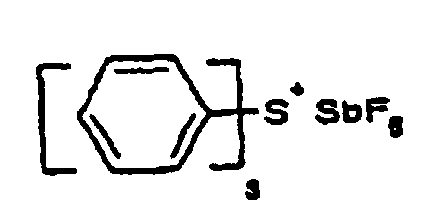
-
- The resist layer obtained was employed for the following dissolution tests using the mixtures shown in Table II-2 as a cleaning agents. The results of these tests are shown in Table II-2.
- The above-mentioned plate which is covered by the resist layer was soaked in 50ml of a cleaning agent and the duration (sec) required to obtain the removal by dissolution of the layer is visually measured. The dissolution rate of the resist layer is set as the value of Å/sec, which is calculated by dividing the thickness Å of the resist layer with the dissolution time (sec).
- PGMEA, PGME, EL, 1-PA and ethanol were used alone as cleaning agent. The tests were performed in the same way as Example II-17 and the results are shown in Table II-2.
Cleaning agent composition (mass ratio) Dissolution rate (Å/sec) Example II-17 1,3-PDMEA =100 4300 Example II-18 1,3-PDMEA:ethanol =60:40 10900 Example II-19 1,3-PDMEA:ethanol =60:10:30 12500 Example II-20 1,3-PDMEA:1-PA =60:40 11300 Example II-21 1,3-PDME =100 5700 Example II-22 1,3-PDME:ethanol =60:40 10600 Example II-23 1,3-PDME:1-PA =60:40 9800 Comparative Example II-6 PGMEA =100 2400 Comparative Example II-7 PGME =100 3200 Comparative Example II-8 EL =100 3900 Comparative Exemple II-9 1-PA =100 no dissolution Comparative Example II-10 ethanol =100 no dissolution abbreviations used in Table II-2 :
1, 3-PDME : 1, 3-propanediolmethyl ether
1, 3-PDMEA : 1, 3-propanediol methyl ether acetate
PGMEA : propylene glycol methyl ether acetate
PGME : propylene glycol methyl ether. - As shown in Table II-2, the dissolution rate is greatly improved by adding PGMEA, ethanol, 1-PA, EL and the like in 1, 3-PDME and/ or 1, 3-PDMEA.
- According to the second invention No. II, it is possible to greatly increase the solubility of resists and the like compared to the solubility of resist in conventional cleaning agents. It is also possible to obtain very safe cleaning agents for lithography. Further it is possible to obtain a sufficient cleaning in a short time by using a little amount of cleaning agent.
- The third invention No.III will be specifically explained hereinafter.
- The resist composition obtained in Preparation Example II-1 was spin coated on a 10,16 cm (4 inches) silicone plate to form a layer of resist of 2.6µm of thickness after a prebake. As a pre-bake, the composition was heated at 100°C directly on a hot plate for 90 seconds. Further, in the Examples, the thickness of the layer is greater than the thickness usually used in order to perform dissolution tests.
- The resist layer formed was employed for the following dissolution tests using as cleaning agents, the rinsing solutions 1-(1) to 1-(8) shown in Table III-1 which consist in mixtures of solvent (solvent A) and water. The results of these tests are shown in Table III-1.
- 0.03ml of rinsing solutions were dropped on the above-mentioned resist layer and then the duration (sec) until appearance of the silicone which is an under layer is measured. The value of the ratio Å/ sec shows the dissolution rate, and is calculated by dividing the thickness of the layer Å by the duration (sec).
- The same procedure was likewise followed as in the Example III-1 except that the solvent A alone was used as a rinsing solution, in which water is not mixed. The results are shown in Table III-1.
Rinsing solution composition (part by weight) Dissolution rate (Å/sec) Rinsing solution Organic solvent mixture (solvent Å) Water Example III-1-(1) 1,3-PDME:1,3-PDMEA = 50:50 5 13,900 Example III-1-(2) 1,3-PDME:1,3-PDMEA = 50:50 10 14,400 Example III-1-(3) 1,3-PDME:1,3-PDMEA = 50:50 15 14,600 Exemple III-1-(4) 1,3-PDME:1,3-PDMEA = 50:50 20 13,700 Example III-1-(6) 1,3-PDME:1,3-PDMEA = 50:50 30 13,200 Example III-1-(7) 1,3-PDME:1,3-PDMEA = 50:50 50 12,800 Example III-1-(8) 1,3-PDME:1,3-PDMEA = 50:50 100 12,300 Comparative Example III-1 1,3-PDME:1,3-PDMEA = 50:50 0 11,600 abbreviations used in Table II-1 :
1, 3-PDME : 1, 3-propanediolmethyl ether
1, 3-PDMEA : 1, 3-propanediol methyl ether acetate - As shown in Table III-1, the dissolution rate is greatly improved by adding water in solvent mixtures of 1, 3-propanediolmethyl ether and 1, 3-propanediol methyl ether acetate.
- One part of polyvinylpyrrolidone, 4 parts of perfluorooctane sulphonic acid, 0.35 part of 2-aminoethanol, 0.004 part of a water soluble alkylsiloxane polymer (Polyflo-KL-245, manufactured by Kyoeisha-yushi Ltd.) and 94.6 parts of purified water were mixed together to form a composition used to prepare a reflection-protecting layer. This composition was coated by spin coating on a 10,16 cm (4 inches) silicone plate and baked up to 90°C for 90 seconds to form an reflection protecting layer having a thickness of 650 Å. Each of the rinsing solutions shown in Examples III-1 was dropped on this reflection protecting layer. Immediately after dropwise addition of the rinsing solution on the reflection protecting layer, the contact angle is reduced and when the rinsing solution has a good affinity to the reflection-protecting layer, a smooth dissolution was achieved compared to rinsing solutions which do not contain water.
- According to the present invention No. III, the solubility of the reflection-preventing layers and the like and resist layers is improved compared to the dissolution obtained when using known rinsing solutions containing only water soluble organic solvents. The affinity of the rinsing solution to a layer prepared from an aqueous solvent is good and thus the dissolution is smooth.
- Further, when the rinsing solution contains water, its ignition point is increased and thus the resulting product may be easily used in production sites, plants in the respect of Japanese or other fire-preventing regulations.
- The fourth invention No. IV will be specifically explained hereinafter.
- 1 mole of 2, 2', 4, 4'-tetrahydroxybenzophenone and 3 moles of naphthoquinone-1, 2-diazide-5-sulphonyl chloride were submitted to an esterification reaction. The solid component consisting of 2 g of the resulting esterification mixture and 8g of a cresol novolak resin was dissolved in the solvents shown in Table 1 to obtain a 25% by weight of solid content composition used to prepare a coating composition for a positive-type photoresist. The physical properties of the coating compositions obtained were measured and the results are shown in Table IV-1.
- The following Examples were conducted like Examples IV-1 except that propylene glycol monoethyl ether acetate (PGMEA), cyclopentanone and ethyl lactate were used alone instead of the solvents used in the former Examples. The results are shown in Table IV-1.
- It is to be noted that, the physical properties of the mixtures shown in Table IV-1 were determined as follows.
- The existence or not of a precipitate : the coating solution obtained was filtered through a membrane filter of 0.2µm and left to stand at 40°C, then the existence of a precipitate was investigated.
- Sensitivity change : the existence or not of a sensitivity change of the photo resist composition was investigated after 3 months.
- Cross-section shape : the coating solution prepared was spin coated on a 15,24 (6 inches) silicone wafer and dried for 90 seconds on a hot plate at 90°C to form a resist layer having a thickness of 1.3µm. This layer was exposed using a stepper through a fixed mask and then heated at 110°C for 90 seconds on a hot plate. Then, it was developed with a 2.38 % aqueous solution of tetramethylammonium hydroxide (TMAH) ; the resist pattern obtained was washed with water for 30 seconds and dried. The cross-section shape of resist obtained was visually observed and evaluated according to the following standards.
- O : no penetration in the contact zone between the silicone wafer and the resist pattern
- X : penetration in the contact zone between the silicone wafer and the resist pattern
-
- The resist compositions of Examples IV-6 to IV-12 and Comparative Examples IV-4 to IV-5 were prepared as follows.
- The following quinone diazide which is a photosensibilizer and the novolak resin were used in the proportion of 24 weight parts of quinone diazide photosensibilizer with respect to 100 weight parts of the novolak resin. The resulting solid component was dissolved in each of the solvent mixtures shown in the Examples and Comparative Examples of Table IV-2 to form 25% by weight of solid-content compositions.
- Quinone diazide photosensibilizer : ester of 2, 2, 4, 4'-tetrahydroxybenzophenone with 1, 2-naphthoquionone diazide-5-sulphonyl chloride.
- Novolak resin : the condensation polymer of m-cresol/p-cresol = 4/6 with formaldehyde.
Resist solvent (% by weight of the mixture) Example IV-6 1,3-PDMEA = 100 Example IV-7 1,3-PDMEA:1,3-PDME = 50:50 Example IV-8 1,3-PDMEA:PGMEA = 60:40 Example IV-9 1,3-PDMEA:PGME = 60:40 Example IV-10 1,3-PDMEA:EL = 60:40 Example IV-11 1,3-PDME = 100 Example IV-12 1,3-PDME:MBAC = 60:40 Comparative Example IV-4 PGMEA = 100 Comparative Example IV-5 PGMEA:BPr = 80:20 MBAC : 3-methoxy-butyl acetate
PnB : butyl propionate. - The ratio of remaining solvent was measured according to the following method for each of the resist compositions prepared. The results are shown in Table IV-3.
- Amount of remaining solvent : thickness of the resist layer is thin which is actually coated on a base plate. For that reason, the absolute amount of the solvent is small, accordingly a fair amount of the solvent evaporates even by a spin coating alone before prebaking and evaporation rate of the solvent is also quick. Accordingly, it is difficult to directly measure the amount of the remaining solvent.
- For these reasons, the following modeling tests were performed. After the prebake, the ratio of remaining solvent in the resist layer was calculated. In other words, 2.0000 g of each of the nine types of resist compositions of Examples IV-1 to IV-7 and Comparative Examples IV-1 and IV-2 were used to uniformly cover the bottom of aluminum Petri dishes having the same diameter. The covered Petri dishes were then heated at 100°C for 2 to 30 min on a hot plate and the weight amount of each resist composition was measured to calculate the ratio of remaining solvent as follows. The results are shown in Table IV-3.
- That is to say that since 2,000 g of the resist composition have a solid content equal to 25% by weight, the weight amount of solvent before baking is equal to 1,500g with a resist solid content of 500g.
Baking duration (min) 2 5 10 15 20 30 Example IV-1 82.6 57.9 38.8 30.9 26.2 20.5 Example IV-2 78.1 53.4 36.9 28.9 25.2 19.6 Example IV-3 81.1 57.1 37.8 30.2 36.0 20.5 Example IV-4 80.0 55.4 37.3 29.1 25.8 20.1 Example IV-5 79.8 54.3 37.3 29.4 25.4 19.8 Example IV-6 81.9 57.3 38.2 30.4 26.1 20.4 Example IV-7 80.9 56.9 37.6 29.8 25.7 20.3 Comparative Example IV-1 77.3 52.9 36.3 31.1 27.8 23.7 Comparative Example IV-2 80.1 55.7 37.2 29.3 26.7 22.2 - In the above-mentioned tests for determining the ratio of remaining solvent, the resist layers had a thickness greater than the resist layer usually used and thus these tests are only modeling tests. Consequently, the baking duration determined in these tests cannot be the same as the baking duration used in a real process.
- In a practical baking state in which the ratio of the remaining solvent is relatively lower, such as not more than 30% by weight , and the adhesion to a base plate during development can be kept, that is it is possible to consider while comparing the Examples with the Comparative Examples concerning the data including a baking duration of not less than 15 minutes in the above-described tests. And, from the above results, it was confirmed that the ratio of the remaining solvent in a practical baking duration is lower in the Examples than in the Comparative Examples. In the practical baking duration, the ratio of the remaining solvent becomes not more than 30% by weight, that is , it was confirmed that it has excellent evaporation properties.
- The reason for this is that due to the use of 1, 3-PDME or 1, 3-PDMEA or the like or mixtures thereof with EL , MBAC or the like in suitable proportions, the rate of skin layer formation on the surface of the resist layer is low and thus evaporation of the solvent can takes place smoothly.
- The resist composition of the Example IV-13 to IV-15 and the Comparative Example 6 were prepared as follows.
- Monohydroxyadamantane acrylate and tetrahydropyranyl metacrylate were co-polymerized to obtain a copolymer containing 70 mol% of monohydroxyadamantane acrylate and 30 mol% of tetrahydropyranylmethacrylate and having a weight-average molecular weight of 8, 000. The solvent mixtures shown in the column of Example IV-4 and Comparative Example were used to dissolve this copolymer and to obtain a 25% by weight of solid content .
- Solubility of the resin : the solvent was heated for 10 min at 50°C to obtain a 25% by weight solid content composition and the dissolution rate of the resin was evaluated on the basis of the following standards
- O : Homogeneous and transparent solution was obtained
- X : Particle-state insoluble resin was remaining on the wall of the apparatus.
-
- According to the present invention No.IV, the solvent used for the resist composition is excellent in safety to human body and enables a resist composition to be obtained having excellent solubility, paintability and improved ratio of remaining solvent. Further, the prepared resist solutions are very stable and may be used particularly to produce photoresist compositions for a semi-conductive device or liquid crystals displays elements or the like.
- The fifth invention No. V will be specifically explained hereinafter.
- 600g of propylene glycol monomethyl ether and 10g of t-butylperoxy-2-ethylhexanoate were introduced in 5 liters separable flasks equipped with a stirrer, a thermometer, a reflux condenser, a dropping funnel and a nitrogen inlet. The temperature was increased up to 90°C and then a solution mixture of 200g of methacrylic acid, 250g of benzyl metacrylate, 300g of propylene glycol monomethyl ether and 10g of azo bis-dimethylvaleronitrile was added dropwise over 3 hours. Further, the mixture was left aged for 6 hours to obtain a solution of a resin containing carboxyl groups. The polymerisation reaction was performed under a nitrogen flow.
- Then, 425g of 3, 4-epoxycyclohexylmethylacrylate (produced by Daicel Chemical LTD ( Cyclomer-A200)), 45g of triphenylphosphine and 1.8g of hydroquinone monomethyl ether were added. The resulting mixture was reacted by heating at 100°C for 20 hours to produce a solution of a modified copolymer (B'1). The addition reaction was performed under a flow of a mixture of gas containing 7% by volume of oxygen and 93% by volume of nitrogen.
- In Examples V-1 to V-3, 100 parts by weight of the solution of the modified copolymer (B'1) obtained in Production Examples V-1 were mixed with 50 parts by weight of trimethylolpropane triacrylate and 2 parts by weight of Irugacure 907 produced by Ciba Geigy and used as an initiator. The resulting mixture formed a solid content which was dissolved in the solvents of Table V-1 to prepare a 25% by weight of a solid component coating solution for a negative type photo resist composition.
- The solvents used contained total alcoholic components of 0.2% by weight of methanol in 1, 3-propanediol methyl ether, 2-methyl-1-pentanol and the like or contained a total alcoholic components of 0.2% by weight of methanol in 1, 3-propanediol methyl ether acetate, 2-methyl-1-pentanol and the like.
- The results regarding the properties of the coating solution obtained are shown in Table V-1.
- These examples were likewise conducted as Example V-1 except that the solvents used were propylene glycol monoethyl ether acetate (PGMEA), cyclopentanone or ethyl lactate (EL). The results are shown in Table V-1.
- The properties of the compounds shown in Table V-1 were determined as follows :
- (1) Existence or not of a precipitate : the existence or not of a precipitate was visually detected concerning the filtrate obtained by filtration of the coating solution prepared on a membrane filter having micro pores of 0.2µm, this filtrate being stood at 40°C for a determined duration.
- (2) Sensitivity changes : the sensitivity change of the photo resist composition was studied after 3 months.
- (3) Pattern formability : the evaluation of the resist pattern was performed
with a microscope.
- Results of the evaluation :
o ○ very good ; O : good, X : not good. - (4) Etching resistance : a copper plated laminated board covered with the
resist pattern was etched with a spray of ferric chloride (Fe II) at 50°C.
- results of the evaluation :
o ○ very good ; O : good ; ▵ not so bad ; X not good -
- The resist pattern used in pattern formability test (3) and etching resistance (4) was formed by coating a copper-plated laminated board with a bar coater to form a 10µm thick layer (thickness measured after 10 min of drying at 80°C), drying the resulting layer and using a pattern layer showing a line/space = 30µm/30µm and close contact irradiation ( 100mJ/cm2) and developing with a 1% sodium carbonate.
Solvent Precipitates Sensitivity change Pattern formability Etching resistance weight ratio of the mixture 1 month 2 months 3 months Example V-1 1,3-PDME = 100 none none none o ○ o ○ Example V-2 1,3-PDMEA:1,3-PDME = 60:40 none none none o ○ o ○ Example V-3 1,3-PDME:PGMEA = 60:40 none none none ○ ○ Comparative Example V-1 PGMEA = 100 none yes yes ○ ▵ Comparative Example V-2 yes yes yes X X Comparative Example V-3 EL yes yes yes X X 1, 3-PDMEA : 1, 3-propanediol methyl ether acetate
1, 3-PDME : 1, 3-propanediolmethyl ether
PGMEA : propylene glycol methyl ether acetate
El : ethyl lactate - The compositions of the resist of Examples V-4 to V-6 and Comparative Examples V-4 to V-6 were prepared as follows. 50 parts by weight of trimethylol propane triacrylate and 2 parts by weight of Irugacure manufactured by Ciba-Geigy used as an initiator were added in 100 parts by weight of the solution of the modified copolymer (B'1) prepared in Preparation Example V-1 to give a 25% by weight solid content composition. In Examples and Comparative Examples, this solid components were dissolved in the solvents listed in Table V-1 and in the same order thereof .
- The ratio of remaining solvent was measured according the method of (1) for each of the resist compositions prepared. The results are shown in Table V-2.
Baking duration (min) 2 5 10 15 20 30 Example V-4 80.0 55.4 37.3 29.1 25.8 20.1 Example V-5 79.8 54.3 37.3 29.4 25.4 19.8 Example V-6 81.9 57.3 38.2 30.4 26.1 20.4 Comparative Example V-4 80.9 56.9 37.6 29.8 25.7 20.3 Comparative Example V-5 77.3 52.9 36.3 31.1 27.8 23.7 Comparative Example V-6 80.1 55.7 37.2 29.3 26.7 22.2 - (1) Ratio of remaining solvent : the resist layer formed on the plate was thin and thus contains a small amount of solvent. The solvent is almost evaporated because of the spin coating before the prebake. Further, since the evaporation rate of the solvent is very high, it is difficult to directly measure the ratio of remaining solvent. For this reason, modeling tests were performed and the ratio of remaining solvent in the resist layer after the pre-bake was calculated. In other words, 2.0000 g of each of the seven types of resist compositions of Examples V-4 to V-6 and Comparative Example V-4 and V-6 were used to uniformly cover the bottom of aluminum Petri dishes having the same diameter. The covered Petri dishes were then heated at 100°C for 2 to 30 minutes on a hot plate and the weight amount of each resist composition was measured to calculate the ratio of remaining solvent as follows. The results are shown in Table V-2.
-
- That is to say that since 2. 0000 g of the resist composition have a solid content equal to 25% by weight, the weight amount of solvent before baking is equal to 1.5000 g with a resist solid content of 0.5000 g.
- Scratching tests using a pencil according to the JIS regulations were performed after curing the layer to give index regarding the homogeneity and the delicateness of the resist layer. For each point, the existence of scattering was detected.
- In the above-mentioned tests for determining the ratio of remaining solvent, the resist layer was thinner than usually used for the modeling tests. Consequently, the baking duration in a real process is not the same as the baking duration of the modeling tests. However, when the ratio of remaining solvent is less than 30%, the ratio of solvent contained in the composition is relatively low and the practical conditions of the baking maintain the adhesion of the resist to the plate during the development. In other words, in the above-mentioned Examples, when the data indicate a baking time of more than 15 minutes, it is possible to practically compare the Examples and Comparative Examples. Thus, according to the above-mentioned results, in order to obtain a ratio of remaining solvent of less than 30%, the ratio of remaining solvent during the practical baking duration is lower in the Examples than in Comparative Examples that indicates excellent evaporating properties.
- The reason for this is that due to the use of 1, 3-PDME or 1, 3-PDMEA or the like or mixtures thereof with EL , MBAC or the like in suitable proportions, the rate of skin film formation on the surface of the resist layer is low and thus evaporation of the solvent can smoothly takes place. This explanation is just an example.
- This Example was performed as Example V-4 except that 1, 3-PDME containing alcohols in high proportion (methanol content of 0.25% by weight and 2-methyl-1-pentanol content of 0.15% by weight). The results regarding the homogeneity of the resist layer and its delicateness are shown in Table v-3.
- These results show that when 1, 3-PDME contains alcohols in a low proportion (Example V-4), the height of the layer is greater and in each point there is no scattering compared to the case where 1, 3-PDME contains alcohols in a high proportion.
Pencil hardness for optionally each point of the layer a b c d e Example V-4 H H H HB H Example V-7 HB B HB HB B - According to the present invention No. V, it was confirmed that the photoresist composition is excellent in view of safeness to human body and, further, it is excellent in solubility to a resist resin and coatability and, moreover, the ratio of remaining solvent is improved, and, particularly, a uniform and delicate coating layer can be obtained by the use of a specified solvent having a low alcohol content. Further, a solution of resist resin composition prepared according to the present invention is particularly useful as a liquid etching for preparing a printed circuit board and a solder photoresist resin composition.
| Solvent (% by weight of the mixture) | Existence or not of a precipitate | Sensitivity change | Cross section shape | ||
| 1 month | 2 months | 3 months | |||
| Example VI-1 | 1,3-PDMEA = 100 | none | none | none | ○ |
| Example IV-2 | 1,3-PDMEA:1,3-PDME = 60:40 | none | none | none | ○ |
| Example IV-3 | 1,3-PDMEA:PGMEA = 60:40 | none | none | none | ○ |
| Example VI-4 | 1,3-PDMEA:EL = 60:40 | none | none | none | ○ |
| Example IV-5 | 1,3-PDMEA:MAK = 60:40 | none | none | none | ○ |
| Comparative Example IV-1 | PGMEA = 100 | none | yes | none | X |
| Comparative Example IV-2 | cyclopentanone = 100 | none | none | yes | X |
| Comparative Example IV-3 | EL = 100 | none | yes | none | X |
| Table IV-1The abbreviations used in the Table are as follows : 1, 3-PDMEA : 1, 3 -propanediol methyl ether acetate 1, 3-PDME : 1, 3-propanediol methyl ether PGMEA : propylene glycol methyl ether acetate EL : ethyl lactate MAK : methyl amyl ketone |
| solvent for resist (% by weight of the mixture) | Solubility of resin | |
| Example IV-13 | 1,3-PDMEA = 100 | ○ |
| Example IV-14 | 1,3-PDMEA:1,3-PDME = 50:50 | ○ |
| Example IV-15 | 1,3-PDMEA:EL = 60:40 | ○ |
| Comparative Example IV-6 | PGMEA = 100 | X |
Claims (26)
- A high purity 3-alkoxy-1-propanol having the content of alcoholic impurities of not more than 0.3% by weight.
- A high purity 3-alkoxy-1-propanol as claimed in claim 1, wherein said 3-alkoxy-1-propanol is 3-methoxy-1-propanol.
- A high purity 3-alkoxy-1-propanol as claimed in claim 2, wherein said alcoholic impurities are 2-methyl-1-pentanol and/or methanol.
- A method for the preparation of a high purity 3-alkoxy-1-propanol characterized in that a 3-alkoxy-1-propanal is produced by allowing to react acrolein with a linear or branched alcohol having a carbon number of 1-4 using acrolein having the content of propionaldehyde of not more than 1% by weight as a raw material, and a 3-alkoxy-1-propanol is produced by a hydrogenation reaction of a reaction mass using hydrogen under the presence of a catalyst, followed by recovering through a distillation of said 3-alkoxy-1-propanol having the content of alcoholic impurities of not more than 0.3% by weight from a crude solution in the hydrogenation reaction.
- A method for the preparation of a high purity 3-alkoxy-1-propanol as claimed in claim 4 characterized in that the concentration of a residual aldehyde compound in said crude solution is adjusted to not more than 0.5% by weight in the hydrogenation reaction.
- A method for the preparation of a high purity 3-alkoxy-1-propanol as claimed in claim 4 or 5, wherein said 3-alkoxy-1-propanol is 3-methoxy-1-propanol.
- A method for the preparation of a high purity 3-alkoxy-1-propanol as claimed in claim 6, wherein said alcoholic impurities are methanol and/or 2-methyl-1-pentanol.
- A solvent for a resist which comprises a solvent (a) includes a 1,3-propanediol alkylether, 1,3-propanediol alkylether acetate, or a mixture thereof.
- A solvent for a resist as claimed in claim 8, characterized in that the content of alcoholic impurities contained in the solvent (a) is not more than 0.3% by weight.
- A solvent for a resist as claimed in claim 8 or 9, wherein said alcoholic impurities are 2-methyl-1-pentanol and/or methanol.
- A cleaning agent for a lithography which comprises a solvent for a resist as claimed in any one of claims 8-10.
- A cleaning agent for lithography as claimed in claim 11, characterized by a homogeneous solution in which there are further contained linear or branched alcohols (b) having a carbon number of 1-4.
- A cleaning agent for lithography as claimed in claim 12, characterized in that said alcohols (b) are ethanol, 1-propanol, 2-propanol, or a mixture thereof.
- A cleaning agent for lithography as claimed in any one of claims 11-13, characterized by a homogeneous solvent containing solvents (c) of the group A described below,Group APropylene glycol alkyletherPropylene glycol alkylether acetateEthylene glycol alkyletherEthylene glycol alkylether acetateAlkyl acetateAlkyl propionateAlkyl alkoxypropionateAlkyl lactateAliphatic ketoneAlkoxybutanol, orA mixture thereof.
- A cleaning agent for lithography as claimed in claim 14, characterized in that the solvents of the group A are propylene glycol methylether, propylene glycol ethylether, propylene glycol propylether, propylene glycol methylether acetate, propylene glycol ethylether acetate, propylene glycol propylether acetate, ethylene glycol ethylether acetate, n-butyl acetate, methyl methoxypropionate, ethyl ethoxypropionate, 2-heptanone, methoxy butanol, and ethyl lactate, or a mixture thereof.
- A rinsing liquid for lithography which comprises a solvent for a resist as claimed in any one of claims 8-10 and water (d).
- A rinsing liquid for lithography as claimed in claim 16, characterized in that the water (d) is an ultra-high pure water.
- A rinsing liquid for lithography as claimed in claim 16 or 17, characterized by further containing a water-soluble organic solvent (e).
- A cleaning agent for lithography as claimed in claim 18, characterized in that said water-soluble organic solvents (e) are a solvent of the group A'' described below,Group A''Propylene glycol alkyletherPropylene glycol alkylether acetateEthyl lactateMethylisobutyl ketoneMethylethyl ketoneAcetone, orA mixture thereof.
- A rinsing liquid for lithography as claimed in any one of claims 16-19, wherein the content of water is 0.5-200 parts by weight based on 100 parts by weight of total organic solvents.
- A rinsing liquid for lithography as claimed in any one of claims 16-20, wherein it is employed for rinsing a resist layer or a reflection protecting-layer.
- A solvent for a resist composition which comprises a solvent for a resist as claimed in any one of claims 8-10.
- A solvent for a resist composition as claimed in claim 22, characterized by further containing other solvents (c') of the group A' described below,Group A'Propylene glycol alkyletherPropylene glycol alkylether acetateAlkyl acetateAlkyl propionateAlkyl alkoxypropionateAlkyl lactateAliphatic ketone, orA mixture thereof.
- A resist composition which comprises a resist resin (F) and the solvent for a resist composition as claimed in claim 22 or 23.
- A photo-resist composition for a printed circuit board which comprises a modified copolymer (B') and the solvent for a resist composition as claimed in claim 22 or 23.
- A photo-resist composition for a printed circuit board as claimed in claim 25, characterized in that said modified copolymer (B') is a copolymer in which an epoxy group-contained unsaturated compound (Uc) having an aliphatic structure is added to carboxylic groups in a copolymer of a copolymerizable unsaturated carboxylic acid (Ua) with an unsaturated compound (Ub) other than said unsaturated carboxylic acid.
Applications Claiming Priority (5)
| Application Number | Priority Date | Filing Date | Title |
|---|---|---|---|
| JP9284299 | 1999-03-31 | ||
| JP9284299 | 1999-03-31 | ||
| JP30190799 | 1999-10-25 | ||
| JP30190799 | 1999-10-25 | ||
| PCT/JP2000/002043 WO2000058252A1 (en) | 1999-03-31 | 2000-03-30 | High-purity 1,3-propanediol derivative solvent, process for producing the same, and use thereof |
Publications (1)
| Publication Number | Publication Date |
|---|---|
| EP1085003A1 true EP1085003A1 (en) | 2001-03-21 |
Family
ID=26434216
Family Applications (1)
| Application Number | Title | Priority Date | Filing Date |
|---|---|---|---|
| EP00912993A Withdrawn EP1085003A1 (en) | 1999-03-31 | 2000-03-30 | High-purity 1,3-propanediol derivative solvent, process for producing the same, and use thereof |
Country Status (4)
| Country | Link |
|---|---|
| US (1) | US6610638B1 (en) |
| EP (1) | EP1085003A1 (en) |
| JP (1) | JP4570786B2 (en) |
| WO (1) | WO2000058252A1 (en) |
Cited By (2)
| Publication number | Priority date | Publication date | Assignee | Title |
|---|---|---|---|---|
| WO2008064991A1 (en) | 2006-11-27 | 2008-06-05 | Basf Se | Process for preparing 3-alkoxypropan-1-ols |
| EP2309331A1 (en) * | 2009-10-09 | 2011-04-13 | Flexoclean Engineering B.V. | A polymer washout solvent and the use thereof for developing a flexographic printing plate |
Families Citing this family (7)
| Publication number | Priority date | Publication date | Assignee | Title |
|---|---|---|---|---|
| EP1197482A1 (en) * | 2000-10-14 | 2002-04-17 | Degussa AG | Process for the preparation of 3-alkoxypropanol |
| JP4048535B2 (en) * | 2002-11-05 | 2008-02-20 | 富士フイルム株式会社 | Positive resist composition |
| JP4588590B2 (en) * | 2005-09-09 | 2010-12-01 | ダイセル化学工業株式会社 | Lithographic cleaning agent or rinse agent |
| WO2009063726A1 (en) * | 2007-11-12 | 2009-05-22 | Jsr Corporation | Process for production of photoresist resins |
| JP5982442B2 (en) * | 2012-10-31 | 2016-08-31 | 富士フイルム株式会社 | Organic processing liquid for patterning chemically amplified resist film, pattern formation method using the same, and electronic device manufacturing method |
| JP5764589B2 (en) * | 2012-10-31 | 2015-08-19 | 富士フイルム株式会社 | Container for organic processing liquid for patterning chemically amplified resist film, pattern formation method using the same, and method for manufacturing electronic device |
| WO2018061573A1 (en) | 2016-09-27 | 2018-04-05 | 富士フイルム株式会社 | Liquid medicine, liquid medicine accommodation body, method for filling liquid medicine, and method for storing liquid medicine |
Family Cites Families (19)
| Publication number | Priority date | Publication date | Assignee | Title |
|---|---|---|---|---|
| US2495313A (en) * | 1950-01-24 | Condensation of acrolein with mono | ||
| US1976677A (en) * | 1929-08-20 | 1934-10-09 | Ig Farbenindustrie Ag | Production of alkylene derivatives from alkylene oxides |
| US4544453A (en) * | 1983-03-17 | 1985-10-01 | Atlantic Richfield Company | Stripping of unreacted glycol ethers and acids from an esterification reaction mixture |
| GB8323962D0 (en) * | 1983-09-07 | 1983-10-12 | Bp Chem Int Ltd | Preparation of glycol derivatives |
| DE4218282A1 (en) * | 1992-06-03 | 1993-12-09 | Degussa | Process for the preparation of 1,3-propanediol |
| JPH0627684A (en) * | 1992-07-10 | 1994-02-04 | Tokyo Ohka Kogyo Co Ltd | Rinse for lithography and production of semiconductor device using the same |
| FR2696739A1 (en) * | 1992-10-14 | 1994-04-15 | Shiny Chemical Ind Co Ltd | New low toxicity propylene glycol mono:methyl ether propionate for paints, inks, etc. |
| JP2921340B2 (en) | 1993-06-03 | 1999-07-19 | 信越化学工業株式会社 | Photoresist composition |
| JPH0725821A (en) | 1993-07-15 | 1995-01-27 | Mitsubishi Chem Corp | Novel solvent and method for producing the same |
| JPH07271054A (en) * | 1994-04-01 | 1995-10-20 | Toray Ind Inc | Rinse liquid for photosensitive polyimide |
| JPH08113546A (en) * | 1994-10-13 | 1996-05-07 | Koei Chem Co Ltd | Production of 3-alkoxy-1-propyl alcohol |
| JPH08291097A (en) | 1995-04-17 | 1996-11-05 | Mitsubishi Rayon Co Ltd | Process for producing alkanediol mono-t-butyl ether |
| JPH1010711A (en) | 1996-06-19 | 1998-01-16 | Mitsubishi Chem Corp | Radiation-sensitive coating composition |
| JPH107755A (en) * | 1996-06-25 | 1998-01-13 | Daicel Chem Ind Ltd | Photocurable resin having alicyclic skeleton and production thereof |
| US5723024A (en) * | 1996-08-26 | 1998-03-03 | Berg; Lloyd | Separation of 2-methyl-1-propanol from 1-butanol by extractive distillation |
| JPH10270311A (en) * | 1997-03-21 | 1998-10-09 | Sony Corp | Method for manufacturing semiconductor device |
| DE19717320A1 (en) * | 1997-04-24 | 1998-10-29 | Basf Ag | One-step process for the production of glycol monoethers from olefins |
| WO1998050339A1 (en) | 1997-05-07 | 1998-11-12 | Idemitsu Petrochemical Co., Ltd. | 1-ACETOXY-3-n-PROPOXYPROPANE AND ETHER ALCOHOL SOLVENTS |
| WO2000069799A1 (en) * | 1999-05-18 | 2000-11-23 | Idemitsu Petrochemical Co., Ltd. | Precursors of 3-alkoxyalkanols and processes for the preparation of 3-alkoxyalkanols |
-
2000
- 2000-03-30 EP EP00912993A patent/EP1085003A1/en not_active Withdrawn
- 2000-03-30 WO PCT/JP2000/002043 patent/WO2000058252A1/en not_active Ceased
- 2000-03-30 JP JP2000607958A patent/JP4570786B2/en not_active Expired - Fee Related
- 2000-03-30 US US09/701,663 patent/US6610638B1/en not_active Expired - Fee Related
Non-Patent Citations (1)
| Title |
|---|
| See references of WO0058252A1 * |
Cited By (6)
| Publication number | Priority date | Publication date | Assignee | Title |
|---|---|---|---|---|
| WO2008064991A1 (en) | 2006-11-27 | 2008-06-05 | Basf Se | Process for preparing 3-alkoxypropan-1-ols |
| EP2309331A1 (en) * | 2009-10-09 | 2011-04-13 | Flexoclean Engineering B.V. | A polymer washout solvent and the use thereof for developing a flexographic printing plate |
| WO2011042225A1 (en) * | 2009-10-09 | 2011-04-14 | Flexoclean Engineering B.V. | A polymer washout solvent, and the use thereof for developing a flexographic printing plate |
| CN102472983A (en) * | 2009-10-09 | 2012-05-23 | 富来科利工程公司 | Polymer washout solvent and its use for developing flexographic printing plates |
| US8921035B2 (en) | 2009-10-09 | 2014-12-30 | Flexoclean Engineering B.V. | Polymer washout solvent, and the use thereof for developing a flexographic printing plate |
| CN102472983B (en) * | 2009-10-09 | 2017-07-21 | 富来科利工程公司 | Polymer washout solvent and its purposes for the flexible printing plate that develops |
Also Published As
| Publication number | Publication date |
|---|---|
| WO2000058252A1 (en) | 2000-10-05 |
| JP4570786B2 (en) | 2010-10-27 |
| US6610638B1 (en) | 2003-08-26 |
Similar Documents
| Publication | Publication Date | Title |
|---|---|---|
| KR100304223B1 (en) | Radiation-sensitive resin composition | |
| KR100365461B1 (en) | Radiosensitive Resin Composition | |
| EP0443820B1 (en) | Radiation-sensitive resin composition | |
| JPH0862834A (en) | Photoresist composition | |
| TWI696891B (en) | Photoresist composition and process for producing photoresist pattern | |
| US20090075207A1 (en) | Norbornene polymer for photoresist and photoresist composition comprising the same | |
| KR20170066315A (en) | Naphthol type calixarene compound, method for producing same, photosensitive composition, resist material and coating film | |
| US6610638B1 (en) | High purity 1,3-propanediol derivative solvent, process for producing the same, and use thereof | |
| JPWO2000058252A1 (en) | High-purity 1,3-propanediol derivative solvent, its production method, and use | |
| KR20010041272A (en) | Photosensitive resin composition | |
| KR101405696B1 (en) | Resist composition | |
| JP5148882B2 (en) | Resist composition | |
| EP0851297A1 (en) | Radiation-sensitive composition adapted for roller coating | |
| JP3640290B2 (en) | Positive photoresist coating liquid and display element substrate using the same | |
| JPH10133363A (en) | Radiation-sensitive composition | |
| EP0851298A1 (en) | Radiation sensitive composition adapted for roller coating | |
| JPS632044A (en) | Positive type radiation sensitive resin composition | |
| JP3787323B2 (en) | Positive photoresist coating liquid and display element substrate using the same | |
| US5738968A (en) | Positive photoresist composition | |
| TWI298821B (en) | Resist composition | |
| EP0735423B1 (en) | Radiation sensitive resin composition | |
| JP4558443B2 (en) | Resist composition | |
| EP0554101A1 (en) | Radiation-sensitive resin composition | |
| TWI417651B (en) | Resist composition | |
| US5350827A (en) | Selected structurally defined novolak binder resins and their use in radiation-sensitive compositions |
Legal Events
| Date | Code | Title | Description |
|---|---|---|---|
| PUAI | Public reference made under article 153(3) epc to a published international application that has entered the european phase |
Free format text: ORIGINAL CODE: 0009012 |
|
| 17P | Request for examination filed |
Effective date: 20001221 |
|
| AK | Designated contracting states |
Kind code of ref document: A1 Designated state(s): AT BE CH CY DE DK ES FI FR GB GR IE IT LI LU MC NL PT SE |
|
| RBV | Designated contracting states (corrected) |
Designated state(s): AT CH DE FR GB IT LI |
|
| STAA | Information on the status of an ep patent application or granted ep patent |
Free format text: STATUS: THE APPLICATION HAS BEEN WITHDRAWN |
|
| 18W | Application withdrawn |
Effective date: 20040702 |