EP1084619A1 - Stable biocidal compositions - Google Patents
Stable biocidal compositions Download PDFInfo
- Publication number
- EP1084619A1 EP1084619A1 EP00307660A EP00307660A EP1084619A1 EP 1084619 A1 EP1084619 A1 EP 1084619A1 EP 00307660 A EP00307660 A EP 00307660A EP 00307660 A EP00307660 A EP 00307660A EP 1084619 A1 EP1084619 A1 EP 1084619A1
- Authority
- EP
- European Patent Office
- Prior art keywords
- isothiazolone
- methyl
- imidazolidine
- composition
- copper
- Prior art date
- Legal status (The legal status is an assumption and is not a legal conclusion. Google has not performed a legal analysis and makes no representation as to the accuracy of the status listed.)
- Granted
Links
- 239000000203 mixture Substances 0.000 title claims abstract description 38
- 230000003115 biocidal effect Effects 0.000 title claims abstract description 10
- MGIYRDNGCNKGJU-UHFFFAOYSA-N isothiazolinone Chemical class O=C1C=CSN1 MGIYRDNGCNKGJU-UHFFFAOYSA-N 0.000 claims abstract description 33
- WSFSSNUMVMOOMR-UHFFFAOYSA-N Formaldehyde Chemical compound O=C WSFSSNUMVMOOMR-UHFFFAOYSA-N 0.000 claims abstract description 21
- WSDISUOETYTPRL-UHFFFAOYSA-N dmdm hydantoin Chemical compound CC1(C)N(CO)C(=O)N(CO)C1=O WSDISUOETYTPRL-UHFFFAOYSA-N 0.000 claims abstract description 17
- WRYCSMQKUKOKBP-UHFFFAOYSA-N Imidazolidine Chemical compound C1CNCN1 WRYCSMQKUKOKBP-UHFFFAOYSA-N 0.000 claims description 16
- JPVYNHNXODAKFH-UHFFFAOYSA-N Cu2+ Chemical compound [Cu+2] JPVYNHNXODAKFH-UHFFFAOYSA-N 0.000 claims description 15
- -1 imidazolidinyl ureas Chemical class 0.000 claims description 10
- 229910001431 copper ion Inorganic materials 0.000 claims description 9
- 125000004178 (C1-C4) alkyl group Chemical group 0.000 claims description 6
- 125000004399 C1-C4 alkenyl group Chemical group 0.000 claims description 6
- 125000000304 alkynyl group Chemical group 0.000 claims description 6
- DHNRXBZYEKSXIM-UHFFFAOYSA-N chloromethylisothiazolinone Chemical compound CN1SC(Cl)=CC1=O DHNRXBZYEKSXIM-UHFFFAOYSA-N 0.000 claims description 6
- CBOIHMRHGLHBPB-UHFFFAOYSA-N hydroxymethyl Chemical compound O[CH2] CBOIHMRHGLHBPB-UHFFFAOYSA-N 0.000 claims description 6
- BEGLCMHJXHIJLR-UHFFFAOYSA-N methylisothiazolinone Chemical compound CN1SC=CC1=O BEGLCMHJXHIJLR-UHFFFAOYSA-N 0.000 claims description 6
- 229910052757 nitrogen Inorganic materials 0.000 claims description 6
- 229910052760 oxygen Inorganic materials 0.000 claims description 6
- 229910052717 sulfur Inorganic materials 0.000 claims description 6
- 238000000034 method Methods 0.000 claims description 5
- 230000000087 stabilizing effect Effects 0.000 claims description 5
- 239000002904 solvent Substances 0.000 claims description 3
- 125000006274 (C1-C3)alkoxy group Chemical group 0.000 claims description 2
- ASKFWACWQQZSSS-UHFFFAOYSA-N 2-ethyl-1,2-thiazol-3-one Chemical compound CCN1SC=CC1=O ASKFWACWQQZSSS-UHFFFAOYSA-N 0.000 claims description 2
- PZOGAKOZVSTZSO-UHFFFAOYSA-N 2-methyl-5,6-dihydro-4h-cyclopenta[d][1,2]thiazol-3-one Chemical compound C1CCC2=C1SN(C)C2=O PZOGAKOZVSTZSO-UHFFFAOYSA-N 0.000 claims description 2
- CVZDIUZSWUDGOP-UHFFFAOYSA-N 4,5-dichloro-2-methyl-1,2-thiazol-3-one Chemical compound CN1SC(Cl)=C(Cl)C1=O CVZDIUZSWUDGOP-UHFFFAOYSA-N 0.000 claims description 2
- PORQOHRXAJJKGK-UHFFFAOYSA-N 4,5-dichloro-2-n-octyl-3(2H)-isothiazolone Chemical compound CCCCCCCCN1SC(Cl)=C(Cl)C1=O PORQOHRXAJJKGK-UHFFFAOYSA-N 0.000 claims description 2
- MMONDPHQMXRZDG-UHFFFAOYSA-N 5-chloro-2-ethyl-1,2-thiazol-3-one Chemical compound CCN1SC(Cl)=CC1=O MMONDPHQMXRZDG-UHFFFAOYSA-N 0.000 claims description 2
- DMSMPAJRVJJAGA-UHFFFAOYSA-N benzo[d]isothiazol-3-one Chemical compound C1=CC=C2C(=O)NSC2=C1 DMSMPAJRVJJAGA-UHFFFAOYSA-N 0.000 claims description 2
- 235000013877 carbamide Nutrition 0.000 claims description 2
- SOROIESOUPGGFO-UHFFFAOYSA-N diazolidinylurea Chemical compound OCNC(=O)N(CO)C1N(CO)C(=O)N(CO)C1=O SOROIESOUPGGFO-UHFFFAOYSA-N 0.000 claims description 2
- 229960001083 diazolidinylurea Drugs 0.000 claims description 2
- 229910052736 halogen Inorganic materials 0.000 claims description 2
- 150000002367 halogens Chemical class 0.000 claims description 2
- JPMIIZHYYWMHDT-UHFFFAOYSA-N octhilinone Chemical compound CCCCCCCCN1SC=CC1=O JPMIIZHYYWMHDT-UHFFFAOYSA-N 0.000 claims description 2
- SIQZJFKTROUNPI-UHFFFAOYSA-N 1-(hydroxymethyl)-5,5-dimethylhydantoin Chemical compound CC1(C)N(CO)C(=O)NC1=O SIQZJFKTROUNPI-UHFFFAOYSA-N 0.000 claims 1
- 150000002461 imidazolidines Chemical class 0.000 abstract description 7
- 150000001879 copper Chemical class 0.000 abstract description 5
- 229940058012 1,3-dimethylol-5,5-dimethylhydantoin Drugs 0.000 abstract description 3
- XLYOFNOQVPJJNP-UHFFFAOYSA-N water Substances O XLYOFNOQVPJJNP-UHFFFAOYSA-N 0.000 description 9
- 239000012530 fluid Substances 0.000 description 8
- 239000003381 stabilizer Substances 0.000 description 7
- 230000003641 microbiacidal effect Effects 0.000 description 6
- 244000005700 microbiome Species 0.000 description 6
- LYCAIKOWRPUZTN-UHFFFAOYSA-N Ethylene glycol Chemical compound OCCO LYCAIKOWRPUZTN-UHFFFAOYSA-N 0.000 description 5
- 230000000813 microbial effect Effects 0.000 description 5
- 229940124561 microbicide Drugs 0.000 description 5
- 239000000853 adhesive Substances 0.000 description 4
- 230000001070 adhesive effect Effects 0.000 description 4
- 239000000645 desinfectant Substances 0.000 description 4
- WGCNASOHLSPBMP-UHFFFAOYSA-N hydroxyacetaldehyde Natural products OCC=O WGCNASOHLSPBMP-UHFFFAOYSA-N 0.000 description 4
- 239000003960 organic solvent Substances 0.000 description 4
- ZWEHNKRNPOVVGH-UHFFFAOYSA-N 2-Butanone Chemical compound CCC(C)=O ZWEHNKRNPOVVGH-UHFFFAOYSA-N 0.000 description 3
- CSCPPACGZOOCGX-UHFFFAOYSA-N Acetone Chemical compound CC(C)=O CSCPPACGZOOCGX-UHFFFAOYSA-N 0.000 description 3
- XEKOWRVHYACXOJ-UHFFFAOYSA-N Ethyl acetate Chemical compound CCOC(C)=O XEKOWRVHYACXOJ-UHFFFAOYSA-N 0.000 description 3
- 150000001338 aliphatic hydrocarbons Chemical class 0.000 description 3
- 239000004599 antimicrobial Substances 0.000 description 3
- 150000004945 aromatic hydrocarbons Chemical class 0.000 description 3
- 150000001875 compounds Chemical class 0.000 description 3
- 239000002537 cosmetic Substances 0.000 description 3
- 239000004615 ingredient Substances 0.000 description 3
- 239000003973 paint Substances 0.000 description 3
- 238000004321 preservation Methods 0.000 description 3
- 239000000243 solution Substances 0.000 description 3
- 239000004094 surface-active agent Substances 0.000 description 3
- 150000001298 alcohols Chemical class 0.000 description 2
- 238000010276 construction Methods 0.000 description 2
- 238000001816 cooling Methods 0.000 description 2
- 239000010949 copper Substances 0.000 description 2
- 229910000365 copper sulfate Inorganic materials 0.000 description 2
- XTVVROIMIGLXTD-UHFFFAOYSA-N copper(II) nitrate Chemical compound [Cu+2].[O-][N+]([O-])=O.[O-][N+]([O-])=O XTVVROIMIGLXTD-UHFFFAOYSA-N 0.000 description 2
- ARUVKPQLZAKDPS-UHFFFAOYSA-L copper(II) sulfate Chemical compound [Cu+2].[O-][S+2]([O-])([O-])[O-] ARUVKPQLZAKDPS-UHFFFAOYSA-L 0.000 description 2
- 239000003599 detergent Substances 0.000 description 2
- 239000006185 dispersion Substances 0.000 description 2
- 239000000839 emulsion Substances 0.000 description 2
- 239000002979 fabric softener Substances 0.000 description 2
- 239000010985 leather Substances 0.000 description 2
- 238000005555 metalworking Methods 0.000 description 2
- 239000000123 paper Substances 0.000 description 2
- 239000004033 plastic Substances 0.000 description 2
- 229920003023 plastic Polymers 0.000 description 2
- QELSKZZBTMNZEB-UHFFFAOYSA-N propylparaben Chemical compound CCCOC(=O)C1=CC=C(O)C=C1 QELSKZZBTMNZEB-UHFFFAOYSA-N 0.000 description 2
- 150000003839 salts Chemical class 0.000 description 2
- 239000004753 textile Substances 0.000 description 2
- 239000002023 wood Substances 0.000 description 2
- WSLDOOZREJYCGB-UHFFFAOYSA-N 1,2-Dichloroethane Chemical compound ClCCCl WSLDOOZREJYCGB-UHFFFAOYSA-N 0.000 description 1
- QCDWFXQBSFUVSP-UHFFFAOYSA-N 2-phenoxyethanol Chemical compound OCCOC1=CC=CC=C1 QCDWFXQBSFUVSP-UHFFFAOYSA-N 0.000 description 1
- 241000894006 Bacteria Species 0.000 description 1
- DKPFZGUDAPQIHT-UHFFFAOYSA-N Butyl acetate Natural products CCCCOC(C)=O DKPFZGUDAPQIHT-UHFFFAOYSA-N 0.000 description 1
- RYGMFSIKBFXOCR-UHFFFAOYSA-N Copper Chemical compound [Cu] RYGMFSIKBFXOCR-UHFFFAOYSA-N 0.000 description 1
- 241000195493 Cryptophyta Species 0.000 description 1
- KCXVZYZYPLLWCC-UHFFFAOYSA-N EDTA Chemical compound OC(=O)CN(CC(O)=O)CCN(CC(O)=O)CC(O)=O KCXVZYZYPLLWCC-UHFFFAOYSA-N 0.000 description 1
- 241000233866 Fungi Species 0.000 description 1
- NTIZESTWPVYFNL-UHFFFAOYSA-N Methyl isobutyl ketone Chemical compound CC(C)CC(C)=O NTIZESTWPVYFNL-UHFFFAOYSA-N 0.000 description 1
- UIHCLUNTQKBZGK-UHFFFAOYSA-N Methyl isobutyl ketone Natural products CCC(C)C(C)=O UIHCLUNTQKBZGK-UHFFFAOYSA-N 0.000 description 1
- CTQNGGLPUBDAKN-UHFFFAOYSA-N O-Xylene Chemical compound CC1=CC=CC=C1C CTQNGGLPUBDAKN-UHFFFAOYSA-N 0.000 description 1
- 240000005428 Pistacia lentiscus Species 0.000 description 1
- 239000004480 active ingredient Substances 0.000 description 1
- 239000002671 adjuvant Substances 0.000 description 1
- 150000001299 aldehydes Chemical class 0.000 description 1
- 150000004996 alkyl benzenes Chemical class 0.000 description 1
- 230000000845 anti-microbial effect Effects 0.000 description 1
- 239000007864 aqueous solution Substances 0.000 description 1
- 239000003139 biocide Substances 0.000 description 1
- ODWXUNBKCRECNW-UHFFFAOYSA-M bromocopper(1+) Chemical compound Br[Cu+] ODWXUNBKCRECNW-UHFFFAOYSA-M 0.000 description 1
- 125000004432 carbon atom Chemical group C* 0.000 description 1
- 239000000919 ceramic Substances 0.000 description 1
- 229910052927 chalcanthite Inorganic materials 0.000 description 1
- 238000002144 chemical decomposition reaction Methods 0.000 description 1
- 239000003153 chemical reaction reagent Substances 0.000 description 1
- 239000011093 chipboard Substances 0.000 description 1
- MVPPADPHJFYWMZ-UHFFFAOYSA-N chlorobenzene Chemical compound ClC1=CC=CC=C1 MVPPADPHJFYWMZ-UHFFFAOYSA-N 0.000 description 1
- 238000000576 coating method Methods 0.000 description 1
- 238000011109 contamination Methods 0.000 description 1
- 229910052802 copper Inorganic materials 0.000 description 1
- ORTQZVOHEJQUHG-UHFFFAOYSA-L copper(II) chloride Chemical compound Cl[Cu]Cl ORTQZVOHEJQUHG-UHFFFAOYSA-L 0.000 description 1
- OPQARKPSCNTWTJ-UHFFFAOYSA-L copper(ii) acetate Chemical compound [Cu+2].CC([O-])=O.CC([O-])=O OPQARKPSCNTWTJ-UHFFFAOYSA-L 0.000 description 1
- YRNNKGFMTBWUGL-UHFFFAOYSA-L copper(ii) perchlorate Chemical compound [Cu+2].[O-]Cl(=O)(=O)=O.[O-]Cl(=O)(=O)=O YRNNKGFMTBWUGL-UHFFFAOYSA-L 0.000 description 1
- IJCCOEGCVILSMZ-UHFFFAOYSA-L copper;dichlorate Chemical compound [Cu+2].[O-]Cl(=O)=O.[O-]Cl(=O)=O IJCCOEGCVILSMZ-UHFFFAOYSA-L 0.000 description 1
- XNEQAVYOCNWYNZ-UHFFFAOYSA-L copper;dinitrite Chemical compound [Cu+2].[O-]N=O.[O-]N=O XNEQAVYOCNWYNZ-UHFFFAOYSA-L 0.000 description 1
- 230000001687 destabilization Effects 0.000 description 1
- 239000012153 distilled water Substances 0.000 description 1
- 238000005553 drilling Methods 0.000 description 1
- 229960001484 edetic acid Drugs 0.000 description 1
- 230000000694 effects Effects 0.000 description 1
- 150000002148 esters Chemical class 0.000 description 1
- 150000002170 ethers Chemical class 0.000 description 1
- 238000001914 filtration Methods 0.000 description 1
- 235000013305 food Nutrition 0.000 description 1
- 238000009920 food preservation Methods 0.000 description 1
- 239000000446 fuel Substances 0.000 description 1
- 239000011521 glass Substances 0.000 description 1
- 150000002334 glycols Chemical class 0.000 description 1
- QFWPJPIVLCBXFJ-UHFFFAOYSA-N glymidine Chemical compound N1=CC(OCCOC)=CN=C1NS(=O)(=O)C1=CC=CC=C1 QFWPJPIVLCBXFJ-UHFFFAOYSA-N 0.000 description 1
- FUZZWVXGSFPDMH-UHFFFAOYSA-M hexanoate Chemical compound CCCCCC([O-])=O FUZZWVXGSFPDMH-UHFFFAOYSA-M 0.000 description 1
- 238000004128 high performance liquid chromatography Methods 0.000 description 1
- 150000001469 hydantoins Chemical class 0.000 description 1
- 230000002401 inhibitory effect Effects 0.000 description 1
- 238000002347 injection Methods 0.000 description 1
- 239000007924 injection Substances 0.000 description 1
- 229910052500 inorganic mineral Inorganic materials 0.000 description 1
- 150000002576 ketones Chemical class 0.000 description 1
- 239000012939 laminating adhesive Substances 0.000 description 1
- 239000000314 lubricant Substances 0.000 description 1
- 238000005259 measurement Methods 0.000 description 1
- 229910001960 metal nitrate Inorganic materials 0.000 description 1
- 125000002496 methyl group Chemical group [H]C([H])([H])* 0.000 description 1
- 229940043265 methyl isobutyl ketone Drugs 0.000 description 1
- 239000004292 methyl p-hydroxybenzoate Substances 0.000 description 1
- 235000010270 methyl p-hydroxybenzoate Nutrition 0.000 description 1
- 229960002216 methylparaben Drugs 0.000 description 1
- 239000002855 microbicide agent Substances 0.000 description 1
- 239000011707 mineral Substances 0.000 description 1
- LXCFILQKKLGQFO-UHFFFAOYSA-N p-hydroxybenzoic acid methyl ester Natural products COC(=O)C1=CC=C(O)C=C1 LXCFILQKKLGQFO-UHFFFAOYSA-N 0.000 description 1
- 239000003208 petroleum Substances 0.000 description 1
- 150000002989 phenols Chemical class 0.000 description 1
- 229960005323 phenoxyethanol Drugs 0.000 description 1
- WVDDGKGOMKODPV-ZQBYOMGUSA-N phenyl(114C)methanol Chemical compound O[14CH2]C1=CC=CC=C1 WVDDGKGOMKODPV-ZQBYOMGUSA-N 0.000 description 1
- XNGIFLGASWRNHJ-UHFFFAOYSA-N phthalic acid Chemical class OC(=O)C1=CC=CC=C1C(O)=O XNGIFLGASWRNHJ-UHFFFAOYSA-N 0.000 description 1
- 239000011120 plywood Substances 0.000 description 1
- 239000000843 powder Substances 0.000 description 1
- 238000002360 preparation method Methods 0.000 description 1
- 239000003755 preservative agent Substances 0.000 description 1
- 230000002335 preservative effect Effects 0.000 description 1
- 239000004405 propyl p-hydroxybenzoate Substances 0.000 description 1
- 235000010232 propyl p-hydroxybenzoate Nutrition 0.000 description 1
- 229960003415 propylparaben Drugs 0.000 description 1
- 238000000746 purification Methods 0.000 description 1
- 230000002829 reductive effect Effects 0.000 description 1
- 238000001223 reverse osmosis Methods 0.000 description 1
- 229920006395 saturated elastomer Polymers 0.000 description 1
- 235000003441 saturated fatty acids Nutrition 0.000 description 1
- 150000004671 saturated fatty acids Chemical class 0.000 description 1
- 239000000565 sealant Substances 0.000 description 1
- 239000002453 shampoo Substances 0.000 description 1
- 239000002002 slurry Substances 0.000 description 1
- 239000000344 soap Substances 0.000 description 1
- 239000000126 substance Substances 0.000 description 1
- 150000005846 sugar alcohols Polymers 0.000 description 1
- 239000008399 tap water Substances 0.000 description 1
- 235000020679 tap water Nutrition 0.000 description 1
- 238000000108 ultra-filtration Methods 0.000 description 1
- 235000021122 unsaturated fatty acids Nutrition 0.000 description 1
- 150000004670 unsaturated fatty acids Chemical class 0.000 description 1
- 239000002966 varnish Substances 0.000 description 1
- 230000000007 visual effect Effects 0.000 description 1
- 238000004065 wastewater treatment Methods 0.000 description 1
- 230000003442 weekly effect Effects 0.000 description 1
- 239000008096 xylene Substances 0.000 description 1
Classifications
-
- A—HUMAN NECESSITIES
- A01—AGRICULTURE; FORESTRY; ANIMAL HUSBANDRY; HUNTING; TRAPPING; FISHING
- A01N—PRESERVATION OF BODIES OF HUMANS OR ANIMALS OR PLANTS OR PARTS THEREOF; BIOCIDES, e.g. AS DISINFECTANTS, AS PESTICIDES OR AS HERBICIDES; PEST REPELLANTS OR ATTRACTANTS; PLANT GROWTH REGULATORS
- A01N35/00—Biocides, pest repellants or attractants, or plant growth regulators containing organic compounds containing a carbon atom having two bonds to hetero atoms with at the most one bond to halogen, e.g. aldehyde radical
-
- A—HUMAN NECESSITIES
- A01—AGRICULTURE; FORESTRY; ANIMAL HUSBANDRY; HUNTING; TRAPPING; FISHING
- A01N—PRESERVATION OF BODIES OF HUMANS OR ANIMALS OR PLANTS OR PARTS THEREOF; BIOCIDES, e.g. AS DISINFECTANTS, AS PESTICIDES OR AS HERBICIDES; PEST REPELLANTS OR ATTRACTANTS; PLANT GROWTH REGULATORS
- A01N43/00—Biocides, pest repellants or attractants, or plant growth regulators containing heterocyclic compounds
- A01N43/72—Biocides, pest repellants or attractants, or plant growth regulators containing heterocyclic compounds having rings with nitrogen atoms and oxygen or sulfur atoms as ring hetero atoms
- A01N43/80—Biocides, pest repellants or attractants, or plant growth regulators containing heterocyclic compounds having rings with nitrogen atoms and oxygen or sulfur atoms as ring hetero atoms five-membered rings with one nitrogen atom and either one oxygen atom or one sulfur atom in positions 1,2
Definitions
- the present invention relates to stable biocidal compositions containing combinations of certain imidazolidines and 3-isothiazolones.
- the present invention also relates to the use of low concentrations of copper salts to stabilize such compositions.
- Microbicides are used commercially to prevent the growth of microbes in a variety of loci, such as cooling towers, metal working fluid systems, paints and cosmetics.
- One of the more important classes of microbicides is 3-isothiazolones.
- Many 3-isothiazolones have achieved commercial success because they are very effective in preventing microbial growth under a wide variety of conditions and in a variety of loci.
- 3-isothiazolones are 5-chloro-2-methyl-3-isothiazolone ("CMI”), 2-methyl-3-isothiazolone (“MI”), and mixtures thereof.
- CMI 5-chloro-2-methyl-3-isothiazolone
- MI 2-methyl-3-isothiazolone
- 3-isothiazolones are highly effective microbicides, some suffer from being unstable under certain conditions. Without the presence of a stabilizer, many 3-isothiazolones chemically degrade and lose microbicidal efficacy. Much research has been devoted to stabilizing 3-isothiazolones. A variety of stabilizers for 3-isothiazolone solutions are known and are described, for example, in US 5,461,150 (Gironda et al) and US 5,312,827 (Bayer et al).
- Imidazolidines which include hydantoins are another class of microbicides, and have been used for years in a variety of loci.
- the most well-known microbicide of this class is 1,3-dimethylol-5,5-dimethylhydantoin ("DMDMH").
- DMDMH is generally provided as an aqueous solution, an anhydrous powder, or a solution in glycol.
- DMDMH is sold under various names, including Glydant®. These types of compounds are storage stable as supplied and do not require stabilizers to prevent chemical degradation.
- the present invention is directed to stable biocidal compositions comprising at least one formaldehyde-releasing imidazolidine, at least one 3-isothiazolone, a stabilizing amount of copper ion and solvent.
- the present invention is also directed to a method of stabilizing a biocidal composition containing at least one formaldehyde-releasing imidazolidine and at least one 3-isothiazolone by the addition of a low level of copper ion.
- the term "antimicrobial agent” refers both to a compound capable of inhibiting microbial growth (a preservative), and a compound capable of reducing microbial concentration (a disinfecting agent), within a given system.
- antimicrobial activity refers to the activity of the antimicrobial agents to eliminate, inhibit or prevent the growth of microorganisms.
- microbial organism microbe
- microorganism are used interchangeably and refer to microorganisms such as, but not limited to: fungi, bacteria, and algae.
- locus or "loci” refers to an industrial system or product subject to contamination by microorganisms.
- AI active ingredient
- mL milliliter
- g grams. Unless specifically identified otherwise in this specification, percentages are by weight, ranges are to be read as inclusive, and ratios are weight ratios.
- the present invention is based in part on the unexpected discovery that addition of 3-isothiazolones to imidazolidine compositions results in destabilization of the imidazolidines.
- a further unexpected discovery is that such combinations can be stabilized using low levels of copper ion.
- Any 3-isothiazolone compound is useful in the compositions of the present invention.
- Suitable 3-isothiazolone compounds include, but are not limited to: 5-chloro-2-methyl-3-isothiazolone; 2-methyl-3-isothiazolone; 2-ethyl-3-isothiazolone; 5-chloro-2-ethyl-3-isothiazolone; 4,5-dichloro-2-methyl-3-isothiazolone; 2-n-octyl-3-isothiazolone; 4,5-dichloro-2-n-octyl-3-isothiazolone; 1,2-benzisothiazolone; 4,5-trimethylene-2-methyl-3-isothiazolone; and mixtures thereof.
- the weight ratio of 5-chloro-2-methyl-3-isothiazolone to 2-methyl-3-isothiazolone is generally 99:1 to 1:99, preferably 90:10 to 70:30.
- imidazolidines useful in the compositions of the present invention are any formaldehyde-releasing imidazolidines, particularly those of formula I and oligomers thereof: wherein:
- Preferred imidazolidines include diazolidinylurea, imidazolidinyl ureas and the mono- and di-methylol 5,5-dimethylhydantoins. Most preferred is 1,3-dimethylol-5,5-dimethylhydantoin.
- compositions of the present invention a greater amount of imidazolidine than 3-isothiazolone will be present in the compositions of the present invention.
- Ratios of imidazolidine to 3-isothiazolone will vary greatly depending on the particular application, but will typically be between 1:1 and 800:1. It is preferred that the imidazolidine to 3-isothiazolone ratio be between 10:1 and 400:1, and most preferably between 75:1 and 333:1.
- copper salts are known in the art. Any copper salt which is sufficiently water soluble to provide the desired level of cupric ion in solution may be used. Suitable examples include, but are not limited to: copper sulfate, copper acetate, copper chloride, copper bromide, copper chlorate, copper perchlorate, copper nitrite and copper nitrate. Copper sulfate and copper nitrate are preferred.
- the copper salts are generally commercially available, for example, from Pfalz and Bauer (Waterbury, Connecticut) and may be used without further purification.
- the amount of cupric ion useful in the compositions of the present invention is typically 10 to 2500 ppm.
- the amount of cupric ion is preferably 10 to 1000 ppm, most preferably 10 to 100 ppm. Less cupric ion is needed where there is a lower concentration of 3-isothiazolone. As the concentration of the 3-isothiazolone is increased, proportionally more cupric ion is required to achieve the same stability.
- the ratio of copper ion to 3-isothiazolone will be between 1:150 and 2:1. It is preferred to have a copper to 3-isothiazolone ratio between 1:75 and 1:1, and most preferably, between 1:15 and 1:5.
- the solvents used in the compositions of the present invention can be water, organic solvent, or mixtures thereof. Any organic solvent is suitable as long as it is compatible with the end use and does not destabilize the antimicrobial agent.
- Suitable organic solvents include, but are not limited to: aliphatic and aromatic hydrocarbons, such as xylene and mixtures of alkylbenzenes; halogenated aliphatic and aromatic hydrocarbons, such as ethylene dichloride and monochlorobenzene; alcohols, such as monohydric, dihydric, and polyhydric alcohols; aldehydes; ketones, such as acetone, methyl ethyl ketone, and methyl iso-butyl ketone; ethers; glycol ethers; glycol ether acetates; saturated and unsaturated fatty acids having at least four carbon atoms; esters, such as ethyl acetate, butyl acetate, glycol esters, and phthalate esters; and
- Preferred organic solvents are glycol ethers; glycol ether acetates; aliphatic and aromatic hydrocarbons; and alcohols. It is more preferred to utilize a mixture of glycol ethers or glycol ether acetates with water. Most preferred is water.
- compositions of the present invention may also include other stabilizers, such as metal nitrates, iodic acid or its salts, and various other inorganic salts and their like, which will not materially affect the performance of the combination compositions of the present invention.
- Other types of ingredients which can be included in the biocidal combinations of the present invention may include, without limitation: ethylenediamine tetraacetic acid, benzyl alcohol, phenoxyethanol, methyl or propyl paraben, or other biocides.
- compositions of the present invention can be used to inhibit the growth of microorganisms by introducing a microbicidally effective amount of the composition onto, into, or at a locus subject to microbial attack.
- Suitable loci include, but are not limited to: cooling towers; air washers; boilers; mineral slurries; wastewater treatment; ornamental fountains; reverse osmosis filtration; ultrafiltration; ballast water; evaporative condensers; heat exchangers; pulp and paper processing fluids; plastics; emulsions and dispersions; paints; latexes; coatings, such as varnishes; construction products, such as mastics, caulks, and sealants; construction adhesives, such as ceramic adhesives, carpet backing adhesives, and laminating adhesives; industrial or consumer adhesives; photographic chemicals; printing fluids; household products, such as bathroom disinfectants or sanitizers; cosmetics and toiletries; shampoos; soaps; detergents; surfactants; industrial disinfectants or sanit
- the total amount of biocidal actives suitable to inhibit or control the growth of microorganisms will depend on the relative concentrations of imidazolidine and 3-isothiazolone, as well as the locus to be protected, but will generally be between 200 and 7000 ppm, based on the volume of said locus to be protected. It is preferred to use between 500 and 2500 ppm. It is of course within the scope of the present invention that the compositions may additionally include other biocidal actives.
- Samples for the combinations were prepared as follows. DMDMH (55 % AI in water) was diluted in distilled water to the appropriate concentration and thoroughly mixed. Stabilizer was added next (the amount based on the amount of Cu 2+ in CuSO 4 ⁇ 5H 2 O), and the sample mixed well. An appropriate amount of 3-isothiazolone (3:1 ratio of CMI:MI) was then melted in a small amount of hot tap water, added to the sample, and then mixed thoroughly. Other samples, i.e. , not containing DMDMH, ITA or stabilizer, were prepared in analogous fashion.
- each sample was sub-sampled into approximately 10 g glass vials.
- the vials were then capped, the tops taped, and the vials stored at constant temperature ovens for the duration of the study.
- Samples were viewed weekly for any visual changes, and aliquots taken at various times during the study.
- AI levels were measured using HPLC, and remaining percent AI levels determined using the initial measurement (Week 0) as 100% AI.
- compositions of the present invention were prepared in accordance with the procedures of Examples 1, above.
- ID Ingredients of Composition AI Remaining 4 Weeks @ 55 °C 12 Weeks @ 40 °C % CMI % DMDMH CU 2 + (ppm) % CMI % DMDMH % CMI % DMDMH G 0.18 51.0 --- 50 77 44 90 H 0.18 49.2 100 100 100 72 95 J 0.43 37.2 --- 9 77 21 85 K 0.48 37.2 100 98 84 75 100
Landscapes
- Life Sciences & Earth Sciences (AREA)
- Agronomy & Crop Science (AREA)
- Plant Pathology (AREA)
- Health & Medical Sciences (AREA)
- Engineering & Computer Science (AREA)
- Dentistry (AREA)
- General Health & Medical Sciences (AREA)
- Wood Science & Technology (AREA)
- Zoology (AREA)
- Environmental Sciences (AREA)
- Pest Control & Pesticides (AREA)
- Agricultural Chemicals And Associated Chemicals (AREA)
Abstract
Description
- The present invention relates to stable biocidal compositions containing combinations of certain imidazolidines and 3-isothiazolones. The present invention also relates to the use of low concentrations of copper salts to stabilize such compositions.
- Microbicides are used commercially to prevent the growth of microbes in a variety of loci, such as cooling towers, metal working fluid systems, paints and cosmetics. One of the more important classes of microbicides is 3-isothiazolones. Many 3-isothiazolones have achieved commercial success because they are very effective in preventing microbial growth under a wide variety of conditions and in a variety of loci. Among the most important 3-isothiazolones are 5-chloro-2-methyl-3-isothiazolone ("CMI"), 2-methyl-3-isothiazolone ("MI"), and mixtures thereof.
- Although 3-isothiazolones are highly effective microbicides, some suffer from being unstable under certain conditions. Without the presence of a stabilizer, many 3-isothiazolones chemically degrade and lose microbicidal efficacy. Much research has been devoted to stabilizing 3-isothiazolones. A variety of stabilizers for 3-isothiazolone solutions are known and are described, for example, in US 5,461,150 (Gironda et al) and US 5,312,827 (Bayer et al).
- Imidazolidines (which include hydantoins) are another class of microbicides, and have been used for years in a variety of loci. The most well-known microbicide of this class is 1,3-dimethylol-5,5-dimethylhydantoin ("DMDMH"). DMDMH is generally provided as an aqueous solution, an anhydrous powder, or a solution in glycol. DMDMH is sold under various names, including Glydant®. These types of compounds are storage stable as supplied and do not require stabilizers to prevent chemical degradation.
- The present invention is directed to stable biocidal compositions comprising at least one formaldehyde-releasing imidazolidine, at least one 3-isothiazolone, a stabilizing amount of copper ion and solvent.
- The present invention is also directed to a method of stabilizing a biocidal composition containing at least one formaldehyde-releasing imidazolidine and at least one 3-isothiazolone by the addition of a low level of copper ion.
- As used in this specification, the term "antimicrobial agent" refers both to a compound capable of inhibiting microbial growth (a preservative), and a compound capable of reducing microbial concentration (a disinfecting agent), within a given system. The term "antimicrobial activity" refers to the activity of the antimicrobial agents to eliminate, inhibit or prevent the growth of microorganisms. The terms "microbial organism," "microbe" and "microorganism" are used interchangeably and refer to microorganisms such as, but not limited to: fungi, bacteria, and algae. The term "locus" or "loci" refers to an industrial system or product subject to contamination by microorganisms. The following abbreviations are used throughout this specification: AI = active ingredient, mL = milliliter; g = grams. Unless specifically identified otherwise in this specification, percentages are by weight, ranges are to be read as inclusive, and ratios are weight ratios.
- The present invention is based in part on the unexpected discovery that addition of 3-isothiazolones to imidazolidine compositions results in destabilization of the imidazolidines. A further unexpected discovery is that such combinations can be stabilized using low levels of copper ion.
- Any 3-isothiazolone compound is useful in the compositions of the present invention. Suitable 3-isothiazolone compounds include, but are not limited to: 5-chloro-2-methyl-3-isothiazolone; 2-methyl-3-isothiazolone; 2-ethyl-3-isothiazolone; 5-chloro-2-ethyl-3-isothiazolone; 4,5-dichloro-2-methyl-3-isothiazolone; 2-n-octyl-3-isothiazolone; 4,5-dichloro-2-n-octyl-3-isothiazolone; 1,2-benzisothiazolone; 4,5-trimethylene-2-methyl-3-isothiazolone; and mixtures thereof. When mixtures of 5-chloro-2-methyl-3-isothiazolone and 2-methyl-3-isothiazolone are used, the weight ratio of 5-chloro-2-methyl-3-isothiazolone to 2-methyl-3-isothiazolone is generally 99:1 to 1:99, preferably 90:10 to 70:30.
- The imidazolidines useful in the compositions of the present invention are any formaldehyde-releasing imidazolidines, particularly those of formula I and oligomers thereof:wherein:

- R1 and R2 are independently selected from: H; CH2OH; C1-C4 alkyl, C1-C4 alkenyl or C1-C4 alkynyl optionally substituted with O, S or N; provided that at least one of R1 or R2 is CH2OH; and
- R3 and R4 are independently selected from: H; OH; halogen; C1-C3 alkoxy; NR5C(O)NHR6; C1-C4 alkyl, C1-C4 alkenyl or C1-C4 alkynyl optionally substituted with O, S or N; and
- R5 and R6 are independently selected from: H; CH2OH; C1-C4 alkyl, C1-C4 alkenyl or C1-C4 alkynyl optionally substituted with O, S or N.
-
- Preferred imidazolidines include diazolidinylurea, imidazolidinyl ureas and the mono- and di-methylol 5,5-dimethylhydantoins. Most preferred is 1,3-dimethylol-5,5-dimethylhydantoin.
- In general, a greater amount of imidazolidine than 3-isothiazolone will be present in the compositions of the present invention. Ratios of imidazolidine to 3-isothiazolone will vary greatly depending on the particular application, but will typically be between 1:1 and 800:1. It is preferred that the imidazolidine to 3-isothiazolone ratio be between 10:1 and 400:1, and most preferably between 75:1 and 333:1.
- A wide variety of copper salts are known in the art. Any copper salt which is sufficiently water soluble to provide the desired level of cupric ion in solution may be used. Suitable examples include, but are not limited to: copper sulfate, copper acetate, copper chloride, copper bromide, copper chlorate, copper perchlorate, copper nitrite and copper nitrate. Copper sulfate and copper nitrate are preferred. The copper salts are generally commercially available, for example, from Pfalz and Bauer (Waterbury, Connecticut) and may be used without further purification.
- The amount of cupric ion useful in the compositions of the present invention is typically 10 to 2500 ppm. The amount of cupric ion is preferably 10 to 1000 ppm, most preferably 10 to 100 ppm. Less cupric ion is needed where there is a lower concentration of 3-isothiazolone. As the concentration of the 3-isothiazolone is increased, proportionally more cupric ion is required to achieve the same stability. In general, the ratio of copper ion to 3-isothiazolone will be between 1:150 and 2:1. It is preferred to have a copper to 3-isothiazolone ratio between 1:75 and 1:1, and most preferably, between 1:15 and 1:5.
- The solvents used in the compositions of the present invention can be water, organic solvent, or mixtures thereof. Any organic solvent is suitable as long as it is compatible with the end use and does not destabilize the antimicrobial agent. Suitable organic solvents include, but are not limited to: aliphatic and aromatic hydrocarbons, such as xylene and mixtures of alkylbenzenes; halogenated aliphatic and aromatic hydrocarbons, such as ethylene dichloride and monochlorobenzene; alcohols, such as monohydric, dihydric, and polyhydric alcohols; aldehydes; ketones, such as acetone, methyl ethyl ketone, and methyl iso-butyl ketone; ethers; glycol ethers; glycol ether acetates; saturated and unsaturated fatty acids having at least four carbon atoms; esters, such as ethyl acetate, butyl acetate, glycol esters, and phthalate esters; and phenols. Preferred organic solvents are glycol ethers; glycol ether acetates; aliphatic and aromatic hydrocarbons; and alcohols. It is more preferred to utilize a mixture of glycol ethers or glycol ether acetates with water. Most preferred is water.
- The compositions of the present invention may also include other stabilizers, such as metal nitrates, iodic acid or its salts, and various other inorganic salts and their like, which will not materially affect the performance of the combination compositions of the present invention. Other types of ingredients which can be included in the biocidal combinations of the present invention may include, without limitation: ethylenediamine tetraacetic acid, benzyl alcohol, phenoxyethanol, methyl or propyl paraben, or other biocides.
- The compositions of the present invention can be used to inhibit the growth of microorganisms by introducing a microbicidally effective amount of the composition onto, into, or at a locus subject to microbial attack. Suitable loci include, but are not limited to: cooling towers; air washers; boilers; mineral slurries; wastewater treatment; ornamental fountains; reverse osmosis filtration; ultrafiltration; ballast water; evaporative condensers; heat exchangers; pulp and paper processing fluids; plastics; emulsions and dispersions; paints; latexes; coatings, such as varnishes; construction products, such as mastics, caulks, and sealants; construction adhesives, such as ceramic adhesives, carpet backing adhesives, and laminating adhesives; industrial or consumer adhesives; photographic chemicals; printing fluids; household products, such as bathroom disinfectants or sanitizers; cosmetics and toiletries; shampoos; soaps; detergents; surfactants; industrial disinfectants or sanitizers, such as cold sterilants, hard surface disinfectants; floor polishes; laundry rinse water; fabric softeners; metalworking fluids; conveyor lubricants; hydraulic fluids; leather and leather products; textiles; textile products; wood and wood products, such as plywood, chipboard, flakeboard, laminated beams, oriented strandboard, hardboard, and particleboard; petroleum processing fluids; fuel; oilfield fluids, such as injection water, fracture fluids, and drilling muds; agriculture adjuvant preservation; surfactant preservation; medical devices; diagnostic reagent preservation; food preservation, such as plastic or paper food wrap; and pools and spas. Preferred loci are cosmetics and toiletries; latexes; emulsions and dispersions; paints; surfactants; floor polishes; fabric softeners; detergents; and household products.
- The total amount of biocidal actives suitable to inhibit or control the growth of microorganisms will depend on the relative concentrations of imidazolidine and 3-isothiazolone, as well as the locus to be protected, but will generally be between 200 and 7000 ppm, based on the volume of said locus to be protected. It is preferred to use between 500 and 2500 ppm. It is of course within the scope of the present invention that the compositions may additionally include other biocidal actives.
- The following examples are presented to illustrate further various aspects of the present invention, but are not intended to limit the scope of the invention in any respect.
- The following is a study of storage stability of combinations of imidazolidine and 3-isothiazolone as compared to either active alone.
- Samples for the combinations were prepared as follows. DMDMH (55 % AI in water) was diluted in distilled water to the appropriate concentration and thoroughly mixed. Stabilizer was added next (the amount based on the amount of Cu2+ in CuSO4·5H2O), and the sample mixed well. An appropriate amount of 3-isothiazolone (3:1 ratio of CMI:MI) was then melted in a small amount of hot tap water, added to the sample, and then mixed thoroughly. Other samples, i.e., not containing DMDMH, ITA or stabilizer, were prepared in analogous fashion.
- After preparation, each sample was sub-sampled into approximately 10 g glass vials. The vials were then capped, the tops taped, and the vials stored at constant temperature ovens for the duration of the study. Samples were viewed weekly for any visual changes, and aliquots taken at various times during the study. AI levels were measured using HPLC, and remaining percent AI levels determined using the initial measurement (Week 0) as 100% AI.
ID Ingredients of Composition AI Remaining 4 Weeks @ 55 °C 8 Weeks @ 55 °C % CMI % DMDMH Cu 2+ (ppm) % CMI % DMDMH % CMI % DMDMH A 0.13 --- --- 85 --- 54 --- B 0.14 --- 100 93 --- 86 --- C --- 49.3 --- --- 93 --- 94 D --- 49.4 100 --- 92 --- 92 E 0.14 49.3 --- 50 87 31 82 F 0.15 49.4 100 100 91 100 91 - The results clearly show that the imidazolidine alone is storage stable and does not require the addition of a stabilizer, but that when a 3-isothiazolone is added to the composition, the stability of the imidazolidine is reduced.
- The following example further demonstrates the storage stability of compositions of the present invention. Samples were prepared in accordance with the procedures of Examples 1, above.
ID Ingredients of Composition AI Remaining 4 Weeks @ 55 °C 12 Weeks @ 40 °C % CMI % DMDMH CU2 + (ppm) % CMI % DMDMH % CMI % DMDMH G 0.18 51.0 --- 50 77 44 90 H 0.18 49.2 100 100 100 72 95 J 0.43 37.2 --- 9 77 21 85 K 0.48 37.2 100 98 84 75 100 - The results indicate that stability of both DMDMH and the 3-isothiazolones are greatly increased when copper ion is added.
Claims (10)
- A stable biocidal composition comprising: at least one formaldehyde-releasing imidazolidine; at least one 3-isothiazolone; a stabilizing amount of copper ion; and solvent.
- The composition of claim 1, wherein the formaldehyde-releasing imidazolidine is of formula I or is an oligomer thereof:wherein:
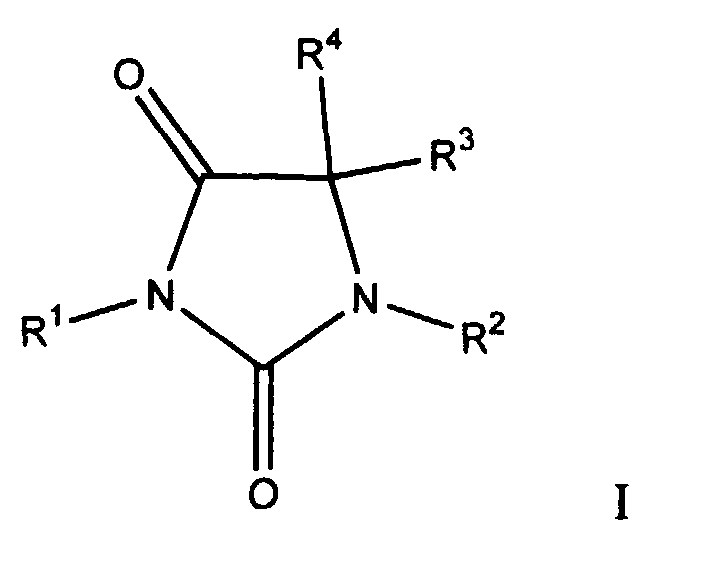 R1 and R2 are independently selected from: H; CH2OH; C1-C4 alkyl, C1-C4 alkenyl or C1-C4 alkynyl optionally substituted with O, S or N; provided that at least one of R1 or R2 is CH2OH; andR3 and R4 are independently selected from: H; OH; halogen; C1-C3 alkoxy; NR5C(O)NHR6; C1-C4 alkyl, C1-C4 alkenyl or C1-C4 alkynyl optionally substituted with O, S or N; andR5 and R6 are independently selected from: H; CH2OH; C1-C4 alkyl, C1-C4 alkenyl or C1-C4 alkynyl optionally substituted with O, S or N.
 - The composition of claim 2, wherein the imidazolidine is selected from the group consisting of: diazolidinylurea, imidazolidinyl ureas, mono-methylol 5,5-dimethylhydantoin, and di-methylol 5,5-dimethylhydantoin.
- The composition of claim 1, wherein the 3-isothiazolone is selected from the group consisting of: 5-chloro-2-methyl-3-isothiazolone; 2-methyl-3-isothiazolone; 2-ethyl-3-isothiazolone; 5-chloro-2-ethyl-3-isothiazolone; 4,5-dichloro-2-methyl-3-isothiazolone; 2-n-octyl-3-isothiazolone; 4,5-dichloro-2-n-octyl-3-isothiazolone; 1,2-benzisothiazolone; 4,5-trimethylene-2-methyl-3-isothiazolone; and mixtures thereof.
- The composition of claim 4, wherein the 3-isothiazolone comprises a mixture of 5-chloro-2-methyl-3-isothiazolone and 2-methyl-3-isothiazolone.
- The composition of claim 1, wherein the weight ratio of copper ion to 3-isothiazolone is between 1:150 and 2:1.
- The composition of claim 1, wherein the weight ratio of imidazolidine to 3-isothiazolone is between 1:1 and 500:1.
- A method of stabilizing a biocidal composition containing at least one formaldehyde-releasing imidazolidine and at least one 3-isothiazolone by the addition of a low level of copper ion.
- The method of claim 8, wherein the weight ratio of copper ion to 3-isothiazolone is between 1:150 and 2:1.
- The method of claim 8, wherein the weight ratio of imidazolidine to 3-isothiazolone is between 1:1 and 500:1.
Applications Claiming Priority (2)
| Application Number | Priority Date | Filing Date | Title |
|---|---|---|---|
| US15377899P | 1999-09-14 | 1999-09-14 | |
| US153778P | 1999-09-14 |
Publications (2)
| Publication Number | Publication Date |
|---|---|
| EP1084619A1 true EP1084619A1 (en) | 2001-03-21 |
| EP1084619B1 EP1084619B1 (en) | 2003-12-10 |
Family
ID=22548706
Family Applications (1)
| Application Number | Title | Priority Date | Filing Date |
|---|---|---|---|
| EP00307660A Expired - Lifetime EP1084619B1 (en) | 1999-09-14 | 2000-09-05 | Stable biocidal compositions |
Country Status (7)
| Country | Link |
|---|---|
| US (1) | US6255331B1 (en) |
| EP (1) | EP1084619B1 (en) |
| JP (1) | JP4993803B2 (en) |
| KR (1) | KR100751003B1 (en) |
| CN (1) | CN1239077C (en) |
| BR (1) | BR0004143A (en) |
| DE (1) | DE60007044T2 (en) |
Cited By (4)
| Publication number | Priority date | Publication date | Assignee | Title |
|---|---|---|---|---|
| WO2001041570A3 (en) * | 1999-12-13 | 2001-12-27 | Air Liquide Sante Int | Bactericidal and fungicidal liquid preparations for industrial products |
| EP1332675A3 (en) * | 2002-01-31 | 2003-10-01 | Rohm and Haas | Synergistic microbicidal combinations |
| EP1665933A3 (en) * | 2004-11-16 | 2006-08-16 | Rohm and Haas Company | Microbicidal composition |
| EP1772055A1 (en) * | 2005-10-04 | 2007-04-11 | Rohm and Haas France SAS | Synergistic microbicidal compositions comprising a N-alkyl-1,2-benzoisothiazolin-3-one |
Families Citing this family (10)
| Publication number | Priority date | Publication date | Assignee | Title |
|---|---|---|---|---|
| US6133300A (en) * | 1999-10-15 | 2000-10-17 | Troy Technology Corporation, Inc. | Antimicrobial mixtures of 1,3-bis(hydroxymethyl)-5,5-dimethylhydantoin and 1,2-benzisothiazolin-3-one |
| US6511673B1 (en) * | 2000-05-10 | 2003-01-28 | Rohm And Haas Company | Microbicidal composition |
| AUPR914701A0 (en) * | 2001-11-27 | 2001-12-20 | Coffey, John I | Method for controlling legionella in cooling towers |
| AU2002342403B2 (en) * | 2001-11-27 | 2007-06-14 | John Innes Coffey | Method for controlling legionella in cooling towers |
| US20050267222A1 (en) * | 2002-10-22 | 2005-12-01 | Dainippon Pharmaceutical Co. Ltd. | Stabilized composition |
| US9034905B2 (en) | 2003-02-05 | 2015-05-19 | Rohm And Haas Company | Synergistic microbicidal combinations |
| JP4853756B2 (en) * | 2004-11-30 | 2012-01-11 | ナガセケムテックス株式会社 | Aqueous antimicrobial preparation |
| US20110008463A1 (en) * | 2008-03-12 | 2011-01-13 | Jan Pieter Hendrik Bosselaers | Combinations of hydroxypyrion compounds and silver compounds |
| ES2535610T3 (en) | 2009-07-07 | 2015-05-13 | Lanxess Deutschland Gmbh | Biocidal agents |
| WO2012113746A1 (en) * | 2011-02-21 | 2012-08-30 | Firmenich Sa | Consumer products containing pro-fragrances |
Citations (4)
| Publication number | Priority date | Publication date | Assignee | Title |
|---|---|---|---|---|
| EP0435439A2 (en) * | 1989-11-17 | 1991-07-03 | Rohm And Haas Company | Aldehyde stabilizers for 3-isothiazolones |
| US5041457A (en) * | 1989-03-10 | 1991-08-20 | Rohm And Haas Company | Synergistic microbicidal combinations containing 2-n-octyl-3-isothiazolone and certain commercial biocides |
| US5464850A (en) * | 1991-10-04 | 1995-11-07 | Ciba Corning Diagnostics Corp. | Synergistic preservative systems for chemistry reagents |
| WO1998036049A1 (en) * | 1997-02-14 | 1998-08-20 | Lonza Inc. | Bleaching and cleaning compositions containing fragrances |
Family Cites Families (22)
| Publication number | Priority date | Publication date | Assignee | Title |
|---|---|---|---|---|
| US3870795A (en) * | 1973-02-28 | 1975-03-11 | Rohm & Haas | Stabilization of solutions of 3-isothiazolones employing certain metal nitrates and nitrites |
| US4067878A (en) * | 1976-03-05 | 1978-01-10 | Rohm And Haas Company | Stabilization of solutions of 3-isothiazolones |
| US4939266A (en) | 1982-06-01 | 1990-07-03 | Rohm And Haas Company | Nitrosamine-free 3-isothiazolone |
| DE3508928A1 (en) * | 1985-03-13 | 1986-09-18 | Giulini Chemie Gmbh, 6700 Ludwigshafen | COMBINATION FOR ANTIMICROBIAL AND ANTIOXIDATIVE STABILIZATION OF EXTERNA AND PERSONAL CARE PRODUCTS |
| US4964892A (en) * | 1988-12-22 | 1990-10-23 | Rohm And Haas Company | Synergistic microbicidal combinations containing 2-N-octyl-3-isothiazolone and certain commercial biocides |
| CA2027241A1 (en) * | 1989-10-24 | 1991-04-25 | Andrew B. Law | Stabilized metal salt/3-isothiazolone combinations |
| ES2061890T5 (en) * | 1989-11-10 | 2002-04-16 | Thor Gmbh | 3-ISOTIAZOLINONE STABILIZED WATER SOLUTIONS. |
| US5037843A (en) | 1990-03-05 | 1991-08-06 | The Mcintyre Group, Ltd. | Antimicrobial preservative system and method comprising a formaldehyde substituted hydantoin |
| US5108500A (en) * | 1990-12-10 | 1992-04-28 | Rohm And Haas Company | Stabilization of water insoluble 3-isothiazolones |
| US5142058A (en) * | 1990-12-14 | 1992-08-25 | Rohm And Haas Company | Halogen-containing organic stabilizers for 3-isothiazolones |
| US5160527A (en) * | 1991-05-24 | 1992-11-03 | Rohm And Haas Company | Stabilized metal salt/3-isothiazolone combinations |
| US5869510A (en) * | 1993-01-15 | 1999-02-09 | Rohm And Haas Company | Iron stabilizers for 3-isothiazolones |
| US5461150A (en) | 1994-12-14 | 1995-10-24 | Rohm And Haas Company | Stabilization of 3-isothiazolone solutions |
| US5668083A (en) * | 1995-06-06 | 1997-09-16 | Rohm And Haas Company | Composition containing 3-isothiazolone and stabilizer |
| US5725806A (en) * | 1995-12-05 | 1998-03-10 | Rohm And Haas Company | Disulfide stabilizers for 3-isothiazolones |
| US6114366A (en) * | 1997-02-27 | 2000-09-05 | Lonza Inc. | Broad spectrum preservative |
| US6221374B1 (en) * | 1997-05-28 | 2001-04-24 | Rohm And Haas Company | Controlled release compositions |
| US5910503A (en) * | 1997-10-28 | 1999-06-08 | Rohm And Haas Company | Stable microbicide formulation |
| US5955486A (en) * | 1997-10-28 | 1999-09-21 | Rohm And Haas Company | Stable microbicide formulation |
| US5922745A (en) * | 1997-11-03 | 1999-07-13 | Nalco Chemical Company | Composition and method for inhibiting the growth of microorganisms including stabilized sodium hypobromite and isothiazolones |
| US6153633A (en) * | 1998-08-11 | 2000-11-28 | Rohm And Haas Company | Stable 3-isothiazolone compositions |
| US6121302A (en) | 1999-05-11 | 2000-09-19 | Lonza, Inc. | Stabilization of isothiazolone |
-
2000
- 2000-08-16 US US09/639,781 patent/US6255331B1/en not_active Expired - Lifetime
- 2000-09-04 KR KR1020000051952A patent/KR100751003B1/en not_active Expired - Lifetime
- 2000-09-05 DE DE60007044T patent/DE60007044T2/en not_active Expired - Lifetime
- 2000-09-05 EP EP00307660A patent/EP1084619B1/en not_active Expired - Lifetime
- 2000-09-08 JP JP2000273747A patent/JP4993803B2/en not_active Expired - Lifetime
- 2000-09-12 CN CNB00126382XA patent/CN1239077C/en not_active Expired - Lifetime
- 2000-09-13 BR BR0004143-2A patent/BR0004143A/en not_active Application Discontinuation
Patent Citations (4)
| Publication number | Priority date | Publication date | Assignee | Title |
|---|---|---|---|---|
| US5041457A (en) * | 1989-03-10 | 1991-08-20 | Rohm And Haas Company | Synergistic microbicidal combinations containing 2-n-octyl-3-isothiazolone and certain commercial biocides |
| EP0435439A2 (en) * | 1989-11-17 | 1991-07-03 | Rohm And Haas Company | Aldehyde stabilizers for 3-isothiazolones |
| US5464850A (en) * | 1991-10-04 | 1995-11-07 | Ciba Corning Diagnostics Corp. | Synergistic preservative systems for chemistry reagents |
| WO1998036049A1 (en) * | 1997-02-14 | 1998-08-20 | Lonza Inc. | Bleaching and cleaning compositions containing fragrances |
Cited By (7)
| Publication number | Priority date | Publication date | Assignee | Title |
|---|---|---|---|---|
| WO2001041570A3 (en) * | 1999-12-13 | 2001-12-27 | Air Liquide Sante Int | Bactericidal and fungicidal liquid preparations for industrial products |
| EP1332675A3 (en) * | 2002-01-31 | 2003-10-01 | Rohm and Haas | Synergistic microbicidal combinations |
| EP1525797A3 (en) * | 2002-01-31 | 2005-05-11 | Rohm And Haas Company | Synergistic microbicidal combination |
| EP1665933A3 (en) * | 2004-11-16 | 2006-08-16 | Rohm and Haas Company | Microbicidal composition |
| US7468384B2 (en) | 2004-11-16 | 2008-12-23 | Rohm And Haas Company | Microbicidal composition |
| EP1772055A1 (en) * | 2005-10-04 | 2007-04-11 | Rohm and Haas France SAS | Synergistic microbicidal compositions comprising a N-alkyl-1,2-benzoisothiazolin-3-one |
| US8741940B2 (en) | 2005-10-04 | 2014-06-03 | Rohm And Haas Company | Microbicidal composition |
Also Published As
| Publication number | Publication date |
|---|---|
| DE60007044T2 (en) | 2004-06-03 |
| JP4993803B2 (en) | 2012-08-08 |
| US6255331B1 (en) | 2001-07-03 |
| CN1239077C (en) | 2006-02-01 |
| BR0004143A (en) | 2001-04-17 |
| JP2001089306A (en) | 2001-04-03 |
| KR100751003B1 (en) | 2007-08-22 |
| EP1084619B1 (en) | 2003-12-10 |
| CN1287780A (en) | 2001-03-21 |
| DE60007044D1 (en) | 2004-01-22 |
| KR20010050325A (en) | 2001-06-15 |
Similar Documents
| Publication | Publication Date | Title |
|---|---|---|
| EP0910951B1 (en) | Stable microbicide formulation | |
| EP1500331B1 (en) | Microbicidal composition | |
| CA2707741C (en) | Microbicidal composition comprising n-methyl-1,2-benzisothiazolin-3-one and at least one of propiconazole and tebuconazole | |
| CA2722343C (en) | An n-methyl-1,2 benzisothiazolin-3-one microbicidal composition | |
| EP1084619B1 (en) | Stable biocidal compositions | |
| EP1120040B1 (en) | Stabilized isothiazolone microbicide solutions | |
| EP1862070B1 (en) | Microbicidal composition | |
| EP0910952B1 (en) | Stable microbicide formulation | |
| EP0913090B1 (en) | Stabilization of 3-isothiazolone solutions | |
| EP1044609B1 (en) | Stable microbicide formulation | |
| US20040198714A1 (en) | Microbicidal composition | |
| EP1082901B1 (en) | Isothiazolone concentrates | |
| EP1071330A1 (en) | Stabilization of isothiazolone | |
| EP0447041A1 (en) | The use of hexamethylenetetramine as a stabilizer for 3-isothiazolones | |
| EP0983723A1 (en) | Stable microbicide formulation | |
| US20120165376A1 (en) | Stabilized microbicidal composition |
Legal Events
| Date | Code | Title | Description |
|---|---|---|---|
| PUAI | Public reference made under article 153(3) epc to a published international application that has entered the european phase |
Free format text: ORIGINAL CODE: 0009012 |
|
| 17P | Request for examination filed |
Effective date: 20000916 |
|
| AK | Designated contracting states |
Kind code of ref document: A1 Designated state(s): DE FR GB IT |
|
| AX | Request for extension of the european patent |
Free format text: AL;LT;LV;MK;RO;SI |
|
| AKX | Designation fees paid |
Free format text: DE FR GB IT |
|
| 17Q | First examination report despatched |
Effective date: 20020527 |
|
| GRAH | Despatch of communication of intention to grant a patent |
Free format text: ORIGINAL CODE: EPIDOS IGRA |
|
| GRAS | Grant fee paid |
Free format text: ORIGINAL CODE: EPIDOSNIGR3 |
|
| GRAA | (expected) grant |
Free format text: ORIGINAL CODE: 0009210 |
|
| AK | Designated contracting states |
Kind code of ref document: B1 Designated state(s): DE FR GB IT |
|
| REG | Reference to a national code |
Ref country code: GB Ref legal event code: FG4D |
|
| REF | Corresponds to: |
Ref document number: 60007044 Country of ref document: DE Date of ref document: 20040122 Kind code of ref document: P |
|
| ET | Fr: translation filed | ||
| PLBE | No opposition filed within time limit |
Free format text: ORIGINAL CODE: 0009261 |
|
| STAA | Information on the status of an ep patent application or granted ep patent |
Free format text: STATUS: NO OPPOSITION FILED WITHIN TIME LIMIT |
|
| 26N | No opposition filed |
Effective date: 20040913 |
|
| REG | Reference to a national code |
Ref country code: FR Ref legal event code: PLFP Year of fee payment: 17 |
|
| REG | Reference to a national code |
Ref country code: FR Ref legal event code: PLFP Year of fee payment: 18 |
|
| REG | Reference to a national code |
Ref country code: FR Ref legal event code: PLFP Year of fee payment: 19 |
|
| PGFP | Annual fee paid to national office [announced via postgrant information from national office to epo] |
Ref country code: FR Payment date: 20190815 Year of fee payment: 20 Ref country code: IT Payment date: 20190917 Year of fee payment: 20 Ref country code: DE Payment date: 20190820 Year of fee payment: 20 |
|
| PGFP | Annual fee paid to national office [announced via postgrant information from national office to epo] |
Ref country code: GB Payment date: 20190905 Year of fee payment: 20 |
|
| REG | Reference to a national code |
Ref country code: DE Ref legal event code: R071 Ref document number: 60007044 Country of ref document: DE |
|
| REG | Reference to a national code |
Ref country code: GB Ref legal event code: PE20 Expiry date: 20200904 |
|
| PG25 | Lapsed in a contracting state [announced via postgrant information from national office to epo] |
Ref country code: GB Free format text: LAPSE BECAUSE OF EXPIRATION OF PROTECTION Effective date: 20200904 |