EP1084618A1 - Herbicidal composition - Google Patents
Herbicidal composition Download PDFInfo
- Publication number
- EP1084618A1 EP1084618A1 EP00120012A EP00120012A EP1084618A1 EP 1084618 A1 EP1084618 A1 EP 1084618A1 EP 00120012 A EP00120012 A EP 00120012A EP 00120012 A EP00120012 A EP 00120012A EP 1084618 A1 EP1084618 A1 EP 1084618A1
- Authority
- EP
- European Patent Office
- Prior art keywords
- formula
- compound
- herbicide
- safener
- mixture
- Prior art date
- Legal status (The legal status is an assumption and is not a legal conclusion. Google has not performed a legal analysis and makes no representation as to the accuracy of the status listed.)
- Withdrawn
Links
- ITGSCCPVERXFGN-UHFFFAOYSA-N OC(C(C1)=NOC1(c1ccccc1)c1ccccc1)=O Chemical compound OC(C(C1)=NOC1(c1ccccc1)c1ccccc1)=O ITGSCCPVERXFGN-UHFFFAOYSA-N 0.000 description 1
Classifications
-
- A—HUMAN NECESSITIES
- A01—AGRICULTURE; FORESTRY; ANIMAL HUSBANDRY; HUNTING; TRAPPING; FISHING
- A01N—PRESERVATION OF BODIES OF HUMANS OR ANIMALS OR PLANTS OR PARTS THEREOF; BIOCIDES, e.g. AS DISINFECTANTS, AS PESTICIDES OR AS HERBICIDES; PEST REPELLANTS OR ATTRACTANTS; PLANT GROWTH REGULATORS
- A01N37/00—Biocides, pest repellants or attractants, or plant growth regulators containing organic compounds containing a carbon atom having three bonds to hetero atoms with at the most two bonds to halogen, e.g. carboxylic acids
- A01N37/42—Biocides, pest repellants or attractants, or plant growth regulators containing organic compounds containing a carbon atom having three bonds to hetero atoms with at the most two bonds to halogen, e.g. carboxylic acids containing within the same carbon skeleton a carboxylic group or a thio analogue, or a derivative thereof, and a carbon atom having only two bonds to hetero atoms with at the most one bond to halogen, e.g. keto-carboxylic acids
-
- A—HUMAN NECESSITIES
- A01—AGRICULTURE; FORESTRY; ANIMAL HUSBANDRY; HUNTING; TRAPPING; FISHING
- A01N—PRESERVATION OF BODIES OF HUMANS OR ANIMALS OR PLANTS OR PARTS THEREOF; BIOCIDES, e.g. AS DISINFECTANTS, AS PESTICIDES OR AS HERBICIDES; PEST REPELLANTS OR ATTRACTANTS; PLANT GROWTH REGULATORS
- A01N43/00—Biocides, pest repellants or attractants, or plant growth regulators containing heterocyclic compounds
- A01N43/72—Biocides, pest repellants or attractants, or plant growth regulators containing heterocyclic compounds having rings with nitrogen atoms and oxygen or sulfur atoms as ring hetero atoms
- A01N43/80—Biocides, pest repellants or attractants, or plant growth regulators containing heterocyclic compounds having rings with nitrogen atoms and oxygen or sulfur atoms as ring hetero atoms five-membered rings with one nitrogen atom and either one oxygen atom or one sulfur atom in positions 1,2
Definitions
- the present invention relates to novel selective herbicidal compositions for controlling grasses and weeds in crops of cultivated plants, especially in crops of cereals and maize, which compositions comprise a herbicide and a safener (antidote) and protect the cultivated plants, but not the weeds, from the phytotoxic action of the herbicide, and to the use of said composition for controlling weeds in crops of cultivated plants.
- compositions comprise a herbicide and a safener (antidote) and protect the cultivated plants, but not the weeds, from the phytotoxic action of the herbicide, and to the use of said composition for controlling weeds in crops of cultivated plants.
- the cultivated plants may also suffer severe damage owing to factors that include the concentration of the herbicide and the mode of application, the cultivated plant itself, the nature of the soil, and the climatic conditions such as exposure to light, temperature and rainfall.
- the proposal has already been made to use different compounds as safeners which are able to antagonise the harmful action of the herbicide on the cultivated plant, i.e. to protect the cultivated plant while leaving the herbicidal action on the weeds to be controlled virtually unimpaired. It has, however, been found that the proposed safeners often have a very specific action with respect not only to the cultivated plants but also to the herbicide, and in some cases also subject to the mode of application, i.e.
- EP-A-0 551 650 discloses compounds that protect cultivated plants from the phytotoxic action of herbicides including 2-acylated 1,3-dicarbonyl compounds.
- the invention provides a selective herbicidal composition
- a selective herbicidal composition comprising, in addition to customary inert formulation assistants such as carriers, solvents and wetting agents, a mixture of
- the invention also relates to a method of selectively controlling weeds in crops of cultivated plants, which comprises treating said cultivated plants, the seeds or seedlings or the crop area thereof, concurrently or separately, with a herbicidally effective amount of the herbicide of formula I and, to antagonise the herbicide, an antidotally effective amount of the safener of formula II.
- Suitable cultivated plants which can be protected by the safeners of formula II against the harmful action of the aforementioned herbicides are preferably cereals, cotton, soybean, sugar beet, sugar cane, plantations, rape, maize and rice, most particularly in maize.
- Crops will also be understood as meaning those crops that have been made tolerant to herbicides or classes of herbicides by conventional breeding or genetic engineering methods.
- the weeds to be controlled may be monocot as well as dicot weeds, typically Stellaria, Nasturtium, Agrostis, Digitaria, Avena, Setaria, Sinapis, Lolium, Solanum, Echinochloa, Scirpus, Monochoria, Sagittaria, Bromus, Alopecurus, Sorghum halepense, Rottboellia, Cyperus, Abutilon, Sida, Xanthium, Amaranthus, Chenopodium, Ipomoea, Chrysanthemum, Galium, Viola and Veronica.
- Crop areas will be understood as meaning the areas already under cultivation with the cultivated plants or seeds thereof, as well as the areas intended for cropping with said cultivated plants.
- a safener of formula II can be used for pretreating seeds of the crop plants (dressing of seeds or seedlings) or it can be incorporated in the soil before or after sowing. It can, however, also be applied by itself alone or together with the herbicide postemergence. Treatment of the plant or the seeds with the safener can therefore in principle be carried out irrespective of the time of application of the herbicide. Treatment can, however, also be carried out by simultaneous application of the herbicide and safener (e.g. as tank mixture). The concentration of safener with respect to the herbicide will depend substantially on the mode of application.
- the ratio of safener to herbicide will usually be from 100:1 to 1:100, preferably 20:1 to 1:20.
- alkyl is methyl, ethyl, n-propyl, isopropyl, n-butyl, sec.-butyl, isobutyl and tert.-butyl.
- the compound of formula I wherein Q is Q 1 and R 1 is hydrogen, is known for example from the Pesticide Manual, eleventh ed., British Crop Protection Council, 1997. The remaining compounds of formula I are described e.g. in WO 97/43270 and in WO 99/51583.
- the compound of formula I, in which Q is Q 2 is described in EP-A-0 496 631.
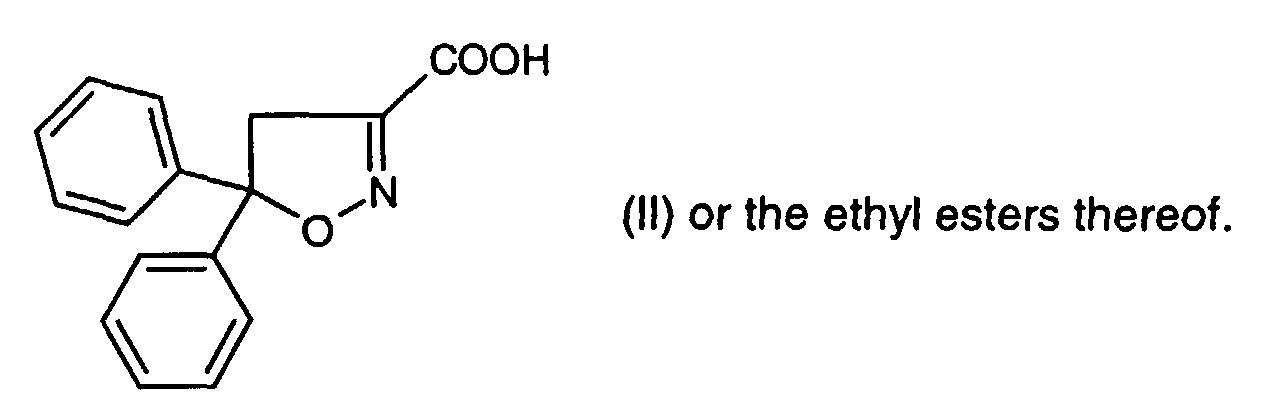
- the compound of formula II is known from DE-A-4331448.
- compositions according to the invention contain a compound of formula I, in which Q is Q 1 and R 1 is hydrogen, -SOCH 3 or -SCH 3 .
- compositions of this invention are suitable for all methods of application commonly used in agriculture, including pre-emergence application, post-emergence application and seed dressing.
- seed dressing 0.001 to 10 g of safener/kg of seeds, preferably 0.05 to 2 g of safener/kg of seeds, is usually applied.
- safener solutions that contain the active ingredient in a concentration of 1 to 10000 ppm, preferably of 100 to 1000 ppm.
- the safeners of formula II or mixtures of the safeners of formula II and the herbicides of formula I, conveniently together with the customary formulation assistants to formulations, typically to emulsifiable concentrates, coatable pastes, directly sprayable or dilutable solutions, dilute emulsions, wettable powders, soluble powders, dusts, granulates or microcapsules.
- formulations typically to emulsifiable concentrates, coatable pastes, directly sprayable or dilutable solutions, dilute emulsions, wettable powders, soluble powders, dusts, granulates or microcapsules.
- formulations are described, for example, in WO 97/34485, pages 9 to 13.
- the formulations are prepared in known manner, conveniently by homogeneously mixing and/or grinding the active ingredients with liquid or solid formulation assistants, typically solvents or solid carriers. Surface-active compounds (surfactants) may additionally be used for preparing the formulations. Suitable solvents and solid carriers
- suitable surface-active compounds are nonionic, cationic and/or anionic surfactants and surfactant mixtures having good emulsifying, dispersing and wetting properties.
- suitable anionic, nonionic, and cationic surfactants are listed for example in said WO 97/34485, pages 7 to 8.
- the herbicidal compositions will usually contain from 0.1 to 99% by weight, preferably from 0.1 to 95% by weight, of compound mixture of the compound of formula I and the compounds of formulae II, from 1 to 99.9% by weight of a solid or liquid formulation assistant, and from 0 to 25% by weight, preferably from 0.1 to 25% by weight, of a surfactant. Whereas it is customarily preferred to formulate commercial products as concentrates, the end user will normally use dilute formulations.
- compositions may also contain further ingredients, such as stabilisers, e.g. where appropriate epoxidised vegetable oils (epoxidised coconut oil, rapeseed oil, or soybean oil), antifoams, typically silicone oil; preservatives, viscosity regulators, binders, and tackifiers, as well as fertilisers or other chemical agents.
- stabilisers e.g. where appropriate epoxidised vegetable oils (epoxidised coconut oil, rapeseed oil, or soybean oil), antifoams, typically silicone oil; preservatives, viscosity regulators, binders, and tackifiers, as well as fertilisers or other chemical agents.
- Seed dressing or treatment of the germinated seedlings is naturally the preferred method of application, because the safener treatment is fully concentrated on the target crop.
- 1 to 1000 g, preferably 5 to 250 g, of safener is used per 100 kg of seeds.
- concentrations may deviate above or below the indicated limit values (repeat dressing).
- a liquid formulation of a mixture of safener and herbicide (reciprocal ratio from 10:1 to 1:100) is used, the concentration of herbicide being from 0.005 to 5.0 kg/ha. This tank mixture is applied before or after sowing.
- the compound of formula II formulated as emulsifiable concentrate, wettable powder or granulate is applied to the open furrow in which the seeds have been sown. After covering the furrow, the herbicide is applied pre-emergence in conventional manner.
- the compound of formula II is applied in solution to a mineral granular carrier or to polymerised granules (urea/formaldehyde) and then dried. A coating can then be applied (coated granules) that allows the safenerto be released at a controlled rate over a specific period of time.
- Emulsifiable concentrates are:
- Emulsifiable concentrates a) b) c) d) Compound mixture 5% 10% 25% 50% Calcium dodecylbenzenesulfonate 6% 8% 6% 8% Polyethoxylated castor oil (36 mol EO) 4% - 4% 4% Octylphenol polyethoxylate (7-8 mol EO) - 4% - 2% Cyclohexanone - - 10% 20% Aromatic hydrocarbon mixture C 9 -C 12 85% 78% 55% 16%
- Emulsions of any desired concentration can be prepared by diluting such concentrates with water.
- the solutions are suitable for use as microdrops.
- F3. Wettable powders a) b) c) d) Compound mixture 5 % 25 % 50 % 80 % Sodium ligninsulfonate 4 % - 3 % - Sodium lauryl sulfate 2 % 3 % - 4 % Sodium diisobutylnaphthalenesulfonate - 6 % 5 % 6 % Octylphenol polyethoxylate (7-8 mol EO) - 1 % 2 % - Highly dispersed silica 1 % 3 % 5 % 10 % Kaolin 88 % 62 % 35 % -
- the finely ground compound is intimately mixed with the adjuvants to give a suspension concentrate from which suspensions of any desired concentration can be prepared by dilution with water. It is often expedient to formulate the compound of formula I and the components of formula II individually and then to combine them shortly before application in the applicator in the desired mixture ratio as tank mixture in water.
- the following Examples illustrate the ability of the safeners of formula II to protect cultivated plants from the phytotoxic action of herbicides of formula I.
- test plants are raised in pots under greenhouse conditions until reaching a post-application stage. Standard soil is used as the growing medium.
- the herbicides are applied to the test plants both on their own and in a mixture with safeners, or are applied to crop plants raised from seed previously dressed with safeners.
Landscapes
- Life Sciences & Earth Sciences (AREA)
- Agronomy & Crop Science (AREA)
- Pest Control & Pesticides (AREA)
- Plant Pathology (AREA)
- Health & Medical Sciences (AREA)
- Engineering & Computer Science (AREA)
- Dentistry (AREA)
- General Health & Medical Sciences (AREA)
- Wood Science & Technology (AREA)
- Zoology (AREA)
- Environmental Sciences (AREA)
- Agricultural Chemicals And Associated Chemicals (AREA)
Abstract

Description
- The present invention relates to novel selective herbicidal compositions for controlling grasses and weeds in crops of cultivated plants, especially in crops of cereals and maize, which compositions comprise a herbicide and a safener (antidote) and protect the cultivated plants, but not the weeds, from the phytotoxic action of the herbicide, and to the use of said composition for controlling weeds in crops of cultivated plants.
- When applying herbicides, the cultivated plants may also suffer severe damage owing to factors that include the concentration of the herbicide and the mode of application, the cultivated plant itself, the nature of the soil, and the climatic conditions such as exposure to light, temperature and rainfall. To counteract this problem and similar ones, the proposal has already been made to use different compounds as safeners which are able to antagonise the harmful action of the herbicide on the cultivated plant, i.e. to protect the cultivated plant while leaving the herbicidal action on the weeds to be controlled virtually unimpaired. It has, however, been found that the proposed safeners often have a very specific action with respect not only to the cultivated plants but also to the herbicide, and in some cases also subject to the mode of application, i.e. a specific safener will often be suitable only for a specific cultivated plant and a specific class of herbicide or a specific herbicide. Thus, for example, EP-A-0 551 650 discloses compounds that protect cultivated plants from the phytotoxic action of herbicides including 2-acylated 1,3-dicarbonyl compounds.
- It has now been found that compounds of formula IIare suitable for protecting cultivated plants from the phytotoxic action of a certain class of pyrazolyl herbicides.

- Accordingly, the invention provides a selective herbicidal composition comprising, in addition to customary inert formulation assistants such as carriers, solvents and wetting agents, a mixture of
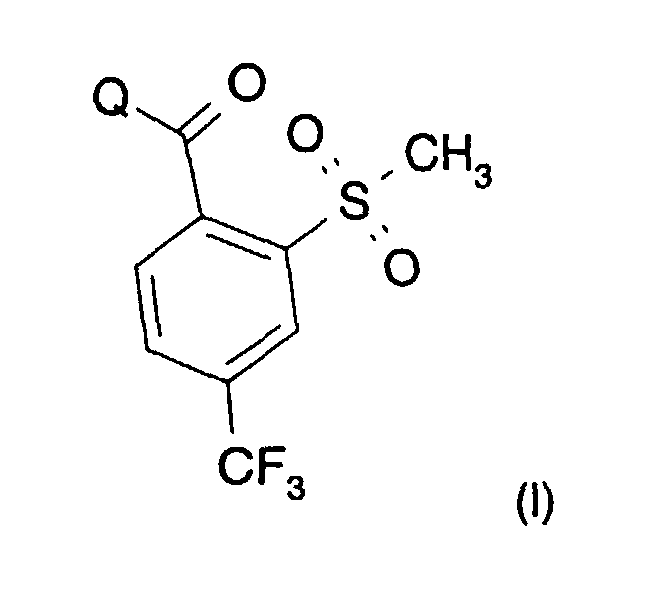
- a) a herbicidally effective amount of a herbicide of formula I
wherein
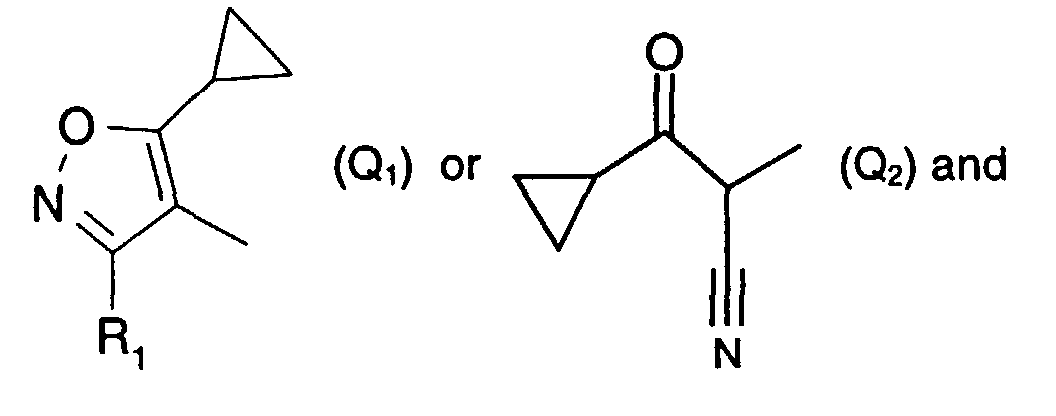
- Q is the group
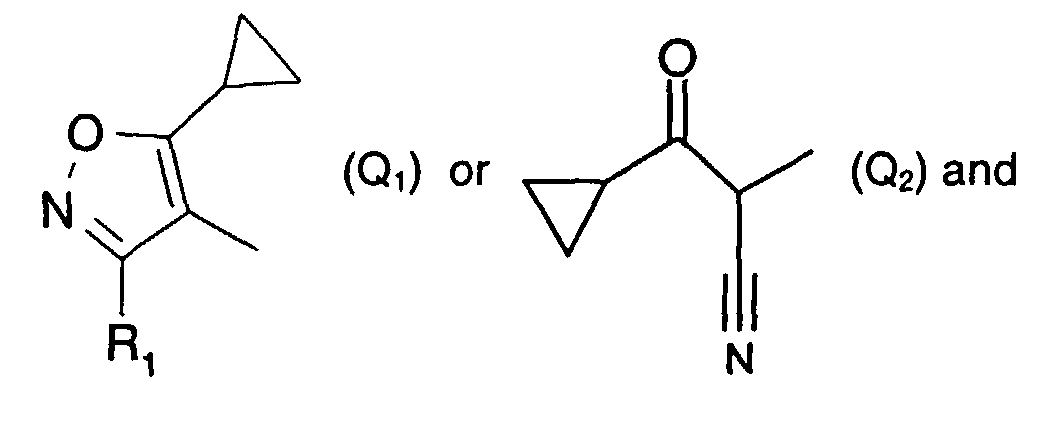
- R1 is hydrogen, -COO-C1-C4-alkyl, -S-C1-C4-alkyl or -SO-C1-C4-alkyl; and
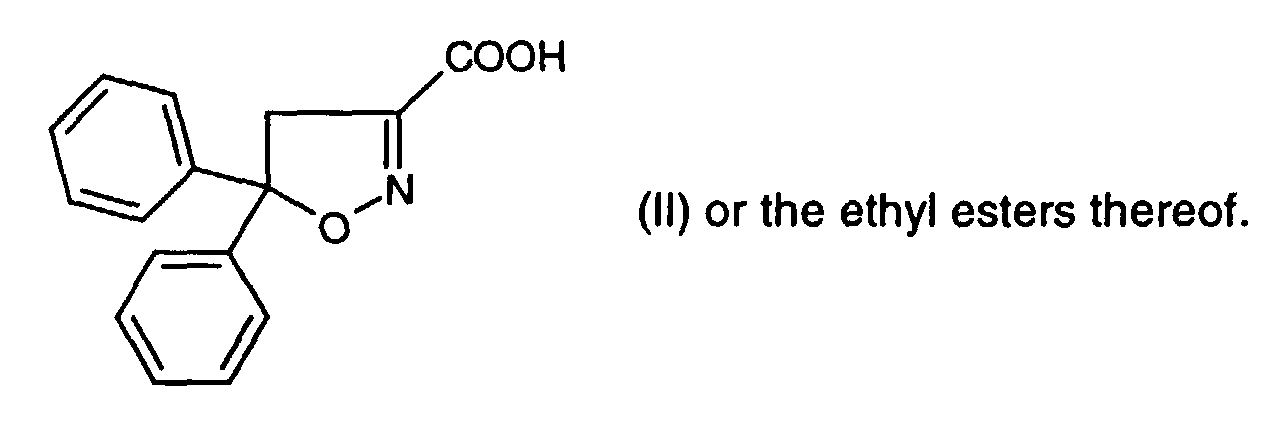
- b) to antagonise the herbicide, an antidotally effective amount of a safener of formula II
-
- The invention also relates to a method of selectively controlling weeds in crops of cultivated plants, which comprises treating said cultivated plants, the seeds or seedlings or the crop area thereof, concurrently or separately, with a herbicidally effective amount of the herbicide of formula I and, to antagonise the herbicide, an antidotally effective amount of the safener of formula II.
- Suitable cultivated plants which can be protected by the safeners of formula II against the harmful action of the aforementioned herbicides are preferably cereals, cotton, soybean, sugar beet, sugar cane, plantations, rape, maize and rice, most particularly in maize.
- Crops will also be understood as meaning those crops that have been made tolerant to herbicides or classes of herbicides by conventional breeding or genetic engineering methods.
- The weeds to be controlled may be monocot as well as dicot weeds, typically Stellaria, Nasturtium, Agrostis, Digitaria, Avena, Setaria, Sinapis, Lolium, Solanum, Echinochloa, Scirpus, Monochoria, Sagittaria, Bromus, Alopecurus, Sorghum halepense, Rottboellia, Cyperus, Abutilon, Sida, Xanthium, Amaranthus, Chenopodium, Ipomoea, Chrysanthemum, Galium, Viola and Veronica.
- Crop areas will be understood as meaning the areas already under cultivation with the cultivated plants or seeds thereof, as well as the areas intended for cropping with said cultivated plants.
- Depending on the end use, a safener of formula II can be used for pretreating seeds of the crop plants (dressing of seeds or seedlings) or it can be incorporated in the soil before or after sowing. It can, however, also be applied by itself alone or together with the herbicide postemergence. Treatment of the plant or the seeds with the safener can therefore in principle be carried out irrespective of the time of application of the herbicide. Treatment can, however, also be carried out by simultaneous application of the herbicide and safener (e.g. as tank mixture). The concentration of safener with respect to the herbicide will depend substantially on the mode of application. Where a field treatment is carried out either by using a tank mixture with a combination of safener and herbicide or by separate application of safener and herbicide, the ratio of safener to herbicide will usually be from 100:1 to 1:100, preferably 20:1 to 1:20.
- In the context of the present invention, alkyl is methyl, ethyl, n-propyl, isopropyl, n-butyl, sec.-butyl, isobutyl and tert.-butyl.
- The compound of formula I, wherein Q is Q1 and R1 is hydrogen, is known for example from the Pesticide Manual, eleventh ed., British Crop Protection Council, 1997. The remaining compounds of formula I are described e.g. in WO 97/43270 and in WO 99/51583. The compound of formula I, in which Q is Q2, is described in EP-A-0 496 631. The compound of formula II is known from DE-A-4331448.
- Preferred compositions according to the invention contain a compound of formula I, in which Q is Q1 and R1 is hydrogen, -SOCH3 or -SCH3.
- In field treatment it is usual to apply 0.001 to 5.0 kg/ha, preferably 0.001 to 0.5 kg/ha, of safener.
The concentration of herbicide is usually in the range from 0.001 to 2 kg/ha, but will preferably be from 0.005 to 1 kg/ha. - The compositions of this invention are suitable for all methods of application commonly used in agriculture, including pre-emergence application, post-emergence application and seed dressing. For seed dressing, 0.001 to 10 g of safener/kg of seeds, preferably 0.05 to 2 g of safener/kg of seeds, is usually applied. If the safener is used in liquid form shortly before sowing to effect soaking, then it is preferred to use safener solutions that contain the active ingredient in a concentration of 1 to 10000 ppm, preferably of 100 to 1000 ppm.
- For application, it is preferred to process the safeners of formula II, or mixtures of the safeners of formula II and the herbicides of formula I, conveniently together with the customary formulation assistants to formulations, typically to emulsifiable concentrates, coatable pastes, directly sprayable or dilutable solutions, dilute emulsions, wettable powders, soluble powders, dusts, granulates or microcapsules. Such formulations are described, for example, in WO 97/34485, pages 9 to 13. The formulations are prepared in known manner, conveniently by homogeneously mixing and/or grinding the active ingredients with liquid or solid formulation assistants, typically solvents or solid carriers. Surface-active compounds (surfactants) may additionally be used for preparing the formulations. Suitable solvents and solid carriers for this purpose are also described in said WO 97/34485, page 6.
- Depending on the type of herbicide of formula I to be formulated, suitable surface-active compounds are nonionic, cationic and/or anionic surfactants and surfactant mixtures having good emulsifying, dispersing and wetting properties. Examples of suitable anionic, nonionic, and cationic surfactants are listed for example in said WO 97/34485, pages 7 to 8. Also the surfactants customarily for the art of formulation and described, inter alia, in "Mc Cutcheon's Detergents and Emulsifiers Annual" MC Publishing Corp., Ridgewood New Jersey, 1981, Stache, H., "Tensid-Taschenbuch" (Handbook of Surfactants), Carl Hanser Verlag, Munich/Vienna, 1981, and M. and J. Ash, "Encyclopedia of Surfactants", Vol I-III, Chemical Publishing Co., New York, 1980-81 are suitable for manufacture of the herbicidal compositions according to the invention.
- The herbicidal compositions will usually contain from 0.1 to 99% by weight, preferably from 0.1 to 95% by weight, of compound mixture of the compound of formula I and the compounds of formulae II, from 1 to 99.9% by weight of a solid or liquid formulation assistant, and from 0 to 25% by weight, preferably from 0.1 to 25% by weight, of a surfactant. Whereas it is customarily preferred to formulate commercial products as concentrates, the end user will normally use dilute formulations.
- The compositions may also contain further ingredients, such as stabilisers, e.g. where appropriate epoxidised vegetable oils (epoxidised coconut oil, rapeseed oil, or soybean oil), antifoams, typically silicone oil; preservatives, viscosity regulators, binders, and tackifiers, as well as fertilisers or other chemical agents. Different methods and techniques may suitably be used for applying the safeners of formula II or compositions containing them for protecting cultivated plants from the harmful effects of herbicides of formula I, conveniently the following:
-
- a) Dressing the seeds with a wettable powder formulation of the compound of formula II by shaking in a vessel until the safener is uniformly distributed on the surface of the seeds (dry treatment), using about 1 to 500 g of compound of formula II (4 g to 2 kg of wettable powder) per 100 kg of seeds.
- b) Dressing seeds with an emulsifiable concentrate of the compound of formula II by method a) (wet treatment).
- c) Dressing by immersing the seeds in a mixture containing 100―1000 ppm of compound of formula II for 1 to 72 hours and where appropriate subsequently drying them (seed soaking).
-
- Seed dressing or treatment of the germinated seedlings is naturally the preferred method of application, because the safener treatment is fully concentrated on the target crop. Usually 1 to 1000 g, preferably 5 to 250 g, of safener is used per 100 kg of seeds. However, depending on the method employed, which also permits the use of other chemical agents or micronutrients, the concentrations may deviate above or below the indicated limit values (repeat dressing).
- A liquid formulation of a mixture of safener and herbicide (reciprocal ratio from 10:1 to 1:100) is used, the concentration of herbicide being from 0.005 to 5.0 kg/ha. This tank mixture is applied before or after sowing.
- The compound of formula II formulated as emulsifiable concentrate, wettable powder or granulate is applied to the open furrow in which the seeds have been sown. After covering the furrow, the herbicide is applied pre-emergence in conventional manner.
- The compound of formula II is applied in solution to a mineral granular carrier or to polymerised granules (urea/formaldehyde) and then dried. A coating can then be applied (coated granules) that allows the safenerto be released at a controlled rate over a specific period of time.
- Particularly preferred formulations are made up as follows (% = per cent by weight; compound mixture means the mixture of the compound of formula I with the compound of formula II):
-
- Compound mixture:
- 1 to 90%, preferrably 5 to 20%
- Surfactant:
- 1 to 30%, preferably 10 to 20%
- Liquid carrier:
- 5 to 94%, preferably 70 to 85%
-
- Compound mixture:
- 0.1 to 10%, preferably 0,1 to 5%
- Solid carrier:
- 99.9 to 90%, preferably 99.9 to 99%
-
- Compound mixture:
- 5 to 75%, preferably 10 to 50%
- Water:
- 94 to 24%, preferably 88 to 30%
- Surfactant:
- 1 to 40%, preferably 2 to 30%
-
- Compound mixture:
- 0.5 to 90%, preferably 1 to 80%
- Surfactant:
- 0.5 to 20%, preferably 1 to 15%
- Solid carrier:
- 5 to 95%, preferably 15 to 90%
-
- Compound mixture:
- 0.1 to 30%, preferably 0.1 to 15%
- Solid carrier:
- 99.5 to 70%, preferably 97 to 85%
- The invention is illustrated in more detail by the following non-limitative Examples.
-
F1. Emulsifiable concentrates a) b) c) d) Compound mixture 5% 10% 25% 50% Calcium dodecylbenzenesulfonate 6% 8% 6% 8% Polyethoxylated castor oil (36 mol EO) 4% - 4% 4% Octylphenol polyethoxylate (7-8 mol EO) - 4% - 2% Cyclohexanone - - 10% 20% Aromatic hydrocarbon mixture C9-C12 85% 78% 55% 16% - Emulsions of any desired concentration can be prepared by diluting such concentrates with water.
F2. Solutions a) b) c) d) Compound mixture 5 % 10 % 50 % 90 % 1-Methoxy-3-(3-methoxy-propoxy)propane - 20 % 20 % - Polyethylene glycol MG 400 20 % 10 % - - N-Methyl-2-pyrrolidone - - 30 % 10 % Aromatic hydrocarbon mixture C9-C12 75 % 60 % - - - The solutions are suitable for use as microdrops.
F3. Wettable powders a) b) c) d) Compound mixture 5 % 25 % 50 % 80 % Sodium ligninsulfonate 4 % - 3 % - Sodium lauryl sulfate 2 % 3 % - 4 % Sodium diisobutylnaphthalenesulfonate - 6 % 5 % 6 % Octylphenol polyethoxylate (7-8 mol EO) - 1 % 2 % - Highly dispersed silica 1 % 3 % 5 % 10 % Kaolin 88 % 62 % 35 % - - The compound is thoroughly mixed with the adjuvants and this mixture is ground in a suitable mill to give wettable powders which can be diluted with water to give suspensions of any desired concentration.
F4. Coated granulates a) b) c) Compound mixture 0.1 % 5 % 15 % Highly dispersed silica 0.9 % 2 % 2 % Inorganic carrier 99.0 % 93 % 83 % (Æ 0.1-1 mm) such as CaCO3 or SiO2 - The compound is dissolved in dichloromethane, the solution is sprayed on to the carrier, and the solvent is removed under vacuum.
F5. Coated granulates a) b) c) Compound mixture 0.1 % 5 % 15 % Polyethylene glycol MG 200 1.0 % 2 % 3 % Highly dispersed silica 0.9 % 1 % 2 % Inorganic carrier 98.0 % 92 % 80 % (Æ 0.1-1 mm) such as CaCO3 or SiO2 - The finely ground compound is uniformly applied in a mixer to the carrier moistened with polyethylene glycol. Non-dusty coated granulates are obtained in this manner.
F6. Extruder granulates a) b) c) d) Compound mixture 0.1 % 3 % 5 % 15 % Sodium ligninsulfonate 1.5 % 2 % 3 % 4 % Carboxymethylcellulose 1.4 % 2 % 2 % 2 % Kaolin 97.0 % 93 % 90 % 79 % - The compound is mixed and ground with the adjuvants, and the mixture is moistened with water. This mixture is extruded and then dried in a stream of air.
F7. Dusts a) b) c) Compound mixture 0.1 % 1 % 5 % Talc 39.9 % 49 % 35 % Kaolin 60.0 % 50 % 60 % - Ready-for-use dusts are obtained by mixing the active ingredient with the carriers on a suitable mill.
F8. Suspension concentrates a) b) c) d) Compound mixture 3 % 10 % 25 % 50 % Ethylene glycol 5 % 5 % 5 % 5 % Nonylphenol polyethoxylate (15 mol EO) - 1 % 2 % - Sodium ligninsulfonate 3 % 3 % 4 % 5 % Carboxymethylcellulose 1 % 1 % 1 % 1 % 37% aqueous formaldehydesolution 0.2 % 0.2 % 0.2 % 0.2 % Silicone oil emulsion 0.8 % 0.8 % 0.8 % 0.8 % Water 87 % 79 % 62 % 38 % - The finely ground compound is intimately mixed with the adjuvants to give a suspension concentrate from which suspensions of any desired concentration can be prepared by dilution with water.
It is often expedient to formulate the compound of formula I and the components of formula II individually and then to combine them shortly before application in the applicator in the desired mixture ratio as tank mixture in water.
The following Examples illustrate the ability of the safeners of formula II to protect cultivated plants from the phytotoxic action of herbicides of formula I. - The test plants are raised in pots under greenhouse conditions until reaching a post-application stage. Standard soil is used as the growing medium. In a post-emergence stage, the herbicides are applied to the test plants both on their own and in a mixture with safeners, or are applied to crop plants raised from seed previously dressed with safeners. The rates of application depend on the optimum dosages determined under field or greenhouse conditions. Evaluation of the tests is made after 2 to 4 weeks (% action = completely dead; 0% action = no phytotoxic action). The mixtures used in this test show good results.
- Examples of the safening action of the compounds of formula II are given in Table B1. The application rate of compound of formula I is 50 g/ha, and the application rate of compound of formula II is likewise 50 g/ha:
Safening action of the compounds of formula II for the compound of formula I, in which Q is Q1 and R1 is hydrogen (formula Ia): plant phytotoxic action compound of formula Ia: compound of formula Ia + compound of formula II as the ethyl ester compound of formula Ia + compound of formula II maize 20 15 10 Chenopodium 100 100 100 - The above data show that, by using the mixture according to the invention, the phytotoxic action of the compound of formula Ia on maize at an application rate of 50 g/ha can be reduced from an agronomically intolerable 20% to 15% or only 10% without impairing the good herbicidal action on Chenopodium.
- The same results are obtained by formulating the compound mixture in accordance with the other above-mentioned formulation examples.
Claims (3)
- A selective herbicidal composition comprising, in addition to customary inert formulation assistants, a mixture ofa) a herbicidally effective amount of a compound of formula Iwherein
 Q is the group
 R1 is hydrogen, -COO-C1-C4-alkyl, -S-C1-C4-alkyl or -SO-C1-C4-alkyl ;andb) to antagonise the herbicide, an antidotally effective amount of a safener of formula II
- A method of selectively controlling weeds and grasses in crops of cultivated plants, which comprises treating said cultivated plants, the seeds or seedlings or the crop area thereof, concurrently or separately, with a herbicidally effective amount of the compound of formula I and, to antagonise the herbicide, an antidotally effective amount of the safener of formula II
- A method according to claim 2, wherein the cultivated plants are maize.
Applications Claiming Priority (2)
| Application Number | Priority Date | Filing Date | Title |
|---|---|---|---|
| CH170099 | 1999-09-16 | ||
| CH170099 | 1999-09-16 |
Publications (1)
| Publication Number | Publication Date |
|---|---|
| EP1084618A1 true EP1084618A1 (en) | 2001-03-21 |
Family
ID=4216564
Family Applications (1)
| Application Number | Title | Priority Date | Filing Date |
|---|---|---|---|
| EP00120012A Withdrawn EP1084618A1 (en) | 1999-09-16 | 2000-09-14 | Herbicidal composition |
Country Status (4)
| Country | Link |
|---|---|
| US (2) | US6489267B1 (en) |
| EP (1) | EP1084618A1 (en) |
| CN (1) | CN1288665A (en) |
| BR (1) | BR0004171A (en) |
Cited By (2)
| Publication number | Priority date | Publication date | Assignee | Title |
|---|---|---|---|---|
| WO2002060256A1 (en) * | 2001-01-31 | 2002-08-08 | Bayer Cropscience Gmbh | Method of safening crops using isoxazoline carboxylates |
| WO2002098229A1 (en) * | 2001-06-06 | 2002-12-12 | Bayer Cropscience Gmbh | Herbicidal agents containing benzoylpyrazoles and safeners |
Families Citing this family (4)
| Publication number | Priority date | Publication date | Assignee | Title |
|---|---|---|---|---|
| DE19853827A1 (en) | 1998-11-21 | 2000-05-25 | Aventis Cropscience Gmbh | Selective herbicidal composition for use in e.g. cereals, cotton or soya, comprises p-hydroxyphenyl pyruvate dioxygenase inhibiting benzoyl compound herbicide and safener, e.g. fenclorim or dicamba |
| HU230234B1 (en) * | 1999-09-08 | 2015-10-28 | Aventis Cropscience Uk Ltd. | New herbicidal compositions |
| AR114590A1 (en) * | 2018-03-21 | 2020-09-23 | Adama Agan Ltd | USE OF PROTECTORS TO IMPROVE THE RESISTANCE OF RICE CULTURE TO HERBICIDES |
| CN121108026B (en) * | 2025-11-13 | 2026-02-10 | 江西众和化工有限公司 | Trifluoro ethyl phenyl sulfide compound, pesticide composition and application thereof |
Citations (3)
| Publication number | Priority date | Publication date | Assignee | Title |
|---|---|---|---|---|
| DE4331448A1 (en) * | 1993-09-16 | 1995-03-23 | Hoechst Schering Agrevo Gmbh | Substituted isoxazolines, processes for their preparation, compositions containing them and their use as safeners |
| US5627131A (en) * | 1995-01-09 | 1997-05-06 | Zeneca Limited | Herbicidal compositions of 4-benzoylisoxazole and antidotes therefor |
| WO2000030447A1 (en) * | 1998-11-21 | 2000-06-02 | Aventis Cropscience Gmbh | Combinations of herbicides and safeners |
Family Cites Families (7)
| Publication number | Priority date | Publication date | Assignee | Title |
|---|---|---|---|---|
| GB9101660D0 (en) * | 1991-01-25 | 1991-03-06 | Rhone Poulenc Agriculture | New compositions of matter |
| EP0551650B1 (en) | 1991-12-31 | 1999-10-13 | Hoechst Schering AgrEvo GmbH | Combinations of herbicides and plant protecting agents |
| US5441992A (en) | 1994-06-09 | 1995-08-15 | Santos; Ruben | Non-CFC foam produced using perfluoroalkanes |
| CN1085042C (en) * | 1996-03-15 | 2002-05-22 | 诺瓦提斯公司 | Herbicidal synergistic composition and method of weed control |
| AU8630598A (en) * | 1997-06-10 | 1998-12-30 | Rhone-Poulenc Agro | New herbicidal mixtures |
| US5905057A (en) * | 1997-11-06 | 1999-05-18 | Rhone-Poulenc Agrochimie | Herbicidal 4-benzoylisoxazole-3-carboxylate liquid compositions comprising N-alkylpyrrolidinone stabilizer |
| HU230234B1 (en) | 1999-09-08 | 2015-10-28 | Aventis Cropscience Uk Ltd. | New herbicidal compositions |
-
2000
- 2000-09-12 CN CN00126384A patent/CN1288665A/en active Pending
- 2000-09-14 EP EP00120012A patent/EP1084618A1/en not_active Withdrawn
- 2000-09-14 BR BR0004171-8A patent/BR0004171A/en not_active Application Discontinuation
- 2000-09-15 US US09/663,224 patent/US6489267B1/en not_active Expired - Lifetime
-
2002
- 2002-12-02 US US10/307,775 patent/US6746987B2/en not_active Expired - Lifetime
Patent Citations (4)
| Publication number | Priority date | Publication date | Assignee | Title |
|---|---|---|---|---|
| DE4331448A1 (en) * | 1993-09-16 | 1995-03-23 | Hoechst Schering Agrevo Gmbh | Substituted isoxazolines, processes for their preparation, compositions containing them and their use as safeners |
| US5516750A (en) * | 1993-09-16 | 1996-05-14 | Hoechst Schering Agrevo Gmbh | Substituted isoxazolines, process for their preparation, composition containing them, and their use of safeners |
| US5627131A (en) * | 1995-01-09 | 1997-05-06 | Zeneca Limited | Herbicidal compositions of 4-benzoylisoxazole and antidotes therefor |
| WO2000030447A1 (en) * | 1998-11-21 | 2000-06-02 | Aventis Cropscience Gmbh | Combinations of herbicides and safeners |
Non-Patent Citations (1)
| Title |
|---|
| SPRAGUE C L ET AL: "ENHANCING THE MARGIN OF SELECTIVITY OF RPA 201772 IN ZEA MAYS WITH ANTIDOTES", WEED SCIENCE,US,WEED SCIENCE SOCIETY OF AMERICA, CHAMPAIGN, IL, vol. 47, no. 5, 1999, pages 492 - 497, XP000901419, ISSN: 0043-1745 * |
Cited By (4)
| Publication number | Priority date | Publication date | Assignee | Title |
|---|---|---|---|---|
| WO2002060256A1 (en) * | 2001-01-31 | 2002-08-08 | Bayer Cropscience Gmbh | Method of safening crops using isoxazoline carboxylates |
| WO2002098229A1 (en) * | 2001-06-06 | 2002-12-12 | Bayer Cropscience Gmbh | Herbicidal agents containing benzoylpyrazoles and safeners |
| US6660691B2 (en) | 2001-06-06 | 2003-12-09 | Aventis Cropscience Gmbh | Herbicidal composition comprising benzoylpyrazoles and safener (isoxadifen or mefenpyr) |
| RU2302113C2 (en) * | 2001-06-06 | 2007-07-10 | Байер Кропсайенс Гмбх | Herbicidal agent containing benzoylpyrazoles and protective components, and a method of controlling weeds in cultural plants |
Also Published As
| Publication number | Publication date |
|---|---|
| CN1288665A (en) | 2001-03-28 |
| US6489267B1 (en) | 2002-12-03 |
| US6746987B2 (en) | 2004-06-08 |
| US20040029733A1 (en) | 2004-02-12 |
| BR0004171A (en) | 2001-04-17 |
Similar Documents
| Publication | Publication Date | Title |
|---|---|---|
| EP0888057B1 (en) | Herbicidal synergistic composition and method of weed control | |
| EP0820227B1 (en) | Synergistic herbicidal compositions of metolachlor | |
| US20040167033A1 (en) | Herbicidal composition | |
| WO2003024224A2 (en) | Herbicidal composition | |
| US7338920B2 (en) | Herbicidal composition | |
| EA009211B1 (en) | Synergististic herbicides containing herbicides from the group of benzoylpyrazoles | |
| US6403532B1 (en) | Herbicidal synergistic composition, and method of controlling weeds | |
| AU719657B2 (en) | Herbicidal composition | |
| US6746987B2 (en) | Herbicidal composition | |
| JP2004525987A (en) | Synergistic herbicides containing benzoylcyclohexanedione for use in rice crops | |
| JPH06263610A (en) | Herbicidal composition for controlling weeds in rice cultivation | |
| TWI242409B (en) | Herbicidal composition | |
| US6569806B1 (en) | Selective herbicidal composition | |
| US6376424B1 (en) | Herbicidal composition | |
| US20050124493A1 (en) | Herbicidal composition | |
| US20050170962A1 (en) | Herbicidal composition | |
| JPH07196423A (en) | Herbicidal composition for controlling weeds in rice cultivation | |
| WO2004008858A1 (en) | Herbicidal composition | |
| US5618774A (en) | Selective safened herbicidal composition | |
| WO1996008146A2 (en) | Herbicidal synergistic composition and method of weed control |
Legal Events
| Date | Code | Title | Description |
|---|---|---|---|
| PUAI | Public reference made under article 153(3) epc to a published international application that has entered the european phase |
Free format text: ORIGINAL CODE: 0009012 |
|
| AK | Designated contracting states |
Kind code of ref document: A1 Designated state(s): DE FR IT |
|
| AX | Request for extension of the european patent |
Free format text: AL;LT;LV;MK;RO;SI |
|
| RAP1 | Party data changed (applicant data changed or rights of an application transferred) |
Owner name: SYNGENTA PARTICIPATIONS AG |
|
| 17P | Request for examination filed |
Effective date: 20010903 |
|
| AKX | Designation fees paid |
Free format text: DE FR IT |
|
| 17Q | First examination report despatched |
Effective date: 20020913 |
|
| STAA | Information on the status of an ep patent application or granted ep patent |
Free format text: STATUS: THE APPLICATION IS DEEMED TO BE WITHDRAWN |
|
| 18D | Application deemed to be withdrawn |
Effective date: 20030325 |