EP1083689A2 - A method of sending routing data across a network, and a network and network node using the method. - Google Patents
A method of sending routing data across a network, and a network and network node using the method. Download PDFInfo
- Publication number
- EP1083689A2 EP1083689A2 EP00307702A EP00307702A EP1083689A2 EP 1083689 A2 EP1083689 A2 EP 1083689A2 EP 00307702 A EP00307702 A EP 00307702A EP 00307702 A EP00307702 A EP 00307702A EP 1083689 A2 EP1083689 A2 EP 1083689A2
- Authority
- EP
- European Patent Office
- Prior art keywords
- node
- data communications
- communications channel
- point
- path
- Prior art date
- Legal status (The legal status is an assumption and is not a legal conclusion. Google has not performed a legal analysis and makes no representation as to the accuracy of the status listed.)
- Granted
Links
Images


Classifications
-
- H—ELECTRICITY
- H04—ELECTRIC COMMUNICATION TECHNIQUE
- H04J—MULTIPLEX COMMUNICATION
- H04J3/00—Time-division multiplex systems
- H04J3/16—Time-division multiplex systems in which the time allocation to individual channels within a transmission cycle is variable, e.g. to accommodate varying complexity of signals, to vary number of channels transmitted
- H04J3/1605—Fixed allocated frame structures
- H04J3/1611—Synchronous digital hierarchy [SDH] or SONET
-
- H—ELECTRICITY
- H04—ELECTRIC COMMUNICATION TECHNIQUE
- H04J—MULTIPLEX COMMUNICATION
- H04J3/00—Time-division multiplex systems
- H04J3/02—Details
- H04J3/08—Intermediate station arrangements, e.g. for branching, for tapping-off
- H04J3/085—Intermediate station arrangements, e.g. for branching, for tapping-off for ring networks, e.g. SDH/SONET rings, self-healing rings, meashed SDH/SONET networks
Definitions
- the present invention relates generally to the transmission of data in a synchronous optical network, and more particularly, to transmitting routing traffic in a synchronous optical network.
- SONET Synchronous Optical Network
- a section concerns communications between two adjacent network elements, referred to as a section terminating equipment (STE) 110-1 through 110-6.
- Regenerators 140-1 and 140-2 and add-drop multiplexers (ADM) 150-1 and 150-2 are examples of STE.
- a line concerns communications between line terminating equipment (LTE) 120-1 through 120-4, such as ADMs 150-1 and 150-2.
- LTE line terminating equipment
- ADMs 150-1 and 150-2 As shown in Figure 1, a line includes one or more sections.
- LTEs 120-1 through 120-4 perform line performance monitoring and automatic protection switching.
- Regenerators generally are not LTEs, although add-drop multiplexers typically include both an STE and an LTE.
- a path includes one or more lines, each of which includes one or more sections.
- SONET includes a section data communications channel (SDCC) providing a 192 kbps channel and a Line Data Communications Channel (LDCC) providing a 576 kbps channel.
- SDCC section data communications channel
- LDCC Line Data Communications Channel
- SONET presently uses the Intermediate System to Intermediate System (IS-IS) level 2 routing protocol for exchanging routing traffic between Intermediate Systems in different areas within the same routing domain.
- IS-IS Intermediate System to Intermediate System
- An Intermediate System is typically defined as a router.
- IS-IS level 2 traffic is sent over the SDCC.
- the SDCC provides only a 192 kbps channel, which at present is heavily used.
- the SDCC does not have a priority mechanism for determining which information can be discarded when the SDCC channel is overloaded. Therefore, in the event the capacity of the SDCC channel is exceeded, the stack discards information without any intelligent discrimination. This can result in the loss of vital messages and lead to network failures.
- Methods and systems consistent with the invention comprise the step of assigning routing metric values for sending routing traffic in a network having line terminating equipment connected by an LDCC, such that routing traffic is sent across the LDCC.
- such methods and systems comprise a node that includes means for storing routing metric values for an LDCC and an SDCC, and means for placing routing traffic on the LDCC.
- such methods and systems comprise a network that includes means for assigning routing metric values to LDCC links, means for assigning routing metric values to SDCC links, means for computing a routing metric from the assigned routing metric values, and means for determining from the computed routing metrics whether to place routing traffic on the LDCC or SDCC, wherein the routing metric values are assigned such that the routing traffic is placed on the LDCC.
- FIG. 1 shows a section data communications channel (SDCC) 160 connecting STE 110-1 thru STE 110-6 and a line data communications channel (LDCC) 170 connecting LTE 120-1 thru LTE 120-4.
- SDCC section data communications channel
- LDCC line data communications channel
- the LDCC is used to carry IS-IS Level 2 traffic. This is preferably accomplished by setting routing metric values for the links between LTEs to a value that is less than the sum of the routing metrics for the SDCC links between the LTEs.
- two LTEs are linked by a single LDCC 170 and through STEs 110 by three SDCC links 160-1, 160-2, and 160-3.
- routing metric values are assigned to the LDCC 170 and the three SDCC links 160-1, 160-2, and 160-3 in such a manner that the system sends IS-IS Level 2 routing traffic over the LDCC 170.
- the system sends routing traffic over the channel with the lowest computed routing metric, where the computer routing metric is the sum of the routing metric values for each link of the connection between the nodes of interest. For example, if the routing metric value for the LDCC is set to 10, and the three SDCC links are each assigned a routing metric value of 5, then the sum of the three SDCC links routing metric values is 15. As such, the IS-IS Level 2 traffic is sent across the LDCC because the sum of the routing metric values over the LDCC is less than the sum of the routing metric values for the three SDCC links. If, however, the routing metric value for each SDCC link is set to 20, then the IS-IS Level 2 traffic is sent across the three SDCC links.
- FIG. 2 provides a block diagram of a SONET network 100, which is connected via a Gateway Network Element (GNE) 230 to an Operations Support System (OSS) 220 connected to a computer 210 in accordance with an embodiment of the invention.
- GNE Gateway Network Element
- OSS Operations Support System
- a network administer manages the SONET network 100.
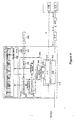
- FIG. 3 provides a more detailed block diagram of an Add Drop Multiplexer (ADM) 310, in accordance with an embodiment of the invention.
- ADM 310 includes STE 312, LTE 314, a TSI 316, a processor 318, memory 320, and a craft port 322.
- the processor 318 preferably, includes a Connectionless Network Protocol (CLNP) machine 330, a IS-IS protocol machine 332, a management application 334, and a management interface 336, an OSI stack layers 4-7 machine 342, and a Link Access Protocol - D (LAP-D) machine 344.
- CLNP Connectionless Network Protocol
- the memory 320 preferably, includes an IS-IS routing table 338.
- the administrator when a network administrator wishes to change the routing metric values in ADM 310's routing table, the administrator enters appropriate instructions through the computer 210 connected to OSS 220. These instructions are then routed from the OSS 220 to the appropriate GNE 230, after which, they are routed through the SONET network 100 to the proper ADM 310 over either the LDCC or SDCC, depending on the current routing metric values.
- the instructions are then routed by the LTE 312 or STE 314, respectively, to the TSI 316 where they are routed through the Link Access Protocol-D (LAP-D) machine 344 to the CLNP protocol machine 330 ofthe processor 318.
- LAP-D Link Access Protocol-D
- the CLNP protocol machine 330 then sends the instructions up through the OSI stack layers 4-7 machine 342 to the management application 334, which makes the appropriate changes to the IS-IS routing table 338 in memory 320.
- a network administrator makes changes to the IS-IS routing table 338 though a computer 340, also referred to as a craft interface, connected to the ADM 310 via a craft port 322.
- the network administrator sends instructions from the computer 340 to the ADM 310 through craft port 322, which sends the instruction to the management interface 336 of the processor 318.
- the management interface 336 then sends the instructions to the management application 334, which makes the appropriate changes to the routing table 338 in memory 320.
- network elements such as ADM 310 may also exchange IS-IS routing traffic amongst themselves.
- this information is received by ADM 310 and routed to the CLNP Protocol Machine 330, which sends the information to the IS-IS protocol machine 332.
- the IS-IS protocol machine 332 then examines the information and makes the appropriate changes in the routing table 338 in memory 320.
- the routing tables of the various LTEs in a SONET network can be set such that all IS-IS Level 2 traffic is sent over the LDCC rather than the SDCC.
- the routing table is set such that the computed routing metric for sending IS-IS Level 2 traffic results in the traffic being sent across the SDCC. This is because there is one LDCC link between LTEs with routing metric value of 50, and three SDCC links, each with a routing metric value of 10. As such, the computed routing metric for sending traffic across the LDCC is 50, and the computed routing metric for the SDCC is 30, or 10+10+10.
- the routing traffic is sent over the SDCC.
- STE-only equipment such as regenerators, must be an IS Level 2 capable network element.
- a processor such as processor 318, computes the sums of routing metric values, and determines on which link to place the IS-IS Level 2 traffic. Further, in an embodiment, a processor running the OSI stack protocols, which, for example, may also be processor 318, places the IS-IS Level 2 traffic on the determined link. Also, as will be obvious to one skilled in the art, separate processors can be used to implement these various functions.
- Figure 4 provides a block diagram of ADM 310, after the routing table has been adjusted so that IS-IS level 2 traffic is sent across the LDCC, in accordance with an embodiment of the invention.
- the assigned routing metric value for the LDCC is 50, while the assigned routing metric value for each SDCC link is now 20.
- the computed metric value for sending the traffic over the SDCC is 60, while for the LDCC it is still 50.
- the IS-IS Level 2 traffic is now sent across the LDCC. Accordingly, the intervening STE-only equipment need not be IS Level 2 capable.
Landscapes
- Engineering & Computer Science (AREA)
- Computer Networks & Wireless Communication (AREA)
- Signal Processing (AREA)
- Data Exchanges In Wide-Area Networks (AREA)
- Mobile Radio Communication Systems (AREA)
Abstract
Description
Claims (25)
- In a network having a plurality of line terminating equipment connected by a line data communication channels and a plurality of section terminating equipment connected by section data communication channels, a method for sending routing information comprising the steps of:assigning a value for a line data communications channel link;assigning a value for a section data communications channel link; andplacing routing information on the line data communications channel.
- The method of claim 1, wherein a plurality of point to point line data communications channel links form a path between the node and a second node, and a plurality of point-to-point section data communications channel links form a path between the node and the second node, further comprising the steps ofwherein the routing metric values are assigned such that the determined path is the line data communications channel.computing a sum of routing metric values for the point-to-point line data communications channel links that form a path between a node and the second node;computing a sum of routing metric values for the point-to-point section data communications channel links that form a path between the node and the second node; anddetermining from the computed sums the path to place Intermediate System to Intermediate System Level 2 routing information on;
- The method of claim 1 wherein the network carries SONET traffic.
- The method of claim 1 wherein the network is a network carries SDH traffic.
- The method of claim 1 wherein the routing information is Intermediate System to Intermediate System Level 2 information.
- A node in a network having a plurality of line terminating equipment connected by a line data communications channel and a plurality of section terminating equipment connected by a section data communications channel, comprising:a storage for storing a routing metric value for a line data communications channel link and for storing a routing metric value for a section data communications channel link; anda first processor for placing routing information on the line data communications channel.
- The node of claim 6, wherein a plurality of point to point line data communications channel links form a path between the node and a second node, and a plurality of point-to-point section data communications channel links form a path between the node and the second node; andwherein the node further comprises
a second processor for computing a sum of routing metric value for the point-to-point line data communications channel links that form a path between the node and the second node, a sum of routing metric values for the point-to-point section data communication channel links that forms a path between the node and the second node, and for determining from the computed sums the path to place the routing information on; andwherein the routing metric values are assigned such that the determined path is the line data communications channel. - The node of claim 6 wherein the network carries SONET traffic.
- The node of claim 6 wherein the network carries SDH traffic.
- The node of claim 6 wherein the routing information is Intermediate System to Intermediate System Level 2 information.
- The node of claim 6 wherein the node is an add-drop multiplexer.
- A network comprising:a plurality of line terminating equipment connected by a line data communications channel, including:means for storing a value for a line data communications channel link,means for storing a value for a section data communications channel link, andmeans for placing Intermediate System to Intermediate System Level 2 routing information on the line data comnunications channel; anda plurality of section terminating equipment connected by a section data communications channel.
- The network element of claim 12, wherein a plurality of point to point line data communications channel links form a path between the node and a second node, and a plurality of point-to-point section data communications channel links form a path between the node and the second node; andwherein the line terminating equipment further comprises:means for computing a sum of routing metric value for the line data communications channel links that form a path between the node and the second node;means for computing a sum of routing metric values for the section data communication channel links that forms a path between the node and the second node; andmeans for determining from the computed sums the path to place the routing information on; andwherein the values are set such that the determined path is the line data communications channel.
- The network of claim 12 wherein the network carries SONET traffic.
- The network of claim 12 wherein the network carries SDH traffic.
- The network of claim 12 wherein the routing information is Intermediate System to Intermediate System Level 2 information.
- The network of claim 12 wherein the line terminating equipment is an add-drop multiplexer,
- A node in a network having a plurality of line terminating equipment connected by a line data communications channel and a plurality of section terminating equipment connected by a section data communications channel, comprising:means for storing a routing metric value for a line data communications channel link;means for storing a routing metric value for a section data communications channel link; andmeans for placing routing information on the line data communications channel.
- The node of claim 18, wherein a plurality of point to point line data communications channel links form a path between the node and a second node, and a plurality of point-to-point section data communications channel links form a path between the node and the second node; andwherein the node further comprisesmeans for computing a sum of routing metric value for the point-to-point line data communications channel links that form a path between the node and the second node;means for computing a sum of routing metric values for the point-to-point section data communication channel links that forms a path between the node and the second node; andmeans for determining from the computed sums the path to place the routing information on;wherein the routing metric values are assigned such that the determined path is the line data communications channel.
- The node of claim 18 wherein the network carries SONET traffic.
- The node of claim 18 wherein the network carries SDH traffic.
- The node of claim 18 wherein the routing information is Intermediate System to Intermediate System Level 2 information.
- The node of claim 18 wherein the node is an add-drop multiplexer.
- A node in a network having a plurality of line terminating equipment connected by a line data communications channel and a plurality of section terminating equipment connected by a section data communications channel, and wherein a plurality of point to point line data communications channel links form a path between the node and a second node, and a plurality of point-to-point section data communications channel links form a path between the node and the second node, comprising:wherein the routing metric values are assigned such that the determined path is the line data communications channel.a storage for storing a routing metric value for a line data communications channel linkand for storing a routing metric value for a section data communications channel link; anda processor for placing routing information on the line data communications channel, for computing a sum of routing metric values for the point-to-point line data communications channel links that form a path between the node and the second node, a sum of routing metric values for the point-to-point section data communication channel links that forms a path between the node and the second node, and for determining from the computed sums the path to place the routing information on; and
- The node of claim 24 wherein the routing information is Intermediate System to Intermediate System Level 2 information
Applications Claiming Priority (2)
| Application Number | Priority Date | Filing Date | Title |
|---|---|---|---|
| US391031 | 1999-09-07 | ||
| US09/391,031 US6757306B1 (en) | 1999-09-07 | 1999-09-07 | Method and system for intermediate system level 2 transparency using the SONET LDCC |
Publications (3)
| Publication Number | Publication Date |
|---|---|
| EP1083689A2 true EP1083689A2 (en) | 2001-03-14 |
| EP1083689A3 EP1083689A3 (en) | 2002-09-11 |
| EP1083689B1 EP1083689B1 (en) | 2004-06-23 |
Family
ID=23544931
Family Applications (1)
| Application Number | Title | Priority Date | Filing Date |
|---|---|---|---|
| EP00307702A Expired - Lifetime EP1083689B1 (en) | 1999-09-07 | 2000-09-07 | A method of sending routing data across a network and a network node using the method |
Country Status (4)
| Country | Link |
|---|---|
| US (1) | US6757306B1 (en) |
| EP (1) | EP1083689B1 (en) |
| CA (1) | CA2317780A1 (en) |
| DE (1) | DE60011719T2 (en) |
Cited By (2)
| Publication number | Priority date | Publication date | Assignee | Title |
|---|---|---|---|---|
| WO2006058490A1 (en) | 2004-11-30 | 2006-06-08 | Huawei Technologies Co., Ltd. | A method for negotiating the bandwidth of data communication channel automatically |
| WO2006079431A1 (en) * | 2005-01-24 | 2006-08-03 | Nokia Siemens Networks Gmbh & Co. Kg | Method for iterative routing with the aid of a path-dependent routing metric |
Families Citing this family (33)
| Publication number | Priority date | Publication date | Assignee | Title |
|---|---|---|---|---|
| US7460652B2 (en) | 2003-09-26 | 2008-12-02 | At&T Intellectual Property I, L.P. | VoiceXML and rule engine based switchboard for interactive voice response (IVR) services |
| US7356475B2 (en) | 2004-01-05 | 2008-04-08 | Sbc Knowledge Ventures, L.P. | System and method for providing access to an interactive service offering |
| US7936861B2 (en) | 2004-07-23 | 2011-05-03 | At&T Intellectual Property I, L.P. | Announcement system and method of use |
| US8165281B2 (en) | 2004-07-28 | 2012-04-24 | At&T Intellectual Property I, L.P. | Method and system for mapping caller information to call center agent transactions |
| US20060026049A1 (en) * | 2004-07-28 | 2006-02-02 | Sbc Knowledge Ventures, L.P. | Method for identifying and prioritizing customer care automation |
| US7580837B2 (en) | 2004-08-12 | 2009-08-25 | At&T Intellectual Property I, L.P. | System and method for targeted tuning module of a speech recognition system |
| US7602898B2 (en) * | 2004-08-18 | 2009-10-13 | At&T Intellectual Property I, L.P. | System and method for providing computer assisted user support |
| US20060062375A1 (en) * | 2004-09-23 | 2006-03-23 | Sbc Knowledge Ventures, L.P. | System and method for providing product offers at a call center |
| US7197130B2 (en) * | 2004-10-05 | 2007-03-27 | Sbc Knowledge Ventures, L.P. | Dynamic load balancing between multiple locations with different telephony system |
| US7668889B2 (en) | 2004-10-27 | 2010-02-23 | At&T Intellectual Property I, Lp | Method and system to combine keyword and natural language search results |
| US7657005B2 (en) * | 2004-11-02 | 2010-02-02 | At&T Intellectual Property I, L.P. | System and method for identifying telephone callers |
| US7724889B2 (en) | 2004-11-29 | 2010-05-25 | At&T Intellectual Property I, L.P. | System and method for utilizing confidence levels in automated call routing |
| US7864942B2 (en) * | 2004-12-06 | 2011-01-04 | At&T Intellectual Property I, L.P. | System and method for routing calls |
| US7242751B2 (en) | 2004-12-06 | 2007-07-10 | Sbc Knowledge Ventures, L.P. | System and method for speech recognition-enabled automatic call routing |
| US20060126811A1 (en) * | 2004-12-13 | 2006-06-15 | Sbc Knowledge Ventures, L.P. | System and method for routing calls |
| US20060126808A1 (en) * | 2004-12-13 | 2006-06-15 | Sbc Knowledge Ventures, L.P. | System and method for measurement of call deflection |
| US7751551B2 (en) | 2005-01-10 | 2010-07-06 | At&T Intellectual Property I, L.P. | System and method for speech-enabled call routing |
| US7450698B2 (en) | 2005-01-14 | 2008-11-11 | At&T Intellectual Property 1, L.P. | System and method of utilizing a hybrid semantic model for speech recognition |
| US7627096B2 (en) | 2005-01-14 | 2009-12-01 | At&T Intellectual Property I, L.P. | System and method for independently recognizing and selecting actions and objects in a speech recognition system |
| US7627109B2 (en) | 2005-02-04 | 2009-12-01 | At&T Intellectual Property I, Lp | Call center system for multiple transaction selections |
| US20060182134A1 (en) * | 2005-02-11 | 2006-08-17 | Sbc Knowledge Ventures, L.P | System and method for dissimilar handoffs in a SONET system |
| US20060188087A1 (en) * | 2005-02-18 | 2006-08-24 | Sbc Knowledge Ventures, Lp | System and method for caller-controlled music on-hold |
| US8130936B2 (en) * | 2005-03-03 | 2012-03-06 | At&T Intellectual Property I, L.P. | System and method for on hold caller-controlled activities and entertainment |
| US7933399B2 (en) * | 2005-03-22 | 2011-04-26 | At&T Intellectual Property I, L.P. | System and method for utilizing virtual agents in an interactive voice response application |
| US8223954B2 (en) | 2005-03-22 | 2012-07-17 | At&T Intellectual Property I, L.P. | System and method for automating customer relations in a communications environment |
| US7636432B2 (en) | 2005-05-13 | 2009-12-22 | At&T Intellectual Property I, L.P. | System and method of determining call treatment of repeat calls |
| US7657020B2 (en) | 2005-06-03 | 2010-02-02 | At&T Intellectual Property I, Lp | Call routing system and method of using the same |
| US8005204B2 (en) | 2005-06-03 | 2011-08-23 | At&T Intellectual Property I, L.P. | Call routing system and method of using the same |
| US8503641B2 (en) * | 2005-07-01 | 2013-08-06 | At&T Intellectual Property I, L.P. | System and method of automated order status retrieval |
| US8175253B2 (en) * | 2005-07-07 | 2012-05-08 | At&T Intellectual Property I, L.P. | System and method for automated performance monitoring for a call servicing system |
| US8526577B2 (en) * | 2005-08-25 | 2013-09-03 | At&T Intellectual Property I, L.P. | System and method to access content from a speech-enabled automated system |
| US8548157B2 (en) | 2005-08-29 | 2013-10-01 | At&T Intellectual Property I, L.P. | System and method of managing incoming telephone calls at a call center |
| US20070050485A1 (en) * | 2005-08-30 | 2007-03-01 | Sbc Knowledge Ventures, L.P. | System and method for designing multi-ring communication networks |
Family Cites Families (8)
| Publication number | Priority date | Publication date | Assignee | Title |
|---|---|---|---|---|
| US5265096A (en) * | 1991-07-03 | 1993-11-23 | Transwitch Corporation | Sonet alarm indication signal transmission method and apparatus |
| CA2092134C (en) * | 1992-03-24 | 1998-07-21 | Anthony J. Mazzola | Distributed routing network element |
| US5262906A (en) * | 1992-06-19 | 1993-11-16 | Alcatel Network Systems, Inc. | Message routing for SONET telecommunications maintenance network |
| US5923653A (en) * | 1995-04-21 | 1999-07-13 | Tektronix, Inc. | SONET/SDH receiver processor |
| US6256292B1 (en) * | 1996-07-11 | 2001-07-03 | Nortel Networks Corporation | Self-healing line switched ring for ATM traffic |
| US6078596A (en) * | 1997-06-26 | 2000-06-20 | Mci Communications Corporation | Method and system of SONET line trace |
| GB9716198D0 (en) * | 1997-07-31 | 1997-10-08 | Plessey Telecomm | RAP routeing for ISO 10589 |
| GB2332809A (en) * | 1997-12-24 | 1999-06-30 | Northern Telecom Ltd | Least cost routing |
-
1999
- 1999-09-07 US US09/391,031 patent/US6757306B1/en not_active Expired - Lifetime
-
2000
- 2000-09-06 CA CA002317780A patent/CA2317780A1/en not_active Abandoned
- 2000-09-07 DE DE60011719T patent/DE60011719T2/en not_active Expired - Fee Related
- 2000-09-07 EP EP00307702A patent/EP1083689B1/en not_active Expired - Lifetime
Cited By (3)
| Publication number | Priority date | Publication date | Assignee | Title |
|---|---|---|---|---|
| WO2006058490A1 (en) | 2004-11-30 | 2006-06-08 | Huawei Technologies Co., Ltd. | A method for negotiating the bandwidth of data communication channel automatically |
| EP1802034A4 (en) * | 2004-11-30 | 2008-04-02 | Huawei Tech Co Ltd | AUTOMATIC NEGOTIATION METHOD OF DATA COMMUNICATION CHANNEL BANDWIDTH |
| WO2006079431A1 (en) * | 2005-01-24 | 2006-08-03 | Nokia Siemens Networks Gmbh & Co. Kg | Method for iterative routing with the aid of a path-dependent routing metric |
Also Published As
| Publication number | Publication date |
|---|---|
| CA2317780A1 (en) | 2001-03-07 |
| DE60011719D1 (en) | 2004-07-29 |
| DE60011719T2 (en) | 2004-10-28 |
| EP1083689B1 (en) | 2004-06-23 |
| US6757306B1 (en) | 2004-06-29 |
| EP1083689A3 (en) | 2002-09-11 |
Similar Documents
| Publication | Publication Date | Title |
|---|---|---|
| EP1083689B1 (en) | A method of sending routing data across a network and a network node using the method | |
| US6992975B1 (en) | Multiple ring support within a single network element | |
| US6917759B2 (en) | Shared mesh signaling algorithm and apparatus | |
| US7167445B2 (en) | Virtual line switched ring (VLSR) connection state distribution scheme | |
| EP0984574B1 (en) | Backwards-compatible failure restoration in bidirectional multiplex section-switched ring transmission systems | |
| US5781535A (en) | Implementation protocol for SHN-based algorithm restoration platform | |
| EP0573211B1 (en) | Distributed switching in bidirectional multiplex section-switched ring transmission systems | |
| US20030214962A1 (en) | Method and apparatus for bandwidth optimization in network ring topology | |
| EP1126649A2 (en) | Method and apparatus for providing a more efficient use of the total bandwidth capacity in a synchronous optical network | |
| EP0818940A2 (en) | Self-healing line switched ring for ATM traffic | |
| EP1735950B1 (en) | Line-level path protection in the optical layer | |
| JP2005500720A (en) | Ethernet protection system | |
| US6904542B2 (en) | System for group-based distributed protection switching | |
| JP4565751B2 (en) | Transmission equipment | |
| US7570583B2 (en) | Extending SONET/SDH automatic protection switching | |
| US6608836B2 (en) | Method and apparatus for egress channel architecture that supports protection within SONET/sdh based networks | |
| US7573814B1 (en) | Method and apparatus for protection of an optical network | |
| US7031261B1 (en) | Method and apparatus for egress channel architecture that supports protection within SONET/SDH based networks | |
| EP1523825B1 (en) | Path protection scheme in a shared mesh network | |
| EP1322056A1 (en) | Method and network element for avoiding misconnections in a shared protection ring telecommunication network | |
| CA2356643C (en) | Virtual line switched ring | |
| WO2003007005A1 (en) | Virtual line switched ring (vlsr) connection state distribution scheme |
Legal Events
| Date | Code | Title | Description |
|---|---|---|---|
| PUAI | Public reference made under article 153(3) epc to a published international application that has entered the european phase |
Free format text: ORIGINAL CODE: 0009012 |
|
| 17P | Request for examination filed |
Effective date: 20000927 |
|
| AK | Designated contracting states |
Kind code of ref document: A2 Designated state(s): AT BE CH CY DE DK ES FI FR GB GR IE IT LI LU MC NL PT SE |
|
| AX | Request for extension of the european patent |
Free format text: AL;LT;LV;MK;RO;SI |
|
| PUAL | Search report despatched |
Free format text: ORIGINAL CODE: 0009013 |
|
| AK | Designated contracting states |
Kind code of ref document: A3 Designated state(s): AT BE CH CY DE DK ES FI FR GB GR IE IT LI LU MC NL PT SE |
|
| AX | Request for extension of the european patent |
Free format text: AL;LT;LV;MK;RO;SI |
|
| AKX | Designation fees paid |
Designated state(s): DE FR GB |
|
| 17Q | First examination report despatched |
Effective date: 20030513 |
|
| RAP1 | Party data changed (applicant data changed or rights of an application transferred) |
Owner name: NORTEL NETWORKS LIMITED |
|
| RTI1 | Title (correction) |
Free format text: A METHOD OF SENDING ROUTING DATA ACROSS A NETWORK AND A NETWORK NODE USING THE METHOD |
|
| GRAP | Despatch of communication of intention to grant a patent |
Free format text: ORIGINAL CODE: EPIDOSNIGR1 |
|
| RTI1 | Title (correction) |
Free format text: A METHOD OF SENDING ROUTING DATA ACROSS A NETWORK AND A NETWORK NODE USING THE METHOD |
|
| GRAS | Grant fee paid |
Free format text: ORIGINAL CODE: EPIDOSNIGR3 |
|
| GRAA | (expected) grant |
Free format text: ORIGINAL CODE: 0009210 |
|
| AK | Designated contracting states |
Kind code of ref document: B1 Designated state(s): DE FR GB |
|
| REG | Reference to a national code |
Ref country code: GB Ref legal event code: FG4D |
|
| REG | Reference to a national code |
Ref country code: IE Ref legal event code: FG4D |
|
| REF | Corresponds to: |
Ref document number: 60011719 Country of ref document: DE Date of ref document: 20040729 Kind code of ref document: P |
|
| PGFP | Annual fee paid to national office [announced via postgrant information from national office to epo] |
Ref country code: FR Payment date: 20040820 Year of fee payment: 5 |
|
| PGFP | Annual fee paid to national office [announced via postgrant information from national office to epo] |
Ref country code: GB Payment date: 20040901 Year of fee payment: 5 |
|
| PGFP | Annual fee paid to national office [announced via postgrant information from national office to epo] |
Ref country code: DE Payment date: 20040930 Year of fee payment: 5 |
|
| ET | Fr: translation filed | ||
| PLBE | No opposition filed within time limit |
Free format text: ORIGINAL CODE: 0009261 |
|
| STAA | Information on the status of an ep patent application or granted ep patent |
Free format text: STATUS: NO OPPOSITION FILED WITHIN TIME LIMIT |
|
| REG | Reference to a national code |
Ref country code: IE Ref legal event code: MM4A |
|
| 26N | No opposition filed |
Effective date: 20050324 |
|
| PG25 | Lapsed in a contracting state [announced via postgrant information from national office to epo] |
Ref country code: GB Free format text: LAPSE BECAUSE OF NON-PAYMENT OF DUE FEES Effective date: 20050907 |
|
| PG25 | Lapsed in a contracting state [announced via postgrant information from national office to epo] |
Ref country code: DE Free format text: LAPSE BECAUSE OF NON-PAYMENT OF DUE FEES Effective date: 20060401 |
|
| GBPC | Gb: european patent ceased through non-payment of renewal fee |
Effective date: 20050907 |
|
| PG25 | Lapsed in a contracting state [announced via postgrant information from national office to epo] |
Ref country code: FR Free format text: LAPSE BECAUSE OF NON-PAYMENT OF DUE FEES Effective date: 20060531 |
|
| REG | Reference to a national code |
Ref country code: FR Ref legal event code: ST Effective date: 20060531 |