EP1083509A1 - Procédé d'affichage sur un terminal d'utilisation - Google Patents
Procédé d'affichage sur un terminal d'utilisation Download PDFInfo
- Publication number
- EP1083509A1 EP1083509A1 EP00402223A EP00402223A EP1083509A1 EP 1083509 A1 EP1083509 A1 EP 1083509A1 EP 00402223 A EP00402223 A EP 00402223A EP 00402223 A EP00402223 A EP 00402223A EP 1083509 A1 EP1083509 A1 EP 1083509A1
- Authority
- EP
- European Patent Office
- Prior art keywords
- site
- page
- display
- terminal
- information
- Prior art date
- Legal status (The legal status is an assumption and is not a legal conclusion. Google has not performed a legal analysis and makes no representation as to the accuracy of the status listed.)
- Ceased
Links
Images
Classifications
-
- G—PHYSICS
- G06—COMPUTING OR CALCULATING; COUNTING
- G06Q—INFORMATION AND COMMUNICATION TECHNOLOGY [ICT] SPECIALLY ADAPTED FOR ADMINISTRATIVE, COMMERCIAL, FINANCIAL, MANAGERIAL OR SUPERVISORY PURPOSES; SYSTEMS OR METHODS SPECIALLY ADAPTED FOR ADMINISTRATIVE, COMMERCIAL, FINANCIAL, MANAGERIAL OR SUPERVISORY PURPOSES, NOT OTHERWISE PROVIDED FOR
- G06Q30/00—Commerce
- G06Q30/02—Marketing; Price estimation or determination; Fundraising
Definitions
- the present invention relates to a display method on a terminal for using a document obtained during a session of viewing a website.
- the object of the invention is to make more documents presented to users essentially when these documents are composite pages produced using a description language of hypertext type.
- These information of a first type is related to a first mode display, a first mode of constitution of an image memory, the content is presented on a screen.
- second information to display is present at a given location in the displayed page on the screen, so at a given location in the file.
- This second information correspond to a second mode of constitution of the page displayed at the screen, for example that necessary to show an image.
- a call is made to a source file comprising on the one hand the second information to display and secondly the mode of constitution of the part of the corresponding page.
- Another function when displaying an HTML file associated with this score is caused by a specific maneuver, most of the time a double click of the left button of the mouse, while its index points to an image region concerned.
- another key on a keyboard for example the key sending, or carriage return, could be used for this purpose.
- the function associated with the pointing and triggered by this specific maneuver is replacing the page of the HTML file displayed on the screen by the reference file page designated by the link hypertext.
- This other page is taken from another memory, we will call it the landing page.
- the landing page is thus the page to which we are sent from an initial page.
- This technique is used in particular on the Internet where pages presented on the terminals have, for some of the elements of these pages, referring properties.
- it is customary to present in a top bar of the URL - Universal Resource Locator - screen of the HTML file describing the page displayed. It is also usual to present in a bar bottom of the screen the possible forwarding address associated with the element of the displayed page pointed to by the pointing device. This forwarding address is the one from which we will make a page while the pointing device is pointed to an item on the first page and that the specific referral action (or double click) is launched.
- files written in HTML have for each page element possibly position designations, always information to display, and possibly referral information.
- Information to display are themselves either directly editable by the file editor (from edition type in standard word processor) or editable on the screen by a image display software (or a subroutine of the editing software with an image presentation option).
- This file contains Furthermore, for the element of the page concerned, whether this element is text or an image, the designation of a reference file to allow, depending of need or will, the switching described above.
- Return address can correspond to the same site, i.e. in practice the same physical file delivery machine connected to the Internet. In that case the referral address may be a sub-address on this site. However the referral address can point to another site, produced by another organism, even most of the time on another machine, connected, it also, to the Internet.
- So companies that produce directories on the Internet are available to users who visit their site a search engine with which the visitor can ask a question, thematic or nominative.
- the user can thus be delivered, in the form of pages composed by the search engine, a list of websites providing information on a topic mentioned or corresponding to the name sought.
- the sites on the list are also produced (automatically) in HTML, so that the user only has to point them and initiate the maneuver specific to take the content.
- This service is free. Nevertheless it has a cost.
- free online directory production companies have planned to place, in the message prompting to ask a question as well as in the response message to the question asked, advertising inserts or informative encouraging the user to become aware of the existence of a other site.
- advertising inserts or informative encouraging the user to become aware of the existence of a other site.
- This advertising image is associated, according to HTML programming, with an address of reference.
- the referral address corresponds to a site managed by the organization which agreed to pay for the advertising insert to the directory production company free.
- Such a process is not always interesting for the user. Indeed because the internet market is global, the user during a session Internet can be located in a place in the world and be invested with a culture completely different from that of the organization that purchased the insert advertising. In addition, for commercial reasons, the advertising presented may only be of regional interest, for example advertisements for products only available in America, while the user is other region, for example in Europe, where the advertised products are not distributed. Under these conditions, the advertising presented loses its appeal.
- a user connects to the Internet by through an access provider and launches a viewing request of a site.
- the access provider receives the response to the request from the Internet, it delivers it to the user having modified some of the characteristics of the transmitted file: those which correspond to unwanted ads.
- the access provider can know by nature to which physical place the user has connected, and therefore a priori which is the spectrum of his needs given the culture of the people at this place. Other more personalized filtering will also be possible.
- the advantage thus provided by the invention is that the information for replacement, source file address and forwarding file address, are not themselves do not need to be transmitted over the Internet. Indeed, in its proximity server an access provider can memorize these information and perform the replacement on the fly. It is even possible that the landing page and the source image itself are stored on this server proximity, which further reduces traffic on the Internet (which is also beginning to become saturated).
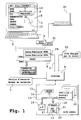
- FIG. 1 shows the different means that can be used to implements the process of the invention.
- a user terminal 1 comprising by example a microcomputer with its keyboard 2, is connected, in general by a switched telephone network 3, to circuits 4 of an access provider.
- the access provider allows access to a site, more generally a network 5 sites, including the Internet. From these sites the user terminal can receive information or send it to them.
- the circuits 4 include in practice modem type organs for receive requests from terminal 1, and other organs of modem type to connect to network 5 here Internet. Possibly the connections 6 of circuits 4 to network 5 can themselves pass through the switched telephone network 3, or by a dedicated network.
- a request issued by the terminal 1 essentially comprises a designation of an address of an information server 7 to which the user from terminal 1 wishes to be connected and from which he wishes to receive a page in generally a home page, unless it has already designated a page dedicated to this server 7.
- a source address 11 designated by the request is displayed in a top bar 19 of screen 8 respecting the syntax Internet: http: // source11.
- the request also includes an indication an IP address, Internet Protocol, Internet protocol, which will be useful for server 7 to send the desired information to terminal 1.
- the response intended for terminal 1 via circuits 4 includes on the one hand all the useful information to display a corresponding page at the request on terminal 1, and on the other hand the IP address which allows the network 5 as well as circuits 4 of the access provider to address the information to be transmitted correctly.
- these are transmitted in packet mode, each packet comprising a part of the file HTML describing the page received and an address corresponding to this address IP.
- FIG. 1 shows on screen 8 of terminal 1 the message, the page, received.
- This message has a number of lines with alphanumeric type indications, AAA, BBB, up to GGG.
- alphanumeric information is displayed by browser software, software which makes it possible, in a known manner, both to constitute the requests, send them, receive pages in responses, and post those responses on screen 8. From this last point of view, browser software behaves at least as a document display software.
- software browser includes means for introducing into the file presented images such as image 9 comprising here a graphic ADVERTISING1.
- a pointer 10 for example an index whose position is governed by a mouse or a maneuvering ball, we can designate an area of the screen 8 where the image is located 9. In this case, we see appear at the top of the screen, at least if we have chosen an option to see it, an indication of a source site where the image represented in the area comes from 9.
- a source site 11 is connected to the Internet network 5 of the same way as the data server 7.
- This source site includes in its in principle a modem 12 to be connected to the Internet network 5 on the one hand, and to be connected on the other hand to a bus 13 of data, address and control in relation to a microprocessor 14, a memory program 15 and a data memory 16 of the site 11.
- the memory of program 15 includes a program 17 with a subroutine essential 18 transmission.
- the purpose of subroutine 18 is to send on the network, at the IP address specified for it, the information it needs show for element 9 of the picture and which are, for simplicity, here the ADVERTISING 1 graphics.
- This ADVERTISING 1 graphics is for example stored in memory 16.
- the information transmitted also includes a forwarding address, also for example contained in memory 16 in association with the content of the image ADVERTISING1.
- Return address then appears in a lower bar of the image proposed on the screen 8 by terminal 1 browser software.
- the address shown in the bar lower corresponds to a site 20 designated by a reference and where the user take the page it wants to display on screen 8 via the Internet replacement of that shown in figure 1, if it performs an action specific (double click) while its pointer 10 indicates area 9.
- sites 7, 11 and 20 show great diversity. This diversity makes it possible to illustrate a general case. It is however possible to hold all or part of the stored image information in memory 16 of site 11 in site 20 itself. But such architecture is not that interesting.
- the site 7 is managed by a service provider, including free services and particular directory services. For reasons of good management of its advertising, he can choose to ask his client, who in turn manages the site 20 (and who seeks to bring users to his home) to give him the file corresponding to memory 16 and which lead to this site 20.
- Program 17 also includes subprograms 21 and 22 update and message formatting to update memory 16 and, when requested, constitute responses in hypertext format.
- the server 7 will propose advertisements that do not correspond to the user of the terminal 1.
- the server 7 in circuits 4 of the access provider, or in circuits of any body involved in the transmission of data between server 7 and terminal 1, we replace the information corresponding to the display of ADVERTISEMENT1 advertising with other information, for example this other information corresponds to the display of other advertisements.
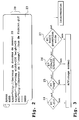
- FIG. 2 gives an example of file 23 which is sent by the server 7 to terminal 1 via network 5.
- this file 23 contains alphanumeric indications AAA, BBB to GGG to display as is, starting for example from the top left of the image presented on screen 8.
- the file includes, sequentially, three types of information corresponding to zone 9.
- the address which appears after "http: //" is that of site 20.
- this address has two forms: on the one hand, a label understandable by the user and which is displayed on screen 8 in the area 19.
- it is an expression in binary form (coded by bytes) which gives the absolute address of site 20 on the Internet 5.
- This absolute address of site 20 can be obtained from the wording understandable by the user using a known service mechanism domain names or DNS which is not described here.
- circuits 4 In the invention we will replace, in circuits 4, the image ADVERTISING1 by another image. As there is no question of having it done this work by an operator, this work will be done automatically.
- circuits 4 have equipment, in particular analogous to that of server 11, capable of implementing a shown test program schematically in Figure 3. The purpose of this test program is to test particular expressions in the transmitted files to know if in the image shown we are dealing with an advertising image.
- the program of FIG. 3 includes for this purpose a first test 24 to know if in file 23 there is an elementary image of type .gif .jpg or other or if on the contrary the part shown is a text file (ending usual .doc or .txt). If it is not the case, if it is about a text file, one will not cause swapping and we will let the display run normally.
- a second test 25 which can be linked to the fact that the part to be shown of the file is an image, we will try to know the position of the image. Since the web pages are presented to users in setting the top on the top of the screen 8, it is possible that part of a page to show, because it is too large, is located below the size of the screen 8. In this case, in a known manner, a vertical elevator bar on the side allows you to move the page vertically. This elevator bar allows you to scroll it in screen 8. However, the beginning of the page which is shown is normally the top of the page. Of course, when it comes to advertising, advertisers are trying to get attention. Through therefore the position of the advertising insert 9 will often include a top of page indication: a "-top" indication or equivalent. If it's not not the case we will cause a normal display.
- the size of the image shown is relatively small. And especially for reasons of reversing with each other like mentioned above, they will have standardized sizes.
- the size 230 x 33 is a standard size for an advertising insert. We know by elsewhere other sizes such as size 125 x 125.
- the position data of insert 9 what is the size of the insert (which we do not yet know if it is advertising) which must be shown in location 9. If the size is not a size of a small insert but on the contrary that of a large image, outside the specified formats, it this is certainly the image that the user of terminal 1 wanted to obtain. there is therefore no question of changing it.
- test 24 to 27 we can have the belief that it is an advertisement.
- other tests are possible, such as for example a test relating to the address of the site 7 delivering the first page, or that of the site 11, or that of site 20.
- the decision to replace the images provided by the server 7 by images of another advertiser can result from a specific subscription (possibly chargeable) subscribed by the user of terminal 1. So we can submit this reversal, or the absence of a reversal, for subscription by the owner of terminal 1 of a particular type of subscription with the access provider 4.
- the proximity 4 can know the location of the call, for example whether the call comes from the south of a national region or from the north of this region national.
- the replacement of the planned ADVERTISING1 by server 7 can be different depending on whether it is to replace it for the user of terminal 30 or for the user of terminal 1.
- the memory 29, which will preferably be a cache memory will include advertisements of different types to be supplied according to a connection number pop (point of presence) by which each of the users terminals 1 or 30 have connected.
- circuits 4 can provide it with advertisements that are better targeted to its socio-cultural profile.
- Profile and IP address information can be stored in a memory of circuits 4 in correspondence a subscription number for this user, or a serial number corresponding to terminal 1.
Landscapes
- Business, Economics & Management (AREA)
- Engineering & Computer Science (AREA)
- Accounting & Taxation (AREA)
- Development Economics (AREA)
- Strategic Management (AREA)
- Finance (AREA)
- Game Theory and Decision Science (AREA)
- Entrepreneurship & Innovation (AREA)
- Economics (AREA)
- Marketing (AREA)
- Physics & Mathematics (AREA)
- General Business, Economics & Management (AREA)
- General Physics & Mathematics (AREA)
- Theoretical Computer Science (AREA)
- Information Transfer Between Computers (AREA)
Abstract
Description
- on lance à ce premier site une requête d'affichage de cette première page de ce premier site,
- dans ce terminal d'utilisation, on reçoit un fichier de type hypertexte, transmis en provenance de ce premier site, et comportant des éléments à afficher,
- chaque élément à afficher comporte une information relative à un contenu pour cette première page,
- on repère dans le fichier hypertexte transmis des expressions particulières, et
- quand ces expressions particulières comportent des caractéristiques attendues,
- pour chaque élément à afficher contenant des expressions particulières comportant des caractéristiques attendues on modifie avant affichage une information relative au contenu et une information d'adresse de renvoi à une autre page.
- un serveur de proximité interposé entre ce terminal et ce premier site,
- des moyens dans ce serveur de proximité pour recevoir un fichier de type hypertexte, transmis au terminal d'utilisation en provenance de ce premier site,
- ce fichier comportant des éléments à afficher,
- chaque élément à afficher comportant une information (src=) relative à un contenu pour cette première page,
- des moyens pour repérer dans le fichier hypertexte transmis des expressions particulières, et
- des circuits pour, quand ces expressions particulières comportent des caractéristiques attendues, modifier avant affichage pour chaque élément à afficher contenant des expressions particulières qui comportent des caractéristiques attendues une information relative au contenu et une information d'adresse de renvoi à une autre page.
- Figure 1: la représentation schématique d'une organisation des moyens impliqués pour mettre en oeuvre le procédé de l'invention ;
- Figure 2 : une représentation simplifiée du fichier transmis en réponse à une requête Internet et des parties de ce fichier qui vont être remplacées selon le procédé de l'invention ;
- Figure 3 : une représentation schématique de critères permettant de repérer dans une page transmise la présence d'une publicité à remplacer.
Claims (14)
- Procédé d'affichage sur un terminal (1) d'utilisation d'une première page dans une session (23) de visualisation d'un premier site (7) dans lequel,caractérisé en ce queon lance (4) à ce premier site une requête d'affichage de cette première page de ce premier site,dans ce terminal d'utilisation, on reçoit un fichier de type hypertexte (28), transmis en provenance de ce premier site, et comportant des éléments à afficher,chaque élément à afficher comporte une information (src=) relative à un contenu pour cette première page,on repère (24-27) dans le fichier hypertexte transmis des expressions particulières, etquand ces expressions particulières comportent des caractéristiques attendues,pour chaque élément (9) à afficher contenant des expressions particulières comportant des caractéristiques attendues on modifie avant affichage une information relative au contenu et une information d'adresse de renvoi à une autre page.
- Procédé selon la revendication 1, caractérisé en ce que le premier site est un site Internet.
- Procédé selon l'une des revendications 1 à 2, caractérisé en ce que chaque élément à afficher comporte des désignations (target) d'image dans cette première page et une information (href=) d'une adresse de renvoi à une autre page.
- Procédé selon l'une des revendications 1 à 3, caractérisé en ce que, pour modifier avant affichage, on modifie le fichier hypertexte transmis.
- Procédé selon l'une des revendications 1 à 4, caractérisé en ce que l'information relative à un contenu pour une première désignation d'image dans la première page est une adresse de source (source11), directe ou indirecte d'une image élémentaire, mémorisée dans ce premier site ou dans un autre site, le contenu à afficher pour cette désignation d'image de la première page étant disponible à cette adresse de source.
- Procédé selon l'une des revendications 1 à 5, caractérisé en ce que les expressions particulières des fichiers sont des caractéristiques de publicité.
- Procédé selon l'une des revendications 1 à 6, caractérisé en ce que les caractéristiques attendues sont des caractéristiques de taille (230x33) et ou de lieu de la position (top), et ou de nature de l'information (buyit) relative au contenu, et ou du contenu, et ou de l'adresse du site et ou de la première page.
- Procédé selon l'une des revendications 1 à 7, caractérisé en ce que on modifie l'affichage dans un serveur (4) d'accès relié au terminal et qui sert de passerelle entre le terminal et un réseau connecté au site pour transmettre le fichier hypertexte.
- Procédé selon la revendication 8, caractérisé en ce qu'on modifie l'affichage si un accord est donné dans un mode d'abonnement du terminal au serveur d'accès.
- Procédé selon l'une des revendications 1 à 9, caractérisé en ce que, d'une session de visualisation à une autre, on change le mode de modification de l'affichage.
- Procédé selon l'une des revendications 1 à 10, caractérisé en ce qu'on modifie l'affichage en fonction de caractéristiques du terminal de visualisation, et ou de la session, et ou d'un profil utilisateur.
- Dispositif d'affichage sur un terminal (1) d'utilisation d'une première page dans une session (23) de visualisation d'un premier site (7) comportantcaractérisé en ce que ce serveur de proximité comporteun serveur (29) de proximité interposé entre ce terminal et ce premier site,des moyens dans ce serveur de proximité pour recevoir un fichier de type hypertexte (28), transmis au terminal d'utilisation en provenance de ce premier site,ce fichier comportant des éléments à afficher,chaque élément à afficher comportant une information (src=) relative à un contenu pour cette première page,des moyens (29) pour repérer (24-27) dans le fichier hypertexte transmis des expressions particulières, etdes circuits pour, quand ces expressions particulières comportent des caractéristiques attendues, modifier avant affichage, pour chaque élément (9) à afficher contenant des expressions particulières qui comportent des caractéristiques attendues, une information relative au contenu et une information d'adresse de renvoi à une autre page.
- Dispositif selon la revendication 12, caractérisé en ce que les circuits pour modifier comportent une mémoire cache.
- Dispositif selon l'une des revendications 12 à 13, caractérisé en ce que moyens pour repérer comportent un microprocesseur pour mettre en oeuvre un programme de test (24-27) et un programme d'interversion de contenu et d'adresse de renvoi.
Applications Claiming Priority (2)
| Application Number | Priority Date | Filing Date | Title |
|---|---|---|---|
| FR9911278A FR2798546B1 (fr) | 1999-09-09 | 1999-09-09 | Procede d'affichage sur un terminal d'utilisation |
| FR9911278 | 1999-09-09 |
Publications (1)
| Publication Number | Publication Date |
|---|---|
| EP1083509A1 true EP1083509A1 (fr) | 2001-03-14 |
Family
ID=9549669
Family Applications (1)
| Application Number | Title | Priority Date | Filing Date |
|---|---|---|---|
| EP00402223A Ceased EP1083509A1 (fr) | 1999-09-09 | 2000-08-03 | Procédé d'affichage sur un terminal d'utilisation |
Country Status (2)
| Country | Link |
|---|---|
| EP (1) | EP1083509A1 (fr) |
| FR (1) | FR2798546B1 (fr) |
Citations (5)
| Publication number | Priority date | Publication date | Assignee | Title |
|---|---|---|---|---|
| EP0877314A1 (fr) * | 1996-01-23 | 1998-11-11 | Aim Corporation | Systeme d'affichage d'informations |
| CA2250450A1 (fr) * | 1997-10-16 | 1999-04-16 | At&T Corp. | Methode et systeme de presentation de publicite personnalisee a un utilisateur sur le world wide web |
| US5933811A (en) * | 1996-08-20 | 1999-08-03 | Paul D. Angles | System and method for delivering customized advertisements within interactive communication systems |
| US5937392A (en) * | 1997-07-28 | 1999-08-10 | Switchboard Incorporated | Banner advertising display system and method with frequency of advertisement control |
| WO1999060504A1 (fr) * | 1998-05-15 | 1999-11-25 | Unicast Communications Corporation | Technique de mise en place de publicite repartie sur reseau et declenchee par navigateur, et d'affichage interstitiel de publicite |
-
1999
- 1999-09-09 FR FR9911278A patent/FR2798546B1/fr not_active Expired - Fee Related
-
2000
- 2000-08-03 EP EP00402223A patent/EP1083509A1/fr not_active Ceased
Patent Citations (5)
| Publication number | Priority date | Publication date | Assignee | Title |
|---|---|---|---|---|
| EP0877314A1 (fr) * | 1996-01-23 | 1998-11-11 | Aim Corporation | Systeme d'affichage d'informations |
| US5933811A (en) * | 1996-08-20 | 1999-08-03 | Paul D. Angles | System and method for delivering customized advertisements within interactive communication systems |
| US5937392A (en) * | 1997-07-28 | 1999-08-10 | Switchboard Incorporated | Banner advertising display system and method with frequency of advertisement control |
| CA2250450A1 (fr) * | 1997-10-16 | 1999-04-16 | At&T Corp. | Methode et systeme de presentation de publicite personnalisee a un utilisateur sur le world wide web |
| WO1999060504A1 (fr) * | 1998-05-15 | 1999-11-25 | Unicast Communications Corporation | Technique de mise en place de publicite repartie sur reseau et declenchee par navigateur, et d'affichage interstitiel de publicite |
Non-Patent Citations (1)
| Title |
|---|
| KOHDA Y ET AL: "Ubiquitous advertising on the WWW: Merging advertisement on the browser", COMPUTER NETWORKS AND ISDN SYSTEMS,NL,NORTH HOLLAND PUBLISHING. AMSTERDAM, vol. 28, no. 11, 1 May 1996 (1996-05-01), pages 1493 - 1499, XP004018245, ISSN: 0169-7552 * |
Also Published As
| Publication number | Publication date |
|---|---|
| FR2798546A1 (fr) | 2001-03-16 |
| FR2798546B1 (fr) | 2003-05-16 |
Similar Documents
| Publication | Publication Date | Title |
|---|---|---|
| US11409828B2 (en) | Dynamic language translation of web site content | |
| US6892354B1 (en) | Method of advertising on line during a communication link idle time | |
| AU2005242771B2 (en) | Automated graphical advertisement size compatibility and link insertion | |
| US6457025B2 (en) | Interstitial advertising display system and method | |
| FR2762460A1 (fr) | Systeme destine a fournir un environnement et une interface utilisateur ameliores pour des technologies de discussion en ligne | |
| JPH10301958A (ja) | データ通信システム用サーバコンピュータ | |
| JP2004536394A (ja) | ネットワークアーキテクチャにおいて連続式メッセージ送信ユニットを用いるシステムおよびその方法 | |
| FR2863127A1 (fr) | Procedes et dispositifs pour la delivrance asynchrone de donnees numeriques | |
| US20060136295A1 (en) | Techniques for magazine like presentation of advertisment using computers | |
| JP4256621B2 (ja) | ネットワークを介して受信した一時メッセージを表示する方法、プログラム製品、およびシステム | |
| EP2336967B1 (fr) | Messagerie personnalisée sur encarts web. | |
| WO2002071296A1 (fr) | Procede publicitaire a navigateur web ayant une fonction publicitaire | |
| EP1083509A1 (fr) | Procédé d'affichage sur un terminal d'utilisation | |
| EP2219113A2 (fr) | Procédé d'affichage, dispositif et produit programme d'ordinateur correspondant | |
| WO2001023976A2 (fr) | Distribution de contenu reseau autopropagee | |
| KR20030051626A (ko) | 3xx 범위의 HTTP 응답 코드를 통해 인터넷 웹페이지 광고를 전달하는 방법 및 시스템 | |
| KR20010069228A (ko) | 게시판 내부에 광고를 삽입하는 인터넷 광고방법 | |
| JP7696584B1 (ja) | 情報処理システムおよび情報処理方法 | |
| WO2002025507A1 (fr) | Systeme de publicite par courrier electronique | |
| Durie | E-Business essentials | |
| FR2527808A1 (fr) | Procede et dispositif de documentation dans un systeme informatique | |
| FR2796479A1 (fr) | Creation d'un document hypertexte en dependance d'un autre dans un terminal client | |
| WO2009034237A1 (fr) | Procede et systeme d'organisation de reunion par messages electroniques | |
| JP2001357296A (ja) | 携帯電話による、手軽なリアルタイム広告の出し方に関する発明 | |
| WO2001027808A1 (fr) | Page de demarrage dynamique |
Legal Events
| Date | Code | Title | Description |
|---|---|---|---|
| PUAI | Public reference made under article 153(3) epc to a published international application that has entered the european phase |
Free format text: ORIGINAL CODE: 0009012 |
|
| AK | Designated contracting states |
Kind code of ref document: A1 Designated state(s): AT BE CH CY DE DK ES FI FR GB GR IE IT LI LU MC NL PT SE |
|
| AX | Request for extension of the european patent |
Free format text: AL;LT;LV;MK;RO;SI |
|
| 17P | Request for examination filed |
Effective date: 20010914 |
|
| AKX | Designation fees paid |
Free format text: AT BE CH CY DE DK ES FI FR GB GR IE IT LI LU MC NL PT SE |
|
| RAP1 | Party data changed (applicant data changed or rights of an application transferred) |
Owner name: ALCATEL LUCENT |
|
| 17Q | First examination report despatched |
Effective date: 20070516 |
|
| STAA | Information on the status of an ep patent application or granted ep patent |
Free format text: STATUS: THE APPLICATION HAS BEEN REFUSED |
|
| 18R | Application refused |
Effective date: 20100928 |