EP1082497B1 - Retroreflective articles including a cured ceramer composite coating having abrasion and stain resistant characteristics - Google Patents
Retroreflective articles including a cured ceramer composite coating having abrasion and stain resistant characteristics Download PDFInfo
- Publication number
- EP1082497B1 EP1082497B1 EP99921633A EP99921633A EP1082497B1 EP 1082497 B1 EP1082497 B1 EP 1082497B1 EP 99921633 A EP99921633 A EP 99921633A EP 99921633 A EP99921633 A EP 99921633A EP 1082497 B1 EP1082497 B1 EP 1082497B1
- Authority
- EP
- European Patent Office
- Prior art keywords
- ceramer
- moiety
- coating
- retroreflective
- silane
- Prior art date
- Legal status (The legal status is an assumption and is not a legal conclusion. Google has not performed a legal analysis and makes no representation as to the accuracy of the status listed.)
- Expired - Lifetime
Links
- 238000000576 coating method Methods 0.000 title claims abstract description 133
- 239000011248 coating agent Substances 0.000 title claims abstract description 95
- 238000005299 abrasion Methods 0.000 title claims description 42
- 239000002131 composite material Substances 0.000 title description 5
- BLRPTPMANUNPDV-UHFFFAOYSA-N Silane Chemical compound [SiH4] BLRPTPMANUNPDV-UHFFFAOYSA-N 0.000 claims abstract description 110
- 229910000077 silane Inorganic materials 0.000 claims abstract description 86
- 239000000758 substrate Substances 0.000 claims abstract description 66
- 229910052809 inorganic oxide Inorganic materials 0.000 claims abstract description 50
- 239000011230 binding agent Substances 0.000 claims abstract description 41
- 239000000203 mixture Substances 0.000 claims description 151
- VYPSYNLAJGMNEJ-UHFFFAOYSA-N Silicium dioxide Chemical compound O=[Si]=O VYPSYNLAJGMNEJ-UHFFFAOYSA-N 0.000 claims description 82
- XLYOFNOQVPJJNP-UHFFFAOYSA-N water Substances O XLYOFNOQVPJJNP-UHFFFAOYSA-N 0.000 claims description 59
- 238000000034 method Methods 0.000 claims description 44
- 239000000178 monomer Substances 0.000 claims description 38
- 239000000377 silicon dioxide Substances 0.000 claims description 29
- NIXOWILDQLNWCW-UHFFFAOYSA-M Acrylate Chemical compound [O-]C(=O)C=C NIXOWILDQLNWCW-UHFFFAOYSA-M 0.000 claims description 24
- 239000002245 particle Substances 0.000 claims description 20
- HRPVXLWXLXDGHG-UHFFFAOYSA-N Acrylamide Chemical compound NC(=O)C=C HRPVXLWXLXDGHG-UHFFFAOYSA-N 0.000 claims description 10
- 239000000853 adhesive Substances 0.000 claims description 9
- 239000004615 ingredient Substances 0.000 claims description 9
- 230000001070 adhesive effect Effects 0.000 claims description 8
- 239000010426 asphalt Substances 0.000 claims description 7
- PNEYBMLMFCGWSK-UHFFFAOYSA-N aluminium oxide Inorganic materials [O-2].[O-2].[O-2].[Al+3].[Al+3] PNEYBMLMFCGWSK-UHFFFAOYSA-N 0.000 claims description 5
- 239000003550 marker Substances 0.000 claims description 5
- 125000005647 linker group Chemical group 0.000 claims description 4
- XPBBUZJBQWWFFJ-UHFFFAOYSA-N fluorosilane Chemical compound [SiH3]F XPBBUZJBQWWFFJ-UHFFFAOYSA-N 0.000 claims 5
- 239000002352 surface water Substances 0.000 claims 2
- 125000001153 fluoro group Chemical group F* 0.000 abstract description 44
- 238000012360 testing method Methods 0.000 description 62
- 239000002904 solvent Substances 0.000 description 47
- 239000002243 precursor Substances 0.000 description 34
- -1 e.g. Substances 0.000 description 33
- 150000001875 compounds Chemical class 0.000 description 31
- 239000000654 additive Substances 0.000 description 30
- 239000000084 colloidal system Substances 0.000 description 29
- 238000010998 test method Methods 0.000 description 29
- 239000000976 ink Substances 0.000 description 28
- HVVWZTWDBSEWIH-UHFFFAOYSA-N [2-(hydroxymethyl)-3-prop-2-enoyloxy-2-(prop-2-enoyloxymethyl)propyl] prop-2-enoate Chemical compound C=CC(=O)OCC(CO)(COC(=O)C=C)COC(=O)C=C HVVWZTWDBSEWIH-UHFFFAOYSA-N 0.000 description 26
- WHNPOQXWAMXPTA-UHFFFAOYSA-N 3-methylbut-2-enamide Chemical compound CC(C)=CC(N)=O WHNPOQXWAMXPTA-UHFFFAOYSA-N 0.000 description 24
- 229920003229 poly(methyl methacrylate) Polymers 0.000 description 23
- 239000004926 polymethyl methacrylate Substances 0.000 description 23
- 230000000996 additive effect Effects 0.000 description 22
- 239000004417 polycarbonate Substances 0.000 description 22
- 229920000515 polycarbonate Polymers 0.000 description 22
- 241001354243 Corona Species 0.000 description 20
- 239000000463 material Substances 0.000 description 20
- 239000007787 solid Substances 0.000 description 19
- 238000009472 formulation Methods 0.000 description 17
- KFZMGEQAYNKOFK-UHFFFAOYSA-N Isopropanol Chemical compound CC(C)O KFZMGEQAYNKOFK-UHFFFAOYSA-N 0.000 description 16
- 239000002253 acid Substances 0.000 description 16
- 150000002148 esters Chemical group 0.000 description 16
- 229920000642 polymer Polymers 0.000 description 16
- XDLMVUHYZWKMMD-UHFFFAOYSA-N 3-trimethoxysilylpropyl 2-methylprop-2-enoate Chemical compound CO[Si](OC)(OC)CCCOC(=O)C(C)=C XDLMVUHYZWKMMD-UHFFFAOYSA-N 0.000 description 15
- NLZUEZXRPGMBCV-UHFFFAOYSA-N Butylhydroxytoluene Chemical compound CC1=CC(C(C)(C)C)=C(O)C(C(C)(C)C)=C1 NLZUEZXRPGMBCV-UHFFFAOYSA-N 0.000 description 15
- 230000016615 flocculation Effects 0.000 description 15
- 238000005189 flocculation Methods 0.000 description 15
- 235000010354 butylated hydroxytoluene Nutrition 0.000 description 14
- 239000000126 substance Substances 0.000 description 14
- WJFKNYWRSNBZNX-UHFFFAOYSA-N 10H-phenothiazine Chemical compound C1=CC=C2NC3=CC=CC=C3SC2=C1 WJFKNYWRSNBZNX-UHFFFAOYSA-N 0.000 description 13
- 239000004322 Butylated hydroxytoluene Substances 0.000 description 13
- 229940095259 butylated hydroxytoluene Drugs 0.000 description 13
- 239000003999 initiator Substances 0.000 description 13
- 238000004519 manufacturing process Methods 0.000 description 13
- 229950000688 phenothiazine Drugs 0.000 description 13
- YXFVVABEGXRONW-UHFFFAOYSA-N Toluene Chemical compound CC1=CC=CC=C1 YXFVVABEGXRONW-UHFFFAOYSA-N 0.000 description 12
- 230000032798 delamination Effects 0.000 description 12
- 229910052739 hydrogen Inorganic materials 0.000 description 12
- 239000001257 hydrogen Substances 0.000 description 12
- 230000008569 process Effects 0.000 description 12
- 230000005855 radiation Effects 0.000 description 12
- 239000003963 antioxidant agent Substances 0.000 description 11
- 125000003118 aryl group Chemical group 0.000 description 11
- 125000004432 carbon atom Chemical group C* 0.000 description 11
- 239000003086 colorant Substances 0.000 description 11
- 239000010410 layer Substances 0.000 description 11
- ZWEHNKRNPOVVGH-UHFFFAOYSA-N 2-Butanone Chemical compound CCC(C)=O ZWEHNKRNPOVVGH-UHFFFAOYSA-N 0.000 description 10
- 125000000217 alkyl group Chemical group 0.000 description 10
- 238000001723 curing Methods 0.000 description 10
- 230000014759 maintenance of location Effects 0.000 description 10
- 150000003254 radicals Chemical class 0.000 description 10
- 125000004122 cyclic group Chemical group 0.000 description 9
- 239000007788 liquid Substances 0.000 description 9
- 239000011159 matrix material Substances 0.000 description 9
- 239000000843 powder Substances 0.000 description 9
- 229910001388 sodium aluminate Inorganic materials 0.000 description 9
- IJGRMHOSHXDMSA-UHFFFAOYSA-N Atomic nitrogen Chemical compound N#N IJGRMHOSHXDMSA-UHFFFAOYSA-N 0.000 description 8
- CBENFWSGALASAD-UHFFFAOYSA-N Ozone Chemical compound [O-][O+]=O CBENFWSGALASAD-UHFFFAOYSA-N 0.000 description 8
- 230000003078 antioxidant effect Effects 0.000 description 8
- 238000006243 chemical reaction Methods 0.000 description 8
- 239000008119 colloidal silica Substances 0.000 description 8
- 229920003023 plastic Polymers 0.000 description 8
- 239000000243 solution Substances 0.000 description 8
- 239000003381 stabilizer Substances 0.000 description 8
- NIXOWILDQLNWCW-UHFFFAOYSA-N acrylic acid group Chemical group C(C=C)(=O)O NIXOWILDQLNWCW-UHFFFAOYSA-N 0.000 description 7
- 238000013459 approach Methods 0.000 description 7
- 239000003795 chemical substances by application Substances 0.000 description 7
- 230000000052 comparative effect Effects 0.000 description 7
- 150000002431 hydrogen Chemical class 0.000 description 7
- 230000002209 hydrophobic effect Effects 0.000 description 7
- 125000002496 methyl group Chemical group [H]C([H])([H])* 0.000 description 7
- TWNQGVIAIRXVLR-UHFFFAOYSA-N oxo(oxoalumanyloxy)alumane Chemical compound O=[Al]O[Al]=O TWNQGVIAIRXVLR-UHFFFAOYSA-N 0.000 description 7
- 239000004033 plastic Substances 0.000 description 7
- 238000011282 treatment Methods 0.000 description 7
- XEKOWRVHYACXOJ-UHFFFAOYSA-N Ethyl acetate Chemical compound CCOC(C)=O XEKOWRVHYACXOJ-UHFFFAOYSA-N 0.000 description 6
- OKKJLVBELUTLKV-UHFFFAOYSA-N Methanol Chemical compound OC OKKJLVBELUTLKV-UHFFFAOYSA-N 0.000 description 6
- MCMNRKCIXSYSNV-UHFFFAOYSA-N Zirconium dioxide Chemical compound O=[Zr]=O MCMNRKCIXSYSNV-UHFFFAOYSA-N 0.000 description 6
- 125000001931 aliphatic group Chemical group 0.000 description 6
- 125000002947 alkylene group Chemical group 0.000 description 6
- 229910052782 aluminium Inorganic materials 0.000 description 6
- XAGFODPZIPBFFR-UHFFFAOYSA-N aluminium Chemical compound [Al] XAGFODPZIPBFFR-UHFFFAOYSA-N 0.000 description 6
- 230000008901 benefit Effects 0.000 description 6
- 239000011203 carbon fibre reinforced carbon Substances 0.000 description 6
- 238000003851 corona treatment Methods 0.000 description 6
- 229910052757 nitrogen Inorganic materials 0.000 description 6
- 239000003504 photosensitizing agent Substances 0.000 description 6
- 229920001187 thermosetting polymer Polymers 0.000 description 6
- 239000000326 ultraviolet stabilizing agent Substances 0.000 description 6
- 238000005303 weighing Methods 0.000 description 6
- 235000013175 Crataegus laevigata Nutrition 0.000 description 5
- 239000004593 Epoxy Substances 0.000 description 5
- CERQOIWHTDAKMF-UHFFFAOYSA-N Methacrylic acid Chemical compound CC(=C)C(O)=O CERQOIWHTDAKMF-UHFFFAOYSA-N 0.000 description 5
- LRHPLDYGYMQRHN-UHFFFAOYSA-N N-Butanol Chemical compound CCCCO LRHPLDYGYMQRHN-UHFFFAOYSA-N 0.000 description 5
- PPBRXRYQALVLMV-UHFFFAOYSA-N Styrene Natural products C=CC1=CC=CC=C1 PPBRXRYQALVLMV-UHFFFAOYSA-N 0.000 description 5
- 230000002378 acidificating effect Effects 0.000 description 5
- ANBBXQWFNXMHLD-UHFFFAOYSA-N aluminum;sodium;oxygen(2-) Chemical compound [O-2].[O-2].[Na+].[Al+3] ANBBXQWFNXMHLD-UHFFFAOYSA-N 0.000 description 5
- 239000012965 benzophenone Substances 0.000 description 5
- 238000004132 cross linking Methods 0.000 description 5
- 238000010894 electron beam technology Methods 0.000 description 5
- 239000008131 herbal destillate Substances 0.000 description 5
- 125000002887 hydroxy group Chemical group [H]O* 0.000 description 5
- 230000007246 mechanism Effects 0.000 description 5
- 238000003892 spreading Methods 0.000 description 5
- 239000003017 thermal stabilizer Substances 0.000 description 5
- 229920001169 thermoplastic Polymers 0.000 description 5
- 239000004416 thermosoftening plastic Substances 0.000 description 5
- XOLBLPGZBRYERU-UHFFFAOYSA-N tin dioxide Chemical compound O=[Sn]=O XOLBLPGZBRYERU-UHFFFAOYSA-N 0.000 description 5
- 239000006097 ultraviolet radiation absorber Substances 0.000 description 5
- JOYRKODLDBILNP-UHFFFAOYSA-N urethane group Chemical group NC(=O)OCC JOYRKODLDBILNP-UHFFFAOYSA-N 0.000 description 5
- 230000002087 whitening effect Effects 0.000 description 5
- KWOLFJPFCHCOCG-UHFFFAOYSA-N Acetophenone Chemical compound CC(=O)C1=CC=CC=C1 KWOLFJPFCHCOCG-UHFFFAOYSA-N 0.000 description 4
- LYCAIKOWRPUZTN-UHFFFAOYSA-N Ethylene glycol Chemical compound OCCO LYCAIKOWRPUZTN-UHFFFAOYSA-N 0.000 description 4
- 125000002877 alkyl aryl group Chemical group 0.000 description 4
- 239000012298 atmosphere Substances 0.000 description 4
- 125000004429 atom Chemical group 0.000 description 4
- QVGXLLKOCUKJST-UHFFFAOYSA-N atomic oxygen Chemical group [O] QVGXLLKOCUKJST-UHFFFAOYSA-N 0.000 description 4
- 238000001035 drying Methods 0.000 description 4
- 230000000694 effects Effects 0.000 description 4
- 238000004049 embossing Methods 0.000 description 4
- 125000000524 functional group Chemical group 0.000 description 4
- KWIUHFFTVRNATP-UHFFFAOYSA-N glycine betaine Chemical compound C[N+](C)(C)CC([O-])=O KWIUHFFTVRNATP-UHFFFAOYSA-N 0.000 description 4
- 229910044991 metal oxide Inorganic materials 0.000 description 4
- 150000004706 metal oxides Chemical class 0.000 description 4
- 229910052760 oxygen Inorganic materials 0.000 description 4
- 239000001301 oxygen Substances 0.000 description 4
- 229920005989 resin Polymers 0.000 description 4
- 239000011347 resin Substances 0.000 description 4
- GHMLBKRAJCXXBS-UHFFFAOYSA-N resorcinol Chemical compound OC1=CC=CC(O)=C1 GHMLBKRAJCXXBS-UHFFFAOYSA-N 0.000 description 4
- 125000004178 (C1-C4) alkyl group Chemical group 0.000 description 3
- JSOZORWBKQSQCJ-UHFFFAOYSA-N 3-[ethoxy(dimethyl)silyl]propyl 2-methylprop-2-enoate Chemical compound CCO[Si](C)(C)CCCOC(=O)C(C)=C JSOZORWBKQSQCJ-UHFFFAOYSA-N 0.000 description 3
- LFQSCWFLJHTTHZ-UHFFFAOYSA-N Ethanol Chemical compound CCO LFQSCWFLJHTTHZ-UHFFFAOYSA-N 0.000 description 3
- UFHFLCQGNIYNRP-UHFFFAOYSA-N Hydrogen Chemical compound [H][H] UFHFLCQGNIYNRP-UHFFFAOYSA-N 0.000 description 3
- CTQNGGLPUBDAKN-UHFFFAOYSA-N O-Xylene Chemical compound CC1=CC=CC=C1C CTQNGGLPUBDAKN-UHFFFAOYSA-N 0.000 description 3
- 239000006087 Silane Coupling Agent Substances 0.000 description 3
- 230000035508 accumulation Effects 0.000 description 3
- 238000009825 accumulation Methods 0.000 description 3
- 150000001252 acrylic acid derivatives Chemical class 0.000 description 3
- 125000003545 alkoxy group Chemical group 0.000 description 3
- 150000001412 amines Chemical group 0.000 description 3
- 150000008365 aromatic ketones Chemical class 0.000 description 3
- 239000011324 bead Substances 0.000 description 3
- 230000009286 beneficial effect Effects 0.000 description 3
- RWCCWEUUXYIKHB-UHFFFAOYSA-N benzophenone Chemical compound C=1C=CC=CC=1C(=O)C1=CC=CC=C1 RWCCWEUUXYIKHB-UHFFFAOYSA-N 0.000 description 3
- 230000015572 biosynthetic process Effects 0.000 description 3
- 230000015556 catabolic process Effects 0.000 description 3
- 230000008859 change Effects 0.000 description 3
- 238000005336 cracking Methods 0.000 description 3
- 238000006731 degradation reaction Methods 0.000 description 3
- 238000009826 distribution Methods 0.000 description 3
- 229920006226 ethylene-acrylic acid Polymers 0.000 description 3
- 229910052736 halogen Inorganic materials 0.000 description 3
- 125000005843 halogen group Chemical group 0.000 description 3
- 150000002367 halogens Chemical class 0.000 description 3
- 238000010438 heat treatment Methods 0.000 description 3
- 125000000623 heterocyclic group Chemical group 0.000 description 3
- 238000010348 incorporation Methods 0.000 description 3
- 239000010954 inorganic particle Substances 0.000 description 3
- 150000002500 ions Chemical class 0.000 description 3
- 238000005259 measurement Methods 0.000 description 3
- QSHDDOUJBYECFT-UHFFFAOYSA-N mercury Chemical compound [Hg] QSHDDOUJBYECFT-UHFFFAOYSA-N 0.000 description 3
- 229910052753 mercury Inorganic materials 0.000 description 3
- 230000003287 optical effect Effects 0.000 description 3
- 239000003960 organic solvent Substances 0.000 description 3
- 239000002985 plastic film Substances 0.000 description 3
- 229920006255 plastic film Polymers 0.000 description 3
- 239000004814 polyurethane Substances 0.000 description 3
- 229920002635 polyurethane Polymers 0.000 description 3
- 238000012545 processing Methods 0.000 description 3
- 239000000047 product Substances 0.000 description 3
- 238000002791 soaking Methods 0.000 description 3
- 238000007655 standard test method Methods 0.000 description 3
- 239000012756 surface treatment agent Substances 0.000 description 3
- 239000004634 thermosetting polymer Substances 0.000 description 3
- 239000008096 xylene Substances 0.000 description 3
- 238000004383 yellowing Methods 0.000 description 3
- OAJLVMGLJZXSGX-NDSREFPTSA-L (2r,3s,4s,5r)-2-(6-aminopurin-9-yl)-5-methanidyloxolane-3,4-diol;cobalt(3+);[(2r,3s,4r,5s)-5-(5,6-dimethylbenzimidazol-1-yl)-4-hydroxy-2-(hydroxymethyl)oxolan-3-yl] [(2r)-1-[3-[(2r,3r,4z,7s,9z,12s,13s,14z,17s,18s,19r)-2,13,18-tris(2-amino-2-oxoethyl)-7,12 Chemical compound [Co+3].O[C@H]1[C@H](O)[C@@H]([CH2-])O[C@H]1N1C2=NC=NC(N)=C2N=C1.C1([C@H](CC(N)=O)[C@@]2(C)CCC(=O)NC[C@@H](C)OP([O-])(=O)O[C@H]3[C@H]([C@H](O[C@@H]3CO)N3C4=CC(C)=C(C)C=C4N=C3)O)[N-]\C2=C(C)/C([C@H](C\2(C)C)CCC(N)=O)=N/C/2=C\C([C@H]([C@@]/2(CC(N)=O)C)CCC(N)=O)=N\C\2=C(C)/C2=N[C@]1(C)[C@@](C)(CC(N)=O)[C@@H]2CCC(N)=O OAJLVMGLJZXSGX-NDSREFPTSA-L 0.000 description 2
- CLECMSNCZUMKLM-UHFFFAOYSA-N (4-ethenylphenyl)methanol Chemical compound OCC1=CC=C(C=C)C=C1 CLECMSNCZUMKLM-UHFFFAOYSA-N 0.000 description 2
- ARXKVVRQIIOZGF-UHFFFAOYSA-N 1,2,4-butanetriol Chemical compound OCCC(O)CO ARXKVVRQIIOZGF-UHFFFAOYSA-N 0.000 description 2
- VXNZUUAINFGPBY-UHFFFAOYSA-N 1-Butene Chemical compound CCC=C VXNZUUAINFGPBY-UHFFFAOYSA-N 0.000 description 2
- MPNXSZJPSVBLHP-UHFFFAOYSA-N 2-chloro-n-phenylpyridine-3-carboxamide Chemical compound ClC1=NC=CC=C1C(=O)NC1=CC=CC=C1 MPNXSZJPSVBLHP-UHFFFAOYSA-N 0.000 description 2
- KXGFMDJXCMQABM-UHFFFAOYSA-N 2-methoxy-6-methylphenol Chemical compound [CH]OC1=CC=CC([CH])=C1O KXGFMDJXCMQABM-UHFFFAOYSA-N 0.000 description 2
- SVTBMSDMJJWYQN-UHFFFAOYSA-N 2-methylpentane-2,4-diol Chemical compound CC(O)CC(C)(C)O SVTBMSDMJJWYQN-UHFFFAOYSA-N 0.000 description 2
- 125000003903 2-propenyl group Chemical group [H]C([*])([H])C([H])=C([H])[H] 0.000 description 2
- LZMNXXQIQIHFGC-UHFFFAOYSA-N 3-[dimethoxy(methyl)silyl]propyl 2-methylprop-2-enoate Chemical compound CO[Si](C)(OC)CCCOC(=O)C(C)=C LZMNXXQIQIHFGC-UHFFFAOYSA-N 0.000 description 2
- KBQVDAIIQCXKPI-UHFFFAOYSA-N 3-trimethoxysilylpropyl prop-2-enoate Chemical compound CO[Si](OC)(OC)CCCOC(=O)C=C KBQVDAIIQCXKPI-UHFFFAOYSA-N 0.000 description 2
- ZCILGMFPJBRCNO-UHFFFAOYSA-N 4-phenyl-2H-benzotriazol-5-ol Chemical compound OC1=CC=C2NN=NC2=C1C1=CC=CC=C1 ZCILGMFPJBRCNO-UHFFFAOYSA-N 0.000 description 2
- 229910000838 Al alloy Inorganic materials 0.000 description 2
- UNXHWFMMPAWVPI-UHFFFAOYSA-N Erythritol Natural products OCC(O)C(O)CO UNXHWFMMPAWVPI-UHFFFAOYSA-N 0.000 description 2
- VZCYOOQTPOCHFL-OWOJBTEDSA-N Fumaric acid Chemical compound OC(=O)\C=C\C(O)=O VZCYOOQTPOCHFL-OWOJBTEDSA-N 0.000 description 2
- PEDCQBHIVMGVHV-UHFFFAOYSA-N Glycerine Chemical compound OCC(O)CO PEDCQBHIVMGVHV-UHFFFAOYSA-N 0.000 description 2
- DGAQECJNVWCQMB-PUAWFVPOSA-M Ilexoside XXIX Chemical compound C[C@@H]1CC[C@@]2(CC[C@@]3(C(=CC[C@H]4[C@]3(CC[C@@H]5[C@@]4(CC[C@@H](C5(C)C)OS(=O)(=O)[O-])C)C)[C@@H]2[C@]1(C)O)C)C(=O)O[C@H]6[C@@H]([C@H]([C@@H]([C@H](O6)CO)O)O)O.[Na+] DGAQECJNVWCQMB-PUAWFVPOSA-M 0.000 description 2
- UQSXHKLRYXJYBZ-UHFFFAOYSA-N Iron oxide Chemical compound [Fe]=O UQSXHKLRYXJYBZ-UHFFFAOYSA-N 0.000 description 2
- UFWIBTONFRDIAS-UHFFFAOYSA-N Naphthalene Chemical compound C1=CC=CC2=CC=CC=C21 UFWIBTONFRDIAS-UHFFFAOYSA-N 0.000 description 2
- 229910019142 PO4 Inorganic materials 0.000 description 2
- 239000004952 Polyamide Substances 0.000 description 2
- 239000004642 Polyimide Substances 0.000 description 2
- 239000004793 Polystyrene Substances 0.000 description 2
- QQONPFPTGQHPMA-UHFFFAOYSA-N Propene Chemical compound CC=C QQONPFPTGQHPMA-UHFFFAOYSA-N 0.000 description 2
- 229910000831 Steel Inorganic materials 0.000 description 2
- NINIDFKCEFEMDL-UHFFFAOYSA-N Sulfur Chemical compound [S] NINIDFKCEFEMDL-UHFFFAOYSA-N 0.000 description 2
- GWEVSGVZZGPLCZ-UHFFFAOYSA-N Titan oxide Chemical compound O=[Ti]=O GWEVSGVZZGPLCZ-UHFFFAOYSA-N 0.000 description 2
- XSTXAVWGXDQKEL-UHFFFAOYSA-N Trichloroethylene Chemical compound ClC=C(Cl)Cl XSTXAVWGXDQKEL-UHFFFAOYSA-N 0.000 description 2
- ZZAGLMPBQOKGGT-UHFFFAOYSA-N [4-[4-(4-prop-2-enoyloxybutoxy)benzoyl]oxyphenyl] 4-(4-prop-2-enoyloxybutoxy)benzoate Chemical compound C1=CC(OCCCCOC(=O)C=C)=CC=C1C(=O)OC(C=C1)=CC=C1OC(=O)C1=CC=C(OCCCCOC(=O)C=C)C=C1 ZZAGLMPBQOKGGT-UHFFFAOYSA-N 0.000 description 2
- 239000006096 absorbing agent Substances 0.000 description 2
- 150000007513 acids Chemical class 0.000 description 2
- 150000003926 acrylamides Chemical class 0.000 description 2
- 125000002252 acyl group Chemical group 0.000 description 2
- 125000004423 acyloxy group Chemical group 0.000 description 2
- 230000002411 adverse Effects 0.000 description 2
- 230000002776 aggregation Effects 0.000 description 2
- 125000004171 alkoxy aryl group Chemical group 0.000 description 2
- XXROGKLTLUQVRX-UHFFFAOYSA-N allyl alcohol Chemical compound OCC=C XXROGKLTLUQVRX-UHFFFAOYSA-N 0.000 description 2
- 125000003368 amide group Chemical group 0.000 description 2
- 150000001408 amides Chemical group 0.000 description 2
- 150000001450 anions Chemical class 0.000 description 2
- 125000000751 azo group Chemical group [*]N=N[*] 0.000 description 2
- 238000011021 bench scale process Methods 0.000 description 2
- HUMNYLRZRPPJDN-UHFFFAOYSA-N benzaldehyde Chemical compound O=CC1=CC=CC=C1 HUMNYLRZRPPJDN-UHFFFAOYSA-N 0.000 description 2
- WURBFLDFSFBTLW-UHFFFAOYSA-N benzil Chemical compound C=1C=CC=CC=1C(=O)C(=O)C1=CC=CC=C1 WURBFLDFSFBTLW-UHFFFAOYSA-N 0.000 description 2
- ISAOCJYIOMOJEB-UHFFFAOYSA-N benzoin Chemical compound C=1C=CC=CC=1C(O)C(=O)C1=CC=CC=C1 ISAOCJYIOMOJEB-UHFFFAOYSA-N 0.000 description 2
- 150000008366 benzophenones Chemical class 0.000 description 2
- XFOZBWSTIQRFQW-UHFFFAOYSA-M benzyl-dimethyl-prop-2-enylazanium;chloride Chemical compound [Cl-].C=CC[N+](C)(C)CC1=CC=CC=C1 XFOZBWSTIQRFQW-UHFFFAOYSA-M 0.000 description 2
- 229960003237 betaine Drugs 0.000 description 2
- IISBACLAFKSPIT-UHFFFAOYSA-N bisphenol A Chemical compound C=1C=C(O)C=CC=1C(C)(C)C1=CC=C(O)C=C1 IISBACLAFKSPIT-UHFFFAOYSA-N 0.000 description 2
- IAQRGUVFOMOMEM-UHFFFAOYSA-N but-2-ene Chemical compound CC=CC IAQRGUVFOMOMEM-UHFFFAOYSA-N 0.000 description 2
- 125000005587 carbonate group Chemical group 0.000 description 2
- 125000002915 carbonyl group Chemical group [*:2]C([*:1])=O 0.000 description 2
- 239000003054 catalyst Substances 0.000 description 2
- YCIMNLLNPGFGHC-UHFFFAOYSA-N catechol Chemical compound OC1=CC=CC=C1O YCIMNLLNPGFGHC-UHFFFAOYSA-N 0.000 description 2
- 150000001768 cations Chemical class 0.000 description 2
- 239000003922 charged colloid Substances 0.000 description 2
- 239000000356 contaminant Substances 0.000 description 2
- 229920001577 copolymer Polymers 0.000 description 2
- 238000007766 curtain coating Methods 0.000 description 2
- PFURGBBHAOXLIO-UHFFFAOYSA-N cyclohexane-1,2-diol Chemical compound OC1CCCCC1O PFURGBBHAOXLIO-UHFFFAOYSA-N 0.000 description 2
- 230000007547 defect Effects 0.000 description 2
- 229910003460 diamond Inorganic materials 0.000 description 2
- 239000010432 diamond Substances 0.000 description 2
- 150000002009 diols Chemical class 0.000 description 2
- 239000002270 dispersing agent Substances 0.000 description 2
- 239000006185 dispersion Substances 0.000 description 2
- 238000004090 dissolution Methods 0.000 description 2
- 239000012153 distilled water Substances 0.000 description 2
- 125000001033 ether group Chemical group 0.000 description 2
- 125000001495 ethyl group Chemical group [H]C([H])([H])C([H])([H])* 0.000 description 2
- 229920002313 fluoropolymer Polymers 0.000 description 2
- 239000004811 fluoropolymer Substances 0.000 description 2
- 239000011521 glass Substances 0.000 description 2
- 125000001072 heteroaryl group Chemical group 0.000 description 2
- 125000004435 hydrogen atom Chemical group [H]* 0.000 description 2
- 150000003949 imides Chemical group 0.000 description 2
- 230000001788 irregular Effects 0.000 description 2
- 150000002576 ketones Chemical class 0.000 description 2
- FPYJFEHAWHCUMM-UHFFFAOYSA-N maleic anhydride Chemical compound O=C1OC(=O)C=C1 FPYJFEHAWHCUMM-UHFFFAOYSA-N 0.000 description 2
- 239000002184 metal Substances 0.000 description 2
- 238000005065 mining Methods 0.000 description 2
- 229940088644 n,n-dimethylacrylamide Drugs 0.000 description 2
- YLGYACDQVQQZSW-UHFFFAOYSA-N n,n-dimethylprop-2-enamide Chemical compound CN(C)C(=O)C=C YLGYACDQVQQZSW-UHFFFAOYSA-N 0.000 description 2
- 125000005375 organosiloxane group Chemical group 0.000 description 2
- 230000001590 oxidative effect Effects 0.000 description 2
- 125000004430 oxygen atom Chemical group O* 0.000 description 2
- 238000005191 phase separation Methods 0.000 description 2
- 229920001568 phenolic resin Polymers 0.000 description 2
- 239000005011 phenolic resin Substances 0.000 description 2
- 125000000951 phenoxy group Chemical group [H]C1=C([H])C([H])=C(O*)C([H])=C1[H] 0.000 description 2
- 235000021317 phosphate Nutrition 0.000 description 2
- 238000009832 plasma treatment Methods 0.000 description 2
- 229920002647 polyamide Polymers 0.000 description 2
- 229920000728 polyester Polymers 0.000 description 2
- 229920001721 polyimide Polymers 0.000 description 2
- 238000006116 polymerization reaction Methods 0.000 description 2
- 229920000193 polymethacrylate Polymers 0.000 description 2
- 229920002223 polystyrene Polymers 0.000 description 2
- 239000004800 polyvinyl chloride Substances 0.000 description 2
- 239000002244 precipitate Substances 0.000 description 2
- 125000002924 primary amino group Chemical group [H]N([H])* 0.000 description 2
- 230000001681 protective effect Effects 0.000 description 2
- WQGWDDDVZFFDIG-UHFFFAOYSA-N pyrogallol Chemical compound OC1=CC=CC(O)=C1O WQGWDDDVZFFDIG-UHFFFAOYSA-N 0.000 description 2
- 150000004053 quinones Chemical class 0.000 description 2
- 230000009467 reduction Effects 0.000 description 2
- 230000002829 reductive effect Effects 0.000 description 2
- 239000011734 sodium Substances 0.000 description 2
- 229910052708 sodium Inorganic materials 0.000 description 2
- 238000004528 spin coating Methods 0.000 description 2
- 239000007921 spray Substances 0.000 description 2
- 238000005507 spraying Methods 0.000 description 2
- 230000003068 static effect Effects 0.000 description 2
- 239000010959 steel Substances 0.000 description 2
- 125000001424 substituent group Chemical group 0.000 description 2
- 125000000472 sulfonyl group Chemical group *S(*)(=O)=O 0.000 description 2
- 229910052717 sulfur Inorganic materials 0.000 description 2
- 239000011593 sulfur Substances 0.000 description 2
- 239000004094 surface-active agent Substances 0.000 description 2
- 150000003512 tertiary amines Chemical class 0.000 description 2
- VZCYOOQTPOCHFL-UHFFFAOYSA-N trans-butenedioic acid Natural products OC(=O)C=CC(O)=O VZCYOOQTPOCHFL-UHFFFAOYSA-N 0.000 description 2
- 125000000876 trifluoromethoxy group Chemical group FC(F)(F)O* 0.000 description 2
- 238000010200 validation analysis Methods 0.000 description 2
- 125000000391 vinyl group Chemical group [H]C([*])=C([H])[H] 0.000 description 2
- 210000002268 wool Anatomy 0.000 description 2
- JNELGWHKGNBSMD-UHFFFAOYSA-N xanthone Chemical compound C1=CC=C2C(=O)C3=CC=CC=C3OC2=C1 JNELGWHKGNBSMD-UHFFFAOYSA-N 0.000 description 2
- 229910052724 xenon Inorganic materials 0.000 description 2
- FHNFHKCVQCLJFQ-UHFFFAOYSA-N xenon atom Chemical compound [Xe] FHNFHKCVQCLJFQ-UHFFFAOYSA-N 0.000 description 2
- 150000007934 α,β-unsaturated carboxylic acids Chemical class 0.000 description 2
- DTGKSKDOIYIVQL-WEDXCCLWSA-N (+)-borneol Chemical group C1C[C@@]2(C)[C@@H](O)C[C@@H]1C2(C)C DTGKSKDOIYIVQL-WEDXCCLWSA-N 0.000 description 1
- 125000004209 (C1-C8) alkyl group Chemical group 0.000 description 1
- IDXCKOANSQIPGX-UHFFFAOYSA-N (acetyloxy-ethenyl-methylsilyl) acetate Chemical compound CC(=O)O[Si](C)(C=C)OC(C)=O IDXCKOANSQIPGX-UHFFFAOYSA-N 0.000 description 1
- INMSLZIWGZNXRL-VQHVLOKHSA-N (e)-2,3-bis(furan-2-yl)prop-2-enamide Chemical compound C=1C=COC=1/C(C(=O)N)=C\C1=CC=CO1 INMSLZIWGZNXRL-VQHVLOKHSA-N 0.000 description 1
- MSAHTMIQULFMRG-UHFFFAOYSA-N 1,2-diphenyl-2-propan-2-yloxyethanone Chemical compound C=1C=CC=CC=1C(OC(C)C)C(=O)C1=CC=CC=C1 MSAHTMIQULFMRG-UHFFFAOYSA-N 0.000 description 1
- QLAJNZSPVITUCQ-UHFFFAOYSA-N 1,3,2-dioxathietane 2,2-dioxide Chemical compound O=S1(=O)OCO1 QLAJNZSPVITUCQ-UHFFFAOYSA-N 0.000 description 1
- BPXVHIRIPLPOPT-UHFFFAOYSA-N 1,3,5-tris(2-hydroxyethyl)-1,3,5-triazinane-2,4,6-trione Chemical compound OCCN1C(=O)N(CCO)C(=O)N(CCO)C1=O BPXVHIRIPLPOPT-UHFFFAOYSA-N 0.000 description 1
- JWYVGKFDLWWQJX-UHFFFAOYSA-N 1-ethenylazepan-2-one Chemical compound C=CN1CCCCCC1=O JWYVGKFDLWWQJX-UHFFFAOYSA-N 0.000 description 1
- OSSNTDFYBPYIEC-UHFFFAOYSA-N 1-ethenylimidazole Chemical compound C=CN1C=CN=C1 OSSNTDFYBPYIEC-UHFFFAOYSA-N 0.000 description 1
- IGGDKDTUCAWDAN-UHFFFAOYSA-N 1-vinylnaphthalene Chemical class C1=CC=C2C(C=C)=CC=CC2=C1 IGGDKDTUCAWDAN-UHFFFAOYSA-N 0.000 description 1
- WHTZQYDVDPHTAM-UHFFFAOYSA-N 2,2,2-tribromo-1-phenylethanone Chemical compound BrC(Br)(Br)C(=O)C1=CC=CC=C1 WHTZQYDVDPHTAM-UHFFFAOYSA-N 0.000 description 1
- PIZHFBODNLEQBL-UHFFFAOYSA-N 2,2-diethoxy-1-phenylethanone Chemical compound CCOC(OCC)C(=O)C1=CC=CC=C1 PIZHFBODNLEQBL-UHFFFAOYSA-N 0.000 description 1
- KWVGIHKZDCUPEU-UHFFFAOYSA-N 2,2-dimethoxy-2-phenylacetophenone Chemical compound C=1C=CC=CC=1C(OC)(OC)C(=O)C1=CC=CC=C1 KWVGIHKZDCUPEU-UHFFFAOYSA-N 0.000 description 1
- PQFVJOFSQGFPRW-UHFFFAOYSA-N 2,4-bis(hydroxymethyl)pentane-1,5-diol Chemical compound OCC(CO)CC(CO)CO PQFVJOFSQGFPRW-UHFFFAOYSA-N 0.000 description 1
- SMZOUWXMTYCWNB-UHFFFAOYSA-N 2-(2-methoxy-5-methylphenyl)ethanamine Chemical compound COC1=CC=C(C)C=C1CCN SMZOUWXMTYCWNB-UHFFFAOYSA-N 0.000 description 1
- JMVZGKVGQDHWOI-UHFFFAOYSA-N 2-(2-methylpropoxy)-1,2-diphenylethanone Chemical class C=1C=CC=CC=1C(OCC(C)C)C(=O)C1=CC=CC=C1 JMVZGKVGQDHWOI-UHFFFAOYSA-N 0.000 description 1
- DUIIPHYNGUDOIM-UHFFFAOYSA-N 2-(4-ethenylphenyl)acetonitrile Chemical compound C=CC1=CC=C(CC#N)C=C1 DUIIPHYNGUDOIM-UHFFFAOYSA-N 0.000 description 1
- KJSGODDTWRXQRH-UHFFFAOYSA-N 2-(dimethylamino)ethyl benzoate Chemical compound CN(C)CCOC(=O)C1=CC=CC=C1 KJSGODDTWRXQRH-UHFFFAOYSA-N 0.000 description 1
- IUOHRYWQNVCEHR-UHFFFAOYSA-N 2-(hydroxymethyl)-2-phenylpropane-1,3-diol Chemical compound OCC(CO)(CO)C1=CC=CC=C1 IUOHRYWQNVCEHR-UHFFFAOYSA-N 0.000 description 1
- VIIZJXNVVJKISZ-UHFFFAOYSA-N 2-(n-methylanilino)ethanol Chemical compound OCCN(C)C1=CC=CC=C1 VIIZJXNVVJKISZ-UHFFFAOYSA-N 0.000 description 1
- TXBCBTDQIULDIA-UHFFFAOYSA-N 2-[[3-hydroxy-2,2-bis(hydroxymethyl)propoxy]methyl]-2-(hydroxymethyl)propane-1,3-diol Chemical compound OCC(CO)(CO)COCC(CO)(CO)CO TXBCBTDQIULDIA-UHFFFAOYSA-N 0.000 description 1
- FPYUJUBAXZAQNL-UHFFFAOYSA-N 2-chlorobenzaldehyde Chemical compound ClC1=CC=CC=C1C=O FPYUJUBAXZAQNL-UHFFFAOYSA-N 0.000 description 1
- VUIWJRYTWUGOOF-UHFFFAOYSA-N 2-ethenoxyethanol Chemical compound OCCOC=C VUIWJRYTWUGOOF-UHFFFAOYSA-N 0.000 description 1
- KMNCBSZOIQAUFX-UHFFFAOYSA-N 2-ethoxy-1,2-diphenylethanone Chemical compound C=1C=CC=CC=1C(OCC)C(=O)C1=CC=CC=C1 KMNCBSZOIQAUFX-UHFFFAOYSA-N 0.000 description 1
- VZMLJEYQUZKERO-UHFFFAOYSA-N 2-hydroxy-1-(2-methylphenyl)-2-phenylethanone Chemical compound CC1=CC=CC=C1C(=O)C(O)C1=CC=CC=C1 VZMLJEYQUZKERO-UHFFFAOYSA-N 0.000 description 1
- XMLYCEVDHLAQEL-UHFFFAOYSA-N 2-hydroxy-2-methyl-1-phenylpropan-1-one Chemical compound CC(C)(O)C(=O)C1=CC=CC=C1 XMLYCEVDHLAQEL-UHFFFAOYSA-N 0.000 description 1
- 125000000954 2-hydroxyethyl group Chemical group [H]C([*])([H])C([H])([H])O[H] 0.000 description 1
- OMIGHNLMNHATMP-UHFFFAOYSA-N 2-hydroxyethyl prop-2-enoate Chemical compound OCCOC(=O)C=C OMIGHNLMNHATMP-UHFFFAOYSA-N 0.000 description 1
- BQZJOQXSCSZQPS-UHFFFAOYSA-N 2-methoxy-1,2-diphenylethanone Chemical compound C=1C=CC=CC=1C(OC)C(=O)C1=CC=CC=C1 BQZJOQXSCSZQPS-UHFFFAOYSA-N 0.000 description 1
- AGBXYHCHUYARJY-UHFFFAOYSA-N 2-phenylethenesulfonic acid Chemical compound OS(=O)(=O)C=CC1=CC=CC=C1 AGBXYHCHUYARJY-UHFFFAOYSA-N 0.000 description 1
- KGIGUEBEKRSTEW-UHFFFAOYSA-N 2-vinylpyridine Chemical compound C=CC1=CC=CC=N1 KGIGUEBEKRSTEW-UHFFFAOYSA-N 0.000 description 1
- CDOUZKKFHVEKRI-UHFFFAOYSA-N 3-bromo-n-[(prop-2-enoylamino)methyl]propanamide Chemical compound BrCCC(=O)NCNC(=O)C=C CDOUZKKFHVEKRI-UHFFFAOYSA-N 0.000 description 1
- LOSWWGJGSSQDKH-UHFFFAOYSA-N 3-ethoxypropane-1,2-diol Chemical compound CCOCC(O)CO LOSWWGJGSSQDKH-UHFFFAOYSA-N 0.000 description 1
- ATVJXMYDOSMEPO-UHFFFAOYSA-N 3-prop-2-enoxyprop-1-ene Chemical group C=CCOCC=C ATVJXMYDOSMEPO-UHFFFAOYSA-N 0.000 description 1
- URDOJQUSEUXVRP-UHFFFAOYSA-N 3-triethoxysilylpropyl 2-methylprop-2-enoate Chemical compound CCO[Si](OCC)(OCC)CCCOC(=O)C(C)=C URDOJQUSEUXVRP-UHFFFAOYSA-N 0.000 description 1
- NITQIDAIEDYYQB-UHFFFAOYSA-N 3-trimethoxysilylprop-2-enyl 2-methylprop-2-enoate Chemical compound CO[Si](OC)(OC)C=CCOC(=O)C(C)=C NITQIDAIEDYYQB-UHFFFAOYSA-N 0.000 description 1
- ZVYPNSGWLVPWSF-UHFFFAOYSA-N 4,6-dichloro-1-benzofuran Chemical compound ClC1=CC(Cl)=C2C=COC2=C1 ZVYPNSGWLVPWSF-UHFFFAOYSA-N 0.000 description 1
- SNTUCKQYWGHZPK-UHFFFAOYSA-N 4-ethenylbenzonitrile Chemical compound C=CC1=CC=C(C#N)C=C1 SNTUCKQYWGHZPK-UHFFFAOYSA-N 0.000 description 1
- KFDVPJUYSDEJTH-UHFFFAOYSA-N 4-ethenylpyridine Chemical compound C=CC1=CC=NC=C1 KFDVPJUYSDEJTH-UHFFFAOYSA-N 0.000 description 1
- RZVHIXYEVGDQDX-UHFFFAOYSA-N 9,10-anthraquinone Chemical compound C1=CC=C2C(=O)C3=CC=CC=C3C(=O)C2=C1 RZVHIXYEVGDQDX-UHFFFAOYSA-N 0.000 description 1
- 229940076442 9,10-anthraquinone Drugs 0.000 description 1
- 239000004925 Acrylic resin Substances 0.000 description 1
- 229920000178 Acrylic resin Polymers 0.000 description 1
- NLHHRLWOUZZQLW-UHFFFAOYSA-N Acrylonitrile Chemical compound C=CC#N NLHHRLWOUZZQLW-UHFFFAOYSA-N 0.000 description 1
- 239000004342 Benzoyl peroxide Substances 0.000 description 1
- OMPJBNCRMGITSC-UHFFFAOYSA-N Benzoylperoxide Chemical compound C=1C=CC=CC=1C(=O)OOC(=O)C1=CC=CC=C1 OMPJBNCRMGITSC-UHFFFAOYSA-N 0.000 description 1
- LSNNMFCWUKXFEE-UHFFFAOYSA-M Bisulfite Chemical compound OS([O-])=O LSNNMFCWUKXFEE-UHFFFAOYSA-M 0.000 description 1
- DKPFZGUDAPQIHT-UHFFFAOYSA-N Butyl acetate Natural products CCCCOC(C)=O DKPFZGUDAPQIHT-UHFFFAOYSA-N 0.000 description 1
- 0 CN(*)S(C)(=O)=O Chemical compound CN(*)S(C)(=O)=O 0.000 description 1
- OKTJSMMVPCPJKN-UHFFFAOYSA-N Carbon Chemical compound [C] OKTJSMMVPCPJKN-UHFFFAOYSA-N 0.000 description 1
- 229920000298 Cellophane Polymers 0.000 description 1
- 241000207199 Citrus Species 0.000 description 1
- FBPFZTCFMRRESA-FSIIMWSLSA-N D-Glucitol Natural products OC[C@H](O)[C@H](O)[C@@H](O)[C@H](O)CO FBPFZTCFMRRESA-FSIIMWSLSA-N 0.000 description 1
- FBPFZTCFMRRESA-JGWLITMVSA-N D-glucitol Chemical compound OC[C@H](O)[C@@H](O)[C@H](O)[C@H](O)CO FBPFZTCFMRRESA-JGWLITMVSA-N 0.000 description 1
- QSJXEFYPDANLFS-UHFFFAOYSA-N Diacetyl Chemical group CC(=O)C(C)=O QSJXEFYPDANLFS-UHFFFAOYSA-N 0.000 description 1
- VGGSQFUCUMXWEO-UHFFFAOYSA-N Ethene Chemical compound C=C VGGSQFUCUMXWEO-UHFFFAOYSA-N 0.000 description 1
- 239000004716 Ethylene/acrylic acid copolymer Substances 0.000 description 1
- CERQOIWHTDAKMF-UHFFFAOYSA-M Methacrylate Chemical compound CC(=C)C([O-])=O CERQOIWHTDAKMF-UHFFFAOYSA-M 0.000 description 1
- NTIZESTWPVYFNL-UHFFFAOYSA-N Methyl isobutyl ketone Chemical compound CC(C)CC(C)=O NTIZESTWPVYFNL-UHFFFAOYSA-N 0.000 description 1
- UIHCLUNTQKBZGK-UHFFFAOYSA-N Methyl isobutyl ketone Natural products CCC(C)C(C)=O UIHCLUNTQKBZGK-UHFFFAOYSA-N 0.000 description 1
- 241001024304 Mino Species 0.000 description 1
- CNCOEDDPFOAUMB-UHFFFAOYSA-N N-Methylolacrylamide Chemical compound OCNC(=O)C=C CNCOEDDPFOAUMB-UHFFFAOYSA-N 0.000 description 1
- WHNWPMSKXPGLAX-UHFFFAOYSA-N N-Vinyl-2-pyrrolidone Chemical compound C=CN1CCCC1=O WHNWPMSKXPGLAX-UHFFFAOYSA-N 0.000 description 1
- AKNUHUCEWALCOI-UHFFFAOYSA-N N-ethyldiethanolamine Chemical compound OCCN(CC)CCO AKNUHUCEWALCOI-UHFFFAOYSA-N 0.000 description 1
- XOJVVFBFDXDTEG-UHFFFAOYSA-N Norphytane Natural products CC(C)CCCC(C)CCCC(C)CCCC(C)C XOJVVFBFDXDTEG-UHFFFAOYSA-N 0.000 description 1
- 239000004677 Nylon Substances 0.000 description 1
- 229920001774 Perfluoroether Polymers 0.000 description 1
- JPYHHZQJCSQRJY-UHFFFAOYSA-N Phloroglucinol Natural products CCC=CCC=CCC=CCC=CCCCCC(=O)C1=C(O)C=C(O)C=C1O JPYHHZQJCSQRJY-UHFFFAOYSA-N 0.000 description 1
- 229920003171 Poly (ethylene oxide) Polymers 0.000 description 1
- 229920002845 Poly(methacrylic acid) Polymers 0.000 description 1
- 239000004372 Polyvinyl alcohol Substances 0.000 description 1
- OFOBLEOULBTSOW-UHFFFAOYSA-N Propanedioic acid Natural products OC(=O)CC(O)=O OFOBLEOULBTSOW-UHFFFAOYSA-N 0.000 description 1
- BQCADISMDOOEFD-UHFFFAOYSA-N Silver Chemical compound [Ag] BQCADISMDOOEFD-UHFFFAOYSA-N 0.000 description 1
- CDBYLPFSWZWCQE-UHFFFAOYSA-L Sodium Carbonate Chemical compound [Na+].[Na+].[O-]C([O-])=O CDBYLPFSWZWCQE-UHFFFAOYSA-L 0.000 description 1
- 229920002125 Sokalan® Polymers 0.000 description 1
- 235000000126 Styrax benzoin Nutrition 0.000 description 1
- 244000028419 Styrax benzoin Species 0.000 description 1
- 235000008411 Sumatra benzointree Nutrition 0.000 description 1
- ATJFFYVFTNAWJD-UHFFFAOYSA-N Tin Chemical compound [Sn] ATJFFYVFTNAWJD-UHFFFAOYSA-N 0.000 description 1
- GSEJCLTVZPLZKY-UHFFFAOYSA-N Triethanolamine Chemical compound OCCN(CCO)CCO GSEJCLTVZPLZKY-UHFFFAOYSA-N 0.000 description 1
- XTXRWKRVRITETP-UHFFFAOYSA-N Vinyl acetate Chemical compound CC(=O)OC=C XTXRWKRVRITETP-UHFFFAOYSA-N 0.000 description 1
- QYKIQEUNHZKYBP-UHFFFAOYSA-N Vinyl ether Chemical compound C=COC=C QYKIQEUNHZKYBP-UHFFFAOYSA-N 0.000 description 1
- XDODWINGEHBYRT-UHFFFAOYSA-N [2-(hydroxymethyl)cyclohexyl]methanol Chemical compound OCC1CCCCC1CO XDODWINGEHBYRT-UHFFFAOYSA-N 0.000 description 1
- NOZAQBYNLKNDRT-UHFFFAOYSA-N [diacetyloxy(ethenyl)silyl] acetate Chemical compound CC(=O)O[Si](OC(C)=O)(OC(C)=O)C=C NOZAQBYNLKNDRT-UHFFFAOYSA-N 0.000 description 1
- 125000000218 acetic acid group Chemical group C(C)(=O)* 0.000 description 1
- 150000001266 acyl halides Chemical class 0.000 description 1
- 239000002390 adhesive tape Substances 0.000 description 1
- 238000005054 agglomeration Methods 0.000 description 1
- 238000004220 aggregation Methods 0.000 description 1
- 150000001298 alcohols Chemical class 0.000 description 1
- 229910052910 alkali metal silicate Inorganic materials 0.000 description 1
- 150000001336 alkenes Chemical class 0.000 description 1
- 125000003342 alkenyl group Chemical group 0.000 description 1
- 125000004183 alkoxy alkyl group Chemical group 0.000 description 1
- 125000004849 alkoxymethyl group Chemical group 0.000 description 1
- 125000005370 alkoxysilyl group Chemical group 0.000 description 1
- 229920000180 alkyd Polymers 0.000 description 1
- 125000003282 alkyl amino group Chemical group 0.000 description 1
- 125000005599 alkyl carboxylate group Chemical group 0.000 description 1
- 125000005336 allyloxy group Chemical group 0.000 description 1
- AZDRQVAHHNSJOQ-UHFFFAOYSA-N alumane Chemical class [AlH3] AZDRQVAHHNSJOQ-UHFFFAOYSA-N 0.000 description 1
- 229940064734 aminobenzoate Drugs 0.000 description 1
- QGZKDVFQNNGYKY-UHFFFAOYSA-O ammonium group Chemical group [NH4+] QGZKDVFQNNGYKY-UHFFFAOYSA-O 0.000 description 1
- PYKYMHQGRFAEBM-UHFFFAOYSA-N anthraquinone Natural products CCC(=O)c1c(O)c2C(=O)C3C(C=CC=C3O)C(=O)c2cc1CC(=O)OC PYKYMHQGRFAEBM-UHFFFAOYSA-N 0.000 description 1
- 229910000410 antimony oxide Inorganic materials 0.000 description 1
- 239000002216 antistatic agent Substances 0.000 description 1
- 239000007864 aqueous solution Substances 0.000 description 1
- 125000005418 aryl aryl group Chemical group 0.000 description 1
- 125000004391 aryl sulfonyl group Chemical group 0.000 description 1
- 125000000732 arylene group Chemical group 0.000 description 1
- 239000002585 base Substances 0.000 description 1
- 229960002130 benzoin Drugs 0.000 description 1
- 125000003236 benzoyl group Chemical group [H]C1=C([H])C([H])=C(C([H])=C1[H])C(*)=O 0.000 description 1
- 235000019400 benzoyl peroxide Nutrition 0.000 description 1
- CADWTSSKOVRVJC-UHFFFAOYSA-N benzyl(dimethyl)azanium;chloride Chemical compound [Cl-].C[NH+](C)CC1=CC=CC=C1 CADWTSSKOVRVJC-UHFFFAOYSA-N 0.000 description 1
- 230000005540 biological transmission Effects 0.000 description 1
- RSOILICUEWXSLA-UHFFFAOYSA-N bis(1,2,2,6,6-pentamethylpiperidin-4-yl) decanedioate Chemical compound C1C(C)(C)N(C)C(C)(C)CC1OC(=O)CCCCCCCCC(=O)OC1CC(C)(C)N(C)C(C)(C)C1 RSOILICUEWXSLA-UHFFFAOYSA-N 0.000 description 1
- CAKVXHUYTFYBPK-UHFFFAOYSA-N bis(2-hydroxyethyl) benzene-1,2-dicarboxylate Chemical compound OCCOC(=O)C1=CC=CC=C1C(=O)OCCO CAKVXHUYTFYBPK-UHFFFAOYSA-N 0.000 description 1
- MQDJYUACMFCOFT-UHFFFAOYSA-N bis[2-(1-hydroxycyclohexyl)phenyl]methanone Chemical compound C=1C=CC=C(C(=O)C=2C(=CC=CC=2)C2(O)CCCCC2)C=1C1(O)CCCCC1 MQDJYUACMFCOFT-UHFFFAOYSA-N 0.000 description 1
- 229920001400 block copolymer Polymers 0.000 description 1
- 150000001634 bornane-2,3-dione derivatives Chemical class 0.000 description 1
- 229910052799 carbon Inorganic materials 0.000 description 1
- 125000002091 cationic group Chemical group 0.000 description 1
- PMMYEEVYMWASQN-IMJSIDKUSA-N cis-4-Hydroxy-L-proline Chemical compound O[C@@H]1CN[C@H](C(O)=O)C1 PMMYEEVYMWASQN-IMJSIDKUSA-N 0.000 description 1
- 235000020971 citrus fruits Nutrition 0.000 description 1
- 229910052681 coesite Inorganic materials 0.000 description 1
- 238000001246 colloidal dispersion Methods 0.000 description 1
- 239000000470 constituent Substances 0.000 description 1
- 238000007334 copolymerization reaction Methods 0.000 description 1
- 229910052906 cristobalite Inorganic materials 0.000 description 1
- 239000003431 cross linking reagent Substances 0.000 description 1
- NUUPJBRGQCEZSI-UHFFFAOYSA-N cyclopentane-1,3-diol Chemical compound OC1CCC(O)C1 NUUPJBRGQCEZSI-UHFFFAOYSA-N 0.000 description 1
- XESDXQJJCYSFDV-UHFFFAOYSA-N decane-1,5,10-triol Chemical compound OCCCCCC(O)CCCCO XESDXQJJCYSFDV-UHFFFAOYSA-N 0.000 description 1
- QDOXWKRWXJOMAK-UHFFFAOYSA-N dichromium trioxide Chemical compound O=[Cr]O[Cr]=O QDOXWKRWXJOMAK-UHFFFAOYSA-N 0.000 description 1
- 125000005594 diketone group Chemical group 0.000 description 1
- 125000000118 dimethyl group Chemical group [H]C([H])([H])* 0.000 description 1
- XNMQEEKYCVKGBD-UHFFFAOYSA-N dimethylacetylene Natural products CC#CC XNMQEEKYCVKGBD-UHFFFAOYSA-N 0.000 description 1
- 238000007598 dipping method Methods 0.000 description 1
- 238000002845 discoloration Methods 0.000 description 1
- KPUWHANPEXNPJT-UHFFFAOYSA-N disiloxane Chemical class [SiH3]O[SiH3] KPUWHANPEXNPJT-UHFFFAOYSA-N 0.000 description 1
- 238000006073 displacement reaction Methods 0.000 description 1
- 229940079593 drug Drugs 0.000 description 1
- 239000003814 drug Substances 0.000 description 1
- 230000008030 elimination Effects 0.000 description 1
- 238000003379 elimination reaction Methods 0.000 description 1
- 238000005516 engineering process Methods 0.000 description 1
- 230000002708 enhancing effect Effects 0.000 description 1
- 230000007613 environmental effect Effects 0.000 description 1
- 125000003700 epoxy group Chemical group 0.000 description 1
- QHZOMAXECYYXGP-UHFFFAOYSA-N ethene;prop-2-enoic acid Chemical compound C=C.OC(=O)C=C QHZOMAXECYYXGP-UHFFFAOYSA-N 0.000 description 1
- FWDBOZPQNFPOLF-UHFFFAOYSA-N ethenyl(triethoxy)silane Chemical compound CCO[Si](OCC)(OCC)C=C FWDBOZPQNFPOLF-UHFFFAOYSA-N 0.000 description 1
- NKSJNEHGWDZZQF-UHFFFAOYSA-N ethenyl(trimethoxy)silane Chemical compound CO[Si](OC)(OC)C=C NKSJNEHGWDZZQF-UHFFFAOYSA-N 0.000 description 1
- FEHYCIQPPPQNMI-UHFFFAOYSA-N ethenyl(triphenoxy)silane Chemical compound C=1C=CC=CC=1O[Si](OC=1C=CC=CC=1)(C=C)OC1=CC=CC=C1 FEHYCIQPPPQNMI-UHFFFAOYSA-N 0.000 description 1
- MBGQQKKTDDNCSG-UHFFFAOYSA-N ethenyl-diethoxy-methylsilane Chemical compound CCO[Si](C)(C=C)OCC MBGQQKKTDDNCSG-UHFFFAOYSA-N 0.000 description 1
- JEWCZPTVOYXPGG-UHFFFAOYSA-N ethenyl-ethoxy-dimethylsilane Chemical compound CCO[Si](C)(C)C=C JEWCZPTVOYXPGG-UHFFFAOYSA-N 0.000 description 1
- MABAWBWRUSBLKQ-UHFFFAOYSA-N ethenyl-tri(propan-2-yloxy)silane Chemical compound CC(C)O[Si](OC(C)C)(OC(C)C)C=C MABAWBWRUSBLKQ-UHFFFAOYSA-N 0.000 description 1
- WOXXJEVNDJOOLV-UHFFFAOYSA-N ethenyl-tris(2-methoxyethoxy)silane Chemical compound COCCO[Si](OCCOC)(OCCOC)C=C WOXXJEVNDJOOLV-UHFFFAOYSA-N 0.000 description 1
- DYFMAHYLCRSUHA-UHFFFAOYSA-N ethenyl-tris(2-methylpropoxy)silane Chemical compound CC(C)CO[Si](OCC(C)C)(OCC(C)C)C=C DYFMAHYLCRSUHA-UHFFFAOYSA-N 0.000 description 1
- GBFVZTUQONJGSL-UHFFFAOYSA-N ethenyl-tris(prop-1-en-2-yloxy)silane Chemical compound CC(=C)O[Si](OC(C)=C)(OC(C)=C)C=C GBFVZTUQONJGSL-UHFFFAOYSA-N 0.000 description 1
- BQRPSOKLSZSNAR-UHFFFAOYSA-N ethenyl-tris[(2-methylpropan-2-yl)oxy]silane Chemical compound CC(C)(C)O[Si](OC(C)(C)C)(OC(C)(C)C)C=C BQRPSOKLSZSNAR-UHFFFAOYSA-N 0.000 description 1
- 125000001301 ethoxy group Chemical group [H]C([H])([H])C([H])([H])O* 0.000 description 1
- 229940093476 ethylene glycol Drugs 0.000 description 1
- YOMFVLRTMZWACQ-UHFFFAOYSA-N ethyltrimethylammonium Chemical compound CC[N+](C)(C)C YOMFVLRTMZWACQ-UHFFFAOYSA-N 0.000 description 1
- 230000001747 exhibiting effect Effects 0.000 description 1
- 238000002474 experimental method Methods 0.000 description 1
- 238000001125 extrusion Methods 0.000 description 1
- 238000005562 fading Methods 0.000 description 1
- 239000011888 foil Substances 0.000 description 1
- 235000011389 fruit/vegetable juice Nutrition 0.000 description 1
- 239000001530 fumaric acid Substances 0.000 description 1
- 229910021485 fumed silica Inorganic materials 0.000 description 1
- 235000011187 glycerol Nutrition 0.000 description 1
- 125000003055 glycidyl group Chemical group C(C1CO1)* 0.000 description 1
- 150000002334 glycols Chemical class 0.000 description 1
- 238000007756 gravure coating Methods 0.000 description 1
- 235000019382 gum benzoic Nutrition 0.000 description 1
- 150000004820 halides Chemical group 0.000 description 1
- 125000005842 heteroatom Chemical group 0.000 description 1
- ZSIAUFGUXNUGDI-UHFFFAOYSA-N hexan-1-ol Chemical class CCCCCCO ZSIAUFGUXNUGDI-UHFFFAOYSA-N 0.000 description 1
- AAYGSSGHJGVNSK-UHFFFAOYSA-N hexane-1,3,6-triol Chemical compound OCCCC(O)CCO AAYGSSGHJGVNSK-UHFFFAOYSA-N 0.000 description 1
- FUZZWVXGSFPDMH-UHFFFAOYSA-M hexanoate Chemical compound CCCCCC([O-])=O FUZZWVXGSFPDMH-UHFFFAOYSA-M 0.000 description 1
- 150000004000 hexols Chemical class 0.000 description 1
- 229940091173 hydantoin Drugs 0.000 description 1
- 230000003301 hydrolyzing effect Effects 0.000 description 1
- 229920001477 hydrophilic polymer Polymers 0.000 description 1
- 229920001600 hydrophobic polymer Polymers 0.000 description 1
- WGCNASOHLSPBMP-UHFFFAOYSA-N hydroxyacetaldehyde Natural products OCC=O WGCNASOHLSPBMP-UHFFFAOYSA-N 0.000 description 1
- 238000005286 illumination Methods 0.000 description 1
- 230000003116 impacting effect Effects 0.000 description 1
- 230000001771 impaired effect Effects 0.000 description 1
- 238000011065 in-situ storage Methods 0.000 description 1
- 238000007603 infrared drying Methods 0.000 description 1
- SYJRVVFAAIUVDH-UHFFFAOYSA-N ipa isopropanol Chemical compound CC(C)O.CC(C)O SYJRVVFAAIUVDH-UHFFFAOYSA-N 0.000 description 1
- 230000001678 irradiating effect Effects 0.000 description 1
- 239000012948 isocyanate Substances 0.000 description 1
- 150000002513 isocyanates Chemical class 0.000 description 1
- ZFSLODLOARCGLH-UHFFFAOYSA-N isocyanuric acid Chemical compound OC1=NC(O)=NC(O)=N1 ZFSLODLOARCGLH-UHFFFAOYSA-N 0.000 description 1
- 125000001449 isopropyl group Chemical group [H]C([H])([H])C([H])(*)C([H])([H])[H] 0.000 description 1
- NLYAJNPCOHFWQQ-UHFFFAOYSA-N kaolin Chemical compound O.O.O=[Al]O[Si](=O)O[Si](=O)O[Al]=O NLYAJNPCOHFWQQ-UHFFFAOYSA-N 0.000 description 1
- 239000004922 lacquer Substances 0.000 description 1
- VZCYOOQTPOCHFL-UPHRSURJSA-N maleic acid Chemical compound OC(=O)\C=C/C(O)=O VZCYOOQTPOCHFL-UPHRSURJSA-N 0.000 description 1
- 239000011976 maleic acid Substances 0.000 description 1
- 230000000873 masking effect Effects 0.000 description 1
- 238000002844 melting Methods 0.000 description 1
- 230000008018 melting Effects 0.000 description 1
- HEBKCHPVOIAQTA-UHFFFAOYSA-N meso ribitol Natural products OCC(O)C(O)C(O)CO HEBKCHPVOIAQTA-UHFFFAOYSA-N 0.000 description 1
- 150000002734 metacrylic acid derivatives Chemical class 0.000 description 1
- 229910052751 metal Inorganic materials 0.000 description 1
- 125000005395 methacrylic acid group Chemical group 0.000 description 1
- QLOAVXSYZAJECW-UHFFFAOYSA-N methane;molecular fluorine Chemical group C.FF QLOAVXSYZAJECW-UHFFFAOYSA-N 0.000 description 1
- 125000000956 methoxy group Chemical group [H]C([H])([H])O* 0.000 description 1
- 229940086559 methyl benzoin Drugs 0.000 description 1
- CRVGTESFCCXCTH-UHFFFAOYSA-N methyl diethanolamine Chemical compound OCCN(C)CCO CRVGTESFCCXCTH-UHFFFAOYSA-N 0.000 description 1
- BFXIKLCIZHOAAZ-UHFFFAOYSA-N methyltrimethoxysilane Chemical compound CO[Si](C)(OC)OC BFXIKLCIZHOAAZ-UHFFFAOYSA-N 0.000 description 1
- 238000002156 mixing Methods 0.000 description 1
- 238000012986 modification Methods 0.000 description 1
- 230000004048 modification Effects 0.000 description 1
- ZIUHHBKFKCYYJD-UHFFFAOYSA-N n,n'-methylenebisacrylamide Chemical compound C=CC(=O)NCNC(=O)C=C ZIUHHBKFKCYYJD-UHFFFAOYSA-N 0.000 description 1
- OVHHHVAVHBHXAK-UHFFFAOYSA-N n,n-diethylprop-2-enamide Chemical compound CCN(CC)C(=O)C=C OVHHHVAVHBHXAK-UHFFFAOYSA-N 0.000 description 1
- OMNKZBIFPJNNIO-UHFFFAOYSA-N n-(2-methyl-4-oxopentan-2-yl)prop-2-enamide Chemical compound CC(=O)CC(C)(C)NC(=O)C=C OMNKZBIFPJNNIO-UHFFFAOYSA-N 0.000 description 1
- KCTMTGOHHMRJHZ-UHFFFAOYSA-N n-(2-methylpropoxymethyl)prop-2-enamide Chemical compound CC(C)COCNC(=O)C=C KCTMTGOHHMRJHZ-UHFFFAOYSA-N 0.000 description 1
- SSJUZVZDNQFTSJ-UHFFFAOYSA-N n-(5,5-dimethylhexyl)prop-2-enamide Chemical compound CC(C)(C)CCCCNC(=O)C=C SSJUZVZDNQFTSJ-UHFFFAOYSA-N 0.000 description 1
- UGENKVXIJXZOLF-UHFFFAOYSA-N n-(9h-fluoren-2-yl)-2-methylprop-2-enamide Chemical compound C1=CC=C2C3=CC=C(NC(=O)C(=C)C)C=C3CC2=C1 UGENKVXIJXZOLF-UHFFFAOYSA-N 0.000 description 1
- JSRIFTPXWWKJEU-UHFFFAOYSA-N n-(9h-fluoren-2-yl)prop-2-enamide Chemical compound C1=CC=C2C3=CC=C(NC(=O)C=C)C=C3CC2=C1 JSRIFTPXWWKJEU-UHFFFAOYSA-N 0.000 description 1
- 125000004108 n-butyl group Chemical group [H]C([H])([H])C([H])([H])C([H])([H])C([H])([H])* 0.000 description 1
- ZQXSMRAEXCEDJD-UHFFFAOYSA-N n-ethenylformamide Chemical compound C=CNC=O ZQXSMRAEXCEDJD-UHFFFAOYSA-N 0.000 description 1
- ZOTWHNWBICCBPC-UHFFFAOYSA-N n-ethyl-n-methylprop-2-enamide Chemical compound CCN(C)C(=O)C=C ZOTWHNWBICCBPC-UHFFFAOYSA-N 0.000 description 1
- SWPMNMYLORDLJE-UHFFFAOYSA-N n-ethylprop-2-enamide Chemical compound CCNC(=O)C=C SWPMNMYLORDLJE-UHFFFAOYSA-N 0.000 description 1
- YPHQUSNPXDGUHL-UHFFFAOYSA-N n-methylprop-2-enamide Chemical compound CNC(=O)C=C YPHQUSNPXDGUHL-UHFFFAOYSA-N 0.000 description 1
- QNILTEGFHQSKFF-UHFFFAOYSA-N n-propan-2-ylprop-2-enamide Chemical compound CC(C)NC(=O)C=C QNILTEGFHQSKFF-UHFFFAOYSA-N 0.000 description 1
- XFHJDMUEHUHAJW-UHFFFAOYSA-N n-tert-butylprop-2-enamide Chemical compound CC(C)(C)NC(=O)C=C XFHJDMUEHUHAJW-UHFFFAOYSA-N 0.000 description 1
- SLCVBVWXLSEKPL-UHFFFAOYSA-N neopentyl glycol Chemical compound OCC(C)(C)CO SLCVBVWXLSEKPL-UHFFFAOYSA-N 0.000 description 1
- 230000003472 neutralizing effect Effects 0.000 description 1
- 150000002825 nitriles Chemical group 0.000 description 1
- 150000002832 nitroso derivatives Chemical class 0.000 description 1
- 239000002736 nonionic surfactant Substances 0.000 description 1
- 229920001778 nylon Polymers 0.000 description 1
- PRKFEDZJXPHATD-OCOZRVBESA-N octadecyl (e)-3-(3,5-ditert-butyl-4-hydroxyphenyl)prop-2-enoate Chemical compound CCCCCCCCCCCCCCCCCCOC(=O)\C=C\C1=CC(C(C)(C)C)=C(O)C(C(C)(C)C)=C1 PRKFEDZJXPHATD-OCOZRVBESA-N 0.000 description 1
- 125000000962 organic group Chemical group 0.000 description 1
- 150000001451 organic peroxides Chemical class 0.000 description 1
- 239000007800 oxidant agent Substances 0.000 description 1
- 230000003647 oxidation Effects 0.000 description 1
- 238000007254 oxidation reaction Methods 0.000 description 1
- VTRUBDSFZJNXHI-UHFFFAOYSA-N oxoantimony Chemical compound [Sb]=O VTRUBDSFZJNXHI-UHFFFAOYSA-N 0.000 description 1
- 239000003973 paint Substances 0.000 description 1
- QNGNSVIICDLXHT-UHFFFAOYSA-N para-ethylbenzaldehyde Natural products CCC1=CC=C(C=O)C=C1 QNGNSVIICDLXHT-UHFFFAOYSA-N 0.000 description 1
- WEAYWASEBDOLRG-UHFFFAOYSA-N pentane-1,2,5-triol Chemical compound OCCCC(O)CO WEAYWASEBDOLRG-UHFFFAOYSA-N 0.000 description 1
- 125000005010 perfluoroalkyl group Chemical group 0.000 description 1
- 150000002978 peroxides Chemical class 0.000 description 1
- 150000002989 phenols Chemical class 0.000 description 1
- QCDYQQDYXPDABM-UHFFFAOYSA-N phloroglucinol Chemical compound OC1=CC(O)=CC(O)=C1 QCDYQQDYXPDABM-UHFFFAOYSA-N 0.000 description 1
- 229960001553 phloroglucinol Drugs 0.000 description 1
- NBIIXXVUZAFLBC-UHFFFAOYSA-K phosphate Chemical compound [O-]P([O-])([O-])=O NBIIXXVUZAFLBC-UHFFFAOYSA-K 0.000 description 1
- 239000010452 phosphate Substances 0.000 description 1
- 125000004437 phosphorous atom Chemical group 0.000 description 1
- 239000000049 pigment Substances 0.000 description 1
- 125000004482 piperidin-4-yl group Chemical group N1CCC(CC1)* 0.000 description 1
- 125000003386 piperidinyl group Chemical group 0.000 description 1
- 210000002381 plasma Anatomy 0.000 description 1
- 229920000058 polyacrylate Polymers 0.000 description 1
- 239000004584 polyacrylic acid Substances 0.000 description 1
- 229920001228 polyisocyanate Polymers 0.000 description 1
- 239000005056 polyisocyanate Substances 0.000 description 1
- 229920005862 polyol Polymers 0.000 description 1
- 229920000098 polyolefin Polymers 0.000 description 1
- 229920005672 polyolefin resin Polymers 0.000 description 1
- 150000003077 polyols Chemical class 0.000 description 1
- 229920001451 polypropylene glycol Polymers 0.000 description 1
- 229920001296 polysiloxane Polymers 0.000 description 1
- 229920002451 polyvinyl alcohol Polymers 0.000 description 1
- 229920000915 polyvinyl chloride Polymers 0.000 description 1
- 238000001556 precipitation Methods 0.000 description 1
- 238000002360 preparation method Methods 0.000 description 1
- 238000007639 printing Methods 0.000 description 1
- 239000011253 protective coating Substances 0.000 description 1
- 229940079877 pyrogallol Drugs 0.000 description 1
- WVIICGIFSIBFOG-UHFFFAOYSA-N pyrylium Chemical class C1=CC=[O+]C=C1 WVIICGIFSIBFOG-UHFFFAOYSA-N 0.000 description 1
- 125000001453 quaternary ammonium group Chemical group 0.000 description 1
- 230000003252 repetitive effect Effects 0.000 description 1
- HEBKCHPVOIAQTA-ZXFHETKHSA-N ribitol Chemical compound OC[C@H](O)[C@H](O)[C@H](O)CO HEBKCHPVOIAQTA-ZXFHETKHSA-N 0.000 description 1
- 238000005096 rolling process Methods 0.000 description 1
- 238000007790 scraping Methods 0.000 description 1
- 238000006748 scratching Methods 0.000 description 1
- 230000002393 scratching effect Effects 0.000 description 1
- 238000007650 screen-printing Methods 0.000 description 1
- 229940116351 sebacate Drugs 0.000 description 1
- CXMXRPHRNRROMY-UHFFFAOYSA-L sebacate(2-) Chemical compound [O-]C(=O)CCCCCCCCC([O-])=O CXMXRPHRNRROMY-UHFFFAOYSA-L 0.000 description 1
- 230000035945 sensitivity Effects 0.000 description 1
- SCPYDCQAZCOKTP-UHFFFAOYSA-N silanol Chemical compound [SiH3]O SCPYDCQAZCOKTP-UHFFFAOYSA-N 0.000 description 1
- RMAQACBXLXPBSY-UHFFFAOYSA-N silicic acid Chemical compound O[Si](O)(O)O RMAQACBXLXPBSY-UHFFFAOYSA-N 0.000 description 1
- 229910052710 silicon Inorganic materials 0.000 description 1
- 229910052814 silicon oxide Inorganic materials 0.000 description 1
- 229920002050 silicone resin Polymers 0.000 description 1
- 229910052709 silver Inorganic materials 0.000 description 1
- 239000004332 silver Substances 0.000 description 1
- KKCBUQHMOMHUOY-UHFFFAOYSA-N sodium oxide Chemical compound [O-2].[Na+].[Na+] KKCBUQHMOMHUOY-UHFFFAOYSA-N 0.000 description 1
- 229910001948 sodium oxide Inorganic materials 0.000 description 1
- MNCGMVDMOKPCSQ-UHFFFAOYSA-M sodium;2-phenylethenesulfonate Chemical compound [Na+].[O-]S(=O)(=O)C=CC1=CC=CC=C1 MNCGMVDMOKPCSQ-UHFFFAOYSA-M 0.000 description 1
- 239000008279 sol Substances 0.000 description 1
- 239000011877 solvent mixture Substances 0.000 description 1
- 239000000600 sorbitol Substances 0.000 description 1
- 230000000087 stabilizing effect Effects 0.000 description 1
- 238000010186 staining Methods 0.000 description 1
- 238000010561 standard procedure Methods 0.000 description 1
- 239000007858 starting material Substances 0.000 description 1
- 238000003756 stirring Methods 0.000 description 1
- 229910052682 stishovite Inorganic materials 0.000 description 1
- 150000003440 styrenes Chemical class 0.000 description 1
- 125000003011 styrenyl group Chemical group [H]\C(*)=C(/[H])C1=C([H])C([H])=C([H])C([H])=C1[H] 0.000 description 1
- 125000005504 styryl group Chemical group 0.000 description 1
- 150000005846 sugar alcohols Polymers 0.000 description 1
- BDHFUVZGWQCTTF-UHFFFAOYSA-M sulfonate Chemical compound [O-]S(=O)=O BDHFUVZGWQCTTF-UHFFFAOYSA-M 0.000 description 1
- 239000002344 surface layer Substances 0.000 description 1
- 238000003786 synthesis reaction Methods 0.000 description 1
- 229920003002 synthetic resin Polymers 0.000 description 1
- 239000000057 synthetic resin Substances 0.000 description 1
- 238000010345 tape casting Methods 0.000 description 1
- 125000000999 tert-butyl group Chemical group [H]C([H])([H])C(*)(C([H])([H])[H])C([H])([H])[H] 0.000 description 1
- 125000003396 thiol group Chemical group [H]S* 0.000 description 1
- YRHRIQCWCFGUEQ-UHFFFAOYSA-N thioxanthen-9-one Chemical compound C1=CC=C2C(=O)C3=CC=CC=C3SC2=C1 YRHRIQCWCFGUEQ-UHFFFAOYSA-N 0.000 description 1
- 229910001887 tin oxide Inorganic materials 0.000 description 1
- 238000004627 transmission electron microscopy Methods 0.000 description 1
- 229910052905 tridymite Inorganic materials 0.000 description 1
- 150000005691 triesters Chemical class 0.000 description 1
- CPUDPFPXCZDNGI-UHFFFAOYSA-N triethoxy(methyl)silane Chemical compound CCO[Si](C)(OCC)OCC CPUDPFPXCZDNGI-UHFFFAOYSA-N 0.000 description 1
- ZIBGPFATKBEMQZ-UHFFFAOYSA-N triethylene glycol Chemical compound OCCOCCOCCO ZIBGPFATKBEMQZ-UHFFFAOYSA-N 0.000 description 1
- FZGFBJMPSHGTRQ-UHFFFAOYSA-M trimethyl(2-prop-2-enoyloxyethyl)azanium;chloride Chemical compound [Cl-].C[N+](C)(C)CCOC(=O)C=C FZGFBJMPSHGTRQ-UHFFFAOYSA-M 0.000 description 1
- 238000005292 vacuum distillation Methods 0.000 description 1
- 229920001567 vinyl ester resin Polymers 0.000 description 1
- 229920002554 vinyl polymer Polymers 0.000 description 1
- NLVXSWCKKBEXTG-UHFFFAOYSA-N vinylsulfonic acid Chemical compound OS(=O)(=O)C=C NLVXSWCKKBEXTG-UHFFFAOYSA-N 0.000 description 1
- 230000000007 visual effect Effects 0.000 description 1
- 238000009736 wetting Methods 0.000 description 1
- PAPBSGBWRJIAAV-UHFFFAOYSA-N ε-Caprolactone Chemical compound O=C1CCCCCO1 PAPBSGBWRJIAAV-UHFFFAOYSA-N 0.000 description 1
Classifications
-
- C—CHEMISTRY; METALLURGY
- C09—DYES; PAINTS; POLISHES; NATURAL RESINS; ADHESIVES; COMPOSITIONS NOT OTHERWISE PROVIDED FOR; APPLICATIONS OF MATERIALS NOT OTHERWISE PROVIDED FOR
- C09D—COATING COMPOSITIONS, e.g. PAINTS, VARNISHES OR LACQUERS; FILLING PASTES; CHEMICAL PAINT OR INK REMOVERS; INKS; CORRECTING FLUIDS; WOODSTAINS; PASTES OR SOLIDS FOR COLOURING OR PRINTING; USE OF MATERIALS THEREFOR
- C09D183/00—Coating compositions based on macromolecular compounds obtained by reactions forming in the main chain of the macromolecule a linkage containing silicon, with or without sulfur, nitrogen, oxygen, or carbon only; Coating compositions based on derivatives of such polymers
- C09D183/04—Polysiloxanes
- C09D183/08—Polysiloxanes containing silicon bound to organic groups containing atoms other than carbon, hydrogen, and oxygen
-
- C—CHEMISTRY; METALLURGY
- C08—ORGANIC MACROMOLECULAR COMPOUNDS; THEIR PREPARATION OR CHEMICAL WORKING-UP; COMPOSITIONS BASED THEREON
- C08F—MACROMOLECULAR COMPOUNDS OBTAINED BY REACTIONS ONLY INVOLVING CARBON-TO-CARBON UNSATURATED BONDS
- C08F230/00—Copolymers of compounds having one or more unsaturated aliphatic radicals, each having only one carbon-to-carbon double bond, and containing phosphorus, selenium, tellurium or a metal
- C08F230/04—Copolymers of compounds having one or more unsaturated aliphatic radicals, each having only one carbon-to-carbon double bond, and containing phosphorus, selenium, tellurium or a metal containing a metal
- C08F230/08—Copolymers of compounds having one or more unsaturated aliphatic radicals, each having only one carbon-to-carbon double bond, and containing phosphorus, selenium, tellurium or a metal containing a metal containing silicon
- C08F230/085—Copolymers of compounds having one or more unsaturated aliphatic radicals, each having only one carbon-to-carbon double bond, and containing phosphorus, selenium, tellurium or a metal containing a metal containing silicon the monomer being a polymerisable silane, e.g. (meth)acryloyloxy trialkoxy silanes or vinyl trialkoxysilanes
-
- C—CHEMISTRY; METALLURGY
- C09—DYES; PAINTS; POLISHES; NATURAL RESINS; ADHESIVES; COMPOSITIONS NOT OTHERWISE PROVIDED FOR; APPLICATIONS OF MATERIALS NOT OTHERWISE PROVIDED FOR
- C09D—COATING COMPOSITIONS, e.g. PAINTS, VARNISHES OR LACQUERS; FILLING PASTES; CHEMICAL PAINT OR INK REMOVERS; INKS; CORRECTING FLUIDS; WOODSTAINS; PASTES OR SOLIDS FOR COLOURING OR PRINTING; USE OF MATERIALS THEREFOR
- C09D4/00—Coating compositions, e.g. paints, varnishes or lacquers, based on organic non-macromolecular compounds having at least one polymerisable carbon-to-carbon unsaturated bond ; Coating compositions, based on monomers of macromolecular compounds of groups C09D183/00 - C09D183/16
-
- E—FIXED CONSTRUCTIONS
- E01—CONSTRUCTION OF ROADS, RAILWAYS, OR BRIDGES
- E01F—ADDITIONAL WORK, SUCH AS EQUIPPING ROADS OR THE CONSTRUCTION OF PLATFORMS, HELICOPTER LANDING STAGES, SIGNS, SNOW FENCES, OR THE LIKE
- E01F9/00—Arrangement of road signs or traffic signals; Arrangements for enforcing caution
- E01F9/60—Upright bodies, e.g. marker posts or bollards; Supports for road signs
- E01F9/604—Upright bodies, e.g. marker posts or bollards; Supports for road signs specially adapted for particular signalling purposes, e.g. for indicating curves, road works or pedestrian crossings
- E01F9/619—Upright bodies, e.g. marker posts or bollards; Supports for road signs specially adapted for particular signalling purposes, e.g. for indicating curves, road works or pedestrian crossings with reflectors; with means for keeping reflectors clean
Definitions
- This invention relates to retroreflective articles such as traffic signs, pavement markers, reflectors, and the like. More particularly, the invention relates to retroreflective articles comprising a cured ceramer coating that provides the retroreflective article with abrasion and stain resistant characteristics and optional dew resistant characteristics.
- Retroreflective structures have been incorporated into a wide variety of different articles in order to make such articles more visible under low light conditions.
- a typical retroreflective structure works by reflecting a substantial portion of incident light back towards the illumination source.
- the underlying article or imagery printed on the retroreflective structure is easily seen by an observer in or near the path of the reflected light.
- one common application for retroreflective articles involves covering the surface of a traffic sign with a layer of retroreflective sheeting. At night, incident light from the headlights of an oncoming motor vehicle bathes the sign in light, which is then reflected back to the driver of the motor vehicle. Information on the sign is easily read as a result.
- traffic signs are not the only application for retroreflective products.
- articles that benefit from retroreflective characteristics include lens elements on pavement markers (particularly raised pavement markings), street name signs, pavement marking tapes, reflectors on bicycles, conspicuity markings for motor vehicles and trains, traffic cones, license plates, self adhesive stickers (such as the validation stickers that are affixed to license plates or windshields), commercial advertising signs, clothing, barrels, barricades, and the like.
- the exposed front surface is formed from thermoplastic or thermosetting polymers.
- polymers include thermosetting or thermoplastic polycarbonate, poly(meth)acrylate (PMMA), ethylene/acrylic acid copolymers (EAA), polyvinyl chloride (PVC), polyurethane, polyester, polyamide, polyimide, phenoxy, phenolic resin, cellulosic resin, polystyrene, styrene copolymer, epoxy, and the like.
- thermoplastic and thermosetting polymers have excellent rigidity or flexibility (depending upon the desired application), dimensional stability, and impact resistance, but unfortunately have poor abrasion resistance. Consequently, retroreflective articles incorporating these polymers are susceptible to scratches, abrasion, and similar damage.
- a tough, abrasion resistant "hardcoat” layer may be coated onto one or more portions of the retroreflective surfaces of such articles.
- Many previously known hardcoat layers incorporate a binder matrix formed from radiation curable prepolymers such as (meth)acrylate functional monomers.
- Such hardcoat compositions have been described, for example, in Japanese patent publication JP02-260145 , U.S. Pat. No. 5,541,049 , and U.S. Pat. No. 5,176,943 .
- One particularly excellent hardcoat composition is described in WO 96/36669 A1 .
- a ceramer is a hybrid, polymerizable composite (preferably transparent) having inorganic oxide particles, e.g., silica, of nanometer dimensions dispersed in an organic binder matrix.
- ceramers are derived from aqueous sols of inorganic colloids according to a process in which a radiation curable binder matrix precursor (e.g., one or more different radiation curable monomers, oligomers, or polymers) and other optional ingredients (such as surface treatment agents that interact with the colloids of the sol, surfactants, antistatic agents, leveling agents, initiators, stabilizers, sensitizers, antioxidants, crosslinking agents, and crosslinking catalysts) are blended into the aqueous sol.
- a radiation curable binder matrix precursor e.g., one or more different radiation curable monomers, oligomers, or polymers
- other optional ingredients such as surface treatment agents that interact with the colloids of the sol, surfactants, antistatic agents, leveling agents, initiators, stabilizers, sensitizers, antioxidants, crosslinking agents, and crosslinking catalysts
- surface treatment agents such as surface treatment agents that interact with the colloids of the sol, surfactants, antistatic agents, leveling agents,
- An organic solvent may then be added, if desired, in amounts effective to provide the composition with viscosity characteristics suitable for coating the composition onto the desired substrate.
- the composition can be dried to remove the solvent and then exposed to a suitable source of energy to cure the radiation curable binder matrix precursor.
- a retroreflective article such as a traffic sign or a raised pavement marker
- Dew formation can be particularly problematic, because dew condenses onto signs predominantly at nighttime when the illuminating characteristics of retroreflective sheetings are most beneficial.
- Water droplets on traffic signs can significantly alter the path of incident and retroreflected light. This can make information on the sign much more difficult for passing motorists to read.
- the elimination or reduction of small beaded water droplets on the surface of a sign increases retroreflectance and readability by reducing the extent to which incident light is scattered or otherwise misdirected by water droplets on the surface of a sign.
- Water-spreading coatings typically include inorganic particles and may also include an organic binder.
- U.S. Patent No. 4,576,864 to Krautter et al discloses a water-spreading layer that is composed of colloidal particles of a metal or silicon oxide in which the water-spreading layer is adhered to a plastic substrate by an adhesive.
- U.S. Patent No. 4,409,285 to Swerdlow discloses a water-spreading coating containing a mixture of large and small inorganic particles containing colloidal silica or alumina.
- U.S. Patent No. 4,481,254 to Fukishima et al discloses an agricultural plastic film containing an olefin resin and an amorphous hydrated aluminum silicate gel.
- Patent Application GB 2,249,041 A to the Imperial College of Science, Technology and Medicine discloses a modified hydrophobic plastic surface that has been subjected to an oxidation treatment and has a surface layer of colloidal hydrous metal oxide.
- Japanese Patent Kokai Publication No. HEI-3-50288 to Yamagishi et al discloses an anti-fogging composition containing a mixture of positively charged colloidal silica and alumina particles with a water-soluble aluminum salt and a nonionic surfactant.
- 5,073,404 , 4,844,946 and 4,755,425 to Huang disclose a retroreflective sheeting that has a transparent coating containing colloidal silica and a polymer selected from aliphatic polyurethanes, polyvinyl chloride copolymers and acrylic polymers.
- U.S. Patent No. 5,244,935 to Oshibe et al discloses an ultraviolet curable anti-fogging composition agent containing an acrylate or acrylamide block copolymer having a hydrophilic polymer segment and a hydrophobic polymer segment, a photopolymerizable compound, and a photoinitiator.
- U.S. Patent No. 5,316,825 to Nakai et al discloses an anti-fogging film made of a transparent synthetic resin having micro concavities of at most 10 ⁇ m in depth and 20 ⁇ m in width.
- anti-fogging properties can be imparted to glass or surface-activated plastic substrates by reacting the substrate surfaces with silanol or siloxane-functionalized polymers or fluoropolymers.
- European Patent Application No. 0 620 255 A1 to Luckey, Ltd. reports that anti-fogging coatings can be produced from mixtures of an epoxy functionalized organosiloxane, an amino functionalized organosiloxane, a hydrophilic methacrylate monomer, and a curing catalyst.
- U.S. Patent No. 5,270,080 to Mino et al discloses anti-fogging compositions composed of silanol-functionalized fluoropolymers.
- U.S. Patent No. 4,536,420 to Rickert discloses a water-wettable coating made from a mixture of colloidal acrylic resin and colloidal silica which, when cured, has a mud-cracked pattern, thus providing canals in the surface which tend to break up water droplets.
- Japanese Kokai Patent Publication 59-176,329 to Mitsubishi Monsanto Kasei Vinyl K.K. discloses transparent molded materials having patterned surfaces of hydrophilic and hydrophobic areas. In the examples, a patterned hydrophobic material is printed onto a hydrophilic film.
- ceramer compositions can be challenging due to the extremely sensitive characteristics of the colloids of the aqueous sol. Particularly, adding other ingredients, such as binder matrix precursors or other additives, to such sols tends to destabilize the colloids, causing the colloids to flocculate, e. g., precipitate out of the sol. Flocculation is not conducive to forming high quality coatings. First, flocculation results in local accumulations of particles. These accumulations are typically large enough to scatter light which results in a reduction of the optical clarity of the resultant coating. In addition, the accumulation of particles may cause nibs or other defects in the resultant coatings.
- ceramer compositions may require special processing conditions that allow binder precursors or additives to be incorporated into a sol to avoid colloid flocculation.
- processing conditions developed to manufacture one ceramer composition are often not applicable to the manufacture of a ceramer containing different components.
- One method of manufacturing ceramers from aqueous, colloidal sols involves incorporating one or more N,N-disubstituted (meth)acrylamide monomers, preferably N,N-dimethyl (meth)acrylamide (hereinafter referred to as "DMA"), into the binder matrix precursor.
- DMA N,N-disubstituted (meth)acrylamide monomers, preferably N,N-dimethyl (meth)acrylamide (hereinafter referred to as "DMA"
- DMA N,N-disubstituted (meth)acrylamide monomers, preferably N,N-dimethyl (meth)acrylamide
- Fluorochemicals have low surface energy characteristics that would satisfy at least one of the aforementioned criteria. Specifically, because compositions with lower surface energy generally tend to show better stain resistance, the incorporation of a fluorochemical into a ceramer would be likely to enhance the ceramer's stain resistance. Unfortunately, the incorporation of fluorochemicals into a ceramer sol is extremely difficult. For example, because fluorochemicals are both hydrophobic (incompatible with water) and oleophobic (incompatible with nonaqueous organic substances), the incorporation of a fluorochemical into a ceramer sol often results in phase separation, e.g., colloid flocculation. This undesirable colloid flocculation can also result during the stripping process, when water is typically removed from the blended aqueous sol.
- Some retroreflective articles are formed through embossing techniques in which information is embossed onto an article in which retroreflective sheeting covers a surface of the article.
- license plate blanks have a retroreflective sheet bonded to an underlying substrate. License plate numbers are formed in the blank using embossing techniques. Accordingly, if a ceramer coating is provided on retroreflective sheeting intended to be used in the manufacture of license plates, the ceramer must have sufficient stretchability (e. g., toughness or impact resistance) to be embossed without cracking.
- a ceramer coating preferably has stretchability if the corresponding retroreflective article is to be attached to a traffic cone or to a curved sidewall of a motor vehicle.
- retroreflective sheeting used in a lens of a raised pavement marker preferably is sufficiently stretchable to withstand flexing stresses when contacted by vehicle tires traversing, impacting, or hitting the pavement marker.
- a retroreflective article is receptive to printing with some kinds of inks and colorants to create graphic patterns on articles such as license plates, stickers, emblems, and the like. Yet, it is also desirable if these same articles are stain resistant at the same time so that undesired inks and colorants, e.g., graffiti, can be easily removed.
- the present invention relates to retroreflective articles having a hard, abrasion resistant, protective ceramer coating that is stain resistant, avoids the use of DMA if desired, and shows excellent bonding to a wide range of polymer surfaces. Additionally, the ceramer coatings of the present invention can be easily treated to provide excellent dew resistant and anti-fogging characteristics. Flexible embodiments of the invention may also be made so that the ceramer coating may be used in applications in which some stretchability is needed to avoid delamination, cracking, or other damage when the corresponding retroreflective article is subjected to flexural stresses.
- the present invention is based, at least in part, upon the finding that a nonionic fluorochemical containing both a fluorinated moiety and a hydrolyzable silane moiety (fluoro/silane component) can be successfully incorporated into a ceramer sol, without causing appreciable colloid flocculation, to provide ceramer coatings with surprisingly long shelf lives and excellent stain resistant characteristics. Ceramers incorporating such a fluorochemical also retain a high level of abrasion resistance and hardness when coated onto a substrate to form a coated retroreflective article.
- the ceramer coating forms a protective coating over an underlying, wholly functional retroreflective structure. In other embodiments, the ceramer coating may complete the optics of the retroreflective structure.
- the ceramer coating may nonetheless be very compatible with certain kinds of inks and colorants allowing information, data, or graphics to be easily incorporated into retroreflective articles of the present invention.
- inks may be applied onto the substrate first and then overcoated with the ceramer coating.
- a very wide variety of inks or colorants may be used, and the ceramer coating will protect the applied inks or colorants from being damaged to a much greater extent than if no ceramer coating were to be used.
- the present invention is not limited to applications in which the ceramer coating merely overcoats underlying inks or colorants.
- the surface of the cured ceramer coating is compatible to receiving certain kinds of inks and colorants so that information, data, or graphics can be applied directly onto the cured ceramer coating with a high level of permanency.
- compatible inks and colorants include 3M SCOTCHLITE TM Roll Coat Paste Series 4800, hot stamping foil as discussed in U.S. Pat. No. 5,393,590 , colorants as disclosed in U.S. Pat. Nos. 5,706,133 and 4,440,590 , and the like.
- inks or colorants such as the inks used in SHARPIE brand permanent markers and Red and Black Magic Ink (available from Magic Ink Company, Japan) are not very compatible with the ceramer coating and can be easily removed from the coating using a suitable solvent such as toluene, xylene, ethyl acetate, isopropanol, methylethyl ketone, or the like.
- a suitable solvent such as toluene, xylene, ethyl acetate, isopropanol, methylethyl ketone, or the like.
- the present invention involved not just discovering the advantages offered by the fluoro/silane component, but also involved developing processing techniques that would allow the fluoro/silane component to be incorporated into the sol without causing flocculation of the colloids. Flocculation can be substantially prevented if the fluoro/silane component is added to an admixture containing a colloidal inorganic oxide and a curable binder precursor (the "first admixture") in the presence of a surface treatment agent containing both a hydrolyzable silane moiety and a polymerizable moiety (a "crosslinkable silane component").
- the fluoro/silane component and the crosslinkable silane component may be combined to form a second admixture, which is then combined with the first admixture to form a third admixture which after stripping will provide a curable ceramer composition of the present invention.
- the crosslinkable silane component may be combined with the first admixture individually, after which the fluoro/silane component may then be added.
- the fluoro/silane component is added to the sol individually in the absence of, e.g., before, the crosslinkable silane component, colloid flocculation tends to occur as soon as the crosslinkable silane component is added or during stripping.
- the present invention relates to a retroreflective article having a substrate and a coating provided on at least a portion of a surface of the substrate.
- the coated portion of the surface is retroreflective.
- the coating contains a cured ceramer composite derived from ingredients containing a free-radically-curable binder precursor and a surface treated, colloidal inorganic oxide.
- the colloidal inorganic oxide surface treatment agent preferably contains a fluoro/silane component containing a hydrolyzable silane moiety and a fluorinated moiety, and a crosslinkable silane component containing a hydrolyzable silane moiety and a free-radically crosslinkable moiety.
- the substrate itself may include a wholly functional retroreflective structure to provide the desired retroreflective characteristics, or retroreflectivity may result only after the ceramer coating is applied onto the substrate to complete the retroreflective optics.
- the substrate includes a retroreflective structure
- any kind of retroreflective structure can be used as desired.
- the retroreflective structure may be in the form of cube corner retroreflective sheeting, encapsulated lens retroreflective sheeting, embedded lens retroreflective sheeting, or the like.
- the uncured ceramer composition is provided by combining the fluoro/silane component with a first admixture containing a colloidal inorganic oxide and a curable binder precursor wherein the curable binder precursor contains a polymerizable moiety copolymerizable with the polymerizable moiety of the crosslinkable silane component.
- This combining step occurs in the presence of the crosslinkable silane component.
- the combining step further occurs under conditions such that at least a portion of the colloidal inorganic oxide is surface treated by the fluoro/silane component.
- One embodiment of a preferred ceramer composition of the present invention is prepared from ingredients containing a compound having at least one hydrolyzable silane moiety and at least one fluorinated moiety ("fluoro/silane component”), a compound having at least one hydrolyzable silane moiety and at least one polymerizable moiety other than a silane moiety (“crosslinkable silane component”), a curable binder precursor having at least one polymerizable moiety that is co-polymerizable with the polymerizable moiety of the crosslinkable silane component, and one or more colloidal inorganic oxides.
- fluoro/silane component a compound having at least one hydrolyzable silane moiety and at least one fluorinated moiety
- crosslinkable silane component a compound having at least one hydrolyzable silane moiety and at least one polymerizable moiety other than a silane moiety
- curable binder precursor having at least one polymerizable moiety that is co-polymeriz
- the fluoro/silane component and the crosslinkable silane component are nonionic in embodiments of the invention in which the colloidal inorganic oxide is provided as a sol.
- the use of nonionic materials minimizes the tendency of the colloids to flocculate when the ingredients are combined.
- the polymerizable moieties of the crosslinkable silane component and the curable binder precursor are free-radically-curable.
- the composition includes from about 4 to about 20 parts by weight of the crosslinkable silane component per 1 part by weight of the fluoro/silane component. It is additionally preferred that the composition includes from about 10 to about 100, more preferably from about 10 to about 80, parts by weight of the curable binder precursor per 100 parts by weight (including the weight of the dispersant or other liquid medium) of the colloidal inorganic oxide. It is also preferred that the composition includes about 1 to about 20 parts by weight of the crosslinkable silane and fluoro/silane components per 100 parts by weight of the colloidal inorganic oxide (again including the weight of the dispersant or other liquid medium). In embodiments of the invention in which the colloidal inorganic oxide is provided as a sol, e.g., an aqueous sol, the sol preferably includes about 2 to about 50, more preferably about 20 to about 50 percent by weight of the colloids.
- the ceramer compositions of the invention preferably contain about 50 to about 60 weight percent curable binder precursor and about 35 to about 40 weight percent colloidal inorganic oxide solids, with the balance (totaling about 5 to about 10 weight percent) being crosslinkable silane and fluoro/silane.
- Suitable fluoro/silane components include those having at least one hydrolyzable or hydrolyzed group and a fluorochemical group. Additionally, suitable fluoro/silane components can be polymers, oligomers, or monomers and typically contain one or more fluorochemical moieties that contain a fluorinated carbon chain having from about 3 to about 20 carbon atoms, more preferably from about 6 to about 14 carbon atoms. These fluorochemical moieties can contain straight chain, branched chain, or cyclic fluorinated alkylene groups or any combination thereof.
- the fluorochemical moieties are preferably free of polymerizable olefinic unsaturation but can optionally contain catenary (in-chain) heteroatoms such as oxygen, divalent or hexavalent sulfur, or nitrogen.
- Perfluorinated groups are preferred, but hydrogen or halogen atoms can also be present as substituents, provided that no more than one atom of either is present for every two carbon atoms.
- a class of useful fluoro/silane components can be represented by the following general formula: S y r - W - R f s
- S y represents a hydrolyzable silane moiety
- R f represents a fluorinated moiety
- r is at least 1, preferably 1-4, more preferably 1
- s is at least 1, preferably 1-4, more preferably 1
- W is a linking group having a valency of r + s.
- each R f moiety of Formula (1) independently is a monovalent or divalent, nonionic, perfluoro moiety that may be linear, branched, or cyclic. If R f is divalent, both valent sites of such an R f moiety preferably are linked to W directly as illustrated by the following formula:
- any of a wide variety of nonionic perfluoro moieties are suitable for use as R f .
- suitable perfluoro moieties include perfluoroalkyl, perfluoroalkylene, perfluoroalkoxy, or oxyperfluoroalkylene moieties having about 1 to about 20, preferably about 3 to about 20 carbon atoms.
- Perfluorinated aliphatic moieties are the most preferred perfluoro moieties.
- each S y moiety of Formula (1) independently is a monovalent or divalent, nonionic hydrolyzable silane moiety that may be linear, branched, or cyclic.
- hydrolyzable silane moiety refers to a hydrolyzable moiety containing at least one Si atom bonded to at least one halogen atom or at least one oxygen atom in which the oxygen atom preferably is a constituent of an acyloxy group or an alkoxy group.
- representative examples of preferred hydrolyzable silane moieties suitable for use as S y may be represented by the following formulae:
- R 1 and R 2 independently may be any nonionic, monovalent substituent other than hydrogen. Additionally, R 1 and R 2 may be linear, branched, or cyclic. In embodiments according to Formula (4), R 1 and R 2 may be co-members of a ring structure.
- representative examples of moieties suitable for use as R 1 and R 2 include any alkyl, aryl, alkaryl, acyl, alkenyl, arylene or heterocyclic moieties, combinations thereof, or the like. Any of such moieties, if cyclic, may include a plurality of rings if desired.
- aryl moieties may be aryl-aryl structures.
- each of R 1 and R 2 is independently an alkyl group of 1 to 4 carbon atoms or an acyl group such as acetyl (CH 3 CO-) or substituted or unsubstituted benzoyl (C 6 H 5 CO-). Most preferably each of R 1 and R 2 independently is a lower alkyl group of 1 to 4 carbon atoms, more preferably CH 3 -.
- Z is preferably a halogen atom or -OR 3 .
- R 3 preferably is an alkyl group of 1 to 8, more preferably 1 to 4, and most preferably 1 to 2 carbon atoms.
- R 3 preferably has the formula -C(O)R 4 , wherein R 4 generally may be any nonionic, monovalent moiety other than hydrogen.
- moieties suitable as R 4 include any alkyl, aryl, or alkaryl moieties, and combinations thereof. Any of such R 4 moieties, if cyclic, may include a plurality of rings if desired. In preferred embodiments, R 4 is CH 3 -.
- W of Formula (1) may be any nonionic moiety capable of linking the at least one S y moiety and the at least one R f moiety together.
- W contains a backbone of 4 to 30 atoms and may contain one or more moieties such as an alkylene moiety, an ether moiety, an ester moiety, a urethane moiety, a carbonate moiety, an imide moiety, an amide moiety, an aryl moiety, an alkaryl moiety, an alkoxyaryl moiety, sulfonyl, nitrogen, oxygen, combinations of these, and the like.
- moieties such as an alkylene moiety, an ether moiety, an ester moiety, a urethane moiety, a carbonate moiety, an imide moiety, an amide moiety, an aryl moiety, an alkaryl moiety, an alkoxyaryl moiety, sulfonyl, nitrogen, oxygen, combinations of these, and the like.
- a preferred class of compounds according to Formula (1) is represented by any of the formulae wherein n is 1 to 20, preferably 3 to 20; R 7 is a monovalent moiety, preferably an aryl, alkyl, or alkyaryl moiety, more preferably an alkyl moiety of 1 to 4 carbon atoms; X 1 is an alkylene group of 1 to 10 carbon atoms, and Z, R 1 , R 2 and R 3 are as defined above.
- Representative specific examples of preferred compounds according to Formula (1) include the following compounds: C 5 F 11 CH 2 OCH 2 CH 2 CH 2 Si(OCH 2 CH 3 ) 3 C 7 F 15 CH 2 OCH 2 CH 2 CH 2 Si(OCH 2 CH 3 ) 3 C 7 F 15 CH 2 OCH 2 CH 2 CH 2 SiCl 3 CgF 17 CH 2 CH 2 OCH 2 CH 2 CH 2 SiCl 3 C 18 F 37 CH 2 OCH 2 CH 2 CH 2 CH 2 SiCl 3 CF 3 CF(CF 2 Cl)CF 2 CF2SO 2 N(CH 3 )CH 2 CH 2 CH 2 SiCl 3 C 8 F 17 SO 2 N(CH 2 CH 3 )CH 2 CH 2 CH 2 Si(OCH 3 ) 3 C 8 F 17 SO 2 N(CH 3 )CH 2 CH 2 CH 2 Si(OCH 3 ) 3 C 8 F 17 SO 2 N(CH 3 )CH 2 CH 2 CH 2 Si(OCH 3 ) 3 C 8 F 17 SO 2 N(CH 2 CH 3 )CH 2 CH 2 CH 2 Si(OCH 3
- a particularly preferred embodiment of a fluoro/silane component according to Formula (1), for example, is represented by the formula
- the compound according to Formula (11) is commercially available from Minnesota Mining and Manufacturing Company, St. Paul, MN under the trade designation FC405. Methods of making such a compound and fluoro/silane compounds in general are described in U.S. Pat. No. 3,787,467 to Lucking et al ., the disclosure of which is herein incorporated by reference.
- Useful fluoro/silane components can be prepared, e.g., by reacting (a) at least one fluorochemical compound having at least one reactive functional group with (b) a functionalized silane having from one to about three hydrolyzable groups and at least one alkyl, aryl, or alkoxyalkyl group that is substituted by at least one functional group that is capable of reacting with the functional group of the fluorochemical compound(s).
- a functionalized silane having from one to about three hydrolyzable groups and at least one alkyl, aryl, or alkoxyalkyl group that is substituted by at least one functional group that is capable of reacting with the functional group of the fluorochemical compound(s).
- Crosslinkable silane components suitable for use in the ceramer composition of the present invention are commercially available from numerous sources.
- suitable crosslinkable silane components contain at least one hydrolyzable silane moiety and at least one polymerizable moiety other than a silane moiety.
- the polymerizable moiety preferably contains either (meth)acrylate, allyl, styryl, amino, or epoxy functionalities, while the hydrolyzable silane group is usually an alkoxy silyl moiety (generally methoxy or ethoxy) which serves as a binding site to hydroxy-functional inorganic substrates via displacement of the alkoxy groups. Additional information concerning crosslinkable silane components may be found in the book by E. P.
- Crosslinkable silane components suitable for use in the ceramer compositions of the present invention may be polymers, oligomers, or monomers and may preferably be represented by the formula (S y ) q -W o - (R c ) p (12)
- S y represents a hydrolyzable silane moiety as defined above with respect to Formulae (1) and (2); R c is a moiety having curable functionality, preferably free-radically-curable functionality; q is at least 1, preferably 1 to 4, more preferably 1; p is at least 1, preferably 1 to 4, more preferably 1; and W o is a linking group having a valency of q + p.
- R c is a moiety having curable functionality, preferably free-radically-curable functionality
- q is at least 1, preferably 1 to 4, more preferably 1
- p is at least 1, preferably 1 to 4, more preferably 1
- W o is a linking group having a valency of q + p.
- W o of Formula (12) may be any nonionic moiety capable of linking the at least one S y moiety and the at least one R c moiety together.
- W o has a backbone of 4 to 30 atoms and may contain one or more moieties such as an alkylene moiety, an ether moiety, an ester moiety, a urethane moiety, a carbonate moiety, an imide moiety, an amide moiety, an aryl moiety, an alkaryl moiety, an alkoxyaryl moiety, arylsulfonyl moiety, nitrogen, oxygen, combinations of these, and the like.
- moieties such as an alkylene moiety, an ether moiety, an ester moiety, a urethane moiety, a carbonate moiety, an imide moiety, an amide moiety, an aryl moiety, an alkaryl moiety, an alkoxyaryl moiety, arylsulfonyl moiety, nitrogen, oxygen,
- Embodiments of compounds according to Formula (12) in the form of silane functional (meth)acrylates include, for example, 3-(methacryloxy)propyl trimethoxysilane, 3-acryloxypropyl trimethoxysilane, 3-(methacryloxy)propyltriethoxysilane, 3-(methacryloxy)propylmethyldimethoxysilane, 3-(acryloxypropyl)methyldimethoxysilane, 3-(methacryloxy)propyldimethylethoxysilane, 3-(methacryloxy)methyltriethoxysilane, 3-(methacryloxy)methyltrimethoxysilane, 3-(methacryloxy)propyldimethylethoxysilane, 3-methacryloxypropenyl trimethoxysilane, vinyldimethylethoxysilane, vinylmethyldiacetoxysilane, vinylmethyldiethoxysilane, vinyltriacetoxysilane, vinyltriethoxysilane, vinyl
- 3-(methacryloxy)propyl trimethoxysilane, 3-acryloxypropyl trimethoxysilane, 3-(methacryloxy)propylmethyldimethoxysilane and 3-(methacryloxy)propyldimethylethoxysilane are preferred.
- embodiments of crosslinkable silane components according to Formula (18) in the form of silane functional polyolefins can be produced from commercially available starting materials by any of several methods.
- crosslinkable silane components are described in the above-mentioned Pleuddeman reference and in U.S. Patent Nos. 4,491,508 and 4,455,205 to Olsen et al .; U.S. Patent Nos. 4,478,876 and 4,486,504 to Chung ; and U.S. Patent No. 5,258,225 to Katsamberis , all of which are incorporated herein by reference.
- free-radically-curable functionality refers to functional groups directly or indirectly pendant from a monomer, oligomer, or polymer backbone (as the case may be) that participate in crosslinking or polymerization reactions upon exposure to a suitable source of radiant (e.g., UV or thermal) curing energy.
- a suitable source of radiant e.g., UV or thermal
- Such functionality generally includes not only groups that crosslink via a cationic mechanism upon radiation exposure but also groups that crosslink via a free radical mechanism.
- Representative examples of radiation polymerizable moieties suitable in the practice of the present invention include epoxy groups, (meth)acrylate groups, olefinic carbon-carbon double bonds, allylether groups, styrene groups, (meth)acrylamide groups, combinations of these, and the like.
- curing energy examples include electromagnetic energy (e.g., infrared energy, microwave energy, visible light, ultraviolet light, and the like), accelerated particles (e.g., electron beam energy), or energy from electrical discharges (e.g., coronas, plasmas, glow discharge, or silent discharge).
- electromagnetic energy e.g., infrared energy, microwave energy, visible light, ultraviolet light, and the like
- accelerated particles e.g., electron beam energy
- energy from electrical discharges e.g., coronas, plasmas, glow discharge, or silent discharge.
- the colloidal inorganic oxides for use in the present invention include particles, powders, and oxides in solution.
- the colloidal inorganic oxides are desirably substantially spherical in shape, and relatively uniform in size (e.g., they have a substantially monodisperse size distribution or a polymodal distribution obtained by blending two or more substantially monodisperse distributions). It is further preferred that the colloidal inorganic oxide be and remain substantially non-aggregated (substantially discrete), as colloidal aggregation can result in precipitation, gellation, or a dramatic increase in sol viscosity and can reduce both adhesion to the substrate and optical clarity.
- the colloidal inorganic oxide be characterized by an average particle diameter of about 1 nanometer to about 200 nanometers, preferably from about 1 nanometer to about 100 nanometers, more preferably from about 2 nanometers to about 75 nanometers. These size ranges facilitate dispersion of the particles into coatable ceramer compositions and provide ceramer coatings that are smoothly surfaced and optically clear. Average particle size of the colloids can be measured using transmission electron microscopy to count the number of particles of a given diameter.
- colloidal inorganic oxides can be used in the present invention.
- Representative examples include colloidal titania, colloidal alumina, colloidal zirconia, colloidal vanadia, colloidal chromia, colloidal iron oxide, colloidal antimony oxide, colloidal tin oxide, and mixtures thereof.
- the colloidal inorganic oxide can be a single oxide such as silica, a combination of oxides such as silica and aluminum oxide, or a core of an oxide of one type (or a core of a material other than a metal oxide) on which is deposited an oxide of another type.
- the colloidal inorganic oxide may be a mixture containing a major amount of a first or primary inorganic oxide, e.g., silica, and a minor amount of a second or additive inorganic oxide, preferably an aluminum oxide such as a sodium aluminate.
- major amount means that the inorganic oxide includes a sufficient amount of the primary oxide (preferably at least about 80% by weight, more preferably at least about 95% by weight, and most preferably at least about 98% by weight) such that the composite properties of the resultant ceramer are primarily due to such primary oxide.
- “Minor amount” means that the inorganic oxides include a sufficient amount of the additive oxide to enhance at least one property of the resultant uncured or cured ceramer composition.
- an additive oxide to be incorporated into a ceramer composition will depend upon a number of factors including the type(s) of additive oxide(s) being used, the desired end use of the ceramer composition, and the like. Generally, if too little of an additive oxide is used, little benefit will be observed. On the other hand, if too much of an additive oxide is used, then the resultant cured ceramer coating may be hazier than desired, and abrasion resistance may be reduced.
- the ceramer composition may include about 100 parts by weight of silica and about 0.01 to about 5, preferably about 1 to about 2 parts by weight of an oxide other than silica, preferably an aluminum oxide.
- the colloidal inorganic oxide is desirably provided in the form of a sol (e.g., a colloidal dispersion of inorganic oxide particles in liquid media), especially sols of amorphous silica.
- a sol e.g., a colloidal dispersion of inorganic oxide particles in liquid media
- sols of amorphous silica e.g., fumed silica which contains irregular aggregates of colloidal particles
- colloids of such sols tend to be substantially monodisperse in size and shape and thus enable the preparation of ceramer compositions exhibiting good optical clarity, smoothness, and surprisingly good adhesion to substrates.
- Preferred sols generally contain from about 2 to about 50 weight percent, preferably from about 25 to about 45 weight percent, of colloidal inorganic oxide.
- Sols useful in the practice of the present invention may be prepared by methods well known in the art.
- silica hydrosols containing from about 2 to about 50 percent by weight of silica in water are generally useful and can be prepared, e.g., by partially neutralizing an aqueous solution of an alkali metal silicate with base to a pH of about 8 or about 9 (such that the resulting sodium content of the solution is less than about 1 percent by weight based on sodium oxide).
- Sols useful in the practice of the present invention may also be prepared in a variety of forms, including hydrosols (where water serves as the liquid medium), organosols (where organic liquids are used as the liquid medium), and mixed sols (where the liquid medium contains both water and an organic liquid).
- silica hydrosols also known as aqueous silica sols
- the surface chemistry of hydrosols makes them particularly well suited for use in the ceramer compositions of the present invention.
- colloidal inorganic oxide particles are dispersed in water, the sol is stabilized to some degree due to common electrical charges that develop on the surface of each particle.
- the common electrical charges tend to promote dispersion rather than agglomeration or flocculation, because the similarly charged particles repel one another.
- Hydrosols are commercially available in both acidic and basic forms and with a variety of particle sizes and concentrations under such trademarks as "LUDOX” (E. I. DuPont de Nemours and Co., Inc. Wilmington, Del.), “NYACOL” (Nyacol Co., Ashland, Mass.), and “NALCO” (Nalco Chemical Co., Oak Brook, III.). Additional examples of suitable colloidal silicas are described in U.S. Patent No. 5,126,394 , incorporated herein by reference.
- the sol is acidic
- the curable binder precursor also preferably is acidic
- the curable binder precursor also preferably is basic.
- ceramer embodiment of the present invention to be derived from an aqueous silica sol, it may be desirable to add a minor amount of a water-soluble compound such as sodium aluminate (NaAlO2) to the sol.
- a water-soluble compound such as sodium aluminate (NaAlO2)
- Addition of a compound such as sodium aluminate provides a sol, and corresponding ceramer composition, that include both silica colloid and aluminum oxide components.
- an additive oxide such as aluminum oxide makes it easier to obtain homogeneous ceramer compositions, and provides improved abrasion resistance, improved adhesion in wet or dry environments and improved weatherability. This is believed to be attributable to the enhanced hydrolytic stability of ceramer composites including silica colloids and aluminum oxide components.
- the sols may include counterions in order to counter the surface charge of the colloids.
- the surface charges on the colloids can be negative or positive.
- either cations or anions are used as counter ions.
- cations suitable for use as counter ions for negatively charged colloids include Na + , K + , Li + , a quaternary ammonium cation such as NR 4+ (wherein each R' may be any monovalent moiety, but is preferably H or lower alkyl such as CH 3 ), combinations of these, and the like.
- counter anions suitable for use as counter ions for positively charged colloids include HSO 3 - and R-COO - , where R represents an alkyl carboxylate.
- suitable curable binder precursors can be selected from any curable thermoplastic or thermosetting polymer that contains moieties capable of crosslinking with the R c (refer to Formula (12)) moiety of the crosslinkable silane component.
- suitable curable binder precursors include polyurethane, polycarbonate, polyester, polyamide, polyimide, phenoxy, phenolic resin, cellulosic resin, polystyrene, styrene copolymer, poly(meth)acrylate, epoxy, silicone resin, combination of these, and the like.
- the curable binder precursor can be in the form of prepolymeric materials which can be copolymerized or homopolymerized in situ after the ceramer composition has been coated onto a substrate.
- the curable binder precursor may contain one or more free-radically-curable monomers, oligomers, polymers, or combinations of these having pendant free-radically-curable functionality which allows the materials to polymerize or crosslink using a source of curing energy such as electron beam radiation, ultraviolet radiation, visible light, and the like.
- Preferred free-radically-curable monomers, oligomers, or polymers each include one or more free-radically-curable, carbon-carbon double bonds such that the average functionality of such materials is greater than one free-radically-curable carbon-carbon double bond per molecule. Materials having such moieties are capable of copolymerization or crosslinking with each other via such carbon-carbon double bond functionality.
- oligomer refers to a compound that is a combination of 2 to 20 monomers.
- polymer refers to a compound that is a combination of 21 or more monomers.
- ceramer compositions including oligomeric or polymeric free-radically-curable binder precursors tend to have higher viscosities than ceramer compositions including only monomeric free-radically-curable binder precursors. Accordingly, in applications involving techniques such as spin coating or the like in which it is desirable for the ceramer composition to have a low viscosity, e.g., a viscosity of less than about 200 centipoise measured at about 25° C using a Brookfield viscometer with any suitable spindle operated at a spindle speed in the range from about 20 to about 50 rpm, it is preferred that at least about 50%, by weight, more preferably substantially all, of any prepolymeric binder precursors are monomeric free-radically-curable binder precursors.
- a low viscosity e.g., a viscosity of less than about 200 centipoise measured at about 25° C using a Brookfield viscometer with any suitable spindle operated at a spindle speed
- Free-radically-curable monomers suitable in the practice of the present invention are preferably selected from combinations of mono, di, tri, tetra, penta, and hexafunctional free-radically-curable monomers.
- Various amounts of the mono, di, tri, tetra, penta, and hexafunctional free-radically-curable monomers may be incorporated into the present invention, depending upon the desired properties of the final ceramer coating.
- the ceramer composition in order to provide ceramer coatings with higher levels of abrasion and impact resistance, it is desirable for the ceramer composition to include one or more multifunctional free-radically-curable monomers, and preferably at least both di- and trifunctional free-radically-curable monomers, such that the free-radically-curable monomers incorporated into the ceramer composition have an average free-radically-curable functionality per molecule of greater than 1.
- Preferred ceramer compositions of the present invention may include about 1 to about 35 parts by weight of monofunctional free-radically-curable monomers, about 0 to about 75 parts by weight of difunctional free-radically-curable monomers, about 1 to about 75 parts by weight of trifunctional free-radically-curable monomers, about 0 to about 75 parts by weight of tetrafunctional free-radically-curable monomers, about 0 to about 75 parts by weight of pentafunctional free-radically-curable monomers, and about 0 to about 75 parts by weight of hexafunctional free-radically-curable monomers, subject to the proviso that the free-radically-curable monomers have an average functionality of greater than 1, preferably about 1.1 to about 4, more preferably about 1.5 to about 3.
- One representative class of monofunctional free-radically-curable monomers suitable in the practice of the present invention includes compounds in which a carbon-carbon double bond is directly or indirectly linked to an aromatic ring.
- Examples of such compounds include styrene, alkylated styrene, alkoxy styrene, free-radically-curable naphthalene, alkylated vinyl naphthalene, alkoxy vinyl naphthalene, combinations of these, and the like.
- Another representative class of monofunctional, free-radically-curable monomers includes compounds in which a carbon-carbon double bond is attached to an cycloaliphatic, heterocyclic, or aliphatic moiety such as 5-vinyl-2-norbomene, 4-vinyl pyridine, 2-vinyl pyridine, 1-vinyl-2-pyrrolidinone, 1-vinyl caprolactam, 1-vinylimidazole, N-vinyl formamide, and the like.
- Such monofunctional free-radically-curable monomers include (meth)acrylate-functional monomers that incorporate moieties of the formula: wherein R 8 is a monovalent moiety, such as hydrogen, halogen, methyl, or the like.
- Representative examples of such monomers include linear, branched, or cycloaliphatic esters of (meth)acrylic acid containing from 1 to 20, preferably 1-8, carbon atoms, such as methyl (meth)acrylate, n-butyl (meth)acrylate, t-butyl (meth)acrylate, ethyl (meth)acrylate, isopropyl (meth)acrylate, and 2-ethylhexyl (meth)acrylate; vinyl esters of alkanoic acids wherein the alkyl moiety of the alkanoic acids contain 2 to 20, preferably 2 to 4, carbon atoms and may be linear, branched, or cyclic; isobornyl (meth)acrylate; vinyl acetate;
- Such (meth)acrylate-functional monomers may also include other kinds of reactive functionality such as hydroxyl functionality, nitrile functionality, epoxy functionality, carboxylic functionality, thiol functionality, amine functionality, sulfonyl functionality, combinations of these, and the like.
- free-radically-curable compounds include glycidyl (meth)acrylate, (meth)acrylonitrile, ⁇ -cyanoethyl-(meth)acrylate, 2-cyanoethoxyethyl (meth)acrylate, p-cyanostyrene, p-(cyanomethyl)styrene, an ester of an ⁇ , ⁇ -unsaturated carboxylic acid with a diol, e.g., 2-hydroxyethyl (meth)acrylate, or 2-hydroxypropyl (meth)acrylate; 1,3-dihydroxypropyl-2-(meth)acrylate; 2,3-dihydroxypropyl-1-(meth)acrylate; an adduct of an ⁇ , ⁇ -unsaturated carboxylic acid with caprolactone; an alkanol vinyl ether such as 2-hydroxyethyl vinyl ether; 4-vinylbenzyl alcohol; allyl alcohol; p-methylol styren
- Another class of monofunctional, free-radically-curable monomers that may optionally be used in the practice of the present invention, but is in no way required, includes one or more N,N-disubstituted (meth)acrylamides.
- Use of an N,N-disubstituted (meth)acrylamide provides numerous advantages. For example, the use of this kind of monomer provides ceramer coatings which show improved adhesion to polycarbonate substrates. Further, use of this kind of monomer also provides ceramer coatings with improved weatherability and toughness.
- the N,N-disubstituted (meth)acrylamide has a molecular weight in the range from about 99 to about 500, preferably from about 99 to about 200, in order to minimize the tendency, if any, of the colloidal inorganic oxides to flocculate and precipitate out of the ceramer composition.
- the N,N-disubstituted (meth)acrylamide monomers generally have the formula: wherein R 9 and R 10 are each independently hydrogen, a (C 1 -C 8 )alkyl group (linear, branched, or cyclic) optionally having hydroxy, halide, carbonyl, and amido functionalities, a (C 1 -C 8 )alkylene group optionally having carbonyl and amido functionalities, a (C 1 -C 4 )alkoxymethyl group, a (C 4 -C 18 )aryl or heteroaryl group, a (C 1 -C 3 )alk(C 4 -C 18 )aryl group, or a (C 4 -C 18 )heteroaryl group; with the proviso that only one of R 9 and R 10 is hydrogen; and R 11 is hydrogen, a halogen, or a methyl group.
- R 9 is a (C 1 -C 4 )alkyl group
- R 10 is a (C 1 -C 4 )alkyl group
- R 11 is hydrogen, or a methyl group.
- R 9 and R 10 can be the same or different. More preferably, each of R 9 and R 10 is CH 3 , and R 11 is hydrogen.
- Examples of such suitable (meth)acrylamides are N-(3-bromopropion-amidomethyl) acrylamide, N-tert-butylacrylamide, N,N-dimethylacrylamide, N,N-diethylacrylamide, N-(5,5-dimethylhexyl)acrylamide, N-(1,1-dimethyl-3-oxobutyl)acrylamide, N-(hydroxymethyl)acrylamide, N-(isobutoxymethyl)acrylamide, N-isopropylacrylamide, N-methylacrylamide, N-ethylacrylamide, N-methyl-N-ethylacrylamide, N-(fluoren-2-yl)acrylamide, N-(2-fluorenyl)-2-methylacrylamide, 2,3-bis(2-furyl)acrylamide, N,N'-methylene-bis acrylamide.
- a particularly preferred (meth)acrylamide is N,N-dimethyl (meth)acrylamide.
- free-radically-curable monomers include alkenes such as ethene, 1-propene, 1-butene, 2-butene (cis or trans), compounds including an allyloxy moiety, and the like.
- Multifunctional (meth)acrylate compounds suitable for use in the curable binder precursor are commercially available from a number of different suppliers.
- such compounds can be prepared using a variety of well known reaction schemes.
- a (meth)acrylic acid or acyl halide or the like is reacted with a polyol having at least two, preferably about 2 to about 6, hydroxyl groups.
- This approach can be represented by the following schematic reaction scheme which, for purposes of illustration, shows the reaction between acrylic acid and a triol:
- This reaction scheme as illustrated provides a trifunctional acrylate.
- di, tetra, penta, or hexa functional compounds corresponding diol, tetrols, pentols, and hexols could be used in place of the triol, respectively.
- a hydroxy or amine functional (meth)acrylate compound or the like is reacted with a polyisocyanate, or isocyanurate, or the like having about 2 to about 6 NCO groups, on average, or the equivalent.
- This approach can be represented by the following schematic reaction scheme which, for purposes of illustration, shows the reaction between hydroxyethyl acrylate and a triisocyanate: wherein each W is
- This reaction scheme as illustrated provides a trifunctional (meth)acrylate.
- corresponding multifunctional isocyanates could be used in place of the triisocyanate, respectively.
- a preferred class of multifunctional (meth)acryl functional compounds includes one or more multifunctional, ethylenically unsaturated esters of (meth)acrylic acid and may be represented by the following formula: wherein R 12 is hydrogen, halogen or a (C 1 -C 4 )alkyl group; R 13 is a polyvalent organic group having m valencies and can be cyclic, branched, or linear, aliphatic, aromatic, or heterocyclic, having carbon, hydrogen, nitrogen, nonperoxidic oxygen, sulfur, or phosphorus atoms; and z is an integer designating the number of acrylic or methacrylic groups in the ester and has a value of about 2 to about 7.
- R 12 is hydrogen, methyl, or ethyl
- R 13 has a molecular weight of about 14 to about 100
- m has a value of about 2 to about 6.
- z has a value of about 2 to about 5, most preferably about 3 to about 4.
- z preferably has an average value of about 1.05 to about 3.
- suitable multifunctional ethylenically unsaturated esters of (meth)acrylic acid are the polyacrylic acid or polymethacrylic acid esters of polyhydric alcohols including, for example, the diacrylic acid and dimethylacrylic acid ester of aliphatic diols such as ethyleneglycol, triethyleneglycol, 2,2-dimethyl-1,3-propanediol, 1,3-cyclopentanediol, 1-ethoxy-2,3-propanediol, 2-methyl-2,4-pentanediol, 1,4-cyclohexanediol, 1,6-hexamethylenediol, 1,2-cyclohexanediol, 1,6-cyclohexanedimethanol; the triacrylic acid and trimethacrylic acid esters of aliphatic triols such as glycerin, 1,2,3-propanetrimethanol, 1,2,4-butanetriol, 1,2,5-p
- the ceramer composition may further include a solvent and other optional additives.
- the ceramer composition may include a solvent to reduce the viscosity of the ceramer composition in order to enhance the ceramer coating characteristics. The appropriate viscosity level depends upon various factors such as the coating thickness, application technique, and the type of substrate material onto which the ceramer composition is applied.
- the viscosity of the ceramer composition at 25°C is about 1 to about 200 centipoise, preferably about 3 to about 75 centipoise, more preferably about 4 to about 50 centipoise, and most preferably about 5 to about 20 centipoise when measured using a Brookfield viscometer with a No. 2 cv spindle at a spindle speed of about 20 rpm.
- sufficient solvent is used such that the solids content of the ceramer composition is about 5 to about 99%, preferably about 10 to about 70%, more preferably about 15 to about 50%, and most preferably about 30% by weight solids.
- the solvent is selected to be compatible with the other components included in the ceramer composition.
- compatible means that there is minimal phase separation between the solvent and the other components.
- the solvent should be selected such that the solvent does not adversely affect the curing properties of the ceramer composition or attack the material of the substrate.
- the solvent should be selected such that it has an appropriate drying rate. That is, the solvent should not dry too slowly, which would slow down the process of making a coated substrate. The solvent also should not dry too quickly, which could cause defects such as pin holes or craters in the resultant ceramer coating.
- the solvent can be an organic solvent, water, or combinations thereof.
- suitable solvents include lower alcohols such as ethanol, methanol, isopropyl alcohol, and n-butanol; ketones such as methyl ethyl ketone and methyl isobutyl ketone; glycols; glycol ethers; combinations thereof, and the like. Most preferably, the solvent is isopropanol.
- the solvent may also include a small amount, e.g. about 2% by weight, of water.
- the ceramer compositions of the present invention also may include a leveling agent to improve the flow or wetting of the ceramer composition onto the substrate. If the ceramer composition does not properly wet the substrate, this can lead to visual imperfections (e.g., pin holes or ridges) in the ceramer coating.
- leveling agents include, but are not limited to, alkylene oxide terminated polysiloxanes such as that available under the trade designation "DOW 57" (a mixture of dimethyl-, methyl-, and (polyethylene oxide acetate-capped) siloxane) from Dow Coming, Midland, Michigan, and fluorochemical surfactants such as those available under the trade designations "FC430" and “FC431” from Minnesota Mining and Manufacturing Company Co., St.
- the ceramer composition can include an amount of a leveling agent effective to impart the desired result.
- the leveling agent is present in an amount up to about 3% by weight, and more preferably about 0.5 to about 1%, based on the total weight of the ceramer composition solids. It should be understood that combinations of different leveling agents can be used if desired.
- the coated ceramer composition preferably is exposed to an energy source, e.g., radiation, which initiates the curing process of the ceramer coating.
- an energy source e.g., radiation
- This curing process typically occurs via a free radical mechanism, which can require the use of a free radical initiator (simply referred to herein as an initiator, e.g., a photoinitiator or a thermal initiator) depending upon the energy source used.
- an initiator e.g., a photoinitiator or a thermal initiator
- the energy source is an electron beam
- the electron beam generates free radicals and no initiator is typically required.
- the energy source is ultraviolet light, or visible light, an initiator is often required. When the initiator is exposed to one of these energy sources, the initiator generates free radicals, which then initiates the polymerization and crosslinking.
- Suitable free radical initiators that generate a free radical source when exposed to thermal energy include, but are not limited to, peroxides such as benzoyl peroxide, azo compounds, benzophenones, and quinones.
- suitable photoinitiators that generate a free radical source when exposed to visible light radiation include, but are not limited to, camphorquinones/alkyl amino benzoate mixtures.
- UV photoinitiators examples include those available under the trade designations "IRGACURETM 184" (1-hydroxycyclohexyl phenyl ketone), “IRGACURETM 361” and “DAROCURTM 1173” (2-hydroxy-2-methyl-1-phenyl-propan-1-one) from Ciba-Geigy.
- an amount of an initiator is included in the ceramer composition to effect the desired level and rate of cure.
- the initiator is used in an amount of about 0.1-10%, and more preferably about 2-4% by weight, based on the total weight of the ceramer composition without solvent. It should be understood that combinations of different initiators can be used if desired.
- the ceramer composition of the present invention can include a photosensitizer.
- the photosensitizer aids in the formation of free radicals that initiate curing of the curable binder precursors, especially in an air atmosphere.
- Suitable photosensitizers include, but are not limited to, aromatic ketones and tertiary amines.
- Suitable aromatic ketones include, but are not limited to, benzophenone, acetophenone, benzil, benzaldehyde, and o-chlorobenzaldehyde, xanthone, thioxanthone, 9,10-anthraquinone, and many other aromatic ketones.
- Suitable tertiary amines include, but are not limited to, methyldiethanolamine, ethyldiethanolamine, triethanolamine, phenylmethyl-ethanolamine, dimethylaminoethylbenzoate, and the like.
- an amount of photosensitizer is included in the ceramer compositions to effect the desired level and rate of cure.
- the amount of photosensitizer used in the ceramer compositions of the present invention is about 0.01 to about 10%, more preferably about 0.05 to about 5%, and most preferably about 0.25 to about 3% by weight, based on the total weight of the ceramer composition without solvent. It should be understood that combinations of different photosensitizers can be used if desired.
- the ceramer compositions of the present invention can include one or more of the following: ultraviolet stabilizer, ultraviolet absorber, ozone stabilizer, and thermal stabilizer/antioxidant.
- An ultraviolet stabilizer or ultraviolet absorber improves weatherability and reduces the "yellowing" of the abrasion resistant, ceramer coating with time.
- An example of an ultraviolet stabilizer includes that available under the trade designation "TINUVINTM 292" (bis(1,2,2,6,6-pentamethyl-4-piperidinyl)sebacate) and an example of an ultraviolet absorber includes that available under the trade designation "TINUVINTM 1130" (hydroxyphenyl benzotriazole), both of which are available from Ciba-Geigy.
- the ceramer composition can include an amount of either an ultraviolet stabilizer or an ultraviolet absorber to impart the desired result.
- the ultraviolet stabilizer or absorber is present in an amount up to about 10% by weight, and more preferably about I to about 5%, based on the total weight of the ceramer composition without solvent. It should be understood that combinations of different ultraviolet stabilizers and absorbers can be used if desired.
- An ozone stabilizer protects against degradation resulting from reaction with ozone.
- ozone stabilizers include, but are not limited to, hindered amines such as that available under the trade designation "IRGANOXTM 1010" available from Ciba-Geigy and phenoltriazine commercially available from Aldrich.
- the ceramer composition can include an amount of an ozone stabilizer to impart the desired result.
- the ozone stabilizer is present in an amount up to about 1% by weight, more preferably about 0.1 to about 1.0%, and most preferably about 0.3 to about 0.5%, based on the total weight of the ceramer composition without solvent. It should be understood that combinations of different ozone stabilizers can be used if desired.
- a thermal stabilizer/antioxidant reduces the amount of yellowing as a result of weathering.
- examples of such materials include, but are not limited to, low melting hindered phenols and triesters. Specific examples include 2,6-di-tert-butyl-4-methylphenol commercially available under the trade designation "ULTRANOXTM 226" antioxidant from Borg Warner Chemicals, Inc., Parkersburg, NY; octadecyl 3,5-di-tert-butyl-4-hydroxycinnamate commercially available under the trade designations "ISONOXTM 132" antioxidant (Schenectady Chemicals, Inc., Schenectady, NY) or "VANOXTM 1320" antioxidant (Vanderbilt Co., Inc., Norwalk, CT).
- the ceramer composition can include sufficient thermal stabilizer/antioxidant to impart the desired result.
- the thermal stabilizer/antioxidant is present in an amount up to about 3% by weight, and more preferably about 0.5 to about 1%, based on the total weight of the ceramer composition without solvent. It should be understood that combinations of different thermal stabilizers/antioxidants can be used if desired.
- a ceramer composition of the present invention is prepared by combining ingredients including a fluoro/silane component, a crosslinkable silane component, a curable binder precursor, and a colloidal inorganic oxide.
- the fluoro/silane component may be combined with a first admixture containing a colloidal inorganic oxide and a curable binder precursor in the presence of a crosslinkable silane component.
- the fluoro/silane component may also be premixed with the crosslinkable silane component to form a second admixture, which second admixture is then combined with the first admixture to form a third admixture, namely the ceramer composition.
- the crosslinkable silane component may also be premixed with the first admixture to provide a fourth admixture, and the fourth admixture combined with the fluoro/silane component to form the ceramer composition.
- the fluoro/silane component, first admixture and crosslinkable silane component are combined under conditions such that at least a portion of the colloidal inorganic oxide is surface treated by the fluoro/silane component.
- the hydrolyzable silane moieties of the fluoro/silane component and the crosslinkable silane component are allowed to react with and thereby functionalize (surface treat) the colloidal inorganic oxide with pendant R c and R f functionality.
- the ceramer composition is then stripped, e. g., heated under vacuum to remove substantially all of the water. For example, removing about 98% of the water, thus leaving about 2% water in the ceramer composition, has been found to be suitable.
- the resultant dried ceramer composition is a clear liquid.
- an organic solvent of the type described above is added, if desired, in an amount such that the ceramer composition preferably includes from about 5% to about 95% by weight, more preferably from about 10% to about 50% by weight, and most preferably about 15% to about 30% by weight solids.
- the resultant ceramer composition is then coated onto any suitable substrate to form a coated retroreflective article for which it is desired to improve one or more of abrasion resistance, impact resistance or stain resistance.
- suitable substrates include traffic signs, lens elements on pavement markers (e.g., raised pavement markers), street name signs, pavement marking tapes, reflectors on bicycles, conspicuity markings for motor vehicles and trains, traffic cones, license plates, self adhesive stickers (such as the validation stickers that are affixed to license plates or windshields), commercial advertising signs, clothing, barrels, barricades, and the like that incorporate any kind of retroreflective structure such as a cube corner retroreflective structure, an encapsulated lens retroreflective structure, an enclosed lens retroreflective structure, and the like.
- Adhesion of the ceramer coating to the substrate may vary depending on the particular substrate and on other factors such as whether the substrate is primed, oriented during manufacture (unoriented or oriented axially or biaxially) or otherwise modified.
- any suitable coating technique can be used for applying the ceramer composition to the substrate, depending upon the nature of the substrate, the viscosity of the ceramer composition, and the like.
- suitable coating techniques include spin coating, gravure coating, flow coating, flood coating, bar coating, rolling, dipping, wire wound coating, spray coating, coating with a brush or roller, screen printing, knife coating, curtain coating, slide curtain coating, extrusion, squeegee coating, and the like.
- Typical protective ceramer coatings of the present invention have a thickness in the range from about 1 micron to about 100 microns, preferably about 2 to about 50 microns, more preferably about 4 to about 9 microns. Generally, ceramer coatings that are too thin may not have sufficient abrasion or impact resistance. Ceramer films that are too thick may have a greater tendency to crack.
- the solvent can be flashed off with heat or allowed to evaporate under ambient conditions.
- the coated ceramer composition is then cured by irradiation with a suitable form of energy, such as visible light, ultraviolet light or electron beam radiation. Irradiating with ultraviolet light in ambient conditions is presently preferred due to the relative low cost and speed of this curing technique. Irradiation causes the curable binder precursor and the surface treated, colloidal inorganic oxide to crosslink together to form a ceramer coating containing a polymer matrix having the colloidal inorganic oxide, and any optional additives, interspersed in the polymer matrix. The resultant ceramer-coated substrate is thereby protected against stains, abrasion, and impact.
- the surfaces of cured ceramer coatings of the present invention tend to be relatively hydrophobic.
- dew moisture or fog moisture tends to condense on such surfaces in the form of water beads that reduce the retroreflective brightness and obscure the visibility of information provided on the underlying substrate.
- a film of water has significantly less effect than water beads upon retroreflective brightness and visibility.
- the surface of a cured ceramer coating of the present invention can be rendered hydrophilic in a number of ways. According to preferred techniques, this may be accomplished by subjecting the surface to a corona treatment as described in U.S. Pat. No. 4,772,488 or in WO 95/32237 ; a plasma treatment; a chemical treatment such as treatment with a chemical etchant or an oxidant such as ozone; or the like.
- a corona treatment as described in U.S. Pat. No. 4,772,488 or in WO 95/32237 ; a plasma treatment; a chemical treatment such as treatment with a chemical etchant or an oxidant such as ozone; or the like.
- such treatments render the surface hydrophilic without adversely affecting other desirable properties of the coating. For example, treated surfaces become dew resistant but remain abrasion resistant, stain resistant, flexible, and the like.
- the energy level typically is at least about 1 joule/cm 2 , preferably about 2 joules/cm 2 to about 20 joules/cm 2 .
- Conventional, commercially available corona apparatuses may be used for this treatment.
- one suitable corona treater is commercially available under the trade designation EGR-48C from ENI Power Systems, Inc., Rochester, NY.
- corona or plasma treatment is carried out under conditions such that the resultant hydrophilic, treated surface has a water contact angle of 40° or less, preferably 20° or less, more preferably 15° or less.
- untreated, hydrophobic, cured ceramer coating surfaces of the present invention tend to have a water contact angle of 50 or more.
- water contact angle is determined by a procedure in which a 0.01 ml droplet of water is deposited onto the surface to be tested. The static water contact angle of the deposited droplet is measured by the method essentially as described in Zisman, W. A., "Contact Angle, Wettability and Adhesion," Advances in Chemistry, Series 43, American Chemical Society, Washington, D.C. (1964 ).
- This test measures the Taber abrasion of the ceramer composition when coated on a substrate and was performed according to ASTM D1044 (Standard Method for Resistance of Transparent Plastics to Surface Abrasion), the disclosure of which is incorporated herein by reference. Briefly, the test method involved abrading a sample on a TABER ABRASERTM tester for 100, 300 and 500 cycles using a 500 gram load with a CS-10F wheel at room temperature. After each cycle of exposure to the abrasive wheel the percent change in haze was measured.
- This test was designed to test the ceramer composition's durability when coated on a substrate and submersed in water at elevated temperatures.
- the sample was completely submerged in water at the stated temperature for the stated time period. Specifically, the samples were submerged in water baths at about 60° C for 11 and 13 days, at about 71 ° C for 6 and 8 days and at about 82° C for 3 and 5 days. At the end of the stated time period, the samples were removed and examined for any delamination. To pass this test, the ceramer composition must not show any delamination from the substrate after a tape snap test and ASTM D3359-95a adhesion (cross-hatched) test were performed.
- This test assesses the ability of the ceramer composition, when coated on a substrate, to withstand weathering conditions (e.g., sunlight).
- weathering conditions e.g., sunlight.
- the test was conducted according to ASTM Test Standard G-26-88, Type B, BH (Standard Practice for Operating Light Exposure Apparatus (Xenon-Arc Type) with and without Water for Exposure of Nonmetallic Materials), the disclosure of which is incorporated by reference herein.
- a sample was exposed to a 6500 Joule/second xenon burner filter through borosilicate inner and outer filters at 0.35W/m 2 in a Water Cooled Xenon Arc Model 65XWWR Weathering Chamber, available from Atlas Electric Devices Co. (Chicago, Illinois) for repetitive cycles of 102 minutes at about 63° C followed by 18 minutes with a water spray.
- the ceramer coating must be capable of withstanding at least 1000 hours of exposure under these conditions with no significant yellowing, whitening, or other discoloration.
- Undesirable results obtained from this weathering test include, in particular, whitening, delamination, and "checks", which are imperfections in the form of slight inclusions in the coating.
- Solvent resistance is defined as the degradation resistance of a ceramer composition coated on a substrate when the coating is contacted with a solvent.
- a small amount of solvent was applied to a horizontally positioned ceramer coating.
- the time for lifting or dissolution (as first observed) of the ceramer coating from the substrate by softly scratching or scraping the coating with a spatula was recorded.
- the time immediately prior to lifting or dissolution of the ceramer coating was recorded. A time of at least 10 minutes was preferred.
- the test spot was kept wet by re-applying solvent if necessary.
- a fine line approximately 3 centimeters long was drawn using a black SHARPIETM fine point permanent marker (available from the Sanford Corporation, Bellwood, IL) on a substrate coated with a ceramer coating. This sample was stored at room temperature for about 24 hours, then wiped with a lacquer thinner (70% toluene, 15% ethyl acetate, 10% butyl acetate, and 5% butanol). After wiping, a number value of 0 to 3 was assigned based on the appearance of the wiped line. The values were defined as follows:
- a ceramer coated substrate was tested for static water contact angle using a 0.01 milliliter droplet by essentially the method described by Zisman, W. A., in Contact Angle, Wettability, and Adhesion," Advances in Chemistry, Series 43, American Chemical Society, Washington, D.C. (1964 ), incorporated by reference herein in its entirety.
- An anti-dew surface was indicated by a low (preferably ⁇ 20°) water contact angle.
- 60° Gloss was measured following ASTM Test Method D523-85, or ASTM D2457-97 Standard Test Method for Specular Gloss of Plastic Films and Solid Plastics (incorporated by reference herein) before and after the Abrasion Resistance test set out below, using a Pacific Scientific GLOSSGARDTM II 60° gloss meter (available from Gardner/Neotec Company, Silver Spring, MD).
- a slightly modified version of the Scrub Resistance ASTM TM D2486 (incorporated by reference herein) was used to measure the abrasion resistance of ceramer coated substrates.
- a coated substrate was applied to an aluminum blank and held in place with tightening screws in a Gardner Straight Line Washability and Abrasion Machine (available from Gardner Laboratory, Inc., Bethesda, Maryland).
- the sample was then scrubbed for a known number of cycles with a nylon bristle brush and a Standardized Abrasive Medium, Abrasive Type #SC-2 (available from Leneta Co., Mahwah, NJ).
- the samples were then washed with warm water about 45°C (100°F), wiped clean and retroreflectivity and 60° gloss were measured.
- This test was an indication of a coating's resistance to solvent degradation.
- this test was used to determine the solvent resistance of powder coated SCOTCHLITETM Reflective License Plate Sheeting Series 3750 having graphics underneath the powder coat. The test was performed before and after applying and curing a ceramer coating.
- a KAYDRYTM towel was wet with MEK and then firmly rubbed back and forth 25 times (50 total rubs) by hand over the sample. The sample was visually inspected and assigned a rating based upon degree of visible change. A rating of "pass” was assigned when no change was observed, while a rating of "fail” was assigned when the pigment underneath the powder coat demonstrated color fading.
- Retroreflective sheeting was mounted on an aluminum alloy 3003-H12 blank having a thickness of 0.8 mm.
- An alphanumeric embossing pattern ABC 123 of about 2mm depth was impressed using male/female dies on an Embossing Press, available from Erick Utsch KG, Siegen, Germany. A rating of "pass" was assigned when no visible cracking was evident.
- Retroreflective sheeting was mounted on aluminum alloy and embossed as in Test Procedure XI.
- the sample was then roll coated with ScotchliteTM Series 4800 Black Roll Coat paste, (available from 3M), an alkyd thermoset.
- the roll coated sample was then subjected to a tape snap test to determine the surface adhesion of ink to the ceramer.
- the adhesion of the external color layer of the retroreflective substrate sample was evaluated by a procedure analogous to ASTM 3359, incorporated by reference herein in its entirety.
- a first series of parallel lines about 1 to about 2 millimeters apart was scored in the surface of the sample, extending through the thickness of the color layer to or into the underlying layer.
- a second series of similar parallel lines was then scored perpendicular to the first series.
- a piece of adhesive tape (3M SCOTCH TM No. 610 Transparent Cellophane Tape), narrower than the array of cuts, was applied over the clear coat with a 3M PA-1 Plastic Applicator. Then the tape was snapped off at 90°. The sample was then examined and the percent of the remaining color layer was determined to assess adhesion. A sample was rated from 0B to 5B as specified in ASTM 3359, according to the amount of ink removed. A rating of 5B is preferred.
- a cross-hatch test was performed using the procedure shown in ASTM D3359-95a, Measuring Adhesion by Tape Test, (incorporated by reference herein). The test on each sample was done by first cross-hatching the coated side of a sheet into approximately 0.63 centimeter squares. Next, a 7.6 centimeter piece of 5.1 centimeter wide 3M Scotch Masking Tape 232, available from 3M, was used to cover the cross-hatched area. Finally, the edge of the tape was pulled straight back and inspected for debris from the ceramer.
- Test Procedure XIV Abrasion Resistance using: Steel Wool
- This test used a 2.54 centimeter diameter flat pad with a #3 coarse steel wool conforming to Federal Specification FF-W-1825A with about 22 ⁇ 0.2 Kg) pressure as specified in ASTM D4280-96 (incorporated by reference herein) substituting sheet samples instead of markers.
- the test samples were visually inspected for scratches. The data excluded single scratches due to protruding steel wool whiskers.
- Test Procedure XV Abrasion Resistance - Falling Carbide
- ASTM Standard Test Method D968-93 (incorporated by reference herein), for Abrasion Resistance of Organic Coatings by Falling Abrasive was used to determine abrasion resistance. 75 grams of graded silica carbide as described in D968-93 were used to abrade each spot of the samples. Each sample was then indexed to a new location and another 75 grams of silica carbide was dropped on the sample for a total of 5 spots. The 60° gloss of each sample was read before and after the test was administered using ASTM D2457-97, Standard Test Method for Specular Gloss of Plastic Films and Solid Plastics, and expressed as a percentage of the original gloss.
- Test Procedure XVI Dirt build-up resistance (Bitumen Adhesive (BT-69), SHARPIE TM pen )
- This test checked the ability of the coatings to resist contaminant build-up on lens sheeting.
- a small piece of BT-69 bitumen adhesive available from 3M Traffic Control Materials Division, was used to draw lines approximately 2.5 to 4 cm long on retroreflective acrylic and polycarbonate sheetings which had been bar-coated with a ceramer. The lines were then wiped off using a paper wipe (Kaydry TM EX-L made by Kimberly-Clark TM ). The wiped lens sheetings were visually inspected for traces of the BT-69 adhesive.
- a similar test was done but using a SANFORD TM black SHARPIES TM pen model 30001. Samples were rated pass if no visible trace of adhesive or ink could be seen.
- PETA penentaerythritol triacrylate
- silica 88 parts by weight of 40% solids, 20 nanometers average particle size, "NALCOTM 2327"
- A-174 7.7 parts by weight of the crosslinkable silane component 3-methacryloxypropyl-trimethoxysilane
- FC-405" fluoro/silane component of Formula (11)
- the first and second admixtures were then mixed together to form a third admixture.
- BHT butylated hydroxytoluene
- phenothiazine both based on the 56.2 parts by weight PETA
- the fourth admixture was then "stripped" by subjecting it to a gentle vacuum distillation (100 ⁇ 20 mm Hg) at 52° ⁇ 2°C until most of the water/methanol was removed. A residual amount (a few weight-percent) of water remained in the dried product.
- the admixture was diluted to 50% solids with a 14:1 weight-ratio solvent of isopropyl alcohol:distilled water. This 50% solids admixture was further diluted to 25% solids with the same solvent mixture. About 0.7 parts by weight photoinitiator (“IRGACURETM 184”) was also added.
- the ceramer composition was then coated onto PMMA (polymethylmethacrylate) and polycarbonate substrates at a thickness of about 4 to about 5 micrometers using conventional flow coating techniques. Each coated substrate was then flash dried at about 60°C for 2.5 minutes in an air circulating oven to ensure that the majority of the isopropanol was driven off. Finally, the coating was cured on a conveyor belt of a UV light processor using a high pressure mercury lamp (Model QC 1202, available from PPG Industries, Plainfield, IL). The process conditions were 16.5 meters/minute, 410 volts, energy 90 mJ/cm 2 , and an air atmosphere.
- the resulting ceramer coatings were perfectly clear and adhered to the PMMA and polycarbonate substrates. Furthermore, the coatings passed Test Procedures I, II and III and had excellent shelf stability. After 6 months, sols prepared in accordance with the above procedure were clear, with no apparent flocculation.
- Example 2 was carried out as in Example 1 except that the crosslinkable silane component was added to the first admixture of PETA and silica, followed by addition of the fluoro/silane component. These steps were performed by heating 56.2 parts by weight of PETA to about 49°C in a one liter flask. 35.2 Parts by weight silica (88 parts by weight of 40% solids NALCOTM 2327) was added to the flask. 7.7 Parts by weight of 3-methacryloxypropyl-trimethoxysilane were then added to the flask, followed by addition of 0.8 parts by weight of a fluoro/silane component of Formula (11).
- Example 3 was carried out as in Example 1 except that the fluoro/silane component was first added individually to the first admixture of PETA and silica, followed by addition of the crosslinkable silane component. These steps were performed by heating 56.2 parts by weight of PETA to about 49°C in a one liter flask. 35.2 Parts by weight silica (88 parts by weight of 40% solids NALCO 2327) were added to the flask. 0.8 Parts by weight of the fluoro/silane component were then added to the flask, followed by addition of 7.7 parts by weight of 3- methacryloxypropyl-trimethoxysilane.
- Example 4 was carried out as in Example 1 except that 15.6 parts by weight (based on 56.2 parts by weight PETA) of dimethylacrylamide (DMA) was added to the third admixture of Example 1 before addition of the mixture of BHT and phenothiazine.
- the resulting admixture was then stripped, diluted with solvent, coated onto PMMA and polycarbonate substrates and cured as in Example 1.
- the resulting ceramer coatings were perfectly clear and adhered to the PMMA and polycarbonate substrates.
- the resulting ceramer coatings passed Test Procedures I, II and III and performed as well as the coatings of Example 1. This example thus shows that DMA may be used in the ceramer compositions of the present invention, if desired, but is not required.
- This ceramer composition contained dimethylacrylamide (DMA) as a component of the binder precursor, but no fluoro/silane component.
- DMA dimethylacrylamide
- 51.5 parts by weight of PETA were heated to about 49°C. 32.4 Parts by weight silica (88 parts by weight of 40% solids NALCO 2327) were added to the PETA to form a first admixture.
- silica 88 parts by weight of 40% solids NALCO 2327) were added to the PETA to form a first admixture.
- 8.1 parts by weight of 3-methacryloxypropyl-trimethoxysilane were mixed with 8.0 parts by weight DMA to form a DMA-altered second admixture.
- the first admixture was mixed with the DMA-altered second admixture to form a third admixture.
- Example 1 The fourth admixture was then stripped, diluted with solvent, coated onto PMMA and polycarbonate substrates and cured as in Example 1. Like the ceramer coating of Example 1, the ceramer coatings of this comparative example were perfectly clear, adhered to the PMMA and polycarbonate substrates, and passed Test Procedures I, II and III. Thus in these tested respects, a composition of the invention performed comparably to a ceramer made using DMA but no fluoro/silane component.
- Comparative Example B was prepared as described in Example 2 except that no fluoro/silane component was added.
- 56.2 Parts by weight of PETA were heated to about 49°C (120°F) in a one liter flask.
- 35.2 Parts by weight silica 88 parts by weight of 40% solids NALCO 2327) were added to the PETA to form a first admixture.
- 7.7 Parts by weight of 3-methacryloxypropyl-trimethoxysilane were then added to the flask, followed by the addition of 15.6 parts by weight DMA (based on 56.2 parts by weight PETA).
- 0.15 parts by weight BHT and 0.02 parts by weight phenothiazine both based on the 56.2 parts by weight PETA were mixed together and then added to the flask.
- Example 2 The resulting admixture was then stripped, diluted with solvent, coated onto PMMA and polycarbonate substrates and cured as in Example 2. Like the ceramer coating of Example 2, the ceramer coatings of this comparative example were perfectly clear, adhered to the PMMA and polycarbonate substrates, and passed Test Procedures I, II and III. Thus in these tested respects, a composition of the invention performed comparably to a ceramer made using DMA but no fluoro/silane component.
- Comparative Example C was a hardcoating prepared using commercially available coating material from Cyro Corp., Rockaway, NJ, under the trade designation "CYRO AR".
- ceramer coatings described above were evaluated using a variety of test methods. As is illustrated in the following Tables 2 through 9 and in Examples 1-2 and 4, a nonionic fluorochemical containing both a fluorinated moiety and a silane moiety (the fluoro/silane component) can be successfully incorporated into a ceramer sol, without causing colloid flocculation. Ceramer coatings containing such a fluoro/silane component, whether prepared with or without DMA, have surprisingly long shelf lives and excellent stain resistant characteristics (See Examples 1 and 4). Additionally, ceramer compositions of the present invention can be used to prepare ceramer coatings that exhibit a high level of abrasion resistance, durability and hardness (See Tables 2-9).
- Example 5 was prepared as described in Example 1, except a silica/alumina mixture was substituted for the silica.
- PETA 56.2 parts by weight of PETA were preheated to about 49°C and then combined with 35.3 parts by weight of silica (88 parts by weight of 40% solids NALCOTM 2327, 20nm) and 1 part by weight sodium aluminate (NaAlO 2 ) to form a first admixture.
- a second admixture of 7.8 parts by weight of A-174 and 0.8 parts by weight of the compound of Formula (11) was prepared and added to the first admixture with stirring to form a third admixture.
- Example 1 The fourth admixture was then stripped, diluted with solvent, coated onto PMMA and polycarbonate substrates and cured as in Example 1.
- Example 6 was carried out as described in Example 5, except dimethylacrylamide was added to the other ingredients in the second admixture.
- the second admixture contained about 0.7 parts by weight of A-174, 0.8 parts by weight of the compound of Formula (11) and 8.0 parts by weight of dimethylacrylamide.
- the ceramer composition was stripped, diluted with solvent, coated onto PMMA and polycarbonate substrates and cured as in Example 1.
- Example 1 The ceramer composition of Example 1 was flow coated onto the PMMA topcoat of DIAMOND GRADETM Retroreflective Sheeting Series 3900, available from 3M. Immediately after the flow coating operation was completed (about 30 seconds), the sheeting was dried in a conventional forced-air oven at about 65°C for 2 minutes. The coated sheeting was then placed on a conveyor belt of a UV processor (Model C18/400/2 available from American Ultraviolet Co. Murray Hill, NJ) equipped with a medium-pressure mercury lamp. The process conditions were 7.6 meters/minute line speed; 600 volts; 1.28 joules/cm 2 energy, and an air atmosphere. The resulting coating was visibly clear.
- a UV processor Model C18/400/2 available from American Ultraviolet Co. Murray Hill, NJ
- Example 1 The ceramer composition of Example 1 was flow coated onto the PMMA topcoat of HIGH INTENSITYTM Retroreflective Sheeting Series 3800, available from 3M. The coated sheeting was then dried, UV cured, corona treated and tested as in Example 7.
- Example 5 The ceramer composition of Example 5 was flow coated onto the PMMA topcoat of DIAMOND GRADETM Retroreflective Sheeting Series 3900, available from 3M. The coated sheeting was then dried, UV cured, corona treated and tested as in Example 7.
- Example 5 The ceramer composition of Example 5 was flow coated onto the PMMA topcoat of HIGH INTENSITYTM Retroreflective Sheeting Series 3800, available from 3M. The coated sheeting was then dried, UV cured, corona treated and tested as in Example 7.
- SCOTCHLITETM Preclear Reflective License Plate Sheeting Series 4780A (available from 3M) was applied to an aluminum blank to form license plate.
- the license plate sheeting has lens elements embedded within a transparent resin and a urethane topcoat.
- the topcoat was flood coated with the ceramer composition of Example 1 by holding the plate in a vertical position, while applying the ceramer composition using a spray bottle and a continuous motion to cover the topcoat completely. After allowing the excess composition to drain from the plate, the plate was dried in a conventional forced-air oven at about 66°C for about 2 minutes to ensure that the majority of the isopropanol was driven off. Finally, the ceramer coating was cured on a conveyor belt of a UV light processor using a medium pressure mercury lamp.
- the process conditions were 8.3 meters/min, 1524 Joule/second/cm, 1.22 J/cm 2 and an air atmosphere.
- the resulting ceramer coatings were visibly clear.
- the coated plate and a control plate made from untreated SCOTCHLITETM Preclear Reflective License Plate Sheeting Series 4780A were tested for abrasion resistance, graffiti resistance, ink receptivity, and embossability.
- Example 11 A sample of the sheeting used in Example 11 but having an EAA (ethylene acrylic acid) topcoat rather than a urethane topcoat was used to prepare a ceramer-coated plate using the method of Example 11.
- the UV light processor was operated at 8.2 meters/min rather than 8.3 meters/min but the other process conditions were as in Example 11.
- the coated plate and a control plate made from untreated SCOTCHLITETM Preclear Reflective License Plate Sheeting Series 4780A (available from 3M) without the urethane topcoat were tested for abrasion resistance and graffiti resistance.
- SCOTCHLITETM Preclear Reflective License Plate Sheeting Series 4750A (available from 3M) was applied to an aluminum blank and coated with the ceramer composition of Example 1 using the method of Example 11.
- the coated plate and a control plate made from untreated SCOTCHLITETM Preclear Reflective License Plate Sheeting Series 4750A were tested for abrasion resistance, graffiti resistance, ink receptivity, and embossability.
- SCOTCHLITETM Reflective License Plate Sheeting Series 3750 (available from 3M) was applied to an aluminum blank and clear coated using acrylic powder B66 (available from Rohm and Haas, Philadelphia, PA) by heating the plate and powder coating at 300°C for about 20 minutes. This plate was then coated with the ceramer composition of Example 1 using the method of Example 11. The coated plate and a control plate made from uncoated SCOTCHLITETM Reflective License Plate Sheeting Series 3750 were tested for abrasion resistance and graffiti resistance.
- SCOTCHLITETM Reflective License Plate Sheeting Series 3750 was applied to an aluminum blank. A graphic was created on the plate using PCN Blue VAGH DISP 815284 colorant (available from Penn Color Inc. Doylestown, PA). The plate was clear coated using acrylic powder B66 and then coated with the ceramer composition of Example 1 using the method of Example 14. The coated plate and a control plate made from uncoated SCOTCHLITETM Reflective License Plate Sheeting Series 3750 were tested for abrasion resistance and solvent resistance using the MEK rub test.
- Ceramer formulations 16-1 to 16-17 were coated onto retroreflective cube corner sheeting made of 0.15 centimeter thick polycarbonate with a 0.0076 centimeter thick PMMA top layer.
- the composition and test results for the ceramer formulations are set out below in Tables 15 to 17.
- the composition and test results for a comparison ceramer formulation are set out below in Table 18.
- Formulations 16-1 and 16-6 and the comparison formulation were applied to the sheeting using a spray coating process.
- the formulations were diluted with isopropanol and N-butanol (2:1 ratio) to about 21 % solids and applied to the non-cube side of the sheeting.
- the solvents were removed using convection or infrared drying.
- the maximum sheet temperature did not exceed 110°C.
- the ceramer formulations were crosslinked using a UV exposure unit at a UV energy dosage of approximately 0.70 J/cm 2 .
- the dry ceramer coating thickness ranged from about 4 to about 15 micrometers, with a target range of about 9 to about 12 micrometers.
- ceramer formulations were applied to the sheeting using either a flow coating or a notched bar coating process.
- Flow coated samples were prepared by using an eyedropper to deliver the ceramer formulation along the top edge of the sheeting while maintaining the sheeting in a vertical orientation.
- Bar coated samples were prepared by drawing the ceramer formulation across the sheet using a straight metal bar maintained at a 50.8 micrometer gap.
- the coated sheets were placed into an oven at about 67° to about 78°C for approximately 2 minutes to remove solvents.
- the sheets were then exposed to UV energy of at least 0.17 J/cm 2 , with a target range of about 0.5 J/cm 2 to about 1.5 J/cm 2 .
Landscapes
- Chemical & Material Sciences (AREA)
- Engineering & Computer Science (AREA)
- Organic Chemistry (AREA)
- Life Sciences & Earth Sciences (AREA)
- Materials Engineering (AREA)
- Wood Science & Technology (AREA)
- Chemical Kinetics & Catalysis (AREA)
- Structural Engineering (AREA)
- Civil Engineering (AREA)
- Architecture (AREA)
- Health & Medical Sciences (AREA)
- Medicinal Chemistry (AREA)
- Polymers & Plastics (AREA)
- Paints Or Removers (AREA)
Abstract
Description
- This invention relates to retroreflective articles such as traffic signs, pavement markers, reflectors, and the like. More particularly, the invention relates to retroreflective articles comprising a cured ceramer coating that provides the retroreflective article with abrasion and stain resistant characteristics and optional dew resistant characteristics.
- Retroreflective structures have been incorporated into a wide variety of different articles in order to make such articles more visible under low light conditions. A typical retroreflective structure works by reflecting a substantial portion of incident light back towards the illumination source. As a result, the underlying article or imagery printed on the retroreflective structure is easily seen by an observer in or near the path of the reflected light. For example, one common application for retroreflective articles involves covering the surface of a traffic sign with a layer of retroreflective sheeting. At night, incident light from the headlights of an oncoming motor vehicle bathes the sign in light, which is then reflected back to the driver of the motor vehicle. Information on the sign is easily read as a result.
- Of course, traffic signs are not the only application for retroreflective products. Other examples of articles that benefit from retroreflective characteristics include lens elements on pavement markers (particularly raised pavement markings), street name signs, pavement marking tapes, reflectors on bicycles, conspicuity markings for motor vehicles and trains, traffic cones, license plates, self adhesive stickers (such as the validation stickers that are affixed to license plates or windshields), commercial advertising signs, clothing, barrels, barricades, and the like.
- On many retroreflective articles, the exposed front surface is formed from thermoplastic or thermosetting polymers. Examples of such polymers include thermosetting or thermoplastic polycarbonate, poly(meth)acrylate (PMMA), ethylene/acrylic acid copolymers (EAA), polyvinyl chloride (PVC), polyurethane, polyester, polyamide, polyimide, phenoxy, phenolic resin, cellulosic resin, polystyrene, styrene copolymer, epoxy, and the like. Many of these thermoplastic and thermosetting polymers have excellent rigidity or flexibility (depending upon the desired application), dimensional stability, and impact resistance, but unfortunately have poor abrasion resistance. Consequently, retroreflective articles incorporating these polymers are susceptible to scratches, abrasion, and similar damage.
- To protect the surfaces of retroreflective articles from physical damage, a tough, abrasion resistant "hardcoat" layer may be coated onto one or more portions of the retroreflective surfaces of such articles. Many previously known hardcoat layers incorporate a binder matrix formed from radiation curable prepolymers such as (meth)acrylate functional monomers. Such hardcoat compositions have been described, for example, in Japanese patent publication
JP02-260145 U.S. Pat. No. 5,541,049 , andU.S. Pat. No. 5,176,943 . One particularly excellent hardcoat composition is described inWO 96/36669 A1 - Many ceramers are derived from aqueous sols of inorganic colloids according to a process in which a radiation curable binder matrix precursor (e.g., one or more different radiation curable monomers, oligomers, or polymers) and other optional ingredients (such as surface treatment agents that interact with the colloids of the sol, surfactants, antistatic agents, leveling agents, initiators, stabilizers, sensitizers, antioxidants, crosslinking agents, and crosslinking catalysts) are blended into the aqueous sol. The resultant composition is then dried to remove substantially all of the water. The drying step sometimes is referred to as "stripping". An organic solvent may then be added, if desired, in amounts effective to provide the composition with viscosity characteristics suitable for coating the composition onto the desired substrate. After coating, the composition can be dried to remove the solvent and then exposed to a suitable source of energy to cure the radiation curable binder matrix precursor.
- Light transmission to and from a retroreflective article, such as a traffic sign or a raised pavement marker, can be impaired by water droplets. Dew formation can be particularly problematic, because dew condenses onto signs predominantly at nighttime when the illuminating characteristics of retroreflective sheetings are most beneficial. Water droplets on traffic signs can significantly alter the path of incident and retroreflected light. This can make information on the sign much more difficult for passing motorists to read. Thus, the elimination or reduction of small beaded water droplets on the surface of a sign increases retroreflectance and readability by reducing the extent to which incident light is scattered or otherwise misdirected by water droplets on the surface of a sign.
- To hamper water droplet formation in moist conditions, coatings have been applied to signs to evenly spread the water over the coating. Water-spreading coatings typically include inorganic particles and may also include an organic binder. For example,
U.S. Patent No. 4,576,864 to Krautter et al . discloses a water-spreading layer that is composed of colloidal particles of a metal or silicon oxide in which the water-spreading layer is adhered to a plastic substrate by an adhesive.U.S. Patent Nos. 4,478,909 to Taniguchi et al. and5,134,021 to Hosono et al . disclose an anti-fogging coating having finely divided silica particles dispersed in a matrix of polyvinyl alcohol and an organosilicon alkoxy compound or hydrolysates thereof.U.S. Patent No. 4,409,285 to Swerdlow discloses a water-spreading coating containing a mixture of large and small inorganic particles containing colloidal silica or alumina.U.S. Patent No. 4,481,254 to Fukishima et al . discloses an agricultural plastic film containing an olefin resin and an amorphous hydrated aluminum silicate gel.U.K. Patent Application GB 2,249,041 A HEI-3-50288 to Yamagishi et al U.S. Patent Nos. 5,073,404 ,4,844,946 and4,755,425 to Huang disclose a retroreflective sheeting that has a transparent coating containing colloidal silica and a polymer selected from aliphatic polyurethanes, polyvinyl chloride copolymers and acrylic polymers. - Other water-spreading layers are known that do not require inorganic particles. For example,
U.S. Patent No. 5,244,935 to Oshibe et al . discloses an ultraviolet curable anti-fogging composition agent containing an acrylate or acrylamide block copolymer having a hydrophilic polymer segment and a hydrophobic polymer segment, a photopolymerizable compound, and a photoinitiator. The photopolymerizable compound has the formula CH2=CHCOO(CH2CRHO)nOCCR=CH2; when n=0, anti-fogging properties were not exhibited and when n >30, the resulting film was weak.U.S. Patent No. 5,316,825 to Nakai et al . discloses an anti-fogging film made of a transparent synthetic resin having micro concavities of at most 10µm in depth and 20µm in width. - Other workers have reported that anti-fogging properties can be imparted to glass or surface-activated plastic substrates by reacting the substrate surfaces with silanol or siloxane-functionalized polymers or fluoropolymers. European Patent Application No.
0 620 255 A1 to Luckey, Ltd. reports that anti-fogging coatings can be produced from mixtures of an epoxy functionalized organosiloxane, an amino functionalized organosiloxane, a hydrophilic methacrylate monomer, and a curing catalyst.U.S. Patent No. 5,270,080 to Mino et al . discloses anti-fogging compositions composed of silanol-functionalized fluoropolymers. European Patent Application Nos.0 491 251 A1 and0 492 575 A2 to Matsushita Electric Industrial Co. report water-repelling, oil-repelling anti-fogging films that are made from siloxy-functionalized hydrophobic compounds. These references report that plastic surfaces can be made reactive to hydroxyl groups or hydrophilic by corona treating the surface. - Other techniques have resulted in heterogeneous surfaces.
U.S. Patent No. 4,536,420 to Rickert discloses a water-wettable coating made from a mixture of colloidal acrylic resin and colloidal silica which, when cured, has a mud-cracked pattern, thus providing canals in the surface which tend to break up water droplets. Japanese Kokai Patent Publication59-176,329 to Mitsubishi Monsanto Kasei Vinyl K.K. - The manufacture of ceramer compositions can be challenging due to the extremely sensitive characteristics of the colloids of the aqueous sol. Particularly, adding other ingredients, such as binder matrix precursors or other additives, to such sols tends to destabilize the colloids, causing the colloids to flocculate, e. g., precipitate out of the sol. Flocculation is not conducive to forming high quality coatings. First, flocculation results in local accumulations of particles. These accumulations are typically large enough to scatter light which results in a reduction of the optical clarity of the resultant coating. In addition, the accumulation of particles may cause nibs or other defects in the resultant coatings. In short, flocculation of the colloids causes the resultant ceramer composition to be cloudy, or hazy, and thus, coatings formed from the ceramer composition could be cloudy or hazy as well. Conversely, if colloid flocculation were to be avoided, the resultant ceramer composition would remain optically clear, allowing coatings containing the ceramer composition to be optically clear as well.
- Thus, the manufacture of ceramer compositions may require special processing conditions that allow binder precursors or additives to be incorporated into a sol to avoid colloid flocculation. Unfortunately, the processing conditions developed to manufacture one ceramer composition are often not applicable to the manufacture of a ceramer containing different components.
- One method of manufacturing ceramers from aqueous, colloidal sols involves incorporating one or more N,N-disubstituted (meth)acrylamide monomers, preferably N,N-dimethyl (meth)acrylamide (hereinafter referred to as "DMA"), into the binder matrix precursor. The presence of such a radiation curable material advantageously stabilizes the colloids, reducing the sensitivity of the colloids to the presence of other ingredients that might be added to the sol. By stabilizing the colloids, the presence of materials like DMA makes ceramers easier to manufacture. In addition to enhancing colloid stability, DMA provides other benefits. For example, ceramer compositions containing DMA show better adhesion to polycarbonate or acrylic substrates and better processability as compared to otherwise identical ceramer compositions lacking DMA.
- Unfortunately, the use of DMA also has some drawbacks. A ceramer composition incorporating DMA tends to attract or bind with acidic contaminants (coffee, soda pop, citrus juices, and the like) in the environment. Thus, ceramers incorporating DMA tend to be more vulnerable to staining.
- Accordingly, it would be desirable to find an alternative approach for making ceramers without DMA, or with reduced amounts of DMA, such that (1) the colloids are sufficiently stable during ceramer manufacture, (2) the resultant ceramer is stain resistant, or (3) the resultant ceramer retains excellent hardness and abrasion resistance.
- Fluorochemicals have low surface energy characteristics that would satisfy at least one of the aforementioned criteria. Specifically, because compositions with lower surface energy generally tend to show better stain resistance, the incorporation of a fluorochemical into a ceramer would be likely to enhance the ceramer's stain resistance. Unfortunately, the incorporation of fluorochemicals into a ceramer sol is extremely difficult. For example, because fluorochemicals are both hydrophobic (incompatible with water) and oleophobic (incompatible with nonaqueous organic substances), the incorporation of a fluorochemical into a ceramer sol often results in phase separation, e.g., colloid flocculation. This undesirable colloid flocculation can also result during the stripping process, when water is typically removed from the blended aqueous sol.
- Consequently, it would further be desirable to find a way to provide ceramers with good stain resistance using fluorochemicals or other stain resistant additives, while avoiding compatibility and hardness problems generally associated with fluorochemicals.
- Some retroreflective articles are formed through embossing techniques in which information is embossed onto an article in which retroreflective sheeting covers a surface of the article. For example, license plate blanks have a retroreflective sheet bonded to an underlying substrate. License plate numbers are formed in the blank using embossing techniques. Accordingly, if a ceramer coating is provided on retroreflective sheeting intended to be used in the manufacture of license plates, the ceramer must have sufficient stretchability (e. g., toughness or impact resistance) to be embossed without cracking. Stretchability of ceramer coatings is also important in other applications in which the retroreflective article is to be attached to an irregular surface (e.g., a road pavement surface) or that will be subjected to flexing stresses during use. For example, a ceramer coating preferably has stretchability if the corresponding retroreflective article is to be attached to a traffic cone or to a curved sidewall of a motor vehicle. Additionally, retroreflective sheeting used in a lens of a raised pavement marker preferably is sufficiently stretchable to withstand flexing stresses when contacted by vehicle tires traversing, impacting, or hitting the pavement marker.
- In addition, depending upon the intended use, it is highly desirable if the surface of a retroreflective article is receptive to printing with some kinds of inks and colorants to create graphic patterns on articles such as license plates, stickers, emblems, and the like. Yet, it is also desirable if these same articles are stain resistant at the same time so that undesired inks and colorants, e.g., graffiti, can be easily removed.
- The present invention relates to retroreflective articles having a hard, abrasion resistant, protective ceramer coating that is stain resistant, avoids the use of DMA if desired, and shows excellent bonding to a wide range of polymer surfaces. Additionally, the ceramer coatings of the present invention can be easily treated to provide excellent dew resistant and anti-fogging characteristics. Flexible embodiments of the invention may also be made so that the ceramer coating may be used in applications in which some stretchability is needed to avoid delamination, cracking, or other damage when the corresponding retroreflective article is subjected to flexural stresses.
- The present invention is based, at least in part, upon the finding that a nonionic fluorochemical containing both a fluorinated moiety and a hydrolyzable silane moiety (fluoro/silane component) can be successfully incorporated into a ceramer sol, without causing appreciable colloid flocculation, to provide ceramer coatings with surprisingly long shelf lives and excellent stain resistant characteristics. Ceramers incorporating such a fluorochemical also retain a high level of abrasion resistance and hardness when coated onto a substrate to form a coated retroreflective article. In some embodiments, the ceramer coating forms a protective coating over an underlying, wholly functional retroreflective structure. In other embodiments, the ceramer coating may complete the optics of the retroreflective structure.
- As another advantage, even though the ceramer coating is stain resistant, the ceramer coating may nonetheless be very compatible with certain kinds of inks and colorants allowing information, data, or graphics to be easily incorporated into retroreflective articles of the present invention. In one embodiment, such inks may be applied onto the substrate first and then overcoated with the ceramer coating. In this embodiment, a very wide variety of inks or colorants may be used, and the ceramer coating will protect the applied inks or colorants from being damaged to a much greater extent than if no ceramer coating were to be used.
- However, the present invention is not limited to applications in which the ceramer coating merely overcoats underlying inks or colorants. Indeed, the surface of the cured ceramer coating is compatible to receiving certain kinds of inks and colorants so that information, data, or graphics can be applied directly onto the cured ceramer coating with a high level of permanency. Examples of compatible inks and colorants include 3M SCOTCHLITE™ Roll Coat Paste Series 4800, hot stamping foil as discussed in
U.S. Pat. No. 5,393,590 , colorants as disclosed inU.S. Pat. Nos. 5,706,133 and4,440,590 , and the like. Other inks or colorants, however, such as the inks used in SHARPIE brand permanent markers and Red and Black Magic Ink (available from Magic Ink Company, Japan) are not very compatible with the ceramer coating and can be easily removed from the coating using a suitable solvent such as toluene, xylene, ethyl acetate, isopropanol, methylethyl ketone, or the like. The ability of many common types of inks and paints to be easily removed from the coatings allows the pristine character of coated traffic signs or the like to be maintained over time, notwithstanding the tendency of some members of society to adorn signage with unwanted graffiti. - The present invention involved not just discovering the advantages offered by the fluoro/silane component, but also involved developing processing techniques that would allow the fluoro/silane component to be incorporated into the sol without causing flocculation of the colloids. Flocculation can be substantially prevented if the fluoro/silane component is added to an admixture containing a colloidal inorganic oxide and a curable binder precursor (the "first admixture") in the presence of a surface treatment agent containing both a hydrolyzable silane moiety and a polymerizable moiety (a "crosslinkable silane component"). The fluoro/silane component and the crosslinkable silane component may be combined to form a second admixture, which is then combined with the first admixture to form a third admixture which after stripping will provide a curable ceramer composition of the present invention. Alternatively, the crosslinkable silane component may be combined with the first admixture individually, after which the fluoro/silane component may then be added. In contrast, if the fluoro/silane component is added to the sol individually in the absence of, e.g., before, the crosslinkable silane component, colloid flocculation tends to occur as soon as the crosslinkable silane component is added or during stripping. The effects caused by the order of addition of the crosslinkable silane and the fluoro/silane tend to be observed in larger scale processes rather than in bench scale processes. In bench scale processes, it may be possible to add the fluoro/silane component to the sol in the absence of the crosslinkable silane without observing appreciable flocculation.
- Accordingly, in one aspect, the present invention relates to a retroreflective article having a substrate and a coating provided on at least a portion of a surface of the substrate. The coated portion of the surface is retroreflective. The coating contains a cured ceramer composite derived from ingredients containing a free-radically-curable binder precursor and a surface treated, colloidal inorganic oxide. The colloidal inorganic oxide surface treatment agent preferably contains a fluoro/silane component containing a hydrolyzable silane moiety and a fluorinated moiety, and a crosslinkable silane component containing a hydrolyzable silane moiety and a free-radically crosslinkable moiety.
- The substrate itself may include a wholly functional retroreflective structure to provide the desired retroreflective characteristics, or retroreflectivity may result only after the ceramer coating is applied onto the substrate to complete the retroreflective optics. In embodiments in which the substrate includes a retroreflective structure, any kind of retroreflective structure can be used as desired. For example, the retroreflective structure may be in the form of cube corner retroreflective sheeting, encapsulated lens retroreflective sheeting, embedded lens retroreflective sheeting, or the like.
- In preferred embodiments, the uncured ceramer composition is provided by combining the fluoro/silane component with a first admixture containing a colloidal inorganic oxide and a curable binder precursor wherein the curable binder precursor contains a polymerizable moiety copolymerizable with the polymerizable moiety of the crosslinkable silane component. This combining step occurs in the presence of the crosslinkable silane component. The combining step further occurs under conditions such that at least a portion of the colloidal inorganic oxide is surface treated by the fluoro/silane component.
- The embodiments of the present invention described below are not intended to be exhaustive or to limit the invention to the precise forms disclosed in the following detailed description. Rather the embodiments are chosen and described so that others skilled in the art may appreciate and understand the principles and practices of the present invention.
- One embodiment of a preferred ceramer composition of the present invention is prepared from ingredients containing a compound having at least one hydrolyzable silane moiety and at least one fluorinated moiety ("fluoro/silane component"), a compound having at least one hydrolyzable silane moiety and at least one polymerizable moiety other than a silane moiety ("crosslinkable silane component"), a curable binder precursor having at least one polymerizable moiety that is co-polymerizable with the polymerizable moiety of the crosslinkable silane component, and one or more colloidal inorganic oxides. Preferably, the fluoro/silane component and the crosslinkable silane component are nonionic in embodiments of the invention in which the colloidal inorganic oxide is provided as a sol. The use of nonionic materials minimizes the tendency of the colloids to flocculate when the ingredients are combined. Preferably, the polymerizable moieties of the crosslinkable silane component and the curable binder precursor are free-radically-curable.
- A wide range of these materials may be incorporated into the ceramer composition with beneficial results. Preferably, the composition includes from about 4 to about 20 parts by weight of the crosslinkable silane component per 1 part by weight of the fluoro/silane component. It is additionally preferred that the composition includes from about 10 to about 100, more preferably from about 10 to about 80, parts by weight of the curable binder precursor per 100 parts by weight (including the weight of the dispersant or other liquid medium) of the colloidal inorganic oxide. It is also preferred that the composition includes about 1 to about 20 parts by weight of the crosslinkable silane and fluoro/silane components per 100 parts by weight of the colloidal inorganic oxide (again including the weight of the dispersant or other liquid medium). In embodiments of the invention in which the colloidal inorganic oxide is provided as a sol, e.g., an aqueous sol, the sol preferably includes about 2 to about 50, more preferably about 20 to about 50 percent by weight of the colloids.
- Expressed on a solids basis, the ceramer compositions of the invention preferably contain about 50 to about 60 weight percent curable binder precursor and about 35 to about 40 weight percent colloidal inorganic oxide solids, with the balance (totaling about 5 to about 10 weight percent) being crosslinkable silane and fluoro/silane.
- Suitable fluoro/silane components include those having at least one hydrolyzable or hydrolyzed group and a fluorochemical group. Additionally, suitable fluoro/silane components can be polymers, oligomers, or monomers and typically contain one or more fluorochemical moieties that contain a fluorinated carbon chain having from about 3 to about 20 carbon atoms, more preferably from about 6 to about 14 carbon atoms. These fluorochemical moieties can contain straight chain, branched chain, or cyclic fluorinated alkylene groups or any combination thereof. The fluorochemical moieties are preferably free of polymerizable olefinic unsaturation but can optionally contain catenary (in-chain) heteroatoms such as oxygen, divalent or hexavalent sulfur, or nitrogen. Perfluorinated groups are preferred, but hydrogen or halogen atoms can also be present as substituents, provided that no more than one atom of either is present for every two carbon atoms.
- A class of useful fluoro/silane components can be represented by the following general formula:

- In this formula, Sy represents a hydrolyzable silane moiety; Rf represents a fluorinated moiety; r is at least 1, preferably 1-4, more preferably 1; s is at least 1, preferably 1-4, more preferably 1; and W is a linking group having a valency of r + s.
- Preferably, each Rf moiety of Formula (1) independently is a monovalent or divalent, nonionic, perfluoro moiety that may be linear, branched, or cyclic. If Rf is divalent, both valent sites of such an Rf moiety preferably are linked to W directly as illustrated by the following formula:

- From Formula (2), it can be seen that each divalent Rf moiety bonds to two valent sites on W. Accordingly, s of Formula (1) is incremented by 2 for each such divalent moiety.
- Any of a wide variety of nonionic perfluoro moieties are suitable for use as Rf. Representative examples of suitable perfluoro moieties include perfluoroalkyl, perfluoroalkylene, perfluoroalkoxy, or oxyperfluoroalkylene moieties having about 1 to about 20, preferably about 3 to about 20 carbon atoms. Perfluorinated aliphatic moieties are the most preferred perfluoro moieties.
- Preferably, each Sy moiety of Formula (1) independently is a monovalent or divalent, nonionic hydrolyzable silane moiety that may be linear, branched, or cyclic. The term "hydrolyzable silane moiety" refers to a hydrolyzable moiety containing at least one Si atom bonded to at least one halogen atom or at least one oxygen atom in which the oxygen atom preferably is a constituent of an acyloxy group or an alkoxy group. Thus, representative examples of preferred hydrolyzable silane moieties suitable for use as Sy may be represented by the following formulae:


- Generally, R1 and R2 independently may be any nonionic, monovalent substituent other than hydrogen. Additionally, R1 and R2 may be linear, branched, or cyclic. In embodiments according to Formula (4), R1 and R2 may be co-members of a ring structure. Thus, representative examples of moieties suitable for use as R1 and R2 include any alkyl, aryl, alkaryl, acyl, alkenyl, arylene or heterocyclic moieties, combinations thereof, or the like. Any of such moieties, if cyclic, may include a plurality of rings if desired. For example, aryl moieties may be aryl-aryl structures. In preferred embodiments, each of R1 and R2 is independently an alkyl group of 1 to 4 carbon atoms or an acyl group such as acetyl (CH3CO-) or substituted or unsubstituted benzoyl (C6H5CO-). Most preferably each of R1 and R2 independently is a lower alkyl group of 1 to 4 carbon atoms, more preferably CH3-.
- Z is preferably a halogen atom or -OR3. In embodiments in which -OR3 is an alkoxy group, R3 preferably is an alkyl group of 1 to 8, more preferably 1 to 4, and most preferably 1 to 2 carbon atoms. In embodiments in which -OR3 is an acyloxy group, R3 preferably has the formula -C(O)R4, wherein R4 generally may be any nonionic, monovalent moiety other than hydrogen. Representative examples of moieties suitable as R4 include any alkyl, aryl, or alkaryl moieties, and combinations thereof. Any of such R4 moieties, if cyclic, may include a plurality of rings if desired. In preferred embodiments, R4 is CH3-.
- Generally, W of Formula (1) may be any nonionic moiety capable of linking the at least one Sy moiety and the at least one Rf moiety together. Preferably, W contains a backbone of 4 to 30 atoms and may contain one or more moieties such as an alkylene moiety, an ether moiety, an ester moiety, a urethane moiety, a carbonate moiety, an imide moiety, an amide moiety, an aryl moiety, an alkaryl moiety, an alkoxyaryl moiety, sulfonyl, nitrogen, oxygen, combinations of these, and the like.
- A preferred class of compounds according to Formula (1) is represented by any of the formulae


- Representative specific examples of preferred compounds according to Formula (1) include the following compounds:
C5F11CH2OCH2CH2CH2Si(OCH2CH3)3
C7F15CH2OCH2CH2CH2Si(OCH2CH3)3
C7F15CH2OCH2CH2CH2SiCl3
CgF17CH2CH2OCH2CH2CH2SiCl3
C18F37CH2OCH2CH2CH2CH2SiCl3
CF3CF(CF2Cl)CF2CF2SO2N(CH3)CH2CH2CH2SiCl3
C8F17SO2N(CH2CH3)CH2CH2CH2Si(OCH3)3
C8F17SO2N(CH3)CH2CH2CH2Si(OCH3)3
C8F17SO2N(CH2CH3)CH2CH2CH2Si(OCH3)av1.9[(OCH2CH2)av6.1OCH3]av1.1
C7F15CH2O(CH2)3Si(OCH2CH2OCH2CH2OH)3
C7F15CH2CH2Si(CH3)Cl2
C8F17CH2CH2SiCl3
Cl3SiCH2CH2CH2OCH2(OCF2CF2)8CH2OCH2CH2CH2SiCl3
CF3O(CF2CF(CF3)OOCF2C(=O)NHCH2CH2CH2Si(OC2H5)3
CF3O(C3F6O)4(CF2O)3CF2CH2OC(=O)NHCH2CH2CH2Si(OCH3)3
Cl3SiCH2CH2OCH2(CF2CF2O)8(CF2O)4CF2CH2CH2CH2SiCl3
C8F17CONHC6H4Si(OCH3)3
C8F17SO2N(CH2CH3)CH2CH2CH2Si(OCH3)av1(OCH2CH2(OCH2CH2)2OCH3)av2
- A particularly preferred embodiment of a fluoro/silane component according to Formula (1), for example, is represented by the formula

- The compound according to Formula (11) is commercially available from Minnesota Mining and Manufacturing Company, St. Paul, MN under the trade designation FC405. Methods of making such a compound and fluoro/silane compounds in general are described in
U.S. Pat. No. 3,787,467 to Lucking et al ., the disclosure of which is herein incorporated by reference. - Useful fluoro/silane components can be prepared, e.g., by reacting (a) at least one fluorochemical compound having at least one reactive functional group with (b) a functionalized silane having from one to about three hydrolyzable groups and at least one alkyl, aryl, or alkoxyalkyl group that is substituted by at least one functional group that is capable of reacting with the functional group of the fluorochemical compound(s). Such methods are disclosed in
U.S. Patent No. 5,274,159 (Pellerite et al. ). - Crosslinkable silane components suitable for use in the ceramer composition of the present invention are commercially available from numerous sources. Generally, suitable crosslinkable silane components contain at least one hydrolyzable silane moiety and at least one polymerizable moiety other than a silane moiety. The polymerizable moiety preferably contains either (meth)acrylate, allyl, styryl, amino, or epoxy functionalities, while the hydrolyzable silane group is usually an alkoxy silyl moiety (generally methoxy or ethoxy) which serves as a binding site to hydroxy-functional inorganic substrates via displacement of the alkoxy groups. Additional information concerning crosslinkable silane components may be found in the book by E. P. Pleuddeman ("Silane coupling Agents", Plenum Press, New York, 1982, pp. 20-23 and 97) as well as in technical reports by S. Sterman and J.G. Marsden entitled "Theory of Mechanisms of Silane Coupling Agents in Glass Reinforced and Filled Thermoplastic and Thermosetting Resin Systems", Union Carbide Corporation, New York, and "A Guide to Dow Coming Silane Coupling Agents", Dow Corning Corporation, 1985, pp. 2-13, the disclosures of which are incorporated by reference herein.
- Crosslinkable silane components suitable for use in the ceramer compositions of the present invention may be polymers, oligomers, or monomers and may preferably be represented by the formula
(Sy)q -Wo- (Rc)p (12)
- In Formula (12), Sy represents a hydrolyzable silane moiety as defined above with respect to Formulae (1) and (2); Rc is a moiety having curable functionality, preferably free-radically-curable functionality; q is at least 1, preferably 1 to 4, more preferably 1; p is at least 1, preferably 1 to 4, more preferably 1; and Wo is a linking group having a valency of q + p. Compounds according to Formula (12) and methods of making such compounds are described in
U.S. Pat. No. 5,314,980 , the disclosure of which is incorporated by reference herein. - Generally, Wo of Formula (12) may be any nonionic moiety capable of linking the at least one Sy moiety and the at least one Rc moiety together. Preferably, Wo has a backbone of 4 to 30 atoms and may contain one or more moieties such as an alkylene moiety, an ether moiety, an ester moiety, a urethane moiety, a carbonate moiety, an imide moiety, an amide moiety, an aryl moiety, an alkaryl moiety, an alkoxyaryl moiety, arylsulfonyl moiety, nitrogen, oxygen, combinations of these, and the like.
- Embodiments of compounds according to Formula (12) in the form of silane functional (meth)acrylates include, for example, 3-(methacryloxy)propyl trimethoxysilane, 3-acryloxypropyl trimethoxysilane, 3-(methacryloxy)propyltriethoxysilane, 3-(methacryloxy)propylmethyldimethoxysilane, 3-(acryloxypropyl)methyldimethoxysilane, 3-(methacryloxy)propyldimethylethoxysilane, 3-(methacryloxy)methyltriethoxysilane, 3-(methacryloxy)methyltrimethoxysilane, 3-(methacryloxy)propyldimethylethoxysilane, 3-methacryloxypropenyl trimethoxysilane, vinyldimethylethoxysilane, vinylmethyldiacetoxysilane, vinylmethyldiethoxysilane, vinyltriacetoxysilane, vinyltriethoxysilane, vinyltriisopropoxysilane, vinyltrimethoxysilane, vinyltriphenoxysilane, vinyltri-t-butoxysilane, vinyltris-isobutoxysilane, vinyltriisopropenoxysilane, vinyltris(2-methoxyethoxy)silane, and mixtures thereof. Of these, 3-(methacryloxy)propyl trimethoxysilane, 3-acryloxypropyl trimethoxysilane, 3-(methacryloxy)propylmethyldimethoxysilane and 3-(methacryloxy)propyldimethylethoxysilane are preferred. Furthermore, embodiments of crosslinkable silane components according to Formula (18) in the form of silane functional polyolefins can be produced from commercially available starting materials by any of several methods.
- Exemplary crosslinkable silane components are described in the above-mentioned Pleuddeman reference and in
U.S. Patent Nos. 4,491,508 and4,455,205 to Olsen et al .;U.S. Patent Nos. 4,478,876 and4,486,504 to Chung ; andU.S. Patent No. 5,258,225 to Katsamberis , all of which are incorporated herein by reference. - In the practice of the present invention, free-radically-curable functionality refers to functional groups directly or indirectly pendant from a monomer, oligomer, or polymer backbone (as the case may be) that participate in crosslinking or polymerization reactions upon exposure to a suitable source of radiant (e.g., UV or thermal) curing energy. Such functionality generally includes not only groups that crosslink via a cationic mechanism upon radiation exposure but also groups that crosslink via a free radical mechanism. Representative examples of radiation polymerizable moieties suitable in the practice of the present invention include epoxy groups, (meth)acrylate groups, olefinic carbon-carbon double bonds, allylether groups, styrene groups, (meth)acrylamide groups, combinations of these, and the like. Representative examples of curing energy include electromagnetic energy (e.g., infrared energy, microwave energy, visible light, ultraviolet light, and the like), accelerated particles (e.g., electron beam energy), or energy from electrical discharges (e.g., coronas, plasmas, glow discharge, or silent discharge).
- The colloidal inorganic oxides for use in the present invention include particles, powders, and oxides in solution. The colloidal inorganic oxides are desirably substantially spherical in shape, and relatively uniform in size (e.g., they have a substantially monodisperse size distribution or a polymodal distribution obtained by blending two or more substantially monodisperse distributions). It is further preferred that the colloidal inorganic oxide be and remain substantially non-aggregated (substantially discrete), as colloidal aggregation can result in precipitation, gellation, or a dramatic increase in sol viscosity and can reduce both adhesion to the substrate and optical clarity. Finally, it is preferable that the colloidal inorganic oxide be characterized by an average particle diameter of about 1 nanometer to about 200 nanometers, preferably from about 1 nanometer to about 100 nanometers, more preferably from about 2 nanometers to about 75 nanometers. These size ranges facilitate dispersion of the particles into coatable ceramer compositions and provide ceramer coatings that are smoothly surfaced and optically clear. Average particle size of the colloids can be measured using transmission electron microscopy to count the number of particles of a given diameter.
- A wide range of colloidal inorganic oxides can be used in the present invention. Representative examples include colloidal titania, colloidal alumina, colloidal zirconia, colloidal vanadia, colloidal chromia, colloidal iron oxide, colloidal antimony oxide, colloidal tin oxide, and mixtures thereof. The colloidal inorganic oxide can be a single oxide such as silica, a combination of oxides such as silica and aluminum oxide, or a core of an oxide of one type (or a core of a material other than a metal oxide) on which is deposited an oxide of another type.
- In one preferred embodiment, for example, the colloidal inorganic oxide may be a mixture containing a major amount of a first or primary inorganic oxide, e.g., silica, and a minor amount of a second or additive inorganic oxide, preferably an aluminum oxide such as a sodium aluminate. As used herein, "major amount" means that the inorganic oxide includes a sufficient amount of the primary oxide (preferably at least about 80% by weight, more preferably at least about 95% by weight, and most preferably at least about 98% by weight) such that the composite properties of the resultant ceramer are primarily due to such primary oxide. "Minor amount" means that the inorganic oxides include a sufficient amount of the additive oxide to enhance at least one property of the resultant uncured or cured ceramer composition.
- It has now been discovered that it is much easier homogeneously to disperse inorganic oxides in uncured ceramer compositions or within sols from which the ceramers are to be derived when the inorganic oxide includes both a primary inorganic oxide and at least one additive inorganic oxide. For example, cured ceramer coatings incorporating silica and aluminum oxide particles have shown better abrasion resistance and improved processability than otherwise identical ceramer coatings having no additive oxide.
- The optimum amount of an additive oxide to be incorporated into a ceramer composition will depend upon a number of factors including the type(s) of additive oxide(s) being used, the desired end use of the ceramer composition, and the like. Generally, if too little of an additive oxide is used, little benefit will be observed. On the other hand, if too much of an additive oxide is used, then the resultant cured ceramer coating may be hazier than desired, and abrasion resistance may be reduced. As one suggested guideline for preferred embodiments in which the corresponding cured ceramer coating is desired to be optically clear, abrasion resistant, and weather resistant, the ceramer composition may include about 100 parts by weight of silica and about 0.01 to about 5, preferably about 1 to about 2 parts by weight of an oxide other than silica, preferably an aluminum oxide.
- The colloidal inorganic oxide is desirably provided in the form of a sol (e.g., a colloidal dispersion of inorganic oxide particles in liquid media), especially sols of amorphous silica. Unlike other forms in which the colloidal inorganic oxide may be supplied (e.g., fumed silica which contains irregular aggregates of colloidal particles), colloids of such sols tend to be substantially monodisperse in size and shape and thus enable the preparation of ceramer compositions exhibiting good optical clarity, smoothness, and surprisingly good adhesion to substrates. Preferred sols generally contain from about 2 to about 50 weight percent, preferably from about 25 to about 45 weight percent, of colloidal inorganic oxide.
- Sols useful in the practice of the present invention may be prepared by methods well known in the art. For example, silica hydrosols containing from about 2 to about 50 percent by weight of silica in water are generally useful and can be prepared, e.g., by partially neutralizing an aqueous solution of an alkali metal silicate with base to a pH of about 8 or about 9 (such that the resulting sodium content of the solution is less than about 1 percent by weight based on sodium oxide). Sols useful in the practice of the present invention may also be prepared in a variety of forms, including hydrosols (where water serves as the liquid medium), organosols (where organic liquids are used as the liquid medium), and mixed sols (where the liquid medium contains both water and an organic liquid). See, e.g., the descriptions of the techniques and forms given in
U.S. Patent Nos. 2,801,185 (Iler ) and4,522,958 (Das et al. ), which descriptions are incorporated herein by reference, as well as those given by R. K. Iler in The Chemistry of Silica, John Wiley & Sons, New York (1979). - Due to their low cost, and due to environmental considerations, silica hydrosols (also known as aqueous silica sols) are preferred for use in preparing the ceramer compositions of the invention. The surface chemistry of hydrosols makes them particularly well suited for use in the ceramer compositions of the present invention. For example, when colloidal inorganic oxide particles are dispersed in water, the sol is stabilized to some degree due to common electrical charges that develop on the surface of each particle. The common electrical charges tend to promote dispersion rather than agglomeration or flocculation, because the similarly charged particles repel one another.
- Hydrosols are commercially available in both acidic and basic forms and with a variety of particle sizes and concentrations under such trademarks as "LUDOX" (E. I. DuPont de Nemours and Co., Inc. Wilmington, Del.), "NYACOL" (Nyacol Co., Ashland, Mass.), and "NALCO" (Nalco Chemical Co., Oak Brook, III.). Additional examples of suitable colloidal silicas are described in
U.S. Patent No. 5,126,394 , incorporated herein by reference. Although either acidic or basic sols are suitable for use in the ceramer compositions of the present invention, it is desirable to match the pH of the sol with that of the curable binder precursor in order to minimize the tendency of the colloids of the sol to flocculate when the sol and the curable binder precursor are combined. For example, if the sol is acidic, the curable binder precursor also preferably is acidic. On the other hand, if the sol is basic, the curable binder precursor also preferably is basic. - In one preferred ceramer embodiment of the present invention to be derived from an aqueous silica sol, it may be desirable to add a minor amount of a water-soluble compound such as sodium aluminate (NaAlO2) to the sol. Addition of a compound such as sodium aluminate provides a sol, and corresponding ceramer composition, that include both silica colloid and aluminum oxide components. Use of an additive oxide such as aluminum oxide makes it easier to obtain homogeneous ceramer compositions, and provides improved abrasion resistance, improved adhesion in wet or dry environments and improved weatherability. This is believed to be attributable to the enhanced hydrolytic stability of ceramer composites including silica colloids and aluminum oxide components.
- The sols may include counterions in order to counter the surface charge of the colloids. Depending upon pH and the type of colloids being used, the surface charges on the colloids can be negative or positive. Thus, either cations or anions are used as counter ions. Examples of cations suitable for use as counter ions for negatively charged colloids include Na+, K+, Li+, a quaternary ammonium cation such as NR4+ (wherein each R' may be any monovalent moiety, but is preferably H or lower alkyl such as CH3), combinations of these, and the like. Examples of counter anions suitable for use as counter ions for positively charged colloids include HSO3 - and R-COO-, where R represents an alkyl carboxylate.
- As one option, suitable curable binder precursors can be selected from any curable thermoplastic or thermosetting polymer that contains moieties capable of crosslinking with the Rc (refer to Formula (12)) moiety of the crosslinkable silane component. Examples of such polymers include polyurethane, polycarbonate, polyester, polyamide, polyimide, phenoxy, phenolic resin, cellulosic resin, polystyrene, styrene copolymer, poly(meth)acrylate, epoxy, silicone resin, combination of these, and the like. As another option, the curable binder precursor can be in the form of prepolymeric materials which can be copolymerized or homopolymerized in situ after the ceramer composition has been coated onto a substrate.
- As one example of an approach using prepolymeric materials, the curable binder precursor may contain one or more free-radically-curable monomers, oligomers, polymers, or combinations of these having pendant free-radically-curable functionality which allows the materials to polymerize or crosslink using a source of curing energy such as electron beam radiation, ultraviolet radiation, visible light, and the like. Preferred free-radically-curable monomers, oligomers, or polymers each include one or more free-radically-curable, carbon-carbon double bonds such that the average functionality of such materials is greater than one free-radically-curable carbon-carbon double bond per molecule. Materials having such moieties are capable of copolymerization or crosslinking with each other via such carbon-carbon double bond functionality.
- Generally, the term "monomer" as used herein refers to a single, one unit molecule capable of combination with itself or other monomers to form oligomers or polymers. The term "oligomer" refers to a compound that is a combination of 2 to 20 monomers. The term "polymer" refers to a compound that is a combination of 21 or more monomers.
- Generally, ceramer compositions including oligomeric or polymeric free-radically-curable binder precursors tend to have higher viscosities than ceramer compositions including only monomeric free-radically-curable binder precursors. Accordingly, in applications involving techniques such as spin coating or the like in which it is desirable for the ceramer composition to have a low viscosity, e.g., a viscosity of less than about 200 centipoise measured at about 25° C using a Brookfield viscometer with any suitable spindle operated at a spindle speed in the range from about 20 to about 50 rpm, it is preferred that at least about 50%, by weight, more preferably substantially all, of any prepolymeric binder precursors are monomeric free-radically-curable binder precursors.
- Free-radically-curable monomers suitable in the practice of the present invention are preferably selected from combinations of mono, di, tri, tetra, penta, and hexafunctional free-radically-curable monomers. Various amounts of the mono, di, tri, tetra, penta, and hexafunctional free-radically-curable monomers may be incorporated into the present invention, depending upon the desired properties of the final ceramer coating.
- For example, in order to provide ceramer coatings with higher levels of abrasion and impact resistance, it is desirable for the ceramer composition to include one or more multifunctional free-radically-curable monomers, and preferably at least both di- and trifunctional free-radically-curable monomers, such that the free-radically-curable monomers incorporated into the ceramer composition have an average free-radically-curable functionality per molecule of greater than 1. Preferred ceramer compositions of the present invention may include about 1 to about 35 parts by weight of monofunctional free-radically-curable monomers, about 0 to about 75 parts by weight of difunctional free-radically-curable monomers, about 1 to about 75 parts by weight of trifunctional free-radically-curable monomers, about 0 to about 75 parts by weight of tetrafunctional free-radically-curable monomers, about 0 to about 75 parts by weight of pentafunctional free-radically-curable monomers, and about 0 to about 75 parts by weight of hexafunctional free-radically-curable monomers, subject to the proviso that the free-radically-curable monomers have an average functionality of greater than 1, preferably about 1.1 to about 4, more preferably about 1.5 to about 3.
- One representative class of monofunctional free-radically-curable monomers suitable in the practice of the present invention includes compounds in which a carbon-carbon double bond is directly or indirectly linked to an aromatic ring. Examples of such compounds include styrene, alkylated styrene, alkoxy styrene, free-radically-curable naphthalene, alkylated vinyl naphthalene, alkoxy vinyl naphthalene, combinations of these, and the like. Another representative class of monofunctional, free-radically-curable monomers includes compounds in which a carbon-carbon double bond is attached to an cycloaliphatic, heterocyclic, or aliphatic moiety such as 5-vinyl-2-norbomene, 4-vinyl pyridine, 2-vinyl pyridine, 1-vinyl-2-pyrrolidinone, 1-vinyl caprolactam, 1-vinylimidazole, N-vinyl formamide, and the like.
- Another representative class of such monofunctional free-radically-curable monomers include (meth)acrylate-functional monomers that incorporate moieties of the formula:

- Such (meth)acrylate-functional monomers may also include other kinds of reactive functionality such as hydroxyl functionality, nitrile functionality, epoxy functionality, carboxylic functionality, thiol functionality, amine functionality, sulfonyl functionality, combinations of these, and the like. Representative examples of such free-radically-curable compounds include glycidyl (meth)acrylate, (meth)acrylonitrile, β-cyanoethyl-(meth)acrylate, 2-cyanoethoxyethyl (meth)acrylate, p-cyanostyrene, p-(cyanomethyl)styrene, an ester of an α,β-unsaturated carboxylic acid with a diol, e.g., 2-hydroxyethyl (meth)acrylate, or 2-hydroxypropyl (meth)acrylate; 1,3-dihydroxypropyl-2-(meth)acrylate; 2,3-dihydroxypropyl-1-(meth)acrylate; an adduct of an α,β-unsaturated carboxylic acid with caprolactone; an alkanol vinyl ether such as 2-hydroxyethyl vinyl ether; 4-vinylbenzyl alcohol; allyl alcohol; p-methylol styrene, (meth)acryloyloxyethyl trimethyl ammonium chloride, (meth)acrylamidopropyl trimethylammonium chloride, vinylbenzyl trimethylammonium chloride, 2-hydroxy-3-allyloxypropyl trimethylammonium chloride, (meth)acryloxypropyl dimethylbenzylammonium chloride, dimethylaminoethyl (meth)acrylate, vinylbenzyl trimethylammonium chloride, N-(3-sulfopropyl)-N-(meth)acryloxyethyl-N,N-dimethylammonium betaine, 2-[(meth)acryloxy]ethyl trimethylammonium methosulfate, N-(3-sulfopropyl)-N-(meth)acrylamidopropyl-N, N-dimethylammonium betaine, N,N-dimethylamino (meth)acrylate, (meth)acryloyloxyethyl acid phosphate, (meth)acrylamidopropyl sodium sulfonate, sodium styrene sulfonate, styrene sulfonic acid, (meth)acrylic acid, maleic acid, fumaric acid, maleic anhydride, vinyl sulfonic acid, 2-(meth)acrylamide-2-methyl-1-propanesulfonic acid, maleic anhydride, mixtures thereof, and the like.
- Another class of monofunctional, free-radically-curable monomers that may optionally be used in the practice of the present invention, but is in no way required, includes one or more N,N-disubstituted (meth)acrylamides. Use of an N,N-disubstituted (meth)acrylamide provides numerous advantages. For example, the use of this kind of monomer provides ceramer coatings which show improved adhesion to polycarbonate substrates. Further, use of this kind of monomer also provides ceramer coatings with improved weatherability and toughness. Preferably, the N,N-disubstituted (meth)acrylamide has a molecular weight in the range from about 99 to about 500, preferably from about 99 to about 200, in order to minimize the tendency, if any, of the colloidal inorganic oxides to flocculate and precipitate out of the ceramer composition.
- The N,N-disubstituted (meth)acrylamide monomers generally have the formula:

- Examples of such suitable (meth)acrylamides are N-(3-bromopropion-amidomethyl) acrylamide, N-tert-butylacrylamide, N,N-dimethylacrylamide, N,N-diethylacrylamide, N-(5,5-dimethylhexyl)acrylamide, N-(1,1-dimethyl-3-oxobutyl)acrylamide, N-(hydroxymethyl)acrylamide, N-(isobutoxymethyl)acrylamide, N-isopropylacrylamide, N-methylacrylamide, N-ethylacrylamide, N-methyl-N-ethylacrylamide, N-(fluoren-2-yl)acrylamide, N-(2-fluorenyl)-2-methylacrylamide, 2,3-bis(2-furyl)acrylamide, N,N'-methylene-bis acrylamide. A particularly preferred (meth)acrylamide is N,N-dimethyl (meth)acrylamide.
- Other examples of free-radically-curable monomers include alkenes such as ethene, 1-propene, 1-butene, 2-butene (cis or trans), compounds including an allyloxy moiety, and the like.
- Multifunctional (meth)acrylate compounds suitable for use in the curable binder precursor are commercially available from a number of different suppliers. Alternatively, such compounds can be prepared using a variety of well known reaction schemes. For example, according to one approach, a (meth)acrylic acid or acyl halide or the like is reacted with a polyol having at least two, preferably about 2 to about 6, hydroxyl groups. This approach can be represented by the following schematic reaction scheme which, for purposes of illustration, shows the reaction between acrylic acid and a triol:
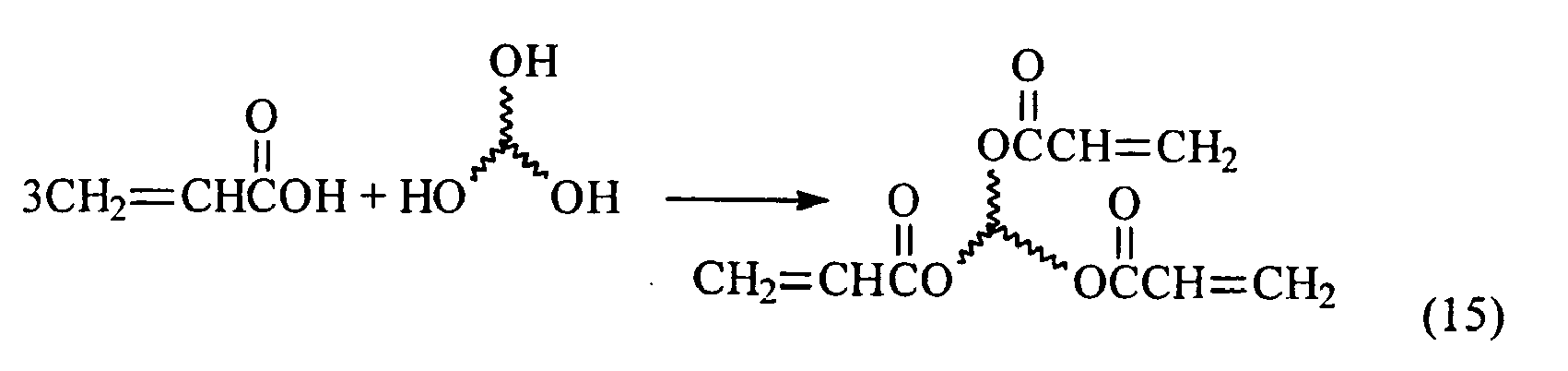
- This reaction scheme as illustrated provides a trifunctional acrylate. To obtain di, tetra, penta, or hexa functional compounds, corresponding diol, tetrols, pentols, and hexols could be used in place of the triol, respectively.
- According to another approach, a hydroxy or amine functional (meth)acrylate compound or the like is reacted with a polyisocyanate, or isocyanurate, or the like having about 2 to about 6 NCO groups, on average, or the equivalent. This approach can be represented by the following schematic reaction scheme which, for purposes of illustration, shows the reaction between hydroxyethyl acrylate and a triisocyanate:


- A preferred class of multifunctional (meth)acryl functional compounds includes one or more multifunctional, ethylenically unsaturated esters of (meth)acrylic acid and may be represented by the following formula:

- Specific examples of suitable multifunctional ethylenically unsaturated esters of (meth)acrylic acid are the polyacrylic acid or polymethacrylic acid esters of polyhydric alcohols including, for example, the diacrylic acid and dimethylacrylic acid ester of aliphatic diols such as ethyleneglycol, triethyleneglycol, 2,2-dimethyl-1,3-propanediol, 1,3-cyclopentanediol, 1-ethoxy-2,3-propanediol, 2-methyl-2,4-pentanediol, 1,4-cyclohexanediol, 1,6-hexamethylenediol, 1,2-cyclohexanediol, 1,6-cyclohexanedimethanol; the triacrylic acid and trimethacrylic acid esters of aliphatic triols such as glycerin, 1,2,3-propanetrimethanol, 1,2,4-butanetriol, 1,2,5-pentanetriol, 1,3,6-hexanetriol, and 1,5,10-decanetriol; the triacrylic acid and trimethacrylic acid esters of tris(hydroxyethyl) isocyanurate; the tetraacrylic and tetramethacrylic acid esters of aliphatic tetraols, such as 1,2,3,4-butanetetraol, 1,1,2,2,-tetramethylolethane, 1,1,3,3-tetramethylolpropane, and pentaerythritol triacrylate; the pentaacrylic acid and pentamethacrylic acid esters of aliphatic pentols such as adonitol; the hexaacrylic acid and hexamethacrylic acid esters of hexanols such as sorbitol and dipentaerythritol; the diacrylic acid and dimethacrylic acid esters of aromatic diols such as resorcinol, pyrocatechol, bisphenol A, and bis(2-hydroxyethyl) phthalate; the trimethacrylic acid ester of aromatic triols such as pyrogallol, phloroglucinol, and 2-phenyl-2,2-dimethylolethanol; and the hexaacrylic acid and hexamethacrylic acid esters of dihydroxy ethyl hydantoin; and mixtures thereof.
- In addition to the fluoro/silane component, the crosslinkable silane component, the curable binder precursor, and the colloidal inorganic oxide, the ceramer composition may further include a solvent and other optional additives. For example, if desired, the ceramer composition may include a solvent to reduce the viscosity of the ceramer composition in order to enhance the ceramer coating characteristics. The appropriate viscosity level depends upon various factors such as the coating thickness, application technique, and the type of substrate material onto which the ceramer composition is applied. In general, the viscosity of the ceramer composition at 25°C is about 1 to about 200 centipoise, preferably about 3 to about 75 centipoise, more preferably about 4 to about 50 centipoise, and most preferably about 5 to about 20 centipoise when measured using a Brookfield viscometer with a No. 2 cv spindle at a spindle speed of about 20 rpm. In general, sufficient solvent is used such that the solids content of the ceramer composition is about 5 to about 99%, preferably about 10 to about 70%, more preferably about 15 to about 50%, and most preferably about 30% by weight solids.
- The solvent is selected to be compatible with the other components included in the ceramer composition. As used in this context, "compatible" means that there is minimal phase separation between the solvent and the other components. Additionally, the solvent should be selected such that the solvent does not adversely affect the curing properties of the ceramer composition or attack the material of the substrate. Furthermore, the solvent should be selected such that it has an appropriate drying rate. That is, the solvent should not dry too slowly, which would slow down the process of making a coated substrate. The solvent also should not dry too quickly, which could cause defects such as pin holes or craters in the resultant ceramer coating. The solvent can be an organic solvent, water, or combinations thereof. Representative examples of suitable solvents include lower alcohols such as ethanol, methanol, isopropyl alcohol, and n-butanol; ketones such as methyl ethyl ketone and methyl isobutyl ketone; glycols; glycol ethers; combinations thereof, and the like. Most preferably, the solvent is isopropanol. Using the procedure described below for making a ceramer composition, the solvent may also include a small amount, e.g. about 2% by weight, of water.
- The ceramer compositions of the present invention also may include a leveling agent to improve the flow or wetting of the ceramer composition onto the substrate. If the ceramer composition does not properly wet the substrate, this can lead to visual imperfections (e.g., pin holes or ridges) in the ceramer coating. Examples of leveling agents include, but are not limited to, alkylene oxide terminated polysiloxanes such as that available under the trade designation "DOW 57" (a mixture of dimethyl-, methyl-, and (polyethylene oxide acetate-capped) siloxane) from Dow Coming, Midland, Michigan, and fluorochemical surfactants such as those available under the trade designations "FC430" and "FC431" from Minnesota Mining and Manufacturing Company Co., St. Paul, MN. The ceramer composition can include an amount of a leveling agent effective to impart the desired result. Preferably, the leveling agent is present in an amount up to about 3% by weight, and more preferably about 0.5 to about 1%, based on the total weight of the ceramer composition solids. It should be understood that combinations of different leveling agents can be used if desired.
- During the manufacture of an abrasion.resistant, ceramer coating of the type including a free-radically-curable binder precursor, the coated ceramer composition preferably is exposed to an energy source, e.g., radiation, which initiates the curing process of the ceramer coating. This curing process typically occurs via a free radical mechanism, which can require the use of a free radical initiator (simply referred to herein as an initiator, e.g., a photoinitiator or a thermal initiator) depending upon the energy source used. If the energy source is an electron beam, the electron beam generates free radicals and no initiator is typically required. If the energy source is ultraviolet light, or visible light, an initiator is often required. When the initiator is exposed to one of these energy sources, the initiator generates free radicals, which then initiates the polymerization and crosslinking.
- Examples of suitable free radical initiators that generate a free radical source when exposed to thermal energy include, but are not limited to, peroxides such as benzoyl peroxide, azo compounds, benzophenones, and quinones. Examples of photoinitiators that generate a free radical source when exposed to visible light radiation include, but are not limited to, camphorquinones/alkyl amino benzoate mixtures. Examples of photoinitiators that generate a free radical source when exposed to ultraviolet light include, but are not limited to, organic peroxides, azo compounds, quinones, benzophenones, nitroso compounds, acryl halides, hydrozones, mercapto compounds, pyrylium compounds, triacrylimidazoles, bisimidazoles, chloroalkytriazines, benzoin, benzoin methyl ether, benzoin ethyl ether, benzoin isopropyl ether, benzoin isobutyl ethers and methylbenzoin, diketones such as benzil and diacetyl, phenones such as acetophenone, 2,2,2-tri-bromo-1-phenylethanone, 2,2-diethoxyacetophenone, 2,2-dimethoxy-2-phenylacetophenone, 2,2,2,-tribromo-1(2-nitrophenyl)ethanone, benzophenone, 4,4-bis(dimethyamino)benzophenone, and acyl phosphates. Examples of commercially available ultraviolet photoinitiators include those available under the trade designations "IRGACURE™ 184" (1-hydroxycyclohexyl phenyl ketone), "IRGACURE™ 361" and "DAROCUR™ 1173" (2-hydroxy-2-methyl-1-phenyl-propan-1-one) from Ciba-Geigy. Typically, if used, an amount of an initiator is included in the ceramer composition to effect the desired level and rate of cure. Preferably, the initiator is used in an amount of about 0.1-10%, and more preferably about 2-4% by weight, based on the total weight of the ceramer composition without solvent. It should be understood that combinations of different initiators can be used if desired.
- In addition to the initiator, the ceramer composition of the present invention can include a photosensitizer. The photosensitizer aids in the formation of free radicals that initiate curing of the curable binder precursors, especially in an air atmosphere. Suitable photosensitizers include, but are not limited to, aromatic ketones and tertiary amines. Suitable aromatic ketones include, but are not limited to, benzophenone, acetophenone, benzil, benzaldehyde, and o-chlorobenzaldehyde, xanthone, thioxanthone, 9,10-anthraquinone, and many other aromatic ketones. Suitable tertiary amines include, but are not limited to, methyldiethanolamine, ethyldiethanolamine, triethanolamine, phenylmethyl-ethanolamine, dimethylaminoethylbenzoate, and the like. Typically, if used, an amount of photosensitizer is included in the ceramer compositions to effect the desired level and rate of cure. Preferably, the amount of photosensitizer used in the ceramer compositions of the present invention is about 0.01 to about 10%, more preferably about 0.05 to about 5%, and most preferably about 0.25 to about 3% by weight, based on the total weight of the ceramer composition without solvent. It should be understood that combinations of different photosensitizers can be used if desired.
- Polymeric materials are known to degrade by a variety of mechanisms. Common additives that can offset this are known as stabilizers, absorbers, antioxidants, and the like. The ceramer compositions of the present invention can include one or more of the following: ultraviolet stabilizer, ultraviolet absorber, ozone stabilizer, and thermal stabilizer/antioxidant.
- An ultraviolet stabilizer or ultraviolet absorber improves weatherability and reduces the "yellowing" of the abrasion resistant, ceramer coating with time. An example of an ultraviolet stabilizer includes that available under the trade designation "TINUVIN™ 292" (bis(1,2,2,6,6-pentamethyl-4-piperidinyl)sebacate) and an example of an ultraviolet absorber includes that available under the trade designation "TINUVIN™ 1130" (hydroxyphenyl benzotriazole), both of which are available from Ciba-Geigy. The ceramer composition can include an amount of either an ultraviolet stabilizer or an ultraviolet absorber to impart the desired result. Preferably, the ultraviolet stabilizer or absorber is present in an amount up to about 10% by weight, and more preferably about I to about 5%, based on the total weight of the ceramer composition without solvent. It should be understood that combinations of different ultraviolet stabilizers and absorbers can be used if desired.
- An ozone stabilizer protects against degradation resulting from reaction with ozone. Examples of ozone stabilizers include, but are not limited to, hindered amines such as that available under the trade designation "IRGANOX™ 1010" available from Ciba-Geigy and phenoltriazine commercially available from Aldrich. The ceramer composition can include an amount of an ozone stabilizer to impart the desired result. Preferably, the ozone stabilizer is present in an amount up to about 1% by weight, more preferably about 0.1 to about 1.0%, and most preferably about 0.3 to about 0.5%, based on the total weight of the ceramer composition without solvent. It should be understood that combinations of different ozone stabilizers can be used if desired.
- A thermal stabilizer/antioxidant reduces the amount of yellowing as a result of weathering. Examples of such materials include, but are not limited to, low melting hindered phenols and triesters. Specific examples include 2,6-di-tert-butyl-4-methylphenol commercially available under the trade designation "ULTRANOX™ 226" antioxidant from Borg Warner Chemicals, Inc., Parkersburg, NY; octadecyl 3,5-di-tert-butyl-4-hydroxycinnamate commercially available under the trade designations "ISONOX™ 132" antioxidant (Schenectady Chemicals, Inc., Schenectady, NY) or "VANOX™ 1320" antioxidant (Vanderbilt Co., Inc., Norwalk, CT). The ceramer composition can include sufficient thermal stabilizer/antioxidant to impart the desired result. Preferably, the thermal stabilizer/antioxidant is present in an amount up to about 3% by weight, and more preferably about 0.5 to about 1%, based on the total weight of the ceramer composition without solvent. It should be understood that combinations of different thermal stabilizers/antioxidants can be used if desired.
- According to one approach, a ceramer composition of the present invention is prepared by combining ingredients including a fluoro/silane component, a crosslinkable silane component, a curable binder precursor, and a colloidal inorganic oxide. The fluoro/silane component may be combined with a first admixture containing a colloidal inorganic oxide and a curable binder precursor in the presence of a crosslinkable silane component. The fluoro/silane component may also be premixed with the crosslinkable silane component to form a second admixture, which second admixture is then combined with the first admixture to form a third admixture, namely the ceramer composition. The crosslinkable silane component may also be premixed with the first admixture to provide a fourth admixture, and the fourth admixture combined with the fluoro/silane component to form the ceramer composition.
- The fluoro/silane component, first admixture and crosslinkable silane component are combined under conditions such that at least a portion of the colloidal inorganic oxide is surface treated by the fluoro/silane component. Preferably, once so combined, the hydrolyzable silane moieties of the fluoro/silane component and the crosslinkable silane component are allowed to react with and thereby functionalize (surface treat) the colloidal inorganic oxide with pendant Rc and Rf functionality. By incorporating the fluoro/silane component into the ceramer composition in this manner, the resultant ceramer composition remains optically clear and, therefore, is especially useful for forming optically clear ceramer coatings.
- The ceramer composition is then stripped, e. g., heated under vacuum to remove substantially all of the water. For example, removing about 98% of the water, thus leaving about 2% water in the ceramer composition, has been found to be suitable. When the curable binder precursor contains free-radically-curable prepolymers, the resultant dried ceramer composition is a clear liquid. As soon as substantially all of the water is removed, an organic solvent of the type described above is added, if desired, in an amount such that the ceramer composition preferably includes from about 5% to about 95% by weight, more preferably from about 10% to about 50% by weight, and most preferably about 15% to about 30% by weight solids.
- The resultant ceramer composition is then coated onto any suitable substrate to form a coated retroreflective article for which it is desired to improve one or more of abrasion resistance, impact resistance or stain resistance. Examples of such substrates include traffic signs, lens elements on pavement markers (e.g., raised pavement markers), street name signs, pavement marking tapes, reflectors on bicycles, conspicuity markings for motor vehicles and trains, traffic cones, license plates, self adhesive stickers (such as the validation stickers that are affixed to license plates or windshields), commercial advertising signs, clothing, barrels, barricades, and the like that incorporate any kind of retroreflective structure such as a cube corner retroreflective structure, an encapsulated lens retroreflective structure, an enclosed lens retroreflective structure, and the like. Adhesion of the ceramer coating to the substrate may vary depending on the particular substrate and on other factors such as whether the substrate is primed, oriented during manufacture (unoriented or oriented axially or biaxially) or otherwise modified.
- Any suitable coating technique can be used for applying the ceramer composition to the substrate, depending upon the nature of the substrate, the viscosity of the ceramer composition, and the like. Examples of suitable coating techniques include spin coating, gravure coating, flow coating, flood coating, bar coating, rolling, dipping, wire wound coating, spray coating, coating with a brush or roller, screen printing, knife coating, curtain coating, slide curtain coating, extrusion, squeegee coating, and the like. Typical protective ceramer coatings of the present invention have a thickness in the range from about 1 micron to about 100 microns, preferably about 2 to about 50 microns, more preferably about 4 to about 9 microns. Generally, ceramer coatings that are too thin may not have sufficient abrasion or impact resistance. Ceramer films that are too thick may have a greater tendency to crack.
- After coating, the solvent can be flashed off with heat or allowed to evaporate under ambient conditions. If radiation curable, the coated ceramer composition is then cured by irradiation with a suitable form of energy, such as visible light, ultraviolet light or electron beam radiation. Irradiating with ultraviolet light in ambient conditions is presently preferred due to the relative low cost and speed of this curing technique. Irradiation causes the curable binder precursor and the surface treated, colloidal inorganic oxide to crosslink together to form a ceramer coating containing a polymer matrix having the colloidal inorganic oxide, and any optional additives, interspersed in the polymer matrix. The resultant ceramer-coated substrate is thereby protected against stains, abrasion, and impact.
- Generally, the surfaces of cured ceramer coatings of the present invention tend to be relatively hydrophobic. Thus, dew moisture or fog moisture tends to condense on such surfaces in the form of water beads that reduce the retroreflective brightness and obscure the visibility of information provided on the underlying substrate. It is desirable in some applications, e.g., traffic signs, to treat the surface of the cured ceramer coating so that the surface becomes sufficiently hydrophilic for moisture to condense on the surface as a uniform film rather than as beads. A film of water has significantly less effect than water beads upon retroreflective brightness and visibility.
- The surface of a cured ceramer coating of the present invention can be rendered hydrophilic in a number of ways. According to preferred techniques, this may be accomplished by subjecting the surface to a corona treatment as described in
U.S. Pat. No. 4,772,488 or inWO 95/32237 - Preferably, corona or plasma treatment is carried out under conditions such that the resultant hydrophilic, treated surface has a water contact angle of 40° or less, preferably 20° or less, more preferably 15° or less. In contrast, untreated, hydrophobic, cured ceramer coating surfaces of the present invention tend to have a water contact angle of 50 or more. In the practice of the present invention, water contact angle is determined by a procedure in which a 0.01 ml droplet of water is deposited onto the surface to be tested. The static water contact angle of the deposited droplet is measured by the method essentially as described in Zisman, W. A., "Contact Angle, Wettability and Adhesion," Advances in Chemistry, Series 43, American Chemical Society, Washington, D.C. (1964).
- While not wishing to be bound by theory, it is believed that these anti-dew treatments work so well for achieving dew and anti-fogging resistance by oxidizing the coating surface without unduly affecting the underlying body of the coating material. The resultant oxidized surface is much more compatible with water than an untreated surface. It can be appreciated, therefore, that any treatment that controllably oxidizes the surface of the coating may also be used to achieve the same objective with beneficial results. The present invention will now be further described with reference to the following examples.
- This test measures the Taber abrasion of the ceramer composition when coated on a substrate and was performed according to ASTM D1044 (Standard Method for Resistance of Transparent Plastics to Surface Abrasion), the disclosure of which is incorporated herein by reference. Briefly, the test method involved abrading a sample on a TABER ABRASER™ tester for 100, 300 and 500 cycles using a 500 gram load with a CS-10F wheel at room temperature. After each cycle of exposure to the abrasive wheel the percent change in haze was measured.
- This test was designed to test the ceramer composition's durability when coated on a substrate and submersed in water at elevated temperatures. The sample was completely submerged in water at the stated temperature for the stated time period. Specifically, the samples were submerged in water baths at about 60° C for 11 and 13 days, at about 71 ° C for 6 and 8 days and at about 82° C for 3 and 5 days. At the end of the stated time period, the samples were removed and examined for any delamination. To pass this test, the ceramer composition must not show any delamination from the substrate after a tape snap test and ASTM D3359-95a adhesion (cross-hatched) test were performed. In the tape snap test, a piece of tape is "snapped" off by pulling it rapidly at 90° to the surface of the coating, and the coating visually inspected for evidence of delamination. Minor or no evidence of delamination will yield a "pass" rating.
- This test assesses the ability of the ceramer composition, when coated on a substrate, to withstand weathering conditions (e.g., sunlight). The test was conducted according to ASTM Test Standard G-26-88, Type B, BH (Standard Practice for Operating Light Exposure Apparatus (Xenon-Arc Type) with and without Water for Exposure of Nonmetallic Materials), the disclosure of which is incorporated by reference herein.
- Briefly, a sample was exposed to a 6500 Joule/second xenon burner filter through borosilicate inner and outer filters at 0.35W/m2 in a Water Cooled Xenon Arc Model 65XWWR Weathering Chamber, available from Atlas Electric Devices Co. (Chicago, Illinois) for repetitive cycles of 102 minutes at about 63° C followed by 18 minutes with a water spray. To provide a ceramer coating passing this test for a particular substrate, the ceramer coating must be capable of withstanding at least 1000 hours of exposure under these conditions with no significant yellowing, whitening, or other discoloration.
- Undesirable results obtained from this weathering test include, in particular, whitening, delamination, and "checks", which are imperfections in the form of slight inclusions in the coating.
- Solvent resistance is defined as the degradation resistance of a ceramer composition coated on a substrate when the coating is contacted with a solvent. A small amount of solvent was applied to a horizontally positioned ceramer coating. The time for lifting or dissolution (as first observed) of the ceramer coating from the substrate by softly scratching or scraping the coating with a spatula was recorded. The time immediately prior to lifting or dissolution of the ceramer coating was recorded. A time of at least 10 minutes was preferred. During testing, the test spot was kept wet by re-applying solvent if necessary.
- A fine line approximately 3 centimeters long was drawn using a black SHARPIE™ fine point permanent marker (available from the Sanford Corporation, Bellwood, IL) on a substrate coated with a ceramer coating. This sample was stored at room temperature for about 24 hours, then wiped with a lacquer thinner (70% toluene, 15% ethyl acetate, 10% butyl acetate, and 5% butanol). After wiping, a number value of 0 to 3 was assigned based on the appearance of the wiped line. The values were defined as follows:
- 3 = ink did not significantly wipe off;
- 2 = some amount of ink left;
- 1 = very small amount of ink left;
- 0 = no ink left.
- A ceramer coated substrate was tested for static water contact angle using a 0.01 milliliter droplet by essentially the method described by Zisman, W. A., in Contact Angle, Wettability, and Adhesion," Advances in Chemistry, Series 43, American Chemical Society, Washington, D.C. (1964), incorporated by reference herein in its entirety. An anti-dew surface was indicated by a low (preferably < 20°) water contact angle.
- 60° Gloss was measured following ASTM Test Method D523-85, or ASTM D2457-97 Standard Test Method for Specular Gloss of Plastic Films and Solid Plastics (incorporated by reference herein) before and after the Abrasion Resistance test set out below, using a Pacific Scientific GLOSSGARD™ II 60° gloss meter (available from Gardner/Neotec Company, Silver Spring, MD).
- This method was used to measure the retroreflective performance of retroreflective sheeting at a 0.2 observation angle and a -4 entrance angle using ASTM Test Method E810-94 (incorporated by reference herein) before and after the Abrasion Resistance test set out in Test Procedure IX.
- A slightly modified version of the Scrub Resistance ASTM TM D2486 (incorporated by reference herein) was used to measure the abrasion resistance of ceramer coated substrates. A coated substrate was applied to an aluminum blank and held in place with tightening screws in a Gardner Straight Line Washability and Abrasion Machine (available from Gardner Laboratory, Inc., Bethesda, Maryland). The sample was then scrubbed for a known number of cycles with a nylon bristle brush and a Standardized Abrasive Medium, Abrasive Type #SC-2 (available from Leneta Co., Mahwah, NJ). The samples were then washed with warm water about 45°C (100°F), wiped clean and retroreflectivity and 60° gloss were measured.
- This test was an indication of a coating's resistance to solvent degradation. In particular, this test was used to determine the solvent resistance of powder coated SCOTCHLITE™ Reflective License Plate Sheeting Series 3750 having graphics underneath the powder coat. The test was performed before and after applying and curing a ceramer coating.
- A KAYDRY™ towel was wet with MEK and then firmly rubbed back and forth 25 times (50 total rubs) by hand over the sample. The sample was visually inspected and assigned a rating based upon degree of visible change. A rating of "pass" was assigned when no change was observed, while a rating of "fail" was assigned when the pigment underneath the powder coat demonstrated color fading.
- Retroreflective sheeting was mounted on an aluminum alloy 3003-H12 blank having a thickness of 0.8 mm. An alphanumeric embossing pattern ABC 123 of about 2mm depth was impressed using male/female dies on an Embossing Press, available from Erick Utsch KG, Siegen, Germany. A rating of "pass" was assigned when no visible cracking was evident.
- Retroreflective sheeting was mounted on aluminum alloy and embossed as in Test Procedure XI. The sample was then roll coated with Scotchlite™ Series 4800 Black Roll Coat paste, (available from 3M), an alkyd thermoset. The roll coated sample was then subjected to a tape snap test to determine the surface adhesion of ink to the ceramer. The adhesion of the external color layer of the retroreflective substrate sample was evaluated by a procedure analogous to ASTM 3359, incorporated by reference herein in its entirety. A first series of parallel lines about 1 to about 2 millimeters apart was scored in the surface of the sample, extending through the thickness of the color layer to or into the underlying layer. A second series of similar parallel lines was then scored perpendicular to the first series. A piece of adhesive tape (3M SCOTCH™ No. 610 Transparent Cellophane Tape), narrower than the array of cuts, was applied over the clear coat with a 3M PA-1 Plastic Applicator. Then the tape was snapped off at 90°. The sample was then examined and the percent of the remaining color layer was determined to assess adhesion. A sample was rated from 0B to 5B as specified in ASTM 3359, according to the amount of ink removed. A rating of 5B is preferred.
- A cross-hatch test was performed using the procedure shown in ASTM D3359-95a, Measuring Adhesion by Tape Test, (incorporated by reference herein). The test on each sample was done by first cross-hatching the coated side of a sheet into approximately 0.63 centimeter squares. Next, a 7.6 centimeter piece of 5.1 centimeter wide 3M Scotch Masking Tape 232, available from 3M, was used to cover the cross-hatched area. Finally, the edge of the tape was pulled straight back and inspected for debris from the ceramer.
- This test used a 2.54 centimeter diameter flat pad with a #3 coarse steel wool conforming to Federal Specification FF-W-1825A with about 22 ± 0.2 Kg) pressure as specified in ASTM D4280-96 (incorporated by reference herein) substituting sheet samples instead of markers. The test samples were visually inspected for scratches. The data excluded single scratches due to protruding steel wool whiskers.
- ASTM Standard Test Method D968-93 (incorporated by reference herein), for Abrasion Resistance of Organic Coatings by Falling Abrasive was used to determine abrasion resistance. 75 grams of graded silica carbide as described in D968-93 were used to abrade each spot of the samples. Each sample was then indexed to a new location and another 75 grams of silica carbide was dropped on the sample for a total of 5 spots. The 60° gloss of each sample was read before and after the test was administered using ASTM D2457-97, Standard Test Method for Specular Gloss of Plastic Films and Solid Plastics, and expressed as a percentage of the original gloss.
- This test checked the ability of the coatings to resist contaminant build-up on lens sheeting. A small piece of BT-69 bitumen adhesive, available from 3M Traffic Control Materials Division, was used to draw lines approximately 2.5 to 4 cm long on retroreflective acrylic and polycarbonate sheetings which had been bar-coated with a ceramer. The lines were then wiped off using a paper wipe (Kaydry™ EX-L made by Kimberly-Clark™). The wiped lens sheetings were visually inspected for traces of the BT-69 adhesive. A similar test was done but using a SANFORD™ black SHARPIES™ pen model 30001. Samples were rated pass if no visible trace of adhesive or ink could be seen.
Table of Components Acronym Descriptions Manufacture Information A-174 Silane A-174 Methacrylate-Functional Silane OSI Specialties, Inc., Danbury, CT BHT Antioxidant CAO-3 Butylated Hydroxytoluene Neville-Synthese Organics, Inc., Pittsburgh, PA N,N-DMA n,n-dimethylacrylamide Alcolac, Baltimore, MD FC405™ Fluorochemical 3M Chemicals, St. Paul, MN IPA Isopropanol Ashland Chemical, Columbus, OH Irga-Cure™ 1-Hydroxycyclohexyl Phenyl Ciba-Specialty Chemicals 184 Ketone 184 Corp, Tarrytown, NY Klebosol™ 30 Colloidal silica solution Clariant, Basking Ridge, NJ N 25 Me FC405™ Me FC405 3M Chemicals, St. Paul, MN NaAlO2 Sodium Aluminate Matheson Coleman and Bell, Norwood, OH NALCO™ Colloidal silica solution Nalco Chemical Company, 1034A Naperville, IL NALCO™ Colloidal silica solution Nalco Chemical Company, 2327 Naperville, IL NALCO™ TX-9715 colloidal Tin solution Nalco Chemical Company, SnO2 Naperville, IL Nyacol™ Colloidal Zirconia solution Nyacol Products Inc., Ashland, ZrO2(Ac) MA PETA Pentaerythritol Triacrylate SR-444C Special Sartomer Company Inc., Exton, PA Phenothiazine Phenothiazine purified grade powder ICI Americas Inc., Hopewell, VA TINUVIN™ bis-(1-octyloxy-2,2,6,6,tetramethyl- Ciba-Geigy Corp., Hawthorne, 123 4-piperidinyl) NY SANDUVOR™ N-acrylated HALS compound Clariant Corp., Charlotte, NC 3058 TINUVIN™ 1,3-Benzenediol, 4-[4,6-bis(2, 4- Ciba-Geigy Corp., Hawthorne, 400 dimethyl)-1,3,5-triazin-2-yl] NY TINUVIN™ bis-(1,2,2,6,6-pentamethyl-4- Ciba-Geigy Corp., Hawthorne, 292 piperidinyl) sebacate NY TINUVIN™ Hydroxyphenyl benzotriazole Ciba-Geigy Corp., Hawthorne, 1130 NY TINUVIN™ 3-(2H-benzotriazol-2-YL)-5-(tert- Ciba-Geigy Corp., Hawthorne, 384 butyl)-4-4hydroxybenzenepropanoic acid NY Vinings Colloidal silica solution Vinings Industries, Midway, Indusil 520 GA - 56.2 Parts by weight of the curable binder precursor PETA (pentaerythritol triacrylate) was heated to about 49°C in a one liter flask. 35.2 Parts by weight silica (88 parts by weight of 40% solids, 20 nanometers average particle size, "NALCO™ 2327") were added to the PETA to form a first admixture. In a separate flask, 7.7 parts by weight of the crosslinkable silane component 3-methacryloxypropyl-trimethoxysilane, ("A-174") was mixed with 0.8 parts by weight of fluoro/silane component of Formula (11) ("FC-405") to form a second admixture. The first and second admixtures were then mixed together to form a third admixture. In a weighing tray, 0.15 parts by weight BHT (butylated hydroxytoluene) and 0.02 parts by weight phenothiazine (both based on the 56.2 parts by weight PETA) were mixed together and then added to the third admixture to form a fourth admixture.
- The fourth admixture was then "stripped" by subjecting it to a gentle vacuum distillation (100 ± 20 mm Hg) at 52° ± 2°C until most of the water/methanol was removed. A residual amount (a few weight-percent) of water remained in the dried product. At the end of the stripping process, the admixture was diluted to 50% solids with a 14:1 weight-ratio solvent of isopropyl alcohol:distilled water. This 50% solids admixture was further diluted to 25% solids with the same solvent mixture. About 0.7 parts by weight photoinitiator ("IRGACURE™ 184") was also added.
- The ceramer composition was then coated onto PMMA (polymethylmethacrylate) and polycarbonate substrates at a thickness of about 4 to about 5 micrometers using conventional flow coating techniques. Each coated substrate was then flash dried at about 60°C for 2.5 minutes in an air circulating oven to ensure that the majority of the isopropanol was driven off. Finally, the coating was cured on a conveyor belt of a UV light processor using a high pressure mercury lamp (Model QC 1202, available from PPG Industries, Plainfield, IL). The process conditions were 16.5 meters/minute, 410 volts, energy 90 mJ/cm2, and an air atmosphere.
- The resulting ceramer coatings were perfectly clear and adhered to the PMMA and polycarbonate substrates. Furthermore, the coatings passed Test Procedures I, II and III and had excellent shelf stability. After 6 months, sols prepared in accordance with the above procedure were clear, with no apparent flocculation.
- Example 2 was carried out as in Example 1 except that the crosslinkable silane component was added to the first admixture of PETA and silica, followed by addition of the fluoro/silane component. These steps were performed by heating 56.2 parts by weight of PETA to about 49°C in a one liter flask. 35.2 Parts by weight silica (88 parts by weight of 40% solids NALCO™ 2327) was added to the flask. 7.7 Parts by weight of 3-methacryloxypropyl-trimethoxysilane were then added to the flask, followed by addition of 0.8 parts by weight of a fluoro/silane component of Formula (11). In a weighing tray, 0.15 part by weight BHT and 0.02 parts by weight phenothiazine (both based on the 56.2 parts by weight PETA) were mixed together and then added to the flask. The resulting admixture was then stripped, diluted with solvent, coated onto PMMA and polycarbonate substrates and cured as in Example 1. The resulting ceramer coatings were perfectly clear and adhered to the PMMA and polycarbonate substrates. Furthermore, the resulting ceramer coatings passed Test Procedures I, II and III.
- Example 3 was carried out as in Example 1 except that the fluoro/silane component was first added individually to the first admixture of PETA and silica, followed by addition of the crosslinkable silane component. These steps were performed by heating 56.2 parts by weight of PETA to about 49°C in a one liter flask. 35.2 Parts by weight silica (88 parts by weight of 40% solids NALCO 2327) were added to the flask. 0.8 Parts by weight of the fluoro/silane component were then added to the flask, followed by addition of 7.7 parts by weight of 3- methacryloxypropyl-trimethoxysilane. In a weighing tray, 0.15 parts by weight BHT and 0.02 parts by weight phenothiazine (both based on the 56.2 parts by weight PETA) were mixed together and then added to the flask. The final mixture precipitated. Thus, the composition was not coatable and the experiment was not completed.
- Example 4 was carried out as in Example 1 except that 15.6 parts by weight (based on 56.2 parts by weight PETA) of dimethylacrylamide (DMA) was added to the third admixture of Example 1 before addition of the mixture of BHT and phenothiazine. The resulting admixture was then stripped, diluted with solvent, coated onto PMMA and polycarbonate substrates and cured as in Example 1. The resulting ceramer coatings were perfectly clear and adhered to the PMMA and polycarbonate substrates. Furthermore, the resulting ceramer coatings passed Test Procedures I, II and III and performed as well as the coatings of Example 1. This example thus shows that DMA may be used in the ceramer compositions of the present invention, if desired, but is not required.
- This ceramer composition contained dimethylacrylamide (DMA) as a component of the binder precursor, but no fluoro/silane component. Specifically, 51.5 parts by weight of PETA were heated to about 49°C. 32.4 Parts by weight silica (88 parts by weight of 40% solids NALCO 2327) were added to the PETA to form a first admixture. In a separate flask, 8.1 parts by weight of 3-methacryloxypropyl-trimethoxysilane were mixed with 8.0 parts by weight DMA to form a DMA-altered second admixture. The first admixture was mixed with the DMA-altered second admixture to form a third admixture. In a weighing tray, 0.15 parts by weight BHT and 0.02 parts by weight phenothiazine (both based on the 51.5 parts by weight PETA) were mixed together and then added to the third admixture to form a fourth admixture.
- The fourth admixture was then stripped, diluted with solvent, coated onto PMMA and polycarbonate substrates and cured as in Example 1. Like the ceramer coating of Example 1, the ceramer coatings of this comparative example were perfectly clear, adhered to the PMMA and polycarbonate substrates, and passed Test Procedures I, II and III. Thus in these tested respects, a composition of the invention performed comparably to a ceramer made using DMA but no fluoro/silane component.
- Comparative Example B was prepared as described in Example 2 except that no fluoro/silane component was added. 56.2 Parts by weight of PETA were heated to about 49°C (120°F) in a one liter flask. 35.2 Parts by weight silica (88 parts by weight of 40% solids NALCO 2327) were added to the PETA to form a first admixture. 7.7 Parts by weight of 3-methacryloxypropyl-trimethoxysilane were then added to the flask, followed by the addition of 15.6 parts by weight DMA (based on 56.2 parts by weight PETA). In a weighing tray, 0.15 parts by weight BHT and 0.02 parts by weight phenothiazine (both based on the 56.2 parts by weight PETA) were mixed together and then added to the flask.
- The resulting admixture was then stripped, diluted with solvent, coated onto PMMA and polycarbonate substrates and cured as in Example 2. Like the ceramer coating of Example 2, the ceramer coatings of this comparative example were perfectly clear, adhered to the PMMA and polycarbonate substrates, and passed Test Procedures I, II and III. Thus in these tested respects, a composition of the invention performed comparably to a ceramer made using DMA but no fluoro/silane component.
- Comparative Example C was a hardcoating prepared using commercially available coating material from Cyro Corp., Rockaway, NJ, under the trade designation "CYRO AR".
- The ceramer coatings described above were evaluated using a variety of test methods. As is illustrated in the following Tables 2 through 9 and in Examples 1-2 and 4, a nonionic fluorochemical containing both a fluorinated moiety and a silane moiety (the fluoro/silane component) can be successfully incorporated into a ceramer sol, without causing colloid flocculation. Ceramer coatings containing such a fluoro/silane component, whether prepared with or without DMA, have surprisingly long shelf lives and excellent stain resistant characteristics (See Examples 1 and 4). Additionally, ceramer compositions of the present invention can be used to prepare ceramer coatings that exhibit a high level of abrasion resistance, durability and hardness (See Tables 2-9). Some of the coatings shown in Tables 2-9 employed additives tabulated in Table 1. The amounts of such additives are expressed based on the weight of ceramer solids.
TABLE 1 Additive Components on Ceramer Basis I 0.9 parts by weight "TINUVIN™ 123" 1.6 parts by weight "SANDUVOR2 3058" 2.8 parts by weight "TINUVIN™ 1130" 2.8 parts by weight "TINUVIN™ 400" II 2 parts by weight "TINUVIN™ 292" III 2 parts by weight "TINUVIN™ 292" 2 parts by weight "TINUVIN™ 384" IV 1.2 parts by weight "TINUVIN™ 123" 0.7 parts by weight "SANDUVOR 3058" 2.07 parts by weight "TINUVIN™ 384" 2.07 parts by weight "TINUVIN™ 400" TABLE 2 Taber Abrasion Test - Coated on PMMA Percent Haze Sample 100 cycles 300 cycles 500 cycles Comp. A* 2.6 3.1 4.1 Example 4* 2.0 3.0 3.6 Comp. B 1.4 3.0 3.9 Example 1 1.3 3.1 3.9 Example 4 0.9 2.4 3.2 Comp. A** 1.9 3.6 4.2 Comp. B** 1.5 2.8 3.7 Example 1** 1.6 3.3 4.1 Example 4** 1.3 2.9 3.5 Samples denoted with "*"included 4 wt-% of additive III on a ceramer weight basis.
Samples denoted with "**" included 2 wt-% of additive II.TABLE 3 Taber Abrasion Test - Coated on Polycarbonate Percent Haze Sample 100 cycles 300 cycles 500 cycles Example 1 1.7 3.3 4.1 Example 4 1.3 2.8 3.5 Comp. A* 3.1 3.2 3.8 Example 4* 2.8 2.7 3.1 Comp. B 1.3 2.3 3.2 Example 1 1.0 2.5 3.2 Example 4 1.0 2.3 3.1 Comp. A** 2.5 2.9 4.4 Comp. B** 3.0 2.5 3.5 Example 1** 3.0 2.6 3.3 Example 4** 2.7 2.2 3.1 Comp. C. 2.5 3.0 3.8 Samples denoted with "*" included 6 wt-% of additive IV on a ceramer weight basis.
Samples denoted with "**" included 8 wt-% of additive I.TABLE 4 Warm Water Adhesion Test - Coated on PMMA Sample 11 days @ 60°C 8 days @ 71°C 3 days @ 82°C Example 1 pass pass pass Example 4 pass pass pass Comp. A* pass pass pass Example 4* pass pass pass Samples denoted with "*" included 4 wt-% of additive III on a ceramer weight basis. TABLE 5 Warm Water Adhesion Test - Coated on PMMA Sample 13 days @ 60°C 6 days @ 71°C 5 days @ 82°C Comp. B pass pass pass Example 1 pass pass pass Example 4 pass pass pass Comp. A* pass pass pass Comp. B* pass pass pass Example 1* pass pass pass Example 4* pass pass pass Comp. C. pass pass pass Samples denoted with "*" included 2 wt-% of additive II on a ceramer weight basis. TABLE 6 Warm Water Adhesion Test - Coated on Polycarbonate Sample 11 days @ 60°C 8 days @ 71°C 3 days @ 82°C Comp. A pass pass pass Example 1 pass pass pass Example 4 pass pass pass Comp. A* pass pass pass Example 4* pass pass pass Samples denoted with "*" included 6 wt-% of additive IV on a ceramer weight basis. TABLE 7 Warm Water Adhesion Test - Coated on Polycarbonate Sample 13 days @ 60°C 6 days @ 71°C 5 days @ 82°C Comp. A Pass pass pass Comp. B pass pass pass Example 1 pass pass pass Example 4 pass pass pass Comp. A* pass pass delaminated Comp. B* pass pass delaminated Example 1* pass pass delaminated Example 4* pass pass delaminated Comp. C. pass pass pass Samples denoted with "*"included 8 wt-% of additive I on a ceramer weight basis. TABLE 8 Weathering Test - Coated on PMMA Sample Hours Example 1 1400 - few small checks Example 4 1400 - few small checks Comp. A 1400 - few small checks Example 1* 3700 - few long checks Example 4* Not done Comp. A* 3515+ Example 1 1800 - checks, slight whitening Example 4 1800 - checks, slight whitening Comp. B 1800 - checks, slight whitening Example 1** 2425+ Example 4** 2425+ Comp. A** 3515+ Comp. B** 2425+ + denotes that the test is on going
Samples denoted with "*" included 4 wt-% of additive III on a ceramer weight basis.
Samples denoted with "**" included 2 wt-% of additive II on a ceramer weight basis.TABLE 9 Weathering Test - Coated on Polycarbonate Sample Hours Example 1 1000 - 20% delamination Example 4 1000 - total delamination Comp. A ~800 Example 1* 2400 - slight delamination Example 4* Not done Comp. A* 2200 Example 1 -750 Example 4 ~50 Comp. A ~800 Comp. B ~900 Example 1** 2425 - slight delamination & very small checks Example 4** 2425 - slight delamination & very small checks Comp. A** ~2500 Comp. B** 2425 - slight delamination Samples denoted with "*" included 6 wt-% of additive IV on a ceramer weight basis.
Samples denoted with "**" included 8 wt-% of additive I on a ceramer weight basis. - Example 5 was prepared as described in Example 1, except a silica/alumina mixture was substituted for the silica. Thus, 56.2 parts by weight of PETA were preheated to about 49°C and then combined with 35.3 parts by weight of silica (88 parts by weight of 40% solids NALCO™ 2327, 20nm) and 1 part by weight sodium aluminate (NaAlO2) to form a first admixture. A second admixture of 7.8 parts by weight of A-174 and 0.8 parts by weight of the compound of Formula (11) was prepared and added to the first admixture with stirring to form a third admixture. In a weighing tray, 0.15 parts by weight BHT and 0.02 parts by weight phenothiazine (both based on the 56.2 parts by weight PETA) were mixed together and then added to the third admixture to form a fourth admixture.
- The fourth admixture was then stripped, diluted with solvent, coated onto PMMA and polycarbonate substrates and cured as in Example 1.
- Example 6 was carried out as described in Example 5, except dimethylacrylamide was added to the other ingredients in the second admixture. The second admixture contained about 0.7 parts by weight of A-174, 0.8 parts by weight of the compound of Formula (11) and 8.0 parts by weight of dimethylacrylamide. The ceramer composition was stripped, diluted with solvent, coated onto PMMA and polycarbonate substrates and cured as in Example 1.
- The ceramer composition of Example 1 was flow coated onto the PMMA topcoat of DIAMOND GRADE™ Retroreflective Sheeting Series 3900, available from 3M. Immediately after the flow coating operation was completed (about 30 seconds), the sheeting was dried in a conventional forced-air oven at about 65°C for 2 minutes. The coated sheeting was then placed on a conveyor belt of a UV processor (Model C18/400/2 available from American Ultraviolet Co. Murray Hill, NJ) equipped with a medium-pressure mercury lamp. The process conditions were 7.6 meters/minute line speed; 600 volts; 1.28 joules/cm2 energy, and an air atmosphere. The resulting coating was visibly clear. Half of this coated sheeting was then corona treated twice using 500 Joule/second power and a web speed of 0.9 meters/minute. The corona treated and non-corona treated sheetings were applied to aluminum panels and tested for solvent resistance, water contact angle, and graffiti resistance according to the test methods disclosed above. Water contact angle was tested immediately after corona treatment, and after soaking the corona treated film in water for 24 hours and then drying at room temperature for about 2 to about 3 hours.
- The ceramer composition of Example 1 was flow coated onto the PMMA topcoat of HIGH INTENSITY™ Retroreflective Sheeting Series 3800, available from 3M. The coated sheeting was then dried, UV cured, corona treated and tested as in Example 7.
- The ceramer composition of Example 5 was flow coated onto the PMMA topcoat of DIAMOND GRADE™ Retroreflective Sheeting Series 3900, available from 3M. The coated sheeting was then dried, UV cured, corona treated and tested as in Example 7.
- The ceramer composition of Example 5 was flow coated onto the PMMA topcoat of HIGH INTENSITY™ Retroreflective Sheeting Series 3800, available from 3M. The coated sheeting was then dried, UV cured, corona treated and tested as in Example 7.
- SCOTCHLITE™ Preclear Reflective License Plate Sheeting Series 4780A (available from 3M) was applied to an aluminum blank to form license plate. The license plate sheeting has lens elements embedded within a transparent resin and a urethane topcoat. The topcoat was flood coated with the ceramer composition of Example 1 by holding the plate in a vertical position, while applying the ceramer composition using a spray bottle and a continuous motion to cover the topcoat completely. After allowing the excess composition to drain from the plate, the plate was dried in a conventional forced-air oven at about 66°C for about 2 minutes to ensure that the majority of the isopropanol was driven off. Finally, the ceramer coating was cured on a conveyor belt of a UV light processor using a medium pressure mercury lamp. The process conditions were 8.3 meters/min, 1524 Joule/second/cm, 1.22 J/cm2 and an air atmosphere. The resulting ceramer coatings were visibly clear. The coated plate and a control plate made from untreated SCOTCHLITE™ Preclear Reflective License Plate Sheeting Series 4780A were tested for abrasion resistance, graffiti resistance, ink receptivity, and embossability.
- A sample of the sheeting used in Example 11 but having an EAA (ethylene acrylic acid) topcoat rather than a urethane topcoat was used to prepare a ceramer-coated plate using the method of Example 11. The UV light processor was operated at 8.2 meters/min rather than 8.3 meters/min but the other process conditions were as in Example 11. The coated plate and a control plate made from untreated SCOTCHLITE™ Preclear Reflective License Plate Sheeting Series 4780A (available from 3M) without the urethane topcoat were tested for abrasion resistance and graffiti resistance.
- SCOTCHLITE™ Preclear Reflective License Plate Sheeting Series 4750A (available from 3M) was applied to an aluminum blank and coated with the ceramer composition of Example 1 using the method of Example 11. The coated plate and a control plate made from untreated SCOTCHLITE™ Preclear Reflective License Plate Sheeting Series 4750A were tested for abrasion resistance, graffiti resistance, ink receptivity, and embossability.
- SCOTCHLITE™ Reflective License Plate Sheeting Series 3750 (available from 3M) was applied to an aluminum blank and clear coated using acrylic powder B66 (available from Rohm and Haas, Philadelphia, PA) by heating the plate and powder coating at 300°C for about 20 minutes. This plate was then coated with the ceramer composition of Example 1 using the method of Example 11. The coated plate and a control plate made from uncoated SCOTCHLITE™ Reflective License Plate Sheeting Series 3750 were tested for abrasion resistance and graffiti resistance.
- SCOTCHLITE™ Reflective License Plate Sheeting Series 3750 was applied to an aluminum blank. A graphic was created on the plate using PCN Blue VAGH DISP 815284 colorant (available from Penn Color Inc. Doylestown, PA). The plate was clear coated using acrylic powder B66 and then coated with the ceramer composition of Example 1 using the method of Example 14. The coated plate and a control plate made from uncoated SCOTCHLITE™ Reflective License Plate Sheeting Series 3750 were tested for abrasion resistance and solvent resistance using the MEK rub test.
TABLE 10 Water Contact Angle, Solvent Resistance, and Graffiti Resistance Results Before and After Corona Treatment Example Contact Angle before water soaking Contact Angle after soaking in water 24 Hr and drying Solvent Resistance toluene/xylene 30/70 Solvent Resistance MEK Graffiti resistance 7 (non-corona) 82° 90-91° >20 minute >15 minute 0 7 (corona) 6-15° 15-22° >20 minute >15 minute 0 8 (non-corona) 89° 90° >20 minute >15 minute 0 8 (corona) 16° 17° >20 minute > 15 minute 0 TABLE 11 Water Contact Angle, Abrasion Resistance , and Solvent Resistance Results Before and After Corona Treatment Example contact angle scrub cycles Brightness @.2/-4 60° Gloss solvent resistance toluene/xylene 30/70 solvent Resistance MEK Graffiti resistance initial Final (after scrub cycle) % Ret Initial Final (after scrub cycle) % Ret 9 (non-corona) 87° 100 1083 891 82% 97 77 79% >15 minute >15 minute 0 9 (corona) 15° 100 1050 890 85% 95 83 87% >15 minute >15 minute 0 10 (non-corona) 86° 100 320 248 78% 125 111 89% >15 minute >15 minute 0 10 (corona) 12° 100 301 268 89% 124 108 87% >15 minute >15 minute 0 TABLE 12 Comparison of Brightness and Gloss Retention for Various License Plate sheetings Before and After Ceramer Coating Example Scrub Cycle Brightness @.2/-4 60° Gloss Graffiti Resistance Init Final (after scrub cycle) % Ret Init Final (after scrub cycle) % Ret 11 100 95.5 72.2 76% 85.6 65.1 76% 0 Control 11 100 101.5 67.5 67% 86.7 51.9 60% 1 12 100 82.7 65 79% 85.6 65.1 76% 0 Control 12 100 88.6 9.3 10% 88.0 9.6 11% 2 13 100 84.6 82.3 97% 83.2 78.7 95% 2 Control 13 100 80.1 35.6 44% 89.9 33.6 37% 3 14 100 93.4 54.9 59% 60.1 62.0 103% 0 Control 14 100 61.5 18.4 30% 64.0 29.7 46% * *Removal of inks using the solvents destroyed the top film thus also destroying the retroreflectivity. TABLE 13 Comparison of Brightness and Gloss Retention for SCOTCHLITE™ Reflective License Plate Sheeting Series 3750 with Graphic Underneath Acrylic Powder Coat Before and After Ceramer Coating Example Scrub Cycle Brightness @.2/-4 60° Gloss MEK Rub Test Init Final (after scrub cycle) % Ret Init Final (after scrub cycle) % Ret 15 100 26.9 28.9 107% 22 22 100% pass Control 15 100 96.6 25.6 27% 42 25.6 61 % fail TABLE 14 License Plate Embossability and Surface Adhesion Test for Ink Receptivity Example Ink Embossability Surface adhesion of Ink 11 4805V Pass 5B 11 4852Vinyl Pass 5B 13 4805V Pass 5B 13 4852Vinyl Pass 5B - Ceramer formulations 16-1 to 16-17 were coated onto retroreflective cube corner sheeting made of 0.15 centimeter thick polycarbonate with a 0.0076 centimeter thick PMMA top layer. The composition and test results for the ceramer formulations are set out below in Tables 15 to 17. The composition and test results for a comparison ceramer formulation are set out below in Table 18.
- Formulations 16-1 and 16-6 and the comparison formulation were applied to the sheeting using a spray coating process. The formulations were diluted with isopropanol and N-butanol (2:1 ratio) to about 21 % solids and applied to the non-cube side of the sheeting. The solvents were removed using convection or infrared drying. The maximum sheet temperature did not exceed 110°C. The ceramer formulations were crosslinked using a UV exposure unit at a UV energy dosage of approximately 0.70 J/cm2. The dry ceramer coating thickness ranged from about 4 to about 15 micrometers, with a target range of about 9 to about 12 micrometers.
- The remaining ceramer formulations were applied to the sheeting using either a flow coating or a notched bar coating process. Flow coated samples were prepared by using an eyedropper to deliver the ceramer formulation along the top edge of the sheeting while maintaining the sheeting in a vertical orientation. Bar coated samples were prepared by drawing the ceramer formulation across the sheet using a straight metal bar maintained at a 50.8 micrometer gap. The coated sheets were placed into an oven at about 67° to about 78°C for approximately 2 minutes to remove solvents. The sheets were then exposed to UV energy of at least 0.17 J/cm2, with a target range of about 0.5 J/cm2 to about 1.5 J/cm2.
- The coated and control sheets were evaluated using Taber Abraser, Falling Silica Carbide, Steel Wool Rub, Sharpie™ Pen, Bitumen Stain, and Cross Hatch Adhesion tests. The results are set out below in tables 15 to 18.
TABLE 15 Formulations with Various FC405 to A-174 Ratios Formulation 16-1 16-2 16-3 16-4 16-5 16-6 PETA 21.6% 22.2% 21.8% 21.8% 21.8% 21.8% Nalco 2327 34.0% 34.8% 34.3% 34.3% 34.3% 34.3% A-174 3.9% 1.7% 3.1% 3.1% 2.9% 3.3% FC405 0.3% 0.3% 0.3% 0.3% 0.5% 0.2% BHT 0.033% 0.034% 0.034% 0.034% 0.034% 0.034% Phenothiazine 0.004% 0.004% 0.004% 0.004% 0.004% 0.004% IRGACURE™ 184 0.850% 0.857% 0.844% 0.852% 0.856% 0.848% TINUVIN™ 292 0.688% 0.694% 0.690% 0.690% 0.693% 0.687% IPA 36.0% 36.8% 36.3% 36.3% 36.3% 36.3% Water 2.6% 2.6% 2.6% 2.6% 2.6% 2.6% Total Weight (%): 100% 100% 100% 100% 100% 100% Taber Gloss Retention: 93% 91% 87% 77% 88% 88% Falling Carbide Gloss Retention: 89.86% 88.24% 88.89% 93.44% 97.06% 100.00% Steel Wool Test: Pass Pass Pass Pass Pass Pass SHARPIE™ Pen Test: Pass Pass Pass Pass Pass Pass Bitumen Test: No Data No Data Pass No Data No Data Pass Cross-hatched: Pass Pass Pass Pass Pass Pass TABLE 16 Formulations with Various Silica Particles Formulation 16-7 16-8 16-9 PETA 20.42% 22.03% 19.57% Nalco 1034A 38.47% 0.00% 0.00% Vinings Indusil 520 0.00% 33.75% 0.00% Klebosol 30 N 25 0.00% 0.00% 40.97% A-174™ 2.90% 3.13% 2.78% FC405™ 0.31% 0.33% 0.29% BHT 0.03% 0.03% 0.03% Phenothiazine 0.00% 0.00% 0.00% IRGACURE™ 184 0.85% 0.84% 0.85% TINUVIN™ 292 0.69% 0.68% 0.69% IPA 33.91% 36.59% 32.50% Water 2.42% 2.61% 2.32% Total Weight (%): 100% 100% 100% Taber Abraser Gloss Retention: 65% 88% 85% Falling Carbide Gloss Retention: 93.94% 88.14% 90.63% Steel Wool Test: Pass Pass Pass Sharpie Pen Test: Pass Pass Pass Bitumen Test: Pass No Data No Data Cross-hatched: Pass Pass Pass TABLE 17 Formulations Containing Mixed SiO2/Metal Oxides Formulation 16-10 16-11 16-12 16-13 16-14 16-15 PETA 21.81% 21.08% 21.50% 21.78% 21.46% 21.10% NALCO 2327 34.24% 33.10% 32.07% 34.19% 32.02% 29.82% SnO2 0.00% 0.00% 3.21% 0.00% 3.37% 6.63% NaAlO2 0.14% 0.14% 0.00% 0.28% 0.00% 0.00% A-174™ 3.09% 2.99% 3.05% 3.09% 3.05% 2.99% FC405 (Et) 0.33% 0.32% 0.32% 0.33% 0.32% 0.32% N,N-DMA 0.00% 3.28% 0.00% 0.00% 0.00% 0.00% BHT 0.03% 0.03% 0.03% 0.03% 0.03% 0.03% Phenothiazine 0.00% 0.00% 0.00% 0.00% 0.00% 0.00% IRGACURE™ 184 0.85% 0.85% 0.85% 0.85% 0.85% 0.85% TINUVIN™ 292 0.69% 0.69% 0.69% 0.69% 0.69% 0.69% IPA 36.23% 35.02% 35.71% 36.17% 35.66% 35.05% Water 2.59% 2.50% 2.55% 2.58% 2.55% 2.50% Total Weight(%): 100% 100% 100% 100% 100% 100% Taber Abraser Gloss Retention: 93% 87% 85% 86% 75% 64% Falling Carbide Gloss Retention: 90.63% 81.54% 88.14% 92.98% 77.27% 87.88% Steel Wool Test: Pass Pass Pass Pass Pass Pass SHARPIE™ Pen Test: Pass Pass Pass Pass Pass Pass Cross-hatched: Pass Pass Pass Pass Pass Pass TABLE 18 Comparison DMA Based Ceramer Comparison Formulation PETA 20.75% NALCO 2327 32.58% N,N-DMA 3.23% A-174 3.27% BHT 0.03% Phenothiazine <<.001 % TINUVIN™ 292 0.69% Irga-Cure 0.86% IPA 37.46% Distilled Water 2.68% Taber Abraser Gloss Retention: 64% Falling Carbide Gloss Retention: 103% Steel Wool Test: Pass SHARPIE™ Pen Test: Pass Bitumen Test: Pass Cross-hatched: Pass - Other embodiments of this invention will be apparent to those skilled in the art upon consideration of this specification or from practice of the invention disclosed herein. Various omissions, modifications, and changes to the principles and embodiments described herein may be made by one skilled in the art without departing from the true scope and spirit of the invention which is indicated by the following claims.
Claims (17)
- A retroreflective article, comprising a substrate and a coating provided on at least a portion of a surface of the substrate, the coated portion being retroreflective and the coating comprising a cured ceramer derived from ingredients comprising:(a) free-radically-curable binder,(b) colloidal inorganic oxide and(c) fluorosilane component that comprises a hydrolyzable silane moiety and a fluorinated moiety.
- The retroreflective article of claim 1 further characterized in that the cured ceramer is also derived from crosslinkable silane comprising a hydrolyzable silane moiety and a free-radically crosslinkable moiety.
- The retroreflective article of claim 1 further characterized in that at least a portion of the inorganic oxide is surface treated by the fluorosilane component or by a crosslinkable silane which comprises a hydrolyzable silane moiety and a free-radically crosslinkable moiety.
- The retroreflective article of any preceding claim further characterized in that the substrate comprises a raised pavement marker having one or more retroreflective elements on said surface; or a traffic sign, license plate or self-adhesive sticker; bearing visually observable information; and wherein the coating is applied over at least a portion of the elements or the information.
- The retroreflective article of any preceding claim further characterized in that the substrate comprises a plurality of retroreflective cube-comer elements.
- The retroreflective article of any preceding claim further characterized in that the coating helps to complete the retroreflective optics of the retroreflective article.
- The retroreflective article of any preceding claim further characterized in that the coated surface is abrasion resistant as evaluated using ASTM D1044; or resists dirt build-up as evaluated using bitumen adhesive; or is dew resistant as evaluated by measuring the water contact angle; or is graffiti resistant.
- The retroreflective article of any preceding claim further characterized in that the fluorosilane component is of the formula:
(Sy)r - W- (Rf)s
wherein Sy represents a hydrolyzable silane moiety; Rf represents a fluorinated moiety; r is at least 1; s is at least 1; and W is a linking group having a valency of r + s. - The retroreflective article of any of claims 2 to 8 further characterized in that the crosslinkable silane is of the formula:
(Sy)q - Wo - (Rc)p
wherein Sy represents a hydrolyzable silane moiety; Rc is a moiety comprising free-radically-curable functionality; q is at least 1; p is at least 1; and W° is a linking group having a valency of q + p. - The retroreflective article of any preceding claim further characterized in that the curable binder comprises one or more (meth)acrylate or (meth)acrylamide monomers.
- The retroreflective article of any preceding claim further characterized in that the colloidal inorganic oxide comprises a mixture of a major amount of silica and a minor amount of at least one other colloidal inorganic oxide.
- The retroreflective article of claim 11 further characterized in that the other colloidal inorganic oxide comprises alumina.
- A method of coating a retroreflective substrate with a ceramer coating, comprising the steps of:(a) stripping water from a mixture comprising free-radically-curable binder and colloidal inorganic oxide sol;(b) coating the stripped composition onto a retroreflective substrate; and(c) curing the coating to form a ceramer coating on the substrate; characterized in that the inorganic oxide is surface treated before the stripping step with a fluoro silane component comprising a hydrolyzable silane moiety and a fluorinated moiety.
- The method of claim 13 further characterized in that the inorganic oxide is also surface treated with a crosslinkable silane comprising a hydrolyzable silane moiety and a free-radically crosslinkable moiety, and the weight ratio of the crosslinkable silane to the fluoro silane component is between 4:1 and 20:1.
- The method of any of claims 13 or 14 further characterized in that after the curing step the ceramer coating has a surface water contact angle greater than 20°, and the method further comprises treating the surface of the cured ceramer coating to reduce the surface water contact angle to less than 20°.
- The retroreflective article of claim 1 wherein the cured ceramer is optically clear.
- The retroreflective article of claim 1 wherein the colloidal inorganic oxide has an average particle diameter of 1 nanometer to 200 nanometers.
Applications Claiming Priority (5)
| Application Number | Priority Date | Filing Date | Title |
|---|---|---|---|
| US71970 | 1993-06-07 | ||
| US09/071,970 US6132861A (en) | 1998-05-04 | 1998-05-04 | Retroreflective articles including a cured ceramer composite coating having a combination of excellent abrasion, dew and stain resistant characteristics |
| US20930098A | 1998-12-10 | 1998-12-10 | |
| US209300 | 1998-12-10 | ||
| PCT/US1999/009695 WO1999057375A1 (en) | 1998-05-04 | 1999-05-03 | Retroreflective articles including a cured ceramer composite coating having abrasion and stain resistant characteristics |
Publications (2)
| Publication Number | Publication Date |
|---|---|
| EP1082497A1 EP1082497A1 (en) | 2001-03-14 |
| EP1082497B1 true EP1082497B1 (en) | 2009-11-25 |
Family
ID=26752880
Family Applications (1)
| Application Number | Title | Priority Date | Filing Date |
|---|---|---|---|
| EP99921633A Expired - Lifetime EP1082497B1 (en) | 1998-05-04 | 1999-05-03 | Retroreflective articles including a cured ceramer composite coating having abrasion and stain resistant characteristics |
Country Status (4)
| Country | Link |
|---|---|
| EP (1) | EP1082497B1 (en) |
| CN (1) | CN1179096C (en) |
| AU (1) | AU3878999A (en) |
| WO (1) | WO1999057375A1 (en) |
Families Citing this family (18)
| Publication number | Priority date | Publication date | Assignee | Title |
|---|---|---|---|---|
| US6589650B1 (en) | 2000-08-07 | 2003-07-08 | 3M Innovative Properties Company | Microscope cover slip materials |
| US6800378B2 (en) | 1998-02-19 | 2004-10-05 | 3M Innovative Properties Company | Antireflection films for use with displays |
| US6265061B1 (en) * | 1998-05-04 | 2001-07-24 | 3M Innovative Properties Company | Retroflective articles including a cured ceramer composite coating having abrasion and stain resistant characteristics |
| AU2001281202B2 (en) * | 2000-08-07 | 2006-07-27 | 3M Innovative Properties Company | Antisoiling hardcoat |
| US6458462B1 (en) | 2000-12-13 | 2002-10-01 | 3M Innovative Properties Company | Sporting goods having a ceramer coating |
| JPWO2002088268A1 (en) | 2001-04-17 | 2004-08-19 | 日本エーアールシー株式会社 | Hard coat composition and resin product provided with hard coat |
| US7153573B2 (en) | 2002-08-08 | 2006-12-26 | Kao Corporation | Polymer composite particle comprising metal oxide and silicone and/or fluorine and method of producing the same |
| WO2005103172A2 (en) | 2004-04-15 | 2005-11-03 | Avery Dennison Corporation | Dew resistant coatings |
| US7879449B2 (en) * | 2006-03-14 | 2011-02-01 | Cerasol Hong Kong Ltd. | Non-stick ceramic coating composition and process |
| US20100036012A1 (en) * | 2006-05-12 | 2010-02-11 | Nobuo Kimura | Organic-inorganic composite body |
| WO2010121019A1 (en) * | 2009-04-15 | 2010-10-21 | 3M Innovative Properties Company | Retroreflecting optical construction |
| KR20140049547A (en) * | 2011-07-14 | 2014-04-25 | 딕 이미징 프로덕츠 유에스에이 엘엘씨 | Method and composition for restoring damaged optical substrates utilizing high refractive index ultraviolet curable coating |
| CN104870575B (en) * | 2012-12-20 | 2018-03-09 | 3M创新有限公司 | Anti-fouling and wear-resistant structure and preparation method thereof |
| JP2020528396A (en) * | 2017-07-28 | 2020-09-24 | スリーエム イノベイティブ プロパティズ カンパニー | Nanocrystalline ceramic oxide beads |
| CN108678590A (en) * | 2018-04-26 | 2018-10-19 | 安徽科杰粮保仓储设备有限公司 | A kind of grain depot sealing thermal insulation window of remote-controlled opening and closing |
| CN111897040B (en) * | 2020-08-12 | 2022-04-15 | 常州市日月反光材料有限公司 | High-strength tear-resistant reflective film and preparation process thereof |
| CN113005939B (en) * | 2021-03-18 | 2022-07-08 | 浙江宏基道安科技股份有限公司 | Anti-aging road cone, manufacturing process and manufacturing equipment |
| CN118146678A (en) * | 2024-03-29 | 2024-06-07 | 南昌大学 | Preparation method of transparent wear-resistant fluorine-free self-cleaning coating |
Family Cites Families (3)
| Publication number | Priority date | Publication date | Assignee | Title |
|---|---|---|---|---|
| AU1301195A (en) * | 1993-12-13 | 1995-07-03 | Ppg Industries, Inc. | Durable coating composition, process for producing durable, antireflective coatings, and coated articles |
| US5677050A (en) * | 1995-05-19 | 1997-10-14 | Minnesota Mining And Manufacturing Company | Retroreflective sheeting having an abrasion resistant ceramer coating |
| JPH1017823A (en) * | 1996-06-28 | 1998-01-20 | Toray Dow Corning Silicone Co Ltd | Coating composition |
-
1999
- 1999-05-03 CN CNB998080462A patent/CN1179096C/en not_active Expired - Fee Related
- 1999-05-03 EP EP99921633A patent/EP1082497B1/en not_active Expired - Lifetime
- 1999-05-03 WO PCT/US1999/009695 patent/WO1999057375A1/en not_active Ceased
- 1999-05-03 AU AU38789/99A patent/AU3878999A/en not_active Abandoned
Also Published As
| Publication number | Publication date |
|---|---|
| WO1999057375A1 (en) | 1999-11-11 |
| EP1082497A1 (en) | 2001-03-14 |
| CN1307660A (en) | 2001-08-08 |
| CN1179096C (en) | 2004-12-08 |
| AU3878999A (en) | 1999-11-23 |
Similar Documents
| Publication | Publication Date | Title |
|---|---|---|
| US6265061B1 (en) | Retroflective articles including a cured ceramer composite coating having abrasion and stain resistant characteristics | |
| US6132861A (en) | Retroreflective articles including a cured ceramer composite coating having a combination of excellent abrasion, dew and stain resistant characteristics | |
| US6245833B1 (en) | Ceramer composition incorporating fluoro/silane component and having abrasion and stain resistant characteristics | |
| US6497961B2 (en) | Ceramer composition and composite comprising free radically curable fluorochemical component | |
| WO1999057375A1 (en) | Retroreflective articles including a cured ceramer composite coating having abrasion and stain resistant characteristics | |
| KR100599891B1 (en) | Antistatic ceramic hard coat composition with improved antistatic properties | |
| JP5607540B2 (en) | Hard coat comprising perfluoropolyether polymer with poly (alkylene oxide) repeat units | |
| JP5199237B2 (en) | Curable fluoroalkyl silicone composition | |
| MXPA97008685A (en) | A retrorreflejante coating with an abrasive resistant ceramer cover | |
| EP1076677B1 (en) | Ceramer composition having abrasion and stain resistant characteristics | |
| EP0827525A1 (en) | Retroreflective sheeting having an abrasion-resistant ceramer coating | |
| WO2004044063A1 (en) | Ultraviolet-curable antistatic hard coating resin composition | |
| WO1999057205A1 (en) | Ceramer composition having abrasion and stain resistant characteristics | |
| JP2011202104A (en) | Hard coat film | |
| JP5432242B2 (en) | Planarized film and method for producing the same | |
| JP4132195B2 (en) | Active energy ray-curable overprint varnish composition and printed matter |
Legal Events
| Date | Code | Title | Description |
|---|---|---|---|
| PUAI | Public reference made under article 153(3) epc to a published international application that has entered the european phase |
Free format text: ORIGINAL CODE: 0009012 |
|
| 17P | Request for examination filed |
Effective date: 20001128 |
|
| AK | Designated contracting states |
Kind code of ref document: A1 Designated state(s): GB |
|
| 17Q | First examination report despatched |
Effective date: 20010815 |
|
| 17Q | First examination report despatched |
Effective date: 20010815 |
|
| GRAP | Despatch of communication of intention to grant a patent |
Free format text: ORIGINAL CODE: EPIDOSNIGR1 |
|
| GRAS | Grant fee paid |
Free format text: ORIGINAL CODE: EPIDOSNIGR3 |
|
| GRAA | (expected) grant |
Free format text: ORIGINAL CODE: 0009210 |
|
| AK | Designated contracting states |
Kind code of ref document: B1 Designated state(s): GB |
|
| REG | Reference to a national code |
Ref country code: GB Ref legal event code: FG4D |
|
| PLBE | No opposition filed within time limit |
Free format text: ORIGINAL CODE: 0009261 |
|
| STAA | Information on the status of an ep patent application or granted ep patent |
Free format text: STATUS: NO OPPOSITION FILED WITHIN TIME LIMIT |
|
| 26N | No opposition filed |
Effective date: 20100826 |
|
| PGFP | Annual fee paid to national office [announced via postgrant information from national office to epo] |
Ref country code: GB Payment date: 20110427 Year of fee payment: 13 |
|
| GBPC | Gb: european patent ceased through non-payment of renewal fee |
Effective date: 20120503 |
|
| PG25 | Lapsed in a contracting state [announced via postgrant information from national office to epo] |
Ref country code: GB Free format text: LAPSE BECAUSE OF NON-PAYMENT OF DUE FEES Effective date: 20120503 |