EP1081188A1 - Improved polymer composition and process for production vulcanizates thereof - Google Patents
Improved polymer composition and process for production vulcanizates thereof Download PDFInfo
- Publication number
- EP1081188A1 EP1081188A1 EP00117297A EP00117297A EP1081188A1 EP 1081188 A1 EP1081188 A1 EP 1081188A1 EP 00117297 A EP00117297 A EP 00117297A EP 00117297 A EP00117297 A EP 00117297A EP 1081188 A1 EP1081188 A1 EP 1081188A1
- Authority
- EP
- European Patent Office
- Prior art keywords
- polymer composition
- polymer
- group
- salt
- conjugated diene
- Prior art date
- Legal status (The legal status is an assumption and is not a legal conclusion. Google has not performed a legal analysis and makes no representation as to the accuracy of the status listed.)
- Granted
Links
- 229920000642 polymer Polymers 0.000 title claims abstract description 118
- 239000000203 mixture Substances 0.000 title claims abstract description 91
- 238000000034 method Methods 0.000 title claims description 33
- 230000008569 process Effects 0.000 title claims description 11
- 238000004519 manufacturing process Methods 0.000 title description 6
- 150000003839 salts Chemical group 0.000 claims abstract description 26
- 238000004073 vulcanization Methods 0.000 claims abstract description 24
- 239000000178 monomer Substances 0.000 claims abstract description 22
- 239000000945 filler Substances 0.000 claims abstract description 19
- 229910052799 carbon Inorganic materials 0.000 claims abstract description 18
- OKTJSMMVPCPJKN-UHFFFAOYSA-N Carbon Chemical group [C] OKTJSMMVPCPJKN-UHFFFAOYSA-N 0.000 claims abstract description 16
- 239000002253 acid Substances 0.000 claims abstract description 9
- 229910052751 metal Inorganic materials 0.000 claims abstract description 7
- 239000002184 metal Substances 0.000 claims abstract description 7
- 230000000737 periodic effect Effects 0.000 claims abstract description 7
- 229920001971 elastomer Polymers 0.000 claims description 20
- NINIDFKCEFEMDL-UHFFFAOYSA-N Sulfur Chemical compound [S] NINIDFKCEFEMDL-UHFFFAOYSA-N 0.000 claims description 19
- 230000032683 aging Effects 0.000 claims description 19
- 229920001577 copolymer Polymers 0.000 claims description 19
- 239000011593 sulfur Substances 0.000 claims description 19
- 229910052717 sulfur Inorganic materials 0.000 claims description 19
- 229920001897 terpolymer Polymers 0.000 claims description 16
- CDBYLPFSWZWCQE-UHFFFAOYSA-L Sodium Carbonate Chemical compound [Na+].[Na+].[O-]C([O-])=O CDBYLPFSWZWCQE-UHFFFAOYSA-L 0.000 claims description 14
- 150000002825 nitriles Chemical class 0.000 claims description 13
- 239000000806 elastomer Substances 0.000 claims description 12
- -1 peroxide compound Chemical class 0.000 claims description 12
- 239000006229 carbon black Substances 0.000 claims description 9
- 150000001993 dienes Chemical class 0.000 claims description 9
- 244000043261 Hevea brasiliensis Species 0.000 claims description 7
- 229920003052 natural elastomer Polymers 0.000 claims description 7
- 229920001194 natural rubber Polymers 0.000 claims description 7
- 229910000029 sodium carbonate Inorganic materials 0.000 claims description 7
- VYPSYNLAJGMNEJ-UHFFFAOYSA-N Silicium dioxide Chemical compound O=[Si]=O VYPSYNLAJGMNEJ-UHFFFAOYSA-N 0.000 claims description 6
- GWEVSGVZZGPLCZ-UHFFFAOYSA-N Titan oxide Chemical compound O=[Ti]=O GWEVSGVZZGPLCZ-UHFFFAOYSA-N 0.000 claims description 6
- 229920001200 poly(ethylene-vinyl acetate) Polymers 0.000 claims description 6
- BWHMMNNQKKPAPP-UHFFFAOYSA-L potassium carbonate Chemical compound [K+].[K+].[O-]C([O-])=O BWHMMNNQKKPAPP-UHFFFAOYSA-L 0.000 claims description 6
- 239000005038 ethylene vinyl acetate Substances 0.000 claims description 5
- 239000005062 Polybutadiene Substances 0.000 claims description 4
- 229920002857 polybutadiene Polymers 0.000 claims description 4
- 229920001195 polyisoprene Polymers 0.000 claims description 3
- 229910000027 potassium carbonate Inorganic materials 0.000 claims description 3
- 239000000377 silicon dioxide Substances 0.000 claims description 3
- RYYKJJJTJZKILX-UHFFFAOYSA-M sodium octadecanoate Chemical compound [Na+].CCCCCCCCCCCCCCCCCC([O-])=O RYYKJJJTJZKILX-UHFFFAOYSA-M 0.000 claims description 3
- 239000000454 talc Substances 0.000 claims description 3
- 229910052623 talc Inorganic materials 0.000 claims description 3
- 239000004408 titanium dioxide Substances 0.000 claims description 3
- LWIHDJKSTIGBAC-UHFFFAOYSA-K tripotassium phosphate Chemical compound [K+].[K+].[K+].[O-]P([O-])([O-])=O LWIHDJKSTIGBAC-UHFFFAOYSA-K 0.000 claims 4
- DGAQECJNVWCQMB-PUAWFVPOSA-M Ilexoside XXIX Chemical compound C[C@@H]1CC[C@@]2(CC[C@@]3(C(=CC[C@H]4[C@]3(CC[C@@H]5[C@@]4(CC[C@@H](C5(C)C)OS(=O)(=O)[O-])C)C)[C@@H]2[C@]1(C)O)C)C(=O)O[C@H]6[C@@H]([C@H]([C@@H]([C@H](O6)CO)O)O)O.[Na+] DGAQECJNVWCQMB-PUAWFVPOSA-M 0.000 claims 2
- 150000001735 carboxylic acids Chemical class 0.000 claims 2
- 239000004927 clay Substances 0.000 claims 2
- 229910052570 clay Inorganic materials 0.000 claims 2
- 229910000160 potassium phosphate Inorganic materials 0.000 claims 2
- 235000011009 potassium phosphates Nutrition 0.000 claims 2
- 159000000001 potassium salts Chemical class 0.000 claims 2
- 239000011734 sodium Substances 0.000 claims 2
- 229910052708 sodium Inorganic materials 0.000 claims 2
- 239000001488 sodium phosphate Substances 0.000 claims 2
- 229910000162 sodium phosphate Inorganic materials 0.000 claims 2
- RYFMWSXOAZQYPI-UHFFFAOYSA-K trisodium phosphate Chemical compound [Na+].[Na+].[Na+].[O-]P([O-])([O-])=O RYFMWSXOAZQYPI-UHFFFAOYSA-K 0.000 claims 2
- 150000002826 nitrites Chemical class 0.000 claims 1
- 239000004615 ingredient Substances 0.000 abstract description 9
- 230000003679 aging effect Effects 0.000 abstract 1
- 239000000654 additive Substances 0.000 description 20
- 230000000996 additive effect Effects 0.000 description 20
- XLOMVQKBTHCTTD-UHFFFAOYSA-N Zinc monoxide Chemical compound [Zn]=O XLOMVQKBTHCTTD-UHFFFAOYSA-N 0.000 description 16
- 230000000704 physical effect Effects 0.000 description 14
- 239000003963 antioxidant agent Substances 0.000 description 12
- 238000006243 chemical reaction Methods 0.000 description 8
- 239000005060 rubber Substances 0.000 description 8
- 239000011787 zinc oxide Substances 0.000 description 8
- 230000003078 antioxidant effect Effects 0.000 description 7
- 230000008859 change Effects 0.000 description 7
- YXIWHUQXZSMYRE-UHFFFAOYSA-N 1,3-benzothiazole-2-thiol Chemical compound C1=CC=C2SC(S)=NC2=C1 YXIWHUQXZSMYRE-UHFFFAOYSA-N 0.000 description 6
- KAKZBPTYRLMSJV-UHFFFAOYSA-N Butadiene Chemical compound C=CC=C KAKZBPTYRLMSJV-UHFFFAOYSA-N 0.000 description 6
- 235000021355 Stearic acid Nutrition 0.000 description 6
- 230000008901 benefit Effects 0.000 description 6
- QIQXTHQIDYTFRH-UHFFFAOYSA-N octadecanoic acid Chemical compound CCCCCCCCCCCCCCCCCC(O)=O QIQXTHQIDYTFRH-UHFFFAOYSA-N 0.000 description 6
- OQCDKBAXFALNLD-UHFFFAOYSA-N octadecanoic acid Natural products CCCCCCCC(C)CCCCCCCCC(O)=O OQCDKBAXFALNLD-UHFFFAOYSA-N 0.000 description 6
- 239000008117 stearic acid Substances 0.000 description 6
- 239000012190 activator Substances 0.000 description 5
- 229920006168 hydrated nitrile rubber Polymers 0.000 description 5
- 230000001590 oxidative effect Effects 0.000 description 5
- 239000000126 substance Substances 0.000 description 5
- KUAZQDVKQLNFPE-UHFFFAOYSA-N thiram Chemical class CN(C)C(=S)SSC(=S)N(C)C KUAZQDVKQLNFPE-UHFFFAOYSA-N 0.000 description 5
- KRADHMIOFJQKEZ-UHFFFAOYSA-N Tri-2-ethylhexyl trimellitate Chemical compound CCCCC(CC)COC(=O)C1=CC=C(C(=O)OCC(CC)CCCC)C(C(=O)OCC(CC)CCCC)=C1 KRADHMIOFJQKEZ-UHFFFAOYSA-N 0.000 description 4
- 230000006866 deterioration Effects 0.000 description 4
- 230000006872 improvement Effects 0.000 description 4
- HLBZWYXLQJQBKU-UHFFFAOYSA-N 4-(morpholin-4-yldisulfanyl)morpholine Chemical compound C1COCCN1SSN1CCOCC1 HLBZWYXLQJQBKU-UHFFFAOYSA-N 0.000 description 3
- 229920002943 EPDM rubber Polymers 0.000 description 3
- 229920000459 Nitrile rubber Polymers 0.000 description 3
- 150000008360 acrylonitriles Chemical class 0.000 description 3
- 150000001733 carboxylic acid esters Chemical class 0.000 description 3
- 239000003795 chemical substances by application Substances 0.000 description 3
- 150000001875 compounds Chemical class 0.000 description 3
- 238000004132 cross linking Methods 0.000 description 3
- 239000000835 fiber Substances 0.000 description 3
- 125000004435 hydrogen atom Chemical group [H]* 0.000 description 3
- 239000000395 magnesium oxide Substances 0.000 description 3
- CPLXHLVBOLITMK-UHFFFAOYSA-N magnesium oxide Inorganic materials [Mg]=O CPLXHLVBOLITMK-UHFFFAOYSA-N 0.000 description 3
- AXZKOIWUVFPNLO-UHFFFAOYSA-N magnesium;oxygen(2-) Chemical compound [O-2].[Mg+2] AXZKOIWUVFPNLO-UHFFFAOYSA-N 0.000 description 3
- 150000001451 organic peroxides Chemical class 0.000 description 3
- 229920002587 poly(1,3-butadiene) polymer Polymers 0.000 description 3
- 229960002447 thiram Drugs 0.000 description 3
- FCHGUOSEXNGSMK-UHFFFAOYSA-N 1-tert-butylperoxy-2,3-di(propan-2-yl)benzene Chemical compound CC(C)C1=CC=CC(OOC(C)(C)C)=C1C(C)C FCHGUOSEXNGSMK-UHFFFAOYSA-N 0.000 description 2
- ZNRLMGFXSPUZNR-UHFFFAOYSA-N 2,2,4-trimethyl-1h-quinoline Chemical compound C1=CC=C2C(C)=CC(C)(C)NC2=C1 ZNRLMGFXSPUZNR-UHFFFAOYSA-N 0.000 description 2
- QQGYZOYWNCKGEK-UHFFFAOYSA-N 5-[(1,3-dioxo-2-benzofuran-5-yl)oxy]-2-benzofuran-1,3-dione Chemical compound C1=C2C(=O)OC(=O)C2=CC(OC=2C=C3C(=O)OC(C3=CC=2)=O)=C1 QQGYZOYWNCKGEK-UHFFFAOYSA-N 0.000 description 2
- VTYYLEPIZMXCLO-UHFFFAOYSA-L Calcium carbonate Chemical compound [Ca+2].[O-]C([O-])=O VTYYLEPIZMXCLO-UHFFFAOYSA-L 0.000 description 2
- MHAJPDPJQMAIIY-UHFFFAOYSA-N Hydrogen peroxide Chemical compound OO MHAJPDPJQMAIIY-UHFFFAOYSA-N 0.000 description 2
- 102000007530 Neurofibromin 1 Human genes 0.000 description 2
- 108010085793 Neurofibromin 1 Proteins 0.000 description 2
- NBIIXXVUZAFLBC-UHFFFAOYSA-N Phosphoric acid Chemical compound OP(O)(O)=O NBIIXXVUZAFLBC-UHFFFAOYSA-N 0.000 description 2
- 150000007513 acids Chemical class 0.000 description 2
- 150000001718 carbodiimides Chemical class 0.000 description 2
- 150000001721 carbon Chemical group 0.000 description 2
- 239000002131 composite material Substances 0.000 description 2
- 238000013329 compounding Methods 0.000 description 2
- 230000006835 compression Effects 0.000 description 2
- 238000007906 compression Methods 0.000 description 2
- 239000013256 coordination polymer Substances 0.000 description 2
- 230000002939 deleterious effect Effects 0.000 description 2
- DMBHHRLKUKUOEG-UHFFFAOYSA-N diphenylamine Chemical class C=1C=CC=CC=1NC1=CC=CC=C1 DMBHHRLKUKUOEG-UHFFFAOYSA-N 0.000 description 2
- AUZONCFQVSMFAP-UHFFFAOYSA-N disulfiram Chemical compound CCN(CC)C(=S)SSC(=S)N(CC)CC AUZONCFQVSMFAP-UHFFFAOYSA-N 0.000 description 2
- 239000012990 dithiocarbamate Substances 0.000 description 2
- 150000004659 dithiocarbamates Chemical class 0.000 description 2
- 229960002377 dixanthogen Drugs 0.000 description 2
- JBKVHLHDHHXQEQ-UHFFFAOYSA-N epsilon-caprolactam Chemical compound O=C1CCCCCN1 JBKVHLHDHHXQEQ-UHFFFAOYSA-N 0.000 description 2
- 229910052739 hydrogen Inorganic materials 0.000 description 2
- 239000001257 hydrogen Substances 0.000 description 2
- 230000003647 oxidation Effects 0.000 description 2
- 238000007254 oxidation reaction Methods 0.000 description 2
- 150000002978 peroxides Chemical class 0.000 description 2
- 150000002989 phenols Chemical class 0.000 description 2
- 239000004014 plasticizer Substances 0.000 description 2
- 239000012048 reactive intermediate Substances 0.000 description 2
- 230000003068 static effect Effects 0.000 description 2
- OJOWICOBYCXEKR-APPZFPTMSA-N (1S,4R)-5-ethylidenebicyclo[2.2.1]hept-2-ene Chemical compound CC=C1C[C@@H]2C[C@@H]1C=C2 OJOWICOBYCXEKR-APPZFPTMSA-N 0.000 description 1
- QEQBMZQFDDDTPN-UHFFFAOYSA-N (2-methylpropan-2-yl)oxy benzenecarboperoxoate Chemical compound CC(C)(C)OOOC(=O)C1=CC=CC=C1 QEQBMZQFDDDTPN-UHFFFAOYSA-N 0.000 description 1
- KOMNUTZXSVSERR-UHFFFAOYSA-N 1,3,5-tris(prop-2-enyl)-1,3,5-triazinane-2,4,6-trione Chemical compound C=CCN1C(=O)N(CC=C)C(=O)N(CC=C)C1=O KOMNUTZXSVSERR-UHFFFAOYSA-N 0.000 description 1
- YHMYGUUIMTVXNW-UHFFFAOYSA-N 1,3-dihydrobenzimidazole-2-thione Chemical class C1=CC=C2NC(S)=NC2=C1 YHMYGUUIMTVXNW-UHFFFAOYSA-N 0.000 description 1
- OXFSTTJBVAAALW-UHFFFAOYSA-N 1,3-dihydroimidazole-2-thione Chemical class SC1=NC=CN1 OXFSTTJBVAAALW-UHFFFAOYSA-N 0.000 description 1
- BJELTSYBAHKXRW-UHFFFAOYSA-N 2,4,6-triallyloxy-1,3,5-triazine Chemical compound C=CCOC1=NC(OCC=C)=NC(OCC=C)=N1 BJELTSYBAHKXRW-UHFFFAOYSA-N 0.000 description 1
- DMWVYCCGCQPJEA-UHFFFAOYSA-N 2,5-bis(tert-butylperoxy)-2,5-dimethylhexane Chemical compound CC(C)(C)OOC(C)(C)CCC(C)(C)OOC(C)(C)C DMWVYCCGCQPJEA-UHFFFAOYSA-N 0.000 description 1
- XMNIXWIUMCBBBL-UHFFFAOYSA-N 2-(2-phenylpropan-2-ylperoxy)propan-2-ylbenzene Chemical compound C=1C=CC=CC=1C(C)(C)OOC(C)(C)C1=CC=CC=C1 XMNIXWIUMCBBBL-UHFFFAOYSA-N 0.000 description 1
- BUZICZZQJDLXJN-UHFFFAOYSA-N 3-azaniumyl-4-hydroxybutanoate Chemical compound OCC(N)CC(O)=O BUZICZZQJDLXJN-UHFFFAOYSA-N 0.000 description 1
- 241000531908 Aramides Species 0.000 description 1
- 239000004342 Benzoyl peroxide Substances 0.000 description 1
- OMPJBNCRMGITSC-UHFFFAOYSA-N Benzoylperoxide Chemical compound C=1C=CC=CC=1C(=O)OOC(=O)C1=CC=CC=C1 OMPJBNCRMGITSC-UHFFFAOYSA-N 0.000 description 1
- 239000004322 Butylated hydroxytoluene Substances 0.000 description 1
- NLZUEZXRPGMBCV-UHFFFAOYSA-N Butylhydroxytoluene Chemical compound CC1=CC(C(C)(C)C)=C(O)C(C(C)(C)C)=C1 NLZUEZXRPGMBCV-UHFFFAOYSA-N 0.000 description 1
- 229920000049 Carbon (fiber) Polymers 0.000 description 1
- 239000004215 Carbon black (E152) Substances 0.000 description 1
- KCXVZYZYPLLWCC-UHFFFAOYSA-N EDTA Chemical compound OC(=O)CN(CC(O)=O)CCN(CC(O)=O)CC(O)=O KCXVZYZYPLLWCC-UHFFFAOYSA-N 0.000 description 1
- LFQSCWFLJHTTHZ-UHFFFAOYSA-N Ethanol Chemical compound CCO LFQSCWFLJHTTHZ-UHFFFAOYSA-N 0.000 description 1
- VGGSQFUCUMXWEO-UHFFFAOYSA-N Ethene Chemical compound C=C VGGSQFUCUMXWEO-UHFFFAOYSA-N 0.000 description 1
- 239000005977 Ethylene Substances 0.000 description 1
- 229930194542 Keto Natural products 0.000 description 1
- OUBMGJOQLXMSNT-UHFFFAOYSA-N N-isopropyl-N'-phenyl-p-phenylenediamine Chemical compound C1=CC(NC(C)C)=CC=C1NC1=CC=CC=C1 OUBMGJOQLXMSNT-UHFFFAOYSA-N 0.000 description 1
- 239000006057 Non-nutritive feed additive Substances 0.000 description 1
- REYJJPSVUYRZGE-UHFFFAOYSA-N Octadecylamine Chemical compound CCCCCCCCCCCCCCCCCCN REYJJPSVUYRZGE-UHFFFAOYSA-N 0.000 description 1
- 229910000831 Steel Inorganic materials 0.000 description 1
- OKKRPWIIYQTPQF-UHFFFAOYSA-N Trimethylolpropane trimethacrylate Chemical compound CC(=C)C(=O)OCC(CC)(COC(=O)C(C)=C)COC(=O)C(C)=C OKKRPWIIYQTPQF-UHFFFAOYSA-N 0.000 description 1
- 230000009471 action Effects 0.000 description 1
- 150000001299 aldehydes Chemical class 0.000 description 1
- 229910000147 aluminium phosphate Inorganic materials 0.000 description 1
- 229940027991 antiseptic and disinfectant quinoline derivative Drugs 0.000 description 1
- 238000013459 approach Methods 0.000 description 1
- 229920003235 aromatic polyamide Polymers 0.000 description 1
- 235000019400 benzoyl peroxide Nutrition 0.000 description 1
- DQXBYHZEEUGOBF-UHFFFAOYSA-N but-3-enoic acid;ethene Chemical compound C=C.OC(=O)CC=C DQXBYHZEEUGOBF-UHFFFAOYSA-N 0.000 description 1
- TVEOPXGOFVVUHS-UHFFFAOYSA-N buta-1,3-diene;nitrous acid Chemical class ON=O.C=CC=C TVEOPXGOFVVUHS-UHFFFAOYSA-N 0.000 description 1
- 235000010354 butylated hydroxytoluene Nutrition 0.000 description 1
- 229940095259 butylated hydroxytoluene Drugs 0.000 description 1
- 229910000019 calcium carbonate Inorganic materials 0.000 description 1
- 239000004917 carbon fiber Substances 0.000 description 1
- BVKZGUZCCUSVTD-UHFFFAOYSA-N carbonic acid Chemical compound OC(O)=O BVKZGUZCCUSVTD-UHFFFAOYSA-N 0.000 description 1
- 150000001732 carboxylic acid derivatives Chemical group 0.000 description 1
- 230000015556 catabolic process Effects 0.000 description 1
- 238000012668 chain scission Methods 0.000 description 1
- 239000007795 chemical reaction product Substances 0.000 description 1
- 229920003211 cis-1,4-polyisoprene Polymers 0.000 description 1
- 230000000052 comparative effect Effects 0.000 description 1
- 238000007796 conventional method Methods 0.000 description 1
- 230000006378 damage Effects 0.000 description 1
- 238000006731 degradation reaction Methods 0.000 description 1
- 235000014113 dietary fatty acids Nutrition 0.000 description 1
- 239000002270 dispersing agent Substances 0.000 description 1
- 230000000694 effects Effects 0.000 description 1
- HQQADJVZYDDRJT-UHFFFAOYSA-N ethene;prop-1-ene Chemical group C=C.CC=C HQQADJVZYDDRJT-UHFFFAOYSA-N 0.000 description 1
- STVZJERGLQHEKB-UHFFFAOYSA-N ethylene glycol dimethacrylate Chemical compound CC(=C)C(=O)OCCOC(=O)C(C)=C STVZJERGLQHEKB-UHFFFAOYSA-N 0.000 description 1
- 239000004744 fabric Substances 0.000 description 1
- 239000000194 fatty acid Substances 0.000 description 1
- 229930195729 fatty acid Natural products 0.000 description 1
- 150000004665 fatty acids Chemical class 0.000 description 1
- 239000012530 fluid Substances 0.000 description 1
- 239000003365 glass fiber Substances 0.000 description 1
- 229920000578 graft copolymer Polymers 0.000 description 1
- 238000010438 heat treatment Methods 0.000 description 1
- 229910001385 heavy metal Inorganic materials 0.000 description 1
- 229920001519 homopolymer Polymers 0.000 description 1
- 229930195733 hydrocarbon Natural products 0.000 description 1
- 150000002430 hydrocarbons Chemical class 0.000 description 1
- 150000002432 hydroperoxides Chemical class 0.000 description 1
- 238000010348 incorporation Methods 0.000 description 1
- 239000012948 isocyanate Substances 0.000 description 1
- 150000002513 isocyanates Chemical class 0.000 description 1
- 125000000468 ketone group Chemical group 0.000 description 1
- 230000007774 longterm Effects 0.000 description 1
- 239000000314 lubricant Substances 0.000 description 1
- HCWCAKKEBCNQJP-UHFFFAOYSA-N magnesium orthosilicate Chemical compound [Mg+2].[Mg+2].[O-][Si]([O-])([O-])[O-] HCWCAKKEBCNQJP-UHFFFAOYSA-N 0.000 description 1
- 239000000391 magnesium silicate Substances 0.000 description 1
- 229910052919 magnesium silicate Inorganic materials 0.000 description 1
- 235000019792 magnesium silicate Nutrition 0.000 description 1
- 239000000463 material Substances 0.000 description 1
- 230000007246 mechanism Effects 0.000 description 1
- 229910044991 metal oxide Inorganic materials 0.000 description 1
- 150000004706 metal oxides Chemical class 0.000 description 1
- VNWKTOKETHGBQD-UHFFFAOYSA-N methane Chemical compound C VNWKTOKETHGBQD-UHFFFAOYSA-N 0.000 description 1
- 230000000116 mitigating effect Effects 0.000 description 1
- 150000002780 morpholines Chemical class 0.000 description 1
- DEQZTKGFXNUBJL-UHFFFAOYSA-N n-(1,3-benzothiazol-2-ylsulfanyl)cyclohexanamine Chemical compound C1CCCCC1NSC1=NC2=CC=CC=C2S1 DEQZTKGFXNUBJL-UHFFFAOYSA-N 0.000 description 1
- 229920001778 nylon Polymers 0.000 description 1
- 238000010525 oxidative degradation reaction Methods 0.000 description 1
- 150000004989 p-phenylenediamines Chemical class 0.000 description 1
- 239000010690 paraffinic oil Substances 0.000 description 1
- 150000004986 phenylenediamines Chemical class 0.000 description 1
- AQSJGOWTSHOLKH-UHFFFAOYSA-N phosphite(3-) Chemical class [O-]P([O-])[O-] AQSJGOWTSHOLKH-UHFFFAOYSA-N 0.000 description 1
- 229920003192 poly(bis maleimide) Polymers 0.000 description 1
- 229920000728 polyester Polymers 0.000 description 1
- 238000012667 polymer degradation Methods 0.000 description 1
- 229940114930 potassium stearate Drugs 0.000 description 1
- ANBFRLKBEIFNQU-UHFFFAOYSA-M potassium;octadecanoate Chemical compound [K+].CCCCCCCCCCCCCCCCCC([O-])=O ANBFRLKBEIFNQU-UHFFFAOYSA-M 0.000 description 1
- 239000000047 product Substances 0.000 description 1
- QQONPFPTGQHPMA-UHFFFAOYSA-N propylene Natural products CC=C QQONPFPTGQHPMA-UHFFFAOYSA-N 0.000 description 1
- 125000004805 propylene group Chemical group [H]C([H])([H])C([H])([*:1])C([H])([H])[*:2] 0.000 description 1
- 125000002943 quinolinyl group Chemical class N1=C(C=CC2=CC=CC=C12)* 0.000 description 1
- 238000007348 radical reaction Methods 0.000 description 1
- 238000007670 refining Methods 0.000 description 1
- 239000012744 reinforcing agent Substances 0.000 description 1
- 150000004756 silanes Chemical class 0.000 description 1
- 239000003381 stabilizer Substances 0.000 description 1
- 239000010959 steel Substances 0.000 description 1
- 229920003048 styrene butadiene rubber Polymers 0.000 description 1
- QAZLUNIWYYOJPC-UHFFFAOYSA-M sulfenamide Chemical class [Cl-].COC1=C(C)C=[N+]2C3=NC4=CC=C(OC)C=C4N3SCC2=C1C QAZLUNIWYYOJPC-UHFFFAOYSA-M 0.000 description 1
- 230000002195 synergetic effect Effects 0.000 description 1
- 238000012360 testing method Methods 0.000 description 1
- 150000003557 thiazoles Chemical class 0.000 description 1
- 150000003751 zinc Chemical class 0.000 description 1
- BOXSVZNGTQTENJ-UHFFFAOYSA-L zinc dibutyldithiocarbamate Chemical compound [Zn+2].CCCCN(C([S-])=S)CCCC.CCCCN(C([S-])=S)CCCC BOXSVZNGTQTENJ-UHFFFAOYSA-L 0.000 description 1
Images
Classifications
-
- C—CHEMISTRY; METALLURGY
- C08—ORGANIC MACROMOLECULAR COMPOUNDS; THEIR PREPARATION OR CHEMICAL WORKING-UP; COMPOSITIONS BASED THEREON
- C08K—Use of inorganic or non-macromolecular organic substances as compounding ingredients
- C08K5/00—Use of organic ingredients
- C08K5/04—Oxygen-containing compounds
- C08K5/09—Carboxylic acids; Metal salts thereof; Anhydrides thereof
- C08K5/098—Metal salts of carboxylic acids
-
- C—CHEMISTRY; METALLURGY
- C08—ORGANIC MACROMOLECULAR COMPOUNDS; THEIR PREPARATION OR CHEMICAL WORKING-UP; COMPOSITIONS BASED THEREON
- C08K—Use of inorganic or non-macromolecular organic substances as compounding ingredients
- C08K3/00—Use of inorganic substances as compounding ingredients
- C08K3/01—Use of inorganic substances as compounding ingredients characterized by their specific function
- C08K3/013—Fillers, pigments or reinforcing additives
Definitions
- the present invention relates to an improved polymer composition and to a process for producing vulcanizates thereof. More particularly, in one of its aspects, the present invention relates to a rubber composition having improved hot air aging characteristics. In yet another of its aspects, the present invention relates to a method for improving the hot air aging characteristics of a polymer vulcanizate.
- thermooxidative attack initiated by a radical mechanism is very relevant in the deterioration of the useful properties of such compositions during oxidative aging. See, for example:
- Thermo-oxidative reactions as described above are autocatalytic chain reactions, where reactive radicals are regenerated within the reaction cascade. It is known in the art to add substances (often called antioxidants) to polymer compositions to facilitate destruction of radicals or reactive intermediates produced during the polymer oxidation process (such as hydroperoxides) thereby improving the oxidative heat aging resistance of the compositions.
- substances forten called antioxidants
- Non-limiting examples of useful antioxidants may be selected from the group consisting of hindered phenols, p-phenylene diamine derivatives, quinoline derivatives and mixtures thereof. Phosphites, dithiophosphates, dithiocarbamates and mercaptoimidazole derivatives are also commonly employed as antioxidants. These substances often either donate hydrogen atoms to other radicals and, during the polymer oxidation process, they:
- rubber compositions are cured with a crosslinking system conventionally selected from the group consisting of sulfur, sulfur donor compounds and/or a peroxide system. It is known in the art that interference of antioxidants with cure systems often presents a major problem. Reaction of antioxidants with cure systems may lead to significant deterioration of the desired state of cure of the composition. Complete or partial depletion of the antioxidant in the composition during cure is likely to occur when the cure system generates radicals during vulcanization.
- the present invention provides a polymer composition comprising:
- the present invention provides a method for improving the hot air aging characteristics of a polymer comprising the steps of:
- incorporation of a particular additive in a polymer composition results in a surprising and unexpected improvement in the oxidative heat aging resistance of the composition while obviating or mitigating a deleterious effect on the action of a vulcanization system used to cure the polymer composition.
- the particular additive is a salt of a strong base and a weak acid, the salt comprising a metal selected from Group 1 of the Periodic Table of Elements (according to IUPAC 1985).
- the present polymer composition is useful to produce a vulcanizate having improved physical properties. More specifically, the vulcanizates produced from the present polymer composition may be characterized by improvement (i.e., in comparison to a vulcanizate produced without the additive) in one or more of the following properties:
- the vulcanizates produced from the present polymer composition have improved hot air aging. This results in a slowing of polymer deterioration and can be accompanied by improvement in one or more of the other properties listed above.
- the present polymer composition comprises two components.
- the first component of the present polymer composition is a polymer having a main polymer chain derived from: (i) at least 30% by weight of a first monomer which introduces at least one of a secondary carbon and a tertiary carbon to the main polymer chain, and (ii) in the range of from 0 to 70% by weight of at least one other monomer.
- polymer is intended to have a broad meaning and is meant to encompass any polymer having a main polymer chain which comprises at least one secondary or tertiary carbon.
- a secondary carbon is a carbon atom having two hydrogen atoms bonded to it while a tertiary carbon is a carbon atom having one hydrogen atom bonded to it.
- the polymer may be a homopolymer, a copolymer, a terpolymer and the like. Also, it is possible to use a mixture of polymers provided at least one polymer in the mixture has the polymer main chain properties described above.
- the polymer suitable for use herein may be an elastomer (e.g., a hydrocarbon rubber), a graft polymer or block polymer of monomers having at least one ethylenically unsaturated bond and polymerizable through this unsaturation, and the like.
- elastomer e.g., a hydrocarbon rubber
- graft polymer or block polymer of monomers having at least one ethylenically unsaturated bond and polymerizable through this unsaturation and the like.
- Elastomers are well known to those of skill in the art.
- suitable elastomers may be selected from the group consisting of natural rubber (NR), cis-1,4-polyisoprene rubber (IR), polybutadiene rubber (BR), styrene-butadiene rubber (SBR), acrylonitrile-butadiene rubber (NBR), hydrogenated acrylonitrilebutadiene rubber (HNBR), other HNBR copolymers, HNBR terpolymers (including hydrogenated acrylonitrile, butadiene, unsaturated carboxylic acid ester terpolymers), ethylene-propylene monomer rubber (EPM), ethylene-propylene-diene monomer rubber (EPDM), ethylene-vinyl acetate rubber (EVM) and the like.
- NR natural rubber
- IR cis-1,4-polyisoprene rubber
- BR polybutadiene rubber
- SBR styrene-buta
- the polymer used in the present polymer composition is an elastomer. More preferably, the elastomer is selected from the group consisting of:
- elastomers such as the preferred elastomers listed above, may contain small amounts of antioxidants (typically less than 0.5 parts by weight), which are added during the manufacturing process of the polymers mainly to increase their shelf life.
- the second component is a salt of a strong base and a weak acid, the salt comprising a metal selected from Group 1 of the Periodic Table of Elements (according to IUPAC 1985).
- Non-limiting examples of the weak acids useful in the production of the above-mentioned salt may be selected from the group consisting of carbonic acid, C 1 -C 50 fatty acids, ethylene diamine tetra(acetic acid), phosphoric acid and mixtures thereof.
- the preferred salt for use in the present polymer composition may be selected from the group consisting of sodium carbonate, potassium carbonate, sodium stearate, potassium stearate and mixtures thereof.
- the most preferred salt for use in the present polymer composition is sodium carbonate.
- the salt is present in the polymer composition in an amount in the range of from 0.5 to 50 parts by weight, preferably in the range of from 1 to 20 parts by weight, most preferably in the range of from 2.5 to 7.5 parts by weight.
- the present polymer composition further comprises a carbodiimide, a polycarbodiimide or mixtures thereof.
- the preferred carbodiimide is available commercially under the tradenames RhenogramTM P50 and StabaxolTM P.
- This ingredient may be used in the present polymer composition in an amount in the range of from 0 to 15 parts by weight, more preferably in the range of from 0 to 10 parts by weight, even more preferably in the range of from 0 to 2 parts by weight.
- the present polymer composition further comprises a vulcanization system.
- a vulcanization system depends on a number of factors, including the choice of polymer component, the intended application of the vulcanizate and the like.
- the vulcanization system is selected from the group consisting of sulfur, a sulfur donor cure system and a peroxide compound.
- Non-limiting examples of useful sulfur donor cure systems may be selected from the group consisting of thiuram compounds (such as tetramethyl thiuram disulfide, tetraethyl thiuram disulfide, tetramethyl thiuram monosulfide and the like), and morpholine compounds (such as morpholine disulfide and the like). Further, it is possible to use dithiobis(caprolactam) in a sulfur donor cure system.
- the useful amount of sulfur or the sulfur-donating compound preferably is in the range of from 0.1 to 5 parts by weight.
- vulcanization agent when the vulcanization agent is sulfur or a sulfur donor cure system, it is conventional to include a vulcanization accelerator.
- useful vulcanization accelerators may be selected from the group consisting of thiazole compounds (such as 2-mercaptobenzothiazole [MBT], dithiobis mercaptobenzothiazole [MBTS] and the like), sulfenamide compounds (such as N-cyclohexyl-2-benzothiazyl sulfenamide and the like), dithiocarbamates (such as zinc-dibutyl dithiocarbamate) and mixtures thereof.
- vulcanization accelerators are preferably used in an amount in the range of 0.5 to 5 parts by weight.
- metal oxides such as zinc oxide, magnesium oxide and the like, as well as acids such as stearic acid, cure activators in these vulcanization systems.
- the vulcanization system may comprise a peroxide compound, preferably an organic peroxide.
- a peroxide compound preferably an organic peroxide.
- useful organic peroxide compounds may be selected from the group consisting of dicumyl peroxide, benzoyl peroxide, 2,5-dimethyl-2,5-di(t-butylperoxy)-hexane, 2,2'-bis(tert-butylperoxydiisopropyl benzene, t-butyl peroxybenzoate and the like.
- Other useful peroxide compounds will be immediately apparent to those of skill in the art.
- the organic peroxide used is preferably in the range of from 0.5 to 15 parts by weight, preferably in the range of from 2 to 8 parts by weight.
- the vulcanization system comprises an organic peroxide
- the coagent acts as a polyfunctional monomer.
- suitable such coagents may be selected from the group consisting of triallyl cyanurate, triallyl isocyanurate, trimethylolpropane trimethacrylate, ethylene dimethacrylate, toluylene bismaleimide and the like.
- the coagent is used in an amount in the range of from 1 to 10 parts by weight.
- the present polymer composition comprises a filler.
- suitable fillers include carbon black (e.g., FEF, MT, GPF and SRF), clays, titanium dioxide, silica fillers (with or without unsaturated silanes), calcium carbonate, talc (magnesium silicate) and the like.
- the amount of filler is conventional.
- the filler is present in an amount in the range of from 20 to 200 parts by weight per hundred parts by weight of the polymer. More preferably, the filler is present in an amount in the range of from 20 to 100 parts by weight per hundred parts by weight of the polymer. Most preferably, the filler is present in an amount in the range of from 40 to 80 parts by weight per hundred parts by weight of the polymer.
- the polymer, the filler (as noted above, the use of a filler is optional), the additive and the vulcanization system may be admixed in any conventional manner known to the art.
- this polymer composition may be admixed on a two-roll rubber mill or an internal mixer.
- the polymer composition is mixed in a conventional manner and the temperature thereof during mixing is maintained as is known in the art.
- the polymer composition is heated to a temperature in the range of from 130° to 200°C, preferably from 140° to 190°C, more preferably from 150° to 180°C.
- the heating is conducted for a period of in the range of from 1 minute to 15 hours, more preferably from 5 minutes to 30 minutes.
- Various methods of post cure may be used to complete the vulcanization step.
- the present polymer composition will further comprise an antioxidant.
- useful antioxidant compounds may be selected from the group consisting of alkylated diphenylamines (such as styrenated diphenyl amine and the like), quinoline- type stabilizers (such as 2,2,4-trimethyl-1,2-dihydroquinoline polymer and the like), mercaptobenzimidazoles (such as zinc salts of methylmercaptobenzimidale) and the like.
- phenylene diamine derivatives such as N-phenyl-N'-isopropyl-p-phenylene diamine and the like
- sterically hindered phenols such as butylated hydroxy toluene and the like
- the amount of antioxidant used is within the purview of a person skilled in the art.
- Other conventional compounding ingredients may also be included by mixing with the copolymer in the conventional manner.
- Such other compounding ingredients are used for their conventional purposes and include activators such as zinc oxide and magnesium oxide; stearic acid; plasticizers; processing aids; reinforcing agents; promoters and retarders in amounts well known in the art.
- the vulcanizate may be formed into a composite with, for example, polyester fiber, nylon fiber aramide fiber, glass fiber, carbon fiber, steel fiber cords or fabrics and the like, whereby a desired rubber composite product is obtained.
- the materials used include the following:
- Examples 1 and 3 contained no special additive. Accordingly, Examples 1 and 3 are provided for comparison purposes only and are outside the scope of the present invention. As will be further apparent to those of skill in the art Examples 1 and 2 relate to a vulcanizate derived using a peroxide curing system whereas those of Examples 3 and 4 relate to vulcanizate derived using a sulfur donor curing system.
- the components of the polymer composition were mixed in a Banbury mixer using conventional techniques.
- the polymer composition was vulcanized at 170°C for a period of 15, 12, 8 and 8 minutes, respectively, for each of Examples 1-4.
- the elongation at break of the vulcanizates was determined in accordance with ASTM D412-80. Hardness properties were determined using a Type A Shore durometer in accordance with ASTM-D2240-81. The properties of the vulcanizates of Examples 1 and 2 are reported in Table 2 while those of Examples 3 and 4 are reported in Table 3.
- Example 1-4 The methodology used in Examples 1-4 was repeated in these Examples using the polymer compositions reported in Table 4.
- the polymer composition was vulcanized at 170°C for a period of 18, 18, 25 and 26 minutes, respectively, for each of Examples 5-8.
- Examples 5 and 7 contained no special additive. Accordingly, Examples 5 and 7 are provided for comparison purposes only and are outside the scope of the present invention. As will be further apparent to those of skill in the art, Examples 5 and 6 relate to a vulcanizate derived from EP copolymer whereas those of Examples 7 and 8 relate to a vulcanizate derived from EPDM terpolymer.
- Example 1-4 The methodology used in Examples 1-4 was repeated in these Examples using the polymer compositions reported in Table 7.
- the polymer composition was vulcanized at 180°C for a period of 12, 12, 13 and 13 minutes, respectively, for each of Examples 9-12.
- Examples 9 and 11 contained no special additive. Accordingly, Examples 9 and 11 are provided for comparison purposes only and are outside the scope of the present invention. As will be further apparent to those of skill in the art, Examples 9 and 10 relate to a vulcanizate derived from a hydrogenated nitrite butadiene polymer whereas those of Examples 11 and 12 relate to a vulcanizate derived from a hydrogenated acrylonitrile, butadiene, unsaturated carboxylic acid ester terpolymer.
- Example 19 As will be apparent to those of skill in the art, the polymer composition of Example 19 contained no special additive. Accordingly, Example 19 is provided for comparison purposes only and is outside the scope of the present invention.
- Example 1-4 The methodology used in Examples 1-4 was repeated in these Examples using the polymer compositions reported in Table 13.
- the polymer composition was vulcanized at 180°C for a period of 17 minutes in each Example.
- Example 20 As will be apparent to those of skill in the art, the polymer composition of Example 20 contained no special additive. Accordingly, Example 20 is provided for comparison purposes only and is outside the scope of the present invention. As will be further apparent to those of skill in the art, Examples 20 and 21 relate to a vulcanizate derived from an ethylene vinyl acetate copolymer.
Landscapes
- Chemical & Material Sciences (AREA)
- Health & Medical Sciences (AREA)
- Chemical Kinetics & Catalysis (AREA)
- Medicinal Chemistry (AREA)
- Polymers & Plastics (AREA)
- Organic Chemistry (AREA)
- Compositions Of Macromolecular Compounds (AREA)
- Processes Of Treating Macromolecular Substances (AREA)
Abstract
Description
- The present invention relates to an improved polymer composition and to a process for producing vulcanizates thereof. More particularly, in one of its aspects, the present invention relates to a rubber composition having improved hot air aging characteristics. In yet another of its aspects, the present invention relates to a method for improving the hot air aging characteristics of a polymer vulcanizate.
- The effects of oxidizing conditions on vulcanizates obtained from polymers have long been a problem, particularly in applications where the vulcanizates are exposed to elevated temperatures for extended periods of time. A variety of approaches have been developed in the art in an attempt to solve this problem.
- It is known that, in compositions comprising polymers based on a monomer which results in a polymer backbone having repeating units including at least one carbon-hydrogen bond (i.e., repeating units have a secondary or tertiary carbon), thermooxidative attack initiated by a radical mechanism is very relevant in the deterioration of the useful properties of such compositions during oxidative aging. See, for example:
- 1. S. Bhattacharjee, A.K. Bhowmick and B.N. Avasthi: "Degradation of Hydrogenated Nitrile Rubber"; Polymer Degradation and Stability, 31, 71-87 (1991); and
- 2. K.C. Smith and B.S. Tripathy: "HNBR and Long Term Serviceability in Modern Automotive Lubricants"; Rubber World, 217 (5), 28-45 (1998).
-
- During the oxidative degradation process located at such carbon-hydrogen bonds among other substances hydroperoxide, alcohol, keto, aldehyde and carboxylic acid functionalities are introduced into the main polymer chain (also referred to as the "polymer backbone"). This often results in polymer chain scission or crosslinking reactions which lead to changes and deterioration of the useful properties of the composition such as tensile strength, hardness, static and dynamic stiffness, elongation at break, compression set etc.
- Thermo-oxidative reactions as described above are autocatalytic chain reactions, where reactive radicals are regenerated within the reaction cascade. It is known in the art to add substances (often called antioxidants) to polymer compositions to facilitate destruction of radicals or reactive intermediates produced during the polymer oxidation process (such as hydroperoxides) thereby improving the oxidative heat aging resistance of the compositions.
- Non-limiting examples of useful antioxidants may be selected from the group consisting of hindered phenols, p-phenylene diamine derivatives, quinoline derivatives and mixtures thereof. Phosphites, dithiophosphates, dithiocarbamates and mercaptoimidazole derivatives are also commonly employed as antioxidants. These substances often either donate hydrogen atoms to other radicals and, during the polymer oxidation process, they:
- (i) are converted into unreactive radicals themselves;
- (ii) block certain reactions which lead to the production of free radicals (e.g., heavy metal trapping); and/or
- (iii) favour reactions of reactive intermediates leading to the production of non-radical reaction products (e.g., hydroperoxide decomposer).
-
- In many cases, to achieve their desired properties, rubber compositions are cured with a crosslinking system conventionally selected from the group consisting of sulfur, sulfur donor compounds and/or a peroxide system. It is known in the art that interference of antioxidants with cure systems often presents a major problem. Reaction of antioxidants with cure systems may lead to significant deterioration of the desired state of cure of the composition. Complete or partial depletion of the antioxidant in the composition during cure is likely to occur when the cure system generates radicals during vulcanization.
- Accordingly, there remains a need in the art to improve antioxidant systems in a way that they offer desirable oxidative heat aging protection without deleterious interference with cure systems and, importantly, without partial or complete loss of antioxidant activity due to chemical reaction at the vulcanization stage.
- It is an object of the present invention to obviate or mitigate at least one of the above-mentioned disadvantages of the prior art.
- It is another object of the present invention to provide a novel polymer composition.
- It is yet another object of the present invention to provide a novel process for producing a polymer vulcanizate.
- It is yet another object of the present invention to provide a novel method for improving the hot air aging characteristics of a polymer vulcanizate.
- Accordingly, in one of its aspects, the present invention provides a polymer composition comprising:
- a polymer having a main polymer chain derived from: (i) at least 30% by weight of a first monomer which introduces at least one of a secondary carbon and a tertiary carbon to the main polymer chain, and (ii) in the range of from 0 to 70% by weight of at least one other monomer; and
- a salt of a strong base and a weak acid, the salt comprising a metal selected from Group 1 of the Periodic Table of Elements (according to IUPAC 1985).
-
- In another of its aspects, the present invention provides a method for improving the hot air aging characteristics of a polymer comprising the steps of:
- admixing: (A) a polymer having a main polymer chain derived from: (i) at least 30% by weight of a first monomer which introduces at least one of a secondary carbon and a tertiary carbon to the main polymer chain, and (ii) in the range of from 0 to 70% by weight of at least one other monomer; and (B) a salt of a strong base and a weak acid, the salt comprising a metal selected from Group 1 of the Periodic Table of Elements (according to IUPAC 1985); and
- vulcanizing the polymer composition.
-
- Thus, it has been discovered that incorporation of a particular additive in a polymer composition results in a surprising and unexpected improvement in the oxidative heat aging resistance of the composition while obviating or mitigating a deleterious effect on the action of a vulcanization system used to cure the polymer composition. The particular additive is a salt of a strong base and a weak acid, the salt comprising a metal selected from Group 1 of the Periodic Table of Elements (according to IUPAC 1985).
- The present polymer composition is useful to produce a vulcanizate having improved physical properties. More specifically, the vulcanizates produced from the present polymer composition may be characterized by improvement (i.e., in comparison to a vulcanizate produced without the additive) in one or more of the following properties:
- hot air aging;
- hot fluid aging;
- aged compression set;
- aged dynamic elastic modulus (EN);
- aged dynamic viscous modulus (EO);
- aged static modulus; and
- aged low temperature properties.
-
- Even more specifically, the vulcanizates produced from the present polymer composition have improved hot air aging. This results in a slowing of polymer deterioration and can be accompanied by improvement in one or more of the other properties listed above.
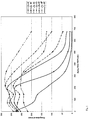
- Embodiments of the present invention will be described with reference to the accompanying Figure in which there is illustrated comparative hot air aging characteristics between polymer vulcanizates of the invention and a conventional polymer vulcanizate.
- Thus, the present polymer composition comprises two components.
- The first component of the present polymer composition is a polymer having a main polymer chain derived from: (i) at least 30% by weight of a first monomer which introduces at least one of a secondary carbon and a tertiary carbon to the main polymer chain, and (ii) in the range of from 0 to 70% by weight of at least one other monomer.
- As used throughout this specification, the term "polymer" is intended to have a broad meaning and is meant to encompass any polymer having a main polymer chain which comprises at least one secondary or tertiary carbon. Those of skill in the art will understand that a secondary carbon is a carbon atom having two hydrogen atoms bonded to it while a tertiary carbon is a carbon atom having one hydrogen atom bonded to it. The polymer may be a homopolymer, a copolymer, a terpolymer and the like. Also, it is possible to use a mixture of polymers provided at least one polymer in the mixture has the polymer main chain properties described above.
- The polymer suitable for use herein may be an elastomer (e.g., a hydrocarbon rubber), a graft polymer or block polymer of monomers having at least one ethylenically unsaturated bond and polymerizable through this unsaturation, and the like.
- Elastomers are well known to those of skill in the art. Non-limiting examples of suitable elastomers may be selected from the group consisting of natural rubber (NR), cis-1,4-polyisoprene rubber (IR), polybutadiene rubber (BR), styrene-butadiene rubber (SBR), acrylonitrile-butadiene rubber (NBR), hydrogenated acrylonitrilebutadiene rubber (HNBR), other HNBR copolymers, HNBR terpolymers (including hydrogenated acrylonitrile, butadiene, unsaturated carboxylic acid ester terpolymers), ethylene-propylene monomer rubber (EPM), ethylene-propylene-diene monomer rubber (EPDM), ethylene-vinyl acetate rubber (EVM) and the like.
- Of course, subject to compatibility, mixtures of two or more of any of the foregoing polymers may be used herein.
- Preferably, the polymer used in the present polymer composition is an elastomer. More preferably, the elastomer is selected from the group consisting of:
- ethylene-propylene copolymer;
- ethylene-propylene-non conjugated diene terpolymer;
- ethylene vinyl acetate copolymer;
- unsaturated nitrile/conjugated diene copolymer;
- hydrogenated unsaturated nitrile/conjugated diene copolymer;
- unsaturated nitrile/conjugated diene/ethylenically unsaturated monomer terpolymer;
- hydrogenated unsaturated nitrile/conjugated diene/ethylenically unsaturated monomer terpolymer;
- stryrene/conjugated diene copolymer;
- hydrogenated stryrene/conjugated diene copolymer;
- polyisoprene
- natural rubber;
- polybutadiene;
- and mixtures thereof.
-
- These elastomers are well known in the art and are readily available to or may be produced by a person of skill in the art.
- It is known in the art that elastomers, such as the preferred elastomers listed above, may contain small amounts of antioxidants (typically less than 0.5 parts by weight), which are added during the manufacturing process of the polymers mainly to increase their shelf life.
- The second component is a salt of a strong base and a weak acid, the salt comprising a metal selected from Group 1 of the Periodic Table of Elements (according to IUPAC 1985).
- Non-limiting examples of the weak acids useful in the production of the above-mentioned salt may be selected from the group consisting of carbonic acid, C1-C50 fatty acids, ethylene diamine tetra(acetic acid), phosphoric acid and mixtures thereof. The preferred salt for use in the present polymer composition may be selected from the group consisting of sodium carbonate, potassium carbonate, sodium stearate, potassium stearate and mixtures thereof. The most preferred salt for use in the present polymer composition is sodium carbonate. Preferably, the salt is present in the polymer composition in an amount in the range of from 0.5 to 50 parts by weight, preferably in the range of from 1 to 20 parts by weight, most preferably in the range of from 2.5 to 7.5 parts by weight.
- Optionally, the present polymer composition further comprises a carbodiimide, a polycarbodiimide or mixtures thereof. The preferred carbodiimide is available commercially under the tradenames Rhenogram™ P50 and Stabaxol™ P. This ingredient may be used in the present polymer composition in an amount in the range of from 0 to 15 parts by weight, more preferably in the range of from 0 to 10 parts by weight, even more preferably in the range of from 0 to 2 parts by weight.
- Preferably, the present polymer composition further comprises a vulcanization system. The choice and amount of vulcanization system depends on a number of factors, including the choice of polymer component, the intended application of the vulcanizate and the like.
- Preferably, the vulcanization system is selected from the group consisting of sulfur, a sulfur donor cure system and a peroxide compound.
- Non-limiting examples of useful sulfur donor cure systems may be selected from the group consisting of thiuram compounds (such as tetramethyl thiuram disulfide, tetraethyl thiuram disulfide, tetramethyl thiuram monosulfide and the like), and morpholine compounds (such as morpholine disulfide and the like). Further, it is possible to use dithiobis(caprolactam) in a sulfur donor cure system. The useful amount of sulfur or the sulfur-donating compound preferably is in the range of from 0.1 to 5 parts by weight.
- As is known in the art, when the vulcanization agent is sulfur or a sulfur donor cure system, it is conventional to include a vulcanization accelerator. Non-limiting examples of useful vulcanization accelerators may be selected from the group consisting of thiazole compounds (such as 2-mercaptobenzothiazole [MBT], dithiobis mercaptobenzothiazole [MBTS] and the like), sulfenamide compounds (such as N-cyclohexyl-2-benzothiazyl sulfenamide and the like), dithiocarbamates (such as zinc-dibutyl dithiocarbamate) and mixtures thereof. Such vulcanization accelerators are preferably used in an amount in the range of 0.5 to 5 parts by weight. Further, it is known to use metal oxides such as zinc oxide, magnesium oxide and the like, as well as acids such as stearic acid, cure activators in these vulcanization systems.
- As stated above, the vulcanization system may comprise a peroxide compound, preferably an organic peroxide. Non-limiting examples of useful organic peroxide compounds may be selected from the group consisting of dicumyl peroxide, benzoyl peroxide, 2,5-dimethyl-2,5-di(t-butylperoxy)-hexane, 2,2'-bis(tert-butylperoxydiisopropyl benzene, t-butyl peroxybenzoate and the like. Other useful peroxide compounds will be immediately apparent to those of skill in the art. The organic peroxide used is preferably in the range of from 0.5 to 15 parts by weight, preferably in the range of from 2 to 8 parts by weight.
- When the vulcanization system comprises an organic peroxide, it is known to include a coagent together therewith. Preferably, the coagent acts as a polyfunctional monomer. Non-limiting examples of suitable such coagents may be selected from the group consisting of triallyl cyanurate, triallyl isocyanurate, trimethylolpropane trimethacrylate, ethylene dimethacrylate, toluylene bismaleimide and the like. Preferably, the coagent is used in an amount in the range of from 1 to 10 parts by weight.
- Preferably, the present polymer composition comprises a filler. The nature of the filler is not particularly restricted and the choice of suitable fillers is within the purview of a person skilled in the art. Non-limiting examples of suitable fillers include carbon black (e.g., FEF, MT, GPF and SRF), clays, titanium dioxide, silica fillers (with or without unsaturated silanes), calcium carbonate, talc (magnesium silicate) and the like. The amount of filler is conventional. Preferably, the filler is present in an amount in the range of from 20 to 200 parts by weight per hundred parts by weight of the polymer. More preferably, the filler is present in an amount in the range of from 20 to 100 parts by weight per hundred parts by weight of the polymer. Most preferably, the filler is present in an amount in the range of from 40 to 80 parts by weight per hundred parts by weight of the polymer.
- In the present process, the polymer, the filler (as noted above, the use of a filler is optional), the additive and the vulcanization system may be admixed in any conventional manner known to the art. For example, this polymer composition may be admixed on a two-roll rubber mill or an internal mixer.
- Thus, the polymer composition is mixed in a conventional manner and the temperature thereof during mixing is maintained as is known in the art.
- In the present process, it is preferred to heat the polymer composition to form vulcanizates using conventional procedures well known in the art. Preferably, the polymer composition is heated to a temperature in the range of from 130° to 200°C, preferably from 140° to 190°C, more preferably from 150° to 180°C.
- Preferably, the heating is conducted for a period of in the range of from 1 minute to 15 hours, more preferably from 5 minutes to 30 minutes. Various methods of post cure, as is well known in the art, may be used to complete the vulcanization step.
- In many cases, the present polymer composition will further comprise an antioxidant. Non-limiting examples of useful antioxidant compounds may be selected from the group consisting of alkylated diphenylamines (such as styrenated diphenyl amine and the like), quinoline- type stabilizers (such as 2,2,4-trimethyl-1,2-dihydroquinoline polymer and the like), mercaptobenzimidazoles (such as zinc salts of methylmercaptobenzimidale) and the like. With sulfur-containing vulcanization systems, phenylene diamine derivatives (such as N-phenyl-N'-isopropyl-p-phenylene diamine and the like), as well as sterically hindered phenols (such as butylated hydroxy toluene and the like) can also be used. The amount of antioxidant used is within the purview of a person skilled in the art.
- Other conventional compounding ingredients may also be included by mixing with the copolymer in the conventional manner. Such other compounding ingredients are used for their conventional purposes and include activators such as zinc oxide and magnesium oxide; stearic acid; plasticizers; processing aids; reinforcing agents; promoters and retarders in amounts well known in the art.
- During production of the vulcanizate from the polymer composition, the vulcanizate may be formed into a composite with, for example, polyester fiber, nylon fiber aramide fiber, glass fiber, carbon fiber, steel fiber cords or fabrics and the like, whereby a desired rubber composite product is obtained.
- Embodiments of the present invention will be illustrated with reference to the following Examples which are provided for illustrative purposes and should not be used to limit the scope of the invention. Unless otherwise stated, all parts in the Examples are parts by weight.
- Further, in the Examples, the materials used include the following:
- Therban™ A3907: a hydrogenated nitrile butadiene polymer commercially available from Bayer Inc.;
- Therban™ A3407: a hydrogenated nitrile butadiene polymer commercially available from Bayer Inc.;
- Therban™ VPKA8798: a hydrogenated acrylonitrile, butadiene, unsaturated carboxylic acid ester terpolymer commercially available from Bayer Inc.;
- Buna™ EP T2070: a copolymer of ethylene and propylene commercially available from Bayer Inc.;
- Buna™ EP T6850: a terpolymer of ethylene, propylene and 5-ethylidene-2-norbornene, commercially available from Bayer Inc.;
- Levapren™ Lev 500HV: ethylene vinyl acetate commercially available from Bayer Inc.;
- Natural rubber (pale crepe);
- Dynamar™ RC5251Q: sodium carbonate commercially available from Dyneon;
- Rhenogran™ P50: polycarbodiimide commercially available from Rhein Chemie Corporation;
- Maglite™ D: magnesium oxide, activator, commercially available from CP Hall; Stearic acid, Emersol™ 132NF: dispersing agent;
- Zinc oxide: activator;
- Carbon black, N660 Sterling-V: filler
- Armeen™ 18D: 1-octadecanamine commercially available from Akzo Nobel Chemicals;
- Naugard™ 445: antioxidant commercially available from UniRoyal Chemicals;
- Vulkanox™ OCD/SG: antidegradant commercially available from Bayer Inc.;
- Vukanox™ ZMB-2/C5: antidegradant commercially available from Bayer Inc.;
- Sunpar™ 2280: paraffinic oil commercially available from Sun Refining;
- Plasthall TOTM: plasticizer commercially available from CP Hall;
- Diak #7: triallyl isocyanate, cross-linking activator, commercially available from E.I. DuPont; and
- Vulcup™ 40KE: 2,2'-bis(tert-butylperoxy diisopropylbenzene commercially available from Hercules;
- Sulfur: vulcanizing agent;
- Sulfasan DTDM: 4,4'-dithiodimorpholine commercially available from FLEXSYS America; and
- Vulkacit™ Thiuram/C: tetramethyl thiuram disulfide vulcanizing agent commercially available from Bayer Inc.
-
- The following procedure was used for each of Examples 1-4. The polymer composition used in Examples 1-4 are shown in Table 1.
- As will be apparent to those of skill in the art, the polymer composition of Examples 1 and 3 contained no special additive. Accordingly, Examples 1 and 3 are provided for comparison purposes only and are outside the scope of the present invention. As will be further apparent to those of skill in the art Examples 1 and 2 relate to a vulcanizate derived using a peroxide curing system whereas those of Examples 3 and 4 relate to vulcanizate derived using a sulfur donor curing system.
- The components of the polymer composition were mixed in a Banbury mixer using conventional techniques. The polymer composition was vulcanized at 170°C for a period of 15, 12, 8 and 8 minutes, respectively, for each of Examples 1-4.
- The elongation at break of the vulcanizates was determined in accordance with ASTM D412-80. Hardness properties were determined using a Type A Shore durometer in accordance with ASTM-D2240-81. The properties of the vulcanizates of Examples 1 and 2 are reported in Table 2 while those of Examples 3 and 4 are reported in Table 3.
- The properties of the vulcanizates reported in Tables 2 and 3 clearly illustrate the superiority of the hot air aging characteristics of the vulcanizates of Examples 2 and 4 (special additive used) when compared to the vulcanizate of Examples 1 and 3 (special additive not used), respectively. This translates into significant practical advantages in many of the conventional applications of the vulcanizates.
- The methodology used in Examples 1-4 was repeated in these Examples using the polymer compositions reported in Table 4. The polymer composition was vulcanized at 170°C for a period of 18, 18, 25 and 26 minutes, respectively, for each of Examples 5-8.
- As will be apparent to those of skill in the art, the polymer composition of Examples 5 and 7 contained no special additive. Accordingly, Examples 5 and 7 are provided for comparison purposes only and are outside the scope of the present invention. As will be further apparent to those of skill in the art, Examples 5 and 6 relate to a vulcanizate derived from EP copolymer whereas those of Examples 7 and 8 relate to a vulcanizate derived from EPDM terpolymer.
- Various physical properties of the vulcanizates were determined as described in Examples 1-4. These properties are reported in Table 4 for Examples 5 and 6, and in Table 5 for Examples 7 and 8.
- The properties of the vulcanizates reported in Tables 5 and 6 clearly illustrate the superiority of the hot air aging characteristics of the vulcanizates of Examples 6 and 8 (special additive used) when compared to the vulcanizate of Examples 5 and 7 (special additive not used), respectively. This translates into significant practical advantages in many of the conventional applications of the vulcanizates.
- The methodology used in Examples 1-4 was repeated in these Examples using the polymer compositions reported in Table 7. The polymer composition was vulcanized at 180°C for a period of 12, 12, 13 and 13 minutes, respectively, for each of Examples 9-12.
- As will be apparent to those of skill in the art, the polymer composition of Examples 9 and 11 contained no special additive. Accordingly, Examples 9 and 11 are provided for comparison purposes only and are outside the scope of the present invention. As will be further apparent to those of skill in the art, Examples 9 and 10 relate to a vulcanizate derived from a hydrogenated nitrite butadiene polymer whereas those of Examples 11 and 12 relate to a vulcanizate derived from a hydrogenated acrylonitrile, butadiene, unsaturated carboxylic acid ester terpolymer.
- Various physical properties of the vulcanizates were determined as described in Examples 1-4. These properties are reported in Table 8 for Examples 9 and 10, and in Table 9 for Examples 11 and 12.
- The properties of the vulcanizates reported in Tables 8 and 9 clearly illustrate the superiority of the hot air aging characteristics of the vulcanizates of Examples 10 and 12 (special additive used) when compared to the vulcanizate of Examples 9 and 11 (special additive not used), respectively. This translates into significant practical advantages in many of the conventional applications of the vulcanizates.
- The methodology used in Examples 1-4 was repeated in these Examples using the polymer compositions reported in Table 10.
- As will be apparent to those of skill in the art, the polymer composition of Example 19 contained no special additive. Accordingly, Example 19 is provided for comparison purposes only and is outside the scope of the present invention.
- Various physical properties of the vulcanizates were determined as described in Examples 1-4. These properties are reported in Tables 11 and 12, and are illustrated in the accompanying Figure.
- The properties of the vulcanizates reported in Tables 8 and 9 clearly illustrate the superiority of the hot air aging characteristics of the vulcanizates of Examples 13-18 (special additive used) when compared to the vulcanizate of Example 19 (special additive not used), respectively. The accompanying Figure is particularly instructive in showing the significant relative improvement in the time needed for the aged vulcanizate to reach 100% elongation at break under the test conditions.
- Additionally, these results illustrate the synergistic benefit of using a polycarbodiimide as an adjunct to the special additive. In this regard, reference can be made to a comparison of the properties for Example 13 with those of Examples 14 and 15, and to a comparison of the properties for Example 16 with those of Examples 17 and 18, particularly at longer aging periods. This translates into significant practical advantages in many of the conventional applications of the vulcanizates.
- The methodology used in Examples 1-4 was repeated in these Examples using the polymer compositions reported in Table 13. The polymer composition was vulcanized at 180°C for a period of 17 minutes in each Example.
- As will be apparent to those of skill in the art, the polymer composition of Example 20 contained no special additive. Accordingly, Example 20 is provided for comparison purposes only and is outside the scope of the present invention. As will be further apparent to those of skill in the art, Examples 20 and 21 relate to a vulcanizate derived from an ethylene vinyl acetate copolymer.
- Various physical properties of the vulcanizates were determined as described in Examples 1-4. These properties are reported in Table 14.
- The properties of the vulcanizates reported in Table 14 clearly illustrates the superiority of the hot air aging characteristics of the vulcanizates of Example 21 (special additive used) when compared to the vulcanizate of Examples 20 (special additive not used). This translates into significant practical advantages in many of the conventional applications of the vulcanizates.
Example Ingredient 1 2 3 4 Natural Rubber 100 100 100 100 Naugard™ 445 1.1 1.1 1.1 1.1 Vulkanox™ ZMB-2/C5 (ZMMBI) 0.4 0.4 0.4 0.4 Dynamar™ RC-5251Q - 5 - 5 Maglite™ D 3 3 3 3 Stearic Acid, Emersol™ 132 NF 3 3 3 3 Zinc Oxide 5 5 5 5 Carbon Black, N660 Sterling-V 50 50 50 50 Sunpar™ 2280 10 10 10 10 Diak #7 1.5 1.5 - - Vulcup 40KE 3.5 3.5 - - Sulfasan DTDM - - 2 2 Sulfur - - 0.3 0.3 Vulkacit Thiuram/C (D) - - 2 2 Example % Change Physical Properties 1 2 1 2 Unaged Elongation at break 325 360 - - Hardness, Shore A 48 48 Aged 4h @110°C Elongation at break 380 385 16.9 6.9 Hardness, Shore A 53 53 Aged 240h @110°C Elongation at break 245 295 -24.6 -18.1 Hardness, Shore A 52 52 Aged 504h @110°C Elongation at break 135 260 -58.5 -27.8 Hardness, Shore A 52 47 Aged 1008h @110°C Elongation at break 2 200 -99.4 -44.4 Hardness, Shore A 82 46 Aged 240h @120°C Elongation at break 190 320 -41.5 -11.1 Hardness, Shore A 46 45 Aged 504h @120°C Elongation at break 1 150 -99.7 -58.3 Hardness, Shore A 76 40 Aged 1008h @120°C Elongation at break 1 70 -99.7 -80.6 Hardness, Shore A 78 54 Example % Change Physical Properties 3 4 3 4 Unaged Elongation at break 220 230 - - Hardness, Shore A 60 60 Aged 4h @110°C Elongation at break 200 220 -9.1 -4.3 Hardness, Shore A 65 63 Aged 240h @110°C Elongation at break 120 130 -45.5 -43.5 Hardness, Shore A 67 67 Aged 504h @110°C Elongation at break 5 80 -97.7 -65.2 Hardness, Shore A 70 66 Aged 1008h @110°C Elongation at break 2 50 -99.1 -78.3 Hardness, Shore A 86 73 Aged 240h @120°C Elongation at break 40 115 -81.8 -50 Hardness, Shore A 66 62 Aged 504h @120°C Elongation at break 1 40 -99.5 -82.6 Hardness, Shore A 72 71 Example Ingredient 5 6 7 8 Buna™ EP T2070 100 100 - - Buna™ EP T6850 - - 100 100 Dynamar™RC-5251Q - 5 - 5 Maglite™ D 3 3 3 3 Naugard™445 1.1 1.1 1.1 1.1 Stearic Acid, Emersol™ 132 NF 1 1 1.5 1.5 Vulkanox™ ZMB-2/C5 (ZMMBI) 0.4 0.4 0.4 0.4 Zinc Oxide 3 3 5 5 Carbon Black, N660 Sterling-V 50 50 50 50 Sunpar™ 2280 10 10 10 10 Diak #7 1.5 1.5 1.5 1.5 Vulcup 40KE 7.5 7.5 3.5 3.5 Example % Change Physical Properties 5 6 5 6 Unaged Elongation at break 280 250 - - Hardness, Shore A 64 66 Aged 240h @160°C Elongation at break 335 360 19.6 44 Hardness, Shore A 71 75 Aged 504h @160°C Elongation at break 285 345 1.8 38 Hardness, Shore A 73 72 Aged 1008h @160°C Elongation at break 85 190 -69.6 -24 Hardness, Shore A 73 76 Example % Change Physical Properties 7 8 7 8 Unaged Elongation at break 380 350 - - Hardness, Shore A 61 59 Aged 240h @160°C Elongation at break 210 270 -44.7 -22.9 Hardness, Shore A 75 70 Aged 504h @160°C Elongation at break 60 160 -84.2 -54.3 Hardness, Shore A 75 75 Aged 1008h @160°C Elongation at break 1 30 -99.7 -91.4 Hardness, Shore A 94 84 Example Ingredient 9 10 11 12 Therban™ A3907 100 100 - - Therban™ VP KA 8798 - - 100 100 Dynamar™ RC-5251Q - 5 - 5 Maglite™ D - - 3 3 Vulcanox™ OCD/SG (ODPA) 1 1 1 1 Vulkanox™ ZMB-2/C5 (ZMMBI) 0.4 0.4 0.4 0.4 Zinc Oxide 3 3 3 3 Carbon Black, N660 Sterling-V 50 50 50 50 Plasthall TOTM 5 5 5 5 Diak #7 1.5 1.5 1.5 1.5 Vulcup 40KE 6.5 6.5 7.5 7.5 Example % Change Physical Properties 9 10 9 10 Unaged Elongation at break 275 285 - - Hardness, Shore A 70 72 Aged 24h @170°C Elongation at break 235 300 -14.5 13.2 Hardness, Shore A 74 75 Aged 48h @170°C Elongation at break 210 290 -23.6 9.4 Hardness, Shore A 75 79 Aged 72h @170°C Elongation at break 185 290 -32.7 9.4 Hardness, Shore A 76 78 Aged 96h @170°C Elongation at break 145 295 -47.3 11.3 Hardness, Shore A 79 78 Aged 168h @170°C Elongation at break 25 160 -90.9 -40 Hardness, Shore A 88 81 Aged 240h @170°C Elongation at break 40 165 -85.5 -38 Hardness, Shore A 86 82 Example % Change Physical Properties 11 12 11 12 Unaged Elongation at break 220 235 - - Hardness, Shore A 62 65 Aged 120h @160°C Elongation at break 210 290 -4.5 23.4 Hardness, Shore A 76 77 Aged 240h @160°C Elongation at break 145 285 -34.1 21.3 Hardness, Shore A 78 78 Aged 360h @160°C Elongation at break 125 240 -43.2 2.1 Hardness, Shore A 82 85 Aged 480h @160°C Elongation at break 80 230 -63.6 -2.1 Hardness, Shore A 86 83 Example Ingredient 13 14 15 16 17 18 19 Therban™ 100 100 100 100 100 100 100 Dynamar™ RC-5251Q 2.5 2.5 2.5 5 5 5 - Rhenogran™ P-50 - 5 10 - 5 10 - Vulcanox™ OCD/SG (ODPA) 1 1 1 1 1 1 1 Vulcanox™ ZMB-2/C5 (ZMMBI) 0.4 0.4 0.4 0.4 0.4 0.4 0.4 Zinc Oxide 3 3 3 3 3 3 3 Carbon Black, N660 Sterling-V 50 50 50 50 50 50 50 Plasthall TOTM 5 5 5 5 5 5 5 Diak #7 1.5 1.5 1.5 1.5 1.5 1.5 1.5 Vulcup 40KE 6.5 6.5 6.5 6.5 6.5 6.5 6.5 Example Physical Properties 13 14 15 16 17 18 19 Unaged Ultimate elongation 255 275 220 265 270 290 285 Hardness, Shore A 69 68 69 70 68 68 70 Aged 72h @160°C 285 270 240 300 310 320 195 Ultimate elongation 76 74 75 78 76 75 76 Hardness, Shore A Aged 144h @160°C 280 260 240 310 290 310 170 Ultimate elongation 78 74 74 74 75 76 77 Hardness, Shore A Aged 216h @160°C 275 290 255 315 330 330 115 Ultimate elongation 76 77 70 79 76 75 78 Hardness, Shore A Aged 336h @160°C 90 230 240 215 285 325 35 Ultimate elongation 84 78 81 83 81 79 87 Hardness, Shore A Aged 504h @160°C 20 95 140 55 180 265 5 Ultimate elongation 81 77 77 76 76 76 88 Hardness, Shore A Aged 672h @150°C 10 45 125 25 100 200 1 Ultimate elongation 91 86 85 88 85 84 92 Hardness, Shore A Example Physical Properties 13 14 15 16 17 18 19 Unaged Ultimate elongation 255 275 220 265 270 290 285 Hardness, Shore A 69 68 69 70 68 68 70 Aged 168th @150°C 20.4 20.6 17.4 19.8 20.9 20.8 25.0 Ultimate tensile (MPa) 290 260 240 300 285 285 210 Ultimate elongation 78 74 74 77 76 73 77 Hardness, Shore A Aged 336h @150°C 16.5 17.5 16.0 16.1 17.6 18.6 17.4 Ultimate tensile (MPa) 230 275 220 300 320 315 80 Ultimate elongation 81 79 78 79 78 78 82 Hardness, Shore A Aged 504h @150°C 16.6 17.3 16.0 15.8 17.3 18.6 13.4 Ultimate tensile (MPa) 205 235 200 235 290 290 35 Ultimate elongation 75 66 71 76 73 73 80 Hardness, Shore A Aged 1008h @150°C 5.1 14.3 13.5 12.4 13.7 14.6 13.3 Ultimate tensile (MPa) 25 155 160 105 245 270 0 Ultimate elongation 85 78 79 83 82 80 90 Hardness, Shore A Aged 1512h @150°C 4.4 5.8 9.4 7.6 10.8 12.3 3.8 Ultimate tensile (MPa) 1 25 65 30 80 125 1 Ultimate elongation 92 84 82 84 83 81 86 Hardness, Shore A Aged 2016h @150°C 0.5 5.9 8.8 5.9 8.8 10.8 0.1 Ultimate tensile (MPa) 0 15 45 45 50 75 0 Ultimate elongation 89 87 84 82 86 80 88 Hardness, Shore A Example Ingredient 20 21 Levapren™ 500HV (KA8608) 100 100 Armeen™ 18D 2 2 Dynamar™ RC-5251Q - 5 Maglite™ D 3 3 Naugard™ 445 1.1 1.1 Stearic acid, Emersol™ 132 NF 1 1 Vulkanox™ ZMB-2/C5 (ZMMBI) 0.4 0.4 Zinc Oxide 3 3 Carbon Black, N660 Sterling-V 50 50 Plasthall TOTM 5 5 Diak #7 1.5 1.5 Vulcup 40KE 7.5 7.5 Example % Change Physical Properties 20 21 20 21 Unaged Elongation at break 190 190 - - Hardness, Shore A 67 70 Aged 240h @160°C Elongation at break 220 310 15.8 63.2 Hardness, Shore A 80 84 Aged 504h @160°C Elongation at break 180 210 -5.3 10.5 Hardness, Shore A 80 86 Aged 1008h @160°C Elongation at break 75 100 -60.5 -47.4 Hardness, Shore A 84 87 - The publications, patents and/or patent applications referred to in this specification are for U.S. patent practice incorporated by reference in their entirety to the same extent as if each individual publication, patent or patent application was specifically and individually indicated to be incorporated by reference in its entirety for U.S. patent practice.
Claims (27)
- A polymer composition comprising:a polymer having a main polymer chain derived from: (i) at least 30% by weight of a first monomer which introduces at least one of a secondary carbon and a tertiary carbon to the main polymer chain, and (ii) in the range of from 0 to 70% by weight of at least one other monomer; anda salt of a strong base and a weak acid, the salt comprising a metal selected from Group 1 of the Periodic Table of Elements (according to IUPAC 1985).
- The polymer composition defined in claim 1, further comprising a polycarbodiimide.
- The polymer composition defined in any one of claims 1-2, further comprising a filler.
- The polymer composition defined in claim 3, wherein the filler is selected from the group consisting of group carbon black, clay, titanium dioxide, silica fillers, talc and mixtures thereof.
- The polymer composition defined in any one of claims 1-4, wherein the polymer comprises an elastomer.
- The polymer composition defined 5, wherein the elastomer is selected from the group consisting of ethylene-propylene copolymer, ethylene-propylene-non conjugated diene terpolymer, ethylene vinyl acetate copolymer, unsaturated nitrile/conjugated diene copolymer, hydrogenated unsaturated nitrile/conjugated diene copolymer, unsaturated nitrile/conjugated diene/ethylenically unsaturated monomer terpolymer, hydrogenated unsaturated nitrile/conjugated diene/ethylenically unsaturated monomer terpolymer, stryrene/conjugated diene copolymer, hydrogenated stryrene/conjugated diene copolymer, polyisoprene, natural rubber, polybutadiene and mixtures thereof.
- The polymer composition defined in any one of claims 1-6, wherein the salt is selected from the group consisting of potassium carbonate, sodium carbonate, sodium or potassium salts of C1 to C50-mono, di or poly carboxylic acids, sodium phosphate, potassium phosphate and mixtures thereof.
- The polymer composition defined in any one of claims 1-6, wherein the salt is selected from the group consisting of sodium carbonate, sodium stearate and mixtures thereof.
- The polymer composition defined in any one of claims 1-8, wherein the salt is present in an amount in the range of from 0.5 to 50 parts by weight.
- The polymer composition defined in any one of claims 1-8, wherein the salt is present in an amount in the range of from 1 to 20 parts by weight.
- The polymer composition defined in any one of claims 1-10, further comprising a vulcanization system.
- The polymer composition defined in claim 11, wherein the vulcanization system is selected from the group consisting of sulfur, a sulfur donor cure system and a peroxide compound.
- A process for producing a polymer vulcanizate comprising the steps of:(i) admixing the polymer composition defined in any one of claims 1-10 with a vulcanization system to produce a curable composition; and(ii) vulcanizing the curable composition to produce the polymer vulcanizate.
- The process defined in claim 13, further comprising a vulcanization system.
- The process defined in claim 14, wherein the vulcanization system is selected from the group consisting of sulfur, a sulfur donor cure system and a peroxide compound.
- A method for improving the hot air aging characteristics of a polymer comprising the steps of:admixing: (A) a polymer having a main polymer chain derived from: (i) at least 30% by weight of a first monomer which introduces at least one of a secondary carbon and a tertiary carbon to the main polymer chain, and (ii) in the range of from 0 to 70% by weight of at least one other monomer; and (B) a salt of a strong base and a weak acid, the salt comprising a metal selected from Group 1 of the Periodic Table of Elements (according to IUPAC 1985) to provide a polymer composition; andvulcanizing the polymer composition.
- The method defined in claim 16, wherein the polymer composition further comprises a polycarbodiimide.
- The method defined in any one of claims 16-17, wherein the polymer composition further comprises a filler.
- The method defined in claim 18, wherein the filler is selected from the group consisting of carbon black, clay, titanium dioxide, silica fillers, talc and mixtures thereof.
- The method defined in any one of claims 16-19, wherein the polymer comprises an elastomer.
- The method defined in 20, wherein the elastomer is selected from the group consisting of ethylene-propylene copolymer, ethylene-propylene-non conjugated diene terpolymer, ethylene vinyl acetate copolymer, unsaturated nitrile/conjugated diene copolymer, hydrogenated unsaturated nitrite/conjugated diene copolymer, unsaturated nitrile/conjugated diene/ethylenically unsaturated monomer terpolymer, hydrogenated unsaturated nitrile/conjugated diene/ethylenically unsaturated monomer terpolymer, stryrene/conjugated diene copolymer, hydrogenated stryrene/conjugated diene copolymer, polyisoprene, natural rubber, polybutadiene and mixtures thereof.
- The method defined in any one of claims 16-21, wherein the salt is selected from the group consisting of potassium carbonate, sodium carbonate, sodium or potassium salts of C1 to C50-mono, di or poly carboxylic acids, sodium phosphate, potassium phosphate and mixtures thereof.
- The method defined in any one of claims 16-21, wherein the salt is selected from the group consisting of sodium carbonate, sodium stearate and mixtures thereof.
- The method defined in any one of claims 16-23, wherein the salt is present in an amount in the range of from 0.5 to 50 parts by weight.
- The method defined in any one of claims 16-23, wherein the salt is present in an amount in the range of from 1 to 20 parts by weight.
- The method defined in any one of claims 16-25, the polymer composition further comprises a vulcanization system.
- The method defined in claim 26, wherein the vulcanization system is selected from the group consisting of sulfur, a sulfur donor cure system and a peroxide compound.
Applications Claiming Priority (2)
| Application Number | Priority Date | Filing Date | Title |
|---|---|---|---|
| CA002281274A CA2281274A1 (en) | 1999-08-31 | 1999-08-31 | Improved polymer composition and process for producing vulcanizates thereof |
| CA2281274 | 1999-08-31 |
Publications (2)
| Publication Number | Publication Date |
|---|---|
| EP1081188A1 true EP1081188A1 (en) | 2001-03-07 |
| EP1081188B1 EP1081188B1 (en) | 2006-06-14 |
Family
ID=4164061
Family Applications (1)
| Application Number | Title | Priority Date | Filing Date |
|---|---|---|---|
| EP00117297A Expired - Lifetime EP1081188B1 (en) | 1999-08-31 | 2000-08-18 | Improved polymer composition and process for production vulcanizates thereof |
Country Status (6)
| Country | Link |
|---|---|
| US (1) | US7005467B2 (en) |
| EP (1) | EP1081188B1 (en) |
| JP (1) | JP4767398B2 (en) |
| CA (1) | CA2281274A1 (en) |
| DE (1) | DE60028671T2 (en) |
| TW (1) | TW568939B (en) |
Cited By (8)
| Publication number | Priority date | Publication date | Assignee | Title |
|---|---|---|---|---|
| EP1239004A1 (en) * | 2001-02-28 | 2002-09-11 | Bayer Inc. | Articles for dynamic load applications |
| EP1491583A1 (en) * | 2003-06-26 | 2004-12-29 | Bayer Inc. | Polymer blends comprising nitrile rubber |
| EP1491582A1 (en) * | 2003-06-26 | 2004-12-29 | Bayer Inc. | Nitrile polymer compositions |
| WO2014089136A1 (en) | 2012-12-04 | 2014-06-12 | E. I. Du Pont De Nemours And Company | Heat aging resistant ethylene vinyl acetate copolymer composition and process for its production |
| US9051460B2 (en) | 2012-12-04 | 2015-06-09 | E.I. Du Pont De Nemours And Company | Heat resistant hydrocarbon elastomer compositions |
| WO2015084336A1 (en) | 2013-12-04 | 2015-06-11 | E. I. Du Pont De Nemours And Company | Heat resistant ethylene vinyl acetate copolymer composition and process for its production |
| US9068066B2 (en) | 2012-12-04 | 2015-06-30 | E I Du Pont De Nemours And Company | Heat resistant hydrocarbon elastomer compositions |
| US9803073B2 (en) | 2013-11-20 | 2017-10-31 | E. I. Du Pont De Nemours And Company | Heat resistant ethylene vinyl acetate copolymer composition and process for its production |
Families Citing this family (4)
| Publication number | Priority date | Publication date | Assignee | Title |
|---|---|---|---|---|
| US8049313B2 (en) * | 2006-09-20 | 2011-11-01 | Freescale Semiconductor, Inc. | Heat spreader for semiconductor package |
| SG194339A1 (en) | 2008-09-12 | 2013-11-29 | Lanxess Inc | Novel elastomeric compositions with improved heat resistance, compression set, and processability |
| CN105367921A (en) * | 2015-12-18 | 2016-03-02 | 杨甫进 | Ethylene-popylene-dene monomer |
| CA3227158A1 (en) * | 2021-07-29 | 2023-02-02 | James DOEDEN (deceased) | Curable liquid rubber compositions and methods of using same |
Citations (10)
| Publication number | Priority date | Publication date | Assignee | Title |
|---|---|---|---|---|
| US5319036A (en) * | 1993-06-23 | 1994-06-07 | Zeon Chemicals U.S.A., Inc. | Curing system for polyacrylate rubbers |
| JPH07331035A (en) * | 1994-06-10 | 1995-12-19 | Denki Kagaku Kogyo Kk | Acrylic elastomer composition |
| JPH08302079A (en) * | 1995-05-11 | 1996-11-19 | Chisso Corp | Crystalline polyolefin composition |
| JPH08311289A (en) * | 1995-05-19 | 1996-11-26 | Japan Synthetic Rubber Co Ltd | Acrylic rubber composition |
| JPH08311288A (en) * | 1995-05-17 | 1996-11-26 | Japan Synthetic Rubber Co Ltd | Acrylic rubber composition |
| JPH0931322A (en) * | 1995-07-24 | 1997-02-04 | Du Pont Mitsui Polychem Co Ltd | Thermoplastic resin composition |
| JPH09137000A (en) * | 1995-09-14 | 1997-05-27 | Nippon Zeon Co Ltd | Elastomer composition containing ethylenically unsaturated carboxylic acid metal salt and method for molding vulcanized elastomer |
| JPH09278963A (en) * | 1996-04-11 | 1997-10-28 | Asahi Denka Kogyo Kk | Vinyl chloride resin composition |
| JPH1017722A (en) * | 1996-07-03 | 1998-01-20 | Taoka Chem Co Ltd | Rubber composition |
| US5783640A (en) * | 1997-03-04 | 1998-07-21 | The Goodyear Tire & Rubber Company | Rubber compositions containing a disodium salt of 2, 2'-dithiosalicyclic acid |
Family Cites Families (25)
| Publication number | Priority date | Publication date | Assignee | Title |
|---|---|---|---|---|
| ES305880A1 (en) * | 1963-11-21 | 1965-07-16 | Montecatini Soc Generale Per L'industria Mine Raria E Ch | A procedure for the preparation of vulcanizados with elevated mechanical properties. (Machine-translation by Google Translate, not legally binding) |
| GB1137929A (en) * | 1966-10-19 | 1968-12-27 | Distrene Ltd | Alkanolamide-containing antistatic agent compositions for polymers |
| US3696059A (en) * | 1968-06-13 | 1972-10-03 | Furukawa Electric Co Ltd | Process for preparing olefin polymer foams |
| US3657165A (en) * | 1968-10-11 | 1972-04-18 | Sekisui Chemical Co Ltd | Process for preparation of ethylenic resin foam |
| US3728205A (en) * | 1969-10-17 | 1973-04-17 | Uniroyal Inc | Antistatic polymer composition |
| USRE28070E (en) * | 1969-10-17 | 1974-07-09 | Uniroyal Inc | Antistatic polymer compositions |
| US3745116A (en) * | 1969-10-17 | 1973-07-10 | Uniroyal Inc | Antistatic polymer composition of poly-hydric alcohol and alkali metal carboxylate |
| GB8606808D0 (en) * | 1986-03-19 | 1986-04-23 | Malaysian Rubber Producers | Elastoplastic compositions |
| JP2610145B2 (en) * | 1987-11-20 | 1997-05-14 | 日本合成ゴム株式会社 | Rubber composition |
| US5059648A (en) * | 1988-10-27 | 1991-10-22 | Nissin Chemical Industry Co., Ltd. | Rubber composition |
| JPH0328253A (en) * | 1989-06-26 | 1991-02-06 | Sumitomo Chem Co Ltd | Method for removing odor of acetic acid |
| JPH03265636A (en) * | 1990-03-15 | 1991-11-26 | Yokohama Rubber Co Ltd:The | Rubber composition |
| US5091448A (en) * | 1990-04-24 | 1992-02-25 | Phillips Petroleum Company | Suspending medium for water soluble polymer |
| JPH0415261A (en) * | 1990-05-10 | 1992-01-20 | Idemitsu Petrochem Co Ltd | Resin additive |
| JP3008556B2 (en) * | 1991-05-15 | 2000-02-14 | ジェイエスアール株式会社 | Rubber laminate |
| US5567742A (en) * | 1992-02-04 | 1996-10-22 | The Dow Chemical Company | Dimensionally-stable polypropylene foam expanded with inorganic blowing agents |
| JP3292414B2 (en) * | 1992-11-26 | 2002-06-17 | 住友ゴム工業株式会社 | Tire tread rubber composition |
| JPH06287359A (en) * | 1993-03-31 | 1994-10-11 | Nippon Zeon Co Ltd | Method for producing vulcanizable rubber composition |
| TW247295B (en) * | 1993-04-17 | 1995-05-11 | Nanya Plastics Corp | Process for producing polypropylene (PP) pearling synthetic paper |
| JPH07238197A (en) * | 1994-03-02 | 1995-09-12 | Mitsubishi Chem Corp | Vinyl chloride resin composition |
| JP3622803B2 (en) * | 1995-11-28 | 2005-02-23 | 日本ゼオン株式会社 | Rubber composition |
| JPH1076619A (en) * | 1996-09-05 | 1998-03-24 | Toppan Printing Co Ltd | Container reinforcement sheet |
| US6362264B1 (en) * | 1996-12-20 | 2002-03-26 | Ck Witco Corporation | Stabilizer for food contact and medical grade PVC |
| JPH10237422A (en) * | 1997-02-21 | 1998-09-08 | Toppan Printing Co Ltd | Packing for liquid container and cap fitted with the packing |
| JPH114913A (en) * | 1997-06-18 | 1999-01-12 | Sumitomo Rubber Ind Ltd | Rubber thread for golf balls |
-
1999
- 1999-08-31 CA CA002281274A patent/CA2281274A1/en not_active Abandoned
- 1999-09-03 TW TW088115262A patent/TW568939B/en not_active IP Right Cessation
-
2000
- 2000-08-18 DE DE60028671T patent/DE60028671T2/en not_active Expired - Lifetime
- 2000-08-18 EP EP00117297A patent/EP1081188B1/en not_active Expired - Lifetime
- 2000-08-30 JP JP2000260804A patent/JP4767398B2/en not_active Expired - Fee Related
-
2003
- 2003-01-30 US US10/354,295 patent/US7005467B2/en not_active Expired - Fee Related
Patent Citations (10)
| Publication number | Priority date | Publication date | Assignee | Title |
|---|---|---|---|---|
| US5319036A (en) * | 1993-06-23 | 1994-06-07 | Zeon Chemicals U.S.A., Inc. | Curing system for polyacrylate rubbers |
| JPH07331035A (en) * | 1994-06-10 | 1995-12-19 | Denki Kagaku Kogyo Kk | Acrylic elastomer composition |
| JPH08302079A (en) * | 1995-05-11 | 1996-11-19 | Chisso Corp | Crystalline polyolefin composition |
| JPH08311288A (en) * | 1995-05-17 | 1996-11-26 | Japan Synthetic Rubber Co Ltd | Acrylic rubber composition |
| JPH08311289A (en) * | 1995-05-19 | 1996-11-26 | Japan Synthetic Rubber Co Ltd | Acrylic rubber composition |
| JPH0931322A (en) * | 1995-07-24 | 1997-02-04 | Du Pont Mitsui Polychem Co Ltd | Thermoplastic resin composition |
| JPH09137000A (en) * | 1995-09-14 | 1997-05-27 | Nippon Zeon Co Ltd | Elastomer composition containing ethylenically unsaturated carboxylic acid metal salt and method for molding vulcanized elastomer |
| JPH09278963A (en) * | 1996-04-11 | 1997-10-28 | Asahi Denka Kogyo Kk | Vinyl chloride resin composition |
| JPH1017722A (en) * | 1996-07-03 | 1998-01-20 | Taoka Chem Co Ltd | Rubber composition |
| US5783640A (en) * | 1997-03-04 | 1998-07-21 | The Goodyear Tire & Rubber Company | Rubber compositions containing a disodium salt of 2, 2'-dithiosalicyclic acid |
Non-Patent Citations (8)
| Title |
|---|
| DATABASE WPI Derwent World Patents Index; AN 1994-198963, XP002152679 * |
| DATABASE WPI Derwent World Patents Index; AN 1994-240491, XP002152680 * |
| PATENT ABSTRACTS OF JAPAN vol. 1996, no. 04 30 April 1996 (1996-04-30) * |
| PATENT ABSTRACTS OF JAPAN vol. 1997, no. 03 31 March 1997 (1997-03-31) * |
| PATENT ABSTRACTS OF JAPAN vol. 1997, no. 06 30 June 1997 (1997-06-30) * |
| PATENT ABSTRACTS OF JAPAN vol. 1997, no. 09 30 September 1997 (1997-09-30) * |
| PATENT ABSTRACTS OF JAPAN vol. 1998, no. 02 30 January 1998 (1998-01-30) * |
| PATENT ABSTRACTS OF JAPAN vol. 1998, no. 05 30 April 1998 (1998-04-30) * |
Cited By (9)
| Publication number | Priority date | Publication date | Assignee | Title |
|---|---|---|---|---|
| EP1239004A1 (en) * | 2001-02-28 | 2002-09-11 | Bayer Inc. | Articles for dynamic load applications |
| US6737461B2 (en) | 2001-02-28 | 2004-05-18 | Bayer Inc. | Articles for dynamic load applications |
| EP1491583A1 (en) * | 2003-06-26 | 2004-12-29 | Bayer Inc. | Polymer blends comprising nitrile rubber |
| EP1491582A1 (en) * | 2003-06-26 | 2004-12-29 | Bayer Inc. | Nitrile polymer compositions |
| WO2014089136A1 (en) | 2012-12-04 | 2014-06-12 | E. I. Du Pont De Nemours And Company | Heat aging resistant ethylene vinyl acetate copolymer composition and process for its production |
| US9051460B2 (en) | 2012-12-04 | 2015-06-09 | E.I. Du Pont De Nemours And Company | Heat resistant hydrocarbon elastomer compositions |
| US9068066B2 (en) | 2012-12-04 | 2015-06-30 | E I Du Pont De Nemours And Company | Heat resistant hydrocarbon elastomer compositions |
| US9803073B2 (en) | 2013-11-20 | 2017-10-31 | E. I. Du Pont De Nemours And Company | Heat resistant ethylene vinyl acetate copolymer composition and process for its production |
| WO2015084336A1 (en) | 2013-12-04 | 2015-06-11 | E. I. Du Pont De Nemours And Company | Heat resistant ethylene vinyl acetate copolymer composition and process for its production |
Also Published As
| Publication number | Publication date |
|---|---|
| DE60028671D1 (en) | 2006-07-27 |
| JP2001081245A (en) | 2001-03-27 |
| JP4767398B2 (en) | 2011-09-07 |
| TW568939B (en) | 2004-01-01 |
| DE60028671T2 (en) | 2007-05-24 |
| EP1081188B1 (en) | 2006-06-14 |
| CA2281274A1 (en) | 2001-02-28 |
| US7005467B2 (en) | 2006-02-28 |
| US20030176549A1 (en) | 2003-09-18 |
Similar Documents
| Publication | Publication Date | Title |
|---|---|---|
| US4983678A (en) | Curable rubber composition | |
| EP1239004B1 (en) | Articles for dynamic load applications | |
| US4918144A (en) | Vulcanizable rubber composition | |
| EP0940429B1 (en) | Improved nitrile polymer vulcanizate and process for the production thereof | |
| EP2334724B1 (en) | Novel elastomeric compositions with improved heat resistance, compression set, and processability | |
| EP1081188B1 (en) | Improved polymer composition and process for production vulcanizates thereof | |
| US4965323A (en) | Method of vulcanizing rubber at pH 5 to 10 | |
| JPH01319551A (en) | Ozone-resistant elastomer composition | |
| US20050101737A1 (en) | Polymer blends comprising nitrile rubber | |
| US4020039A (en) | Vulcanizable elastomeric compositions | |
| US20010004660A1 (en) | Polymer composition and process for producing vulcanizates thereof | |
| WO2003064513A1 (en) | Improved nitrile polymer vulcanizate and process for the production thereof | |
| JP5489448B2 (en) | Improved polymer vulcanizate and process for producing the same | |
| JPH10110070A (en) | Rubber composition for open crosslinking and method for open-crosslinking the same | |
| EP4130067A1 (en) | Acrylic rubber, acrylic rubber-containing composition, and crosslinked rubber | |
| US7737225B1 (en) | High performance elastomeric compound | |
| MXPA00008328A (en) | Improved polymer composition and process for producing vulcanizates thereof | |
| US6759457B2 (en) | Unique compositions having utility in rubber applications | |
| EP4209540A1 (en) | Ethylene/propylene copolymer rubber composition | |
| JPH09169873A (en) | Rubber composition for open cross-linking and cross-linking method | |
| JP2003206374A (en) | Crosslinking agent for open crosslinking and open crosslinking method | |
| CA2265120A1 (en) | Improved nitrile polymer vulcanizate and process for the production thereof |
Legal Events
| Date | Code | Title | Description |
|---|---|---|---|
| PUAI | Public reference made under article 153(3) epc to a published international application that has entered the european phase |
Free format text: ORIGINAL CODE: 0009012 |
|
| AK | Designated contracting states |
Kind code of ref document: A1 Designated state(s): DE FR GB IT |
|
| AX | Request for extension of the european patent |
Free format text: AL;LT;LV;MK;RO;SI |
|
| 17P | Request for examination filed |
Effective date: 20010907 |
|
| AKX | Designation fees paid |
Free format text: DE FR GB IT |
|
| 17Q | First examination report despatched |
Effective date: 20030213 |
|
| RAP1 | Party data changed (applicant data changed or rights of an application transferred) |
Owner name: LANXESS INC. |
|
| GRAP | Despatch of communication of intention to grant a patent |
Free format text: ORIGINAL CODE: EPIDOSNIGR1 |
|
| GRAS | Grant fee paid |
Free format text: ORIGINAL CODE: EPIDOSNIGR3 |
|
| GRAA | (expected) grant |
Free format text: ORIGINAL CODE: 0009210 |
|
| AK | Designated contracting states |
Kind code of ref document: B1 Designated state(s): DE FR GB IT |
|
| PG25 | Lapsed in a contracting state [announced via postgrant information from national office to epo] |
Ref country code: IT Free format text: LAPSE BECAUSE OF FAILURE TO SUBMIT A TRANSLATION OF THE DESCRIPTION OR TO PAY THE FEE WITHIN THE PRESCRIBED TIME-LIMIT;WARNING: LAPSES OF ITALIAN PATENTS WITH EFFECTIVE DATE BEFORE 2007 MAY HAVE OCCURRED AT ANY TIME BEFORE 2007. THE CORRECT EFFECTIVE DATE MAY BE DIFFERENT FROM THE ONE RECORDED. Effective date: 20060614 |
|
| REG | Reference to a national code |
Ref country code: GB Ref legal event code: FG4D |
|
| REF | Corresponds to: |
Ref document number: 60028671 Country of ref document: DE Date of ref document: 20060727 Kind code of ref document: P |
|
| PLBE | No opposition filed within time limit |
Free format text: ORIGINAL CODE: 0009261 |
|
| STAA | Information on the status of an ep patent application or granted ep patent |
Free format text: STATUS: NO OPPOSITION FILED WITHIN TIME LIMIT |
|
| EN | Fr: translation not filed | ||
| 26N | No opposition filed |
Effective date: 20070315 |
|
| PG25 | Lapsed in a contracting state [announced via postgrant information from national office to epo] |
Ref country code: FR Free format text: LAPSE BECAUSE OF FAILURE TO SUBMIT A TRANSLATION OF THE DESCRIPTION OR TO PAY THE FEE WITHIN THE PRESCRIBED TIME-LIMIT Effective date: 20070309 |
|
| PG25 | Lapsed in a contracting state [announced via postgrant information from national office to epo] |
Ref country code: FR Free format text: LAPSE BECAUSE OF FAILURE TO SUBMIT A TRANSLATION OF THE DESCRIPTION OR TO PAY THE FEE WITHIN THE PRESCRIBED TIME-LIMIT Effective date: 20060614 |
|
| PGFP | Annual fee paid to national office [announced via postgrant information from national office to epo] |
Ref country code: DE Payment date: 20160809 Year of fee payment: 17 Ref country code: GB Payment date: 20160817 Year of fee payment: 17 |
|
| REG | Reference to a national code |
Ref country code: DE Ref legal event code: R081 Ref document number: 60028671 Country of ref document: DE Owner name: ARLANXEO CANADA INC., SARNIA, CA Free format text: FORMER OWNER: LANXESS INC., SARNIA, ONTARIO, CA Ref country code: DE Ref legal event code: R082 Ref document number: 60028671 Country of ref document: DE Representative=s name: WICHMANN, BIRGID, DIPL.-CHEM. DR.RER.NAT., DE |
|
| REG | Reference to a national code |
Ref country code: DE Ref legal event code: R119 Ref document number: 60028671 Country of ref document: DE |
|
| GBPC | Gb: european patent ceased through non-payment of renewal fee |
Effective date: 20170818 |
|
| PG25 | Lapsed in a contracting state [announced via postgrant information from national office to epo] |
Ref country code: GB Free format text: LAPSE BECAUSE OF NON-PAYMENT OF DUE FEES Effective date: 20170818 Ref country code: DE Free format text: LAPSE BECAUSE OF NON-PAYMENT OF DUE FEES Effective date: 20180301 |