EP1081127A1 - Novel process for the preparation of n,n'-dialkylalkanediamines - Google Patents
Novel process for the preparation of n,n'-dialkylalkanediamines Download PDFInfo
- Publication number
- EP1081127A1 EP1081127A1 EP00909650A EP00909650A EP1081127A1 EP 1081127 A1 EP1081127 A1 EP 1081127A1 EP 00909650 A EP00909650 A EP 00909650A EP 00909650 A EP00909650 A EP 00909650A EP 1081127 A1 EP1081127 A1 EP 1081127A1
- Authority
- EP
- European Patent Office
- Prior art keywords
- reaction
- dihaloalkane
- formula
- represented
- mol
- Prior art date
- Legal status (The legal status is an assumption and is not a legal conclusion. Google has not performed a legal analysis and makes no representation as to the accuracy of the status listed.)
- Granted
Links
- 238000002360 preparation method Methods 0.000 title claims abstract description 31
- 238000000034 method Methods 0.000 title abstract description 25
- 238000006243 chemical reaction Methods 0.000 claims abstract description 121
- 150000003973 alkyl amines Chemical class 0.000 claims abstract description 70
- 125000000217 alkyl group Chemical group 0.000 claims abstract description 18
- GDTBXPJZTBHREO-UHFFFAOYSA-N bromine Chemical group BrBr GDTBXPJZTBHREO-UHFFFAOYSA-N 0.000 claims abstract description 14
- 229910052794 bromium Inorganic materials 0.000 claims abstract description 8
- 229910052801 chlorine Inorganic materials 0.000 claims abstract description 8
- 239000000460 chlorine Substances 0.000 claims abstract description 8
- 125000001309 chloro group Chemical group Cl* 0.000 claims abstract description 8
- ZCYVEMRRCGMTRW-UHFFFAOYSA-N 7553-56-2 Chemical group [I] ZCYVEMRRCGMTRW-UHFFFAOYSA-N 0.000 claims abstract description 7
- 229910052740 iodine Chemical group 0.000 claims abstract description 7
- 125000004435 hydrogen atom Chemical group [H]* 0.000 claims description 9
- 239000006227 byproduct Substances 0.000 abstract description 34
- 230000015572 biosynthetic process Effects 0.000 abstract description 18
- WKBOTKDWSSQWDR-UHFFFAOYSA-N Bromine atom Chemical group [Br] WKBOTKDWSSQWDR-UHFFFAOYSA-N 0.000 abstract description 2
- UFHFLCQGNIYNRP-UHFFFAOYSA-N Hydrogen Chemical compound [H][H] UFHFLCQGNIYNRP-UHFFFAOYSA-N 0.000 abstract description 2
- -1 cyclic diamines Chemical class 0.000 abstract description 2
- 229910052739 hydrogen Inorganic materials 0.000 abstract description 2
- 239000001257 hydrogen Substances 0.000 abstract description 2
- 239000013067 intermediate product Substances 0.000 abstract 1
- 239000011630 iodine Chemical group 0.000 abstract 1
- BAVYZALUXZFZLV-UHFFFAOYSA-N Methylamine Chemical compound NC BAVYZALUXZFZLV-UHFFFAOYSA-N 0.000 description 74
- RXYPXQSKLGGKOL-UHFFFAOYSA-N 1,4-dimethylpiperazine Chemical compound CN1CCN(C)CC1 RXYPXQSKLGGKOL-UHFFFAOYSA-N 0.000 description 22
- 238000004817 gas chromatography Methods 0.000 description 22
- 125000004122 cyclic group Chemical group 0.000 description 14
- KVKFRMCSXWQSNT-UHFFFAOYSA-N n,n'-dimethylethane-1,2-diamine Chemical compound CNCCNC KVKFRMCSXWQSNT-UHFFFAOYSA-N 0.000 description 14
- SCYULBFZEHDVBN-UHFFFAOYSA-N 1,1-Dichloroethane Chemical compound CC(Cl)Cl SCYULBFZEHDVBN-UHFFFAOYSA-N 0.000 description 12
- 239000011541 reaction mixture Substances 0.000 description 12
- YFBQXUGQIFAFMM-UHFFFAOYSA-N 2-chloro-n-methylethanamine Chemical compound CNCCCl YFBQXUGQIFAFMM-UHFFFAOYSA-N 0.000 description 11
- ODZZIKZQNODXFS-UHFFFAOYSA-N n,n'-dimethyl-n'-[2-(methylamino)ethyl]ethane-1,2-diamine Chemical compound CNCCN(C)CCNC ODZZIKZQNODXFS-UHFFFAOYSA-N 0.000 description 11
- 238000004519 manufacturing process Methods 0.000 description 7
- 239000002994 raw material Substances 0.000 description 7
- 238000011835 investigation Methods 0.000 description 6
- 239000000047 product Substances 0.000 description 5
- 150000001875 compounds Chemical class 0.000 description 4
- 238000007086 side reaction Methods 0.000 description 4
- 239000012535 impurity Substances 0.000 description 3
- 239000000203 mixture Substances 0.000 description 3
- WSLDOOZREJYCGB-UHFFFAOYSA-N 1,2-Dichloroethane Chemical compound ClCCCl WSLDOOZREJYCGB-UHFFFAOYSA-N 0.000 description 2
- PPLBPDUKNRCHGG-UHFFFAOYSA-N 1,2-dichloropentane Chemical compound CCCC(Cl)CCl PPLBPDUKNRCHGG-UHFFFAOYSA-N 0.000 description 2
- RDHNFSNXWLWMIX-UHFFFAOYSA-N 1-n,2-n-dimethylpropane-1,2-diamine Chemical compound CNCC(C)NC RDHNFSNXWLWMIX-UHFFFAOYSA-N 0.000 description 2
- KDSNLYIMUZNERS-UHFFFAOYSA-N 2-methylpropanamine Chemical compound CC(C)CN KDSNLYIMUZNERS-UHFFFAOYSA-N 0.000 description 2
- CURLTUGMZLYLDI-UHFFFAOYSA-N Carbon dioxide Chemical compound O=C=O CURLTUGMZLYLDI-UHFFFAOYSA-N 0.000 description 2
- QUSNBJAOOMFDIB-UHFFFAOYSA-N Ethylamine Chemical compound CCN QUSNBJAOOMFDIB-UHFFFAOYSA-N 0.000 description 2
- 230000000052 comparative effect Effects 0.000 description 2
- 230000002349 favourable effect Effects 0.000 description 2
- 238000009472 formulation Methods 0.000 description 2
- 230000000977 initiatory effect Effects 0.000 description 2
- UQUPIHHYKUEXQD-UHFFFAOYSA-N n,n′-dimethyl-1,3-propanediamine Chemical compound CNCCCNC UQUPIHHYKUEXQD-UHFFFAOYSA-N 0.000 description 2
- WGYKZJWCGVVSQN-UHFFFAOYSA-N propylamine Chemical compound CCCN WGYKZJWCGVVSQN-UHFFFAOYSA-N 0.000 description 2
- 238000000746 purification Methods 0.000 description 2
- 239000002904 solvent Substances 0.000 description 2
- 238000003756 stirring Methods 0.000 description 2
- PAAZPARNPHGIKF-UHFFFAOYSA-N 1,2-dibromoethane Chemical compound BrCCBr PAAZPARNPHGIKF-UHFFFAOYSA-N 0.000 description 1
- NUUUANNAZVEWHM-UHFFFAOYSA-N 1,2-dibromohexane Chemical compound CCCCC(Br)CBr NUUUANNAZVEWHM-UHFFFAOYSA-N 0.000 description 1
- XFNJYAKDBJUJAJ-UHFFFAOYSA-N 1,2-dibromopropane Chemical compound CC(Br)CBr XFNJYAKDBJUJAJ-UHFFFAOYSA-N 0.000 description 1
- ZHFXSKJYCSWRJA-UHFFFAOYSA-N 1,2-dichlorohexane Chemical compound CCCCC(Cl)CCl ZHFXSKJYCSWRJA-UHFFFAOYSA-N 0.000 description 1
- KNKRKFALVUDBJE-UHFFFAOYSA-N 1,2-dichloropropane Chemical compound CC(Cl)CCl KNKRKFALVUDBJE-UHFFFAOYSA-N 0.000 description 1
- GBBZLMLLFVFKJM-UHFFFAOYSA-N 1,2-diiodoethane Chemical compound ICCI GBBZLMLLFVFKJM-UHFFFAOYSA-N 0.000 description 1
- LEQRYJLODPPISB-UHFFFAOYSA-N 1,2-diiodohexane Chemical compound CCCCC(I)CI LEQRYJLODPPISB-UHFFFAOYSA-N 0.000 description 1
- ISXPOEJSKALLKA-UHFFFAOYSA-N 1,2-diiodopropane Chemical compound CC(I)CI ISXPOEJSKALLKA-UHFFFAOYSA-N 0.000 description 1
- CYSGHNMQYZDMIA-UHFFFAOYSA-N 1,3-Dimethyl-2-imidazolidinon Chemical compound CN1CCN(C)C1=O CYSGHNMQYZDMIA-UHFFFAOYSA-N 0.000 description 1
- UXAFLFGXSIWWMY-UHFFFAOYSA-N 1,3-dibromo-2,2-dimethylpropane Chemical compound BrCC(C)(C)CBr UXAFLFGXSIWWMY-UHFFFAOYSA-N 0.000 description 1
- XZNGUVQDFJHPLU-UHFFFAOYSA-N 1,3-dibromobutane Chemical compound CC(Br)CCBr XZNGUVQDFJHPLU-UHFFFAOYSA-N 0.000 description 1
- VEFLKXRACNJHOV-UHFFFAOYSA-N 1,3-dibromopropane Chemical compound BrCCCBr VEFLKXRACNJHOV-UHFFFAOYSA-N 0.000 description 1
- KTWNITKLQPCZSL-UHFFFAOYSA-N 1,3-dichloro-2,2-dimethylpropane Chemical compound ClCC(C)(C)CCl KTWNITKLQPCZSL-UHFFFAOYSA-N 0.000 description 1
- QBGVARBIQGHVKR-UHFFFAOYSA-N 1,3-dichlorobutane Chemical compound CC(Cl)CCCl QBGVARBIQGHVKR-UHFFFAOYSA-N 0.000 description 1
- YHRUOJUYPBUZOS-UHFFFAOYSA-N 1,3-dichloropropane Chemical compound ClCCCCl YHRUOJUYPBUZOS-UHFFFAOYSA-N 0.000 description 1
- ZFMSVHPAOMPMMF-UHFFFAOYSA-N 1,3-diiodobutane Chemical compound CC(I)CCI ZFMSVHPAOMPMMF-UHFFFAOYSA-N 0.000 description 1
- AAAXMNYUNVCMCJ-UHFFFAOYSA-N 1,3-diiodopropane Chemical compound ICCCI AAAXMNYUNVCMCJ-UHFFFAOYSA-N 0.000 description 1
- QDLTWESUVICXFC-UHFFFAOYSA-N 1,4-dibromo-2,2-dimethylbutane Chemical compound BrCC(C)(C)CCBr QDLTWESUVICXFC-UHFFFAOYSA-N 0.000 description 1
- STFHKSYRFIGDIE-UHFFFAOYSA-N 1,4-dibromo-2,3-dimethylbutane Chemical compound BrCC(C)C(C)CBr STFHKSYRFIGDIE-UHFFFAOYSA-N 0.000 description 1
- KMPYOUUNAVKBPY-UHFFFAOYSA-N 1,4-dichloro-2,2-dimethylbutane Chemical compound ClCC(C)(C)CCCl KMPYOUUNAVKBPY-UHFFFAOYSA-N 0.000 description 1
- GNMKHDROSCCKQP-UHFFFAOYSA-N 1,4-dichloro-2,3-dimethylbutane Chemical compound ClCC(C)C(C)CCl GNMKHDROSCCKQP-UHFFFAOYSA-N 0.000 description 1
- IFWDFVBTMLRSGN-UHFFFAOYSA-N 1,4-diiodo-2,2-dimethylbutane Chemical compound ICC(C)(C)CCI IFWDFVBTMLRSGN-UHFFFAOYSA-N 0.000 description 1
- YROMMMDGXYYFAL-UHFFFAOYSA-N 1,4-diiodo-2,3-dimethylbutane Chemical compound ICC(C)C(C)CI YROMMMDGXYYFAL-UHFFFAOYSA-N 0.000 description 1
- SINFEIHKTHSHFX-UHFFFAOYSA-N 1,5-dibromo-2,3-dimethylpentane Chemical compound BrCC(C)C(C)CCBr SINFEIHKTHSHFX-UHFFFAOYSA-N 0.000 description 1
- QIGWMDCDKHTWLP-UHFFFAOYSA-N 1,5-dibromo-2,4-dimethylpentane Chemical compound BrCC(C)CC(C)CBr QIGWMDCDKHTWLP-UHFFFAOYSA-N 0.000 description 1
- IBODDUNKEPPBKW-UHFFFAOYSA-N 1,5-dibromopentane Chemical compound BrCCCCCBr IBODDUNKEPPBKW-UHFFFAOYSA-N 0.000 description 1
- FTCSUURLURHHQS-UHFFFAOYSA-N 1,5-dichloro-2,3-dimethylpentane Chemical compound ClCC(C)C(C)CCCl FTCSUURLURHHQS-UHFFFAOYSA-N 0.000 description 1
- UJZYQAQRCSGANW-UHFFFAOYSA-N 1,5-dichloro-2,4-dimethylpentane Chemical compound ClCC(C)CC(C)CCl UJZYQAQRCSGANW-UHFFFAOYSA-N 0.000 description 1
- LBKDGROORAKTLC-UHFFFAOYSA-N 1,5-dichloropentane Chemical compound ClCCCCCCl LBKDGROORAKTLC-UHFFFAOYSA-N 0.000 description 1
- LBCBCYQCZKQTEC-UHFFFAOYSA-N 1,5-diiodo-2,3-dimethylpentane Chemical compound ICC(C)C(C)CCI LBCBCYQCZKQTEC-UHFFFAOYSA-N 0.000 description 1
- BQXZTUYLOJZRAP-UHFFFAOYSA-N 1,5-diiodo-2,4-dimethylpentane Chemical compound ICC(C)CC(C)CI BQXZTUYLOJZRAP-UHFFFAOYSA-N 0.000 description 1
- IAEOYUUPFYJXHN-UHFFFAOYSA-N 1,5-diiodopentane Chemical compound ICCCCCI IAEOYUUPFYJXHN-UHFFFAOYSA-N 0.000 description 1
- BTJBVXCQEUEJHY-UHFFFAOYSA-N 1,6-dibromo-2,2-dimethylhexane Chemical compound BrCC(C)(C)CCCCBr BTJBVXCQEUEJHY-UHFFFAOYSA-N 0.000 description 1
- SGRHVVLXEBNBDV-UHFFFAOYSA-N 1,6-dibromohexane Chemical compound BrCCCCCCBr SGRHVVLXEBNBDV-UHFFFAOYSA-N 0.000 description 1
- PCNZIJUSFPYAKM-UHFFFAOYSA-N 1,6-dichloro-2,2-dimethylhexane Chemical compound ClCC(C)(C)CCCCCl PCNZIJUSFPYAKM-UHFFFAOYSA-N 0.000 description 1
- OVISMSJCKCDOPU-UHFFFAOYSA-N 1,6-dichlorohexane Chemical compound ClCCCCCCCl OVISMSJCKCDOPU-UHFFFAOYSA-N 0.000 description 1
- BLJOZMDBCSUUBU-UHFFFAOYSA-N 1,6-diiodo-2,2-dimethylhexane Chemical compound ICC(C)(C)CCCCI BLJOZMDBCSUUBU-UHFFFAOYSA-N 0.000 description 1
- QLIMAARBRDAYGQ-UHFFFAOYSA-N 1,6-diiodohexane Chemical compound ICCCCCCI QLIMAARBRDAYGQ-UHFFFAOYSA-N 0.000 description 1
- WWHYHCSKMJNLPL-UHFFFAOYSA-N 1-bromo-3-(bromomethyl)-3-ethylpentane Chemical compound CCC(CC)(CBr)CCBr WWHYHCSKMJNLPL-UHFFFAOYSA-N 0.000 description 1
- HESIYBFJNQBJMD-UHFFFAOYSA-N 1-bromo-4-(bromomethyl)-4-ethylhexane Chemical compound CCC(CC)(CBr)CCCBr HESIYBFJNQBJMD-UHFFFAOYSA-N 0.000 description 1
- AFGCKZCKGZLXOC-UHFFFAOYSA-N 1-bromo-5-(bromomethyl)-4-ethylheptane Chemical compound CCC(CBr)C(CC)CCCBr AFGCKZCKGZLXOC-UHFFFAOYSA-N 0.000 description 1
- GRRAKBALQMWMAB-UHFFFAOYSA-N 1-bromo-5-(bromomethyl)-5-propyloctane Chemical compound CCCC(CBr)(CCC)CCCCBr GRRAKBALQMWMAB-UHFFFAOYSA-N 0.000 description 1
- MIECVEBHXUYJIW-UHFFFAOYSA-N 1-chloro-3-(chloromethyl)-3-ethylpentane Chemical compound CCC(CC)(CCl)CCCl MIECVEBHXUYJIW-UHFFFAOYSA-N 0.000 description 1
- VGWXTEJJAFIGCX-UHFFFAOYSA-N 1-chloro-4-(chloromethyl)-4-ethylhexane Chemical compound CCC(CC)(CCl)CCCCl VGWXTEJJAFIGCX-UHFFFAOYSA-N 0.000 description 1
- VXUQFSIIZFMVJD-UHFFFAOYSA-N 1-chloro-5-(chloromethyl)-4-ethylheptane Chemical compound CCC(CCl)C(CC)CCCCl VXUQFSIIZFMVJD-UHFFFAOYSA-N 0.000 description 1
- CNEMBMTWTUYUBD-UHFFFAOYSA-N 1-chloro-5-(chloromethyl)-5-propyloctane Chemical compound CCCC(CCl)(CCC)CCCCCl CNEMBMTWTUYUBD-UHFFFAOYSA-N 0.000 description 1
- BOYTYXUWVADZPF-UHFFFAOYSA-N 1-iodo-5-(iodomethyl)-5-propyloctane Chemical compound CCCC(CI)(CCC)CCCCI BOYTYXUWVADZPF-UHFFFAOYSA-N 0.000 description 1
- MODZWRQMMLWZSF-UHFFFAOYSA-N 1-n,2-n-dimethylhexane-1,2-diamine Chemical compound CCCCC(NC)CNC MODZWRQMMLWZSF-UHFFFAOYSA-N 0.000 description 1
- QRXLZLYTGQVBHS-UHFFFAOYSA-N 1-n,2-n-dimethylpentane-1,2-diamine Chemical compound CCCC(NC)CNC QRXLZLYTGQVBHS-UHFFFAOYSA-N 0.000 description 1
- DKZBLXUAJDHZQQ-UHFFFAOYSA-N 1-n,3-n-dimethylbutane-1,3-diamine Chemical compound CNCCC(C)NC DKZBLXUAJDHZQQ-UHFFFAOYSA-N 0.000 description 1
- FZGZFCKRBPXVPB-UHFFFAOYSA-N 2,2-diethyl-n,n'-dimethylbutane-1,4-diamine Chemical compound CNCC(CC)(CC)CCNC FZGZFCKRBPXVPB-UHFFFAOYSA-N 0.000 description 1
- AGZAEOHBRGEGSD-UHFFFAOYSA-N 2,2-diethyl-n,n'-dimethylpentane-1,5-diamine Chemical compound CNCC(CC)(CC)CCCNC AGZAEOHBRGEGSD-UHFFFAOYSA-N 0.000 description 1
- FGTUAOGBHCTIPK-UHFFFAOYSA-N 2,2-diethyl-n,n'-dimethylpropane-1,3-diamine Chemical compound CNCC(CC)(CC)CNC FGTUAOGBHCTIPK-UHFFFAOYSA-N 0.000 description 1
- DGNAHTSCCAHJIA-UHFFFAOYSA-N 2,3-diethyl-n,n'-dimethylbutane-1,4-diamine Chemical compound CNCC(CC)C(CC)CNC DGNAHTSCCAHJIA-UHFFFAOYSA-N 0.000 description 1
- VJJVSGXMWYPNAO-UHFFFAOYSA-N 2,3-diethyl-n,n'-dimethylhexane-1,6-diamine Chemical compound CNCC(CC)C(CC)CCCNC VJJVSGXMWYPNAO-UHFFFAOYSA-N 0.000 description 1
- YPOHXOGRLSOUFA-UHFFFAOYSA-N 2,5-diethyl-n,n'-dimethylhexane-1,6-diamine Chemical compound CNCC(CC)CCC(CC)CNC YPOHXOGRLSOUFA-UHFFFAOYSA-N 0.000 description 1
- ZIQNZEFIQWBNHV-UHFFFAOYSA-N 3,3-bis(bromomethyl)pentane Chemical compound CCC(CC)(CBr)CBr ZIQNZEFIQWBNHV-UHFFFAOYSA-N 0.000 description 1
- BLAWUMUXEBERLG-UHFFFAOYSA-N 3,3-bis(chloromethyl)pentane Chemical compound CCC(CC)(CCl)CCl BLAWUMUXEBERLG-UHFFFAOYSA-N 0.000 description 1
- ZNRBGNPOXLVHGK-UHFFFAOYSA-N 3,3-bis(iodomethyl)pentane Chemical compound CCC(CC)(CI)CI ZNRBGNPOXLVHGK-UHFFFAOYSA-N 0.000 description 1
- SIKIDJVIVIVEGJ-UHFFFAOYSA-N 3,6-bis(bromomethyl)octane Chemical compound CCC(CBr)CCC(CC)CBr SIKIDJVIVIVEGJ-UHFFFAOYSA-N 0.000 description 1
- GQLHAJYRJOZLQC-UHFFFAOYSA-N 3,6-bis(chloromethyl)octane Chemical compound CCC(CCl)CCC(CC)CCl GQLHAJYRJOZLQC-UHFFFAOYSA-N 0.000 description 1
- RBLJTPWFKMPJMN-UHFFFAOYSA-N 3,6-bis(iodomethyl)octane Chemical compound CCC(CI)CCC(CC)CI RBLJTPWFKMPJMN-UHFFFAOYSA-N 0.000 description 1
- LAGIFTFOKXUUKI-UHFFFAOYSA-N 4-(2-bromoethyl)-4-(bromomethyl)heptane Chemical compound CCCC(CBr)(CCC)CCBr LAGIFTFOKXUUKI-UHFFFAOYSA-N 0.000 description 1
- SDPREVIDIXHGBB-UHFFFAOYSA-N 4-(2-chloroethyl)-4-(chloromethyl)heptane Chemical compound CCCC(CCl)(CCC)CCCl SDPREVIDIXHGBB-UHFFFAOYSA-N 0.000 description 1
- SGIJVQQKXGPBJO-UHFFFAOYSA-N 4-(2-iodoethyl)-4-(iodomethyl)heptane Chemical compound CCCC(CI)(CCC)CCI SGIJVQQKXGPBJO-UHFFFAOYSA-N 0.000 description 1
- LBEKMCCDNLOTRZ-UHFFFAOYSA-N 4-ethyl-1-iodo-4-(iodomethyl)hexane Chemical compound CCC(CC)(CI)CCCI LBEKMCCDNLOTRZ-UHFFFAOYSA-N 0.000 description 1
- UBSUHTMOKXFWCW-UHFFFAOYSA-N 4-ethyl-1-iodo-5-(iodomethyl)heptane Chemical compound CCC(CI)C(CC)CCCI UBSUHTMOKXFWCW-UHFFFAOYSA-N 0.000 description 1
- 239000005749 Copper compound Substances 0.000 description 1
- CJKRXEBLWJVYJD-UHFFFAOYSA-N N,N'-diethylethylenediamine Chemical compound CCNCCNCC CJKRXEBLWJVYJD-UHFFFAOYSA-N 0.000 description 1
- 150000001350 alkyl halides Chemical class 0.000 description 1
- 238000004458 analytical method Methods 0.000 description 1
- HQABUPZFAYXKJW-UHFFFAOYSA-N butan-1-amine Chemical compound CCCCN HQABUPZFAYXKJW-UHFFFAOYSA-N 0.000 description 1
- 229910002092 carbon dioxide Inorganic materials 0.000 description 1
- 239000001569 carbon dioxide Substances 0.000 description 1
- 150000001880 copper compounds Chemical class 0.000 description 1
- 238000006704 dehydrohalogenation reaction Methods 0.000 description 1
- 238000004821 distillation Methods 0.000 description 1
- 229910052736 halogen Inorganic materials 0.000 description 1
- 125000005843 halogen group Chemical group 0.000 description 1
- 150000002367 halogens Chemical class 0.000 description 1
- 230000002401 inhibitory effect Effects 0.000 description 1
- PNDPGZBMCMUPRI-UHFFFAOYSA-N iodine Chemical group II PNDPGZBMCMUPRI-UHFFFAOYSA-N 0.000 description 1
- JJWLVOIRVHMVIS-UHFFFAOYSA-N isopropylamine Chemical compound CC(C)N JJWLVOIRVHMVIS-UHFFFAOYSA-N 0.000 description 1
- 239000007788 liquid Substances 0.000 description 1
- ONSHGMZAIKGPKT-UHFFFAOYSA-N n,n',2,2-tetramethylhexane-1,6-diamine Chemical compound CNCCCCC(C)(C)CNC ONSHGMZAIKGPKT-UHFFFAOYSA-N 0.000 description 1
- JXRIGNBVDJINOQ-UHFFFAOYSA-N n,n',2,2-tetramethylpropane-1,3-diamine Chemical compound CNCC(C)(C)CNC JXRIGNBVDJINOQ-UHFFFAOYSA-N 0.000 description 1
- KAPZKRPHLFJSLD-UHFFFAOYSA-N n,n',2,3-tetramethylpentane-1,5-diamine Chemical compound CNCCC(C)C(C)CNC KAPZKRPHLFJSLD-UHFFFAOYSA-N 0.000 description 1
- ZKHJWFKZSIMABD-UHFFFAOYSA-N n,n',2,4-tetramethylpentane-1,5-diamine Chemical compound CNCC(C)CC(C)CNC ZKHJWFKZSIMABD-UHFFFAOYSA-N 0.000 description 1
- BTUMBVYGBBJDGZ-UHFFFAOYSA-N n,n'-dimethyl-2,2-dipropylbutane-1,4-diamine Chemical compound CCCC(CCC)(CNC)CCNC BTUMBVYGBBJDGZ-UHFFFAOYSA-N 0.000 description 1
- JQKKYOFMQNHOMH-UHFFFAOYSA-N n,n'-dimethyl-2,2-dipropylhexane-1,6-diamine Chemical compound CCCC(CCC)(CNC)CCCCNC JQKKYOFMQNHOMH-UHFFFAOYSA-N 0.000 description 1
- CZPRYVBLOUZRGD-UHFFFAOYSA-N n,n'-dimethylbutane-1,4-diamine Chemical compound CNCCCCNC CZPRYVBLOUZRGD-UHFFFAOYSA-N 0.000 description 1
- MDKQJOKKKZNQDG-UHFFFAOYSA-N n,n'-dimethylhexane-1,6-diamine Chemical compound CNCCCCCCNC MDKQJOKKKZNQDG-UHFFFAOYSA-N 0.000 description 1
- BESLVGXJZXNIJE-UHFFFAOYSA-N n,n'-dimethylpentane-1,5-diamine Chemical compound CNCCCCCNC BESLVGXJZXNIJE-UHFFFAOYSA-N 0.000 description 1
- 150000002816 nickel compounds Chemical class 0.000 description 1
- 238000011403 purification operation Methods 0.000 description 1
- 230000035484 reaction time Effects 0.000 description 1
- 230000009257 reactivity Effects 0.000 description 1
- BHRZNVHARXXAHW-UHFFFAOYSA-N sec-butylamine Chemical compound CCC(C)N BHRZNVHARXXAHW-UHFFFAOYSA-N 0.000 description 1
- 238000000926 separation method Methods 0.000 description 1
- YBRBMKDOPFTVDT-UHFFFAOYSA-N tert-butylamine Chemical compound CC(C)(C)N YBRBMKDOPFTVDT-UHFFFAOYSA-N 0.000 description 1
- XLYOFNOQVPJJNP-UHFFFAOYSA-N water Substances O XLYOFNOQVPJJNP-UHFFFAOYSA-N 0.000 description 1
Classifications
-
- C—CHEMISTRY; METALLURGY
- C07—ORGANIC CHEMISTRY
- C07C—ACYCLIC OR CARBOCYCLIC COMPOUNDS
- C07C209/00—Preparation of compounds containing amino groups bound to a carbon skeleton
- C07C209/04—Preparation of compounds containing amino groups bound to a carbon skeleton by substitution of functional groups by amino groups
- C07C209/06—Preparation of compounds containing amino groups bound to a carbon skeleton by substitution of functional groups by amino groups by substitution of halogen atoms
- C07C209/08—Preparation of compounds containing amino groups bound to a carbon skeleton by substitution of functional groups by amino groups by substitution of halogen atoms with formation of amino groups bound to acyclic carbon atoms or to carbon atoms of rings other than six-membered aromatic rings
Definitions
- the object of the invention is to solve the above problems on the known preparation process of N,N'-dialkylalkanediamine and to increase the yield of N,N'-dialkylalkanediamine.
- Another object of the invention is to provide a novel preparation process of N,N'-dialkylalkanediamine which can inhibit formation of cyclic dialkyldiamine and trialkylalkanetriamine, can give high purity and high yield, and has no requirement to make purification equipment complex and large scale.
- a haloalkaneamine intermediate generates in the course of forming N,N'-dialkylalkanediamine by reaction of dihaloalkane and alkylamine, and that the object of the invention can be achieved by proceeding the reaction while controlling the residual amount of haloalkaneamine intermediate in the reaction system, that is, concentration in the reaction mixture.
- alkylamine and dihaloalkane are charged to the reactor, dihaloalkane is preferably added continuously or by portions, the reaction is proceeded with controlling the amount of haloalkaneamine intermediate in the above range, formation of cyclic dialkyldiamine and trialkylalkanetriamine is inhibited, and thus high purity N,N'-dialkylalkanediamine can be obtained in a high yield.
- Lower alkylamine which can be used in the invention is represented by the formula (2): R-NH 2 wherein R is a lower alkyl group, and includes, for example, methylamine, ethylamine, 1-propylamine, 2-propylamine, n-butylamine, isobutylamine, sec-butylamine and t-butylamine.
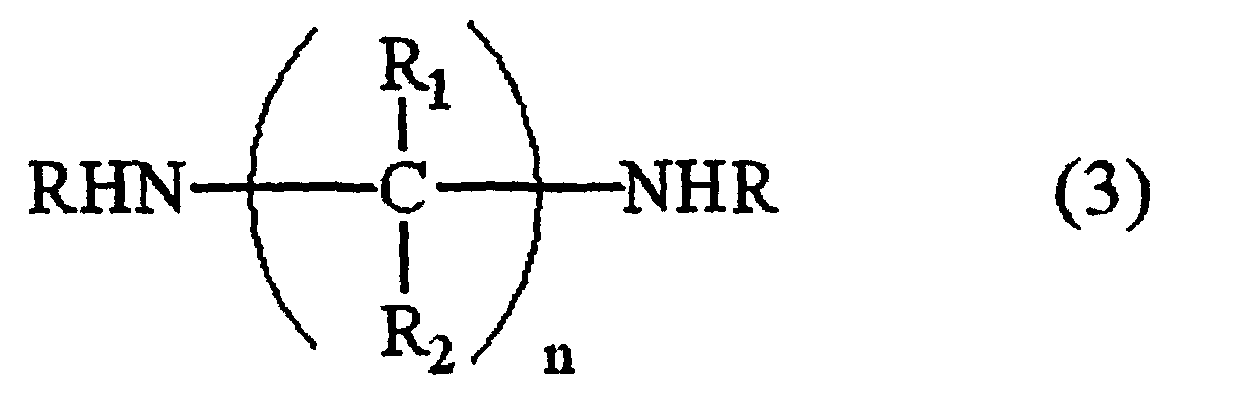
- N,N'-dialkylalkanediamine which can be obtained by the process of the invention is represented by the formula (3) : wherein R 1 and R 2 are a hydrogen atom or lower alkyl group and can be the same or different to each other, R is a lower alkyl group, and n is an integer of 2 to 6.
- the residual amount of haloalkaneamine in the reaction system corresponds to a ratio (content) of haloalkaneamine to lower alkylamine in the reaction mixture.
- the amount is usually 0.0005 to 0.002 mol, preferably 0.002 mol or less, more preferably 0.001 mol or less for 1 mol of lower alkylamine.
- the residual amount of haloalkaneamine exceeding 0.002 mol ratio in the reaction system leads to increase in the formation of unfavorable by-products cyclic dialkyldiamine and trialkylalkanetriamine.
- the reason of such phenomenon is considered as follows.
- the reaction velocity for forming N,N'-dialkylalkanediamine from residual haloalkaneamine intermediate in the reaction system and lower alkylamine is unexpectedly lower than the reaction velocity for forming the haloalkaneamine intermediate from dihaloalkane and lower alkylamine.
- the haloalkaneamine intermediate is accumulated in the reaction system.
- the reaction of the haloalkaneamine intermediate with each other or with the desired N,N'-dialkylalkanediamine proceeds in an unexpectedly high velocity and is liable to form by-products.
- a raw material feeding port is installed in the course of reaction system and the raw material are fed by portions to control the residual amount of haloalkaneamine intermediate in the specified range of the invention.
- reaction was carried out at 120 °C for 6 minutes.
- the reaction mixture was analyzed by gas chromatography and the amount of N-methyl-2-chloroethylamine intermediate was controlled to 0.001 mol or less for 1 mol of monomethylamine.
- excess monomethylamine was recovered and the reaction mass was analyzed by gas chromatography.
- reaction was carried out at 110 °C for 7 minutes.
- the reaction mixture was analyzed by gas chromatography and the amount N-methyl-2-chloroethylamine intermediate was controlled to 0.00105 mol or less for 1 mol of monomethylamine.
- excess monomethylamine was recovered and the reaction mass was analyzed by gas chromatography.
- N,N'-dimethyl-1,2-ethanediamine 90.9 %.
- By-product N,N'-dimethylpiperazine was 2.7 % and by-product N,N',N''-trimethyldiethylenetriamine was 5.8 %.
Landscapes
- Chemical & Material Sciences (AREA)
- Organic Chemistry (AREA)
- Organic Low-Molecular-Weight Compounds And Preparation Thereof (AREA)
Abstract
Description



- Usually
- 0.0005 ≦ [HA]m/[AM]m ≦ 0.002
- Preferably
- [HA]m/[AM]m ≦ 0.002
- More preferably
- [HA]m/[AM]m ≦ 0.001
Claims (9)
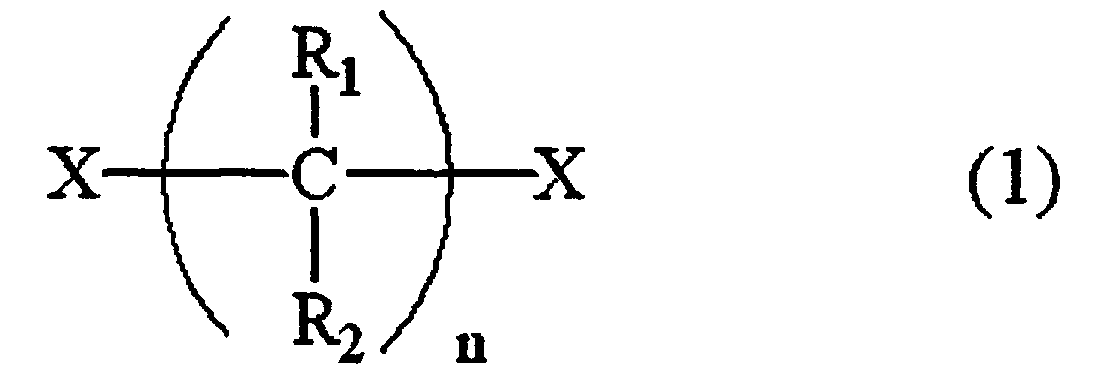
- A preparation process of N,N'-dialkylalkanediamine by reacting dihaloalkane represented by the formula (1) :wherein R1 and R2 are a hydrogen atom or a lower alkyl group, X is a chlorine, bromine or iodine atom, and n is an integer of 2 to 6, with lower alkylamine represented by the formula (2) :
 wherein R1 and R2 are a hydrogen atom or a lower alkyl group, X is a chlorine, bromine or iodine atom, and n is an integer of 2 to 6, characterized in that the reaction is carried out with controlling the residual amount of haloalkaneamine intermediate represented by the formula (4) :
 wherein R is a lower alkyl group, R1 and R2 are a hydrogen atom or a lower alkyl group, X is a chlorine, bromine or iodine atom, and n is an integer of 2 to 6, to 0.002 mol or less for 1 mol of lower alkylamine represented by the formula (2).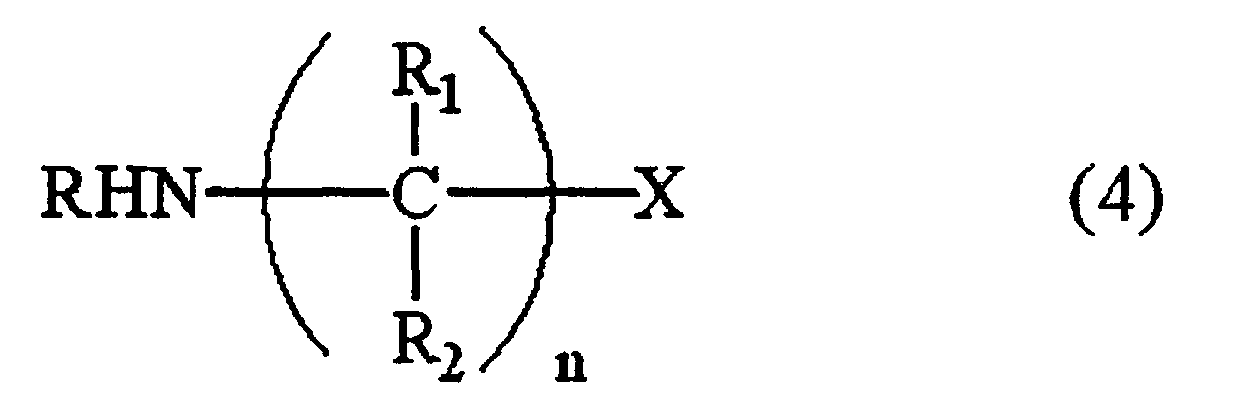
- A preparation process according to claim 1 wherein the lower alkylamine represented by the formula (2) is used in amount of 5 mole or more for 1 mol of dihaloalkane represented by the formula (1).
- A preparation process according to claim 1 wherein the reaction of dihaloalkane with lower alkylamine is carried out by dropwise addition of dihaloalkane to lower alkylamine in a batch reactor.
- A preparation process according to claim 1 wherein the reaction of dihaloalkane with lower alkylamine is carried out in a vessel type continuous reactor or a tubular continuous reactor.
- A preparation process according to claim 1 wherein the reaction of dihaloalkane with lower alkylamine is carried out in a multistage vessel type continuous reactor.
- A preparation process according to claim 1 wherein the reaction of dihaloalkane with lower alkylamine is carried out in a tubular continuous reactor.
- A preparation process according to claim 6 wherein the reaction is carried out by feeding dihaloalkane represented by the formula (1) and lower alkylamine represented by the formula (2) to a tubular continuous reactor, and dihaloalkane is added by portion or continuously at a position capable of controlling a residual amount in the reactor tube of haloalkaneamine represented by the formula (4), to 0.002 mol or less for 1 mol of lower alkylamine.
- A preparation process according to one of claims 1 to 7 wherein the residual amount in the reaction system of haloalkaneamine represented by the formula (4) is 0.001 mol or less for 1 mol of lower alkylamine represented by the formula (2).
- A preparation process according to one of claims 1 to 8 wherein the reaction is carried out at temperature of 50 to 250 °C.
Applications Claiming Priority (3)
| Application Number | Priority Date | Filing Date | Title |
|---|---|---|---|
| JP7473499 | 1999-03-19 | ||
| JP7473499 | 1999-03-19 | ||
| PCT/JP2000/001576 WO2000056697A1 (en) | 1999-03-19 | 2000-03-15 | Novel process for the preparation of n,n'-dialkylalkanediamines |
Publications (3)
| Publication Number | Publication Date |
|---|---|
| EP1081127A1 true EP1081127A1 (en) | 2001-03-07 |
| EP1081127A4 EP1081127A4 (en) | 2005-01-12 |
| EP1081127B1 EP1081127B1 (en) | 2005-12-28 |
Family
ID=13555772
Family Applications (1)
| Application Number | Title | Priority Date | Filing Date |
|---|---|---|---|
| EP00909650A Expired - Lifetime EP1081127B1 (en) | 1999-03-19 | 2000-03-15 | Novel process for the preparation of n,n'-dialkylalkanediamines |
Country Status (7)
| Country | Link |
|---|---|
| US (1) | US6242651B1 (en) |
| EP (1) | EP1081127B1 (en) |
| KR (1) | KR100407428B1 (en) |
| CN (1) | CN1222505C (en) |
| DE (1) | DE60025096T2 (en) |
| TW (1) | TW487691B (en) |
| WO (1) | WO2000056697A1 (en) |
Families Citing this family (6)
| Publication number | Priority date | Publication date | Assignee | Title |
|---|---|---|---|---|
| WO2011049660A1 (en) * | 2009-10-19 | 2011-04-28 | Dow Global Technologies Inc. | Process for preparing a 1,2-ethylenediamine or 1,2-propylenediamine |
| CN101735067B (en) * | 2009-12-07 | 2013-01-16 | 浙江工业大学 | A kind of synthetic method of 1,4-butanediamine |
| CN103130651A (en) * | 2011-11-22 | 2013-06-05 | 上海氯碱化工股份有限公司 | Method for producing vinylamine by kettle-type reactor |
| CN103012164B (en) * | 2012-12-26 | 2014-12-31 | 上海安诺芳胺化学品有限公司 | Method for continuously producing m-diethylaminophenol through channelization |
| CN109694335B (en) * | 2017-10-23 | 2021-12-17 | 西华大学 | Solvent-free preparation method of disubstituted p-nitrophenylacetonitrile derivative |
| TWI767397B (en) * | 2020-11-04 | 2022-06-11 | 中國石油化學工業開發股份有限公司 | A method for preparing n,n,n',n'-tetrabutyl-1,6-hexanediamine |
Family Cites Families (4)
| Publication number | Priority date | Publication date | Assignee | Title |
|---|---|---|---|---|
| DE2455678C3 (en) * | 1974-11-25 | 1979-05-10 | Bayer Ag, 5090 Leverkusen | Process for the production of tetramethylethylenediamine |
| IL56176A (en) * | 1978-01-30 | 1982-03-31 | American Cyanamid Co | Process for preparing n-ethylethylenediamine |
| JPH0637435B2 (en) * | 1985-11-29 | 1994-05-18 | 三井東圧化学株式会社 | Method for producing N, N'-dialkylethylenediamine |
| JP2501562B2 (en) * | 1986-07-18 | 1996-05-29 | 三井東圧化学株式会社 | Method for producing N, N ''-dialkylalkanediamines |
-
2000
- 2000-03-15 WO PCT/JP2000/001576 patent/WO2000056697A1/en not_active Ceased
- 2000-03-15 CN CNB008003521A patent/CN1222505C/en not_active Expired - Lifetime
- 2000-03-15 EP EP00909650A patent/EP1081127B1/en not_active Expired - Lifetime
- 2000-03-15 KR KR10-2000-7012989A patent/KR100407428B1/en not_active Expired - Lifetime
- 2000-03-15 DE DE60025096T patent/DE60025096T2/en not_active Expired - Lifetime
- 2000-03-15 US US09/673,749 patent/US6242651B1/en not_active Expired - Lifetime
- 2000-03-17 TW TW089104916A patent/TW487691B/en not_active IP Right Cessation
Also Published As
| Publication number | Publication date |
|---|---|
| US6242651B1 (en) | 2001-06-05 |
| KR20010025051A (en) | 2001-03-26 |
| EP1081127B1 (en) | 2005-12-28 |
| KR100407428B1 (en) | 2003-11-28 |
| TW487691B (en) | 2002-05-21 |
| DE60025096D1 (en) | 2006-02-02 |
| WO2000056697A1 (en) | 2000-09-28 |
| CN1222505C (en) | 2005-10-12 |
| DE60025096T2 (en) | 2006-08-03 |
| CN1296472A (en) | 2001-05-23 |
| EP1081127A4 (en) | 2005-01-12 |
Similar Documents
| Publication | Publication Date | Title |
|---|---|---|
| KR20050019893A (en) | Preparation of secondary amines | |
| JP2996727B2 (en) | Method for producing tertiary butylamine | |
| EP1081127B1 (en) | Novel process for the preparation of n,n'-dialkylalkanediamines | |
| US3400157A (en) | Production of bis(beta nu, nu-dimethyl-amino) alkyl] ethers | |
| US5767330A (en) | Process for preparing alkyl chlorides | |
| JP4421057B2 (en) | Novel process for producing N, N'-dialkylalkanediamine | |
| US5072024A (en) | Synthesis of N-substituted amides by condensation of nitriles with certain organic hydroxyl compounds | |
| US2814649A (en) | Process for separation of chlorinated xylenes | |
| US3928474A (en) | Manufacture of glycols | |
| US3760015A (en) | Production of vinylidene chloride and methyl chloroform | |
| US5041659A (en) | Synthesis of n-disubstituted amides by reaction of amides with certain organic hydroxyl compounds | |
| JP2501562B2 (en) | Method for producing N, N ''-dialkylalkanediamines | |
| US5847216A (en) | Preparation of selegiline | |
| US2889380A (en) | Production of 1, 4-dichlorobutane | |
| IE42100B1 (en) | Process for the preparation of 2,2,2-trichloroethyl chloroformate | |
| US2546330A (en) | Synthesis of aromatic silane | |
| US3578714A (en) | Process for preparing aniline from phenol | |
| EP1238963A1 (en) | Process for producing fluorinated alkylamine compound | |
| US3178482A (en) | Process for fluorinating chlorofluorocyclopentenes | |
| US3859323A (en) | Preparation of 4,4'-methylenebis (cyclohexylisocyanate) | |
| US3414605A (en) | Synthesis of acrylonitrile using silicide catalyst | |
| US2447372A (en) | Carbamyl chloride and method of producing same | |
| Zengel et al. | A new process for the production of p-phenylenediamine alternatively from polyester waste, terephthalic ester, or terephthalic acid | |
| US4251460A (en) | Process for production of dimethylformamide | |
| US2982780A (en) | Process for the production of benzonitrile and phthalonitriles |
Legal Events
| Date | Code | Title | Description |
|---|---|---|---|
| PUAI | Public reference made under article 153(3) epc to a published international application that has entered the european phase |
Free format text: ORIGINAL CODE: 0009012 |
|
| 17P | Request for examination filed |
Effective date: 20001204 |
|
| AK | Designated contracting states |
Kind code of ref document: A1 Designated state(s): AT BE CH CY DE DK ES FI FR GB GR IE IT LI LU MC NL PT SE |
|
| RBV | Designated contracting states (corrected) |
Designated state(s): BE DE FR GB |
|
| RAP1 | Party data changed (applicant data changed or rights of an application transferred) |
Owner name: MITSUI CHEMICALS, INC. |
|
| A4 | Supplementary search report drawn up and despatched |
Effective date: 20041126 |
|
| GRAP | Despatch of communication of intention to grant a patent |
Free format text: ORIGINAL CODE: EPIDOSNIGR1 |
|
| GRAS | Grant fee paid |
Free format text: ORIGINAL CODE: EPIDOSNIGR3 |
|
| GRAA | (expected) grant |
Free format text: ORIGINAL CODE: 0009210 |
|
| AK | Designated contracting states |
Kind code of ref document: B1 Designated state(s): BE DE FR GB |
|
| REG | Reference to a national code |
Ref country code: GB Ref legal event code: FG4D |
|
| REF | Corresponds to: |
Ref document number: 60025096 Country of ref document: DE Date of ref document: 20060202 Kind code of ref document: P |
|
| ET | Fr: translation filed | ||
| PLBE | No opposition filed within time limit |
Free format text: ORIGINAL CODE: 0009261 |
|
| STAA | Information on the status of an ep patent application or granted ep patent |
Free format text: STATUS: NO OPPOSITION FILED WITHIN TIME LIMIT |
|
| 26N | No opposition filed |
Effective date: 20060929 |
|
| REG | Reference to a national code |
Ref country code: FR Ref legal event code: PLFP Year of fee payment: 17 |
|
| REG | Reference to a national code |
Ref country code: FR Ref legal event code: PLFP Year of fee payment: 18 |
|
| REG | Reference to a national code |
Ref country code: FR Ref legal event code: PLFP Year of fee payment: 19 |
|
| PGFP | Annual fee paid to national office [announced via postgrant information from national office to epo] |
Ref country code: FR Payment date: 20190322 Year of fee payment: 20 Ref country code: GB Payment date: 20190320 Year of fee payment: 20 Ref country code: DE Payment date: 20190321 Year of fee payment: 20 |
|
| PGFP | Annual fee paid to national office [announced via postgrant information from national office to epo] |
Ref country code: BE Payment date: 20190320 Year of fee payment: 20 |
|
| REG | Reference to a national code |
Ref country code: DE Ref legal event code: R071 Ref document number: 60025096 Country of ref document: DE |
|
| REG | Reference to a national code |
Ref country code: GB Ref legal event code: PE20 Expiry date: 20200314 |
|
| REG | Reference to a national code |
Ref country code: BE Ref legal event code: MK Effective date: 20200315 |
|
| PG25 | Lapsed in a contracting state [announced via postgrant information from national office to epo] |
Ref country code: GB Free format text: LAPSE BECAUSE OF EXPIRATION OF PROTECTION Effective date: 20200314 |