EP1080473B1 - Antimony silicate sorbent for removal of metal ions - Google Patents
Antimony silicate sorbent for removal of metal ions Download PDFInfo
- Publication number
- EP1080473B1 EP1080473B1 EP99920951A EP99920951A EP1080473B1 EP 1080473 B1 EP1080473 B1 EP 1080473B1 EP 99920951 A EP99920951 A EP 99920951A EP 99920951 A EP99920951 A EP 99920951A EP 1080473 B1 EP1080473 B1 EP 1080473B1
- Authority
- EP
- European Patent Office
- Prior art keywords
- antimony
- ions
- metal ions
- removal
- silicate
- Prior art date
- Legal status (The legal status is an assumption and is not a legal conclusion. Google has not performed a legal analysis and makes no representation as to the accuracy of the status listed.)
- Expired - Lifetime
Links
- 229910052787 antimony Inorganic materials 0.000 title claims description 36
- WATWJIUSRGPENY-UHFFFAOYSA-N antimony atom Chemical compound [Sb] WATWJIUSRGPENY-UHFFFAOYSA-N 0.000 title claims description 28
- BPQQTUXANYXVAA-UHFFFAOYSA-N Orthosilicate Chemical compound [O-][Si]([O-])([O-])[O-] BPQQTUXANYXVAA-UHFFFAOYSA-N 0.000 title claims description 25
- 229910021645 metal ion Inorganic materials 0.000 title claims description 20
- 239000002594 sorbent Substances 0.000 title claims description 3
- 239000000463 material Substances 0.000 claims description 51
- 239000010955 niobium Substances 0.000 claims description 20
- 238000000034 method Methods 0.000 claims description 19
- WFKWXMTUELFFGS-UHFFFAOYSA-N tungsten Chemical compound [W] WFKWXMTUELFFGS-UHFFFAOYSA-N 0.000 claims description 17
- 229910052721 tungsten Inorganic materials 0.000 claims description 17
- 239000010937 tungsten Substances 0.000 claims description 17
- 229910052758 niobium Inorganic materials 0.000 claims description 14
- GUCVJGMIXFAOAE-UHFFFAOYSA-N niobium atom Chemical compound [Nb] GUCVJGMIXFAOAE-UHFFFAOYSA-N 0.000 claims description 14
- 150000001875 compounds Chemical class 0.000 claims description 11
- 229910052715 tantalum Inorganic materials 0.000 claims description 10
- GUVRBAGPIYLISA-UHFFFAOYSA-N tantalum atom Chemical compound [Ta] GUVRBAGPIYLISA-UHFFFAOYSA-N 0.000 claims description 10
- 238000002441 X-ray diffraction Methods 0.000 claims description 8
- 239000002253 acid Substances 0.000 claims description 7
- 239000007864 aqueous solution Substances 0.000 claims description 7
- 239000007788 liquid Substances 0.000 claims description 7
- 239000007795 chemical reaction product Substances 0.000 claims description 6
- 238000002360 preparation method Methods 0.000 claims description 5
- 239000002210 silicon-based material Substances 0.000 claims description 5
- 150000002500 ions Chemical class 0.000 description 24
- VWDWKYIASSYTQR-UHFFFAOYSA-N sodium nitrate Chemical compound [Na+].[O-][N+]([O-])=O VWDWKYIASSYTQR-UHFFFAOYSA-N 0.000 description 16
- GRYLNZFGIOXLOG-UHFFFAOYSA-N Nitric acid Chemical compound O[N+]([O-])=O GRYLNZFGIOXLOG-UHFFFAOYSA-N 0.000 description 14
- 229910017604 nitric acid Inorganic materials 0.000 description 14
- 239000000243 solution Substances 0.000 description 13
- XLYOFNOQVPJJNP-UHFFFAOYSA-N water Substances O XLYOFNOQVPJJNP-UHFFFAOYSA-N 0.000 description 13
- HEMHJVSKTPXQMS-UHFFFAOYSA-M Sodium hydroxide Chemical compound [OH-].[Na+] HEMHJVSKTPXQMS-UHFFFAOYSA-M 0.000 description 12
- 239000002019 doping agent Substances 0.000 description 12
- -1 Na+ for example Chemical class 0.000 description 10
- 229910052712 strontium Inorganic materials 0.000 description 10
- 238000003786 synthesis reaction Methods 0.000 description 10
- 230000015572 biosynthetic process Effects 0.000 description 9
- 239000000047 product Substances 0.000 description 9
- 230000002378 acidificating effect Effects 0.000 description 8
- 230000002285 radioactive effect Effects 0.000 description 8
- 238000001035 drying Methods 0.000 description 6
- 239000011734 sodium Substances 0.000 description 6
- 229910052778 Plutonium Inorganic materials 0.000 description 5
- BOTDANWDWHJENH-UHFFFAOYSA-N Tetraethyl orthosilicate Chemical compound CCO[Si](OCC)(OCC)OCC BOTDANWDWHJENH-UHFFFAOYSA-N 0.000 description 5
- JYIBXUUINYLWLR-UHFFFAOYSA-N aluminum;calcium;potassium;silicon;sodium;trihydrate Chemical compound O.O.O.[Na].[Al].[Si].[K].[Ca] JYIBXUUINYLWLR-UHFFFAOYSA-N 0.000 description 5
- 229910052792 caesium Inorganic materials 0.000 description 5
- 229910001603 clinoptilolite Inorganic materials 0.000 description 5
- 238000005342 ion exchange Methods 0.000 description 5
- 239000002609 medium Substances 0.000 description 5
- NTHWMYGWWRZVTN-UHFFFAOYSA-N sodium silicate Chemical compound [Na+].[Na+].[O-][Si]([O-])=O NTHWMYGWWRZVTN-UHFFFAOYSA-N 0.000 description 5
- 229910001427 strontium ion Inorganic materials 0.000 description 5
- 229910052695 Americium Inorganic materials 0.000 description 4
- LFQSCWFLJHTTHZ-UHFFFAOYSA-N Ethanol Chemical compound CCO LFQSCWFLJHTTHZ-UHFFFAOYSA-N 0.000 description 4
- 239000004115 Sodium Silicate Substances 0.000 description 4
- VMPVEPPRYRXYNP-UHFFFAOYSA-I antimony(5+);pentachloride Chemical compound Cl[Sb](Cl)(Cl)(Cl)Cl VMPVEPPRYRXYNP-UHFFFAOYSA-I 0.000 description 4
- 229910001424 calcium ion Inorganic materials 0.000 description 4
- 150000001768 cations Chemical class 0.000 description 4
- 230000000694 effects Effects 0.000 description 4
- 229910001425 magnesium ion Inorganic materials 0.000 description 4
- 238000002156 mixing Methods 0.000 description 4
- 229910052708 sodium Inorganic materials 0.000 description 4
- 229910052911 sodium silicate Inorganic materials 0.000 description 4
- 239000012612 commercial material Substances 0.000 description 3
- 239000012153 distilled water Substances 0.000 description 3
- 238000010438 heat treatment Methods 0.000 description 3
- 229910052700 potassium Inorganic materials 0.000 description 3
- 229910001415 sodium ion Inorganic materials 0.000 description 3
- 239000002699 waste material Substances 0.000 description 3
- BHPQYMZQTOCNFJ-UHFFFAOYSA-N Calcium cation Chemical compound [Ca+2] BHPQYMZQTOCNFJ-UHFFFAOYSA-N 0.000 description 2
- 229910020350 Na2WO4 Inorganic materials 0.000 description 2
- VYPSYNLAJGMNEJ-UHFFFAOYSA-N Silicium dioxide Chemical compound O=[Si]=O VYPSYNLAJGMNEJ-UHFFFAOYSA-N 0.000 description 2
- 239000003463 adsorbent Substances 0.000 description 2
- AQTIRDJOWSATJB-UHFFFAOYSA-K antimonic acid Chemical compound O[Sb](O)(O)=O AQTIRDJOWSATJB-UHFFFAOYSA-K 0.000 description 2
- 229910001417 caesium ion Inorganic materials 0.000 description 2
- ZCCIPPOKBCJFDN-UHFFFAOYSA-N calcium nitrate Chemical compound [Ca+2].[O-][N+]([O-])=O.[O-][N+]([O-])=O ZCCIPPOKBCJFDN-UHFFFAOYSA-N 0.000 description 2
- 239000003054 catalyst Substances 0.000 description 2
- 229910001385 heavy metal Inorganic materials 0.000 description 2
- XLYOFNOQVPJJNP-ZSJDYOACSA-N heavy water Substances [2H]O[2H] XLYOFNOQVPJJNP-ZSJDYOACSA-N 0.000 description 2
- 239000000203 mixture Substances 0.000 description 2
- XMVONEAAOPAGAO-UHFFFAOYSA-N sodium tungstate Chemical compound [Na+].[Na+].[O-][W]([O-])(=O)=O XMVONEAAOPAGAO-UHFFFAOYSA-N 0.000 description 2
- 239000002904 solvent Substances 0.000 description 2
- CIOAGBVUUVVLOB-UHFFFAOYSA-N strontium atom Chemical compound [Sr] CIOAGBVUUVVLOB-UHFFFAOYSA-N 0.000 description 2
- VEXZGXHMUGYJMC-UHFFFAOYSA-N Hydrochloric acid Chemical compound Cl VEXZGXHMUGYJMC-UHFFFAOYSA-N 0.000 description 1
- DGAQECJNVWCQMB-PUAWFVPOSA-M Ilexoside XXIX Chemical compound C[C@@H]1CC[C@@]2(CC[C@@]3(C(=CC[C@H]4[C@]3(CC[C@@H]5[C@@]4(CC[C@@H](C5(C)C)OS(=O)(=O)[O-])C)C)[C@@H]2[C@]1(C)O)C)C(=O)O[C@H]6[C@@H]([C@H]([C@@H]([C@H](O6)CO)O)O)O.[Na+] DGAQECJNVWCQMB-PUAWFVPOSA-M 0.000 description 1
- 229910019804 NbCl5 Inorganic materials 0.000 description 1
- XUIMIQQOPSSXEZ-UHFFFAOYSA-N Silicon Chemical compound [Si] XUIMIQQOPSSXEZ-UHFFFAOYSA-N 0.000 description 1
- QAOWNCQODCNURD-UHFFFAOYSA-N Sulfuric acid Chemical compound OS(O)(=O)=O QAOWNCQODCNURD-UHFFFAOYSA-N 0.000 description 1
- GWEVSGVZZGPLCZ-UHFFFAOYSA-N Titan oxide Chemical compound O=[Ti]=O GWEVSGVZZGPLCZ-UHFFFAOYSA-N 0.000 description 1
- 229910021536 Zeolite Inorganic materials 0.000 description 1
- XLGNVNJCHMVSGV-UHFFFAOYSA-N [Sb].[Si]=O Chemical compound [Sb].[Si]=O XLGNVNJCHMVSGV-UHFFFAOYSA-N 0.000 description 1
- 229910052768 actinide Inorganic materials 0.000 description 1
- 150000001255 actinides Chemical class 0.000 description 1
- 230000004913 activation Effects 0.000 description 1
- 239000012736 aqueous medium Substances 0.000 description 1
- 229910052791 calcium Inorganic materials 0.000 description 1
- 239000011575 calcium Substances 0.000 description 1
- 238000005119 centrifugation Methods 0.000 description 1
- 239000003153 chemical reaction reagent Substances 0.000 description 1
- 229910052681 coesite Inorganic materials 0.000 description 1
- 229910052906 cristobalite Inorganic materials 0.000 description 1
- 239000002178 crystalline material Substances 0.000 description 1
- 230000003247 decreasing effect Effects 0.000 description 1
- HNPSIPDUKPIQMN-UHFFFAOYSA-N dioxosilane;oxo(oxoalumanyloxy)alumane Chemical compound O=[Si]=O.O=[Al]O[Al]=O HNPSIPDUKPIQMN-UHFFFAOYSA-N 0.000 description 1
- 230000004992 fission Effects 0.000 description 1
- 238000005189 flocculation Methods 0.000 description 1
- 230000016615 flocculation Effects 0.000 description 1
- 229910052500 inorganic mineral Inorganic materials 0.000 description 1
- 239000007791 liquid phase Substances 0.000 description 1
- 238000011068 loading method Methods 0.000 description 1
- 229910052749 magnesium Inorganic materials 0.000 description 1
- 229910052751 metal Inorganic materials 0.000 description 1
- 239000002184 metal Substances 0.000 description 1
- 239000011707 mineral Substances 0.000 description 1
- 230000007935 neutral effect Effects 0.000 description 1
- YHBDIEWMOMLKOO-UHFFFAOYSA-I pentachloroniobium Chemical compound Cl[Nb](Cl)(Cl)(Cl)Cl YHBDIEWMOMLKOO-UHFFFAOYSA-I 0.000 description 1
- 239000012071 phase Substances 0.000 description 1
- 229910001414 potassium ion Inorganic materials 0.000 description 1
- 235000019353 potassium silicate Nutrition 0.000 description 1
- 229910052710 silicon Inorganic materials 0.000 description 1
- 239000010703 silicon Substances 0.000 description 1
- 239000000377 silicon dioxide Substances 0.000 description 1
- 239000007787 solid Substances 0.000 description 1
- 239000007790 solid phase Substances 0.000 description 1
- 239000007858 starting material Substances 0.000 description 1
- 238000003756 stirring Methods 0.000 description 1
- 229910052682 stishovite Inorganic materials 0.000 description 1
- 229960005196 titanium dioxide Drugs 0.000 description 1
- OGIDPMRJRNCKJF-UHFFFAOYSA-N titanium oxide Inorganic materials [Ti]=O OGIDPMRJRNCKJF-UHFFFAOYSA-N 0.000 description 1
- 231100000331 toxic Toxicity 0.000 description 1
- 230000002588 toxic effect Effects 0.000 description 1
- 229910052905 tridymite Inorganic materials 0.000 description 1
- 239000010457 zeolite Substances 0.000 description 1
Images




Classifications
-
- G—PHYSICS
- G21—NUCLEAR PHYSICS; NUCLEAR ENGINEERING
- G21F—PROTECTION AGAINST X-RADIATION, GAMMA RADIATION, CORPUSCULAR RADIATION OR PARTICLE BOMBARDMENT; TREATING RADIOACTIVELY CONTAMINATED MATERIAL; DECONTAMINATION ARRANGEMENTS THEREFOR
- G21F9/00—Treating radioactively contaminated material; Decontamination arrangements therefor
- G21F9/04—Treating liquids
- G21F9/06—Processing
- G21F9/12—Processing by absorption; by adsorption; by ion-exchange
-
- B—PERFORMING OPERATIONS; TRANSPORTING
- B01—PHYSICAL OR CHEMICAL PROCESSES OR APPARATUS IN GENERAL
- B01J—CHEMICAL OR PHYSICAL PROCESSES, e.g. CATALYSIS OR COLLOID CHEMISTRY; THEIR RELEVANT APPARATUS
- B01J39/00—Cation exchange; Use of material as cation exchangers; Treatment of material for improving the cation exchange properties
- B01J39/08—Use of material as cation exchangers; Treatment of material for improving the cation exchange properties
- B01J39/14—Base exchange silicates, e.g. zeolites
Definitions
- the present invention relates to the removal of metal ions from a solution phase.
- it may be used in the removal of radionuclides from a solution, but it should be understood that the invention is not restricted in any way to radionuclides.
- a material comprising antimony silicate doped with one or more elements selected from the group consisting of tungsten, niobium and tantalum.
- the invention in another aspect provides a use of the material according to the first aspect as a sorbent in the removal of metal ions from a liquid medium.
- the metal ions may be radioactive metal ions.
- the radioactive metal ions may comprise Sr, Cs, Co, Pu or Am ions.
- the radioactive metal ions may be removed from an acidic liquid medium which contains background ions such as Na, K, Mg, and Ca ions at a higher concentration than the concentration of the radioactive metal ions.
- the radioactive metal ions may be selectively removed from the acidic liquid medium which contains background ions such as Na, K, Mg, and Ca ions, the background ions being left behind in the liquid medium.
- background ions such as Na, K, Mg, and Ca ions
- a method of extracting metal ions from an aqueous solution comprising contacting the aqueous solution with the material according to the first aspect of the present invention.
- the ions may be radioactive ions.
- the ions may be strontium ions.
- the aqueous solution may have a pH less than 7.
- the material according to the invention is highly effective as an ion exchange material for selectively removing metal ions, e.g. Sr, Co, Pu and Am ions, from aqueous solutions.
- metal ions e.g. Sr, Co, Pu and Am ions
- the material is effective at selectively removing the metal ions Sr, Co, Pu and Am from a solution containing background metal ions such as Na, K, Mg and Ca whilst leaving behind the background ions in solution.
- background metal ions such as Na, K, Mg and Ca
- the material has been found to be particularly effective at removing radioactive ions.
- the radioactive ions may comprise one or more of Sr, Cs, Co or Pu metal ions. Also toxic heavy metal ions may be removed.
- the material has been found to be of comparable effectiveness to commercially available ion exchange materials for the removal of many ions and has been found to be much more effective than commercial materials for the removal of some ions in particular.
- the material is more efficient at removing Sr, Co, Pu and Am ions, for example, than many conventional ion exchangers.
- the material is very effective at removing Sr ions from aqueous solution.
- the material has been found to be especially good at removing Sr ions from acidic media.
- known ion exchangers are poor at removal of metal ions, in particular Sr, from acidic aqueous media.
- K d values for several nuclides in various 'model' test media using a material comprising antimony silicate prepared by the inventors but not doped with tungsten, niobium or tantalum are shown in Table 1.
- K d is calculated according to Equation 1.
- K d (Ai-A).V/Ai.m where Ai is the initial cation concentration, A is the cation concentration after contact with the ion exchanger, V is the volume of solution and m is the mass of the ion exchange material.
- K d is an estimation of the processing capacity of the material.
- K d is a measure of the distribution of the isotope between the solid and liquid phases.
- the material containing antimony silicate used for Table 1 is much more efficient for Sr uptake, for example, than commercial materials such as CST and clinoptilolite, see also Figure 2 and Tables 1, 2 and 3.
- the material containing antimony silicate is also more efficient for Sr uptake than commercial materials in the presence of other cations such as Na + for example, see Figure 7.
- the material may be amorphous or crystalline but is preferably crystalline.
- the X-ray Diffraction (XRD) pattern of the crystalline material shows characteristics of crystalline antimony silicate.
- a method of preparation of a material comprising antimony silicate doped with one or more elements selected from the group consisting of tungsten, niobium and tantalum comprising reacting together in a liquid medium a silicon containing compound, an antimony containing compound and a compound containing the one or more elements under polymerisation conditions.
- the silicon and antimony containing compounds may be compounds which have been used previously such as in J. Solid State Chem., 99, 173(1992) to synthesise antimony silicates.
- the silicon containing compound may be Si(OC 2 H 5 ) 4 (TEOS) or Na 2 Si 3 O 7 (sodium silicate) or another suitable starting material.
- the silicon containing compounds may be provided dissolved in a suitable solvent such as water or ethanol for example.
- the antimony containing compound may, for example, be KSb(OH) 6 or SbCl 5 .
- the antimony containing compound may be dissolved in water or other suitable solvent.
- the antimony containing compound comprises Sb(V) rather than Sb(III).
- the Si:Sb mole ratio is less than about 20.
- the Si:Sb mole ratio is less than 5. More preferably, the Si:Sb ratio is in the range from 3:1 to 1:3. Most preferably the Si:Sb ratio is from 1:1 to 1:2.
- the reaction product may be dried for a period of time of, e.g., several days.
- the reaction product may be dried for an overnight period.
- the reaction product is dried at a temperature from slightly above ambient temperature to about 800°C.
- the drying temperature is from 40°C to 800°C.
- the drying temperature is from 40°C to 300°C. More preferably, the drying temperature is from 40°C to 100°C.
- the reaction product may be dried for an overnight period at a temperature from about 40 °C to about 70°C.
- Figure 8 shows how the distribution coefficient, Kd, value for 85 Sr varies according to the drying temperature used for an antimony silicate material but not doped with tungsten, niobium or tantalum.
- the compounds may be reacted together by mixing them.
- the mixing time may vary, for example from about an hour to several days. Preferably the mixing time is from one to eight hours. The mixing time may however be much shorter or much longer than the time given as an example.
- the polymerisation conditions may be provided by the presence of a suitable polymerisation catalyst such as, for example, an acid.
- a suitable polymerisation catalyst such as, for example, an acid.
- the acid may be, for example, HNO 3 , HCl or H 2 SO 4 .
- the acid may be added to the antimony containing compound before the silicon containing compounds is added or after.
- the reaction product may be filtered and/or washed with water at one or more stages before or during the drying.
- the one or more elements selected from the group consisting of tungsten, niobium and tantalum may be referred to hereinafter as the dopant species.
- the material according to the invention may be doped with only one element from the group consisting of tungsten, niobium and tantalum.
- the material may be doped with two or more elements from the group consisting of tungsten, niobium and tantalum.
- Tungsten and/or niobium are the preferred dopant species.
- the mole ratio of Sb:Si:dopant may be in the range from about 1:1:0.005 to about 1:1:2, for a case where the Sb:Si ratio is about 1:1. Generally, better results are obtained where the dopant level, Sb:Si:dopant, is from about 1:1:0.01 to about 1:1:0.5.
- the optimum dopant level may not always fall in the forgoing range as other factors such as the Si:Sb ratio, the type of synthesis reagents, drying times and temperatures may affect the optimum dopant level. Also, the optimum dopant level will depend on the type of ion to be removed from solution
- the weight % concentration of the dopant in the material should be in the range from about 0.5 to about 30.0 weight %.
- the precise optimum dopant level will depend, inter alia, on the ion to be removed from solution. Some optimum tungsten dopant levels for various ions are shown in Figure 13.
- the material according to the invention may be crystalline or amorphous in structure.
- a crystalline structure is preferred.
- the XRD pattern of the crystalline structure preferably is substantially similar to the XRD pattern of crystalline antimony silicate which is shown in Figure 1.
- an antimony silicate with one or more elements selected from the group consisting of tungsten, niobium and tantalum changes the selectivity for different ions.
- selective doping with the aforementioned dopants may be controlled in a way so as to make antimony silicate more selective towards particular metal ions.
- doping with W can lead to greater selectivity for caesium ions.
- examples 1 to 5 relate to antimony silicate materials not doped with tungsten, niobium or tantalum and therefore do not fall within the scope of the claims.
- Antimony silicates were prepared by the following two methods.
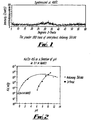
- KSb(OH 6 ) was dissolved in 360 ml distilled H 2 O and this was then added under stirring to 4.17g of TEOS dissolved in ethanol. 2.75ml concentrated HNO 3 was then added as polymerisation catalyst, and the mixture stirred for 1 hour at 77°C. The product was washed with distilled water and dried. The dried product was then heated to form the desired material. The materials were found to be amorphous under XRD analysis (see Figure 1). Table 1 shows the Kd values for various ions for a sample which was heated to 450°C.
- SbCl 5 was mixed with sodium silicate, Na 2 Si 3 O 7 , in the presence of 4M HCl with the pH maintained at about 1. This formed a gel-like product after being left at 60°C overnight. The product was filtered and washed and dried and the XRD trace showed that the material was crystalline.
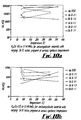
- Figures 2 and 3 shows how the Kd value for 85 Sr varies as a function of pH in 0.1M NaNO 3 for the antimony silicate prepared at 450°C as above, commercial CST and clinoptilolite and the commercially available SrTreat material.
- the Kd values for the antimony silicate are almost constant between pH3-13 and Kd is still above 1000 ml/g at pH 1 which is far superior to the commercial SrTreat and CST and clinoptilolite.
- Figure 4 shows how the Kd values are affected by the presence of calcium ions.
- Figure 5 shows how the Kd values are affected by the presence of Mg 2+ ions.
- Figure 6 shows how the Kd values are affected by the presence of K + ions.
- Figure 7 shows how the Kd values are affected by the presence of Na + ions.
- Na 2 WO 4 * 2H 2 O was mixed with KSb(OH) 6 and TEOS at acidic pH in Sb:Si:W mole ratios of 1:1:0.5, 1:1:1, 1:1:2 and 1:1:0.1.
- the mixtures were kept in a 77°C oven overnight and a gel-like product was filtered and dried at room temperature.
- the materials so obtained were amorphous when analysed by XRD.
- a crystalline tungsten doped material was obtained by adding 6.10g SbCl 5 in 100 ml 4M HCI to a solution of 4.46g sodium silicate ("water glass") in 100 ml water simultaneously with a solution of 3.30g Na 2 WO 4 * 2H 2 O in 100 ml water. Additional 200 ml of water was quickly added.
- Several different Sb:Si:W ratios were used and the heating time at 77°C was varied.
- the XRD patterns were characteristic of crystalline antimony silicate.
- Table 4 shows K d values for removal of Cs, Sr and Co in 0.1M HNO 3 using tungsten doped antimony silicates prepared by both methods A and B above.
- the K d values tend to increase with increasing W concentration before decreasing at higher W concentrations.
- the W doped materials are generally more selective towards Cs than the undoped material.
- Figures 11 a, b, c show how the K d values change as a function of pH in 0.1 NaNO 3 .
- Figure 12 shows how the K d value for Sr changes as a function Ca(NO 3 ) 2 concentration.
- Figure 13 shows how the K d values for Cs, Sr and Co change as a function of the weight % loading of tungsten in the material.
- Si:Sb:Nb 1:1:0.48 material
- 0.892g sodium silicate solution (27% SiO 2 , 14% NaOH) was diluted to 80 ml with distilled water. This was quickly added to a stirred solution of 1.22 g SbCl 5 and 0.53g NbCl 5 in 4M HCI (20ml). The resulting clear colourless solution was left overnight at ambient temperature, 348K or 473K. The products were isolated by centrifugation, washed with distilled water and air dried at 348K. Further samples with different Si:Sb:Nb ratios were made.
- Table 5 shows K d values for Cs, Sr and Co in 0.1 M HNO 3 for niobium doped antimony silicates prepared at different mole ratios and temperatures.
- peaks in the k d values occur when the Nb:Sb ratio is in the range 0.01 to 0.05 when a synthesis temperature of 298 K is used. When a synthesis temperature of 473 K is used, however, the peak K d occurs around a Nb:Sb ratio of about 1:1.
- K D Distribution coefficients (K D ) for Antimonysilicate NUCLIDE 4 M HNO 3 0.1 M HNO 3 0.1 M NaNO 3 0.1 M NaNO 3 / 0.1 M NaOH Dist.
Landscapes
- Chemical & Material Sciences (AREA)
- High Energy & Nuclear Physics (AREA)
- Physics & Mathematics (AREA)
- Engineering & Computer Science (AREA)
- General Engineering & Computer Science (AREA)
- Chemical Kinetics & Catalysis (AREA)
- Organic Chemistry (AREA)
- Silicates, Zeolites, And Molecular Sieves (AREA)
- Catalysts (AREA)
- Inorganic Compounds Of Heavy Metals (AREA)
- Solid-Sorbent Or Filter-Aiding Compositions (AREA)
- Treatment Of Liquids With Adsorbents In General (AREA)
- Water Treatment By Sorption (AREA)
Description
- The present invention relates to the removal of metal ions from a solution phase. As an example, it may be used in the removal of radionuclides from a solution, but it should be understood that the invention is not restricted in any way to radionuclides.
- In the nuclear industry large volumes of aqueous waste streams are produced which contain radionuclides and other polluting metal species. It is desirable to dispose of such wastes with minimum volume for maximised capacity usage. Actinide elements, fission products, activation products and heavy metals typically are removed from such wastes. Techniques such as flocculation or ion exchange have been employed to remove these species and have been generally successful. However, certain radionuclides can be more problematic to remove than others. For example, strontium ions are difficult to remove by known ion exchange techniques when present in acidic media. Moreover, other ions present in the solution, eg Ca2+, Mg2+, Na+, K+, may interfere with the uptake of strontium. Commercially available materials for Sr removal include clinoptilolite (a zeolite mineral), sodium titanates (Allied Signal, US), titanosilicate CST (UOP, US) and titanium-oxide based SrTreat (Selion OY, Finland) which work more efficiently in neutral/alkaline media.
In Journal of Radioanalytical and Nuclear Chemistry (1996) 204, 75 is disclosed the use of antimony silicate as an adsorbent for strontium in acidic media. In SU 929209 A is disclosed the use of antimony silicon oxide based cation exchangers as adsorbents for divalent metal ions in acidic media. - According to a first aspect of the present invention, there is provided a material comprising antimony silicate doped with one or more elements selected from the group consisting of tungsten, niobium and tantalum.
- The invention in another aspect provides a use of the material according to the first aspect as a sorbent in the removal of metal ions from a liquid medium.
- The metal ions may be radioactive metal ions.
- The radioactive metal ions may comprise Sr, Cs, Co, Pu or Am ions.
- The radioactive metal ions may be removed from an acidic liquid medium which contains background ions such as Na, K, Mg, and Ca ions at a higher concentration than the concentration of the radioactive metal ions.
- The radioactive metal ions may be selectively removed from the acidic liquid medium which contains background ions such as Na, K, Mg, and Ca ions, the background ions being left behind in the liquid medium.
- According to a further aspect of the present invention there is provided a method of extracting metal ions from an aqueous solution comprising contacting the aqueous solution with the material according to the first aspect of the present invention.
- The ions may be radioactive ions. The ions may be strontium ions. The aqueous solution may have a pH less than 7.
- It has been found by the inventors that the material according to the invention is highly effective as an ion exchange material for selectively removing metal ions, e.g. Sr, Co, Pu and Am ions, from aqueous solutions.
- The material is effective at selectively removing the metal ions Sr, Co, Pu and Am from a solution containing background metal ions such as Na, K, Mg and Ca whilst leaving behind the background ions in solution.
- The material has been found to be particularly effective at removing radioactive ions. The radioactive ions may comprise one or more of Sr, Cs, Co or Pu metal ions. Also toxic heavy metal ions may be removed.
- The material has been found to be of comparable effectiveness to commercially available ion exchange materials for the removal of many ions and has been found to be much more effective than commercial materials for the removal of some ions in particular. The material is more efficient at removing Sr, Co, Pu and Am ions, for example, than many conventional ion exchangers. The material is very effective at removing Sr ions from aqueous solution.
- The material has been found to be especially good at removing Sr ions from acidic media. In contrast, known ion exchangers are poor at removal of metal ions, in particular Sr, from acidic aqueous media.
- Kd values for several nuclides in various 'model' test media using a material comprising antimony silicate prepared by the inventors but not doped with tungsten, niobium or tantalum are shown in Table 1. Kd is calculated according to
Equation 1. - The material containing antimony silicate used for Table 1 is much more efficient for Sr uptake, for example, than commercial materials such as CST and clinoptilolite, see also Figure 2 and Tables 1, 2 and 3. The material containing antimony silicate is also more efficient for Sr uptake than commercial materials in the presence of other cations such as Na+ for example, see Figure 7.
- The material may be amorphous or crystalline but is preferably crystalline. Preferably, the X-ray Diffraction (XRD) pattern of the crystalline material shows characteristics of crystalline antimony silicate.
- According to a still further aspect of the present invention there is provided a method of preparation of a material comprising antimony silicate doped with one or more elements selected from the group consisting of tungsten, niobium and tantalum, the method comprising reacting together in a liquid medium a silicon containing compound, an antimony containing compound and a compound containing the one or more elements under polymerisation conditions.
- Referring to the method of preparation of the material according to the invention, the silicon and antimony containing compounds may be compounds which have been used previously such as in J. Solid State Chem., 99, 173(1992) to synthesise antimony silicates. For example, the silicon containing compound may be Si(OC2H5)4 (TEOS) or Na2Si3O7 (sodium silicate) or another suitable starting material. The silicon containing compounds may be provided dissolved in a suitable solvent such as water or ethanol for example. The antimony containing compound may, for example, be KSb(OH)6 or SbCl5. The antimony containing compound may be dissolved in water or other suitable solvent. Preferably the antimony containing compound comprises Sb(V) rather than Sb(III).
- The Si:Sb mole ratio is less than about 20. Preferably the Si:Sb mole ratio is less than 5. More preferably, the Si:Sb ratio is in the range from 3:1 to 1:3. Most preferably the Si:Sb ratio is from 1:1 to 1:2.
- The reaction product may be dried for a period of time of, e.g., several days. The reaction product may be dried for an overnight period.. The reaction product is dried at a temperature from slightly above ambient temperature to about 800°C. Particularly, the drying temperature is from 40°C to 800°C. Preferably, the drying temperature is from 40°C to 300°C. More preferably, the drying temperature is from 40°C to 100°C. Typically, the reaction product may be dried for an overnight period at a temperature from about 40 °C to about 70°C.
- Figure 8 shows how the distribution coefficient, Kd, value for 85Sr varies according to the drying temperature used for an antimony silicate material but not doped with tungsten, niobium or tantalum.
- The compounds may be reacted together by mixing them. The mixing time may vary, for example from about an hour to several days. Preferably the mixing time is from one to eight hours. The mixing time may however be much shorter or much longer than the time given as an example.
- The polymerisation conditions may be provided by the presence of a suitable polymerisation catalyst such as, for example, an acid. The acid may be, for example, HNO3, HCl or H2SO4. The acid may be added to the antimony containing compound before the silicon containing compounds is added or after.
- The reaction product may be filtered and/or washed with water at one or more stages before or during the drying.
- The one or more elements selected from the group consisting of tungsten, niobium and tantalum may be referred to hereinafter as the dopant species.
- The material according to the invention may be doped with only one element from the group consisting of tungsten, niobium and tantalum. The material may be doped with two or more elements from the group consisting of tungsten, niobium and tantalum.
- Tungsten and/or niobium are the preferred dopant species.
- The mole ratio of Sb:Si:dopant may be in the range from about 1:1:0.005 to about 1:1:2, for a case where the Sb:Si ratio is about 1:1. Generally, better results are obtained where the dopant level, Sb:Si:dopant, is from about 1:1:0.01 to about 1:1:0.5. However, the optimum dopant level may not always fall in the forgoing range as other factors such as the Si:Sb ratio, the type of synthesis reagents, drying times and temperatures may affect the optimum dopant level. Also, the optimum dopant level will depend on the type of ion to be removed from solution
- Preferably, the weight % concentration of the dopant in the material should be in the range from about 0.5 to about 30.0 weight %. The precise optimum dopant level will depend, inter alia, on the ion to be removed from solution. Some optimum tungsten dopant levels for various ions are shown in Figure 13.
- The material according to the invention may be crystalline or amorphous in structure. A crystalline structure is preferred. The XRD pattern of the crystalline structure preferably is substantially similar to the XRD pattern of crystalline antimony silicate which is shown in Figure 1.
- It has also been found that doping an antimony silicate with one or more elements selected from the group consisting of tungsten, niobium and tantalum changes the selectivity for different ions. Thus, selective doping with the aforementioned dopants may be controlled in a way so as to make antimony silicate more selective towards particular metal ions. For example, it has been found that doping with W can lead to greater selectivity for caesium ions.
- Specific embodiments of the present invention will now be described by way of the following examples 6 to 9. The examples are illustrative only. It should be noted that examples 1 to 5 relate to antimony silicate materials not doped with tungsten, niobium or tantalum and therefore do not fall within the scope of the claims.
- Antimony silicates were prepared by the following two methods.
- 5.26g of KSb(OH6) was dissolved in 360 ml distilled H2O and this was then added under stirring to 4.17g of TEOS dissolved in ethanol. 2.75ml concentrated HNO3 was then added as polymerisation catalyst, and the mixture stirred for 1 hour at 77°C. The product was washed with distilled water and dried. The dried product was then heated to form the desired material. The materials were found to be amorphous under XRD analysis (see Figure 1). Table 1 shows the Kd values for various ions for a sample which was heated to 450°C.
- SbCl5 was mixed with sodium silicate, Na2Si3O7, in the presence of 4M HCl with the pH maintained at about 1. This formed a gel-like product after being left at 60°C overnight. The product was filtered and washed and dried and the XRD trace showed that the material was crystalline.
- The results described below were obtained using the material prepared by method A above.
- Figures 2 and 3 shows how the Kd value for 85Sr varies as a function of pH in 0.1M NaNO3 for the antimony silicate prepared at 450°C as above, commercial CST and clinoptilolite and the commercially available SrTreat material. The Kd values for the antimony silicate are almost constant between pH3-13 and Kd is still above 1000 ml/g at
pH 1 which is far superior to the commercial SrTreat and CST and clinoptilolite. - Figure 4 shows how the Kd values are affected by the presence of calcium ions.
- Figure 5 shows how the Kd values are affected by the presence of Mg2+ ions.
- Figure 6 shows how the Kd values are affected by the presence of K+ ions.
- Figure 7 shows how the Kd values are affected by the presence of Na+ ions.
- Different antimony silicate samples were then prepared by heating the product to various temperatures. Samples were prepared by heating to 100°C, 200°C, 300°C, 450°C, 600°C and 800°C. Figures 8 and 9 shows how Kd for 85Sr and 57Co varies with the synthesis temperature. A slight maximum is seen at about 300°C. Separate results are given for the case when acid is added in the synthesis before the silicate (see below).
- Samples were prepared as above with various synthesis temperatures except that some HNO3 was added before TEOS to hasten the solubility of the KSb(OH)6. The comparison of the Kd values with and without prior addition of HNO3 are shown in Figures 8 and 9. The material prepared where the acid was added before the silicate was slightly better at removing 85Sr and 57Co.
- Syntheses were also carried out in which the Sb:Si ratio was varied. The Sb:Si ratios used were 1:1, 2:1, 3:1, 1:2 and 1:3. Also a synthesis was carried out without any silicate to produce antimonic acid. The synthesis temperatures were about 100°C and 300°C. The Kd values for 85Sr in 0.1M HNO3 are shown in Figure 10.
- Antimonic acid and the Sb:Si = 1:2 showed the best performance. When the amount of Sb is increased the Kd values for 85Sr tend to fall. The ratio of Sb: Si giving the best performance for Sr removal was found to be 1:1 to 2:1.
- Na2WO4 *2H2O was mixed with KSb(OH)6 and TEOS at acidic pH in Sb:Si:W mole ratios of 1:1:0.5, 1:1:1, 1:1:2 and 1:1:0.1. The mixtures were kept in a 77°C oven overnight and a gel-like product was filtered and dried at room temperature. The materials so obtained were amorphous when analysed by XRD.
- A crystalline tungsten doped material was obtained by adding 6.10g SbCl5 in 100 ml 4M HCI to a solution of 4.46g sodium silicate ("water glass") in 100 ml water simultaneously with a solution of 3.30g Na2WO4 *2H2O in 100 ml water. Additional 200 ml of water was quickly added. Several different Sb:Si:W ratios were used and the heating time at 77°C was varied. The XRD patterns were characteristic of crystalline antimony silicate.
- Table 4 shows Kd values for removal of Cs, Sr and Co in 0.1M HNO3 using tungsten doped antimony silicates prepared by both methods A and B above.
- For Sr, the Kd values show little improvement over the undoped antimony silicate material, except at very low W levels, eg. Sb:Si:W = 1:1:0.1.
- For Cs removal on the other hand, the Kd values tend to increase with increasing W concentration before decreasing at higher W concentrations. The W doped materials are generally more selective towards Cs than the undoped material.
- Figures 11 a, b, c show how the Kd values change as a function of pH in 0.1 NaNO3.
- Figure 12 shows how the Kd value for Sr changes as a function Ca(NO3)2 concentration.
- Figure 13 shows how the Kd values for Cs, Sr and Co change as a function of the weight % loading of tungsten in the material.
- To produce a Si:Sb:Nb = 1:1:0.48 material, 0.892g sodium silicate solution (27% SiO2, 14% NaOH) was diluted to 80 ml with distilled water. This was quickly added to a stirred solution of 1.22 g SbCl5 and 0.53g NbCl5 in 4M HCI (20ml). The resulting clear colourless solution was left overnight at ambient temperature, 348K or 473K. The products were isolated by centrifugation, washed with distilled water and air dried at 348K. Further samples with different Si:Sb:Nb ratios were made.
- Table 5 shows Kd values for Cs, Sr and Co in 0.1 M HNO3 for niobium doped antimony silicates prepared at different mole ratios and temperatures.
- For Cs ions, peaks in the kd values occur when the Nb:Sb ratio is in the range 0.01 to 0.05 when a synthesis temperature of 298 K is used. When a synthesis temperature of 473 K is used, however, the peak Kd occurs around a Nb:Sb ratio of about 1:1.
- For Sr ions maximum Kd values are generally seen for low concentrations of Nb.
Distribution coefficients (KD) for Antimonysilicate NUCLIDE 4 M HNO3 0.1 M HNO3 0.1 M NaNO3 0.1 M NaNO3 / 0.1 M NaOH Dist. H2O Cs-134 32.8 590 280 26.0 2517 Sr-85 68.0 19660 44305 56070 13480 Co-57 1959 33807 6177 273 Am-241 3.43 134856 245071 120482 979 Zn-65 2.92 4604 39853 25827 962 Fe-59 14292 6442 114 Mn-54 569 2545 3330 972 Pu-236 17024 14067 8752 417 85.7 Distribution coefficients (KD) for CST NUCUDE 4 M HNO3 0.1 M HNO3 0.1 M NaNO3 0.1 M NaNO3 / 0.1 M NaOH Dist. H2O Cs-134 1327 51460 97500 10710 177800 Sr-85 0.60 9.6 1091 465500 18910 Co-57 0.57 0.18 334 1155 26220 Pu-236 12.1 285 31950 9157 789 Am-241 4.35 95.3 18822 ! 8577 59388 ! Distribution coefficients (KD) for clinoptilolite NUCLIDE 4 M HNO3 0.1 M HNO3 0.1 M NaNO3 0.1 M NaNO3 / 0.1 M NaOH Dist. H2O Cs-134 43.0 2524 1844 594 72010 Sr-85 0.5 34.0 422 354 146360 Co-57 1.23 4.05 5777 1310 14360 Pu-236 0 1021 2517 26700 1147 Am-241 0 ! 3.78 10435 48874 ! 1365 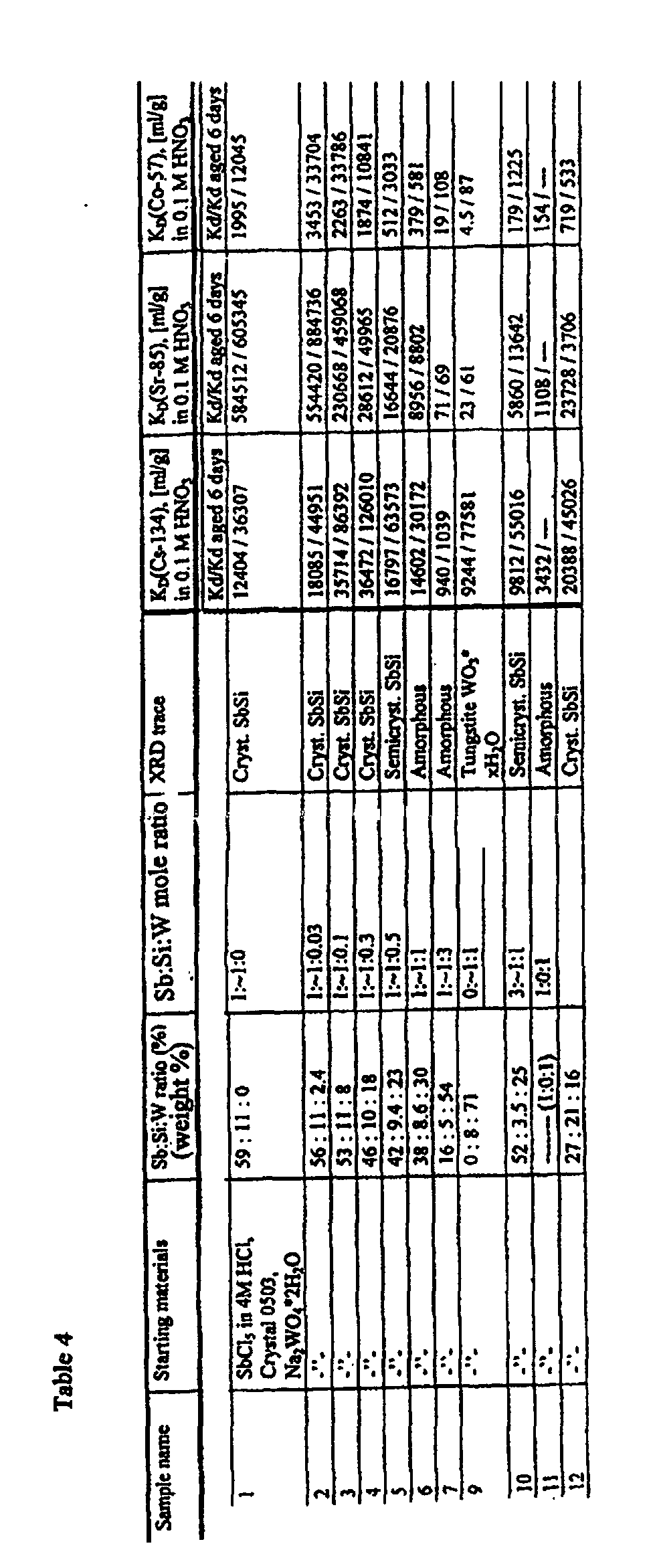
Distribution coefficients (L/Kg) of Cs-137, Sr-90 and Co-57 in 0.1 mol/L HNO3 on niobium-doped antimony silicates prepared at different temperatures (V:m = 200) Temp (K) Starting Si:Sb:Nb Cs-137 Sr-90 Co-57 298 1:1:0.012 87633 323369 12042 1:1:0.026 97476 236791 11397 1:1:0.093 71503 177655 6724 1:1:0.0263 11014 74176 817 1:1:0.48 989 745 38 1:1:0.98 374 37 2 0.5:1:0.01 54708 627533 21153 348 1:1:0.012 22406 160147 1477 1:1:0.026 25771 144125 1748 1:1:0.093 26606 303250 2176 1:1:0.0263 24990 108549 864 1:1:0.48 9636 70236 177 1:1:0.98 637 539 17 0.5:1:0.01 24556 620052 3240 473 1:1:0.012 5349 43503 2367 1:1:0.026 6249 14761 1542 1:1:6.093 3619 15683 4588 1:1:0.0263 13155 27277 17068 1:1:0.48 14688 7988 5031 1:1:0.98 118552 4354 403 0.5:1:0.01 17550 14451 2772
Claims (10)
- A material comprising antimony silicate doped with one or more elements selected from the group consisting of tungsten, niobium and tantalum.
- A material as in claim 1 and wherein the one or more elements is present in the material at a concentration in the range from about 0.5 to about 30.0 weight %.
- A material as in either of claims 1 and 2 and wherein the material has a crystalline structure as shown by an x-ray diffraction analysis of the material.
- A material as in claim 3 and wherein the crystalline structure is substantially similar to crystalline antimony silicate.
- A method of preparation of a material according to any of claims 1 to 4, the method comprising reacting together in a liquid medium a silicon containing compound, an antimony containing compound and a compound containing the one or more elements under polymerisation conditions.
- A method as in Claim 5 and wherein the polymerisation conditions are provided by an acid.
- A method as in either of Claims 5 and 6 and wherein the reaction product is dried at a temperature less than 800°C to form the material.
- A method as in Claim 7 and wherein the temperature is below 300°C.
- Use of a material according to any of claims 1 to 4 as a sorbent in the removal of metal ions from a liquid medium.
- A method of extracting metal ions from an aqueous solution comprising contacting the aqueous solution with a material as in any of claims 1 to 4.
Applications Claiming Priority (5)
| Application Number | Priority Date | Filing Date | Title |
|---|---|---|---|
| GBGB9810268.4A GB9810268D0 (en) | 1998-05-14 | 1998-05-14 | Waste minimisation |
| GB9810268 | 1998-05-14 | ||
| GB9904169 | 1999-02-24 | ||
| GBGB9904169.1A GB9904169D0 (en) | 1998-05-14 | 1999-02-24 | Waste minimisation |
| PCT/GB1999/001305 WO1999059161A1 (en) | 1998-05-14 | 1999-05-13 | Antimony silicate sorbent for removal of metal ions |
Publications (2)
| Publication Number | Publication Date |
|---|---|
| EP1080473A1 EP1080473A1 (en) | 2001-03-07 |
| EP1080473B1 true EP1080473B1 (en) | 2003-04-09 |
Family
ID=26313671
Family Applications (1)
| Application Number | Title | Priority Date | Filing Date |
|---|---|---|---|
| EP99920951A Expired - Lifetime EP1080473B1 (en) | 1998-05-14 | 1999-05-13 | Antimony silicate sorbent for removal of metal ions |
Country Status (9)
| Country | Link |
|---|---|
| US (1) | US7332089B2 (en) |
| EP (1) | EP1080473B1 (en) |
| JP (1) | JP4331898B2 (en) |
| KR (1) | KR100641533B1 (en) |
| AU (1) | AU3833599A (en) |
| DE (1) | DE69906724T2 (en) |
| GB (1) | GB9904169D0 (en) |
| RU (1) | RU2219996C2 (en) |
| WO (1) | WO1999059161A1 (en) |
Families Citing this family (20)
| Publication number | Priority date | Publication date | Assignee | Title |
|---|---|---|---|---|
| US7074257B2 (en) * | 2002-10-15 | 2006-07-11 | Synlite Chemical Company, Llc | Method for removing heavy metals and radionuclides |
| US8763700B2 (en) | 2011-09-02 | 2014-07-01 | Robert Ray McDaniel | Dual function proppants |
| US9725645B2 (en) | 2011-05-03 | 2017-08-08 | Preferred Technology, Llc | Proppant with composite coating |
| US9290690B2 (en) | 2011-05-03 | 2016-03-22 | Preferred Technology, Llc | Coated and cured proppants |
| US9562187B2 (en) | 2012-01-23 | 2017-02-07 | Preferred Technology, Llc | Manufacture of polymer coated proppants |
| RU2484833C1 (en) * | 2012-05-12 | 2013-06-20 | Федеральное государственное казенное военное образовательное учреждение высшего профессионального образования "Военная академия войск радиационной, химической и биологической защиты и инженерных войск имени Маршала Советского Союза С.К. Тимошенко" | Method and agent for elimination of deposited iodine, cesium, strontium radionuclides |
| JP5285183B1 (en) | 2012-12-20 | 2013-09-11 | 日立Geニュークリア・エナジー株式会社 | Method for producing radionuclide adsorbent, apparatus for producing the same, and radionuclide adsorbent |
| US9518214B2 (en) | 2013-03-15 | 2016-12-13 | Preferred Technology, Llc | Proppant with polyurea-type coating |
| US10100247B2 (en) | 2013-05-17 | 2018-10-16 | Preferred Technology, Llc | Proppant with enhanced interparticle bonding |
| US9790422B2 (en) | 2014-04-30 | 2017-10-17 | Preferred Technology, Llc | Proppant mixtures |
| JP6485265B2 (en) * | 2014-07-18 | 2019-03-20 | 東ソー株式会社 | Silicotitanate having a Sichinakite structure and method for producing the same |
| US9862881B2 (en) | 2015-05-13 | 2018-01-09 | Preferred Technology, Llc | Hydrophobic coating of particulates for enhanced well productivity |
| WO2016183313A1 (en) | 2015-05-13 | 2016-11-17 | Preferred Technology, Llc | High performance proppants |
| CN105642223A (en) * | 2016-01-05 | 2016-06-08 | 中国核动力研究设计院 | Stibonium potassium silicate and application and preparation method of stibonium potassium silicate |
| US11208591B2 (en) | 2016-11-16 | 2021-12-28 | Preferred Technology, Llc | Hydrophobic coating of particulates for enhanced well productivity |
| US10696896B2 (en) | 2016-11-28 | 2020-06-30 | Prefferred Technology, Llc | Durable coatings and uses thereof |
| US12330186B2 (en) | 2017-11-02 | 2025-06-17 | Preferred Technology, Llc | Continuous mixers and methods of using the same |
| RU2681633C1 (en) * | 2018-04-27 | 2019-03-11 | федеральное государственное автономное образовательное учреждение высшего образования "Национальный исследовательский ядерный университет "МИФИ" (НИЯУ МИФИ) | Method of obtaining granulated aluminosilicate adsorbent for cleaning of aqueous media from cesium cations |
| JP2020060385A (en) * | 2018-10-05 | 2020-04-16 | 株式会社荏原製作所 | Rapid analytic method of radiostrontium 90 |
| CN118183748B (en) * | 2024-02-21 | 2026-01-06 | 中国科学院福建物质结构研究所 | A method for preparing acid-resistant, highly selective antimony silicate |
Family Cites Families (12)
| Publication number | Priority date | Publication date | Assignee | Title |
|---|---|---|---|---|
| SU929209A1 (en) * | 1980-08-04 | 1982-05-23 | Предприятие П/Я А-1997 | Method of producing antimony-silicon cationite |
| JPS6354358A (en) * | 1986-04-21 | 1988-03-08 | Sumitomo Chem Co Ltd | Production of epsilon-caprolactam |
| EP0452693B1 (en) * | 1990-03-30 | 1995-10-04 | BASF Aktiengesellschaft | Method of preparing 2,2-disubstituted pentane 1,5-diamines |
| JPH06106055A (en) * | 1992-09-30 | 1994-04-19 | Toagosei Chem Ind Co Ltd | Adsorption separation method of Sr ions from a solution containing Sr ions |
| DE69409891T2 (en) | 1993-02-16 | 1998-09-10 | Mitsubishi Heavy Ind Ltd | EXHAUST GAS PURIFICATION CATALYST |
| AU6268594A (en) * | 1993-02-25 | 1994-09-14 | Sandia National Laboratories | Novel silico-titanates and their methods of making and using |
| NO177616C (en) * | 1993-05-14 | 1995-10-18 | Kvaerner Moss Tech As | Device for connecting a container wall with a pipe |
| JPH07185322A (en) * | 1993-12-27 | 1995-07-25 | Toagosei Co Ltd | Adsorbent for sr ion |
| US5858243A (en) * | 1995-05-11 | 1999-01-12 | Uop | Use of crystalline intergrowth molecular sieves for removing contaminant metal ions from liquid streams |
| GB9613113D0 (en) * | 1996-06-21 | 1996-08-28 | Ecc Int Ltd | Granular materials |
| US5888398A (en) * | 1997-01-27 | 1999-03-30 | Arch Development Corp. | Composition and process for separating cesium ions from an acidic aqueous solution also containing other ions |
| RU2118856C1 (en) * | 1997-05-06 | 1998-09-10 | Общество с ограниченной ответственностью "Дальхитосорб" | method and apparatus for removing strontium and cesium radionuclides from solutions |
-
1999
- 1999-02-24 GB GBGB9904169.1A patent/GB9904169D0/en not_active Ceased
- 1999-05-13 WO PCT/GB1999/001305 patent/WO1999059161A1/en not_active Ceased
- 1999-05-13 EP EP99920951A patent/EP1080473B1/en not_active Expired - Lifetime
- 1999-05-13 AU AU38335/99A patent/AU3833599A/en not_active Abandoned
- 1999-05-13 RU RU2000131208/15A patent/RU2219996C2/en not_active IP Right Cessation
- 1999-05-13 KR KR1020007012748A patent/KR100641533B1/en not_active Expired - Fee Related
- 1999-05-13 JP JP2000548887A patent/JP4331898B2/en not_active Expired - Fee Related
- 1999-05-13 DE DE69906724T patent/DE69906724T2/en not_active Expired - Lifetime
-
2003
- 2003-09-30 US US10/675,138 patent/US7332089B2/en not_active Expired - Fee Related
Also Published As
| Publication number | Publication date |
|---|---|
| JP2002515587A (en) | 2002-05-28 |
| WO1999059161A1 (en) | 1999-11-18 |
| AU3833599A (en) | 1999-11-29 |
| EP1080473A1 (en) | 2001-03-07 |
| JP4331898B2 (en) | 2009-09-16 |
| DE69906724T2 (en) | 2004-03-04 |
| US20040065620A1 (en) | 2004-04-08 |
| KR20010071256A (en) | 2001-07-28 |
| KR100641533B1 (en) | 2006-10-31 |
| GB9904169D0 (en) | 1999-04-14 |
| US7332089B2 (en) | 2008-02-19 |
| DE69906724D1 (en) | 2003-05-15 |
| RU2219996C2 (en) | 2003-12-27 |
Similar Documents
| Publication | Publication Date | Title |
|---|---|---|
| US7332089B2 (en) | Method of extracting metal ions from an aqueous solution utilizing an antimony silicate sorbent | |
| Dyer et al. | Sorption characteristics of radionuclides on synthetic birnessite-type layered manganese oxides | |
| EP0797542A1 (en) | Process for forming alumino-silicate derivatives | |
| Dyer et al. | Ion exchange of caesium and strontium on a titanosilicate analogue of the mineral pharmacosiderite | |
| Ooi et al. | The pH titration study of lithium ion adsorption on. LAMBDA.-MnO2. | |
| Kozai et al. | Sorption characteristics of neptunium by sodium-smectite | |
| Abe et al. | Synthetic inorganic ion-exchange materials—XXIII: Ion-exchange equilibria of transition metals and hydrogen ions on crystalline antimonic (V) acid | |
| JP2949227B1 (en) | Hydrous bismuth compounds with excellent inorganic anion exchange properties and their production | |
| JP4041202B2 (en) | Sr ion adsorbent, method for producing the same, and method for treating Sr ion-containing water using the same | |
| US4366090A (en) | Process for the preparation of adsorbent materials | |
| JPH024442A (en) | High performance lithium adsorbent and its preparation | |
| Pekárek et al. | Historical Background of Inorganic Ion Exchangers, their Classification, and Present Status | |
| JP2500345B2 (en) | Method of solidifying and removing iodide ion | |
| Zhuravlev et al. | Synthesis and characterization of the ion exchange properties of a spherically granulated sodium aluminophosphatesilicate | |
| JP2981892B1 (en) | Lithium isotope separating agent | |
| RU2680964C1 (en) | Sorption material for the strontium radionuclides selective extraction from complex by ionic composition solutions and method of the strontium radionuclides extraction with its help | |
| JP3173528B2 (en) | Method for immobilizing carbonate ion or bicarbonate ion | |
| RU2094115C1 (en) | INORGANIC ION EXCHANGER BASED ON Mn(III) AND Mn(IV) OXIDES AND METHOD OF PREPARATION THEREOF | |
| Hayes et al. | Quaternary ammonium surfactant effects on sorption of trace metals onto quartz and aluminosilicates | |
| US20250033022A1 (en) | Composition and method for producing same | |
| SU1590096A1 (en) | Method of producing sorbent for extracting ions of metals from solutions | |
| RU2501603C1 (en) | Method of producing fly grit microsphere-based sorbent for removal of radioactive wastes (versions) | |
| Olivera Pastor et al. | Hydrolysis and selective sorption of lanthanides in vermiculite | |
| EP0748770B1 (en) | Bismuth lead compound | |
| Qureshi et al. | Synthesis and characterization of zirconium (IV) 4-amino, 3-hydroxy naphthalene sulfonate ion exchanger: Quantitative separation of mercury from numerous metal ions |
Legal Events
| Date | Code | Title | Description |
|---|---|---|---|
| PUAI | Public reference made under article 153(3) epc to a published international application that has entered the european phase |
Free format text: ORIGINAL CODE: 0009012 |
|
| 17P | Request for examination filed |
Effective date: 20001201 |
|
| AK | Designated contracting states |
Kind code of ref document: A1 Designated state(s): BE DE ES FI FR GB IT NL SE |
|
| 17Q | First examination report despatched |
Effective date: 20010823 |
|
| GRAG | Despatch of communication of intention to grant |
Free format text: ORIGINAL CODE: EPIDOS AGRA |
|
| GRAG | Despatch of communication of intention to grant |
Free format text: ORIGINAL CODE: EPIDOS AGRA |
|
| GRAH | Despatch of communication of intention to grant a patent |
Free format text: ORIGINAL CODE: EPIDOS IGRA |
|
| GRAH | Despatch of communication of intention to grant a patent |
Free format text: ORIGINAL CODE: EPIDOS IGRA |
|
| RAP1 | Party data changed (applicant data changed or rights of an application transferred) |
Owner name: INEOS SILICAS LIMITED |
|
| GRAA | (expected) grant |
Free format text: ORIGINAL CODE: 0009210 |
|
| AK | Designated contracting states |
Designated state(s): BE DE ES FI FR GB IT NL SE |
|
| PG25 | Lapsed in a contracting state [announced via postgrant information from national office to epo] |
Ref country code: NL Free format text: LAPSE BECAUSE OF FAILURE TO SUBMIT A TRANSLATION OF THE DESCRIPTION OR TO PAY THE FEE WITHIN THE PRESCRIBED TIME-LIMIT Effective date: 20030409 Ref country code: IT Free format text: LAPSE BECAUSE OF FAILURE TO SUBMIT A TRANSLATION OF THE DESCRIPTION OR TO PAY THE FEE WITHIN THE PRESCRIBED TIME-LIMIT;WARNING: LAPSES OF ITALIAN PATENTS WITH EFFECTIVE DATE BEFORE 2007 MAY HAVE OCCURRED AT ANY TIME BEFORE 2007. THE CORRECT EFFECTIVE DATE MAY BE DIFFERENT FROM THE ONE RECORDED. Effective date: 20030409 Ref country code: BE Free format text: LAPSE BECAUSE OF FAILURE TO SUBMIT A TRANSLATION OF THE DESCRIPTION OR TO PAY THE FEE WITHIN THE PRESCRIBED TIME-LIMIT Effective date: 20030409 |
|
| REG | Reference to a national code |
Ref country code: GB Ref legal event code: FG4D |
|
| PG25 | Lapsed in a contracting state [announced via postgrant information from national office to epo] |
Ref country code: SE Free format text: LAPSE BECAUSE OF FAILURE TO SUBMIT A TRANSLATION OF THE DESCRIPTION OR TO PAY THE FEE WITHIN THE PRESCRIBED TIME-LIMIT Effective date: 20030709 |
|
| NLV1 | Nl: lapsed or annulled due to failure to fulfill the requirements of art. 29p and 29m of the patents act | ||
| ET | Fr: translation filed | ||
| PG25 | Lapsed in a contracting state [announced via postgrant information from national office to epo] |
Ref country code: ES Free format text: LAPSE BECAUSE OF FAILURE TO SUBMIT A TRANSLATION OF THE DESCRIPTION OR TO PAY THE FEE WITHIN THE PRESCRIBED TIME-LIMIT Effective date: 20031030 |
|
| PLBE | No opposition filed within time limit |
Free format text: ORIGINAL CODE: 0009261 |
|
| STAA | Information on the status of an ep patent application or granted ep patent |
Free format text: STATUS: NO OPPOSITION FILED WITHIN TIME LIMIT |
|
| 26N | No opposition filed |
Effective date: 20040112 |
|
| REG | Reference to a national code |
Ref country code: GB Ref legal event code: 732E Free format text: REGISTERED BETWEEN 20100311 AND 20100317 |
|
| REG | Reference to a national code |
Ref country code: FR Ref legal event code: TP |
|
| REG | Reference to a national code |
Ref country code: FR Ref legal event code: CA |
|
| PGFP | Annual fee paid to national office [announced via postgrant information from national office to epo] |
Ref country code: FR Payment date: 20110607 Year of fee payment: 13 |
|
| PGFP | Annual fee paid to national office [announced via postgrant information from national office to epo] |
Ref country code: GB Payment date: 20110520 Year of fee payment: 13 Ref country code: FI Payment date: 20110512 Year of fee payment: 13 |
|
| PGFP | Annual fee paid to national office [announced via postgrant information from national office to epo] |
Ref country code: DE Payment date: 20110520 Year of fee payment: 13 |
|
| REG | Reference to a national code |
Ref country code: DE Ref legal event code: R082 Ref document number: 69906724 Country of ref document: DE Representative=s name: PFENNING MEINIG & PARTNER GBR, DE |
|
| REG | Reference to a national code |
Ref country code: DE Ref legal event code: R082 Ref document number: 69906724 Country of ref document: DE Representative=s name: PFENNING MEINIG & PARTNER GBR, DE |
|
| REG | Reference to a national code |
Ref country code: DE Ref legal event code: R082 Ref document number: 69906724 Country of ref document: DE Representative=s name: PFENNING, MEINIG & PARTNER MBB PATENTANWAELTE, DE Effective date: 20111212 Ref country code: DE Ref legal event code: R082 Ref document number: 69906724 Country of ref document: DE Representative=s name: PFENNING, MEINIG & PARTNER MBB PATENTANWAELTE, DE Effective date: 20111214 Ref country code: DE Ref legal event code: R082 Ref document number: 69906724 Country of ref document: DE Representative=s name: PFENNING MEINIG & PARTNER GBR, DE Effective date: 20111212 Ref country code: DE Ref legal event code: R082 Ref document number: 69906724 Country of ref document: DE Representative=s name: PFENNING MEINIG & PARTNER GBR, DE Effective date: 20111214 Ref country code: DE Ref legal event code: R081 Ref document number: 69906724 Country of ref document: DE Owner name: PQ SILICAS UK LTD., WARRINGTON, GB Free format text: FORMER OWNER: INEOS SILICAS LTD., WARRINGTON, GB Effective date: 20111214 Ref country code: DE Ref legal event code: R081 Ref document number: 69906724 Country of ref document: DE Owner name: PQ SILICAS UK LTD., GB Free format text: FORMER OWNER: INEOS SILICAS LTD., WARRINGTON, GB Effective date: 20111214 |
|
| GBPC | Gb: european patent ceased through non-payment of renewal fee |
Effective date: 20120513 |
|
| PG25 | Lapsed in a contracting state [announced via postgrant information from national office to epo] |
Ref country code: FI Free format text: LAPSE BECAUSE OF NON-PAYMENT OF DUE FEES Effective date: 20120513 |
|
| REG | Reference to a national code |
Ref country code: FR Ref legal event code: ST Effective date: 20130131 |
|
| REG | Reference to a national code |
Ref country code: DE Ref legal event code: R119 Ref document number: 69906724 Country of ref document: DE Effective date: 20121201 |
|
| PG25 | Lapsed in a contracting state [announced via postgrant information from national office to epo] |
Ref country code: FR Free format text: LAPSE BECAUSE OF NON-PAYMENT OF DUE FEES Effective date: 20120531 Ref country code: GB Free format text: LAPSE BECAUSE OF NON-PAYMENT OF DUE FEES Effective date: 20120513 |
|
| PG25 | Lapsed in a contracting state [announced via postgrant information from national office to epo] |
Ref country code: DE Free format text: LAPSE BECAUSE OF NON-PAYMENT OF DUE FEES Effective date: 20121201 |
|
| P01 | Opt-out of the competence of the unified patent court (upc) registered |
Effective date: 20230525 |