EP1078931A2 - Process for the preparation of vitamin D analogues - Google Patents
Process for the preparation of vitamin D analogues Download PDFInfo
- Publication number
- EP1078931A2 EP1078931A2 EP00117261A EP00117261A EP1078931A2 EP 1078931 A2 EP1078931 A2 EP 1078931A2 EP 00117261 A EP00117261 A EP 00117261A EP 00117261 A EP00117261 A EP 00117261A EP 1078931 A2 EP1078931 A2 EP 1078931A2
- Authority
- EP
- European Patent Office
- Prior art keywords
- formula
- compound
- palladium
- enantiomer
- phosphine
- Prior art date
- Legal status (The legal status is an assumption and is not a legal conclusion. Google has not performed a legal analysis and makes no representation as to the accuracy of the status listed.)
- Granted
Links
- 0 *O[C@@](C[C@@](C1=C)O)CC1=CC(O)=O Chemical compound *O[C@@](C[C@@](C1=C)O)CC1=CC(O)=O 0.000 description 5
- PRATYZGBJBLORA-HVMFMYALSA-N C[C@@]1(/C(/C2)=C/C(O)=O)O[C@@H]1C[C@@H]2O Chemical compound C[C@@]1(/C(/C2)=C/C(O)=O)O[C@@H]1C[C@@H]2O PRATYZGBJBLORA-HVMFMYALSA-N 0.000 description 1
Classifications
-
- C—CHEMISTRY; METALLURGY
- C07—ORGANIC CHEMISTRY
- C07F—ACYCLIC, CARBOCYCLIC OR HETEROCYCLIC COMPOUNDS CONTAINING ELEMENTS OTHER THAN CARBON, HYDROGEN, HALOGEN, OXYGEN, NITROGEN, SULFUR, SELENIUM OR TELLURIUM
- C07F7/00—Compounds containing elements of Groups 4 or 14 of the Periodic Table
- C07F7/02—Silicon compounds
- C07F7/08—Compounds having one or more C—Si linkages
- C07F7/18—Compounds having one or more C—Si linkages as well as one or more C—O—Si linkages
- C07F7/1804—Compounds having Si-O-C linkages
- C07F7/1872—Preparation; Treatments not provided for in C07F7/20
- C07F7/1892—Preparation; Treatments not provided for in C07F7/20 by reactions not provided for in C07F7/1876 - C07F7/1888
-
- C—CHEMISTRY; METALLURGY
- C07—ORGANIC CHEMISTRY
- C07C—ACYCLIC OR CARBOCYCLIC COMPOUNDS
- C07C401/00—Irradiation products of cholesterol or its derivatives; Vitamin D derivatives, 9,10-seco cyclopenta[a]phenanthrene or analogues obtained by chemical preparation without irradiation
-
- C—CHEMISTRY; METALLURGY
- C07—ORGANIC CHEMISTRY
- C07C—ACYCLIC OR CARBOCYCLIC COMPOUNDS
- C07C69/00—Esters of carboxylic acids; Esters of carbonic or haloformic acids
- C07C69/66—Esters of carboxylic acids having esterified carboxylic groups bound to acyclic carbon atoms and having any of the groups OH, O—metal, —CHO, keto, ether, acyloxy, groups, groups, or in the acid moiety
- C07C69/73—Esters of carboxylic acids having esterified carboxylic groups bound to acyclic carbon atoms and having any of the groups OH, O—metal, —CHO, keto, ether, acyloxy, groups, groups, or in the acid moiety of unsaturated acids
- C07C69/732—Esters of carboxylic acids having esterified carboxylic groups bound to acyclic carbon atoms and having any of the groups OH, O—metal, —CHO, keto, ether, acyloxy, groups, groups, or in the acid moiety of unsaturated acids of unsaturated hydroxy carboxylic acids
-
- C—CHEMISTRY; METALLURGY
- C07—ORGANIC CHEMISTRY
- C07D—HETEROCYCLIC COMPOUNDS
- C07D303/00—Compounds containing three-membered rings having one oxygen atom as the only ring hetero atom
- C07D303/02—Compounds containing oxirane rings
- C07D303/12—Compounds containing oxirane rings with hydrocarbon radicals, substituted by singly or doubly bound oxygen atoms
- C07D303/32—Compounds containing oxirane rings with hydrocarbon radicals, substituted by singly or doubly bound oxygen atoms by aldehydo- or ketonic radicals
-
- C—CHEMISTRY; METALLURGY
- C07—ORGANIC CHEMISTRY
- C07D—HETEROCYCLIC COMPOUNDS
- C07D303/00—Compounds containing three-membered rings having one oxygen atom as the only ring hetero atom
- C07D303/02—Compounds containing oxirane rings
- C07D303/38—Compounds containing oxirane rings with hydrocarbon radicals, substituted by carbon atoms having three bonds to hetero atoms with at the most one bond to halogen, e.g. ester or nitrile radicals
- C07D303/40—Compounds containing oxirane rings with hydrocarbon radicals, substituted by carbon atoms having three bonds to hetero atoms with at the most one bond to halogen, e.g. ester or nitrile radicals by ester radicals
-
- C—CHEMISTRY; METALLURGY
- C07—ORGANIC CHEMISTRY
- C07F—ACYCLIC, CARBOCYCLIC OR HETEROCYCLIC COMPOUNDS CONTAINING ELEMENTS OTHER THAN CARBON, HYDROGEN, HALOGEN, OXYGEN, NITROGEN, SULFUR, SELENIUM OR TELLURIUM
- C07F7/00—Compounds containing elements of Groups 4 or 14 of the Periodic Table
- C07F7/02—Silicon compounds
- C07F7/08—Compounds having one or more C—Si linkages
- C07F7/18—Compounds having one or more C—Si linkages as well as one or more C—O—Si linkages
- C07F7/1804—Compounds having Si-O-C linkages
-
- Y—GENERAL TAGGING OF NEW TECHNOLOGICAL DEVELOPMENTS; GENERAL TAGGING OF CROSS-SECTIONAL TECHNOLOGIES SPANNING OVER SEVERAL SECTIONS OF THE IPC; TECHNICAL SUBJECTS COVERED BY FORMER USPC CROSS-REFERENCE ART COLLECTIONS [XRACs] AND DIGESTS
- Y02—TECHNOLOGIES OR APPLICATIONS FOR MITIGATION OR ADAPTATION AGAINST CLIMATE CHANGE
- Y02P—CLIMATE CHANGE MITIGATION TECHNOLOGIES IN THE PRODUCTION OR PROCESSING OF GOODS
- Y02P20/00—Technologies relating to chemical industry
- Y02P20/50—Improvements relating to the production of bulk chemicals
- Y02P20/55—Design of synthesis routes, e.g. reducing the use of auxiliary or protecting groups
Definitions
- the invention relates to a process useful to produce vitamin D analogs, such as calcitriol, sold under the brand name Rocaltrol®.
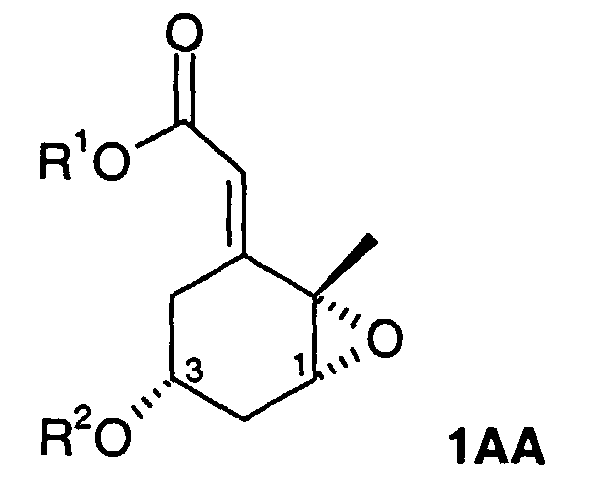
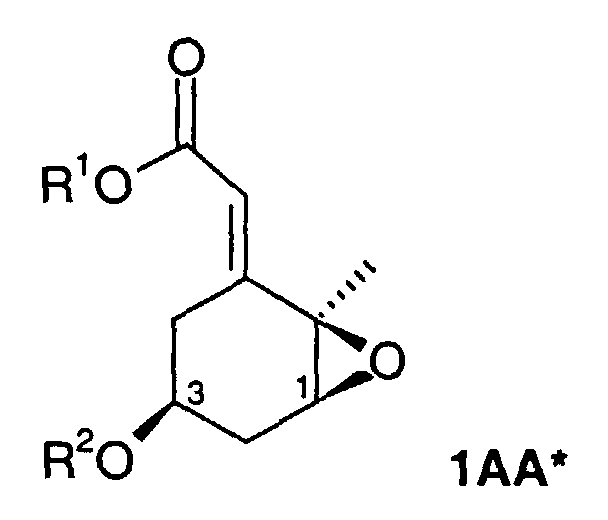
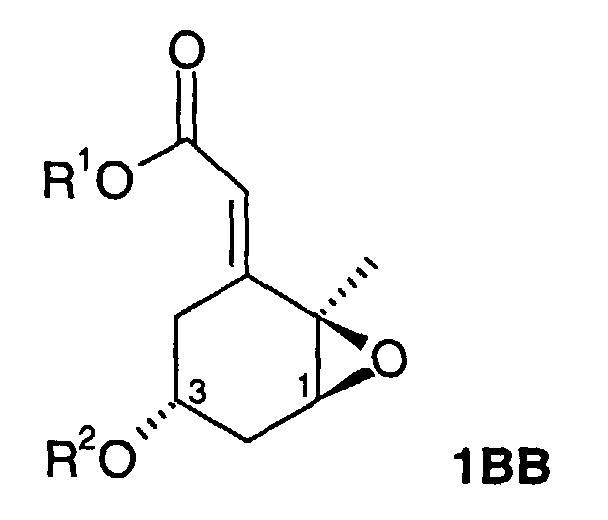
- the subject invention provides a method of stereospecifically producing a compound of formula: or the enantiomers thereof
- the reacting is preferably in the presence of a palladium catalyst that is palladium-phosphine catalyst, such as a palladium-triarylphosphine, especially when selected from the group consisting of palladium-triphenylphosphine, palladium-tris(2-methoxyphenyl)phosphine, palladium-tris(3-methoxyphenyl)phosphine, palladium-tris(4-methoxyphenyl)phosphine, palladium-tris(o-tolyl)phosphine, palladium-tris(m-tolyl)phosphine, palladium-tris(p-tolyl)phosphine, palladium-tris(4-fluorophenyl)phosphine, palladium-tris(p-trifluoromethylphenyl)phosphine, and palladium-tris(2-furyl)phosphine.
- a palladium catalyst is pal
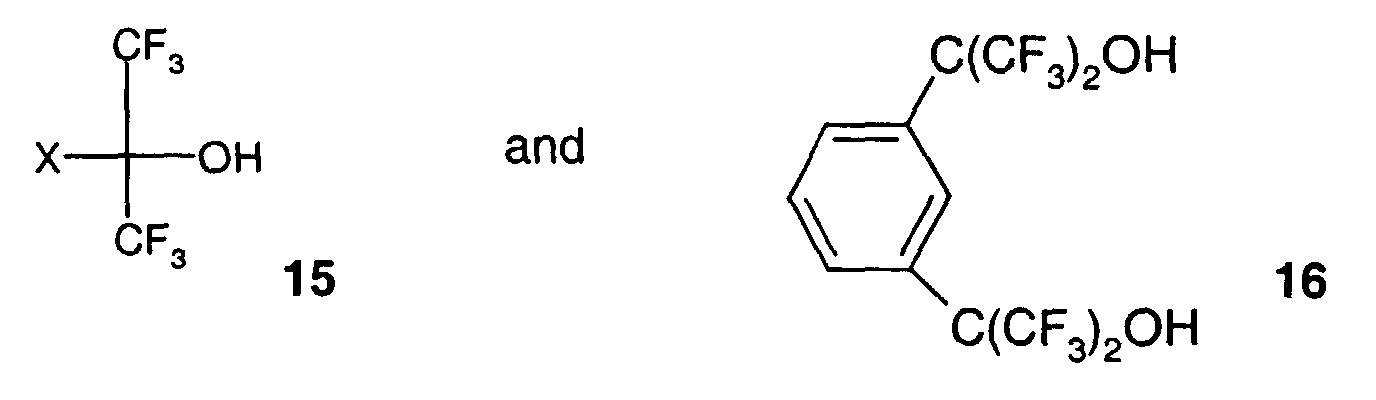
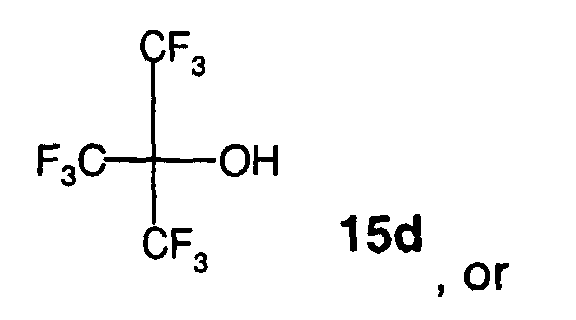
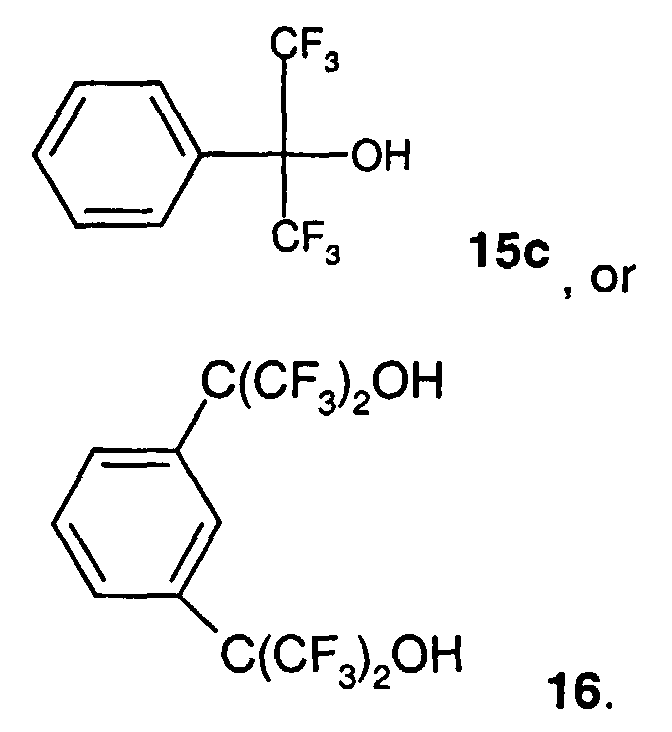
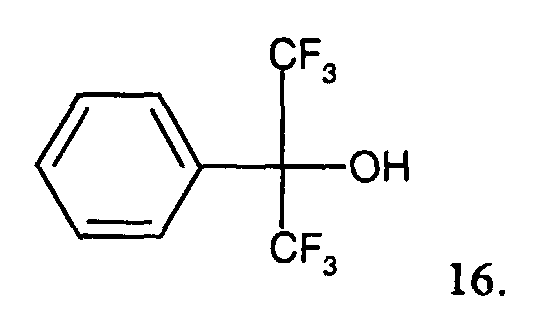
- the fluorinated alcohol is favorably selected from the group consisting of:
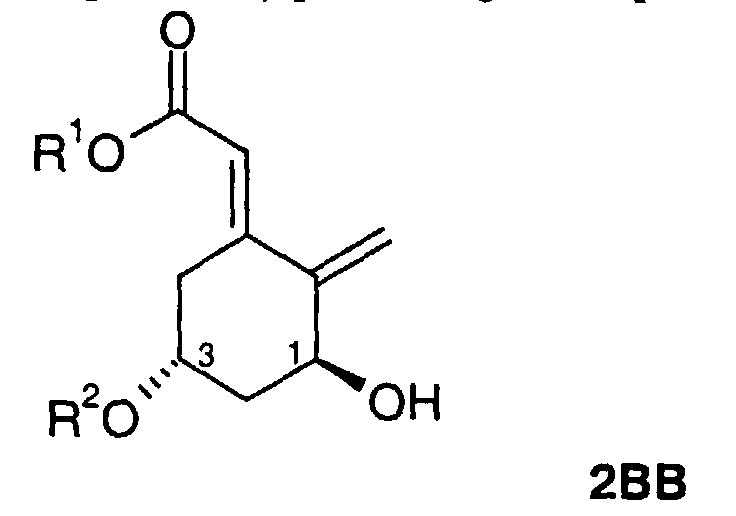
- the present invention also provides novel intermediates used in the process for the preparation of the compounds of formulae 2AA, 2AA*, 2BB and 2BB*, the invention is thus related to compounds having the structure
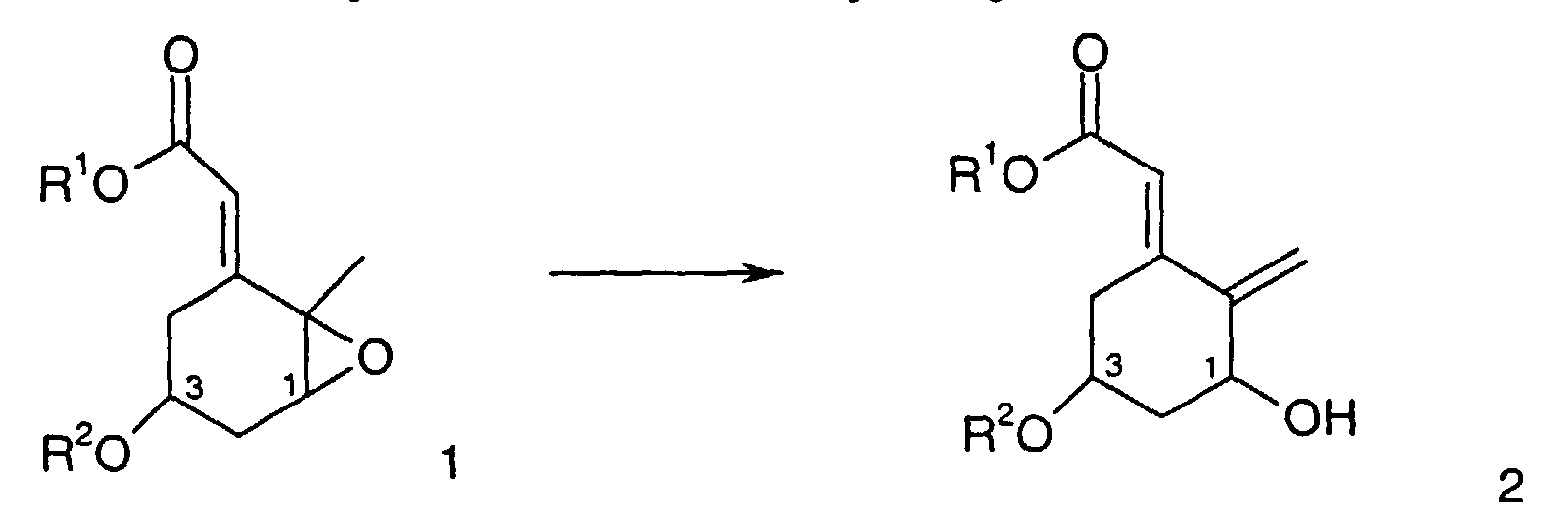
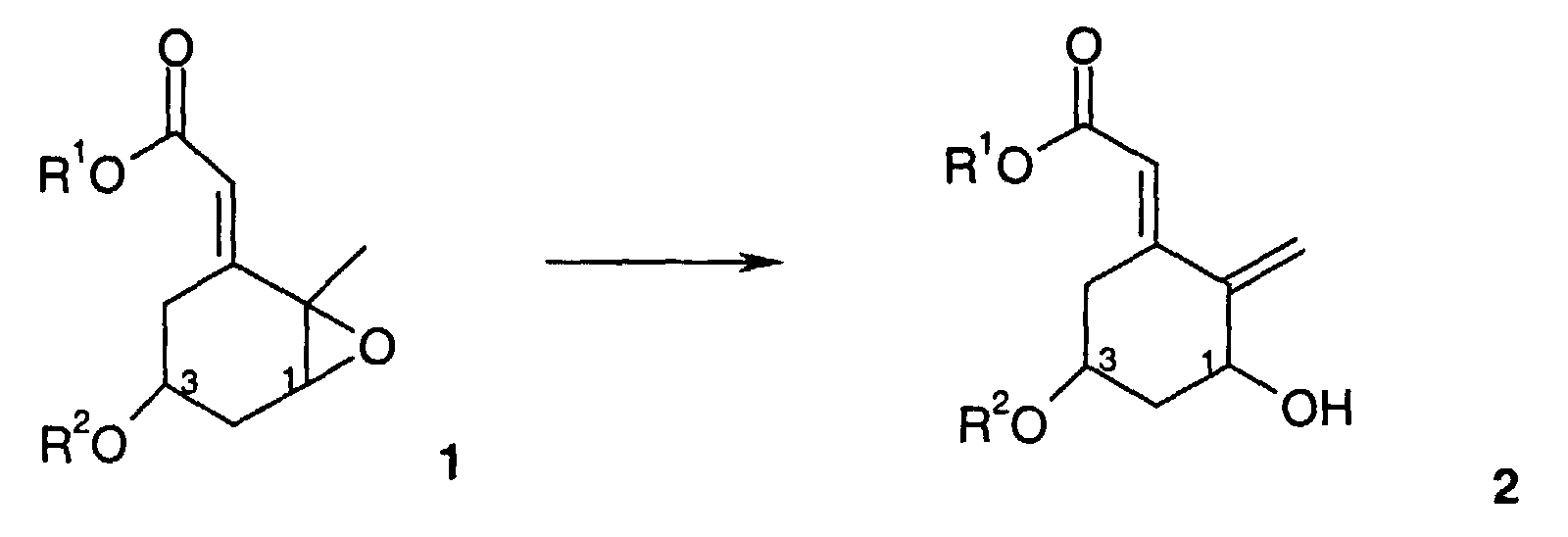
- the subject invention is concerned generally with a stereospecific and regioselective process for converting compounds of formula 1 to compounds of formula 2 .
- R 1 is C 1 -C 6 alkyl that can be straight-chain or branched.
- R 1 is a hydroxy protective group.
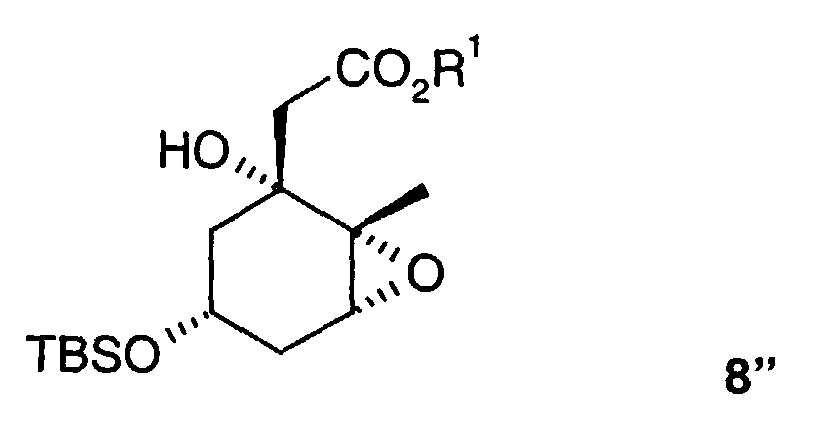
- the choice of protective group is readily determinable by the skilled artisan. However, a silyl protective group, such as tert -butyldimethylsilyl ("TBS”) is preferred.
- the bonds forming the epoxide ring may be above the plane or below the plane of the molecule.
- the adjacent methyl group is above the plane.
- the adjacent methyl is below the plane.
- Compounds of formula 2A - D are useful for the preparation of Vitamin D analogs, for example, for compound 2A , see: Shiuey, S. J.; Kulesha, I.; Baggiolini, E. G.; Uskokovic, M. R. J. Org. Chem . 1990 , 55 , 243; for compound 2B , see: Nagasawa, K.; Zako, Y.; Ishihara, H.; Shimizu, I. Tetrahedron Lett . 1991 , 32 , 4937. Nagasawa, K.; Zako, Y.; Ishihara, H.; Shimizu, I. J.
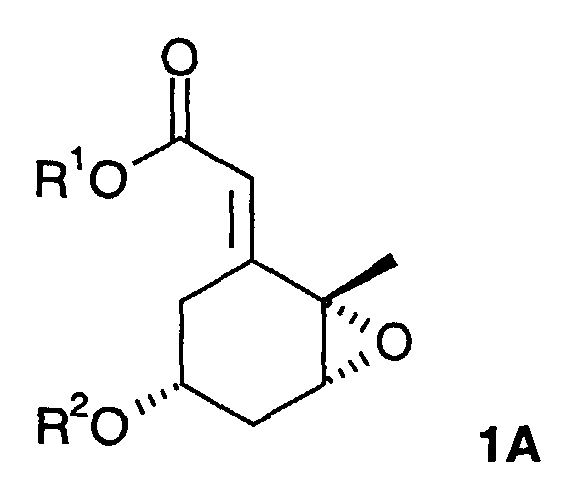
- the starting material may be (+)-Carvone for the preparation of 1A
- the starting material may be (-)-Carvone for the preparation of 1C [Liu, H. J.; Zhu, B. Y. Can. J. Chem. 1991 , 69 , 2008].
- the compound of formula 3 or its enantiomer may be obtained by reacting (+)-carvone or (-)-carvone, respectively, with an acetic acid ester, such as methylacetate, ethylacetate, propylacetate, isopropylacetate, t -butyl, iso -butyl, or sec -butyl acetate, pentyl (primary, seconadry or tertiary) acetate, or hexyl (primary, seconadry or tertiary) acetate, according to procedures set forth in the above publication.
- an acetic acid ester such as methylacetate, ethylacetate, propylacetate, isopropylacetate, t -butyl, iso -butyl, or sec -butyl acetate
- pentyl (primary, seconadry or tertiary) acetate or hexyl (primary, seconadry
- R 1 is C 1 -C 6 alkyl that can be straight-chain or branched.
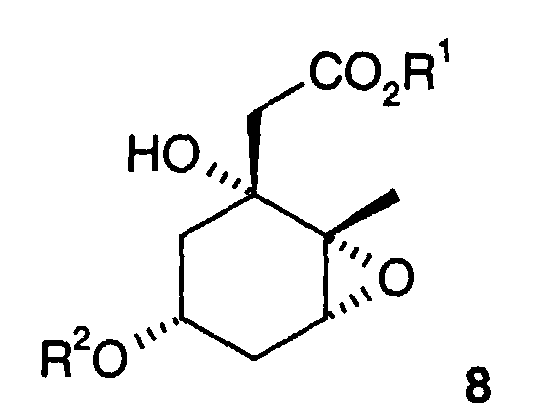
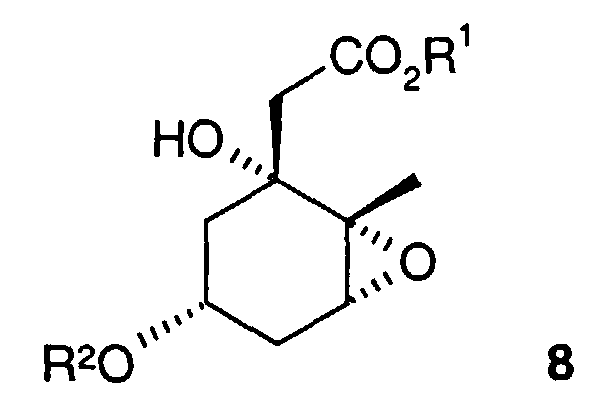
- R 2 is a hydroxy protective group, for example a silyl protective group.
- hydroxy protective group is readily apparent to the skilled artisan, see for example T. W. Greene, P. G. M. Wuts, Protective Groups in Organic Synthesis, 2 nd Ed., John Wiley & Sons, 1991.
- Acceptable hydroxy protective groups for use in connection with the subject invention include silyl ethers such as trimethylsilyl, triethylsilyl, tripropylsilyl, triisopropylsilyl, t -butyldimethylsilyl, dimethylthexylsilyl, triphenylsilyl, and t -butyldiphenylsilyl.
- Step A of the above process is the highly regio- and stereoselective epoxidation of the known [Liu, H. J.; Zhu, B. Y. Can. J. Chem . 1991 , 69 , 2008] allyl alcohol of formula 3 catalyzed by vanadyl acetylacetonate to obtain the epoxide of formula 4 .
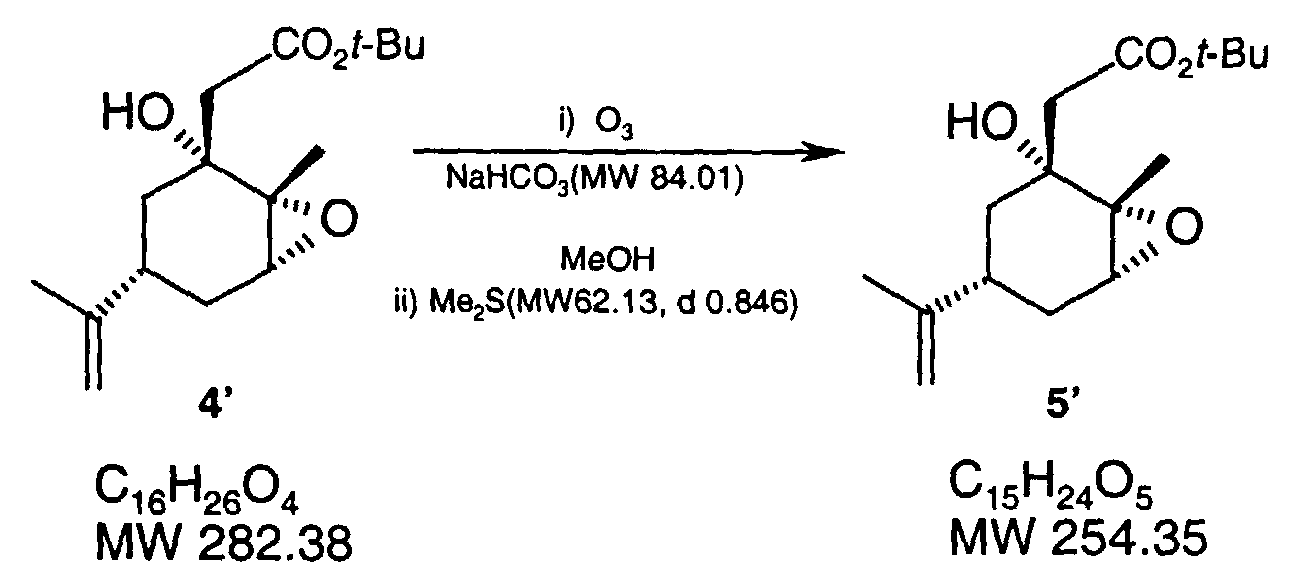
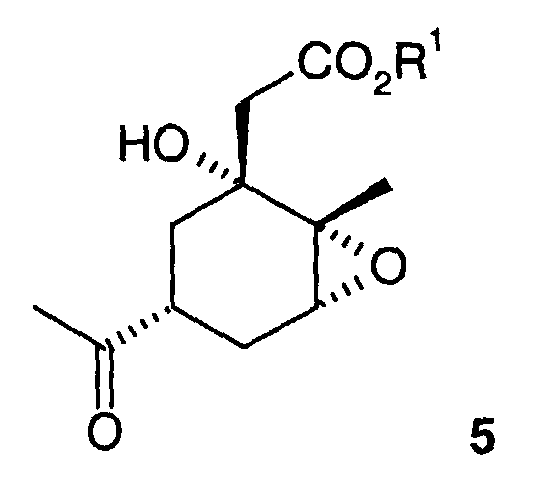
- the side chain double bond is then ozonized to give the ketone of formula 5 .
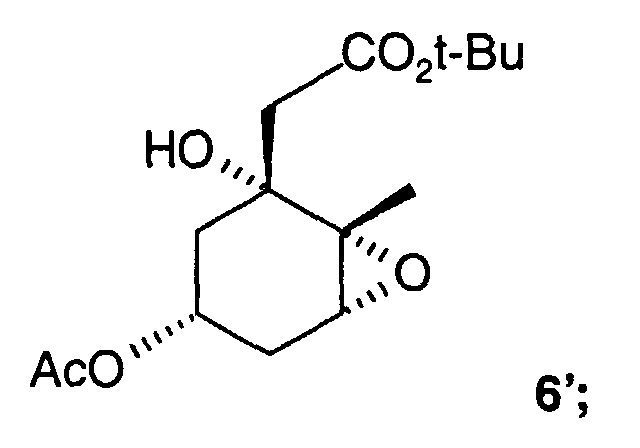
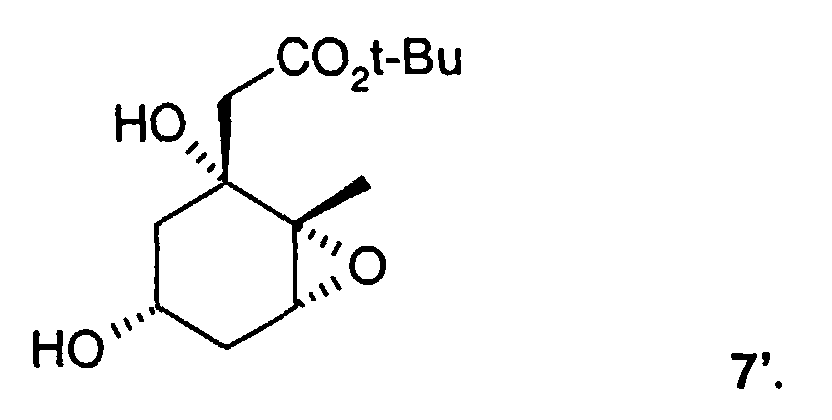
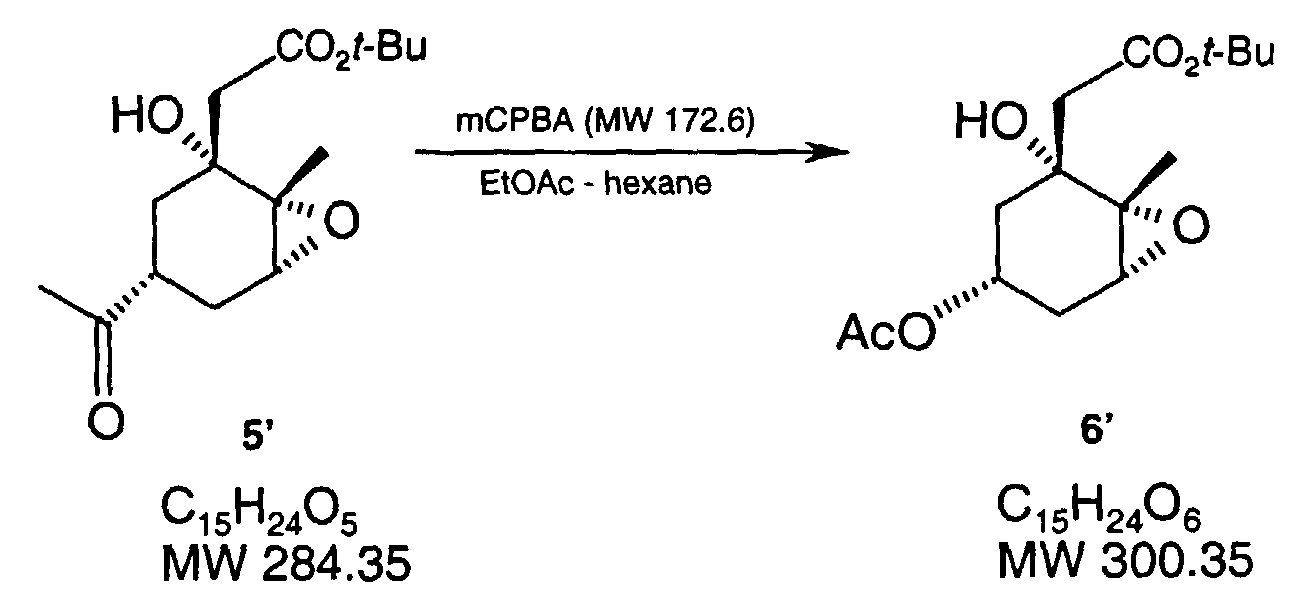
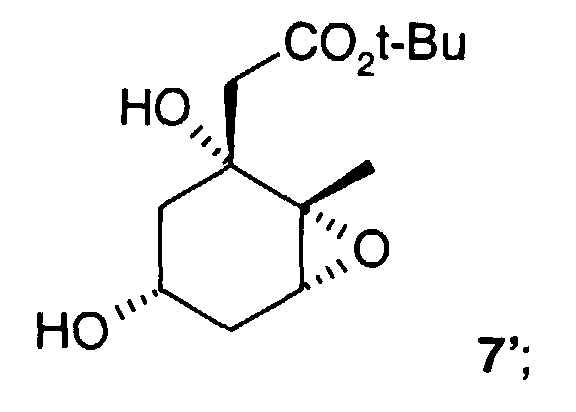
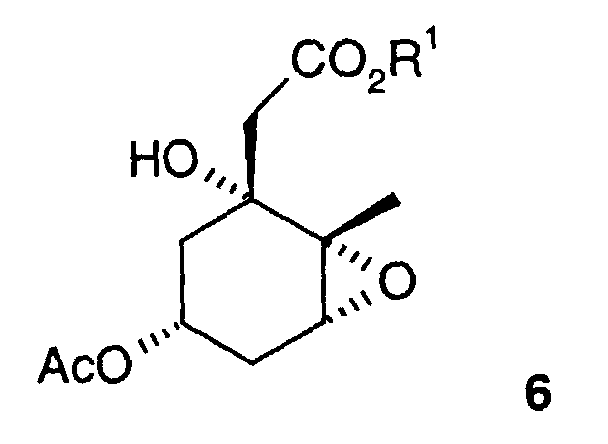
- a Baeyer-Villiger oxidation of the ketone of formula 5 followed by hydrolysis of the resulting acetate 6 gave alcohol 7 .
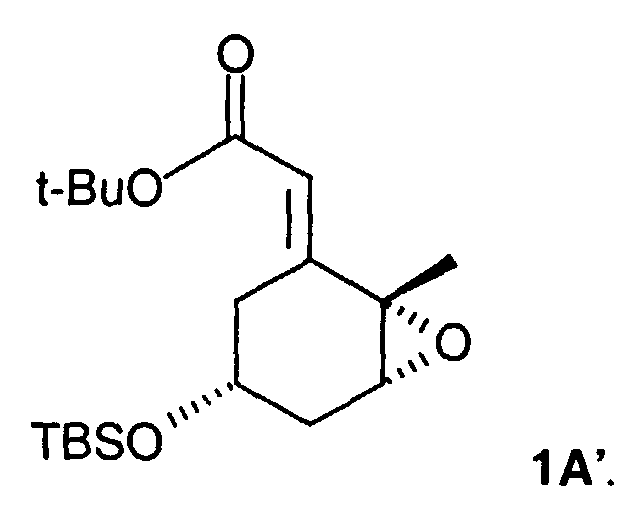
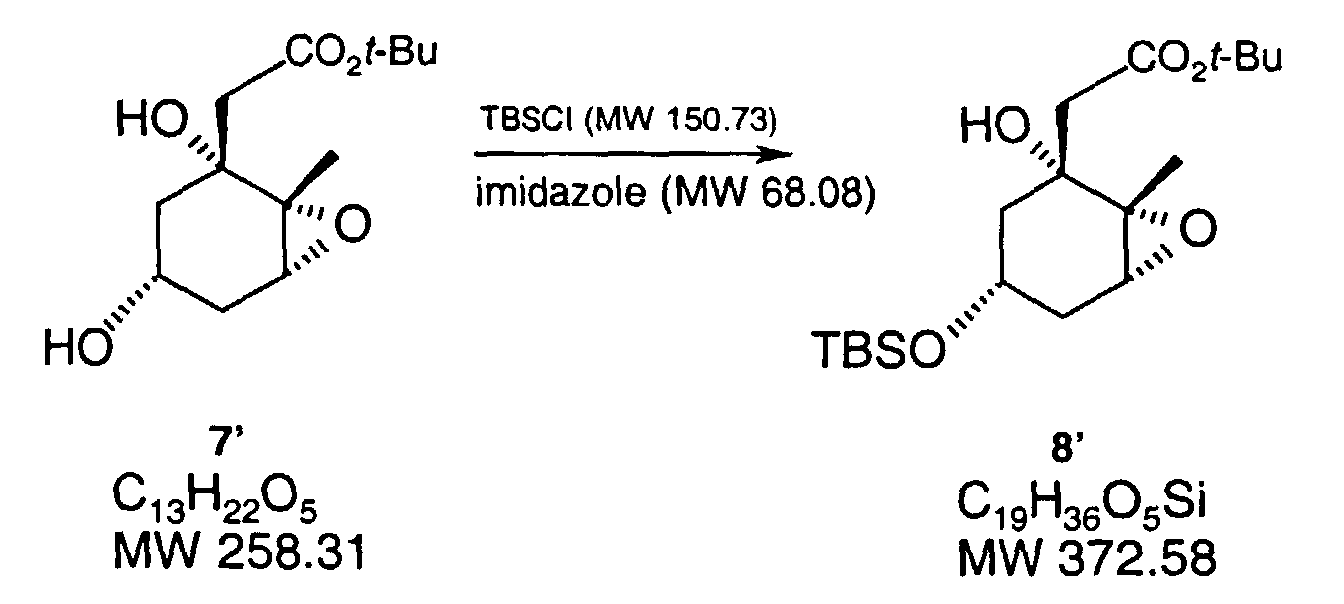
- Selective silylation of the secondary alcohol and dehydration of the tertiary alcohol gave unsaturated ester of formula 1A in the (E) configuration.
- the allyl alcohol of formula 3 can be epoxidized in methylene chloride using a catalytic amount of vanadyl acetylacetonate and a nonane solution of tert -butyl hydroperoxide in the presence of molecular sieves.
- the reaction can be carried out in refluxing cyclohexane with constant removal of water by a Dean-Stark condenser, using 1.5 mol% of the vanadium complex and about 1.2 equiv. of the hydroperoxide to give a complete reaction after five hours and product in a good yield.
- the epoxide of formula 4 tends to be unstable.
- a methanolic solution containing the epoxide of formula 4 can be ozonized in the presence of sodium bicarbonate, with dry ice-acetone cooling.
- a Polymetrics Laboratory Ozonator Model T-816 (Polymetrics, Inc.) can be used to generate the ozonized air (shell pressure 6 PSIG; flow rate 4 LPM; 110 V). This is followed with a reduction with dimethyl sulfide to obtain the ketone of formula 5 .
- Sodium bicarbonate should be removed by filtration prior to concentration below 30°C.
- the compound of formula 5 can be oxidized under modified Baeyer-Villiger oxidation conditions (excess meta-chloroperbenzoic acid in the absence of base) in a mixure of hexane and ethyl acetate. Greater amounts of hexane in the mixture accelerate the reaction. However, a too high ratio of hexane to ethyl acetate causes an additional layer in the reaction mixture and the production of by-products. A 3:1 mixture of hexane to ethyl acetate was found particularly suitable.
- the acetate of formula 6 can be hydrolyzed in methanol with a catalytic amount of sodium methoxide (15 mol%) with ice-water cooling.
- the product of formula 7 can then be crystallized from ethyl acetate-hexane and isolated.
- Selective protection of the secondary alcohol over the tertiary alcohol in formula 7 can be achieved using known protection technology, such as t -butyldimethylsilyl chloride and imidazole in tetrahydrofuran.
- Other silyl protective groups such as trimethylsilyl, triethylsilyl, tripropylsilyl, triisopropylsilyl, dimethylthexylsilyl, triphenylsilyl, and t -butyldiphenylsilyl protective groups can be similarly used, when a corresponding silylchloride is reacted with the compound of formula 7 in the presence of base, such as imidazole, pyridine, or other aromatic or aliphatic tertiary amine.
- Imidazole hydrochloride that precipitates from the reaction mixture can be removed by filtration. The filtrate can be concentrated and then introduced to the next step without further purification. Alternatively, silylation may be performed in pyridine and the reaction mixture can then be added directly to the dehydration mixture (i.e., pyridine/thionyl chloride) in Step F.
- the protected (for example silyl) ether of formula 8 can be dehydrated to give the compound of formula 1A on treatment with thionyl chloride in pyridine. Adding a THF solution of the compound of formula 8 into a preformed, cold thionyl chloride/pyridine mixture minimizes formation of by-product.
- the product can be used in the next step without purification.
- this crude product may contain protective group (for example silyl) by-products, the protective group should be stable under these dehydration conditions.
- the starting material may be (+)-Carvone [Okamura, W. H.; Aurrecoechea, J. M.; Gibbs, R. A.; Norman, A. W. J. Org. Chem . 1989 , 54 , 4072] for the preparation of 1B
- the starting material may be (-)-Carvone [Jones, Joel, Jr.; Kover, W. B. Synth. Commun . 1995 , 25 , 3907] for the praparation of 1D .
- compound 9 or its enantiomer may be obtained from (+)-Carvone or (-)-Carvone, respectively, by diastereoselective epoxidation according to procedures set forth in the above publications.
- a skilled chemist having read the present specification would know how to produce a given enantiomer by choosing the corresponding enantiomeric starting material.
- the compound of formula 9 is known [Klein, E.; Ohloff, G. Tetrahedron 1963 , 19 , 1091. Okamura, W. H.; Aurrecoechea, J. M.; Gibbs, R. A.; Norman, A. W. J. Org. Chem . 1989 , 54 , 4072].
- a 1,3-dipolar cycloaddition of ozone to the compound of formula 9 occurs to give an ozonide, which at a higher temperature (e.g., room temperature) releases formaldehyde via a retro-1,3-dipolar cycloaddition to form carbonyl oxide.
- a higher temperature e.g., room temperature
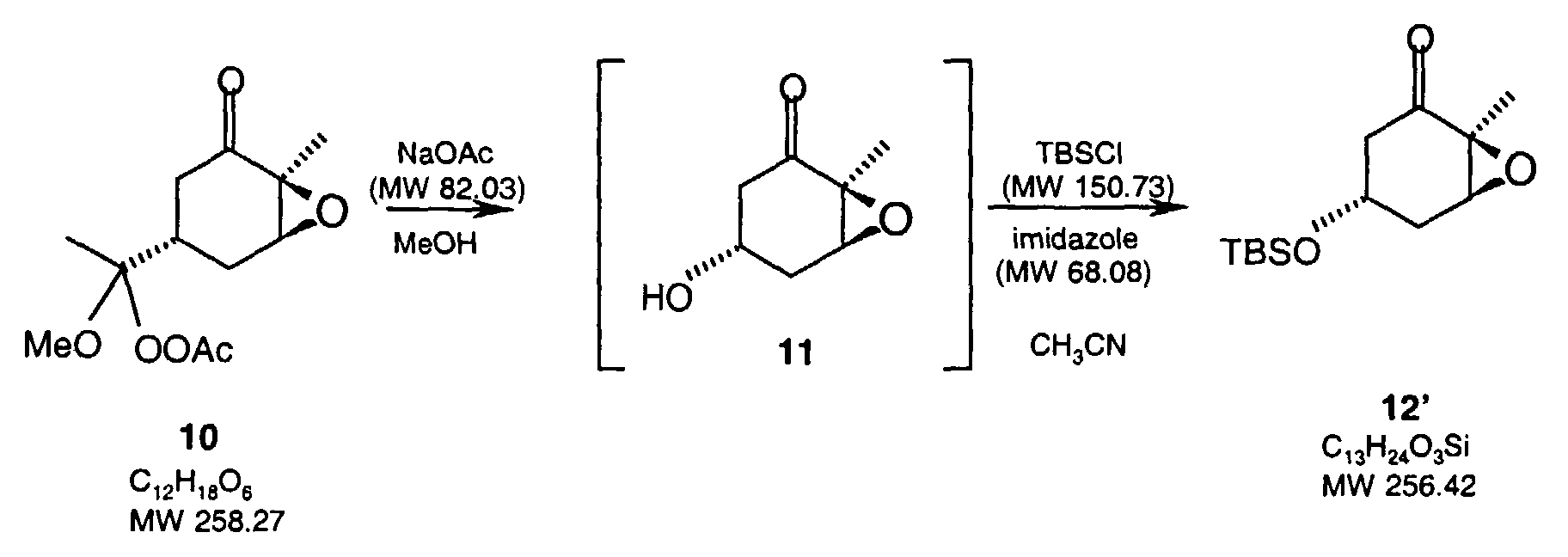
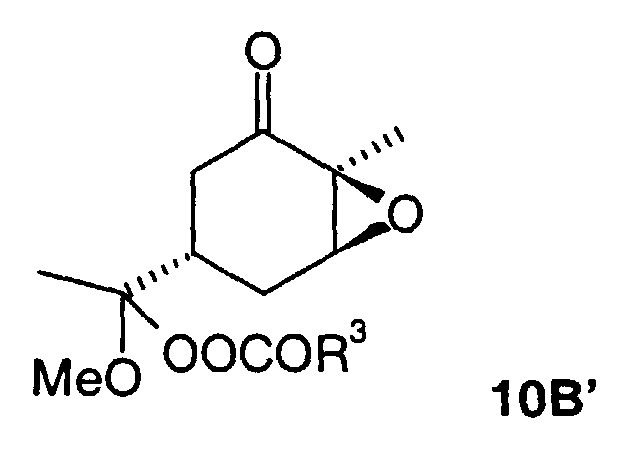
- the carbonyl oxide is efficiently trapped by the alcohol to give the desired hydroperoxide of formula 10A (Step G1) which is then acylated to the compound of formula 10B (Step G2).
- R 3 can be C 1 -C 6 alkyl, phenyl, 4-nitrophenyl, or CF 3 . Such variations are readily made by the skilled artisan.
- Such apropriate acylating agents are aliphatic and aromatic acid halides (chlorides or bromides) and acid anhydrides, such as acetylchloride, acetic anhydride, propionylchloride, benzoylchloride, 4-nitrobenzoylchloride, and trifluoroacetic anhydride.
- These acylating agents may react with hydroperoxide 10A in the presence of base such as triethylamine, as above, to give the corresponding peroxyesters 10B , where R is methyl, ethyl, phenyl, 4-nitrophenyl, trifluoromethyl.
- a peroxyacetate 10B where R is methyl is preferred.
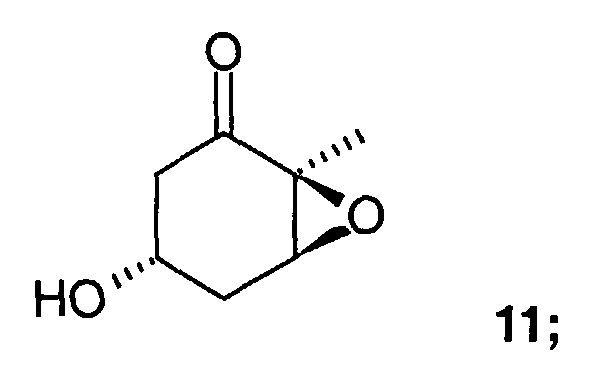
- the peroxyester of formula 10B is immediately subjected to the Criegee rearangement to yield the alcohol of formula 11 , preferably in methanol.
- the peroxyacetate of formula 10B tends to be unstable. Accordingly, sodium acetate may be added to prevent acid-catalyzed solvolysis of the compound of formula 10 to the corresponding dimethyl acetal and Step H1 preferably follows Step G immediately.
- An aqueous workup of the reaction mixture should be used to remove acidic and basic by-products in order to obtain purified compound of formula 11 .
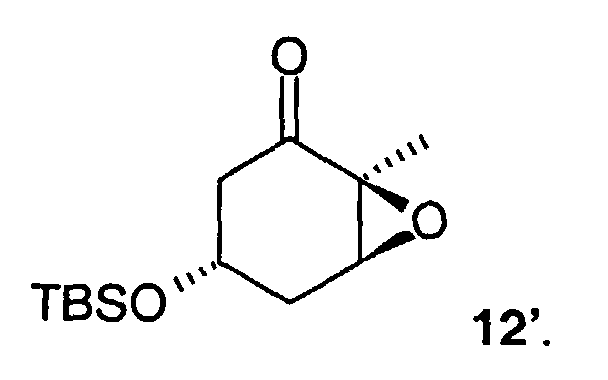
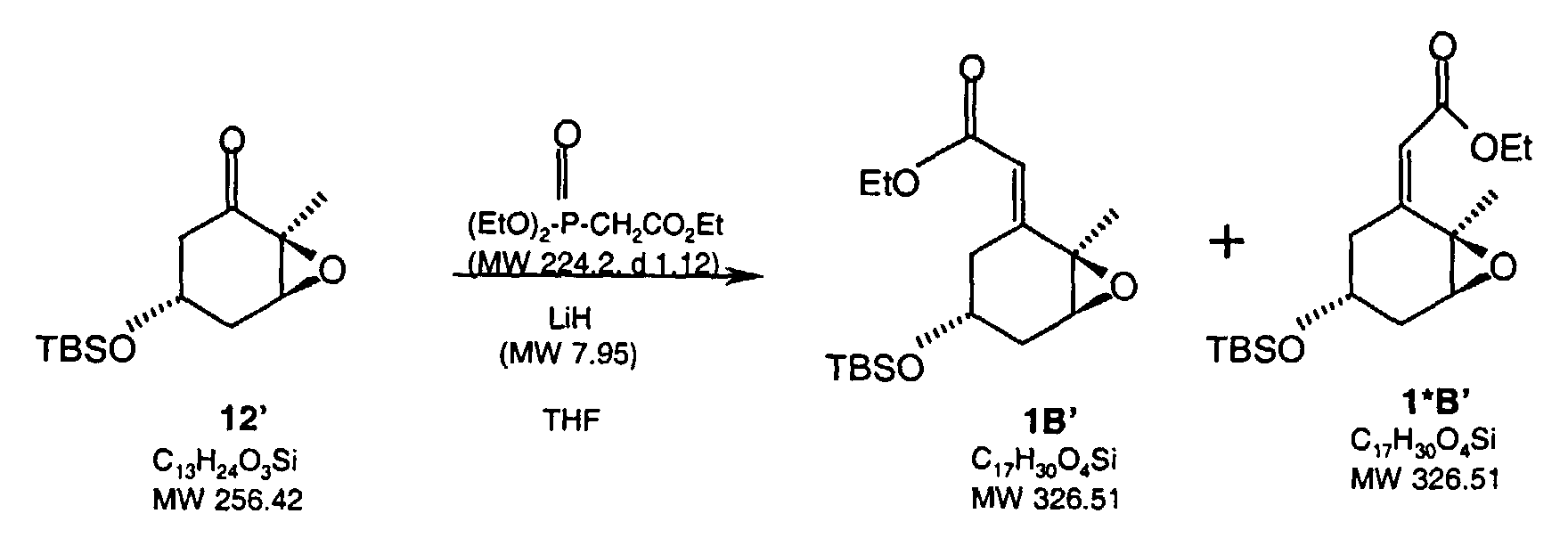
- the product of formula 11 can be protected (for example, silylated) to give the ketone of formula 12 .
- the relatively volatile protective group (for example, silyl) by-products can be removed at 45°C under high vacuum and the crude product of formula 12 obtained.
- Protection of the secondary alcohol in formula 11 can be achieved using known protection technology, for example using t -butyldimethylsilyl chloride and imidazole.
- Other silyl protective groups such as trimethylsilyl, triethylsilyl, tripropylsilyl, triisopropylsilyl, dimethylthexylsilyl, triphenylsilyl, and t -butyldiphenylsilyl protective groups can be similarly used, when a corresponding silylchloride is reacted with 7 in the presence of base, such as imidazole, pyridine, or other aromatic or aliphatic tertiary amine under controlled conditions to minimize elimination of the silyloxy group.
- base such as imidazole, pyridine, or other aromatic or aliphatic tertiary amine under controlled conditions to minimize elimination of the silyloxy group.
- a Wittig-Horner reaction of the compound of formula 12 can be carried out using 2.2 equiv. of tri-R 1 phosphonoacetate (where R 1 is a C 1 -C 6 alkyl that can be straight-chain or branched) and 1.8 equiv. of lithium hydride in a relatively small amount of THF, at a relatively low temperature (11°C), for a longer reaction time (20 h) to minimize elimination of the protecting (for example, silyloxy) group.
- the desired compound of formula 1B is thus obtained in approximately a 7-9:1 mixture with its Z-isomer (the compound of formula 1*B ).
- reaction will be discussed with reference to the reaction of a species of formula 1A (formula 1A' ) to form the corresponding species of formula 2A (formula 2A' ).
- the same principles hold true with its enantiomer ⁇ compound 1C , as well as the reactions of compound 1B to form 2B , and of its enantiomer ⁇ compound 1D to form 2D .
- phosphine ligands for example, triarylphosphines, such as triphenylphosphine, tris(2-methoxyphenyl)phosphine, tris(3-methoxyphenyl)phosphine, tris(4-methoxyphenyl)phosphine, tris(o-tolyl)phosphine, tris(m-tolyl)phosphine, tris(p-tolyl)phosphine, tris(4-fluorophenyl)phosphine, tris(p-trifluoromethylphenyl)phosphine, and tris(2-furyl)phosphine, and aryl phosphines such as 1,2-bis(diphenylphosphino)ethane] in combination with palladium(0) catalyze the isomerization and that adding a fluorinated alcohol [for example 1,1,1,3,3,3-hexafluoro-2-phenyl
- the palladium-phosphine catalyst can be prepared in situ prior to the reaction from commercial palladium sources, such as Pd 2 dba 3 (CHCl 3 ) ("dba” stands for dibenzylideneacetone), and an excess (typically 4-5 equivalents) of the corresponding phosphine ligand, such as triphenylphosphine.
- palladium sources may be used as well, such as palladium(0) complexes Pd 2 dba 3 , Pddba 2 , and palladium(II) salts Pd(OAc) 2 , PdCl 2 , [allylPdCl] 2 , and Pd(acac) 2 ("acac” stands for acetylacetonate).
- a palladium(0)-phosphine catalyst such as tetrakis(triphenylphosphine)palladium(0), may be separately prepared and used in the reaction. However, generation of the catalyst in situ from Pd 2 dba 3 (CHCl 3 ) and phosphine is preferred.
- Isomers 1B (E-isomer) and 1*B (Z-isomer) can be separated by chromatography. From pure E-isomers 1B the desired allylic alcohols ( 2B' and 2B'' ) were obtained with high selectivity (>99%). On the other hand, (Z)-diene oxides 1*B gave ketones 13 and 14 selectively (see the table below). Both ethyl and t-butyl esters gave similar results.
- silyl protective groups such as trimethylsilyl, triethylsilyl, tripropylsilyl, triisopropylsilyl, dimethylthexylsilyl, triphenylsilyl, and t -butyldiphenylsilyl protective groups can be similarly used, when a corresponding silylchloride is reacted with alcohol 2B . Since alcohol 2B' / 2B'' is converted to a non-polar product by silylation, while the polar ketone remains unchanged, pure silylated product can be easily isolated by a simple silica gel filtration.
- the product of this reaction may undergo a Diels-Alder dimerization as a concentrated solution and in the solid phase, at room temperature. Thus, it should be stored at ⁇ 20°C.
- the percentages given are the area percentages of the corresponding peaks at 220 nm.
- the HPLC conditions are as follows:
- a 250 mL round-bottomed flask equipped with a magnetic stirrer, septum stopper, thermocouple and nitrogen bubbler was charged with 388 mg (0.375 mmol) of tris(dibenzylideneacetone)dipalladium(0)-chloroform adduct and 985 mg (3.75 mmol) of triphenylphosphine.
- the flask was evacuated and refilled with nitrogen three times, then charged via syringe with 23 mL of toluene. The resulting deep purple mixture was stirred at ambient temperature for 30 min to give a light orange suspension.
- This material was dissolved in 100 mL of hexanes and the resulting solution was filtered through 200 g of TLC silica gel.
- the silica gel pad was then washed with 1.5 L of 98:2 hexane:ethyl acetate, and the combined filtrate and washes were concentrated to dryness under reduced pressure to give 27.7 g (84.0%) of the compound of formula 3B' as a colorless oil.
- a 3 L, three-necked, round-bottomed flask equipped with a mechanical stirrer, nitrogen inlet-tube and gas outlet-tube was charged with 247 g ( about 776 mmol) of the compound of formula 4' , 24 g (286 mmol) of sodium bicarbonate and 1.8 L of methanol. After the mixture was cooled with a dry-ice/acetone bath, the nitrogen inlet-tube was replaced with a gas dispersion tube with porous fitted glass tip (25-50 ⁇ ), and the gas outlet-tube was connected, through a trap, to a tube (4 mm I.D.) immersed in a 1 M solution of potassium iodide (2 L).
- the combined filtrate and washes were concentrated under reduced pressure (bath temperature ⁇ 30°C) to remove essentially all of the methanol.
- the resulting yellow, milky residue was partitioned between 1 L of ethyl acetate and 300 mL of water.
- the aqueous layer was separated and extracted with 50 mL of ethyl acetate.
- the combined organic layers were washed with 300 mL of saturated sodium chloride solution, dried over sodium sulfate, and concentrated under reduced pressure (bath temperature ⁇ 35°C).
- the resulting pale yellow oil was dissolved in 150 mL of ethyl acetate and 600 mL of hexane was added.
- the resulting suspension was stored in a refrigerator overnight.
- the organic layer was washed with 30 mL of 10% potassium bicarbonate solution and dried over magnesium sulfate.
- the combined aqueous layers were extracted with 200 mL of ethyl acetate.
- the organic layer was washed with 20 mL of 10% potassium bicarbonate solution and dried over magnesium sulfate.
- the combined aqueous layers were again extracted with 200 mL of ethyl acetate.
- the organic layer was washed with 20 mL of 10% potassium bicarbonate solution and dried over magnesium sulfate.
- the combined aqueous layers were extracted one more time with 200 mL of ethyl acetate.
- the organic layer was washed with 20 mL of 10% potassium bicarbonate solution and dried over magnesium sulfate.
- the solution was washed with 20 mL of 5% potassium bicarbonate solution and 20 mL of saturated sodium chloride solution, dried over magnesium sulfate and concentrated under reduced pressure (bath temperature ⁇ 35°C).
- the residue (4.3 g) was dissolved in 5 mL of ethyl acetate and, after crystallization was induced by the addition of seed crystals, 25 mL of hexane was gradually added. The resulting suspension was allowed to stand for 4 h.
- a 500 mL, three-necked, round-bottomed flask equipped with a mechanical stirrer, thermometer, nitrogen inlet-tube and gas outlet-tube was charged with 20.0 g (120 mmol) of the compound of formula 9 , 20 mL (494 mmol) of methanol and 200 mL of dichloromethane. After the mixture was cooled to ⁇ 68°C with a dry-ice/acetone bath, the nitrogen inlet-tube was replaced with a gas dispersion tube with porous fitted glass tip (25-50 ⁇ ), and the gas outlet-tube was connected, through a trap, to a tube (4 mm I.D.) immersed in a 1 M solution of potassium iodide (2 L).
- ozonized air (4.5 LPM) was continuously passed through the reaction mixture at ⁇ 68 ⁇ 3°C.
- the reaction turned pale blue after 65 min, indicating complete reaction.
- Excess ozone was removed by purging with nitrogen for 30 min to give a colorless solution.
- the gas dispersion and outlet tubes were replaced with a nitrogen bubbler and an addition funnel.
- the mixture was allowed to warm to 14°C over 40 min. After cooling to ⁇ 25°C with a dry-ice/acetone bath, 117 mL (839 mmol) of triethylamine was added over 5 min, while maintaining the temperature of the mixture below ⁇ 25°C.
- the resulting solution was again concentrated to dryness at 35°C under reduced pressure, and 35 mL of acetonitrile and 29.5 g (433 mmol) of imidazole were added. After cooling with an ice-water bath, 32.6 g (217 mmol) of tert -butylchlorodimethylsilane was added. The cold bath was removed and the mixture was stirred at room temperature for 4 h. TLC analysis indicated the presence of only a trace amount of starting material. The reaction mixture was quenched by the addition of 10 mL of methanol. A mild exotherm ensued that raised the temperature of the mixture by 2°C.
Landscapes
- Chemical & Material Sciences (AREA)
- Organic Chemistry (AREA)
- Chemical Kinetics & Catalysis (AREA)
- Organic Low-Molecular-Weight Compounds And Preparation Thereof (AREA)
- Low-Molecular Organic Synthesis Reactions Using Catalysts (AREA)
- Epoxy Compounds (AREA)
- Pharmaceuticals Containing Other Organic And Inorganic Compounds (AREA)
Abstract
Description


for the preparation of compounds of formula 2AA and 2AA*reacting a compound of formula:
- wherein R1 and R2 are as above
and for the preparation of compounds of formula 2BB and 2BB*reacting a compound of formula:

- wherein R1 and R2 are as above,
to compounds having the structure


- wherein R1 is C1-C6 alkyl;


- wherein R1 is C1-C6 alkyl;

- wherein R1 is C1-C6 alkyl;
- R1
- is C1-C6 alkyl, and
- R2
- is a hydroxy protective group selected from the group consisting of trimethylsilyl, triethylsilyl, tripropylsilyl, triisopropylsilyl, t-butyldimethylsilyl ("TBS"), dimethylthexylsilyl, triphenylsilyl, and t-butyldiphenylsilyl.
- wherein R1 is C1-C6 alkyl,

- R2
- is a hydroxy protective group selected from the group consisting of trimethylsilyl, triethylsilyl, tripropylsilyl, triisopropylsilyl, t-butyldimethylsilyl, dimethylthexylsilyl, triphenylsilyl, and t-butyldiphenylsilyl;


- wherein R3 is C1-C6 alkyl, phenyl, 4-nitrophenyl, or CF3;


- R2
- is a hydroxy protective group selected from the group consisting of trimethylsilyl, triethylsilyl, tripropylsilyl, triisopropylsilyl, t-butyldimethylsilyl, dimethylthexylsilyl, triphenylsilyl, and t-butyldiphenylsilyl;
- R1
- is C1-C6 alkyl and R2 is a hydroxy protective group selected from the group consisting of trimethylsilyl, triethylsilyl, tripropylsilyl, triisopropylsilyl, t-butyldimethylsilyl, dimethylthexylsilyl, triphenylsilyl, and t-butyldiphenylsilyl;

- wherein R1 is C1-C6 alkyl;

- R2
- is a hydroxy protective group selected from the group consisting of trimethylsilyl, triethylsilyl, tripropylsilyl, triisopropylsilyl, t-butyldimethylsilyl, dimethylthexylsilyl, triphenylsilyl, and t-butyldiphenylsilyl;

- R1
- is C1-C6 alkyl and R2 is a hydroxy protective group selected from the group consisting of trimethylsilyl, triethylsilyl, tripropylsilyl, triisopropylsilyl, t-butyldimethylsilyl, dimethylthexylsilyl, triphenylsilyl, and t-butyldiphenylsilyl;

- wherein R1 is C1-C6 alkyl;

- R2
- is a hydroxy protective group selected from the group consisting of trimethylsilyl, triethylsilyl, tripropylsilyl, triisopropylsilyl, t-butyldimethylsilyl, dimethylthexylsilyl, triphenylsilyl, and t-butyldiphenylsilyl;



| pKa of Additive vs. Selectivity. | |||
| Alcohol Additive | Mol% | pKa in water | % (formula 2A' vs. formula 13) |
| t-BuOH | 100 | 19 | 25 |
| MeC(CF3)2OH (formula 15a) | 10 | 9.51 | 26 |
| (CF3)2CHOH (formula 15b) | 10 | 9.13 | 32 |
| PhC(CF3)2OH (formula 15c) | 10 | 8.52 | 91 |
| (CF3)3COH (formula 15d) | 10 | 5.18 | 95 |
| Formula 16 | 10 | 8.48 | 92 |

| R1 (Substrate) | E : Z of substrate | E : Z of product | Allylic Alcohol : Ketone |
| Et (1B' + 1*B') | 4 : 1 | E only (2B') | 80:20 (2B':14) |
| Et (1B' + 1*B') | 7 : 1 | E only (2B') | 88:12 (2B':14) |
| Et (1B' + 1*B') | 9 : 1 | E only (2B') | 90 : 10 (2B':14) |
| Et (1B') | E only | E only (2B') | >99 : 1 (2B':14) |
| Et (1*B') | Z only | E only (2B') | 14 : 86 (2B':14) |
| t-Bu (1B'') | E only | E only (2B'') | >99 : 1 (2B'':13) |
| t-Bu (1*B'') | Z only | E only (2B'') | 8 : 92 (2B'':13) |

- Column:
- Nucleosil 5 µm, 4.6 x 250 mm
- Mobile Phase:
- 2% isopropanol in hexanes at 0.5 mL/min
- Retention Times:
- 7.6 min (the compound of formula 1A'), 8.8 min (the ketone by-product), 8.9 min (dibenzylidene-acetone), 12.1 min (the compound of formula 2A') and 18 min (the dimer).





Claims (26)


- R1 and R2
- are as above



- R1
- is C1-C6 alkyl and
- R2
- is a hydroxy protective group selected from the group consisting of trimethylsilyl, triethylsilyl, tripropylsilyl, triisopropylsilyl, t-butyldimethylsilyl, dimethylthexylsilyl, triphenylsilyl, and t-butyldiphenylsilyl; or its enantiomer.



- R2
- is a hydroxy protective group selected from the group consisting of trimethylsilyl, triethylsilyl, tripropylsilyl, triisopropylsilyl, t-butyldimethylsilyl, dimethylthexylsilyl, triphenylsilyl, and t-butyldiphenylsilyl; or its enantiomer.

- R1
- is C1-C6 alkyl and
- R2
- is a hydroxy protective group selected from the group consisting of trimethylsilyl, triethylsilyl, tripropylsilyl, triisopropylsilyl, t-butyldimethylsilyl, dimethylthexylsilyl, triphenylsilyl, and t-butyldiphenylsilyl; or its enantiomer.


- R1
- is C1-C6 alkyl and
- R2
- is a hydroxy protective group selected from the group consisting of trimethylsilyl, triethylsilyl, tripropylsilyl, triisopropylsilyl, t-butyldimethylsilyl, dimethylthexylsilyl, triphenylsilyl, and t-butyldiphenylsilyl; or its enantiomer.


Applications Claiming Priority (4)
| Application Number | Priority Date | Filing Date | Title |
|---|---|---|---|
| US15022699P | 1999-08-23 | 1999-08-23 | |
| US15037899P | 1999-08-23 | 1999-08-23 | |
| US150378P | 1999-08-23 | ||
| US150226P | 1999-08-23 |
Publications (3)
| Publication Number | Publication Date |
|---|---|
| EP1078931A2 true EP1078931A2 (en) | 2001-02-28 |
| EP1078931A3 EP1078931A3 (en) | 2003-04-16 |
| EP1078931B1 EP1078931B1 (en) | 2006-03-08 |
Family
ID=26847433
Family Applications (1)
| Application Number | Title | Priority Date | Filing Date |
|---|---|---|---|
| EP00117261A Expired - Lifetime EP1078931B1 (en) | 1999-08-23 | 2000-08-16 | Process for the preparation of vitamin D analogues |
Country Status (9)
| Country | Link |
|---|---|
| EP (1) | EP1078931B1 (en) |
| JP (1) | JP3517391B2 (en) |
| KR (1) | KR100369881B1 (en) |
| CN (2) | CN1179938C (en) |
| AT (1) | ATE319722T1 (en) |
| CA (1) | CA2316157C (en) |
| DE (1) | DE60026407T2 (en) |
| ES (1) | ES2258432T3 (en) |
| MX (1) | MXPA00008175A (en) |
Cited By (1)
| Publication number | Priority date | Publication date | Assignee | Title |
|---|---|---|---|---|
| WO2002070441A1 (en) * | 2001-03-02 | 2002-09-12 | Nissan Chemical Industries, Ltd. | Process for preparation of optically active cyclohexenes and optically active cyclohexene derivatives to be used in the preparation |
Families Citing this family (2)
| Publication number | Priority date | Publication date | Assignee | Title |
|---|---|---|---|---|
| WO2015045739A1 (en) * | 2013-09-25 | 2015-04-02 | Jsr株式会社 | Radiation-sensitive resin composition, method for forming resist pattern, polymer, and compound |
| CN112724060B (en) * | 2021-01-15 | 2022-10-21 | 常州博海威医药科技股份有限公司 | Novel process for producing prostaglandin and intermediate |
Family Cites Families (1)
| Publication number | Priority date | Publication date | Assignee | Title |
|---|---|---|---|---|
| DK0503630T3 (en) * | 1991-03-13 | 1996-01-29 | Kuraray Co | cyclohexanetriol |
-
2000
- 2000-08-16 EP EP00117261A patent/EP1078931B1/en not_active Expired - Lifetime
- 2000-08-16 ES ES00117261T patent/ES2258432T3/en not_active Expired - Lifetime
- 2000-08-16 AT AT00117261T patent/ATE319722T1/en not_active IP Right Cessation
- 2000-08-16 DE DE60026407T patent/DE60026407T2/en not_active Expired - Lifetime
- 2000-08-17 CA CA002316157A patent/CA2316157C/en not_active Expired - Fee Related
- 2000-08-21 MX MXPA00008175A patent/MXPA00008175A/en active IP Right Grant
- 2000-08-23 CN CNB001238655A patent/CN1179938C/en not_active Expired - Fee Related
- 2000-08-23 KR KR10-2000-0048927A patent/KR100369881B1/en not_active Expired - Fee Related
- 2000-08-23 CN CNB2004100476902A patent/CN1269808C/en not_active Expired - Fee Related
- 2000-08-23 JP JP2000251987A patent/JP3517391B2/en not_active Expired - Fee Related
Cited By (1)
| Publication number | Priority date | Publication date | Assignee | Title |
|---|---|---|---|---|
| WO2002070441A1 (en) * | 2001-03-02 | 2002-09-12 | Nissan Chemical Industries, Ltd. | Process for preparation of optically active cyclohexenes and optically active cyclohexene derivatives to be used in the preparation |
Also Published As
| Publication number | Publication date |
|---|---|
| MXPA00008175A (en) | 2002-08-06 |
| DE60026407T2 (en) | 2006-11-09 |
| KR20010071114A (en) | 2001-07-28 |
| CN1554650A (en) | 2004-12-15 |
| CA2316157C (en) | 2004-11-23 |
| KR100369881B1 (en) | 2003-01-30 |
| CA2316157A1 (en) | 2001-02-23 |
| CN1179938C (en) | 2004-12-15 |
| JP3517391B2 (en) | 2004-04-12 |
| CN1269808C (en) | 2006-08-16 |
| CN1287115A (en) | 2001-03-14 |
| EP1078931B1 (en) | 2006-03-08 |
| JP2001122882A (en) | 2001-05-08 |
| EP1078931A3 (en) | 2003-04-16 |
| DE60026407D1 (en) | 2006-05-04 |
| ES2258432T3 (en) | 2006-09-01 |
| ATE319722T1 (en) | 2006-03-15 |
Similar Documents
| Publication | Publication Date | Title |
|---|---|---|
| Yamaguchi et al. | Concise Enantio‐and Diastereoselective Total Syntheses of Fumagillol, RK‐805, FR65814, Ovalicin, and 5‐Demethylovalicin | |
| EP3245185B1 (en) | Intermediate compounds for producing perfuming ingredients | |
| Nakamura et al. | Stereochemical control in microbial reduction. 12.(S)-4-nitro-2-butanol as a source to synthesize natural products. | |
| Toyama et al. | Convenient route to both enantiomerically pure forms of trans-4, 5-dihydroxy-2-cyclopenten-1-one: efficient synthesis of the neocarzinostatin chromophore core | |
| EP1078931A2 (en) | Process for the preparation of vitamin D analogues | |
| US6291694B1 (en) | Process and intermediates useful to produce vitamin D analogs | |
| US6353123B1 (en) | Process and intermediates useful to produce vitamin D analogs | |
| Schneider et al. | General and Asymmetric Synthesis of Protected 1, 3, 5‐Triols with Pendant Functional Groups | |
| JP2018177746A (en) | Method for producing 2,4-dienal = acetal compound and 2,4-dienal compound | |
| TWI628185B (en) | Intermediates for synthesizing treprostinil and preparation method thereof as well as the preparation method of treprostinil thereby | |
| EP4119535B1 (en) | Acetal compounds, processes for their preparation, and processes for preparing aldehyde compounds from the acetal compounds | |
| US9061982B2 (en) | Process for the preparation of oxovinylionol and its O-protected derivatives | |
| US4107181A (en) | Useful prostaglandin intermediates | |
| EP0685473B1 (en) | Benzoheterocyclic compounds, as antioxidants | |
| CN107001209A (en) | The intermolecular reaction formation chroman based on alkynes and dimethyl furan in the presence of golden (I) complex compound | |
| US11148989B2 (en) | Dialkoxyalkadienyne compound and a process for preparing the same and a process for preparing a dienynal compound | |
| DK2776447T3 (en) | PROCEDURE FOR THE PREPARATION OF OXOVINYLIONOL AND ITS O-PROTECTED DERIVATIVES | |
| US20050054877A1 (en) | Enantiomerically selective cyclopropanation | |
| KR20200042861A (en) | Method for producing silicon compound, and silicon compound | |
| JP2860506B2 (en) | Halogenoallyl alcohol derivatives | |
| Acocella et al. | Vinylogous Aldol Reaction of a Silyloxydiene Promoted by Sulfoxides, as Lewis Bases: 1, 4–asymmetric Induction Mediated by a Remote Methylsulfinyl Group | |
| JP3825489B2 (en) | Unsaturated halogen compound and method for producing sex pheromone using the same | |
| JP2002128759A (en) | 4-[(R) -1'-formylethyl] azetidin-2-one derivative | |
| JP3549576B2 (en) | Hexahydroindanecarboxylic acid ester derivative and method for producing the same | |
| JP2001294580A (en) | Optically active oxazoline compound and method for producing optically active allyl alcohol derivative by using the compound |
Legal Events
| Date | Code | Title | Description |
|---|---|---|---|
| PUAI | Public reference made under article 153(3) epc to a published international application that has entered the european phase |
Free format text: ORIGINAL CODE: 0009012 |
|
| AK | Designated contracting states |
Kind code of ref document: A2 Designated state(s): AT BE CH CY DE DK ES FI FR GB GR IE IT LI LU MC NL PT SE |
|
| AX | Request for extension of the european patent |
Free format text: AL;LT;LV;MK;RO;SI |
|
| PUAL | Search report despatched |
Free format text: ORIGINAL CODE: 0009013 |
|
| AK | Designated contracting states |
Designated state(s): AT BE CH CY DE DK ES FI FR GB GR IE IT LI LU MC NL PT SE |
|
| AX | Request for extension of the european patent |
Extension state: AL LT LV MK RO SI |
|
| 17P | Request for examination filed |
Effective date: 20031016 |
|
| AKX | Designation fees paid |
Designated state(s): AT BE CH CY DE DK ES FI FR GB GR IE IT LI LU MC NL PT SE |
|
| 17Q | First examination report despatched |
Effective date: 20040603 |
|
| GRAP | Despatch of communication of intention to grant a patent |
Free format text: ORIGINAL CODE: EPIDOSNIGR1 |
|
| GRAS | Grant fee paid |
Free format text: ORIGINAL CODE: EPIDOSNIGR3 |
|
| GRAA | (expected) grant |
Free format text: ORIGINAL CODE: 0009210 |
|
| AK | Designated contracting states |
Kind code of ref document: B1 Designated state(s): AT BE CH CY DE DK ES FI FR GB GR IE IT LI LU MC NL PT SE |
|
| PG25 | Lapsed in a contracting state [announced via postgrant information from national office to epo] |
Ref country code: AT Free format text: LAPSE BECAUSE OF FAILURE TO SUBMIT A TRANSLATION OF THE DESCRIPTION OR TO PAY THE FEE WITHIN THE PRESCRIBED TIME-LIMIT Effective date: 20060308 Ref country code: NL Free format text: LAPSE BECAUSE OF FAILURE TO SUBMIT A TRANSLATION OF THE DESCRIPTION OR TO PAY THE FEE WITHIN THE PRESCRIBED TIME-LIMIT Effective date: 20060308 Ref country code: BE Free format text: LAPSE BECAUSE OF FAILURE TO SUBMIT A TRANSLATION OF THE DESCRIPTION OR TO PAY THE FEE WITHIN THE PRESCRIBED TIME-LIMIT Effective date: 20060308 Ref country code: FI Free format text: LAPSE BECAUSE OF FAILURE TO SUBMIT A TRANSLATION OF THE DESCRIPTION OR TO PAY THE FEE WITHIN THE PRESCRIBED TIME-LIMIT Effective date: 20060308 |
|
| REG | Reference to a national code |
Ref country code: GB Ref legal event code: FG4D |
|
| REG | Reference to a national code |
Ref country code: CH Ref legal event code: EP |
|
| REG | Reference to a national code |
Ref country code: IE Ref legal event code: FG4D |
|
| REF | Corresponds to: |
Ref document number: 60026407 Country of ref document: DE Date of ref document: 20060504 Kind code of ref document: P |
|
| PG25 | Lapsed in a contracting state [announced via postgrant information from national office to epo] |
Ref country code: SE Free format text: LAPSE BECAUSE OF FAILURE TO SUBMIT A TRANSLATION OF THE DESCRIPTION OR TO PAY THE FEE WITHIN THE PRESCRIBED TIME-LIMIT Effective date: 20060608 Ref country code: DK Free format text: LAPSE BECAUSE OF FAILURE TO SUBMIT A TRANSLATION OF THE DESCRIPTION OR TO PAY THE FEE WITHIN THE PRESCRIBED TIME-LIMIT Effective date: 20060608 |
|
| PG25 | Lapsed in a contracting state [announced via postgrant information from national office to epo] |
Ref country code: PT Free format text: LAPSE BECAUSE OF FAILURE TO SUBMIT A TRANSLATION OF THE DESCRIPTION OR TO PAY THE FEE WITHIN THE PRESCRIBED TIME-LIMIT Effective date: 20060808 |
|
| PG25 | Lapsed in a contracting state [announced via postgrant information from national office to epo] |
Ref country code: IE Free format text: LAPSE BECAUSE OF NON-PAYMENT OF DUE FEES Effective date: 20060816 |
|
| PG25 | Lapsed in a contracting state [announced via postgrant information from national office to epo] |
Ref country code: MC Free format text: LAPSE BECAUSE OF NON-PAYMENT OF DUE FEES Effective date: 20060831 |
|
| NLV1 | Nl: lapsed or annulled due to failure to fulfill the requirements of art. 29p and 29m of the patents act | ||
| REG | Reference to a national code |
Ref country code: ES Ref legal event code: FG2A Ref document number: 2258432 Country of ref document: ES Kind code of ref document: T3 |
|
| ET | Fr: translation filed | ||
| PLBE | No opposition filed within time limit |
Free format text: ORIGINAL CODE: 0009261 |
|
| STAA | Information on the status of an ep patent application or granted ep patent |
Free format text: STATUS: NO OPPOSITION FILED WITHIN TIME LIMIT |
|
| 26N | No opposition filed |
Effective date: 20061211 |
|
| PG25 | Lapsed in a contracting state [announced via postgrant information from national office to epo] |
Ref country code: GR Free format text: LAPSE BECAUSE OF FAILURE TO SUBMIT A TRANSLATION OF THE DESCRIPTION OR TO PAY THE FEE WITHIN THE PRESCRIBED TIME-LIMIT Effective date: 20060609 |
|
| PG25 | Lapsed in a contracting state [announced via postgrant information from national office to epo] |
Ref country code: LU Free format text: LAPSE BECAUSE OF NON-PAYMENT OF DUE FEES Effective date: 20060816 |
|
| PG25 | Lapsed in a contracting state [announced via postgrant information from national office to epo] |
Ref country code: CY Free format text: LAPSE BECAUSE OF FAILURE TO SUBMIT A TRANSLATION OF THE DESCRIPTION OR TO PAY THE FEE WITHIN THE PRESCRIBED TIME-LIMIT Effective date: 20060308 |
|
| PGFP | Annual fee paid to national office [announced via postgrant information from national office to epo] |
Ref country code: FR Payment date: 20090806 Year of fee payment: 10 Ref country code: ES Payment date: 20090803 Year of fee payment: 10 |
|
| PGFP | Annual fee paid to national office [announced via postgrant information from national office to epo] |
Ref country code: GB Payment date: 20090708 Year of fee payment: 10 Ref country code: CH Payment date: 20090811 Year of fee payment: 10 Ref country code: DE Payment date: 20090831 Year of fee payment: 10 |
|
| PGFP | Annual fee paid to national office [announced via postgrant information from national office to epo] |
Ref country code: IT Payment date: 20090812 Year of fee payment: 10 |
|
| REG | Reference to a national code |
Ref country code: CH Ref legal event code: PL |
|
| GBPC | Gb: european patent ceased through non-payment of renewal fee |
Effective date: 20100816 |
|
| PG25 | Lapsed in a contracting state [announced via postgrant information from national office to epo] |
Ref country code: CH Free format text: LAPSE BECAUSE OF NON-PAYMENT OF DUE FEES Effective date: 20100831 Ref country code: LI Free format text: LAPSE BECAUSE OF NON-PAYMENT OF DUE FEES Effective date: 20100831 |
|
| REG | Reference to a national code |
Ref country code: FR Ref legal event code: ST Effective date: 20110502 |
|
| PG25 | Lapsed in a contracting state [announced via postgrant information from national office to epo] |
Ref country code: IT Free format text: LAPSE BECAUSE OF NON-PAYMENT OF DUE FEES Effective date: 20100816 |
|
| REG | Reference to a national code |
Ref country code: DE Ref legal event code: R119 Ref document number: 60026407 Country of ref document: DE Effective date: 20110301 |
|
| PG25 | Lapsed in a contracting state [announced via postgrant information from national office to epo] |
Ref country code: DE Free format text: LAPSE BECAUSE OF NON-PAYMENT OF DUE FEES Effective date: 20110301 Ref country code: FR Free format text: LAPSE BECAUSE OF NON-PAYMENT OF DUE FEES Effective date: 20100831 |
|
| PG25 | Lapsed in a contracting state [announced via postgrant information from national office to epo] |
Ref country code: GB Free format text: LAPSE BECAUSE OF NON-PAYMENT OF DUE FEES Effective date: 20100816 |
|
| REG | Reference to a national code |
Ref country code: ES Ref legal event code: FD2A Effective date: 20111019 |
|
| PG25 | Lapsed in a contracting state [announced via postgrant information from national office to epo] |
Ref country code: ES Free format text: LAPSE BECAUSE OF NON-PAYMENT OF DUE FEES Effective date: 20100817 |