EP1078924A1 - Intermediates and a process for producing beta-adrenergic receptor agonists - Google Patents
Intermediates and a process for producing beta-adrenergic receptor agonists Download PDFInfo
- Publication number
- EP1078924A1 EP1078924A1 EP00305987A EP00305987A EP1078924A1 EP 1078924 A1 EP1078924 A1 EP 1078924A1 EP 00305987 A EP00305987 A EP 00305987A EP 00305987 A EP00305987 A EP 00305987A EP 1078924 A1 EP1078924 A1 EP 1078924A1
- Authority
- EP
- European Patent Office
- Prior art keywords
- compound
- solution
- formula
- added
- alkyl
- Prior art date
- Legal status (The legal status is an assumption and is not a legal conclusion. Google has not performed a legal analysis and makes no representation as to the accuracy of the status listed.)
- Granted
Links
- 238000000034 method Methods 0.000 title abstract description 9
- 239000000543 intermediate Substances 0.000 title description 11
- 239000000808 adrenergic beta-agonist Substances 0.000 title description 2
- 150000001875 compounds Chemical class 0.000 claims abstract description 50
- 125000006273 (C1-C3) alkyl group Chemical group 0.000 claims description 10
- 125000001997 phenyl group Chemical group [H]C1=C([H])C([H])=C(*)C([H])=C1[H] 0.000 claims description 10
- 238000004519 manufacturing process Methods 0.000 claims description 6
- 125000004209 (C1-C8) alkyl group Chemical group 0.000 claims description 5
- 125000002112 pyrrolidino group Chemical group [*]N1C([H])([H])C([H])([H])C([H])([H])C1([H])[H] 0.000 claims description 5
- 125000002496 methyl group Chemical group [H]C([H])([H])* 0.000 claims description 4
- 125000003277 amino group Chemical group 0.000 claims 1
- 239000000243 solution Substances 0.000 description 29
- HEMHJVSKTPXQMS-UHFFFAOYSA-M Sodium hydroxide Chemical compound [OH-].[Na+] HEMHJVSKTPXQMS-UHFFFAOYSA-M 0.000 description 24
- LFQSCWFLJHTTHZ-UHFFFAOYSA-N Ethanol Chemical compound CCO LFQSCWFLJHTTHZ-UHFFFAOYSA-N 0.000 description 23
- HEDRZPFGACZZDS-MICDWDOJSA-N Trichloro(2H)methane Chemical compound [2H]C(Cl)(Cl)Cl HEDRZPFGACZZDS-MICDWDOJSA-N 0.000 description 22
- BZLVMXJERCGZMT-UHFFFAOYSA-N Methyl tert-butyl ether Chemical compound COC(C)(C)C BZLVMXJERCGZMT-UHFFFAOYSA-N 0.000 description 21
- YXFVVABEGXRONW-UHFFFAOYSA-N Toluene Chemical compound CC1=CC=CC=C1 YXFVVABEGXRONW-UHFFFAOYSA-N 0.000 description 18
- 238000006243 chemical reaction Methods 0.000 description 15
- XEKOWRVHYACXOJ-UHFFFAOYSA-N Ethyl acetate Chemical compound CCOC(C)=O XEKOWRVHYACXOJ-UHFFFAOYSA-N 0.000 description 14
- 239000000203 mixture Substances 0.000 description 14
- 235000019441 ethanol Nutrition 0.000 description 13
- IAZDPXIOMUYVGZ-UHFFFAOYSA-N Dimethylsulphoxide Chemical compound CS(C)=O IAZDPXIOMUYVGZ-UHFFFAOYSA-N 0.000 description 12
- RTZKZFJDLAIYFH-UHFFFAOYSA-N ether Substances CCOCC RTZKZFJDLAIYFH-UHFFFAOYSA-N 0.000 description 10
- 150000002924 oxiranes Chemical class 0.000 description 10
- 239000007787 solid Substances 0.000 description 9
- XLYOFNOQVPJJNP-UHFFFAOYSA-N water Substances O XLYOFNOQVPJJNP-UHFFFAOYSA-N 0.000 description 9
- VLKZOEOYAKHREP-UHFFFAOYSA-N n-Hexane Chemical class CCCCCC VLKZOEOYAKHREP-UHFFFAOYSA-N 0.000 description 8
- 238000005160 1H NMR spectroscopy Methods 0.000 description 7
- CPELXLSAUQHCOX-UHFFFAOYSA-M Bromide Chemical compound [Br-] CPELXLSAUQHCOX-UHFFFAOYSA-M 0.000 description 7
- VEXZGXHMUGYJMC-UHFFFAOYSA-N Hydrochloric acid Chemical compound Cl VEXZGXHMUGYJMC-UHFFFAOYSA-N 0.000 description 7
- 235000019439 ethyl acetate Nutrition 0.000 description 7
- 238000004128 high performance liquid chromatography Methods 0.000 description 7
- 239000010410 layer Substances 0.000 description 7
- -1 or preferably Chemical compound 0.000 description 7
- 239000000047 product Substances 0.000 description 7
- 239000002904 solvent Substances 0.000 description 7
- WYURNTSHIVDZCO-UHFFFAOYSA-N tetrahydrofuran Substances C1CCOC1 WYURNTSHIVDZCO-UHFFFAOYSA-N 0.000 description 7
- CSNNHWWHGAXBCP-UHFFFAOYSA-L Magnesium sulfate Chemical compound [Mg+2].[O-][S+2]([O-])([O-])[O-] CSNNHWWHGAXBCP-UHFFFAOYSA-L 0.000 description 6
- OKKJLVBELUTLKV-UHFFFAOYSA-N Methanol Chemical compound OC OKKJLVBELUTLKV-UHFFFAOYSA-N 0.000 description 6
- VYPSYNLAJGMNEJ-UHFFFAOYSA-N Silicium dioxide Chemical compound O=[Si]=O VYPSYNLAJGMNEJ-UHFFFAOYSA-N 0.000 description 6
- 150000001408 amides Chemical class 0.000 description 6
- 239000002585 base Substances 0.000 description 6
- 239000000463 material Substances 0.000 description 6
- 239000003921 oil Substances 0.000 description 6
- 0 *c1ccc(*=I)[n]1-c1ncc([C@](CNCCOc2ccc(CC(N*)=O)cc2)O)cc1 Chemical compound *c1ccc(*=I)[n]1-c1ncc([C@](CNCCOc2ccc(CC(N*)=O)cc2)O)cc1 0.000 description 5
- 238000001644 13C nuclear magnetic resonance spectroscopy Methods 0.000 description 5
- MZRVEZGGRBJDDB-UHFFFAOYSA-N N-Butyllithium Chemical compound [Li]CCCC MZRVEZGGRBJDDB-UHFFFAOYSA-N 0.000 description 5
- 239000012267 brine Substances 0.000 description 5
- 239000012044 organic layer Substances 0.000 description 5
- JUJWROOIHBZHMG-UHFFFAOYSA-N pyridine Substances C1=CC=NC=C1 JUJWROOIHBZHMG-UHFFFAOYSA-N 0.000 description 5
- HPALAKNZSZLMCH-UHFFFAOYSA-M sodium;chloride;hydrate Chemical compound O.[Na+].[Cl-] HPALAKNZSZLMCH-UHFFFAOYSA-M 0.000 description 5
- GZJZZQHTBTUBEL-HNNXBMFYSA-N 2-[4-[2-[[(2r)-2-(6-aminopyridin-3-yl)-2-hydroxyethyl]amino]ethoxy]phenyl]acetic acid Chemical compound C1=NC(N)=CC=C1[C@@H](O)CNCCOC1=CC=C(CC(O)=O)C=C1 GZJZZQHTBTUBEL-HNNXBMFYSA-N 0.000 description 4
- ZMANZCXQSJIPKH-UHFFFAOYSA-N Triethylamine Chemical compound CCN(CC)CC ZMANZCXQSJIPKH-UHFFFAOYSA-N 0.000 description 4
- 238000001816 cooling Methods 0.000 description 4
- 238000010438 heat treatment Methods 0.000 description 4
- BWHMMNNQKKPAPP-UHFFFAOYSA-L potassium carbonate Chemical compound [K+].[K+].[O-]C([O-])=O BWHMMNNQKKPAPP-UHFFFAOYSA-L 0.000 description 4
- 125000002924 primary amino group Chemical group [H]N([H])* 0.000 description 4
- WEZUQIJFTGLDQJ-UHFFFAOYSA-N 2-[4-(2-aminoethoxy)phenyl]-n-methylacetamide Chemical compound CNC(=O)CC1=CC=C(OCCN)C=C1 WEZUQIJFTGLDQJ-UHFFFAOYSA-N 0.000 description 3
- WEVYAHXRMPXWCK-UHFFFAOYSA-N Acetonitrile Chemical compound CC#N WEVYAHXRMPXWCK-UHFFFAOYSA-N 0.000 description 3
- 230000015572 biosynthetic process Effects 0.000 description 3
- 238000001704 evaporation Methods 0.000 description 3
- 230000008020 evaporation Effects 0.000 description 3
- 238000000605 extraction Methods 0.000 description 3
- 239000012467 final product Substances 0.000 description 3
- 150000002576 ketones Chemical class 0.000 description 3
- 229910052943 magnesium sulfate Inorganic materials 0.000 description 3
- 230000037361 pathway Effects 0.000 description 3
- 239000012071 phase Substances 0.000 description 3
- 238000002360 preparation method Methods 0.000 description 3
- 238000000746 purification Methods 0.000 description 3
- 238000003756 stirring Methods 0.000 description 3
- 238000003786 synthesis reaction Methods 0.000 description 3
- GEJJWYZZKKKSEV-KGLIPLIRSA-N (1s,2r)-2-amino-1,2-diphenylethanol Chemical compound C1([C@H](O)[C@H](N)C=2C=CC=CC=2)=CC=CC=C1 GEJJWYZZKKKSEV-KGLIPLIRSA-N 0.000 description 2
- OJVAMHKKJGICOG-UHFFFAOYSA-N 2,5-hexanedione Chemical compound CC(=O)CCC(C)=O OJVAMHKKJGICOG-UHFFFAOYSA-N 0.000 description 2
- LSBDFXRDZJMBSC-UHFFFAOYSA-N 2-phenylacetamide Chemical compound NC(=O)CC1=CC=CC=C1 LSBDFXRDZJMBSC-UHFFFAOYSA-N 0.000 description 2
- WGOLHUGPTDEKCF-UHFFFAOYSA-N 5-bromopyridin-2-amine Chemical compound NC1=CC=C(Br)C=N1 WGOLHUGPTDEKCF-UHFFFAOYSA-N 0.000 description 2
- HBAQYPYDRFILMT-UHFFFAOYSA-N 8-[3-(1-cyclopropylpyrazol-4-yl)-1H-pyrazolo[4,3-d]pyrimidin-5-yl]-3-methyl-3,8-diazabicyclo[3.2.1]octan-2-one Chemical class C1(CC1)N1N=CC(=C1)C1=NNC2=C1N=C(N=C2)N1C2C(N(CC1CC2)C)=O HBAQYPYDRFILMT-UHFFFAOYSA-N 0.000 description 2
- DLFVBJFMPXGRIB-UHFFFAOYSA-N Acetamide Chemical compound CC(N)=O DLFVBJFMPXGRIB-UHFFFAOYSA-N 0.000 description 2
- IJGRMHOSHXDMSA-UHFFFAOYSA-N Atomic nitrogen Chemical compound N#N IJGRMHOSHXDMSA-UHFFFAOYSA-N 0.000 description 2
- ZAFNJMIOTHYJRJ-UHFFFAOYSA-N Diisopropyl ether Chemical compound CC(C)OC(C)C ZAFNJMIOTHYJRJ-UHFFFAOYSA-N 0.000 description 2
- QMMFVYPAHWMCMS-UHFFFAOYSA-N Dimethyl sulfide Chemical compound CSC QMMFVYPAHWMCMS-UHFFFAOYSA-N 0.000 description 2
- YNQLUTRBYVCPMQ-UHFFFAOYSA-N Ethylbenzene Chemical compound CCC1=CC=CC=C1 YNQLUTRBYVCPMQ-UHFFFAOYSA-N 0.000 description 2
- UFHFLCQGNIYNRP-UHFFFAOYSA-N Hydrogen Chemical compound [H][H] UFHFLCQGNIYNRP-UHFFFAOYSA-N 0.000 description 2
- MHAJPDPJQMAIIY-UHFFFAOYSA-N Hydrogen peroxide Chemical compound OO MHAJPDPJQMAIIY-UHFFFAOYSA-N 0.000 description 2
- WTDHULULXKLSOZ-UHFFFAOYSA-N Hydroxylamine hydrochloride Chemical compound Cl.ON WTDHULULXKLSOZ-UHFFFAOYSA-N 0.000 description 2
- 241001465754 Metazoa Species 0.000 description 2
- KDLHZDBZIXYQEI-UHFFFAOYSA-N Palladium Chemical compound [Pd] KDLHZDBZIXYQEI-UHFFFAOYSA-N 0.000 description 2
- NBIIXXVUZAFLBC-UHFFFAOYSA-N Phosphoric acid Chemical compound OP(O)(O)=O NBIIXXVUZAFLBC-UHFFFAOYSA-N 0.000 description 2
- 239000002253 acid Substances 0.000 description 2
- 230000010933 acylation Effects 0.000 description 2
- 238000005917 acylation reaction Methods 0.000 description 2
- 150000008044 alkali metal hydroxides Chemical class 0.000 description 2
- 229910000085 borane Inorganic materials 0.000 description 2
- 238000004296 chiral HPLC Methods 0.000 description 2
- 238000004587 chromatography analysis Methods 0.000 description 2
- 229910052681 coesite Inorganic materials 0.000 description 2
- 238000007796 conventional method Methods 0.000 description 2
- 229910052906 cristobalite Inorganic materials 0.000 description 2
- 239000013058 crude material Substances 0.000 description 2
- 239000012043 crude product Substances 0.000 description 2
- 239000012045 crude solution Substances 0.000 description 2
- 238000010511 deprotection reaction Methods 0.000 description 2
- 229960004132 diethyl ether Drugs 0.000 description 2
- VTIIJXUACCWYHX-UHFFFAOYSA-L disodium;carboxylatooxy carbonate Chemical compound [Na+].[Na+].[O-]C(=O)OOC([O-])=O VTIIJXUACCWYHX-UHFFFAOYSA-L 0.000 description 2
- NLFBCYMMUAKCPC-KQQUZDAGSA-N ethyl (e)-3-[3-amino-2-cyano-1-[(e)-3-ethoxy-3-oxoprop-1-enyl]sulfanyl-3-oxoprop-1-enyl]sulfanylprop-2-enoate Chemical compound CCOC(=O)\C=C\SC(=C(C#N)C(N)=O)S\C=C\C(=O)OCC NLFBCYMMUAKCPC-KQQUZDAGSA-N 0.000 description 2
- 239000012442 inert solvent Substances 0.000 description 2
- 238000002955 isolation Methods 0.000 description 2
- 235000020997 lean meat Nutrition 0.000 description 2
- 230000003472 neutralizing effect Effects 0.000 description 2
- 239000012074 organic phase Substances 0.000 description 2
- 229910000027 potassium carbonate Inorganic materials 0.000 description 2
- UMJSCPRVCHMLSP-UHFFFAOYSA-N pyridine Natural products COC1=CC=CN=C1 UMJSCPRVCHMLSP-UHFFFAOYSA-N 0.000 description 2
- 239000012429 reaction media Substances 0.000 description 2
- 238000000926 separation method Methods 0.000 description 2
- 239000000377 silicon dioxide Substances 0.000 description 2
- 229960001922 sodium perborate Drugs 0.000 description 2
- 229940045872 sodium percarbonate Drugs 0.000 description 2
- YKLJGMBLPUQQOI-UHFFFAOYSA-M sodium;oxidooxy(oxo)borane Chemical compound [Na+].[O-]OB=O YKLJGMBLPUQQOI-UHFFFAOYSA-M 0.000 description 2
- 229910052682 stishovite Inorganic materials 0.000 description 2
- 238000003860 storage Methods 0.000 description 2
- 238000004809 thin layer chromatography Methods 0.000 description 2
- 229910052905 tridymite Inorganic materials 0.000 description 2
- 238000000825 ultraviolet detection Methods 0.000 description 2
- 238000010626 work up procedure Methods 0.000 description 2
- HTSGKJQDMSTCGS-UHFFFAOYSA-N 1,4-bis(4-chlorophenyl)-2-(4-methylphenyl)sulfonylbutane-1,4-dione Chemical compound C1=CC(C)=CC=C1S(=O)(=O)C(C(=O)C=1C=CC(Cl)=CC=1)CC(=O)C1=CC=C(Cl)C=C1 HTSGKJQDMSTCGS-UHFFFAOYSA-N 0.000 description 1
- LUYDCKABOZKBMK-UHFFFAOYSA-N 2-chloro-1-[6-(2,5-dimethylpyrrol-1-yl)pyridin-3-yl]ethanone Chemical compound CC1=CC=C(C)N1C1=CC=C(C(=O)CCl)C=N1 LUYDCKABOZKBMK-UHFFFAOYSA-N 0.000 description 1
- SCOJKGRNQDKFRP-UHFFFAOYSA-N 2-chloro-n-methoxy-n-methylacetamide Chemical compound CON(C)C(=O)CCl SCOJKGRNQDKFRP-UHFFFAOYSA-N 0.000 description 1
- QWMFKVNJIYNWII-UHFFFAOYSA-N 5-bromo-2-(2,5-dimethylpyrrol-1-yl)pyridine Chemical compound CC1=CC=C(C)N1C1=CC=C(Br)C=N1 QWMFKVNJIYNWII-UHFFFAOYSA-N 0.000 description 1
- ZOXJGFHDIHLPTG-UHFFFAOYSA-N Boron Chemical compound [B] ZOXJGFHDIHLPTG-UHFFFAOYSA-N 0.000 description 1
- IAZDPXIOMUYVGZ-WFGJKAKNSA-N Dimethyl sulfoxide Chemical compound [2H]C([2H])([2H])S(=O)C([2H])([2H])[2H] IAZDPXIOMUYVGZ-WFGJKAKNSA-N 0.000 description 1
- 208000032928 Dyslipidaemia Diseases 0.000 description 1
- 208000017170 Lipid metabolism disease Diseases 0.000 description 1
- 238000005481 NMR spectroscopy Methods 0.000 description 1
- 208000008589 Obesity Diseases 0.000 description 1
- 208000011623 Obstructive Lung disease Diseases 0.000 description 1
- 239000003463 adsorbent Substances 0.000 description 1
- 239000000556 agonist Substances 0.000 description 1
- VCDGSBJCRYTLNU-AZWGFFAPSA-N alpine borane Chemical compound C1CCC2CCCC1B2[C@@H]1C[C@H](C2(C)C)C[C@H]2[C@H]1C VCDGSBJCRYTLNU-AZWGFFAPSA-N 0.000 description 1
- 229910000147 aluminium phosphate Inorganic materials 0.000 description 1
- 239000012491 analyte Substances 0.000 description 1
- 238000004458 analytical method Methods 0.000 description 1
- 239000008346 aqueous phase Substances 0.000 description 1
- 208000006673 asthma Diseases 0.000 description 1
- 239000003637 basic solution Substances 0.000 description 1
- 229910052796 boron Inorganic materials 0.000 description 1
- 125000001246 bromo group Chemical group Br* 0.000 description 1
- 239000003054 catalyst Substances 0.000 description 1
- 230000003197 catalytic effect Effects 0.000 description 1
- 239000003153 chemical reaction reagent Substances 0.000 description 1
- 239000003638 chemical reducing agent Substances 0.000 description 1
- 125000001309 chloro group Chemical group Cl* 0.000 description 1
- 238000004440 column chromatography Methods 0.000 description 1
- 239000010779 crude oil Substances 0.000 description 1
- 230000008021 deposition Effects 0.000 description 1
- 239000002274 desiccant Substances 0.000 description 1
- 208000037265 diseases, disorders, signs and symptoms Diseases 0.000 description 1
- 238000004821 distillation Methods 0.000 description 1
- CETRZFQIITUQQL-UHFFFAOYSA-N dmso dimethylsulfoxide Chemical compound CS(C)=O.CS(C)=O CETRZFQIITUQQL-UHFFFAOYSA-N 0.000 description 1
- 238000001035 drying Methods 0.000 description 1
- 230000000694 effects Effects 0.000 description 1
- 239000003480 eluent Substances 0.000 description 1
- LHWWETDBWVTKJO-UHFFFAOYSA-N et3n triethylamine Chemical compound CCN(CC)CC.CCN(CC)CC LHWWETDBWVTKJO-UHFFFAOYSA-N 0.000 description 1
- 125000001301 ethoxy group Chemical group [H]C([H])([H])C([H])([H])O* 0.000 description 1
- DQYBDCGIPTYXML-UHFFFAOYSA-N ethoxyethane;hydrate Chemical compound O.CCOCC DQYBDCGIPTYXML-UHFFFAOYSA-N 0.000 description 1
- OJCSPXHYDFONPU-UHFFFAOYSA-N etoac etoac Chemical compound CCOC(C)=O.CCOC(C)=O OJCSPXHYDFONPU-UHFFFAOYSA-N 0.000 description 1
- 238000001914 filtration Methods 0.000 description 1
- 239000012530 fluid Substances 0.000 description 1
- 239000012458 free base Substances 0.000 description 1
- 239000011521 glass Substances 0.000 description 1
- 229910052736 halogen Inorganic materials 0.000 description 1
- 125000005843 halogen group Chemical group 0.000 description 1
- 238000001511 high performance liquid chromatography nuclear magnetic resonance spectroscopy Methods 0.000 description 1
- 229910052739 hydrogen Inorganic materials 0.000 description 1
- 239000001257 hydrogen Substances 0.000 description 1
- 230000007062 hydrolysis Effects 0.000 description 1
- 238000006460 hydrolysis reaction Methods 0.000 description 1
- 201000001421 hyperglycemia Diseases 0.000 description 1
- 239000012535 impurity Substances 0.000 description 1
- 238000011065 in-situ storage Methods 0.000 description 1
- 208000027866 inflammatory disease Diseases 0.000 description 1
- 230000008991 intestinal motility Effects 0.000 description 1
- 125000001449 isopropyl group Chemical group [H]C([H])([H])C([H])(*)C([H])([H])[H] 0.000 description 1
- 239000007788 liquid Substances 0.000 description 1
- 238000000622 liquid--liquid extraction Methods 0.000 description 1
- 235000019341 magnesium sulphate Nutrition 0.000 description 1
- 238000004949 mass spectrometry Methods 0.000 description 1
- 230000008018 melting Effects 0.000 description 1
- 238000002844 melting Methods 0.000 description 1
- COTNUBDHGSIOTA-UHFFFAOYSA-N meoh methanol Chemical compound OC.OC COTNUBDHGSIOTA-UHFFFAOYSA-N 0.000 description 1
- LFMTUFVYMCDPGY-UHFFFAOYSA-N n,n-diethylethanamine oxide Chemical compound CC[N+]([O-])(CC)CC LFMTUFVYMCDPGY-UHFFFAOYSA-N 0.000 description 1
- 229910052757 nitrogen Inorganic materials 0.000 description 1
- 235000020824 obesity Nutrition 0.000 description 1
- BDOLXPFAFMNDOK-UHFFFAOYSA-N oxazaborolidine Chemical compound B1CCON1 BDOLXPFAFMNDOK-UHFFFAOYSA-N 0.000 description 1
- 239000007800 oxidant agent Substances 0.000 description 1
- 230000001590 oxidative effect Effects 0.000 description 1
- LPNYRYFBWFDTMA-UHFFFAOYSA-N potassium tert-butoxide Chemical compound [K+].CC(C)(C)[O-] LPNYRYFBWFDTMA-UHFFFAOYSA-N 0.000 description 1
- 244000144977 poultry Species 0.000 description 1
- 239000000843 powder Substances 0.000 description 1
- 230000001376 precipitating effect Effects 0.000 description 1
- 230000002035 prolonged effect Effects 0.000 description 1
- 208000017497 prostate disease Diseases 0.000 description 1
- 238000010926 purge Methods 0.000 description 1
- 150000003222 pyridines Chemical class 0.000 description 1
- 239000011541 reaction mixture Substances 0.000 description 1
- 238000001953 recrystallisation Methods 0.000 description 1
- 238000010992 reflux Methods 0.000 description 1
- 238000004007 reversed phase HPLC Methods 0.000 description 1
- 150000003839 salts Chemical class 0.000 description 1
- 239000013049 sediment Substances 0.000 description 1
- 239000000741 silica gel Substances 0.000 description 1
- 229910002027 silica gel Inorganic materials 0.000 description 1
- 238000000638 solvent extraction Methods 0.000 description 1
- 239000007858 starting material Substances 0.000 description 1
- 239000000126 substance Substances 0.000 description 1
- WHRNULOCNSKMGB-UHFFFAOYSA-N tetrahydrofuran thf Chemical compound C1CCOC1.C1CCOC1 WHRNULOCNSKMGB-UHFFFAOYSA-N 0.000 description 1
- 238000010792 warming Methods 0.000 description 1
- 239000003643 water by type Substances 0.000 description 1
Classifications
-
- C—CHEMISTRY; METALLURGY
- C07—ORGANIC CHEMISTRY
- C07D—HETEROCYCLIC COMPOUNDS
- C07D213/00—Heterocyclic compounds containing six-membered rings, not condensed with other rings, with one nitrogen atom as the only ring hetero atom and three or more double bonds between ring members or between ring members and non-ring members
- C07D213/02—Heterocyclic compounds containing six-membered rings, not condensed with other rings, with one nitrogen atom as the only ring hetero atom and three or more double bonds between ring members or between ring members and non-ring members having three double bonds between ring members or between ring members and non-ring members
- C07D213/04—Heterocyclic compounds containing six-membered rings, not condensed with other rings, with one nitrogen atom as the only ring hetero atom and three or more double bonds between ring members or between ring members and non-ring members having three double bonds between ring members or between ring members and non-ring members having no bond between the ring nitrogen atom and a non-ring member or having only hydrogen or carbon atoms directly attached to the ring nitrogen atom
- C07D213/60—Heterocyclic compounds containing six-membered rings, not condensed with other rings, with one nitrogen atom as the only ring hetero atom and three or more double bonds between ring members or between ring members and non-ring members having three double bonds between ring members or between ring members and non-ring members having no bond between the ring nitrogen atom and a non-ring member or having only hydrogen or carbon atoms directly attached to the ring nitrogen atom with hetero atoms or with carbon atoms having three bonds to hetero atoms with at the most one bond to halogen, e.g. ester or nitrile radicals, directly attached to ring carbon atoms
- C07D213/72—Nitrogen atoms
- C07D213/73—Unsubstituted amino or imino radicals
-
- C—CHEMISTRY; METALLURGY
- C07—ORGANIC CHEMISTRY
- C07D—HETEROCYCLIC COMPOUNDS
- C07D401/00—Heterocyclic compounds containing two or more hetero rings, having nitrogen atoms as the only ring hetero atoms, at least one ring being a six-membered ring with only one nitrogen atom
- C07D401/02—Heterocyclic compounds containing two or more hetero rings, having nitrogen atoms as the only ring hetero atoms, at least one ring being a six-membered ring with only one nitrogen atom containing two hetero rings
- C07D401/04—Heterocyclic compounds containing two or more hetero rings, having nitrogen atoms as the only ring hetero atoms, at least one ring being a six-membered ring with only one nitrogen atom containing two hetero rings directly linked by a ring-member-to-ring-member bond
-
- C—CHEMISTRY; METALLURGY
- C07—ORGANIC CHEMISTRY
- C07D—HETEROCYCLIC COMPOUNDS
- C07D405/00—Heterocyclic compounds containing both one or more hetero rings having oxygen atoms as the only ring hetero atoms, and one or more rings having nitrogen as the only ring hetero atom
- C07D405/14—Heterocyclic compounds containing both one or more hetero rings having oxygen atoms as the only ring hetero atoms, and one or more rings having nitrogen as the only ring hetero atom containing three or more hetero rings
Definitions
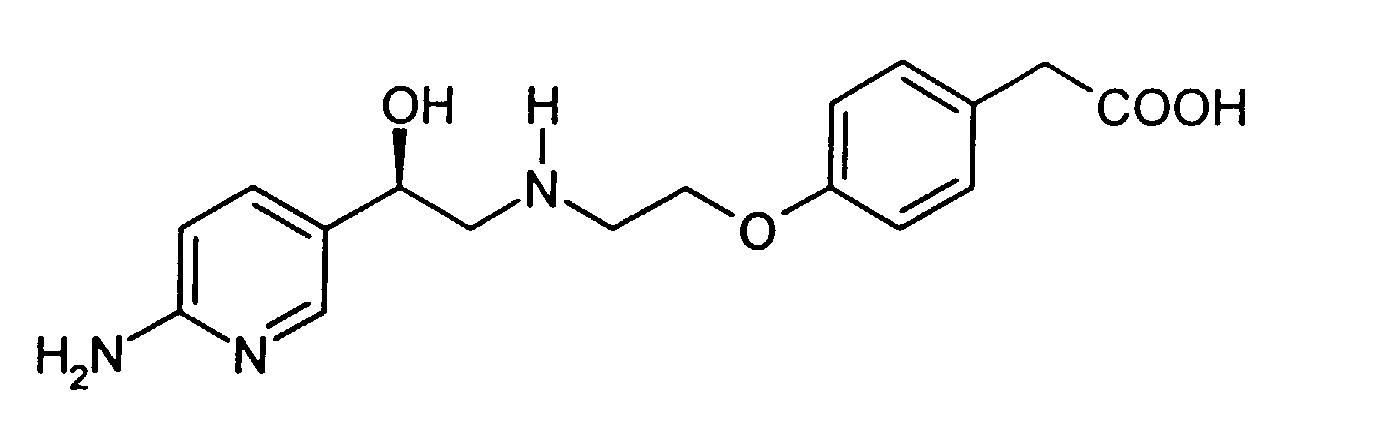
- This invention relates to producing a process for making (4-(2-(2-(6-aminopyridin-3-yl)-2(R)-hydroxyethylamino)ethoxy)phenylacetic acid.
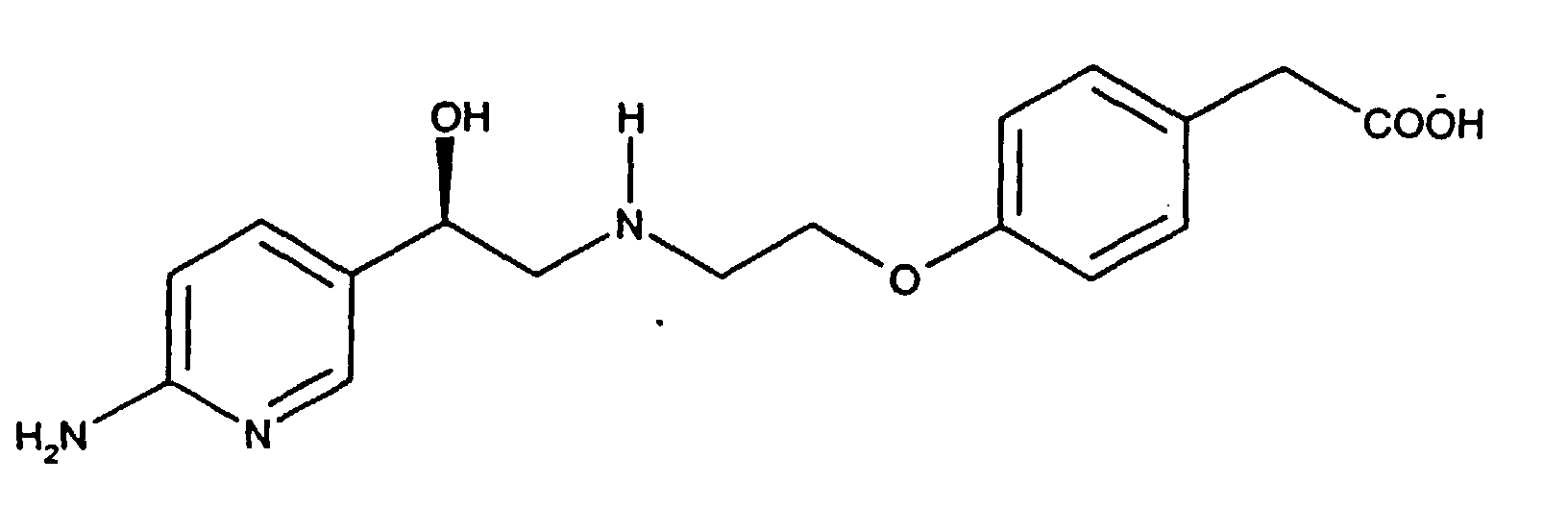
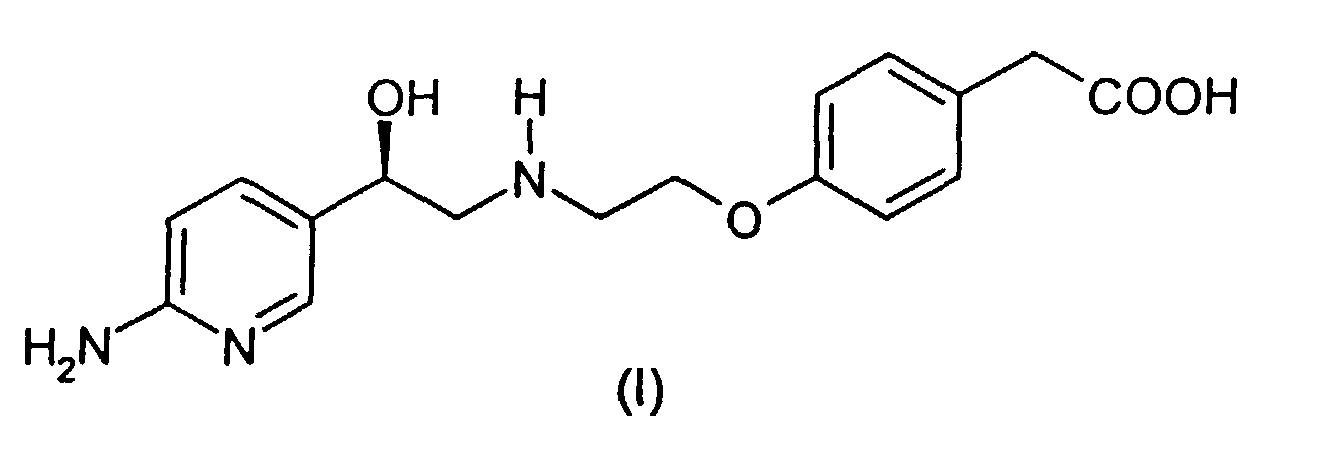
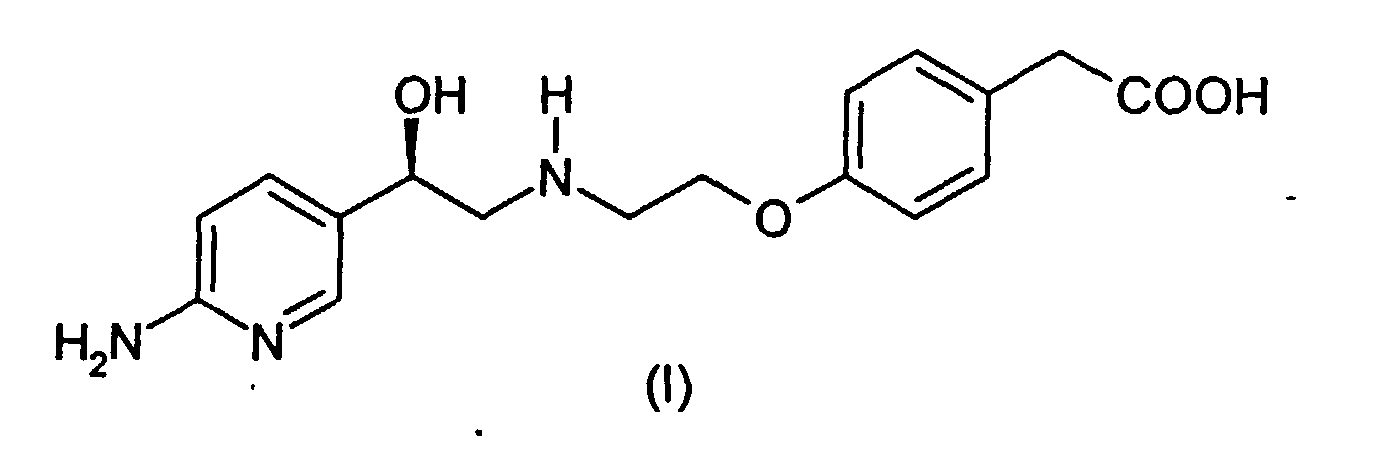
- Compound I (4-(2-(2-(6-aminopyridin-3-yl)-2(R)-hydroxyethylamino)ethoxy)phenylacetic acid (herein also referred to as "Compound I”) has the following structure: A specific synthesis for compound I is disdosed in Example 1 of International Patent Application PCT/IB95/00344, published internationally as WO 96/35671, which designated, inter alia , the United States, which was filed in the US as co-pending Application No. 08/945,551 on November 4, 1997 and which is herein incorporated by reference.
- the compound is a selective ⁇ -adrenergic receptor agonist which has utility for, inter alia , the treatment of hyperglycemia, obesity, intestinal motility disorders, depression, prostate disease, dyslipidemia, and airway inflammatory disorders such as asthma and obstructive lung disease.
- the compound is also useful for increasing lean meat deposition and/or improving the lean meat to fat ratio in edible animals such as ungulate animals and poultry.
- the majority of agonist activity resides in the R-enantiomer.
- This invention provides a process for preparing a compound of the formula: comprising deprotecting a compound of the formula wherein R 2 and R 3 are independently C 1 -C 3 alkyl or phenyl. Deprotecting in this instance thus means converting the pyrrolidino group to free amino. As indicated, R 2 and R 3 can be different. It is preferred that R 2 and R 3 are the same.
- the invention further provides a process for preparing a compound of formula III: wherein R 1 is C 1 -C 8 alkyl, comprising converting the pyrrolidino group in a compound of formula wherein R 2 and R 3 are as previously defined, to an amino (-NH 2 ) group.
- R 1 is C 1 -C 8 alkyl
- R 2 and R 3 are as previously defined, to an amino (-NH 2 ) group.
- compound III is useful as a penultimate intermediate which can be hydrolyzed by base in a reaction inert solvent to make compound (I).
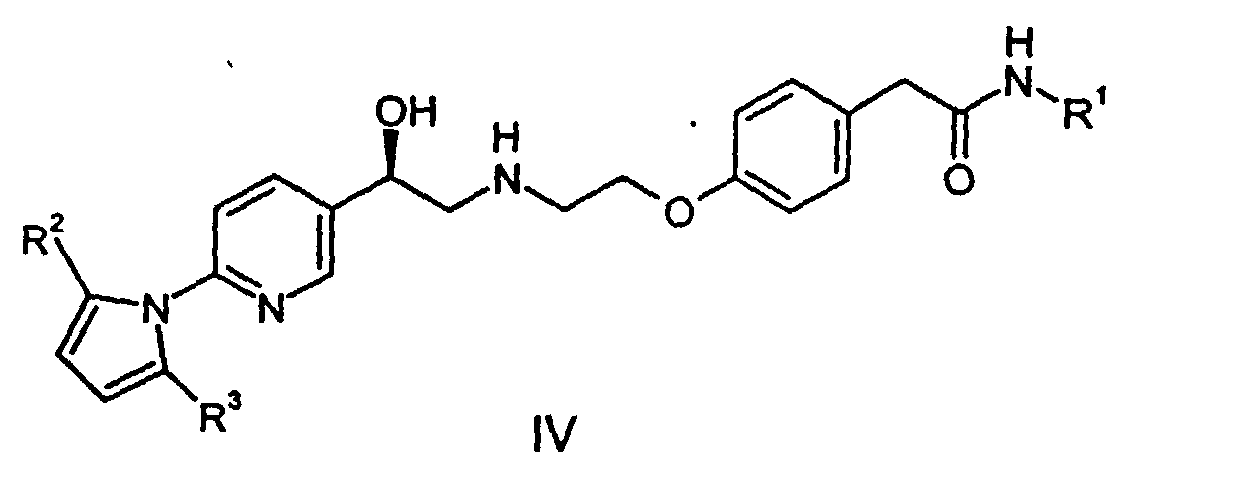
- this invention provides a process for preparing a compound of formula (I), comprising deprotecting a compound having the formula wherein R 1 , R 2 , and R 3 are is as previously defined.
- Deprotecting in this instance means converting the western end of the molecule from pyrrolidino to amino, and converting the eastern (amide) portion, (e.g., by hydrolysis) to the free acid.
- this invention provides certain intermediates useful in the processes described above.
- reaction is conducted in any conventional reaction inert solvent, which allows water removal by distillation, such as toluene or ethylbenzene, or by contacting with a conventional drying agent.
- Workup can be by isolation of the product under reduced pressure followed by cleanup with a water/isopropyl ether extraction system, with product being isolated, if desired, by evaporation to yield an oil that solidifies.
- Bromide (10) can be converted to 5-(2-haloacetyl)-2-(2,5-dimethylpyrrol-1-yl)pyridine (15), wherein X, the halo group, is chloro or bromo, by lithium-halogen exchange of the bromide using butyllithium followed by acylation.
- Bromide (10) can be treated with butyllithium at reduced temperature, for example -78 °C, followed by acylation with the corresponding 2-halo-N-methoxy-N-methylacetamide or ⁇ -halodimethylacetamide while maintaining reduced temperature, to yield ⁇ -haloketone (15).
- the reaction is conducted in a suitable solvent, such as diisopropyl ether, diethyl ether, or preferably, methyl tert-butyl ether (MTBE).
- a suitable solvent such as diisopropyl ether, diethyl ether, or preferably, methyl tert-butyl ether (MTBE).
- MTBE methyl tert-butyl ether
- the ⁇ -haloketone (15) product can be worked up conventionally, for example using aqueous (e.g, 1M) hydrochloric acid, followed by separation of the phases and isolation of (15) by evaporation.
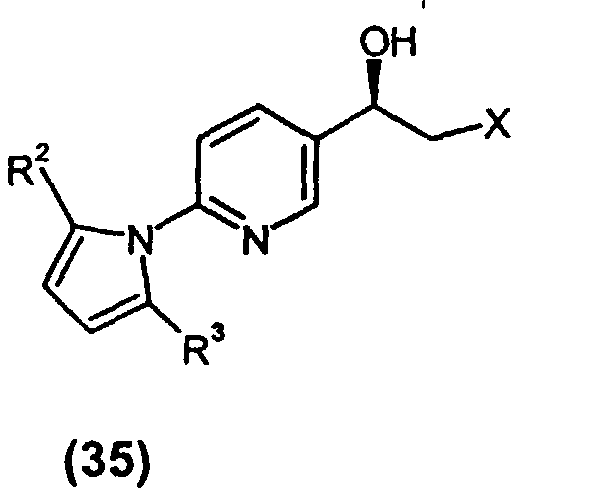
- ⁇ -haloketone can be used to introduce chirality into the molecule by asymmetrically reducing (15) to the corresponding chiral alcohol (35) [structure shown in left hand pathway] with a chiral pinene-derived boron reagent such as (-)- ⁇ -chlorodiisopinocampheylborane (DIP-Cl) or with alpine borane, with DIP-Cl being preferred.
- DIP-Cl chiral pinene-derived boron reagent
- the reaction can be run at reduced temperature in a solvent such as methyl tert-butyl ether or, preferably, THF.
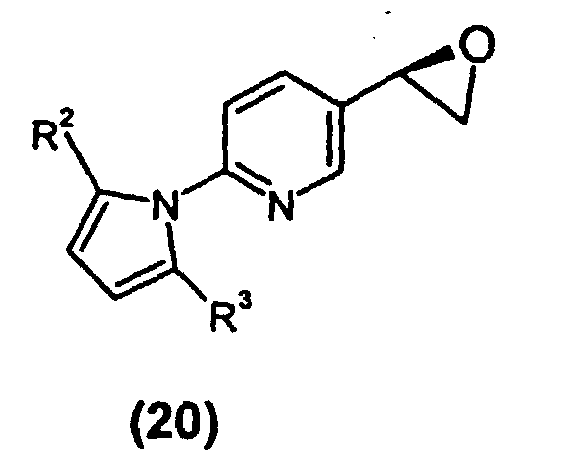
- Oxidative workup of the intermediate thiral alcohol to afford epoxide (20), without isolating alcohol (35), can be effected by any of several oxidizing agents in the presence of base, including any of hydrogen peroxide, triethylamine N-oxide, sodium percarbonate or sodium perborate in the presence of an alkali metal hydroxide such as sodium hydroxide. Sodium percarbonate and sodium perborate are preferred.
- Epoxide (20) can be reacted with compound (25) [structure shown in left hand pathway], an alkyl 4-(2-aminoethoxy)phenylacetamide wherein R 1 is C 1 -C 8 alkyl, to form the protected intermediate (IV).
- a crude solution of the epoxide, generated as described above, and the amide (25) can be combined in DMSO and heated to within the range of 60 to 100 °C, typically for a timespan of several hours.
- the product can be worked up by any convenient liquid-liquid extraction procedure (e.g. EtOAc/water) and can be further purified by acid/base extraction.
- the product can be isolated conventionally by concentration of solvent, for example by evaporation.
- a preferred alternative procedure for preparing protected intermediate (IV) involves making ⁇ -haloketone (15) as described above and conducting the chemistry alternatively illustrated (left hand pathway) in Scheme 1. Chirality is introduced via an asymmetric reduction of (15), thereby producing chiral alcohol (35), by treating ketone (15) with a catalytic amount of oxazaborolidine as shown, made in situ by combining (1S,2R)-2-amino-1,2-diphenylethanol with BH 3 ⁇ SMe 2 in a solvent such as THF or toluene. Alcohol (35) can then be epoxidized by adding base to the reaction medium to produce epoxide (20) (not shown), which can then be reacted directly with intermediate amide (25) to produce protected alcohol (IV). Epoxide (20), not shown in the left synthesis branch of Scheme 1, was not isolated. Generally a solvent such as DMSO or THF is employed and the reaction medium is heated to a temperature between 60 and 100 °C, typically 80-90 °C.
- asymmetric chiral reduction of ⁇ -chloroketone can be conducted using a number of additional chiral reductants, other than those specifically disclosed and illustrated, which are known and/or commercially available.
- amide (25) has been described in International Patent Publication Number WO 98/21184, herein incorporated by reference, and such compounds are disclosed therein as compounds of formula XVI. Such compounds may be prepared as set forth in the Examples below.
- the amide of formula (25) wherein R 4 is methyl is prepared as set forth in Preparation I below.
- Other such C 1 -C 8 alkyl amides (25) may be prepared by methods analogous thereto.
- the final product, compound (I), is made as shown in Scheme 2, by deprotection of compound (IV).
- the compound (IV) is treated with a base, preferably an alkali metal hydroxide, and with hydroxylamine hydrochloride to deprotect at both the eastern and western ends of the molecule.
- a base preferably an alkali metal hydroxide
- hydroxylamine hydrochloride to deprotect at both the eastern and western ends of the molecule.
- alcohol (IV) can proceed through compound II or compound III enroute to forming the desired final product.
- the particular sequence of deprotection is not considered critical.
- Alcohol (IV) can first be treated with base to hydrolyze the eastern (amide) portion of the molecule to produce penultimate intermediate (II).
- alcohol (IV) can first be deprotected at the western end of the molecule by converting the pyrrolidino group to free amino, thereby producing penultimate intermediate (III).
- the final product, compound (I) can be isolated in a conventional manner by neutralizing the basic solution and precipitating the zwitterion.
- HPLC reverse phase HPLC using a SymmetryTM C8 column (Waters Corporation, Milford, MA) with an isocratic solvent consisting of various proportions, depending on the analyte, of acetonitrile and pH 3.2 phosphoric acid/triethylamine buffer, using UV detection.
- SymmetryTM C8 column Waters Corporation, Milford, MA
- isocratic solvent consisting of various proportions, depending on the analyte, of acetonitrile and pH 3.2 phosphoric acid/triethylamine buffer, using UV detection.
- the following conventional abbreviations have been employed herein: h - hours; m.p.
- the aqueous layer was decanted from the gum that settled out, and 1M NaOH (2.1 L) was added.
- the aq. layer was extracted with EtOAc (2 x 1.4 L), the combined organic layers extracted with brine (500 mL) and dried over K 2 CO 3 .
- the solution was filtered and concentrated to an oil, which solidified to a tacky solid upon storage to provide 43.38 g (63% yield, calculated on the crude bromide (10) of Example 1 which was treated as in Examples 2 and 3 without purification) of title compound which was sufficiently pure to carry forward in the synthesis.
- a small portion was purified by SiO 2 chromatography (MeOH/EtOAc/NEt 3 ) to provide an analytically pure sample.
- hydroxlyamine hydrochloride (9.06 g, 0.130 mol) and heating continueded overnight. After a total heating time of 17.5 h, the solution was cooled to rt. The heterogenous solution was filtered, and the solids rinsed with EtOH (25 mL) to provide 9.97 g of crude title compound. To the crude material was added H 2 O (50 mL) and NaOH (1.72 g) causing most of the solids to dissolve. The solution was heated up to 75 °C for 20 min, and the solution filtered through a scintered glass frit while hot to remove a very small quantity of insoluble sediment.
- reaction was quenched by the slow addition of water (15 mL), causing slow hydrogen evolution.
- water 15 mL
- the reaction solution was added to diisopropylether (50 mL), EtOAc (50 mL), and 2N HCl (200 mL) and stirred well for 15 min.
- the phases were separated and the aqueous phase extracted with EtOAc (150 mL).
- the combined organic phases were further extracted with brine (125 mL) containing 12.5 M NaOH soln (1.5 mL).
- the solution was dried (MgSO 4 ), filtered and concentrated to provide 5.27 g (95%) of crude product.
- Methyl 4-2-(N-benzyloxycarbonylamino)ethoxy)phenylacetamide (18.4 kg, 53.73 mol) and 1.84 kg 10% palladium on carbon (50% H 2 O wet) were suspended in 276 L of methanol under nitrogen, and the reaction vessel pressurized to 50 psig with hydrogen gas. This H 2 pressure was maintained by additional charges of H 2 until there was no further uptake of H 2 (approx. 20 hours) and the reaction was complete by thin layer chromatography. After purging the vessel with N 2 , the mixture was heated to 45°C and filtered at this temperature through Celite®. The solvent was displaced with toluene until a final volume of 30 L was achieved. After cooling to 5°C.
Landscapes
- Chemical & Material Sciences (AREA)
- Organic Chemistry (AREA)
- Pyridine Compounds (AREA)
- Organic Low-Molecular-Weight Compounds And Preparation Thereof (AREA)
- Medicines That Contain Protein Lipid Enzymes And Other Medicines (AREA)
- Preparation Of Compounds By Using Micro-Organisms (AREA)
- Plural Heterocyclic Compounds (AREA)
Abstract
Description
- This invention relates to producing a process for making (4-(2-(2-(6-aminopyridin-3-yl)-2(R)-hydroxyethylamino)ethoxy)phenylacetic acid.
- (4-(2-(2-(6-aminopyridin-3-yl)-2(R)-hydroxyethylamino)ethoxy)phenylacetic acid (herein also referred to as "Compound I") has the following structure:A specific synthesis for compound I is disdosed in Example 1 of International Patent Application PCT/IB95/00344, published internationally as WO 96/35671, which designated, inter alia, the United States, which was filed in the US as co-pending Application No. 08/945,551 on November 4, 1997 and which is herein incorporated by reference.
- The compound is a selective β-adrenergic receptor agonist which has utility for, inter alia, the treatment of hyperglycemia, obesity, intestinal motility disorders, depression, prostate disease, dyslipidemia, and airway inflammatory disorders such as asthma and obstructive lung disease. The compound is also useful for increasing lean meat deposition and/or improving the lean meat to fat ratio in edible animals such as ungulate animals and poultry. The majority of agonist activity resides in the R-enantiomer.
- This invention provides a process for preparing a compound of the formula:comprising deprotecting a compound of the formula
 wherein R2 and R3 are independently C1-C3 alkyl or phenyl. Deprotecting in this instance thus means converting the pyrrolidino group to free amino. As indicated, R2 and R3 can be different. It is preferred that R2 and R3 are the same.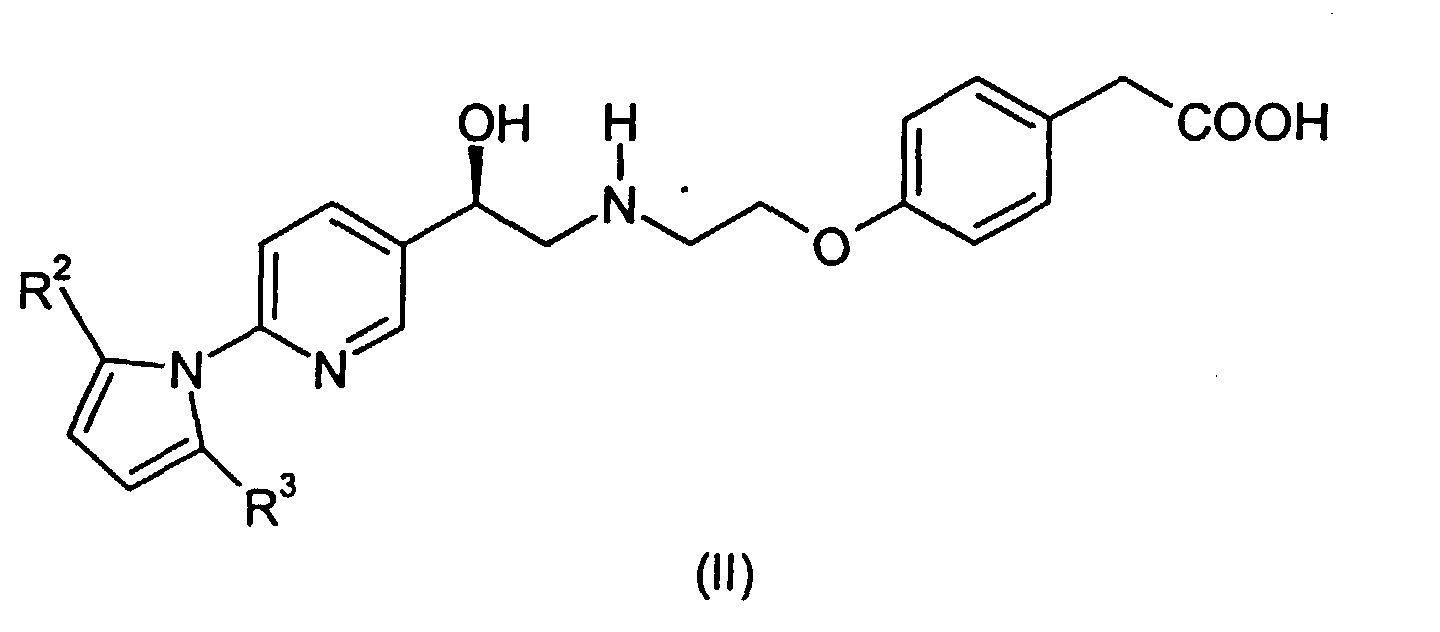
- The invention further provides a process for preparing a compound of formula III:wherein R1 is C1-C8 alkyl,

comprising converting the pyrrolidino group in a compound of formulawherein R2 and R3 are as previously defined, to an amino (-NH2) group. It is noted that compound III is useful as a penultimate intermediate which can be hydrolyzed by base in a reaction inert solvent to make compound (I).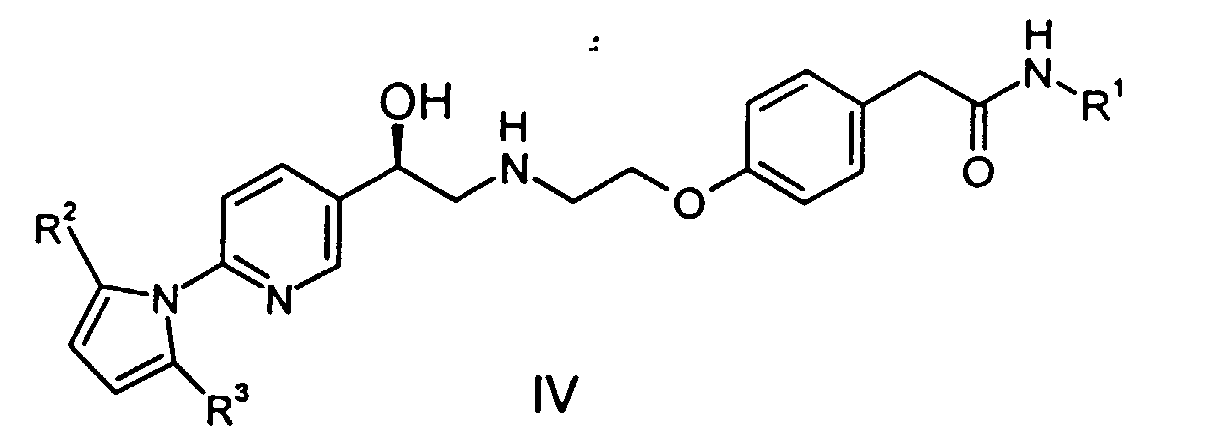
- In another aspect, this invention provides a process for preparing a compound of formula (I), comprising deprotecting a compound having the formulawherein R1, R2, and R3 are is as previously defined. Deprotecting in this instance means converting the western end of the molecule from pyrrolidino to amino, and converting the eastern (amide) portion, (e.g., by hydrolysis) to the free acid.

- In further aspects, as further disclosed and described below, this invention provides certain intermediates useful in the processes described above.
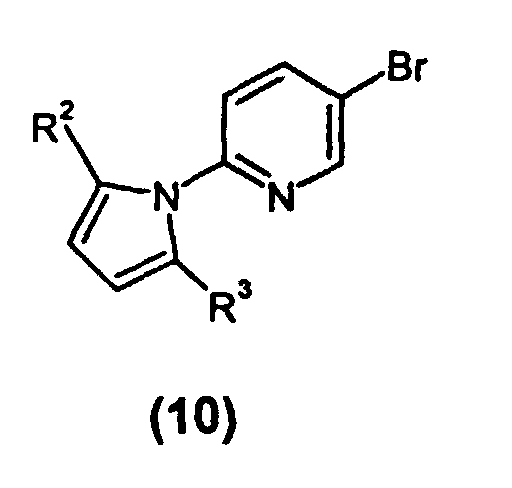
- The chemistry of the instant invention is disclosed as a flow chart in Scheme 1.As illustrated, 2-amino-5-bromopyridine (5), available commercially from a number of suppliers including Aldrich Chemical Company, Inc., Milwaukee, WI, is treated with a compound of the formula R2CO(CH2)2COR3, wherein R2 and R3 are as previously defined, under Dean-Stark conditions to make a 5-bromo-(2,5-dialkyl-pyrrol-1-yl)-pyridine (10), such as 5-bromo-(2,5-dimethylpyrrol-1-yl)-pyridine (10). The reaction is conducted in any conventional reaction inert solvent, which allows water removal by distillation, such as toluene or ethylbenzene, or by contacting with a conventional drying agent. Workup can be by isolation of the product under reduced pressure followed by cleanup with a water/isopropyl ether extraction system, with product being isolated, if desired, by evaporation to yield an oil that solidifies.

- Bromide (10) can be converted to 5-(2-haloacetyl)-2-(2,5-dimethylpyrrol-1-yl)pyridine (15), wherein X, the halo group, is chloro or bromo, by lithium-halogen exchange of the bromide using butyllithium followed by acylation. Bromide (10) can be treated with butyllithium at reduced temperature, for example -78 °C, followed by acylation with the corresponding 2-halo-N-methoxy-N-methylacetamide or α-halodimethylacetamide while maintaining reduced temperature, to yield α-haloketone (15). The reaction is conducted in a suitable solvent, such as diisopropyl ether, diethyl ether, or preferably, methyl tert-butyl ether (MTBE). The α-haloketone (15) product can be worked up conventionally, for example using aqueous (e.g, 1M) hydrochloric acid, followed by separation of the phases and isolation of (15) by evaporation.
- α-haloketone (15) can be used to introduce chirality into the molecule by asymmetrically reducing (15) to the corresponding chiral alcohol (35) [structure shown in left hand pathway] with a chiral pinene-derived boron reagent such as (-)-β-chlorodiisopinocampheylborane (DIP-Cl) or with alpine borane, with DIP-Cl being preferred. The reaction can be run at reduced temperature in a solvent such as methyl tert-butyl ether or, preferably, THF. Oxidative workup of the intermediate thiral alcohol to afford epoxide (20), without isolating alcohol (35), can be effected by any of several oxidizing agents in the presence of base, including any of hydrogen peroxide, triethylamine N-oxide, sodium percarbonate or sodium perborate in the presence of an alkali metal hydroxide such as sodium hydroxide. Sodium percarbonate and sodium perborate are preferred.
- Epoxide (20) can be reacted with compound (25) [structure shown in left hand pathway], an alkyl 4-(2-aminoethoxy)phenylacetamide wherein R1 is C1-C8 alkyl, to form the protected intermediate (IV). A crude solution of the epoxide, generated as described above, and the amide (25) can be combined in DMSO and heated to within the range of 60 to 100 °C, typically for a timespan of several hours. The product can be worked up by any convenient liquid-liquid extraction procedure (e.g. EtOAc/water) and can be further purified by acid/base extraction. The product can be isolated conventionally by concentration of solvent, for example by evaporation.
- A preferred alternative procedure for preparing protected intermediate (IV) involves making α-haloketone (15) as described above and conducting the chemistry alternatively illustrated (left hand pathway) in Scheme 1. Chirality is introduced via an asymmetric reduction of (15), thereby producing chiral alcohol (35), by treating ketone (15) with a catalytic amount of oxazaborolidine as shown, made in situ by combining (1S,2R)-2-amino-1,2-diphenylethanol with BH3·SMe2 in a solvent such as THF or toluene. Alcohol (35) can then be epoxidized by adding base to the reaction medium to produce epoxide (20) (not shown), which can then be reacted directly with intermediate amide (25) to produce protected alcohol (IV). Epoxide (20), not shown in the left synthesis branch of Scheme 1, was not isolated. Generally a solvent such as DMSO or THF is employed and the reaction medium is heated to a temperature between 60 and 100 °C, typically 80-90 °C.
- Those skilled in the art will appreciate that the asymmetric chiral reduction of α-chloroketone (15) can be conducted using a number of additional chiral reductants, other than those specifically disclosed and illustrated, which are known and/or commercially available.
- The preparation of amide (25) has been described in International Patent Publication Number WO 98/21184, herein incorporated by reference, and such compounds are disclosed therein as compounds of formula XVI. Such compounds may be prepared as set forth in the Examples below. For example, the amide of formula (25) wherein R4 is methyl is prepared as set forth in Preparation I below. Other such C1-C8 alkyl amides (25) may be prepared by methods analogous thereto.
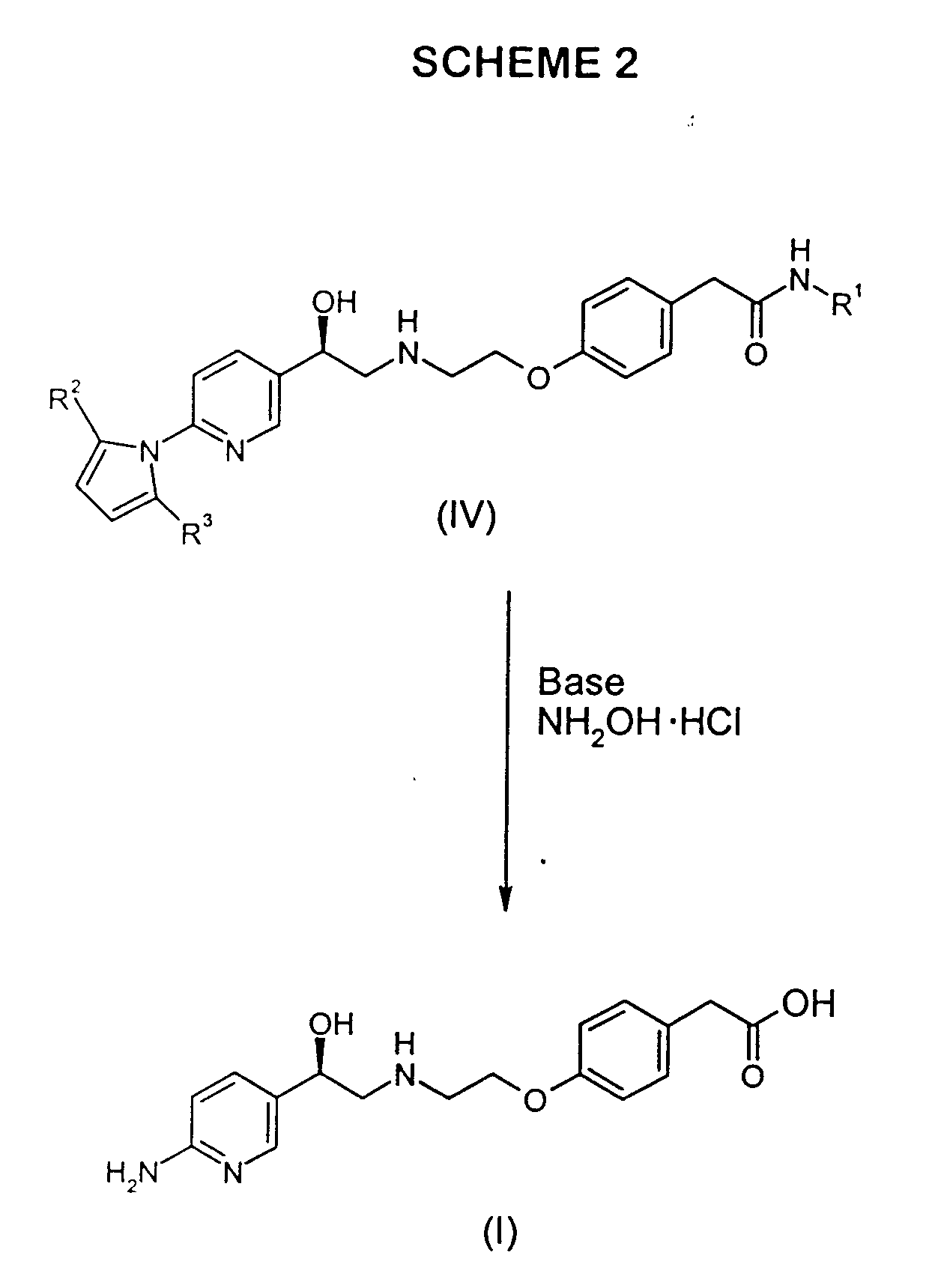
- The final product, compound (I), is made as shown in Scheme 2, by deprotection of compound (IV).The compound (IV) is treated with a base, preferably an alkali metal hydroxide, and with hydroxylamine hydrochloride to deprotect at both the eastern and western ends of the molecule. Thus alcohol (IV) can proceed through compound II or compound III enroute to forming the desired final product. The particular sequence of deprotection is not considered critical. Alcohol (IV) can first be treated with base to hydrolyze the eastern (amide) portion of the molecule to produce penultimate intermediate (II). Alternatively, alcohol (IV) can first be deprotected at the western end of the molecule by converting the pyrrolidino group to free amino, thereby producing penultimate intermediate (III). The final product, compound (I), can be isolated in a conventional manner by neutralizing the basic solution and precipitating the zwitterion. Depending on the level of inorganic salts in the material, it may be necessary to rework the product. This can be effected by rebasicifying in aqueous NaOH, filtering, neutralizing to precipitate zwitterion, and repulping in water or a lower alcohol, preferably ethyl alcohol.
- Conventional methods and techniques of purification and separation known to those skilled in the art may be used to isolate the compounds of this invention. Such techniques include all types of chromatography, including but not limited to high performance liquid chromatography, column chromatography using common adsorbents such as silica gel, thin layer chromatography and the like; recrystallization; and differential (i.e., liquid-liquid) extraction techniques.
- In the reaction schemes discussed herein, compounds (II), (IV), (10), (15), (20), and (35) are believed to be novel, and each is presented as an additional novel feature of the invention.
- The invention is further disclosed and described by the following examples, which are for purposes of illustration only, not limitation. Reference to "HPLC" means reverse phase HPLC using a Symmetry™ C8 column (Waters Corporation, Milford, MA) with an isocratic solvent consisting of various proportions, depending on the analyte, of acetonitrile and pH 3.2 phosphoric acid/triethylamine buffer, using UV detection. The following conventional abbreviations have been employed herein: h - hours; m.p. - melting point; MTBE - methyl tert-butyl ether, IPE - isopropyl ether; N-normal; M - molar; mol - moles; mL - milliliter; g - grams; THF - tetrahydrofuran; temp. - temperature; HPLC - high performance liquid chromatography; rt - room temperature; DMSO - dimethylsulfoxide; EtOAc - ethyl acetate; Me - methyl; Bu - butyl; Ph-phenyl; MeOH - methanol; EtOH - ethanol; NEt3 - triethylamine;
-

- To a solution of 2-amino-5-bromopyridine (89.87 g, 0.5194 mol) in toluene (500 mL) was added 2,5-hexanedione (85.0 mL, 0.724 mol). The reaction flask was equipped with a Dean-Stark apparatus and the solution heated to reflux for 14 h. The cooled reaction solution was extracted with H2O (2 x 200 mL). The organic layer was added directly to a plug of SiO2 3''l x 2''w and eluted with toluene (250 mL). This treatment removes a significant amount of color from the crude product. The resulting eluent was concentrated to a light amber oil, which solidified upon cooling to provide 128.76 g (99%) of the title compound.
- 1H NMR (400 MHz, CDCl3): 2.13 (s, 6), 5.90 (s, 2), 7.12 (d, 1, J=8.3), 7.93 (dd, 1, J=2.5, 8.3), 8.65 (d, J=2.5).
- 13C NMR (100 MHz, CDCl3): 13.21, 107.41, 118.92, 123.01, 128.60, 140.51, 150.43, 150.71.
- Anal. Calcd for C11H11N2Br: C, 52.61; H, 4.42; N, 11.16. Found: C, 52.68; H, 4.28; N, 10.99.
-
-
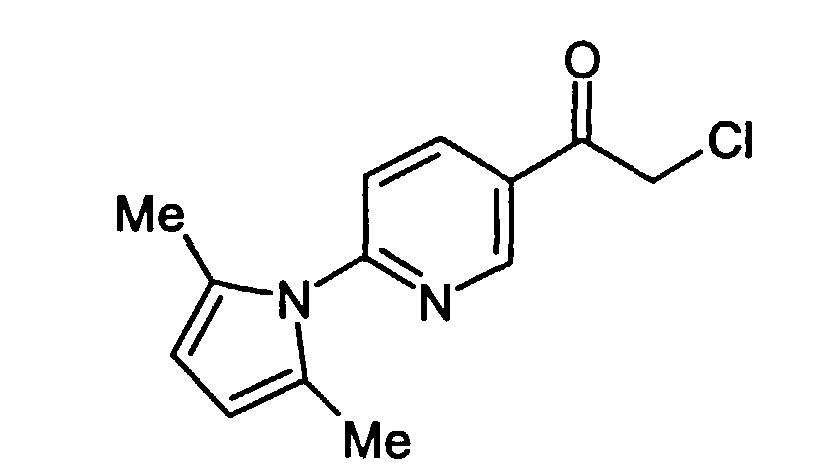
- A solution of the compound made as in Example 1 (100.00 g, 0.3982 mol) in MTBE (1.5 L) was cooled to -78 °C. To the solution was added BuLi (175 mL, 2.5 M in hexanes, 0.4375 mol) over 15 min, causing a rise in internal temperature from -78 °C to -70 °C. After 10 minutes, a solution of 2-chloro-N-methoxy-N-methylacetamide (63.10 g, 0.4587 mol) in MTBE (200 mL) was added over 10 min, causing a rise in internal temperature from -78 °C to -65 °C. After an additional 20 min, 1M HCl (1 L) was added, and the cooling bath removed. The mixture was stirred vigorously for 2h while warming to rt, and then the layers separated. The aq. layer was extracted with MTBE (400 mL), and the combined organic layers were extracted with 400 mL brine (containing 30 mL 12.5M NaOH-this wash serves to free base any protonated pyridine). The org. layer was dried with MgSO4, filtered and concentrated to provide crude title compound as a red oil. To the crude oil was added hexanes (500 mL) and the mixture stirred vigorously overnight. The mixture thus obtained was filtered, and the solids rinsed with hexanes (2 x 100 mL) to provide 81.32 g (82%) of the title compound as a tan, slightly sticky powder. This material should be stored cold, as prolonged storage at rt will cause darkening and impurity buildup.
- 1H NMR (300 MHz, CDCl3): 2.18 (s, 6), 4.69 (s, 2), 5.93 (s, 2), 7.33 (ap. d, 1, J=8.3), 8.36 (ddd, 1, J=1.3, 2.6, 8.5), 9.11-9.13 (m, 1).
- 13C NMR (100 MHz, CDCl3): 13.65, 45.48, 108.59, 121.16, 127.70, 128.88, 138.07, 149.78, 155.67, 189.41.
- Anal. Calcd for C13H13N2OCl: C, 62.78; H, 5.27; N, 11.26. Found: C, 62.75; H, 5.11; N, 11.27.
- Mass Spec: AP+=249.1, AP-=247.2
-
-

- To a N2 purged flask was added (-)-DIP-Cl [(-)-β-chlorodiisopinocampheylborane, 75.90 g, 0.2366 mol] which was rinsed into the flask with MTBE (50 mL). To the solution was added THF (112.5 mL), and the mixture cooled to approx. -30 °C. A solution of compound made as in Example 2 (45.0g, 0.181 mol) in THF (67.5 mL) was added dropwise over 10 min, causing the internal temp. to reach a maximum of -19 °C. The reaction was held between -30 °C and -23 °C for 6 h, upon which HPLC analysis showed complete conversion to (R)-5-(2-chloro-1-hydroxyethyl)-2-(2,5-dimethylpyrrol-1-yl)-5-(2-chloro-1-hydroxyethyl)pyridine (chiral HPLC of aliquot shows 93% ee). To the solution was added NaBO3·4H2O (27.8 g, 0.181 mol) followed by MTBE (175 mL). The mixture was stirred at rt overnight. To the reaction mixture was added 2N NaOH (675 mL) and the mixture stirred at rt for 6 h. HPLC analysis showed complete conversion of the chiral alcohol to the title epoxide. The layers were separated, and the aqueous layer extracted with MTBE (560 mL). The combined organic layers were extracted with 1N NaOH (225 mL) and brine (225 mL). The organic solution was dried (MgSO4), filtered, and concentrated to a thick oil to provide 82.9 g of crude epoxide which was contaminated with large amounts of pinene derived material The crude material was used in Example 4 without further purification.
- 1H NMR (400 MHz, CDCl3): 2.11 (s, 6), 2.90 (dd, 1, J=2.6, 5.3), 3.24 (dd, 1, J=4.0, 5.3), 3.96 (dd, 1, J=2.5, 4.0), 5.89 (s, 2), 7.20 (d, 1, J=8.1), 7.66 (dd, 1, J=2.5, 8.3), 8.56 (d, 1, J=2.5).
-
-

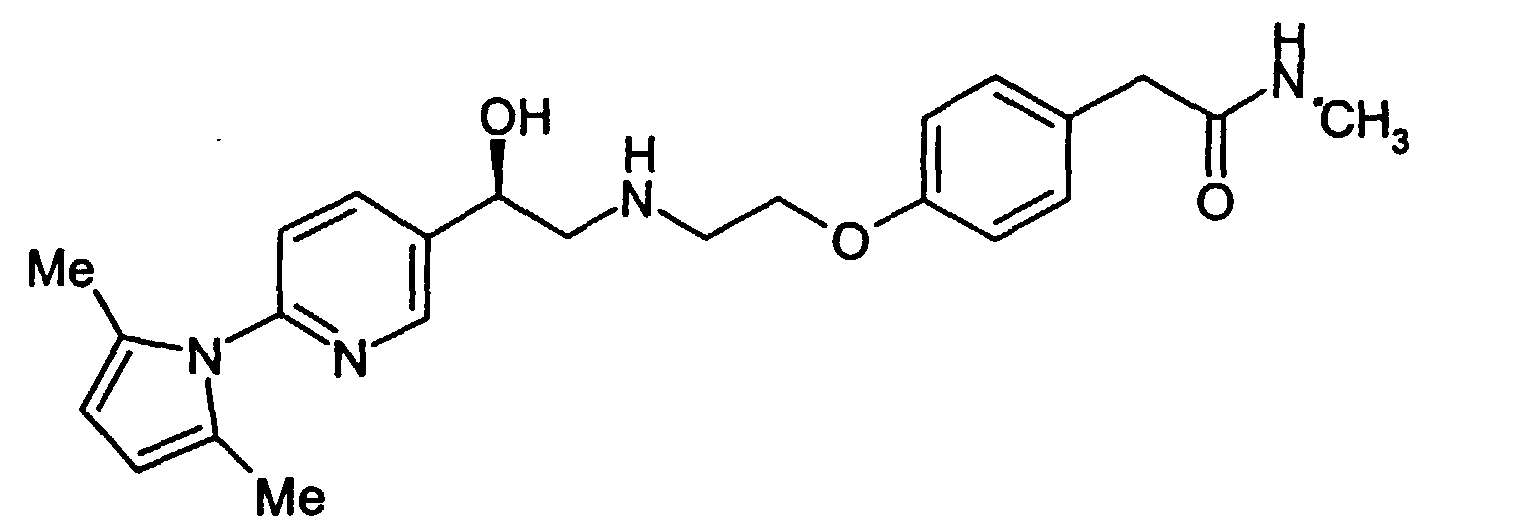
- To a crude solution of epoxide produced as in Example 3 (74.6 g mixture, synthesized from 0.163 mol of the ketone produced as in Example 2) in DMSO (140 mL) was added Methyl 4-(2-aminoethoxy)phenylacetamide (68.35 g, 0.3282 mol). The mixture was heated in an 85 °C bath for 8.5 h. Heating was discontinued, and the solution allowed to cool and stir at rt overnight. The mixture was added to 0.5 M HCl (2.8 L), which caused a gum to separate out. The solution was extracted with diethylether (3 x 1 L) and the ether washes discarded. The aqueous layer was decanted from the gum that settled out, and 1M NaOH (2.1 L) was added. The aq. layer was extracted with EtOAc (2 x 1.4 L), the combined organic layers extracted with brine (500 mL) and dried over K2CO3. The solution was filtered and concentrated to an oil, which solidified to a tacky solid upon storage to provide 43.38 g (63% yield, calculated on the crude bromide (10) of Example 1 which was treated as in Examples 2 and 3 without purification) of title compound which was sufficiently pure to carry forward in the synthesis. A small portion was purified by SiO2 chromatography (MeOH/EtOAc/NEt3) to provide an analytically pure sample.
- 1H NMR (300 MHz, CDCl3): 2.14 (s, 6), 2.77 (d, 3, J=4.8), 2.84 (dd, 1, J=9.5, 12.2), 3.07-3.21 (m, 3), 3.54 (s, 2), 4.13 (t, 2, J=5.0), 4.84 (dd, 1, J=3.3, 9.3), 5.47 (br s, 1), 5.92 (s, 2), 6.93 (d, 2, J=8.7), 7.20 (d, 2, J=8.7), 7.24 (d, 1, J=8.1), 7.91 (dd, 1, J=2.3, 8.1), 8.60 (d, 1, J=2.2).
- 13C NMR (100 MHz, CDCl3): 13.15, 26.46, 42.70, 48.34, 56.69, 67.36, 69.37, 106.87, 114.96, 121.67, 127.34, 128.59, 130.67, 135.76, 136.68, 147.22, 151.36, 157.96, 172.06.
- Anal. Calcd for C24H30N4O3: C, 68.22; H, 7.16; N, 13.26. Found: C, 67.82; H, 7.39; N, 13.03.
-
-
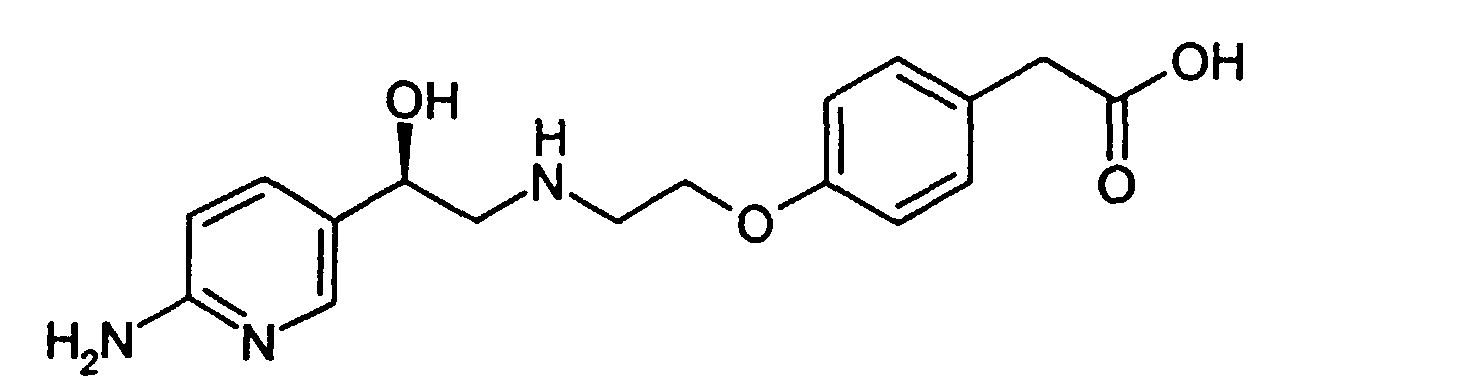
- In a 200 mL flask, 40 mL abs. EtOH was added to the compound produced as in Example 4 (11.01 g, 26.06 mmol). The solution was heated up to 70 °C until all the solids had dissolved (30 min). To the solution was added 1.6M NaOH (50 mL), and the bath temperature was raised to 100 °C. After 44 hours, HPLC analysis showed only 1.2% starting material remaining. The solution was concentrated to 1/2 volume by continued heating at 100 °C without condenser, followed by concentration of the remainder under reduced pressure (bath temp=50 °C) to a fluid brown oil. The crude residue was taken up in abs. EtOH (100 mL) and heated to 80 °C. To the hot solution was added hydroxlyamine hydrochloride (9.06 g, 0.130 mol) and heating continuted overnight. After a total heating time of 17.5 h, the solution was cooled to rt. The heterogenous solution was filtered, and the solids rinsed with EtOH (25 mL) to provide 9.97 g of crude title compound. To the crude material was added H2O (50 mL) and NaOH (1.72 g) causing most of the solids to dissolve. The solution was heated up to 75 °C for 20 min, and the solution filtered through a scintered glass frit while hot to remove a very small quantity of insoluble sediment. The solution was cooled to rt, and 6M HCl was added dropwise to reduce the pH to ∼7, after which stirring was continued for 30 min (note: solids began to come out of solution at pH=9.8). The solids were filtered and rinsed with water (2 x 10-15 mL). The purified title compound was air dried followed by drying under high vacuum to provide 4.58 g (53%) of product which was pure by HPLC and 1H NMR analysis.
- To a solution of (1S,2R)-2-amino-1,2-diphenylethanol (0.2429 g, 1.139 mmol) in THF (75 mL) was added BH3·SMe2 (∼10.0 M, 3.80 mL). This solution was allowed to stir at rt for 15 h, during which time hyrdogen is evolved. To the catalyst solution was added 5-(2-chloroacetyl)-2-(2,5-dimethylpyrrol-1-yl)-pyridine (5.5134 g, 22.168 mmol), in THF (10 mL) via syringe pump over 3 h. After an additional 3 h, the reaction was quenched by the slow addition of water (15 mL), causing slow hydrogen evolution. After 1 h from water addition, the reaction solution was added to diisopropylether (50 mL), EtOAc (50 mL), and 2N HCl (200 mL) and stirred well for 15 min. The phases were separated and the aqueous phase extracted with EtOAc (150 mL). The combined organic phases were further extracted with brine (125 mL) containing 12.5 M NaOH soln (1.5 mL). The solution was dried (MgSO4), filtered and concentrated to provide 5.27 g (95%) of crude product. Chiral HPLC (Chiracel OG column, Daicel Corporation, with UV detection) showed this material to be a 91.8:8.2 mixture of desired (R) to undesired (S) enantiomers. The crude was crystallized from EtOAc/hexanes providing two crops of material, totalling 3.7098 g (67%) of pure material that was a 97.5:2.5 mixture of enantiomers.
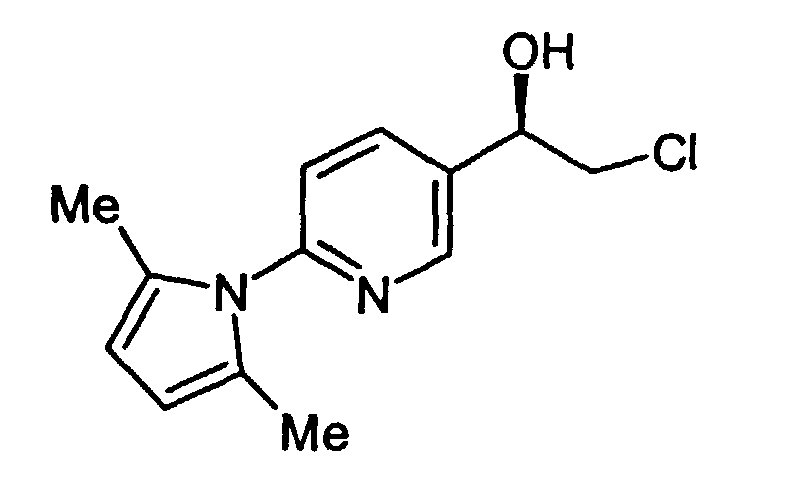
- 1H NMR (400 MHz, CDCl3): 2.12 (s, 6), 2.85 (d, 1, J=3.4), 3.7 (dd, 1, J=8.6, 11.3), 3.83 (dd, 1, J=3.6, 11.3), 5.02 (ddd, 1, J=3.4, 3.4, 8.3), 5.89 (s, 2), 7.23 (d, 1, J=9.2), 7.88 (dd, 1, J=2.6, 8.3), 8.60 (d, 1, J=2.4).
- 13C NMR (100 MHz, CDCl3): 13.11, 50.00, 71.06, 107.16, 121.92, 128.68, 135.18, 136.37, 147.34, 151.65.
- AP+=251.1 Example 7 - N-methyl (4-(2-(2-(6-(2,5-dimethylpyrrol-1-yl)pyridin-3-yl)-2(R)-hydroxyethylamino)ethoxy)phen-1-yl)acetate
-
- To a solution of compound produced as in Example 6 (9.99 g, 39.8 mmol) in DMSO (80 mL) was added methyl 4-(2-aminoethoxy)phenylacetamide (16.23 g, 77.93 mmol) followed by KOt-Bu (4.49 g, 40.0 mmol). The mixture was heated in an 80 °C bath for 20 h. After cooling, the mixture was added to water (300 mL) and EtOAc (300 mL). The phases were separated and the organic layer further extracted with water (2 x 200 mL). The organic phase was extracted with brine, dried (K2CO3), filtered and concentrated to provide 13.93 g (83%) of title compound as a hard yellow solid.
- 1H NMR (300 MHz, CDCl3): 2.14 (s, 6), 2.77 (d, 3, J=4.8), 2.84 (dd, 1, J=9.5, 12.2), 3.07-3.21 (m, 3), 3.54 (s, 2), 4.13 (t, 2, J=5.0), 4.84 (dd, 1, J=3.3, 9.3), 5.47 (br s, 1), 5.92 (s, 2), 6.93 (d, 2, J=8.7), 7.20 (d, 2, J=8.7), 7.24 (d, 1, J=8.1), 7.91 (dd, 1, J=2.3, 8.1), 8.60 (d, 1, J=2.2).
- 13C NMR (100 MHz, CDCl3): 13.15, 26.46, 42.70, 48.34, 56.69, 67.36, 69.37, 106.87, 114.96, 121.67, 127.34, 128.59, 130.67, 135.76, 136.68, 147.22, 151.36, 157.96, 172.06.
- Anal. Calcd for C24H30N4O3: C, 68.22; H, 7.16; N, 13.26. Found: C, 67.82; H, 7.39; N, 13.03.
-
-
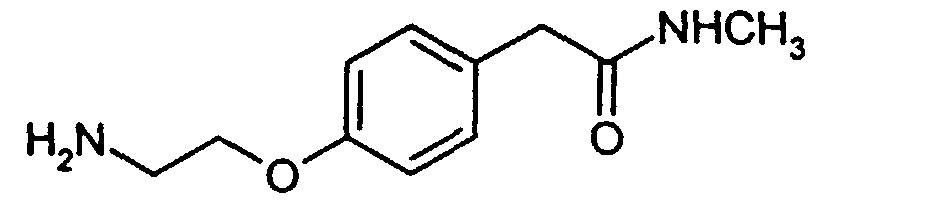
- Methyl 4-2-(N-benzyloxycarbonylamino)ethoxy)phenylacetamide (18.4 kg, 53.73 mol) and 1.84 kg 10% palladium on carbon (50% H2O wet) were suspended in 276 L of methanol under nitrogen, and the reaction vessel pressurized to 50 psig with hydrogen gas. This H2 pressure was maintained by additional charges of H2 until there was no further uptake of H2 (approx. 20 hours) and the reaction was complete by thin layer chromatography. After purging the vessel with N2, the mixture was heated to 45°C and filtered at this temperature through Celite®. The solvent was displaced with toluene until a final volume of 30 L was achieved. After cooling to 5°C. the resulting solids were filtered off, washed with cold toluene, and vacuum dried to give the title compound (9.95 kg, 88.9% of theory). NMR (300 MHz, d6-DMSO): δ = 7.99-7.57 (m, 1H), 7.20-7.10 (d, 2H), 6.90-6.80 (d, 2H), 3.93-3.83 (m, 2H), 3.30 (s, 2H), 3.00-2.62 (m, 4H), 2.57 (d, 2H).
Claims (11)
- A process for preparing a compound of the formula:comprising deprotecting a compound of the formula (II)
 wherein R2 and R3 are independently C1-C3 alkyl or phenyl.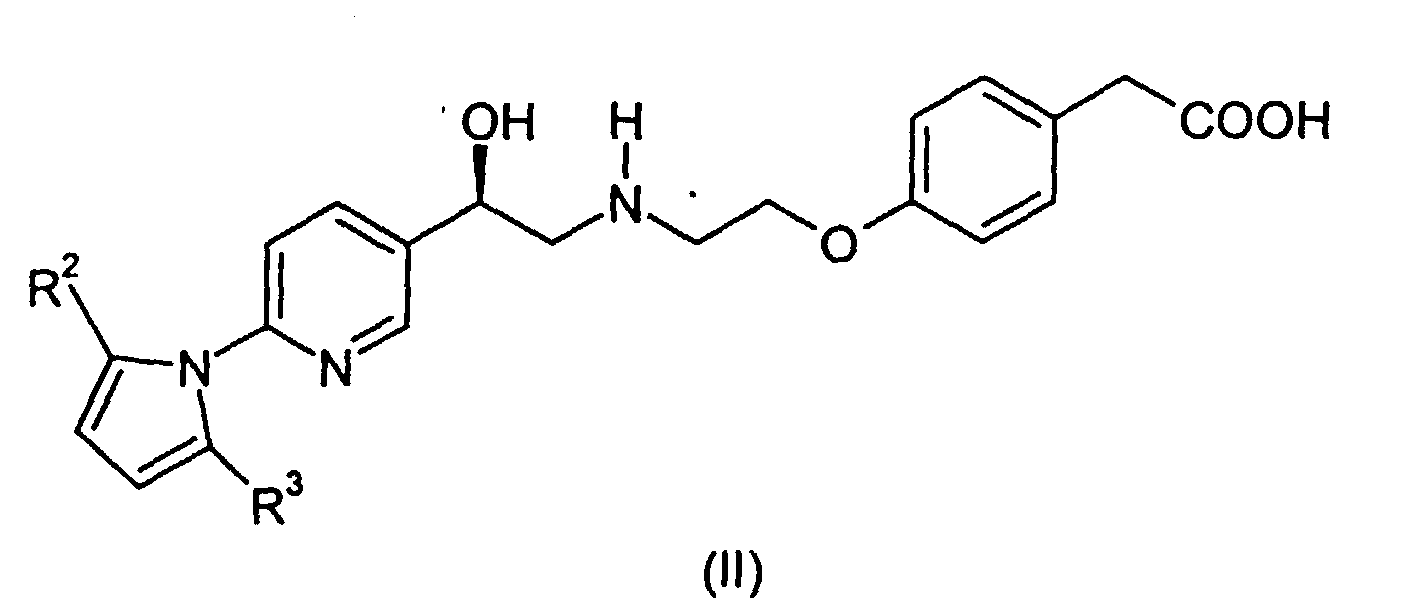
- A process for preparing a compound of formula III:wherein R1 is C1-C8 alkyl,

comprising converting the pyrrolidino group in a compound of formulawherein R2 and R3 are independently C1-C3 alkyl or phenyl, to an amino group.
- A process for preparing a compound of formula (I),comprising deprotecting a compound having the formula
 wherein R1 is C1-C8 alkyl, and R2 and R3 are independently C1-C3 alkyl or phenyl.
- A compound having the formulawherein R2 and R3 are independently C1-C3 alkyl or phenyl.

- A compound having the formulawherein R1 is C1-C8 alkyl, and R2 and R3 are independently C1-C3 alkyl or phenyl.
- A compound having the formulawherein R2 and R3 are independently C1-C3 alkyl or phenyl.
- A compound having the formulawherein R2 and R3 are independently C1-C3 alkyl or phenyl and X is Cl or Br.

- A compound as defined in claim 7, wherein X is Cl and R2 and R3 are methyl.
- A compound having the formulawherein R2 and R3 are independently C1-C3 alkyl or phenyl and X is Cl or Br.
- A compound as defined in claim 9, wherein X is Cl and R2 and R3 are methyl.
- A compound having the formulawherein R2 and R3 are independently C1-C3 alkyl or phenyl.
Applications Claiming Priority (2)
| Application Number | Priority Date | Filing Date | Title |
|---|---|---|---|
| US14541799P | 1999-07-23 | 1999-07-23 | |
| US145417P | 1999-07-23 |
Publications (2)
| Publication Number | Publication Date |
|---|---|
| EP1078924A1 true EP1078924A1 (en) | 2001-02-28 |
| EP1078924B1 EP1078924B1 (en) | 2004-10-20 |
Family
ID=22513018
Family Applications (1)
| Application Number | Title | Priority Date | Filing Date |
|---|---|---|---|
| EP00305987A Expired - Lifetime EP1078924B1 (en) | 1999-07-23 | 2000-07-14 | Intermediates and a process for producing beta-adrenergic receptor agonists |
Country Status (6)
| Country | Link |
|---|---|
| US (2) | US6297382B1 (en) |
| EP (1) | EP1078924B1 (en) |
| JP (1) | JP2001048864A (en) |
| AT (1) | ATE280167T1 (en) |
| DE (1) | DE60015036T2 (en) |
| ES (1) | ES2228413T3 (en) |
Cited By (4)
| Publication number | Priority date | Publication date | Assignee | Title |
|---|---|---|---|---|
| WO2003072547A1 (en) * | 2002-02-27 | 2003-09-04 | Pfizer Products Inc. | PROCESSES AND INTERMEDIATES USEFUL IN PREPARING β3-ADRENERGIC RECEPTOR AGONISTS |
| WO2004047838A3 (en) * | 2002-11-27 | 2004-10-28 | Boehringer Ingelheim Int | Pharmaceutical composition comprising beta-3-adrenoceptor agonists and antimuscarinic agents |
| WO2004108676A1 (en) * | 2003-06-04 | 2004-12-16 | Pfizer Limited | 2-(6-amino-pyridin-3-yl)-2-hydroxyethylamine derivatives as beta 2-adrenoceptors agonists |
| US7375100B2 (en) | 2003-06-04 | 2008-05-20 | Pfizer Inc | 2-amino-pyridine derivatives useful for the treatment of diseases |
Families Citing this family (7)
| Publication number | Priority date | Publication date | Assignee | Title |
|---|---|---|---|---|
| US6864268B2 (en) | 2002-02-27 | 2005-03-08 | Pfizer Inc. | β3 adrenergic receptor agonists |
| WO2003072573A1 (en) * | 2002-02-27 | 2003-09-04 | Pfizer Products Inc. | Crystal forms of (r)-2-(2-(4-oxazol-4-yl-phenoxy)-ethylamino)-1-pyridin-3-yl-ethanol |
| US7323462B2 (en) * | 2002-12-10 | 2008-01-29 | Pfizer Inc. | Morpholine dopamine agonists |
| US20050026884A1 (en) * | 2003-07-31 | 2005-02-03 | Robinson Cynthia B. | Combination of dehydroepiandrosterone or dehydroepiandrosterone-sulfate with a beta-agonist bronchodilator for treatment of asthma or chronic obstructive pulmonary disease |
| US20050113318A1 (en) * | 2003-07-31 | 2005-05-26 | Robinson Cynthia B. | Combination of dehydroepiandrosterone or dehydroepiandrosterone-sulfate with a beta-agonist bronchodilator for treatment of asthma or chronic obstructive pulmonary disease |
| US20090285900A1 (en) * | 2003-07-31 | 2009-11-19 | Robinson Cynthia B | Combination of dehydroepiandrosterone or dehydroepiandrosterone-sulfate with a beta-agonist bronchodilator for treatment of asthma or chronic obstructive pulmonary disease |
| EP1786762A2 (en) * | 2004-09-10 | 2007-05-23 | Theravance, Inc. | Amidine substituted aryl aniline compounds |
Citations (3)
| Publication number | Priority date | Publication date | Assignee | Title |
|---|---|---|---|---|
| WO1996035671A1 (en) * | 1995-05-10 | 1996-11-14 | Pfizer Inc. | β-ADRENERGIC AGONISTS |
| WO1999032475A1 (en) * | 1997-12-19 | 1999-07-01 | Bayer Corporation | Novel sulfonamide substituted chroman derivatives useful as beta-3 adrenoreceptor agonists |
| EP0994105A2 (en) * | 1998-10-15 | 2000-04-19 | Pfizer Products Inc. | 2-amino-pyridine intermediates for beta3-Adrenergic receptor agonists |
Family Cites Families (4)
| Publication number | Priority date | Publication date | Assignee | Title |
|---|---|---|---|---|
| US5019578A (en) | 1987-11-27 | 1991-05-28 | Merck & Co., Inc. | β-adrenergic agonists |
| US5030640A (en) | 1989-01-05 | 1991-07-09 | Merck & Co., Inc. | Novel β-adrenergic agonists and pharmaceutical compositions thereof |
| AR003509A1 (en) | 1995-09-15 | 1998-08-05 | Merck & Co Inc | SYNTHESIS OF ALPHA-CHLORINE OR FLUORINE KETONES. |
| WO1998021184A1 (en) * | 1996-11-14 | 1998-05-22 | Pfizer Inc. | Process for substituted pyridines |
-
2000
- 2000-07-14 DE DE60015036T patent/DE60015036T2/en not_active Expired - Fee Related
- 2000-07-14 EP EP00305987A patent/EP1078924B1/en not_active Expired - Lifetime
- 2000-07-14 AT AT00305987T patent/ATE280167T1/en not_active IP Right Cessation
- 2000-07-14 ES ES00305987T patent/ES2228413T3/en not_active Expired - Lifetime
- 2000-07-20 US US09/620,042 patent/US6297382B1/en not_active Expired - Fee Related
- 2000-07-24 JP JP2000222094A patent/JP2001048864A/en active Pending
-
2001
- 2001-07-24 US US09/912,016 patent/US6441181B1/en not_active Expired - Fee Related
Patent Citations (3)
| Publication number | Priority date | Publication date | Assignee | Title |
|---|---|---|---|---|
| WO1996035671A1 (en) * | 1995-05-10 | 1996-11-14 | Pfizer Inc. | β-ADRENERGIC AGONISTS |
| WO1999032475A1 (en) * | 1997-12-19 | 1999-07-01 | Bayer Corporation | Novel sulfonamide substituted chroman derivatives useful as beta-3 adrenoreceptor agonists |
| EP0994105A2 (en) * | 1998-10-15 | 2000-04-19 | Pfizer Products Inc. | 2-amino-pyridine intermediates for beta3-Adrenergic receptor agonists |
Non-Patent Citations (2)
| Title |
|---|
| BRUEKELMAN ET AL: "Protection of Primary amines as N-substituted 2,5-Dimethylpyrroles", J CHEM SOC PERKIN TRANS 1, 1984, pages 28012801 - 2807, XP000945145 * |
| LOWE J A ET AL: "A New Class of Selective and Potent Inhibitors of Neuronal Nitric Oxide Synthase", BIOORGANIC & MEDICINAL CHEMISTRY LETTERS,GB,OXFORD, vol. 9, no. 17, 6 September 1999 (1999-09-06), pages 2569 - 2572, XP004188865, ISSN: 0960-894X * |
Cited By (4)
| Publication number | Priority date | Publication date | Assignee | Title |
|---|---|---|---|---|
| WO2003072547A1 (en) * | 2002-02-27 | 2003-09-04 | Pfizer Products Inc. | PROCESSES AND INTERMEDIATES USEFUL IN PREPARING β3-ADRENERGIC RECEPTOR AGONISTS |
| WO2004047838A3 (en) * | 2002-11-27 | 2004-10-28 | Boehringer Ingelheim Int | Pharmaceutical composition comprising beta-3-adrenoceptor agonists and antimuscarinic agents |
| WO2004108676A1 (en) * | 2003-06-04 | 2004-12-16 | Pfizer Limited | 2-(6-amino-pyridin-3-yl)-2-hydroxyethylamine derivatives as beta 2-adrenoceptors agonists |
| US7375100B2 (en) | 2003-06-04 | 2008-05-20 | Pfizer Inc | 2-amino-pyridine derivatives useful for the treatment of diseases |
Also Published As
| Publication number | Publication date |
|---|---|
| JP2001048864A (en) | 2001-02-20 |
| DE60015036T2 (en) | 2006-03-02 |
| US20020045757A1 (en) | 2002-04-18 |
| US6297382B1 (en) | 2001-10-02 |
| EP1078924B1 (en) | 2004-10-20 |
| US6441181B1 (en) | 2002-08-27 |
| ATE280167T1 (en) | 2004-11-15 |
| ES2228413T3 (en) | 2005-04-16 |
| DE60015036D1 (en) | 2004-11-25 |
Similar Documents
| Publication | Publication Date | Title |
|---|---|---|
| JP5249219B2 (en) | Process for the preparation of 2-substituted-5- (1-alkylthio) alkylpyridines | |
| EP1078924B1 (en) | Intermediates and a process for producing beta-adrenergic receptor agonists | |
| JPH0262854A (en) | Production of substituted phenoxyethylamines | |
| CN1168718C (en) | The preparation method of 2-(6-substituted pyridin-2-yloxymethyl)phenyl acetate | |
| US5840961A (en) | Asymmetric synthesis of chiral beta-amiNo acids | |
| JPH0137391B2 (en) | ||
| JP2004051592A (en) | Method for producing 5-(2'-pyridyl)-2-pyridone derivative | |
| CN111943930B (en) | Synthesis process of Lasmidinan | |
| JP2006070034A (en) | Method for producing 2-aminopyridine derivative | |
| KR100578425B1 (en) | Cathecol Hydrazine Derivatives, Process for Producing the Same and Pharmaceutical Composition Containing the Same | |
| EP0069622B1 (en) | Process for the preparation of beta-cyclo-substituted ethyl amines, and products so obtained | |
| JPS6059231B2 (en) | Intermediates for the production of pirbuterol and congeners | |
| CA2367971A1 (en) | Synthesis of 3-amino-3-aryl propanoates | |
| FR2727410A1 (en) | SULFONYL CHLORIDES, THEIR PREPARATION AND THEIR USE AS SYNTHESIS INTERMEDIATES | |
| JPH09221472A (en) | Asymmetric synthesis method of α-cycloalkylalkyl-substituted methanamines | |
| JP2002173472A (en) | Method for producing optically active 1-(trifluoromethyl mono-substituted phenyl) ethylamine | |
| EP0100068A1 (en) | 3-Cycloalkylamino-2-OR-propoxycyanopyridines | |
| US5082939A (en) | Pyridazine derivatives | |
| US4873328A (en) | Process for preparing alkoxyalkylidenehydrazinopyridazine derivatives | |
| JP4193437B2 (en) | Optically active carboxylic acids | |
| JP4752110B2 (en) | Method for producing trifluoropropenyl compound | |
| JP2946678B2 (en) | Chiral ferrocene derivatives | |
| JP3144920B2 (en) | α-Acylaminoketone derivatives, production method thereof and use thereof | |
| JP2584959B2 (en) | Substituted phenoxyacetaldehyde oximes | |
| US20030158428A1 (en) | Intermediates and processes for preparing substituted chromanol derivatives |
Legal Events
| Date | Code | Title | Description |
|---|---|---|---|
| PUAI | Public reference made under article 153(3) epc to a published international application that has entered the european phase |
Free format text: ORIGINAL CODE: 0009012 |
|
| 17P | Request for examination filed |
Effective date: 20000727 |
|
| AK | Designated contracting states |
Kind code of ref document: A1 Designated state(s): AT BE CH CY DE DK ES FI FR GB GR IE IT LI LU MC NL PT SE |
|
| AX | Request for extension of the european patent |
Free format text: AL;LT;LV;MK;RO;SI |
|
| AKX | Designation fees paid |
Free format text: AT BE CH CY DE DK ES FI FR GB GR IE IT LI LU MC NL PT SE |
|
| 17Q | First examination report despatched |
Effective date: 20021128 |
|
| GRAP | Despatch of communication of intention to grant a patent |
Free format text: ORIGINAL CODE: EPIDOSNIGR1 |
|
| GRAS | Grant fee paid |
Free format text: ORIGINAL CODE: EPIDOSNIGR3 |
|
| GRAA | (expected) grant |
Free format text: ORIGINAL CODE: 0009210 |
|
| AK | Designated contracting states |
Kind code of ref document: B1 Designated state(s): AT BE CH CY DE DK ES FI FR GB GR IE IT LI LU MC NL PT SE |
|
| PG25 | Lapsed in a contracting state [announced via postgrant information from national office to epo] |
Ref country code: NL Free format text: LAPSE BECAUSE OF FAILURE TO SUBMIT A TRANSLATION OF THE DESCRIPTION OR TO PAY THE FEE WITHIN THE PRESCRIBED TIME-LIMIT Effective date: 20041020 Ref country code: BE Free format text: LAPSE BECAUSE OF FAILURE TO SUBMIT A TRANSLATION OF THE DESCRIPTION OR TO PAY THE FEE WITHIN THE PRESCRIBED TIME-LIMIT Effective date: 20041020 Ref country code: AT Free format text: LAPSE BECAUSE OF FAILURE TO SUBMIT A TRANSLATION OF THE DESCRIPTION OR TO PAY THE FEE WITHIN THE PRESCRIBED TIME-LIMIT Effective date: 20041020 Ref country code: FI Free format text: LAPSE BECAUSE OF FAILURE TO SUBMIT A TRANSLATION OF THE DESCRIPTION OR TO PAY THE FEE WITHIN THE PRESCRIBED TIME-LIMIT Effective date: 20041020 Ref country code: LI Free format text: LAPSE BECAUSE OF FAILURE TO SUBMIT A TRANSLATION OF THE DESCRIPTION OR TO PAY THE FEE WITHIN THE PRESCRIBED TIME-LIMIT Effective date: 20041020 Ref country code: CH Free format text: LAPSE BECAUSE OF FAILURE TO SUBMIT A TRANSLATION OF THE DESCRIPTION OR TO PAY THE FEE WITHIN THE PRESCRIBED TIME-LIMIT Effective date: 20041020 |
|
| REG | Reference to a national code |
Ref country code: GB Ref legal event code: FG4D |
|
| REG | Reference to a national code |
Ref country code: CH Ref legal event code: EP |
|
| REG | Reference to a national code |
Ref country code: IE Ref legal event code: FG4D |
|
| REG | Reference to a national code |
Ref country code: GR Ref legal event code: EP Ref document number: 20040403270 Country of ref document: GR |
|
| REF | Corresponds to: |
Ref document number: 60015036 Country of ref document: DE Date of ref document: 20041125 Kind code of ref document: P |
|
| PGFP | Annual fee paid to national office [announced via postgrant information from national office to epo] |
Ref country code: FR Payment date: 20041202 Year of fee payment: 6 |
|
| PGFP | Annual fee paid to national office [announced via postgrant information from national office to epo] |
Ref country code: DE Payment date: 20041213 Year of fee payment: 6 |
|
| PG25 | Lapsed in a contracting state [announced via postgrant information from national office to epo] |
Ref country code: SE Free format text: LAPSE BECAUSE OF FAILURE TO SUBMIT A TRANSLATION OF THE DESCRIPTION OR TO PAY THE FEE WITHIN THE PRESCRIBED TIME-LIMIT Effective date: 20050120 Ref country code: DK Free format text: LAPSE BECAUSE OF FAILURE TO SUBMIT A TRANSLATION OF THE DESCRIPTION OR TO PAY THE FEE WITHIN THE PRESCRIBED TIME-LIMIT Effective date: 20050120 |
|
| PGFP | Annual fee paid to national office [announced via postgrant information from national office to epo] |
Ref country code: IE Payment date: 20050314 Year of fee payment: 6 |
|
| REG | Reference to a national code |
Ref country code: ES Ref legal event code: FG2A Ref document number: 2228413 Country of ref document: ES Kind code of ref document: T3 |
|
| REG | Reference to a national code |
Ref country code: CH Ref legal event code: PL |
|
| NLV1 | Nl: lapsed or annulled due to failure to fulfill the requirements of art. 29p and 29m of the patents act | ||
| PGFP | Annual fee paid to national office [announced via postgrant information from national office to epo] |
Ref country code: ES Payment date: 20050602 Year of fee payment: 6 |
|
| PGFP | Annual fee paid to national office [announced via postgrant information from national office to epo] |
Ref country code: GB Payment date: 20050707 Year of fee payment: 6 |
|
| PG25 | Lapsed in a contracting state [announced via postgrant information from national office to epo] |
Ref country code: LU Free format text: LAPSE BECAUSE OF NON-PAYMENT OF DUE FEES Effective date: 20050714 Ref country code: CY Free format text: LAPSE BECAUSE OF FAILURE TO SUBMIT A TRANSLATION OF THE DESCRIPTION OR TO PAY THE FEE WITHIN THE PRESCRIBED TIME-LIMIT Effective date: 20050714 |
|
| PG25 | Lapsed in a contracting state [announced via postgrant information from national office to epo] |
Ref country code: MC Free format text: LAPSE BECAUSE OF NON-PAYMENT OF DUE FEES Effective date: 20050731 |
|
| ET | Fr: translation filed | ||
| PLBE | No opposition filed within time limit |
Free format text: ORIGINAL CODE: 0009261 |
|
| STAA | Information on the status of an ep patent application or granted ep patent |
Free format text: STATUS: NO OPPOSITION FILED WITHIN TIME LIMIT |
|
| 26N | No opposition filed |
Effective date: 20050721 |
|
| PG25 | Lapsed in a contracting state [announced via postgrant information from national office to epo] |
Ref country code: GR Free format text: LAPSE BECAUSE OF NON-PAYMENT OF DUE FEES Effective date: 20060202 |
|
| PG25 | Lapsed in a contracting state [announced via postgrant information from national office to epo] |
Ref country code: IE Free format text: LAPSE BECAUSE OF NON-PAYMENT OF DUE FEES Effective date: 20060714 Ref country code: GB Free format text: LAPSE BECAUSE OF NON-PAYMENT OF DUE FEES Effective date: 20060714 |
|
| PGFP | Annual fee paid to national office [announced via postgrant information from national office to epo] |
Ref country code: IT Payment date: 20060731 Year of fee payment: 7 |
|
| PG25 | Lapsed in a contracting state [announced via postgrant information from national office to epo] |
Ref country code: DE Free format text: LAPSE BECAUSE OF NON-PAYMENT OF DUE FEES Effective date: 20070201 |
|
| GBPC | Gb: european patent ceased through non-payment of renewal fee |
Effective date: 20060714 |
|
| REG | Reference to a national code |
Ref country code: IE Ref legal event code: MM4A |
|
| REG | Reference to a national code |
Ref country code: FR Ref legal event code: ST Effective date: 20070330 |
|
| REG | Reference to a national code |
Ref country code: ES Ref legal event code: FD2A Effective date: 20060715 |
|
| PG25 | Lapsed in a contracting state [announced via postgrant information from national office to epo] |
Ref country code: PT Free format text: LAPSE BECAUSE OF NON-PAYMENT OF DUE FEES Effective date: 20050320 |
|
| PG25 | Lapsed in a contracting state [announced via postgrant information from national office to epo] |
Ref country code: ES Free format text: LAPSE BECAUSE OF NON-PAYMENT OF DUE FEES Effective date: 20060715 |
|
| PG25 | Lapsed in a contracting state [announced via postgrant information from national office to epo] |
Ref country code: FR Free format text: LAPSE BECAUSE OF NON-PAYMENT OF DUE FEES Effective date: 20060731 |
|
| PG25 | Lapsed in a contracting state [announced via postgrant information from national office to epo] |
Ref country code: IT Free format text: LAPSE BECAUSE OF NON-PAYMENT OF DUE FEES Effective date: 20070714 |